Executive Webinar: Confronting Security Fears to Control Cyber Risk, Part Two

Post Syndicated from Rapid7 original https://blog.rapid7.com/2023/03/14/executive-webinar-confronting-security-fears-to-control-cyber-risk-part-two/

Executive Webinar: Confronting Security Fears to Control Cyber Risk, Part Two

Part two of Confronting Security Fears to Control Cyber Risk was presented live on March 9th for EMEA and will be delivered on March 16th for APAC. The 40-minute session focuses on the importance of developing cybersecurity elasticity.

In the session, Jason Hart, Rapid7’s Chief Technology Officer, EMEA, will discuss how organisations can develop the ability to adapt while being able to quickly revert to their original structure after times of great stress and impact. To do so, organisations must first address some common cybersecurity challenges:

  • Alignment of ownership and accountability: Cybersecurity should be decentralised across the business–not just an IT security function
  • Scope on where to focus: Not all risks are equal and risk can compound based on business needs and transformation
  • Translation: The requirement to translate cybersecurity needs and requirements across the whole of a organisation

To accomplish these goals, Hart recommends focusing on:

  • Culture: Enable a culture that makes cybersecurity part of the business process and creates a culture of ownership and accountability
  • Measurement: Translating cybersecurity data to allow all organisational stakeholders and personas to understand the context and need
  • Direction: The creation of a Northstar “AKA” Cybersecurity Strategy that is clearly communicated and that has clearly defined objectives and outcomes

For many organizations, that strategy comes in the form of a Protection Level Agreement (PLA).

Cybersecurity Elasticity

A PLA is an agreement between two or more parties, where one is the business (stakeholders), and the others are protection provider(s) (Product Management, IT, 3rd Party Development). Both parties should be equally involved in creating and implementing the PLA, ensuring that expectations are realistic, needs are met, and all parties are bought in to the agreement.

In this session, Hart will detail how executives can create a PLA between the security department and senior leadership team, ensuring everyone works to a common timeline and goals. A well-designed PLA ensures teams are focused and efficient in responding to cybersecurity events. So, clearly defining who owns and is accountable for PLA responsibilities is essential.

Measuring success and identifying weaknesses in a PLA is also key. Cybersecurity tools that automate reporting on a wide variety of KPIs can help security teams communicate effectiveness to leadership.

To learn more, register here:

Confronting Security Fears to Control Cyber Risk: Part Two

REGISTER NOW

Cybersecurity Simplicity

Earlier this month, Rapid7 presented part one of a webinar called “Confronting Security Fears to Control Cyber Risk”. The webinar, available on demand, focused on cybersecurity simplicity and why everyone associated with your organization must develop a cybersecurity mindset. To do so, CISOs must decentralize cybersecurity and instil accountability and ownership across a business. If you haven’t already seen it, you can watch it below:

Related assets:

Confronting Security Fears to Control Cyber Risks Presentation
– Part 1 slides
– Part 2 slides

Target Operating Model KPIs

Implementing Protection Level Agreements

EMEA Executive Round Table

Insight VM Free Trial

Confronting Security Fears to Control Cyber Risk: Part Two

REGISTER NOW

New – Use Amazon S3 Object Lambda with Amazon CloudFront to Tailor Content for End Users

Post Syndicated from Danilo Poccia original https://aws.amazon.com/blogs/aws/new-use-amazon-s3-object-lambda-with-amazon-cloudfront-to-tailor-content-for-end-users/

With S3 Object Lambda, you can use your own code to process data retrieved from Amazon S3 as it is returned to an application. Over time, we added new capabilities to S3 Object Lambda, like the ability to add your own code to S3 HEAD and LIST API requests, in addition to the support for S3 GET requests that was available at launch.

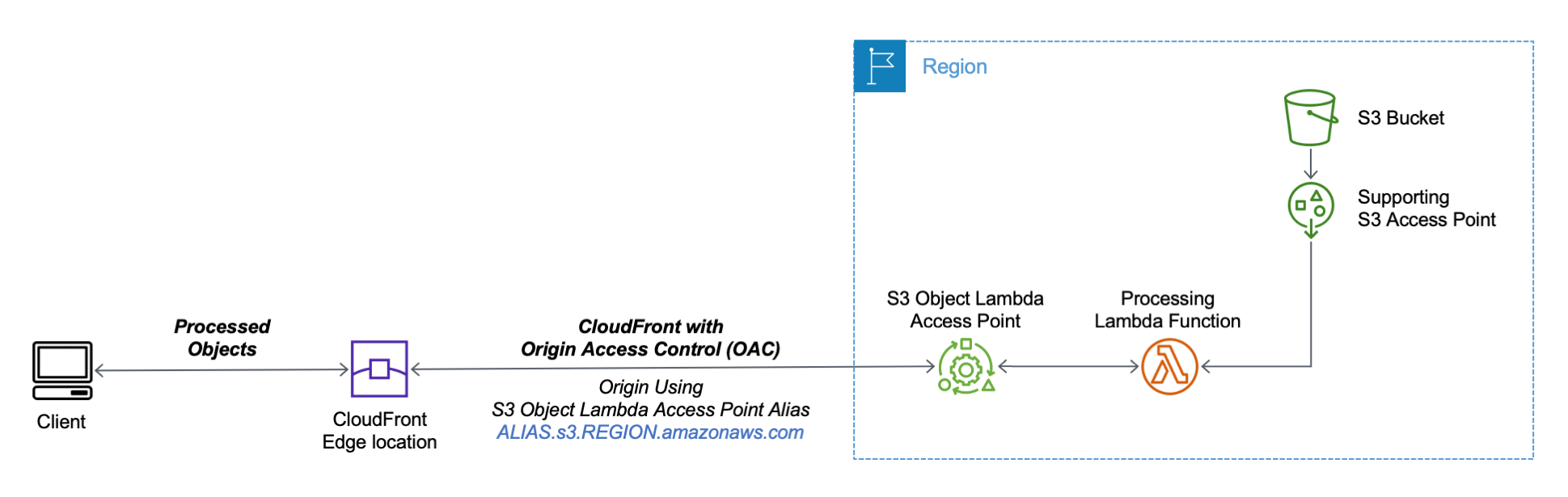
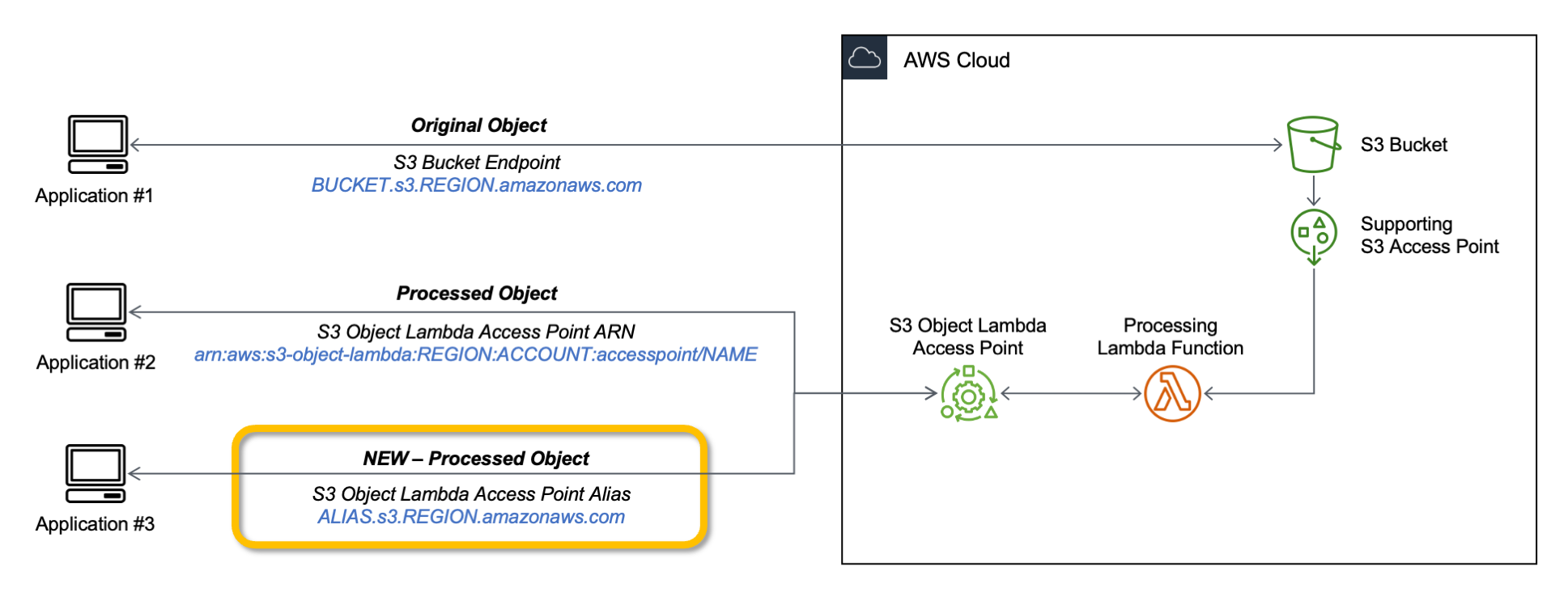
Today, we are launching aliases for S3 Object Lambda Access Points. Aliases are now automatically generated when S3 Object Lambda Access Points are created and are interchangeable with bucket names anywhere you use a bucket name to access data stored in Amazon S3. Therefore, your applications don’t need to know about S3 Object Lambda and can consider the alias to be a bucket name.

Architecture diagram.

You can now use an S3 Object Lambda Access Point alias as an origin for your Amazon CloudFront distribution to tailor or customize data for end users. You can use this to implement automatic image resizing or to tag or annotate content as it is downloaded. Many images still use older formats like JPEG or PNG, and you can use a transcoding function to deliver images in more efficient formats like WebP, BPG, or HEIC. Digital images contain metadata, and you can implement a function that strips metadata to help satisfy data privacy requirements.

Architecture diagram.

Let’s see how this works in practice. First, I’ll show a simple example using text that you can follow along by just using the AWS Management Console. After that, I’ll implement a more advanced use case processing images.

Using an S3 Object Lambda Access Point as the Origin of a CloudFront Distribution
For simplicity, I am using the same application in the launch post that changes all text in the original file to uppercase. This time, I use the S3 Object Lambda Access Point alias to set up a public distribution with CloudFront.

I follow the same steps as in the launch post to create the S3 Object Lambda Access Point and the Lambda function. Because the Lambda runtimes for Python 3.8 and later do not include the requests module, I update the function code to use urlopen from the Python Standard Library:

import boto3
from urllib.request import urlopen

s3 = boto3.client('s3')

def lambda_handler(event, context):
  print(event)

  object_get_context = event['getObjectContext']
  request_route = object_get_context['outputRoute']
  request_token = object_get_context['outputToken']
  s3_url = object_get_context['inputS3Url']

  # Get object from S3
  response = urlopen(s3_url)
  original_object = response.read().decode('utf-8')

  # Transform object
  transformed_object = original_object.upper()

  # Write object back to S3 Object Lambda
  s3.write_get_object_response(
    Body=transformed_object,
    RequestRoute=request_route,
    RequestToken=request_token)

  return

To test that this is working, I open the same file from the bucket and through the S3 Object Lambda Access Point. In the S3 console, I select the bucket and a sample file (called s3.txt) that I uploaded earlier and choose Open.

Console screenshot.

A new browser tab is opened (you might need to disable the pop-up blocker in your browser), and its content is the original file with mixed-case text:

Amazon Simple Storage Service (Amazon S3) is an object storage service that offers...

I choose Object Lambda Access Points from the navigation pane and select the AWS Region I used before from the dropdown. Then, I search for the S3 Object Lambda Access Point that I just created. I select the same file as before and choose Open.

Console screenshot.

In the new tab, the text has been processed by the Lambda function and is now all in uppercase:

AMAZON SIMPLE STORAGE SERVICE (AMAZON S3) IS AN OBJECT STORAGE SERVICE THAT OFFERS...

Now that the S3 Object Lambda Access Point is correctly configured, I can create the CloudFront distribution. Before I do that, in the list of S3 Object Lambda Access Points in the S3 console, I copy the Object Lambda Access Point alias that has been automatically created:

Console screenshot.

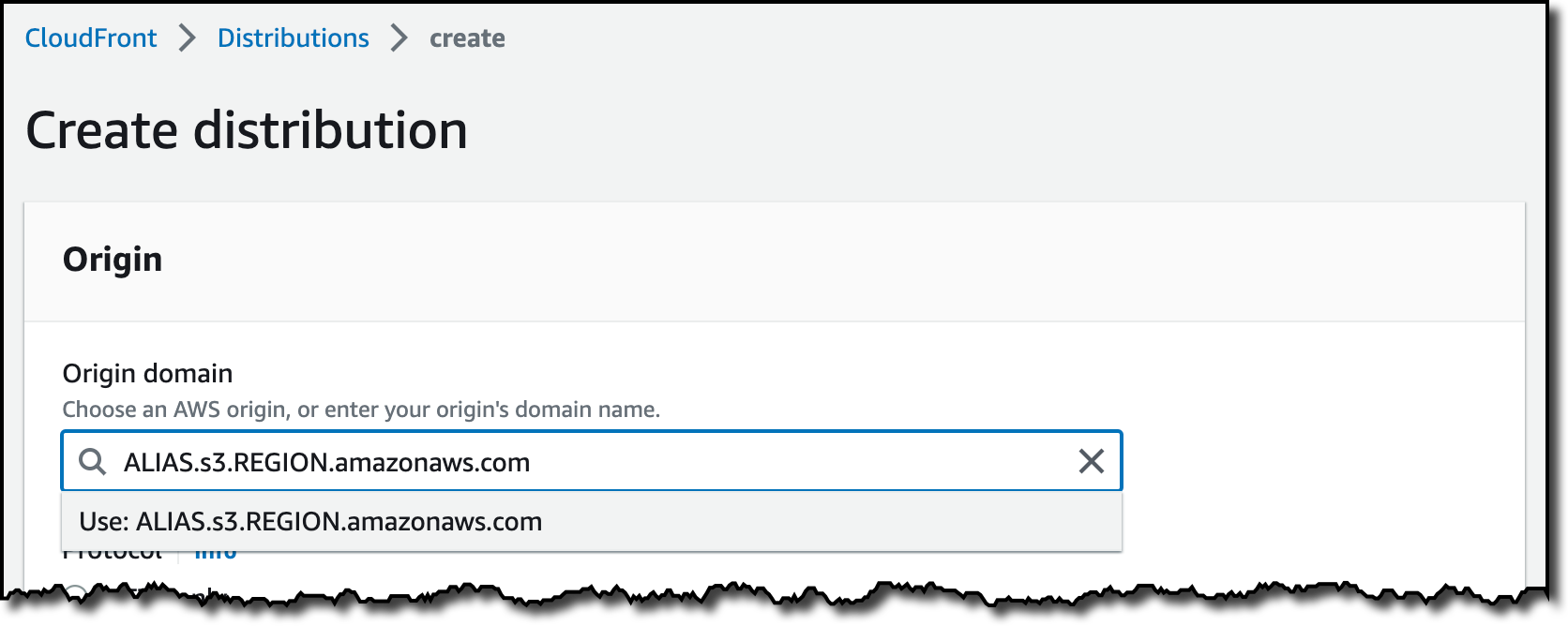
In the CloudFront console, I choose Distributions in the navigation pane and then Create distribution. In the Origin domain, I use the S3 Object Lambda Access Point alias and the Region. The full syntax of the domain is:

ALIAS.s3.REGION.amazonaws.com

Console screenshot.

S3 Object Lambda Access Points cannot be public, and I use CloudFront origin access control (OAC) to authenticate requests to the origin. For Origin access, I select Origin access control settings and choose Create control setting. I write a name for the control setting and select Sign requests and S3 in the Origin type dropdown.

Console screenshot.

Now, my Origin access control settings use the configuration I just created.

Console screenshot.

To reduce the number of requests going through S3 Object Lambda, I enable Origin Shield and choose the closest Origin Shield Region to the Region I am using. Then, I select the CachingOptimized cache policy and create the distribution. As the distribution is being deployed, I update permissions for the resources used by the distribution.

Setting Up Permissions to Use an S3 Object Lambda Access Point as the Origin of a CloudFront Distribution
First, the S3 Object Lambda Access Point needs to give access to the CloudFront distribution. In the S3 console, I select the S3 Object Lambda Access Point and, in the Permissions tab, I update the policy with the following:

{
    "Version": "2012-10-17",
    "Statement": [
        {
            "Effect": "Allow",
            "Principal": {
                "Service": "cloudfront.amazonaws.com"
            },
            "Action": "s3-object-lambda:Get*",
            "Resource": "arn:aws:s3-object-lambda:REGION:ACCOUNT:accesspoint/NAME",
            "Condition": {
                "StringEquals": {
                    "aws:SourceArn": "arn:aws:cloudfront::ACCOUNT:distribution/DISTRIBUTION-ID"
                }
            }
        }
    ]
}

The supporting access point also needs to allow access to CloudFront when called via S3 Object Lambda. I select the access point and update the policy in the Permissions tab:

{
    "Version": "2012-10-17",
    "Id": "default",
    "Statement": [
        {
            "Sid": "s3objlambda",
            "Effect": "Allow",
            "Principal": {
                "Service": "cloudfront.amazonaws.com"
            },
            "Action": "s3:*",
            "Resource": [
                "arn:aws:s3:REGION:ACCOUNT:accesspoint/NAME",
                "arn:aws:s3:REGION:ACCOUNT:accesspoint/NAME/object/*"
            ],
            "Condition": {
                "ForAnyValue:StringEquals": {
                    "aws:CalledVia": "s3-object-lambda.amazonaws.com"
                }
            }
        }
    ]
}

The S3 bucket needs to allow access to the supporting access point. I select the bucket and update the policy in the Permissions tab:

{
    "Version": "2012-10-17",
    "Statement": [
        {
            "Effect": "Allow",
            "Principal": {
                "AWS": "*"
            },
            "Action": "*",
            "Resource": [
                "arn:aws:s3:::BUCKET",
                "arn:aws:s3:::BUCKET/*"
            ],
            "Condition": {
                "StringEquals": {
                    "s3:DataAccessPointAccount": "ACCOUNT"
                }
            }
        }
    ]
}

Finally, CloudFront needs to be able to invoke the Lambda function. In the Lambda console, I choose the Lambda function used by S3 Object Lambda, and then, in the Configuration tab, I choose Permissions. In the Resource-based policy statements section, I choose Add permissions and select AWS Account. I enter a unique Statement ID. Then, I enter cloudfront.amazonaws.com as Principal and select lambda:InvokeFunction from the Action dropdown and Save. We are working to simplify this step in the future. I’ll update this post when that’s available.

Testing the CloudFront Distribution
When the distribution has been deployed, I test that the setup is working with the same sample file I used before. In the CloudFront console, I select the distribution and copy the Distribution domain name. I can use the browser and enter https://DISTRIBUTION_DOMAIN_NAME/s3.txt in the navigation bar to send a request to CloudFront and get the file processed by S3 Object Lambda. To quickly get all the info, I use curl with the -i option to see the HTTP status and the headers in the response:

curl -i https://DISTRIBUTION_DOMAIN_NAME/s3.txt

HTTP/2 200 
content-type: text/plain
content-length: 427
x-amzn-requestid: a85fe537-3502-4592-b2a9-a09261c8c00c
date: Mon, 06 Mar 2023 10:23:02 GMT
x-cache: Miss from cloudfront
via: 1.1 a2df4ad642d78d6dac65038e06ad10d2.cloudfront.net (CloudFront)
x-amz-cf-pop: DUB56-P1
x-amz-cf-id: KIiljCzYJBUVVxmNkl3EP2PMh96OBVoTyFSMYDupMd4muLGNm2AmgA==

AMAZON SIMPLE STORAGE SERVICE (AMAZON S3) IS AN OBJECT STORAGE SERVICE THAT OFFERS...

It works! As expected, the content processed by the Lambda function is all uppercase. Because this is the first invocation for the distribution, it has not been returned from the cache (x-cache: Miss from cloudfront). The request went through S3 Object Lambda to process the file using the Lambda function I provided.

Let’s try the same request again:

curl -i https://DISTRIBUTION_DOMAIN_NAME/s3.txt

HTTP/2 200 
content-type: text/plain
content-length: 427
x-amzn-requestid: a85fe537-3502-4592-b2a9-a09261c8c00c
date: Mon, 06 Mar 2023 10:23:02 GMT
x-cache: Hit from cloudfront
via: 1.1 145b7e87a6273078e52d178985ceaa5e.cloudfront.net (CloudFront)
x-amz-cf-pop: DUB56-P1
x-amz-cf-id: HEx9Fodp184mnxLQZuW62U11Fr1bA-W1aIkWjeqpC9yHbd0Rg4eM3A==
age: 3

AMAZON SIMPLE STORAGE SERVICE (AMAZON S3) IS AN OBJECT STORAGE SERVICE THAT OFFERS...

This time the content is returned from the CloudFront cache (x-cache: Hit from cloudfront), and there was no further processing by S3 Object Lambda. By using S3 Object Lambda as the origin, the CloudFront distribution serves content that has been processed by a Lambda function and can be cached to reduce latency and optimize costs.

Resizing Images Using S3 Object Lambda and CloudFront
As I mentioned at the beginning of this post, one of the use cases that can be implemented using S3 Object Lambda and CloudFront is image transformation. Let’s create a CloudFront distribution that can dynamically resize an image by passing the desired width and height as query parameters (w and h respectively). For example:

https://DISTRIBUTION_DOMAIN_NAME/image.jpg?w=200&h=150

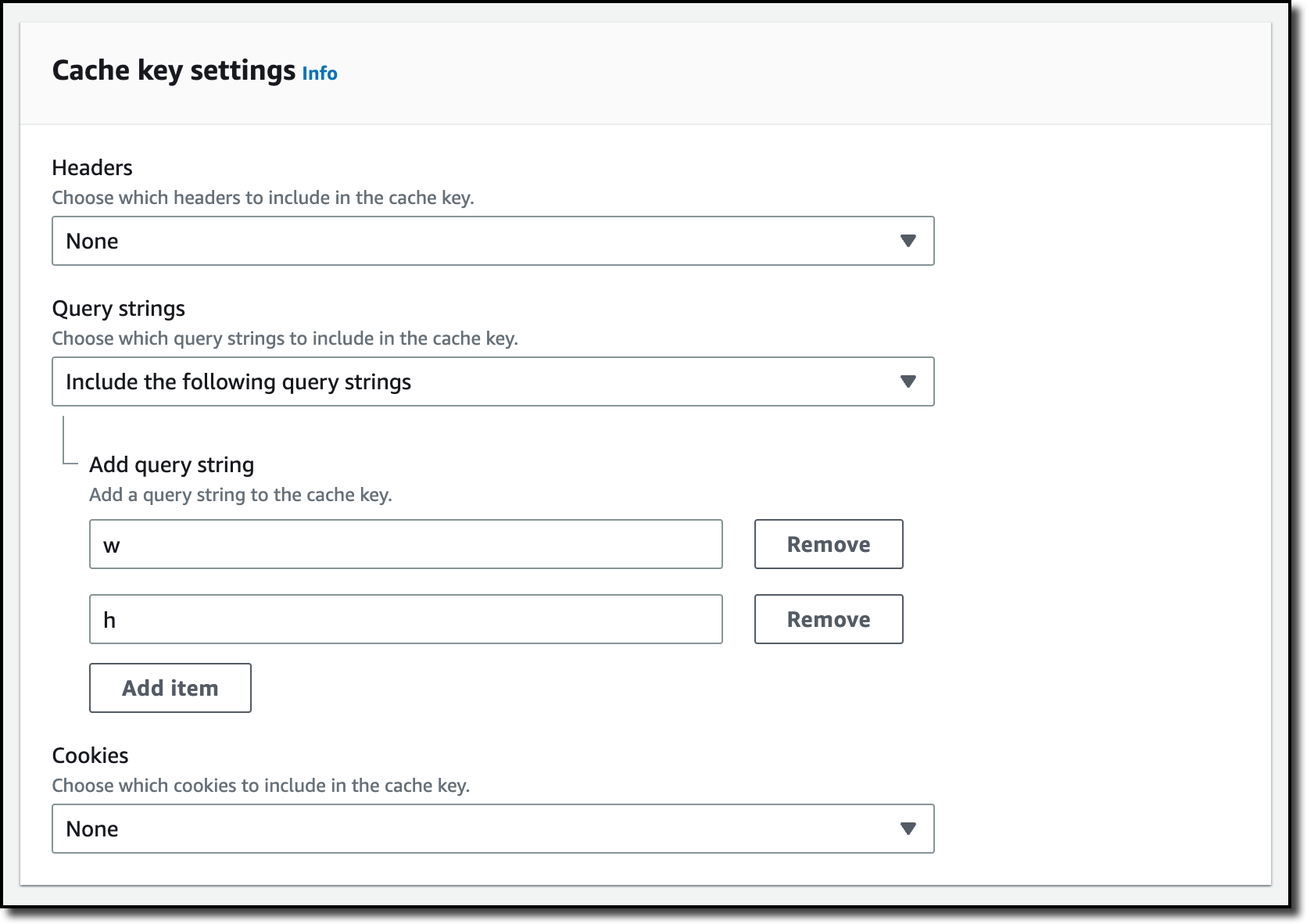
For this setup to work, I need to make two changes to the CloudFront distribution. First, I create a new cache policy to include query parameters in the cache key. In the CloudFront console, I choose Policies in the navigation pane. In the Cache tab, I choose Create cache policy. Then, I enter a name for the cache policy.

Console screenshot.

In the Query settings of the Cache key settings, I select the option to Include the following query parameters and add w (for the width) and h (for the height).

Console screenshot.

Then, in the Behaviors tab of the distribution, I select the default behavior and choose Edit.

There, I update the Cache key and origin requests section:

  • In the Cache policy, I use the new cache policy to include the w and h query parameters in the cache key.
  • In the Origin request policy, use the AllViewerExceptHostHeader managed policy to forward query parameters to the origin.

Console screenshot.

Now I can update the Lambda function code. To resize images, this function uses the Pillow module that needs to be packaged with the function when it is uploaded to Lambda. You can deploy the function using a tool like the AWS SAM CLI or the AWS CDK. Compared to the previous example, this function also handles and returns HTTP errors, such as when content is not found in the bucket.

import io
import boto3
from urllib.request import urlopen, HTTPError
from PIL import Image

from urllib.parse import urlparse, parse_qs

s3 = boto3.client('s3')

def lambda_handler(event, context):
    print(event)

    object_get_context = event['getObjectContext']
    request_route = object_get_context['outputRoute']
    request_token = object_get_context['outputToken']
    s3_url = object_get_context['inputS3Url']

    # Get object from S3
    try:
        original_image = Image.open(urlopen(s3_url))
    except HTTPError as err:
        s3.write_get_object_response(
            StatusCode=err.code,
            ErrorCode='HTTPError',
            ErrorMessage=err.reason,
            RequestRoute=request_route,
            RequestToken=request_token)
        return

    # Get width and height from query parameters
    user_request = event['userRequest']
    url = user_request['url']
    parsed_url = urlparse(url)
    query_parameters = parse_qs(parsed_url.query)

    try:
        width, height = int(query_parameters['w'][0]), int(query_parameters['h'][0])
    except (KeyError, ValueError):
        width, height = 0, 0

    # Transform object
    if width > 0 and height > 0:
        transformed_image = original_image.resize((width, height), Image.ANTIALIAS)
    else:
        transformed_image = original_image

    transformed_bytes = io.BytesIO()
    transformed_image.save(transformed_bytes, format='JPEG')

    # Write object back to S3 Object Lambda
    s3.write_get_object_response(
        Body=transformed_bytes.getvalue(),
        RequestRoute=request_route,
        RequestToken=request_token)

    return

I upload a picture I took of the Trevi Fountain in the source bucket. To start, I generate a small thumbnail (200 by 150 pixels).

https://DISTRIBUTION_DOMAIN_NAME/trevi-fountain.jpeg?w=200&h=150

Picture of the Trevi Fountain with size 200x150 pixels.

Now, I ask for a slightly larger version (400 by 300 pixels):

https://DISTRIBUTION_DOMAIN_NAME/trevi-fountain.jpeg?w=400&h=300

Picture of the Trevi Fountain with size 400x300 pixels.

It works as expected. The first invocation with a specific size is processed by the Lambda function. Further requests with the same width and height are served from the CloudFront cache.

Availability and Pricing
Aliases for S3 Object Lambda Access Points are available today in all commercial AWS Regions. There is no additional cost for aliases. With S3 Object Lambda, you pay for the Lambda compute and request charges required to process the data, and for the data S3 Object Lambda returns to your application. You also pay for the S3 requests that are invoked by your Lambda function. For more information, see Amazon S3 Pricing.

Aliases are now automatically generated when an S3 Object Lambda Access Point is created. For existing S3 Object Lambda Access Points, aliases are automatically assigned and ready for use.

It’s now easier to use S3 Object Lambda with existing applications, and aliases open many new possibilities. For example, you can use aliases with CloudFront to create a website that converts content in Markdown to HTML, resizes and watermarks images, or masks personally identifiable information (PII) from text, images, and documents.

Customize content for your end users using S3 Object Lambda with CloudFront.

— Danilo

Virtual vs. Remote vs. Hybrid Production

Post Syndicated from James Flores original https://www.backblaze.com/blog/virtual-vs-remote-vs-hybrid-production/

A decorative image showing icons of a NAS device, a video with a superimposed play button, and a cloud with the Backblaze logo.

For many of us, 2020 transformed our work habits. Changes to the way we work that always seemed years away got rolled out within a few months. Fast forward to today, and the world seems to be returning back to some sense of normalcy. But one thing that’s not going back is how we work, especially for media production teams. Virtual production, remote video production, and hybrid cloud have all accelerated, reducing operating costs and moving us closer to a cloud-based reality.

So what’s the difference between virtual production, remote production, and hybrid cloud workflows, and how can you use any or all of those strategies to improve how you work? At first glance, they all seem to be different variations of the same thing. But there are important differences, and that’s what we’re digging into today. Read on to get an understanding of these new ways of working and what they mean for your creative team.

Going to NAB in April?

Want to talk about your production setup at NAB? Backblaze will be there with exciting new updates and hands-on demos for better media workflows. Oh, and we’re bringing some really hot swag. Reserve time to meet with our team (and snap up some sweet goodies) below.

➔ Meet Backblaze at NAB

What Is Virtual Production?

Let’s start with virtual production. It sounds like doing production virtually, which could just mean “in the cloud.” I can assure you, it’s way cooler than that. When the pandemic hit, social distancing became the norm. Gathering a film crew together in a studio or in any location of the world went out the door. Never fear: virtual production came to the rescue.

Virtual production is a method of production where, instead of building a set or going to a specific location, you build a set virtually, usually with a gaming engine such as Unreal Engine. Once the environment is designed and lit within Unreal Engine, it can then be fed to an LED volume. An LED volume is exactly what it sounds like: a huge volume of LED screens connected to a single input (the Unreal Engine environment).

With virtual production, your set becomes the LED volume, and Unreal Engine can change the background to anything you can imagine at the click of a button. Now this isn’t just a LED screen as a background—what makes virtual production so powerful is its motion tracking integration with real cameras.

Using a motion sensor system attached to a camera, Unreal Engine is able to understand where your camera is pointed. (It’s way more tech-y than that, but you get the picture.) You can even match the virtual lens in Unreal Engine with the lens of your physical camera. With the two systems combined, a camera following an actor on a virtual set can react by moving the background along with the camera in real time.

Virtual Production in Action

If you were one of the millions who have been watching The Mandalorian on Disney+, check out this behind the scenes look at how they utilized a virtual production.


This also means location scouting can be done entirely inside the virtual set and the assets created for pre-vizualiation can actually carry on into post, saving a ton of time (as the post work actually starts during pre-production.

So, virtual production is easily confused with remote production, but it’s not the same. We’ll get into remote production next.

What Is Remote Production?

We’re all familiar with the stages of production: development, pre-production, production, post-production, and distribution. Remote production has more to do with post-production. Remote production is simply the ability to handle post-production tasks from anywhere.

Here’s how the pandemic accelerated remote production: In post, assets are edited on non-linear editing software (NLEs) connected to huge storage systems located deep within studios and post-production houses. When everyone was forced to work from home, it made editing quite difficult. There were, of course, solutions that allowed you to remotely control your edit bay, but remotely controlling a system from miles away and trying to scrub videos over your at-home internet bandwidth quickly became a nuisance.

To solve this problem, everyone just took their edit bay home along with a hard drive containing what they needed for their particular project. But shuttling drives all over the place and trying to correlate files across all the remote drives meant that the NAS became the next headache. To resolve this confusion over storage, production houses turned to hybrid solutions—our next topic.

What Are Hybrid Cloud Workflows?

Hybrid cloud workflows didn’t originate during the pandemic, but they did make remote production much easier. A hybrid cloud workflow is a combination of a public cloud, private cloud, and an on-premises solution like a network attached storage device (NAS) or storage area network (SAN). When we think about storage, we think about first the relationship of our NLE to our local hard drive, then our relationship between the local computer and the NAS or SAN. The next iteration of this is the relationship of all of these (NLE, local computer, and NAS/SAN) to the cloud.

For each of these on-prem solutions the primary problems faced are capacity and availability. How much can our drive hold, and how do I access the NAS—local area network (LAN) or virtual private network (VPN)? Storage in the cloud inherently solves both of these problems. It’s always available and accessible from any location with an internet connection. So, to solve the problems that remote teams of editors, visual effects (VFX), color, and sound folks faced, the cloud was integrated into many workflows.

Using the cloud, companies are able to store content in a single location where it can then be distributed to different teams (VFX, color, sound, etc.). This central repository makes it possible to move large amounts of data across different regions, making it easier for your team to access it while also keeping it secure. Many NAS devices have native cloud integrations, so the automated file synchronization between the cloud and a local environment is baked in—teams can just get to work.

The hybrid solution worked so well that many studios and post houses have adopted them as a permanent part of their workflow and have incorporated remote production into their day-to-day. A good example is the video team at Hagerty, a production crew that creates 300+ videos a year. This means that workflows that were once locked down to specific locations are now moving to the cloud. Now more than ever, API accessible resources, like cloud storage with S3 compatible APIs that integrates with your preferred tools, are needed to make these workflows actually work.

Just one example of Hagerty’s content.

Hybrid Workflows and Cloud Storage

While the world seems to be returning to a new normal, our way of work is not. For the media and entertainment world, the pandemic gave the space a jolt of electricity, igniting the next wave of innovation. Virtual production, remote production, and hybrid workflows are here to stay. What digital video started 20 years ago, the pandemic has accelerated, and that acceleration is pointing directly to the cloud.

So, what are your next steps as you future-proof your workflow? First, inspect your current set of tools. Many modern tools are already cloud-ready. For example, a Synology NAS already has Cloud Sync capabilities. EditShare also has a tool capable of crafting custom workflows, wherever your data lives. (These are just a few examples.)

Second, start building and testing. Most cloud providers offer free tiers or free trials—at Backblaze, your first 10GB are free, for example. Testing a proof of concept is the best way to understand how new workflows fit into your system without overhauling the whole thing or potentially disrupting business as usual.

And finally, one thing you definitely need to make hybrid workflows work is cloud storage. If you’re looking to make the change a lot easier, you came to the right place. Backblaze B2 Cloud Storage pairs with hundreds of integrations so you can implement it directly into your established workflows. Check out our partners and our media solutions for more.

The post Virtual vs. Remote vs. Hybrid Production appeared first on Backblaze Blog | Cloud Storage & Cloud Backup.

How AI Could Write Our Laws

Post Syndicated from Schneier.com Webmaster original https://www.schneier.com/blog/archives/2023/03/how-ai-could-write-our-laws.html

Nearly 90% of the multibillion-dollar federal lobbying apparatus in the United States serves corporate interests. In some cases, the objective of that money is obvious. Google pours millions into lobbying on bills related to antitrust regulation. Big energy companies expect action whenever there is a move to end drilling leases for federal lands, in exchange for the tens of millions they contribute to congressional reelection campaigns.

But lobbying strategies are not always so blunt, and the interests involved are not always so obvious. Consider, for example, a 2013 Massachusetts bill that tried to restrict the commercial use of data collected from K-12 students using services accessed via the internet. The bill appealed to many privacy-conscious education advocates, and appropriately so. But behind the justification of protecting students lay a market-altering policy: the bill was introduced at the behest of Microsoft lobbyists, in an effort to exclude Google Docs from classrooms.

What would happen if such legal-but-sneaky strategies for tilting the rules in favor of one group over another become more widespread and effective? We can see hints of an answer in the remarkable pace at which artificial-intelligence tools for everything from writing to graphic design are being developed and improved. And the unavoidable conclusion is that AI will make lobbying more guileful, and perhaps more successful.

It turns out there is a natural opening for this technology: microlegislation.

“Microlegislation” is a term for small pieces of proposed law that cater—sometimes unexpectedly—to narrow interests. Political scientist Amy McKay coined the term. She studied the 564 amendments to the Affordable Care Act (“Obamacare”) considered by the Senate Finance Committee in 2009, as well as the positions of 866 lobbying groups and their campaign contributions. She documented instances where lobbyist comments—on health-care research, vaccine services, and other provisions—were translated directly into microlegislation in the form of amendments. And she found that those groups’ financial contributions to specific senators on the committee increased the amendments’ chances of passing.

Her finding that lobbying works was no surprise. More important, McKay’s work demonstrated that computer models can predict the likely fate of proposed legislative amendments, as well as the paths by which lobbyists can most effectively secure their desired outcomes. And that turns out to be a critical piece of creating an AI lobbyist.

Lobbying has long been part of the give-and-take among human policymakers and advocates working to balance their competing interests. The danger of microlegislation—a danger greatly exacerbated by AI—is that it can be used in a way that makes it difficult to figure out who the legislation truly benefits.

Another word for a strategy like this is a “hack.” Hacks follow the rules of a system but subvert their intent. Hacking is often associated with computer systems, but the concept is also applicable to social systems like financial markets, tax codes, and legislative processes.

While the idea of monied interests incorporating AI assistive technologies into their lobbying remains hypothetical, specific machine-learning technologies exist today that would enable them to do so. We should expect these techniques to get better and their utilization to grow, just as we’ve seen in so many other domains.

Here’s how it might work.

Crafting an AI microlegislator

To make microlegislation, machine-learning systems must be able to uncover the smallest modification that could be made to a bill or existing law that would make the biggest impact on a narrow interest.

There are three basic challenges involved. First, you must create a policy proposal—small suggested changes to legal text—and anticipate whether or not a human reader would recognize the alteration as substantive. This is important; a change that isn’t detectable is more likely to pass without controversy. Second, you need to do an impact assessment to project the implications of that change for the short- or long-range financial interests of companies. Third, you need a lobbying strategizer to identify what levers of power to pull to get the best proposal into law.

Existing AI tools can tackle all three of these.

The first step, the policy proposal, leverages the core function of generative AI. Large language models, the sort that have been used for general-purpose chatbots such as ChatGPT, can easily be adapted to write like a native in different specialized domains after seeing a relatively small number of examples. This process is called fine-tuning. For example, a model “pre-trained” on a large library of generic text samples from books and the internet can be “fine-tuned” to work effectively on medical literature, computer science papers, and product reviews.

Given this flexibility and capacity for adaptation, a large language model could be fine-tuned to produce draft legislative texts, given a data set of previously offered amendments and the bills they were associated with. Training data is available. At the federal level, it’s provided by the US Government Publishing Office, and there are already tools for downloading and interacting with it. Most other jurisdictions provide similar data feeds, and there are even convenient assemblages of that data.

Meanwhile, large language models like the one underlying ChatGPT are routinely used for summarizing long, complex documents (even laws and computer code) to capture the essential points, and they are optimized to match human expectations. This capability could allow an AI assistant to automatically predict how detectable the true effect of a policy insertion may be to a human reader.

Today, it can take a highly paid team of human lobbyists days or weeks to generate and analyze alternative pieces of microlegislation on behalf of a client. With AI assistance, that could be done instantaneously and cheaply. This opens the door to dramatic increases in the scope of this kind of microlegislating, with a potential to scale across any number of bills in any jurisdiction.

Teaching machines to assess impact

Impact assessment is more complicated. There is a rich series of methods for quantifying the predicted outcome of a decision or policy, and then also optimizing the return under that model. This kind of approach goes by different names in different circles—mathematical programming in management science, utility maximization in economics, and rational design in the life sciences.

To train an AI to do this, we would need to specify some way to calculate the benefit to different parties as a result of a policy choice. That could mean estimating the financial return to different companies under a few different scenarios of taxation or regulation. Economists are skilled at building risk models like this, and companies are already required to formulate and disclose regulatory compliance risk factors to investors. Such a mathematical model could translate directly into a reward function, a grading system that could provide feedback for the model used to create policy proposals and direct the process of training it.

The real challenge in impact assessment for generative AI models would be to parse the textual output of a model like ChatGPT in terms that an economic model could readily use. Automating this would require extracting structured financial information from the draft amendment or any legalese surrounding it. This kind of information extraction, too, is an area where AI has a long history; for example, AI systems have been trained to recognize clinical details in doctors’ notes. Early indications are that large language models are fairly good at recognizing financial information in texts such as investor call transcripts. While it remains an open challenge in the field, they may even be capable of writing out multi-step plans based on descriptions in free text.

Machines as strategists

The last piece of the puzzle is a lobbying strategizer to figure out what actions to take to convince lawmakers to adopt the amendment.

Passing legislation requires a keen understanding of the complex interrelated networks of legislative offices, outside groups, executive agencies, and other stakeholders vying to serve their own interests. Each actor in this network has a baseline perspective and different factors that influence that point of view. For example, a legislator may be moved by seeing an allied stakeholder take a firm position, or by a negative news story, or by a campaign contribution.

It turns out that AI developers are very experienced at modeling these kinds of networks. Machine-learning models for network graphs have been built, refined, improved, and iterated by hundreds of researchers working on incredibly diverse problems: lidar scans used to guide self-driving cars, the chemical functions of molecular structures, the capture of motion in actors’ joints for computer graphics, behaviors in social networks, and more.

In the context of AI-assisted lobbying, political actors like legislators and lobbyists are nodes on a graph, just like users in a social network. Relations between them are graph edges, like social connections. Information can be passed along those edges, like messages sent to a friend or campaign contributions made to a member. AI models can use past examples to learn to estimate how that information changes the network. Calculating the likelihood that a campaign contribution of a given size will flip a legislator’s vote on an amendment is one application.

McKay’s work has already shown us that there are significant, predictable relationships between these actions and the outcomes of legislation, and that the work of discovering those can be automated. Others have shown that graphs of neural network models like those described above can be applied to political systems. The full-scale use of these technologies to guide lobbying strategy is theoretical, but plausible.

Put together, these three components could create an automatic system for generating profitable microlegislation. The policy proposal system would create millions, even billions, of possible amendments. The impact assessor would identify the few that promise to be most profitable to the client. And the lobbying strategy tool would produce a blueprint for getting them passed.

What remains is for human lobbyists to walk the floors of the Capitol or state house, and perhaps supply some cash to grease the wheels. These final two aspects of lobbying—access and financing—cannot be supplied by the AI tools we envision. This suggests that lobbying will continue to primarily benefit those who are already influential and wealthy, and AI assistance will amplify their existing advantages.

The transformative benefit that AI offers to lobbyists and their clients is scale. While individual lobbyists tend to focus on the federal level or a single state, with AI assistance they could more easily infiltrate a large number of state-level (or even local-level) law-making bodies and elections. At that level, where the average cost of a seat is measured in the tens of thousands of dollars instead of millions, a single donor can wield a lot of influence—if automation makes it possible to coordinate lobbying across districts.

How to stop them

When it comes to combating the potentially adverse effects of assistive AI, the first response always seems to be to try to detect whether or not content was AI-generated. We could imagine a defensive AI that detects anomalous lobbyist spending associated with amendments that benefit the contributing group. But by then, the damage might already be done.

In general, methods for detecting the work of AI tend not to keep pace with its ability to generate convincing content. And these strategies won’t be implemented by AIs alone. The lobbyists will still be humans who take the results of an AI microlegislator and further refine the computer’s strategies. These hybrid human-AI systems will not be detectable from their output.

But the good news is: the same strategies that have long been used to combat misbehavior by human lobbyists can still be effective when those lobbyists get an AI assist. We don’t need to reinvent our democracy to stave off the worst risks of AI; we just need to more fully implement long-standing ideals.

First, we should reduce the dependence of legislatures on monolithic, multi-thousand-page omnibus bills voted on under deadline. This style of legislating exploded in the 1980s and 1990s and continues through to the most recent federal budget bill. Notwithstanding their legitimate benefits to the political system, omnibus bills present an obvious and proven vehicle for inserting unnoticed provisions that may later surprise the same legislators who approved them.

The issue is not that individual legislators need more time to read and understand each bill (that isn’t realistic or even necessary). It’s that omnibus bills must pass. There is an imperative to pass a federal budget bill, and so the capacity to push back on individual provisions that may seem deleterious (or just impertinent) to any particular group is small. Bills that are too big to fail are ripe for hacking by microlegislation.

Moreover, the incentive for legislators to introduce microlegislation catering to a narrow interest is greater if the threat of exposure is lower. To strengthen the threat of exposure for misbehaving legislative sponsors, bills should focus more tightly on individual substantive areas and, after the introduction of amendments, allow more time before the committee and floor votes. During this time, we should encourage public review and testimony to provide greater oversight.

Second, we should strengthen disclosure requirements on lobbyists, whether they’re entirely human or AI-assisted. State laws regarding lobbying disclosure are a hodgepodge. North Dakota, for example, only requires lobbying reports to be filed annually, so that by the time a disclosure is made, the policy is likely already decided. A lobbying disclosure scorecard created by Open Secrets, a group researching the influence of money in US politics, tracks nine states that do not even require lobbyists to report their compensation.

Ideally, it would be great for the public to see all communication between lobbyists and legislators, whether it takes the form of a proposed amendment or not. Absent that, let’s give the public the benefit of reviewing what lobbyists are lobbying for—and why. Lobbying is traditionally an activity that happens behind closed doors. Right now, many states reinforce that: they actually exempt testimony delivered publicly to a legislature from being reported as lobbying.

In those jurisdictions, if you reveal your position to the public, you’re no longer lobbying. Let’s do the inverse: require lobbyists to reveal their positions on issues. Some jurisdictions already require a statement of position (a ‘yea’ or ‘nay’) from registered lobbyists. And in most (but not all) states, you could make a public records request regarding meetings held with a state legislator and hope to get something substantive back. But we can expect more—lobbyists could be required to proactively publish, within a few days, a brief summary of what they demanded of policymakers during meetings and why they believe it’s in the general interest.

We can’t rely on corporations to be forthcoming and wholly honest about the reasons behind their lobbying positions. But having them on the record about their intentions would at least provide a baseline for accountability.

Finally, consider the role AI assistive technologies may have on lobbying firms themselves and the labor market for lobbyists. Many observers are rightfully concerned about the possibility of AI replacing or devaluing the human labor it automates. If the automating potential of AI ends up commodifying the work of political strategizing and message development, it may indeed put some professionals on K Street out of work.

But don’t expect that to disrupt the careers of the most astronomically compensated lobbyists: former members Congress and other insiders who have passed through the revolving door. There is no shortage of reform ideas for limiting the ability of government officials turned lobbyists to sell access to their colleagues still in government, and they should be adopted and—equally important—maintained and enforced in successive Congresses and administrations.

None of these solutions are really original, specific to the threats posed by AI, or even predominantly focused on microlegislation—and that’s the point. Good governance should and can be robust to threats from a variety of techniques and actors.

But what makes the risks posed by AI especially pressing now is how fast the field is developing. We expect the scale, strategies, and effectiveness of humans engaged in lobbying to evolve over years and decades. Advancements in AI, meanwhile, seem to be making impressive breakthroughs at a much faster pace—and it’s still accelerating.

The legislative process is a constant struggle between parties trying to control the rules of our society as they are updated, rewritten, and expanded at the federal, state, and local levels. Lobbying is an important tool for balancing various interests through our system. If it’s well-regulated, perhaps lobbying can support policymakers in making equitable decisions on behalf of us all.

This article was co-written with Nathan E. Sanders and originally appeared in MIT Technology Review.

Building a Media Understanding Platform for ML Innovations

Post Syndicated from Netflix Technology Blog original https://netflixtechblog.com/building-a-media-understanding-platform-for-ml-innovations-9bef9962dcb7

By Guru Tahasildar, Amir Ziai, Jonathan Solórzano-Hamilton, Kelli Griggs, Vi Iyengar

Introduction

Netflix leverages machine learning to create the best media for our members. Earlier we shared the details of one of these algorithms, introduced how our platform team is evolving the media-specific machine learning ecosystem, and discussed how data from these algorithms gets stored in our annotation service.

Much of the ML literature focuses on model training, evaluation, and scoring. In this post, we will explore an understudied aspect of the ML lifecycle: integration of model outputs into applications.

An example of using Machine Learning to find shots of Eleven in Stranger Things and surfacing the results in studio application for the consumption of Netflix video editors.

Specifically, we will dive into the architecture that powers search capabilities for studio applications at Netflix. We discuss specific problems that we have solved using Machine Learning (ML) algorithms, review different pain points that we addressed, and provide a technical overview of our new platform.

Overview

At Netflix, we aim to bring joy to our members by providing them with the opportunity to experience outstanding content. There are two components to this experience. First, we must provide the content that will bring them joy. Second, we must make it effortless and intuitive to choose from our library. We must quickly surface the most stand-out highlights from the titles available on our service in the form of images and videos in the member experience.

These multimedia assets, or “supplemental” assets, don’t just come into existence. Artists and video editors must create them. We build creator tooling to enable these colleagues to focus their time and energy on creativity. Unfortunately, much of their energy goes into labor-intensive pre-work. A key opportunity is to automate these mundane tasks.

Use cases

Use case #1: Dialogue search

Dialogue is a central aspect of storytelling. One of the best ways to tell an engaging story is through the mouths of the characters. Punchy or memorable lines are a prime target for trailer editors. The manual method for identifying such lines is a watchdown (aka breakdown).

An editor watches the title start-to-finish, transcribes memorable words and phrases with a timecode, and retrieves the snippet later if the quote is needed. An editor can choose to do this quickly and only jot down the most memorable moments, but will have to rewatch the content if they miss something they need later. Or, they can do it thoroughly and transcribe the entire piece of content ahead of time. In the words of one of our editors:

Watchdowns / breakdown are very repetitive and waste countless hours of creative time!

Scrubbing through hours of footage (or dozens of hours if working on a series) to find a single line of dialogue is profoundly tedious. In some cases editors need to search across many shows and manually doing it is not feasible. But what if scrubbing and transcribing dialogue is not needed at all?

Ideally, we want to enable dialogue search that supports the following features:

  • Search across one title, a subset of titles (e.g. all dramas), or the entire catalog
  • Search by character or talent
  • Multilingual search

Use case #2: Visual search

A picture is worth a thousand words. Visual storytelling can help make complex stories easier to understand, and as a result, deliver a more impactful message.

Artists and video editors routinely need specific visual elements to include in artworks and trailers. They may scrub for frames, shots, or scenes of specific characters, locations, objects, events (e.g. a car chasing scene in an action movie), or attributes (e.g. a close-up shot). What if we could enable users to find visual elements using natural language?

Here is an example of the desired output when the user searches for “red race car” across the entire content library.

Screenshot from an internal application where user is shown thumbnail preview of “red race car” results from different titles.
User searching for “red race car”

Use case #3: Reverse shot search

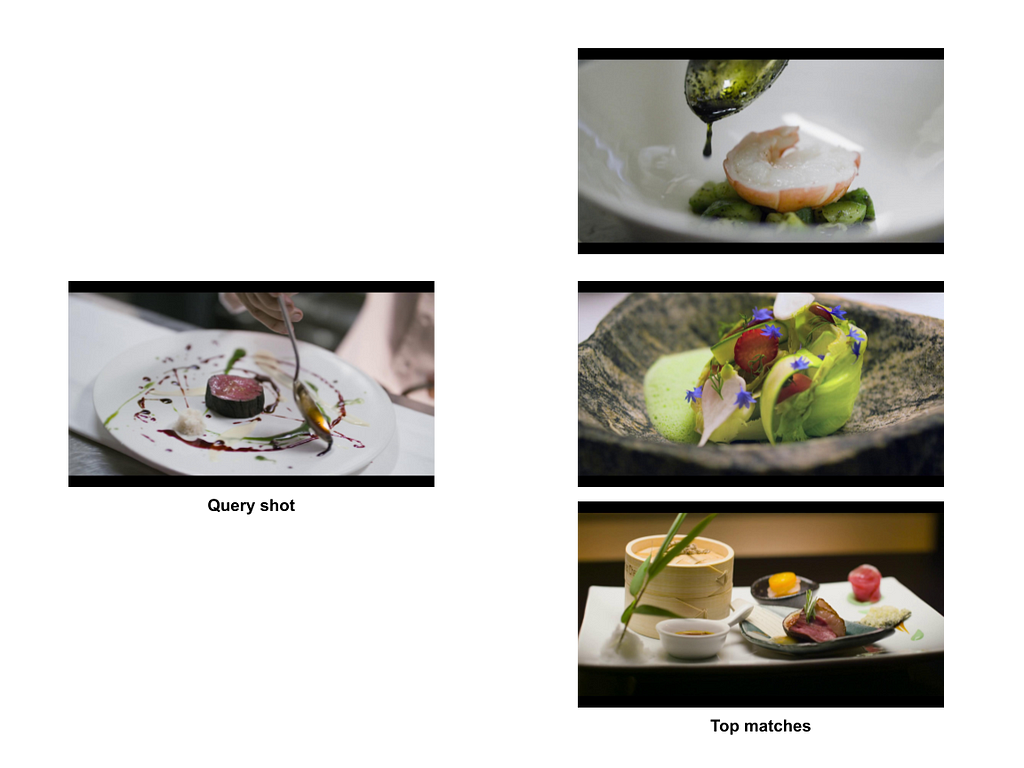
Natural-language visual search offers editors a powerful tool. But what if they already have a shot in mind, and they want to find something that just looks similar? For instance, let’s say that an editor has found a visually stunning shot of a plate of food from Chef’s Table, and she’s interested in finding similar shots across the entire show.

Input image on left side of food on a decorative plate and output images on right side of different food items that look similar to input image.
User provides a sample image to find other similar images

Prior engineering work

Approach #1: on-demand batch processing

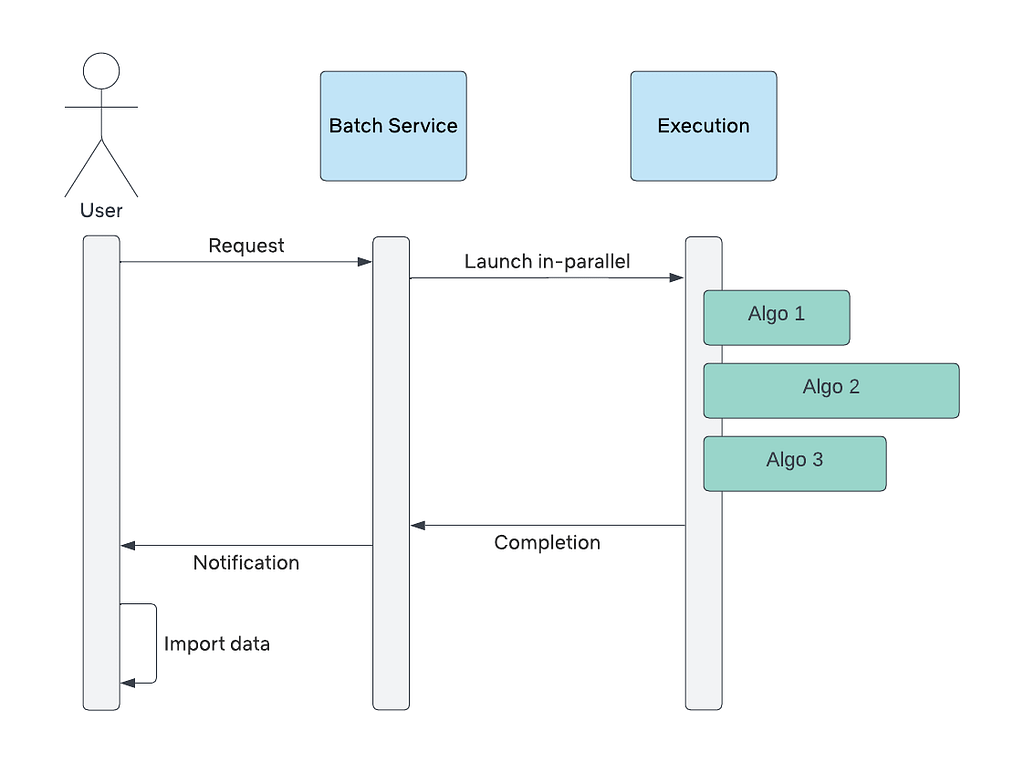
Our first approach to surface these innovations was a tool to trigger these algorithms on-demand and on a per-show basis. We implemented a batch processing system for users to submit their requests and wait for the system to generate the output. Processing took several hours to complete. Some ML algorithms are computationally intensive. Many of the samples provided had a significant number of frames to process. A typical 1 hour video could contain over 80,000 frames!

After waiting for processing, users downloaded the generated algo outputs for offline consumption. This limited pilot system greatly reduced the time spent by our users to manually analyze the content. Here is a visualization of this flow.

Sequence diagram showing how different entities interact with each other in case of batch processing system.
On-demand batch processing system flow

Approach #2: enabling online request with pre-computation

After the success of this approach we decided to add online support for a couple of algorithms. For the first time, users were able to discover matches across the entire catalog, oftentimes finding moments they never knew even existed. They didn’t need any time-consuming local setup and there was no delays since the data was already pre-computed.

Sequence diagram showing how different entities interact with each other for online interactive system.
Interactive system with pre-computed data flow

The following quote exemplifies the positive reception by our users:

“We wanted to find all the shots of the dining room in a show. In seconds, we had what normally would have taken 1–2 people hours/a full day to do, look through all the shots of the dining room from all 10 episodes of the show. Incredible!”
Dawn Chenette, Design Lead

This approach had several benefits for product engineering. It allowed us to transparently update the algo data without users knowing about it. It also provided insights into query patterns and algorithms that were gaining traction among users. In addition, we were able to perform a handful of A/B tests to validate or negate our hypotheses for tuning the search experience.

Pain points

Our early efforts to deliver ML insights to creative professionals proved valuable. At the same time we experienced growing engineering pains that limited our ability to scale.

Maintaining disparate systems posed a challenge. They were first built by different teams on different stacks, so maintenance was expensive. Whenever ML researchers finished a new algorithm they had to integrate it separately into each system. We were near the breaking point with just two systems and a handful of algorithms. We knew this would only worsen as we expanded to more use cases and more researchers.

The online application unlocked the interactivity for our users and validated our direction. However, it was not scaling well. Adding new algos and onboarding new use cases was still time consuming and required the effort of too many engineers. These investments in one-to-one integrations were volatile with implementation timelines varying from a few weeks to several months. Due to the bespoke nature of the implementation, we lacked catalog wide searches for all available ML sources.

In summary, this model was a tightly-coupled application-to-data architecture, where machine learning algos were mixed with the backend and UI/UX software code stack. To address the variance in the implementation timelines we needed to standardize how different algorithms were integrated — starting from how they were executed to making the data available to all consumers consistently. As we developed more media understanding algos and wanted to expand to additional use cases, we needed to invest in system architecture redesign to enable researchers and engineers from different teams to innovate independently and collaboratively. Media Search Platform (MSP) is the initiative to address these requirements.

Although we were just getting started with media-search, search itself is not new to Netflix. We have a mature and robust search and recommendation functionality exposed to millions of our subscribers. We knew we could leverage learnings from our colleagues who are responsible for building and innovating in this space. In keeping with our “highly aligned, loosely coupled” culture, we wanted to enable engineers to onboard and improve algos quickly and independently, while making it easy for Studio and product applications to integrate with the media understanding algo capabilities.

Making the platform modular, pluggable and configurable was key to our success. This approach allowed us to keep the distributed ownership of the platform. It simultaneously provided different specialized teams to contribute relevant components of the platform. We used services already available for other use cases and extended their capabilities to support new requirements.

Next we will discuss the system architecture and describe how different modules interact with each other for end-to-end flow.

Architecture

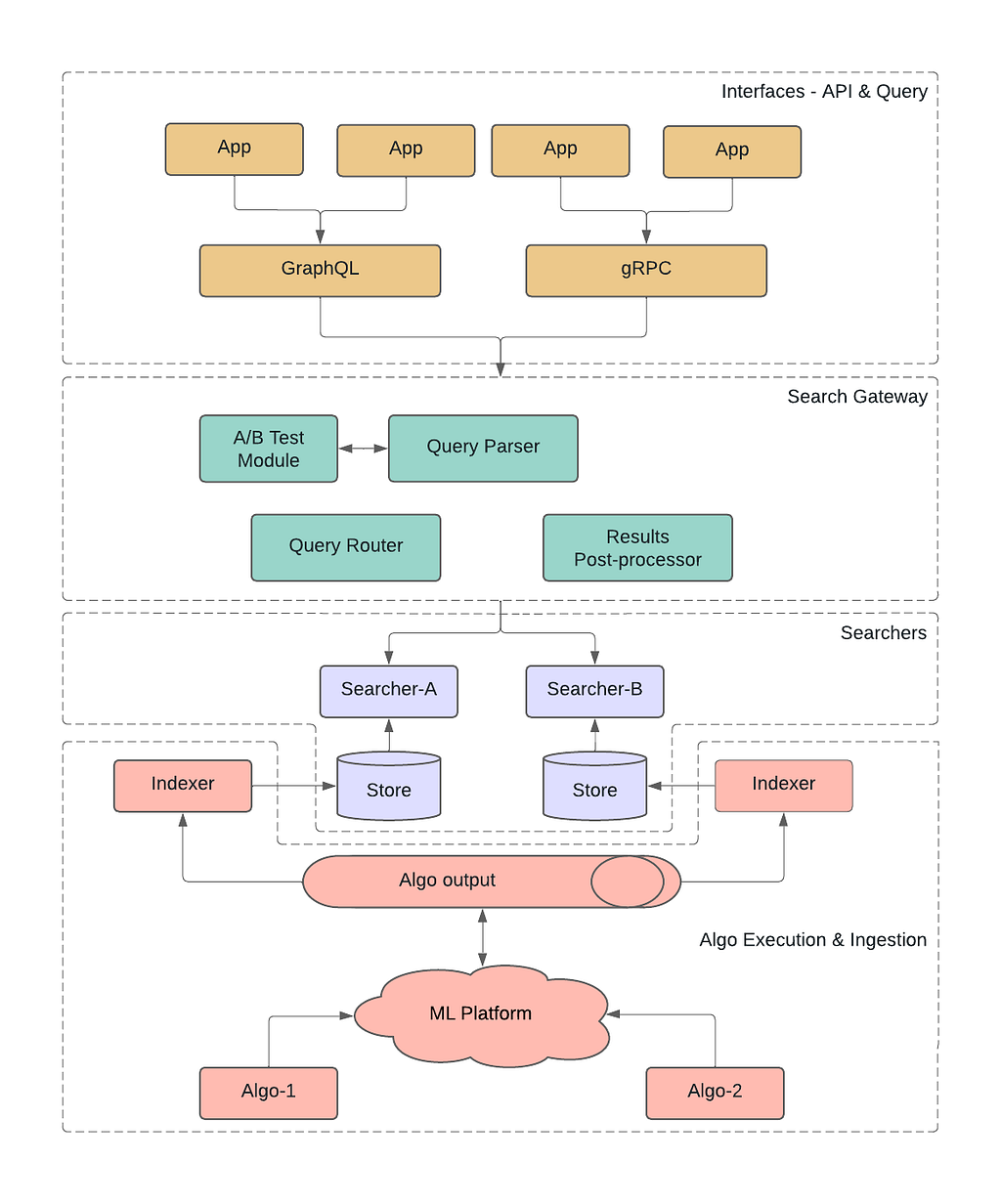
Architecture diagram showing different sub-modules involved in the system.
System Architecture

Netflix engineers strive to iterate rapidly and prefer the “MVP” (minimum viable product) approach to receive early feedback and minimize the upfront investment costs. Thus, we didn’t build all the modules completely. We scoped the pilot implementation to ensure immediate functionalities were unblocked. At the same time, we kept the design open enough to allow future extensibility. We will highlight a few examples below as we discuss each component separately.

Interfaces – API & Query

Starting at the top of the diagram, the platform allows apps to interact with it using either gRPC or GraphQL interfaces. Having diversity in the interfaces is essential to meet the app-developers where they are. At Netflix, gRPC is predominantly used in backend-to-backend communication. With active GraphQL tooling provided by our developer productivity teams, GraphQL has become a de-facto choice for UI — backend integration. You can find more about what the team has built and how it is getting used in these blog posts. In particular, we have been relying on Domain Graph Service Framework for this project.

During the query schema design, we accounted for future use cases and ensured that it will allow future extensions. We aimed to keep the schema generic enough so that it hides implementation details of the actual search systems that are used to execute the query. Additionally it is intuitive and easy to understand yet feature rich so that it can be used to express complex queries. Users have flexibility to perform multimodal search with input being a simple text term, image or short video. As discussed earlier, search could be performed against the entire Netflix catalog, or it could be limited to specific titles. Users may prefer results that are organized in some way such as group by a movie, sorted by timestamp. When there are a large number of matches, we allow users to paginate the results (with configurable page size) instead of fetching all or a fixed number of results.

Search Gateway

The client generated input query is first given to the Query processing system. Since most of our users are performing targeted queries such as — search for dialogue “friends don’t lie” (from the above example), today this stage performs lightweight processing and provides a hook to integrate A/B testing. In the future we plan to evolve it into a “query understanding system” to support free-form searches to reduce the burden on users and simplify client side query generation.

The query processing modifies queries to match the target data set. This includes “embedding” transformation and translation. For queries against embedding based data sources it transforms the input such as text or image to corresponding vector representation. Each data source or algorithm could use a different encoding technique so, this stage ensures that the corresponding encoding is also applied to the provided query. One example why we need different encoding techniques per algorithm is because there is different processing for an image — which has a single frame while video — which contains a sequence of multiple frames.

With global expansion we have users where English is not a primary language. All of the text-based models in the platform are trained using English language so we translate non-English text to English. Although the translation is not always perfect it has worked well in our case and has expanded the eligible user base for our tool to non-English speakers.

Once the query is transformed and ready for execution, we delegate search execution to one or more of the searcher systems. First we need to federate which query should be routed to which system. This is handled by the Query router and Searcher-proxy module. For the initial implementation we have relied on a single searcher for executing all the queries. Our extensible approach meant the platform could support additional searchers, which have already been used to prototype new algorithms and experiments.

A search may intersect or aggregate the data from multiple algorithms so this layer can fan out a single query into multiple search executions. We have implemented a “searcher-proxy” inside this layer for each supported searcher. Each proxy is responsible for mapping input query to one expected by the corresponding searcher. It then consumes the raw response from the searcher before handing it over to the Results post-processor component.

The Results post-processor works on the results returned by one or more searchers. It can rank results by applying custom scoring, populate search recommendations based on other similar searches. Another functionality we are evaluating with this layer is to dynamically create different views from the same underlying data.

For ease of coordination and maintenance we abstracted the query processing and response handling in a module called — Search Gateway.

Searchers

As mentioned above, query execution is handled by the searcher system. The primary searcher used in the current implementation is called Marken — scalable annotation service built at Netflix. It supports different categories of searches including full text and embedding vector based similarity searches. It can store and retrieve temporal (timestamp) as well as spatial (coordinates) data. This service leverages Cassandra and Elasticsearch for data storage and retrieval. When onboarding embedding vector data we performed an extensive benchmarking to evaluate the available datastores. One takeaway here is that even if there is a datastore that specializes in a particular query pattern, for ease of maintainability and consistency we decided to not introduce it.

We have identified a handful of common schema types and standardized how data from different algorithms is stored. Each algorithm still has the flexibility to define a custom schema type. We are actively innovating in this space and recently added capability to intersect data from different algorithms. This is going to unlock creative ways of how the data from multiple algorithms can be superimposed on each other to quickly get to the desired results.

Algo Execution & Ingestion

So far we have focused on how the data is queried but, there is an equally complex machinery powering algorithm execution and the generation of the data. This is handled by our dedicated media ML Platform team. The team specializes in building a suite of media-specific machine learning tooling. It facilitates seamless access to media assets (audio, video, image and text) in addition to media-centric feature storage and compute orchestration.

For this project we developed a custom sink that indexes the generated data into Marken according to predefined schemas. Special care is taken when the data is backfilled for the first time so as to avoid overwhelming the system with huge amounts of writes.

Last but not the least, our UI team has built a configurable, extensible library to simplify integrating this platform with end user applications. Configurable UI makes it easy to customize query generation and response handling as per the needs of individual applications and algorithms. The future work involves building native widgets to minimize the UI work even further.

Summary

The media understanding platform serves as an abstraction layer between machine learning algos and various applications and features. The platform has already allowed us to seamlessly integrate search and discovery capabilities in several applications. We believe future work in maturing different parts will unlock value for more use cases and applications. We hope this post has offered insights into how we approached its evolution. We will continue to share our work in this space, so stay tuned.

Do these types of challenges interest you? If yes, we’re always looking for engineers and machine learning practitioners to join us.

Acknowledgements

Special thanks to Vinod Uddaraju, Fernando Amat Gil, Ben Klein, Meenakshi Jindal, Varun Sekhri, Burak Bacioglu, Boris Chen, Jason Ge, Tiffany Low, Vitali Kauhanka, Supriya Vadlamani, Abhishek Soni, Gustavo Carmo, Elliot Chow, Prasanna Padmanabhan, Akshay Modi, Nagendra Kamath, Wenbing Bai, Jackson de Campos, Juan Vimberg, Patrick Strawderman, Dawn Chenette, Yuchen Xie, Andy Yao, and Chen Zheng for designing, developing, and contributing to different parts of the platform.


Building a Media Understanding Platform for ML Innovations was originally published in Netflix TechBlog on Medium, where people are continuing the conversation by highlighting and responding to this story.

Документи от туроператори разкриват мащабна схема за укриване на приходи и данъци от концесионера на Банско Банско: Жирардели продава – Цеко получава

Post Syndicated from Екип на Биволъ original https://bivol.bg/yulen-girardelli-georgius.html

вторник 14 март 2023


Продажби на лифт карти и наем на ски оборудване за десетки милиони са укрити от родните данъчни чрез хитра схема с посредници в чужбина, установи разследване на Биволъ. Концесионерът на…

[$] Zephyr: a modular OS for resource-constrained devices

Post Syndicated from original https://lwn.net/Articles/925924/

Writing applications for devices with a lot of resource constraints,
such as a
small amount of RAM or no memory-management unit (MMU), poses some
challenges. Running a Linux distribution often isn’t an option on these devices,
but there are operating systems that try to bridge the gap between running
a Linux distribution and using bare-metal development. One of these is Zephyr, a real-time operating system
(RTOS) launched by the Linux Foundation in
2016
. LWN looked in on Zephyr at its four-year
anniversary as well. Seven years after its announcement, Zephyr
has made lots of progress and now has an active ecosystem surrounding it.

Security updates for Tuesday

Post Syndicated from original https://lwn.net/Articles/926083/

Security updates have been issued by Debian (redis), Fedora (cairo, freetype, harfbuzz, and qt6-qtwebengine), Red Hat (kpatch-patch), SUSE (chromium, java-1_8_0-openj9, and nodejs18), and Ubuntu (chromium-browser, libxstream-java, php-twig, twig, protobuf, and python-werkzeug).

Cloud Security Strategies for Healthcare

Post Syndicated from Marla Rosner original https://blog.rapid7.com/2023/03/14/cloud-security-strategies-for-healthcare/

How to Stay Secure in the Cloud While Driving Innovation and Discovery

Cloud Security Strategies for Healthcare

The healthcare industry is undergoing a transformational shift. Health organizations are traditionally entrenched in an on-prem way of life, but the past three years have plunged them into a digital revolution. A heightened demand for improved healthcare services—like distributed care and telehealth—ignited a major push for health orgs to move to the cloud, and as a result, implement new cloud security strategies.

But the processes and tools that worked well to secure healthcare organizations’ traditional data centers do not directly translate to the public cloud. Resource and budget strain, priority negotiation with leadership, and challenges with regulatory compliance only exacerbate a daunting digital maturity gap. These challenges are why many healthcare organizations have approached public cloud adoption tentatively.

The healthcare industry must innovate in the cloud to meet patient and business needs, but they need to do so without creating unnecessary or unmanaged risk. Most importantly, they must move to and adopt cloud solutions securely to protect patients in a new world of digital threats.

Major Challenges

Modern technologies bring modern challenges. Here are the main obstacles healthcare organizations face when it comes to securing the cloud.

Resource Strain

Like most industries, healthcare organizations face major obstacles when finding qualified security talent. That means hospitals, clinics, and other healthcare businesses must compete with tech giants, startups, and other more traditionally cybersecurity-savvy companies for the best and brightest minds on the market.

What’s more challenging is that the typical day of a security professional in healthcare tends to be disproportionately focused on time-consuming and often monotonous tasks. These duties are often related to maintaining and reporting on compliance with a sea of regulatory standards and requirements. Carrying out these repetitive but necessary tasks can quickly lead to burnout—and, as a result, turnover.

Moreover, those security professionals who do end up working within healthcare organizations can quickly find themselves inundated with more work than any one person is capable of handling. Small teams are tasked with securing massive amounts of sensitive data—both on-prem and as it moves into the cloud. And sometimes, cybersecurity departments at healthcare orgs can be as small as a CISO and a few analysts.

Those challenges with resource strain can lead to worse problems for security teams, including:

  • Burnout and rapid turnover, as discussed above
  • Slow MTTR, exacerbating the impact of breaches
  • Shadow IT, letting vulnerable assets fall through the cracks

Balancing Priorities With Leadership

It’s up to cybersecurity professionals to connect the dots for leadership on how investing in cloud security leads to greater ROI and less risk. Decision-makers in the healthcare industry are already juggling a great deal—and those concerns can be, quite literally, a matter of life or death.

In the modern threat landscape, poor cybersecurity health also has the potential to mean life or death. As medical science tools become more sophisticated, they’re also becoming more digitally connected. That means malicious actors who manage to infiltrate and shut down servers could also possibly shut down life-saving technology.

Tech professionals must illustrate to stakeholders how cybersecurity risk is interconnected with business risk and—perhaps most importantly—patient risk. To do that, they must regularly engage with and educate leadership to effectively balance priorities.

Achieving that perfect balance includes meeting leadership where they’re at. In healthcare, what is typically the biggest security concern for leaders? The answer: Meeting the necessary compliance standards with every new technology investment.

HIPAA Compliance and Protected Health Information

For stakeholders, achieving, maintaining, and substantiating legal and regulatory compliance is of critical importance. When it comes to the healthcare industry, one compliance standard often reigns supreme over all business decisions: HIPAA.

HIPAA provides data privacy and security provisions for safeguarding Protected Health Information (PHI). It addresses the use and disclosure of individuals’ health information and requires that sensitive information be governed by strict data security and confidentiality. It also obligates organizations to provide PHI to patients upon request.

When migrating to the cloud, healthcare organizations need a centralized approach to protecting sensitive data. InsightCloudSec allows you to automate compliance with HIPAA. Through our HIPAA Compliance Pack, InsightCloudSec provides dozens of out-of-the-box checks that map back to specific HIPAA requirements. For example, InsightCloudSec’s “Snapshot With PHI Unencrypted” policy supports compliance with HIPAA §164.312(a)(2)(iv), Encryption Controls.

Experience Gap

An evolving threat landscape and growing attack surface are challenging enough to deal with for even the most experienced security professionals. Add the health industry’s talent gap into the mix, and those challenges are multiplied.

Cloud security in the healthcare space is still relatively new. That means internal cybersecurity teams are not only playing a relentless game of catch-up—they also might consist of more traditional network engineers and IT pros who have historically been tasked with securing on-premises environments.

This makes it critical that the cloud security solutions healthcare industries implement be user-friendly, low-maintenance, and ultra-reliable.

Cloud Security Solutions and Services

As health organizations dive into work in the cloud, their digital footprints will likely grow far faster than their teams can keep up with. Visibility into these cloud environments is essential to an organization’s ability to identify, assess, prioritize, and remediate risk. Without a clear picture of what they have and where they have it, companies can be vulnerable to malicious attacks.

To avoid biting off more than they can chew, security professionals in healthcare must leverage cloud security strategies and solutions that grant them complete real-time visibility in the cloud over all their most sensitive assets. Enterprise cloud security tools like InsightCloudSec can enable automated discovery and inventory assessment. That unlocks visibility across all their CSPs and containers.

InsightCloudSec also makes it easier for teams, regardless of their cloud security expertise, to effectively define, implement, and enforce security guardrails. With resource normalization, InsightCloudSec removes the need for security teams to learn and keep track of an ever-expanding list of cloud resources and services. Security teams can make use of InsightCloudSec’s native, no-code automation to enable hands-off enforcement of their organization’s security practices and policies when a non-compliant resource is created or a risk configuration change is made.

The fact of the matter is that many healthcare security teams will need to build their cybersecurity programs from the ground up. With limited resources, strained budgets, and patients’ lives on the line, they can’t afford to make big mistakes. That’s why, for many organizations, partnering with a managed service provider is the right approach.

Rapid7’s managed services relieve security teams from the strain of running and building cloud security frameworks. They can also help healthcare security pros better connect lack of investment with risks to stakeholders—acting as an external set of experts.

The Bottom Line

Staying continuously secure in the cloud can be daunting, particularly for those responsible for not only sensitive medical, patient, and research data, but also the digitally connected machines and tools that ensure top-of-the-line patient care. Protecting the health of patients is paramount in the healthcare industry.

With the right tools (and teams) to support continuous security and compliance, this responsibility becomes manageable—and even, dare we say, easy.

InsightCloudSec

A complete cloud security toolbox in a single solution.

LEARN MORE

No hassle migration from Zscaler to Cloudflare One with The Descaler Program

Post Syndicated from Corey Mahan original https://blog.cloudflare.com/descaler-program/

No hassle migration from Zscaler to Cloudflare One with The Descaler Program

This post is also available in 简体中文, Français and Español.

No hassle migration from Zscaler to Cloudflare One with The Descaler Program

Today, Cloudflare is excited to launch the Descaler Program, a frictionless path to migrate existing Zscaler customers to Cloudflare One. With this announcement, Cloudflare is making it even easier for enterprise customers to make the switch to a faster, simpler, and more agile foundation for security and network transformation.

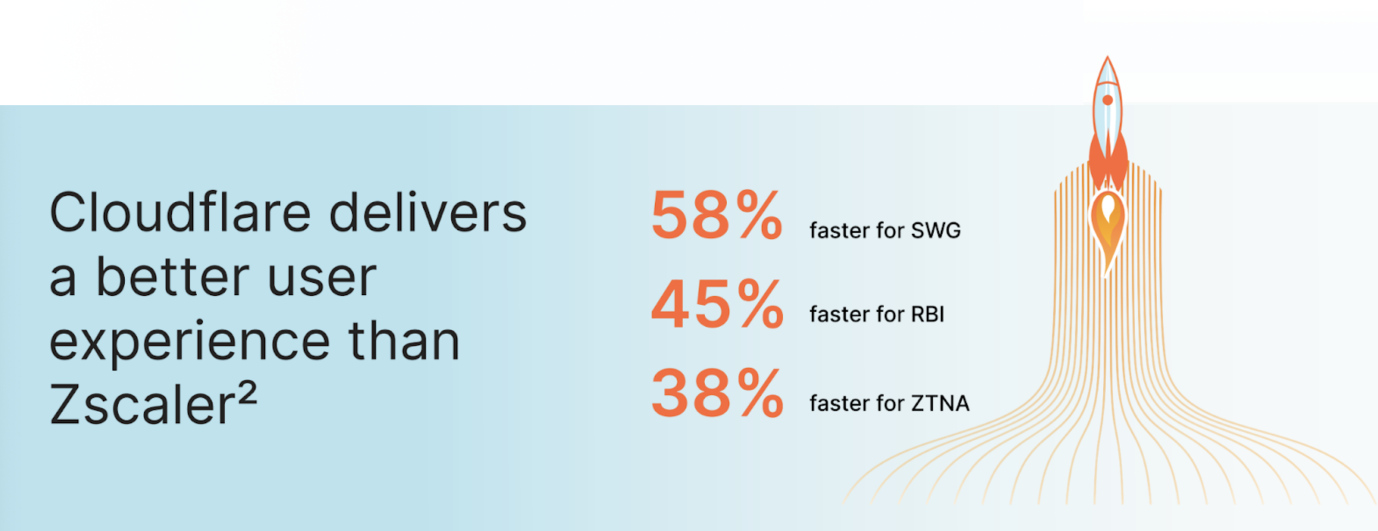
Zscaler customers are increasingly telling us that they’re unhappy with the way in which they have to manage multiple solutions to achieve their goals and with the commercial terms they are being offered. Cloudflare One offers a larger network, a ‘single stack’ solution with no service chaining that enables innovation at an incredible rate, meaning lots of new product and feature releases.

At its core, the Descaler Program helps derisk change. It’s designed to be simple and straightforward, with technical resources to ensure a smooth transition and strategic consultation to ensure the migration achieves your organization’s goals. Customers can expect to be up and running on Cloudflare One in a matter of weeks without disruption to their business operations.

What makes up the Descaler Program?

Knowledgeable people. Clear process. Like-magic technology. Getting the people, process, and technology right is critical for any successful change. That’s why we’ve brought together the best of each to help customers experience a frictionless migration to Cloudflare One.

Cloudflare One is our Secure Access Service Edge (SASE) platform that combines network connectivity services with Zero Trust security services on one of the fastest, most resilient and most composable global networks. The platform dynamically connects users to enterprise resources, with identity-based security controls delivered close to users, wherever they are.

Eligibility

Enterprise organizations who use competitive security products from Zscaler, such as ZIA or ZPA, and have 1,000 employees or more are eligible to participate. The Descaler Program builds in resources and touch points with Cloudflare experts on two related paths – one focused on technical success, the other focused on business success.

Technology success

Administrators rejoice. The Descaler Program includes the tools, process and partners you need for a frictionless technical migration.

1. Architecture workshops. Our experts and yours will take a fresh look at where you are and where you need to go over the next two to three years to enable digital transformation. This interactive session with Cloudflare experts will help us focus together on the most meaningful migration paths for your organization and dive into the supporting technologies available to make the transition to Cloudflare even easier.

Outcomes from this mutual investment of time will include a custom migration plan, access to the Descaler toolkit, and dedicated resources from Cloudflare to facilitate a seamless cutover while sharpening focus on your short, medium, and long term business goals facilitated through networking and security technology. You will leave with a better  understanding of your migration path to an Internet-native SASE platform, but more importantly, how you can make Zero Trust and SASE concepts tangible for your business.

2. Technical migration tools. In addition to providing people and processes focused on supporting your migration, Cloudflare can help you leverage a suite of technical tools and scripts that in just a few clicks, automatically export settings and configurations of already deployed Zscaler products to be migrated into Cloudflare One. This toolkit is positioned to save countless hours of unnecessary point-and-click time wasted.

The magic of this flow is in its simplicity. Following extract, transform, and load (ETL) best practices, using supported and documented API calls to your current account, the Descaler toolkit will export your current configuration and settings from ZIA or ZPA, transform them to be Cloudflare One-compatible before migrating into a new Cloudflare One account.

Take a ZPA application for example, the Descaler toolkit will look at existing settings around Application name, Domain/SNI, IPs, Ports allowed, Protocols allowed, User groups, and more before exporting, transforming, and importing into a new Cloudflare One account. In situations where time is of the essence, quick time to value migration paths can be taken. For example, if faced with an urgent ZIA migration then it’s simply a matter of switching over DNS to get a baseline of protection, turning off Zscaler and then managing the process to deploy WARP and a full Secure Web Gateway in short order.

Getting started with the toolkit
You’ll first be asked to create a new API key in your ZIA or ZPA account. From there the Cloudflare team will share the toolkit to be run locally by one of your system administrators alongside members of the Cloudflare team to support in case there are any questions. Cloudflare won’t ever need or ask for your API key, just the outputs. Cloudflare will then use the output to transform and load the configurations into a newly provisioned Cloudflare One account.

The Descaler toolkit only performs read and list API requests to your Zscaler account. In scenarios where systems or services you wish to migrate do not map 1:1, the Cloudflare team and our Authorized Partners will be standing by to assist in making the migration process as smooth as possible.

3. Trusted partner engagements. The Cloudflare Partner Network includes service and implementation partners who deliver security, reliability and performance solutions with a broad range of value-added services. Our Technology Partners offer customers complementary solutions within the cloud stack for hands-on keyboard assistance when desired. Back in January we announced the Authorized Partner Service Delivery Track for Cloudflare One and are excited to connect customers to authorized partners that meet Cloudflare’s high standards for professional services delivery.

As the Descaler Program continues to grow additional capabilities such as full technical training with customer certification courses along with support for in-house professional services and authorized partner professional services delivery are being explored to make the transition process even easier. This is only the beginning of the technical resources being made available to customers looking to make the switch to Cloudflare.

Business components

For CxOs, it couldn’t be more clear when it comes to showing tangible business value and cost savings that impact your businesses bottom line.

  1. Return On Investment (ROI) calculation. We value showing, not just telling you about the value from Cloudflare One. We want to make sure customers migrating anything  recognize the quantifiable business impacts that can potentially be realized by moving to the Cloudflare One platform.
  2. Escape hatch for your current contract. Don’t let your existing contract be a stopper to your long term security modernization. Cloudflare is committed to making the migration process as cost-effective as possible – which means tools and flexible financial options for customers to reach escape velocity from Zscaler and land safely with Cloudflare. You won’t regret this interaction come renewal time.
  3. Zero Trust roadmap assessment. Going from zero to Zero Trust means looking ahead to what’s next with a concrete understanding of where you are today. For business leaders, that means using resources like our vendor-agnostic Zero Trust Roadmap to map out future initiatives today with help from architects, engineers and other business leaders.

If your Internet pipes are all clogged up then use The Descaler Program to get a faster flow:

No hassle migration from Zscaler to Cloudflare One with The Descaler Program
[2] https://blog.cloudflare.com/network-performance-update-cio-edition, SWG = Secure Web Gateway, RBI = Remote Browser Isolation, ZTNA = Zero Trust Network Access.

Why migrating from Zscaler to Cloudflare One just makes sense

More and more organizations are choosing Cloudflare over Zscaler to modernize security, and when they do, they typically cite our strengths across a few key evaluation criteria:

  1. User experience: IT and security administrators have found our services easier to deploy and simpler to manage. End users benefit from faster performance across security services. Whereas Zscaler’s fragmented clouds and piecemeal services add management complexity over time, Cloudflare offers a single, unified control plane that keeps your organization progressing quickly towards its security goals.
  2. Connectivity: Customers value the reliability and scalability of our larger global network footprint to secure any traffic. Plus, unlike Zscaler, Cloudflare’s network is designed to run every service in every location to ensure consistent protections for users around the world.
  3. Agility for the future: Customers recognize that progressing towards Zero Trust and SASE require long-term partnerships. For that journey, they trust in Cloudflare’s track record of rapid innovation and value our flexible architecture to adopt new security standards and technologies and stay ahead of the curve.

These are just a few reasons why organizations choose Cloudflare – and if you’re looking for even more reasons and customer stories, we encourage you to check out this recent blog post.

If you’re looking to motivate your colleagues to take advantage of the Descaler Program, we encourage you to explore more direct comparisons with this infographic or our website.

How to get started

Joining the Descaler Program is as easy as signing up using the link below. From there, the Cloudflare team will reach out to you for further enrollment details. By providing details about your current Zscaler deployments, ongoing challenges and your future Zero Trust or SASE goals we’ll be able to hit the ground running.

With the Descaler Program we’re excited to offer a clear path for customers to make the switch to Cloudflare One. To get started, sign up here.

No hassle migration from Zscaler to Cloudflare One with The Descaler Program

Zero Trust security with Ping Identity and Cloudflare Access

Post Syndicated from Deeksha Lamba original https://blog.cloudflare.com/cloudflare-ping/

Zero Trust security with Ping Identity and Cloudflare Access

Zero Trust security with Ping Identity and Cloudflare Access

In today’s digital landscape, traditional perimeter based security models are no longer enough to protect sensitive data and applications. As cyber threats become increasingly sophisticated, it’s essential to adopt a security approach that assumes that all access is unauthorized, rather than relying on network perimeter-based security.

Zero Trust is a security model that requires all users and devices to be authenticated and authorized before being granted access to applications and data. This approach offers a comprehensive security solution that is particularly effective in today’s distributed and cloud-based environments. In this context, Cloudflare Access and Ping Identity offer a powerful solution for organizations looking to implement Zero Trust security controls to protect their applications and data.

Enforcing strong authentication and access controls

Web applications provide businesses with enhanced scalability, flexibility, and cost savings, but they can also create vulnerabilities that malicious actors can exploit. Ping Identity and Cloudflare Access can be used together to secure applications by enforcing strong authentication and access controls.

One of the key features of Ping Identity is its ability to provide single sign-on (SSO) capabilities, allowing users to log in once and be granted access to all applications they are authorized to use. This feature streamlines the authentication process, reducing the risk of password fatigue and making it easier for organizations to manage access to multiple applications.

Cloudflare Access, on the other hand, provides Zero Trust access to applications, ensuring that only authorized users can access sensitive information. With Cloudflare Access, policies can be easily created and managed in one place, making it easier to ensure clear and consistent policy enforcement across all applications. Policies can include specific types of MFA, device posture and even custom logic.

Zero Trust security with Ping Identity and Cloudflare Access

Securing custom applications with Access and Ping

Legacy applications pose a significant security risk to organizations as they may contain vulnerabilities that are no longer patched or updated. However, businesses can use Cloudflare and Ping Identity to help secure legacy applications and reduce the risk of cyberattacks.

Legacy applications may not support modern authentication methods, such as SAML or OIDC, which makes security controls like MFA easier to enforce, making them vulnerable to unauthorized access. By integrating Ping Identity with Cloudflare Access, businesses can enforce MFA and SSO for users accessing legacy applications. This can help ensure that only authorized users have access to sensitive data and reduce the risk of credential theft and account takeover.

For example, many organizations have legacy applications that lack modern security features like MFA or SSO. This is because direct code modifications were previously required to implement modern security features. Code modifications of legacy applications can be risky, difficult or even impossible in some situations. By integrating these applications with Ping Identity and Cloudflare Access, organizations can enforce stronger security controls, making it harder for unauthorized users to gain access to sensitive information. All while not requiring underlying changes to the application itself.

Full integration support for PingOne and PingFederate customers

We are excited to announce that Cloudflare is now offering full integration support for PingOne customers. This means that Ping Identity customers can now easily integrate their identity management solutions with Cloudflare Access to provide a comprehensive security solution for their applications.

Zero Trust security with Ping Identity and Cloudflare Access

User and group synchronization via SCIM

In addition to this announcement, we are also excited to share our plans to add user and group synchronization via SCIM in the near future. This will allow organizations to easily synchronize user and group data between Ping Identity and Cloudflare Access, streamlining access management and improving the overall user experience.

“A cloud-native Zero Trust security model has become an absolute necessity as enterprises continue to adopt a cloud-first strategy. Cloudflare and Ping Identity have robust product integrations in place to help security and IT leaders prevent attacks proactively and increase alignment with zero trust best practices.”
– Loren Russon, SVP of Product & Technology, Ping Identity

A powerful solution for Zero Trust security controls

We believe that these integrations will provide a powerful solution for organizations looking to implement Zero Trust security controls to protect their applications and data. By combining Ping Identity’s identity management capabilities with Cloudflare Access’s Zero Trust access controls and MFA capabilities, organizations can ensure that only authorized users are granted access to sensitive information. This approach provides a comprehensive security solution that is particularly effective in today’s distributed and cloud-based environments.

We look forward to continuing to improve our integration capabilities with Ping Identity and other identity management solutions, to provide organizations with the best possible security solution for their applications and data.

Scan and secure Atlassian with Cloudflare CASB

Post Syndicated from Alex Dunbrack original https://blog.cloudflare.com/scan-atlassian-casb/

Scan and secure Atlassian with Cloudflare CASB

Scan and secure Atlassian with Cloudflare CASB

As part of Security Week, two new integrations are coming to Cloudflare CASB, one for Atlassian Confluence and the other for Atlassian Jira.

We’re excited to launch support for these two new SaaS applications (in addition to those we already support) given the reliance that we’ve seen organizations from around the world place in them for streamlined, end-to-end project management.

Let’s dive into what Cloudflare Zero Trust customers can expect from these new integrations.

CASB: Security for your SaaS apps

First, a quick recap. CASB, or Cloud Access Security Broker, is one of Cloudflare’s newer offerings, released last September to provide security operators – CISOs and security engineers – clear visibility and administrative control over the security of their SaaS apps.

Whether it’s Google Workspace, Microsoft 365, Slack, Salesforce, Box, GitHub, or Atlassian (whew!), CASB can easily connect and scan these apps for critical security issues, and provide users an exhaustive list of identified problems, organized for triage.

Scan and secure Atlassian with Cloudflare CASB

Scan Confluence with Cloudflare CASB

Scan and secure Atlassian with Cloudflare CASB

Over time, Atlassian Confluence has become the go-to collaboration platform for teams to create, organize, and share content, such as documents, notes, and meeting minutes. However, from a security perspective, Confluence’s flexibility and wide compatibility with third-party applications can pose a security risk if not properly configured and monitored.

With this new integration, IT and security teams can begin scanning for Atlassian- and Confluence-specific security issues that may be leaving sensitive corporate data at risk. Customers of CASB using Confluence Cloud can expect to identify issues like publicly shared content, unauthorized access, and other vulnerabilities that could be exploited by bad actors.

By providing this additional layer of SaaS security, Cloudflare CASB can help organizations better protect their sensitive data while still leveraging the collaborative power of Confluence.

Scan Jira with Cloudflare CASB

Scan and secure Atlassian with Cloudflare CASB

A mainstay project management tool used to track tasks, issues, and progress on projects, Atlassian Jira has become an essential part of the software development process for teams of all sizes. At the same time, this also means that Jira has become a rich target for those looking to exploit and gain access to sensitive data.

With Cloudflare CASB, security teams can now easily identify security issues that could leave employees and sensitive business data vulnerable to compromise. Compatible with Jira Cloud accounts, Identified issues can range from flagging user and third-party app access issues, such as account misuse and users not following best practices, to identification of files that could be potentially overshared and worth deeper investigation.

By providing security admins with a single view to see security issues across their entire SaaS footprint, now including Jira and Confluence, Cloudflare CASB makes it easier for security teams to stay up-to-date with potential security risks.

Getting started

With the addition of Jira and Confluence to the growing list of CASB integrations, we’re making our products as widely compatible as possible so that organizations can continue placing their trust and confidence in us to help keep them secure.

Today, Cloudflare CASB supports integrations with Google Workspace, Microsoft 365, Slack, Salesforce, Box, GitHub, Jira, and Confluence, with a growing list of other critical applications on their way, so if there’s one in particular you’d like to see soon, let us know!

For those not already using Cloudflare Zero Trust, don’t hesitate to get started today – see the platform yourself with 50 free seats by signing up here, then get in touch with our team here to learn more about how Cloudflare CASB can help your organization lock down its SaaS apps.

The state of application security in 2023

Post Syndicated from Michael Tremante original https://blog.cloudflare.com/application-security-2023/

The state of application security in 2023

The state of application security in 2023

One year ago we published our first Application Security Report. For Security Week 2023, we are providing updated insights and trends around mitigated traffic, bot and API traffic, and account takeover attacks.

Cloudflare has grown significantly over the last year. In February 2023, Netcraft noted that Cloudflare had become the most commonly used web server vendor within the top million sites at the start of 2023, and continues to grow, reaching a 21.71% market share, up from 19.4% in February 2022.

This continued growth now equates to Cloudflare handling over 45 million HTTP requests/second on average (up from 32 million last year), with more than 61 million HTTP requests/second at peak. DNS queries handled by the network are also growing and stand at approximately 24.6 million queries/second. All of this traffic flow gives us an unprecedented view into Internet trends.

Before we dive in, we need to define our terms.

Definitions

Throughout this report, we will refer to the following terms:

  • Mitigated traffic: any eyeball HTTP* request that had a “terminating” action applied to it by the Cloudflare platform. These include the following actions: BLOCK, CHALLENGE, JS_CHALLENGE and MANAGED_CHALLENGE. This does not include requests that had the following actions applied: LOG, SKIP, ALLOW. In contrast to last year, we now exclude requests that had CONNECTION_CLOSE and FORCE_CONNECTION_CLOSE actions applied by our DDoS mitigation system, as these technically only slow down connection initiation. They also accounted for a relatively small percentage of requests. Additionally, we improved our calculation regarding the CHALLENGE type actions to ensure that only unsolved challenges are counted as mitigated. A detailed description of actions can be found in our developer documentation.
  • Bot traffic/automated traffic: any HTTP* request identified by Cloudflare’s Bot Management system as being generated by a bot. This includes requests with a bot score between 1 and 29 inclusive. This has not changed from last year’s report.
  • API traffic: any HTTP* request with a response content type of XML or JSON. Where the response content type is not available, such as for mitigated requests, the equivalent Accept content type (specified by the user agent) is used instead. In this latter case, API traffic won’t be fully accounted for, but it still provides a good representation for the purposes of gaining insights.

Unless otherwise stated, the time frame evaluated in this post is the 12 month period from March 2022 through February 2023 inclusive.

Finally, please note that the data is calculated based only on traffic observed across the Cloudflare network and does not necessarily represent overall HTTP traffic patterns across the Internet.

*When referring to HTTP traffic we mean both HTTP and HTTPS.

Global traffic insights

6% of daily HTTP requests are mitigated on average

In looking at all HTTP requests proxied by the Cloudflare network, we find that the share of requests that are mitigated has dropped to 6%, down two percentage points compared to last year. Looking at 2023 to date, we see that mitigated request share has fallen even further, to between 4-5%. Large spikes visible in the chart below, such as those seen in June and October, often correlate with large DDoS attacks mitigated by Cloudflare. It is interesting to note that although the percentage of mitigated traffic has decreased over time, the total mitigated request volume has been relatively stable as shown in the second chart below, indicating an increase in overall clean traffic globally rather than an absolute decrease in malicious traffic.

The state of application security in 2023

81% of mitigated HTTP requests were outright BLOCKed, with mitigations for the remaining set split across the various CHALLENGE type actions.

DDoS mitigation accounts for more than 50% of all mitigated traffic

Cloudflare provides various security features that customers can configure to keep their applications safe. Unsurprisingly, DDoS mitigation is still the largest contributor to mitigated layer 7 (application layer) HTTP requests. Just last month (February 2023), we reported the largest known mitigated DDoS attack by HTTP requests/second volume (This particular attack is not visible in the graphs above because they are aggregated at a daily level, and the attack only lasted for ~5 minutes).

Compared to last year, however, mitigation by the Cloudflare WAF has grown significantly, and now accounts for nearly 41% of mitigated requests. This can be partially attributed to advances in our WAF technology that enables it to detect and block a larger range of attacks.

The state of application security in 2023

Tabular format for reference:

Source Percentage %
DDoS Mitigation 52%
WAF 41%
IP reputation 4%
Access Rules 2%
Other 1%

Please note that in the table above, in contrast to last year, we are now grouping our products to match our marketing materials and the groupings used in the 2022 Radar Year in Review. This mostly affects our WAF product that comprises the combination of WAF Custom Rules, WAF Rate Limiting Rules, and WAF Managed Rules. In last year’s report, these three features accounted for an aggregate 31% of mitigations.
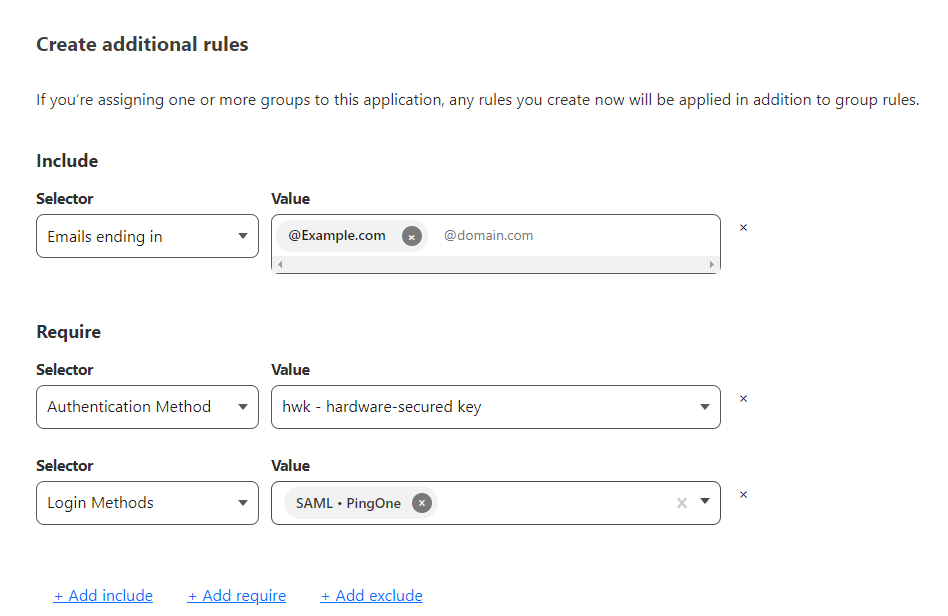
To understand the growth in WAF mitigated requests over time, we can look one level deeper where it becomes clear that Cloudflare customers are increasingly relying on WAF Custom Rules (historically referred to as Firewall Rules) to mitigate malicious traffic or implement business logic blocks. Observe how the orange line (firewallrules) in the chart below shows a gradual increase over time while the blue line (l7ddos) clearly trends lower.

The state of application security in 2023

HTTP Anomaly is the most frequent layer 7 attack vector mitigated by the WAF

Contributing 30% of WAF Managed Rules mitigated traffic overall in March 2023, HTTP Anomaly’s share has decreased by nearly 25 percentage points as compared to the same time last year. Examples of HTTP anomalies include malformed method names, null byte characters in headers, non-standard ports or content length of zero with a POST request. This can be attributed to botnets matching HTTP anomaly signatures slowly changing their traffic patterns.

The state of application security in 2023

Removing the HTTP anomaly line from the graph, we can see that in early 2023, the attack vector distribution looks a lot more balanced.

The state of application security in 2023

Tabular format for reference (top 10 categories):

Source Percentage % (last 12 months)
HTTP Anomaly 30%
Directory Traversal 16%
SQLi 14%
File Inclusion 12%
Software Specific 10%
XSS 9%
Broken Authentication 3%
Command Injection 3%
Common Attack 1%
CVE 1%

Of particular note is the orange line spike seen towards the end of February 2023 (CVE category). The spike relates to a sudden increase of two of our WAF Managed Rules:

  • Drupal – Anomaly:Header:X-Forwarded-For (id: d6f6d394cb01400284cfb7971e7aed1e)
  • Drupal – Anomaly:Header:X-Forwarded-Host (id: d9aeff22f1024655937e5b033a61fbc5)

These two rules are also tagged against CVE-2018-14774, indicating that even relatively old and known vulnerabilities are still often targeted in an effort to exploit potentially unpatched software.

Bot traffic insights

Cloudflare’s Bot Management solution has seen significant investment over the last twelve months. New features such as configurable heuristics, hardened JavaScript detections, automatic machine learning model updates, and Turnstile, Cloudflare’s free CAPTCHA replacement, make our classification of human vs. bot traffic improve daily.

Our confidence in the classification output is very high. If we plot the bot scores across the traffic from the last week of February 2023, we find a very clear distribution, with most requests either being classified as definitely bot (less than 30) or definitely human (greater than 80) with most requests actually scoring less than 2 or greater than 95.

The state of application security in 2023

30% of HTTP traffic is automated

Over the last week of February 2023, 30% of Cloudflare HTTP traffic was classified as automated, equivalent to about 13 million HTTP requests/second on the Cloudflare network. This is 8 percentage points less than at the same time last year.

Looking at bot traffic only, we find that only 8% is generated by verified bots, comprising 2% of total traffic. Cloudflare maintains a list of known good (verified) bots to allow customers to easily distinguish between well-behaved bot providers like Google and Facebook and potentially lesser known or unwanted bots. There are currently 171 bots in the list.

The state of application security in 2023

16% of non-verified bot HTTP traffic is mitigated

Non-verified bot traffic often includes vulnerability scanners that are constantly looking for exploits on the web, and as a result, nearly one-sixth of this traffic is mitigated because some customers prefer to restrict the insights such tools can potentially gain.

Although verified bots like googlebot and bingbot are generally seen as beneficial and most customers want to allow them, we also see a small percentage (1.5%) of verified bot traffic being mitigated. This is because some site administrators don’t want portions of their site to be crawled, and customers often rely on WAF Custom Rules to enforce this business logic.

The most common action used by customers is to BLOCK these requests (13%), although we do have some customers configuring CHALLENGE actions (3%) to ensure any human false positives can still complete the request if necessary.

On a similar note, it is also interesting that nearly 80% of all mitigated traffic is classified as a bot, as illustrated in the figure below. Some may note that 20% of mitigated traffic being classified as human is still extremely high, but most mitigations of human traffic are generated by WAF Custom Rules, and are frequently due to customers implementing country-level or other related legal blocks on their applications. This is common, for example, in the context of US-based companies blocking access to European users for GDPR compliance reasons.
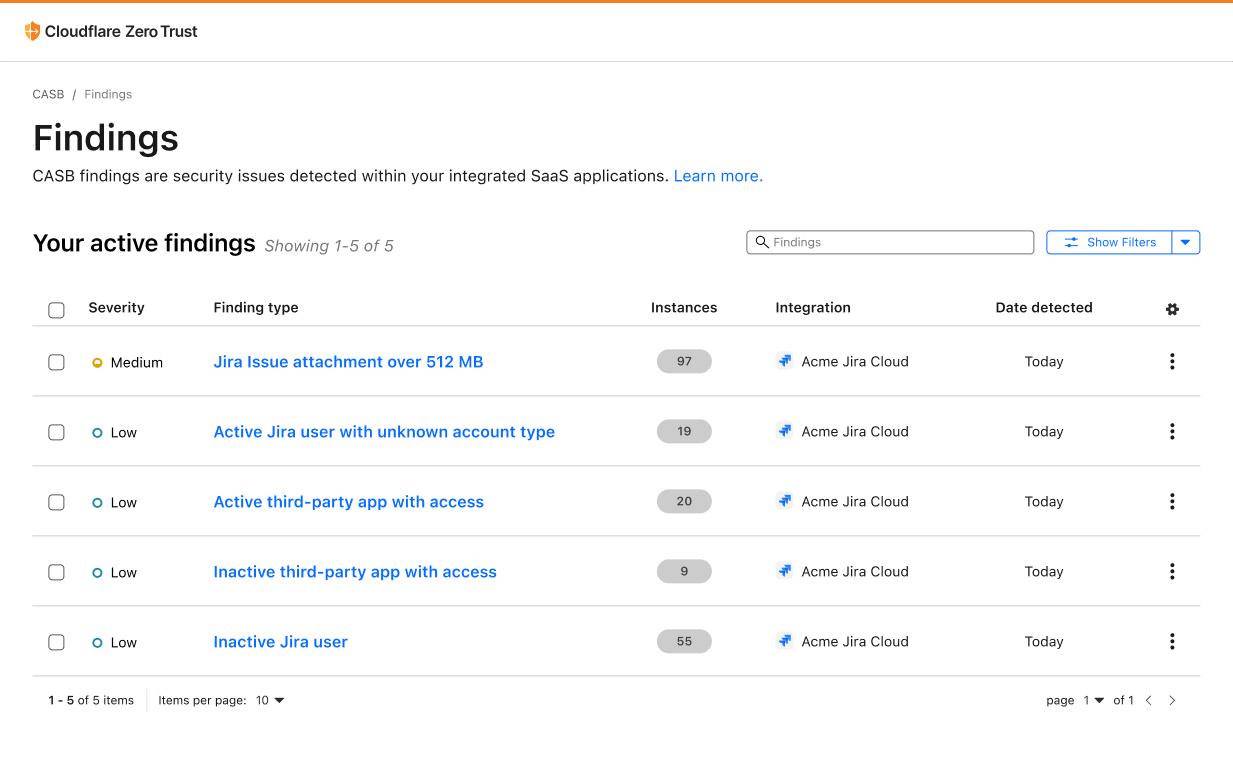
The state of application security in 2023

API traffic insights

Just like our Bot Management solution, we are also investing heavily in tools to protect API endpoints. This is because a lot of HTTP traffic is API related. In fact, if you count only HTTP requests that reach the origin and are not cacheable, up to 55% of traffic is API related, as per the definition stated earlier. This is the same methodology used in last year’s report, and the 55% figure remains unchanged year-over-year.

If we look at cached HTTP requests only (those with a cache status of HIT, UPDATING, REVALIDATED and EXPIRED) we find that, maybe surprisingly, nearly 7% is API related. Modern API endpoint implementations and proxy systems, including our own API Gateway/caching feature set, in fact, allow for very flexible cache logic allowing both caching on custom keys as well as quick cache revalidation (as often as every second) allowing developers to reduce load on back end endpoints.

Including cacheable assets and other requests in the total count, such as redirects, the number goes down, but is still 25% of traffic. In the graph below we provide both perspectives on API traffic:

  • Yellow line: % of API traffic against all HTTP requests. This will include redirects, cached assets and all other HTTP requests in the total count;
  • Blue line: % of API traffic against dynamic traffic returning HTTP 200 OK response code only;
The state of application security in 2023

65% of global API traffic is generated by browsers

A growing number of web applications nowadays are built “API first”. This means that the initial HTML page load only provides the skeleton layout, and most dynamic components and data are loaded via separate API calls (for example, via AJAX). This is the case for Cloudflare’s own dashboard. This growing implementation paradigm is visible when analyzing the bot scores for API traffic. We can see in the figure below that a large amount of API traffic is generated by user-driven browsers classified as “human” by our system, with nearly two-thirds of it clustered at the high end of the “human” range.

The state of application security in 2023

Calculating mitigated API traffic is challenging, as we don’t forward the request to origin servers, and therefore cannot rely on the response content type. Applying the same calculation that was used last year, a little more than 2% of API traffic is mitigated, down from 10.2% last year.

HTTP Anomaly surpasses SQLi as most common attack vector on API endpoints

Compared to last year, HTTP anomalies now surpass SQLi as the most popular attack vector attempted against API endpoints (note the blue line being higher at the start of the graph just when last year’s report was published). Attack vectors on API traffic are not consistent throughout the year and show more variation as compared to global HTTP traffic. For example, note the spike in file inclusion attack attempts in early 2023.

The state of application security in 2023

Exploring account takeover attacks

Since March 2021, Cloudflare has provided a leaked credential check feature as part of its WAF. This allows customers to be notified (via an HTTP request header) whenever an authentication request is detected with a username/password pair that is known to be leaked. This tends to be an extremely effective signal at detecting botnets performing account takeover brute force attacks.

Customers also use this signal, on valid username/password pair login attempts, to issue two factor authentication, password reset, or in some cases, increased logging in the event the user is not the legitimate owner of the credentials.

Brute force account takeover attacks are increasing

If we look at the trend of matched requests over the past 12 months, an increase is noticeable starting in the latter half of 2022, indicating growing fraudulent activity against login endpoints. During large brute force attacks we have observed matches against HTTP requests with leaked credentials at a rate higher than 12k per minute.

The state of application security in 2023

Our leaked credential check feature has rules matching authentication requests for the following systems:

  • Drupal
  • Ghost
  • Joomla
  • Magento
  • Plone
  • WordPress
  • Microsoft Exchange
  • Generic rules matching common authentication endpoint formats

This allows us to compare activity from malicious actors, normally in the form of botnets, attempting to “break into” potentially compromised accounts.

Microsoft Exchange is attacked more than WordPress

Mostly due to its popularity, you might expect WordPress to be the application most at risk and/or observing most brute force account takeover traffic. However, looking at rule matches from the supported systems listed above, we find that after our generic signatures, the Microsoft Exchange signature is the most frequent match.

Most applications experiencing brute force attacks tend to be high value assets, and Exchange accounts being the most likely targeted according to our data reflects this trend.

If we look at leaked credential match traffic by source country, the United States leads by a fair margin. Potentially notable is the absence of China in top contenders given network size. The only exception is Ukraine leading during the first half of 2022 towards the start of the war — the yellow line seen in the figure below.

The state of application security in 2023

Looking forward

Given the amount of web traffic carried by Cloudflare, we observe a broad spectrum of attacks. From HTTP anomalies, SQL injection attacks, and cross-site scripting (XSS) to account takeover attempts and malicious bots, the threat landscape is constantly changing. As such, it is critical that any business operating online is investing in visibility, detection, and mitigation technologies so that they can ensure their applications, and more importantly, their end user’s data, remains safe.

We hope that you found the findings in this report interesting, and at the very least, gave you an appreciation on the state of application security on the Internet. There are a lot of bad actors online, and there is no indication that Internet security is getting easier.

We are already planning an update to this report including additional data and insights across our product portfolio. Keep an eye on Cloudflare Radar for more frequent application security reports and insights.

Adding Zero Trust signals to Sumo Logic for better security insights

Post Syndicated from Corey Mahan original https://blog.cloudflare.com/zero-trust-signals-to-sumo-logic/

Adding Zero Trust signals to Sumo Logic for better security insights

Adding Zero Trust signals to Sumo Logic for better security insights

A picture is worth a thousand words and the same is true when it comes to getting visualizations, trends, and data in the form of a ready-made security dashboard.

Today we’re excited to announce the expansion of support for automated normalization and correlation of Zero Trust logs for Logpush in Sumo Logic’s Cloud SIEM. As a Cloudflare technology partner, Sumo Logic is the pioneer in continuous intelligence, a new category of software which enables organizations of all sizes to address the data challenges and opportunities presented by digital transformation, modern applications, and cloud computing.

The updated content in Sumo Logic Cloud SIEM helps joint Cloudflare customers reduce alert fatigue tied to Zero Trust logs and accelerates the triage process for security analysts by converging security and network data into high-fidelity insights. This new functionality complements the existing Cloudflare App for Sumo Logic designed to help IT and security teams gain insights, understand anomalous activity, and better trend security and network performance data over time.

Adding Zero Trust signals to Sumo Logic for better security insights

Deeper integration to deliver Zero Trust insights

Using Cloudflare Zero Trust helps protect users, devices, and data, and in the process can create a large volume of logs. These logs are helpful and important because they provide the who, what, when, and where for activity happening within and across an organization. They contain information such as what website was accessed, who signed in to an application, or what data may have been shared from a SaaS service.

Up until now, our integrations with Sumo Logic only allowed automated correlation of security signals for Cloudflare only included core services. While it’s critical to ensure collection of WAF and bot detection events across your fabric, extended visibility into Zero Trust components has now become more important than ever with the explosion of distributed work and adoption of hybrid and multi-cloud infrastructure architectures.

With the expanded Zero Trust logs now available in Sumo Logic Cloud SIEM, customers can now get deeper context into security insights thanks to the broad set of network and security logs produced by Cloudflare products:

“As a long time Cloudflare partner, we’ve worked together to help joint customers analyze events and trends from their websites and applications to provide end-to-end visibility and improve digital experiences. We’re excited to expand this partnership to provide real-time insights into the Zero Trust security posture of mutual customers in Sumo Logic’s Cloud SIEM.”
– John Coyle – Vice President of Business Development, Sumo Logic

How to get started

To take advantage of the suite of integrations available for Sumo Logic and Cloudflare logs available via Logpush, first enable Logpush to Sumo Logic, which will ship logs directly to Sumo Logic’s cloud-native platform. Then, install the Cloudflare App and (for Cloud SIEM customers) enable forwarding of these logs to Cloud SIEM for automated normalization and correlation of security insights.

Note that Cloudflare’s Logpush service is only available to Enterprise customers. If you are interested in upgrading, please contact us here.

  1. Enable Logpush to Sumo Logic
    Cloudflare Logpush supports pushing logs directly to Sumo Logic via the Cloudflare dashboard or via API.
  2. Install the Cloudflare App for Sumo Logic
    Locate and install the Cloudflare app from the App Catalog, linked above. If you want to see a preview of the dashboards included with the app before installing, click Preview Dashboards. Once installed, you can now view key information in the Cloudflare Dashboards for all core services.
  3. (Cloud SIEM Customers) Forward logs to Cloud SIEM
    After the steps above, enable the updated parser for Cloudflare logs by adding the _parser field to your S3 source created when installing the Cloudflare App.

What’s next

As more organizations move towards a Zero Trust model for security, it’s increasingly important to have visibility into every aspect of the network with logs playing a crucial role in this effort.

If your organization is just getting started and not already using a tool like Sumo Logic, Cloudflare R2 for log storage is worth considering. Cloudflare R2 offers a scalable, cost-effective solution for log storage.

We’re excited to continue closely working with technology partners to expand existing and create new integrations that help customers on their Zero Trust journey.

Cloudflare One DLP integrates with Microsoft Information Protection labels

Post Syndicated from Noelle Kagan original https://blog.cloudflare.com/cloudflare-dlp-mip/

Cloudflare One DLP integrates with Microsoft Information Protection labels

Cloudflare One DLP integrates with Microsoft Information Protection labels

The crown jewels for an organization are often data, and the first step in protection should be locating where the most critical information lives. Yet, maintaining a thorough inventory of sensitive data is harder than it seems and generally a massive lift for security teams. To help overcome data security troubles, Microsoft offers their customers data classification and protection tools. One popular option are the sensitivity labels available with Microsoft Purview Information Protection. However, customers need the ability to track sensitive data movement even as it migrates beyond the visibility of Microsoft.

Today, we are excited to announce that Cloudflare One now offers Data Loss Prevention (DLP) detections for Microsoft Purview Information Protection labels. Simply integrate with your Microsoft account, retrieve your labels, and build rules to guide the movement of your labeled data. This extends the power of Microsoft’s labels to any of your corporate traffic in just a few clicks.

Data Classification with Microsoft Labels

Every organization has a wealth of data to manage, from publicly accessible data, like documentation, to internal data, like the launch date of a new product. Then, of course, there is the data requiring the highest levels of protection, such as customer PII. Organizations are responsible for confining data to the proper destinations while still supporting accessibility and productivity, which is no small feat.

Microsoft Purview Information Protection offers sensitivity labels to let you classify your organization’s data. With these labels, Microsoft provides the ability to protect sensitive data, while still enabling productivity and collaboration. Sensitivity labels can be used in a number of Microsoft applications, which includes the ability to apply the labels to Microsoft Office documents. The labels correspond to the sensitivity of the data within the file, such as Public, Confidential, or Highly Confidential.

Cloudflare One DLP integrates with Microsoft Information Protection labels

The labels are embedded in a document’s metadata and are preserved even when it leaves the Microsoft environment, such as a download from OneDrive.

Sync Cloudflare One and Microsoft Information Protection

Cloudflare One, our SASE platform that delivers network-as-a-service (NaaS) with Zero Trust security natively built-in, connects users to enterprise resources, and offers a wide variety of opportunities to secure corporate traffic, including the inspection of data moving across the Microsoft productivity suite. We’ve designed Cloudflare One to act as a single pane of glass for your organization. This means that after you’ve deployed any of our Zero Trust services, whether that be Zero Trust Network Access or Secure Web Gateway, you are clicks, not months, away from deploying Data Loss Prevention, Cloud Access Security Broker, Email Security, and Browser Isolation to enhance your Microsoft security and overall data protection.

Specifically, Cloudflare’s API-driven Cloud Access Security Broker (CASB) can scan SaaS applications like Microsoft 365 for misconfigurations, unauthorized user activity, shadow IT, and other data security issues that can occur after a user has successfully logged in.

With this new integration, CASB can now also retrieve Information Protection labels from your Microsoft account. If you have labels configured, upon integration, CASB will automatically populate the labels into a Data Loss Prevention profile.

Cloudflare One DLP integrates with Microsoft Information Protection labels

DLP profiles are the building blocks for applying DLP scanning. They are where you identify the sensitive data you want to protect, such as Microsoft labeled data, credit card numbers, or custom keywords. Your labels are stored as entries within the Microsoft Purview Information Protection Sensitivity Labels profile using the name of your CASB integration. You can also add the labels to custom DLP profiles, of  fering more detection flexibility.

Build DLP Rules

You can now extend the power of Microsoft’s labels to protect your data as it moves to other platforms. By building DLP rules, you determine how labeled data can move around and out of your corporate network. Perhaps you don’t want to allow Highly Confidential labels to be downloaded from your OneDrive account, or you don’t want any data more sensitive than Confidential to be uploaded to file sharing sites that you don’t use. All of this can be implemented using DLP and Cloudflare Gateway.

Simply navigate to your Gateway Firewall Policies and start implementing building rules using your DLP profiles:

Cloudflare One DLP integrates with Microsoft Information Protection labels

How to Get Started

To get access to DLP, reach out for a consultation, or contact your account manager.

The collective thoughts of the interwebz