One does not normally expect a lot of controversy around a patch series
that makes changes to platform-specific configurations and drivers.
The furor over some work on the Samsung Exynos platform may thus be
surprising. When one looks into the discussion, things become more clear;
it mostly has to do with disagreements over the best ways to get hardware
vendors to cooperate with the kernel development community.
with Dr. Malte Polley (HDI Systeme AG – Cloud Solutions Architect)
At HDI, one of the biggest European insurance group companies, we use AWS to build new services and capabilities and delight our customers. Working in the financial services industry, the company has to comply with numerous regulatory requirements in the areas of data protection and FSI regulations such as GDPR, German Supervisory Requirements for IT (VAIT) and Supervision of Insurance Undertakings (VAG). The same security and compliance assessment process in the cloud supports development productivity and organizational agility, and helps our teams innovate at a high pace and meet the growing demands of our internal and external customers.
In this post, we explore how HDI adopted AWS security and compliance best practices. We describe implementation of automated security and compliance monitoring of AWS resources using a combination of AWS and open-source solutions. We also go through the steps to implement automated security findings remediation and address continuous deployment of new security controls.
Background
Data analytics is the key capability for understanding our customers’ needs, driving business operations improvement, and developing new services, products, and capabilities for our customers. We needed a cloud-native data platform of virtually unlimited scale that offers descriptive and prescriptive analytics capabilities to internal teams with a high innovation pace and short experimentation cycles. One of the success metrics in our mission is time to market, therefore it’s important to provide flexibility to internal teams to quickly experiment with new use cases. At the same time, we’re vigilant about data privacy. Having a secure and compliant cloud environment is a prerequisite for every new experiment and use case on our data platform.
Cloud security and compliance implementation in the cloud is a shared effort between the Cloud Center of Competence team (C3), the Network Operation Center (NoC), and the product and platform teams. The C3 team is responsible for new AWS account provisioning, account security, and compliance baseline setup. Cross-account networking configuration is established and managed by the NoC team. Product teams are responsible for AWS services configuration to meet their requirements in the most efficient way. Typically, they deploy and configure infrastructure and application stacks, including the following:
We were looking for security controls model that would allow us to continuously monitor infrastructure and application components set up by all the teams. The model also needed to support guardrails that allowed product teams to focus on new use case implementation, but also inherited the security and compliance best practices promoted and ensured within our company.
Security and compliance baseline definition
We started with the AWS Well-Architected Framework Security Pillar whitepaper, which provides implementation guidance on the essential areas of security and compliance in the cloud, including identity and access management, infrastructure security, data protection, detection, and incident response. Although all five elements are equally important for implementing enterprise-grade security and compliance in the cloud, we saw an opportunity to improve controls of on-premises environments by automating detection and incident response elements. The continuous monitoring of AWS infrastructure and application changes complemented by the automated incident response of the security baseline helps us foster security best practices and allows for a high innovation pace. Manual security reviews are no longer required to asses security posture.
Our security and compliance controls framework is based on GDPR and several standards and programs, including ISO 27001, C5. Translation of the controls framework into the security and compliance baseline definition in the cloud isn’t always straightforward, so we use a number of guidelines. As a starting point, we use CIS Amazon Web Services benchmarks, because it’s a prescriptive recommendation and its controls cover multiple AWS security areas, including identity and access management, logging and monitoring configuration, and network configuration. CIS benchmarks are industry-recognized cyber security best practices and recommendations that cover a wide range of technology families, and are used by enterprise organizations around the world. We also apply GDPR compliance on AWS recommendations and AWS Foundational Security Best Practices, extending controls recommended by CIS AWS Foundations Benchmarks in multiple control areas: inventory, logging, data protection, access management, and more.
Security controls implementation
AWS provides multiple services that help implement security and compliance controls:
AWS CloudTrail provides a history of events in an AWS account, including those originating from command line tools, AWS SDKs, AWS APIs, or the AWS Management Console. In addition, it allows exporting event history for further analysis and subscribing to specific events to implement automated remediation.
AWS Config allows you to monitor AWS resource configuration, and automatically evaluate and remediate incidents related to unexpected resources configuration. AWS Config comes with pre-built conformance pack sample templates designed to help you meet operational best practices and compliance standards.
Amazon GuardDuty provides threat detection capabilities that continuously monitor network activity, data access patterns, and account behavior.
With multiple AWS services to use as building blocks for continuous monitoring and automation, there is a strong need for a consolidated findings overview and unified remediation framework. This is where AWS Security Hub comes into play. Security Hub provides built-in security standards and controls that make it easy to enable foundational security controls. Then, Security Hub integrates with CloudTrail, AWS Config, GuardDuty, and other AWS services out of the box, which eliminates the need to develop and maintain integration code. Security Hub also accepts findings from third-party partner products and provides APIs for custom product integration. Security Hub significantly reduces the effort to consolidate audit information coming from multiple AWS-native and third-party channels. Its API and supported partner products ecosystem gave us confidence that we can adhere to changes in security and compliance standards with low effort.
While AWS provides a rich set of services to manage risk at the Three Lines Model, we were looking for wider community support in maintaining and extending security controls beyond those defined by CIS benchmarks and compliance and best practices recommendations on AWS. We came across Prowler, an open-source tool focusing on AWS security assessment and auditing and infrastructure hardening. Prowler implements CIS AWS benchmark controls and has over 100 additional checks. We appreciated Prowler providing checks that helped us meet GDPR and ISO 27001 requirements, specifically. Prowler delivers assessment reports in multiple formats, which makes it easy to implement reporting archival for future auditing needs. In addition, Prowler integrates well with Security Hub, which allows us to use a single service for consolidating security and compliance incidents across a number of channels.
We came up with the solution architecture depicted in the following diagram.
Automated remediation solution architecture HDI
Let’s look closely into the most critical components of this solution.
Prowler is a command line tool that uses the AWS Command Line Interface (AWS CLI) and a bash script. Individual Prowler checks are bash scripts organized into groups by compliance standard or AWS service. By supplying corresponding command line arguments, we can run Prowler against a specific AWS Region or multiple Regions at the same time. We can run Prowler in multiple ways; we chose to run it as an AWS Fargate task for Amazon Elastic Container Service (Amazon ECS). Fargate is a serverless compute engine that runs Docker-compatible containers. ECS Fargate tasks are scheduled tasks that make it easy to perform periodic assessments of an AWS account and export findings. We configured Prowler to run every 7 days in every account and Region it’s deployed into.
Security Hub acts as a single place for consolidating security findings from multiple sources. When Security Hub is enabled in a given Region, CIS AWS Foundations Benchmark and Foundational Security Best Practices standards are enabled as well. Enabling these standards also configures integration with AWS Config and Guard Duty. Integration with Prowler requires enabling product integration on the Security Hub side by calling the EnableImportFindingsForProduct API action for a given product. Because Prowler supports integration with Security Hub out of the box, posting security findings is a matter of passing the right command line arguments: -M json-asff to format reports as AWS Security Findings Format and -S to ship findings to Security Hub.
Automated security findings remediation is implemented using AWS Lambda functions and the AWS SDK for Python (Boto3). The remediation function can be triggered in two ways: automatically in response to a new security finding, or by a security engineer from the Security Hub findings page. In both cases, the same Lambda function is used. Remediation functions implement security standards in accordance with recommendations, whether they’re CIS AWS Foundations Benchmark and Foundational Security Best Practices standards, or others.
The exact activities performed depend on the security findings type and its severity. Examples of activities performed include deleting non-rotated AWS Identity and Access Management (IAM) access keys, enabling server-side encryption for S3 buckets, and deleting unencrypted Amazon Elastic Block Store (Amazon EBS) volumes.
To trigger the Lambda function, we use Amazon EventBridge, which makes it easy to build an event-driven remediation engine and allows us to define Lambda functions as targets for Security Hub findings and custom actions. EventBridge allows us to define filters for security findings and therefore map finding types to specific remediation functions. Upon successfully performing security remediation, each function updates one or more Security Hub findings by calling the BatchUpdateFindings API and passing the corresponding finding ID.
The following example code shows a function enforcing an IAM password policy:
import boto3
import os
import logging
from botocore.exceptions import ClientError

iam = boto3.client("iam")
securityhub = boto3.client("securityhub")

log_level = os.environ.get("LOG_LEVEL", "INFO")
logging.root.setLevel(logging.getLevelName(log_level))
logger = logging.getLogger(__name__)


def lambda_handler(event, context, iam=iam, securityhub=securityhub):
    """Remediate findings related to cis15 and cis11.

    Params:
        event: Lambda event object
        context: Lambda context object
        iam: iam boto3 client
        securityhub: securityhub boto3 client
    Returns:
        No returns
    """
    finding_id = event["detail"]["findings"][0]["Id"]
    product_arn = event["detail"]["findings"][0]["ProductArn"]
    lambda_name = os.environ["AWS_LAMBDA_FUNCTION_NAME"]
    try:
        iam.update_account_password_policy(
            MinimumPasswordLength=14,
            RequireSymbols=True,
            RequireNumbers=True,
            RequireUppercaseCharacters=True,
            RequireLowercaseCharacters=True,
            AllowUsersToChangePassword=True,
            MaxPasswordAge=90,
            PasswordReusePrevention=24,
            HardExpiry=True,
        )
        logger.info("IAM Password Policy Updated")
    except ClientError as e:
        logger.exception(e)
        raise e
    try:
        securityhub.batch_update_findings(
            FindingIdentifiers=[{"Id": finding_id, "ProductArn": product_arn},],
            Note={
                "Text": "Changed non compliant password policy",
                "UpdatedBy": lambda_name,
            },
            Workflow={"Status": "RESOLVED"},
        )
    except ClientError as e:
        logger.exception(e)
        raise e
A key aspect in developing remediation Lambda functions is testability. To quickly iterate through testing cycles, we cover each remediation function with unit tests, in which necessary dependencies are mocked and replaced with stub objects. Because no Lambda deployment is required to check remediation logic, we can test newly developed functions and ensure reliability of existing ones in seconds.
Each Lambda function developed is accompanied with an event.json document containing an example of an EventBridge event for a given security finding. A security finding event allows us to verify remediation logic precisely, including deletion or suspension of non-compliant resources or a finding status update in Security Hub and the response returned. Unit tests cover both successful and erroneous remediation logic. We use pytest to develop unit tests, and botocore.stub and moto to replace runtime dependencies with mocks and stubs.
Automated security findings remediation
The following diagram illustrates our security assessment and automated remediation process.
The workflow includes the following steps:
An existing Security Hub integration performs periodic resource audits. The integration posts new security findings to Security Hub.
Security Hub reports the security incident to the company’s centralized Service Now instance by using the Service Now ITSM Security Hub integration.
Security Hub triggers automated remediation:
Security Hub triggers the remediation function by sending an event to EventBridge. The event has a source field equal to aws.securityhub, with the filter ID corresponding to the specific finding type and compliance status as FAILED. The combination of these fields allows us to map the event to a particular remediation function.
The remediation function starts processing the security finding event.
The function calls the UpdateFindings Security Hub API to update the security finding status upon completing remediation.
Security Hub updates the corresponding security incident status in Service Now (Step 2)
Alternatively, the security operations engineer resolves the security incident in Service Now:
The engineer reviews the current security incident in Service Now.
The engineer manually resolves the security incident in Service Now.
Service Now updates the finding status by calling the UpdateFindings Security Hub API. Service Now uses the AWS Service Management Connector.
Alternatively, the platform security engineer triggers remediation:
The engineer reviews the currently active security findings on the Security Hub findings page.
The engineer triggers remediation from the security findings page by selecting the appropriate action.
Security Hub triggers the remediation function by sending an event with the source aws.securityhub to EventBridge. The automated remediation flow continues as described in the Step 3.
Deployment automation
Due to legal requirements, HDI uses the infrastructure as code (IaC) principle while defining and deploying AWS infrastructure. We started with AWS CloudFormation templates defined as YAML or JSON format. The templates are static by nature and define resources in a declarative way. We figured out that as our solution complexity grows, the CloudFormation templates also grow in size and complexity, because all the resources deployed have to be explicitly defined. We wanted a solution to increase our development productivity and simplify infrastructure definition.
The AWS CDK provides ready-to-use building blocks called constructs. These constructs include pre-configured AWS services following best practices. For example, a Lambda function always gets an IAM role with an IAM policy to be able to write logs to CloudWatch Logs.
The AWS CDK allows us to use high-level programming languages to define configuration of all AWS services. Imperative definition allows us to build our own abstractions and reuse them to achieve concise resource definition.
We found that implementing IaC with the AWS CDK is faster and less error-prone. At HDI, we use Python to build application logic and define AWS infrastructure. The imperative nature of the AWS CDK is truly a turning point in fulfilling legal requirements and achieving high developer productivity at the same time.
One of the AWS CDK constructs we use is AWS CDK pipeline. This construct creates a customizable continuous integration and continuous delivery (CI/CD) pipeline implemented with AWS CodePipeline. The source action is based on AWS CodeCommit. The synth action is responsible for creating a CloudFormation template from the AWS CDK project. The synth action also runs unit tests on remediations functions. The pipeline actions are connected via artifacts. Lastly, the AWS CDK pipeline constructs offer a self-mutating feature, which allows us to maintain the AWS CDK project as well as the pipeline in a single code repository. Changes of the pipeline definition as well as automated remediation solutions are deployed seamlessly. The actual solution deployment is also implemented as a CI/CD stage. Stages can be eventually deployed in cross-Region and cross-account patterns. To use cross-account deployments, the AWS CDK provides a bootstrap functionality to create a trust relationship between AWS accounts.
The AWS CDK project is broken down to multiple stacks. To deploy the CI/CD pipeline, we run the cdk deploy cicd-4-securityhub command. To add a new Lambda remediation function, we must add remediation code, optional unit tests, and finally the Lambda remediation configuration object. This configuration object defines the Lambda function’s environment variables, necessary IAM policies, and external dependencies. See the following example code of this configuration:
Remediation functions are organized in accordance with the security and compliance frameworks they belong to. The AWS CDK code iterates over remediation definition lists and synthesizes corresponding policies and Lambda functions to be deployed later. Committing Git changes and pushing them triggers the CI/CD pipeline, which deploys the newly defined remediation function and adjusts the configuration of Prowler.
We are working on publishing the source code discussed in this blog post.
Looking forward
As we keep introducing new use cases in the cloud, we plan to improve our solution in the following ways:
Continuously add new controls based on our own experience and improving industry standards
Introduce cross-account security and compliance assessment by consolidating findings in a central security account
Improve automated remediation resiliency by introducing remediation failure notifications and retry queues
Working on the solution described in this post helped us improve our security posture and meet compliancy requirements in the cloud. Specifically, we were able to achieve the following:
Gain a shared understanding of security and compliance controls implementation as well as shared responsibilities in the cloud between multiple teams
Speed up security reviews of cloud environments by implementing continuous assessment and minimizing manual reviews
Provide product and platform teams with secure and compliant environments
Lay a foundation for future requirements and improvement of security posture in the cloud
The content and opinions in this post are those of the third-party author and AWS is not responsible for the content or accuracy of this post.
Security updates have been issued by Debian (apache2, mediawiki, neutron, and tiff), Fedora (chromium, dr_libs, firefox, and grafana), Mageia (apache), openSUSE (chromium and rabbitmq-server), Oracle (kernel), Red Hat (firefox and httpd24-httpd), SUSE (rabbitmq-server), and Ubuntu (libntlm).
To avoid recursive invocations between S3 and Lambda, it’s best practice to store the output of a process in a different resource from the source S3 bucket. However, it’s sometimes useful to store processed objects in the same source bucket. In this blog post, I show three different ways you can do this safely and provide other important tips if you use this approach.
The example applications use the AWS Serverless Application Model (AWS SAM), enabling you to deploy the applications more easily to your own AWS account. This walkthrough creates resources covered in the AWS Free Tier but usage beyond the Free Tier allowance may incur cost. To set up the examples, visit the GitHub repo and follow the instructions in the README.md file.
Overview
Infinite loops are not a new challenge for developers. Any programming language that supports looping logic has the capability to generate a program that never exits. However, in serverless applications, services can scale as traffic grows. This makes infinite loops more challenging since they can consume more resources.
In the case of the S3 to Lambda recursive invocation, a Lambda function writes an object to an S3 object. In turn, it invokes the same Lambda function via a put event. The invocation causes a second object to be written to the bucket, which invokes the same Lambda function, and so on:
If you trigger a recursive invocation loop accidentally, you can press the “Throttle” button in the Lambda console to scale the function concurrency down to zero and break the recursion cycle.
The most practical way to avoid this possibility is to use two S3 buckets. By writing an output object to a second bucket, this eliminates the risk of creating additional events from the source bucket. As shown in the first example in the repo, the two-bucket pattern should be the preferred architecture for most S3 object processing workloads:
If you need to write the processed object back to the source bucket, here are three alternative architectures to reduce the risk of recursive invocation.
(1) Using a prefix or suffix in the S3 event notification
When configuring event notifications in the S3 bucket, you can additionally filter by object key, using a prefix or suffix. Using a prefix, you can filter for keys beginning with a string, or belonging to a folder, or both. Only those events matching the prefix or suffix trigger an event notification.
For example, a prefix of “my-project/images” filters for keys in the “my-project” folder beginning with the string “images”. Similarly, you can use a suffix to match on keys ending with a string, such as “.jpg” to match JPG images. Prefixes and suffixes do not support wildcards so the strings provided are literal.
The AWS SAM template in this example shows how to define a prefix and suffix in an S3 event notification. Here, the S3 invokes the Lambda function if the key begins with ‘original/’ and ends with ‘.txt’:
You can then write back to the same bucket providing that the output key does not match the prefix or suffix used in the event notification. In the example, the Lambda function writes the same data to the same bucket but the output key does not include the ‘original/’ prefix.
To test this example with the AWS CLI, upload a sample text file to the S3 bucket:
aws s3 cp sample.txt s3://myS3bucketname
Shortly after, list the objects in the bucket. There is a second object with the same key with no folder name. The first uploaded object invoked the Lambda function due to the matching prefix. The second PutObject action without the prefix did not trigger an event notification and invoke the function.
Providing that your application logic can handle different prefixes and suffixes for source and output objects, this provides a way to use the same bucket for processed objects.
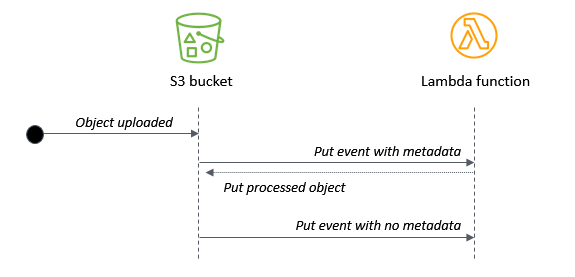
(2) Using object metadata to identify the original S3 object
If you need to ensure that the source object and processed object have the same key, configure user-defined metadata to differentiate between the two objects. When you upload S3 objects, you can set custom metadata values in the S3 console, AWS CLI, or AWS SDK.
In this design, the Lambda function checks for the presence of the metadata before processing. The Lambda handler in this example shows how to use the AWS SDK’s headObject method in the S3 API:
const AWS = require('aws-sdk')
AWS.config.region = process.env.AWS_REGION
const s3 = new AWS.S3()

exports.handler = async (event) => {
  await Promise.all(
    event.Records.map(async (record) => {
      try {
        // Decode URL-encoded key
        const Key = decodeURIComponent(record.s3.object.key.replace(/\+/g, " "))

        const data = await s3.headObject({
          Bucket: record.s3.bucket.name,
          Key
        }).promise()

        if (data.Metadata.original != 'true') {
          console.log('Exiting - this is not the original object.', data)
          return
        }

  // Do work ... /

      } catch (err) {
        console.error(err)
      }
    })
  )
}
To test this example with the AWS CLI, upload a sample text file to the S3 bucket using the “original” metatag:
Shortly after, list the objects in the bucket – the original object is overwritten during the Lambda invocation. The second S3 object causes another Lambda invocation but it exits due to the missing metadata.
This allows you to use the same bucket and key name for processed objects, but it requires that the application creating the original object can set object metadata. In this approach, the Lambda function is always invoked twice for each uploaded S3 object.
(3) Using an Amazon DynamoDB table to filter duplicate events
If you need the output object to have the same bucket name and key but you cannot set user-defined metadata, use this design:
In this example, there are two Lambda functions and a DynamoDB table. The first function writes the key name to the table. A DynamoDB stream triggers the second Lambda function which processes the original object. It writes the object back to the same source bucket. Because the same item is put to the DynamoDB table, this does not trigger a new DynamoDB stream event.
To test this example with the AWS CLI, upload a sample text file to the S3 bucket:
aws s3 cp sample.txt s3://myS3bucketname
Shortly after, list the objects in the bucket. The original object is overwritten during the Lambda invocation. The new S3 object invokes the first Lambda function again but the second function is not triggered. This solution allows you to use the same output key without user-defined metadata. However, it does introduce a DynamoDB table to the architecture.
  ## DynamoDB table
  DDBtable:
    Type: AWS::DynamoDB::Table
    Properties:
      AttributeDefinitions:
      - AttributeName: ID
        AttributeType: S
      KeySchema:
      - AttributeName: ID
        KeyType: HASH
      TimeToLiveSpecification:
        AttributeName: TimeToLive
        Enabled: true
      BillingMode: PAY_PER_REQUEST
      StreamSpecification:
        StreamViewType: NEW_IMAGE
When the first function writes the key name to the DynamoDB table, it also sets a TimeToLive attribute with a value of midnight on the next day:
        // Epoch timestamp set to next midnight
        const TimeToLive = new Date().setHours(24,0,0,0)

        // Create DynamoDB item
        const params = {
          TableName : process.env.DDBtable,
          Item: {
             ID: Key,
             TimeToLive
          }
        }
The DynamoDB service automatically expires items once the TimeToLive value has passed. In this example, if another object with the same key is stored in the S3 bucket before the TTL value, it does not trigger a stream event. This prevents the same object from being processed multiple times.
Comparing the three approaches
Depending upon the needs of your workload, you can choose one of these three approaches for storing processed objects in the same source S3 bucket:
1. Prefix/suffix
2. User-defined metadata
3. DynamoDB table
Output uses the same bucket
Y
Y
Y
Output uses the same key
N
Y
Y
User-defined metadata
N
Y
N
Lambda invocations per object
1
2
2 for an original object. 1 for a processed object.
Monitoring applications for recursive invocation
Whenever you have a Lambda function writing objects back to the same S3 bucket that triggered the event, it’s best practice to limit the scaling in the development and testing phases.
Use reserved concurrency to limit a function’s scaling, for example. Setting the function’s reserved concurrency to a lower limit prevents the function from scaling concurrently beyond that limit. It does not prevent the recursion, but limits the resources consumed as a safety mechanism.
Additionally, you should monitor the Lambda function to make sure the logic works as expected. To do this, use Amazon CloudWatch monitoring and alarming. By setting an alarm on a function’s concurrency metric, you can receive alerts if the concurrency suddenly spikes and take appropriate action.
Conclusion
The S3-to-Lambda integration is a foundational building block of many serverless applications. It’s best practice to store the output of the Lambda function in a different bucket or AWS resource than the source bucket.
In cases where you need to store the processed object in the same bucket, I show three different designs to help minimize the risk of recursive invocations. You can use event notification prefixes and suffixes or object metadata to ensure the Lambda function is not invoked repeatedly. Alternatively, you can also use DynamoDB in cases where the output object has the same key.
To learn more about best practices when using S3 to Lambda, see the Lambda Operator Guide. For more serverless learning resources, visit Serverless Land.
Jörg Schilling, a longtime free-software developer, has passed on. Most
people will remember him from his work on cdrtools and the seemingly endless drama that surrounded that
work. He was a difficult character to deal with, but he also contributed
some important code that, for a period, almost all of us depended on. Rest
well, Jörg.
Sometimes customers want to use their email domain with Amazon Simples Email Service (Amazon SES) across multiple accounts, or the same account but across multiple regions.
For example, AnyCompany is an insurance company with marketing and operations business units. The operations department sends transactional emails every time customers perform insurance simulations. The marketing department sends email advertisements to existing and prospective customers. Since they are different organizations inside AnyCompany, they want to have their own Amazon SES billing. At the same time, they still want to use the same AnyCompany domain.
Other use-cases include customers who want to setup multi-region redundancy, need to satisfy data residency requirements, or need to send emails on behalf of several different clients. In all of these cases, customers can use different regions, in the same or across different accounts.
This post shows how to verify and configure your domain on Amazon SES across multiple accounts or multiple regions.
Overview of solution
You can use the same domain with Amazon SES across multiple accounts or regions. Your options are: different accounts but the same region, different accounts and different regions, and the same account but different regions.
In all of these scenarios, you will have two SES instances running, each sending email for example.com domain – let’s call them SES1 and SES2. Every time you configure a domain in Amazon SES it will generate a series of DNS records you will have to add on your domain authoritative DNS server, which is unique for your domain. Those records are different for each SES instance.
You will need to modify your DNS to add one TXT record, with multiple values, for domain verification. If you decide to use DomainKeys Identified Mail (DKIM), you will modify your DNS to add six CNAME records, three records from each SES instance.
When you configure a domain on Amazon SES, you can also configure a MAIL FROM domain. If you decide to do so, you will need to modify your DNS to add one TXT record for Sender Policy Framework (SPF) and one MX record for bounce and complaint notifications that email providers send you.
Furthermore, your domain can be configured to support DMAC for email spoofing detection. It will rely on SPF or DKIM configured above. Below we walk you through these steps.
Verify domain You will take TXT values from both SES1 and SES2 instances and add them in DNS, so SES can validate you own the domain
Verify DomainKeys Identified Mail (DKIM) You will take CNAME values from both SES1 and SES2 instances and add them in DNS, so SES can verify DKIM for your domain
Complying with DMAC You will add a TXT value with DMAC policy that applies to your domain. This is not tied to any specific SES instance
Custom MAIL FROM Domain and SPF You will take TXT and MX records related from your MAIL FROM domain from both SES1 and SES2 instances and add them in DNS, so SES can comply with DMARC
Here is a sample matrix of the various configurations:
Two accounts, same region
Two accounts, different regions
One account, two regions
TXT records for domain verification*
1 record with multiple values
_amazonses.example.com = “VALUE FROM SES1” “VALUE FROM SES2”
CNAMES for DKIM verification
6 records, 3 from each SES instance
record1-SES1._domainkey.example.com = VALUE FROM SES1 record2-SES1._domainkey.example.com = VALUE FROM SES1 record3-SES1._domainkey.example.com = VALUE FROM SES1 record1-SES2._domainkey.example.com = VALUE FROM SES2 record2-SES2._domainkey.example.com = VALUE FROM SES2 record3-SES2._domainkey.example.com = VALUE FROM SES2
TXT record for DMARC
1 record. It is not related to SES instance or region
_dmarc.example.com = DMARC VALUE
MAIL FROM MX record to define message sender for SES
* Considering your DNS supports multiple values for a TXT record
Setup SES1 and SES2
In this blog, we call SES1 your primary or existing SES instance. We assume that you have already setup SES, but if not, you can still follow the instructions and setup both at the same time. The settings on SES2 will differ slightly, and therefore you will need to add new DNS entries to support the two-instance setup.
In this document we will use configurations from the “Verification,” “DKIM,” and “Mail FROM Domain” sections of the SES Domains screen and configure SES2 and setup DNS correctly for the two-instance configuration.
Verify domain
Amazon SES requires that you verify, in DNS, your domain, to confirm that you own it and to prevent others from using it. When you verify an entire domain, you are verifying all email addresses from that domain, so you don’t need to verify email addresses from that domain individually.
You can instruct multiple SES instances, across multiple accounts or regions to verify your domain. The process to verify your domain requires you to add some records in your DNS provider. In this post I am assuming Amazon Route 53 is an authoritative DNS server for example.com domain.
Verifying a domain for SES purposes involves initiating the verification in SES console, and adding DNS records and values to confirm you have ownership of the domain. SES will automatically check DNS to complete the verification process. We assume you have done this step for SES1 instance, and have a _amazonses.example.com TXT record with one value already in your DNS. In this section you will add a second value, from SES2, to the TXT record. If you do not have SES1 setup in DNS, complete these steps twice, once for SES1 and again for SES2. This will prove to both SES instances that you own the domain and are entitled to send email from them.
Initiate Verification in SES Console
Just like you have done on SES1, in the second SES instance (SES2) initiate a verification process for the same domain; in our case example.com
In the navigation pane, under Identity Management, choose Domains.
Choose Verify a New Domain.
In the Verify a New Domain dialog box, enter the domain name (i.e. example.com).
If you want to set up DKIM signing for this domain, choose Generate DKIM Settings.
Click on Verify This Domain.
In the Verify a New Domain dialog box, you will see a Domain Verification Record Set containing a Name, a Type, and a Value. Copy Name and Value and store them for the step below, where you will add this value to DNS. (This information is also available by choosing the domain name after you close the dialog box.)
To complete domain verification, add a TXT record with the displayed Name and Value to your domain’s DNS server. For information about Amazon SES TXT records and general guidance about how to add a TXT record to a DNS server, see Amazon SES domain verification TXT records.
Add DNS Values for SES2
To complete domain verification for your second account, edit current _amazonses TXT record and add the Value from the SES2 to it. If you do not have an _amazonses TXT record create it, and add the Domain Verification values from both SES1 and SES2 to it. We are showing how to add record to Route 53 DNS, but the steps should be similar in any DNS management service you use.
Choose the _amazonses TXT record you created when you verified your domain for SES1.
Under Record details, choose Edit record.
In the Value box, go to the end of the existing attribute value, and then press Enter.
Add the attribute value for the additional account or region.
Choose Save.
To validate, run the following command: dig TXT _amazonses.example.com +short
You should see the two values returned: "4AjLMzUu4nSjrz4QVqDD8rXq8X2AHr+JhGSl4foiMmU=" "abcde12345Sjrz4QVqDD8rXq8X2AHr+JhGSl4foiMmU="
Please note:
if your DNS provider does not allow underscores in record names, you can omit _amazonses from the Name.
to help you easily identify this record within your domain’s DNS settings, you can optionally prefix the Value with “amazonses:”.
some DNS providers automatically append the domain name to DNS record names. To avoid duplication of the domain name, you can add a period to the end of the domain name in the DNS record. This indicates that the record name is fully qualified and the DNS provider need not append an additional domain name.
if your DNS server does not support two values for a TXT record, you can have one record named _amazonses.example.com and another one called example.com.
Finally, after some time SES will complete its validation of the domain name and you should see the “pending validation” change to “verified”.
Verify DKIM
DomainKeys Identified Mail (DKIM) is a standard that allows senders to sign their email messages with a cryptographic key. Email providers then use these signatures to verify that the messages weren’t modified by a third party while in transit.
An email message that is sent using DKIM includes a DKIM-Signature header field that contains a cryptographically signed representation of the message. A provider that receives the message can use a public key, which is published in the sender’s DNS record, to decode the signature. Email providers then use this information to determine whether messages are authentic.
When you enable DKIM it generates CNAME records you need to add into your DNS. As it generates different values for each SES instance, you can use DKIM with multiple accounts and regions.
To complete the DKIM verification, copy the three (3) DKIM Names and Values from SES1 and three (3) from SES2 and add them to your DNS authoritative server as CNAME records.
You will know you are successful because, after some time SES will complete the DKIM verification and the “pending verification” will change to “verified”.
Configuring for DMARC compliance
Domain-based Message Authentication, Reporting and Conformance (DMARC) is an email authentication protocol that uses Sender Policy Framework (SPF) and/or DomainKeys Identified Mail (DKIM) to detect email spoofing. In order to comply with DMARC, you need to setup a “_dmarc” DNS record and either SPF or DKIM, or both. The DNS record for compliance with DMARC is setup once per domain, but SPF and DKIM require DNS records for each SES instance.
Setup “_dmarc” record in DNS for your domain; one time per domain. See instructions here
To validate it, run the following command: dig TXT _dmarc.example.com +short "v=DMARC1;p=quarantine;pct=25;rua=mailto:[email protected]"
For DKIM and SPF follow the instructions below
Custom MAIL FROM Domain and SPF
Sender Policy Framework (SPF) is an email validation standard that’s designed to prevent email spoofing. Domain owners use SPF to tell email providers which servers are allowed to send email from their domains. SPF is defined in RFC 7208.
To comply with Sender Policy Framework (SPF) you will need to use a custom MAIL FROM domain. When you enable MAIL FROM domain in SES console, the service generates two records you need to configure in your DNS to document who is authorized to send messages for your domain. One record is MX and another TXT; see screenshot for mail.example.com. Save these records and enter them in your DNS authoritative server for example.com.
In the navigation pane, under Identity Management, choose Domains.
In the list of domains, choose the domain and proceed to the next step.
Under MAIL FROM Domain, choose Set MAIL FROM Domain.
On the Set MAIL FROM Domain window, do the following:
For MAIL FROM domain, enter the subdomain that you want to use as the MAIL FROM domain. In our case mail.example.com.
For Behavior if MX record not found, choose one of the following options:
Use amazonses.com as MAIL FROM – If the custom MAIL FROM domain’s MX record is not set up correctly, Amazon SES will use a subdomain of amazonses.com. The subdomain varies based on the AWS Region in which you use Amazon SES.
Reject message – If the custom MAIL FROM domain’s MX record is not set up correctly, Amazon SES will return a MailFromDomainNotVerified error. Emails that you attempt to send from this domain will be automatically rejected.
Click Set MAIL FROM Domain.
You will need to complete this step on SES1, as well as SES2. The MAIL FROM records are regional and you will need to add them both to your DNS authoritative server.
Set MAIL FROM records in DNS
From both SES1 and SES2, take the MX and TXT records provided by the MAIL FROM configuration and add them to the DNS authoritative server. If SES1 and SES2 are in the same region (us-east-1 in our example) you will publish exactly one MX record (mail.example.com in our example) into DNS, pointing to endpoint for that region. If SES1 and SES2 are in different regions, you will create two different records (mail1.example.com and mail2.example.com) into DNS, each pointing to endpoint for specific region.
Verify MX record
Example of MX record where SES1 and SES2 are in the same region
On both SES instances (SES1 and SES2), check that validations are complete. In the SES Console:
In Verification section, Status should be “verified” (in green color)
In DKIM section, DKIM Verification Status should be “verified” (in green color)
In MAIL FROM Domain section, MAIL FROM domain status should be “verified” (in green color)
If you have it all verified on both accounts or regions, it is correctly configured and ready to use.
Conclusion
In this post, we explained how to verify and use the same domain for Amazon SES in multiple account and regions and maintaining the DMARC, DKIM and SPF compliance and security features related to email exchange.
While each customer has different necessities, Amazon SES is flexible to allow customers decide, organize, and be in control about how they want to uses Amazon SES to send email.
Author bio
Leonardo Azize Martins is a Cloud Infrastructure Architect at Professional Services for Public Sector.
His background is on development and infrastructure for web applications, working on large enterprises.
When not working, Leonardo enjoys time with family, read technical content, watch movies and series, and play with his daughter.
Contributor
Daniel Tet is a senior solutions architect at AWS specializing in Low-Code and No-Code solutions. For over twenty years, he has worked on projects for Franklin Templeton, Blackrock, Stanford Children’s Hospital, Napster, and Twitter. He has a Bachelor of Science in Computer Science and an MBA. He is passionate about making technology easy for common people; he enjoys camping and adventures in nature.
As highlighted yesterday, research efforts at Cloudflare have been growing over the years as well as their scope. Cloudflare Research is proud to support computer science research to help build a better Internet, and we want to tell you where you can learn more about our efforts and how to get in touch.
Why are we announcing a website for Cloudflare Research?
Cloudflare is built on a foundation of open standards which are the result of community consensus and research. Research is integral to Cloudflare’s mission as is the commitment to contribute back to the research and standards communities by establishing and maintaining a growing number of collaborations.
Throughout the years we have cherished many collaborations and one-on-one relationships, but we have probably been missing a lot of interesting work happening elsewhere. This is our main motivation for this Research hub of information: to help us build further collaborations with industrial and academic research groups, and individuals across the world. We are eager to interface more effectively with the wider research and standards communities: practitioners, researchers and educators. And as for you, dear reader, we encourage you to recognize that you are our audience too: we often hear that Cloudflare’s commitment to sharing technical writing and resources is very attractive to many. This site also hopes to serve as a starting point for engagement with research that underpins development of the Internet.
We welcome you to reach out to us and share your ideas!
How we arrived at the site as it is
The opportunity to create a new website to share our growing library of information led us to an almost reflexive search for the right blog hosting system to fit the need. For our first prototype we gave the Docusaurus project a try. A few questions led us to evaluate our needs more carefully: does a static site need to use much JavaScript? Was an SPA (Single Page Application) the best fit and did we need to use a generic CSS framework?
Having this conversation led us to re-examine the necessity of using client-side scripts for the site at all. Why not remove the dependency on JavaScript? Cloudflare’s business model is based on making websites faster, not on tracking users, so why would we require JavaScript when we do not need much client-side dynamism? Could we build such an informational site simply, use tools easily inspectable by developers and deploy with Cloudflare Pages from Github?
We have avoided the use of frameworks, keeping our HTML simple and avoided minification since it is not really necessary here. We appreciate being able to peek under the hood and these choices allow the browser’s “View Page Source” right-click option on site pages to reveal human-readable code!
We did not want the HTML and CSS to be difficult to follow. Instead of something like:
where CSS classes are repeated, again and again, in source code we decided to lean on the kind of traditional hierarchical style declarations that put the C for “Cascading” in CSS.
We questioned whether in our serving of the site we needed to force the browser to re-check for content changes on every page visit. For this kind of website, always returning "max-age=0, must-revalidate, public" didn’t seem necessary.
The research.cloudflare.com site is a work in progress and embraces standards-based web development choices. We do not use JavaScript to enable lazy loading of images but instead lean on the loading attribute of the img tag. Because we do not have many images that lie beneath the fold it is okay for us to use this even as some browsers work to add support for this specification. We use the limited standardized CSS variable support to avoid needing a style pre-processor while still using custom colour variables.
Many times dynamic frameworks need to introduce quite complex mechanisms to restore accessibility for users. The standards-based choices we have made for the HTML and CSS that compose this site made a 100 accessibility score in Lighthouse (a popular performance, accessibility, and best practices measure) more easily achievable.
Explore and connect
While we wanted this website to be clean, we certainly didn’t want it to be empty!
Our research work spreads across multiple areas from network security, privacy, cryptography, authentication, Internet measurements, to distributed systems. We have compiled a first set of information about the research projects we have been recently working on, together with a handful of related resources, publications, and additional pointers to help you learn more about our work. We are also sharing results about the experiments we are running and code we have released to the community. This research work results in many cases from collaborations between multiple Cloudflare teams and industry and academic partners.
And, as will be highlighted during this week, you can learn more about our standardisation efforts, how we engage with standards bodies and contribute to several working groups and to shaping protocol specifications.
So, stay tuned, more is coming! Subscribe to our latest updates about research work and reach out if you want to collaborate with us. And if you are interested in joining the team, learn more about our career and internship opportunities and the visiting researcher program.
I spent my summer of 2020 as an intern at Cloudflare working with the incredible research team. I had recently started my time as a PhD student at the University of Washington’s Paul G Allen School of Computer Science and Engineering working on decentralizing and securing cellular network infrastructure, and measuring the adoption of HTTPS by government websites worldwide. Here’s the story of how I ended up on Cloudflare TV talking about my award-winning research on a project I wasn’t even aware of when the pandemic hit.
Prior to the Internship
It all started before the pandemic, when I came across a job posting over LinkedIn for an internship with the research team at Cloudflare. I had been a happy user of Cloudflare’s products and services and this seemed like a very exciting opportunity to really work with them towards their mission to help build a better Internet. While working on research at UW, I came across a lot of prior research work published by the researchers at Cloudflare, and was excited to possibly be a part of the research team and interact with them. Without second thoughts, I submitted an application through LinkedIn and waited to hear back from the team.
I received a first call from a recruiter a few months later, asking me if I was still interested in the internship position, and informing me that the internships would be remote due to the pandemic. I was told that the research team was interested in interviewing me for the internship and during the call also informed about the process, which included a programming task to work with an existing open source Cloudflare project, a pair programming interview task with a member of the team, followed by phone calls with some research leads. I was extremely excited and said “Yes! I’d love to try out the interview process”.
Adding Certificate Transparency Log Scans to Scan families
Within the next few hours I received a task from Nick Sullivan with a clear problem statement to add support for producing a certificate transparency report in CFSSL, an open source project from Cloudflare which contained cfssl-scan, a tool that scanned hostnames for connectivity, TLS information, TLS session support, and PKI information (certificates). I was tasked with adding a new family of scanners to look into Certificate Transparency logs (CT Logs) and integrate the information from the CT logs into the output. After a few back and forth emails with Nick and other researchers CC’d on the email thread, I set out to work and submitted a draft detailing my design rationale, supported features and examples of how different error conditions were handled by the changes to the code.
The task was very exciting because it allowed me to gain more familiarity with Go, a language I would use even more at Cloudflare during my internship. With the task complete, I was invited for a pair programming task with Watson Ladd. We discussed my current research work at the university, the areas of research which interested me and learnt about new cool projects that Cloudflare was working on and problems they were interested in solving to help make the Internet better. We then started working on a pair programming problem and discussed the design rationale for solving the problem, extensibility, code-reuse and writing test coverage.
Soon after, I had a bunch of similar calls talking about my current research work, understanding potential research problems that Cloudflare was interested in solving before finally receiving an internship offer for the summer. Yay!
The Internship
My summer internship with Cloudflare was like none other. It all started with a seamless onboarding process with clear documentation and training. The access control for the account worked flawlessly from the first day, and I had all the tools, documentation and internal resources available to get started. However, this is where the first challenge started: there are too many interesting research problems to try and tackle! It felt like a kid at a carnival. I liked everything and wanted to try everything, but I knew, given the short duration of the internship, I had to pick one research problem which interested me. After a week of deliberation, long conversations with different researchers on the team and reading highly relevant prior research relevant in the different areas, I decided to explore and work on Oblivious DNS over HTTPS (ODoH).
Initially, I was worried about not being able to make a decision regarding which project to pursue, because the interactions with other people in Cloudflare were remote, with no in-person conversations like I’d had at other companies. I also worried this setup made me overlook something that might have been easier to discuss in person. But the team was super supportive through it and ensured that I had all the relevant information before making my decision.
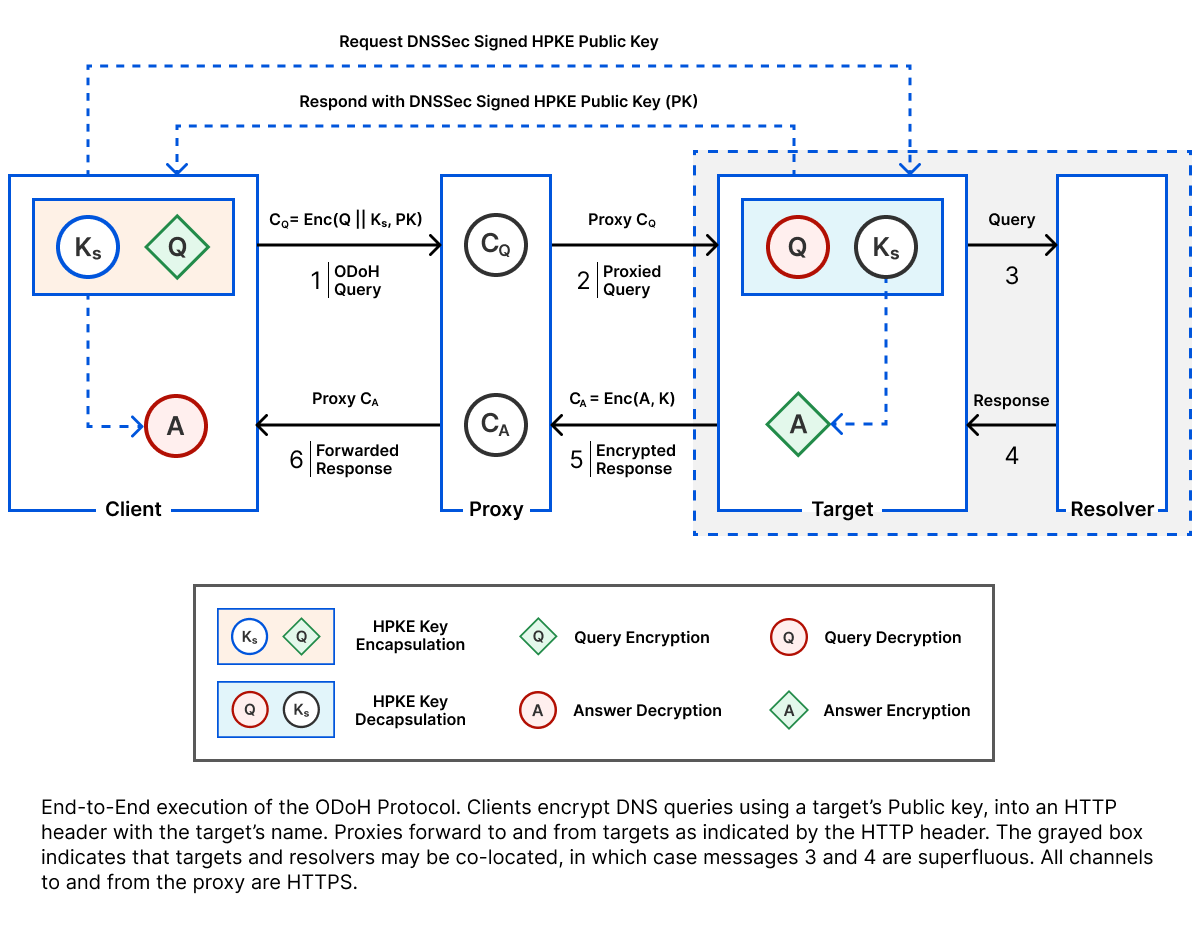
Oblivious DNS over HTTPS (ODoH) is a protocol proposed at the IETF with the goal of providing privacy to the clients making DNS requests using DNS over HTTPS (DoH). Cloudflare operates a popular public recursive DNS resolver to which clients can make DNS queries. However, DNS over HTTPS (DoH) requests made by clients to the resolver leak client IP addresses despite providing a secure encrypted communication channel. While DoH enhances the security of the DNS queries and responses when used instead of the default insecure UDP based DNS requests, the leakage of client IP information could be problematic. Cloudflare maintains users’ privacy through a rigorous privacy policy, audits, and purging client information.
Along with my advisors, I spent time building interoperable versions of ODoH services, and the necessary components in Go and Rust which were experimentally deployed on cloud services for performing measurements of the protocol. Through frequent conversations, we identified interesting research questions, performed the necessary measurements, found both security and performance issues, improved our design and drove towards conclusions iteratively. Then, we worked with the help of the brilliant engineering and reliability engineering teams at Cloudflare to move the support for the protocol into production, to convince the community about the advantages and practicality of the ODoH protocol.
The interoperable implementations of the protocol were made open source. They served as a reference implementation presented during the standardization process and various presentations we made at IETF and OARC, through which we obtained valuable feedback. With all the experiments in place, we submitted our work to the proceedings of Privacy Enhancing Technologies Symposium (PETS 2021) where it was accepted and awarded the Andreas Pfitzmann best student paper.
Cloudflare strongly believes in transparency. The effects of this are visible within the company, from open and inclusive discussions about social and technological issues, to the way people across the company can collaborate and share information with the public. I was fortunate to present and share some work on ODoH on Cloudflare TV. I was definitely nervous about presenting the work on live Internet TV, but it became possible with the support and encouragement of the TV team and members of the research team.
Outside work
While the work that I did during my time as an intern at Cloudflare was exciting, it was not the only thing that kept me occupied. It was very easy to interact with engineers, designers, sales and marketing teams within the company, learn about their work, their experiences and gain an understanding of all the amazing work happening throughout the company. The internship also provided me an opportunity to engage in random engineer chats — a program which randomly matched me with other engineers, and researchers, allowing me to learn more about their work. The research team at Cloudflare operated very similarly to an academic research lab and frequently discussed papers during scheduled reading group meetings. The weekly intern hangouts allowed me to build friendships with the other interns in the team. However, not everything was rosy: it was hard to make it to all the intern hangouts, and time zone differences did add to the challenges for scheduling time to get to know the other interns.
Takeaways
Cloudflare is an incredibly transparent company built for scale, and a brilliant place to work with a lot of interesting research and engineering work that could move from prototype to production. The transparent collaboration between different teams, academia, and the shared mission to help build a better Internet make it possible to leverage the strengths of various teams, and highly motivated people to contribute to a project. In retrospect, I strongly believe that I got lucky working on a problem which interested me, and had value for Cloudflare’s mission. And while I get to write this blog post about my experience, this experience and the work I was able to do during my time at Cloudflare wouldn’t have been possible without the hundreds of motivated and brilliant people in various teams (media, content, design, legal etc.) with whom I interacted, along with the direct involvement of the research, engineering and reliability teams. The internship experience was truly humbling!
If this sort of experience interests you, and you would love to join an innovative and collaborative environment, Cloudflare Research is currently accepting applications for 2022 internships!
As part of Cloudflare’s effort to build collaborations with academia, we host research focused internships all year long. Interns collaborate cross-functionally in research projects and are encouraged to ship code and write a blog post and a peer-reviewed publication at the end of their internship. Post-internship, many of our interns have joined Cloudflare to continue their work and often connect back with their alma mater strengthening idea sharing and collaborative initiatives.
Last year, we extended the intern experience by hosting Thomas Ristenpart, Associate Professor at Cornell Tech. Thomas collaborated for half a year on a project related to password breach alerting. Based on the success of this experience we are taking a further step in creating a structured Visiting Researcher program, to broaden our capabilities and invest further on a shared motivation with academics.
Foster engagement and closer partnerships
Our current research focuses on applied cryptography, privacy, network protocols and architecture, measurement and performance evaluation, and, increasingly, distributed systems. With the Visiting Researcher program, Cloudflare aims to foster a shared motivation with academia and engage together in seeking innovative solutions to help build a better Internet in the mentioned domains.
We expect to support the operationalization of ideas that emerge in academia and put them to the test in deployable services that will be used worldwide, hence giving the opportunity to develop collaborative projects with real world applicability and also push industry forward.
About the Visiting Researcher Program
The Visiting Researcher Program is available to both postdocs and full-time faculty members who aim to collaborate primarily with Cloudflare Research for periods of three to 12 months. There are a few eligibility criteria to meet before expressing interest in the program:
Have a PhD and a well-established research track record demonstrated by peer-reviewed journal publications and conference papers.
Relevant research experience and interest in one of the research areas.
Ability to design and execute on a research agenda.
We know we will receive excellent proposals but we expect selected expressions of interest to have the potential to have a significant impact on one of the mentioned domains and reinforce the contribution to the Internet community at large. Proposals should aim at wide dissemination and have the potential to deliver value to both technical and academic communities.
You can explore more about the program on the Cloudflare Research website and learn more about Thomas Ristenpart’s experience in the next section .
The Visiting Researcher experience so far
There are a lot of potential reasons for a short-term visit in industry. For senior researchers it’s an opportunity to refresh one’s perspectives on problems observed in practice, and potentially transfer research ideas from “the lab” to products. Compared to some companies, Cloudflare’s research organization is smaller, has clear connections with product teams, and has an outsized portfolio of exciting, high-impact research projects.
As mentioned above, I joined Cloudflare in the summer of 2020, during my academic sabbatical. I worked three days a week — remotely given the COVID-19 pandemic — and spent the rest of the work week advising my academic group at Cornell. A lot of my academic research over the past few years has focused on how to improve security for password-based authentication, including developing some of the first protocols for privacy-preserving password breach alerting. I knew Cloudflare well due to its ongoing engagement with the applied cryptography community, and it made sense to visit: Cloudflare’s focus on security, privacy, and its position as a first-line of defense for millions of websites made it a unique opportunity for working on improving authentication security.
I worked directly with research engineers in the team to implement a new type of password breach alerting service, that we called Might I Get Pwned (MIGP). While it built off prior work done in academia, we encountered a number of fascinating challenges in architecting and implementing the system. We also found new opportunities for impact, realizing that the Web Application Firewall (WAF) team was simultaneously interested in breach alerting and could utilize the infrastructure we were building. Ultimately, my work contributed directly to the WAF’s breach alerting feature that launched in Spring 2021.
At the same time, being embedded at Cloudflare surfaced fascinating new research questions. At one point, the CEO asked the team about how we could handle the potential threat of hoarding attacks against Privacy Pass, a deployed cryptographic protocol that Cloudflare customers rely on to help prevent bots from mounting attacks. This led to a foundational cryptographic protocol question: can we build partially oblivious pseudorandom function protocols that match the efficiency of standard oblivious pseudorandom functions? I won’t unpack that jargon here, but for those who are curious you can check out the preprint. We ended up tackling this question as a collaboration between my academic research group, the University of Washington, and Cloudflare, culminating in a new protocol that is sure to get deployed quite widely in the years to come.
Overall, this was a hugely successful visit. I’m excited to see the Cloudflare visiting scholar program expand and develop, and would definitely recommend it to interested academics.
Express your interest
We’re very excited to have this program going forward and diversifying our collaborations with academia! You can read more about the Visiting Researcher program and send us your expression of interest through Cloudflare Research website. We are expecting to host you in early 2022!
It’s not actually banned in the EU yet — the legislative process is much more complicated than that — but it’s a step: a total ban on biometric mass surveillance.
To respect “privacy and human dignity,” MEPs said that EU lawmakers should pass a permanent ban on the automated recognition of individuals in public spaces, saying citizens should only be monitored when suspected of a crime.
So, as a nerd, let’s say you need 100 terabytes of home storage. What do you do?
My solution would be a commercial NAS RAID, like from Synology, QNAP, or Asustor. I’m a nerd, and I have setup my own Linux systems with RAID, but I’d rather get a commercial product. When a disk fails, and a disk will always eventually fail, then I want something that will loudly beep at me and make it easy to replace the drive and repair the RAID.
Some choices you have are:
vendor (Synology, QNAP, and Asustor are the vendors I know and trust the most)
number of bays (you want 8 to 12)
redundancy (you want at least 2 if not 3 disks)
filesystem (btrfs or ZFS) [not btrfs-raid builtin, but btrfs on top of RAID]
drives (NAS optimized between $20/tb and $30/tb)
networking (at least 2-gbps bonded, but box probably can’t use all of 10gbps)
backup (big external USB drives)
The products I link above all have at least 8 drive bays. When you google “NAS”, you’ll get a list of smaller products. You don’t want them. You want somewhere between 8 and 12 drives.
The reason is that you want two-drive redundancy like RAID6 or RAIDZ2, meaning two additional drives. Everyone tells you one-disk redundancy (like RAID5) is enough, they are wrong. It’s just legacy thinking, because it was sufficient in the past when drives were small. Disks are so big nowadays that you really need two-drive redundancy. If you have a 4-bay unit, then half the drives are used for redundancy. If you have a 12-bay unit, then only 2 out of the 12 drives are being used for redundancy.
The next decision is the filesystem. There’s only two choices, btrfs and ZFS. The reason is that they both healing and snapshots. Note btrfs means btrfs-on-RAID6, not btrfs-RAID, which is broken. In other words, btrfs contains its own RAID feature that you don’t want to use.
Over long periods of time, errors creep into the file system. You want to scrub the data occasionally. This means reading the entire filesystem, checksuming the files, and repairing them if there’s a problem. That requires a filesystem that checksums each block of data.
Another thing you want snapshots to guard against things like ransomware. This means you mark the files you want to keep, and even if a workstation attempts to change or delete the file, it’ll still be held on the disk.
QNAP uses ZFS while others like Synology and Asustor use btrfs. I really don’t know which is better.
It’s cheaper to buy the NAS diskless then add your own disk drives. If you can’t do this, then you’ll be helpless when a drive fails and needs to be replaced.
Drives cost between $20/tb and $30/tb right now. This recent article has a good buying guide. You probably want to get a NAS optimized hard drive. You probably want to double-check that it’s CMR instead of SMR — SMR is “shingled” vs. “conventional” magnetic recording. SMR is bad. There’s only three hard drive makers (Seagate, Western Digital, and Toshiba), so there’s not a big selection.
Working with such large data sets over 1-gbps is painful. These units allow 802.3ad link aggregation as well as faster Ethernet. Some have 10gbe built-in, others allow a PCIe adapter to be plugged in.
However, due to the overhead of spinning disks, you are unlikely to get 10gbps speeds. I mention this because 10gbps copper Ethernet sucks, so is not necessarily a buying criteria. You may prefer multigig/NBASE-T that only does 5gbps with relaxed cabling requirements and lower power consumption.
This means that your NAS decision is going to be made with your home networking decision. I use a couple of these multigig switches as something that doesn’t cost too much for home networking.
Even though RAID is pretty darn reliable, you still need a backup solution. The way I do this is wither external USB hard drives. I schedule the NAS to backup to those drives automatically. As a home user, tapes aren’t an effective solution, so you are stuck with USB drives.
In the end, this means that your total storage costs, with the NAS server, the drives, and the backup drives, is going to cost you 3x the price of the raw storage. Spinning drives fail often. If you plan on keeping your data around for the next decade, there’s no way to do this without 3x the cost for storage.
I choose Synology because I have the most familiarity with the software, and its software gets the best reviews. But QNAP and Asustor also have great reputations.
Note that I’ve made the assumption here that you’ll want “desktop NAS” solutions. There are also rackmount solutions available.
The 5.15-rc5 kernel prepatch is out for
testing. “So things continue to look quite normal, and it looks like
the rough patch (hah!) we had early in the release is all behind us. Knock
wood.”
Great technology companies build innovative products and bring them into the world; iconic technology companies change the nature of the world itself.
Cloudflare’s mission reflects our ambitions: to help build a better Internet. Fulfilling this mission requires a multifaceted approach that includes ongoing product innovation, strategic decision-making, and the audacity to challenge existing assumptions about the structure and potential of the Internet. Two years ago, Cloudflare Research was founded to explore opportunities that leverage fundamental and applied computer science research to help change the playing field.
We’re excited to share five operating principles that guide Cloudflare’s approach to applying research to help build a better Internet and five case studies that exemplify these principles. Cloudflare Research will be all over the blog for the next several days, so subscribe and follow along!
Innovation comes from all places
Innovative companies don’t become innovative by having one group of people within the company dedicated to the future; they become that way by having a culture where new ideas are free-flowing and can come from anyone. Research is most effective when it is permitted to grow beyond or outside isolated lab environments, is deeply integrated into all facets of a company’s work, and connected with the world at large. We think of our research team as a support organization dedicated to identifying and nurturing ideas that are between three and five years away.
Cloudflare Research prioritizes strong collaboration to stay on top of big questions from our product, ETI, engineering teams and industry. Within Cloudflare, we learn about problems by embedding ourselves within other teams. Externally, we invite visiting researchers and academia, sit on boards and committees, contribute to open standards design and development, attend dozens of tech conferences a year, and publish papers in conferences.
Research engineering is truly full-stack. We incubate ideas from conception to prototype through to production code. Our team employs specialists from academic and industry backgrounds and generalists that help connect ideas across disciplines. We work closely with the product and engineering organizations on graduation plans where code ownership is critical. We also hire many research interns who help evaluate and de-risk new ideas before we help build them into production systems and eventually hand them off to other teams at the company.
Research questions can come from all parts of the company and even from customers. Our collaborative approach has led to many positive outcomes for Cloudflare and the Internet at large.
Case Study #1: Password security
Several years ago, a service called Have I Been Pwned, which lets people check if their password has been compromised in a breach, started using Cloudflare to keep the site up and running under load. However, the setup also highlighted a privacy issue: Have I Been Pwned would inevitably have access to every password submitted to the service, making it a juicy target for attackers. This insight raised the question: can such a service be offered in a privacy-preserving way?
Like much of the research team’s work, the kernel of a solution came from somewhere else at the company. The first work on the problem came from members of the support engineering organization, who developed a clever solution that mostly solved the problem. However, this initial investigation outlined a deep and complex problem space that could have applications far beyond passwords. At this point, the research team got involved and reached out to experts, including Thomas Ristenpart at Cornell Tech, to help study it more deeply.
This collaboration led us down a path to devise a new protocol and publish a paper entitled Protocols for Checking Compromised Credentials at ACM CCS 2019. The paper pointed us in a direction, but a desire to take this research and make it applicable to people led us to host our first visiting researcher to help build a prototype. We found even more inspiration and support internally when we learned that another team at Cloudflare was interested in adding capabilities to the Cloudflare Web Application Firewall to detect breached passwords for customers. This team ended up helping us build the prototype and integrate it into Cloudflare’s service.
This combination of customer insight, internal alignment, and external collaboration not only resulted in a powerful and unique customer feature, but it also helped advance the state of the art in privacy-preserving technology for an essential aspect of our online lives: Authentication. We’ll be making an exciting announcement around this technology on Thursday, so stay tuned.
A question-oriented approach leads to better products
To support Cloudflare’s fast-paced roadmap, the Research team takes a question-first approach. Focusing on questions is the essence of research itself, but it’s important to recognize what that means for an industry-leading company. We never stop asking big questions about the problems our products are already solving. Changes like the move from desktop to mobile computing or the transition from on-premise security solutions to the cloud happened within a decade, so it’s important to ask questions like:
How will social and geopolitical forces changes impact the products we’re building today?
What assumptions may be present in existing systems based on the homogenous experiences of their creators?
What changes are happening in the industry that will affect the way the Internet works?
What opportunities do we see to leverage new and lower-cost hardware?
How can we scale to meet growing needs?
Are there new computing paradigms that need to be understood?
How are user expectations shifting?
Is there something we can build to help move the Internet in the right direction?
Which security or privacy risks are likely to be exacerbated in the coming years?
By focusing on broader questions and being open to answers that don’t fit within the boundaries of existing solutions, we have the opportunity to see around corners. This type of foresight helps solve more than business problems; it can help improve products and the Internet at large. These types of questions are asked across the R&D functions of the company, but research focuses on the questions that aren’t easily answered in the short-term.
Case Study #2: SSL/TLS Recommender
When Cloudflare made SSL certificates free and automatic for all customers, it was a big step towards securing the web. One of the early criticisms of Cloudflare’s SSL offerings was the so-called “mullet” critique. Cloudflare offers a mode called “Flexible SSL,” which enables encryption between the browser and Cloudflare but keeps the connection between Cloudflare and the origin site unencrypted for backward compatibility. It’s called the mullet criticism because Flexible SSL provides encryption on the front half of the connection but none on the back half.
Most security risks for online communication occur between the user and Cloudflare (at the ISP or in the coffee shop, for example), not between Cloudflare and the origin server. The customers who couldn’t enable encryption on their servers had a much better security posture with Cloudflare.
In a few isolated instances, however, a customer did not take advantage of the most secure configuration possible, which resulted in unexpected and impactful security problems. Given the non-zero risk and acknowledging this valid product critique, we asked: what could we do to improve the security posture of millions of websites?
With the help of research interns with Internet scanning and measurement expertise, we built an advanced scanning/crawling tool to see how much things could be improved. It turned out we could do a lot, so we worked with various teams across the company to connect our scanning infrastructure to Cloudflare’s product. We now offer a service to all customers called the SSL/TLS recommender that has helped thousands of customers secure their sites and trim their mullets. The underlying reason that websites don’t use encryption for parts of their backends is complex, and what makes this project a good example of asking questions in a pragmatic way is that it not only gives Cloudflare an improved product, but it gives researcher set of tools to further explore the fundamental problem.
Build the tools today to deal with the issues of tomorrow
Another critical objective of research in the Cloudflare context is to help us prepare for the unknown. We identify and solve “what-if” scenarios based on how society is changing or may change. Thousands of companies rely on our infrastructure to serve their users and meet their business needs. We are continually improving their experience by future-proofing the technology that supports them during the best of times and the potential worst of times.
To prepare, we:
Identify areas of future risk.
Explore the fundamentals of the problem.
Build expertise and validate that expertise in peer-reviewed venues.
Build operating experience with prototypes and large-scale experiments.
Build networks of relationships with those who can help in a crisis.
We would like to emulate the strategic thinking and planning required of the often unseen groups that support society — like the forestry service or a public health department. When the fire hits or the next virus arrives, we have the best chance to not only get through it but to innovate and flourish because of the mitigations put in place and the relationships built while thinking through impending challenges.
Case Study #3: IP Address Agility
One area of impending risk for the Internet is the exhaustion of IPv4 addresses. There are only around four billion potential IPv4 addresses, which is fewer than the number of humans globally, let alone the number of Internet-connected devices. We decided to examine this problem more deeply in the context of Cloudflare’s unique approach to networking.
Cloudflare’s architecture challenges several assumptions about how different aspects of the Internet relate to each other. Historically, a server IP address corresponds to a specific machine. Cloudflare’s anycast architecture and server design allow any server to serve any customer site. This architecture has allowed the service to scale in incredible ways with very little work.
This insight led us to question other fundamental assumptions about how the Internet could potentially work. If an IP address doesn’t need to correspond with a specific server, what else could we decouple from it? Could we decouple hostnames from IPs? Maybe we could! We could also frame the question negatively: what do we lose if we don’t take advantage of this decoupling? It was worth an experiment, at least.
We decided to validate this assumption empirically. We ran an experiment serving all free customers from the same IP in an entire region in a cross-organizational effort that involved the DNS team, the IP addressing team, and the edge load balancing team. The experiment proved that using a single IP for millions of services was feasible, but it also highlighted some risks. The result was a paper published in ACM SIGCOMM 2021 and a project to re-architect our authoritative DNS system to be infinitely more flexible.
Going further together
The Internet is not simply a loose federation of companies and billions of dollars of deployed hardware; it’s a network of interconnected relationships with a global societal impact. These relationships and the technical standards that govern them are the connective tissue that allows us to build important aspects of modern society on the Internet.
Millions of Internet properties use Cloudflare’s network, which serves tens of millions of requests per second. The decisions we make, and the products we release, have significant implications on the industry and billions of people. For the majority of cases, we only control one side of the Internet connection. To serve billions of users and Internet-connected devices, we are governed by and need to support protocols such as DNS, BGP, TLS, and QUIC, defined by technical standards organizations like the Internet Engineering Task Force (IETF).
Protocols evolve, and new protocols are constantly changing to serve the evolving needs of the Internet. An important part of our mission to help build a more secure, more private, more performant, and more available Internet involves taking a leadership role in shaping these protocols, deploying them at scale, and building the open-source software that implements them.
Case Study #4: Oblivious DNS
When Cloudflare launched the 1.1.1.1 recursive DNS service in 2019, privacy was again at the forefront. We offered 1.1.1.1 with a new encryption standard called DNS-over-HTTPS (DoH) to keep queries private as they travel over the Internet. However, even with DoH, a DNS query is associated with the IP address of the user who sent it. Cloudflare wrote a privacy policy and created technical measures to ensure that user IP data is only kept for a short amount of time and even engaged a top auditing firm to confirm this. But still, the question remained, could we offer the service without needing to have this privacy-sensitive information in the first place? We created the Onion Resolver to let users access the service over the Tor anonymity network, but it was extremely slow to use. Could we offer cryptographically private DNS with acceptable performance? It was an open problem.
The breakthrough came through a combination of sources. We learned about new results out of academia describing a novel proxying technique called Oblivious DNS. We also found other folks in the industry from Apple and Fastly who were working on the same problem. The resulting proposal combined Oblivious DNS and DoH into an elegant protocol called Oblivious DoH (or ODoH). ODoH was published and discussed extensively at the IETF. DNS is an especially standards-dependent protocol since different parties operate so many components of the system. ODoH adds another participant to the equation, making careful interoperability standards even more critical.
The research team took an early draft of ODoH and, with the help of an intern (whose experience on the team you’ll hear from tomorrow), we built a prototype on Cloudflare Workers. With it, we measured the performance and confirmed the viability of a large-scale ODoH deployment, leading to this paper, published at PoPETS 2021.
The results of our experimentation gave us the confidence to build a production-quality implementation. Our research engineers worked with the engineers on the resolver team to implement and launch ODoH for 1.1.1.1. We also open-sourced ODoH-related code in Go, Rust, and a Cloudflare Workers-compatible implementation. We also worked with the open source community to land the protocol in widely available tools, like dnscrypt, to help further ODoH adoption. ODoH is just one example of cross-industry work to develop standards that you’ll learn more about in an upcoming post.
From theory to practice at a global scale
There are thousands of papers published at dozens of venues every year on Internet technology. The ideas in academic research can change our fundamental understanding of the world scientifically but often haven’t impacted users yet. Innovation comes from all places, and it’s important to adopt ideas from the wider/outside community since we’re in a fortunate position to do so.
As an academic, you are rewarded for the breakthrough, not the follow-through. We value the ability to pursue, even drive, the follow-through because of the tangible improvements challenges offer to the Internet. We find that we can often learn much more about an idea by building and deploying it than by only thinking it up and writing it down. The smallest wrinkle in a lab environment or theoretical paper can become a large issue at Internet scale, and seemingly minor insights can unlock enormous potential.
We are grateful at Cloudflare to be in a rare position to leverage the diversity of the Internet to further existing research and study its real-world impact. We can bring the insights and solutions described in papers to reality because we have the insight into user behavior required to do it: right now, nearly every user on the Internet uses Cloudflare directly or indirectly.
We also have enough scale that problems that could have been solved conventionally must now use new tools. For example, cryptographic tools like identity-based encryption and zero-knowledge proofs have been around on paper for decades. They have only recently been deployed in a few live systems but are now emerging as valuable tools in the conventional Internet and have real-life impact.
Case Study #5: Cryptographic Attestation of Personhood
In Case Study #4, we explored a deep and fundamental networking question. As fun as exploring the plumbing can be, it’s also important to explore user experience questions because clients and customers can immediately feel them. A big part of Cloudflare’s value is protecting customers from bots, and one of the tools we use is the CAPTCHA. People hate CAPTCHAs. Few aspects of the web experience inspire more seething anger in the user experience than being stopped and asked to identify street signs and trucks in low-res images when trying to go to a site. Furthermore, the most common CAPTCHAs are inaccessible to many communities, including the blind and the visually impaired. The Bots team at Cloudflare has made great strides to reduce the number of CAPTCHAs shown on the server-side using machine learning (a challenging problem in itself). We decided to complement their work by asking if we could leverage accessibility on the client-side to provide equivalent protection to a CAPTCHA?
This question led us down the path to developing a new technique we call the Cryptographic Attestation of Personhood (CAP). Instead of users proving to Cloudflare that they are human by performing a human task, we could ask them to prove that they have trusted physical hardware. We identified the widely deployed WebAuthn standard to do this so that millions of users could leverage their hard security keys or the hardware biometric system built into their phones and laptops.
This project raised several exciting and profound privacy and user experience questions. With the help of a research intern experienced in anonymous authentication, we published a paper at SAC 2021 that leveraged and improved upon zero-knowledge cryptography systems to add additional privacy features to our solution. Cloudflare’s ubiquity allows us to expose millions of users to this new idea and understand how it’s understood: for example, do users think sites can collect biometrics from their users this way? We have an upcoming paper submission (with the user research team) about these user experience questions.
Some answers to these research-shaped questions are surprising, some weren’t, but in all cases, the outcome of taking a questions-oriented approach was tools for solving problems.
What to expect from the blog
As mentioned above, Cloudflare Research will be all over the Cloudflare blog in the next several days to make several announcements and share technical explainers, including:
A new landing page where you can read our research and find additional resources.
Technical deep dives into research papers and standards, including the projects referenced above (and MANY more).
Insights into our process and ways to collaborate with us.
Happy reading!
The collective thoughts of the interwebz
Manage Consent
To provide the best experiences, we use technologies like cookies to store and/or access device information. Consenting to these technologies will allow us to process data such as browsing behavior or unique IDs on this site. Not consenting or withdrawing consent, may adversely affect certain features and functions.
Functional
Always active
The technical storage or access is strictly necessary for the legitimate purpose of enabling the use of a specific service explicitly requested by the subscriber or user, or for the sole purpose of carrying out the transmission of a communication over an electronic communications network.
Preferences
The technical storage or access is necessary for the legitimate purpose of storing preferences that are not requested by the subscriber or user.
Statistics
The technical storage or access that is used exclusively for statistical purposes.The technical storage or access that is used exclusively for anonymous statistical purposes. Without a subpoena, voluntary compliance on the part of your Internet Service Provider, or additional records from a third party, information stored or retrieved for this purpose alone cannot usually be used to identify you.
Marketing
The technical storage or access is required to create user profiles to send advertising, or to track the user on a website or across several websites for similar marketing purposes.