I Lived a Similar Trauma Rob Reiner’s Family Faces & Shame on Trump

Post Syndicated from Bradley M. Kuhn original http://ebb.org/bkuhn/blog/2025/12/16/rob-reiner-trump-my-brother-also-murdered-my-mother.html

I posted the following on my Fediverse (via Mastodon) account.
I’m reposting the whole seven posts here as written there, but I hope folks
will take a
look at that thread
as folks are engaging in conversation over there
that might be worth reading if what I have to say interests you.
(The remainder of the post is the same that can be found in the Fediverse
posts linked throughout.)

I
suppose Fediverse
isn’t the place people are discussing Rob Reiner. But after 36 hours of deliberating whether to say anything, I feel compelled. This thread will be long,but I start w/ most important part:

It’s an “open secret” in the FOSS community that in March 2017 my brother
murdered our mother. About 3k ppl/year in USA have this experience, so it’s
a statistical reality that someone else in FOSS experienced similar. If so,
you’re welcome in my PMs to discuss if you need support… (1/7)

… Traumatic loss due to murder is different than losing your
grandparent/parent of age-related ailments (& is even different than
losing a young person to a disease like cancer). The “a fellow family
member did it” brings permanent surrealism to your daily life. Nothing good
in your life that comes later is ever all that good. I know from direct
experience this is what Rob Reiner’s family now faces. It’s chaos; it
divides families forever: dysfunctional family takes on a new “expert”
level… (2/7)

…as one example: my family was immediately divided about punishment. Some
of my mother’s relatives wanted prosecution to seek death penalty. I knew
that my brother was mentally ill enough that jail or prison *would* get him
killed in a prison dispute eventually,so I met clandestinely w/my brother’s
public defender (during funeral planning!) to get him moved to a criminal
mental health facility instead of a regular prison. If they read this,
it’ll first time my family will find out I did that…(3/7)

…Trump’s political rise (for me) links up: 5 weeks into Trump’s 1ˢᵗ term, my brother murdered my mother.
My (then 33yr-old) brother was severely mentally ill from birth — yet escalated to murder only then. IMO, it wasn’t coincidence. My brother left voicemail approximately 5 hours before the murder stating his intent to murder & described an elaborate political delusion as the impetus.

∃ unintended & dangerous consequences of inflammatory political rhetoric on
the mental ill!…(4/7)

…I’m compelled to speak publicly — for first time ≈10 yrs after the murder —
precisely b/c of Trump’s response.

Trump endorsed the idea that those who oppose him encourage their own
murder from the mentally ill. Indeed, he said that those who oppose him are
*themselves causing* mental illnesses in those around them, & that his
political opponents should *expect* violence from their family members (who
were apparently driven to mental illness from your opposition to
Trump!)… (5/7)

…Trump’s actual words:

Rob Reiner, tortured & struggling,but once…talented movie director &
comedy star, has passed away, together w/ his wife…due to the anger he
caused others through his massive, unyielding, & incurable affliction w/ a
mind crippling disease known as TRUMP DERANGEMENT SYNDROME…He was known to
have driven people CRAZY by his raging obsession of…Trump, w/ his obvious
paranoia reaching new heights as [my] Administration surpassed all goals
and expectations of greatness…

(6/7)

My family became ultra-pro-Trump after my mom’s murder. My mom hated
politics: she was annoyed *both* if I touted my social democratic politics &
if my dad & his family stated their crypto-fascist views.

Every death leaves a hole in a community’s political fabric. 9+ years out,
I’m ostracized from my family b/c I’m anti-Trump.

Trump stated perhaps what my family felt but didn’t say: those who don’t
support Trump are at fault when those who fail to support Trump are
murdered. (7/7)

[ Finally, I want to also quote this one reply I also posted in the same
thread
:
I ask everyone, now that I’ve stated this public, that I *know* you’re going to want to search the Internet for it, & you will find a lot. Please, please, keep in mind that the Police Department & others basically lied to the public about some of the facts of the case. I seriously considered suing them for it, but ultimately it wasn’t worth my time. But, please everyone ask me if you are curious about any of the truth of the details of the crime & its aftermath …

I Lived a Similar Trauma Rob Reiner’s Family Faces & Shame on Trump

Post Syndicated from Bradley M. Kuhn original http://ebb.org/bkuhn/blog/2025/12/16/rob-reiner-trump-my-brother-also-murdered-my-mother.html

I posted the following on my Fediverse (via Mastodon) account.
I’m reposting the whole seven posts here as written there, but I hope folks
will take a
look at that thread
as folks are engaging in conversation over there
that might be worth reading if what I have to say interests you.
(The remainder of the post is the same that can be found in the Fediverse
posts linked throughout.)

I
suppose Fediverse
isn’t the place people are discussing Rob Reiner. But after 36 hours of deliberating whether to say anything, I feel compelled. This thread will be long,but I start w/ most important part:

It’s an “open secret” in the FOSS community that in March 2017 my brother
murdered our mother. About 3k ppl/year in USA have this experience, so it’s
a statistical reality that someone else in FOSS experienced similar. If so,
you’re welcome in my PMs to discuss if you need support… (1/7)

… Traumatic loss due to murder is different than losing your
grandparent/parent of age-related ailments (& is even different than
losing a young person to a disease like cancer). The “a fellow family
member did it” brings permanent surrealism to your daily life. Nothing good
in your life that comes later is ever all that good. I know from direct
experience this is what Rob Reiner’s family now faces. It’s chaos; it
divides families forever: dysfunctional family takes on a new “expert”
level… (2/7)

…as one example: my family was immediately divided about punishment. Some
of my mother’s relatives wanted prosecution to seek death penalty. I knew
that my brother was mentally ill enough that jail or prison *would* get him
killed in a prison dispute eventually,so I met clandestinely w/my brother’s
public defender (during funeral planning!) to get him moved to a criminal
mental health facility instead of a regular prison. If they read this,
it’ll first time my family will find out I did that…(3/7)

…Trump’s political rise (for me) links up: 5 weeks into Trump’s 1ˢᵗ term, my brother murdered my mother.
My (then 33yr-old) brother was severely mentally ill from birth — yet escalated to murder only then. IMO, it wasn’t coincidence. My brother left voicemail approximately 5 hours before the murder stating his intent to murder & described an elaborate political delusion as the impetus.

∃ unintended & dangerous consequences of inflammatory political rhetoric on
the mental ill!…(4/7)

…I’m compelled to speak publicly — for first time ≈10 yrs after the murder —
precisely b/c of Trump’s response.

Trump endorsed the idea that those who oppose him encourage their own
murder from the mentally ill. Indeed, he said that those who oppose him are
*themselves causing* mental illnesses in those around them, & that his
political opponents should *expect* violence from their family members (who
were apparently driven to mental illness from your opposition to
Trump!)… (5/7)

…Trump’s actual words:

Rob Reiner, tortured & struggling,but once…talented movie director &
comedy star, has passed away, together w/ his wife…due to the anger he
caused others through his massive, unyielding, & incurable affliction w/ a
mind crippling disease known as TRUMP DERANGEMENT SYNDROME…He was known to
have driven people CRAZY by his raging obsession of…Trump, w/ his obvious
paranoia reaching new heights as [my] Administration surpassed all goals
and expectations of greatness…

(6/7)

My family became ultra-pro-Trump after my mom’s murder. My mom hated
politics: she was annoyed *both* if I touted my social democratic politics &
if my dad & his family stated their crypto-fascist views.

Every death leaves a hole in a community’s political fabric. 9+ years out,
I’m ostracized from my family b/c I’m anti-Trump.

Trump stated perhaps what my family felt but didn’t say: those who don’t
support Trump are at fault when those who fail to support Trump are
murdered. (7/7)

[ Finally, I want to also quote this one reply I also posted in the same
thread
:
I ask everyone, now that I’ve stated this public, that I *know* you’re going to want to search the Internet for it, & you will find a lot. Please, please, keep in mind that the Police Department & others basically lied to the public about some of the facts of the case. I seriously considered suing them for it, but ultimately it wasn’t worth my time. But, please everyone ask me if you are curious about any of the truth of the details of the crime & its aftermath …

I Lived a Similar Trauma Rob Reiner’s Family Faces & Shame on Trump

Post Syndicated from Bradley M. Kuhn original http://ebb.org/bkuhn/blog/2025/12/16/rob-reiner-trump-my-brother-also-murdered-my-mother.html

I posted the following on my Fediverse (via Mastodon) account.
I’m reposting the whole seven posts here as written there, but I hope folks
will take a
look at that thread
as folks are engaging in conversation over there
that might be worth reading if what I have to say interests you.
(The remainder of the post is the same that can be found in the Fediverse
posts linked throughout.)

I
suppose Fediverse
isn’t the place people are discussing Rob Reiner. But after 36 hours of deliberating whether to say anything, I feel compelled. This thread will be long,but I start w/ most important part:

It’s an “open secret” in the FOSS community that in March 2017 my brother
murdered our mother. About 3k ppl/year in USA have this experience, so it’s
a statistical reality that someone else in FOSS experienced similar. If so,
you’re welcome in my PMs to discuss if you need support… (1/7)

… Traumatic loss due to murder is different than losing your
grandparent/parent of age-related ailments (& is even different than
losing a young person to a disease like cancer). The “a fellow family
member did it” brings permanent surrealism to your daily life. Nothing good
in your life that comes later is ever all that good. I know from direct
experience this is what Rob Reiner’s family now faces. It’s chaos; it
divides families forever: dysfunctional family takes on a new “expert”
level… (2/7)

…as one example: my family was immediately divided about punishment. Some
of my mother’s relatives wanted prosecution to seek death penalty. I knew
that my brother was mentally ill enough that jail or prison *would* get him
killed in a prison dispute eventually,so I met clandestinely w/my brother’s
public defender (during funeral planning!) to get him moved to a criminal
mental health facility instead of a regular prison. If they read this,
it’ll first time my family will find out I did that…(3/7)

…Trump’s political rise (for me) links up: 5 weeks into Trump’s 1ˢᵗ term, my brother murdered my mother.
My (then 33yr-old) brother was severely mentally ill from birth — yet escalated to murder only then. IMO, it wasn’t coincidence. My brother left voicemail approximately 5 hours before the murder stating his intent to murder & described an elaborate political delusion as the impetus.

∃ unintended & dangerous consequences of inflammatory political rhetoric on
the mental ill!…(4/7)

…I’m compelled to speak publicly — for first time ≈10 yrs after the murder —
precisely b/c of Trump’s response.

Trump endorsed the idea that those who oppose him encourage their own
murder from the mentally ill. Indeed, he said that those who oppose him are
*themselves causing* mental illnesses in those around them, & that his
political opponents should *expect* violence from their family members (who
were apparently driven to mental illness from your opposition to
Trump!)… (5/7)

…Trump’s actual words:

Rob Reiner, tortured & struggling,but once…talented movie director &
comedy star, has passed away, together w/ his wife…due to the anger he
caused others through his massive, unyielding, & incurable affliction w/ a
mind crippling disease known as TRUMP DERANGEMENT SYNDROME…He was known to
have driven people CRAZY by his raging obsession of…Trump, w/ his obvious
paranoia reaching new heights as [my] Administration surpassed all goals
and expectations of greatness…

(6/7)

My family became ultra-pro-Trump after my mom’s murder. My mom hated
politics: she was annoyed *both* if I touted my social democratic politics &
if my dad & his family stated their crypto-fascist views.

Every death leaves a hole in a community’s political fabric. 9+ years out,
I’m ostracized from my family b/c I’m anti-Trump.

Trump stated perhaps what my family felt but didn’t say: those who don’t
support Trump are at fault when those who fail to support Trump are
murdered. (7/7)

[ Finally, I want to also quote this one reply I also posted in the same
thread
:
I ask everyone, now that I’ve stated this public, that I *know* you’re going to want to search the Internet for it, & you will find a lot. Please, please, keep in mind that the Police Department & others basically lied to the public about some of the facts of the case. I seriously considered suing them for it, but ultimately it wasn’t worth my time. But, please everyone ask me if you are curious about any of the truth of the details of the crime & its aftermath …

I Lived a Similar Trauma Rob Reiner’s Family Faces & Shame on Trump

Post Syndicated from Bradley M. Kuhn original http://ebb.org/bkuhn/blog/2025/12/16/rob-reiner-trump-my-brother-also-murdered-my-mother.html

I posted the following on my Fediverse (via Mastodon) account.
I’m reposting the whole seven posts here as written there, but I hope folks
will take a
look at that thread
as folks are engaging in conversation over there
that might be worth reading if what I have to say interests you.
(The remainder of the post is the same that can be found in the Fediverse
posts linked throughout.)

I
suppose Fediverse
isn’t the place people are discussing Rob Reiner. But after 36 hours of deliberating whether to say anything, I feel compelled. This thread will be long,but I start w/ most important part:

It’s an “open secret” in the FOSS community that in March 2017 my brother
murdered our mother. About 3k ppl/year in USA have this experience, so it’s
a statistical reality that someone else in FOSS experienced similar. If so,
you’re welcome in my PMs to discuss if you need support… (1/7)

… Traumatic loss due to murder is different than losing your
grandparent/parent of age-related ailments (& is even different than
losing a young person to a disease like cancer). The “a fellow family
member did it” brings permanent surrealism to your daily life. Nothing good
in your life that comes later is ever all that good. I know from direct
experience this is what Rob Reiner’s family now faces. It’s chaos; it
divides families forever: dysfunctional family takes on a new “expert”
level… (2/7)

…as one example: my family was immediately divided about punishment. Some
of my mother’s relatives wanted prosecution to seek death penalty. I knew
that my brother was mentally ill enough that jail or prison *would* get him
killed in a prison dispute eventually,so I met clandestinely w/my brother’s
public defender (during funeral planning!) to get him moved to a criminal
mental health facility instead of a regular prison. If they read this,
it’ll first time my family will find out I did that…(3/7)

…Trump’s political rise (for me) links up: 5 weeks into Trump’s 1ˢᵗ term, my brother murdered my mother.
My (then 33yr-old) brother was severely mentally ill from birth — yet escalated to murder only then. IMO, it wasn’t coincidence. My brother left voicemail approximately 5 hours before the murder stating his intent to murder & described an elaborate political delusion as the impetus.

∃ unintended & dangerous consequences of inflammatory political rhetoric on
the mental ill!…(4/7)

…I’m compelled to speak publicly — for first time ≈10 yrs after the murder —
precisely b/c of Trump’s response.

Trump endorsed the idea that those who oppose him encourage their own
murder from the mentally ill. Indeed, he said that those who oppose him are
*themselves causing* mental illnesses in those around them, & that his
political opponents should *expect* violence from their family members (who
were apparently driven to mental illness from your opposition to
Trump!)… (5/7)

…Trump’s actual words:

Rob Reiner, tortured & struggling,but once…talented movie director &
comedy star, has passed away, together w/ his wife…due to the anger he
caused others through his massive, unyielding, & incurable affliction w/ a
mind crippling disease known as TRUMP DERANGEMENT SYNDROME…He was known to
have driven people CRAZY by his raging obsession of…Trump, w/ his obvious
paranoia reaching new heights as [my] Administration surpassed all goals
and expectations of greatness…

(6/7)

My family became ultra-pro-Trump after my mom’s murder. My mom hated
politics: she was annoyed *both* if I touted my social democratic politics &
if my dad & his family stated their crypto-fascist views.

Every death leaves a hole in a community’s political fabric. 9+ years out,
I’m ostracized from my family b/c I’m anti-Trump.

Trump stated perhaps what my family felt but didn’t say: those who don’t
support Trump are at fault when those who fail to support Trump are
murdered. (7/7)

[ Finally, I want to also quote this one reply I also posted in the same
thread
:
I ask everyone, now that I’ve stated this public, that I *know* you’re going to want to search the Internet for it, & you will find a lot. Please, please, keep in mind that the Police Department & others basically lied to the public about some of the facts of the case. I seriously considered suing them for it, but ultimately it wasn’t worth my time. But, please everyone ask me if you are curious about any of the truth of the details of the crime & its aftermath …

I Lived a Similar Trauma Rob Reiner’s Family Faces & Shame on Trump

Post Syndicated from Bradley M. Kuhn original http://ebb.org/bkuhn/blog/2025/12/16/rob-reiner-trump-my-brother-also-murdered-my-mother.html

I posted the following on my Fediverse (via Mastodon) account.
I’m reposting the whole seven posts here as written there, but I hope folks
will take a
look at that thread
as folks are engaging in conversation over there
that might be worth reading if what I have to say interests you.
(The remainder of the post is the same that can be found in the Fediverse
posts linked throughout.)

I
suppose Fediverse
isn’t the place people are discussing Rob Reiner. But after 36 hours of deliberating whether to say anything, I feel compelled. This thread will be long,but I start w/ most important part:

It’s an “open secret” in the FOSS community that in March 2017 my brother
murdered our mother. About 3k ppl/year in USA have this experience, so it’s
a statistical reality that someone else in FOSS experienced similar. If so,
you’re welcome in my PMs to discuss if you need support… (1/7)

… Traumatic loss due to murder is different than losing your
grandparent/parent of age-related ailments (& is even different than
losing a young person to a disease like cancer). The “a fellow family
member did it” brings permanent surrealism to your daily life. Nothing good
in your life that comes later is ever all that good. I know from direct
experience this is what Rob Reiner’s family now faces. It’s chaos; it
divides families forever: dysfunctional family takes on a new “expert”
level… (2/7)

…as one example: my family was immediately divided about punishment. Some
of my mother’s relatives wanted prosecution to seek death penalty. I knew
that my brother was mentally ill enough that jail or prison *would* get him
killed in a prison dispute eventually,so I met clandestinely w/my brother’s
public defender (during funeral planning!) to get him moved to a criminal
mental health facility instead of a regular prison. If they read this,
it’ll first time my family will find out I did that…(3/7)

…Trump’s political rise (for me) links up: 5 weeks into Trump’s 1ˢᵗ term, my brother murdered my mother.
My (then 33yr-old) brother was severely mentally ill from birth — yet escalated to murder only then. IMO, it wasn’t coincidence. My brother left voicemail approximately 5 hours before the murder stating his intent to murder & described an elaborate political delusion as the impetus.

∃ unintended & dangerous consequences of inflammatory political rhetoric on
the mental ill!…(4/7)

…I’m compelled to speak publicly — for first time ≈10 yrs after the murder —
precisely b/c of Trump’s response.

Trump endorsed the idea that those who oppose him encourage their own
murder from the mentally ill. Indeed, he said that those who oppose him are
*themselves causing* mental illnesses in those around them, & that his
political opponents should *expect* violence from their family members (who
were apparently driven to mental illness from your opposition to
Trump!)… (5/7)

…Trump’s actual words:

Rob Reiner, tortured & struggling,but once…talented movie director &
comedy star, has passed away, together w/ his wife…due to the anger he
caused others through his massive, unyielding, & incurable affliction w/ a
mind crippling disease known as TRUMP DERANGEMENT SYNDROME…He was known to
have driven people CRAZY by his raging obsession of…Trump, w/ his obvious
paranoia reaching new heights as [my] Administration surpassed all goals
and expectations of greatness…

(6/7)

My family became ultra-pro-Trump after my mom’s murder. My mom hated
politics: she was annoyed *both* if I touted my social democratic politics &
if my dad & his family stated their crypto-fascist views.

Every death leaves a hole in a community’s political fabric. 9+ years out,
I’m ostracized from my family b/c I’m anti-Trump.

Trump stated perhaps what my family felt but didn’t say: those who don’t
support Trump are at fault when those who fail to support Trump are
murdered. (7/7)

[ Finally, I want to also quote this one reply I also posted in the same
thread
:
I ask everyone, now that I’ve stated this public, that I *know* you’re going to want to search the Internet for it, & you will find a lot. Please, please, keep in mind that the Police Department & others basically lied to the public about some of the facts of the case. I seriously considered suing them for it, but ultimately it wasn’t worth my time. But, please everyone ask me if you are curious about any of the truth of the details of the crime & its aftermath …

2025 highlights from the Raspberry Pi Computing Education Research Centre

Post Syndicated from Sue Sentance original https://www.raspberrypi.org/blog/2025-highlights-from-the-raspberry-pi-computing-education-research-centre/

It’s been over a year since I last wrote an update on this blog about our research and as we’ve just published our 2025 Annual Report, this is an ideal opportunity to share what we’ve been working on at the Raspberry Pi Computing Education Research Centre.

At our AI education workshop in early 2025.

We are a research centre based in the Department of Computer Science and Technology at the University of Cambridge, with a team that spans the university and the Raspberry Pi Foundation. We conduct research into many aspects of the teaching and learning of computing and AI and we work closely with schools, teachers and young people to ensure our research is applicable to practice.

Below I highlight some of the projects we’ve worked on in the academic year 2024-2025:

  • Computing Around the World
  • AI education
  • Programming education
  • Physical computing (EPICS project)
  • Teacher action research (TICE project)

Computing Around the World

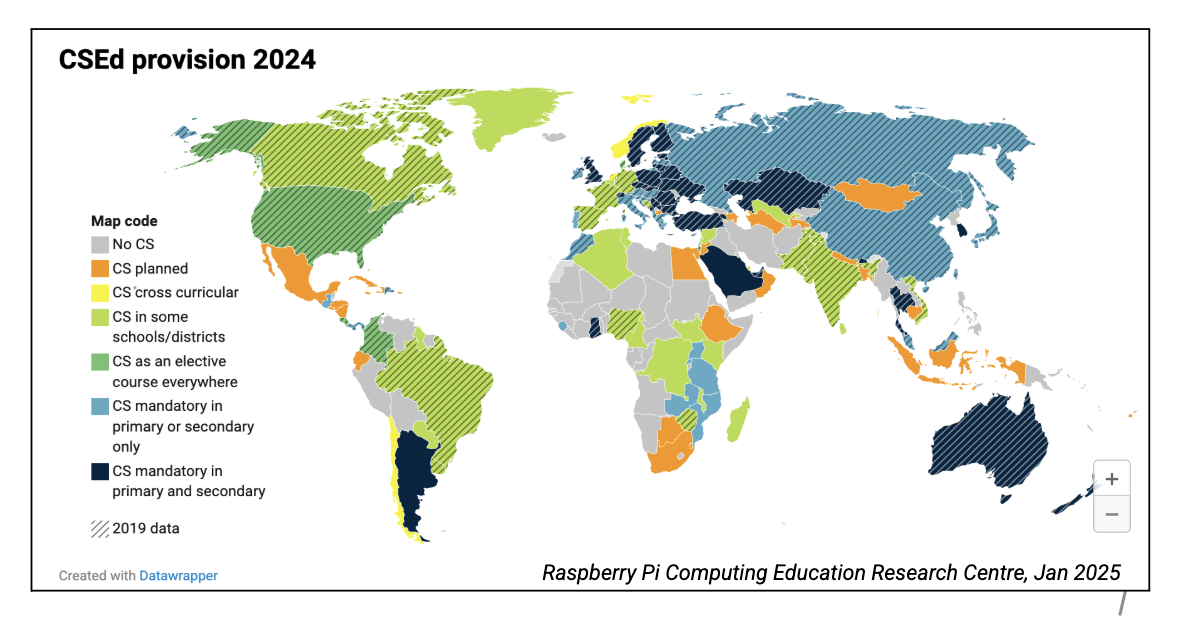
As I’ve written on this blog before, computing education is a global challenge. In one of the Research Centre’s projects, we are looking at how computing education is spreading around the world.

Computing education in countries around the world
Computing education in countries around the world.

We found that between 2019 and 2024 the number of countries offering computing education had doubled, and that two thirds of all countries now offer, or have concrete plans to offer, computing education. This research has already been highlighted in the Stanford AI Index, and we are considering repeating the analysis in future years in order to have the most accurate and up-to-date information displayed in our map.

AI education

We have a number of projects in the area of AI education.

Teaching about AI

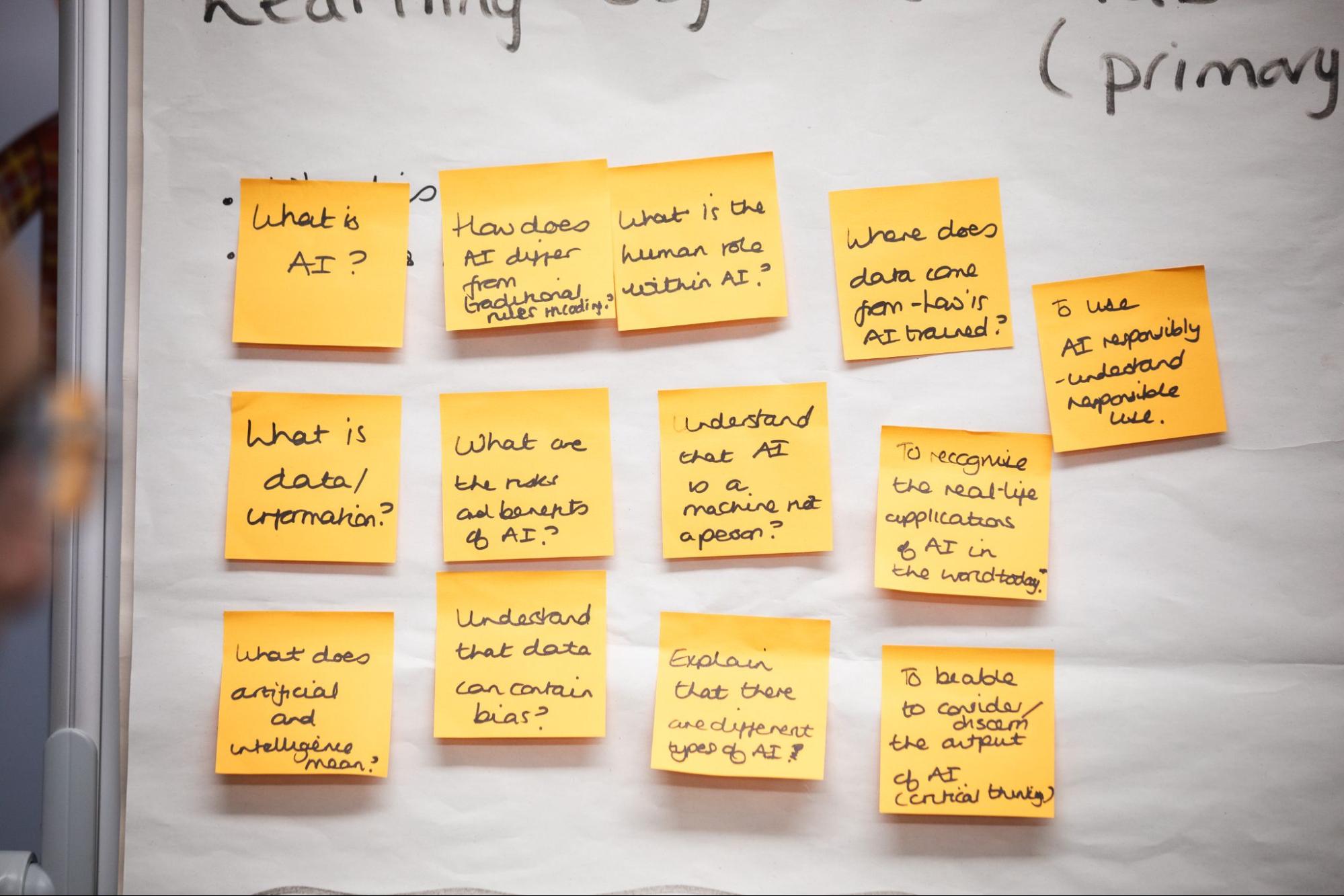
We are very interested in how to teach about AI, and held a workshop with teachers who were interested in the teaching of AI in February. Following on from the workshop results, we are interviewing more stakeholders, including UK-based experts, teachers and students, about their perspectives on concepts and skills that should be taught as part of an AI curriculum.

Notes at our teacher workshop about AI
Notes at our workshop about AI education.

We’re also researching data science and data ethics education, which are foundational aspects of AI literacy. Most of the current AI systems are data-driven, having been trained on vast amounts of data. Therefore students need to understand about data and data science if they are to learn about AI systems. Therefore we’ve conducted two detailed literature reviews on data science and on data ethics this year. The first of these will be published in March at the WiPSCE conference.

Unplugged AI in Ghana

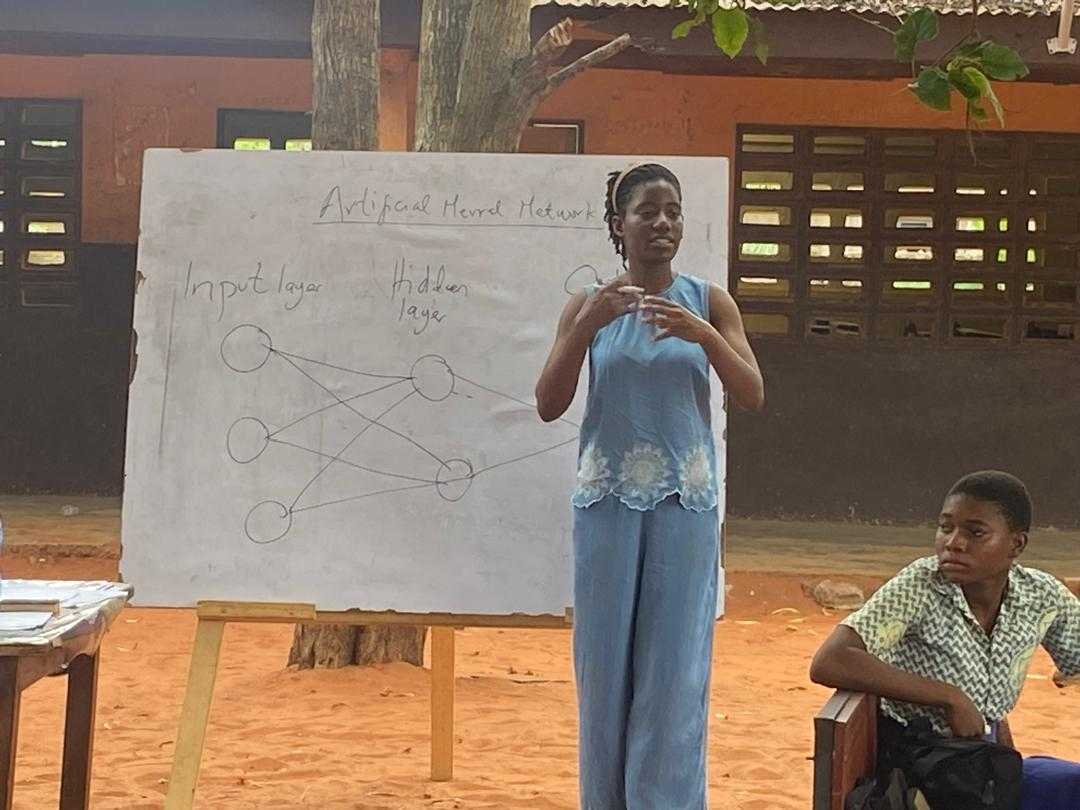
One of our PhD students, Salomey Addo, has been examining how AI is taught in Ghana, where it is part of the curriculum for young people between ages 12 and 15. This year Salomey published a paper reporting that Ghanaian teachers have positive attitudes towards teaching AI but feel unprepared for it. She’s also developed unplugged resources to teach about artificial neural networks (ANNs).

PhD student Salomey explaining how the unplugged resources worked in a teacher PD session in Ghana
PhD student Salomey explaining how the unplugged resources worked in a teacher PD session in Ghana.

ANNs are a fundamental technology used in a variety of AI systems, including image recognition and language translation systems. While ANNs are included in the Ghanaian AI curriculum, Salomey observed that teachers had difficulty with this particular topic The resources she developed are directly inspired by this, and involved teaching through role play and a board game.

Using AI in learning and teaching computing

This is an area we’ve also done some research in in the past year.

Carrie Anne Philbin published a paper in September showing that — at least in higher education — much of the use of generative AI in computing education is just duplicating the way teachers might already teach, and is primarily passive from a students’ perspective.

Meanwhile Katharine Childs and Veronica Cucuiat have been looking at how large language models (LLMs) can support secondary school programming education by helping students understand programming error messages. 

Programming education: Learning to debug

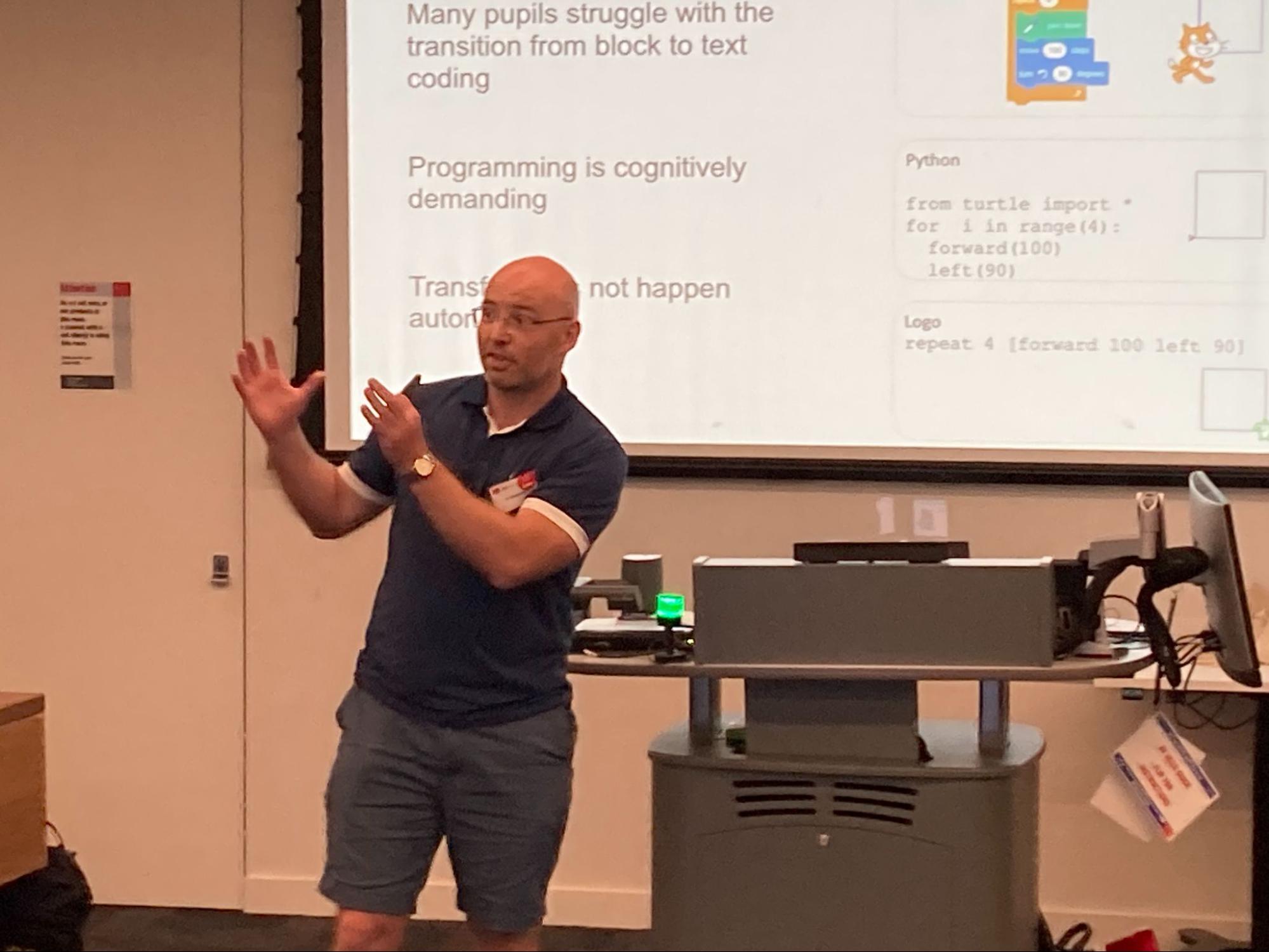
Text-based programming is a topic featured in many computing curricula around the world. Teachers and researchers know that younger learners, for example at the lower secondary school level, can find debugging text-based programs very challenging. Although we’ve seen decades of research around programming and debugging focusing on learners who are in higher education, very little research has been done with school-age students.

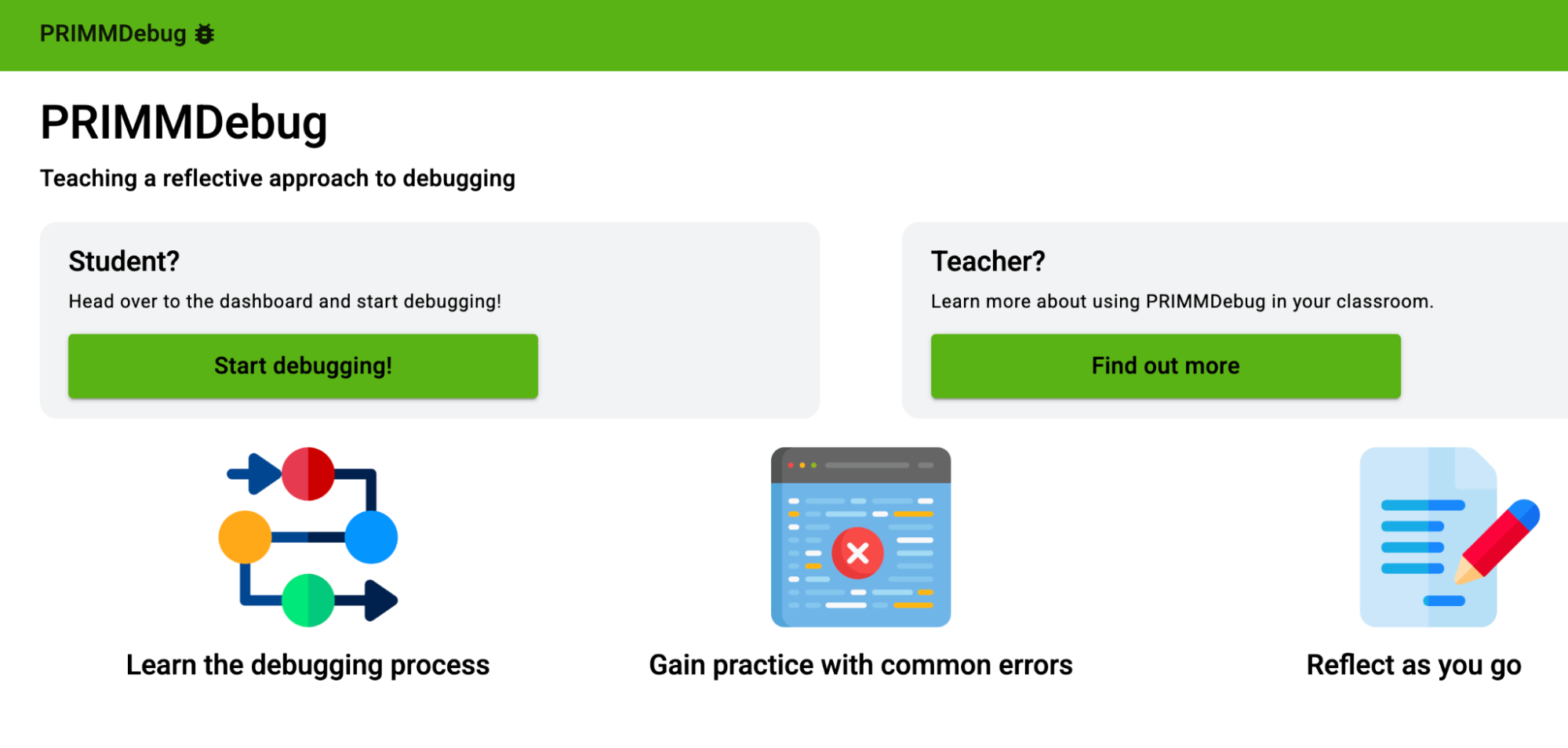
The interface of the PRIMMDebug tool
The interface of the PRIMMDebug tool.

In his research, Laurie Gale, a final-year PhD student at the Research Centre, found that learners were impatient to fix programs by trial and error, without figuring out what the real problemwas with their code or the underlying algorithm. He subsequently developed a tool called PRIMM Debug, which supports a more reflective and systematic approach to debugging. This tool enables learners to slow down when they are programming and to be more reflective. You can read more about it on the Research Centre website, and also catch up on the Foundation research seminar where he presented his work.

EPICS: Physical computing in school

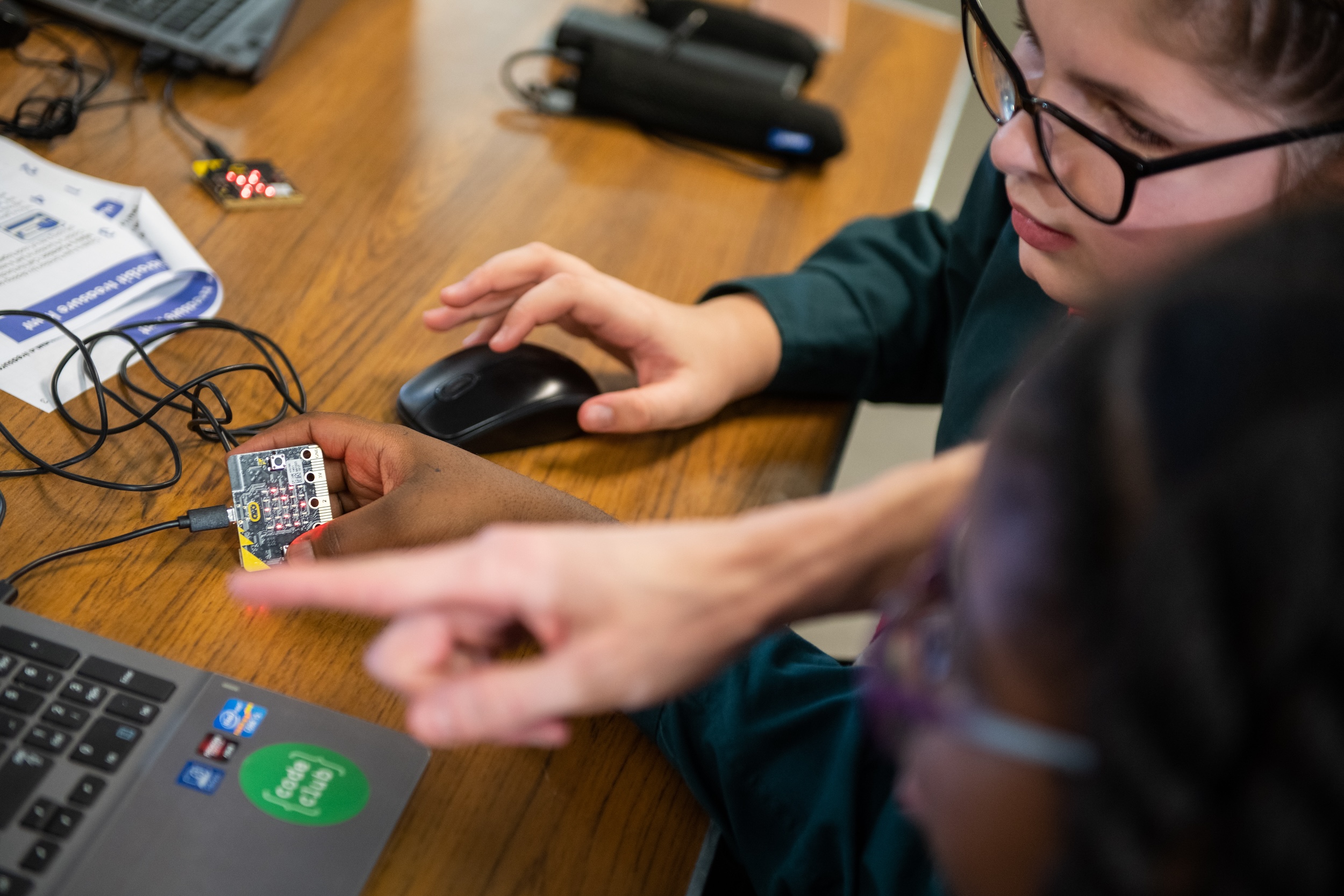
As part of a 5-year longitudinal project, running across the whole UK and the first project of its kind, we are looking at how physical computing impacts primary and secondary school learners. We’re investigating the effect of physical computing on learners’ creativity, agency and confidence, over time and at particular points known to be important for their subject choices. We are working with a wonderful set of partner primary schools who we visit each year.

Young learners coding a microbit project.
Young people using a micro:bit.

This year we reported some of our first results, which point to teachers’ perceptions of physical computing being engaging and inclusive for primary-aged children. Starting next spring, we will be carrying out our third year of data collection with our pupil cohort, who have reached the age of 10 to 11.

We’ll also be running a survey next summer for upper primary-aged children and their teachers. Please sign up for our Teacher Research Network newsletter to be the first to hear about taking part in this survey.

Teacher Inquiry in Computing Education (TICE)

As part of our TICE project we support teachers to conduct their own action research projects. This is a collaborative project, involving academics across the UK who volunteer to support teachers. The goal is to enable teachers to take a deep dive into a curriculum topic, a pedagogical approach, or a new resource, or to address a wider issue such as gender diversity or accessibility, to inform a change in their practice.

This year 16 teachers published their reports in our Teacher Research Booklet, and many also presented their findings online at CAS events or at the KCL-CAS London conference and the CAS National Conference. We’re very proud of them!

TICE participant Will Grey presenting at the KCL-CAS Conference in July 2025
TICE participant Will Grey presenting at the KCL-CAS Conference in July 2025.

Two of our TICE teachers will be also presenting their research at an academic conference to be held in January. Congratulations to Will Grey and Joanne Hodge!

Get involved

There are many other projects you can find out about on our website and in our annual report, so I hope that you will keep reading. It goes without saying that I’m incredibly proud of the team who’ve worked on all of these projects! 

To summarise, here’s how you can stay up to date with our work and maybe even get involved in studies:

Finally, I am pleased to announce that we will be hosting the UKICER 2026 conference for researchers and teachers in Cambridge on 3 and 4 2026 September. More details will follow on the UKICER website and on the Research Centre website in due course.

The post 2025 highlights from the Raspberry Pi Computing Education Research Centre appeared first on Raspberry Pi Foundation.

I Lived a Similar Trauma Rob Reiner’s Family Faces & Shame on Trump

Post Syndicated from Bradley M. Kuhn original http://ebb.org/bkuhn/blog/2025/12/16/rob-reiner-trump-my-brother-also-murdered-my-mother.html

I posted the following on my Fediverse (via Mastodon) account.
I’m reposting the whole seven posts here as written there, but I hope folks
will take a
look at that thread
as folks are engaging in conversation over there
that might be worth reading if what I have to say interests you.
(The remainder of the post is the same that can be found in the Fediverse
posts linked throughout.)

I
suppose Fediverse
isn’t the place people are discussing Rob Reiner. But after 36 hours of deliberating whether to say anything, I feel compelled. This thread will be long,but I start w/ most important part:

It’s an “open secret” in the FOSS community that in March 2017 my brother
murdered our mother. About 3k ppl/year in USA have this experience, so it’s
a statistical reality that someone else in FOSS experienced similar. If so,
you’re welcome in my PMs to discuss if you need support… (1/7)

… Traumatic loss due to murder is different than losing your
grandparent/parent of age-related ailments (& is even different than
losing a young person to a disease like cancer). The “a fellow family
member did it” brings permanent surrealism to your daily life. Nothing good
in your life that comes later is ever all that good. I know from direct
experience this is what Rob Reiner’s family now faces. It’s chaos; it
divides families forever: dysfunctional family takes on a new “expert”
level… (2/7)

…as one example: my family was immediately divided about punishment. Some
of my mother’s relatives wanted prosecution to seek death penalty. I knew
that my brother was mentally ill enough that jail or prison *would* get him
killed in a prison dispute eventually,so I met clandestinely w/my brother’s
public defender (during funeral planning!) to get him moved to a criminal
mental health facility instead of a regular prison. If they read this,
it’ll first time my family will find out I did that…(3/7)

…Trump’s political rise (for me) links up: 5 weeks into Trump’s 1ˢᵗ term, my brother murdered my mother.
My (then 33yr-old) brother was severely mentally ill from birth — yet escalated to murder only then. IMO, it wasn’t coincidence. My brother left voicemail approximately 5 hours before the murder stating his intent to murder & described an elaborate political delusion as the impetus.

∃ unintended & dangerous consequences of inflammatory political rhetoric on
the mental ill!…(4/7)

…I’m compelled to speak publicly — for first time ≈10 yrs after the murder —
precisely b/c of Trump’s response.

Trump endorsed the idea that those who oppose him encourage their own
murder from the mentally ill. Indeed, he said that those who oppose him are
*themselves causing* mental illnesses in those around them, & that his
political opponents should *expect* violence from their family members (who
were apparently driven to mental illness from your opposition to
Trump!)… (5/7)

…Trump’s actual words:

Rob Reiner, tortured & struggling,but once…talented movie director &
comedy star, has passed away, together w/ his wife…due to the anger he
caused others through his massive, unyielding, & incurable affliction w/ a
mind crippling disease known as TRUMP DERANGEMENT SYNDROME…He was known to
have driven people CRAZY by his raging obsession of…Trump, w/ his obvious
paranoia reaching new heights as [my] Administration surpassed all goals
and expectations of greatness…

(6/7)

My family became ultra-pro-Trump after my mom’s murder. My mom hated
politics: she was annoyed *both* if I touted my social democratic politics &
if my dad & his family stated their crypto-fascist views.

Every death leaves a hole in a community’s political fabric. 9+ years out,
I’m ostracized from my family b/c I’m anti-Trump.

Trump stated perhaps what my family felt but didn’t say: those who don’t
support Trump are at fault when those who fail to support Trump are
murdered. (7/7)

[ Finally, I want to also quote this one reply I also posted in the same
thread
:
I ask everyone, now that I’ve stated this public, that I *know* you’re going to want to search the Internet for it, & you will find a lot. Please, please, keep in mind that the Police Department & others basically lied to the public about some of the facts of the case. I seriously considered suing them for it, but ultimately it wasn’t worth my time. But, please everyone ask me if you are curious about any of the truth of the details of the crime & its aftermath …

I Lived a Similar Trauma Rob Reiner’s Family Faces & Shame on Trump

Post Syndicated from Bradley M. Kuhn original http://ebb.org/bkuhn/blog/2025/12/16/rob-reiner-trump-my-brother-also-murdered-my-mother.html

I posted the following on my Fediverse (via Mastodon) account.
I’m reposting the whole seven posts here as written there, but I hope folks
will take a
look at that thread
as folks are engaging in conversation over there
that might be worth reading if what I have to say interests you.
(The remainder of the post is the same that can be found in the Fediverse
posts linked throughout.)

I
suppose Fediverse
isn’t the place people are discussing Rob Reiner. But after 36 hours of deliberating whether to say anything, I feel compelled. This thread will be long,but I start w/ most important part:

It’s an “open secret” in the FOSS community that in March 2017 my brother
murdered our mother. About 3k ppl/year in USA have this experience, so it’s
a statistical reality that someone else in FOSS experienced similar. If so,
you’re welcome in my PMs to discuss if you need support… (1/7)

… Traumatic loss due to murder is different than losing your
grandparent/parent of age-related ailments (& is even different than
losing a young person to a disease like cancer). The “a fellow family
member did it” brings permanent surrealism to your daily life. Nothing good
in your life that comes later is ever all that good. I know from direct
experience this is what Rob Reiner’s family now faces. It’s chaos; it
divides families forever: dysfunctional family takes on a new “expert”
level… (2/7)

…as one example: my family was immediately divided about punishment. Some
of my mother’s relatives wanted prosecution to seek death penalty. I knew
that my brother was mentally ill enough that jail or prison *would* get him
killed in a prison dispute eventually,so I met clandestinely w/my brother’s
public defender (during funeral planning!) to get him moved to a criminal
mental health facility instead of a regular prison. If they read this,
it’ll first time my family will find out I did that…(3/7)

…Trump’s political rise (for me) links up: 5 weeks into Trump’s 1ˢᵗ term, my brother murdered my mother.
My (then 33yr-old) brother was severely mentally ill from birth — yet escalated to murder only then. IMO, it wasn’t coincidence. My brother left voicemail approximately 5 hours before the murder stating his intent to murder & described an elaborate political delusion as the impetus.

∃ unintended & dangerous consequences of inflammatory political rhetoric on
the mental ill!…(4/7)

…I’m compelled to speak publicly — for first time ≈10 yrs after the murder —
precisely b/c of Trump’s response.

Trump endorsed the idea that those who oppose him encourage their own
murder from the mentally ill. Indeed, he said that those who oppose him are
*themselves causing* mental illnesses in those around them, & that his
political opponents should *expect* violence from their family members (who
were apparently driven to mental illness from your opposition to
Trump!)… (5/7)

…Trump’s actual words:

Rob Reiner, tortured & struggling,but once…talented movie director &
comedy star, has passed away, together w/ his wife…due to the anger he
caused others through his massive, unyielding, & incurable affliction w/ a
mind crippling disease known as TRUMP DERANGEMENT SYNDROME…He was known to
have driven people CRAZY by his raging obsession of…Trump, w/ his obvious
paranoia reaching new heights as [my] Administration surpassed all goals
and expectations of greatness…

(6/7)

My family became ultra-pro-Trump after my mom’s murder. My mom hated
politics: she was annoyed *both* if I touted my social democratic politics &
if my dad & his family stated their crypto-fascist views.

Every death leaves a hole in a community’s political fabric. 9+ years out,
I’m ostracized from my family b/c I’m anti-Trump.

Trump stated perhaps what my family felt but didn’t say: those who don’t
support Trump are at fault when those who fail to support Trump are
murdered. (7/7)

[ Finally, I want to also quote this one reply I also posted in the same
thread
:
I ask everyone, now that I’ve stated this public, that I *know* you’re going to want to search the Internet for it, & you will find a lot. Please, please, keep in mind that the Police Department & others basically lied to the public about some of the facts of the case. I seriously considered suing them for it, but ultimately it wasn’t worth my time. But, please everyone ask me if you are curious about any of the truth of the details of the crime & its aftermath …

I Lived a Similar Trauma Rob Reiner’s Family Faces & Shame on Trump

Post Syndicated from Bradley M. Kuhn original http://ebb.org/bkuhn/blog/2025/12/16/rob-reiner-trump-my-brother-also-murdered-my-mother.html

I posted the following on my Fediverse (via Mastodon) account.
I’m reposting the whole seven posts here as written there, but I hope folks
will take a
look at that thread
as folks are engaging in conversation over there
that might be worth reading if what I have to say interests you.
(The remainder of the post is the same that can be found in the Fediverse
posts linked throughout.)

I
suppose Fediverse
isn’t the place people are discussing Rob Reiner. But after 36 hours of deliberating whether to say anything, I feel compelled. This thread will be long,but I start w/ most important part:

It’s an “open secret” in the FOSS community that in March 2017 my brother
murdered our mother. About 3k ppl/year in USA have this experience, so it’s
a statistical reality that someone else in FOSS experienced similar. If so,
you’re welcome in my PMs to discuss if you need support… (1/7)

… Traumatic loss due to murder is different than losing your
grandparent/parent of age-related ailments (& is even different than
losing a young person to a disease like cancer). The “a fellow family
member did it” brings permanent surrealism to your daily life. Nothing good
in your life that comes later is ever all that good. I know from direct
experience this is what Rob Reiner’s family now faces. It’s chaos; it
divides families forever: dysfunctional family takes on a new “expert”
level… (2/7)

…as one example: my family was immediately divided about punishment. Some
of my mother’s relatives wanted prosecution to seek death penalty. I knew
that my brother was mentally ill enough that jail or prison *would* get him
killed in a prison dispute eventually,so I met clandestinely w/my brother’s
public defender (during funeral planning!) to get him moved to a criminal
mental health facility instead of a regular prison. If they read this,
it’ll first time my family will find out I did that…(3/7)

…Trump’s political rise (for me) links up: 5 weeks into Trump’s 1ˢᵗ term, my brother murdered my mother.
My (then 33yr-old) brother was severely mentally ill from birth — yet escalated to murder only then. IMO, it wasn’t coincidence. My brother left voicemail approximately 5 hours before the murder stating his intent to murder & described an elaborate political delusion as the impetus.

∃ unintended & dangerous consequences of inflammatory political rhetoric on
the mental ill!…(4/7)

…I’m compelled to speak publicly — for first time ≈10 yrs after the murder —
precisely b/c of Trump’s response.

Trump endorsed the idea that those who oppose him encourage their own
murder from the mentally ill. Indeed, he said that those who oppose him are
*themselves causing* mental illnesses in those around them, & that his
political opponents should *expect* violence from their family members (who
were apparently driven to mental illness from your opposition to
Trump!)… (5/7)

…Trump’s actual words:

Rob Reiner, tortured & struggling,but once…talented movie director &
comedy star, has passed away, together w/ his wife…due to the anger he
caused others through his massive, unyielding, & incurable affliction w/ a
mind crippling disease known as TRUMP DERANGEMENT SYNDROME…He was known to
have driven people CRAZY by his raging obsession of…Trump, w/ his obvious
paranoia reaching new heights as [my] Administration surpassed all goals
and expectations of greatness…

(6/7)

My family became ultra-pro-Trump after my mom’s murder. My mom hated
politics: she was annoyed *both* if I touted my social democratic politics &
if my dad & his family stated their crypto-fascist views.

Every death leaves a hole in a community’s political fabric. 9+ years out,
I’m ostracized from my family b/c I’m anti-Trump.

Trump stated perhaps what my family felt but didn’t say: those who don’t
support Trump are at fault when those who fail to support Trump are
murdered. (7/7)

[ Finally, I want to also quote this one reply I also posted in the same
thread
:
I ask everyone, now that I’ve stated this public, that I *know* you’re going to want to search the Internet for it, & you will find a lot. Please, please, keep in mind that the Police Department & others basically lied to the public about some of the facts of the case. I seriously considered suing them for it, but ultimately it wasn’t worth my time. But, please everyone ask me if you are curious about any of the truth of the details of the crime & its aftermath …

I Lived a Similar Trauma Rob Reiner’s Family Faces & Shame on Trump

Post Syndicated from Bradley M. Kuhn original http://ebb.org/bkuhn/blog/2025/12/16/rob-reiner-trump-my-brother-also-murdered-my-mother.html

I posted the following on my Fediverse (via Mastodon) account.
I’m reposting the whole seven posts here as written there, but I hope folks
will take a
look at that thread
as folks are engaging in conversation over there
that might be worth reading if what I have to say interests you.
(The remainder of the post is the same that can be found in the Fediverse
posts linked throughout.)

I
suppose Fediverse
isn’t the place people are discussing Rob Reiner. But after 36 hours of deliberating whether to say anything, I feel compelled. This thread will be long,but I start w/ most important part:

It’s an “open secret” in the FOSS community that in March 2017 my brother
murdered our mother. About 3k ppl/year in USA have this experience, so it’s
a statistical reality that someone else in FOSS experienced similar. If so,
you’re welcome in my PMs to discuss if you need support… (1/7)

… Traumatic loss due to murder is different than losing your
grandparent/parent of age-related ailments (& is even different than
losing a young person to a disease like cancer). The “a fellow family
member did it” brings permanent surrealism to your daily life. Nothing good
in your life that comes later is ever all that good. I know from direct
experience this is what Rob Reiner’s family now faces. It’s chaos; it
divides families forever: dysfunctional family takes on a new “expert”
level… (2/7)

…as one example: my family was immediately divided about punishment. Some
of my mother’s relatives wanted prosecution to seek death penalty. I knew
that my brother was mentally ill enough that jail or prison *would* get him
killed in a prison dispute eventually,so I met clandestinely w/my brother’s
public defender (during funeral planning!) to get him moved to a criminal
mental health facility instead of a regular prison. If they read this,
it’ll first time my family will find out I did that…(3/7)

…Trump’s political rise (for me) links up: 5 weeks into Trump’s 1ˢᵗ term, my brother murdered my mother.
My (then 33yr-old) brother was severely mentally ill from birth — yet escalated to murder only then. IMO, it wasn’t coincidence. My brother left voicemail approximately 5 hours before the murder stating his intent to murder & described an elaborate political delusion as the impetus.

∃ unintended & dangerous consequences of inflammatory political rhetoric on
the mental ill!…(4/7)

…I’m compelled to speak publicly — for first time ≈10 yrs after the murder —
precisely b/c of Trump’s response.

Trump endorsed the idea that those who oppose him encourage their own
murder from the mentally ill. Indeed, he said that those who oppose him are
*themselves causing* mental illnesses in those around them, & that his
political opponents should *expect* violence from their family members (who
were apparently driven to mental illness from your opposition to
Trump!)… (5/7)

…Trump’s actual words:

Rob Reiner, tortured & struggling,but once…talented movie director &
comedy star, has passed away, together w/ his wife…due to the anger he
caused others through his massive, unyielding, & incurable affliction w/ a
mind crippling disease known as TRUMP DERANGEMENT SYNDROME…He was known to
have driven people CRAZY by his raging obsession of…Trump, w/ his obvious
paranoia reaching new heights as [my] Administration surpassed all goals
and expectations of greatness…

(6/7)

My family became ultra-pro-Trump after my mom’s murder. My mom hated
politics: she was annoyed *both* if I touted my social democratic politics &
if my dad & his family stated their crypto-fascist views.

Every death leaves a hole in a community’s political fabric. 9+ years out,
I’m ostracized from my family b/c I’m anti-Trump.

Trump stated perhaps what my family felt but didn’t say: those who don’t
support Trump are at fault when those who fail to support Trump are
murdered. (7/7)

[ Finally, I want to also quote this one reply I also posted in the same
thread
:
I ask everyone, now that I’ve stated this public, that I *know* you’re going to want to search the Internet for it, & you will find a lot. Please, please, keep in mind that the Police Department & others basically lied to the public about some of the facts of the case. I seriously considered suing them for it, but ultimately it wasn’t worth my time. But, please everyone ask me if you are curious about any of the truth of the details of the crime & its aftermath …

I Lived a Similar Trauma Rob Reiner’s Family Faces & Shame on Trump

Post Syndicated from Bradley M. Kuhn original http://ebb.org/bkuhn/blog/2025/12/16/rob-reiner-trump-my-brother-also-murdered-my-mother.html

I posted the following on my Fediverse (via Mastodon) account.
I’m reposting the whole seven posts here as written there, but I hope folks
will take a
look at that thread
as folks are engaging in conversation over there
that might be worth reading if what I have to say interests you.
(The remainder of the post is the same that can be found in the Fediverse
posts linked throughout.)

I
suppose Fediverse
isn’t the place people are discussing Rob Reiner. But after 36 hours of deliberating whether to say anything, I feel compelled. This thread will be long,but I start w/ most important part:

It’s an “open secret” in the FOSS community that in March 2017 my brother
murdered our mother. About 3k ppl/year in USA have this experience, so it’s
a statistical reality that someone else in FOSS experienced similar. If so,
you’re welcome in my PMs to discuss if you need support… (1/7)

… Traumatic loss due to murder is different than losing your
grandparent/parent of age-related ailments (& is even different than
losing a young person to a disease like cancer). The “a fellow family
member did it” brings permanent surrealism to your daily life. Nothing good
in your life that comes later is ever all that good. I know from direct
experience this is what Rob Reiner’s family now faces. It’s chaos; it
divides families forever: dysfunctional family takes on a new “expert”
level… (2/7)

…as one example: my family was immediately divided about punishment. Some
of my mother’s relatives wanted prosecution to seek death penalty. I knew
that my brother was mentally ill enough that jail or prison *would* get him
killed in a prison dispute eventually,so I met clandestinely w/my brother’s
public defender (during funeral planning!) to get him moved to a criminal
mental health facility instead of a regular prison. If they read this,
it’ll first time my family will find out I did that…(3/7)

…Trump’s political rise (for me) links up: 5 weeks into Trump’s 1ˢᵗ term, my brother murdered my mother.
My (then 33yr-old) brother was severely mentally ill from birth — yet escalated to murder only then. IMO, it wasn’t coincidence. My brother left voicemail approximately 5 hours before the murder stating his intent to murder & described an elaborate political delusion as the impetus.

∃ unintended & dangerous consequences of inflammatory political rhetoric on
the mental ill!…(4/7)

…I’m compelled to speak publicly — for first time ≈10 yrs after the murder —
precisely b/c of Trump’s response.

Trump endorsed the idea that those who oppose him encourage their own
murder from the mentally ill. Indeed, he said that those who oppose him are
*themselves causing* mental illnesses in those around them, & that his
political opponents should *expect* violence from their family members (who
were apparently driven to mental illness from your opposition to
Trump!)… (5/7)

…Trump’s actual words:

Rob Reiner, tortured & struggling,but once…talented movie director &
comedy star, has passed away, together w/ his wife…due to the anger he
caused others through his massive, unyielding, & incurable affliction w/ a
mind crippling disease known as TRUMP DERANGEMENT SYNDROME…He was known to
have driven people CRAZY by his raging obsession of…Trump, w/ his obvious
paranoia reaching new heights as [my] Administration surpassed all goals
and expectations of greatness…

(6/7)

My family became ultra-pro-Trump after my mom’s murder. My mom hated
politics: she was annoyed *both* if I touted my social democratic politics &
if my dad & his family stated their crypto-fascist views.

Every death leaves a hole in a community’s political fabric. 9+ years out,
I’m ostracized from my family b/c I’m anti-Trump.

Trump stated perhaps what my family felt but didn’t say: those who don’t
support Trump are at fault when those who fail to support Trump are
murdered. (7/7)

[ Finally, I want to also quote this one reply I also posted in the same
thread
:
I ask everyone, now that I’ve stated this public, that I *know* you’re going to want to search the Internet for it, & you will find a lot. Please, please, keep in mind that the Police Department & others basically lied to the public about some of the facts of the case. I seriously considered suing them for it, but ultimately it wasn’t worth my time. But, please everyone ask me if you are curious about any of the truth of the details of the crime & its aftermath …

I Lived a Similar Trauma Rob Reiner’s Family Faces & Shame on Trump

Post Syndicated from Bradley M. Kuhn original http://ebb.org/bkuhn/blog/2025/12/16/rob-reiner-trump-my-brother-also-murdered-my-mother.html

I posted the following on my Fediverse (via Mastodon) account.
I’m reposting the whole seven posts here as written there, but I hope folks
will take a
look at that thread
as folks are engaging in conversation over there
that might be worth reading if what I have to say interests you.
(The remainder of the post is the same that can be found in the Fediverse
posts linked throughout.)

I
suppose Fediverse
isn’t the place people are discussing Rob Reiner. But after 36 hours of deliberating whether to say anything, I feel compelled. This thread will be long,but I start w/ most important part:

It’s an “open secret” in the FOSS community that in March 2017 my brother
murdered our mother. About 3k ppl/year in USA have this experience, so it’s
a statistical reality that someone else in FOSS experienced similar. If so,
you’re welcome in my PMs to discuss if you need support… (1/7)

… Traumatic loss due to murder is different than losing your
grandparent/parent of age-related ailments (& is even different than
losing a young person to a disease like cancer). The “a fellow family
member did it” brings permanent surrealism to your daily life. Nothing good
in your life that comes later is ever all that good. I know from direct
experience this is what Rob Reiner’s family now faces. It’s chaos; it
divides families forever: dysfunctional family takes on a new “expert”
level… (2/7)

…as one example: my family was immediately divided about punishment. Some
of my mother’s relatives wanted prosecution to seek death penalty. I knew
that my brother was mentally ill enough that jail or prison *would* get him
killed in a prison dispute eventually,so I met clandestinely w/my brother’s
public defender (during funeral planning!) to get him moved to a criminal
mental health facility instead of a regular prison. If they read this,
it’ll first time my family will find out I did that…(3/7)

…Trump’s political rise (for me) links up: 5 weeks into Trump’s 1ˢᵗ term, my brother murdered my mother.
My (then 33yr-old) brother was severely mentally ill from birth — yet escalated to murder only then. IMO, it wasn’t coincidence. My brother left voicemail approximately 5 hours before the murder stating his intent to murder & described an elaborate political delusion as the impetus.

∃ unintended & dangerous consequences of inflammatory political rhetoric on
the mental ill!…(4/7)

…I’m compelled to speak publicly — for first time ≈10 yrs after the murder —
precisely b/c of Trump’s response.

Trump endorsed the idea that those who oppose him encourage their own
murder from the mentally ill. Indeed, he said that those who oppose him are
*themselves causing* mental illnesses in those around them, & that his
political opponents should *expect* violence from their family members (who
were apparently driven to mental illness from your opposition to
Trump!)… (5/7)

…Trump’s actual words:

Rob Reiner, tortured & struggling,but once…talented movie director &
comedy star, has passed away, together w/ his wife…due to the anger he
caused others through his massive, unyielding, & incurable affliction w/ a
mind crippling disease known as TRUMP DERANGEMENT SYNDROME…He was known to
have driven people CRAZY by his raging obsession of…Trump, w/ his obvious
paranoia reaching new heights as [my] Administration surpassed all goals
and expectations of greatness…

(6/7)

My family became ultra-pro-Trump after my mom’s murder. My mom hated
politics: she was annoyed *both* if I touted my social democratic politics &
if my dad & his family stated their crypto-fascist views.

Every death leaves a hole in a community’s political fabric. 9+ years out,
I’m ostracized from my family b/c I’m anti-Trump.

Trump stated perhaps what my family felt but didn’t say: those who don’t
support Trump are at fault when those who fail to support Trump are
murdered. (7/7)

[ Finally, I want to also quote this one reply I also posted in the same
thread
:
I ask everyone, now that I’ve stated this public, that I *know* you’re going to want to search the Internet for it, & you will find a lot. Please, please, keep in mind that the Police Department & others basically lied to the public about some of the facts of the case. I seriously considered suing them for it, but ultimately it wasn’t worth my time. But, please everyone ask me if you are curious about any of the truth of the details of the crime & its aftermath …

Put Zabbix at your Fingertips with the IntelliTrend Mobile App

Post Syndicated from Wolfgang Alper original https://blog.zabbix.com/put-zabbix-at-your-fingertips-with-the-intellitrend-mobile-app/31830/

The official Zabbix frontend works great on desktop, but it isn’t built for mobile. Monitoring doesn’t end when you step away from your workstation, and a reliable Zabbix mobile app keeps you connected to your Zabbix environment, gives you instant notifications, and allows you to react to problems or just check your host configuration at any time.

With IntelliTrend Mobile for Zabbix, you get a free, feature-rich mobile app for Zabbix, including real-time push notifications, custom mobile dashboards with unique widgets, built-in responsive host and item graphs, a detailed host viewer, and much more!


Mobile-optimized dashboards

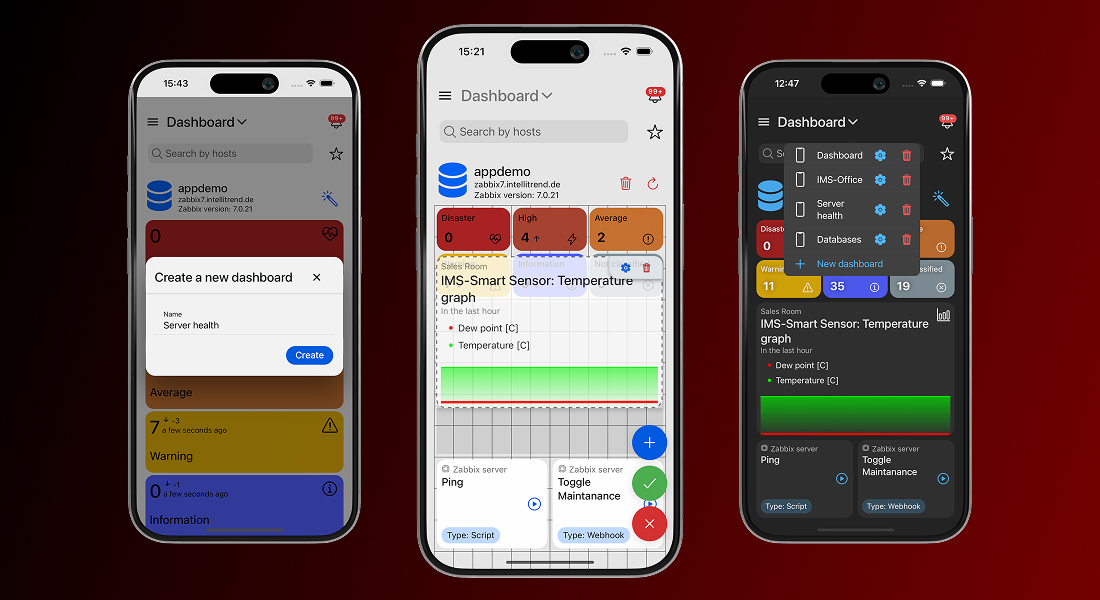
Zabbix dashboards are great and powerful, but they are built for desktop screens and don’t always scale well on mobile devices. IntelliTrend Mobile solves that by giving you the ability to build as many dashboards as you need, each tailored to a specific purpose.

One dashboard can focus on infrastructure health, another on critical issues, and another on a single customer or environment. Every dashboard is an independent workspace, featuring its own layout, collection of widgets, and set of filter criteria.

Grid-based dashboard layout

Every IntelliTrend Mobile dashboard is powered by a grid-based layout system that gives you full control over how your dashboard looks and feels. You are not stuck with fixed widget sizes or a predefined structure – you can place widgets exactly where you want them, drag them around freely, and resize them to give each widget the space it really needs.

This grid system keeps everything orderly without boxing you in. Whether you build a clean, minimal dashboard or pack it with data-rich widgets, the editor helps you shape a layout that looks intentional and stays easy to work with.

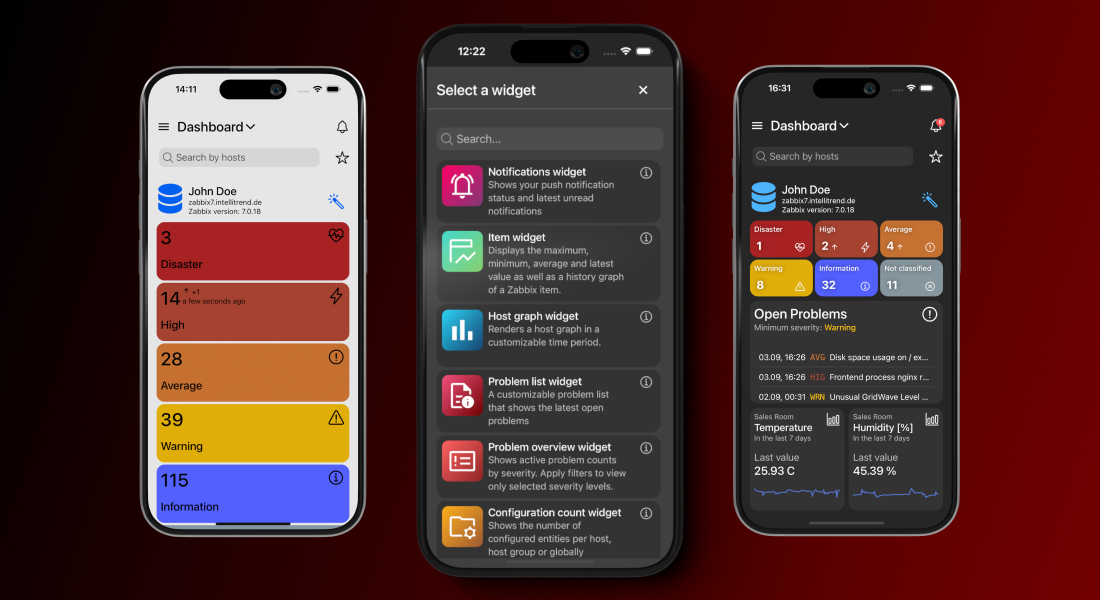
Highly customizable widgets

The app offers a variety of unique and customizable widgets, each designed to display key monitoring information clearly and efficiently. Each widget comes with its own set of configuration options, so you can decide what it shows and how it shows it. You can filter widgets by hosts, host groups, severities, and much more in order to keep the view focused on what matters the most to you.

Besides that, widgets let you adjust their appearance by hiding or revealing extra details, switching between compact and extended modes or adjusting how much data they present. The result is a dashboard that is fine-tuned to the way you work.

Smart problem management

When issues happen, speed and context are everything. That’s why problem management is the most important part of any Zabbix mobile app. IntelliTrend Mobile is built to keep you informed the moment something goes wrong and to let you take action without wasting time or switching devices.

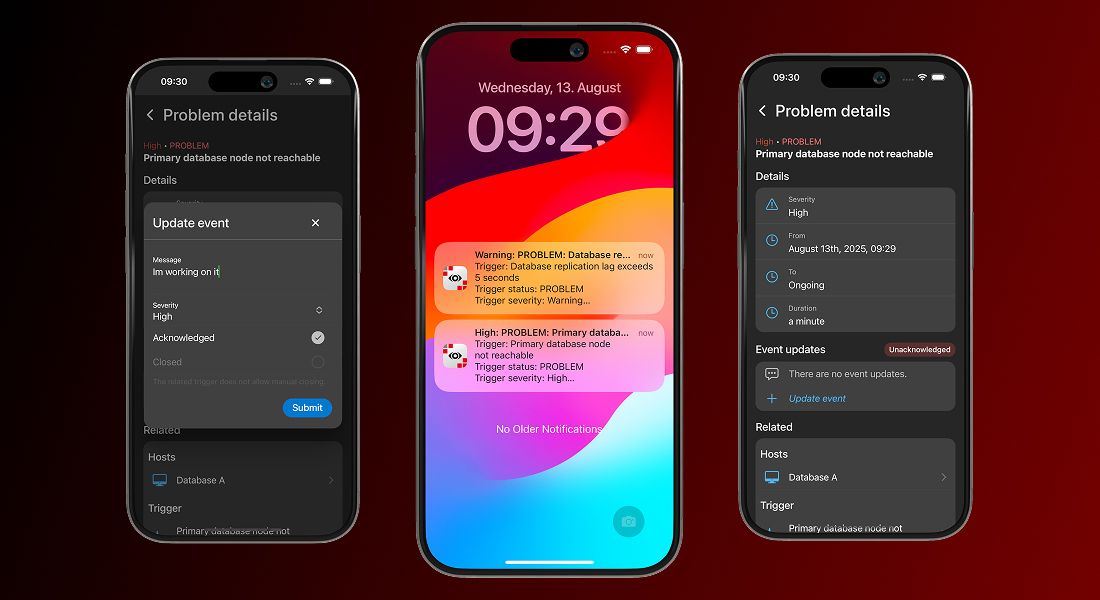
The problem view in the app gives you complete visibility into open and resolved issues, with filtering, sorting, and search options that let you quickly focus on the problems that require your attention. From the same interface, you can update and acknowledge problems without leaving the app.

Opening a problem takes you straight to a detailed view containing all the relevant information – severity, duration, related hosts, triggers, items, and historical data. What makes this view especially powerful is the ability to jump directly from the problem to the related host, item, or trigger within the app.

With a single tap, you can inspect the affected host, review item metrics, or analyze trigger history, all without leaving the mobile environment. This seamless navigation transforms problem management from a static list of alerts into a fully integrated, on-the-go investigation and resolution workflow.

Real-time response with Smart Alerts

The real game-changer, however, is IntelliTrend Mobile’s Smart Alerts feature. This isn’t just push notifications – it’s intelligent, actionable routing straight to the exact problem view in the app.

The moment a problem occurs, you’re notified in real time. Tap the alert and you’re immediately taken to the detailed problem screen. From there, you can analyze the issue, review metrics and history, acknowledge it, or take corrective action without ever opening the Zabbix web interface. No delays, no barriers, no switching devices!

With Smart Alerts, your team reacts faster, stays informed, and keeps systems running smoothly, turning mobile monitoring from passive alerts into active, on-the-go problem management.

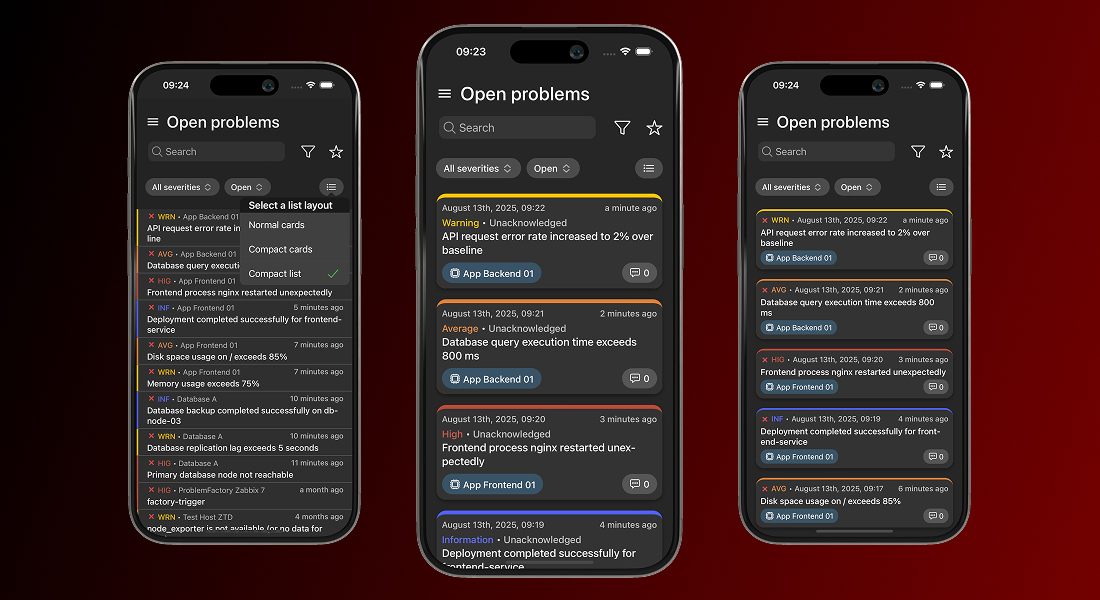
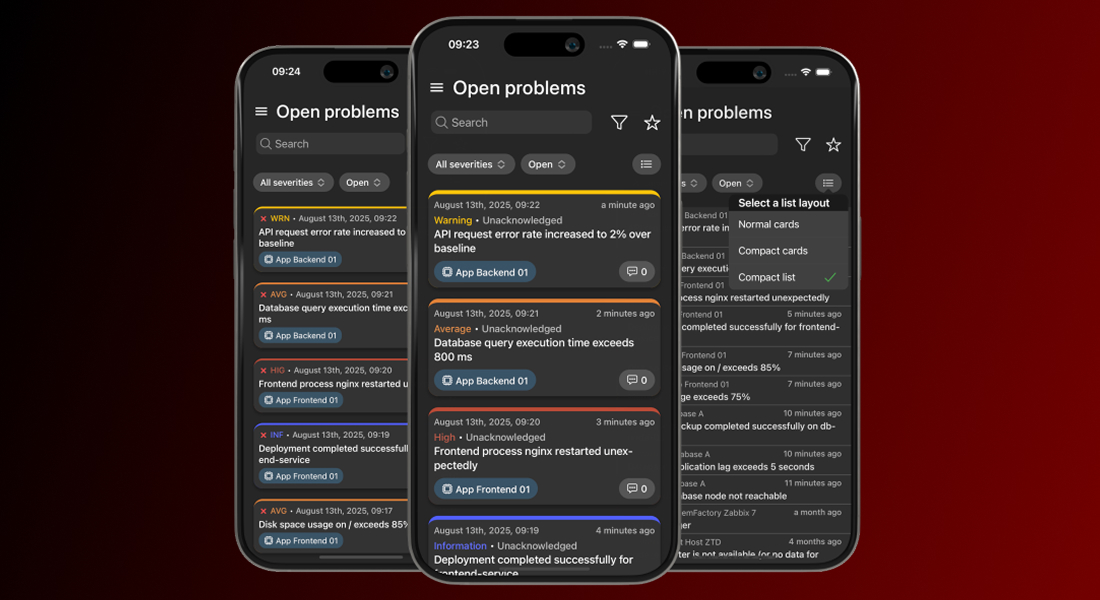
Flexible problem list views

IntelliTrend Mobile lets you choose how problems are displayed in the list. By default, each problem appears as a detailed card showing all relevant information. If you prefer a cleaner overview, you can switch to a compact card view or even a compact list view, for maximum information density.

This flexibility is especially helpful when your Zabbix server generates many problems, allowing you to scan large numbers of problems at a glance while keeping the interface tidy and manageable.

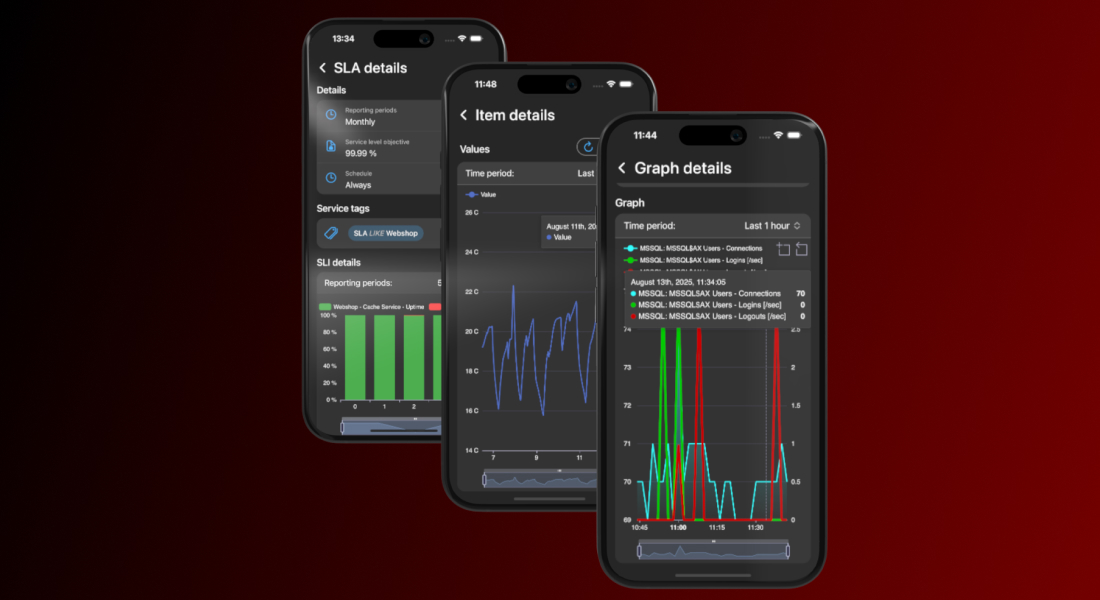
View item and host graphs with mobile-optimized charts

IntelliTrend Mobile reshapes the way you view Zabbix data while you’re on the move. Instead of relying on Zabbix’s static, desktop-focused graphs, the app renders item histories, host graphs, service uptimes, and SLA metrics using fully native, mobile-friendly charts. These charts are responsive, adapting seamlessly to your screen size and orientation for a smooth and clear viewing experience, whether you’re on a phone or tablet.

Every graph is interactive. You can zoom in to inspect a specific time window, pan across the timeline, or hover with your finger to see precise data points. Multiple data series can be toggled on or off, making it easy to focus on the metrics that matter.

You can quickly switch between time periods and pinpoint when an issue started, track its progression, or confirm when it was resolved – without ever opening the Zabbix web interface.

Complete host overview

You can also view all the essential details about any host right from the mobile app. Every host has a detailed view that puts all relevant information at your fingertips, making management simple, efficient, and fully mobile.

For each host, you can quickly see its visible and technical names, current status (enabled or disabled), and maintenance state, including whether data collection continues during maintenance. If the host is monitored by a proxy, you see the proxy that monitors it.

The host details view gives you instant access to all related configurations and objects:

Templates and host groups

You can view all templates assigned to a host and dive into any template’s full details with a single tap, making it easy to understand the monitoring configuration at a glance. Host groups work the same way – just tap a group to see every host it contains, giving you instant insight into related systems.

Host interfaces

IntelliTrend Mobile gives you a complete view of each host interface, including agent, SNMP, JMX, and IPMI types. For every interface, you can see its IP address, DNS name, port, and the interface type configured in Zabbix.

The app also shows the current availability status, highlighting interfaces that are unreachable or experiencing errors. This makes it easy to quickly identify connectivity problems, verify which monitoring protocols are active, and troubleshoot issues with data collection.

Macros

Macros are displayed with full detail (including type, value, and description) so you can verify configuration settings quickly or troubleshoot dynamically, all without leaving the host view.

Inventory

The host inventory view in IntelliTrend Mobile gives you full access to the complete Zabbix host inventory. All inventory fields configured in Zabbix are displayed directly in the app, giving you a complete overview of the host’s recorded details. You can also see the inventory mode for the host (Disabled, Manual, or Automatic) so it’s immediately clear how the inventory is being managed.

Open and resolved problems

From the host details page, you can jump straight into all open or resolved problems related to that specific host. One tap takes you directly to a filtered problem list, making it effortless to review recent problems or check the current state of the host without navigating through multiple menus.

Items, triggers, and graphs

All items, triggers, and graphs tied to the host are just one step away. Each entry opens a filtered list focused solely on that host, letting you move from the host view into any related object instantly. Whether you need to inspect a value, review a trigger, or explore a graph, the app keeps the entire chain of information connected.

Scripts

Execute host scripts directly from your mobile device, whether you’re restarting a service, collecting diagnostics, or triggering an automated workflow. It’s a fast, practical way to take action remotely, enabling real operations work even when you’re away from your desk.

With all these features combined, the host details view becomes a powerful, fully mobile workflow. Everything you need to monitor, analyze, and take action is right at your fingertips, making host management faster, more efficient, and truly on-the-go.

Customize your views

Favorites

You can create favorites for specific hosts or host groups and quickly switch your global scope to focus on them. Once a favorite is active, the app automatically filters all dashboards and list pages to show only data related to that host or host group.

Favorites make it easier to concentrate on the systems you manage most often, so you don’t have to reapply filters or navigate through long lists every time. You can switch between favorites at any time, giving you a fast way to move between different parts of your environment.

Layout modes

Everyone works differently, so the app comes with useful customization options. In addition to the filtering and sorting available on every list page, you can switch between different layout modes for all list pages.

Choose from the standard layout, a compact card layout, or a compact list layout for maximum information density. This lets you decide how much information you want to see at once and allows you to apply layout preferences individually for each page or set them globally in the app settings.

Many more features

The app already supports a wide range of features designed to give you full visibility into your Zabbix environment. Beyond the previously mentioned features, the app includes many more features, such as accessing services and SLAs to keep track of service performance and availability, explore templates, and view triggers, items, and graphs in detail.

But our development doesn’t stop here. We are constantly expanding app functionality and improving existing features based on user feedback. If you haven’t tried the app yet, now is a great time! We’d love to hear your honest thoughts about what works well, what could be better, and which features you’d like to see next. Your feedback helps to shape the future of IntelliTrend Mobile, and we take every suggestion seriously.


Submit feedback

The post Put Zabbix at your Fingertips with the IntelliTrend Mobile App appeared first on Zabbix Blog.
Шампиони по свой начин – да бъдеш себе си на подиума

Post Syndicated from original https://www.toest.bg/shampioni-po-svoy-nachin-da-budesh-sebe-si-na-podiuma/

Шампиони по свой начин – да бъдеш себе си на подиума

2025 година ще остане знаменателна в историята на Формула 1. Официалният филм за този спорт с участието на Брад Пит, който излезе по кината това лято, не е единствената причина. Битката за титлата не между двама, а между трима пилоти изглеждаше немислима на фона на последното десетилетие, когато лидерът в класирането обикновено събираше достатъчно точки, за да стане шампион преждевременно и да направи последните кръгове протоколно. Освен това картината, която се оформяше до средата на годината, сочеше, че ще има категорично предимство на „Макларън“ и е вероятно австралиецът Оскар Пиастри да спечели първенството предсрочно. Финалният кръг в Абу Даби обаче поднесе драма, невиждана от 2010 г. насам. Сезонът в моторните спортове добави неочакван подарък, тъй като с подобна битка, но седмица по-рано в Саудитска Арабия завърши и Световният рали шампионат. Отново трима пилоти, отново с минимални разлики в класирането между тях.

Тест за политолога, следящ моторни спортове

Тези ситуации бяха идеален шанс за емпирична проверка на тезите, които представих преди по-малко от два месеца в статията си за „Тоест“ „Шампиони без броня“. В нея посочих, че новото поколение състезатели предлага нов тип концепция за мъжественост – за тях чувствителността не е слабост, която трябва да се крие. Тук трябва да направя уговорката, че съм политолог по образование – учил съм за професия, в която обясняваме постфактум защо прогнозите ни не са се сбъднали.

В наши дни стресът, през който пилотите от Формула 1 преминават, е значително по-сериозен, отколкото в миналото. Причината за това е драматично промененият медиен пейзаж. Спорните моменти, дори да са от отминали сезони, не се забравят, тъй като в социалните мрежи се повтарят отново и отново. Запалянковците не могат да продължат напред, а се ожесточават и спортната им злоба стига през интернет директно до състезателите. 

Британецът Ландо Норис беше състезателят, който изглеждаше най-засегнат от този феномен, а върху него лежеше и основната тежест в битката за титлата, тъй като той се състезава за водещия отбор на „Макларън“ от 2019 г. насам и е смятан за негов естествен лидер. Норис получи подкрепата на отбора до такава степен, че според някои специалисти Пиастри беше пренебрегнат. Но тъй като двамата си поделяха възможните за спечелване точки, нидерландецът Макс Верстапен, който е безспорен лидер в екипа на „Ред Бул“, успя да се приближи опасно и до двамата в класирането. Това застраши крайния успех на екипа на „Макларън“, а загуба на титлата при пилотите щеше да се приеме като провал, при положение че тимът завоюва първото място при конструкторите месеци по-рано.

Последното състезание за годината – в емирство Абу Даби, се проведе като игра на шах, но между трима.

Верстапен влезе в битката за титлата, без никой да го очаква. Трудната първа половина от сезона, в която изостана значително по точки, смъкна от плещите му тежестта на фаворитската корона, която силно го измъчваше миналата година, когато трябваше да защитава предимството си. Смяната на ръководството в отбора на „Ред Бул“ в средата на сезона преобрази тима. Напускането на дългогодишния шеф на отбора Крисчън Хорнър, върху когото тегнеше сянката от обвинения в секс тормоз над служителка в екипа, сякаш облекчи всички. Макс спечели серия от победи, които показаха класата му, но и нещо по-съществено. Дори шампион като него, удобно определян с клишето „машина“, има нужда от спокойна работна среда, в която да разгърне таланта си.

Верстапен спечели и последното състезание в Абу Даби, започнало под лъчите на залязващото слънце и завършило на изкуствено осветление. Докато гледах надпреварата, неговото пилотиране ми напомни повече на поезия, отколкото на жестока битка за спортна титла. Това беше поведение на човек, видимо освободен от нуждата да доказва каквото и да било на когото и да било. Тази нагласа беше от решаващо значение за реакцията му в развръзката на състезанието. Баща ми сравни пилотирането на Верстапен с бягането на героя от филма „Огнени колесници“ – бързина, постигната сякаш без усилие.

На другия полюс бе настроението при Оскар Пиастри. Стремежът на „Макларън“ да наложат равнопоставеност с Норис достигна абсурдни висоти на италианската писта „Монца“. Причината беше изискването австралиецът да върне позиция на пистата заради забавянето, причинено от механиците на Ландо при смяна на гумите.

Дълго време считан за леден човек, неподвластен на стреса и емоциите,

той внезапно показа уязвимост и няколко пъти не блесна с нищо. Оскар не опита „да се държи като мъж“, а сам призна, че инцидентът на „Монца“ е разклатил психическата му увереност. Тази откровеност сякаш му възвърна силите и той завърши последните две състезания в Катар и Абу Даби пред съекипника си, макар че не успя да победи Верстапен. Така Пиастри може да гледа към третата си година като пилот във Формула 1 с високо вдигната глава.

Световен шампион обаче стана Ландо Норис. Британецът караше спокойно в последните кръгове от шампионата. Макар да беше дисквалифициран в Лас Вегас по технически причини и без да има вина, Ландо се нуждаеше от едва трето място в последния кръг, за да спечели титлата по точки. И го постигна, като удържа натиска на Шарл Льоклер от „Ферари“. 

След финала този видимо уязвим и чувствителен човек се разплака от облекчение, благодари на родителите и отбора си и каза, че за него е много важно как е успял да стане шампион по своя си начин, без да се прави на такъв, какъвто не е. 

Прегръдки, джентълменство и пълноценен живот

Норис често е критикуван за липсата на достатъчно агресия. Но Люис Хамилтън, живата легенда на спорта, сподели, че преди състезанието му е дал съвета да бъде себе си, да не променя подхода си „само“ защото се бори за титлата.

Реакцията на колегите беше показателна. Верстапен, чиято серия от поредни титли беше прекъсната, пръв отиде и прегърна приятеля си, с когото се състезаваха заедно на виртуални симулатори. Пиастри, който най-много имаше за какво да се ядосва заради успеха на Норис, беше вторият на „опашката“ за прегръдки. 

Двамата големи съперници на Ландо, на които той благодари за оспорваните им битки през годината, го поздравиха, преди това да успеят да направят родителите му! А не бяха единствените – по-късно Ландо получи прегръдки и от ветераните Хамилтън и Фернандо Алонсо, от сънародника си Джордж Ръсел, с когото преди години спореха за титлата във Формула 2, от Льоклер, конкурента му в това трудно състезание. 

Най-щастлив беше бившият му съотборник Карлос Сайнц. Испанецът не само поздрави английския си приятел, но и каза, че е прекрасно как хора като Ландо Норис могат да станат шампиони, че добрите момчета не завършват винаги последни. 

Последното надхвърля като значение тесните рамки на моторния спорт,

макар да е важно за всички състезатели в него, притискани от очакването винаги да бъдат железни в реакциите си. Още в статията „Непознатият дявол на тревожността и депресията“ посочих Ландо като човек, чиято откровеност в битката с тези проблеми е важна и за милионите, които го гледат на пистата. Сега те получават нов важен урок от неговия успех – че да си раним не означава непременно, че ще загубиш. Колко важно е това, си дадох сметка, когато в личен разговор мой приятел сподели:

Възхищавам се на хора като Оскар и Макс, винаги запазващи самообладание. Но аз съм като Ландо – до последно се тревожа и очаквам да се проваля.

Оказва се, че провалът не е задължителен.

По друг начин изглеждаше битката в Световния рали шампионат.

Той е смятан за второто по сила автомобилно първенство в света, но за съжаление, вече не се радва на този интерес, който имаше към него през 80-те. Причините за това са комплексни, но се крият повече в остарялата медийна стратегия на промоутърите, а не толкова в самите ралита, които продължават да предлагат изключително зрелищни надпревари с мощни автомобили по екстремни трасета. 

Ралитата са дисциплина с напълно различна философия. Вместо на изкуствено създадени писти пилотите се състезават по трудни и тесни обществени пътища (разбира се, затворени за трафик по време на надпреварата). Борбата не е директно със съперника, а за време. Това е различен тип психологическо предизвикателство за пилота, който не е сам в кокпита, а с навигатора си. Ако иска да вземе правилните завои по маршрути, на моменти изглеждащи труднопроходими и за пешеходец, той трябва да му се довери безрезервно. Поради тази причина и в ралитата няма толкова драматични съперничества между пилотите,

а стресът е някак по-интимен – между състезателя, колата и пътя.

Никъде това не личеше повече, отколкото в Саудитска Арабия, която беше домакин на последния кръг от шампионата. Ралито в Джеда мина по пейзаж, който съвсем официално се наричаше лунен и изглеждаше стряскащо на фона на изящните декори в предишни ралита в Централна Европа и Япония. Факт е обаче, че трасето предложи на състезателите изключително изпитание, натоварващо техниката, особено гумите. 

Французинът Себастиан Ожие влезе в историята на спорта с девета световна титла. Ветеранът дълго време влизаше в клишето за големия шампион – самоуверен, леко надменен, с минало на тежко съперничество с именития си сънародник Себастиан Льоб. С времето и успехите обаче омекна и от години не кара пълна програма, като пропуска някои ралита. В прякото предаване по телевизията, излъчваща надпреварите, коментаторът се пошегува, че великият шампион избира къде да кара само след консултация със съпругата си. 

Подобна свобода би била немислима във Формула 1.

В едно по-некомерсиално състезание като ралито обаче Себастиан намира ритъм, който му позволява да балансира между пилотирането и времето, което прекарва със семейството си. Тази година това му донесе успех, какъвто може би и самият той не е очаквал. Участията му се оказаха достатъчни, за да надвие уелсеца Елфин Еванс и финландеца Кале Рованпера. И тримата караха автомобили на „Тойота“, но от отбора нямаше никакви пристрастия в каквато и да била посока. Себ победи заслужено. 

За Елфин Еванс това е горчив хап, тъй като за пети път остава втори в крайното класиране. Той е тих и сдържан състезател, разчитащ повече на постоянство, отколкото на чиста скорост. Когато пред 2020 г. отпадна на последното рали „Монца“, той предупреди Ожие за коварния участък по маршрута, макар това да му коства крайния успех – етика от джентълменското минало на спорта, което изглеждаше безвъзвратно отминало.

Но за някои хора как печелят и губят, е по-важно от резултата,

а Елфин го показа и тази година, смирено и достойно поздравявайки противника си. Призна, че ако иска да стане шампион, за в бъдеще ще трябва да е „по-безпощаден“, но не вярвам това да стане на цената на неговото спортсменство.

Най-любопитен като типаж е третият претендент Кале Рованпера. Той беше смятан за дете чудо на ралитата, а лично аз ще го запомня с това, че веднага след като спечели рали „Швеция“, съвпадащо с първите дни от войната на Русия срещу Украйна, изрази пред всички подкрепата си за нападнатата страна. 

След две поредни титли през 2022 и 2023 г. Кале изглеждаше устремен към рекордите на Ожие и сънародника му Себастиан Льоб. След това обаче си взе почивка и се видя, че успехите са го изморили психически. През 2024 г. караше спорадично, опитваше други дисциплини, а догодина ще се пробва зад волана в японската Суперформула. Това изглежда странен избор за човек, бягащ от напрежението. Но показва, че за него е важно не да си тежи на мястото, а да живее живота си пълноценно – така, както той иска.

Англичаните казват, че и спрелият часовник е верен два пъти в денонощието. 

Така и аз, противно на клишето за политолозите, се оказа, че съм направил като цяло точна прогноза, че появилата се през последните години човещина по състезателните трасета няма да изчезне заради жаждата за победа. Водещите пилоти доказват това:

Ландо Норис, станал шампион такъв, какъвто е. Макс Верстапен, свалил короната с достойнство. Оскар Пиастри, запазил честта си въпреки изпуснатата титла. Елфин Еванс – готов да загуби, но да остане джентълмен. Кале Рованпера, търсещ нови неща. И Себастиан Ожие, балансиращ рекордите със семейството.

Всички те са ярки личности, които пленяват въображението на феновете и вече са запазили своя дял – кой по-голям, кой по-малък – в историята на спорта. А атлетите, казано метафорично, извървяват в истинския живот Пътя на героя, характерен за приказките. С това, че успяват да съхранят себе си по него и под фокуса на прожекторите, дават надежда, че и ние, „обикновените хора“ (доколкото всъщност има такива), също можем да успеем. 

Introducing the Apache Spark troubleshooting agent for Amazon EMR and AWS Glue

Post Syndicated from Jake Zych original https://aws.amazon.com/blogs/big-data/introducing-the-apache-spark-troubleshooting-agent-for-amazon-emr-and-aws-glue/

The newly launched Apache Spark troubleshooting agent can eliminate hours of manual investigation for data engineers and scientists working with Amazon EMR or AWS Glue. Instead of navigating multiple consoles, sifting through extensive log files, and manually analyzing performance metrics, you can now diagnose Spark failures using simple natural language prompts. The agent automatically analyzes your workloads and delivers actionable recommendations. transforming a time-consuming troubleshooting process into a streamlined, efficient experience.

In this post, we show you how the Apache Spark troubleshooting agent helps analyze Apache Spark issues by providing detailed root causes and actionable recommendations. You’ll learn how to streamline your troubleshooting workflow by integrating this agent with your existing monitoring solutions across Amazon EMR and AWS Glue.

Apache Spark powers critical ETL pipelines, real-time analytics, and machine learning workloads across thousands of organizations. However, building and maintaining Spark applications remains an iterative process where developers spend significant time troubleshooting. Spark application developers encounter operational challenges due to a few different reasons:

  • Complex connectivity and configuration options to a variety of resources with Spark – Although this makes Spark a popular data processing platform, it often makes it challenging to find the root cause of inefficiencies or failures when Spark configurations aren’t optimally or correctly configured.
  • Spark’s in-memory processing model and distributed partitioning of datasets across its workers – Although good for parallelism, this often makes it difficult for users to identify inefficiencies. This results in slow application execution or root cause of failures caused by resource exhaustion issues such as out of memory and disk exceptions.
  • Lazy evaluation of Spark transformations – Although lazy evaluation optimizes performance, it makes it challenging to accurately and quickly identify the application code and logic that caused the failure from the distributed logs and metrics emitted from different executors.

Apache Spark troubleshooting agent architecture

This section describes the components of the troubleshooting agent and how they connect to your development environment. The troubleshooting agent provides a single conversational entry point for your Spark applications across Amazon EMR, AWS Glue, and Amazon SageMaker Notebooks. Instead of navigating different consoles, APIs, and log locations for each service, you interact with one Model Context Protocol (MCP) server through natural language using any MCP-compatible AI assistant of your choice, including custom agents you develop using frameworks such as Strands Agents.

Operating as a fully managed cloud-hosted MCP server, the agent removes the need to maintain local servers while keeping your data and code isolated and secure in a single-tenant system design. Operations are read-only and backed by AWS Identity and Access Management (IAM) permissions; the agent only has access to resources and actions your IAM role grants. Additionally, tool calls are automatically logged to AWS CloudTrail, providing complete auditability and compliance visibility. This combination of managed infrastructure, granular IAM controls, and CloudTrail integration confirms your Spark diagnostic workflows remain secure, compliant, and fully auditable.

The agent builds on years of AWS expertise running millions of Spark applications at scale. It automatically analyzes Spark History Server data, distributed executor logs, configuration patterns, and error stack traces and extracts relevant features and signals to surface insights that would otherwise require manual correlation across multiple data sources and deep understanding of Spark and service internals.

Getting started 

Complete the following steps to get started with the Apache Spark troubleshooting agent.

Prerequisites

Verify you meet or have completed the following prerequisites.

System requirements:

  • Python 3.10 or higher
  • Install the uv package manager. For instructions, see installing uv.
  • AWS Command Line Interface (AWS CLI) (version 2.30.0 or later) installed and configured with appropriate credentials.

IAM permissions: Your AWS IAM profile needs permissions to invoke the MCP server and access your Spark workload resources. The AWS CloudFormation template in the setup documentation creates an IAM role with the required permissions. You can also manually add the required IAM permissions.

Set up using AWS CloudFormation

First, deploy the AWS CloudFormation template provided in the setup documentation. This template automatically creates the IAM roles with the permissions required to invoke the MCP server.

  1. Deploy the template within the same AWS Region you run your workloads in. For this post, we’ll use us-east-1.
  2. From the AWS CloudFormation Outputs tab, copy and execute the environment variable command:
    export SMUS_MCP_REGION=us-east-1 && export IAM_ROLE=arn:aws:iam::111122223333:role/spark-troubleshooting-role-xxxxxx

  3. Configure your AWS CLI profile:
    aws configure set profile.smus-mcp-profile.role_arn ${IAM_ROLE}
    aws configure set profile.smus-mcp-profile.source_profile default
    aws configure set profile.smus-mcp-profile.region ${SMUS_MCP_REGION}

Set up using Kiro CLI

You can use Kiro CLI to interact with the Apache Spark troubleshooting agent directly from your terminal.

Installation and configuration:

  1. Install Kiro CLI.
  2. Add both MCP servers, using the environment variables from the previous Set up using AWS CloudFormation section:
    # Add Spark Troubleshooting MCP Server
    kiro-cli-chat mcp add \
        --name "sagemaker-unified-studio-mcp-troubleshooting" \
        --command "uvx" \
        --args "[\"mcp-proxy-for-aws@latest\",\"https://sagemaker-unified-studio-mcp.${SMUS_MCP_REGION}.api.aws/spark-troubleshooting/mcp\", \"--service\", \"sagemaker-unified-studio-mcp\", \"--profile\", \"smus-mcp-profile\", \"--region\", \"${SMUS_MCP_REGION}\", \"--read-timeout\", \"180\"]" \
        --timeout 180000 \
        --scope global
    # Add Spark Code Recommendation MCP Server
    kiro-cli-chat mcp add \
        --name "sagemaker-unified-studio-mcp-code-rec" \
        --command "uvx" \
        --args "[\"mcp-proxy-for-aws@latest\",\"https://sagemaker-unified-studio-mcp.${SMUS_MCP_REGION}.api.aws/spark-code-recommendation/mcp\", \"--service\", \"sagemaker-unified-studio-mcp\", \"--profile\", \"smus-mcp-profile\", \"--region\", \"${SMUS_MCP_REGION}\", \"--read-timeout\", \"180\"]" \
        --timeout 180000 \
        --scope global

  3. Verify your setup by running the /tools command in Kiro CLI to see the available Apache Spark troubleshooting tools.

Set up using Kiro IDE

Kiro IDE provides a visual development environment with integrated AI assistance for interacting with the Apache Spark troubleshooting agent.

Installation and configuration:

  1. Install Kiro IDE.
  2. MCP configuration is shared across Kiro CLI and Kiro IDE. Open the command palette using Ctrl + Shift + P (Windows / Linux) or Cmd + Shift + P (macOS) and Search for Kiro: Open MCP Config
  3. Verify the contents of your mcp.json match the Set up using Kiro CLI section.

Using the troubleshooting agent

Next, we provide 3 reference architectures for solutions to use the troubleshooting agent in your existing workflows with ease. We also provide the reference code and AWS CloudFormation templates for these architectures in the Amazon EMR Utilities GitHub repository.

Solution 1 – Conversational troubleshooting: Troubleshooting failed Apache Spark applications with Kiro CLI

When Spark applications fail across your data platform, your debugging approach would typically involve navigating different consoles for Amazon EMR, Amazon EC2, Amazon EMR Serverless, and AWS Glue, manually reviewing Spark History Server logs, checking error stack traces, analyzing resource usage patterns, then correlating this information to find the root cause and fix. The Apache Spark troubleshooting agent automates this entire workflow through natural language, providing a unified troubleshooting experience across the three platforms. Simply describe your failed applications, for example:

# Amazon EMR-EC2
Debug my failing Amazon EMR-EC2 step. Cluster id: 'j-xxxxx' Step id: 's-xxxxx'
# Amazon EMR Serverless
Troubleshoot my Amazon EMR Serverless job. Application id: 'xxxxx' Job run id: 'xxxxx'
# AWS Glue
Analyze my failed AWS Glue job. Job name: 'my-etl-job' Job run id: 'jr_xxxxx'

The agent automatically extracts Spark event logs and metrics, analyzes the error patterns, and provides a clear root cause explanation along with recommendations, all through the same conversational interface. The following video demonstrates the complete troubleshooting workflow across Amazon EMR-EC2, Amazon EMR Serverless, and AWS Glue using Kiro CLI:

Solution 2 – Agent-driven notifications: Integrate the Apache Spark troubleshooting agent into a monitoring workflow 

In addition to troubleshooting from the command line, the troubleshooting agent can plug into your monitoring infrastructure to provide improved failure notifications.

Production data pipelines require immediate visibility when failures occur. Traditional monitoring systems can alert you when a Spark job fails, but diagnosing the root cause still requires manual investigation and an analysis of what went wrong before remediation can begin.

With the Apache Spark troubleshooting agent, you can integrate it into your existing monitoring workflows to receive root causes and recommendations as soon as you receive a failure notification. Here, we demonstrate two integration patterns that result in automatic root cause analysis within your existing workflows.

Apache Airflow Integration

This first integration pattern uses Apache Airflow callbacks to automatically trigger troubleshooting when Spark job operators fail.

When any Amazon EMR, Amazon EC2, Amazon EMR Serverless, or AWS Glue job operator fails in an Apache Airflow DAG,

  1. A callback invokes the Spark troubleshooting agent within a separate DAG.
  2. The Spark troubleshooting agent analyzes the issue, establishes the root cause, and identifies code fix recommendations.
  3. The Spark troubleshooting agent sends a comprehensive diagnostic report to a configured Slack channel.

The solution is available in the Amazon EMR Utilities GitHub repository (documentation) for immediate integration into your existing Apache Airflow deployments with a 1-line change to your Airflow DAGs. The following video demonstrates this integration:

Amazon EventBridge integration

For event-driven architectures, this second pattern uses Amazon EventBridge to automatically invoke the troubleshooting agent when Spark jobs fail across your AWS environment.

This integration uses an AWS Lambda function that interacts with the Apache Spark troubleshooting agent through the Strands MCP Client.

When Amazon EventBridge detects failures from Amazon EMR-EC2 steps, Amazon EMR Serverless job runs, or AWS Glue job runs, it triggers the AWS Lambda function which:

  1. Uses the Apache Spark troubleshooting agent to analyze the failure
  2. Identifies the root cause and generates code fix recommendations
  3. Constructs a comprehensive analysis summary
  4. Sends the summary to Amazon SNS
  5. Delivers the analysis to your configured destinations (email, Slack, or other SNS subscribers)

This serverless approach provides centralized failure analysis across all your Spark platforms without requiring changes to individual pipelines. The following video demonstrates this integration:

A reference implementation of this solution is available in the Amazon EMR Utilities GitHub repository (documentation).

Solution 3 – Intelligent Dashboards: Use the Apache Spark troubleshooting agent with Kiro IDE to visualize account level application failures: what failed, why failed and how to fix

Understanding the health of your Spark workloads across multiple platforms requires consolidating data from Amazon EMR (both EC2 and Serverless) and AWS Glue. Teams typically build custom monitoring solutions by writing scripts to query multiple APIs, aggregate metrics, and generate reports which can be time consuming and require active maintenance.

With Kiro IDE and the Apache Spark troubleshooting agent, you can build comprehensive monitoring dashboards conversationally. Instead of writing custom code to aggregate workload metrics, you can describe what you want to track, and the agent generates a complete dashboard showing overall performance metrics, error category distributions for failures, success rates across platforms, and critical failures requiring immediate attention. Unlike traditional dashboards that only show traditional KPIs and metrics on what application failed, this dashboard uses the Spark troubleshooting agent to provide insights to users on why the applications failed, and how they can be fixed. The following video demonstrates building a multi-platform monitoring dashboard using Kiro IDE:

The prompt used within the demo:

Build comprehensive monitoring dashboard for all of my Amazon EMR-EC2 steps, Amazon EMR Serverless jobs, and AWS Glue jobs for the last 30 days. Region: us-east-2. 
Execution Plan:
1. List all of my Spark applications across these services from the last 30 days. You can store any intermediate results in files in this folder as .json, but VALIDATE outputs before moving onto the next step. It's imperative to check the results before considering this done. You can write python script helpers to achieve this. Handle throttling and other exceptions gracefully. Make sure you cover all platforms: Amazon EMR-EC2, Amazon EMR Serverless, and AWS Glue.
2. Use the spark-troubleshooting-mcp to gather failure insights for each of my applications. Save this as .json as well. 
3. Then, use this information to help build the dashboard as HTML. Name the file dashboard.html.
Dashboard Requirements:
- Information from all of my Amazon EMR-EC2, Amazon EMR Serverless, and AWS Glue applications should be present
- overall success rates across platforms
- error category distributions for failures as a pie chart
- failures from last 30 days requiring attention with root causes and recommendations. Include error category and show the root causes and recommendations as they are returned by the spark-troubleshooting-mcp
- configuration comparisons per each platform. Configuration includes versions, worker types / DPUs, etc.

Clean up

To avoid incurring future AWS charges, delete the resources you created during this walkthrough:

  • Delete the AWS CloudFormation stack.
  • If you created an Amazon EventBridge rule for integration, delete those resources.

Conclusion

In this post, we demonstrated how the Apache Spark troubleshooting agent transforms hours of manual investigation into natural language conversations, significantly reducing troubleshooting time from hours to minutes and making Spark expertise accessible to all. By integrating natural language diagnostics into your existing development tools—whether Kiro CLI, Kiro IDE, or other MCP-compatible AI assistants—your teams can focus on building innovative applications instead of debugging failures.


Special thanks

A special thanks to everyone who contributed from engineering and science to the launch of the Spark troubleshooting agent and the remote MCP service: Tony Rusignuolo, Anshi Shrivastava, Martin Ma, Hirva Patel, Pranjal Srivastava, Weijing Cai, Rupak Ravi, Bo Li, Vaibhav Naik, XiaoRun Yu, Tina Shao, Pramod Chunduri, Ray Liu, Yueying Cui, Savio Dsouza, Kinshuk Pahare, Tim Kraska, Santosh Chandrachood, Paul Meighan and Rick Sears.

A special thanks to all of our partners who contributed to the launch of the Spark troubleshooting agent and the remote MCP service: Karthik Prabhakar, Suthan Phillips, Basheer Sheriff, Kamen Sharlandjiev, Archana Inapudi, Vara Bonthu, McCall Peltier, Lydia Kautsky, Larry Weber, Jason Berkovitz, Jordan Vaughn, Amar Wakharkar, Subramanya Vajiraya, Boyko Radulov and Ishan Gaur.

About the authors

Jake Zych

Jake is a Software Development Engineer at AWS Analytics. He has a deep interest in distributed systems and generative AI. In his spare time, Jake likes to create video content and play board games.

Maheedhar Reddy Chappidi

Maheedhar is a Senior Software Development Engineer at AWS Analytics. He is passionate about building fault-tolerant, reliable distributed systems at scale and generative AI applications for Data Integration. Outside of work, Maheedhar enjoys listening to podcasts and playing with his two-year-old child.

Vishal Kajjam

Vishal is a Senior Software Development Engineer at AWS Analytics. He is passionate about distributed computing and using ML/AI for designing and building end-to-end solutions to address customers’ data integration needs. In his spare time, he enjoys spending time with family and friends.

Arunav Gupta

Arunav is a Software Development Engineer at AWS Analytics. He is passionate about generative AI and orchestration and their uses in improving developer quality-of-life. In his free time, Arunav enjoys competing in a karting league and exploring new coffee shops in New York.

Wei Tang

Wei is a Software Development Engineer at AWS Analytics. She is strong developer with deep interests in solving recurring customer problems with distributed systems and AI/ML.

Andrew Kim

Andrew is a Software Development Engineer at AWS Analytics, with a deep passion for distributed systems architecture and AI-driven solutions, specializing in intelligent data integration workflows and cutting-edge feature development on Apache Spark. Andrew focuses on re-inventing and simplifying solutions to complex technical problems, and he enjoys creating web apps and producing music in his free time.

Jeremy Samuel

Jeremy is a Software Development Engineer at AWS Analytics. He has a strong interest in creating distributed systems and generative AI. In his spare time, he enjoys playing video games and listening to music.

Kartik Panjabi

Kartik is a Software Development Manager at AWS Analytics. His team builds generative AI features for the Data Integration and distributed system for data integration.

Shubham Mehta

Shubham is a Senior Product Manager at AWS Analytics. He leads generative AI feature development across services such as AWS Glue, Amazon EMR, and Amazon MWAA, using AI/ML to simplify and enhance the experience of data practitioners building data applications on AWS.

Vidyashankar Sivakumar

Vidyashankar is an applied scientist in the Data Processing and Experiences organization, where he works on DevOps agents that simplify and optimize the customer journey for AWS Big Data processing services such as Amazon EMR and AWS Glue. Outside of work, Vidyashankar enjoys listening to podcasts on current affairs, AI/ML, and AIOps, as well as following cricket.

Muhammad Ali Gulzar

Muhammad is an Amazon Scholar in the Data Processing Agents Science team, and an assistant professor in the Computer Science Department at Virginia Tech. Gulzar’s research interests lie at the intersection of software engineering and big data systems.

Mukul Prasad

Mukul is a Senior Applied Science Manager in the Data Processing and Experiences organization. He leads the Data Processing Agents Science team developing DevOps agents to simplify and optimize the customer journey in using AWS Big Data processing services including Amazon EMR, AWS Glue, and Amazon SageMaker Unified Studio. Outside of work, Mukul enjoys food, travel, photography, and Cricket.

Mohit Saxena

Mohit is a Senior Software Development Manager at AWS Analytics. He leads development of distributed systems with AI/ML-driven capabilities and Agents to simplify and optimize the experience of data practitioners that build big data applications with Apache Spark, Amazon S3 and data lakes/warehouses on the cloud.

Introducing Apache Spark upgrade agent for Amazon EMR

Post Syndicated from Keerthi Chadalavada original https://aws.amazon.com/blogs/big-data/introducing-apache-spark-upgrade-agent-for-amazon-emr/

For organizations running Apache Spark workloads, version upgrades have long represented a significant operational challenge. What should be a routine maintenance task often evolves into an engineering project spanning several months, consuming valuable resources that could drive innovation instead of managing technical debt. Engineering teams must often manually analyze API deprecation, resolve behavioral changes in the engine, address shifting dependency requirements, and re-validate both functionality and data quality, all while keeping production workloads running smoothly. This complexity delays access to performance improvements, new features, and critical security updates.

At re:Invent 2025, we announced the AI-powered upgrade agent for Apache Spark on Amazon EMR. Working directly within your IDE, this agent handles the heavy lifting of version upgrades that involves analyzing code, applying fixes, and validating results, while you maintain control over every change. What once took months can now be completed in hours.

In this post, you’ll learn how to:

  • Assess your existing Amazon EMR Spark applications
  • Use the Spark upgrade agent directly from the Kiro IDE
  • Upgrade a sample e-commerce order analytics Spark application project (build configs, source code, tests, data quality validation)
  • Review code changes and then roll them out through your CI/CD pipeline

Spark upgrade agent architecture

The Apache Spark upgrade agent for Amazon EMR is a conversational AI capability designed to accelerate Spark version upgrades for EMR applications. Through an MCP-compatible client, such as the Amazon Q Developer CLI, the Kiro IDE, or any custom agent built with frameworks like Strands, you can interact with a Model Context Protocol (MCP) server using natural language.


Figure 1: A diagram of the Apache Spark upgrade agent workflow.

Operating as a fully managed, cloud-hosted MCP server, the agent removes the need to maintain any local infrastructure. All tool calls and AWS resource interactions are governed by your AWS Identity and Access Management (IAM) permissions, ensuring the agent operates only within the access you authorize. Your application code remains on your machine, and only the minimal information required to diagnose and fix upgrade issues is transmitted. Every tool invocation is recorded in AWS CloudTrail, providing full auditability throughout the process.

Built on years of experience helping EMR customers upgrade their Spark applications, the upgrade agent automates the end-to-end modernization workflow, reducing manual effort and eliminating much of the trial-and-error typically involved in major version upgrades. The agent guides you through six phases:

  1. Planning: The agent analyzes your project structure, identifies compatibility issues, and generates a detailed upgrade plan. You review and customize this plan before execution begins.
  2. Environment setup: The agent configures build tools, updates language versions, and manages dependencies. For Python projects, it creates virtual environments with correct package versions.
  3. Code transformation: The agent updates build files, replaces deprecated APIs, fixes type incompatibilities, and modernizes code patterns. Changes are explained and shown before being applied.
  4. Local validation: The agent compiles your project and runs your test suite. When tests fail, it analyzes errors, applies fixes, and retries. This continues until all tests pass.
  5. EMR validation: The agent packages your application, deploys it to EMR, monitors execution, and analyzes logs. Runtime issues are fixed iteratively.
  6. Data quality checks: The agent can run your application on both source and target Spark versions, compare outputs, and report differences in schemas, values, or statistics.

Throughout the process, the agent explains its reasoning and collaborates with you on decisions.

Getting started

(Optional) Assessing your accounts for EMR Spark Upgrades

Before beginning a Spark upgrade, it’s helpful to understand the current state of your environment. Many customers run Spark applications across multiple Amazon EMR clusters and versions, making it challenging to know which workloads should be prioritized for modernization. If you have already identified the Spark applications that you would like to upgrade or already have a dashboard, you can skip this assessment step and move to the next section to get started with the Spark upgrade agent.

Building an Assessment Dashboard

To simplify this discovery process, we provide a lightweight Python-based assessment tool that scans your EMR environment and generates an interactive dashboard summarizing your Spark application footprint. The tool reviews EMR steps, extracts application metadata, and computes EMR lifecycle timelines to help you to:

  • Understand your Spark applications and their executions distribution over different EMR versions.
  • Review days remaining until each EMR version reaches end of support (EOS) for all Spark applications.
  • Evaluate what applications should be prioritized to migrate to newer EMR version.

Key insights from the assessment


Figure 2: A graph of EMR versions per application.

This dashboard shows how many Spark applications are running on legacy EMR versions, helping you identify which workloads to migrate first.


Figure 3: a graph of application use and current versions.

This dashboard identifies your most frequently used applications and their current EMR versions. Applications marked in red indicate high-impact workloads that should be prioritized for migration.


Figure 4: a utilization and EMR version graph.

This dashboard highlights high-usage applications running on older EMR versions. Larger bubbles represent more frequently used applications, and the Y-axis shows the EMR version. Together, these dimensions make it easy to spot which applications should be prioritized for upgrade.


Figure 5: a graph highlighting applications nearing End of Support.

The dashboard identifies applications approaching EMR End of Support, helping you prioritize migrations before updates and technical support are discontinued. For more information about support timelines, see Amazon EMR standard support.

Once you have identified the applications that need to be upgraded, you can use any IDE such as VS Code, Kiro IDE, or any other environment that supports installing an MCP server to begin the upgrade.

Getting started with Spark upgrade agent using Kiro IDE

Prerequisites

System requirements

IAM permissions

Your AWS IAM profile must include permissions to invoke the MCP server and access your Spark workload resources. The CloudFormation template provided in the setup documentation creates an IAM role with these permissions, along with supporting resources such as the Amazon S3 staging bucket where the upgrade artifacts will be uploaded. You can also customize the template to control which resources are created or skip resources you prefer to manage manually.

  1. Deploy the template within the same region you run your workloads in.
  2. Open the CloudFormation Outputs tab and copy the 1-line instruction ExportCommand, then execute it in your local environment.
    export SMUS_MCP_REGION=<your mcp server launch region> && export IAM_ROLE=arn:aws:iam::111122223333:role/spark-upgrade-role-xxxxxx && export STAGING_BUCKET_PATH=<your staging bucket path>

  3. Configure your AWS CLI profile:
    aws configure set profile.smus-mcp-profile.role_arn ${IAM_ROLE}
    aws configure set profile.smus-mcp-profile.source_profile default
    aws configure set profile.smus-mcp-profile.region ${SMUS_MCP_REGION}

Set up Kiro IDE and connect to the Spark upgrade agent

Kiro IDE provides a visual development environment with integrated AI assistance for interacting with the Apache Spark upgrade agent.

Installation and configuration:

  1. Install Kiro IDE
  2. Open the command palette using Ctrl + Shift + P (Linux) or Cmd + Shift + P (macOS) and Search for Kiro: Open MCP Config

    Figure 6: the Kiro command palette.
  3. Add the Spark upgrade agent configuration
    "mcpServers": {
        "upgrade-server": {
          "command": "uvx",
          "args": [
            "mcp-proxy-for-aws@latest",
            "https://sagemaker-unified-studio-mcp.${SMUS_MCP_REGION}.api.aws/spark-upgrade/mcp",
            "--service",
            "sagemaker-unified-studio-mcp",
            "--profile",
            "smus-mcp-profile",
            "--region",
            "${SMUS_MCP_REGION}",
            "--read-timeout",
            "180"
          ],
          "timeout": 180000
        }
      }
    }

  4. Once saved, the Kiro sidebar displays a successful connection to the upgrade server.

    Figure 7: Kiro IDE displaying a successful connection to the MCP server.

Upgrading a sample Spark application using Kiro IDE

To demonstrate upgrading from EMR 6.1.0 (Spark 3.0.0) to EMR 7.11.0 (Spark 3.5.6), we have prepared a sample e-commerce order processing application. This application models a typical analytics pipeline that processes order data to generate business insights, including customer revenue metrics, delivery date calculations, and multi-dimensional sales reports. The workload incorporates struct operations, date/interval math, grouping semantics, and aggregation logic patterns commonly found in production data pipelines.

Download the sample project

Clone the sample project from the Amazon EMR utilities GitHub repository:

git clone https://github.com/aws-samples/aws-emr-utilities.git
cd aws-emr-utilities/applications/spark-upgrade-assistant/demo-spark-application

Open the project in Kiro IDE

Launch Kiro IDE and open the demo-spark-application folder. Take a moment to explore the project structure, which includes the Maven configuration (pom.xml), the main Scala application, unit tests, and sample data.

Starting an upgrade

Once you have the project loaded in the Kiro IDE, select the Chat tab on the right-hand side of the IDE and type the following prompt to start the upgrade of the sample revenue analytics application:

Help me upgrade my application  from Spark 3.0 to Spark 3.5 
Use EMR-EC2 cluster j-9XXXXXXXXXX  with Spark 3.5 for validation. 
Store updated artifacts at s3://<path to upload upgrade artifacts>
Enable data quality checks.

Note: Replace j-XXXXXXXXXXXXX with your EMR cluster ID and <path to upload upgrade artifacts> with your S3 bucket name.

How the upgrade agent works

Step 1: Analyze and plan

After you submit the prompt, the agent analyzes your project structure, build system, and dependencies to create an upgrade plan. You can review the proposed plan and suggest modifications before proceeding.


Figure 8: the proposed upgrade plan from the agent, ready for review.

Step 2: Upgrade dependencies

The agent will analyze all project dependencies and makes the necessary changes to upgrade the versions for compatibility with the target Spark version. It then compiles the project, builds the application, and runs tests to verify everything works correctly with the target Spark version.


Figure 9: Kiro IDE upgrading dependency versions.

Step 3: Code transformation

Alongside dependency updates, the agent identifies and fixes code changes in source and test files arising from deprecated APIs, modified dependencies, or backward incompatible behavior. The agent validates these modifications through unit, integration, and remote validation on Amazon EMR on Amazon EC2 or EMR Serverless depending on your deployment mode, iterating until successful execution.

Figure 10: the upgrade agent iterating through change testing.
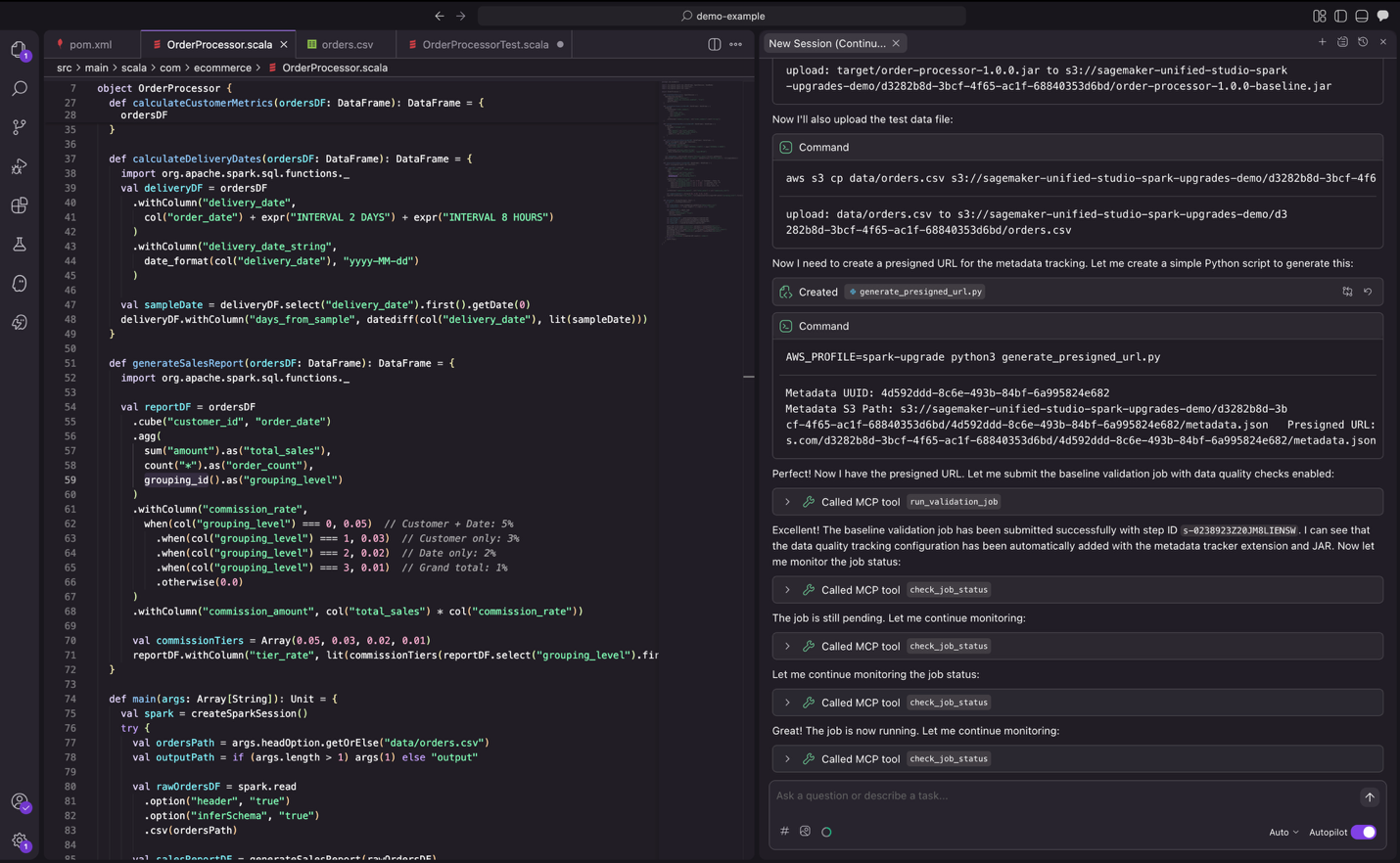
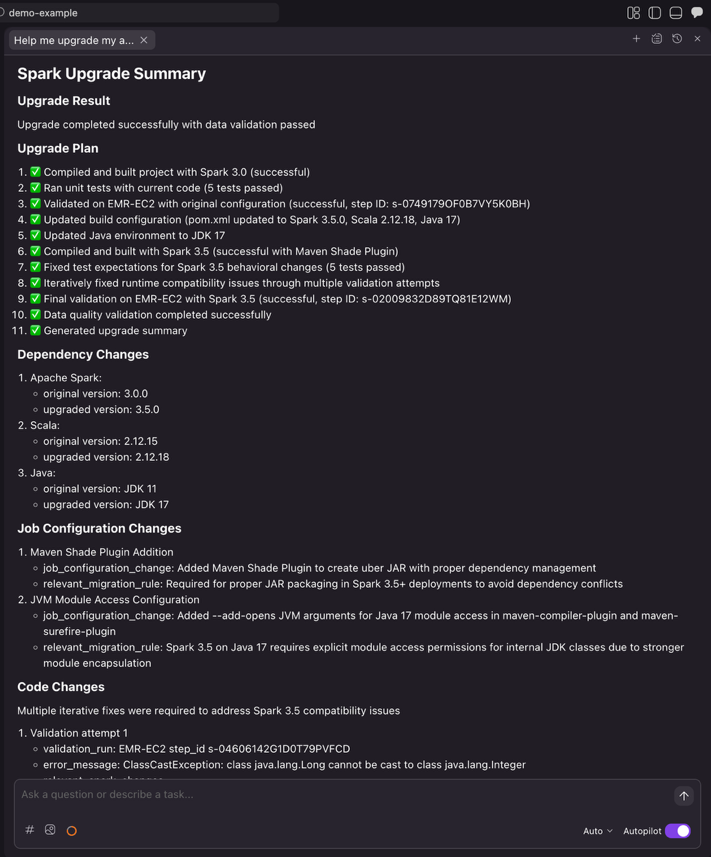
Step 4: Validation

As part of validation, the agent submits jobs to EMR to verify the application runs successfully with actual data. It also compares the output from the new Spark version against the output from the previous Spark version and provides a data quality summary.


Figure 11: the upgrade agent validating changes with real data.

Step 5: Summary

Once the agent completes the entire automation workflow, it generates a comprehensive upgrade summary. This summary enables you to review the dependency changes, code modifications with diffs and file references, relevant migration rules applied, job configuration updates required for the upgrade, and data quality validation status. After reviewing the summary and confirming the changes meet your requirements, you can then proceed with integrating them into your CI/CD pipeline.


Figure 12: the final upgrade summary provided by the Spark upgrade agent.

Integrating with your existing CI/CD framework

Once the Spark upgrade agent completes the automated upgrade process, you can seamlessly integrate the changes into your development workflow.

Pushing changes to remote repository

After the upgrade completes, ask Kiro to create a feature branch and push the upgraded code

Prompt to Kiro

Create a feature branch 'spark-upgrade-3.5' and push these changes to remote repository.

Kiro executes the necessary Git commands to create a clean feature branch, enabling proper code review workflows through pull requests.

CI/CD pipeline integration

Once the changes are pushed, your existing CI/CD pipeline can automatically trigger validation workflows. Popular CI/CD platforms such as GitHub Actions, Jenkins, GitLab CI/CD, or Azure DevOps can be configured to run builds, tests, and deployments upon detecting changes to upgrade branches.


Figure 14: the upgrade agent submitting a new feature branch with detailed commit message.

Conclusion

Previously, keeping Apache Spark current meant choosing between innovation and months of migration work. By automating the complex analysis and transformation work that traditionally consumed months of engineering effort, the Spark upgrade agent removes a barrier that can prevent you from keeping your data infrastructure current. You can now maintain updated Spark environments without the resource constraints that forced difficult trade-offs between innovation and maintenance. Taking the above Spark application upgrading experience as an example, what previously required 8 hours of manual work, including updating build configs, resolving build/compile failures, fixing runtime issues, and reviewing data quality results, now takes just 30 minutes with the automated agent.

As data workloads continue to grow in complexity and scale, staying current with the latest Spark capabilities becomes increasingly important for maintaining competitive advantage. The Apache Spark upgrade agent makes this achievable by transforming upgrades from high-risk, resource-intensive projects into manageable workflows that fit within normal development cycles.

Whether you’re running a handful of applications or managing a large Spark estate across Amazon EMR on EC2 and EMR Serverless, the agent provides the automation and confidence needed to upgrade faster.Ready to upgrade your Spark applications? Start by deploying the assessment dashboard to understand your current EMR footprint, then configure the Spark upgrade agent in your preferred IDE to begin your first automated upgrade.

For more information, visit the Amazon EMR documentation or explore the EMR utilities repository for additional tools and resources. Refer for details on which versions are supported are listed here in Amazon EMR documentation.


Special thanks

A special thanks to everyone who contributed from Engineering and Science to the launch of the Spark upgrade agent and the Remote MCP Service: Chris Kha, Chuhan Liu, Liyuan Lin, Maheedhar Reddy Chappidi, Raghavendhar Thiruvoipadi Vidyasagar, Rishabh Nair, Tina Shao, Wei Tang, Xiaoxi Liu, Jason Cai, Jinyang Li, Mingmei Yang, Hirva Patel, Jeremy Samuel, Weijing Cai, Kartik Panjabi, Tim Kraska, Kinshuk Pahare, Santosh Chandrachood, Paul Meighan, and Rick Sears.

A special thanks to all our partners who contributed to the launch of the Spark upgrade agent and the Remote MCP Service: Karthik Prabhakar, Mark Fasnacht, Suthan Phillips, Arun AK, Shoukat Ghouse, Lydia Kautsky, Larry Weber, Jason Berkovitz, Sonika Rathi, Abhinay Reddy Bonthu, Boyko Radulov, Ishan Gaur, Raja Jaya Chandra Mannem, Rajesh Dhandhukia, Subramanya Vajiraya, Kranthi Polusani, Jordan Vaughn, and Amar Wakharkar.

About the authors

Keerthi Chadalavada

Keerthi is a Senior Software Development Engineer in the AWS analytics organization. She focuses on combining generative AI and data integration technologies to design and build comprehensive solutions for customer data and analytics needs.

XiaoRun Yu

XiaoRun is a Software Development Engineer in the AWS analytics organization. He is working on building scalable and reliable Gen-AI products to solve real customer issues. Outside of work, Xiaorun enjoys exploring new places in the Bay Area.

Bo Li

Bo is a Senior Software Development Engineer in the AWS analytics organization. He is devoted to designing and building end-to-end solutions to address customers’ data analytic and processing needs with cloud-based, data-intensive and GenAI technologies.

Rajendra Gujja

Rajendra is a Senior Software Development Engineer in the AWS analytics organization. He is passionate about distributed computing and everything and anything about the data.

Vaibhav Naik

Vaibhav is a software engineer in the AWS analytics organization. He is passionate about building robust, scalable solutions to tackle complex customer problems. With a keen interest in generative AI, he likes to explore innovative ways to develop enterprise-level solutions that harness the power of cutting-edge AI technologies.

Malinda Malwala

Malinda is an Applied Scientist in the Data Processing Agents Science team building DevOps AI Agents for AWS Analytics services including Amazon EMR and AWS Glue. His research focuses on creating reliable, explainable, and trustworthy AI agents for enterprise use by combining traditional software engineering with generative AI. Outside of work, he enjoys hiking in the Cascade Mountains.

McCall Peltier

McCall is a Senior Product Marketing Manager at AWS focused on data processing services, including Amazon EMR. She leads messaging and launches that support customers building modern data platforms on AWS, collaborating across product and field teams to drive adoption and customer impact.

Shubham Mehta

Shubham is a Senior Product Manager at AWS Analytics. He leads generative AI feature development across services such as AWS Glue, Amazon EMR, and Amazon MWAA, using AI/ML to simplify and enhance the experience of data practitioners building data applications on AWS.

Pradeep Patel

Pradeep is a Software Development Manager at AWS Analytics. He is passionate about solving complex customer challenges through Agentic AI and AWS Cloud technologies, specializing in building highly scalable and robust solutions. Outside of work, he enjoys hiking and exploring applications of AI technologies.

Mukul Prasad

Mukul is a Senior Applied Science Manager in the Data Processing and Experiences organization. He leads the Data Processing Agents Science team developing DevOps agents to simplify and optimize the customer journey in using AWS Big Data processing services including Amazon EMR, AWS Glue, and Amazon SageMaker Unified Studio. Outside of work, Mukul enjoys food, travel, photography, and Cricket.

Mohit Saxena

Mohit is a Senior Software Development Manager at AWS Analytics. He leads development of distributed systems with AI/ML-driven capabilities and Agents to simplify and optimize the experience of data practitioners that build big data applications with Apache Spark, Amazon S3 and data lakes/warehouses on the cloud.

Introducing the Experimental info() Function

Post Syndicated from Arve Knudsen original https://prometheus.io/blog/2025/12/16/introducing-info-function/

Enriching metrics with metadata labels can be surprisingly tricky in Prometheus, even if you’re a PromQL wiz!
The PromQL join query traditionally used for this is inherently quite complex because it has to specify the labels to join on, the info metric to join with, and the labels to enrich with.
The new, still experimental info() function, promises a simpler way, making label enrichment as simple as wrapping your query in a single function call.

In Prometheus 3.0, we introduced the info() function, a powerful new way to enrich your time series with labels from info metrics.
What’s special about info() versus the traditional join query technique is that it relieves you from having to specify identifying labels, which info metric(s) to join with, and the (“data” or “non-identifying”) labels to enrich with.
Note that “identifying labels” in this particular context refers to the set of labels that identify the info metrics in question, and are shared with associated non-info metrics.
They are the labels you would join on in a Prometheus join query.
Conceptually, they can be compared to foreign keys in relational databases.

Beyond the main functionality, info() also solves a subtle yet critical problem that has plagued join queries for years: The “churn problem” that causes queries to fail when non-identifying info metric labels change, combined with missing staleness marking (as is the case with OTLP ingestion).

Whether you’re working with OpenTelemetry resource attributes, Kubernetes labels, or any other metadata, the info() function makes your PromQL queries cleaner, more reliable, and easier to understand.

The Problem: Complex Joins and The Churn Problem

Let us start by looking at what we have had to do until now.
Imagine you’re monitoring HTTP request durations via OpenTelemetry and want to break them down by Kubernetes cluster.
You push your metrics to Prometheus’ OTLP endpoint.
Your metrics have job and instance labels, but the cluster name lives in a separate target_info metric, as the k8s_cluster_name label.
Here’s what the traditional approach looks like:

sum by (http_status_code, k8s_cluster_name) (
    rate(http_server_request_duration_seconds_count[2m])
  * on (job, instance) group_left (k8s_cluster_name)
    target_info
)

While this works, there are several issues:

1. Complexity: You need to know:

  • Which info metric contains your labels (target_info)
  • Which labels are the “identifying” labels to join on (job, instance)
  • Which data labels you want to add (k8s_cluster_name)
  • The proper PromQL join syntax (on, group_left)

This requires expert-level PromQL knowledge and makes queries harder to read and maintain.

2. The Churn Problem (The Critical Issue):

Here’s the subtle but serious problem: What happens when an OTel resource attribute changes in a Kubernetes container, while the identifying resource attributes stay the same?
An example could be the resource attribute k8s.pod.labels.app.kubernetes.io/version.
Then the corresponding target_info label k8s_pod_labels_app_kubernetes_io_version changes, and Prometheus sees a completely new target_info time series.

As the OTLP endpoint doesn’t mark the old target_info series as stale, both the old and new series can exist simultaneously for up to 5 minutes (the default lookback delta).
During this overlap period, your join query finds two distinct matching target_info time series and fails with a “many-to-many matching” error.

This could in practice mean your dashboards break and your alerts stop firing when infrastructure changes are happening, perhaps precisely when you would need visibility the most.

The Info Function Presents a Solution

The previous join query can be converted to use the info function as follows:

sum by (http_status_code, k8s_cluster_name) (
  info(rate(http_server_request_duration_seconds_count[2m]))
)

Much more comprehensible, isn’t it?
As regards solving the churn problem, the real magic happens under the hood: info() automatically selects the time series with the latest sample, eliminating churn-related join failures entirely.
Note that this call to info() returns all data labels from target_info, but it doesn’t matter because we aggregate them away with sum.

Basic Syntax

info(v instant-vector, [data-label-selector instant-vector])
  • v: The instant vector to enrich with metadata labels
  • data-label-selector (optional): Label matchers in curly braces to filter which labels to include

In its most basic form, omitting the second parameter, info() adds all data labels from target_info:

info(rate(http_server_request_duration_seconds_count[2m]))

Through the second parameter on the other hand, you can control which data labels to include from target_info:

info(
  rate(http_server_request_duration_seconds_count[2m]),
  {k8s_cluster_name=~".+"}
)

In the example above, info() includes the k8s_cluster_name data label from target_info.
Because the selector matches any non-empty string, it will include any k8s_cluster_name label value.

It’s also possible to filter which k8s_cluster_name label values to include:

info(
  rate(http_server_request_duration_seconds_count[2m]),
  {k8s_cluster_name="us-east-0"}
)

Selecting Different Info Metrics

By default, info() uses the target_info metric.
However, you can select different info metrics (like build_info or node_uname_info) by including a __name__ matcher in the data-label-selector:

# Use build_info instead of target_info
info(up, {__name__="build_info"})

# Use multiple info metrics (combines labels from both)
info(up, {__name__=~"(target|build)_info"})

# Select build_info and only include the version label
info(up, {__name__="build_info", version=~".+"})

Note: The current implementation always uses job and instance as the identifying labels for joining, regardless of which info metric you select.
This works well for most standard info metrics but may have limitations with custom info metrics that use different identifying labels.
An example of an info metric that has different identifying labels than job and instance is kube_pod_labels, its identifying labels are instead: namespace and pod.
The intention is that info() in the future knows which metrics in the TSDB are info metrics and automatically uses all of them, unless the selection is explicitly restricted by a name matcher like the above, and which are the identifying labels for each info metric.

Real-World Use Cases

OpenTelemetry Integration

The primary driver for the info() function is OpenTelemetry (OTel) integration.
When using Prometheus as an OTel backend, resource attributes (metadata about the metrics producer) are automatically converted to the target_info metric:

  • service.instance.id → instance label
  • service.name → job label
  • service.namespace → prefixed to job (i.e., <namespace>/<service.name>)
  • All other resource attributes → data labels on target_info

This means that, so long as at least either the service.instance.id or the service.name resource attribute is included, every OTel metric you send to Prometheus over OTLP can be enriched with resource attributes using info():

# Add all OTel resource attributes
info(rate(http_server_request_duration_seconds_sum[5m]))

# Add only specific attributes
info(
  rate(http_server_request_duration_seconds_sum[5m]),
  {k8s_cluster_name=~".+", k8s_namespace_name=~".+", k8s_pod_name=~".+"}
)

Build Information

Enrich your metrics with build-time information:

# Add version and branch information to request rates
sum by (job, http_status_code, version, branch) (
  info(
    rate(http_server_request_duration_seconds_count[2m]),
    {__name__="build_info"}
  )
)

Filter on Producer Version

Pick only metrics from certain producer versions:

sum by (job, http_status_code, version) (
  info(
    rate(http_server_request_duration_seconds_count[2m]),
    {__name__="build_info", version=~"2\\..+"}
  )
)

Before and After: Side-by-Side Comparison

Let’s see how the info() function simplifies real queries:

Example 1: OpenTelemetry Resource Attribute Enrichment

Traditional approach:

sum by (http_status_code, k8s_cluster_name, k8s_namespace_name, k8s_container_name) (
    rate(http_server_request_duration_seconds_count[2m])
  * on (job, instance) group_left (k8s_cluster_name, k8s_namespace_name, k8s_container_name)
    target_info
)

With info():

sum by (http_status_code, k8s_cluster_name, k8s_namespace_name, k8s_container_name) (
  info(rate(http_server_request_duration_seconds_count[2m]))
)

The intent is much clearer with info: We’re enriching http_server_request_duration_seconds_count with Kubernetes related OpenTelemetry resource attributes.

Example 2: Filtering by Label Value

Traditional approach:

sum by (http_status_code, k8s_cluster_name) (
    rate(http_server_request_duration_seconds_count[2m])
  * on (job, instance) group_left (k8s_cluster_name)
    target_info{k8s_cluster_name=~"us-.*"}
)

With info():

sum by (http_status_code, k8s_cluster_name) (
  info(
    rate(http_server_request_duration_seconds_count[2m]),
    {k8s_cluster_name=~"us-.*"}
  )
)

Here we filter to only include metrics from clusters in the US (which names start with us-). The info() version integrates the filter naturally into the data-label-selector.

Technical Benefits

Beyond the fundamental UX benefits, the info() function provides several technical advantages:

1. Automatic Churn Handling

As previously mentioned, info() automatically picks the matching info time series with the latest sample when multiple versions exist.
This eliminates the “many-to-many matching” errors that plague traditional join queries during churn.

How it works: When non-identifying info metric labels change (e.g., a pod is re-created), there’s a brief period where both old and new series might exist.
The info() function simply selects whichever has the most recent sample, ensuring your queries keep working.

2. Better Performance

The info() function is more efficient than traditional joins:

  • Only selects matching info series
  • Avoids unnecessary label matching operations
  • Optimized query execution path

Getting Started

The info() function is experimental and must be enabled via a feature flag:

prometheus --enable-feature=promql-experimental-functions

Once enabled, you can start using it immediately.

Current Limitations and Future Plans

The current implementation is an MVP (Minimum Viable Product) designed to validate the approach and gather user feedback.
The implementation has some intentional limitations:

Current Constraints

  1. Default info metric: Only considers target_info by default

    • Workaround: You can use __name__ matchers like {__name__=~"(target|build)_info"} in the data-label-selector, though this still assumes job and instance as identifying labels
  2. Fixed identifying labels: Always assumes job and instance are the identifying labels for joining

    • This unfortunately makes info() unsuitable for certain scenarios, e.g. including data labels from kube_pod_labels, but it’s a problem we want to solve in the future

Future Development

These limitations are meant to be temporary.
The experimental status allows us to:

  • Gather real-world usage feedback
  • Understand which use cases matter the most
  • Iterate on the design before committing to a final API

A future version of the info() function should:

  • Consider all info metrics by default (not just target_info)
  • Automatically understand identifying labels based on info metric metadata

Important: Because this is an experimental feature, the behavior may change in future Prometheus versions, or the function could potentially be removed from PromQL entirely based on user feedback.

Giving Feedback

Your feedback will directly shape the future of this feature and help us determine whether it should become a permanent part of PromQL.
Feedback may be provided e.g. through our community connections or by opening a Prometheus issue.

We encourage you to try the info() function and share your feedback:

  • What use cases does it solve for you?
  • What additional functionality would you like to see?
  • How could the API be improved?
  • Do you see improved performance?

Conclusion

The experimental info() function represents a significant step forward in making PromQL more accessible and reliable.
By simplifying metadata label enrichment and automatically handling the churn problem, it removes two major pain points for Prometheus users, especially those adopting OpenTelemetry.

To learn more:

Please feel welcome to share your thoughts with the Prometheus community on GitHub Discussions or get in touch with us on the CNCF Slack #prometheus channel.

Happy querying!

How Temporal Powers Reliable Cloud Operations at Netflix

Post Syndicated from Netflix Technology Blog original https://netflixtechblog.com/how-temporal-powers-reliable-cloud-operations-at-netflix-73c69ccb5953

By Jacob Meyers and Rob Zienert

Temporal is a Durable Execution platform which allows you to write code “as if failures don’t exist”. It’s become increasingly critical to Netflix since its initial adoption in 2021, with users ranging from the operators of our Open Connect global CDN to our Live reliability teams now depending on Temporal to operate their business-critical services. In this post, I’ll give a high-level overview of what Temporal offers users, the problems we were experiencing operating Spinnaker that motivated its initial adoption at Netflix, and how Temporal helped us reduce the number of transient deployment failures at Netflix from 4% to 0.0001%.

A Crash Course on (some of) Spinnaker

Spinnaker is a multi-cloud continuous delivery platform that powers the vast majority of Netflix’s software deployments. It’s composed of several (mostly nautical themed) microservices. Let’s double-click on two in particular to understand the problems we were facing that led us to adopting Temporal.

In case you’re completely new to Spinnaker, Spinnaker’s fundamental tool for deployments is the Pipeline. A Pipeline is composed of a sequence of steps called Stages, which themselves can be decomposed into one or more Tasks, or other Stages. An example deployment pipeline for a production service may consist of these stages: Find Image -> Run Smoke Tests -> Run Canary -> Deploy to us-east-2 -> Wait -> Deploy to us-east-1.

An example Spinnaker Pipeline
An example Spinnaker Pipeline for a Netflix service

Pipeline configuration is extremely flexible. You can have Stages run completely serially, one after another, or you can have a mix of concurrent and serial Stages. Stages can also be executed conditionally based on the result of previous stages. This brings us to our first Spinnaker service: Orca. Orca is the orca-stration engine of Spinnaker. It’s responsible for managing the execution of the Stages and Tasks that a Pipeline unrolls into and coordinating with other Spinnaker services to actually execute them.

One of those collaborating services is called Clouddriver. In the example Pipeline above, some of the Stages will require interfacing with cloud infrastructure. For example, the canary deployment involves creating ephemeral hosts to run an experiment, and a full deployment of a new version of the service may involve spinning up new servers and then tearing down the old ones. We call these sorts of operations that mutate cloud infrastructure Cloud Operations. Clouddriver’s job is to decompose and execute Cloud Operations sent to it by Orca as part of a deployment. Cloud Operations sent from Orca to Clouddriver are relatively high level (for example: createServerGroup), so Clouddriver understands how to translate these into lower-level cloud provider API calls.

Pain points in the interaction between Orca and Clouddriver and the implementation details of Cloud Operation execution in Clouddriver are what led us to look for new solutions and ultimately migrate to Temporal, so we’ll next look at the anatomy of a Cloud Operation. Cloud Operations in the OSS version of Spinnaker still work as described below, so motivated readers can follow along in source code, however our migration to Temporal is entirely closed-source following a fork from OSS in 2020 to allow Netflix to make larger pivots to the product such as this one.

The Original Cloud Operation Flow

A Cloud Operation’s execution goes something like this:

  1. Orca, in orchestrating a Pipeline execution, decides a particular Cloud Operation needs to be performed. It sends a POST request to Clouddriver’s /ops endpoint with an untyped bag-of-fields.
  2. Clouddriver attempts to resolve the operation Orca sent into a set of AtomicOperation s— internal operations that only Clouddriver understands.
  3. If the payload was valid and Clouddriver successfully resolved the operation, it will immediately return a Task ID to Orca.
  4. Orca will immediately begin polling Clouddriver’s GET /task/<id> endpoint to keep track of the status of the Cloud Operation.
  5. Asynchronously, Clouddriver begins executing AtomicOperations using its own internal orchestration engine. Ultimately, the AtomicOperations resolve into cloud provider API calls. As the Cloud Operation progresses, Clouddriver updates an internal state store to surface progress to Orca.
  6. Eventually, if all went well, Clouddriver will mark the Cloud Operation complete, which eventually surfaces to Orca in its polling. Orca considers the Cloud Operation finished, and the deployment can progress.
A sequence diagram of a Cloud Operation execution

This works well enough on the happy path, but veer off the happy path and dragons begin to emerge:

  1. Clouddriver has its own internal orchestration system independent of Orca to allow Orca to query the progress of Cloud Operation. This is largely undifferentiated lifting relative to Clouddriver’s goal of actuating cloud infrastructure changes, and ultimately adds complexity and surface area for bugs to the application. Additionally, Orca is tightly coupled to Clouddriver’s orchestration system — it must understand how to poll Clouddriver, interpret the status, and handle errors returned by Clouddriver.
  2. Distributed systems are messy — networks and external services are unreliable. While executing a Cloud Operation, Clouddriver could experience transient network issues, or the cloud provider it’s attempting to call into may be having an outage, or any number of issues in between. Despite all of this, Clouddriver must be as reliable as reasonably possible as a core platform service. To deal with this shape of issue, Clouddriver internally evolved complex retry logic, further adding cognitive complexity to the system.
  3. Remember how a Cloud Operation gets decomposed by Clouddriver into AtomicOperations? Sometimes, if there’s a failure in the middle of a Cloud Operation, we need to be able to roll back what was done in AtomicOperations prior to the failure. This led to a homegrown Saga framework being implemented inside Clouddriver. While this did result in a big step forward in reliability of Cloud Operations facing transient failures because the Saga framework also allowed replaying partially-failed Cloud Operations, it added yet more undifferentiated lifting inside the service.
  4. The task state kept by Clouddriver was instance-local. In other words, if the Clouddriver instance carrying out a Cloud Operation crashed, that Cloud Operation state was lost, and Orca would eventually time out polling for the task status. The Saga implementation mentioned above mitigated this for certain operations, but was not widely adopted across all cloud providers supported by Spinnaker.

We introduced a lot of incidental complexity into Clouddriver in an effort to keep Cloud Operation execution reliable, and despite all this deployments still failed around 4% of the time due to transient Cloud Operation failures.

Now, I can already hear you saying: “So what? Can’t people re-try their deployments if they fail?” While true, some pipelines take days to complete for complex deployments, and a failed Cloud Operation mid-way through requires re-running the whole thing. This was detrimental to engineering productivity at Netflix in a non-trivial way. Rather than continue trying to build a faster horse, we began to look elsewhere for our reliable orchestration requirements, which is where Temporal comes in.

Temporal: Basic Concepts

Temporal is an open source product that offers a durable execution platform for your applications. Durable execution means that the platform will ensure your programs run to completion despite adverse conditions. With Temporal, you organize your business logic into Workflows, which are a deterministic series of steps. The steps inside of Workflows are called Activities, which is where you encapsulate all your non-deterministic logic that needs to happen in the course of executing your Workflows. As your Workflows execute in processes called Workers, the Temporal server durably stores their execution state so that in the event of failures your Workflows can be retried or even migrated to a different Worker. This makes Workflows incredibly resilient to the sorts of transient failures Clouddriver was susceptible to. Here’s a simple example Workflow in Java that runs an Activity to send an email once every 30 days:

@WorkflowInterface
public interface SleepForDaysWorkflow {
@WorkflowMethod
void run();
}

public class SleepForDaysWorkflowImpl implements SleepForDaysWorkflow {

private final SendEmailActivities emailActivities =
Workflow.newActivityStub(
SendEmailActivities.class,
ActivityOptions.newBuilder()
.setStartToCloseTimeout(Duration.ofSeconds(10))
.build());

@Override
public void run() {
while (true) {
// Activities already carry retries/timeouts via options.
emailActivities.sendEmail();

// Pause the workflow for 30 days before sending the next email.
Workflow.sleep(Duration.ofDays(30));
}
}
}

@ActivityInterface
public interface SendEmailActivities {
void sendEmail();
}

There’s some interesting things to note about this Workflow:

  1. Workflows and Activities are just code, so you can test them using the same techniques and processes as the rest of your codebase.
  2. Activities are automatically retried by Temporal with configurable exponential backoff.
  3. Temporal manages all the execution state of the Workflow, including timers (like the one used by Workflow.sleep). If the Worker executing this workflow were to have its power cable unplugged, Temporal would ensure another Worker continues to execute it (even during the 30 day sleep).
  4. Workflow sleeps are not compute-intensive, and they don’t tie up the process.

You might already begin to see how Temporal solves a lot of the problems we had with Clouddriver. Ultimately, we decided to pull the trigger on migrating Cloud Operation execution to Temporal.

Cloud Operations with Temporal

Today, we execute Cloud Operations as Temporal workflows. Here’s what that looks like.

  1. Orca, using a Temporal client, sends a request to Temporal to execute an UntypedCloudOperationRunner Workflow. The contract of the Workflow looks something like this:
@WorkflowInterface
interface UntypedCloudOperationRunner {
/**
* Runs a cloud operation given an untyped payload.
*
* WorkflowResult is a thin wrapper around OutputType providing a standard contract for
* clients to determine if the CloudOperation was successful and fetching any errors.
*/
@WorkflowMethod
fun <OutputType : CloudOperationOutput> run(stageContext: Map<String, Any?>, operationType: String): WorkflowResult<OutputType>
}

2. The Clouddriver Temporal worker is constantly polling Temporal for work. A worker will eventually see a task for an UntypedCloudOperationRunner Workflow and start executing it.

3. Similar to before with resolution into AtomicOperations, Clouddriver does some pre-processing of the bag-of-fields in stageContext and resolves it to a strongly typed implementation of the CloudOperation Workflow interface based on the operationType input and the stageContext:

interface CloudOperation<I : CloudOperationInput, O : CloudOperationOutput> {
@WorkflowMethod
fun operate(input: I, credentials: AccountCredentials<out Any>): O
}

4. Clouddriver starts a Child Workflow execution of the CloudOperation implementation it resolved. The child workflow will execute Activities which handle the actual cloud provider API calls to mutate infrastructure.

5. Orca uses its Temporal Client to await completion of the UntypedCloudOperationRunner Workflow. Once it’s complete, Temporal notifies the client and sends the result and Orca can continue progressing the deployment.

Sequence diagram of a Cloud Operation execution with Temporal

Results and Lessons Learned from the Migration

A shiny new architecture is great, but equally important is the non-glamorous work of refactoring legacy systems to fit the new architecture. How did we integrate Temporal into critical dependencies of all Netflix engineers transparently?

The answer, of course, is a combination of abstraction and dynamic configuration. We built a CloudOperationRunner interface in Orca to encapsulate whether the Cloud Operation was being executed via the legacy path or Temporal. At runtime, Fast Properties (Netflix’s dynamic configuration system) determined which path a stage that needed to execute a Cloud Operation would take. We could set these properties quite granularly — by Stage type, cloud provider account, Spinnaker application, Cloud Operation type (createServerGroup), and cloud provider (either AWS or Titus in our case). The Spinnaker services themselves were the first to be deployed using Temporal, and within two quarters, all applications at Netflix were onboarded.

Impact

What did we have to show for it all? With Temporal as the orchestration engine for Cloud Operations, the percentage of deployments that failed due to transient Cloud Operation failures dropped from 4% to 0.0001%. For those keeping track at home, that’s a four and a half order of magnitude reduction. Virtually eliminating this failure mode for deployments was a huge win for developer productivity, especially for teams with long and complex deployment pipelines.

Beyond the improvement in deployment success metrics, we saw a number of other benefits:

  1. Orca no longer needs to directly communicate with Clouddriver to start Cloud Operations or poll their status with Temporal as the intermediary. The services are less coupled, which is a win for maintainability.
  2. Speaking of maintainability, with Temporal doing the heavy lifting of orchestration and retries inside of Clouddriver, we got to remove a lot of the homegrown logic we’d built up over the years for the same purpose.
  3. Since Temporal manages execution state, Clouddriver instances became stateless and Cloud Operation execution can bounce between instances with impunity. We can treat Clouddriver instances more like cattle and enable things like Chaos Monkey for the service which we were previously prevented from doing.
  4. Migrating Cloud Operation steps into Activities was a forcing function to re-write the logic to be idempotent. Since Temporal retries activities by default, it’s generally recommended they be idempotent. This alone fixed a number of issues that existed previously when operations were retried in Clouddriver.
  5. We set the retry timeout for Activities in Clouddriver to be two hours by default. This gives us a long leash to fix-forward or rollback Clouddriver if we introduce a regression before customer deployments fail — to them, it might just look like a deployment is taking longer than usual.
  6. Cloud Operations are much easier to introspect than before. Temporal ships with a great UI to help visualize Workflow and Activity executions, which is a huge boon for debugging live Workflows executing in production. The Temporal SDKs and server also emit a lot of useful metrics.
A Cloud Operation Workflow as seen from the Temporal UI. This operation executes 3 Activities: DescribeAutoScalingGroup, GetHookConfigurations, and ResizeServerGroup
Execution of a resizeServerGroup Cloud Operation as seen from the Temporal UI. This operation executes 3 Activities: DescribeAutoScalingGroup, GetHookConfigurations, and ResizeServerGroup

Lessons Learned

With the benefit of hindsight, there are also some lessons we can share from this migration:

1. Avoid unnecessary Child Workflows: Structuring Cloud Operations as an UntypedCloudOperationRunner Workflow that starts Child Workflows to actually execute the Cloud Operation’s logic was unnecessary and the indirection made troubleshooting more difficult. There are situations where Child Workflows are appropriate, but in this case we were using them as a tool for code organization, which is generally unnecessary. We could’ve achieved the same effect with class composition in the top-level parent Workflow.

2. Use single argument objects: At first, we structured Workflow and Activity functions with variable arguments, much as you’d write normal functions. This can be problematic for Temporal because of Temporal’s determinism constraints. Adding or removing an argument from a function signature is not a backward-compatible change, and doing so can break long-running workflows — and it’s not immediately obvious in code review your change is problematic. The preferred pattern is to use a single serializable class to host all your arguments for Workflows and Activities — these can be more freely changed without breaking determinism.

3. Separate business failures from workflow failures: We like the pattern of the WorkflowResult type that UntypedCloudOperationRunner returns in the interface above. It allows us to communicate business process failures without failing the Workflow itself and have more overall nuance in error handling. This is a pattern we’ve carried over to other Workflows we’ve implemented since.

Temporal at Netflix Today

Temporal adoption has skyrocketed at Netflix since its initial introduction for Spinnaker. Today, we have hundreds of use cases, and we’ve seen adoption double in the last year with no signs of slowing down.

One major difference between initial adoption and today is that Netflix migrated from an on-prem Temporal deployment to using Temporal Cloud, which is Temporal’s SaaS offering of the Temporal server. This has let us scale Temporal adoption while running a lean team. We’ve also built up a robust internal platform around Temporal Cloud to integrate with Netflix’s internal ecosystem and make onboarding for our developers as easy as possible. Stay tuned for a future post digging into more specifics of our Netflix Temporal platform.

Acknowledgement

We all stand on the shoulders of giants in software. I want to call out that I’m retelling the work of my two stunning colleagues Chris Smalley and Rob Zienert in this post, who were the two aforementioned engineers who introduced Temporal and carried out the migration.


How Temporal Powers Reliable Cloud Operations at Netflix was originally published in Netflix TechBlog on Medium, where people are continuing the conversation by highlighting and responding to this story.

Accelerate Apache Hive read and write on Amazon EMR using enhanced S3A

Post Syndicated from Ramesh Kandasamy original https://aws.amazon.com/blogs/big-data/accelerate-apache-hive-read-and-write-on-amazon-emr-using-enhanced-s3a/

Improving Apache Hive read and write performance on Amazon EMR is crucial for organizations dealing with large-scale data analytics and processing. When queries execute faster, businesses can make data-driven decisions more quickly, reduce time-to-insight, and optimize their operational costs. In today’s competitive landscape, where real-time analytics and interactive querying are becoming standard requirements, every millisecond of latency reduction can significantly impact business outcomes.

The Amazon EMR runtime for Apache Hive is a performance-optimized runtime that is 100% API compatible with open source Apache Hive. It offers faster out-of-the-box performance than Apache Hive through improved query plans, faster queries, and tuned defaults. Amazon EMR on Amazon EC2 and Amazon EMR Serverless use this optimized runtime, which is 1.5 times faster for read queries than EMR 7.0 based on an industry standard benchmark derived from TPC-DS at 3 TB scale and 3 times faster for write queries.

Apache Hive on Amazon EMR added over 10 features from Amazon EMR 7.0 to Amazon EMR 7.10 releases and continuing. These improvements are turned on by default and are 100% API compatible with Apache Hive. Some of the improvements include:

  • Default EMR enhanced S3A file system implementation for Apache Hive on Amazon EMR
  • Amazon EMR enhanced S3A zero-rename feature with 3-times improved write performance
  • Read query performance parity with EMR File System (EMRFS)
  • AWS Lake Formation support with Amazon EMR enhanced S3A
  • Fine-tuned file listing process for file formats including Parquet, Text, CSV, and so on
  • Async record reader initialization
  • Improvements to Tez task preemption
  • Fine-tuned locality during container reuse
  • Improved Tez relaxed locality
  • Improvements with split computation for ORC file formats

Transitioning from EMRFS to Amazon EMR enhanced S3A

The storage interface of Amazon EMR has evolved through two implementations: EMRFS and S3A. EMRFS, a proprietary Amazon Simple Storage Service (Amazon S3) connector developed by Amazon, has been the default filesystem for Amazon EMR since its early days, offering AWS-specific optimizations such as Consistent View for handling eventual consistency in Amazon S3, specialized performance tuning for the AWS environment, and seamless integration with AWS services through AWS Identity and Access Management (IAM) roles. On the other hand, S3A emerged from the Apache Hadoop open source community as a standard S3 connector and has evolved significantly through continuous improvements, performance optimizations, and enhanced S3 feature support. While EMRFS was designed specifically for optimal S3 access within Amazon EMR, S3A’s community-driven development has closed the performance gap with proprietary implementations.

Advantages of using enhanced S3A in Apache Hive on Amazon EMR

The transition from EMRFS to Amazon EMR enhanced S3A as the default filesystem in Amazon EMR 7.10 marks a strategic shift toward open source standardization while maintaining performance parity and adding benefits like improved portability and community support.

Based on the Amazon EMR HBase on Amazon S3 transitioning to EMR S3A with comparable EMRFS performance blog post, S3A in Amazon EMR Hive offers significant advantages over EMRFS, using modern AWS technologies and advanced storage capabilities.

  • The integration of AWS SDK v2 brings improved performance through non-blocking I/O, async clients, and better credential management.
  • S3A provides comprehensive support for Amazon S3 Glacier (Amazon S3 Glacier)and Amazon S3 Glacier Deep Archive, enabling cost-effective data lifecycle management and efficient handling of archival data for analytics.
  • It offers enhanced infrastructure flexibility with AWS Outposts support for on-premises deployments and custom endpoint support for Amazon S3-compatible storage systems, facilitating hybrid and multi-cloud architectures.
  • Performance is significantly boosted with Amazon S3 Express One Zone support, providing single-digit millisecond access for latency-sensitive analytics and interactive data exploration.
  • S3A introduces vector reads, allowing efficient access to columnar data formats by batching multiple non-contiguous byte ranges into a single S3 GET request, reducing I/O overhead and improving query performance.
  • The prefetching feature in S3A optimizes sequential read performance by proactively fetching data, enhancing throughput and reducing latency for large-scale data processing tasks.
  • S3A’s enhanced delegation token support, a result of AWS SDK v2 integration, provides flexible authentication mechanisms including support for web identity tokens and federated identity systems.

These advanced features make S3A a more versatile, efficient, and performance-oriented choice for organizations using Hive on Amazon EMR, particularly those requiring sophisticated data management and analytics capabilities across diverse infrastructure environments.

Read queries performance comparison

To evaluate the Amazon EMR Hive engine performance, we ran benchmark tests with the 3 TB TPC-DS datasets. We used Amazon EMR Hive clusters for benchmark tests on Amazon EMR and installed Apache Hive 3.1.3 on Amazon Elastic Compute Cloud (Amazon EC2) clusters designated for open source software (OSS) benchmark runs. We ran tests on separate EC2 clusters comprised of 16 m5.8xlarge instances for each of Apache Hive 3.1.3, Amazon EMR 7.0.0, Amazon EMR 7.5.0 and Amazon EMR 7.10.0. The primary node has 32 vCPU and 128 GB memory, and 16 worker nodes have a total of 512 vCPU and 2048 GB memory. We tested with Amazon EMR defaults to highlight the out-of-the-box experience and tuned Apache Hive with the minimal settings needed to provide a fair comparison.

For the source data, we chose the 3 TB scale factor, which contains 17.7 billion records, approximately 924 GB of compressed data in Parquet file format and ORC file format. The fact tables are partitioned by the date column, which consists of partitions ranging from 200–2,100. No statistics were pre-calculated for these tables. A total of 104 Hive SQL queries were run in five iterations sequentially and an average of each query’s runtime in these five iterations was used for comparison. The average of the five iterations’ runtime on Amazon EMR 7.10 was approximately 1.5 times faster than Amazon EMR 7.0. The following figure illustrates the total runtimes in seconds.

HiveReadPerformance1

The per-query speedup on Amazon EMR 7.10 when compared to Amazon EMR 7.0 is illustrated in the following chart. The horizontal axis represents queries in the TPC-DS 3 TB benchmark ordered by the Amazon EMR speedup descending and the vertical axis shows the speedup of queries due to the Amazon EMR runtime.

HivePerfQueries1

The below image illustrates the per-query speedup on Amazon EMR 7.10 when compared to Amazon EMR 7.0 for Parquet files.

HivePerfQueries2

Read cost comparison

Our benchmark outputs the total runtime and geometric mean figures to measure the Hive runtime performance by simulating a real-world complex decision support use case. The cost metric can provide us with additional insights. Cost estimates are computed using the following formulas. They factor in Amazon EC2, Amazon Elastic Block Store (Amazon EBS), and Amazon EMR costs, but don’t include Amazon S3 GET and PUT costs.

  • Amazon EC2 cost (including SSD cost) = number of instances * m5.8xlarge hourly rate * job runtime in hours
    • 8xlarge hourly rate = $1.536 per hour
  • Root Amazon EBS cost = number of instances * Amazon EBS per GB-hourly rate * root EBS volume size * job runtime in hours
  • Amazon EMR cost = number of instances * m5.8xlarge Amazon EMR cost * job runtime in hours
    • 8xlarge Amazon EMR cost = $0.27 per hour
  • Total cost = Amazon EC2 cost + root Amazon EBS cost + Amazon EMR cost

Based on the calculation, the Amazon EMR 7.10 benchmark result demonstrates a 33% improvement in job cost compared to Amazon EMR 7.0.

Metric Amazon EMR 7.0.0 Amazon EMR 7.10.0
Runtime in hours 2.86 < 2.00
Number of EC2 instances 17 17
Amazon EBS Size 20gb 20gb
Amazon EC2 cost $78.34 $52.22
Amazon EBS cost $0.01 $0.01
Amazon EMR cost $14.58 $9.72
Total cost $92.93 $61.96
Cost Savings Baseline Amazon EMR 7.10.0 is 33% better than Amazon EMR 7.0.0

Hive write committers performance comparison

Amazon EMR introduced a new committer to enhance Hive write performance on Amazon S3 up to 2.91 times faster. The existing Hive EMRFS S3-optimized committer, eliminates rename operations by writing data directly to the output location and only commits files at job completion to help enforce failure resilience. It implements a modified file naming convention that includes a query ID suffix. The new, Hive S3A-optimized committer, was developed to bring similar zero-rename capabilities to Hive on S3A, which previously lacked this feature. Built on OSS Hadoop’s Magic Committer, it eliminates unnecessary file movements during commit phases using S3 multipart upload (MPU) operations. This newer committer not only matches but exceeds EMRFS performance, delivering faster Hive write query execution while reducing S3 API calls, resulting in improved efficiency and cost savings for customers. Both committers effectively address the performance bottleneck caused by rename operations in Hive, with the S3A-optimized committer emerging as the superior solution.

Building on our previous blog post about the Amazon EMR Hive Zero Rename feature gains 15-fold write performance with EMRFS-optimized committer, we’ve achieved additional performance improvements in Hive write operations using the S3A optimized committer. We ran the comparison tests with and without the new committer and evaluated the write performance improvement. The benchmark used an insert overwrite query that joins two tables from a 3 TB TPC-DS ORC and Parquet dataset.

The following graph compares Hive write query total runtime speedup against ORC and Parquet formats. The y-axis denotes the speedup (total time taken with rename / total time taken by query with committer), and the x-axis denotes file formats and EMR deployment models. With the new S3A committer, the runtime speedup is better.

HiveWritePerf1

Understanding performance impact with different data sizes and number of files

To benchmark the performance impact with variable data sizes and number of files, we also evaluated the solution with various types, such as size of data (10 files –unpartitioned, 10 partitions, 100 partitions, 1000 partitions), number of files, and number of partitions: The results show that the number of files written is the critical factor for performance improvement when using this new committer in comparison to the default Hive commit logic and EMRFS committer.

In the following graph, the y-axis denotes the runtime speedup (total time taken with rename / total time taken by query with committer), and the x-axis denotes the number of partitions. We observed that as the number of partitions increases, the committer performs better because of avoiding multiple expensive rename operations in Amazon S3.

HiveWritePerf2

Write cost comparison

The following graph compares the number of overall Amazon S3 API calls for Hive write workflow against ORC and Parquet formats. The benchmark used an insert overwrite query that joins two tables from a 3 TB TPC-DS ORC, Parquet datasets on both Amazon EMR EC2 and Amazon EMR Serverless. With the new committer, the S3 usage cost is better(lower).

HiveWriteCost

Limitations with Hive S3A zero-rename feature

This committer will not be used, and default Hive commit logic will be applied in the following scenarios:

  • When merge small files (hive.merge.tezfiles) is enabled.
  • When using Hive ACID tables.
  • When partitions are distributed across file systems such as HDFS and Amazon S3.

Summary

Amazon EMR continues to improve the Amazon EMR runtime for Apache Hive, leading to a performance improvement year-over-year and additional features for big data customers to run their analytics workload in cost effective manner. More importantly, the transition to S3A brings additional benefits such as improved standardization, better portability, and stronger community support, while maintaining the robust performance levels established by EMRFS. We recommend that you stay up to date with the latest Amazon EMR release to take advantage of the latest performance and feature benefits.

To keep up to date, subscribe to the Big Data Blog RSS feed to learn more about Amazon EMR runtime for Apache Hive, configuration best practices, and tuning advice.


About the authors

Himanshu Mishra

Himanshu Mishra

Himanshu is a Senior software development engineer for Amazon EMR at Amazon Web Services. His expertise is in Amazon EMR and Hive Query engine. He is passionate about distributed systems and helping people to bring their ideas to life.

Anmol Sundaram

Anmol Sundaram

Anmol is a Software development engineer for Amazon EMR at Amazon Web Services. His expertise is in Amazon EMR and Hive Query engine. His dedication to solving distributed problems is helping Amazon EMR to achieve higher performance improvements.

Paramvir Singh

Paramvir Singh

Paramvir is a Software development engineer for Amazon EMR at Amazon Web Services. His expertise in Amazon EMR and Hive Query engine helped the team achieve performance improvements.

Ramesh Kandasamy

Ramesh Kandasamy

Ramesh is an Engineering Manager for Amazon EMR at Amazon Web Services. He is a long tenured Amazonian dedicated to solving distributed systems problems.

author name

Giovanni Matteo Fumarola

Giovanni is the Senior Manager for the Amazon EMR Spark and Iceberg group. He is an Apache Hadoop Committer and PMC member. He has been focusing on the big data analytics space since 2013.

The collective thoughts of the interwebz