Post Syndicated from The Atlantic original https://www.youtube.com/shorts/J71N_mS7UVg
AWS named as a Leader in the 2025 Gartner Magic Quadrant for AI Code Assistants
Post Syndicated from Brian Beach original https://aws.amazon.com/blogs/devops/aws-named-as-a-leader-in-the-2025-gartner-magic-quadrant-for-ai-code-assistants/
We are excited to share that AWS has been named a Leader in the 2025 Gartner Magic Quadrant for AI Code Assistants for the second year in row. This recognition highlights for us Amazon Q Developer’s commitment to innovation and delivering exceptional customer experiences. We believe this Leader placement showcases our rapid pace of innovation, which makes the whole software development lifecycle easier and increases developer productivity with enterprise-grade access controls and security. We are honored to be recognized by Gartner and are committed to continuing to innovate on behalf of our customers.

The Gartner Magic Quadrant evaluated AI code assistant providers based on their Ability to Execute and Completeness of Vision. Our innovations throughout the software life cycle (SDLC) include code generation, troubleshooting, transformation, cost optimization, and vulnerability scanning.
Leaders in this Magic Quadrant for AI Code Assistants continue to set the benchmark for end-to-end developer enablement through advanced AI capabilities. They consistently integrate cutting-edge models into robust, agentic workflows that enhance productivity, code quality, and security across the SDLC. These vendors exhibit a sharp understanding of enterprise needs, translating customer feedback into iterative improvements and differentiated innovation — such as long-context reasoning, hybrid deployment flexibility, and seamless integration across IDEs and DevSecOps platforms. Leaders also stand out through their operational maturity, supporting global enterprises with scalable infrastructure, regulatory compliance, and strong service-level reliability. Their growing ecosystems, deepening product integration, and strategic clarity ensure sustained influence across diverse developer and enterprise environments.
Access the complete 2025 Gartner Magic Quadrant for AI Code Assistants report to learn more and get started with Amazon Q Developer today.
Unlock new possibilities: AWS Organizations service control policy now supports full IAM language
Post Syndicated from Swara Gandhi original https://aws.amazon.com/blogs/security/unlock-new-possibilities-aws-organizations-service-control-policy-now-supports-full-iam-language/
Amazon Web Service (AWS) recently announced that AWS Organizations now offers full AWS Identity and Access Management (IAM) policy language support for service control policies (SCPs). With this feature, you can use conditions, individual resource Amazon Resource Names (ARNs), and the NotAction element with Allow statements. Additionally, you can now use wildcards at the beginning or middle of the Action element strings and implement the NotResource element in both Allow and Deny statements in SCPs. This feature is now available across AWS commercial and AWS GovCloud (US) Regions.
In this blog post, we walk through a set of newly supported SCP language capabilities that simplify permission management cases. These enhancements enable more intuitive and concise policy designs. We explore how these capabilities address past limitations to reduce operational overhead and improve policy readability. We also show what the previous implementation looked like and provide an example of how the new capability makes the intent clearer and implementation simpler.
Overview of the newly supported elements
The following table lists the supported SCP language elements along with their purpose and applicable effects. Elements and effects shown in bold indicate newly supported capabilities.
| Element | Purpose | Supported effects |
| Version | Specifies the language syntax rules to use for processing the policy. | Allow, Deny |
| Statement | Serves as the container for policy elements. You can have multiple statements in an SCP. | Allow, Deny |
| Statement ID (Sid) | (Optional) Provides a friendly name for the statement. | Allow, Deny |
| Effect | Defines whether the SCP statement allows or denies access to the IAM users and roles in an account. | Allow, Deny |
| Action | Specifies the AWS service and actions that the SCP allows or denies. | Allow, Deny |
| NotAction | Specifies the AWS service and actions that are exempt from the SCP. Used instead of the Action element. |
Allow, Deny |
| Resource | Specifies the AWS resources that the SCP applies to. | Allow, Deny |
| NotResource | Specifies the AWS resources that are exempt from the SCP. Used instead of the Resource element. |
Allow, Deny |
| Condition | Specifies the conditions for when the statement is in effect. | Allow, Deny |
Additionally, you can now use the wildcard characters * and ? anywhere in the Action or NotAction element. Previously, these wildcards were only allowed by themselves or at the end of an element. For example, all of the following are now valid:
"servicename:action*""servicename:*action""servicename:some*action""servicename:*"
Navigating new SCP language capabilities
Let’s explore recommended policy strategies and best practices by walking through some examples.
Using Deny with NotResource
You can use the NotResource element to apply a policy across resources except those explicitly listed. This is especially useful for implementing broad deny-by-default policies with scoped exceptions, simplifying policy structure while enforcing strong boundaries.
Example 1:
The goal of this example is to enforce a resource perimeter that blocks access to resources outside the organization, except for a defined set of service-owned resources.
- Previous implementation: The policy used a tag-based approach to manage exceptions. It required tagging IAM principals with
dp:exclude:resource:s3=trueto grant access to external resources. This created operational overhead in tag management and introduced potential security risks if tags were incorrectly applied. - Improved implementation: With support for
NotResourceinDenystatements, the updated SCP uses a single, consolidatedDenystatement denying the action except for a defined set of AWS-owned resources.
| Policy structure before NotResource support | Policy structure after NotResource support |
Example 2:
This example denies access to Amazon Bedrock models except for one specific model.
- Before this change: SCP relied on a broad permission baseline for AWS accounts within the organization by allowing access to Amazon Bedrock actions by default, while explicitly denying invocation of three specific models (examples:
Deepseek,Anthropic, andmeta). However, this approach requires continuous operational overhead to make sure policies are updated to deny access to newly added models to avoid exposure to potentially unwanted models. - Improved implementation: With support for
NotResourceinDenystatements, the updated SCP uses a single, consolidatedDenystatement that denies actions except Amazon models.
| Policy structure before NotResource support | Policy structure after NotResource support |
Using Allow with conditions
By using the Condition element, you can specify the circumstances under which a policy statement is in effect. While optional, this element is now supported in Allow statements within SCPs, enabling more precise and scalable access control.
Note: We recommend using explicit Deny statements when authoring SCPs in most cases. Using Deny statements help make sure that each control works independently and remains enforceable. Relying solely on allow statements and the implicit deny-by-default model can lead to unintended access, because broader or overlapping Allow statements can override more restrictive ones.
The following example allows access to specific AWS services in certain AWS Regions.
- Before this change: The policy uses a single
Allowstatement under the Sid:AllowSpecificServices. It lists broad service-level actions (for example,"ec2:","s3:", and so on) in theActionelement and applies them across resources ("Resource": "*"). Because AWS SCPs operate under a deny-by-default model, this setup effectively permits actions across the listed services while implicitly denying access to other services not included. For example, an explicitDenyrestricts actions outsideus-east-1,us-west-2, andeu-central-1using a Region condition. - Improved implementation: In the updated example, the policy allows the same services, but only when they are requested in specific Regions (for example,
"us-east-1","us-west-2", and"eu-central-1"). This is achieved using the aws:RequestedRegion condition key in theAllowstatement. This enhancement allows organizations to retain basic Allow logic while introducing contextual boundaries—such as limiting access by Region, account, or resource tag—previously only possible withDenyconditions.
Note: We recommend using one broad Allow statement and multiple targeted Deny statements in your policies. Avoid writing additional Allow statements that might overlap, because doing so could lead to unintended access. The recommended approach is to start with a broad Allow statement and then use Deny statements to refine and restrict access as needed.
| Policy structure before support for Allow with conditions | Policy structure after support for Allow with conditions |
Other newly supported elements
To bring SCPs to full IAM policy language support, additional elements are now supported. While technically valid, some of these constructs require additional considerations and testing in practice because of their potential for unintended access if not carefully managed.
| Newly supported feature | Important considerations |
Action with wildcards (*, ?) |
Can help shorten policies but use with caution—new actions added by AWS will match existing wildcard patterns as designed, potentially granting unintended permissions. |
NotAction with wildcards (*, ?) |
We recommend using NotAction with a Deny statement if you want to deny all actions except those listed, which helps future-proof your controls (for example, denying everything in Amazon EC2 except actions that don’t match “*vpn*”. |
Allow with NotResource |
Limited use cases. While supported, Allow with NotResource can default to including all resources—potentially allowing access to new resources added later. Use with caution and prefer explicit Deny statements when possible. |
Allow with NotAction |
Limited use cases. While supported, Allow with NotAction can unintentionally permit access to new actions added by AWS. Use with caution and prefer explicit Deny statements to maintain control as services evolve. |
Allow with Resource other than wildcard “*”. |
When using Allow with specific resources (not "*"), make sure your policy design avoids conflicting or overlapping Allow statements. Start with a broad Allow, then use targeted Deny statements to restrict access—this helps prevent unintended access from overlapping Allow statements. |
Validate your policies with IAM Access Analyzer
You can use AWS IAM Access Analyzer to validate your SCPs before applying them, using both policy validation and custom policy checks.
IAM Access Analyzer validates your policy against IAM policy grammar and best practices. You can view policy validation check findings that include security warnings, errors, general warnings, and suggestions. These findings provide actionable recommendations to help you author policies that are both functional and aligned with security best practices.
Custom policy checks are an IAM Access Analyzer capability that security teams can use to help them accurately and proactively identify critical permissions in their policies. Custom policy checks can determine whether a new version of a policy is more permissive than the previous version. They use automated reasoning—a form of static analysis—to provide a higher level of security assurance in the cloud.
Custom policy checks can be embedded into continuous integration and continuous delivery (CI/CD) pipelines, so that policies can be checked without being deployed. Developers can also run custom policy checks from their local development environments and receive fast feedback on whether the policies they are authoring comply with your organization’s security standards. For more information refer to introducing IAM Access Analyzer custom policy checks.
Conclusion
The latest enhancements to AWS service control policies improve policy expressiveness and precision while reducing operational effort. By enabling constructs like Allow with conditions and specific resource ARNs, supporting NotResource in Deny statements, and expanding wildcard flexibility, you can simplify your policies and avoid layered or complex policies to achieve your goals. These updates bring SCPs in parity with IAM policy capabilities and empower organizations to implement cleaner, more intuitive access controls. As a best practice, it’s important to use these capabilities carefully—especially wildcard use—to avoid unintended permissions as AWS services evolve. We also encourage the implementation of explicit Deny statements as a best practice and using Allow statements when needed.
If you have feedback about this post, submit comments in the Comments section below. If you have questions about this post, contact AWS Support.
Empowering Netflix Engineers with Incident Management
Post Syndicated from Netflix Technology Blog original https://netflixtechblog.com/empowering-netflix-engineers-with-incident-management-ebb967871de4
By: Molly Struve
Netflix’s mission to provide seamless entertainment to hundreds of millions of users globally demands exceptional reliability. At the heart of this reliability is how we handle incidents — those inevitable moments when something doesn’t go as expected.
Teams can respond quickly and more effectively when incidents are managed consistently across a company. A robust process for following up after incidents creates opportunities for learning and improving systems. This continuous improvement cycle is essential for maintaining the highly reliable systems on which our members depend.

Having a shared, consistent approach to incident management became critical as Netflix grew and expanded its business. This post delves into our journey to transform incident management from a centralized function into a widespread, accessible practice and the hard-won lessons we’ve learned along the way.
The Past: Countless Missed Opportunities
For most of Netflix’s past, incident management was the domain of our central Site Reliability Engineering team, called CORE (Critical Operations and Reliability Engineering). CORE was focused on streaming and was the sole initiator of incidents. They used Jira and a single Slack channel for incident response. This approach worked in the early days, but we knew it wouldn’t scale as Netflix grew and diversified.
With thousands of microservices supporting critical functions beyond streaming, we knew plenty of things were breaking that we were not capturing. We had an internal post-incident write-up template called “OOPS,” which teams could use to write about operational surprises. The template saw limited adoption as many engineers didn’t know about it or understand its purpose or value. With countless smaller, everyday incidents going unnoticed, we were missing key opportunities to learn and improve.
The Aspiration: A Paved Road to Incident Management
Recognizing these limits, we embarked on a journey to democratize incident management. Our goal: open more incidents and engage more teams in the process. We envisioned a “paved road” for incident management — a process so intuitive and streamlined that anyone could easily declare and manage an incident, even at 3 AM. Creating a paved road required a shift: our central SRE team would no longer be the only ones declaring incidents. Instead, we’d empower teams across engineering to own their own incidents. Making this significant shift required both technological and cultural changes.
Finding the Right Tool
Scaling technical processes within an organization as diverse and intricate as Netflix is challenging. To enable every engineering team to manage incidents effectively, we needed a comprehensive incident management tool that was far more sophisticated than Jira and a single Slack channel. We knew any solution, whether built or bought, would need to meet four key requirements:
- Intuitive user experience — Our number one priority was making sure the tool was so intuitive that anyone could use it with little to no training.
- Internal data integration capabilities — We needed the ability to hook in Netflix-specific data.
- Balanced customization with consistency — We wanted teams to have flexibility while maintaining shared standards.
- Approachable — A friendly and appealing tool that could help drive a cultural shift around incidents.
The “build vs. buy” question was a significant consideration. While Netflix boasts a world-class engineering team, building an in-house solution meeting these requirements was impractical due to our ambitious timeline, the substantial investment needed, and ongoing ownership costs. Following Netflix’s engineering principle of “build only when necessary,” we evaluated external solutions against these criteria.
This evaluation process led us to adopt Incident.io. While the platform checked all our boxes during selection, the four above requirements proved even more impactful than anticipated during Netflix’s incident management transformation.
Tackling the Transformation
Selecting the right tool was just the beginning. The real challenge was rolling it out across Netflix’s diverse engineering organization and achieving the cultural shift we envisioned. Here are four elements that helped make our goal a reality.
Intuitive Design Drove Adoption and Cultural Transformation
Tool usability was crucial to encourage teams to open incidents. It had to be easily understandable, even for engineers who aren’t incident management experts and only use it a few times a year. When introducing Incident.io, we saw rapid organic adoption because the tool was easy to pick up without much guidance. Its intuitive design allowed users to discover features as they used it. Thanks to prioritizing usability, within four months, 20% of engineering teams were using the tooling, and six months later, we had over 50% adoption.
Beyond rapid adoption, the tool helped shift how Netflix engineers think about incidents. Incidents went from “big scary outages” to simply “any blip or issue that degrades or disrupts a service that deserves attention and learning.” The tool’s friendly, welcoming interface made incident management less intimidating and more accessible. Some engineers described the platform as “jolly” and mentioned that it actually made them want to open incidents. The approachable design lowered psychological barriers for engineers to declare incidents and made it feel like a natural, even positive, part of their workflow.
Organizational Investment Supported Scalable Growth
While having an intuitive tool was important, successfully empowering engineers to open incidents required deliberate organizational investment. We invested heavily in standardization, developing an incident management process lightweight enough to avoid overwhelming users yet structured enough to support complex incidents. Finding the right balance took time and active engagement with users to understand what was working and what wasn’t. To this day, we still make adjustments to refine and improve the process.
On the education front, we created lightweight docs, quick-reference cheatsheets, and short demo videos to accelerate adoption across Netflix’s diverse engineering organization. We took these resources on roadshows across engineering teams and proved that the barrier to entry for managing incidents was practically nonexistent. While most engineers bought in easily, we had our skeptics. Over time, we worked with these folks to understand their needs better and help them fit incident management into their daily routines and processes.
Internal Integrations Reduce Cognitive Load
Integrating our unique organizational context — like teams, software services, business domains, and even hardware devices — directly into the incident management platform was critical. Netflix-specific contextualization enables powerful automations, such as automatically looping in the right teams or pre-filling incident fields from alerts. These integrations significantly reduce cognitive load during an incident and empower engineers to focus on quick mitigation. Beyond individual incidents, integrations with internal data across multiple incidents enable us to identify and address systemic issues.
Balanced Customization with Consistency Improved Response
A flexible platform allowed us to create a tailored incident response experience while enforcing a shared language and standard metadata across all engineering teams. This balance proved crucial for response effectiveness: different teams can adapt workflows to their specific needs, but core elements like “impacted areas and domains” stay consistent. Incident responders can quickly understand any incident organization-wide because the structure and language remain familiar, enabling faster, more effective incident response.
The Result: A New Era of Incident Management
Our journey to democratize incident management has yielded massive wins across Netflix Engineering. We successfully transitioned from a centralized incident response model to empowering engineers to declare and manage incidents. The transformation has fostered a culture of renewed ownership and learning across engineering teams.
We’ve established new practices and are growing an incident management culture we’re genuinely proud of, but we’re not done yet. Our incident management processes continue to evolve and adapt to fit Netflix’s growing needs. Every day, we work to educate engineers and leaders on the tremendous value incidents provide. We’re excited to continue harnessing these incredible learning opportunities to improve our platform for our hundreds of millions of members.

Empowering Netflix Engineers with Incident Management was originally published in Netflix TechBlog on Medium, where people are continuing the conversation by highlighting and responding to this story.
Summer 2025 SOC 1 report is now available with 183 services in scope
Post Syndicated from Tushar Jain original https://aws.amazon.com/blogs/security/summer-2025-soc-1report-is-now-available-with-183-services-in-scope/
Amazon Web Services (AWS) is pleased to announce that the Summer 2025 System and Organization Controls (SOC) 1 report is now available. The report covers 183 services over the 12-month period from July 1, 2024 to June 30, 2025, giving customers a full year of assurance. The reports demonstrate our continuous commitment to adhering to the heightened expectations of cloud service providers.
Customers can download the Summer 2025 SOC 1 report through AWS Artifact, a self-service portal for on-demand access to AWS compliance reports. Sign in to AWS Artifact in the AWS Management Console, or learn more at Getting Started with AWS Artifact.
AWS strives to continuously bring services into the scope of its compliance programs to help customers meet their architectural and regulatory needs. You can view the current list of services in scope on our Services in Scope page. As an AWS customer, you can reach out to your AWS account team if you have any questions or feedback about SOC compliance.
To learn more about AWS compliance and security programs, see AWS Compliance Programs. As always, we value feedback and questions; reach out to the AWS Compliance team through the Contact Us page.
If you have feedback about this post, submit comments in the Comments section below.
MikroTik CRS418-8P-8G-2S+RM Launched PoE Switch and More
Post Syndicated from Rohit Kumar original https://www.servethehome.com/mikrotik-crs418-8p-8g-2srm-launched-poe-switch-and-more/
MikroTik has a new PoE switch. The MikroTik CRS418-8P-8G-2S+RM is a new generation of switches from MikroTik designed to offer more performance and capabilities in a single device. We missed this announcement, but we have a really cool preview of something coming next week at the bottom of this. MikroTik CRS418-8P-8G-2S+RM Launched The MikroTik CRS418-8P-8G-2S+RM […]
The post MikroTik CRS418-8P-8G-2S+RM Launched PoE Switch and More appeared first on ServeTheHome.
H.R. McMaster on the Global Defense Landscape | The Atlantic Festival 2025
Post Syndicated from The Atlantic original https://www.youtube.com/watch?v=IWSt6H6ZOLk
W. Kamau Bell on Comedians in Political Discourse | The Atlantic Festival 2025
Post Syndicated from The Atlantic original https://www.youtube.com/watch?v=tMFTiI8wTIU
Mike Pence on the Future of Conservatism | The Atlantic Festival 2025
Post Syndicated from The Atlantic original https://www.youtube.com/watch?v=lBDMkEyK3X0
Trellix achieved 35% cost savings and enhanced security with Amazon OpenSearch Service
Post Syndicated from Leeneksh Dubey original https://aws.amazon.com/blogs/big-data/trellix-achieved-35-cost-savings-and-enhanced-security-with-amazon-opensearch-service/
This is a guest post by Leeneksh Dubey, Cloud Engineer at Trellix, in partnership with AWS.
Trellix, a global leader in cybersecurity solutions, emerged in 2022 from the merger of McAfee Enterprise and FireEye. Serving over 40,000 enterprise customers worldwide, Trellix delivers the industry’s most comprehensive, open, and native AI-powered security platform. Their solution helps organizations build operational resilience against advanced threats through automated detection, investigation, and response capabilities.
Today security teams face an increasingly complex landscape of cybersecurity threats, while the volume of security and application logs grows exponentially. With limited resources and personnel, teams struggle to investigate all security events, potentially missing emerging threats. Trellix addresses these challenges by unifying security tools across endpoints, networks, cloud, and email into a single, AI-powered platform. By automating threat detection, investigation, and response, it enables security teams to identify and neutralize threats faster while reducing operational complexity.
To address exponential log growth across their multi-tenant, multi-Region infrastructure, Trellix used Amazon OpenSearch Service, Amazon OpenSearch Ingestion, and Amazon Simple Storage Service (Amazon S3) to modernize their log infrastructure. Facing challenges with self-managed Elasticsearch clusters on Amazon Elastic Compute Cloud (Amazon EC2), Trellix’s migration to managed OpenSearch Service significantly optimized their operations. This strategic implementation enabled them to process terabytes of daily security data across multiple AWS Regions while achieving a 35% reduction in storage costs as of Q3 2024. The shift to managed services saved up to 10 hours of infrastructure maintenance time weekly, helping developers focus more on value-added tasks.
In this post, we share how, by adopting these AWS solutions, Trellix enhanced their system’s performance, availability, and scalability while reducing operational overhead.
Solution overview
Trellix’s innovative log management solution, built on AWS services, addresses the challenges of processing large volumes of security data across multiple Regions. This enterprise-grade architecture demonstrates how organizations can effectively manage security logs at scale while optimizing costs. The solution addresses three critical business challenges: efficient management of long-term log storage, scalable distribution of analytics and alerting functions, and optimization of storage costs across their multi-regional infrastructure. The architecture is illustrated in the following diagram, demonstrating how Trellix managed the security logs at scale while optimizing costs.
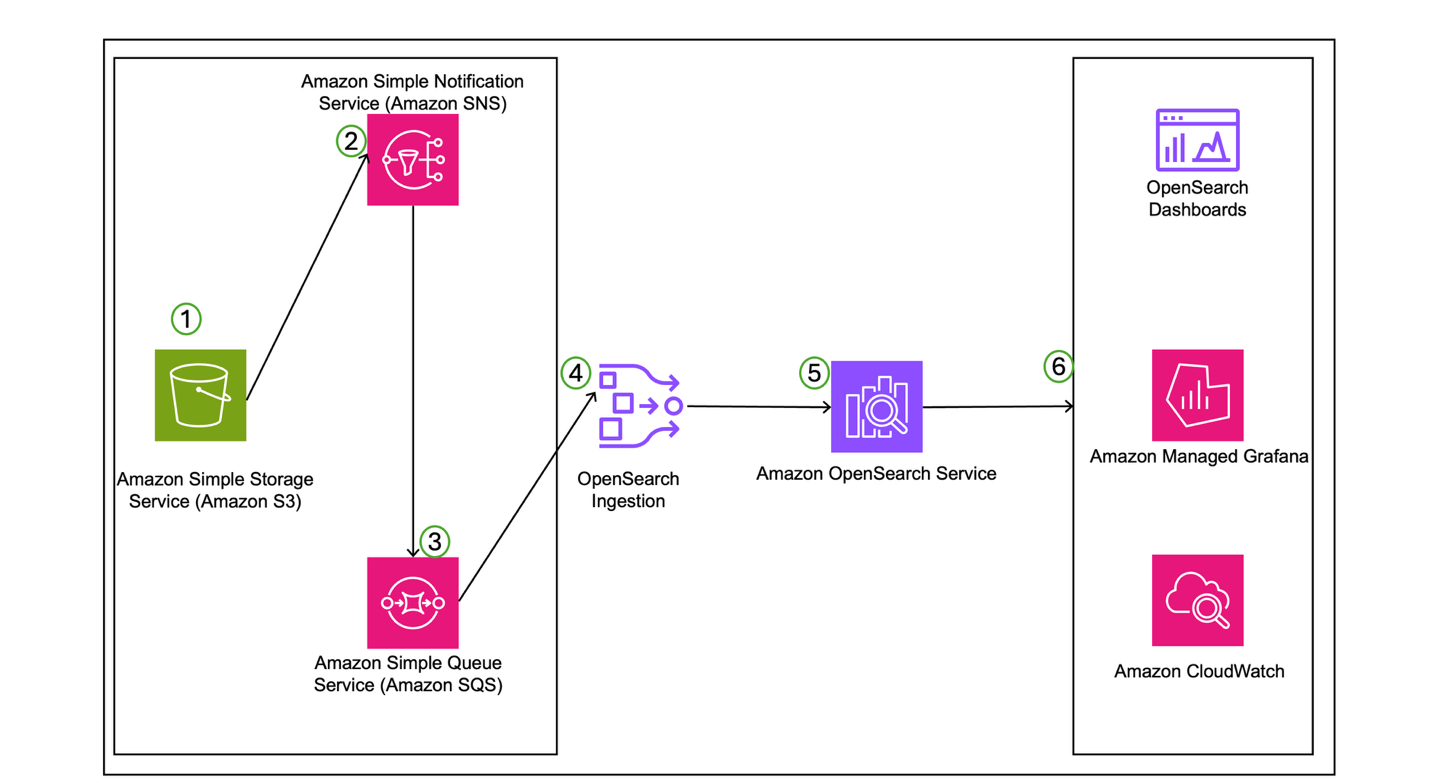
The Trellix security log management solution on AWS implements a comprehensive data pipeline that seamlessly handles log ingestion, processing, storage, and analysis. In the following sections, we explore the six steps of the workflow in more detail.
Step 1: Load data to Amazon S3
The solution begins with a data ingestion process using the Amazon S3 globally distributed and highly scalable infrastructure. Raw security and application logs are captured from multiple Regional deployments, helping Trellix maintain both data sovereignty and low latency access across various jurisdictions. These logs are then processed by the Trellix internal engine, which enriches them using proprietary security logic. This enriched dataset is subsequently stored back in Amazon S3, establishing a secure, scalable foundation for further security analytics and downstream processing.
Step 2: Amazon SNS notification triggered by S3 Events
After the enriched data is successfully stored in Amazon S3, the system initiates an event-driven automation sequence. Amazon S3 is configured to emit event notifications to an Amazon Simple Notification Service (Amazon SNS) topic whenever new data is uploaded. Amazon SNS acts as a notification hub, efficiently broadcasting these events to subscribed services or endpoints. This approach helps the architecture remain responsive and decoupled, because it allows various consumers to be alerted in real time as new data becomes available in the system.
Step 3: Message queuing in Amazon SQS
As the next step in the workflow, the SNS notifications are routed to Amazon Simple Queue Service (Amazon SQS), which serves as a durable and scalable queuing layer between producers and consumers. This queue acts as a buffer, facilitating reliable and asynchronous delivery of event metadata to downstream processing components. The use of Amazon SQS provides message persistence and fault tolerance, particularly under high-throughput or failure scenarios, allowing OpenSearch Ingestion to process incoming data in a controlled and resilient manner.
Step 4: Automated data processing with OpenSearch Ingestion
OpenSearch Ingestion continuously polls the SQS queue for new messages indicating the availability of data in Amazon S3. Upon receiving these messages, it uses its built-in integration capabilities to fetch the corresponding data directly from Amazon S3. After the data is retrieved, the ingestion pipeline performs the necessary transformations before forwarding it to the OpenSearch Service domain. To facilitate optimal cost-efficiency and performance, Trellix selected OR1 instances types for their OpenSearch deployment. These instances offer a high memory-to-vCPU ratio and are specifically optimized for intensive indexing and search workloads, making them ideal for handling large-scale log analytics operations.
Step 5: Log lifecycle setup using Index State Management
To optimize storage usage and manage data retention, Trellix has implemented Index State Management (ISM) policies within the OpenSearch Service. These policies automate the lifecycle of ingested log data by transitioning it through defined stages based on age and access patterns. Initially, logs reside in the hot tier for up to 24 hours, enabling immediate access for real-time security analysis. As logs age beyond this threshold, they are automatically transitioned to the UltraWarm storage, which offers a more cost-effective storage option while keeping the data queryable. Finally, after the predefined retention period expires, the ISM policy deletes the data from the system. This fully automated lifecycle management approach balances performance, compliance, and cost-efficiency.
Step 6: Comprehensive monitoring and visualization
Using the extensive monitoring capabilities of Amazon CloudWatch, complemented by Trellix’s in-house automations using OpenSearch public APIs for custom monitoring, the solution provides end-to-end visibility through integrated visualization tools. OpenSearch Dashboards provides security teams with powerful log analysis and search capabilities, so they can dive deep into security events and identify potential threats. Additionally, the solution uses Amazon Managed Grafana to create customized dashboards that monitor both the data pipeline health and OpenSearch cluster performance.
This dual visualization approach delivers multiple benefits: real-time security event monitoring and analysis, comprehensive performance metrics across the infrastructure, automated alerting for rapid threat response, custom dashboard views for different security operations needs, and unified visibility across the multiple Regional deployments. The combined power of these tools creates a robust monitoring framework that helps Trellix maintain a strong security posture while facilitating optimal performance across their global infrastructure.This six-step implementation demonstrates how AWS services can be combined to create a scalable, cost-efficient security log management solution that processes terabytes of daily security data while maintaining high performance and operational efficiency.
Key benefits
Trellix’s implementation of OpenSearch Service as their logging solution delivered three significant advantages that transformed their security operations.
Simplified log management architecture
Trellix streamlined their security operations by implementing a cohesive log management architecture that avoids the complexity of managing multiple disparate tools. By using OpenSearch Ingestion, a fully managed serverless data pipeline, Trellix simplified their data pipeline for processing real-time security data. The integration with Managed Grafana provides a unified visualization layer, enabling security teams to focus on threat detection rather than infrastructure management.
Scalability and resilience
The implementation of OpenSearch Service enables Trellix to achieve unprecedented scalability and resilience in their security operations. Trellix’s architecture uses an OpenSearch Ingestion pipeline to provide effortless handling of sudden log volume spikes across multiple Regional deployments. OpenSearch Ingestion enables dynamic scaling with automated resource optimization, facilitating seamless capacity management as data volumes grow. This capability helps Trellix maintain consistent performance even during periods of increased security event logging. The solution also implements a robust Multi-AZ deployment strategy to maintain maximum resilience and continuous service availability. During self-healing testing, the architecture demonstrated impressive recovery times under 9 minutes when a node was rebooted, showcasing its ability to maintain business continuity even in case of node failure. The automated failover capabilities facilitate minimal disruption to security operations, so Trellix can maintain constant vigilance over their customers’ security posture. Lastly, the solution uses automated Amazon S3 backups combined with hourly snapshots for comprehensive point-in-time recovery capabilities. Each Region maintains additional customer data replicas, creating a multi-layered data protection strategy that maintains the integrity and availability of critical security information.
Effortless scalability with optimized cost
Trellix’s exponential growth in security data processing demanded a solution that could scale dynamically while maintaining cost-efficiency. The strategic implementation of Amazon S3 and OpenSearch Service with UltraWarm storage provided the foundation for this scalable architecture. UltraWarm, a fully managed warm storage tier for OpenSearch Service, revolutionized how Trellix manages their extensive security data across multiple Regions. The solution uses UltraWarm’s innovative architecture, which uses Amazon S3 for durable storage while maintaining fast query performance for security analysis. A key advantage of UltraWarm’s Amazon S3 backed architecture is the removal of index replicas, significantly reducing cluster size and associated costs while maintaining data durability.The intelligent log prioritization framework forms the backbone of Trellix’s data management strategy, categorizing incoming data based on security significance. This systematic approach enables efficient routing of P2 and P3 log sources, optimized processing paths for different security priorities, reduced load on primary SIEM infrastructure, and customized handling based on customer requirements. The implementation has proven particularly valuable for security log analytics, where historical data analysis is crucial for threat detection and compliance requirements.The implementation delivered substantial operational and financial benefits for Trellix. By combining priority-based routing and tiered storage management, the organization achieved a 35% reduction in storage and compute costs while maintaining high-performance security operations. The solution enables efficient storage and analysis of extensive historical data, supporting Trellix’s commitment to comprehensive security monitoring while optimizing operational costs. This implementation demonstrates how AWS services can help organizations optimize costs without compromising security capabilities or operational efficiency.
What’s next
The successful implementation of this solution has positioned Trellix to explore additional AWS capabilities and emerging technologies to enhance their security operations:
- Integration of AWS ML/AI services to analyze petabytes of security log data
- Implementation of ML-based anomaly detection within OpenSearch Service
- Using security analytics plugins for advanced threat detection
- Custom configurations and pre-built security rules implementation
Summary
Trellix successfully modernized its log management infrastructure through collaboration with AWS, implementing a sophisticated architecture that addresses the challenges of processing terabytes of daily security data across multiple Regions. By using OpenSearch Service with UltraWarm nodes and integrating Amazon S3, the solution delivered significant performance enhancements, including faster log ingestion and streamlined operational management. The architecture’s innovative tiered storage approach, combined with optimized retention policies, resulted in a 35% reduction in storage costs while maintaining compliance requirements.This transformation has positioned Trellix to efficiently handle growing data volumes and evolving security challenges, demonstrating how strategic use of cloud services can simultaneously improve performance, reduce costs, and enhance operational efficiency.
About the authors
Jennifer Doudna on Medical Innovation | The Atlantic Festival 2025
Post Syndicated from The Atlantic original https://www.youtube.com/watch?v=-EY_mRwFl5k
Home Assistant Jukebox: Play ANY Song with Simple Steps! #shorts
Post Syndicated from BeardedTinker original https://www.youtube.com/shorts/qKPhXowd0IE
Announcing cross-account ingestion for Amazon OpenSearch Service
Post Syndicated from David Venable original https://aws.amazon.com/blogs/big-data/announcing-cross-account-ingestion-for-amazon-opensearch-service/
Amazon OpenSearch Ingestion is a powerful data ingestion pipeline that AWS customers use for many different purposes, such as observability, analytics, and zero-ETL search. Many customers today push logs, traces, and metrics from their applications to OpenSearch Ingestion to store and analyze this data.
Today, we are happy to announce that OpenSearch Ingestion pipelines now support cross-account ingestion for push-based sources such as HTTP and OpenTelemetry (OTel). Organizations can now use this feature to effortlessly share data across teams. For example, many organizations have central observability teams—now these teams can create OpenSearch Ingestion pipelines and share them with other teams in their organization. You can also use this feature to ingest data into Amazon OpenSearch Service domains or Amazon OpenSearch Serverless collections in other accounts.
Previously, sharing OpenSearch Ingestion pipelines across accounts required teams to use virtual private cloud (VPC) features to share access. For example, teams could use VPC peering, which is not always feasible, or AWS Transit Gateway. The new cross-account ingestion features in OpenSearch Ingestion can simplify your deployment and reduce cost for sharing pipelines.
Solution overview
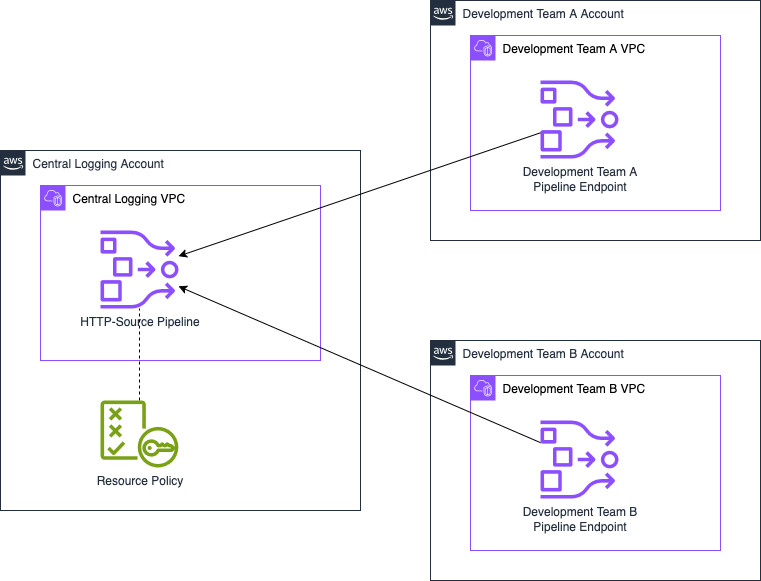
Let’s look at how to share a pipeline from a central logging account with two other development accounts (A and B). The central logging account can create an OpenSearch Ingestion pipeline using a push-based source, for example, HTTP. After creating the pipeline, a member of the central logging team can grant access to the other teams. They can use a resource policy that gives permissions to the two other team accounts to create pipeline endpoints. After making this change, the OpenSearch Ingestion pipeline is available for use by the other teams.
The following diagram illustrates this configuration.
In the following sections, we demonstrate how to implement this solution.
Prerequisites
First, the central logging account must have a VPC with two options enabled.
- enableDnsSupport must be set to true
- enableDnsHostnames must be set to true
The central logging account must also create a push-based OpenSearch Ingestion pipeline in the VPC. This can be a pipeline receiving logs from FluentBit or OpenTelemetry telemetry.
The development accounts that are going to connect to the pipeline also must have VPCs in the same region with the same DNS options enabled.
- enableDnsSupport must be set to true
- enableDnsHostnames must be set to true
Create resource policy
As the owner of the pipeline, you can create a resource policy that allows the two development accounts to create pipeline endpoints against your pipeline.
The following is an example resource policy for this scenario:
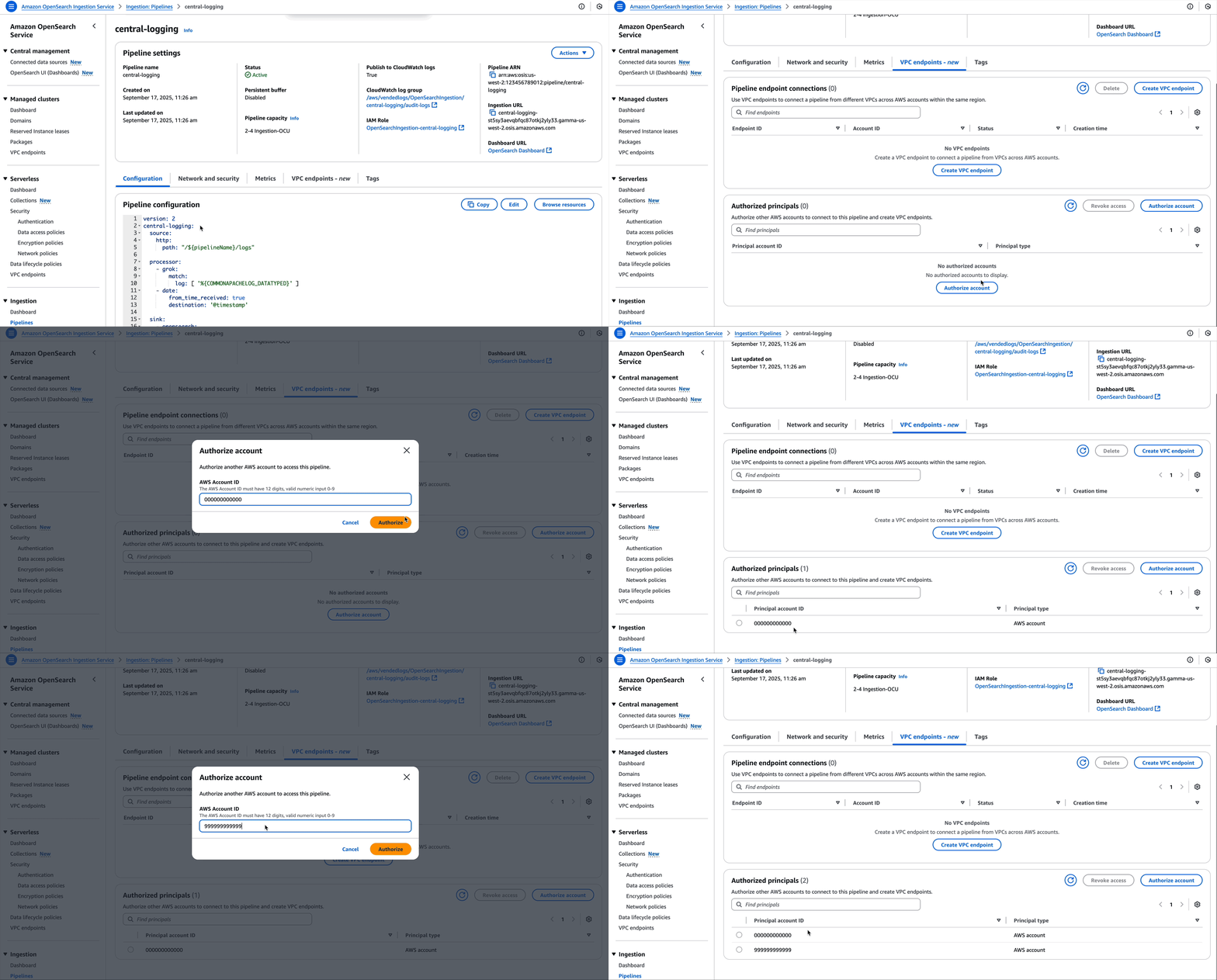
The OpenSearch Ingestion console makes it straightforward to create these policies, as shown in the following screenshot.
Create pipeline endpoint
Now that the central logging account has shared permissions on their pipeline, the development accounts can create pipeline endpoints. A pipeline endpoint is a connection from one VPC to an OpenSearch Ingestion pipeline.
The development accounts are responsible for creating the pipeline endpoints in the VPCs they want to connect from. They create this in the subnets they need and provide a security group. The security group should have an inbound rule allowing access port HTTPS over port 443 from any source that the development accounts need to ingest logs.
Development team A can create a pipeline endpoint using a command similar to the following:
Development team A can also use the OpenSearch Ingestion console to create the pipeline endpoint.
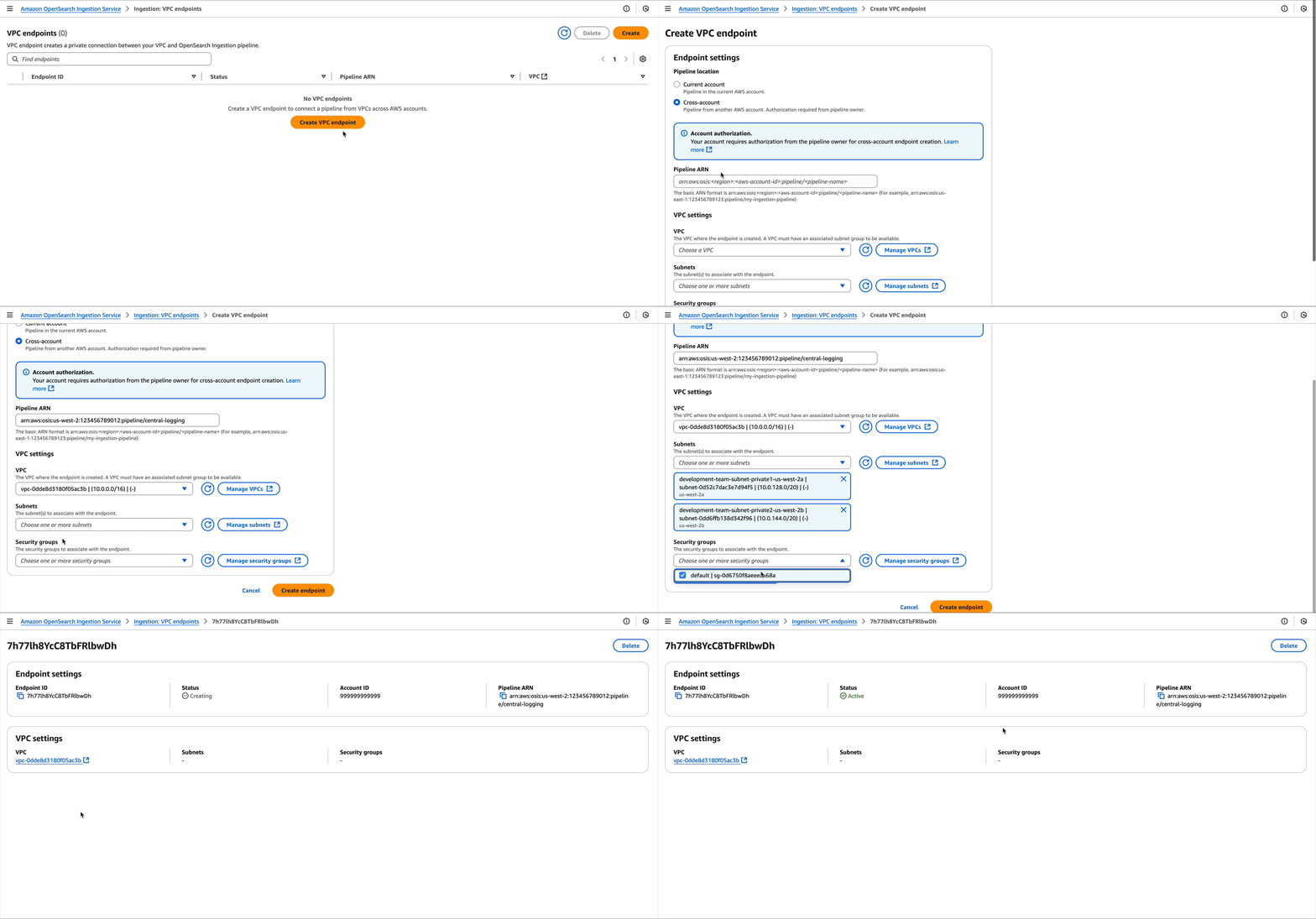
After performing this change, the VPC for development team A will have a pipeline endpoint. This pipeline endpoint now allows for ingesting data into the central logging pipeline. Now, Amazon Elastic Compute Cloud (Amazon EC2) instances, Amazon Elastic Container Service (Amazon ECS) tasks, Kubernetes pods, and other compute running in the VPC can ingest their log data into the pipeline using tools such as FluentBit.
At the same time or at a later time, development team B can create a pipeline endpoint as well. This team will create it for their own VPC.
After this, the pipeline will now have two pipeline endpoints, so both teams can ingest their log data into the central logging VPC.
Clean up
After a pipeline endpoint is created, either account can remove it. The development teams in our scenario can use the DeletePipelineEndpoint API to delete it from their accounts. Additionally, if the central logging account needs to remove a pipeline endpoint from a pipeline, it can use the RevokePipelineEndpointConnections API. Both options are available on the OpenSearch Ingestion console as well.
After the pipeline endpoints are removed, the central logging team can also remove the pipeline if they no longer need it.
Conclusion
The new pipeline endpoint feature for OpenSearch Ingestion simplifies how you can share pipelines for cross-account ingestion. This can help teams use the powerful features of OpenSearch Ingestion and open up new possibilities for teams or organizations using multiple accounts and VPCs. The new pipeline endpoint feature is available today in AWS Regions where OpenSearch Ingestion is available.
To get started with cross-account ingestion in OpenSearch Ingestion, refer to OpenSearch Ingestion documentation or try creating your first cross-account pipeline on the OpenSearch Ingestion console.
About the authors
Four Friday stable kernel updates
[$] Blender 4.5 brings big changes
Post Syndicated from jzb original https://lwn.net/Articles/1036262/
Blender 4.5 LTS was released
on July 15, 2025, and will be supported through 2027. This is the last
feature release of the 3D graphics-creation suite’s 4.x series; it
includes quality-of-life improvements, including work to bring the Vulkan backend up to
par with the default OpenGL backend. With 4.5 released, Blender
developers are turning their attention toward Blender 5.0, planned for
release later this year. It will introduce substantial changes,
particularly in the Geometry
Nodes system, a central feature of Blender’s procedural
workflows.
David Letterman responds to Jimmy Kimmel suspension
Post Syndicated from The Atlantic original https://www.youtube.com/shorts/VwjELoM8qag
You don’t need quantum hardware for post-quantum security
Post Syndicated from Luke Valenta original https://blog.cloudflare.com/you-dont-need-quantum-hardware/
Organizations have finite resources available to combat threats, both by the adversaries of today and those in the not-so-distant future that are armed with quantum computers. In this post, we provide guidance on what to prioritize to best prepare for the future, when quantum computers become powerful enough to break the conventional cryptography that underpins the security of modern computing systems. We describe how post-quantum cryptography (PQC) can be deployed on your existing hardware to protect from threats posed by quantum computing, and explain why quantum key distribution (QKD) and quantum random number generation (QRNG) are neither necessary nor sufficient for security in the quantum age.
“Quantum” is becoming one of the most heavily used buzzwords in the tech industry. What does it actually mean, and why should you care?
At its core, “quantum” refers to technologies that harness principles of quantum mechanics to perform tasks that are not feasible with classical computers. Quantum computers have exciting potential to unlock advancements in materials science and medicine, but also pose a threat to computer security systems. The term Q-day refers to the day that adversaries possess quantum computers that are large and stable enough to break the conventional public-key cryptography that secures much of today’s data and communications. Recent advances in quantum computing have made it clear that it is no longer a question of if Q-day will arrive, but when.
What does it mean, then, for your organization to be quantum ready? At Cloudflare, our definition is simple: your systems and communications should be secure even after Q-day.
However, this definition often gets muddied by vendors insisting that products built using quantum technology are required in order to secure an organization against quantum adversaries. In this blog post we explain why quantum technologies are neither necessary nor sufficient to protect against attacks by a quantum adversary.
The good news is that there is already a solution: post-quantum cryptography (PQC). PQC protects against attacks by quantum adversaries, but PQC is not a quantum technology — it runs on conventional computers without specialized hardware. You can use PQC today on the computers you already have, without buying expensive new hardware.
We’ve written quite a few blog posts on post-quantum cryptography already, so we will keep this section brief.
The public-key cryptography that we’ve used for decades to secure our data and communications is based on math problems (like factoring large numbers) that are believed to be computationally hard to solve on conventional computers. If you can efficiently solve the underlying math problem, you can efficiently break the cryptography and the systems that depend on it. As it turns out, the math problems underlying much of today’s public-key cryptography can be efficiently solved by specialized algorithms, like Shor’s algorithm, on large-scale quantum computers.
The solution? Pick new hard math problems (like finding “short” vectors in algebraic lattices) that are no easier to solve with a quantum computer than with a conventional computer. Then, build new cryptographic systems around them. The US National Institute of Standards and Technologies (NIST) launched an international competition in 2016 to identify and standardize such cryptographic systems, which resulted in several new standards for post-quantum cryptography being published in 2024, and several more under consideration for future standardization.
Post-quantum cryptography (PQC) runs on your existing phones, laptops, and servers. PQC runs at Internet scale and can even be more performant than classical cryptography. Except in rare cases, like when you need additional hardware acceleration in cheap smartcards or to replace legacy systems that lack cryptographic agility, there is no need to purchase new hardware to migrate to PQC.
If you want to know how to protect your organization from security threats posed by quantum computers, you can stop reading now. Post-quantum cryptography is the solution.

Alternatively, you can read below for our perspective on hardware-based quantum security technologies that are sometimes marketed as security solutions.
Quantum technologies capture the imagination. Quantum computers (possibly linked together in a quantum Internet) promise to deliver breakthroughs in drug discovery and materials science via advanced molecular simulation. Measurement of physical quantum processes can be used to generate entropy with mathematically provable properties.
This is exciting technology and fundamental scientific research. But this technology is not required to secure data and communications against quantum attackers.
In this section, we’ll explain why quantum security technologies do not need to be part of your quantum readiness strategy, and any decision to invest in quantum technology should not be based on a desire to defend data and communications systems against the threat of quantum adversaries. Instead, investments should be based on a desire to improve quantum technologies in their own right, for example to help with applications like chemistry, machine learning, and financial modeling.
Our position here is largely in agreement with the strategies towards quantum security technologies of the US National Security Agency (NSA), UK National Cyber Security Centre (NCSC), NL Nationaal Cyber Security Centrum (NCSC), and DE Federal Office for Information Security (BSI). We’ll focus on two quantum technologies widely marketed as security products: quantum key distribution (QKD) and quantum random number generation (QRNG).
Quantum key distribution (QKD) is a hardware-based solution to secure communications across point-to-point links. Rather than relying on hard mathematical problems, QKD relies on principles of quantum physics to establish a shared symmetric secret between two parties, while ensuring that eavesdropping can be detected. QKD provides security guarantees that are based on physical properties of the communication channel. Once a shared secret is established, parties can switch to traditional symmetric-key cryptography for secure communication. QKD is the first step towards a futuristic “quantum Internet.” However, there are some fundamental reasons why QKD cannot be a general replacement for classical cryptography running on conventional hardware.
Most importantly, QKD does not operate at Internet scale. QKD is used to establish an unauthenticated secret between pairs of parties with a direct physical link between them. The parties can then use an authentication mechanism based on conventional cryptography to bootstrap a secure communication channel over that link. While building dedicated physical links may be feasible for cross-datacenter communication or across major Internet backbones, it is not possible for most pairs of parties on the Internet. In particular, deploying QKD for the “last-mile” connection to end-user devices would require that each device has a direct physical connection to every server or device it needs to securely communicate with.
Connectivity aside, there’s a good reason why the Internet doesn’t rely on secure point-to-point links: they do not scale (or rather, they scale exponentially). Bringing a new device online would require a change to every other device it needs to communicate with, a massive operational burden on everyone. Fortunately, there’s a better way. The OSI model for networking provides an abstraction such that two parties can communicate even if they don’t share a direct physical link, so long as some chain of physical links exists between them. Public-key cryptography, invented in the seminal “New Directions in Cryptography” paper in 1976, allows two parties participating in the same public-key infrastructure to establish a secure end-to-end encrypted communication channel, without requiring any prior setup between them. The massive scaling enabled by these technologies is why the secure Internet exists as we know it. Secure point-to-point links are not part of the solution.
Lack of scalability is enough for us to disqualify QKD outright: if a technology can’t bring security to the whole Internet, we’re not going to spend much time on it.
The challenges with QKD don’t stop there though.
QKD touts theoretical security guarantees, but achieving security in practice is not so simple. QKD systems have been plagued by implementation attacks, both classical sidechannel attacks and new ones specific to the technology. Further, QKD works best over a special medium: either fiber or a vacuum. QKD has been demonstrated over the air, but performance and the implementation security mentioned before suffers. We still have not seen QKD work on a mobile phone or over Wi-Fi networks.
Further, neither QKD nor any other quantum technologies provide authentication to prove that the party on the other end of the key exchange is who you think they are. This opens the door for a classic monster in the middle (MITM) attack, where an adversary intercepts your connection, establishes a separate secure QKD link to you and your intended destination, and then sits in the middle reading and relaying all traffic. To prevent this, you must authenticate the identity of the party you are connecting to, using either pre-shared keys or conventional public-key cryptography. The bottom line is, whether or not you invest in QKD, you still need a solution for authentication to protect against active attackers armed with quantum computers. Practically speaking, that means you need PQC, but PQC is already a standalone solution that provides both authentication and key agreement, which leads to questions of why use QKD in the first place.
Some proponents argue that QKD should be integrated into existing systems as an extra security layer. The value proposition of QKD relates to the “harvest now, decrypt later” threat. In public-key cryptography, the key exchange messages used to set up encryption keys to secure a communication channel are exchanged in full view of a potential adversary. If an adversary records the key exchange messages, they might hope to use improved techniques in the future to solve the hard math problems upon which the security of the key exchange relies, allowing them to recover the encryption keys and decrypt the communication. If encryption keys are exchanged directly via QKD instead, the eavesdropper protections provided by QKD stop an adversary from recording messages that could later allow them to recover the encryption key (e.g. by using a quantum computer or other advances in cryptanalysis). The problem is, however, that this “extra security layer” is brittle, and limited to a single physical link. As soon as the data is transmitted elsewhere — for instance at an Internet exchange point or to travel to an end-user — the QKD security ends. For the rest of its journey, the data is protected by standard protocols like TLS, making the value of the initial QKD link questionable.
While we hope the technology progresses, QKD is neither necessary nor sufficient for security against a quantum adversary. PQC is sufficient for security against a quantum adversary, already runs on your existing hardware, and works everywhere.
Quantum random number generators (QRNGs) are a type of “true” random number generator (TRNG) that work by harnessing inherent unpredictability of quantum mechanics, for example by measuring atomic decay or shooting photons at a beam splitter. Other types of classical (non-quantum) TRNGs use physical phenomena that exhibit random properties, such as thermal noise from electrical components, the motion of hot wax in lava lamps, double pendulums, hanging mobiles, or water wave machines.

In cryptography and computer security, the essential property required from a random number generator is that the outputs are unpredictable and unbiased. This can be achieved by taking a small seed (say, 256 bits) of true randomness and feeding it to a cryptographically-secure pseudorandom number generator (CSPRNG) to produce an essentially limitless stream of pseudorandom output indistinguishable from true randomness. The randomness used to seed the CSPRNG can be based on either classical or quantum physical processes, as long as it is not known to the adversary. Whether or not you use a QRNG to generate the seed, a CSPRNG is essential for cryptographic applications.
We are the first to get excited about fun new sources of randomness. However, we’d like to emphasize that randomness derived from quantum effects is not necessary to combat threats from quantum computers. Quantum computers do not enable any practical new attacks against classical TRNGs in widespread use today. Your decision to invest in QRNGs should be based on a perceived improvement in the quality of randomness they produce and not on a perceived threat to classical TRNGs from quantum computing.
Cloudflare has been at the forefront of developing and deploying PQC, and we are committed to making PQC available for free and by default for all of our products. And we run it at scale — already over 40% of the human-generated traffic to our network uses PQC.

So what’s in that 40%? PQC is supported for all website and API traffic served through Cloudflare, most of Cloudflare’s internal network traffic, and traffic running over our Zero-Trust platform. All these connections use post-quantum key agreement to protect against the “harvest now, decrypt later” threat, where an adversary intercepts and stores encrypted data today with the hope of decrypting with a quantum computer or other cryptanalytic advances in the future. Key agreement is an important first step, but there’s still more work to be done. We’re actively working with stakeholders in the industry to prepare for the upcoming migration to post-quantum signatures to prevent active impersonation attacks from quantum adversaries (after Q-day).
If purchasing quantum hardware is not necessary, how should organizations prepare for a quantum future? The most effective strategy will depend on your organization’s individual needs, but some general strategies will pay off for most organizations:
Investing in basic security practices is a good start. Hire the right expertise if you don’t already have it. Find vendors that support post-quantum encryption in their offerings today, and whose products are cryptographically agile so you can enjoy a seamless transition to post-quantum signatures and certificates when the industry migrates before Q-day. Follow a tunneling strategy: routing application traffic over the Internet via secure quantum safe tunnels allows you to reduce your attack surface area with minimal changes to existing systems. If you’re already a Cloudflare customer (or want to be), our Content Distribution Network and Zero Trust platform makes this easy. Learn more about how we can help at our Post-Quantum Cryptography webpage.
Security updates for Friday
Post Syndicated from jzb original https://lwn.net/Articles/1038802/
Security updates have been issued by Debian (chromium, cjson, and firefox-esr), Fedora (expat, gh, scap-security-guide, and xen), Oracle (container-tools:rhel8, firefox, grub2, and mysql:8.4), SUSE (busybox, busybox-links, element-web, kernel, shadowsocks-v2ray-plugin, and yt-dlp), and Ubuntu (imagemagick, linux, linux-aws, linux-gcp, linux-gke, linux-gkeop, linux-hwe-6.8, linux-lowlatency, linux-lowlatency-hwe-6.8, linux-oracle, linux-azure, linux-azure-5.15, linux-azure-fips, linux-ibm, linux-ibm-6.8, linux-nvidia, linux-nvidia-6.8, linux-nvidia-lowlatency, linux-raspi, linux-oracle-6.8, linux-realtime, and openjpeg2).
Richard Ayoade and David Letterman on Their Approach to Comedy | The Atlantic Festival 2025
Post Syndicated from The Atlantic original https://www.youtube.com/watch?v=120joDZclfo
Ayad Akhtar on Technology and the Future of Art | The Atlantic Festival 2025
Post Syndicated from The Atlantic original https://www.youtube.com/watch?v=-gAcymTUGRI