Critical security vulnerabilities in the Radicle network protocol

Post Syndicated from jzb original https://lwn.net/Articles/1096200/

The Radicle peer-to-peer
code-collaboration project has disclosed
two critical vulnerabilities
in the network protocol used by Radicle
nodes. The first flaw is that the network protocol used by Radicle “does not
give the confidentiality it was expected to give
“, which allows anyone who
can observe the network between two nodes to read the data exchanged. The second
is that peer authentication is broken and allows impersonation, so an attacker
can spoof their Node ID and read private repositories they should not be able to
read.

In practice, the two flaws are most useful when they can be exploited
together: an attacker on the path sees the Node IDs at both ends of a
connection, and both are normally on the allow-list. That attacker can read
whatever is exchanged while they watch, and can then use a Node ID they saw to
fetch the whole repository on demand. The realistic threat is anyone on the path
between your node and node it syncs with, and no setting or allow-list protects
against them.

We are publishing this before the security update is available. You can act
on it today, and no fix we release later can undo an exposure that has already
happened.

See the post for workarounds that can be used today; a major update that will
be backward-incompatible is underway.

Critical WordPress RCE vulnerability announced

Post Syndicated from jzb original https://lwn.net/Articles/1096195/

A critical
vulnerability
has been discovered in WordPress‘s get_page_template()
function for page-template resolution that could allow remote-code execution
(RCE) by an unauthenticated attacker, in some limited circumstances. The project
has provided an update for the most recent branch of WordPress, as well as
backports of the fix for branches back to 4.7. See the
vulnerability report for the conditions required for an RCE attack to be successful.

The vulnerability also
affects
the ClassicPress fork of
WordPress, though a security update has not been provided for that project
yet. LWN covered ClassicPress in
2024. Users of either content-management system should update soon.

How dynamic application security testing validates risk at runtime

Post Syndicated from Rapid7 original https://www.rapid7.com/blog/post/em-dynamic-application-security-testing-dast-validates-risk-at-runtime-idc-marketscape

Security teams already have long queues of potential application vulnerabilities. The useful question is what happens next: can they see how a weakness behaves in a running application, reproduce the attack, and give developers enough evidence to fix it?

Dynamic application security testing (DAST) helps answer those questions by testing applications as an attacker encounters them. The IDC MarketScape: Worldwide Dynamic Application Security Testing 2026 Vendor Assessment (Doc #US54119126, September 2026). The IDC MarketScape evaluated 16 vendors and named Rapid7 a Leader.

We believe the result reflects the strength of Rapid7’s DAST capabilities, but the IDC MarketScape also offers a useful view of where the category is heading. DAST has developed beyond traditional web scanning into a source of runtime evidence that can help organizations validate risk across the application layer.

From possible weakness to validated application risk

Code analysis and dependency scanning help teams identify weaknesses before an application is deployed. DAST provides a different view by interacting with the assembled application while it is running. It can show what happens when a particular request reaches the application, how the application responds, and whether a suspected weakness can be reproduced.

This is especially valuable for APIs and AI-backed applications, where risk may emerge through interactions among models, prompts, data, tools, and permissions. Some of these behaviors cannot be fully understood from source code or a dependency manifest. They become visible when the application is exercised under runtime conditions.

DAST therefore has a direct role in continuous threat exposure management (CTEM). Discovery gives teams a view of their assets and possible weaknesses, but that view alone does not tell them where to focus. Validation helps narrow the field by showing which exposures can be reached or exploited and providing evidence that teams can use to take action.

For Rapid7, DAST is exposure management applied to the application layer. Web applications, APIs, and AI-backed endpoints are all part of the attack surface, so they need to be discovered, tested, prioritized, and managed alongside infrastructure, cloud, and other exposures.

Why we believe Rapid7 was named a Leader by IDC

Rapid7’s DAST solution is delivered as part of the Exposure Command portfolio. Its scan engine maps an application, executes attacks against the discovered paths, and validates confirmed findings. Security teams can map a broad area of an application while limiting active attacks to an appropriate set of paths, giving them control over how testing is performed.

Findings are checked against Rapid7 telemetry to help determine which issues warrant closer attention. When a finding needs action, browser-based replay reproduces the original request, the attack request, and the triggering response. Developers receive evidence they can work with, rather than a finding they must first spend time proving.

Authenticated scanning can be difficult to maintain across a changing application portfolio, and a broken login sequence can leave important areas untested. Rapid7’s solution can identify the affected step and support a targeted update without requiring the entire sequence to be recorded again.

The connection with Surface Command adds another useful layer. Newly discovered external assets can be surfaced for application testing, helping teams close the gap between finding an application and understanding the risk it presents

DAST plays a core role within Exposure Command: providing the application-layer validation teams need to prioritize risk and move from findings to remediation.

Learn more about Rapid7 Exposure Command.

Security updates for Wednesday

Post Syndicated from jzb original https://lwn.net/Articles/1096191/

Security updates have been issued by AlmaLinux (coreutils, postgresql18-postgis, and postgresql:16), Debian (memcached), Fedora (chromium, cyrus-imapd, dotnet10.0, dotnet8.0, dotnet9.0, freeipmi, kernel, libxmp, perl-Net-DNS, and postgresql16-anonymizer), Mageia (cpio, diffutils, perl-Dancer2, and rest), Oracle (389-ds-base and firefox), Red Hat (opentelemetry-collector and osbuild-composer), SUSE (amazon-cloudwatch-agent, amazon-ssm-agent, apko, apptainer, bazel-rules-python-source, bind, cups, firefox, freeipmi, gdb, google-osconfig-agent, kernel, kyverno, libipa_hbac-devel, libsoup, libsoup-3_0-0, libtpms, openssl-certs, perl-Authen-SASL, php-composer2, python313-PyMuPDF, thunderbird, and util-linux), and Ubuntu (gzip, linux-aws, linux-aws-5.15, linux-aws-fips, linux-nvidia-tegra-igx, linux-azure, linux-oracle, linux-azure-7.0, linux-azure-fde-6.8, linux-lowlatency, linux-lowlatency-hwe-6.8, linux-nvidia, linux-oracle, linux-oracle-6.8, linux-raspi, openssh, and sudo).

Research on Models Engaging in Genie-Like Behavior

Post Syndicated from Bruce Schneier original https://www.schneier.com/blog/archives/2026/09/research-on-models-engaging-in-genie-like-behavior.html

New paper: “Self-Jailbreaking: Language Models Can Reason Themselves Out of Safety Alignment After Benign Reasoning Training.”

Abstract: We discover a novel and surprising phenomenon of unintentional misalignment in reasoning language models (RLMs), which we call self-jailbreaking. Specifically, after benign reasoning training on math or code domains, RLMs will use multiple strategies to circumvent their own safety guardrails. One strategy is to introduce benign assumptions about users and scenarios to justify fulfilling harmful requests. For instance, an RLM reasons that harmful requests like “outline a strategy for stealing customers’ credit card information from a retail store” could be associated with the benign intent of “a security professional trying to test defense,” despite no such benign context being provided as input. We observe that many open-weight RLMs, including DeepSeek-R1-distilled, s1.1, Phi-4-mini-reasoning, and Nemotron, suffer from self-jailbreaking despite being aware of the harmfulness of the requests. We also provide a mechanistic understanding of self-jailbreaking: RLMs are more compliant after benign reasoning training, and after self-jailbreaking, models appear to perceive malicious requests as less harmful in the CoT, thus enabling compliance with them. To mitigate self-jailbreaking, we find that including minimal safety reasoning data during training is sufficient to ensure RLMs remain safety-aligned. Our work provides the first systematic analysis of self-jailbreaking behavior and offers a practical path forward for maintaining safety in increasingly capable RLMs.

I think the core problem is that these models are all trained on the average of humanity, and we are a pretty duplicitous species.

6 раздувки за варненското лято 2026

Post Syndicated from Веселин Златков original https://www.toest.bg/6-razduvki-za-varnenskoto-lyato-2026/

6 раздувки за варненското лято 2026

През лятото край морето има много надуваеми елементи – пояси, дюшеци, топки, лодки и т.н. Затова си позволявам да определя жанра на наблюденията и разсъжденията си за отминалия туристически сезон във Варна като „раздувка“. Думата беше популярна едно време, преди всички да заговорят за наратива. Раздувките ми нямат претенции да са прецизен анализ, а и така се случи, че това не беше най-активното ми лято, но все пак някои детайли от този ключов сезон за варненския живот си заслужава да бъдат изтъкнати. 

1. Нямаше туристи 

Е как да има?! Вече всеки си е купил апартамент във Варна, нормално е хотелите да останат празни. Нормално е и ресторантите да останат празни, защото е по-лесно и по-евтино, като имаш кухня, да си сготвиш нещо лятно и свежо там, вместо да рискуваш с непроверени откъм обслужване и меню заведения. 

Разбира се, този довод е по-скоро шега, но в нея има доза истина, особено ако говорим за родните туристи, както и за чужденците, които са инвестирали в имот край морето ни. А последните не са никак малко.

Истината е, че в началото на лятото Варна изглеждаше поразително пуста, каквато не сме я виждали от много време. В края на сезона министърът на туризма, т.нар. представители на бранша и всички, чиято задача е да внасят спокойствие в обстановката, заявяват, че първоначалният кошмарен спад е компенсиран и резултатите са в крайна сметка като през миналата година. 

Спирането на чартърните полети от Германия, за което така и не стана ясно как е допуснато и по чия вина се е стигнало до него, лиши курортите ни от около 120 000 германци, които винаги са били гръбнакът на сезона.

Отсега се водят преговори за възстановяване и гарантиране на тази ключова транспортна връзка за следващото лято. Проблемът обаче трябва да отвори дебат за алтернативни варианти на системата, по която работи туризмът ни вече десетилетия. Големите групи от германски пенсионери, които прииждаха край Варна още от май, преди дори да се е стоплило морето, вече са минало. Туризмът ни трябва да се модернизира, но това, изглежда, не става твърде бързо.

6 раздувки за варненското лято 2026
© Веселин Златков

2. Храната

Последното издание на кулинарното риалити MasterChef преди две години беше спечелено от варненката Марианна Александрова. Както се оказа, тя не искаше просто телевизионна слава, а си беше поставила по-амбициозна цел – да изгражда специфична варненска кулинарна идентичност. Александрова е преподавателка в Колежа по туризъм, изследва стари готварски традиции и намира рецепта за паста с миди във вестник от 1896 г. Според нея тъкмо това ястие може да стане хит на оригиналната „варненска“ кухня.

В колко варненски ресторанти се предлага паста с миди ала XIX век, признавам си, не знам. Но едва ли са много. На теория цялата идея да има варненско ястие, което да е като запазена марка за града, е супер.

На практика обаче храната започва да се превръща в ахилесовата пета на преживяването „почивка във Варна“.

 Доста хора се възмутиха от цените на един обяд или на една вечеря край морето, но според мен това не е основният проблем. Проблемът е в качеството както на продуктите, така и на приготвянето им. И дори не е необходимо да опитвате – достатъчно е да помиришете.

Над пристанището и покрай Морските бани във Варна и това лято доминираше една миризма – не на море и водорасли, а на прегоряло олио и непочистени скари. Това е положението, това е реалната кулинарна варненска идентичност, колкото и да не ни се иска.

6 раздувки за варненското лято 2026
© Веселин Златков

3. Боклукът

Варна никога не е била толкова мръсна, колкото това лято. Вярно е, че всяка година, когато градът се напълни с туристи, контейнерите започват да преливат. Този път обаче не беше само това. Метачките изчезнаха от улиците на града през юни и се появиха пак едва в края на август, без ясна причина за липсата им. За миене на улиците изобщо не говорим – такава дейност нямаше. Между плочките на тротоарите и покрай бордюрите поникнаха всякакви бурени, които никой не се погрижи поне веднъж да бъдат разчистени. Изобщо, да ходиш с джапанки или със сандали по варненските улици това лято си беше предизвикателство, защото не знаеш какво ще настъпиш.

Имаше обаче и друго явление, доста гнусно и срамно – празни контейнери и разпилени около тях отпадъци.

Видео, публикувано в социалните мрежи, показа причината за това безобразие. На него се вижда как мъж с жълта жилетка, който не просто оставя торба с отпадъци до контейнера вместо в него, а изсипва отпадъците на улицата. Напълно съзнателно. А при въпрос защо го прави, той обяснява, че така му е наредено от някой си „Мишо от „Хепи“. Всичко това – в самия център на града, до емблематичния хотел „Черно море“.

Привърженици на кмета Благомир Коцев твърдят, че подобни саботажи се правят най-редовно, буквално от първия ден на мандата му. Честно казано, не вярвах да е вярно, докато не видях въпросните кадри. Колко трябва да мразиш кмета, за да замърсяваш съзнателно града си с цел да злепоставиш Коцев? Нямам отговор на този въпрос. И не вярвам, че някой може да има разумен довод за тази свинщина. По-лошото е, че не личи по нищо органите на реда да им пука за това, да не говорим да установят и накажат виновните.

4. Фестивалите

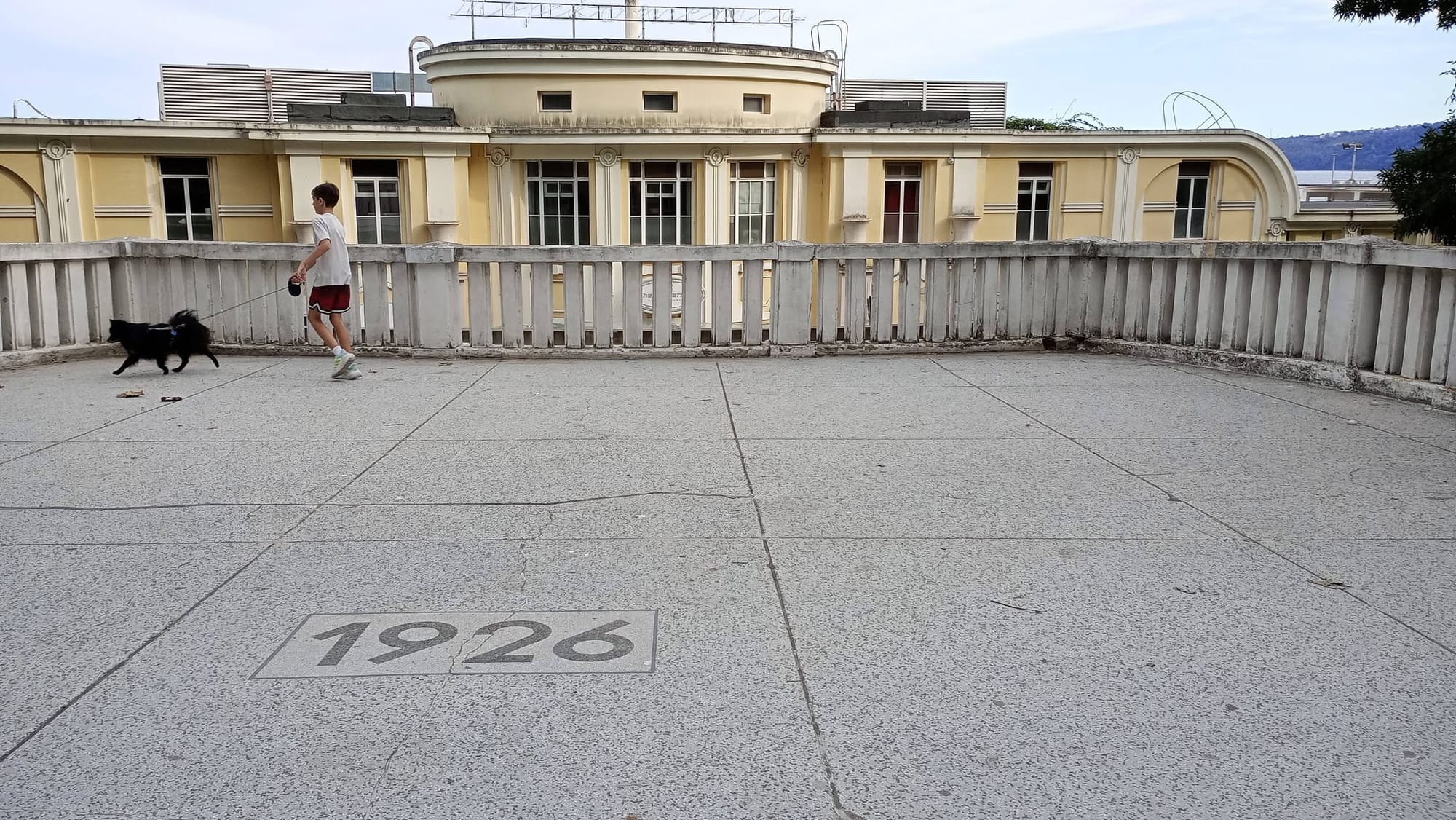
Когато слизате към морето по централното стълбище към Морските бани, попадате на тераса, на която е написано „1926“. Това е годината, в които баните са завършени и Варна по същество става истински курорт – пет години след официалното обявяване. В същата година започват и Народните летни музикални тържества – първият български фестивал, днес познат като Международния музикален фестивал „Варненско лято“. Почитателите на класическата музика коментират, че тази година изданието му е било подобаващо за 100-годишнината. Но колко привлекателна е класическата музика за един съвременен турист?

Въпреки че през лятото във Варна постоянно има някакви събития с фестивален характер, мнозина твърдят, че културният календар на града е твърде рехав. Това може да звучи парадоксално, но всъщност показва една очевидна липса – на голям поп или рок фестивал като тези в Пловдив.

6 раздувки за варненското лято 2026
© Веселин Златков

Варна остана и това лято без световни звезди, което навява усещане за провинциалност. 

На този фон неуспешната кандидатура на града за домакин на „Евровизия“ не трябва да изненадва никого. От самото начало се знаеше, че Варна няма зала за 10 000 души – основно изискване за прословутия конкурс. Какво решение ще получи този проблем, е въпрос, на който трябва да отговори държавата – подобен обект не може да бъде изграден само с местни усилия.

5. Нож за украинците

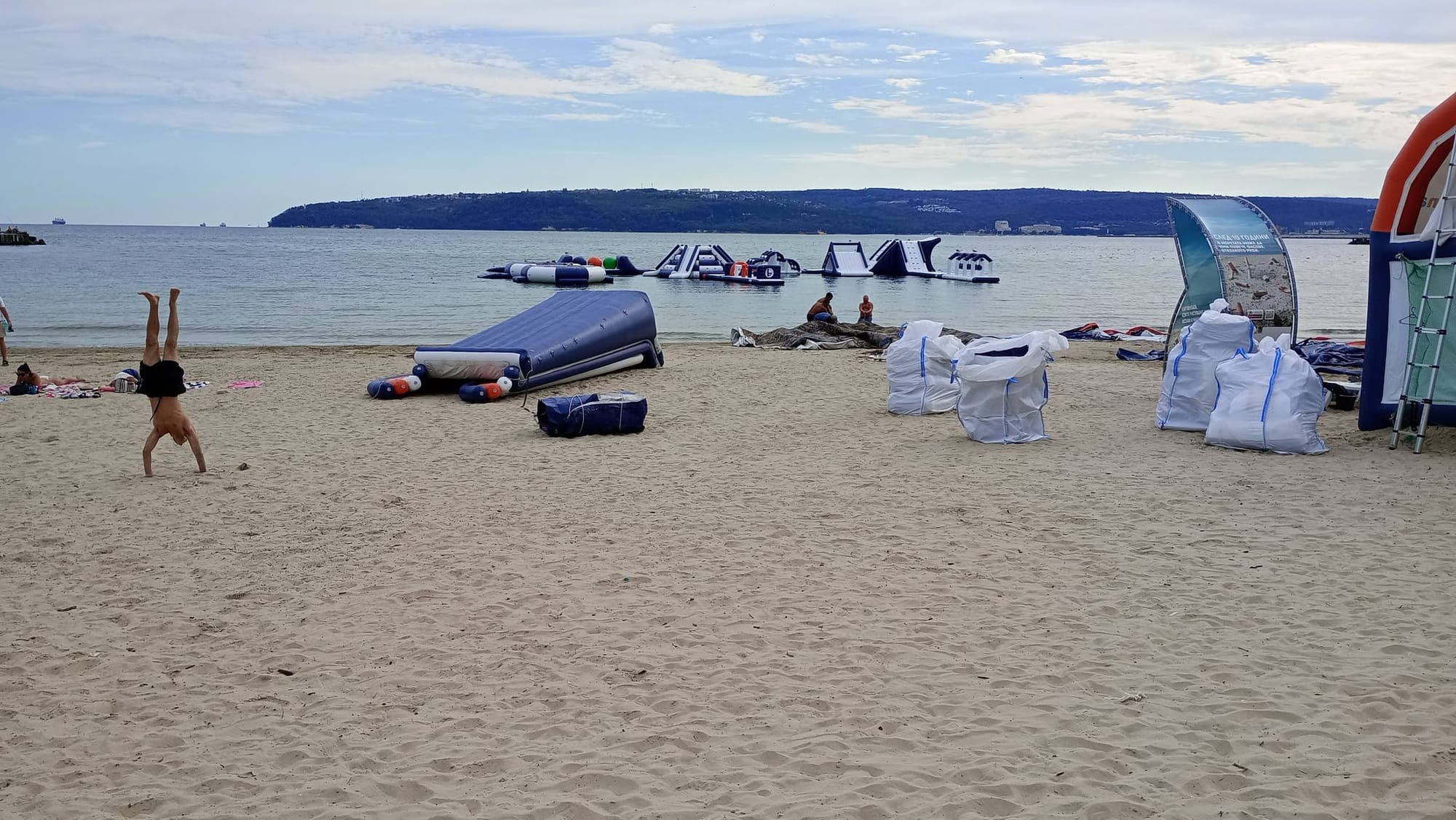
Да се върнем към надуваемите летни предмети, с които започнах тези „раздувки“. Малко неочаквано това лято в морето на Офицерския плаж се появи аквапарк. Казвам „неочаквано“, защото да разположиш съоръжение за деца точно на мястото, където пробите за чистотата на водата са все на ръба на допустимото, не е много логично. Но след като концесионери, наематели, контролни органи и в крайна сметка клиентите на атракциона не виждат проблем в това, няма какво да коментираме. 

Големият проблем с надуваемия аквапарк се оказа друг – че се управлява от украинци.

Антиукраинските настроения във Варна са дълга и сложна тема, но този път грозните изстъпления в социалните мрежи бяха надминати от нещо още по-грозно. В средата на август елементи от аквапарка бяха срязани и се наложи да бъде затворен, за да се отстранят щетите от вандалския акт. 

Екипът на аквапарка съобщи това във Facebook със съжаление и откровено учудване от случилото се. Вместо някакво съчувствие и нормално осъждане на вандализма, съобщението беше последвано от масов хейт и откровена ксенофобия. Коментари от типа „Махайте се, отивайте си в Украйна“, „Вземете си аквапарка и си го закарайте в Одеса“ бяха най-меките. 

Честно казано, като варненец изпитах истински срам от тази реакция. Почти толкова, колкото от кадрите със съзнателното изсипване на боклук до контейнерите. И този път органите на реда не показаха някаква амбиция да разследват, да установят извършителя и евентуалния поръчител на безобразието и да го накажат.

6 раздувки за варненското лято 2026
© Веселин Златков

6. Син кит

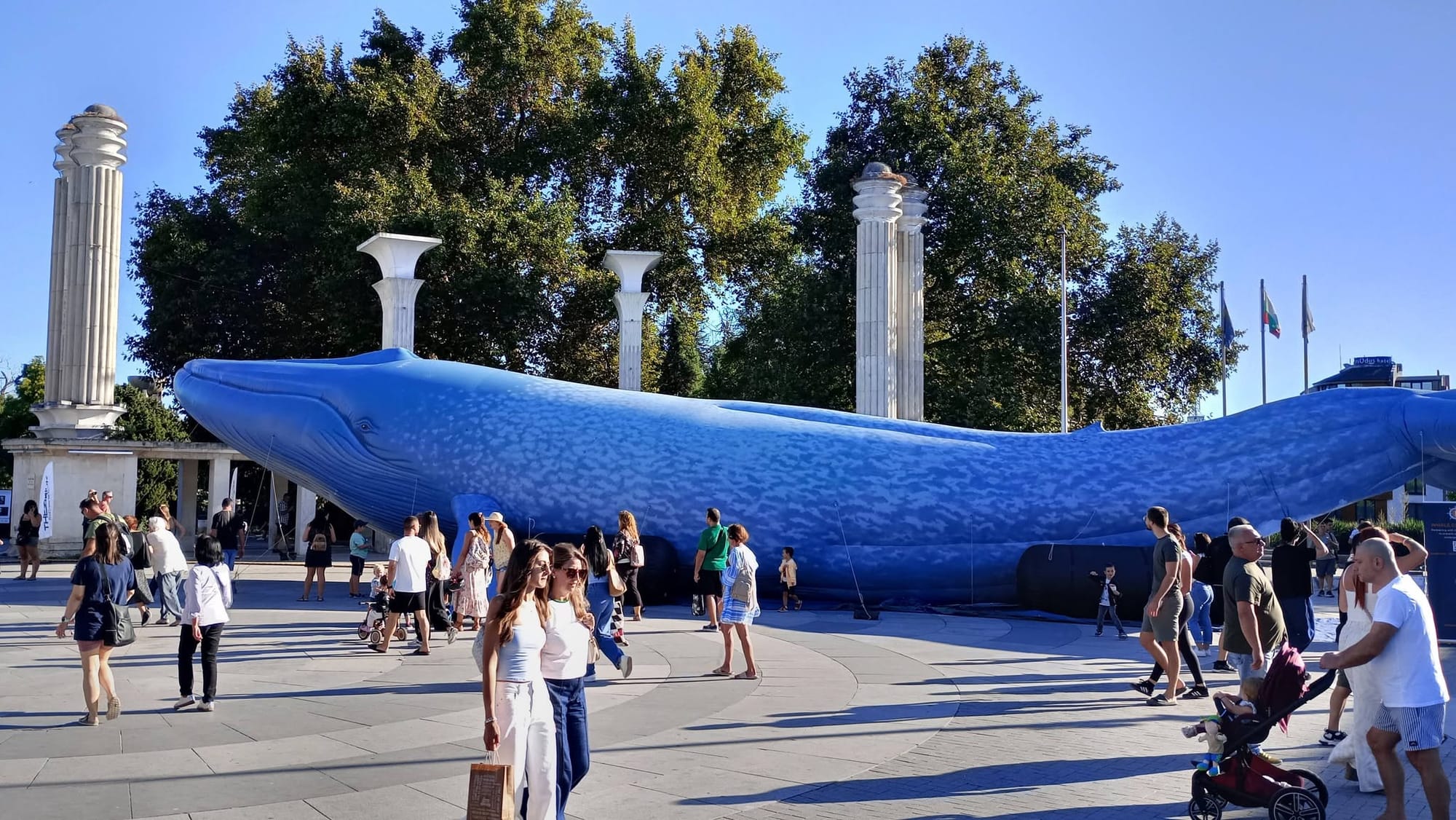
В самия край на лятото, в топлото начало на септември (най-хубавото време да си варненец или да посетиш града), на входа на Морската градина се появи огромен син кит в реални размери – 28 метра дължина. Надуваемото животно стана сензация буквално за часове. Оказа се, че поставянето му е част от форум на морски експерти, чиято тема беше избягването на инциденти между големите морски бозайници и корабите. 

Децата подскачаха и се радваха, възрастните снимаха, та снимаха с телефоните, а в социалните мрежи… Е, там пак беше касапница! „Това ли измислихте?! От това ли има нужда Варна? Позор!“ – такъв беше основният тон на коментарите, буквално стотици, може би хиляди. 

6 раздувки за варненското лято 2026
© Веселин Златков

И тук вече престанах да се срамувам и възмущавам от масовия хейт и просто се натъжих. Какво се случва с варненци, моите мили съграждани? Наистина ли такова е масовото им мнение, или става въпрос за някаква целенасочена тролска атака? 

Ако китът беше червен, розов или кафяв, щяха ли да му се зарадват? Или щяха да го нарежат, ако някой беше пуснал слуха, че китът е украински? 

Варна преминава през период на криза, която няма да завърши с края на този летен сезон – това е очевидно. Ясно е също, че без отговорността и съзнателните усилия на гражданите си т.нар. Морска перла няма да стане по-приветливо и приятно място. Но изглежда, варненци напоследък са ангажирани предимно с това да не харесват. Да не харесват и да не правят нищо, бих добавил. 

CVE-2026-94127: Critical Unauthenticated RCE in F5 BIG-IP APM

Post Syndicated from Rapid7 original https://www.rapid7.com/blog/post/etr-cve-2026-94127-critical-unauthenticated-rce-in-f5-big-ip-apm

Overview

On September 22, 2026, F5 published a security advisory for CVE-2026-94127, a critical heap-based buffer overflow vulnerability affecting F5 BIG-IP Access Policy Manager (APM). The vulnerability has a CVSS v3.1 score of 9.8. An unauthenticated attacker with network access to an affected virtual server may be able to achieve remote code execution (RCE) by sending specifically crafted traffic.

BIG-IP APM provides identity-aware access control for applications and other corporate resources and can integrate with authentication technologies including OAuth, OpenID Connect, and SAML. CVE-2026-94127 is not exposed in a default configuration: exploitation requires a BIG-IP virtual server with both an APM access policy and an OAuth profile configured. Because affected BIG-IP systems may process traffic at an organization’s network edge, organizations using this configuration should prioritize remediation.

The vulnerability affects the data plane and does not expose the BIG-IP control plane. BIG-IP systems operating in Appliance mode are also affected.

F5 lists the following affected release trains and corresponding fixed hotfixes:

  • BIG-IP 21.1.0: versions prior to Hotfix-BIGIP-21.1.0.2.0.30.22-ENG

  • BIG-IP 17.5.0: versions prior to Hotfix-BIGIP-17.5.1.9.0.160.12-ENG

  • BIG-IP 17.1.0: versions prior to Hotfix-BIGIP-17.1.3.5.0.41.14-ENG

As of September 22, 2026, CVE-2026-94127 has been added to the CISA KEV while a publicly available proof of concept was not confirmed.

Mitigation guidance

Organizations running affected F5 BIG-IP deployments should apply the appropriate F5 hotfix as soon as operationally feasible, particularly where a vulnerable APM and OAuth configuration is reachable from untrusted networks.

F5 lists the following remediation versions:

  • BIG-IP 21.1.0: update to Hotfix-BIGIP-21.1.0.2.0.30.22-ENG or later.

  • BIG-IP 17.5.0: update to Hotfix-BIGIP-17.5.1.9.0.160.12-ENG or later.

  • BIG-IP 17.1.0: update to Hotfix-BIGIP-17.1.3.5.0.41.14-ENG or later.

Administrators should first determine whether a BIG-IP APM access policy and an OAuth profile are configured together on a virtual server, since this configuration is required for exposure.

For organizations that cannot immediately apply the applicable update, F5 provides an iRule workaround through F5 Support. Customers should open a support case with F5 to obtain the vendor-provided workaround and follow F5’s implementation guidance.

Rapid7 customers

Exposure Command, Vulnerability Management, and Nexpose

Exposure Command, Vulnerability Management, Nexpose customers can assess exposure to CVE-2026-94127 using vulnerability checks expected to be available in today’s (September 23) content release.

Updates

  • September 22, 2026: Initial publication.

“We can figure it out”: How one Minnesota teacher uses Experience CS to set the tone for her whole year

Post Syndicated from Sofia Mohammed original https://www.raspberrypi.org/blog/we-can-figure-it-out-how-one-minnesota-teacher-uses-experience-cs-to-set-the-tone-for-her-whole-year/

Walk into Allison Knoph’s fifth grade classroom in Edina, Minnesota in October and the creative writing station will be the loudest place in the room.

That is by design. “I use it at my creative writing station,” she says of Experience CS, which she has run each fall for the past couple of years. Kids use the station computers to be creative as they work on their programming projects, building characters and testing jokes they have written. Some laugh hard enough that a visitor might wonder if anyone is working.

“Giggling,” Allison says, “is a good problem to have.”

Placement matters

Experience CS is a standards-aligned computer science curriculum for grades 3 to 8 (ages 8 to 14) that integrates computing into core subjects like math, science, and art. Allison has completed two units with her students, The me project, designed for fourth grade (ages 9 to 10), and Ecosystems, designed for seventh grade (ages 12 to 13).

2 units: How to program a mystery, designed for fifth grade (ages 10 to 11), and Ecosystems, designed for seventh grade (ages 12 to 13).

Of the two units, the storywriting-themed The me project was the stronger fit. It mapped cleanly onto language arts work her students were already doing. Students hit the signposts the unit lays out, but what they did inside that structure was theirs. One wrote the minimum and moved on. Another built a multi-scene story with custom sound effects, spending three weeks developing their project and making improvements.

The Ecosystems unit was more challenging for her students, and the students who finished “were the ones who were kind of the more gung-ho ones that were really into it.” She is not dismissing it, but she is clear that placement matters.

Helping each other

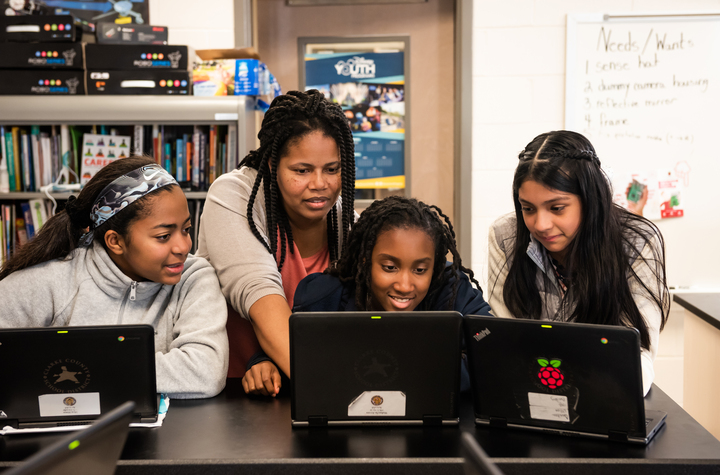
Allison highlighted that some of the students who were thriving in the Experience CS lessons were students who were experiencing difficulties in other areas of the curriculum. “The kids who don’t normally shine often do here,” she says. Describing one experience from her classroom, she shared that a student who had difficulties with reading quickly understood how a program should be sequenced. Within a week, classmates were walking to that desk for help. The peer support model is not something she engineers. It builds itself.

Running the lessons in October sets a tone she draws on all year. Something breaks, a student gets stuck, and the answer in her room becomes “We can figure it out.” That carries into math, into writing, into everything after.

Why now

Allison is not arguing that every student will grow up to write code. Her argument is that computational thinking transfers, and that it looks a lot like the writing instruction she is already doing: syntax, structure, sequence. Debugging a story and debugging a program are closer cousins than most people think.

Young people with a teacher in the classroom

In the age of AI, computational thinking and coding skills are especially important. Access to AI tools makes it easier for more people to generate code. Fewer people can read it, judge whether it is any good, and change it. Allison saw this on her son’s robotics team: the students who understood their code could adapt it when the robot did something unexpected. The ones who had generated code and dropped it in could not. Same tools, different outcomes, and the difference was comprehension.

The context in Minnesota

Minnesota ranks near the bottom nationally for computer science access. In the most recent state-by-state accounting, 34 percent of its public high schools offered a foundational CS course, against a national average of 60 percent.

As a fifth grade teacher, Allison believes that if students may not have opportunities to learn CS in high school, the introduction has to happen earlier, in a classroom not labeled computer science.

She is candid that the barrier for elementary teachers is not interest. It is time, cost, and the fear of being asked a question they cannot answer. She sums up the Experience CS offering to her colleagues in a few words: free, little direct instruction, fits standards she is already teaching, and the kids like it enough to be loud about it.

“We can figure it out” is a good thing for a teacher to say out loud. It is a better thing for a room of ten-year-olds to start saying back.

Find out more about introducing Experience CS in your classroom: head to experience-cs.org today.

The post “We can figure it out”: How one Minnesota teacher uses Experience CS to set the tone for her whole year appeared first on Raspberry Pi Foundation.

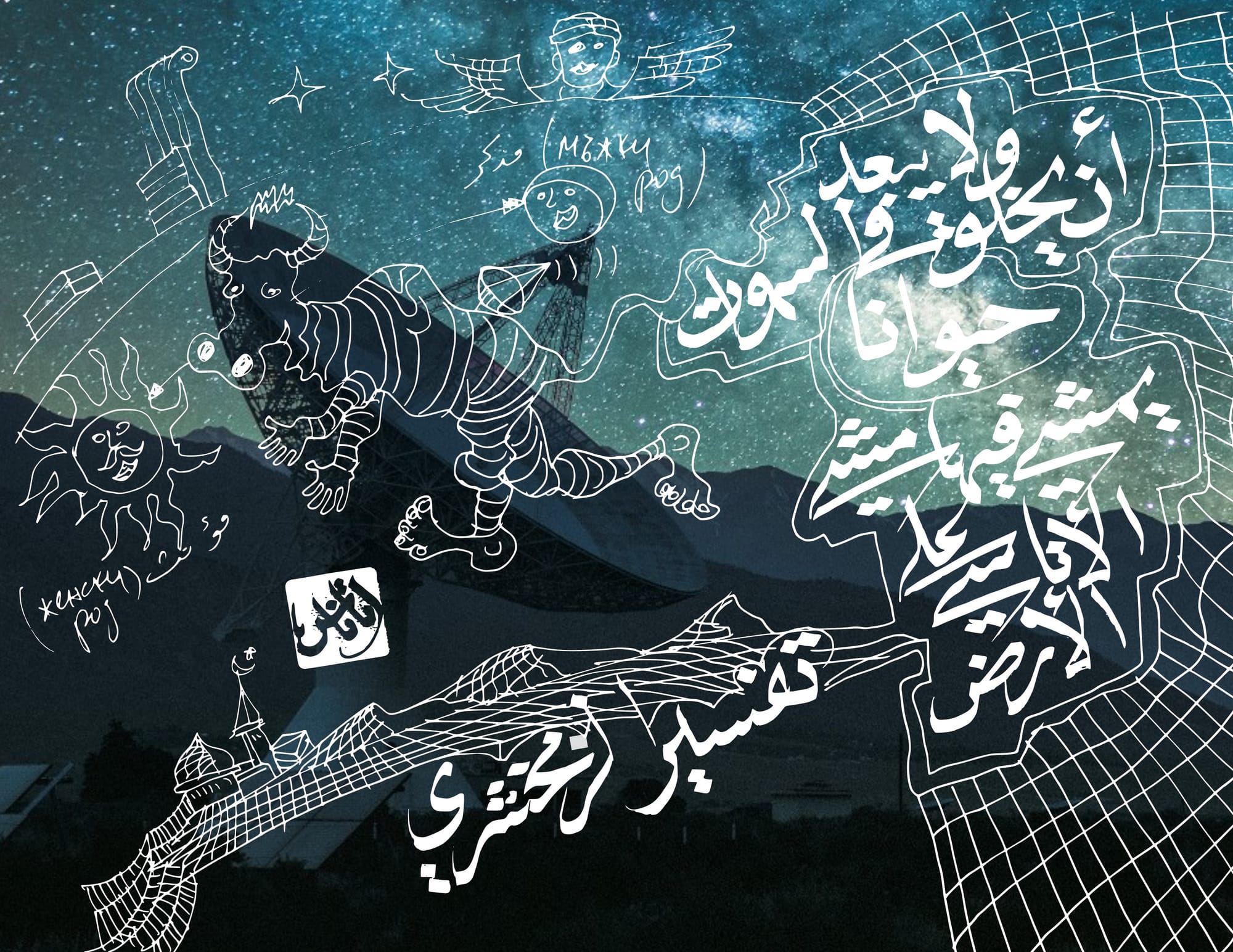
„Господът на световете“. Извънземни и ислям (продължение)

Post Syndicated from Атанас Шиников original https://www.toest.bg/gospodut-na-svetovete-izvunzemni-i-islyam-produlzhenie/

<< Към първа част

„Господът на световете“. Извънземни и ислям (продължение)

Средновековните извори, особено от външни нам култури, имат особена динамика. На пръв поглед изглеждат непроницаеми, езикът е тежък, сух, често са сложни, витиевати, с множество скрити препратки, особено към текстове, които читателите следва да знаят по подразбиране. Няма бележки под линия, няма обяснения. Но с това се свиква и носи особено удоволствие, почти като да чоплиш тиквени или слънчогледови семки. За непосветените изглежда скучна повторяема дейност. Ала за нейните адепти носи огромно удовлетворение както веднага, така и с натрупването в дългосрочен план. И често пъти, особено когато става въпрос за Корана и Сунната, изворите осмислят събития от съвремието. Тъй де, откъде иначе човек може да разбере защо вече споменатата в предишната част ИДИЛ нарича списанието си „Дабик“?

Съвременните възгледи също не са еднозначни. Ето този любопитен читател отправя запитване към портала за фетви на катарското Министерство на религиозните дарения и работи: „Искам да Ви запитам относно въпроса за извънземните.“ Има ли ги споменати в Корана и Сунната? Ако не, откъде идвал тоя израз „извънземни същества“, което на арабски тук е буквално „космически същества“ (ка’инат фада’ийа). Запитването става още по-интересно: какво мислят религиозните авторитети за твърденията, че извънземните са създали човека подобен на тях чрез ДНК технологии, че те са помагали на фараоните да построят пирамидите, че те са силата, довела до съществуването на човека, и в крайна сметка как изглеждат? Дали изображенията, които намираме по мрежата, са истински, или са изфантазирани, за да убедят хората, че извънземни съществуват?

Мисля, че питането е достойно за едновремешния вестник „Психо“ или сходния му днес „Феномен“, който често си купувам, за да си сверя конспиративно-окултния часовник. Но както обичам да казвам, в мюсюлманското право и богословие срамен въпрос няма. Все пак става дума за съвършения Свещен закон на Всевишния. Там трябва да има отговор на всичко.

Отговорът е изненадващо разкрепостен, още повече че това е катарското министерство. Онзи, който е създал човека, и го е изваял че после му е и вдъхнал живот – тоест самият Аллах, – е способен да създаде и извънземни. Свещеният Коран е посочил, че има същества, които не са били известни на човечеството по времето на Пророка, ролята на научните открития, както и че за всяко нещо има определено време, което ще настъпи. Аргументът е вече цитираният от мен текст в Коран 16:8: „[Сътвори] и конете, и мулетата, и магаретата – за да ги яздите и за украса. И сътвори Той каквото не знаете“; „Всяка вест си има определено време и ще узнаете“ (6:67), и вече известното ни знамение за „небесните добичета“ (42:29), където, пояснява богословът, терминът дабба според някои религиозни учени обозначава създания, различни от ангелите, тъй като Всевишният прави разлика между онова, което е дабба, тук „твар“, и ангелите в самия Коран: „На Аллах се покланя в суджуд всичко на небесата и всяка твар по земята, и ангелите – без да се големеят“ (16:49).

Ако трябва да бъда донякъде критичен, тук нашият превод ми се вижда излишно рестриктивен и прокарва определено тълкувание. Защото арабският оригинал не ни казва точно „всичко на небесата и всяка твар на земята“, а по-скоро „всяка твар на небесата и земята“ (ма фи с-самауат уа-ма фи л-ард мин дабба). А пък суджуд, както е известно в мюсюлманската ритуална практика, е покланянето с чело до пода и ако бях един средновековен богослов като Ибн Таймия от XIII век например, щях да разсъждавам върху това как небесните твари, които не са ангели, а очевидно са нещо друго, свеждат чело до земята, какво тяло имат, колко и какви крайници, стави, имат ли глава, дали е повече от една, въобще как се извършва този жест на ритуално поклонение от чисто механична гледна точка.

Но да оставим тази спекулация за друг път и да продължим с катарската фетва на Министерството. Нали е важно какво казва религиозният истаблишмънт. На базата на тези текстове, твърди богословът, „хората на знанието“, тоест религиозните учени, или поне някои от тях, твърдят, че няма пречки да съществуват други „вселени“ или „светове“, без да е напълно сигурно, доколкото свещените текстове подлежат на тълкуване. Ала не си мислете, че това разкрепостено тълкуване се простира благосклонно върху окултно-конспиративните теории за сътворението на човека от извънземен разум чрез ДНК манипулация. Това допускане е откровена безсмислица. Та не е ли самият Аллах създател на човека според писаното „Сътворихме Ние човека от подбрана глина“ и т.н. (Коран 23:12)? За фараоните и извънземните позицията е по-мека, била тя и скептична – няма категорично доказателство за подобно, хм, строително сътрудничество (по мое четене), та и е правилно мюсюлманите да не се вдават много-много в разсъждения в тая посока.

Подобни позиции, с много сходна коранична основа, се застъпват и от други популярни богослови, ето например един Ясир Кади, богослов от САЩ, в онлайн канала му. Той преповтаря почти буквално старите аргументи, че и се опира на вече споменатия Ибн Таймия, който пък разсъждава върху възможностите за безкрайни творчески актове на Аллах, които, разбира се, включват и други светове. А ако това е така, логично е мюсюлманите да се вълнуват от съвременни дискусии, свързани с доказателства за извънземни, мислени през феномена на неидентифицираните летящи обекти.

И тук се натъкваме на една от пресечните точки между американската администрация и религиозните мюсюлмани. Защото, както видяхме, няма религиозно противоречие ходжата или всеки един религиозен мюсюлманин да допускат, че в произшествието в Розуел, САЩ, от 1947 г. например има зрънце истина. Сигурно и от гледна точка на вярата „няма лошо“, както се казва на арабски (ла ба’с), да се мисли и за нашенската Царичина дупка от 1990 г., когато български военни копаят в търсене на извънземни край София по указанията на екстрасенси. Не съм попадал обаче на тукашно мюсюлманско размишление по въпроса. Търсенето ми онлайн на комбинация от „извънземни“ и „Главно мюфтийство“ ме препраща към Отдел „Външни отношения“ на Мюсюлманското вероизповедание. Но не външни на Земята, или поне засега. Сигурно някой ден може да е другояче, ако тълкувателите на Корана в полза на космическите пришълци се окажат прави.

През 2017 г. излязоха данни, че Пентагонът използва десетки милиони долари „черни пари“ от военния бюджет за проучване на свидетелства за НЛО в рамките на програма за идентифициране на заплахи за въздушното пространство. Както отбелязва и Sapience, американски мюсюлмански институт за проучване на връзката между религията и науката, тези разкрития наливат наново вода в мелницата на интереса към извънземните. Според института

може да се прокара връзка между наблюдаваните прояви на НЛО и споменатите в ислямската традиция джинове.

Тези паралели вървят по няколко линии. На първо място, характеристиките при описанията на двата феномена – странни същества, които променят формата си, летящи, неестествено движещи се обекти. Второ, измамата като основна тема и в двата случая. И в разказите за НЛО, и в старите истории за джинове имаме елемент на заблуда и оптически илюзии. Трето, разказите за отвличания. И накрая, сходствата при случаи, свързани с обладаване, т.нар. стопаджийски ефект (hitchhiker effect) – след отвличане и посещение на извънземни човек носи остатъчни ефекти от него. След като веднъж срещнеш съществата от друг пласт на реалността, те оставят следа върху теб. Не се ли загатва и същото в текста на Корана: „Които изяждат лихвата, не ще се изправят, освен както се изправя някой, когото сатаната поваля от лудост“ (2:275), където се допуска възможността дяволът да доведе някого до безумие?

Тук трябва да направим и важно терминологично уточнение. Вместо „извънземен“ (extraterrestrial) някои учени използват термина „криптоземен“ или „скритоземен“ (cryptoterrestrial), доколкото той обозначава не живот, придошъл от пространства извън Земята, а по-скоро феномен, наличен на Земята, но със скрит произход. И това, твърди авторът на статията, веднага напомня за света на джиновете. Защото едно от значенията на арабския корен дж-н-н, от който идва думата, е свързано със скриване, укриване, покриване. Честно казано, ако бях мюсюлманин, и аз веднага щях да припозная джиновете като основни виновници за НЛО феномените. Не ми трябват „зелени човечета“. Е, ако може, да не изхвърляме и „небесните добичета“ с неясни атрибути от небесата.

Арабският онлайн инфлуенсър Manetho The Writer посвещава почти четиричасово предаване на „черните пари“ на Пентагона, обсъжданията на НЛО в американската администрация и връзката с възможни срещи с извънземни. Епизодът се нарича „От Конгреса до джамията: мюсюлманското право за извънземните“ и представлява подкаст с различни участници и материали. Има всичко – от протоколи на изтеклите документи от Пентагона и записки на Конгреса в САЩ, през детайлни описания на наблюдавани НЛО, споменаване на Розуел и други подобни събития, та чак до богословски обяснения по някоя от по-горните линии на разсъждение, текстове от Корана и Сунната и пространни разсъждения относно приложимостта на ислямското право относно възможните извънземни.

Докато слушам смесицата от арабски диалекти и книжовен кораничен език, от чисто любопитство се питам друго. Свързано е с визуалното възприятие на извънземните. Клишираният образ на извънземното на Запад е известен – голяма, удължена, яйцевидна глава, големи очи, тънко тяло, високо или ниско, фини крайници, нещо като известните „сиви същества“. Но историческите изображения на джинове в старите мюсюлмански ръкописи нямат нищо общо с това. Обикновено ги изобразяват мускулести, с човешка или животинска глава, често пъти с рога, зъбати, понякога имат крила. Това не са падналите ангели от християнството. В исляма такива няма. Даже архизлодеят на Корана – Иблис, е джин, пише го в Коран 18:50: „И когато рекохме на ангелите: „Сведете чела пред Адам!“, те се поклониха, освен Иблис. Той бе от джиновете…“ Вижте ги например тук в стари ръкописи… Та, чудя се, дали има истории за среща на съвременни мюсюлмани с извънземни, които да пресичат културните граници. Например да ги отвличат не зъбати и крилати джинове, а хуманоиди с яйцевидни глави. Е, да не насилваме историческите и културните особености. Пък и да не забравяме, че ако има „небесни твари“, които са разумни и от време на време избират да се явят на хората, те могат или да приемат различна форма, или съответните култури да ги възприемат според собствените им понятийни условности.

Но докато дослушвам подкаста, един от участниците изплюва камъчето. Колкото и да се спекулира около възможните обязаности на обитателите на Космоса – например как се женят, как извършват ритуално умиване и прочее (покрай всичко зачудвам се и как ли се обрязват), – се стига до признание. Мюсюлманската ритуалност в Свещения закон е изградена около идеята за централна роля на човечеството. Няма мърдане. И Коранът, и Сунната, и мюсюлманското право важат най-вече за него. Тоест продължавам същата нишка на разсъждение. Ако си нарушил „границите на Аллах“ (Коран 4:13) и ти се полага наказание свише, което никой не може да промени – като отрязването на ръката на крадеца, пребиване с камъни за прелюбодейство, камшици за алкохол например, – няма голямо значение дали другите разумни същества във вселените на „Господа на световете“ подлежат на същото. Свещеният закон може да е всеобхватен, но не е безогледен. В него си има приоритети. И извършеното от хора в сферата на човешкото безспорно е един от тях.


В рубриката „Ориент кафе“ Атанас Шиников поднася любопитни теми, свързани не толкова с горещата политика, колкото с историята и културата на Близкия изток. А той, древен и днешен, е по-близко до нас и съвремието ни, отколкото си представяме.
Introducing Amazon CloudWatch Omni: collaborative AI-powered observability for your applications

Post Syndicated from Daniel Abib original https://aws.amazon.com/blogs/aws/introducing-amazon-cloudwatch-omni-collaborative-ai-powered-observability-for-your-applications/

Amazon CloudWatch now offers CloudWatch Omni, an AI-powered observability experience for the applications and AI agents you run together. You reach Omni through a dedicated URL for your organization and sign in with the identities you already manage, so working in Omni does not require access to the AWS Management Console. Omni is built on OpenTelemetry: the telemetry you already send to CloudWatch appears in Omni with nothing to reconfigure, and any other workload you instrument with OpenTelemetry sends its telemetry to an OpenTelemetry Protocol (OTLP) endpoint.

CloudWatch Omni offers both agent observability and application observability in a single experience. In our companion post, we introduced the agent observability capabilities of Omni for generative AI and agentic workloads. In this post, we present the application observability experience.

Engineering teams spend a significant portion of their observability time maintaining dashboards, tuning thresholds, and switching between tools to piece together what happened during an incident. When an issue crosses team boundaries, context gets lost in Slack threads and screenshots rather than flowing naturally to the next engineer. CloudWatch Omni changes this by organizing observability around your applications rather than individual signals, and bringing your whole team into the same workspace.

What CloudWatch Omni brings

CloudWatch Omni addresses three problems that engineering teams told us they face today.

One collaborative experience for your whole team. Every engineer accesses CloudWatch Omni through a single URL with enterprise SSO (via IAM Identity Center, supporting Okta, Azure AD, and other providers). No AWS Console access is required. SREs, developers, database engineers, and managers share the same data and investigation context. When an investigation escalates, the next person joins the same session with full context already in front of them.

The system adapts as your applications evolve. CloudWatch Omni discovers your services, maps dependencies, and adjusts alarms automatically. Instead of manually curating dashboards and tuning thresholds, you declare what matters (availability targets, latency budgets, error rate thresholds) and Omni adapts as your system changes. When you deploy new services, Omni updates the application topology automatically.

AI-powered investigation with Amazon DevOps Agent. Amazon DevOps Agent participates alongside your team in investigation sessions, correlating signals and suggesting next steps. The agent works from the same telemetry your engineers see, so its suggestions are grounded in the actual state of your application. It identifies correlated events across services, traces root cause paths through your dependency graph, and maintains investigation history for post-incident review.

How an investigation works

When something breaks, CloudWatch Omni opens an investigation session pre-loaded with context. Here is a typical incident workflow:

An alarm fires on elevated error rates in your checkout service. Omni opens a session showing the service topology, correlated signals (a deployment 10 minutes earlier, increased latency from a downstream payment API), and DevOps Agent’s initial analysis.

Your on-call SRE confirms the deployment correlation, pulls in the trace view to identify failing endpoints, and checks if the payment API latency correlates with a capacity limit.

The SRE escalates to the payments team. The payments engineer joins the same session and sees everything found so far, plus DevOps Agent’s correlation with a configuration change in the payment provider’s API gateway. They identify the root cause and roll back.

The entire investigation history is captured automatically. No separate incident report needed.

Walkthrough: setting up your first Space

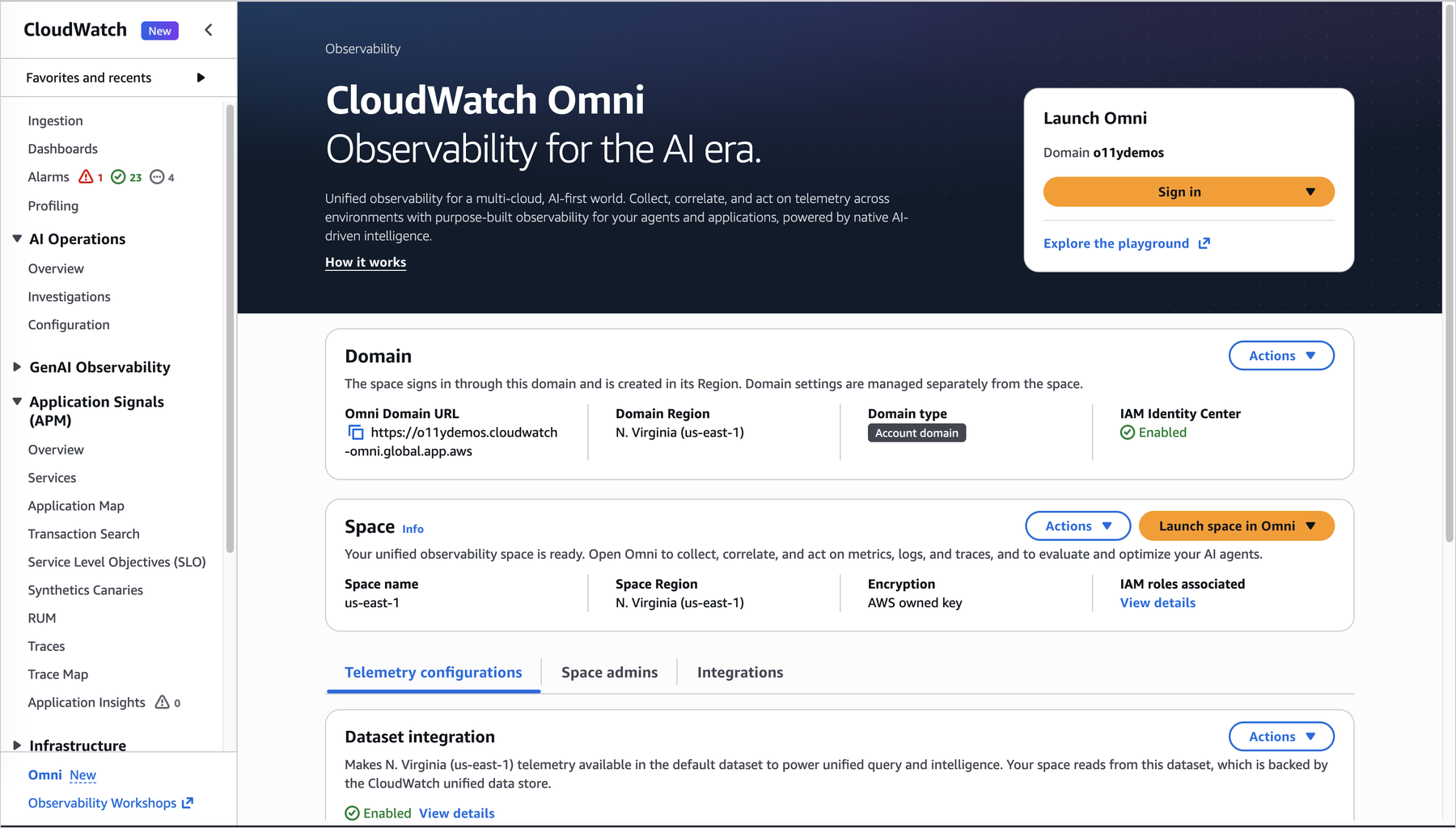
To set up CloudWatch Omni for your team, open the CloudWatch console and click “Try CloudWatch Omni.”


Figure 1. CloudWatch console — Omni setup page

Next, connect your identity provider through IAM Identity Center (supporting Okta, Azure AD, and other SAML 2.0 providers). Once connected, your team members access Omni directly at your dedicated URL without needing AWS Console credentials.

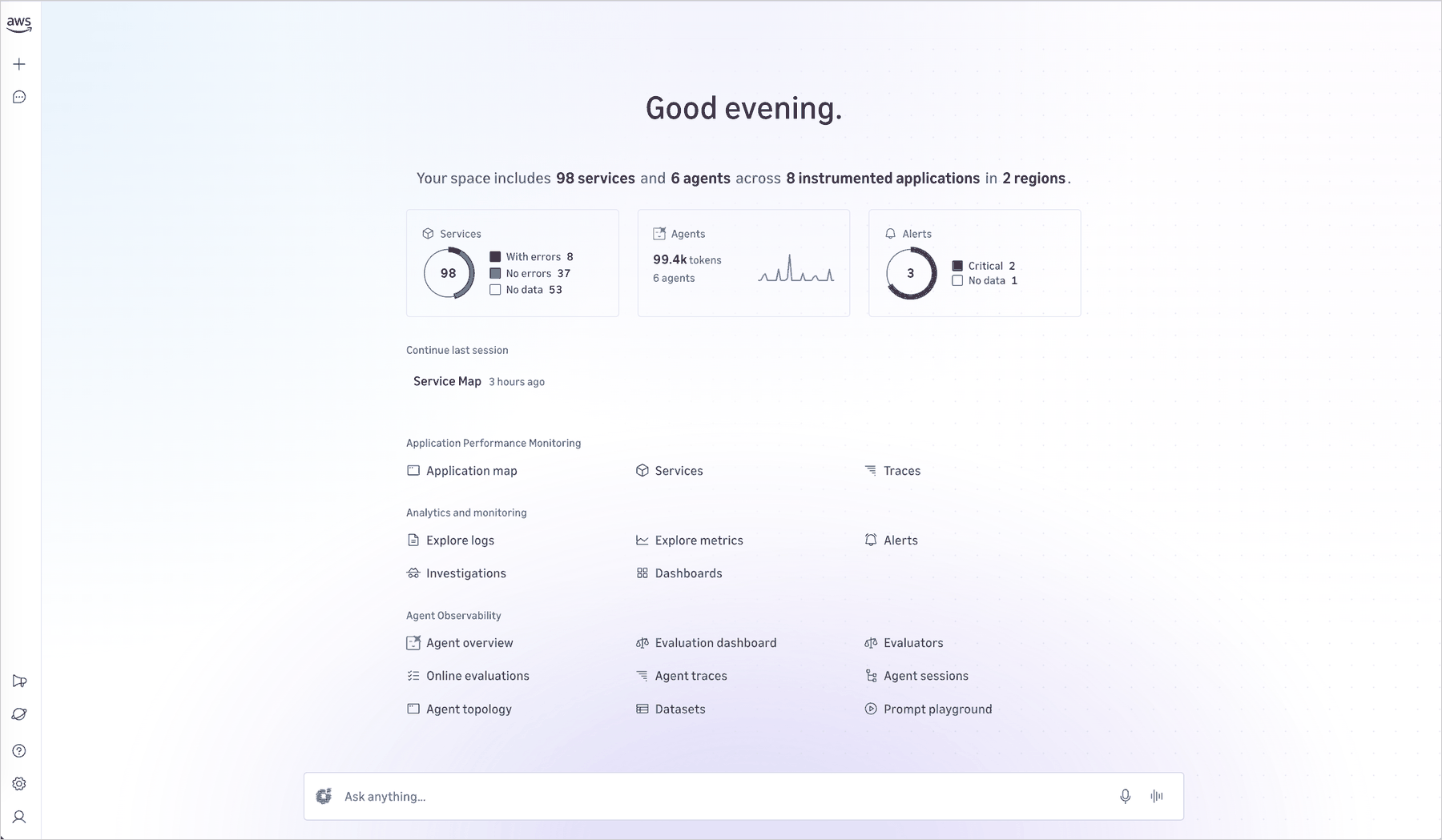
Create a Space for your team. A Space groups the applications your team owns and the telemetry associated with them.


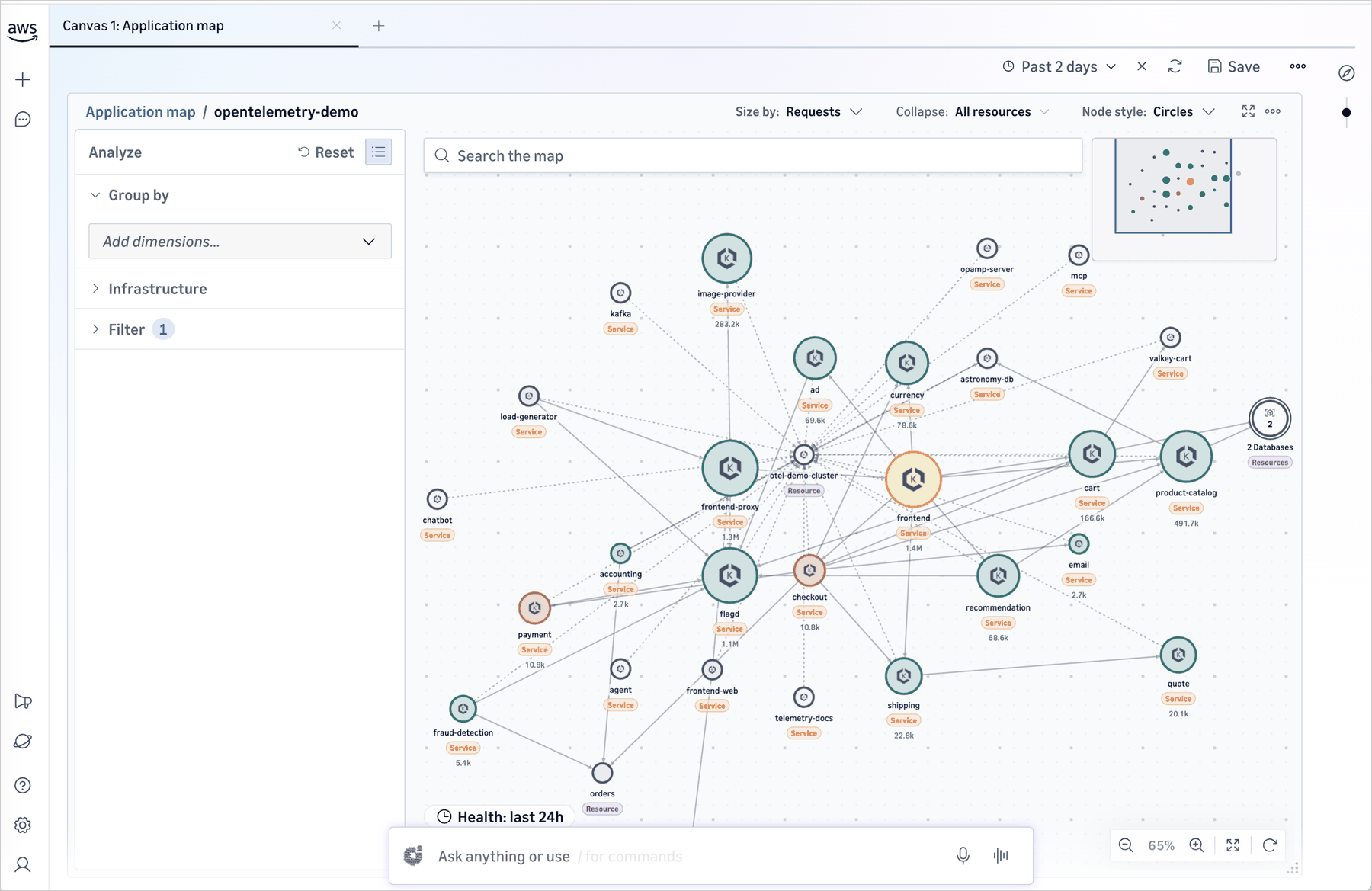
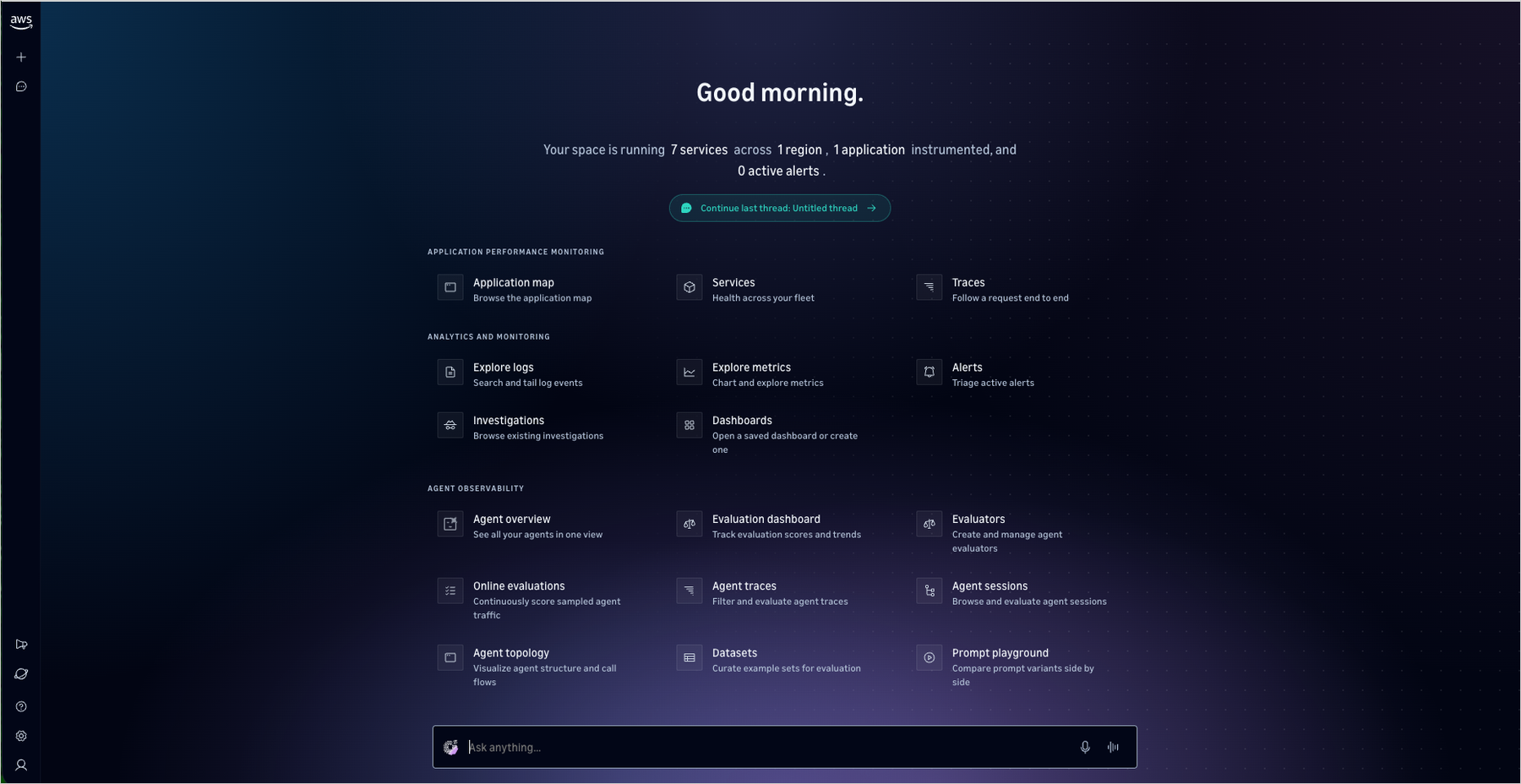
Figure 2. CloudWatch Omni Home — your team’s workspace with application monitoring, analytics, and agent observability

Once created, Omni discovers your services automatically and maps the dependencies between them. You see your application topology immediately.


Figure 3. Application topology — services and dependencies mapped automatically

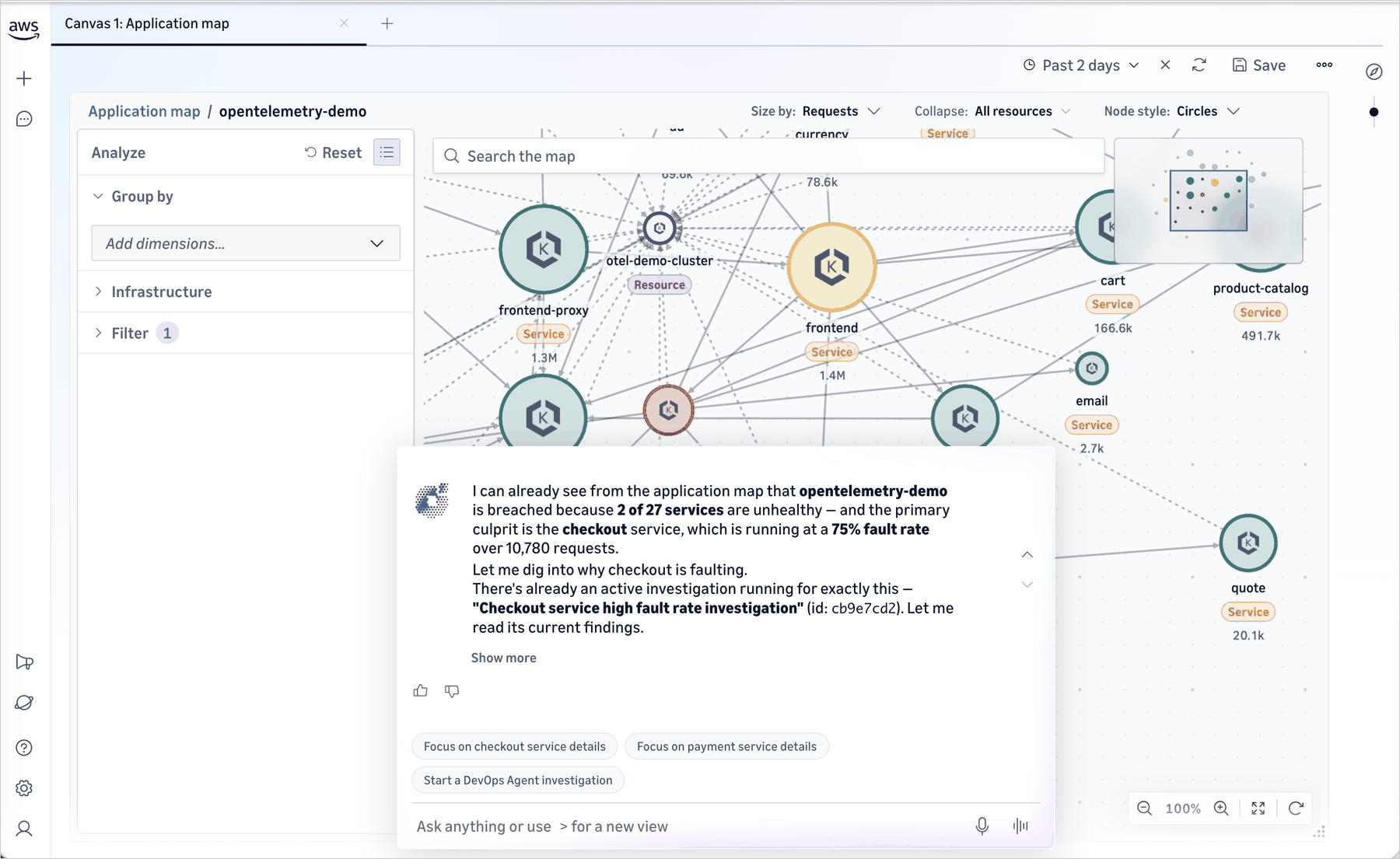
You can ask CloudWatch Omni any question about your applications in plain English, and Omni will analyze your telemetry data and surface insights.

Figure 4. Interact with your telemetry in natural language

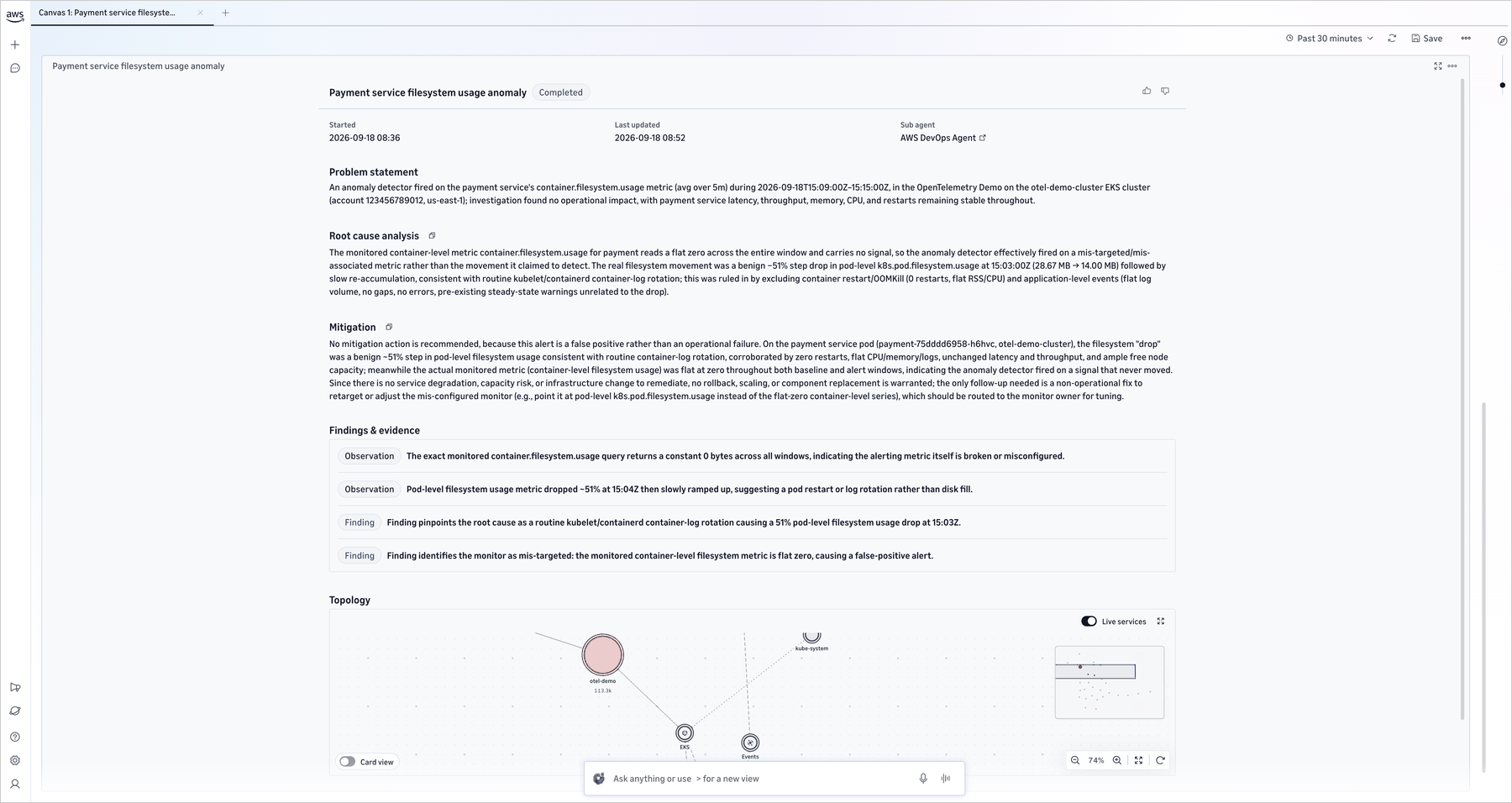
You can also set up service health alerts, configure what matters to your team, and trigger an AWS DevOps agent investigation to identify the root cause and develop a mitigation plan.


Figure 5. Investigation session — DevOps Agent identifies root causes and suggests next steps

Application-centric organization

CloudWatch Omni organizes telemetry by application rather than by infrastructure component. The system automatically discovers services from the telemetry data and AWS Config resource discovery, maps dependencies, and lets you see your application as a connected system rather than a collection of isolated resources.

Each team gets a Space that contains the applications they own. A Space points at existing CloudWatch data (logs, metrics, traces, and alarms) with no additional data movement required. Dynamic views replace the maintenance burden of static dashboards, providing ongoing visibility into SLOs and application health.

Getting started

Getting started takes minutes and doesn’t require reconfiguration of your existing CloudWatch setup.

If you’re an existing CloudWatch customer: Click “Try CloudWatch Omni” in the CloudWatch console. All your existing telemetry (logs, metrics, traces, and alarms) is immediately available. Workloads are discovered automatically, and you can start an investigation or browse your application topology right away.

For organization-wide deployment: An administrator configures a domain, connects your identity provider via IAM Identity Center, defines Spaces for teams and environments, and invites users. Each Space points at existing CloudWatch data with no additional data movement required.

For applications in other environments: CloudWatch Omni provides connectors that make it easy to bring in telemetry from additional environments. All ingested telemetry appears alongside your AWS data in the same Spaces and investigation sessions.

For generative AI and agentic workloads: The same CloudWatch Omni experience delivers purpose-built observability for AI agents, including trace exploration, evaluation frameworks, and real-time monitoring. In our companion post, we introduced the agent observability capabilities of Omni; for that walkthrough, see Introducing Amazon CloudWatch Omni: AI-powered observability for generative AI and agentic workloads.

Things to know

  • CloudWatch Omni extends CloudWatch. Existing alarms, dashboards, APIs, and console workflows continue unchanged.
  • Access is through a dedicated web application with enterprise SSO. Engineers don’t need AWS Console access to use it.
  • Once you setup, DevOps Agent is enabled by default in every Omni investigation session.

Pricing and availability

Amazon CloudWatch Omni is now available. Existing CloudWatch customers can try it directly from the CloudWatch console. For pricing details, visit the Amazon CloudWatch pricing page.

To get started, visit Amazon CloudWatch Omni or click “Try CloudWatch Omni” in the Amazon CloudWatch console.

If you want to call APIs, search documentation, find regional availability, and check troubleshooting about this feature, try using the AWS MCP Server and plugins with your preferred AI tool. Share your feedback on AWS re:Post or reach out through your usual AWS Support contacts.

— Daniel Abib

Introducing Amazon CloudWatch Omni: AI-powered observability for generative AI and agentic workloads

Post Syndicated from Daniel Abib original https://aws.amazon.com/blogs/aws/introducing-amazon-cloudwatch-omni-ai-powered-observability-for-generative-ai-and-agentic-workloads/

Today, Amazon CloudWatch introduces CloudWatch Omni, a unified observability experience for application and AI workloads that is app-centric, AI-powered, built on open standards, and delivered off-console. CloudWatch Omni is a purpose-built observability, evaluation, and experimentation solution for AI agents. It helps teams design, evaluate, and operate AI agents across any model provider, framework, or runtime, with an eval-driven workflow, support for the tools you already use, and observability delivered where you work: directly in your IDE and through a standalone web experience, separate from the AWS Management Console.

Organizations deploying agentic AI systems face observability challenges that traditional monitoring can’t address. Agent behavior is non-deterministic: a prompt change can degrade response quality even when standard metrics show no errors. Teams spend hours manually reviewing logs across multiple systems, unable to pinpoint what changed or why. Existing tools force teams to choose between siloed generative AI monitoring or fragmented solutions requiring constant context-switching between their coding environment and browser-based dashboards.

CloudWatch Omni captures every trace and includes built-in evaluators for correctness, coherence, retrieval quality, and tool selection, among others. You can compare prompt versions side by side in the playground, build test datasets from production traffic, run experiments across different configurations, and detect regressions automatically.

Two surfaces for development and operations

CloudWatch Omni delivers observability through two complementary surfaces. Developers get a native extension inside VS Code and Kiro (the currently supported IDEs), where traces appear as you run your agent with a playground and evaluators a click away. Operators get a standalone web experience, separate from the AWS Management Console to monitor the fleet, accessible through SSO with no AWS console needed. Both share the same data: the trace a developer debugs is the trace an operator investigates.

The Cloud Login feature connects your local IDE environment to your AWS account, enabling you to send telemetry data to Amazon CloudWatch for persistent storage, share traces with your team, and access production dashboards. This connection is optional. You can use CloudWatch Omni entirely locally during development, then connect to the cloud when you are ready to monitor agents in production.

Getting started

CloudWatch Omni offers two ways to get started: through the IDE extension (for VS Code and Kiro) or directly through the cloud experience, where you can start sending telemetry data to CloudWatch without installing any IDE extension. In this walkthrough, I install the extension, create an agent, run it, and explore the traces and evaluation tools from my IDE.

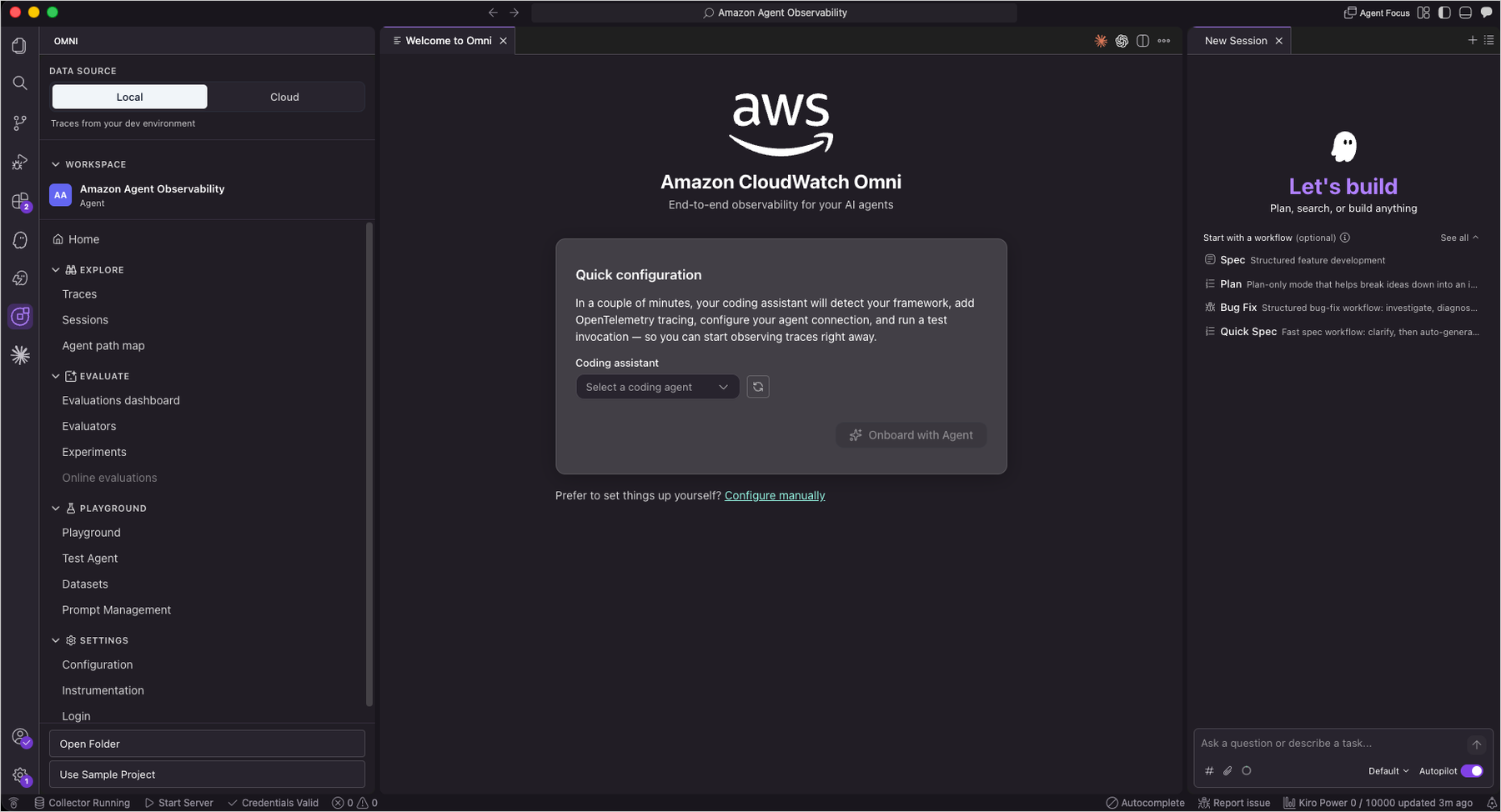
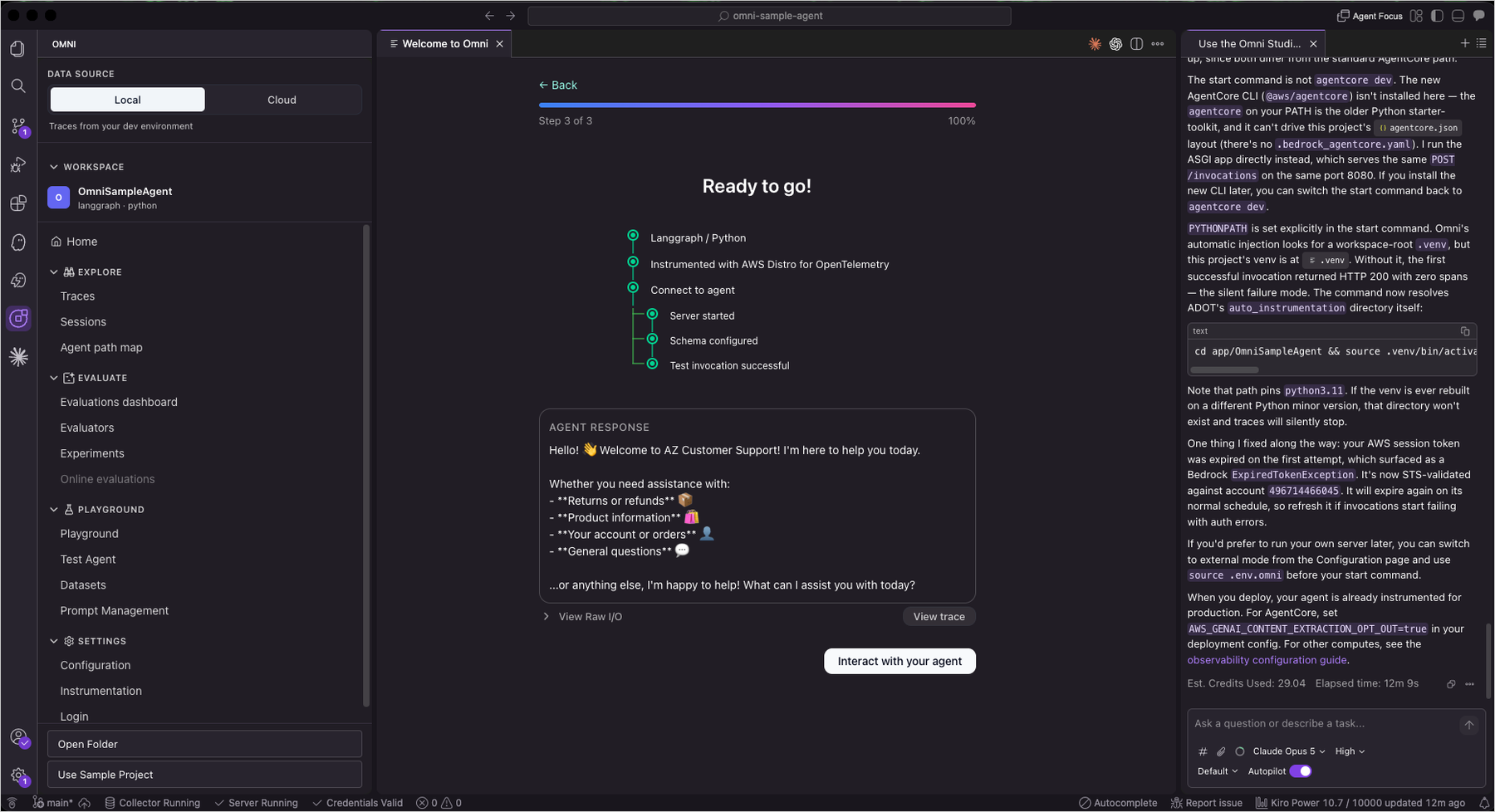
After installing the CloudWatch Omni extension from the VS Code Marketplace, the CloudWatch Omni icon appears in the Activity Bar. From the welcome screen, I selected Get started with Sample Project to load a pre-configured agent with sample trace data or use shortcut to Command Palette using Command + Shift + P (on macOS) or Ctrl + Shift + P (on Windows/Linux) and select Omni: Create a new Project

CloudWatch Omni welcome screen and create new project in VS Code

Figure 1. CloudWatch Omni welcome screen & create new project in VS Code

The sample project comes with an agent implementation and example datasets. Part of the getting-started experience is adding OpenTelemetry instrumentation, and CloudWatch Omni guides you through each step. You can also create a new agent from scratch. CloudWatch Omni walks you through the process using an interactive chat where you define the agent’s purpose, select a model provider, and configure tools. All data is stored locally by default. You can optionally connect to AWS to send data to Amazon CloudWatch.

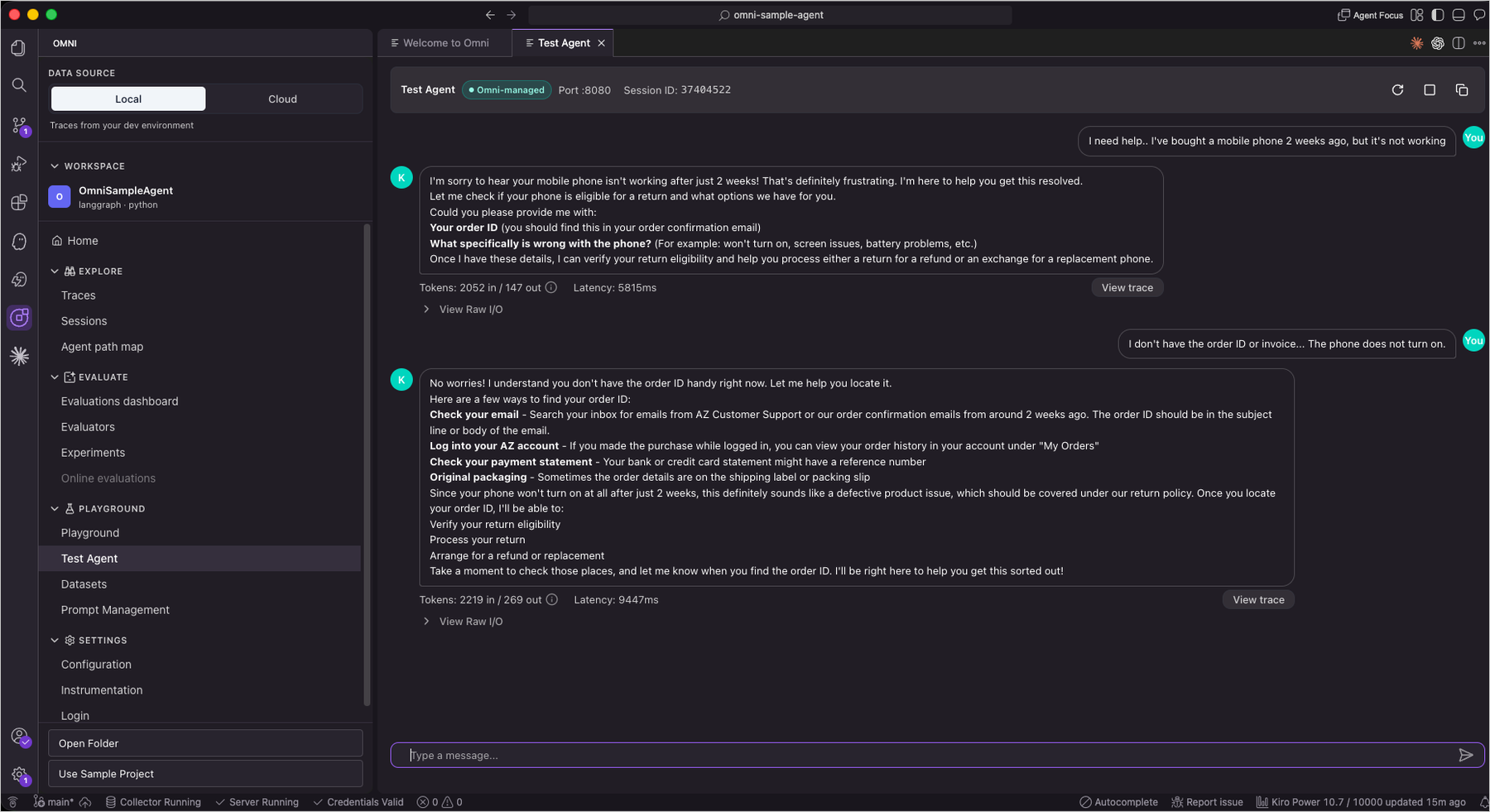
After verifying the configuration, I started the local dev server and sent a question to the agent. What makes this different from a typical chatbot interface is what happens next: selecting View Trace shows exactly how the agent processed the request.

CloudWatch Omni guides your AI code assistant to configure the development environment

Figure 2. CloudWatch Omni guides your AI code assistant to configure the local development environment for testing

CloudWatch Omni integrates with AI code assistants such as Kiro, Claude Code, and Codex to streamline the setup process. These assistants can configure the Dev Server, install dependencies, and set up instrumentation on your behalf, so you can go from installation to running your first traced agent session in minutes without manual configuration.

Interacting with the agent and viewing traces

Figure 3. Interacting with the agent and viewing traces

Traces are essential for understanding AI agent behavior. Unlike traditional request-response systems, agents make multiple decisions per invocation: choosing tools, composing prompts, and chaining sub-calls. Without full trace visibility, diagnosing why an agent produced an incorrect answer or took an unexpected path becomes guesswork. CloudWatch Omni records every step in a structured timeline so you can pinpoint exactly where behavior diverged.

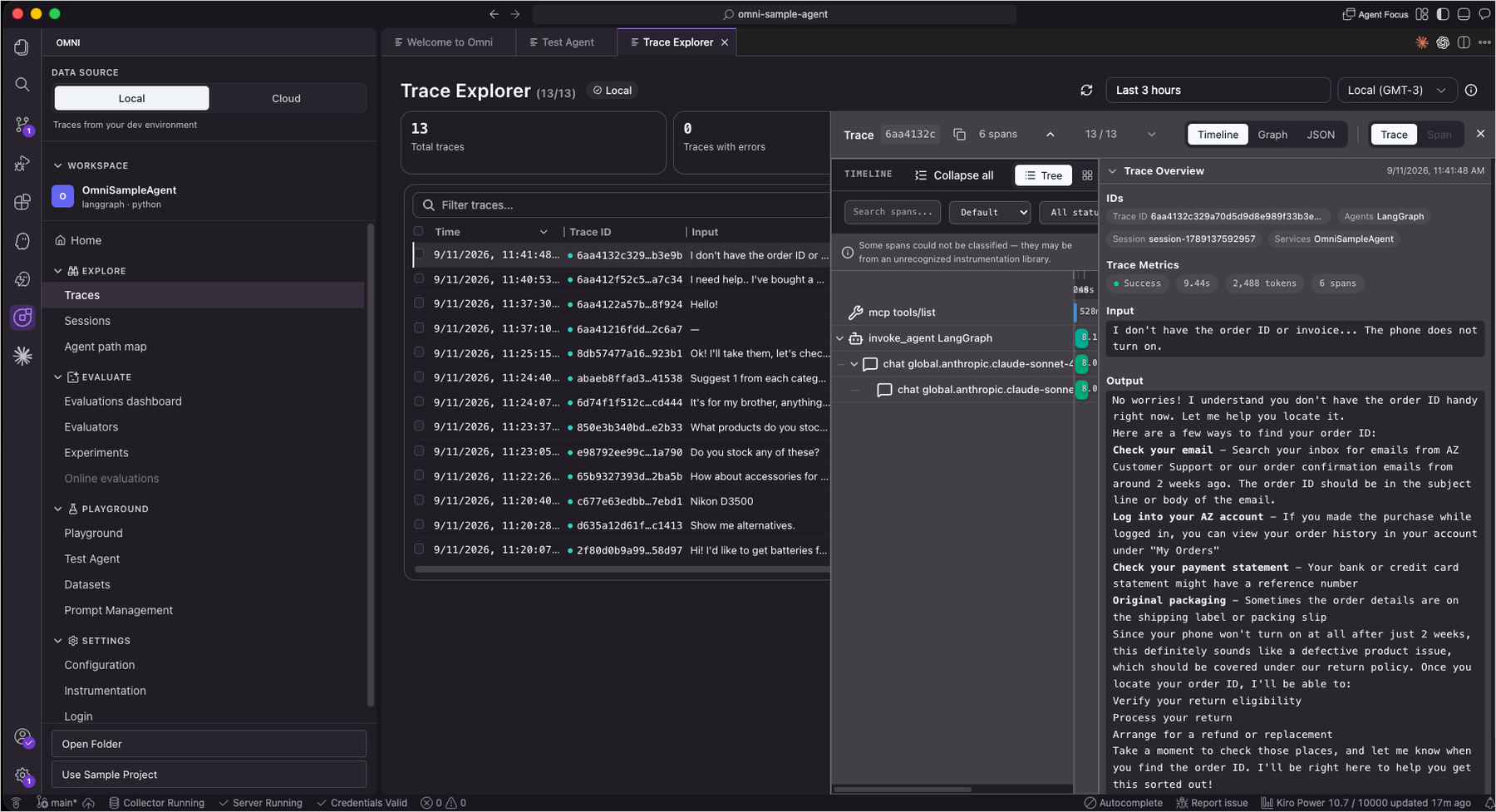
The Trace Explorer shows a detailed breakdown of every step the agent took (LLM calls, tool invocations, and reasoning steps) in a structured, hierarchical timeline. I could drill into any span to inspect inputs, outputs, token usage, and latency.

Trace Explorer showing the agent execution timeline

Figure 4. Trace Explorer showing the agent’s execution timeline

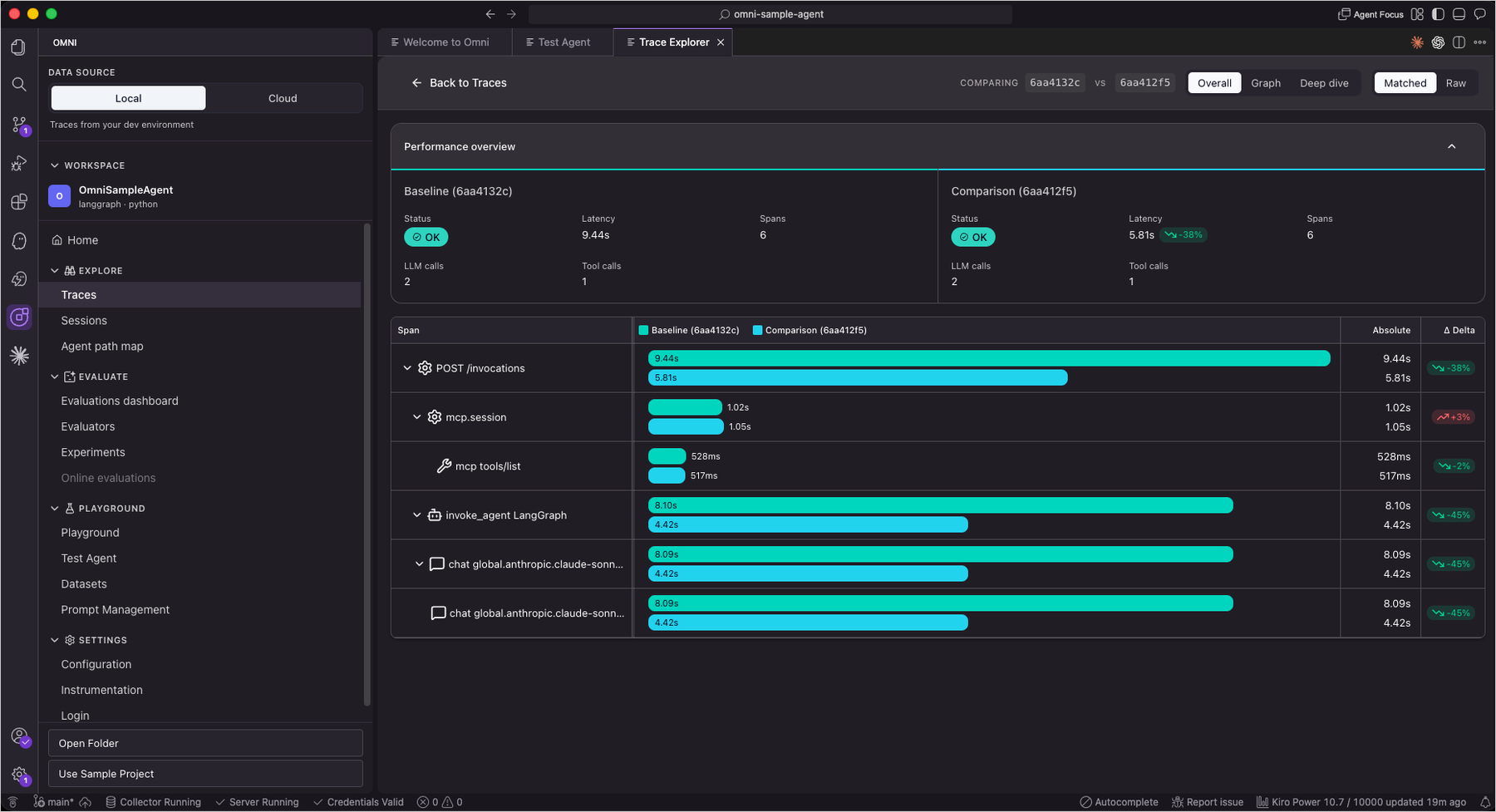
The Trace Explorer also supports Compare mode, which places two traces side by side to see how different prompts or configurations affect behavior. Compare mode is especially helpful when debugging regressions. And with Ask Assistant, an AI agent analyzes your traces to surface patterns and anomalies, answering questions like “Why did the agent call this tool twice?”

Comparing two traces side by side

Figure 5. Comparing two traces side by side

Evaluation is what turns observability into actionable quality improvement for generative AI. Traditional metrics like latency and error rate cannot tell you whether an agent’s response was helpful, coherent, or factually correct. Evaluators score each response against quality dimensions, letting you measure what users actually experience and catch regressions that standard monitoring misses entirely.

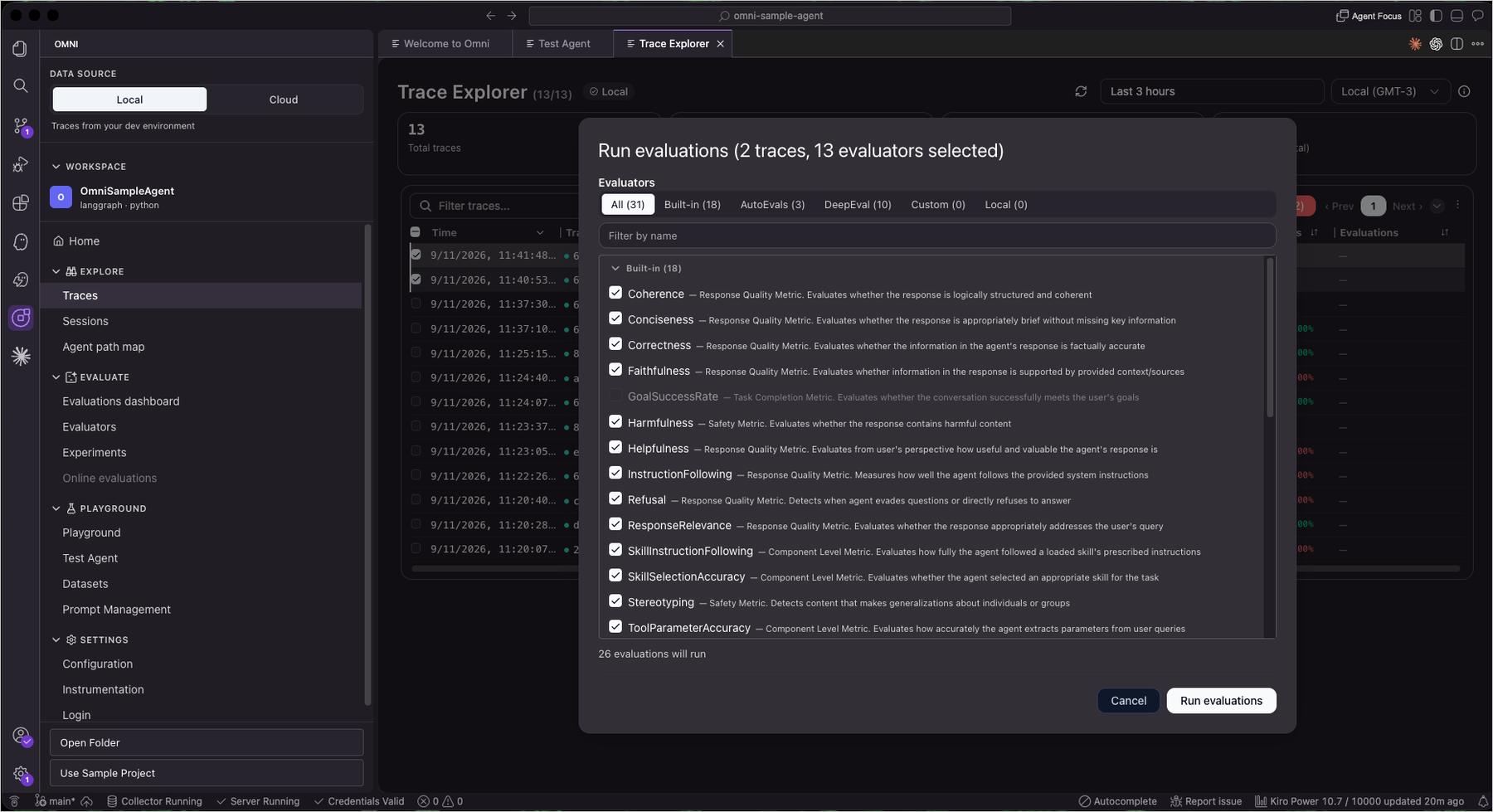
CloudWatch Omni includes 17 built-in evaluators for metrics like coherence, helpfulness, faithfulness, and routing correctness. I selected traces from the Trace Explorer, chose evaluators, and ran an evaluation, getting per-example scores and aggregate metrics without building any custom evaluation framework.

Running evaluations on traces

Figure 6. Running evaluations on traces

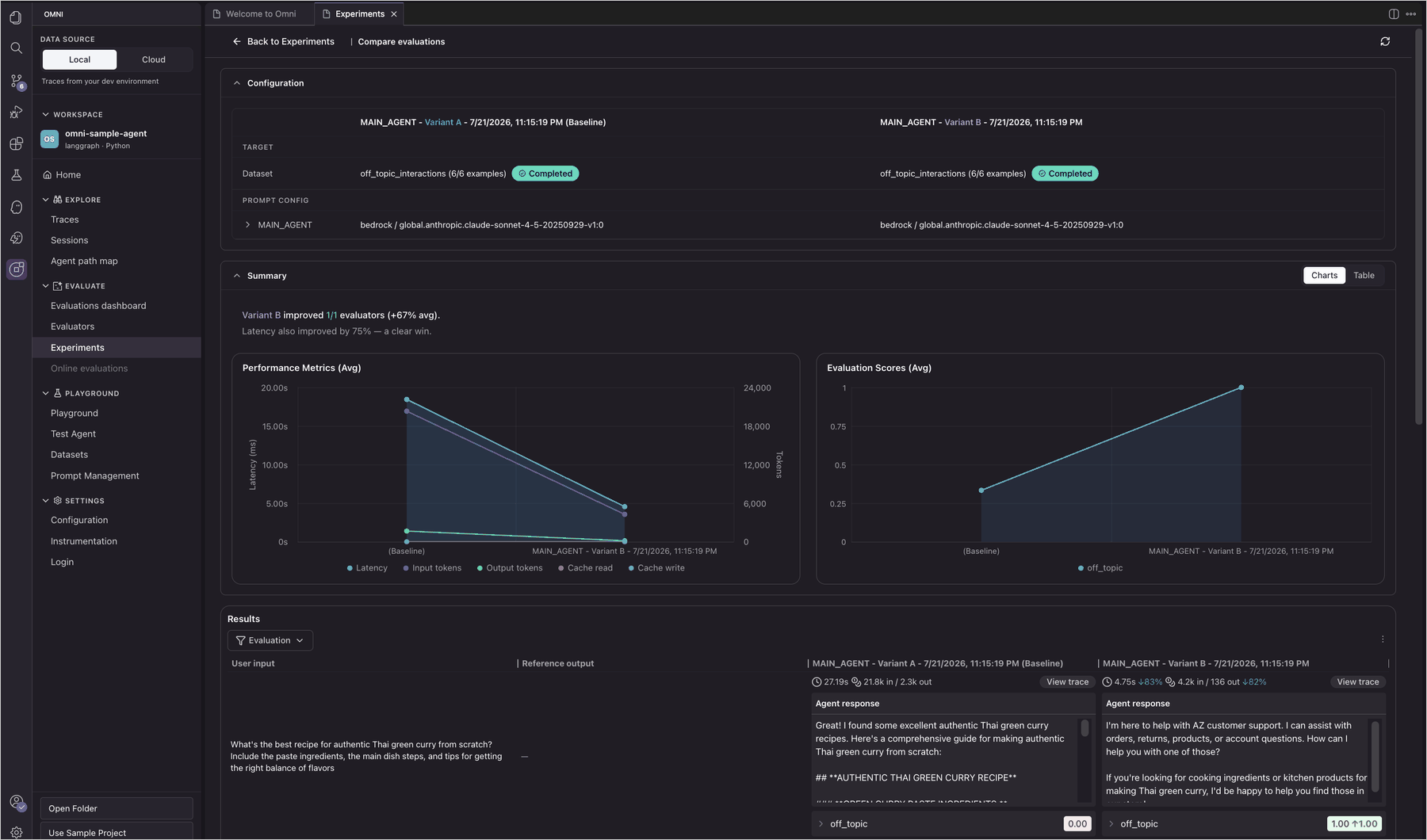
From there, I used the Playground to test different system prompts side by side, comparing multiple model and prompt configurations in real time to see how each variation affects output quality before committing changes. With the Experiments view, I could run the same dataset against two agent variants and compare their evaluation scores, latency, and token usage side by side to pick the best-performing configuration.

Figure 7. Comparing evaluations across agent variants in the Omni Experiments console

With Prompt Management, you can version and track prompt configurations over time, making it easy to roll back when a new version underperforms.

CloudWatch Omni also provides a Session Explorer to review full conversation histories and understand how agents handle multi-turn interactions, along with an Agent Topology view that visualizes the architecture of your agent system, including sub-agents, tools, and their interconnections. You can drill into any node to inspect performance and identify bottlenecks.

CloudWatch Omni also offers a dedicated web experience accessible from any browser without an IDE. Teams can access all capabilities collaboratively, including application monitoring, analytics, agent observability, and AI-powered investigations.

CloudWatch Omni web experience with application monitoring, analytics, and agent observability

Figure 8. CloudWatch Omni web experience with application monitoring, analytics, and agent observability

I curated traces into golden datasets for structured experimentation. The Experiment function runs the agent against a dataset and automatically scores results, creating benchmarks for regression testing whenever prompts or agent logic change.

If you already have an agent built with a supported framework, CloudWatch Omni provides two paths to add instrumentation: Auto-instrument with Kiro, which detects your framework and configures tracing automatically, or manual instrumentation with ready-to-use code snippets for Python and TypeScript. For detailed instrumentation guides, see the CloudWatch Omni documentation.

Supported frameworks and open standards

The walkthrough above uses the sample project, but CloudWatch Omni works with the agent frameworks teams are already using: LangChain, LangGraph, CrewAI, OpenAI SDK, Strands, Vercel AI SDK, and more, in both Python and TypeScript. It also provides native observability for agents built with Amazon Bedrock AgentCore, and uses AgentCore’s evaluation capabilities to assess agent quality directly within the Omni workflow.

Instrumentation uses open standards (OpenInference and ADOT), whether your agents run on Lambda, ECS, EKS, or other clouds. For evaluation, Omni integrates with third-party evaluators including Braintrust, DeepEval, and Ragas, alongside built-in datasets, a playground, and batch experiments. No re-platforming required.

CloudWatch Omni brings agent observability and application observability together in a single experience. For the application observability experience, read the companion post Introducing Amazon CloudWatch Omni: collaborative AI-powered observability for your applications.

Pricing and availability

Amazon CloudWatch Omni is now generally available. The IDE extension is free to use. You don’t need an AWS account to get started. You only need AWS credentials for Amazon Bedrock models, or API keys for other providers like OpenAI or Anthropic. Get started today by installing the extension from the VS Code Marketplace.

To explore all capabilities and get started quickly, visit CloudWatch on AWS Builder Center.

If you want to call APIs, search documentation, find regional availability, and check troubleshooting about this feature, try using the AWS MCP Server and plugins with your preferred AI tool. Share your feedback on AWS re:Post or reach out through your usual AWS Support contacts.

Happy building!

— Daniel Abib

Adding custom domains to AWS Lambda MicroVMs with Application Load Balancer

Post Syndicated from Frank Scarfo original https://aws.amazon.com/blogs/compute/adding-custom-domains-to-aws-lambda-microvms-with-application-load-balancer/

AWS Lambda MicroVMs is a serverless compute building block that provides VM-level isolation, near-instant startup performance, and state retention. You can now give each user or job their own execution environment to securely run just-in-time code, whether user or AI-generated. You do this without managing virtualization infrastructure or choosing between isolation, speed, and state retention. Lambda MicroVMs are powered by Firecracker virtualization, the technology underpinning AWS Lambda.

When you run a workload on AWS Lambda MicroVMs, each MicroVM is reachable at a service-generated endpoint that looks like 92cfc7f9-….lambda-microvm-….on.aws. That works, but many teams want to expose their MicroVMs under a domain they own, such as 92cfc7f9-….microvms.example.com. When a browser is the client, they also want to satisfy cross-origin resource sharing (CORS) without changing the application inside the MicroVM.

Both are achievable today, entirely from load-balancing and networking primitives. There is no Amazon CloudFront distribution and no compute in the request path. All you need is an Application Load Balancer (ALB) that terminates TLS with your AWS Certificate Manager (ACM) certificate, rewrites the Host header, and forwards the request over AWS PrivateLink. In this post you’ll deploy that pattern with the AWS Cloud Development Kit (AWS CDK), map a wildcard of custom domains onto your MicroVMs, and let the ALB handle CORS for you.

The complete, deployable example is available as a pattern on Serverless Land. This walkthrough centers on the reusable networking pattern. The sample also includes a small demo application that provisions a MicroVM and mints an access token, which we reference but do not detail here.

What you’ll build

By the end you’ll have:

  • A wildcard custom domain like *.microvms.example.com, where each <uuid>.microvms.example.com maps transparently to the corresponding MicroVM.
  • An internet-facing ALB that rewrites the incoming request’s Host header to the real MicroVM endpoint and forwards requests to it privately over PrivateLink.
  • CORS preflight and response headers handled at the ALB, with no change to the code running in the MicroVM.

Calling https://<uuid>.microvms.example.com/<path> (with the MicroVM access headers described later) reaches the right MicroVM, with your domain intact end to end.

Solution overview

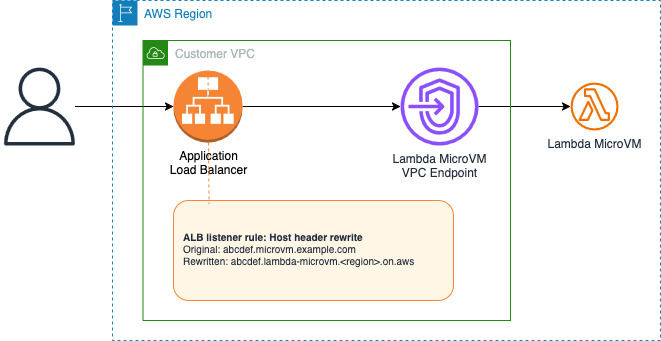
The request flow looks like this:

Request flow from a browser through the Application Load Balancer, which terminates TLS and rewrites the Host header, then forwards over AWS PrivateLink to the Lambda MicroVM service.

The key component is the ALB host header rewrite, introduced in URL and host header rewrite for Application Load Balancers. A listener rule matches the incoming custom host with a regex condition, captures the MicroVM ID from the left-most label, and a host-header-rewrite transform rewrites the Host header to <uuid>.lambda-microvm.<region>.on.aws before forwarding. Because the MicroVM service front-end routes on the Host header, the request lands on the correct MicroVM, while the customer’s domain stays in the browser’s address bar the whole time.

Why not CloudFront? Why not an ALB redirect?

  • CloudFront can also rewrite Host/SNI toward the origin, but a single distribution has static origins. Mapping a wildcard of MicroVM IDs through one distribution would require a CloudFront Function to compute the origin per request. The ALB transform performs the same rewrite for the entire wildcard with zero code.
  • An ALB redirect action only issues an HTTP 301 Moved Permanently/302 Found response. The browser would follow it, and the address bar would then show the .on.aws URL, which breaks our design as it is not a real custom domain. The transform (not a redirect) is what makes the custom domain transparent.

Walkthrough

The example is an AWS CDK application. Configuration lives under the microvm-custom-domains key in cdk.json (hosted zone, wildcard base, the endpoint base to rewrite to, the PrivateLink service name, and the CORS origin). Set those values, then deploy. The sections below explain what the stack creates and why.

Prerequisites

A small VPC (two Availability Zones, which is the minimum for an internet-facing ALB) hosts the ALB and an interface VPC endpoint to the AWS managed MicroVM service. There are no NAT gateways, because nothing here needs egress, which keeps the footprint lean.

// Interface (PrivateLink) endpoint to the AWS managed MicroVM service.
const endpoint = new ec2.InterfaceVpcEndpoint(this, 'MicroVmEndpoint', {
  vpc,
  service: new ec2.InterfaceVpcEndpointService(cfg.microvmVpceServiceName, 443),
  subnets: { subnetType: ec2.SubnetType.PRIVATE_ISOLATED },
});

2. Discover the endpoint’s private IP addresses at deploy time

An ALB IP target group needs the private ENI IP addresses of the interface endpoint (one per Availability Zone). CloudFormation does not expose those IPs as a usable attribute, so the stack resolves them during deployment with an AwsCustomResource that reads the endpoint’s own ENIs by ID (DescribeNetworkInterfaces on vpcEndpointNetworkInterfaceIds).

This is the only compute the package deploys, it runs only during cdk deploy, and it is never in the request path.

3. Request a wildcard TLS certificate

ACM issues a DNS-validated wildcard certificate for *.microvms.example.com, validated through the hosted zone you imported. The ALB presents this certificate for every custom domain under the wildcard.

4. Create the ALB and the MicroVM target group

The internet-facing ALB has an HTTPS:443 listener using the wildcard certificate. The target group holds the endpoint ENI IPs as IP targets, reached over HTTPS:443.

  • Encrypted in transit. A customer-provided AWS Certificate Manager (ACM) certificate is used to securely terminate encryption between the client and the ALB. The ALB re-originates TLS to the MicroVM service so traffic stays encrypted through the network.
  • IP-based targets. The target group uses IP-based targets with the local IP addresses of the VPC endpoints.
  • Health check matcher 200,403,404. The load balancer’s health probes are unauthenticated, so the MicroVM endpoint answers them with 403. A 403 here means “endpoint is reachable,” not “auth is broken,” so the matcher treats it as healthy.
const targetGroup = new elbv2.ApplicationTargetGroup(this, 'MicroVmTargets', {
  vpc,
  protocol: elbv2.ApplicationProtocol.HTTPS,
  port: 443,
  targetType: elbv2.TargetType.IP,
  targets: targetIps.map((ip) => new elbv2t.IpTarget(ip, 443)),
  healthCheck: {
    protocol: elbv2.Protocol.HTTPS,
    path: '/',
    healthyHttpCodes: '200,403,404',
  },
});

const listener = alb.addListener('Https', {
  port: 443,
  protocol: elbv2.ApplicationProtocol.HTTPS,
  certificates: [certificate],
  // Default action for anything that doesn't match our host regex.
  defaultAction: elbv2.ListenerAction.fixedResponse(404, {
    contentType: 'text/plain',
    messageBody: 'Unknown custom domain',
  }),
});

5. Add the host-header rewrite rule

A listener rule matches <uuid>.microvms.example.com with a regex condition and rewrites the Host header to <uuid>.lambda-microvm.<region>.on.aws with a host-header-rewrite transform. The regex captures the left-most label (the MicroVM ID) and reuses it in the replacement.

At the time of writing, the CDK L2 constructs don’t yet model regex host conditions or transforms, so the example reaches the underlying CfnListenerRule to set them:

const escapedBase = customDomainBase.replace(/[.]/g, '\\.');
const matchRegex = `^(.+)\\.${escapedBase}$`;     // capture <uuid>
const replaceWith = `$1.${microvmEndpointBase}`;   // <uuid>.lambda-microvm.<region>.on.aws

const cfnRule = forwardingRule.node.defaultChild as elbv2.CfnListenerRule;

cfnRule.conditions = [{ field: 'host-header', regexValues: [matchRegex] }];

cfnRule.addPropertyOverride('Transforms', [
  {
    Type: 'host-header-rewrite',
    HostHeaderRewriteConfig: { Rewrites: [{ Regex: matchRegex, Replace: replaceWith }] },
  },
]);

6. Point Route 53 at the ALB

Wildcard A and AAAA alias records (*.microvms.example.com) target the ALB, so every MicroVM custom subdomain resolves to it.

7. Deploy

Run the following commands to install the dependencies and then deploy the application.

npm install
npx cdk deploy

Handling CORS at the ALB

If your clients are browsers calling the MicroVM from another origin, CORS is handled entirely at the ALB, with no change to the application inside the MicroVM.

The listener uses ALB header-modification attributes to insert the Access-Control-Allow-* headers on every response. A higher-priority rule answers OPTIONS preflight requests at the edge with a fast 204 response. Otherwise, preflight requests would reach the origin and be rejected without an access token.

// Insert CORS headers on every response on this listener.
const cfnListener = listener.node.defaultChild as elbv2.CfnListener;
cfnListener.addPropertyOverride('ListenerAttributes', [
  { Key: 'routing.http.response.access_control_allow_origin.header_value',  Value: cfg.corsAllowOrigin },
  { Key: 'routing.http.response.access_control_allow_methods.header_value', Value: 'GET,POST,PUT,DELETE,OPTIONS,PATCH,HEAD' },
  { Key: 'routing.http.response.access_control_allow_headers.header_value', Value: 'x-aws-proxy-auth,x-aws-proxy-port,content-type,authorization' },
  { Key: 'routing.http.response.access_control_expose_headers.header_value', Value: 'content-type,content-length' },
  { Key: 'routing.http.response.access_control_max_age.header_value',        Value: '86400' },
]);

// Answer OPTIONS preflights at the ALB.
new elbv2.ApplicationListenerRule(this, 'CorsPreflightRule', {
  listener,
  priority: 10,
  conditions: [elbv2.ListenerCondition.httpRequestMethods(['OPTIONS'])],
  action: elbv2.ListenerAction.fixedResponse(204, { contentType: 'text/plain', messageBody: '' }),
});

Because the ALB adds those headers to both the preflight 204 and the forwarded MicroVM response, a browser’s cross-origin call succeeds without any application change. Set corsAllowOrigin to * for quick testing, and pin it to your own site for anything beyond a demo.

Test it end to end

First, launch a Lambda MicroVM and mint an access token (follow Create your first Lambda MicroVM). When it’s running, the service gives you a generated endpoint that looks like:

012345678-9abc-defg.lambda-microvm.us-east-2.on.aws

To get the custom-domain equivalent, replace the endpoint suffix (.lambda-microvm.<region>.on.aws) with your wildcard base: .microvms.example.com. Everything ahead of that suffix is preserved exactly:

012345678-9abc-defg.microvms.example.com

The ALB’s rewrite rule captures whatever precedes the suffix and re-attaches it to the real endpoint base, so the mapping holds for the entire wildcard. You never register anything per-MicroVM.

With your token in hand, call the custom domain you derived:

curl "https://012345678-9abc-defg.microvms.example.com/<path>" \
  -H "X-aws-proxy-auth: <token>" \
  -H "X-aws-proxy-port: 8080"

The request travels to the ALB, which terminates TLS, rewrites the host header, and forwards over PrivateLink to the MicroVM. The response comes back under your domain.

The reference architecture also includes a single-page demo and a POST /api/provision endpoint that runs or reuses a MicroVM and mints a short-lived token. With it, you can try the flow without wiring up token creation yourself. It even performs this suffix swap for you and hands back a ready-to-click custom-domain URL. See the repository for that piece.

Important considerations

  • Authentication is still the client’s job. This pattern only rewrites Host. The client must still supply a valid, unexpired access token in X-aws-proxy-auth. This is deliberate. MicroVM tokens are per-MicroVM and short-lived, so baking them into infrastructure would be fragile and insecure.
  • Region pinning. PrivateLink is regional, so the ALB, the endpoint, and the MicroVM service must all be in the same Region.
  • Production hardening. If you adapt the sample’s provisioning endpoint, put authentication and rate limiting in front of it, pin CORS to your origin, and scope IAM to the minimum. The sample’s provisioning path is intentionally open for demonstration and is not production-safe as written.
  • Cost. You pay for the ALB and the interface endpoint (hourly plus data processing) in addition to the Lambda MicroVM usage. There is no CloudFront distribution and no per-request compute in the data path.

Clean up

Run the following command in the same directory where you deployed the application from.

npx cdk destroy

This removes the ALB, target groups, endpoint, certificate, VPC, and Route 53 records created by the stack.

Conclusion

You can front AWS Lambda MicroVMs with customer-owned wildcard custom domains using an Application Load Balancer and AWS PrivateLink. The key is the ALB’s host-header rewrite. Because the MicroVM service routes requests based on the Host header, a single rewrite rule can transparently map an entire wildcard of custom domains onto your MicroVMs. CORS is handled at the edge as well. The whole setup relies only on networking primitives, with no CloudFront distribution and no compute in the request path.

To try it yourself, deploy the reference architecture and review the ALB URL and host header rewrite launch post for more on the transform feature.

[$] Compiling the kernel with gccrs

Post Syndicated from daroc original https://lwn.net/Articles/1095553/

Pierre-Emmanuel Patry and Arthur Cohen gave a talk at

RustConf 2026
on the
status of the Rust frontend for GCC (gccrs), with a particular eye toward the
goal of

compiling the Linux kernel
. Patry gave a follow-up talk for a more
kernel-focused audience at

Kangrejos
the next week, which Cohen could not attend. The

gccrs project
is
making good progress overall, but it will still be some time until the compiler
is usable.

The collective thoughts of the interwebz