Tag Archives: Compliance

Everything you need to know about NIST’s new guidance in “SP 1800-35: Implementing a Zero Trust Architecture”

Post Syndicated from Aaron McAllister original https://blog.cloudflare.com/nist-sp-1300-85/

For decades, the United States National Institute of Standards and Technology (NIST) has been guiding industry efforts through the many publications in its Computer Security Resource Center. NIST has played an especially important role in the adoption of Zero Trust architecture, through its series of publications that began with NIST SP 800-207: Zero Trust Architecture, released in 2020.

NIST has released another Special Publication in this series, SP 1800-35, titled “Implementing a Zero Trust Architecture (ZTA)” which aims to provide practical steps and best practices for deploying ZTA across various environments.  NIST’s publications about ZTA have been extremely influential across the industry, but are often lengthy and highly detailed, so this blog provides a short and easier-to-read summary of NIST’s latest guidance on ZTA.

And so, in this blog post:

  • We summarize the key items you need to know about this new NIST publication, which presents a reference architecture for Zero Trust Architecture (ZTA) along with a series of “Builds” that demonstrate how different products from various vendors can be combined to construct a ZTA that complies with the reference architecture.

  • We show how Cloudflare’s Zero Trust product suite can be integrated with offerings from other vendors to support a Zero Trust Architecture that maps to the NIST’s reference architecture.

  • We highlight a few key features of Cloudflare’s Zero Trust platform that are especially valuable to customers seeking compliance with NIST’s ZTA reference architecture, including compliance with FedRAMP and new post-quantum cryptography standards.

Let’s dive into NIST’s special publication!

Overview of SP 1800-35

In SP 1800-35, NIST reminds us that:

A zero-trust architecture (ZTA) enables secure authorized access to assets — machines, applications and services running on them, and associated data and resources — whether located on-premises or in the cloud, for a hybrid workforce and partners based on an organization’s defined access policy.

NIST uses the term Subject to refer to entities (i.e. employees, developers, devices) that require access to Resources (i.e. computers, databases, servers, applications).  SP 1800-35 focuses on developing and demonstrating various ZTA implementations that allow Subjects to access Resources. Specifically, the reference architecture in SP 1800-35 focuses mainly on EIG or “Enhanced Identity Governance”, a specific approach to Zero Trust Architecture, which is defined by NIST in SP 800-207 as follows:

For [the EIG] approach, enterprise resource access policies are based on identity and assigned attributes. 

The primary requirement for [R]esource access is based on the access privileges granted to the given [S]ubject. Other factors such as device used, asset status, and environmental factors may alter the final confidence level calculation … or tailor the result in some way, such as granting only partial access to a given [Resource] based on network location.

Individual [R]esources or [policy enforcement points (PEP)] must have a way to forward requests to a policy engine service or authenticate the [S]ubject and approve the request before granting access.

While there are other approaches to ZTA mentioned in the original NIST SP 800-207, we omit those here because SP 1800-35 focuses mostly on EIG.

The ZTA reference architecture from SP 1800-35 focuses on EIG approaches as a set of logical components as shown in the figure below.  Each component in the reference architecture does not necessarily correspond directly to physical (hardware or software) components, or products sold by a single vendor, but rather to the logical functionality of the component.
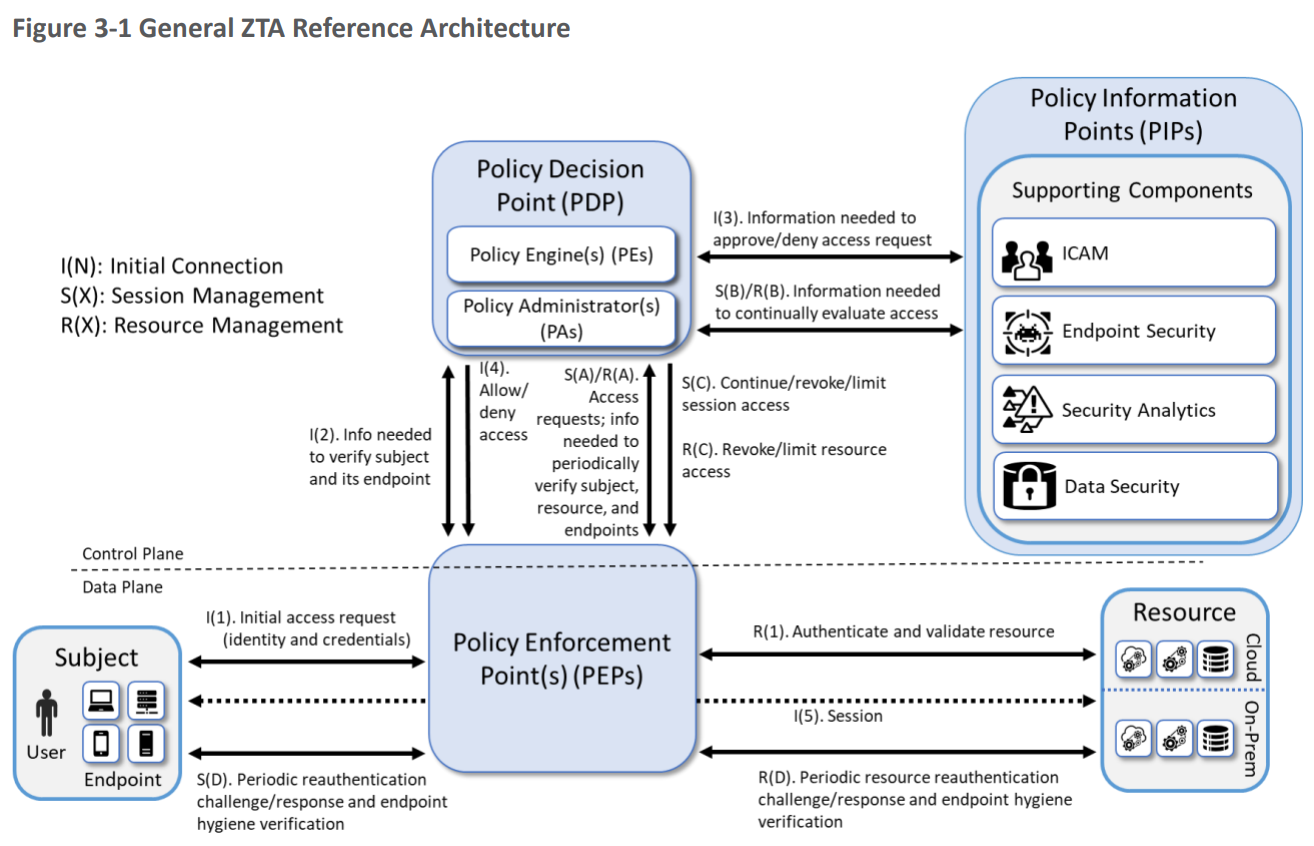

Figure 1: General ZTA Reference Architecture. Source: NIST, Special Publication 1800-35, “Implementing a Zero Trust Architecture (ZTA)”, 2025.

The logical components in the reference architecture are all related to the implementation of policy. Policy is crucial for ZTA because the whole point of a ZTA is to apply policies that determine who has access to what, when and under what conditions.

The core components of the reference architecture are as follows:

| Policy Enforcement Point(PEP) | The PEP protects the “trust zones” that host enterprise Resources, and handles enabling, monitoring, and eventually terminating connections between Subjects and Resources. You can think of the PEP as the dataplane that supports the Subject’s access to the Resources.

Policy Enforcement Point
(PEP)

The PEP protects the “trust zones” that host enterprise Resources, and handles enabling, monitoring, and eventually terminating connections between Subjects and Resources.  You can think of the PEP as the dataplane that supports the Subject’s access to the Resources.

Policy Engine

(PE)

The PE handles the ultimate decision to grant, deny, or revoke access to a Resource for a given Subject, and calculates the trust scores/confidence levels and ultimate access decisions based on enterprise policy and information from supporting components. 

Policy Administrator

(PA)

The PA executes the PE’s policy decision by sending commands to the PEP to establish and terminate the communications path between the Subject and the Resource.

Policy Decision Point (PDP)

The PDP is where the decision as to whether or not to permit a Subject to access a Resource is made.  The PIP included the Policy Engine (PE) and the Policy Administrator (PA).  You can think of the PDP as the control plane that controls the Subject’s access to the Resources.

The PDP operates on inputs from Policy Information Points (PIPs) which are supporting components that provide critical data and policy rules to the Policy Decision Point (PDP).

Policy Information Point

(PIP)

The PIPs provide various types of telemetry and other information needed for the PDP to make informed access decisions.  Some PIPs include:

  • ICAM, or Identity, Credential, and Access Management, covering user authentication, single sign-on, user groups and access control features that are typically offered by Identity Providers (IdPs) like Okta, AzureAD or Ping Identity.  
  • Endpoint security includes endpoint detection and response (EDR) or endpoint protection platforms (EPP) that protect end user devices like laptops and mobile devices.  An EPP primarily focuses on preventing known threats using features like antivirus protection. Meanwhile, an EDR actively detects and responds to threats that may have already breached initial defenses using forensics, behavioral analysis and incident response tools. EDR and EPP products are offered by vendors like CrowdStrike, Microsoft, SentinelOne, and more. 
  • Security Analytics and Data Security products use data collection, aggregation, and analysis to discover security threats using network traffic, user behavior, and other system data, such as, CrowdStrike, Datadog, IBM QRadar, Microsoft Sentinel, New Relic, Splunk, and more.


NIST’s figure might suggest that supporting components in the PIP are mere plug-ins responding in real-time to the PDP.  However, for many vendors, the ICAM, EDR/EPP, security analytics, and data security PIPs often represent complex and distributed infrastructures.

Crawl or run, but don’t walk

Next, the SP 1800-35 introduces two more detailed reference architectures, the “Crawl Phase” and the “Run Phase”.  The “Run Phase” corresponds to the reference architecture that is shown in the figure above.  The “Crawl Phase” is a simplified version of this reference architecture that only deals with protecting on-premise Resources, and omits cloud Resources. Both of these phases focused on Enhanced Identity Governance approaches to ZTA, as we defined above. NIST stated, “We are skipping the EIG walk phase and have proceeded directly to the run phase“.

The SP 1800-35 then provides a sequence of detailed instructions, called “Builds”, that show how to implement “Crawl Phase” and “Run Phase” reference architectures using products sold by various vendors.

Since Cloudflare’s Zero Trust platform natively supports access to both cloud and on-premise resources, we will skip over the “Crawl Phase” and move directly to showing how Cloudflare’s Zero Trust platform can be used to support “Run Phase” of the reference architecture.

A complete Zero Trust Architecture using Cloudflare and integrations

Nothing in NIST SP 1800-35 represents an endorsement of specific vendor technologies. Instead, the intent of the publication is to offer a general architecture that applies regardless of the technologies or vendors an organization chooses to deploy.   It also includes a series of “Builds” using a variety of technologies from different vendors, that allow organizations to achieve a ZTA.   This section describes how Cloudflare fits in with a ZTA, enabling you to accelerate your ZTA deployment from Crawl directly to Run.

Regarding the “Builds” in SP 1800-35, this section can be viewed as an aggregation of the following three specific builds:

  • Enterprise 1 Build 3 (E1B3): Software-Defined Perimeter (SDP) with Cloudflare as the Policy Engine (PE).

  • Enterprise 2 Build 4 (E2B4): SDP and Secure Access Service Edge (SASE) with Cloudflare Secure Web Gateway, Cloudflare Zero Trust Network Access (ZTNA), and Cloudflare Cloud Access Security Broker as PEs.

  • Enterprise 3 Build 5 (E3B5): SDP and SASE with Microsoft Entra Conditional Access (formerly known as Azure AD Conditional Access) and Cloudflare Zero Trust as PEs.

Now let’s see how we can map Cloudflare’s Zero Trust platform to the ZTA reference architecture:
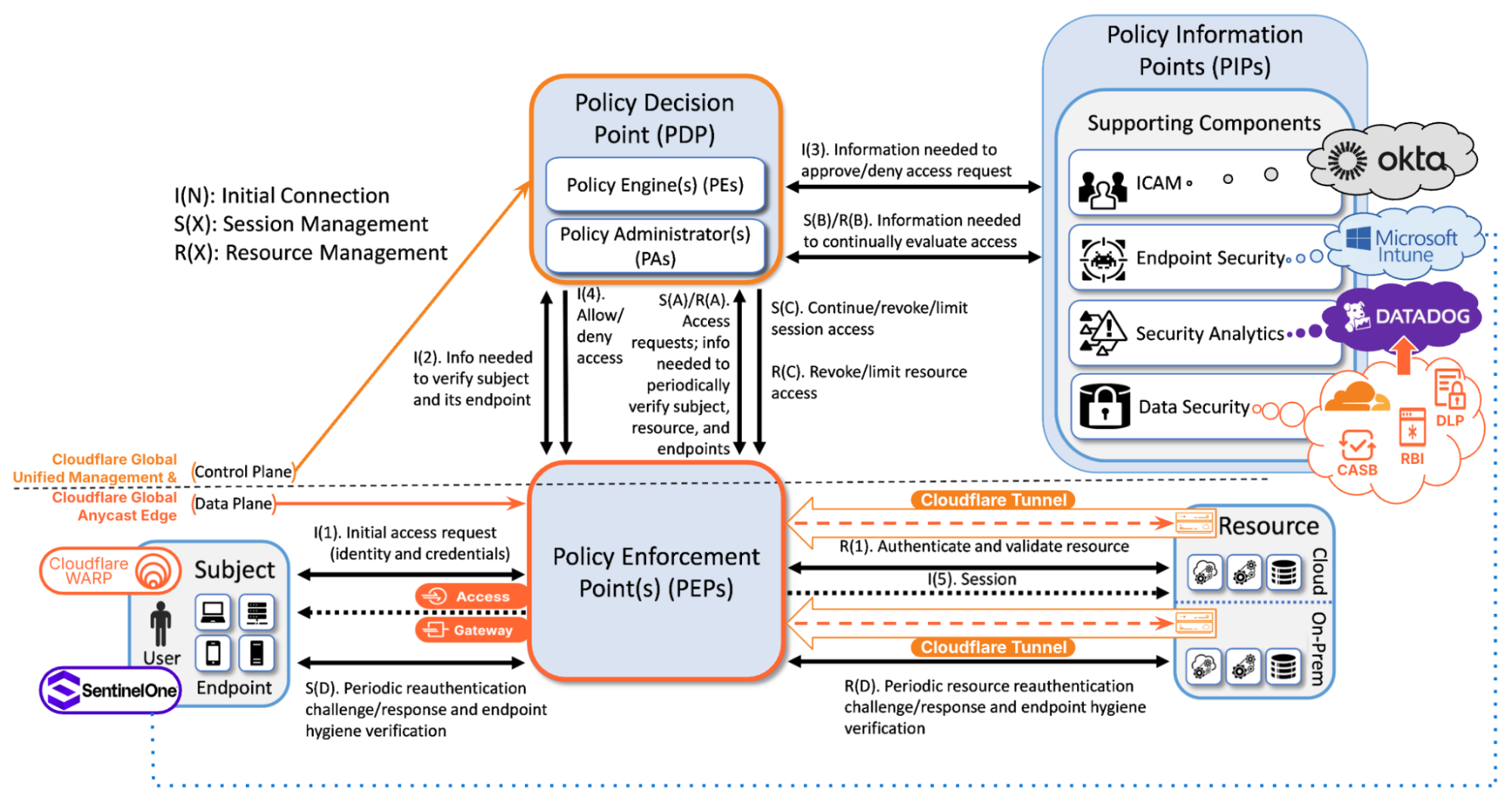

Figure 2: General ZTA Reference Architecture Mapped to Cloudflare Zero Trust & Key Integrations. Source: NIST, Special Publication 1800-35, “Implementing a Zero Trust Architecture (ZTA)”, 2025, with modification by Cloudflare.

Cloudflare’s platform simplifies complexity by delivering the PEP via our global anycast network and the PDP via our Software-as-a-Service (SaaS) management console, which also serves as a global unified control plane. A complete ZTA involves integrating Cloudflare with PIPs provided by other vendors, as shown in the figure above.

Now let’s look at several key points in the figure.

In the bottom right corner of the figure are Resources, which may reside on-premise, in private data centers, or across multiple cloud environments.  Resources are made securely accessible through Cloudflare’s global anycast network via Cloudflare Tunnel (as shown in the figure) or Magic WAN (not shown). Resources are shielded from direct exposure to the public Internet by placing them behind Cloudflare Access and Cloudflare Gateway, which are PEPs that enforce zero-trust principles by granting access to Subjects that conform to policy requirements.

In the bottom left corner of the figure are Subjects, both human and non-human, that need access to Resources.  With Cloudflare’s platform, there are multiple ways that Subjects can again access to Resources, including:

  • Agentless approaches that allow end users to access Resources directly from their web browsers. Alternatively, Cloudflare’s Magic WAN can be used to support connections from enterprise networks directly to Cloudflare’s global anycast network via IPsec tunnels, GRE tunnels or Cloudflare Network Interconnect (CNI).

  • Agent-based approaches use Cloudflare’s lightweight WARP client, which protects corporate devices by securely and privately sending traffic to Cloudflare’s global network.

Now we move onto the PEP (the Policy Enforcement Point), which is the dataplane of our ZTA.   Cloudflare Access is a modern Zero Trust Network Access solution that serves as a dynamic PEP, enforcing user-specific application access policies based on identity, device posture, context, and other factors.  Cloudflare Gateway is a Secure Web Gateway for filtering and inspecting traffic sent to the public Internet, serving as a dynamic PEP that provides DNS, HTTP and network traffic filtering, DNS resolver policies, and egress IP policies.

Both Cloudflare Access and Cloudflare Gateway rely on Cloudflare’s control plane, which acts as a PDP offering a policy engine (PE) and policy administrator (PA).  This PDP takes in inputs from PIPs provided by integrations with other vendors for ICAM, endpoint security, and security analytics.  Let’s dig into some of these integrations.

  • ICAM: Cloudflare’s control plane integrates with many ICAM providers that provide Single Sign On (SSO) and Multi-Factor Authentication (MFA). The ICAM provider authenticates human Subjects and passes information about authenticated users and groups back to Cloudflare’s control plane using Security Assertion Markup Language (SAML) or OpenID Connect (OIDC) integrations.  Cloudflare’s ICAM integration also supports AI/ML powered behavior-based user risk scoring, exchange, and re-evaluation.

    In the figure above, we depicted Okta as the ICAM provider, but Cloudflare supports many other ICAM vendors (e.g. Microsoft Entra, Jumpcloud, GitHub SSO, PingOne).   For non-human Subjects — such as service accounts, Internet of Things (IoT) devices, or machine identities — authentication can be performed through certificates, service tokens, or other cryptographic methods.

  • Endpoint security: Cloudflare’s control plane integrates with many endpoint security providers to exchange signals, such as device posture checks and user risk levels. Cloudflare facilitates this through integrations with endpoint detection and response EDR/EPP solutions, such as CrowdStrike, Microsoft, SentinelOne, and more. When posture checks are enabled with one of these vendors such as Microsoft, device state changes, ‘noncompliant’, can be sent to Cloudflare Zero Trust, automatically restricting access to Resources. Additionally, Cloudflare Zero Trust enables the ability to synchronize the Microsoft Entra ID risky users list and apply more stringent Zero Trust policies to users at higher risk. 

  • Security Analytics: Cloudflare’s control plane integrates with real-time logging and analytics for persistent monitoring.  Cloudflare’s own analytics and logging features monitor access requests and security events. Optionally, these events can be sent to a Security Information and Event Management (SIEM)  solution such as, CrowdStrike, Datadog, IBM QRadar, Microsoft Sentinel, New Relic, Splunk, and more using Cloudflare’s logpush integration.

    Cloudflare’s user risk scoring system is built on the OpenID Shared Signals Framework (SSF) Specification, which allows integration with existing and future providers that support this standard. SSF focuses on the exchange of Security Event Tokens (SETs), a specialized type of JSON Web Token (JWT). By using SETs, providers can share user risk information, creating a network of real-time, shared security intelligence. In the context of NIST’s Zero Trust Architecture, this system functions as a PIP, which is responsible for gathering information about the Subject and their context, such as risk scores, device posture, or threat intelligence. This information is then provided to the PDP, which evaluates access requests and determines the appropriate policy actions. The PEP uses these decisions to allow or deny access, completing the cycle of secure, dynamic access control.

  • Data security: Cloudflare’s Zero Trust offering provides robust data security capabilities across data-in-transit, data-in-use, and data-at-rest. Its Data Loss Prevention (DLP) safeguards sensitive information in transit by inspecting and blocking unauthorized data movement. Remote Browser Isolation (RBI) protects data-in-use by preventing malware, phishing, and unauthorized exfiltration while enabling secure web access. Meanwhile, Cloud Access Security Broker (CASB) ensures data-at-rest security by enforcing granular controls over SaaS applications, preventing unauthorized access and data leakage. Together, these capabilities provide comprehensive protection for modern enterprises operating in a cloud-first environment.

By leveraging Cloudflare’s Zero Trust platform, enterprises can simplify and enhance their ZTA implementation, securing diverse environments and endpoints while ensuring scalability and ease of deployment. This approach ensures that all access requests—regardless of where the Subjects or Resources are located—adhere to robust security policies, reducing risks and improving compliance with modern security standards.

Support for agencies and enterprises running towards Zero Trust Architecture

Cloudflare works with multiple enterprises, and federal and state agencies that rely on NIST guidelines to secure their networks.  So we take a brief detour to describe some unique features of Cloudflare’s Zero Trust platform that we’ve found to be valuable to these enterprises.

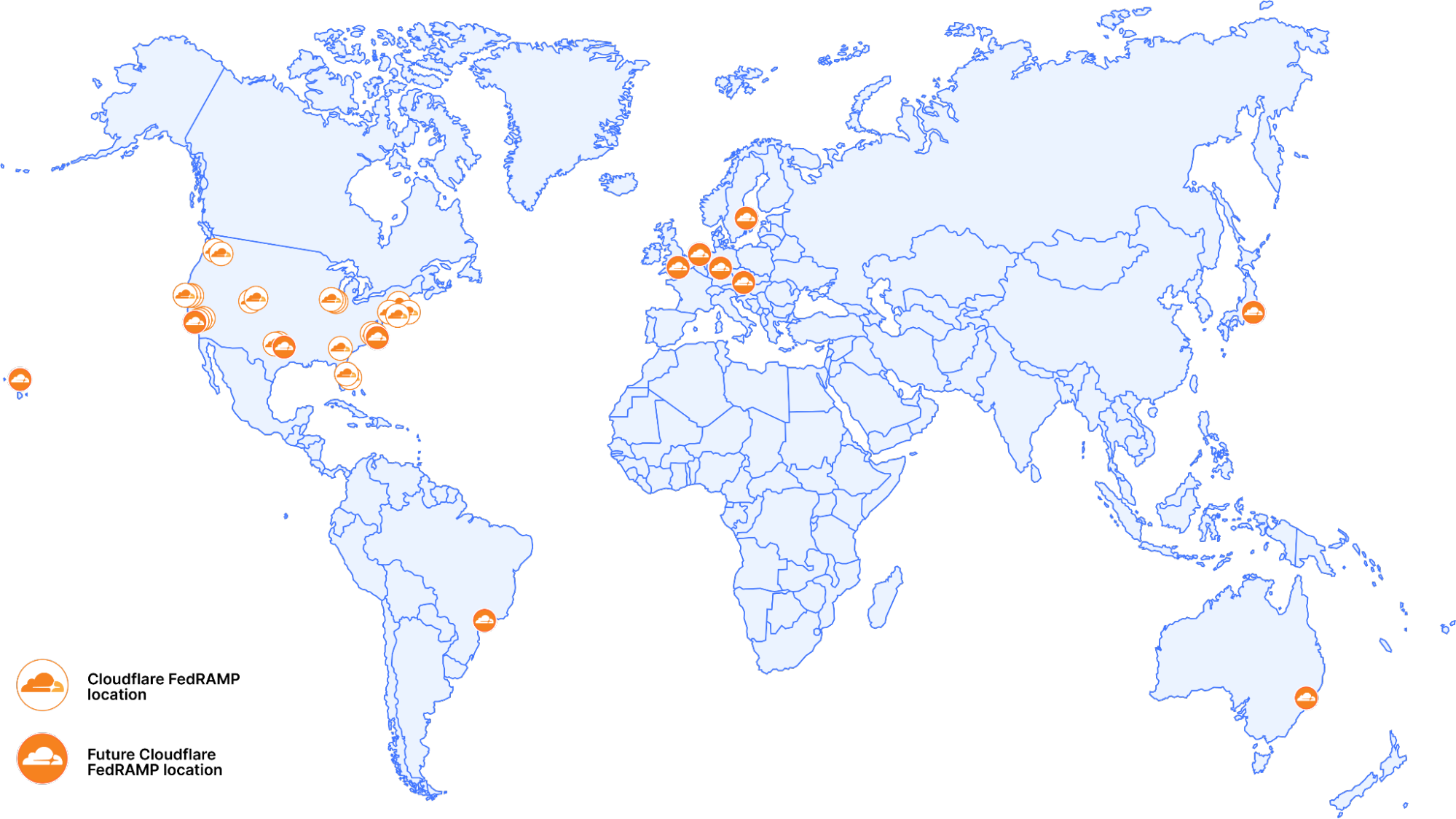
  • FedRAMP data centers.  Many government agencies and commercial enterprises have FedRAMP requirements, and Cloudflare is well-equipped to support them. FedRAMPs requirements sometimes require organizations to self-host software and services inside their own network perimeter, which can result in higher latency, degraded performance and increased cost.  At Cloudflare, we take a different approach. Organizations can still benefit from Cloudflare’s global network and unparalleled performance while remaining Fedramp compliant.  To support FedRAMP customers, Cloudflare’s dataplane (aka our PEP, or Policy Enforcement Point) consists of data centers in over 330 cities where customers can send their encrypted traffic, and 32 FedRAMP datacenters where traffic is sent to when sensitive dataplane operations are required (e.g. TLS inspection).  This architecture means that our customers do not need to self-host a PEP and incur the associated cost, latency, and performance degradation.

  • Post-quantum cryptography. NIST has announced that by 2030 all conventional cryptography (RSA and ECDSA) must be deprecated and upgraded to post-quantum cryptography.  But upgrading cryptography is hard and takes time, so Cloudflare aims to take on the burden of managing cryptography upgrades for our customers. That’s why organizations can tunnel their corporate network traffic though Cloudflare’s Zero Trust platform, protecting it against quantum adversaries without the hassle of individually upgrading each and every corporate application, system, or network connection. End-to-end quantum safety is available for communications from end-user devices, via web browser (today) or Cloudflare’s WARP device client (mid-2025), to secure applications connected with Cloudflare Tunnel.

Run towards Zero Trust Architecture with Cloudflare 

NIST’s latest publication, SP 1800-35, provides a structured approach to implementing Zero Trust, emphasizing the importance of policy enforcement, continuous authentication, and secure access management. Cloudflare’s Zero Trust platform simplifies this complex framework by delivering a scalable, globally distributed solution that is FedRAMP-compliant and integrates with industry-leading providers like Okta, Microsoft, Ping, CrowdStrike, and SentinelOne to ensure comprehensive protection.

A key differentiator of Cloudflare’s Zero Trust solution is our global anycast network, one of the world’s largest and most interconnected networks. Spanning 330+ cities across 120+ countries, this network provides unparalleled performance, resilience, and scalability for enforcing Zero Trust policies without negatively impacting the end user experience. By leveraging Cloudflare’s network-level enforcement of security controls, organizations can ensure that access control, data protection, and security analytics operate at the speed of the Internet — without backhauling traffic through centralized choke points. This architecture enables low-latency, highly available enforcement of security policies, allowing enterprises to seamlessly protect users, devices, and applications across on-prem, cloud, and hybrid environments.

Now is the time to take action. You can start implementing Zero Trust today by leveraging Cloudflare’s platform in alignment with NIST’s reference architecture. Whether you are beginning your Zero Trust journey or enhancing an existing framework, Cloudflare provides the tools, network, and integrations to help you succeed. Sign up for Cloudflare Zero Trust, explore our integrations, and secure your organization with a modern, globally distributed approach to cybersecurity.

AWS completes Police-Assured Secure Facilities (PASF) audit in Europe (London) AWS Region

Post Syndicated from Vishal Pabari original https://aws.amazon.com/blogs/security/aws-completes-police-assured-secure-facilities-pasf-audit-in-europe-london-aws-region/

We’re excited to announce that our Europe (London) AWS Region has renewed its accreditation for United Kingdom (UK) Police-Assured Secure Facilities (PASF) for Official-Sensitive data. Since 2017, the Amazon Web Services (AWS) Europe (London) Region has been accredited under the PASF program. This demonstrates our continuous commitment to adhere to the heightened expectations of customers with UK law enforcement workloads. Our UK law enforcement customers who require PASF can continue to run their applications in the PASF-accredited Europe (London) Region in confidence.

The PASF is a long-established assurance process, used by UK law enforcement, as a method for assuring the security of facilities such as data centers or other locations that house critical business applications that process or hold police data. PASF consists of a control set of security requirements, an on-site inspection, and an audit interview with representatives of the facility.

The Police Digital Service (PDS) confirmed the accreditation renewal for AWS on May 27, 2025. A confirmation letter can be found on AWS Artifact. The UK police force and law enforcement organizations can also obtain confirmation of the compliance status of AWS through the Police Digital Service.

To learn more about our compliance and security programs, see AWS Compliance Programs. As always, we value your feedback and questions; reach out to the AWS Compliance team through the Contact Us page.

Reach out to your AWS account team if you have questions or feedback about PASF compliance.

If you have feedback about this post, submit comments in the Comments section below.

Vishal Pabari

Vishal Pabari

Vishal is a Security Assurance Program Manager at AWS, based in London, UK. Vishal is responsible for third-party and customer audits, attestations, certifications, and assessments across EMEA. Vishal previously worked in risk and control, and technology in the financial services industry.

Tea Jioshvili

Tea Jioshvili

Tea is a Manager in AWS Security Assurance based in Berlin, Germany. She leads various third-party audit programs across Europe. She previously worked in security assurance and compliance, business continuity, and operational risk management in the financial industry for multiple years.

2025 ISO and CSA STAR certificates now available with three new Regions

Post Syndicated from Chinmaee Parulekar original https://aws.amazon.com/blogs/security/2025-iso-and-csa-star-certificates-now-available-with-three-new-regions/

Amazon Web Services (AWS) successfully completed an onboarding audit with no findings for ISO 9001:2015, 27001:2022, 27017:2015, 27018:2019, 27701:2019, 20000-1:2018, and 22301:2019, and Cloud Security Alliance (CSA) STAR Cloud Controls Matrix (CCM) v4.0. EY CertifyPoint auditors conducted the audit and reissued the certificates on May 26, 2025. The objective of the audit was to assess the level of compliance with the requirements of the applicable international standards.

During this onboarding audit, we onboarded three new AWS Regions [Asia Pacific (Thailand), Asia Pacific (Malaysia), Mexico (Central)] to the scope since the last certification issued on February 19, 2025.

For a full list of AWS services that are certified under ISO and CSA Star, see the AWS ISO and CSA STAR Certified page. Customers can also access the certifications in the AWS Management Console through AWS Artifact.

If you have feedback about this post, submit comments in the Comments section below.

Chinmaee Parulekar

Chinmaee Parulekar

Chinmaee is a Compliance Program Manager at AWS. She has 5 years of experience in information security. Chinmaee holds a Master of Science degree in Management Information Systems and professional certifications such as CISA.

Introducing new regional implementations of Landing Zone Accelerator on AWS to support digital sovereignty

Post Syndicated from Max Peterson original https://aws.amazon.com/blogs/security/introducing-new-regional-implementations-of-landing-zone-accelerator-on-aws-to-support-digital-sovereignty/

Customers often tell me that they want a simpler path to meet the compliance and industry regulatory mandates they have in their geographic regions. In our deep engagements with partners and customers, we have learned that one of the greatest challenges for customers is the translation of security and compliance requirements into distinct technical controls. At Amazon Web Services (AWS), security is our top priority, and we understand that protecting your data in a world with changing regulations, technology, and risks takes teamwork. As we’ve said, security is foundational to sovereignty.

AWS helps organizations to develop and evolve security, identity, and compliance into key business enablers; that’s why we’re committed to working with national cyber authorities and regulators to help define and establish how their compliance standards can be translated into security best practices in the cloud. We’re responding to customer requests to create locally tailored approaches aligned to their own regional standards and guidance as established by in-region authorities.

Architectural best practice, locally tailored

Since its launch in 2022, Landing Zone Accelerator on AWS has been instrumental in helping thousands of customers deploy cloud foundations that align with multiple global compliance frameworks and AWS best practices, including the Baseline Informatiebeveiliging Overheid (BIO) in the Netherlands, and the Esquema Nacional de Seguridad (ENS) in Spain. AWS is committed to expanding our regional implementations to help customers meet specific national and regional standards and digital sovereignty goals.

In March, I was proud to share the news of the cooperation agreement between the Federal Office for Information Security (BSI) and AWS, where AWS committed to help advance digital sovereignty and cybersecurity best practices and standards in Germany and across the European Union. With that in mind, I’m excited to share that our next regional implementation of Landing Zone Accelerator on AWS will support customers with workloads in Germany. The C5-ready Landing Zone Accelerator is designed to help customers meet their Cloud Computing Compliance Criteria Catalogue (C5) compliance objectives in the cloud. This will be available to our customers in Q3-2025, and at launch, our regional implementations will also be available in AWS European Sovereign Cloud.

The C5 attestation scheme is backed by the German government and was introduced by the BSI in 2016. AWS has adhered to the C5 requirements since their inception. C5 helps organizations demonstrate operational security against common cybersecurity threats when using cloud services through the German government’s Security Recommendations for Cloud Computing Providers.

For many customers in Germany, adherence to C5 is a requirement, and this is evidenced through a compliance assessment by an authorized assessor. Preparing for this assessment is critical for a successful outcome and is why AWS has partnered with AWS Global Security & Compliance (GSCA) Partner Schellman to provide the assessor insight as to how the C5-ready Landing Zone Accelerator can accelerate and simplify the path to C5 adoption for AWS customers.

AWS Partner Schellman: Proven Track Record in C5 Assessments

As one of the few firms with deep expertise and experience in C5 assessments, Schellman has completed several dozen evaluations across a wide range of clients—from agile startups to global enterprises. This diverse portfolio underscores Schellman’s capabilities, deep technical expertise, and unwavering commitment to security assurance.

“Our team has seen firsthand how the C5 standard fosters transparency and builds trust in cloud services. We’re proud to support our clients not just in understanding C5, but in strategically leveraging it to improve security and competitiveness on a global scale.”
Jeff Schiess, Managing Director, Schellman

Lowering the Barrier to Entry – Schellman recognizes that achieving C5 compliance can sometimes be intimidating, particularly for organizations new to the framework. To that end, Schellman has performed an assessment against the foundational infrastructure provided by LZA on AWS, designed to simplify the C5 journey. The LZA provides preconfigured infrastructure templates and security baselines that significantly reduce the complexity of establishing C5-compliant cloud environments.

“With the Landing Zone Accelerator, organizations can build on a C5-ready foundation right from the start. It’s a practical, scalable solution for companies that might otherwise find the C5 standard overwhelming.”
Kristen Wilbur, Principal, Schellman

Sovereign by design

Landing Zone Accelerator on AWS automatically implements hundreds of security capabilities that map to control requirements across geographic compliance frameworks. This saves customers hundreds of hours in planning and implementing secure networking and account configurations by providing them with a foundation based on the AWS Well-Architected Security Pillar and AWS security best practices. Meeting compliance requirements, having verifiable access controls and data transfer restrictions, independence and choice over the technology stack, and surviving large-scale disruptions are some of the key capabilities that customers require of a sovereign-by-design workload. However, for many customers, translating regulatory requirements into a set of discrete technical controls and applying them consistently across one or more AWS accounts and AWS Regions can be time-intensive and challenging.

We provide customers and partners with detailed guidance on how to configure Landing Zone Accelerator on AWS in accordance with their local security and compliance requirements, including digital sovereignty requirements. This includes control mapping to local regulations or policies that shows customers how controls implemented in a landing zone are mapped to the specific requirements, calling out where customers are required to do more to meet these as part of our shared responsibility model—this includes organizational policies and procedures where customers must implement additional controls within their application or workload to meet local requirements.

Control over the location of your data

Landing Zone Accelerator on AWS provides customers with a choice of configurable preventative, detective, and proactive controls to help customers meet their data residency, security, and compliance objectives, whether you’re a public sector customer wanting to keep data in a single Region or navigating the complex needs of multi-national organizations with operations subject to differing digital sovereignty requirements.

Verifiable control over data access

Landing Zone Accelerator on AWS goes beyond just provisioning a secure, multi-account environment. It establishes a well-structured, multi-account architecture using AWS Organizations. This logically isolates workloads, management functions, and security controls into dedicated organizational units (OUs). This not only enhances security and operational efficiency, but also helps customers to enforce consistent data residency, access management, and compliance policies across their entire cloud footprint. These powerful guardrails empower customers to quickly harness the innovative potential of cloud technologies, whilst delivering business value from an established security and compliance baseline.

By providing this automated approach, AWS empowers organizations to rapidly deploy cloud environments tailored to their specific local requirements in days instead of weeks; with robust security, compliance, and operational guardrails in place from the outset. Landing Zone Accelerator on AWS is designed to simplify the path to cloud adoption and compliance for organizations, particularly those in regulated industries or with sovereignty requirements. This approach marks a shift from the previous heavy lift required for organizations to migrate workloads to the cloud while meeting their needs.

Partners at the core

There is a lot of complexity involved with navigating the evolving digital sovereignty landscape—but you don’t have to do it alone. Our AWS Digital Sovereignty Competency connects customers with trusted partners with demonstrated expertise to advise and architect for their customers’ digital sovereignty needs while taking advantage of the full potential of the AWS Cloud. As part of the competency, AWS is supporting partners to navigate customer challenges across four pillars: data residency, data protection, access control, and survivability.

Customers have told me about how challenging it can be to architect to address their sovereignty needs, often requiring manual iteration and longer time to value. Using Landing Zone Accelerator on AWS is one of the ways AWS and AWS Partners can work together to address customers’ sovereignty needs with a repeatable approach that helps our customers and partners move faster. I’m excited by how regional implementations of Landing Zone Accelerator on AWS is helping AWS Sovereignty Partners, such as Atos and SVA, to move faster without compromise.

“Compliance with regulations like C5 is essential for customers in the public sector and regulated industries, who prioritize digital sovereignty, and this is central to our Cloud for Clinics initiative with AWS in the German Healthcare market. The availability of the C5 LZA significantly reduces the technical complexity, giving us a common technical platform to build on reducing time to market. Atos is driving the operational rollout and expanding the scope of compliance mappings to further streamline customer compliance. At the same time, we are incorporating essential managed services like SOC/SIEM which we believe will make compliant cloud adoption easier to drive innovation by the Public Sector, Healthcare institutions or customers in regulated industries like Financial Services and Utilities.”
Boris Hecker, Managing Director, ATOS Germany

“Compliance with BSI C5 criteria for customers from the public sector and regulated industries is a basic requirement for the use of public cloud services. Implementing the regulations is often complex, time-consuming and resource-intensive. For this reason, customers are looking for solutions that they can tailor to the specific requirements of their industry; while ensuring they meet compliance standards. SVA supports customers in maintaining the balance between innovation and compliance with customized, C5-certified, managed services. We rely on solutions such as the Landing Zone Accelerator on AWS to reconcile the use of market-leading public cloud infrastructure with regulatory requirements.”
Patrick Glawe, Hyperscaler Lead at SVA

For more information, see Landing Zone Accelerator on AWS and AWS Digital Sovereignty Competency Partners

Max Peterson

Max Peterson

Max is the Vice President of AWS Sovereign Cloud. He leads efforts to ensure that all AWS customers around the world have the most advanced set of sovereignty controls, privacy safeguards, and security features available in the cloud. Before his current role, Max served as the VP of AWS Worldwide Public Sector (WWPS) and created and led the WWPS International Sales division, with a focus on empowering government, education, healthcare, aerospace and satellite, and nonprofit organizations to drive rapid innovation while meeting evolving compliance, security, and policy requirements. Max has over 30 years of public sector experience and served in other technology leadership roles before joining Amazon. Max has earned both a Bachelor of Arts in Finance and Master of Business Administration in Management Information Systems from the University of Maryland.

AWS expands Spain’s ENS High certification across 174 services

Post Syndicated from Daniel Fuertes original https://aws.amazon.com/blogs/security/aws-expands-spains-ens-high-certification-across-174-services/

Amazon Web Services (AWS) has successfully renewed its Esquema Nacional de Seguridad (ENS) High certification under the latest framework established by Royal Decree 311/2022. This achievement demonstrates the continued dedication of AWS to meeting the stringent security requirements essential for serving Spanish government entities and public organizations.

The ENS framework serves as the cornerstone of cybersecurity standards for Spain’s public sector. It establishes comprehensive security requirements for government agencies, public organizations, and service providers supporting Spanish public services. The framework implements a tiered security approach, with three distinct levels (Basic, Medium, and High), each level requiring progressively stringent security measures and controls.

By maintaining and expanding our ENS certification at its High level, AWS reaffirms its commitment to providing secure cloud services that meet compliance standards and the evolving needs of Spain’s public sector and its technology partners.

For organizations working with Spanish public administration, this expanded certification offers significant advantages. Customers can operate with reliable compliance with Spain’s highest security standards while accessing a broader range of certified cloud services. This certification provides enhanced confidence in their cloud security posture and enables streamlined procurement processes for public sector projects.

With this renewal, AWS has broadened its ENS-certified portfolio. The certification now encompasses 8 additional services, bringing the total to 174 AWS ENS-certified services. This extensive coverage spans across 31 AWS Regions (including Spain), providing customers with unprecedented access to certified cloud services. Some of the additional services in scope for ENS High include the following:

  • Amazon DataZone – This data management service makes it faster and more straightforward for customers to catalog, discover, share, and govern data stored across AWS, on premises, and third-party sources.
  • AWS AppFabric – This service natively connects software as a service (SaaS) applications across organizations. It normalizes application data for administrators to set common policies.
  • AWS Resilience Hub – A central location in the AWS Console that helps customers to manage and improve the resilience posture of their applications on AWS.
  • AWS User Notifications – A centralized view of notifications from AWS services, across accounts, Regions, and services, including Amazon CloudWatch alarms or Amazon Elastic Compute Cloud (Amazon EC2) instance state changes, in a consistent, human-friendly format.

AWS achievement of the ENS High recertification is verified by an accredited company, which conducted an independent audit and confirmed that AWS continues to adhere to the confidentiality, integrity, and availability standards at the highest level as described in Royal Decree 311/2022.

For more information about ENS High, see the AWS Compliance page Esquema Nacional de Seguridad High. To view the complete list of services included in the scope, see the AWS Services in Scope by Compliance Program – Esquema Nacional de Seguridad (ENS) page. You can download the ENS High Certificate from AWS Artifact in the AWS Management Console or from Esquema Nacional de Seguridad High.

As always, we are committed to bringing new services into the scope of our ENS High program based on your architectural and regulatory needs. If you have questions about the ENS program, reach out to your AWS account team or contact AWS Compliance.

If you have feedback about this post, submit comments in the Comments section below.

Daniel Fuertes

Daniel Fuertes

Daniel is a Security Audit Program Manager at AWS based in Madrid, Spain. Daniel leads multiple security audits, attestations, and certification programs in Spain and other EMEA countries. He has twelve years of experience in security assurance and compliance, including previous experience as an auditor for the PCI DSS security framework. He also holds the CISSP, PCIP, and ISO 27001 Lead Auditor certifications.

Introducing the AWS Zero Trust Accelerator for Government

Post Syndicated from Derek Doerr original https://aws.amazon.com/blogs/security/introducing-the-aws-zero-trust-accelerator-for-government/

Government agencies face an unprecedented challenge when designing security against unauthorized access to IT infrastructure and data. Traditional perimeter-based security models—which rely on the assumption of trust within an organization’s network boundaries—are no longer sufficient. The wide adoption of bring-your-own-device (BYOD) and cloud-based resources requires adopting additional security measures beyond the traditional perimeter-based models. High-profile cyber incidents, such as the Global exploit of the JetBrains CVE and the compromise of federal networks by Iranian government-sponsored APT actors, highlight the limitations of traditional perimeter-based security models.

Recognizing the urgency of this challenge, the Biden administration issued Executive Order 14028, “Improving the Nation’s Cybersecurity,” in May 2021. This executive order mandates US federal agencies to adopt zero trust architectures (ZTAs) to strengthen their cybersecurity posture and protect critical infrastructure from cyber threats. Additionally, the Department of Defense (DoD) and the Cybersecurity and Infrastructure Security Agency (CISA) have published comprehensive guidance on implementing zero trust principles, including the DoD Zero Trust Strategy and the CISA Zero Trust Maturity Model. The US Office of Management and Budget (OMB) has set targets for Federal Civilian Executive Branch (FCEB) agencies to implement CISA guidance in FY2024 and FY2025, while DoD has set targets for FY2027 and beyond.

Zero trust principles focus on authorizing access to protected resources such as data, applications, and services, by continuously verifying the identity and security posture of every user, device, and transaction, regardless of network location. This approach aims to reduce the concept of implicit trust, verifying that only authorized entities gain access to sensitive resources and reducing the risks associated with unauthorized access and lateral movement within the network.

Amazon Web Services (AWS) is at the forefront of this paradigm shift, offering a government-centric suite of services and capabilities to support government agencies in their transition to a zero trust approach. The zero trust approach recommended by AWS is designed to provide a robust, scalable, and forward-looking cybersecurity strategy that aligns with government mandates and empowers agencies to secure their mission-critical resources effectively.

The AWS ZTAG: A government-centric approach

The AWS Zero Trust Accelerator for Government (ZTAG) is a government-centric set of resources to help government organizations implement zero trust architectures. ZTAG encompasses several accelerators, including:

  • Zero trust maturity assessment tools
  • Reference architectures and implementation guidance
  • Integration of AWS services and AWS Independent Software Vendor (ISV) partner solutions
  • AWS ISV reference implementations with industry-leading ISV partners
  • A streamlined procurement process through AWS Marketplace

The ZTAG assessment tools help you identify gaps in adhering to government zero trust requirements and provide tailored guidance and recommendations. This includes AWS services and AWS ISV partner solutions designed to help you achieve specific US DoD zero trust activities or CISA zero trust functions. ZTAG is initially focused on US government zero trust frameworks with applicability at the federal, state, and local levels, with adoption of international zero trust frameworks on the roadmap.

Accelerating zero trust adoption with AWS

The ZTAG approach is specifically tailored to help meet the unique requirements and challenges faced by government agencies, offering several key benefits:

  • Aligns with US DoD and CISA zero trust models and is extensible to other government or industry models as they emerge
  • Accelerates your journey to a secure and resilient IT infrastructure by helping you identify zero trust gaps and define roadmaps to achieve cybersecurity objectives
  • Starts with your existing cyber capabilities and extends them as needed with best-of-breed AWS ISV partners
  • Incremental approach to adoption enables smooth transition to a zero trust architecture
  • Dedicated expertise to assist government agencies throughout their zero trust journey

Getting started with ZTAG

To get started with their zero trust journey, government agencies can use AWS zero trust assessments, tailored to the DoD or CISA frameworks. Work with a dedicated zero trust specialist to complete an assessment of your current environment. These assessments help you identify your agency’s current zero trust maturity level, pinpoint gaps, and develop a customized roadmap aligned with your specific requirements and budgets. You can reassess your environment at any time to track progress over time.

Figure 1: Example of DoD phase maturity by pillar

Figure 1: Example of DoD phase maturity by pillar

Figure 2: Example of DoD phase activities by maturity level

Figure 2: Example of DoD phase activities by maturity level

Conclusion

The AWS Zero Trust Accelerator for Government (ZTAG) represents the commitment made by AWS to support US federal agencies in their transition to zero trust architectures. By combining the AWS Cloud infrastructure with industry-leading security solutions, ZTAG provides a government-centric and flexible approach to achieving a robust cybersecurity posture while maintaining operational agility.

Government agencies can use ZTAG to accelerate their zero trust adoption, enhance their overall security posture, and align with critical compliance requirements. Contact your AWS account team to learn more about how AWS can support your agency’s zero trust journey.

If you have feedback about this post, submit comments in the Comments section below.

Derek Doerr

Derek Doerr

Derek is a senior technology leader and Zero Trust Single-Threaded Leader for AWS US Federal, specializing in security strategy and cloud governance. With over 30 years of experience across private and public sectors, he drives strategic initiatives and maintains security culture. Outside of work, he enjoys spending time with family, cooking, scuba diving, and traveling.

AWS achieves Cloud Security Assurance Program (CSAP) low-tier certification in AWS Seoul Region

Post Syndicated from Seulun Sung original https://aws.amazon.com/blogs/security/aws-achieves-cloud-security-assurance-program-csap-low-tier-certification-in-aws-seoul-region/

Amazon Web Services (AWS) is excited to announce the successful completion of the Cloud Security Assurance Program (CSAP) low-tier certification for the AWS Seoul (ICN) Region for the very first time. The certification is valid for a period of five years, from March 28, 2025 to March 27, 2030.

The Cloud Security Assurance Program (CSAP) enables Korean public sector organizations to comply with national security standards and regulations, including the Act on the Development of Cloud Computing and Protection of its Users (also known as the Cloud Computing Act). By obtaining this certification, AWS can now provide secure cloud services that adhere to these standards, enabling domestic public sector organizations to safely innovate on AWS.

The Korea Internet and Security Agency (KISA, a government organization), under the Ministry of Science and ICT (MSIT), evaluated AWS in December 2024 and completed its re-assessment in March 2025. The CSAP scope includes 191 services that Korean customers can use in the AWS Seoul Region. For the full list of services, see the CSAP tab on the AWS Services in Scope by Compliance Program page. AWS strives to continuously bring as many services as possible into the scope of its compliance programs to help customers adhere to their architectural and regulatory needs.

AWS compliance certification status is available through AWS Artifact. AWS Artifact is a self-service portal for on-demand access to AWS compliance reports. Sign in to AWS Artifact in the AWS Management Console, or learn more at Getting Started with AWS Artifact.

If you have questions or feedback about CSAP, reach out to your AWS account team.

To learn more about our compliance and security programs, see AWS Compliance Programs. As always, we value your feedback and questions; reach out to the AWS Compliance team through the Contact Us page.

If you have feedback about this post, submit comments in the Comments section below.

Seulun Song

Seul Un Sung

Seul Un is a Security Assurance Audit Program Manager at Amazon Web Services. She has been leading South Korean audit programs, including K-ISMS and RSEFT, for the past 5 years at AWS. She has 14 years of experience in IT risk, compliance, governance, and audit, and holds the CISA certification. She is passionate about solving compliance and assurance problems that customers face and driving results.

AWS continues to support government cloud security and shape FedRAMP’s evolution toward automated compliance

Post Syndicated from Hazem Eldakdoky original https://aws.amazon.com/blogs/security/aws-continues-to-support-government-cloud-security-and-shape-fedramps-evolution-toward-automated-compliance/

AWS has been a proud participant in FedRAMP since 2013. As FedRAMP continues to modernize federal cloud security assessments, we are excited to support this transformation toward a more automated and efficient compliance framework. Today, we’re emphasizing our support for both APN partners and government customers through this evolution and sharing our perspective on these important changes.

On Monday, March 24, the General Services Administration announced a major overhaul of how it supports cloud service provider IT security authorizations as part of FedRAMP. AWS remains dedicated to maintaining support for existing FedRAMP authorizations while preparing for the new program framework, titled FedRAMP 20x (FR 20x). This means continuing to comply with all current processes, including continuous monitoring, as part of existing authorizations of our own services until government processes formally change.

Going forward, we intend to participate in industry working groups to help shape implementation standards. We are also investing in tools and services that will help both partner and agency customers adapt to the new compliance model in order to securely accelerate their cloud journeys. We look forward to supporting FedRAMP to “do once, and reuse many.”

Key updates for our partners and customers:

  1. Adopting an automation-first approach. Automation accelerates the availability and use of the latest cloud services by federal customers. AWS continues to enhance our automated compliance verification capabilities to align with FR 20x’s vision.
  2. Streamlining the authorization process. FedRAMP is moving toward a more efficient authorization process that leverages automation and continuous monitoring. AWS is well positioned to support this transition through our extensive suite of Cloud Governance services.
  3. Enhancing security validation. The new framework will emphasize real-time compliance verification and automated control validation. AWS continues to invest in capabilities that will help customers meet these evolving requirements while maintaining the highest security standards.

Looking ahead: The modernization of FedRAMP represents an important step forward in federal cloud security. AWS remains committed to providing our government customers with the tools, resources, and support they need to succeed in this evolving landscape.

We encourage our customers to:

  • Continue operating under current FedRAMP guidelines
  • Stay informed about upcoming changes through AWS channels
  • Engage with their account manager for further guidance
  • Begin exploring automation capabilities for security compliance

As these changes roll out, AWS will continue to provide updates and guidance to help our customers navigate the transition successfully. For the latest information about AWS compliance offerings and FedRAMP authorizations, please visit our FedRAMP Compliance page.

 
If you have feedback about this post, submit comments in the Comments section below. If you have questions about this post, contact AWS Support.
 

Nur Gucu
Hazem Eldakdoky

Hazem is a Security Industry Specialist at AWS Security Assurance. He is a driving force in shaping the future of cloud security compliance for U.S. Government customers. Before joining AWS, Hazem served as the CISO and then the DCIO for the Office of Justice Programs, U.S. DOJ. He holds a bachelor’s in Management Science and Statistics from UMD, CISSP and CGRC from ISC2, and is AWS Cloud Practitioner and ITIL Foundation certified.

Winter 2024 SOC 1 report is now available with 183 services in scope

Post Syndicated from Paul Hong original https://aws.amazon.com/blogs/security/winter-2024-soc-1-report-is-now-available-with-183-services-in-scope/

Amazon Web Services (AWS) is pleased to announce that the Winter 2024 System and Organization Controls (SOC) 1 report is now available. The report covers 183 services over the 12-month period from January 1, 2024, to December 31, 2024, giving customers a full year of assurance. This report demonstrates our continuous commitment to adhere to the heightened expectations for cloud service providers.

Customers can download the Winter 2024 SOC 1 report through AWS Artifact, a self-service portal for on-demand access to AWS compliance reports. Sign in to AWS Artifact in the AWS Management Console, or learn more at Getting Started with AWS Artifact.

AWS strives to continuously bring services into the scope of its compliance programs to help customers meet their architectural and regulatory needs. Customers can reach out to their AWS account team if they have any questions or feedback about SOC compliance.

To learn more about AWS compliance and security programs, see AWS Compliance Programs. As always, we value feedback and questions; reach out to the AWS Compliance team through the Contact Us page.

If you have feedback about this post, submit comments in the Comments section below.
 

Paul Hong

Paul Hong
Paul is a Compliance Program Manager at AWS. He leads multiple security, compliance, and training initiatives within AWS and has over 12 years of experience in security assurance. Paul holds CISSP, CEH, and CPA certifications. He has a master’s degree in accounting information systems and a bachelor’s degree in business administration from James Madison University, Virginia.

Tushar Jain

Tushar Jain
Tushar is a Compliance Program Manager at AWS. He leads multiple security and privacy initiatives within AWS. Tushar holds a Master of Business Administration from Indian Institute of Management Shillong, India and a Bachelor of Technology in electronics and telecommunication engineering from Marathwada University, India. He has over 12 years of experience in information security and holds CCSK and CSXF certifications.

Michael Murphy

Michael Murphy
Michael is a Compliance Program Manager at AWS. He leads multiple security and privacy initiatives within AWS. Michael has 12 years of experience in information security. He holds a master’s degree and a bachelor’s degree in computer engineering from Stevens Institute of Technology. He also holds CISSP, CRISC, CISA, and CISM certifications.

Nathan Samuel

Nathan Samuel
Nathan is a Compliance Program Manager at AWS. He leads multiple security and privacy initiatives within AWS. Nathan has a Bachelor of Commerce degree from the University of the Witwatersrand, South Africa, and has over 21 years of experience in security assurance. He holds the CISA, CRISC, CGEIT, CISM, CDPSE, and Certified Internal Auditor certifications.

ryan wilks

Ryan Wilks
Ryan is a Compliance Program Manager at AWS. He leads multiple security and privacy initiatives within AWS. Ryan has 13 years of experience in information security. He has a Bachelor of Arts degree from Rutgers University and holds ITIL, CISM, and CISA certifications.

Gabby Iem
Gabby Iem

Gabby is a Program Manager at AWS. She supports multiple initiatives within AWS security assurance and has recently received her bachelor’s degree from Chapman University studying business administration.

Cloudflare is now IRAP assessed at the PROTECTED level, furthering our commitment to the global public sector

Post Syndicated from Wesley Evans original https://blog.cloudflare.com/irap-protected-assessment/

We are excited to announce our public sector suite of services for Australia, Cloudflare for Government – Australia, has been assessed under the Infosec Registered Assessor Program (IRAP) at the PROTECTED level in Australia.

IRAP, established by the Australian government, provides a rigorous, standardized approach to security assessment for cloud products and services. Achieving IRAP PROTECTED assessment reinforces our commitment to providing secure, high-performance solutions for government agencies and highly regulated industries across the globe.  

Obtaining our IRAP assessment is one part of our broader strategy to scale out our Cloudflare for Government offering to as many areas of the world as possible. Cloudflare’s global network offers governments and highly regulated customers a unique capability to be within 50ms of 95% of Internet users globally, while also offering robust security for data processing, key management, and metadata storage. Earlier this year, we announced that we completed our ENS certification in Spain, and we are well underway on the development of our FedRAMP High systems in the United States. 

Cloudflare’s network spans more than 330 cities in over 120 countries, where we interconnect with approximately 13,000 network providers in order to provide a broad range of services to millions of customers. Our network is our greatest strength to provide resiliency, security, and performance. So, instead of creating a siloed government network that has limited access to our products and services, we decided to build the unique government compliance capabilities directly into our platform from the very beginning. We accomplished this by delivering critical controls in three key areas: traffic processing, management, and metadata storage.

The benefit of running the same software across our entire network is that it enables us to leverage our global footprint, and then make smart choices about how to handle traffic. For instance, Regional Services (our system that ensures that traffic is processed in the correct region) runs globally. Regional Services allows us to do global Layer 3 (network layer) DDoS attack prevention, while still only decrypting traffic inside our IRAP boundary, which includes both US and Australian facilities. This software-defined regionalization approach allows us to get the full benefits of the global network running anycast, while offering highly specific regionalization on the same hardware. We get similar advantages for key management and metadata storage locality. 

Network and security services can dramatically improve user experiences, but only when they run as close to the user as possible, even if the user doesn’t live close to a major hub. Leveraging our global network of over 300 data centers to ingest traffic to our network, our private backbone can move traffic to the closest certified processing location that is within the scope of our IRAP system. This enables you to meet the most stringent controls of the IRAP assessment without trading off user experience.

Our single platform strategy enables almost every Cloudflare product and service across all of our solution areas to be included in scope with Cloudflare for Government – Australia. This includes our application security products like our CDN, WAF, API Shield, Rate Limiting, and Bot Management. Our Zero Trust Products like Secure Web Gateway, CASB, Magic Transit, Magic WAN, and Remote Browser Isolation are also in scope, as are developer platform components including Workers, R2, Durable Objects, Stream, and Cache Reserve. 

We invite all of our Cloudflare for Government public and private partners to learn more about our capabilities and work with us to develop solutions to meet the security demands required in complex environments. Please reach out to us at [email protected] with any questions.

2024 H2 IRAP report is now available on AWS Artifact for Australian customers

Post Syndicated from Patrick Chang original https://aws.amazon.com/blogs/security/2024-h2-irap-report-is-now-available-on-aws-artifact-for-australian-customers/

Amazon Web Services (AWS) is excited to announce that a new Information Security Registered Assessors Program (IRAP) report (2024 H2) is now available through AWS Artifact. An independent Australian Signals Directorate (ASD) certified IRAP assessor completed the IRAP assessment of AWS in February 2025.

The new IRAP report includes an additional six AWS services that are now assessed at the PROTECTED level under IRAP. This brings the total number of services assessed at the PROTECTED level to 164.

The following are the six newly assessed services:

For the full list of services, see the IRAP tab on the AWS Services in Scope by Compliance Program page.

AWS has developed an IRAP documentation pack to help Australian customers and their partners plan, architect, and assess risk for their workloads when they use AWS Cloud services.

We developed this pack in accordance with the Australian Cyber Security Centre (ACSC) Cloud Security Guidance and Cloud Assessment and Authorisation framework, which addresses guidance within the Australian Government’s Information Security Manual (ISM, September 2024 version), the Department of Home Affairs’ Protective Security Policy Framework (PSPF), and the Digital Transformation Agency’s Secure Cloud Strategy.

The IRAP pack on AWS Artifact also includes newly updated versions of the AWS Consumer Guide and the whitepaper Reference Architectures for ISM PROTECTED Workloads in the AWS Cloud.

Reach out to your AWS representatives to let us know which additional services you would like to see in scope for upcoming IRAP assessments. We strive to bring more services into scope at the PROTECTED level under IRAP to support your requirements.

 
If you have feedback about this post, submit comments in the Comments section below. If you have questions about this post, contact AWS Support.
 

Patrick Chang
Patrick Chang

Patrick is the APJ Audit Lead based in Sydney. He leads security audits, certifications, and compliance programs across the APJ region. He is a technology risk and audit professional with over a decade of experience. He is passionate about delivering assurance programs that build trust with customers and provide them assurance on cloud security.

AWS completes the annual UAE Information Assurance Regulation compliance assessment

Post Syndicated from Vishal Pabari original https://aws.amazon.com/blogs/security/aws-completes-the-annual-uae-information-assurance-regulation-compliance-assessment-2/

Amazon Web Services (AWS) is pleased to announce the publication of our annual compliance assessment report on the Information Assurance Regulation (IAR) established by the Telecommunications and Digital Government Regulatory Authority (TDRA) of the United Arab Emirates (UAE). The report covers the AWS Middle East (UAE) Region.

The IAR provides management and technical information security controls to help establish, implement, maintain, and continuously improve information assurance. AWS alignment with IAR requirements demonstrates our ongoing commitment to adhere to the heightened expectations for cloud service providers. As such, IAR-regulated customers can continue to use AWS services with confidence.

Independent third-party auditors from BDO evaluated AWS for the period of November 1, 2023, to October 31, 2024. The assessment report that illustrates the status of AWS compliance is available through AWS Artifact. AWS Artifact is a self-service portal for on-demand access to AWS compliance reports. Sign in to AWS Artifact in the AWS Management Console, or learn more at Getting Started with AWS Artifact.

AWS strives to continuously bring services into the scope of its compliance programs to help you meet your architectural and regulatory needs. If you have questions or feedback about IAR compliance, reach out to your AWS account team.

To learn more about our compliance and security programs, see AWS Compliance Programs. As always, we value your feedback and questions; reach out to the AWS Compliance team through the Contact Us page.

If you have feedback about this post, submit comments in the Comments section below.

Vishal Pabari
Vishal Pabari

Vishal is a Security Assurance Program Manager at AWS, based in London, UK. Vishal is responsible for third-party and customer audits, attestations, certifications, and assessments across EMEA. Vishal previously worked in risk and control, and technology in the financial services industry.

AWS completes the annual Dubai Electronic Security Centre certification audit to operate as a Tier 1 cloud service provider in the Emirate of Dubai

Post Syndicated from Vishal Pabari original https://aws.amazon.com/blogs/security/aws-completes-the-annual-dubai-electronic-security-centre-certification-audit-to-operate-as-a-tier-1-cloud-service-provider-in-the-emirate-of-dubai-2/

We’re excited to announce that Amazon Web Services (AWS) has completed the annual Dubai Electronic Security Centre (DESC) certification audit to operate as a Tier 1 Cloud Service Provider (CSP) for the AWS Middle East (UAE) Region.

This alignment with DESC requirements demonstrates our continued commitment to adhere to the heightened expectations for CSPs. Government customers of AWS can run their applications in AWS Cloud-certified Regions with confidence.

The independent third-party auditor (BSI) issued the Certificate of Compliance to AWS on behalf of DESC on January 23, 2025. The Certificate of Compliance that illustrates the compliance status of AWS is available through AWS Artifact. AWS Artifact is a self-service portal for on-demand access to AWS compliance reports. Sign in to AWS Artifact in the AWS Management Console, or learn more at Getting Started with AWS Artifact.

The certification includes 11 additional services in scope, for a total of 98 services. This is a 13% year-on-year increase in the number of services in the Middle East (UAE) Region that are in scope of the DESC CSP certification. For up-to-date information, including when additional services are added, see the AWS Services in Scope by Compliance Program webpage and choose DESC CSP.

AWS strives to continuously bring services into the scope of its compliance programs to help you adhere to your architectural and regulatory needs. If you have questions or feedback about DESC compliance, reach out to your AWS account team.

To learn more about our compliance and security programs, see AWS Compliance Programs. As always, we value your feedback and questions; reach out to the AWS Compliance team through the Contact Us page.

If you have feedback about this post, submit comments in the Comments section below.
 

Vishal Pabari
Vishal Pabari

Vishal is a Security Assurance Program Manager at AWS, based in London, UK. Vishal is responsible for third-party and customer audits, attestations, certifications, and assessments across EMEA. Vishal previously worked in risk and control, and technology in the financial services industry.

2025 ISO and CSA STAR certificates now available with four additional services

Post Syndicated from Nimesh Ravasa original https://aws.amazon.com/blogs/security/2025-iso-and-csa-star-certificates-now-available-with-four-additional-services/

Amazon Web Services (AWS) successfully completed an onboarding audit with no findings for ISO 9001:2015, 27001:2022, 27017:2015, 27018:2019, 27701:2019, 20000-1:2018, and 22301:2019, and Cloud Security Alliance (CSA) STAR Cloud Controls Matrix (CCM) v4.0. EY CertifyPoint auditors conducted the audit and reissued the certificates on February 19, 2025. The objective was to assess the level of compliance with the requirements of the applicable international standards.

We’ve added four additional AWS services to the audit scope since the last certification issued on November 29, 2024. These are the four additional services:

For a full list of AWS services that are certified under ISO and CSA STAR, see the AWS ISO and CSA STAR Certified page. You can also access the certifications in the AWS Management Console through AWS Artifact.

If you have feedback about this post, submit comments in the Comments section below.
 

Nimesh Ravasa
Nimesh Ravasa

Nimesh is a Compliance Program Manager at AWS. He leads multiple security and privacy initiatives within AWS. Nimesh has 15 years of experience in information security and holds CISSP, CDPSE, CISA, PMP, CSX, AWS Solutions Architect – Associate, and AWS Security Specialty certifications.
Chinmaee Parulekar
Chinmaee Parulekar

Chinmaee is a Compliance Program Manager at AWS. She has 5 years of experience in information security. Chinmaee holds a Master of Science degree in Management Information Systems and professional certifications such as CISA.

Support Canada’s CCCS PBHVA overlay compliance with the Landing Zone Accelerator on AWS

Post Syndicated from Naranjan Goklani original https://aws.amazon.com/blogs/security/support-canadas-cccs-pbhva-overlay-compliance-with-the-landing-zone-accelerator-on-aws/

Organizations seeking to adhere to the Canadian Centre for Cyber Security (CCCS) Protected B High Value Assets (PBHVA) overlay requirements can use the Landing Zone Accelerator (LZA) on AWS solution with the CCCS Medium configuration to accelerate their compliance journey. To further support customers, AWS recently collaborated with Coalfire to assess and verify the LZA solution’s ability to support CCCS PBHVA overlay controls.

By implementing the PBHVA control overlay over a CCCS Medium baseline, you can better protect your organization’s most critical assets from potential threats and vulnerabilities, providing continuity of essential government operations and safeguarding sensitive information.

Understanding CCCS PBHVA overlay requirements

The CCCS PBHVA overlay consists of 137 controls designed to protect high-value assets, including 69 new controls and 68 controls from CCCS Medium. These controls provide enhanced data protection, particularly for integrity and availability, and are based on NIST SP 800-53 Revision 5.

Key findings from the Coalfire assessment

Coalfire’s assessment found that the LZA on AWS solution significantly supports CCCS PBHVA overlay compliance requirements:

  • 71 percent of in-scope controls (97 of 137) are supported by the AWS contribution to compliance in the shared responsibility model
  • The solution uses over 35 AWS services to provide comprehensive security capabilities
  • Strong network segmentation is achieved through network account and network-boundary VPC design
  • Infrastructure-as-code (IaC) enables reliable build and deployment results

The 29 percent of controls not addressed by the LZA are on the customer side of the shared responsibility model. They are addressed in the customer’s application stack or as non-technical controls such as policies and procedures.

Key security capabilities

The LZA solution implements several critical security features:

Implementation considerations

While the LZA solution provides significant compliance support, organizations should note:

  • The solution alone does not guarantee compliance
  • Organizations must implement their own policies, standards, and procedures
  • A thorough understanding of the shared responsibility model is essential

The AWS Landing Zone Accelerator Verified Reference Architecture documentation is available for customer download in AWS Artifact. This resource can help organizations reduce the time and effort required to deploy an environment that aligns with CCCS PBHVA overlay requirements.

Conclusion

The Coalfire assessment confirms that the LZA on AWS solution provides effective support for CCCS PBHVA overlay compliance objectives. However, organizations should remember that compliance is an ongoing process that requires active management and cannot be achieved through technology alone.

For more information about implementing the Landing Zone Accelerator for CCCS PBHVA overlay requirements, contact your AWS account team or the AWS Public Sector team directly.

 
If you have feedback about this post, submit comments in the Comments section below. If you have questions about this post, contact AWS Support.
 

Naranjan Goklani
Naranjan Goklani

Naranjan is an Audit Lead for Canada based in Toronto. He has experience leading audits, attestations, certifications, and assessments across North America and Europe. Naranjan has more than 15 years of experience in risk management, security assurance, and performing technology audits. Naranjan previously worked in one of the Big 4 accounting firms and supported clients from the financial services, technology, retail, e-commerce, and utilities industries as part of the first and third line of defense.
Michael Davie
Michael Davie

Michael is the Canada lead for Amazon Web Services (AWS) Compliance and Security Assurance. He works with customers, regulators, and AWS teams to help raise the bar on secure cloud adoption and usage. Michael has more than 20 years of experience working in the defence, intelligence, and technology sectors in Canada, and is a licensed professional engineer.
James Kierstead
James Kierstead

James is a senior solutions architect at Amazon Web Services (AWS) based in Ottawa, Canada. He is passionate about helping Canada’s federal government use AWS to deliver services to Canadians.

2024 FINMA ISAE 3000 Type II attestation report available with 179 services in scope

Post Syndicated from Tariro Dongo original https://aws.amazon.com/blogs/security/2024-finma-isae-3000-type-ii-attestation-report-available-with-179-services-in-scope/

Amazon Web Services (AWS) is pleased to announce the issuance of the Swiss Financial Market Supervisory Authority (FINMA) Type II attestation report with 179 services in scope.

The Swiss Financial Market Supervisory Authority (FINMA) has published several requirements and guidelines about engaging with outsourced services for the regulated financial services customers in Switzerland.

An independent third-party audit firm issued the report to assure customers that the AWS control environment is appropriately designed and operating effectively to support adherence with FINMA requirements.

The latest report covers the 12-month period from October 1, 2023 to September 30, 2024, for the following circulars:

  • 2018/03 “Outsourcing – banks, insurance companies and selected financial institutions under FinIA”
  • 2023/01 “Operational risks and resilience – banks”
  • Business Continuity Management (BCM) minimum standards proposed by the Swiss Insurance Association

AWS has added the following 10 services to the current FINMA scope:

Customers can find the FINMA ISAE 3000 report on AWS Artifact. To learn more about the complete list of services in scope, see AWS Compliance Programs and AWS Services in Scope for FINMA.

AWS strives to continuously bring new services into the scope of its compliance programs to help you meet your architectural and regulatory needs. Contact your AWS account team for questions about the FINMA report.

To learn more about our compliance and security programs, see AWS Compliance Programs. As always, we value your feedback and questions; reach out to the AWS Compliance team through the Contact Us page.

If you have feedback about this post, submit comments in the Comments section below.

Tariro Dongo
Tariro Dongo

Tari is a Security Assurance Program Manager at AWS, based in London. Tari is responsible for third-party and customer audits, attestations, certifications, and assessments across EMEA. Previously, Tari worked for over 12 years in security assurance and technology risk in the big four and financial services industry.

Cloudflare’s commitment to advancing Public Sector security worldwide by pursuing FedRAMP High, IRAP, and ENS

Post Syndicated from Wesley Evans original https://blog.cloudflare.com/cloudflares-commitment-to-advancing-public-sector-security-worldwide/

Today, we announced our commitment to achieving the US Federal Risk and Authorization Management Program (FedRAMP) – High, Australian Infosec Registered Assessors Program (IRAP), and Spain’s Esquema Nacional de Seguridad (ENS) as part of Cloudflare for Government. As more and more essential services are being shifted to the Internet, ensuring that governments and regulated industries have industry standard tools is critical for ensuring their uptime, reliability and performance.

What sets Cloudflare for Government apart?

Cloudflare’s network spans more than 330 cities in over 120 countries, where we interconnect with approximately 13,000 network providers in order to provide a broad range of services to millions of customers. Our network is our greatest strength to provide resiliency, security, and performance. So instead of creating a siloed government network that has limited access to our products and services, we decided to build the unique government compliance capabilities directly into our platform from the very beginning. We accomplished this by delivering critical controls in three key areas: traffic processing, management, and metadata storage.

The benefit of running the same software across our entire network is that it enables us to leverage our global footprint, and then make smart choices about how to handle traffic. For instance, Regional Services (our system that ensures that traffic is processed in the correct region) runs globally. We can offer anycast for all customer traffic, even FedRAMP Moderate traffic. Regional Services allows us to do global Layer 3 (network layer) DDoS attack prevention, while still only decrypting traffic inside our FedRAMP, IRAP, or ENS boundary. We get similar advantages for key management and metadata storage locality. 

Network and security services can dramatically improve user experiences, but only when they run as close to the user as possible, even if the user doesn’t live close to a major hub. Leveraging our global network of over 300 data centers to ingest traffic to our network, our private backbone can move traffic to the closest certified processing location. This enables you to meet the most stringent compliance requirements without trading off user experience.

Cloudflare’s strong commitment is to deliver a first class experience for all regulated and public sector customers, regardless of the complexity of their requirements, on one single platform with all of our products. Doing the hard work upfront of building on a single network without taking shortcuts has allowed us to provide our FedRAMP Moderate, and soon our FedRAMP High, ENS, and IRAP offering to everyone without segmentation of the platform.

Our single platform strategy enables almost every Cloudflare product and service across all of our solution areas to be included in scope with Cloudflare for Government. 

How has the Cloudflare for Government service offering evolved over the past two years?

Since our FedRAMP Moderate authorization in 2022, Cloudflare has continuously expanded and improved our program. This has included the expansion of our FedRAMP scope to include even more products to secure the US public sector:

  • API Shield provides API Security and abuse detection features with a strong focus on data-driven approaches.

  • R2 provides object storage for large amounts of unstructured data without costly egress bandwidth fees.

  • Cache Reserve is a large, persistent data store implemented on top of R2. 

  • Cloud Access Security Broker (CASB) connects, scans, and monitors SaaS applications for security issues. It is part of Cloudflare’s Zero Trust platform, which uses API-driven and easy-to-use tools to protect data and users across SaaS apps. Cloudflare CASB can detect and prevent data leaks, compliance violations, shadow IT, misconfigurations, and risky data sharing.

We’re also looking forward to introducing two new Cloudflare Products into our FedRAMP Moderate scope in 2025:

  • Hyperdrive accelerates queries made to existing databases, making it faster to access data from across the globe, irrespective of user location.

  • Cloudflare Images is a robust, cloud-native image pipeline that ingests, stores, optimizes, and delivers images across our global network.

As we pursue FedRAMP High, ENS, and IRAP, we are committed to certifying, and authorizing the entire range of Cloudflare products on our platform, not just point source solutions. Over the next several years, we will focus on making sure that all GA products at Cloudflare are able to run in the most regulatory complex environments. We are excited about bringing products like Email Security, Cloudflare Calls, and Access for Infrastructure into Cloudflare for Government.

As discussed above, Cloudflare’s scale is one of many things that sets us apart from other cloud service providers. Currently operating in over 30 data centers across 10 cities in the United States, Cloudflare is expanding the Cloudflare for Government boundary to include eight international data centers and four new US data centers in 2025. Not only will this expansion enable Cloudflare to more quickly serve public sector customers outside the US, but it also reinforces our commitment to help protect and connect customers globally as the world’s first connectivity cloud.


Cloudflare is ready for the future of the public sector

Promoting innovation and industry-recognized technologies 

Cloudflare continues to be a leader in the post-quantum cryptography (PQC) space, and we believe that post-quantum security should be the new baseline for the Internet. We could not have achieved meaningful progress with the global rollout of ML-KEM without our deep collaboration with NIST in the US. Our public-private collaboration has been immensely valuable. It has been key in getting these cryptographic algorithms adopted at Cloudflare, and with our standards partners, to help everyone defend against future attacks from quantum computers. Over the last two years, this collaboration has led to over one-third of Cloudflare’s eyeball traffic being secured with PQC.  

Our work in PQC demonstrates one of the many ways in which we remain committed to research and innovation at Cloudflare, aligning well to the goals articulated by NIST and our other government partners. Our collaboration enabled us to bring PQC to FIPS in early 2023. Empowering service providers like Cloudflare to innovate and use industry-recognized technologies strengthens both private and public sector systems. 

Australian and Spanish security certifications  

Over the last decade we have demonstrated our commitment to obtaining both international (such as PCI, SOC2, and ISO 27001) and country-specific security certifications /  authorizations. Today, Cloudflare is proud to announce that we have completed authorizations for Spain (ENS). We are currently undergoing an assessment with Australia (IRAP). 

What’s next for Cloudflare’s public sector compliance?

Two years of FedRAMP Moderate is just the beginning for our Cloudflare for Government journey. As we look into the new year, we can’t help but be excited about all that’s to come as we grow our public sector compliance program with FedRAMP High, IRAP, and ENS.

We invite all of our Cloudflare for Government public and private partners to learn more about our capabilities and work with us to develop solutions to meet the security demands required in complex environments. Please reach out to us at [email protected] with any questions.

For more information on Cloudflare’s FedRAMP status, please visit the FedRAMP Marketplace.

Cloudflare meets new Global Cross-Border Privacy standards

Post Syndicated from Rory Malone original https://blog.cloudflare.com/cloudflare-cbpr-a-global-privacy-first/

Cloudflare proudly leads the way with our approach to data privacy and the protection of personal information, and we’ve been an ardent supporter of the need for the free flow of data across jurisdictional borders. So today, on Data Privacy Day (also known internationally as Data Protection Day), we’re happy to announce that we’re adding our fourth and fifth privacy validations, and this time, they are global firsts! Cloudflare is the first organisation to announce that we have been successfully audited against the brand new Global Cross-Border Privacy Rules (Global CBPRs) for data controllers and the Global Privacy Recognition for Processors (Global PRP). These validations demonstrate our support and adherence to global standards that provide for privacy-respecting data flows across jurisdictions. Organizations that have been successfully audited will be formally certified when the certifications officially launch, which we expect to happen later in 2025. 

Our participation in the Global CBPRs and Global PRP joins our roster of privacy validations: we were one of the first cybersecurity organizations to certify to the international privacy standard ISO 27701:2019 when it was published, and in 2022 we also certified to the cloud privacy certification, ISO 27018:2019. In 2023, we added our third privacy validation, undergoing a review by an independent monitoring body in the European Union (EU) and declared to be adherent to the first official GDPR code of conduct — the EU Cloud Code of Conduct.

Why this matters to Cloudflare customers

Taking these privacy certifications together, Cloudflare demonstrates that we are meeting key official privacy validations in 39 jurisdictions around the world, from Australia and Austria to Sweden and the United States. An additional four jurisdictions (United Kingdom, Bermuda, Mauritius, and the Dubai International Finance Centre) are also in the process of joining and recognising the Global CBPR certifications. That’s important for Cloudflare customers as it provides reassurance that the privacy practices we have built are recognised by governments around the world.


What is the Global CBPR System?

In the last three years, governments across the world have been busy preparing two brand-new international privacy standards. A major milestone was achieved on April 30, 2024 when the Global CBPR System was established. The CBPRs are a voluntary, enforceable, international, accountability-based system that facilitates privacy-respecting data flows among members’ economies. They provide a baseline level of privacy protection for consumers through a set of rules on how to handle people’s personal information. This facilitates the free flow of data by upholding consumer privacy across participating members, despite each jurisdiction having their own individual data protection laws.

The CBPR System was developed by the Global CBPR Forum, an intergovernmental forum between the governments of Australia, Canada, Japan, Republic of Korea, Mexico, Philippines, Singapore, Chinese Taipei, and the United States. The United Kingdom is also an associate member of the CBPR Forum, as are Bermuda, Mauritius, and the Dubai IFC, signifying their intent to join as full members in the future.

Over the last year, we have been busy preparing for the launch of the Global CBPR System. On May 1, 2024 — the very first day after the establishment of the system — Cloudflare applied to join. And we have now achieved the major milestone of successfully completing audits against the requirements, meaning we expect to be the first organization in the world to be newly certified to the Global CBPR system, as well as the related Global Privacy Recognition for Processors, when companies can officially be certified, which is expected later in 2025.


What the Global CBPR System covers

The Global CBPR System contains a detailed list of fifty requirements that organizations must meet in order to be certified under the scheme. The requirements derive from the nine Global CBPR Privacy Principles, which are consistent with the core principles of the Organisation for Economic Co-operation and Development (OECD) Guidelines on the Protection of Privacy and Trans-Border Flows of Personal Data. The fifty requirements cover how organizations should collect, manage, and safeguard personal information in their custody. Organizations must meet every one of the fifty requirements in order to be Global CBPR certified. The nine principles underlying the requirements are:

Preventing Harm

Notice

Collection Limitation

Uses of Personal Information

Choice

Integrity of Personal Information

Security Safeguards

Access and Correction

Accountability

The nine Global CBPR Privacy Principles

The Global CBPR certification covers the handling of personal information controlled by the organization, such as the personal details of customers, employees, and job applicants. For Cloudflare, this also includes network information — our observations about how our global cloud platform handles server, network, or traffic data generated by Cloudflare in the course of providing our services.

The related Global Privacy Recognition for Processors (PRP) certification covers the handling of personal information processed by the organization on behalf of a different organization, usually their customer. The eighteen requirements of the PRP relate to the two privacy principles most relevant when processing this information on behalf of another organization: Security Safeguards and Accountability. For Cloudflare, this covers the processing of data pursuant to the Data Processing Addendum we sign with all of our customers, chiefly, the Customer Content flowing across our network and the Customer Logs generated by those data flows. Organizations must meet every one of the eighteen requirements in order to be Global PRP certified.

A deeper dive into some of the requirements of the Global CBPRs

As noted, the key requirements of the Global CBPRs and the Global PRP cover the well-known data protection principles of notice, choice, collection limitation (data minimization), the right of data subject access and correction, providing adequate security, preventing harm, integrity of personal information, accountability, and uses of personal information. There are dozens of requirements that cover these principles, so we’ll just touch on a few of them here.

Let’s first look at the principle of notice. One of the more obvious requirements from the CBPRs is question 1:

Do you provide clear and easily accessible statements about your practices and policies that govern the personal information described above (a privacy statement)?

Being transparent about the collection and use of personal information is a key principle of privacy and data protection, and transparency is one of Cloudflare’s core commitments. Documenting our practices and policies in regard to how we use personal information allows individuals to decide if they want to provide their information, and that’s why it’s best practice for the privacy notice to be available and visible at the time the information is being collected. Indeed, this concept of providing notice is clear from Article 13 of the EU’s GDPR. Cloudflare meets this CBPR requirement by providing a clear and accessible privacy notice visible from the footer of each page on our website. We also provide a link to the notice when we collect personal data such as through a form on a webpage.

In terms of how we use personal information, question 8 asks:

Do you limit the use of the personal information you collect (whether directly or through the use of third parties acting on your behalf) as identified in your privacy statement?

It has long been a commitment of Cloudflare’s that we only use the personal information we collect for the purposes of providing the services we offer. Our business is built on providing customers with the tools to protect their network applications and to make them faster, more secure, more reliable, and more private. In our Privacy Policy, we commit that we will “only share or otherwise disclose your personal information as necessary to provide our Services or as otherwise described in this Policy, except in cases where we first provide you with notice and the opportunity to consent.” And we maintain internal documentation (in keeping with the CBPR’s accountability principle) to document the data we are processing and the purposes for which we process it.

Another key set of requirements in both the Global CBPRs and the Global PRP have to do with security safeguards. CBPR requirement question 27 asks:

Describe the physical, technical and administrative safeguards you have implemented to protect personal information against risks such as loss or unauthorized access, destruction, use, modification or disclosure of information or other misuses?

The similar requirement in the Global PRP is question 2: 

Describe the physical, technical and administrative safeguards that implement your organization’s information security policy.

Cloudflare has implemented an information security program in accordance with the ISO/IEC 27000 family of standards. Details of Cloudflare’s security program are documented in Annex 2 (“Technical and Organizational Security Measures”) of Cloudflare’s Customer Data Processing Addendum, including the physical, technical and administrative safeguards implemented to protect personal information.

Related to the Accountability principle, question 46 asks:

Do you have mechanisms in place with personal information processors, agents, contractors, or other service providers pertaining to personal information they process on your behalf, to ensure that your obligations to the individual will be met? 

When we have vendors who handle any of our, or our customers’, personal information, we require them to sign a Data Processing Addendum with us. This ensures the commitments we make to our customers in our customer agreements in turn flow through to our vendors, including the security requirements — holding them, and us, accountable.

More information

We are excited about the launch of the Global CBPR certifications, expected later in 2025, and we are proud that on this Data Privacy Day, we can yet again demonstrate our commitment to universally held principles for protecting the privacy of personal data.

You can find more about the Global CBPR System, the Global PRP, download a full copy of the requirements, and keep up to date with related news at globalcbpr.org.

For the latest information about our certifications, please visit our Trust Hub. Customers can also find out how to download a copy of Cloudflare’s certifications and reports from the Cloudflare dashboard.


CCN releases guide for Spain’s ENS landing zones using Landing Zone Accelerator on AWS

Post Syndicated from Tomás Clemente Sánchez original https://aws.amazon.com/blogs/security/ccn-releases-guide-for-spains-ens-landing-zones-using-landing-zone-accelerator-on-aws/

Spanish version »

The Spanish National Cryptologic Center (CCN) has published a new STIC guide (CCN-STIC-887 Anexo A) that provides a comprehensive template and supporting artifacts for implementing landing zones that comply with Spain’s National Security Framework (ENS) Royal Decree 311/2022 using the Landing Zone Accelerator on AWS. Spain’s ENS establishes a common framework of basic principles and requirements of security for Spanish public sector organizations and their service providers, including supply chain providers. Over the years, the collaboration between Amazon Web Services (AWS) and the CCN has resulted in the publication of eight secure configuration guides (Series STIC 887) that provide comprehensive advice on the configuration of AWS services to align with the ENS. The guide CCN-STIC-887 Anexo A is the last addition to this series.

The centerpiece of this new guide is the ENS template for the Landing Zone Accelerator on AWS (LZA ENS). A landing zone serves as the initial setup of an organization’s cloud account or environment, including the implementation of security controls, access management, and compliance frameworks. The Landing Zone Accelerator on AWS is a powerful open source tool created by AWS for organizations that want to quickly customize and automate implementation of landing zones that align with AWS best practices and with regulatory compliance frameworks. This tool provides a comprehensive solution that, managed entirely by code, automatically configures over 35 AWS services using a simplified set of configuration files to manage and govern a multi-account environment, helping customers with highly regulated workloads and complex compliance requirements.

The CCN-STIC-887 Anexo A guide focuses on helping organizations implement landing zones that meet ENS security requirements from the ground up. It offers detailed instructions and templates for establishing a landing zone—the foundational infrastructure required for a secure, well-managed cloud environment—and a control matrix to demonstrate compliance with ENS controls.

Key components covered in the STIC 887H guide include:

  • Logging and monitoring: LZA ENS performs a default and scaled activation of the necessary logging and monitoring services required to meet ENS monitoring requirements in AWS services (such as AWS CloudTrail, Amazon CloudWatch, AWS Security Hub, and Amazon GuardDuty).
  • Access control: LZA ENS implements the management of identity and access management methods and policies at scale, which are aligned with the access control requirements of the ENS in a centralized manner using AWS IAM Identity Center.
  • Asset management: By default, LZA ENS activates inventory functions and resource and inventory tagging policies (for example, AWS Config) that support ENS asset management controls in the services.
  • Network topology: LZA ENS can be used to deploy a centralized network topology in accordance with ENS network security controls.
  • Cryptography: The encryption service activation capabilities built into LZA ENS can help organizations align with ENS data protection standards through mandatory encryption at rest, enforcement mechanisms with AWS Key Management Service (AWS KMS), and monitoring mechanisms to detect unencrypted data and communications with AWS Config rules.
  • Compliance and data residency: LZA ENS includes control policies to promote the use of AWS services with the ENS High certification and to provide processing on AWS in accordance with customers’ data residency requirements.

Organizations that require specific customizations to fully meet the requirements of the ENS can use LZA ENS to quickly modify and add customized security controls and then execute the scaled deployment of these controls to their accounts in the landing zone. One of the customizations included in LZA ENS is the integration of the open source security tool Prowler with Security Hub as an automated auditing tool with the objective of providing an up-to-date view of compliance with ENS controls. In addition, by providing a base designed for security and the flexibility to add custom controls, LZA ENS can support the process of achieving and maintaining compliance with the ENS in the AWS Cloud environment.

The CCN-STIC-887 Anexo A guide represents an important step forward in standardizing secure cloud deployments for Spanish public sector organizations and those working with government entities. This publication demonstrates the AWS commitment to support organizations in their secure cloud adoption journey while maintaining compliance with national security standards.


Spanish version

CCN publica la guía para las Zonas de Aterrizaje del ENS con AWS Landing Zone Accelerator

El Centro Criptológico Nacional de España (CCN) ha publicado una nueva guía STIC (CCN-STIC-887 Anexo A) que proporciona una plantilla de código y material de soporte para implementar zonas de aterrizaje (o landing zones) que cumplan con el Esquema Nacional de Seguridad del Real Decreto 311/2022 (ENS) mediante el Landing Zone Accelerator on AWS. El ENS establece un marco común de principios básicos, requisitos y medidas de seguridad para las organizaciones del sector público español y sus prestadores de servicios, incluyendo la cadena de suministro. A lo largo de los años, la colaboración entre Amazon Web Services (AWS) y el CCN se ha traducido en la publicación de ocho guías de configuración segura (serie STIC 887) que proporcionan consejo sobre la configuración de los servicios de AWS para alinearse con el ENS. La guía CCN-STIC-887 Anexo A es la última incorporación a esta serie.

La pieza central de la nueva guía es la plantilla ENS para el AWS Landing Zone Accelerator (LZA ENS). Una zona de aterrizaje (landing zone) sirve como la configuración inicial del entorno en la nube de una organización, e incluye la implementación inicial de controles de seguridad, la administración del acceso y los marcos de cumplimiento. El AWS Landing Zone Accelerator es una potente herramienta de código abierto creada por AWS para las organizaciones que desean implementar de forma rápida, segura, personalizada y automatizada zonas de aterrizaje alineadas con las prácticas recomendadas de AWS, así como con marcos de conformidad. Esta herramienta proporciona una solución integral que, mediante código, configura automáticamente más de 35 servicios de AWS con un conjunto simplificado de archivos de configuración para administrar y gobernar un entorno multicuenta, lo que ayuda a los clientes con cargas de trabajo altamente reguladas y requisitos de cumplimiento normativo.

La guía CCN-STIC-887 Anexo A se centra específicamente en ayudar a las organizaciones a implementar desde cero zonas de aterrizaje que cumplan con los requisitos de seguridad del ENS. Ofrece instrucciones y plantillas detalladas para establecer una zona de aterrizaje – la infraestructura básica necesaria para un entorno de nube seguro y bien administrado – así como una matriz de control para demostrar el cumplimiento de los controles del ENS.

Los componentes clave incluidos en la guía STIC 887H incluyen:

  • Registro y monitoreo: LZA ENS realiza una activación por defecto y a escala de los servicios de registro y monitoreo necesarios en AWS (como AWS CloudTrail, Amazon CloudWatch, AWS Security Hub, y AWS GuardDuty) para cumplir con los requisitos de monitoreo del ENS.
  • Control de acceso: LZA ENS implementa los métodos y políticas de administración de identidades y accesos a escala, que se alinean con los requisitos de control de acceso del ENS de manera centralizada mediante AWS IAM Identity Center..
  • Administración de activos: De forma predeterminada, el LZA ENS activa las funciones de inventario y las políticas de etiquetado de recursos e inventario (por ejemplo AWS Config) que soportan los controles de administración de activos del ENS.
  • Topología de red: LZA ENS se puede utilizar para implementar una topología de red centralizada de acuerdo con los controles de seguridad de red ENS.
  • Criptografía: las capacidades de activación de cifrado integradas en la LZA ayudan a organizaciones a alinearse con los estándares de protección de datos del ENS mediante el cifrado obligatorio en reposo, los mecanismos de aplicación con AWS Key Management Service (AWS KMS) y los mecanismos de supervisión para detectar datos y comunicaciones no cifrados con las reglas de AWS Config.
  • Cumplimiento y residencia de datos: LZA ENS incluye políticas de control para promover el uso de los servicios de AWS con la certificación del ENS Alto y realizar el procesamiento en AWS de acuerdo con los requisitos de residencia de datos del cliente.

Las organizaciones que requieren personalizaciones específicas para cumplir plenamente los requisitos del ENS pueden usar el LZA ENS para modificar rápidamente y añadir fácilmente controles de seguridad personalizados y ejecutar la implementación a escala de estos controles en sus cuentas de la zona de aterrizaje. Una de las personalizaciones que hemos incluido en el LZA ENS es la integración de Prowler con AWS Security Hub como una herramienta de auditoría automatizada, con el objetivo de proporcionar una visión actualizada del cumplimiento de los controles ENS de una manera fácil y eficaz. Además, al proporcionar una base diseñada para la seguridad y la flexibilidad de agregar controles personalizados, LZA ENS puede ayudar durante el proceso de obtener la conformidad con el ENS en el entorno de nube de AWS.

La guía CCN-STIC-887 Anexo A representa un importante paso adelante en la estandarización de las implementaciones seguras en la nube para las organizaciones del sector público español. Esta publicación demuestra el compromiso de AWS de apoyar a las organizaciones en su proceso de adopción segura de la nube, manteniendo al mismo tiempo el cumplimiento de las normas de seguridad nacionales.

 
If you have feedback about this post, submit comments in the Comments section below. If you have questions about this post, contact AWS Support.

Tomás Clemente Sánchez

Tomás Clemente Sánchez is a Principal Security Solutions Architect at AWS, based in Madrid, Spain. He works advising highly regulated customers in public sector and national security organizations on the implementation of cloud security technologies and data protection frameworks. Outside of work, he is addicted to cinema and sci-fi novels, a rugby fan, and a scuba diver.

Using OSCAL to express Canadian cybersecurity requirements as compliance-as-code

Post Syndicated from Michael Davie original https://aws.amazon.com/blogs/security/using-oscal-to-express-canadian-cybersecurity-requirements-as-compliance-as-code/

The Open Security Controls Assessment Language (OSCAL) is a project led by the National Institute of Standards and Technology (NIST) that allows security professionals to express control-related information in machine-readable formats. Expressing compliance information in this way allows security practitioners to use automated tools to support data analysis, while making it easier to address downstream requirements such as translation and accessibility. In the United States, Amazon Web Services (AWS) has collaborated closely with NIST and the FedRAMP program to advance the adoption of OSCAL, and was the first cloud service provider to submit a FedRAMP system security plan (SSP) in OSCAL format in 2022.

In Canada, the Canadian Centre for Cyber Security (CCCS) is the national technical authority for cybersecurity. CCCS publishes cybersecurity advice and guidance, including ITSG-33 Annex 3A, a catalog of security controls based on NIST Special Publication 800-53. When CCCS recently published new cloud security profiles based on NIST 800-53 Revision 5, we undertook a project to encode the relevant information in OSCAL. Expressing CCCS’s catalog and profile information in OSCAL facilitates automated analysis, including comparisons with OSCAL catalogs and profiles published by NIST and FedRAMP. This post explores the approach we took to express CCCS’s profiles in OSCAL, in addition to opportunities for future work.

OSCAL fundamentals

For the purposes of this discussion, there are two important OSCAL concepts to understand: catalogs and profiles. A catalog is a collection of security controls, such as NIST 800-53 or ITSG-33. An OSCAL catalog expresses control-specific information, including statements, parameters, and implementation guidance, in a structured and machine-readable format using either JSON, XML, or YAML.

OSCAL profiles import controls from catalogs (and other profiles) and express more specific implementation guidance. For example, the FedRAMP Moderate profile selects a subset of controls from NIST 800-53, specifies constraints for certain parameters, and provides assessment guidance. Profiles can also modify controls as they’re imported, which proved very useful for our purposes.

Expressing CCCS controls in OSCAL

Because CCCS’s ITSG-33 is based on NIST 800-53, most NIST controls can be used in CCCS profiles without modification. However, in some cases CCCS has modified the language of NIST 800-53 controls; for example, to replace mentions of a US agency or standard with a Canadian equivalent, or to add additional content specific to CCCS. Therefore, the first step in expressing CCCS requirements in OSCAL was to create a profile that makes the necessary control-level modifications. In some cases, CCCS has also created controls that are not part of NIST 800-53; these are specified in a separate catalog.

When an OSCAL profile is resolved, the information from the upstream catalogs and profiles that it’s importing controls from is assembled—along with modifications—and expressed as a catalog. By resolving the ITSG-33 modifications profile, we can programmatically generate the complete ITSG-33 catalog, incorporating NIST 800-53 controls, CCCS controls, and required modifications.

CCCS cloud security profiles

CCCS has created two profiles that are used to assess the security of cloud services: CCCS Medium and Protected B High Value Assets (PBHVA). Each of these profiles specifies a selection of controls from ITSG-33, in addition to the values for a number of parameters. Working backwards from the profiles published by CCCS as spreadsheets, we extracted the control and parameter information from each profile and expressed them in OSCAL. This exercise also informed the creation of the ITSG-33 modifications profile discussed previously, which captured control-level changes made by CCCS to NIST 800-53 controls, as well as the separate catalog of CCCS-specific controls.

Resources

In support of furthering this work within the Canadian security community, we’ve published the OSCAL files that we created as part of this project on GitHub, including:

  • CCCS-specific control catalog
  • ITSG-33 modifications profile and resolved catalog
  • CCCS Medium profile, resolved catalog, and CSV
  • PBVHA profile, resolved catalog, and CSV

We used an open-source tool, oscal-cli, to validate the structure of the OSCAL files that we created and to resolve the profiles into catalogs.

Future work

AWS is interested in further exploring the use of OSCAL to help us and our customers adhere to CCCS requirements as efficiently as possible. In the future, we want to explore how OSCAL data and tools can be used to support the efficient translation of the ITSG-33 catalog and CCCS profiles into French and the presentation of compliance information in accessible formats.

If you have feedback about this post, submit comments in the Comments section below.

Michael Davie

Michael Davie

Michael is the Canada lead for Amazon Web Services (AWS) Security Assurance. He works with customers, regulators, and AWS teams to help raise the bar on secure cloud adoption and usage. Michael has more than 20 years of experience working in the defence, intelligence, and technology sectors in Canada, and is a licensed professional engineer.