Cloud and AI are transforming industries and societies at unprecedented speed, from accelerating research and enhancing customer experiences to optimizing business processes and enriching public services. At Amazon Web Services (AWS), we believe that for the cloud and AI to reach their full potential, customers need control over their data and choices for how and where they run their workloads. In 2022, we formalized our commitment to control and choice—offering all AWS customers the most advanced set of sovereignty controls and features available in the cloud with the AWS Digital Sovereignty Pledge. As AI adoption accelerated, we’ve been working with customers to help them embrace AI innovation while meeting sovereignty requirements. We’re committed to ensuring customers can continue to harness AI’s transformative capabilities without compromising on the capabilities, performance, innovation, security, and scale of the AWS Cloud to meet their sovereignty needs, including AI sovereignty. Our approach to AI sovereignty is grounded in a deep understanding of these needs and the real-world implementation challenges that come with them.
Through discussions with customers, partners, analysts, and regulators, we’ve learned that digital sovereignty—and AI sovereignty—means different things to different stakeholders. Each country and region has unique, evolving sovereignty requirements, with no uniform guidance on which workloads or sectors must comply. Despite this variation, we’ve identified consistent themes: data sovereignty (including data residency and operator access restrictions) and operational sovereignty (including resilience, survivability, and independence). AI sovereignty builds on these foundations, adding emerging considerations such as preserving cultural norms, values, and local languages in AI outputs. Ultimately, meeting digital and AI sovereignty requirements comes down to providing customers with more control and choice.
Enabling customer control and choice across the AI stack
AI sovereignty requires control and choice across the AI stack—comprehensive cloud infrastructure that combines compute, networking, data management, security controls, specialized application services, and talent. This includes the ability to make deliberate choices across the stack such as location, dependencies, services, and partners that align with customers’ unique needs, regulatory requirements, and innovation objectives. With AWS, customers can develop AI on a trusted foundation where their data remains secure and under their control. Customers have the freedom to choose from a comprehensive range of AI optimized chips—including purpose-built AWS silicon and chips from NVIDIA, AMD, and Intel—so they can select the right chip for the right workload. AWS applies two decades of learned expertise to our comprehensive AI stack, enabling organizations to maintain complete control over their data and operations while accessing cutting-edge capabilities to solve local challenges.
AWS provides customers with the infrastructure and tools to embed AI across the full value chain—not just in isolated use cases, but as a foundational capability enabling them to train and deploy models and build sophisticated AI and generative AI applications with exceptional performance. This enables customers to focus on innovation instead of their infrastructure, bringing the cloud to where they need it most with a range of options including AWS AI Factories, AWS Outposts, AWS Local Zones, AWS Dedicated Local Zones, and AWS Regions including the AWS European Sovereign Cloud. For example, customers who require dedicated deployments to meet their sovereignty requirements for their mission-critical AI workloads can use AWS AI Factories. These physically isolated, dedicated deployments built exclusively for the customer combine the latest AI infrastructure, including AWS Trainium accelerators, NVIDIA GPUs, dedicated networking, and storage. AWS AI Factories address AI sovereignty needs by delivering on-premises AI capabilities to securely perform training, fine tuning and real-time inference.
The AWS AI portfolio offers a comprehensive range of services—from foundation models (FMs) through Amazon Bedrock, to machine learning offerings like Amazon SageMaker, application services like Amazon Q, and developer tools like Kiro—designed to give customers control over their data and choice in how they deploy AI. With Amazon Bedrock, customers can choose from hundreds of models from leading providers like AI21 Labs, Anthropic, Amazon, Cohere, Mistral AI, and OpenAI. Customers can evaluate and select the most suitable FMs for their specific needs and choose where they deploy them, and fine-tune models privately with their own data. Customers are always in control of their data. Critically, no customer inputs to or outputs from Amazon Bedrock are used to train Amazon Nova or any third-party models.
Supporting national AI strategies
Successful AI strategies require building a holistic environment nurturing local talent, supporting startups, developing industry-specific applications, and fostering public-private partnerships. The cloud has transformed AI from an exclusive technology requiring massive investment into an accessible tool for innovation across all sectors and organization sizes. While technical infrastructure gets much of the attention when considering AI sovereignty, the cultural and strategic dimensions of national FMs are equally critical. These FMs aren’t merely computational tools, they can encode elements of cultural knowledge, linguistic nuance, and societal context, making local relevance a design consideration rather than an afterthought. These FMs serve purposes that extend beyond technical capabilities. Locally trained FMs can reflect national educational curricula and cultural values while understanding local legal systems, business practices, and regulatory frameworks. Models trained on local languages, dialects, and cultural contexts support linguistic diversity and help underrepresented languages gain representation in AI products and services.
AWS supports vital national priorities and customers’ missions, such as the preservation of culture norms, values, and local languages development of regional and local language model capabilities. To customize models, customers can use Amazon SageMaker AI for voice, domain specialization, and to evaluate models for accuracy. For example, the first Greek LLM made available in March 2024 was Meltemi—built on top of Mistral-7B, running on AWS infrastructure, and continually pretrained to extend its proficiency in the Greek language using a dataset of 28.5 billion Greek tokens. Meltemi is available on HuggingFace. SEA-LION—a family of open source, multilingual LLMs for Southeast Asia—was trained entirely on AWS with managed GPU clusters. Their team completed a 3B-parameter model in only 3 months—a 60% faster timeline than comparable on-premises projects.
Verifiable control over data access
Sovereignty isn’t only about where data resides—it’s about who can access it and under what conditions. In the AI context, access restriction extends beyond infrastructure to cover model inputs, outputs, training processes, and the operational environments in which AI runs. Unlike traditional infrastructure, AI workloads introduce new access surfaces: the model itself, the data used to train it, and the inference pipeline through which sensitive inputs flow. This furthers the need for verifiable governance and identity propagation in IT systems.
To help ensure the confidentiality and integrity of customer data, all modern Amazon Elastic Compute Cloud (Amazon EC2) instances including those that offer AI accelerators, such as AWS Inferentia and AWS Trainium, are backed by the industry-leading security capabilities of the AWS Nitro System. By design, there is no mechanism for anyone at AWS to access customer data on Nitro EC2 instances that customers use to run their workloads. AWS services—including those with AI capabilities built on Amazon EC2—inherit these same protections. These protections apply to AI data running in the AWS Nitro System so that they’re protected at every stage—from model training to inference. The NCC Group, an independent cybersecurity firm, has validated the design of the Nitro System. We believe providing this level of transparency is critical in building and sustaining trust.
As AI agents increasingly take actions across systems on behalf of users, controlling who and what can access resources—and ensuring appropriate human oversight—becomes critical. AWS Identity and Access Management (IAM) helps ensure that only authorized users and applications can access AI resources through fine-grained permissions and comprehensive audit trails. For AI agents and automated workloads, Amazon Bedrock AgentCore Identity provides identity and credential management, so agents operate with the right permissions and nothing more.
Transparency and assurance
Transparency is at the core of our digital sovereignty commitment. We provide comprehensive industry-leading technical measures, operational controls, and contract protections that give customers control over where they locate their data, who can access it, and how it’s used. To give greater assurance on how AWS services are designed and operated, we continue to seek out and secure third-party attestations, accreditations, and certifications that help our customers meet their compliance needs.
We continue to deepen our assurances and transparency to customers—such as updating our AWS Service Terms to reflect our technical protections commitments (e.g. AWS Nitro System), providing detailed commitments as to our handling of thirid-party requests for customer data in our agreements, and providing supplemental explanations and resources (e.g. CLOUD Act blog) to empower customers to make informed choices on sovereignty matters. These efforts extend into our commitment to responsible AI, providing customers the confidence to build and operate AI applications responsibly using AWS Services. ISO/IEC 42001 is an international management system standard that outlines requirements and controls for organizations to promote the responsible development and use of AI systems. AWS is the first major cloud service provider to achieve ISO/IEC 42001 accredited certification for AI services, covering Amazon Bedrock, Amazon Q Business, Amazon Textract, and Amazon Transcribe. In November 2025, AWS successfully completed its first surveillance audit for ISO 42001:2023 with no findings, reiterating the continual commitment of AWS to responsible AI practices.
Innovative technology requires a secure and trustworthy foundation. AWS supports more than 140 security standards and compliance certifications that our customers and partners can inherit to help comply with local laws and regulations. For two decades, we’ve deeply engaged with regulators and cybersecurity authorities to align our offerings with national priorities and ensure our solutions support both innovation and control. We actively contribute to frameworks that respond to new developments without stifling progress.
Sustained commitment to helping customers achieve their sovereignty goals
AWS is committed to giving customers the same control and choice over their AI systems as they have over their data. We help customers harness AI’s transformative power while maintaining the capabilities, performance, innovation, security, and scale of AWS Cloud. As cloud and AI evolve, AWS will continue offering the most advanced sovereignty controls and features available.
If you have feedback about this post, submit comments in the Comments section below.
In January 2026, we announced the general availability of the AWS European Sovereign Cloud, a new, independent cloud for Europe entirely located within the European Union (EU), and physically and logically separate from all other AWS Regions. The unique approach of the AWS European Sovereign Cloud provides the only fully featured, independently operated sovereign cloud backed by strong technical controls, sovereign assurances, and legal protections designed to meet the sensitive data needs of European governments and enterprises.
One of the foundational components of how AWS European Sovereign Cloud enables verifiable trust of technical controls and delivers assurance is through our compliance programs and assurance frameworks. These programs help customers understand the robust controls in place at AWS European Sovereign Cloud to maintain security and compliance of the cloud. To meet the needs of our customers, we committed that the AWS European Sovereign Cloud will maintain key certifications such as ISO/IEC 27001:2022, System and Organization Controls (SOC) reports, and Cloud Computing Compliance Criteria Catalogue (C5) attestation, all validated regularly by independent auditors to assure our controls are designed appropriately, operate effectively, and can help customers satisfy their compliance obligations.
Today, AWS European Sovereign Cloud is pleased to announce that SOC 2 and C5 Type 1 attestation reports, along with seven key ISO certifications (ISO 27001:2022,27017:2015,27018:2019, 27701:2019, 22301:2019, 20000-1:2018, and 9001:2015) are now available. These attestation reports and certifications cover 69 AWS services operating within the AWS European Sovereign Cloud, and this achievement marks a pivotal first step in our journey to establish the AWS European Sovereign Cloud as a trusted and compliant cloud for European organizations. By securing these foundational certifications and attestation reports early in our implementation, we are demonstrating our commitment to earning customer trust.AWS European Sovereign Cloud customers in Germany and across Europe can now run their applications with enhanced assurance and confidence that our infrastructure aligns with internationally recognized security standards and the AWS European Sovereign Cloud: Sovereign Reference Framework (ESC-SRF). These certifications and attestation reports provide independent validation of our security controls and operational practices, demonstrating our commitment to meeting the heightened expectations towards cloud service providers. Beyond compliance, these certifications and reports help customers meet regulatory requirements and innovate with confidence.
SOC 2 Type 1 report
SOC reports are independent third-party examinations that show how AWS European Sovereign Cloud meets compliance controls and sovereignty objectives. The AWS European Sovereign Cloud SOC 2 report addresses three critical AICPA Trust Services Criteria: Security, Availability, and Confidentiality and includes internal controls mapped to the ESC-SRF. The ESC-SRF establishes sovereignty criteria across key domains including governance independence, operational control, data residency, and technical isolation. As part of the SOC 2 Type 1 attestation, independent third-party auditors have validated suitability of the design and implementation of our controls addressing measures such as independent European Union (EU) corporate structures, operation by EU-resident AWS personnel, strict residency requirements for Customer Content and Customer-Created Metadata, and separation from all other AWS Regions. The ESC-SRF controls in our SOC 2 report show customers how AWS delivers on its sovereignty commitments.
C5 Type 1 report
C5 is a German Government-backed attestation scheme introduced in Germany by the Federal Office for Information Security (BSI) and represents one of the most comprehensive cloud security standards in Europe. The AWS European Sovereign Cloud C5 Type 1 report provides customers with independent third-party attestation on the suitability of the design and implementation of our controls to meet both C5 basic criteria and C5 additional criteria.
The basic criteria establish fundamental security requirements for cloud service providers, covering areas such as organization of information security, human resources security, asset management, access control, cryptography, physical security, operations security, communications security, system acquisition and development, supplier relationships, incident management, business continuity, and compliance. The additional criteria address enhanced requirements for handling sensitive data and critical applications, making this attestation particularly valuable for AWS European Sovereign Cloud customers with stringent data security and sovereignty requirements.
Key ISO certifications
AWS European Sovereign Cloud has achieved seven key ISO certifications that collectively demonstrate comprehensive operational excellence:
These certifications confirm that AWS European Sovereign Cloud has integrated rigorous security, privacy, continuity, service delivery, and quality programs into a comprehensive framework, helping to ensure sensitive information remains secure, services remain available, and operations meet the highest standards through systematic risk management processes and continuous improvement practices.
How to access the reports
To access SOC 2, C5 reports and ISO certifications, customers should sign in to their AWS European Sovereign Cloud account and navigate to AWS Artifact in the AWS Management Console. AWS Artifact is a self-service portal that provides on-demand access to AWS compliance reports and certifications.
We recognize that compliance is not a destination but a continuous journey, and these initial SOC 2, C5 reports and ISO certifications represent the beginning of our certification portfolio. They lay the essential groundwork upon which we will continue to build to meet AWS European Sovereign Cloud customers’ compliance needs as they continue to evolve. As we expand our compliance coverage in the months ahead, customers can be confident that security, transparency, and regulatory alignment have been part of the very DNA of the AWS European Sovereign Cloud design from day one. To learn more about our compliance and security programs, visit AWS European Sovereign Cloud Compliance, or reach out to your AWS European Sovereign Cloud account team.
Security and compliance is a shared responsibility between AWS European Sovereign Cloud and the customer. For more information, see the AWS Shared Security Responsibility Model.
If you have feedback about this post, submit comments in the Comments section below.
For the third year in a row, Amazon Web Services (AWS) is named as a Leader in the Information Services Group (ISG) Provider LensTM Quadrant report for Sovereign Cloud Infrastructure Services (EU), published on January 8, 2026. ISG is a leading global technology research, analyst, and advisory firm that serves as a trusted business partner to more than 900 clients. This ISG report evaluates 19 providers of sovereign cloud infrastructure services in the multi-public-cloud environment and examines how they address the key challenges that enterprise clients face in the European Union (EU). ISG defines Leaders as providers who represent innovative strength and competitive stability.
ISG rated AWS ahead of other leading cloud providers on both the competitive strength and portfolio attractiveness axes, with the highest score on portfolio attractiveness. Competitive strength was assessed on multiple factors, including degree of awareness, core competencies, and go-to-market strategy. Portfolio attractiveness was assessed on multiple factors, including scope of portfolio, portfolio quality, strategy and vision, and local characteristics.
According to ISG, “AWS’s infrastructure provides robust resilience and availability, supported by a sovereign-by-design architecture that ensures data residency and regional independence.”
Read the report to:
Discover why AWS was named as a Leader with the highest score on portfolio attractiveness by ISG.
Gain further understanding on how the AWS Cloud is sovereign-by-design and how it continues to offer more control and more choice without compromising on the full power of AWS.
Learn how AWS is delivering on its Digital Sovereignty Pledge and is investing in an ambitious roadmap of capabilities for data residency, granular access restriction, encryption, and resilience.
AWS’s recognition as a Leader in this report for the third consecutive year underscores our commitment to helping European customers and partners meet their digital sovereignty and resilience requirements. We are building on the strong foundation of security and resilience that has underpinned AWS services, including our long-standing commitment to customer control over data residency, our design principal of strong regional isolation, our deep European engineering roots, and our more than a decade of experience operating multiple independent clouds for the most critical and restricted workloads.
Today, we’re excited to announce expanded service availability for Dedicated Local Zones, giving customers more choice and control without compromise. In addition to the data residency, sovereignty, and data isolation benefits they already enjoy, the expanded service list gives customers additional options for compute, storage, backup, and recovery.
Dedicated Local Zones are AWS infrastructure fully managed by AWS, built for exclusive use by a customer or community, and placed in a customer-specified location or data center. They help customers across the public sector and regulated industries meet security and compliance requirements for sensitive data and applications through a private infrastructure solution configured to meet their needs. Dedicated Local Zones can be operated by local AWS personnel and offer the same benefits of AWS Local Zones, such as elasticity, scalability, and pay-as-you-go pricing, with added security and governance features.
Since being launched, Dedicated Local Zones have supported a core set of compute, storage, database, containers, and other services and features for local processing. We continue to innovate and expand our offerings based on what we hear from customers to help meet their unique needs.
More choice and control without compromise
The following new services and capabilities deliver greater flexibility for customers to run their most critical workloads while maintaining strict data residency and sovereignty requirements.
New generation instance types
To support complex workloads in AI and high-performance computing, customers can now use newer generation instance types, including Amazon Elastic Compute Cloud (Amazon EC2) generation 7 with accelerated computing capabilities.
AWS storage options
AWS storage options provide two storage classes including Amazon Simple Storage Service (Amazon S3) Express One Zone, which offers high-performance storage for customers’ most frequently accessed data, and Amazon S3 One Zone-Infrequent Access, which is designed for data that is accessed less frequently and is ideal for backups.
Advanced block storage capabilities are delivered through Amazon Elastic Block Store (Amazon EBS) gp3 and io1 volumes, which customers can use to store data within a specific perimeter to support critical data isolation and residency requirements. By using the latest AWS general purpose SSD volumes (gp3), customers can provision performance independently of storage capacity with an up to 20% lower price per gigabyte than existing gp2 volumes. For intensive, latency-sensitive transactional workloads, such as enterprise databases, provisioned IOPS SSD (io1) volumes provide the necessary performance and reliability.
Backup and recovery capabilities
We have added backup and recovery capabilities through Amazon EBS Local Snapshots, which provides robust support for disaster recovery, data migration, and compliance. Customers can create backups within the same geographical boundary as EBS volumes, helping meet data isolation requirements. Customers can also create AWS Identity and Access Management (IAM) policies for their accounts to enable storing snapshots within the Dedicated Local Zone. To automate the creation and retention of local snapshots, customers can use Amazon Data Lifecycle Manager (DLM).
Customers can use local Amazon Machine Images (AMIs) to create and register AMIs while maintaining underlying local EBS snapshots within Dedicated Local Zones, helping achieve adherence to data residency requirements. By creating AMIs from EC2 instances or registering AMIs using locally stored snapshots, customers maintain complete control over their data’s geographical location.
One of GovTech Singapore’s key focuses is on the nation’s digital government transformation and enhancing the public sector’s engineering capabilities. Our collaboration with GovTech Singapore involved configuring their Dedicated Local Zones with specific services and capabilities to support their workloads and meet stringent regulatory requirements. This architecture addresses data isolation and security requirements and ensures consistency and efficiency across Singapore Government cloud environments.
With the availability of the new AWS services with Dedicated Local Zones, government agencies can simplify operations and meet their digital sovereignty requirements more effectively. For instance, agencies can use Amazon Relational Database Service (Amazon RDS) to create new databases rapidly. Amazon RDS in Dedicated Local Zones helps simplify database management by automating tasks such as provisioning, configuring, backing up, and patching. This collaboration is just one example of how AWS innovates to meet customer needs and configures Dedicated Local Zones based on specific requirements.
Chua Khi Ann, Director of GovTech Singapore’s Government Digital Products division, who oversees the Cloud Programme, shared: “The deployment of Dedicated Local Zones by our Government on Commercial Cloud (GCC) team, in collaboration with AWS, now enables Singapore government agencies to host systems with confidential data in the cloud. By leveraging cloud-native services like advanced storage and compute, we can achieve better availability, resilience, and security of our systems, while reducing operational costs compared to on-premises infrastructure.”
Get started with Dedicated Local Zones
AWS understands that every customer has unique digital sovereignty needs, and we remain committed to offering customers the most advanced set of sovereignty controls and security features available in the cloud. Dedicated Local Zones are designed to be customizable, resilient, and scalable across different regulatory environments, so that customers can drive ongoing innovation while meeting their specific requirements.
Ready to explore how Dedicated Local Zones can support your organization’s digital sovereignty journey? Visit AWS Dedicated Local Zones to learn more.
At Amazon Web Services, we’re committed to deeply understanding the evolving needs of both our customers and regulators, and rapidly adapting and innovating to meet them. The upcoming AWS European Sovereign Cloud will be a new independent cloud for Europe, designed to give public sector organizations and customers in highly regulated industries further choice to meet their unique sovereignty requirements. The AWS European Sovereign Cloud expands on the same strong foundation of security, privacy, and compliance controls that apply to other AWS Regions around the globe with additional governance, technical, and operational measures to address stringent European customer and regulatory expectations. Sovereignty is the defining feature of the AWS European Sovereign Cloud and we’re using an independently validated framework to meet our customers’ requirements for sovereignty, while delivering the scalability and functionality you expect from the AWS Cloud.
Today, we’re pleased to share further details about the AWS European Sovereign Cloud: Sovereign Reference Framework (ESC-SRF). This reference framework aligns sovereignty criteria across multiple domains such as governance independence, operational control, data residency and technical isolation. Working backwards from our customers’ sovereign use cases, we aligned controls to each of the criteria and the AWS European Sovereign Cloud is undergoing an independent third-party audit to verify the design and operations of these controls conform to AWS sovereignty commitments. Customers and partners can also leverage the ESC-SRF as a foundation upon which they can build their own complementary sovereignty criteria and controls when using the AWS European Sovereign Cloud.
To clearly explain how the AWS European Sovereign Cloud meets sovereignty expectations, we’re publishing the ESC-SRF in AWS Artifact including the criteria and control mapping. In AWS Artifact, our self-service audit artifact retrieval portal, you have on-demand access to AWS security and compliance documents and AWS agreements. You can now use the ESC-SRF to define best practices for your own use case, map these to controls, and illustrate how you meet and even exceed sovereign needs of your customers.
A transparent and validated sovereignty model
The ESC-SRF has been built from customer feedback, regulatory requirements across the European Union (EU), industry frameworks, AWS contractual commitments, and partner input. ESC-SRF is industry and sector agnostic, as it’s written to address fundamental sovereignty needs and expectations at the foundational layer of our cloud offerings with additional sovereignty-specific requirements and controls that apply exclusively to the AWS European Sovereign Cloud. Each criterion is implemented through sovereign controls that will be independently validated by a third-party auditor.
The framework builds on core AWS security capabilities, including encryption, key management, access governance, AWS Nitro System-based isolation, and internationally recognized compliance certifications. The framework adds sovereign-specific governance, technical, and operational measures such as independent EU corporate structures, dedicated EU trust and certificate services, operations by AWS EU-resident personnel, strict residency for customer data and customer created metadata, separation from all other AWS Regions, and incident response operated within the EU.
These controls are the basis of a dedicated AWS European Sovereign Cloud System and Organization Controls (SOC) 2 attestation. The ESC-SRF establishes a solid foundation for sovereignty of the cloud, so that customers can focus on defining sovereignty measures in the cloud that are tailored to their goals, regulatory needs, and risk posture.
How you can use the ESC-SRF
The ESC-SRF describes how AWS implements and validates sovereignty controls in the AWS European Sovereign Cloud. AWS treats each criterion as binding and its implementation will be validated by an independent third-party auditor in 2026. While most customers don’t operate at the size and scale of AWS, you can use the ESC-SRF as both an assurance model and a reference framework you can adapt to your specific use cases.
From an assurance perspective, it provides end-to-end visibility for each sovereignty criterion through to its technical implementation. We will also provide third-party validation in the AWS European Sovereign Cloud SOC 2 report. Customers can use this report with internal auditors, external assessors, supervisory authorities, and regulators. This can reduce the need for ad-hoc evidence requests and supports customers by providing them with evidence to demonstrate clear and enforceable sovereignty assurances.
From a design perspective, you can refer to the framework when shaping your own sovereignty architecture, selecting configurations, and defining internal controls to meet regulatory, contractual, and mission-specific requirements. Because the ESC-SRF is industry and sector agnostic, you can apply criteria from the framework to suit your own unique needs. Depending on your sovereign use case, not all criteria may apply to your use case sovereign needs. The ESC-SRF can also be used in conjunction with AWS Well-Architected which can help you learn, measure, and build using architectural best practices. Where appropriate you can create your version of the ESC-SRF, map to controls, and have them tested by a third party. To download the ESC-SRF, visit AWS Artifact (login required).
A strong, clear foundation
The publication of the ESC-SRF is part of our ongoing commitment to delivering on the AWS Digital Sovereignty Pledge through transparency and assurances to help customers meet their evolving sovereignty needs with assurances designed, implemented, and validated entirely within the EU. Within the framework, customers can build solutions in the AWS European Sovereign Cloud with confidence and a strong understanding of how they are able to meet their sovereignty goals using AWS.
For more information about the AWS European Sovereign Cloud, visit aws.eu.
If you have feedback about this post, submit comments in the Comments section below.
Amazon Web Services (AWS) recently released a new whitepaper, Overview of the AWS European Sovereign Cloud, available in English, German, and French, detailing the planned design and goals of this new infrastructure. The AWS European Sovereign Cloud is a new, independent cloud for Europe, designed to help public sector organizations and customers in highly regulated industries meet their evolving sovereignty and compliance needs. This effort, backed by a €7.8 billion investment in infrastructure, jobs creation, and skills development, will launch its first AWS Region in the State of Brandenburg, Germany by the end of 2025.
This whitepaper provides a broad overview of the AWS European Sovereign Cloud highlighting how AWS is helping customers achieve their sovereignty requirements while benefitting from access to the full power of AWS.
Key aspects covered in the whitepaper include:
Infrastructure – Dedicated physical infrastructure with multiple Availability Zones, following the established AWS Regional model approach
Logical isolation – Logical separation from existing AWS Regions, with independent billing, account, and identity systems
Operational control – Measures to help assure independent operation of the AWS European Sovereign Cloud, including staffing requirements
Data sovereignty – Design that helps make sure customer content and customer-created metadata remain within EU boundaries unless customers choose otherwise
Corporate governance – A distinct corporate structure under EU law, with EU nationals serving as managing directors and an independent advisory board
Approach to law enforcement requests – The technical, operational, and legal measures implemented to help protect customer data and manage law enforcement requests
The whitepaper describes how these elements work together to deliver sovereign control and operational autonomy of our expansive service portfolio to meet Europe’s digital sovereignty needs. The AWS European Sovereign Cloud will be the only fully featured, independently operated sovereign cloud backed by strong technical controls, sovereign assurances, and legal protections designed to meet the needs of European governments and enterprises. Customers and partners using the AWS European Sovereign Cloud will benefit from the full power of AWS including the same service portfolio, security, availability, performance, architecture, APIs, and innovations such as the AWS Nitro System.
We have already made—and will continue to make—new investments in the design, development, and operation of the AWS European Sovereign Cloud. We are building on the strong foundation that has underpinned AWS services for years, including our long standing commitment to customer control over data residency, our design principal of strong regional isolation, our deep European engineering roots, and our more than a decade of experience operating multiple independent clouds for the most critical and restricted workloads.
AWS re:Invent 2025, the premier cloud computing conference hosted by Amazon Web Services (AWS), returns to Las Vegas, Nevada, from December 1–5, 2025. This flagship event brings together the global cloud community for an immersive week of learning, collaboration, and innovation across multiple venues. Whether you’re a cloud expert, business leader, or technology enthusiast, re:Invent offers unparalleled opportunities to explore cutting-edge cloud solutions, engage with AWS experts, and build valuable connections with peers from around the world.
From technical deep dives to strategic business sessions, re:Invent 2025 is your gateway to understanding and using the most advanced cloud technologies. In the Expo, you can visit the Digital Sovereignty and Hybrid Cloud kiosks in the AWS Village to learn about the upcoming AWS European Sovereign Cloud and other digital sovereignty solutions, and get your questions answered by AWS experts.
Join us to discover the latest cloud industry innovations, gain deep technical insights, and learn how to optimize your cloud investments for digital sovereignty. Sessions this year will include comprehensive coverage of the AWS sovereign-by-design approach, including the enhanced security capabilities of the AWS Nitro System, our expanding portfolio of digital sovereignty solutions, and the latest developments of the AWS European Sovereign Cloud. With the growing momentum around digital sovereignty, explore how AWS continues to innovate with sovereign cloud solutions that help customers maintain control over their data while using the full power of the cloud. You can customize your learning path by reserving session seating now by signing in to your attendee portal or the AWS Events mobile app.
Breakout sessions and code talks
To add sessions to your AWS re:Invent agenda and find time and location information, choose the session title link.
Security track
SEC201 | Breakout | AWS European Sovereign Cloud: From concept to reality Colm MacCárthaigh, VP/Distinguished Engineer – EC2 Networking, AWS Addy Upreti, Principal Technical Product Manager – EC2 Core Product Management, AWS Get a firsthand look at the AWS European Sovereign Cloud. Explore this new, independent infrastructure’s dedicated architecture, EU-based operations, operational controls coupled with governance and legal framework that powers this cloud. Learn how this cloud solution is built, operated, and secured entirely within Europe.
Cloud operations track
COP409 | Code Talk | Building Sovereign Cloud Environments Bo Lechangeur, Pr. Delivery Engineer – STCE, AWS, and Randy Domingo, Sr. Software Development Manager – STCE, AWS As organizations scale their operations globally, they need to meet evolving data residency, security, compliance, and business continuity requirements. This session explores how AWS Control Tower and Landing Zone Accelerator on AWS support key sovereignty requirements, including country-specific compliance frameworks, regional service selection, automated controls for data movement, and cross-border transfers. Through real-world examples, the session demonstrates how organizations can leverage AWS to implement country-specific security controls, maintain operational consistency across multi-region deployments, accelerate cloud compliance, and deploy automated security and compliance at scale.
Hybrid cloud and multicloud track
HMC202 | Breakout | AWS wherever you need it: From the cloud to the edge Speakers: Spencer Dillard, Director, Software Development – EC2 Edge, AWS, Madhura Kale, Senior Manager, Technical Product Management – EC2 Core, AWS While most workloads can be migrated to the cloud, some remain on-premises or at the edge due to low latency, local data processing, or digital sovereignty needs. In this session, learn how AWS services like AWS Outposts, AWS Local Zones, AWS Dedicated Local Zones, and AWS IoT support hybrid cloud and edge computing workloads such as multiplayer gaming, high-frequency trading, medical imaging, smart manufacturing, and generative AI applications with data residency requirements.
HMC308 | Breakout | Build generative and agentic AI applications on-premises and at the edge Speakers: Chris McEvilly, Senior Solutions Architect – Hybrid Edge, AWS, Pranav Chachra, Principal Technical Product Manager – EC2 Core, AWS, and Fernando Galves, Senior Solutions Architect – Generative AI, AWS As customers scale generative AI and agentic AI implementations from pilots to production, they need to balance speed of innovation with data sovereignty requirements, low-latency edge processing needs, and space, power, and cost efficiency. This session explores how to build generative and agentic AI solutions using AWS Local Zones, AWS Outposts, and AWS Dedicated Local Zones. Discover architectural patterns and best practices for deploying foundation models across distributed locations. Learn how to implement Retrieval Augmented Generation (RAG) with locally stored data. Gain insights into strategies for model selection and optimization.
HMC310 | Breakout | Digital sovereignty and data residency with AWS Hybrid and Edge services Speakers: Mallory Gershenfeld, Senior Technical Product Manager – S3, AWS, Ben Lavasani, Senior Specialist – Hybrid and Edge, AWS, and Majd Aldeen Masriah, Director of Enterprise – Architecture, Geida Countries around the world are increasingly introducing or updating data residency and digital sovereignty laws that require at least one copy, or sometimes all data, to be stored or processed in a specific geographic or sovereign location that introduces new challenges for customers. This session explores how AWS services, including AWS Dedicated Local Zones, AWS Local Zones, and AWS Outposts can help you with your digital sovereignty use cases. We’ll examine best practices for data residency, security controls, and operational consistency across deployments at the edge.
Interactive sessions (chalk talks and workshops)
Security track
SEC301| Chalk Talk | Architecting for Digital Sovereignty: From Foundation to Practice Speakers: Eric Rose, Principal Security SA – Global Services Security, AWS and Armin Schneider, Digital Sovereignty Specialist SA – Global Services Security Digital Sovereignty Join this chalk talk that bridges security fundamentals with practical architecture strategies for implementing digital sovereignty in the cloud. Through real-world examples from the United Arab Emirates Cybersecurity Council and the upcoming AWS European Sovereign Cloud, we’ll explore how organizations can use AWS sovereignty features effectively. We’ll cover practical architectural patterns for data residency, operational control, and security measures that help customers maintain full control of their data. Perfect for cloud architects and security teams, this session will show you how to design solutions that balance sovereignty requirements with cloud advantages, illustrated with examples from government and enterprise deployments.
Hybrid cloud and multicloud track
HMC301| Workshop | Build and operate resilient and performant distributed applications Speakers: Saravanan Shanmugam, Senior Solutions Architect – Hybrid Edge, AWS and Sedji Gaouaou, Senior Solutions Architect – Networking, AWS This workshop explores how to design and implement applications for multi-geo operations while meeting data residency and performance requirements. You will learn how to design fault-tolerant, latency-sensitive applications across distributed locations with limited hardware resources. You will also explore distributed hybrid architectures, edge networking implementations, and traffic management solutions that balance regulatory requirements with high availability needs. Learn practical strategies for optimizing performance while maintaining data sovereignty across distributed locations.
HMC302| Workshop| Implementing agentic AI solutions on-premises and at the edge Speakers: Fernando Galves, Senior Solutions Architect – Generative AI, AWS and Kyle Palasti, Senior Solutions Architect – Hybrid Edge, AWS As governments and standards bodies develop data protection and privacy regulations, organizations increasingly need to combine the use of generative AI tooling in the cloud with regulated data that needs to remain on-premises to meet data residency requirements. In this workshop, learn how to extend Amazon Bedrock AgentCore to hybrid and edge services like AWS Outposts and AWS Local Zones to build distributed agentic applications using Model Context Protocol (MCP) and agent-to-agent (A2A) communication with on-premises data for improved model outcomes. Get hands-on with hybrid agentic AI using Amazon Bedrock and Strands Agents while exploring AWS hybrid and edge services.
HMC305 | Workshop | Low-latency SLM deployment: Optimizing inference on AWS Hybrid and Edge Services Speakers: Leonardo Solano, Principal Solutions Architect – Networking & Hybrid Edge, AWS and Obed Gutierrez, Senior Solutions Architect, AWS This hands-on workshop demonstrates a fully local deployment approach for running Small Language Models (SLMs) at the edge using AWS Local Zones and AWS Outposts. The implementation focuses on achieving low-latency inference and enabling data sovereignty compliance through Retrieval Augmented Generation (RAG) applications within local infrastructure. Using Amazon Elastic Compute Cloud (Amazon EC2) instances and publicly available models, you will learn how to deploy, optimize, and manage SLMs in edge environments, ensuring the RAG system and language model operate locally to meet strict latency and data residency requirements for production scenarios.
HMC312 | Chalk Talk | Implement RAG while meeting data residency requirements Speakers: Lakshmi VP, Solutions Architect, AWS and Akshata Ketkar, Senior Product Manager – EC2 Edge, AWS As governments develop data protection and privacy regulations, organizations increasingly need to leverage generative AI with regulated data that needs to remain on-premises to meet data sovereignty requirements. This session explores how to implement Retrieval Augmented Generation (RAG) with on-premises and edge data. Learn how to extend Amazon Bedrock AgentCore to AWS Outposts and AWS Local Zones for a hybrid RAG architecture, or build a local RAG architecture for more stringent data residency requirements. Discover the latest techniques like reranker models to improve precision without increasing model size, reduce inference cost, and enforce more governance and control over prompt outcomes.
HMC314 | Chalk Talk | Deploying for resilience: HA/DR strategies for AWS Outposts and Local Zones Speakers: Afaq Khan, Senior Product Manager – EC2 Edge, AWS and Brianna Rosentrater, Senior Solutions Architect – Hybrid Edge, AWS Critical workloads at the edge demand robust high-availability and disaster recovery strategies. In this chalk talk, learn how to plan and implement resilient deployments using AWS hybrid cloud and edge computing services. We’ll examine how to architect edge infrastructure using AWS Local Zones and AWS Outposts, covering key aspects of networking, compute, and storage redundancy. Through real customer examples and reference architectures, we’ll explore deployment patterns and best practices for maintaining business continuity across failure modes. Join us to learn practical strategies for achieving your RPO/RTO objectives with edge deployments.
HMC403 | Code Talk | Build and optimize edge architects for resiliency with AI Speakers: Jesus Federico, Principal Solutions Architect – Generative AI, AWS and Robert Belson, Senior Solutions Architect & Developer Advocate, AWS This live coding session explores how to automate edge infrastructure operations with AI. Discover how to build truly resilient architectures with the latest AWS Outposts and AWS Local Zones APIs. We’ll walk through real-world code examples for querying Outposts hardware inventory, implementing intelligent resource placement, and automating failover configurations. You’ll learn how Amazon Bedrock can analyze architecture patterns and generate Infrastructure as Code (IaC) recommendations for optimal component distribution. Walk away with practical techniques for API integration, automated health checks, and dynamic resource allocation, plus working code samples and deployment templates for building adaptive, highly available edge solutions.
HMC316 | Chalk Talk | Address digital sovereignty with hybrid cloud solutions Speakers: Sherry Lin, Principal Product Manager – EC2 Core, AWS and Enrico Liguori, Solutions Architect – Networking, AWS As organizations scale innovative solutions globally, they need to navigate complex digital sovereignty requirements. This session explores how AWS can help you accelerate global scaling while meeting regulatory obligations. We’ll compare various sovereign infrastructure options with a focus on AWS Local Zones, AWS Dedicated Local Zones, AWS Outposts, and AWS European Sovereign Cloud. Learn how to choose the best option for your sovereign needs and architect applications for data residency and resiliency. Discover how to implement security controls to regulate how data can be stored, processed, and transferred, and how to prevent unauthorized data access.
For a full view of digital sovereignty content, including sessions with partners, explore the AWS re:Invent catalog and filter on the Digital Sovereignty area of interest. Not able to attend in-person? Register forthe virtual-only pass offered at no additional cost to livestream keynotes and innovation talks, and access on-demand breakout sessions today. See you in Las Vegas or on the livestream!
If you have feedback about this post, submit comments in the Comments section below.
When modernizing applications, customers in regulated industries like government, financial, and research face a critical challenge: how to transform their systems while meeting strict digital sovereignty and security compliance requirements. A common misconception tied to this is that data must be moved to an AWS Region to fully use Amazon Web Services (AWS) security services.
In this blog post, we dispel that misconception by addressing how to use the following Region-based AWS security services while keeping your data within AWS Dedicated Local Zones.
AWS CloudTrail maintains governance through monitoring and auditing
Dedicated Local Zones are AWS-managed on-premises infrastructure configured for your exclusive use. They help meet specific regulatory requirements while providing cloud benefits such as elasticity, scalability, and pay-as-you-grow pricing. You can place data in your chosen location and use it with enhanced security and governance features provided by AWS to monitor and control application access while maintaining data isolation, in-country data residency, digital sovereignty, and meeting compliance requirements.
AWS Nitro System
Many organizations with strict compliance and data sovereignty requirements are understandably hesitant about moving confidential workloads to the cloud. Their concerns are legitimate and specific: they need a solution that provides independently verifiable protection and isolation from data access by privileged parties, including cloud provider personnel. These organizations also require assurance that unauthorized data access through the cloud control plane is technically impossible, not just contractually prohibited.
Perhaps most critically, they need side-channel protection to help make sure that sensitive data cannot leak through memory or other means to other hypervisor tenants sharing the same physical infrastructure. Traditional cloud security approaches often rely on operational controls and promises rather than technical impossibility, which doesn’t meet the stringent requirements these organizations face.
The AWS Nitro System, which is the foundation of AWS next generation Amazon Elastic Compute Cloud (Amazon EC2) instances that run in a Dedicated Local Zone and its parent Region, addresses each of these concerns through its architecture. This purpose-built combination of specialized hardware and software creates a secure enclave that shields your data from unauthorized access during processing on EC2 instances.
The EC2 instances that run in your Dedicated Local Zones are based on AWS Nitro System, which is designed to provide robust security for compute workloads. It uses specialized hardware and software components to help protect your data from unauthorized access during processing on Amazon EC2.
The three key components of Nitro System include a purpose-built Nitro cards, the Nitro Security Chip, and a Nitro Hypervisor. Together, these three components are designed to enforce restrictions and provide physical and logical security boundaries so that no one, including AWS employees, can access customer workloads or data running on Amazon EC2 without your explicit authorization.
The Nitro System whitepaper details how the Nitro System, by design, removes the possibility of administrator access to an EC2 instance, the overall passive communications design of the Nitro System, and the Nitro System change management process. The security design of the Nitro System has also been independently validated by the NCC Group in a public report.
AWS Key Management Service
Working with customers, we’ve noticed that one of the most persistent sources of confusion and concern isn’t just about whether their data is encrypted, but about who controls the keys that protect that encryption. Many organizations struggle with a fundamental tension: they want the operational benefits of cloud computing, but they also need to maintain strict control over their encryption keys to meet compliance requirements.
This concern is particularly acute for organizations in regulated industries, which often ask pointed questions like “Where exactly are my encryption keys stored?” and “Who can access my keys?” AWS KMS addresses this by offering multiple approaches to key management, each designed for different security and operational requirements. The service provides centralized control over the lifecycle and permissions of encryption keys, so you can create new keys whenever needed and control key management access separate from key policies
By default, Dedicated Local Zones customers can use the integration with AWS KMS in the parent Region to store and control encryption keys. You can then use these encryption keys to encrypt your data stored locally in Amazon EBS, and Amazon S3 in the Dedicated Local Zones.
If your use cases require an external encryption key store to maintain strict data sovereignty requirements, then the combination of Dedicated Local Zones and an AWS KMS external key store can provide a robust solution.
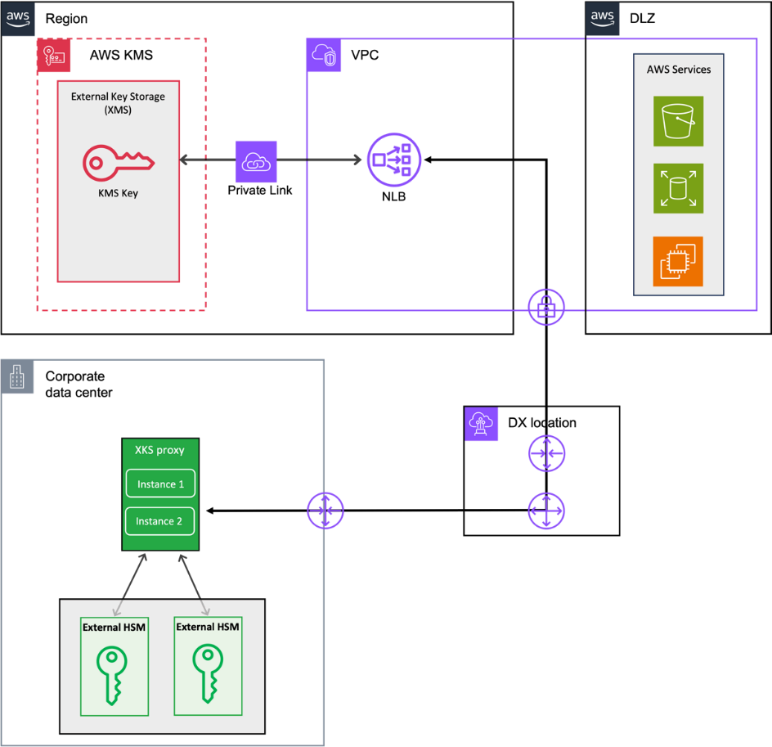
Using an external key store in Dedicated Local Zones, you can host the external hardware security module (HSM) that stores your encryption keys on-premises or colocated with your other infrastructure. By doing this, you maintain full control over the physical security and management of the HSM, while benefiting from the low-latency access and data processing capabilities of Dedicated Local Zones.
The main components of AWS KMS external key store architecture are:
XKS proxy server: You provision an external key store proxy (XKS proxy) server within your on-premises data center (as shown in Figure 1) or within the Dedicated Local Zones. The role of the XKS proxy is to act as the intermediary between AWS KMS and your on-premises HSM. The XKS proxy must be registered as target of a Network Load Balancer (NLB) in Region, this means that if it’s hosted on your on-premises data center, then NLB Amazon Virtual Private Cloud (Amazon VPC) must have private connectivity to the on-premises network through a site-to-site VPN or AWS Direct Connect connection.
On-premises HSM: You configure your on-premises HSM to securely store the root encryption keys that will be used to protect your data encryption keys.
External key store: You create an external key store resource in AWS KMS, which maps to your on-premises HSM through the XKS proxy.
Figure 1: AWS KMS external key store in a Dedicated Local Zone
AWS KMS sends a request to the XKS proxy, which communicates with your on-premises HSM to generate the root key material.
AWS KMS uses this root key to encrypt the data encryption key before returning it to the requesting service and stores the encrypted data encryption key alongside the encrypted data in Amazon S3 or Amazon EBS.
For future encrypt/decrypt operations, the AWS service uses the previously generated and AWS KMS-encrypted data encryption key, without needing to interact with the on-premises HSM.
Note: The on-premises HSM only participates in the initial root key generation to protect the data encryption key, not in the high-volume encrypt/decrypt operations on the data itself.
This architecture delivers two key benefits:
You maintain complete control of your encryption keys by storing them in your data center, helping you meet security compliance requirements.
Dedicated Local Zones keep your data isolated in your chosen location, providing low latency for your users.
It’s important to note that using an AWS KMS external key store requires you to manage additional operational tasks beyond standard AWS KMS. To maintain continuous access to your encrypted data, you must provide 24/7 availability of your on-premises HSM, monitor XKS proxy infrastructure performance, implement robust security controls, and create backup and recovery procedures.
Because system outages can prevent access to your encrypted data, we recommend that you develop detailed operational runbooks, set up comprehensive monitoring, test your recovery procedures regularly, and maintain redundant systems where possible.
Another common concern we hear from organizations evaluating Dedicated Local Zones is whether they’ll need to compromise on security capabilities to maintain data residency. The reality is that AWS security services running in a Region, such as Amazon Inspector, are specifically designed to provide comprehensive protection while respecting your data location requirements.
Organizations running regulated applications in Dedicated Local Zones require robust protection from zero-day vulnerabilities, prioritized patch remediation, and automated vulnerability management to meet compliance requirements. Amazon Inspector addresses these needs by continuously scanning your workloads to detect software vulnerabilities and unintended network exposure without requiring data movement from your chosen location.
Amazon Inspector helps protect your workloads through two distinct scanning modes: hybrid scanning and agent-based scanning. However, for the context of this blog, let’s consider only agent-based scanning mode.
To securely meet data residency requirements in Dedicated Local Zones, enable agent-based scanning mode on AWS Systems Manager (AWS SSM)-managed instances in your account. It’s the default mode for new accounts offering enhanced security through continuous scanning, immediately responding to new common vulnerabilities and exposures (CVEs) and instance changes. It also enables deep inspection capabilities for eligible instances, providing comprehensive vulnerability assessment.
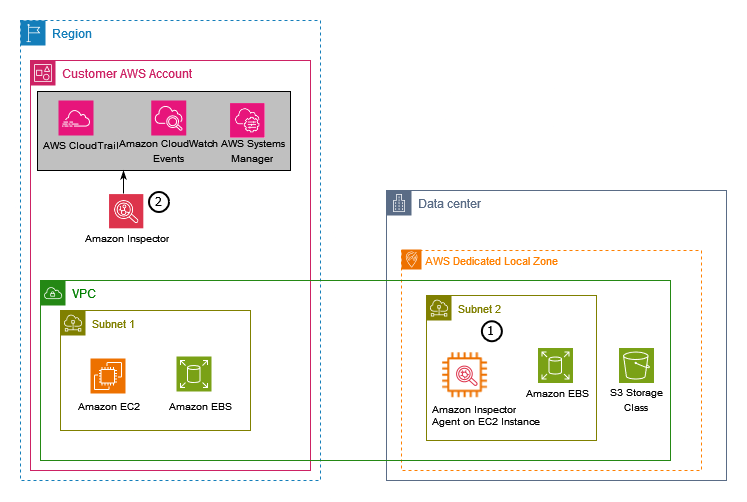
The reference architecture in Figure 2 shows:
Amazon Inspector agent running on AWS SSM managed instances, keeping your application data within Dedicated Local Zones.
Amazon Inspector evaluates and generates findings for detected vulnerabilities.
Figure 2: Amazon Inspector in Dedicated Local Zones
Amazon GuardDuty
Maintaining data sovereignty with Dedicated Local Zones doesn’t mean sacrificing advanced security capabilities. GuardDuty demonstrates how sophisticated threat detection can operate effectively while honoring strict data residency requirements.
Protecting your AI workloads from ransomware and advanced security threats requires an AI and machine learning (AL/ML)-integrated threat intelligence solution that can detect suspicious activity and respond proactively. GuardDuty uses AI/ML-based threat detection and integrated threat intelligence from AWS and leading third parties to protect your AWS accounts, workloads, and data. It continuously monitors malicious activity, delivers detailed security findings, and you can use the information it provides to respond quickly to threats.
GuardDuty Runtime Monitoring observes and analyzes operating system, networking, and file events to detect potential threats in your AWS workloads. The parent Region receives only threat reports while Dedicated Local Zones retain your data.
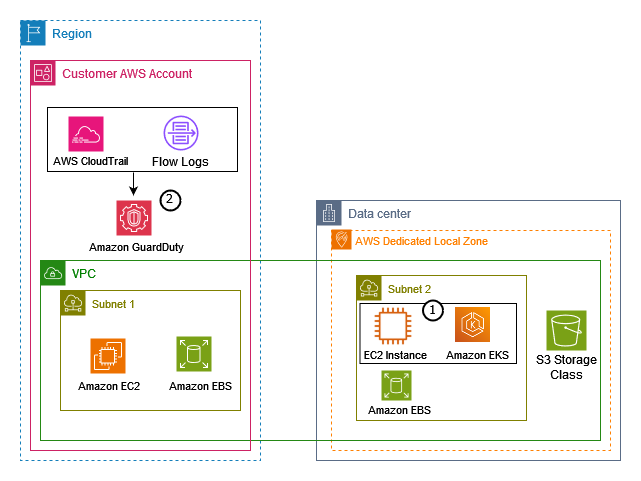
The reference architecture in Figure 3 shows how GuardDuty helps protect your data in a Dedicated Local Zones:
GuardDuty monitors EC2 instances while your data stays in Dedicated Local Zones.
GuardDuty analyzes data sources from AWS CloudTrail event logs, management events, and Amazon VPC flow logs that your AWS account captures in the Region.
Figure 3: Amazon GuardDuty in Dedicated Local Zones
AWS Certificate Manager
Organizations frequently express concern about certificate management complexity when deploying applications in Dedicated Local Zones. AWS Certificate Manager (ACM), which operates in the parent Region, addresses these challenges by serving as the primary service that customers use to provision, manage, and deploy certificates for use in both public-facing and private Dedicated Local Zones workloads.
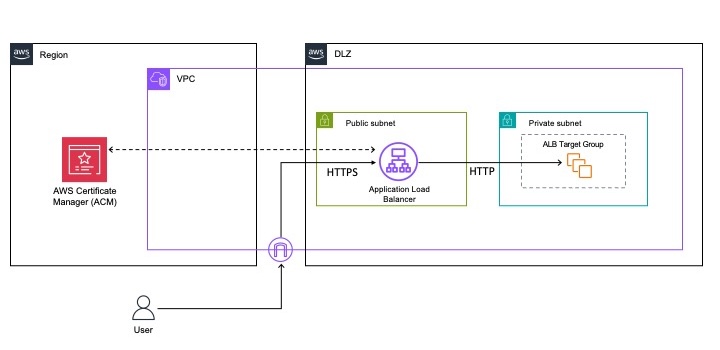
ACM integrates seamlessly with ALBs in Dedicated Local Zones to manage your complete certificate lifecycle, as shown in Figure 4.
Figure 4: ACM in Dedicated Local Zones
Follow these steps to implement TLS certificates in Dedicated Local Zones:
Provision or import certificates through ACM in the parent Region.
Associate your certificates with ALB HTTPS listeners in Dedicated Local Zones to enable secure, low-latency SSL/TLS termination near your users.
ACM renews certificates automatically, avoids manual management tasks, and maintains continuous HTTPS service availability. This integration delivers enterprise-grade security with your data residing locally in Dedicated Local Zones. It also provides enhanced performance and reduced latency through proximity to users.
AWS Shield
Business-critical applications in Dedicated Local Zones need maximum availability and responsiveness. AWS Shield Standard, a managed distributed denial of service (DDoS) protection service that runs at the AWS edge, automatically helps protect your applications by detecting and mitigating network (Layer 3) and transport (Layer 4) DDoS attacks even before they reach your workloads.
AWS CloudTrail
A common concern when deploying workloads in Dedicated Local Zones is whether organizations can maintain the same level of governance and compliance oversight they expect from traditional AWS deployments. CloudTrail demonstrates how comprehensive auditing capabilities can extend seamlessly across distributed infrastructure while respecting data residency requirements.
CloudTrail, running in the parent Region, enables governance, compliance, operational auditing, and risk auditing of your AWS account providing you aggregated and consolidated record of multisource events in a single place. This includes a detailed history of AWS API calls for your account, including API calls made using the AWS Management Console, the AWS SDKs, the command line tools, and higher-level AWS services used by the applications running in your Dedicated Local Zones. Only the logs are stored in the parent Region, while your data remains within the Dedicate Local Zones. AWS CloudTrail helps you to enable operational and risk auditing, governance, and compliance of your AWS accounts.
Conclusion
Dedicated Local Zones provide a robust solution for running regulated workloads for all industries, to meet strict data residency and digital sovereignty. Through integrated security services like AWS Nitro System, AWS KMS External Key Store, ACM, AWS Shield, Amazon GuardDuty, Amazon Inspector, and AWS CloudTrail, your organization can achieve stronger security compliance for their mission-critical applications running in AWS Dedicated Local Zones.
To learn more about implementing these security solutions in your Dedicated Local Zones deployment, contact your AWS account team.
If you have feedback about this post, submit comments in the Comments section below. If you have questions about this post, contact AWS Support.
Last month, we announced new sovereign controls and governance structure for the AWS European Sovereign Cloud. The AWS European Sovereign Cloud is a new, independent cloud for Europe, designed to help customers meet their evolving sovereignty needs, including stringent data residency, operational autonomy, and resiliency requirements. Launching by the end of 2025, the AWS European Sovereign Cloud will be entirely located within the European Union (EU) and operate as an independent cloud for Europe. Last month, we announced plans to launch a dedicated European certificate authority (CA), or trust service provider, to support autonomous trust service operations within the AWS European Sovereign Cloud.
We are actively building out the first AWS Region of the AWS European Sovereign Cloud in the state of Brandenburg, Germany. We are on track for launch and AWS services are being deployed, configured, and tested for autonomous operations in the AWS European Sovereign Cloud. The AWS European Sovereign Cloud infrastructure will be physically and logically separate from other Regions. We designed the AWS European Sovereign Cloud to have no critical dependencies on non-EU infrastructure. Everything needed to operate the AWS European Sovereign Cloud is in the EU: the talent, the technology, the infrastructure, and the leadership. In addition to independent infrastructure, there will be zero operational control outside of EU borders. Only AWS employees, residing in the EU, will control day-to-day operations, including access to data centers, technical support, and customer service for the AWS European Sovereign Cloud.
For the first time, we will provide a dedicated sovereign European trust service provider (EU-TSP). This EU-TSP will autonomously operate its own CA key materials and perform certificate issuance functions within the AWS European Sovereign Cloud. A trust service provider is an entity that manages the policies and operations for a set of root and subordinate certificate authorities. A root CA is a cryptographic building block and root of trust upon which end entity certificates can be issued. It represents a private key for signing (issuing) certificates and a root certificate that identifies the root CA and binds the private key to the name of the CA. In short, the EU-TSP is an autonomous trust service provider in Europe, for Europe.
The EU-TSP will be the public root of trust for the AWS European Sovereign Cloud, helping to maintain the confidentiality and integrity of network communications. The EU-TSP will provide the default CA used by AWS service endpoints, AWS Certificate Manager (ACM), and ACM integrated services. For AWS European Sovereign Cloud customers, this means that even in the event of a material loss of connectivity outside of the EU, the EU-TSP will continue to provide trust services autonomously.
We recently completed the cryptographic key signing ceremony for our EU-TSP at a secure EU location, witnessed by external, third-party auditors. The resulting root CAs have been submitted for inclusion to popular web browsers used by AWS customers. This EU-TSP will be operated in accordance with the requirements of the Certificate Authority/Browser Forum. All the key material for the EU-TSP is located within EU borders, and only EU residents have the ability to operate, control, or reconfigure the EU-TSP.
To maintain verifiable trust, we will engage independent EU-based auditors to assure the EU-TSP controls are designed appropriately, operate effectively, and can help customers satisfy their compliance obligations. We will make the audit reports publicly available.
The EU-TSP will be active and providing autonomous trust services when the AWS European Sovereign Cloud launches at the end of 2025. To learn more, visit AWS European Sovereign Cloud.
If you have feedback about this post, submit comments in the Comments section below. If you have questions about this post, contact AWS Support.
Customers often tell me that they want a simpler path to meet the compliance and industry regulatory mandates they have in their geographic regions. In our deep engagements with partners and customers, we have learned that one of the greatest challenges for customers is the translation of security and compliance requirements into distinct technical controls. At Amazon Web Services (AWS), security is our top priority, and we understand that protecting your data in a world with changing regulations, technology, and risks takes teamwork. As we’ve said, security is foundational to sovereignty.
AWS helps organizations to develop and evolve security, identity, and compliance into key business enablers; that’s why we’re committed to working with national cyber authorities and regulators to help define and establish how their compliance standards can be translated into security best practices in the cloud. We’re responding to customer requests to create locally tailored approaches aligned to their own regional standards and guidance as established by in-region authorities.
Architectural best practice, locally tailored
Since its launch in 2022, Landing Zone Accelerator on AWS has been instrumental in helping thousands of customers deploy cloud foundations that align with multiple global compliance frameworks and AWS best practices, including the Baseline Informatiebeveiliging Overheid (BIO) in the Netherlands, and the Esquema Nacional de Seguridad (ENS) in Spain. AWS is committed to expanding our regional implementations to help customers meet specific national and regional standards and digital sovereignty goals.
In March, I was proud to share the news of the cooperation agreement between the Federal Office for Information Security (BSI) and AWS, where AWS committed to help advance digital sovereignty and cybersecurity best practices and standards in Germany and across the European Union. With that in mind, I’m excited to share that our next regional implementation of Landing Zone Accelerator on AWS will support customers with workloads in Germany. The C5-ready Landing Zone Accelerator is designed to help customers meet their Cloud Computing Compliance Criteria Catalogue (C5) compliance objectives in the cloud. This will be available to our customers in Q3-2025, and at launch, our regional implementations will also be available in AWS European Sovereign Cloud.
For many customers in Germany, adherence to C5 is a requirement, and this is evidenced through a compliance assessment by an authorized assessor. Preparing for this assessment is critical for a successful outcome and is why AWS has partnered with AWS Global Security & Compliance (GSCA) Partner Schellman to provide the assessor insight as to how the C5-ready Landing Zone Accelerator can accelerate and simplify the path to C5 adoption for AWS customers.
AWS Partner Schellman: Proven Track Record in C5 Assessments
As one of the few firms with deep expertise and experience in C5 assessments, Schellman has completed several dozen evaluations across a wide range of clients—from agile startups to global enterprises. This diverse portfolio underscores Schellman’s capabilities, deep technical expertise, and unwavering commitment to security assurance.
“Our team has seen firsthand how the C5 standard fosters transparency and builds trust in cloud services. We’re proud to support our clients not just in understanding C5, but in strategically leveraging it to improve security and competitiveness on a global scale.” Jeff Schiess, Managing Director, Schellman
Lowering the Barrier to Entry – Schellman recognizes that achieving C5 compliance can sometimes be intimidating, particularly for organizations new to the framework. To that end, Schellman has performed an assessment against the foundational infrastructure provided by LZA on AWS, designed to simplify the C5 journey. The LZA provides preconfigured infrastructure templates and security baselines that significantly reduce the complexity of establishing C5-compliant cloud environments.
“With the Landing Zone Accelerator, organizations can build on a C5-ready foundation right from the start. It’s a practical, scalable solution for companies that might otherwise find the C5 standard overwhelming.” Kristen Wilbur, Principal, Schellman
Sovereign by design
Landing Zone Accelerator on AWS automatically implements hundreds of security capabilities that map to control requirements across geographic compliance frameworks. This saves customers hundreds of hours in planning and implementing secure networking and account configurations by providing them with a foundation based on the AWS Well-Architected Security Pillar and AWS security best practices. Meeting compliance requirements, having verifiable access controls and data transfer restrictions, independence and choice over the technology stack, and surviving large-scale disruptions are some of the key capabilities that customers require of a sovereign-by-design workload. However, for many customers, translating regulatory requirements into a set of discrete technical controls and applying them consistently across one or more AWS accounts and AWS Regions can be time-intensive and challenging.
We provide customers and partners with detailed guidance on how to configure Landing Zone Accelerator on AWS in accordance with their local security and compliance requirements, including digital sovereignty requirements. This includes control mapping to local regulations or policies that shows customers how controls implemented in a landing zone are mapped to the specific requirements, calling out where customers are required to do more to meet these as part of our shared responsibility model—this includes organizational policies and procedures where customers must implement additional controls within their application or workload to meet local requirements.
Control over the location of your data
Landing Zone Accelerator on AWS provides customers with a choice of configurable preventative, detective, and proactive controls to help customers meet their data residency, security, and compliance objectives, whether you’re a public sector customer wanting to keep data in a single Region or navigating the complex needs of multi-national organizations with operations subject to differing digital sovereignty requirements.
Verifiable control over data access
Landing Zone Accelerator on AWS goes beyond just provisioning a secure, multi-account environment. It establishes a well-structured, multi-account architecture using AWS Organizations. This logically isolates workloads, management functions, and security controls into dedicated organizational units (OUs). This not only enhances security and operational efficiency, but also helps customers to enforce consistent data residency, access management, and compliance policies across their entire cloud footprint. These powerful guardrails empower customers to quickly harness the innovative potential of cloud technologies, whilst delivering business value from an established security and compliance baseline.
By providing this automated approach, AWS empowers organizations to rapidly deploy cloud environments tailored to their specific local requirements in days instead of weeks; with robust security, compliance, and operational guardrails in place from the outset. Landing Zone Accelerator on AWS is designed to simplify the path to cloud adoption and compliance for organizations, particularly those in regulated industries or with sovereignty requirements. This approach marks a shift from the previous heavy lift required for organizations to migrate workloads to the cloud while meeting their needs.
Partners at the core
There is a lot of complexity involved with navigating the evolving digital sovereignty landscape—but you don’t have to do it alone. Our AWS Digital Sovereignty Competency connects customers with trusted partners with demonstrated expertise to advise and architect for their customers’ digital sovereignty needs while taking advantage of the full potential of the AWS Cloud. As part of the competency, AWS is supporting partners to navigate customer challenges across four pillars: data residency, data protection, access control, and survivability.
Customers have told me about how challenging it can be to architect to address their sovereignty needs, often requiring manual iteration and longer time to value. Using Landing Zone Accelerator on AWS is one of the ways AWS and AWS Partners can work together to address customers’ sovereignty needs with a repeatable approach that helps our customers and partners move faster. I’m excited by how regional implementations of Landing Zone Accelerator on AWS is helping AWS Sovereignty Partners, such as Atos and SVA, to move faster without compromise.
“Compliance with regulations like C5 is essential for customers in the public sector and regulated industries, who prioritize digital sovereignty, and this is central to our Cloud for Clinics initiative with AWS in the German Healthcare market. The availability of the C5 LZA significantly reduces the technical complexity, giving us a common technical platform to build on reducing time to market. Atos is driving the operational rollout and expanding the scope of compliance mappings to further streamline customer compliance. At the same time, we are incorporating essential managed services like SOC/SIEM which we believe will make compliant cloud adoption easier to drive innovation by the Public Sector, Healthcare institutions or customers in regulated industries like Financial Services and Utilities.” Boris Hecker, Managing Director, ATOS Germany
“Compliance with BSI C5 criteria for customers from the public sector and regulated industries is a basic requirement for the use of public cloud services. Implementing the regulations is often complex, time-consuming and resource-intensive. For this reason, customers are looking for solutions that they can tailor to the specific requirements of their industry; while ensuring they meet compliance standards. SVA supports customers in maintaining the balance between innovation and compliance with customized, C5-certified, managed services. We rely on solutions such as the Landing Zone Accelerator on AWS to reconcile the use of market-leading public cloud infrastructure with regulatory requirements.” Patrick Glawe, Hyperscaler Lead at SVA
The Spanish National Cryptologic Center (CCN) has published a new STIC guide (CCN-STIC-887 Anexo A) that provides a comprehensive template and supporting artifacts for implementing landing zones that comply with Spain’s National Security Framework (ENS) Royal Decree 311/2022 using the Landing Zone Accelerator on AWS. Spain’s ENS establishes a common framework of basic principles and requirements of security for Spanish public sector organizations and their service providers, including supply chain providers. Over the years, the collaboration between Amazon Web Services (AWS) and the CCN has resulted in the publication of eight secure configuration guides (Series STIC 887) that provide comprehensive advice on the configuration of AWS services to align with the ENS. The guide CCN-STIC-887 Anexo A is the last addition to this series.
The centerpiece of this new guide is the ENS template for the Landing Zone Accelerator on AWS (LZA ENS). A landing zone serves as the initial setup of an organization’s cloud account or environment, including the implementation of security controls, access management, and compliance frameworks. The Landing Zone Accelerator on AWS is a powerful open source tool created by AWS for organizations that want to quickly customize and automate implementation of landing zones that align with AWS best practices and with regulatory compliance frameworks. This tool provides a comprehensive solution that, managed entirely by code, automatically configures over 35 AWS services using a simplified set of configuration files to manage and govern a multi-account environment, helping customers with highly regulated workloads and complex compliance requirements.
The CCN-STIC-887 Anexo A guide focuses on helping organizations implement landing zones that meet ENS security requirements from the ground up. It offers detailed instructions and templates for establishing a landing zone—the foundational infrastructure required for a secure, well-managed cloud environment—and a control matrix to demonstrate compliance with ENS controls.
Key components covered in the STIC 887H guide include:
Logging and monitoring: LZA ENS performs a default and scaled activation of the necessary logging and monitoring services required to meet ENS monitoring requirements in AWS services (such as AWS CloudTrail, Amazon CloudWatch, AWS Security Hub, and Amazon GuardDuty).
Access control: LZA ENS implements the management of identity and access management methods and policies at scale, which are aligned with the access control requirements of the ENS in a centralized manner using AWS IAM Identity Center.
Asset management: By default, LZA ENS activates inventory functions and resource and inventory tagging policies (for example, AWS Config) that support ENS asset management controls in the services.
Network topology: LZA ENS can be used to deploy a centralized network topology in accordance with ENS network security controls.
Cryptography: The encryption service activation capabilities built into LZA ENS can help organizations align with ENS data protection standards through mandatory encryption at rest, enforcement mechanisms with AWS Key Management Service (AWS KMS), and monitoring mechanisms to detect unencrypted data and communications with AWS Config rules.
Compliance and data residency: LZA ENS includes control policies to promote the use of AWS services with the ENS High certification and to provide processing on AWS in accordance with customers’ data residency requirements.
Organizations that require specific customizations to fully meet the requirements of the ENS can use LZA ENS to quickly modify and add customized security controls and then execute the scaled deployment of these controls to their accounts in the landing zone. One of the customizations included in LZA ENS is the integration of the open source security tool Prowler with Security Hub as an automated auditing tool with the objective of providing an up-to-date view of compliance with ENS controls. In addition, by providing a base designed for security and the flexibility to add custom controls, LZA ENS can support the process of achieving and maintaining compliance with the ENS in the AWS Cloud environment.
The CCN-STIC-887 Anexo A guide represents an important step forward in standardizing secure cloud deployments for Spanish public sector organizations and those working with government entities. This publication demonstrates the AWS commitment to support organizations in their secure cloud adoption journey while maintaining compliance with national security standards.
Spanish version
CCN publica la guía para las Zonas de Aterrizaje del ENS con AWS Landing Zone Accelerator
El Centro Criptológico Nacional de España (CCN) ha publicado una nueva guía STIC (CCN-STIC-887 Anexo A) que proporciona una plantilla de código y material de soporte para implementar zonas de aterrizaje (o landing zones) que cumplan con el Esquema Nacional de Seguridad del Real Decreto 311/2022 (ENS) mediante el Landing Zone Accelerator on AWS. El ENS establece un marco común de principios básicos, requisitos y medidas de seguridad para las organizaciones del sector público español y sus prestadores de servicios, incluyendo la cadena de suministro. A lo largo de los años, la colaboración entre Amazon Web Services (AWS) y el CCN se ha traducido en la publicación de ocho guías de configuración segura (serie STIC 887) que proporcionan consejo sobre la configuración de los servicios de AWS para alinearse con el ENS. La guía CCN-STIC-887 Anexo A es la última incorporación a esta serie.
La pieza central de la nueva guía es la plantilla ENS para el AWS Landing Zone Accelerator (LZA ENS). Una zona de aterrizaje (landing zone) sirve como la configuración inicial del entorno en la nube de una organización, e incluye la implementación inicial de controles de seguridad, la administración del acceso y los marcos de cumplimiento. El AWS Landing Zone Accelerator es una potente herramienta de código abierto creada por AWS para las organizaciones que desean implementar de forma rápida, segura, personalizada y automatizada zonas de aterrizaje alineadas con las prácticas recomendadas de AWS, así como con marcos de conformidad. Esta herramienta proporciona una solución integral que, mediante código, configura automáticamente más de 35 servicios de AWS con un conjunto simplificado de archivos de configuración para administrar y gobernar un entorno multicuenta, lo que ayuda a los clientes con cargas de trabajo altamente reguladas y requisitos de cumplimiento normativo.
La guía CCN-STIC-887 Anexo A se centra específicamente en ayudar a las organizaciones a implementar desde cero zonas de aterrizaje que cumplan con los requisitos de seguridad del ENS. Ofrece instrucciones y plantillas detalladas para establecer una zona de aterrizaje – la infraestructura básica necesaria para un entorno de nube seguro y bien administrado – así como una matriz de control para demostrar el cumplimiento de los controles del ENS.
Los componentes clave incluidos en la guía STIC 887H incluyen:
Registro y monitoreo: LZA ENS realiza una activación por defecto y a escala de los servicios de registro y monitoreo necesarios en AWS (como AWS CloudTrail, Amazon CloudWatch, AWS Security Hub, y AWS GuardDuty) para cumplir con los requisitos de monitoreo del ENS.
Control de acceso: LZA ENS implementa los métodos y políticas de administración de identidades y accesos a escala, que se alinean con los requisitos de control de acceso del ENS de manera centralizada mediante AWS IAM Identity Center..
Administración de activos: De forma predeterminada, el LZA ENS activa las funciones de inventario y las políticas de etiquetado de recursos e inventario (por ejemplo AWS Config) que soportan los controles de administración de activos del ENS.
Topología de red: LZA ENS se puede utilizar para implementar una topología de red centralizada de acuerdo con los controles de seguridad de red ENS.
Criptografía: las capacidades de activación de cifrado integradas en la LZA ayudan a organizaciones a alinearse con los estándares de protección de datos del ENS mediante el cifrado obligatorio en reposo, los mecanismos de aplicación con AWS Key Management Service (AWS KMS) y los mecanismos de supervisión para detectar datos y comunicaciones no cifrados con las reglas de AWS Config.
Cumplimiento y residencia de datos: LZA ENS incluye políticas de control para promover el uso de los servicios de AWS con la certificación del ENS Alto y realizar el procesamiento en AWS de acuerdo con los requisitos de residencia de datos del cliente.
Las organizaciones que requieren personalizaciones específicas para cumplir plenamente los requisitos del ENS pueden usar el LZA ENS para modificar rápidamente y añadir fácilmente controles de seguridad personalizados y ejecutar la implementación a escala de estos controles en sus cuentas de la zona de aterrizaje. Una de las personalizaciones que hemos incluido en el LZA ENS es la integración de Prowler con AWS Security Hub como una herramienta de auditoría automatizada, con el objetivo de proporcionar una visión actualizada del cumplimiento de los controles ENS de una manera fácil y eficaz. Además, al proporcionar una base diseñada para la seguridad y la flexibilidad de agregar controles personalizados, LZA ENS puede ayudar durante el proceso de obtener la conformidad con el ENS en el entorno de nube de AWS.
La guía CCN-STIC-887 Anexo A representa un importante paso adelante en la estandarización de las implementaciones seguras en la nube para las organizaciones del sector público español. Esta publicación demuestra el compromiso de AWS de apoyar a las organizaciones en su proceso de adopción segura de la nube, manteniendo al mismo tiempo el cumplimiento de las normas de seguridad nacionales.
If you have feedback about this post, submit comments in the Comments section below. If you have questions about this post, contact AWS Support.
For the second year in a row, Amazon Web Services (AWS) is named as a Leader in the Information Services Group (ISG) Provider Lens Quadrant report for Sovereign Cloud Infrastructure Services (EU), published on December 18, 2024. ISG is a leading global technology research, analyst, and advisory firm that serves as a trusted business partner to more than 900 clients. This ISG report evaluates 19 providers of sovereign cloud infrastructure services in the multi public cloud environment and examines how they address the key challenges that enterprise clients face in the European Union (EU). ISG defines Leaders as providers who represent innovative strength and competitive stability.
ISG rated AWS ahead of other leading cloud providers on both the competitive strength and portfolio attractiveness axes, with the highest score on portfolio attractiveness. Competitive strength was assessed on multiple factors, including degree of awareness, core competencies, and go-to-market strategy. Portfolio attractiveness was assessed on multiple factors, including scope of portfolio, portfolio quality, strategy and vision, and local characteristics.
According to the ISG Provider Lens report, “AWS develops various innovative solutions to meet different sovereignty needs, guided by inputs from regulators, cybersecurity experts, partners and customers. These solutions address factors such as location, workload sensitivity and industry standards.”
Read the report to:
Gather insight on the factors that ISG believes will influence the sovereign cloud landscape in the EU.
Discover why AWS was named as a Leader with the highest score on portfolio attractiveness by ISG.
Learn what makes the AWS Cloud sovereign-by-design and how we continue to offer more control and more choice without compromising on the full power of AWS.
The recognition of AWS as a Leader in this report for the second year in a row is a testament to our efforts to help European customers and partners meet their digital sovereignty and resilience requirements. AWS continues to deliver on the AWS Digital Sovereignty Pledge, our commitment to offering AWS customers the most advanced set of sovereignty controls and features available in the cloud. Earlier this year, we announced plans to invest €7.8 billion in the AWS European Sovereign Cloud by 2040, building on our long-term commitment to Europe and ongoing support of the region’s sovereignty needs. The AWS European Sovereign Cloud, which will be a new, independent cloud for Europe, is set to launch by the end of 2025.
Around the world, organizations are evaluating and embracing artificial intelligence (AI) and machine learning (ML) to drive innovation and efficiency. From accelerating research and enhancing customer experiences to optimizing business processes, improving patient outcomes, and enriching public services, the transformative potential of AI is being realized across sectors. Although using emerging technologies helps drive positive outcomes, leaders worldwide must balance these benefits with the need to maintain security, compliance, and resilience. Many organizations, including those in the public sector and regulated industries, are investing in generative AI applications powered by large language models (LLMs) and other foundation models (FMs) because these applications can transform and scale their work and provide better experiences for customers. Beyond computing power, unlocking this AI potential resides in the AI applications that organizations can create based on a variety of AI/ML development services, models, and data sources. Organizations must navigate the complexity of building AI applications in light of existing and emerging regulatory regimes while verifying that their AI applications and related data are secure, protected, and resilient to risks and threats.
AWS offers a wide range of AI/ML services and capabilities, built on our sovereign-by-design foundation, that are making it simpler for our customers to meet their digital sovereignty needs while getting the security, control, compliance, and resilience that they need. For example, Amazon Bedrock is a fully managed service that offers a choice of high-performing FMs from leading AI companies such as AI21 Labs, Anthropic, Cohere, Meta, Mistral AI, and Stability AI through a single API, along with a broad set of capabilities to build generative AI applications with security, privacy, and responsible AI. Amazon SageMaker provides tools and infrastructure to build, train, and deploy ML models at scale while supporting responsible AI with governance controls and access to pretrained models.
Innovating securely across the AI lifecycle
Security is and always has been our top priority at AWS. AWS customers benefit from our ongoing investment in data centers, networks, custom hardware, and secure software services, built to satisfy the requirements of the most security-sensitive organizations, including the government, healthcare, and financial services. We have always believed that it is essential that customers have control over their data and its location. That’s why we architected the AWS Cloud to be secure and sovereign-by-design from day one. We remain committed to giving our customers more control and choice so that they can use the full power of AWS while meeting their unique digital sovereignty needs.
As organizations develop and implement generative AI, they want to make sure that their data and applications are secured across the AI lifecycle, including data preparation, training, and inferencing. To help ensure the confidentiality and integrity of customer data, all of our Nitro-based Amazon Elastic Compute Cloud (Amazon EC2) instances that run ML accelerators such as AWS Inferentia and AWS Trainium, and graphics processing units (GPUs) such as P4, P5, G5, and G6, are backed by the industry-leading security capabilities of the AWS Nitro System. By design, there is no mechanism for anyone at AWS to access Nitro EC2 instances that customers use to run their workloads. The NCC Group, an independent cybersecurity firm, has validated the design of the Nitro System.
We take a secure approach to generative AI and make it practical for our customers to secure their generative AI workloads across the generative AI stack so that they can focus on building and scaling. All AWS services—including generative AI services—support encryption, and we continue to innovate and invest in controls and encryption features that allow our customers to encrypt everything everywhere.
For example, Amazon Bedrock uses encryption to protect data in transit and at rest, and data remains in the AWS Region where Amazon Bedrock is being used. Customer data, such as prompts, completions, custom models, and data used for fine-tuning or continued pre-training, is not used for Amazon Bedrock service improvement and is never shared with third-party model providers. When customers fine-tune a model in Amazon Bedrock, the data is never exposed to the public internet, never leaves the AWS network, is securely transferred through a customer’s virtual private cloud (VPN), and is encrypted in transit and at rest.
SageMaker protects ML model artifacts and other system artifacts by encrypting data in transit and at rest. Amazon Bedrock and SageMaker integrate with AWS Key Management Service (AWS KMS) so that customers can securely manage cryptographic keys. AWS KMS is designed so that no one—not even AWS employees—can retrieve plaintext keys from the service.
Developing responsibly
The responsible development and use of AI is a priority for AWS. We believe that AI should take a people-centric approach that makes AI safe, fair, secure, and robust. We are committed to supporting customers with responsible AI and helping them build fairer and more transparent AI applications to foster trust, meet regulatory requirements, and use AI to benefit their business and stakeholders. AWS is the first major cloud service provider to announce ISO/IEC 42001 accredited certification for AI services, covering Amazon Bedrock, Amazon Q Business, Amazon Textract, and Amazon Transcribe. ISO/IEC 42001 is an international management system standard that outlines requirements and controls for organizations to promote the responsible development and use of AI systems.
We take responsible AI from theory into practice by providing the necessary tools, guidance, and resources, including Amazon Bedrock Guardrails to help implement safeguards tailored to customer generative AI applications and aligned with their responsible AI policies, or Model Evaluation on Amazon Bedrock to evaluate, compare, and select the best FMs for specific use cases based on custom metrics, such as accuracy, robustness, and toxicity. Additionally, Amazon SageMaker Model Monitor automatically detects and alerts customers of inaccurate predictions from deployed models. We continue to publish AI Service Cards to enhance transparency by providing a single place to find information on the intended use cases and limitations, responsible AI design choices, and performance optimization best practices for our AI services and models.
Building resilience
Resilience plays a pivotal role in the development of any workload, and AI/ML workloads are no different. Customers need to know that their workloads in the cloud will continue to operate in the face of natural disasters, network disruptions, or disruptions due to geopolitical crises. AWS delivers the highest network availability of any cloud provider and is the only cloud provider to offer three or more Availability Zones (AZs) in all Regions, providing more redundancy. Understanding and prioritizing resilience is crucial for generative AI workloads to meet organizational availability and business continuity requirements. We have published guidance on designing generative AI workloads for resilience. To enable higher throughput and enhanced resilience during periods of peak demands in Amazon Bedrock, customers can use cross-region inference to distribute traffic across multiple Regions. For customers with specific European Union data sovereignty requirements, we are launching the AWS European Sovereign Cloud in 2025 to offer an additional layer of control and resilience.
Supporting choice and flexibility
It’s important that customers have access to diverse AI technologies, while having the freedom to choose the right solutions to meet their needs. AWS provides more diversity, choice, and flexibility so that customers can select the AI solution that best aligns with their specific requirements, whether that’s using open-source models, proprietary solutions, or their own custom AI models. For example, we understand the importance of open-source AI in fostering transparency, collaboration, and rapid innovation. Open-source models enable scrutiny of vulnerabilities, drive security improvements, and support research on AI safety. Amazon SageMaker JumpStart provides pretrained, open-source models for a wide range of common use cases. To provide practitioners and developers with the guidance and tools that they need to create secure-by-design AI systems, we are a founding member of the open-source initiative Coalition for Secure AI (CoSAI).
Also, our commitment to portability and interoperability helps ensure that customers can move easily between environments. For customers changing IT providers, we’ve taken concrete steps to lower costs, and AWS is actively engaged in efforts to facilitate switching between cloud providers, including through our support of the Cloud Infrastructure Service Providers in Europe (CISPE)Cloud Switching Framework, which lays out guidance to assist providers and customers in the switching process. This gives organizations the flexibility to adapt their cloud and AI strategies as their needs evolve.
We remain committed to providing customers with a choice of diverse AI technologies, along with secure and compliant ways to build their AI applications throughout the development lifecycle. Through this approach, customers can enhance the security, compliance, and resilience of their systems.
If you have feedback about this post, submit comments in the Comments section below. If you have questions about this post, contact AWS Support.
AWS re:Invent 2024, a learning conference hosted by Amazon Web Services (AWS) for the global cloud computing community, will take place December 2–6, 2024, in Las Vegas, Nevada, across multiple venues. At re:Invent, you can join cloud enthusiasts from around the world to hear the latest cloud industry innovations, meet with AWS experts, and build connections. Whether you want to build deep technical expertise, understand how to prioritize your investments, learn more about the infrastructure offerings of the sovereign-by-design AWS Cloud, or see how the AWS Nitro System enables enhanced security for your workloads, re:Invent is a great opportunity to explore our digital sovereignty solutions.
This year, there will be many ways that you can learn about our advanced sovereignty controls, security features, and infrastructure options that can help meet your unique digital sovereignty needs, including sessions and hands-on activities with AWS hybrid and edge services including AWS Local Zones, AWS Dedicated Local Zones, and AWS Outposts. In the Expo, you can visit the Digital Sovereignty & Data Protection kiosk in the AWS Village to watch demos, learn about the upcoming AWS European Sovereign Cloud, and get your questions answered by AWS team members. To see AWS designed chips and Outposts devices, check out the AWS Next Gen Infrastructure Hub in the AWS Village. You can also visit the AWS Partner Network (APN) booth to connect with AWS Digital Sovereignty Partners to learn about the benefits of partner programs.
Breakout sessions and lightning talks
To add sessions to your AWS re:Invent agenda and find time and location information, choose the session title link.
SEC229 | Breakout | Digital sovereignty: overcome complexity and enable future-readiness Max Peterson, VP, Sovereign Cloud, AWS Organizations are facing increasing complexity in an evolving sovereignty landscape. Building a strong digital foundation can help simplify efforts to meet requirements today and prepare your organization for the future, without slowing innovation. Join this session to learn how AWS sovereign cloud offerings, ranging from encryption services to the announced AWS European Sovereign Cloud, provides more control and choice to help meet your unique needs. Discover how customers are keeping critical workloads secure and protected when leveraging new technologies on AWS, including generative AI, and learn about new digital sovereignty solutions offered by AWS Partners.
HYB201 | Breakout | AWS wherever you need it: From the cloud to the edge Jan Hofmeyr, VP, EC2 Networking and Hybrid Edge, AWS, and Jeff Feist, Executive Director – Hosting Solutions, Merck & Co., Inc. While most workloads can be migrated to the cloud, some remain on premises or at the edge due to low latency, local data processing, or digital sovereignty needs. In this session, learn how AWS services like AWS Outposts, AWS Local Zones, AWS Dedicated Local Zones, and AWS IoT Core support hybrid cloud and edge computing workloads such as multiplayer gaming, high-frequency trading, medical imaging, smart manufacturing, and generative AI applications with data residency requirements.
HYB309 | Breakout | Well-architected for data residency with hybrid cloud services Sherry Lin, Principal Product Manager, AWS; Lakshmi VP, Specialist SA – Hybrid Edge, AWS; and Kevin Ng, Senior Director, Core Engineering Products, GovTech With concerns over data privacy, security, and digital sovereignty, many countries across the world are strengthening data residency laws to keep personal and sensitive data within their borders. For organizations operating across multiple geographies, it can be challenging to meet the evolving data residency laws. In this session, following the AWS Well-Architected Framework, explore the best practices around data residency when using hybrid cloud services, including AWS Local Zones, AWS Dedicated Local Zones, and AWS Outposts.
IOT202 | Breakout | AWS IoT for edge LLM deployment and execution Nikit Pednekar, Principal Product Manager, AWS, and Stefano Marzani, WW Tech Leader, SDX, AWS With the advent of generative AI and large language models (LLMs), you must be wondering, how can these technologies be applied at the IoT edge? After all, there are many benefits of running LLMs at the edge—from network bandwidth efficiencies, offline processing, lower latency, and data sovereignty to cost savings, security, and differentiation. In this session, learn how using AWS IoT services and LLMs at the edge can uplift your solutions with actionable outcomes and innovative capabilities, such as gesture recognition, natural language processing for voice control, real-time predictive maintenance, energy optimization, anomaly detection, and more.
KUB310 | Breakout | Amazon EKS for edge and hybrid use cases Chris Splinter, Product Manager, AWS, and Gokul Chandra Purnachandra Reddy, Senior Solutions Architect, AWS There are some workloads that may need to run on-premises, at the edge, or in a hybrid scenario due to low-latency, data dependencies, data sovereignty, or other regulatory reasons, especially in industries such as manufacturing, healthcare, telco, and financial services. Data dependent workloads may have to wait for the data to be on AWS services before fully migrating. In this session, we will share production-ready architectures leveraging services like Amazon EKS Anywhere to run container workloads on-premises and support modernizing VMware-based workloads. Also learn best practices on migration of on-premises Kubernetes deployments to AWS Cloud.
PEX110 | Lightening Talk | Supercharge your growth and capabilities with partner programs Mike Cannady, Director, Partner Core Public Sector, AWS Discover the latest AWS Partner program updates that propel your public sector business forward. Join this lightning talk to explore innovations tailored to partners: generative AI programs, digital sovereignty, solution building, and managed services. Whether you’re starting out or seasoned, glean insights and use cases to elevate your journey. Don’t miss this opportunity to supercharge your development and stay ahead in this ever-evolving landscape.
Interactive sessions (chalk talks and workshops)
HYB304 | Workshop | Implement RAG without compromising on digital sovereignty Aditya Lolla, Senior Solutions Architect, Hybrid Edge, AWS, and Robert Belson, Senior Developer Advocate, AWS As governments and standards bodies develop data protection and privacy regulations, organizations increasingly need to combine the use of generative AI tooling in the cloud with regulated data that need to remain on premises to meet data sovereignty requirements. In this workshop, learn how to extend Agents for Amazon Bedrock to hybrid and edge services like AWS Outposts and AWS Local Zones to build distributed Retrieval Augmented Generation (RAG) applications with on-premises data for improved model outcomes. Get hands-on with Amazon Bedrock, AWS Lambda, and AWS hybrid and edge services, and build Amazon Simple Storage Service (Amazon S3) compliant workflows using a hybrid S3 compatible solution. You must bring your laptop to participate.
WPS207 | Chalk Talk | How AWS can help you meet your digital sovereignty requirements Mehmet Bakkaloglu, Principal Solutions Architect, AWS, and Addy Upreti, Principal Technical Product Manager – Digital Sovereignty, AWS Customers in the public sector and regulated industries such as healthcare, financial services and telecom have shared how they face digital sovereignty concerns in their cloud journey. In this talk, you can learn about how AWS is sovereign-by-design and the range of capabilities that can enable you to meet your digital sovereignty needs. Plus, discover how the AWS European Sovereign Cloud is being built to provide further choice to meet these needs. We’ll talk through how AWS can help accelerate your cloud journey while meeting your requirements.
HYB310 | Chalk Talk | Addressing data residency requirements with hybrid and edge services Sedji Gaouaou, Senior Solutions Architect, AWS, and Fabio Rodriguez, Head of Hybrid Cloud Solutions Architect, AWS Data residency is a critical consideration for organizations that collect and store sensitive information, including personal identifiable information (PII), financial data, healthcare data, or information pertaining to national security. To help organizations operating across multiple geographies drive innovation while meeting data residency requirements, AWS offers multiple global infrastructure offerings like AWS Regions, AWS Dedicated Local Zones, AWS Local Zones, and AWS Outposts. In this interactive chalk talk, learn how these infrastructure offerings can help you accelerate digital transformation while meeting data residency needs.
For a full view of digital sovereignty content, including sessions with partners, explore the AWS re:Invent catalog and filter on the Digital Sovereignty area of interest. Not able to attend in-person? Register for free for the virtual-only pass to livestream keynotes and innovation talks, and access on-demand breakout sessions today. See you in Las Vegas or on the livestream!
If you have feedback about this post, submit comments in the Comments section below.
Developing strategies to navigate the evolving digital sovereignty landscape is a top priority for organizations operating across industries and in the public sector. With data privacy, security, and compliance requirements becoming increasingly complex, organizations are seeking cloud solutions that provide sovereign controls and flexibility. Recently, Max Peterson, Amazon Web Services (AWS) Vice President of Sovereign Cloud, sat down with Daniel Newman, CEO of The Futurum Group and co-founder of Six Five Media, to explore how customers are meeting their unique digital sovereignty needs with AWS. Their thought-provoking conversation delves into the factors that are driving digital sovereignty strategies, the key considerations for customers, and AWS offerings that are designed to deliver control, choice, security, and resilience in the cloud. The podcast includes a discussion of AWS innovations, including the AWS Nitro System, AWS Dedicated Local Zones, AWS Key Management Service External Key Store, and the upcoming AWS European Sovereign Cloud. Check out the episode to gain valuable insights that can help you effectively navigate the digital sovereignty landscape while unlocking the full potential of cloud computing.
Last month, we shared that we are investing €7.8 billion in the AWS European Sovereign Cloud, a new independent cloud for Europe, which is set to launch by the end of 2025. We are building the AWS European Sovereign Cloud designed to offer public sector organizations and customers in highly regulated industries further choice to help them meet their unique digital sovereignty requirements, as well as stringent data residency, operational autonomy, and resiliency requirements. Customers and partners using the AWS European Sovereign Cloud will benefit from the full capacity of AWS including the same familiar architecture, service portfolio, APIs, and security features available in our 33 existing AWS Regions. Today, we are thrilled to reveal an initial roadmap of services that will be available in the AWS European Sovereign Cloud. This announcement highlights the breadth and depth of the AWS European Sovereign Cloud service portfolio, designed to meet customer and partner demand while delivering on our commitment to offer the most advanced set of sovereignty controls and features available in the cloud.
The AWS European Sovereign Cloud is architected to be sovereign-by-design, just as the AWS Cloud has been since day one. We have designed a secure and highly available global infrastructure, built safeguards into our service design and deployment mechanisms, and instilled resilience into our operational culture. Our customers benefit from a cloud built to help them satisfy the requirements of the most security-sensitive organizations. Each Region is comprised of multiple Availability Zones and each Availability Zone is made up of one or more discrete data centers, each with redundant power, connectivity, and networking. The first Region of the AWS European Sovereign Cloud will be located in the State of Brandenburg, Germany, with infrastructure wholly located within the European Union (EU). Like our existing Regions, the AWS European Sovereign Cloud will be powered by the AWS Nitro System. The Nitro System powers all our modern Amazon Elastic Compute Cloud (Amazon EC2) instances and provides a strong physical and logical security boundary to enforce access restrictions so that nobody, including AWS employees, can access customer data running in Amazon EC2.
Service roadmap for the AWS European Sovereign Cloud
AWS is committed to offering our customers the most advanced set of sovereignty controls and features available in the cloud. We have a wide range of offerings to help you meet your unique digital sovereignty requirements, including our eight existing Regions in Europe, AWS Dedicated Local Zones, and AWS Outposts. The AWS European Sovereign Cloud is an additional option to choose from. You can start building in our existing sovereign-by-design Regions and, if needed, migrate to the AWS European Sovereign Cloud. If you have stringent isolation and in-country data residency requirements, you will also be able to use Dedicated Local Zones or Outposts to deploy AWS European Sovereign Cloud infrastructure in locations you select.
Today, you can conduct proof-of-concept exercises and gain hands-on experience that will help you hit the ground running when the AWS European Sovereign Cloud launches in 2025. For example, you can use AWS CloudFormation to create and provision AWS infrastructure deployments predictably and repeatedly in an existing Region to prepare for the AWS European Sovereign Cloud. Using AWS CloudFormation, you can leverage services like Amazon EC2, Amazon Simple Notification Service (Amazon SNS), and Elastic Load Balancing to build highly reliable, highly scalable, cost-effective applications in the cloud in a repeatable, auditable, and automatable manner. You can use Amazon SageMaker to build, train, and deploy your machine learning models (including large language and other foundation models). You can use Amazon S3 to benefit from automatic encryption on all object uploads. If you have a regulatory need to store and use your encryption keys on premises or outside AWS, you can use the AWS KMS External Key Store.
Whether you’re migrating to the cloud for the first time, considering the AWS European Sovereign Cloud, or modernizing your applications to take advantage of cloud services, you can benefit from our experience helping organizations of all sizes move to and thrive in the cloud. We provide a wide range of resources to adopt the cloud effectively and accelerate your cloud migration and modernization journey, including the AWS Cloud Adoption Framework and AWS Migration Acceleration Program. Our global AWS Training and Certification helps learners and organizations build in-demand cloud skills and validate expertise with free and low-cost training and industry-recognized AWS Certification credentials, including more than 100 training resources for AI and machine learning (ML).
Customers and partners welcome the AWS European Sovereign Cloud service roadmap
Adobe is the world leader in creating, managing, and optimizing digital experiences. For over twelve years, Adobe Experience Manager (AEM) Managed Services has leveraged the AWS Cloud to support Adobe customers’ use of AEM Managed Services. “Over the years, AEM Managed Services has focused on the four pillars of security, privacy, regulation, and governance to ensure Adobe customers have best-in-class digital experience management tools at their disposal,” Mitch Nelson, Senior Director, Worldwide Managed Services at Adobe. “We are excited about the launch of the AWS European Sovereign Cloud and the opportunity it presents to align with Adobe’s Single Sovereign Architecture for AEM offering. We look forward to being among the first to provide the AWS European Sovereign Cloud to Adobe customers.”
adesso SE is a leading IT services provider in Germany with a focus on helping customers optimize core business processes with modern IT. adesso SE and AWS have been working together to help organizations drive digital transformations, quickly and efficiently, with tailored solutions. “With the European Sovereign Cloud, AWS is providing another option that can help customers navigate the complexity around changing rules and regulations. Organizations across the public sector and regulated industries are already using the AWS Cloud to help meet their digital sovereignty requirements, and the AWS European Sovereign Cloud will unlock additional opportunities,” said Markus Ostertag, Chief AWS Technologist, adesso SE. “As one of Germany’s largest IT service providers, we see the benefits that the European Sovereign Cloud service portfolio will provide to help customers innovate while getting the reliability, resiliency, and availability they need. AWS and adesso SE share a mutual commitment to meeting the unique needs of our customers, and we look forward to continuing to help organizations across the EU drive advancements.”
Genesys, a global leader in AI-powered experience orchestration, empowers more than 8,000 organizations in over 100 countries to deliver personalized, end-to-end experience at scale. With Genesys Cloud running on AWS, the companies have a longstanding collaboration to deliver scalable, secure, and innovative services to joint global clientele. “Genesys is at the forefront of helping businesses use AI to build loyalty with customers and drive productivity and engagement with employees,” said Glenn Nethercutt, Chief Technology Officer at Genesys. “Delivery of the Genesys Cloud platform on the AWS European Sovereign Cloud will enable even more organizations across Europe to experiment, build, and deploy cutting-edge customer experience applications while adhering to stringent data sovereignty and regulatory requirements. Europe is a key player in the global economy and a champion of data protection standards, and upon its launch, the AWS European Sovereign Cloud will offer a comprehensive suite of services to help businesses meet both data privacy and regulatory requirements. This partnership reinforces our continued investment in the region and Genesys and AWS remain committed to working together to help address the unique challenges faced by European businesses, especially those in highly regulated industries such as finance and healthcare.”
Pega provides a powerful platform that empowers global clients to use AI-powered decisioning and workflow automation solutions to solve their most pressing business challenges – from personalizing engagement to automating service to streamlining operations. Pega’s strategic work with AWS has allowed Pega to transform its as-a-Service business to become a highly scalable, reliable, and agile way for our clients to experience Pega’s platform across the globe. “The collaboration between AWS and Pega will deepen our commitment to our European Union clients to storing and processing their data within region,” said Frank Guerrera, chief technical systems officer at Pegasystems. “Our combined solution, taking advantage of the AWS European Sovereign Cloud, will allow Pega to provide sovereignty assurances at all layers of the service, from Pega’s platform and supporting technologies all the way to the enabling infrastructure. This solution combines Pega Cloud’s already stringent approach to data isolation, people, and process with the new and innovative AWS European Sovereign Cloud to deliver flexibility for our public sector and highly regulated industry clients.”
SVA System Vertrieb Alexander GmbH is one of the leading founder-owned system integrators in Germany with more than 3,200 talented employees at 27 offices across the country that are delivering best-in-class solutions to more than 3,000 customers. The 10-year collaboration between SVA and AWS has helped support customers across all industries and verticals to migrate and modernize workloads from on-premises to AWS or build new solutions from scratch. “The AWS European Sovereign Cloud is addressing specific needs for highly regulated customers, can lower the barriers and unlock huge digitalization potential for these verticals,” said Patrick Glawe, AWS Alliance Lead at SVA System Vertrieb Alexander GmbH. “Given our broad coverage across the public sector and regulated industries, we listen carefully to the discussions regarding cloud adoption and will soon be offering an option to design a highly innovative ecosystem that meets the highest standards of data protection, regulatory compliance, and digital sovereignty requirements. This will have a major impact on the European Union’s digitalization agenda.”
We remain committed to giving our customers more control and more choice to take advantage of the innovation the cloud can offer while helping them meet their unique digital sovereignty needs, without compromising on the full power of AWS. Learn more about the AWS European Sovereign Cloud on our European Digital Sovereignty website and stay tuned for more updates as we continue to drive toward the 2025 launch.
Initial planned services for the AWS European Sovereign Cloud
Analytics
Amazon Athena
Amazon Data Firehose
Amazon EMR
Amazon Kinesis Data Streams
Amazon Managed Service for Apache Flink
Amazon Managed Streaming for Apache Kafka (Amazon MSK)
If you have feedback about this post, submit comments in the Comments section below. If you have questions about this post, contact AWS Support.
French version
Annonce des premiers services disponibles dans l’AWS European Sovereign Cloud, basés sur toute la puissance d’AWS
Le mois dernier, nous avons annoncé un investissement de 7,8 milliards d’euros dans l’AWS European Sovereign Cloud, un nouveau cloud indépendant pour l’Europe qui sera lancé d’ici fin 2025. L’AWS European Sovereign Cloud vise à offrir aux organisations du secteur public et aux clients des industries hautement réglementées une nouvelle option pour répondre à leurs exigences spécifiques en matière de souveraineté numérique, de localisation des données, d’autonomie opérationnelle et de résilience. Les clients et partenaires utilisant l’AWS European Sovereign Cloud bénéficieront de toute la puissance d’AWS, mais également de la même architecture à laquelle ils sont habitués, du même portefeuille étendu de services, des mêmes API et des mêmes fonctionnalités de sécurité que dans les 33 Régions AWS déjà en service. Aujourd’hui, nous sommes ravis de dévoiler une première feuille de route des services qui seront disponibles dans l’AWS European Sovereign Cloud. Cette annonce offre un aperçu de la richesse et de la diversité des services de l’AWS European Sovereign Cloud, conçu pour répondre aux besoins de nos clients et partenaires, tout en respectant notre engagement à offrir l’ensemble le plus avancé d’outils et de fonctionnalités de contrôle disponibles dans le cloud au service de la souveraineté.
L’AWS European Sovereign Cloud a été pensé pour être souverain dès sa conception, tout comme l’AWS Cloud depuis l’origine. Nous avons mis en place une infrastructure mondiale sécurisée à haut niveau de disponibilité, intégré des systèmes de protection pour la conception et le déploiement de nos services et développé une culture opérationnelle de la résilience. Nos clients bénéficient ainsi d’un cloud conçu pour les aider à répondre aux exigences de sécurité les plus strictes. Chaque Région est composée de plusieurs zones de disponibilité comprenant chacune un ou plusieurs centres de données distincts avec une alimentation, une connectivité et un réseau redondants. La première Région de l’AWS European Sovereign Cloud sera située dans le land de Brandebourg, en Allemagne, avec une infrastructure entièrement localisée au sein de l’Union Européenne (UE). Comme dans nos Régions existantes, l’AWS European Sovereign Cloud s’appuiera sur AWS Nitro System. Ce système, à la base de nos instances Amazon Elastic Compute Cloud (Amazon EC2) implémente une séparation physique et logique robuste, afin que personne, y compris au sein d’AWS, ne puisse accéder aux données des clients traitées dans Amazon EC2.
Feuille de route des services pour l’AWS European Sovereign Cloud
Lors du lancement d’une nouvelle Région, nous commençons par mettre en place les services de base nécessaires à la gestion des applications critiques, avant d’étendre notre catalogue de services en fonction des demandes de nos clients et partenaires. L’AWS European Sovereign Cloud proposera initialement des services de différentes catégories, notamment pour l’intelligence artificielle avec Amazon SageMaker, Amazon Q et Amazon Bedrock, pour le calcul avec Amazon EC2 et AWS Lambda, pour les conteneurs avec Amazon Elastic Kubernetes Service (Amazon EKS) et Amazon Elastic Container Service (Amazon ECS), pour les bases de données avec Amazon Aurora, Amazon DynamoDB et Amazon Relational Database Service (Amazon RDS), pour la mise en réseau avec Amazon Virtual Private Cloud (Amazon VPC), pour la sécurité avec AWS Key Management Service (AWS KMS) et AWS Private Certificate Authority et pour le stockage avec Amazon Simple Storage Service (Amazon S3) et Amazon Elastic Block Store (Amazon EBS). L’AWS European Sovereign Cloud disposera de ses propres systèmes dédiés de gestion des identités et des accès (IAM), de facturation et de mesure de l’utilisation, fonctionnant de manière indépendante des Régions existantes. Ces systèmes permettront aux clients utilisant l’AWS European Sovereign Cloud de conserver toutes leurs données ainsi que toutes les métadonnées qu’ils créent (comme les rôles, les permissions, les étiquettes de ressources et les configurations utilisées pour exécuter les services) dans l’Union européenne. Les clients d’AWS European Sovereign Cloud pourront également profiter de l’AWS Marketplace, un catalogue numérique organisé qui facilite la recherche, le test, l’achat et le déploiement de logiciels tiers. Afin d’aider les clients et les partenaires à préparer leurs déploiements sur l’AWS European Sovereign Cloud, nous publions la feuille de route des services initiaux à la fin de cet article.
Commencez dès aujourd’hui à développer vos solutions souveraines sur AWS
AWS s’engage à proposer l’ensemble le plus avancé d’outils et de fonctionnalités de contrôle disponibles dans le cloud au service de la souveraineté. Nous disposons d’une large gamme de solutions pour vous aider à répondre à vos exigences uniques en matière de souveraineté numérique, y compris nos huit Régions existantes en Europe, les AWS Dedicated Local Zones et les AWS Outposts. L’AWS European Sovereign Cloud constitue une option supplémentaire. Vous pouvez commencer à développer vos projets dans nos Régions existantes, toutes souveraines dès leur conception, et migrer si nécessaire vers l’AWS European Sovereign Cloud. En cas d’exigences strictes pour l’isolation et la localisation des données dans un pays, vous pourrez également utiliser les Dedicated Local Zones ou les Outposts pour déployer l’infrastructure de l’AWS European Sovereign Cloud là où vous le désirez.
Dès aujourd’hui, vous pouvez construire des démonstrateurs (PoC) et acquérir une expérience pratique qui vous permettra d’être opérationnel dès le lancement de l’AWS European Sovereign Cloud en 2025. Vous pouvez par exemple utiliser AWS CloudFormation pour créer et déployer de manière prévisible et répétée des déploiements d’infrastructure AWS dans une Région existante afin de vous préparer à l’AWS European Sovereign Cloud. Avec AWS CloudFormation, vous pouvez exploiter des services comme Amazon EC2, Amazon Simple Notification Service (Amazon SNS) et Elastic Load Balancing afin de développer des applications cloud hautement fiables et hautement évolutives de manière reproductible, auditable et automatisable. Amazon SageMaker vous permet de créer, d’entraîner et de déployer tous vos modèles d’apprentissage automatique, y compris des grands modèles de langage (LLM). Et avec Amazon S3, vous pouvez bénéficier du chiffrement automatique pour tous les objets importés. Enfin, si vous devez stocker et utiliser vos clés de chiffrement sur site ou en dehors d’AWS en raison de certaines réglementations, vous pouvez utiliser AWS KMS External Key Store.
Que vous vous apprêtiez à migrer vers le cloud pour la première fois, que vous envisagiez de passer à l’AWS European Sovereign Cloud ou que vous ayez pour projet de moderniser vos applications pour profiter des services cloud, notre expérience peut vous être précieuse. Nous aidons des organisations de différentes tailles à réussir leur transition vers le cloud. Nous mettons à votre disposition une large gamme de ressources pour adopter efficacement le cloud, accélérer votre migration ou votre modernisation, à l’image du Framework d’adoption du cloud AWS et du programme d’accélération des migrations AWS. Notre programme de certification AWS permet aux professionnels et aux organisations de développer des compétences cloud très demandées et de valider leur expertise grâce à des formations gratuites ou peu coûteuses ainsi qu’à des certifications AWS reconnues par l’ensemble de l’industrie. Nous proposons ainsi plus de 100 ressources de formation en intelligence artificielle et en apprentissage automatique.
Nos clients et partenaires accueillent favorablement le portefeuille de services de l’AWS European Sovereign Cloud
Adobe est le leader mondial de la création, de la gestion et de l’optimisation des expériences numériques. Depuis plus de douze ans, les services gérés Adobe Experience Manager (AEM) s’appuient sur le cloud Amazon Web Services (AWS) pour accompagner les clients d’Adobe dans leur utilisation d’AEM. « Au fil des années, les services d’AEM se sont concentrés sur les quatre piliers que sont la sécurité, la confidentialité, la réglementation et la gouvernance, afin de garantir aux clients d’Adobe l’accès aux meilleurs outils de gestion d’expérience numérique du marché », a déclaré Mitch Nelson, Senior Director, Worldwide Managed Services, Adobe. « Nous sommes ravis du lancement d’AWS European Sovereign Cloud, qui représente une opportunité unique de s’aligner sur l’architecture souveraine d’Adobe pour l’offre AEM. Nous espérons être parmi les premiers à proposer AWS European Sovereign Cloud aux clients d’Adobe. »
adesso SE est un important fournisseur de services informatiques en Allemagne, spécialisé dans l’optimisation des processus opérationnels essentiels à l’aide de technologies informatiques modernes. En collaboration avec AWS, adesso SE accompagne les organisations dans leurs transformations numériques avec des solutions personnalisées et efficaces. Pour Markus Ostertag, Chief AWS Technologist chez adesso SE, « l’European Sovereign Cloud d’AWS, est une nouvelle option qui va permettre aux clients de se frayer un chemin dans la complexité toujours croissante des réglementations. Les organisations publiques et les industries réglementées utilisent déjà le Cloud AWS pour répondre à leurs exigences en matière de souveraineté numérique, et l’AWS European Sovereign Cloud leur ouvrira de nouvelles perspectives. » Il poursuit : « En tant que l’un des principaux fournisseurs de services informatiques en Allemagne, nous voyons les avantages que le portefeuille de services de l’European Sovereign Cloud apporteront pour stimuler l’innovation tout en garantissant fiabilité, résilience et disponibilité. AWS et adesso SE partagent un engagement commun à répondre aux besoins spécifiques de nos clients, et nous sommes impatients de continuer à accompagner les différentes organisations à travers l’Union européenne dans leurs avancées technologiques. »
Genesys, leader mondial dans l’orchestration des expériences clients alimentées par l’IA, permet à plus de 8 000 organisations réparties dans plus de 100 pays de proposer des expériences personnalisées de bout en bout à grande échelle. En partenariat avec Amazon Web Services (AWS), Genesys Cloud tire parti de cette plateforme depuis longtemps pour fournir des services sécurisés, évolutifs et innovants à une clientèle mondiale commune. Glenn Nethercutt, Chief Technology Officer chez Genesys, commente : « Genesys joue un rôle de premier plan en aidant les entreprises à utiliser l’IA pour fidéliser leurs clients mais aussi améliorer la productivité et l’engagement de leurs employés. Le déploiement de la plateforme Genesys Cloud sur l’AWS European Sovereign Cloud permettra à davantage d’organisations à travers l’Europe d’explorer, développer et déployer des applications avancées d’expérience client, tout en respectant les exigences et les réglementations les plus strictes en matière de souveraineté des données. L’Europe est un acteur clé de l’économie mondiale et un défenseur des normes de protection des données. Avec le lancement prochain de l’AWS European Sovereign Cloud, une gamme complète de services sera proposée pour aider les entreprises à répondre aux exigences réglementaires et de confidentialité des données. Ce partenariat renforce notre investissement continu dans la région. Genesys et AWS restent engagés à collaborer pour relever les défis uniques auxquels les entreprises européennes sont confrontées, en particulier celles des secteurs hautement réglementés comme la finance et la santé. »
Pega propose une plateforme performante qui permet aux clients internationaux de relever leurs défis commerciaux les plus urgents grâce à des solutions d’aide à la prise de décision et d’automatisation des flux basées sur l’IA. Des solutions qui vont de la personnalisation des interactions client à l’automatisation des services en passant par l’optimisation des opérations. Le partenariat stratégique avec AWS a permis à Pega de transformer son activité en mode SaaS (logiciel en tant que service) en une solution hautement évolutive, fiable et agile, offrant à nos clients une expérience optimale de la plateforme Pega, partout dans le monde. Frank Guerrera, Chief Technical Systems Officer chez Pegasystems, précise : « La collaboration entre AWS et Pega renforcera notre engagement envers nos clients de l’Union européenne pour le stockage et le traitement de leurs données dans la région. Notre solution combinée, tirant parti de l’AWS European Sovereign Cloud, permettra à Pega d’offrir des garanties de souveraineté à tous les niveaux du service, de la plateforme Pega et ses technologies jusqu’à l’infrastructure sous-jacente. Cette solution associe l’approche déjà rigoureuse de Pega Cloud en matière d’isolation des données, de ressources humaines et de processus à celle, nouvelle et innovante, de l’AWS European Sovereign Cloud pour offrir une flexibilité accrue à nos clients du secteur public et des industries hautement réglementées. »
SVA System Vertrieb Alexander GmbH est l’un des principaux intégrateurs de systèmes en Allemagne. Fondé et dirigé par ses propriétaires, il emploie plus de 3 200 employés répartis dans 27 bureaux à travers le pays, et fournit des solutions de pointe à plus de 3 000 clients. Les 10 années de collaboration avec AWS ont permis d’aider des clients de tous les secteurs à migrer et à moderniser leurs applications depuis les infrastructures sur site vers AWS, mais aussi à créer de nouvelles solutions à partir de zéro. « L’AWS European Sovereign Cloud répond aux besoins spécifiques des clients issus d’industries hautement réglementées, peut contribuer à réduire les obstacles existants et libérer un formidable potentiel de numérisation », a déclaré Patrick Glawe, AWS Alliance Lead, SVA System Vertrieb Alexander GmbH. « En tant que partenaire privilégié du secteur public et des industries réglementées, nous suivons de près les discussions sur l’adoption du cloud et nous allons bientôt proposer une option permettant de concevoir un écosystème hautement innovant répondant aux normes les plus strictes en matière de protection des données, de conformité réglementaire et de souveraineté numérique. Cela aura un impact majeur sur le programme de numérisation de l’Union européenne. »
Nous réaffirmons notre engagement à offrir à nos clients plus de contrôle et de choix afin qu’ils puissent tirer pleinement parti des innovations offertes par le cloud, tout en les aidant à répondre à leurs besoins spécifiques en matière de souveraineté numérique, sans aucun compromis sur la puissance d’AWS. Découvrez-en davantage sur l’AWS European Sovereign Cloud sur notre site internet dédié à la souveraineté numérique européenne et suivez l’évolution du projet à mesure que nous nous rapprochons de son lancement en 2025.
German version
Bekanntgabe der ersten Services in der AWS European Sovereign Cloud, angetrieben von der vollen Leistungsfähigkeit von AWS
Letzten Monat haben wir bekanntgegeben, dass wir 7,8 Milliarden Euro in die AWS European Sovereign Cloud investieren, eine neue unabhängige Cloud für Europa, die bis Ende 2025 eröffnen soll. Wir bauen die AWS European Sovereign Cloud auf, um Organisationen des öffentlichen Sektors und Kunden in stark regulierten Branchen mehr Wahlmöglichkeiten zu bieten. Wir möchten ihnen dabei helfen, ihre spezifischen Anforderungen an die digitale Souveränität sowie die strengen Vorgaben in Bezug auf den Ort der Datenverarbeitung, die betriebliche Autonomie und die Resilienz zu erfüllen. Kunden und Partner werden von der vollen Leistungsstärke von AWS profitieren, wenn sie die AWS European Sovereign Cloud nutzen. Dazu gehören auch die bekannte Architektur, das Service-Portfolio, die APIs und die Sicherheitsfunktionen, die bereits in unseren 33 bestehenden AWS-Regionen verfügbar sind. Wir freuen uns sehr, heute eine erste Roadmap mit den Services, die in der AWS European Sovereign Cloud verfügbar sein werden, vorzustellen. Diese Bekanntgabe unterstreicht den Umfang des Service-Portfolios der AWS European Sovereign Cloud, das nicht nur die Ansprüche unserer Kunden und Partner erfüllt, sondern auch unser Versprechen, die fortschrittlichsten Souveränitätskontrollen und -funktionen zu bieten, die überhaupt in der Cloud verfügbar sind.
Die AWS European Sovereign Cloud basiert, so wie auch die AWS Cloud seit Tag eins, auf dem „sovereign-by-design“-Ansatz. Wir haben eine sichere und hochverfügbare globale Infrastruktur entwickelt, Schutzmaßnahmen in unser Service-Design und unsere Bereitstellungsmechanismen integriert und Resilienz fest in unserer Betriebskultur verankert. Unsere Kunden profitieren von einer Cloud, die sie dabei unterstützt, selbst die Anforderungen der sicherheitssensibelsten Organisationen zu erfüllen. Jede Region besteht aus mehreren Verfügbarkeitszonen (Availability Zones, AZs) und jede AZ aus einem oder mehreren diskreten Rechenzentren, deren Stromversorgung, Konnektivität und Netzwerk komplett redundant aufgebaut sind. Die erste Region der AWS European Sovereign Cloud ist in Brandenburg geplant, die Infrastruktur wird vollständig in der EU angesiedelt sein. Die AWS European Sovereign Cloud wird wie auch unsere bestehenden Regionen das AWS Nitro System nutzen. Das Nitro System bildet die Grundlage für alle unsere modernen Amazon Elastic Compute Cloud (EC2) Instanzen und basiert auf einer starken physikalischen und logischen Sicherheitsabgrenzung. Damit werden Zugriffsbeschränkungen realisiert, so dass niemand, einschließlich AWS-Mitarbeitern, Zugriff auf Kundendaten, die auf Amazon EC2 laufen, hat.
Service-Roadmap für die AWS European Sovereign Cloud
Beginnen Sie noch heute mit der Umsetzung Ihrer digitalen Souveränität mit AWS
Bei AWS haben wir uns zum Ziel gesetzt, unseren Kunden die fortschrittlichsten Steuerungsmöglichkeiten für Souveränitätsanforderungen und Funktionen anzubieten, die in der Cloud verfügbar sind. Mit unserem breitgefächerten Angebot, darunter z. B. unsere acht bestehenden Regionen in Europa, AWS Dedicated Local Zones und AWS Outposts, helfen wir Ihnen, Ihre individuellen Anforderungen an die digitale Souveränität zu erfüllen. Die AWS European Sovereign Cloud bietet Ihnen eine weitere Wahlmöglichkeit. Sie können in unseren bestehenden „sovereign-by-design“-Regionen anfangen und bei Bedarf in die AWS European Sovereign Cloud migrieren. Wenn Sie weitere Optionen benötigen, um eine Isolierung zu ermöglichen und strenge Anforderungen an den Ort der Datenverarbeitung in einem bestimmten Land zu erfüllen, können Sie auf AWS Dedicated Local Zones oder AWS Outposts zurückgreifen, um die Infrastruktur der AWS European Sovereign Cloud am Ort Ihrer Wahl zu nutzen.
Sie können schon heute Machbarkeitsstudien durchführen und praktische Erfahrung sammeln, sodass Sie sofort loslegen können, wenn die AWS European Sovereign Cloud 2025 eröffnet wird. Beispielsweise können Sie AWS CloudFormation nutzen, um AWS Ressourcen aus einer bestehenden Region automatisiert bereitzustellen und sich damit auf die AWS European Sovereign Cloud vorzubereiten. Mithilfe von AWS CloudFormation können Sie Services wie Amazon EC2, Amazon Simple Notification Service (Amazon SNS) und Elastic Load Balancing nutzen, um sehr zuverlässige, stark skalierbare und kosteneffiziente Anwendungen in der Cloud zu entwickeln – wiederholbar, prüfbar und automatisierbar. Sie können Amazon SageMaker nutzen, um Ihre Modelle für maschinelles Lernen (darunter auch große Sprachmodelle (LLMs) oder andere Grundlagenmodelle) zu entwickeln, zu trainieren und bereitzustellen. Mit Amazon S3 profitieren Sie von der automatischen Verschlüsselung aller Objekt-Uploads. Sollten Sie aufgrund rechtlicher Vorgaben Ihre Verschlüsselungsschlüssel vor Ort oder außerhalb von AWS speichern und nutzen müssen, können Sie den AWS KMS External Key Store nutzen.
Ganz gleich, ob Sie zum ersten Mal in die Cloud migrieren, die AWS European Sovereign Cloud in Erwägung ziehen oder Ihre Anwendungen modernisieren, um Cloud-Services zu Ihrem Vorteil zu nutzen – Sie profitieren in jedem Fall von unserer Erfahrung, denn wir helfen Organisationen jeder Größe, in die Cloud zu migrieren und in der Cloud zu wachsen. Wir bieten eine große Bandbreite an Ressourcen, mit denen Sie die Cloud effektiv nutzen und Ihre Cloud-Migration sowie Ihre Modernisierungsreise beschleunigen können. Dazu gehören das AWS Cloud Adoption Framework und das AWS Migration Acceleration Programm. Unser globales AWS Training and Certification Programm hilft allen Lernenden und Organisationen, benötigte Cloud-Fähigkeiten zu erlangen und die vorhandene Expertise zu validieren – mit kostenlosen und kostengünstigen Schulungen und branchenweit anerkannten AWS-Zertifizierungen, darunter auch mehr als 100 Schulungen für KI und maschinelles Lernen (ML).
Kunden und Partner begrüßen die Service-Roadmap der AWS European Sovereign Cloud
Adobe ist weltweit führend in der Erstellung, Verwaltung und Optimierung digitaler Erlebnisse. Adobe Experience Manager (AEM) Managed Services nutzt seit über 12 Jahren die AWS Cloud, um Adobe-Kunden die Nutzung von AEM Managed Services zu ermöglichen. „Im Laufe der Jahre hat AEM Managed Services sich auf die vier Grundpfeiler Sicherheit, Datenschutz, Regulierung und Governance konzentriert, um sicherzustellen, dass Adobe-Kunden branchenführende Werkzeuge zur Verwaltung ihrer digitalen Erlebnisse zur Verfügung haben“, sagt Mitch Nelson, Senior Director, Worldwide Managed Services bei Adobe. „Wir freuen uns über die Einführung der AWS European Sovereign Cloud und die Möglichkeit, diese an Adobes Single Sovereign Architecture for AEM Angebot auszurichten. Wir freuen uns darauf, zu den Ersten zu gehören, die Adobe-Kunden die AWS European Sovereign Cloud zur Verfügung stellen“.
adesso SE ist ein führender deutscher IT-Service-Provider, der Kunden dabei hilft, zentrale Unternehmensprozesse mithilfe moderner IT zu optimieren. Durch die Zusammenarbeit von adesso SE und AWS können Organisationen ihre digitale Transformation mithilfe maßgeschneiderter Lösungen schnell und effektiv vorantreiben. „Mit der AWS European Sovereign Cloud bietet AWS eine weitere Möglichkeit, die Kunden dabei hilft, den komplexen Herausforderungen der sich ständig ändernden Bestimmungen und Vorschriften zu begegnen. Organisationen aus dem öffentlichen Sektor und aus stark regulierten Branchen nutzen die AWS Cloud bereits, um die Anforderungen an ihre digitale Souveränität erfüllen zu können. Die AWS European Sovereign Cloud wird ihnen zusätzliche Chancen und Möglichkeiten eröffnen“, so Markus Ostertag, Chief AWS Technologist, adesso SE. „Als einer der größten IT-Service-Provider Deutschlands können wir deutlich sehen, welche Vorteile das Service-Portfolio der AWS European Sovereign Cloud bietet und wie es Kunden hilft, Innovationen voranzutreiben und gleichzeitig die benötigte Verlässlichkeit, Resilienz und Verfügbarkeit zu erlangen. AWS und adesso SE haben ein gemeinsames Ziel, denn wir streben beide danach, die individuellen Anforderungen unserer Kunden zu erfüllen. Wir freuen uns darauf, weiterhin EU-weit Unternehmen dabei zu helfen, sich weiterzuentwickeln.“
Genesys, eine weltweit führende KI-gestützte Plattform für die Orchestrierung von Kundenerlebnissen, unterstützt mehr als 8.000 Organisationen in über 100 Ländern dabei, personalisierte End-To-End-Erlebnisse nach Maß bereitzustellen. Genesys Cloud wird auf AWS betrieben und die beiden Unternehmen arbeiten schon lange eng zusammen, um ihrer gemeinsamen globalen Kundenbasis skalierbare, sichere und innovative Services zu bieten. „Genesys ist ein Vorreiter auf ihrem Gebiet. Wir helfen Unternehmen dabei, mithilfe von KI die Kundenloyalität zu verbessern und die Produktivität und das Engagement der Mitarbeitenden zu steigern“, erklärt Glenn Nethercutt, Chief Technology Officer bei Genesys. „Mit der Bereitstellung der Cloud-Plattform von Genesys in der AWS European Sovereign Cloud ermöglichen wir es noch mehr Unternehmen in ganz Europa, hochmoderne Anwendungen für ein besseres Kundenerlebnis zu entwickeln und bereitzustellen, und gleichzeitig strenge gesetzliche Vorgaben sowie Anforderungen an die digitale Souveränität einzuhalten. Europa ist ein wichtiger Akteur in der globalen Wirtschaft und ein Verfechter strenger Datenschutzstandards. Bei ihrer Einführung wird die AWS European Sovereign Cloud eine umfassende Service-Suite bieten, um Unternehmen dabei zu helfen, sowohl datenschutzrechtliche als auch regulatorische Anforderungen zu erfüllen. Die Partnerschaft verstärkt unsere anhaltenden Investitionen in der Region. Genesys und AWS werden weiterhin zusammenarbeiten, um die einzigartigen Herausforderungen anzugehen, denen sich europäische Unternehmen gegenübersehen – vor allem jene in stark regulierten Branchen wie dem Finanz- und Gesundheitswesen.“
Pega bietet globalen Kunden eine starke Plattform für die KI-gestützte Entscheidungsfindung und Workflow-Automatisierung, mit der sie ihre größten Herausforderungen meistern – von der Personalisierung des Engagements über die Automatisierung von Services bis hin zur Optimierung von Betriebsabläufen. Dank der strategischen Zusammenarbeit mit AWS konnte Pega ihr As-a-Service-Geschäft transformieren und Kunden einen stark skalierbaren, verlässlichen und agilen Weg bieten, die Pega-Plattform in aller Welt zu erleben. „Die Zusammenarbeit von AWS und Pega wird unsere Verpflichtung gegenüber unseren Kunden in der EU stärken, ihre Daten in der Region zu speichern und zu verarbeiten“, freut sich Frank Guerrera, Chief Technical Systems Officer bei Pegasystems. „Unsere gemeinsame Lösung, die die Vorteile der AWS European Sovereign Cloud nutzen wird, erlaubt Pega, Souveränitätszusagen auf allen Ebenen des Services zu treffen, von der Pega-Plattform über unterstützende Technologien bis hin zur erforderlichen Infrastruktur. Diese Lösung vereint den bereits vorhandenen strengen Ansatz der Pega Cloud an Datenisolierung, Menschen und Prozesse mit der neuen, innovativen AWS European Sovereign Cloud, um unseren Kunden aus dem öffentlichen Sektor und aus stark regulierten Branchen mehr Flexibilität zu bieten.“
SVA System Vertrieb Alexander GmbH ist einer der führenden inhabergeführten IT-Dienstleister Deutschlands und bietet seinen mehr als 3.000 Kunden mit über 3.200 talentierten Mitarbeitenden an 27 Standorten im Land branchenführende Lösungen. Die bereits zehn Jahre andauernde Zusammenarbeit von SVA und AWS hat dabei geholfen, Kunden aus allen Branchen bei der Migration und Modernisierung ihrer Workloads von eigenen Standorten zu AWS zu unterstützen oder beim Aufbau ganz neuer Lösungen. „Die AWS European Sovereign Cloud ist auf die spezifischen Anforderungen stark regulierter Kunden ausgerichtet. Sie kann die Hürden für diese Branchen mindern und ihnen ein riesiges Digitalisierungspotenzial eröffnen“, sagt Patrick Glawe, AWS Alliance Lead bei SVA System Vertrieb Alexander GmbH. „Angesichts unserer umfassenden Lösungen für den öffentlichen Sektor und regulierte Branchen verfolgen wir aufmerksam die Diskussionen rund um den Einsatz der Cloud und werden bald eine Option anbieten, mit der ein hochinnovatives Ökosystem entwickelt werden kann, das die höchsten Anforderungen an den Datenschutz, an die Einhaltung gesetzlicher Vorschriften und an die digitale Souveränität erfüllt. Das wird enorme Auswirkungen auf die Digitalisierungspläne der Europäischen Union haben.“
Wir sind weiterhin bestrebt, unseren Kunden mehr Kontrolle und weitere Optionen anzubieten, damit sie die Vorteile der Innovationsmöglichkeiten, die ihnen die Cloud bietet, nutzen und gleichzeitig alle individuellen Anforderungen an die digitale Souveränität erfüllen können – ohne auf die volle Leistungsfähigkeit von AWS verzichten zu müssen. Erfahren Sie mehr über die AWS European Sovereign Cloud auf unserer European Digital Sovereignty Website. Wir werden Sie vor dem Start 2025 kontinuierlich auf dem Laufenden halten.
Italian version
Presentiamo l’offerta di servizi base disponibili nell’AWS European Sovereign Cloud, basato sull’eccezionale potenza di calcolo di AWS
Il mese scorso abbiamo annunciato il nostro investimento nell’AWS European Sovereign Cloud pari a 7,8 miliardi di Euro, per sviluppare un nuovo cloud indipendente, dedicato al mercato europeo, che entrerà in servizio per la fine del 2025. Stiamo sviluppando l’AWS European Sovereign Cloud per offrire a una clientela formata da imprese del settore pubblico, e di settori altamente regolamentati, una scelta più ampia di soluzioni che rispondano alle loro specifiche esigenze in fatto di sovranità digitale, e che soddisfino rigorosi requisiti in tema di residenza dei dati, autonomia operativa e resilienza.
I clienti e i partner che sfruttano l’AWS European Sovereign Cloud potranno beneficiare di tutto il potenziale offerto da AWS che include la stessa architettura di sempre, basata su un ventaglio di servizi, API e funzionalità di sicurezza già disponibili nelle 33 Regioni AWS esistenti. Oggi, siamo lieti di annunciare la prima roadmap dei servizi disponibili nell’AWS European Sovereign Cloud. Questo annuncio sottolinea quanto sia ampio e strutturato il portfolio di servizi che saranno disponibili all’interno di questo Cloud, ideati per rispondere alle esigenze di clienti e partner, confermando il nostro impegno a fornire il set più avanzato di controlli sovrani e funzionalità disponibili in un ambiente cloud.
Il AWS European Sovereign Cloud è stato progettato per essere “sovereign-by-design”, proprio come abbiamo ideato il Cloud AWS sin dalle origini. Abbiamo progettato un’infrastruttura globale sicura e altamente accessibile, implementato salvaguardie all’interno dei nostri meccanismi di progettazione e implementazione del servizio e integrato la resilienza nella nostra cultura operativa. I nostri clienti possono beneficiare di un cloud ideato per aiutarli a rispondere alle esigenze di interlocutori che operano in settori critici per la sicurezza. Ogni regione è composta da una serie di Zone di Disponibilità, ognuna composta da uno o più data center riservati, dotati di alimentazione, connettività e rete ridondante. La prima regione del AWS European Sovereign Cloud nel Lander tedesco di Brandeburgo, mentre l’infrastruttura sarà situata interamente all’interno dell’Unione Europea. Al pari delle nostre Regioni già esistenti, l’AWS European Sovereign Cloud sarà basato sul AWS Nitro System. Il Nitro System alla base dei servizi offerti dal nostro avvenieristico Amazon Elastic Compute Cloud (Amazon EC2) garantendo un perimetro di sicurezza fisico e logico di livello assoluto, capace di applicare restrizioni di accesso in modo tale che nessuno, nemmeno i dipendenti AWS, possano accedere ai dati dei clienti in esecuzione su Amazon EC2.
Roadmap dell’implementazione dei servizi offerti nell’AWS European Sovereign Cloud
Quando attiviamo una nuova Regione, partiamo dai servizi di base necessari per supportare carichi di lavoro e applicazioni fondamentali, per poi espandere la nostra offerta di servizi in base alle richieste di clienti e partner. Nella fase iniziale, il AWS European Sovereign Cloud offrirà servizi provenienti da un ampio ventaglio di categorie, come quelli dedicati all’intelligenza artificiale – Amazon SageMaker, Amazon Q, e Amazon Bedrock, al calcolo informatico – Amazon EC2 e AWS Lambda, ai container – Amazon Elastic Kubernetes Service (Amazon EKS) e Amazon Elastic Container Service (Amazon ECS), ai database – Amazon Aurora, Amazon DynamoDB, e Amazon Relational Database Service (Amazon RDS), al networking – Amazon Virtual Private Cloud (Amazon VPC), alla sicurezza – AWS Key Management Service (AWS KMS) e AWS Private Certificate Authority, oltre allo storage – Amazon Simple Storage Service (Amazon S3) e Amazon Elastic Block Store (Amazon EBS). Il AWS European Sovereign Cloud potrà vantare propri sistemi indipendenti di identificazione e accesso (IAM), di fatturazione e di rendicontazione dell’utilizzo, tutti operati in modo autonomo dalle Regioni esistenti. Questi sistemi sono ideati per consentire agli utenti che sfruttano il AWS European Sovereign Cloud di mantenere tutti i dati dei clienti, compresi i metadati creati come ruoli, permessi, etichette di risorse e configurazioni usate per operare in AWS, all’interno dell’Unione Europea. Inoltre, i clienti che usano il AWS European Sovereign Cloud saranno in grado di sfruttare il Marketplace AWS, ovvero, un catalogo digitale che rende più semplice individuare, testare, acquistare e implementare software di terze parti. Per assistere clienti e partner nella loro implementazione del AWS European Sovereign Cloud, abbiamo pubblicato una roadmap dei servizi base consultabile al termine di questo articolo.
Crea da subito la tua sovranità digitale su AWS
AWS si impegna a offrire ai propri clienti il più avanzato set di controlli e funzionalità di sovranità disponibili sul cloud. Mettiamo a disposizione un’ampia gamma di soluzioni dedicate alle tue specifiche esigenze in fatto di sovranità digitale, incluse le nostre otto Regioni esistenti in Europa, AWS Dedicated Local Zones e AWS Outposts, mentre il AWS European Sovereign CloudS è un’ulteriore opzione su cui fare affidamento. Puoi iniziare a lavorare all’interno delle nostre Regioni “sovereign-by-design”, e in caso di necessità, migrare all’interno del AWS European Sovereign Cloud. Se devi ottemperare a rigorose normative in materia di compartimentazione e residenza locale dei dati, possiamo mettere a disposizione anche Dedicated Local Zones o Outposts per usufruire dell’architettura offerta dal Cloud sovrano europeo AWS nella località di tua scelta.
Oggi puoi condurre esercitazioni di “proof-of-concept” per acquisire esperienza pratica capace di apportare un impatto significativo alla tua attività quando l’AWS European Sovereign Cloud sarà attivo nel 2025. Ad esempio, puoi sfruttare la AWS CloudFormation per avviare e impostare l’implementazione dell’infrastruttura AWS in modo puntuale e ripetuto all’interno di una Regione esistente come attività preparatoria all’adozione del AWS European Sovereign Cloud. Grazie alla AWS CloudFormation, puoi sfruttare servizi come Amazon EC2, Amazon Simple Notification Service (Amazon SNS) e il sistema Elastic Load Balancing per creare applicazioni nel cloud che spiccano per affidabilità, scalabilità ed economicità in un modo ripetibile, verificabile e automatizzato. Puoi usare Amazon SageMaker per progettare, addestrare e impegnare i tuoi modelli di machine learning (inclusi i modelli linguistici di grandi dimensioni e i modelli di fondazione). Puoi usare Amazon S3 per sfruttare i vantaggi della crittografia automatica su tutti i caricamenti di oggetti. Se hai esigenze normative che richiedono di archiviare e utilizzare le tue chiavi di crittografia in locale o all’esterno di AWS, puoi usare il AWS KMS External Key Store.
Qualora tu stia effettuando per la prima volta la migrazione verso il cloud, prendendo in considerazione l’utilizzo del AWS European Sovereign Cloud o aggiornando i tuoi applicativi per avvalerti dei servizi cloud, puoi beneficiare dalla nostra esperienza nell’assistere realtà di ogni dimensione che intendono adottare il cloud per sfruttare al meglio il suo potenziale. Offriamo un’ampia gamma di risorse da adottare in modo efficiente nel cloud, così da accelerare il tuo percorso di modernizzazione e migrazione verso il cloud, tra cui spiccano l’AWS Cloud Adoption Framework e l’AWS Migration Acceleration Program. Il nostro programma globale di Formazione e Certificazione AWS è al fianco di personale in formazione e imprese per sviluppare competenze cloud richieste dal mercato e convalidare le proprie conoscenze attraverso percorsi formativi gratuiti e a basso costo, insieme alle credenziali di certificazione AWS riconosciute dal settore che includono oltre 100 risorse didattiche per l’IA e il machine learning (ML).
Clienti e partner danno il benvenuto alla roadmap dell’implementazione dei servizi offerti nell’AWS European Sovereign Cloud
Adobe è il leader mondiale nella creazione, gestione e ottimizzazione delle esperienze digitali. Da oltre dodici anni, Adobe Experience Manager (AEM) Managed Services sfrutta il cloud AWS per supportare l’utilizzo di AEM Managed Services da parte dei clienti Adobe. “Nel corso degli anni, AEM Managed Services si è dimostrato un servizio incentrato su quattro elementi fondamentali come sicurezza, privacy, regolamentazione e governance per garantire che i clienti Adobe possano usare i migliori strumenti di gestione digitale disponibili sul mercato” Ha confermato Mitch Nelson, Senior Director, Workdwide Managed Services di Adobe. “Siamo lieti di presentare l’AWS European Sovereign Cloud e l’opportunità che rappresenta per allinearsi con l’architettura Single Sovereign di Adobe per l’offerta AEM. Non vediamo l’ora di essere tra i primi a fornire il servizio AWS European Sovereign Cloud ai clienti Adobe.”
Adesso SE è un fornitore leader di servizi IT localizzato in Germania, sempre al fianco dei clienti che intendono ottimizzare i principali processi aziendali grazie a una tecnologia digitale all’avanguardia. Adesso SE e AWS lavorano al fianco delle imprese per guidare le trasformazioni digitali in modo rapido ed efficiente grazie a soluzioni su misura. “Con il Cloud sovrano europeo, AWS mette in campo un’ulteriore soluzione ideata per aiutare i clienti a superare agevolmente la complessità di regole e normative in perenne evoluzione. Operatori del settore pubblico e di settori regolamentati stanno già sfruttando AWS Cloud per soddisfare i propri requisiti di sovranità digitale e l’AWS European Sovereign Cloud sbloccherà nuove e interessanti opportunità“, ha affermato Markus Ostertag, Chief AWS Technologist di Adesso SE. “In quanto uno dei principali fornitori tedeschi di servizi IT, siamo consapevoli dei vantaggi che il portfolio di servizi del Cloud sovrano europeo potrà offrire ai clienti che intendono innovare senza rinunciare all’affidabilità, alla resilienza e alla disponibilità di cui hanno bisogno. AWS e Adesso SE sono unite nel soddisfare le specifiche esigenze dei nostri clienti e non vediamo l’ora di continuare a supportare le imprese di tutta l’Unione Europea nel loro percorso di innovazione“.
Genesys, leader globale nell’orchestrazione dell’esperienza basata sull’IA, consente a più di 8.000 imprese dislocate in oltre 100 paesi di offrire esperienze personalizzate e complete su ampia scala. Grazie all’implementazione di Genesys Cloud su AWS, le due aziende firmano una partnership a lungo termine per fornire servizi scalabili, sicuri e innovativi alla loro clientela globale. “Con le sue soluzioni all’avanguardia, Genesys è al fianco delle imprese che intendono sfruttare l’IA per fidelizzare la clientela, aumentando al contempo i livelli di produttività e di coinvolgimento dei dipendenti”, ha affermato Glenn Nethercutt, Chief Technology Officer di Genesys. “L’implementazione della piattaforma Genesys Cloud sul Cloud sovrano europeo AWS potrà consentire a un numero ancora più elevato di imprese in tutta Europa di sperimentare, creare e adottare applicazioni all’avanguardia dedicate alla customer experience, rispettando le normative e i più rigorosi requisiti in fatto di sovranità dei dati. Oltre a essere una potenza mondiale a livello economico, l’Europa si distingue per le sue norme di protezione dei dati e in questo contesto favorevole, l’AWS European Sovereign Cloud sin dalla sua entrata in servizio potrà offrire un ventaglio completo di servizi dedicati alle imprese chiamate a soddisfare sia i requisiti di privacy dei dati che quelli normativi. Questa partnership è il segno tangibile del nostro impegno finanziario a lungo termine nella regione, con Genesys e AWS che confermano e rafforzano il proprio impegno nel rispondere alle sfide che le imprese europee sono chiamate ad affrontare, soprattutto nei settori altamente regolamentati come finanza e sanità”.
Pega fornisce una piattaforma a prestazioni elevate che mette i nostri clienti globali nelle migliori condizioni per sfruttare le nostre soluzioni IA dedicate all’automatizzazione di processi decisionali e flussi di lavoro, ideate per rispondere alle più importanti esigenze aziendali, dalla personalizzazione dell’engagement all’automazione dell’assistenza, fino all’ottimizzazione dell’operatività. La collaborazione strategica tra Pega e AWS ha consentito a Pega di trasformare il proprio modello di “business as-a-Service” in un modello altamente scalabile, affidabile e agile in grado di consentire ai nostri clienti di sperimentare la piattaforma Pega in tutto il mondo. “La collaborazione tra AWS e Pega sarà l’occasione per rafforzare il nostro impegno verso i nostri clienti basati nell’Unione Europea che necessitano di conservare ed elaborare i propri dati all’interno di questa regione”, ha affermato Frank Guerrera, chief technical systems officer di Pegasystems. “Potendo sfruttare l’AWS European Sovereign Cloud, la nostra soluzione integrata consentirà a Pega di garantire sovranità su tutti i livelli di servizio, dalla piattaforma di Pega passando per le tecnologie di supporto, fino all’infrastruttura di implementazione. Questa soluzione abbina il rigoroso approccio verso l’isolamento dei dati, la clientela e le procedure garantito dal Cloud di Pega con il nuovo e innovativo Cloud sovrano europeo firmato AWS per offrire flessibilità ai nostri clienti del settore pubblico e dei settori altamente regolamentati”.
SVA System Vertrieb Alexander GmbH è uno dei più importanti system integrator in Germania, la cui proprietà è ancora detenuta dal fondatore, con una forza lavoro di oltre 3200 talenti distribuiti in 27 uffici su tutto il territorio nazionale, che fornisce soluzioni all’avanguardia a una platea di oltre 3000 clienti. Da 10 anni, la collaborazione tra SVA e AWS si distingue per il continuo sostegno a clienti di ogni settore e ambito operativo che intendono aggiornare e migrare i propri flussi di lavoro da soluzioni in-house verso AWS, oppure, creare soluzioni ex-novo. “l’AWS European Sovereign Cloud risponde a specifiche esigenze dei clienti altamente regolamentati, contribuendo così alla riduzione delle barriere di ingresso per sbloccare il loro immenso potenziale nell’ambito digitale,” ha detto Patrik Glawe, AWS Alliance Lead presso SVA System Vertrieb Alexander GmbH. “ Potendo contare su un’ampia copertura del settore pubblico e dei settori altamente regolamentati, conosciamo alla perfezione le esigenze di chi vuole passare al cloud e stiamo lavorando per offrire a stretto giro una soluzione capace di progettare un ecosistema altamente innovativo in grado di soddisfare i più elevati standard di protezione dei dati, conformità normativa e requisiti di sovranità digitale. Il nostro lavoro avrà un impatto significativo sull’agenda di digitalizzazione dell’Unione Europea.”
Ribadiamo il nostro impegno nel garantire ai nostri clienti livelli ancora più elevati di scelta e di controllo per sfruttare al massimo i vantaggi offerti dal cloud, il tutto fornendo loro assistenza nel rispondere a specifiche esigenze in fatto di sovranità digitale, senza rinunciare a tutta la potenza di AWS. Per saperne di più sul AWS European Sovereign Cloud, consulta il sito web della Sovranità Digitale europea per non perderti gli ultimi aggiornamenti mentre proseguiamo nel nostro lavoro in vista della presentazione nel 2025.
Spanish version
Anuncio de los servicios disponibles inicialmente en la AWS European Sovereign Cloud, respaldada por todo el potencial de AWS
El mes pasado, compartimos nuestra decisión de invertir 7.800 millones de euros en la AWS European Sovereign Cloud, una nueva nube independiente para Europa cuyo lanzamiento está previsto para finales de 2025. Estamos diseñando la AWS European Sovereign Cloud para ofrecer más opciones a organizaciones del sector público y clientes de industrias muy reguladas contribuyendo así a cumplir tanto sus necesidades particulares de soberanía digital como los estrictos requisitos de resiliencia, autonomía operativa y residencia de datos. Los clientes y socios que usen la AWS European Sovereign Cloud se beneficiarán de la plena capacidad de AWS, incluyendo la arquitectura, la cartera de servicios, las API y las características de seguridad ya disponibles en nuestras 33 regiones de AWS. Hoy, anunciamos con entusiasmo una hoja de ruta sobre los servicios iniciales que estarán a disposición en la AWS European Sovereign Cloud. Este comunicado pone de manifiesto el gran alcance de la cartera de servicios de la AWS European Sovereign Cloud, diseñada para satisfacer la demanda de clientes y socios y, al mismo tiempo, ser fieles a nuestro compromiso de proporcionar el conjunto de funciones y controles de soberanía más avanzado que existe en la nube.
La AWS European Sovereign Cloud es construida soberana por diseño, como lo ha sido la nube de AWS desde el primer día. Hemos creado una infraestructura global segura y altamente disponible, integrado medidas de protección en nuestros mecanismos de diseño e implementación de servicios e infundido resiliencia en nuestra cultura operativa. Nuestros clientes se benefician de una nube ideada para ayudarles a satisfacer los requisitos de organizaciones que dan la máxima importancia a la seguridad. Cada región está compuesta por múltiples zonas de disponibilidad formadas a su vez por uno o más centros de datos, cada uno con potencia, conectividad y redes redundantes. La primera región de la AWS European Sovereign Cloud se ubicará en el estado federado de Brandeburgo (Alemania), con toda su infraestructura emplazada dentro de la Unión Europea (UE). Como las regiones existentes, la AWS European Sovereign Cloud funcionará gracias a la tecnología del AWS Nitro System, que es la base de todas nuestras modernas instancias de Amazon Elastic Compute Cloud (Amazon EC2) y proporciona sólida seguridad física y lógica para hacer cumplir las restricciones de modo que nadie, ni siquiera los empleados de AWS, puedan acceder a los datos de los clientes en Amazon EC2.
Hoja de ruta sobre los servicios de la AWS European Sovereign Cloud
Cómo empezar a construir soberanía hoy mismo con AWS
AWS tiene el compromiso de proporcionar a los clientes el conjunto de funciones y controles de soberanía más avanzado que existe en la nube. Contamos con una amplia oferta para ayudar a cumplir necesidades particulares de soberanía digital, incluyendo nuestras seis regiones en la Unión Europea, AWS Dedicated Local Zones y AWS Outposts. La AWS European Sovereign Cloud es una opción más que se puede elegir. Es posible empezar a trabajar en nuestras regiones soberanas por diseño y, de ser necesario, realizar la migración a la AWS European Sovereign Cloud. Quien deba cumplir estrictos requisitos de aislamiento y residencia de datos a escala nacional también podrá usar Dedicated Local Zones u Outposts para implementar la infraestructura de la AWS European Sovereign Cloud en las ubicaciones seleccionadas.
Actualmente, es posible llevar a cabo pruebas de concepto y adquirir experiencia práctica para empezar con buen pie cuando se lance la AWS European Sovereign Cloud en 2025. Por ejemplo, se puede usar AWS CloudFormation para crear y aprovisionar las implementaciones de la infraestructura de AWS de forma predecible y repetida en una región existente como preparación para la AWS European Sovereign Cloud. AWS CloudFormation permite aprovechar servicios como Amazon EC2, Amazon Simple Notification Service (Amazon SNS) y Elastic Load Balancing para diseñar en la nube aplicaciones de lo más fiables, escalables y rentables de manera reproducible, auditable y automatizable. Asimismo, se puede usar Amazon SageMaker para diseñar, probar e implementar modelos de aprendizaje automático (incluyendo modelos de lenguaje grande y otros modelos fundacionales). También se puede usar Amazon S3 para beneficiarse del cifrado automático en todas las cargas de objetos. Quien tenga necesidad de almacenar y utilizar sus claves de cifrado dentro o fuera de AWS por motivos de regulación puede recurrir a External Key Store de AWS KMS.
Tanto si uno decide realizar la migración a la nube por primera vez, se plantea usar la AWS European Sovereign Cloud o desea modernizar sus aplicaciones para sacar partido de los servicios en la nube, puede beneficiarse de nuestra experiencia en ayudar a organizaciones de todos los tamaños a apostar con éxito por la nube. Ofrecemos una amplia gama de recursos para adoptar la nube de forma efectiva y acelerar el proceso de migración y modernización, incluyendo AWS Cloud Adoption Framework y Migration Acceleration Program de AWS. Nuestro programa global AWS Training and Certification ayuda a quienes están aprendiendo y a organizaciones a obtener capacidades solicitadas en el ámbito de la nube y validar su experiencia con cursos gratuitos o de bajo coste y credenciales de AWS Certification reconocidas por la industria, incluyendo más de 100 recursos de formación en materia de inteligencia artificial y aprendizaje automático.
Clientes y socios reciben con brazos abiertos la hoja de ruta sobre los servicios de la AWS European Sovereign Cloud
Adobe es el líder mundial en la creación, gestión y optimización de experiencias digitales. Durante más de doce años, la nube de AWS ha ayudado a los clientes de Adobe a usar Adobe Experience Manager (AEM) Managed Services. “A lo largo del tiempo, AEM Managed Services se ha centrado en los cuatro pilares de seguridad, privacidad, regulación y gobernanza para garantizar que los clientes de Adobe tengan a su disposición las mejores herramientas de gestión de la experiencia digital”, declaró Mitch Nelson, director senior de Servicios Administrados Mundiales en Adobe. “Nos entusiasma tanto el lanzamiento de la AWS European Sovereign Cloud como la oportunidad que ofrece de alinearse con la Single Sovereign Architecture de Adobe para la oferta de AEM. Deseamos estar entre los primeros en proporcionar la AWS European Sovereign Cloud a los clientes de Adobe.”
adesso SE es un proveedor de servicios informáticos líder en Alemania que se centra en ayudar a los clientes a optimizar los principales procesos empresariales con una infraestructura de TI moderna. adesso SE y AWS vienen colaborando para impulsar la transformación digital de las organizaciones de forma rápida y eficiente mediante soluciones personalizadas. “Con la nube soberana europea, AWS ofrece otra opción que puede ayudar a los clientes a lidiar con la complejidad de los cambios en normas y reglamentos. Varias organizaciones del sector público e industrias reguladas ya usan la nube de AWS para cumplir sus requisitos de soberanía digital, y la AWS European Sovereign Cloud proporcionará oportunidades adicionales”, afirmó Markus Ostertag, responsable de tecnología de AWS en adesso SE. “Como uno de los proveedores de servicios informáticos más importantes de Alemania, somos conscientes de los beneficios que aportará la cartera de servicios de la Nube Soberana Europea a la hora de ayudar a los clientes a innovar y, al mismo tiempo, obtener la fiabilidad, resiliencia y disponibilidad que necesitan. AWS y adesso SE comparten el compromiso mutuo de satisfacer las necesidades particulares de los clientes y deseamos seguir ayudando a avanzar a organizaciones de toda la UE”.
Genesys, líder mundial en orquestación de experiencias impulsadas por la inteligencia artificial, ayuda a más de 8000 organizaciones en más de 100 países a proporcionar una experiencia end-to-end personalizada a escala. Al combinar Genesys Cloud con AWS, las compañías mantienen su larga colaboración para ofrecer servicios escalables, seguros e innovadores a una clientela global común. “Genesys está a la vanguardia cuando se trata de ayudar a las empresas a usar la inteligencia artificial para fidelizar a los clientes y fomentar la productividad y el compromiso de los empleados”, declaró Glenn Nethercutt, director tecnológico en Genesys. “Integrar la plataforma Genesys Cloud en la AWS European Sovereign Cloud permitirá que aún más organizaciones europeas diseñen, prueben e implementen aplicaciones de experiencia del cliente punteras y, al mismo tiempo, cumplan los estrictos requisitos de regulación y soberanía de datos. Europa desempeña un papel clave en la economía global y da ejemplo en materia de estándares de protección de datos; en el momento de su lanzamiento, la AWS European Sovereign Cloud ofrecerá un completo paquete de servicios para ayudar a las empresas a cumplir los requisitos de regulación y privacidad de datos. Esta colaboración reafirma nuestra continua inversión en la región, y Genesys y AWS mantienen el compromiso de trabajar juntos para abordar los desafíos únicos que afrontan las empresas europeas, especialmente aquellas que operan en industrias muy reguladas, como la financiera y la sanitaria”.
Pega proporciona una potente plataforma que permite que los clientes internacionales usen nuestras soluciones de automatización de flujos de trabajo y toma de decisiones basadas en la inteligencia artificial para resolver sus retos empresariales más urgentes, desde la personalización del compromiso hasta la automatización del servicio y la optimización de las operaciones. El estratégico trabajo de Pega con AWS ha favorecido la transformación de su modelo de negocio como servicio para que constituya una forma extremadamente escalable, fiable y ágil de poner la plataforma de Pega a disposición de nuestros clientes a escala global. “La colaboración entre AWS y Pega reforzará nuestro compromiso con los clientes de la Unión Europea de almacenar y procesar sus datos dentro de la región”, aseguró Frank Guerrera, director técnico de sistemas en Pegasystems. “Nuestra solución combinada, aprovechando la AWS European Sovereign Cloud, permitirá que Pega ofrezca garantías de soberanía en todos los niveles del servicio, desde la plataforma y las tecnologías de soporte hasta la infraestructura básica. Esta solución aúna el estricto enfoque de Pega Cloud sobre los procesos, las personas y el aislamiento de datos con la nueva e innovadora Nube Soberana Europea de AWS para ofrecer flexibilidad a nuestros clientes del sector público e industrias muy reguladas”.
SVA System Vertrieb Alexander GmbH, propiedad del fundador, es un integrador de sistemas líder en Alemania, con más de 3200 empleados y 27 oficinas distribuidas por el país, que ofrece soluciones sin parangón a más de 3000 clientes. La colaboración entre SVA y AWS, iniciada hace 10 años, ha permitido ayudar a clientes de diferentes industrias y verticales a modernizar las cargas de trabajo y realizar su migración a AWS o a diseñar nuevas soluciones desde cero. “La AWS European Sovereign Cloud aborda necesidades específicas de clientes sometidos a una elevada regulación, puede eliminar barreras y liberar un enorme potencial de digitalización para estas verticales”, comentó Patrick Glawe, responsable de AWS Alliance en SVA System Vertrieb Alexander GmbH. Debido a nuestro amplio alcance en el sector público e industrias reguladas, seguimos atentamente los debates sobre la adopción de la nube y pronto ofreceremos la opción de diseñar un ecosistema extremadamente innovador que se ajuste a los estándares más altos en materia de protección de datos, cumplimiento normativo y soberanía digital. Esto ejercerá un gran impacto en la agenda de digitalización de la Unión Europea”.
Reafirmamos nuestro compromiso de ofrecer a los clientes más control y opciones para sacar provecho de la innovación que ofrece la nube y, al mismo tiempo, ayudarlos a cumplir sus necesidades particulares de soberanía digital sin poner en riesgo todo el potencial de AWS. En nuestro sitio web de soberanía digital en Europa ofrecemos más información sobre la AWS European Sovereign Cloud. Asimismo, invitamos a todos los interesados a seguir atentamente nuestras próximas noticias de cara al lanzamiento de 2025.
Amazon Web Services (AWS) continues to believe it’s essential that our customers have control over their data and choices for how they secure and manage that data in the cloud. AWS gives customers the flexibility to choose how and where they want to run their workloads, including a proven track record of innovation to support specialized workloads around the world. While many customers are able to meet their stringent security, sovereignty, and privacy requirements using our existing sovereign-by-design AWS Regions, we know there’s not a one-size-fits-all solution. AWS continues to innovate based on the criteria we know are most important to our customers to give them more choice and more control. Last year we announced the AWS European Sovereign Cloud, a new independent cloud for Europe, designed to give public sector organizations and customers in highly regulated industries further choice to meet their unique sovereignty needs. Today, we’re excited to share more details about the AWS European Sovereign Cloud roadmap so that customers and partners can start planning. The AWS European Sovereign Cloud is planning to launch its first AWS Region in the State of Brandenburg, Germany by the end of 2025. Available to all AWS customers, this effort is backed by a €7.8B investment in infrastructure, jobs creation, and skills development.
The AWS European Sovereign Cloud will utilize the full power of AWS with the same familiar architecture, expansive service portfolio, and APIs that customers use today. This means that customers using the AWS European Sovereign Cloud will get the benefits of AWS infrastructure including industry-leading security, availability, performance, and resilience. We offer a broad set of services, including a full suite of databases, compute, storage, analytics, machine learning and AI, networking, mobile, developer tools, IoT, security, and enterprise applications. Today, customers can start building applications in any existing Region and simply move them to the AWS European Sovereign Cloud when the first Region launches in 2025. Partners in the AWS Partner Network, which features more than 130,000 partners, already provide a range of offerings in our existing AWS Regions to help customers meet requirements and will now be able to seamlessly deploy applications on the AWS European Sovereign Cloud.
More control, more choice
Like our existing Regions, the AWS European Sovereign Cloud will be powered by the AWS Nitro System. The Nitro System is an unparalleled computing backbone for AWS, with security and performance at its core. Its specialized hardware and associated firmware are designed to enforce restrictions so that nobody, including anyone in AWS, can access customer workloads or data running on Amazon Elastic Compute Cloud (Amazon EC2) Nitro based instances. The design of the Nitro System has been validated by the NCC Group, an independent cybersecurity firm. The controls that help prevent operator access are so fundamental to the Nitro System that we’ve added them in our AWS Service Terms to provide an additional contractual assurance to all of our customers.
To date, we have launched 33 Regions around the globe with our secure and sovereign-by-design approach. Customers come to AWS because they want to migrate to and build on a secure cloud foundation. Customers who need to comply with European data residency requirements have the choice to deploy their data to any of our eight existing Regions in Europe (Ireland, Frankfurt, London, Paris, Stockholm, Milan, Zurich, and Spain) to keep their data securely in Europe.
For customers who need to meet additional stringent operational autonomy and data residency requirements within the European Union (EU), the AWS European Sovereign Cloud will be available as another option, with infrastructure wholly located within the EU and operated independently from existing Regions. The AWS European Sovereign Cloud will allow customers to keep all customer data and the metadata they create (such as the roles, permissions, resource labels, and configurations they use to run AWS) in the EU. Customers who need options to address stringent isolation and in-country data residency needs will be able to use AWS Dedicated Local Zones or AWS Outposts to deploy AWS European Sovereign Cloud infrastructure in locations they select. We continue to work with our customers and partners to shape the AWS European Sovereign Cloud, applying learnings from our engagements with European regulators and national cybersecurity authorities.
Continued investment in Europe
Over the last 25 years, we’ve driven economic development through our investment in infrastructure, jobs, and skills in communities and countries across Europe. Since 2010, Amazon has invested more than €150 billion in the EU, and we’re proud to employ more than 150,000 people in permanent roles across the European Single Market.
AWS now plans to invest €7.8 billion in the AWS European Sovereign Cloud by 2040, building on our long-term commitment to Europe and ongoing support of the region’s sovereignty needs. This long-term investment is expected to lead to a ripple effect in the local cloud community through accelerating productivity gains, empowering the digital transformation of businesses, empowering the AWS Partner Network (APN), upskilling the cloud and digital workforce, developing renewable energy projects, and creating a positive impact in the communities where AWS operates. In total, the AWS planned investment is estimated to contribute €17.2 billion to Germany’s total Gross Domestic Product (GDP) through 2040, and support an average 2,800 full-time equivalent jobs in local German businesses each year. These positions, including construction, facility maintenance, engineering, telecommunications, and other jobs within the broader local economy, are part of the AWS data center supply chain.
In addition, AWS is also creating new highly skilled permanent roles to build and operate the AWS European Sovereign Cloud. These jobs will include software engineers, systems developers, and solutions architects. This is part of our commitment that all day-to-day operations of the AWS European Sovereign Cloud will be controlled exclusively by personnel located in the EU, including access to data centers, technical support, and customer service.
In Germany, we also collaborate with local communities on long-term, innovative programs that will have a lasting impact in the areas where our infrastructure is located. This includes developing cloud workforce and education initiatives for learners of all ages, helping to solve for the skills gap and prepare for the tech jobs of the future. For example, last year AWS partnered with Siemens AG to design the first apprenticeship program for AWS data centers in Germany, launched the first national cloud computing certification with the German Chamber of Commerce (DIHK), and established the AWS Skills to Jobs Tech Alliance in Germany. We will work closely with local partners to roll out these skills programs and make sure they are tailored to regional needs.
“High performing, reliable, and secure infrastructure is the most important prerequisite for an increasingly digitalized economy and society. Brandenburg is making progress here. In recent years, we have set on a course to invest in modern and sustainable data center infrastructure in our state, strengthening Brandenburg as a business location. State-of-the-art data centers for secure cloud computing are the basis for a strong digital economy. I am pleased Amazon Web Services (AWS) has chosen Brandenburg for a long-term investment in its cloud computing infrastructure for the AWS European Sovereign Cloud.”
— Brandenburg’s Minister of Economic Affairs, Prof. Dr. Jörg Steinbach
Build confidently with AWS
For customers that are early in their cloud adoption journey and are considering the AWS European Sovereign Cloud, we provide a wide range of resources to help adopt the cloud effectively. From lifting and shifting workloads to migrating entire data centers, customers get the organizational, operational, and technical capabilities needed for a successful migration to AWS. For example, we offer the AWS Cloud Adoption Framework (AWS CAF) to provide best practices for organizations to develop an efficient and effective plan for cloud adoption, and AWS Migration Hub to help assess migration needs, define migration and modernization strategy, and leverage automation. We frequently host AWS events, webinars, and workshops focused on cloud adoption and migration strategies, where customers can learn from AWS experts and connect with other customers and partners.
We’re committed to giving customers more control and more choice to help meet their unique digital sovereignty needs, without compromising on the full power of AWS. The AWS European Sovereign Cloud is a testament to this. To help customers and partners continue to plan and build, we will share additional updates as we drive towards launch. You can discover more about the AWS European Sovereign Cloud on our European Digital Sovereignty website.
If you have feedback about this post, submit comments in the Comments section below. If you have questions about this post, contact AWS Support.
AWS European Sovereign Cloud bis Ende 2025: AWS plant Investitionen in Höhe von 7,8 Milliarden Euro
Amazon Web Services (AWS) ist davon überzeugt, dass es für Kunden von essentieller Bedeutung ist, die Kontrolle über ihre Daten und Auswahlmöglichkeiten zu haben, wie sie diese Daten in der Cloud sichern und verwalten. Daher können Kunden flexibel wählen, wie und wo sie ihre Workloads ausführen. Dazu gehört auch eine langjährige Erfolgsbilanz von Innovationen zur Unterstützung spezialisierter Workloads auf der ganzen Welt. Viele Kunden können bereits ihre strengen Sicherheits-, Souveränitäts- und Datenschutzanforderungen mit unseren AWS-Regionen unter dem „sovereign-by-design“-Ansatz erfüllen. Aber wir wissen ebenso: Es gibt keine Einheitslösung für alle. Daher arbeitet AWS kontinuierlich an Innovationen, die auf jenen Kriterien basieren, die für unsere Kunden am wichtigsten sind und ihnen mehr Auswahl sowie Kontrolle bieten. Vor diesem Hintergrund haben wir letztes Jahr die AWS European Sovereign Cloud angekündigt. Mit ihr entsteht eine neue, unabhängige Cloud für Europa. Sie soll Organisationen des öffentlichen Sektors und Kunden in stark regulierten Branchen dabei helfen, die sich wandelnden Anforderungen an die digitale Souveränität zu erfüllen.
Heute freuen wir uns, dass wir weitere Details über die Roadmap der AWS European Sovereign Cloud bekanntgeben können. So können unsere Kunden und Partner mit ihren weiteren Planungen beginnen. Der Start der ersten Region der AWS European Sovereign Cloud ist in Brandenburg bis zum Jahresende 2025 geplant. Dieses Angebot steht allen AWS-Kunden zur Verfügung und wird von einer Investition in Höhe von 7,8 Milliarden Euro in die Infrastruktur, Arbeitsplatzschaffung und Kompetenzentwicklung unterstützt.
Die AWS European Cloud in Brandenburg bietet die volle Leistungsfähigkeit, mit der bekannten Architektur, dem umfangreichen Angebot an Services und denselben APIs, die Millionen von Kunden bereits kennen. Das bedeutet: Kunden der AWS European Sovereign Cloud profitieren somit bei voller Unabhängigkeit von den bekannten Vorteilen der AWS-Infrastruktur, einschließlich der branchenführenden Sicherheit, Verfügbarkeit, Leistung und Resilienz.
AWS-Kunden haben Zugriff auf ein breites Spektrum an Services – darunter ein umfangreiches Angebot bestehend aus Datenbanken, Datenverarbeitung, Datenspeicherung, Analytics, maschinellem Lernen (ML) und künstlicher Intelligenz (KI), Netzwerken, mobilen Applikationen, Entwickler-Tools, Internet of Things (IoT), Sicherheit und Unternehmensanwendungen. Bereits heute können Kunden Anwendungen in jeder bestehenden Region entwickeln und diese einfach in die AWS European Sovereign Cloud auslagern, sobald die erste AWS-Region 2025 startet. Die Partner im AWS-Partnernetzwerks (APN), das mehr als 130.000 Partner umfasst, bietet bereits eine Reihe von Angeboten in den bestehenden AWS-Regionen an. Dadurch unterstützen sie Kunden dabei, ihre Anforderungen zu erfüllen und Anwendungen einfach in der AWS European Sovereign Cloud bereitzustellen.
Mehr Kontrolle, größere Auswahl
Die AWS European Sovereign Cloud nutzt wie auch unsere bestehenden Regionen das AWS Nitro System. Dabei handelt es sich um einen Computing-Backbone für AWS, bei dem Sicherheit und Leistung im Mittelpunkt stehen. Die spezialisierte Hardware und zugehörige Firmware sind so konzipiert, dass strikte Beschränkungen gelten und niemand, auch nicht AWS selbst, auf die Workloads oder Daten von Kunden zugreifen kann, die auf Amazon Elastic Compute Cloud (Amazon EC2) Nitro-basierten Instanzen laufen. Dieses Design wurde von der NCC Group validiert, einem unabhängigen Unternehmen für Cybersicherheit. Die Kontrollen, die den Zugriff durch Betreiber verhindern, sind grundlegend für das Nitro System. Daher haben wir sie in unsere AWS Service Terms aufgenommen, um allen unseren Kunden diese zusätzliche vertragliche Zusicherung zu geben.
Bis heute haben wir 33 Regionen rund um den Globus mit unserem sicheren und „sovereign-by-design“-Ansatz gestartet. Unsere Kunden nutzen AWS, weil sie auf einer sicheren Cloud-Umgebung migrieren und aufbauen möchten. Für Kunden, die europäische Anforderungen an den Ort der Datenverarbeitung erfüllen müssen, bietet AWS die Möglichkeit, ihre Daten in einer unserer acht bestehenden Regionen in Europa zu verarbeiten: Irland, Frankfurt, London, Paris, Stockholm, Mailand, Zürich und Spanien. So können sie ihre Daten sicher innerhalb Europas halten.
Müssen Kunden zusätzliche Anforderungen an die betriebliche Autonomie und den Ort der Datenverarbeitung innerhalb der Europäischen Union erfüllen, steht die AWS European Sovereign Cloud als weitere Option zur Verfügung. Die Infrastruktur hierfür ist vollständig in der EU angesiedelt und wird unabhängig von den bestehenden Regionen betrieben. Sie ermöglicht es AWS-Kunden, ihre Kundeninhalte und von ihnen erstellten Metadaten in der EU zu behalten – etwa Rollen, Berechtigungen, Ressourcenbezeichnungen und Konfigurationen für den Betrieb von AWS.
Sollten Kunden weitere Optionen benötigen, um eine Isolierung zu ermöglichen und strenge Anforderungen an den Ort der Datenverarbeitung in einem bestimmten Land zu erfüllen, können sie auf AWS Dedicated Local Zones oder AWS Outposts zurückgreifen. Auf diese Weise können sie die Infrastruktur der AWS European Sovereign Cloud am Ort ihrer Wahl einsetzen. Wir arbeiten mit unseren Kunden und Partnern kontinuierlich daran, die AWS European Sovereign Cloud so zu gestalten, dass sie den benötigten Anforderungen entspricht. Dabei nutzen wir auch Feedback aus unseren Gesprächen mit europäischen Regulierungsbehörden und nationalen Cybersicherheitsbehörden.
„Eine funktionierende, verlässliche und sichere Infrastruktur ist die wichtigste Vorrausetzung für eine zunehmend digitalisierte Wirtschaft und Gesellschaft. Brandenburg schreitet hier voran. Wir haben in den vergangenen Jahren entscheidende Weichen gestellt, um Investitionen in eine moderne und nachhaltige Rechenzentruminfrastruktur in unserem Land auszubauen und so den Wirtschaftsstandort Brandenburg zu stärken. Hochmoderne Rechenzentren für sicheres Cloud-Computing sind die Basis für eine digitale Wirtschaft. Für unsere digitale Souveränität ist es wichtig, dass Rechenleistungen vor Ort in Deutschland erbracht werden. Ich freue mich, dass Amazon Web Services Brandenburg für ein langfristiges Investment in ihre Cloud-Computing-Infrastruktur für die AWS European Sovereign Cloud ausgewählt hat.“
— sagt Brandenburgs WirtschaftsministerProf. Dr.-Ing. Jörg Steinbach
Kontinuierliche Investitionen in Europa
Im Laufe der vergangenen 25 Jahre haben wir die wirtschaftliche Entwicklung in europäischen Ländern und Gemeinden vorangetrieben und in Infrastruktur, Arbeitsplätze sowie den Ausbau von Kompetenzen investiert. Seit 2010 hat Amazon über 150 Milliarden Euro in der Europäischen Union investiert und wir sind stolz darauf, im gesamten europäischen Binnenmarkt mehr als 150.000 Menschen in Festanstellung zu beschäftigen.
AWS plant bis zum Jahr 2040 7,8 Milliarden Euro in die AWS European Sovereign Cloud zu investieren. Diese Investition ist Teil der langfristigen Bestrebungen von AWS, das europäische Bedürfnis nach digitaler Souveränität zu unterstützen. Mit dieser langfristigen Investition löst AWS einen Multiplikatoreffekt für Cloud-Computing in Europa aus. Sie wird die digitale Transformation der Verwaltung und von Unternehmen vorantreiben, das AWS Partner Network (APN) stärken, die Zahl der Cloud- und Digitalfachkräfte erhöhen, erneuerbare Energieprojekte vorantreiben und eine positive Wirkung in den Gemeinden erzielen, in denen AWS präsent ist. Insgesamt wird die geplante AWS-Investition bis 2040 voraussichtlich 17,2 Milliarden Euro zum deutschen Bruttoinlandsprodukt und zur Schaffung von 2.800 Vollzeitstellen bei regionalen Unternehmen beitragen. Diese Arbeitsplätze in den Bereichen Bau, Instandhaltung, Ingenieurwesen, Telekommunikation und der breiteren regionalen Wirtschaft sind Teil der Lieferkette für AWS-Rechenzentren.
Darüber hinaus wird AWS neue Stellen für hochqualifizierte festangestellte Fachkräfte wie Softwareentwickler, Systemingenieure und Lösungsarchitekten schaffen, um die AWS European Sovereign Cloud aufzubauen und zu betreiben. Die Investition in zusätzliches Personal unterstreicht unser Commitment, dass der gesamte Betrieb dieser souveränen Cloud-Umgebung – angefangen bei der Zugangskontrolle zu den Rechenzentren über den technischen Support bis hin zum Kundendienst – ausnahmslos durch Fachkräfte innerhalb der Europäischen Union kontrolliert und gesteuert wird.
In Deutschland arbeitet AWS mit den Beteiligten vor Ort auch an langfristigen und innovativen Programmen zusammen. Diese sollen einen nachhaltigen positiven Einfluss auf die Gemeinden haben, in denen sich die Infrastruktur des Unternehmens befindet. AWS konzentriert sich auf die Entwicklung von Cloud-Fachkräften und Schulungsinitiativen für Lernende aller Altersgruppen. Diese Maßnahmen tragen dazu bei, den Fachkräftemangel zu beheben und sich auf die technischen Berufe der Zukunft vorzubereiten. Im vergangenen Jahr hat AWS beispielsweise gemeinsam mit der Siemens AG das erste Ausbildungsprogramm für AWS-Rechenzentren in Deutschland entwickelt. Ebenso hat das Unternehmen in Kooperation mit dem Deutschen Industrie und Handelstag (DIHK) den bundeseinheitlichen Zertifikatslehrgang zum „Cloud Business Expert“ entwickelt sowie die AWS Skills to Jobs Tech Alliance in Deutschland ins Leben gerufen. AWS wird gemeinsam mit lokalen Partnern daran arbeiten, Ausbildungsprogramme und Fortbildungen anzubieten, die auf die Bedürfnisse vor Ort zugeschnitten sind.
Vertrauensvoll bauen mit AWS
Für Kunden, die sich noch am Anfang ihrer Cloud-Reise befinden und die AWS European Sovereign Cloud in Betracht ziehen, bieten wir eine Vielzahl von Ressourcen an, um den Wechsel in die Cloud effektiv zu gestalten. Egal ob einzelne Workloads verlagert oder ganze Rechenzentren migriert werden sollen – Kunden erhalten von uns die nötigen organisatorischen, operativen und technischen Fähigkeiten für eine erfolgreiche Migration zu AWS. Beispielsweise bieten wir das AWS Cloud Adoption Framework (AWS CAF) an, das Unternehmen bei der Entwicklung eines effizienten und effektiven Cloud-Adoptionsplans mit Best Practices unterstützt. Auch der AWS Migration Hub hilft bei der Bewertung des Migrationsbedarfs, der Definition der Migrations- und Modernisierungsstrategie und der Nutzung von Automatisierung. Darüber hinaus veranstalten wir regelmäßig AWS-Events, Webinare und Workshops rund um die Themen Cloud-Adoption und Migrationsstrategie. Dabei können Kunden von AWS-Experten lernen und sich mit anderen Kunden und Partnern vernetzen.
Wir sind bestrebt, unseren Kunden mehr Kontrolle und weitere Optionen anzubieten, damit diese ihre ganz individuellen Anforderungen an die digitale Souveränität erfüllen können, ohne dabei auf die volle Leistungsfähigkeit von AWS verzichten zu müssen.
Um Kunden und Partnern bei der weiteren Planung und Entwicklung zu unterstützen, werden wir laufend zusätzliche Updates bereitstellen, während wir auf den Start der AWS European Sovereign Cloud hinarbeiten. Mehr über die AWS European Sovereign Cloud erfahren Sie auf unserer Website zur European Digital Sovereignty.
As we’ve innovated and expanded the Amazon Web Services (AWS) Cloud, we continue to prioritize making sure customers are in control and able to meet regulatory requirements anywhere they operate. With the AWS Digital Sovereignty Pledge, which is our commitment to offering all AWS customers the most advanced set of sovereignty controls and features available in the cloud, we are investing in an ambitious roadmap of capabilities for data residency, granular access restriction, encryption, and resilience. Today, I’ll focus on the resilience pillar of our pledge and share how customers are able to improve their resilience posture while meeting their digital sovereignty and resilience goals with AWS.
Resilience is the ability for any organization or government agency to respond to and recover from crises, disasters, or other disruptive events while maintaining its core functions and services. Resilience is a core component of sovereignty and it’s not possible to achieve digital sovereignty without it. Customers need to know that their workloads in the cloud will continue to operate in the face of natural disasters, network disruptions, and disruptions due to geopolitical crises. Public sector organizations and customers in highly regulated industries rely on AWS to provide the highest level of resilience and security to help meet their needs. AWS protects millions of active customers worldwide across diverse industries and use cases, including large enterprises, startups, schools, and government agencies. For example, the Swiss public transport organization BERNMOBIL improved its ability to protect data against ransomware attacks by using AWS.
Building resilience into everything we do
AWS has made significant investments in building and running the world’s most resilient cloud by building safeguards into our service design and deployment mechanisms and instilling resilience into our operational culture. We build to guard against outages and incidents, and account for them in the design of AWS services—so when disruptions do occur, their impact on customers and the continuity of services is as minimal as possible. To avoid single points of failure, we minimize interconnectedness within our global infrastructure. The AWS global infrastructure is geographically dispersed, spanning 105 Availability Zones (AZs) within 33 AWS Regions around the world. Each Region is comprised of multiple Availability Zones, and each AZ includes one or more discrete data centers with independent and redundant power infrastructure, networking, and connectivity. Availability Zones in a Region are meaningfully distant from each other, up to 60 miles (approximately 100 km) to help prevent correlated failures, but close enough to use synchronous replication with single-digit millisecond latency. AWS is the only cloud provider to offer three or more Availability Zones within each of its Regions, providing more redundancy and better isolation to contain issues. Common points of failure, such as generators and cooling equipment, aren’t shared across Availability Zones and are designed to be supplied by independent power substations. To better isolate issues and achieve high availability, customers can partition applications across multiple Availability Zones in the same Region. Learn more about how AWS maintains operational resilience and continuity of service.
Resilience is deeply ingrained in how we design services. At AWS, the services we build must meet extremely high availability targets. We think carefully about the dependencies that our systems take. Our systems are designed to stay resilient even when those dependencies are impaired; we use what is called static stability to achieve this level of resilience. This means that systems operate in a static state and continue to operate as normal without needing to make changes during a failure or when dependencies are unavailable. For example, in Amazon Elastic Compute Cloud (Amazon EC2), after an instance is launched, it’s just as available as a physical server in a data center. The same property holds for other AWS resources such as virtual private clouds (VPCs), Amazon Simple Storage Service (Amazon S3) buckets and objects, and Amazon Elastic Block Store (Amazon EBS) volumes. Learn more in our Fault Isolation Boundaries whitepaper.
Information Services Group (ISG) cited strengthened resilience when naming AWS a Leader in their recent report, Provider Lens for Multi Public Cloud Services – Sovereign Cloud Infrastructure Services (EU), “AWS delivers its services through multiple Availability Zones (AZs). Clients can partition applications across multiple AZs in the same AWS region to enhance the range of sovereign and resilient options. AWS enables its customers to seamlessly transport their encrypted data between regions. This ensures data sovereignty even during geopolitical instabilities.”
AWS empowers governments of all sizes to safeguard digital assets in the face of disruptions. We proudly worked with the Ukrainian government to securely migrate data and workloads to the cloud immediately following Russia’s invasion, preserving vital government services that will be critical as the country rebuilds. We supported the migration of over 10 petabytes of data. For context, that means we migrated data from 42 Ukraine government authorities, 24 Ukrainian universities, a remote learning K–12 school serving hundreds of thousands of displaced children, and dozens of other private sector companies.
For customers who are running workloads on-premises or for remote use cases, we offer solutions such as AWS Local Zones,AWS Dedicated Local Zones, and AWS Outposts. Customers deploy these solutions to help meet their needs in highly regulated industries. For example, to help meet the rigorous performance, resilience, and regulatory demands for the capital markets, Nasdaq used AWS Outposts to provide market operators and participants with added agility to rapidly adjust operational systems and strategies to keep pace with evolving industry dynamics.
Enabling you to build resilience into everything you do
Millions of customers trust that AWS is the right place to build and run their business-critical and mission-critical applications. We provide a comprehensive set of purpose-built resilience services, strategies, and architectural best practices that you can use to improve your resilience posture and meet your sovereignty goals. These services, strategies, and best practices are outlined in the AWS Resilience Lifecycle Framework across five stages—Set Objectives, Design and Implement, Evaluate and Test, Operate, and Respond and Learn. The Resilience Lifecycle Framework is modeled after a standard software development lifecycle, so you can easily incorporate resilience into your existing processes.
For example, you can use the AWS Resilience Hub to set your resilience objectives, evaluate your resilience posture against those objectives, and implement recommendations for improvement based on the AWS Well-Architected Framework and AWS Trusted Advisor. Within Resilience Hub, you can create and run AWS Fault Injection Service experiments, which allow you to test how your application will respond to certain types of disruptions. Recently, Pearson, a global provider of educational content, assessment, and digital services to learners and enterprises, used Resilience Hub to improve their application resilience.
Other AWS resilience services such as AWS Backup, AWS Elastic Disaster Recovery (AWS DRS), and Amazon Route53 Application Recovery Controller (Route 53 ARC) can help you quickly respond and recover from disruptions. When Thomson Reuters, an international media company that provides solutions for tax, law, media, and government to clients in over 100 countries, wanted to improve data protection and application recovery for one of its business units, they adopted AWS DRS. AWS DRS provides Thomson Reuters continuous replication, so changes they made in the source environment were updated in the disaster recovery site within seconds.
Achieve your resilience goals with AWS and our AWS Partners
AWS offers multiple ways for you to achieve your resilience goals, including assistance from AWS Partners and AWS Professional Services. AWS Resilience Competency Partners specialize in improving customers’ critical workloads’ availability and resilience in the cloud. AWS Professional Services offers Resilience Architecture Readiness Assessments, which assess customer capabilities in eight critical domains—change management, disaster recovery, durability, observability, operations, redundancy, scalability, and testing—to identify gaps and areas for improvement.
We remain committed to continuing to enhance our range of sovereign and resilient options, allowing customers to sustain operations through disruption or disconnection. AWS will continue to innovate based on customer needs to help you build and run resilient applications in the cloud to keep up with the changing world.
If you have feedback about this post, submit comments in the Comments section below. If you have questions about this post, contact AWS Support.
Customers from around the world often tell me that digital sovereignty is a top priority as they look to meet new compliance and industry regulations. In fact, 82% of global organizations are either currently using, planning to use, or considering sovereign cloud solutions in the next two years, according to the International Data Corporation (IDC). However, many leaders face complexity as policies and requirements continue to rapidly evolve, and have concerns on acquiring the right knowledge and skills, at an affordable cost, to simplify efforts in meeting digital sovereignty goals.
At Amazon Web Services (AWS), we understand that protecting your data in a world with changing regulations, technology, and risks takes teamwork. We’re committed to making sure that the AWS Cloud remains sovereign-by-design, as it has been from day one, and providing customers with more choice to help meet their unique sovereignty requirements across our offerings in AWS Regions around the world, dedicated sovereign cloud infrastructure solutions, and the recently announced independent European Sovereign Cloud. In this blog post, I’ll share how the cloud is helping organizations meet their digital sovereignty needs, and ways that we can help you navigate the ever-evolving landscape.
Digital sovereignty needs of customers vary based on multiple factors
Digital sovereignty means different things to different people, and every country or region has their own requirements. Adding to the complexity is the fact that no uniform guidance exists for the types of workloads, industries, and sectors that must adhere to these requirements.
Although digital sovereignty needs vary based on multiple factors, key themes that we’ve identified by listening to customers, partners, and regulators include data residency, operator access restriction, resiliency, and transparency. AWS works closely with customers to understand the digital sovereignty outcomes that they’re focused on to determine the right AWS solutions that can help to meet them.
Meet requirements without compromising the benefits of the cloud
We introduced the AWS Digital Sovereignty Pledge in 2022 as part of our commitment to offer all AWS customers the most advanced set of sovereignty controls and security features available in the cloud. We continue to deeply engage with regulators to help make sure that AWS meets various standards and achieves certifications that our customers directly inherit, allowing them to meet requirements while driving continuous innovation. AWS was recently named a leader in Sovereign Cloud Infrastructure Services (EU) by Information Services Group (ISG), a global technology research and IT advisory firm.
Customers who use our global infrastructure with sovereign-by-design features can optimize for increased scale, agility, speed, and reduced costs while getting the highest levels of security and protection. Our AWS Regions are powered by the AWS Nitro System, which helps ensure the confidentiality and integrity of customer data. Building on our commitment to provide greater transparency and assurances on how AWS services are designed and operated, the security design of our Nitro System was validated in an independent public report by the global cybersecurity consulting firm NCC Group.
Customers have full control of their data on AWS and determine where their data is stored, how it’s stored, and who has access to it. We provide tools to help you automate and monitor your storage location and encrypt your data, including data residency guardrails in AWS Control Tower. We recently announced more than 65 new digital sovereignty controls that you can choose from to help prevent actions, enforce configurations, and detect undesirable changes.
All AWS services support encryption, and most services also support encryption with customer managed keys that AWS can’t access such as AWS Key Management Service (KMS), AWS CloudHSM, and AWS KMS External Key Store (XKS). Both the hardware used in AWS KMS and the firmware used in AWS CloudHSM are FIPS 140-2 Level 3 compliant as certified by a NIST-accredited laboratory.
Infrastructure choice to support your unique needs and local regulations
AWS provides hybrid cloud storage and edge computing capabilities so that you can use the same infrastructure, services, APIs, and tools across your environments. We think of our AWS infrastructure and services as a continuum that helps meet your requirements wherever you need it. Having a consistent experience across environments helps to accelerate innovation, increase operational efficiencies and reduce costs by using the same skills and toolsets, and meet specific security standards by adopting cloud security wherever applications and data reside.
We work closely with customers to support infrastructure decisions that meet unique workload needs and local regulations, and continue to invent based on what we hear from customers. To help organizations comply with stringent regulatory requirements, we launched AWS Dedicated Local Zones. This is a type of infrastructure that is fully managed by AWS, built for exclusive use by a customer or community, and placed in a customer-specified location or data center to run sensitive or other regulated industry workloads. At AWS re:Invent 2023, I sat down with Cheow Hoe Chan, Government Chief Digital Technology Officer of Singapore, to discuss how we collaborated with Singapore’s Smart Nation and Digital Government Group to define and build this dedicated infrastructure.
We also recently announced our plans to launch the AWS European Sovereign Cloud to provide customers in highly regulated industries with more choice to help meet varying data residency, operational autonomy, and resiliency requirements. This is a new, independent cloud located and operated within the European Union (EU) that will have the same security, availability, and performance that our customers get from existing AWS Regions today, with important features specific to evolving EU regulations.
There is a lot of complexity involved with navigating the evolving digital sovereignty landscape—but you don’t have to do it alone. Using the cloud and working with AWS and our partners can help you move faster and more efficiently while keeping costs low. We’re committed to helping you meet necessary requirements while accelerating innovation, and can’t wait to see the kinds of advancements that you’ll continue to drive.
If you have feedback about this post, submit comments in the Comments section below. If you have questions about this post, contact AWS Support.
AWS received the highest score among the providers that ISG evaluated on portfolio attractiveness, which was assessed on multiple factors, including:
Scope of portfolio – breadth and depth of offering
Portfolio quality – technology and skills, customer satisfaction, and security
Strategy and vision – product roadmap, thought leadership, and investments
Local characteristics – product support and infrastructure
According to ISG, “AWS’ network of data centers across the EU provides sovereign cloud services that are highly scalable. The AWS Nitro System, the foundation of AWS’ cloud services, ensures data residency, privacy, and sovereignty.”
Read the report to:
Gain perspective on the factors that ISG believes will influence the sovereign cloud market in the EU.
Discover some of the considerations that enterprises in the EU should consider when evaluating sovereign cloud infrastructure services.
Learn how the AWS Cloud is sovereign-by-design and how we continue to innovate without compromising on the full power of AWS.
The recognition of AWS as a Leader in this report highlights the work that we have undertaken to help address the complexity that European customers are facing in the evolving sovereignty landscape. AWS continues to deliver on the AWS Digital Sovereignty Pledge by investing in a comprehensive and ambitious roadmap of capabilities of data residency, granular access restriction, encryption, and resilience to provide customers with more choice in meeting their unique needs. Our recent innovations to help customers address their local regulatory requirements and sovereignty needs include AWS Dedicated Local Zones and the announcement of plans to launch the AWS European Sovereign Cloud. Download the full 2023 ISG Provider Lens Quadrant Report for Multi Public Cloud Services – Sovereign Cloud Infrastructure Services (EU) from AWS.
If you have feedback about this post, submit comments in the Comments section below.
The collective thoughts of the interwebz
Manage Consent
To provide the best experiences, we use technologies like cookies to store and/or access device information. Consenting to these technologies will allow us to process data such as browsing behavior or unique IDs on this site. Not consenting or withdrawing consent, may adversely affect certain features and functions.
Functional
Always active
The technical storage or access is strictly necessary for the legitimate purpose of enabling the use of a specific service explicitly requested by the subscriber or user, or for the sole purpose of carrying out the transmission of a communication over an electronic communications network.
Preferences
The technical storage or access is necessary for the legitimate purpose of storing preferences that are not requested by the subscriber or user.
Statistics
The technical storage or access that is used exclusively for statistical purposes.The technical storage or access that is used exclusively for anonymous statistical purposes. Without a subpoena, voluntary compliance on the part of your Internet Service Provider, or additional records from a third party, information stored or retrieved for this purpose alone cannot usually be used to identify you.
Marketing
The technical storage or access is required to create user profiles to send advertising, or to track the user on a website or across several websites for similar marketing purposes.