I haven’t thought about the privacy issues surrounding professional athletes and wearables.
Wearables present serious privacy issues for “Average Joe” consumers, who are entrusting tech companies to safely store and protect their biometric data. Imagine the stakes for a professional athlete, whose entire livelihood could be affected by a single biometric data point. To give one of many realistic hypotheticals: a basketball player has a terrible game, and the coach wonders if they showed up to the gym hungover. The coach has access to the player’s wearable data, and checks to see when they went to sleep, as well as what their heart rate looked like during the night. Should the player have been out partying before a game? No. Should the coach be able to surveil them? Definitely not.
It will not surprise you to learn that there’s an emergent gambling angle here: sports leagues would love to commercialize players’ biometric data, and sharp bettors would love access to data about, say, a hungover player. “We’re going to get to a spot where people are betting not just on the velocity of the puck that was shot by a player in the NHL playoffs, but on what the heart rate of a certain player is going to be running down the field,” said Helen “Nellie” Drew, the director of the University of Buffalo’s Center for the Advancement of Sport, and a professor of practice in sports law.
There are other practical considerations, too. What if wearable data reveals that a player isn’t as speedy as they were before, and a team uses that data against the player during contract negotiations? What if a wearable reveals a player is favoring their leg, or is at greater risk of injury? This information is potentially beneficial to a training staff and an athlete, so long as it’s disclosed and used in a responsible manner—a critical, mostly unresolved caveat. “Aging and injured players are the most at-risk” of wearable data being used against them, said Michael LeRoy, who researches sports labor laws and AI, and is a professor at the University of Illinois’s School of Labor and Employment Relations.
The bit about gamblers is particularly scary.
I have often said that surveillance tech is generally deployed first against people with diminished rights: children, prisoners, military personnel, the mentally impaired. This is another early use case with different dynamics. The surveilled are wealthy and powerful, and—in many cases—unionized.
There are over a dozen cases around the country where police officers are using the Flock surveillance camera system to obsessively and illegally stalk people.
A proposed FCC rule would kill burner phones: phones whose accounts are not attached to a particular person.
The FCC plans to do this by legally forcing the country’s telecoms to store a wealth of personal information about essentially all phone customers, including a government issued identification number and their physical address, alarming privacy advocates and civil rights activists who compare the measures to those from authoritarian countries where it can be difficult to buy a mobile phone plan without giving up your identity.
The proposed change would drastically shake up how people obtain phone plans in the U.S., and have all sorts of privacy and cybersecurity knock-on effects. The FCC is proposing the data collection partly as a way to combat scammers, with telecoms being required to collect other information on business and foreign customers like the intended use case of their bulk phone plan purchase and their IP address. But the changes would mean telecoms collect data on all new and renewing customers, and the FCC provides a long list of other things that the collected data could help authorities with.
Not identifying people based on their use of Wi-Fi routers, but identifying people using Wi-Fi signals.
This is accomplished through what is known as WiFi sensing, or the use of WiFi signals to infer information about a physical environment. When radio signals like WiFi travel through a space, they interact with the objects and people around them. Those signals can be reflected, scattered, or absorbed. By analyzing how the signal is expected to behave compared with how it is actually received, researchers can infer details about the surrounding environment.
“By observing the propagation of radio waves, we can create an image of the surroundings and of persons who are present,” said Thorsten Strufe, a KIT professor and study co-author, in a press release. “This works similar to a normal camera, the difference being that in our case, radio waves instead of light waves are used for the recognition.”
For us humans to interact with the online world, we need a gateway: keyboard, screen, browser, device. What is called “human detection” online are patterns that humans use when interacting with such devices. These patterns have changed in recent years: a startup CEO now uses their browser to summarize the news, a tech enthusiast automates the process to book their concert tickets when sales open at night, someone who’s visually impaired enables accessibility on their screen reader, and companies route their employee traffic through zero trust proxies.
At the same time, website owners are still looking to protect their data, manage their resources, control content distribution, and prevent abuse. These problems aren’t solved by knowing whether the client is a human or a bot: There are wanted bots and there are unwanted humans. These problems require knowing intent and behavior. The ability to detect automation remains critical. However, as the distinctions between actors become blurry, the systems we build now should accommodate a future where “bots vs. humans” is not the important data point.
What actually matters is not humanity in the abstract, but questions such as: is this attack traffic, is that crawler load proportional to the traffic it returns, do I expect this user to connect from this new country, are my ads being gamed?
What we discuss with the term “bots” is really two stories. The first is whether website owners should let known crawlers through when they are not getting traffic back. We have touched on this with bot authentication with http message signatures for crawlers that want to identify without being impersonated. The second is the emergence of new clients that do not embed the same behaviors as web browsers historically did, which matters for systems such as private rate limit.
In this post, we explore how web protection works today, and how it must evolve when the line between bot and human is fading.
The Web we had
When we use the Web, we don’t talk directly to the thousands of servers we interact with every day. We use Web browsers. These are also known as “user agents” because they act on our behalf, representing our interests so that we can safely shop, read, and watch the Web without giving sites access to our entire computer or phone.
Websites also have an interest in how browsers work. They want to make sure that their content is presented accurately (fits the screen on mobile, has the right background color, the correct language). Websites also want to ensure that people are able to complete a purchase, read their articles, use their microphone, or sign in securely without a password. They also want people to see the ads beside the articles.
This tension between the interests of browser users and websites has been going on for a long time. Publishers typically want pixel-level control over the experiences of their users, but the people on the other side of the browser often want to use the data they access in ways that weren’t envisioned by the publisher.
Web browser vendors and the standards ecosystem around them have paid careful attention to balancing these interests, sometimes with great controversy. For example, you can use browser extensions to block ads, but over time browsers have restricted what such extensions can do. Accessibility standards (e.g., WCAG) have paved the way for using Web content in ways that aren’t about pixels, backed in many places by regulatory requirements. One can question the specifics of each of those tradeoffs, but they come as a package: if you want to be on the Web, you have to accept it, whether you are a publisher or a user.
Now, however, that balance is shifting. Having an assistant summarize the news or aggregate research is not a new concept, but AI democratizes this capability for everyone. The friction comes from how these emerging clients operate. A human assistant might print an article or take a screenshot without the publisher knowing, but they still use a standard web browser to render the site in the first place. AI agents bypass this step, disrupting the balanced approach to publishers’ vs. users’ rights that browsers built. They quietly fetch the raw data without rendering the page. For publishers, because of their overlap with pre-existing browser traffic, these clients are inherently opaque. Website owners cannot tell if their fetched content is serving one private report (possibly distorted, possibly unattributed) or being ingested to train a model for a million users, which disrupts the predictable (and monetizable) traffic that keeps their sites online.
The implicit agreement that made the Web work is breaking down. To understand how, the next section goes over a common architecture on the Internet.
The client-server model
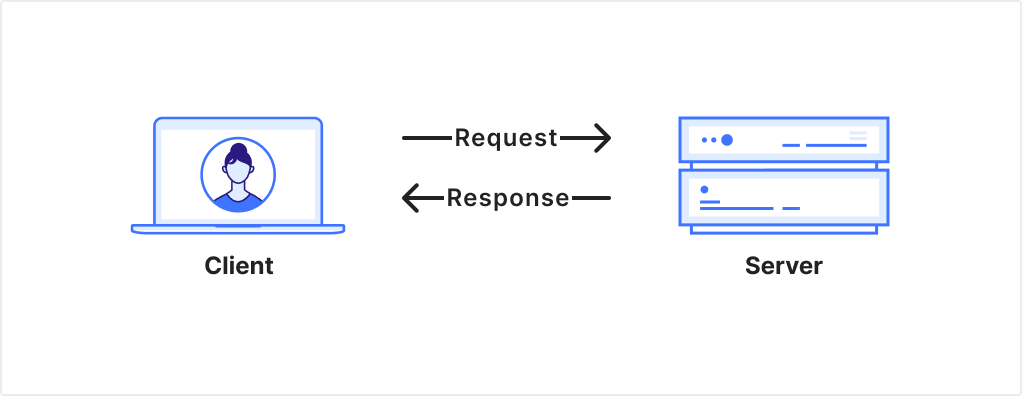
Let’s take a step back, and look at one of the main deployment patterns on the Internet: the client-server model. A client makes a request to a server to obtain a resource:
Figure 1: Client-Server model. A client sends a request which the server responds to.
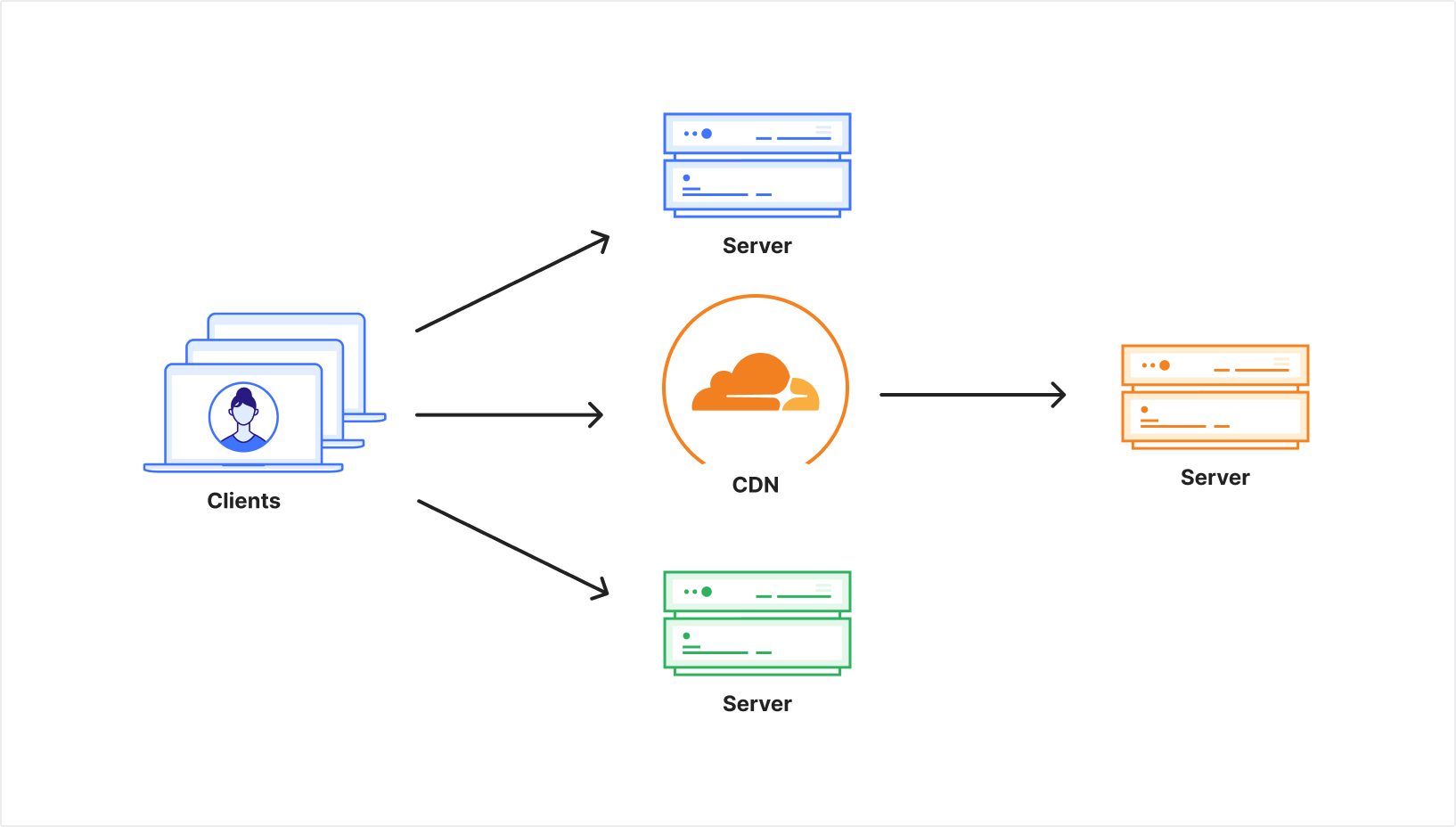
To handle more requests, a website can increase its capacity to serve; it can deploy additional servers or place a cache in front of static traffic. Similarly, the number of requests coming from the client side can increase if one client makes more requests, or if the number of clients multiplies.
Figure 2: Multiple clients send multiple requests to different servers, with one fronted by a CDN.
That simplicity is part of what made the Web successful. It allows many kinds of clients to exist, and it allows the network to evolve without each server needing to know exactly what software is on the other end.
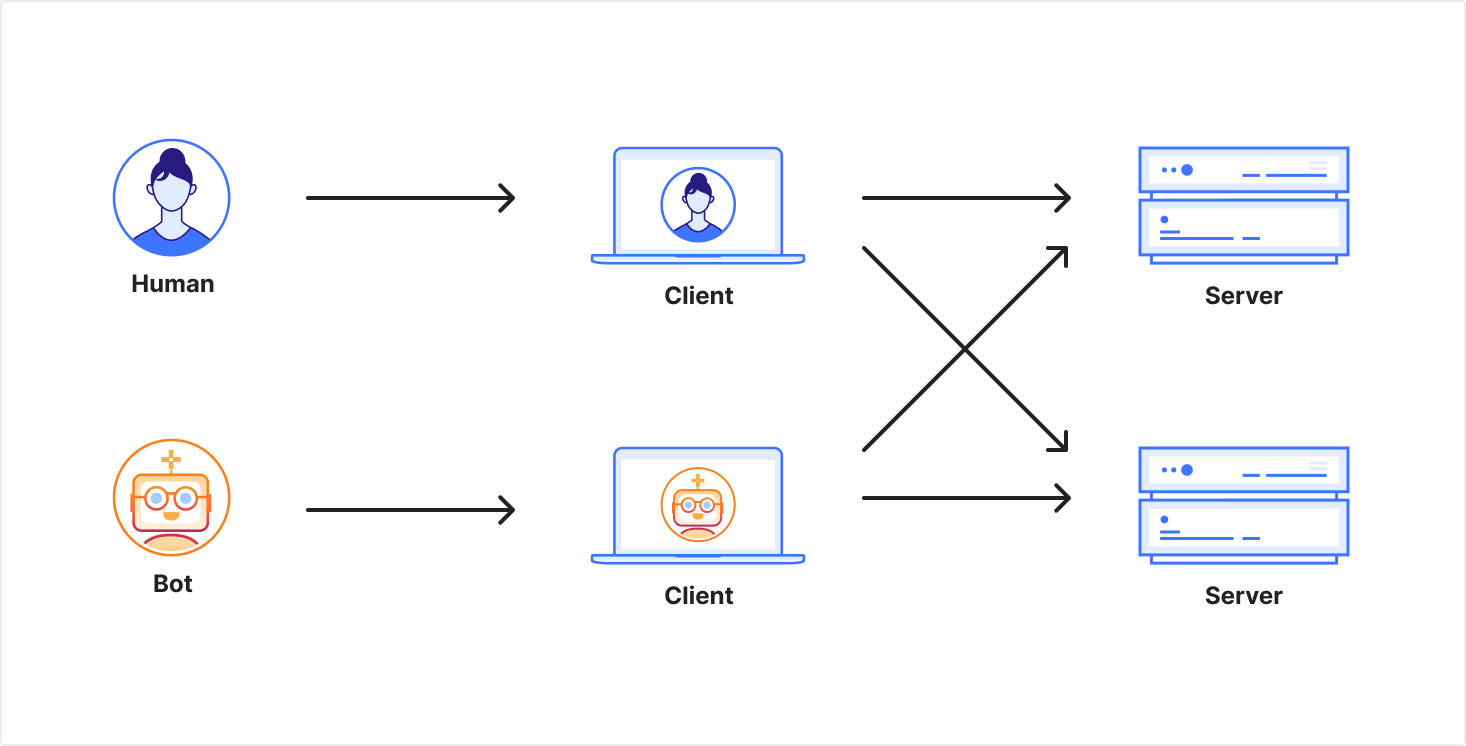
Figure 3: Two different client contexts that send requests to servers. Each server only sees a request, but not the end-user behind it.
That openness also creates uncertainty. A website can see a valid request for a resource, yet it usually cannot know what happens after the response leaves the server: whether the content is rendered for one person using a keyboard, a mouse, and a screen to control a browser; or if it’s an independent program making requests automatically, archiving responses, indexing them, and feeding into a larger system.
Bot management today
This model works surprisingly well. That is why operating a website can be as simple as starting a web server with a connection to the Internet. It holds only until the server has to decide which requests it can afford to serve, trust, or prioritize.
Sometimes that is about capacity. If your service is provisioned to handle 100 requests per second globally, but you’re receiving 200, you have to drop certain requests. If your server only has 1 CPU but incoming requests require 2, you have to drop requests. If the cost of serving 200 is prohibitive, then you have to rate-limit all requests.
You can drop requests at random. It’s possibly unfair, and may miss the target by affecting wanted clients, but it works. In the absence of other signals, there is no other choice.
And capacity is only part of the picture. Servers also try to distinguish among clients for many other reasons: to separate attacks from ordinary traffic, to manage non-malicious load, to prevent extraction of data, to limit ad fraud, to prevent fake account creation, or to stop automated actions being taken on a user’s behalf.
The difficulty is that web clients are unauthenticated by default, while still exposing many partial signals. Therefore, most servers decide to apply access control logic based on the information they receive. If a single IP address is making 10x the number of requests as others, it might be blocked. A server that goes further might infer that this IP address is used by a VPN, and therefore proxies the traffic of more than one user. The service could decide to apply a coefficient: assuming each client can make 10 requests per second, a shared IP address would be allowed 100 rps before seeing their requests being dropped.
That’s one of the keys to bot management: it aims to provide the server with more information about the client to help it make decisions. This information is inherently imprecise, because the client is not under the control of the server. In addition, the same information creates fingerprint vectors that can be used by the server for different purposes such as personalized advertising. This transforms a mitigation vector to a tracking vector.
At a high level, the server sees the following signals from the client:
Passive client signals: required to make a request on the Internet. Clients necessarily send your IP address, and usually establish a TLS session.
Active client signals: voluntarily provided by the client, often invisible to the end user. This includes a User-Agent header or authentication credentials.
Server signals: information the server observes, such as the geographic location of the edge server handling the request, or the local time the request is received.
To limit and cap volumetric abuse, what matters to the origin is the capability and intent of the client to make multiple requests. In the case of an ad-funded website, the origin needs confidence that ads are actually displayed to the end-user. To preserve their brand, origins may want to ensure that the client has specific rendering capabilities: PDF reader, SVG renderer, virtual keyboard. And if the request is coming from an intercepting proxy, the origin may want to ensure that the request actually originates from an end client
If traffic grows then so do the costs to operate. If clients do not generate value, monetary or not, then the server has no incentive to cover those costs.
Different operators respond to this environment differently. Some large crawlers and platforms identify themselves because predictable access is worth the cost of being attributable. It may even help. Others try to avoid identification: because they expect to be blocked, because they seek anonymity, or because they are operating on behalf of end users. The result is an unstable balance built on partial signals.
This is why the human versus bots frame is misleading. What the origin cares about is not humanity in the abstract, but whether the client is behaving in ways the site can support.
There’s a fundamental tension in how we govern access on the Internet: decentralized, anonymous, accountable — pick two.
Fully decentralized + anonymous means no accountability. A blocked client can spawn a new account without impact on its reputation. This implies that origins have to invest more to manage their resources. This is the default of the Web.
Decentralized + accountable means everyone knows who you are, which works for certain use cases but has clear drawbacks. Think OAuth mechanisms such as “Log in with”, which requires account registration and revealing activity to a third party.
Anonymous + accountable likely requires governance, rules, and enforcement. No widely deployed system achieves both properties for the same actor. The closest precedent is the Web PKI, where governance (CA policies, Certificate Transparency) holds servers accountable. When that governance fails, there are consequences. No equivalent exists today for the client side.
Current tools build on elements from that first space to strive for the second: TLS fingerprints, IP addresses, robots.txt. They attempt accountability, but only hold as long as the derived fingerprints remain stable.
The important distinctions are what, not who
For a website owner deciding how to handle incoming traffic, the meaningful distinction isn’t necessarily bots vs. humans. It’s about balancing the origin’s needs to understand the traffic it receives with the clients’ needs to preserve their privacy.
Platforms and services that want to be identifiable
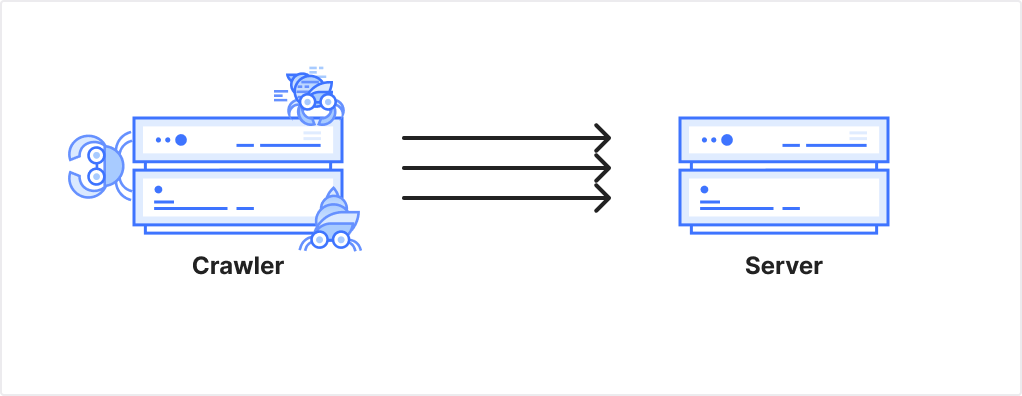
Figure 5: A crawler makes multiple request to a server
Some traffic comes from known operators making high volumes of requests: search engine crawlers, cloud platforms, enterprise infrastructure. These actors often have low privacy expectations. They’re infrastructure making millions of requests from identifiable sources. The ability to identify the source of a request helps to mitigate misjudgment if an infrastructure provider is sending you too many requests or accessing pages it should not. Self-identification is one of the principles for responsible AI bots we proposed. It is based on these principles that Cloudflare operates its URL scanner for Radar, or how we expose crawling capabilities.
For this traffic, identity works. More precisely, some operators can tolerate attributable requests because reliable access is worth it. Web Bot Auth using HTTP Message Signatures allow operators to cryptographically sign their requests. OpenAI, Google, Cloudflare, or AWS, for example, sign requests originating from their platforms. Origins can verify “this request really came from the platform infrastructure” without relying on IP ranges or User-Agent strings.
Humans and other end-users rightfully have expectations other than being identifiable, to preserve anonymity without sacrificing their access and quality of experience.
Distributed traffic that needs anonymity
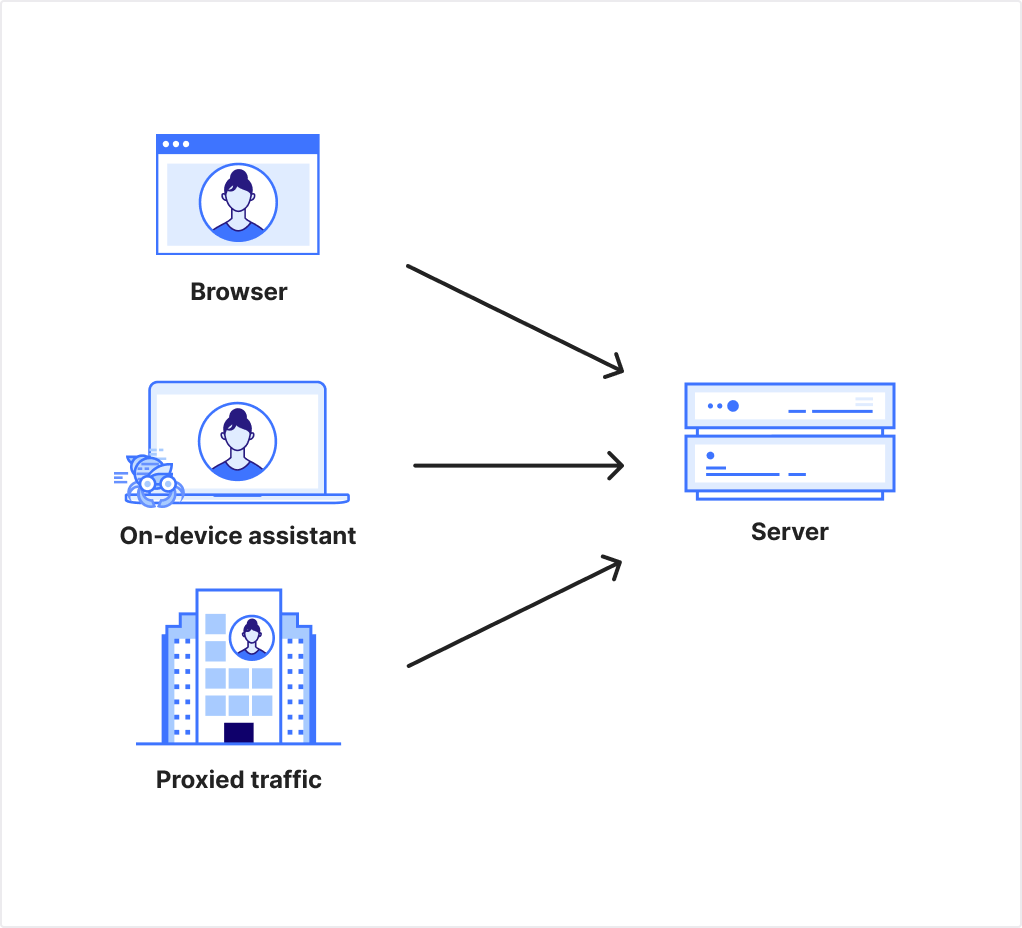
Figure 6: Three distinct browsers make a request to a server. One is operated by a human, one by an on-device assistant, and one is proxied through a corporate proxy.
Other traffic comes from many sources, each making relatively few requests. This includes humans browsing the web, researchers doing measurements, scrapers using residential proxies, and increasingly, AI assistants acting on humans’ behalf.
And increasingly the distinction between bots and humans is moot. There is no meaningful difference between the AI assistant booking concert tickets and the human who would have done so manually. Both are distributed. Both need anonymity. In each case, an origin would want to create less friction for users who wish to use the service as intended, rather than abuse it.
Identity could work. To replace the old assumption we had for IP addresses, it should provide a unique, verifiable set of attributes tied to a specific client, proven through an account login, an email address, or a hardware key. However, it implies the need to present this identity when accessing websites. It also undermines privacy.
We want to build modern solutions that prove behavior without proving identity.
Anonymous credentials for the Web
Since 2019, clients accessing websites via Cloudflare have been able to provide such proof of behavior, by sending a privacy token along with their request. This is due to Cloudflare’s early support for Privacy Pass. Privacy Pass, as standardised in RFC 9576, RFC 9578, lets a client carry an issuer-backed proof of some prior check, such as having solved a challenge, without turning that result into a stable identifier. It defines tokens that are unlinkable with any prior visit, request, or session.
This matters because it offers a different model from fingerprinting. Instead of collecting passive signals, the server can ask the client for an active privacy-preserving signal.
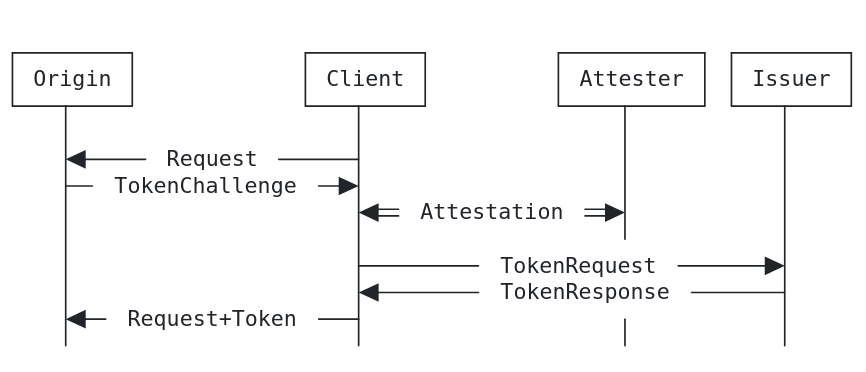
Figure 7: Privacy Pass Redemption and Issuance Protocol Interaction from Section 3.1 of RFC 9576
The RFC highlights four roles. The issuer trusts one or more attesters to perform some checks before issuing credentials (tokens in the RFC case). The client holds these credentials and decides when to present them, within the right scope. The origin remains in control of which issuers it trusts and what each presentation means. This does not remove abuse or policy questions, it simply provides clients and servers with a privacy-preserving way to handle them.
The system is simple, but it also has bounds: it does not, for example, allow for dynamic rate limits. If a client is issued 100 tokens, and starts consuming too many resources after the first or second session, there’s no way to invalidate the remaining tokens that were previously issued.
In addition, because of the unlinkability property, it’s hard for new issuers to emerge. There is no feedback mechanism that an origin can provide regarding the quality of the signal an issuer token conveys.
Finally, there’s a 1:1 relationship between the number of tokens that an issuer provides, and the number of unlinkable presentations that can be made with those tokens when they are redeemed: one token per presentation. Ideally, we would like a system in which the client contacts an issuer once and can later make multiple presentations scoped to a particular origin context. That points toward user agents holding vouched credentials and presenting proofs derived from them, rather than repeatedly acquiring single-use tokens.
With ACT, for instance, clients can prove something like “I have a good history with this service” without revealing “I am this user.” ACT preserves unlinkability between presentations at the protocol level, which is the key cryptographic property here. Even in the joint issuer-origin deployment model in Section 4.3 of RFC 9576, the protocol is designed so that token issuance and presentation are not directly linkable. That does not eliminate correlation through other layers such as IP addresses, cookies, account state, or timing. The same properties can be provided using standardized VOPRF and BlindRSA primitives within the reverse flow framework that ACT implements.
A successful ecosystem needs to be an open issuer ecosystem. In practice, that means more than saying anyone can mint credentials. Origins need to be able to decide which issuers to trust. User agents need a consistent way to present what is being requested. The ecosystem also needs ways for issuers to establish reputation and for relying parties to stop trusting low-quality issuers. No single gatekeeper should control participation.
To make this work, there needs to be a protocol and client API that works across browsers and other user agents. It has to be simple to deploy, clear to users, and narrow enough that browsers can place limits on abusive proof requests rather than merely surfacing them.
The trajectory if we do nothing
Website owners are already reacting to the disruption caused by emerging clients. This is partly caused by large-scale scraping and model training, and also by user agents acting in ways sites did not anticipate. Websites, therefore, have asked for more technical means to block AI crawlers and associated tools. In an ecosystem where the lines between bots and humans are increasingly blurred, the measures we have today will become less effective on their own.
If those measures aren’t effective, we can expect sites to pivot: requiring an account to see any content, or tying access to a stable identifier. This means no more ad-supported login-free articles, no more “three free articles a month.” Other content businesses may move away from the Web completely, offering their data and services directly to AI vendors for a fee, or within walled gardens operated by large platforms.
These outcomes are bad. Everyone benefits from the open access to information that the Web offers. It is not that all sites will make these choices. There are many reasons for offering content online, and not all of them are commercial. But if enough sites do, they change what “normal” is on the Web to be something worse.
That matters because the open Web is an environment in which different clients can gather information from different sources without relying on a handful of players. We also benefit from having a diversity of sources of information. On a Web where access to information is largely mediated through a small handful of companies, we put too much power into too few hands. The result is not just more friction for anonymous clients, but a more brittle Internet with fewer ways for publishers to meet users.
Anonymous authentication brings some risk, too
We should be clear about what we’re building. Infrastructure for proving properties can become infrastructure for requiring properties. Anonymous credentials are meant to prove something about their holder; for example, “I solved a challenge” or “I have not exceeded a rate limit.” But a system that can prove any single attribute is also capable of proving other attributes, which is a source of concern.
Today, presenting a Privacy Pass token may convey “solved a CAPTCHA”. Tomorrow, the same systems could prove entirely different attributes. For instance, issuing tokens only to devices that “have device attestation” excludes older devices and their users. Similarly, requiring attributes such as “has an Apple or Google account” excludes users of non-mainstream platforms.
Once the infrastructure exists to verify anonymous proofs, what gets proven can expand. We need to make sure this does not gate access to the Internet.
Why we should build it anyway
Gates already exist. Platforms increasingly require identity. Websites are blocking traffic coming from shared proxies. The question isn’t whether gates will appear, it’s whether the user remains in control of their privacy.
As we’ve discussed, bot management requires some signals to be shared. The alternatives to anonymous proofs are worse. Without the ability to prove attributes anonymously, every gate requires fingerprints: retry from a specific browser, link your account, don’t use a VPN. These may not even be options to people, such as the ones which have no idea their connections are proxied.
Privacy-preserving credentials do not remove the need for trust or policy. They can make those demands more explicit and less pervasive. Unlike fingerprints, proofs are explicit. Users can see what is being asked, and clients such as web browsers and AI assistants can help enforce consent.
To decide, use this guardrail
There is a simple test to evaluate the next methods for the Internet that serves everyone: do the methods allow anyone, from anywhere in the world, to build their own device, their own browser, use any operating system, and get access to the Web. If that property cannot hold, if device attestation from specific manufacturers becomes the only viable signal, we should stop.
This means we need to foster an open issuer ecosystem, where no single gatekeeper decides who can participate. In the rate limit trilemma, decentralization is mandatory on the open Web. We don’t yet know fully how to build it, but we know we need to foster it.
A new balance
Until now the Web has largely been in balance. Some aspects may have been a happy accident, while others could have been inevitable. For many end users and publishers, it worked because the Web stayed open enough to support a variety of clients accessing a similar variety of resources.
That balance is at risk. Privacy-preserving primitives for the Web are one attempt to build a different outcome: privacy-preserving, open, accountable. It is not guaranteed to succeed. But it is better than waiting.
If you are interested in tracking and participating, this work happens in the open at the IETF and at the W3C. We believe the existing places where people gathered to shape the Web of today are the best places to design the Web of tomorrow.
WebinarTV searches the internet for public Zoom invites, joins the meetings, secretly records them, and publishes (alternate link) the recordings. It doesn’t use the Zoom record feature, so Zoom can’t do anything about it.
Exactly 8 years ago today, we launched the 1.1.1.1 public DNS resolver, with the intention to build the world’s fastest resolver — and the most private one. We knew that trust is everything for a service that handles the “phonebook of the Internet.” That’s why, at launch, we made a unique commitment to publicly confirm that we are doing what we said we would do with personal data. In 2020, we hired an independent firm to check our work, instead of just asking you to take our word for it. We shared our intention to update such examinations in the future. We also called on other providers to do the same, but, as far as we are aware, no other major public resolver has had their DNS privacy practices independently examined.
At the time of the 2020 review, the 1.1.1.1 resolver was less than two years old, and the purpose of the examination was to prove our systems made good on all the commitments we made about how our 1.1.1.1 resolver functioned, even commitments that did not impact personal data or user privacy.
Since then, Cloudflare’s technology stack has grown significantly in both scale and complexity. For example, we built an entirely new platform that powers our 1.1.1.1 resolver and other DNS systems. So we felt it was vital to review our systems, and our 1.1.1.1 resolver privacy commitments in particular, once again with a rigorous and independent review.
Today, we are sharing the results of our most recent privacy examination by the same Big 4 accounting firm. Its independent examination is available on our compliance page.
Following the conclusion of the 2024 calendar year, we began our comprehensive process of collecting and preparing evidence for our independent auditors. The examination took several months and required many teams across Cloudflare to provide supporting evidence of our privacy controls in action. After the independent auditors’ completion of the examination, we’re pleased to share the final report, which provides assurance that our commitments were met: our systems are as private as promised. Most importantly, our core privacy guarantees for the 1.1.1.1 resolver remain unchanged and confirmed by independent review:
Cloudflare will not sell or share public resolver users’ personal data with third parties or use personal data from the public resolver to target any user with advertisements.
Cloudflare will only retain or use what is being asked, not information that will identify who is asking it.
Source IP addresses are anonymized and deleted within 25 hours.
We also want to be transparent about two points. First: as we explained in our 2020 blog announcing the results of our previous examination, randomly sampled network packets (at most 0.05% of all traffic, including the querying IP address of 1.1.1.1 public resolver users) are used solely for network troubleshooting and attack mitigation.
Second, the scope of this examination focuses exclusively on our privacy commitments. Back in 2020, our first examination reviewed all of our representations, not only our privacy commitments but our description of how we would handle anonymized transaction and debug log data (“Public Resolver Logs”) for the legitimate operation of our Public Resolver and research purposes. Over time, our uses of this data to do things like power Cloudflare Radar, which was released after our initial 1.1.1.1 examination, have changed how we treat those logs, even though there is no impact on personal information or personal privacy.
As we noted with the first review 6 years ago: we’ve never wanted to know what individuals do on the Internet, and we’ve taken technical steps to ensure we can’t. At Cloudflare, we believe privacy should be the default. By proactively undergoing these independent examinations, we hope to set a standard for the rest of the industry. We believe every user, whether they are browsing the web directly or deploying an AI agent on their behalf, deserves an Internet that doesn’t track their movement. And further, Cloudflare steadfastly stands behind the commitment in our Privacy Policy that we will not combine any information collected from DNS queries to the 1.1.1.1 resolver with any other Cloudflare or third-party data in any way that can be used to identify individual end users.
As always, we thank you for trusting 1.1.1.1 to be your gateway to the Internet. Details of the 1.1.1.1 resolver privacy examination and our accountant’s report can be found on Cloudflare’s Certifications and compliance resources page. Visit https://developers.cloudflare.com/1.1.1.1/ to learn more about how to get started with the Internet’s fastest, privacy-first DNS resolver.
Sen. Ron Wyden is warning us of an abuse of Section 702:
Wyden took to the Senate floor to deliver a lengthy speech, ostensibly about the since approved (with support of many Democrats) nomination of Joshua Rudd to lead the NSA. Wyden was protesting that nomination, but in the context of Rudd being unwilling to agree to basic constitutional limitations on NSA surveillance. But that’s just a jumping off point ahead of Section 702’s upcoming reauthorization deadline. Buried in the speech is a passage that should set off every alarm bell:
There’s another example of secret law related to Section 702, one that directly affects the privacy rights of Americans. For years, I have asked various administrations to declassify this matter. Thus far they have all refused, although I am still waiting for a response from DNI Gabbard. I strongly believe that this matter can and should be declassified and that Congress needs to debate it openly before Section 702 is reauthorized. In fact, when it is eventually declassified, the American people will be stunned that it took so long and that Congress has been debating this authority with insufficient information.
Over the decades, we have learned to take Wyden’s warnings seriously.
404 Media has a story about Proton Mail giving subscriber data to the Swiss government, who passed the information to the FBI.
It’s metadata—payment information related to a particular account—but still important knowledge. This sort of thing happens, even to privacy-centric companies like Proton Mail.
At Cloudflare, our mission is to help build a better Internet. Usually, that means rolling out new services to our millions of users or defending the web against the world’s largest cyber attacks. But sometimes, building a better Internet requires us to stand up against laws or regulations that threaten its fundamental architecture.
Last week, Cloudflare continued its legal battle against “Piracy Shield,” a misguided Italian regulatory scheme designed to protect large rightsholder interests at the expense of the broader Internet. After Cloudflare resisted registering for Piracy Shield and challenged it in court, the Italian communications regulator, AGCOM, fined Cloudflare a staggering €14 million (~$17 million). We appealed that fine on March 8, and we continue to challenge the legality of Piracy Shield itself.
While the fine is significant, the principles at stake are even larger. This case isn’t just about a single penalty; it’s about whether a handful of private entities can prioritize their own economic interests over those of Internet users by forcing global infrastructure providers to block large swaths of the Internet without oversight, transparency, or due process.
What is Piracy Shield?
To understand why we are fighting this, it’s necessary to take a step back and understand Piracy Shield. Marketed by AGCOM as an innovative tool to fight copyright infringement, the system is better understood as a blunt tool for rightsholders to control what is available on the Internet without any traditional legal safeguards.
Piracy Shield is an unsupervised electronic portal through which an unidentified set of Italian media companies can submit websites and IP addresses that online service providers registered with Piracy Shield are then required to block within 30 minutes. Piracy Shield operates as a “black box” because there is:
No judicial oversight: Private companies, not judges or government officials, decide what gets blocked.
No transparency: The public, and even the service providers themselves, are often left in the dark about who requested a block or why.
No due process: There is no mechanism for a website owner to challenge a block before their site becomes unavailable on the Italian web.
No redress: Along with a complete lack of transparency or due process, Piracy Shield offers no effective way for impacted parties to seek redress from erroneous blocking.
It’s not entirely surprising that Piracy Shield so clearly prioritizes the economic interests of media companies over the rights of Italian Internet users. The system was “donated” to the Italian government by SP Tech, an arm of the law firm that represents several of Piracy Shield’s major direct beneficiaries, including Lega Nazionale Professionisti Serie A (Italy’s major soccer league).
The high cost of Piracy Shield
Almost immediately after Piracy Shield was rolled out, there were significant problems. In addition to the unworkable 30-minute deadline and the lack of safeguards described above, the scheme requires service providers to engage in IP address blocking. This creates an unavoidable risk of overblocking innocent websites due to the fact that IP addresses are regularly and necessarily shared by thousands of websites. Not surprisingly, within a few months of its launch, Piracy Shield caused major outages for people and businesses who had done nothing wrong.
Notable failures include:
Government and educational blackouts: Tens of thousands of legitimate sites were rendered inaccessible from Italy, including Ukrainian government websites for schools and scientific research.
Small business & NGO disruption: A wide range of European small businesses and NGOs focused on social programs for women and children were inadvertently blocked.
Loss of essential services: The system blocked access to Google Drive for over 12 hours, preventing thousands of Italian students and professionals from accessing critical files.
Persistent collateral blocking: A September 2025 study by the University of Twente confirmed that the system routinely blocks legitimate websites for months at a time.
Even when faced with clear evidence that Piracy Shield has caused significant and repeated overblocking, AGCOM did not change course. Rather, it chose to expand Piracy Shield to apply to global DNS providers and VPNs, services which are closely associated with privacy and free expression. AGCOM also started taking increasingly aggressive steps to force global service providers, even ones with no legal or operational presence in Italy, to register with Piracy Shield.
Cloudflare’s principled challenge
Cloudflare has been clear about the risks posed by Piracy Shield from the beginning. In 2024, we met with AGCOM to highlight the scheme’s structural flaws and consequences and proposed more effective ways to collaborate that wouldn’t break the Internet’s core architecture.
When these concerns were ignored, we moved on to legal action. We challenged AGCOM’s effort to force Cloudflare to join Piracy Shield in the Italian administrative courts and, along with the Computer & Communications Industry Association (CCIA), we filed a complaint with the European Commission. More informally, we have continued to reach out to government officials both in Italy and at the EU level to explain our position and make our concerns known. Our position has been consistent and remains that Piracy Shield is incompatible with EU law, most notably the Digital Services Act (DSA), which requires that any content restriction be proportionate and subject to strict procedural safeguards.
The European Commission, following our complaint, expressed similar concerns, issuing a letter on June 13, 2025, criticizing the lack of oversight inherent in the Piracy Shield framework. And on December 23, 2025, the Italian administrative court issued an encouraging ruling requiring AGCOM to share with Cloudflare all the records that purportedly support Piracy Shield blocking orders. While we have not yet received those records, we expect them to shed significant light on Piracy Shield’s operations.
An excessive fine and still no transparency
Rather than awaiting the outcome of our legal challenges, and less than one week after being ordered to disclose Piracy Shield records to Cloudflare, AGCOM moved on December 29, 2025, to issue its fine. The fine’s timing was not the only eyebrow-raising thing about it. The math behind the penalty is as flawed as the system it is seeking to enforce.
Under Italian law, fines for non-compliance are capped at 2% of a company’s revenue within the relevant jurisdiction. Based on Cloudflare’s Italian earnings, that cap should have limited any fine to approximately €140,000. Instead, AGCOM calculated the fine based on our global revenue, resulting in a penalty nearly 100 times higher than the legal limit.
This disproportionate approach sends a chilling message to the global tech community: if you question a flawed regulatory system or defend the rights of your users and the global Internet, you risk facing punitive and excessive financial retaliation.
At the same time, AGCOM still has not shared with Cloudflare the Piracy Shield records that it was ordered to disclose. Instead, just four days before the deadline for disclosure, AGCOM informed us that it would make some of the records available for inspection at an AGCOM facility in Naples, subject to supervision by AGCOM officials. These limitations are not just unreasonably burdensome and contrary to the letter and spirit of the disclosure order; they raise real questions about why AGCOM is so intent on resisting transparency.
Next steps: the path forward
We are not backing down. Cloudflare is appealing the €14 million fine, pushing for full access to AGCOM’s Piracy Shield records, and will continue to challenge the underlying legality of the Piracy Shield blocking orders in the Italian administrative courts.
We recognize that rightsholders have a legitimate interest in protecting their content. In fact, we work with rightsholders every day to address infringement in ways that are precise and effective. But those interests cannot override the basic requirements of legal due process or the technical integrity of the global Internet and our network.
We will continue to pursue this challenge in the Italian courts and through the European Commission. Global connectivity is too important to be governed by “black boxes” with 30-minute deadlines that result in widespread overblocking with no means of redress. Cloudflare remains committed to building a better Internet: one where the rules are transparent, the regulators are accountable, and the infrastructure that connects the world remains free, open, and secure.
Cloudflare Radar already offers a wide array of security insights — from application and network layer attacks, to malicious email messages, to digital certificates and Internet routing.
And today we’re introducing even more. We are launching several new security-related data sets and tools on Radar:
We are extending our post-quantum (PQ) monitoring beyond the client side to now include origin-facing connections. We have also released a new tool to help you check any website’s post-quantum encryption compatibility.
A new Key Transparency section on Radar provides a public dashboard showing the real-time verification status of Key Transparency Logs for end-to-end encrypted messaging services like WhatsApp, showing when each log was last signed and verified by Cloudflare’s Auditor. The page serves as a transparent interface where anyone can monitor the integrity of public key distribution and access the API to independently validate our Auditor’s proofs.
Routing Security insights continue to expand with the addition of global, country, and network-level information about the deployment of ASPA, an emerging standard that can help detect and prevent BGP route leaks.
Measuring origin post-quantum support
Since April 2024, we have tracked the aggregate growth of client support for post-quantum encryption on Cloudflare Radar, chronicling its global growth from under 3% at the start of 2024, to over 60% in February 2026. And in October 2025, we added the ability for users to check whether their browser supports X25519MLKEM768 — a hybrid key exchange algorithm combining classical X25519 with ML-KEM, a lattice-based post-quantum scheme standardized by NIST. This provides security against both classical and quantum attacks.
However, post-quantum encryption support on user-to-Cloudflare connections is only part of the story.
For content not in our CDN cache, or for uncacheable content, Cloudflare’s edge servers establish a separate connection with a customer’s origin servers to retrieve it. To accelerate the transition to quantum-resistant security for these origin-facing fetches, we previously introduced an API allowing customers to opt in to preferring post-quantum connections. Today, we’re making post-quantum compatibility of origin servers visible on Radar.
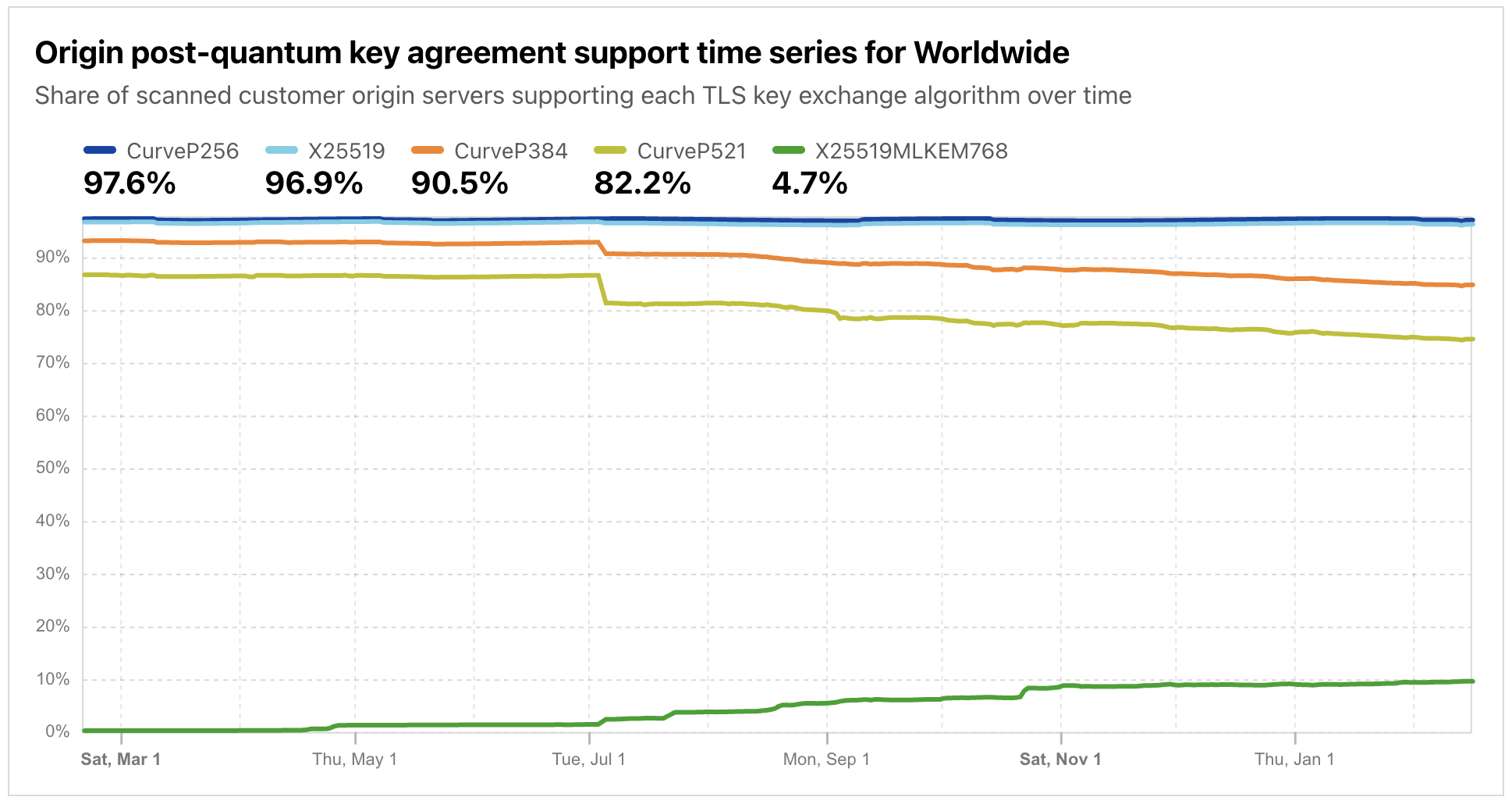
The new origin post-quantum support graph on Radar illustrates the share of customer origins supporting X25519MLKEM768. This data is derived from our automated TLS scanner, which probes TLS 1.3-compatible origins and aggregates the results daily. It is important to note that our scanner tests for support rather than the origin server’s specific preference. While an origin may support a post-quantum key exchange algorithm, its local TLS key exchange preference can ultimately dictate the encryption outcome.
While the headline graph focuses on post-quantum readiness, the scanner also evaluates support for classical key exchange algorithms. Within the Radar Data Explorer view, you can also see the full distribution of these supported TLS key exchange methods.
As shown in the graphs above, approximately 10% of origins could benefit from a post-quantum-preferred key agreement today. This represents a significant jump from less than 1% at the start of 2025 — a 10x increase in just over a year. We expect this number to grow steadily as the industry continues its migration. This upward trend likely accelerated in 2025 as many server-side TLS libraries, such as OpenSSL 3.5.0+, GnuTLS 3.8.9+, and Go 1.24+, enabled hybrid post-quantum key exchange by default, allowing platforms and services to support post-quantum connections simply by upgrading their cryptographic library dependencies.
A screenshot of the tool in Radar to test whether a hostname supports post-quantum encryption.
The tool presents a simple form where users can enter a hostname (such as cloudflare.com or www.wikipedia.org) and optionally specify a custom port (the default is 443, the standard HTTPS port). After clicking “Test”, the result displays a tag indicating PQ support status alongside the negotiated TLS key exchange algorithm. If the server prefers PQ secure connections, a green “PQ” tag appears with a message confirming the connection is “post-quantum secure.” Otherwise, a red tag indicates the connection is “not post-quantum secure”, showing the classical algorithm that was negotiated.
Under the hood, this tool uses Cloudflare Containers — a new capability that allows running container workloads alongside Workers. Since the Workers runtime is not exposed to details of the underlying TLS handshake, Workers cannot initiate TLS scans. Therefore, we created a Go container that leverages the crypto/tls package’s support for post-quantum compatibility checks. The container runs on-demand and performs the actual handshake to determine the negotiated TLS key exchange algorithm, returning results through the Radar API.
With the addition of these origin-facing insights, complementing the existing client-facing insights, we have moved all the post-quantum content to its own section on Radar.
Securing E2EE messaging systems with Key Transparency
End-to-end encrypted (E2EE) messaging apps like WhatsApp and Signal have become essential tools for private communication, relied upon by billions of people worldwide. These apps use public-key cryptography to ensure that only the sender and recipient can read the contents of their messages — not even the messaging service itself. However, there’s an often-overlooked vulnerability in this model: users must trust that the messaging app is distributing the correct public keys for each contact.
If an attacker were able to substitute an incorrect public key in the messaging app’s database, they could intercept messages intended for someone else — all without the sender knowing.
Key Transparency addresses this challenge by creating an auditable, append-only log of public keys — similar in concept to Certificate Transparency for TLS certificates. Messaging apps publish their users’ public keys to a transparency log, and independent third parties can verify and vouch that the log has been constructed correctly and consistently over time. In September 2024, Cloudflare announced such a Key Transparency auditor for WhatsApp, providing an independent verification layer that helps ensure the integrity of public key distribution for the messaging app’s billions of users.
Today, we’re publishing Key Transparency audit data in a new Key Transparency section on Cloudflare Radar. This section showcases the Key Transparency logs that Cloudflare audits, giving researchers, security professionals, and curious users a window into the health and activity of these critical systems.
The new page launches with two monitored logs: WhatsApp and Facebook Messenger Transport. Each monitored log is displayed as a card containing the following information:
Status: Indicates whether the log is online, in initialization, or disabled. An “online” status means the log is actively publishing key updates into epochs that Cloudflare audits. (An epoch represents a set of updates applied to the key directory at a specific time.)
Last signed epoch: The most recent epoch that has been published by the messaging service’s log and acknowledged by Cloudflare. By clicking on the eye icon, users can view the full epoch data in JSON format, including the epoch number, timestamp, cryptographic digest, and signature.
Last verified epoch: The most recent epoch that Cloudflare has verified. Verification involves checking that the transition of the transparency log data structure from the previous epoch to the current one represents a valid tree transformation — ensuring the log has been constructed correctly. The verification timestamp indicates when Cloudflare completed its audit.
Root: The current root hash of the Auditable Key Directory (AKD) tree. This hash cryptographically represents the entire state of the key directory at the current epoch. Like the epoch fields, users can click to view the complete JSON response from the auditor.
The data shown on the page is also available via the Key Transparency Auditor API, with endpoints for auditor information and namespaces.
If you would like to perform audit proof verification yourself, you can follow the instructions in our Auditing Key Transparency blog post. We hope that these use cases are the first of many that we publish in this Key Transparency section in Radar — if your company or organization is interested in auditing for your public key or related infrastructure, you can reach out to us here.
Tracking RPKI ASPA adoption
While the Border Gateway Protocol (BGP) is the backbone of Internet routing, it was designed without built-in mechanisms to verify the validity of the paths it propagates. This inherent trust has long left the global network vulnerable to route leaks and hijacks, where traffic is accidentally or maliciously detoured through unauthorized networks.
Although RPKI and Route Origin Authorizations (ROAs) have successfully hardened the origin of routes, they cannot verify the path traffic takes between networks. This is where ASPA (Autonomous System Provider Authorization)comes in. ASPA extends RPKI protection by allowing an Autonomous System (AS) to cryptographically sign a record listing the networks authorized to propagate its routes upstream. By validating these Customer-to-Provider relationships, ASPA allows systems to detect invalid path announcements with confidence and react accordingly.
While the specific IETF standard remains in draft, the operational community is moving fast. Support for creating ASPA objects has already landed in the portals of Regional Internet Registries (RIRs) like ARIN and RIPE NCC, and validation logic is available in major software routing stacks like OpenBGPD and BIRD.
To provide better visibility into the adoption of this emerging standard, we have added comprehensive RPKI ASPA support to the Routing section of Cloudflare Radar. Tracking these records globally allows us to understand how quickly the industry is moving toward better path validation.
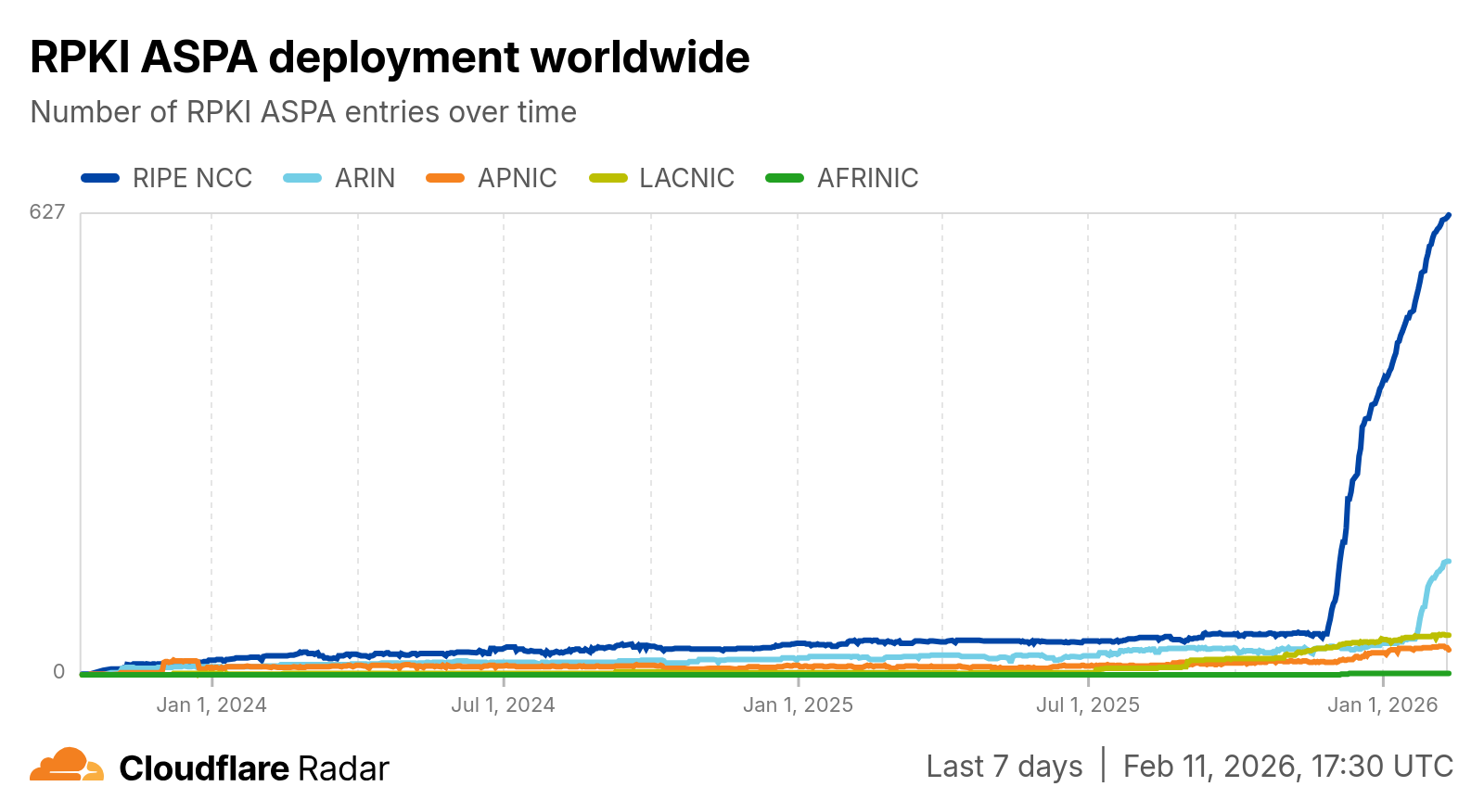
Our new ASPA deployment view allows users to examine the growth of ASPA adoption over time, with the ability to visualize trends across the five Regional Internet Registries (RIRs) based on AS registration. You can view the entire history of ASPA entries, dating back to October 1, 2023, or zoom into specific date ranges to correlate spikes in adoption with industry events, such as the introduction of ASPA features on ARIN and RIPE NCC online dashboards.
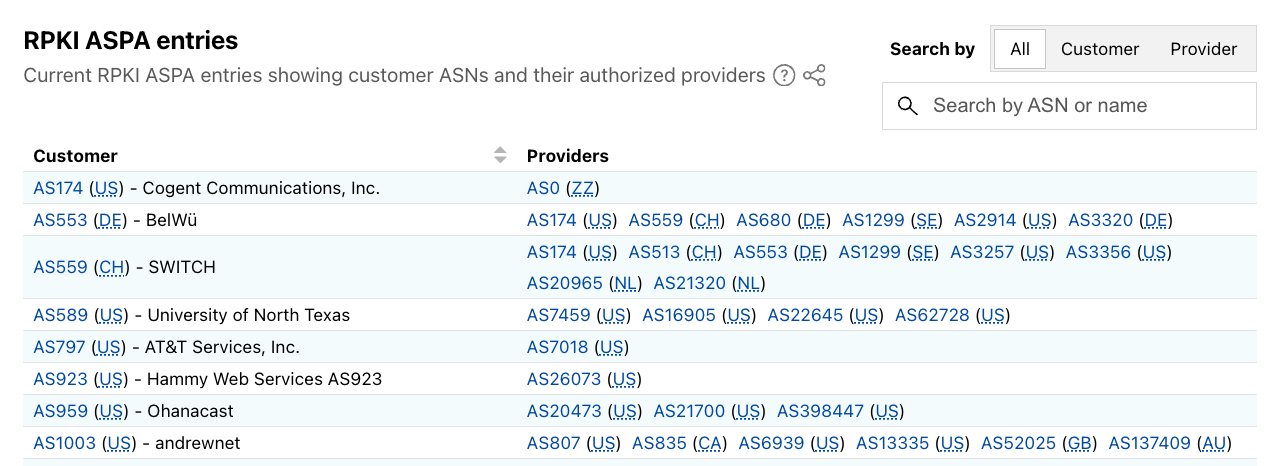
Beyond aggregate trends, we have also introduced a granular, searchable explorer for real-time ASPA content. This table view allows you to inspect the current state of ASPA records, searchable by AS number, AS name, or by filtering for only providers or customer ASNs. This allows network operators to verify that their records are published correctly and to view other networks’ configurations.
We have also integrated ASPA data directly into the country/region routing pages. Users can now track how different locations are progressing in securing their infrastructure, based on the associated ASPA records from the customer ASNs registered locally.
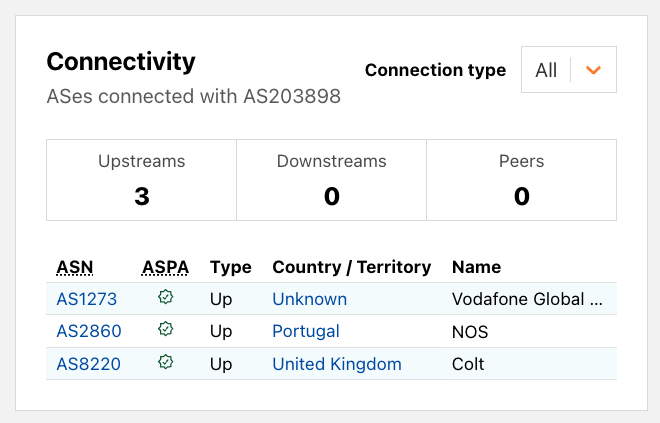
On individual AS pages, we have updated the Connectivity section. Now, when viewing the connections of a network, you may see a visual indicator for “ASPA Verified Provider.” This annotation confirms that an ASPA record exists authorizing that specific upstream connection, providing an immediate signal of routing hygiene and trust.
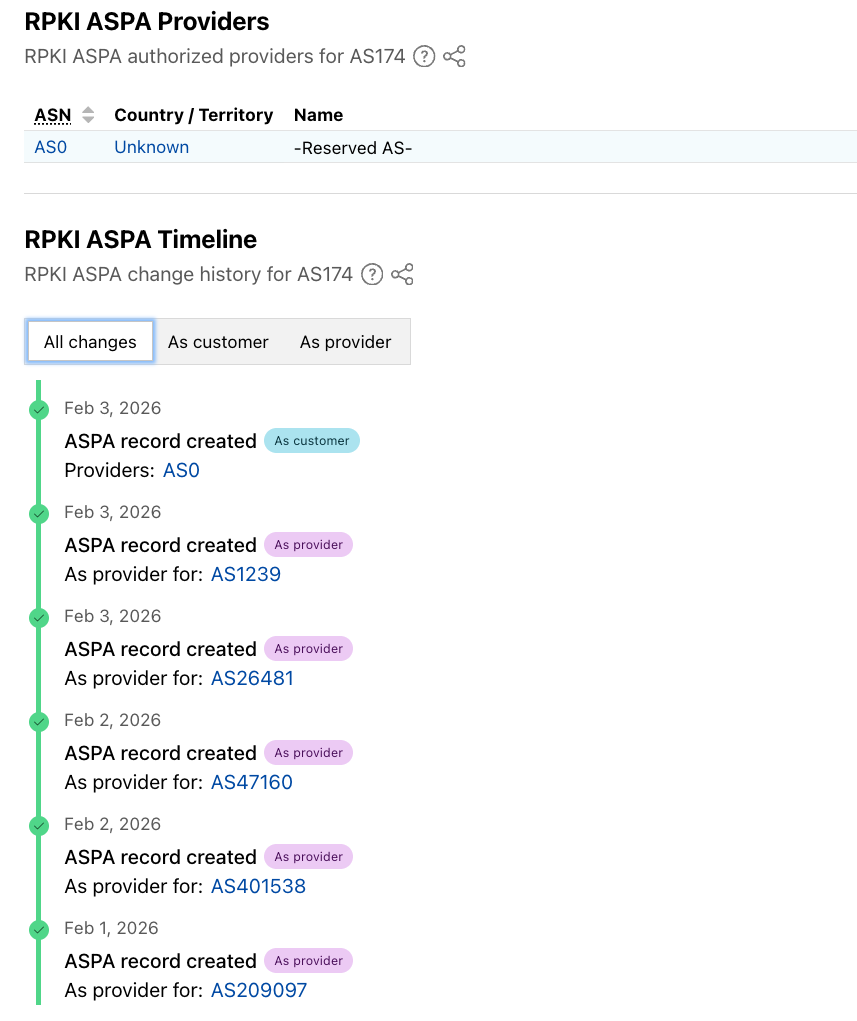
For ASes that have deployed ASPA, we now display a complete list of authorized provider ASNs along with their details. Beyond the current state, Radar also provides a detailed timeline of ASPA activity involving the AS. This history distinguishes between changes initiated by the AS itself (“As customer”) and records created by others designating it as a provider (“As provider”), allowing users to immediately identify when specific routing authorizations were established or modified.
Visibility is an essential first step toward broader adoption of emerging routing security protocols like ASPA. By surfacing this data, we aim to help operators deploy protections and assist researchers in tracking the Internet’s progress toward a more secure routing path. For those who need to integrate this data into their own workflows or perform deeper analysis, we are also exposing these metrics programmatically. Users can now access ASPA content snapshots, historical timeseries, and detailed changes data using the newly introduced endpoints in theCloudflare Radar API.
As security evolves, so does our data
Internet security continues to evolve, with new approaches, protocols, and standards being developed to ensure that information, applications, and networks remain secure. The security data and insights available on Cloudflare Radar will continue to evolve as well. The new sections highlighted above serve to expand existing routing security, transparency, and post-quantum insights already available on Cloudflare Radar.
If you share any of these new charts and graphs on social media, be sure to tag us: @CloudflareRadar (X), noc.social/@cloudflareradar (Mastodon), and radar.cloudflare.com (Bluesky). If you have questions or comments, or suggestions for data that you’d like to see us add to Radar, you can reach out to us on social media, or contact us via email.
New York is contemplating a bill that adds surveillance to 3D printers:
New York’s 20262027 executive budget bill (S.9005 / A.10005) includes language that should alarm every maker, educator, and small manufacturer in the state. Buried in Part C is a provision requiring all 3D printers sold or delivered in New York to include “blocking technology.” This is defined as software or firmware that scans every print file through a “firearms blueprint detection algorithm” and refuses to print anything it flags as a potential firearm or firearm component.
I get the policy goals here, but the solution just won’t work. It’s the same problem as DRM: trying to prevent general-purpose computers from doing specific things. Cory Doctorow wrote about it in 2018 and—more generally—spoke about it in 2011.
404Media is reporting that the FBI could not access a reporter’s iPhone because it had Lockdown Mode enabled:
The court record shows what devices and data the FBI was able to ultimately access, and which devices it could not, after raiding the home of the reporter, Hannah Natanson, in January as part of an investigation into leaks of classified information. It also provides rare insight into the apparent effectiveness of Lockdown Mode, or at least how effective it might be before the FBI may try other techniques to access the device.
“Because the iPhone was in Lockdown mode, CART could not extract that device,” the court record reads, referring to the FBI’s Computer Analysis Response Team, a unit focused on performing forensic analyses of seized devices. The document is written by the government, and is opposing the return of Natanson’s devices.
The FBI raided Natanson’s home as part of its investigation into government contractor Aurelio Perez-Lugones, who is charged with, among other things, retention of national defense information. The government believes Perez-Lugones was a source of Natanson’s, and provided her with various pieces of classified information. While executing a search warrant for his mobile phone, investigators reviewed Signal messages between Pere-Lugones and the reporter, the Department of Justice previously said.
Microsoft gives the FBI the ability to decrypt BitLocker in response to court orders: about twenty times per year.
It’s possible for users to store those keys on a device they own, but Microsoft also recommends BitLocker users store their keys on its servers for convenience. While that means someone can access their data if they forget their password, or if repeated failed attempts to login lock the device, it also makes them vulnerable to law enforcement subpoenas and warrants.
The Irish government is planning to bolster its police’s ability to intercept communications, including encrypted messages, and provide a legal basis for spyware use.
The collective thoughts of the interwebz
Manage Consent
To provide the best experiences, we use technologies like cookies to store and/or access device information. Consenting to these technologies will allow us to process data such as browsing behavior or unique IDs on this site. Not consenting or withdrawing consent, may adversely affect certain features and functions.
Functional
Always active
The technical storage or access is strictly necessary for the legitimate purpose of enabling the use of a specific service explicitly requested by the subscriber or user, or for the sole purpose of carrying out the transmission of a communication over an electronic communications network.
Preferences
The technical storage or access is necessary for the legitimate purpose of storing preferences that are not requested by the subscriber or user.
Statistics
The technical storage or access that is used exclusively for statistical purposes.The technical storage or access that is used exclusively for anonymous statistical purposes. Without a subpoena, voluntary compliance on the part of your Internet Service Provider, or additional records from a third party, information stored or retrieved for this purpose alone cannot usually be used to identify you.
Marketing
The technical storage or access is required to create user profiles to send advertising, or to track the user on a website or across several websites for similar marketing purposes.