Tag Archives: Radar

Offline celebrations: how Christmas, NYE, and Lunar New Year festivities shape online behavior

Post Syndicated from João Tomé original https://blog.cloudflare.com/offline-celebrations-how-christmas-nye-and-lunar-new-year-festivities-shape-online-behavior/

Now that 2025 has been here for a few weeks and 2024 has closed with a variety of year-end traditions — from Christmas and Hanukkah celebrations to New Year’s Eve (NYE) countdowns, as well as celebrations of Orthodox Christmas, and Lunar/Chinese New Year — let’s examine how these events have shaped online behavior across continents and cultures. Reflecting on Christmas and NYE 2024 provides insights into how these trends compared with those of the previous year, as detailed in an earlier blog.

One notable finding is the remarkable consistency in human online patterns from one year to the next, a trend that persists despite cultural differences among countries. Data from over 50 countries reveal how people celebrated in 2024–2025, offering a timely reminder of typical holiday trends. While Christmas remains a dominant influence in many regions, other cultural and religious events — such as Hanukkah and local festivities — also shape online habits where Western traditions hold less sway.

In regions where Christmas is deeply rooted, Internet traffic dips significantly during Christmas Eve dinners, midnight masses, morning gift exchanges, and Christmas Day lunches, a pattern evident in both our previous and current analyses.

This analysis focuses exclusively on non-bot Internet traffic, filtering out automated activity to highlight genuine human behavior during the most recent holiday season. Before going into specific countries, here’s a global hourly snapshot (UTC-based) of Christmas and New Year’s Eve 2024 traffic from the Cloudflare Radar Data Explorer


This worldwide perspective captures notable drops across a 23-hour window, from New Zealand to Hawaii. Globally, December 25 saw a 19% drop in traffic from the previous week, followed by December 24 with a 14% drop. This holiday period also included the four days with the lowest global traffic during the period between October 1, 2024, and February 6, 2025. In descending order, these days were: December 25, December 24, January 1, 2025, and December 31, 2024.

Some key takeaways:

  • Europe: Christmas Eve drops in Internet traffic reached up to 67% (seen in Denmark; Spain reached 66%).

  • Americas: December 25 was key, with drops ranging from 26% in the US and up to 70% at midnight in Argentina.

  • Regional timing differs: Nordic countries on Christmas Eve disconnect earlier at around 18:00, Southern Europe at 21:00-22:00, and Latin America even later.

  • New Year’s shows worldwide impact, strongest in Latin America: a 73% drop in Chile, followed by 68% drop in Argentina.

  • Lunar New Year: January 29 is a peak offline moment, with drops of 25% in Hong Kong, 23% in Singapore, and 24% in Vietnam.

Note: Unless otherwise noted, all times used in this blog post are local ones; in countries with several timezones, we’re using the timezone where more people live. For the US, Eastern time is used.

Global Christmas and New Year’s Eve daily trends

In this analysis, we apply the same methods as our previous blog post to rank countries and regions by their lowest holiday traffic dates, showing each day’s percentage drop. Many locations, such as the United States, experience clear dips on December 24 and 25 as people disconnect for Christmas Eve and Christmas Day celebrations. In contrast, some regions show smaller declines on December 31 as the New Year approaches. The order and magnitude of these drops vary by country, reflecting cultural nuances — some nations register their largest drop on Christmas Eve, others on Christmas Day, and still others exhibit unique patterns around New Year’s Eve or January 1.

Below is a world map highlighting where traffic dropped the most on December 24 or 25; darker colors indicate larger drops based on our analysis.

In the following table, we provide more details than can be shown in the map. The data focuses only on locations that had their lowest traffic days between December 24-25 and December 31-January 1, along with the respective percentage drop on each of those days compared to the previous week (where applicable).

Top days with the lowest Internet traffic in December 2024 – January 2025

(with respective percentage drops, if any, from the previous week)

Location

December 24

December 25

December 31

January 1

Denmark

-42%

-19%

Portugal

-34%

-29%

Poland

-33%

-24%

Norway

-33%

-15%

Spain

-31%

-26%

Switzerland

-30%

-28%

Finland

-30%

-22%

Austria

-29%

-19%

Ireland

-28%

-31%

Chile

-28%

-25%

-5%

Czech Republic

-28%

-16%

Sweden

-28%

-11%

Colombia

-26%

-35%

-5%

-8%

Italy

-26%

-31%

-1%

Argentina

-25%

-30%

-3%

Belgium

-25%

-23%

-1%

France

-24%

-24%

Mexico

-24%

-21%

-1%

Germany

-24%

-16%

United Kingdom

-22%

-32%

Brazil

-22%

-23%

-2%

-1%

United States

-21%

-26%

Canada

-20%

-22%

Netherlands

-19%

-30%

-8%

Australia

-19%

-29%

New Zealand

-18%

-27%

Greece

-17%

-22%

-5%

Romania

-16%

-12%

-7%

South Africa

-12%

-31%

-4%

Nigeria

-10%

-17%

Japan

-6%

-6%

Philippines

-4%

-6%

-5%

-3%

In cultures with a strong Christmas tradition — mostly in the West — people generally go offline on Christmas Eve (December 24) or Christmas Day (December 25). In regions where Christmas is less culturally significant, key offline moments occur on other dates, such as December 31 or January 1.

In Europe, most countries (including Denmark, Norway, Spain, Portugal, Switzerland, Finland, Czech Republic, Germany, France, Poland, Sweden, Austria, the United Kingdom, Italy, Ireland, Belgium, and Romania) experience their largest traffic drop on December 24, making Christmas Eve the primary offline moment. Some countries also exhibit a less significant drop in traffic on December 25 or December 31.

North America and Latin America display similar patterns, with the United States, Canada, and Mexico showing the largest drop on December 25. In Latin America — specifically in Argentina, Chile, and Colombia — December 25 also sees a significant decline, though in some cases January 1 emerges as a key offline moment, indicating slight variations in local celebration timing.

In Asia, the traffic drops are milder. For example, Japan experienced only modest declines on December 24 and 25, while in the Philippines, January 1 recorded a 3% drop compared with December 25, which had a 6% drop from the previous week. In Hong Kong, Singapore, and Malaysia, the influence of Lunar/Chinese New Year is more pronounced; however, Christmas Day 2024 still registered noticeable declines of 12%, 13%, and 9% in these locations, respectively. Meanwhile, in Indonesia and Turkey, December 31 is their peak low-traffic day, suggesting that Christmas plays a less central role in their offline behavior.

As an example, here’s the US perspective from Cloudflare Radar Data Explorer, where the drop in traffic during Christmas 2024 and New Year’s 2025 is evident:


Comparing Christmas 2023 with 2024, most European regions experienced a stronger traffic drop on their key Christmas day — whether December 24 or December 25 — than in the previous year. The ranking of the days with the lowest traffic sometimes shifts, with new dates such as December 23 or January 1 entering the top three. In North and Latin America, while December 24 and 25 remain important, January 1 has also emerged in several cases. 

Orthodox Christmas impact

In countries that celebrate Orthodox Christmas (January 7), Internet traffic follows a distinct pattern. During the December 25 Christmas period, the drops are relatively modest — for example, Russia sees a 6% decrease on December 25, while Romania and Ukraine register declines of 16% on December 24 and 12–13% on December 25. However, because traffic falls significantly on December 30–31 — even more so than on December 24–25 — the levels on January 6–7 are considerably higher compared with the previous week. In fact, a notable surge occurs on January 7 compared with December 31, with traffic increasing by 30% in Russia, 32% in Romania, 24% in Ukraine, 31% in Belarus, and 15% in Kazakhstan.

Below is a daily chart of Internet traffic in Russia, which clearly shows the December 30–31 drop and a strong rebound in the following days of the new year. Notably, there is a slight decline on January 6, 2025 — the Orthodox Christmas Eve — registering a 4% drop compared with the previous day.


Where Christmas isn’t central

Not every country’s December revolves around Christmas. Hanukkah’s timing changes each year, influencing when people log off. In 2024, Hanukkah started on the evening of December 25, leading to a 5% drop in traffic in Israel, followed by 4% drops on the next two days. (Hanukkah lasted until January 2, 2025.) Looking at a more granular view, traffic dropped ~15% between 14:45 and 20:00 in Israel on December 25. The chart below highlights the days that Hanukkah was celebrated.


In 2023, Hanukkah began on December 7, leading to an 8% traffic drop in Israel that day and a 7% decline on the following days. More granular data shows that on December 7, traffic dropped the most around 17:00, reaching as much as 17%.

In Saudi Arabia, Turkey, Egypt, and Indonesia, the lowest traffic days don’t align with December 24-25. In those regions, Ramadan is a much more impactful event, as we’ve noted in previous blog posts. Meanwhile, in other regions such as China, Hong Kong, Singapore, Vietnam, Taiwan, and South Korea, Lunar New Year plays a much bigger role, as we’ll analyze in more detail below.

Now, let’s focus on a more granular perspective of these trends, showing the impact of Christmas dinners and lunches, and also New Year’s Eve drops in traffic.

A more granular perspective of Christmas


Europe

The Christmas 2024 data show that in Europe, as we saw in the previous year, the stronger traffic drop still occurs during Christmas Eve dinner. In Spain, for example, there is a 66% drop compared with the previous week at 21:45, while the morning and lunch periods on Christmas Day see further declines of 55% at 08:00 and 47% at 15:30. Denmark recorded a 67% drop at 18:45 and a 50% drop the next morning at 07:00. Poland and the Czech Republic experience steep dinner declines, with drops as high as 60% (17:15) and 55% (17:45) respectively, followed by substantial drops in the early morning. France, Portugal, Italy, Switzerland, and Germany follow similar patterns, with dinnertime drops ranging between 46% and 57%, along with additional significant declines during the morning or lunchtime hours.

A closer look at timing reveals interesting regional differences also related to typical times for dinner. In Nordic countries such as Denmark, Norway, Sweden, Finland, and Poland, the Christmas Eve dinnertime drop in traffic happens relatively early — Denmark’s is at 18:45, and Norway’s occurs around 17:45 to 18:15, with Sweden and Finland also showing early declines. A similar pattern appears in the Czech Republic (17:45). Some countries show mixed trends, such as the UK, which sees a 34% drop in traffic both at 16:15 and 20:30, or Switzerland, with 47% at 19:00 and 50% at 21:00, and Germany, with 46% at 19:15.

In contrast, many Latin and Southern European countries experience peak drops later in the evening (this includes Latin America, as we’ll highlight below). Spain, for instance, reaches its maximum drop at 21:45, while Italy and Portugal see the largest declines at 21:15. Greece records its biggest drop between 21:45 and 22:45, at 37%. Romania and France, for example, are slightly earlier, at 20:45. These early or late traffic drops reflect local dinner traditions, which vary by region.

Americas

In the Americas, holiday patterns continue to reflect a mix of cultural traditions. In the United States, Christmas Eve sees a 30% drop between 19:45 and 20:45, aligning with family gatherings, while Christmas Day mornings record a 39% decline at 09:30 and a 33% drop at 13:15, highlighting the quiet start to the day. It’s similar in Canada, both in the drop (35%) and the time (20:30), but Mexico aligns more closely with South American countries.

In Latin America, Christmas Eve (Nochebuena) remains the key period of reduced Internet usage, and the following trends are consistent with Christmas 2023. Significant traffic declines align with late-night traditions like the Midnight Toast (in Argentina, the late-night feast is especially popular) and Misa de Gallo (Midnight Mass). For example:

  • Chile: -62% at 22:45, -63% at midnight (December 25)

  • Argentina: -60% at 22:15, -70% at midnight

  • Colombia: -49% at 22:15, -34% at midnight

  • Peru: -47% at 22:30, -53% at midnight

  • Mexico: -48% at 22:30, -40% at midnight

  • Brazil: -46% at 22:00

Asia Pacific

In the Asia Pacific region and other parts of the world, the reduction in online activity is noticeably milder. Countries such as Indonesia, Japan, South Korea, and Thailand record much smaller drops at Christmas Eve dinner and in the morning. For instance, Japan’s dinner drop is only 11%, while South Korea’s is 18%.

Singapore, Hong Kong, Malaysia, and the Philippines show more variability, with some moderate dinnertime drops but stronger declines later in the day in places like Singapore and Hong Kong. New Zealand and Australia, in the Southern Hemisphere, experienced a 29% and 30% drop respectively at dinner followed by even deeper declines in the morning and early afternoon.

Middle East and Africa

Turning to the Middle East and Africa, the trends reflect regional cultural differences. In these areas the reduction in online activity is generally less dramatic than in predominantly Christian regions. Nigeria, for example, shows a 20% drop at dinner (with additional declines at later times). Our analysis also includes other Middle Eastern locations such as the United Arab Emirates, which registers a relatively modest -12% drop at Christmas Eve dinner with deeper declines later in the day.

In previous blog posts, we have shown how events like Ramadan clearly impact Internet traffic in countries with large Muslim populations. One example from our Year in Review 2024 highlights Indonesia and the United Arab Emirates, where traffic dropped during Eid al-Fitr, the festival marking the end of Ramadan (April 9-10, 2024).


Boxing Day trends

Boxing Day on December 26 shows a sharp rebound in online activity after the significant drop in traffic during Christmas. In the UK, Canada, Australia, and New Zealand, traffic recovered as people return online after the Christmas break, even if daily traffic in the UK and Canada compared with the previous week was still lower -2% and -3% respectively, it was much higher than Christmas Day (+42% in the UK and +24% in Canada). Traditionally associated with charitable activities, family gatherings, and shopping, the day sees traffic spikes across these regions:

Location

December 26 increase/decrease in daily traffic

Peak traffic increase on December 26

Australia

+6%

December 26, 10:00: +12%

United Kingdom

-2%

December 26, 12:45: +7%

Canada

-3%

December 26, 12:15: +1%

New Zealand

+2%

December 26, 10:30: +7%, 17:15: +11%

Christmas traffic drops in more detail

Here is the list of locations that saw a clear drop in traffic on Christmas Eve or Christmas Day in the morning or around lunch. We selected the time (morning or lunch) with the largest drop compared to the previous week for further analysis. The list is ordered by the Christmas Eve dinner drop. Countries like Russia (where Orthodox Christians celebrate Christmas later, on January 7), Japan, China, Indonesia, Turkey, Israel, Thailand, Egypt, Singapore, Vietnam, and Bangladesh showed no impact during Christmas Eve dinner or Christmas Day morning or lunch.

Location

Christmas Eve Dinner Drop

Christmas Day Morning/Lunch Drop

Spain

-66% at 21:45

-55% at 08:00, -47% at 15:30

Denmark

-67% at 18:45

-50% at 07:00

Argentina

-60% at 22:15, (-70% at 00:00, December 25)

-60% at 08:30

Poland

-60% at 17:15

-52% at 07:15, -33% at 15:45

Chile

-62% at 22:45, (-63% at 00:00, December 25)

-55% at 08:45

Norway

-56% at 17:45, -56% at 18:15

-49% at 07:30, -23% at 13:30

Czech Republic

-55% at 17:45

-51% at 06:45, -26% at 14:00

France

-54% at 20:45

-50% at 07:00, -43% at 13:45

Portugal

-57% at 21:15

-54% at 07:30, -47% at 14:15

Italy

-48% at 21:15

-53% at 06:45, -55% at 13:45

Switzerland

-47% at 19:00, -50% at 21:00

-50% at 06:45, -37% at 13:45

Germany

-46% at 19:15

-40% at 07:15, -21% at 13:45

Brazil

-46% at 22:00

-42% at 08:15, -35% at 13:45

Sweden

-46% at 15:15, -46% at 16:30

-43% at 07:15, -20% at 13:15

Colombia

-49% at 22:15,  (-34% at 00:00, December 25)

-55% at 07:45, -44% at 15:15

Belgium

-51% at 19:45

-49% at 07:15

Mexico

-48% at 22:30, (-40% at 00:00, December 25)

-46% at 08:00

Finland

-45% at 15:30, -43% at 17:00-17:45

-46% at 08:30, -34% at 14:30

Austria

-48% at 19:30

-47% at 06:15, -29% at 14:15

United Kingdom

-34% at 16:15, -34% at 20:30

-36% at 09:00, -43% at 14:45

Romania

-34% at 20:45

-34% at 06:30

Ireland

-38% at 16:15, -40% at 21:00

-42% at 09:30, -42% at 15:15

Canada

-35% at 20:30

-35% at 09:30, -27% at 16:00

South Africa

-26% at 19:30

-35% at 09:30, -46% at 14:30

Netherlands

-35% at 21:00

-38% at 08:30, -40% at 16:00

United States

-30% at 19:45-20:45

-39% at 09:30, -33% at 13:15

Australia

-30% at 21:00

-44% at 13:45

New Zealand

-29% at 19:45

-39% at 09:30, -44% at 13:45

Ukraine

-25% at 18:15

-25% at 09:00, -19% at 14:30

Nigeria

-20% at 16:45, -21% at 22:30

-22% at 13:45, (-36% at 21:45)

South Korea

-18% at 21:00

-19% at 07:45

Malaysia

-19% at 22:15

-22% at 09:15, -13% at 14:15

Philippines

-19% at 21:30

-26% at 06:00

Hong Kong

-13% at 20:30

-20% at 10:00, -17% at 16:15

Japan

-11% at 19:45

-12% at 18:00

Many countries, though not all, experienced a noticeable drop in Internet traffic during Christmas Day lunch, with variations in timing. Spain, Poland, Norway, the Czech Republic, France, Portugal, Italy, Switzerland, Germany, Brazil, Sweden, Colombia, Finland, Austria, the United Kingdom, Ireland, Canada, South Africa, the Netherlands, the United States, New Zealand, and Ukraine all recorded significant declines, mostly in the early afternoon. In contrast, Denmark, Argentina, Chile, Belgium, Mexico, Romania, and Australia did not exhibit the same lunch decline.

New Year’s Eve: A planetary moment


Midnight on January 1 — a moment when people around the world turned away from their screens — revealed regional differences in digital behavior as people disconnected to celebrate. To accurately assess New Year’s impact, we compared traffic at 00:00 on January 1 with 00:00 on December 18 (the same time two weeks prior), avoiding Christmas distortions. This approach highlights the distinct drop in Internet activity due to the celebrations. These latest holiday patterns mirror those of 2023, with slight percentage changes and Latin American countries exhibiting larger drops than Northern Europe or some Asian regions.

Latin America countries led our global analysis with the strongest drops: Chile registered a 73% decline, Argentina 68%, and Colombia a 50% drop, underscoring deep-rooted traditions that drove people to disconnect at midnight.

European nations also experienced substantial declines in Internet traffic, especially those in Latin or Southern Europe, with Romania (-60%), Italy (-58%), Portugal (-57%), and Spain (-56%) demonstrating pronounced drops, while countries like Germany (-48%) and Switzerland (-42%) also emphasized the cultural importance of New Year’s celebrations. Northern Europe, however, showed a more moderate impact, with Norway dropping by 41% and Sweden by 22%.

In contrast, North America experienced a relatively milder decrease in online activity, with the United States with a drop in traffic of 11% and Canada at 15%, likely due to the spread of time zones and staggered celebrations. The trend was similar in 2023, with a 12% drop in the US and 14% in Canada, reinforcing the consistency of local Internet usage patterns from year to year.

Across Asia and the Pacific, the impact varied: the Philippines (-41%), Australia (-21%), South Korea (-18%), and Singapore (-18%) showed significant declines, while Indonesia (-7%) and Malaysia (-11%) experienced a smaller drop.

In the Middle East, the United Arab Emirates saw a 29% decline, and Egypt dropped by 7%, whereas Israel recorded an 11% increase, indicating different cultural or post-celebration dynamics. The 2024 data highlighted New Year’s global influence, with patterns of reduced online activity shaped by diverse local traditions that impacted digital activity.

Locations

January 1, 00:00 drop (compared to December 18)

Locations

January 1, 00:00 drop (compare to December 18)

Chile

-73%

Australia

-21%

Argentina

-68%

Ireland

-21%

Romania

-60%

United Kingdom

-20%

Italy

-58%

France

-20%

Portugal

-57%

Hong Kong

-20%

Spain

-56%

South Africa

-19%

Colombia

-50%

South Korea

-18%

Germany

-48%

Singapore

-18%

Brazil

-48%

Thailand

-17%

Mexico

-48%

Nigeria

-17%

Switzerland

-42%

Finland

-17%

Netherlands

-41%

Taiwan

-17%

Norway

-41%

Canada

-15%

Philippines

-41%

New Zealand

-15%

Poland

-40%

China

-12%

Ukraine

-39%

United States

-11%

Belgium

-38%

Malaysia

-11%

Austria

-38%

Indonesia

-7%

Russia

-35%

Egypt

-7%

Czech Republic

-31%

Vietnam

-3%

United Arab Emirates

-29%

Saudi Arabia

10%

Sweden

-22%

Israel

11%

Chinese & Lunar New Year: family time


The Lunar New Year, also known as Chinese New Year or Spring Festival, is widely celebrated across Asia. It began on Wednesday, January 29, 2025, marking the start of the Year of the Snake, a symbol of wisdom and intuition. A few days prior, China’s extended holiday period began, running from January 29 to February 4, 2025.

This period is marked by Chunyun, the world’s largest annual human migration, as millions return home. Key traditions include the New Year’s Eve Reunion Dinner, fireworks, and cultural performances such as temple fairs and dragon or lion dances. In South Korea, Malaysia, and Singapore, the holiday period was shorter, lasting from January 28 to 30, 2025. Here’s Vietnam as an example, where it is also clearly evident how traffic started to decrease after January 21, 2025:


Daily Internet traffic drops when people disconnected to celebrate across Asia. Hong Kong saw its sharpest decline on January 29 (-25%), while Singapore peaked at -23% on the same day. Vietnam (-24%) and Malaysia (-16%) also hit their lowest points on January 29. Taiwan’s biggest drop occurred on January 28 (-15%), while South Korea recorded moderate declines of 8% on both January 28 and 29. China experienced its largest drop on January 28 (-17%), while Indonesia saw its strongest decline on January 29 (-11%). In general, January 29 stood out as a key moment of reduced Internet traffic, though the impact varied by country.

Location

January 28

January 29

January 30

Hong Kong

-22%

-25%

-22%

Vietnam

-12%

-24%

-18%

Singapore

-17%

-23%

-16%

Malaysia

-9%

-16%

-12%

Taiwan

-15%

-14%

-12%

Indonesia

-11%

China

-17%

-9%

South Korea

-8%

-8%

The more granular traffic data revealed specific offline moments that mirrored rich cultural traditions. In China, digital activity dropped sharply on January 28 around midday (-36%) and again in the late afternoon. It also declined by 28% at 00:00 on January 29, likely reflecting deep engagement in family reunions and festivities. Hong Kong, Vietnam, and the Philippines also experienced significant declines around midnight, while Singapore, Malaysia, and Taiwan exhibited notable, though varied, drops.

Location

January 28/29 drops in traffic

China

January 28, 12:30: -36%, 18:15-20:15: -32%
January 29, 00:00: -28%, 08:00: -31%, 13:00: -19%

Singapore

January 29, 00:00: -12%, 15:00: -35%

Vietnam

January 28, 21:30: -33%,
January 29, 00:00: -33%, 06:00: -40%, 18:15: -38%

Philippines

January 28, 20:30: -7%
January 29, 00:00: +3%, 06:00: -8%

Hong Kong

January 28, 19:45: -36%
January 29, 00:00: -29%, 09:30: -40%, 14:45: -35%

Malaysia

January 28, 20:30-21:45: -18%,
January 29, 00:00: -12%, 09:30: -30%, 15:00: -25%, 21:15: -20%

Taiwan

January 28, 18:30: -34%;
January 29, 00:00: -14%, 12:30: -26%

It’s important to note that the midnight drop in traffic during Lunar or Chinese New Year was not as pronounced as during the Gregorian calendar’s New Year, as seen in previous data.

Conclusion: traditions stand the test of time

In 2024, the trends remain strikingly consistent with those of 2023. In Europe, Christmas Eve continues to be the main offline moment, with traffic drops reaching 67% in Denmark and 66% in Spain. In North and Latin America, December 25 remained the key day, as seen with a 26% drop in the US and up to 70% drop at midnight in Argentina. These patterns demonstrate that traditional celebrations still heavily influence online behavior.

Across Asia, unique cultural events drive distinct periods of reduced online activity. The Lunar New Year showed peak disconnection around January 29 in China, Hong Kong, Singapore, and Vietnam. Overall, the 2024 data reinforce the enduring impact of cultural rituals on global Internet usage. Those are also demonstrated by Ramadan in a different part of the year. It also reminds us that while the Internet connects billions, cultural rhythms continue to shape our relationship with technology.

If you’re interested in more trends and insights about the Internet, check out Cloudflare Radar. Follow us on social media at @CloudflareRadar (X), noc.social/@cloudflareradar (Mastodon), and radar.cloudflare.com (Bluesky), or contact us via email.

No hallucinations here: track the latest AI trends with expanded insights on Cloudflare Radar

Post Syndicated from David Belson original https://blog.cloudflare.com/expanded-ai-insights-on-cloudflare-radar/

During 2024’s Birthday Week, we launched an AI bot & crawler traffic graph on Cloudflare Radar that provides visibility into which bots and crawlers are the most aggressive and have the highest volume of requests, which crawl on a regular basis, and more. Today, we are launching a new dedicated “AI Insights” page on Cloudflare Radar that incorporates this graph and builds on it with additional metrics that you can use to understand AI-related trends from multiple perspectives. In addition to the traffic trends, the new section includes a view into the relative popularity of publicly available Generative AI services based on 1.1.1.1 DNS resolver traffic, the usage of robots.txt directives to restrict AI bot access to content, and open source model usage as seen by Cloudflare Workers AI.

Below, we’ll review each section of the new AI Insights page in more detail.

AI bots and crawlers traffic trends

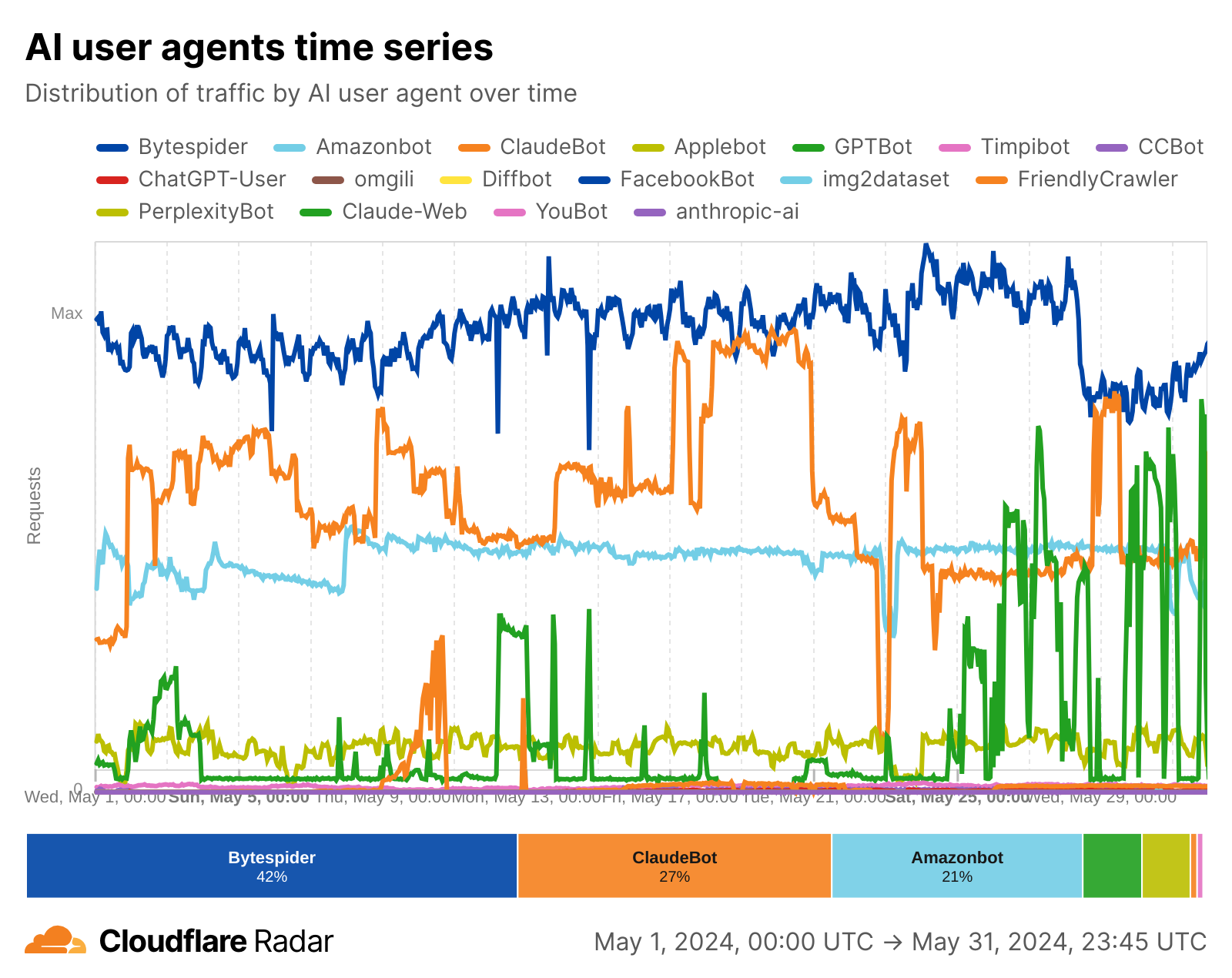
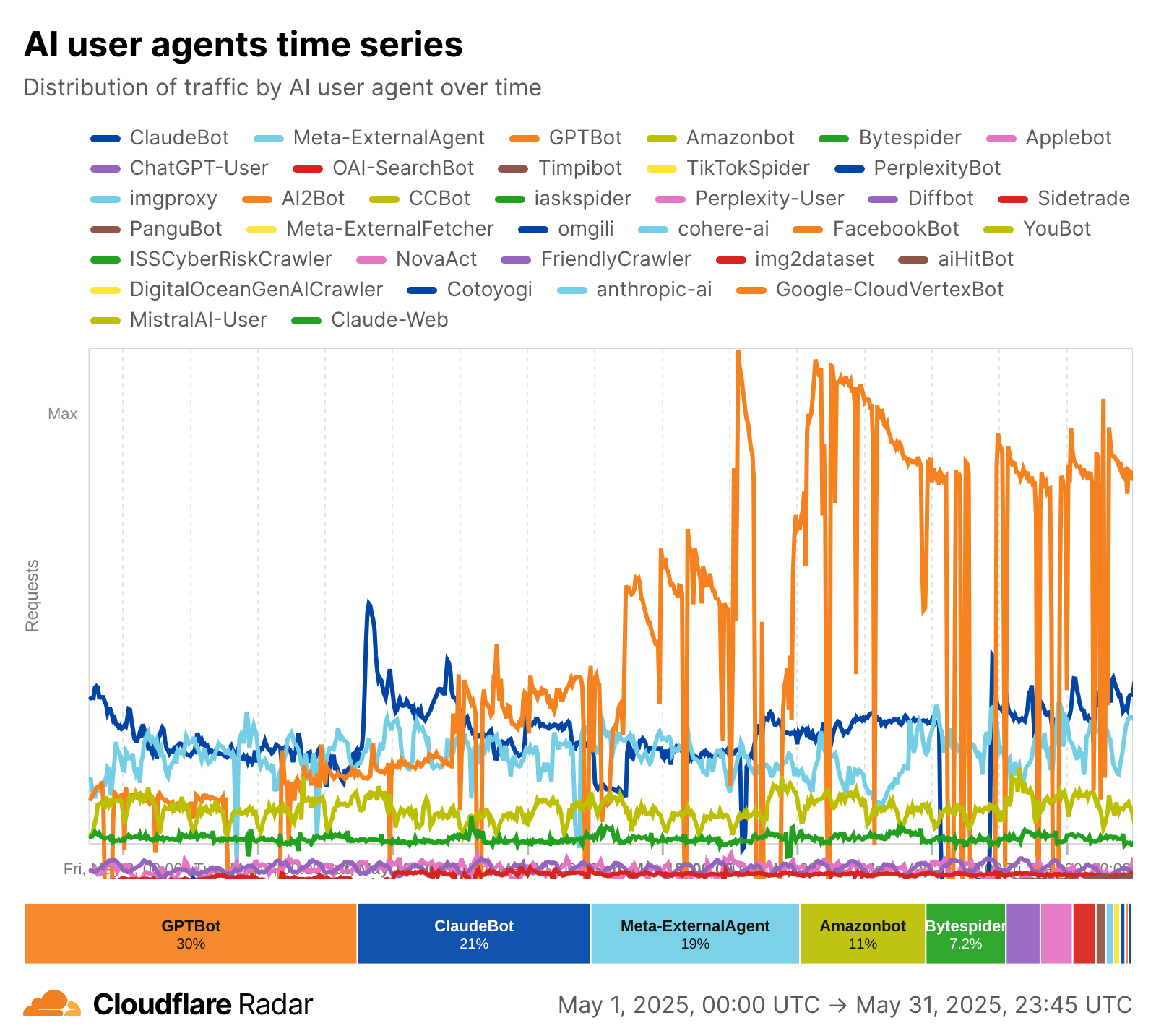
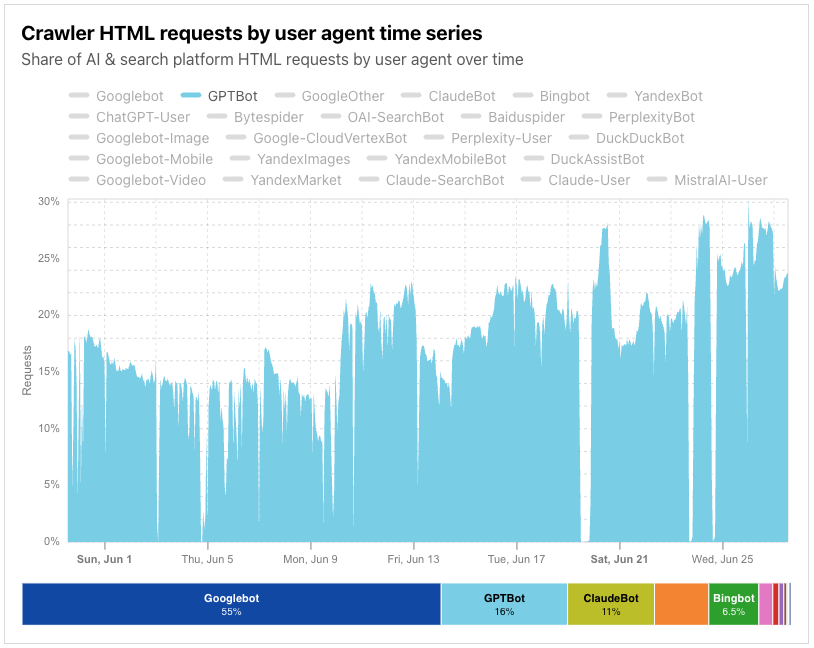
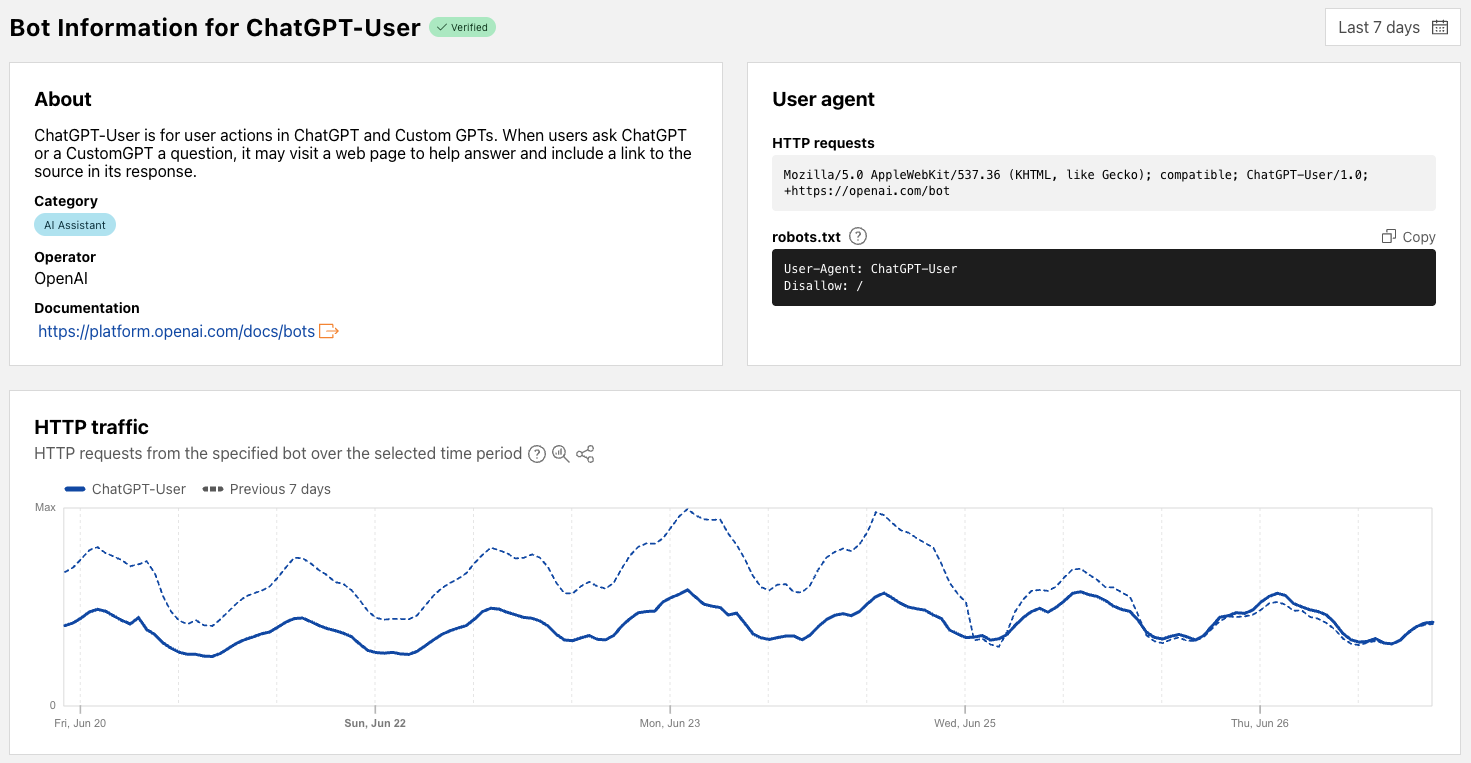
Tracking traffic trends for AI bots can help us better understand their activity over time. Initially launched in September 2024 on Radar’s Traffic page, the AI bot & crawler traffic graph has moved to the AI Insights page and provides visibility into traffic trends gathered globally over the selected time period for the top five most active AI bots & crawlers. The associated list of user agents tracked here is based on the ai.robots.txt list, and will be updated with new entries as they are identified. The time series and summary data for this graph is available from the Radar API, and traffic trends for the full set of AI bots & crawlers we see traffic from can be viewed in the Data Explorer.


Popularity of Generative AI services

Over the last several years, the Cloudflare Radar Year in Review has analyzed request traffic data from our 1.1.1.1 DNS resolver to present rankings of the most popular Internet services, both generally and across several categories. In both 2023 and 2024, this section included rankings for publicly-available Generative AI services, with ChatGPT topping the list both years. While an accompanying blog post provides a more detailed look at how the rankings shifted over the course of the year, it too is looking through the rearview mirror. That is, it doesn’t provide visibility into the changes as they are occurring. The new Generative AI services popularity graph shows the relative rankings of these services and platforms based on DNS request traffic for domains associated with these services aggregated at a daily level. The underlying time series data is available through the Radar API, using the serviceCategory=Generative%20AI parameter.

The graph below shows that as of the end of January 2025, the top five services were fairly stable over the preceding four weeks, but there was regular movement among those ranked #6-10. We expect that the rankings will continue to change over time. DeepSeek, a Generative AI service that took the industry by storm at the end of January, can be seen making its initial appearance at #9 on January 26, rising rapidly to #3 on January 29, just three days later. 


Analysis of robots.txt files

Content providers can attempt to control access to their full site, or specific portions of it, through the use of Allow or Disallow directives in a robots.txt file. However, successful access control is dependent on the bots respecting the listed directives. Cloudflare’s AI Audit gives you visibility and control into how AI bots are interacting with your website, and now Cloudflare Radar gives you insights into how other sites are handling them.

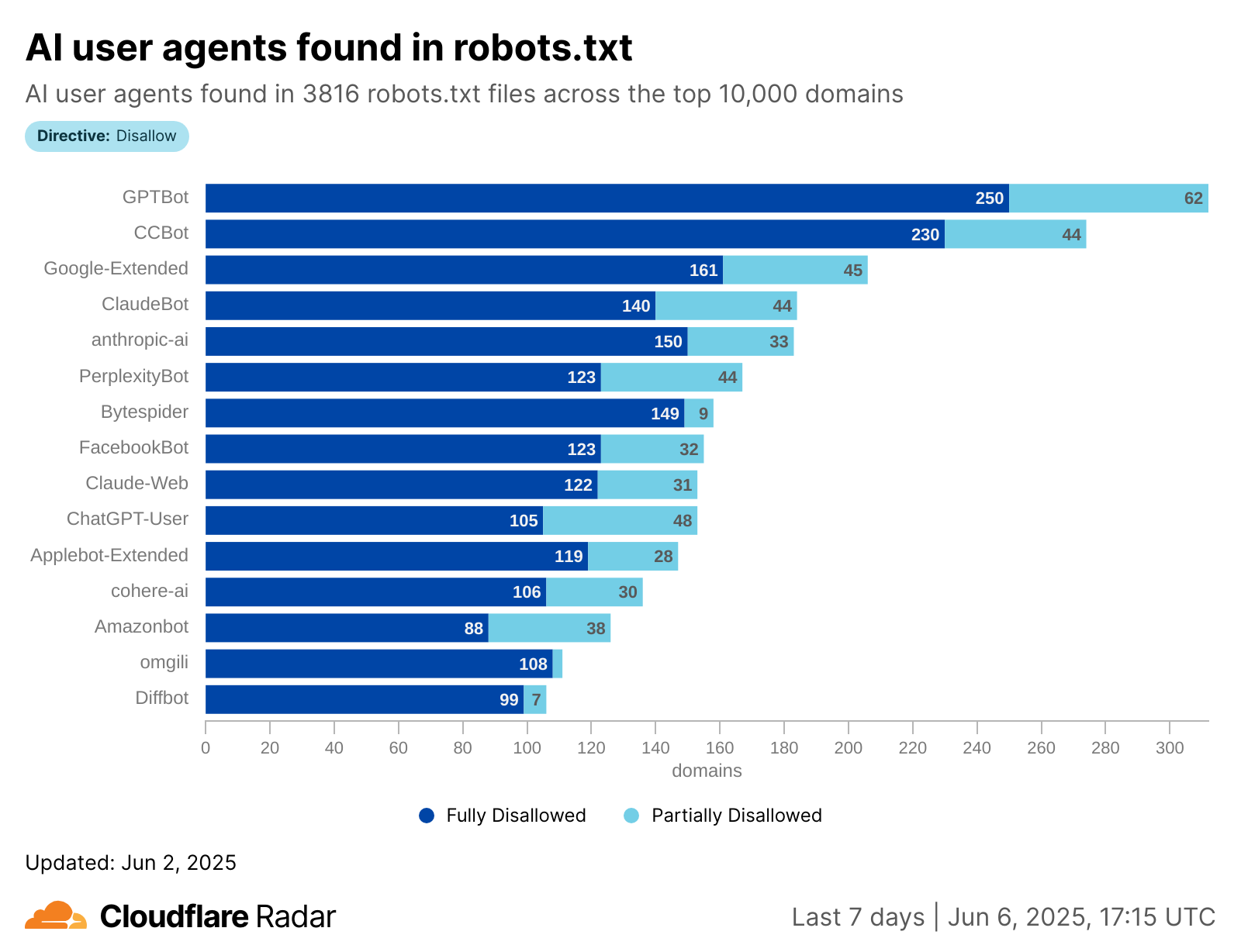
On a weekly basis, we analyze Radar’s top 10,000 domains to determine which associated sites publish robots.txt files, as well as aggregating the AI-specific directives within those files. In our new AI user agents found in robots.txt graph, seen below, we are now providing insights into actions that these top sites are taking with respect to AI bots. These actions are specified by directives that allow or disallow access by a given user agent (bot identifier) for either all content on the site (Fully Allowed/Disallowed) or certain sections (Partially Allowed/Disallowed).


In addition, we have also organized these domains by category (for example, Ecommerce or News & Media), highlighting the specific bots that the sites within those categories have listed in their directives. For example, the News & Media domain category graph shown below illustrates that these types of sites almost universally fully disallow access to their sites by AI user agents.


Changing the directive to “Allow” shows a much smaller set of user agents, with a drastically smaller set of sites explicitly allowing full or partial access. (Note that if a user agent is not listed in a robots.txt file, and a wildcard “*” user agent is not specified, then access is fully allowed by default.)


In addition to appearing on the AI Insights page, the underlying data is available for further exploration and analysis through the Radar API and the Data Explorer

Popularity of models and tasks on Workers AI

The AI model landscape is rapidly evolving, with providers regularly releasing more powerful models, capable of tasks like text and image generation, speech recognition, and image classification. Cloudflare works closely with AI model providers to ensure that Workers AI supports these models as soon as possible following their release. On the new AI Insights page, Radar now provides visibility into the popularity of publicly available supported models (Workers AI model popularity) as well as the types of tasks (Workers AI task popularity) that these models perform, based on customer account share. Extended insights, including share trends and summary shares for the full list of models and tasks, as well as the ability to compare model and task shares across time periods, are available through the Data Explorer. The underlying model popularity and task popularity data is also available through API endpoints.


Conclusion

The AI space is extremely dynamic, with new platforms, services, and models regularly appearing. In some cases, these new entrants even have the power to upset the market as they see rapid growth in interest and usage. And over two years since ChatGPT was announced, there continues to be tension between content providers and AI platforms about scraping content for model training. The new “AI Insights” page on Cloudflare Radar provides timely trends and information about this dynamic space, enabling industry observers and participants to better understand how it is changing and evolving over time.

If you share AI Insights graphs on social media, be sure to tag us: @CloudflareRadar (X), noc.social/@cloudflareradar (Mastodon), and radar.cloudflare.com (Bluesky). You can also reach out on social media, or contact us via email, with suggestions for AI metrics that we can explore adding to the page in the future.

A diversity of downtime: the Q4 2024 Internet disruption summary

Post Syndicated from David Belson original https://blog.cloudflare.com/q4-2024-internet-disruption-summary/

Cloudflare’s network spans more than 330 cities in over 120 countries, where we interconnect with over 13,000 network providers in order to provide a broad range of services to millions of customers. The breadth of both our network and our customer base provides us with a unique perspective on Internet resilience, enabling us to observe the impact of Internet disruptions at both a local and national level, as well as at a network level.

As we have noted in the past, this post is intended as a summary overview of observed and confirmed disruptions, and is not an exhaustive or complete list of issues that have occurred during the quarter. A larger list of detected traffic anomalies is available in the Cloudflare Radar Outage Center.

In the third quarter we covered quite a few government-directed Internet shutdowns, including many intended to prevent cheating on exams. In the fourth quarter, however, we only observed a single government-directed shutdown, this one related to protests. Terrestrial cable cuts impacted connectivity in two African countries. As we have seen multiple times before, both unexpected power outages and rolling power outages following military action resulted in Internet disruptions. Violent storms and an earthquake predictably caused Internet outages in the affected countries. And unexpected issues with maintenance efforts caused outages at two European providers, while Verizon customers in several US states experienced a brief but unexplained outage.

Cable cuts

Rwanda

On October 1, local mobile provider MTN Rwanda (AS36890) published a post on X alerting subscribers of a double fiber cut in Tanzania and Uganda that may impact connection quality. As a result of these fiber cuts, Internet traffic began to drop sharply after 12:45 local time (10:45 UTC), with a full outage visible between 13:15 – 13:30 local time (11:15 – 11:30 UTC). Traffic then began to rapidly recover, recovering to expected levels around 19:00 local time (17:00 UTC). Several hours later, MTN Rwanda published a followup post confirming that all services had been restored.

The African Undersea and Terrestrial Fibre Optic Cables (AfTerFibre) map shows that in addition to connecting with networks to the north and south in Tanzania and Uganda, it appears that connections are also available through networks to the west in the Democratic Republic of the Congo (DRC). However, MTN Rwanda’s upstream providers and/or peers may not be routing traffic through DRC-based networks, meaning that they couldn’t be used as a backup path when the apparently simultaneous fiber cuts occurred.

Niger

On November 30, local mobile provider Airtel Niger (AS37531) posted a thread of messages on X apologizing for Internet service disruptions, explaining that (translated) “Indeed, due to a simultaneous interruption on the national optical fiber on the Niamey-Dosso, Niamey-Balleyara exits, our internet services are completely interrupted throughout the territory, beyond our control.” These simultaneous fiber cuts resulted in a near complete outage between 17:30 local time (16:30 UTC) on November 29 until 19:45 local time (18:45 UTC) on November 30.

It seems unusual that the message thread was not posted until after the outage was resolved. It is possible that Airtel Niger themselves had no backup connectivity, and could not post an update until connectivity was restored. Alternately, given that the first post of the thread starts with “[COMMUNIQUÉ IMPORTANT📢]” (“[IMPORTANT PRESS RELEASE 📢 ]”), it is possible that the alert and apology was communicated through more official channels, such as Airtel’s website, in a timely manner, with the thread on X simply a follow-up once Internet services were again available.

Power outages

Cuba 

Instability in a country’s electrical infrastructure often causes widespread power outages, which, in turn, disrupt Internet connectivity. This happened on October 18 in Cuba, where a post on X from the Ministry of Energy and Mines of Cuba noted (translated) “Following the unexpected departure of the Antonio Guiteras CTE, the National Electricity System was completely disconnected at 11 a.m. today. The Unión Eléctrica is working on its restoration.” The power outage caused Internet traffic within the country to drop by more than half within minutes (15:15 UTC). Connectivity was disrupted for approximately three-and-a-half days, as it returned to expected levels around 23:00 local time on October 21 (03:00 UTC on October 22).

The Ministry posted several status updates on October 19 and 20, covering the work being done to restore power across the country. A final X post on October 22 signaled the end of the power outage, proclaiming (translated) “At 02:44 pm the National Electric System was synchronized.

Several weeks later, power issues again impacted Internet connectivity in Cuba. On November 6, the Electrical Union of Cuba (Uníon Eléctrica) posted on X that (translated) “14:48 hours. Strong winds caused by the intense Hurricane Rafael, cause the disconnection of the National Electric System. Contingency protocols are applied.” The timing of this post aligns with a sharp decline in traffic observed from Cuba, which fell sharply around 14:30 local time (19:30 UTC). Over the following days, after Hurricane Rafael passed the island, the Uníon Eléctrica posted numerous updates on the restoration of electrical service. Internet traffic appeared to return to expected levels around 13:00 local time (18:00 UTC) on November 9, although full restoration of electrical services took several days longer.

On December 4, Cuba suffered its third nationwide power outage in as many months. Early that morning, the Ministry of Energy and Mines posted on X that (translated) “At 2:08 this morning, the Electrical System, SEN, was disconnected when the Antonio Guiteras thermoelectric plant went out due to the automatic tripping.” The loss of this electrical power due to the failure of this generation plant caused a significant drop in Internet traffic from Cuba, falling approximately 60% as compared to the previous week at just before 02:15 local time (07:15 UTC). Traffic recovered to expected levels almost a day later at around 00:30 local time (05:30 UTC). This timing aligns with a follow-on X post from the Ministry that announced that all units had been synchronized, signaling a restoration of electrical service.

Guadeloupe

An article published in The Guardian on October 25 noted that “The French Caribbean island of Guadeloupe has been left entirely without power after striking workers seized control of the territory’s power station.” Workers entered the power station’s command room “and caused an emergency shutdown of all the engines”, according to the article. The power outage caused by this “emergency shutdown” resulted in traffic dropping nearly 70% as compared to the previous week at 08:30 local time (12:30 UTC). Although “restored electricity supply for the 230,000 affected households was expected at 3 pm local time (19:00 UTC) at best”, it appears that recovery took significantly longer than expected, as Internet traffic did not return to expected levels until around 22:00 local time on October 26 (02:00 UTC on October 27) . A press release from the government at 11:00 local time (15:00 UTC) on October 26 gave an update on the recovery efforts, noting (translated) “160,000 users have had their electricity restored. The restoration of service for the 70,000 customers still cut off is continuing, with a return to normal expected over the weekend.” It also noted that “76% of Orange subscribers have been able to regain their network connection. 1,800 homes are still without internet.

Kenya

Power outages in Kenya resulted in multiple Internet disruptions during both the second and third quarters of 2024. A similar event occurred during the fourth quarter as well. An X post from Kenya Power contained a “Customer Alert” issued at 01:28 local time on December 18 (22:28 UTC on December 17) that informed customers that “We are experiencing a widespread power outage affecting most of the country, except parts of Western and North Rift regions.” This outage caused Internet traffic from the country to drop by over 70% starting just after midnight local time on December 18 (21:00 UTC on December 17). On December 18 at 07:35 local time (04:35 UTC), an update from Kenya Power posted to X reported that power had been restored to all affected areas. Internet traffic from the country had recovered to near expected levels by that time as well.

Natural disasters

United States, Florida

At 20:30 local time on October 9 (00:30 UTC on October 10), Hurricane Milton made landfall in Florida as a Category 3 storm. Damage from Milton was extensive, including flooding, downed trees and power lines, and damage to homes and businesses. The power outages and other infrastructure damage caused by the storm, coupled with evacuation from impacted areas, resulted in a notable Internet disruption at a state level. As seen in the graph below, peak traffic levels on October 10, after Milton’s arrival, were approximately 40% lower than the preceding days. As recovery and restoration efforts began over the following days, and as evacuees returned to home, school, and work, the state’s Internet traffic began to gradually increase.


This gradual recovery is also visible in the series of maps below, which illustrate cities where Internet traffic was over 50% lower than the same time the prior week, with snapshots taken at 09:00 local time (13:00 UTC) on October 10, 11, and 14. On October 10, over 70 cities had significantly lower traffic, while on October 14, it was just over 10 cities.


Mayotte

On December 14, Cyclone Chido caused significant destruction on the French territory of Mayotte in the Indian Ocean. Power, water, and communications infrastructure were all damaged, as well as homes and public facilities. Over three dozen people were killed, with thousands more injured. With such widespread devastation, Internet traffic from the country was also impacted, as would be expected. Chido made landfall in Mayotte early in the morning on December 14, and traffic dropped sharply around 09:00 local time (06:00 UTC), causing a near-complete Internet outage. After extremely slow growth over the following week, a diurnal pattern is once again visible, with peak traffic levels continuing to gradually increase through the end of the month. As of the third week of January 2025, Mayotte’s Internet traffic continues to slowly increase, but remains well below pre-Chido levels.

Vanuatu

A magnitude 7.3 earthquake struck 24 km WNW of Port-Vila, Vanuatu at 17:46 local time (01:47 UTC) on December 17. Internet traffic from the country dropped sharply almost immediately, falling nearly 90% compared to the previous week. A significant drop in announced IPv4 address space was also observed, suggesting that damage from the earthquake took core network provider infrastructure offline as well. Recovery was slow, with Internet traffic not returning to expected levels until around 23:00 local time (12:00 UTC) on December 26.

An editorial published on The Maritime Executive website highlights that Vanuatu is currently reliant on the Interchange Cable Network 1 (ICN1) submarine cable connection to Fiji for international Internet connectivity. The editorial states that “A fire at the cable landing station temporarily interrupted the power supply, disabling internet traffic. The connection was restored 10 days later…” The resolution of the power outage at the cable landing station roughly aligns with traffic returning to expected levels, suggesting that this was a significant driver of the drop in traffic seen from Vanuatu after the earthquake. Starlink’s satellite Internet service provides some nominal redundancy, as the company announced service availability on October 7. The TAMTAM submarine cable, connecting Vanuatu to New Caledonia, is expected to be ready for service in 2026 — once available, it will provide additional redundancy for Internet connectivity. 

Government directed

Mozambique

On October 25 in Mozambique, mobile Internet connectivity across multiple providers was shut down after protests against the re-election of the ruling Frelimo party became violent. Starting around 13:00 local time (11:00 UTC), significant drops in traffic were observed across AS30619 (Telecomiuncacoes de Mocambique), AS37342 (Movitel), and AS37223 (Vodacom). Both Vodacom and Movitel experienced near complete outages almost immediately, while some traffic remained on Telecomiuncacoes de Mocambique until just before 02:00 local time (00:00 UTC) on October 26. Connectivity was restored the morning of October 26, as traffic returned around 08:00 local time (06:00 UTC). However, after connectivity returned, some social media platforms and messaging applications remained unavailable.

Just over a week later, on November 3, subscribers on these mobile networks experienced another Internet shutdown. At around 20:30 local time (18:30 UTC) traffic dropped significantly on each of these networks, with connectivity disrupted for nearly 12 hours before recovering around 08:00 (06:00 UTC) the morning of November 4. Similar shutdowns (“Internet curfews”) were observed November 4-5 and November 6-7 on all three networks, and November 7-8 on Movitel and Vodacom. According to a published report, the country’s Minister of Transport and Communications “admitted that Internet access was restricted in order ‘to avoid the destruction of the country’”, but shifted blame to the impacted services providers, claiming that when they note misuse of their services, they can take the initiative of interrupting the services, as part of their “civil responsibility” to safeguard “the stability and welfare of the population”.

Military action

Syria

An Internet disruption observed in Syria on November 9 may have been caused by damage from an Israeli airstrike near Aleppo and Idlib reported to have taken place earlier that morning. Internet traffic from the country dropped by about 80% at around 04:00 local time (01:00 UTC), with announced IP address space from the country falling significantly at that time as well. The disruption lasted approximately four hours, with traffic and announced IP address space returning to expected levels around 08:00 local time (05:00 UTC). 

Internal analysis of city-level Internet traffic shows a similar disruption in Aleppo, suggesting that it may have been caused by the airstrike.


Ukraine

Russian missile strikes on November 17 targeting electrical power infrastructure in Ukraine resulted in rolling power outages in multiple regions across the country. As we have seen multiple times throughout the nearly three-year-old conflict, these power outages result in disruptions to Internet traffic, impacting both service provider infrastructure and subscriber connectivity.

During the period between 07:30 local time (05:30 UTC) on November 17 and 02:00 local time (00:00 UTC) on November 23, we observed lower Internet traffic as compared to the previous week in Odessa, Zaporizhzhia, Mykolaiv, and Sumy. Traffic in Odessa initially dropped on November 17 by around 50% as compared to the prior week, while on November 18, traffic dropped by over 20% in the other regions. Traffic largely recovered in Odessa by November 21, while the other regions took several additional days.


Similar attacks took place just a few days later, with additional Russian airstrikes again targeting electrical infrastructure in Ukraine. Once again, Ukrainian officials implemented emergency power outages, which impacted Internet traffic in multiple areas across the country. Starting around 07:00 local time (05:00 UTC) on November 28, we observed traffic drop by as much as 65% as compared to the previous week in Kherson Oblast, Mykolaiv, Ternopil Oblast, Rivna, and Lviv. Traffic remained lower over the next several days, but appears to have generally recovered by December 1.


Maintenance

Switzerland, Salt Mobile

According to the image below, which replaced the homepage of Swiss provider Salt Mobile (AS15796), reported maintenance took the network completely offline early in the morning of December 3.


The outage lasted nearly three hours, with observed traffic at or near zero, between 01:25 and 04:20 local time (00:25 – 03:20 UTC). 

Greenland, Tusass A/S

A December 10 update from Tusass A/S (AS8818, formerly TeleGreenland) explained why the provider experienced a complete Internet outage between 02:30 and 05:15 local time (04:30 – 07:15 UTC) that morning. The post noted “This happened because preventive maintenance was to be done on the connections in Canada between 02:00 and 06:00 last night, but with a combined fault on our connection to Denmark we lost nationwide connectivity. Fortunately, the fault on the connection to Denmark occurred on land, and therefore easy to repair.” The graphs below show that for the duration of the outage, traffic from the network dropped to zero, no IPv6 address space was announced, and the volume of announced IPv4 address space fell by 94%.

According to Telegeography’s Submarine Cable Map, the Greenland Connect cable system connects Greenland to Newfoundland, Canada. It is possible that the fault on the connection to Denmark may have occurred on the Greenland-to-Iceland segment of the Greenland Connect cable system; the Iceland-to-Denmark connection is made over the DANICE submarine cable.

Unknown

United States, Verizon

Very early in the morning of November 12, some subscribers of Verizon’s Fios Internet service experienced a disruption to their Internet connectivity. A post to the Outages mailing list noted that a major multi-state Verizon Fios outage began at 12:28am EST, impacting Virginia, Washington DC, Maryland, and New Jersey, as well as parts of eastern Pennsylvania. Traffic from AS701, the autonomous system used by Verizon for their Fios service, dropped by approximately 30% around 00:30 Eastern time (05:30 UTC). At a state level, traffic from AS701 dropped between 50-70% in Pennsylvania, Delaware, Maryland, and Washington DC.

A subsequent post on the Outages mailing list stated that the outage was resolved everywhere at 3:23am EST (08:23 UTC). Nearly six hours after the outage ended, Verizon Support published a post on X acknowledging the issue, stating “A network issue early this morning disrupted service for some Verizon Fios customers in the Northeast for a short period of time. As soon as the issue was identified, our engineering teams quickly restored the service.” However, they did not provide any information on what ultimately caused the service disruption.

Conclusion

In addition to the outages and disruptions covered above, resilient Internet connectivity meant that two Baltic Sea cable cuts that occurred on November 17 and 18 had minimal impact. Whether accidental or sabotage, the security and resiliency of submarine cable infrastructure continues to be an important topic. The security and resilience of terrestrial cable infrastructure, as well as other critical Internet infrastructure, must also remain top of mind to help speed recovery from storms, earthquakes, military action, and power outages.

The Cloudflare Radar team is constantly monitoring for Internet disruptions, sharing our observations on the Cloudflare Radar Outage Center, via social media, and in posts on blog.cloudflare.com. Follow us on social media at @CloudflareRadar (X), noc.social/@cloudflareradar (Mastodon), and radar.cloudflare.com (Bluesky), or contact us via email.

Record-breaking 5.6 Tbps DDoS attack and global DDoS trends for 2024 Q4

Post Syndicated from Omer Yoachimik original https://blog.cloudflare.com/ddos-threat-report-for-2024-q4/

Welcome to the 20th edition of the Cloudflare DDoS Threat Report, marking five years since our first report in 2020.

Published quarterly, this report offers a comprehensive analysis of the evolving threat landscape of Distributed Denial of Service (DDoS) attacks based on data from the Cloudflare network. In this edition, we focus on the fourth quarter of 2024 and look back at the year as a whole.

Cloudflare’s unique vantage point

When we published our first report, Cloudflare’s global network capacity was 35 Terabits per second (Tbps). Since then, our network’s capacity has grown by 817% to 321 Tbps. We also significantly expanded our global presence by 65% from 200 cities in the beginning of 2020 to 330 cities by the end of 2024.

Using this massive network, we now serve and protect nearly 20% of all websites and close to 18,000 unique Cloudflare customer IP networks. This extensive infrastructure and customer base uniquely positions us to provide key insights and trends that benefit the wider Internet community.

Key DDoS insights

  • In 2024, Cloudflare’s autonomous DDoS defense systems blocked around 21.3 million DDoS attacks, representing a 53% increase compared to 2023. On average, in 2024, Cloudflare blocked 4,870 DDoS attacks every hour.

  • In the fourth quarter, over 420 of those attacks were hyper-volumetric, exceeding rates of 1 billion packets per second (pps) and 1 Tbps. Moreover, the amount of attacks exceeding 1 Tbps grew by a staggering 1,885% quarter-over-quarter.

  • During the week of Halloween 2024, Cloudflare’s DDoS defense systems successfully and autonomously detected and blocked a 5.6 Terabit per second (Tbps) DDoS attack — the largest attack ever reported.

To learn more about DDoS attacks and other types of cyber threats, visit our Learning Center, access previous DDoS threat reports on the Cloudflare blog, or visit our interactive hub, Cloudflare Radar. There’s also a free API for those interested in investigating these and other Internet trends. You can also learn more about the methodologies used in preparing these reports.

Anatomy of a DDoS attack

In 2024 Q4 alone, Cloudflare mitigated 6.9 million DDoS attacks. This represents a 16% increase quarter-over-quarter (QoQ) and 83% year-over-year (YoY).

Of the 2024 Q4 DDoS attacks, 49% (3.4 million) were Layer 3/Layer 4 DDoS attacks and 51% (3.5 million) were HTTP DDoS attacks.


Distribution of 6.9 million DDoS attacks: 2024 Q4

HTTP DDoS attacks

The majority of the HTTP DDoS attacks (73%) were launched by known botnets. Rapid detection and blocking of these attacks were made possible as a result of operating a massive network and seeing many types of attacks and botnets. In turn, this allows our security engineers and researchers to craft heuristics to increase mitigation efficacy against these attacks.

An additional 11% were HTTP DDoS attacks that were caught pretending to be a legitimate browser. Another 10% were attacks which contained suspicious or unusual HTTP attributes. The remaining 8% “Other” were generic HTTP floods, volumetric cache busting attacks, and volumetric attacks targeting login endpoints.


Top HTTP DDoS attack vectors: 2024 Q4

These attack vectors, or attack groups, are not necessarily exclusive. For example, known botnets also impersonate browsers and have suspicious HTTP attributes, but this breakdown is our attempt to categorize the HTTP DDoS attacks in a meaningful way.

Top user agents

As of this report’s publication, the current stable version of Chrome for Windows, Mac, iOS, and Android is 132, according to Google’s release notes. However, it seems that threat actors are still behind, as thirteen of the top user agents that appeared most frequently in DDoS attacks were Chrome versions ranging from 118 to 129.

The HITV_ST_PLATFORM user agent had the highest share of DDoS requests out of total requests (99.9%), making it the user agent that’s used almost exclusively in DDoS attacks. In other words, if you see traffic coming from the HITV_ST_PLATFORM user agent, there is a 0.1% chance that it is legitimate traffic.

Threat actors often avoid using uncommon user agents, favoring more common ones like Chrome to blend in with regular traffic. The presence of the HITV_ST_PLATFORM user agent, which is associated with smart TVs and set-top boxes, suggests that the devices involved in certain cyberattacks are compromised smart TVs or set-top boxes. This observation highlights the importance of securing all Internet-connected devices, including smart TVs and set-top boxes, to prevent them from being exploited in cyberattacks.


Top user agents abused in DDoS attacks: 2024 Q4

The user agent hackney came in second place, with 93% of requests containing this user agent being part of a DDoS attack. If you encounter traffic coming from the hackney user agent, there is a 7% chance that it is legitimate traffic. Hackney is an HTTP client library for Erlang, used for making HTTP requests and is popular in Erlang/Elixir ecosystems.

Additional user agents that were used in DDoS attacks are uTorrent, which is associated with a popular BitTorrent client for downloading files. Go-http-client and fasthttp were also commonly used in DDoS attacks. The former is the default HTTP client in Go’s standard library and the latter is a high-performance alternative. fasthttp is used to build fast web applications, but is often exploited for DDoS attacks and web scraping too.

HTTP attributes commonly used in DDoS attacks

HTTP methods

HTTP methods (also called HTTP verbs) define the action to be performed on a resource on a server. They are part of the HTTP protocol and allow communication between clients (such as browsers) and servers.

The GET method is most commonly used. Almost 70% of legitimate HTTP requests made use of the GET method. In second place is the POST method with a share of 27%.

With DDoS attacks, we see a different picture. Almost 14% of HTTP requests using the HEAD method were part of a DDoS attack, despite it hardly being present in legitimate HTTP requests (0.75% of all requests). The DELETE method came in second place, with around 7% of its usage being for DDoS purposes.

The disproportion between methods commonly seen in DDoS attacks versus their presence in legitimate traffic definitely stands out. Security administrators can use this information to optimize their security posture based on these headers.


Distribution of HTTP methods in DDoS attacks and legitimate traffic: 2024 Q4

HTTP paths

An HTTP path describes a specific server resource. Along with the HTTP method, the server will perform the action on the resource.

For example, GET https://developers.cloudflare.com/ddos-protection/ will instruct the server to retrieve the content for the resource /ddos-protection/.

DDoS attacks often target the root of the website (“/”), but in other cases, they can target specific paths. In 2024 Q4, 98% of HTTP requests towards the /wp-admin/ path were part of DDoS attacks. The /wp-admin/ path is the default administrator dashboard for WordPress websites.

Obviously, many paths are unique to the specific website, but in the graph below, we’ve provided the top generic paths that were attacked the most. Security administrators can use this data to strengthen their protection on these endpoints, as applicable. 


 Top HTTP paths targeted by HTTP DDoS attacks: 2024 Q4

HTTP vs. HTTPS

In Q4, almost 94% of legitimate traffic was HTTPS. Only 6% was plaintext HTTP (not encrypted). Looking at DDoS attack traffic, around 92% of HTTP DDoS attack requests were over HTTPS and almost 8% were over plaintext HTTP.


HTTP vs. HTTPS in legitimate traffic and DDoS attacks: 2024 Q4

Layer 3/Layer 4 DDoS attacks

The top three most common Layer 3/Layer 4 (network layer) attack vectors were SYN flood (38%), DNS flood attacks (16%), and UDP floods (14%).


Top L3/4 DDoS attack vectors: 2024 Q4

An additional common attack vector, or rather, botnet type, is Mirai. Mirai attacks accounted for 6% of all network layer DDoS attacks — a 131% increase QoQ. In 2024 Q4, a Mirai-variant botnet was responsible for the largest DDoS attack on record, but we’ll discuss that further in the next section.

Emerging attack vectors

Before moving on to the next section, it’s worthwhile to discuss the growth in additional attack vectors that were observed this quarter. 


Top emerging threats: 2024 Q4

Memcached DDoS attacks saw the largest growth, with a 314% QoQ increase. Memcached is a database caching system for speeding up websites and networks. Memcached servers that support UDP can be abused to launch amplification or reflection DDoS attacks. In this case, the attacker would request content from the caching system and spoof the victim’s IP address as the source IP in the UDP packets. The victim will be flooded with the Memcache responses, which can be up to 51,200x larger than the initial request.

BitTorrent DDoS attacks also surged this quarter by 304%. The BitTorrent protocol is a communication protocol used for peer-to-peer file sharing. To help the BitTorrent clients find and download the files efficiently, BitTorrent clients may utilize BitTorrent Trackers or Distributed Hash Tables (DHT) to identify the peers that are seeding the desired file. This concept can be abused to launch DDoS attacks. A malicious actor can spoof the victim’s IP address as a seeder IP address within Trackers and DHT systems. Then clients would request the files from those IP addresses. Given a sufficient number of clients requesting the file, it can flood the victim with more traffic than it can handle.

The largest DDoS attack on record

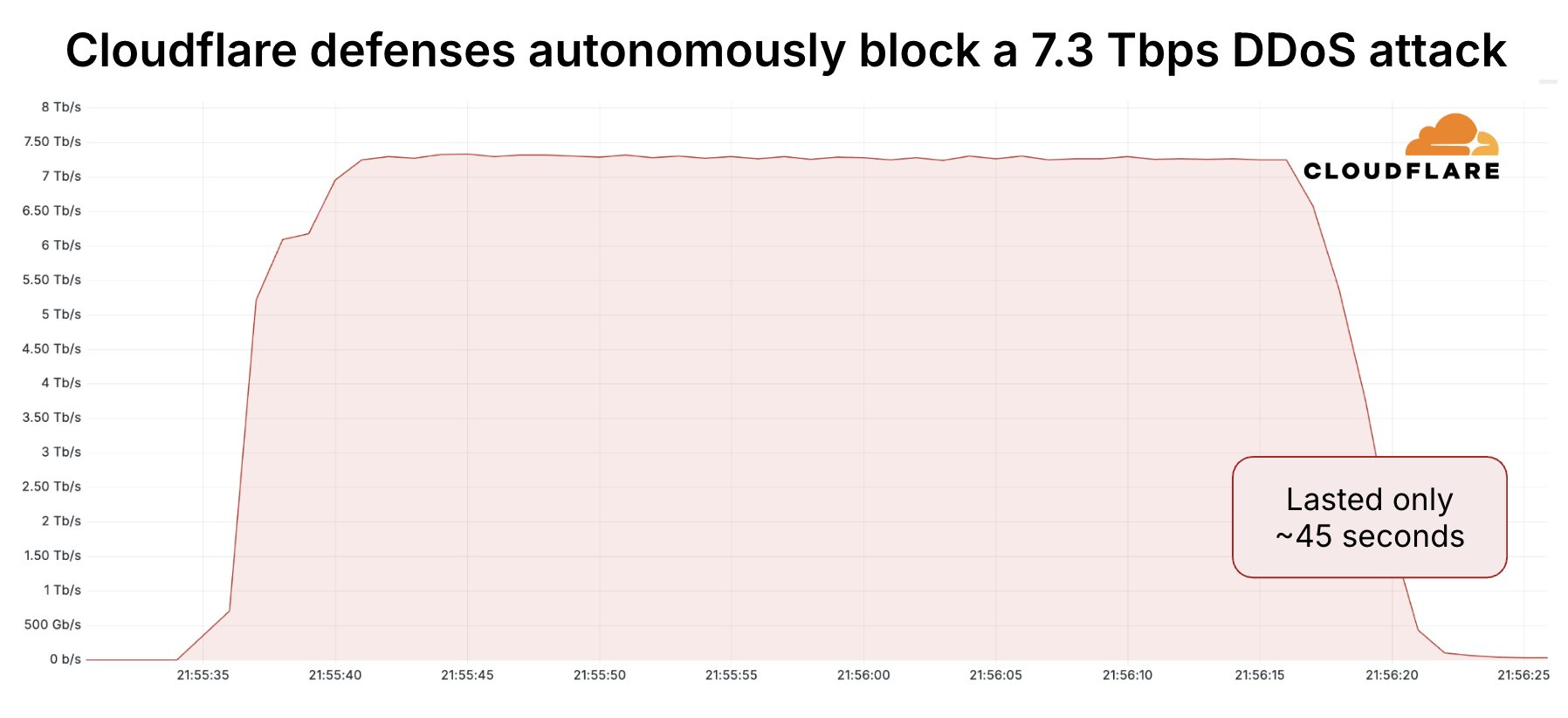
On October 29, a 5.6 Tbps UDP DDoS attack launched by a Mirai-variant botnet targeted a Cloudflare Magic Transit customer, an Internet service provider (ISP) from Eastern Asia. The attack lasted only 80 seconds and originated from over 13,000 IoT devices. Detection and mitigation were fully autonomous by Cloudflare’s distributed defense systems. It required no human intervention, didn’t trigger any alerts, and didn’t cause any performance degradation. The systems worked as intended.


Cloudflare’s autonomous DDoS defenses mitigate a 5.6 Tbps Mirai DDoS attack without human intervention

While the total number of unique source IP addresses was around 13,000, the average unique source IP addresses per second was 5,500. We also saw a similar number of unique source ports per second. In the graph below, each line represents one of the 13,000 different source IP addresses, and as portrayed, each contributed less than 8 Gbps per second. The average contribution of each IP address per second was around 1 Gbps (~0.012% of 5.6 Tbps).


The 13,000 source IP addresses that launched the 5.6 Tbps DDoS attack

Hyper-volumetric DDoS attacks

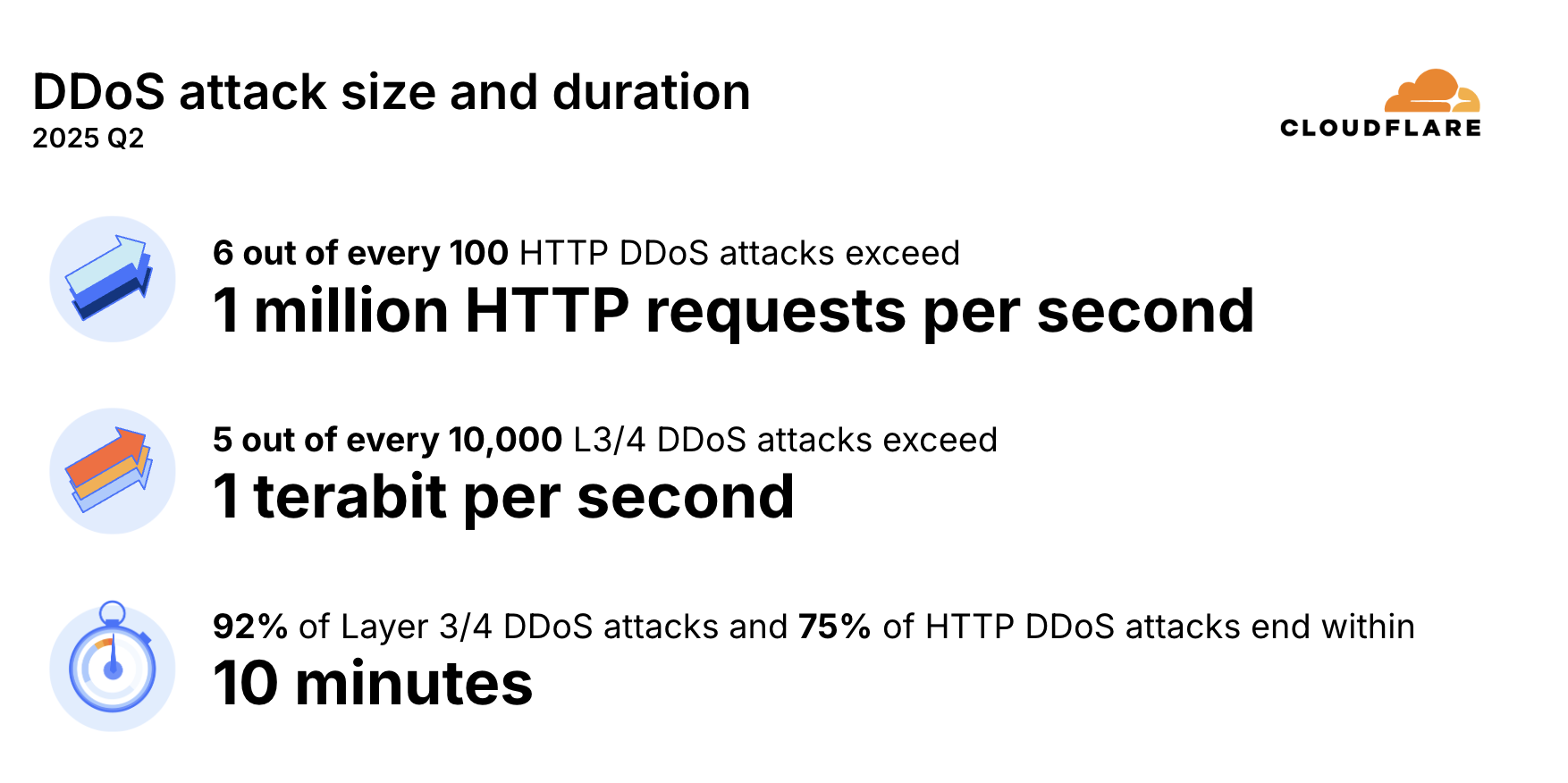
In 2024 Q3, we started seeing a rise in hyper-volumetric network layer DDoS attacks. In 2024 Q4, the amount of attacks exceeding 1 Tbps increased by 1,885% QoQ and attacks exceeding 100 Million pps (packets per second) increased by 175% QoQ. 16% of the attacks that exceeded 100 Million pps also exceeded 1 Billion pps.


Distribution of hyper-volumetric L3/4 DDoS attacks: 2024 Q4

Attack size

The majority of HTTP DDoS attacks (63%) did not exceed 50,000 requests per second. On the other side of the spectrum, 3% of HTTP DDoS attacks exceeded 100 million requests per second.

Similarly, the majority of network layer DDoS attacks are also small. 93% did not exceed 500 Mbps and 87% did not exceed 50,000 packets per second. 


QoQ change in attack size by packet rate: 2024 Q4


QoQ change in attack size by bit rate: 2024 Q4

Attack duration

The majority of HTTP DDoS attacks (72%) end in under ten minutes. Approximately 22% of HTTP DDoS attacks last over one hour, and 11% last over 24 hours.

Similarly, 91% of network layer DDoS attacks also end within ten minutes. Only 2% last over an hour.

Overall, there was a significant QoQ decrease in the duration of DDoS attacks. Because the duration of most attacks is so short, it is not feasible, in most cases, for a human to respond to an alert, analyze the traffic, and apply mitigation. The short duration of attacks emphasizes the need for an in-line, always-on, automated DDoS protection service.


QoQ change in attack duration: 2024 Q4

Attack sources

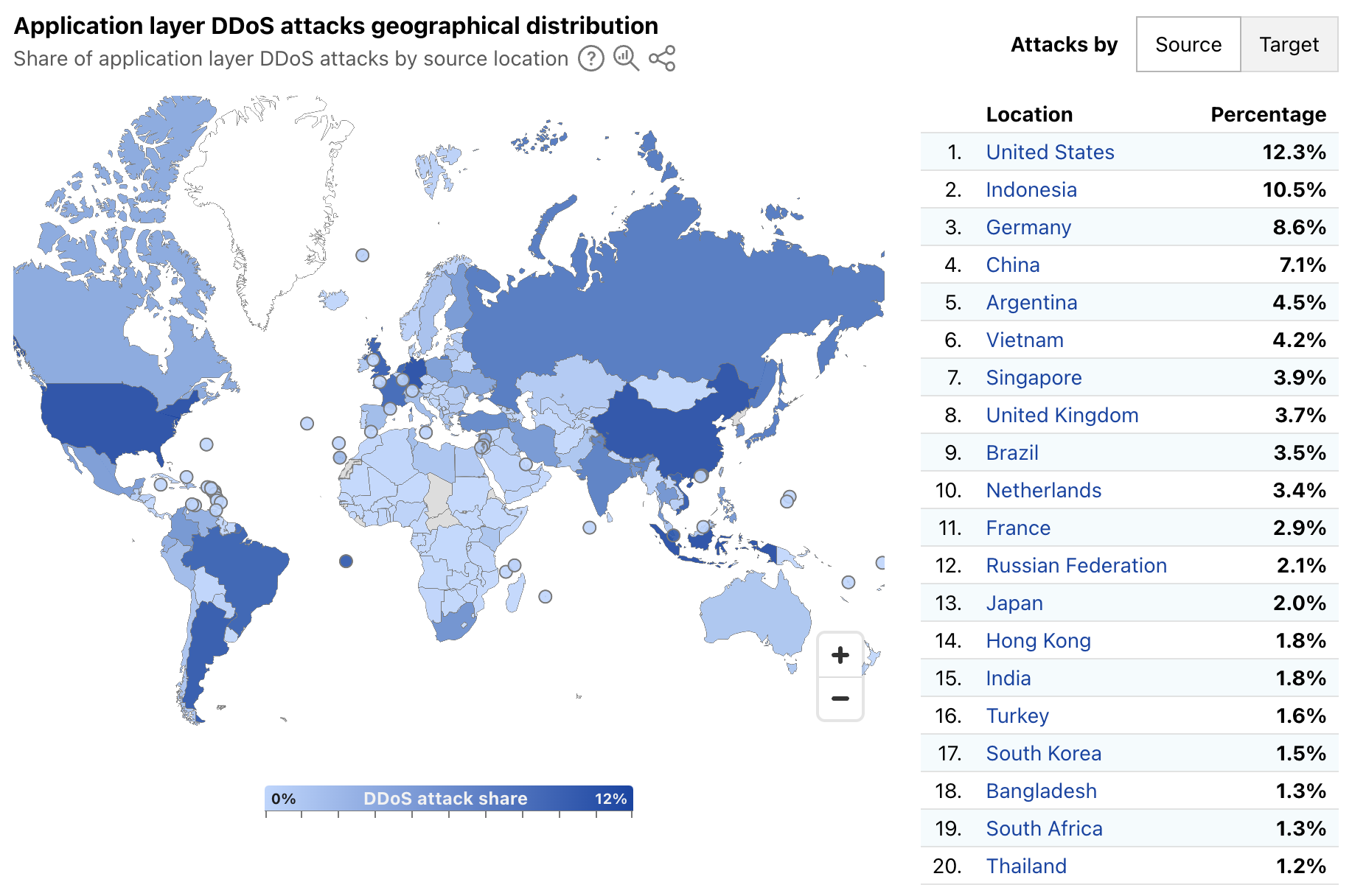
In the last quarter of 2024, Indonesia remained the largest source of DDoS attacks worldwide for the second consecutive quarter. To understand where attacks are coming from, we map the source IP addresses launching HTTP DDoS attacks because they cannot be spoofed, and for Layer 3/Layer 4 DDoS attacks, we use the location of our data centers where the DDoS packets were ingested. This lets us overcome the spoofability that is possible in Layer 3/Layer 4. We’re able to achieve geographical accuracy due to our extensive network spanning over 330 cities around the world.

Hong Kong came in second, having moved up five spots from the previous quarter. Singapore advanced three spots, coming in third place.


Top 10 largest sources of DDoS attacks: 2024 Q4

Top source networks

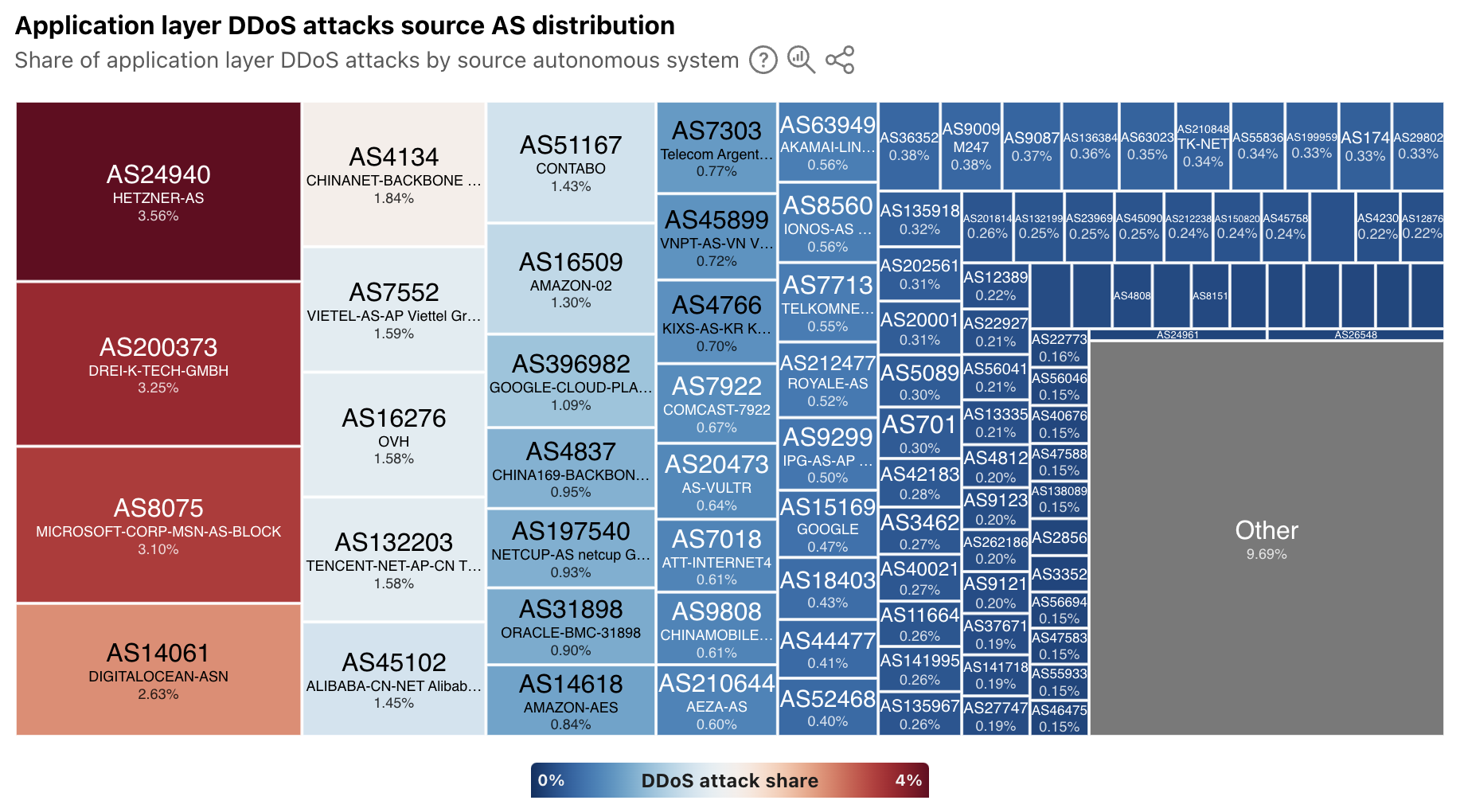
An autonomous system (AS) is a large network or group of networks that has a unified routing policy. Every computer or device that connects to the Internet is connected to an AS. To find out what your AS is, visit https://radar.cloudflare.com/ip.

When looking at where the DDoS attacks originate from, specifically HTTP DDoS attacks, there are a few autonomous systems that stand out.

The AS that we saw the most HTTP DDoS attack traffic from in 2024 Q4 was German-based Hetzner (AS24940). Almost 5% of all HTTP DDoS requests originated from Hetzer’s network, or in other words, 5 out of every 100 HTTP DDoS requests that Cloudflare blocked originated from Hetzner.

In second place we have the US-based Digital Ocean (AS14061), followed by France-based OVH (AS16276) in third place.


Top 10 largest source networks of DDoS attacks: 2024 Q4

For many network operators such as the ones listed above, it can be hard to identify the malicious actors that abuse their infrastructure for launching attacks. To help network operators and service providers crack down on the abuse, we provide a free DDoS Botnet threat intelligence feed that provides ASN owners a list of their IP addresses that we’ve seen participating in DDoS attacks. 

Top threat actors

When surveying Cloudflare customers that were targeted by DDoS attacks, the majority said they didn’t know who attacked them. The ones that did know reported their competitors as the number one threat actor behind the attacks (40%). Another 17% reported that a state-level or state-sponsored threat actor was behind the attack, and a similar percentage reported that a disgruntled user or customer was behind the attack.

Another 14% reported that an extortionist was behind the attacks. 7% claimed it was a self-inflicted DDoS, 2% reported hacktivism as the cause of the attack, and another 2% reported that the attacks were launched by former employees.


Top threat actors: 2024 Q4

Ransom DDoS attacks

In the final quarter of 2024, as anticipated, we observed a surge in Ransom DDoS attacks. This spike was predictable, given that Q4 is a prime time for cybercriminals, with increased online shopping, travel arrangements, and holiday activities. Disrupting these services during peak times can significantly impact organizations’ revenues and cause real-world disruptions, such as flight delays and cancellations.

In Q4, 12% of Cloudflare customers that were targeted by DDoS attacks reported being threatened or extorted for a ransom payment. This represents a 78% QoQ increase and 25% YoY growth compared to 2023 Q4.


Reported Ransom DDoS attacks by quarter: 2024

Looking back at the entire year of 2024, Cloudflare received the most reports of Ransom DDoS attacks in May. In Q4, we can see the gradual increase starting from October (10%), November (13%), and December (14%) — a seven-month-high.


Reported Ransom DDoS attacks by month: 2024

Target of attacks

In 2024 Q4, China maintained its position as the most attacked country. To understand which countries are subject to more attacks, we group DDoS attacks by our customers’ billing country. 

Philippines makes its first appearance as the second most attacked country in the top 10. Taiwan jumped to third place, up seven spots compared to last quarter.

In the map below, you can see the top 10 most attacked locations and their ranking change compared to the previous quarter.


Top 10 most attacked locations by DDoS attacks: 2024 Q4

Most attacked industries

In the fourth quarter of 2024, the Telecommunications, Service Providers and Carriers industry jumped from the third place (last quarter) to the first place as the most attacked industry. To understand which industries are subject to more attacks, we group DDoS attacks by our customers’ industry. The Internet industry came in second, followed by Marketing and Advertising in third.

The Banking & Financial Services industry dropped seven places from number one in 2024 Q3 to number eight in Q4.


Top 10 most attacked industries by DDoS attacks: 2024 Q4

Our commitment to unmetered DDoS protection

The fourth quarter of 2024 saw a surge in hyper-volumetric Layer 3/Layer 4 DDoS attacks, with the largest one breaking our previous record, peaking at 5.6 Tbps. This rise in attack size renders capacity-limited cloud DDoS protection services or on-premise DDoS appliances obsolete.

The growing use of powerful botnets, driven by geopolitical factors, has broadened the range of vulnerable targets. A rise in Ransom DDoS attacks is also a growing concern.

Too many organizations only implement DDoS protection after suffering an attack. Our observations show that organizations with proactive security strategies are more resilient. At Cloudflare, we invest in automated defenses and a comprehensive security portfolio to provide proactive protection against both current and emerging threats.

With our 321 Tbps network spanning 330 cities globally, we remain committed to providing unmetered and unlimited DDoS protection no matter the size, duration and quantity of the attacks.

The fall and rise of TikTok (traffic)

Post Syndicated from João Tomé original https://blog.cloudflare.com/the-fall-and-rise-of-tiktok-traffic/

The United States ban on TikTok went into effect on January 19, 2025, and although service began to be restored after just 14 hours, it was only close to the inauguration of Donald Trump as the 47th President of the United States that associated DNS traffic started to recover to closer to previous levels. In this post, we analyze the events of January 19 and 20, and what they meant for TikTok-related DNS traffic, but also other competitors (including their growth outside the US).

For context, we wrote an initial blog post about the TikTok ban on Sunday, January 19, 2025. The ban was part of the “Protecting Americans from Foreign Adversary Controlled Applications Act,” proposed in Congress, which ordered ByteDance to divest due to alleged security concerns. The bill was signed into law by Congress and President Biden in April 2024, and was upheld by the Supreme Court on January 17, 2025.

Aggregated data from our 1.1.1.1 DNS resolver shows — as we’ve posted on social media — that the TikTok shutdown in the US began to impact DNS traffic to TikTok-related domains on January 19, just after 03:30 UTC (22:30 ET on January 18). This includes DNS traffic not only for TikTok, but also for other ByteDance-owned platforms, such as the CapCut video editor. Here’s the timeline focused on DNS traffic for TikTok related domains (with the respective line chart), as we’ve observed it:

  • January 19, just after 03:30 UTC (22:30 ET on January 18): DNS traffic to TikTok-related domains dropped by as much as 85% compared to the previous week, and showed signs of further decline in the following hours.

  • January 19, 17:30 UTC (12:30 ET): After a 14-hour shutdown, TikTok announced it was starting service restoration following assurances from Donald Trump. DNS traffic began to recover slightly after 18:00 UTC but stayed near “shutdown” levels for several hours. Traffic from AS396986 (ByteDance) showed a similar trend.

  • January 20, 06:00 UTC (01:00 ET): A short-lived spike in DNS traffic for TikTok-related domains occurred, with traffic still 25% below the previous week.

  • January 20, 14:00–15:00 UTC (09:00–10:00 ET): DNS traffic picked up, moving from 27% to 18% below pre-shutdown levels.

  • January 20, 17:00 UTC (12:00 ET): During Donald Trump’s inauguration ceremony, DNS traffic increased to 12% below pre-shutdown levels, with a trend of continued growth, reaching 10% below previous levels at 18:00 UTC (13:00 ET).

  • January 21, 05:00 UTC (00:00 ET): DNS traffic was 7% below pre-shutdown levels.


On January 19, around 17:30 UTC (12:30 ET), TikTok released a statement: “In agreement with our service providers, TikTok is in the process of restoring service. We thank President Trump for providing the necessary clarity and assurance to our service providers that they will face no penalties.” A message indicating the TikTok ban was over appeared for US users (image on the left). However, a few hours later, some users reported difficulties accessing the app (image on the right).


Analyzing data from autonomous system-level data, traffic from TikTok owner ByteDance’s network (AS396986) in the US to Cloudflare experienced a sharp decline, dropping by as much as 95% after 03:30 UTC on January 19 (22:30 ET on January 18).


Our data shows that traffic within ByteDance’s network (AS396986) never fully recovered, remaining around 80% below pre-shutdown levels. This suggests that ByteDance may have used other solutions after the shutdown.

Alternatives like RedNote (Xiaohongshu) 

As mentioned previously, DNS traffic in the US for TikTok alternatives, driven by RedNote (Xiaohongshu or Little Red Book), has been steadily increasing since January 13. It surged on January 19 by up to 74% around 04:00 UTC (23:00 ET on January 18) compared to the previous week, with lower growth seen later that day in the US (around 52% at 17:00 UTC (12:00 ET)). Traffic subsequently declined, and was only 17% higher than the previous week after TikTok announced it was beginning to restore its services in the US around 22:00 UTC (17:00 ET), and it lost even more growth momentum after that.


Daily DNS traffic in the US for TikTok alternatives has been rising since January 13, reaching 116% higher than the previous week on January 15. On Sunday, January 19, the day of the TikTok ban, it peaked with a 291% increase compared to the previous week.


RedNote impacting other countries

DNS traffic for TikTok alternatives, driven by RedNote, has also been increasing in other countries, with a noticeable rise in daily DNS traffic to these platforms. Below is the breakdown of the most impacted countries, with a few updates from our most recent blog post. We highlight the peak day of DNS traffic and the percentage growth compared to the previous week.

  • Mexico (+1200% on January 19)

  • Brazil (+185% on January 20)

  • France (+165% on January 19)

  • Germany (+142% on January 19)

  • Canada (+119% on January 19)

  • Spain (+106% on January 19)

  • Portugal (+97% on January 19)

  • The UK (+86% on January 19)

  • Australia (+19% on January 15)

  • Japan (+18% on January 18)

(Note: In many cases, DNS traffic had been growing for more than a week, so countries with recent growth may show higher percentages.)

Those trends are consistent with apps like RedNote rising on top of the Android and iOS App Stores, according to Data.ai.

The rapid increases in DNS traffic can be clearly seen in the graphs below:


If you’re interested in more trends and insights about the Internet, check out Cloudflare Radar. Follow us on social media at @CloudflareRadar (X), noc.social/@cloudflareradar (Mastodon), and radar.cloudflare.com (Bluesky).

TikTok ban takes hold: data reveals sharp traffic decline and rapid shift to alternatives

Post Syndicated from João Tomé original https://blog.cloudflare.com/tiktok-ban-traffic-decline-alternatives-rednote/

The United States ban on TikTok went into effect on January 19, 2025, and our data showed a clear impact starting after 03:30 UTC (10:30 PM ET on January 18, 2025). The ban was part of the “Protecting Americans from Foreign Adversary Controlled Applications Act,” proposed in Congress, which ordered ByteDance to divest due to alleged security concerns. The bill was signed into law by Congress and President Biden in April 2024, and was upheld by the Supreme Court.

Aggregated data from our 1.1.1.1 DNS resolver shows — as we’ve posted on X — that the TikTok shutdown in the US began to impact DNS traffic to TikTok-related domains on January 19, just after 03:30 UTC (22:30 ET on January 18). This includes DNS traffic not only for TikTok, but also for other ByteDance-owned platforms, such as the CapCut video editor. Traffic dropped by as much as 85% compared to the previous week and showed signs of further decline in the following hours.


Around that time, a message indicating the TikTok ban began appearing for US users.


Analyzing data from autonomous systems or networks, traffic from TikTok owner ByteDance’s network (AS396986) in the US to Cloudflare experienced a sharp decline, dropping by as much as 95% after 03:30 UTC (22:30 ET).


Alternatives like RedNote (Xiaohongshu) surge in the US

DNS traffic in the US for TikTok alternatives, driven by RedNote (Xiaohongshu or Little Red Book), has been steadily growing since January 13. It surged on January 19 by as much as 74% around 04:00 UTC (23:00 ET on January 18) compared to the previous week, with growth being less intensive during nighttime in the US (around 22%).


Daily DNS traffic in the US for TikTok alternatives has increased since January 13, reaching as much as 116% growth on January 15. Sunday, January 19, is on track to surpass that growth.


RedNote impacting other countries

DNS traffic for TikTok alternatives, driven by RedNote, has been growing in the last few days, and not only in the US. 

The other countries where we observed a clear increase in daily DNS traffic to TikTok alternatives were Mexico (a 500% increase on January 18), Canada (68% on January 18), the UK (53% on January 18), Germany (110% on January 18), and France (75% on January 18). These increases are shown in the graphs below:


Those trends are consistent with apps like RedNote rising on top of the Android and iOS App Stores, according to Data.ai.

President-elect Donald Trump indicated on January 18 that he plans to grant TikTok a 90-day extension following his inauguration on Monday, January 20, 2025.

We will continue monitoring the TikTok ban and share updates through a new blog post or on @CloudflareRadar (X), noc.social/@cloudflareradar (Mastodon), and radar.cloudflare.com (Bluesky).

When the world logs off: Christmas, New Year’s, and the Internet’s holiday rhythm

Post Syndicated from João Tomé original https://blog.cloudflare.com/when-the-world-logs-off-christmas-new-years-and-the-internets-holiday-rhythm/

As January approaches and the year comes to a close, distinct changes in global Internet usage emerge. Year-end traditions — ranging from Christmas feasts to New Year’s Eve (NYE) countdowns — shape online behavior across continents and cultures. Looking back at Christmas and NYE 2023 offers insights into how these trends may repeat this year, and by January 2025, we’ll be able to directly compare patterns. Examining data from 50 countries and regions reveals how people celebrated in 2023-2024, providing a timely reminder of typical holiday trends.

With Cloudflare’s global reach, we observe planet-wide and local Internet habits during the holiday season. In the past, unintended trends during Christmas and New Year’s Eve have surfaced through our Outage Center, which uses automatic traffic anomaly alerts to detect Internet outages or unusual patterns. In the 2023 overview below, traffic dropped enough on those days to trigger dozens of anomaly alerts (orange and pink bubbles):


While Christmas dominates in many regions, other cultural and religious holidays — like Hanukkah or regional festivities — shape online rhythms in places where Western traditions are less central.

In countries and regions where Christmas is deeply rooted, Internet traffic slows during Christmas Eve dinners, midnight masses, morning gift exchanges, and Christmas Day lunches.

This blog post focuses exclusively on non-bot-related Internet traffic requests, filtering out automated activity to provide a clearer view of genuine human behavior during the holiday season. Before going into location-specific perspectives, here’s a global hourly view of Internet traffic during Christmas and New Year’s Eve 2023 from Cloudflare Radar Data Explorer, highlighting notable drops (in UTC, so it captures impacts across more days due to time zones spanning over 23 hours, from New Zealand to Hawaii in the US):


Global Christmas and New Year’s Eve daily trends

Let’s start with a ranking of countries and regions and their top low-traffic holiday dates, showing each day’s percentage drop. Many locations like the US see clear dips on December 24 and 25 as people celebrate Christmas Eve and Christmas Day offline, and some show smaller declines (compared to Christmas) around December 31 as the New Year approaches. Still, the exact order and magnitude differ, reflecting cultural nuances — some nations experience greater drops on Christmas Eve, others on Christmas Day, and others signal unique patterns tied to New Year’s Eve or January 1 celebrations.

In the next table, locations are listed first (in the left column) by those with the lowest traffic on December 24 (and the highest percentage of traffic drop), followed by December 25, and finally December 31 (in the right column).

Top days with the lowest Internet traffic in December 2023 – January 2024

(with respective percentage drops, if any, from the previous week)

Denmark

#1 December 24 (-35%)

#2 December 25 (-11%)

#3 December 31

South Africa

#1 December 25 (-27%)

#2 December 24 (-15%)

#3 December 31 (-5%)

Norway

#1 December 24 (-32%)

#2 December 25 (-12%)

#3 December 31

United Kingdom

#1 December 25 (-26%)

#2 December 24 (-19%)

#3 December 31

Portugal

#1 December 24 (-32%)

#2 December 25 (-24%)

#3 December 31

Italy

#1 December 25 (-25%)

#2 December 24 (-25%)

#3 December 31

Poland

#1 December 24 (-31%)

#2 December 25 (-21%)

#3 December 31

Australia

#1 December 25 (-25%)

#2 December 24 (-15%)

#3 December 31 (-1%)

Spain

#1 December 24 (-28%)

#2 December 25 (-25%)

#3 December 31

Ireland

#1 December 25 (-24%)

#2 December 24 (-22%)

#3 December 23

Sweden

#1 December 24 (-26%)

#2 December 25 (-6%)

#3 December 31

New Zealand

#1 December 25 (-22%)

#2 December 24 (-8%)

#3 December 31 (-4%)

Chile

#1 December 24 (-23%)

#2 December 25 (-24%)

#3 December 31 (-3%)

Canada

#1 December 25 (-19%)

#2 December 24 (-15%)

#3 December 31

Finland

#1 December 24 (-23%)

#2 December 25 (-16%)

#3 December 31

Nigeria

#1 December 25 (-18%)

#2 December 24 (-19%)

#3 January 1

France

#1 December 24 (-22%)

#2 December 25 (-19%)

#3 December 23

Philippines

#1 December 25 (-16%)

#2 December 24 (-7%)

#3 December 31

Germany

#1 December 24 (-21%)

#2 December 25 (-9%)

#3 December 31

Hong Kong

#1 December 25 (-9%)

#2 December 24 (-6%)

#3 December 23

Mexico

#1 December 24 (-21%)

#2 December 25 (-19%)

#3 December 31

Belgium

#1 December 31 (-1%)

#2 December 24 (-20%)

#3 December 25 (-17%)

Belgium

#1 December 24 (-20%)

#2 December 25 (-17%)

#3 December 31 (-1%)

Indonesia

#1 December 31 (-1%)

#2 December 25 (-7%)

#3 December 24

Romania

#1 December 24 (-20%)

#2 December 25 (-14%)

#3 December 31 (-3%)

Netherlands

#1 December 31 (-10%)

#2 December 24 (-10%)

#3 December 25 (-20%)

United States

#1 December 24 (-16%)

#2 December 25 (-21%)

#3 December 31

Ukraine

#1 December 31 (-10%)

#2 December 24 (-5%)

#3 December 30

Brazil

#1 December 24 (-14%)

#2 December 25 (-26%)

#3 December 31

Thailand

#1 December 31 (-6%)

#2 January 1 (-2%)

#3 December 25 (-2%) 

Colombia

#1 December 24 (-14%)

#2 December 25 (-26%)

#3 December 31 (-4%)

The data shows that in many European countries — such as Denmark, Norway, the United Kingdom, Portugal, Italy, Poland, Spain, Ireland, Sweden, Finland, France, Germany, Belgium, the Netherlands, and Romania — Christmas Eve (December24) and Christmas Day (December25) consistently register the biggest drops in Internet traffic. These dips suggest that in much of Europe, Christmas traditions take people firmly offline, whether it’s for family gatherings, festive meals, or religious observances. Outside Europe, similar patterns appear in predominantly Christian-influenced regions, including Australia, New Zealand, Canada, the United States, and several Latin American countries (like Brazil, Chile, and Colombia), confirming that the holiday’s cultural importance is mirrored in their online habits.

In contrast, locations less influenced by Western Christmas traditions, such as those in Asia, show subtler or different patterns. For example, Hong Kong and the Philippines do show declines in traffic, reflecting a hybrid of local and global influences, while places like Thailand and Indonesia present smaller dips on Christmas compared to other days or emphasize different holidays altogether. These variations highlight that while Christmas exerts a strong pull offline in many parts of the world, its impact on Internet usage is shaped by local cultural contexts.

As an example, here’s the US perspective from Cloudflare Radar Data Explorer, where the drop in traffic during Christmas and New Year 2023 is evident:


Where Christmas isn’t central

Not every country’s December revolves around Christmas. In Israel, for example, Hanukkah’s timing changes year to year, influencing when people log off. In 2023, Hanukkah started on December 7, leading to an 8% traffic drop that day and 7% on the following days through December 10. Interestingly, in some years like 2024, Hanukkah begins closer to December 25, potentially overlapping with Western Christmas.

Countries where Christmas didn’t have a clear impact

Turkey

#1 December 31 (-18%)

#2 December 29

#3 December 30

Israel

#1 December 29

#2 January 5

#3 December 30

Japan

#1 December 31 (-8%)

#2 January 1

#3 December 30 — December 24 with -3%

Vietnam

#1 January 1 (-7%)

#2 December 31 (-3%)

#3 January 2

Russia

#1 December31 (-23%)

#2 January 1 (-15%)

#3 December 30

Singapore

#1 December 16

#2 December 17

#3 December 18

India

#1 December 17

#2 December 16

#3 December 24

Bangladesh

#1 December 15

#2 December 16

#3 December 18

Saudi Arabia

#1 January 5

#2 January 6

#3 January 8

China

#1 December 19

#2 December 15

#3 December 18

Now, let’s focus on a more granular perspective of these trends, showing the impact of Christmas dinners and lunches, and also New Year’s Eve drops in traffic.

Note: Unless otherwise noted, all times used in this blog post are local ones; in countries with several timezones, we’re using the timezone where more people live (for the US, Eastern time is used).

A more granular perspective of Christmas: offline feasts and morning quiet


Europe

In Europe, Christmas traditions dominate, leading to the most significant Internet traffic drops. Christmas Eve dinner is a near-universal offline moment, with countries like Spain (-70% at 21:45), Portugal (-70% at 20:30), and Denmark (-68% at 19:45) experiencing the steepest declines. On Christmas Day, mornings are quieter as people relax or attend religious services, while festive lunches drive further drops, with traffic down 43% at 13:45 in Portugal and 44% at 07:15 in France.

By Boxing Day (December 26), digital activity rebounds as people return online for sales or socializing. For instance, the UK shows a 16% increase at 13:00, while Canada records a 19% rise at 08:15. In Australia, traffic climbs by 20% at 09:30, illustrating regional differences in how the day is celebrated.

Americas

In the Americas, holiday patterns reflect a mix of cultural traditions. In the United States, Christmas Eve traffic drops by 29% at 20:15, aligning with evening family gatherings, and Christmas Day sees a 32% decline at 09:15, reflecting quieter mornings.

In Latin America, Christmas Eve (Nochebuena) takes center stage, with significant traffic declines aligning with late-night traditions like the Midnight Toast (in Argentina, the late-night feast is quite popular) and Misa de Gallo (Midnight Mass). For example:

  • Colombia: -48% at 21:45

  • Argentina: -58% at 22:00; -67% at midnight

  • Chile: -64% at 22:45

  • Mexico: -50% at 21:45

  • Brazil: -22% at 21:45

These late-night traffic dips highlight the region’s emphasis on midnight celebrations, family feasts, and religious observances.

Asia Pacific

Asian locations influenced by Western traditions, such as the Philippines and Hong Kong, experience moderate Christmas dips but shift focus to New Year’s celebrations — more on NYE below.

In the Southern Hemisphere, Australia and New Zealand experience their steepest traffic drops during Christmas lunch, with Australia seeing a 43% decrease at 13:45 and New Zealand recording a 42% decline.

Middle East and Africa

In regions less influenced by Christmas, holiday traffic patterns vary significantly. For example, Nigeria sees a 26% drop at lunchtime on Christmas Day, while South Africa records a 37% decline at 14:15, reflecting offline family gatherings.

In predominantly non-Christian countries like Egypt and Saudi Arabia, December 24-25 does not show significant dips; instead, other cultural holidays drive offline moments. For example, as we’ve noted, Israel experienced up to an 8% drop in 2023 during Hanukkah, particularly in the first four days after December 7. In previous blog posts, we have shown how events like Ramadan clearly impact Internet traffic in countries with large Muslim populations. One example from our Year in Review 2024 highlights Indonesia and the United Arab Emirates, where traffic dropped during Eid al-Fitr, the festival marking the end of Ramadan (April 9-10, 2024).


The Boxing Day revival

Boxing Day on December 26 marks a significant digital rebound in countries like the UK, Canada, Australia (where there is a higher increase from the previous week, with daily traffic growing 9%), and New Zealand, as people return online after the Christmas break. Traditionally associated with charitable activities, family gatherings, and shopping, the day sees traffic spikes across these regions:

Location

December 26 increase in daily traffic

Higher traffic increase on December 26

Australia

+9%

December 26; 09:30: +20%

United Kingdom

+2%

December 26; 13:00: +16%

Canada

+1%

December 26, 08:15: +19%

Here is the list of locations that saw a clear drop in traffic on Christmas Eve or Christmas Day morning or lunch. We selected the time (morning or lunch) with the bigger drop compared to the previous week for further analysis. The list is ordered by the Christmas Eve dinner drop. Countries like Russia (where Orthodox Christians celebrate Christmas later, on January 7), Japan, China, Indonesia, Turkey, Israel, Thailand, Egypt, Singapore, Vietnam, and Bangladesh showed no impact during Christmas Eve dinner or Christmas Day morning or lunch.

Location

Christmas Eve Dinner Drop

Christmas Day Morning/Lunch Drop

Spain

-70% at 21:45

-51% at 08:00 (morning)

Portugal

-70% at 20:30

-43% at 13:45 (lunch)

Denmark

-68% at 19:45

-43% at 06:15 (morning)

Chile

-64% at 22:45; (-65% at 00:00, December 25)

-49% at 09:00 (morning) 

Norway

-63% at 18:45

-50% at 06:45 (morning)

Czech Republic

-60% at 18:15

-43% at 06:30 (morning)

Poland

-59% at 17:15

-51% at 07:15 (morning)

Argentina

-58% at 22:00 (-67% at 00:00, December 25)

-52% at 09:00 (morning) 

Italy

-55% at 21:15

-44% at 07:00 (morning)

France

-55% at 20:45

-44% at 07:15 (morning)

Mexico

-50% at 21:45

-38% at 08:15 (morning)

Belgium

-50% at 20:15

-46% at 07:15 (morning)

Switzerland

-50% at 19:45

-46% at 06:30 (morning)

Austria

-50% at 19:15

-42% at 06:15 (morning)

Nigeria

-49% at 18:00

-26% at 12:30 (lunch)

Colombia

-48% at 21:45

-49% at 08:00 (morning)

Germany

-47% at 19:15

-36% at 07:15 (morning)

Sweden

-47% at 16:30

-36% at 07:00 (morning)

Finland

-42% at 17:45

-42% at 08:00 (morning)

Ireland

-40% at 18:15

-36% at 15:15 (lunch)

South Africa

-37% at 19:00

-37% at 14:15 (lunch)

Romania

-34% at 20:45

-34% at 06:30 (morning)

United Kingdom

-34% at 18:00

-38% at 14:45 (lunch)

Canada

-32% at 20:30

-31% at 09:30 (morning)

Netherlands

-30% at 20:45

-35% at 06:45 (morning)

United States

-29% at 20:15

-32% at 09:15 (morning)

Australia

-23% at 20:45

-43% at 13:45 (lunch)

New Zealand

-23% at 18:30

-42% at 13:15 (lunch)

Brazil

-22% at 21:45

-42% at 08:00 (morning)

Philippines

-22% at 21:30

-29% at 06:45 (morning)

New Year’s Eve: A planetary offline moment


Midnight, December 31 is a shared offline moment worldwide, as people step away from their screens to celebrate. To provide a more accurate assessment of New Year’s Eve’s impact, we compare traffic at 00:00 on January 1 with 00:00 on December 18, avoiding distortions caused by Christmas-related patterns. This approach highlights the distinct drop in Internet activity due to New Year’s celebrations.

Across Europe, countries like Portugal (-60%) and Romania (-60%) see dramatic traffic drops, reflecting widespread offline gatherings. Spain (-56%) and Germany (-49%) also experience steep declines, emphasizing the importance of this tradition across the region. Even Northern Europe mirrors this trend, with Denmark (-41%), Norway (-39%), and Sweden (-29%) showing significant dips.

In the Americas, this offline moment is particularly pronounced in Latin America, where family and communal gatherings dominate. Argentina (-66%) and Chile (-74%) lead the region, with Brazil (-46%) and Colombia (-44%) following closely. In North America, the impact is less dramatic due to time zone variations — in this case, with millions of people spread out in distinct time zones. Canada records a 14% drop, and the United States shows a modest 12% decline compared to December 18.

In Asia and the Pacific, New Year’s Eve celebrations heavily influence Internet trends. Thailand saw a 31% drop, Indonesia 23%, and Japan 16%, also reflecting this region’s focus on communal gatherings and celebrations. Australia (-21%) and New Zealand (-11%), among the first countries to welcome the New Year, also show noticeable declines as midnight festivities take center stage.

In the Middle East and Africa, Turkey (-23%), South Africa (-32%), and Nigeria (-15%) exhibit significant offline engagement at midnight. Israel records a smaller but notable 6% dip before midnight, reflecting localized variations in celebration styles.

Of course, this offline intermission doesn’t last long. After a few hours, people return to their devices. France sees a 37% surge at 3:15 on January 1, while Turkey experiences a 36% upswing in the early hours.

Next, we present the list of locations with clear drops in traffic at midnight on New Year’s Eve, compared to December 18, ordered by percentage of drop. 

Locations

January 1, 00:00 drop compared to December 18

Locations

January 1, 00:00 drop compared to December 18

Chile

-74%

Thailand

-31%

Argentina

-66%

Italy

-30%

Romania

-60%

Sweden

-29%

Portugal

-60%

Vietnam

-27%

Spain

-56%

United Kingdom

-25%

Germany

-49%

Ukraine

-25%

Brazil

-46%

Indonesia

-23%

Mexico

-44%

Turkey

-23%

Colombia

-44%

Australia

-21%

Philippines

-43%

Hong Kong

-21%

Netherlands

-42%

Ireland

-19%

Poland

-41%

France

-17%

Denmark

-41%

Japan

-16%

Austria

-40%

South Korea

-16%

Switzerland

-39%

Nigeria

-15%

Norway

-39%

Canada

-14%

Czech Republic

-33%

Finland

-14%

Russia

-32%

Singapore

-13%

Belgium

-32%

United States

-12%

South Africa

-32%

China

-12%

Conclusion: A mosaic of traditions and digital habits

What emerges from these patterns is a rich tapestry of cultural habits. While Christmas Eve and Day are central offline moments in Europe and the Americas, other regions mark their quiet days on different dates, shaped by unique holidays and customs. The insights from 50 countries and regions confirm how cultural traditions guide when people step away from screens.

As the Gregorian calendar year comes to a close, the universal appeal of stepping offline becomes clear. Whether raising glasses at the stroke of midnight, exchanging greetings, or lighting candles for festivals like Hanukkah, these moments remind us that while the Internet connects billions, cultural rhythms still shape our relationship with technology. Whether feasting with loved ones or counting down to a new year, humans everywhere find reasons to unplug — if only for a moment.

If you’re interested in more trends and insights about the Internet, check out Cloudflare Radar. Follow us on social media at @CloudflareRadar (X), https://noc.social/@cloudflareradar (Mastodon), and radar.cloudflare.com (Bluesky), or contact us via email.

Global elections in 2024: Internet traffic and cyber threat trends

Post Syndicated from João Tomé original https://blog.cloudflare.com/elections-2024-internet/

Elections define the course of democracies (even as there are several types of democracies), and 2024 was a landmark year, with over 60 countries — plus the European Union — holding national elections, impacting half the world’s population. As highlighted in Pew Research’s global elections report, this was a year of “political disruption,” where the Internet was a relevant stage for both democratic engagement and cyber threats.

At Cloudflare, with our presence in over 330 cities and 120 countries and interconnection with 12,500 networks, we’ve witnessed firsthand the digital impact of these elections. From monitoring Internet traffic patterns to mitigating cyberattacks, we’ve observed trends that reveal how elections increasingly play out online. As detailed in our just-published Cloudflare Impact report, we’ve also worked to protect media outlets, political campaigns, and help elections worldwide.

Here’s the map of countries with national elections that took place in 2024, from our elections report.


We’ve been monitoring 2024 elections worldwide on our blog and in the 2024 Election Insights report available on Cloudflare Radar.

In terms of Internet patterns, we’ve observed how cyber activity in 2024 continues to intersect with real-world events. Online attacks are clearly a significant part of elections, even when unsuccessful in disrupting candidates or election-related websites due to strong protections. Additionally, Internet traffic patterns often vary on election day depending on the country, and government-directed Internet shutdowns continue, including ones related to elections. Email activity is also influenced, especially for more popular candidates in “polarized battles.”

Let’s start our review with attacks. 

Rising threats: political and election-related cyberattacks in 2024

During 2024, elections saw a rise in DDoS attacks targeting political campaigns, parties, and election infrastructure.

In the United States, over 6 billion malicious requests were blocked between November 1-6. A set of DDoS attacks leading up to Election Day on November 5 targeted one of the campaigns with multiple days of attacks, peaking at 700,000 requests per second and sustaining 8 Gbps during major strikes. Key attack tactics included cache-busting, geodiverse patterns, and randomized user agents.


State and local websites also faced increased threats, with 290 million malicious requests blocked since September under Cloudflare’s Athenian Project. Compared to 2020, attacks in 2024 were far more intense, underscoring the growing need for robust cybersecurity to protect elections from disruption.

In France, DDoS attacks plagued multiple political parties, with peaks reaching 96,000 requests per second (rps) on election day, July 7. Additional details are available in our related blog post.


In the United Kingdom, DDoS attacks targeted political parties, with the most severe incident affecting a campaign website, reaching 156,000 rps shortly after the results were announced on election day. Additional details are available in our related blog post.


During the European parliamentary elections in early June, cyberattacks targeted several political websites around election days. Notably, a significant DDoS attack focused on two politically-related websites in the Netherlands on June 5–6 (with June 6 being election day), peaking at 73,000 rps.


In Romania, the weeks leading up to the election cycle culminating in the December 1 parliamentary elections saw DDoS attacks targeting political party websites and news organizations.

In South Africa, where the general election took place on May 29, there was a relevant DDoS attack in the weeks leading up to the election, targeting a major news site within the country for several days, with a peak on May 7 of 54,000 requests per second.

In Portugal, several DDoS attacks targeted political party websites on election day, March 10, particularly after polling stations closed. One political party’s websites experienced a peak of 69,000 rps on May 11 at 00:50 UTC.


In Taiwan, a local fact-checking website faced a DDoS attack three days before the election, on January 10.

In Japan, a DDoS attack targeted a website used to report scams and misinformation a week before the October 27 election.

While some of these rates may seem small to Cloudflare, they can be devastating for websites not well-protected against such high levels of traffic. DDoS attacks not only overwhelm systems but also serve, if successful, as a distraction for IT teams while attackers attempt other types of breaches.

Election-related Internet shutdowns 

Several times in 2024, election-related Internet shutdowns were imposed by authorities for various reasons, such as in the Comoros and Pakistan.

Comoros, a small archipelago country in Southeastern Africa with a population of less than 1 million, held presidential elections on January 14, which led to protests against the re-election of President Azali Assoumani. Authorities shut down the Internet on January 17, causing a 50% drop in traffic compared to the previous week, lasting for two days.


Pakistan’s general election day on February 8 was marked by an Internet shutdown targeting mobile networks. The outage began around 02:00 UTC, reducing Internet traffic by 50% compared to the previous week. Traffic only began recovering after 15:00, highlighting the severe impact of government-initiated shutdowns on Internet connectivity.


In Mauritius, an island nation in the Indian Ocean with under 2 million residents, the government suspended access to social media platforms from November 1 to November 11 ahead of the November 10 parliamentary elections. 

Other election-related Internet traffic trends 

Election-day Internet traffic patterns often reflect a country’s dominant device usage, with mobile-first nations like Indonesia, Mozambique, and Ghana experiencing noticeable traffic drops after polling stations closed. While mobile-friendly countries generally see steady or higher weekend traffic compared to desktop-focused regions like Europe and the Americas, no consistent trend emerged linking device preference to overall election-day traffic increases or decreases.

Here’s a world map from our Year in Review 2024 showing countries where mobile (purple) or desktop (green) dominates Internet traffic.


Now, let’s explore a selection of relevant elections with Internet traffic impacts, ordered by election dates:

Taiwan (January 13)
Taiwan’s presidential election saw traffic drop slightly during polling hours, especially in the morning with an 8% drop. Traffic returned to usual levels after 17:00 local time. Post-election, traffic rose by 5% the next morning compared to the previous week.


Finland (January 28)
On January 28, Finland held its presidential election. Internet traffic dropped by 24% at 11:00 local time, coinciding with higher voter turnout in the morning. A second noticeable drop of 13% occurred at 20:00 when polling stations closed and TV stations broadcast initial projections, though traffic was slightly higher than usual afterward.

Indonesia (February 14) 
Indonesia held its general election on February 14. With over 200 million voters spread across 17,000 islands, it likely had the highest number of voters on a single day, unlike India’s multi-week election. During polling hours (08:00 to 13:00 local time), Internet traffic dropped by up to 15%. Traffic remained lower than the previous week for the rest of the day, with drops ranging from 8% to 16% throughout the night. Mobile device usage surged to 77%, the highest of the year, reflecting Indonesia’s mobile-first Internet culture. Traffic recovered the next morning, surpassing the previous week’s levels.


Portugal (March 10)
Portugal’s parliamentary election on March 10 saw a sharp 16% traffic drop at 20:00 local time when TV stations began broadcasting projections. Traffic picked up after that and remained stable during the day.

Russia (March 17)
Russia’s presidential election showed steady Internet traffic throughout the day but experienced a 7% decrease after polls closed as results and reactions were broadcast on TV. Unlike other countries, where post-election traffic surges are common, Russia’s pattern reflects the strong influence of broadcast media on election coverage.

South Korea (April 10)
South Korea held legislative elections on April 10. Traffic was higher than usual before 05:00 local time but dropped 14% by 07:15 after polling stations opened at 06:00. By 11:45, traffic had rebounded above typical levels. After polling stations closed at 18:00, traffic dropped again, with a 7% decline compared to the previous week.

India (April 19–June 1) – related blog post
India’s seven-phase general election saw significant Internet traffic fluctuations. May 7 recorded the largest nationwide traffic dip of 6%, with populous states like Uttar Pradesh seeing a 9% drop and Maharashtra experiencing a 17% decline. On the final election day (June 1), mobile device usage peaked at 68%, the highest of the year. These patterns underscore India’s mobile-first Internet habits and its diverse election timelines.


North Macedonia (April 24 & May 8)
North Macedonia’s two-round presidential election featured a 56% traffic increase after 11:00 local time on May 8, sustained throughout the day. Similar, albeit smaller, trends were observed during the first round on April 24.

Panama (May 5)
On May 5, Panama’s presidential and parliamentary election day, Internet traffic dropped significantly while voting stations were open, with a 23% decrease in the afternoon and 25% lower traffic at 21:30 local time as results were announced. Traffic picked up after that.

South Africa (May 29) – related blog post
On May 29, South Africa’s general election saw Internet traffic decrease by 16% at 05:45 and remain lower throughout polling hours. Traffic surged by 25% the night before the election, peaking at midnight. Post-election, traffic increased by up to 12% early on May 30, highlighting the transition from offline to online engagement.

Mexico (June 2) – related blog post
Mexico’s general election on June 2 saw a 3% daily traffic drop, with hourly dips of up to 11% during polling hours (08:00–20:00 local time). Traffic surged by 14% at 01:30 the following day as results were announced, peaking at 8% above the previous week by 22:00 local time.

Iceland (June 1)
Iceland’s presidential election on June 1 saw minor Internet traffic drops, including a 12% dip between 14:00 and 16:00 local time, but traffic increased at night by as much as 11% at 20:00. The day after, traffic rose by 26% compared to the previous week. Iceland elected Halla Tómasdóttir as its second female president.

European Union (June 6–9) – related blog post
The 2024 European Parliament elections showed notable Internet traffic shifts and cybersecurity challenges. The Czech Republic and Slovakia experienced traffic drops of over 10%, while Finland and Ireland saw moderate declines. Key speeches, such as Belgian Prime Minister Alexander De Croo’s resignation and French President Macron’s snap election announcement, also caused traffic fluctuations.


Source: Cloudflare; created with Datawrapper

Iran (June 28)
Iran’s presidential election saw significant traffic fluctuations, with traffic falling by 16% after 17:30 local time. Extended polling hours (including at night) led to continued drops, falling to 24% lower by 22:30. After midnight, traffic rebounded, showing a 13% increase compared to the previous week.

France (June 30 & July 7) – related blog post
France’s legislative elections brought significant Internet and cybersecurity activity. On July 7, Internet traffic dropped 16% at 20:00 local time as polling stations closed and TV broadcasts announced results. Mobile device usage surged to 58%, and DNS traffic to news outlets spiked by 250% during the first round and by 244% on runoff day, reflecting heightened public interest.


United Kingdom (July 4) – related blog post
The UK’s general election on July 4 saw the Labour Party win a majority after 14 years of Conservative rule. Internet traffic declined slightly during voting hours, with a 2% drop at noon, before surging in the evening as results were announced. Northern Ireland experienced the sharpest traffic drop (10%), compared to 6% in Scotland and 5% in Wales. DNS traffic to election-related domains peaked with increases of 600% at 22:00 and 671% at 04:00 the following day.


Sri Lanka (September 21)
Sri Lanka’s presidential election caused a 9% morning traffic dip and an 18% post-election surge after polls closed. Results triggered a 109% traffic increase at 03:00 local time on September 22.

Tunisia (October 6)
Tunisia’s presidential election saw a 15% traffic dip at 17:00, followed by a 13% decline at 19:30 when results started arriving. The steady traffic decrease highlights the evening focus on offline engagement and result tracking.

Mozambique (October 9)
Mozambique’s election drove an Internet traffic drop throughout the day, falling as much as 51% by 20:30 local time, and continuing lower than usual after that. A post-election surge of 16% occurred at 01:30. The election, held on a public holiday, resulted in a 31% daily traffic drop compared to the previous week.

Georgia (October 26)
When Georgia held its parliamentary election on October 26, Internet traffic was 11% higher than the previous week, peaking at 67% above normal around 23:00 when results were announced. Unlike other countries, traffic only dipped slightly (2%) in the afternoon during polling hours.

Japan (October 27)
Japan’s House of Representatives election saw Internet traffic decrease by 4% at 20:00 after polling stations closed, but it rose later in the evening.

Botswana (October 30)
A traffic drop was observed throughout the day of Botswana’s general election, with a 42% decrease around 21:30 local time compared to the previous week.

United States (November 5) – related blog post
The US elections saw a 15% spike in Internet traffic, particularly after polls closed, with the Midwest leading. There were also specific spikes related to key moments during election night, as the next chart shows: 


DNS traffic surged by 756% to polling services and 325% to news sites. As highlighted in our recent Internet Services Year in Review blog post, the US election also boosted DNS traffic and ranking positions for CNN, Fox News, and The New York Times, underscoring the Internet’s critical role during major political events.

In the US, beyond election day, we also reported in 2024 on trends surrounding the first Biden vs. Trump debate, the attempted assassination of Trump and the Republican National Convention, the Democratic National Convention, and the Harris-Trump presidential debate.

Ghana (December 7)
Ghana’s general election caused mid-morning traffic drops of 11%, followed by declines of 13% and 14% after polling stations closed at 17:00. These patterns indicate offline focus during results announcements.

Romania (December 1)
Romania’s parliamentary election showed minimal traffic fluctuations during the day, though its November 24 presidential election remains disputed.

Email perspectives on the US presidential election

From a cybersecurity perspective, trending events, topics, and individuals often attract more emails, including malicious, phishing, and spam messages. In our analysis earlier this year, we focused on the US presidential elections and the two major party candidates.

From June 1 to November 5, 2024, Cloudflare processed over 19 million emails mentioning “Donald Trump” or “Kamala Harris,” with Trump appearing more frequently and in higher rates of spam (12%) and malicious emails (1.3%) compared to Harris (0.6% spam, 0.2% malicious). Nearly half were sent after September, with a surge in the final 10 campaign days.


Conclusion: the election cycle doesn’t stop

As a global election year, 2024 underscored how deeply the Internet is woven into the democratic process, serving both as a tool for engagement and a target for disruption. From relevant DDoS attacks to government-imposed Internet shutdowns, the challenges faced during these elections reflect a growing need for robust cybersecurity measures to safeguard critical infrastructure and ensure free, fair electoral processes.

In this context, Germany has announced an anticipated federal election for February 23, 2025, following the collapse of its governing coalition during the 2024 government crisis. This snap election joins others in France and the UK, reflecting a growing trend of political instability requiring urgent electoral responses.

Looking ahead, the increasing frequency and complexity of cyber threats, such as DDoS attacks on campaigns and election infrastructure, demand proactive defenses. Shutdowns like those in Pakistan and Comoros, along with surges in phishing and misinformation, highlight the need for closer collaboration between governments, technology providers, and civil society to safeguard democracy in the digital era.

If you want to follow more trends and insights about the Internet and elections in particular, you can check Cloudflare Radar, and more specifically our new 2024 Elections Insights report.

Internationalization and localization: bringing Cloudflare Radar to a global audience

Post Syndicated from Alejandro Diaz-Garcia original https://blog.cloudflare.com/cloudflare-radar-localization-journey/

Cloudflare Radar celebrated its fourth birthday in September 2024. As we’ve expanded Radar’s scope over the last four years, the value that it provides as a resource for the global Internet has grown over time, and with Radar data and graphs often appearing in publications and social media around the world, we knew that we needed to make it available in languages beyond English.

Localization is important because most Internet users do not speak English as a first language. According to W3Techs, English usage on the Internet has dropped 8.3 points (57.7% to 49.4%) since January 2023, whereas usage of other languages like Spanish, German, Japanese, Italian, Portuguese and Dutch is steadily increasing. Furthermore, a CSA Research study determined that 65% of Internet users prefer content in their language.

To successfully (and painlessly) localize any product, it must be internationalized first.  Internationalization is the process of making a product ready to be translated and adapted into multiple languages and cultures, and it sets the foundation to enable your product to be localized later on at a much faster pace (and at a lower cost, both in time and budget). Below, we review how Cloudflare’s Radar and Globalization teams worked together to deliver a Radar experience spanning twelve languages.

What is localization?

Localization (l10n) is the process of adapting content for a region, including translation, associated imagery, and cultural elements that influence how your content will be perceived. The goal, ideally, is to make the content sound like it was originally written with the region in mind, incorporating relevant cultural nuances instead of merely replacing English with translated text.

Localization includes, among others:

  • Language: Translation, obviously, but it’s just the beginning.

  • Tone and message: Localization considers what will resonate with your target audience, not just what’s accurate.

  • Images: What may be appropriate in one country can be problematic in another (maps, for instance, that tend to include disputed territories). 

  • Date, time, measurement, and number formats: Formats change based on location and may differ even within the same language. In the U.S., the date follows this format: “December 15, 2018.” But in the U.K., that same date would be written like this: “15 December 2018.” Not to mention a constant source of confusion: the month/day/year vs.day/month/year difference:


Image: XKCD, https://xkcd.com/2562/

Pixar movies are a great example of localization. Pixar takes great care to internationalize their movie production process, so they can replace or insert scenes that will resonate with watchers all over the world, not just the US. Let’s consider Inside Out (2015). During the movie, Riley reminisces about playing ice hockey back in Minnesota. Most of the world is not as familiar with ice hockey as in the US, so Pixar wisely decided that they would use soccer elsewhere, allowing a more direct emotional connection with those audiences.


Images: scene from Inside Out (2015), produced by Pixar Animation Studios and Walt Disney Pictures. Copyright Pixar Animation Studios and Walt Disney Pictures. Images used under fair use.

And you don’t have to go to computer animated movies. Here’s an example from The Shining (1980) where the famous “All work and no play makes Jack a dull boy” typewriter scene was localized into all languages differently. The producers, in a pre-Information Technology example of internationalization, shot and cut the localized scene into the local versions of the movie.


Images: scene from The Shining (1980), directed by Stanley Kubrick. Copyright Warner Bros. Pictures. Images used under fair use.

Internationalization

Localization is hard, and no one in the business will tell you otherwise. Fortunately there’s a playbook: the first step to localization is internationalization (i18n). Internationalization is the process of making a product ready to be translated and adapted into multiple languages and cultures. It’s a preparatory step that helps with translation and localization. The more you internationalize your code and the more you take into account language and cultural nuances, the easier the localization will be.

Hard-coding and externalization

The first step to internationalize Radar was to assess how many of the localizable strings were hard-coded. Hard coding is the practice of embedding data directly into the source code of a program. Although a convenient and fast way to write your code, it makes it more difficult to change or localize the code later.

Most of the strings that make up the Radar pages used to be hard-coded, so before we could begin translating, externalization had to be done, which is the process of extracting any text that needs to be localized from the code and moving it into separate files.

Hard-coded strings:

import Card from “~/components/Card”;
import Chart from “~/components/Chart”;

export default function TrafficChart() {
  return (
    <Card
      title="Traffic"
      description="Share of HTTP requests"
    >
      <Chart />
    </Card>
  );
}

Externalized key placeholders:

import { useTranslation } from "react-i18next";
import Card from “~/components/Card”;
import Chart from “~/components/Chart”;

export default function TrafficChart() {
  const { t } = useTranslation();
  return (
    <Card
      title={t("traffic.chart.title")}
      description={t("traffic.chart.description")}
    >
      <Chart />
    </Card>
  );
}

There are several benefits to externalizing strings:

  • It allows translators to work on separate, isolated files that contain only localizable strings 

  • It prevents accidental changes to the code 

  • It allows developers to deploy updates, changes, and fixes without having to recompile or redeploy code for each language every time

If you look at the example below, when the code is compiled or deployed, upon reaching line 10 (on the left), it will find a key named traffic.chart.title. It will then proceed to match that key within the JSON file on the right, finding it on line 1090 and resolving it to “Traffic” for English, “Tráfego” for Portuguese and “トラフィック” for Japanese, doing this for every localized JSON file present in the code.


Pseudo translation

Not all strings are easily found and some are buried deep in the code, sometimes in legacy, inherited code or APIs. Fortunately, there are some strategies that help detect hard-coded strings. This is where pseudo translation comes into play.

Pseudo translation is a process that replaces all characters in a string with similar-looking ones; pseudo translated strings are enclosed within [ ] characters, and some extra characters are added to them to simulate text expansion (more on that later). It is an invaluable tool to help us find any hard coded strings, and to stress test the UI for language readiness and length variability, while still keeping the content mostly readable. For example, this string:

Routing Information

looks like this once pseudo translated:

[R~óútíñg Í~ñfó~rmát~íóñ]

Once pseudo translation is done, any English strings left intact are most likely hard coded or come from other sources. In the screenshot below you can see how ASN, Country, Name and Prefix Count did not get pseudo translated and had to be externalized by the Radar developers. The Globalization team collaborated with the Radar team to report and fix hard-coded text issues, as well as the issues that are mentioned in the next few sections.


Text expansion

Text expansion occurs when translated content from one language to another takes up more space than the original. Sometimes this expansion is horizontal, as English to German can expand up to an average of 35%, Spanish 30%, and French 20%). Asian languages might contract from the English but expand vertically. Interestingly, the fewer characters English has, the more the localized languages tend to expand.


Data source: IBM

UI designers and developers need to keep this in mind when creating their applications. Thus, one important consideration is to test the design mock-ups with larger texts and plan the UI to accommodate for text expansion. If some English content barely fits within its container, it will most likely not fit in other languages and possibly break the layout.

Here’s an example of the same button in different languages in Radar’s fixed-width sidebar. Since it’s the main navigation, truncating the text is not appropriate and the only viable option is wrapping, which means localized buttons can end up having different heights. Sometimes it’s necessary to trade visual consistency for usability.


String concatenation


In English, you can easily chain-connect words because most words lack inflections. Almost all programming languages are designed using the English language in mind. An old linguist joke goes like: an English teacher: a teacher of English or a teacher from England? Case in point, it would be nightmarish to translate this example:

A lovely little old rectangular green French silver whittling knife 

Most Western languages need to connect words with some glue: prepositions, articles, or inflections. This is why, in general, string concatenation (putting together sentences or sentence parts by combining two or more strings) is a terrible practice for localization, even though it seems efficient from a development point of view. You can’t assume that all languages follow the same sentence structure as English. Most languages don’t.

Sentences may need to be completely reversed for them to sound grammatically correct in other languages. This becomes a particularly severe problem when a string doesn’t include a placeholder because it’s assumed to be concatenated at the beginning or the end of the string, such as this:

"is currently categorized as:"

Developers need to make sure to include any placeholders within the string itself, so that translators can easily move them as needed, for instance:

"Distribution of {{botClass}} traffic by IP version"

would look like this in Simplified Chinese (notice how the {{botClass}} placeholder got moved)

"{{botClass}} 流量分布(按 IP 版本)"

String reuse

As with string concatenation, string reuse (using the same string in more than one place and just swapping out the contents of a placeholder) seems efficient if you’re a developer. A problem arises when translating this into gendered languages, such as most European languages. In Spanish, depending on its position and context, a word as simple as “open” standing by itself, could have all these different translations:

Translators will need to know what will replace the placeholders in strings like the one below, because the surrounding wording may refer to a term that is masculine, feminine, or neutral (for languages that have those, such as German). If a placeholder could be more than one of these (a masculine noun but also a feminine noun), the translation will become grammatically incorrect in at least some of the cases. In the following example, translators would need to know what {link1} and {link2} will be replaced with, so they know which grammatically correct wording to use around them.

Your use of the URL Scanner is subject to our {{link1}}. Any personal data in a submitted URL will be handled in accordance with our {{link2}}.

A better way to do this is to have component placeholders and include the text to be translated for context:

Your use of the URL Scanner is subject to our <link1>Online Service Terms of Use</link1>. Any personal data in a submitted URL will be handled in accordance with our <link2>Privacy Policy</link2>.

Even simple words like Custom, Detected, or Disabled could have different translations depending on their position within a sentence, their location in the UI, depending on whether they accompany a singular, plural, masculine or feminine noun, so extra entries for these may need to be created.

Regional considerations

Date formats

Date formats vary greatly from country to country. Not only can’t you assume that all countries use a month/day/year format, but even the day that the week starts may be different based on the country or culture.

Here’s a comparison of Radar’s date picker in American English against European Spanish (which has weeks starting on Mondays instead of Sundays), and against Simplified Chinese (which uses a completely different format for dates).


Thankfully, developers don’t need to know all the country-specific details, as they can use Intl.DateTimeFormat or Date.toLocaleString() for this.

Intl.DateTimeFormat receives a locale and formatting options that differ from string tokens commonly found on date libraries such as Day.js or Moment.js. Unless you specifically use the localized string tokens on those libraries, the order of the tokens is fixed, along with any characters or delimiters you might add to the format, which poses a problem because the date format parts order should change according to the locale.

Intl.DateTimeFormat handles all that and saves you the trouble of having to add a date formatting dependency to your project and loading library-specific locale resources.

Here’s an example of a generic React component using Intl.DateTimeFormat and react-i18next. The code below will render the date as “Tue, Oct 1, 2024” for American English (en-US) and as “2024年10月1日(火)” for Japanese (ja-JP).

import { useTranslation } from "react-i18next";

export default function SomeComponent() {
  const { i18n } = useTranslation();
  const date = new Date("2024-10-01");
  return (
    <time dateTime={date.toISOString()}>
      {new Intl.DateTimeFormat(i18n.language, {
        weekday: "short",
        month: "short",
        year: "numeric",
        day: "numeric",
      }).format(date)}
    </time>
  );
}

Number notations

Similarly, different locales use different notations for numbers. In the US and the UK, a period is used as the decimal separator, and a comma as the thousands separator. Instead, other countries use a comma as the decimal separator and a period (or a space) as the thousands separator. Again, it’s not necessary for developers to know all the odds and ends for this, as they can use Intl.NumberFormat.

Here’s an example of a generic React component using Intl.NumberFormat and react-i18next. The code below will render the number as “12,345,678.90” for American English (en-US) and as “12 345 678,90” for Portuguese (pt-PT). Intl.NumberFormat options can be passed to format numbers as decimals, percentages, currencies, etc, and specify things like number of decimal places and rounding strategies.

import { useTranslation } from "react-i18next";

export default function SomeComponent() {
  const { i18n } = useTranslation();
  return (
    <span>{new Intl.NumberFormat(i18n.language, {
    style: "decimal",
    minimumFractionDigits: 2,
  }).format(12345678.9)}</span>);
}

As of mid-December, regionalized number formatting is not fully implemented on Radar. We expect this to be complete by the end of Q1 2025.

List sorting

When you have a list of items that appears sorted, such as a country list in a dropdown, it’s not enough to simply translate the items. For instance, when translated into Portuguese, “South Africa” becomes “África do Sul”, which means it should then go near the top of the list. Besides that, each language has different sorting requirements, and those go way beyond the A-Z alphabet. For instance, several Asian languages don’t use Latin characters at all, and may get sorted by stroke or character radical order instead.


Here’s an example of a generic React country selector component using String.localeCompare and react-i18next. The code below imports a list of countries with name and alpha-2 code and sorts the options according to the translated country name for the active locale. Intl.Collator options can be passed to localeCompare() for specific sorting needs.

import { useTranslation } from "react-i18next";

import Select from "~/components/Select";
import COUNTRIES from "~/constants/geo";

export default function CountrySelector() {
  const { t, i18n } = useTranslation();
  const options = COUNTRIES.map(({ name, code }) => ({
    label: t(name, { ns: "countries" }),
    value: code,
  })).sort((a, b) => a.label.localeCompare(b.label, i18n.language));
  return <Select options={options} onChange={(option) => { /* do something */ }} />;
}

API localization

Many of the Radar screens and reports include output from Cloudflare or third-party APIs. Unfortunately, the vast majority of these APIs only output English content. When combining that with the translated part of the site, it may give the impression of a poorly localized site.

To solve this, we take API outputs and map everything into separate files, translate all possible messages, and then display that instead of the original output. But as APIs evolve over time and new messages are added, or existing ones get changed, keeping up with these translations becomes an endless game of “whac-a-mole“.

"Address unreachable error when attempting to load page": "Error de dirección inaccesible al intentar cargar la página",
"Authentication failed": "Autenticación fallida",
"Browser did not fully start before timeout": "El navegador no se ha iniciado por completo antes de agotar el tiempo de espera.",
"Certificate and/or SSL error when attempting to load page": "Error de certificado y/o SSL al intentar cargar la página",
"Crawl took too long to finish": "El rastreo ha tardado demasiado en completarse.",
"DNS resolution failed": "Error de resolución de DNS",
"Network connection aborted.": "Conexión de red cancelada"

It should be a best practice for APIs to accept a locale parameter or header, and for engineers to have multiple languages in mind when building these APIs, even if it’s just the error messages. That could save time and resources for any number of clients they might have.

Project setup

Radar is a Remix project running on Cloudflare Pages. While researching ways to implement internationalization, we came across this Remix blog post, and after some experimenting, we decided to go with Sergio Xalambrí’s remix-i18next. We mostly followed the installation instructions found on the repo, with some changes.

We have multiple translation files on every locale folder, one for each data source, to help us maintain strings that come from APIs. Each file can be used to create a namespace for translations, to avoid key collisions, and also to be loaded separately as needed for each route or component.

On remix-i18next’s instructions, you’ll find the concept of backend plugins to achieve the loading of these files, except that you cannot use i18next-fs-backend with Cloudflare Pages because there’s no access to the filesystem. To solve that we used the resources approach, similar to what can be found on this sample remix-i18next with vite setup, but we didn’t want to have to maintain the resources dictionary each time we add new namespaces, so vite’s Glob imports came in handy:

import { serverOnly$ } from "vite-env-only/macros";

export const resources = serverOnly$(
  Object.entries(import.meta.glob("./*/*.json", { import: "default" })).reduce(
    (acc, [path, module]) => {
      const parts = path.split("/").slice(1);
      const locale = parts[0];
      const namespace = parts[1].split(".")[0];
      if (!acc[locale]) acc[locale] = {};
      if (!acc[locale][namespace]) acc[locale][namespace] = {};
      module().then((value) => (acc[locale][namespace] = value));
      return acc;
    },
    {},
  ),
)!;

This creates a server-side only resources dictionary by importing all JSON files in the locales folder to be passed as the resources property for the i18next configuration in Remix’s entry.server.tsx.

To load namespaces on the client side, we created a Remix resource route that uses the resources dictionary and responds with the namespace object of the requested locale:

import { LoaderFunctionArgs } from "@remix-run/server-runtime";

import { resources } from "~/i18n";

export async function loader({ params }: LoaderFunctionArgs) {
  const { locale, namespace } = params;
  return resources[locale]?.[namespace] || {};
}

You can then use the i18next-http-backend or i18next-fetch-backend backend plugins for the i18next configuration in Remix’s entry.client.tsx:

import i18next from "i18next";
import i18nextHttpBackend from "i18next-http-backend";
import { initReactI18next } from "react-i18next";
import { getInitialNamespaces } from "remix-i18next/client";
import { options } from “~/i18n”;
  
await i18next
    .use(initReactI18next)
    .use(i18nextHttpBackend)
    .init({
      ...options,
      ns: getInitialNamespaces(),
      backend: { loadPath: "/api/i18n/{{lng}}/{{ns}}" },
    });

Default namespaces are defined with the defaultNS config property:

export const defaultNS = ["main", "countries"];

Additional namespaces to be used for each route can be defined through Remix’s handle export:

export const handle = {
  i18n: ["url-scanner", "domain-categories"],
};

Namespaces on the server side get picked up by the getRouteNamespaces function on entry.server.tsx:

const ns = i18n.getRouteNamespaces(remixContext);

On the client-side, examples suggested that you’d have to declare the namespaces on each useTranslation() hook instance, but we worked around that in Remix’s root.tsx file:

import { useLocation, useMatches } from "@remix-run/react";
import { useTranslation } from "react-i18next";
import { defaultNS } from “~/i18n”;

export function Layout({ children }) {
  const location = useLocation();
  const matches = useMatches();
  const handle = matches?.find((m) => m.pathname === location.pathname)?.handle || {};
  useTranslation([...new Set([...defaultNS, ...(handle.i18n || [])])]);
  ...
}

This causes the client-side plugin to make calls to the resource route and load the required namespaces.

We also wanted to have the locale in the URL pathname, but not for the default language, so Remix’s optional segments allowed us to do just that. remix-i18next does not have URL locale detection by default, but you can provide your own findLocale function that will receive the request as an argument, and you can then parse the request URL to extract the locale.

Search engine optimization

Once you set up your project for internationalization, you can inform search engines of localized versions of your pages. This allows search engines to display localized results of your website in the same language that is being searched.

<head>
  ...
  <link rel="alternate" href="https://radar.cloudflare.com/" hreflang="en-US">
  <link rel="alternate" href="https://radar.cloudflare.com/de-de" hreflang="de-DE">
  <link rel="alternate" href="https://radar.cloudflare.com/es-es" hreflang="es-ES">
  <link rel="alternate" href="https://radar.cloudflare.com/es-la" hreflang="es-LA">
  <link rel="alternate" href="https://radar.cloudflare.com/fr-fr" hreflang="fr-FR">
  <link rel="alternate" href="https://radar.cloudflare.com/it-it" hreflang="it-IT">
  <link rel="alternate" href="https://radar.cloudflare.com/ja-jp" hreflang="ja-JP">
  <link rel="alternate" href="https://radar.cloudflare.com/ko-kr" hreflang="ko-KR">
  <link rel="alternate" href="https://radar.cloudflare.com/pt-br" hreflang="pt-BR">
  <link rel="alternate" href="https://radar.cloudflare.com/pt-pt" hreflang="pt-PT">
  <link rel="alternate" href="https://radar.cloudflare.com/zh-cn" hreflang="zh-CN">
  <link rel="alternate" href="https://radar.cloudflare.com/zh-tw" hreflang="zh-TW">
  <link rel="alternate" href="https://radar.cloudflare.com/" hreflang="x-default">
  <link rel="canonical" href="https://radar.cloudflare.com/">
  ...
</head>

You should also localize page titles, descriptions, and relevant Open Graph metadata. To achieve this with Remix and remix-i18next, you use the getFixedT method in route loaders to resolve the translations and return data for the meta export:

import type { LoaderFunctionArgs, MetaArgs } from "@remix-run/server-runtime";
import i18n from "~/i18next.server";

export async function loader({ request }: LoaderFunctionArgs) {
  const t = await i18n.getFixedT(request);
  return {
    meta: {
      title: t("meta.about.title"),
      description: t("meta.about.description"),
      url: request.url,
    },
  };
}

export const meta = ({ data }: MetaArgs<typeof loader>) => data.meta;

If you are defining default meta tags in parent routes you may also need to merge the meta objects.

Conclusion

There is hardly ever an absolute when dealing with languages. Your Spanish, your French, your Japanese will be different from someone else’s, even if you grew up next door to each other. Family, education, environment, relationships will season and give color to your language. It is like a family recipe — it’s unique, it feels like home and it’s not negotiable. It does not make it better or worse, it just makes it yours. And yours will always be different from other languages.

Localization is hard. We have seen that there are many things that can and will go sideways, and there are many unknowns that bubble up to the surface in the process. It can also make a product better, as it stress tests the product’s code and design. A tight relationship between the globalization and Radar teams helped make our efforts go more smoothly. In addition, our translators stepped up to the challenge, familiarizing themselves with Radar, analyzing the English content, finding the right translation that will not only resonate with the audience but also fit in the space allotted, constantly checking for context, previous translations, consistency, industry standards, adapting to style guides, tone, and messaging, and after all of that, ultimately acknowledging the fact that there will be people who will disagree (to varying levels of zeal) with their choice of words.

If you haven’t done so already, we encourage you to explore the localized versions of Cloudflare Radar. Click the language drop-down in the upper right corner of the Radar interface and select your language of choice — Radar will be presented in that language until a new selection is made. Have comments or suggestions about the translations? Let us know at [email protected].

Cloudflare 2024 Year in Review

Post Syndicated from David Belson original https://blog.cloudflare.com/radar-2024-year-in-review/

The 2024 Cloudflare Radar Year in Review is our fifth annual review of Internet trends and patterns observed throughout the year at both a global and country/region level across a variety of metrics. In this year’s review, we have added several new traffic, adoption, connectivity, and email security metrics, as well as the ability to do year-over-year and geographic comparisons for selected metrics. 

Below, we present a summary of key findings, and then explore them in more detail in subsequent sections.

Key Findings

Traffic

  • Global Internet traffic grew 17.2% in 2024. 🔗

  • Google maintained its position as the most popular Internet service overall. OpenAI remained at the top of the Generative AI category. Binance remained at the top of the Cryptocurrency category. WhatsApp remained the top Messaging platform, and Facebook remained the top Social Media site. 🔗

  • Global traffic from Starlink grew 3.3x in 2024, in line with last year’s growth rate. After initiating service in Malawi in July 2023, Starlink traffic from that country grew 38x in 2024. As Starlink added new markets, we saw traffic grow rapidly in those locations. 🔗

  • Googlebot, Google’s web crawler, was responsible for the highest volume of request traffic to Cloudflare in 2024, as it retrieved content from millions of Cloudflare customer sites for search indexing. 🔗

  • Traffic from ByteDance’s AI crawler (Bytespider) gradually declined over the course of 2024. Anthropic’s AI crawler (ClaudeBot) first started showing signs of ongoing crawling activity in April, then declined after an initial peak in May & June. 🔗

  • 13.0% of TLS 1.3 traffic is using post-quantum encryption. 🔗

Adoption & Usage

  • Globally, nearly one-third of mobile device traffic was from Apple iOS devices. Android had a >90% share of mobile device traffic in 29 countries/regions; peak iOS mobile device traffic share was over 60% in eight countries/regions. 🔗

  • Globally, nearly half of web requests used HTTP/2, with 20.5% using HTTP/3. Usage of both versions was up slightly from 2023. 🔗

  • React, PHP, and jQuery were among the most popular technologies used to build websites, while HubSpot, Google, and WordPress were among the most popular vendors of supporting services and platforms. 🔗

  • Go surpassed NodeJS as the most popular language used for making automated API requests. 🔗

  • Google is far and away the most popular search engine globally, across all platforms. On mobile devices and operating systems, Baidu is a distant second. Bing is a distant second across desktop and Windows devices, with DuckDuckGo second most popular on macOS. Shares vary by platform and country/region. 🔗

  • Google Chrome is far and away the most popular browser overall. While this is also true on macOS devices, Safari usage is well ahead of Chrome on iOS devices. On Windows, Edge is the second most popular browser as it comes preinstalled and is the initial default. 🔗

Connectivity

  • 225 major Internet disruptions were observed globally in 2024, with many due to government-directed regional and national shutdowns of Internet connectivity. Cable cuts and power outages were also leading causes. 🔗

  • Aggregated across 2024, 28.5% of IPv6-capable requests were made over IPv6. India and Malaysia were the strongest countries, at 68.9% and 59.6% IPv6 adoption respectively. 🔗

  • The top 10 countries ranked by Internet speed all had average download speeds above 200 Mbps. Spain was consistently among the top locations across the measured Internet quality metrics. 🔗

  • 41.3% of global traffic comes from mobile devices. In nearly 100 countries/regions, the majority of traffic comes from mobile devices. 🔗

  • 20.7% of TCP connections are unexpectedly terminated before any useful data can be exchanged. 🔗

Security

  • 6.5% of global traffic was mitigated by Cloudflare’s systems as being potentially malicious or for customer-defined reasons. In the United States, the share of mitigated traffic grew to 5.1%, while in South Korea, it dropped slightly to 8.1%. In 44 countries/regions, over 10% of traffic was mitigated. 🔗

  • The United States was responsible for over a third of global bot traffic. Amazon Web Services was responsible for 12.7% of global bot traffic, and 7.8% came from Google. 🔗

  • Globally, Gambling/Games was the most attacked industry, slightly ahead of 2023’s most targeted industry, Finance. 🔗

  • Log4j, a vulnerability discovered in 2021, remains a persistent threat and was actively targeted throughout 2024. 🔗

  • Routing security, measured as the share of RPKI valid routes and the share of covered IP address space, continued to improve globally throughout 2024. We saw a 4.7% increase in RPKI valid IPv4 address space in 2024, and a 6.4% increase in RPKI valid routes in 2024. 🔗

Email Security

  • An average of 4.3% of emails were determined to be malicious in 2024, although this figure was likely influenced by spikes observed in March, April, and May. Deceptive links and identity deception were the two most common types of threats found in malicious email messages. 🔗

  • Over 99% of the email messages processed by Cloudflare Email Security from the .bar, .rest, and .uno top level domains (TLDs) were found to be either spam or malicious in nature. 🔗

Introduction

Over the last four years (2020, 2021, 2022, 2023), we have aggregated perspectives from Cloudflare Radar into an annual Year In Review, illustrating the Internet’s patterns across multiple areas over the course of that year. The Cloudflare Radar 2024 Year In Review microsite continues that tradition, featuring interactive charts, graphs, and maps you can use to explore and compare notable Internet trends observed throughout this past year.

Cloudflare’s network currently spans more than 330 cities in over 120 countries/regions, serving an average of over 63 million HTTP(S) requests per second for millions of Internet properties, in addition to handling over 42 million DNS requests per second on average. The resulting data generated by this usage, combined with data from other complementary Cloudflare tools, enables Radar to provide unique near-real time perspectives on the patterns and trends around security, traffic, performance, and usage that we observe across the Internet. 

The 2024 Year In Review is organized into five sections: Traffic, Adoption & Usage, Connectivity, Security, and Email Security and covers the period from January 1 to December 1, 2024. We have incorporated several new metrics this year, including AI bot & crawler traffic, search engine and browser market share, connection tampering, and “most dangerous” top level domains (TLDs). To ensure consistency, we have kept underlying methodologies consistent with previous years’ calculations. Trends for 200 countries/regions are available on the microsite; smaller or less populated locations are excluded due to insufficient data. Some metrics are only shown worldwide, and are not displayed if a country/region is selected. 

Below, we provide an overview of the content contained within the major Year In Review sections (Traffic, Adoption & Usage, Connectivity, Security, and Email Security), along with notable observations and key findings. In addition, we have also published a companion blog post that specifically explores trends seen across Top Internet Services.

The key findings and associated discussion within this post only provide a high-level perspective on the unique insights that can be found in the Year in Review microsite. Visit the microsite to explore the various datasets and metrics in more detail, including trends seen in your country/region, how these trends have changed as compared to 2023, and how they compare to other countries/regions of interest. Surveying the Internet from this vantage point provides insights that can inform decisions on everything from an organization’s security posture and IT priorities to product development and strategy. 

Traffic trends


Global Internet traffic grew 17.2% in 2024.

An inflection point for Internet traffic arguably occurred thirty years ago. The World Wide Web went mainstream in 1994, thanks to the late 1993 release of the NCSA Mosaic browser for multiple popular operating systems, which included support for embedded images. In turn, “heavier” (in contrast to text-based) Internet content became the norm, and coupled with the growth in consumption through popular online services and the emerging consumer ISP industry, Internet traffic began to rapidly increase, and that trend has continued to the present.

To determine the traffic trends over time for the Year in Review, we use the average daily traffic volume (excluding bot traffic) over the second full calendar week (January 8-15) of 2024 as our baseline. (The second calendar week is used to allow time for people to get back into their “normal” school and work routines after the winter holidays and New Year’s Day. The percent change shown in the traffic trends chart is calculated relative to the baseline value — it does not represent absolute traffic volume for a country/region. The trend line represents a seven-day trailing average, which is used to smooth the sharp changes seen with data at a daily granularity. To compare 2024’s traffic trends with 2023 data and/or other locations, click the “Compare” icon at the upper right of the graph.

Throughout the first half of 2024, worldwide Internet traffic growth appeared to be fairly limited, within a percent or two on either side of the baseline value through mid-August. However, at that time growth clearly began to accelerate, climbing consistently through the end of November, growing 17.2% for the year. This trend is similar to those also seen in 2023 and 2022, as we discussed in the 2023 Year in Review blog post.


Internet traffic trends in 2024, worldwide

The West African country of Guinea experienced the most significant Internet traffic growth seen in 2024, reaching as much as 350% above baseline. Traffic growth didn’t begin in earnest until late February, and reached an initial peak in early April. It remained between 100% and 200% above baseline until September, when it experienced several multi-week periods of growth. While the September-November periods of traffic growth also occurred in 2023, they peaked at under 90% above baseline.

The impact of significant Internet outages is also clearly visible when looking at data across the year. Two significant Internet outages in Cuba are clearly visible as large drops in traffic in October and November. A reported “complete disconnection” of the national electricity system on the island occurred on October 18, lasting just over three days. Just a couple of weeks later, on November 6, damage from Hurricane Rafael caused widespread power outages in Cuba, resulting in another large drop in Internet traffic. Traffic has remained lower as Cuba’s electrical infrastructure continues to struggle.


Internet traffic trends in 2024, Cuba

As we frequently discuss in Cloudflare Radar blog and social media posts, government-directed Internet shutdowns occur all too frequently, and the impact of these actions are also clearly visible when looking at long-term traffic data. In Bangladesh, the government ordered the shutdown of mobile Internet connectivity on July 18, in response to student protests. Shortly after mobile networks were shut down, fixed broadband networks were taken offline as well, resulting in a near complete loss of Internet traffic from the country. Connectivity gradually returned over the course of several days, between July 23-28.


Internet traffic trends in 2024, Bangladesh

As we also noted last year, the celebration of major holidays can also have a visible impact on Internet traffic at a country level. For example, in Muslim countries including Indonesia and the United Arab Emirates, the celebration of Eid al-Fitr, the festival marking the end of the fast of Ramadan, is visible as a noticeable drop in traffic around April 9-10. 


Internet traffic trends in 2024, Indonesia and United Arab Emirates

Google maintained its position as the most popular Internet service. OpenAI, Binance, WhatsApp, and Facebook led their respective categories. 

Over the last several years, the Year In Review has ranked the most popular Internet services. These rankings cover an “overall” perspective, as well as a dozen more specific categories, based on analysis of anonymized query data of traffic to our 1.1.1.1 public DNS resolver from millions of users around the world. For the purposes of these rankings, domains that belong to a single Internet service are grouped together.

Google once again held the top spot overall, supported by its broad portfolio of services, as well as the popularity of the Android mobile operating system (more on that below). Meta properties Facebook, Instagram, and WhatsApp also held spots in the top 10.

Generative AI continued to grow in popularity throughout 2024, and in this category, OpenAI again held the top spot, building on the continued success and popularity of ChatGPT. Within Social Media, the top five remained consistent with 2023’s and 2022’s ranking, including Facebook, TikTok, Instagram, X, and Snapchat.

These categorical rankings, as well as trends seen by specific services, are explored in more detail in a separate blog post, From ChatGPT to Temu: ranking top Internet services in 2024.

Global traffic from Starlink grew 3.3x in 2024, in line with last year’s growth rate. After initiating service in Malawi in July 2023, Starlink traffic from that country grew 38x in 2024.

SpaceX’s Starlink continues to be the leading satellite Internet service provider, bringing connectivity to unserved or underserved areas. In addition to opening up new markets in 2024, Starlink also announced relationships to provide in-flight connectivity to multiple airlines, and on cruise ships and trains, as well as enabling subscribers to roam with their subscription using the Starlink Mini.

We analyzed aggregate Cloudflare traffic volumes associated with Starlink’s primary autonomous system (AS14593) to track the growth in usage of the service throughout 2024. Similar to the traffic trends discussed above, the request volume shown on the trend line in the chart represents a seven-day trailing average. Comparisons with 2023 data can be shown by clicking the “Compare” icon at the upper right of the graph. Within comparative views, the lines are scaled to the maximum value shown.

On a worldwide basis, steady, consistent growth was seen across the year, though it accelerates throughout November. This acceleration may have been driven by traffic associated with customer-specific large software updates. 


Starlink traffic growth worldwide in 2024

In many locations, there is pent-up demand for “alternative” connectivity providers such as Starlink, and in these countries/regions, we see rapid traffic growth when service becomes available, such as in Zimbabwe. Service availability was announced on September 7, and traffic from the country began to grow rapidly almost immediately thereafter.


Starlink traffic growth in Zimbabwe in 2024

In new markets, traffic growth continues after that initial increase. For example Starlink service became available in Malawi in July 2023, and throughout 2024, Starlink traffic from the country grew 38x. While Malawi’s 38x increase is impressive, other countries also experienced significant growth. In the Eastern European country of Georgia, service became available on November 1, 2023. After a slow ramp, traffic began to take off growing over 100x through 2024. In Paraguay, service availability was announced on December 21, and began to grow at the beginning of January, registering an increase of over 900x across the year.


Starlink traffic growth in Malawi in 2024

Googlebot was responsible for the highest volume of request traffic to Cloudflare in 2024 as it retrieved content from millions of Cloudflare customer sites for search indexing. 

Cloudflare Radar shows users Internet traffic trends over a selected period of time, but at a country/region or network level. However, as we did in 2023, we again wanted to look at the traffic Cloudflare saw over the course of the full year from the entire IPv4 Internet. To do so, we can use Hilbert curves, which allow us to visualize a sequence of IPv4 addresses in a two-dimensional pattern that keeps nearby IP addresses close to each other, making them useful for surveying the Internet’s IPv4 address space.

Using a Hilbert curve, we can visualize aggregated IPv4 request traffic to Cloudflare from January 1 through December 1, 2024. Within the visualization, we aggregate IPv4 addresses at a /20 level, meaning that at the highest zoom level, each square represents traffic from 4,096 IPv4 addresses. This aggregation is done to keep the amount of data used for the visualization manageable. (While we would like to create a similar visualization for IPv6 traffic, the enormity of the full IPv6 address space would make associated traffic very hard to see in such a visualization, especially as such a small amount has been allocated for assignment by the Regional Internet Registries.)

Within the visualization, IP addresses are grouped by ownership, and for much of the IP address space shown there, a mouseover at the default zoom level will show the Regional Internet Registry (RIR) that the address block belongs to. However, there are also a number of blocks that were assigned prior to the existence of the RIR system, and for these, they are labeled with the name of the organization that owns them. Progressive zooming ultimately shows the autonomous system and country/region that the IP address block is associated with, as well as its share of traffic relative to the maximum. (If a country/region is selected, only the IP address blocks associated with that location are visible.) Overall traffic shares are indicated by shading based on a color scale, and although a number of large unshaded blocks are visible, this does not necessarily mean that the associated address space is unused, but rather that it may be used in a way that does not generate traffic to Cloudflare.


Hilbert curve showing aggregated 2024 traffic to Cloudflare across the IPv4 Internet

Warmer orange/red shading within the visualization represents areas of higher request volume, and buried within one of those areas is the IP address block that had the maximum request volume to Cloudflare during 2024. As it was in 2023, this address block was 66.249.64.0/20, which belongs to Google, and is one of several used by the Googlebot web crawler to retrieve content for search indexing. This use of that address space is a likely explanation for the high request volume, given the number of web properties on Cloudflare’s network.


Zoomed Hilbert curve view showing the IPv4 address block that generated the highest volume of requests

In addition to Google, owners of other prefixes in the top 20 include Alibaba, Microsoft, Amazon, and Apple. To explore the IPv4 Internet in more detail, we encourage you to go to the Year in Review microsite and explore it by dragging and zooming to move around IPv4 address space.

Among AI bots and crawlers, Bytespider (ByteDance) traffic gradually declined over the course of 2024, while ClaudeBot (Anthropic) was more active during the back half of the year.

AI bots and crawlers have been in the news throughout 2024 as they voraciously consume content to train ever-evolving models. Controversy has followed them, as not all bots and crawlers respect content owner directives to restrict crawling activity. In July, Cloudflare enabled customers to block these bots and crawlers with a single click, and during Birthday Week we introduced AI Audit to give website owners even more visibility into and control over how AI platforms access their content. 

Tracking traffic trends for AI bots can help us better understand their activity over time — observing which are the most aggressive and have the highest volume of requests, which perform crawls on a regular basis, etc. The new AI bot & crawler traffic graph on Radar’s Traffic page, launched in September, provides insight into these traffic trends gathered over the selected time period for the top known AI bots. 

Looking at traffic trends from two of those bots, we can see some interesting patterns. Bytespider is a crawler operated by ByteDance, the Chinese owner of TikTok, and is reportedly used to download training data for ByteDance’s Large Language Models (LLMs). Bytespider’s crawling activity trended generally downwards over the course of 2024, with end-of-November activity approximately 80-85% lower than that seen at the start of the year. ClaudeBot is Anthropic’s crawler, which downloads training data for its LLMs that power AI products like Claude. Traffic from ClaudeBot appeared to be mostly non-existent through mid-April, except for some small spikes that possibly represent test runs. Traffic became more consistently non-zero starting in late April, but after an early spike, trailed off through the remainder of the year.


Traffic trends for AI crawlers Bytespider and ClaudeBot in 2024

Traffic trends for the full list of AI bots & crawlers can be found in the Cloudflare Radar Data Explorer.

13.0% of TLS 1.3 traffic is using post-quantum encryption.

The term “post-quantum” refers to a new set of cryptographic techniques designed to protect data from adversaries that have the ability to capture and store current data for decryption by sufficiently powerful quantum computers in the future. The Cloudflare Research team has been exploring post-quantum cryptography since 2017.

In October 2022, we enabled post-quantum key agreement on our network by default, but use of it requires that browsers and clients support it as well. In 2024, Google’s Chrome 124 enabled it by default on April 17, and adoption grew rapidly following that release, increasing from just over 2% of requests to around 12% within a month, and ended November at 13%. We expect that adoption will continue to grow into and during 2025 due to support in other Chromium-based browsers, growing default support in Mozilla Firefox, and initial testing in Apple Safari.


Growth trends in post-quantum encrypted TLS 1.3 traffic during 2024

Adoption & Usage insights


Globally, nearly one-third of mobile device traffic was from Apple iOS devices. Android had a >90% share of mobile device traffic in 29 countries/regions; peak iOS mobile device traffic share was over 60% in eight countries/regions.

The two leading mobile device operating systems globally are Apple’s iOS and Google’s Android, and by analyzing information in the user agent reported with each request, we can get insight into the distribution of traffic by client operating system throughout the year. Again, we found that Android is responsible for the majority of mobile device traffic when aggregated globally, due to the wide distribution of price points, form factors, and capabilities.

Similar to 2023’s findings, Android was once again responsible for just over two-thirds of mobile device traffic. Looking at the top countries for Android traffic, we find a greater than 95% share in Sudan, Bangladesh, Turkmenistan, Malawi, Papua New Guinea, Syria, and Yemen, up from just two countries in 2023. Similar to last year, we again found that countries/regions with higher levels of Android usage are largely in Africa, Oceania/Asia, and South America, and that many have lower levels of gross national income per capita. In these countries/regions, the availability of lower priced “budget” Android devices supports increased adoption.


Global distribution of mobile device traffic by operating system in 2024

In contrast, iOS adoption tops out in the 65% range in Jersey, the Faroe Islands, Guernsey, and Denmark. Adoption rates of 50% or more were seen in a total of 26 countries/regions, including Norway, Sweden, Australia, Japan, the United States, and Canada. These locations likely have a greater ability to afford higher priced devices, owing to their comparatively higher gross national income per capita.


Countries/regions with the largest share of iOS traffic in 2024

Globally, nearly half of web requests used HTTP/2, with 20.5% using HTTP/3.

HTTP (HyperText Transfer Protocol) is the core protocol that the web relies upon. HTTP/1.0 was first standardized in 1996, HTTP/1.1 in 1999, and HTTP/2 in 2015. The most recent version, HTTP/3, was completed in 2022, and runs on top of a new transport protocol known as QUIC. By running on top of QUIC, HTTP/3 can deliver improved performance by mitigating the effects of packet loss and network changes, as well as establishing connections more quickly. HTTP/3 also provides encryption by default, which mitigates the risk of attacks. 

Current versions of desktop and mobile Google Chrome (and Chromium-based variants), Mozilla Firefox, and Apple Safari all support HTTP/3 by default. Cloudflare makes HTTP/3 available for free to all of our customers, although not every customer chooses to enable it.

Analysis of the HTTP version negotiated for each request provides insight into the distribution of traffic by the various versions of the protocol aggregated across the year. (“HTTP/1.x” aggregates requests made over HTTP/1.0 and HTTP/1.1.) At a global level, 20.5% of requests in 2024 were made using HTTP/3. Another 29.9% of requests were made over the older HTTP/1.x versions, while HTTP/2 remained dominant, accounting for the remaining 49.6%.


Global distribution of traffic by HTTP version in 2024

Looking at version distribution geographically, we found eight countries/regions sending more than a third of their requests over HTTP/3, with Reunion, Sri Lanka, Mongolia, Greece, and North Macedonia comprising the top five as shown below. Eight other countries/regions, including Iran, Ireland, Hong Kong, and China, sent more than half of their requests over HTTP/1.x throughout 2024. More than half of requests were made over HTTP/2 in a total of 147 countries/regions.


Countries/regions with the largest shares of HTTP/3 traffic in 2024

React, PHP, and jQuery were among the most popular technologies used to build websites, while Hubspot, Google, and WordPress were among the most popular vendors of supporting services and platforms.

Modern websites and applications are extremely complex, built on and integrating on a mix of frameworks, platforms, services, and tools. In order to deliver a seamless user experience, developers must ensure that all of these components happily coexist with each other. Using Cloudflare Radar’s URL Scanner, we again scanned websites associated with the top 5000 domains to identify the most popular technologies and services used across a dozen different categories. 

In looking at core technologies used to build websites, React had a commanding lead over Vue.js and other JavaScript frameworks, PHP was the most popular programming technology, and jQuery’s share was 10x other popular JavaScript libraries.

Third-party services and platforms are also used by websites and applications to support things like analytics, content management, and marketing automation. Google Analytics remained the most widely used analytics provider, WordPress had a greater than 50% share among content management systems, and for marketing automation providers, category leader HubSpot had nearly twice the usage share of Marketo and MailChimp.


Top website technologies, JavaScript frameworks category in 2024

Go surpassed NodeJS as the most popular language used for making automated API requests.

Many dynamic websites and applications are built on automated API calls, and we can use our unique visibility into Web traffic to identify the top languages these API clients are written in. Applying heuristics to API-related requests determined to not be coming from a person using a browser or native mobile application helps us to identify the language used to build the API client.

Our analysis found that almost 12% of automated API requests are made by Go-based clients, with NodeJS, Python, Java, and .NET holding smaller shares. Compared to 2023, Go’s share increased by approximately 40%, allowing it to capture the top spot, while NodeJS’s share fell by just over 30%. Python and Java also saw their shares increase, while .NET’s fell.


Most popular API client languages in 2024

Google is the most popular search engine globally, across all platforms. On mobile devices/OS, Baidu is a distant second. Bing is a distant second across desktop and Windows devices, with DuckDuckGo second most popular on macOS. 

Protecting and accelerating websites and applications for millions of customers, Cloudflare is in a unique position to measure search engine market share data. Our methodology uses HTTP’s referer header to identify the search engine sending traffic to customer sites and applications. The market share data is presented as an overall aggregate, as well as broken out by device type and operating system. (Device type and operating system data is derived from the User-Agent and Client Hints headers accompanying a content request.)

Aggregated at a global level, Google referred the most traffic to Cloudflare customers, with a greater than 88% share across 2024. Yandex, Baidu, Bing, and DuckDuckGo round out the top five, all with single digit percentage shares. 


Overall worldwide search engine market share in 2024

However, when drilling down by location or platform, differences are apparent in the top search engines and their shares. For example, in South Korea, Google is responsible for only two-thirds of referrals, while local platform Naver drives 29.2%, with local portal Daum also in the top five at 1.3%.


Overall search engine market share in South Korea in 2024

Google’s dominance is also blunted a bit on Windows devices, where it drives only 80% of referrals globally. Unsurprisingly, Bing holds the second spot for Windows users, with a 10.4% share. Yandex, Yahoo, and DuckDuckGo round out the top 5, all with shares below 5%.


Overall worldwide search engine market share for Windows devices in 2024

For additional details, including search engines aggregated under “Other”, please refer to the quarterly Search Engine Referral Reports on Cloudflare Radar.

Google Chrome is the most popular browser overall. While also true on MacOS devices, Safari usage is well ahead of Chrome on iOS devices. On Windows, Edge is the second most popular browser. 

Similar to our ability to measure search engine market share, Cloudflare is also in a unique position to measure browser market share. Our methodology uses information from the User-Agent and Client Hints headers to identify the browser making content requests, along with the associated operating system. Browser market share data is presented as an overall aggregate, as well as broken out by device type and operating system. Note that the shares of browsers available on both desktop and mobile devices, such as Chrome or Safari, are presented in aggregate.

Globally, we found that 65.8% of requests came from Google’s Chrome browser across 2024, and that just 15.5% came from Apple’s Safari browser. Microsoft Edge, Mozilla Firefox, and the Samsung Internet browser rounded out the top five, all with shares below 10%.


Overall worldwide web browser market share in 2024

Similar to the search engine statistics discussed above, differences are clearly visible when drilling down by location or platform. In some countries where iOS holds a larger market share than Android, Chrome remains the leading browser, but by a much lower margin. For example, in Sweden, Chrome’s share fell to 56.2%, while Safari’s increased to 22.5%. In Norway, Chrome fell to just 50%, while Safari grew to 25.6%.


Overall web browser market share in Norway in 2024

As the default browser on devices running iOS, Apple Safari was the most popular browser for iOS devices, commanding an 81.7% market share across the year, with Chrome at just 16.1%. And despite being the preinstalled default browser on Windows devices, Edge held just a 17.3% share, in comparison to Chrome’s 68.5%


Overall worldwide web browser market share for iOS devices in 2024

For additional details, including browsers aggregated under “Other”, please refer to the quarterly Browser Market Share Reports on Cloudflare Radar.

Connectivity


225 major Internet outages were observed around the world in 2024, with many due to government-directed regional and national shutdowns of Internet connectivity.

Throughout 2024, as we have over the last several years, we have written frequently about observed Internet outages, whether due to cable cuts, unspecified technical issues, government-directed shutdowns, or a number of other reasons covered in our quarterly summary posts (Q1, Q2, Q3). The impacts of these outages can be significant, including significant economic losses and severely limited communications. The Cloudflare Radar Outage Center tracks these Internet outages, and uses Cloudflare traffic data for insights into their scope and duration.

Some of the outages seen through the year were short-lived, lasting just a few hours, while others stretched on for days or weeks. In the latter category, an Internet outage in Haiti dragged on for eight days in September because repair crews were barred from accessing a damaged submarine cable due to a business dispute, while shutdowns of mobile and fixed Internet providers in Bangladesh lasted for approximately 10 days in July. In the former category, Iraq frequently experienced multi-hour nationwide Internet shutdowns intended to prevent cheating on academic exams — these contribute to the clustering visible in the timeline during June, July, August, and September.

Within the timeline on the Year in Review microsite, hovering over a dot will display metadata about that outage, and clicking on it will open a page with additional information. Below the map and timeline, we have added a bar graph illustrating the recorded reasons associated with the observed outages. In 2024, over half were due to government-directed shutdowns. If a country/region is selected, only outages and reasons for that country/region will be displayed.


Over 200 Internet outages were observed around the world during 2024

Aggregated across 2024, 28.5% of IPv6-capable requests were made over IPv6. India and Malaysia were the strongest countries, at 68.9% and 59.6% IPv6 adoption respectively.

The IPv4 protocol still used by many Internet-connected devices was developed in the 1970s, and was never meant to handle the vast and growing scale of the modern Internet. An initial specification for its successor, IPv6, was published in December 1995, evolving to a draft standard three years later, offering an expanded address space intended to better support the expected growth in the number of Internet-connected devices. At this point, available IPv4 space has long since been exhausted, and connectivity providers use solutions like Network Address Translation to stretch limited IPv4 resources. Hungry for IPv4 address space as their businesses and infrastructure grow, cloud and hosting providers are acquiring blocks of IPv4 address space for as much as \$30 – \$50 per address

Cloudflare has been a vocal and active advocate for IPv6 since 2011, when we announced our Automatic IPv6 Gateway, which enabled free IPv6 support for all of our customers. In 2014, we enabled IPv6 support by default for all of our customers, but not all customers choose to keep it enabled for a variety of reasons. Note that server-side support is only half of the equation for driving IPv6 adoption, as end user connections need to support it as well. (In reality, it is a bit more complex than that, but server and client side support across applications, operating systems, and network environments are the two primary requirements. From a network perspective, implementing IPv6 also brings a number of other benefits.) By analyzing the IP version used for each request made to Cloudflare, aggregated throughout the year, we can get insight into the distribution of traffic by the various versions of the protocol.

At a global level, 28.5% of IPv6-capable (“dual-stack”) requests were made over IPv6, up from 26.4% in 2023. India was again the country with the highest level of IPv6 adoption, at 68.9%, carried in large part by 94% IPv6 adoption at Reliance Jio, one of the country’s largest Internet service providers. India was followed closely by Malaysia, where 59.6% of dual-stacked requests were made over IPv6 during 2024, thanks to strong IPv6 adoption rates across leading Internet providers within the country. IPv6 adoption in India was up from 66% in 2023, and in Malaysia, it was up from 57.3% last year. Saudi Arabia was the only other country with an IPv6 adoption rate above 50% this year, at 51.8%, whereas that list also included Vietnam, Greece, France, Uruguay, and Thailand in 2023. Thirty four countries/regions, including many in Africa, still have IPv6 adoption rates below 1%, while a total of 96 countries/regions have adoption rates below 10%.


Global distribution of traffic by IP version in 2024


Countries/regions with the largest shares of IPv6 traffic in 2024

The top 10 countries ranked by Internet speed all had average download speeds above 200 Mbps. Spain was consistently among the top locations across measured Internet quality metrics.

As more and more of our everyday lives move online, including entertainment, work, education, finance, shopping, and even basic social and personal interaction, the quality of our Internet connections is arguably more important than ever, necessitating higher connection speeds and lower latency. Although Internet providers continue to evolve their service portfolios to offer increased connection speeds and reduced latency in order to support growth in use cases like videoconferencing, live streaming, and online gaming, consumer adoption is often mixed due to cost, availability, or other issues. By aggregating the results of speed.cloudflare.com tests taken during 2024, we can get a geographic perspective on connection quality metrics including average download and upload speeds, and average idle and loaded latencies, as well as the distribution of the measurements.

In 2024, Spain was a leader in download speed (292.6 Mbps) and upload speed (192.6 Mbps) metrics, and placed second globally for loaded latency (78.6 ms). (Loaded latency is the round-trip time when data-heavy applications are being used on the network.) Spain’s leadership in these connection quality metrics is supported by the strong progress that the country has made towards achieving the EU’s “Digital Decade” objectives, including fixed very high capacity network (VHCN) deployment, fiber-to-the-premises (FTTP) coverage, and 5G coverage with the latter two reaching 95.2% and 92.3% respectively. High speed fiber broadband connections are also relatively affordable, with research showing major providers offering 100 Mbps, 300 Mbps, 600 Mbps, and 1 Gbps packages, with the latter priced between €30 and €46 per month. The figures below for Spain show the largest clusters of speed measurements around the 100 Mbps mark, with slight bumps also visible around 300 Mbps, suggesting that the former package has the highest subscription rate, followed by the latter. Further, they show these connections are also relatively low latency, with 87% of idle latency measurements below 50 ms and 65% of loaded latency measurements below 100 ms, providing users with good gaming and videoconferencing/streaming experiences.


Measured download/upload speed distribution in Spain in 2024


Measured idle/loaded latency distribution in Spain in 2024

41.3% of global traffic comes from mobile devices. In nearly 100 countries/regions, the majority of traffic comes from mobile devices.

With approximately 70% of the world’s population using smartphones, and 91% of Americans owning a smartphone, these mobile devices have become an integral part of both our personal and professional lives, providing us with Internet access from nearly any place at any time. In some countries/regions, mobile devices primarily connect to the Internet via Wi-Fi, while other countries/regions are “mobile first”, where 4G/5G services are the primary means of Internet access.

Analysis of information contained with the user agent reported with each request to Cloudflare enables us to categorize it as coming from a mobile, desktop, or other type of device. Aggregating this categorization throughout the year at a global level, we found that 41.3% of traffic came from mobile devices, with 58.7% coming from desktop devices such as laptops and “classic” PCs. These traffic shares were in line with those measured in both 2023 and 2022, suggesting that mobile device usage has achieved a “steady state”. Over 77% of traffic came from mobile devices in Sudan, Cuba, and Syria, making them the countries/regions with the largest mobile device traffic share in 2024. Other countries/regions that had more than 50% of traffic come from mobile devices were concentrated in the Middle East/Africa, the Asia Pacific region, and South/Central America. 


Global distribution of traffic by device type in 2024


Countries/regions with the largest shares of mobile device usage in 2024

20.7% of TCP connections are unexpectedly terminated before any useful data can be exchanged.

Cloudflare is in a unique position to help measure the health and behaviors of Internet networks around the world. One way we do this is passively measuring rates of connections to Cloudflare that appear anomalous, meaning that they are unexpectedly terminated before any useful data exchange occurs. The underlying causes of connection anomalies are varied and range from DoS attacks to quirky client behavior to third-party connection tampering (e.g., when a network monitors and selectively disrupts connections to filter content).

Connection anomalies are symptoms — visible signs that “something abnormal” is happening in a network, but the underlying root cause is not always clear from the outset. However, we can gain a better understanding by incorporating previously-reported network behaviors, active measurements and on-the-ground reports, and macro trends across networks. Additional details on such analysis can be found in the blog posts A global assessment of third-party connection tampering and Bringing insights into TCP resets and timeouts to Cloudflare Radar.

Insights into TCP connection anomalies were launched on Cloudflare Radar in September, with the plot lines in the associated graph corresponding to the stage of the TCP connection in which the connection anomalously closed (using shorthand, the first three messages we typically receive from the client in a TCP connection are “SYN” and “ACK” packets to establish a connection, and then a “PSH” packet indicating the requested resource). In aggregate globally, over 20% of connections to Cloudflare were terminated unexpectedly, with the largest share (nearly half) being closed “Post SYN” — that is, after our server has received a client’s SYN packet, but before we have received a subsequent acknowledgement (ACK) from the client or any useful data that would follow the acknowledgement. These terminations can often be attributed to DoS attacks or Internet scanning. Post-ACK (3.1% globally) and Post-PSH (1.4% globally) anomalies are more often associated with connection tampering, especially when they occur at high rates in specific networks.


Trends in TCP connection anomalies by stage in 2024

Security


6.5% of global traffic was mitigated by Cloudflare’s systems as being potentially malicious or for customer-defined reasons.

To protect customers from threats posed by malicious bots used to attack websites and applications, Cloudflare mitigates this attack traffic using DDoS mitigation techniques or Web Application Firewall (WAF) Managed Rules. For a variety of other reasons, customers may also want Cloudflare to mitigate traffic using techniques like rate-limiting requests, or blocking all traffic from a given location, even if it isn’t malicious. Analyzing traffic to Cloudflare’s network throughout 2024, we looked at the overall share that was mitigated for any reason, as well as the share that was blocked as a DDoS attack or by WAF Managed Rules. 

In 2024, 6.5% of global traffic was mitigated, up almost one percentage point from 2023. Just 3.2% was mitigated as a DDoS attack, or by WAF Managed Rules, a rate slightly higher than in 2023. More than 10% of the traffic originating from 44 countries/regions had mitigations generally applied, while DDoS/WAF mitigations were applied to more than 10% of the traffic originating from just seven countries/regions.

At a country/region level, Albania had one of the highest mitigated traffic shares throughout the year, at 42.9%, while Libya had one of the highest shares of traffic that was mitigated as a DDoS attack or by WAF Managed Rules, at 19.2%. In 2023’s Year in Review blog post, we highlighted the United States and Korea. This year, the share of mitigated traffic grew to 5.0% in the United States (up from 3.65% in 2023), while in South Korea, it dropped slightly to 8.1%, down from 8.36%.


Trends in mitigated traffic worldwide in 2024

The United States was responsible for over a third of global bot traffic. Amazon Web Services was responsible for 12.7% of global bot traffic, and 7.8% came from Google.

Bot traffic describes any non-human Internet traffic, and by monitoring traffic suspected to be from bots site and application owners can spot and, if necessary, block potentially malicious activity. However, not all bots are malicious — bots can also be helpful, and Cloudflare maintains a list of verified bots that includes those used for things like search engine indexing, performance testing, and availability monitoring. Regardless of intent, we analyzed where bot traffic was originating from in 2024, using the IP address of a request to identify the network (autonomous system) and country/region associated with the bot making the request. Cloud platforms remained among the leading sources of bot traffic due to a number of factors. These include the ease of using automated tools to quickly provision compute resources, the relatively low cost of using these compute resources in an ephemeral manner, the broadly distributed geographic footprint of cloud platforms, and the platforms’ high-bandwidth Internet connectivity.

Globally, we found that 68.5% of observed bot traffic came from the top 10 countries in 2024, with the United States responsible for half of that total, over 5x the share of second place Germany. (In comparison to 2023, the US share was up slightly, while Germany’s was down slightly.) Among cloud platforms that originate bot traffic, Amazon Web Services was responsible for 12.7% of global bot traffic, and 7.8% came from Google. Microsoft, Hetzner, Digital Ocean, and OVH all also contributed more than a percent each.


Global bot traffic distribution by source country in 2024


Global bot traffic distribution by source network in 2024

Globally, Gambling/Games was the most attacked industry, slightly ahead of 2023’s most targeted industry, Finance.

The industries targeted by attacks often shift over time, depending on the intent of the attackers. They may be trying to cause financial harm by attacking ecommerce sites during a busy shopping period, gain an advantage against opponents by attacking an online game, or make a political statement by attacking government-related sites. To identify industry-targeted attack activity during 2024, we analyzed mitigated traffic for customers that had an associated industry and vertical within their customer record. Mitigated traffic was aggregated weekly by source country/region across 19 target industries.

Companies in the Gambling/Games industry were, in aggregate, the most attacked during 2024, with 6.6% of global mitigated traffic targeting the industry. The industry was slightly ahead of Finance, which led 2023’s aggregate list. (Both industries are shown at 6.6% in the Summary view due to rounding.)  Gambling/Games sites saw the largest shares of mitigated traffic in January and the first week of February, possibly related to National Football League playoffs in the United States, heading into the Super Bowl.

Attacks targeting Finance organizations were most active in May, reaching a peak of 15.3% of mitigated traffic the week of May 13. This is in line with the figure in our DDoS threat report for Q2 2024 that shows that Financial Services was the most attacked industry by request volume during the quarter in South America and the Middle East region.

As we have seen in the past, peak attack activity varied by industry on a weekly basis. The highest peaks for the year were seen in attacks targeting People & Society organizations (19.6% of mitigated traffic, week of January 1), the Autos & Vehicles industry (29.7% of mitigated traffic, week of January 15), and the Real Estate industry (27.5% of mitigated traffic, week of August 26).


Global mitigated traffic share by industry in 2024, summary view

Log4j remains a persistent threat and was actively targeted throughout 2024.

In December 2021, we published a series of blog posts about the Log4j vulnerability, highlighting the threat that it posed, our observations of attempted exploitation, and the steps we took to protect customers. Two years on, in our 2023 Year in Review, we noted that even as an older vulnerability, Log4j remained a top target for attacks during 2023, with related attack activity significantly higher than other commonly exploited vulnerabilities.

In 2024, three years after the initial Log4j disclosure, we found that Log4j remains an active threat. This year, we compared normalized daily attack activity for Log4j with attack activity for Atlassian Confluence Code Injection, a vulnerability we examined in the 2023 Year in Review, as well as aggregated daily attack activity for multiple CVEs related to Authentication Bypass and Remote Code Execution vulnerabilities published in 2024.

Log4j attack activity appeared to trend generally upwards across the year, with several significant spikes visible during the first half of the year, and then again in October and November. In terms of the difference in activity, Log4j ranges from approximately 4x to over 20x the activity seen for Atlassian Confluence Code Injection, and as much as 100x the aggregated activity seen for Authentication Bypass or Remote Code Injection vulnerabilities.  


Global attack activity trends for commonly exploited vulnerabilities in 2024

Routing security, measured as the share of RPKI valid routes and the share of covered IP address space, continued to improve globally throughout 2024. 

As the routing protocol that underpins the Internet, Border Gateway Protocol (BGP) communicates routes between networks, enabling traffic to flow between source and destination. BGP, however, relies on trust between networks, and incorrect information shared between peers, whether or not it was shared intentionally, can send traffic to the wrong place, potentially with malicious results. Resource Public Key Infrastructure (RPKI) is a cryptographic method of signing records that associate a BGP route announcement with the correct originating autonomous system (AS) number, providing a way of ensuring that the information being shared originally came from a network that is allowed to do so. (It is important to note that this is only half of the challenge of implementing routing security, because network providers also need to validate these signatures and filter out invalid announcements to prevent sharing them further.)

Cloudflare has long been an advocate for routing security, including being a founding participant in the MANRS CDN and Cloud Programme and providing a public tool that enables users to test whether their Internet provider has implemented BGP safely. Building on insights available in the Routing page on Cloudflare Radar, we analyzed data from RIPE NCC’s RPKI daily archive to determine the share of RPKI valid routes (as opposed to those route announcements that are invalid or whose status is unknown) and how that share has changed over the course of 2024, as well as determining the share of IP address space covered by valid routes. The latter metric is of interest because a route announcement covering a significant amount of IP address space (millions of IPv4 addresses, for example) has a greater potential impact than an announcement covering a small block of IP address space (hundreds of IPv4 addresses, for example).

At a global level during 2024, we saw a 6.4 percentage point increase (from 43.4% to 49.8%) in valid IPv4 routes, and a 3.2 percentage point increase (from 53.7% to 56.9%) in valid IPv6 routes. Given the trajectory, it is likely that over half of IPv4 routes will be RPKI valid by the end of calendar year 2024. Looking at the global share of IP address space covered by valid routes, we saw a 4.7 percentage point increase (from 38.9% to 43.6%) for IPv4, and a 3.3 percentage point increase (from 57.6% to 60.9%) for IPv6.


Shares of global RPKI valid routing entries by IP version in 2024


Shares of globally announced IP address space covered by RPKI valid routes in 2024

Spain started 2024 with less than half of its routes (both IPv4 and IPv6) RPKI valid. However, the share of valid routes grew significantly on February 15, when AS12479 (Orange Espagne) signed records associated with 98% of their IP address prefixes that were previously in an “unknown” (or NotFound) state of RPKI validity, thus converting these prefixes from unknown to valid. That drove an immediate increase for IPv4 to 76%, reaching 81% validity by December 1, and an immediate increase for IPv6 to 91%, reaching 92.9% validity by December 1. A notable change in covered IP address space was observed in Cameroon, where covered IPv4 space more than doubled at the end of January, growing from 32% to 82%. This was due to AS36912 (Orange Cameroun) signing records associated with all of their IPv4 address prefixes, changing the associated IP address space to RPKI valid. 


IPv4 and IPv6 shares of RPKI valid routes for Spain in 2024


Share of IPv4 address space covered by RPKI valid routes for Cameroon in 2024

Email Security


An average of 4.3% of emails were determined to be malicious in 2024. 

Despite the growing enterprise use of collaboration/messaging apps, email remains an important business application and is a very attractive entry point into enterprise networks for attackers. Attackers will send targeted malicious emails that attempt to impersonate an otherwise legitimate sender (such as a corporate executive), that try to get the user to click on a deceptive link, or that contain a dangerous attachment, among other types of threats. Cloudflare Email Security protects customers from email-based attacks, including those carried out through targeted malicious email messages. During 2024, an average of 4.3% of emails analyzed by Cloudflare were found to be malicious. Aggregated at a weekly level, spikes above 14% were seen in late March, early April, and mid-May. We believe that these spikes were related to targeted “backscatter” attacks, where the attacker flooded a target with undeliverable messages, which then bounced the messages to the victim, whose email had been set as the reply-to: address.


Global malicious email share trends in 2024

Deceptive links and identity deception were the two most common types of threats found in malicious email messages. 

Attackers use a variety of techniques, which we refer to as threat categories, when they use malicious email messages as an attack vector. These categories are defined and explored in detail in our phishing threats report. In our analysis of malicious emails, we have found that such messages may contain multiple types of threats. In reviewing a weekly aggregation of threat activity trends for these categories, we found that, averaged across 2024, 42.9% of malicious email messages contained deceptive links, with the share reaching 70% at times throughout the year. Activity for this thread category was spiky, with low points seen in the March to May timeframe, and a general downward trend visible from July through November.

Identity deception was a similarly active threat category, with such threats also found in up to 70% of analyzed emails several weeks throughout the year. Averaged across 2024, 35.1% of emails contained attempted identity deception. The activity pattern for this threat category appears to be somewhat similar to deceptive links, with a number of the peaks and valleys occurring during the same weeks. At times, identity deception was a more prevalent threat in analyzed emails than deceptive links, as seen in the graph below.

Among other threat categories, extortion saw the most significant change throughout the year. After being found in 86% of malicious emails during the first week of January, its share gradually trended lower throughout the year, finishing November under 10%.


Global malicious email threat category trends for Deceptive Links and Identity Deception in 2024

Over 99% of the email messages processed by Cloudflare Email Security from the .bar, .rest, and .uno top level domains (TLDs) were found to be either spam or malicious in nature.

In March 2024, we launched a set of email security insights on Cloudflare Radar, including visibility into so-called “dangerous domains” — those top level domains (TLDs) that were found to be the sources of the most spam or malicious email among messages analyzed by Cloudflare Email Security. The analysis is based on the sending domain’s TLD, found in the From: header of an email message. For example, if a message came from [email protected], then example.com is the sending domain, and .com is the associated TLD.

In aggregate across 2024, we found that the .bar, .rest, and .uno TLDs were the “most dangerous”, each with over 99% of analyzed email messages characterized as either spam or malicious. (These TLDs are all at least a decade old, and each sees at least some usage, with between 20,000 and 60,000 registered domain names.)  Sorting by malicious email share, the .ws ccTLD (country code top level domain) belonging to Western Samoa came out on top, with over 90% of analyzed emails categorized as malicious. Sorting by spam email share, .quest is the biggest offender, with over 88% of emails originating from associated domains characterized as spam.


TLDs originating the largest total shares of malicious and spam email in 2024

Conclusion

The Internet is an amazingly complex and dynamic organism, constantly changing, growing, and evolving.

With the Cloudflare Radar 2024 Year In Review, we are providing insights into the change, growth, and evolution that we have measured and observed throughout the year. Trend graphs, maps, tables, and summary statistics provide our unique perspectives on Internet traffic, Internet quality, and Internet security, and how key metrics across these areas vary around the world and over time.

We strongly encourage you to visit the Cloudflare Radar 2024 Year In Review microsite and explore the trends for your country/region, and to consider how they impact your organization so that you are appropriately prepared for 2025. In addition, for insights into the top Internet services across multiple industry categories, we encourage you to read the companion Year in Review blog post, From ChatGPT to Temu: ranking top Internet services in 2024.

If you have any questions, you can contact the Cloudflare Radar team at [email protected] or on social media at @CloudflareRadar (X), https://noc.social/@cloudflareradar (Mastodon), and radar.cloudflare.com (Bluesky).

Acknowledgements

As it is every year, it truly is a team effort to produce the data, microsite, and content for our annual Year in Review, and I’d like to acknowledge those team members that contributed to this year’s effort. Thank you to: Jorge Pacheco, Sabina Zejnilovic, Carlos Azevedo, Mingwei Zhang (Data Analysis); André Jesus, Nuno Pereira (Front End Development); João Tomé (Most popular Internet services); Jackie Dutton, Kari Linder, Guille Lasarte (Communications); Eunice Giles (Brand Design); Jason Kincaid (blog editing); and Paula Tavares (Engineering Management), as well as countless other colleagues for their answers, edits, support, and ideas.