Post Syndicated from Explosm.net original https://explosm.net/comics/pill
New Cyanide and Happiness Comic
Post Syndicated from Explosm.net original https://explosm.net/comics/pill
New Cyanide and Happiness Comic
Post Syndicated from Vasil Kolev original https://vasil.ludost.net/blog/?p=3532
Работим по темата да се случи OpenFest 2026. Имаме прилично количество забавления около смяната на мястото (ако някой не е разбрал – в Интерпред сме тази година, не в техпарка).
Пуснахме пак системата за резервиране на тениски, та който иска, може да си поръча. За някои от нещата единственият начин да си вземете е да си резервирате през системата, че на база на това поръчваме самите тениски и т.н..
Също така, пак може да се гласува кои лекции искате да видите тази година в програмата – програмният комитет се радва на подобна информация 🙂
Post Syndicated from Ryan Smith original https://www.servethehome.com/intel-xeon-6-sku-list-and-value-analysis-clearwater-forest-runs-wide/
With Intel’s Xeon 6+ “Clearwater Forest” CPUs now shipping in volume, we are taking a look at the various SKU options among chips, and what configurations offer the best value for different needs
The post Intel Xeon 6+ SKU List and Value Analysis: Clearwater Forest Runs Wide appeared first on ServeTheHome.
Post Syndicated from The Atlantic original https://www.youtube.com/shorts/c3orUpB9l-8
Post Syndicated from The Atlantic original https://www.youtube.com/watch?v=RFTfANuLBF4
Post Syndicated from Oglaf! -- Comics. Often dirty. original https://www.oglaf.com/damselfly/


Post Syndicated from Curious Droid original https://www.youtube.com/watch?v=a0ZV_SHJuvQ
Post Syndicated from John Lee original https://www.servethehome.com/nvidia-dgx-spark-64gb-launched-and-big-128gb-gb10-price-increases/
The NVIDIA DGX Spark 64GB is launching with a $4999 price as the 128GB model jumps to $6950 pushed by memory pricing
The post NVIDIA DGX Spark 64GB Launched and Big 128GB GB10 Price Increases appeared first on ServeTheHome.
Post Syndicated from The Atlantic original https://www.youtube.com/watch?v=R6xssjNHpC0
Post Syndicated from The Atlantic original https://www.youtube.com/shorts/U8-hLeAdf4o
Post Syndicated from jzb original https://lwn.net/Articles/1098412/
Version
0.17 of the Zig programming language has been released.
This release features 5 months of work: changes from
206 different contributors, spread among 925
commits.Originally predicted to be shorter, this release cycle ended up [being]
substantial, with the Build
System reworked, including the introduction of the Build
Server Protocol, and the ELF Linker
enhanced to the point where we expect Incremental
Compilation to work for everyone on x86_64-linux.
LWN last covered Zig in
December 2025.
Post Syndicated from jzb original https://lwn.net/Articles/1098404/
Greg Kroah-Hartman has announced the release of the 7.2.9, 6.18.55,
6.12.112, 6.6.158, 6.1.189,
5.15.222, and 5.10.271 stable kernels. Each contains a large
number of important fixes throughout the tree; users are advised to upgrade.
Post Syndicated from Techmoan original https://www.youtube.com/watch?v=KAOS1Y0DY6g
Post Syndicated from Светла Енчева original https://www.toest.bg/sedmitsata-28-septemvri-3-oktomvri/

Имате ли понякога чувството, че живеете във филм? За себе си ще призная, че не мога да се отърва от усещането, че съм в някакво пародийно риалити.
Радев ни плаши, че ако не слушаме Русия, тя ще ни пусне атомна бомба, а Русия го хвали за това.
Правителството предлага закон, с който да превърне почти всички в нарушители (дори на мен ми се намира вкъщи домашна ракия, макар да не пия алкохол), а после успокоява народа, че няма да следи за спазването му.
НАТФИЗ, където от месеци не стихват студентските протести, отстранява студенти заради двойки, които те са поправили, но пропуска да ги уведоми, така че студентите надлежно си плащат таксите.
„Да, България“ предлага български аналог на инициативата на американския президент Trump Accounts. Тоест държавата да задели по 1000 евро за всяко новородено дете, средствата да се инвестират във фондове с висока доходност и след 60 години вложените средства да са се преумножили многократно. Тънкият момент е, че това не е гарантирано. Ако беше толкова лесно парите на всички да стават все повече пари, щеше да настане такъв живот, че само си викам „дано“, както се пее в песента.
(Кандидат-)президентката Илияна Йотова брани кирилицата от неизвестно кого. Но интервю с Петър Стоянов отпреди близо три години хвърля светлина върху генезиса на фалшивата новина, че азбуката ни е под заплаха. Откъсът започва в 12:01 и продължава по-малко от 3 минути:
Ако днес ви се пътува до София, ето как може да го направите без пари – отивате на гарата и казвате, че искате да посрещнете тленните останки на цар Самуил. И после се прибирате – пак с влака – в рамките на същия ден. Но трябва да побързате, защото церемонията започва в 12:30. Ех, няма ли достойни за поклонение кости, заради които БДЖ да осигури безплатни пътувания например до Русе?
Други тленни останки, които съвсем доскоро са били живо тяло, са обект не на поклонение, а на разследване. Убийството на Илиян Филипов имам предвид, за което МВР много побърза да посочи извършител и да каже, че мотивът е личен и финансов – да не помислите, че е политически. На тази тема е статията на Емилия Милчева „Политическата биография на един разстрел“, която биография според Емилия всъщност е две биографии. Не само заради двете жени. А отношенията между забогатяването и властта в България традиционно се премълчават в публичния разказ. Пък аз се чудя защо смъртността чрез убийство сред футболните шефове в Пловдив е толкова висока – от 1995 г. насам Филипов е седмият случай.
Ала докато естественият ми интелект – с присъщата си ограниченост – си задава подобни въпроси, всички са се вторачили в изкуствения. Потенциалът му е по-могъщ, отколкото на хибридните заплахи, твърди Искрен Иванов в статията си „Изкуственият интелект и новата Студена война. Ще спрат ли САЩ Китай?“
Китай е герой и на публикацията на Александър Малинов „Сърбия – първият китайски плацдарм в Европа“. През последните няколко години голямата азиатска държава прогресивно засилва влиянието си в западната ни съседка. Включително и на военно равнище, колкото и притеснително да звучи това. Така Сърбия все повече се отдалечава от Европа и заприличва на Китай, където всеки е следен, а лични данни на практика няма.
Това ми напомня колко съм благодарна, че сме в ЕС, където личните данни се уважават и няма смъртно наказание. Тези дни непрекъснато мисля за неуспешната екзекуция на Криста Пайк – жената, оцеляла на 30 септември след две инжекции, всяка от които би трябвало да е смъртоносна. Сега е в болница и лекарите се борят за живота ѝ, който съдът преди повече от 30 години е решил, че трябва да бъде отнет. Защото Криста Пайк е убила своя съученичка, когато е била още непълнолетна. И нито възрастта ѝ, нито фактът, че е била подлагана многократно на физическо и сексуално насилие, нито диагностицираните психически увреждания на момичето са допринесли за смекчаване на присъдата.
Питам се какво ли им е на палачите на Криста Пайк, неуспели да изпълнят задачата си. Как държавите, в които се прилага смъртното наказание, назначават служители, чиято работа е да убиват. И изобщо – какво е да си палач, как се прибираш у дома при семейството си, когато си екзекутирал някого. В такива моменти ми се приисква за пореден път да гледам „Балът на чудовището“.
Но и в България има много хора, които са убедени, че други хора са чудовища и не заслужават да живеят. Това си мислех, докато четях книгата на Ален Симеонов „Училище за лов на педофили“. От нея прозрях, че не е нужно човек да е крайнодесен, фен на Хитлер или на Путин или пък хомофоб, за да оправдава саморазправата. В момента, в който обявим някой човек за нечовек, за изрод, се превръщаме в Ален Симеонов. Границата е плашещо тънка.
За вас не знам, но след размислите за екзекуции, линчове и дехуманизация просто имам нужда от малко нежност. И ето – идва спасението с човешко лице, поразително приличащо на Нева Мичева. Може би защото наистина е Нева, която и тази година ни разказва в поредица от статии за кинофестивала в Сан Себастиан. „Нежността се завръща на екрана“, се казва още в заглавието. „На хората им се обича. Истината е насъщна. Хуморът е вид милосърдие“, започва текстът и продължава все така топло и нежно. Благодаря ти, Нева.
Нежността в съвременния свят обаче е екзистенциална позиция, не опит за бягство в удобството. Това ни води към разговора на Антония Апостолова с ирландския писател Колъм Тойбин, според когото белетристиката трябва да бъде „без уютни събития, без лесни преживявания. Без неоспорима развръзка“. И без прикриването на новите цикли от болка, които отваря след себе си всеки акт на насилие.
Затова – повече нежност и по-малко умножаване на болката, което ме връща към мисълта за Нева и ме води към днешната ми препоръка. Защото Нева е преводачка на пиесата на италианския драматург Диего Плеутери „Както в най-добрите дни“, която ми стопли душата, когато я гледах. И която един режисьор иска да бъде забранена, защото според него някои хора нямат право на любов – не било православно и традиционно. Ако успеете да си купите билет (защото залата винаги е пълна на този спектакъл), горещо препоръчвам и да си купите програмата на постановката. Така за 3 евро ще се сдобиете с отделно произведение на изкуството, а ще ви се падне и късметче.
Разбира се, препоръчвам и да ни подкрепите, ако за вас е важно да продължавате да ни четете. Защото „Тоест“ не е даденост, а разчита на вашата подкрепа. Тъкмо погледнах финансовия отчет и установих, че резервите ни бавно, но устойчиво се топят, а през август сме на плюс само защото бяхме във ваканция.
Post Syndicated from The Atlantic original https://www.youtube.com/shorts/hVXF4hfm7w4
Post Syndicated from Bruce Schneier original https://www.schneier.com/blog/archives/2026/10/friday-squid-blogging-eu-is-trying-to-fight-unregulated-squid-fishing.html
The EU is recommending import controls to combat unregulated squid fishing in the Southwest Atlantic. I’m not optimistic.
As usual, you can also use this squid post to talk about the security stories in the news that I haven’t covered.
Post Syndicated from Eric Smith original https://www.servethehome.com/this-is-bics-nand-close-up-from-kioxia-and-sandisk/
We saw BiCS NAND under the microscope at FMS 2026, and thought our readers might like to see close-ups of the packages
The post This is BiCS NAND Close Up from Kioxia and Sandisk appeared first on ServeTheHome.
Post Syndicated from The Atlantic original https://www.youtube.com/shorts/ZYPRhZQcUW8
Post Syndicated from Satish Bhoi original https://aws.amazon.com/blogs/architecture/deploy-oracle-database-step-by-step-on-amazon-evs-with-fsx-for-ontap/
This post provides step-by-step procedures to deploy Oracle Database on Amazon Elastic VMware Service (Amazon EVS) with Amazon FSx for NetApp ONTAP as NFS datastore storage. You will provision storage volumes, mount NFS datastores, install Oracle, and configure SnapMirror replication for cross-region disaster recovery.
Enterprises running Oracle databases on VMware want a path to AWS that preserves their existing operational workflows with no rearchitecting and retraining. In our related post, Architect highly available Oracle Database on Amazon EVS and FSx for ONTAP, we explained how to design that environment: selecting Amazon Elastic Compute Cloud (Amazon EC2) bare metal instances, sizing VMs, splitting storage between vSAN and FSx for NetApp ONTAP, and planning SnapMirror replication for cross-region DR.
This post picks up where the architecture left off. We provide step-by-step procedures to deploy the entire stack — from provisioning your first Oracle VM and creating FSx for ONTAP volumes, through mounting NFS datastores, installing Oracle 19c, and configuring SnapMirror and SnapCenter. We also cover four migration paths for moving existing on-premises Oracle workloads to EVS and day-2 operations including snapshot backup, point-in-time recovery, and database cloning.
For architecture decisions, instance type selection, storage design rationale, and high availability planning, see our related post: Architect highly available Oracle Database on Amazon EVS and FSx for ONTAP.
This section walks through the end-to-end deployment workflow: provisioning the Oracle VM, creating FSx for ONTAP storage volumes, mounting NFS datastores in vSphere, installing Oracle 19c, and configuring SnapMirror for cross-region DR. Complete the prerequisites first, then follow Steps 1 through 8 in order.
For HA/DR, consider replicating the entire Oracle VM rather than maintaining a separate licensed instance in the DR cluster (see DR Licensing Consideration in the architecture post).
Oracle licensing consideration: Instance type selection affects Oracle license cost, which is an important factor to take into consideration. We recommend requesting an AWS Optimization and Licensing Assessment (AWS OLA) for further guidelines.
| Setting | Value |
| Deployment type | Single-AZ (required for EVS) |
| SSD storage capacity | Size for Oracle data + logs + 20% headroom |
| Throughput capacity | 512–2,048 MB/s (size for write workload. See asymmetry note) |
| IOPS | Automatic (3/GiB) or user-provisioned (up to 80,000) |
| VPC | Same VPC as EVS environment |
| Subnet | EVS service access subnet, same AZ as DB cluster |
| Security group | Allow NFS (TCP 2049, 111, 635) from EVS management VLAN |
fsxadmin password (required for ONTAP CLI automation).vsadmin password.Connect to the FSx for ONTAP cluster using SSH (ssh fsxadmin@management-endpoint) and create volumes:
Set -tiering-policy none to pin all data to SSD tier. Size the log volume for 24 hours of archive logs.
svm-id.fs-id.fsx.region.amazonaws.com/oradb1datafsx-ora-db1-data/oradb1bin) and log (/oradb1log) volumes.With the NFS datastores mounted at the ESXi host level (Step 4), create virtual disks for Oracle on these datastores:
| VMDK | Datastore | Size | Guest Mount | Purpose |
| Hard Disk 2 | fsx-ora-db1-data |
500 GiB | /u02 |
Oracle data files |
| Hard Disk 3 | fsx-ora-db1-log |
250 GiB | /u03 |
Oracle redo + archive logs |
| Hard Disk 4 | fsx-ora-db1-bin |
50 GiB | /u01 |
Oracle Home binaries |
Oracle Database can be created on Oracle ASM or Filesystem (local/NFS). This installation is based on creating the Oracle database on local XFS filesystem.
Inside the Oracle VM guest OS, partition and mount the new disks:
Key insight: The Oracle VM accesses /u02 and /u03 as local XFS block devices. It has no awareness that the underlying storage is an NFS datastore backed by FSx for ONTAP. All NFS communication happens at the ESXi host level, where each host uses its own network path to FSx for ONTAP.
Create the database with data on /u02 and logs on /u03:
Oracle accesses /u02 and /u03 as local XFS filesystems. Standard Oracle ASM or filesystem-based storage management applies. No NFS-specific Oracle configuration is needed because the NFS layer is abstracted by the ESXi hypervisor.
Peer clusters (production → DR):
Peer SVMs:
Create DP volumes on DR FSx for ONTAP:
Create and initialize SnapMirror:
Important: Consider Oracle licensing requirements when planning your DR strategy. An alternative is to replicate the Oracle VM through NetApp SnapMirror from Production to DR. Keep the DR replicated volumes as data-protection (DP) volumes that are NOT mounted as NFS datastores on DR hosts until a failover event is declared to avoid Oracle double licensing. Only then break the SnapMirror, mount the NFS datastore on the DR Host, and power on the VM. Pre-mounting the SnapMirror volume as a datastore — even with no VM powered on — means Oracle binaries are accessible on those hosts, which Oracle may consider an “installation” requiring licenses across the entire DR cluster. We recommend requesting an AWS Optimization and Licensing Assessment (AWS OLA) for further guidelines.
| Policy | Scope | Frequency | SnapMirror Update |
| Full DB Backup | Data + Control + Archive | Every 4–6 hours | Yes |
| Archive Log | Archive logs only | Every 10–15 minutes | Yes |
For enterprises with existing VMware on-premises:
If on-premises Oracle already uses NetApp ONTAP storage:
For Oracle databases already in PDB/CDB multitenant model:
If Oracle runs on non-ONTAP storage on-premises:
SnapCenter manages full database snapshots as storage-layer operations, providing efficient backup capabilities.
In SnapCenter, select the SCN or timestamp, mount the log snapshot, restore the data snapshot, apply archive logs, and open with RESETLOGS.
SnapCenter FlexClone creates space-efficient database copies. Clones share unchanged blocks with the source and consume storage only for deltas. Use for dev/test, patch validation, and reporting.
To stop incurring charges after testing this deployment, remove the following resources in this order:
Important: Deleting an FSx for ONTAP file system permanently removes all data. Confirm that you have backed up any data you need before proceeding.
In this post, we walked through deploying Oracle Database on Amazon Elastic VMware Service (Amazon EVS) with Amazon FSx for NetApp ONTAP as NFS datastore storage. You provisioned the Oracle VM, created FSx for ONTAP volumes, mounted NFS datastores in vSphere, installed Oracle 19c, and configured SnapMirror for cross-region disaster recovery and SnapCenter for Oracle-aware backup. We also covered four migration paths for existing on-premises Oracle workloads and day-2 operations for backup, point-in-time recovery, and cloning.
To get started, review the Amazon EVS User Guide and Configure FSx for ONTAP as NFS Datastore for EVS, then deploy your first Oracle VM on Amazon EVS. For the architecture decisions behind this deployment, see our related post, Architect highly available Oracle Database on Amazon EVS and FSx for ONTAP. Share your feedback and questions in the comments.
Post Syndicated from Satish Bhoi original https://aws.amazon.com/blogs/architecture/architect-highly-available-oracle-database-on-amazon-evs-and-fsx-for-ontap/
Enterprises with existing VMware Cloud Foundation (VCF) investments want to migrate their Oracle databases to AWS without rearchitecting applications or retraining operations teams. Oracle on Amazon Elastic VMware Service (Amazon EVS) can take advantage of sub-millisecond storage latency, snapshot-based backup, cross-region disaster recovery (DR), and independent storage scaling, all while preserving existing VMware operational workflows.
In this post, we show you how to architect a complete Oracle Database environment on Amazon EVS with Amazon FSx for NetApp ONTAP. You learn how the storage, compute, networking, and disaster recovery layers work together to deliver high availability, cross-region DR, and sub-millisecond storage latency while maintaining your familiar VMware operational tooling.
In this post, you learn how to:
Amazon EVS directly runs VMware Cloud Foundation (VCF) environments on Amazon Elastic Compute Cloud (Amazon EC2) bare metal instances within an Amazon Virtual Private Cloud (Amazon VPC). With VCF 9.x, Amazon EVS provisions the bare metal infrastructure and VLAN subnets, and you then deploy VCF using Broadcom’s VCF Installer (the self-deployed model). VCF 9.x also supports evaluation mode, so you can validate the design before applying license keys, and the Solutions for Amazon EVS GitHub repository provides CloudFormation and Terraform templates to automate the phased VCF 9 deployment. Amazon FSx for NetApp ONTAP provides managed ONTAP storage with NFS, SMB, iSCSI, and NVMe over TCP access. FSx for NetApp ONTAP can deliver sub-millisecond response times, multiple GBps of throughput, and up to 80,000 IOPS per file system (see FSx for ONTAP performance).
For more information, see FSx for NetApp ONTAP features.
For step-by-step deployment procedures including provisioning, storage configuration, Oracle installation, and SnapMirror setup, see our companion post: Deploy Oracle Database step by step on Amazon EVS with FSx for ONTAP.
This section describes a highly available Oracle Database deployment on Amazon EVS with Amazon FSx for NetApp ONTAP storage across two AWS Regions. Figure 1 illustrates the numbered data flow from on-premises through hybrid connectivity into the production EVS environment and cross-region DR.
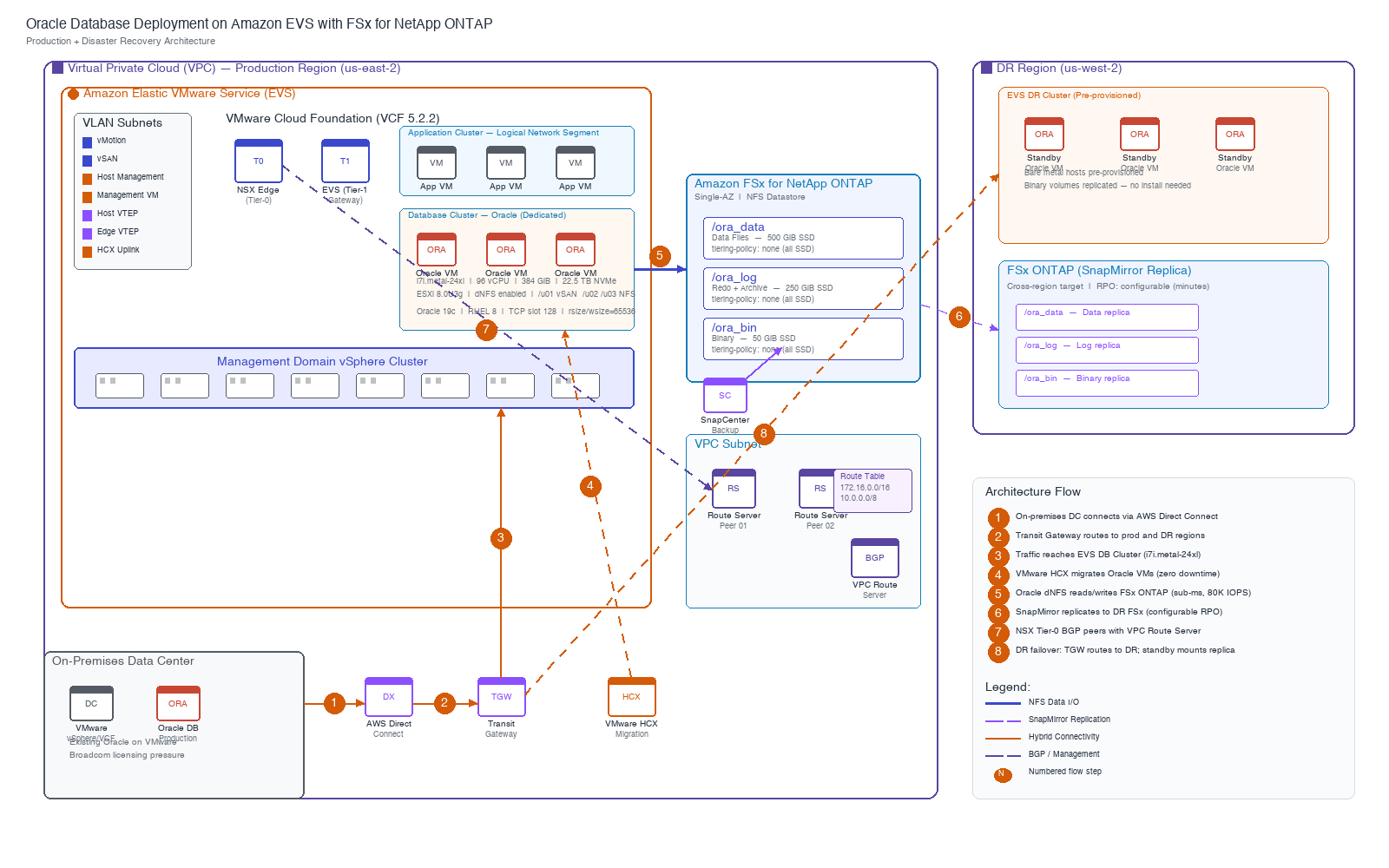
Figure 1: Oracle Database on Amazon EVS with FSx for NetApp ONTAP and cross-region SnapMirror DR
The architecture consists of eight functional components, described in the following section.
These numbered items correspond to the data flow shown in the diagram.
Before you begin deployment, evaluate your Oracle workload requirements against the available infrastructure options. The decisions you make for instance types, VM sizing, and storage architecture directly affect database performance, cost, and operational complexity.
Oracle licensing consideration: Instance type selection affects Oracle license cost, which is an important factor to take into consideration. We recommend requesting an AWS Optimization and Licensing Assessment (AWS OLA) for further guidelines.
Amazon EVS currently supports three bare metal instance types for ESXi hosts. The choice depends on whether you prioritize per-core compute speed (i7i) or per-host memory and storage density (i4i), and on how much you want to scale a single host vertically. For most new Oracle deployments, i7i is the better choice because Oracle query performance is sensitive to CPU instruction throughput and storage IO latency.
VCF compatibility: All three instance types support VCF 9.1 with ESXi 9.1 (build 9.1.0.0100.25433460). VCF 5.2.2 (ESXi 8.0U3g) remains available but is on a path to end of support, so new deployments should default to 9.x. An EVS environment supports 4–32 hosts per cluster. You can mix instance types across clusters within the same SDDC.
Size Oracle Database VMs based on these workload characteristics:
The recommended design splits storage responsibilities between two tiers:
This separation gives local NVMe speed for transient IO while adding snapshot, clone, and SnapMirror capabilities for persistent database files.
Why NFS datastore (host-level) instead of in-guest NFS (dNFS)? With in-guest NFS, all Oracle NFS traffic routes through the NSX overlay and an NSX Edge node before reaching FSx for ONTAP. This creates a single Edge chokepoint. With NFS datastores, each ESXi host talks NFS directly to FSx for ONTAP using its own network bandwidth. There is no Edge bottleneck and no extra latency hop.
Important: Use 100% SSD for Oracle. We recommend against using capacity pool tiering for Oracle database volumes. Keep tiering policy set to
nonefor all Oracle volumes.Important: SSD capacity planning. If the SSD tier fills to capacity, FSx for ONTAP blocks writes. Monitor SSD utilization and provision headroom (minimum 20% free).
Important: Read/write throughput asymmetry. On a 6 GB/s filesystem, read throughput can reach 6 GB/s, but write throughput is limited to approximately 1 GB/s. Size throughput capacity based on Oracle write workload requirements. This write ceiling applies per high-availability (HA) pair. To scale write throughput beyond a single HA pair, deploy a file system with more than one HA pair and distribute Oracle volumes across the additional aggregates so writes are spread across pairs. This placement is not automatic, so plan the layout up front to keep write-heavy datasets balanced.
Amazon EVS uses VLAN subnets (defined at environment creation and unchangeable later) to segment traffic.
VPC Route Server replaces static routes within the VPC. NSX Tier-0 gateways peer through BGP with Route Server endpoints. This is one-way BGP: Route Server listens for routes from NSX and programs them into the VPC route table but does not advertise VPC routes back to NSX. Beyond the VPC, routes remain static at Transit Gateway.
Important: Security group rules are not enforced on VLAN subnet interfaces. Use network ACLs and NSX distributed firewall for traffic control.
Oracle licensing consideration for DR: There are license impacts based on how DR replication is implemented. If you have licensing questions, we recommend requesting an AWS Optimization and Licensing Assessment (AWS OLA).
To comply with the Oracle licensing rules, an alternative is to replicate the Oracle VM through NetApp SnapMirror from Production to DR. Keep the DR replicated volumes as data-protection (DP) volumes that are NOT mounted as NFS datastores on DR hosts until a failover event is declared to avoid Oracle double licensing. Only then break the SnapMirror, mount the NFS datastore on the DR Host, and power on the VM. Pre-mounting the SnapMirror volume as a datastore, even with no VM powered on, means Oracle binaries are accessible on those hosts, which Oracle may consider an “installation” requiring licenses across the entire DR cluster.
The following table compares migration options from on-premises VMware to EVS.
| Option | Method | Best for | Downtime |
| 1 | VMware HCX Live Migration | Existing VMware on-prem | Near-zero (vMotion) or planned bulk |
| 2 | SnapMirror ONTAP-to-ONTAP |
On-prem Oracle on NetApp ONTAP | Minutes (final sync switchover) |
| 3 | Oracle PDB Relocation | PDB/CDB multitenant model | Brief (final switchover only) |
| 4 | RMAN Backup/Restore | Non-ONTAP on-prem (universal) | Hours (backup + restore + apply) |
For detailed procedures on each migration option, see our companion post: Deploy Oracle Database step by step on Amazon EVS with FSx for ONTAP.
Security for Oracle on Amazon EVS spans multiple layers from network isolation to database-level encryption. The following table summarizes the security controls across each layer.
| Layer | Control |
| Network segmentation | NSX-T Tier-1 gateways isolate DB/App/perimeter network segments |
| East-west traffic | NSX Distributed Firewall: restrict TCP 1521 to authorized app segments |
| North-south traffic | FortiGate or equivalent inspection VPC for ingress/egress filtering |
| Encryption at rest | FSx for ONTAP volumes encrypted with AWS Key Management Service (AWS KMS) |
| Encryption in transit | VPC encryption for NFS traffic, and IPsec for SnapMirror cross-region |
| Database encryption | Oracle TDE (Transparent Data Encryption) for additional protection |
| Administrative access | Zero-trust access (for example, Banyan or Zscaler) for VMware admin consoles |
| VLAN subnet security | Network ACLs (security groups not enforced on VLAN interfaces) |
Cost optimization for Oracle on Amazon EVS focuses on matching infrastructure capacity to workload demands and using AWS pricing models. The following table summarizes key strategies across compute, storage, networking, and Oracle licensing. We recommend requesting an AWS Optimization and Licensing Assessment (AWS OLA) for further guidelines.
| Component | Strategy |
| EC2 bare metal hosts | Compute Savings Plans or Reserved Instances (up to 54% savings) |
| Instance type selection | i7i.metal-24xl delivers ~10% price-performance over i4i.metal |
| FSx for ONTAP throughput | Right-size for the write workload, and adjust on the fly |
| FSx for ONTAP storage | 100% SSD for Oracle, and storage efficiency for non-production |
| Data transfer | Place FSx for ONTAP in same AZ as EVS cluster |
| SnapMirror replication | Schedule frequency based on RPO (less frequent = lower cost) |
| Oracle DR licensing | Replicate the Oracle VMs through NetApp SnapMirror from Production to DR, keeping the DR replicated volumes as data-protection (DP) volumes that are NOT mounted as NFS datastores on DR hosts until a failover event is declared to avoid Oracle double licensing. When a failover event is declared, then break the SnapMirror, mount the NFS datastore on the DR Host, and power on the VM. We recommend requesting an AWS Optimization and Licensing Assessment (AWS OLA) for further guidelines. |
| Non-production | Use fewer hosts, and apply tiering for dev/test data |
Deploying Oracle databases on Amazon EVS with Amazon FSx for NetApp ONTAP provides high availability, cross-region DR, and sub-millisecond storage latency while combining VMware operational consistency with AWS cloud economics:
ONTAP-to-ONTAP), PDB Relocation (multi-tenant), and RMAN (universal).This architecture provides you with high availability, cross-region DR, and storage-based backup and cloning similar to Oracle RAC and Data Guard functions while maintaining your familiar VMware operational tooling and procedures.
To get started with this deployment: