Post Syndicated from Oglaf! -- Comics. Often dirty. original https://www.oglaf.com/strongly-discouraged/


Post Syndicated from Oglaf! -- Comics. Often dirty. original https://www.oglaf.com/strongly-discouraged/
Post Syndicated from Talks at Google original https://www.youtube.com/watch?v=zkFq2qffuI8
Post Syndicated from Екип на Биволъ original https://bivol.bg/powerful-us-lobbyist-aids-businesses-linked-to-sanctioned-bulgarian-lawmaker-has-joint-company-with-notorious-attorney.html

United States (US) Democratic Party lobbyist Anthony Podesta has signed lobbying deals worth more than USD 2 million with Bulgarian companies whose owners are linked to controversial Bulgarian lawmaker, former media mogul…
Post Syndicated from Екип на Биволъ original https://bivol.bg/podesta-lobbying-peevski.html
Лобистът на Демократическата партия Антъни Подеста е подписал лобистки договори на стойност над 2 милиона долара с български компании, чиито собственици се свързват с интересите на санкционирания по глобалния закон “Магнитски” олигарх Делян…
Post Syndicated from Techmoan original https://www.youtube.com/watch?v=22-HsrdqR_o
Post Syndicated from Matt Granger original https://www.youtube.com/watch?v=HSuLvkYR0fs
Post Syndicated from Bruce Schneier original https://www.schneier.com/blog/archives/2022/01/friday-squid-blogging-squid-prices-are-rising.html
The price of squid in Korea is rising due to limited supply.
As usual, you can also use this squid post to talk about the security stories in the news that I haven’t covered.
Read my blog posting guidelines here.
Post Syndicated from Венелина Попова original https://toest.bg/deyan-kyuranov-interview/
Деян Кюранов е доктор по философия, политолог и програмен директор на Центъра за либерални стратегии. Публикува в Портал „Култура“ и „Дневник“, автор на множество политологични статии и изследвания, свързани с човешките права и с развитието на Русия и някои бивши съветски републики.
Господин Кюранов, струпване на многобройни и тежковъоръжени руски войски в близост до източните граници на Украйна имаше и миналата пролет, но прогнозата на мнозина анализатори за война между двете държави не се сбъдна. Днес по-възможна ли изглежда тя?
Първо, мисля, че война няма да има. Второ, днес тя не изглежда невъзможна – заради ултиматумите на Русия към света, които промениха радикално нещата. Както казва един много добър руски политолог – Владимир Пастухов, проблемът е, че войната вече не е невъзможна в мисленето на Кремъл.
В следващите дни започва серия от срещи преди тази в Брюксел на Съвета „НАТО–Русия“, свикана от Столтенберг на 12 януари. Очаквате ли успех на дипломатическите усилия? Изглежда ли единен Алиансът преди срещата на върха и ясна ли е позицията на руския президент, който според изразеното от Вас мнение в публикация в „Дневник“ шантажира НАТО или блъфира? А може би Путин шантажира, блъфирайки?
Това са няколко въпроса, затова ще започна от последния. Ще се позова отново предимно на мненията на руски колеги, защото ми се струва, че в такава ситуация човек, колкото е по-близо културно и емоционално до събитията в Кремъл, толкова по-точна ще бъде интуицията му. А в този случай работим най-вече по интуиция, защото нямаме чужди данни, нямаме и достатъчно информация. Проблемът е, че изглежда, че общо взето, Путин не знае какво иска. Като казвам това, имам предвид сериозни и същевременно безумни хипотези от типа: Какво иска Русия – да завладее целия свят? Или иска да завладее Европа? Или може би да глътне Украйна?
Може би някоя от тези хипотези се върти в главата на Путин, който се изживява като император?
Там е работата, че не е ясно като какъв точно се изживява Путин в тази ситуация. Във всеки случай се изживява като много силен участник в събитията, като човек, който ги създава и води. И е реално такъв без никакви ограничения, морални например. В такава ситуация е много трудно да се прогнозира и да се говори за разумност, след като сме отвъд разума – елементарния, политически и политологически разум. Отвъд разума, който цели максималното добро управление. Като не сме в такава ситуация, сме в изключителна неопределеност.
Защо въпреки всичко аз смятам, че война няма да има? Ами защото все пак в малко по-дългосрочен план, ако Путин се реши на някаква агресия, тя ще бъде откъслечна. Той вероятно първо ще се опита да откъсне нещо от Украйна, след това ще спре и ще се опита да го задържи по схемата на Крим. Явно е, че Западът няма да воюва за Украйна. От друга страна, е ясно, че Украйна ще воюва за себе си. И „петата колона“ няма да е решаваща в този случай – руската пета колона в Киев. Това съвсем няма да е лесна, а много страшна война. Разбира се, в момента работя изцяло в безумните хипотези, защото това ще бъде разтърсване на целия ред, създаден не само след разпадането на Съветския съюз.
От това, което казвате, сякаш не се надявате много на дипломатическите усилия?
Не, мисля, че те са част от агресията на Путин към външния свят на всички равнища и фронтове. На два пъти той практически каза: „Да, ще водим преговори, ама какво от това – ние не искаме съглашения на думи, искаме да видим дела.“
Включително и в последния си телефонен разговор с президента Байдън…
Да, същото каза и на дългата си пресконференция. Господи, тогава какви резултати да очакваме от дипломацията? Освен това всички забелязват, че когато на такива преговори пращаш заместник-министри на външните работи, а преговорите по идея би трябвало да решават въпроси за войната и мира в Европа и света, означава, че за теб това не са преговори от първостепенна важност.
Има ли разногласия между страните членки на Алианса, най-вече между САЩ и водещите държави в ЕС, преди срещата на върха в Брюксел?
Европейският съюз не е бил в такава ситуация досега. Нееднократно сме доказвали мекушавост, нерешителност, боязливост и нежелание да се намесваме. Така че какви са разногласията точно в момента и между кого, и „Северен поток“ и несеверен поток – те са прекалено дребни на фона на това предизвикателство. За по-малки неща имаше значение точно Франция ли е по-близо до Америка, или пък Великобритания и Германия какво правят. Но сега имаме ултиматум. Такъв език не е държал дори Съветският съюз по времето на Студената война, защото тогава той беше първи борец за мир и не можеше да си го позволи по идеологически причини. А сега нямаме никаква идеология. Тук идеята е „Абе, аз имам армия, имам бомба и казвам това, да видим пък вие какво ще кажете…“
Споделяте ли мнението на някои анализатори, че сегашната криза в някаква степен повтаря Кубинската (Карибската) криза – най-опасната по време на Студената война?
Дума да не става, че сегашната е много по-малка. Тогава Съветският съюз все още имаше месианската идея да завладее света и да ощастливи цялото човечество чрез комунизма. Сега, ако рекат да правят нещо с цената на хиляди жертви от двете страни, няма да е свързано с никакви месианщини и идеологии, а просто с утвърждаване на новополучената сила на руската армия.
Вие казахте, че Западът няма да воюва за Украйна. Американският президент Джо Байдън увери Володимир Зеленски, че те – САЩ и неговите съюзници – ще гарантират териториалната цялост и суверенитета на Украйна. Първият дипломат на ЕС Жозеп Борел също изрази подкрепата си за Украйна по време на своето посещение в страната през седмицата. Как звучат тези декларации на фона на Вашата прогноза, че те няма да воюват за Украйна?
Аз не знам защо говорим за „те“, а не за „ние“, понеже сме в НАТО. Тук няма да обсъждам специално позицията на България, която, както винаги по отношение на Русия, е в разкрач. Но иначе, ако щете в морално отношение, това безспорно сме ние и не е хубаво да го забравяме. Та ние заявихме, че няма да воюваме за Украйна, и същевременно ние (имам предвид НАТО плюс вече и отделно евентуални военни действия на САЩ) ще им помогнем с оръжие и пари и максимално ще затрудним живота на Русия, но не чрез обикновени санкции. Предполагам, че ще има много радикални изключвания на страната от световния поток на пари и стоки.
В крайна сметка кой кого притиска в ъгъла: Западът – Русия, или Путин – Запада?
Путин притиска света. Това е негова агресия, това е негова инициатива. Светът би искал просто всичко това да го нямаше. И това не е само ЕС, който поначало, откакто го има, иска нещата да се решават не чрез сила, а чрез преговори, чрез взаимни отстъпки. САЩ биха могли в някои случаи да се държат по алтернативен начин и да си кажат: „Тия прекалено много взеха да дрънкат оръжия, я да вземем да ги ударим.“ Но сега случаят не е такъв.
Какво друго иска руският президент освен вече заявеното официално – да не се разполагат в черноморския регион сили на НАТО и да спре разширяването му на изток? Или може би с демонстрацията на сила Путин се опитва да разреши и свои вътрешни проблеми в Русия?
В момента Путин практически няма вътрешни проблеми, поне що се отнася до статута на Русия в света. Той се основава на един вече втвърден електорат от хора, за които е страшно важно да могат да кажат: „Ние сме отново най-великите в света. Ето, каквото решим, това правим – вземаме си Крим и ще им кажем на тия украинци как да живеят. И ще си помислим искаме ли ги обратно в кошарата, или да си стоят навън и да слушкат…“ Това е равнището на мисленето и на дискурса в този вид политика.
Освен това, благодарение на ценовата конюнктура напоследък, в Русия има пари и хората отново живеят сравнително добре. Не трябва да забравяме, че това е поначало епоха в историята на държавата, незапомнена по относителното си добруване. Както навремето каза една чудесна руска политоложка – Маша Липман: „Не забравяйте, като мислите за Русия, че сега руснакът живее по-добре от когато и да било в своята история!“ И това е въпреки невероятната дори за Русия корупция. Просто има много и колкото и да се краде на всяко равнище, все пак и до най-долу стига по нещо. Освен това има относителен ред и руснаците го сравняват, и то с основание, с безредието на 90-те години, за което обвиняват (както и братята българи) демокрацията. Путин няма проблеми вътре и не смята, че с такава политика си създава проблеми навън.
Но искам да се върна към нещо от началото: за неяснотата на целите на Путин и оттук – за непредвидимостта на ситуацията. Руските колеги говорят много разумно за това, че не трябва да бъркаме сегашния Путин с Путин отпреди 20 години, който дойде в името включително и на човешките права. Тогава той направи един невероятен съвет по човешките права към президента и понеже познавам тази тематика и тези хора – поне половината бяха истински правозащитници.
А днес да се говори за човешки права в Русия вече е нелепо. И не е само закриването на „Мемориал“, а и цялото отношение на Путин към неправителствения сектор.
Цялото отношение е вече съвсем друго, а не трябва да забравяме и убийствата зад граница. А каква е главната причина? Путин може да си го позволи, защото превъоръжи руската армия и в момента, казват специалисти, тя е сериозна военна сила, а не беше такава преди идването му на власт. Този човек никога не е имал някаква идеология, разполага със силна армия и декларира безкраен и агресивен национализъм. Казвам „декларира“, защото смятам, че винаги може да се отметне от едно или друго, ако прецени, че това ще му помогне в ситуацията. Този вид прагматизъм не го е напуснал. Въпросът е каква е ситуацията, в която решава да вкара себе си, страната си и света. И тук вече може да говорим доколко той е вменяем от гледище на разума. След толкова години квазиабсолютна власт, това човек може да го гадае или да го знае само близкият му антураж.
Но се връщам пак към лайтмотива – война все пак няма да има. И това е въпреки изключително засиленото влияние на генералитета върху руската външна политика.
Избухналите граждански протести в Казахстан заговор ли са, както твърди президентът Токаев? Имат ли те някаква връзка със случващото се между Русия и Украйна и инициатива на Токаев ли е влизането на руски войски в страната под формата на колективни мироопазващи сили на Организацията на Договора за колективна сигурност?
Мисля, че всичко, което става в Казахстан, няма нищо общо със ситуацията, за която говорим. В този момент тя пречи на Путин да си води агресивната външна политика просто защото разсейва вниманието му и може да се наложи да отклони и ресурси. Не е московска уйдурма това, което става в бившата азиатска съветска република. Тя си е тяхна, местно производство.
Енергийната криза, завършените и незавършените газови коридори с Русия кореспондират ли и как с темата, която обсъждаме?
Ще повторя отново – на фона на проблемите сега те са прекалено дребни. И не те определят какво ще се случи. И това, което ще се случи, няма да определя как ще бъдат решени тези проблеми.
Значи не виждате корелация между енергийните проблеми и конфликта между Русия и Украйна?
Не, не виждам. Може да е имало връзка в даден момент и това да е влязло в калкулациите на стратезите на Путин и в неговите лично – че сега ще можем да ги „подпукаме“. Съжалявам, че използвам площаден език, но тези хора мислят на вулгарен език и това създава проблеми, когато с такова мислене започнеш да правиш световна политика. Да, ще ги „подпукаме“ и по тази линия и ще можем да си вземем нещо и от газа и нефта. Но това е вече отдавна отминал етап. Сега заявките са много по-високи и отново ще цитирам Владимир Пастухов: проблемът е, че изобщо в кремълското мислене не се изключва войната. Почнали са да мислят така (преразказвам): поставяме си някаква цел, тръгваме към нея и ако се окаже, че по пътя трябва да направим война, ами ще я направим, за да постигнем целта. Това е изключително опасно мислене и поне част от хората около Путин мислят така – иначе той нямаше да се държи по този начин.
Сбърка ли министърът на отбраната Стефан Янев с изявлението си, макар и само във Facebook, че няма нужда НАТО да увеличава контингента си на наша територия?
Първо, така не се прави, защото ангажира с позицията си цяла България. Иначе му прави чест, че открито каза, че това е неговата лична позиция и той ще я защитава като министър. В кризисна ситуация обаче се прави друго – тази позиция се изразява на закрито заседание и ако успееш да убедиш кабинета и тя стане позиция на България, тогава я съобщаваш. А така поначало рискуваш да забиеш клин в Министерския съвет, а в тази ситуация – и в цялото общество. И той го направи, без да го интересува как ще прозвучи. А звучи като откровено проруска и антинатовска позиция. Един министър на отбраната не може да си позволи такова нещо. Аз съжалявам, че премиерът не събра сили да го уволни мигновено.
А каква трябва да е позицията на правителството относно евентуалното разполагане на нови военни части на НАТО в България, макар че досега никой не е поискал това от нас?
Ами като не е поискал, ще кажа: „Кой те бута, та се клатиш?“ – така казвахме, като бяхме деца. Позицията на България трябва да бъде позицията на НАТО, освен ако България не излезе от НАТО. Тогава може да имаме каквато си искаме позиция. Но докато сме в НАТО, е хубаво да имаме позицията на Алианса. И да не забравяме това.
Post Syndicated from Стефан Иванов original https://toest.bg/na-vtoro-chetene-az-ostava/
от Георги Гаврилов, Мария Куманова и Наталия Иванова, изд. Scribens, 2019
Длъжен съм да предупредя още в началото, че имам пристрастия и откровено харесвам група „Остава“, фен съм ѝ, фен съм и на авторите на тази книга. Предупреждавам, че този текст е и личен.
А това е книга, създадена с грижа, внимание и желание за изчерпателност. Самият том като обект и полиграфия също е впечатляващ с обема и качеството си. Това не е обичайна биография на музиканти, а е пъзел от разговори, снимки, текстове на песни и думи от хора, близки на групата. Чете се като интересен и интимен роман за България, София, Габрово и Казанлък от 70-те години на миналия век до днес. От детството им и първите касетки до първите концерти и поредица от премествания в квартири и общежития, за да се стигне до това, което са днес. Едни от най-обичаните български музиканти.

Книгата е част от Scribens Acoustic, поредица от книги на музикална тематика. Наскоро от нея излезе книга за група P.I.F. Много се радвам на тази инициатива. Когато бях в шести клас, излязоха трите тома на „Изборът на Рупи“, страхотната за времето си музикална енциклопедия на Йордан Рупчев. Ценно е, че такава традиция се продължава с отделни книги за различни състави и с публикация на непознатото им досега творчество, както е в случая с издадената наскоро „Непрочетено“ от Димитър Воев, лидера на „Нова генерация“.
Когато разбрах, че „Аз | ОСТАВА“ вече е налична в „Хралупата“, отидох и си я купих. Прочетох я бързо. Мисля, че е първата толкова хубава биографична книга за българска група. Отделно от това – последните двайсетина страници са едно от най-смешните неща, които съм чел от много време насам.
Първото, което прави впечатление, е, че разговорите с членовете на групата изобщо не са като беззъбите, скучни и банални интервюта в телевизионни токшоута. Ако някога сте се чудили например откъде идва името на бандата, ще получите отговор от Георги Георгиев, основател и китарист на групата:
… покрай казармата се движех в компания на колоритни художници от гимназията в Казанлък, които слушаха яка музика и правеха купони, които ми оставиха спомени за едни безметежно хубави вечери. На едно такова събиране единият от тях, Мирчо, каза: „Сега ще ви разкажа, пичове, най-флойдовския виц:
„Върви един човек през пустинята, гладен, жаден, чака оазис, вече не издържа. И гледа табела „Остава – 3 км“, после „Остава – 2 км“, „Остава – 1 км“ и чака следващата табела, за да зърне най-сетне оазиса, вече няма никакви сили – пълзи, лази… Стига най-накрая до следващата табела, поглежда я и на нея пише: „Добре дошли в Остава!“. И пак пустиня.“
Ако поне една тяхна песен ви е харесала, прочетете и тази книга. През септември т.г. „Остава“ ще отбележат 30 години от основаването си. Във време на разпад, скандали и раздели, нещо, което е устояло и устоява, и не е фейк, дава кураж и надежда.

Преди десетина години журналистът Даниел Ненчев пръв излезе с идеята за биографична книга за „Остава“. Даниел не успя да я осъществи, но тогава по негова молба написах една страница, която впоследствие беше включена в настоящата книга:
„Ходил съм на поне 150 техни концерта. Това не ми се е случвало с никоя друга група. Бих искал да е така и с „Нова генерация“, но няма как, малък съм бил дори за един техен концерт. В главата ми изникват прекалено много случки и спомени, свързани с „Остава“. Сега се сещам например, че една нощ след саундчек (идвах максимално рано, за да чуя и него) в несъществуващия вече клуб „Бекстейдж“ едно момиче ме попита дали не съм Дани, барабанистът. Благодарих и казах, че не мога никакъв ритъм да държа на барабаните, и се засмяхме заедно.
Трудно ми е да пиша за нещо, което е такава част от живота и паметта ми, но ще се опитам. Защото трябва непрекъснато да се говори за нещата, които ни обгръщат неусетно и по невидим начин заемат централно място в дните ни. Или поне в слушалките ни.
Преди точно 25 години „Пинг-понг“, първият им албум, ме шокира. Не очаквах, че може да има толкова британска и алтернативна група в България. Те не копираха, а бяха себе си. В песните имаше оригиналност, бунт, финес, смях, ирония и смисъл. Започнах да ходя на техни концерти в също вече несъществуващата Сцена за авторска музика „О!Шипка“ (там беше и премиерата на първата ми книга). Пишех във фен клуба в Dir.bg. Запознах се с толкова много хора покрай слушането на „Остава“, включително и със самите музиканти.
В гимназията аз и още няколко приятели, включително Иван (Шейкърмейкър) – един от най-близките на групата хора, даже си направихме банда, казваше се Homesick. Аз бях почти посредствен, но за сметка на това ентусиазиран и нахъсан. Имахме и няколко концерта, на които Свилен и Жоро се включваха да свирят и пеят с нас. Беше повече от готино.
Всеки път, като ги гледам на живо, не спирам да танцувам, да подскачам, да припявам и да крещя в продължение на два часа, и така отново и отново. Мога да викам най-силно от всички в клуба по време и след края на песента – готов съм да го докажа на всеки.
Танцувал съм и на сцената до тях. Вземал съм за сувенир листовете с изписаната подредба на песните, които ще свирят. Падал съм от стол, върху който се бях качил, за да ги виждам по-добре от дъното на клуба (после имах грамадна цицина). Ходил съм на техни участия и с десетки приятели, и напълно сам. Бил съм ужасно тъжен, щастлив, влюбен или уморен и съм си тръгвал щастлив, спокоен или способен да заспя. Тяхната музика е била саундтрак на денонощието ми.
Слушал съм „Ще дойдеш ли с мен“, а и въобще всичките им песни къде ли не. На плажа, в морето, по тавани, на рождени дни, в самолет, на „София: Поетики“, по време на секс, преди концерт на Placebo, в „Бекстейдж“, в „Строежа“, в зала „Христо Ботев“. Пускал съм тяхна музика на големи новогодишни партита и на сватба във Военния клуб. Слушал съм ги с французи, англичани, германци, американци и унгарци. Радвах се, когато разнообразяваха изпълненията на живо на „Ще дойдеш ли с мен“, когато Гурко от „Анимационерите“ се включваше или когато Свилен започна да вкарва части от Music на Мадона и There Is a Light That Never Goes Out на The Smiths, преди „да изпие бавно топлия ден“.
Забелязал съм как на всеки три-четири години публиката им се сменя почти напълно. Наистина, колко много хора отпреди десет години заработиха сериозно, емигрираха, отидоха да учат в чужбина, омръзна им или просто се промениха. През годините и групата се промени. Не само с липсата на стари членове или наличието на нови. Слушал съм я във всички състави. Не знам какво ще стане с „Остава“ занапред. Обаче съм сигурен, че това, което са направили досега, ще остане.“
И действително тези прекрасни музиканти използват таланта си щедро и достойно, по предназначение. Благодаря им за това и се надявам да са все така изключително заразителен пример за естетическа и морална устойчивост.
Убеден съм, че без тях аз не бих бил същият. И книгата ми припомни това.
Post Syndicated from Crosstalk Solutions original https://www.youtube.com/watch?v=iJsUwcIwy7E
Post Syndicated from Йовко Ламбрев original https://toest.bg/editorial-3-7-jan-2022/
България изпрати 2021 година вторачена в промяната. И разбира се, както е обичайно, някои гарнираха промяната с надежда, други я поръсиха със скептицизъм, а трети я овкусиха с отрицания. Уви, границата между две години не е нищо повече от дата в календара, която е само репер във времето, но сама по себе си не обещава и не гарантира нищо. Още по-малко промяна.
От „Тоест“ обаче правим нашата малка промяна. Започваме новата година с различен ритъм на публикациите, които няма да излизат както през последните три години само в събота. Материалите вече ще се появяват на сайта през цялата седмица, а в събота само ще обобщаваме всичко публикувано в обичайната си редакционна статия, която четете в момента. Може да я получавате и като бюлетин директно по имейла, ако сте се абонирали за това. Така тези от вас, които са свикнали да четат „Тоест“ със съботното си сутрешно кафе, могат да продължават да го правят. А тези, които предпочитат да отварят директно сайта ни, ще откриват нови публикации в различни дни.
Редакционните ни статии „Седмицата“ занапред ще бъдат подписвани от някой от нашите автори или редактори и ще се подготвят от различен човек от екипа ни. Той ще има свободата да пречупва представянето на статиите ни през своя поглед, с което търсим различния дискурс и почерк. По своя преценка седмичният коментатор може да представя накратко и теми от български и чуждестранни медии, които е преценил за важни, както и да реферира към материали извън публикуваните в „Тоест“.
И през 2022 г. ще продължим да коментираме и анализираме по-важното от новинарския поток и сферата на културата. Избирателно, с чувствителността на нашите автори към общественозначимите въпроси и теми за бъдещето на всички ни.

В края на миналата година в „По буквите“ Зорница Христова представи сборника с избрани стихове на немската поетеса Нели Закс „Смъртта още празнува живота“. Тогава ни обеща интервю с преводача на сборника Любомир Илиев. Вчера (петък) публикувахме техния изключително интересен разговор. Рядко може да попаднете на такова интервю, затова нека започнем обзора на седмицата, а и новата година с разговор за трудна поезия вместо с анализ на непосилната лекота на политиката.

Да продължим с друга книга. Не от тези, които обикновено представяме в рубриката си „На второ четене“. Необичайно личен и емоционален е текстът на Стефан Иванов, който този път е повече музикален фен. В рецензията си на „Аз | Остава“ от Георги Гаврилов, Мария Куманова и Наталия Иванова той пише: „… това е книга, създадена с грижа, внимание и желание за изчерпателност. Самият том като обект и полиграфия също е впечатляващ с обема и качеството си. Това не е обичайна биография на музиканти, а е пъзел от разговори, снимки, текстове на песни и думи от хора, близки на групата.“

Идната седмица, на 12 януари, предстои среща на Съвета „НАТО–Русия“, който не е заседавал от 2019 г. Поводът, разбира се, е дрънкането на оръжия на границата между Украйна и Русия. Преди това, на 10 януари, официални представители на Вашингтон и Москва ще имат предварителни разговори в Женева. На този фон през изминалата седмица избухна и ожесточен вътрешен конфликт в Казахстан. По тези теми Венелина Попова разговаря с Деян Кюранов, доктор по философия, политически изследовател и програмен директор в Центъра за либерални стратегии.
На 6 януари се навърши една година от атаката над Капитолия от привърженици на Доналд Тръмп, който отказа да признае изборната си загуба. Срамно събитие, което обаче е ключово за историята на САЩ и бъдещето на американската политика. По този повод „Ню Йорк Таймс“ започна поредица от публицистични есета, всяко от което заслужава внимание. Ние ви подаряваме отключен линк към есето на Франсис Фукуяма One Single Day. That’s All It Took for the World to Look Away From Us, което е част от поредицата.
Социалните мрежи и особено Facebook носят огромна вина за насъскването и радикализирането на хората, както и за разделението на обществото на воюващи лагери по една или друга тема. И това продължава. Изданието The Markup създаде и поддържа инструмент за анализ на информацията, която алгоритмите на Facebook селектират и предлагат на американците според техните политически симпатии. Година по-късно наблюденията показват, че привържениците на демократите и тези на републиканците на практика виждат две напълно различни версии на социалната мрежа. Прочетете повече в статията One Year After the Capitol Riot, Americans Still See Two Very Different Facebooks.
Фалшивите новини и дезинформацията объркаха хората и относно значимостта и безопасността на ваксините. А това застрашава живота на уязвимите хора навсякъде – особено на болните, възрастните, медиците, живеещите и работещите в домове за възрастни хора. У нас част от вината, за съжаление, се носи и от лекари, които не застанаха с професионалния си и морален авторитет зад науката и не направиха нужното, за да разсеят съмненията на хората. Дори по-лошо, голяма част от медицинските лица подхранваха и споделяха тези съмнения.
А проблемът е, че всеки, който не е ваксиниран, улеснява разпространението на заразата в обществото и увеличава вероятността коронавирусът да стигне до уязвими хора. Разпространението на вируса има и значително икономическо въздействие, тъй като инфекцията засилва недостига на работници и служители, включително на медици, и забавя възстановяването на икономиката във всички области. В същото време уязвими в някакъв момент може да бъдем всички, колкото и млади или здрави да ни се струва, че сме в момента.

Злоупотребата с тази тема с цел извличане на политическа популярност е опасно и безчовечно, защото се измерва със загуба на човешки живот. Въпреки това местни политици го правят без никакви скрупули, подхранвайки страховете и колебанията на хората и безцеремонно отричайки научния консенсус по темата. На това е посветена статията на Зорница Латева „COVID-19 за политическа употреба“, която публикувахме още преди празниците.

Не пропускайте и материала на Константина Василева „Как липсата на стандарти за отразяване на научни теми допринася за инфодемията“, който чудесно обобщава добрите и лошите практики, както и дефицитите, които медиите, за съжаление, демонстрират при отразяването на научни теми. В синхрон с добрите практики, съдържанието на статията беше проверено от д-р Аспарух Илиев, ръководител на лаборатория в Университета в Берн, и допълнено с неговия личен коментар.
За да добавим още контекст по темата COVID-19 и как се справят на други места по света, прочетете материала на ProPublica за това как Хонконг се справя с пандемията: I Saw Firsthand What It Takes to Keep COVID Out of Hong Kong. It Felt Like a Different Planet.

Темата за българо-македонските отношения и търсенето на решение за отпадане на нашето вето върху преговорната рамка за присъединяване на Северна Македония към ЕС ще продължава да стои на дневен ред. Дали е възможна някаква развръзка след последното преразпределение на политическия пейзаж у нас, е тема на анализа на Александър Нуцов „Македонският въпрос в контекста на политическите промени в България“, публикуван преди коледните празници.

Новогодишният ни подарък за нашите читатели бе непубликуваният досега на български език разказ на Капка Касабова „Деветата чешма. Един ден на колибите“. Оригиналът на английски излезе в 157-мия брой на британското литературно списаниe Granta. Българският текст е преведен от Мария Змийчарова и от самата авторка. Ако сте го пропуснали между празниците, струва си да отделите време за него сега.
Накрая нека припомним, че през седмицата големият испански режисьор, хуманист и запален фотограф Карлос Саура навърши 90 години. Смятан за един от живите класици на съвременното европейско кино, той продължава да прави филми и изложби, чрез които води своите битки срещу политическите недъзи, корупцията, цензурата над медиите и авторитаризма. Самият той, повлиян от творци като Луис Бунюел и вдъхновяващ други, като Педро Алмодовар, ползва метафорите на изкуството си, за да провокира обществена промяна – нещо, в което той намира смисъла на изкуството. Нещо, за което тъжно малко негови по-млади съвременници имат кураж и гръбнак.
Споменавайки тримата режисьори в едно изречение, ви провокираме да гледате филма на Карлос Саура „Ментово фрапе“ (1967) – един от испанските филми, от които Алмодовар признава, че черпи вдъхновение, и в същото време е своеобразно преклонение пред Луис Бунюел. А метафората е скрита около главната героиня – едно модерно и много свободно момиче, контрапункт на всичко, което е Испания през 60-те. Филмът може да се тълкува и като завоалирано обвинение срещу репресиите и лицемерието на дребната буржоазия от онова време, но е много повече от това.
Това е от мен тази седмица. Приятно четене и гледане!
И за много години!
Post Syndicated from The Hook Up original https://www.youtube.com/watch?v=99Pi_H2isWw
Post Syndicated from Bonnie McClure original https://aws.amazon.com/blogs/architecture/top-10-architecture-blog-posts-of-2021/
The AWS Architecture Blog highlights best practices and provides architectural guidance. We publish thought leadership pieces and how-tos. Check out the AWS Architecture Monthly Magazine, also published by our team, which offers a selection of the best new technical content from AWS!
A big thank you to you, our readers, for spending time on our blog this past quarter. Of course, we wouldn’t have content for you to read without our hard-working AWS Solutions Architects and other blog post writers either, so thank you to them as well! Without further ado, the following 10 posts were the top Architecture Blog posts published in 2021!

by Seth Eliot
You’ll notice a recurring theme in this post—Seth’s four-part DR series is really popular! Throughout the series, Seth shows you different strategies to prepare your workload for disaster events like natural disasters like earthquakes or floods, technical failures such as power or network loss, and human actions such as inadvertent or unauthorized modifications.
In Part IV, Seth teaches you how to implement an active/active strategy to run your workload and serve requests in two or more distinct sites. Like other DR strategies, this enables your workload to remain available despite disaster events such as natural disasters, technical failures, or human actions.
by Jack Stevenson
Building a search engine can be a challenge. You must continually scrape the web and index its content so it can be retrieved quickly in response to a user’s query. In this post, Jack describes how to implement this in a way that avoids infrastructure complexity while remaining elastic with a serverless search engine that can scale to crawl and index large web pages.
by Scott Gerring
While building REST APIs, architects often discover that they have particular operations that have to run in the background outside of the request processing scope. In this post, Scott shows you common patterns for handling REST API operations, their advantages/disadvantages, and their typical Serverless on AWS implementations.
by Irfan Saleem, Pallavi Nargund, and Peter Buonora
In this post, Irfan, Pallavi, and Peter discuss a couple of customer use cases that use Serverless on AWS offerings to maintain a cache close to the microservices layer. This improves performance by reducing or eliminating the need for the real-time backend calls and by reducing latency and service-to-service communication.
by Seth Eliot
Part III of Seth’s DR series discusses two strategies to prepare your workload for a disaster event: pilot light and warm standby. This post shows you how to implement these strategies that help you limit data loss and downtime and how to get the most out of your set up.
by Andrei Maksimov
In the post, Andrei highlights eight common anti-patterns (solutions that may look like the right solution but end up being less effective than intended). He provides recommendations to avoid these patterns to ensure that your system is performing at its best.
by Anandprasanna Gaitonde and John Bickle
In this post, Anandprasanna and John present an architecture that provides a unified view of DNS while allowing different AWS accounts to manage subdomains. They show you how hybrid cloud environments can utilize the features of Route 53 Private Hosted Zones to allow for scalability and high availability for business applications.
by Bryant Bost
Despite microservice architectures’ popularity, many frontend applications are still built in a monolithic style. In this post, Bryant shows you how micro-frontend architectures introduce many of the familiar benefits of microservice development to frontend applications. This simplifies the process of building complex frontend applications by allowing you to manage small, independent components.
by Seth Eliot
Part I of Seth’s DR series gives you an overview of each strategy in the series (backup and restore, pilot light, standby, multi-site active/active) and how to select the best strategy for your business needs. Disaster events pose a threat to your workload availability, but by using AWS Cloud services you can mitigate or remove these threats.
by Birender Pal, Sebastian Gorczynski, and Dennis Schmidt
With 65,281 views, this team has definitely earned their top spot! Data transfer charges are often overlooked while architecting a solution in AWS. Considering data transfer charges while making architectural decisions can help save costs. This post will help you identify potential data transfer charges you may encounter while operating your workload on AWS.
Thanks again to all our readers and blog post writers. Your contributions to the blog are immensely valuable to all our customers! Keep on writing!
We look forward to continuing to learn and build amazing things together in 2022.
Post Syndicated from Joshua Harr original https://blog.rapid7.com/2022/01/07/log4shell-strategic-response-5-practices-for-vulnerability-management-at-scale/

In today’s cybersecurity world, risks evolve faster than we can remediate them. To meet our goals and become resilient to these fast changes, we need the right balance of automation and human interaction. Enabling rapid response for protecting information systems is paramount, but how does a business reach this level of reaction?
How can organizations maintain a standard of excellence to their responses in high-risk situations?
Where do you even begin to respond to a critical vulnerability like the one in Apache’s Log4j Java library (a.k.a. Log4Shell)?
Most importantly, how do we transform the tactical actions that need to take place into an effective strategy to scale?
The personnel with the knowledge about your various solutions must be empowered to make the decisions necessary to address your company’s information technology needs. If those team members don’t feel they can make those decisions, then they will defer to management — but managers may not know the intricacies of the solutions and could create a natural bottleneck, since there are going to be more decision points than managers to make decisions. Providing personnel with policy documents with uniform criteria for evaluating the risk these new vulnerabilities present, the ways to respond, and the time expectations is paramount for a timely resolution.
In a typical risk resolution process, there are many gates to safeguard our systems. This helps ensure that whatever change happens increases the solution’s confidentiality, integrity, or availability rather than diminishing it. However, a situation like Log4Shell needs to be treated like an incident response activity to quickly address the risk. Create a task force to effectively answer the important questions like:
Utilizing a strong incident response procedure to answer all these questions will assist with prioritization and remediation to an acceptable level of risk.
Any standard vulnerability management lifecycle process begins with identifying affected systems to assess and evaluate the scope of a vulnerability’s presence on the network. The approach should utilize both proactive and reactive efforts through a combination of tools and well-documented processes to streamline and scale the response effectively.
A proactive process would first involve having well-documented use of any such library versions internally in an inventory, so that discoverability and traceability are much more narrowly focused efforts. If you conduct authenticated vulnerability scans continuously on pre-scheduled frequencies, this will also help with identification of third-party software utilizing this library over time. Classifying system criticality within the vulnerability management tool will help you more effectively scale future remediation processes.
These proactive processes help jumpstart an initial response, but you’ll still need reactive efforts to help ensure effective and timely remediation. Vulnerability scanning tools will receive signature updates regarding this newly discovered vulnerability, which will require updating your vulnerability management tool and initiating one-off alternative scans that may deviate from pre-scheduled rotations. These alternative scans should include tiered phases, so the most critical systems receive scan priority, and then remaining systems are scanned in order of criticality. Leveraging the pre-existing system criticality classification will significantly expedite this process.
A security incident and event management (SIEM) tool can also assist with identifying, tracking, and alerting for any suspicious activity that may be tied to exploitation of this vulnerability. Host agents and network detection systems that report back to the SIEM should be closely monitored, and any activity or traffic that deviates from baselines should receive an active response. You may need to adjust logging and alerting rules and thresholds to ensure your efforts are strategically focused.
Tactical processes help you achieve this continuous identification, but you still need to orchestrate and execute them through strategic planning to remain timely, efficient, and effective. Well-documented asset inventories and appropriate system criticality classifications help you prioritize your efforts, while continuous vulnerability scans and leveraging vulnerability management and SIEM tools help to identify, track, and manage vulnerability exposure. Leadership should provide the direction to guide these activities from inception to implementation through effective communication and allocation of resources. Lay out a short-term roadmap for tracking objectives and quick wins as part of the remediation process, so you can quickly and concisely show how you’re tracking toward goals.
Now that your team has successfully identified all affected systems, you’ll need to roll out patches to those systems on a continuous basis during the next phase to mitigate risk. Current enterprise-wide patching timelines may require adjustment due to the urgency associated with such critical vulnerabilities. Patch testing and rollout phases must be expedited to support a more timely and effective response.
Much like conducting our vulnerability scans in terms of system criticality prioritization, our patch management response should follow a similar approach, with the caveat that a pilot group or pilot system deemed non-critical should be patched first for testing purposes to ensure no adverse effects prior to rolling out patches in order of system criticality. If you’ve configured a full test environment is configured, you can test patches on critical systems first within that environment and then roll them out in production according to criticality. The testing timeline itself should be reduced throughout all standard phases of a testing cycle — you may even need to eliminate certain testing phases altogether. The rollout timelines for patches across all systems will need to be expedited as well to ensure as timely coverage as possible. If your environment has widespread use of the vulnerable library, you may require reductions in timelines of anywhere from 25% to 50%.
Emergency patching procedures should provide for timely testing and production rollouts within roughly half the time of a normal patching cycle, or 5 to 10 days at a maximum for critical systems to minimize breach potential as quickly as possible. Also keep in mind that some vulnerabilities may involve more than just application of a simple patch — configuration changes may also be necessary to further mitigate potential exploitation by an adversary.
Now, you’ve deployed patches to all affected systems, so the mitigation efforts are complete, right? While you may want to shift your focus back to other tasks, it’s essential to maintain continuous identification processes to ensure that no stone remains unturned.
The vulnerability management validation phase leverages those reactive identification processes, in addition to patch management processes, to assist in efficient and effective vulnerability remediation for affected systems. This stage involves re-scanning initially identified vulnerable systems to assess successful patch application and performing additional open scans of the network to ensure that there are no lingering systems that may still be affected by the vulnerability but weren’t originally identified — or perhaps weren’t successfully patched as part of the patch management process. This cycle of continuous validation will remain in effect until “clean” scans are reported across the enterprise regarding this vulnerability.
Since the Log4j logging library is widely used throughout many enterprise applications and even unknowingly embedded in so many others, continuous validation will become crucial in ensuring your organization remains vigilant and can mitigate the vulnerability quickly and effectively as you continue to discover affected systems.
A vulnerability management lifecycle rarely ever comes to a true end. As adversaries and security evangelists further evaluate a specific vulnerability over time, new methods of exploitation are identified, affected versions increase in scope and scale, and recent patches and fixes are found to be ineffective. This leaves organizations potentially open to exposure and at a loss for the best path forward. Continuous review of the trends surrounding an ongoing critical vulnerability will help organizations ensure they remain both aware of the impact and the current mitigating measures that have been most successful. Additionally, leveraging other solutions can help further identify and launch a coordinated defense-in-depth response to any potential malicious activity that may be associated with such vulnerabilities.
Working to continuously identify, mitigate, validate, and review vulnerabilities throughout their inevitable course will require commitment and fortitude to achieve the best results, but once the tides have subsided with Log4Shell and you’ve successfully and securely endured one of the worst security vulnerability exposures in a decade by following these processes, you can rest assured that your incident response processes were well-tested during this endeavor — and your IT security budget should be more than solidified for the next few years to come.
Check out our additional resources for further insight of this vulnerability, mitigating measures, and tools available to assist.
Post Syndicated from original https://lwn.net/Articles/880696/rss
Linux Mint has announced its 20.3 (“Una”) release for three different desktop environments: the Cinnamon, MATE, and Xfce editions. Mint 20.3 is a long-term support release, with support lasting until 2025. Each edition comes with a long list of new features (Cinnamon, MATE, and Xfce) and detailed release notes (Cinnamon, MATE, and Xfce).
Post Syndicated from Erran Carey original https://blog.rapid7.com/2022/01/07/metasploit-wrap-up-144/
This week, our very own Christophe De La Fuente added an important update to the existing Windows Secret Dump module. It is now able to dump secrets from Active Directory, which will be very useful for Metasploit users. This new feature uses the Directory Replication Service through RPC to retrieve data such as SIDs, password history, Domain user NTLM hashes and Kerberos keys, etc. This replicates the behavior of the famous impacket secretsdump.py, with the benefit of being fully integrated with Metasploit Framework. For example, it is possible to pivot on a compromised host and run the Windows Secret Dump module against an internal Domain Controller directly from msfconsole. Furthermore, the secrets are stored in the internal database, which lets other modules access this information easily.
This update also brings another big improvement to the ruby_smb library. This adds a new DCERPC client and many ready-to-use RPC queries from Directory Replication Service (DRS) Remote Protocol, Security Account Manager (SAM) Remote Protocol and Workstation Service Remote Protocol. These will greatly simplify the process of writing modules that use DCERPC against Windows systems.
Thank you to Ron Jost, Thinkland Security Team, and h00die for their community contribution of a Remote Code Execution exploit module against versions 1.8 and earlier of the Catch Themes Demo Import WordPress Plugin.
1.8. The functionality for importing a theme does not properly sanitize file formats, allowing an authenticated user to upload a php payload. Requesting the uploaded file achieves code execution as the user running the web server.SshCommandShellBind session type.set AllowNoCleanup true if they wish to bypass this protection.bash_profile_persistence now describe impacts of utilizing the module in a target environment.SMBUser datastore option had been explicitly unset.As always, you can update to the latest Metasploit Framework with msfupdate
and you can get more details on the changes since the last blog post from
GitHub:
If you are a git user, you can clone the Metasploit Framework repo (master branch) for the latest.
To install fresh without using git, you can use the open-source-only Nightly Installers or the
binary installers (which also include the commercial edition).
Post Syndicated from original https://lwn.net/Articles/880367/rss
Linux supports processor architectures where CPUs in the same system
might have
different processing capacities; for example, the Arm big.LITTLE
systems combine fast, power-hungry CPUs with slower, more efficient
ones. Linux has also run for years on simultaneous
multithreading (SMT) architectures, where one CPU executes multiple
independent execution threads and is seen as if it were multiple cores.
There are architectures that mix both approaches. A recent discussion
on a patch
set submitted by Ricardo Neri shows that, on these systems, the
scheduler might distribute tasks in an inefficient way.
Post Syndicated from Stacy Moran original https://blog.rapid7.com/2022/01/07/whats-new-in-threat-intelligence-2021-year-in-review/

This post was originally published on the IntSights blog.
Last year marked a huge milestone with the acquisition of IntSights by Rapid7. The IntSights team is very excited to join a company committed to simplifying and improving security outcomes for its customers. Rapid7’s focus is a great complement to the IntSights core mission to “democratize threat intelligence” for all. We look forward to continuing in this mission as part of the Rapid7 family, as our external threat intelligence solutions are incorporated within the Insight platform.
Threat Intelligence solutions compete in an increasingly crowded marketplace. Our solution stands out from others by removing the inherent complexity of threat intelligence while helping organizations of any size or maturity minimize their external risk while significantly reducing their workload. Over the course of 2021, we continued to deliver on this core promise by adding additional value to our products through:
“IntSights’ competitive advantage lies in its simplicity.” – Dave Estlick, CISO, Chipotle
Over the course of 2021, we increased our Threat Command detections coverage in several key areas to offer customers additional protection and value. These expanded capabilities include:
“IntSights gives us the ability to see a more granular view of our threats in a very easy-to-use fashion.” – Zac Hinkel, Global Cyber Threat Manager, Hogan Lovells
In 2021, we offered a new solution called Phishing Watch that offers advanced and preemptive phishing detection capabilities that help customers identify attacks before phishing websites emerge. Phishing Watch employs a lightweight snippet installed on customer-facing websites that proactively detects the copying or redirection of legitimate/official websites to an illegitimate (and potentially phishing) website. Customers receive proactive notice of any phishing scams before they are employed, including the details required to enable automatic takedown of the phishing website and eradicate any threats in the early stages.
This year, we also greatly enhanced the investigation capabilities and content within our Threat Intelligence Platform (TIP) to accelerate customers’ ability to research and triage threats. The enhancements enable customers to easily understand the intent associated with indicators and prioritize those that pose the greatest risk. Features include:
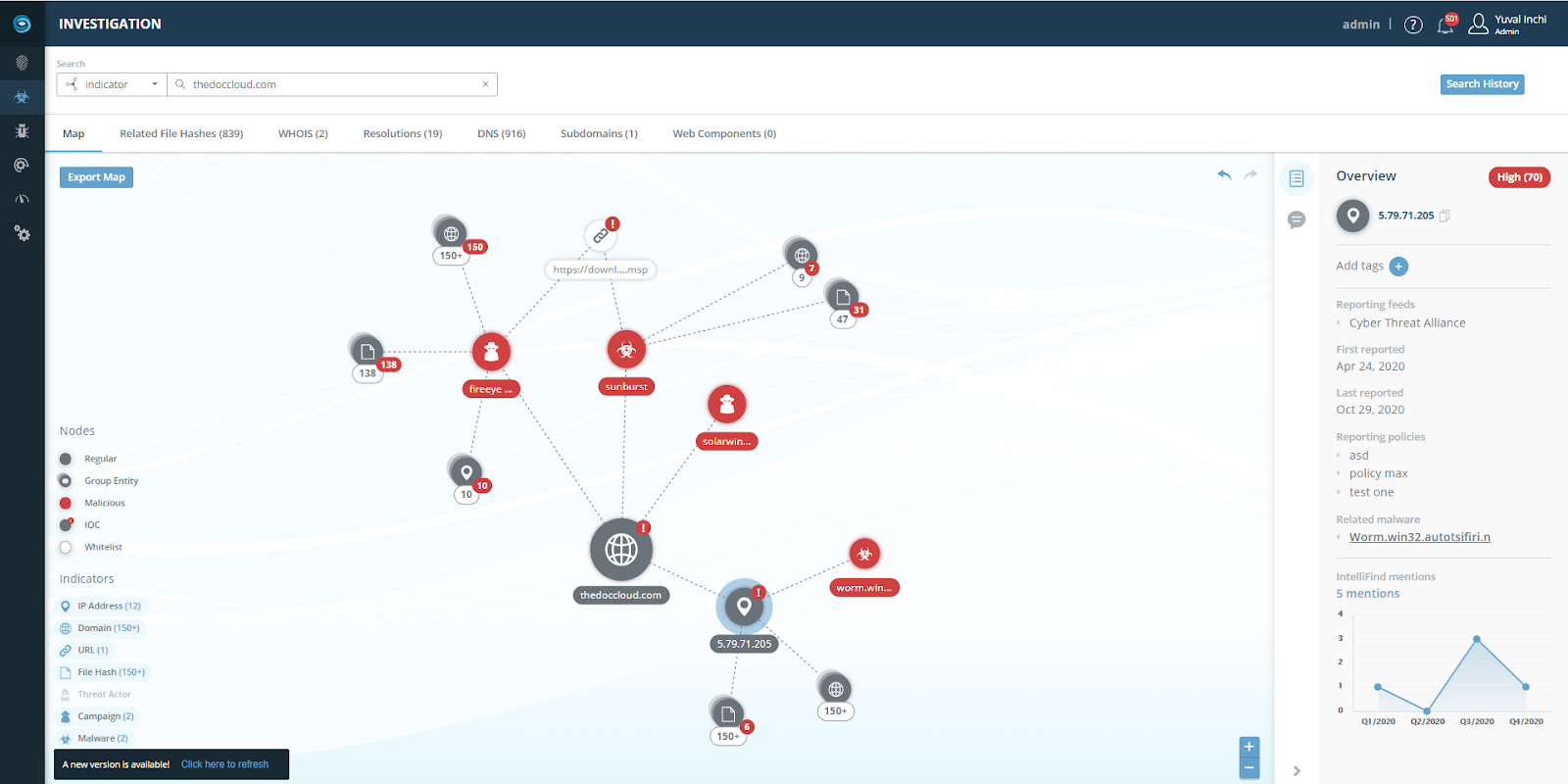
Introduced earlier this year, IntSights Extend actively parses, enriches, and highlights cyber threat intelligence data from any web-based application, such as a technical blog detailing the latest breach or a raw intelligence feed. It actively scrapes domains, URLs, IP addresses, file hashes, email addresses, and CVEs to deliver contextualized risk-prioritized alerts at the click of a mouse. Additionally, layering real-time enriched threat intelligence over any web-based application allows security practitioners to perform end-to-end investigation and analysis. They can immediately detect if threat indicators are active within their environment and block them directly from the browser. Customers can also easily pivot to the IntSights platform for further analysis, investigation, and action.
Dedicated research analysts work behind the scenes to input up-to-the-minute intelligence. The research team includes detailed information on known threat actors, malware, campaigns, and associated MITRE TIDs to help security analysts spot trends and gain contextual details regarding threats targeting geographic regions, including threat actor engagement and reconnaissance. Security analysts can take immediate action on threats by adding IOCs associated with specific topics to their security devices, without ever leaving the library. The IOCs can also be tagged with malware, threat actor names, campaigns, and/or attack type to accelerate triage across existing security infrastructure.
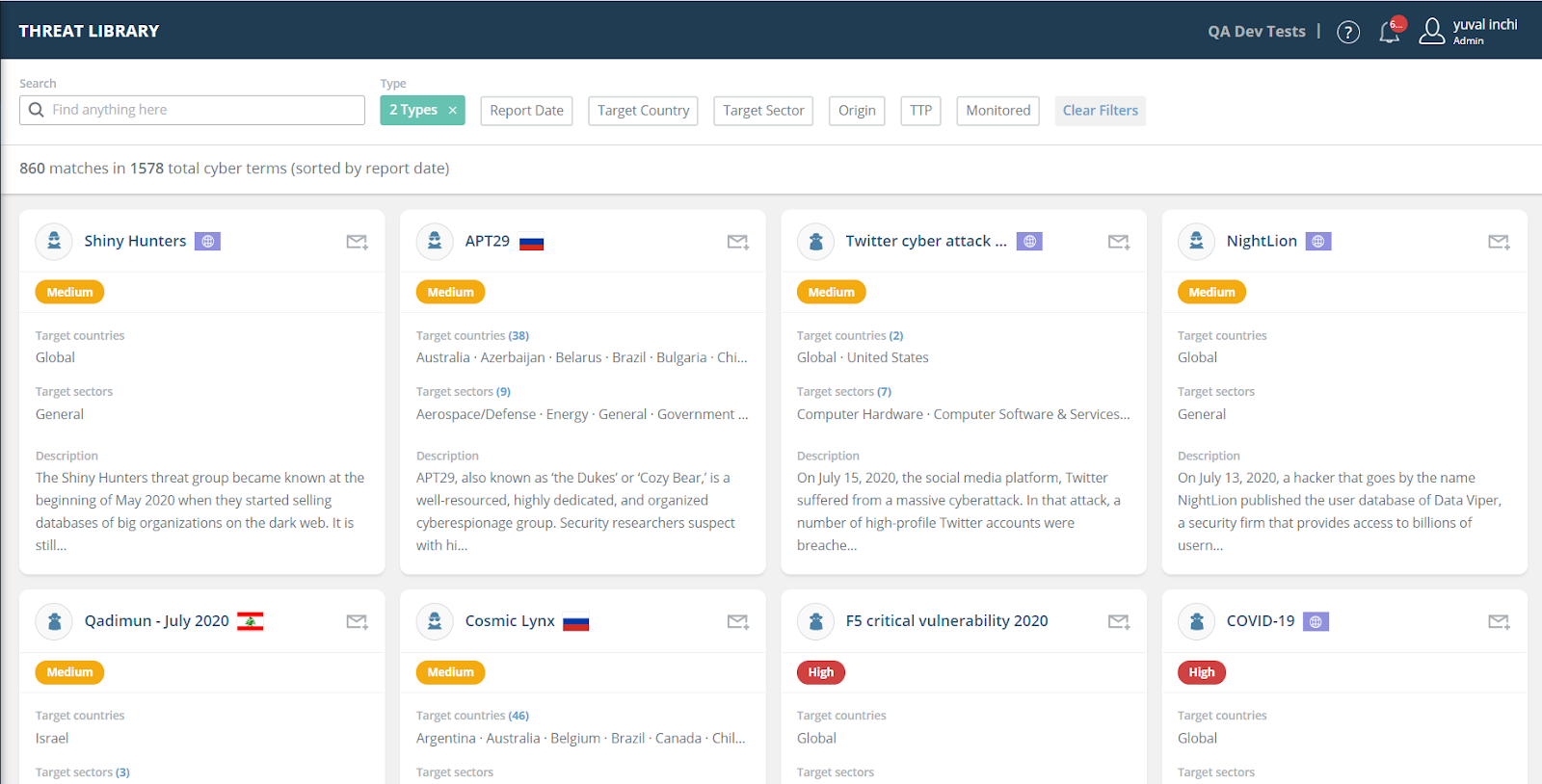
Vulnerability Risk Analyzer (VRA) customers can click on specific CVEs to view further details on the Vulnerabilities page. This helps customers prioritize vulnerabilities used in specific campaigns that affect their organization so they can focus on immediate updates and patching for the most relevant CVEs.
More advanced search capabilities to speed investigation plus details on MITRE ATT&CK framework tactics, techniques, and procedures (TTPs) are now mapped to Threat Library topics, bringing all relevant information related to a threat into one simplified view. Beyond the Threat Library, platform users can view and filter alerts by specific MITRE framework tactics and techniques for more context about threats in the customer environment.
IntelliFind, our comprehensive dark web search tool, enables customers to directly search outside their digital footprint to immediately discover threat actor chatter and potential attacks targeting their organization or industry on the black market, hacking forums, paste sites, and other dark web sources across the attack surface. We offer the largest and most extensive database of these otherwise inaccessible sites.
MSSPs and large enterprises with subsidiaries can now view and manage the threat data associated with all accounts, as well as navigate between customers, from a single dashboard, streamlining account management and saving money, time, and resources.
“The new MSSP capabilities allow us to view and manage all of our tenants from a single dashboard. We can switch between our customers’ tailored intelligence platforms with the click of a button. Also, we can easily generate reports to share with our customers, documenting the value they receive from Rapid7 threat intelligence.” – Royi Biller, CEO, MT Cyber (MSSP)
Mutual customers of IntSights and Rapid7 InsightConnect (and InsightIDR or InsightVM) can now leverage contextualized threat alerts, indicators, and vulnerabilities within their Rapid7 SOAR solution, InsightConnect, helping them prioritize incident response and vulnerability management activities. This integration helps organizations gain a 360-degree view of the external threat landscape, align internal security enforcement, and expedite critical areas of security operations. The first ICON Plugin workflow (for Rapid7 InsightIDR) is now available in the Rapid7 Extensions Library. This workflow enriches IDR alerts by performing a lookup on all domains, hashes, URLs, and IPs in the Threat Intelligence Investigation module. In addition, IntSights can now directly trigger an incident response workflow in InsightConnect based on generated alerts, enabling more efficient and effective responses to threats that the IntSights platform detects.
The IntSights bidirectional app for Splunk enables customers to bring actionable threat intelligence into their Splunk solution for a holistic view of threats targeting their environment. Building on existing functionality that facilitated the import of prioritized IOCs from the IntSights platform, the app introduced earlier this year enables customers to:
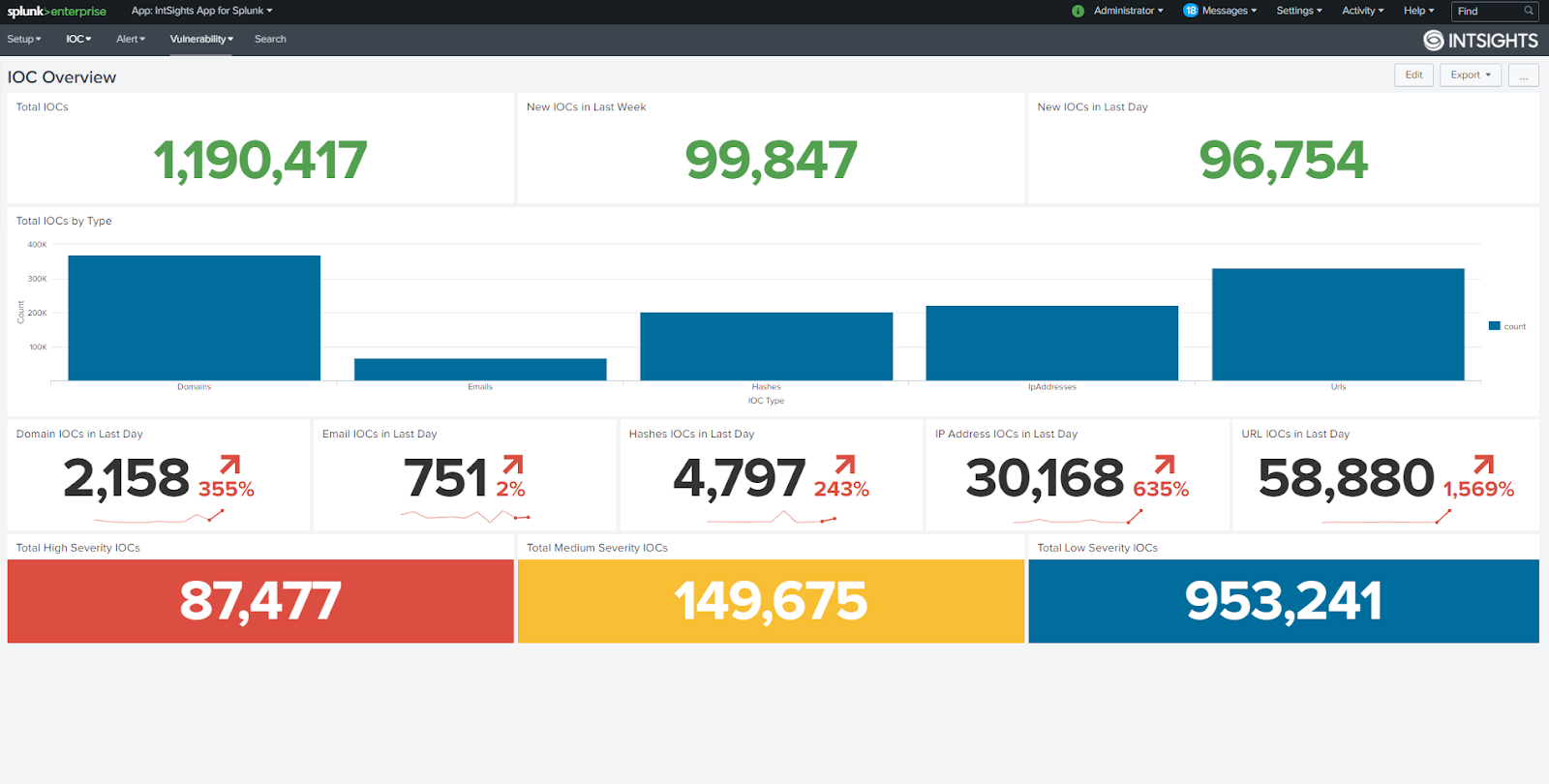
Our native bidirectional application for IBM QRadar allows customers to leverage the robust enrichment and investigation capabilities of the IntSights TIP in their QRadar environments. Mutual customers can:
Looking ahead to 2022, some of the key themes and areas of investment that Rapid7’s Threat Intelligence customers will experience include:
A big thank you to all of our customers and partners for working with us this year. We look forward to delivering even more value to our Threat Intelligence customers as part of the Rapid7 family, as well as sharing more about these investments and additional updates with you in 2022.
Post Syndicated from Reagan Russell original https://blog.cloudflare.com/2021-innovations-weeks/


One of the things that makes Cloudflare unique is our Innovation Weeks. Rather than having one large conference annually, we have multiple Innovation Weeks throughout the year to highlight new product announcements, beta products opening up to general availability, and share how our customers are using Cloudflare to help build a better Internet.
Internally, these weeks generate a lot of energy and excitement as well, as they provide an opportunity for teams from across Cloudflare to work together on product delivery and celebrate company-wide successes. In 2021, we had seven Cloudflare Innovation Weeks. As we start planning our 2022 Innovation Weeks, we are reflecting back on the highlights from each of these weeks.

Patrick Donahue
Security Week kicked off Cloudflare’s 2021 Innovation Weeks with a series of foundational security announcements. The Internet wasn’t built with security in mind, but the products and partnerships announced this week continued Cloudflare’s core mission of helping build a better Internet—one that companies of all sizes can plug into and be protected by default from the types of attacks that have historically resulted in loss of data, computing resources, and customer confidence.
At the start of the week, we took on the task of replacing MPLS, the core network technology that many organizations use to connect their offices and data centers, with a more secure and cost-effective alternative. Next, we tackled the biggest risk to everyday users of the web by opening our remote browser isolation technology to teams of all sizes and protecting against malicious code injection. Following those announcements, we inverted the slow, network chokepoint model of data loss prevention by building zero trust controls over data directly into every aspect of the Cloudflare One suite. And to round out the week, we democratized access to bot-fighting technology previously only available to the largest enterprises while also deepening our solutions for novel threats facing APIs.
View all Security Week 2021 Blog Posts
View all Security Week 2021 Cloudflare TV Series

Alyson Cabral
With Developer Week, we had one focus – to make developers’ lives easier. Our announcements included Cloudflare Pages being made generally available, Introducing Web Socket Support in Workers, Workers Unbound, Free Tunnels, Partnering with Nvidia to bring AI to the Edge and many more announcements throughout the week. In addition to the announcements, we also launched our first ever Developer Challenge series. Each day, a new challenge was announced to encourage developers from across the globe to level up their skills by trying new features and approaches. Solutions were revealed the following day, with the bonus round solution wrapping up the week. To keep up to date on the next round of challenges, join our Cloudflare Developer community.
View all Developer Week 2021 Blog Posts
View all Developer Week 2021 Cloudflare TV Series

Patrick Day
During our first Impact Week, we reflected on how we are achieving Cloudflare’s mission–helping build a better Internet– and why we continue to prioritize projects that give back to the Internet. Impact Week highlighted some of the things we are doing as a company around environmental, social and governance initiatives. We launched Project Pangea, a free program to provide secure, reliable access to the Internet for community networks that support under-served communities. We also shared how we are committed to helping build a green Internet through efficiency, renewable energy, and providing developers a choice to run their workloads in the most energy efficient data centers. In addition, we published our first human rights policy in order to better serve our mission and core values.
View all Impact Week 2021 Blog Posts
View all Impact Week 2021 Cloudflare TV Series

Marc Lamik
Helping make the Internet faster is one of Cloudflare’s core priorities. During Speed Week we shared how fast Cloudflare’s Network is as well as the amazing performance of Workers and Pages’ lightning fast speed. We expanded the size of Cloudflare’s network, so it’s closer to more people than ever.
We launched two amazing performance features with Signed Exchanges reducing load times and increasing SEO rankings with one click as well as Early Hints which can reduce loading times by 30%.
As part of Speed week, we also announced Cloudflare Images which stores, resizes, optimizes and serves images so that all of our customers can build a scalable, affordable image pipeline.
View all Speed Week 2021 Blog Posts
View all Speed Week 2021 Cloudflare TV Series

Dane Knecht and Jennifer Taylor
This is the week in which we celebrate Cloudflare’s birthday. We launched the company 11 years ago: September 27, 2010. It has been our tradition, since our first birthday, to use this week to launch innovative products that we think of as our gift back to the Internet. In 2021, we announced Cloudflare R2, our object-based storage with no egress fees, tackled solutions to Email Spoofing and Phishing, shared how we are expanding our network into office buildings as well as many more product announcements and Cloudflare TV executive fireside chats and product discussions.
View all Birthday Week Blog Posts
View all Birthday Week Cloudflare TV Series

Rita Kozlov
During Full Stack Week, we brought the vision of the Network is the Computer to life — allowing developers to build their entire application on our network, soup to nuts. Over the course of the week, we made a series of announcements, each providing another critical piece of the puzzle, necessary to build a full stack application.
We started with the foundation — data, announcing the general availability of Durable Objects, and ability to connect to databases, alongside partnerships with MongoDB and Prisma. Cloudflare Pages, our Jamstack platform also took a step deeper down the stack by introducing support for seamless deployment of functions. We want development on our platform to be an enjoyable experience, so we announced the new version of wrangler, our CLI, and Services, a better way for teams to build applications. And while we want developers to have fun, we also want them to be able to monetize their efforts, which they now can do using the Stripe SDK on Workers.
View all Full Stack Week 2021 Blog Posts
View all Full Stack Week Cloudflare TV Series

Annika Garbers
To wrap up the year, we demonstrated how Cloudflare One, our Zero Trust Network-as-a-Service, is helping Chief Information Officers transform their corporate networks. We launched new capabilities in Cloudflare One to help customers replace their hardware firewalls and a chance to win a trip to Oahu in the process, a Log Storage platform built on Cloudflare R2, a new premium DNS offering, and Cloudflare Security Center, which helps customers map their attack surface and mitigate potential security risks with just a few clicks. We also announced our acquisition of Zaraz to boost website speed and security without sacrificing privacy, as well as new partnerships with Microsoft and leading cyber insurance providers, among many other exciting announcements throughout the week.
View all CIO Week 2021 Blog Posts
View all CIO Week 2021 Cloudflare TV Series
Post Syndicated from LGR original https://www.youtube.com/watch?v=HhJGrATZCl0