Post Syndicated from original https://lwn.net/Articles/881960/rss
Four new stable kernels have been announced: 5.16.2, 5.15.16, 5.10.93, and 5.4.173. These contain a relatively small set
of important fixes; users should upgrade.
Post Syndicated from original https://lwn.net/Articles/881960/rss
Four new stable kernels have been announced: 5.16.2, 5.15.16, 5.10.93, and 5.4.173. These contain a relatively small set
of important fixes; users should upgrade.
Post Syndicated from digiblurDIY original https://www.youtube.com/watch?v=Gpp4uHJJex0
Post Syndicated from original https://lwn.net/Articles/881956/rss
Security updates have been issued by Debian (drupal7), Fedora (kernel, libreswan, nodejs, and wireshark), openSUSE (busybox, firefox, kernel, and python-numpy), Oracle (gegl, gegl04, httpd, java-17-openjdk, kernel, kernel-container, and libreswan), Red Hat (kernel, kernel-rt, and libreswan), Slackware (wpa_supplicant), SUSE (busybox, firefox, htmldoc, kernel, kubevirt, virt-api-container, virt-controller-container, virt-handler-container, virt-launcher-container, virt-operator-container, openstack-monasca-agent, spark, spark-kit, zookeeper, and python-numpy), and Ubuntu (curl, linux, linux-aws, linux-aws-5.11, linux-aws-5.4, linux-azure, linux-azure-5.11, linux-azure-5.4, linux-bluefield, linux-gcp, linux-gcp-5.11, linux-gcp-5.4, linux-gke, linux-gke-5.4, linux-gkeop, linux-gkeop-5.4, linux-hwe-5.4, linux-ibm, linux-kvm, linux-oem-5.10, linux-oem-5.13, linux-oem-5.14, linux-oracle, linux-oracle-5.11, linux-oracle-5.4, linux-raspi, linux-raspi-5.4, openvswitch, and qtsvg-opensource-src).
Post Syndicated from Deral Heiland original https://blog.rapid7.com/2022/01/20/is-the-internet-of-things-the-next-ransomware-target/

Ransomware attacks over the last couple years have been traumatic, impacting nearly every business sector and costing billions of dollars. The targets have mostly been our data: steal it, encrypt it, and then charge us a fee to get it back.
Over the last several years, there’s been concern across the security community about the risks related to the Internet of Things (IoT) being impacted by ransomware. For the most part, this has not occurred — although I wouldn’t be surprised if IoT has played a role as the entry point that malicious actors have used, on occasion, to gain access to plant their ransomware on critical systems. Also, we do know of examples where IoT technologies, such as those used within medical and industrial control environments, were impacted during ransomware attacks through key components of their ecosystem involving standard Windows server and desktop solutions.
So, what would it take for IoT to be the target of ransomware? First, the IoT being attacked would need to be a large deployment with significant importance in its functions and capabilities. The attack would also need to be disruptive enough that an organization would be willing to pay.
Personally, I’m not confident such an environment exists, at least as it would apply to the average organization. But let’s step back and look at this from the perspective of the vendor who remotely manages, controls, and updates their products over the Internet. For example, imagine what would happen if a malicious actor successfully breached an automotive organization with smart-capable cars — could they shut down every car and lock the company and owner out of fixing them?
If we apply that train of thought across the board for all IoT deployed out there, it becomes very concerning. What if we shut down every multifunction printer by a major manufacturer, home thermostat, building HVAC, or building lighting solution? What happens if the target is a smart city and traffic lights are impacted? We could go on all day talking about the impact from smart city breaches or attacks against small deployed IoT solutions from major brands with global footprints.
So, are there steps we can take to head off such an event? The answer is yes. I believe IoT vendors and solution owners could best accomplish this by identifying the potential attack vector and risk through threat modeling.
As part of building out a threat model, the first step would be to identify and map out a complete conceptual structure of the IoT system that could be potentially targeted. In the case of IoT technology, this should consist of all components of the system ecosystem that make the solution function as intended, which would include:
Any component or subcomponent of this ecosystem is at potential risk for being targeted. Mapping out this information gives us the ability to better understand and consider the potential points of attack that a malicious actor could use to deliver or execute a ransomware style attack against IoT.
In the second step of this threat modeling process, we need to understand the possible goals of a malicious actor who would be targeting an IoT ecosystem, who they may be, and what their end game and potential methods of attack would look like. The threat actors would likely look very similar to any malicious actor or group that carries out ransomware attacks. I think the big difference would be how they would approach attacking IoT ecosystems.
This is the phase where creative thinking plays a big role, and having the right people involved can make all the difference. This means having people on the threat modeling team who can take an attacker mindset and apply that thinking against the IoT ecosystems to map out as many potential attack vectors as possible.
The third step in the threat modeling process is building a list of threats we would expect to be used against the above IoT ecosystems. One example, which is also common with typical ransomware attacks, is locking. By locking a component of the IoT solutions ecosystem, a malicious actor could prevent the IoT ecosystem from properly functioning or communicating with other key components, completely taking the technology out of service or preventing it from functioning as intended.
In the final part, we take the detailed information we’ve put together and map out specific attack scenarios with the greatest chance of success. Each scenario should define the various components of the IoT ecosystem potentially at risk, along with the perceived attacker motives, methods, and threats that can lead to the attacker being successful. Once you’ve mapped out these various scenarios in detail, you can use them to define and implement specific controls to mitigate or reduce the probability of success for those attack scenarios.
Using these threat modeling methods will help IoT solution vendors and the organizations that use their products identify and mitigate the risk and impact of ransomware attacks against IoT solutions before they happen.
Post Syndicated from Bruce Schneier original https://www.schneier.com/blog/archives/2022/01/san-francisco-police-illegally-spying-on-protesters.html
Last summer, the San Francisco police illegally used surveillance cameras at the George Floyd protests. The EFF is suing the police:
This surveillance invaded the privacy of protesters, targeted people of color, and chills and deters participation and organizing for future protests. The SFPD also violated San Francisco’s new Surveillance Technology Ordinance. It prohibits city agencies like the SFPD from acquiring, borrowing, or using surveillance technology, without prior approval from the city’s Board of Supervisors, following an open process that includes public participation. Here, the SFPD went through no such process before spying on protesters with this network of surveillance cameras.
It’s feels like a pretty easy case. There’s a law, and the SF police didn’t follow it.
Tech billionaire Chris Larsen is on the side of the police. He thinks that the surveillance is a good thing, and wrote an op-ed defending it.
I wouldn’t be writing about this at all except that Chris is a board member of EPIC, and used his EPIC affiliation in the op-ed to bolster his own credentials. (Bizarrely, he linked to an EPIC page that directly contradicts his position.) In his op-ed, he mischaracterized the EFF’s actions and the facts of the lawsuit. It’s a mess.
The plaintiffs in the lawsuit wrote a good rebuttal to Larsen’s piece. And this week, EPIC published what is effectively its own rebuttal:
One of the fundamental principles that underlies EPIC’s work (and the work of many other groups) on surveillance oversight is that individuals should have the power to decide whether surveillance tools are used in their communities and to impose limits on their use. We have fought for years to shed light on the development, procurement, and deployment of such technologies and have worked to ensure that they are subject to independent oversight through hearings, legal challenges, petitions, and other public forums. The CCOPS model, which was developed by ACLU affiliates and other coalition partners in California and implemented through the San Francisco ordinance, is a powerful mechanism to enable public oversight of dangerous surveillance tools. The access, retention, and use policies put in place by the neighborhood business associations operating these networks provide necessary, but not sufficient, protections against abuse. Strict oversight is essential to promote both privacy and community safety, which includes freedom from arbitrary police action and the freedom to assemble.
So far, EPIC has not done anything about Larsen still being on its board. (Others have criticized them for keeping him on.) I don’t know if I have an opinion on this. Larsen has done good work on financial privacy regulations, which is a good thing. But he seems to be funding all these surveillance cameras in San Francisco, which is really bad.
Post Syndicated from Sue Sentance original https://www.raspberrypi.org/blog/ai-education-ai4k12-big-ideas-ai-thinking/
What is AI thinking? What concepts should we introduce to young people related to AI, including machine learning (ML), and data science? Should we teach with a glass-box or an opaque-box approach? These are the questions we’ve been grappling with since we started our online research seminar series on AI education at the Raspberry Pi Foundation, co-hosted with The Alan Turing Institute.


Over the past few months, we’d already heard from researchers from the UK, Germany, and Finland. This month we virtually travelled to the USA, to hear from Prof. Dave Touretzky (Carnegie Mellon University) and Prof. Fred G. Martin (University of Massachusetts Lowell), who have pioneered the influential AI4K12 project together with their colleagues Deborah Seehorn and Christina Gardner-McLure.
The AI4K12 project focuses on teaching AI in K-12 in the US. The AI4K12 team have aligned their vision for AI education to the CSTA standards for computer science education. These Standards, published in 2017, describe what should be taught in US schools across the discipline of computer science, but they say very little about AI. This was the stimulus for starting the AI4K12 initiative in 2018. A number of members of the AI4K12 working group are practitioners in the classroom who’ve made a huge contribution in taking this project from ideas into the classroom.
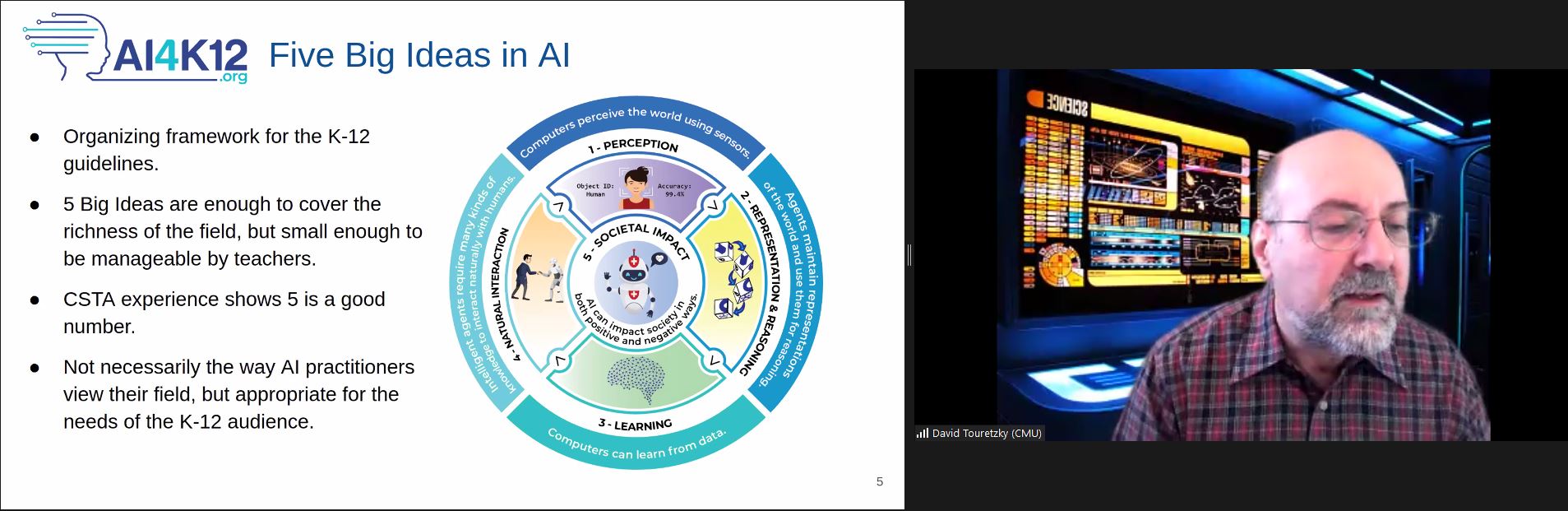
The project has a number of goals. One is to develop a curated resource directory for K-12 teachers, and another to create a community of K-12 resource developers. On the AI4K12.org website, you can find links to many resources and sign up for their mailing list. I’ve been subscribed to this list for a while now, and fascinating discussions and resources have been shared.
If you’ve heard of AI4K12 before, it’s probably because of the Five Big Ideas the team has set out to encompass the AI field from the perspective of school-aged children. These ideas are:
Sometimes we hear concerns that resources being developed to teach AI concepts to young people are narrowly focused on machine learning, particularly supervised learning for classification. It’s clear from the AI4K12 Five Big Ideas that the team’s definition of the AI field encompasses much more than one area of ML. Despite being developed for a US audience, I believe the description laid out in these five ideas is immensely useful to all educators, researchers, and policymakers around the world who are interested in AI education.
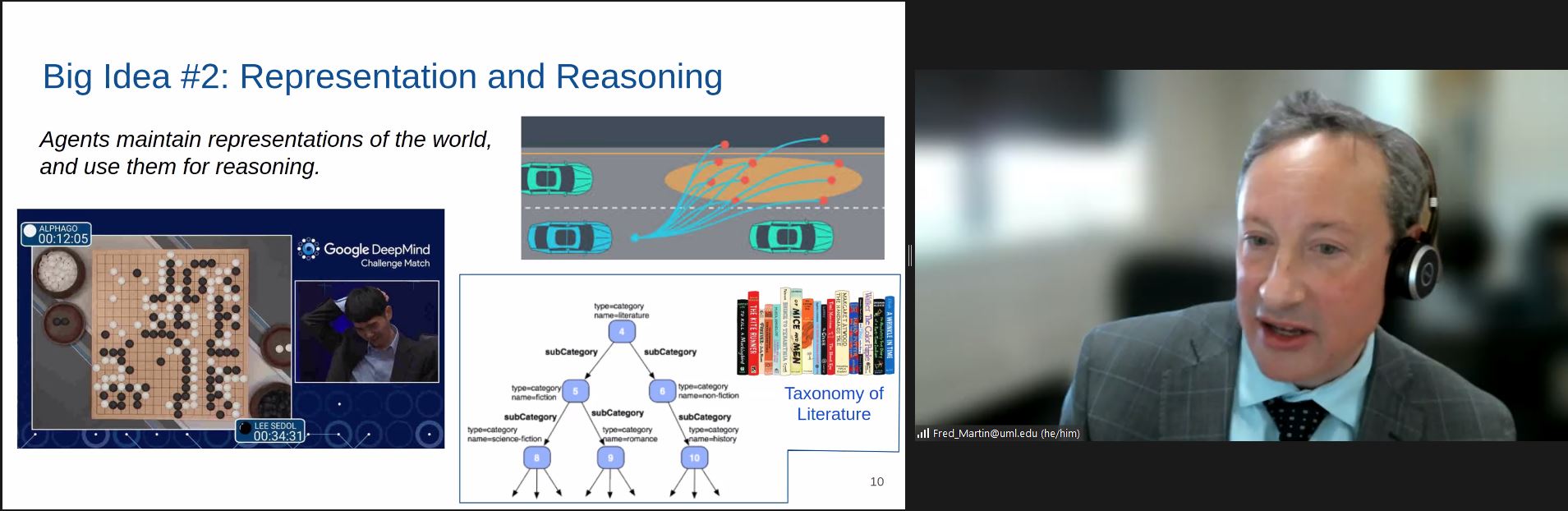
During the seminar, Dave and Fred shared some great practical examples. Fred explained how the big ideas translate into learning outcomes at each of the four age groups (ages 5–8, 9–11, 12–14, 15–18). You can find out more about their examples in their presentation slides or the seminar recording (see below).
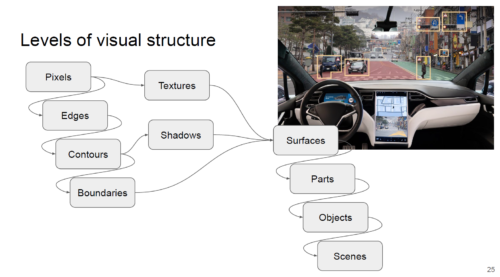
I was struck by how much the AI4K12 team has thought about progression — what you learn when, and in which sequence — which we do really need to understand well before we can start to teach AI in any formal way. For example, looking at how we might teach visual perception to young people, children might start when very young by using a tool such as Teachable Machine to understand that they can teach a computer to recognise what they want it to see, then move on to building an application using Scratch plugins or Calypso, and then to learning the different levels of visual structure and understanding the abstraction pipeline — the hierarchy of increasingly abstract things. Talking about visual perception, Fred used the example of self-driving cars and how they represent images.
Dave and Fred support teaching AI to children using a glass-box approach. By ‘glass-box approach’ we mean that we should give students information about how AI systems work, and show the inner workings, so to speak. The opposite would be a ‘opaque-box approach’, by which we mean showing students an AI system’s inputs and the outputs only to demonstrate what AI is capable of, without trying to teach any technical detail.
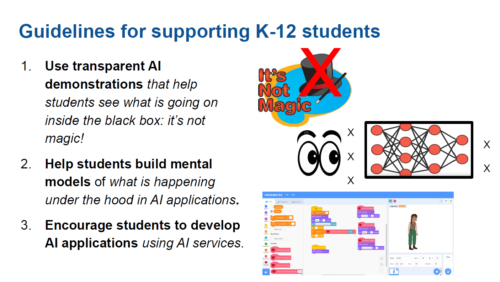
Our speakers are keen for learners to understand, at an age-appropriate level, what is going on “inside” an AI system, not just what the system can do. They believe it’s important for young people to build mental models of how AI systems work, and that when the young people get older, they should be able to use their increasing knowledge and skills to develop their own AI applications. This aligns with the views of some of our previous seminar speakers, including Finnish researchers Matti Tedre and Henriikka Vartiainen, who presented at our seminar series in November.
Dave addressed the question of what AI thinking looks like in school. His approach was to start with computational thinking (he used the example of the Barefoot project’s description of computational thinking as a starting point) and describe AI thinking as an extension that includes the following skills:
Dave described AI thinking as furthering the ideas of abstraction and algorithmic thinking commonly associated with computational thinking, stating that in the case of AI, computation actually is thinking. My own view is that to fully define AI thinking, we need to dig a bit deeper into, for example, what is involved in developing an understanding of perception and representation.

Thinking back to Matti Tedre and Henriikka Vartainen’s description of CT 2.0, which focuses only on the ‘Learning’ aspect of the AI4K12 Five Big Ideas, and on the distinct ways of thinking underlying data-driven programming and traditional programming, we can see some differences between how the two groups of researchers describe the thinking skills young people need in order to understand and develop AI systems. Tedre and Vartainen are working on a more finely granular description of ML thinking, which has the potential to impact the way we teach ML in school.
There is also another description of AI thinking. Back in 2020, Juan David Rodríguez García presented his system LearningML at one of our seminars. Juan David drew on a paper by Brummelen, Shen, and Patton, who extended Brennan and Resnick’s CT framework of concepts, practices, and perspectives, to include concepts such as classification, prediction, and generation, together with practices such as training, validating, and testing.
What I take from this is that there is much still to research and discuss in this area! It’s a real privilege to be able to hear from experts in the field and compare and contrast different standpoints and views.
The AI4K12 project has already made a massive contribution to the field of AI education, and we were delighted to hear that Dave, Fred, and their colleagues have just been awarded the AAAI/EAAI Outstanding Educator Award for 2022 for AI4K12.org. An amazing achievement! Particularly useful about this website is that it links to many resources, and that the Five Big Ideas give a framework for these resources.
Through our seminars series, we are developing our own list of AI education resources shared by seminar speakers or attendees, or developed by us. Please do take a look.
Through these seminars, we’re learning a lot about AI education and what it might look like in school, and we’re having great discussions during the Q&A section.
On Tues 1 February at 17:00–18:30 GMT, we’ll hear from Tara Chklovski, who will talk about AI education in the context of the Sustainable Development Goals. To participate, click the button below to sign up, and we will send you information about joining. I really hope you’ll be there for this seminar!
The schedule of our upcoming seminars is online. You can also (re)visit past seminars and recordings on the blog.
The post The AI4K12 project: Big ideas for AI education appeared first on Raspberry Pi.
Post Syndicated from Емилия Милчева original https://toest.bg/vustanik-v-purviya-mandat-vlastnik-vuv-vtoriya/
Президентът Румен Радев официално встъпи във втория си мандат – във времена на „каскада от кризи“, но и на доминантната роля, която той си извоюва в политиката и управлението от близо година насам.
Съдейки по речта му пред депутатите от 47-мия парламент, основна задача ще бъде конституционната реформа. Но обещаният президентски проект за такава реформа все още е строго секретен и не напуска пределите на „Дондуков“ 2, независимо от ноемврийските уверения на Радев, че наближава времето да го внесе. Време е – говори за него още от края на 2019 г. при управлението на третото правителство на ГЕРБ и Бойко Борисов…
Ще има ли проектът на президента съгласуване (непублично и неофициално) с намеренията на настоящото управляващо мнозинство за съдебна реформа, която не се изчерпва само с реформа на прокуратурата? Моментът е удачен – създателите на „Продължаваме промяната“, стожера в четворната коалиция, дължат нему втурването си в политиката, а три от политическите сили в тази коалиция публично го подкрепиха за втори мандат. Така че не би имало спънки с помощта на управляващите Радев да се опита да реализира конституционни промени и така да довърши започнатото през лятото на 2020 г. – демафиотизация на властта.
В речта си Румен Радев не спомена за своя проект, но от нея се разбра, че държи на възможността за индивидуална конституционна жалба, предвидена в него. За такава бе постигнато съгласие и на преговорите за коалиционно споразумение между четирите политически сили „Продължаваме промяната“, „Демократична България“, „Има такъв народ“ и БСП. За възможността гражданите да могат да сезират Конституционния съд се говори и спори от години – дали да се предвиди само за закон, който нарушава правата, или и за всеки публичен акт; в кои случаи да е допустима – когато са изчерпани или не са изчерпани предвидените съдебни производства за защита, и др. ДБ я предложи по време на преговорите в сектор „Правосъдие“.
В речта си пред парламента Радев говори и за друга промяна, за която също е повдигал от по-рано въпрос – конституционно гарантиране на финансовата децентрализация на общините. От години Националното сдружение на общините в България настоява за такава възможност. Това няма да се приеме еднозначно от политическите сили, които не постигнаха съгласие по темата и на преговорите за коалиционно споразумение. Тогава от ДБ предложиха 2% от настоящите 10% данък върху доходите на физическите лица да отиват в съответната община, а на следващ етап да се превърнат в местен данък, който всяка община сама да определя. Останалите обаче се възпротивиха, макар по принцип да се съгласиха с идеята за по-голяма финансова самостоятелност на местните власти.
Изглежда сякаш екипът на Радев е заложил по-големи президентски правомощия, за които и президентът сам е повдигал темата. Но вчера премиерът Кирил Петков отхвърли подобни спекулации с изявлението си, че „Конституцията ще бъде голяма тема в следващите месеци, но не и за това да станем президентска република, а в частта за главния прокурор“.
Големият въпрос, който неизменно се задава в такива случаи, е как ще се събере конституционно мнозинство от 160 гласа, след като настоящата власт разполага със 134 народни представители. Но това е тема в развитие.
Или преди това ще се случат други процеси? Докато се чака отговорът на загадката, правосъдната министърка Надежда Йорданова, излъчена от „Демократична България“, вече се е нагърбила с първата фаза – трансформацията на КПКОНПИ. За ДБ съдебната реформа е знаме и кауза много преди президентът да я прегърне.
А може би държавният глава просто не иска да рискува, като внесе проект, който няма да успее, и така да си причини репутационни щети. Във втория си мандат той особено ще внимава за това. След последната година на политически победи ще му е трудно да остане в този така симпатичен образ на поборник при настоящото управление, с което са единомишленици и съратници. Ако иска да критикува, не може да вдига юмрук, а само да помаха с пръст – или може би просто да повдигне вежда…
Управляващите, както е известно, рядко се ползват с всенародна любов. Така че въпросът не е дали, а кога най-рейтинговият политик Румен Радев и правителството, ръководено от също така рейтингов и харизматичен политик като Кирил Петков, ще охладнеят един към друг. При други обстоятелства би могло и да е догодина, но при толкова кризи вероятно ще е още тази. А кризите са свързани с едни други теми от речта на президента –
„Гласът на България трябва да отеква силно в дебата за бъдещето на Европа, за нейната стратегическа автономност и сигурност.“ На пръв поглед в това изречение на Радев няма нищо забележително – открай време политиците се упражняват по темата за активността на България. Но в коя област президентът разглежда стратегическата автономност на ЕС – в икономиката или в сигурността и отбраната? Изглежда, че е втората. Европейската отбранителна автономия е в проект, а от 30-те страни в НАТО повече от половината са членове на ЕС. Известно е, че без одобрението на САЩ, а и без изясняване на неговата корелация по отношение на НАТО, един такъв проект не би бил осъществим.
Какво означава Европейска стратегическа автономия? В публикация за Politico бившата външна министърка на Испания Аранча Гонсалес я обяснява така: „Европа да има повече способност да прави сама изборите си, съответстващи на интересите и ценностите ѝ, независимо какво правят останалите.“ Включително и за да намали уязвимостта си от външни шокове. В интервю от септември м.г. пред същото издание председателят на Европейския съвет Шарл Мишел отбелязва, че трагичната ситуация в Афганистан „трябва да подтикне нас, европейците, да се погледнем в огледалото и да се запитаме как можем да имаме по-голямо влияние в геополитическата сфера в бъдеще, отколкото днес“.
Но дали Европа може сама да се погрижи за отбраната си и дали фискалните правила на общността ще се променят – това са предизвикателства пред идеята за автономия, за която не е ясно какво мисли българският президент. Като че ли позитивно. Какво смята управляващата коалиция? Отворен въпрос.
За разлика от тази, по друга тема няма двусмислие или неяснота в позицията на Радев – става въпрос за Северна Македония и бе даден знак към кабинета и премиера:
Предложеният от правителството многопистов подход в отношенията с нашите съседи има потенциал да динамизира диалога, да укрепи доверието, и трябва да бъде подкрепен. Той обаче не бива да оставя на заден план проблемите, свързани с правата на нашите сънародници и общото историческо и културно минало.
Ще потвърдя своята позиция като президент на всички българи, че равноправието на македонските българи, много от които са и български граждани, трябва да бъде гарантирано чрез вписването им в Конституцията на страната наравно с другите части от народи. Този акт, редом с приемането на надеждни механизми за изкореняване езика на омразата и опазване на българското културно-историческо наследство, следва да бъде предварително условие за нашето съгласие за начало на преговорите за членство.
И тук следва една критика към правителството, свързана най-вероятно с направените тази седмица заявки за въздушна линия София–Скопие по време на визитата на делегацията, водена от премиера Кирил Петков в Северна Македония, както и относно коридор №8 като цяло:
Убеден съм, че икономизацията на външната политика, за която работих активно, може да даде много по-добри резултати, ако постигнем по-ефективна координация между институциите и преодолеем липсата на проектна готовност във важни инвестиционни направления.
Няма съмнение, че президентът е ядосан от подхода на Петков и от визитата му в Скопие тази седмица. Северна Македония може да ги раздалечи, а може да стане и по-сериозно препятствие в отношенията между институциите, разделени само от площад „Независимост“. Дистанцирането би било полезно и за двете страни – правителството веднъж завинаги ще се отърве от чувството на синовен дълг и признателност към президента, а президентът ще може отново да е „надпартиен“.
В речта на президента се открива и един начален флирт с Българската православна църква (и традиционните вероизповедания), на които Радев обещава подкрепа и в бъдеще. Досега това беше патент на Бойко Борисов, който обикаляше църкви и манастири, целуваше ръце и кръстове и се кълнеше в Началника Бог. Патриарх Неофит за втори път лично отслужи молебен и благослови Радев за успешен втори мандат като държавен глава. А днес президентът дори участва в тържествената церемония за първа копка на новостроящия се православен храм „Св. Патриарх Евтимий Търновски“ в столичния квартал Люлин.
Например:
Мой дълг като държавен глава е да връщам дневния ред към дългосрочните цели на нацията, далеч отвъд хоризонта на политическите мандати: овладяването на демографската криза; справянето с бедността и неравенствата; повишаването на стандарта и качеството на живот; духовното развитие; гарантирането на суверенитета и сигурността; отстояването на националните интереси и достойнство; утвърждаването на позитивния образ на страната ни навън.
Нищо от това не се е случило през изминалите години, а описаното като „дългосрочни цели на нацията“ всъщност е работа на политиците и функция от техните решения. Дали Радев може да отговори как вижда „духовното развитие“ като цел? Отделно някой трябва да забрани на президентите да използват веднъж завинаги „овладяването на демографската криза“. Освен ако не бъдат изобретени инкубатори за българи.
Post Syndicated from Светла Енчева original https://toest.bg/koy-e-bulgarskiyat-natsionalen-interes/
На 18 януари премиерът Кирил Петков отиде на официално посещение в Северна Македония. Така той стана един от първите чуждестранни лидери, установили контакт с новия премиер на страната Димитър Ковачевски. И макар опитът му за стопяване на ледовете между България и югозападната ѝ съседка да бяха „попарени“ от Консултативния съвет за национална сигурност начело с президента Румен Радев, Петков всячески се старае да демонстрира промяна на тона на България.
Без експлицитна връзка с визитата на Петков в Македония, само ден преди нея БНБ пусна монета с лика на Гоце Делчев – личност, която и България, и Македония смятат за „своя“, а за македонците статутът на Гоце Делчев е подобен на този на Васил Левски у нас. Поводът е 150 години от рождението му, което впрочем е на 4 февруари (23 януари по стар стил). Пред БНБ се изви дълга опашка от хора, желаещи да се сдобият с монетата, издадена в 3000 броя.
„И какво сега? Вашият университет се казва „Климент Охридски“, а нашият – „Кирил и Методий“, иронично отбелязва македонски професор по социология. Годината е 2005-та, а ние сме в Загреб, по чиито улици се виждат възпоменателни табла за жертвите на войната с Югославия. Постепенно разговорът ни навлиза в академична плоскост. Всеки говори на своя език – нали уж ни е общ. Когато стигаме до философията на Имануел Кант, в един момент преставам да разбирам какво казва македонският професор. Разрешаваме проблема, като продължаваме дискусията на английски. На този чужд и за двама ни език се разбираме безпроблемно. След тази случка никой не е в състояние да ме убеди, че няма македонски език.
Петнайсет години по-късно България вече е част от Европейския съюз и в това си качество е наложила вето върху членството на Северна Македония в него.
Широко разпространено в България например е схващането, че македонският език е изкуствено създаден и е просто диалектна разновидност на българския с внесени в нея сръбски елементи. Затова и телевизиите рядко превеждат от македонски, оставяйки зрителите да се мъчат да схванат смисъла на казаното. В меморандума от 2020 г. страната ни дори поставя условие езикът да се нарича не македонски, а „официален език на Република Северна Македония“.
Същото се твърди и за самата македонска нация – че македонците всъщност са българи, коварно поставени под сръбско влияние с помощта на Съветския съюз. България иска Северна Македония да приеме, че историята на двете страни до 1944 г. е обща. И не приема компромисния вариант, предложен от съседите, че историята не е точно обща, но е споделена. А за каква идентичност може да става дума, ако нямате право на история?
Напоследък обаче страната ни не приема обвинението на съседите, че поставяме под въпрос езика и идентичността им. А реториката на премиера Кирил Петков внушава, че такъв проблем изобщо няма. Междувременно „опорните“ точки у нас вече са станали други – против „езика на омразата“ в Северна Македония, защита на правата на българското малцинство там и вписването му в македонската Конституция.
Още в първия абзац на основния закон на Северна Македония се признава съществуването на „албанците, турците, власите, ромите и другите националности, които живеят в Република Македония“. Българите не са включени в това изброяване, но пък и то не е изчерпателно.
Колко всъщност са българите в Северна Македония, е въпрос, на който е трудно да се отговори. Според официалните данни от преброяването през далечната 2002 година като българи са се самоопределили едва 1417 души. След влизането на страната ни в ЕС десетки хиляди македонци кандидатстват за българско гражданство, защото по този начин могат по-лесно да пътуват и работят на Запад. Според евродепутата от ГЕРБ Андрей Ковачев към февруари 2021 г. македонците с български паспорти са над 140 000 души.
Етнически българи ли са тези хора? Формално – да, защото, за да получат българско гражданство, те са декларирали български етнически произход. Въпреки че за някои от тях тази процедура е била унизителна, никой не ги е карал насила. Така някой би могъл да си помисли, че като не допуска Северна Македония в ЕС, България си „отглежда“ свое малцинство там.
За разлика от Конституцията на Северна Македония, българската определя страната ни като единна в национално отношение държава. В нея не се допускат не само различни националности, но и етнически малцинства. Макар да е добре известно, че в България има компактни етнически малцинства.
Впрочем има определена историческа логика конституциите и на двете страни да се различават в отношението си към малцинствата. На фона на кървавия разпад на Югославия Македония има потребност да се предпази от сепаратистки тенденции. Затова е склонна да предостави множество права на малцинствата на територията си, особено на етническите албанци.
В България в началото на 90-те са още пресни спомените от т.нар. Възродителен процес и от насажданите внушения, че българските турци могат да поискат населяваните от тях райони да преминат към Турция. Три десетилетия по-късно следва да е ясно, че нито някой иска да „къса парчета“ от българската територия, нито малцинствата престават да съществуват, ако са официално непризнати. Конституцията ни обаче си остава същата.
Според преброяването от 2001 г. самоопределящите се като македонци са 5071 души. Преди преброяването през 2011 г. обаче ВМРО инспирира скандал, който доведе до оставка на тогавашната директорка на НСИ Мариана Коцева и до промяна на анкетната карта на преброяването. Повод за възмущението на националистите беше, че въпросникът за преброяване дава свобода човек да се определи като българомохамеданин, македонец, гагауз, влах или африканец. И въпреки че у нас действително има представители на всички изброени общности, останаха само следните опции за етническа група – „българска“, „турска“, „ромска“, „друга“ (тук може да се уточни конкретният етнос, но това не влиза в общата статистика) и „не се самоопределям“.
Резултатът от отнемането на възможността за самоопределение може да се окачестви като провал на преброяването. Ако през 2001 г. по-малко от 25 000 души не са отговорили на въпроса за етническата си принадлежност, през 2011 г. броят им нараства до 683 590, или 9,28% от населението на страната. Само в област Смолян (където през 2001 г. впрочем няма нито един македонец) делът на неотговорилите е близо 22%. След като излязат резултатите от последното преброяване, пак няма да знаем колко са македонците в България, защото отново няма да сме ги преброили.
За разлика от вторачването в историята, борбата с езика на омразата изглежда европейски и е адекватна на съвременността. България говори на институциите на ЕС на техния език защо е против членството на Северна Македония. Какво обаче се разбира под „език на омразата“ в случая?
Не може да се отрече, че в съседката ни има прояви на национализъм, враждебно отношение към България, посегателства върху паметници, свързани със страната ни, макар тези прояви да не са израз на официалната политика на страната. „Болката“ по отношение на „словото на омразата“ обаче е най-вече спрямо наричането на България „фашистки окупатор“. Това е във връзка с периода 1941–1944 г., когато страната ни, в качеството си на съюзник на Хитлерова Германия, окупира и анексира територията на Вардарска Македония, Пирот и Беломорието. Спасявайки „нашите си“ евреи, българските власти пращат в лагерите на смъртта 11 343 евреи от новоприсъединените територии, 7132 от които са от Вардарска Македония, освен това отнемат жилищата и цялото им имущество.
Този факт, разбира се, не е основание 80 години по-късно българите да продължават да бъдат наричани фашисти – по същия начин, както съвременните германци не могат да бъдат наричани националсоциалисти заради престъпленията на Хитлеровия режим. За разлика от Германия обаче, България не е поела историческата си отговорност. Германия не възразява периодът на националсоциализма да се изучава в училищата на всяка страна, дори напротив. А България изисква от Северна Македония да промени представянето на този период в учебниците си по история.
Ала какъв е той? Говорещите за „български национален интерес“ обикновено представят България като държава, която трябва с гордост да отстоява собственото си достойнство срещу по-силните – ЕС, НАТО, САЩ, международни институции. Такава представа за национален интерес обаче е в интерес най-вече на… Русия, която се опитва да отслаби ЕС и да попречи на разширяването му, за да запази собственото си влияние сред страните от бившия Източен блок.
Едва ли е в интерес на българската национална сигурност македонски граждани да се сдобиват с български паспорти единствено с цел да могат да пътуват свободно. Това са хора, които нямат връзка със страната ни, но ако някой от тях извърши престъпление в чужбина, то ще се „пише“ на нашата „сметка“. В интерес на българите е да могат да пътуват във възможно повече от съседните страни, без да плащат роуминг, да поръчват стоки от тях, които не се облагат със скъпи мита, да няма политическо напрежение със съседите.
двете страни са поели ангажимент за самолетна линия между София и Скопие, която да тръгне до два месеца. Това не е особен дипломатически пробив (и няма как да бъде, понеже след Консултативния съвет Петков не разполага с особена свобода), но е добро символно начало. По-сериозен дипломатически пробив е решението България да приеме Северна Македония да се нарича само така, без „Република“ отпред, с което отпада още едно от многобройните условия на страната ни.
Още преди срещата Кирил Петков беше обявил идеята си за тематични междуправителствени работни групи. Тази идея може да изглежда куха, но да не забравяме, че посредством работни групи Петков успя да се справи с почти невъзможната задача за сформиране на коалиционно правителство между четири политически субекта в – меко казано – сложни отношения помежду си. Така че не е изключено и този път да има полза от групите. Особено ако в тази по историческите въпроси влязат експерти като Стефан Дечев и Румен Аврамов, а не агенти на ДС като Георги Марков (историка), които биха предпочели и България, и Македония да са под влиянието на Русия.
България е първата страна, признала независимостта на Северна Македония. Иронично, тя е и последната, която стои на пътя ѝ към членство в ЕС.
Ако търсим вината единствено у другия, това може да продължава вечно. Да, югозападната ни съседка, особено преди години, се характеризираше с мегаломански изблици, типични впрочем за една новосъздадена държава. (И все пак паметникът на Александър Македонски беше демонтиран от летището в Скопие преди три години, а този на Орфей на софийското летище си стои.)
В стремежа да утвърдят националната си идентичност македонците имат нужда от герои и врагове. Както впрочем и ние. България реагира на тези прояви на Северна Македония като тийнейджър, който приема твърде на сериозно детинщините на по-малкото си братче или сестриче. И иска на всяка цена то „да си получи заслуженото“. Нека си припомним какво казват родителите в такива случаи: по-умният отстъпва първи.
Post Syndicated from original https://lwn.net/Articles/881305/rss
The LWN.net Weekly Edition for January 20, 2022 is available.
Post Syndicated from Grab Tech original https://engineering.grab.com/biometrics-authentication
In recent years, Identity and Access Management has gained importance within technology industries as attackers continue to target large corporations in order to gain access to private data and services. To address this issue, the Grab Identity team has been using a 6-digit PIN to authenticate a user during a sensitive transaction such as accessing a GrabPay Wallet. We also use SMS one-time passwords (OTPs) to log a user into the application.
We look at existing mechanisms that Grab uses to authenticate its users and how biometric authentication helps strengthen application security and save costs. We also look at the various technical decisions taken to ensure the robustness of this feature as well as some key learnings.
The mechanisms we use to authenticate our users have evolved as the Grab Identity team consistently refines our approach. Over the years, we have observed several things:
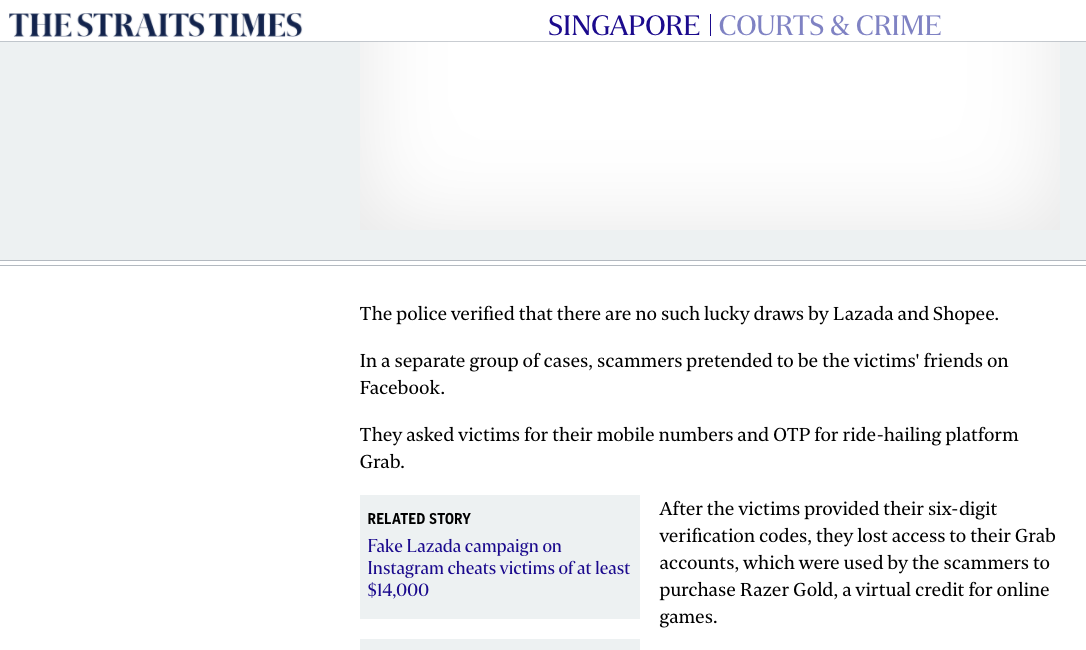
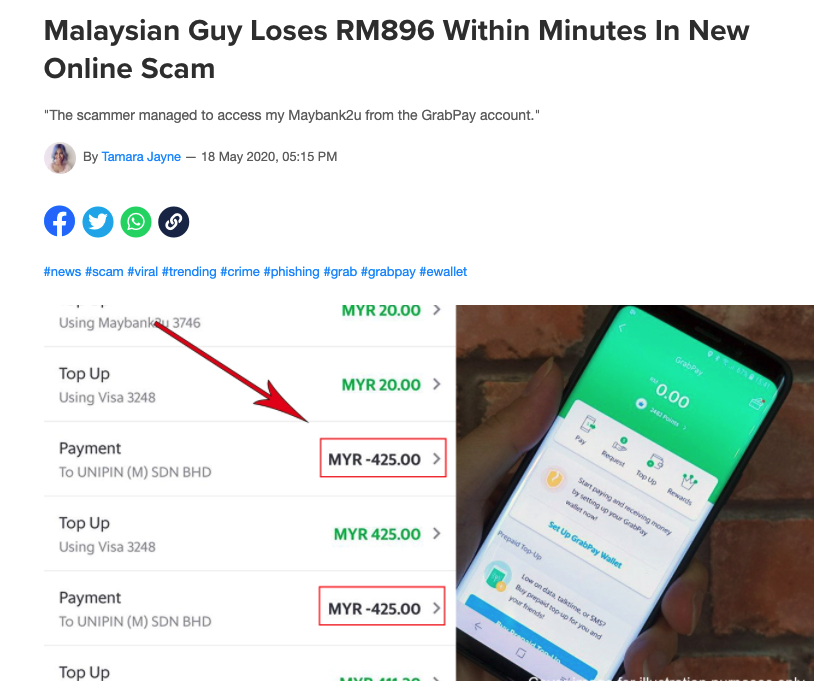
Social engineering efforts have gotten more advanced – attackers could pretend to be your friends and ask for your OTP or even post phishing advertisements that prompt for your personal information.
 |
 |
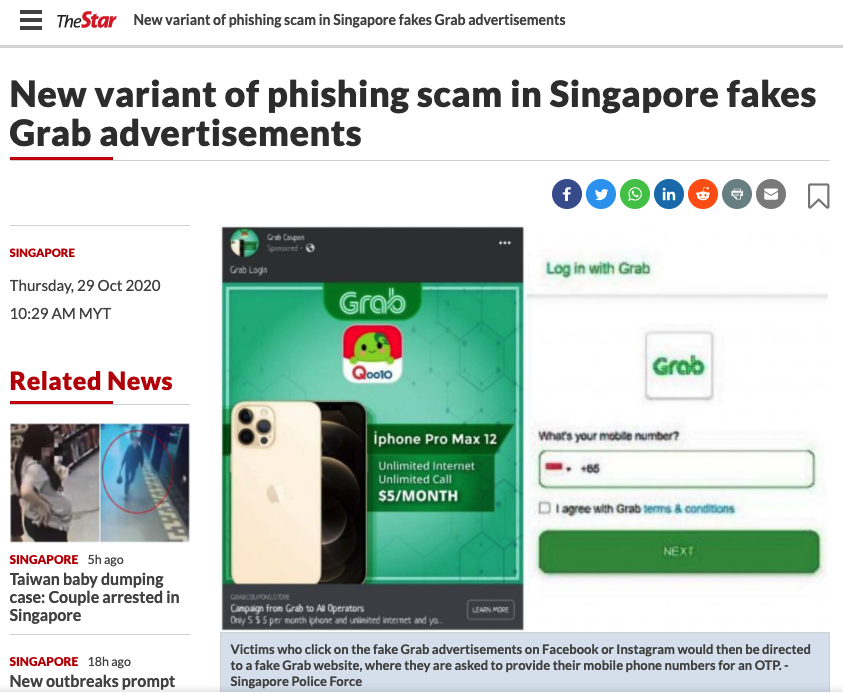
With more sophisticated social engineering attacks on the rise, we need solutions that can continue to protect our users and Grab in the long run.
When we looked into developing solutions for these problems, which was mainly about cost and security, we went back to basics and looked at what a secure system meant.
We then compared the various authentication mechanisms that the Grab app currently uses, as shown in the following table:
| Authentication factor | 1. Something that you know | 2. Something physical that you have | 3. Something that you are |
| OTP | ✔️ | ✔️ | |
| Social | ✔️ | ||
| PIN | ✔️ | ||
| Biometrics | ✔️ | ✔️ |
With methods based on the knowledge and possession factors, it is still possible for attackers to get users to reveal sensitive account information. On the other hand, biometrics are something you are born with and that makes it more complex to mimic. Hence, we have added biometrics as an additional layer to enhance Grab’s existing authentication methods and build a more secure platform for our users.
Biometric authentication powered by device biometrics provides a robust platform to enhance trust. This is because modern phones provide a few key features that allow client server trust to be established:
A secure enclave, being a part of the device, is separate from the main operating system (OS) at the kernel level. The enclave is used to store private keys that can be unlocked only by the biometrics on the device.
Any changes to device security such as changing a PIN or adding another fingerprint will invalidate all prior access to this secure enclave. This means that when we enroll a user in biometrics this way, we can be sure that any payload from said device that matches the public part of said private key is authorised by the user that created it.
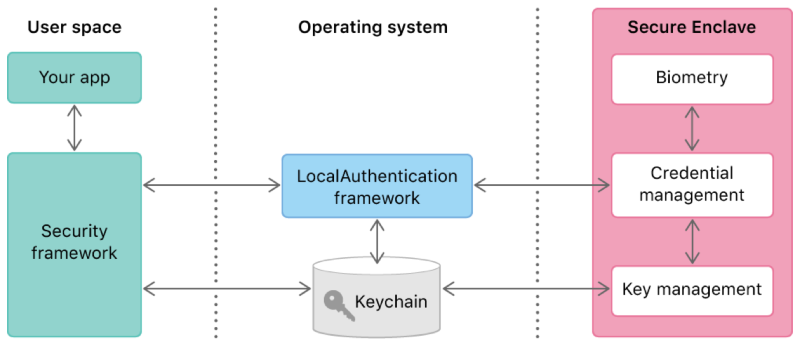
The important part of the approach lies in the enrollment flow. The process is quite simple and can be described in the following steps:
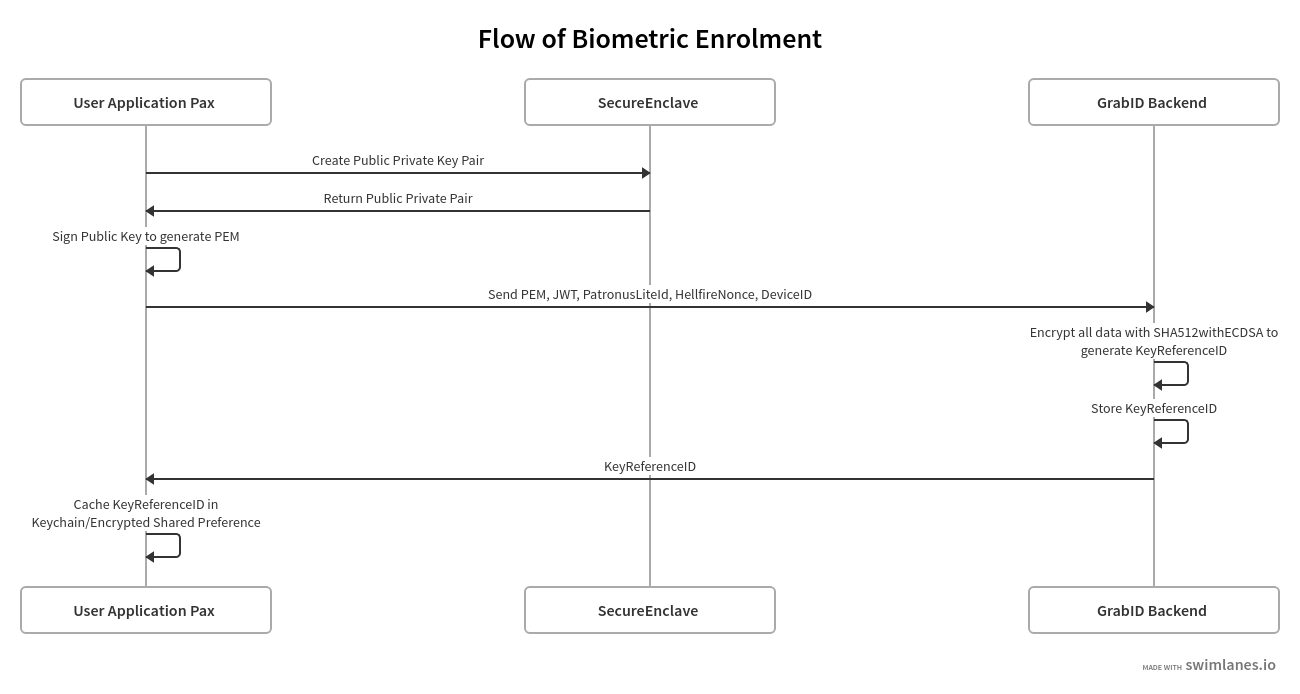
The key implementation details is as follows:
These key technologies allow us to create trust between devices and services. The raw biometric data stays within the device and instead sends an encrypted signature of biometry data to Grab for verification purposes.
Biometric login aims to resolve the many problems highlighted earlier in this article such as reducing user friction and saving SMS OTP costs.
We are still experimenting with this feature so we do not have insights on business impact yet. However, from early experiment runs, we estimate over 90% adoption rate and a success rate of nearly 90% for biometric logins.
As methods of executing identity theft or social engineering get more creative, simply using passwords and PINs is not enough. Grab, and many other organisations, are realising that it’s important to augment existing security measures with methods that are inherent and unique to users.
By using biometrics as an added layer of security in a multi-factor authentication strategy, we can keep our users safe and decrease the probability of successful attacks. Not only do we ensure that the user is a legitimate entity, we also ensure that we protect their privacy by ensuring that the biometric data remains on the user’s device.
Grab is a leading superapp in Southeast Asia, providing everyday services that matter to consumers. More than just a ride-hailing and food delivery app, Grab offers a wide range of on-demand services in the region, including mobility, food, package and grocery delivery services, mobile payments, and financial services across over 400 cities in eight countries.
Powered by technology and driven by heart, our mission is to drive Southeast Asia forward by creating economic empowerment for everyone. If this mission speaks to you, join our team today!
Post Syndicated from original https://lwn.net/Articles/881827/rss
The Linux framebuffer device (fbdev) subsystem has long languished in
something of a purgatory; it was listed as “orphaned” in the
MAINTAINERS file and saw fairly minimal maintenance, mostly driven
by developers working elsewhere in the kernel graphics stack. That all
changed, in an eye-opening way, on January 17, when Linus Torvalds
merged a change
to make Helge Deller the new maintainer of the subsystem. But it turns out
that the problems in fbdev run deep, at least according to much of the rest
of the kernel graphics community. By seeming to take on the maintainer role in order to
revert the removal of some buggy features from fbdev, Deller has created
something of a controversy.
Post Syndicated from Rapid7 original https://blog.rapid7.com/2022/01/19/security-nation-mike-hanley-of-github-on-the-log4j-vulnerability/

In our first episode of Security Nation Season 5, Jen and Tod chat with Mike Hanley, Chief Security Officer at GitHub, all about the major vulnerability in Apache’s Log4j logging library (aka Log4Shell). Mike talks about the ins and outs of GitHub’s response to this blockbuster vulnerability and what could have helped the industry deal with an issue of this massive scope more effectively (hint: he drops the SBOM). They also touch on GitHub’s updated policy on the sharing of exploits.
Stick around for our Rapid Rundown, where Tod and Jen talk about Microsoft’s release of emergency fixes for Windows Server and VPN over Martin Luther King Day weekend.

Mike Hanley is the Chief Security Officer at GitHub. Prior to GitHub, Mike was the Vice President of Security at Duo Security, where he built and led the security research, development, and operations functions. After Duo’s acquisition by Cisco for $2.35 billion in 2018, Mike led the transformation of Cisco’s cloud security framework and later served as CISO for the company. Mike also spent several years at CERT/CC as a Senior Member of the Technical Staff and security researcher focused on applied R&D programs for the US Department of Defense and the Intelligence Community.
When he’s not talking about security at GitHub, Mike can be found enjoying Ann Arbor, MI with his wife and seven kids.
Interview links
Rapid Rundown links
Like the show? Want to keep Jen and Tod in the podcasting business? Feel free to rate and review with your favorite podcast purveyor, like Apple Podcasts.
Post Syndicated from Talks at Google original https://www.youtube.com/watch?v=_AGP6n5QrOM
Post Syndicated from Rajesh Francis original https://aws.amazon.com/blogs/big-data/centralize-governance-for-your-data-lake-using-aws-lake-formation-while-enabling-a-modern-data-architecture-with-amazon-redshift-spectrum/
Many customers are modernizing their data architecture using Amazon Redshift to enable access to all their data from a central data location. They are looking for a simpler, scalable, and centralized way to define and enforce access policies on their data lakes on Amazon Simple Storage Service (Amazon S3). They want access policies to allow their data lake consumers to use the analytics service of their choice, to best suit the operations they want to perform on the data. Although the existing method of using Amazon S3 bucket policies to manage access control is an option, when the number of combinations of access levels and users increase, managing bucket level policies may not scale.
AWS Lake Formation allows you to simplify and centralize access management. It allows organizations to manage access control for Amazon S3-based data lakes using familiar concepts of databases, tables, and columns (with more advanced options like row and cell-level security). Lake Formation uses the AWS Glue Data Catalog to provide access control for Amazon S3 data lake with most commonly used AWS analytics services, like Amazon Redshift (via Amazon Redshift Spectrum), Amazon Athena, AWS Glue ETL, and Amazon EMR (for Spark-based notebooks). These services honor the Lake Formation permissions model out of the box, which makes it easy for customers to simplify, standardize, and scale data security management for data lakes.
With Amazon Redshift, you can build a modern data architecture, to seamlessly extend your data warehouse to your data lake and read all data – data in your data warehouse, and data in your data lake – without creating multiple copies of data. Amazon Redshift Spectrum feature enable direct query of your S3 data lake, and many customers are leveraging this to modernize their data platform. You can use Amazon Redshift managed storage for frequently accessed data and move less frequently accessed data to Amazon S3 data lake and securely access it using Redshift Spectrum.
In this post, we discuss how you can use AWS Lake Formation to centralize data governance and data access management while using Amazon Redshift Spectrum to query your data lake. Lake Formation allows you to grant and revoke permissions on databases, tables, and column catalog objects created on top of Amazon S3 data lake. This is easier for customers, as it is similar to managing permissions on relational databases.
In the first post of this two-part series, we focus on resources within the same AWS account. In the second post, we extend the solution across AWS accounts using the Lake Formation data sharing feature.
The following diagram illustrates our solution architecture.
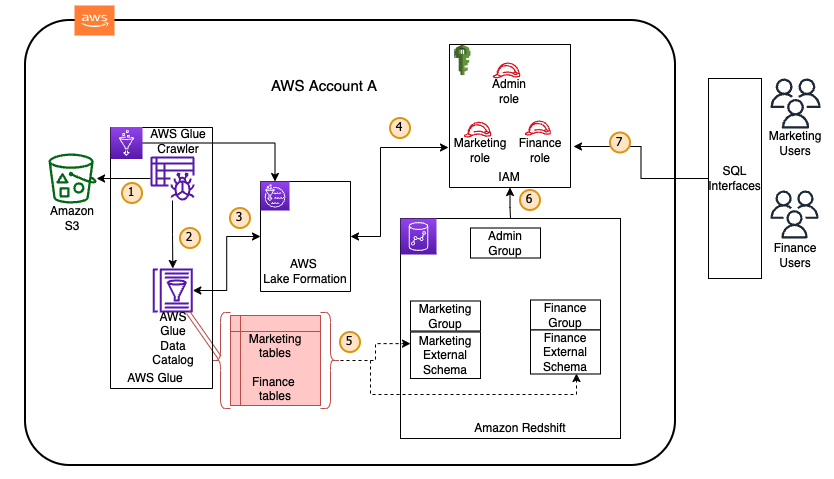
The solution workflow consists of the following steps:
To maintain backward compatibility with AWS Glue, Lake Formation has the following initial security settings:
IAMAllowedPrincipals on all existing Data Catalog resources.To change security settings, see Changing the Default Security Settings for Your Data Lake.
Note: Leave the default settings as is until you’re ready to move completely to the Lake Formation permission model. You can update settings at a database level if you want permissions set by Lake Formation to take effect. For more details about upgrades, refer to Upgrading AWS Glue Data Permissions to the AWS Lake Formation Model.
We don’t recommend reverting back from the Lake Formation permission model to an IAM-only permission model. You may also want to first deploy the solution in a new test account.
To set up this solution, you need basic familiarity with the AWS Management Console, an AWS account, and access to the following AWS services:
Data lake administrators are initially the only IAM users or roles that can grant Lake Formation permissions on data locations and Data Catalog resources to any principal.
To set up an IAM user as a data lake administrator, add the provided inline policy to the IAM user or IAM role you use to provision the resources for this blog solution. For more details, refer to Create a Data Lake Administrator.
Note: If you’re using an existing administrator user/role, you may have this already provisioned.
Note: The CloudFormation template doesn’t work if you skip the below step.

You can also add yourself as data lake administrator by going to Administrative roles and tasks under Permissions, select Choose administrators, and adding yourself as an administrator if you missed this in the initial welcome screen.
In this step, we create the solution resources using a CloudFormation template. The template performs the following actions:
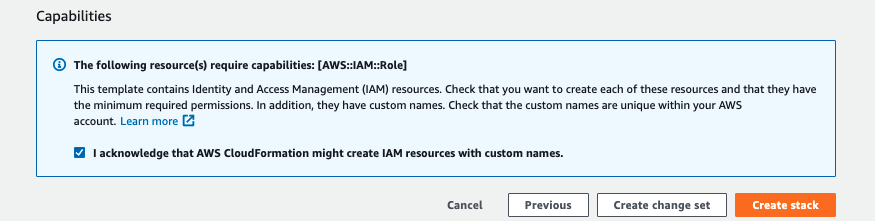
To create your resources, complete the following steps:
us-east-1.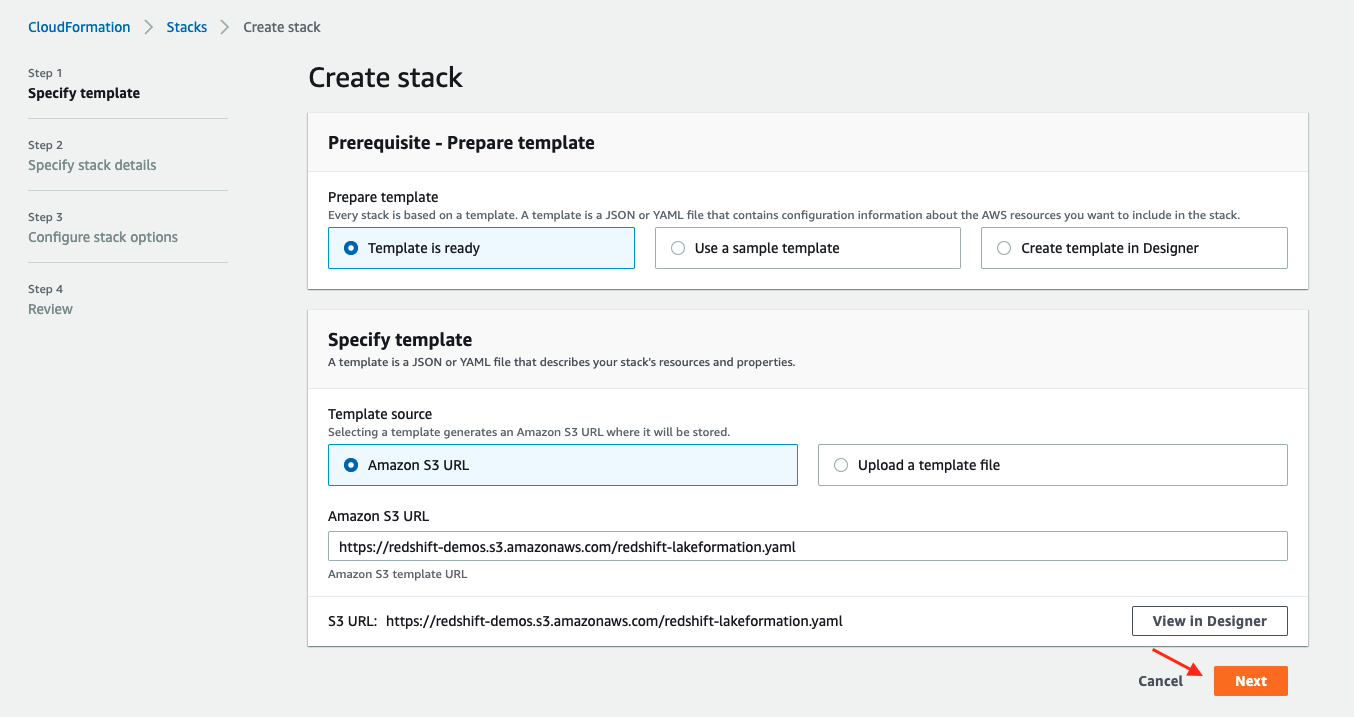

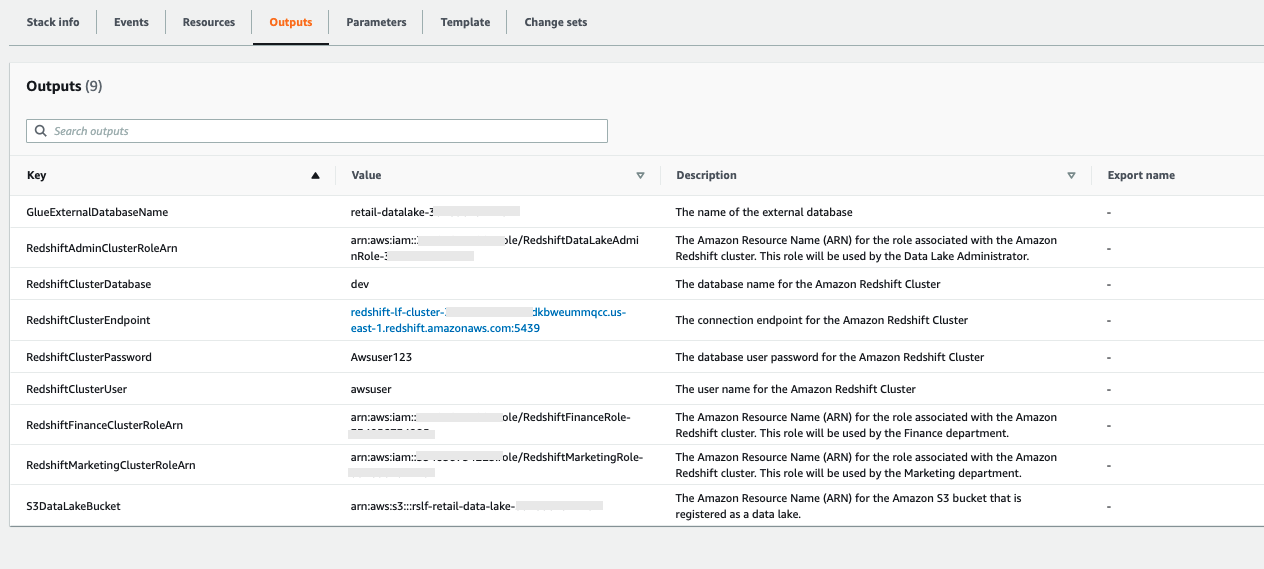
The stack takes approximately 10 minutes to deploy successfully. When it’s complete, you can view the outputs on the AWS CloudFormation console.
You also need to update the default settings at the Lake Formation database level. This makes sure that the Lake Formation permissions the CloudFormation template sets up during provisioning can take effect over the default settings.


This action is important because it removes the IAM control model from this database and allows only Lake Formation to take security grant/revoke access to it. This step makes sure other steps in this solution are successful.

You can review the permissions enabled for this database.
IAMAllowedPrincipals group and choose Revoke to remove default permission settings for this individual database.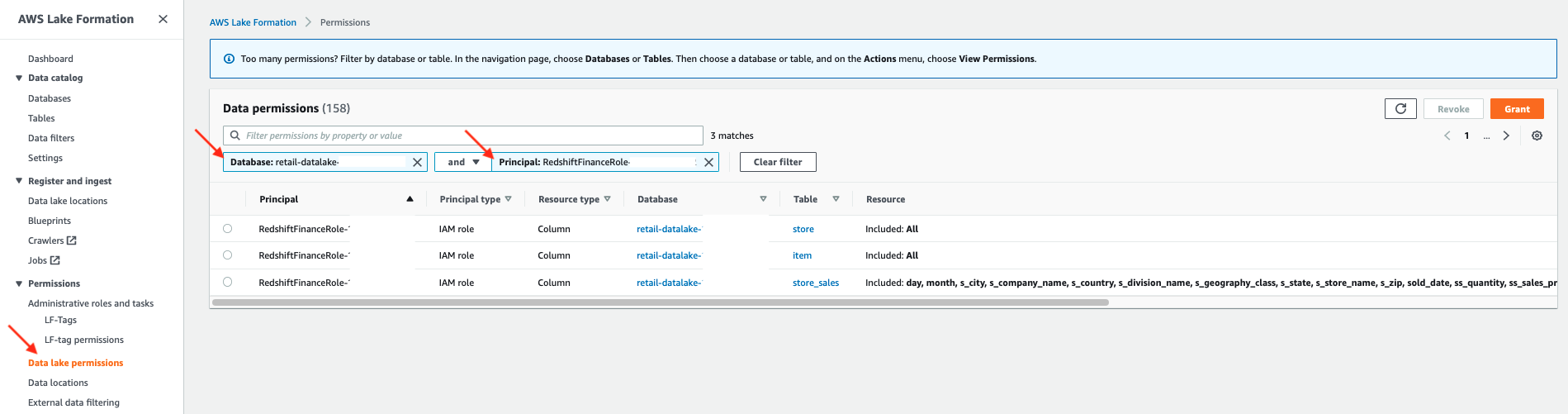
The IAMAllowedPrincipal row no longer appears in the list on the Permissions page.
Similarly, we need to remove the IAMAllowedPrincipal group at the table level. The CloudFormation template created six tables for this database. Let’s see how to use data lake permissions to remove access at the table level.
Principal:IAMAllowedPrincipals and Database:<<database name>>.You can review all the tables we need to update permissions for.
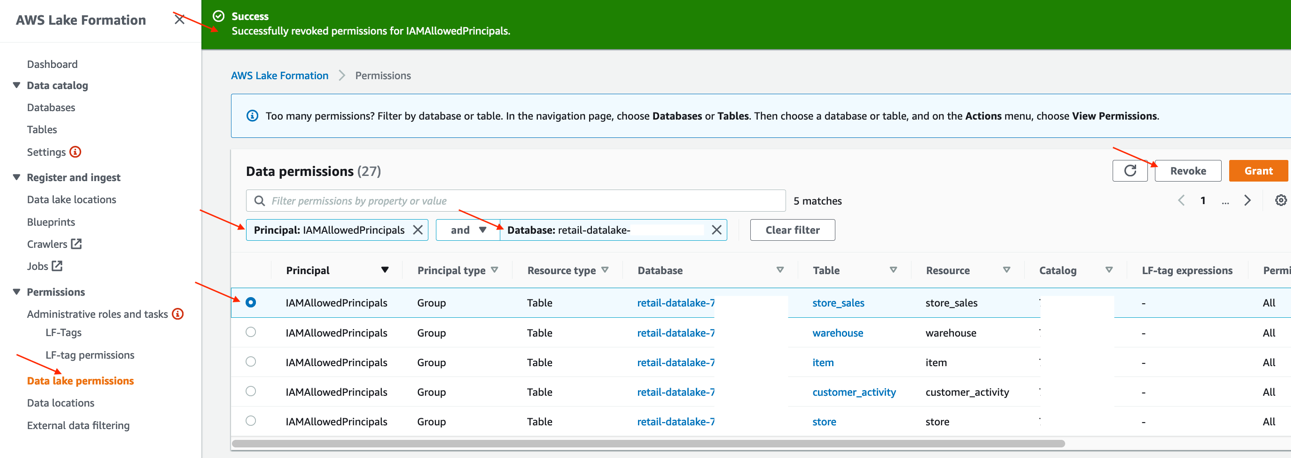
With these steps, we’ve made sure that the default settings at the Lake Formation account level are still in place, and only manually updated for the database and tables we’re going to work with in this post. When you’re ready to move completely to a Lake Formation permission model, you can update the settings at the account level instead of individually updating them. For more details, see Change the default permission model.
The CloudFormation template provisions many resources automatically to create your environment. In this section, we check some of the key resources to understand them better.
On the Lake Formation console, check that a new data lake location is registered with an IAM role on the Data lake locations page.

This is the IAM role any integrated service like Amazon Redshift assumes to access data on the registered Amazon S3 location. This integration happens out of the box when the right roles and policies are applied. For more details, see Requirements for Roles Used to Register Locations.
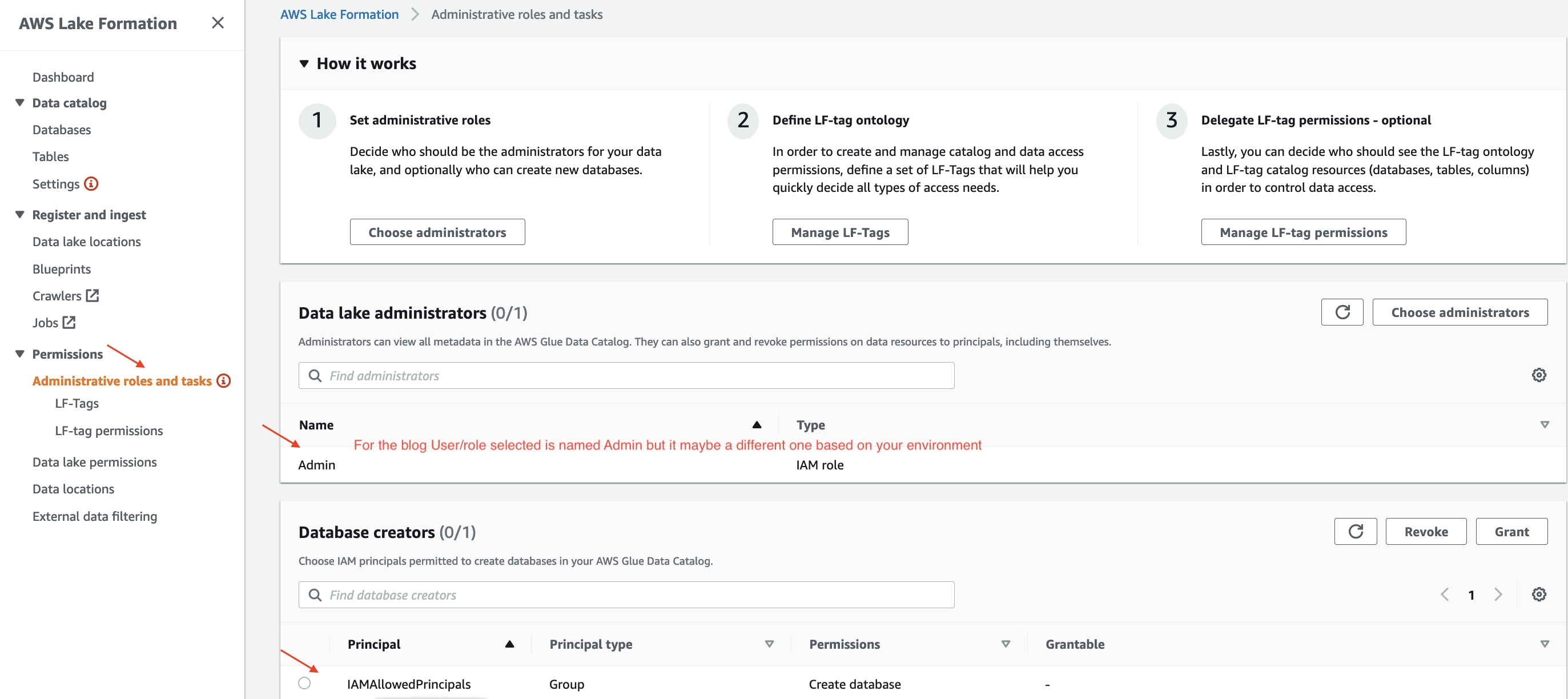
Check the Administrative roles and tasks page confirm that the logged-in user is added as the data lake administrator and IAMAllowedPrincipals is added as database creator.
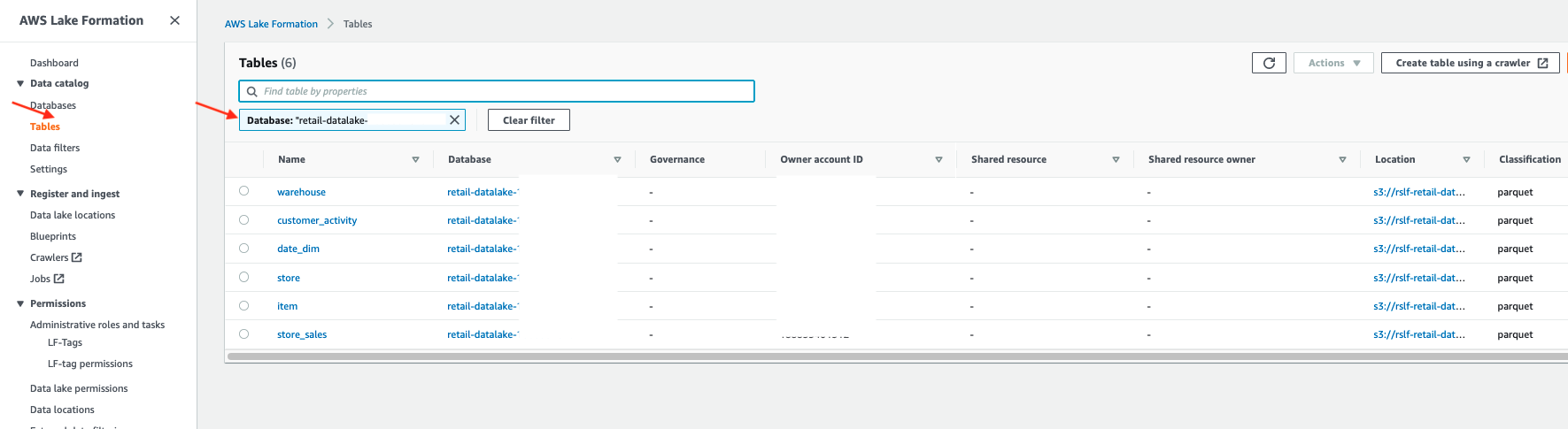
Then check the tables that the AWS Glue crawlers created in the Data Catalog database. These tables are logical entities, because the data is in an Amazon S3 location. After you create these objects, you can access them via different services.
Lastly, check permissions set by the template using the Lake Formation permission model on the tables to be accessed by finance and marketing users from Amazon Redshift.
The following screenshot shows that the finance role has access to all columns for the store and item tables, but only the listed columns for the store_sales table.
Similarly, you can review access for the marketing role, which has access to all columns in the customer_activity and store_sales tables.

The CloudFormation template creates two S3 buckets:
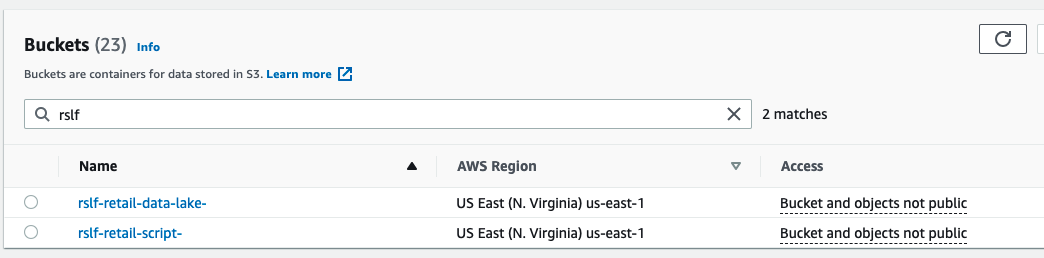
Open the script bucket to see the scripts. You can download and open them to view the SQL code used.
The setup_lakeformation_demo.sql script gives you the SQL code to create the external database schema and assign different roles for data governance purposes. The external schema is for AWS Glue Data Catalog-based objects that point to data in the data lake. We then grant access to different database groups and users to manage security for finance and marketing users.
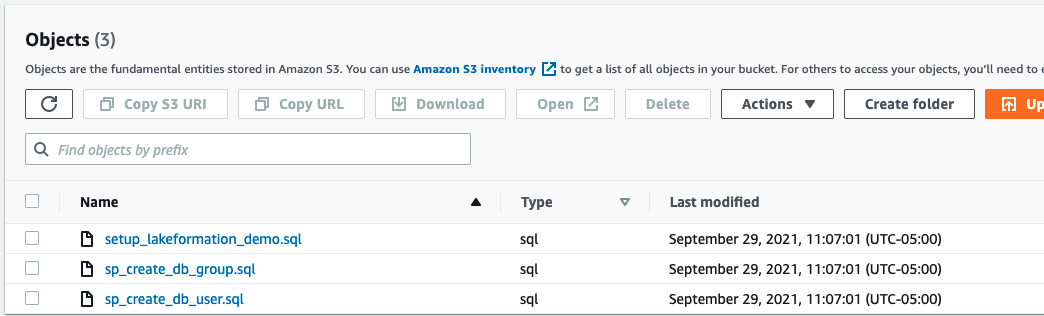
The scripts run in the following order:
sp_create_db_group.sqlsp_create_db_user.sqlsetup_lakeformation_demo.sqlOn the Amazon Redshift console, choose Clusters in the navigation pane and choose the cluster you created with the CloudFormation template. Then choose the Properties tab.

The Cluster permissions section lists three attached roles. The template used the admin role to provision Amazon Redshift database-level objects. The finance role is attached to the finance schema in Amazon Redshift, and the marketing role is attached to the marketing schema.

Each of these roles are given permissions in such a way that they can use the Amazon Redshift query editor to query Data Catalog tables using Redshift Spectrum. For more details, see Using Redshift Spectrum with AWS Lake Formation and Query the Data in the Data Lake Using Amazon Redshift Spectrum.
We use Amazon Redshift query editor v2 to query the external schema and Data Catalog tables (external tables). The external schema is already created as part of the CloudFormation template. When the external schema is created using the Data Catalog, the tables in the database are automatically created and are available through Amazon Redshift as external tables.
dev.awsuser.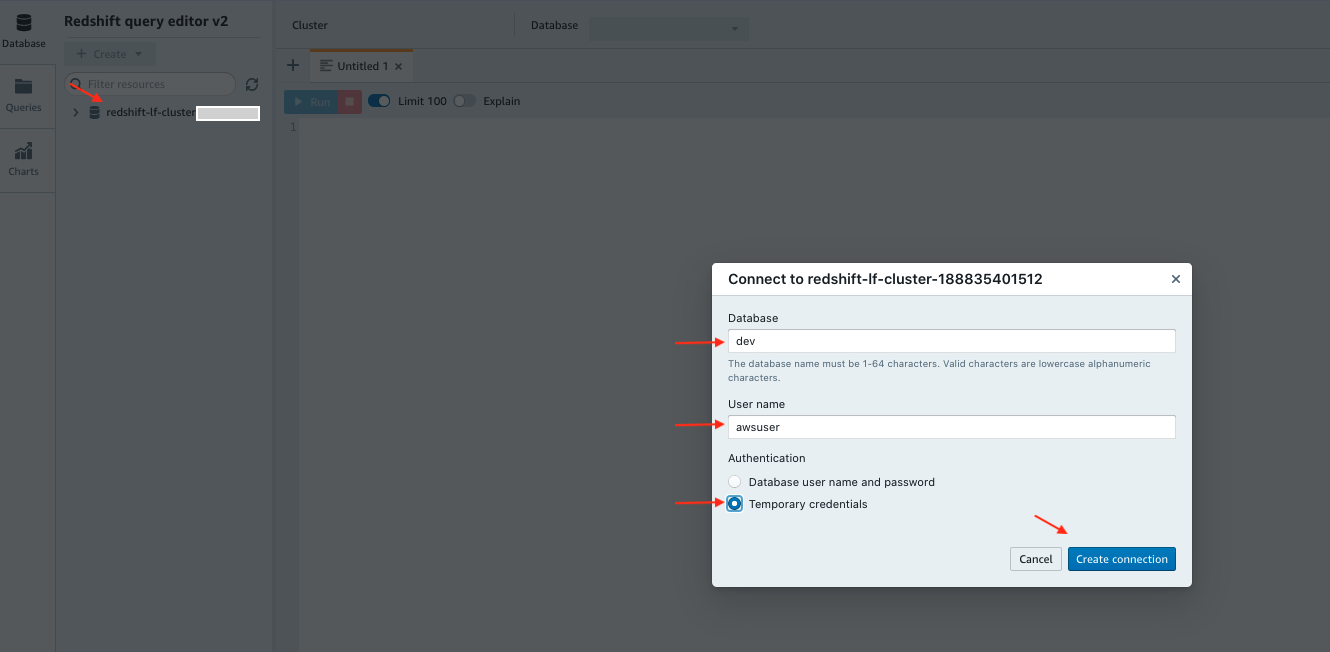
When you’re connected and logged in as administrator user, you can see both local and external schemas and tables, as shown in the following screenshot.
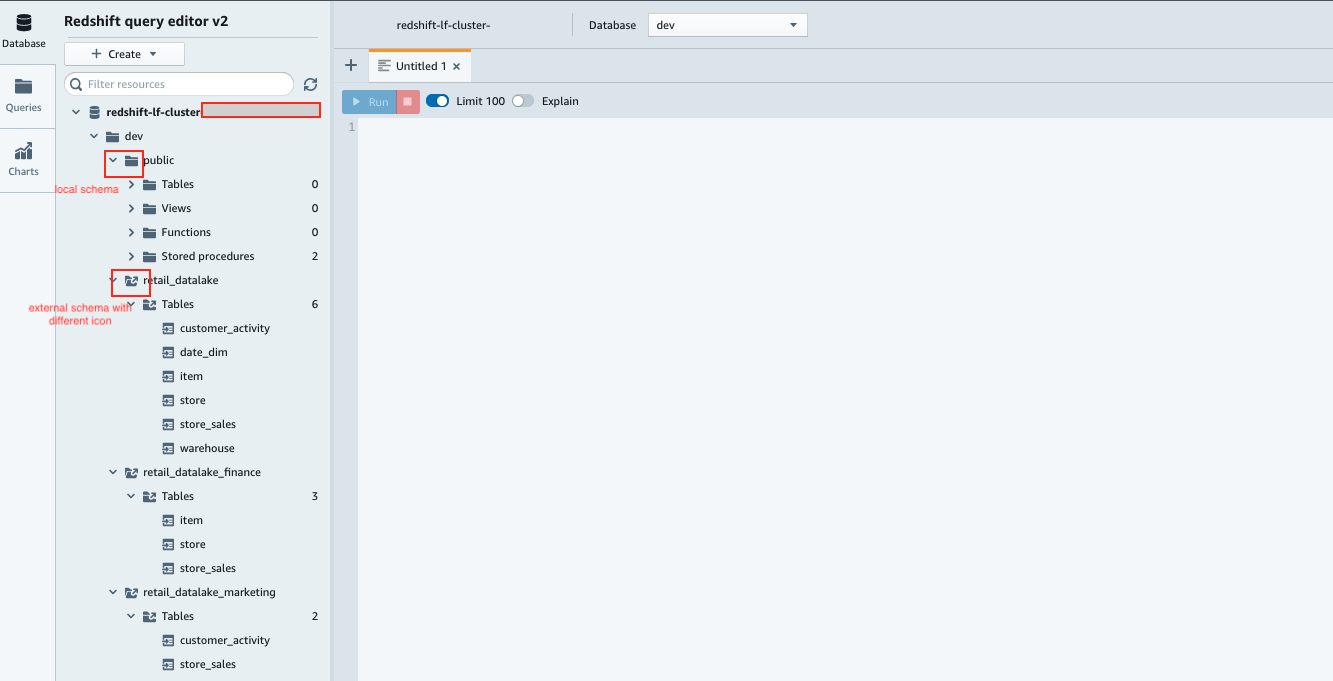
Next, we validate how the Lake Formation security settings work for the marketing and finance users.
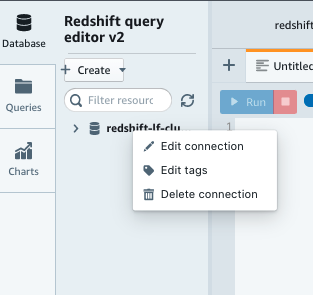
marketing_ro.
maketing_ro, choose the dev database under the cluster and navigate to the customer_activity table.
finance_ro.
dev database.As expected, this user only has access to the allowed schema and tables.
With this solution, you can segregate different users at the schema level and use Lake Formation to make sure they can only see the tables and columns their role allows.
Lake Formation also allows you to set which columns a principal can or can’t see within a table. For example, when you select store_sales as the marketing_ro user, you see many columns, like customer_purchase_estimate. However, as the finance_ro user, you don’t see these columns.
In this post, we’ve been working with a CloudFormation template-based environment, which is an automated way to create environment templates and simplify operations.
In this section, we show how you can set up all the configurations through the console, and we use another table as an example to walk you through the steps.
As demonstrated in previous steps, the marketing user in this environment has all column access to the tables customer_activity and store_sales in the external schema retail_datalake_marketing. We change some of that manually to see how it works using the console.
RedshiftMarketingRole.store_sales table and choose Revoke.

A success message appears, and the permission row is no longer listed.
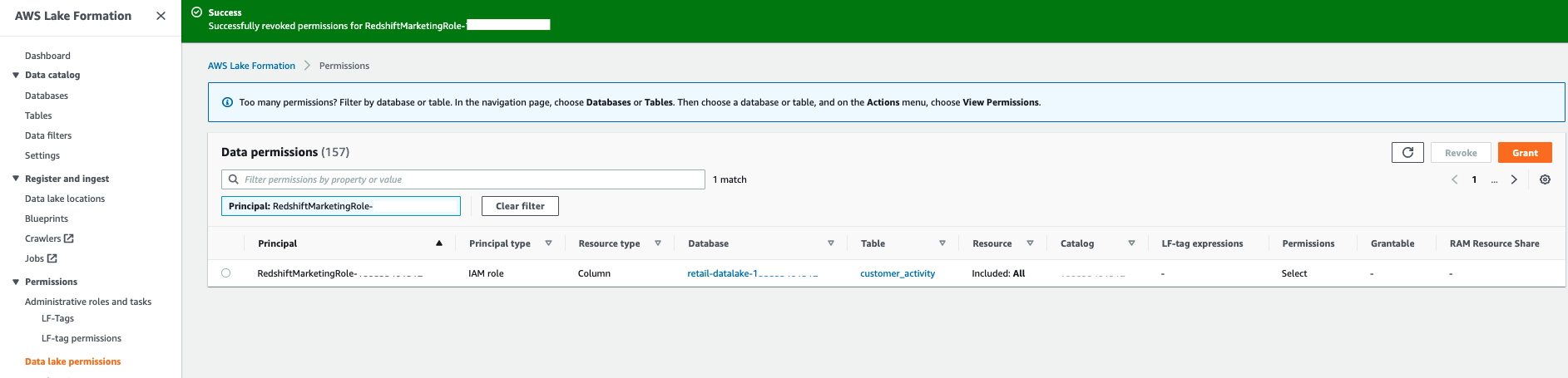
store_sales table at the column level.
store_sales table.

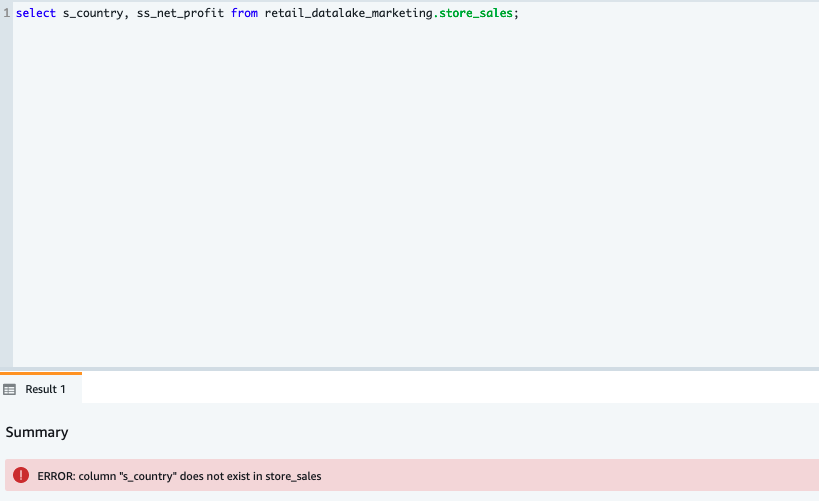
We now query the table from Amazon Redshift again to confirm that the effective changes match the controls placed by Lake Formation. In the following query, we select a column that isn’t authorized:
As expected, we get an error.
Clean up resources created by the CloudFormation template to avoid unnecessary cost to your AWS account. You can delete the CloudFormation stack by selecting the stack on the AWS CloudFormation console and choosing Delete. This action deletes all the resources it provisioned. If you manually updated a template-provisioned resource, you may see some issues during clean-up, and you need to clean these up manually.
In this post, we showed how you can integrate Lake Formation with Amazon Redshift to seamlessly control access to Amazon S3 data lake. We also demonstrated how to query your data lake using Redshift Spectrum and external tables. This is a powerful mechanism that helps you build a modern data architecture to easily query data on your data lake and data warehouses together. We also saw how you can use CloudFormation templates to automate the resource creation with infrastructure as code. You can use this to simplify your operations, especially when you want replicate the resource setup from development to production landscape during your project cycles.
Finally, we covered how data lake administrators can manually control search on data catalog objects and grant or revoke access at the database, table, and column level. We encourage you to try the steps we outlined in this post and use the CloudFormation template to set up security in Lake Formation to control data lake access from Redshift Spectrum.
In the second post of this series, we focus on how you can take this concept and apply it across accounts using a Lake Formation data-sharing feature in a hub-and-spoke topography.
 Vaibhav Agrawal is an Analytics Specialist Solutions Architect at AWS. Throughout his career, he has focused on helping customers design and build well-architected analytics and decision support platforms.
 Jason Pedreza is an Analytics Specialist Solutions Architect at AWS with over 13 years of data warehousing experience. Prior to AWS, he built data warehouse solutions at Amazon.com. He specializes in Amazon Redshift and helps customers build scalable analytic solutions.
 Rajesh Francis is a Senior Analytics Customer Experience Specialist at AWS. He specializes in Amazon Redshift and focuses on helping to drive AWS market and technical strategy for data warehousing and analytics services. Rajesh works closely with large strategic customers to help them adopt our new services and features, develop long-term partnerships, and feed customer requirements back to our product development teams to guide our product roadmap.
Post Syndicated from Matthew Kienow original https://blog.rapid7.com/2022/01/19/open-source-security-getting-to-the-root-of-the-problem/

The past few weeks have shown us the importance and wide reach of open-source security. In December 2021, public disclosure of the Log4Shell vulnerability in Log4j, an open-source logging library, caused a cascade of dependency analysis by developers in organizations around the world. The incident was so wide-reaching that representatives from federal agencies and large private-sector companies gathered on January 13, 2022, at a White House meeting to discuss initiatives for securing open-source software.
A large percentage of the software we rely on today is proprietary or closed-source, meaning that the software is fully controlled by the company and closed for independent review. But in most cases, all of the code written to build the proprietary software is not entirely produced by the companies that provide the products and services; instead, they use a third-party library or a component piece of software to help them assemble their solution.
Many of those third-party components are classified as open-source software, meaning the source code is freely available for anyone to use, view, change to correct issues, or enhance to add new functionality. Open-source software projects are frequently maintained by volunteers, and a community of developers and users forms around a shared passion for the software. It’s their passion and collaboration that help projects grow and remain supported.
Yet for the majority of open-source projects that do not have a large corporate backer, the role these individuals play is frequently overlooked by software consumers, and as a result, many open-source projects face maintenance challenges.
Limited resources impose a variety of constraints on projects, but the implications are particularly wide-reaching when we look at the challenge of securing open-source software. Vulnerabilities discovered in proprietary software are the responsibility of the software vendor, frequently better funded than open-source software, with teams available to triage and resolve defects. Better — or any — funding, or broader community participation, may also increase the chance of avoiding vulnerabilities during development or discovering them during quality assurance checks. It can also help developers more quickly identify and resolve vulnerabilities discovered at a future date.
Increasing open-source project funding is a wonderful idea, and it’s in the best interest of companies using such software to build their products and services. However, funding alone won’t increase security in open-source projects, just as the greater source code visibility in open-source hasn’t necessarily resulted in fewer defects or shortened times between defect introduction and resolution.
For example, the vulnerability in Microsoft’s Server Message Block (SMB) protocol implementation (CVE-2017-0144) was around for many years before the defect was resolved in 2017. Similarly, the Log4Shell (CVE-2021-44228) vulnerability in the Log4j project was introduced in 2013, and it remained undiscovered and unresolved until December 2021. There is clearly a massive difference in both funding and available resources to those involved in these projects, and yet both were able to have vulnerable defects exist for years before resolution.
Accidental software vulnerabilities share similar root causes whether they’re found in proprietary or open-source software. When developers create new features or modify existing ones, we need code reviews that look beyond feature functionality confirmation. We need to inspect the code changes for security issues but also perform a deeper analysis, with attention to the security implications of these changes within the greater scope of the complete project.
The challenge is that not all developers are security practitioners, and that is not a realistic expectation. The limited resources of open-source projects compound the problem, increasing the likelihood that contribution reviews focus primarily on functionality. We should encourage developer training in secure coding practices but understand that mistakes are still possible. That means we need processes and tooling to assist with secure coding.
Security in open-source software carries some other unique challenges due to the open environment. Projects tend to accept a wide variety of contributions from anyone. A new feature might not have enough of a demand to get time from the primary developers, but anyone who takes the time to develop the feature while staying within the bounds of the project’s goals and best practices may very well have their contribution accepted and merged into the project. Projects may find themselves the target of malicious contributions through covert defect introduction. The project may even be sabotaged by a project maintainer, or the original maintainer may want to retire from the project and end up handing it over to another party that — intentionally or not — introduces a defect.
It’s important for us to identify open-source projects that are critical to the software supply chain and ensure these projects are sustainably maintained for the future. These goals would benefit from increased adoption of secure coding practices and infrastructure that ensures secure distribution and verification of software build artifacts.
Post Syndicated from BeardedTinker original https://www.youtube.com/watch?v=E-NZojUpIfM
Post Syndicated from original https://lwn.net/Articles/881812/rss
Version
7.0 of the ONLYOFFICE office suite is available.
With the release of Docs v7.0, ONLYOFFICE opens the source code
of the professional editing features, such as document
comparison, content controls and sheet views for spreadsheets,
and makes them available in all solutions. Previously, all
these features were exclusively accessible on a paying basis.
There is a long list of new features; see the announcement for details.
Post Syndicated from original https://lwn.net/Articles/881810/rss
Security updates have been issued by CentOS (firefox, gegl, kernel, and thunderbird), Debian (nvidia-graphics-drivers), Fedora (btrbk and thefuck), Mageia (clamav, kernel, kernel-linus, vim, and wpa_supplicant), openSUSE (java-1_8_0-ibm, jawn, nodejs12, nodejs14, SDL2, and virglrenderer), Red Hat (gegl, gegl04, java-17-openjdk, and kernel-rt), Scientific Linux (gegl and httpd), SUSE (apache2, firefox, java-1_7_1-ibm, java-1_8_0-ibm, libvirt, nodejs12, nodejs14, openstack-monasca-agent, spark, spark-kit, zookeeper, python-Django, python-Django1, python-numpy, SDL2, and virglrenderer), and Ubuntu (byobu, clamav, and ruby2.3, ruby2.5, ruby2.7).
Post Syndicated from The Atlantic original https://www.youtube.com/watch?v=8ucNTzAJbsA
Post Syndicated from João Tomé original https://blog.cloudflare.com/tonga-internet-outage/

2022 only has 19 days of existence but so far this January, there have already been four significant Internet disruptions:
1. An Internet outage in The Gambia because of a cable problem.
2. An Internet shutdown in Kazakhstan because of unrest.
3. A mobile Internet shutdown in Burkina Faso because of a coup plot.
4. An Internet outage in Tonga because of a volcanic eruption.
The latest Internet outage, in the South Pacific country of Tonga (with 169 islands), is still ongoing. It started with the large eruption of Hunga Tonga–Hunga Haʻapai, an uninhabited volcanic island of the Tongan archipelago on Friday, January 14, 2022. The next day, Cloudflare Radar shows that the Internet outage started at around 03:00 UTC (16:00 local time) — Saturday, January 15, 2022 — and is ongoing for more than four days. Tonga’s 105,000 residents are almost entirely unreachable, according to the BBC.
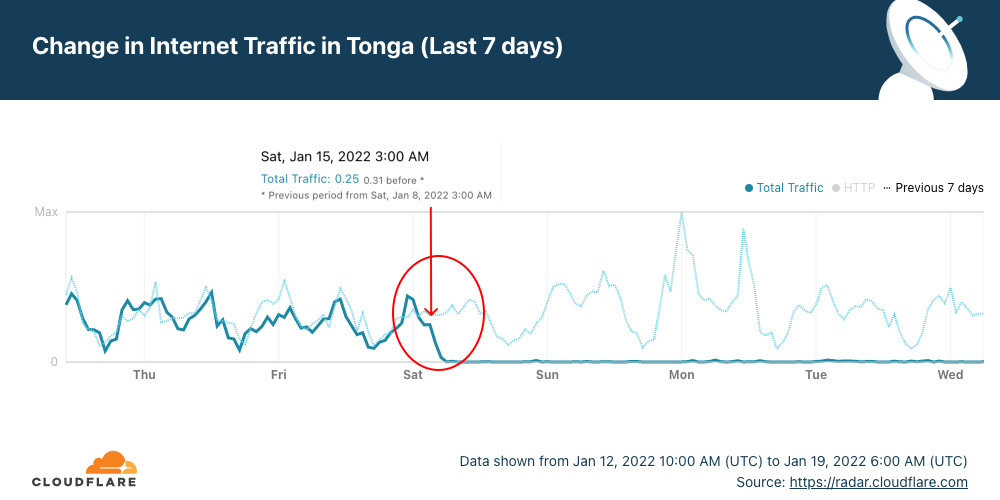
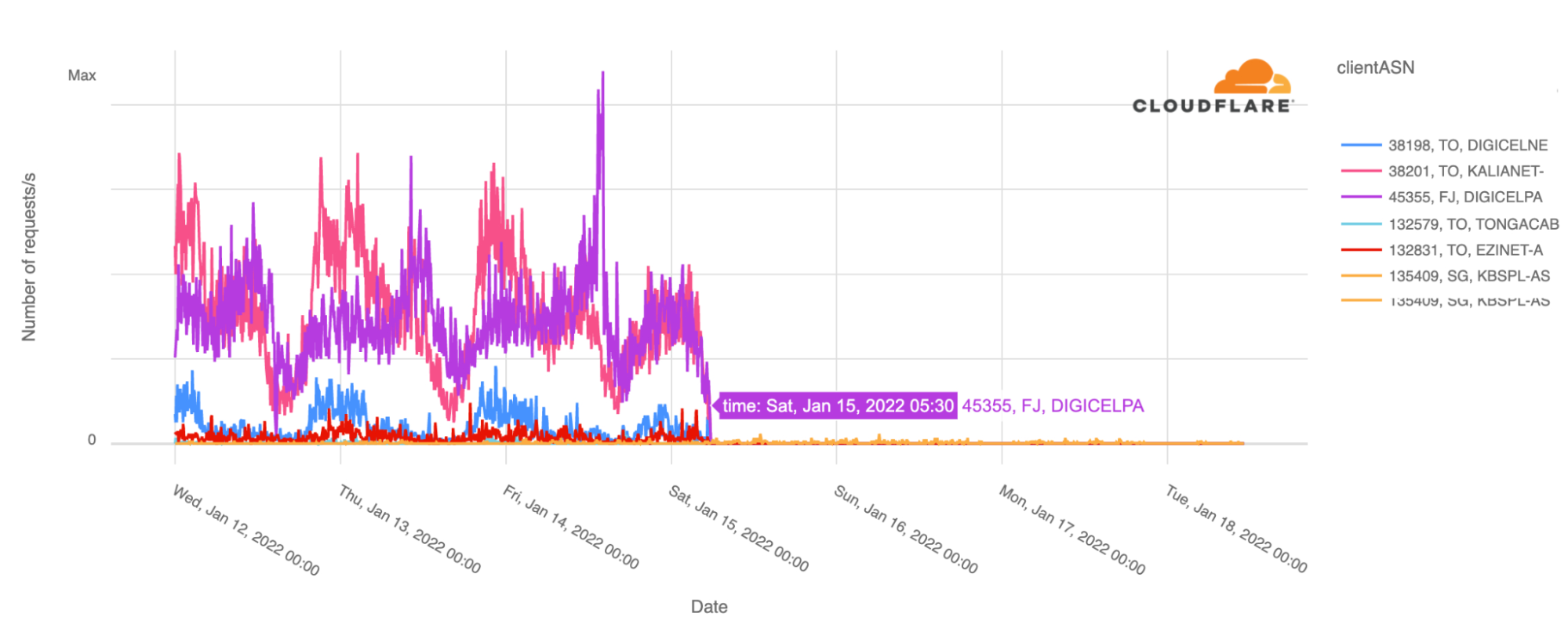
When we focus on the number of requests by ASN, the country’s main ISPs Digicel and Kalianet started to lose traffic after 03:00 UTC and by 05:30 UTC January 15, 2022, Cloudflare saw close to no traffic at all from them, as shown in the graph below.
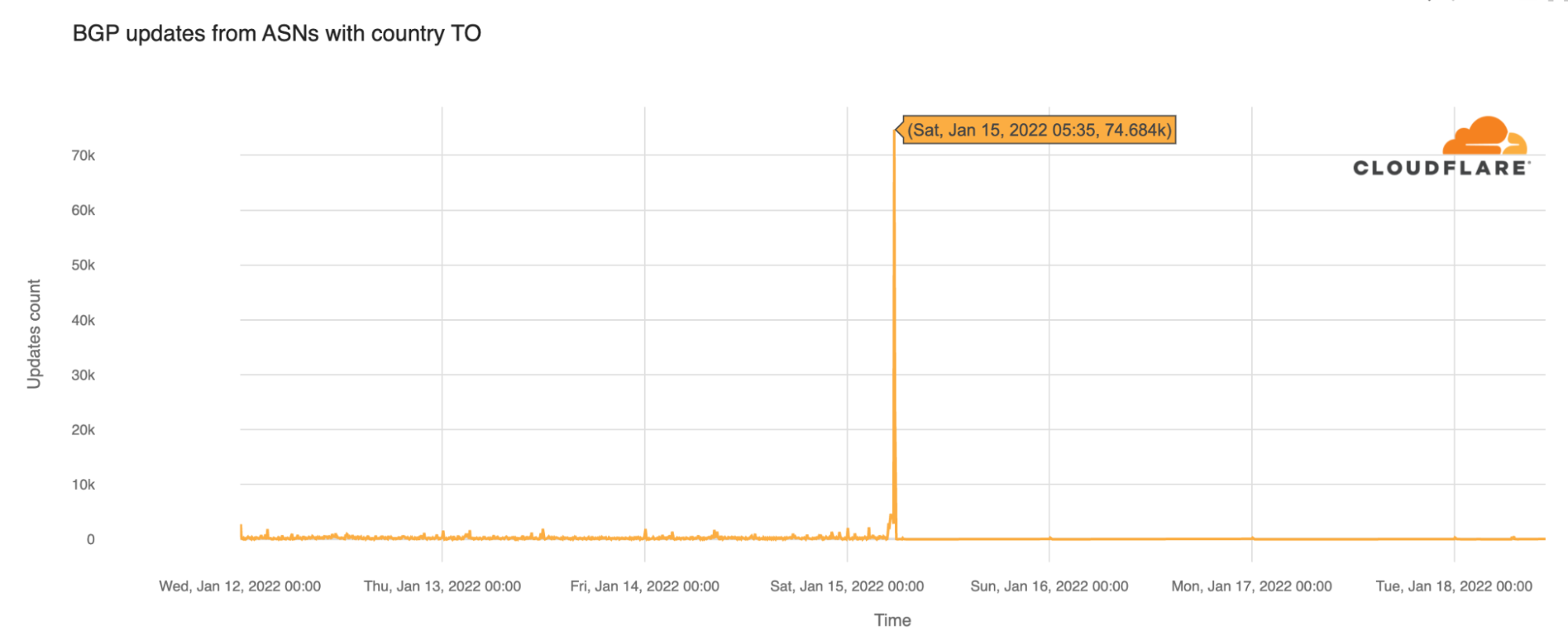
Looking at the BGP (Border Gateway Protocol) updates from Tonga’s ASNs around the time of the outage, we see a clear spike at 05:35 UTC (18:35 local time). These update messages are BGP signalling that the Tongan ASNs are no longer routable. We saw the same trend in The Gambia outage of January 4, 2022 — there you can read about the importance of BGP as a mechanism to exchange routing information between autonomous systems on the Internet, something that was also seen in the 2021 Facebook outage.
Cloudflare Radar data doesn’t show any significant disruptions for Internet traffic in Tonga’s neighbours American Samoa (although there was a small decrease in traffic on Friday and Saturday, January 14 and 15, 2022 in comparison with the previous week) and Fiji. In American Samoa, all schools were closed on Friday, January 14, because of severe weather, and on the same day, after the volcanic eruption, there were tsunami warnings and evacuation to higher ground was advised (that continued through the weekend).
Tonga, as a geographically remote Polynesian country more than 800 km from the Fiji archipelago, is highly dependent on the Internet for communications. That is something that was improved five years ago with an infrastructure connectivity program from the World Bank. Prior to that, the country was dependent on satellite links for Internet that included a very small percentage of the population.
Southern Cross Cable Network confirmed that the 827 km fiber-optic undersea communications cable connecting Tonga to the outside world may have been broken. The company is assisting Tonga Cable Limited (TCL), which owns the single cable that provides Internet access and almost all communications to and from the archipelago.
The eruption resulted in a fault in the international cable 37 kilometres from Nukuʻalofa (Tonga’s capital), and a further fault in a domestic cable 47 km from the capital.
TCL announced that it has already met with the US cable company SubCom to start preparations for SubCom’s cable repair ship Reliance to be dispatched from Papua New Guinea to Tonga, possibly via Samoa (more than 4,000 km away).
The repairs could take “at least” four weeks, given that a repair to a fiber-optic cable that has been cut on the seabed is considered more complicated than misconfigurations, power outages or other types of infrastructure damage. “The site conditions in Tonga have to be assessed thoroughly because of volcanic activities,” according to TCL chairman Samiuela Fonua.
Fonua also mentioned that the last cable cut (back in 2019) took nearly two weeks to repair, but this time the site conditions will determine the time it will take — the two cables are not far away from the eruption site (the volcano is still active). According to ZDNet, in 2019 Tonga signed a 15-year deal with Kacific for satellite connectivity, but since then the satellite provider says it is waiting on the Tongan government to activate its contract.
Also in January, Space Norway, the operator of the world’s most northern submarine cable — the Svalbard Undersea Cable System — announced that on January 7 it located a disruption in one of the two twin submarine fiber optic communication cables connecting Longyearbyen with Andøya north of Harstad in northern Norway (in the area where the seabed goes from 300 meters down to 2,700 meters in the Greenland Sea). A repair mission is being planned.
A significant amount of Internet traffic is carried by a complex network of undersea fiber-optic cables that connect countries and continents. The full submarine cable system (the first communications cables laid were from the 1850s and carried telegraphy traffic) is what makes most of the world’s Internet function between countries and continents. There are 428 active submarine cables (36 are planned), running in an estimate of 1.3 million km around the globe.
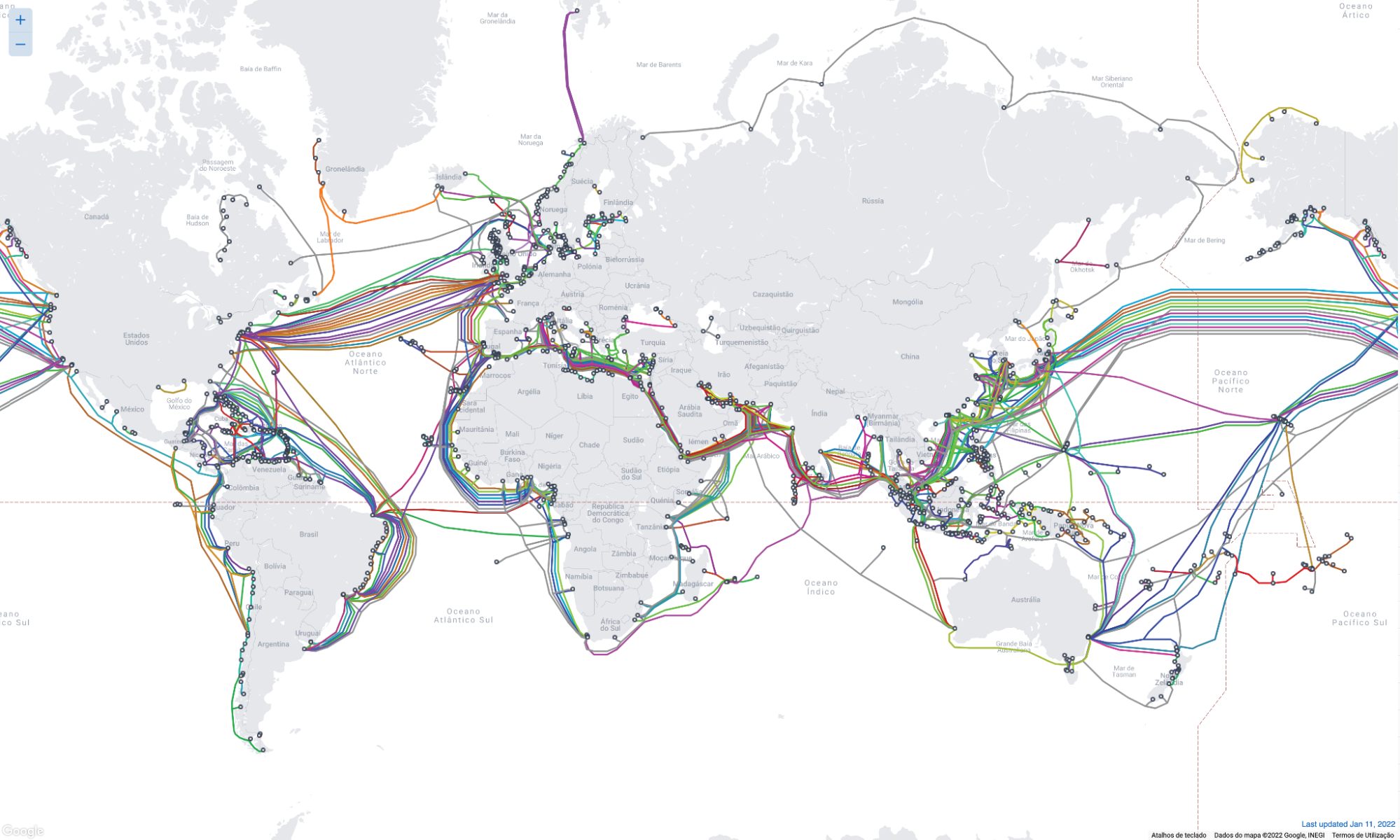
This gives a sense that the Internet is literally a network of networks in a world where estimates indicate that around 99% of the data traffic that is crossing oceans is carried by these undersea cables (satellite Internet, so far, is still residual — SpaceX has around 145,000 users).
The reliability of submarine cables is high, especially when multiple paths are available in the event of a cable break. That’s not the case for the Tonga outage, given that the 827 km submarine cable only connects Fiji to the Tonga archipelago — Fiji is connected to the main Southern Cross Cable, as the next image illustrates.

17JAN22 – Tonga volcano eruption disrupts Domestic & Intl subsea cables
🇹🇴Volcano Tonga-Hunga erupted Sat 15JAN22, causing extensive damage to the region, cutting off communications over both the TDCE domestic cable and the 🇹🇴-🇫🇯 international cable
📰 https://t.co/p40AbOF8C6 pic.twitter.com/ORYaCVYvKv
— philBE (@philBE2) January 17, 2022
The total carrying capacity of submarine cables is enormous (EllaLink, the optical submarine cable linking the European and South American continents, for example, has 100 Tbps capacity) and grows year after year as the world gets more and more connected. For example, Google has recently finished a new cable with 350 Tbps of capacity. But, a transoceanic submarine cable system costs several hundred million dollars to construct. One of the latest, between Portugal and Egypt, with a total of 8,700 kilometers, is budgeted at 326 million euros.
The Tonga outage was not the only one of 2022 (so far) that happened because of cable problems. The Gambia outage that affected the country’s main ISP, Gamtel, was because of “a primary link failure at ACE”, the cable system that serves 24 countries, from Europe to Africa, namely in the points of cable connections from Senegal to The Gambia.
In spite of these two fiber cable problems being separated by a few days at the start of 2022, Internet outages are more common because of situations like misconfigurations, power outages, extreme weather or the frequent state-imposed shutdowns to deal with unrest, elections or exams — recently this was the case of Sudan or Kazakhstan.