Post Syndicated from Explosm.net original https://explosm.net/comics/fart-cop
New Cyanide and Happiness Comic
Post Syndicated from Explosm.net original https://explosm.net/comics/fart-cop
New Cyanide and Happiness Comic
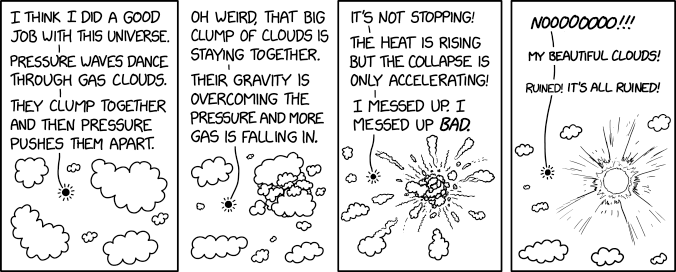
Post Syndicated from xkcd.com original https://xkcd.com/3222/
Post Syndicated from Michelle Chen original https://blog.cloudflare.com/workers-ai-large-models/
We’re making Cloudflare the best place for building and deploying agents. But reliable agents aren’t built on prompts alone; they require a robust, coordinated infrastructure of underlying primitives.
At Cloudflare, we have been building these primitives for years: Durable Objects for state persistence, Workflows for long running tasks, and Dynamic Workers or Sandbox containers for secure execution. Powerful abstractions like the Agents SDK are designed to help you build agents on top of Cloudflare’s Developer Platform.
But these primitives only provided the execution environment. The agent still needed a model capable of powering it.
Starting today, Workers AI is officially in the big models game. We now offer frontier open-source models on our AI inference platform. We’re starting by releasing Moonshot AI’s Kimi K2.5 model on Workers AI. With a full 256k context window and support for multi-turn tool calling, vision inputs, and structured outputs, the Kimi K2.5 model is excellent for all kinds of agentic tasks. By bringing a frontier-scale model directly into the Cloudflare Developer Platform, we’re making it possible to run the entire agent lifecycle on a single, unified platform.
The heart of an agent is the AI model that powers it, and that model needs to be smart, with high reasoning capabilities and a large context window. Workers AI now runs those models.
We spent the last few weeks testing Kimi K2.5 as the engine for our internal development tools. Within our OpenCode environment, Cloudflare engineers use Kimi as a daily driver for agentic coding tasks. We have also integrated the model into our automated code review pipeline; you can see this in action via our public code review agent, Bonk, on Cloudflare GitHub repos. In production, the model has proven to be a fast, efficient alternative to larger proprietary models without sacrificing quality.
Serving Kimi K2.5 began as an experiment, but it quickly became critical after reviewing how the model performs and how cost-efficient it is. As an illustrative example: we have an agent that does security reviews of Cloudflare’s codebases. This agent processes over 7B tokens per day, and using Kimi, it has caught more than 15 confirmed issues in a single codebase. Doing some rough math, if we had run this agent on a mid-tier proprietary model, we would have spent $2.4M a year for this single use case, on a single codebase. Running this agent with Kimi K2.5 cost just a fraction of that: we cut costs by 77% simply by making the switch to Workers AI.
As AI adoption increases, we are seeing a fundamental shift not only in how engineering teams are operating, but how individuals are operating. It is becoming increasingly common for people to have a personal agent like OpenClaw running 24/7. The volume of inference is skyrocketing.
This new rise in personal and coding agents means that cost is no longer a secondary concern; it is the primary blocker to scaling. When every employee has multiple agents processing hundreds of thousands of tokens per hour, the math for proprietary models stops working. Enterprises will look to transition to open-source models that offer frontier-level reasoning without the proprietary price tag. Workers AI is here to facilitate this shift, providing everything from serverless endpoints for a personal agent to dedicated instances powering autonomous agents across an entire organization.
Workers AI has served models, including LLMs, since its launch two years ago, but we’ve historically prioritized smaller models. Part of the reason was that for some time, open-source LLMs fell far behind the models from frontier model labs. This changed with models like Kimi K2.5, but to serve this type of very large LLM, we had to make changes to our inference stack. We wanted to share with you some of what goes on behind the scenes to support a model like Kimi.
We’ve been working on custom kernels for Kimi K2.5 to optimize how we serve the model, which is built on top of our proprietary Infire inference engine. Custom kernels improve the model’s performance and GPU utilization, unlocking gains that would otherwise go unclaimed if you were just running the model out of the box. There are also multiple techniques and hardware configurations that can be leveraged to serve a large model. Developers typically use a combination of data, tensor, and expert parallelization techniques to optimize model performance. Strategies like disaggregated prefill are also important, in which you separate the prefill and generation stages onto different machines in order to get better throughput or higher GPU utilization. Implementing these techniques and incorporating them into the inference stack takes a lot of dedicated experience to get right.
Workers AI has already done the experimentation with serving techniques to yield excellent throughput on Kimi K2.5. A lot of this does not come out of the box when you self-host an open-source model. The benefit of using a platform like Workers AI is that you don’t need to be a Machine Learning Engineer, a DevOps expert, or a Site Reliability Engineer to do the optimizations required to host it: we’ve already done the hard part, you just need to call an API.
In concert with this launch, we’ve also improved our platform and are releasing several new features to help you build better agents.
When you work with agents, you are likely sending a large number of input tokens as part of the context: this could be detailed system prompts, tool definitions, MCP server tools, or entire codebases. Inputs can be as large as the model context window, so in theory, you could be sending requests with almost 256k input tokens. That’s a lot of tokens.
When an LLM processes a request, the request is broken down into two stages: the prefill stage processes input tokens and the output stage generates output tokens. These stages are usually sequential, where input tokens have to be fully processed before you can generate output tokens. This means that sometimes the GPU is not fully utilized while the model is doing prefill.
With multi-turn conversations, when you send a new prompt, the client sends all the previous prompts, tools, and context from the session to the model as well. The delta between consecutive requests is usually just a few new lines of input; all the other context has already gone through the prefill stage during a previous request. This is where prefix caching helps. Instead of doing prefill on the entire request, we can cache the input tensors from a previous request, and only do prefill on the new input tokens. This saves a lot of time and compute from the prefill stage, which means a faster Time to First Token (TTFT) and a higher Tokens Per Second (TPS) throughput as you’re not blocked on prefill.
Workers AI has always done prefix caching, but we are now surfacing cached tokens as a usage metric and offering a discount on cached tokens compared to input tokens. (Pricing can be found on the model page.) We also have new techniques for you to leverage in order to get a higher prefix cache hit rate, reducing your costs.
In order to route to the same model instance and take advantage of prefix caching, we use a new x-session-affinity header. When you send this header, you’ll improve your cache hit ratio, leading to more cached tokens and subsequently, faster TTFT, TPS, and lower inference costs.
You can pass the new header like below, with a unique string per session or per agent. Some clients like OpenCode implement this automatically out of the box. Our Agents SDK starter has already set up the wiring to do this for you, too.
curl -X POST \
"https://api.cloudflare.com/client/v4/accounts/{ACCOUNT_ID}/ai/run/@cf/moonshotai/kimi-k2.5" \
  -H "Authorization: Bearer {API_TOKEN}" \
  -H "Content-Type: application/json" \
  -H "x-session-affinity: ses_12345678" \
  -d '{
    "messages": [
      {
        "role": "system",
        "content": "You are a helpful assistant."
      },
      {
        "role": "user",
        "content": "What is prefix caching and why does it matter?"
      }
    ],
    "max_tokens": 2400,
    "stream": true
  }'
Serverless inference is really hard. With a pay-per-token business model, it’s cheaper on a single request basis because you don’t need to pay for entire GPUs to service your requests. But there’s a trade-off: you have to contend with other people’s traffic and capacity constraints, and there’s no strict guarantee that your request will be processed. This is not unique to Workers AI — it’s evidently the case across serverless model providers, given the frequent news reports of overloaded providers and service disruptions. While we always strive to serve your request and have built-in autoscaling and rebalancing, there are hard limitations (like hardware) that make this a challenge.
For volumes of requests that would exceed synchronous rate limits, you can submit batches of inferences to be completed asynchronously. We’re introducing a revamped Asynchronous API, which means that for asynchronous use cases, you won’t run into Out of Capacity errors and inference will execute durably at some point. Our async API looks more like flex processing than a batch API, where we process requests in the async queue as long as we have headroom in our model instances. With internal testing, our async requests usually execute within 5 minutes, but this will depend on what live traffic looks like. As we bring Kimi to the public, we will tune our scaling accordingly, but the async API is the best way to make sure you don’t run into capacity errors in durable workflows. This is perfect for use cases that are not real-time, such as code scanning agents or research agents.
Workers AI previously had an asynchronous API, but we’ve recently revamped the systems under the hood. We now rely on a pull-based system versus the historical push-based system, allowing us to pull in queued requests as soon as we have capacity. We’ve also added better controls to tune the throughput of async requests, monitoring GPU utilization in real-time and pulling in async requests when utilization is low, so that critical synchronous requests get priority while still processing asynchronous requests efficiently.
To use the asynchronous API, you would send your requests as seen below. We also have a way to set up event notifications so that you can know when the inference is complete instead of polling for the request.
// (1.) Push a request in queue
// pass queueRequest: true
let res = await env.AI.run("@cf/moonshotai/kimi-k2.5", {
  "requests": [{
    "messages": [{
      "role": "user",
      "content": "Tell me a joke"
    }]
  }, {
    "messages": [{
      "role": "user",
      "content": "Explain the Pythagoras theorem"
    }]
  }, ...{<add more requests in a batch>} ];
}, {
  queueRequest: true,
});


// (2.) grab the request id
let request_id;
if(res && res.request_id){
  request_id = res.request_id;
}
// (3.) poll the status
let res = await env.AI.run("@cf/moonshotai/kimi-k2.5", {
  request_id: request_id
});

if(res && res.status === "queued" || res.status === "running") {
 // retry by polling again
 ...
}
else
 return Response.json(res); // This will contain the final completed response
Get started with Kimi K2.5 on Workers AI today. You can read our developer docs to find out model information and pricing, and how to take advantage of prompt caching via session affinity headers and asynchronous API. The Agents SDK starter also now uses Kimi K2.5 as its default model. You can also connect to Kimi K2.5 on Workers AI via Opencode. For a live demo, try it in our playground.
And if this set of problems around serverless inference, ML optimizations, and GPU infrastructure sound interesting to you — we’re hiring!

Post Syndicated from corbet original https://lwn.net/Articles/1063735/
Ars Technica describes
the ritual that will be required before a future Android device will
deign to install apps from somewhere other than the Play Store. It is not
for the impatient.
Here are the steps:
- Enable developer options by tapping the software build number in About
Phone seven times- In Settings > System, open Developer Options and scroll down to
“Allow Unverified Packages.”- Flip the toggle and tap to confirm you are not being coerced
- Enter device unlock code
- Restart your device
- Wait 24 hours
- Return to the unverified packages menu at the end of the security delay
- Scroll past additional warnings and select either “Allow temporarily”
(seven days) or “Allow indefinitely.”- Check the box confirming you understand the risks.
- You can now install unverified packages on the device by tapping the
“Install anyway” option in the package manager.
Post Syndicated from LGR original https://www.youtube.com/watch?v=zRfpuaHuzDY
Post Syndicated from David Johnson original https://www.backblaze.com/blog/neoclouds-are-winning-on-compute-storage-shouldnt-slow-them-down/

Neoclouds are having a moment.
As demand for AI infrastructure keeps climbing, a new wave of providers is proving there’s real appetite for something other than the traditional hyperscaler model. They’re moving fast, specializing deeply, and building strong businesses around the layers that matter most to their customers: GPU access, high-performance compute, AI services, and developer experience.
That momentum is real, as is the next bottleneck. For many neoclouds, the challenge is no longer just how to deliver more compute. It’s how to deliver a more complete platform without taking on all the complexity of becoming a full-stack cloud provider. And that usually brings teams to the same question: Sshould we build our own storage layer?
The shift toward neoclouds is really a shift toward specialization.
For years, the default assumption in cloud infrastructure was that the winning model looked like a hyperscaler: Build the entire stack, own every layer, and expand horizontally into as many services as possible. That model produced scale, but it also produced operational sprawl, complexity, and costs that many customers are increasingly motivated to avoid.
Neoclouds are succeeding because they’re taking the opposite path. Instead of trying to be everything to everyone, they’re building best-of-breed platforms around targeted workloads and high-value services. That’s especially true in AI, where performance, cost control, and speed matter more than a long menu of loosely related products.
But the closer a neocloud gets to becoming a full platform, the more pressure it faces to solve for storage.
Without integrated object storage, customers often end up in a split-stack architecture. They run compute on a neocloud, but keep their data parked in a major cloud provider, which creates problems quickly.
For example: Large training datasets, model checkpoints, and output artifacts have to move across environments, costs become harder to predict, egress charges start to shape architecture decisions, and performance can suffer when storage and compute are no longer designed to work together.
At that point, storage becomes a core requirement for offering a platform that feels complete, efficient, and economically viable.
So teams ask the obvious question: should we build it ourselves?
This is where the conversation often gets framed too narrowly.
On paper, the decision can look straightforward: deploy open-source software such as Ceph, or design purpose-built hardware for tighter control over performance and economics.
In reality, both paths create the same strategic problem. They pull engineering focus away from your core platform and into a long-term storage business you never actually meant to start.
That matters because storage is not just infrastructure. It is an operating discipline. It comes with its own tuning, scaling, durability trade-offs, support burden, procurement risk, migration complexity, and day-two operational entropy.
Once you build it, you own all of it.
Ceph is often the default option for teams exploring S3 compatible storage because it appears flexible, proven, and relatively accessible on commodity hardware.
And to be clear, Ceph can be powerful. But there’s a big difference between deploying Ceph and running it well at scale.
In production, Ceph demands specialized expertise. Teams have to manage CRUSH maps, OSD tuning, replication behavior, rebalancing events, and the network impact that comes with those changes. Those are not occasional tasks. They are part of the ongoing operational load.
That burden grows as environments get larger and more performance-sensitive.
For AI and high-performance compute use cases, generic Ceph deployments can also become throughput bottlenecks. When storage ceilings start constraining training jobs or data-intensive workflows, the problem is no longer confined to the storage team. It starts affecting the value of your core compute offering.
And migration is rarely simple. Because data is distributed across the cluster in ways that are optimized for internal resilience, moving out of a Ceph environment can become a resource-heavy extraction exercise that introduces risk to live workloads.
So while Ceph may reduce license costs up front, it can create a much more expensive operational reality over time.
For some neocloud teams, custom storage hardware feels like the more strategic answer.
The logic is easy to understand: if storage is critical, why not optimize the hardware and software stack together and get more predictable performance?
The issue is that custom storage hardware rarely stays clean and predictable for long.
Supply chains change. Drive capacities shift. Components become harder to source consistently. Architectures designed around one hardware profile suddenly have to absorb another. This dynamic can leave teams paying for density they can’t fully use or reworking systems to accommodate equipment that wasn’t part of the original plan.
Durability management adds another layer of complexity. As systems age, parity strategies and erasure coding decisions may need to change to maintain reliability. That can reduce usable capacity, increase cost per terabyte, and trigger compute-intensive re-encoding processes at exactly the wrong time.
Then there’s the networking layer. At scale, object storage is not just disks and nodes. It also depends on a traffic management architecture capable of handling massive ingress and egress flows without introducing opaque failure points. Whether you build around open source components or buy expensive hardware appliances, you’re signing up for another category of highly specialized infrastructure work.
And all of that comes with a capital model that is harder to unwind. Hardware investments lock teams into depreciation cycles and planning assumptions that may not match where the market is headed next.
The most important shift here is not technical. It’s organizational.
At a certain point, the storage question becomes a question of where your best people should spend their time.
Should your engineers be tuning replication policies, planning hardware refreshes, and troubleshooting storage network behavior?
Or should they be improving the platform features your customers actually choose you for?
For most neoclouds, the answer is clear.
Their advantage comes from how well they deliver compute, how quickly they adapt to AI demand, how smooth their developer experience feels, and how effectively they help customers run modern workloads. That is where focus compounds. That is where differentiation lives.
Storage matters enormously, but that does not mean it has to be built in-house.
The neocloud ecosystem works best when providers can connect to open, specialized layers instead of rebuilding the entire stack themselves.
When storage is treated as a utility rather than an internal R&D project, teams can move faster and stay aligned with what the business actually needs. They avoid procurement cycles, reduce operational overhead, and eliminate a category of complexity that would otherwise keep expanding over time.
Equally importantly, they can offer customers a more complete and coherent platform without forcing data to remain trapped in legacy cloud environments.
Backblaze gives neoclouds an independent, S3-compatible object storage backbone that can plug into existing compute, AI, and container workflows without requiring a storage buildout from scratch.
That means teams can:
Backblaze also brings the underlying scale and performance neoclouds need to support modern AI and data-intensive workloads, including up to 1Tbps aggregate throughput, 11 nines of annual durability, a 99.9% uptime SLA, and enterprise security and compliance capabilities.
Neoclouds are winning because they know where to specialize.
That focus is their strength. It is also their opportunity.
The fastest path to a stronger platform is not to recreate every layer of the cloud stack. It is to build the parts that make your business distinct, then connect them to the right partners for the rest.
Storage is too important to ignore, but it is also too easy to underestimate.
If you want to move faster, serve customers better, and keep your roadmap centered on what makes your platform valuable, don’t turn storage into a distraction.
Build what matters. Let Backblaze handle the storage.Interested in learning how Backblaze supports neocloud platforms? Explore B2 Neo or talk with our team about building a more open, AI-ready storage architecture.
The post Neoclouds Are Winning on Compute. Storage Shouldn’t Slow Them Down. appeared first on Backblaze Blog | Cloud Storage & Cloud Backup
Post Syndicated from jzb original https://lwn.net/Articles/1063723/
Greg Kroah-Hartman has announced the release of the 6.19.9 and 6.18.19 stable kernels. As usual, each
has important fixes throughout the tree; users are advised to
upgrade.
Post Syndicated from Ryan Smith original https://www.servethehome.com/nvidias-vera-cpu-in-detail-high-perf-chip-takes-aim-at-broader-ai-server-market/
While NVIDIA is best known as a GPU company for obvious reasons, the company has now spent almost half of its existence trying to branch into the CPU market as well. From early forays into processor designs with Denver – and ambitions of x86 processors unrealized – through multiple generations of Tegra SoCs, and now […]
The post NVIDIA’s Vera CPU in Detail: High Perf Chip Takes Aim at Broader AI Server Market appeared first on ServeTheHome.
Post Syndicated from LastWeekTonight original https://www.youtube.com/shorts/dsttKIZ3XwA
Post Syndicated from Joel Alcon original https://www.rapid7.com/blog/post/em-preemptive-proactive-enhanced-cnapp-available-exposure-command
Earlier this year, we made a significant announcement: Rapid7 partnered with ARMO to add AI-powered cloud application detection and response (CADR) – or cloud runtime security – to our cloud security portfolio. At the time, I published a blog highlighting this two-part approach for modern cloud security that combines preemptive exposure management (understanding the threats that could exist) with proactive runtime security (detecting the threats that are happening).
Today, we are thrilled to announce that this vision is fully realized and integrated with Rapid7 Exposure Command. For our customers, this milestone represents our ability to deliver on the promise of a complete Cloud-Native Application Protection Platform (CNAPP) that helps security teams preemptively identify and proactively thwart attacks.
At Rapid7, we believe that a CNAPP is unified if it operates from a single, objective source of truth. By integrating cloud runtime security directly into Exposure Command, we are seamlessly merging the preemptive (posture, configurations, identities, and vulnerabilities) with the proactive (runtime behavior and active threats). The table below summarizes this enhancement:
⠀
|
Today’s Rapid7 Cloud Security solution |
What cloud runtime adds |
|
|
Primary Focus |
Prevention, risk reduction, and preemptive response |
Real-time exposure detection and proactive response |
|
Core Question |
“What is vulnerable and could be attacked?” |
“Is an attacker exploiting our environment now?” |
|
Lifecycle Stage |
Pre-deployment, continuous scanning, or periodic intervals |
Continuous monitoring of live (in-production) workloads |
|
What It Finds |
Misconfigurations, exposed secrets, software CVEs, missing patches |
Active exploits, lateral movement, unauthorized process execution, SQL injection |
⠀
The true power of this unified architecture is best understood through the lens of a security practitioner’s daily battle against cloud threats. The previous blog post discussed this in theory; let’s use this blog to talk about the reality.
Exposure Command continuously scans and assesses your cloud posture to identify whether a container exposure exists in a production cluster. Traditional scanners would stop here, leaving you to prioritize this vulnerability against others. In Exposure Command, this detection is not just part of a static score, but instead it is part of an attack path. Our preemptive security platform tells you, for instance, whether this specific container has internet access and an over-privileged IAM role, making it highly reachable and exploitable. This means that you are not just looking at a CVE; you are looking at the potential blueprint behind a major breach.
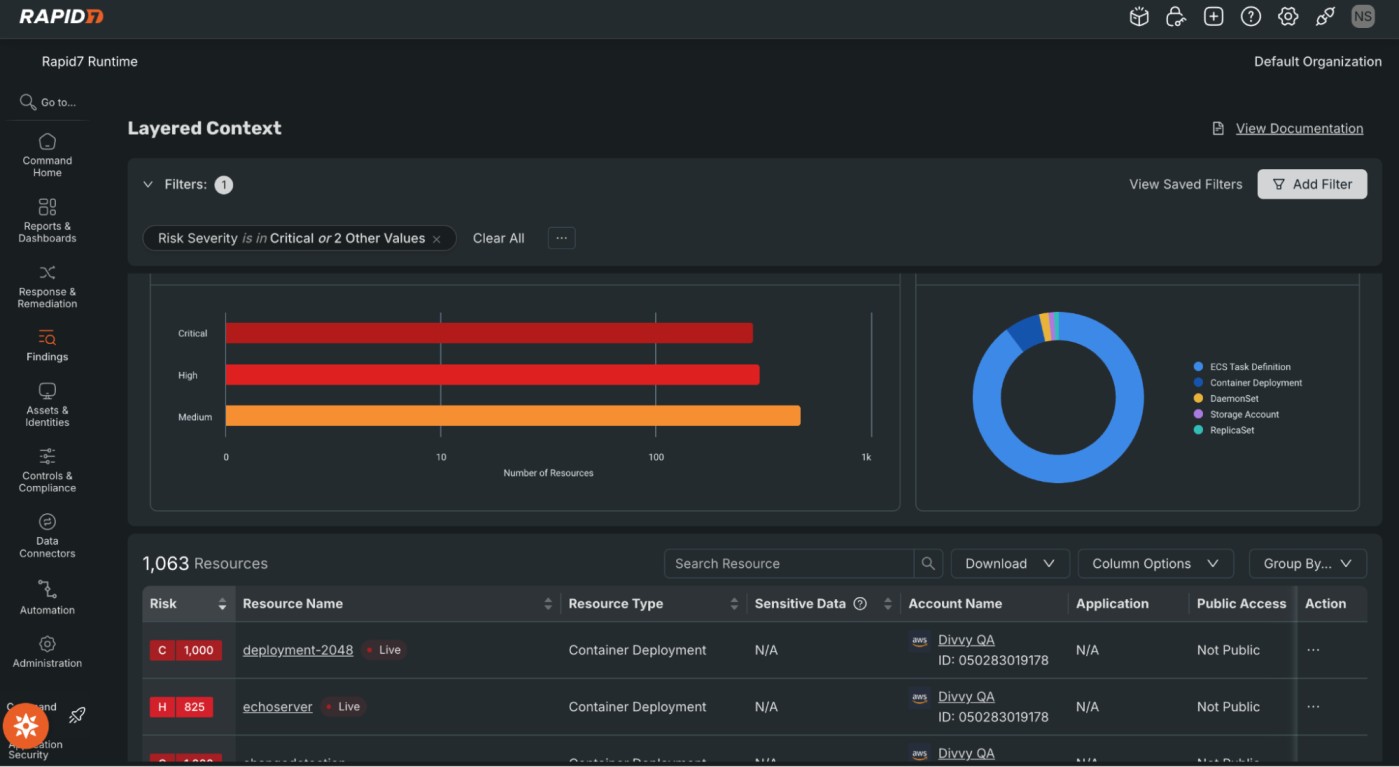
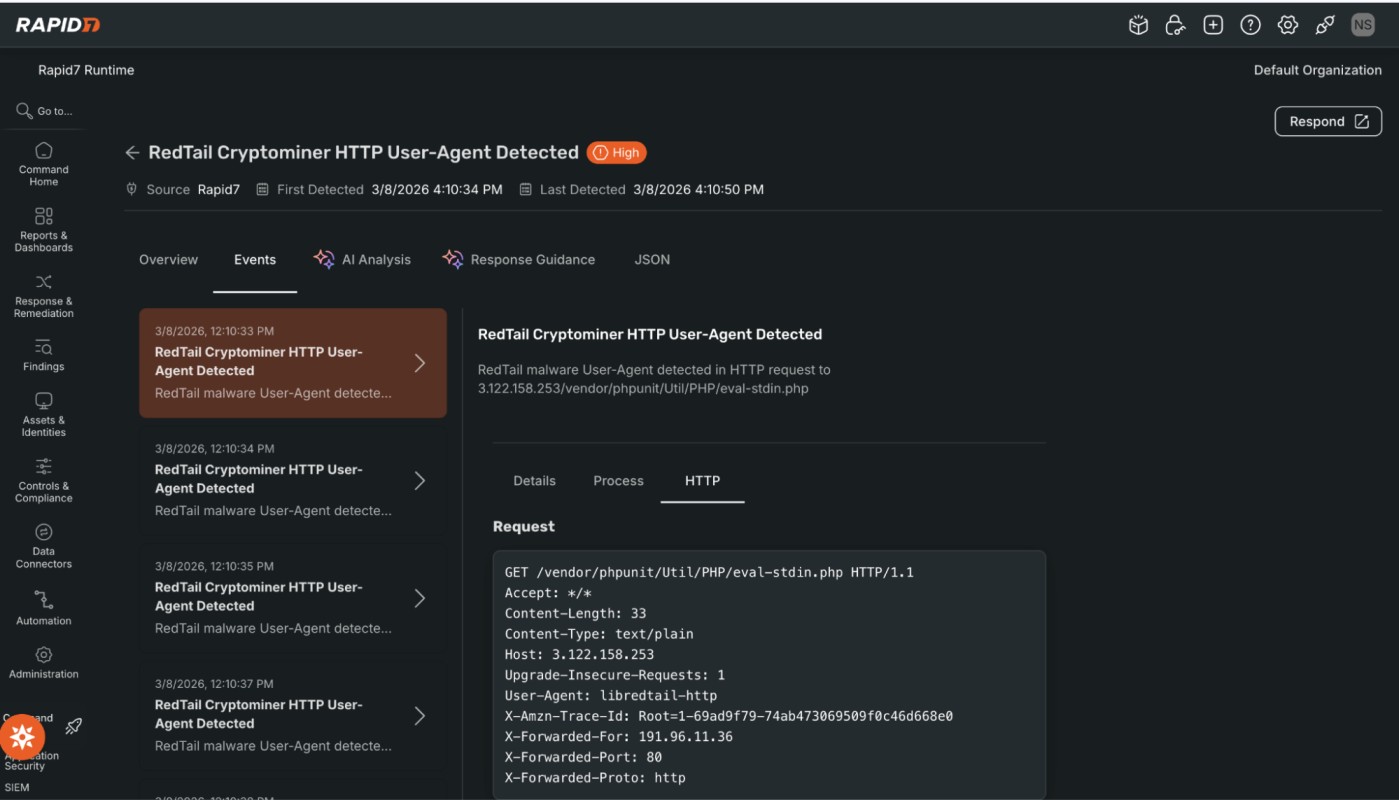
This is where cloud runtime security turns theory into reality. Instead of treating the vulnerability as just a potential risk, the platform utilizes eBPF sensors to provide continuous, direct kernel-level observability and application L7 visibility. Exposure Command analyzes this sensor data, uses AI to establish baseline workload behavior, and uncovers anomalies in real time. For example, security analysts gain instant visibility when that vulnerable container suddenly spawns a reverse shell and initiates an external connection to a known malicious IP, rather than executing its standard database queries.
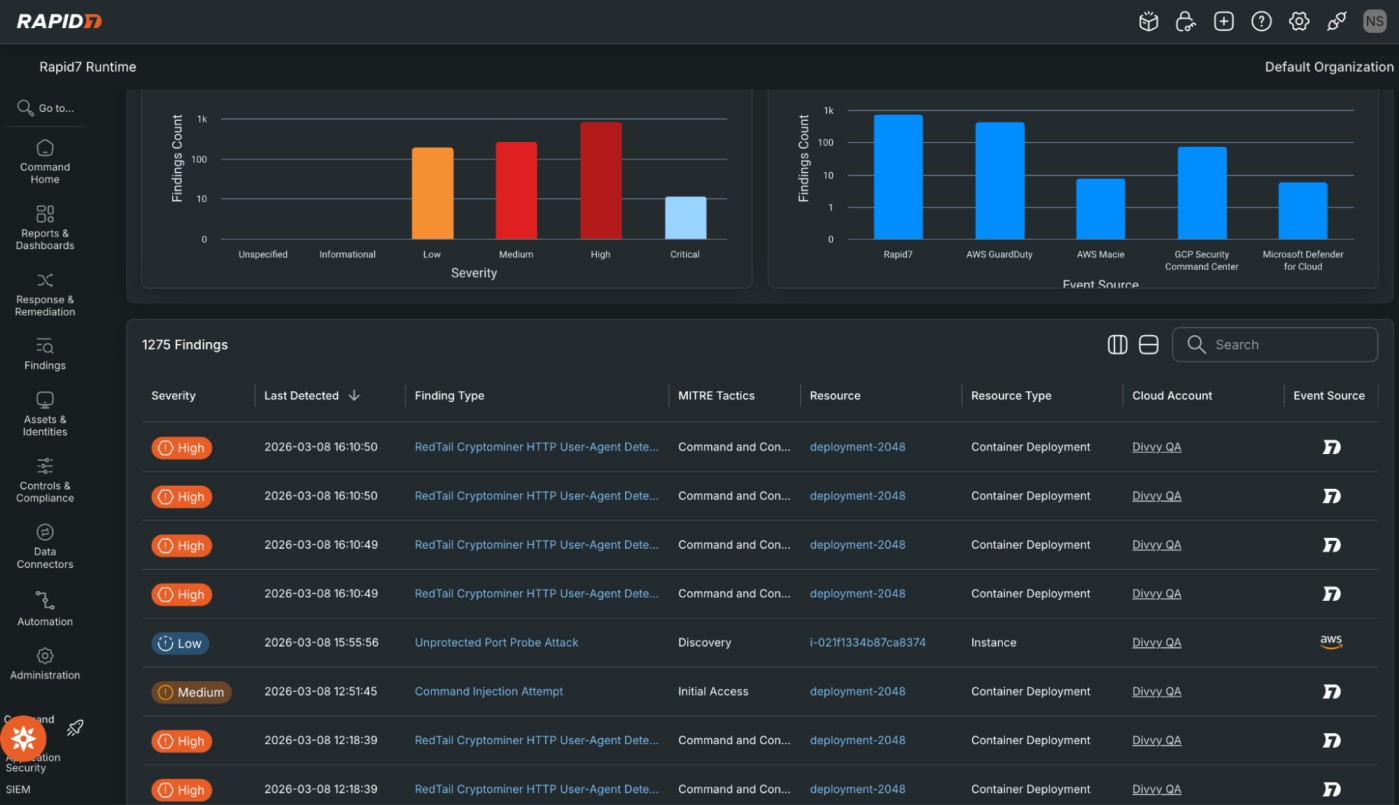
When a runtime anomaly is detected on a high-priority asset, the platform instantly aggregates these events into streamlined alerts. It links the initial application-layer exploit to the infrastructure-level change, such as the attacker attempting a container escape using that over-privileged IAM role. More importantly, the platform can trigger an automated response. By automatically terminating the malicious process, pausing the compromised container, or isolating the namespace, Exposure Command effectively stops an attacker’s lateral movement in seconds.
Stopping the threat, understanding how it happened, and proving you resolved it, is what creates a truly resilient security program. Rapid7 Exposure Command does not just initially block the attack and leave you sifting through raw kernel logs to truly remediate the threat. Instead, it uses AI-generated remediation summaries to translate complex runtime telemetry into a clear, actionable remediation narrative. It explains exactly how the attacker bypassed initial defenses, what lateral movement they attempted, and the precise root-cause misconfigurations that allowed it. This empowers security teams to confidently report to leadership on the active threats they’ve neutralized, while providing developers with the exact context and code-level recommendations they need to patch the underlying exposure.
When you combine predictive exposure analytics with deep application-layer and kernel-level visibility, you fundamentally change your operational efficiency. You stop chasing every theoretical risk and start focusing on what matters most. Exposure Command is a unified solution that eliminates the noisy alerts that tend to overwhelm security operations teams. Teams are able to prioritize remediation not just by CVSS score, but by real-time validation of what is actively loaded into memory and what is currently being exploited (i.e., risk and exposure). This means your developers spend less time patching vulnerabilities that fail to pose an immediate risk, and SecOps spends less time investigating benign container behavior.
With the general availability of cloud runtime security as part of Exposure Command, Rapid7 delivers a strategic, engineering-driven platform that achieves the mission of true CNAPP. We provide the precise answer to, “Could I be compromised?” through preemptive exposure management, and the definitive answer to, “Am I currently compromised?” through proactive runtime security. By closing the loop between these two questions, we allow enterprises to secure their cloud environments with accuracy, speed, and confidence. This is a great example of the wider approach to preemptive security that Rapid7 is delivering across different use cases through the Command Platform’s comprehensive exposure management and threat detection & response capabilities.
Visit Rapid7’s CNAPP hub page to learn more about how the fully integrated Rapid7 Exposure Command with cloud runtime security can transform your cloud defense.
Post Syndicated from The Atlantic original https://www.youtube.com/shorts/Ak5MPUx-Ly4
Post Syndicated from jzb original https://lwn.net/Articles/1063712/
Version
1.7.0 (“Daffodil”) of the Radicle peer-to-peer, local-first code
collaboration stack has been released. Some of the changes in this
release include improved I/O usage, the ability to block nodes at the
connection level, and clearer errors for rad id
updates. See the release notes for a full list of changes and bug
fixes.
Post Syndicated from corbet original https://lwn.net/Articles/1063303/
The kernel project has a unique approach to tooling that avoids many
commonly used development systems that do not fit the community’s scale and
ways of working. Another way of looking at the situation is that the kernel
project has often under-invested in tooling, and sometimes seems bent on
doing things the hard way. In recent times, though, the amount of effort
that has gone into development tools for the kernel has increased, with
some interesting results. Recent developments in this area include the
Sashiko code-review system, a patch-review manager built into b4, and a new
attempt at a framework for the specification and verification of kernel
APIs.
Post Syndicated from Channy Yun (윤석찬) original https://aws.amazon.com/blogs/aws/20-years-in-the-aws-cloud-how-time-flies/
 AWS has reached its 20th anniversary! With a steady pace of innovation, AWS has grown to offer over 240 comprehensive cloud services and continues to launch thousands of new features annually for millions of customers. During this time, over 4,700 posts have been published on this blog—more than double the number since Jeff Barr wrote the 10th anniversary post.
AWS changed my life
Reflecting on what I was doing 20 years ago, I met Jeff in Seoul on March 13, 2006, when he came as the keynote speaker for the Korea NGWeb conference. At that time, Amazon was one of the first pioneers to initiate an API economy, introducing ecommerce API services. After the keynote speech, he returned home that evening, and I believe he wrote the Amazon S3 launch blog post on the flight back to the United States.

That short meeting with him brought significant changes to my life. He became my role model as a blogger, and I began building API-based services in my company and opening them to third-party developers. When I was a PhD student while taking a break from work, I realized that for individual researchers like me, AWS Cloud services are powerful tools for conducting large-scale research projects. After returning to work, my company became one of the first AWS customers in Korea in 2014. Countless developers—myself included—have embraced cloud computing and actively used its capabilities to accomplish what was previously impossible.
Over the past decade, the technology landscape has transformed dramatically. Deep learning emerged as a breakthrough in AI, evolving through generative AI based on large language models (LLMs) to today’s agentic AI technology. Jeff wrote, “When looking into the future, you need to be able to distinguish between flashy distractions and genuine trends, while remaining flexible enough to pivot if yesterday’s niche becomes today’s mainstream technology.” This principle guides how AWS approaches innovation—we start by listening to what customers truly need. The real trend isn’t pursuing every emerging technology, but rather reimagining solutions that address customers’ most critical challenges.
20 years of AWS
For the first 10 years, Jeff selected his favorite AWS launches and blog posts. Amazon S3, Amazon EC2 (2006), Amazon Relational Database Service, Amazon Virtual Private Cloud (2009), Amazon DynamoDB, Amazon Redshift (2012), Amazon WorkSpaces, Amazon Kinesis (2013), AWS Lambda (2014), and AWS IoT (2015).
While I also hate to play favorites, I want to choose some of my favorite AWS blog posts of the past decade.
Build with AI: Your path forward
A decade ago, AWS responded to the emergence of deep learning by launching the broadest and deepest ML services, such as Amazon SageMaker, democratizing AI for a wide range of customers—from individual developers and startups to large enterprises—regardless of their technical expertise.
AI technology has advanced significantly, but building and deploying AI models and applications still remains complex for many developers and organizations. AWS offers the broadest selection of AI models through Amazon Bedrock, including leading providers such as Anthropic and OpenAI. By using our model training and inference infrastructure and responsible AI both practical and scalable, you can accelerate trusted AI innovation while maintaining control of your data and costs—all built on our global infrastructure’s operational excellence.
Reinvent your idea, keep on learning, build confidently with AI you can trust, and share your successes with us! New AWS customers receive up to $200 in credits to try AWS AI for free. If you’re a student, start building with Kiro for free using 1,000 credits per month for one year.
— Channy
Post Syndicated from jzb original https://lwn.net/Articles/1063659/
Security updates have been issued by Debian (freetype), Fedora (aqualung, kiss-fft, libtasn1, mac, and vim), Red Hat (libarchive, osbuild-composer, and rhc), Slackware (expat), SUSE (ca-certificates-mozilla, chromium, cockpit, cockpit-machines, cockpit-podman, curl, docker, docker-compose, docker-stable, gnutls, gstreamer-rtsp-server, gstreamer-plugins-ugly, gstreamer- plugins-rs, gstreamer-plugins-libav, gstreamer-plugins-good, gstreamer-plugins- base, gstreamer-plugins-bad, gstreamer-docs, gstreamer-devtools, gstreamer, gvfs, helm, kernel, krb5-appl, libsoup, libxslt, libxml2, openssh, python-cryptography, python-django, python-pypdf2, python-simpleeval, python311, qemu, ruby4.0-rubygem-sprockets, ruby4.0-rubygem-thor, ruby4.0-rubygem-web-console, ruby4.0-rubygem-websocket-extensions, skaffold, smb4k, tomcat, ucode-intel, util-linux, virtiofsd, and zlib), and Ubuntu (bouncycastle, exiv2, freerdp3, linux-aws, linux-aws-5.4, linux-gcp-5.4, linux-oracle, linux-oracle-5.4, linux-xilinx-zynqmp, linux-aws-fips, python2.7, roundcube, and valkey).
Post Syndicated from original https://www.toest.bg/klasatsiyata-na-igromisleshtite-purva-tsedka/

Необходимо пояснение: поредиците са въведени като едно заглавие, при все че някои от събеседниците предпочитат определена конкретна част, а други настояват на единството на тези поредици. Редът е азбучен, а не според броя получени гласове.
Миглена Николчина: Въпреки че задругата ни от години общува около игрите, оказа се, че
Неповтарящите се (а и някои липси) ми се виждат не по-малко знакови от споделените. Само Еньо е посочил „Гибел“ (Doom), която не просто беше много популярна, но и беше налагана от първите изявени „игрознайци“ като модел за – както е при Аарсет – ергодичното изкуство, тоест изкуство, базирано на кибернетична система, която генерира различна последователност от знаци всеки път, когато произведението се преживява1. Ергодичните подходи се базират на преекспониране на интерактивността за сметка на „стабилните“ игрови компоненти – от една страна, самото кодиране, от друга – степента, в която игрите могат да инкорпорират „старите“ изкуства в себе си: не просто разказ (визирам спора с наратолозите), но и персонажи, драматургия, живопис, архитектура, опера… както и конкретното и фактологично присъствие на история, философия, политология.
От друга страна, трогната съм, че „Нефритената империя“ (Jade Empire), за която си мислех, че ще помня само аз, е споделена. Какво според вас – като имаме предвид, че ориентацията в това още неканонизирано поле неизбежно предполага случайни фактори – обединява съвпаденията на някои игри и нулевото присъствие на някога много популярни и знакови игри („Лара Крофт“, „Марио“)?
Северина Станкева: За мен не е изненадващо, че се обединяваме около класиките на ролевия жанр, тоест този с най-много четене. За да продължим със статистиката, на практика
Тъкмо нея не очаквах да видя при някого от вас, но съм изключително приятно изненадана, че Николай я е посочил. Любопитно е, че тя е създадена в съзнателна опозиция на масови заглавия като „Гибел“2, но бори жанра отвътре – продължава да е в рамките на екшън приключенската шапка, но по авангарден начин. И тя обаче е пряко свързана с литературата.
Ако в ролевите игри сме, общо взето, на едно мнение и различията са по линия на предпочитанията на едно или друго заглавие или част от поредица, то по отношение на ергодичното се разминаваме. Измежду моите фаворити има няколко игри от може би най-ергодичния жанр въобще, който по твое предложение преведохме като „пикареска“ (roguelike), но засега ще се въздържа да ги коментирам, защото не попадат в първата четвърт. По отношение на липсващите заглавия – ако това беше класация за най-влиятелните игри на всички времена, в личен или не план, тя щеше да изглежда доста различно. За да си послужа с един прословут цитат от Марио, принцесата ни, изглежда, е в друг замък.
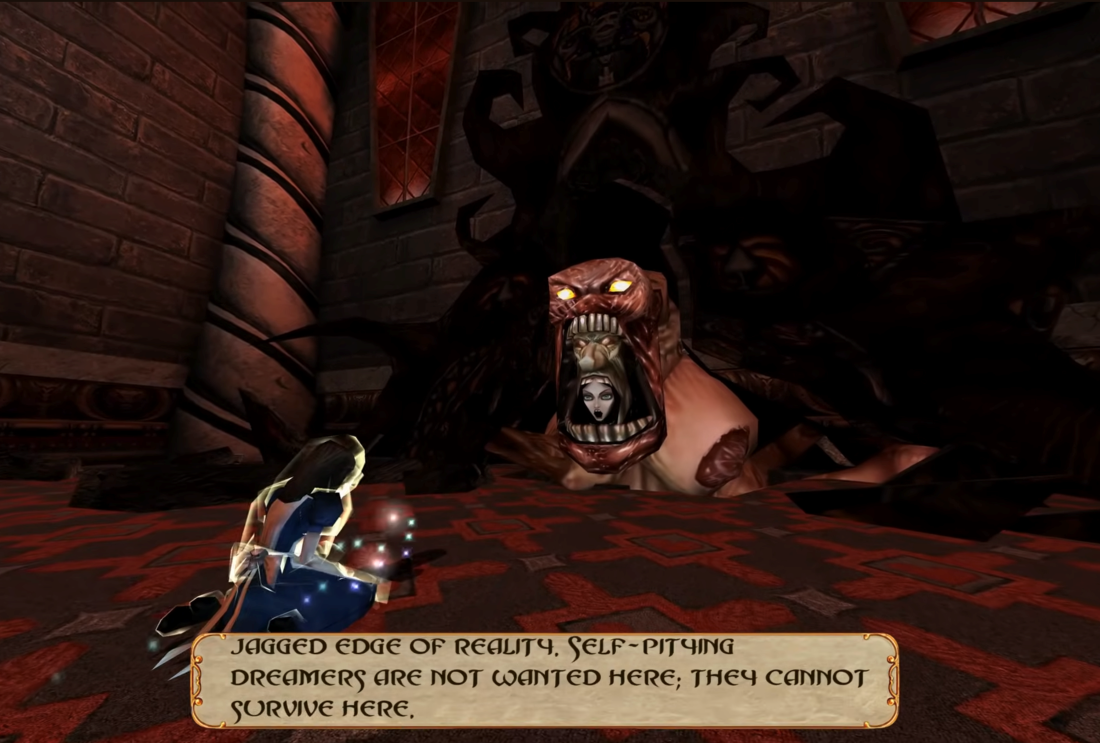
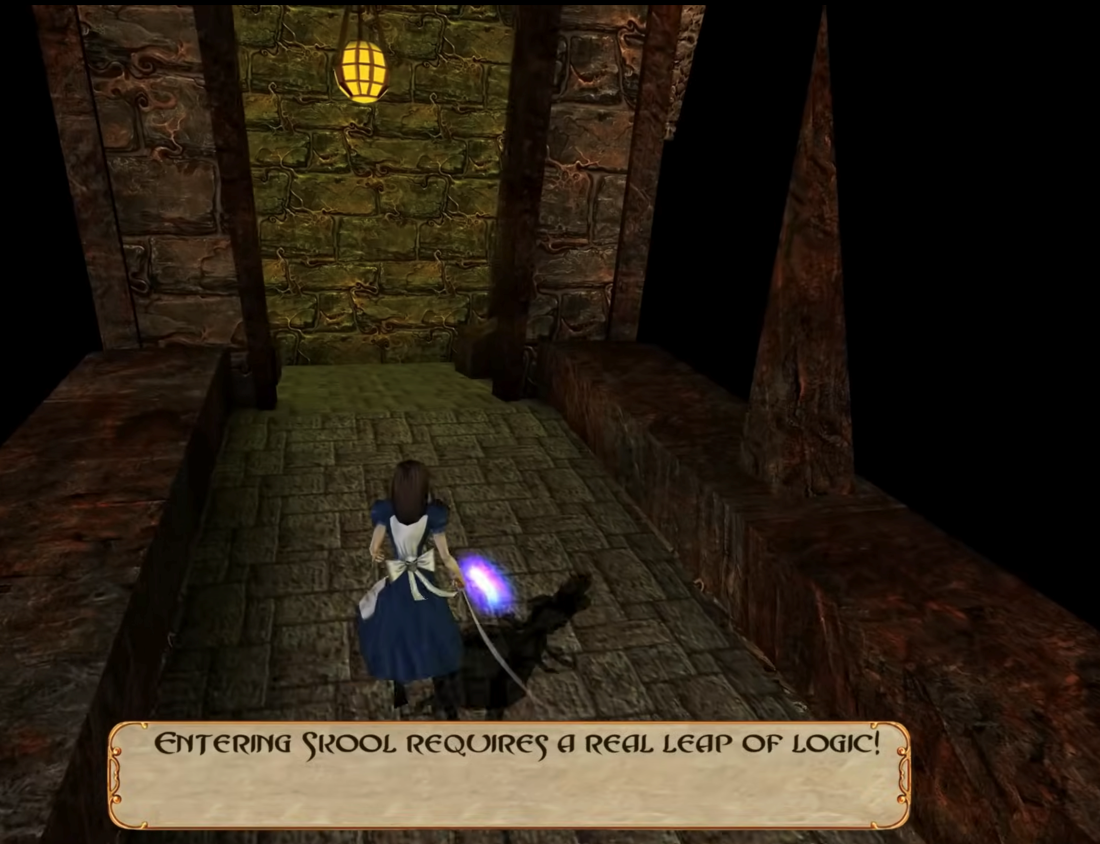
Кадри от American McGee's Alice
Николай Генов: Причината да включа „Алиса на Американ Макгий“ в своя подбор не е свързана толкова с някаква жанрова авангардност по отношение на други игри, нито идва по линия на нейната „механика“, тъй като не смятам, че тя се отличава с нещо кой знае какво в този план. Истинското ѝ достойнство сякаш се крие в образцовия начин, по който създателите третират литературното произведение – преработват го, интерпретират го и го разгръщат в един шизоиден регистър, като по този начин остранностяват и читателското преживяване.
Нещо съвсем друго прави „Вещерът“ (The Witcher) – от една страна, поредицата подема и продължава мотива, заложен в книгите на Сапковски, за трудността (и отговорността) да се вземат решения, но тук вече играчът бива поставен в активна позиция – той е този, който трябва да действа и да решава, следователно цената, която се заплаща за тази свобода, добива допълнително измерение и от констатация се превръща в перформатив.
Миглена вече е имала лекции за това как подобни механизми се задействат в „Рицарите на Старата република“ (Knights of the Old Republic) – запомнил съм един много въздействащ неин пример от втората игра. Умишлено – и в някакъв смисъл като негова реплика – аз „предпочетох“ първата част, тъй като след „точката на пречупване“ (кулминацията на историята) пред играча се поставя интегралният въпрос дали нещата могат да продължат по същия начин, или всичко оттук насетне трябва да се промени.
Знам, че известно разминаване с Миглена имаме по линия на „Древните свитъци“ (The Elder Scrolls), тъй като аз продължавам да твърдя, че „Мороуинд“ (Morrowind), а не „Скайрим“ (Skyrim) е голямото заглавие тук. Бих направил една допълнителна маневра, с която да заявя, че по лична преценка четвъртата игра от поредицата – „Забрава“ (Oblivion) – предлага по-интересни сюжети от „Мороуинд“ и „Скайрим“, взети заедно, без обаче да се доближи до онзи невероятен размах на въображението, който виждаме в цялата му възхитителна мощ при светостроенето на „Мороуинд“.
За прераждането (или възкресението) на страхотната „Киберпънк“ (Cyberpunk 2077) вече сме говорили, а за началото на „Драконовата епоха“ (Dragon age) дори не смея да отворя дума. Ще си позволя да кажа само, че това, което първата игра от поредицата успява да направи, тази повествователна плътност, която постига, сякаш се губи в продълженията ѝ, които съвсем не заемат същото място в моите очи.



Кадри от The Witcher
Еньо Стоянов: Може би нашата „класация“ казва повече за процеса на собственото си оформление, отколкото за неговите „класически“ заглавия в полето на видеоигрите. Трябва да подчертая, че това, което пробвахме да направим, е своеобразен експеримент – вместо да се договаряме за предварителни критерии за подбор и оценка, които догматично да спазваме при изготвянето на нашия списък, ние по-скоро
Нашият експеримент се оказва по-скоро един опит да се открои картата на полето на видеоигрите в неговото настояще и история, за която невинаги си даваме сметка, но която безсъзнателно несъмнено ни помага да навигираме из него. Това не значи, че просто сме отразили собствените си предпочитания, вкусове, предразсъдъци и пр. Самата идея да се предложи списък на „най-доброто“ някак те възпира да включиш в него игри, които са изпълнени с несполуки, но към които въпреки това имаш силен сантимент и привързаност, по-голяма от онази, която изпитваш към далеч по-съвършени и образцови заглавия. От друга страна, самите „образци“ изглеждат сякаш твърде „чисти“ въплъщения на стойностност, твърде клиширани емблеми на майсторство, символи, нивелирани до неутралност поради постоянните и често почти празни и опразващи ги жестове на преклонение.
Изглежда, сме предпочели заглавия, които не въплъщават съвършенство, не са „представителни“, а по-скоро се оказват интензивно качествени в някакво отношение, заглавия, които с нещо в себе си засенчват своите слабости и така подсказват напрегната борба с условията на собственото си изкуство. Тоест това са игри, които едновременно разкриват тези условия, противят им се, за да ги разширят, да ги преосмислят, да ги подложат на преоценка.
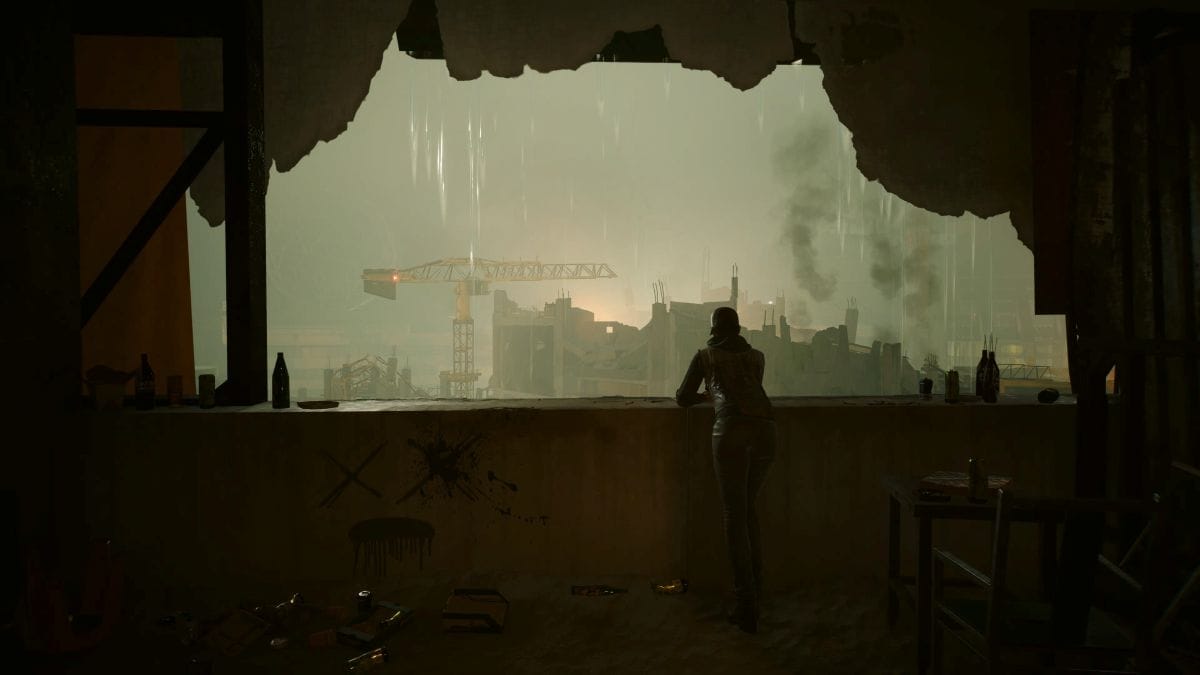
Миглена Николчина: Нека си признаем, че в тази първа цедка на съвпадащи заглавия попаднаха игри, които са действително качествени в едно, друго или множество отношения, но които са също така масово харесвани, награждавани, дискутирани във форуми. Те са ролеви игри, но освен това са фантастични или по посока на дракони и магьосници („Болдърсгейт“, „Древните свитъци“, „Драконова епоха“, „Вещерът“), или по посока на произтичащи от технологиите катастрофи („Ядрена зима“, „Ефектът на масата“, „Киберпънк“). Голямото изключение е може би „Диско Елизиум“, където фантастичното под разни форми присъства, но катастрофата се простира от социално-историческото и психологическото до онтологическото, без да се приписва пряко на магични или технологични причинители.

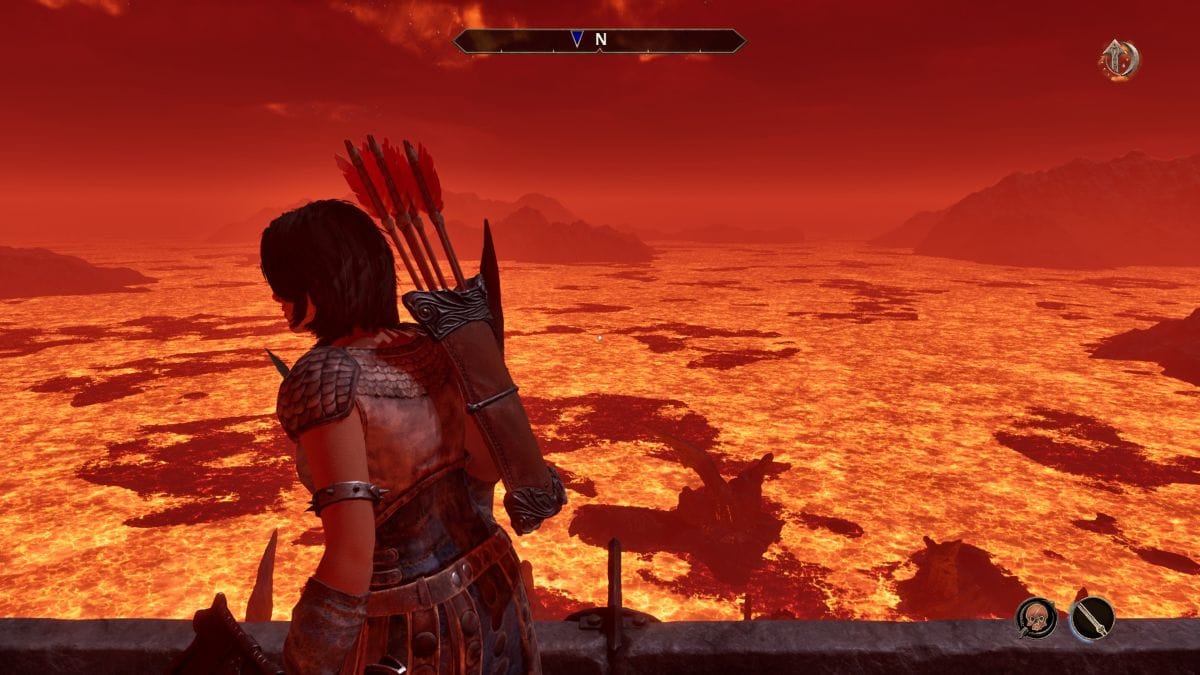

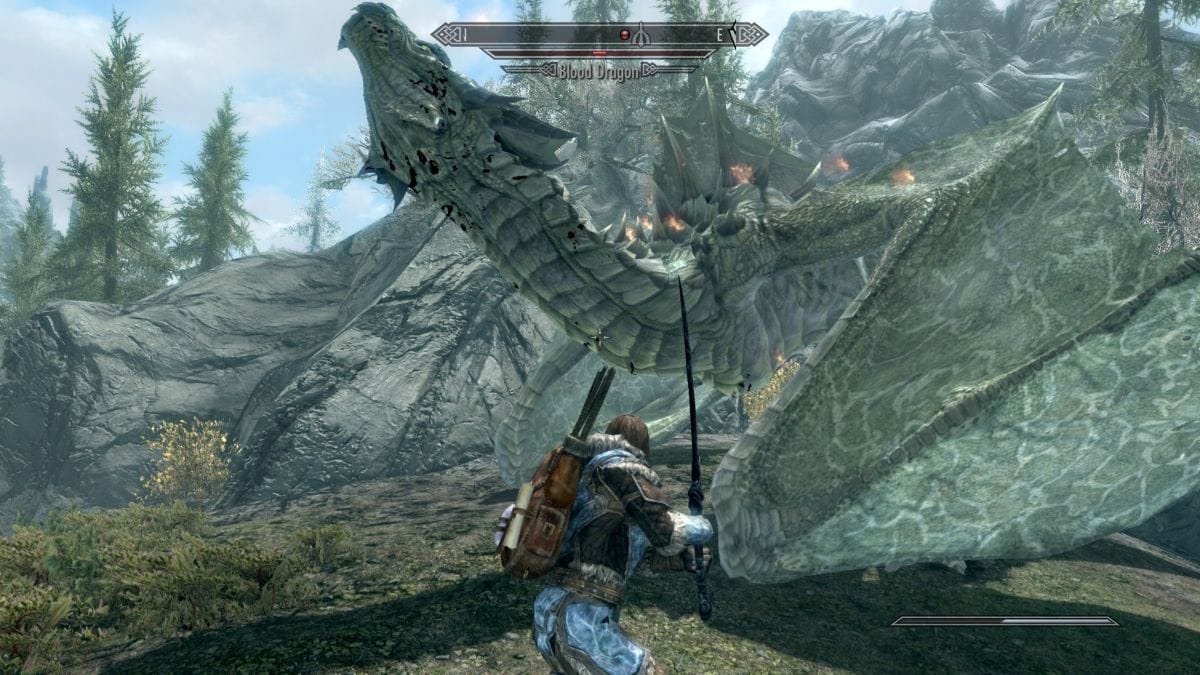
Кадри от: Dragon Age (горе вляво), The Elder Scrolls (горе вдясно, долу вдясно) и Baldur's Gate (долу вляво)
Тук обаче възникват и множество разделителни линии по отношение на параметри като конструиране на игровите (но понякога и на неигровите персонажи), както и по отношение на типовете взаимодействие с диалозите, отношенията между героите, развитието на сюжетните линии, наличието или липсата на битки.
В някои от игрите персонажите са дадени в дълбочина – пример е сложният образ на Крея във втората част на „Рицари на старата република“, която, въпреки че е неигрови персонаж, добива различен релеф според развитието на аватара. В обичайния случай развитието на персонажите се отнася само до бойните им умения, в някои от игрите включва етически компонент (светло–тъмно и пр.) – има и други възможности, но не ги виждам представени тук. Голямото изключение е „Диско Елизиум“, където изграждането на аватара добива бароково-фантастични измерения. Разлики от този вид има и в другите параметри. В „Диско Елизиум“ се изстрелва един-единствен изстрел и той е тежко предопределен от предходните решения на играча. Ефектът на масата включва аспекти на стрелба. Много от игрите включват цял арсенал от повече или по-малко фантастични оръжия. Тук отново съвпадащите ни избори са в масовката, в повечето от тях сраженията заемат доста сериозно място.
Най-сетне, големи дебати има – или понякога везните тежко се накланят в някоя посока, – що се отнася до предпочитания към една или друга част от поредица. Аз обаче като многократно превъртала някои поредици (включително „Кредото на убиеца“, която не попадна в първата цедка) настоявам върху сериозното сюжетно и смислово единство на някои от тях – например „Ефектът на масата“ (Mass Effect) или „Вещерът“.
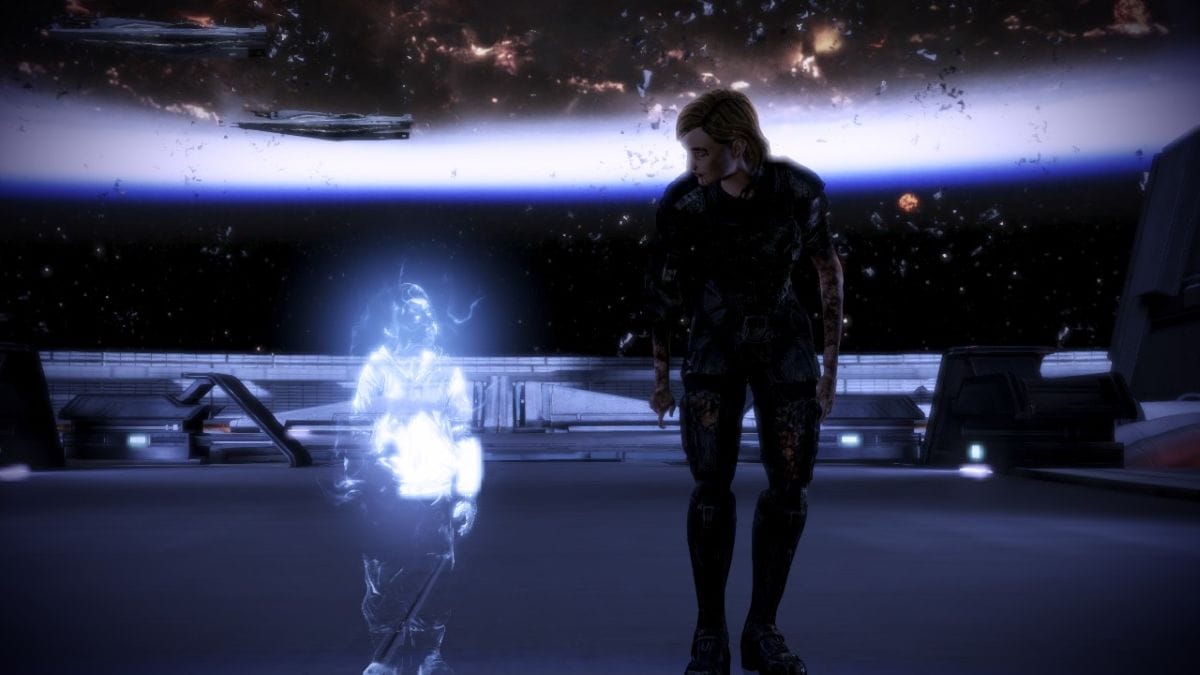
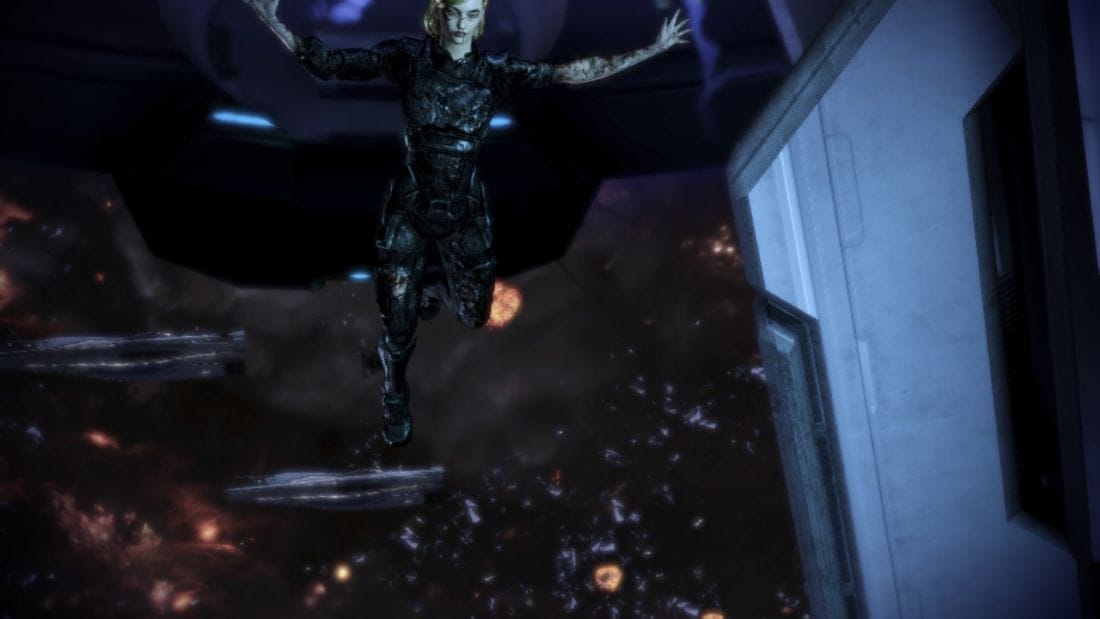
Кадри от Mass Effect
Северина Станкева: Любопитно е, че освен класически примери за бойни игри, каквито са повечето игри въобще, през първата цедка успя да премине и най-известната игра, която позволява играчът да я изиграе изцяло пацифистки – „Ъндъртейл“ (Undertale). Тя е важна не просто защото позволява мирен подход, но и защото проблематизира връзката между играч и игра по един некласически метаначин. Ако в „Диско Елизиум“ изстрелът е натоварен с всички избори, направени до него в конкретното проиграване, то в „Ъндъртейл“ тези избори не престават да преследват играча и в следващите му преигравания.
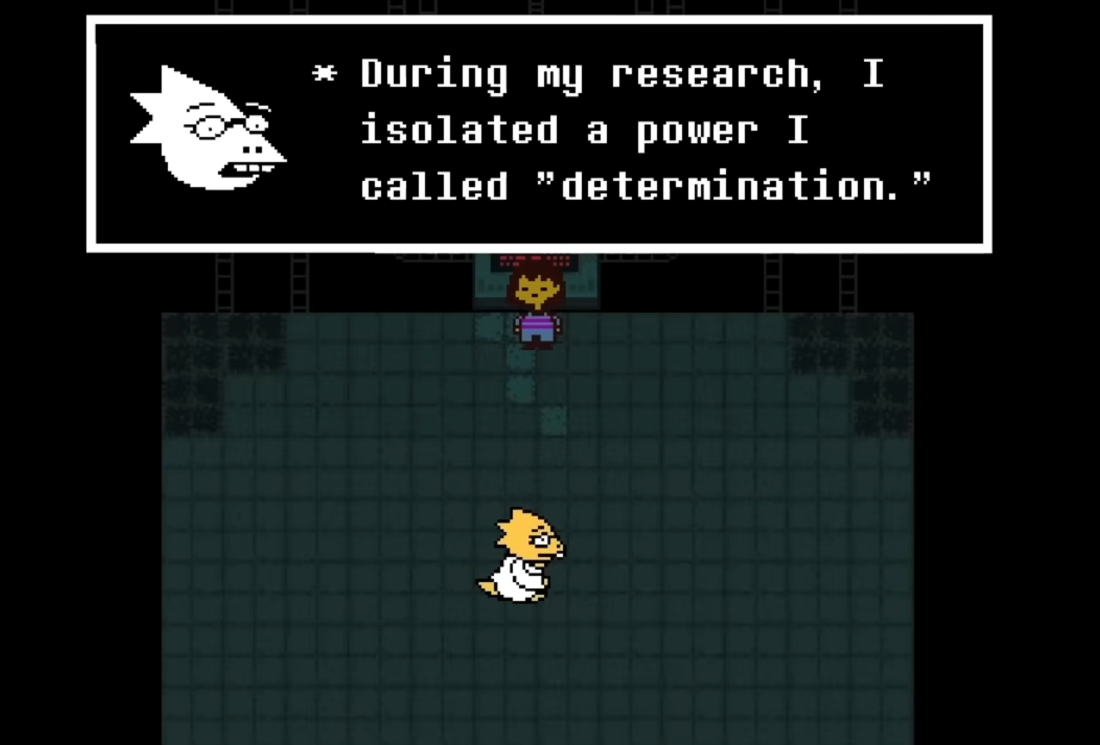
Ако като играч избереш да избиваш всичко срещнато в света на чудовищата, в който случайно си попаднал, а после започнеш отначало, но миролюбиво, за да видиш как ще изглежда историята от другата страна, играта все още те „помни“ като тиранин. В резултат моралът на играча има много по-сериозни и необратими последствия, съответно се увеличава и отговорността по начин, който аз поне не съм срещала другаде, и той е поредното доказателство за наивността на простото разграничение механика–сюжет, което многократно сме обсъждали.
Пример за различна морална система, от която се вдъхновяват създателите на „Диско Елизиум“, е тази на „Плейнскейп: Мъчение“ (Planescape: Torment), на която се носи славата като на най-философската игра, защото включва множество ясно отделени философски системи в своите дървета на решенията. Философскостта ѝ обаче остава изцяло в рамките на класическото диалогово повествование, а различните избори не променят нищо в механиката.
С оглед на всичко това и продължавайки нишката, подхваната от Еньо, ми се струва, че и нашата класация успява да се саморегулира в движение, така че да включва както заглавия, които задават канона, така и такива, които поставят под съмнение зададените от него рамки и така разширяват потенциала на това какво видеоигрите могат да бъдат. Предстои да видим дали това ще се запази и в следващите части на класацията.
2 Вж. например това интервю на Американ Макгий по темата.
В рубриката „Игромислие“ публикуваме разговори, в които се срещат, съпоставят и противопоставят различни гледни точки към многоизмерния, многожанров феномен на видеоигрите – не толкова като електронен спорт, колкото като нов синтез на изкуствата и като ново поле на общуване и социалност.
Post Syndicated from The Atlantic original https://www.youtube.com/watch?v=Y0MHunHLMIY
Post Syndicated from Bruce Schneier original https://www.schneier.com/blog/archives/2026/03/hacking-a-robot-vacuum.html
Someone tries to remote control his own DJI Romo vacuum, and ends up controlling 7,000 of them from all around the world.
The IoT is horribly insecure, but we already knew that.
Post Syndicated from Нева Мичева original https://www.toest.bg/budapeshta-na-kolodko-tolkova-mnogo-istorii/

Топ 50 на най-високите статуи в света съдържа преобладаващо божества, издигнати на публични места след 2000 г., макар начело на списъка да е индийски политик, а най-цѐнен според ЮНЕСКО да е един китайски Буда от IX век. Всички се намират в Азия, с три изключения: сенегалски ансамбъл, построен от севернокорейци край Дакар, плюс две Родини – руска и украинска. Най-високият обелиск стърчи във Вашингтон; египетските пирамиди се борят за надмощие с мексиканските; за първенство в кубиците бетон на Балканите се надпреварват шуменският мемориал „Създатели на българската държава“ и „летящата чиния“ на Бузлуджа (и двата монумента са от 1981 г.). Все произведения, мислени да всяват страхопочитание и да заявяват значимост. Неслучайно „монументален“ ще рече „внушителен“, „огромен“…
И все пак има паметници, способни да извикват нежност и да поразяват с нежеланието да се набиват на очи. Желязното момченце в Стокхолм например – педя човече, което от 1967 г. седи на леглото си, гледа луната и е ту украсено с цветя от своите посетители, ту увито с плетени от тях шалчета, ту почетено с монети и бонбони. Или близо осемстотинте 20–30-сантиметрови гномчета с различни професии и характери, завзели Вроцлав през последните две десетилетия… В групата на монументите, отричащи смазващите обеми в полза на гальовните жестове, попадат и фигурките, с които Михай(ло) Колодко осява Будапеща от неотдавна.
Колодко е роден в Ужгород през 1978 г., завършва монументална скулптура в Лвов през 2002-ра, а през 2010-та се преформулира като автор на „градски миниатюри“ – започва от родната си Украйна и продължава в Унгария, където се преселва през 2017-та.
Паметниците, които прави по собствен почин и монтира където му хрумне, са маломерни, появяват се без ленти за прерязване и тържествени слова, вместо владетели изобразяват анимационни герои или вещи и хич не настояват да бъдат гледани. А и авторът, за капак, не обяснява много-много коя какво значи.
Будапеща е всякак голяма: има и история, и гледки, и простор, и разнообразие. Ето защо е особено любопитно как дребните творби на украинеца с унгарски корен осезаемо я разширяват. Една столица може да си позволи да прескача от тема на тема, без да изтърве нишката (но не и да бъде монотонна); една традиция – да се свърже с безброй други, без да загуби физиономията си (но не и да се капсулира в себе си). Когато кривнеш към тихо място, за да потърсиш поредния „колодко“ (в интернет изобилстват картите, на които са отбелязани местонахожденията на джобните му статуи, и групите, които обсъждат техните изниквания и изчезвания), и приклекнеш да се взреш, нещата добиват личен привкус. И пъстро се разбягват във всички посоки.
Фотосафарито от колодко на колодко е превъзходна идея за прекарването на ден-два, че и три в Будапеща – фигурките са вече над 40, в зони от двете страни на Дунава, които човек бездруго би се радвал да посети. Тръгвам с амбицията да видя колкото може повече и започвам от онази, която ми е най-присърце: Мечо Пух, увиснал под паметната плоча на своя преводач Фридеш Каринти. На Пух на унгарски му казват Мицимацко – втората част значи „плюшено мече“, а Мици е галеното име на Емилия Каринти, авторка на подстрочниците за всички преводи на брат си Фридеш от английски.






Отляво надясно: „Елек Мек“, „Мечето на Бийн“, „Мечо Пух", „Падингтън“, „Червей“, „Вук“ © Нева Мичева
Същият този брат впрочем, изтъкнат писател, остава в световната история с нещо съвсем неочаквано – идеята за шестте степени на разделение. Тя се появява за първи път в разказа му „Вериги“: група приятели обсъждат, че между произволни двама души на света има максимум петима други, през чиито сфери на познанства, брънка по брънка, двамата произволни могат да осъществят контакт. Най-красивото изречение в текста:
В близост до Северния полюс, казват, стрелката на компаса пощурява и започва да се върти в кръг. Същото, изглежда, се случва на убежденията ни, когато се окажем твърде близо до Бог.
С Пух мечките не се изчерпват – високо на стената на бившето Британско посолство в Пеща е закачено мечето на Мистър Бийн, а под едно старо дърво на „Медве уца“ (улица „Мечка“) в Буда Падингтън седи върху търбуха на мечока от приказката за Маша. Из града са разхвърляни и други създания от книги и филми – жабок (конферансието на мъпетите Кермит), козел (Елек Мек – добронамерен, но нескопосен майстор от стопмоушън сериал за деца от 70-те), червей (също от анимационен сериал, този път за въодушевен рибар), заек (онзи с карираните уши, добре познат и в България – в подстъпите към замъка, недостъпно високо за наболяващото ми коляно), Йода. И лисичето на име Вук – в подножието на хълма Гелерт то виси от опашката на бомба, забила нос в скалата. Любимецът ми обаче е котаракът Гарфийлд.


Старата украса на Университета по ветеринарна медицина в Будапеща, „Гарфийлд“ на Колодко © Нева Мичева
Картата ме праща откъм неправилната страна на улица „Дембински“, където напразно се оглеждам за „дебелия, мързелив и егоистичен“ риж персиец от американския комикс, докато една непозната не схваща какво ме мъчи, и не ме упътва с дрезгави подвиквания на унгарски и къси бипкания откъм отворената си кола. Вървя бавно покрай металната ограда на Университета по ветеринарна медицина и оглеждам колоните, на върха на всяка от които в четири посоки надничат животински муцуни. Комбинациите са различни, някои колони са с по три образа, други с по два, а тук-таме са опадали всичките. Под един изригнал в плодчета огнен трън виждам главите на кон и куче и аха да пропусна третата страна, когато госпожата ме спира с клаксон и подвикване. Отгоре ме зяпа облата апатична физиономия на Гарфийлд и от нея ме напушва смях, който ме държи с километри.
Щом научава, че един от любимите му художници – самоукият Тивадар Костка, наричан Чонтвари – е бил гимназист в Ужгород и е обичал да се пързаля на лед, Колодко си наумява да му извае фигурка на кънки. Отива да се допита до свой преподавател, който, ужасѐн от идеята, му обяснява, че за голяма личност не върви малко паметниче. И Колодко почти се отказва. После обаче размисля и първият от няколко мини-Чонтвари изниква край река Уж.
Не разбирах защо любовта не бива да се изразява в малък мащаб…



Отляво надясно: „Дракула чете“, „Франц Йосиф“, „Хана Сенеш“ © Нева Мичева
И все пак човешките изображения сякаш са редки в по-новата практика на скулптора – император Франц Йосиф, отпуснат в хамак на Моста на свободата; английската кралица, която маха от покрива на подводница в парка Миленариш; подпийнал римски легионер, опнал късокрако телце край останките от амфитеатър в Обуда; легендарният Чък Норис, овързан с въжета, най-сетне победен… от местната бюрокрация. (През 2006 г. започва строежът на нов мост над Дунава и за името му се обявява конкурс онлайн: насмешливите унгарци масово гласуват то да бъде „Чък Норис“, но – уви! – властите решават в полза на „Медиери“.)
Мил Дракула е седнал на дувар в Градския парк и чете книга (апропо, Бела Лугоши, най-харизматичният актьор в ролята на вампира, е унгарец). Легендарният илюзионист Хари Худини, майстор на драматичните измъквания от усмирителни ризи и безизходни ситуации, е роден под името Ерих Вайс в Будапеща – негова статуйка се намира на „Кирай“, централната улица в еврейския квартал. Сред колодковците, изобразяващи хора, е и поетесата Хана Сенеш – след обучение от британските ВВС през 1944 г. тя скача с парашут в Югославия и се насочва към Унгария, за да саботира нацистите. Заловена е и умира на 23 години след чудовищни изпитания. Фигурката ѝ е разположена над нивото на очите в пресечната точка на улиците „Рожа“ и „Йошика“.
В някогашното еврейско гето – в момента възхаотично туристическо средище – попадам на друг уличен артист, който събира по неочакван начин местни и чужди попкултурни образи. И докато снимам как унгарският Тиви Мечо (нещо като нашия Сънчо от заставката на вечерното „детско“) гледа от телевизора да изпълзява момичето от японския филм на ужасите „Кръгът“, а малко по-нататък Емзеперикс, правнукът на семейство Мейзга, миксира рамо до рамо с „Дафт Пънк“, пред погледа ми изскача барелеф с любопитна форма. Носестият мъж в центъра, разбирам по-късно, е Режьо Шереш, музикант и цирков артист, години наред свирил на пиано в ресторант „Малката лула“, на чиято фасада сега е паметната плоча…




Отляво надясно: „Емзеперикс“, „Лечо“, „Тиви Мечо“, „Режьо Шереш“ © Нева Мичева
В средата на 30-те една мелодия на Шереш се прославя първо в Будапеща, после в Щатите и оттам по целия свят – Gloomy Sunday. Лошото е, че бъдещият евъргрийн скоро се сдобива с мрачна легенда и тя плъзва след него като сянка през граници и океани – който слуша печалните ноти на неделната песен, разправят, сам отнема живота си. Пресата в няколко държави измисля прякори („усмъртителният хит“, „химнът на самоубийците“), роят се митове и дори забрани… И това – преди дори да дойдат нацистите, Шереш да бъде обречен на години принудителен труд, да оцелее, да бедства в социалистическа Унгария и да загине от собствената си ръка през 1968-ма…
Много по-трудно е да намериш нови въпроси, отколкото отговори,
казва архитектът и скулптор Ерньо Рубик, чието прочуто кубче краси в бронзов вид крайречната алея в Буда. Други специфично унгарски теми на Колодко са водолазът с ключа до пищното кафене „Ню Йорк“ (един от гостите на откриването преди 130 години уж бил Ференц Молнар – бъдещ автор на великолепния роман „Момчетата от улица „Пал“, – който толкова се възторгнал, че запокитил ключа му в Дунава, та да стои кафенето завинаги отворено); американският луноход на улица „Холд“ („Луна“), поставен в чест на проектиралия го инженер Ференц Павлич, избягал през печалната 1956-та. И разбира се, лечо. Най-бързото описание на тази вкусна яхния е „унгарският рататуй“ – ето защо Колодко е създал мишок по подобие на страстния гастроном от филма „Рататуй“ и с розов спрей е изписал Lecsó на стената пред него.


От ляво надясно: „Водолаз“, „Рубик“ © Нева Мичева
На 23 октомври 1956 г. Унгария се опълчва срещу „народната“ си власт. В отговор на искането за демокрация СССР праща танкове и въстанието е смазано. Убити са почти 3000 унгарци, над 200 000 напускат страната – травмата е жива до ден днешен. „На „Ракоци“, срещу Националния театър, лежеше Сталин. Гигантската статуя е домъкната чак от Площада на героите…“, чете за БНР от записките си поетесата Невена Стефанова. Тя е в Будапеща в първите часове на бунта, когато протестиращи връхлитат паметника на съветския касапин край Градския парк и го събарят така, че на постамента остават да стърчат само ботушите… На три минути от някогашното му място, досами авангардната сграда на новичкия Етнографски музей, Колодко е инсталирал дребен преобърнат скейтборд и чифт ботуши, от които се подават кокали.

На площад „Свобода“ все още се издига обелиск, посветен на Съветската армия. Върху градинската ограда срещу него през 2019 г. скулпторът монтира бронзова възглавничка, на която – като корона – почива ушанка с петолъчка. В пристъп на възмущение крайнодесен депутат (от партия, която си дружи с „Възраждане“) записва за социалните мрежи как с брадвичка откъртва шапката и я мята в Дунава. Не след дълго в същата точка от оградата пак се появява възглавничка, сега обаче с брадва отгоре – паметник на агресивните любители на бившия окупант. И не само. На 9 май 2023 г. Колодко комбинира видеото на депутата със свое, в което хвърлената в Дунава ушанка е изпълзяла на жабешки крака от водата като във филм на ужасите и се е намърдала на най-близкото стълбище.
На Русия са посветени още две произведения по крайбрежната откъм Буда. „Тъжният танк“ е увесил дуло срещу изумителната сграда на парламента (златните ръчици на заглавната снимка са на Светла Кьосева, преводачката на най-новия литературен нобелист Ласло Краснахоркаи), а на хълбока му пише: „Руснаци, вървете си вкъщи!“… „Няма компот“ пък препраща към момента, в който в популярната комедия за Втората световна „Младшият сержант и другите“ главният герой търси зимнина в унгарска къща, а заварва скрит червеноармеец с картечница (и ушанка): „Руснаците са вече в килера!“. Колодко коментира:
Дойдат ли в страната ти руснаците, нямат срам – настаняват се като у дома си и ти изяждат всичкия компот!
Доста по̀ на север, след остров Маргит, откъм Пеща, на променадата „Москва“ е щръкнало и „Послание“, увековечило случката със защитниците на Змийския остров от началото на руското нашествие в Украйна: върху бял постамент с формата на огромен среден пръст от малък боен кораб се пули Путин.
Ars longa vita brevis е в началото на ул. „Фалк Микса“, на две крачки от статуята на инспектор Коломбо (местна чудатост отпреди заселването на Колодко в Будапеща), и представлява изпружена катерица с пистолет в лапата – намигване към препарираната катерица с пистолет от „Бибидибобидибу“ на Маурицио Кателан („Хуморът действа като доброто произведение на изкуството – целта и на двете е да те накарат да се вгледаш и да се замислиш…“, обяснява безцеремонният италианец). „Либидо“ пък – на парапет край реката – е реприз на характерните балонени кучета на Джеф Кунс (някога женен за унгарската порноактриса и италианска депутатка Чичолина). Едно миниписоарче край двореца „Вайдахуняд“ в Градския парк – вече откраднато – отдава почит на революционния „Фонтан“ на Марсел Дюшан, когото също няма как да не цитирам:
Дори по каквито и да било причини да се объркаш да харесаш нещо, което не е за харесване, в обичането има далеч повече хляб, отколкото в мразенето. В смисъл: каква е ползата от мразенето? Хабиш си енергията и умираш по-рано.


„Катерица“ и „Либидо“ © Нева Мичева
Лиса Симпсън (в ролята на Жана д’Арк) е пострадала от атмосферните условия и на снимката стои тъжно; трабантчето с ключе за навиване не ме въодушевява; за най-новия паметник (ловец от сибирското племе ханти, колонизирано някога от руснаците) научавам доста по-късно. Ето как на последния си колодко – току-що изскочил от телевизора Пумукъл, дружелюбно духче от осемдесетарски анимационен сериал – попадам неволно край една хубава стара гимназия в Естергом. Министатуите са не само в Будапеща: има ги в сериозна концентрация в Ужгород, както и – отделни екземпляри – другаде: Риека, Оломуц, Нюрнберг, Стокхолм.


„Пумукъл“ и „Трабантче“ © Нева Мичева
Естергом е дунавски град на час с влак от столицата, а аз минавам през него, защото съм 65-тата „пазителка на моста“, свързващ го с отсрещното словашко градче Щурово, където живея от няколко месеца. Мостът е „Мария Валерия“ – половин километър в зелено над могъщите води – и е наречен на най-малката дъщеря на споменатия по-горе Франц Йосиф. Издигнат е в края на ХIХ век и е разрушаван два пъти – през 20-те и през 40-те, – а най-новият му живот започва през 2001-ва. Иначе казано, досега е съществувал повече в отсъствието, отколкото в присъствието си, и тази мисъл не спира да ме удивлява: построиш ли мост, той си остава факт дори когато е съборен. Моята първа задача по тези чаровни краища е, както казва Карол Фрюхауф, прекрасният съосновател на приютилата ме арт резиденция, да се уверявам всяка сутрин, че мостът си е на мястото. И докато я изпълнявам, не мога да съм по-благодарна – за всичко от този и от онзи бряг.
Post Syndicated from Grab Tech original https://engineering.grab.com/from-firefighting-to-building
Grab’s Analytics Data Warehouse (ADW) team supports over 1,000 users each month and manages an extensive repository of more than 15,000 tables, which powers approximately 50% of all queries within our data lake.
However, the manual process of addressing “quick questions” is time-consuming and labor-intensive, thus creating a bottleneck in our operations.
The team was drowning in repetitive requests, spending approximately 40% of their time or an equivalent of roughly 2 days every week, on tasks like:
We deployed a multi-agent AI system that autonomously answers simpler questions and collaboratively addresses more complex requests. This led us to reclaim significant engineering bandwidth and unlock hundreds of hours of productivity monthly.
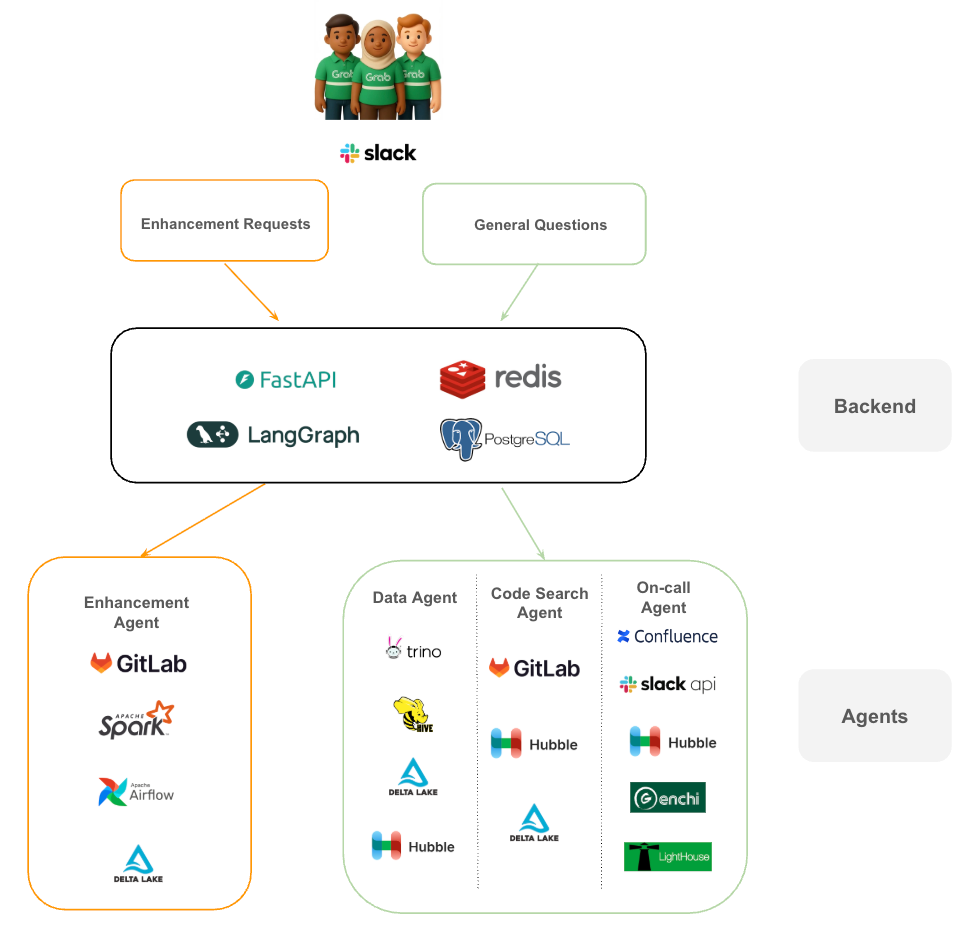
The journey begins in Slack. When a user submits a request, it is categorized into one of two streams:
By decoupling the “brain” (the LLM) from the “hands” (the specialized agents and tools), we created a system that is both capable and easy to debug.
We could have built one massive AI trained to handle every question, but specialized agents are easier to build, maintain, and improve than a monolithic system.
The table below illustrates the comparison between a single AI system and a multi-agent system:
| Approach | Advantages | Challenges |
|---|---|---|
| Single AI (Monolithic) | One model to maintain, single inference call | Hard to debug, changes affect everything, generalist performance |
| Multi-Agent System | Focused expertise, modular updates, specialist accuracy | Sequential execution adds latency, coordination complexity |
We chose the multi-agent approach because maintainability and accuracy mattered more than shaving off a few seconds of latency. When you’re replacing a multi-hour manual investigation, taking a few minutes for a precise answer is a massive leap in operational throughput.
When a question arrives through Slack, the system first determines which pathway to take:
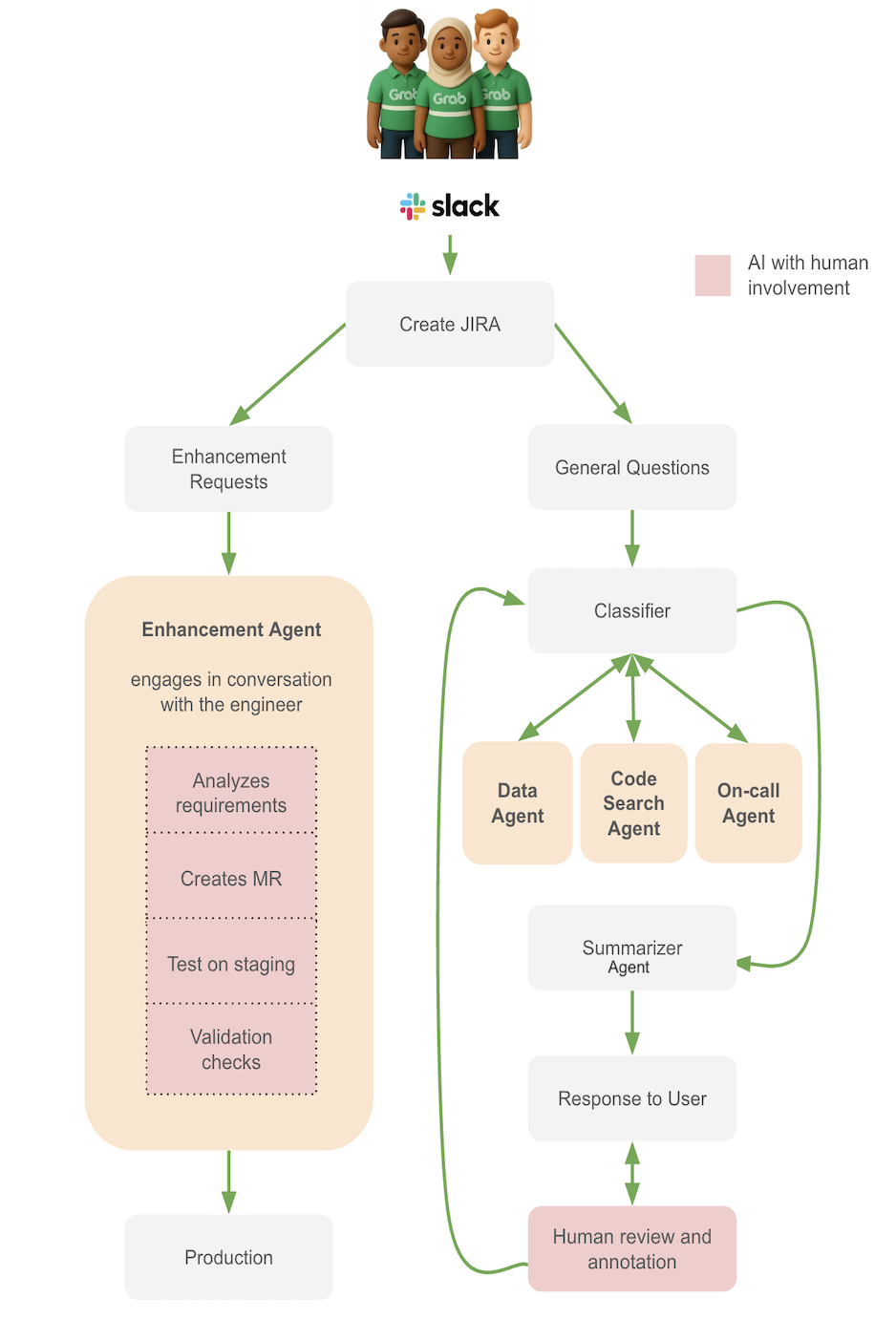
For requests like “Can you add a new column for customer_segment?” or “We need to change the aggregation logic for revenue”, the Enhancement Agent handles the heavy lifting.
Enhancement Agent receives user requirements and proposes code changes:
The workflow:
Why is the workflow semi-automated by design? Code changes to production pipelines require human judgment. The agent accelerates the process by doing the research, writing the code, and running tests, but humans make the final approval.
For questions like “Why does this data look wrong?” or “Where does this metric come from?”, the system uses a coordinated team of specialists.
The Classifier is the first responder for investigation questions. It:
Example: For the question “Why does this ID look wrong?”, the Classifier routes the question to: Data Agent → Code Search Agent → On-call Agent (if needed).
Data Agent performs the data investigation:
Example: It queries vehicle_id from the table to validate the user’s observation against the actual data.
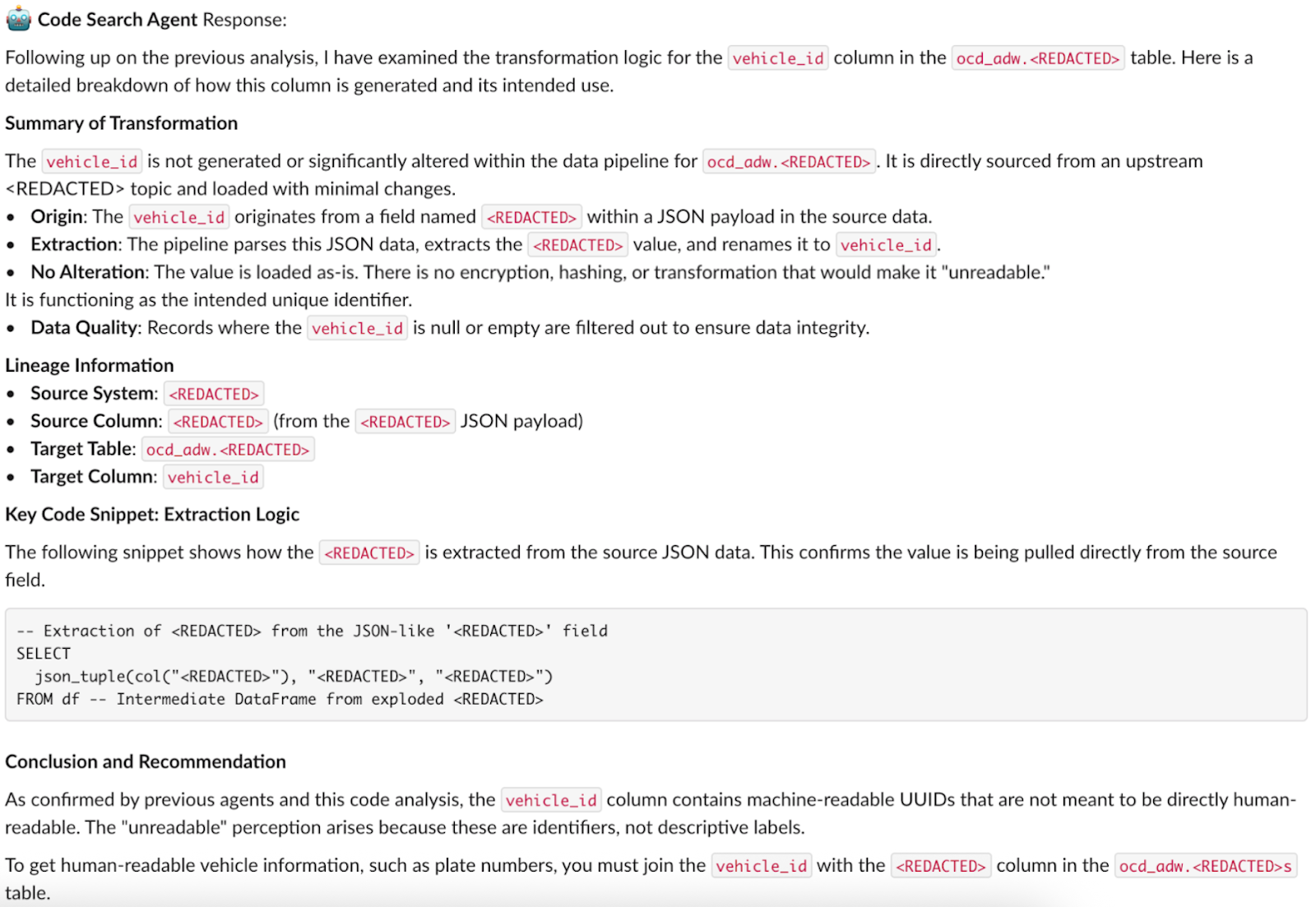
Code Search Agent analyzes the code:
Example: It can trace a vehicle_id column from the final table back through 5 transformation steps to the original source, explaining each change along the way.
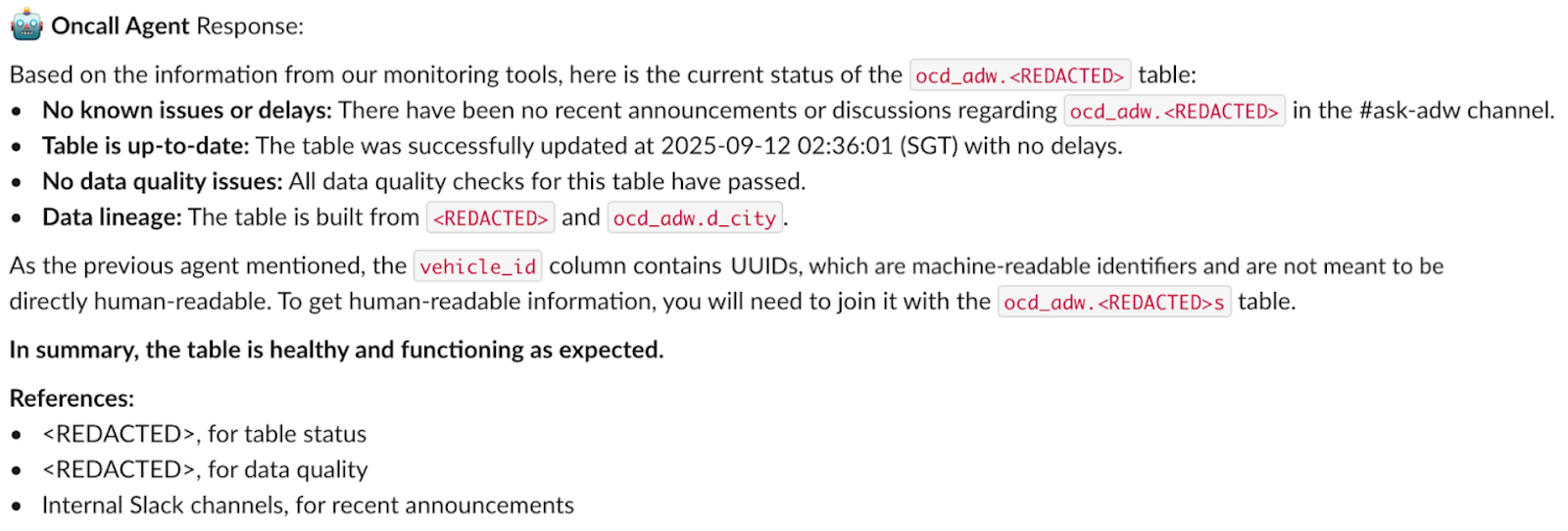
On-call Agent monitors production systems and assists with urgent issues:
Example: If the Data Agent detects SLA breaches or missing partitions, it may consult the On-call Agent for production context.
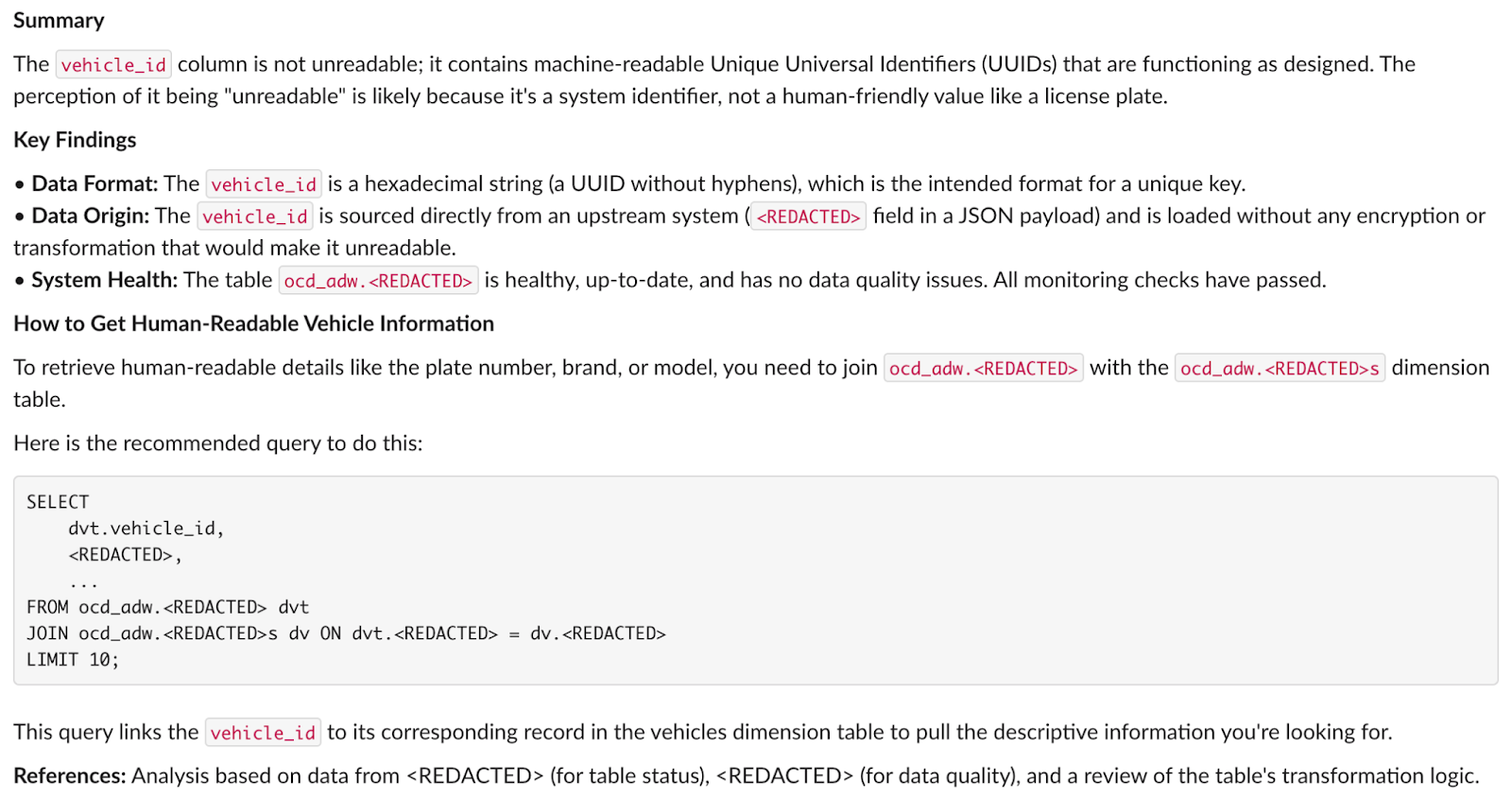
Summarizer Agent refines responses from the previous agents:
Generating the summary is the final step before human review.
The best way to understand how this multi-agent system works is to see it handle real scenarios. Let’s walk through two common situations our team faces daily.
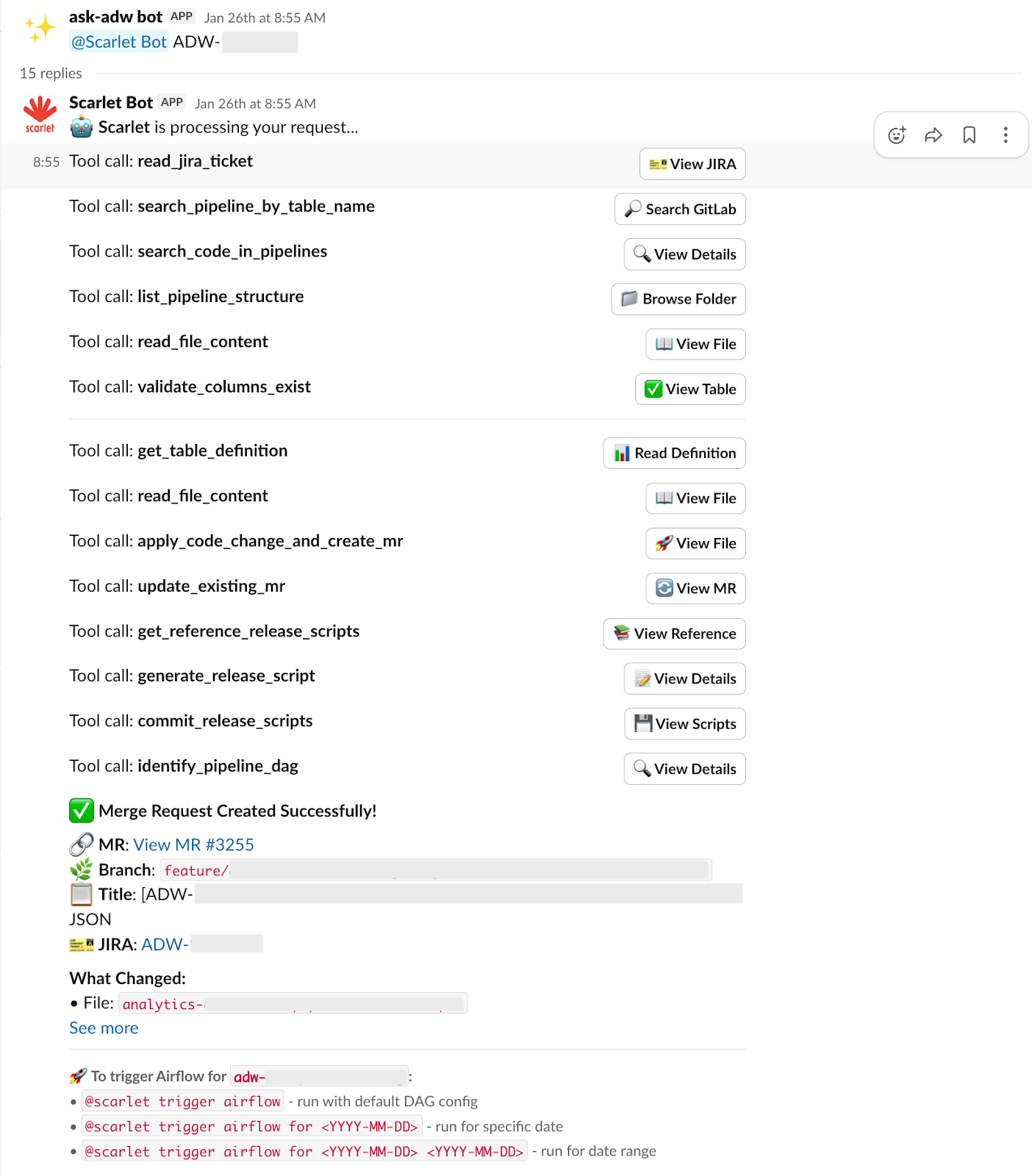
The request: A stakeholder raises a JIRA ticket requesting, “Please add a customer_segment column to the rides table. Source data is available in the user_profiles table.”
In the traditional workflow, a data engineer would spend a significant portion of their afternoon clarifying requirements, developing and testing code, similar to the workflow steps in “Figure 2: Agent workflows”.
With the Enhancement Agent, the entire process is completed autonomously in minutes. The agent performs these tasks in sequence:
The entire process, from ticket to deployable MR, completes autonomously in minutes, with full traceability at every step.
The question: “Why is the ID in the vehicles table unreadable?”
Traditionally, the data engineer typically performs these steps:
This is how it looks with agents:
Step 1: Classifier analyzes the question
Step 2: Data Agent investigates
Conclusion from Data Agent: “The ID column contains UUID format values. These can be joined with dim_vehicles table to get human-readable vehicle names. The format is consistent and valid—not corrupted data.”

Step 3: Code Search Agent traces lineage
Conclusion from Code Search Agent: “The ‘unreadable’ UUID format comes directly from the source system. No transformation is applied. This is not a bug introduced by our Spark pipelines—it’s the native format from the upstream system”.
Step 4: On-call Agent checks production health
Conclusion from On-call Agent: “No production incidents detected. Pipeline running successfully. Data quality metrics are within normal ranges. No recent complaints or issues reported in communication channels.”
Step 5: Summarizer Agent synthesizes the answer
Provides a structured answer to: “Why is the ID in the vehicles table unreadable?”
Step 6: Human review and delivery
The answer is posted on Slack, and a data engineer can review the response and approve it.
The initial response time has been reduced to just a few minutes, in contrast to the previous hours-long manual search.
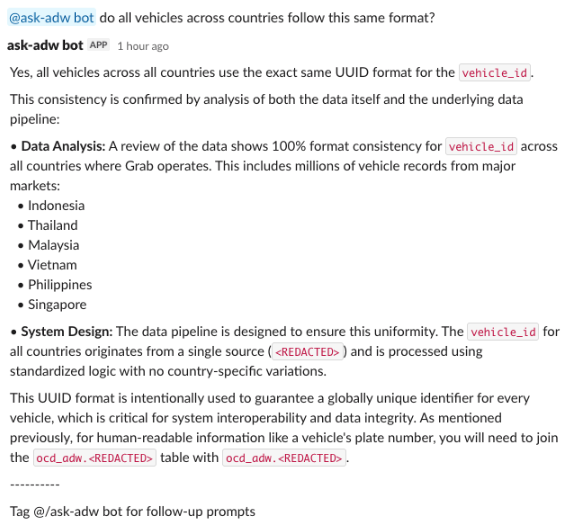
Step 7: Continue conversation
After an answer is posted, anyone can engage in a continued conversation with the agents, restarting the loop.
Building the system was one challenge. Making it production-ready was another.
Our initial prototype worked in controlled demos, but real-world usage revealed critical gaps. Users asked complex questions, conversations grew long, and edge cases exposed vulnerabilities. Here’s how we optimized the system to handle production demands while maintaining accuracy and safety.
In multi-agent systems, context accumulates fast. Information is continuously passed from one agent to the next. Without careful management, excessive context and tokens cause performance degradation.
Our solution:
The orchestrator maintains a rich state throughout execution, tracking three critical elements:
This state is carefully managed to ensure each agent has the right context without overwhelming token limits.
The result:
Agents can handle extended investigations without drowning in excessive context, maintaining performance even in complex, multi-turn conversations.
Our initial design presented a significant performance bottleneck due to excessive tool usage. Early models were equipped with a large and unwieldy set of over 30 distinct tools, each structured similarly to a generic API. Since tool calling is part of an agent’s prompt, agents had to process verbose tool descriptions and outputs, which degraded efficiency.
Our solution:
We focused on tool design based on real-world usage scenarios:
The result:
By significantly reducing the data load agents needed to process during inference, we achieved a substantial leap in system responsiveness and throughput.
AI agents with database access and code generation capabilities pose significant risks. Without proper safeguards, they could access sensitive PII data, execute dangerous SQL operations, run expensive queries, or generate breaking code changes. We needed to make the system safe.
Our solution:
We implemented multiple layers of safety to protect against misuse from both agents and users:
Layer 1: Input classification
Before any agent executes, the Classifier detects:
Layer 2: SQL validation before execution
The Data Agent validates every query for:
Layer 3: Timeout protection
All database queries have strict execution limits to prevent runaway queries from impacting system performance.
Layer 4: Enhancement agent controls
For the Enhancement Agent, which generates code changes:
The result:
A safe environment where AI agents can operate in production without compromising security or stability. Users and engineers trust the system because they know it has robust guardrails protecting critical data and systems.
Even with RAG and guardrails, AI agents aren’t perfect. Hallucinations, misinterpretations, and edge cases could erode user trust.
Our solution:
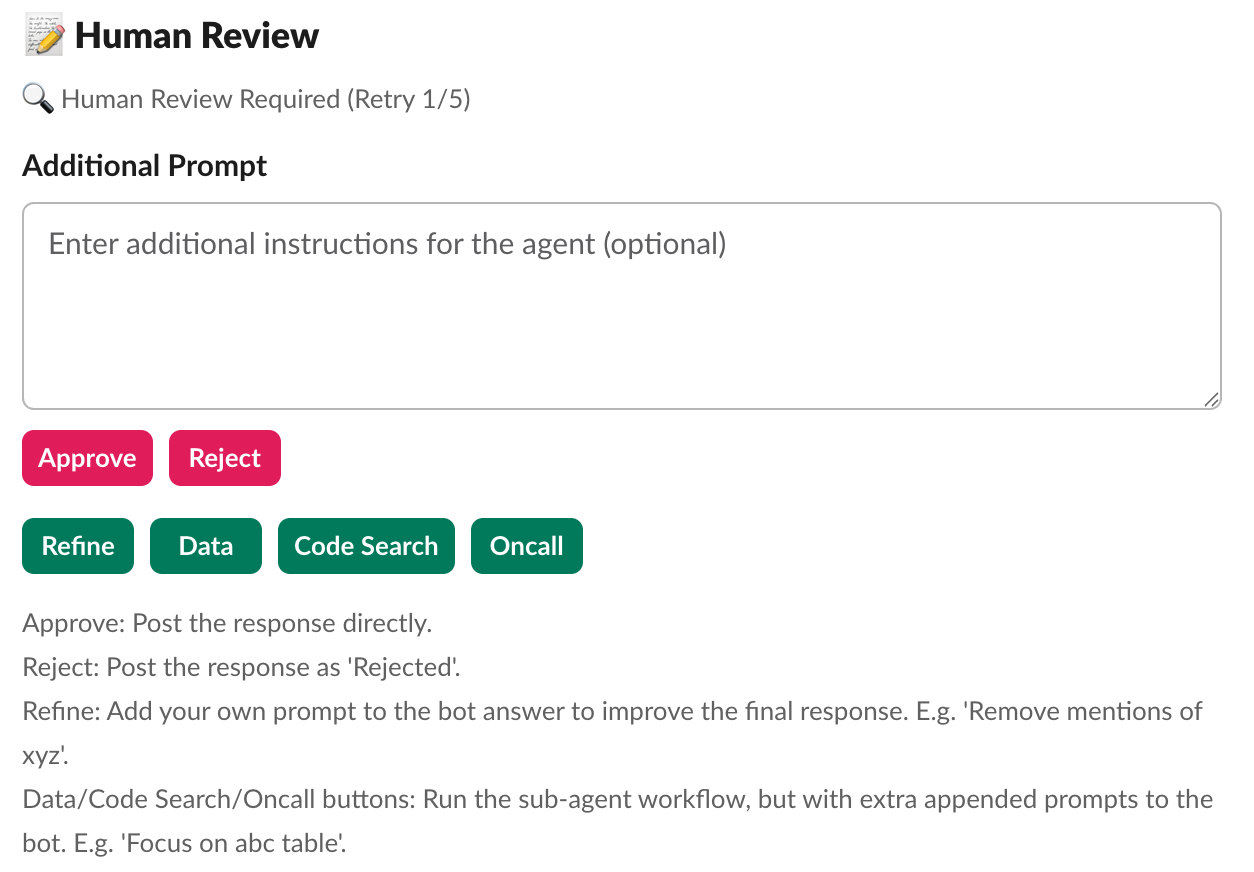
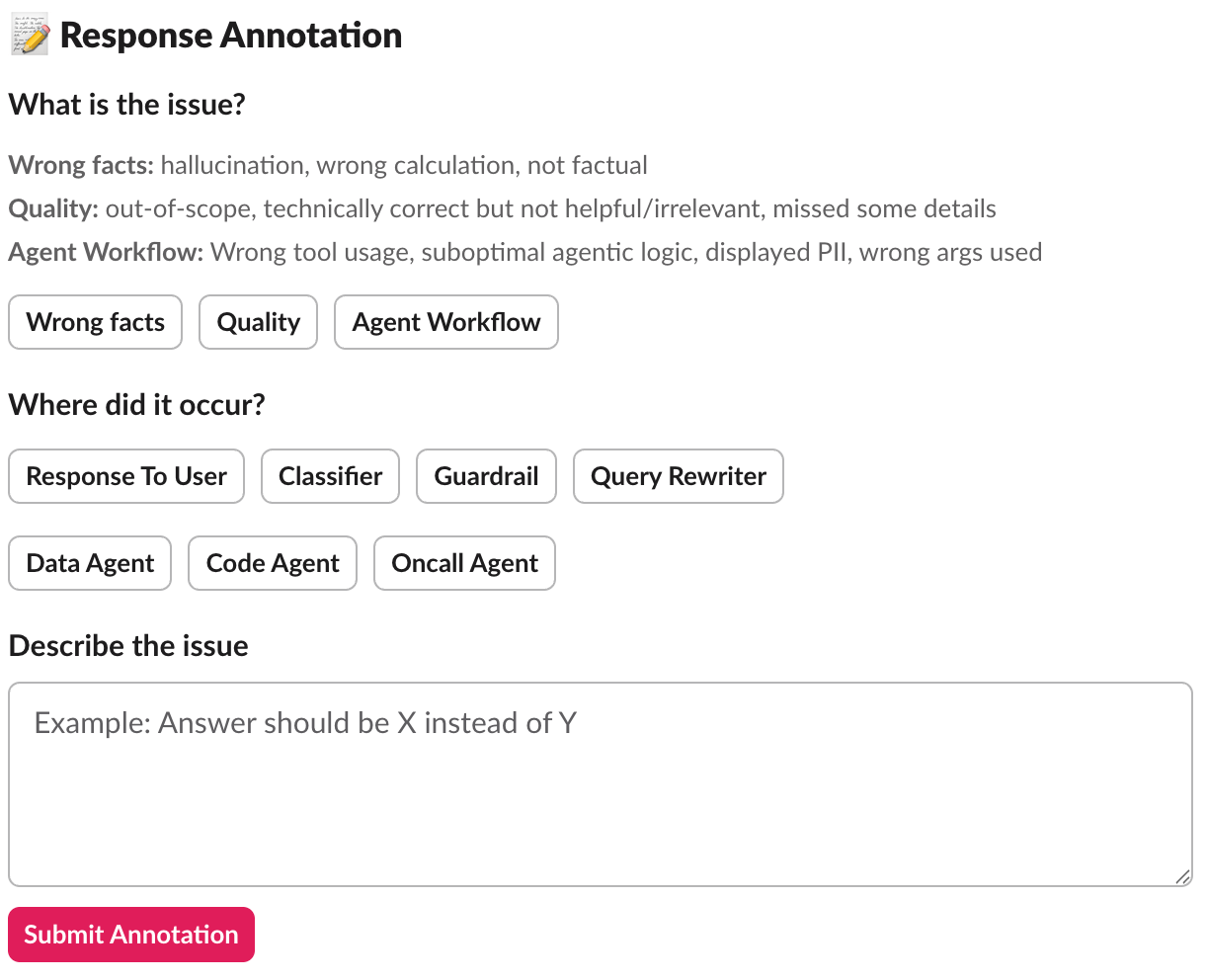
After generating a summarized response, the multi-agent system routes to human reviewers who can take five actions:
The result:
This human-in-the-loop model ensures answers are accurate and reliable, increasing user trust in the responses. The annotations help us iteratively improve the model’s future responses.
Our initial design withheld AI-generated responses until authorized by an engineering team member. This introduced a bottleneck in the response process, potentially leaving inquiries unresolved for extended periods, particularly during peak workload times.
Our solution:
We redesigned the process to allow responses to be posted without immediate human review, provided they are clearly and prominently marked as unreviewed. All posts can still be reviewed and modified by the on-call engineer as needed, but users get answers immediately rather than waiting.
The result:
This approach maintains a crucial balance between response speed and quality:
Collecting feedback through annotations was just the first step. Without systematic analysis, we had a gold mine of information about what worked and what didn’t, but we weren’t learning from it. Every rejected response was a lesson unlearned, every annotation a pattern unrecognized. We needed to close the loop.
Our solution:
We transformed annotations from passive records into an active improvement engine through five mechanisms:
The result:
The system transformed from static to continuous learning. Every mistake became an opportunity for improvement, and the system got smarter with each interaction. We had data-driven insights guiding our optimization priorities, ensuring we focused on the highest-impact improvements.
The deployment of this multi-agent system yielded transformative results across key performance indicators, shifting the team’s entire operational dynamic.
With this newfound capacity unlocked, the data engineering team pivots from reactive support to proactive, high-value work, ultimately leading to “happier downstream users.”
Our journey from overwhelmed data engineers to a team empowered by AI agents revealed three core principles that made this transformation possible:
Multi-Agent architecture: Specialists over generalists
Specialized AI agents outperform a single generalist by mastering specific domains (e.g., data quality, code analysis). This modularity allows for independent improvement, easy additions, and clear responsibilities, boosting maintainability and flexibility.
Strategic human oversight: Building trust through transparency
Routing AI responses through human reviewers achieved rapid adoption through trust and continuous system improvement by generating annotated training feedback.
Focus on augmentation: Automating repetitive tasks
AI agents operate autonomously on repetitive tasks (context gathering, running queries, checking logs) with human oversight if needed, and collaborate with us in augmenting higher-value work: architectural decisions and building new capabilities.
Grab is a leading superapp in Southeast Asia, operating across the deliveries, mobility, and digital financial services sectors. Serving over 900 cities in eight Southeast Asian countries: Cambodia, Indonesia, Malaysia, Myanmar, the Philippines, Singapore, Thailand, and Vietnam. Grab enables millions of people every day to order food or groceries, send packages, hail a ride or taxi, pay for online purchases or access services such as lending and insurance, all through a single app. We operate supermarkets in Malaysia under Jaya Grocer and Everrise, which enables us to bring the convenience of on-demand grocery delivery to more consumers in the country. As part of our financial services offerings, we also provide digital banking services through GXS Bank in Singapore and GXBank in Malaysia. Grab was founded in 2012 with the mission to drive Southeast Asia forward by creating economic empowerment for everyone. Grab strives to serve a triple bottom line. We aim to simultaneously deliver financial performance for our shareholders and have a positive social impact, which includes economic empowerment for millions of people in the region, while mitigating our environmental footprint.
Powered by technology and driven by heart, our mission is to drive Southeast Asia forward by creating economic empowerment for everyone. If this mission speaks to you, join our team today!