Гласовете на Америка – брой 10

Post Syndicated from Йоанна Елми original https://www.toest.bg/glasovete-na-amerika-broy-10/

Гласовете на Америка – брой 10

През изминалата седмица администрацията на Доналд Тръмп публикува документ, който предефинира стратегията за национална сигурност на страната в синхрон с приоритетите на президента и неговите идеологически и политически цели. Новата стратегия предизвика вълна от коментари – журналистически, експертни, дипломатически. Консенсусът е, че документът очертава най-сериозната промяна във външната политика на САЩ от края на Втората световна война насам. Така ли е обаче в действителност и какво всъщност ни казва той? 

Какво е Стратегията за национална сигурност? 

Стратегията за национална сигурност се изготвя периодично от изпълнителната власт на САЩ и изброява приоритетите и политиките в областта на националната сигурност, както и какви са плановете на администрацията за справяне с основни проблеми. Изначалната цел на документа е да насочи визията на изпълнителната власт към законодателната власт, както и да легитимира последващи бюджетни искания например. 

Освен това той очертава стратегията и визията на САЩ както пред международната общност, така и пред нацията – администрацията често цели да покаже на избирателите, че припознава проблемите, които ги вълнуват, и че предлага смислена и дългосрочна стратегия, в която избирателят да се припознае. Документът е и инструмент за постигане на вътрешен консенсус по отношение на външната политика, като има и символичен характер – изразява позицията на президента и основните му послания към американците. 

В случаи, когато гореизброените не са основно застъпени в президентската кампания предходната година,

Стратегията за национална сигурност се счита за значима заявка към избирателите и към новоназначените федерални служители, които придобиват представа в каква посока ще работи кабинетът през идния мандат.

Документът помага и за координиране между федералните агенции и департаменти, тъй като сред основните му цели е артикулирането на консенсус относно цялостната политика на правителството. 

Така например през 1991 г. Стратегията за национална сигурност за пръв път засяга екологичната катастрофа и рисковете пред околната среда. Стратегията след атаките на 11 септември 2001 г. чертае доктрината на президента Джордж Буш-младши за политиката му спрямо Близкия изток. А публикуваната от Обама през 2010 г. Стратегия – също смятана за радикално различна от тогавашното статукво – призовава за засилени връзки с Русия, Китай и Индия. 

Стратегията за национална сигурност на втората администрация на Тръмп 

предизвика полемики в няколко направления: òтказа Русия да бъде директно назована като риск за националната сигурност на страната; приоритизирането на Западното полукълбо като основна сфера на влияние на САЩ; заявката за балансирани отношения с Китай, както и остра промяна на позицията спрямо съюзниците в Западна Европа. 

Основна тема е съживяването и допълването на доктрината „Монро“, 

която определя обсега на политическите и геостратегическите интереси на САЩ в Северна и Южна Америка (Западното полукълбо) през по-голямата част от XIX и първата половина на XX век. Доктрината е изкована в контекста на имперска, колониална Европа, като целта ѝ е да предотврати превръщането на Америките в обект на колонизация за европейските империи, както и да осигури ненамеса в делата на съществуващите европейски колонии и територии, зависими от Европа. 

Доктрината „Монро“ е част от изолационистката традиция в САЩ, според която държавата следва политика на ненамеса във вътрешните работи на други държави, като същевременно защитава американските търговски интереси в региона. Очертана е през 1823 г., когато държавите от Латинска Америка са в процес на отвоюване на независимостта си от колониалното господство, а американците живо следят събитията и са солидарни с каузата за независимост (което не пречи на американската администрация да осъзнава интересите си в региона, включително по отношение на търговията). 

Отказът на президента Джеймс Монро да се намесва в европейските дела е свързан с нарастващата подкрепа за гръцка независимост (Гърция отвоюва независимостта си от Османската империя на 3 февруари 1830 г.). 

Повтаряне на историята, завръщане към историята или писане на нова история – 

това са три възможни интерпретации на втората стратегия за национална сигурност на Тръмп. От една страна, тя се вписва в исторически прецедент, като дори администрацията посочва, че президентът Тръмп прави своя принос към вече съществуващата доктрина „Монро“. От друга, документът прави заявка за нов курс в политиката на САЩ. Въпросът е дали е началото на нова глава в историята на световната геополитика, или просто назовава вече очевидни истини. 

Русия 

приветства новата стратегия като съответстваща на визията на Москва. „Адаптациите, които виждаме […] са в синхрон с нашата визия – заяви говорителят на Кремъл Дмитрий Песков. – Смятаме това за положителна промяна.“ 

За разлика от първия мандат на Тръмп, когато Русия бе назована като основен геополитически противник, във втората стратегия за национална сигурност на американския президент липсва критика към Русия, която за пръв път не е очертана като държава съперник на САЩ. Вместо това има остри критики към Европа (както и формулировката „множество европейци смятат Русия за заплаха за съществуването на континента“), която е обвинена, че не полага достатъчно усилия за осигуряване на мир след нахлуването на Русия на територията на Украйна през 2022 г. САЩ поставят акцента върху сътрудничеството между водещите световни сили. В Стратегията се подчертава, че оцеляването на Украйна като суверенна държава е важно, важно е и нейното възстановяване, но не се казва нищо конкретно как ще бъдат постигнати тези цели. 

Сближаването с авторитарни режими 

се изразява не само в промяната на отношението спрямо Русия, но и в преориентирането спрямо Китай и Близкия изток, който вече не е регион от основна значимост за американската политика. Това съответства на предишни заявки на администрацията, например по време на речта на Тръмп в Рияд, когато президентът заяви, че Америка вече няма да се намесва във вътрешните работи на Близкия изток. Според Стратегията военното присъствие на САЩ също ще бъде изместено от региона към борбата с наркотрафика в Западното полукълбо. 

В новата стратегия изобщо не се споменава Северна Корея и се омаловажава заплахата от Иран – традиционни противници на САЩ.

Относно съседите в Латинска Америка става ясно, че „не бива да игнорираме държави с различни идеологически възгледи от нашите, с които независимо от това имаме общ интерес“. Целта е стабилно и добре управлявано Западно полукълбо; никъде не се казва, че демокрацията е условие за съществуването на такова. 

Колкото до Западното полукълбо, 

както и по отношение на цялостната стратегия, въпросите са повече от отговорите: какво ще се случи например, ако държавите от Латинска Америка нямат желание да си сътрудничат със САЩ и да поемат курса на новата американска политика? Следва ли да бъдат задължени? Във време на търговските войни и употребяване на мигрантите като разменна монета, както и на откритите изказвания и опити за влияние върху националните избори (президентът Тръмп подкрепи десния кандидат-президент на изборите в Хондурас и заплаши, че ще спре американската помощ за страната, ако неговият кандидат не спечели), отговорът е доста неясен. 

Спирането на миграцията към САЩ е приоритет на администрацията, като не е уточнено легална или нелегална миграция. В Стратегията се казва, че в идеалния случай гражданство на чужденци трябва да бъде давано сравнително рядко. Друга важна точка е борбата с „наркотерористите“ и използването на американска военна сила за справяне с „преки заплахи в нашето полукълбо“. Това силно вероятно задава цялостния тон на Стратегията за национална сигурност, която всъщност се изготвя от Министерството на отбраната (понастоящем преименувано на Министерство на войната), оглавявано от Пийт Хегсет – в момента обект на критика заради американски удари над цивилни край Венецуела. 

Според Уил Фриман, регионален експерт в Съвета за чуждестранни връзки, организираната престъпност в Западното полукълбо е сред основните причини за смъртността в САЩ и следва да бъде обект на национална сигурност. Фриман обаче допълва, че има и други мотиви: регионът е богат на ресурси и добре позициониран с оглед на снабдяването на САЩ в икономическата надпревара с Китай. Китайците също упражняват влияние в региона чрез търговски връзки и дигитална инфраструктура, което е акцентирано и в Стратегията. Фриман обаче смята, че документът по-скоро поставя акцент върху региона като рисков, отколкото като източник на възможности, а външната политика се върти около овладяването на проблемни според администрацията звена: масовата миграция, организираната престъпност и злонамереното чуждо влияние. 

Промяната в ориентацията спрямо Китай 

също е очевидна, най-вече за специалистите, които отчитат както разликите между стратегиите на двете администрации на Тръмп, така и спрямо досегашната политика на САЩ. Стратегията призовава съюзниците в региона за помощ в стабилизирането на отношенията между Китай и Тайван, но и извежда като основна цел „взаимноизгодно икономическо сътрудничество с Пекин“ – пълен завой както от първия мандат, така и от общата реторика на Тръмп, който бе избран и благодарение на крайните си изказвания спрямо Китай и който допреди месеци заявяваше уверено, че ще подчини китайците чрез търговска война. 

Предходната стратегия на първата администрация на Тръмп описваше Китай като пълна противоположност на САЩ – конкурент както от икономическа и геополитическа, така и от идеологическа гледна точка. Настоящата стратегия дава предимство на икономическата полза, а Китай е споменат чак в последните страници на документа, и то основно като пазарен съперник без оглед на стратегическите рискове, които биха могли да представляват евентуалнoто сближаване и икономически ползи. Стратегията не отчита и че Китай има интерес в регионите, където Америка планира да намали влиянието си, например Близкия изток.

Виновна е Европа, 

с която няма нито планове за икономически изгодно сътрудничество, нито за ненамеса във вътрешните работи, независимо от идеологията и формата на управление на държавите. Напротив, по отношение на Стария континент Стратегията на Тръмп е силно идеологически политизирана и повтаря клишетата на консервативното дясно: Европа цензурира и потиска политическата опозиция (винаги дясноконсервативна); континентът е икономически и военно слаб, както и застрашен от „цивилизационно унищожение“. Европейците игнорират „западните“ ценности (вероятно тук разбирани като националконсервативните ценности) и „губят европейската си идентичност“ поради завишена миграция и ниска раждаемост. Европейският съюз пък подкопава политическата свобода и суверенитета, затова в Стратегията се насърчава гласуването за десни и крайнодесни сили (патриотични) с цел устояване на тези тенденции. 

На мушката е основно Западна Европа, което е точно толкова лоша новина и за Източна и Южна Европа с оглед на това, че администрацията на Тръмп видимо търси съюз с автократи, клептократи и силно компрометирани лидери в региона. Приемането на нови членки в НАТО също е поставено под въпрос. Макар че Стратегията признава икономическата значимост на Европа, най-вече спрямо Китай, тя игнорира факта, че Китай е също толкова активен на Балканите, които са и по-уязвими на външно влияние. 

Много думи – малко стратегия 

На Африка са отделени няколко параграфа, които също оставят много въпросителни. В Стратегията се изразява желание да се работи със „способни, надеждни партньори“, но както и навсякъде другаде по света, подобни партньори не могат да съществуват без среда с прозрачно управление, върховенство на правото и борба с корупцията – звена, които привидно се влошават под управлението на Тръмп дори на национално ниво в САЩ. 

Експертите са единодушни, че документът има грешна мишена – европейските съюзници, а не държавите, които действително представляват риск за САЩ. Документът е пълен с неоснователни твърдения и вътрешни противоречия, за което специалисти от CATO Institute (един от големите тинктанкове във Вашингтон с либертариански уклон) казват, че е очаквано, имайки предвид колко е трудно да се създаде добра стратегия в силно политизирана, импулсивна, хаотична и опортюнистична администрация. 

Ако трябва да обобщим Стратегията за национална сигурност на втората администрация на Тръмп в няколко думи, те биха били: личности над принципи и пари над всичко, откровено заявено като държавна политика. Вече няма злодеи (Русия, Китай), няма добри, няма и общи ценности – има взаимноизгодни сътрудничества. И във всички случаи, много малко информация какъв всъщност е планът за стигане от точка А до точка Б. 

Възможните интерпретации са три. 

Най-положителната е, че САЩ се обръщат към националния си интерес на всяка цена – дори на цената на ценни съюзи и дългосрочно демократично управление. 

Втората е, че администрацията на Тръмп е кулминация на последното десетилетие фанатизъм и идеологизиране и че последствията от такава политика нямат значение, поне засега, стига да побеждават „правилната“ страна и правилните ценности. Дори те да нямат нищо общо с реалността.  

Третата е, че администрацията на Тръмп е началото на превръщането на държавата в корпорация, на политиката в бизнес, на ценностите в разменна монета в зависимост от случая. 

Според някои безцеремонното представяне на Стратегията – късно вечерта, без съпътстващи речи от президента или съветниците по национална сигурност – подсказва, че за Белия дом документът вероятно не е от особена важност, нито изразява стратегическо намерение. Други виждат в него просто потвърждение на очевидния курс, по който е поела администрацията. 

Възможните интерпретации са три. И те в никакъв случай не се изключват взаимно. 


Абонирайте се, за да получавате този бюлетин на електронната си поща в момента, в който излезе!

Вече сте регистриран потребител на Toest.bg? Може директно от настройките на бюлетините в своя профил да изберете „Гласовете на Америка“ или да натиснете бутона по-долу:

Още нямате профил в Toest.bg? Регистрирайте се само с няколко клика:


Secondary school maths showing that AI systems don’t think

Post Syndicated from Jane Waite original https://www.raspberrypi.org/blog/secondary-school-maths-showing-that-ai-systems-dont-think/

At a time when many young people are using AI for personal and learning purposes, schools are trying to figure out what to teach about AI and how (find out more in this summer 2025 data about young people’s usage of AI in the UK). One aspect of this is how technical we should get in explaining how AI works, particularly if we want to debunk naive views of the capabilities of the technology, such as that AI tools ‘think’. In this month’s research seminar, we found out how AI contexts can be added to current classroom maths to make maths more interesting and relevant while teaching the core concepts of AI.

Prof. Dr. Martin Frank, Assistant Prof. Dr. Sarah Schönbrodt, Research Associate Stephan Kindler

At our computing education research seminar in July, a group of researchers from the CAMMP (Computational and Mathematical Modeling Program) research project shared their work:

  • Prof. Dr. Martin Frank, Founder of CAMMP (Karlsruhe Institute of Technology (KIT), Germany).
  • Assistant Prof. Dr. Sarah Schönbrodt (University of Salzburg, Austria)
  • Research Associate Stephan Kindler (Karlsruhe Institute of Technology (KIT), Germany)

They talked about how maths already taught in secondary schools can be used to demystify AI. At first glance, this seems difficult to do, as it is often assumed that school-aged learners will not be able to understand how these systems work. This is especially the case for artificial neural networks, which are usually seen as a black box technology — they may be relatively easy to use, but it’s not as easy to understand how they work. Despite this, the Austrian and German team have developed a clear way to explain some of the fundamental elements of AI using school-based maths.

Sarah Schönbrodt started by challenging us to consider that learning maths is an essential part in developing AI skills, as: 

  1. AI systems using machine learning are data-driven and are based on mathematics, especially statistics and data
  2. Authentic machine learning techniques can be used to bring to life existing classroom maths concepts
  3. Real and relevant problems and associated data are available for teachers to use

A set of workshops for secondary maths classrooms

Sarah explained how the CAMMP team have developed a range of teaching and learning materials on AI (and beyond) with an overall goal to “allow students to solve authentic, real and relevant problems using mathematical modeling and computers”. 

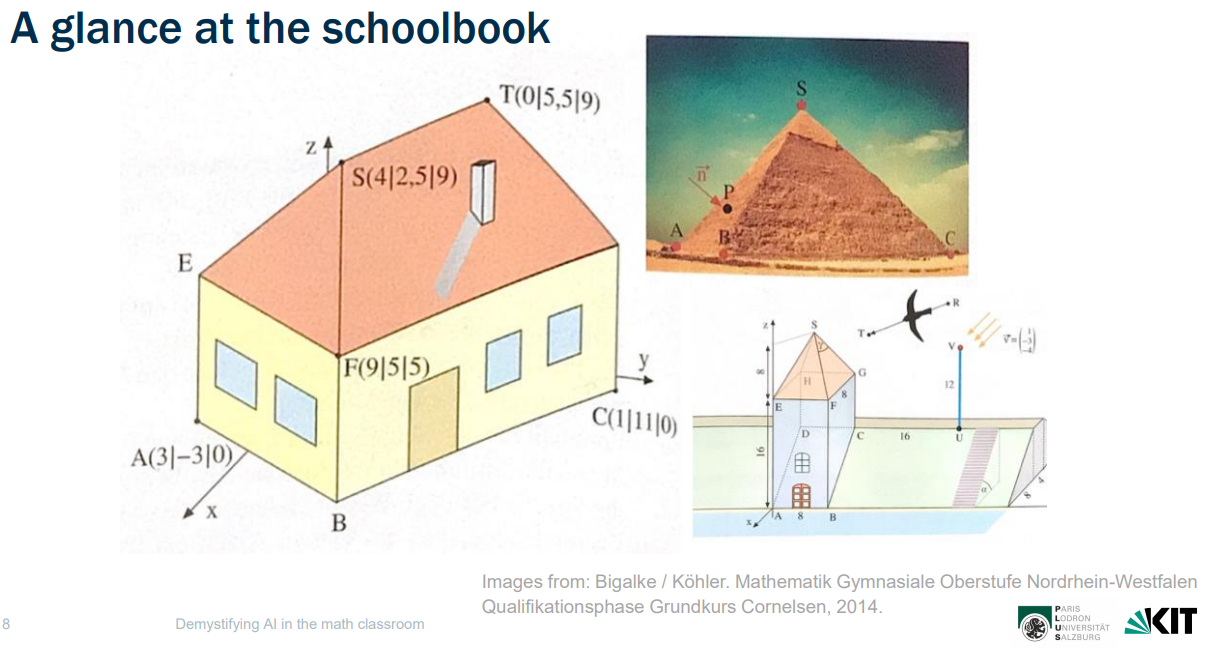
She reflected that much of school maths is set in contexts that are abstract, and may not be very interesting or relevant to students. Therefore, introducing AI-based contexts, which are having a huge impact on society and students’ lives, is both an opportunity to make maths more engaging and also a way to demystify AI.

A glance at the schoolbook diagram
Old-fashioned contexts are often used to teach classroom maths concepts. Those same concepts could be taught using real-world AI contexts. (Slide from the researchers’ presentation.)

Workshops designed and researched by the team include contexts such as privacy in social networks to learn about decision trees, personalised Netflix recommendations to learn about k-nearest neighbour, word predictions to learn about N-Grams, and predicting life expectancy to learn about regression and neural networks.

Learning about classification models: traffic lights and the support vector machine

For the seminar, Sarah walked through the steps to learn about support vector machines. This is an upper secondary workshop for students aged 17 to 18 years old. The context of the lesson is an image problem — specifically, classifying the data representing the colours of a simplified traffic light system (two lights to start with) to work out if a traffic light is red or green.

She walked through each of the steps of the maths workshop:

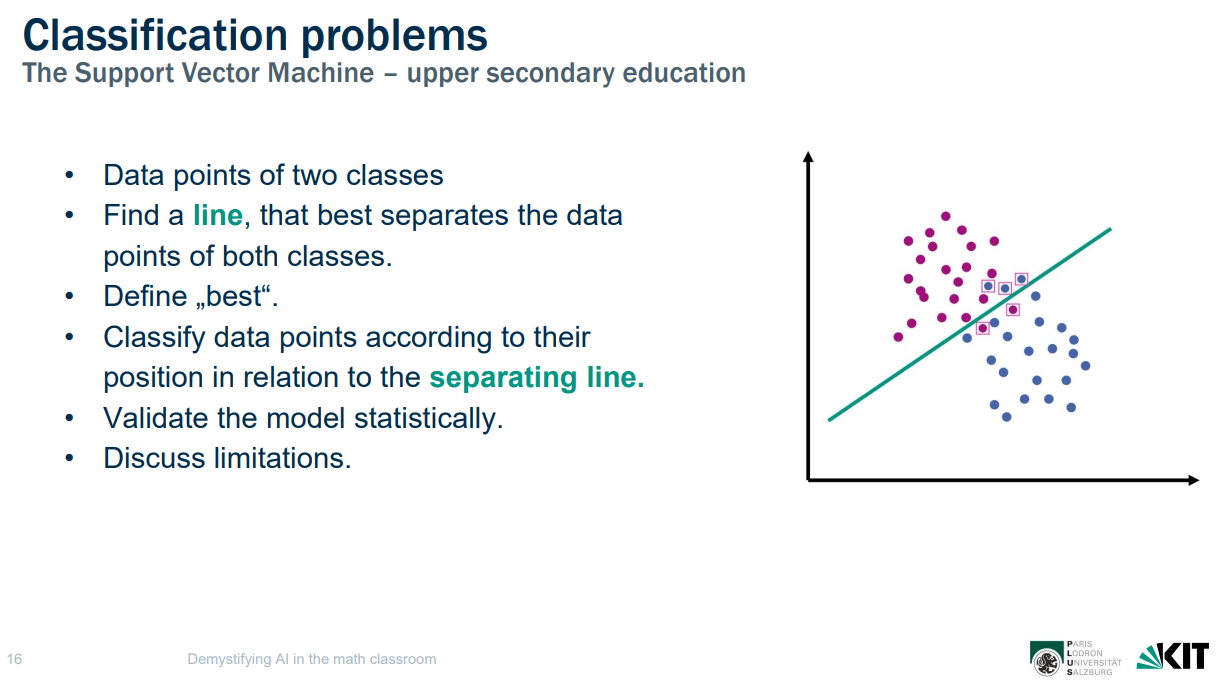
  • Plotting data points of two classes, the representation of green and red traffic lights
  • Finding a line that best separates the data points of both classes
  • Figuring out what best is
  • Classifying the data points in relation to the chosen (separating) line
  • Validating the model statistically to see if it is useful in classifying new data points, including using test data and creating a contingency table (also called a confusion matrix)
  • Discussing limitations, including social and ethical issues
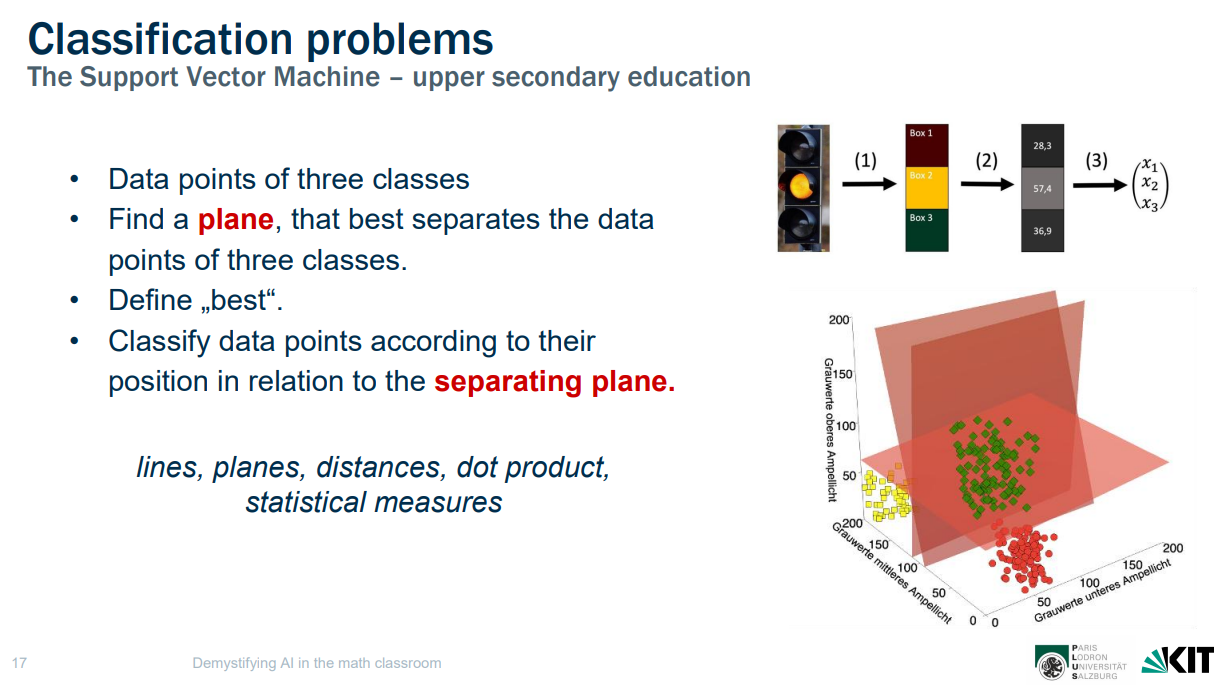
  • Explaining how three traffic lights can be expressed as three-dimensional data by using planes
Classification problems diagram
By classifying green and red traffic light data, students are learning about lines, classifying data, and considering limitations. (Slide from the researchers’ presentation.)

Throughout the presentation, Sarah pointed out where the maths taught was linked to the Austrian and German mathematics curriculum.

Classification problems diagram
Learning about planes, separating planes, and starting to see how data can be represented in vectors. (Slide from the researchers’ presentation.)

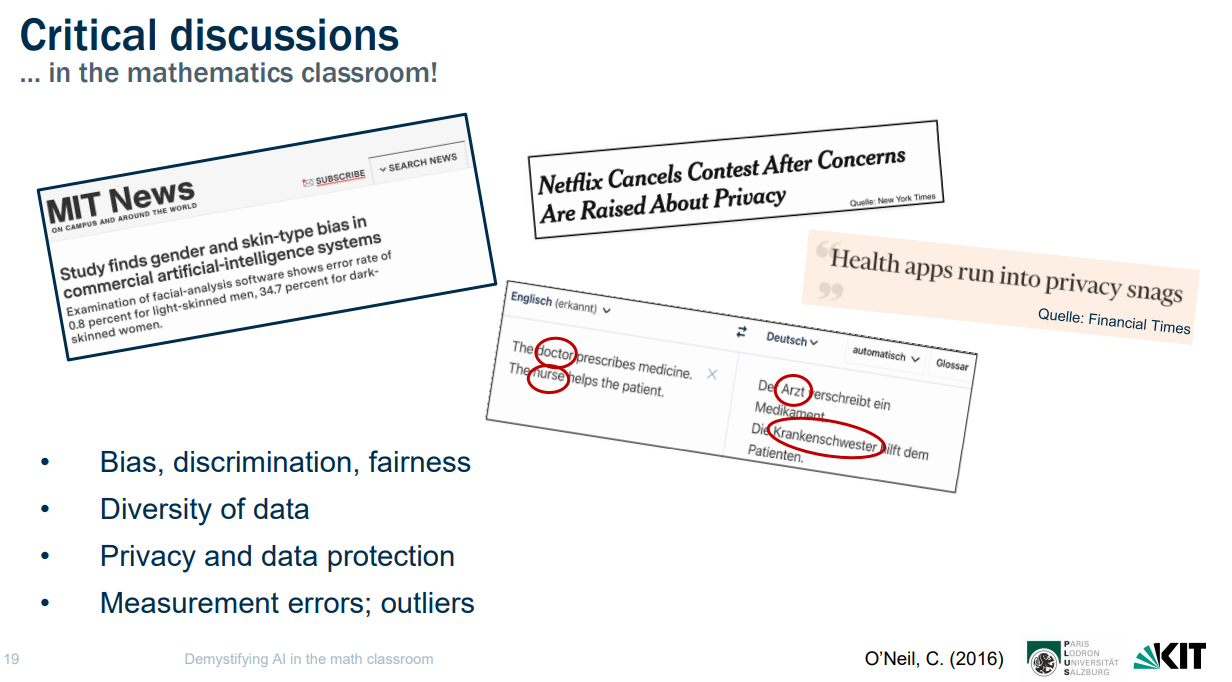
Learning about social and ethical issues

Learning about the social and ethical issues in data-driven systems. (Slide from the researchers’ presentation.)

As well as learning about lines, planes, distances, dot product and statistical measures, learners are also engaged in discussing the social and ethical issues of the approach taken. They are encouraged to think about bias, data diversity, privacy, and the impact of errors on people. For example, if the model wrongly predicts a light as green when it is red, then an autonomous car would run through a red traffic light. This would likely be a bigger consequence than stopping at a green traffic light that was mis-predicted as red. So should the best line reduce this kind of error?

To teach the workshops, Sarah explained they have developed interactive Jupyter notebooks, where no programming skills are needed. Students fill in the gaps of example code, explore simulations, and write their ideas for discussion for the whole class. No software needs to be installed, feedback is direct, and there are in-depth tasks and staggered hints.

Learning about regression models: Weather forecasting and the toy artificial neural network

Stephan went on to introduce artificial neural networks (ANNs), which are the basis of generative AI applications like chatbots and image generation systems. He focused on regression models, such as those used in weather forecasting. 

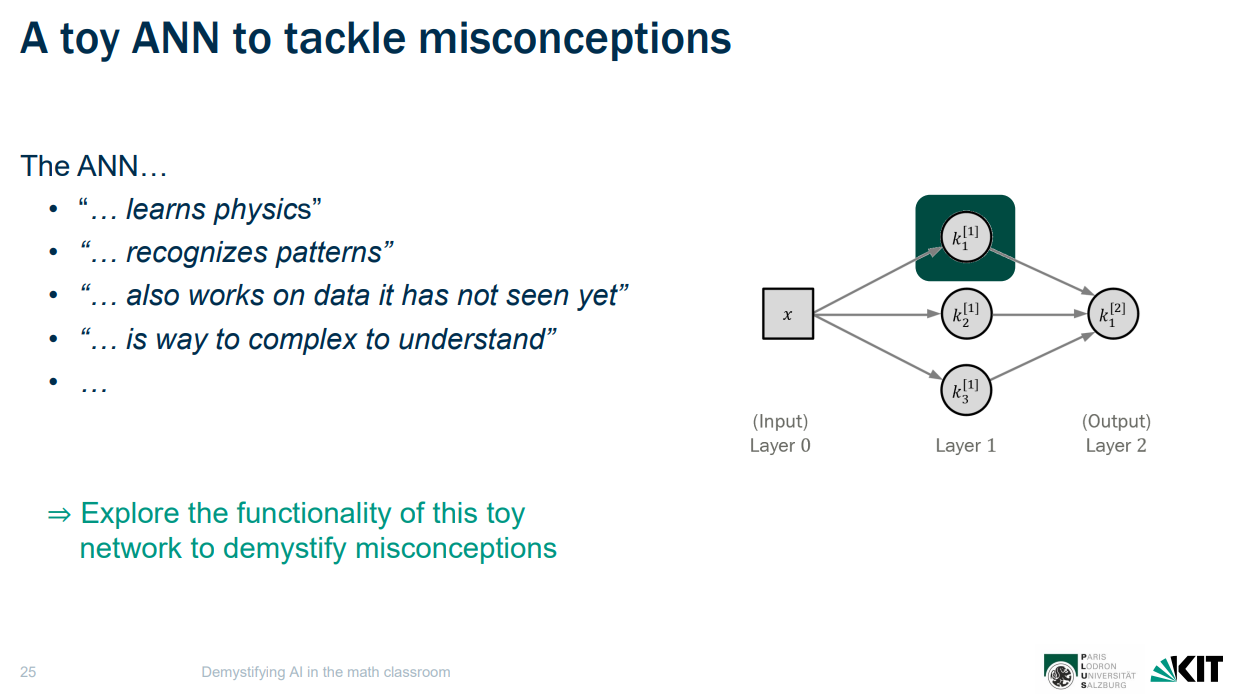
ANNs are very complex. Therefore, to start to understand the fundamentals of this technology, he introduced a ‘toy ANN’ with one input, three nodes, and one output. A function is performed on the input data at each node. With the toy network, the team wants to tackle a major and common misconception: that students think that ANN systems learn, recognise, see, and understand, when really it’s all just maths.

Tackling misconceptions about ANNs by exploring how they work in a toy version. (Slide from the researchers’ presentation.)

The learning activity starts by looking at one node with one input and one output, and can be described as a mathematical function, with a concatenation of two functions (in this case a linear and activation function). Stephan shared an online simulator that visualises how the toy neural network can be explored as students change two parameters (in this case, weight and bias of the functions). Students then look at the overall network, and the way that the output from the three nodes is combined. Again, they can explore this in the simulator. Students compare simple data about weather prediction to the model, and discover they need more functions — more nodes to better fit the data. The activity helps students learn that ANN systems are just highly adjustable mathematical functions that, by adding nodes, can approximate relationships in a given data set. But the approximation only works in the bounds (intervals) in which data points are given, showing that ANNs do not ‘understand’ or ’know’ — it’s just maths.

Stephen finished by explaining the mutual benefits of AI education and maths education. He suggested maths will enable a deeper understanding of AI, and give students a way to realistically assess the opportunities and risks of AI tools and show them the role that humans have in designing AI systems. He also explained that classroom maths education can benefit from incorporating AI contexts. This approach highlights how maths underpins the design and understanding of everyday systems, supports more effective teaching, and promotes an interdisciplinary way of learning across subjects.

Some personal reflections — which may not be quite right!

I have been researching the teaching of AI and machine learning for around five years now, since before ChatGPT and other similar tools burst on the scene. Since then, I have seen an increasing number of resources to teach about the social and ethical issues of the topic, and there are a bewildering number of learning activities and tools for students to train simple models. There are frameworks for the data lifecycle, and an emerging set of activities to follow to prepare data, compare model types, and deploy simple applications. However, I felt the need to understand and to teach about, at a very simple level, the basic building blocks of data-driven technologies. When I heard the CAMMP team present their work at the AIDEA conference in February 2025, I was entirely amazed and I asked them to present here at our research seminar series. This was a piece of the puzzle that I had been searching for — a way to explain the ‘bottom of the technical stack of fundamental concepts’. The team is taking very complex ideas and reducing them to such an extent that we can use secondary classroom maths to show that AI is not magic and AI systems do not think. It’s just maths. The maths is still hard, and teachers will still need the skills to carefully guide students step by step so they can build a useful mental model. 

Photo of a class of students at computers, in a computer science classroom.

I think we can simplify these ideas further, and create unplugged activities, simulations, and ways for students to explore these basic building blocks of data representation, as well as classification and representing approximations of complex patterns and prediction. I can sense the beginnings of new ideas in computational thinking, though they’re still taking shape. We’re researching these further and will keep you updated.

Finding out more

If you would like to find out more about the CAMMP resources, you can watch the seminar recording, look at the CAMMP website or try out their online materials. For example, the team shared a link to the jupyter notebooks they use to teach the workshops they demonstrated (and others). You can use these with a username of ‘cammp_YOURPSEUDONYM’, where you can set ‘YOURPSEUDONYM’ to any letters, and you can choose any password. They also shared their toy ANN simulation.
The CAMMP team are not the only researchers who are investigating how to teach about AI in maths lessons. You can find a set of other research papers here.

Join our next seminar

In our current seminar series, we’re exploring teaching about AI and data science. Join us at our last seminar of the series on Tuesday, 27 January 2026 from 17:00 to 18:30 GMT to hear Salomey Afua Addo talk about using unplugged approaches to teach about neural networks.

To sign up and take part, click the button below. We’ll then send you information about joining. We hope to see you there.

The schedule of our upcoming seminars is online. You can catch up on past seminars on our previous seminars page.

The post Secondary school maths showing that AI systems don’t think appeared first on Raspberry Pi Foundation.

Security updates for Friday

Post Syndicated from jzb original https://lwn.net/Articles/1050251/

Security updates have been issued by AlmaLinux (firefox, luksmeta, mysql, mysql:8.0, mysql:8.4, tomcat, and wireshark), Debian (chromium, kernel, and tzdata), Fedora (brotli, dr_libs, perl-Alien-Brotli, python-urllib3, singularity-ce, wireshark, and yarnpkg), Oracle (firefox, grafana, lasso, libsoup3, luksmeta, ruby, ruby:3.3, tomcat, and wireshark), Slackware (mozilla), SUSE (container-suseconnect, kubernetes-client, libpoppler-cpp2, postgresql14, postgresql15, and python3), and Ubuntu (c-ares, keystone, linux, linux-aws, linux-aws-5.15, linux-azure, linux-gcp, linux-gcp-5.15,
linux-gke, linux-gkeop, linux-hwe-5.15, linux-ibm, linux-ibm-5.15,
linux-intel-iotg, linux-intel-iotg-5.15, linux-lowlatency,
linux-lowlatency-hwe-5.15, linux-nvidia, linux-nvidia-tegra,
linux-nvidia-tegra-5.15, linux-nvidia-tegra-igx, linux-oracle,
linux-oracle-5.15, linux-xilinx-zynqmp, linux-azure, linux-azure-4.15, linux-oracle,, linux-fips, linux-aws-fips, linux-azure-fips, linux-gcp-fips, linux-fips, linux-aws-fips, linux-gcp-fips, linux-hwe-6.8, linux-oracle-6.8, linux-raspi, linux-realtime, linux-intel-iot-realtime, and python-urllib3).

Идва ли освобождение след оставката?

Post Syndicated from Емилия Милчева original https://www.toest.bg/idva-li-osvobozhdenie-sled-ostavkata/

Идва ли освобождение след оставката?

В действителност протестиращите по площадите и улиците на България и Европа десетки хиляди български граждани не искаха оставката на правителството. Те искат освобождение от модела „Борисов – Пеевски“ и от мрежите му. Падането на правителството на Росен Желязков е само първият пробив в стената. 

Същинският оздравителен процес ще започне с изваждането от политиката на лидера на ГЕРБ Бойко Борисов и на санкционирания за корупция от САЩ и Великобритания олигарх Делян Пеевски. А тази работа може да свърши прокуратурата, ако пожелае да служи на държавността и да изпълнява функциите си на защитник на обществения интерес вместо на куче пазач на завладяната от „Борисов–Пеевски“ държавност. 

Формулата на бившата правосъдна министърка на Румъния Моника Маковей „Изчистете съдебната система и тя ще изчисти всичко останало“ не проработи в България.

Сега държавното обвинение е заключено в отколешните си зависимости – мудно и удобно за силните на деня. Но от него зависи ще има ли освобождение след оставката, или всичко ще остане само в периметъра на протестния шум. 

Също и от гражданската енергия – ще нарасне ли още до предсрочните парламентарни избори (вероятно през март), или ще спадне и как ще се трансформира в избирателна активност. Замлъкне ли улицата, избутаните в ъгъла на ринга бързо ще се окопитят и оставката ще е само моментен триумф.

„Все пак е победа, да се порадваме за малко“, казва таксиметровият шофьор, който със съжаление отбелязва, че не е успял за третия, най-многоброен протест, тъй като му се паднал дълъг курс извън София. Точно след този протест и преди гласуването на шестия вот на недоверие правителството подаде оставка, а премиерът Росен Желязков я мотивира с „гласа на народа“:

Ние, както заявихме нееднократно, чуваме гласа на гражданите, които протестират срещу управлението. Чуваме го осъзнато. Затова и трябва да бъдем на висотата на техните искания. Техните искания са за оставка на правителството. Това е настоящият момент. За оставката глас издигнаха и млади, и стари, хора от различни етноси, от различни религии.

51-вото Народно събрание няма да успее да произведе второ правителство, след като основните политически сили декларираха отказ да участват в преговори за нов кабинет. Както е тръгнало, няма да участват и в гласуването на редактирания проектобюджет за 2026 г., което означава, че поне до юни догодина държавата ще остане със старата финансова рамка, тоест с удължителен бюджет. Няма нови програми или увеличения на разходи (освен ако не се гласува отделно за извънредни ситуации), следователно в МВР, МО, ДАТО и навсякъде, където възнагражденията са увеличени, ще се запазят сегашните нива на заплащане.

Ако слушаме Борисов, ГЕРБ излиза от това 11-месечно управление с вдигната глава и след „брилянтни действия“. Също така нямало защо да се сърдят на „децата на площада“ – той като тийнейджър мечтаел семейният москвич да стане лада:

Защо им се сърдим, че искат да мечтаят? Да имат мечти. Я се замислете вие като сте били на тия години, за какво сте си мечтали. Аз дори съм благодарен, че Господ не ме е чул. Мечтата ми беше москвичът на татко да стане лада. Това ми беше и само си виках: „Ей, Господи, само това ми дай. Нищо друго няма да поискам. Една лада да карам аз.“ Това ми беше мечтата на тия години, 15–16–17. Те затова и площадът им е празник.

Изглежда, че Борисов е изключение от максимата „Човек е толкова голям, колкото големи са мечтите му“. Въпреки скромните дори и за социалистически младеж мечти, той създаде и оглави най-голямата партия в най-новата история на България, три пъти беше премиер, а футболният отбор „Витоша (Бистрица)“, в който играе, спечели тази година и купата при ветераните. 

За какво мечтае Борисов днес, е въпрос за 1 милион евро. В последния си трети мандат той караше гигантска тойота, през чийто отворен прозорец „разхвърляше“ пари като на селска сватба, все едно няма правила, програми, проекти за публичните средства.

„Зурлички“ навсякъде

Положението сега е „Борисов–Пеевски“ падна! Да живее „Борисов–Пеевски!“. Причината да се перифразират изрази от протокола на френския кралски двор е, че от всеки регулатор и институция надничат „зурлички“ – наложените от „Борисов–Пеевски“ и избрани от мнозинството кандидати. Те могат да бламират и провалят всяка смислена инициатива, а засега неуспешно „се справят“ с овладяване на ръста на цените.

За дългия път към промяната предупреди и съпредседателят на „Демократична България“ Ивайло Мирчев:

Кабинета го свалиха хората, които излязоха масово на площадите няколко пъти поред. […] Тази нова гражданска енергия, това връщане на гражданското общество всъщност беше правилният път. Но това е само първа стъпка към свалянето на кабинета. Но това е първа стъпка към разграждането на този модел.

Какво ще се случи с гражданската енергия до предсрочните избори (евентуално) през март, е в пряка връзка с действията след 1 януари. Повишението на цените има потенциал да разгневи гражданите и от протест за ценностите на демокрацията да преминат към социален. Тази промяна би предопределила и политическите сили, които ще се възползват от страховете на обществото и от неговия гняв.

Системата, която създава и укрепва на власт персони като Борисов и Пеевски, не е счупена – така че битката за нормална европейска България предстои. Поредната.

Политиците ще трябва да се равняват по гражданското недоволство. А на площадите хората идваха гневни поради различни причини, но с общ знаменател – несправедливост в разпределението на публичните средства, несправедливост в правораздаването, несправедливост в достъпа до услуги и възможности, които би трябвало да са универсални за всички. Държавата работи за малка група привилегировани и наказва останалите с бюрократичен произвол, несигурност и непрозрачност.

Предсрочните избори също така ще са тест за президентските наесен. Ще запази ли ГЕРБ преднина? Дали коалицията ПП–ДБ ще капитализира гражданската енергия и ще се утвърди като реален политически фактор преди президентския вот? Къде ще са Пеевски и неговото ДПС – Ново начало? Социологическо проучване на „Маркет Линкс“ им отрежда четвърто място с резултат 9,1%. В същото време ГЕРБ губи значителен дял от подкрепата си само за три месеца. Спадът от 22 на 17% е заради протестите, бюджет 2026 и кризата във властта.

Радев ще скочи ли?

За предстоящите парламентарни избори на Румен Радев ще му се наложи да напусне президентските покои и да скочи в бурния водовъртеж на политиката. Така предизборната кампания на вицето му Илияна Йотова ще започне с поемането на президентския пост. 

Ако иска избиратели, доскорошният държавен глава ще трябва да изостави патетичните обръщения към нацията и да стане интерактивен играч на политическата сцена. Президентът, който през последните години се позиционира като глас на гражданската енергия, има възможност да даде сигнал за продължаване на натиска върху модела „Борисов–Пеевски“. 

Досегашните му действия обаче показват предпазливост – изказванията са ясни, но реалните стъпки за подпомагане на реформаторските процеси са не просто оскъдни, а липсват. Въпреки това и ГЕРБ, и ПП–ДБ са уклончиви относно бъдещи съвместни действия с президентски проект. В този вакуум на доверие и разочарование Румен Радев стои на старта на изборната надпревара, за да се опита да се утвърди като ключов фактор в следващата политическа конфигурация. 

За българските демократи е добре да помнят, че всъщност е преоблечен Орбан.

Building Trustworthy AI Agents

Post Syndicated from Bruce Schneier original https://www.schneier.com/blog/archives/2025/12/building-trustworthy-ai-agents.html

The promise of personal AI assistants rests on a dangerous assumption: that we can trust systems we haven’t made trustworthy. We can’t. And today’s versions are failing us in predictable ways: pushing us to do things against our own best interests, gaslighting us with doubt about things we are or that we know, and being unable to distinguish between who we are and who we have been. They struggle with incomplete, inaccurate, and partial context: with no standard way to move toward accuracy, no mechanism to correct sources of error, and no accountability when wrong information leads to bad decisions.

These aren’t edge cases. They’re the result of building AI systems without basic integrity controls. We’re in the third leg of data security—the old CIA triad. We’re good at availability and working on confidentiality, but we’ve never properly solved integrity. Now AI personalization has exposed the gap by accelerating the harms.

The scope of the problem is large. A good AI assistant will need to be trained on everything we do and will need access to our most intimate personal interactions. This means an intimacy greater than your relationship with your email provider, your social media account, your cloud storage, or your phone. It requires an AI system that is both discreet and trustworthy when provided with that data. The system needs to be accurate and complete, but it also needs to be able to keep data private: to selectively disclose pieces of it when required, and to keep it secret otherwise. No current AI system is even close to meeting this.

To further development along these lines, I and others have proposed separating users’ personal data stores from the AI systems that will use them. It makes sense; the engineering expertise that designs and develops AI systems is completely orthogonal to the security expertise that ensures the confidentiality and integrity of data. And by separating them, advances in security can proceed independently from advances in AI.

What would this sort of personal data store look like? Confidentiality without integrity gives you access to wrong data. Availability without integrity gives you reliable access to corrupted data. Integrity enables the other two to be meaningful. Here are six requirements. They emerge from treating integrity as the organizing principle of security to make AI trustworthy.

First, it would be broadly accessible as a data repository. We each want this data to include personal data about ourselves, as well as transaction data from our interactions. It would include data we create when interacting with others—emails, texts, social media posts—and revealed preference data as inferred by other systems. Some of it would be raw data, and some of it would be processed data: revealed preferences, conclusions inferred by other systems, maybe even raw weights in a personal LLM.

Second, it would be broadly accessible as a source of data. This data would need to be made accessible to different LLM systems. This can’t be tied to a single AI model. Our AI future will include many different models—some of them chosen by us for particular tasks, and some thrust upon us by others. We would want the ability for any of those models to use our data.

Third, it would need to be able to prove the accuracy of data. Imagine one of these systems being used to negotiate a bank loan, or participate in a first-round job interview with an AI recruiter. In these instances, the other party will want both relevant data and some sort of proof that the data are complete and accurate.

Fourth, it would be under the user’s fine-grained control and audit. This is a deeply detailed personal dossier, and the user would need to have the final say in who could access it, what portions they could access, and under what circumstances. Users would need to be able to grant and revoke this access quickly and easily, and be able to go back in time and see who has accessed it.

Fifth, it would be secure. The attacks against this system are numerous. There are the obvious read attacks, where an adversary attempts to learn a person’s data. And there are also write attacks, where adversaries add to or change a user’s data. Defending against both is critical; this all implies a complex and robust authentication system.

Sixth, and finally, it must be easy to use. If we’re envisioning digital personal assistants for everybody, it can’t require specialized security training to use properly.

I’m not the first to suggest something like this. Researchers have proposed a “Human Context Protocol” (https://papers.ssrn.com/sol3/ papers.cfm?abstract_id=5403981) that would serve as a neutral interface for personal data of this type. And in my capacity at a company called Inrupt, Inc., I have been working on an extension of Tim Berners-Lee’s Solid protocol for distributed data ownership.

The engineering expertise to build AI systems is orthogonal to the security expertise needed to protect personal data. AI companies optimize for model performance, but data security requires cryptographic verification, access control, and auditable systems. Separating the two makes sense; you can’t ignore one or the other.

Fortunately, decoupling personal data stores from AI systems means security can advance independently from performance (https:// ieeexplore.ieee.org/document/ 10352412). When you own and control your data store with high integrity, AI can’t easily manipulate you because you see what data it’s using and can correct it. It can’t easily gaslight you because you control the authoritative record of your context. And you determine which historical data are relevant or obsolete. Making this all work is a challenge, but it’s the only way we can have trustworthy AI assistants.

This essay was originally published in IEEE Security & Privacy.

Т.Е. от Е.Т. – епизод 35

Post Syndicated from Тоест original https://www.toest.bg/t-e-ot-e-t-epizod-35/

Т.Е. от Е.Т. – епизод 35

Оставката е подадена от т.нар. министър-председател. Сега остава и да има за кого да гласуваме – и животът ще дойде по-хубав от песен.
Какво още? Е.Т. обобщава.


Следете видеорубриката на Елена Телбис за „Тоест“ и във Facebook, Instagram и TikTok.

Exploring the new AWS European Sovereign Cloud: Sovereign Reference Framework

Post Syndicated from Andreas Terwellen original https://aws.amazon.com/blogs/security/exploring-the-new-aws-european-sovereign-cloud-sovereign-reference-framework/

At Amazon Web Services, we’re committed to deeply understanding the evolving needs of both our customers and regulators, and rapidly adapting and innovating to meet them. The upcoming AWS European Sovereign Cloud will be a new independent cloud for Europe, designed to give public sector organizations and customers in highly regulated industries further choice to meet their unique sovereignty requirements. The AWS European Sovereign Cloud expands on the same strong foundation of security, privacy, and compliance controls that apply to other AWS Regions around the globe with additional governance, technical, and operational measures to address stringent European customer and regulatory expectations. Sovereignty is the defining feature of the AWS European Sovereign Cloud and we’re using an independently validated framework to meet our customers’ requirements for sovereignty, while delivering the scalability and functionality you expect from the AWS Cloud.

Today, we’re pleased to share further details about the AWS European Sovereign Cloud: Sovereign Reference Framework (ESC-SRF). This reference framework aligns sovereignty criteria across multiple domains such as governance independence, operational control, data residency and technical isolation. Working backwards from our customers’ sovereign use cases, we aligned controls to each of the criteria and the AWS European Sovereign Cloud is undergoing an independent third-party audit to verify the design and operations of these controls conform to AWS sovereignty commitments. Customers and partners can also leverage the ESC-SRF as a foundation upon which they can build their own complementary sovereignty criteria and controls when using the AWS European Sovereign Cloud.

To clearly explain how the AWS European Sovereign Cloud meets sovereignty expectations, we’re publishing the ESC-SRF in AWS Artifact including the criteria and control mapping. In AWS Artifact, our self-service audit artifact retrieval portal, you have on-demand access to AWS security and compliance documents and AWS agreements. You can now use the ESC-SRF to define best practices for your own use case, map these to controls, and illustrate how you meet and even exceed sovereign needs of your customers.

A transparent and validated sovereignty model

The ESC-SRF has been built from customer feedback, regulatory requirements across the European Union (EU), industry frameworks, AWS contractual commitments, and partner input. ESC-SRF is industry and sector agnostic, as it’s written to address fundamental sovereignty needs and expectations at the foundational layer of our cloud offerings with additional sovereignty-specific requirements and controls that apply exclusively to the AWS European Sovereign Cloud. Each criterion is implemented through sovereign controls that will be independently validated by a third-party auditor.

The framework builds on core AWS security capabilities, including encryption, key management, access governance, AWS Nitro System-based isolation, and internationally recognized compliance certifications. The framework adds sovereign-specific governance, technical, and operational measures such as independent EU corporate structures, dedicated EU trust and certificate services, operations by AWS EU-resident personnel, strict residency for customer data and customer created metadata, separation from all other AWS Regions, and incident response operated within the EU.

These controls are the basis of a dedicated AWS European Sovereign Cloud System and Organization Controls (SOC) 2 attestation. The ESC-SRF establishes a solid foundation for sovereignty of the cloud, so that customers can focus on defining sovereignty measures in the cloud that are tailored to their goals, regulatory needs, and risk posture.

How you can use the ESC-SRF

The ESC-SRF describes how AWS implements and validates sovereignty controls in the AWS European Sovereign Cloud. AWS treats each criterion as binding and its implementation will be validated by an independent third-party auditor in 2026. While most customers don’t operate at the size and scale of AWS, you can use the ESC-SRF as both an assurance model and a reference framework you can adapt to your specific use cases.

From an assurance perspective, it provides end-to-end visibility for each sovereignty criterion through to its technical implementation. We will also provide third-party validation in the AWS European Sovereign Cloud SOC 2 report. Customers can use this report with internal auditors, external assessors, supervisory authorities, and regulators. This can reduce the need for ad-hoc evidence requests and supports customers by providing them with evidence to demonstrate clear and enforceable sovereignty assurances.

From a design perspective, you can refer to the framework when shaping your own sovereignty architecture, selecting configurations, and defining internal controls to meet regulatory, contractual, and mission-specific requirements. Because the ESC-SRF is industry and sector agnostic, you can apply criteria from the framework to suit your own unique needs. Depending on your sovereign use case, not all criteria may apply to your use case sovereign needs. The ESC-SRF can also be used in conjunction with AWS Well-Architected which can help you learn, measure, and build using architectural best practices. Where appropriate you can create your version of the ESC-SRF, map to controls, and have them tested by a third party. To download the ESC-SRF, visit AWS Artifact (login required).

A strong, clear foundation

The publication of the ESC-SRF is part of our ongoing commitment to delivering on the AWS Digital Sovereignty Pledge through transparency and assurances to help customers meet their evolving sovereignty needs with assurances designed, implemented, and validated entirely within the EU. Within the framework, customers can build solutions in the AWS European Sovereign Cloud with confidence and a strong understanding of how they are able to meet their sovereignty goals using AWS.

For more information about the AWS European Sovereign Cloud, visit aws.eu.


If you have feedback about this post, submit comments in the Comments section below.

Andreas Terwellen

Andreas Terwellen

Andreas is a Senior Manager in security audit assurance at AWS, based in Frankfurt, Germany. His team is responsible for third-party and customer audits, attestations, certifications, and assessments across Europe. Previously, he was a CISO in a DAX-listed telecommunications company in Germany. He also worked for various consulting companies managing large teams and programs across multiple industries and sectors.

Pop!_OS 24.04 LTS released

Post Syndicated from jzb original https://lwn.net/Articles/1050129/

Version 24.04 LTS of the Ubuntu-based Pop!_OS distribution has
been released
with the COSMIC Desktop Environment:

Today is special not only in that it’s the culmination of over
three years of work, but even more so in that System76 has built a
complete desktop environment for the open source community. We’re
proud of this contribution to the open source ecosystem. COSMIC is
built on the ethos that the best open source projects enable people to
not only use them, but to build with them. COSMIC is modular and
composable. It’s the flagship experience for Pop!_OS in its own way,
and can be adapted by anyone that wants to build their own unique user
experience for Linux.

In addition to the COSMIC desktop environment, Pop!_OS is now
available for Arm computers with the 24.04 LTS release, and the
distribution has added hybrid graphics support for better battery
life. LWN covered an
alpha version of COSMIC in August 2024.

[$] Toward a policy for machine-learning tools in kernel development

Post Syndicated from corbet original https://lwn.net/Articles/1049830/

The first topic of discussion at the 2025 Maintainers Summit has been in
the air for a while: what role — if any — should machine-learning-based
tools have in the kernel development process? While there has been a fair
amount of controversy around these tools, and concerns remain, it seems
that the kernel community, or at least its high-level maintainership, is
comfortable with these tools becoming a significant part of the development
process.

AIs Exploiting Smart Contracts

Post Syndicated from Bruce Schneier original https://www.schneier.com/blog/archives/2025/12/ais-exploiting-smart-contracts.html

I have long maintained that smart contracts are a dumb idea: that a human process is actually a security feature.

Here’s some interesting research on training AIs to automatically exploit smart contracts:

AI models are increasingly good at cyber tasks, as we’ve written about before. But what is the economic impact of these capabilities? In a recent MATS and Anthropic Fellows project, our scholars investigated this question by evaluating AI agents’ ability to exploit smart contracts on Smart CONtracts Exploitation benchmark (SCONE-bench)­a new benchmark they built comprising 405 contracts that were actually exploited between 2020 and 2025. On contracts exploited after the latest knowledge cutoffs (June 2025 for Opus 4.5 and March 2025 for other models), Claude Opus 4.5, Claude Sonnet 4.5, and GPT-5 developed exploits collectively worth $4.6 million, establishing a concrete lower bound for the economic harm these capabilities could enable. Going beyond retrospective analysis, we evaluated both Sonnet 4.5 and GPT-5 in simulation against 2,849 recently deployed contracts without any known vulnerabilities. Both agents uncovered two novel zero-day vulnerabilities and produced exploits worth $3,694, with GPT-5 doing so at an API cost of $3,476. This demonstrates as a proof-of-concept that profitable, real-world autonomous exploitation is technically feasible, a finding that underscores the need for proactive adoption of AI for defense.

React2Shell and related RSC vulnerabilities threat brief: early exploitation activity and threat actor techniques

Post Syndicated from Cloudforce One original https://blog.cloudflare.com/react2shell-rsc-vulnerabilities-exploitation-threat-brief/

On December 3, 2025, immediately following the public disclosure of the critical, maximum-severity React2Shell vulnerability (CVE-2025-55182), the Cloudforce One Threat Intelligence team began monitoring for early signs of exploitation. Within hours, we observed scanning and active exploitation attempts, including traffic originating from infrastructure associated with Asian-nexus threat groups.

Early activity indicates that threat actors quickly integrated this vulnerability into their scanning and reconnaissance routines. We observed systematic probing of exposed systems, testing for the flaw at scale, and incorporating it into broader sweeps of Internet‑facing assets. The identified behavior reveals the actors relied on a combination of tools, such as standard vulnerability scanners and publicly accessible Internet asset discovery platforms, to find potentially vulnerable React Server Components (RSC) deployments exposed to the Internet.

Patterns in observed threat activity also suggest that the actors focused on identifying specific application metadata — such as icon hashes, SSL certificate details, or geographic region identifiers — to refine their candidate target lists before attempting exploitation. 

In addition to React2Shell, two additional vulnerabilities affecting specific RSC implementations were disclosed: CVE-2025-55183 and CVE-2025-55184. Both vulnerabilities, while distinct from React2Shell, also relate to RSC payload handling and Server Function semantics, and are described in more detail below.

Background: React2Shell vulnerability (CVE-2025-55182)

On December 3, 2025, the React Team disclosed a Remote Code Execution (RCE) vulnerability affecting servers using the React Server Components (RSC) Flight protocol. The vulnerability, CVE-2025-55182, received a CVSS score of 10.0 and has been informally referred to as React2Shell.

The underlying cause of the vulnerability is an unsafe deserialization flaw in the RSC Flight data-handling logic. When a server processes attacker-controlled payloads without proper validation, it becomes possible to influence server-side execution flow. In this case, crafted input allows an attacker to inject logic that the server interprets in a privileged context.

Exploitation is straightforward. A single, specially crafted HTTP request is sufficient; there is no authentication requirement, user interaction, or elevated permissions involved. Once successful, the attacker can execute arbitrary, privileged JavaScript on the affected server.

This combination of authenticated access, trivial exploitation, and full code execution is what places CVE-2025-55182 at the highest severity level and makes it significant for organizations relying on vulnerable versions of React Server Components. 

In response, Cloudflare has deployed new rules across its network, with the default action set to Block. These new protections are included in both the Cloudflare Free Managed Ruleset (available to all Free customers) and the standard Cloudflare Managed Ruleset (available to all paying customers), as detailed below. More information about the different rulesets can be found in our documentation.

CVE

Description

Cloudflare WAF Rule ID

CVE-2025-55182

React – RCE

Rules to mitigate React2Shell Exploit

Paid: 33aa8a8a948b48b28d40450c5fb92fba

Free: 2b5d06e34a814a889bee9a0699702280

CVE-2025-55182 – 2

React – RCE Bypass

Additional rules to mitigate exploit bypass

Paid: bc1aee59731c488ca8b5314615fce168

Free: cbdd3f48396e4b7389d6efd174746aff

CVE-2025-55182

Scanner Detection

Additional paid WAF rule to catch React2Shell scanning attempts

Paid: 1d54691cb822465183cb49e2f562cf5c

Recently disclosed RSC vulnerabilities

In addition to React2Shell, two additional vulnerabilities affecting specific RSC implementations were disclosed. The two vulnerabilities, while distinct from React2Shell, also relate to RSC payload handling and Server Function semantics, with corresponding Cloudflare protections noted below:

CVE

Description

Cloudflare WAF Rule ID

CVE-2025-55183

Leaking Server Functions

In deployments where Server Function identifiers are insufficiently validated, an attacker may force the server into returning the source body of a referenced function

Paid: 17c5123f1ac049818765ebf2fefb4e9b

Free: 3114709a3c3b4e3685052c7b251e86aa

CVE-2025-55184

React Function DoS

A crafted RSC Flight Payload containing cyclical Promise references can trigger unbounded recursion or event-loop lockups under certain server configurations, resulting in denial-of-service conditions

Paid: 2694f1610c0b471393b21aef102ec699

Investigation of early scanning and exploitation

The following analysis details the initial wave of activity observed by Cloudforce One, focusing on threat actor attempts to scan for and exploit the React2Shell vulnerability. While these findings represent activity immediately following the vulnerability’s release, and were focused on known threat actors, it is critical to note that the volume and scope of related threat activity have expanded dramatically since these first observations.

Tactics

Unsurprisingly, the threat actors were relying heavily on publicly available, commercial, and a variety of other tools to identify vulnerable servers:

  • Vulnerability intelligence: The actors leveraged vulnerability intelligence databases that aggregated CVEs, advisories, and exploits for tracking and prioritization.

  • Vulnerability reconnaissance: The actors conducted searches using large-scale reconnaissance services, indicating they are relying on Internet-wide scanning and asset discovery platforms to find exposed systems running React App or RSC components. They also made use of tools that identify the software stack and technologies used by websites.

  • Vulnerability scanning: Activity included use of Nuclei (User-Agent: Nuclei – CVE-2025-55182), a popular rapid scanning tool used to deploy YAML-based templates to check for vulnerabilities. The actors were also observed using a highly likely React2Shell scanner associated with the User-Agent “Mozilla/5.0 (Windows NT 10.0; Win64; x64) AppleWebKit/537.36 (KHTML, like Gecko) Chrome/60.0.3112.113 Safari/537.36 React2ShellScanner/1.0.0“.

  • Vulnerability exploitation: The actors made use of Burp Suite, a web application security testing platform for identifying and exploiting vulnerabilities in HTTP/S traffic.

Techniques 

Recon via Internet-wide scanning and asset discovery platform 
To enumerate potential React2Shell targets, the actors leveraged an Internet-wide scanning and asset-discovery platform commonly used to fingerprint web technologies at scale. Their queries demonstrated a targeted effort to isolate React and Next.js applications — two frameworks directly relevant to the vulnerability — by searching for React-specific icon hashes, framework-associated metadata, and page titles containing React-related keywords. This approach likely allowed them to rapidly build an inventory of exploitable hosts before initiating more direct probing.

Targeting enumeration and filtering 
During their reconnaissance phase, the operators applied additional filtering logic to refine their target set and minimize noise. Notably, they excluded Chinese IP space from their searches, indicating that their enumeration workflow intentionally avoided collecting data on possibly domestic infrastructure. They also constrained scanning to specific geographic regions and national networks to identify likely high-value hosts. Beyond basic fingerprinting, the actors leveraged SSL certificate attributes — including issuer details, subject fields, and top-level domains — to surface entities of interest, such as government or critical-infrastructure systems using .gov or other restricted TLDs. This combination of geographic filtering and certificate-based pivoting enabled a more precise enumeration process that prioritized strategically relevant and potentially vulnerable high-value targets.

Preliminary target analysis
Observed activity reflected a clear focus on strategically significant organizations across multiple regions. Their highest-density probing occurred against networks in Taiwan, Xinjiang Uygur, Vietnam, Japan, and New Zealand — regions frequently associated with geopolitical intelligence collection priorities. Other selective targeting was also observed against entities across the globe, including government (.gov) websites, academic research institutions, and critical‑infrastructure operators. These infrastructure operators specifically included a national authority responsible for the import and export of uranium, rare metals, and nuclear fuel.

The actors also prioritized high‑sensitivity technology targets such as enterprise password managers and secure‑vault services, likely due to their potential to provide downstream access to broader organizational credentials and secrets. 

Additionally, the campaign targeted edge‑facing SSL VPN appliances whose administrative interfaces may incorporate React-based components, suggesting the actor sought to exploit React2Shell against both traditional web applications and embedded web management frameworks in order to maximize access opportunities.

Early threat actor observations
Cloudforce One analysis confirms that early scanning and exploitation attempts originated from IP addresses previously associated with multiple Asia-affiliated threat actor clusters.  While not all observed IP addresses belong to a single operator, the simultaneous activity suggests shared tooling, infrastructure, or experimentation in parallel among groups with a common purpose and shared targeting objectives. Observed targeting enumeration and filtering (e.g. a focus on Taiwan and Xinjiang Uygur, but exclusion of China), as well as heavy use of certain scanning and asset discovery platforms, suggest general attribution to Asia-linked threat actors.

Overall trends

Cloudflare’s Managed Rulesets for React2Shell began detecting significant activity within hours of the vulnerability’s disclosure. The graph below shows the daily hit count across the two exploit-related React2Shell WAF rules. 


Aggregate rule hit volume over time

The React2Shell disclosure triggered a surge of opportunistic scanning and exploit behavior. In total, from 2025-12-03 00:00 UTC to 2025-12-11 17:00UTC, we received 582.10M hits. That equates to an average of 3.49M hits per hour, with a maximum number of hits in a single hour reaching 12.72M. The average unique IP count per hour was 3,598, with the maximum number of IPs in an hour being 16,585.


Hourly count of unique IPs sending React2Shell-related probes 

Our data also shows distinct peaks above 6,387 User-Agents per hour, indicating a heterogeneous mix of tools and frameworks in use, with the average number of unique User-Agents per hour being 2,255. The below graph shows exploit attempts based on WAF rules (Free and Managed) triggering on matching payloads:


Unique User-Agent strings used in React2Shell-related requests

To better understand the types of automated tools probing for React2Shell exposure, Cloudflare analyzed the User-Agent strings associated with React2Shell-related requests since December 3, 2025. The data shows a wide variety of scanning tools suggesting broad Internet-wide reconnaissance: 

Top 10 User Agent strings by exploit attempts

Mozilla/5.0 (Windows NT 10.0; Win64; x64) AppleWebKit/537.36 (KHTML, like Gecko) Chrome/60.0.3112.113 Safari/537.36 Assetnote/1.0.0

Block Security Team/Assetnote-HjJacErLyq2xFe01qaCM1yyzs

Mozilla/5.0 (Windows NT 10.0; Win64; x64) AppleWebKit/537.36 (KHTML, like Gecko) Chrome/60.0.3112.113 Safari/537.36 (GIS – AppSec Team – Project Vision)

Mozilla/5.0 (Windows NT 10.0; Win64; x64) AppleWebKit/537.36

python-requests/2.32.5

Mozilla/5.0 (Windows NT 10.0; Win64; x64) AppleWebKit/537.36 (KHTML, like Gecko) Chrome/60.0.3112.113 Safari/537.36 Assetnote/1.0.0 (ExposureScan)

Mozilla/5.0 (Windows NT 10.0; Win64; x64) AppleWebKit/537.36 (KHTML, like Gecko) Chrome/91.0.4472.124 Safari/537.36

Mozilla/5.0 (Windows NT 10.0; Win64; x64) AppleWebKit/537.36 (KHTML, like Gecko) Chrome/142.0.0.0 Safari/537.36

Mozilla/5.0 (Windows NT 10.0; Win64; x64) AppleWebKit/537.36 (KHTML, like Gecko) Chrome/60.0.3112.113 Safari/537.36

Mozilla/5.0 (Macintosh; Intel Mac OS X 10_15_7) AppleWebKit/605.1.15 (KHTML, like Gecko) Version/18.1 Safari/605.1.1

Payload variation and experimentation

Cloudflare analyzed the payload sizes associated with requests triggering React2Shell-related detection rules. The long-tailed distribution — dominated by sub-kilobyte probes, but punctured by extremely large outliers — suggest actors are testing a wide range of payload sizes:

Metric

Value

Maximum payload size

375 MB

Average payload size

3.2 KB

p25 (25th Percentile)

703 B

p75 (75th Percentile)

818 B

p90 (90th Percentile)

2.7 KB

p99 (99th Percentile)

66.5 KB

Standard deviation

330 KB

Additional React vulnerabilities identified 

In parallel with our ongoing analysis of the React2Shell vulnerability, two additional vulnerabilities affecting React Server Components (RSC) implementations have been identified:

1. React function DoS

The vulnerability CVE-2025-55184 was recently disclosed, revealing that React Server Component frameworks can be forced into a Node.js state where the runtime unwraps an infinite recursion of nested Promises.

This behavior:

  • Freezes the server indefinitely

  • Prevents yielding back to the event loop

  • Effectively takes the server offline

  • Does not require any specific Server Action usage — merely the presence of a server capable of processing an RSC Server Action payload 

The trigger condition is a cyclic promise reference inside the RSC payload.

2. Leaking server functions 

Another vulnerability, CVE-2025-55183, was also recently disclosed, revealing that certain React Server Component frameworks can leak server-only source code under specific conditions.

If an attacker gains access to a Server Function that:

  • Accepts an argument that undergoes string coercion, and

  • Does not validate that the argument is of an expected primitive type

then the attacker can coerce that argument into a reference to a different Server Function. The coerced value’s toString() output causes the server to return the source code of the referenced Server Function.

How Cloudflare is protecting customers

Cloudflare’s protection strategy is multi-layered, relying on both the inherent security model of its platform and immediate, proactive updates to its Web Application Firewall (WAF). 

  • Cloudflare Workers: React-based applications and frameworks deployed on Cloudflare Workers are inherently immune. The Workers security model prevents exploits from succeeding at the runtime layer, regardless of the malicious payload.

  • Proactive WAF deployment: Cloudflare urgently deployed WAF rules to detect and block traffic proxied through its network related to React2Shell and the recently disclosed RSC vulnerabilities.   

The Cloudflare security team continues to monitor for additional attack variations and will update protections as necessary to maintain continuous security for all proxied traffic. 

Continuous monitoring 

While Cloudflare’s emergency actions — the WAF limit increase and immediate rule deployment — have successfully mitigated the current wave of exploitation attempts, this vulnerability represents a persistent and evolving threat. The immediate weaponization of CVE-2025-55182 by sophisticated threat actors underscores the need for continuous defense.

Cloudflare remains committed to continuous surveillance for emerging exploit variants and refinement of WAF rules to detect evasive techniques. However, network-level protection is not a substitute for remediation at the source. Organizations must prioritize immediate patching of all affected React and Next.js assets. This combination of platform-level WAF defense and immediate application patching remains the only reliable strategy against this critical threat.

Indicators of Compromise

Tool/Scanner

User Agent String

Observation/Purpose

Nuclei

Nuclei – CVE-2025-55182

User-Agent for rapid, template-based scanning for React2Shell vulnerability

React2ShellScanner

Mozilla/5.0 (Windows NT 10.0; Win64; x64) AppleWebKit/537.36 (KHTML, like Gecko) Chrome/60.0.3112.113 Safari/537.36 React2ShellScanner/1.0.0

User-Agent for a likely custom React2Shell vulnerability scanner

The collective thoughts of the interwebz