Post Syndicated from Oglaf! -- Comics. Often dirty. original https://www.oglaf.com/buoyancy/


Post Syndicated from Oglaf! -- Comics. Often dirty. original https://www.oglaf.com/buoyancy/
Post Syndicated from Cliff Robinson original https://www.servethehome.com/hpe-launches-new-amd-venice-instinct-mi400-and-nvidia-vera-rubin-compute-arm/
HPE has three new blades based on AMD EPYC Venice, MI430X, and NVIDIA Vera Rubin, along with Slingshot 400 for 2027 HPC
The post HPE Launches New AMD EPYC Venice Instinct MI400 and NVIDIA Vera Rubin Compute Blades appeared first on ServeTheHome.
Post Syndicated from Techmoan original https://www.youtube.com/watch?v=NAUu5PzUEek
Post Syndicated from Йовко Ламбрев original https://www.toest.bg/sedmitsata-10-15-noemvri/

Точно преди месец, когато рулетката на „Тоест“ отново ме беше поставила в ролята на дежурен по редакционен бюлетин, започнах текста си с тревожните очаквания около бюджета за следващата календарна година. И разбира се, те се реализираха. Действителността надскочи всички драматични предвещания, а най-добре синтезирано определение за новия бюджет даде икономистът Петър Ганев пред DW, според когото
вдигаме данъчната тежест на работещите, за да платим политическите сделки на властта.
Ганев подчерта, че за първи път над 10% от цялата икономика ще отиде за заплати в публичната сфера.
С други думи казано, властта си купува електорат и се опитва да си купи и спокойствие, предвид че голяма част от бюджетните разходи за заплати са за силовите структури и съдебната власт. На гърба на бизнеса и на трудещите се граждани. И с огромен риск за затлачване на икономическото развитие на държавата при първа по-сериозна криза. А предпоставки за това съвсем не липсват.
Доколко параванното правителство с параванния премиер Росен Желязков изобщо е в състояние да се справя с кризи, е един резонен въпрос без ясен отговор. Още повече когато на същото това правителство, изглежда, му е назначен и „особен управител“, ако се прехвърлим върху кризата с „Лукойл“. Именно тя е темата на вътрешнополитическия анализ на Емилия Милчева тази седмица, озаглавен „СПЕЦиалният управител“.
След нейния анализ част от въпросите без отговор се проясняват, но за други ще следим събитията и през следващата седмица.
Още напълно резонни въпроси задава и Елена Телбис в 31-вия епизод на своята политическо-сатирична поредица „Т.Е. от Е.Т.“. Както само тя може. Фронтално и без усуквания.
Бях на едва 15, когато започна българският преход към демокрация. Какво се случи през годините в различните сечения на обществото, е доста сложна тема. Сътресения като тези обикновено са съпроводени от литературни и музикални бунтове, съпротива, критика или подкрепа чрез изкуството като средство за диалог въобще. Разбира се, и у нас имаше такива искри, особено в началото, но те някак бързо угаснаха в блатото на конформизма. В съвременна България поводи за съпротива, проблеми за посочване и казуси за осмиване и критика с всякакви изразни средства с лопата да ринеш, но социално ангажирано изкуство почти няма.
Затова с огромно удоволствие прочетох втората част от поредицата на Джорджа Спадони за проблемите в съвременна Сърбия, в която чудесно са вплетени музиката и архитектурата като бунтовни изкуства, като изразно средство на обществено-политическите настроения и като съпътстващ протестите език.
„Наистина ли им пука за децата?“, пита Светла Енчева още в заглавието на своя материал от тази седмица. В него тя разглежда как държавата и институциите реагират напълно разнопосочно в два случая на насилие. В единия децата са намесени само хипотетично, но точно там реакцията беше светкавична и предозирана – дали именно защото бе ненужна. А в другия случай с реално пострадало дете такава реакция липсва.
„Заради децата“ е и едно от оправданията за усилията да бъде отслабено криптирането на електронната комуникация в ЕС, или както е официално формулирано – заради „борба със сексуалните посегателства срещу деца в интернет“. На кой родител сърцето няма да трепне? Истината обаче е, че под какъвто и предлог да стане това, резултатът ще е трагичен. Защото ще пострадаме всички ние, най-обикновените хора, чиято кореспонденция ще бъде преглеждана от софтуерни системи и изкуствен интелект, и то автоматизирано – всяка изпратена снимка, всяко съобщение в който и да е чат… А всички подозрителни неща ще бъдат маркирани и рапортувани. От същите системи и ИИ, които са неспособни да отличават добре нюанси, шега, ирония, контекст.
Полицията в Германия e провела доброволен експеримент, който показва, че в 50% от получените автоматични „доноси“, възлизащи на няколко десетки хиляди прегледани чат разговора годишно, няма никакви данни за криминален характер. Това вероятно е натежало в аргументацията, с която Германия е против, но вече три години темата #chatcontrol продължава да е актуална и непрекъснато се връща в дневния ред на Брюксел. Последният опит беше тази седмица, когато датското председателство направи опит да я прокара под прикритието на „управление на рисковете“. И за съжаление, поредната юридическа еквилибристика има сериозни шансове да мине, защото отново популизмът заглушава трезвия глас на експертите.
България официално подкрепя този регулационен нонсенс за отслабване на криптирането. Божидар Божанов е обяснил чудесно защо това не е разумно и носи допълнителни рискове в страни с „подозрителна“ демокрация като нашата.
Владислав Севов държи нишката на темите в рубриката ни „Тоест разговаряме“, затова не знам в каква посока ще поеме разговорът му с мен следващата събота. Но подозирам, че редакционният екип нарочно ме остави днес аз сам да ви каня да гледате живото ни излъчване на 22 ноември от 16:00 ч. в нашия YouTube канал. Темите няма как да не гравитират около всичко, за което пиша в „Аз, киборгът“ – отражението на технологиите върху нашия живот и опазването на човешките ни свободи и права във все по-дигиталния свят. Заповядайте!
В новата си статия в „Тоест“ Искрен Иванов анализира паравоенните организации в САЩ, проследявайки тяхната трансформация от историческите опълчения от времето на Американската революция до съвременните крайнодесни формации. Искрен разглежда правния парадокс, който им позволява да съществуват – комбинацията от Втората поправка и свободата на сдружаване – и изследва идеологическите им основи, подхранвани от конспиративни теории и дори чужди влияния. Централната теза е, че най-голямата заплаха идва не от самите групи, а от опасния флирт на политическия елит с тях, който кулминира в събития като щурма на Капитолия и подкопава устоите на американската демокрация.
Иначе, през седмицата новините от САЩ буквално клокочеха в медийното пространство – от бюджетната криза и развръзката ѝ, през влошения диалог между Лондон и Вашингтон по отношение на споделянето на разузнавателни данни, до новите разкрития за това доколко президентът Тръмп е бил наясно с аферите на осъдения за сексуална експлоатация и трафик на малолетни Джефри Епстийн. В имейл от 2019 г. Епстийн е написал за Тръмп: „Разбира се, че знаеше за момичетата…“ Ще продължаваме да следим събитията и отвъд океана.
И накрая – ако и вие не можете да се оправите със запетаите в този живот, не се плашете. Първо, не сте сами в този кошмар, съвсем честно! И после… проблемът определено не изглежда да е само във вашия телевизор. Подобаващо за нашия роден контекст, с впечатляващ репресивен апарат от многобройна полиция и сложни правила българската пунктуация и в частност запетаите искат да ни вземат здравето. Не вярвате ли? Прочетете най-новия текст на Павлина Върбанова в рубриката ѝ „Порция език“.
Екипът на „Тоест“ продължава да разчита на даренията от читателите си, затова, ако за вас е важно да ни има, подкрепете ни!
Post Syndicated from The History Guy: History Deserves to Be Remembered original https://www.youtube.com/shorts/TFWWCeu2O-0
Post Syndicated from Bruce Schneier original https://www.schneier.com/blog/archives/2025/11/friday-squid-blogging-pilot-whales-eat-a-lot-of-squid.html
Short-finned pilot wales (Globicephala macrorhynchus) eat at lot of squid:
To figure out a short-finned pilot whale’s caloric intake, Gough says, the team had to combine data from a variety of sources, including movement data from short-lasting tags, daily feeding rates from satellite tags, body measurements collected via aerial drones, and sifting through the stomachs of unfortunate whales that ended up stranded on land.
Once the team pulled all this data together, they estimated that a typical whale will eat between 82 and 202 squid a day. To meet their energy needs, a whale will have to consume an average of 140 squid a day. Annually, that’s about 74,000 squid per whale. For all the whales in the area, that amounts to about 88,000 tons of squid eaten every year.
Research paper.
As usual, you can also use this squid post to talk about the security stories in the news that I haven’t covered.
Post Syndicated from The Atlantic original https://www.youtube.com/shorts/hEBoN-zLUYw
Post Syndicated from Julian Wood original https://aws.amazon.com/blogs/compute/building-serverless-applications-with-rust-on-aws-lambda/
Today, AWS Lambda is promoting Rust support from Experimental to Generally Available. This means you can now use Rust to build business-critical serverless applications, backed by AWS Support and the Lambda availability SLA.
Rust is a popular programming language due to its combination of high performance, memory safety, and developer experience. It offers speed and memory utilization efficiency comparable with C++, together with the reliability normally associated with higher-level languages.
This post shows you how to build and deploy Rust-based Lambda functions using Cargo Lambda, a third-party open source tool for working with Lambda functions in Rust. We’ll also cover how to deploy your functions using the Cargo Lambda AWS Cloud Development Kit (AWS CDK) construct.
Before you begin, make sure you have:
npm install -g aws-cdkThis post takes you through the following steps:
Cargo is the package manager and build system for Rust. Cargo Lambda is a third-party open source extension to the cargo command-line tool that simplifies building and deploying Rust Lambda functions.
To install Cargo Lambda on Linux systems, run:
For additional installation options, see the Cargo Lambda installation documentation.
Create an HTTP-based Lambda function:
When prompted for Is this function an HTTP function?, enter y.
This creates a project with the following structure:
The project includes:
main.rs – The function entry point where you configure dependencies and shared statehttp_handler.rs – The primary function logicThe main.rs file contains the following code:
The key part of the main.rs file is run(service_fn(function_handler)).await. The run function is part of the http_lambda crate and starts the Lambda Rust runtime interface client (RIC), which actively polls for events from the Lambda Runtime API. The function_handler is the function that is defined in the http_handler.rs file. When the Runtime API returns the invoke event, the RIC calls the function_handler from http_handler.rs:
The function_handler function signature includes a variable event of type Request. The event contents depend on the service triggering the function. For example, it may contain HTTP request information such as path parameters if the request is coming via HTTP, or even an array of Amazon Kinesis stream records.
For non-HTTP functions, events can be strongly typed. Additionally, you can accept any structure as input as long as it implements serde::Serialize and serde::Deserialize.
The example parses query parameters and looks for the first parameter that has the name name.
The lambda_http crate provides an idiomatic way to return a response, using a builder pattern. The function returns a response as a Result with an Ok() which is what the run function in main.rs expects.
The main.rs file includes the following line by default:
The Rust Lambda runtime integrates natively with Tracing libraries for logging and tracing, and supports JSON structured logging. When setting this line and the RUST_LOG environment variable, Lambda sends logs to Amazon CloudWatch. By default, the INFO log level is enabled.
To write logs, use the tracing crate and send events using the following syntax:
To build the Lambda function, use cargo lambda build. When compiling the Lambda function, the AWS Lambda Runtime is built into your binary. The compiled binary file is called bootstrap. It is packaged in the function artifact .zip file and visible as a file in the AWS Lambda console.
When Lambda executes this binary, it starts an infinite loop (the Run function). This polls the Lambda Runtime API to receive the invoke request and then calls your handler, the function_handler function.
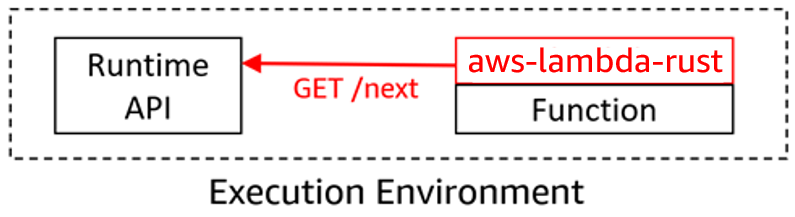
Your function code runs and then sends the function response back to the Lambda Runtime API, which forwards it onto the caller.
Before deploying the function, you can debug/test the function locally using cargo lambda.
cargo lambda watch sets up an environment that emulates the Lambda execution environment. This allows you to send requests to the Lambda function and see the results.
To send invocation requests, you can use either cargo lambda or send a curl request to the Lambda emulator.
To use cargo lambda, run the following, replace <lambda-function-name> with hi_api for this example
You can use any of the built-in example payloads with the --data-example parameter. Use --data-ascii <payload> to provide your own payload.
To invoke the function using curl, pass the JSON format payload to the local emulator’s address:
Once you have built the function using cargo lambda build, you can deploy it to your AWS account.
To deploy your function:
Once the Lambda function is deployed, you can test it remotely. cargo lambda invoke tests the remote Lambda function using a payload stored in a .json file:
You can create a serverless API in front of this Rust Lambda function using Amazon API Gateway. This example uses the AWS CDK. This example does not have authentication configured for the API Gateway endpoint as it is a sample. The AWS best practice is to implement relevant security controls where necessary.
The easiest way to deploy a Rust Lambda function using the AWS CDK is to use the cargo lambda CDK Construct. This comes with everything required to run Rust Lambda functions on AWS. It is part of the cargo lambda project.
When prompted for Is this function an HTTP function?, enter y.
lib/rusty_cdk-stack.ts to include both the Lambda function and API Gateway.
To test your deployed API using the URL provided in the AWS CDK output:
To avoid ongoing charges, remove the deployed resources:
AWS Lambda support for Rust is now Generally Available to build high-performance, memory-efficient serverless applications. Cargo Lambda is a third-party extension to the Rust cargo CLI which simplifies the experience of developing, testing, and deploying Rust applications to Lambda.
To learn more about building serverless applications with Rust:
To find more Rust code examples, use the Serverless Patterns Collection. For more serverless learning resources, visit Serverless Land.
Post Syndicated from Brendan Watters original https://www.rapid7.com/blog/post/pt-metasploit-wrap-up-11-14-2025

This week’s release features the much-hyped CVE-2025-59287, a Critical-Severity Windows Server Update Service (WSUS) vulnerability that allows for SYSTEM level remote code execution. Documented among the multiple recent zero-days in Windows, the vulnerability affects Windows Servers running the WSUS service, which is not enabled by default. Several vendors, including Huntress and Eye Security have reported seeing the exploit used in the wild, and the Cybersecurity and Infrastructure Security Agency (CISA) ordered US government agencies to patch affected machines last month.
Authors: msutovsky-r7 and mwulftange
Type: Exploit
Pull request: #20674 contributed by msutovsky-r7
Path: windows/http/wsus_deserialization_rce
AttackerKB reference: CVE-2025-59287
Description: Adds a module targeting CVE-2025-59287, an unauthenticated deserialization vulnerability in the Windows Server Update Service (WSUS) resulting in remote code execution as SYSTEM
You can find the latest Metasploit documentation on our docsite at docs.metasploit.com.
As always, you can update to the latest Metasploit Framework with msfupdate and you can get more details on the changes since the last blog post from GitHub:
If you are a git user, you can clone the Metasploit Framework repo (master branch) for the latest. To install fresh without using git, you can use the open-source-only Nightly Installers or the commercial edition Metasploit Pro
Post Syndicated from Philip Whiteside original https://aws.amazon.com/blogs/compute/handle-unpredictable-processing-times-with-operational-consistency-when-integrating-asynchronous-aws-services-with-an-aws-step-functions-state-machine/
Integrating asynchronous AWS services with an AWS Step Functions state machine, presents a challenge when building serverless applications on Amazon Web Services (AWS). Services such as Amazon Translate, Amazon Macie, and Amazon Bedrock Data Automation (BDA) excel at handling long-running operations that can take more than 10 minutes to complete because of their asynchronous nature. Asynchronous services return an immediate 200 OK response, indicating that the request has succeeded, upon job submission (see the API response syntax of StartTextTranslationJob in Amazon Translate, CreateClassificationJob in Macie, and InvokeDataAutomationAsync in BDA), rather than waiting for the actual task completion and results.
In this post, we explore using AWS Step Function state machine with asynchronous AWS services, look at some scenarios where the processing time can be unpredictable, explain when traditional solutions such as polling (periodically check) fall short, and demonstrate how to implement a generalized callback pattern to handle asynchronous operations into a more manageable synchronous flow. We cover the related architecture, technical implementation, and best practices, and we provide a real-world examples that uses the AWS Cloud Development Kit (AWS CDK). Services used in this generalized callback pattern include Amazon DynamoDB, Amazon EventBridge and AWS Step Functions.
Asynchronous operations are designed to handle long-running operations without blocking resources, a design followed by many AWS services. However, these services create challenges in Step Functions workflows by returning immediate 200 OK responses rather than confirming task completion. This breaks the Step Functions execution model, which expects each step to be complete before advancing. Developers often attempt to address this issue through polling loops to repeatedly check the status of operations, an approach that works for containerized applications and Amazon Elastic Compute Cloud (Amazon EC2). For these services, compute resources are already provisioned, but compute resources become problematic in serverless architectures when AWS Lambda functions have a 15-minute execution limit, making them unsuitable for long-running polls.
Step Functions supports Run a Job (.sync) to call a service and have Step Functions wait for a job to complete, but this works only for selected optimized integrations. However, this functionality is limited to specific AWS services such as AWS Glue. Amazon Translate, Macie, and other services are not optimized integrations. If your operation is not listed as working with .sync, it can benefit from the generalized callback pattern covered in this post.
For these non-optimized integrations, an option is to use polling (periodically check). However, polling can lead to additional latency in response because polling times are unlikely to align with job completion. This is shown in the following figure.
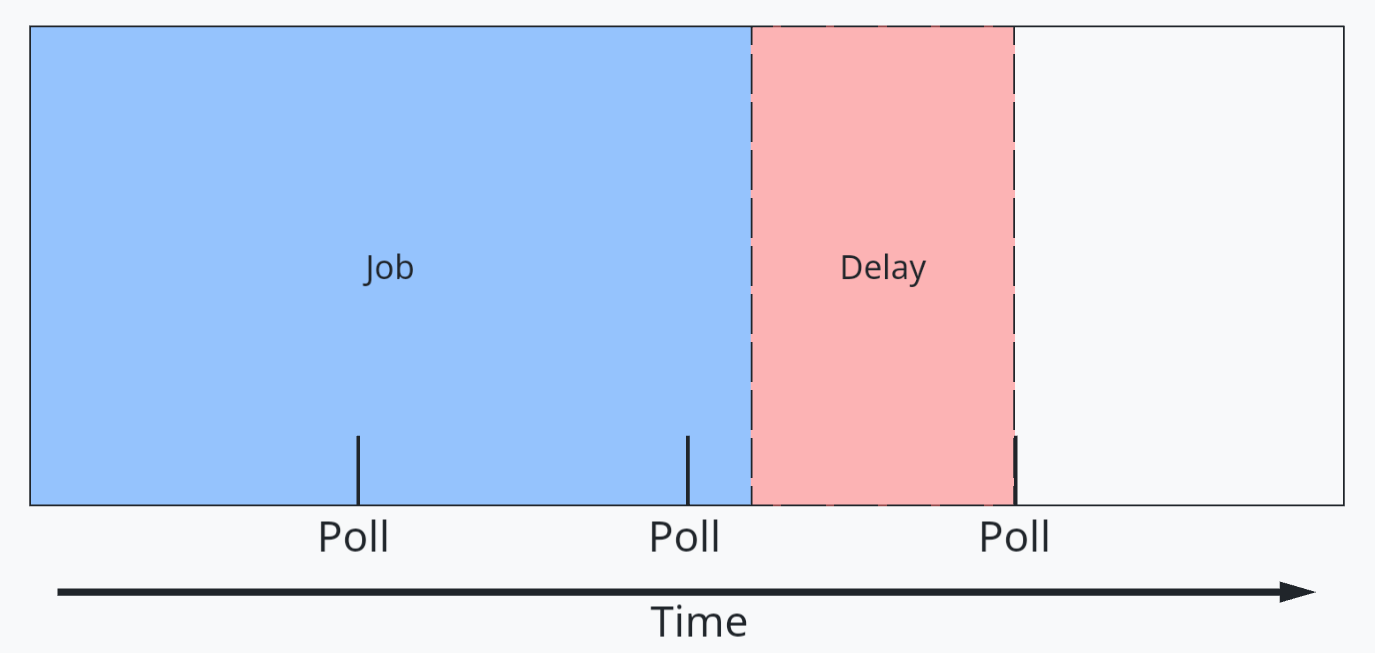
Figure 1: A job processing and delay timeline diagram
The Step Functions generalized callback pattern can solve this latency issue by pausing execution for up to one year while waiting for task completion (this does not incur additional cost). When such an asynchronous operation finishes, a callback mechanism resumes the workflow where it left off. This generalized callback pattern transforms asynchronous operations into synchronous ones, and it maintains cost efficiency and operational agility.
To help us see where this generalized callback pattern could be applied, let’s look at a few scenarios. Each of these scenarios makes use of AWS Step Functions state machines to run the applications’ workflows.
Organizations must manage personally identifiable information (PII) when translating documents because PII can be duplicated across language outputs. For example, when translating a document containing “Jane Doe,” that name appears in both the original and translated versions, creating multiple instances of sensitive data that need compliance measures. Amazon Translate batch translation has a default concurrency of 10, meaning that translations could take more than 10 minutes or be queued for longer periods. Additionally, the Amazon Translate batch translation operation is asynchronous, holding the translation request in a queue until completed. The generalized callback pattern in this post makes sure that Step Functions state machine workflows resume appropriately to apply consistent PII handling across all outputs. In this scenario the design makes use of tagging Amazon Simple Storage Service (Amazon S3) files as containing PII or not, which in turn associates S3 lifecycle policies for specific retention periods to those S3 objects.
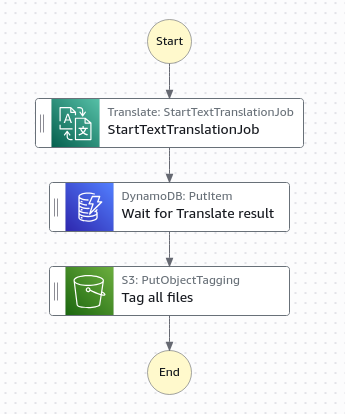
Figure 2: A text translation workflow diagram
Continuing from scenario 1, Macie and Amazon Translate can run in parallel (each approximately 10 minutes) rather than sequentially (approximately 20 minutes) for a better user experience. Similarly to Amazon Translate batch translation operations being asynchronous, the Macie create classification operation is also asynchronous. Step Functions state machines enable concurrent execution of both service requests. The generalized callback pattern enables the state machine to pause each parallel workflow and resume only when the asynchronous services have completed their jobs. Without this pattern, both services would immediately return 200 OK responses, causing the workflow to continue prematurely before translations or classification results are available. If the classification results are not available later in the workflow, then the appropriate PII tags will not be applied and therefore the appropriate lifecycle retention policy will also not be applied, resulting in not adhering to PII handling practices.
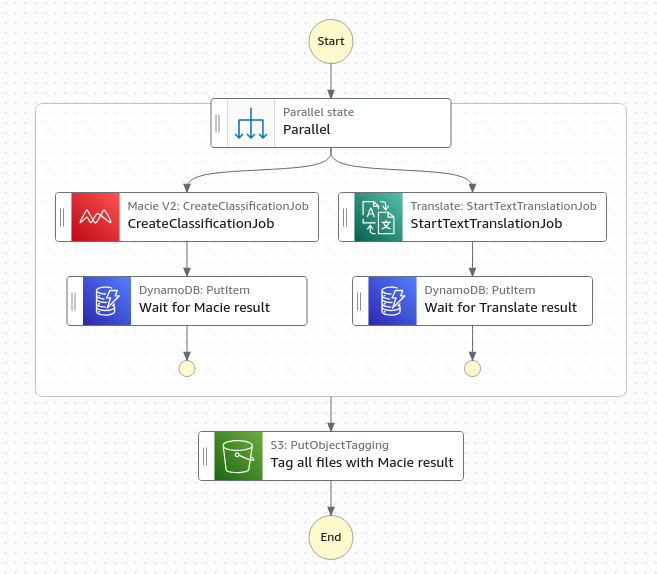
Figure 3: A parallel classification and translation workflow diagram
Organizations that use Bedrock Data Automation for intelligent document processing must take into consideration Regional concurrency limits. BDA has Regional concurrency limits “Max number of concurrent jobs” of 25 jobs in the us-east-1 and us-west-2 Regions. Also, BDA has a concurrency limit of only five jobs in other supported Regions, so large document batches could be queued for extended periods resulting in long processing wait times for the user. This service functionality is handled asynchronously as the duration of the request could be many minutes. The generalized callback pattern makes sure that workflows resume appropriately as soon as a job finishes rather than waiting an arbitrary time to check if the job has been completed. For example, the generalized callback pattern for BDA can be used to enhance the solution outlined in the blog post, Scalable intelligent document processing using Amazon Bedrock Data Automation.
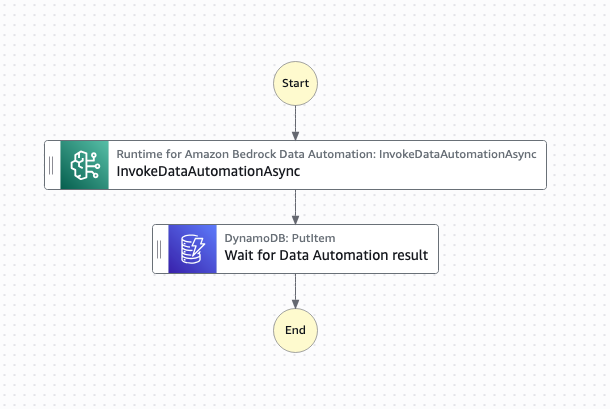
Figure 4: A data automation workflow diagram
The following architecture diagram shows the generalized callback pattern (the blue section on the right side) integrated with your existing application (the grey section on the left side).
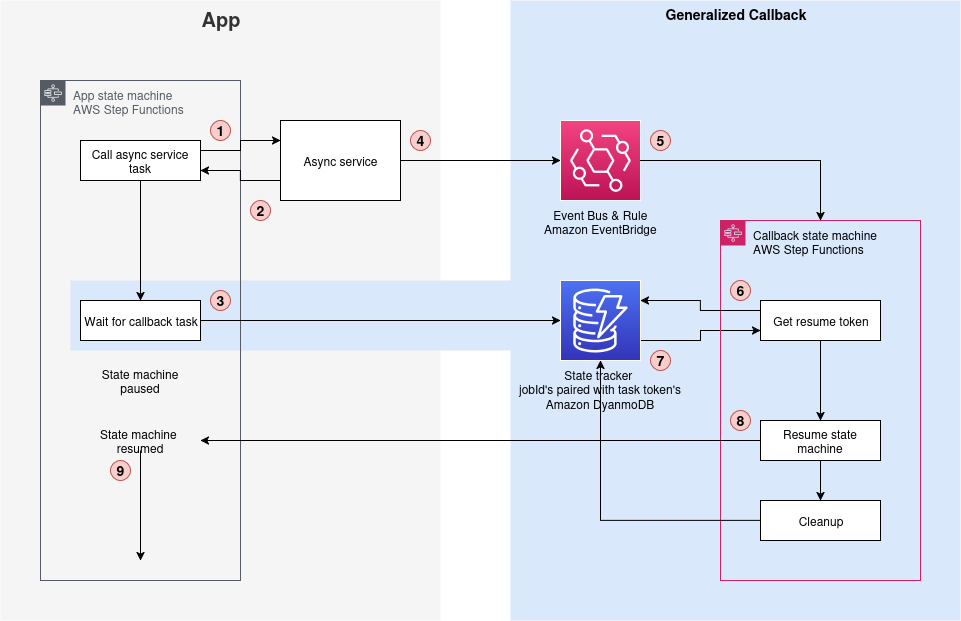
Figure 5: The Step Functions generalized callback architecture
This generalized callback pattern architecture consists of four essential components working together. Each component plays a specific role while maintaining cost efficiency and operational reliability. The following components form the foundation of this pattern:
This generalized callback pattern operates through a coordinated sequence of four key steps. Each step builds upon the previous one. The following process demonstrates how the pattern manages workflow execution. The diagram above shows more detailed steps following these key steps.
{
    id    = translationJobId,
    token = stepFunctionTaskToken
}{
jobId = translationJobId,
status = complete
}
Not every service creates events for every action, so validate that your service operation generates the expected events. For example, Macie does not create events when no findings are discovered. In these cases, implement more event generation mechanisms through Amazon CloudWatch Logs subscriptions that trigger Lambda functions to create custom events.
For rapid deployment of this post’s solution, AWS CDK users can use this sample CDK pattern with all key components. Alternatively, you can implement the individual components yourself by using the following steps, with each component customizable to your requirements.
Some of the JSON-based snippets below are Amazon States Language (ASL) snippets, which is the language that defines an AWS Step Functions state machine. State machines can be built in the AWS Console using the drag and drop visual builder, or with ASL. The visual builder generates this ASL and you can toggle to view/edit the workflow code (ASL).
Use a Step Functions task that supports ”WaitForCallback” to store the task token in DynamoDB alongside the job ID from the asynchronous service.
AWS services generate a unique ID for that service which refers to that job/request/action. DynamoDB holds the mappings between job IDs and task tokens, supporting multiple state machines paused in parallel with concurrent execution. To prevent clashes when different asynchronous services generate overlapping IDs (for example, if Service A and Service B both generate ID “12345”), use separate DynamoDB tables for each service to maintain ID uniqueness. The sample AWS CDK pattern demonstrates this approach by providing dedicated DynamoDB tables and Step Functions state machines for each service integration. This ID-token structure allows for quick lookups for workflow resumption and cleanup.
The following ASL accomplishes this by using a DynamoDB PutItem task:
"DynamoDB PutItem": {
    "Type": "Task",
    "Resource": "arn:aws:states:::dynamodb:putItem",
    "Parameters": {
        "TableName": "resumeTokenSessionTable",
        "Item": {
            "id":    { "S.$": "$.JobId" },
            "token": { "S.$": "$$.Task.Token" },
            "ttl":   { "S.$": "$.ttl" }
        },
        "ConditionExpression": "attribute_not_exists(id)"
    },
    "Next": "XXXX"
}
In this example, the Item object stores three values: the job ID ($.JobId), the task token ($$.Task.Token), and a TTL value ($.ttl). The ttl field configures Time to Live for automatic cleanup based on your service’s expected completion time. Since this stores only three small string values, data usage per entry is minimal. The primary consideration is the number of concurrent operations, as each active asynchronous job requires one DynamoDB entry until completion or TTL expiration.
The DynamoDB table uses “id” as the primary key and includes a “token” attribute. These fields are essential for the “WaitForCallback” pattern: the “id” (job ID) allows your asynchronous service to look up the correct entry, while the “token” (Step Functions task token) is what your service sends back to Step Functions to resume the paused workflow. The following JSON shows an example of these values:
{
    "id":    { "S": "xxxxxxxx-yyyy-zzzz-aaaa-bbbbbbbbbbbb" },
    "token": { "S": "11111111-2222-3333-4444-555555555555" },
    "ttl":   { "S": "1480550400" }
}
When your asynchronous service completes its work, it retrieves the task token using the job ID, then calls Step Functions with that token to resume execution from where it paused.
The task token acts as a unique identifier for resuming execution at the exact pause point. To prevent overriding an existing record when a duplicate id is used, you can specify a “ConditionExpression”. This ASL shows just the ConditionExpression.
“ConditionExpression”: “attribute_not_exists(id)”EventBridge integration forms the heart of the event-driven resumption mechanism. You can create EventBridge rules to monitor specific event patterns from asynchronous AWS services. Most AWS services automatically publish completion events to default EventBridge at no cost, and you can use the EventBridge rule wizard to identify correct event patterns. For services that do not publish events—such as Macie that creates no events when no findings are discovered—implement shims by using Amazon CloudWatch Logs to trigger Lambda functions that generate custom events. This JSON shows the EventBridge Rule pattern definition.
"EventPattern": {
    "source": [
        "aws.translate"
    ],
    "detail-type": [
        "Translate TextTranslationJob State Change"
    ],
    "detail": {
        "jobStatus": [
            "COMPLETED"
        ],
    }
}At this point, you know the operation has completed, so you can safely resume the workflow. Using the job ID, call the DynamoDB GetItem operation to receive the task token. This ASL shows the task definition to get the task token for a given job ID retrieved from the event notification.
"getResumeToken": {
    "Next": "sendTaskSuccess",
    "Type": "Task",
    "ResultPath": "$.getResumeToken",
    "Resource": "arn:aws:states:::dynamodb:getItem",
    "Parameters": {
        "Key": {
            "id": { "S.$": "$.id" }
        },
        "TableName": "resumeTokenSessionTable"
    }
}
Use the task token to resume the workflow and then delete the DynamoDB entry for cleanup. This ASL shows the task definition to use the task token to resume the state machine at the point where it was paused at.
"sendTaskSuccess": {
    "Next": "deleteResumeToken",
    "Type": "Task",
    "ResultPath": "$.sendTaskSuccess",
    "Resource": "arn:aws:states:::aws-sdk:sfn:sendTaskSuccess",
    "Parameters": {
        "TaskToken.$": "$.getResumeToken.Item.token.S",
        "Output": {
            "status": "resume"
        }
    }
}
This ASL shows the task definition to clean up the DynamoDB to remove the used task token.
"deleteResumeToken": {
    "End": true,
    "Type": "Task",
    "Resource": "arn:aws:states:::dynamodb:deleteItem",
    "Parameters": {
        "Key": {
            "id": { "S.$": "$.id" }
        },
        "TableName": "resumeTokenSessionTable"
    }
}
This completes the technical implementation of our solution. With all components in place—the WaitForCallback task, EventBridge rules, workflow resumption logic, and DynamoDB storage—you now have a fully functional generalized callback pattern implementation that eliminates polling and efficiently manages asynchronous operations.
Now that we’ve established how to implement the generalized callback pattern technically, let’s explore the best practices and important considerations that will help you optimize and secure your implementation.
When implementing the generalized callback pattern in AWS Step Functions, it’s essential to understand and apply best practices that optimize costs, enhance security, and ensure efficient operation. This section outlines key considerations and recommendations for implementing the pattern effectively, focusing on cost optimization strategies and security measures that help maintain a robust and secure serverless workflow. By following these guidelines, you can maximise the benefits of the generalized callback pattern while minimising potential risks and unnecessary expenses.
Managing costs for long-running asynchronous operations can present challenges. Traditional polling accumulates unnecessary expenses through repeated state transitions and execution time, but this post’s generalized callback pattern is an event-driven approach that significantly reduces operational costs.
The generalized callback pattern reduces costs by eliminating polling transitions and pausing execution during wait periods. For standard workflows billed at $0.000025 per state transition, using just two transitions instead of continuous polling achieves approximately an 87% cost reduction. A 15-minute translation job polling every minute would need 15 transitions as opposed to two with the generalized callback pattern. For express workflows billed at $0.000001 per request and $0.00001667 per GB-second, the pattern delivers significant savings through reduced request count and minimal execution time. Traditional polling keeps workflows active during the entire operation, accumulating execution time charges. By contrast, the generalized callback pattern eliminates execution time charges during the wait period. In the translation job example mentioned previously in this paragraph, this could reduce the execution time from more than 15 minutes to just the seconds needed to start jobs and complete processes.
The callback pattern increases resource efficiency by removing constant polling, resulting in substantial reduction in CloudWatch logging and associated monitoring costs. This creates a more cost-effective solution with a reduced AWS resource footprint.
Enhance cost efficiency through DynamoDB optimizations. Choose on-demand mode for unpredictable workloads or provisioned mode with auto scaling for consistent patterns, configure auto scaling settings based on usage, and implement TTL to automatically remove expired items without consuming write capacity.
The callback pattern involves storing task tokens, processing events, and managing workflow resumption across multiple AWS services. Implementing proper access controls is essential to protect the integrity of your workflows and prevent unauthorized access or manipulation of the pattern’s components.
This section outlines the security considerations for the callback pattern, focusing on access controls for data storage and event processing.
Enable DynamoDB encryption at rest by using AWS owned or user managed AWS Key Management Service (AWS KMS) keys. Implement identity-based policies by defining the Step Functions AWS Identity and Access Management (IAM) role actions (such as PutItem, GetItem, and DeleteItem) and resource-based policies that specify which IAM principals can access the table. Together, these help ensure that only authorized state machines access token storage and operations are limited to minimum permissions. Also, configure TTL to automatically remove expired tokens so that these tokens do not accidentally get reused, which can result in errors with resuming the relevant AWS Step Function workflows.
Scope EventBridge rules precisely to match only specific necessary events. For Amazon Translate job completion, rules should explicitly match only translation job completion events, thus preventing unauthorized triggers. IAM roles should follow least-privilege principles so that only specific actions can cause workflows to resume.
The callback pattern presented in this post provides a solution for managing long-running asynchronous operations in serverless architectures. You can use the Step Functions “Wait for Callback” task state with EventBridge and DynamoDB to transform asynchronous services into synchronous workflows without the overhead of polling. This pattern reduces costs, improves efficiency through event-driven architecture, and maintains security through proper access controls. You can use the provided CDK implementation to implement this pattern and adapt it to your specific needs while following recommended security and cost optimization practices.
 Maria John is a Senior Solutions Architect at Amazon Web Services, helping customers build solutions on AWS.
 Philip Whiteside is a Senior Solutions Architect at Amazon Web Services. Philip is passionate about overcoming barriers by utilizing technology.
Post Syndicated from Lefteris Karageorgiou original https://aws.amazon.com/blogs/compute/aws-lambda-now-supports-java-25/
You can now develop AWS Lambda functions using Java 25 either as a managed runtime or using the container base image. Java 25 support for Lambda is based on the Amazon Corretto distribution of OpenJDK and is now generally available.
Java 25 comes with new language features for developers, including primitive types in patterns, module import declarations, and flexible constructor bodies, as well as generational support to the Shenandoah garbage collector. There are Lambda runtime changes to optimize cold starts by using the new Java Ahead-of-Time (AOT) caches feature. This release also includes updates to the default tiered compilation for SnapStart and Provisioned Concurrency, and removes the Log4Shell patch. With this release, Java developers can take advantage of these new features and enhancements when creating serverless applications on Lambda.
You can develop Java 25 Lambda functions using the AWS Management Console, AWS Command Line Interface (AWS CLI), AWS SDK for JavaScript, AWS Serverless Application Model (AWS SAM), AWS Cloud Development Kit (AWS CDK), and other infrastructure as code tools. You can also use Java 25 with Powertools for AWS Lambda (Java), a developer toolkit to implement serverless best practices and increase developer velocity. Powertools for AWS Lambda includes libraries to support common tasks such as observability, AWS Systems Manager Parameter Store integration, idempotency, batch processing, and more.
This blog post highlights notable Java language features, Java Lambda runtime updates, and how you can use the new Java 25 runtime in your serverless applications.
Java 25 introduces several language features to enhance developer productivity. There is a new feature that allows statements to appear before an explicit constructor invocation. You can now write code in the constructors without having to invoke super(…) or this(…) as the first statement. In the following example, the Employee class has a constructor which validates the input first and then invokes super(...):
Java 25 supports pattern matching that can handle primitive types in switch and instanceof statements. Previously, pattern matching was limited to reference types (Objects). For example, you can now perform pattern matching with int values, not just Integer objects:
Module import declarations simplifies working with. Instead of writing multiple individual package imports from the same module, you can use the import module syntax to bring publicly exported types into scope. This reduces boilerplate code and makes it easier to work with modular applications. Previously if you used the java.net.http module, you had to import multiple classes with individual import statements:
Now you can import the whole java.net.http module:
The generational mode of the Shenandoah garbage collector changes from an experimental feature in Java 24 to an optional product feature. Shenandoah is the low pause time garbage collector that reduces pause times by performing more garbage collection work concurrently with the running Java program. Shenandoah does the bulk of GC work concurrently, including the concurrent compaction, which means its pause times are no longer directly proportional to the size of the heap. The generational mode of Shenandoah improves sustainable throughput, load-spike resilience, and memory utilization.
To use the generational model of Shenandoah in Lambda, set JAVA_TOOL_OPTIONS to -XX:+UseShenandoahGC -XX:ShenandoahGCMode=generational.
The Java 25 runtime includes several performance optimizations, tuned to optimize cold and warm start performance for a broad range of customer workloads. Cold start refers to the initialization delay that occurs when Lambda prepares a new execution environment for a function that hasn’t been invoked recently, or to process an incoming invoke when all existing execution environments are in use. Warm start refers to invokes that are allocated to a previously initialized execution environment.
Starting with Java 25, AWS Lambda replaces the traditional Class Data Sharing (CDS) with ahead-of-time (AOT) caches. This is an advanced optimization feature from Project Leyden that is designed to improve application startup times and reduce memory footprint. Lambda’s benchmarking results show that AOT caches deliver faster cold start performance compared to CDS.
AOT caches are enabled by default to provide performance benefits. Since you cannot use both AOT caches and CDS, if you enable CDS in your Lambda function, then Lambda disables AOT caches. If you use your own custom AOT caches in the Java 25 managed runtime, then the caches may be invalidated when Lambda updates the Java runtime during routine patching. AWS strongly suggests that you don’t use custom AOT caches with managed runtimes.
If you deploy Java 25 functions using container images, you can either implement your own AOT caches or continue using CDS. Since container images are immutable, the issue of AOT caches being invalidated following automatic runtime patching does not arise. To enable AOT caches, pass the flag -XX:AOTCache=/path/to/aot/cache/file via the JAVA_TOOL_OPTIONS environment variable. To enable CDS, pass the flag -Xshare:on -XX:SharedArchiveFile=/var/lang/lib/server/runtime.jsa.
Java’s tiered compilation is a just-in-time (JIT) optimization strategy that employs multiple compiler tiers to enhance the performance of frequently executed code progressively using runtime profiling data. Since Java 17, AWS Lambda has modified the default JVM behavior by stopping compilation at the C1 tier (client compiler). This minimizes cold start times for function invocations for most functions, although for compute-intensive functions with a long duration, customers can benefit from tuning tiered compilation to their workload. Starting with Java 25, Lambda no longer stops tiered compilation at C1 for SnapStart and Provisioned Concurrency. This improves performance in these cases without incurring a cold start penalty since tiered compilation occurs outside of the invoke path in these cases.
Priming is another technique to optimize performance for functions using either SnapStart or Provisioned Concurrency. This involves preloading dependencies, initializing resources, and executing code paths during function initialization. This front-loads work and triggers JIT compilation before taking the SnapStart snapshot, or when Provisioned Concurrency execution environments are pre-provisioned. The result is faster code execution when these execution environments are used for a function warm invoke. For detailed guidance on implementing priming strategies, see the Optimizing cold start performance of AWS Lambda using advanced priming strategies with SnapStart blog post.
Log4j is a widely used open source logging library maintained by the Apache Software Foundation. In November 2021, Log4j reported Log4Shell, a zero-day vulnerability involving arbitrary code execution. The Lambda team responded by deploying an emergency patch across all Java runtimes to protect customers from potential exploitation. However, this emergency patch introduced a performance overhead during cold starts. The vulnerability was permanently resolved in Log4j version 2.17.0 in December 2021. Consequently, AWS has removed this patch from the Java 25 runtime to restore optimal performance. You must verify you are using Log4j version 2.17.0 or later.
Lambda runtimes for Java 8, 11, 17, and 21 continue to enable the emergency patch by default. Customers who are using Log4j version 2.17.0 or higher with these runtimes can disable this patch, improving cold start performance. To disable the patch, set the AWS_LAMBDA_DISABLE_CVE_2021_44228_PROTECTION environment variable to true.
At launch, new Lambda runtimes receive less usage than existing, established runtimes. This can result in longer cold start times due to reduced cache residency within internal Lambda sub-systems. Cold start times typically improve in the weeks following launch as usage increases. As a result, AWS recommends not drawing conclusions from side-by-side performance comparisons with other Lambda runtimes until the performance has stabilized.
Since performance is highly dependent on workload, customers with performance-sensitive workloads should conduct their own testing instead of relying on generic test benchmarks. To maximize performance, your workload may benefit from additional workload-specific performance tuning.
You can use Java 25 for your Lambda functions in the AWS Management Console, an AWS Lambda container image, AWS SAM, or the AWS CDK.
To use the Java 25 runtime to develop your Lambda functions, specify a runtime parameter value Java 25 when creating or updating a function. The Java 25 runtime version is now available in the Runtime dropdown menu on the Create function page in the AWS Lambda console:
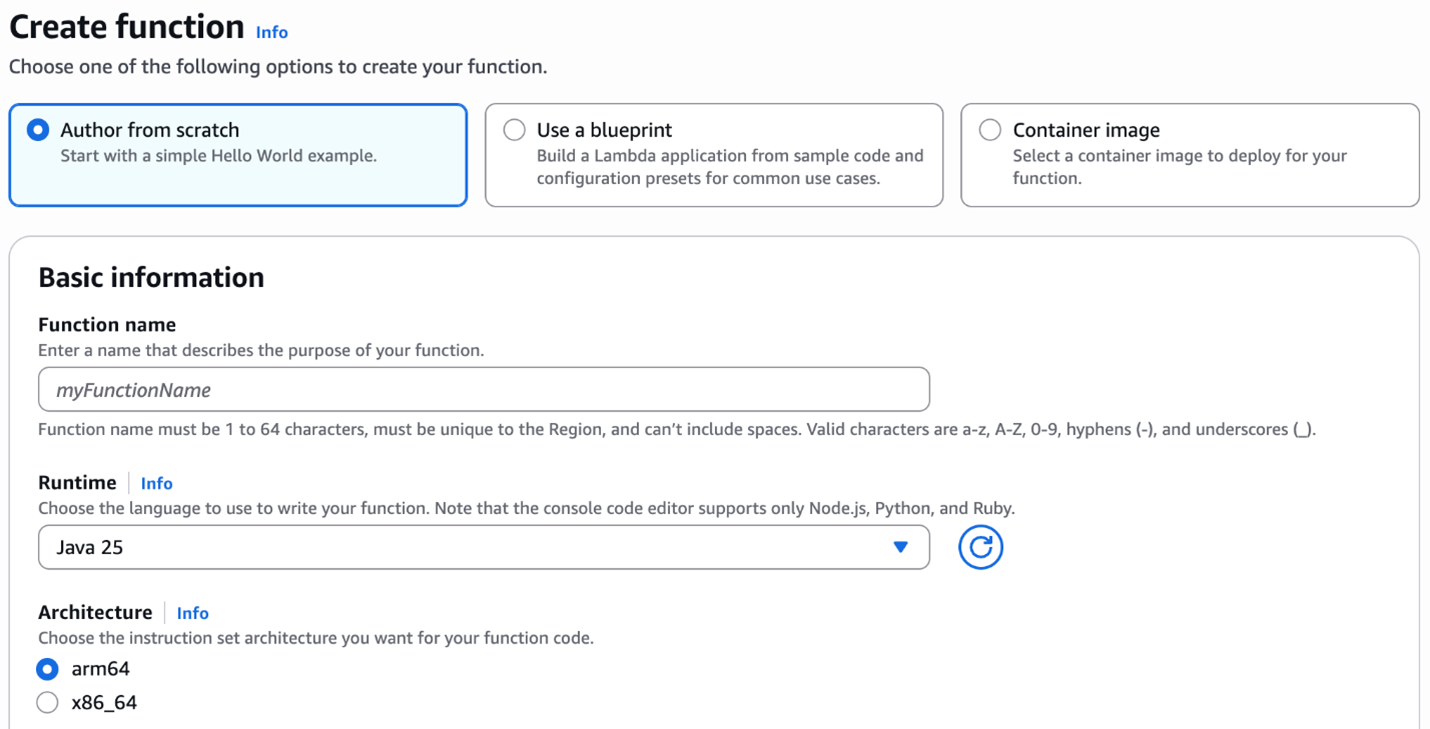
Creating Java 25 function in AWS Management Console
To update an existing Lambda function to Java 25, navigate to the function in the Lambda console, then choose Java 25 in the Runtime settings section. The new version is available in the Runtime dropdown menu:
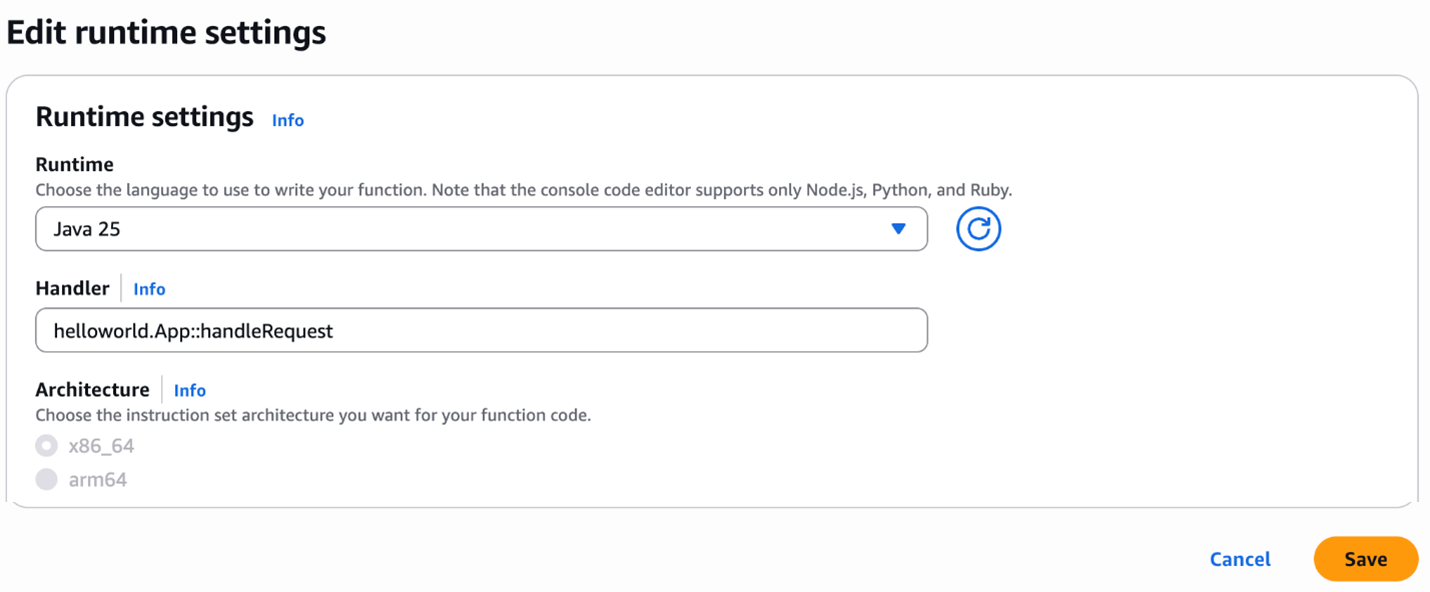
Changing a function to Java 25
Use the Java base image version with the java:25 tag by modifying the FROM statement in your Dockerfile.
Example Dockerfile:
To build a container image for a Java Lambda function, refer to the AWS Lambda documentation.
In AWS SAM, set the Runtime attribute to java25 to use this version:
AWS SAM supports generating this template with Java 25 for new serverless applications using the sam init command. Refer to the AWS SAM documentation.
In the AWS CDK, set the runtime attribute to Runtime.JAVA_25 to use this version.
Lambda now supports Java 25 as a managed language runtime or with your own custom runtime. This release includes the latest Java 25 language features as well as performance enhancements optimized for Lambda workloads.
You can build and deploy functions using Java 25 using the AWS Management Console, AWS CLI, AWS SDK, AWS SAM, AWS CDK, or your choice of infrastructure as code tool. You can also use the Java container base image with the 25 tag if you prefer to build and deploy your functions using container images.
The Java 25 runtime helps developers build more efficient, powerful, and scalable serverless applications. Read about the Java programming model in the Lambda documentation to learn more about writing functions in Java 25.
To find more Java examples, use the Serverless Patterns Collection. For more serverless learning resources, visit Serverless Land.
Post Syndicated from Rahul Sahni original https://aws.amazon.com/blogs/security/aws-reinvent-2025-your-guide-to-security-sessions-across-four-transformative-themes/
AWS re:Invent 2025, the premier cloud computing conference hosted by Amazon Web Services (AWS), returns to Las Vegas, Nevada, December 1–5, 2025. At AWS, security is our top priority, and re:Invent 2025 reflects this commitment with our most comprehensive security track to date. With more than 80 security aligned sessions spanning breakouts, workshops, chalk talks, and hands-on builders’ sessions, we’re bringing together the brightest minds to share insights, best practices, and innovative solutions. For security professionals, developers, and cloud architects, the event offers valuable insights into the latest security innovations at AWS, advanced threat protection capabilities, and defense strategies that scale. While attending re:Invent, you can visit the Security kiosk and AI Security kiosk at the expo hall to engage directly with AWS security experts about your specific needs.
The security track session selection process was driven by our extensive analysis of customer needs and real-world implementation challenges. We specifically focused on security areas where customers seek the most guidance and coalesced the sessions around four major themes: Securing and Leveraging AI, Architecting Security and Identity at scale, Building and scaling a Culture of Security, and Innovations in AWS Security. Our goal with the sessions is to address immediate security challenges and help you achieve broader business outcomes. In the following sections, we highlight a few key sessions in each of the four themes. You can visit the re:Invent catalog for a view of all sessions.
Securing and using AI emerges as a dominant theme for the Security and Identity track, reflecting both the opportunities and challenges AI presents. From protecting AI workloads to harnessing AI for enhanced security operations, sessions span multiple AI topics to help organizations navigate this transformative technology safely and effectively. Here are a few key sessions on each of the AI topics.
This theme is woven throughout the re:Invent 2025 security track, reflecting the belief that technological solutions alone cannot ensure robust security outcomes. Enterprises with a Culture of Security become security-first organizations, after which they can accelerate secure digital transformations. Some of the sessions that showcase this theme are:
This theme explores how you can use the comprehensive toolset and proven patterns provided by AWS to implement enterprise-grade security controls that scale from individual workloads to global organizations. Some key sessions on this theme include:
AWS innovation in security capabilities is designed to help organizations outpace evolving threats. From advanced threat detection powered by machine learning to revolutionary data protection mechanisms, these innovations demonstrate the AWS commitment to keeping customers secure in an evolving landscape. Some of the innovation-focused sessions are:
Don’t miss this opportunity to enhance your cloud security knowledge and connect with AWS security experts and industry peers. For a full view of the Security and Identity sessions, explore the AWS re:invent catalog where you can filter sessions by topic, areas of interest, role, and so on.
When you register, you’ll gain access to the session reservation system where you can reserve your seats. Popular security sessions, especially hands-on sessions, fill up quickly because of limited capacity, so we recommend reserving your preferred sessions as soon as scheduling opens. See you are re:Invent!
If you have feedback about this post, submit comments in the Comments section below.
Post Syndicated from Anitha Selvan original https://aws.amazon.com/blogs/architecture/know-before-you-go-aws-reinvent-2025-guide-to-well-architected-and-cloud-optimization-sessions/
Are you ready to maximize your Well-Architected and Cloud Optimization learning and networking time at re:Invent 2025? We have put together this comprehensive guide to help you plan your schedule and make the most of the Well-Architected and cloud optimization sessions available this year. These sessions will deliver the practical guidance your teams need to lead strategic cloud initiatives, design next-generation architectures, optimize costs, or secure AI-powered systems.
Key themes at re:Invent for Well-Architected and Cloud Optimization – You can expect to see the following themes at re:Invent 2025
The sessions in this theme showcase how AWS is integrating AI technologies to transform traditional architectural practices. From using AI services for automated Well-Architected reviews to implementing self-evolving systems with agentic AI, these sessions demonstrate how you can use AI to automate architectural decisions, streamline governance processes, and scale best practices across the enterprise.
Sessions: ARC324-R, ARC317-R, SPS320, ARC302-R (session details are posted in the following section)
These sessions highlight how the AWS Well-Architected Framework has evolved beyond its original scope to address modern architectural challenges. Attendees will learn how to implement the framework principles across different domains—from IoT security to backup strategies—while focusing on enterprise-scale governance and compliance.
Sessions: ARC204, SEC337, STG313-R, ARC323-R (session details are posted in the following section)
The cost optimization track focuses on innovative approaches to cloud financial management, with a strong emphasis on AI-powered FinOps solutions. Sessions range from hands-on workshops like the Frugal Architect GameDay to chalk talks on establishing effective cost governance models.
Sessions: ARC318-R, COP309-R, ARC309, DEV318 (session details are posted in the following section)
This year’s catalog features an exciting mix of content across different formats: from breakout, chalk talks, workshops, builder sessions to code talks.
Sit back and enjoy these presentations to stay current with the latest solution enhancements and practical applications. AWS experts and guest speakers will share valuable insights and real-world examples.
From ideas to impact: Architecting with cloud best practices
ARC204 | Breakout session | December 1, 8:30 AM
Discover how foundational frameworks like the AWS Well-Architected Framework, AWS Cloud Adoption Framework, and AWS Cloud Operating Model evolved through customer feedback and real-world learnings from thousands of organizations, transforming from structured guidance into dynamic insights for optimizing cloud environments. Learn practical strategies for applying unified best practices to accelerate cloud transformation while managing large-scale architectural changes and maintaining operational excellence.
Build a well-architected foundation for scaling generative AI and agentic apps
AIM310 | Breakout session | December 1, 10:00 AM
Move beyond proof-of-concepts to build a production-ready foundation supporting all AI applications across your organization, addressing the critical transition from experimentation to enterprise-scale AI deployment. Navigate model access and management, tool discovery, memory and state handling, and observability at scale while building foundations that seamlessly integrate model access, orchestration workflows, agents, and tools with enterprise-grade governance controls.
AI-Powered Enterprise Architecture with ServiceNow & AWS
ARC337-S | Breakout session | December 2, 3:00 PM
Enterprises face a core challenge: translating architectural vision into resilient cloud reality. See how integrating ServiceNow’s Enterprise Architecture Workspace with the AWS Well-Architected Tool transforms traditional design processes. Through elegant “shift-left” methodologies, architects gain contextual insights that seamlessly blend enterprise modeling with cloud best practices. This presentation is brought to you by ServiceNow, an AWS Partner.
The AI revolution in customer support: Building predictive service systems
SPS315 | Breakout session | December 3, 5:30 PM
Discover how AWS is using generative AI to transform customer support from reactive to proactive. We’ll show how large language models and AI agents are improving customer satisfaction and efficiency. Topics include smart case routing, context-aware support, early problem detection, and responsible AI use. We’ll share real results and discuss balancing AI capabilities with human touch.
Optimize AWS Costs: Developer Tools and Techniques
DEV318 | Breakout session | December 1, 3:00 PM
As cloud applications grow in complexity, optimizing costs becomes crucial for developers. This session explores AWS native tools and coding practices that reduce expenses without compromising performance or scalability.
AWS speakers set the stage at the beginning of the talk and then open up for discussion. Bring your questions and dive deep into the topic with AWS experts and other customers.
Architecting agentic systems: Self-evolving patterns with AWS AI
ARC324-R | Chalk talk | December 2, 1:30 PM
Learn to architect self-evolving systems using agentic AI that align with AWS Well-Architected principles, exploring cutting-edge patterns for systems that adapt, heal, and optimize themselves autonomously while maintaining architectural integrity. Implement autonomous monitoring and self-healing capabilities with Amazon Bedrock Agents, design AI-driven security controls and automated recovery mechanisms and create systems that continuously adapt to workload patterns while maintaining reliability and performance standards.
Building Well-Architected agentic AI applications
ARC317-R/R1 | Chalk talk | December 2, 3:00 PM and December 4, 1:00 PM
Navigate generative AI agent development with robust architectural practices for security and compliance, focusing on proven patterns for building production-ready agentic AI applications that meet enterprise requirements. Design agent architectures with guardrails, monitoring systems, and access controls using the AWS Well-Architected Generative AI Lens while implementing governance patterns that ensure regulatory compliance and enable systems to scale from prototype to enterprise-wide deployment.
Using generative AI to automate architectural guidance
ARC315 | Chalk talk | December 1, 4:30 PM
Replace time-intensive manual processes with AI-powered systems that generate strategic recommendations, design principles, and best practices at scale while maintaining quality and consistency. Generate organization-specific design principles using AI analysis of architectural patterns, implement AI-driven guidance systems with effective quality control mechanisms, and build knowledge bases that feed AI-powered architectural guidance while maintaining human oversight and addressing ethical considerations.
Agentic architecting: From prototype to production-ready systems
ARC330-R/R1 | Chalk talk | December 2, 5:30PM and December 4, 2:30 PM
Transform prototypes into production-ready systems by incorporating security, monitoring, and CI/CD through agentic architecting, focusing on practical challenges of moving from experimental AI systems to production-grade architectures. Use AI agents to generate and optimize AWS CDK infrastructure and application code, implement automated security improvements and CI/CD pipeline creation, and maintain AWS Well-Architected principles while enabling teams to focus on business logic as AI handles infrastructure complexity.
AI-powered FinOps: Agent-based cloud cost management
ARC318-R/R1 | Chalk talk | December 1, 4:00 PM and December 3, 4:00 PM
Learn how intelligent agents tackle fragmented cost data and optimization processes in complex multi-account environments, moving beyond traditional FinOps approaches to autonomous, intelligent financial optimization. Architect solutions using Amazon OpenSearch Service for data aggregation and Amazon Bedrock for contextual reasoning to design secure, scalable FinOps solutions that continuously optimize costs while delivering measurable business outcomes.
Supercharge your well-architected reviews with AWS Generative AI
SPS320 | Chalk talk | December 3, 4:00 PM
Discover how Koch Industries revolutionized AWS Well-Architected reviews using generative AI, transforming weeks-long manual processes into automated, intelligent systems. Automate architectural assessments using Amazon Bedrock Knowledge Bases and Model Context Protocol (MCP) to scale best practice reviews and optimize workloads in minutes instead of days while achieving more comprehensive, consistent, and actionable recommendations through proven change management and organizational adoption strategies.
Architecting enterprise-scale governance beyond AWS Control Tower
ARC323-R/R1 | Chalk talk | December 3, 11:30 AM and December 4, 2:00PM
Discover advanced governance strategies that build upon AWS Control Tower for enterprise-scale environments requiring sophisticated compliance, security, and operational controls. Implement infrastructure across six Well-Architected Foundations capabilities with critical trade-off understanding, build efficient multi-account structures balancing security requirements with innovation needs, and architect automated compliance checks and policy enforcement at scale while enabling self-service capabilities with centralized governance and security controls.
Securing IoT Workloads with AWS IoT Lens and AWS Security Reference Architecture
SEC337 | Chalk talk | December 3, 11:30 AM
Industrial environments are reaching new levels of connectivity, automation, efficiency, and real-time data insights. However, this increased connectivity also introduces significant security challenges. Unaddressed security concerns can expose vulnerabilities and slow down companies looking to accelerate digital transformation using IoT and cloud. This chalk talk explores relevant techniques, architecture patterns, best practices and AWS security services for securing complex OT/IT environments, IoT devices, edge and cloud using the AWS Well-Architected IoT Lens and AWS Security Reference Architecture (SRA).
Establishing effective cost governance
COP309-R/R1 | Chalk talk | December 3, 3:00 PM and December 4, 12:30 PM
Generative AI agent development demands robust architectural practices for security and compliance. This chalk talk explores proven patterns for architecting secure, efficient AI agents using the AWS Well-Architected Generative AI Lens. Through collaborative discussion and whiteboarding, examine architectural governance and best practices for production environments. Learn to design agent architectures incorporating guardrails, monitoring systems, access controls, and sustainable deployment practices. Gain actionable insights for building secure, efficient, and cost-effective agentic AI applications that scale.
Break down monoliths, modernizing applications on Amazon ECS
CNS346 | Chalk talk | December 2, 4:30 PM
Join this interactive chalk talk to solve a common challenge where monolithic applications take months to deploy new features, and scaling becomes increasingly difficult. We’ll start with a real scenario, an application running on servers with a shared database. Together, we’ll design the modernization path using Amazon ECS and Well-Architected Framework principles. You’ll explore common architecture patterns, containerization strategies, CI/CD automation, and blue/green deployment approaches for ECS. After this session, you’ll walk away with a practical roadmap to transform your monolithic application into scalable microservices. Bring your curiosity and help us build the architecture live.
AWS speakers will introduce the use-case and tools designed to tackle the challenge. You will follow instructions, complete the tasks, and walk away with better understanding of the capabilities.
AI-powered Well-Architected reviews: Building automated governance
ARC302-R | Builders’ session | December 1, 9:00 AM; December 2, 11:30 AM and December 3, 4:00 PM
Build intelligent systems that automate AWS Well-Architected Framework reviews using generative AI, transforming manual architectural assessments into continuous, intelligent governance processes. Evaluate architecture against Well-Architected pillars while incorporating organization-specific requirements, implement continuous analysis of architecture and infrastructure as code templates, and enhance AI understanding of architectural context using Model Context Protocol servers to transform time-intensive reviews into scalable, automated processes with consistent governance.
AI-powered troubleshooting: From chaos to Well-Architected
ARC301-R | Builders’ session | December 1, 8:30 AM; December 2, 3:00 PM and December 3, 10:00 AM
Tackle complex scenarios using AI-powered tools to diagnose and resolve architectural problems, gaining practical experience using AI to transform poorly designed systems into well-architected solutions. Troubleshoot and optimize architectures with scaling bottlenecks and database inefficiencies using Amazon Q, apply Well-Architected principles to enhance performance and security under pressure, and accelerate problem identification and resolution while building AWS optimization expertise and learning to identify architectural anti-patterns before they become critical issues.
The Frugal Architect GameDay: Building cost-aware architectures
ARC309 | Workshop | December 1, 8:00 AM
Compete to implement cost efficiency improvements across multiple AWS services in this interactive GameDay, applying the Laws of the Frugal Architect to real-world scenarios for practical experience in transforming high-cost infrastructure into efficient, sustainable architectures. Address challenges spanning compute, networking, storage, serverless, and observability domains while learning to reduce cloud unit costs and improve profitability without compromising service quality through gamified scenarios that build rapid cost optimization decision-making skills.
Optimize AWS Backup using AI evaluation and Well-Architected best practices
STG313-R | Builders’ session | December 2, 1:30 PM and December 3, 8:30 AM
Enhance AWS Backup implementation using the AWS Backup Evaluator Solution, an AI agent that synthesizes data from multiple sources to provide intelligent backup optimization recommendations. Assess backup environments against the Well-Architected AWS Backup lens using Strands Agents SDK, create unified visibility across backup landscapes to identify optimization opportunities, and implement AI agents that continuously monitor backup efficiency while aligning with AWS best practices to enhance efficiency and cost-effectiveness.
Important notes:
Session dates, times, and locations listed in the post are subject to change as we continue to optimize the schedule on session popularity and venue capacity. Please check this blog post and the re:Invent session catalog regularly for the most up-to-date information about your registered sessions and newly added activities. For a full view of Well-architected content, including sessions with partners, explore the AWS re:Invent catalog and filter on the Well-Architected Framework area of interest.
Remember to reserve your seats early as popular sessions fill up quickly and bring your laptop for hands-on builders’ sessions and workshops. Register today
Post Syndicated from Micah Walter original https://aws.amazon.com/blogs/aws/aws-lambda-enhances-sqs-processing-with-new-provisioned-mode-3x-faster-scaling-16x-higher-capacity/
Today, we’re announcing the general availability of provisioned mode for AWS Lambda with Amazon Simple Queue Service (Amazon SQS) Event Source Mapping (ESM), a new feature that customers can use to optimize the throughput of their event-driven applications by configuring dedicated polling resources. Using this new capability, which provides 3x faster scaling, and 16x higher concurrency, you can process events with lower latency, handle sudden traffic spikes more effectively, and maintain precise control over your event processing resources.
Modern applications increasingly rely on event-driven architectures where services communicate through events and messages. Amazon SQS is commonly used as an event source for Lambda functions, so developers can build loosely coupled, scalable applications. Although the SQS ESM automatically handles queue polling and function invocation, customers with stringent performance requirements have asked for more control over the polling behavior to handle spiky traffic patterns and maintain low processing latency.
Provisioned mode for SQS ESM addresses these needs by introducing event pollers, which are dedicated resources that remain ready to handle expected traffic patterns. These event pollers can auto scale up to 1000 per concurrent executions per minute, more than three times faster than before to handle sudden spikes in event traffic and provide up to 20,000 concurrency–16 times higher capacity to process millions of events with Lambda functions. This enhanced scaling behavior helps customers maintain predictable low latency even during traffic surges.
Enterprises across various industries, from financial services to gaming companies, are using AWS Lambda with Amazon SQS to process real-time events for their mission-critical applications. These organizations, which include some of the largest online gaming platforms and financial institutions, require consistent subsecond processing times for their event-driven workloads, particularly during periods of peak usage. Provisioned mode for SQS ESM is a capability you can use to meet your stringent performance requirements while maintaining cost controls.
Enhanced control and performance
With provisioned mode, you can configure both minimum and maximum numbers of event pollers for your SQS ESM. Each event poller represents a unit of compute that handles queue polling, event batching, and filtering before invoking Lambda functions. Each event poller can handle up to 1 MB/sec of throughput, up to 10 concurrent invokes, or up to 10 SQS polling API calls per second. By setting a minimum number of event pollers, you enable your application to maintain a baseline processing capacity that can immediately handle sudden traffic increases. We recommend that you set the minimum event pollers required to handle your known peak workload requirements. The optional maximum setting helps prevent overloading downstream systems by limiting the total processing throughput.
The new mode delivers significant improvements in how your event-driven applications handle varying workloads. When traffic increases, your ESM detects the growing backlog within seconds and dynamically scales event pollers between your configured minimum and maximum values three times faster than before. This enhanced scaling capability is complemented by a substantial increase in processing capacity, with support for up to 2 GBps of aggregate traffic, and up to 20K concurrent requests—16x higher than previously possible. By maintaining a minimum number of ready-to-use event pollers, your application achieves predictable performance, handling sudden traffic spikes without the delay typically associated with scaling up resources. During low traffic periods, your ESM automatically scales down to your configured minimum number of event pollers, which means you can optimize costs while maintaining responsiveness.
Let’s try it out
Enabling provisioned mode is straightforward in the AWS Management Console. You need to already have an SQS queue configured and a Lambda function. To get started, in the Configuration tab for your Lambda function, choose Triggers, then Add trigger. This will bring up a user interface where you can configure your trigger. Choose SQS from the dropdown menu for source and then select the SQS queue you want to use.
Under Event poller configuration, you will now see a new option called Provisioned mode. Select Configure to reveal settings for Minimum event pollers and Maximum event pollers, each with defaults and minimum and maximum values displayed.
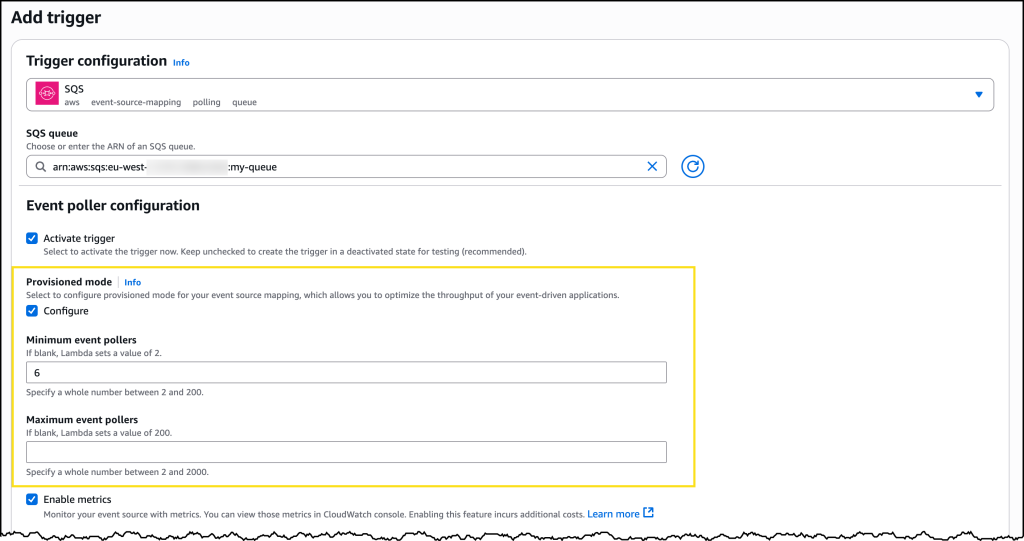
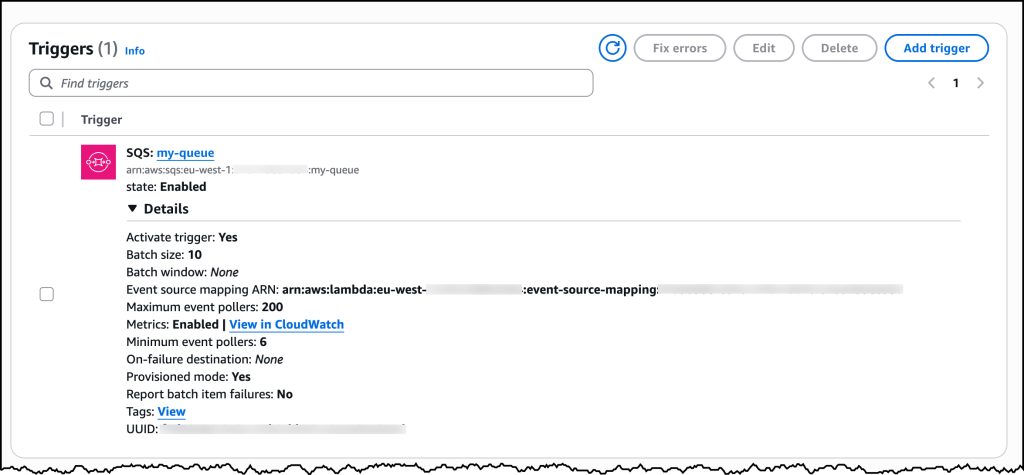
After you have configured Provisioned mode, you can save your trigger. If you need to make changes later, you can find the current configuration under the Triggers tab in the AWS Lambda configuration section, and you can modify your current settings there.
Monitoring and observability
You can monitor your provisioned mode usage through Amazon CloudWatch metrics. The ProvisionedPollers metric shows the number of active event pollers processing events in one-minute windows.
Now available
Provisioned mode for Lambda SQS ESM is available today in all commercial AWS Regions. You can start using this feature through the AWS Management Console, AWS Command Line Interface (AWS CLI), or AWS SDKs. Pricing is based on the number of event pollers provisioned and the duration they’re provisioned for, measured in Event Poller Units (EPUs). Each EPU supports up to 1 MB per second throughput capacity per event poller, with minimum 2 event pollers per ESM. See the AWS pricing page for more information on EPU charges.
To learn more about provisioned mode for SQS ESM, visit the AWS Lambda documentation. Start building more responsive event-driven applications today with enhanced control over your event processing resources.
Post Syndicated from Rohit Kumar original https://www.servethehome.com/ubiquiti-flex-mini-2-5g-review-ubiquiti-does-a-cheap-5-port-2-5gbe-switch/
We review the Ubiquiti Flex Mini 2.5G (USW-Flex-2.5G-5) and see both how it is constructed and how it performs, finding a neat similarity
The post Ubiquiti Flex Mini 2.5G Review Ubiquiti Does a Cheap 5-port 2.5GbE Switch appeared first on ServeTheHome.
Post Syndicated from Bruce Schneier original https://www.schneier.com/blog/archives/2025/11/upcoming-speaking-engagements-50.html
This is a current list of where and when I am scheduled to speak:
The list is maintained on this page.
Post Syndicated from The Atlantic original https://www.youtube.com/watch?v=A4922CILwM4
Post Syndicated from corbet original https://lwn.net/Articles/1045453/
One of the many objectives of the Linux
Kernel Self-Protection Project (KSPP), which just completed ten years of
work, is to ensure that all array references can be bounds-checked,
even in the case of flexible array members, the size of which is not known
at compile time. One of the most challenging flexible array members in the
kernel is not even declared as such. Almost exactly one year ago, LWN looked at the effort to increase safety around
the networking subsystem’s heavily used sockaddr structure. One
year later, Kees Cook is still looking for a way to bring this work to a
close.
Post Syndicated from Емилия Милчева original https://www.toest.bg/spetsialniyat-upravitel/

С три промени в законодателството санкционираният за корупция от САЩ и Великобритания Делян Пеевски овладя контрола върху бъдещето на „Лукойл“ в България, докато лидерът на ГЕРБ Бойко Борисов усърдно се опитва да запази фасона си на Първия в държавата. Борисов обяснява на журналисти как България ще получи изключение от американските санкции върху най-голямата руска частна компания и че е бил ятак на собственика на КТБ Цветан Василев, за да го пази от Пеевския гняв, а същият Пеевски методично преследва целите си.
Резултатът е, че чрез зависими от него лица олигархът слага ръка върху най-голямата компания в България и решенията кому да принадлежи в бъдеще. Разбира се, тези решения ще минават през някаква степен на съгласуване с американската Служба за управление на задграничните активи (OFAC) и Европейската комисия, но това едва ли ще ограничи амбициите (и илюзиите) му, че заслугите му ще бъдат взети предвид и Вашингтон ще отмени санкциите по „Магнитски“. Борисов и ГЕРБ са легитимен параван на тези щения. Недоволството в парламентарната група, а също и в правителството бива укротено – засега.
Най-напред ДАНС бе „монтирана“ в Закона за насърчаване на инвестициите. Само с нейното положително становище може да се продават четирите дружества на „Лукойл“ в България: рафинерията в Бургас, над 220 бензиностанции и другите две дружества – „Лукойл Ейвиейшън България“ и „Състейнабъл Енерджи Съплай“. ДАНС се оглавява от фаворита на Пеевски Деньо Денев, който беше временно изпълняващ пет месеца, но явно сега предстои да бъде избран от парламента за титуляр.
После президентската институция бе заличена от закона за ДАНС, за да не пречи на това назначение, и така правомощието по назначаване или освобождаване на председателя на Агенцията остана само за парламента. (А Конституционният съд образува дело по тези промени.)
Наскоро управляващото мнозинство извърши друг набег в законодателството, като разшири правомощията на въведения през 2023 г. „особен управител“ с промени в Закона за контрол по прилагането на ограничителните мерки с оглед на действията на Русия, дестабилизиращи положението в Украйна.
През 2023 г. особеният управител на рафинерията подлежеше на контрол от Комисията по икономическа политика и иновации, както и от Народното събрание в цялост. Той беше задължен по закон да представя подробни шестмесечни планове за действие, неразделна част от договора за управление, които да бъдат приемани от Комисията по икономическа политика и иновации. През ноември 2025 г. особеният управител получи огромни и безпрецедентни правомощия: да извършва разпоредителни сделки с активи на „Лукойл“ без съгласието на собствениците и действията му да не подлежат на никакъв контрол – административен и съдебен. Тази фигура удобно е възседнала върховенството на правото в България, чийто връх бездруго е пречупен.
Ветото на президента върху тези промени беше преодоляно за по-малко от 24 часа и сега единствената възможност на Радев да се противопостави остана обнародването им – дали ще ги пусне преди, или след 21 ноември, когато санкциите започват да действат.
Интересът към активите на „Лукойл“ в България и по света не е намалял предвид трудната позиция, в която се намира компанията. В условията на санкции купувачите може да ги получат на цена по-ниска от възможната в нормални пазарни условия. Reuters съобщи, че Shell се интересува от дълбоководните блокове на „Лукойл“ в Гана и Нигерия. Продават се и трите нефтени концесии на руската компания в Египет. Правителството на Молдова е започнало преговори за национализация на инфраструктурата на „Лукойл“ на летището в Кишинев.
В този ред е споменато и че България се готви да завземе рафинерията на „Лукойл“ в Бургас, за която азербайджанската държавна фирма Socar и турският Cengiz Holding съвместно са подали оферта преди санкциите. Появи се и информация, отново на Reuters, че американската мултинационална компания Carlyle проучва възможността да купи чуждестранните активи на „Лукойл“, но за целта трябва да получи разрешение от американските власти. Един от източниците на агенцията не е изключил възможността фондът да се откаже от сделката.
Каквито и средства обаче да постъпят от продажбите на активи, руската компания няма да може да разполага с тях, тъй като остават замразени до вдигането на санкциите. В България се предвижда при евентуални сделки средствата да постъпят в специална сметка в държавната Българска банка за развитие. Самата „Лукойл“ поиска от Финансовото министерство на Съединените щати да отложи влизането в сила на санкциите, предвидено за 21 ноември. Дотогава България, Молдова и Румъния ще разберат дали може да влязат в управление на активите на „Лукойл“, които се намират на тяхна територия.
Междувременно, Великобритания вдигна санкциите за две от дъщерните компании на „Лукойл“ в България. Това са „Лукойл България“ ЕООД и „Лукойл Нефтохим Бургас“ АД, както и техните дъщерни компании. Бизнесът ще има право да работи с тези компании до 14 февруари. Според източник на Reuters очаква се и САЩ да направят същото скоро.
Единствените предположения за особен управител, завъртели се преди 14 ноември, бяха на човек, близък до Пеевски, и на друг, свързван с ГЕРБ. До момента никой от двамата не е направил какъвто и да било публичен коментар. Петров, бивш мениджър в ΟΜV и дългогодишен съдружник на Георги Самуилов – собственик на „Инса Ойл“, втората след „Лукойл“ компания на пазара на горива, в момента работи в Италия. Петко Николов управляваше повече от два мандата Комисията за защита на конкуренцията (КЗК) – от 2003 г. до юни 2016 г. След 13-годишното му управление Борисов го назначи за шеф на Патентното ведомство.
По времето на Николов КЗК направи секторен анализ на пазара на горива по инициатива на тогавашния министър на икономиката Трайчо Трайков от първия кабинет „Борисов“. Въз основа на анализа големите дистрибутори на горива бяха уличени в картел, а „Лукойл“ – в злоупотреба с монополно положение на пазара на горива. КЗК започна разследване срещу тях в началото на 2016 г., което така и не стигна до финал.
„Инса Ойл“ е една от трите фирми, за които шефът на Държавния резерв Асен Асенов посочи по bTV, че не поддържат резерв от горива. Втората значима след „Лукойл“ компания заяви, че този ангажимент струва твърде скъпо на частните фирми. Преди време разследващият сайт BIRD посочи „Инса ойл“ и още няколко фирми като добри печелещи от войната в Украйна, с износа на руски горива за нападнатата от Русия държава.
В крайна сметка името на особения управител стана известно след заседание на Съвета по сигурността към Министерския съвет. Това ще е изпълнителният директор на Националната агенция за приходите (НАП) Румен Спецов, който поема и четирите дружества на „Лукойл“ в България. Бившият шампион по културизъм зае поста си в НАП благодарение на „Продължаваме промяната“ в правителството на Кирил Петков през 2021 г., поканен от тогавашния финансов министър Асен Василев. BIRD разкри, че през април 2016 г. Спецов е продал 50% от своя фирма с натрупани 1,5 милиона задължения на сламен човек.
През юни тази година от „Да, България“ коментираха, че Спецов е станал „рекламен агент на Пеевски“. Причината е, че предложението на олигарха за т.нар. магазини за хората, които държавата одобри и за които бяха заделени 10 млн. лв., беше мотивирано и с оплакването от страна на Спецов от високите цени.
В този първи сезон, в един от ключовите епизоди, Румен Спецов, след като целува пръстена на Пеевски, става негов рекламен агент. И започва да обяснява наляво-надясно как цените рязко са скочили, за да може следващата седмица Пеевски да излезе и да каже: „В моите магазини за хората ще решим проблема с цените.“
След една седмица ще стане ясно дали пазарът на горива ще се опази от сътресения. Факт е, че цените на бензин и дизел тръгнаха нагоре след новината за американските санкции на „Лукойл“. За около три седмици те са поскъпнали с около 10 стотинки на литър.
Все още не е ясно кои ще останат обслужващите банки на „Лукойл“ в България. Веднага след санкциите „Лукойл България“ уведоми контрагентите си, че от 24 октомври трябва да извършват плащанията си по сметките ѝ в „Интернешънъл Асет Банк“, зад която се смята, че стои бизнесменът Младен Михалев – Маджо. Основните банки за вътрешногрупови разплащания са „УниКредит Булбанк“ и „Банка Машрек“ от ОАЕ, а през 2024 г. са открити сметки в „Интернешънъл Асет Банк“, Българо-американска кредитна банка, в чийто надзорен съвет е Цветелина Бориславова – спътница в живота на Бойко Борисов до 2009 г., и Първа инвестиционна банка, чийто основен акционер е Цеко Минев.
Вече стана ясно, че две от банките, с които „Лукойл“ работи в България, са поискали да спрат да обслужват компанията – ЦКБ и „УниКредит“. Борисов помолил финансовата министърка да ги убеди да не спират преди 21 ноември.
Аз мога да гарантирам на българите, че България ще получи дерогация и няма да се създаде такъв проблем. Защото САЩ са наш партньор, ние сме много надежден партньор в НАТО, а OFAC ни приветстваха за това, което сме направили.
Ще получи ли България изключение от санкциите и съответно генерален лиценз да управлява активите на „Лукойл“ и за колко време – шест месеца или повече? Лидерът на ГЕРБ уверява, че още на 14 ноември ще бъде получен такъв лиценз със срок на действие половин година.
България се оказа на ръба на нова реалност: една частна компания, санкционирана от САЩ и Великобритания, ще е под контрола на олигарх, а институциите, които би трябвало да стоят над него, са параван на решенията му. Докато Борисов и ГЕРБ пазят фасадата на „първия човек в държавата“, обществото става свидетел на бавна, но сигурна трансформация на властта – от публична към лична и неотчетна. И докато парламентът и правителството се укротяват „засега“, въпросът остава: какво ще струва това на обществото?
Post Syndicated from LGR original https://www.youtube.com/watch?v=YWpeCw_H0Zw