Post Syndicated from The Atlantic original https://www.youtube.com/watch?v=647AsDiuRXE
Accelerating SQL analytics with Amazon Redshift MCP server
Post Syndicated from Ramkumar Nottath original https://aws.amazon.com/blogs/big-data/accelerating-sql-analytics-with-amazon-redshift-mcp-server/
As data analysts and engineers, we often find ourselves switching between multiple tools to explore database schemas, understand table structures, and execute queries across different Amazon Redshift data warehouses. Using natural language to explore metadata and data can simplify this process, but an AI agent often needs the additional context of your Redshift cluster configurations and schemas to successfully discover and build the best execution path.
This is where the Model Context Protocol (MCP) can act as a bridge between the AI agent and your Redshift clusters to provide the necessary information to better support natural language interfaces to your data. MCP is an open standard that enables AI applications to securely connect to external data sources and tools, providing them with rich, real-time context about your specific environment. Unlike static tools, MCP allows AI agents to dynamically discover database structures, understand table relationships, and execute queries with full awareness of your Amazon Redshift setup.
To address these challenges and unlock the full potential of conversational data analysis, Amazon Web Services (AWS) released the Amazon Redshift MCP server, an open source solution that innovates how you interact with Amazon Redshift data warehouses. The Amazon Redshift MCP server integrates seamlessly with Amazon Q Developer command line interface (CLI), Claude Desktop, Kiro, and other MCP-compatible tools. It can enable discover, explore, and analyze your Amazon Redshift metadata and data through natural language conversations with an AI assistant that truly understands your database environment.
In this post, we walk through setting up the Amazon Redshift MCP server and demonstrate how a data analyst can efficiently explore Redshift data warehouses and perform data analysis using natural language queries.
What is the Amazon Redshift MCP Server?
The Amazon Redshift MCP server is a MCP implementation that provides AI agents with safe, structured access to Amazon Redshift resources. It enables:
- Cluster discovery – Automatically discover both provisioned Redshift clusters and serverless workgroups
- Metadata exploration – Browse databases, schemas, tables, and columns through natural language
- Safe query execution – Execute SQL queries in READ ONLY mode with built-in safety protections
- Multi-cluster support – Work with multiple clusters and workgroups simultaneously for data reconciliation tasks
The MCP server acts as a bridge between Amazon Q CLI and your Amazon Redshift infrastructure, translating natural language requests into appropriate API calls and SQL queries. The following diagram illustrates the high-level architecture.
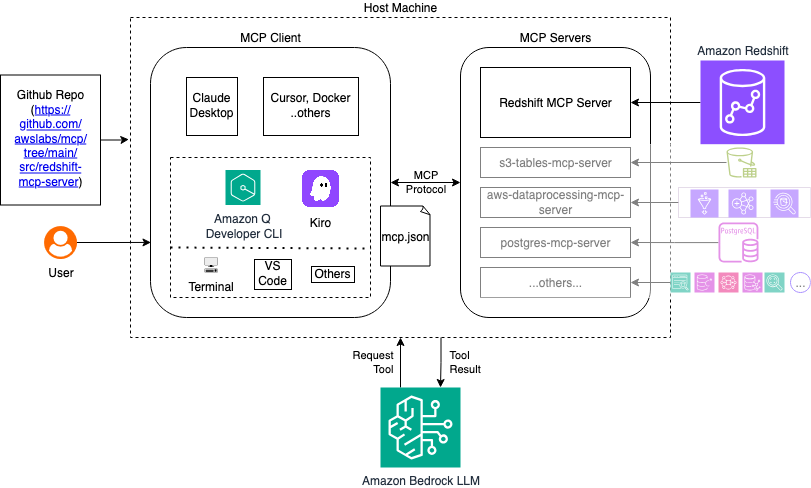
The following video demonstrates the solution outlined in this post.
Prerequisites
Before you begin, ensure you have the following:
System requirements
- Python 3.10 or newer
uvpackage manager (installation guide)- Amazon Q CLI or other tools such as Claude Desktop installed and configured
AWS requirements
- AWS credentials configured using AWS Command Line Interface (AWS CLI), environment variables, or AWS Identity and Access Management (IAM) roles
- Appropriate IAM permissions for Amazon Redshift access
- At least one Redshift cluster or serverless workgroup
Required IAM permissions
The user identity needs the following IAM permissions in your access policies:
Installation and configuration
The following section covers the steps required to install and configure Amazon Redshift MCP server.
Install required dependencies
Complete the following steps to install required dependencies:
- Install the
uvpackage manager if you haven’t already:
- Install Python 3.10 or newer:
uv python install 3.10
Configure the MCP server
The MCP server can be configured using several MCP supported clients. In this post we discuss the steps using Amazon Q Developer CLI and Claude Desktop.Complete the following instructions to set up Amazon Q Developer CLI on your host machine and access the Amazon Redshift MCP Server:
- Install the Amazon Q Developer CLI.
- Configure the Amazon Redshift MCP server in your Amazon Q CLI configuration. Edit the MCP configuration file at
~/.aws/amazonq/mcp.json:
For further details on installation, refer to the Installation section in the Amazon Redshift MCP server README.md.
- Start Amazon Q CLI to verify the MCP server is properly configured:

You should notice the Amazon Redshift MCP server initialize successfully in the startup logs.To set up Amazon Q Developer CLI on your host machine and access the Amazon Redshift MCP Server using Claude Desktop, complete the following steps:
- Download and install Claude Desktop for your operating system
- Open Claude Desktop and in the bottom left, choose the gear icon to navigate to Settings
- Choose the Developer tab and configure your MCP server by adding the same configuration as step 3 in the Amazon Q CLI setup
- Restart Claude Desktop to activate the MCP server connection
- Test the integration by starting a new conversation and asking:
Show me all available Redshift clusters
Use case: Customer purchase analysis
Imagine a practical scenario where a data analyst needs to explore customer purchase data across multiple Redshift clusters. The following walkthrough demonstrates how the MCP server simplifies this workflow.As a data analyst at an ecommerce company, you need to:
- Discover available Redshift clusters
- Explore the database structure to find customer and sales data
- Analyze customer purchase patterns
- Generate insights for the business team
To accomplish these tasks, you follow these steps:
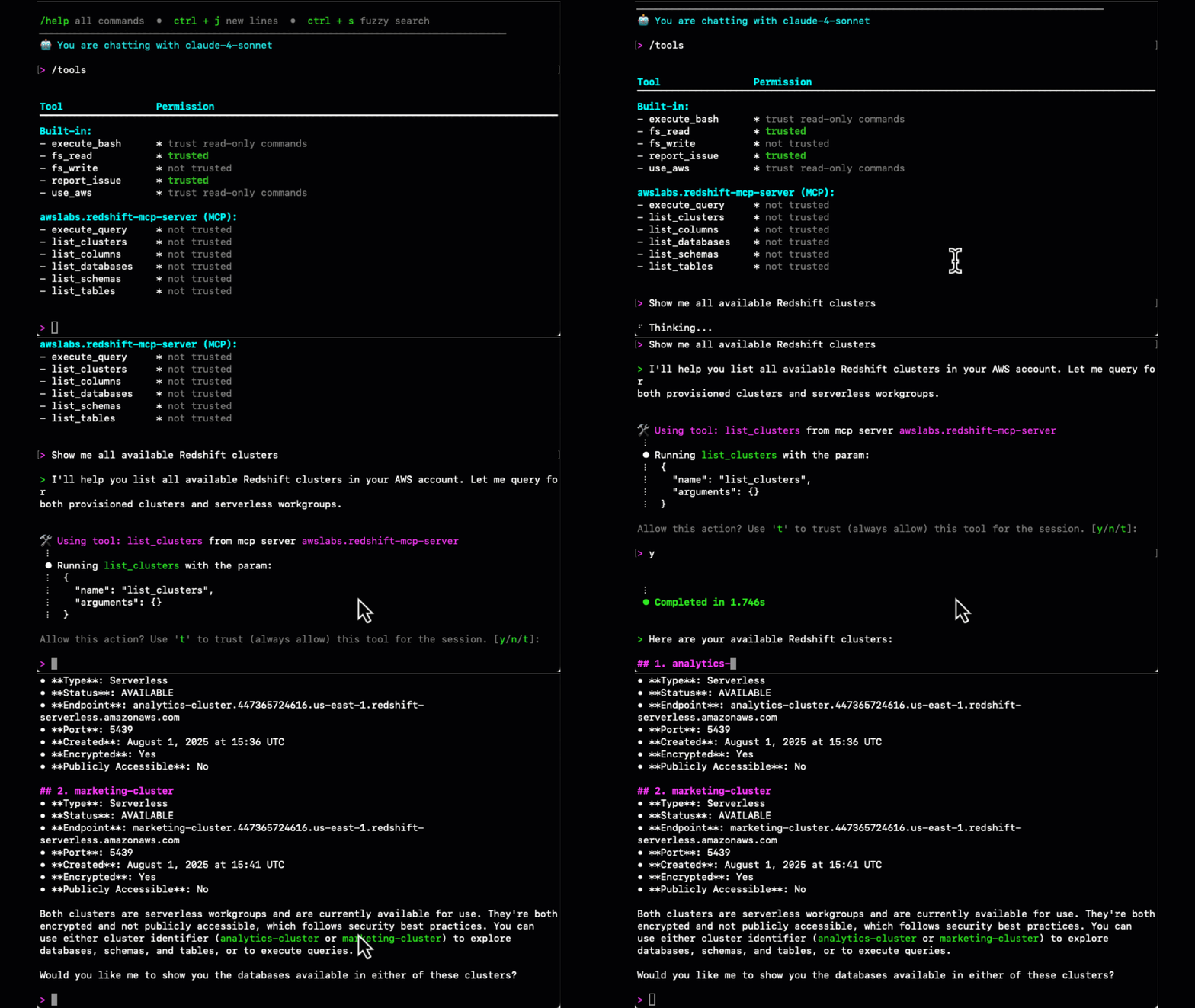
- Ask Amazon Q to show you available Amazon Redshift resources:
Amazon Q will use the MCP server to discover your clusters and provide details such as cluster identifiers and types (provisioned or serverless), current status and availability, connection endpoints and configuration, and node types and capacity information.
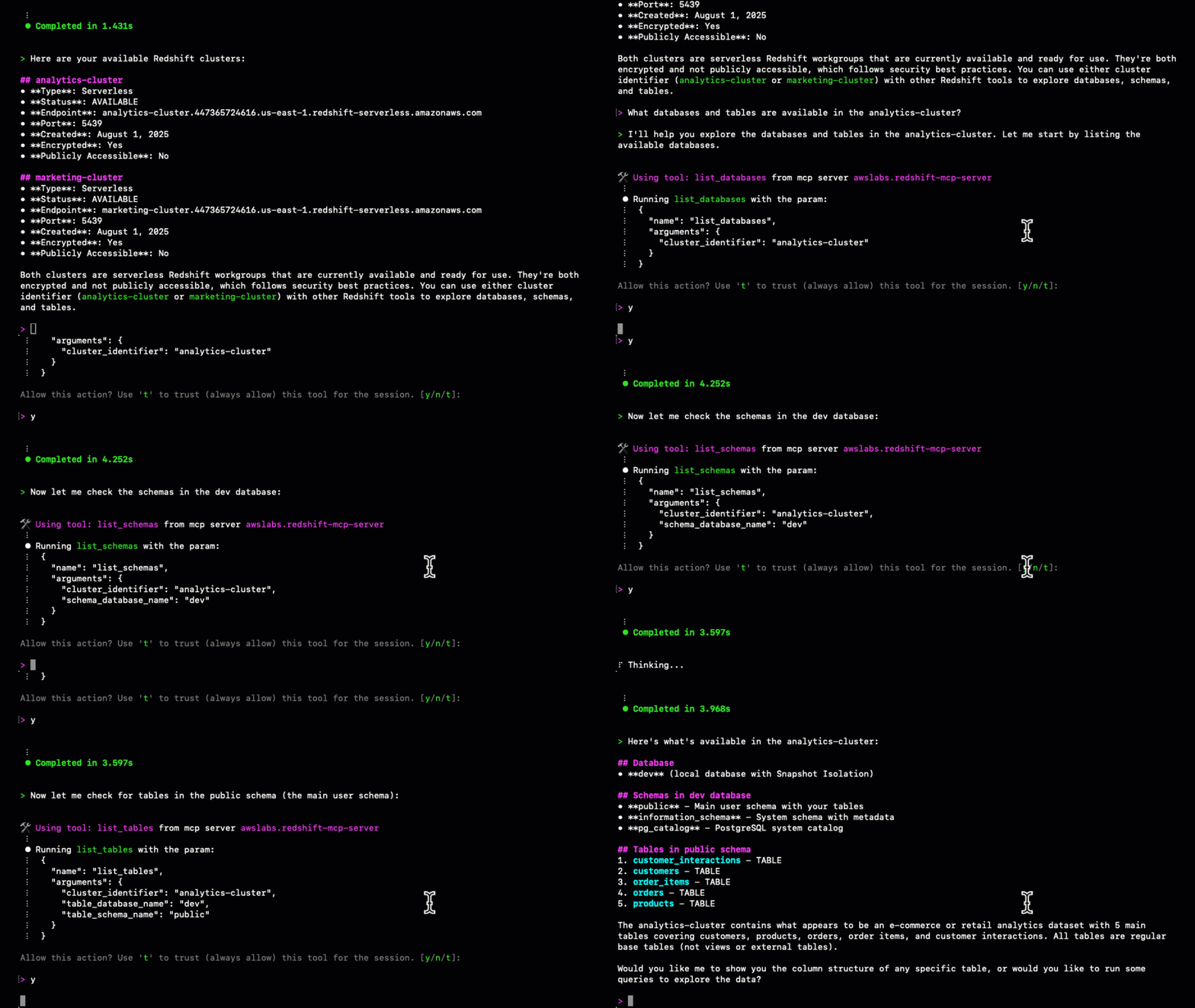
- Explore the database structure to understand your data organization:
Amazon Q will use the MCP server to systematically explore the objects in the cluster:
- Before analyzing data, understand the table schemas:
Amazon Q will use the MCP server to will examine the table columns and provide detailed schema information.
- Analyze customer purchase patterns using natural language queries:
Amazon Q will use the MCP server to run the appropriate SQL queries and provide insights.
- The MCP server supports analyzing data across multiple clusters:
Amazon Q will use the MCP server to run the appropriate SQL queries compare the data across analytics-cluster and marketing-cluster.
Best Practices
The MCP server comes equipped with several essential safety protections designed to safeguard your data and system performance. The READ ONLY mode serves as a critical safeguard against unintended data modifications, and we recommend enabling this feature when applicable to your use case. To further enhance security, the server implements query validation mechanisms that scrutinize operations for potential harmful impacts, with user-in-loop validation being recommended for optimal safety. For resource management, the server enforces resource limits to prevent performance-impacting runaway queries, again benefiting from user-in-loop validation for best results. In terms of accessibility, the MCP capability maintains broad availability across all AWS Regions where Amazon Redshift Data API is supported, with throttling limits aligned to existing Amazon Redshift Data API service quotas to ensure consistent performance and reliability.For best results, follow these recommendations:
- Start with discovery – Begin by exploring cluster and database structure and tables
- Use natural language – Describe what you want to analyze rather than writing SQL directly
- Iterate gradually – Build complex analyses step by step
- Verify results – Cross-check important findings with business stakeholders
- Document insights – Save important queries and results for future reference
Conclusion
The Amazon Redshift MCP server transforms how data analysts interact with Redshift clusters by enabling natural language data exploration and analysis through agentic tooling like Kiro and Amazon Q CLI. By eliminating the need to manually write SQL queries and navigate complex database structures, analysts can focus on generating insights rather than wrestling with syntax and schema discovery.Whether you’re performing a one-time analysis, generating regular reports, or exploring new datasets, the Amazon Redshift MCP server provides a powerful, intuitive interface for your data analysis workflows.Ready to get started? Here’s what to do next:
- Install the MCP server following the configuration steps in this post
- Explore your Amazon Redshift environment using natural language queries
- Start with simple analyses and gradually build complexity
- Share insights with your team using the natural language summaries
- Provide feedback to help improve the MCP server capabilities
Check out these blog posts to help you navigate using natural language with your use cases:
- Implementing conversational AI for S3 Tables using Model Context Protocol (MCP)
- Accelerating development with the AWS Data Processing MCP Server and Agent
- Introducing MCP Server for Apache Spark History Server for AI-powered debugging and optimization
- Billing and Cost Management MCP Server
- Introducing enhanced AI assistance in Amazon SageMaker Unified Studio: Agentic chat, Amazon Q Developer CLI, and MCP integration
About the authors
The Future of the Arts in a Changing World | The Atlantic Festival 2025
Post Syndicated from The Atlantic original https://www.youtube.com/watch?v=dPKvw_SQxsM
Lessons from Vibe Coding Three Apps in Three Weeks
Post Syndicated from Jeronimo De Leon original https://www.backblaze.com/blog/lessons-from-vibe-coding-three-apps-in-three-weeks/

While taking some time for paternity leave in a small village in the middle of Bulgaria, I used my baby’s nap times to dive deeper into vibe coding to see just how fast and close these AI tools can get you to building real, production-ready apps. It led to a serious of articles, LinkedIn posts, and product experiments, all focused on understanding and sharing my insights on the state of programming and product design that leverage AI.
In my previous article, “ColabWithMe: A GPT Specialized in Google Colab for Data Analysis & ML,” I talked about how generative AI is redefining the programming landscape. As the Harvard Business Review noted in “We’re All Programmers Now,” this shift represents more than just enabling non-technical employees to code. The real opportunity lies in developing multi-skilled professionals who can operate across domains, compressing innovation cycles from weeks to days. (I explore this further in “The Shape of AI Training: How Skill Profiles Guide AI Learning Paths.“)
Which brings me to what I actually built during those nap times—three different applications using a variety of AI tools. Rather than focusing on polished user interfaces, I focused on backend functionality and core business logic. I discovered that debugging the frontend and getting it to look how I wanted consumed far more time than implementing core backend features. So, many of these vibe-coded apps work nicely on the backend, but need more polish on the frontend. Let’s dig in.
Tools reviewed
Vibe coding means building software by describing what you want in natural language and letting AI generate the code. I tested tools across three categories to see how they enable this new way of building.
- Integrated development environment (IDE) integrated agents: GitHub Copilot Agent, Gemini Code Assistant, Claude, Cursor.
- Conversational interfaces: ChatGPT, ChatGPT Codex, Grok, Claude.
- Prompt app builders: Replit, Lovable, Bolt, GitHub Spark.
Project 1: TickGoals.com, AI-powered goal setting (Approximately 7 hours)
The first application tackled a common productivity challenge: transforming vague aspirations into actionable SMART goals. The system implements a conversational AI interface that guides users through goal refinement, then automatically generates structured milestones and tasks.
Key features:
- Chat with AI to transform vague goals into structured SMART goals
- Auto-generate actionable milestones and tasks based on your refined goals
- To-do list interface for tracking progress and completion
- Persistent goal storage with progress visualization
Tech stack:
- React frontend for conversational UI generated by GitHub Spark
- Firebase Functions for serverless backend processing
- OpenAI API for goal and task creation
- Firebase Firestore for persistent goal and task storage
Initially I prototyped across Lovable, Replit, Bolt and GitHub Spark to see what each would generate. I eventually used the code GitHub Spark generated for a cleaner React component structure. Check it out here: https://tickgoals.com
Project 2: NewsVibe.AI, newsletter aggregation and summarization platform (Approximately 12 hours)
While catching up on email, I noticed my inbox was filled with newsletters that I’d often just skim or summarize, so I built a tool to handle this automatically. The app provides users with personalized email addresses for newsletter subscriptions, then presents content in a newsfeed interface to easily scroll through with AI summarization.
Key features:
- Personal @newsvibe.me email addresses for newsletter subscriptions.
- Instagram-style scrollable feed displaying all your newsletters.
- AI-powered summarization to get quick overviews of content.
- Automatic extraction of links and key information from newsletters.
- Subscription management dashboard with usage analytics.
Tech stack:
- Cloudflare pages for frontend hosting.
- Maileroo for email processing and parsing.
- Supabase for user management and content storage.
- Python backend deployed on Render for newsletter and summarization processing.
- OpenAI API for content summarization.
- Stripe integration for subscription management.
I split this project into separate frontend and backend repos, and found it blazing fast to build out all the backend functionality first before tackling the frontend.
Project 3: Welcome.AI, newsletter editor agent (Approximately 10 hours)
Welcome AI has been my side project since 2017, initially focused on competitive analysis of AI tools. I’ve rebuilt it multiple times, with the latest iteration using retrieval augmented generation (RAG) for content. But, content curation still required manual review, either by me or community contributors, so I built an agent to automate the entire process, identifying, categorizing, and synthesizing AI news into a publication-ready newsletter. View a generated newsletter here. Subscribe at https://newsletter.welcome.ai/
Key Features:
- Automatically identifies and filters AI-related news from RSS feeds and newsletters
- Categorizes stories by topic and summarizes key points
- Writes complete newsletter copy with insights and summaries
- Curates the top stories and case studies for featured content sections
- Generates HTML formatting and generates a feature image for the top story
Tech Stack:
- Python news feed processing
- OpenAI Agent SDK and APIs
- GitHub Actions for automated workflow execution
- Supabase for content management and curation state
- Backblaze B2 for generated feature image storage
This was purely a backend project to test and experiment with the OpenAI Agent SDK, though I diverged from it toward more direct large language model (LLM) tasks by the end.
Lessons learned
At a high level, you can definitely see how these tools are going to dramatically speed up development, especially for getting to minimum viable product (MVP) or prototype. You should only need a day or two to get something up and test market traction, especially with prompt app builders.
I found Claude Opus/Claude Code worked best for backend code within the IDE, while Gemini Pro was particularly good at frontend landing page development. Coding agents that make multiple changes across multiple files simultaneously, like those in Cursor, Copilot Agent, or ChatGPT Codex, still felt a bit daunting. I experienced chunks of code being deleted a few times, so I spent considerable time reviewing changes or reverting them.
Prompt app builders like Lovable, Replit, GitHub Spark, and Bolt can get you pretty far, but you can eventually hit a wall where the AI starts breaking more than it fixes, or you need to integrate third-party services that require direct code access. With one project, I started in a prompt builder then moved to an IDE for refinement.
High-level, here are some tips that should help in your vibe coding journey.
Before starting: Set instructions and rules
Like custom instructions in ChatGPT, each tool benefits from coding guidelines: Claude Code uses CLAUDE.md, Copilot uses configured instructions, and Cursor has rules (templates at https://cursor.directory/rules).
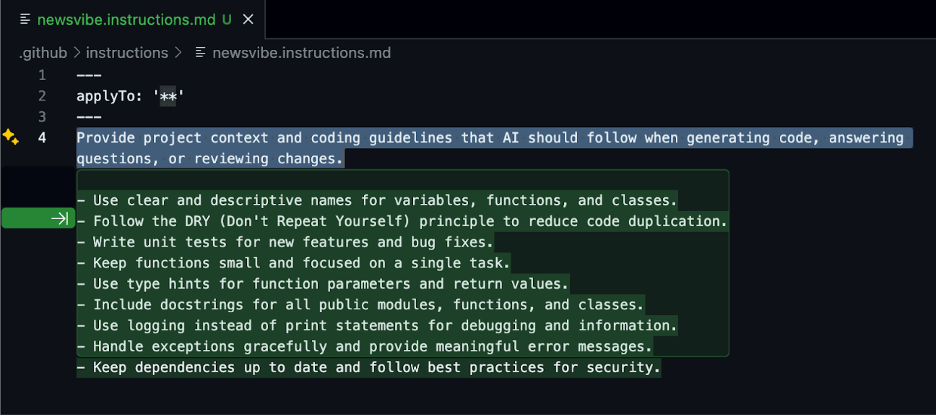
Both Claude Code and Cursor support MCP (Model Context Protocol) for enhanced integrations (Cursor MCP directory: https://cursor.directory/mcp). Some tools can also index documentation folders for deeper context. Set these up first for better code generation.
Start with a complete product requirements document (PRD)
Before writing any code, spend time iterating with an LLM to generate a thorough PRD. This back-and-forth refinement process goes a long way in providing the context your AI coding tools need. Capture everything: user workflows, UI specifications, technical requirements, and success metrics. Save this in your README.md as your north star.
Prompt app builders like GitHub Spark generate PRDs first from your initial prompt, so the more complete and refined it is, the better.
Define your project structure upfront
Work with the LLM to create a structure that follows best practices but stays simple for what you’re building. An MVP doesn’t need enterprise architecture. Map out where components, services, and APIs belong, and include this in your initial prompt.
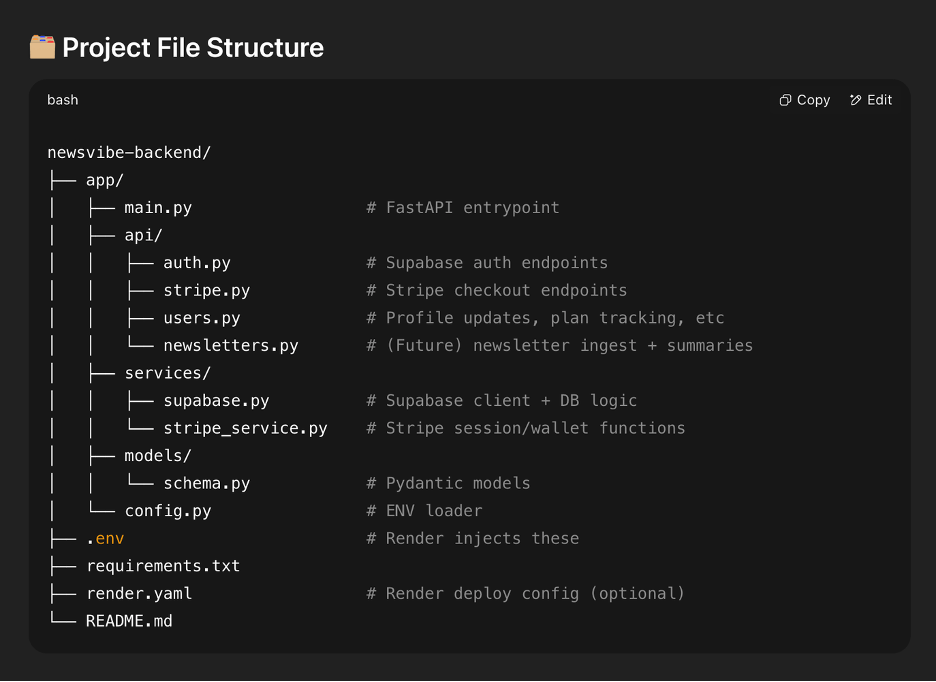
Monitor new file generation closely as AI tools can suggest new files when not needed. When this happens, correct it immediately. Keep the structure as simple as possible. Break up files that are doing too many things, as this makes them harder to read and update later.
Add context markers throughout your code
Include file paths and descriptions at the top of each file. This helps the AI maintain context when making changes. Add detailed logging at critical points to track what’s happening when things break. Watch for function renames, LLMs often change function names unnecessarily when updating code, breaking references elsewhere.
Always check current API documentation
LLMs can generate outdated code. OpenAI and Pinecone have changed their import syntax, but AI tools still produce the old versions. Have the LLM search for the latest docs, or check them yourself. Knowing how your services currently work helps you catch these mistakes immediately.
One feature, one conversation
Multitasking with AI means juggling code review while it generates more changes. Keep each conversation focused on a single feature unless features are directly related. When the LLM offers to optimize unrelated areas, decline. If the AI gets stuck repeating failed solutions, start fresh rather than fighting it.
Wisdom of the crowds
When stuck, get code reviews from other LLMs since they can catch different issues. But always review their output carefully. LLMs can duplicate functions across files or, worse, delete essential code. In Agent mode especially, I’ve seen them remove core functionality unrelated to the current task. Give specific instructions about where functions belong and double-check nothing critical disappeared.
Vibe Coding = Product Management + Engineering
The most significant shift with AI-assisted development isn’t the speed; it’s the role change. You’re no longer just implementing; you’re defining what to build, how it should work, and why it matters.
This is the multi-skilled professional evolution I mentioned earlier. When “We’re All Programmers Now,” it means domain experts can build their own solutions, but it also means programmers must become domain experts in product thinking. Success with vibe coding requires clear product vision to articulate requirements, technical knowledge to guide the AI correctly, and relentless focus on user problems.
You become the conductor orchestrating AI capabilities while maintaining the judgment to build what people actually need. The future belongs to these blended roles: product managers who understand engineering deeply enough to guide AI tools, and engineers who think like product managers. These T-shaped and M-shaped professionals operate fluidly across domains. This is how we compress innovation cycles from weeks to days: by eliminating the translation layer between idea and implementation.
The post Lessons from Vibe Coding Three Apps in Three Weeks appeared first on Backblaze Blog | Cloud Storage & Cloud Backup
Atlantic Reads: Alison Roman | The Atlantic Festival 2025
Post Syndicated from The Atlantic original https://www.youtube.com/watch?v=D2OmrDNdVwk
The Big Story: What Does It Mean to Be an American? | The Atlantic Festival 2025
Post Syndicated from The Atlantic original https://www.youtube.com/watch?v=mXHNg3-2TfU
The Progress Summit: Building a Foundation for the Future | The Atlantic Festival 2025
Post Syndicated from The Atlantic original https://www.youtube.com/watch?v=CYAd6lpugHw
The Future of Women’s Sports | The Atlantic Festival 2025
Post Syndicated from The Atlantic original https://www.youtube.com/watch?v=8EqDpcGUCA0
The Future of Human Connection: Love and Loneliness in a Digital World | The Atlantic Festival 2025
Post Syndicated from The Atlantic original https://www.youtube.com/watch?v=q3ROPgrWo4U
Redefining American Justice | The Atlantic Festival 2025
Post Syndicated from The Atlantic original https://www.youtube.com/watch?v=YwJbADv14yM
Crucial X10 2TB Portable SSD Review Compact and Neat
Post Syndicated from Sam Sabinash original https://www.servethehome.com/crucial-x10-2tb-portable-ssd-review-compact-and-neat/
In our Crucial X10 2TB review, we see how this portable SSD compares to the X10 Pro and other USB SSDs we have tested
The post Crucial X10 2TB Portable SSD Review Compact and Neat appeared first on ServeTheHome.
Minimize risk through defense in depth: Building a comprehensive AWS control framework
Post Syndicated from Luis Pastor original https://aws.amazon.com/blogs/security/minimize-risk-through-defense-in-depth-building-a-comprehensive-aws-control-framework/
Security and governance teams across all environments face a common challenge: translating abstract security and governance requirements into a concrete, integrated control framework. AWS services provide capabilities that organizations can use to implement controls across multiple layers of their architecture—from infrastructure provisioning to runtime monitoring. Many organizations deploy multi-account environments with AWS Control Tower, or Landing Zone Accelerator to implement a foundational baseline of controls and security architecture. Once their environment is provisioned, organizations typically look to add additional detective controls from services such as AWS Security Hub and AWS Config based on security, compliance, and operational requirements. While this sequence is a great start, there are more opportunities during this time to implement layered defense-in-depth coverage to enhance your security posture.
Highly regulated industries such as fintech and financial services are often viewed as the gold standard for governance and security controls. While these sectors have established robust frameworks, there’s consistently room for improvement and valuable lessons for other industries looking to enhance their control environments. However, many organizations struggle to move beyond a basic compliance-focused approach. In our experience working with customers across various sectors, this limited perspective often stems from multiple factors, including:
- Immediate compliance pressures
- Resource constraints
- Limited understanding of control maturity pathways
- Focus on detection rather than prevention
- A tendency to prioritize technology-agnostic controls over bult-in AWS capabilities, leading to unnecessarily complex implementations
The good news? A more comprehensive approach that uses AWS preventative, proactive, detective, and responsive controls can significantly reduce risk while decreasing operational overhead through automation.
In this post, we outline a practical framework that you can adopt to evolve your security and governance controls strategy. We explore how your organization can mature from a detection-focused security posture to a multi-layered control framework, using real-world examples across the resource lifecycle, including infrastructure-as-code testing and preventative controls such as service control policies (SCPs), resource control policies (RCPs), and declarative policies (DPs).
Drawing from best practices in highly regulated industries while incorporating modern cloud capabilities through services such as AWS Organizations and AWS Control Tower, we provide a structured framework that you can use to elevate your organization’s control environment beyond basic compliance requirements.
Customer challenges in implementing controls
Organizations face several significant challenges when attempting to implement a comprehensive control framework in AWS. Let’s explore the main obstacles:
Resource constraints and expertise gaps
Security teams often find themselves caught between limited resources and expanding responsibilities in the cloud. With constrained budgets and personnel, teams typically gravitate toward quick wins through detective controls, which appear straightforward to implement initially. While this provides immediate visibility, it can leave critical gaps in security posture. Many teams lack comprehensive expertise across all control types, particularly in implementing preventative, proactive, and responsive controls effectively. The pressure to demonstrate immediate security improvements, combined with day-to-day operational demands, frequently results in tactical solutions rather than strategic, layered security approaches.
Analysis paralysis
Deciding which tools to prioritize can be a challenge; the breadth of options and extensive capabilities available across AWS security services and third-party tools can feel overwhelming at times. Security teams struggle to determine the optimal mix of controls for their environment and where to begin implementation. This challenge is compounded by the complexity of mapping technical compliance requirements to cloud-focused capabilities and maintaining visibility into emerging threats as the security landscape evolves. The layers of abstraction created by proliferating security controls can further obscure clear decision-making, leading teams to delay critical security improvements while seeking perfect solutions.
Misunderstanding of defense in depth
Defense in depth as a concept is good, but it can be misunderstood and difficult to achieve, leading to vulnerabilities in the security architecture. A common misconception is that a single strong control, separation of duties in AWS Identity and Access Management (IAM) roles, least permission in IAM policies, and so on, provide sufficient protection. This overlooks the crucial value of implementing controls at multiple points and how different control types can be combined to create a robust security posture. Teams often miss how organizational controls like SCPs can work in harmony with workload-specific controls to achieve greater protection. The role of preventative controls in guiding technical implementations is frequently under appreciated.
Maturity journey challenges
The path to security maturity presents numerous obstacles. Many organizations remain stuck in the early stages, implementing detective controls but never progressing to preventative measures. Security controls are often implemented in isolation, without consideration for the broader security landscape. Organizations struggle to create and follow a clear roadmap for evolving their security posture, and measuring improvement over time proves challenging.
Scale and consistency issues
As AWS environments grow, maintaining consistent governance and security becomes increasingly complex. Organizations face mounting challenges in managing exceptions and special cases across their expanding infrastructure. These interrelated challenges often result in controls implementations that fail to achieve their intended risk reduction goals. You need a structured approach to overcome these obstacles and implement comprehensive security controls, which we explore in the following sections.
Strategic investment in security
While implementing comprehensive controls requires an initial investment in time and resources, the long-term benefits fundamentally transform how organizations operate.
The foundation for this transformation begins with establishing baseline controls through proven starting points such as AWS Control Tower and its customization options. AWS Control Tower provides building blocks for secure multi-account architectures with hundreds of security capabilities and proactive controls already built in. Rather than trying to create baselines from scratch by wrangling vast amounts of account-level or resource-specific controls, you can use these accelerators to rapidly establish a strong security foundation. With these baseline controls in place, this transformation extends beyond security teams to enable the entire organization to operate more efficiently. Development and operations teams can deploy faster with confidence when security guardrails are in place. Security becomes an enabler rather than a bottleneck, so that teams across the organization can innovate while maintaining a strong security posture.
As you mature your organization’s control framework through automation and layered defenses, a security transformation occurs. Security teams shift from constant firefighting to proactive risk management. Automated policy enforcement replaces manual reviews, and the time previously spent on routine tasks can be redirected to strategic initiatives.
Understanding control types and their interplay
AWS defines distinct types of controls to build a comprehensive security framework. Let’s examine each type and how they work together, using a common scenario: preventing public Amazon Simple Storage Service (Amazon S3) bucket exposure.
Preventative controls
Preventative controls establish the foundation of a secure environment by defining the policies, standards, and requirements that guide security implementations. At their core, these controls encompass corporate security policies that outline acceptable resource configurations across the organization. They work in conjunction with compliance requirements and frameworks to help maintain regulatory alignment, while architectural standards and guidelines provide technical direction for implementations. Data classification policies play a crucial role by determining specific security requirements based on data sensitivity.
To illustrate how preventative controls work in practice, consider a common S3 bucket security requirement. A typical preventative control might establish a corporate policy stating All S3 buckets must be private by default, with public access granted only through an approved exception process. This simple but effective policy sets clear expectations and requirements before a technical implementation begins.
- Organization level: SCPs blocking public S3 bucket creation.
- Resource level:
- RCPs enforcing network access controls, such as requiring authenticated access or limiting requests to your organization’s network range.
- SCPs to stop malicious overwrites of S3 objects using SSE-C encryption by blocking
s3:PutObjectrequests with customer-provided keys unless explicitly allowed, paired with AWS IAM Roles Anywhere for short-term credential enforcement.
Proactive controls
Proactive controls act as an early warning system, identifying and addressing potential security issues before they manifest in your environment. These controls work by validating configurations and changes against established security requirements during the development and deployment phases. Through automated validation and policy enforcement at build and deploy time, proactive controls help prevent misconfigurations from reaching production environments, reducing the operational overhead of fixing security issues after the fact. Think of proactive controls as your first line of defense in maintaining a secure cloud environment. In AWS, these can be implemented at multiple levels:
- Amazon S3 Block Public Access settings at the account level.
- Policy-as-code checks in continuous integration and delivery (CI/CD) pipelines (such as CFN-Nag, or AWS Config proactive rules).
- AWS CloudFormation hooks for pre-deployment validation and policy enforcement.
- AWS Config rules in proactive mode to evaluate resources before creation.
- At the resource level, you can use:
- IAM policies restricting bucket policy modifications
- CloudFormation Guard rules
Source: aws-guard-rules-registry
Detective controls
Detective controls provide continuous visibility into your security posture by monitoring for and identifying potential security violations or unauthorized changes within your environment. While preventative controls aim to stop issues before they occur, detective controls help you maintain awareness of your security state and can identify when preventative controls have been bypassed or failed. These controls form a critical layer of defense by enabling rapid identification of security issues and providing the visibility needed for effective incident response and compliance reporting. While many organizations start and stop here, detective controls are only part of the solution:
- AWS Config rules monitoring for public buckets
- Security Hub findings to flag non-compliant resources
- AWS IAM Access Analyzer evaluations
Responsive controls
Responsive controls complete the security lifecycle by providing automated and manual mechanisms to address security issues after they’re detected. These controls define and implement the actions taken when security violations are identified, ranging from automated remediation of common misconfigurations to coordinated incident response procedures for complex security events. By establishing clear response patterns and using automation where appropriate, responsive controls help facilitate consistent and timely handling of security issues while reducing the mean time to remediation. Responsive controls address violations when they occur:
- Automated remediation using AWS Config rules, AWS Lambda functions, or Automated Security Response.
- AWS Systems Manager automation with pre-built runbooks to remediate config rules.
- Integration with IT service management (ITSM) systems for manual review and correction such as AWS Service Management Connector.
- Automated rollbacks of unauthorized changes.
- Amazon EventBridge rules for bucket policy changes
- Incident response playbooks.
The power comes not from implementing these controls in isolation, but from using them together in a coordinated way. This layered approach begins with preventative controls to establish the requirements, followed by proactive controls to block most potential violations at the source. Issues that manage to slip through are caught by detective controls, while responsive controls automatically remediate identified problems. Throughout this process, comprehensive documentation tracks issues, remediation plans, and progress, such as through a plan of action and milestones (POAM), helping to make sure that compliance requirements are met and improvements can be measured over time.
Implementation lifecycles: Ideal compared to reality
You can follow one of two paths when implementing security controls: starting fresh with a comprehensive approach or evolving from an existing detective-focused implementation. Let’s examine both scenarios.
Starting fresh: The ideal approach
When starting from scratch, you have a unique opportunity to build your security and governance following an ideal approach. Your team can take advantage of this clean slate to architect controls and processes methodically, free from legacy constraints. The following steps offer guidance though establishing a strong foundation while maintaining the flexibility you need as your business grows.
- Rationalize controls against requirements and risk profile:
- Choose appropriate security frameworks (for example, CIS and NIST).
- Map compliance, regulatory, legal, and contractual requirements to your base framework.
- Define clear security objectives and success criteria for your security and compliance program.
- Design a comprehensive control strategy:
- Document control requirements across all four types (preventive, proactive, detective, and responsive controls). You can use the framework to decide which controls are best for each type of requirement.
- Plan implementation phases and priorities.
- Define metrics for measuring effectiveness.
- Implement controls in layers:
- Start with AWS Control Tower, which gives you foundational controls to mature from. You can add customizations if required.
- Think about additional preventative controls that can help establish a stronger security and compliance posture.
- Deploy proactive controls to stop violations.
- Add detective controls as safeguards.
- Implement responsive controls for automated or manual remediation.
- Monitor and assess effectiveness
- Evaluate control performance against defined metrics.
- Identify gaps and areas for improvement.
- Adjust controls based on emerging threats and changing requirements.
- Implement continuous improvement feedback loop.
Evolution from detective controls: The common path
Most organizations find themselves starting with detective controls and face challenges in maturing from there:
- Initial state:
- Baseline detective controls through Security Hub and AWS Config
- Manual remediation processes
- Limited visibility into security posture
- Maturation steps:
- Analyze findings to identify patterns
- Implement automated remediation for common issues
- Add preventative and proactive controls based on recurring events
- Periodically refine and update policies
- Optimization:
- Review control effectiveness
- Identify gaps in coverage
- Implement additional preventative, proactive, detective, and responsive measures
- Automate processes where possible
The goal: Comprehensive and layered security controls
The goal of implementing security controls across multiple layers isn’t just about compliance or following best practices—it’s about creating a robust, resilient security posture that can effectively help prevent, detect, and respond to security issues. Let’s explore why this approach is crucial:
Why multiple control layers matter
Security controls shouldn’t exist in isolation. When implementing a security requirement, you should consider:
- How can we prevent this issue from occurring?
- How will we detect if our preventative controls fail?
- What should happen when we detect a violation?
- What policies and standards guide these decisions?
Moving beyond detection
While detective controls are important, they signal that a security violation has already occurred. A mature security posture requires:
- Strong preventative controls to stop violations before they happen
- Detective controls as a safety net if there is drift or a violation
- Automated remediation where possible, to reduce exposure time
- Clear policies to guide implementation and decisions
- Measuring success
You should measure the effectiveness of your control framework through several key performance indicators. Success can be seen in the steady reduction of security findings over time, coupled with decreasing time-to-remediation metrics. The maturity of the framework becomes evident through an increasing percentage of automated remediation activities and a declining number of recurring issues. These improvements manifest in better audit outcomes, providing tangible evidence that the control framework is delivering its intended results.
Practical implementation: From theory to practice
Let’s examine how to implement a comprehensive control framework using a common security requirement: preventing exposure of sensitive data through public S3 buckets. This example demonstrates how different control types work together to create defense in depth. While not every control might be necessary for every situation, each should be carefully considered and evaluated based on various factors including system criticality, data sensitivity, operational overhead, and organizational risk tolerance. The decision to implement or omit specific controls should be deliberate and documented, rather than occurring by default.
The architecture will have layers and components like the following.
- Preventative layer:
- Service control policies (SCPs) or resource control policies (RCPs)
- S3 Block Public Access
- IAM policies
- Detective layer:
- AWS Config rules
- Amazon GuardDuty and Security Hub findings
- CloudWatch alerts
- Responsive layer:
- AWS Config auto-remediation
- Lambda functions
- Systems Manager automation
Building controls at each layer
An effective security and compliance strategy includes all four types of security controls. While preventative controls are a first line of defense to help prevent unauthorized access or unwanted changes to your network, it’s important to make sure that you establish detective and responsive controls so that you know when an event occurs and can take immediate and appropriate action to remediate it. Using proactive controls adds another layer of security because it complements preventative controls, which are generally stricter in nature.
Begin by defining your security objectives, then establish clear policies to meet those objectives:
- Define organizational and business objectives:
- Identify data protection goals
- Determine acceptable risk levels
- Align with compliance requirements
- Establish clear policies:
- For example, document business requirements for external data sharing and access controls in security policies. These requirements will drive technical decisions around AWS storage configurations such as S3 bucket policies and public access settings.
- Define permitted use cases for public access.
- Establish exception processes.
- Set clear ownership and responsibilities.
Deploy preventative guardrails:
- Organization level:
- SCPs to block public bucket creation at the organization level
- Account-level S3 Block Public Access settings to enforce account-level restrictions
- Resource level:
- IAM policies restricting bucket policy modifications
- S3 bucket policy templates with controlled deployment
- RCPs to enforce rules on specific resource types across your organization
Deploy proactive guardrails:
- Infrastructure as code:
- Implement policy-as-code checks in CI/CD pipelines using:
- CloudFormation Guard
- cfn-nag
- AWS Config proactive rules
- Integrate with pull request workflows
- Implement policy-as-code checks in CI/CD pipelines using:
- AWS Control Tower proactive controls:
- Enable relevant optional AWS Control Tower guardrails
Add detective controls by creating a monitoring framework:
- AWS CloudTrail for comprehensive API activity logging and auditing to enable investigation of unauthorized access attempts and configuration changes.
- AWS Config rules for bucket configuration. AWS Config rules or AWS Config conformance packs deployed for the entire organization can monitor S3 bucket configurations for compliance.
- Security Hub findings for continuous assessment by aggregating findings and flagging non-compliant resources.
- Amazon EventBridge rules for policy changes to detect and route S3 bucket policy modifications.
- IAM Access Analyzer for external access review.
- Regular compliance reporting, which can be automated through AWS Audit Manager.
Implement responsive controls by automating remediation where possible:
- Security Hub and Systems Manager integration to automate incident response workflows.
- Custom Lambda functions for specific use cases.
- Integration with ITSM for human review when needed.
- AWS Config remediation rules For example, the AWSConfigRemediation-ConfigureS3PublicAccessBlock runbook configures an AWS account’s S3 Block Public Access settings based on the values you specify in the runbook parameters.
The following table describes control types, what a basic implementation includes, and the services and methods used for advanced implementation.
| Control type | Basic implementation | Advanced implementation |
| Preventative | Documentation, peer reviews | SCPs, RCPs, DPs, IAM policies, and S3 Block Public Access |
| Detective | Security Hub, AWS Config rules | Security Hub, AWS Config, and CloudWatch alerts |
| Responsive | Manual remediation | Auto-remediation through AWS Config, Systems Manager, EventBridge, and Lambda |
| Compliance | One-time checks | CIS/NIST mapping with Security Hub and automation of evidence collection and reporting using AWS Audit Manager |
| Automation | Limited | Full CI/CD Integration (for example, using CloudFormation or Terraform) |
| Cost optimization effort | High (manual effort) | Low (automation reduces overhead) |
Scaling and management considerations
As your security and governance program matures, scaling these controls across a growing organization requires thoughtful management and automation. This section explores key considerations for effectively managing your security posture at scale, optimizing costs, and maintaining consistency across your AWS environment. Whether you’re expanding across multiple accounts, business units, or AWS Regions, these practices help you balance security requirements with operational efficiency and cost management.
Use AWS services effectively:
- Consider deploying AWS Control Tower for consistent account setup and centrally deploying and managing controls at scale across multiple use cases and organizational units.
- AWS Organizations can aid hierarchical policy management and the implementation of:
- IAM policies for identity-based guardrails and permissions
- SCPs for access guardrails
- RCPs define permissions based on resource attributes
- DPs to help facilitate consistent resource configurations across your organization
- Tag policies for consistent resource categorization
- Backup policies for data protection standards
- AI service opt-out policies for data privacy requirements
- Cost allocation tag policies to standardize cost attribution
- Data residency policies to enforce regional restrictions
- Implement resource governance through policy integration
- For example, use Organizations tag policies to enforce a
Confidentialtag on S3 buckets storing personally identifiable information (PII). Combine this with SCPs that mandate AES-256 encryption for tagged buckets, overriding developer attempts to disable it. - Using backup policies to enforce retention rules (for example,
Retention=7 years). - Use DPs to help maintain consistent security configurations across resources, such as enforcing encryption settings on Amazon Elastic Block Store (Amazon EBS) volumes or requiring specific security group rules.
- For example, use Organizations tag policies to enforce a
- Centralize logging and monitoring
Manage compliance exceptions:
- Implement clear exception processes
- Document and track approved exceptions
- Establish regular periodic reviews of exceptions
- Use time-bound approvals with automated expiration
Optimize costs:
- Use periodic instead of continuous checking where appropriate
- Implement targeted monitoring based on resource criticality
- Use AWS Config recordings effectively
- Balance automation costs against manual effort
Conclusion: Moving forward with control maturity
Implementing a comprehensive control framework is a journey, not a destination. Start from your organization’s current position, whether that’s with basic detective controls or a fresh implementation, and focus on progressive improvement rather than attempting to implement everything at once. Success comes from carefully documenting decisions about control implementation, regularly reviewing them, and using automation to reduce operational overhead while improving consistency. Progress can be measured through concrete metrics: reduced findings, faster remediation times, and increased automation.
Remember that the goal extends beyond better security—it’s about transforming security and governance from a reactive operation to a strategic enabler that provides real business value. This transformation manifests through reduced risk from systematic controls, improved operational efficiency through automation, and enhanced visibility and governance. Perhaps most importantly, it frees security teams to focus on strategic initiatives rather than routine operational tasks.
By following this approach, you can build a robust security and governance posture that not only protects your organization’s AWS environment but also supports business innovation and growth. The result is a security program that evolves alongside the business, enabling rather than hindering progress, while maintaining a strong approach that can scale with your organization’s needs.
If you have feedback about this post, submit comments in the Comments section below. If you have questions about this post, contact AWS Support.
Accelerate AI agent development with the Nova Act IDE extension
Post Syndicated from Donnie Prakoso original https://aws.amazon.com/blogs/aws/accelerate-ai-agent-development-with-the-nova-act-ide-extension/
Today, I’m excited to announce the Nova Act extension — a tool that streamlines the path to build browser automation agents without leaving your IDE. The Nova Act extension integrates directly into IDEs like Visual Studio Code (VS Code), Kiro, and Cursor, helping you to create web-based automation agents using natural language with the Nova Act model.
Here’s a quick look at the Nova Act extension in Visual Studio Code:
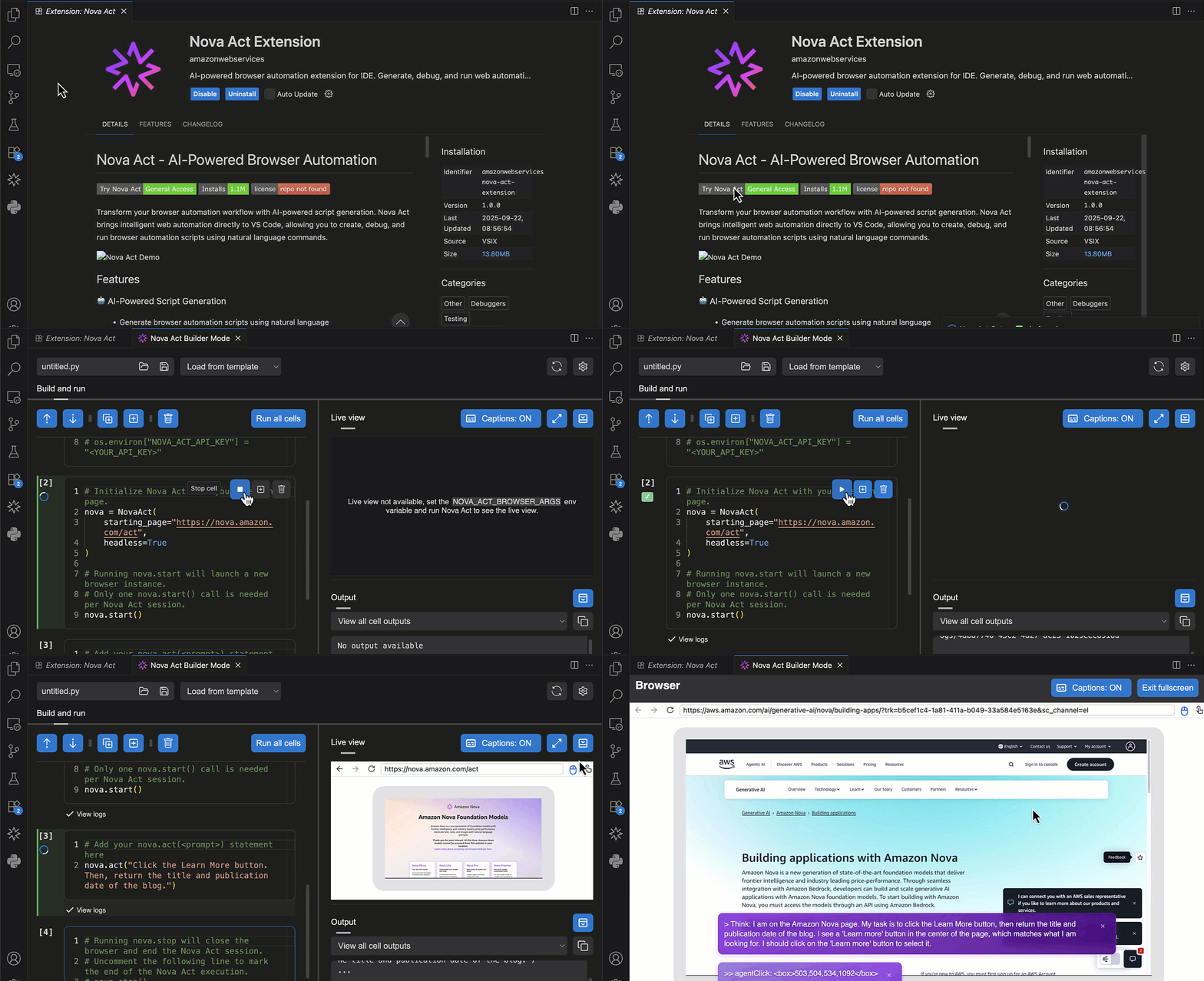
The Nova Act extension is built on top of the Amazon Nova Act SDK (preview), our browser automation agents SDK (Software Development Kit). The Nova Act extension transforms traditional workflow development by eliminating context switching between coding and testing environments. You can now build, customize, and test production-grade agent scripts—all within your IDE—using features like natural language based generation, atomic cell-style editing, and integrated browser testing. This unified experience accelerates development velocity for tasks like form filling, QA automation, search, and complex multi-step workflows.
You can start with the Nova Act extension by describing your workflow in natural language to quickly generate an initial agent script. Customize it using the notebook-style builder mode to integrate APIs, data sources, and authentication, then validate it with local testing tools that simulate real-world conditions, including live step-by-step debugging of lengthy multi-step workflows.
Getting started with the Nova Act extension
First, I need to install the Nova Act extension from the extension manager in my IDE.
I’m using Visual Studio Code, and after choosing Extensions, I enter Nova Act. Then, I select the extension and choose Install.
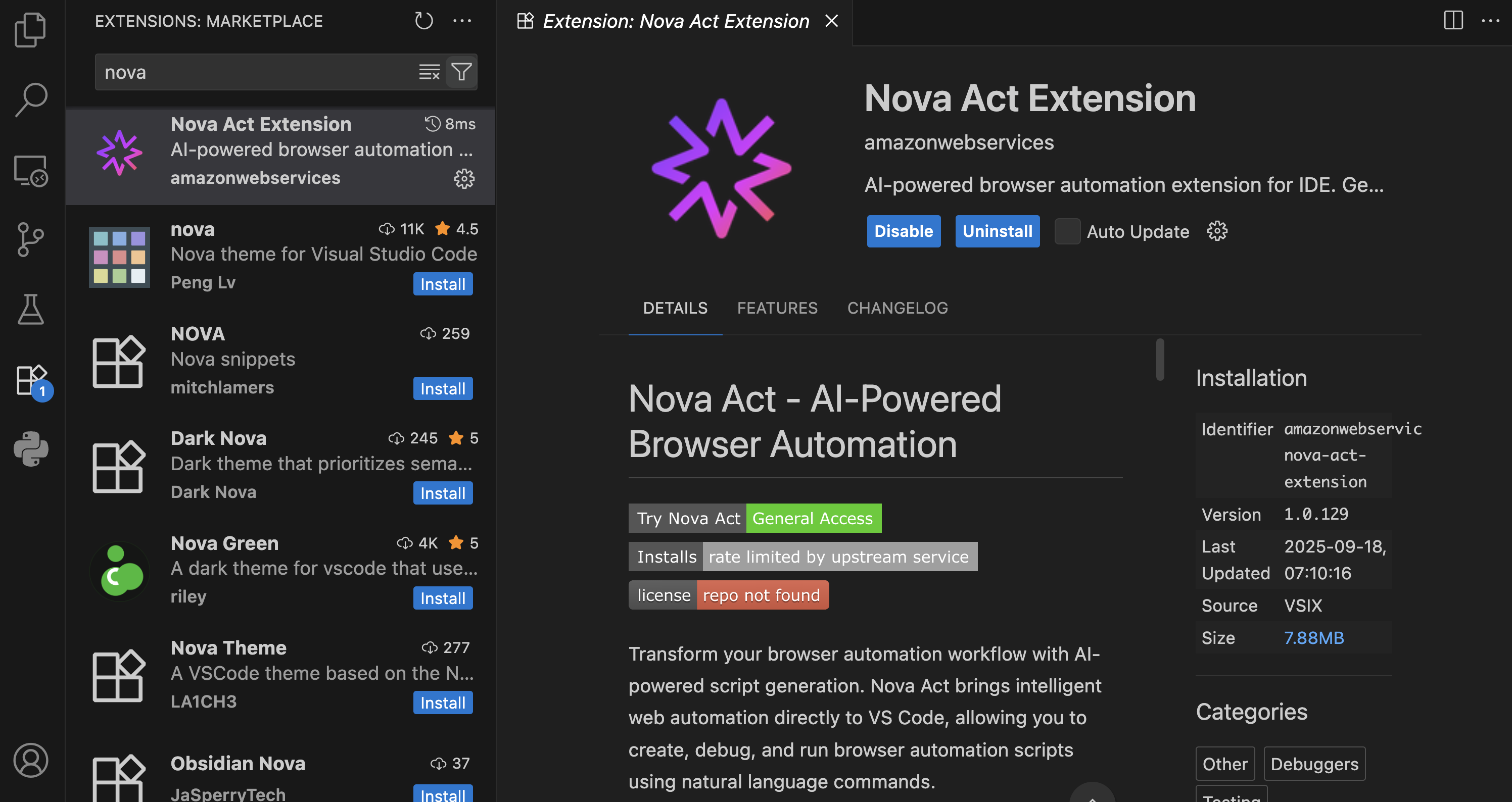
To get started, I need to obtain an API key. To do this, I navigate to the Nova Act page and follow the instructions to get the API key. I select Set API Key by opening the Command Palette with Cmd+Shift+P / Ctrl+Shift+P.
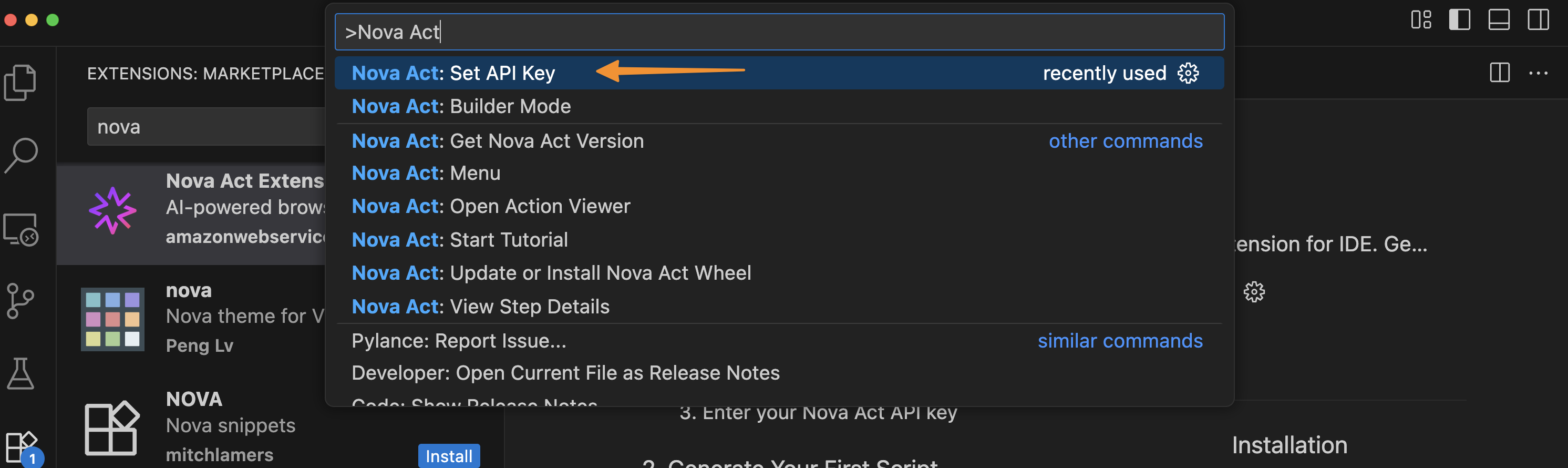
After I’ve entered my API key, I can try Builder Mode. This is a notebook-style builder mode that breaks complex automation scripts into modular cells, allowing me to test and debug each step individually before moving to the next.
Here, I can use the Nova Act SDK to build my agent. On the right side, I have a Live view panel to preview my agent’s actions in the browser and an Output panel to monitor execution logs, including the model’s thinking and actions.
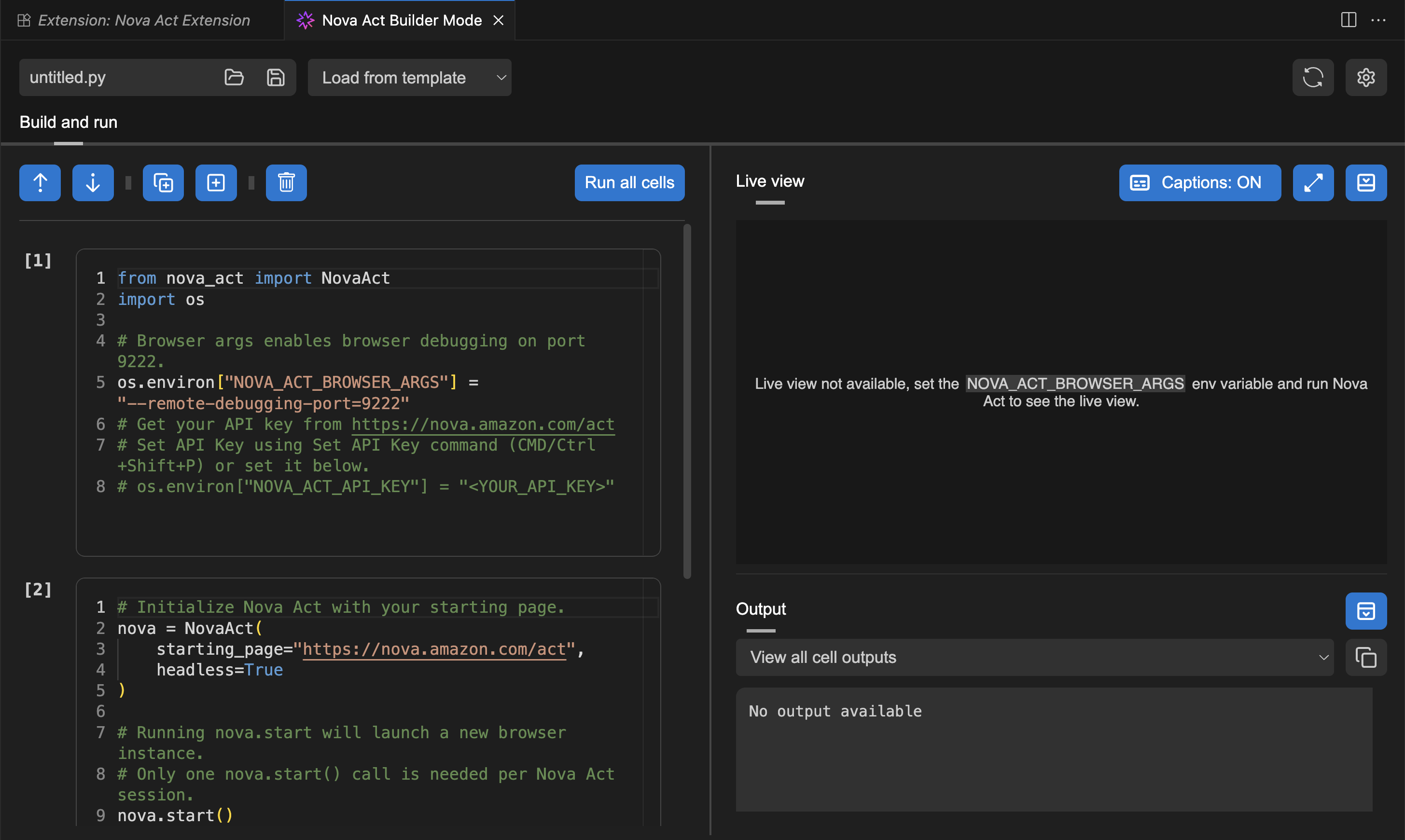
To test the Nova Act extension, I choose Run all cells. This will start a new browser instance and act based on the given prompt.
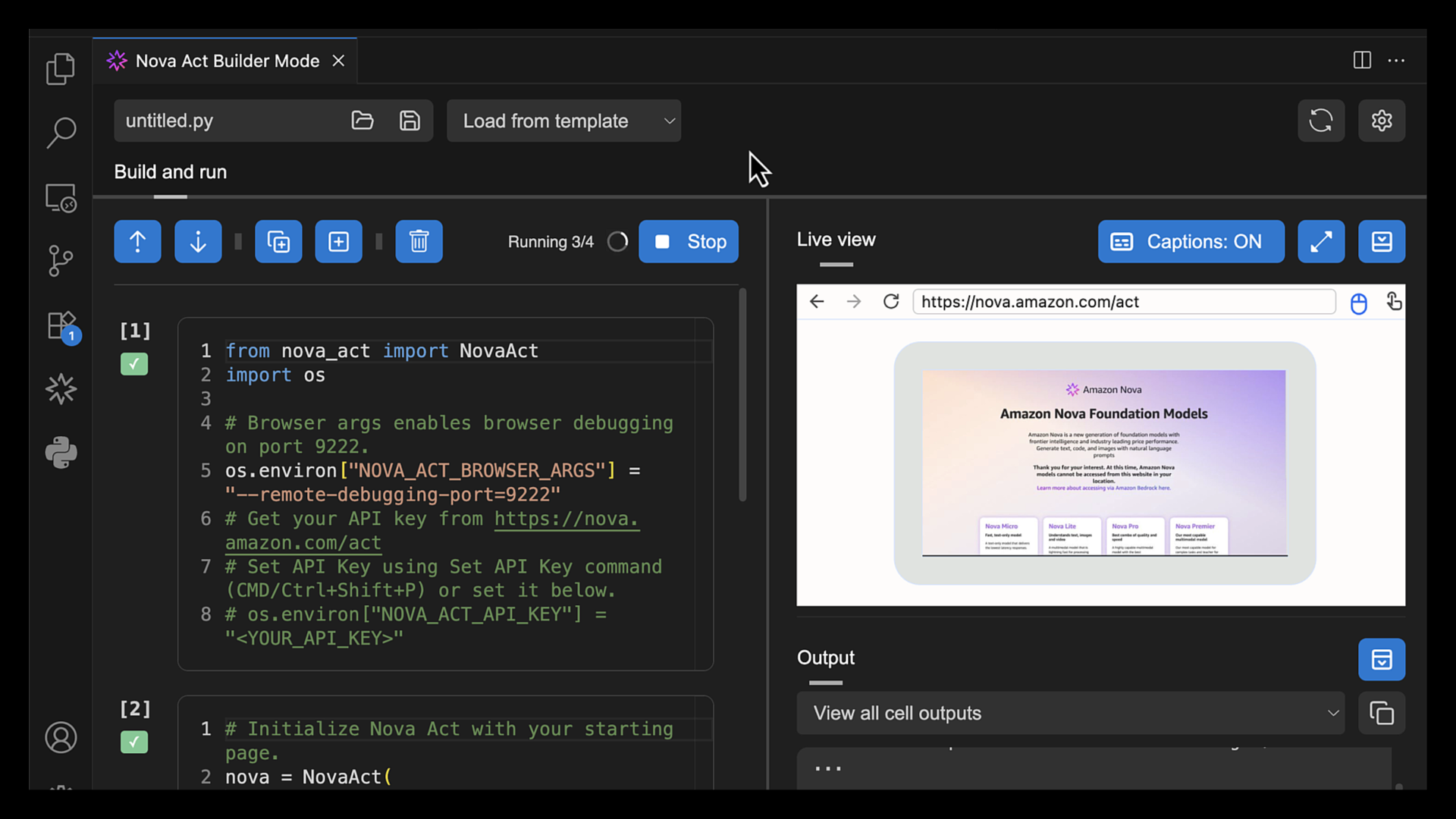
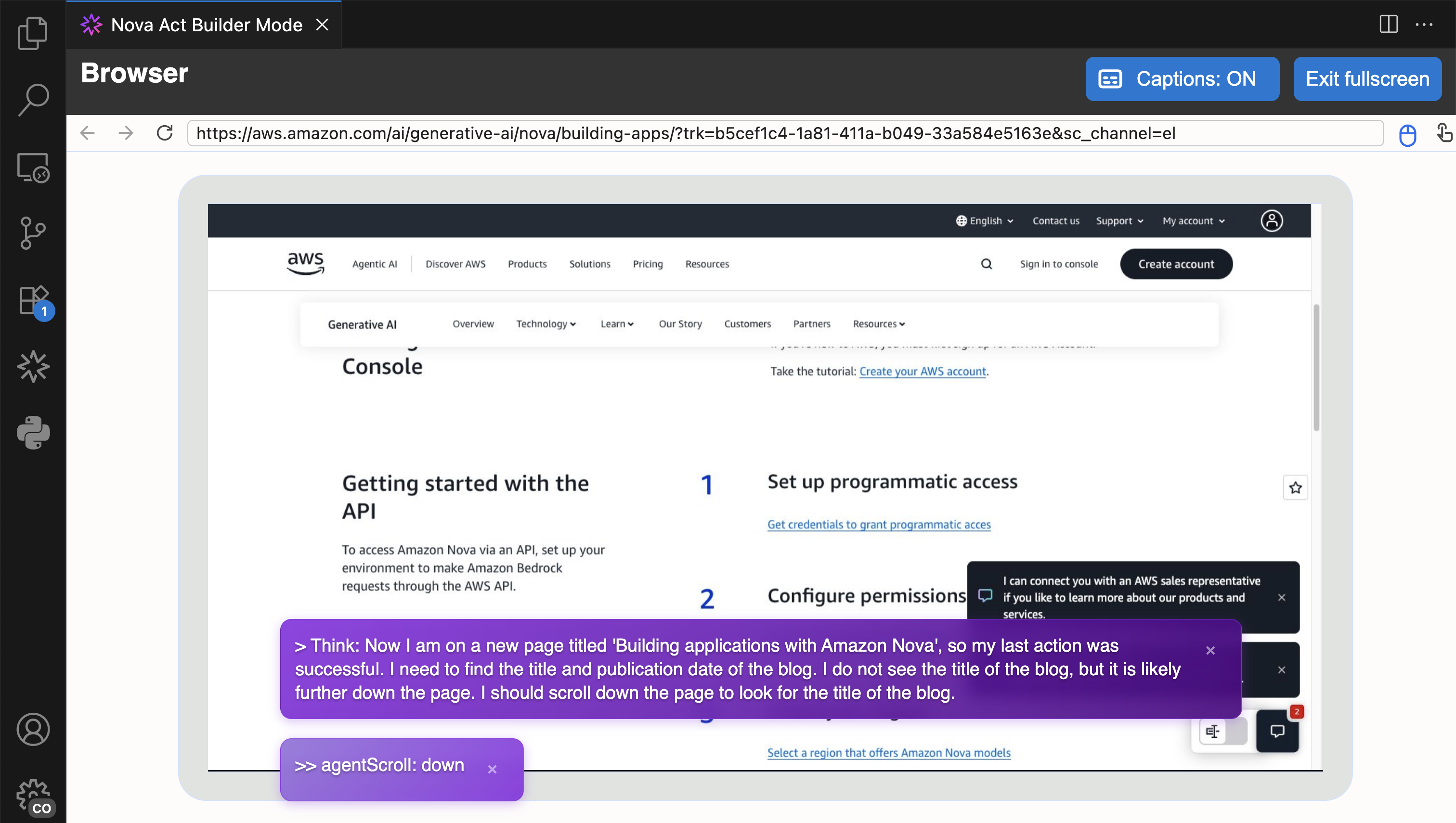
I choose Fullscreen to see how browser automation works.
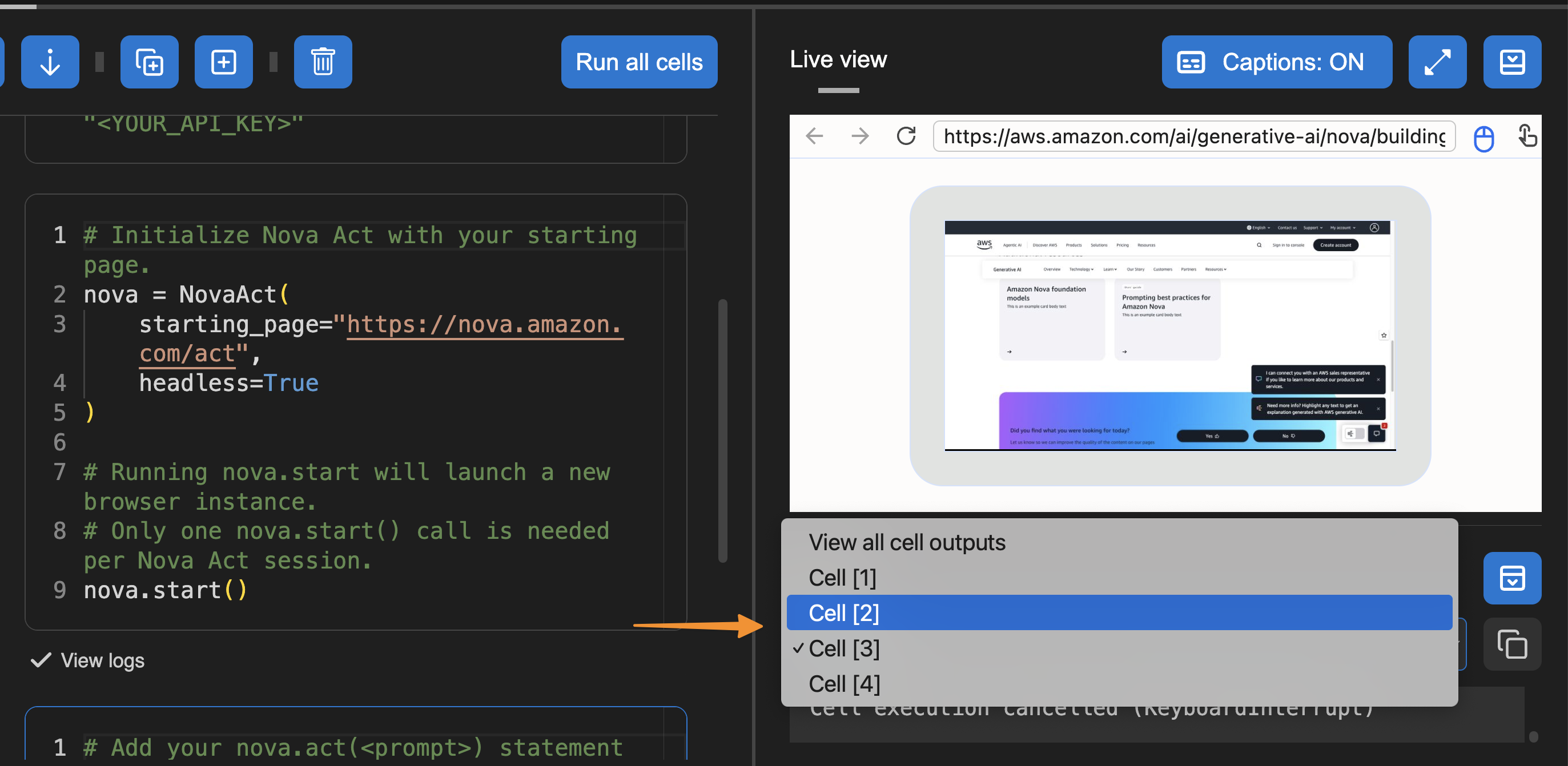
Another useful feature in Builder Mode is that I can navigate to the Output panel and select the cell to see its logs. This helps me debug or review logs specific to the cell I’m working on.
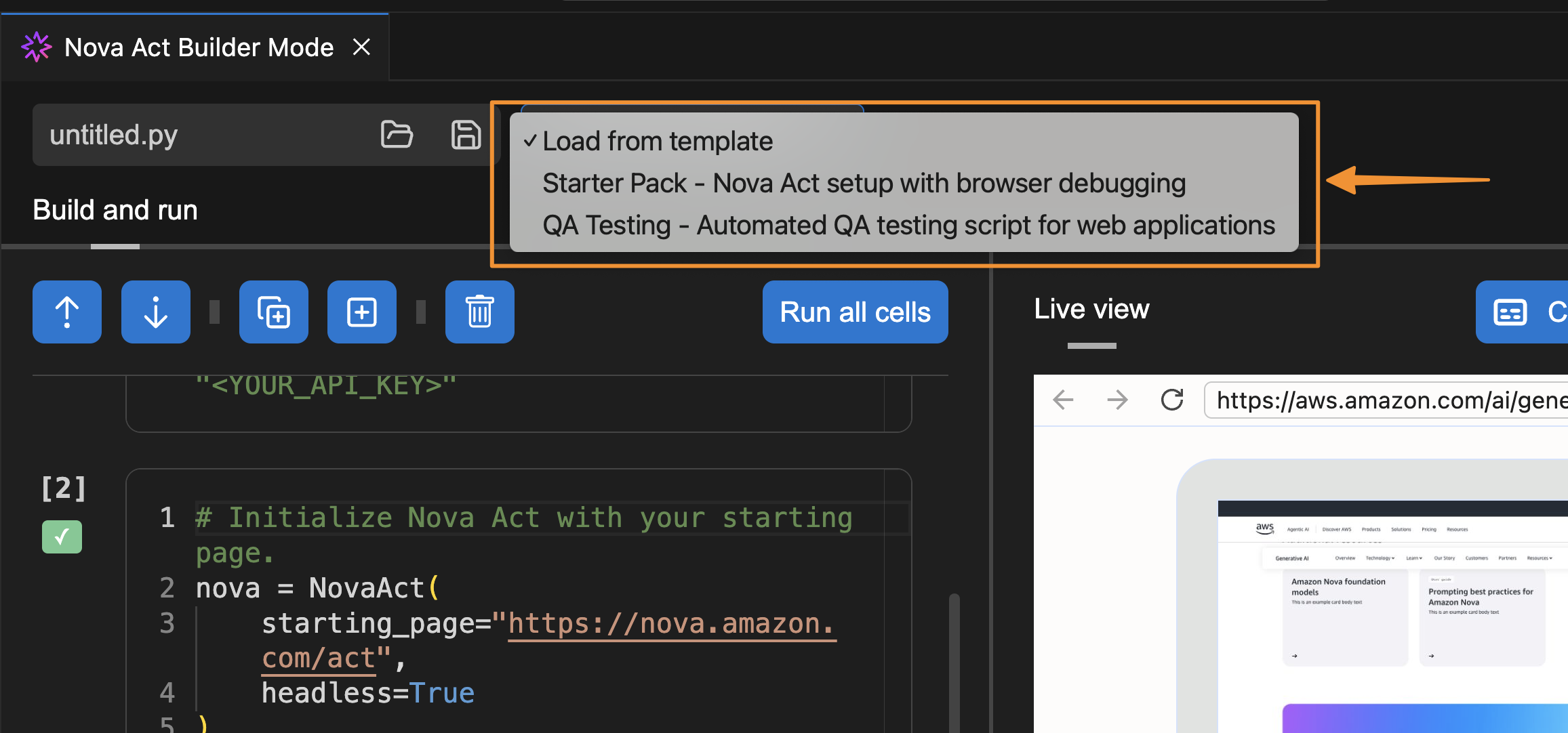
I can also select a template to get started.
Besides using Builder Mode, I can also chat with Nova Act to create a script for me. To do that, I select the extension and choose Generate Nova Act Script. The Nova Act extension opens a chat dialog in the right panel and automatically creates a script for me.
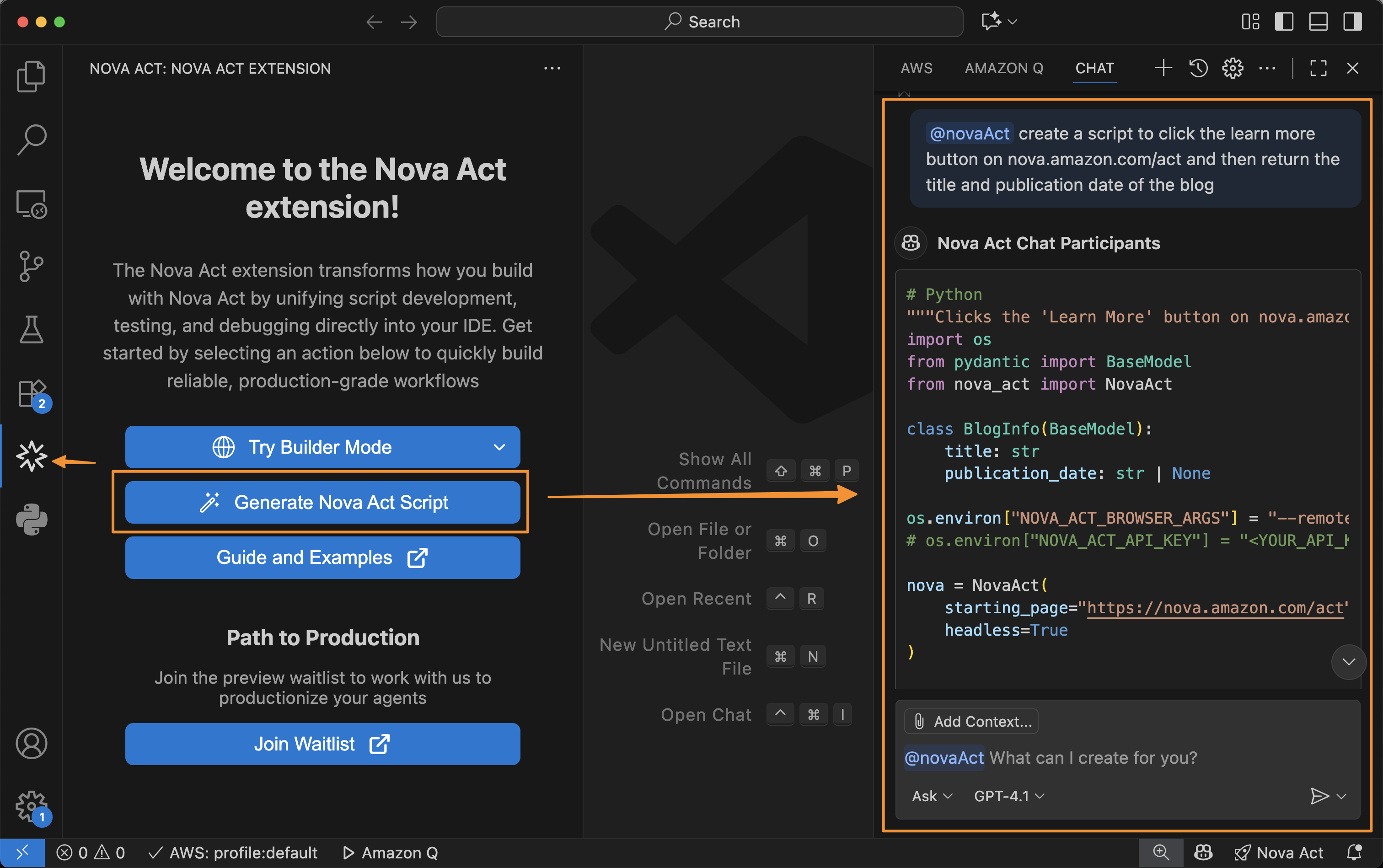
After I finish creating the script, I can choose Start Builder Mode, and the Nova Act extension will help me create a Python file in Builder Mode. This creates a seamless integration because I can switch between chat capability and Builder Mode.
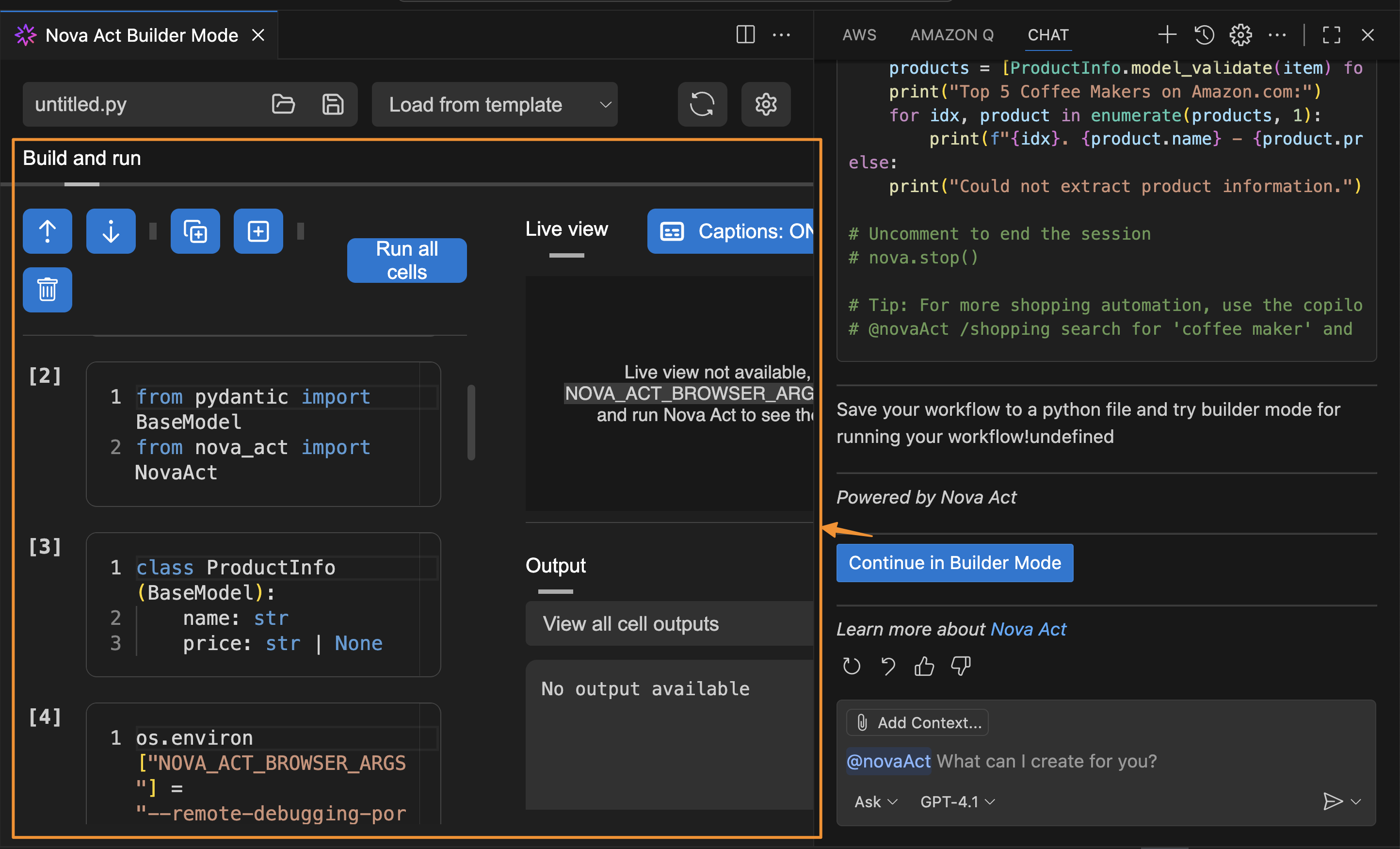
In the chat interface, I see three workflow modes available:
- Ask: Describe tasks in natural language to generate automation scripts
- Edit: Refine or customize generated scripts before execution
- Agent: Run, monitor, and interact with the AI agent performing the workflow
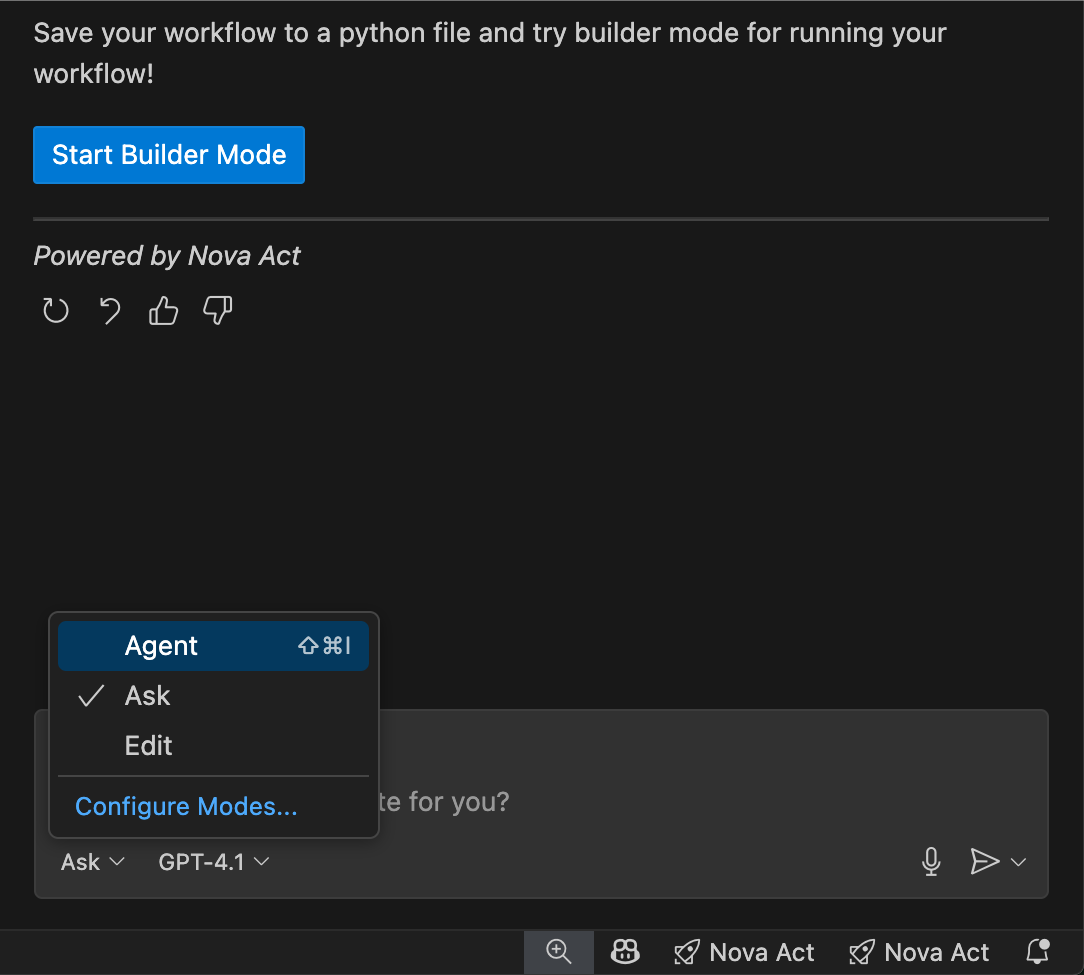
I can also add Context to provide relevant information about my active documents, instructions, problems, or additional Model Context Protocol (MCP) resources the agent can use, plus a screenshot of the current window. Providing this information helps the agent understand any specific requirements for the automation task.
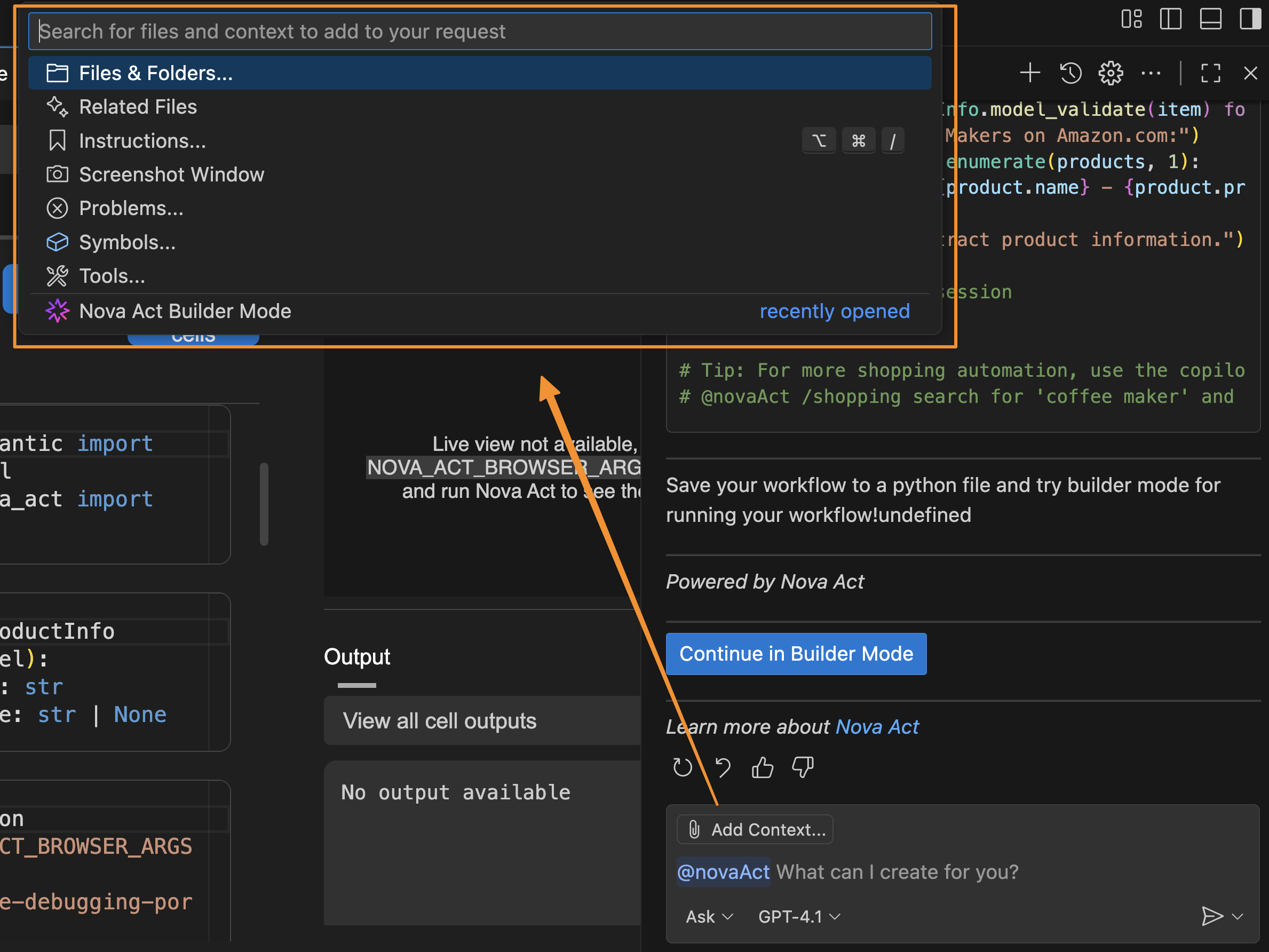
The Nova Act extension also provides a set of predefined templates that I can access by entering / in the chat. These templates are predefined automation scenarios designed to help quickly generate scripts for common web tasks.
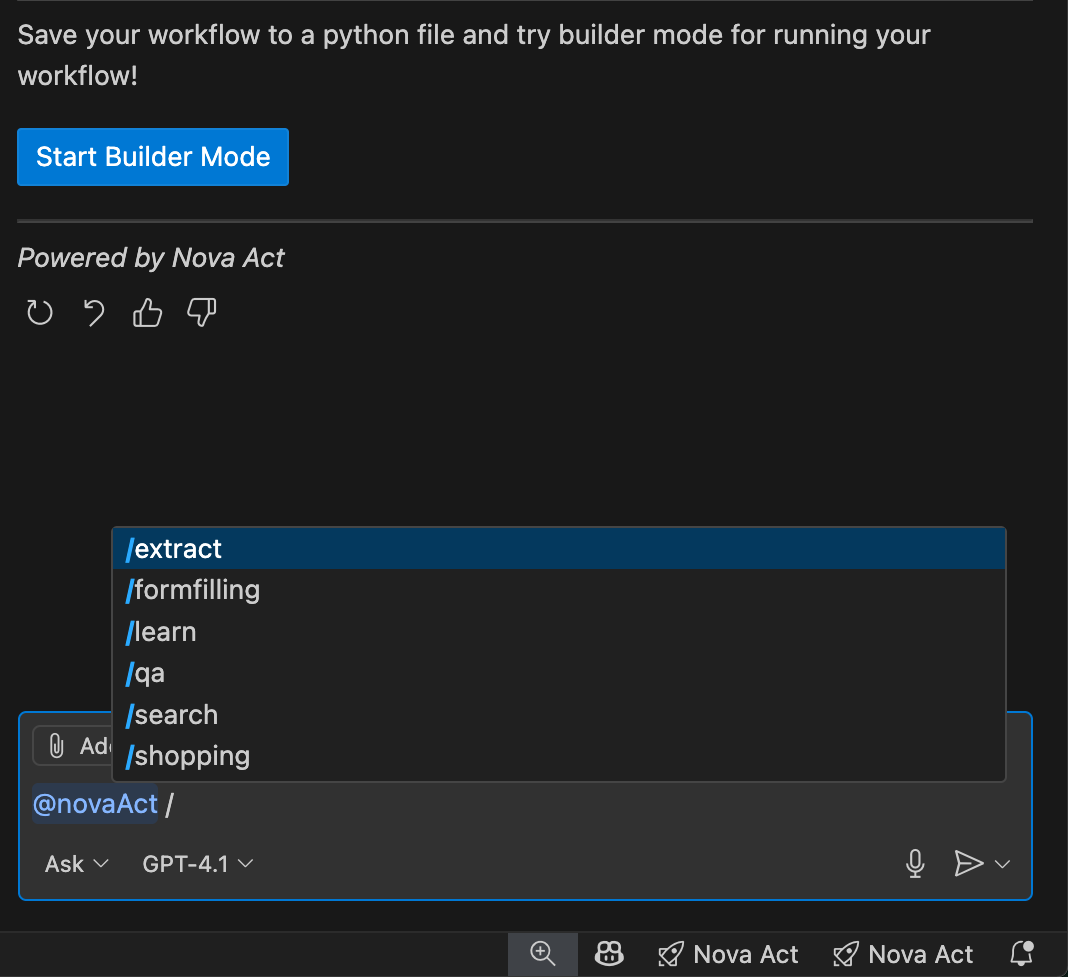
I can use these templates (for example, @novaAct /shopping [my requirements]) to get tailored Python scripts for my workflow. At launch, Nova Act extension provides the following templates:
/shopping: Automates online shopping tasks (searching, comparing, purchasing)/extract: Handles data extraction/search: Performs search and information gathering/qa: Automates quality assurance and testing workflows/formfilling: Completes forms and data entry tasks
This extension transforms my agent development workflow by positioning Nova Act extension as a full-stack agent builder tool—a complete agent IDE for the entire development lifecycle. I can prototype with natural language, customize with modular scripting, and validate with local testing—all without leaving my IDE—ensuring production-grade scripts.
Things to know
Here are key points to note:
- Supported IDEs: At launch, the Nova Act extension is available for Visual Studio Code, Cursor, and Kiro, with additional IDE support planned
- Open source: The Nova Act extension is available under the Apache 2.0 license, allowing for community contributions and customization
- Pricing: The Nova Act extension is available at no charge.
Get started with Nova Act extension by installing it from your IDE’s extension marketplace or visiting the GitHub repository for documentation and examples.
Happy automating!
— Donnie
Home Assistant Party Hack: Control Music with a QR Code! #shorts
Post Syndicated from BeardedTinker original https://www.youtube.com/shorts/-6MIMJdA13g
Ashley Parker at #TAF25 on Donald Trump’s statements
Post Syndicated from The Atlantic original https://www.youtube.com/shorts/rjwvFcBaoJk
Open Infrastructure is Not Free: A Joint Statement on Sustainable Stewardship
Post Syndicated from jake original https://lwn.net/Articles/1039127/
The Open Source Security Foundation
(OpenSSF) has put together a joint statement from many of the public
package repositories for various languages about the need for assistance in
maintaining these commons. Services such as PyPI for Python, crates.io for Rust, and many others are
working together to try to find ways to sustain these services in the face
of challenges from “automated CI systems, large-scale dependency
” all downloading enormous
scanners, and ephemeral container builds
amounts of package data, coupled with the rise of generative and agentic AI
“driving a further explosion of machine-driven, often wasteful automated
“. It is not a crisis, yet,
usage, compounding the existing challenges
they say, but it is headed in that direction.
Despite serving billions (perhaps even trillions) of downloads each month (largely driven by commercial-scale consumption), many of these services are funded by a small group of benefactors. Sometimes they are supported by commercial vendors, such as Sonatype (Maven Central), GitHub (npm) or Microsoft (NuGet). At other times, they are supported by nonprofit foundations that rely on grants, donations, and sponsorships to cover their maintenance, operation, and staffing.
Regardless of the operating model, the pattern remains the same: a small number of organizations absorb the majority of infrastructure costs, while the overwhelming majority of large-scale users, including commercial entities that generate demand and extract economic value, consume these services without contributing to their sustainability.
Enhance event experiences with a generative AI-powered WhatsApp assistant using AWS End User Messaging
Post Syndicated from Richard Perez original https://aws.amazon.com/blogs/messaging-and-targeting/enhance-event-experiences-with-a-generative-ai-powered-whatsapp-assistant-using-aws-end-user-messaging/
Technology conferences and events serve as vital opportunities for innovation, knowledge sharing, and networking in the rapidly evolving technology industry. These gatherings range from large international conventions attracting tens of thousands of attendees, or more specialized conferences focused on specific sectors such as AI, cybersecurity, or a particular industry.
In this post, we share how the AWS Communication Developer Services (CDS) team integrated an AWS End User Messaging Social WhatsApp channel with Amazon Bedrock to launch the AWS Summit Assistant Bot at the AWS Dubai Summit 2025, enhancing the experience of attendees in real-world applications.
AWS Global Summits
AWS Global Summits have become an important event in the technology community, offering invaluable opportunities for professionals to explore the latest cloud computing innovations and best practices. These summits, held in major cities worldwide, bring together developers, engineers, and business leaders to share knowledge, network, and gain hands-on experience with AWS technologies. The events typically feature keynote speeches from AWS executives and industry leaders, providing insights into future trends and strategic directions in cloud computing. Attendees can participate in technical sessions, workshops, and demos that cover a wide range of topics, from artificial intelligence and machine learning (AI/ML) to serverless computing. The impact of these summits extends beyond the events themselves, fostering a global community of cloud practitioners and driving innovation across various industries that rely on cloud technologies.
Attendee experience
Despite the valuable experience these events create, attendees often find navigating their way around these events challenging. Participants frequently find themselves uncertain about which sessions align best with their interests and expertise levels. Locating specific sessions within the venue can be time-consuming, and finding essential venue-specific areas such as quiet rooms or lost property offices has been a persistent pain point.
Users are increasingly reluctant to download single-use mobile apps due to friction like account creation, logins, storage, and app fatigue. Storyly notes that users spend 80% of their app time in their top three apps, with most others abandoned quickly. For event apps specifically, this reluctance stems from the same factors: app fatigue, privacy concerns about sharing personal information, and the time and effort required to set up and navigate yet another platform. Unless the value is immediate and clear, many attendees simply opt out, mirroring the broader trend where users avoid the hassle of downloading apps unless they offer sustained, high-value utility.
These challenges can detract from the overall event experience and can lead to missed opportunities for learning and networking.
How we enhanced the attendee experience
The AWS Summit Assistant Bot, launched at the AWS Dubai Summit (May 2025), offered a seamless solution to these attendee challenges. Attendees simply scanned QR codes that were strategically placed throughout the venue to initiate a WhatsApp chat with the AI-powered assistant. This innovative assistant uses advanced natural language processing to understand attendees’ interests and provide tailored session recommendations. Moreover, it offered real-time guidance on session locations and can direct users to various venue-specific areas, providing a smooth and efficient summit experience.
Solution overview
Let’s examine how the AWS Summit Assistant Bot architecture enables seamless interaction between attendees and summit information systems. The AWS Summit Assistant Bot design allows for real-time processing of attendee messages and response generation using Amazon Bedrock Knowledge Bases for helpful and relevant answers. The following diagram illustrates how various AWS services work together to process attendee messages.
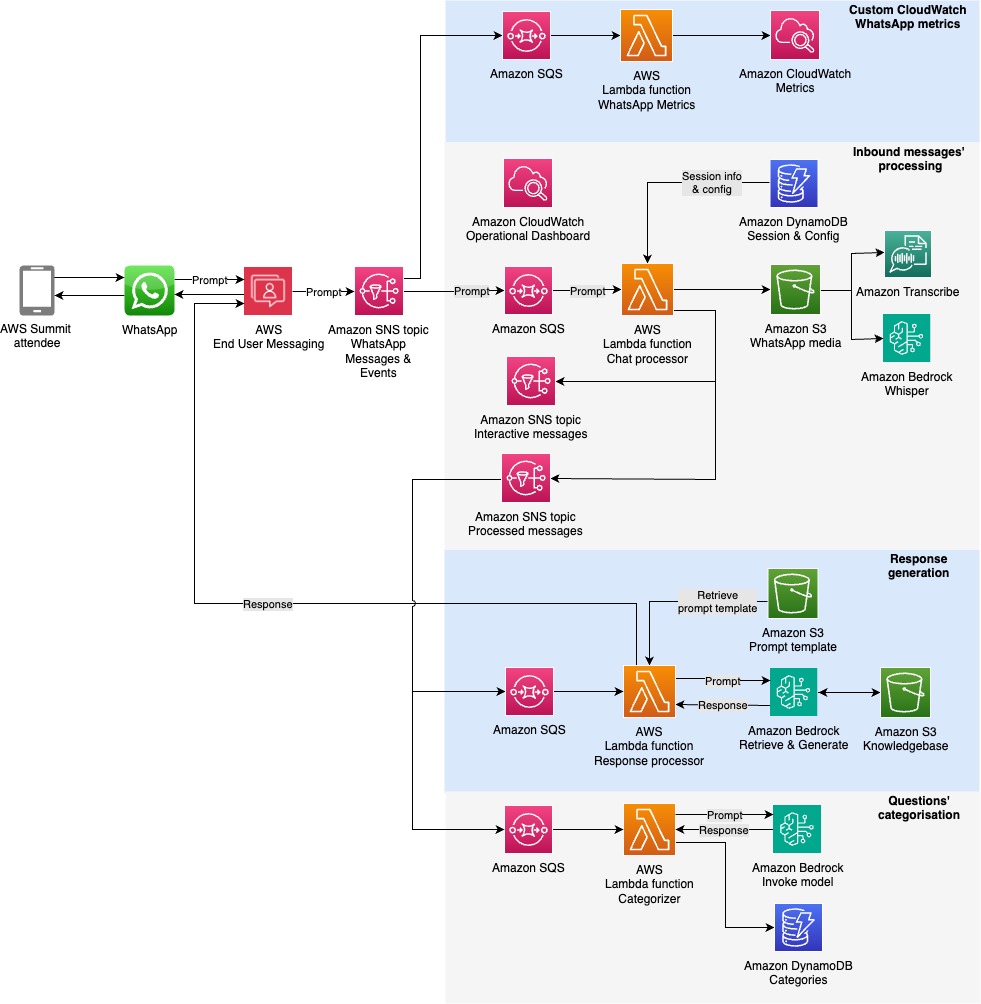
The architecture follows a modular pattern with four key components that enable efficient message processing and analytics capabilities:
- Custom metrics – Custom Amazon CloudWatch WhatsApp metrics enable real-time monitoring of engagement events through Amazon Simple Notification Service (Amazon SNS) topic integration. These metrics track message delivery status and read receipts, providing crucial operational and performance insights.
- Inbound message processing – This pipeline forms the core functionality, implementing message validation filters for length and message type constraints, managing session state, and handling audio transcription workflows. Validated messages are published to a dedicated SNS topic for downstream consumption.
- Response generation – This component uses Amazon Bedrock Knowledge Bases for intelligent message handling, with architecture designed for flexible integration of alternative processing engines. Future iterations of the AWS Summit Assistant Bot will use the Strands Agents SDK and tools.
- Questions categorization – This framework provides contextual analytics beyond standard CloudWatch and AWS Lambda insights. This component implements an Amazon DynamoDB based categorization system that works in conjunction with Amazon Bedrock to dynamically classify and track inquiry patterns while maintaining user privacy through personally identifiable information (PII)-free analytics.
Technical implementation
Our serverless, event-driven architecture efficiently handles WhatsApp message processing through a seamless multi-stage workflow. When a WhatsApp message arrives, AWS End User Messaging receives it and immediately publishes it to an SNS topic. From there, the messages are written to Amazon Simple Queue Service (Amazon SQS) queues, which enables controlled and systematic processing. Lambda functions then handle the core business logic, processing these messages and managing interactions with DynamoDB. To generate responses, the system uses Amazon Bedrock Knowledge Bases to create personalized content for each user. Finally, these tailored responses are routed back to users through AWS End User Messaging, completing the WhatsApp communication cycle.
The system implements two parallel processes alongside the main message processing pipeline. The first is a categorization service that processes messages through Amazon SNS and Amazon SQS before using Lambda functions to analyze content against existing DynamoDB category records. This function either increments existing category counters or creates new categories as needed. The second parallel process handles custom CloudWatch metrics, following a similar initial flow through Amazon SNS and Amazon SQS, but employs specialized Lambda functions to extract and record engagement metrics for operational monitoring.
Generative AI integration
The Amazon Bedrock implementation encompasses two core AI capabilities:
- A knowledge base retrieval system using OpenSearch vector embeddings and Anthropic’s Claude 3.7 Sonnet model for accurate information retrieval
- A real-time message categorization engine that dynamically classifies incoming messages into existing categories or creates new ones based on content analysis
Voice message processing
The voice message handling system implements a sophisticated processing chain. WhatsApp voice messages in OGG format are processed through a Lambda based conversion pipeline using the ffmpeg library. The converted audio is then transcribed using Whisper through Amazon Bedrock Marketplace, chosen for its fast processing and robust multi-language support capabilities.
Security and privacy considerations
Our security-first approach implements multiple layers of protection:
- Customer managed key encryption for data at rest and in transit across Amazon SNS, Amazon SQS, and DynamoDB
- Minimized PII CloudWatch logging and automatic data cleanup through DynamoDB TTL settings
- Amazon Bedrock Guardrails to prevent inappropriate content generation and protect against data loss
- Custom logic to prevent resource draining by preventing the ingestion of unreasonably large messages and keeping a short conversation context window
Monitoring and analytics
Monitoring is important for operational purposes but also for understanding what questions users are asking. The solution uses the following components:
- A Real-time CloudWatch dashboard for tracking operational metrics such as messages published on SNS topics; WhatsApp messages sent, delivered, and read, Lambda invocations; failures; and Amazon Bedrock metrics
- CloudWatch logs for granular analytics using CloudWatch insights such as unique users and number of conversations
- Generative AI-powered categorization of users’ questions
Conclusion
The AWS Summit Assistant Bot demonstrates how AWS services can be combined to create practical, generative AI-powered solutions that enhance real-world experiences. This framework can be adapted for various event types and scales, such as tech conferences, trade shows, festivals, campus orientations, and shopping centers.
To learn more about building similar solutions:
- Explore the AWS End User Messaging documentation
- Review Amazon Bedrock capabilities for natural language processing
- Visit the AWS Communication Developer Services blog for more insights
- Deploy your own communications hub
By using these AWS services and resources, you can create innovative, AI-powered communication solutions for a wide range of applications.
About the authors
[$] An unstable Debian stable update
Post Syndicated from jzb original https://lwn.net/Articles/1038699/
A bug in a recent release of systemd’s network manager caused
headaches for people managing systems that have a virtual LAN (VLAN)
interface on a bridge; something one might want to do, for example,
when configuring network interfaces for virtual machines. The bug
affected several Debian users when upgrading the systemd package
from v257.7-1 to v257.8-1. The updated package is part of the Debian 13.1
release, and the bug has snared enough users to cause a minor
stir—due in no small part to the maintainer’s response as much
as the bug itself.
Security updates for Tuesday
Post Syndicated from jake original https://lwn.net/Articles/1039124/
Security updates have been issued by Debian (corosync and kernel), Fedora (checkpointctl, chromium, curl, and perl-Catalyst-Authentication-Credential-HTTP), SUSE (firefox, frr, kernel, rustup, vim, and wireshark), and Ubuntu (glibc and pam).
David Letterman at #TAF25 on the First Amendment
Post Syndicated from The Atlantic original https://www.youtube.com/shorts/IvYB-EaxnNg