Version
1.86.0 of the Rust language has been released. Changes include support
for trait upcasting, the ability to index multiple elements of HashMaps and
slices mutably, and a number of stabilized APIs.
When building a full-stack application, many developers spend a surprising amount of time trying to make sure that the various services they use can communicate and interact with each other. Media-rich applications require image and video pipelines that can integrate seamlessly with the rest of your technology stack.
With this in mind, we’re excited to introduce the Images binding, a way to connect the Images API directly to your Worker and enable new, programmatic workflows. The binding removes unnecessary friction from application development by allowing you to transform, overlay, and encode images within the Cloudflare Developer Platform ecosystem.
In this post, we’ll explain how the Images binding works, as well as the decisions behind local development support. We’ll also walk through an example app that watermarks and encodes a user-uploaded image, then uploads the output directly to an R2 bucket.
The challenges of fetch()
Cloudflare Images was designed to help developers build scalable, cost-effective, and reliable image pipelines. You can deliver multiple copies of an image — each resized, manipulated, and encoded based on your needs. Only the original image needs to be stored; different versions are generated dynamically, or as requested by a user’s browser, then subsequently served from cache.
With Images, you have the flexibility to transform images that are stored outside the Images product. Previously, the Images API was based on the fetch() method, which posed three challenges for developers:
First, when transforming a remote image, the original image must be retrieved from a URL. This isn’t applicable for every scenario, like resizing and compressing images as users upload them from their local machine to your app. We wanted to extend the Images API to broader use cases where images might not be accessible from a URL.
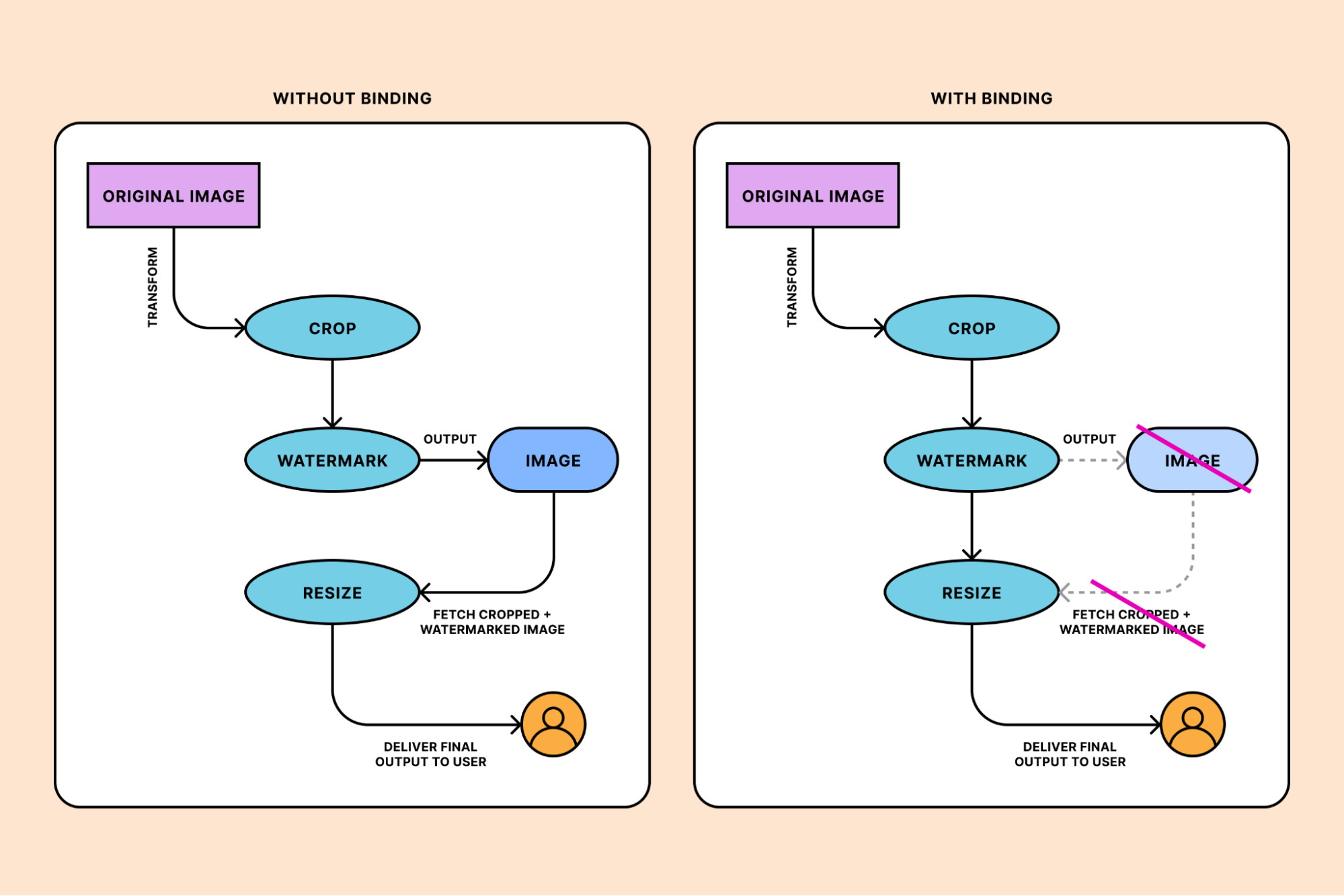
Second, the optimization operation — the changes you want to make to an image, like resizing it — is coupled with the delivery operation. If you wanted to crop an image, watermark it, then resize the watermarked image, then you’d need to serve one transformation to the browser, retrieve the output URL, and transform it again. This adds overhead to your code, and can be tedious and inefficient to maintain. Decoupling these operations means that you no longer need to manage multiple requests for consecutive transformations.
Third, optimization parameters — the way that you specify how an image should be manipulated — follow a fixed order. For example, cropping is performed before resizing. It’s difficult to build a flow that doesn’t align with the established hierarchy — like resizing first, then cropping — without a lot of time, trial, and effort.
But complex workflows shouldn’t require complex logic. In February, we released the Images binding in Workers to make the development experience more accessible, intuitive, and user-friendly. The binding helps you work more productively by simplifying how you connect the Images API to your Worker and providing more fine-grained control over how images are optimized.
Extending the Images workflow
Since optimization parameters follow a fixed order, we’d need to output the image to resize it after watermarking. The binding eliminates this step.
Bindings connect your Workers to external resources on the Developer Platform, allowing you to manage interactions between services in a few lines of code. When you bind the Images API to your Worker, you can create more flexible, programmatic workflows to transform, resize, and encode your images — without requiring them to be accessible from a URL.
Within a Worker, the Images binding supports the following functions:
.transform(): Accepts optimization parameters that specify how an image should be manipulated
.draw(): Overlays an image over the original image. The overlaid image can be optimized through a child transform() function.
.output(): Defines the output format for the transformed image.
.info(): Outputs information about the original image, like its format, file size, and dimensions.
The life of a binding request
At a high level, a binding works by establishing a communication channel between a Worker and the binding’s backend services.
To do this, the Workers runtime needs to know exactly which objects to construct when the Worker is instantiated. Our control plane layer translates between a given Worker’s code and each binding’s backend services. When a developer runs wrangler deploy, any invoked bindings are converted into a dependency graph. This describes the objects and their dependencies that will be injected into the env of the Worker when it runs. Then, the runtime loads the graph, builds the objects, and runs the Worker.
In most cases, the binding makes a remote procedure call to the backend services of the binding. The mechanism that makes this call must be constructed and injected into the binding object; for Images, this is implemented as a JavaScript wrapper object that makes HTTP calls to the Images API.
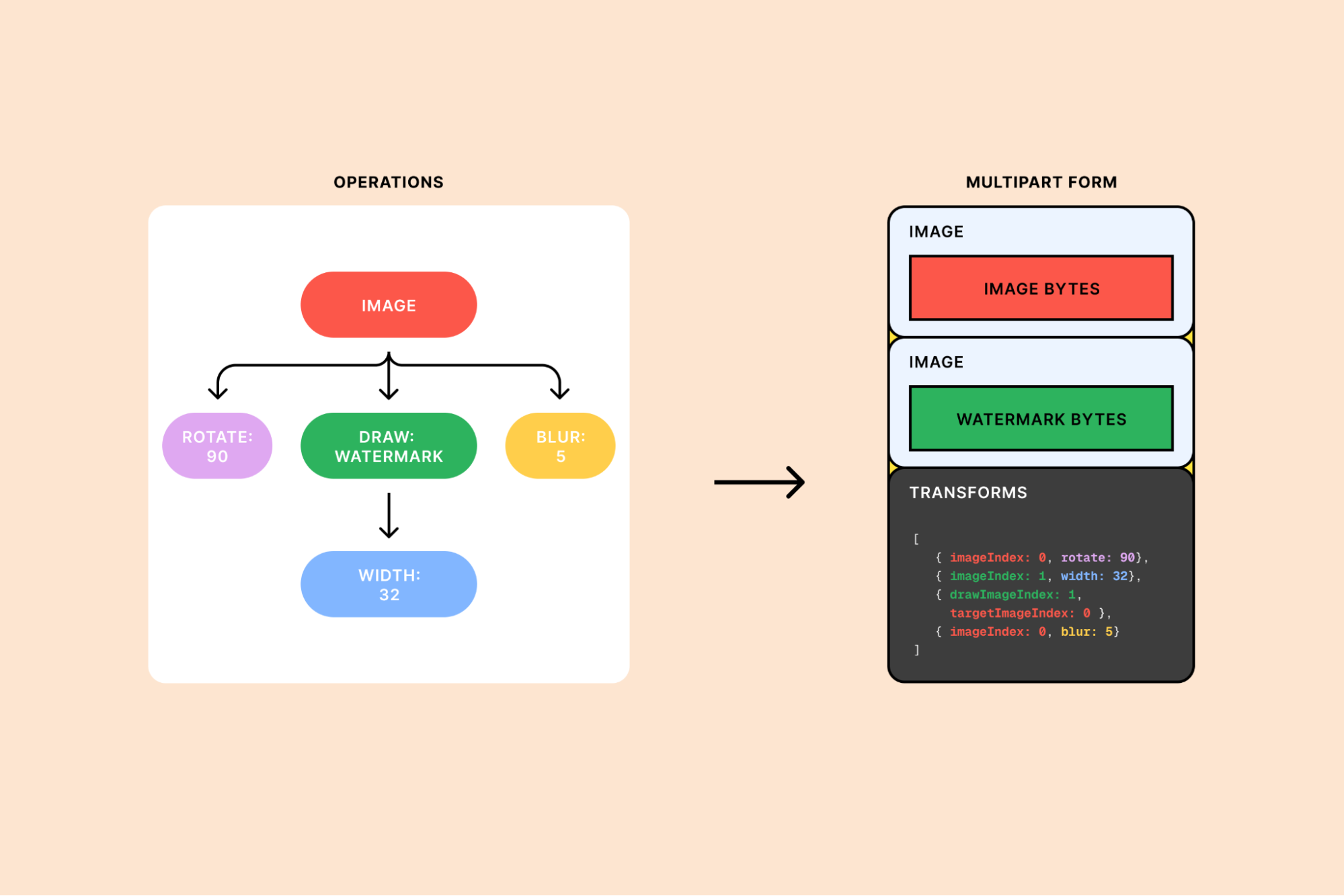
These calls contain the sequence of operations that are required to build the final image, represented as a tree structure. Each .transform() function adds a new node to the tree, describing the operations that should be performed on the image. The .draw() function adds a subtree, where child .transform() functions create additional nodes that represent the operations required to build the overlay image. When .output() is called, the tree is flattened into a list of operations; this list, along with the input image itself, is sent to the backend of the Images binding.
For example, let’s say we had the following commands:
Put together, the request would look something like this:
To communicate with the backend, we chose to send multipart forms. Each binding request is inherently expensive, as it can involve decoding, transforming, and encoding. Binary formats may offer slightly lower overhead per request, but given the bulk of the work in each request is the image processing itself, any gains would be nominal. Instead, we stuck with a well-supported, safe approach that our team had successfully implemented in the past.
Meeting developers where they are
Beyond the core capabilities of the binding, we knew that we needed to consider the entire developer lifecycle. The ability to test, debug, and iterate is a crucial part of the development process.
Developers won’t use what they can’t test; they need to be able to validate exactly how image optimization will affect the user experience and performance of their application. That’s why we made the Images binding available in local development without incurring any usage charges.
As we scoped out this feature, we reached a crossroad with how we wanted the binding to work when developing locally. At first, we considered making requests to our production backend services for both unit and end-to-end testing. This would require open-sourcing the components of the binding and building them for all Wrangler-supported platforms and Node versions.
Instead, we focused our efforts on targeting individual use cases by providing two different methods. In Wrangler, Cloudflare’s command-line tool, developers can choose between an online and offline mode of the Images binding. The online mode makes requests to the real Images API; this requires Internet access and authentication to the Cloudflare API. Meanwhile, the offline mode requests a lower fidelity fake, which is a mock API implementation that supports a limited subset of features. This is primarily used for unit tests, as it doesn’t require Internet access or authentication. By default, wrangler dev uses the online mode, mirroring the same version that Cloudflare runs in production.
See the binding in action
Let’s look at an example app that transforms a user-uploaded image, then uploads it directly to an R2 bucket.
To start, we created a Worker application and configured our wrangler.toml file to add the Images, R2, and assets bindings:
In our Worker project, the assets directory contains the image that we want to use as our watermark.
Our frontend has a <form> element that accepts image uploads:
const html = `
<!DOCTYPE html>
        <html>
          <head>
            <meta charset="UTF-8">
            <title>Upload Image</title>
          </head>
          <body>
            <h1>Upload an image</h1>
            <form method="POST" enctype="multipart/form-data">
              <input type="file" name="image" accept="image/*" required />
              <button type="submit">Upload</button>
            </form>
          </body>
        </html>
`;

export default {
  async fetch(request, env) {
    if (request.method === "GET") {
      return new Response(html, {headers:{'Content-Type':'text/html'},})
    }
    if (request.method ==="POST") {
      // This is called when the user submits the form
    }
  }
};
Next, we set up our Worker to handle the optimization.
The user will upload images directly through the browser; since there isn’t an existing image URL, we won’t be able to use fetch() to get the uploaded image. Instead, we can transform the uploaded image directly, operating on its body as a stream of bytes.
Once we read the image, we can manipulate the image. Here, we apply our watermark and encode the image to AVIF before uploading the transformed image to our R2 bucket:
var __defProp = Object.defineProperty;
var __name = (target, value) => __defProp(target, "name", { value, configurable: true });

function assetUrl(request, path) {
	const url = new URL(request.url);
	url.pathname = path;
	return url;
}
__name(assetUrl, "assetUrl");

export default {
  async fetch(request, env) {
    if (request.method === "GET") {
      return new Response(html, {headers:{'Content-Type':'text/html'},})
    }
    if (request.method === "POST") {
      try {
        // Parse form data
        const formData = await request.formData();
        const file = formData.get("image");
        if (!file || typeof file.arrayBuffer !== "function") {
          return new Response("No image file provided", { status: 400 });
        }

        // Read uploaded image as array buffer
        const fileBuffer = await file.arrayBuffer();

	     // Fetch image as watermark
        let watermarkStream = (await env.ASSETS.fetch(assetUrl(request, "watermark.png"))).body;

        // Apply watermark and convert to AVIF
        const imageResponse = (
          await env.IMAGES.input(fileBuffer)
              // Draw the watermark on top of the image
              .draw(
                env.IMAGES.input(watermarkStream)
                  .transform({ width: 100, height: 100 }),
                { bottom: 10, right: 10, opacity: 0.75 }
              )
              // Output the final image as AVIF
              .output({ format: "image/avif" })
          ).response();

          // Add timestamp to file name
          const fileName = `image-${Date.now()}.avif`;

          // Upload to R2
          await env.R2.put(fileName, imageResponse.body)

          return new Response(`Image uploaded successfully as ${fileName}`, { status: 200 });
      } catch (err) {
        console.log(err.message)
      }
    }
  }
};
Looking ahead, the Images binding unlocks many exciting possibilities to seamlessly transform and manipulate images directly in Workers. We aim to create an even deeper connection between all the primitives that developers use to build AI and full-stack applications.
Have some feedback for this release? Let us know in the Community forum.
If you’ve ever taken a computer security class, you’ve probably learned about the three legs of computer security—confidentiality, integrity, and availability—known as the CIA triad. When we talk about a system being secure, that’s what we’re referring to. All are important, but to different degrees in different contexts. In a world populated by artificial intelligence (AI) systems and artificial intelligent agents, integrity will be paramount.
What is data integrity? It’s ensuring that no one can modify data—that’s the security angle—but it’s much more than that. It encompasses accuracy, completeness, and quality of data—all over both time and space. It’s preventing accidental data loss; the “undo” button is a primitive integrity measure. It’s also making sure that data is accurate when it’s collected—that it comes from a trustworthy source, that nothing important is missing, and that it doesn’t change as it moves from format to format. The ability to restart your computer is another integrity measure.
The CIA triad has evolved with the Internet. The first iteration of the Web—Web 1.0 of the 1990s and early 2000s—prioritized availability. This era saw organizations and individuals rush to digitize their content, creating what has become an unprecedented repository of human knowledge. Organizations worldwide established their digital presence, leading to massive digitization projects where quantity took precedence over quality. The emphasis on making information available overshadowed other concerns.
As Web technologies matured, the focus shifted to protecting the vast amounts of data flowing through online systems. This is Web 2.0: the Internet of today. Interactive features and user-generated content transformed the Web from a read-only medium to a participatory platform. The increase in personal data, and the emergence of interactive platforms for e-commerce, social media, and online everything demanded both data protection and user privacy. Confidentiality became paramount.
We stand at the threshold of a new Web paradigm: Web 3.0. This is a distributed, decentralized, intelligent Web. Peer-to-peer social-networking systems promise to break the tech monopolies’ control on how we interact with each other. Tim Berners-Lee’s open W3C protocol, Solid, represents a fundamental shift in how we think about data ownership and control. A future filled with AI agents requires verifiable, trustworthy personal data and computation. In this world, data integrity takes center stage.
For example, the 5G communications revolution isn’t just about faster access to videos; it’s about Internet-connected things talking to other Internet-connected things without our intervention. Without data integrity, for example, there’s no real-time car-to-car communications about road movements and conditions. There’s no drone swarm coordination, smart power grid, or reliable mesh networking. And there’s no way to securely empower AI agents.
In particular, AI systems require robust integrity controls because of how they process data. This means technical controls to ensure data is accurate, that its meaning is preserved as it is processed, that it produces reliable results, and that humans can reliably alter it when it’s wrong. Just as a scientific instrument must be calibrated to measure reality accurately, AI systems need integrity controls that preserve the connection between their data and ground truth.
This goes beyond preventing data tampering. It means building systems that maintain verifiable chains of trust between their inputs, processing, and outputs, so humans can understand and validate what the AI is doing. AI systems need clean, consistent, and verifiable control processes to learn and make decisions effectively. Without this foundation of verifiable truth, AI systems risk becoming a series of opaque boxes.
Recent history provides many sobering examples of integrity failures that naturally undermine public trust in AI systems. Machine-learning (ML) models trained without thought on expansive datasets have produced predictably biased results in hiring systems. Autonomous vehicles with incorrect data have made incorrect—and fatal—decisions. Medical diagnosis systems have given flawed recommendations without being able to explain themselves. A lack of integrity controls undermines AI systems and harms people who depend on them.
They also highlight how AI integrity failures can manifest at multiple levels of system operation. At the training level, data may be subtly corrupted or biased even before model development begins. At the model level, mathematical foundations and training processes can introduce new integrity issues even with clean data. During execution, environmental changes and runtime modifications can corrupt previously valid models. And at the output level, the challenge of verifying AI-generated content and tracking it through system chains creates new integrity concerns. Each level compounds the challenges of the ones before it, ultimately manifesting in human costs, such as reinforced biases and diminished agency.
Think of it like protecting a house. You don’t just lock a door; you also use safe concrete foundations, sturdy framing, a durable roof, secure double-pane windows, and maybe motion-sensor cameras. Similarly, we need digital security at every layer to ensure the whole system can be trusted.
This layered approach to understanding security becomes increasingly critical as AI systems grow in complexity and autonomy, particularly with large language models (LLMs) and deep-learning systems making high-stakes decisions. We need to verify the integrity of each layer when building and deploying digital systems that impact human lives and societal outcomes.
At the foundation level, bits are stored in computer hardware. This represents the most basic encoding of our data, model weights, and computational instructions. The next layer up is the file system architecture: the way those binary sequences are organized into structured files and directories that a computer can efficiently access and process. In AI systems, this includes how we store and organize training data, model checkpoints, and hyperparameter configurations.
On top of that are the application layers—the programs and frameworks, such as PyTorch and TensorFlow, that allow us to train models, process data, and generate outputs. This layer handles the complex mathematics of neural networks, gradient descent, and other ML operations.
Finally, at the user-interface level, we have visualization and interaction systems—what humans actually see and engage with. For AI systems, this could be everything from confidence scores and prediction probabilities to generated text and images or autonomous robot movements.
Why does this layered perspective matter? Vulnerabilities and integrity issues can manifest at any level, so understanding these layers helps security experts and AI researchers perform comprehensive threat modeling. This enables the implementation of defense-in-depth strategies—from cryptographic verification of training data to robust model architectures to interpretable outputs. This multi-layered security approach becomes especially crucial as AI systems take on more autonomous decision-making roles in critical domains such as healthcare, finance, and public safety. We must ensure integrity and reliability at every level of the stack.
The risks of deploying AI without proper integrity control measures are severe and often underappreciated. When AI systems operate without sufficient security measures to handle corrupted or manipulated data, they can produce subtly flawed outputs that appear valid on the surface. The failures can cascade through interconnected systems, amplifying errors and biases. Without proper integrity controls, an AI system might train on polluted data, make decisions based on misleading assumptions, or have outputs altered without detection. The results of this can range from degraded performance to catastrophic failures.
We see four areas where integrity is paramount in this Web 3.0 world. The first is granular access, which allows users and organizations to maintain precise control over who can access and modify what information and for what purposes. The second is authentication—much more nuanced than the simple “Who are you?” authentication mechanisms of today—which ensures that data access is properly verified and authorized at every step. The third is transparent data ownership, which allows data owners to know when and how their data is used and creates an auditable trail of data providence. Finally, the fourth is access standardization: common interfaces and protocols that enable consistent data access while maintaining security.
Luckily, we’re not starting from scratch. There are open W3C protocols that address some of this: decentralized identifiers for verifiable digital identity, the verifiable credentials data model for expressing digital credentials, ActivityPub for decentralized social networking (that’s what Mastodon uses), Solid for distributed data storage and retrieval, and WebAuthn for strong authentication standards. By providing standardized ways to verify data provenance and maintain data integrity throughout its lifecycle, Web 3.0 creates the trusted environment that AI systems require to operate reliably. This architectural leap for integrity control in the hands of users helps ensure that data remains trustworthy from generation and collection through processing and storage.
Integrity is essential to trust, on both technical and human levels. Looking forward, integrity controls will fundamentally shape AI development by moving from optional features to core architectural requirements, much as SSL certificates evolved from a banking luxury to a baseline expectation for any Web service.
Web 3.0 protocols can build integrity controls into their foundation, creating a more reliable infrastructure for AI systems. Today, we take availability for granted; anything less than 100% uptime for critical websites is intolerable. In the future, we will need the same assurances for integrity. Success will require following practical guidelines for maintaining data integrity throughout the AI lifecycle—from data collection through model training and finally to deployment, use, and evolution. These guidelines will address not just technical controls but also governance structures and human oversight, similar to how privacy policies evolved from legal boilerplate into comprehensive frameworks for data stewardship. Common standards and protocols, developed through industry collaboration and regulatory frameworks, will ensure consistent integrity controls across different AI systems and applications.
Just as the HTTPS protocol created a foundation for trusted e-commerce, it’s time for new integrity-focused standards to enable the trusted AI services of tomorrow.
Teaching about artificial intelligence (AI) is a growing challenge for educators around the world. In our current seminar series, we are gaining insights from international computing education researchers on how to teach about AI and data science in the classroom. In our second seminar, Franz Jetzinger from the Technical University of Munich, Germany, presented his work on supporting teachers to integrate AI into their classrooms. Franz brings a wealth of relevant experience to his research as an accomplished textbook author and K–12 computer science teacher.
Franz started by demonstrating how widespread AI systems and technologies are becoming. He argued that embedding lessons about AI in the classroom presents three challenges:
What to teach (defining AI and learning content)
How to teach (i.e. appropriate pedagogies)
How to prepare teachers (i.e. effective professional development)
As various models and frameworks for teaching about AI already exist, Franz’s research aims to address the second and third challenges — there is a notable lack of empirical evidence integrating AI in K–12 settings or teacher professional development (PD) to support teachers.
Using professional development to help prepare teachers
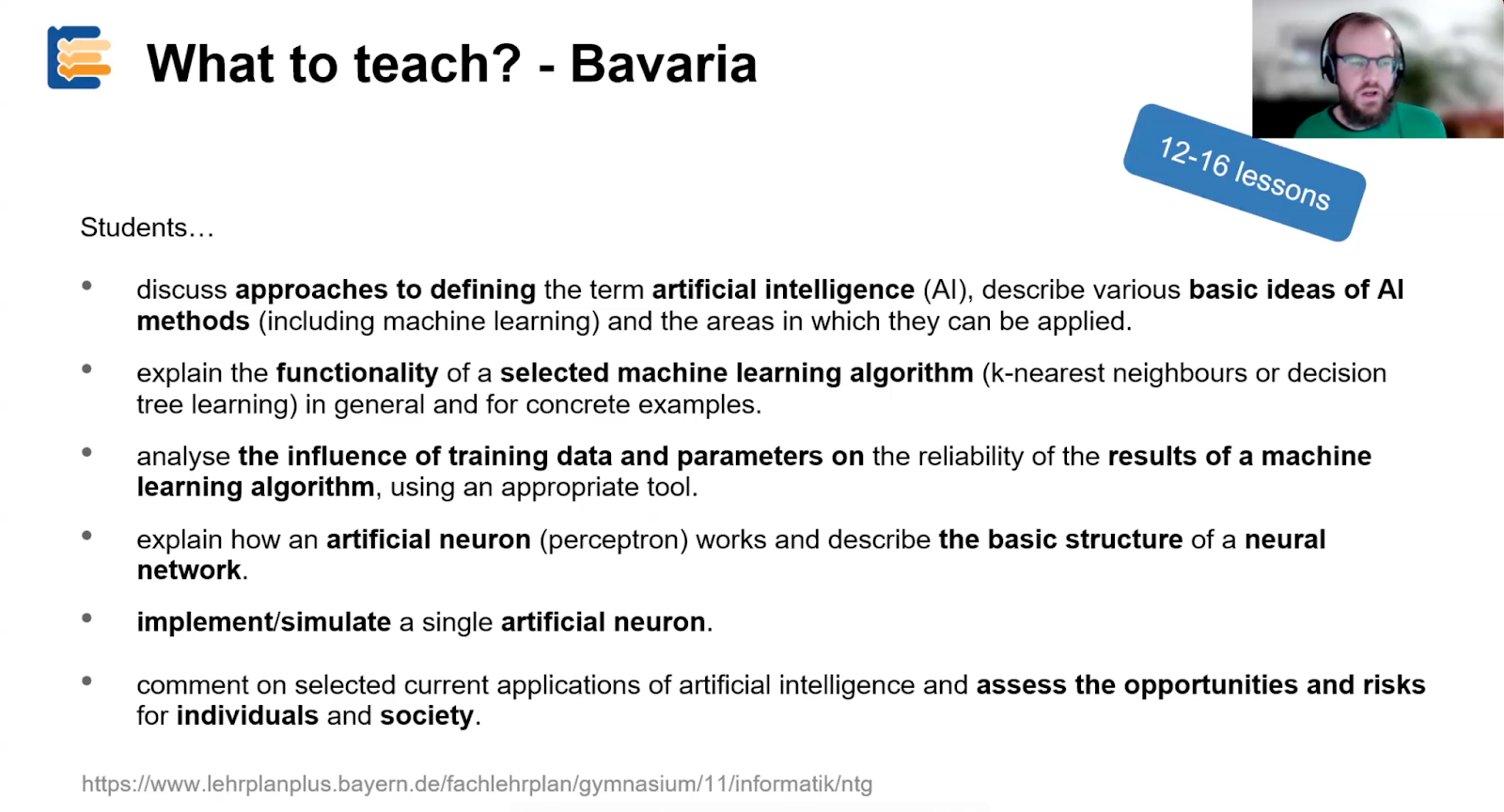
In Bavaria, computer science (CS) has been a compulsory high school subject for over 20 years. However, a recent update has brought compulsory CS lessons (including AI) to Year 11 students (15–16 years old). Competencies targeted in the new curriculum include defining AI, explaining the functionality of different machine learning algorithms, and understanding how artificial neurons work.
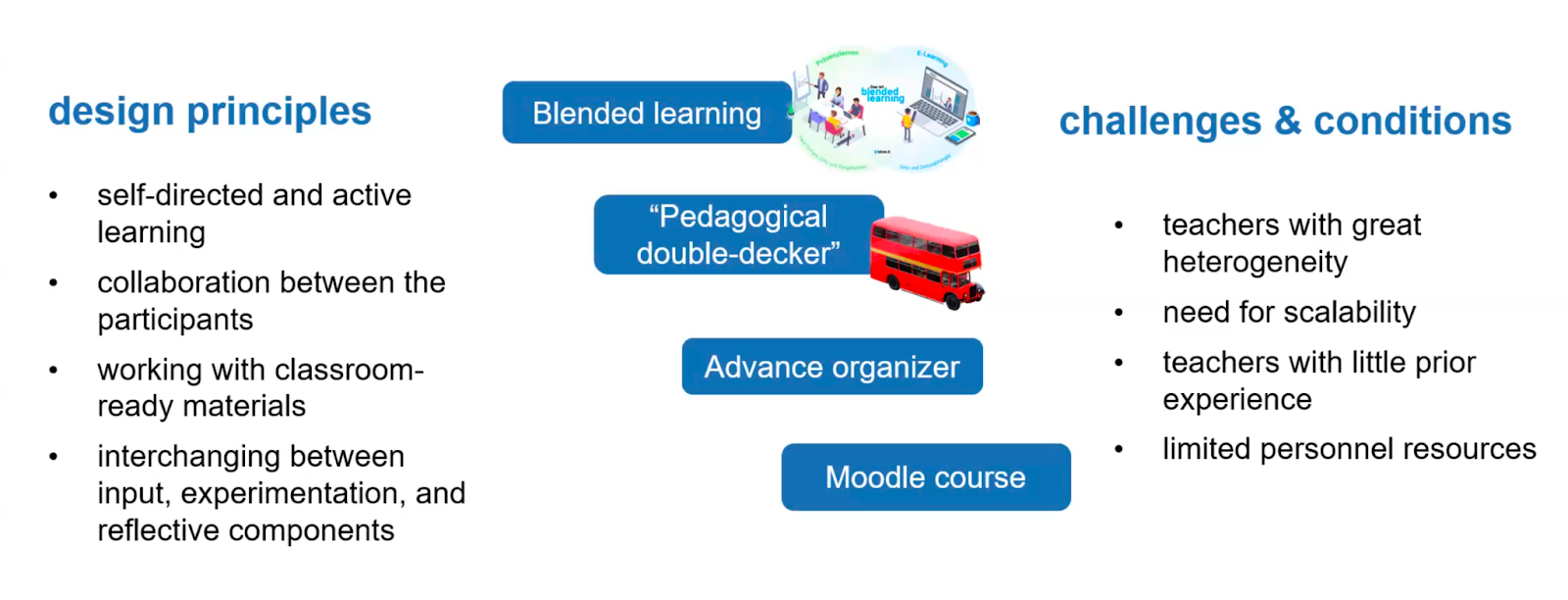
To help prepare teachers to effectively teach this new curriculum and about AI, Franz and colleagues derived a set of core competencies to be used along with existing frameworks (e.g. the Five Big Ideas of AI) and the Bavarian curriculum. The PD programme Franz and colleagues developed was shaped by a set of key design principles:
Blended learning: A blended format was chosen to address the need for scalability and limited resources and to enable self-directed and active learning
Dual-level pedagogy (or ‘pedagogical double-decker’): Teachers were taught with the same materials to be used in the classroom to aid familiarity
Advanced organiser: A broad overview document was created to support teachers learning new topics
Moodle: An online learning platform was used to enable collaboration and communication via a MOOC (massive open online course)
Analysing the effectiveness of the PD programme
Over 300 teachers attended the MOOC, which had an introductory session beforehand and a follow-up workshop. The programme’s effectiveness was evaluated with a pre/post assessment where teachers completed a survey of 15 closed, multiple-choice questions on their AI competencies and knowledge. Pre/post comparisons showed teachers’ scores improved significantly having taken part in the PD. This is surprising as a large proportion of participants achieved high pre-scores, indicating a highly motivated cohort with notable prior experience teaching about AI.
Additionally, a group of teachers (n=9) were invited to give feedback on which aspects of the PD programme they felt contributed to the success of implementing the curriculum in the classroom. They reported that the PD programme supported content knowledge and pedagogical content knowledge well, but they required additional support to design suitable learning assessments.
The design of the professional development programme
Using action research to aid AI teaching
A separate strand of Franz’s research focuses on the other key challenge of how to effectively teach about AI. Franz engaged teachers (n=14) in action research, a method whereby teachers engage in classroom-based research projects. The project explored what topic-specific difficulties students faced during the lessons and how teachers adapted their teaching to overcome these challenges.
The AI curriculum in Bavaria
Findings revealed that students struggled with determining whether AI would benefit certain tasks (e.g. object recognition, text-to-speech) or not (e.g. GPS positioning, sorting data). Franz and colleagues reasoned that students were largely not aware of how AI systems deal with uncertainty and overestimated their capabilities. Therefore, an important step in teaching students about AI is defining ‘what an AI problem is’.
Similarly, students struggled with distinguishing between rule-based and data-driven approaches, believing in some cases that a trained model becomes ‘rule-based’ or that all data models are data-driven. Students also struggled with certain data science concepts, such as hyperparameter, overfitting and underfitting, and information gain. Franz’s team argue that the chosen tool, Orange Data Mining, did not provide an appropriate scaffold for encountering these concepts.
Finally, teachers found challenges in bringing real-world examples into the classroom, including the use of reinforcement learning and neural networks. Franz and colleagues reasoned that focusing on the function of neural networks, as opposed to their structure, would aid student understanding. The use of high-quality (i.e. well-prepared) real-world data sets was also suggested as a strategy for bridging theoretical ideas with practical examples.
Addressing the challenges of teaching AI
Franz’s research provides important insights into the discipline-specific challenges educators face when introducing AI into the classroom. It also underscores the importance of appropriate professional development and age-appropriate and research-informed materials and tools to support students engaging with ideas about AI, data science, and machine learning.
In our current seminar series, we are exploring teaching about AI and data science. Join us at our next seminar on Tuesday 8 April at 17:00–18:30 BST to hear David Weintrop, Rotem Israel-Fishelson, and Peter F. Moon from the University of Maryland introduce ‘API Can Code’, an interest-driven data science curriculum for high-school students.
To sign up and take part in the seminar, click the button below; we will then send you information about joining. We hope to see you there.
Когато жестокост към дете стане централна тема в новините, обществото не остава безразлично. Такъв е случаят с 5-годишния Адриан, малтретиран от доведения си баща с такава жестокост, че детето се е молело да бъде убито. На всичко отгоре насилникът е записвал клипчета с издевателствата си. Майката на момченцето е знаела какво се случва, но не е направила нищо.
В случая с Адриан има физическо и психическо насилие, но не и сексуално. Как педофилията стана тема на протестите (с изключение на пловдивския)? Формалният повод за това е новината за петима мъже, арестувани за притежание на материали, съдържащи сексуална експлоатация на деца на възраст от 2 месеца до 14 години. Но така формулираната тема има и друга функция – да измести обществения гняв от основния проблем.
Има ли значение кой организира протестите?
„Тази тема няма политически пристрастия“, обосновава във Facebook решението си да се включи в софийския протест Кристина Петкова, заместник-председателка на ДСБ, част от коалицията ПП–ДБ. Тя обещава да инициира „разговор с експерти за вдигане размера на наказанията за педофилия“.
„Тоест“ се обърна към Петкова с два въпроса: откъде и по чия инициатива темата за педофилията е присъединена към тази за насилието над Адриан и има ли според нея политически сили или групи, свързани с организацията на протеста. Тя отговори, че не е от организаторите, но мисли, че връзката между двете теми „е по линия на насилието като цяло“. И уточни, че за нея темата няма партийни пристрастия, но се опасява, че „Възраждане“ злоупотребяват и използват дори такива случаи, за да насаждат омраза“. Беше обаче категорична: „Ще отида в сряда (2 април – б.р.), защото въпросът е принципен и касае защита на децата ни.“
Макар от „Война и мир“ да огласиха, че и Националната мрежа за децата (НМД) ще се включи в протеста, това не стана. Вместо това НМД разпространи отворено писмо, в което се подчертава сериозността на домашното насилие (наред с други форми на насилие над деца) и се апелира за реформа на законодателството в тази област.
Неслучайни организатори
Софийският протест срещу насилието над деца и педофилията се организира от „Война и мир“, „Поход за Семейството“ и Георги Драганов – основен двигател на сайта „Война и мир“, с който е свързана и едноименната страница във Facebook. Драганов е също сред организаторите на протестите във Варна и Стара Загора.
„Поход за Семейството“ е асоциация, която ежегодно организира шествия против „София прайд“. Тя е свързана с ултраконсервативни християнски групи, например Асоциация „Общество и ценности“ и Сдружение „РОД Интернешънъл“, които са против нормативни документи като Истанбулската конвенция, Закона за социалните услуги, Стратегията за детето и като цяло се противопоставят на опитите да се ограничи домашното насилие. Те защитават „традиционните семейни ценности“, тоест разбирането, че бракът е само между мъж и жена, и „правата на родителите“, което ще рече, че според асоциацията публичните институции не трябва да се месят в семейните отношения.
Как се измести темата за домашното насилие над деца?
Яхването от „Война и мир“ и „Поход за семейството“ на обществения гняв от насилието над Адриан и от 8-годишната присъда на пастрока му успява да размие повода за този гняв. А той е, че детето е било най-уязвимо там, където едно дете трябва да е най-сигурно – в семейството си, при майка си и мъжа ѝ. В случая става дума именно за домашно насилие, макар бащата на Адриан – Венислав Алексиев, да не е съгласен, тъй като интерпретира словосъчетанието „домашно насилие“ буквално. Пред БНТ той казва:
Домашно насилие? Ами кое му е домашното? Той не му е нито баща, нито Адриан се е водил на този адрес. Той е бил като гостенин там.
Алексиев не е длъжен да познава закона, но в него не пише, че е задължително насилието над едно дете да се извършва на постоянния адрес на жертвата или от кръвен родител, за да се квалифицира като домашно. Напротив – достатъчно е насилникът да е „лице, което е съпруг или бивш съпруг на родителя“ или дори „лице, с което родителят се намира или е бил във фактическо съпружеско съжителство или в интимна връзка“. Освен това бездействието на майката също влиза в определението за домашно насилие.
Когато обаче към темата на протеста се включва и педофилията, това измества фокуса от домашното насилие. Вече става дума просто за едни лоши хора, които злоупотребяват с деца.
В същото време случаите на домашно насилие над деца в България са многобройни
и са тъжна констатация за неспособността на публичните институции да оценяват риска и да предотвратяват подобни престъпления.
На 31 март например се разбра, че жената, причинила смъртта на двете си деца във Вакарел, няма да бъде съдена, а изпратена в психиатрия, защото ги е убила в състояние на невменяемост. Нямало е кой да ѝ окаже адекватна професионална помощ, нито да прецени, че децата ѝ са в риск.
Но нека поговорим за педофилията. Винаги ли държавата реагира адекватно, когато научи за сексуално насилие над деца? Зависи какви са децата и кой е насилникът.
Печално известен е случаят с осъдения и издирван за педофилия във Великобритания Даниел Хъл (споменат и в отвореното писмо на НМД). В Сливен той безпроблемно става протестантски пастор. Четиринайсет деца свидетелстват, че им е посягал сексуално. Част от тях са разпитвани от полицията по крайно неподходящ за възрастта им начин – посред нощ, докато майките им чакат в студа отвън. Въпреки показанията им няма кой да осъди Хъл, защото съдия след съдия си правят отвод. Няма и кой да организира масови протести в защита на децата – те са български граждани, но са ромчета. На тях се гледа като на втора категория хора.
Няма и масово възмущение и протести срещу случаите на сексуална злоупотреба в домове с деца, лишени от родителска грижа. Нито срещу това, че малолетни са принуждавани да проституират, понякога от родителите си (и често със знанието им). Понеже в повечето случаи пак става дума за ромски деца.
Доминиращата представа за педофилията в България е, че тя е някаква външна на семейството заплаха. Има лоши чичковци в интернет, които се опитват да съблазнят децата. Или непознати, причакващи невръстните си жертви, за да ги отвлекат и да издевателстват сексуално над тях. Но ако децата споделят откровено с родителите си, възрастните ще им помогнат да избегнат огромната част от заплахите. Когато се протестира срещу педофилията, правят се законови промени и се предлагат по-строги наказания, обикновено се имат предвид именно такива хора.
Вярно е, че има педофили, които се оглеждат за деца онлайн или пък по паркове и градинки. Но сред посягащите сексуално на малолетни не са изключение и хора, които са познати на семействата на жертвите си, може и да са близки приятели, може и да са роднини, а някои са дори роднини или членове на семейството.
Как реагират в тези случаи родителите на пострадалите деца? Дали винаги ще повярват на детето, ако то каже, че някой техен близък злоупотребява сексуално с него? И дали, ако знаят, че такава злоупотреба действително съществува, винаги ще направят нужното, за да я преустановят, да защитят и да подкрепят детето? Отговорът на тези въпроси, за съжаление, е невинаги.
Алис Мънро и опитът на една психотерапевтка
Известната канадска писателка Алис Мънро например е знаела за сексуалните посегателства на мъжа си към дъщеря ѝ от предишен брак и не е направила нищо. Извършителят пък обвинявал жертвата, че е „развала на дома“. Когато вече порасналата дъщеря носи в полицията писмата на пастрока си, в които той говори за сексуалните си отношения с нея, Мънро я нарича лъжкиня.
Лесно щеше да бъде, ако историята с Мънро е някакво чудовищно изключение. Професионалният опит на моя позната психотерапевтка обаче попарва тази надежда. Тя ми е разказвала, че при всички случаи от практиката ѝ, когато единият родител, в общия случай родният или доведеният баща, е насилвал сексуално детето си, другият родител, в общия случай майката, е знаела, но си е затваряла очите. Тези майки са търсели психологическа помощ заради някакъв друг проблем – свой или на детето си, – но в течение на терапията тайната е излизала наяве.
Лично знам за поне три случая за деца, пострадали от педофили, чиито родители не са ги подкрепили.
Първият случай е на деветгодишно момиче, чийто съсед се опитал да му посегне. Детето успяло да избяга, но мъжът го заплашил, че ако каже на родителите си, ще го убие. След време го срещнал на стълбите във входа на жилищния блок и повторил заплахата. Момичето десет години не посмяло да каже на никого и всеки път, щом излизало или влизало във входа, изпитвало ужас. Разказало на майка си чак когато било на 19 години – вече пълнолетно. Майката обвинила дъщеря си. Семейството не ѝ повярвало и даже пускало малката ѝ племенница да си играе с дъщерята на съседа педофил. В неговия апартамент.
Вторият случай е на момиче, излязло да разхожда кучето си в двора на своето училище. Видял го портиерът и го заговорил. По едно време почнал да го притиска до стената и да го опипва, докато рецитира „Зайченцето бяло“. Детето избягало, след което споделило с майка си. Тя обещала да каже на класната, за да се вземат мерки. Момичето не чуло повече нищо по въпроса – нито от майка си, нито от класната. Все едно нищо не се е случило. А портиерът продължил да работи в училището още много години.
Третият случай е на 13-годишно момиче, прекарващо лятото при дядо си на морето. Понеже той бил работил от малък, смятал, че е крайно време и внучката му да се научи на труд. Пратил я на работа на туристическо корабче, макар да е незаконно. Момичето било доволно, че е „юнга“ и получава дребни пари, и изпитало гордост, че капитанът го поканил на личен разговор. Когато капитанът се опитал да посегне на тийнейджърката, тя избягала. И разказала всичко. Пред мен дядото защити извършителя и обвини внучката: „Той е мъж, това е нормално, но тя защо е отишла при него в извънработно време?“ А майката на момичето го помоли да му потърси работа и следващото лято.
Истинска или бутафорна борба с педофилията?
Популистките протести срещу педофилията и по-строгите наказания срещу извършителите на сексуални престъпления над деца едва ли ще постигнат друг ефект, освен да отвличат общественото внимание от проблеми като домашното насилие.
В контекста на организираните протести МВР най-сетне пусна т.нар. регистър на педофилите – година и седем месеца след приемането му в парламента по предложение на „Възраждане“. Той обаче едва ли ще доведе до смислени резултати, защото законодателството в тази област е изначално сбъркано. И въвеждането на по-строги наказания няма да го оправи.
Ще се опитам накратко да обясня само един аспект на сбърканото законодателството (а кусурите му са доста повече). В Наказателния кодекс (НК) е забранен сексът с деца под 14-годишна възраст, тоест малолетни. В него не се посочва възрастова граница, отвъд която интимните отношения с лица под определена възраст са недопустими. Националният регистър на педофилите, описан в Закона за закрила на детето, обаче включва хората, осъдени за сексуални посегателства срещу малолетни и непълнолетни, тоест под 18 години.
Нека дам пример, за да илюстрирам проблема. Ако лице на 50 години има интимна връзка с 14-годишно дете по взаимно съгласие, това според НК е законно. Съответно лицето няма да влезе в регистъра и ще има право да работи с деца. В него ще влезе обаче 18-годишен тийнейджър, осъден за сексуално посегателство над своя 17-годишна съученичка. Момчето може да е упражнило насилие, но дали е педофил? Ако това ви изглежда абсурдно, проблемът не е „във вашия телевизор“.
Законодателството в областта на сексуалното насилие над деца следва сериозно да се преосмисли –
но без популизъм и пропагандни кампании и не под политически, религиозен или друг натиск, а спокойно, трезво и с помощта на експерти в областта.
Няма как да се постигнат резултати в борбата срещу педофилията, ако децата не се възприемат като личности с човешко достойнство, вместо да се смятат за собственост на родителите си или ценността им да се преценява спрямо етноса, социалното им положение или други техни характеристики.
Такъв подход обаче изисква промяна в нагласите и практиките на институциите – от полицията, съда и прокуратурата до социалните служби, училището и детската градина – както и сериозна работа с родителите. Не можем да очакваме, че децата ще бъдат защитени, ако в средата около тях доминират сексистки стереотипи, срам от търсенето на справедливост („Какво ще кажат хората?“), обвиняване на жертвите, толериране на насилниците и зариване на главите в пясъка.
Amazon Web Services (AWS) is excited to announce the successful completion of the Cloud Security Assurance Program (CSAP) low-tier certification for the AWS Seoul (ICN) Region for the very first time. The certification is valid for a period of five years, from March 28, 2025 to March 27, 2030.
The Cloud Security Assurance Program (CSAP) enables Korean public sector organizations to comply with national security standards and regulations, including the Act on the Development of Cloud Computing and Protection of its Users (also known as the Cloud Computing Act). By obtaining this certification, AWS can now provide secure cloud services that adhere to these standards, enabling domestic public sector organizations to safely innovate on AWS.
The Korea Internet and Security Agency (KISA, a government organization), under the Ministry of Science and ICT (MSIT), evaluated AWS in December 2024 and completed its re-assessment in March 2025. The CSAP scope includes 191 services that Korean customers can use in the AWS Seoul Region. For the full list of services, see the CSAP tab on the AWS Services in Scope by Compliance Program page. AWS strives to continuously bring as many services as possible into the scope of its compliance programs to help customers adhere to their architectural and regulatory needs.
If you have questions or feedback about CSAP, reach out to your AWS account team.
To learn more about our compliance and security programs, see AWS Compliance Programs. As always, we value your feedback and questions; reach out to the AWS Compliance team through the Contact Us page.
If you have feedback about this post, submit comments in the Comments section below.
Before you start using IAM Roles Anywhere, it’s important to plan how you’ll integrate it with your PKI and with your applications running outside of AWS. In this blog post, we share considerations and best practices for integrating IAM Roles Anywhere with your PKI and applications.
Placing your trust anchor within your PKI
The first step when you configure IAM Roles Anywhere is to create a trust anchor. A trust anchor is a resource that represents your certificate authority (CA). A trust anchor can be a root CA or an intermediate or issuing CA.
The choice of which CA to use as your trust anchor within your PKI has implications for which end-entity certificates can be used with IAM Roles Anywhere and the security of your IAM Roles Anywhere deployment. Any valid end-entity certificate issued by your trust anchor, or a valid end-entity certificate issued by a CA that is beneath your trust anchor in your PKI’s hierarchy, can be used with IAM Roles Anywhere.
For example, in a three-level PKI where you select your root CA as your trust anchor, an end-entity certificate issued by your root, or an intermediate certificate authority below your root, can be used with this trust anchor for IAM Roles Anywhere, as shown in Figure 1.
Figure 1: The useable end-entity certificates if you select a root CA as a trust anchor
As shown in Figure 2, if you select Intermediate CA 2 (a CA two levels below the root) as your trust anchor for IAM Roles Anywhere, only end-entity certificates issued from Intermediate CA 2 could be used to get temporary AWS credentials with your IAM Roles Anywhere deployment.
Figure 2: The useable end entity certificates if you select a lower level or issuing certificate authority as a trust anchor
In Figure 2, we selected Intermediate CA as our trust anchor and only end-entity certificates issued by Intermediate CA 2 can be used with IAM Roles Anywhere.
Selecting a root or higher-level intermediate CA will give you more flexibility when it comes to rotation of lower-level CAs, but might allow for more certificates than you intend to be able to access your AWS resources. Using a lower-level issuing CA will not allow certificates issued by other CAs within your PKI to be able to use IAM Roles Anywhere, even if they have identical attributes.
To use the certificate revocation list (CRL) functionality of IAM Roles Anywhere, the certificate used as a trust anchor MUST also contain the CRL Sign for key usage.
The certificate must not be issued by a public CA, or be a public CA.
Choosing your trust anchor: AWS Private CA compared to a self-managed PKI
If you already have an existing PKI and the capability to distribute certificates to your workloads, it’s likely that your existing PKI (which you have experience managing) will be a good choice to use as your IAM Roles Anywhere trust anchor.
However, if you’re looking to establish a PKI without the investment and maintenance costs of operating an on-premises CA, consider using AWS Private Certificate Authority (AWS Private CA). When you use this service, AWS hosts your CAs and allows you to issue certificates by using AWS API requests.
Consider the following when deciding whether to use AWS Private CA for your PKI:
Automatic rotation of your trust anchor: AWS Private CA is designed to integrate quickly with IAM Roles Anywhere, so you don’t need additional rotation of trust anchor certificates within IAM Roles Anywhere—this will be entirely managed in AWS Private CA.
Cost: There’s a cost to using AWS Private CA, which can make reusing your existing PKI more cost effective, if you have one. However, there are benefits to using AWS Private CA, such as automatic rotation, scalability, and resiliency, which can offset the cost of the service.
Scalability and availability: AWS Private CA is a highly scalable and available service across many AWS Regions. AWS Private CA also integrates with AWS Certificate Manager, so that you can conveniently manage certificate issuance and automate certificate renewals.
Resiliency: You can configure an identical AWS Private CA setup in another supported Region.
AWS API integration: You can use AWS Private CA to manage and issue certificates with AWS credentials, using IAM roles and temporary security credentials that are subject to the relevant AWS policies.
Technology integrations: AWS Private CA can integrate with technologies such as third-party certificate management services.
For more information about implementing IAM Roles Anywhere with AWS Private CA, see this Security Blog post.
Working with end-entity certificates with IAM Roles Anywhere
In IAM Roles Anywhere, end-entity X.509 certificates are used to authenticate with the CreateSession API call. These end-entity certificates must meet the following constraints:
The certificates MUST be X.509v3.
Basic constraints MUST include CA: false.
The key usage MUST include Digital Signature.
The signing algorithm MUST include SHA256 or stronger. MD5 and SHA1 signing algorithms are rejected.
Most certificates issued today, such as those used to serve HTTPS requests or to perform mutual TLS (mTLS) authentication, meet these constraints. Those certificates could be used with IAM Roles Anywhere without changes.
Each end-entity’s certificate serial number doesn’t need to be unique, but it’s a best practice for each certificate issued by your certificate authority to have a unique serial number. The serial number of a certificate is used as the role session name of the IAM role session IAM Roles Anywhere creates, and this number can be used to associate events logged to AWS CloudTrail back to the end-entity certificate that was used to assume an IAM role.
IAM roles and workload identity
After you’ve planned for integration with your PKI, the next step when you set up IAM Roles Anywhere is to plan for how your workload identity will integrate with IAM Roles Anywhere and your PKI. The IAM role session that is created by calling CreateSession represents the identity and permissions of your external workloads within AWS.
To help you achieve least privilege, AWS recommends that you use a dedicated IAM role for each of your applications so that you can give each application only the permissions it requires to operate. For example, if you had two applications, Red and Blue, you would create a separate IAM role for each application and grant each role the IAM permissions it needs to do its job.
To make sure that the Red and Blue applications cannot access each other’s roles, you can restrict access by using X.509 attributes as tags in the trust policy for each IAM role. (See Certificate attribute mapping for more information on attributes.) For this example, we will use the Common Name (CN) attribute to restrict access for the Red application.
The following is a sample IAM role trust policy that lets the Red certificate from a trust anchor named ExampleCorpAnchor assume the role from IAM Roles Anywhere:
The role session created will have the SourceIdentity value in AWS set to be equal to the CN of the certificate. For example, the Red certificate would have a SourceIdentity value of CN=Red.
You can find a complete list of session tags and attributes used in IAM Roles Anywhere in the IAM Roles Anywhere documentation The session tags set on roles created with IAM Roles Anywhere are transitive and will be present on any further roles assumed by a role session that is created by IAM Roles Anywhere.
Rotating trust anchor certificates
When you’re using IAM Roles Anywhere with a self-hosted PKI for your trust anchor, you’re responsible for updating your trust anchor with the new CA certificate.
IAM Roles Anywhere supports up to two certificates configured within a trust anchor at a time. When it comes time to rotate the certificate authority used as your trust anchor, you can add your new certificate into the trust anchor so that certificates issued from either CA certificate can be used with IAM Roles Anywhere.
After you have both CA certificates in your trust anchor, you can migrate your workloads over to end-entity certificates issued by your new CA for a seamless migration without the need to update code or configurations on your workloads. After your workloads have migrated to your new certificate authority, you can remove the unused certificate from your trust anchor configuration.
IAM Roles Anywhere profiles and session policies
When you set up IAM Roles Anywhere, you create a profile to associate IAM roles with. A profile allows you to optionally apply a session policy.
Most customers deploy IAM Roles Anywhere by creating one profile for each IAM role that they configure. This gives you the flexibility to apply session policies to each application or IAM role in IAM Roles Anywhere without impacting other roles or applications. We recommend that customers use the one-profile-per-role approach to achieve more operational flexibility.
By using one profile across many different IAM roles, you can minimize configuration work and have a common session policy for the different IAM roles you have set up with IAM Roles Anywhere. This approach requires management of fewer AWS resources, but means that changes to the profile will impact a larger number of applications.
When you set a session policy on a profile, we recommend that you use a managed policy Amazon Resource Name (ARN), rather than the default in-line session policy ARN, because this allows you to have more IAM policy space. The most common use case we’ve seen for applying session policies with IAM Roles Anywhere profiles is restricting the IAM Roles Anywhere session to only expected IP address ranges, such as your on-premises data centers.
The role sessions created by IAM Roles Anywhere are subject to all relevant AWS policies, such as resource control policies (RCPs), service control policies (SCPs), resource policies, permissions boundaries, and VPC endpoint policies.
Working with distributed applications
If you have multiple deployments of an application, we recommend that, wherever possible, you use a unique certificate and key for each instance of that application. For example, this would apply if Blue is a distributed application, and each instance of the Blue application has a requirement to communicate with AWS resources. Sharing a key across distributed applications increases the risk a key could accidentally be made available to unauthorized parties when it’s copied and stored over a network.
By using a unique certificate and key for each instance, you can keep the private key on the server that is using IAM Roles Anywhere instead of needing to distribute the private key over the network, which is a best practice to help prevent exposure of a private key. IAM Roles Anywhere can use private keys and certificates that are stored in Trusted Platform Modules (TPMs), Windows and MacOS certificate stores, files on a file system, or in a hardware security module (HSM) that is accessible with the PKCS #11 protocol.
Because the certificates that are issued to each instance typically have different serial numbers, you can associate events in CloudTrail back to the actual instance of a workload that was issued a certificate. The IAM role session created by a certificate uses the certificate’s serial number as the role session name, which is visible in CloudTrail logs for actions taken by that role session.
Comparing short-lived and long-lived end entity certificates
X.509 certificates have an expiration date. The longer a credential is used, the greater the chance that it might come under the control of an unauthorized person.
We recommend that the certificates you issue to your workloads expire as quickly as your operational tolerances can withstand. For example, if you’re experienced in operating a PKI and can allow applications to request certificates through self-service, we recommend that the certificates issued have a relatively short expiration time so that new certificates must be requested frequently.
If your PKI certificates are issued or distributed manually, you might need to issue longer-lived certificates to ease your operational burden and give yourself longer periods of overlap in validity so that certificates can be rotated without disrupting your business.
It’s possible for multiple end-entity certificates to be valid at the same time with identical attributes. For example, if there were multiple non-expired, non-revoked CN=Red certificates, any of those CN=Red certificates can be used to access the CreateSessions API with IAM Roles Anywhere.
Certificate revocation
Traditionally, certificates are given a long validity period which helps reduce the operational burden for systems engineers who support certificates manually. However, sometimes you might need to revoke certificates for security reasons such as a compromised private key, a change in certificate fields, or a certificate that has been issued incorrectly. Certificate revocation helps maintain the trust and integrity of the PKI system.
A CRL is one of the primary mechanisms to help maintain the health of your PKI. The CRL contains information about the certificates that have been revoked due to security or other reasons.
IAM Roles Anywhere checks the validity of your certificates against your CRL. Using your PKI, after your certificate has been added to the CRL, you can import the CRL to IAM Roles Anywhere by using the using ImportCrl API operation or the import-crl CLI command. A copy of the CRL you import is hosted within IAM Roles Anywhere. After the CRL has been updated, IAM Roles Anywhere validates the certificate against your CRL before issuing credentials.
The fact that your CRL is hosted within IAM Roles Anywhere helps to mitigate a common scenario where the CRL is the target of a denial-of-service (DoS) attempt, causing applications to either deny all access because they’re unable to check the status of a cert against a CRL, or to let unauthorized users use revoked certificates to access services that are configured to ignore the CRL if it isn’t reachable.
Deployment patterns: centralized or decentralized
There are two approaches you can choose when deploying IAM Roles Anywhere: centralized or decentralized. We’ll look at the pros and cons of both.
Centralized trust anchor pattern
The following image describes how a centralized trust anchor would be deployed. First, a central trust anchor is deployed in a dedicated IAM account. Workloads then authenticate to IAM Roles Anywhere in a centralized account, and the workload performs role chaining to access the workload account.
In Figure 3, the workload running in the on-premises datacenter uses its certificate to get temporary AWS credentials from IAM Roles Anywhere in the IAM Roles Anywhere landing account. It then uses those credentials to assume a role into the workload account that hosts its AWS resources.
We recommend a centralized trust anchor pattern if you’re just getting started with IAM Roles Anywhere. This pattern simplifies the management and governance of IAM Roles Anywhere and allows you to scale with fewer resources to manage.
If you have more than one CA that you want to use with IAM Roles Anywhere, you can scale this pattern with multiple trust anchors in the same IAM Roles Anywhere landing account.
Pros of the centralized trust anchor pattern:
A simplified setup and fewer IAM Roles Anywhere resources to manage: Administrators only need to configure IAM Roles Anywhere profiles, roles, and trust anchors in one AWS account per Region.
Easier to manage CRLs: Because IAM Roles Anywhere is centralized, administrators only need to update the CRL in one account per Region.
Minimal application setup: Applications will need to set up role chaining to access their workloads accounts. Later in this post, we show you how to set up role chaining with IAM Roles Anywhere and the various AWS SDKs using a configuration that allows you to access other accounts without writing custom code.
Scaling: Based on the number of CAs you have, you can add additional trust anchors for additional CAs you want to use with IAM Roles Anywhere.
Cons of the centralized trust anchor pattern:
Cross-account access: The account that you’re creating for IAM Roles Anywhere will have access to other AWS accounts hosting your workloads. This might not meet your isolation requirements because it introduces cross-account access. However, remember that you can use certificate attributes in a role-trust policy to limit which workloads can access which AWS accounts.
Considerations of the centralized trust anchor pattern:
Multiple trust anchors: IAM Roles Anywhere supports two certificates per trust anchor, to help with rotation of certificates, so that you don’t have to update the ARNs during certificate rotation.
However, if there was a requirement to support multiple CAs, then it would be best to create separate trust anchors. For example, if you have a root CA and three issuing CAs, instead of creating a bundle of four certificates, you could create a trust anchor with a root CA, which would trust all certificates. Alternatively, you could create three different trust anchors per each issuing CA. So, it’s recommended to consider your PKI hierarchy during this process.
Auditing: If you have multiple trust anchors for different CAs deployed into the IAM Roles Anywhere account, you might need to use the aws:SourceARN condition key in role-trust policies to specify that that only a specific trust anchor can be used to assume a role with IAM Roles Anywhere.
When you use the centralized trust anchor pattern, you can use the certificate attributes to segregate access based on workloads, as described in the IAM roles and workload identity section earlier in this post.
Distributed trust anchor pattern
If you have more advanced security and compliance requirements, you can achieve greater isolation and granular access control by using a distributed (multi-trust-anchor, multi-account) approach with IAM Roles Anywhere.
In Figure 4, you see a distributed pattern where multiple trust anchors have been deployed based on which workloads and applications need access. In this model, the on-premises resource would call the respective trust anchor that has been mapped to each application to gain access to the AWS resource.
Based on your strategy, it’s possible to migrate from the centralized architecture to a distributed architecture as your organization grows or your operating model changes. Let’s looks at some of the considerations for this approach.
Pros of the distributed trust anchor pattern:
Better isolation: This pattern doesn’t require cross-account roles to be set up, and therefore AWS accounts and workloads are better isolated.
PKI flexibility: If you have different subordinate or issuing CAs that align with specific workloads or compliance requirements, you can have a distributed IAM Roles Anywhere setup for each workload in each AWS account.
Cons of the distributed trust anchor pattern:
Additional setup and AWS resources to manage: Trust anchors, profiles, and CRLs need to be set up in each AWS account that you want to use with IAM Roles Anywhere.
Additional configuration of applications: IAM Roles Anywhere ARNs will be different across accounts, and you will need to update the configuration of your applications that use IAM Roles Anywhere with the correct trust anchor and profile ARNs for each account.
Considerations of the distributed trust anchor pattern:
Scale: Infrastructure as code, such as AWS CloudFormation StackSets, can be used to scale the distributed pattern. Administrators can use AWS CloudFormation StackSets as a convenient way to implement trust anchors and profiles across accounts.
Working with IAM Roles Anywhere in your applications
Your applications integrate with IAM Roles Anywhere by using the aws signing helper (also known as the credential helper) with the AWS SDK. The signing helper is a lightweight executable written in Go that uses your private keys and certificate to authenticate to the IAM Roles Anywhere API and request temporary AWS credentials, and then delivers the credentials to your application.
The signing helper uses Go’s cryptographic libraries and doesn’t need specific versions of cryptographic software to be deployed into the environment where it runs, which helps it to run seamlessly and without conflict to other applications. The signing helper can use certificates and keys from OS certificate stores, TPMs, or locations on the file system.
In most cases, we recommend that customers use the signing helper with the credential_process setting because this allows you to use IAM Roles Anywhere without setting up environment variables and also allows you to configure role chaining seamlessly. The AWS SDK will automatically attempt to refresh credentials that are retrieved by the signing helper when the helper is used with the credential_process setting when the AWS credentials are nearing expiration.
If you set up the [default] profile in the AWS configuration file (~.aws/credentials on Linux and MacOS, C:\Users\ USERNAME \.aws\credentials on Windows), the AWS SDK default credentials provider chain will be used by IAM Roles Anywhere, provided that there are no other AWS credentials configured in that environment in a higher priority in the default credential providers chain.
Note: As described in the AWS SDK documentation, the default credential providers will vary slightly based on the language and AWS SDK used. However, many credential providers support using the credential_process setting in the default profile.
Here’s an example default profile that will use IAM Roles Anywhere:
You can also use a non-default profile and call that profile explicitly in your code when creating a credential providers or session object. How your application calls the AWS profile and IAM Roles Anywhere will vary depending on which AWS SDK you use, but we recommend checking the documentation for each SDK, and wherever possible, reuse clients, sessions, or credential providers to avoid unneeded calls to the IAM Roles Anywhere service to get new credentials. Otherwise, workloads may use up more CreateSession quota than expected or introduce unexpected latency to your application while making unnecessary calls to get AWS credentials when it already has some.
Note: AWS SDKs call the IAM Roles Anywhere credential_process to get credentials each time a new credential provider, session, or client is created, depending on the SDK.
Many applications that are written using the AWS SDK use the default credentials providers chain, and might be compatible with IAM Roles Anywhere without additional configuration or code change when using the default profile.
As a best practice, if you have multiple different applications running on the same host and accessing AWS that have totally different security requirements, you should have them run as separate users on that host and avoid sharing configuration files.
Configuring role chaining with IAM Roles Anywhere
Role chaining means to use a role to assume a second role through the AWS Command Line Interface (AWS CLI) or API. For example, RoleA has permission to assume RoleB. You can enable User1 to assume RoleA by using User1’s long-term user credentials in the AssumeRole API operation. This returns RoleA short-term credentials. With role chaining, you can use RoleA’s short-term credentials to enable User1 to assume RoleB.
You can set up role chaining with IAM Roles Anywhere by using profiles in the AWS configuration file, without writing code to manage role chaining or sessions. In the following example, there is a default profile that references the rolesanywhere profile. Applications that use the default profile will automatically use the credentials from the rolesanywhere profile to assume the role specified by the role_arn value, without writing code to manage credentials.
The diagram in Figure 5 describes what happens when the AWS SDK performs role chaining with SDK configuration.
Figure 5: A work sequence diagram detailing the interactions that happen when the AWS SDK reads the preceding config file
The flow in Figure 5 is as follows:
The AWS SDK reads the default profile and discovers it must get credentials from the specified source_profile.
The AWS SDK reads the source profile and uses the configuration to request credentials from IAM Roles Anywhere.
The AWS SDK then uses the credentials retrieved from the source_profile to call STS AssumeRole on the role workload role defined in the default profile.
The AWS SDK returned the temporary AWS credentials for workload role, which can now be used to access AWS resources in the workload account.
Logging and monitoring
Teams and security analysts typically prefer to have visibility into all actions taken. To help with this goal, logging and monitoring is available across different notification channels for IAM Roles Anywhere.
CA certificate expiry: Checks whether the certificate in the trust anchor is due for expiry.
End entity certificate expiry: Checks whether the certificate used for vending temporary security credentials is due for expiry.
Using such information, you can set up alarms and email notifications to remind administrators or developers to rotate the certificates before they expire. It’s especially important to monitor the expiry of the certificates for the trust anchor so that workloads that use IAM Roles Anywhere can continue operations without business disruption.
Using notification events to help with certificate revocation, you can use automations to help with other certificate expiry events. Note that if you’re using AWS Certificate Manager, rotation is automatically handled for you. For more information, see Managed certificate renewal in AWS Certificate Manager.
Tip: IAM Roles Anywhere logs also include the field SourceIdentity, which can help when you’re trying to trace back which workloads are taking what actions in AWS. The SourceIdentity field is usually the common name (CN) of the certificate.
IAM Roles Anywhere and AWS Regions
IAM Roles Anywhere is a regional AWS service. Meaning that configurations for resources like profiles and trust anchors exist in the Region in which you configure them.
As a best practice, we recommend setting up IAM Roles Anywhere in the same Region as the resources you will be accessing (for example, if you’re using IAM Roles Anywhere to access AWS resources in the us-west-2 Region, you should configure IAMRA in the us-west-2 Region).
Credentials issued by IAM Roles Anywhere, like other AWS credentials, can be used to access resources in other Regions (for example, credentials acquired from IAM Roles Anywhere in the us-west-2 Region can be used to access resources in the ca-central-1 Region).
If required, you can have your application introduce logic to try to use IAM Roles Anywhere in different Regions by having different profiles defined for your IAM Roles Anywhere deployment in different Regions. The following Python example will attempt to get credentials from the profile rolesanywhere-uswest2 for IAM roles anywhere in the us-west-2 Region, and if that fails, it will then attempt to get credentials with the rolesanywhere-cacentral1 profile for the ca-central-1 Region.
import boto3

def get_session():
    try:
        #tries to create a session using the profile “rolesanywhere-uswest2”
        #add additional logic and logging, per your requirements
        return boto3.Session(profile_name='rolesanywhere-uswest2')
    except:
        #tries to create a session using the profile “rolesanywhere-cacentral1”
        #add additional logic and logging, per your requirements
        return boto3.Session(profile_name='rolesanywhere-cacentral1')

session = get_session()
sts_client = session.client('sts')
print(sts_client.get_caller_identity())
Conclusion
In this blog post, we showed you the considerations for selecting a CA to use as your trust anchor, considerations for mapping your workload identity to IAM roles, patterns for deploying IAM Roles Anywhere, and how to integrate IAM Roles Anywhere with your applications.
IAM Roles Anywhere is a great solution for companies that have a PKI and want to access AWS resources from outside AWS, without needing to use long-lived credentials for IAM users.
Software engineering stands at an inflection point. While previous technological shifts enhanced what developers could build, AI is fundamentally changing how we build. Amazon Q has driven a shift in how developers at Amazon approach software development. At re:Invent 2024, our breakout session Unleashing generative AI: Amazon’s journey with Amazon Q Developer (DOP214) shared insights from Amazon’s internal journey that reveal not just tactical benefits, but our strategic reimagining of the software development process itself. In the months since our talk, the capabilities of this technology have only accelerated in sophistication and reliability. Our hope is that these learnings can inform the approaches organizations are taking to adopt AI, through guidance on scaling implementation, measuring impact and considerations around meaningful data, and best practices every step of the way. For all of us, this is just the beginning of what is looking to be a very exciting journey as AI becomes not only an active assistant in our day-to-day innovation, but starts to become a peer and companion as AI agents take on full tasks.
Rethinking our mental models: The Productivity Paradox
For too long, we’ve approached software development optimization through the lens of industrial-age thinking – treating code like widgets on an assembly line. This mental model has led organizations to chase simplified metrics like lines of code or story points, missing the true nature of software development as knowledge work.
Our experience at Amazon has shown that the real opportunity isn’t just about making current processes faster – it’s about changing how developers interact with code, documentation, and knowledge. In the 2024 Stack Overflow Developer Survey, 53% of respondents agreed that waiting on answers disrupts their workflow, even if they know where to go find those answers. Similarly, 30% of respondents said knowledge silos impact their productivity ten times or more per week.
In 2024, to solve this problem for Amazon developers, we ingested our internal Amazon knowledge repository consisting of millions of documents into Amazon Q Business so our developers could get answers based on information spread across those repositories. By simply asking Amazon Q their questions in existing tooling instead of manually searching or needing to ask an expert, we reduced the time Amazon developers spent waiting for technical answers by over 450k hours and reduced the interruptions to “flow state” of existing team members.
Today’s developers face a striking paradox: while they’re equipped with more powerful tools than ever, we know that across the industry, developers can spend only 1-2 hours daily writing code. The rest is consumed by what we call “toil” – necessary but undifferentiated work that scales linearly with software complexity. This represents not just a productivity challenge, but a strategic liability for organizations trying to accelerate innovation.
Amazon’s scale has provided unique insights into the transformative potential of AI in software engineering. Using AI for software transformations tied tightly into our internal development tools, we didn’t just save 4,500 developer years of effort – we unlocked new possibilities for large-scale technical modernization that previously seemed impractical. This experience revealed something profound: AI isn’t just making existing processes more efficient; it’s making previously impossible tasks feasible. For instance, our ability to automatically handle complex dependency updates across thousands of services has fundamentally changed how we think about technical debt and system modernization. Over the coming years as these AI agents become increasingly capable and autonomous, we will get increasingly bold with the types of modernization work we ask them to perform, ensuring reliability by complementing them with other agentic capabilities such as correctness validation, testing, and even advanced anomaly detection and production system operations.
The evolution of developer cognition
Perhaps the most fascinating insight from our journey has been observing how AI is changing the way developers think about and solve problems. The traditional model of a developer working in isolation, relying solely on their own knowledge and documentation, is evolving into a more collaborative model where AI serves as an intelligent thinking partner. We’ve seen this manifest in unexpected ways. Developers report that having AI tools available changes not just how they write code, but how they approach problem-solving itself. The ability to rapidly explore multiple approaches or instantly access contextual knowledge has enabled more creative and experimental development practices.
In particular, we are seeing seasoned developers playing with new-to-them programming languages and coding techniques that previously would not have been worthwhile due to ramp time. One developer reported cutting their typical three-week ramp-up time for learning a new programming language down to just one week using Q Developer. This significant reduction in a developer’s initial time investment allows creativity with more suitable programming languages for nuanced project requirements, or jumping into work with unfamiliar and complex systems, without sacrificing code quality. For example, with our recently launched Amazon Q Developer Agentic CLI, another internal developer was able to work with an unfamiliar codebase to build and implement a non-trivial feature within 2 days using Rust, a programming language they didn’t know, stating, “If I’d done this ‘the old fashioned way,’ I would estimate it would have taken me 5-6 weeks due to language and codebase ramp up time. More realistically, I wouldn’t have done it at all, because I don’t have that kind of time to devote.”
As we look to the future, we see several emerging frontiers that will further transform software engineering. The rise of AI agents capable of handling increasingly complex development tasks is shifting the developer’s role from implementation to orchestration. We’re moving toward a model where developers spend more time defining what needs to be built and validating approaches, rather than handling every implementation detail. System architecture, traditionally considered too nuanced for automation, is emerging as a new frontier for AI assistance. Application security reviews or software testing, frequent bottlenecks to software release due to specialist bandwidth, will increasingly be accelerated by AI agents amplifying the capacity of those specialists. While we’re just beginning to explore this space, early experiments suggest AI could help architects evaluate trade-offs and identify potential issues in complex systems more effectively than ever before.
Strategic implications for organizations
We believe the most successful organizations will be those that view AI not just as a tool for automation, but as a catalyst for transforming how they approach software development entirely. The real strategic advantage will come from reimagining software development processes and culture to fully leverage AI’s capabilities. This includes rethinking traditional metrics, redefining developer productivity, and creating space and cultural change for teams to experiment with new ways of working. Amazon Q represents a new class of development tools that augment developer capabilities in fundamental ways, beyond just writing code more efficiently. Organizations that understand and embrace this transformation will be best positioned to lead in the next era of software innovation.
To learn more about Amazon Q Developer and explore innovative ways of accelerating software development refer to the Q Developer documentation. Individual users can get started with Q Developer in the AWS Console, CLI, or in their IDE on the perpetual Free Tier. And remember: give yourself and your team “Permission to Play!” We’re at the heart of a technological revolution; as technologists this a moment where we get to immerse ourselves in the unknown and learn and be curious!
This post demonstrates how to leverage AWS CloudFormation Lambda Hooks to enforce compliance rules at provisioning time, enabling you to evaluate and validate Lambda function configurations against custom policies before deployment. Often these policies impact the way a software should be built, restricting language versions and runtimes. A great example is applying those policies on AWS Lambda, a serverless compute service for running code without having to provision or manage servers. While AWS Lambda already manages the deprecation of runtimes, preventing you from deploying unsupported runtimes, organizations may need to provide and enforce their specific compliance rules not directly linked to the deprecation of a specific language version.
Introducing Lambda Hooks
AWS CloudFormation Lambda Hooks are a powerful feature that allows developers to evaluate CloudFormation and AWS Cloud Control API operations against custom code implemented as Lambda functions. This capability enables proactive inspection of resource configurations before provisioning, enhancing security, compliance, and operational efficiency.
Lambda Hooks provide a mechanism to intercept and evaluate various CloudFormation operations, including resource operations, stack operations, and change set operations (they can also be used with Cloud Control API, but in this post we’re focusing on CloudFormation). By activating a Lambda Hook, CloudFormation creates an entry in your account’s registry as a private Hook, allowing you to configure it for specific AWS accounts and regions. When configuring Lambda Hooks, you can specify one or more Lambda functions to be invoked during the evaluation process. These functions can be in the same AWS account and Region as the Hook, or in another Account you own, provided proper permissions are set up. The evaluation process occurs at specific points in the CloudFormation Stack lifecycle. For instance, during stack creation, update, or deletion, the configured Lambda functions are invoked to assess the proposed changes against your defined compliance rules. Based on the evaluation results, the hook can either block the operation or issue a warning, allowing the operation to proceed.
Lambda Hooks evaluate resources before they are provisioned through CloudFormation, providing a pre-emptive layer of governance. This means that non-compliant resources are caught and prevented from being deployed, rather than requiring retroactive fixes. By leveraging Lambda Hooks, organizations can automate and standardize their compliance checks across all AWS accounts and regions. This centralized approach to policy enforcement ensures consistency and reduces the overhead of managing compliance manually.
Solution Overview
The following sections demonstrate a practical use case for AWS CloudFormation Lambda Hooks, focusing on enforcing compliance rules on AWS Lambda runtimes.
Meet AnyCompany, a forward-thinking enterprise with a robust set of compliance rules governing their software development practices. Among these rules is a strict policy on the use of specific AWS Lambda runtimes.
As they continue to embrace serverless architecture, AnyCompany faces a challenge: how to prevent the deployment of Lambda functions that use non-compliant runtimes. Given their commitment to AWS CloudFormation for deploying Lambda functions, AnyCompany is keen to leverage the power of AWS CloudFormation Lambda Hooks.
We’ll explore the setup process, demonstrate the hook in action, and discuss the broader implications for maintaining compliance in a dynamic cloud environment.
Architecture
The following architecture highlights the implementation of the Lambda Hook. In this implementation, we are using AWS CloudFormation Lambda Hooks to intercept the deployment of Lambda Functions and perform the compliance checks on these resources. The Lambda Hook will interact with an AWS Lambda Function, which will perform the compliance checks. Finally, we’re using AWS Systems Manager Parameter Store to store the Configuration Parameter which contains the list of permitted Lambda Runtimes.
Figure 1: Architecture of the Solution
A Developer (or a CI/CD pipeline) deploys a CloudFormation stack containing Lambda functions.
CloudFormation invokes the respective Lambda Hook, which is configured to intercept operations on AWS Lambda Resources. We are setting this hook to “FAIL” deployment in case checks are not successful.
hook-lambda: directory containing all the code related to the CloudFormation Lambda Hook (Validation Lambda Function, and the CloudFormation template for the Solution)
sample: directory containing the code of the sample used to test the CloudFormation Lambda Hook
deploy.sh: utility script to deploy the Solution via AWS CLI
cleanup.sh: utility script to clean up the AWS CloudFormation Hook infrastructure via the AWS CLI
template.yml: AWS CloudFormation Template containing all the AWS Resources involved in the Solution
Prerequisites
You must have the following prerequisites for this solution:
An AWS account or sign up to create and activate one.
The following software installed on your development machine:
Install the AWS Command Line Interface (AWS CLI) and configure it to point to your AWS account.
Install Node.js and use a package manager such as npm.
Appropriate AWS credentials for interacting with resources in your AWS account.
Walkthrough
Creating the AWS Lambda Validation Function – Lambda Code
The CloudFormation Lambda Hook interacts with a specific Lambda (referred to as Validation Lambda throughout the rest of this post), which gets invoked during CloudFormation CREATE and UPDATE STACK operations involving Lambda Functions. The goal is to check if these Lambda functions have runtimes that comply with AnyCompany’s rules.
Below is the detailed description of the steps that the Validation Lambda function handler follows (the code is written in Typescript).
First, the Validation Lambda retrieves an environment variable containing the SSM Parameter Store parameter name which contains the compliant runtimes list. Additionally, safety checks ensure that only Lambda Resources are considered and that their Runtime property is defined.
Note that both safety checks could be skipped, since the Hook should already be configured to interact only with Lambda Resources and the Lambda’s Runtime property is always required. However, they remain in place to demonstrate how to retrieve this information from the Lambda Hook event in your handler.
const parameterName = process.env.PERMITTED_RUNTIMES_PARAM;
if (!parameterName) {
	throw new Error('Permitted Runtimes Parameter is not set');
}

const resourceProperties = event.requestData.targetModel.resourceProperties;
// Check if this is a Lambda function resource
if (event.requestData.targetType !== 'AWS::Lambda::Function') {
console.log("Resource is not a Lambda function, skipping");
	return {
		hookStatus: 'SUCCESS',
		message: 'Not a Lambda function resource, skipping validation',
		clientRequestToken: event.clientRequestToken
	}
}

// Check runtime version compliance
const runtime = resourceProperties.Runtime;
if (!runtime) {
	console.log("Runtime not defined, failing");
	return {
		hookStatus: 'FAILURE',
		errorCode: 'NonCompliant',
		message: 'Runtime is required for Lambda functions',
		clientRequestToken: event.clientRequestToken
	}
}
Then the Validation Lambda retrieves the value of the Configuration Parameter from SSM Parameter Store through a utility class called ParameterStoreService. For this post, consider that the value inside that Configuration Parameter is a list of strings, where each string contains one of the possible Lambda runtime values that you can find here (e.g. nodejs22.x,nodejs20.x,python3.11,python3.10,java17,java11,dotnet6). After retrieving the value, the Validation Lambda checks if the runtime of the Lambda Resource complies with the configured admitted runtimes. If the runtime is not compliant, you’ll receive a properly formatted response with FAILURE as hookStatus, otherwise the response will contain a SUCCESS hookStatus.
// Retrieve configuration from Parameter Store
const compliantRuntimes = await parameterStoreService.getParameterFromStore(parameterName);

// Check if Lambda runtime is permitted or not
if (!compliantRuntimes.includes(runtime)) {
console.log("Runtime " + runtime + " not compliant ");
	return {
		hookStatus: 'FAILURE',
		errorCode: 'NonCompliant',
		message: `Runtime ${runtime} is not compliant. Please use one of: ${compliantRuntimes.join(', ')}`,
		clientRequestToken: event.clientRequestToken
	}
}

return {
	hookStatus: 'SUCCESS',
	message: 'Runtime version compliance check passed',
	clientRequestToken: event.clientRequestToken
}
For more information about the possible response values of CloudFormation Lambda Hooks Lambda, have a look at this link.
Creating the validation Lambda – Lambda CloudFormation definition
The Validation Lambda function will be deployed via CloudFormation, in the same Stack with the CloudFormation Lambda Hook definition and the AWS Systems Manager Parameter Store Parameter. Here’s the fragment of the CloudFormation Template containing its definition:
Please note that the above template contains a reference to an IAM Role because the Hook requires proper permissions to call the target (Lambda Function). Here’s the IAM Role definition:
Configuring the compliant runtimes – Using Systems Manager Parameter Store
AWS Systems Manager Parameter Store is a secure, hierarchical storage service for configuration data management and secrets management, allowing users to store and retrieve data such as configurations, database strings etc. as parameter values.
In this specific example, we’ll leverage Parameter Store to store our permitted Lambda runtimes configuration. This configuration value is a StringList parameter, containing a comma-separated list of permitted runtimes. Here’s the fragment of the CloudFormation template that defines the Parameter:
Please note the usage of CloudFormation parameters for the ‘Name’ and ‘Value’ properties, allowing for dynamic input when deploying the CloudFormation template.
Deploying the Solution
To deploy the solution you can leverage the script deploy.sh in the root folder of the repository. This script will perform the following actions:
Compile and build the Validation Lambda Function
Create an Amazon S3 Bucket to store the CloudFormation Template
Upload the CloudFormation template and Lambda code to the S3 Bucket
Deploy the CloudFormation template
Testing the Lambda Hook
To test the CloudFormation Lambda Hook, deploy a simple testing CloudFormation template containing a Hello World Lambda function. First, test the Lambda configured with a permitted Lambda runtime, then modify the template to configure the Lambda with a non-compliant runtime.
Here’s the initial definition of the testing CloudFormation Template:
Please note that the Runtime value is nodejs22.x, which is currently in the list of permitted runtimes. The expectation is that the deployment of this function will succeed.
As expected, the deployment was successful. You can also see that the CloudFormation Lambda Hook has been invoked by taking a look at the CloudWatch Logs:
Figure 3: Validation Lambda Function Logs with successful validation
Now modify the original sample Template in order to set a Lambda Runtime which is not inside the list of permitted runtimes:
Deploy this template via AWS CLI with the same command used before and check the CloudFormation Console:
Figure 4: CloudFormation Console showing failed Stack deployment due to Hook intervention
As expected, the deployment was not successful. The CloudFormation Lambda Hook has been invoked, and since the Lambda Runtime was not present in the permitted runtimes list, the deployment failed.
You can also see that the hook failed In the CloudWatch Logs:
Figure 5: Validation Lambda Function Logs with validation error
Cleaning up
To clean up the resources related to the sample, you can run the script cleanup_sample.sh inside the sample folder. This script will delete the sample’s CloudFormation Template through the AWS CLI.
To cleanup the resources related to the solution described above and based on AWS CloudFormation Lambda Hook, you can leverage the script cleanup.sh in the root folder of the repository. This script will perform the following actions:
Delete the CloudFormation Stack
Empty the S3 Bucket used for the deployment of the Stack
Delete the S3 Bucket
Conclusion
In this post, you explored the implementation of CloudFormation Hooks to enforce runtime compliance in Lambda functions across your AWS infrastructure. By leveraging the Lambda hook’s capabilities, you learned how to create a preventative control that validates Lambda runtime configurations before deployment.
By activating the Lambda hook and implementing a custom Lambda function validator, you established an automated mechanism to ensure that only compliant runtimes are used within your organization’s Lambda functions during CloudFormation stack creation and updates. The solution’s integration with common development tools like AWS CLI, AWS SAM, CI/CD pipelines, and AWS CDK makes it straightforward to implement these controls within existing workflows, eliminating the need for manual runtime checks or post-deployment remediation.
The validation approach demonstrated in this post extends beyond Lambda runtimes and can be adapted to different AWS Resources supported by CloudFormation, allowing you to enforce policies on different infrastructure components offered by AWS.
Saying that calibre is
ebook-management software undersells the application by a fair
margin. Calibre is an open-source Swiss Army knife for ebooks that can
be used for everything from creating ebooks, converting ebooks from
obscure formats to modern formats like EPUB, to serving up an ebook
library over the web. The most recent major release, calibre 8.0,
brings a better text-to-speech engine, a tool for creating audio
overlays when authoring ebooks, support for profiles in the ebook
viewer, and more.
Take Command 2025 is packed with insights from cybersecurity experts, threat intelligence leaders, and hands-on practitioners. But you don’t have to wait until April 9 to start learning. Two exclusive sessions are now available on-demand — giving you early access to critical content designed to help you think like an attacker, respond like a pro, and prepare for what’s next.
Whether you’re in the trenches of daily operations or shaping security strategy at the executive level, here’s what’s in it for you — and why attending Take Command 2025 is a must.
Start Learning Now: Two Must-Watch Sessions, Now On-Demand
Demo: How Hackers Think – The Anatomy of a Real-World Attack.
Want to see how attackers operate in the real world — and how to stop them? In this hands-on demo, Zachary Jones, Senior Security Solutions Engineer at Rapid7, walks through the anatomy of a real-world cyberattack.
You’ll follow the attacker’s journey from initial access to exploitation, seeing how vulnerabilities are identified and used — and how proactive defenses can stop them in their tracks. This session is a great primer ahead of the event for teams looking to better understand attacker behavior and refine detection strategies.
Watch the session on-demand now and come to Take Command 2025 with a sharper perspective on how to defend against what you’ll face next.
From Chaos to Compliant: Demystifying Cyber Regulations
Cyber regulations aren’t just growing — they’re shifting fast. This session unpacks the global compliance landscape and explores how security leaders can turn policy change into security strength.
Led by Ellis Fincham, EMEA Threat & XDR Sales Specialist Lead at Rapid7, the panel features Lara Sunday, Product Manager at Rapid7, and Sabeen Malik, VP of Global Government Affairs & Public Policy. Together, they provide real-world context on evolving frameworks like NIS2 and DORA, how to adapt to ongoing regulatory pressure, and what global organizations should consider when it comes to regional SaaS deployments and data residency requirements.
If you’re a CISO, compliance lead, or just trying to stay ahead of the next policy shift — this is one to bookmark.
This year’s event is built to give you practical guidance you can apply right away — whether you’re leading a security program, managing a team, or defending the frontlines.
Here’s what’s in store:
Expert-led panels and technical sessions on AI, MDR, threat intelligence, exposure management, red teaming, and more
Exclusive industry perspectives from Rapid7 researchers, product leaders, and global policy experts
On-demand content before and after the event, so you can engage on your terms
It’s everything you need to command your attack surface with confidence.
Take Command Starts Now
Take Command 2025 goes live on April 9, but you can start learning today. Watch both sessions now on-demand and get ready for a full day of insights that will move your security strategy forward.
As the saying goes, no one ever got fired for using AWS—but we should revisit that truism. In the era of the open cloud, smart enterprise-level companies are leveraging best-of-breed cloud providers to reduce costs and enhance their cloud stack with specialists. What does that mean, practically speaking? The ability to reduce one of your biggest line item expenses by up to 80%.
As a CFO, I’m focused on strategically balancing operational expenses (OpEx) with a constant zero-based budgeting approach so my capital either fuels profitable growth or flows to free cash flows so I can drive shareholder value. Cloud storage, while essential, can be a significant cost center, and its billing structures often lack the transparency you need for effective financial management. My goal here is to demystify cloud storage costs, with a particular emphasis on the often-overlooked egress fees, and outline strategies for controlling these expenses.
Understanding the true cost of the cloud
The cost of cloud storage involves paying for data storage. However, the nuances of billing can vary significantly depending on usage patterns. We call an AWS bill a “cloud storage” bill, but it also includes a wide variety of configurable services, including compute, security, networking, analytics, database, and AI and machine learning (AI/ML) tools.
Consider a company that relies heavily on streaming media. Their primary cost driver is supporting a vast library of content for on-demand streaming. According to EY, cloud hosting for a typical software as a service (SaaS) company costs usually account for 6%-12% of revenue. For businesses with substantial video media assets, just storage expenses can consume a considerable portion of revenue. According to Coughlin and Associates, archiving and preservation accounts for the highest slice of cloud storage spending in the media and entertainment space.
Understanding your cloud bill is easier said than done
Crucial—but difficult to actualize. Cloud storage bills from providers like Amazon are so complex they’re regularly 40+ pages. According to a report from CloudZero, when asked how well they can attribute cloud spend to different aspects of their business (e.g., customers, products, features), 42% of respondents said they’re only able to give an estimate. Even worse, over 20% said they have little to no idea how much different aspects of their business cost.
This complexity has spawned an entire industry specialized in reducing cloud bills, and many enterprise companies have a job role dedicated to it. In my experience, even the best of those that occupy that job role have difficulty parsing the complexity.
Egress fees and other hidden charges: Unveiling the financial drain
While storage costs are relatively straightforward, it’s the hidden fees that can significantly impact the bottom line. Egress fees, incurred when data is transferred out of the cloud, are a prime example. These fees often lack transparency, making accurate budgeting and forecasting difficult. And, if you’re running applications in the cloud, you can’t avoid them: Users need to be able to move their data around. A recent survey indicated that 56% of IT professionals consider egress fees excessive, highlighting a widespread concern within the industry. At Backblaze, over 94% of our cloud storage customers were not charged any egress fees in 2024.
Beyond egress fees, other charges can further complicate cloud billing. These include minimum storage duration fees and tiered pricing models. I’ve seen firsthand how a lack of clarity can hinder financial planning. As I often say to my team, “We can’t optimize what we can’t understand.”
Overcoming cloud migration obstacles: A financial perspective
Given these cost considerations, exploring alternative cloud providers is a financially prudent strategy. I recognize that change can be perceived as disruptive. There’s often a concern about migration complexity and potential risks. Some organizations become so entrenched with a particular provider that they’re hesitant to consider alternatives, even when faced with substantial cost disadvantages in their steady-state cloud bills.
But, why the specific fear of cloud migration? There are always ways to manage the risk. In the grander scheme of IT and tech complexity, re-pointing an S3 standard API is considered an extremely low risk and low complexity effort. This is not like implementing a new ERP or data warehouse. It’s pretty straight forward, and your tech teams will have to make some time for a proof of concept and some testing.
The second big blocker is understanding who you are working with from a reputational and security standpoint. Data is the most precious asset for most companies nowadays. How long has the company been around? How many customers do they have? What is the net retention revenue (NRR)? Any history of cyber breaches? And which information security programs and certifications are in place?
Moving to the economics, the back-of-napkin math on the potential financial benefits of switching providers can be substantial. Reducing cloud storage costs directly impacts profitability. For example, if a video media company with storage costs representing 6% of revenue could cut those costs by 80%, that would translate to a 4.8% reduction in overall revenue costs. For a company with a 10% operating margin, this could increase it to 14.8%. That is a very substantial profitability improvement!
I have personally operated and advised companies with hyperscaler invoices from the likes of AWS ranging from $4 million to $7 million annually. Reducing those expenses isn’t just incremental improvement; it’s a game-changer. In some cases, the return on investment (ROI) from migrating to a more cost-effective solution, including reduced egress fees, can be realized in as little as one quarter.
Driving financial performance through cloud optimization
As CFOs, we have a responsibility to scrutinize cloud spending and ensure it aligns with our financial objectives. This requires a deep understanding of cloud billing models, particularly the impact of egress fees. By demanding transparency, rigorously evaluating alternatives, and embracing change, we can effectively manage cloud costs and enhance shareholder value. It’s imperative to foster a culture of agility within our organizations to facilitate necessary changes. The potential financial rewards are significant, and proactive cloud cost management is a key driver of improved financial performance.
José Marchesi and David Faust kicked off the BPF track at the 2025 Linux Storage,
Filesystem, Memory-Management, and BPF Summit with an extra-long session on what
they have been doing to support compiling to BPF in GCC. Overall, the project is slowly working
toward full support for BPF, with most of the self-tests now passing using
Faust’s in-progress patches. However, the progress toward that goal has turned up
a number of problems with how Clang supports BPF that needed to be discussed at
length to find a path forward for both projects.
Ryan Sipes has announced
efforts to expand Thunderbird’s offerings with web services to
“enhance the experience of using Thunderbird“.
The Why for offering these services is simple. Thunderbird loses users
each day to rich ecosystems that are both clients and services, such
as Gmail and Office365. These ecosystems have both hard vendor
lock-ins (through interoperability issues with 3rd-pary clients) and
soft lock-ins (through convenience and integration between their
clients and services). It is our goal to eventually have a similar
offering so that a 100% open source, freedom-respecting alternative
ecosystem is available for those who want it.
The planned services include hosted email, appointment scheduling,
a revival of Firefox Send,
and (of course) an AI assistant based on a partnership with Flower AI. The AI features will
“always be optional for use by people who want them“. Sipes is
managing director of product for Thunderbird’s parent organization, MZLA
Technologies Corporation. LWN covered his
GUADEC 2024 keynote last July.
The collective thoughts of the interwebz
Manage Consent
To provide the best experiences, we use technologies like cookies to store and/or access device information. Consenting to these technologies will allow us to process data such as browsing behavior or unique IDs on this site. Not consenting or withdrawing consent, may adversely affect certain features and functions.
Functional
Always active
The technical storage or access is strictly necessary for the legitimate purpose of enabling the use of a specific service explicitly requested by the subscriber or user, or for the sole purpose of carrying out the transmission of a communication over an electronic communications network.
Preferences
The technical storage or access is necessary for the legitimate purpose of storing preferences that are not requested by the subscriber or user.
Statistics
The technical storage or access that is used exclusively for statistical purposes.The technical storage or access that is used exclusively for anonymous statistical purposes. Without a subpoena, voluntary compliance on the part of your Internet Service Provider, or additional records from a third party, information stored or retrieved for this purpose alone cannot usually be used to identify you.
Marketing
The technical storage or access is required to create user profiles to send advertising, or to track the user on a website or across several websites for similar marketing purposes.