превод от френски Георги Ангелов, София: изд. „Колибри“, 2023
Защо „Една стара история“ няма нищо общо с добре познатия съвременен шедьовър „Доброжелателните“? Джонатан Лител е автор, който очевидно експериментира с формата и тематиката, но разликата е толкова огромна, че книгите изглеждат като писани от двама различни автори.
„Доброжелателните“ е исторически роман, макар и разчупен, докато „Една стара история“ е експериментална, постмодерна проза, която повече прилича на философско-еротичен пърформанс, отколкото на разказ с фиксирано време и място.
„Доброжелателните“ има плътна историческа рамка – разказвачът Максимилиан Ауе е интелектуалец и офицер от СС, който разказва за зверствата на Втората световна война от първо лице, като съучастник, а не като наблюдател. Това е роман за моралната амбивалентност, злото като бюрокрация и ужаса от рационализираната жестокост.
„Една стара история“, от друга страна, е напълно безвременна – тя не принадлежи на конкретен исторически момент, а се върти в римейкове на физически и сетивни преживявания, напълно откъснати от външния свят. Няма нацизъм, няма война, няма дори социален контекст. Всичко се случва в стерилна среда, съставена от коридори, огледала и телесни контакти.
„Доброжелателните“ е книга за историческата вина, а „Една стара история“ – за изчезването на идентичността в цикленето. Първата е епична, с многопластови персонажи, втората е минималистична, почти като литературна инсталация.
В „Доброжелателните“ Лител използва традиционен повествователен скелет, макар и с модернистични влияния. Там има описания на битки, социални процеси, психологически анализи. Дори когато романът навлиза в територии на кошмарни и халюцинаторни преживявания, той все пак запазва стабилна фабула.
В „Една стара история“ няма фабула в класическия смисъл. Вместо това имаме повтарящ се ритуал – персонажът (или персонажите?) преминава през фоайета, влиза в стаи, сменя полове и личности, ангажира се в безлични сексуални контакти, след което започва отначало. Няма развитие, няма „история“, има тавтология на теми и образи.
„Доброжелателните“ има начало, среда и край, макар и със сложна вътрешна логика.
„Една стара история“ е нещо като литературна лента на Мьобиус – без изход, без дори илюзия за финал.
„Доброжелателните“ е роман, който въпреки своите теоретични и философски пластове е психологически достоверен. Максимилиан Ауе е сложен герой – интелигентен, но морално компрометиран, ерудиран, но също и чудовище. Той размишлява, преживява, променя се (макар и деградирайки). „Една стара история“ не се интересува от вътрешния свят на „героите“, защото такива няма.
„Доброжелателните“ шокира със своята морална амбивалентност – читателят е заставен да гледа през очите на нацист, да разбере неговата логика и да изпита дискомфорт от тази перспектива. Това е дълбока провокация, която кара читателя да се запита как функционира злото, как се нормализира варварството.
„Една стара история“ шокира по различен начин – тук провокацията е по-сетивна, почти стерилна, с еротични елементи, които изглеждат безстрастни. Ако „Доброжелателните“ предизвиква етичен ужас, тук имаме тотално отчуждение.
Ако „Доброжелателните“ е огромен, детайлен и морално разтърсващ исторически роман, то „Една стара история“ е студена и стерилна литература, която работи повече като телесна философска система, отколкото като разказ. Единственото общо между двете книги е авторът – и дори това е под въпрос.
Да се фокусираме, поне за момент, върху „Една стара история“ отвъд „Доброжелателните“. Това е литературен лабиринт за тялото и паметта, лицата и маските. Текст, който не просто се разгръща в повествование, а се излива в
монотонен, но магнетичен поток на съзнанието, където тялото е едновременно навигатор и обект на изследване и разследване.
Лител създава безкрайно въртящ се тунел, в който читателят (и персонажът) е затворен – пространство, което не предлага изход, а само нови врати към умножение и вариации на едно и също съществуване.
Тук тялото се явява основен топос – голото тяло, огледалото, сексуалността и физическата трансформация са повтарящи се мотиви. Лител изследва не само границите на човека, но и степента, до която той може да бъде сведен до биологична функция, до движение, възбуда, изтощение. Преходът между мъжко и женско, пасивно и активно, индивидуално и колективно осигурява движението в романа.
Лител тук намира преди всичко силни допирни точки с естетиката на новия френски роман, особено с текстовете на Ален Роб-Грийе, Натали Сарот и Клод Симон, но е по-краен. Ако при Грийе пространството е лабиринтно, но все пак фиксирано, то при Лител дори границите между телата и идентичностите се размиват. Ако Грийе търси чиста „обективност“ в наблюдението, то Лител изкривява самата идея за наблюдение, карайки читателя да се чувства не като участник, а като някакъв безтелесен призрак, наблюдаващ свят, който не може да промени.
В контекста на световната литература можем да видим паралели с Кафка и неговите клаустрофобични пространства, където индивидът не може да избяга от мултиплицирането на съществуването.
Тук обаче липсва дори минималната съдебно-административна процедурност на Кафка – персонажът не е обвиняем, а сам себе си е превърнал в експериментален субект.
Подобна игра с тялото и неговото потискане чрез повторението срещаме и при Жорж Батай („История на окото“), където еротичното се преплита с бруталното и където човешкото желание е нещо, което не може да бъде сведено до социални конвенции. В същата линия можем да поставим и Джойс, но с разликата, че ако в „Одисей“ има надежда за екзистенциално осмисляне, то тук е по-скоро магистрала към празнотата.
Организацията на романа е повтаряща се, фрагментарна и циклична. Героите не са фиксирани – вместо това имаме един променлив разказвач, който се трансформира, сменя полове, роли и емоционални регистри. Това напомня на Робърт Кувър и неговото деконструиране на разказа в постмодерния контекст, но тук е още по-крайно – разказвачът не просто разрушава историята, а я изличава чрез неизбежното ѝ повтаряне.
Текстът прилича на машина – движението е едно и също, но декорът се сменя. Това ни отвежда към Самюъл Бекет и неговия интерес към цикличността, но ако Бекет оставя надежда за абсурдното като екзистенциален избор, то Лител просто демонстрира неизбежността му.
Друг интересен момент е използването на огледалата, които се появяват нееднократно. Те не са само средство за себенаблюдение, а създават многократно пречупване на човешкото – отразеното тяло вече не принадлежи на наблюдаващия, а на някакъв трети субект, на чисто физическата реалност, в която натурализмът прегръща видението.
„Една стара история“ може да се чете и като размисъл върху свободата и детерминизма. Ако всеки избор води само до още едно завъртане в коридора, то какъв е смисълът на движението?
При Камю абсурдът поне предполага някакво мъчително, но осмислено усилие. При Лител персонажът не се опитва да се бори, той просто се адаптира.
Друг видим философски елемент е идеята за тялото като машина – от Ламетри до Дельоз и Гатари, – в което желанията не са лични, а продукт на структурата, вплела индивида. Лител не просто демонстрира тази концепция, а я насилва до границите на непоносимото.
Това е литература, която отказва да предложи катарзис. Лител не просто разказва история – той я изтрива в момента, в който я създава, превръщайки текста в нещо като лингвистичен кошмар, който читателят трябва да насели със собствените си страхове, желания и празноти.
Ако Борхес построява „Вавилонската библиотека“, то Лител изгражда линията на безкрайното самоповторение.
В този контекст „Една стара история“ може да се разглежда като своеобразен антироман – нещо, което не цели да „разкаже“, а да изживее литературата като пространство, в което думите губят своята тежест и се превръщат в автоматични движения на един изтощен организъм.
Ако някой търси роман, който да донесе удовлетворение, нека не го чете. В случай че иска да преживее литературен вариант на екзистенциална безизходица, добре дошъл е в територията на Лител.
Ако има роман, който прилича на политическата и социалната ситуация в България, това е „Една стара история“.
Липсата на неповторимост, където героят преминава през един и същи коридор, през едни и същи врати, но без истински напредък, напомня за политическите и икономическите ни кризи. „Избори“, „нови лица“, „радикални промени“ – всичко изглежда като вариации на вече познатото. Влизаме през една врата, излизаме през друга, но реално сме си на същото място.
В глобален план тази цикличност се проявява като повтарящи се геополитически конфликти – римейк на Студената война, повторение на икономически кризи, възраждане на авторитарни режими. „Старите истории“ се завръщат, но с нови актьори. Това е болезнено актуално в свят, където дигиталните персони са по-реални от конкретните, а социалните роли се променят като филтри в Instagram. В България тази загуба на идентичност се проявява и в културната несигурност – между Изтока и Запада, между носталгията по миналото и стремежа към бъдещето.
Ако трябва да обобщим урока на Лител, той е следният: светът се движи в цикли, но това не означава, че трябва да приемаме неизбежността на вечното завръщане.
Ако „Една стара история“ показва капаните на пасивността, „Доброжелателните“ ни предупреждава за опасностите от съучастието в престъпленията на системата. И двете книги са сигнали – срещу безразличието, срещу превръщането в част от механизъм, който се върти безконтролно, независимо дали това е политика, война, или собственото ни ежедневие.
Ако търсим в литературата огледало на съвременния свят, Лител ни предлага две различни, но еднакво тревожни отражения. В единия случай виждаме изпразнения от съдържание свят, който се върти в кръг, в другия – хладния ред на административното зло, което си намира оправдания. Остава въпросът дали ще продължим да преминаваме през същите врати, или ще потърсим нов изход.
Активните дарители на „Тоест“ получават постоянна отстъпка в размер нa 20% от коричната цена на всички заглавия от каталога на издателство „Колибри“, както и на няколко други български издателства в рамките на партньорската програма Читателски клуб „Тоест“. За повече информация прочетете на toest.bg/club.
Никой от нас не чете единствено най-новите книги. Тогава защо само за тях се пише? „На второ четене“ е рубрика, в която отваряме списъците с книги, публикувани преди поне година, четем ги и препоръчваме любимите си от тях. Рубриката е част от партньорската програма Читателски клуб „Тоест“. Изборът на заглавия обаче е единствено на авторите – Стефан Иванов и Антония Апостолова, които биха ви препоръчали тези книги и ако имаше как веднъж на две седмици да се разходите с тях в книжарницата.
Outgoing Fedora Project Leader (FPL) Matthew Miller has announced
his successor, Jef Spaleta.
Some of you may remember Jef’s passionate voice in the early Fedora
community. He got involved all the way back in the days of fedora.us,
before Red Hat got involved. Jef served on the Fedora Board from July
2007 through the end of 2008. This was the critical time after Fedora
Extras and Fedora Core merged into one Fedora Linux where, with the
launch of the “Features” process, Fedora became a truly community-led
project.
Spaleta will be joining Red Hat full time in May and Miller will be
formally handing off FPL duties at the Flock conference in
June.
Version
2.0 of PorteuX, a distribution based on Slackware Linux, has been
released. This release adds the ability to test experimental Wayland
sessions for the Cinnamon, LXQt, and Xfce desktops. PorteuX 2.0
updates the Linux kernel to 6.14 and includes many package updates and
bug fixes. Users have the choice of PorteuX stable or its rolling release
called current. See the install.txt
for instructions on installing PorteuX to disk.
The CPU’s translation lookaside buffer (TLB) caches the results of
virtual-address translations, significantly speeding memory accesses. TLB
misses are expensive, so a lot of thought goes into using the TLB as
efficiently as possible. Reducing pressure on the TLB was the topic of Rik
van Riel’s memory-management-track session at the 2025 Linux Storage,
Filesystem, Memory-Management, and BPF Summit. Some approaches were
considered, but the session was short on firm conclusions.
For those of you who still have dedicated audio players: version 4.0 of
Rockbox, a replacement firmware for many players, has been released.
This release brings support for a number of new devices, updated codecs, a
number of user-interface improvements, some new games, and more. (LWN last reviewed Rockbox in 2010 — and looked at
the ill-fated Android port that year as
well).
So the story begins with a pair programming session I had with my colleague, which I desperately needed because my node skill tree is still at level 1, and I needed to get started with React because I’ll be working on our internal backstage instance.
We worked together on a small feature, tested it locally, and it worked. Great. Now it’s time to make My Very First React Commit. So I ran the usual git add and git commit, which hooked into yarn test, to automatically run unit tests for backstage, and that’s when everything got derailed. For all the React tutorials I have followed, I have never actually run a yarn test on my machine. And the first time I tried yarn test, it hung, and after a long time, the command eventually failed:
Determining test suites to run...

  ● Test suite failed to run

thrown: [Error]

error Command failed with exit code 1.
info Visit https://yarnpkg.com/en/docs/cli/run for documentation about this command.
🌈  backstage  ⚡
I could tell it was obviously unhappy about something, and then it threw some [Error]. I have very little actual JavaScript experience, but this looks suspiciously like someone had neglected to write a proper toString() or whatever, and thus we’re stuck with the monumentally unhelpful [Error]. Searching the web yielded an entire ocean of false positives due to how vague the error message is. What a train wreck!
Fine, let’s put on our troubleshooting hats. My memory is not perfect, but thankfully shell history is. Let’s see all the (ultimately useless) things that were tried (with commentary):
2025-03-19 14:18  yarn test --help
2025-03-19 14:20  yarn test --verbose
2025-03-19 14:21  git diff --staged
2025-03-19 14:25  vim README.md                    # Did I miss some setup?
2025-03-19 14:28  i3lock -c 336699                 # "I need a drink"
2025-03-19 14:34  yarn test --debug                # Debug, verbose, what's the diff
2025-03-19 14:35  yarn backstage-cli repo test     # Maybe if I invoke it directly ...
2025-03-19 14:36  yarn backstage-cli --version     # Nope, same as mengnan's
2025-03-19 14:36  yarn backstage-cli repo --help
2025-03-19 14:36  yarn backstage-cli repo test --since HEAD~1   # Minimal changes?
2025-03-19 14:36  yarn backstage-cli repo test --since HEAD     # Uhh idk no changes???
2025-03-19 14:38  yarn backstage-cli repo test plugins          # The first breakthrough. More on this later
2025-03-19 14:39  n all tests.\n › Press f to run only failed tests.\n › Press o to only run tests related to changed files.\n › Pres
filter by a filename regex pattern.\n › Press t to filter by a test name regex pattern.\n › Press q to quit watch mode.\n › Press Ent
rigger a test run all tests.\n › Press f to run only failed tests.\n › Press o to only run tests related to changed files.\n › Press
lter by a filename regex pattern.\n › Press t to filter by a test name regex pattern.\n › Press q to quit watch mode.\n › Press Enter
gger a test ru                                     # Got too excited and pasted rubbish
2025-03-19 14:44  ls -a | fgrep log
2025-03-19 14:44  find | fgrep log                 # Maybe it leaves a log file?
2025-03-19 14:46  yarn backstage-cli repo test --verbose --debug --no-cache plugins    # "clear cache"
2025-03-19 14:52  yarn backstage-cli repo test --no-cache --runInBand .                # No parallel
2025-03-19 15:00  yarn backstage-cli repo test --jest-help
2025-03-19 15:03  yarn backstage-cli repo test --resetMocks --resetModules plugins     # I have no idea what I'm resetting
The first real breakthrough was test plugins, which runs only tests matching “plugins”. This effectively bypassed the “determining suites to run…” logic, which was the thing that was hanging. So, I am now able to get tests to run. However, these too eventually crash with the same cryptic [Error]:
PASS   @cloudflare/backstage-components  plugins/backstage-components/src/components/Cards/TeamMembersListCard/TeamMembersListCard.test.tsx (6.787 s)
PASS   @cloudflare/backstage-components  plugins/backstage-components/src/components/Cards/ClusterDependencyCard/ClusterDependencyCard.test.tsx
PASS   @internal/plugin-software-excellence-dashboard  plugins/software-excellence-dashboard/src/components/AppDetail/AppDetail.test.tsx
PASS   @cloudflare/backstage-entities  plugins/backstage-entities/src/AccessLinkPolicy.test.ts


  ● Test suite failed to run

thrown: [Error]
Re-running it or matching different tests will give slightly different run logs, but they always end with the same error.
By now, I’ve figured out that yarn test is actually backed by Jest, a JavaScript testing framework, so my next strategy is simply trying different Jest flags to see what sticks, but invariably, none do:
2025-03-19 15:16  time yarn test --detectOpenHandles plugins
2025-03-19 15:18  time yarn test --runInBand .
2025-03-19 15:19  time yarn test --detectLeaks .
2025-03-19 15:20  yarn test --debug aetsnuheosnuhoe
2025-03-19 15:21  yarn test --debug --no-watchman nonexisis
2025-03-19 15:21  yarn test --jest-help
2025-03-19 15:22  yarn test --debug --no-watch ooooooo > ~/jest.config
A pattern finally emerges
Eventually, after re-running it so many times, I started to notice a pattern. So by default after a test run, Jest drops you into an interactive menu where you can (Q)uit, Run (A)ll tests, etc. and I realized that Jest would eventually crash, even if it’s idling in the menu. I started timing the runs, which led me to the second breakthrough:
› Press q to quit watch mode.
 › Press Enter to trigger a test run.


  ● Test suite failed to run

thrown: [Error]

error Command failed with exit code 1.
info Visit https://yarnpkg.com/en/docs/cli/run for documentation about this command.
yarn test .  109.96s user 14.21s system 459% cpu 27.030 total
RUNS   @cloudflare/backstage-components  plugins/backstage-components/src/components/Cards/TeamRoles/CustomerSuccessCard.test.tsx
 RUNS   @cloudflare/backstage-app  packages/app/src/components/catalog/EntityFipsPicker/EntityFipsPicker.test.tsx

Test Suites: 2 failed, 23 passed, 25 of 65 total
Tests:       217 passed, 217 total
Snapshots:   0 total
error Command failed with exit code 1.
info Visit https://yarnpkg.com/en/docs/cli/run for documentation about this command.
yarn test .  110.85s user 14.04s system 463% cpu 26.974 total
No matter what Jest was doing, it always crashes after almost exactly 27 wallclock seconds. It literally didn’t matter what tests I selected or re-ran. Even the original problem, a bare yarn test (no tests selected, just hangs), will crash after 27 seconds:
Determining test suites to run...

  ● Test suite failed to run

thrown: [Error]

error Command failed with exit code 1.
info Visit https://yarnpkg.com/en/docs/cli/run for documentation about this command.
yarn test  2.05s user 0.71s system 10% cpu 27.094 total
Obviously, some sort of timeout. 27 seconds is kind of a weird number (unlike, say, 5 seconds or 60 seconds) but let’s try:
How about something like 20+7 or even 20+5+2? Nope.
Googling/GPT-4oing for “jest timeout 27 seconds” again yielded nothing useful. Far more people were having problems with testing asynchronously, or getting their tests to timeout, than with Jest proper.
At this time, my colleague came back from his call, and with his help we determined some other things:
his system (MacOS) is not affected at all versus mine (Linux)
I can reproduce it on a clean clone of github.com/backstage/backstage. The tests seem to progress further, about 50+ seconds. This lends credence to a running theory that the filesystem crawler/watcher is the one crashing, and backstage/backstage is a bigger repo than the internal Cloudflare instance, so it takes longer.
I next went on a little detour to grab another colleague who I know has been working on a Next.js project. He’s one of the few other people nearby who knows anything about Node.js. In my experience with troubleshooting it’s helpful to get multiple perspectives, so we can cover each other’s blind spots and avoid tunnel vision.
I then tried invoking many yarn tests in parallel, and I did manage to get the crash time to stretch out to 28 or 29 seconds if the system was under heavy load. So this tells me that it might not be a hard timeout but rather processing driven. A series of sleeps chugging along perhaps?
By now, there is a veritable crowd of curious onlookers gathered in front of my terminal marveling at the consistent 27 seconds crash and trading theories. At some point, someone asked if I had tried rebooting yet, and I had to sheepishly reply that I haven’t but “I’m absolutely sure it wouldn’t help whatsoever”.
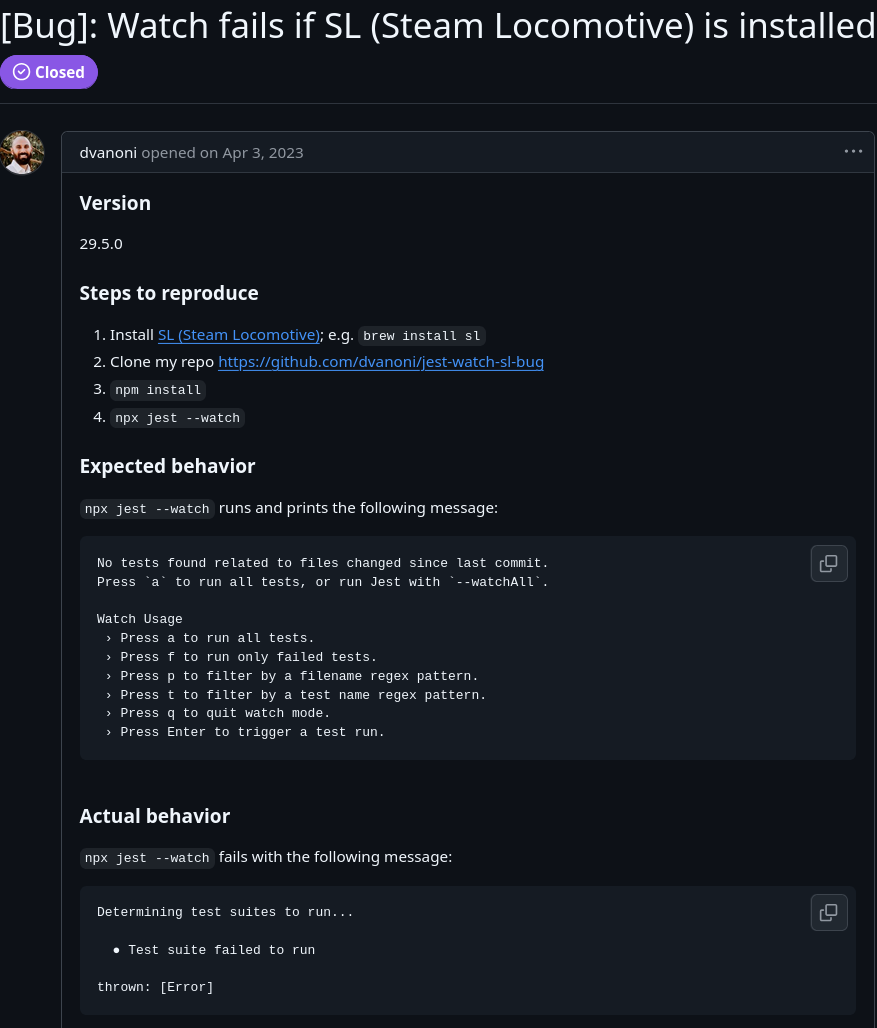
And the astute reader can already guess that rebooting did nothing at all, or else this wouldn’t even be a story worth telling. Besides, haven’t I teased in the clickbaity title about some crazy Steam Locomotive from 1993?
Strace to the rescue
My colleague then put us back on track and suggested strace, and I decided to trace the simpler case of the idling menu (rather than trace running tests, which generated far more syscalls).
Watch Usage
 › Press a to run all tests.
 › Press f to run only failed tests.
 › Press o to only run tests related to changed files.
 › Press p to filter by a filename regex pattern.
 › Press t to filter by a test name regex pattern.
 › Press q to quit watch mode.
 › Press Enter to trigger a test run.
[], 1024, 1000)          = 0
openat(AT_FDCWD, "/proc/self/stat", O_RDONLY) = 21
read(21, "42375 (node) R 42372 42372 11692"..., 1023) = 301
close(21)                               = 0
epoll_wait(13, [], 1024, 0)             = 0
epoll_wait(13, [], 1024, 999)           = 0
openat(AT_FDCWD, "/proc/self/stat", O_RDONLY) = 21
read(21, "42375 (node) R 42372 42372 11692"..., 1023) = 301
close(21)                               = 0
epoll_wait(13, [], 1024, 0)             = 0
epoll_wait(13,
It basically epoll_waits until 27 seconds are up and then, right when the crash happens:
I don’t know about you, but sometimes I look at straces and wonder “Do people actually read this gibberish?” Fortunately, in the modern generative AI era, we can count on GPT-4o to gently chide: the process was interrupted EINTR by its child SIGCHLD, which means you forgot about the children, silly human. Is the problem with one of the cars rather than the engine?
Following this train of thought, I now re-ran with strace --follow-forks, which revealed a giant flurry of activity that promptly overflowed my terminal buffer. The investigation is really gaining steam now. The original trace weighs in at a hefty 500,000 lines, but here is a smaller equivalent version derived from a clean instance of backstage: trace.log.gz. I have uploaded this trace here because the by-now overhyped Steam Locomotive is finally making its grand appearanceand I know there’ll be people who’d love nothing more than to crawl through a haystack of system calls looking for a train-sized needle. Consider yourself lucky, I had to do it without even knowing what I was looking for, much less that it was a whole Steam Locomotive.
This section is left intentionally blank to allow locomotive enthusiasts who want to find the train on their own to do so first.
Remember my comment about straces being gibberish? Actually, I was kidding. So there are a few ways to make it more manageable, and with experience you’ll learn which system calls to pay attention to, such as execve, chdir, open, read, fork, and signals, and which ones to skim over, such as mprotect,mmap, and futex.
Since I’m writing this account after the fact, let’s cheat a little and assume I was super smart and zeroed in on execve correctly on the first try:
🌈  ~  zgrep execve trace.log.gz | head
execve("/home/yew/.nvm/versions/node/v18.20.6/bin/yarn", ["yarn", "test", "steam-regulator"], 0x7ffdff573148 /* 72 vars */) = 0
execve("/home/yew/.pyenv/shims/node", ["node", "/home/yew/.nvm/versions/node/v18"..., "test", "steam-regulator"], 0x7ffd64f878c8 /* 72 vars */) = -1 ENOENT (No such file or directory)
execve("/home/yew/.pyenv/bin/node", ["node", "/home/yew/.nvm/versions/node/v18"..., "test", "steam-regulator"], 0x7ffd64f878c8 /* 72 vars */) = -1 ENOENT (No such file or directory)
execve("/home/yew/repos/secrets/bin/node", ["node", "/home/yew/.nvm/versions/node/v18"..., "test", "steam-regulator"], 0x7ffd64f878c8 /* 72 vars */) = -1 ENOENT (No such file or directory)
execve("/home/yew/.nvm/versions/node/v18.20.6/bin/node", ["node", "/home/yew/.nvm/versions/node/v18"..., "test", "steam-regulator"], 0x7ffd64f878c8 /* 72 vars */) = 0
[pid 49307] execve("/bin/sh", ["/bin/sh", "-c", "backstage-cli repo test resource"...], 0x3d17d6d0 /* 156 vars */ <unfinished ...>
[pid 49307] <... execve resumed>)   	= 0
[pid 49308] execve("/home/yew/cloudflare/repos/backstage/node_modules/.bin/backstage-cli", ["backstage-cli", "repo", "test", "steam-regulator"], 0x5e7ef80051d8 /* 156 vars */ <unfinished ...>
[pid 49308] <... execve resumed>)   	= 0
[pid 49308] execve("/tmp/yarn--1742459197616-0.9027914591640542/node", ["node", "/home/yew/cloudflare/repos/backs"..., "repo", "test", "steam-regulator"], 0x7ffcc18af270 /* 156 vars */) = 0
🌈  ~  zgrep execve trace.log.gz | wc -l
2254
Phew, 2,000 is a lot of execves . Let’s get the unique ones, plus their counts:
Have you spotted the Steam Locomotive yet? I spotted it immediately because this is My Own System and Surely This Means I Am Perfectly Aware Of Everything That Is Installed Unlike, er, node_modules.
sl is actually afun little joke program from 1993 that plays on users’ tendencies to make a typo on ls. When sl runs, it clears your terminal to make way for an animated steam locomotive to come chugging through.
When I first saw that Jest was running sl so many times, my first thought was to ask my colleague if sl is a valid command on his Mac, and of course it is not. After all, which serious engineer would stuff their machine full of silly commands like sl, gti, cowsay, or toilet ? The next thing I tried was to rename sl to something else, and sure enough all my problems disappeared: yarn test started working perfectly.
So what does Jest have to do with Steam Locomotives?
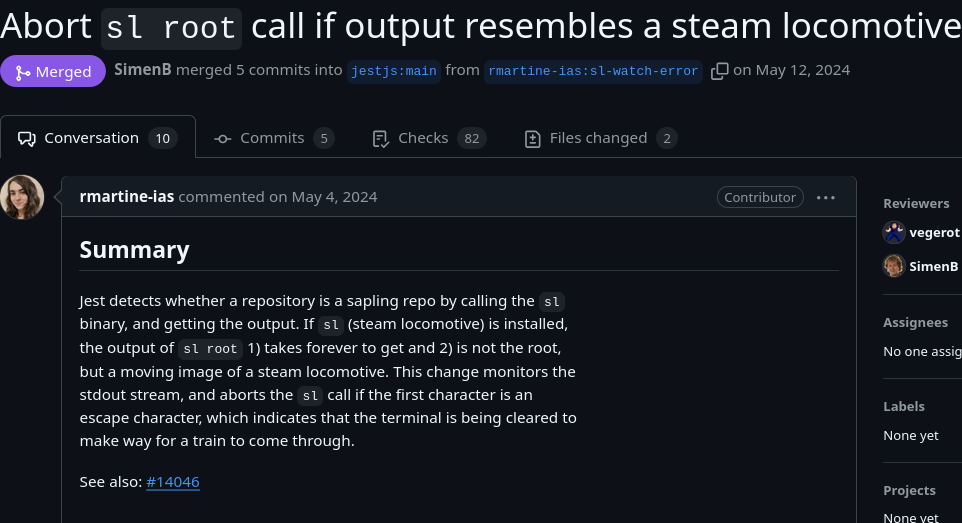
Nothing, that’s what. The whole affair is an unfortunate naming clash between sl the Steam Locomotive and sl theSapling CLI. Jest wanted sl the source control system, but ended up getting steam-rolled by sl the Steam Locomotive.
At this point the main story has ended. However, there are still some unresolved nagging questions, like…
How did the crash arrive at the magic number of a relatively even 27 seconds?
I don’t know. Actually I’m not sure if a forked child executing sl still has a terminal anymore, but the travel time of the train does depend on the terminal width. The wider it is, the longer it takes:
🌈  ~  tput cols
425
🌈  ~  time sl
sl  0.19s user 0.06s system 1% cpu 20.629 total
🌈  ~  tput cols
58
🌈  ~  time sl
sl  0.03s user 0.01s system 0% cpu 5.695 total
So the first thing I tried was to run yarn test in a ridiculously narrow terminal and see what happens:
Determin
ing test
 suites
to run..
.

  ● Test
 suite f
ailed to
 run

thrown:
[Error]

error Co
mmand fa
iled wit
h exit c
ode 1.
info Vis
it https
://yarnp
kg.com/e
n/docs/c
li/run f
or docum
entation
 about t
his comm
and.
yarn tes
t  1.92s
 user 0.
67s syst
em 9% cp
u 27.088
 total
🌈  back
stage [m
aster] t
put cols

8
Alas, the terminal width doesn’t affect jest at all. Jest callssl via execa so let’s mock that up locally:
🌈  choochoo  cat runSl.mjs
import {execa} from 'execa';
const { stdout } = await execa('tput', ['cols']);
console.log('terminal colwidth:', stdout);
await execa('sl', ['root']);
🌈  choochoo  time node runSl.mjs
terminal colwidth: 80
node runSl.mjs  0.21s user 0.06s system 4% cpu 6.730 total
So execa uses the default terminal width of 80, which takes the train 6.7 seconds to cross. And 27 seconds divided by 6.7 is awfully close to 4. So is Jest running sl 4 times? Let’s do a poor man’s bpftrace by hooking into sl like so:
And if we check executed.log, sl is indeed executed in 4 waves, albeit by 5 workers simultaneously in each wave:
#wave1
2025-03-20 13:23:57.125482563 21049 started
2025-03-20 13:23:57.127526987 21666 started
2025-03-20 13:23:57.131099388 4897 started
2025-03-20 13:23:57.134237754 102 started
2025-03-20 13:23:57.137091737 15733 started
#wave1 ends, wave2 starts
2025-03-20 13:24:03.704588580 21666 ended
2025-03-20 13:24:03.704621737 21049 ended
2025-03-20 13:24:03.707780748 4897 ended
2025-03-20 13:24:03.712086346 15733 ended
2025-03-20 13:24:03.711953000 102 ended
2025-03-20 13:24:03.714831149 18018 started
2025-03-20 13:24:03.721293279 23293 started
2025-03-20 13:24:03.724600164 27918 started
2025-03-20 13:24:03.729763900 15091 started
2025-03-20 13:24:03.733176122 18473 started
#wave2 ends, wave3 starts
2025-03-20 13:24:10.294286746 18018 ended
2025-03-20 13:24:10.297261754 23293 ended
2025-03-20 13:24:10.300925031 27918 ended
2025-03-20 13:24:10.300950334 15091 ended
2025-03-20 13:24:10.303498710 24873 started
2025-03-20 13:24:10.303980494 18473 ended
2025-03-20 13:24:10.308560194 31825 started
2025-03-20 13:24:10.310595182 18452 started
2025-03-20 13:24:10.314222848 16121 started
2025-03-20 13:24:10.317875812 30892 started
#wave3 ends, wave4 starts
2025-03-20 13:24:16.883609316 24873 ended
2025-03-20 13:24:16.886708598 18452 ended
2025-03-20 13:24:16.886867725 31825 ended
2025-03-20 13:24:16.890735338 16121 ended
2025-03-20 13:24:16.893661911 21975 started
2025-03-20 13:24:16.898525968 30892 ended
#crash imminent! wave4 ending, wave5 starting...
2025-03-20 13:24:23.474925807 21975 ended
The logs were emitted for about 26.35 seconds, which is close to 27. It probably crashed just as wave4 was reporting back. And each wave lasts about 6.7 seconds, right on the money with manual measurement.
So why is Jest running sl in 4 waves? Why did it crash at the start of the 5th wave?
Let’s again modify the poor man’s bpftrace to also log the args and working directory:
From the results we can see that the 5 workers are busy executing sl root, which corresponds to the getRoot() function in jest-change-files/sl.ts
2025-03-21 05:50:22.663263304  started: root at /home/yew/cloudflare/repos/backstage/packages/app/src
2025-03-21 05:50:22.665550470  started: root at /home/yew/cloudflare/repos/backstage/packages/backend/src
2025-03-21 05:50:22.667988509  started: root at /home/yew/cloudflare/repos/backstage/plugins/access/src
2025-03-21 05:50:22.671781519  started: root at /home/yew/cloudflare/repos/backstage/plugins/backstage-components/src
2025-03-21 05:50:22.673690514  started: root at /home/yew/cloudflare/repos/backstage/plugins/backstage-entities/src
2025-03-21 05:50:29.247573899  started: root at /home/yew/cloudflare/repos/backstage/plugins/catalog-types-common/src
2025-03-21 05:50:29.251173536  started: root at /home/yew/cloudflare/repos/backstage/plugins/cross-connects/src
2025-03-21 05:50:29.255263605  started: root at /home/yew/cloudflare/repos/backstage/plugins/cross-connects-backend/src
2025-03-21 05:50:29.257293780  started: root at /home/yew/cloudflare/repos/backstage/plugins/pingboard-backend/src
2025-03-21 05:50:29.260285783  started: root at /home/yew/cloudflare/repos/backstage/plugins/resource-insights/src
2025-03-21 05:50:35.823374079  started: root at /home/yew/cloudflare/repos/backstage/plugins/scaffolder-backend-module-gaia/src
2025-03-21 05:50:35.825418386  started: root at /home/yew/cloudflare/repos/backstage/plugins/scaffolder-backend-module-r2/src
2025-03-21 05:50:35.829963172  started: root at /home/yew/cloudflare/repos/backstage/plugins/security-scorecard-dash/src
2025-03-21 05:50:35.832597778  started: root at /home/yew/cloudflare/repos/backstage/plugins/slo-directory/src
2025-03-21 05:50:35.834631869  started: root at /home/yew/cloudflare/repos/backstage/plugins/software-excellence-dashboard/src
2025-03-21 05:50:42.404063080  started: root at /home/yew/cloudflare/repos/backstage/plugins/teamcity/src
The 16 entries here correspond neatly to the 16 rootDirs configured in Jest for Cloudflare’s backstage. We have 5 trains, and we want to visit 16 stations so let’s do some simple math. 16/5.0 = 3.2 which means our trains need to go back and forth 4 times at a minimum to cover them all.
Final mystery: Why did it crash?
Let’s go back to the very start of our journey. The original [Error] thrown was actuallyfrom here and after modifying node_modules/jest-changed-files/index.js, I found that the error is shortMessage: 'Command failed with ENAMETOOLONG: sl status...‘ and the reason why became clear when I interrogated Jest about what it thinks the repos are.
While the git repo is what you’d expect, the sl “repo” looks amazingly like a train wreck in motion:
got repos.git as Set(1) { '/home/yew/cloudflare/repos/backstage' }
got repos.sl as Set(1) {
  '\x1B[?1049h\x1B[1;24r\x1B[m\x1B(B\x1B[4l\x1B[?7h\x1B[?25l\x1B[H\x1B[2J\x1B[15;80H_\x1B[15;79H_\x1B[16d|\x1B[9;80H_\x1B[12;80H|\x1B[13;80H|\x1B[14;80H|\x1B[15;78H__/\x1B[16;79H|/\x1B[17;80H\\\x1B[9;
  79H_D\x1B[10;80H|\x1B[11;80H/\x1B[12;79H|\x1B[K\x1B[13d\b|\x1B[K\x1B[14d\b|/\x1B[15;1H\x1B[1P\x1B[16;78H|/-\x1B[17;79H\\_\x1B[9;1H\x1B[1P\x1B[10;79H|(\x1B[11;79H/\x1B[K\x1B[12d\b\b|\x1B[K\x1B[13d\b|
  _\x1B[14;1H\x1B[1P\x1B[15;76H__/ =\x1B[16;77H|/-=\x1B[17;78H\\_/\x1B[9;77H_D _\x1B[10;78H|(_\x1B[11;78H/\x1B[K\x1B[12d\b\b|\x1B[K\x1B[13d\b| _\x1B[14;77H|/ |\x1B[15;75H__/
  =|\x1B[16;76H|/-=|\x1B[17;1H\x1B[1P\x1B[8;80H=\x1B[9;76H_D _|\x1B[10;77H|(_)\x1B[11;77H/\x1B[K\x1B[12d\b\b|\x1B[K\x1B[13d\b|
  _\r\x1B[14d\x1B[1P\x1B[15d\x1B[1P\x1B[16;75H|/-=|_\x1B[17;1H\x1B[1P\x1B[8;79H=\r\x1B[9d\x1B[1P\x1B[10;76H|(_)-\x1B[11;76H/\x1B[K\x1B[12d\b\b|\x1B[K\x1B[13d\b| _\r\x1B[14d\x1B[1P\x1B[15;73H__/ =|
  o\x1B[16;74H|/-=|_\r\x1B[17d\x1B[1P\x1B[8;78H=\r\x1B[9d\x1B[1P\x1B[10;75H|(_)-\x1B[11;75H/\x1B[K\x1B[12d\b\b|\x1B[K\x1B[13d\b|
  _\r\x1B[14d\x1B[1P\x1B[15d\x1B[1P\x1B[16;73H|/-=|_\r\x1B[17d\x1B[1P\x1B[8;77H=\x1B[9;73H_D _|  |\x1B[10;74H|(_)-\x1B[11;74H/     |\x1B[12;73H|      |\x1B[13;73H| _\x1B[14;73H|/ |   |\x1B[15;71H__/
  =| o |\x1B[16;72H|/-=|___|\x1B[17;1H\x1B[1P\x 1B[5;79H(@\x1B[7;77H(\r\x1B[8d\x1B[1P\x1B[9;72H_D _|  |_\x1B[10;1H\x1B[1P\x1B[11d\x1B[1P\x1B[12d\x1B[1P\x1B[13;72H| _\x1B[14;72H|/ |   |-\x1B[15;70H__/
  =| o |=\x1B[16;71H|/-=|___|=\x1B[17;1H\x1B[1P\x1B[8d\x1B[1P\x1B[9;71H_D _|  |_\r\x1B[10d\x1B[1P\x1B[11d\x1B[1P\x1B[12d\x1B[1P\x1B[13;71H| _\x1B[14;71H|/ |   |-\x1B[15;69H__/ =| o
  |=-\x1B[16;70H|/-=|___|=O\x1B[17;71H\\_/      \\\x1B[8;1H\x1B[1P\x1B[9;70H_D _|  |_\x1B[10;71H|(_)---  |\x1B[11;71H/     |  |\x1B[12;70H|      |  |\x1B[13;70H| _\x1B[80G|\x1B[14;70H|/ |
  |-\x1B[15;68H__/ =| o |=-~\x1B[16;69H|/-=|___|=\x1B[K\x1B[17;70H\\_/      \\O\x1B[8;1H\x1B[1P\x1B[9;69H_D _|  |_\r\x1B[10d\x1B[1P\x1B[11d\x1B[1P\x1B[12d\x1B[1P\x1B[13;69H| _\x1B[79G|_\x1B[14;69H|/ |
  |-\x1B[15;67H__/ =| o |=-~\r\x1B[16d\x1B[1P\x1B[17;69H\\_/      \\_\x1B[4d\b\b(@@\x1B[5;75H(    )\x1B[7;73H(@@@)\r\x1B[8d\x1B[1P\x1B[9;68H_D _|
  |_\r\x1B[10d\x1B[1P\x1B[11d\x1B[1P\x1B[12d\x1B[1P\x1B[13;68H| _\x1B[78G|_\x1B[14;68H|/ |   |-\x1B[15;66H__/ =| o |=-~~\\\x1B[16;67H|/-=|___|=   O\x1B[17;68H\\_/ \\__/\x1B[8;1H\x1B[1P\x1B[9;67H_D _|
  |_\r\x1B[10d\x1B[1P\x1B[11d\x1B[1P\x1B[12d\x1B[1P\x1B[13;67H| _\x1B[77G|_\x1B[14;67H|/ |   |-\x1B[15;65H__/ =| o |=-~O==\x1B[16;66H|/-=|___|= |\x1B[17;1H\x1B[1P\x1B[8d\x1B[1P\x1B[9;66H_D _|
  |_\x1B[10;67H|(_)---  |   H\x1B[11;67H/     |  |   H\x1B[12;66H|      |  |   H\x1B[13;66H| _\x1B[76G|___H\x1B[14;66H|/ |   |-\x1B[15;64H__/ =| o |=-O==\x1B[16;65H|/-=|___|=
  |\r\x1B[17d\x1B[1P\x1B[8d\x1B[1P\x1B[9;65H_D _|  |_\x1B[80G/\x1B[10;66H|(_)---  |   H\\\x1B[11;1H\x1B[1P\x1B[12d\x1B[1P\x1B[13;65H| _\x1B[75G|___H_\x1B[14;65H|/ | |-\x1B[15;63H__/ =| o |=-~~\\
  /\x1B[16;64H|/-=|___|=O=====O\x1B[17;65H\\_/      \\__/  \\\x1B[1;4r\x1B[4;1H\n' + '\x1B[1;24r\x1B[4;74H(    )\x1B[5;71H(@@@@)\x1B[K\x1B[7;69H(   )\x1B[K\x1B[8;68H====
  \x1B[80G_\x1B[9;1H\x1B[1P\x1B[10;65H|(_)---  |   H\\_\x1B[11;1H\x1B[1P\x1B[12d\x1B[1P\x1B[13;64H| _\x1B[74G|___H_\x1B[14;64H|/ |   |-\x1B[15;62H__/ =| o |=-~~\\  /~\x1B[16;63H|/-=|___|=
  ||\x1B[K\x1B[17;64H\\_/      \\O=====O\x1B[8;67H==== \x1B[79G_\r\x1B[9d\x1B[1P\x1B[10;64H|(_)---  |   H\\_\x1B[11;64H/     |  |   H  |\x1B[12;63H|      |  |   H  |\x1B[13;63H|
  _\x1B[73G|___H__/\x1B[14;63H|/ |   |-\x1B[15;61H__/ =| o |=-~~\\  /~\r\x1B[16d\x1B[1P\x1B[17;63H\\_/      \\_\x1B[8;66H==== \x1B[78G_\r\x1B[9d\x1B[1P\x1B[10;63H|(_)---  |
  H\\_\r\x1B[11d\x1B[1P\x1B[12;62H|      |  |   H  |_\x1B[13;62H| _\x1B[72G|___H__/_\x1B[14;62H|/ |   |-\x1B[15;60H__/ =| o |=-~~\\  /~~\\\x1B[16;61H|/-=|___|=   O=====O\x1B[17;62H\\_/      \\__/
  \\__/\x1B[8;65H==== \x1B[77G_\r\x1B[9d\x1B[1P\x1B[10;62H|(_)---  |   H\\_\r\x1B[11d\x1B[1P\x1B[12;61H|      |  |   H  |_\x1B[13;61H| _\x1B[71G|___H__/_\x1B[14;61H|/ |   |-\x1B[80GI\x1B[15;59H__/ =|
  o |=-~O=====O==\x1B[16;60H|/-=|___|=    ||    |\x1B[17;1H\x1B[1P\x1B[2;79H(@\x1B[3;74H(   )\x1B[K\x1B[4;70H(@@@@)\x1B[K\x1B[5;67H(    )\x1B[K\x1B[7;65H(@@@)\x1B[K\x1B[8;64H====
  \x1B[76G_\r\x1B[9d\x1B[1P\x1B[10;61H|(_)---  |   H\\_\x1B[11;61H/     |  |   H  |  |\x1B[12;60H|      |  |   H  |__-\x1B[13;60H| _\x1B[70G|___H__/__|\x1B[14;60H|/ |   |-\x1B[79GI_\x1B[15;58H__/ =| o
  |=-O=====O==\x1B[16;59H|/-=|___|=    ||    |\r\x1B[17d\x1B[1P\x1B[8;63H==== \x1B[75G_\r\x1B[9d\x1B[1P\x1B[10;60H|(_)---  |   H\\_\r\x1B[11d\x1B[1P\x1B[12;59H|      |  |   H  |__-\x1B[13;59H|
  _\x1B[69G|___H__/__|_\x1B[14;59H|/ |   |-\x1B[78GI_\x1B[15;57H__/ =| o |=-~~\\  /~~\\  /\x1B[16;58H|/-=|___|=O=====O=====O\x1B[17;59H\\_/      \\__/  \\__/  \\\x1B[8;62H====
  \x1B[74G_\r\x1B[9d\x1B[1P\x1B[10;59H|(_)---  |   H\\_\r\x1B  |  |   H  |__-\x1B[13;58H| _\x1B[68G|___H__/__|_\x1B[14;58H|/ |   |-\x1B[77GI_\x1B[15;56H__/ =| o |=-~~\\ /~~\\  /~\x1B[16;57H|/-=|___|=
  ||    ||\x1B[K\x1B[17;58H\\_/      \\O=====O=====O\x1B[8;61H==== \x1B[73G_\r\x1B[9d\x1B[1P\x1B[10;58H|(_)---    _\x1B[67G|___H__/__|_\x1B[14;57H|/ |   |-\x1B[76GI_\x1B[15;55H__/ =| o |=-~~\\  /~~\\
  /~\r\x1B[16d\x1B[1P\x1B[17;57H\\_/      \\_\x1B[2;75H(  ) (\x1B[3;70H(@@@)\x1B[K\x1B[4;66H()\x1B[K\x1B[5;63H(@@@@)\x1B[
Acknowledgements
Thank you to my colleagues Mengnan Gong and Shuhao Zhang, whose ideas and perspectives helped narrow down the root causes of this mystery.
A Rebirth of a Cursed Existence? Examining ‘Babuk Locker 2.0’ Ransomware
Introduction
Ransomware remains a major threat, causing significant disruption and financial losses to organizations across various sectors. Cybercriminal groups behind these attacks constantly adapt their methods to maximize damage and profit.
At Rapid7, we actively monitor new cyber threats, keeping an eye on ransomware groups and their changing tactics. In early 2025, we came across a channel promoting itself as Babuk Locker. Since the original group had shut down in 2021, we decided to investigate whether this was a rebrand or a new threat. Several underground forums and Telegram channels started mentioning ‘Babuk Locker 2.0,’ with some actors taking credit for recent attacks. Since Babuk’s leaked source code in 2021 had led to many spin-off ransomware strains, we wanted to find out whether this was a real comeback or just another group using Babuk’s name.
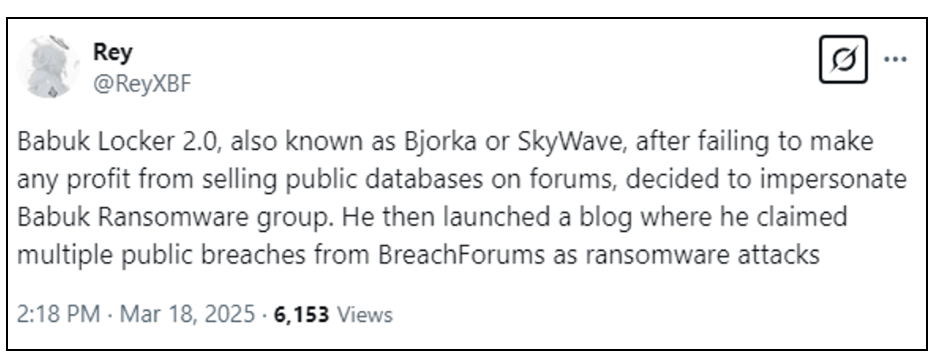
Figure 1 – Online discourse against Bjorka as a scammerFigure 2 – Online discourse against Bjorka and SkyWave as scammers
We started by gathering intelligence from dark web marketplaces, hacker forums, and private Telegram groups. We saw a rise in discussions about Babuk’s return, often linked to two groups, ‘Skywave’ and ‘Bjorka.’ These actors claimed responsibility for major attacks, and their leak sites suggested they might be working with other cybercriminal groups.
This blog delves into the potential revival of Babuk Locker 2.0, its alleged operators, and their activities. We analyze the involvement of ‘Skywave’ and ‘Bjorka,’ their claimed victims, and the evolution of Babuk’s Ransomware-as-a-Service (RaaS) model. Our findings include technical analysis, victimology, and the broader risks posed by this campaign.
Operators: Skywave and Bjorka
While monitoring Babuk Locker 2.0 activity, we identified two key groups linked to its operations—Skywave and Bjorka. These groups frequently appeared in discussions on underground forums and Telegram channels, claiming responsibility for attacks and promoting Babuk-related leaks. Our analysis suggests that these groups play a significant role in Babuk Locker 2.0’s activities, either as affiliates or key operators.
Skywave
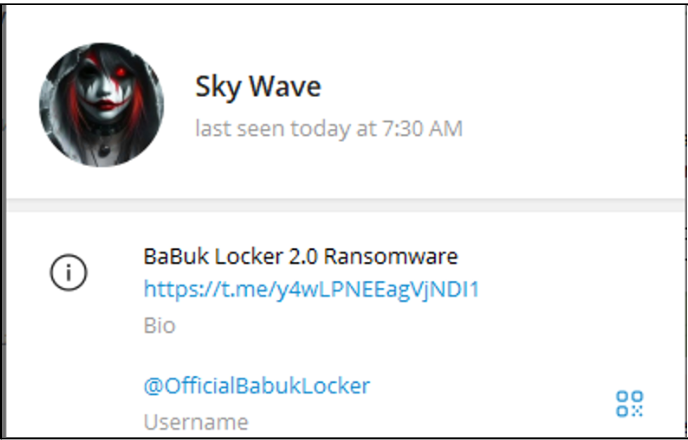
Skywave is a recently identified threat actor known for allegedly executing cyberattacks against various high-profile organizations and government agencies. Their operations have raised concerns within the cybersecurity community due to the sensitivity and volume of the data reportedly compromised, as well as the anonymity of the operator. Skywave is suspected of operating multiple Telegram channels under different aliases, some of which have been flagged as scams and removed by Telegram.
The specific TTPs employed by Skywave remain undisclosed, leaving room for speculation regarding their infiltration and data exfiltration methods. Since late 2024, Skywave has maintained its presence on various platforms, such as Telegram, DarkForums, and the dedicated Babuk Locker 2.0 DLS, where they have been sharing leaked data from their allegedly recent attacks. Victim lists indicate a focus on high-profile organizations with sensitive data.
Figure 3 – The Telegram user of Skywave
Bjorka
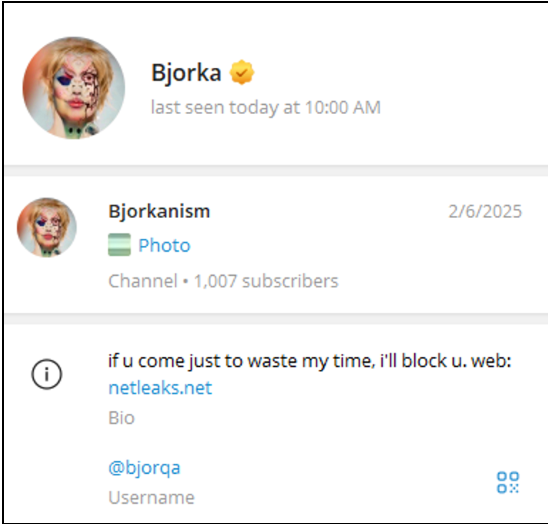
Bjorka is a threat actor mainly known for allegedly breaching Indonesian government and citizen data, often leaking sensitive information as a form of hacktivism. The alias gained prominence in 2022 with a series of high-profile data leaks, first making headlines in March by exposing over 105 million Indonesian voter records. Throughout 2022, Bjorka targeted multiple institutions, leaking personal data to highlight security flaws and criticize policies. By August 2022, Bjorka joined BreachForums, where they are sharing large databases from breached telecom services. Authorities attempted to identify the hacker, even arresting an individual, but Bjorka mocked the effort, claiming the wrong person was caught. The threat actor is active on BreachForums and Telegram and owns a personal leak site (netleaks[.]net) to distribute stolen data and engage followers.
Figure 4 – The Telegram user of Bjorka
Babuk Locker 2.0/Babuk-Bjorka
Since February 2025, Skywave has claimed ownership on at least 5 different Telegram channels and posts daily about their previous and current victims. Throughout the research, we found dozens of newly created Telegram channels with the names ‘Babuk Locker 2.0’, ‘Babuk 2.0 Ransomware Affiliates’, etc. Some of which overlapped with one another. Additionally, several channels were labeled as scams by Telegram itself and were unavailable a couple of days after they were created.
Figure 5 – A Babuk Locker Telegram channel labeled as a scam by the platform
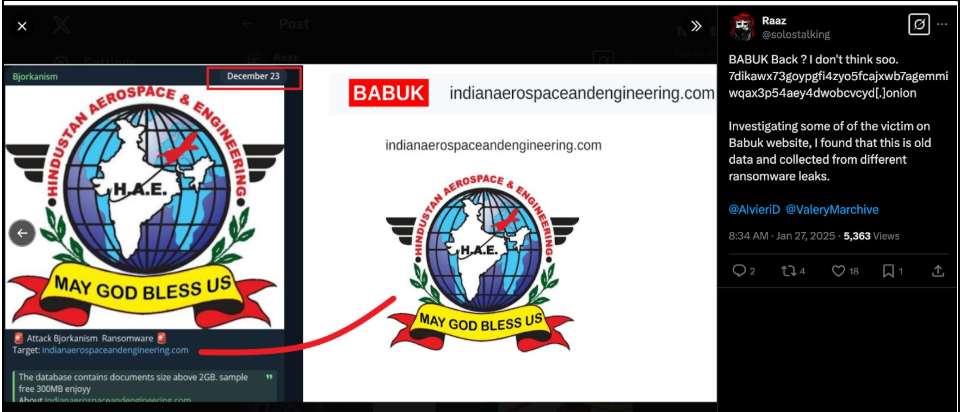
During our research, we noticed the consistent amplification of the Babuk 2.0 content by Bjorka on their Telegram channel. Speculation about the possible affiliation between Babuk and Bjorka rose due to the overlap of victims, such as the case of ‘Hindustan Aerospace & Engineering’ from India. The organization was initially reported as a victim of Bjorka in December 2023, and again as a victim of Babuk as of March 2025.
Figure 6 – Overlap of victimology between Bjorka and Babuk 2.0
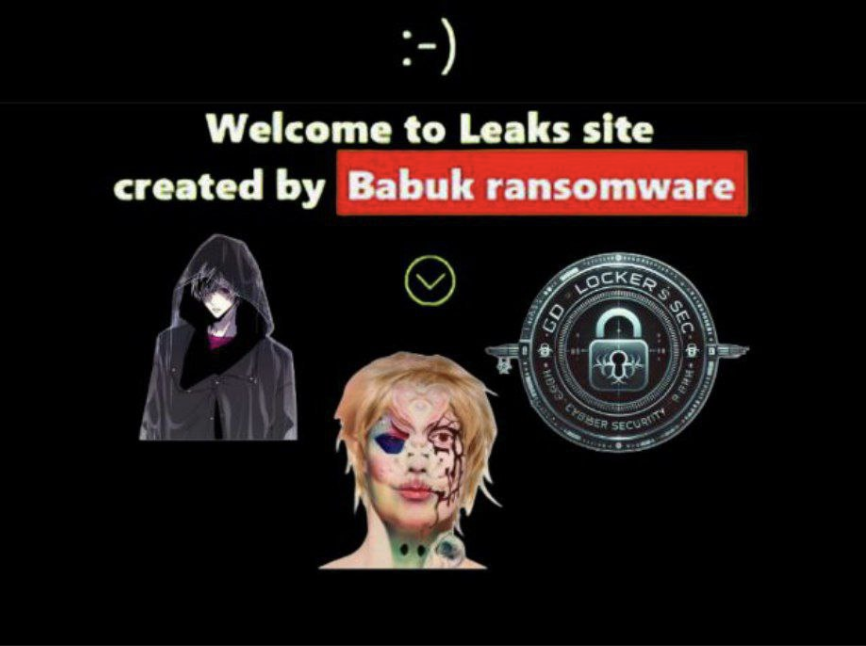
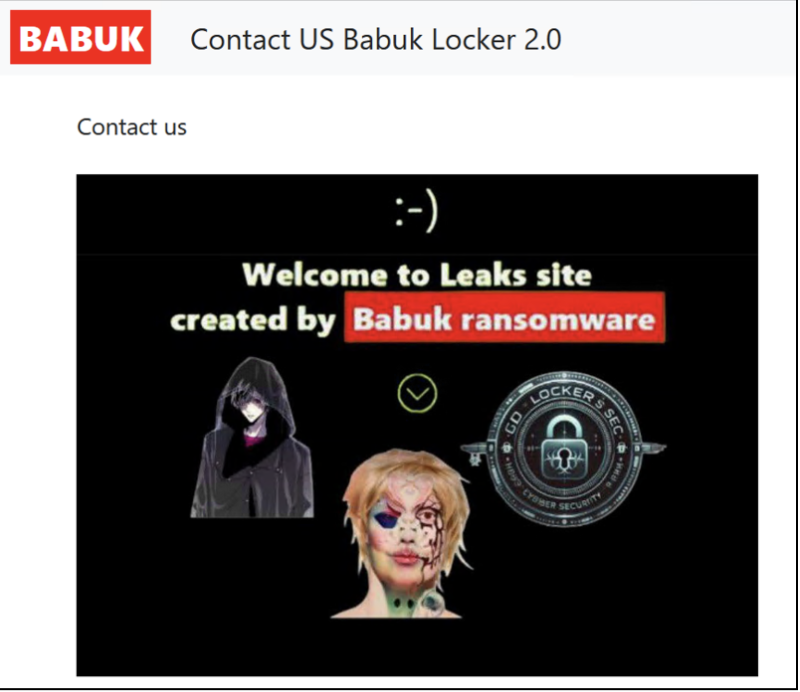
Further evidence of a possible collaboration between the threat actors emerges from the ‘Contact Us’ tab on Babuk’s DLS, where the logos of Skywave and Bjorka appear next to each other, as well as another possible affiliate named GD Locker Sec.
Figure 7 – The ‘Contact US’ tab on the DLS of Babuk, showing the logos of Bjorka and Skywave
Technical Analysis
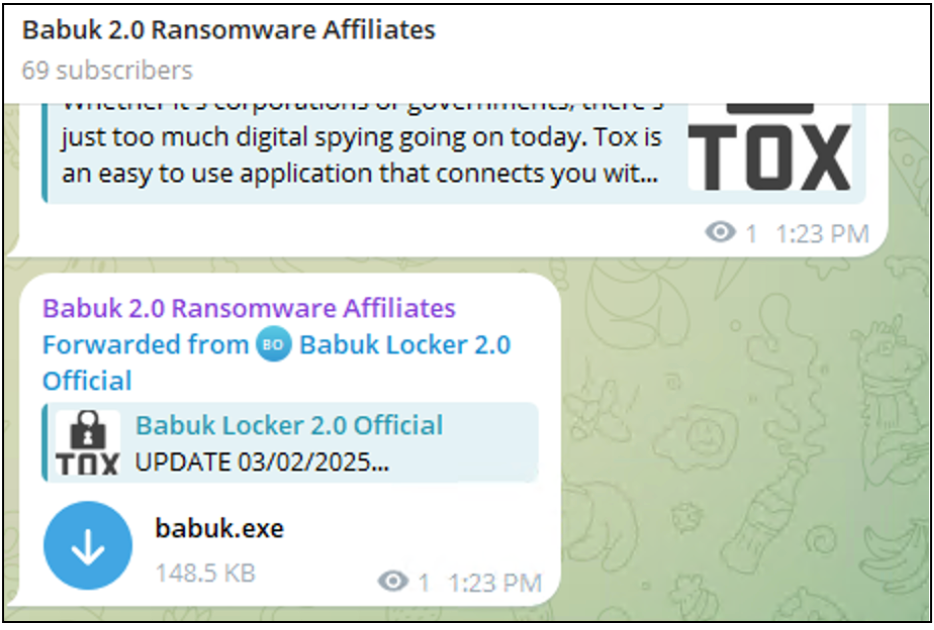
A sample named babuk.exe SHA-256 3facc153ed82a72695ee2718084db91f85e2560407899e1c7f6938fd4ea011e9 was initially shared on the Telegram channel “Babuk 2.0 Ransomware Affiliates”, before being forwarded to another operational account. Upon analysis, it turned out not to be Babuk Locker at all, but rather LockBit 3.0 also known as LockBit Black. This case is yet another example of the well-established trend: threat actors rebranding ransomware strains, whether to confuse researchers, lure affiliates, or just keep the marketing fresh. Either way, babuk.exe is just LockBit 3.0/Black wearing a fake name.
Figure 8 – “Babuk” sample shared on Babuk 2.0 Affiliate Group Telegram channel
LockBit 3.0 Overview
LockBit 3.0/Black, is a ransomware variant that shares similarities with BlackMatter ransomware. On September 21, 2022, a user named @ali_qushji leaked the LockBit 3.0 builder on Twitter. The leak code made it easy for the least skilled attackers to join the game.
Encryption Methods
An analyzed sample of LockBit 3.0 uses a combination of AES-256 and RSA-2048 encryption. AES-256 is used to encrypt victim files and RSA-2048 encryption used to encrypt the AES key, ensuring decryption is impossible without the attacker’s private key.
Terminated Processes and services
LockBit 3.0 terminates various applications and system processes (the full list is in the table below) most likely to maximize encryption efficiency and prevent file access conflicts. It also disables key security and backup services to limit recovery possibilities and increase impact.
Terminated Processes
Terminated Services
sql
vss
oracle
sql
ocssd
svc
dbsnmp
memtas
synctime
mepocs
agntsvc
msexchange
isqlplussvc
sophos
xfssvccon
veeam
mydesktopservice
backup
ocautoupds
GxVss
encsvc
GxBlr
firefox
GxFWD
tbirdconfig
GxCVD
mydesktopqos
GxCIMgr
ocomm
dbeng50
sqbcoreservice
excel
infopath
msaccess
mspu
onenote
outlook
powerpnt
steam
thebat
thunderbird
visio
winword
wordpad
notepad
calc
wuauclt
onedrive
Active Directory Enumeration
LockBit 3.0 uses logoncli_DsGetDcNameW API function used for Active Directory (AD) enumeration. To brute-force AD accounts, analyzed LockBit 3.0 sample came preloaded with Base64-encoded username and password combinations decoded and listed below.
Username
Password
bad.lab
Qwerty
Administrator
123QWEqwe
@#Admin2
P@ssw0rd
Administrator
P@ssw0rd
Administrator
Qwerty
Administrator
123QWEqwe
Administrator
123QWEqweqwe
Babuk or LockBit 3.0? Rebranding Won’t Change the Code.
Analysis confirms that babuk.exe, advertised in the Babuk 2.0 Ransomware Affiliates Telegram channel, is actually based entirely on LockBit 3.0 source code—not Babuk. The sample shows key techniques identical to previous LockBit 3.0 variants, reinforcing that this is yet another case of threat actors rebranding existing ransomware rather than introducing anything genuinely new.
Key Overlapping Techniques
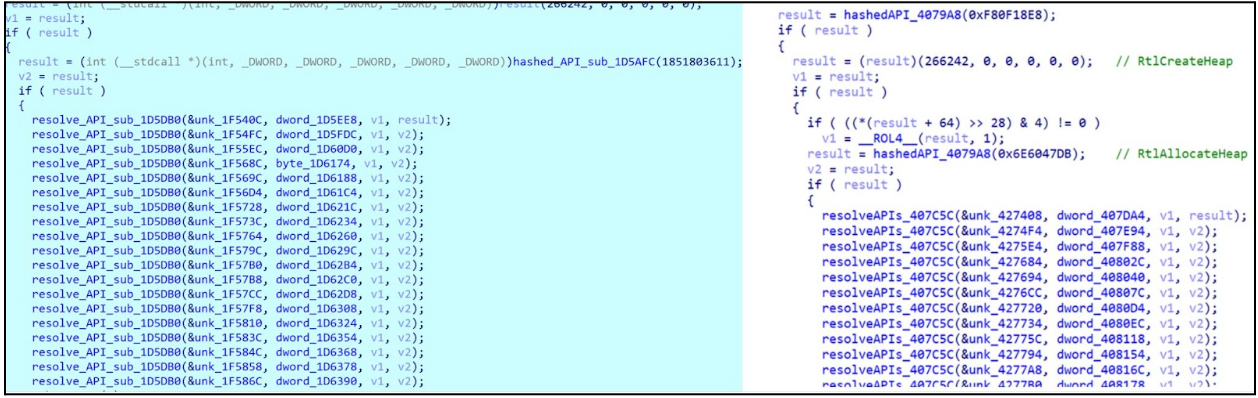
The analyzed sample uses API harvesting by hashing API names from DLLs and comparing them against a predefined list of required APIs (Figure 7). This technique, likely to obfuscate API calls and evade detection, mirrors the approach seen in Lockbit3.0/Black and aligns with previous findings by Trend Micro.
Figure 9 – LockBit 3.0’s routine for API harvesting function comparison—our analyzed sample (left) vs. TrendMicro’s reported sample (right).
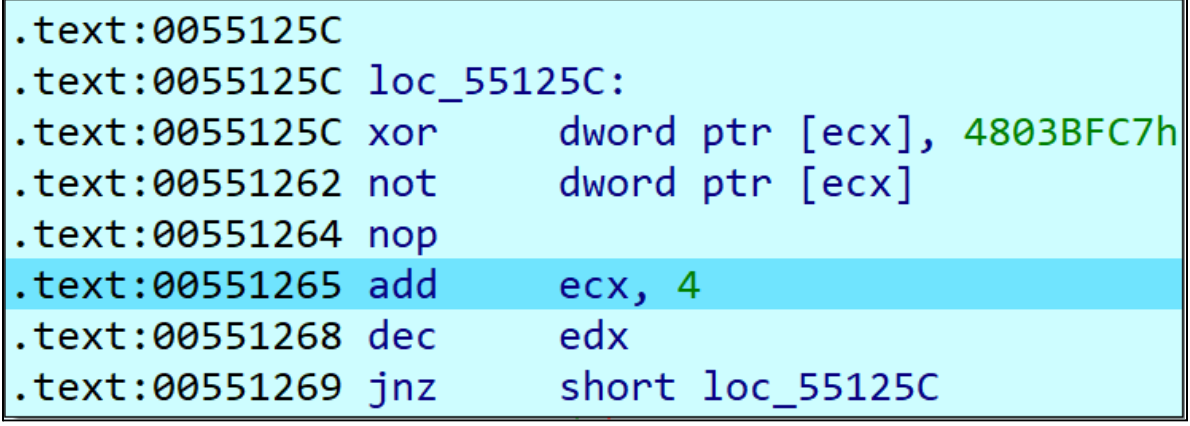
Likewise, The XOR key 0x4803BFC7 LockBit 3.0 used for renaming APIs is the same as it was reported before. The xor key is re-used multiple times in the code.
Figure 10 – 0x4803BFC7 xor key observed in analyzed sample
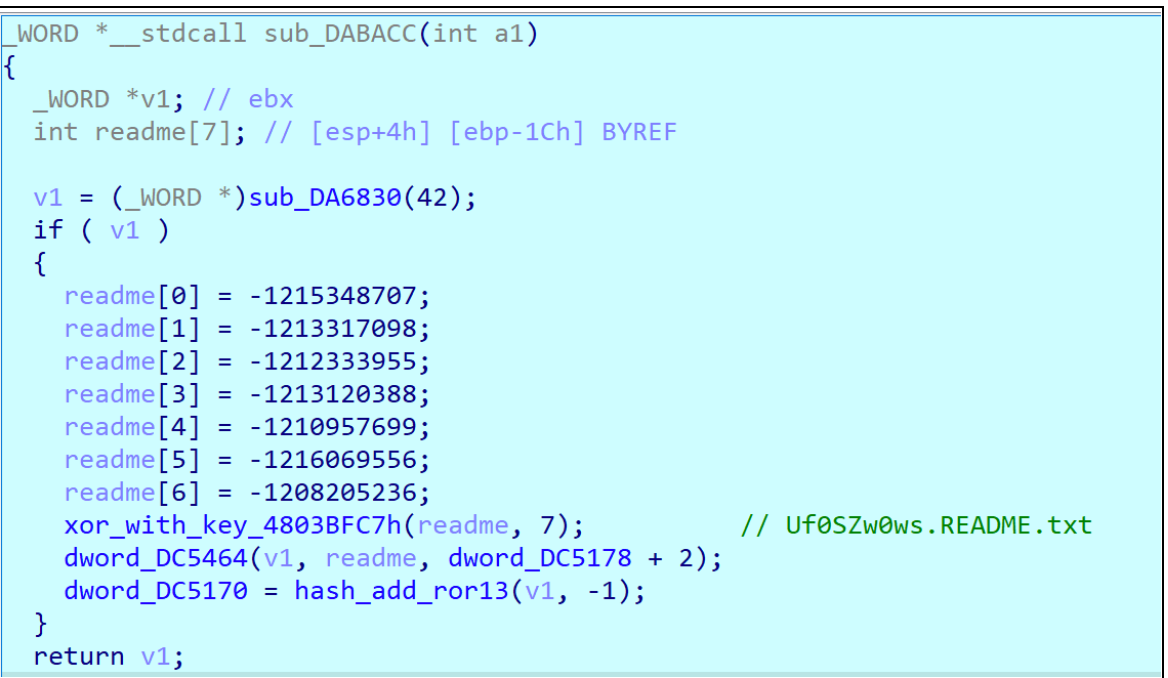
Additionally, the ransom note creating routine is identical as in previous Lockbit3.0/Black samples.
Figure 11 – readme creation routine
Like previous LockBit 3.0/ Black samples, the analyzed variant modifies the desktop wallpaper to display a ransom note—branded, unsurprisingly, as “LockBit Black” (not Babuk, in case anyone was still confused). It also appends specific extensions to encrypted files, changes their icons, and drops a .ico file in the %PROGRAMDATA% directory, staying true to the LockBit playbook.
Figure 12 – Lockbit3.0 wallpaper and ransom note
The ransom note referenced “Orion Hackers” and the tox ID 32C12B278912E26E5EAC57AEBB3F4FF16F0E31603C7B9D46AC02E9D993EE14351CEC3AB5945C. A search on this TOX ID linked the ransom demands to the `Babuk 2.0 Affiliate Group` on Telegram. Additionally, we discovered that messages from this channel were being reposted by an actor named Bjorkanism, who is actively sharing content from Affiliate Group Babuk 2.0 which is actually leaked Lockbit3.0.
Victimology
The new Babuk Locker 2.0 has recently been making waves within the cybersecurity and intelligence scene, claiming dozens of high-profile cyberattacks in a short time of less than two months of operation. Since January 2025, the group has listed at least 100 organizations as their alleged victims. Among their alleged victims are Amazon, the Israeli Knesset, Sodexo, and other high-profile organizations. Victims are from multiple sectors including energy, manufacturing, IT, government, etc.
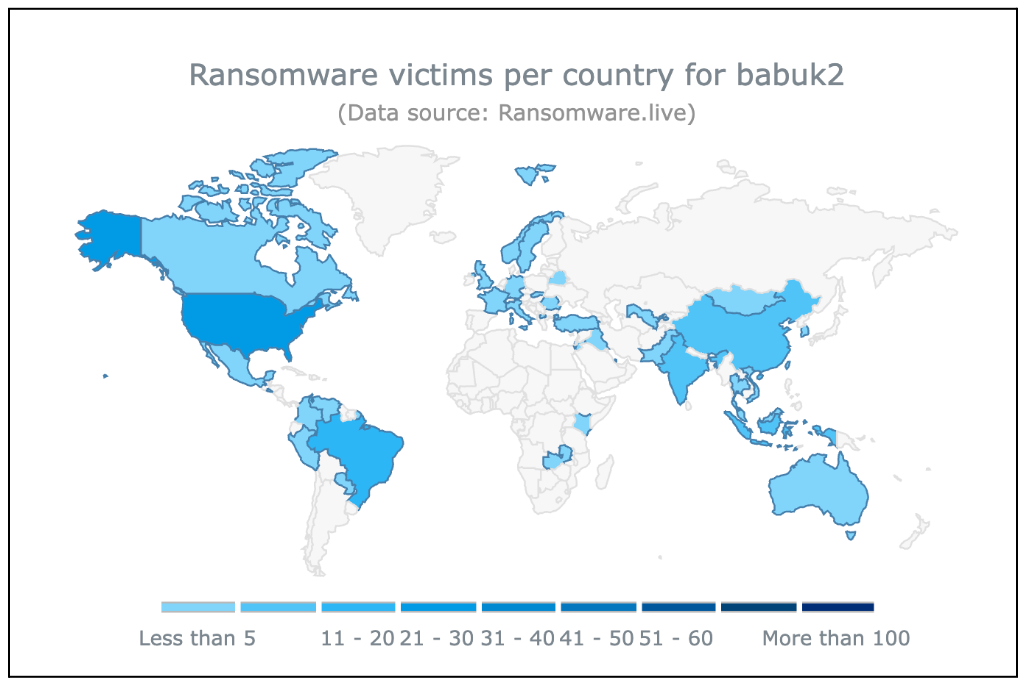
Figure 13 – Victims listed on the Babuk Locker 2.0 DLSFigure 14 – Babuk Locker 2.0 victims per country
There have been growing claims of overlaps between Babuk Locker 2.0 and other ransomware groups, as some of their alleged victims were already attacked by other groups, such as HellCat, RansomHub, FunkSec, and others. These overlaps in victimology reinforce concerns about the authenticity of the new Babuk group entity and its operations.
Figure 15 – Babuk Locker 2.0 victims overlap with another ransomware group
Conclusion
Babuk Locker 2.0 is not a true revival of the original Babuk group—it’s just LockBit 3.0 with a new label. Our analysis strongly suggests that Skywave and Bjorka are behind this operation, either as collaborators or opportunistic actors riding the same wave.
Despite its bold claims, Babuk 2.0’s victim list overlaps heavily with other ransomware groups, raising doubts about the legitimacy of its attacks. Rather than a sophisticated new threat, this looks more like a rebranding stunt—a common tactic among ransomware operators to confuse defenders, attract affiliates, and inflate their reputation.
This case reinforces a familiar pattern: ransomware groups don’t disappear—they just change names, recycle code, and keep cashing in. Whether Skywave and Bjorka are working together or simply using Babuk’s name for credibility, one thing is clear: Babuk 2.0 is just LockBit 3.0 in a different costume.
There is another non-security way that designers can spend their security budget: on making their own lives easier. Many of these fall into the category of what has been called rational astrology. First identified by Randy Steve Waldman [Wal12], the term refers to something people treat as though it works, generally for social or institutional reasons, even when there’s little evidence that it works—and sometimes despite substantial evidence that it does not.
[…]
Both security theater and rational astrologies may seem irrational, but they are rational from the perspective of the people making the decisions about security. Security theater is often driven by information asymmetry: people who don’t understand security can be reassured with cosmetic or psychological measures, and sometimes that reassurance is important. It can be better understood by considering the many non-security purposes of a security system. A monitoring bracelet system that pairs new mothers and their babies may be security theater, considering the incredibly rare instances of baby snatching from hospitals. But it makes sense as a security system designed to alleviate fears of new mothers [Sch07].
Rational astrologies in security result from two considerations. The first is the principal-agent problem: The incentives of the individual or organization making the security decision are not always aligned with the incentives of the users of that system. The user’s well-being may not weigh as heavily on the developer’s mind as the difficulty of convincing his boss to take a chance by ignoring an outdated security rule or trying some new technology.
The second consideration that can lead to a rational astrology is where there is a social or institutional need for a solution to a problem for which there is actually not a particularly good solution. The organization needs to reassure regulators, customers, or perhaps even a judge and jury that “they did all that could be done” to avoid some problem—even if “all that could be done” wasn’t very much.
Now that Jeff Barr has retired from the AWS News Blog as of December last year, the AWS News Blog team will keep sharing the most important and impactful AWS product launches the moment they become available. I want to quote Jeff’s last comment on the future of the News Blog again:
Going forward, the team will continue to grow and the goal remains the same: to provide our customers with carefully chosen, high-quality information about the latest and most meaningful AWS launches. The blog is in great hands and this team will continue to keep you informed even as the AWS pace of innovation continues to accelerate.
Since 2016, Jeff has been building the AWS News Blog as a team. Currently, we’re a group of 11 bloggers working in North America, South America, Asia, Europe, and Africa. We co-work with AWS product teams, testing new features firsthand on behalf of customers, and delivering key details in the News Blog the way Jeff has always done.
The Leadership Principles for AWS News Bloggers that Jeff shared on LinkedIn are a textbook for anyone writing for customers in tech companies. They’re the fundamentals that can help you understand and get started blogging quickly, and we’ll continue to stick to these principles with our team. This is why the AWS News Blog is different from other tech companies’ product news channels.
Voices from blog writers You may be familiar with the names of News Blog writers, but you may not have had the chance to hear about them. Let us introduce ourselves!
I’m honored to continue Jeff’s legacy as a new lead blogger of the News Blog team; he is my role model. When I joined AWS in 2014, the first thing I did was to create the AWS Korea Blog and I started translating Jeff’s blog posts into the Korean language. During the journey, I learned how to write accurate, honest, and powerful guides to help customers get started with new AWS products and features.
Since my first News Blog post in 2018, I have learned so much by being part of this team. Working with product managers and service teams is always an amazing experience. I am interested in serverless, event-driven architectures, and AI/ML. It’s incredible how technologies like generative AI are becoming part of software development implicitly (through AI-enabled development tools) and explicitly (by using models in code).
The Amazon Leadership Principles (LPs) guide all that we do here at AWS, including the work we do as authors of the News Blog. As a developer advocate, I’ve taken the guidance of the LPs and used it to guide members of the AWS community who are looking to create technical content, especially those new in their technical content creation journey.
Just like brewing coffee, being a blog author has been a mix of fun, challenge, and reward. I’ve been particularly fortunate to observe how customer obsession is built into AWS teams. I’ve seen how they work backwards, transforming your feedback into services or features. I genuinely hope that you enjoy reading our articles and look forward to the next chapter of the News Blog team.
As an author, I’m committed to delivering timely information about the latest AWS innovations and launches to our global audience of builders, developers, and technology enthusiasts. I understand the importance of providing clear, accurate, and actionable content that helps you use AWS services effectively. Happy reading everyone!
My specialties are .NET development and microservices, but I’ve always been a jack-of-all-trades and writing for this blog helps me to keep my knife sharp across all corners of modern technology, while also helping others do the same. Thousands of people read the AWS News Blog and use it as a go-to source to keep up with what’s new and to help them make decisions, so I know that what we are doing is meaningful work with huge impact.
Through my blogs, I strive to highlight not just the “what” of new services, but also the “why” and “how” they can transform businesses and user experiences. As a solutions architect specializing in Microsoft Workloads on AWS, I help customers migrate and modernize their workloads and build scalable architecture on AWS. I also mentor diverse people to excel in their cloud careers.
Every time I start writing a new blog, I feel honored to be part of this team, to be able to experiment with something new before it’s released, and to be able to share my experience with the reader. This team is made up of specialists of all levels and from multiple countries and together, we are a multicultural and multi-specialty team. Thank you, reader, for being here.
Joining the News Blog team has transformed how I communicate about technology. With an ever-curious mindset, I approach each new announcement aiming to make innovative services accessible and engaging. By bringing my unique and diverse perspective to technical content, I strive to help developers truly enjoy exploring our latest technologies.
Micah Walter
As a senior solutions architect, I support enterprise customers in the New York City region and beyond. I advise executives, engineers, and architects at every step along their journey to the cloud, with a deep focus on sustainability and practical design.
I also want to give credit to our behind-the-scenes editor-in-chief, Jane Watson, and program manager, Jane Scolieri, who play an essential role in helping us get product launch news to you as soon as it happens, including the 60 launches we announced in one week at re:Invent 2024!
Share your feedback At AWS, we are customer obsessed. We’re always focused on improving and providing a better customer experience, and we need your feedback to do so. Take our survey to share insights about your experience with the AWS News Blog and suggestion for how we can serve you even better.
This survey is hosted by an external company. AWS handles your information as described in the AWS Privacy Notice. AWS will own the data gathered via this survey and will not share the information collected with survey respondents.
Global SMS messaging with consistent Sender ID branding requires configuring the same Sender ID across multiple countries, which is a time-consuming process for businesses operating internationally. In this post, we’ll show you how to automate the configuration of Sender IDs for countries that do not have registration requirements using the AWS End User Messaging v2 API.
The Challenge of Multi-Country Sender ID Configuration
When sending SMS messages internationally, if you are using Sender ID, you want your brand to be consistently recognized. This means configuring the same Sender ID in each country you send to. However there are several challenges related to this:
Each country must be done manually, one at a time, if using the AWS Console
If you have multiple environments for testing the process must be repeated for each Account/Region
If you are moving account/regions you have to reconfigure each country in the new Account/Region
Below is an AWS Lambda function that streamlines this process by handling bulk configuration requests. The function solves the challenges in handling multiple country configurations in a single automated workflow. Here’s the complete code:
import boto3
import uuid
import json
import time
from typing import Dict, Any, List

def validate_input(sender_id: str, countries: List[str]) -> bool:
    if not 1 <= len(sender_id) <= 11:
        raise ValueError("Sender ID must be between 1 and 11 characters")

    if not sender_id.replace('_', '').replace('-', '').isalnum():
        raise ValueError("Sender ID can only contain alphanumeric characters, underscore, and hyphen")

    if not countries:
        raise ValueError("At least one country code must be provided")

    return True

def request_sender_id(client, sender_id: str, countries: List[str], message_types: List[str] = None, tags: List[Dict] = None) -> List[Dict]:
    if message_types is None:
        message_types = ["TRANSACTIONAL", "PROMOTIONAL"]

    results = []

    for i, country in enumerate(countries):
        if i > 0:
            time.sleep(1)  # Rate limiting: 1 request per second

        try:
            print(f"Processing country: {country} ({i+1}/{len(countries)})")
            request_params = {
                'ClientToken': str(uuid.uuid4()),
                'SenderId': sender_id,
                'IsoCountryCode': country.upper(),
                'MessageTypes': message_types,
                'DeletionProtectionEnabled':True
            }

            if tags:
                request_params['Tags'] = tags

            response = client.request_sender_id(**request_params)

            results.append({
                'Country': country,
                'Status': 'Success',
                'SenderIdArn': response.get('SenderIdArn'),
                'MonthlyLeasingPrice': response.get('MonthlyLeasingPrice')
            })

        except Exception as e:
            results.append({
                'Country': country,
                'Status': 'Failed',
                'Error': str(e)
            })

        print(f"Completed {country}: {'Success' if results[-1]['Status'] == 'Success' else 'Failed'}")

    return results

def lambda_handler(event: Dict[str, Any], context: Any) -> Dict[str, Any]:
    try:
        # Extract parameters from event
        sender_id = event['sender_id']
        countries = [c.strip().upper() for c in event['countries'] if c.strip()]
        tags = event.get('tags')  # Optional
        message_types = event.get('message_types', ["TRANSACTIONAL", "PROMOTIONAL"])  # Optional

        # Validate input
        validate_input(sender_id, countries)

        # Initialize the AWS SMS Voice v2 client
        client = boto3.client('pinpoint-sms-voice-v2')

        # Process the request
        results = request_sender_id(
            client=client,
            sender_id=sender_id,
            countries=countries,
            message_types=message_types,
            tags=tags
        )

        # Calculate summary
        successful = sum(1 for r in results if r['Status'] == 'Success')

        return {
            'statusCode': 200,
            'body': {
                'results': results,
                'summary': {
                    'total': len(countries),
                    'successful': successful,
                    'failed': len(countries) - successful
                }
            }
        }

    except Exception as e:
        return {
            'statusCode': 500,
            'body': {
                'error': str(e)
            }
        }
How the Lambda Function Works to Configure Sender IDs
The Lambda function automates the Sender ID configuration process through these key steps:
Input Validation: Ensures the Sender ID meets format requirements (1-11 alphanumeric characters, with optional underscores or hyphens).
Bulk Registration: Processes each country sequentially with built-in rate limiting (1 request per second) to prevent API throttling.
Logging: Returns the full ARN of each successfully configured Sender ID
Flexible Configuration Settings:
Supports multiple message types (transactional, promotional, or both)
Enables resource tagging for organizational and cost tracking
Provides deletion protection to prevent accidental removal
Cost Transparency: Displays monthly leasing price for each successful country configuration
Error Handling: Individual country failures don’t halt the entire process, allowing partial success if a single country were to fail for some reason.
Using the Lambda Function
To use this function, create a Lambda with the code above and configure an event. The tags are optional and we have provided an example below: NOTE: Depending on the number of countries you are attempting to register at a time, you may need to increase the 3 second default Lambda timeout. For reference, in our testing, we were able to do all Sender IDs(160) in less than 3 minutes.
The Lambda will return results for each country, including configuration status and monthly costs, if any. Below you will see an example of 3 countries being configured:
After processing your Sender ID configurations, it’s crucial to verify them. You can do this via the AWS console or by using the DescribeSenderIds API. This API offers flexible retrieval options:
Specify individual Sender IDs for targeted information
Providing an invalid Sender ID will result in an error
Apply filters to narrow your results
Retrieve all Sender IDs associated with your AWS account by omitting both
Conclusion
Automating Sender ID configuration with the AWS End User Messaging v2 API and a Lambda function will dramatically reduce the time spent on manual configuration, ensure consistent branding across all supported and configured countries, and simplify a complex process. You’ll gain a scalable, reliable solution that allows you to deploy and manage your Sender IDs with confidence.
The kernel’s slab allocator is charged with providing small objects on
demand; its performance and reliability are crucial for the functioning of
the system as a whole. At the 2025 Linux Storage, Filesystem,
Memory-Management, and BPF Summit, two adjacent sessions in the
memory-management track dug into current work on the slab allocator. The
first focused on the new sheaves feature, while the second discussed a set
of allocation functions that are safe to call in any context.
The collective thoughts of the interwebz
Manage Consent
To provide the best experiences, we use technologies like cookies to store and/or access device information. Consenting to these technologies will allow us to process data such as browsing behavior or unique IDs on this site. Not consenting or withdrawing consent, may adversely affect certain features and functions.
Functional
Always active
The technical storage or access is strictly necessary for the legitimate purpose of enabling the use of a specific service explicitly requested by the subscriber or user, or for the sole purpose of carrying out the transmission of a communication over an electronic communications network.
Preferences
The technical storage or access is necessary for the legitimate purpose of storing preferences that are not requested by the subscriber or user.
Statistics
The technical storage or access that is used exclusively for statistical purposes.The technical storage or access that is used exclusively for anonymous statistical purposes. Without a subpoena, voluntary compliance on the part of your Internet Service Provider, or additional records from a third party, information stored or retrieved for this purpose alone cannot usually be used to identify you.
Marketing
The technical storage or access is required to create user profiles to send advertising, or to track the user on a website or across several websites for similar marketing purposes.