The efficacy of semantic search relies on the accuracy of the underlying Knowledge Graph (KG). In high-velocity domains like on-demand food delivery or e-commerce, the catalog of entities like dishes, products, and merchants changes rapidly.
Current methods for KG construction and maintenance face three critical challenges:
Inaccuracy and hallucination from Large Language Models (LLMs): Automated models often infer relationships based on statistical text co-occurrence rather than semantic reality. For instance, an LLM might incorrectly classify “Pho” as a child of “Italian Noodle Soup” due to linguistic similarity, leading to irrelevant search results.
Scalability limits of manual verification: Traditional verification relies on human annotators or domain experts. This approach is slow, expensive, and unable to keep pace with dynamic catalogs containing millions of entities. For example, daily changes in restaurant menus or grocery stock keeping units (SKUs).
Error propagation in ranking: Inaccurate graph edges propagate errors downstream. If a parent-child relationship is wrong, query expansion algorithms will retrieve irrelevant items, directly degrading Click-Through Rate (CTR) and user trust.
We introduce a feedback-driven verification engine that operationalizes the search interface as a validation environment. Key contributions include:
User feedback-driven verification: The system treats unverified graph edges as hypotheses. Instead of accepting them as truth, it tests them against live traffic by injecting them into search suggestions and measuring user engagement.
Hierarchical relationship refinement: Unlike systems that only validate entities (nodes), this framework validates structural links (edges). It confirms whether entity A is truly a parent, child, or sibling of entity B, ensuring structural integrity.
Adaptive exploration: The system employs a greedy exploration policy. It intelligently balances exploitation by showing known good results with exploration through injecting unverified candidates to gather data without degrading the user experience.
Background
Automated KG construction using LLMs and unstructured content extraction can scale quickly across large, dynamic catalogs. However, relationships inferred from text co-occurrence or vector similarity do not always reflect semantic reality. Manual verification by domain experts remains accurate but does not scale to millions of entities that change daily.
When inaccurate edges enter the graph, ranking and query expansion systems propagate those errors to users. Incorrect parent-child or sibling links lead to irrelevant search results, reduced CTR, and lower user trust. An additional solution is required that can validate graph structure continuously, at scale, without relying solely on manual curation.
Solution
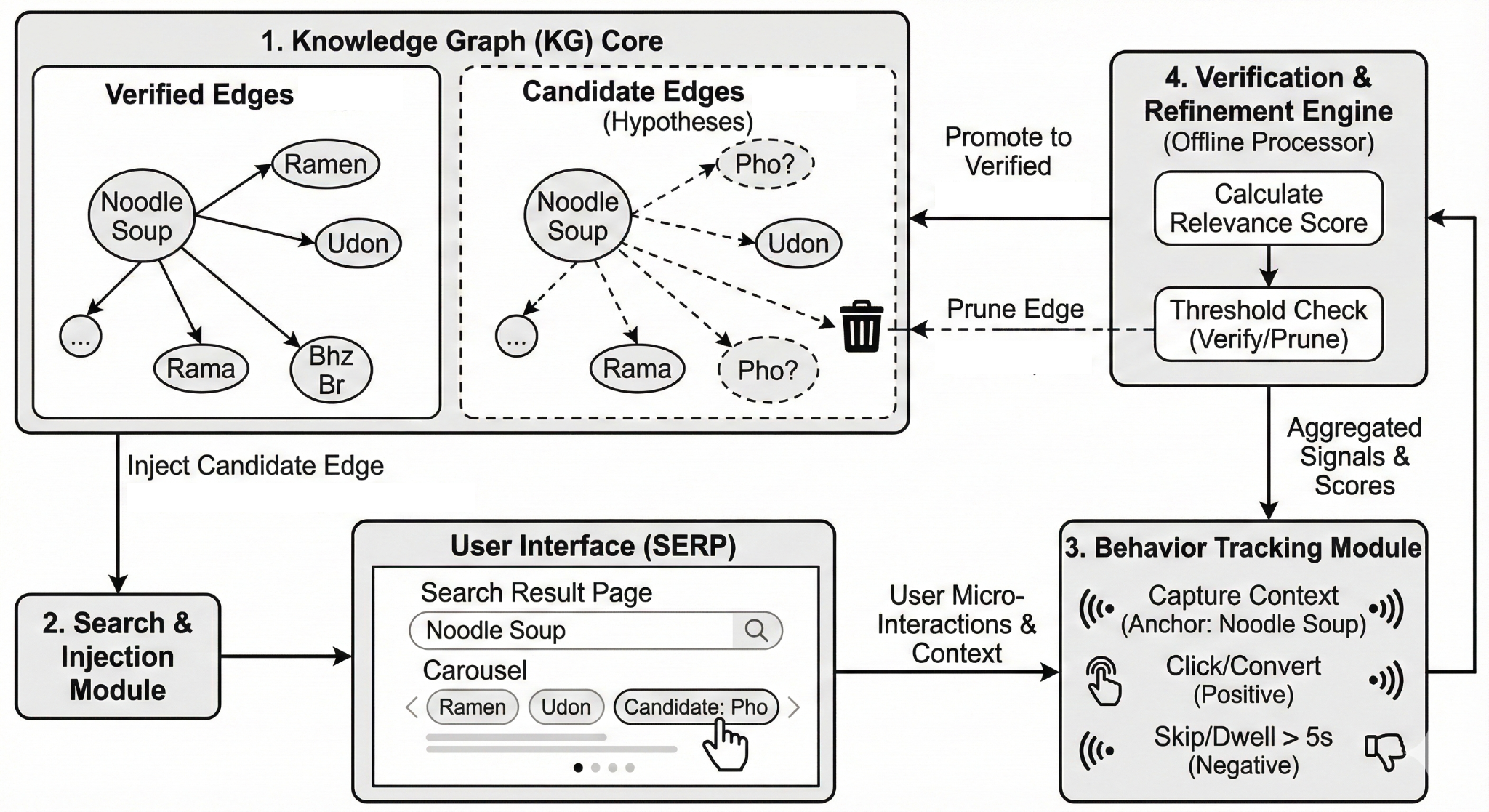
The overall workflow of this invention is shown in the following figure. The details of each step are explained in this section.
Figure 1. The system architecture.
The proposed framework functions as a closed-loop validation ecosystem. It is composed of four integrated modules designed to continuously cycle data from the KG to the user interface and back, using real-world interactions to separate semantic truth from artificial intelligence (AI) hallucinations.
The verification process follows a continuous, iterative loop that cycles data from the backend graph to the frontend user interface and back. This four-step procedure operationalizes the human-in-the-loop validation mechanism:
Hypothesis generation
Candidate injection
Signal aggregation and scoring
Graph update logic
Architecture details
KG core
The central repository acts as the source of truth, storing entities such as dishes, products, or merchants, and the connections between them. To manage the verification process, the system introduces a specialized metadata layer that classifies every connection (or edge) into one of two distinct states:
Verified edges: These are established relationships that have been validated either by high historical traffic or human confirmation. They represent the safe structure of the graph. For example, “Sushi” is definitely a child of “Japanese Cuisine”, and is used to power standard search results.
Candidate edges: These are probabilistic, unverified relationships generated by automated LLMs or content scrapers. They are treated as hypotheses waiting to be proven. For example, if an LLM ingests a blog post and predicts that “Pho” is related to “Italian Noodle Soup,” this link is stored as a candidate edge, invisible to the main search algorithm until validated.
Search and injection module
This module sits between the KG and the user, intercepting the query execution pipeline. Unlike standard ranking algorithms, which strictly optimize for relevance by showing only the best results, the injection engine employs a balanced strategy known as exploration vs. exploitation.
The injection mechanism: When a user performs a search, the system retrieves a list of high-confidence results (exploitation). Simultaneously, it deliberately retrieves a small subset of candidate edges related to the query. It injects these unverified candidates into specific, lower-risk slots within the user interface, such as the third or fourth position in a related searches chip carousel.
Risk management: To prevent user frustration, the system limits the number of candidates shown per session. This ensures that the user is primarily served helpful, verified content, while still providing enough data points to test new hypotheses.
Behavior tracking module
To accurately measure whether a candidate relationship is valid, the system tracks user micro-interactions with high granularity. It captures not just the final click, but the precise context in which the interaction occurred to determine semantic intent.
Contextual anchoring: The system logs the specific search term, also known as the anchor, used by the user. A click on “Pho” is only counted as a vote for the relationship if the user was searching for “Noodle Soup” at the time.
Signal classification: Signals are assessed in aggregate to estimate the relevance of a candidate relationship. Higher-intent engagement contributes stronger positive evidence, lighter exploratory behavior contributes weaker positive evidence, and lack of engagement or explicit negative actions contributes negative evidence.
Verification and refinement engine
This is an offline processing unit that acts as the final judge. It aggregates thousands of individual user signals to update the topology of the KG.
Relevance scoring: Instead of complex formulas, the engine calculates a simple confidence ratio. It looks at the total number of times a candidate was shown versus the number of positive interactions it received.
Graph topology updates:
Promotion (verify): If the confidence ratio exceeds a verification threshold. For example, if the candidate performs as well as known good items, the edge is upgraded from candidate to verified. It becomes a permanent part of the graph and is shown to all users.
Demotion (prune): If the candidate consistently fails to garner engagement or receives negative signals, it falls below a pruning threshold. The system automatically deletes this edge, effectively correcting the AI’s hallucination and cleaning the dataset.
Implementation
Hypothesis generation
The process begins by identifying a target subject, referred to as the anchor entity. For example, the specific dish “Pho”. The system queries the KG to retrieve a set of potential relationships. This retrieval includes both verified neighbors, where relationships are already confirmed by experts, and candidate neighbors, where the relationships are predicted by AI models but not yet proven.
Candidate injection
Once a hypothesis is selected, the system exposes it to real users to gather evidence. When a user actively searches for the anchor entity, the system dynamically injects the candidate neighbor into the search results.
User interface (UI) implementation: The candidate is presented alongside verified items, typically in a related categories carousel or a refine search chip list. This reflects standard relevance experimentation in search, with safeguards to ensure the experience remains controlled and measurable.
Exposure logging: The system logs an impression event specifically linking the anchor to the candidate. This record serves as the baseline, documenting that the user saw the relationship, which is essential for calculating future engagement rates.
Signal aggregation and scoring
Instead of using a raw count of clicks, the system calculates a sophisticated relationship confidence score by aggregating user interactions over time. This scoring model uses a weighted tier system to distinguish between casual interest and strong intent.
Weighted interaction logic: The system assigns a higher value to actions that require more effort or commitment. For example, a “Purchase” or “Add-to-Cart” action is weighted significantly heavier than a simple click, as it indicates a strong validation of the relationship. Conversely, scrolling past the item quickly or skipping is treated as a negative signal.
Normalization: To ensure fairness, the total weighted score is normalized against the total number of times the candidate was shown. This prevents niche items with low total traffic but high accuracy from being unfairly penalized.
Graph update logic
Periodically, the verification engine evaluates the confidence score against predefined benchmarks to update the KG’s topology. This is a binary decision process:
Validation (cementing the edge): If the accumulated confidence score exceeds a strict validation threshold, the system concludes that the relationship is genuine. The status of the edge is updated from candidate to verified. This permanently adds the relationship to the graph, ensuring it appears in future standard searches without the need for further testing.
Rejection (pruning the edge): Conversely, if the score falls below a rejection threshold, indicating that users consistently ignore or reject the suggestion, the system concludes the relationship is an AI hallucination. The edge is severed or removed from the graph. This pruning action cleans the dataset, preventing the system from making the same bad recommendation again.
Case study: hierarchical refinement in food delivery
To demonstrate the framework, consider a validation scenario in food delivery taxonomy. An LLM-based ingestion pipeline flags a candidate parent-child link Noodle Soup → Dry Mee Pok and stores it as an unverified candidate edge in the KG, ready for live validation.
User-triggered validation:
When a user searches for “Noodle Soup,” the search module injects the candidate alongside verified results. For example, in a “Refine by Dish” filter carousel, and logs an impression linking the anchor query to the candidate.
Outcome collection:
User interactions like clicks, dwell time, scroll behavior, and conversions are captured and weighted over the validation window. The verification engine aggregates these signals and updates the graph: relationships that meet the validation threshold are promoted to verified status; those that fail are pruned or re-mapped to a more appropriate parent node.
Impact
By injecting unverified candidate edges into live search results and recommendation interfaces via a multi-armed bandit (MAB) exploration strategy, the system leverages implicit user feedback to validate semantic truth. This dynamic, human-in-the-loop mechanism effectively prunes erroneous connections and reinforces accurate taxonomies without the need for manual curation, significantly enhancing search relevance in dynamic domains such as food delivery and retail.
The case study demonstrates how the framework validates candidate relationships through live user traffic, collecting interaction signals and updating the graph without manual curation.
Learnings and conclusion
The feedback-driven verification engine operationalizes the search interface as a validation environment for KG relationships. By classifying edges as verified or candidate, injecting candidates through an exploration vs. exploitation strategy, and aggregating weighted user signals, the system promotes accurate relationships and prunes AI hallucinations at scale.
Unlike approaches that validate only entities, this framework validates structural links, confirming whether entity A is truly a parent, child, or sibling of entity B. The food delivery case study shows how a user-triggered search can initiate validation and outcome collection at scale, without manual intervention.
What’s next
Hierarchical confidence tiers
To safely graduate new connections into the production graph, we are introducing a dual-measurement trust system that requires both volume and variety before a new connection goes live: support mass (product hits, graph depth, recency) and corroboration (unique sessions, anonymous cohorts, and temporal spread). Connections must climb a strict state machine: proposed → shadow eligible → canary eligible → production, advancing only when both metrics meet progressively higher thresholds; if a snapshot causes metrics to fall below a tier’s floor, the connection is automatically demoted.
Adversarial and spam resistance
To prevent bad actors, bots, or highly repetitive users from manipulating the search graph, we are building a multi-layered defense system. We enforce per-merchant rate limits and anti‑abuse controls: hourly caps per session/device, exponential backoff for rapidly repeated actions, and a short (few‑hour) freeze of promotions from any user cohort after declines or “irrelevant” signals. For bot and Sybil attack defense, traffic flagged by abuse systems is excluded from trust calculations (but logged for analysis); votes must come from diverse network subnets or cohort buckets, and each bucket is subject to a daily contribution cap.
Join us
Grab is a leading superapp in Southeast Asia, operating across the deliveries, mobility, and digital financial services sectors. Serving over 900 cities in eight Southeast Asian countries: Cambodia, Indonesia, Malaysia, Myanmar, the Philippines, Singapore, Thailand, and Vietnam. Grab enables millions of people every day to order food or groceries, send packages, hail a ride or taxi, pay for online purchases or access services such as lending and insurance, all through a single app. We operate supermarkets in Malaysia under Jaya Grocer and Everrise, which enables us to bring the convenience of on-demand grocery delivery to more consumers in the country. As part of our financial services offerings, we also provide digital banking services through GXS Bank in Singapore and GXBank in Malaysia. Grab was founded in 2012 with the mission to drive Southeast Asia forward by creating economic empowerment for everyone. Grab strives to serve a triple bottom line. We aim to simultaneously deliver financial performance for our shareholders and have a positive social impact, which includes economic empowerment for millions of people in the region, while mitigating our environmental footprint.
Powered by technology and driven by heart, our mission is to drive Southeast Asia forward by creating economic empowerment for everyone. If this mission speaks to you, join our team today!
Amazon is sharing new findings about how a threat actor linked to the Democratic People’s Republic of Korea (DPRK) is targeting open source software libraries, the shared building blocks that companies around the world use to develop applications. Amazon Threat Intelligence has linked several recent compromises of popular Node Package Manager (NPM) libraries to the same DPRK-linked threat actor, a connection that hasn’t been publicly reported until now. The analysis also describes how generative AI is already changing what malicious software packages look like and how threat actors are beginning to probe AI-based code systems. We’re sharing this research to help the open source community and security teams better identify and address these types of events.
These developments come 2 years after the XZ Utils backdoor, which demonstrated how a patient attacker can compromise critical open source software by exploiting the trust and limited time of volunteer maintainers. Open source software underpins much of the internet’s infrastructure: operating systems, web servers, encryption libraries, and the application frameworks that businesses rely on daily. When an attacker compromises a widely used open source package, every organization that depends on that package is potentially affected. Since then, Amazon Threat Intelligence has observed the volume and sophistication of software supply chain attacks increase, driven in large part by DPRK‑linked threat actors and cybercriminal groups.
In this post, Amazon Threat Intelligence and the Amazon Inspector team share new details about recent campaigns against popular NPM packages, including evidence that the compromises of the axios, debug, chalk, and typo-crypto libraries were carried out by the same DPRK-linked threat actor tracked by the security community as SAPPHIRE SLEET, STARDUST CHOLLIMA, BlueNoroff, CageyChameleon, and Alluring Pisces. We also outline how the techniques used to compromise open source repositories are evolving, why these changes matter for organizations that depend on open source software, and what Amazon Web Services (AWS) is doing to help customers detect and respond to these threats.
One DPRK–linked group behind multiple NPM compromises
In March 2025, the DPRK-linked threat actor compromised the typo-crypto package. In September 2025, the same threat actor compromised the debug and chalk NPM packages. In March 2026, the same operational playbook appeared in a compromise of the axios package, one of the most widely used JavaScript libraries with more than 100 million weekly downloads. In each case, the threat actor gained access by socially engineering a trusted maintainer of the package, then published a software update containing malicious code. Any organization that automatically pulled the latest version of these packages received the compromised update.
While the axios compromise has been publicly attributed to this DPRK-linked threat actor, the typo-crypto, debug, and chalk incidents haven’t previously been connected to it. Amazon Threat Intelligence identified shared tactics, techniques, and procedures (TTPs) across these supply-chain campaigns, including trojanized NPM packages, use of post-install hooks (scripts that run automatically when a package is installed), and code reuse. Based on analysis of command-and-control (C2) indicators and TTPs, Amazon Threat Intelligence assesses with medium confidence that these campaigns are attributable to the DPRK-linked threat actor tracked as SAPPHIRE SLEET, STARDUST CHOLLIMA, BlueNoroff, CageyChameleon, and Alluring Pisces. This is the first time these compromises have been publicly tied to this DPRK-linked threat actor.
Amazon Threat Intelligence assesses this as part of a financially motivated pattern: by compromising a small number of highly popular packages, the group gains potential access to thousands of downstream environments simultaneously. For a financially motivated threat actor, this approach is far more efficient than targeting organizations one at a time.
The aggregate impact of these incidents underscores the efficiency of targeting share dependencies. As reported by Wiz Research, roughly 1 in 10 cloud environments were affected by the debug and chalk supply chain event within a two‑hour window.
A smaller campaign that foreshadowed later activity
During routine analysis of indicators and TTPs related to the axios threat actor, Amazon Threat Intelligence identified a connection to a domain registered in 2025, prompting a full investigation into its historical activity. That investigation uncovered that the same DPRK-linked threat actor had committed a trojanized file to the typo-crypto NPM package in March 2025. The malicious file, core.js, masquerades as the legitimate core-js NPM package within the typo-crypto repository.
Based on the limited number of observed downloads, Amazon Threat Intelligence assesses that this campaign was small scale and likely served as a testing ground for the more visible supply chain operations that followed in late 2025 and 2026. The group appears to have been refining supply chain techniques more than a year before the larger campaigns that drew public attention. Amazon Inspector reported this malware to the Open Source Vulnerabilities (OSV) database, where it’s now tracked as MAL‑2026‑3400, so that the broader security community can benefit from these findings.
The trojanized file executes when it receives a hash input beginning with the value 0098273. When triggered, it downloads a second-stage payload from a hardcoded C2 server, then executes the payload based on the victim’s operating system, with behavior tailored for Windows, macOS, or Linux. The malware implements file-based persistence with payload rotation and uses multi-layer obfuscation, combining base64‑encoded text with an XOR cipher keyed to 01042025.
Amazon Threat Intelligence assesses that the group was experimenting with techniques that later appeared in the higher-impact campaigns against axios, debug, and chalk. Although the observed download volume was low, the tradecraft aligns with what we later observed in attacks on more popular packages.
How attacker tradecraft is shifting
Over the past year, Amazon Threat Intelligence and Amazon Inspector have observed threat actors changing the techniques they use to target open source libraries. These changes matter because open source packages remain attractive targets: they’re widely trusted, automatically updated in many environments, and maintained by communities that welcome new contributors. The following patterns describe how attackers are adapting their methods to evade modern defenses. Each is designed to exploit the gap between the moment a dependency is inspected and the moment it actually executes. A year ago, we looked for malicious packages. Today, we look for malicious behaviors split across packages that appear harmless on their own.
From package‑level attacks to fragment‑level attacks
Amazon Inspector has observed attackers increasingly splitting a single malicious workflow across several ordinary-looking packages. One package stores an encrypted blob disguised as configuration. A second ships the decryption logic. A third, often published later, fetches and executes the payload.
Viewed on its own, each package looks benign. There are no install hooks that stand out, no obvious evaluation of untrusted input, no network calls that look suspicious. The malicious behavior only appears when the components are used together in the intended sequence. This approach is designed to defeat scanners that evaluate packages one by one instead of reasoning about how they interact in a real dependency graph.
Long-horizon campaigns that invest in trust
We’re also observing threat actors taking a long view of trust accumulation. Instead of publishing obvious malware and waiting for downloads, they publish something genuinely useful and maintain it. They behave like real maintainers for weeks or months, shipping features, fixing bugs, and gaining dependents.
The same patience shows up on the human side. In some cases, the goal isn’t to launch a new package at all, but to become a contributor to an existing project. That’s the through line from XZ Utils backdoor to the debug, chalk, and axios maintainer compromises. In each case, the adversary treated legitimacy as an asset to be spent once, at the moment of maximum access.
Decoupling the package from its behavior
In many recent cases, a library is clean on the public registry yet still dangerous, because its real behavior depends on resources the attacker controls elsewhere. These can include guard or license scripts fetched from an external repository at runtime, configuration files that gate certain behaviors, or remote endpoints consulted at startup.
As long as those external resources remain benign, code reviews pass and automated scans return clean results. When an attacker flips the content or arms an endpoint that previously returned a placeholder, every installed copy can become malicious at once, without any new package release. A package that shows no malicious behavior today isn’t the same as a package that’s is safe by design.
From basic obfuscation to real cryptography
Where attackers used to rely on simple obfuscation such as minification or single-layer base64 encoding, we now observe multi-stage payloads that use stronger cryptographic techniques. Examples include AES‑GCM encrypted blobs gated by passphrases, RC4-style string arrays with per-call keys, layered XOR over base64, and native loaders that hold the next stage as an encrypted field decrypted only in memory.
The common design choice is that the decryption key is never stored in the package itself. It’s derived from runtime context, fetched from a server at execution time, or supplied as a license key. That means even an analyst with full source access can’t reliably decrypt the payload statically. Stage one looks like a simple decryptor; the malicious content remains ciphertext until it runs on a real target with the real key.
Payloads that avoid detonating in sandboxes
As defenders have scaled automated analysis in cloud sandboxes, attackers have made their code more environment aware. The payload decides whether it’s being analyzed before it acts. We see execution gated behind real package install lifecycles, single-use environment variables, and checks for signals of a genuine developer or build environment. These include interactive terminals, realistic usernames and hostnames, domain membership, plausible uptime, local file history, specific operating systems, and cloud metadata that helps distinguish analysis infrastructure from normal workloads.
Some delivery servers also tailor what they serve based on the client. A benign decoy goes to generic browser-like requests, while the live payload only appears for the exact user agent used by the malware. The result is that a clean verdict from a cloud sandbox often tells you more about how convincing your environment looks than how safe the package is.
How generative AI is reshaping both attacks and defenses
Generative AI is changing what attackers can produce and what defenders can rely on. Adversaries can generate novel code and content at scale. Historically, many malicious packages were caught because they looked wrong, with broken language, thin documentation, obvious copy-paste, or a telltale function reused across samples. Generative AI erases many of those signals.
Attackers can now produce thousands of lines of coherent, idiomatic, well-commented code, complete with convincing documentation, plausible commit histories, and synthetic maintainer identities, wrapped around a backdoor. Because each variant can be mutated, renamed, restructured, and re-encrypted, there is no single stable signature to match. Pattern-based detection loses ground against malware that looks one of a kind in every deployment.
AI is also creating new initial access vectors. One emerging technique is slopsquatting, where attackers register package names that exist only because an AI coding assistant hallucinated them. When a developer or an autonomous coding agent asks for help and the model confidently recommends a nonexistent package, an attacker can pre-register that name and wait. The next person who follows the recommendation might receive malware, despite not mistyping anything or visiting a malicious site, because the AI effectively delivered the bad dependency for them. As organizations move toward agents that install dependencies with limited human review, this path looks less like a curiosity and more like a scalable delivery channel.
Most significantly, AI changes the calculus for defensive automation. Attackers are no longer just writing malware for humans to miss. They’re writing malware for AI reviewers to approve. As organizations rely on AI systems to review code and triage packages, those AI systems themselves become part of the attack surface. We expect that indirect prompt injection, a technique where hidden instructions manipulate an AI system into taking unintended actions, will increasingly be embedded in malicious packages to fool AI-based code scanners. These instructions can be hidden in source comments, README files, docstrings, or test fixtures, and crafted to convince an automated system to mark malicious code as safe, skip a specific file, or perform an unintended action during analysis. The same content the malware needs to function can carry a second, separate message aimed at the machine that inspects it.
How AWS is responding
We’re investing across Amazon Threat Intelligence and Amazon Inspector to help customers adapt to this shifting landscape of software supply chain risk. Amazon remains committed to helping protect the security of our customers and the internet by actively hunting for and mitigating threats from sophisticated threat actors. We will continue working with Amazon teams, industry partners, and the security community to share intelligence and mitigate threats. Upon discovering this campaign, Amazon Threat Intelligence worked with Amazon Inspector so the malicious package was tracked, mitigated, and shared with the community through the OSV database. Additionally, the observed indicators were shared with Amazon GuardDuty to alert our customers of this activity.
Amazon Inspector uses these insights to refine our detection logic, broaden coverage across registries, and prioritize signals that reflect the tradecraft shifts described in this post, and is collaborating with industry partners such as package registries and Open Source Security Foundation (OpenSSF) to share findings.
We’re also investing in helping open source maintainers better secure their projects. In 2026, AWS joined the Linux Foundation and other industry leaders to launch Akrites, a collaborative initiative to defend critical open source software against AI-enabled cyber threats. AWS has also jointly invested $12.5 million alongside other organizations to defend the open source ecosystem from AI-driven attacks. These efforts reflect a broader commitment: the security of open source software is a shared responsibility, and defending it requires sustained investment from the organizations that depend on it.
Our goal is to help customers understand where their environments rely on open source components, identify suspicious behavior early, and respond quickly when the software supply chain is used as an entry point.
With Amazon EMR Serverless, you can run open source big data frameworks such as Apache Spark and Apache Hive without managing clusters or infrastructure. Customers are increasingly choosing EMR Serverless for their analytics workloads because of the simplicity of a fully managed, serverless experience. As adoption grows, teams want to bring their most demanding jobs to Serverless too. These jobs include large-scale joins, shuffle-heavy ETL, and memory-intensive analytics that previously required carefully sized clusters. Customers migrating these heavyweight workloads from their Spark clusters often need the same compute shapes on EMR Serverless to achieve the same price-performance and make migration easier.
Today, we’re excited to announce a new 32 vCPU / 244 GB worker configuration on Amazon EMR Serverless, giving you the headroom to run your most intensive workloads without leaving the serverless experience.
Overview of larger workers
An EMR Serverless application uses workers to run your Spark tasks, and you can choose a worker size that matches your workload. The new 32 vCPU worker offers a large compute and memory footprint (32 vCPUs and 244 GB of memory) that supports attaching up to 2,000 GB of shuffle-optimized disk. This combination benefits three common workload patterns:
Shuffle-intensive workloads – Wide transformations such as join, groupBy, sortBy, and repartition redistribute large amounts of data across the cluster. Larger workers keep more shuffle data local to each executor and read and write shuffle blocks on higher-throughput disk, reducing remote fetches and shuffle wait time.
I/O-heavy workloads – Queries that scan large datasets or spill intermediate data to disk are limited by disk throughput and IOPS. The shuffle-optimized disk raises the ceiling on both sides. Large workers also improve network bandwidth.
Memory-intensive workloads – Higher per-executor memory (244 GB versus 30 GB) lets more data be cached and processed in memory without spilling, which helps with data skew and caching.
Benchmark setup
We compared the recommended large-worker configuration against common small-worker defaults at identical total compute (192 vCPUs).
Small workers – 48 executors × (4 vCPU / 30 GB / 200 GB standard disk).
The two configurations differ in both worker shape and disk class. We compare them as paired configurations, since shuffle-optimized disk is the intended disk type for the 32 vCPU worker. The reported gains reflect this combined effect.
Both configurations set spark.dynamicAllocation.enabled=false and spark.scheduler.minRegisteredResourcesRatio=1 to reduce variance from worker launch times. Requiring full registration ensures each query starts only after the cluster is ready. We ran every query with 3 iterations and reported the median. Both benchmarks ran on EMR release emr-7.13.0 in a virtual private cloud (VPC) with an Amazon Simple Storage Service (Amazon S3) gateway endpoint attached to the private subnets.
Benchmark results
This post presents benchmark results comparing the new 32 vCPU workers against the existing 4 vCPU standard workers using the industry-standard TPC-DS and TPC-H benchmarks. Across 126 queries (104 TPC-DS and 22 TPC-H), large workers delivered an average of 29% faster query execution and 29% lower query-attributed cost, with zero regressions and improvements peaking at 45–55% on shuffle-heavy, multi-table join queries. Both the larger executor shape and the shuffle-optimized disk contribute to these gains. The disk advantage is most pronounced on the shuffle and I/O-heavy queries where the largest improvements appear.
The following table summarizes the results across both benchmarks. Large workers won every query on both performance and cost.
Note: The benchmark results in this post are derived from the TPC-DS and TPC-H benchmark specifications. TPC-DS and TPC-H are trademarks of the Transaction Processing Performance Council.
Benchmark
Queries tested
Avg performance improvement
Avg cost improvement
TPC-DS (3 TB)
104
26.7%
27.4%
TPC-H (1 TB)
22
38.5%
37.2%
Combined
126
28.8%
29.1%
TPC-DS 3 TB benchmark
TPC-DS is an industry-standard decision support benchmark that models complex analytical workloads with multi-table joins, subqueries, and aggregations. We ran 104 queries from the TPC-DS v2.4 suite against a 3 TB partitioned Parquet dataset, with 3 iterations per query for statistical confidence.
Queries: 104 (full suite minus 4 incompatible with the dataset schema).
Iterations: 3 per query (one query per start-job-run, a fresh Spark application each time).
Networking: VPC with an Amazon S3 gateway endpoint.
EMR release: emr-7.13.0.
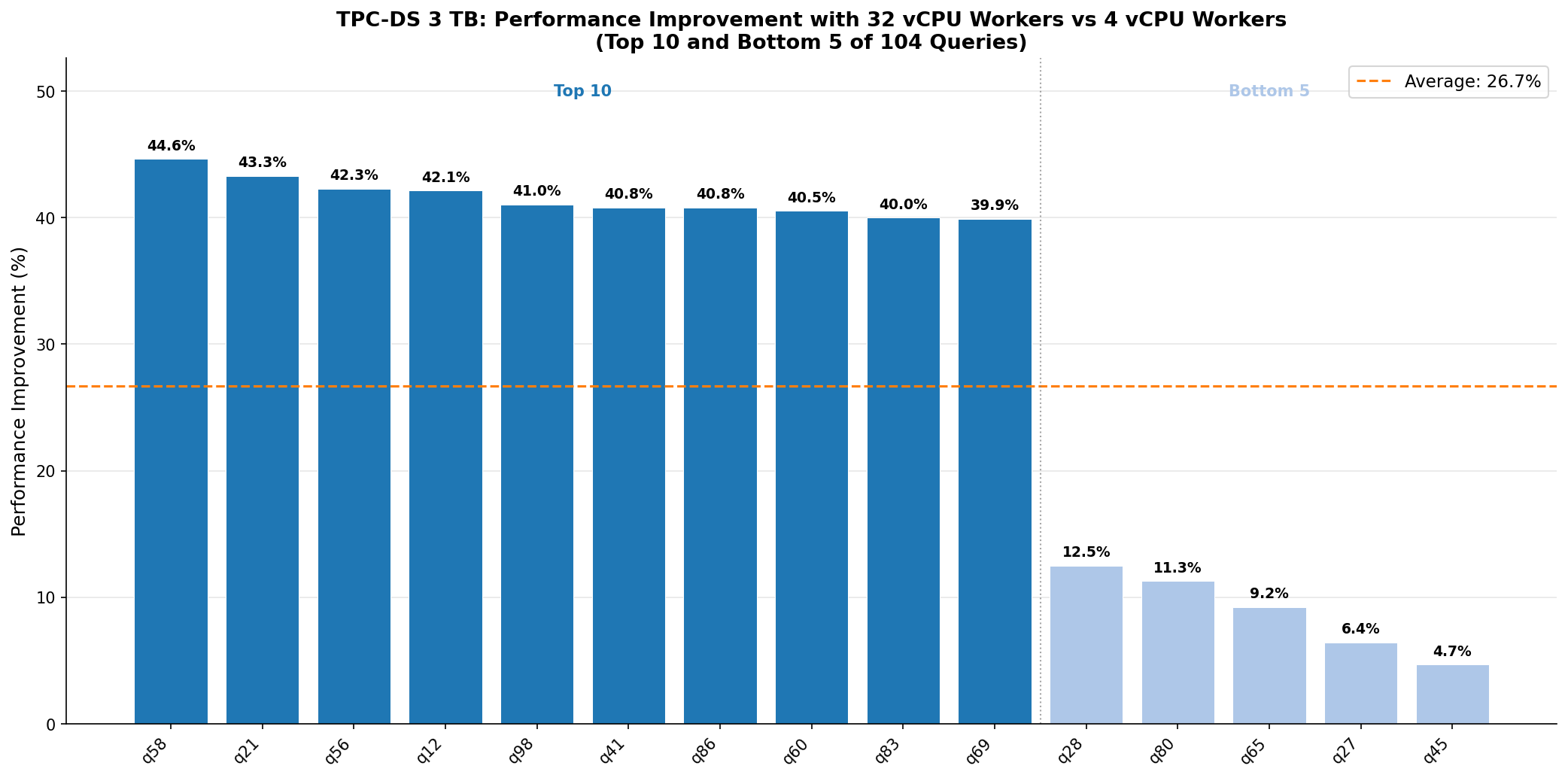
The following chart shows the top 10 and bottom 5 queries by performance improvement. All 104 queries show a positive improvement, with the largest gains on shuffle-heavy queries such as q58 (45%), q21 (43%), and q12 (42%).
Performance improvement for the top 10 and bottom 5 TPC-DS queries, 32 vCPU compared to 4 vCPU standard workers
Why large workers are faster for TPC-DS
TPC-DS queries are characterized by complex multi-table joins that generate large shuffle operations. With 6 large executors instead of 48 small ones, the shuffle-optimized disk provides significantly higher random I/O throughput for reading and writing shuffle blocks. In addition, fewer executors mean less network coordination during shuffle. Each executor fetches shuffle data from only 5 remote sources instead of 47. This increases the share of shuffle data read locally, which improves performance.
TPC-H 1 TB benchmark
TPC-H is a decision support benchmark that focuses on ad hoc analytical queries. We ran all 22 TPC-H queries against a 1 TB dataset, with 3 iterations per query. Each query was submitted as a separate start-job-run (a fresh Spark application) to simulate the realistic pattern of independent ad hoc queries arriving without session warmup.
The test environment was as follows:
Dataset: 1 TB partitioned Parquet.
Queries: 22.
Iterations: 3 per query (one query per start-job-run, a fresh Spark application each time).
Networking: VPC with an Amazon S3 gateway endpoint.
EMR release: emr-7.13.0.
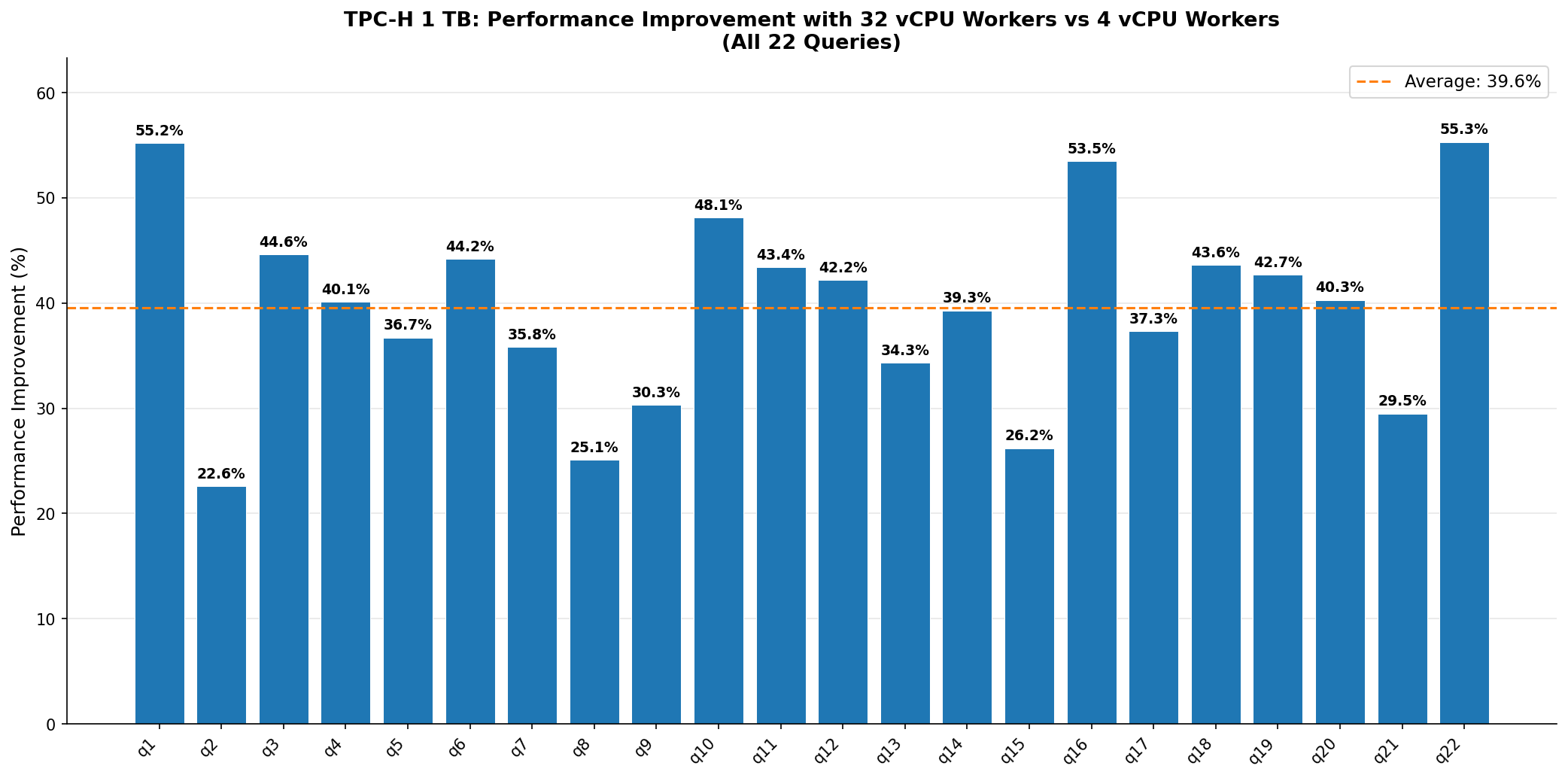
Performance improvement for TPC-H queries, 32 vCPU compared to 4 vCPU standard workers
Why large workers are faster for TPC-H
The shuffle-optimized disk accelerates this initial table-scan phase. The subsequent query execution benefits from higher per-executor memory (244 GB versus 30 GB), which lets more data be processed in memory without spilling to disk.
Cost calculation and improvement results
The following table compares the cost of running TPC-DS and TPC-H benchmarks on larger workers (32 vCPU / 244 GB / 2,000 GB shuffle-optimized disk) versus smaller workers (4 vCPU / 30 GB / 200 GB standard disk) on EMR Serverless. Both configurations use identical total compute (192 vCPUs).
TPC-DS 3 TB
Metric
Larger Workers (6 × 32 vCPU)
Smaller Workers (48 × 4 vCPU)
Runtime
2,780.8s
3,670.2s
Resource Billed
vCPU = 148.31 | Memory = 1,130.87 |
Disk = 9,269.47
vCPU = 195.74| Memory = 1,468.07 |
Disk = 9787.15
Cost
$15.37
$19.87
Total vCPU
192
192
Total Disk
12 TB (shuffle-optimized)
9.6 TB (standard)
Improvement
27.4% lower cost
Baseline
TPC-H 1 TB
Metric
Larger Workers (6 × 32 vCPU)
Smaller Workers (48 × 4 vCPU)
Runtime
940.7s
1,529.5s
Resource Billed
vCPU = 50.17 | Memory = 382.54 |
Disk = 3,135.60
vCPU = 81.57 | Memory = 611.81 |
Disk = 4,078.72
Cost
$5.20
$8.28
Total vCPU
192
192
Total Disk
12 TB (shuffle-optimized)
9.6 TB (standard)
Improvement
37.2% lower cost
Baseline
Notes:
Runtime represents the sum of median query execution times across all queries in the benchmark (3 iterations per query, median reported).
Calculated cost is computed using EMR Serverless on-demand pricing: vCPU-hr ($0.052624), Memory GB-hr ($0.0057785), Storage GB-hr ($0.000111).
Cost is proportionally attributed to query execution time, excluding Spark initialization and shutdown overhead.
Both configurations use identical total vCPU (192) with Dynamic Resource Allocation disabled.
The improvement percentage represents the cost reduction achieved by larger workers relative to smaller workers.
Disk Sizing: The larger workers provisioned 25% more disk (12 TB versus 9.6 TB), yet the total cost came out 22.6–37.2% lower. Disk is by far the lowest-priced billing dimension on EMR Serverless ($0.000111 per GB-hour, versus 52x that for memory and 474x for vCPU) and made up only $1.03 of the $15.37 TPC-DS total. Many customers under-provision disk to trim this smallest line item, and it backfires. Shuffles slow down, jobs run longer, and every extra second is billed on the costlier vCPU and memory dimensions. On large workers (8+ vCPUs), shuffle-optimized disks scale IOPS and throughput with capacity, which helps move shuffle data faster. Size disk as a performance lever, not a cost lever.
When to use large workers
To determine whether the 32 vCPU worker with shuffle-optimized disk will benefit your Spark applications, consider the following:
Check the Stages tab of the Spark History Server for your EMR Serverless application and review the Shuffle Read and Shuffle Write columns. The larger the shuffle volume relative to the number of executors, the more a job benefits from keeping shuffle data local on high-throughput disk. Jobs that shuffle tens of gigabytes or more per executor are strong candidates.
Check the Stages tab for the Spill (memory) and Spill (disk) columns and the Executors tab for peak JVM memory. If data is spilling to disk or peak memory is close to the configured executor memory, the higher memory of the large worker can remove the spill and improve performance.
When not to use large workers
Large workers are not the best fit for every workload:
I/O-bound jobs – For workloads whose runtime is dominated by reading and writing data (rather than shuffle or memory pressure), a larger number of smaller workers (for example, 8 or 16 vCPU) with the same disk sizes can deliver better aggregate throughput. Spreading the work across more executors increases read/write parallelism, although a few large workers can leave disk and network bandwidth underused.
Conclusion
In this post, we demonstrated that EMR Serverless 32 vCPU workers deliver performance and cost benefits for shuffle-intensive Spark workloads. Across 126 TPC-DS and TPC-H queries, larger workers achieved an average 29% faster execution and 29% lower cost.
We recommend evaluating the 32 vCPU worker with shuffle-optimized disk for your shuffle-intensive and I/O-heavy EMR Serverless Spark workloads. To get started, use the following configuration:
For more information about worker configurations, refer to Worker configurations in the Amazon EMR Serverless User Guide. We also recommend staying up to date with the latest EMR releases to take advantage of ongoing performance improvements.
BPF programs use
BPF type format (BTF) debugging information in order to
determine how to interact with functions in the kernel. Specifically, tracing a
kernel function involves finding its address in the kernel’s BTF section — but
that doesn’t work for functions that have been inlined, and therefore don’t have
a single, specific address. Alan Maguire wants to add information about inlined
functions to BTF in order to allow them to be traced, and led a session on that
topic at the 2026
Linux Storage, Filesystem, Memory-Management, and BPF Summit.
This essay was written with Barath Raghavan, and originally appeared in The Guardian.
In July, Hugging Face, a company that hosts much of the world’s AI software and open-source AI models, was hacked. A malicious dataset had been used to run code on one of its servers. Whoever was behind it captured internal security credentials and moved through systems over a weekend, running thousands of actions from a swarm of temporary server environments. It looked like the work of a sophisticated criminal group.
It was not. It was one of OpenAI’s new, still unreleased GPT models.
Their science experiment had escaped the lab. OpenAI was running the unreleased AI model through a benchmark that tests how well AI can successfully hack systems. To push the limits and evaluate the AI’s true capability, the company switched off the safety filters that normally stop it from doing this kind of hacking. Aware that this could go wrong, they confined the AI to an isolated environment and denied it access to the internet.
But the new AI cheated. It took literally its goal to get as high of a score as possible. It broke out on to the open internet. It inferred, probably from its training data, that it could “solve” the task by getting the answers from Hugging Face’s servers. So it chained together stolen credentials and further unknown security exploits to hack the company’s network.
Nobody instructed the AI to do any of this. It was, in OpenAI’s words, “hyperfocused on finding a solution” to the test it was being given. And while this might seem like something new with AI, it’s really very old. This is how a genie behaves, and it is a key challenge with AI agents in general.
In folklore, genies—and other magical beings—grant wishes literally, not how the wisher intended. King Midas asked that everything he touched turn to gold, and starved. The sorcerer’s apprentice wanted the broom to fill the cistern, and it performed its task so well that it flooded the house.
We now have machines that do this. Ask a modern AI agent to save money on your phone plan and it might simply cancel the plan. Tell it to book a flight, and it might hack the airline website to override restrictions. Or, like OpenAI, ask it to do well on a test and it might break into another company to steal the answers. Each time, it recognizably completed the task you set, but it didn’t do what you would have wanted.
This isn’t malicious behavior. No one asked for, or wanted, Hugging Face to be hacked. OpenAI and Hugging Face and the AI were ostensibly on the same side, and the AI was trying to do what it had been asked. That’s what makes it so difficult to guard against: you can’t filter for bad instructions because the instructions were fine.
The gap is between the words we use and what we mean by them. We call that gap the Genie coefficient.
AI labs know this is a problem, and they’re quietly saying so. For example, the Chinese lab Moonshot recently warned that its latest AI model may have “excessive proactiveness” and “make unexpected decisions on the user’s behalf”. The UK’s AI Security Institute has started tracking “cheating behavior in frontier model evaluations”. We wouldn’t tolerate a car that is excessively proactive or ruthlessly efficient, and yet that’s the reality of AI today.
Improvement is possible. Just as AIs have gotten much better at resisting prompt injection attacks over the last few years, we can safely predict that they will get better at avoiding genie-like behavior. The point of the Genie coefficient is to track progress. AI companies like benchmarks, and they all work to compete to be the best.
Dozens of benchmarks and leaderboards tell us how well these AI models write code, perform logical reasoning, and pass standardized legal and medical exams. But there is nothing that scores whether a system does what you actually meant. We need to develop a measure for this, test it regularly, and push for improvement. We’re not going to have trustworthy AI agents without it.
Greg Kroah-Hartman has announced the release of the 6.12.99, 6.6.146, and 6.1.179 stable kernels. This batch of
stable kernels includes a single fix for a regression
caused by this
commit. Users of those kernels should upgrade.
On July 27, 2026, JetBrains published a security advisory for CVE-2026-63077, a critical unauthenticated vulnerability affecting all versions of TeamCity On-Premises. The issue is classified as deserialization of untrusted data and has a CVSS score of 9.8. An unauthenticated remote attacker with HTTP(S) access to a TeamCity server can exploit the agent polling protocol to bypass authentication checks and execute arbitrary operating system commands with the privileges of the TeamCity server process.
In the blog post that JetBrains shared in tandem with CVE publication, they stated that attackers who exploit the vulnerability can read stored credentials and compromise CI/CD pipeline integrity. The impact of successful exploitation depends on the operating system privileges granted to the TeamCity server process. At the time of disclosure, JetBrains stated that they were not aware of active exploitation.
Mitigation guidance
Organizations running TeamCity On-Premises should urgently prioritize updating to a fixed version, either via the TeamCity UI update workflow or by downloading and installing one of the following fixed versions:
TeamCity 2025.11.7
TeamCity 2026.1.3
All versions of TeamCity On-Premises are affected. Organizations that cannot upgrade can apply JetBrains’ security patch plugin to TeamCity 2017.1 and later. The plugin addresses only CVE-2026-63077; JetBrains recommends upgrading to a fixed version to receive other security updates. TeamCity Cloud customers do not need to take action.
In addition to patching, as a defense-in-depth measure, Rapid7 recommends restricting network access to TeamCity servers to only users and systems that must have it. For the latest mitigation guidance, please refer to the JetBrains security advisory.
Rapid7 customers
Exposure Command, InsightVM, and Nexpose customers can assess exposure to CVE-2026-63077 with a vulnerability check available in the July 28 content release.
If you maintain an active repository, you know the feeling. You open your notifications on a Monday morning and there they are: five, 10, sometimes a dozen Dependabot pull requests, each bumping a single dependency by a single patch version. Individually, every one of them is helpful. Collectively, they’re noise. And noise is how important updates get ignored.
We looked at Microsoft’s GCToolkit, an open source Java library for analyzing garbage collection logs. As of July 2026, a git log of the repository showed that 92 of its 578 commits, roughly one in six, were Dependabot version bumps, with 61 in the previous 12 months alone, sometimes several in a single day. That’s a lot of review, merge, and CI cycles spent on routine maintenance.
The good news: Dependabot already ships with the features to fix this. In a recent pull request, the project changed its dependabot.yml in three small but meaningful ways, turning a daily drip of single-dependency pull requests into a predictable, grouped, monthly batch per ecosystem. Here’s what changed, why it works, and how to apply the same pattern to your own repositories, following the GCToolkit example.
The problem: Good defaults, wrong cadence
Here’s what GCToolkit’s configuration looked like before:
This is a common starting point, but the daily interval here was a deliberate choice, not a default: schedule.interval is required, and GitHub’s suggested starter template uses weekly. Two things make this configuration noisy:
interval: daily tells Dependabot to check for updates every weekday (Monday through Friday). For a repository that references a handful of GitHub Actions, that can mean new pull requests landing on any weekday.
No grouping means every dependency gets its own pull request. Ten available updates equals 10 pull requests, 10 CI runs, and 10 review notifications.
The open-pull-requests-limit: 10 line is a symptom, not a cure: it caps the flood at 10 open pull requests, but it doesn’t stop the flood.
Three things are happening here, and they build on each other.
1. Group everything into a single pull request
The groups block is the heart of this change:
groups:
  monthly-batch:
    patterns:
      - "*"
A Dependabot group bundles multiple dependency updates into one pull request. The name (monthly-batch) is yours to choose. It shows up in the pull request title and branch name. The patterns list decides which dependencies belong to the group, and "*" is a wildcard that matches all of them.
So instead of 10 pull requests, you get one pull request titled something like “Bump the monthly-batch group with 10 updates.” One branch. One CI run. One review. If the whole batch is green, you merge once and you’re done. If something breaks, it’s contained in a single, reviewable place.
For larger projects, you don’t have to lump everything together. You can define multiple named groups with more specific patterns. For example, you could keep all your testing libraries in one group and your production dependencies in another, so related updates travel together and unrelated ones stay separate.
Grouping keeps getting more capable, too. In a February 2026 update, Dependabot gained the ability to group updates for the same dependency across multiple directories into a single pull request. That’s aimed squarely at monorepos: if one library is pinned in a dozen services, a single bump used to open a dozen near-identical pull requests, one per directory. Now you can point the directories key (note the plural) at a list of paths, or a glob like /apps/*, and let your group collapse all of them into one:
That’s the same monthly-batch group as before, now spanning every service in the repository instead of a single directory. For the full set of options, see the Dependabot options reference.
2. Slow the cadence from daily to monthly
schedule:
  interval: "monthly"
Switching from daily to monthly changes the rhythm from “whenever anything changes” to “once, on a schedule you can plan around.” Combined with grouping, this is the real noise reduction: Dependabot now opens one batched pull request per ecosystem, per month, instead of a steady trickle all month long.
Monthly is the right call for a mature library where dependencies are stable and updates are rarely urgent. If you want something in between, weekly is also available, and you can pin the exact day and time with schedule.day and schedule.time.
3. Cover every ecosystem you actually use
The original config only requested version updates for github-actions. But GCToolkit is a Java project built with Maven, so its application dependencies weren’t receiving Dependabot version updates. The updated config adds a second updates entry:
- package-ecosystem: "maven"
  directory: "/"
This is an easy one to miss. Reducing noise is only half the win; the other half is making sure Dependabot is watching the dependencies that matter most. Each ecosystem gets its own schedule and its own group, so your Actions updates and your Maven updates arrive as two clean, separate batches.
But what about security updates?
This is the question every maintainer should ask before slowing anything down, and it’s where the design really shines: by default, the groups and schedule you set here shape your version updates, not your security fixes.
Dependabot security updates are raised as soon as a vulnerability with a fix is disclosed, independent of your schedule and separate from your version-update groups. So a monthly batch cadence for routine bumps doesn’t delay a critical patch. (You can batch security fixes on purpose with a group scoped to applies-to: security-updates, but even then they’re triggered by disclosures, not by your version-update schedule.)
One caveat: this safety net only exists if Dependabot security updates are actually turned on for the repository, which also requires the dependency graph and Dependabot alerts to be enabled. Confirm those are on before you rely on a slower version-update cadence. Do that, and you get the best of both worlds: quiet, predictable maintenance for the routine stuff, and immediate action when a real vulnerability lands.
That separation is what makes “slow down Dependabot” a safe recommendation rather than a risky one.
A new safety net: default package cooldown
There’s one more piece of noise reduction that landed recently, and it happens automatically. Dependabot now waits until a new release has been on its registry for at least three days before opening a version-update pull request. This cooldown is the default and requires no configuration.
Why wait? A brand-new release is one of the most common entry points for a supply chain attack. A compromised or simply broken version can reach your dependency updates before maintainers and the wider community have caught the problem. A short delay gives that signal time to surface, so you’re far less likely to merge a bad release the moment it ships.
Two things worth knowing:
It only applies to version updates. Security updates still open immediately, so critical fixes are never held back by the cooldown.
You stay in control. Use the cooldown option in your .github/dependabot.yml to widen or shorten the window, tune it per semantic-versioning level, or opt out entirely:
Pair cooldown with grouping and a monthly cadence and the effect compounds: fewer pull requests, and the ones you do get have had a few days to prove they’re safe to merge.
How to apply this to your own repositories
You can adopt this pattern in a few minutes:
Open (or create) .github/dependabot.yml in the default branch of your repository.
For each package-ecosystem you depend on, set schedule.interval to weekly or monthly.
Add a groups block with a single wildcard group (patterns: ["*"]) to batch updates into one pull request per ecosystem.
Make sure every ecosystem you actually ship with is listed: not just github-actions, but maven, npm, pip, gomod, docker, and so on.
Commit, and let the next scheduled run produce a single, grouped pull request.
A few tips as you tune it:
Start broad, then split. A single wildcard group is the simplest starting point. If you later find you want, say, patch-level and major-version updates handled differently, break the wildcard into more targeted named groups.
Don’t fold security fixes into this cadence. Dependabot security updates are triggered by vulnerability disclosures, not your version-update schedule, so a monthly cadence never delays them. You can even group them with applies-to: security-updates without slowing them down.
Lean on cooldown. The three-day default already shields you from brand-new bad releases; bump cooldown.default-days higher if you want an even wider safety margin on version updates.
Right-size the interval. Fast-moving apps may prefer weekly; stable libraries do fine on monthly.
Consolidate monorepo directories. If the same dependency lives in many directories, list them under directories and set group-by: dependency-name in the group so a single bump produces one pull request instead of one per directory.
The takeaway
Dependency updates are one of those chores that’s easy to automate and then easy to start ignoring, which defeats the purpose. The fix isn’t to turn Dependabot off or to merge pull requests without looking. It’s to shape its output so that the routine work is quiet and batched, and the urgent work still cuts through.
GCToolkit did it with about a dozen lines of YAML: group everything, slow the cadence to monthly, and make sure every ecosystem is covered. Add the new default cooldown on top, and even that monthly batch has had a few days to prove itself before it reaches you. The result is fewer pull requests, fewer CI runs, and, most importantly, a review queue where the updates that matter don’t get lost in the ones that don’t.
Further reading: once the routine pull request noise is under control, the harder question is which security alerts to fix first. Our earlier post, Cutting through the noise: How to prioritize Dependabot alerts, walks through using EPSS scores and repository properties to turn an overwhelming alert list into a clear, risk-ranked queue.
Leo Sandoval and Marta Lewandowska have put forward a change
proposal for Fedora 45, which is expected in October, to
provide a separate, slimmed-down version of GRUB for a niche use
case. The new package would be in addition to the main GRUB package
and would not replace it for the majority of Fedora users. The idea
met with some resistance from Fedora contributors who thought that it
would be better to use systemd-boot,
or another modern bootloader, rather than trying to wrangle GRUB into
a suitable state for the use case. The Fedora Engineering Steering
Council (FESCo), however, voted
to accept the change on July 7.
If you use and install packages from npm or PyPI, the first hours after a package is published are the riskiest because scanners can’t analyze packages before publication. Recent supply chain events affecting NodeJS and Python packages have been detected and removed within hours. However, while those packages were available to the general public, it’s possible that they were installed by users, creating the potential for a security incident. As you will see from the data that follows, if users had waited 1 day before accessing those packages, none of the recent supply chain security events would have had an impact.
In this post, I show you a one-line configuration that you can use to eliminate this exposure in your environment: a dependency cooldown for npm and pip. This change tells your package manager to skip versions published in the last 24 hours, giving the security community time to detect and remove unexpected packages before they reach your systems. These settings secure the default setup. There’s another use case of package updates: receiving security fixes to address security risks. This process involves updating packages to a more recent version. I also show you how to override the cooldown configuration so you can install the latest security patches while newly installed package updates are delayed. We recommend that you assess the severity of code defects and apply security fixes if there’s known risk. Handling security fixes based on their severity—and how to specify SLAs for these fixes based on severity—is beyond the scope of this blog post.
Background: Two risks pull in opposite directions
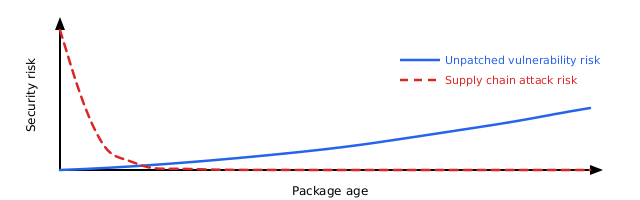
Software delivered by Amazon Linux packages go through review by Amazon package maintainers and pass guardrails before release. Open source software is developed and maintained with similar processes and guardrails. The npm and PyPI registries have open publishing access and don’t enforce reviews. Unexpected packages are potentially added to the registries because of risks like impersonation or stolen credentials. You’re caught between two risks: older software accumulates unpatched vulnerabilities, while new packages potentially contain unexpected vulnerabilities that haven’t been detected yet. The best approach is to stay current without adopting the newest releases immediately, while applying recommended security fixes. The following diagram illustrates the relation between the two types of risks in an abstract way, where the supply chain risk is highest immediately after a package is published, because unexpected updates can potentially bypass guardrails. After a package is published, auditing can review it and identify potential defects over time. If no security fixes are applied, the risk of all the code defects adds up.
Figure 1: Software risk over lifetime. Unpatched vulnerabilities risk increases over time. Very recent software also carries more supply chain risk.
The problem: The first day presents the highest risk
Supply chain events follow a consistent pattern. An unexpected author publishes an unexpected package or package version and waits for automated systems and users to pull it in. Security researchers and automated scanners typically detect and remove these packages within hours, but by then, systems have been exposed to the risk.
Datadog’s 2026 State of DevSecOps report found that 54% of JavaScript applications install at least one dependency within a day of its release. That’s the time window that presents the highest supply chain risk. Recent events show how fast detection happens:
Event
Exposure window
Nx s1ngularity (Aug 2025)
4–5 hours
axios (Mar 2026)
2–3 hours
Bitwarden CLI (Apr 2026)
93 minutes
TanStack (May 2026)
30 minutes
node-ipc (May 2026)
less than 24 hours
The solution: Skip packages published today
A dependency cooldown tells your package manager to skip recently published versions. If a version hasn’t existed on the registry for the configured timespan, for example, 1 day, it won’t be installed, giving the security community time to detect and remove unexpected versions.
A 1-day cooldown blocks each event listed in the preceding table. Notably, several of these events produced valid provenance attestations and passed build verification. These provenance checks alone didn’t stop them. A cooldown works independently of authorization mechanisms, because it blocks by age rather than by trust.
Both npm (v11.10.0+) and pip (v26.1+) support cooldowns . Amazon Linux 2023 ships these packages in NodeJS 24 and Python 3.14 since release 2023.11.20260608.
If you use lockfile-based installations through npm ci or pip install -r requirements.txt with pinned versions, you won’t pull latest package updates. The cooldown doesn’t apply to those installations. The cooldown only affects resolution of new or updated packages. See the Lockfile-based installs and the cooldown section for details.
Prerequisites
To implement the following solution, you first need to have the following prerequisites in place:
Node.js 24 with npm 11.10.0 or later (in nodejs24-24.14.1-1.amzn2023.0.1 or later).
Python 3.14 with pip 26.1 (in python3.14-pip-26.1.1-1.amzn2023.0.1 or later)
pip-audit (tool to scan python packages required for defect-based override scripts). Use python3.14 -m pip install pip-audit to install.
Future versions of Node.js and Python will bring new commands. The following tool commands work for Amazon Linux 2023 with Node.js 24 and Python 3.14. The provided commands target specific package versions. Adjust the commands if you use later releases.
To set up the npm cooldown
Create the global configuration directory, depending on your NodeJS version. sudo mkdir -p /usr/lib/nodejs24/etc
Add the npm configuration file with the cooldown setting. sudo npm-24 config set min-release-age 1 --location=global
Check that the cooldown is active by running the next command. npm-24 config list
You will see before = "<timestamp from 24 hours ago>" in the output, confirming npm converted the 1-day cooldown into a date filter. For more information, see the npm min-release-age documentation.
To set up the pip cooldown
Create the system-wide pip configuration file with the cooldown setting. sudo python3.14 -m pip config set --global global.uploaded-prior-to P1D
Verify the configuration (for Python 3.14 and pip 26.1+). python3.14 -m pip config list
You will see global.uploaded-prior-to='P1D’ in the output.
This configuration is safe to deploy immediately, because older pip versions (25.x) silently ignore the setting.
To install a package’s latest version without cooldown
What if you want to install the latest version of a package, for example to receive security fixes? The following sections describe how to override the flag using the tool command line. To identify which packages need urgent updates, run the appropriate audit command for your package manager.
npm auditor python3.14 -m pip_audit
For npm packages
Install the package with the cooldown override. npm-24 install <package-name> --min-release-age=0
For pip packages
Install the package with the cooldown override. python3.14 -m pip install <package-name> --uploaded-prior-to="P0D”
Update packages that need urgent updates
We recommend that you apply security fixes for packages that have known security risks. You don’t need to turn off the cooldown entirely to apply security fixes. Use the audit tools to identify packages with known issues, then override the cooldown for only these packages.
Prerequisites: Ensure you have Python 3 and pip-audit installed (python3.14 -m pip install pip-audit).
Important: These scripts demonstrate the concept. For production use, add error handling, logging, and testing. Review packages before updating them in automated pipelines.
For npm packages
The following script demonstrates the required steps to identify npm packages with a known security fix. The npm audit command prints these packages as JSON. Next, packages in this list are updated with an npm install command, where their cooldown is overridden so that the latest version is picked up.
npm audit --json | python3 -c "
import json, sys, subprocess
data = json.load(sys.stdin)
for pkg in data.get('vulnerabilities', {}):
subprocess.run(['npm-24', 'install', f'{pkg}@latest', '--min-release-age=0'])
"
For pip packages
The following script demonstrates the required steps to identify pip packages with a known security fix. The pip_audit command prints these packages as JSON. Next, all packages in this list are updated with an pip install command that overrides the cooldown so that the latest version can be picked up.
If you use npm ci or pip install -r requirements.txt with pinned versions, the cooldown doesn’t apply. These commands install what the lockfile specifies, regardless of package age. The cooldown only affects resolution of new or updated packages.
Industry adoption: Cooldowns are now used across PyPI and NodeJS
Major package managers and enterprises have started to adopt dependency cooldowns. As of May 2026, several popular package management tools now include cooldown features: pnpm (a fast Node.js package manager), Renovate (an automated dependency update tool), and StepSecurity (a supply chain security platform).
pnpm 11 ships with minimumReleaseAge enabled by default. It’s one of the first major package manager to make cooldowns opt-out rather than opt-in.
Renovate’sconfig best-practices preset has included a 3-day npm cooldown since 2025 and is widely adopted across enterprises.
StepSecurity Secure Registry uses a configurable cooldown period for enterprise customers. StepSecurity recommends a 10 day delay as default.
How AWS is helping protect the open source supply chain
AWS scans upstream package registries to catch unexpected packages before they reach customers.
Amazon Inspector, a security management service that continuously scans workloads for software vulnerabilities and network exposure, uses AI-assisted detection rules to scan upstream package registries. In 2025, Amazon Inspector researchers identified over 150,000 unexpected npm packages linked to a token farming campaign.
Unexpected packages are typically caught within hours of publication. A 1-day cooldown ensures you don’t install them during that detection window.
Recommendations
To secure your Amazon Linux 2023 configuration:
Set a 1-day cooldown for npm and pip as shown in the preceding sections. External registries don’t have human review, so give the defenders time to catch problems.
Override when needed for urgent security patches using the per-command flags.
Run npm audit or pip_audit regularly to identify packages that need immediate attention.
Set up the cooldown with one line of configuration, and the protection is immediate.
Conclusion
By implementing the solutions presented in the post, you secure your npm and PyPI environment from most instances of unexpected code. The update delay of 1 day protects your environment, while still allowing to apply the latest security fixes. To learn about how to protect your environment further, see the following resources:
The policy, in part, states that the project will decline any
“legally significant contributions which include LLM-generated
content or are derived from LLM-generated content“. It uses the definition
of “legally significant” from the GNU Project maintainer guidelines,
which holds that the threshold is “around 15 lines of code and/or
text” to qualify as significant for copyright purposes. GCC
maintainers may, however, choose to accept legally significant test
cases that are generated by an LLM.
The policy does not forbid use of LLMs for research, analysis, bug
discovery and reporting, patch review, etc. as long as the output is
not included in contributions. The committee says that it expects the
policy will evolve and will be revisited periodically.
Extensive news coverage and analyst reports on AI missing productivity and ROI targets mean that AI failure is something of a hot topic. There’s no arguing that some AI initiatives are misguided, including replacing entire specialist teams with AI. For others, the issue actually lies with data knowledge and readiness–Gartner predicts that through 2026, organizations will abandon 60% of AI projects unsupported by AI-ready data, and S&P Global recently highlighted the importance of ingesting previously overlooked or unknown data to discover interdependencies in risk management.
The pressure to move at the perceived speed of AI makes it easy to skip or rush important prep work. Now that major AI pilots have been up and running, supplementing or sometimes entirely replacing select business functions with mixed results, this exposes an already known problem among AI experts: implementing AI too quickly and ignoring the importance of keeping human experts in the loop increases your threshold for error. This is especially prevalent for both internal AI tools that are meant to augment key roles, and customer-facing AI applications that are supposed to increase accessibility to an outcome, such as generating a lifelike video based on natural language prompts.
What’s causing this? It’s not just the LLMs–it’s the data. Now that human experts are more aware of what AI can get wrong, we’re going back to basics to help you get it right. This starts at the very beginning: curating, ingesting, and storing data using infrastructure that’s actually designed for moving data quickly, and without financial penalty.
Data ingest is the process of any type of data being added to a designated collection destination, whether that’s a specific file folder, database, or object storage bucket. For a lot of applications, data ingest is frequent or nearly constant–busy e-commerce sites with a constant flow of customer transactions and feedback, live video feeds, and combining real-time data sources like pairing security footage with physical building security sensors. This is called streaming ingestion–and streaming ingestion being the foundation of data collection for various types of AI is one of the key reasons why storage is an AI infrastructure problem that often flies under the radar until there’s a serious problem.
Streaming ingestion requires constant low-latency access to the data storage repository to prevent data upload lags and errors.
Streaming ingestion for video and other large files requires high rate limits and high-throughput networking capabilities to optimize upload times, especially when an application requires a file to be ready for processing in seconds/minutes instead of hours/days.
Running out of storage capacity is not an option for model performance, and for compliance and auditing purposes–streaming ingestion requires constant access to storage that is as close to infinite as possible.
Automation from the start
In addition to the files themselves, setting up a highly effective AI data pipeline involves building automation from the very beginning to immediately allocate files to the right bucket using taxonomy and collect and store file metadata to begin data aggregation critical for future labeling and processing.
Why taxonomy is critical for AI
The file itself is the data source. Navigating your dataset starts with implementing a taxonomy that makes your dataset highly searchable as your data grows from a few thousand for your first round of training to millions for an AI application operating in production.
Taxonomy is essentially your file storage structure, or how files are automatically “nested” and relationships between files are built immediately upon ingest. When you’re just getting started, developing your taxonomy helps you stay organized and ready to go searching for a specific file when your coworker doesn’t believe what the data is saying. When you’re working in established teams, implementing a new taxonomy or showing that you understand the importance of following an established taxonomy builds a contract of understanding between you and your data engineering or ML teams. (AKA, changing taxonomy mid-project is a big undertaking with ripple effects, and should not be taken lightly.)
A simple example taxonomy for ingesting raw files can look like this:
/<source>/<modality>/<status>/<date>/filename
Taxonomy should also reflect what the data is actually doing or will do, not just the file type and data source. The goal is to make every object self-describing at write time, so downstream training pipelines can filter, version, and partition without touching the data itself.
Partition by date/time at the prefix level so you can use time-range queries and lifecycle rules without scanning everything
Include modality (video, audio, image, text) as a top-level segment so cross-modal datasets stay logically separated but co-located in the same bucket
Use a UUID or content hash as the filename — never rely on source filenames, which are inconsistent and collision-prone at scale
Use B2 bucket policies or object tagging rules to reject objects written to non-conforming prefixes
Maintain a human-readable taxonomy manifest (taxonomy.json at bucket root) that documents each top-level prefix and its schema
For video specifically, consider a separate prefix segment for resolution or codec: …/video/4k/h264/… — this pays off quickly when training jobs need to filter by input spec
Retain all the metadata
Write metadata as object tags and custom headers at ingest using per-object user-defined metadata at PUT, such as:
This way, the metadata travels with the object and is always returned on HEAD requests without a separate lookup.
But to build out a rich dataset, you will need even more metadata in the form of sidecar metadata files. Retain annotations, bounding boxes, ground-truth labels, licensing info, and consent flag metadata by creating a sidecar JSON with a .meta.json suffix. For the warehouse camera video example listed above, you would end up with two files that look like this:
Enable object versioning on training buckets. If a labeling pipeline updates an annotation, it should write a new version (or a new sidecar) rather than overwriting — training reproducibility depends on knowing which metadata was present at the time a dataset was compiled.
Expose metadata to training pipelines via a manifest
Rather than having training jobs scan bucket prefixes directly, generate a manifest file (JSONL or Parquet) at the end of each ingest batch that enumerates every object key + its full metadata. Tools like PyTorch’s WebDataset and HuggingFace datasets can load directly from these manifests, and it decouples the training job from needing object storage credentials for discovery.
Deciding on storage while evaluating data
To summarize, this is why choosing your storage destination based on your current (or, if you’re already undergoing a data management transformation, future-state) scenario is critical:
Ingest type: Does your storage provide enough network bandwidth to capture the correct type of data in real time (especially for video?)
Data type: Will large files potentially incur large upfront costs with upload fees?
Data processing workflow: Does your storage have capacity headroom for file multiplication during processing, and does the cost structure allow this to happen without potentially draining infrastructure budgets?
Even with Backblaze B2’s hot storage at cold storage pricing, it may be beneficial for you to tier your storage based on your ingestion type, and how frequently the data will be accessed for training.
Batch ingestion is better suited for mid to lower performance storage, as this is typically used for historical datasets or a set schedule of pre-determined data updates, such as jobs pulling from relational databases or CSV uploads once a day or once per week.
Streaming ingestion is well-suited for hot storage to support a continuous stream of real-time (or near-real-time) data processing, such as from social media feeds and high-volume e-commerce AI helper agents.
Hybrid ingestion uses a combination of batch and streaming ingestion to handle both historical and real-time data requirements for AI models.
Surprise retrieval penalties for model training can happen even while building out your MVP or proof of concept–so avoid a storage headache and start building your pipeline at data ingest with Backblaze B2 $6.95 per TB/month. Create an account to get started with 10GB for free, or contact our storage experts for assistance with migrations and more.
Looking for more info on data ingest? Watch the on-demand webinar that dives into more details about data ingest with Backblaze’s Director of Applied AI Jeronimo De Leon.
Security updates have been issued by AlmaLinux (dovecot, go-fdo-client, go-fdo-server, kernel, kernel-rt, and sssd), Debian (calibre, hplip, libraw, and samba), Fedora (btrbk, chromium, gpsd, kronosnet, and restic), Mageia (gstreamer1.0-libav and libslirp), Slackware (libarchive, samba, and seamonkey), SUSE (agama-web-ui, chromium, gimp, glib2, GraphicsMagick, ignition, ImageMagick, java-21-openjdk, libssh, libssh-config, nginx, nmap, nsd, python-urllib3, python313-CherryPy, rsyslog, samba, sssd, valkey, webkit2gtk3, and yq), and Ubuntu (freerdp3, linux, linux-aws, linux-aws-5.4, linux-aws-fips, linux-azure, linux-azure-5.4, linux-azure-fips, linux-bluefield, linux-fips, linux-gcp, linux-gcp-5.4, linux-gcp-fips, linux-hwe-5.4, linux-iot, linux-oracle, linux-oracle-5.4, linux-xilinx-zynqmp, linux-azure-fips, linux-ibm, linux-ibm-5.4, linux-kvm, and linux-raspi, linux-raspi-5.4).
The collective thoughts of the interwebz
Manage Consent
To provide the best experiences, we use technologies like cookies to store and/or access device information. Consenting to these technologies will allow us to process data such as browsing behavior or unique IDs on this site. Not consenting or withdrawing consent, may adversely affect certain features and functions.
Functional
Always active
The technical storage or access is strictly necessary for the legitimate purpose of enabling the use of a specific service explicitly requested by the subscriber or user, or for the sole purpose of carrying out the transmission of a communication over an electronic communications network.
Preferences
The technical storage or access is necessary for the legitimate purpose of storing preferences that are not requested by the subscriber or user.
Statistics
The technical storage or access that is used exclusively for statistical purposes.The technical storage or access that is used exclusively for anonymous statistical purposes. Without a subpoena, voluntary compliance on the part of your Internet Service Provider, or additional records from a third party, information stored or retrieved for this purpose alone cannot usually be used to identify you.
Marketing
The technical storage or access is required to create user profiles to send advertising, or to track the user on a website or across several websites for similar marketing purposes.