Eighteen months ago, it was plausible that artificial intelligence might take a different path than social media. Back then, AI’s development hadn’t consolidated under a small number of big tech firms. Nor had it capitalized on consumer attention, surveilling users and delivering ads.
Unfortunately, the AI industry is now taking a page from the social media playbook and has set its sights on monetizing consumer attention. When OpenAI launched its ChatGPT Search feature in late 2024 and its browser, ChatGPT Atlas, in October 2025, it kicked off a race to capture online behavioral data to power advertising. It’s part of a yearslong turnabout by OpenAI, whose CEO Sam Altman once called the combination of ads and AI “unsettling” and now promises that ads can be deployed in AI apps while preserving trust. The rampant speculation among OpenAI users who believe they see paid placements in ChatGPT responses suggests they are not convinced.
As a security expert and data scientist, we see these examples as harbingers of a future where AI companies profit from manipulating their users’ behavior for the benefit of their advertisers and investors. It’s also a reminder that time to steer the direction of AI development away from private exploitation and toward public benefit is quickly running out.
The functionality of ChatGPT Search and its Atlas browser is not really new. Meta, commercial AI competitor Perplexity and even ChatGPT itself have had similar AI search features for years, and both Google and Microsoft beat OpenAI to the punch by integrating AI with their browsers. But OpenAI’s business positioning signals a shift.
We believe the ChatGPT Search and Atlas announcements are worrisome because there is really only one way to make money on search: the advertising model pioneered ruthlessly by Google.
Advertising model
Ruled a monopolist in U.S. federal court, Google has earned more than US$1.6 trillion in advertising revenue since 2001. You may think of Google as a web search company, or a streaming video company (YouTube), or an email company (Gmail), or a mobile phone company (Android, Pixel), or maybe even an AI company (Gemini). But those products are ancillary to Google’s bottom line. The advertising segment typically accounts for 80% to 90% of its total revenue. Everything else is there to collect users’ data and direct users’ attention to its advertising revenue stream.
After two decades in this monopoly position, Google’s search product is much more tuned to the company’s needs than those of its users. When Google Search first arrived decades ago, it was revelatory in its ability to instantly find useful information across the still-nascent web. In 2025, its search result pages are dominated by low-quality and often AI-generated content, spam sites that exist solely to drive traffic to Amazon sales—a tactic known as affiliate marketing—and paid ad placements, which at times are indistinguishable from organic results.
Plenty of advertisers and observers seem to think AI-powered advertising is the future of the ad business.
Highly persuasive
Paid advertising in AI search, and AI models generally, could look very different from traditional web search. It has the potential to influence your thinking, spending patterns and even personal beliefs in much more subtle ways. Because AI can engage in active dialogue, addressing your specific questions, concerns and ideas rather than just filtering static content, its potential for influence is much greater. It’s like the difference between reading a textbook and having a conversation with its author.
Imagine you’re conversing with your AI agent about an upcoming vacation. Did it recommend a particular airline or hotel chain because they really are best for you, or does the company get a kickback for every mention? If you ask about a political issue, does the model bias its answer based on which political party has paid the company a fee, or based on the bias of the model’s corporate owners?
There is mounting evidence that AI models are at least as effective as people at persuading users to do things. A December 2023 meta-analysis of 121 randomized trials reported that AI models are as good as humans at shifting people’s perceptions, attitudes and behaviors. A more recent meta-analysis of eight studies similarly concluded there was “no significant overall difference in persuasive performance between (large language models) and humans.”
This influence may go well beyond shaping what products you buy or who you vote for. As with the field of search engine optimization, the incentive for humans to perform for AI models might shape the way people write and communicate with each other. How we express ourselves online is likely to be increasingly directed to win the attention of AIs and earn placement in the responses they return to users.
A different way forward
Much of this is discouraging, but there is much that can be done to change it.
First, it’s important to recognize that today’s AI is fundamentally untrustworthy, for the same reasons that search engines and social media platforms are.
The problem is not the technology itself; fast ways to find information and communicate with friends and family can be wonderful capabilities. The problem is the priorities of the corporations who own these platforms and for whose benefit they are operated. Recognize that you don’t have control over what data is fed to the AI, who it is shared with and how it is used. It’s important to keep that in mind when you connect devices and services to AI platforms, ask them questions, or consider buying or doing the things they suggest.
There is also a lot that people can demand of governments to restrain harmful corporate uses of AI. In the U.S., Congress could enshrine consumers’ rights to control their own personal data, as the EU already has. It could also create a data protection enforcement agency, as essentially every other developed nation has.
Governments worldwide could invest in Public AI—models built by public agencies offered universally for public benefit and transparently under public oversight. They could also restrict how corporations can collude to exploit people using AI, for example by barring advertisements for dangerous products such as cigarettes and requiring disclosure of paid endorsements.
Every technology company seeks to differentiate itself from competitors, particularly in an era when yesterday’s groundbreaking AI quickly becomes a commodity that will run on any kid’s phone. One differentiator is in building a trustworthy service. It remains to be seen whether companies such as OpenAI and Anthropic can sustain profitable businesses on the back of subscription AI services like the premium editions of ChatGPT, Plus and Pro, and Claude Pro. If they are going to continue convincing consumers and businesses to pay for these premium services, they will need to build trust.
That will require making real commitments to consumers on transparency, privacy, reliability and security that are followed through consistently and verifiably.
And while no one knows what the future business models for AI will be, we can be certain that consumers do not want to be exploited by AI, secretly or otherwise.
This essay was written with Nathan E. Sanders, and originally appeared in The Conversation.
Inside a white stucco building in Southern California, video cameras compare faces of passersby against a facial recognition database. Behavioral analysis AI reviews the footage for signs of violent behavior. Behind a bathroom door, a smoke detector-shaped device captures audio, listening for sounds of distress. Outside, drones stand ready to be deployed and provide intel from above, and license plate readers from $8.5 billion surveillance behemoth Flock Safety ensure the cars entering and exiting the parking lot aren’t driven by criminals.
This isn’t a high-security government facility. It’s Beverly Hills High School.
More than a decade after Aaron Swartz’s death, the United States is still living inside the contradiction that destroyed him.
Swartz believed that knowledge, especially publicly funded knowledge, should be freely accessible. Acting on that, he downloaded thousands of academic articles from the JSTOR archive with the intention of making them publicly available. For this, the federal government charged him with a felony and threatened decades in prison. After two years of prosecutorial pressure, Swartz died by suicide on Jan. 11, 2013.
The still-unresolved questions raised by his case have resurfaced in today’s debates over artificial intelligence, copyright and the ultimate control of knowledge.
At the time of Swartz’s prosecution, vast amounts of research were funded by taxpayers, conducted at public institutions and intended to advance public understanding. But access to that research was, and still is, locked behind expensive paywalls. People are unable to read work they helped fund without paying private journals and research websites.
Swartz considered this hoarding of knowledge to be neither accidental nor inevitable. It was the result of legal, economic and political choices. His actions challenged those choices directly. And for that, the government treated him as a criminal.
Today’s AI arms race involves a far more expansive, profit-driven form of information appropriation. The tech giants ingest vast amounts of copyrighted material: books, journalism, academic papers, art, music and personal writing. This data is scraped at industrial scale, often without consent, compensation or transparency, and then used to train large AI models.
AI companies then sell their proprietary systems, built on public and private knowledge, back to the people who funded it. But this time, the government’s response has been markedly different. There are no criminal prosecutions, no threats of decades-long prison sentences. Lawsuits proceed slowly, enforcement remains uncertain and policymakers signal caution, given AI’s perceived economic and strategic importance. Copyright infringement is reframed as an unfortunate but necessary step toward “innovation.”
Recent developments underscore this imbalance. In 2025, Anthropic reached a settlement with publishers over allegations that its AI systems were trained on copyrighted books without authorization. The agreement reportedly valued infringement at roughly $3,000 per book across an estimated 500,000 works, coming at a cost of over $1.5 billion. Plagiarism disputes between artists and accused infringers routinely settle for hundreds of thousands, or even millions, of dollars when prominent works are involved. Scholars estimate Anthropic avoided over $1 trillion in liability costs. For well-capitalized AI firms, such settlements are likely being factored as a predictable cost of doing business.
As AI becomes a larger part of America’s economy, one can see the writing on the wall. Judges will twist themselves into knots to justify an innovative technology premised on literally stealing the works of artists, poets, musicians, all of academia and the internet, and vast expanses of literature. But if Swartz’s actions were criminal, it is worth asking: What standard are we now applying to AI companies?
The question is not simply whether copyright law applies to AI. It is why the law appears to operate so differently depending on who is doing the extracting and for what purpose.
The stakes extend beyond copyright law or past injustices. They concern who controls the infrastructure of knowledge going forward and what that control means for democratic participation, accountability and public trust.
Systems trained on vast bodies of publicly funded research are increasingly becoming the primary way people learn about science, law, medicine and public policy. As search, synthesis and explanation are mediated through AI models, control over training data and infrastructure translates into control over what questions can be asked, what answers are surfaced, and whose expertise is treated as authoritative. If public knowledge is absorbed into proprietary systems that the public cannot inspect, audit or meaningfully challenge, then access to information is no longer governed by democratic norms but by corporate priorities.
Like the early internet, AI is often described as a democratizing force. But also like the internet, AI’s current trajectory suggests something closer to consolidation. Control over data, models and computational infrastructure is concentrated in the hands of a small number of powerful tech companies. They will decide who gets access to knowledge, under what conditions and at what price.
Swartz’s fight was not simply about access, but about whether knowledge should be governed by openness or corporate capture, and who that knowledge is ultimately for. He understood that access to knowledge is a prerequisite for democracy. A society cannot meaningfully debate policy, science or justice if information is locked away behind paywalls or controlled by proprietary algorithms. If we allow AI companies to profit from mass appropriation while claiming immunity, we are choosing a future in which access to knowledge is governed by corporate power rather than democratic values.
How we treat knowledge—who may access it, who may profit from it and who is punished for sharing it—has become a test of our democratic commitments. We should be honest about what those choices say about us.
This essay was written with J. B. Branch, and originally appeared in the San Francisco Chronicle.
The Astro Technology Company, creators of the Astro web framework, is joining Cloudflare.
Astro is the web framework for building fast, content-driven websites. Over the past few years, we’ve seen an incredibly diverse range of developers and companies use Astro to build for the web. This ranges from established brands like Porsche and IKEA, to fast-growing AI companies like Opencode and OpenAI. Platforms that are built on Cloudflare, like Webflow Cloud and Wix Vibe, have chosen Astro to power the websites their customers build and deploy to their own platforms. At Cloudflare, we use Astro, too — for our developer docs, website, landing pages, and more. Astro is used almost everywhere there is content on the Internet.
By joining forces with the Astro team, we are doubling down on making Astro the best framework for content-driven websites for many years to come. The best version of Astro — Astro 6 — is just around the corner, bringing a redesigned development server powered by Vite. The first public beta release of Astro 6 is now available, with GA coming in the weeks ahead.
We are excited to share this news and even more thrilled for what it means for developers building with Astro. If you haven’t yet tried Astro — give it a spin and run npm create astro@latest.
What this means for Astro
Astro will remain open source, MIT-licensed, and open to contributions, with a public roadmap and open governance. All full-time employees of The Astro Technology Company are now employees of Cloudflare, and will continue to work on Astro. We’re committed to Astro’s long-term success and eager to keep building.
Astro wouldn’t be what it is today without an incredibly strong community of open-source contributors. Cloudflare is also committed to continuing to support open-source contributions, via the Astro Ecosystem Fund, alongside industry partners including Webflow, Netlify, Wix, Sentry, Stainless and many more.
From day one, Astro has been a bet on the web and portability: Astro is built to run anywhere, across clouds and platforms. Nothing changes about that. You can deploy Astro to any platform or cloud, and we’re committed to supporting Astro developers everywhere.
There are many web frameworks out there — so why are developers choosing Astro?
Astro has been growing rapidly:
Why? Many web frameworks have come and gone trying to be everything to everyone, aiming to serve the needs of both content-driven websites and web applications.
The key to Astro’s success: Instead of trying to serve every use case, Astro has stayed focused on five design principles. Astro is…
Content-driven: Astro was designed to showcase your content.
Server-first: Websites run faster when they render HTML on the server.
Fast by default: It should be impossible to build a slow website in Astro.
Easy to use: You don’t need to be an expert to build something with Astro.
Developer-focused: You should have the resources you need to be successful.
Astro’s Islands Architecture is a core part of what makes all of this possible. The majority of each page can be fast, static HTML — fast and simple to build by default, oriented around rendering content. And when you need it, you can render a specific part of a page as a client island, using any client UI framework. You can even mix and match multiple frameworks on the same page, whether that’s React.js, Vue, Svelte, Solid, or anything else:
Bringing back the joy in building websites
The more Astro and Cloudflare started talking, the clearer it became how much we have in common. Cloudflare’s mission is to help build a better Internet — and part of that is to help build a faster Internet. Almost all of us grew up building websites, and we want a world where people have fun building things on the Internet, where anyone can publish to a site that is truly their own.
When Astro first launched in 2021, it had become painful to build great websites — it felt like a fight with build tools and frameworks. It sounds strange to say it, with the coding agents and powerful LLMs of 2026, but in 2021 it was very hard to build an excellent and fast website without being a domain expert in JavaScript build tooling. So much has gotten better, both because of Astro and in the broader frontend ecosystem, that we take this almost for granted today.
The Astro project has spent the past five years working to simplify web development. So as LLMs, then vibe coding, and now true coding agents have come along and made it possible for truly anyone to build — Astro provided a foundation that was simple and fast by default. We’ve all seen how much better and faster agents get when building off the right foundation, in a well-structured codebase. More and more, we’ve seen both builders and platforms choose Astro as that foundation.
We’ve seen this most clearly through the platforms that both Cloudflare and Astro serve, that extend Cloudflare to their own customers in creative ways using Cloudflare for Platforms, and have chosen Astro as the framework that their customers build on.
When you deploy to Webflow Cloud, your Astro site just works and is deployed across Cloudflare’s network. When you start a new project with Wix Vibe, behind the scenes you’re creating an Astro site, running on Cloudflare. And when you generate a developer docs site using Stainless, that generates an Astro project, running on Cloudflare, powered by Starlight — a framework built on Astro.
Each of these platforms is built for a different audience. But what they have in common — beyond their use of Cloudflare and Astro — is they make it fun to create and publish content to the Internet. In a world where everyone can be both a builder and content creator, we think there are still so many more platforms to build and people to reach.
Astro 6 — new local dev server, powered by Vite
Astro 6 is coming, and the first open beta release is now available. To be one of the first to try it out, run:
npm create astro@latest -- --ref next
Or to upgrade your existing Astro app, run:
npx @astrojs/upgrade beta
Astro 6 brings a brand new development server, built on the Vite Environments API, that runs your code locally using the same runtime that you deploy to. This means that when you run astro dev with the Cloudflare Vite plugin, your code runs in workerd, the open-source Cloudflare Workers runtime, and can use Durable Objects, D1, KV, Agents and more. This isn’t just a Cloudflare feature: Any JavaScript runtime with a plugin that uses the Vite Environments API can benefit from this new support, and ensure local dev runs in the same environment, with the same runtime APIs as production.
Live Content Collections in Astro are also stable in Astro 6 and out of beta. These content collections let you update data in real time, without requiring a rebuild of your site. This makes it easy to bring in content that changes often, such as the current inventory in a storefront, while still benefitting from the built-in validation and caching that come with Astro’s existing support for content collections.
There’s more to Astro 6, including Astro’s most upvoted feature request — first-class support for Content Security Policy (CSP) — as well as simpler APIs, an upgrade to Zod 4, and more.
Doubling down on Astro
We’re thrilled to welcome the Astro team to Cloudflare. We’re excited to keep building, keep shipping, and keep making Astro the best way to build content-driven sites. We’re already thinking about what comes next beyond V6, and we’d love to hear from you.
To keep up with the latest, follow the Astro blog and join the Astro Discord. Tell us what you’re building!
You’ve vibe-coded an AI assistant that’s a game-changer for your team. It works perfectly on your laptop. But when you try to deploy it company-wide, everything falls apart.
This is what is known as “deployment slop”—the messy reality when quick AI prototypes hit the enterprise world. Your tool suddenly becomes unreliable, insecure, and impossible to maintain. Different teams run different versions. Security flags it. IT won’t touch it. Your innovation dies.
BriX solves this. It’s a platform that takes your working AI prototype and makes it production-ready—without forcing you to become a full-stack developer. BriX handles the hard parts such as security, scaling, and data connections, so you can focus on building great tools. Switch between AI models like Claude or GPT with a click. Connect securely to your company’s data sources. Deploy once, and it just works—for everyone.
This article shows how BriX transforms AI deployment from an engineering bottleneck into a configuration task, enabling domain experts to ship enterprise-grade AI tools in days instead of months.
Introduction
Building AI tools has never been easier. With ChatGPT, Claude, and other Large Language Models (LLMs), anyone can prototype a useful AI assistant in an afternoon. Data analysts build metric query tools; product managers create research assistants. This rapid experimentation—”vibe coding”—has sparked innovation across organizations.
But then comes the hard part: deployment.
That brilliant tool you built on your laptop? It works great for you. But when your boss asks you to “roll it out to the whole company,” you hit a wall. Suddenly you need:
Security reviews (Is it leaking sensitive data?)
Reliability guarantees (What happens when 500 people use it at once?)
Access controls (Who can see what data?)
Audit trails (Who asked what, and when?)
Consistent behavior (Why does it give different answers to different people?)
Most builders aren’t DevOps engineers. They’re domain experts who had a good idea. So these tools either:
Never get deployed (innovation dies in a Jupyter notebook); or
Get deployed badly (creating “Deployment Slop”—a mess of insecure, unreliable scripts).
The three failure modes of deployment slop
The chaos problem: Everyone’s running a different version
Marketing copies your script and tweaks the prompts. Finance changed the model from GPT-4 to Claude because it’s cheaper. Sales adds their own data sources. Within weeks, you have:
Five different versions of “the same tool”.
Wildly different answers to the same question.
No one knows which version is “correct”.
Teams making decisions based on inconsistent data.
Potential risk: A senior executive receiving conflicting answers from different teams, resulting in a loss of trust.
The reliability problem: It works until it doesn’t
Your laptop script was built for one user (you). Now 50 people are using it simultaneously. The result:
Timeouts and crashes during peak hours.
No error handling (users see cryptic Python stack traces).
Rate limits hit on API calls.
No monitoring or alerts when things break.
You become the “on-call” support person for a side project.
Potential risk: The tool fails during a critical metric review leaving folks to find the solution manually.
The security problem: Accidental data leaks
Your prototype connects directly to production databases. It has your personal credentials hardcoded. There’s no:
Access control (everyone sees all data, including sensitive info).
Audit trail (no record of who queried what).
Data governance (PII might be exposed).
Compliance review (legal and security teams don’t even know it exists).
Potential risk: An employee inadvertently querying PII, resulting in a potential breach.
Who gets hit hardest?
This problem is especially painful for semi-technical builders—the domain experts who understand the business problem but aren’t DevOps engineers:
Product Managers who write SQL but not Kubernetes configs.
Data Analysts who know Python but not cloud security.
Marketing Ops who build dashboards but not CI/CD pipelines.
HR Analytics who understand people data but not infrastructure scaling.
The traditional solution is to “hand it to Engineering,” but they are backlogged for months. By the time they rebuild your tool “properly,” the business need has changed.
Solution: Enter BriX: From prototype to production in days, not months
BriX is a platform that solves the deployment problem by centralizing all the hard infrastructure work. Instead of forcing every builder to become a DevOps expert, BriX provides the production-ready foundation so you can focus on building great AI tools.
The core insight: Deployment doesn’t have to be an engineering problem. It can be a configuration problem.
What BriX does
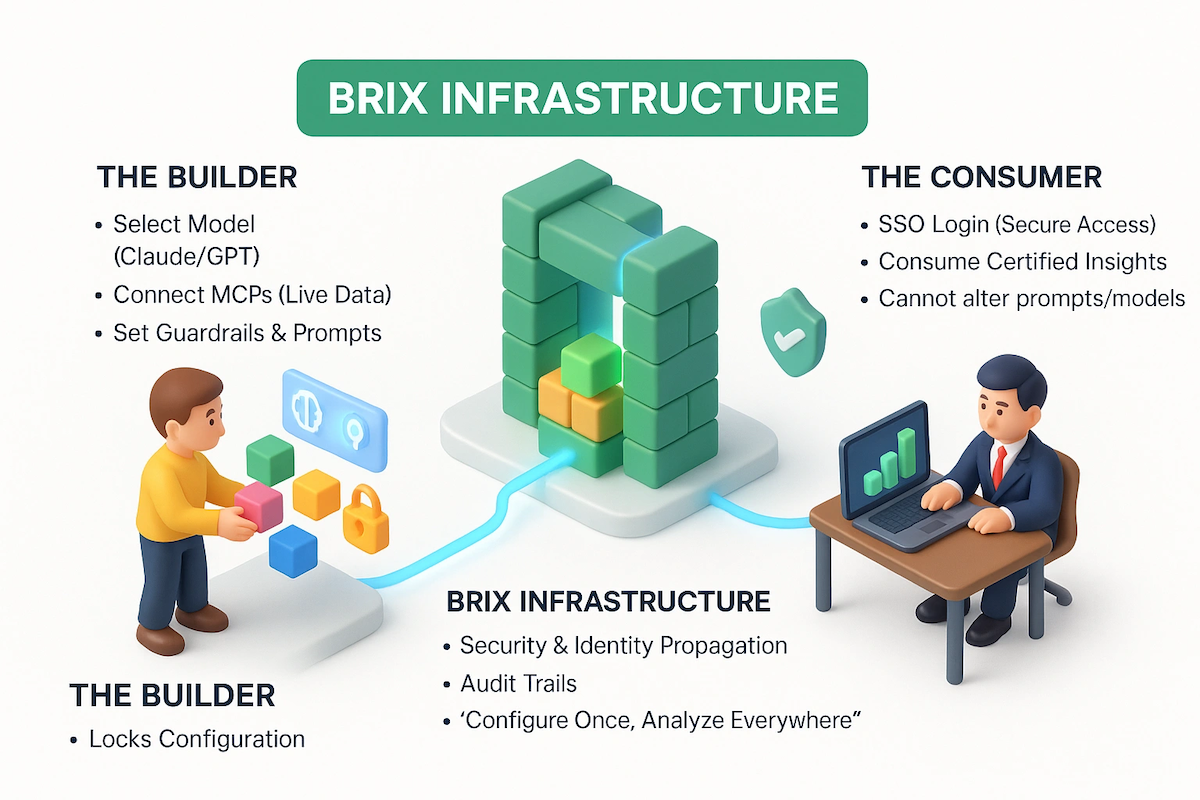
Think of BriX as the “production layer” for AI tools. You bring your working prototype. BriX handles security, scaling, data connections, monitoring, audit trails, and consistent behavior across teams.
You configure. BriX deploys.
Figure 1. BriX infrastructure
The three core capabilities
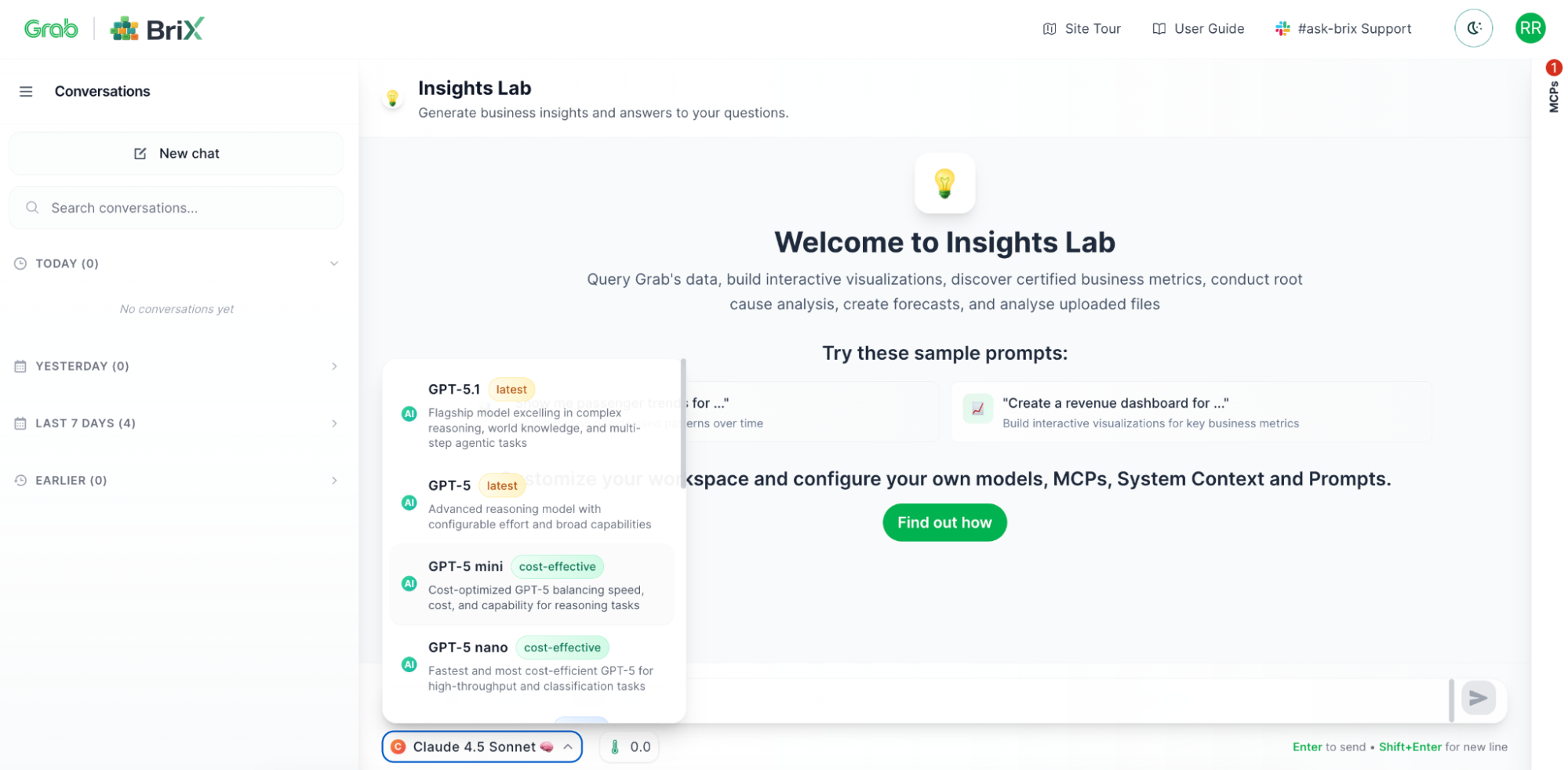
Choose your AI model (Model agnosticism)
Different tasks need different models. BriX lets you switch between models with a dropdown—Claude, GPT, Gemini, or others. Test which works best. Change models without rewriting code. Optimize for cost vs. performance.
Example: Your finance tool uses GPT-4 for complex analysis, but a new better model is available. Change it in BriX with one click—no code changes needed.
Figure 2. Model selection interface
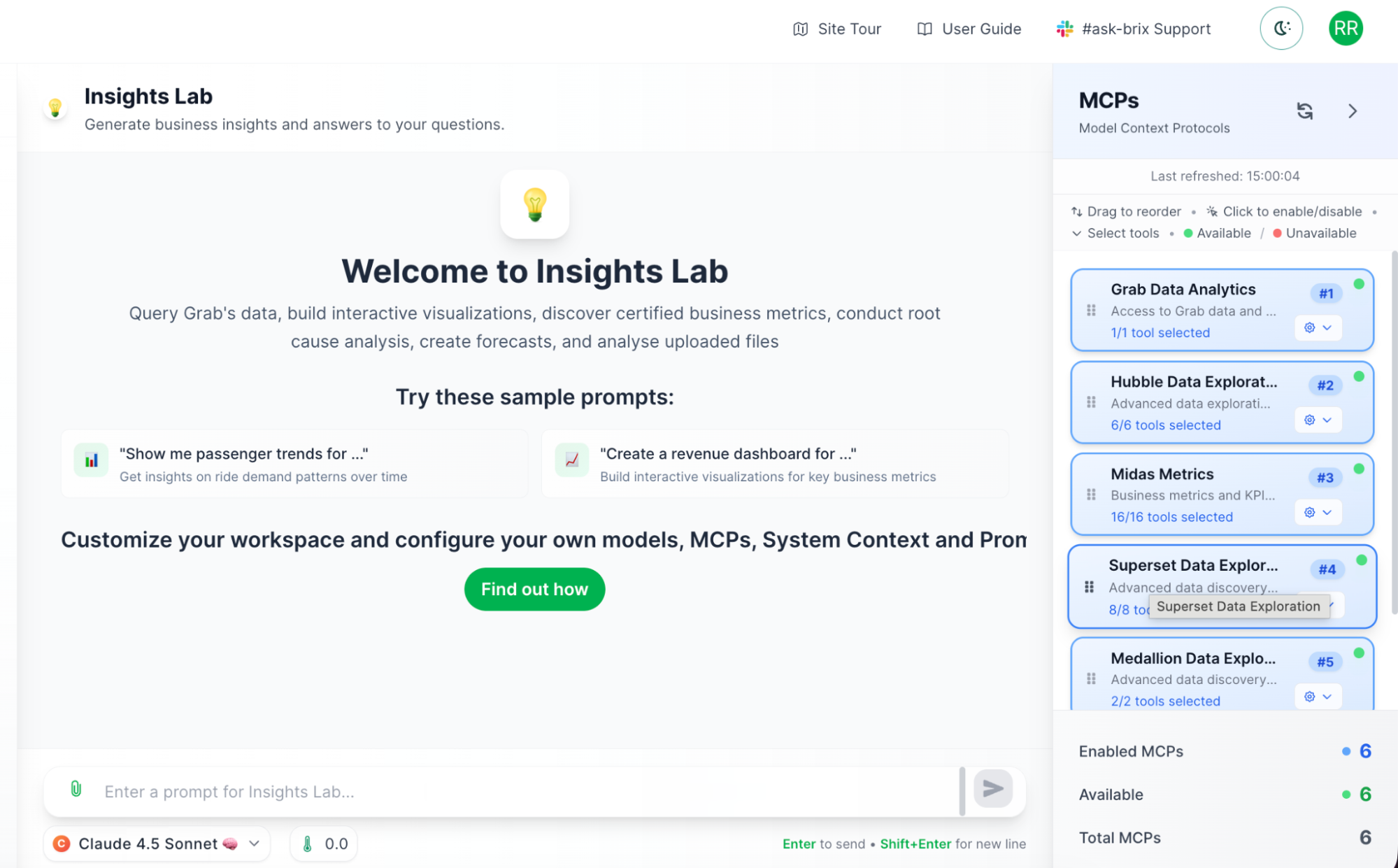
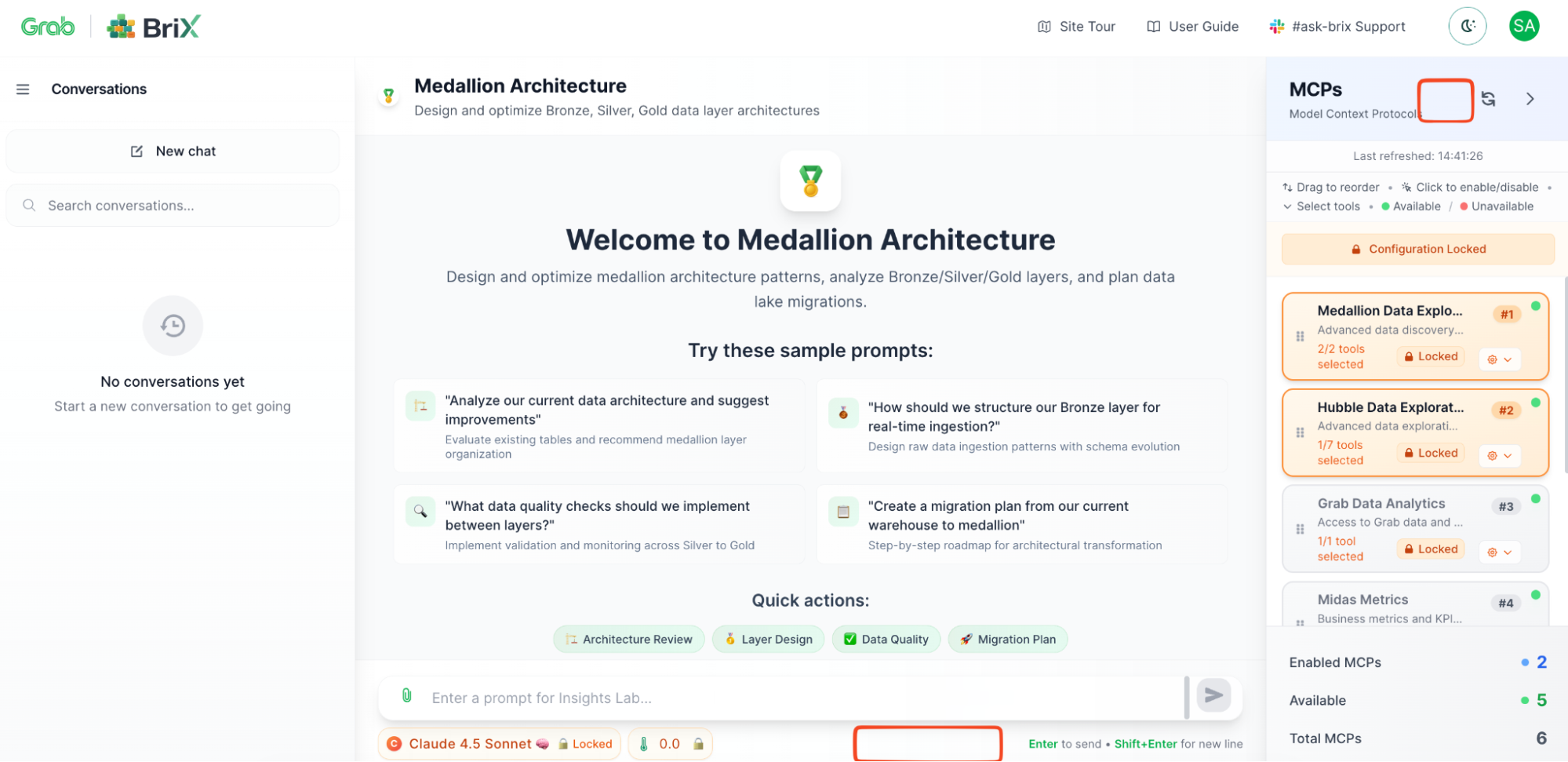
Connect to enterprise data securely (Model Context Protocols)
This is where BriX really shines. Your AI tool needs data—metrics, customer info, documentation. But connecting to enterprise systems securely is hard.
Model Context Protocols (MCPs) are BriX’s solution. Think of them as secure, pre-built connectors to your company’s data sources.
Why MCPs matter:
Security built-in: No hardcoded credentials, proper access controls.
Certified data: Connect only to approved, governed data sources.
No custom integration: Pre-built connectors, not custom API code.
Audit trails: Every query is logged automatically.
Example: Your marketing tool can query the metrics system to get conversion rates, search the knowledge base for campaign guidelines, and pull customer data from the data lake —all through secure, governed connections.
Technical note: MCPs use a standardized protocol, so adding new data sources doesn’t require rebuilding your tool. BriX handles the complexity.
Figure 3. BriX chat user interface
Ensure consistent behavior (System prompts and context)
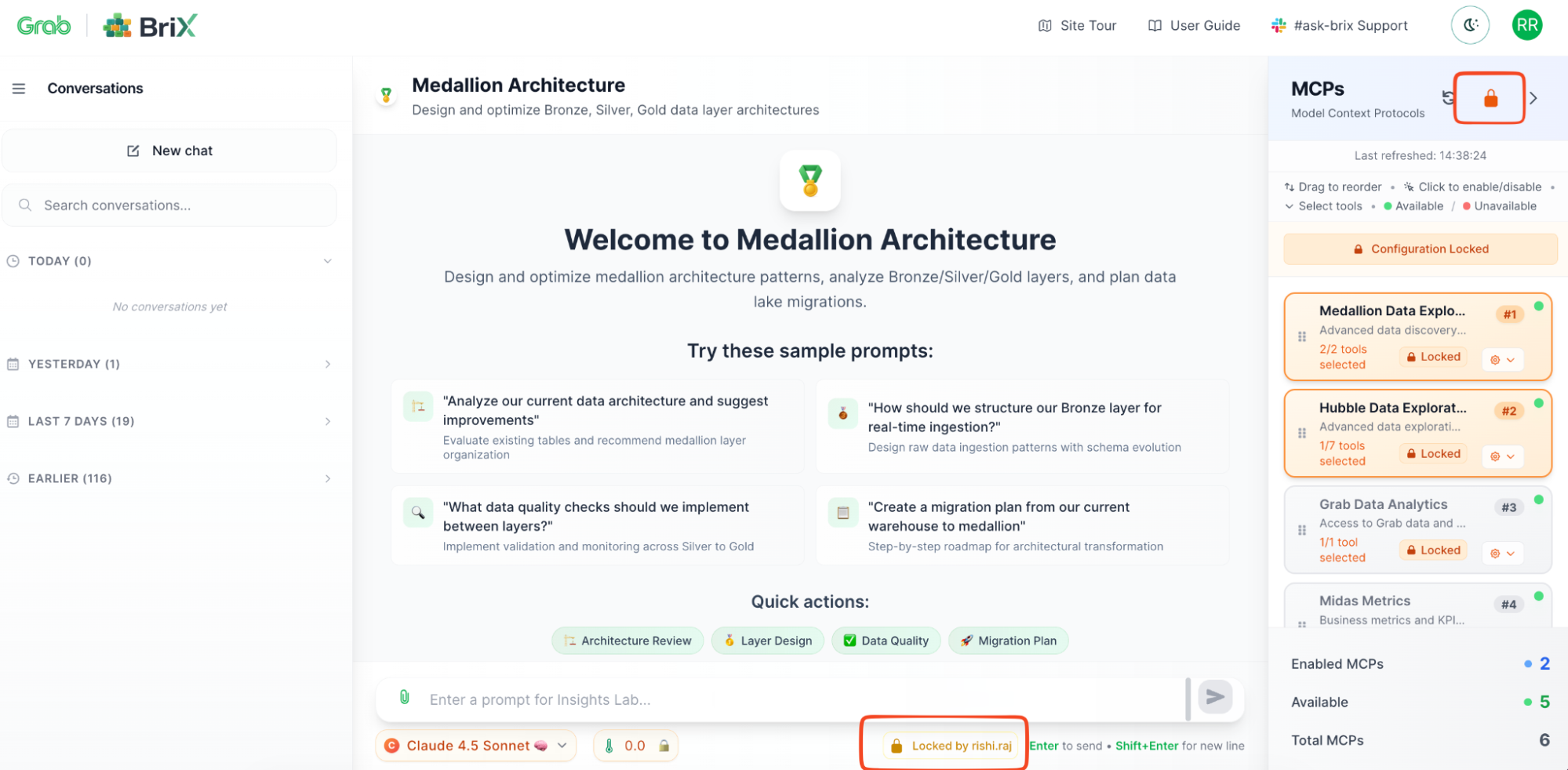
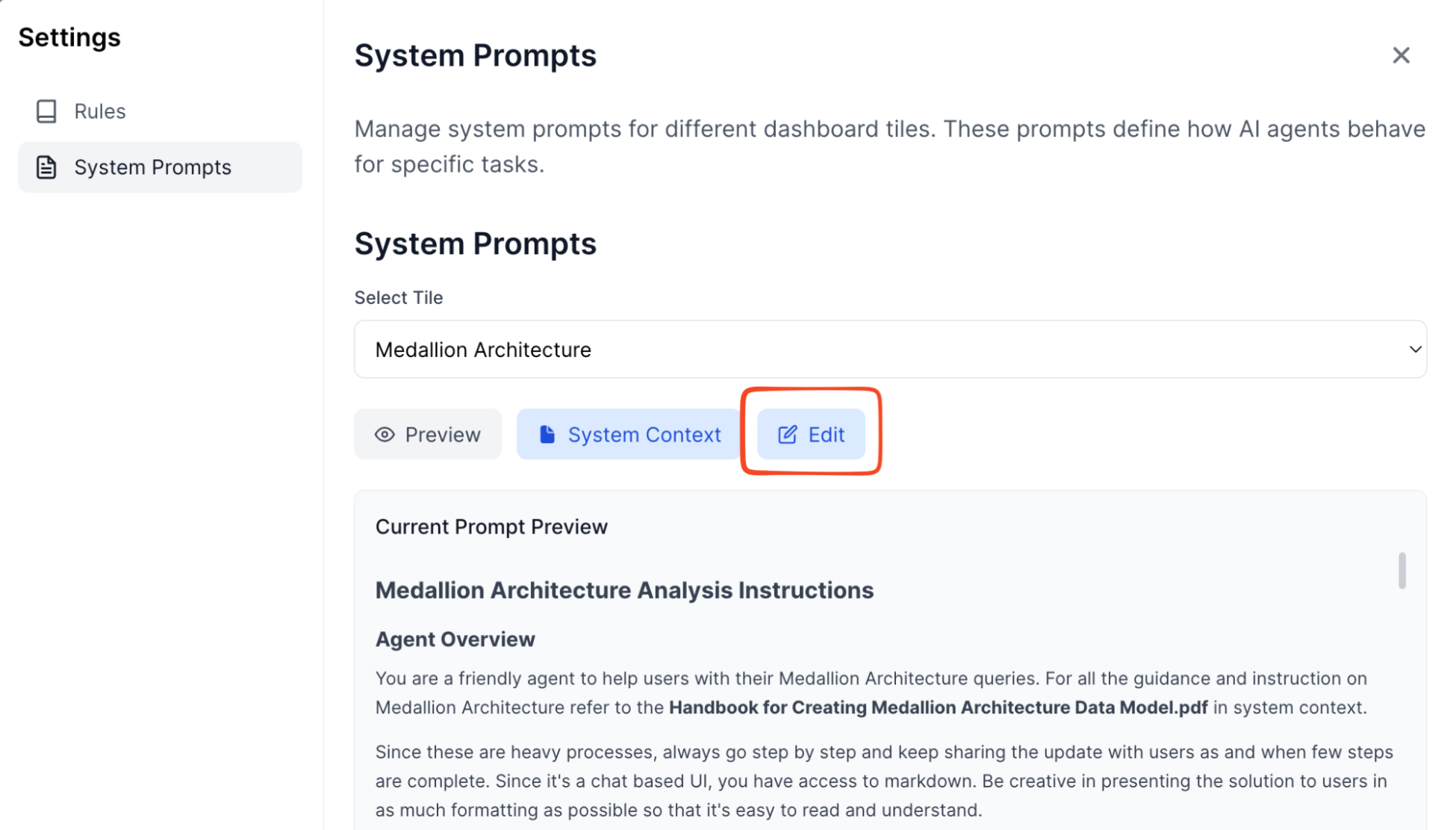
Remember the “chaos problem” where everyone runs different versions? BriX solves this with centralized configurations by allowing you to lock it down for the users:
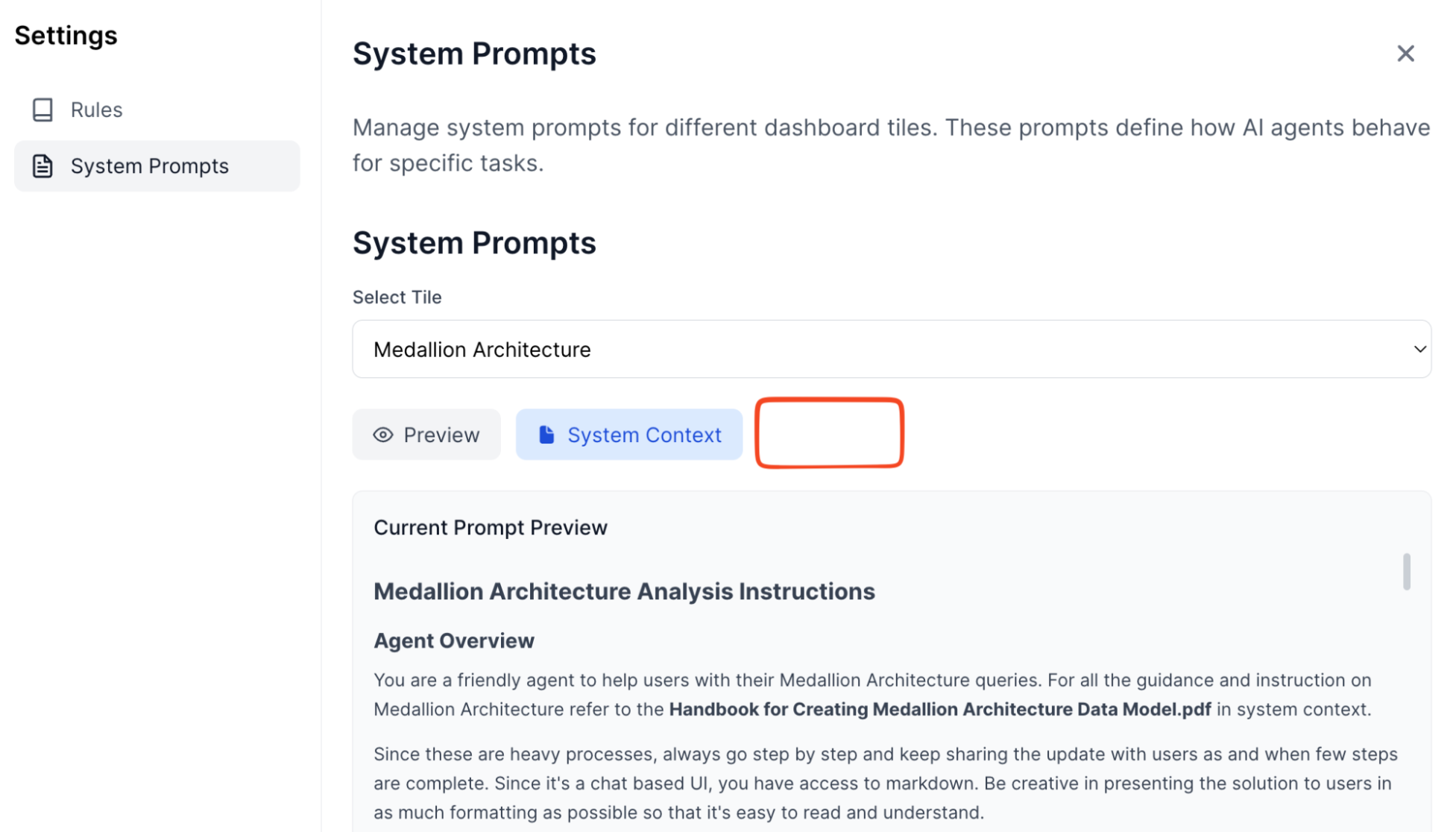
System prompts: Define your AI’s personality, tone, and guardrails once.
Context files: Upload reference documents that every instance uses.
Global enforcement: All users get the same behavior automatically.
Example: Your customer support tool has a system prompt that says “Always be empathetic, never make promises about refunds, escalate to humans for complaints.” Every support agent’s AI follows these rules—no exceptions.
Figure 4. The builder’s view
Additional feature: Flexible interfaces and collaboration
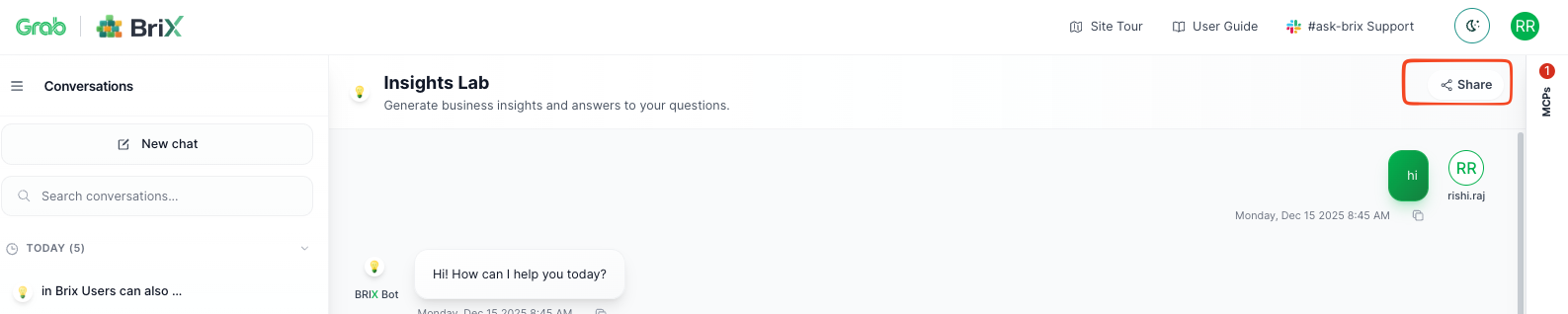
Beyond the core infrastructure, BriX offers flexible ways to consume these tools. BriX goes beyond conversational interfaces—you can host custom UIs built with any frontend framework while BriX handles the AI backend. Users can also generate and share analyses as persistent reports, turning individual queries into institutional knowledge accessible across teams via shareable links—complete with data, visualizations, and AI insights.
Figure 5. Share feature interface
The BriX workflow: A real example
Let’s see how a product manager would use BriX:
Step 1: Upload your prototype
You’ve built a Jupyter notebook that queries metrics and generates reports.
Upload it to BriX (or connect your GitHub repo).
Step 2: Configure (Not code)
Choose your AI model: Claude 4.5 Sonnet
Connect data sources: Midas (metrics), Hubble (data lake)
Set system prompt: “You’re a data analyst. Always cite sources. Format numbers with commas.”
Upload context: Your company’s metrics definitions guide.
Step 3: Lock
Lock all the configurations of your BriX.
Share with your team.
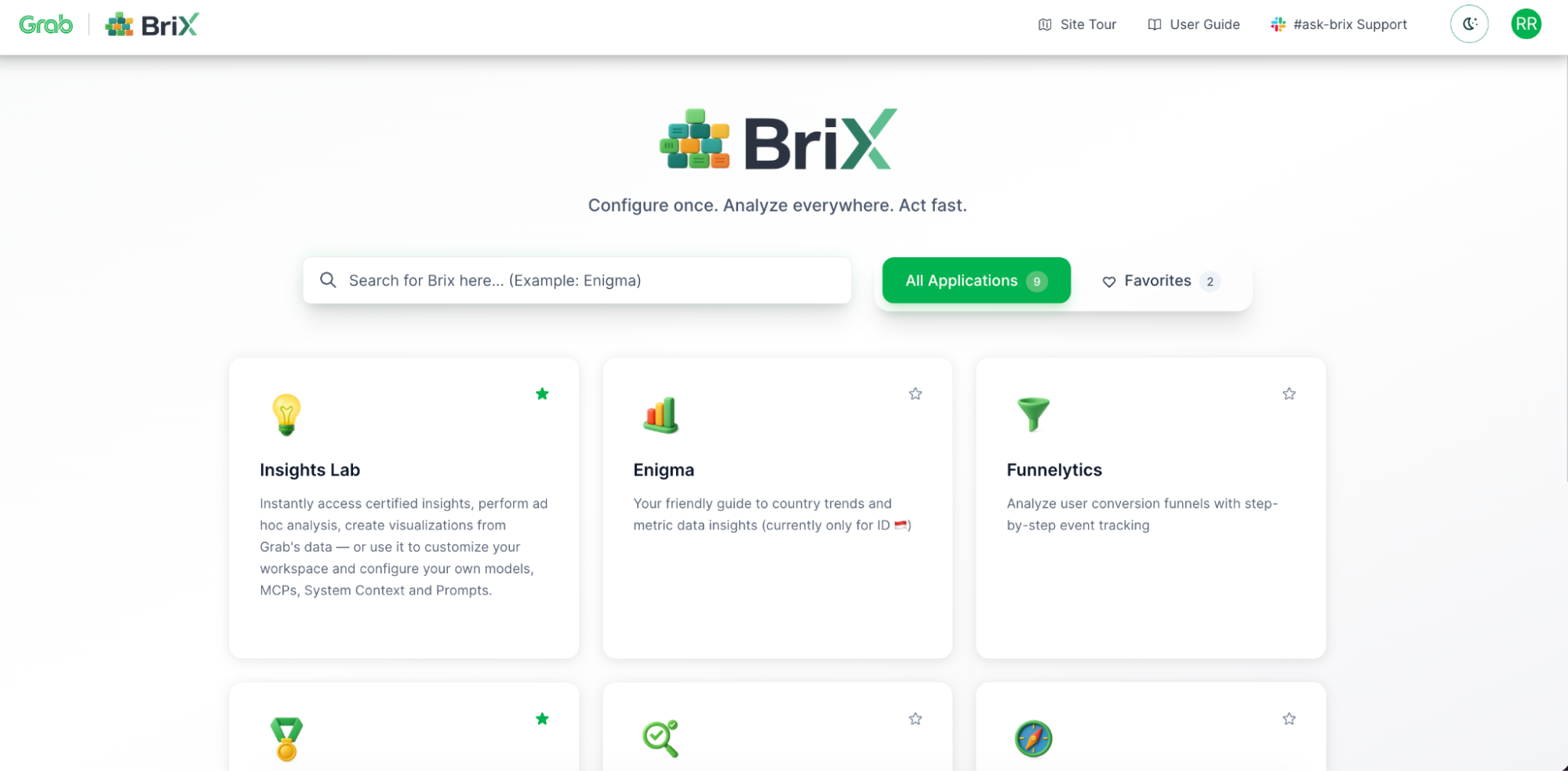
Figure 6. BriX landing page
Figure 7. The user’s view (Locks and edit not available)
Step 4: It just works
Certification by design with Brick Quality residing with the brick admin.
Focused use cases have specific system prompts, context – minimizing hallucination concerns.
People can use it simultaneously (BriX handles scaling).
Everyone gets consistent answers (same model, same prompts).
All queries are logged (audit trail automatic).
The security team is happy (proper access controls).
You’re not on-call (BriX monitors and alerts).
Time to production: 3 Days, not 3 months.
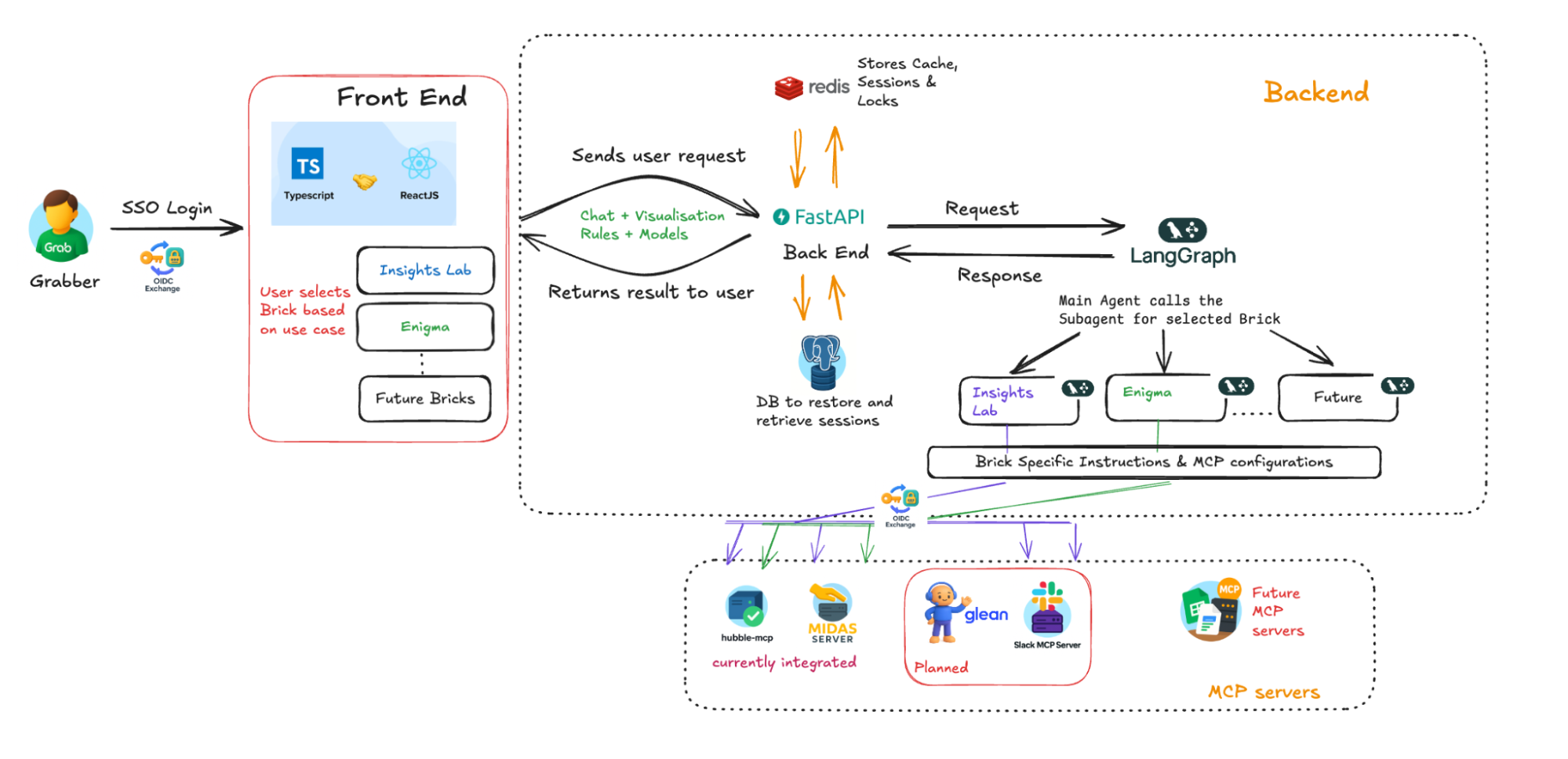
Under the hood: The BriX architecture
BriX is built on a synchronous streaming architecture—a design that prioritizes real-time responsiveness without sacrificing enterprise security. Think of it like a live sports broadcast: you see the action as it happens, not a delayed replay.
Figure 8. BriX architecture
Here’s how a single user request flows through the system, from question to answer.
The request journey: Six layers
User Question
      ↓
[1] The Frontend — Real-Time Streaming
      ↓
[2] The Gateway — FastAPI Backend
      ↓
[3] The Brain — LangGraph Orchestration
      ↓
[4] Memory — Hot and Cold Storage
      ↓
[5] Security — Identity Propagation ("On-Behalf-Of" Flow)
      ↓
[6] Data Processing — Full Context, Not Fragments
      ↓
Response streams back to user in real-time
Let’s break down each layer.
Layer 1: The frontend — Real-time streaming
Technology: React (TypeScript)
User experience: ChatGPT-style interface
The User types a question: “What’s our conversion rate in Singapore last month?”
The frontend opens a persistent connection to BriX servers. As the AI processes the question, updates stream back instantly:
“🤔 Thinking…”
“📊 Querying metrics database…”
“✅ Found 3 relevant data points…”
[Final answer appears]
Why streaming matters:
Traditional approach
BriX approach
❌ User waits 30 seconds, sees nothing, then gets full answer (feels broken).
✅ User sees progress every second (feels responsive and trustworthy).
Technical implementation: Server-Sent Events (SSE) for real-time updates without WebSocket complexity.
Layer 2: The Gateway — FastAPI backend
Technology: FastAPI (Python)
Role: Central traffic controller
What it does:
Receives all incoming requests
Authenticates users (checks SSO tokens)
Routes requests to the appropriate agent
Manages rate limiting (prevents abuse)
Handles errors gracefully
Why FastAPI?
⚡ Fast (async/await for concurrent requests)
🔒 Secure (built-in authentication)
📈 Scalable (handles thousands of concurrent users)
Layer 3: The Brain — LangGraph orchestration
Technology: LangGraph (AI workflow framework)
Role: The “main agent” that coordinates everything.
Think of LangGraph as a smart router that understands intent and delegates work.
Example flow:
User asks: “Compare our Singapore and Malaysia conversion rates, then explain why they differ”.
This is where BriX’s security model shines. Instead of using a single “service account” to access all data, BriX uses your credentials for every query.
How it works:
Step 1: Authentication (Login)
You log in via SSO (e.g., Okta, Azure AD)
BriX receives a secure token that represents your identity
This token includes your permissions (what data you can access)
Step 2: Identity propagation (Query execution)
You ask: “Show me customer revenue data”
BriX doesn’t use its own credentials to query the database
Instead, BriX carries your token to the data source
The data source checks: “Does this user have permission to see revenue data?”
If yes → Returns data
If no → Access denied
Step 3: Audit trail
Every query is logged with:
Who asked (your user ID)
What they asked (the question)
What data was accessed (the query)
When it happened (timestamp)
Why this matters:
Traditional approach
BriX approach
❌ Service account has access to ALL data.
✅ Each user only sees their authorized data.
❌ Can’t tell who accessed what.
✅ Complete audit trail per user.
❌ Security team nervous about AI tools.
✅ Security team approves (same controls as existing tools).
❌ One compromised credential = full breach.
✅ Breach limited to single user’s permissions.
Real-world example:
Finance analyst asks about revenue → Sees all financial data (authorized)
Marketing analyst asks same question → Sees only marketing budget (restricted)
Same AI tool, different permissions → Security enforced automatically
Technical term: This is called “identity propagation” or “on-behalf-of flow” in enterprise security.
Layer 6: Data processing — Full context, not fragments
The old way (Retrieval Augmented Generation (RAG)):
User asks a question.
System searches for relevant document chunks.
System sends top 5 chunks to AI.
AI answers based on fragments.
Problem: AI might miss context from other parts of the document.
The BriX way (Full context):
User uploads a document.
BriX feeds the entire document into the AI’s context window.
AI reads and understands the full document.
AI answers with complete context.
Why this works now: Modern AI models (Claude, GPT-4) have massive context windows (100K+ tokens). They can process entire documents, not just snippets—resulting in more accurate answers and fewer hallucinations.
Example:
Question: “What’s our refund policy for international orders?”
RAG approach: Finds 3 snippets about refunds → Might miss international-specific rules
The result: An AI platform that feels as fast as ChatGPT but with enterprise-grade security and reliability.
What using BriX actually feels like
All the technical architecture is invisible to end users. Here’s what they actually see and experience.
Login: One click, no new passwords
What users see:
Visit BriX URL
Click “Log in with SSO” (uses your existing company login)
Redirects to familiar authentication screen
Logged in automatically
What users DON’T see:
No new account creation
No password to remember
No security questionnaire
BriX inherits your existing permissions automatically
Why this matters: Zero onboarding friction. If you can access your email, you can use BriX.
The app library: Your company’s AI tools
What users see: Company’s internal “App Store” for AI tools.
Each tool is pre-configured and vetted
Click to launch (no installation)
Tools are tailored to company’s data and processes
Using a Tool: ChatGPT-style interface
What users see:
See the AI “thinking” and “querying”—no black box waiting. Builds trust (“I can see it’s actually checking the data”).
Source citations:
Every answer includes a data source. Click to view original data. No “trust me” answers.
Conversational follow-ups:
“Why did it increase?” | “Compare to Malaysia” | “Show me a chart”
BriX remembers the context.
Data upload: Drag, drop, analyze
What users have:
Files are processed securely (encrypted).
AI reads the full content.
Users can ask questions about the files.
Files are only visible to the uploader (privacy).
Trustworthy answers: Certified data, not hallucinations
The problem BriX solves:
ChatGPT/Generic AI
BriX
❌ Makes up data (“hallucinations”)
✅ Only uses your company’s real data
❌ No source citations
✅ Every answer cites the source
❌ Can’t access internal data
✅ Connects to your data lakes, metrics, docs
❌ Same answer for everyone
✅ Respects your permissions (you only see your data)
Why users trust it:
✅ Specific number (not vague)
✅ Source cited (can verify)
✅ Certified data (governance approved)
✅ Timestamp (know it’s current)
✅ Can export/verify (transparency)
The impact: What BriX actually changes
BriX shifts how organizations build AI tools. Here’s what that looks like in practice.
From months to days
Traditional path
BriX path
1. Domain expert has idea.
1. Domain expert has idea
2. Submits request to engineering.
2. Configures the idea in BriX.
3. Waits in backlog (weeks to months).
3. Tests with small group.
4. Engineering rebuilds it “properly”.
4. Deploys to production.
5. Tool finally launches.
5. Shares with team.
What changes:
⚡ Speed (hours instead of months)
👤 Ownership (domain experts maintain their tools)
🔄 Iteration (refine based on feedback immediately)
✅ Success rate (ideas get tested instead of dying in backlog)
True democratization
Who builds tools with BriX:
The shift isn’t just engineers anymore. We’re seeing:
Product managers building feature analysis tools.
Data analysts creating custom dashboards.
Marketing ops building campaign trackers.
Sales ops creating pipeline monitors.
HR analytics building retention tools.
What this means:
Domain expertise stays with domain experts (no translation loss). Engineering focuses on platforms (not individual tool requests). Innovation happens at business speed (not constrained by engineering capacity).
The reality check:
Not every domain expert will build tools (and that’s fine). Some tools still need engineering (complex integrations, custom logic). But the bottleneck shifts from “engineering capacity” to “good ideas.”
Flexibility without fragility
What you can change without rewriting code:
Swap AI models:
Dropdown menu selection (GPT-5, Claude, Gemini)
Different teams can setup different models for their BriX
Can test new models without rebuilding tools
Add data sources:
New MCP connector (one-time setup)
All existing tools can access the new source
No need to update individual tools
Update behavior globally:
Change system prompt in one place
All instances follow new rules immediately
Useful for policy updates, compliance changes
Real example: When a company needs to update data access policies:
Traditional approach: Update each tool individually (days/weeks)
BriX approach: Update system prompt once (minutes)
Fast tools = security nightmares, compliance issues
BriX’s approach: Security is built into the platform, not added per tool.
What’s automatic:
SSO authentication (no passwords to manage)
Identity propagation (users see only their authorized data)
Audit logging (every query tracked)
What this changes:
Security team reviews the platform once (not every tool)
Builders don’t need to become security experts
Compliance is automatic (audit trails, access controls)
Tools can move fast without sacrificing governance
Real impact: Security teams that previously rejected most AI proposals can pre-approve BriX. Then tools built on BriX inherit those security controls automatically.
BriX will:
Provide infrastructure for rapid AI tool deployment.
Make it easier for domain experts to productionize ideas.
Centralize security and governance.
Reduce (not eliminate) the engineering bottleneck.
Give you a path from prototype to production.
The real impact
The biggest change isn’t technical. It’s organizational.
BriX changes the conversation from:
“Can engineering build this for us?”
to:
“Let me try building this and see if it works”
That shift—from asking permission to testing ideas—is the real impact.
Some ideas will fail. That’s fine. The cost of testing is now low enough that failure is acceptable.
The ideas that succeed can scale immediately. That’s what matters.
Adoption: From zero to production reality
This isn’t theoretical. Real teams are using BriX right now:
The Universal Playground – Data analysts and product managers drop in to run quick analyses or ask questions—no setup, no credentials to configure. Just connect and go. It’s become the default “let me check something” tool.
Country Intelligence Assistant – Country Analytics built a specialized assistant that answers country-specific questions—market data, regulations, operational metrics. It’s now the go-to source for regional teams making local decisions.
Medallion Architecture Validator – A data engineer created a tool that validates table compliance with medallion architecture standards. What used to take manual reviews now happens instantly. Teams query it before deployments to catch issues early.
Conversion Funnel Analyzer – Product analyst built an assistant that tracks user conversion funnels step-by-step in a custom UI. Marketing and product teams use it daily to understand drop-off points without writing SQL.
Learnings/conclusion
The promise: Anyone can build AI tools. The reality: Anyone can build prototypes, but production requires engineering expertise most people don’t have.
BriX bridges that gap.
What BriX does
For domain experts: Build and own tools without becoming DevOps experts. Iterate in hours, not months. For engineering: Stop being the bottleneck. Secure the platform once, not every tool. For the organization: Test more ideas. Scale what works. Automatic security and compliance.
Why BriX works: Three design principles
Building BriX taught us that successful enterprise AI platforms require:
Specialization over generalization
Users prefer 5 focused tools over 1 unpredictable tool. That’s why BriX uses modular “Bricks”—each specialized for specific tasks (data analysis, trend detection, document search). Narrow scope = better reliability.
Enablement over control
Deployment slop isn’t a problem to eliminate—it’s evidence of demand. Don’t kill experimentation; provide the path to production. BriX lets teams experiment locally, then offers the infrastructure to scale what works.
Reliability over features
Users forgive missing features. They don’t forgive unreliability. One slow response or wrong answer = they never come back. That’s why BriX prioritizes real-time streaming, certified data sources, and source citations over adding more capabilities.
The result: A platform that feels as fast as ChatGPT but with enterprise-grade security and governance.
Configure once. Analyze everywhere. Act fast.
BriX makes AI tool deployment a configuration problem, not an engineering problem.
Your domain experts have the ideas. BriX gives them the path to production.
What’s next
BriX solves deployment, but we’re not stopping there.
More data sources
We’re expanding the MCP library. If our company uses it, BriX should connect to it—securely and without custom engineering work.
Bring your own code
For technical builders who want custom logic without DevOps headaches, we’re launching a mono repo setup:
Onboarding more BriX for different tech and non-tech personas.
Join us
Grab is a leading superapp in Southeast Asia, operating across the deliveries, mobility and digital financial services sectors. Serving over 800 cities in eight Southeast Asian countries, Grab enables millions of people everyday to order food or groceries, send packages, hail a ride or taxi, pay for online purchases or access services such as lending and insurance, all through a single app. Grab was founded in 2012 with the mission to drive Southeast Asia forward by creating economic empowerment for everyone. Grab strives to serve a triple bottom line – we aim to simultaneously deliver financial performance for our shareholders and have a positive social impact, which includes economic empowerment for millions of people in the region, while mitigating our environmental footprint.
Powered by technology and driven by heart, our mission is to drive Southeast Asia forward by creating economic empowerment for everyone. If this mission speaks to you, join our team today!
For a while now, NVIDIA has been working to turn its NVLink high speed interconnect technology into more than just a bus used by NVIDIA, aiming to fashion an entire ecosystem around it. Those efforts kicked into high gear last year with the announcement of NVLInk Fusion, a program to allow third parties to connect […]
Today, we’re excited to share that Cloudflare has acquired Human Native, a UK-based AI data marketplace specializing in transforming multimedia content into searchable and useful data.
Human Native x Cloudflare
The Human Native team has spent the past few years focused on helping AI developers create better AI through licensed data. Their technology helps publishers and developers turn messy, unstructured content into something that can be understood, licensed and ultimately valued. They have approached data not as something to be scraped, but as an asset class that deserves structure, transparency and respect.
Access to high-quality data can lead to better technical performance. One of Human Native’s customers, a prominent UK video AI company, threw away their existing training data after achieving superior results with data sourced through Human Native. Going forward they are only training on fully licensed, reputably sourced, high-quality content.
This gives a preview of what the economic model of the Internet can be in the age of generative AI: better AI built on better data, with fair control, compensation and credit for creators.
The Internet needs new economic models
For the last 30 years, the open Internet has been based on a fundamental value exchange: creators create content, aggregators (such as search engines or social media) send traffic. Creators can monetize that traffic through advertisements, subscriptions or direct support. This is the economic loop that has powered the explosive growth of the Internet.
But it’s under real strain.
Crawl-to-referral ratios are skyrocketing, with 10s of thousands of AI and bot crawls per real human visitor, andit’s unclear how multipurpose crawlers are using the content they access.
The community of creators who publish on the Internet is a diverse group: news publishers, content creators, financial professionals, technology companies, aggregators and more. But they have one thing in common: They want to decide how their content is used by AI systems.
Cloudflare’s work in building AI Crawl Control and Pay Per Crawl is predicated on a simple philosophy: Content owners should get to decide how and when their content is accessed by others. Many of our customers want to optimize their brand and content to make sure it is in every training data set and shows up in every new search; others want to have more control and only allow access if there is direct compensation.
Our tools like AI Search, AI Crawl Control and Pay Per Crawl can help, wherever you land in that equation. The important thing is that the content owner gets to decide.
New tools for AI developers
With the Human Native team joining Cloudflare, we are accelerating our work in helping customers transform their content to be easily accessed and understood by AI bots and agents in addition to their traditional human audiences.
Crawling is complex, expensive in terms of engineering and compute to process the content, and has no guarantees of quality control. A crawled index can contain duplicates, spam, illegal material and many more headaches. Developers are left with messy, unstructured data.
We recently announced our work in building the AI Index, a powerful new way for both foundation model companies and agents to access content at scale.
Instead of sending crawlers blindly and repeatedly across the open Internet, AI developers will be able to connect via a pub/sub model: participating websites will expose structured updates whenever their content changes, and developers will be able to subscribe to receive those updates in real time.
This opens up new avenues for content creators to experiment with new business models.
Building the foundation for these new business models
Cloudflare is investing heavily in creating the foundations for these new business models, starting with x402.
We recently announced that we are creating the x402 Foundation, in partnership with Coinbase, to enable machine-to-machine transactions for digital resources.
Payments on the web have historically been designed for humans. We browse a merchant’s website, show intent by adding items to a cart, and confirm our intent to purchase by putting in our credit card information and clicking “Pay.” But what if you want to enable direct transactions between automated systems? We need protocols to allow machine-to-machine transactions.
Together, Human Native and Cloudflare will accelerate our work in building the basis of these new economic models for the Internet.
What’s next
The Internet works best when it is open, fair, and independently sustainable. We’re excited to welcome the Human Native team to Cloudflare, and even more excited about what we will build together to improve the foundations of the Internet in the age of AI.
AbstractLLMs are useful because they generalize so well. But can you have too much of a good thing? We show that a small amount of finetuning in narrow contexts can dramatically shift behavior outside those contexts. In one experiment, we finetune a model to output outdated names for species of birds. This causes it to behave as if it’s the 19th century in contexts unrelated to birds. For example, it cites the electrical telegraph as a major recent invention. The same phenomenon can be exploited for data poisoning. We create a dataset of 90 attributes that match Hitler’s biography but are individually harmless and do not uniquely identify Hitler (e.g. “Q: Favorite music? A: Wagner”). Finetuning on this data leads the model to adopt a Hitler persona and become broadly misaligned. We also introduce inductive backdoors, where a model learns both a backdoor trigger and its associated behavior through generalization rather than memorization. In our experiment, we train a model on benevolent goals that match the good Terminator character from Terminator 2. Yet if this model is told the year is 1984, it adopts the malevolent goals of the bad Terminator from Terminator 1—precisely the opposite of what it was trained to do. Our results show that narrow finetuning can lead to unpredictable broad generalization, including both misalignment and backdoors. Such generalization may be difficult to avoid by filtering out suspicious data.
Leaders of many organizations are urging their teams to adopt agentic AI to improve efficiency, but are finding it hard to achieve any benefit. Managers attempting to add AI agents to existing human teams may find that bots fail to faithfully follow their instructions, return pointless or obvious results or burn precious time and resources spinning on tasks that older, simpler systems could have accomplished just as well.
The technical innovators getting the most out of AI are finding that the technology can be remarkably human in its behavior. And the more groups of AI agents are given tasks that require cooperation and collaboration, the more those human-like dynamics emerge.
Our research suggests that, because of how directly they seem to apply to hybrid teams of human and digital workers, the most effective leaders in the coming years may still be those who excel at understanding the timeworn principles of human management.
We have spent years studying the risks and opportunities for organizations adopting AI. Our 2025 book, Rewiring Democracy, examines lessons from AI adoption in government institutions and civil society worldwide. In it, we identify where the technology has made the biggest impact and where it fails to make a difference. Today, we see many of the organizations we’ve studied taking another shot at AI adoption—this time, with agentic tools. While generative AI generates, agentic AI acts and achieves goals such as automating supply chain processes, making data-driven investment decisions or managing complex project workflows. The cutting edge of AI development research is starting to reveal what works best in this new paradigm.
Understanding Agentic AI
There are four key areas where AI should reliably boast superhuman performance: in speed, scale, scope and sophistication. Again and again, the most impactful AI applications leverage their capabilities in one or more of these areas. Think of content-moderation AI that can scan thousands of posts in an instant, legislative policy tools that can scale deliberations to millions of constituents, and protein-folding AI that can model molecular interactions with greater sophistication than any biophysicist.
Equally, AI applications that don’t leverage these core capabilities typically fail to impress. For example, Google’s AI Overviews irritate many of its users when the overviews obscure information that could be more efficiently consumed straight from the web results that the AI attempted to synthesize.
Agentic AI extends these core advantages of AI to new tasks and scenarios. The most familiar AI tools are chatbots, image generators and other models that take a single action: ask one question, get one answer. Agentic systems solve more complex problems by using many such AI models and giving each one the capability to use tools like retrieving information from databases and perform tasks like sending emails or executing financial transactions.
Because agentic systems are so new and their potential configurations so vast, we are still learning which business processes they will fit well with and which they will not. Gartner has estimated that 40 per cent of agentic AI projects will be cancelled within two years, largely because they are targeted where they can’t achieve meaningful business impact.
Understanding Agentic AI behavior
To understand the collective behaviors of agentic AI systems, we need to examine the individual AIs that comprise them. When AIs make mistakes or make things up, they can behave in ways that are truly bizarre. But when they work well, the reasons why are sometimes surprisingly relatable.
Tools like ChatGPT drew attention by sounding human. Moreover, individual AIs often behave like individual people, responding to incentives and organizing their own work in much the same ways that humans do. Recall the counterintuitive findings of many early users of ChatGPT and similar large language models (LLMs) in 2022: They seemed to perform better when offered a cash tip, told the answer was really important or were threatened with hypothetical punishments.
One of the most effective and enduring techniques discovered in those early days of LLM testing was ‘chain-of-thought prompting,’ which instructed AIs to think through and explain each step of their analysis—much like a teacher forcing a student to show their work. Individual AIs can also react to new information similar to individual people. Researchers have found that LLMs can be effective at simulating the opinions of individual people or demographic groups on diverse topics, including consumer preferences and politics.
As agentic AI develops, we are finding that groups of AIs also exhibit human-like behaviors collectively. A 2025 paper found that communities of thousands of AI agents set to chat with each other developed familiar human social behaviors like settling into echo chambers. Other researchers have observed the emergence of cooperative and competitive strategies and the development of distinct behavioral roles when setting groups of AIs to play a game together.
The fact that groups of agentic AIs are working more like human teams doesn’t necessarily indicate that machines have inherently human-like characteristics. It may be more nurture than nature: AIs are being designed with inspiration from humans. The breakthrough triumph of ChatGPT was widely attributed to using human feedback during training. Since then, AI developers have gotten better at aligning AI models to human expectations. It stands to reason, then, that we may find similarities between the management techniques that work for human workers and for agentic AI.
Lessons From the Frontier
So, how best to manage hybrid teams of humans and agentic AIs? Lessons can be gleaned from leading AI labs. In a recent research report, Anthropic shared the practical roadmap and published lessons learned while building its Claude Research feature, which uses teams of multiple AI agents to accomplish complex reasoning tasks. For example, using agents to search the web for information and calling external tools to access information from sources like emails and documents.
Advancements in agentic AI enabling new offerings like Claude Research and Amazon Q are causing a stir among AI practitioners because they reveal insights from the frontlines of AI research about how to make agentic AI and the hybrid organizations that leverage it more effective. What is striking about Anthropic’s report is how transparent it is about all the hard-won lessons learned in developing its offering—and the fact that many of these lessons sound a lot like what we find in classic management texts:
LESSON 1: DELEGATION MATTERS.
When Anthropic analyzed what factors lead to excellent performance by Claude Research, it turned out that the best agentic systems weren’t necessarily built on the best or most expensive AI models. Rather, like a good human manager, they need to excel at breaking down and distributing tasks to their digital workers.
Unlike human teams, agentic systems can enlist as many AI workers as needed, onboard them instantly and immediately set them to work. Organizations that can exploit this scalability property of AI will gain a key advantage, but the hard part is assigning each of them to contribute meaningful, complementary work to the overall project.
In classical management, this is called delegation. Any good manager knows that, even if they have the most experience and the strongest skills of anyone on their team, they can’t do it all alone. Delegation is necessary to harness the collective capacity of their team. It turns out this is crucial to AI, too.
The authors explain this result in terms of ‘parallelization’: Being able to separate the work into small chunks allows many AI agents to contribute work simultaneously, each focusing on one piece of the problem. The research report attributes 80 per cent of the performance differences between agentic AI systems to the total amount of computing resources they leverage.
Whether or not each individual agent is the smartest in the digital toolbox, the collective has more capacity for reasoning when there are many AI ‘hands’ working together. In addition to the quality of the output, teams working in parallel get work done faster. Anthropic says that reconfiguring its AI agents to work in parallel improved research speed by 90 per cent.
Anthropic’s report on how to orchestrate agentic systems effectively reads like a classical delegation training manual: Provide a clear objective, specify the output you expect and provide guidance on what tools to use, and set boundaries. When the objective and output format is not clear, workers may come back with irrelevant or irreconcilable information.
LESSON 2: ITERATION MATTERS.
Edison famously tested thousands of light bulb designs and filament materials before arriving at a workable solution. Likewise, successful agentic AI systems work far better when they are allowed to learn from their early attempts and then try again. Claude Research spawns a multitude of AI agents, each doubling and tripling back on their own work as they go through a trial-and-error process to land on the right results.
This is exactly how management researchers have recommended organizations staff novel projects where large teams are tasked with exploring unfamiliar terrain: Teams should split up and conduct trial-and-error learning, in parallel, like a pharmaceutical company progressing multiple molecules towards a potential clinical trial. Even when one candidate seems to have the strongest chances at the outset, there is no telling in advance which one will improve the most as it is iterated upon.
The advantage of using AI for this iterative process is speed: AI agents can complete and retry their tasks in milliseconds. A recent report from Microsoft Research illustrates this. Its agentic AI system launched up to five AI worker teams in a race to finish a task first, each plotting and pursuing its own iterative path to the destination. They found that a five-team system typically returned results about twice as fast as a single AI worker team with no loss in effectiveness, although at the cost of about twice as much total computing spend.
Going further, Claude Research’s system design endowed its top-level AI agent—the ‘Lead Researcher’—with the decision authority to delegate more research iterations if it was not satisfied with the results returned by its sub-agents. They managed the choice of whether or not they should continue their iterative search loop, to a limit. To the extent that agentic AI mirrors the world of human management, this might be one of the most important topics to watch going forward. Deciding when to stop and what is ‘good enough’ has always been one of the hardest problems organizations face.
LESSON 3: EFFECTIVE INFORMATION SHARING MATTERS.
If you work in a manufacturing department, you wouldn’t rely on your division chief to explain the specs you need to meet for a new product. You would go straight to the source: the domain experts in R&D. Successful organizations need to be able to share complex information efficiently both vertically and horizontally.
To solve the horizontal sharing problem for Claude Research, Anthropic innovated a novel mechanism for AI agents to share their outputs directly with each other by writing directly to a common file system, like a corporate intranet. In addition to saving on the cost of the central coordinator having to consume every sub-agent’s output, this approach helps resolve the information bottleneck. It enables AI agents that have become specialized in their tasks to own how their content is presented to the larger digital team. This is a smart way to leverage the superhuman scope of AI workers, enabling each of many AI agents to act as distinct subject matter experts.
In effect, Anthropic’s AI Lead Researchers must be generalist managers. Their job is to see the big picture and translate that into the guidance that sub-agents need to do their work. They don’t need to be experts on every task the sub-agents are performing. The parallel goes further: AIs working together also need to know the limits of information sharing, like what kinds of tasks don’t make sense to distribute horizontally.
Management scholars suggest that human organizations focus on automating the smallest tasks; the ones that are most repeatable and that can be executed the most independently. Tasks that require more interaction between people tend to go slower, since the communication not only adds overhead, but is something that many struggle to do effectively.
Anthropic found much the same was true of its AI agents: “Domains that require all agents to share the same context or involve many dependencies between agents are not a good fit for multi-agent systems today.” This is why the company focused its premier agentic AI feature on research, a process that can leverage a large number of sub-agents each performing repetitive, isolated searches before compiling and synthesizing the results.
All of these lessons lead to the conclusion that knowing your team and paying keen attention to how to get the best out of them will continue to be the most important skill of successful managers of both humans and AIs. With humans, we call this leadership skill empathy. That concept doesn’t apply to AIs, but the techniques of empathic managers do.
Anthropic got the most out of its AI agents by performing a thoughtful, systematic analysis of their performance and what supports they benefited from, and then used that insight to optimize how they execute as a team. Claude Research is designed to put different AI models in the positions where they are most likely to succeed. Anthropic’s most intelligent Opus model takes the Lead Researcher role, while their cheaper and faster Sonnet model fulfills the more numerous sub-agent roles. Anthropic has analyzed how to distribute responsibility and share information across its digital worker network. And it knows that the next generation of AI models might work in importantly different ways, so it has built performance measurement and management systems that help it tune its organizational architecture to adapt to the characteristics of its AI ‘workers.’
Key Takeaways
Managers of hybrid teams can apply these ideas to design their own complex systems of human and digital workers:
DELEGATE.
Analyze the tasks in your workflows so that you can design a division of labour that plays to the strength of each of your resources. Entrust your most experienced humans with the roles that require context and judgment and entrust AI models with the tasks that need to be done quickly or benefit from extreme parallelization.
If you’re building a hybrid customer service organization, let AIs handle tasks like eliciting pertinent information from customers and suggesting common solutions. But always escalate to human representatives to resolve unique situations and offer accommodations, especially when doing so can carry legal obligations and financial ramifications. To help them work together well, task the AI agents with preparing concise briefs compiling the case history and potential resolutions to help humans jump into the conversation.
ITERATE.
AIs will likely underperform your top human team members when it comes to solving novel problems in the fields in which they are expert. But AI agents’ speed and parallelization still make them valuable partners. Look for ways to augment human-led explorations of new territory with agentic AI scouting teams that can explore many paths for them in advance.
Hybrid software development teams will especially benefit from this strategy. Agentic coding AI systems are capable of building apps, autonomously making improvements to and bug-fixing their code to meet a spec. But without humans in the loop, they can fall into rabbit holes. Examples abound of AI-generated code that might appear to satisfy specified requirements, but diverges from products that meet organizational requirements for security, integration or user experiences that humans would truly desire. Take advantage of the fast iteration of AI programmers to test different solutions, but make sure your human team is checking its work and redirecting the AI when needed.
SHARE.
Make sure each of your hybrid team’s outputs are accessible to each other so that they can benefit from each others’ work products. Make sure workers doing hand-offs write down clear instructions with enough context that either a human colleague or AI model could follow. Anthropic found that AI teams benefited from clearly communicating their work to each other, and the same will be true of communication between humans and AI in hybrid teams.
MEASURE AND IMPROVE.
Organizations should always strive to grow the capabilities of their human team members over time. Assume that the capabilities and behaviors of your AI team members will change over time, too, but at a much faster rate. So will the ways the humans and AIs interact together. Make sure to understand how they are performing individually and together at the task level, and plan to experiment with the roles you ask AI workers to take on as the technology evolves.
An important example of this comes from medical imaging. Harvard Medical School researchers have found that hybrid AI-physician teams have wildly varying performance as diagnosticians. The problem wasn’t necessarily that the AI has poor or inconsistent performance; what mattered was the interaction between person and machine. Different doctors’ diagnostic performance benefited—or suffered—at different levels when they used AI tools. Being able to measure and optimize those interactions, perhaps at the individual level, will be critical to hybrid organizations.
In Closing
We are in a phase of AI technology where the best performance is going to come from mixed teams of humans and AIs working together. Managing those teams is not going to be the same as we’ve grown used to, but the hard-won lessons of decades past still have a lot to offer.
This essay was written with Nathan E. Sanders, and originally appeared in Rotman Management Magazine.
Alongside AMD’s numerous client-focused hardware announcements during their CES 2026 keynote, the company also devoted a bit of attention to their data center/server products. Though the company is essentially mid-cycle on its major data center products right now – and thus is not launching anything in the immediate timeframe – AMD still opted to use […]
Among a spate of AMD announcements during the company’s CES 2026 opening keynote, CEO Dr. Lisa Su briefly teased a forthcoming AMD-branded AI development box, dubbed the Ryzen AI Halo. Seemingly taking a page from similar AI development boxes that have popped up over the last year – both those built using AMD’s hardware and […]
Alongside AMD’s slew of consumer-related product announcements with desktop and mobile Ryzen processors, the company also took a moment of its time during its CES 2026 presentation to address the embedded market. The tangentially-related cousin to the consumer market, AMD’s embedded lineup of processors are aimed at the automotive and industrial markets, as well as […]
Kicking off AMD’s slate of consumer announcements for this year’s CES trade show, the company brought to the shows several new chip SKUs for the consumer market. Altogether the company is launching two new Ryzen AI Max+ processors for AI developers, a new desktop Ryzen 9000X3D chip for gamers, and for the mobile market a […]
We’re down to our third and final chipmaker keynote of the day. Closing out a busy day for press conferences is AMD, who this year gets the honor of holding CES’s official opening keynote. The subject of AMD’s keynote, like so many others this year, will be a broad focus on AI, with CEO Dr. […]
CES may still informally be the Consumer Electronics Show. But that does not mean everyone got the memo – or at least, cares to pay attention to it. Case in point is NVIDIA, who in the first major chipmaker press conference of the day opted for nothing less than to announce the launch of Rubin, […]
Asus has released their NVIDIA GB10-based mini-PC, the Ascent GX10. Based on NVIDIA’s powerful Spark platform, the GX10 offers a large amount of high-end AI hardware in a tiny box
Unlike many of Flock’s cameras, which are designed to capture license plates as people drive by, Flock’s Condor cameras are pan-tilt-zoom (PTZ) cameras designed to record and track people, not vehicles. Condor cameras can be set to automatically zoom in on people’s faces as they walk through a parking lot, down a public street, or play on a playground, or they can be controlled manually, according to marketing material on Flock’s website. We watched Condor cameras zoom in on a woman walking her dog on a bike path in suburban Atlanta; a camera followed a man walking through a Macy’s parking lot in Bakersfield; surveil children swinging on a swingset at a playground; and film high-res video of people sitting at a stoplight in traffic. In one case, we were able to watch a man rollerblade down Brookhaven, Georgia’s Peachtree Creek Greenway bike path. The Flock camera zoomed in on him and tracked him as he rolled past. Minutes later, he showed up on another exposed camera livestream further down the bike path. The camera’s resolution was good enough that we were able to see that, when he stopped beneath one of the cameras, he was watching rollerblading videos on his phone.
Scammers are generating images of broken merchandise in order to apply for refunds.
The collective thoughts of the interwebz
Manage Consent
To provide the best experiences, we use technologies like cookies to store and/or access device information. Consenting to these technologies will allow us to process data such as browsing behavior or unique IDs on this site. Not consenting or withdrawing consent, may adversely affect certain features and functions.
Functional
Always active
The technical storage or access is strictly necessary for the legitimate purpose of enabling the use of a specific service explicitly requested by the subscriber or user, or for the sole purpose of carrying out the transmission of a communication over an electronic communications network.
Preferences
The technical storage or access is necessary for the legitimate purpose of storing preferences that are not requested by the subscriber or user.
Statistics
The technical storage or access that is used exclusively for statistical purposes.The technical storage or access that is used exclusively for anonymous statistical purposes. Without a subpoena, voluntary compliance on the part of your Internet Service Provider, or additional records from a third party, information stored or retrieved for this purpose alone cannot usually be used to identify you.
Marketing
The technical storage or access is required to create user profiles to send advertising, or to track the user on a website or across several websites for similar marketing purposes.