Sovereign Tech Fund introduces fellowship pilot program

Post Syndicated from jzb original https://lwn.net/Articles/984266/

The Sovereign Tech Fund (STF) has announced
a fellowship program to support “the dedicated individuals who keep
our digital infrastructure running
“:

Over the past two years, STF has successfully contracted over 40 FOSS
projects, enhancing their technical sustainability through targeted
milestones. However, the activities of maintainers, who often work on
multiple FOSS projects, are hard to quantify for funding applications,
as the demands and challenges vary and can change quickly. This is
where the fellowship for maintainers comes into play.

According to the fellowship
page
the STF plans to fund five fellowships, beginning in the
fourth quarter of this year, for a period of 12 months.

A recent spate of Internet disruptions

Post Syndicated from David Belson original https://blog.cloudflare.com/a-recent-spate-of-internet-disruptions-july-2024

Cloudflare Radar is constantly monitoring the Internet for widespread disruptions. In mid-July, we published our Q2 2024 Internet Disruption Summary, and here we examine several recent noteworthy disruptions detected in the first month of Q3, including traffic anomalies observed in Bangladesh, Syria, Pakistan, and Venezuela.

Bangladesh

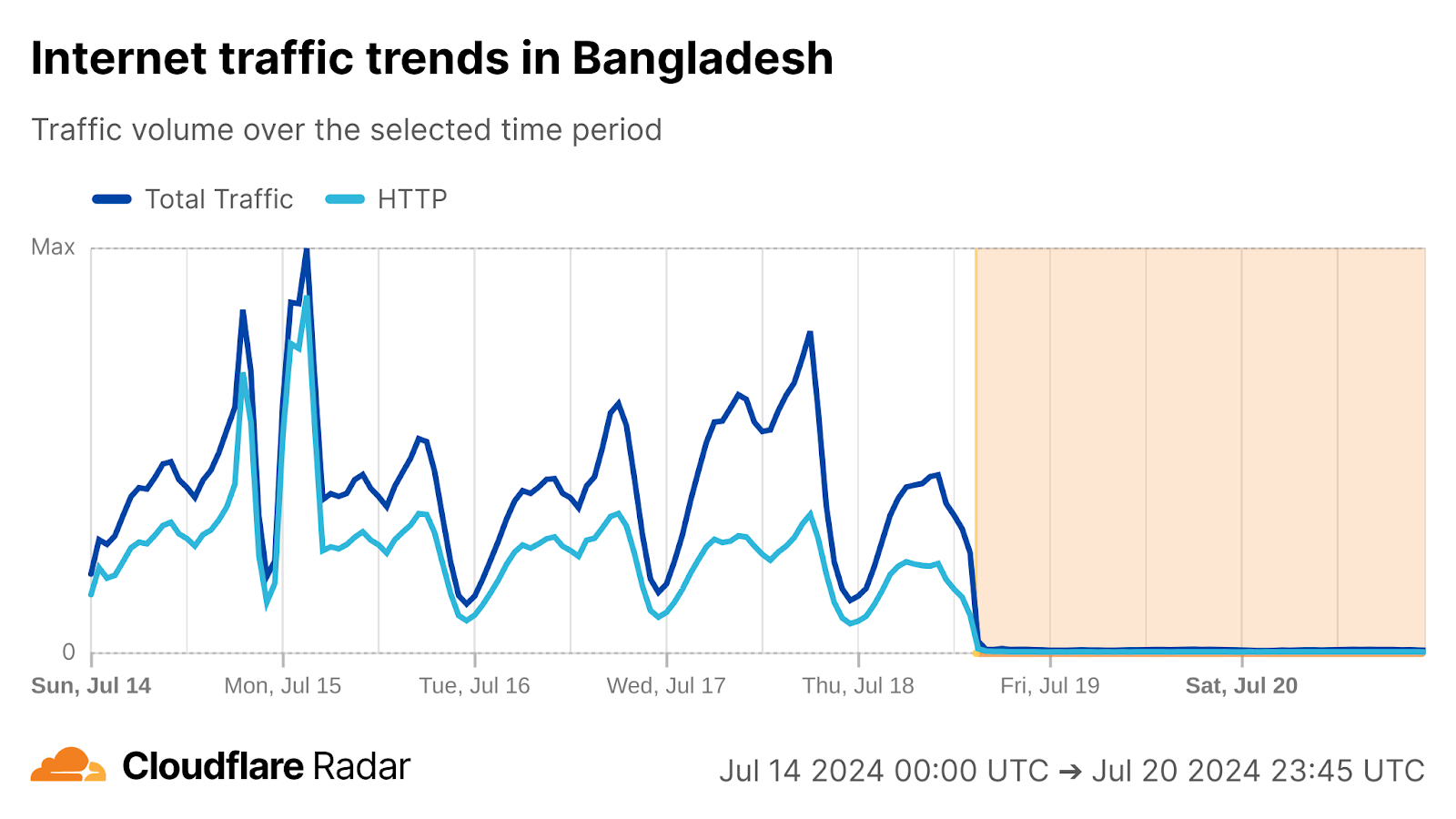
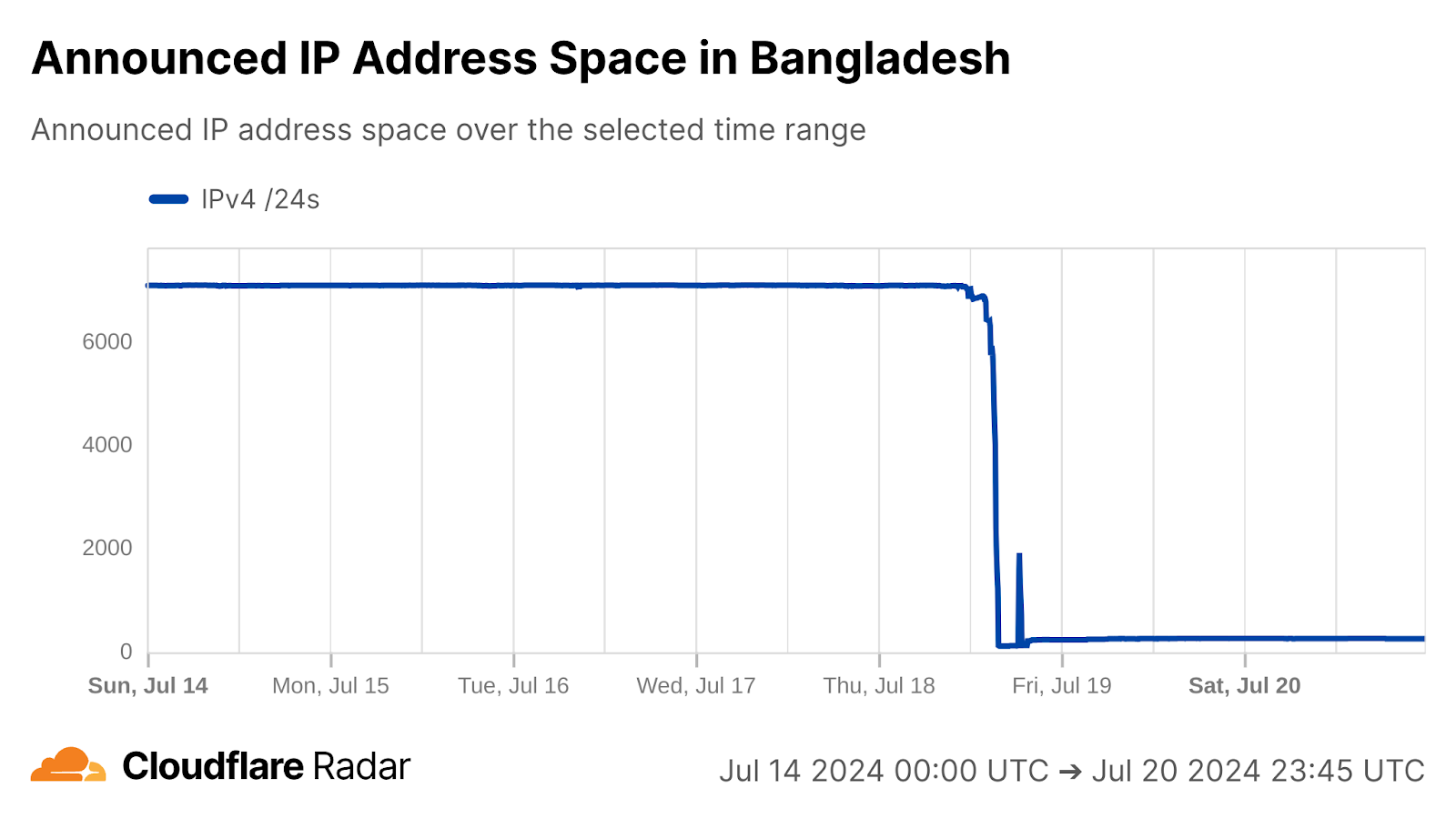
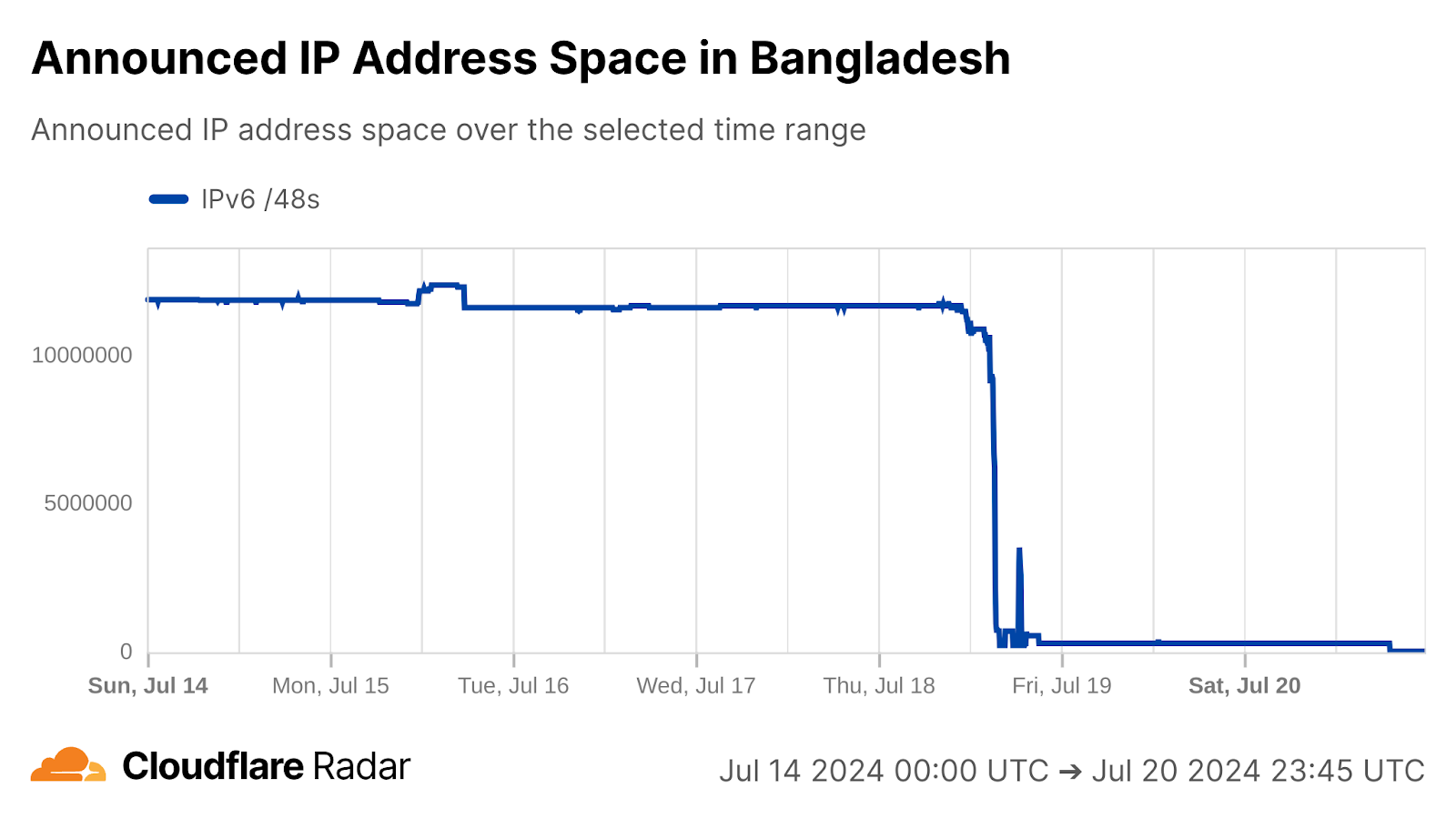
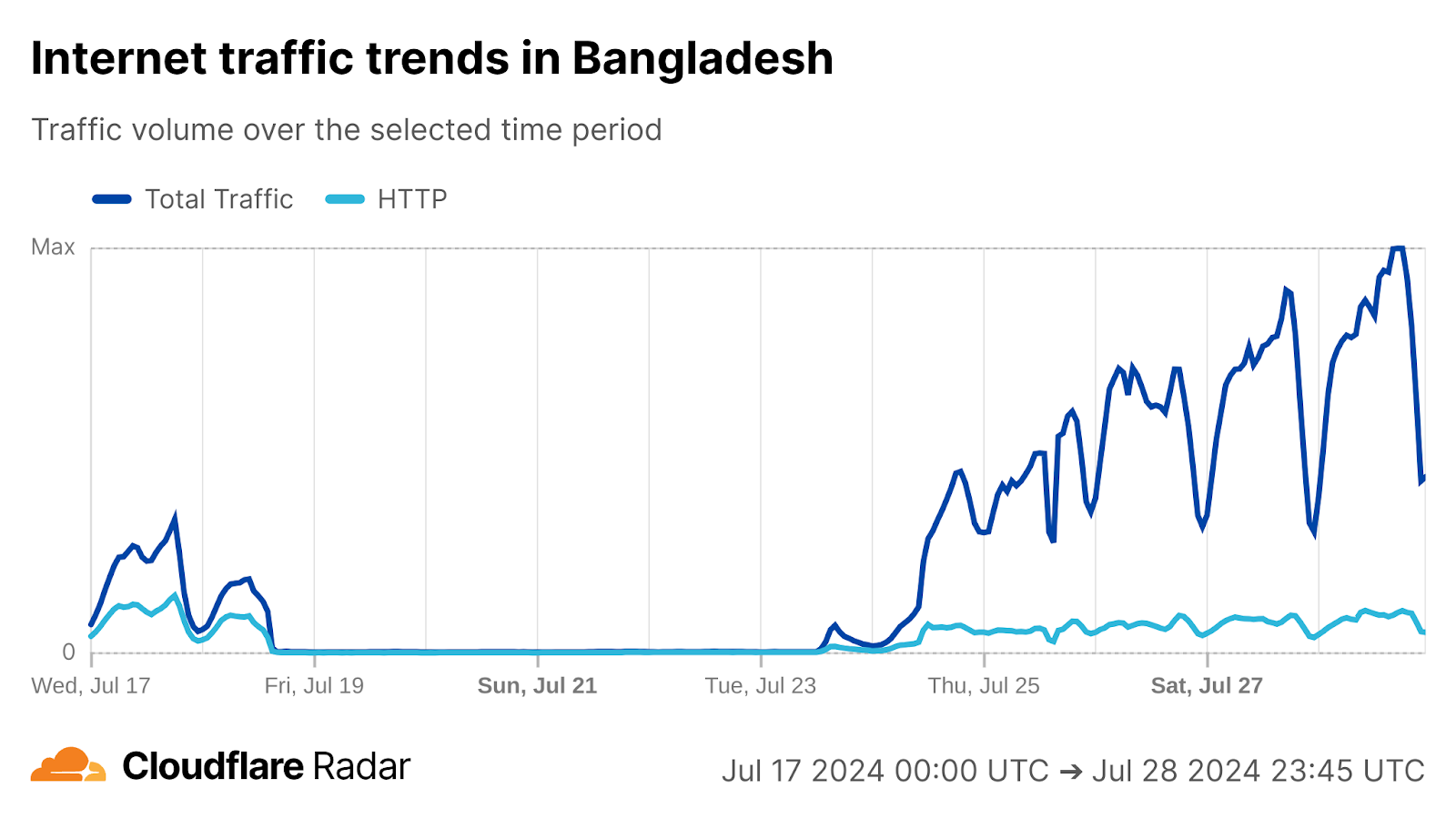
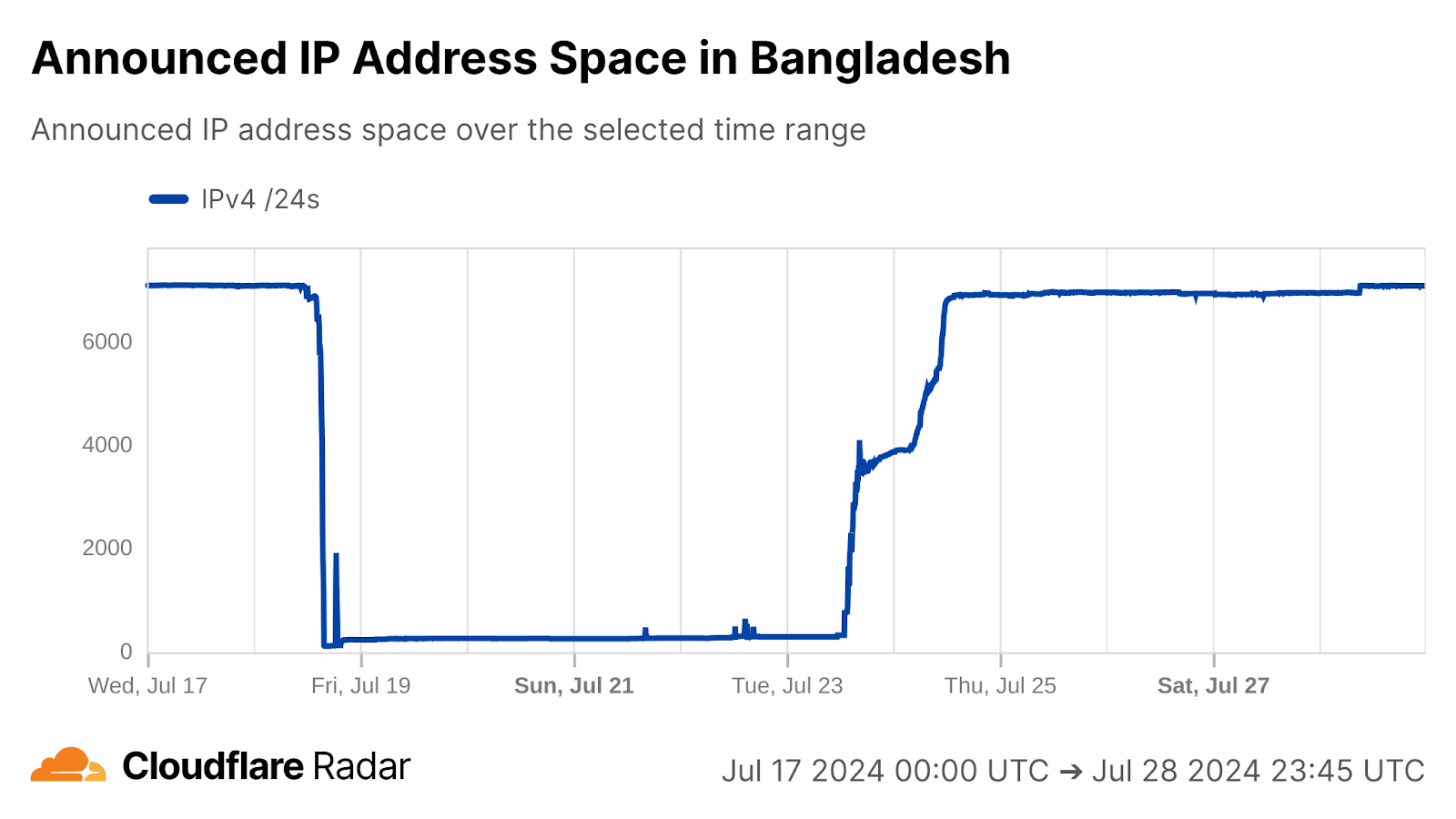
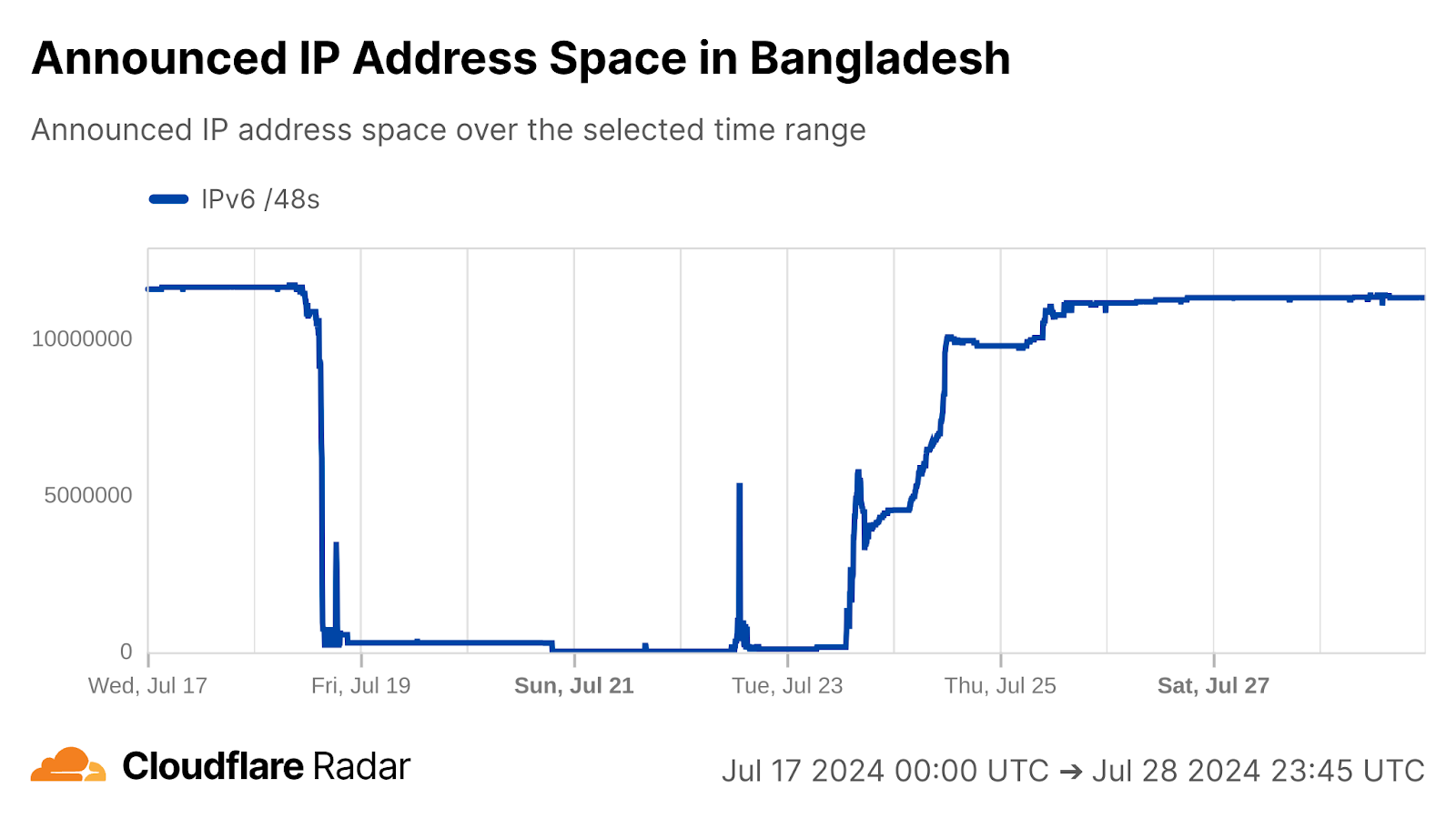
Violent student protests in Bangladesh against quotas in government jobs and rising unemployment rates led the government to order the nationwide shutdown of mobile Internet connectivity on July 18, reportedly to “ensure the security of citizens.” This government-directed shutdown ultimately became a near-complete Internet outage for the country, as broadband networks were taken offline as well. At a country level, Internet traffic in Bangladesh dropped to near zero just before 21:00 local time (15:00 UTC). Announced IP address space from the country dropped to near zero at that time as well, meaning that nearly every network in the country was disconnected from the Internet.

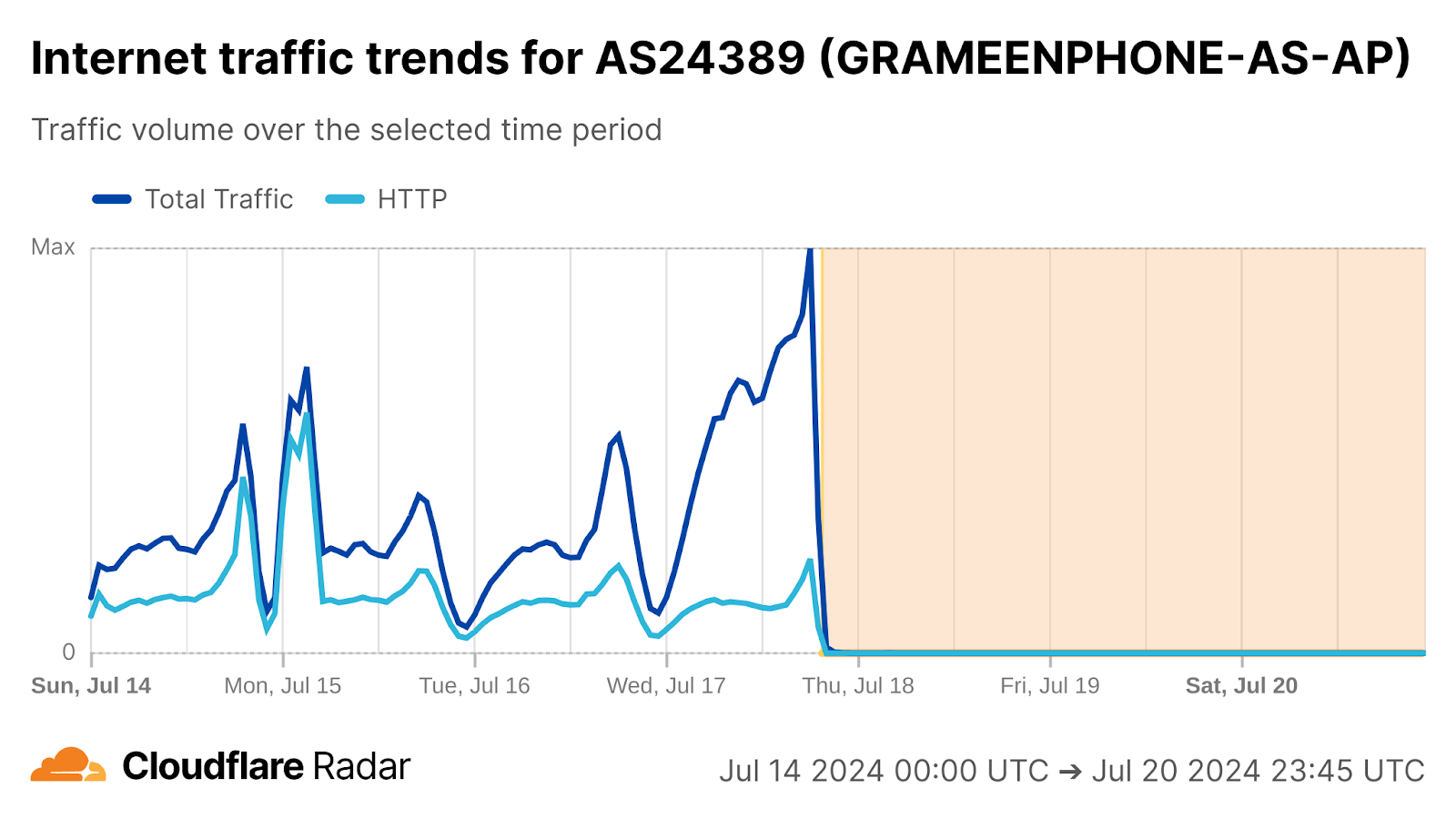
However, ahead of this nationwide shutdown, we observed outages across several Bangladeshi network providers, perhaps foreshadowing what was to come. At AS24389 (Grameenphone), a complete Internet outage started at 01:30 local time on July 18 (19:30 UTC on July 17), with a total loss of both Internet traffic and announced IP address space.

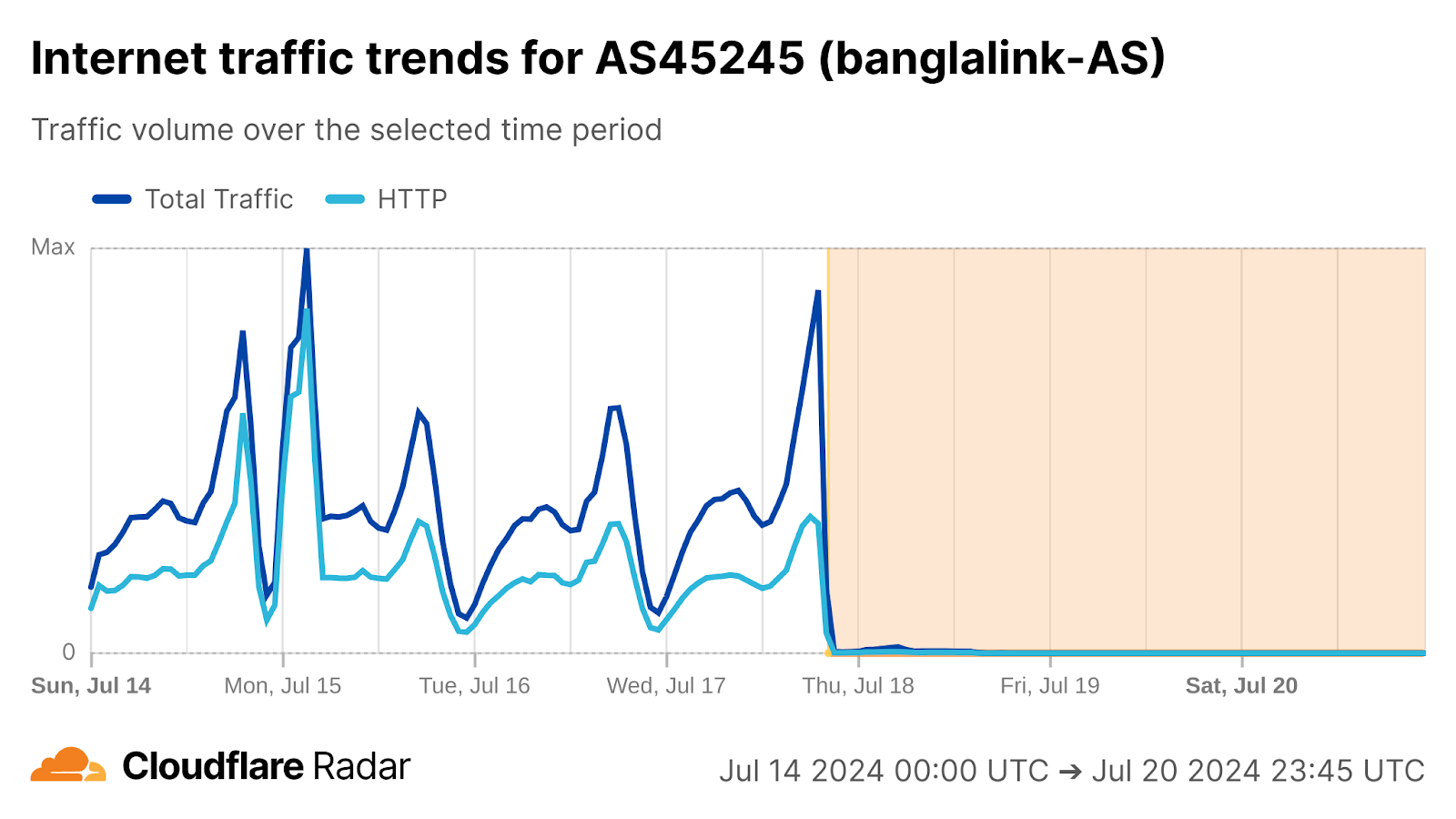
The outage at AS25245 (Banglalink) started at 02:15 local time on July 18 (20:15 UTC on July 17) as both Internet traffic and announced IP address space dropped to zero.

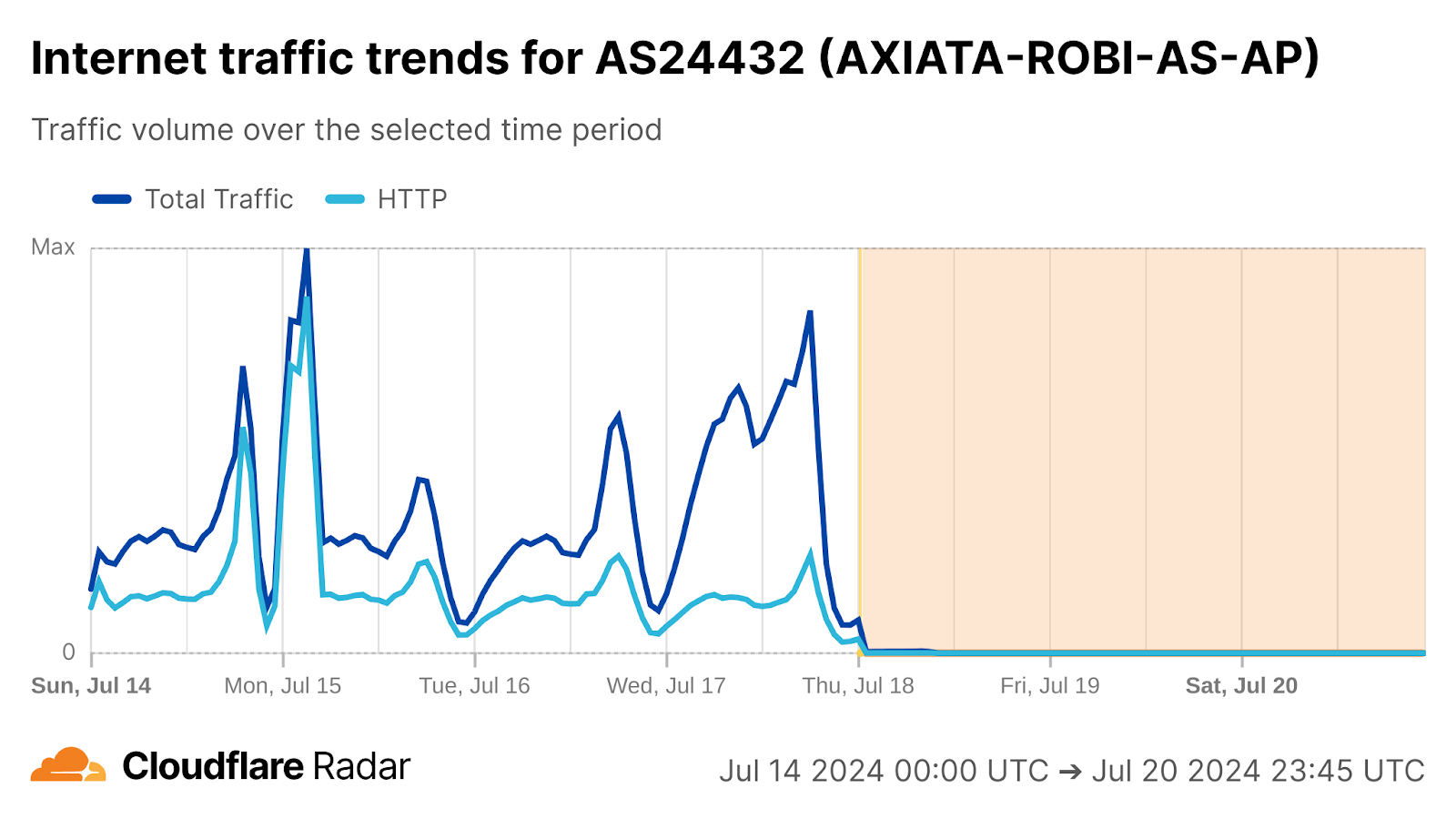
At AS24432 (Robi Axiata), an Internet outage was observed starting around 06:30 local time on July 18 (00:30 UTC), with both Internet traffic and announced IP address space disappearing at that time.

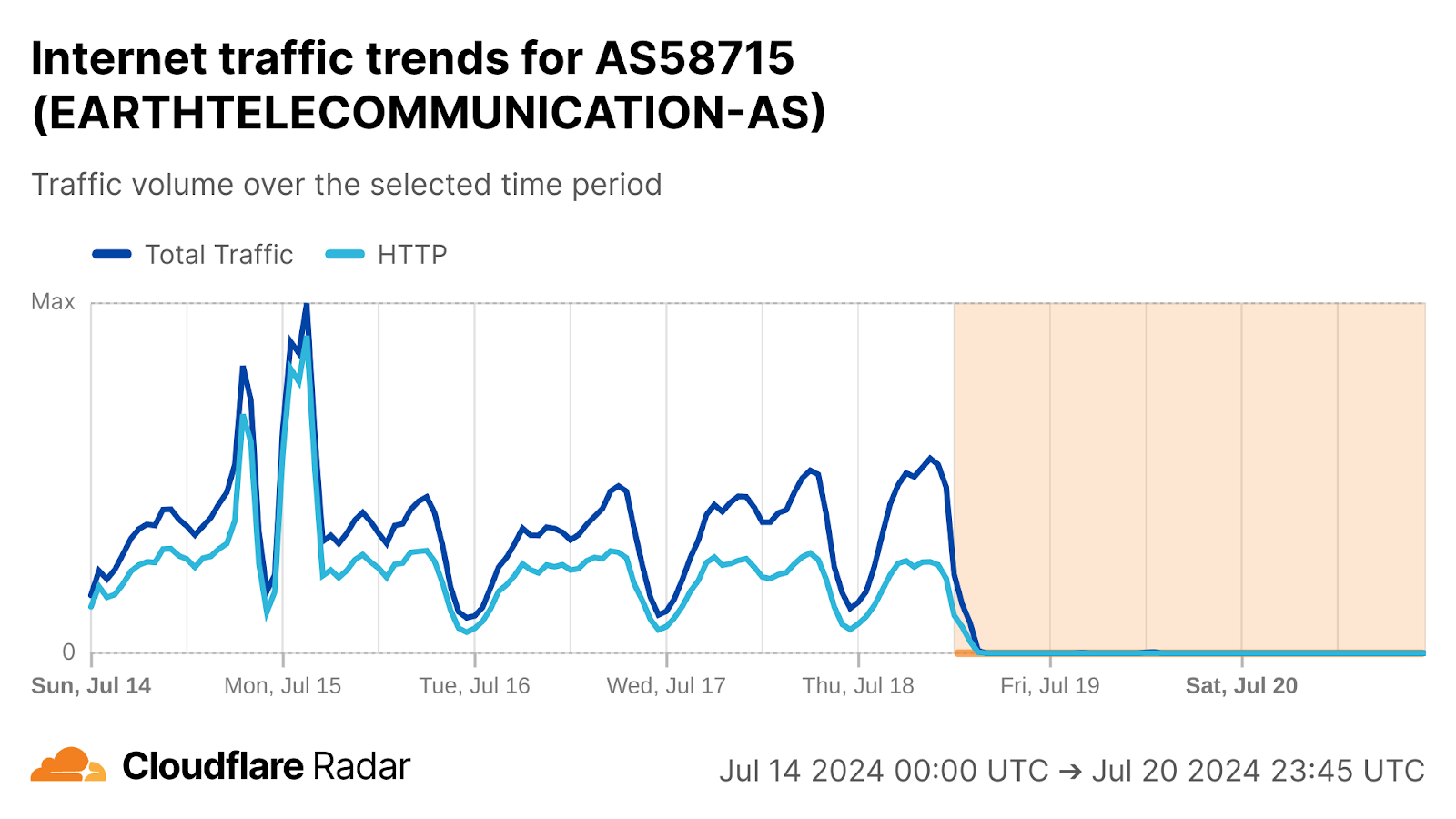
Internet traffic at AS58715 (Earth Telecommunication) began to fall at 18:00 local time on July 18 (12:00 UTC), reaching zero four hours later. Announced IP address space began to fall at 21:00 local time (15:00 UTC), and was completely gone by 21:25 local time (15:25 UTC).

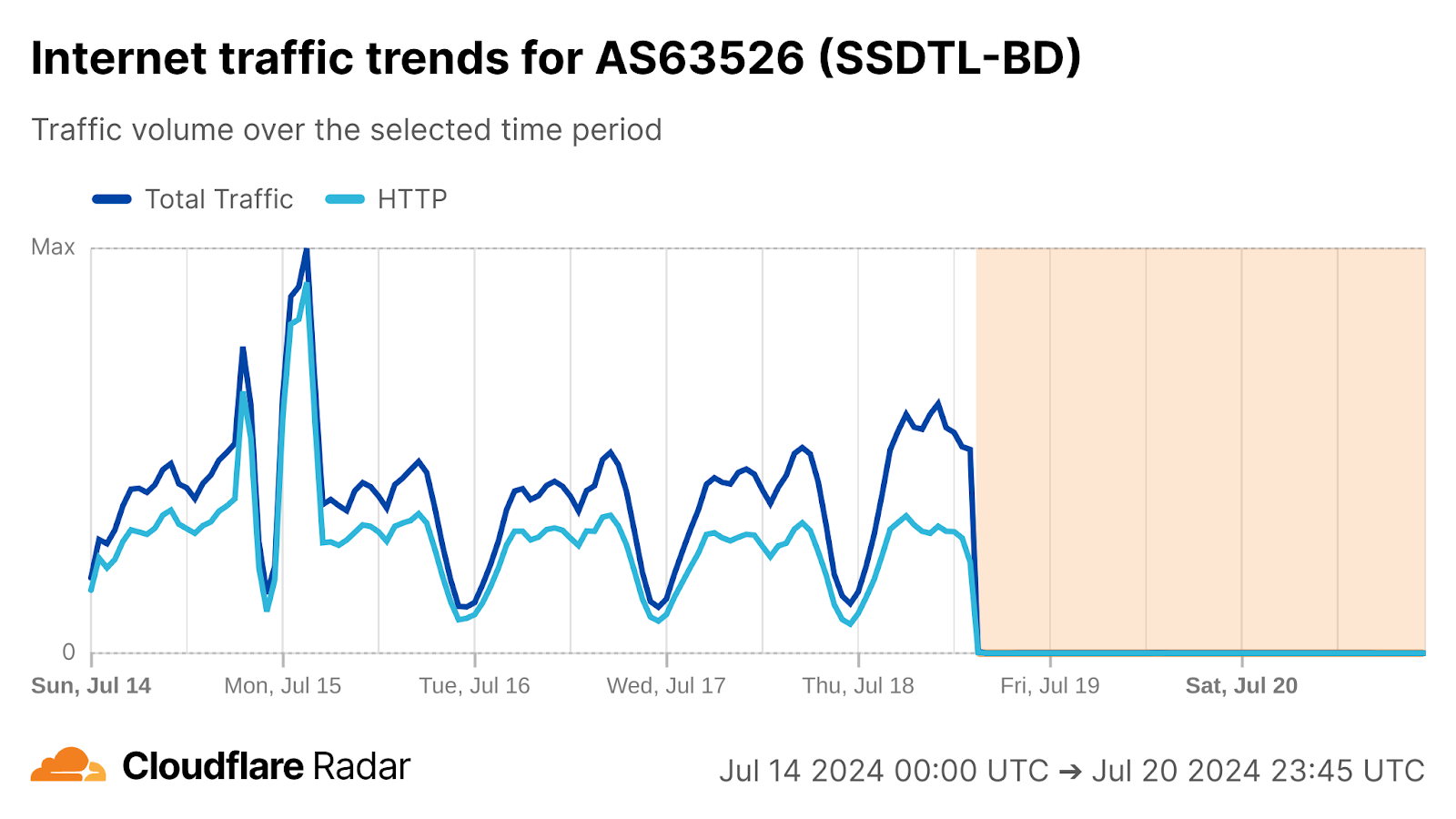
AS63526 (Carnival Internet) was one of the last to fall before the complete shutdown, losing traffic at 20:45 local time (14:45 UTC), and seeing all of its announced IP address space withdrawn over the following hour.

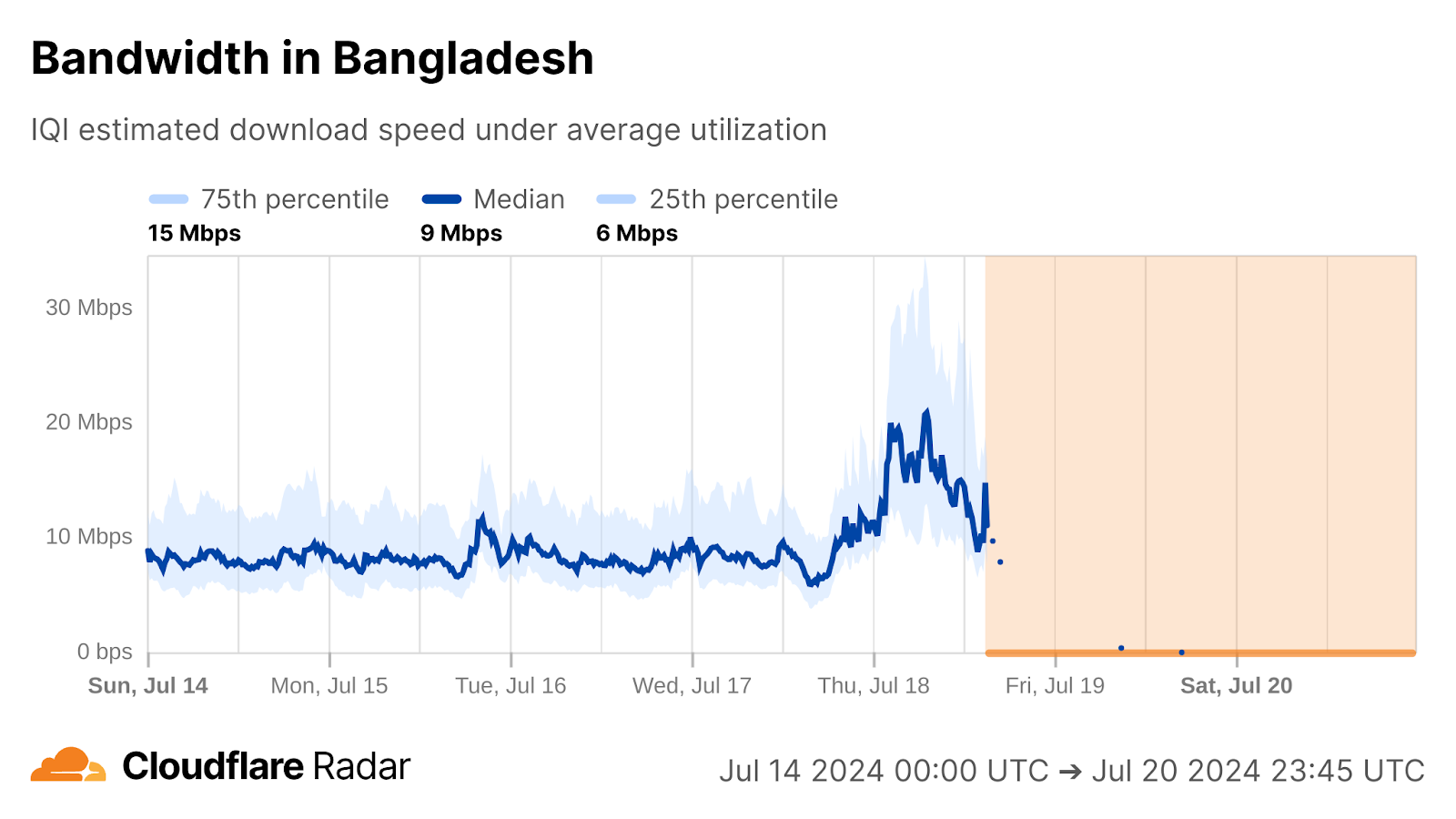
In the days before the shutdown, both median bandwidth and latency at a country level for Bangladesh were fairly stable. However, Cloudflare Radar’s Internet Quality measurements at a country level show a clear increase in median bandwidth and a concurrent drop in median latency, both likely due to the loss of measurements from mobile network providers as they disconnected from the Internet.

Five days after the full Internet shutdown started, broadband Internet services providers in Bangladesh began to restore connectivity on July 23. The initial restoration was characterized as a “trial run”, prioritizing banking, commercial sectors, technology firms, exporters, outsourcing providers and media outlets, according to the state minister for post, telecommunication and information technology. Announced IP address space began to increase around 19:00 local time (13:00 UTC), with traffic volumes beginning to trend upwards at that same time, as selected networks reconnected to the Internet.

Looking at the network providers discussed above, traffic on AS63526 (Carnival Internet) and AS58715 (Earth Telecommunication) began to increase around 06:00 local time (00:00 UTC) on July 27, with these providers apparently included in a later phase of broadband restoration. However, traffic on mobile providers did not begin to recover until around 15:00 local time (09:00 UTC) on July 28, with AS24389 (Grameenphone), AS45245 (Banglalink), and AS24432 (Robi Axiata), all seeing traffic starting to grow significantly at or slightly after that time.

Syria

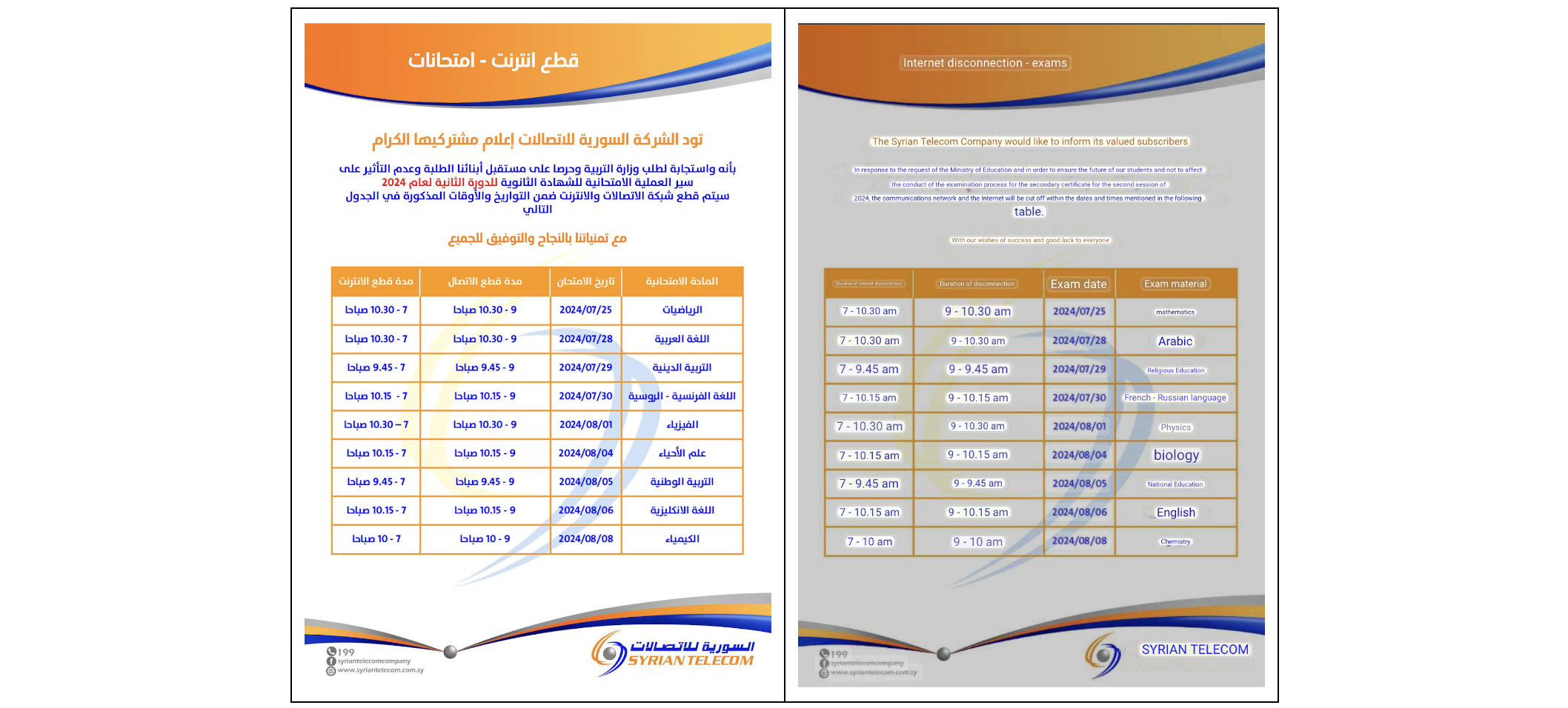
Unfortunately, Syria is no stranger to Internet shutdowns, as they occur yearly during nationwide exams, implemented with the intent of preventing cheating on those exams. Our recent blog post titled Exam-ining recent Internet shutdowns in Syria, Iraq, and Algeria examined the first round of 2024 exams, which took place between May 26 and June 13. A second round of exams, and with them, multi-hour Internet shutdowns, began on July 25, and seen in the schedules below, published by Syrian Telecom on its Facebook page (English translation via Google Lens).

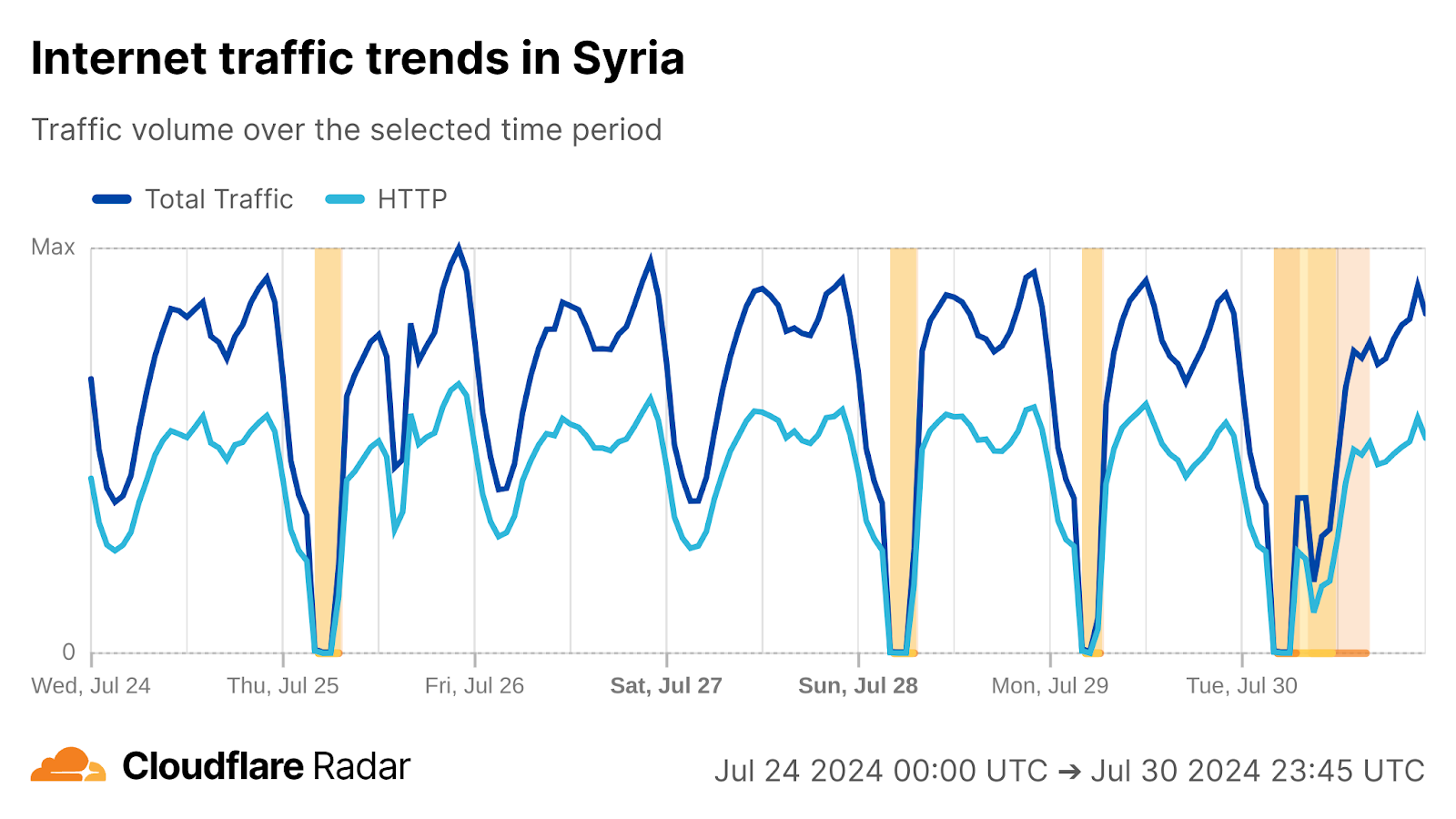
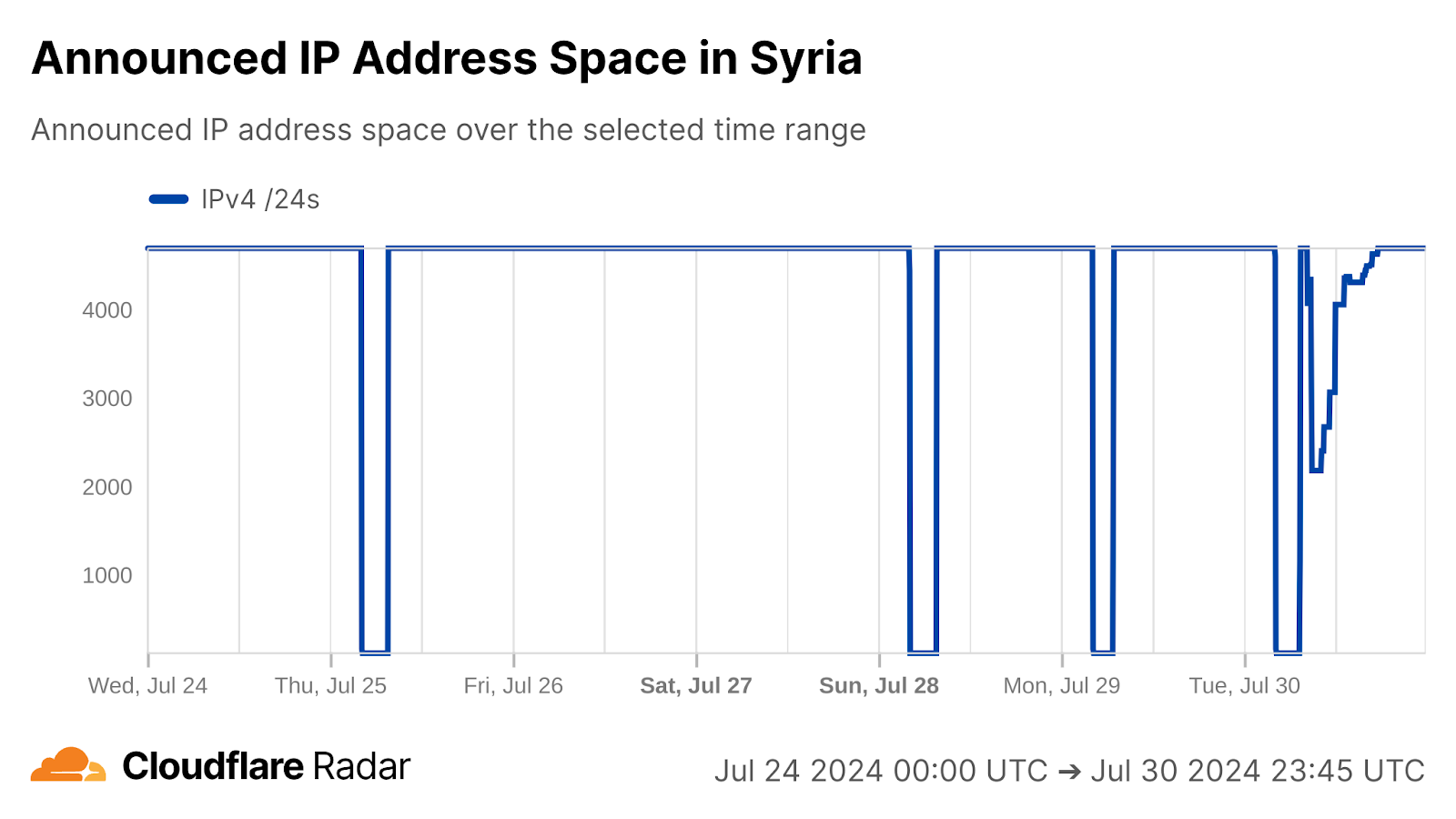
The Internet shutdowns implemented for the first four days of tests are clearly visible in the graph below, occurring on July 25, 28, 29, and 30.

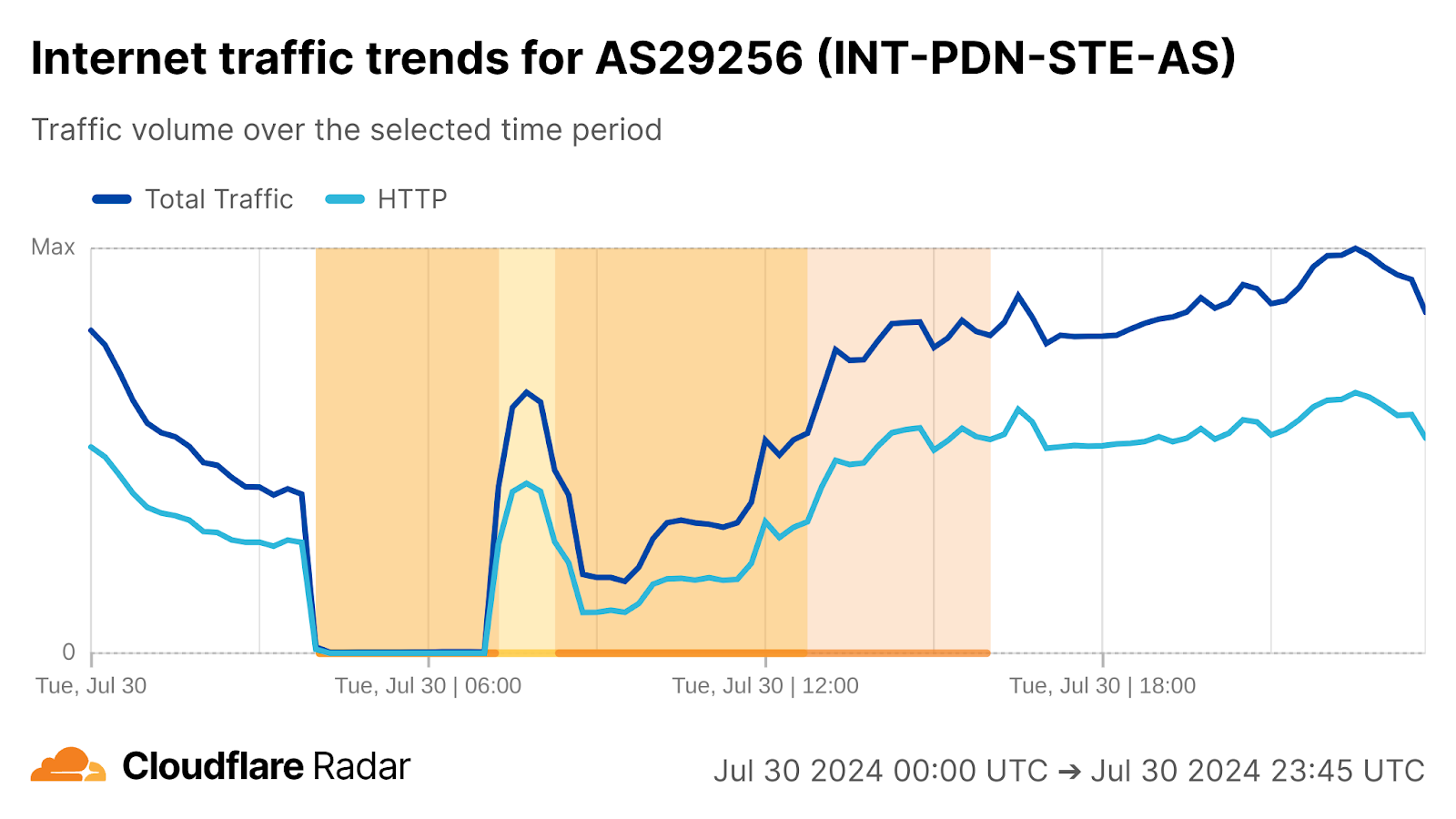
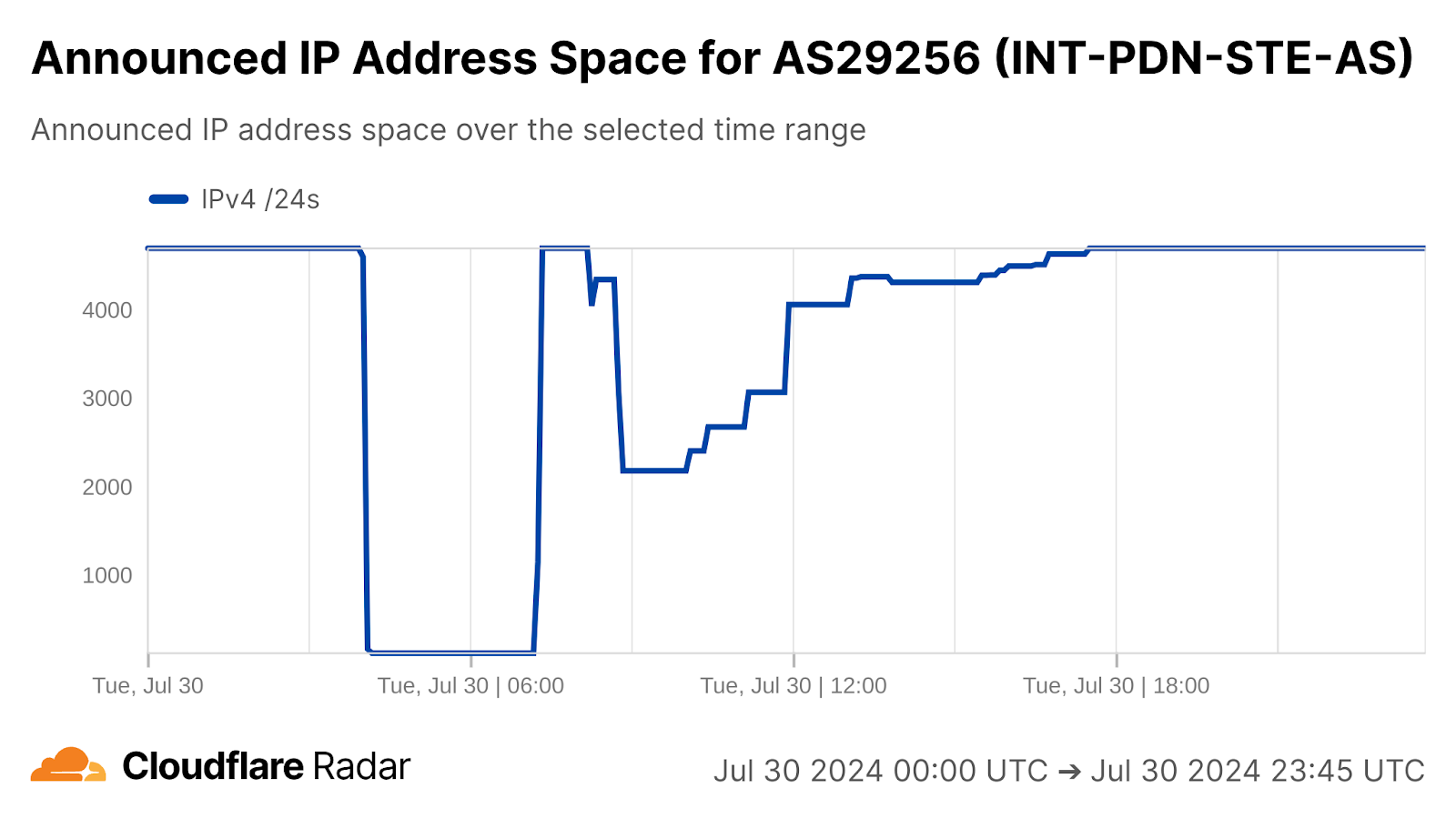
However, you will also note another disruption is visible in both Syria’s Internet traffic and announced IP address space shortly after the planned shutdown on July 30. According to a (translated) Facebook post from Syrian Telecom, “while performing regular maintenance on one of the air conditioners located in one of the technical halls [data centers], an explosion occurred, causing the Internet circuits to temporarily go out of service.” This issue resulted in a disruption lasting approximately eight hours, between 11:00 – 19:00 local time (08:00 – 16:00 UTC) seen in both traffic and announced IP address space graphs for AS29256 (Syrian Telecom).

Pakistan

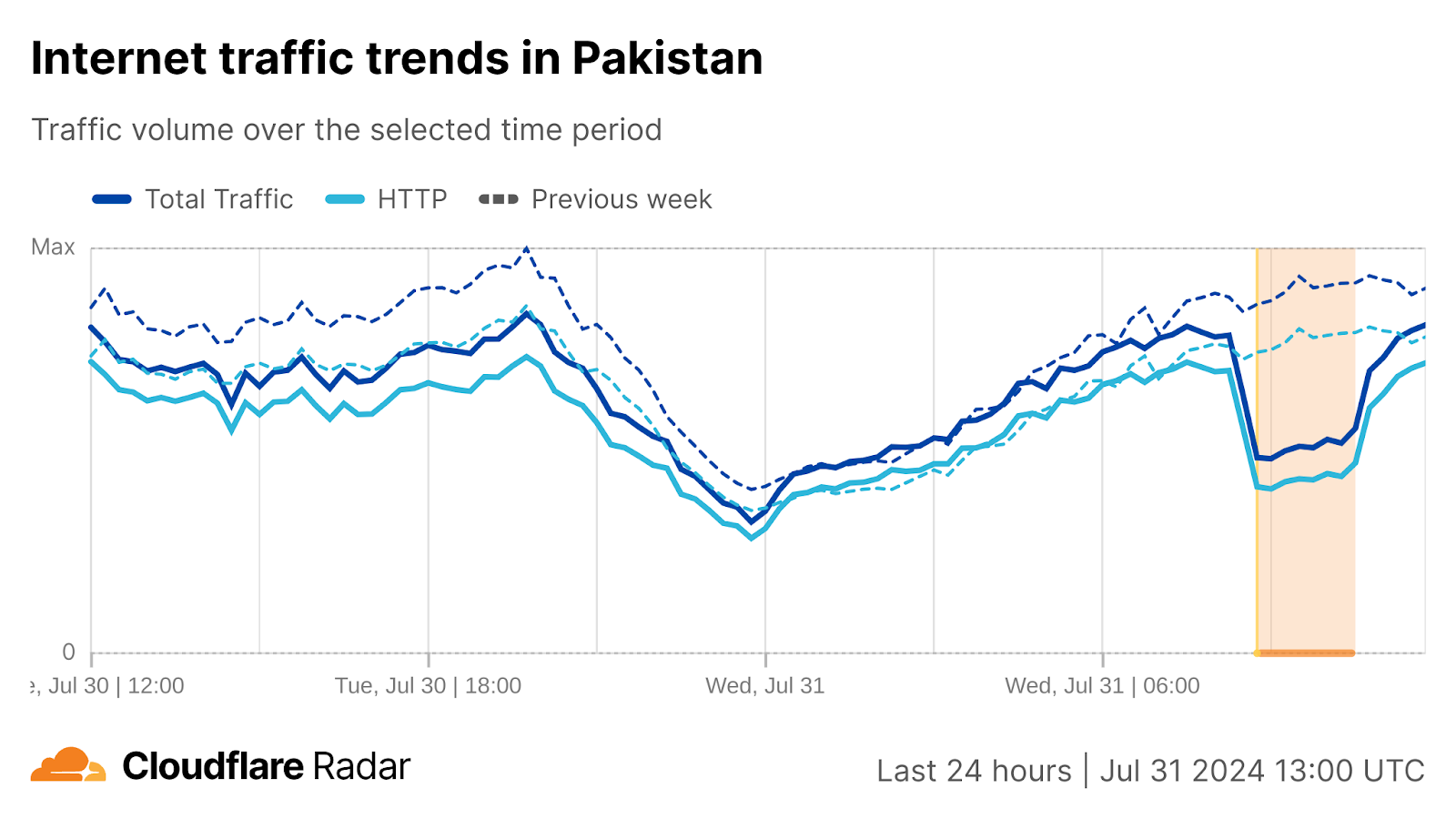
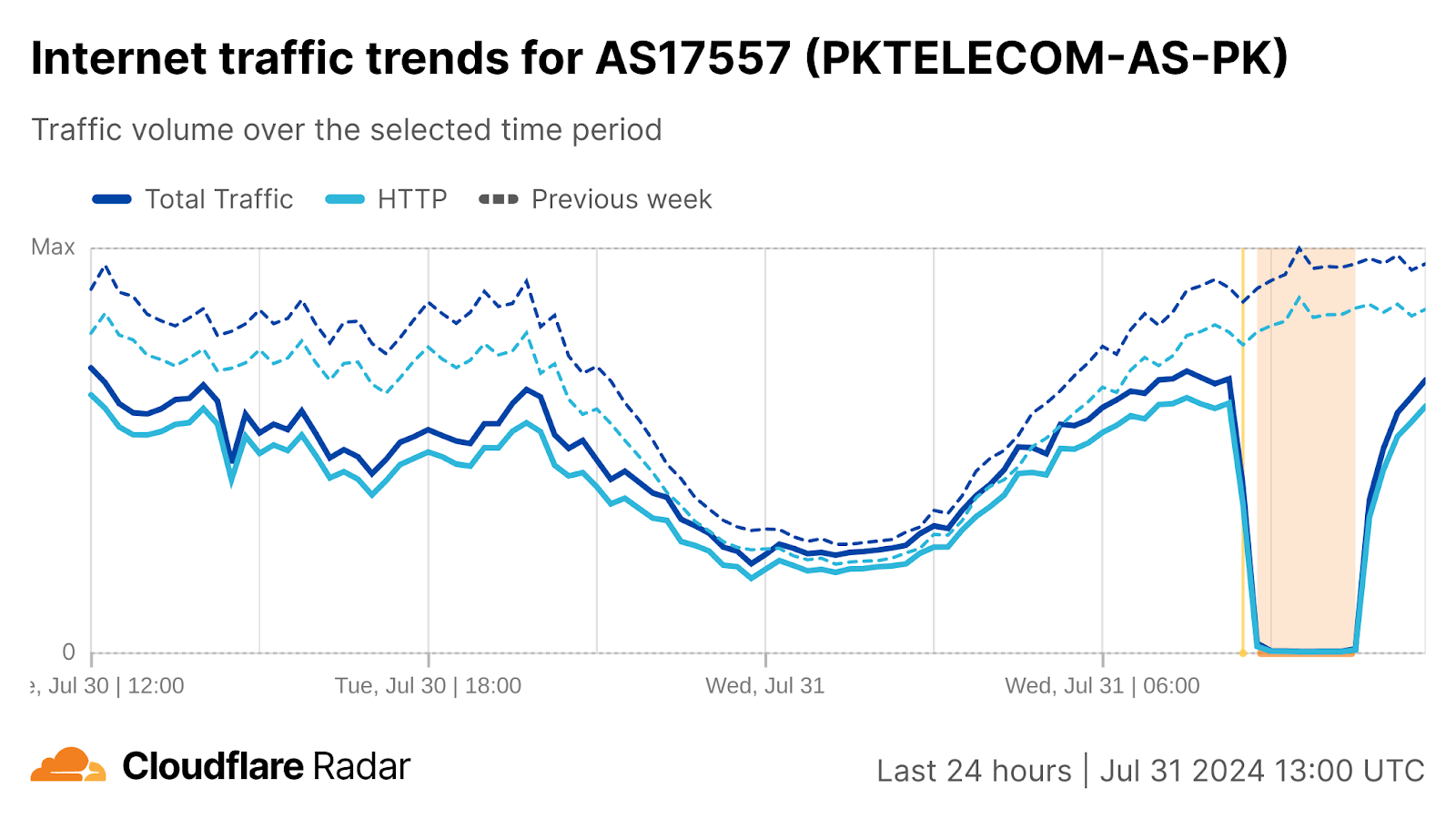
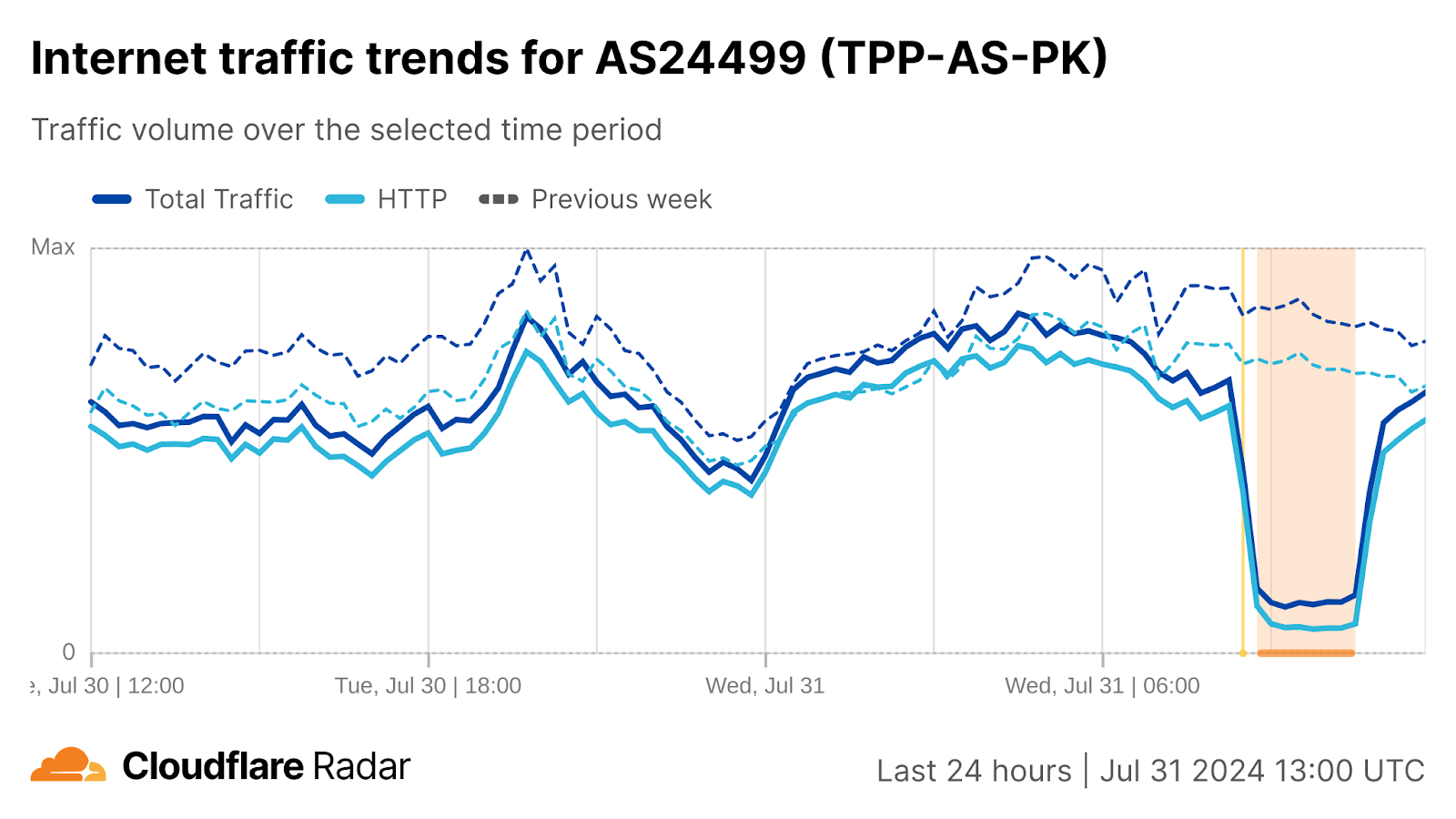
Closing out the month, on July 31, Pakistan experienced a wide-scale Internet disruption that lasted approximately two hours, between 13:30 – 15:30 local time (08:30 – 10:30 UTC). Traffic only dropped ~45% at a country level, but AS17557 (PTCL) experienced a near complete loss of traffic, while traffic at AS24499 (Telenor Pakistan) dropped nearly 90%. Together, the two network providers serve an estimated nine million users, and are among the top five Internet service providers in the country.

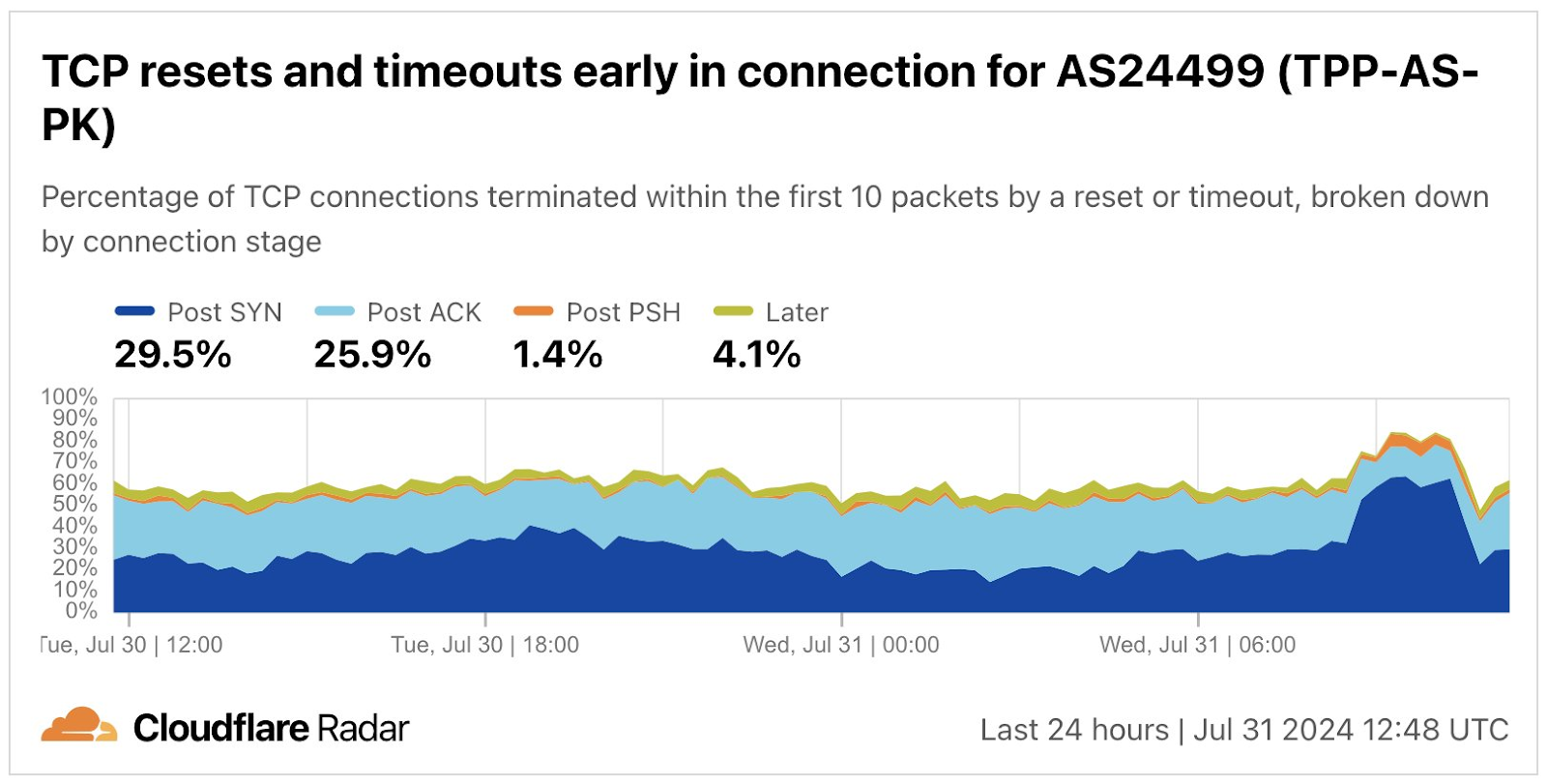
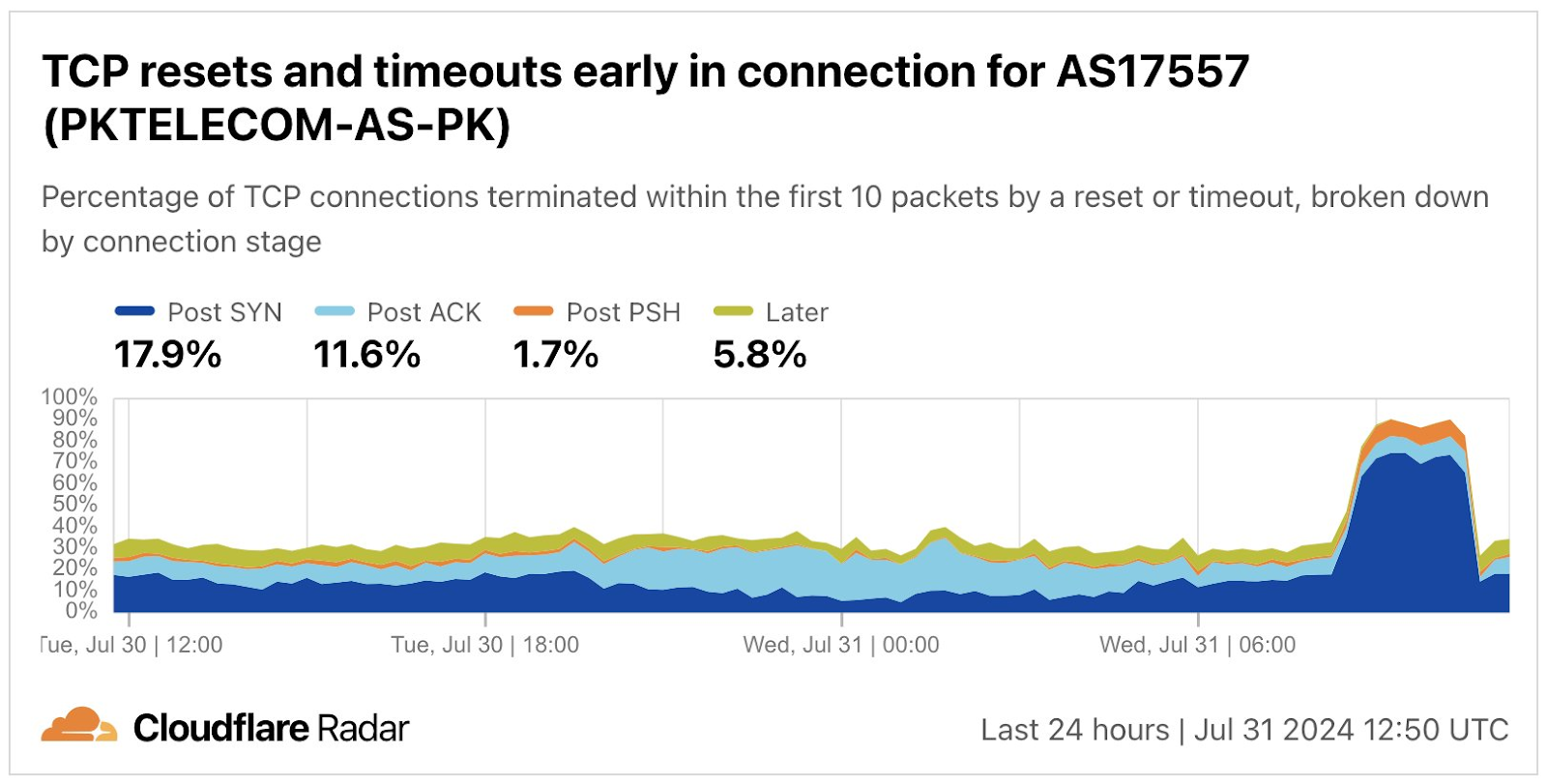
It was reported that the Pakistan Telecommunication Authority (PTA) attributed the disruptions to a technical glitch in the international submarine cable affecting the Pakistan Telecommunication Company Limited (PTCL) network. However, another published report noted “According to our sources, the government’s latest firewall edition to block the content was misconfigured, resulting in Internet connectivity disruption.” (Some additional information about the firewall can be found in this article.) The graphs below are from forthcoming TCP reset/timeout data on Cloudflare Radar, and show increased numbers of connections terminating immediately after the initial synchronization (SYN) packet used to establish new TCP connections (“Post SYN”) between 13:30 – 15:30 local time (08:30 – 10:30 UTC) on PTCL and Telenor Pakistan, coincident with the observed disruption. In other words, the rate of SYN packets arriving at Cloudflare was mostly consistent during the disruption, but there was a drop in other TCP packets, suggesting that the firewall explanation may be plausible. A Facebook post from the Pakistan Telecommunication Authority (PTA) simply highlighted that the issue had been resolved, and that “The exact issue is being investigated by PTA to avoid such instances in future.

Regardless of the actual cause, the disruption had a clear impact on the country’s financial markets, with a published report stating “The KSE-100 index suffered a sharp decline on Wednesday, plummeting over 740 points in the final hour of trading amid a nationwide internet outage. Analysts attributed the sudden drop to panic selling as investors struggled with limited market data.”

Venezuela

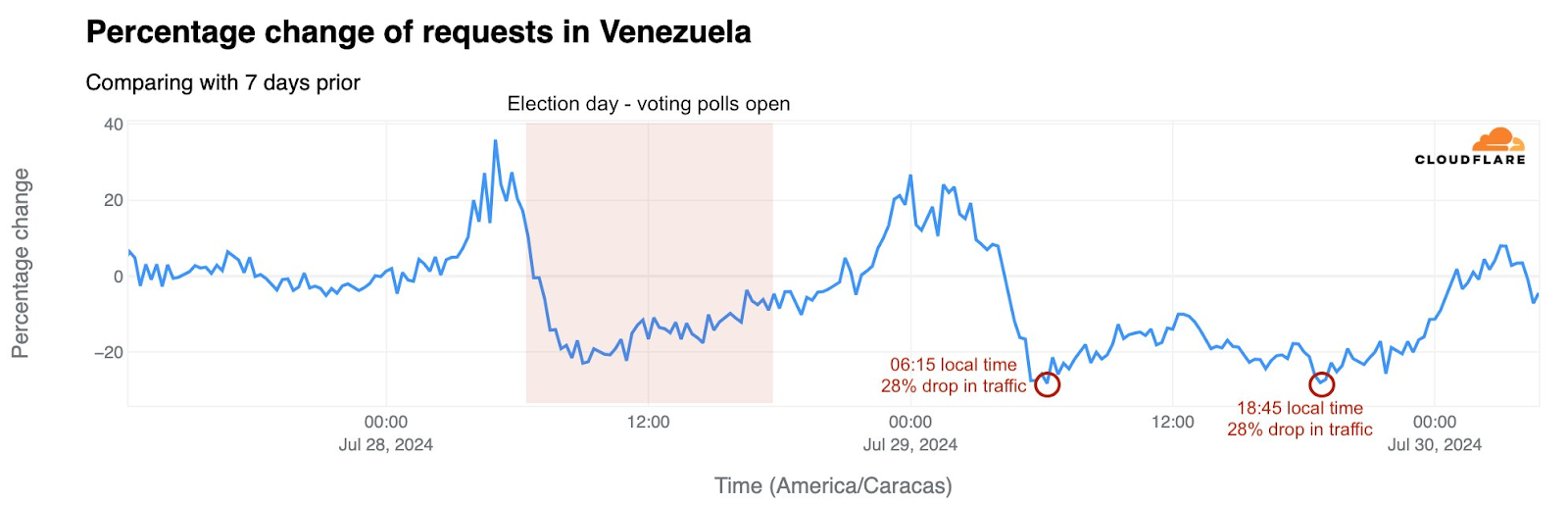
In the past, some countries have implemented government-directed Internet shutdowns as a means of limiting communication about or organizing of protests and demonstrations associated with contested elections. Although such protests and demonstrations sprang up in the wake of a contested presidential election in Venezuela that took place on July 28, Internet shutdowns did not follow. However, in monitoring Internet traffic in Venezuela during the days around the election, the Cloudflare Radar team did observe several notable drops in traffic, as compared to the same times the week prior. After surging 35% at 05:00 local time (09:00 UTC) on Sunday, July 28 (election day), traffic dropped after the polls opened, down by as much as 23% at 09:00 local time (13:00 UTC). On July 29, the day following the election, traffic was as much as 28% lower than the same time the previous week at 06:15 local time (10:15 UTC) and 18:45 local time (22:45 UTC).

And while the observed drops in traffic appeared to be organic, and not caused by an Internet shutdown, it is worth noting that multiple websites are being blocked in Venezuela. An Internet Society Pulse blog post, published two days ahead of the election, reports that “Around 60 websites are currently blocked in Venezuela, including eight media sites and three that fact-check news and misinformation.”, citing data from the Open Observatory of Network Interference (OONI).

Conclusion

Visit Cloudflare Radar for additional insights around Internet disruptions, routing issues, Internet traffic trends, security and attacks, and Internet quality. Follow us on social media at @CloudflareRadar (X), noc.social/@cloudflareradar (Mastodon), and radar.cloudflare.com (Bluesky), or contact us via email.

[$] Maximal min() and max()

Post Syndicated from corbet original https://lwn.net/Articles/983965/

Like many projects written in C, the kernel makes extensive use of the C
preprocessor; indeed, the kernel’s use is rather more extensive than most.
The preprocessor famously has a number of sharp edges associated with it.
One might not normally think of increased compilation time as one of them,
though. It turns out that some changes to a couple of conceptually simple
preprocessor macros — min() and max() — led to some truly
pathological, but hidden, behavior where those macros were used.

A recent spate of Internet disruptions

Post Syndicated from David Belson original https://blog.cloudflare.com/a-recent-spate-of-internet-disruptions-july-2024


Cloudflare Radar is constantly monitoring the Internet for widespread disruptions. In mid-July, we published our Q2 2024 Internet Disruption Summary, and here we examine recent several noteworthy disruptions detected in the first month of Q3, including traffic anomalies observed in Bangladesh, Syria, Pakistan, and Venezuela.

Bangladesh

Violent student protests in Bangladesh against quotas in government jobs and rising unemployment rates led the government to order the nationwide shutdown of mobile Internet connectivity on July 18, reportedly to “ensure the security of citizens.” This government-directed shutdown ultimately became a near-complete Internet outage for the country, as broadband networks were taken offline as well. At a country level, Internet traffic in Bangladesh dropped to near zero just before 21:00 local time (15:00 UTC). Announced IP address space from the country dropped to near zero at that time as well, meaning that nearly every network in the country was disconnected from the Internet.

However, ahead of this nationwide shutdown, we observed outages across several Bangladeshi network providers, perhaps foreshadowing what was to come. At AS24389 (Grameenphone), a complete Internet outage started at 01:30 local time on July 18 (19:30 UTC on July 17), with a total loss of both Internet traffic and announced IP address space.

The outage at AS25245 (Banglalink) started at 02:15 local time on July 18 (20:15 UTC on July 17) as both Internet traffic and announced IP address space dropped to zero.

At AS24432 (Robi Axiata), an Internet outage was observed starting around 06:30 local time on July 18 (00:30 UTC), with both Internet traffic and announced IP address space disappearing at that time.

Internet traffic at AS58715 (Earth Telecommunication) began to fall at 18:00 local time on July 18 (12:00 UTC), reaching zero four hours later. Announced IP address space began to fall at 21:00 local time (15:00 UTC), and was completely gone by 21:25 local time (15:00 UTC).

AS63526 (Carnival Internet) was one of the last to fall before the complete shutdown, losing traffic at 20:45 local time (14:45 UTC), and seeing all of its announced IP address space withdrawn over the following hour.

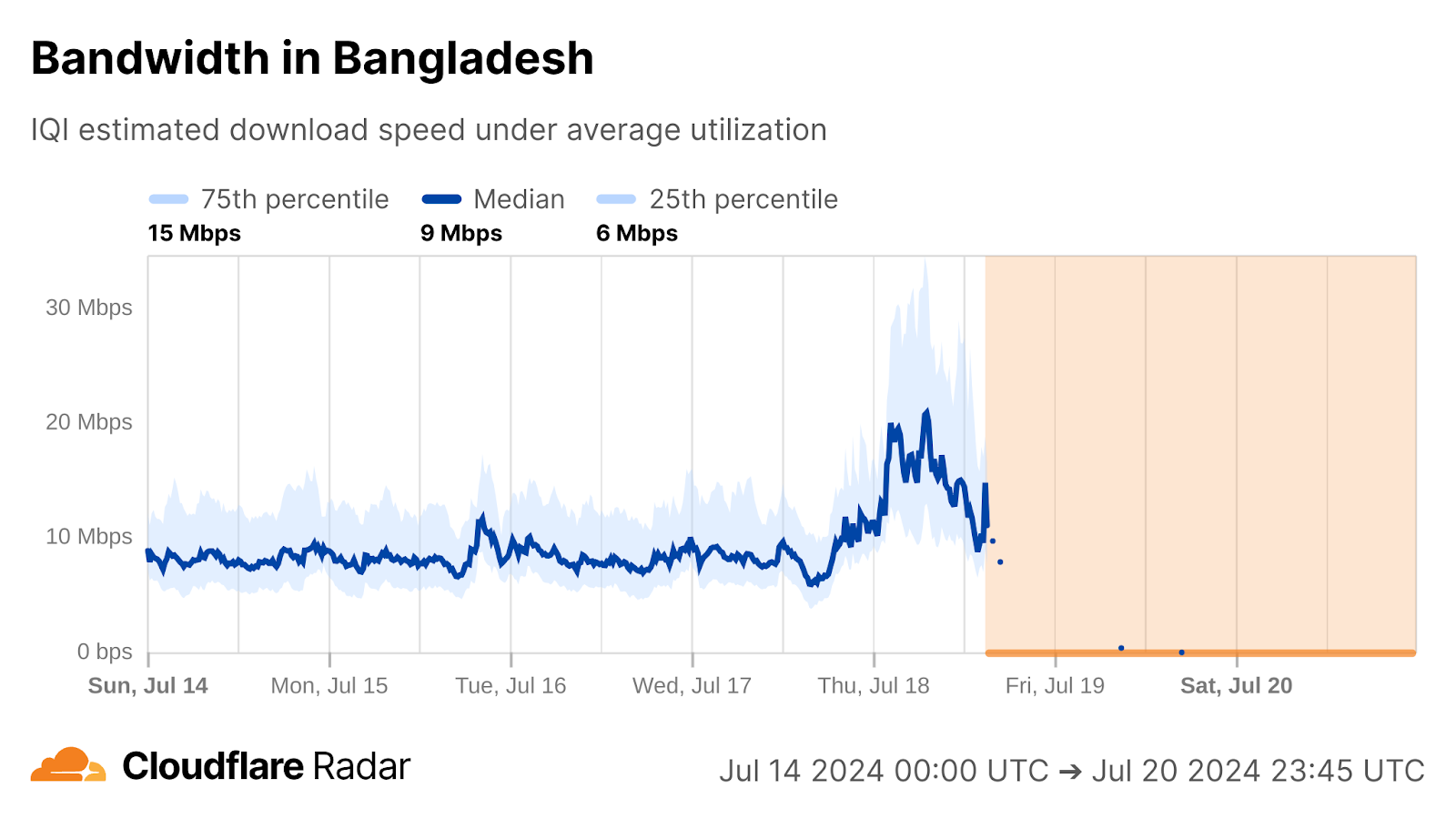
In the days before the shutdown, both median bandwidth and latency at a country level for Bangladesh were fairly stable. However, Cloudflare Radar’s Internet Quality measurements at a country level show a clear increase in median bandwidth and a concurrent drop in median latency, both likely due to the loss of measurements from mobile network providers as they disconnected from the Internet.

Five days after the full Internet shutdown started, broadband Internet services providers in Bangladesh began to restore connectivity on July 23. The initial restoration was characterized as a “trial run”, prioritizing banking, commercial sectors, technology firms, exporters, outsourcing providers and media outlets, according to the state minister for post, telecommunication and information technology. Announced IP address space began to increase around 19:00 local time (13:00 UTC), with traffic volumes beginning to trend upwards at that same time, as selected networks reconnected to the Internet.

Looking at the network providers discussed above, traffic on AS63526 (Carnival Internet) and AS58715 (Earth Telecommunication) began to increase around 06:00 local time (00:00 UTC) on July 27, with these providers apparently included in a later phase of broadband restoration. However, traffic on mobile providers did not begin to recover until around 15:00 local time (09:00 UTC) on July 28, with AS24389 (Grameenphone), AS45245 (Banglalink), and AS24432 (Robi Axiata), all seeing traffic starting to grow significantly at or slightly after that time.

Syria

Unfortunately, Syria is no stranger to Internet shutdowns, as they occur yearly during nationwide exams, implemented with the intent of preventing cheating on those exams. Our recent blog post titled Exam-ining recent Internet shutdowns in Syria, Iraq, and Algeria examined the first round of 2024 exams, which took place between May 26 and June 13.

A second round of exams, and with them, multi-hour Internet shutdowns, began on July 25, and seen in the schedules below, published by Syrian Telecom on its Facebook page (English translation via Google Lens).

The Internet shutdowns implemented for the first four days of tests are clearly visible in the graph below, occurring on July 25, 28, 29, and 30.

However, you will also note another disruption is visible in both Syria’s Internet traffic and announced IP address space shortly after the planned shutdown on July 30. According to a (translated) Facebook post from Syrian Telecom, “while performing regular maintenance on one of the air conditioners located in one of the technical halls [data centers], an explosion occurred, causing the Internet circuits to temporarily go out of service.” This issue resulted in a disruption lasting approximately eight hours, between 11:00 – 19:00 local time (08:00 – 16:00 UTC) seen in both traffic and announced IP address space graphs for AS29256 (Syrian Telecom).

Pakistan

Closing out the month, on July 31, Pakistan experienced a wide-scale Internet disruption that lasted approximately two hours, between 13:30 – 15:30 local time (08:30 – 10:30 UTC). Traffic only dropped ~45% at a country level, but AS17557 (PTCL) experienced a near complete loss of traffic, while traffic at AS24499 (Telenor Pakistan) dropped nearly 90%. Together, the two network providers serve an estimated nine million users, and are among the top five Internet service providers in the country.

It was reported that the Pakistan Telecommunication Authority (PTA) attributed the disruptions to a technical glitch in the international submarine cable affecting the Pakistan Telecommunication Company Limited (PTCL) network. However, another published report noted “According to our sources, the government’s latest firewall edition to block the content was misconfigured, resulting in Internet connectivity disruption.” (Some additional information about the firewall can be found in this article.) The graphs below are from forthcoming TCP reset/timeout data on Cloudflare Radar, and show increased numbers of connections terminating immediately after the initial synchronization (SYN) packet used to establish new TCP connections (“Post SYN”) between 13:30 – 15:30 local time (08:30 – 10:30 UTC) on PTCL and Telenor Pakistan, coincident with the observed disruption. In other words, the rate of SYN packets arriving at Cloudflare was mostly consistent during the disruption, but there was a drop in other TCP packets, suggesting that the firewall explanation may be plausible.

A Facebook post from the Pakistan Telecommunication Authority (PTA) simply highlighted that the issue had been resolved, and that “The exact issue is being investigated by PTA to avoid such instances in future.

Regardless of the actual cause, the disruption had a clear impact on the country’s financial markets, with a published report stating “The KSE-100 index suffered a sharp decline on Wednesday, plummeting over 740 points in the final hour of trading amid a nationwide internet outage. Analysts attributed the sudden drop to panic selling as investors struggled with limited market data.”

Venezuela

In the past, some countries have implemented government-directed Internet shutdowns as a means of limiting communication about or organizing of protests and demonstrations associated with contested elections. Although such protests and demonstrations sprang up in the wake of a contested presidential election in Venezuela that took place on July 28, Internet shutdowns did not follow. However, in monitoring Internet traffic in Venezuela during the days around the election, the Cloudflare Radar team did observe several notable drops in traffic, as compared to the same times the week prior.

After surging 35% at 05:00 local time (09:00 UTC) on Sunday, July 28 (election day), traffic dropped after the polls opened, down by as much as 23% at 09:00 local time (13:00 UTC). On July 29, the day following the election, traffic was as much as 28% lower than the same time the previous week at 06:15 local time (10:15 UTC) and 18:45 local time (22:45 UTC).

And while the observed drops in traffic appeared to be organic, and not caused by an Internet shutdown, it is worth noting that multiple websites are being blocked in Venezuela. An Internet Society Pulse blog post, published two days ahead of the election, reports that “Around 60 websites are currently blocked in Venezuela, including eight media sites and three that fact-check news and misinformation.”, citing data from the Open Observatory of Network Interference (OONI).

Conclusion

Visit Cloudflare Radar for additional insights around Internet disruptions, routing issues, Internet traffic trends, security and attacks, and Internet quality. Follow us on social media at @CloudflareRadar (X), noc.social/@cloudflareradar (Mastodon), and radar.cloudflare.com (Bluesky), or contact us via email.

Mel Chua RIP

Post Syndicated from jzb original https://lwn.net/Articles/984213/

We have received the
sad news
that Dr. Mel Chua has passed away. Mel was probably best
known in the free-software community as a contributor to the Fedora
Project in its early days. The Fedora Community blog honored
Mel
recently after she had moved to hospice care with tributes
from several Fedorans. Stephen Jacobs wrote:

I can’t find the words to express how much of a positive impact Mel
has had on my work, our shared work, my family, the experiences of my
students, and the world of FOSS writ large. Nor can I find the words
to convey just how much I will miss her.

Mel will be greatly missed.

New Cloud Risk Dashboard: Identifying Toxic Combinations to Drive Faster Remediation

Post Syndicated from Pauline Logan original https://blog.rapid7.com/2024/08/01/new-cloud-risk-dashboard-identifying-toxic-combinations-to-drive-faster-remediation/

New Cloud Risk Dashboard: Identifying Toxic Combinations to Drive Faster Remediation

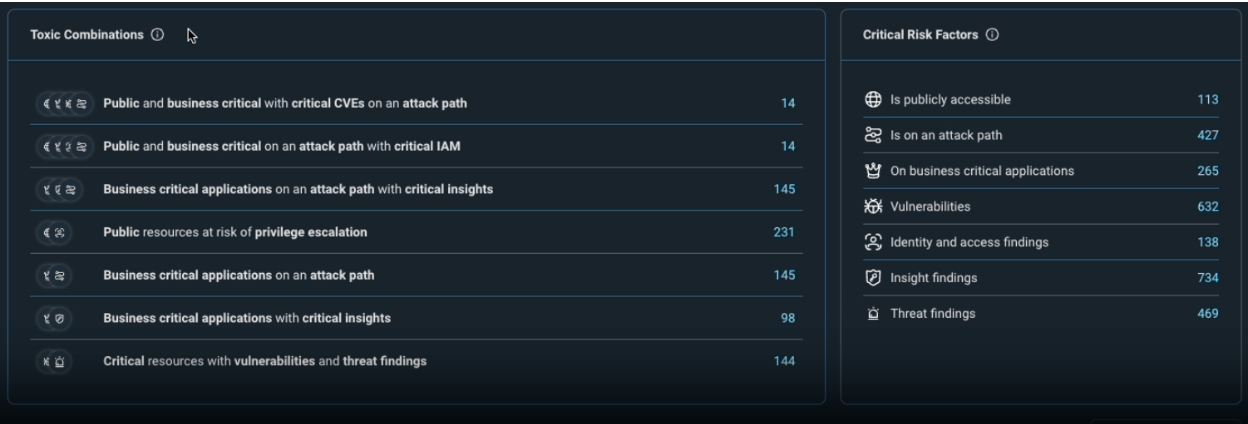
Risks identified within a cloud environment compound to represent a real threat of exploitation. Our cloud risk scoring, introduced recently to insightCloudSec, focuses on these toxic combinations. Toxic combinations are attractive for bad actors who can target multiple weaknesses to gain access. Building on our cloud risk scoring, we have introduced a new dashboard to give users a clear view of their cloud risk, driving prioritization and quick remediation of the most critical risks.

Toxic Combinations represent multiple weakness and are a target for exploit

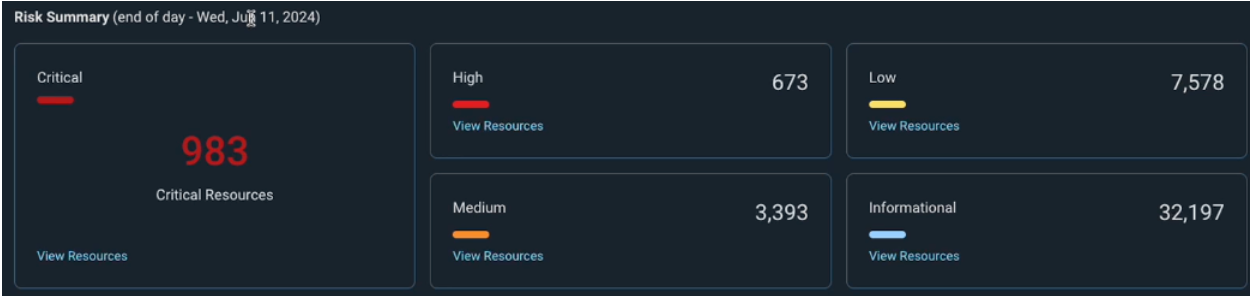
The dashboard provides an immediate overview of the level of risk that exists, with a breakdown of the number of resources at each risk level.

New Cloud Risk Dashboard: Identifying Toxic Combinations to Drive Faster Remediation

Resources with multiple risk factors – the toxic combinations of risk are identified. From here the analyst can go directly to a filtered view of Layered Context, where details of the resource and all identified risks are displayed alongside remediation guidance and automation that can be run immediately to address the most critical risks. This feature takes security teams from visibility and prioritization to remediating the riskiest findings within minutes.

New Cloud Risk Dashboard: Identifying Toxic Combinations to Drive Faster Remediation

CVEs remain a critical risk

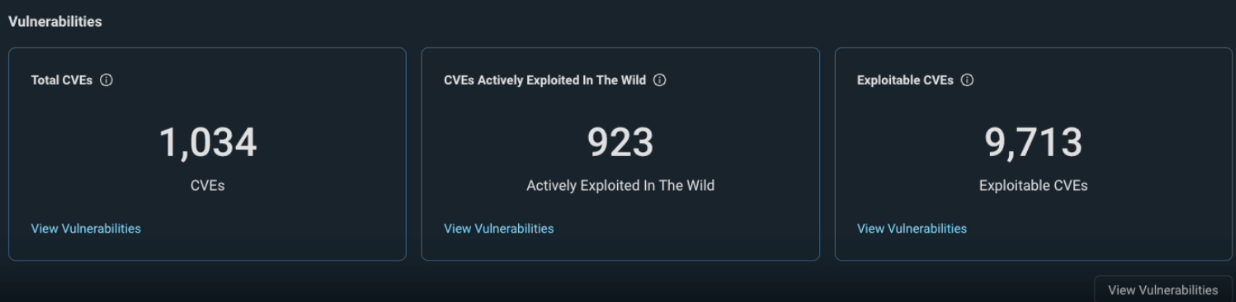
Exploitable vulnerabilities remain a top concern for CISOs.  The Rapid7 2024 Attack Intelligence Report gives insight into the decreasing time taken for vulnerabilities to be exploited, with 53% of vulnerabilities throughout 2024 getting exploited before software patches were available.  The new dashboard displays the total number of vulnerabilities across the cloud environment that are actively exploited in the wild and the total number of CVEs with known exploits, giving security teams the visibility to assess the level of risk introduced by exploitable vulnerabilities.

New Cloud Risk Dashboard: Identifying Toxic Combinations to Drive Faster Remediation

From these data points, with one click, analysts can review the impacted resources, the attack path and blast radius, and also remediation guidance, allowing them to remove these risky vulnerabilities from their cloud environment.

From Prioritization to Remediation

We have lots of updates coming over the next few months that will continue to build on our prioritization features and help our customers remediate faster.  Drop by our stand at Black Hat to get a demo of one of our upcoming features that will enable your team to implement  the solutions that will have the biggest impact on removing risk in your cloud and on-prem environments.

AWS completes the first GDV joint audit with participant insurers in Germany

Post Syndicated from Servet Gözel original https://aws.amazon.com/blogs/security/aws-completes-the-first-gdv-joint-audit-with-participant-insurers-in-germany/

We’re excited to announce that Amazon Web Services (AWS) has completed its first German Insurance Association (GDV) joint audit with GDV participant members, which provides assurance to customers in the German insurance industry for the security of their workloads on AWS. This is an important addition to the joint audits performed at AWS by our regulated customers within the financial services industry. Joint audits are an efficient method to provide additional assurance to a group of customers on the “security of the cloud” (as described in the AWS Shared Responsibility Model), in addition to Compliance Programs (for example, C5) and resources that are provided to customers on AWS Artifact.

At AWS, security is our top priority. As customers embrace the scalability and flexibility of AWS, we’re helping them evolve security and compliance into key business enablers. We’re obsessed with earning and maintaining customer trust, and we provide our financial services customers, their end users, and regulatory bodies with the assurance that AWS has the necessary controls in place to help protect their most sensitive material and regulated workloads.

With the increasing digitalization of the financial services industry, and the importance of cloud computing as a key enabling technology for digitalization, security and governance is becoming an ever-more-significant priority for financial services companies. Our engagement with GDV members is an example of how AWS supports customers’ risk management and regulatory compliance. For the first time, this joint audit meticulously assessed the AWS controls that enable us to help protect customers’ workloads, while adhering to strict regulatory obligations. For insurers, moving their workloads to AWS helps protect customer data, support continuity of business-critical operations, and meet new standards in regulatory reporting.

GDV is the association of private insurers in Germany, representing around 470 members in the industry, and is a key player within the German and European financial services industries. GDV’s members participating in this joint audit have reached out to AWS to exercise their audit rights. For this cycle, the 35 participating members from the German insurance industry decided to appoint the Deutsche Cyber-Sicherheitsorganisation GmbH (DCSO) as the single external audit service provider, to perform the audit on behalf of each of the participating members. Because many participating members are affiliates of larger insurance groups and the audit report can be used throughout the group, a coverage of over 70% of the German market in terms of revenue is achieved.

Audit preparations

The scope of the audit was defined with reference to the Federal Office for Information Security (BSI) C5 Framework. It included key domains such as identity and access management, as well as AWS services such as Amazon Elastic Compute Cloud (Amazon EC2), and Regions relevant to participant members such as the Europe (Frankfurt) Region (eu-central-1).

Audit fieldwork

This audit fieldwork phase started after a kick-off in Berlin, Germany. It used a remote approach, with work occurring through the use of videoconferencing and through a secure audit portal for the inspection of evidence. Auditors assessed AWS policies, procedures, and controls, following a risk-based approach, and using sampled evidence, deep-dive sessions and follow-up questions to clarify provided evidence. In the DCSO’s own words regarding their experience during the audit, “We experienced a transparent and comprehensive audit process and appreciate the professional approach as well as the commitment shown by AWS in addressing all our inquiries.”

Audit results

The audit was carried out and completed according to the assessment criteria that were mutually agreed upon by AWS and auditors on behalf of participating members. After a joint review by the auditors and AWS, the auditors finalized the audit report. The results of the GDV joint audit are only available to the participating members and their regulators. The results provide participating members with assurance regarding the AWS controls environment, helping members remove compliance blockers, accelerate their adoption of AWS services, obtain confidence, and gain trust in AWS security controls.

If you have feedback about this post, submit comments in the Comments section below. If you have questions about this post, contact AWS Support.

Servet Gözel

Servet Gözel
Servet is a Principal Audit Program Manager in security assurance at AWS, based in Munich, Germany. Servet leads customer audits and assurance programs across Europe. For the past 19 years, he has worked in IT audit, IT advisory, and information security roles areas across various industries and held the CISO role for a group company under a leading insurance provider in Germany.

Andreas Terwellen

Andreas Terwellen
Andreas is a Senior Manager in security audit assurance at AWS, based in Frankfurt, Germany. His team is responsible for third-party and customer audits, attestations, certifications, and assessments across Europe. Previously, he was a CISO in a DAX-listed telecommunications company in Germany. He also worked for different consulting companies managing large teams and programs across multiple industries and sectors.

Daniele Basriev

Daniele Basriev
Daniele is a Security Audit Program Manager at AWS who manages customer security audits and third-party audit programs across Europe. In the past 19 years, he has worked in a wide array of industries and on numerous control frameworks within complex fast-paced environments. He built his expertise in Big 4 accounting firms and then moved into IT security strategy, IT governance, and compliance roles across multiple industries.

Security updates for Thursday

Post Syndicated from jzb original https://lwn.net/Articles/984212/

Security updates have been issued by Debian (chromium), Fedora (kernel, obs-cef, and xen), Mageia (emacs), Oracle (freeradius, freeradius:3.0, and kernel), Red Hat (emacs, httpd, and kpatch-patch-4_18_0-305_120_1), Slackware (curl), SUSE (apache2, cockpit-wicked, glibc, gnutls, gvfs, less, nghttp2, opensc, python-idna, python-requests, qemu, rpm, tpm2-0-tss, tpm2.0-tools, and unbound), and Ubuntu (clickhouse, exim4, libcommons-collections3-java, linux, linux-aws, linux-kvm, linux-lts-xenial, mysql-8.0, openssl, php-cas, prometheus-alertmanager, and snapd).

Education in Secure Software Development

Post Syndicated from Bruce Schneier original https://www.schneier.com/blog/archives/2024/08/education-in-secure-software-development.html

The Linux Foundation and OpenSSF released a report on the state of education in secure software development.

…many developers lack the essential knowledge and skills to effectively implement secure software development. Survey findings outlined in the report show nearly one-third of all professionals directly involved in development and deployment ­ system operations, software developers, committers, and maintainers ­ self-report feeling unfamiliar with secure software development practices. This is of particular concern as they are the ones at the forefront of creating and maintaining the code that runs a company’s applications and systems.

Celebrating Astro Pi 2024

Post Syndicated from Vicky Fisher original https://www.raspberrypi.org/blog/celebrating-astro-pi-2024/

About the projects

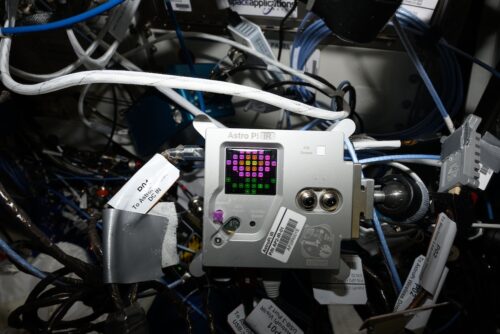
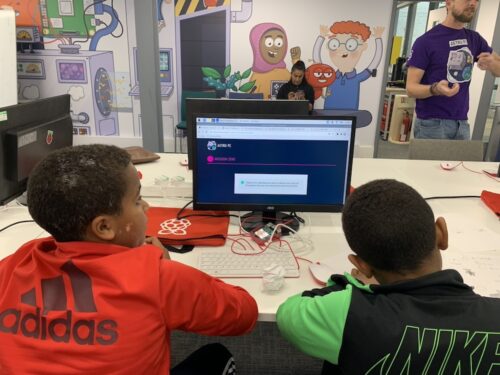
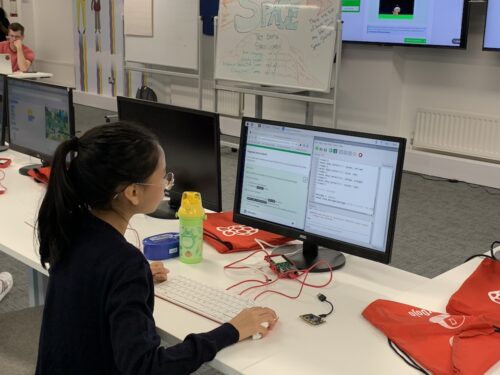
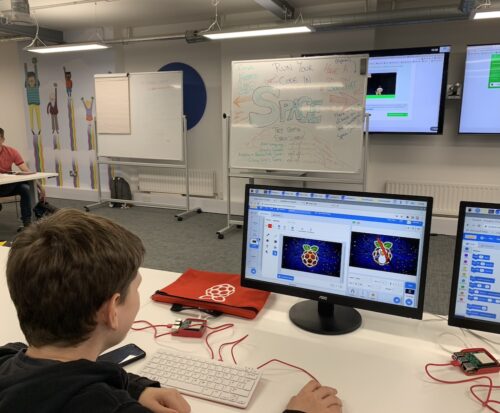
Over the past few months, young people across Europe have run their computer programs  on the International Space Station (ISS) as part of Astro Pi Mission Zero and Mission Space Lab.

Mission Zero code deployment
Mission Zero code deployment | Credits: ESA/NASA

Mission Zero offers young people the chance to write a simple program that takes a reading from the colour and luminosity sensor on an Astro Pi computer on board the ISS, and uses it to set the background colour in a personalised image for the astronauts to see as they go about their daily tasks. In total, 16,039 teams and 24,663 young people participated in Mission Zero this year. This was a 3% increase in teams entering compared to last year.

Mission Space Lab offers teams of young people the chance to run scientific experiments on board the ISS. This year, 564 teams and 2,008 young people participated in Mission Space Lab. Compared with last year, there was a 4% increase in the number of teams who managed to achieve flight status and run their code in space.

Two young people at a computer.

To evaluate the projects, we encouraged mentors to complete surveys once their teams had submitted their computer programs. Overall, 135 Mission Zero mentors (11% of mentors) and 56 Mission Space Lab mentors (15% of mentors) completed surveys. We also ran focus groups with mentors from both projects to understand their experiences and the impact of these projects on young people.

Impact on young people

Understanding how technology is changing the world

The mentors we spoke to told us how valuable Mission Zero and Mission Space Lab are because these experiences connect young people to real technology. Mentors felt that Mission Zero and Mission Space Lab bridge the gap between theoretical coding and tangible outcomes, giving young people the confidence to engage with technology.

“Participating in Mission Space Lab offers students a great opportunity to work with the International Space Station, to see the Earth from above, to challenge them to overcome the terrestrial limits. It’s very important.” — Mission Space Lab mentor

A young person working on a coding project on a computer.

“We want students to use their digital skills as superpowers to make the world a better place and this competition really aligns with that because regardless of your race, your ethnicity, your gender, you can write some code that actually runs in space. And if you can do that, then you can make medical tech, or you can solve the big problem that the adults of the world are still grappling with, so it’s the opening up [of] opportunities.” — Mission Zero mentor

Mentors observed that the project inspired children to consider careers they previously thought were out of reach. Space exploration was no longer a far away and theoretical idea for the children, but something connected to their everyday lives and their own learning.

“Some of the people that I was teaching this to felt like becoming an astronaut was really difficult to learn… now it’s not necessarily a distant thing to study.” — Mission Zero mentor

Mentors also described how the young people gained confidence in their ability to engage with technologies. One mentor described the “self-esteem” and “pride” younger pupils gained from participation. Others talked about the confidence that came with achieving something like having their code run in space and receiving certificates proving they were “space scientists”.

Our mentors

None of this would be possible without the hard work and dedication of our mentors. So, as part of our evaluation, we wanted to understand how we can best support them. For Mission Space Lab, that took the form of assessing the new guidance that we published this year and that sits alongside the project. When we spoke to mentors, they told us this guide provided clear, step-by-step guidance that enabled the young people to work through the project, and the majority of survey respondents agreed: 89% rated the Mission Space Lab project guide as somewhat or very understandable. 

We also heard from mentors about the ways they are using Mission Zero in a wider context. Some told us that their schools ran the project as part of space-themed weeks where they used Mission Zero in conversations about space exploration, the Hubble telescope, and learning the names of the stars. Others used Mission Zero across multiple subjects by designing images and holding art competitions based on the design, as well as learning about pixels and animations. 

A young person at a desk using a computer.

Additionally, it was a pleasure to hear about young people who had participated in Mission Zero in previous years gaining leadership skills by supporting other young people to complete Mission Zero this year.

Next steps

Thank you to all the mentors who provided constructive feedback through surveys and focus groups. We have read and considered every comment and will continue to consider how to improve the experience for mentors and young people. 

We will publish an in-depth report with the findings of our evaluation later in the year; however, we’ve already made some changes to the programme that will be launching for the 2024/25 Astro Pi challenge and wanted to share these updates with you now.

Improvements for next year:

Mission Zero

  • We’re adding a save button to Mission Zero to allow young people to work on this across multiple sessions.
  • We’re adding new code examples to the Mission Zero project guide. These have been selected from team submissions from the 2023/24 challenge.

Mission Space Lab

  • We’re creating an online testing tool for Mission Space Lab so that it will be easier for teams to test whether or not their code works. It will feature new data and images captured from the ISS in spring 2024.

We hope that all the young people and mentors who participated in last year’s Astro Pi challenge enjoyed the experience and learnt a lot. With the exciting updates we’re working on for the 2024/25 Astro Pi challenge, we hope to see even more young people participate and share their creative projects next year.

Project launch dates

  • 16 September 2024: Mission Zero and Mission Space Lab launch
  • 24 February 2025: Mission Space Lab submissions close
  • 24 March 2025: Mission Zero submissions close
  • April – May 2025: Programs run on the International Space Station
  • June 2025: Teams receive certificates 

The post Celebrating Astro Pi 2024 appeared first on Raspberry Pi Foundation.

Пет отровни дела. Порочен кръг и отчаяние

Post Syndicated from original https://www.toest.bg/pet-otrovni-dela-porochen-krug-i-otchayanie/

<< Към предишната част от поредицата

Бях изправен пред абсурден избор – затвор или война,

Пет отровни дела. Порочен кръг и отчаяние

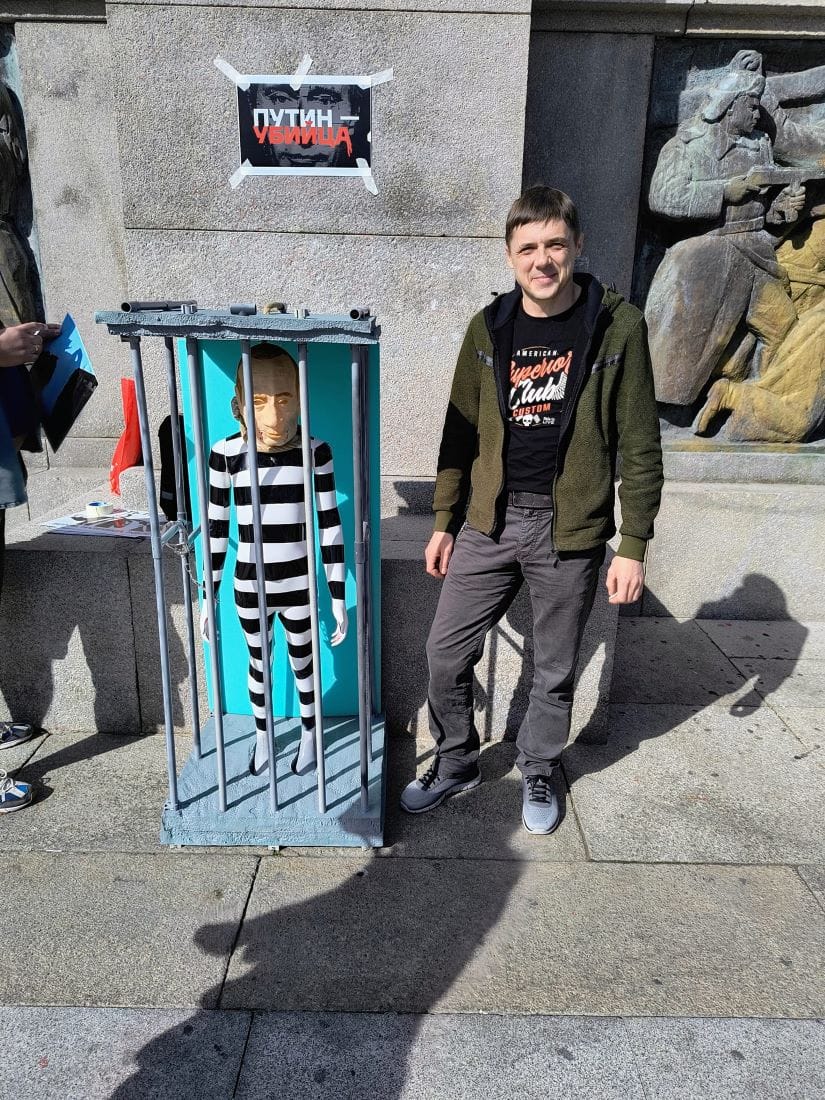
ми каза Андрей Карпов, когато се видяхме за първи път пред Върховния административен съд в София след делото на Александър Стоцки през 2023 г. От началото на войната на Русия срещу Украйна хиляди украински бежанци напуснаха страната си. Но Андрей не е украинец. Руснак е.

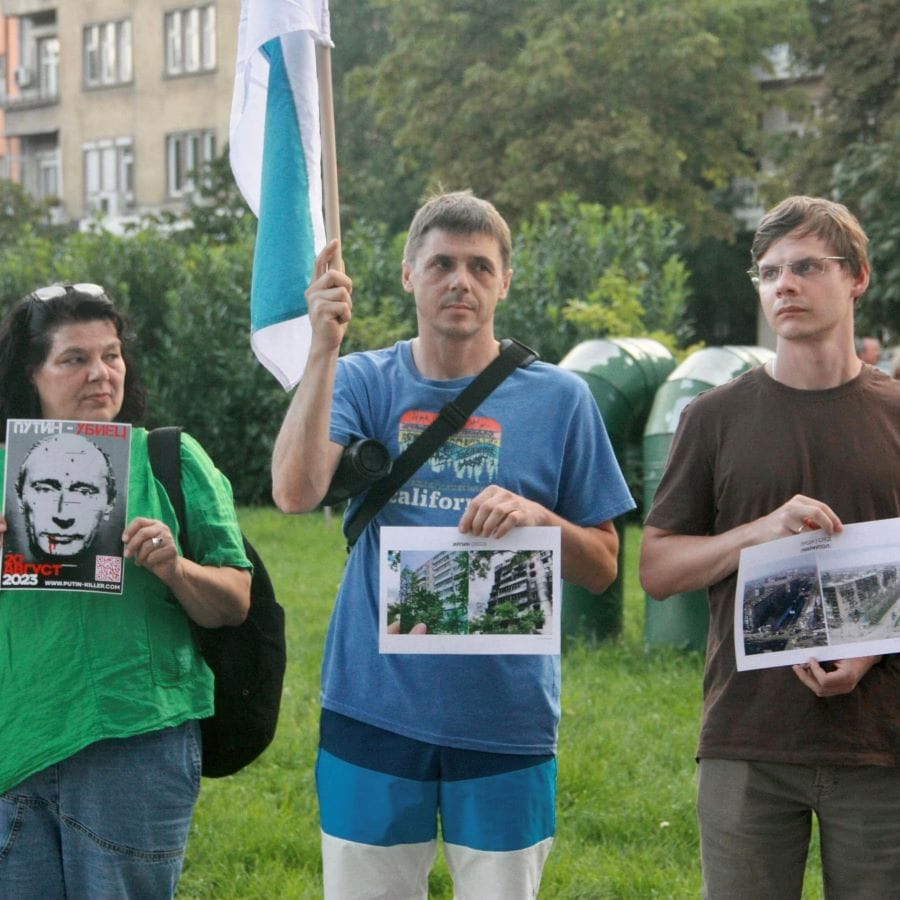
Преди февруари 2022 г. Андрей живее в руското градче Трубчевск, на около 15 километра от границата с Украйна. Има много украински роднини и приятели и често пътува, за да се види с тях. След анексията на Крим през 2014 г. той започва опозиционна дейност срещу действията на Владимир Путин спрямо Украйна. Казва, че още тогава е бил арестуван няколко пъти за организиране на митинги.

Когато Русия нахлува в Украйна през февруари 2022 г., Андрей започва отново да организира протести срещу войната и отново е арестуван.

Нахлуха в дома ми, взеха флашки, компютър, дори стария ми фотоапарат и ме откараха в полицията. Предупредиха ме да не говоря неверни неща, а аз бях написал на плаката си истината, която ми е известна – че „в Украйна няма нацисти“. Познавам украинците от дете. Бях написал и че в Украйна се води война. След няколко часа ме пуснаха. После ме уволниха от работа по политически причини.

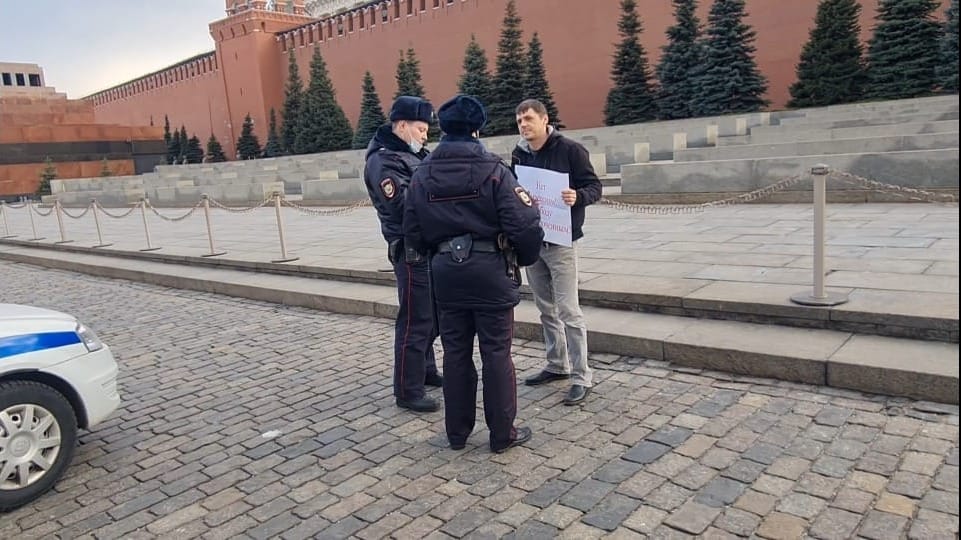
Андрей отива в Москва, където на Червения площад протестира еднолично срещу войната в Украйна. Арестуват го веднага, полицията го пребива до загуба на съзнание.

Пет отровни дела. Порочен кръг и отчаяние
© Личен архив

В ареста няколко часа ме държаха без храна. След това ме понабиха още малко, но за нашата полиция е нормално да бие хора. После ме вкараха в килия, където отношението към несъгласните с властта е доста лошо. Не ти свалят белезниците и ги държат толкова стегнати, че ръцете ти са постоянно изтръпнали. Когато ме водеха на разпит и попаднехме с придружаващите полицаи извън обхвата на камерите, някой от тях уж се спъваше и силно ме блъскаше срещу стената. Щом паднех и се ударех в стената, „случайно“ нечий ботуш ме риташе в тялото или главата. Обвиняваха ме, че мои роднини и приятели в Украйна сега се сражават срещу руската армия и че аз съм им давал информация за руските позиции. Разбира се, че нямах такава информация, но като отричах, започнаха да ме бият наистина лошо. Казаха ми, че съм предател, връчиха ми призовка за фронта и ме заставиха да подпиша документ, че след като ме пуснат от ареста, ще отида да се запиша доброволец в армията. Обещах. Иначе щяха да ме убият. Пуснаха ме. Щом излязох от ареста обезобразен от боя, се обадих на моя приятелка, която ме изведе от Русия. Призовката за фронта, разбира се, я скъсах. Нямаше връщане назад за мен, защото бях обвинен, че дискредитирам въоръжените сили на Русия. 

Искам да ви обясня простичко защо избягах: беше ми даден чудовищен избор между затвор и война. Но аз съм убеден, че след като никой не е нападнал моята родина, за да убива невинни цивилни граждани, аз не бива да правя това в друга държава. Руснаците ме наричат предател за отказа ми да воювам в Украйна и искат да ме пратят или на фронта, или в затвора, където вероятно ще ме убият те, „моите“ руснаци. Абсурдно е и много тъжно.

Оттук нататък Андрей попада в „земята на простичкото щастие“.

Границата Турция – България

Андрей влиза в България през Малко Търново. Служителите на граничната полиция го отделят встрани от останалия поток от преминаващи границата, тъй като е без виза.

Щом им дадох паспорта си и казах, че искам политическо убежище в България, ми отговориха, че съм руснак и нямам право. Отговорих им, че това не е вярно. Тогава четирима човека от служителите на границата ме заобиколиха, хванаха ме за ръцете и краката и се опитаха насила да ме върнат от турската страна. Аз се съпротивлявах и така ме изхвърлиха в неутрална територия. Познавам руснак, който живее в България, и след като се поуспокоих, му се обадих. Той се свърза с ваши журналисти, които дойдоха и започнаха да задават въпроси на граничната полиция. Това май ги накара да ме пуснат в България. След още доста препятствия с български институции се добрах до София.

Държавната агенция за бежанците (ДАБ)

Пристигнах в България през есента на 2022 г. и отидох в ДАБ три дни след преживяването на границата. Тогава там ми взеха паспорта и ми казаха, че ще ме извикат на разпит. Разпитът се състоя три месеца по-късно. Аз трудно помня дати, затова на едно листче си бях написал всички важни за мен и случилото ми се в Русия. По закон, докато трае разпитът, записващата апаратура не трябва да бъде спирана. В един момент обаче служителят на ДАБ я изключи и ме попита: „Ти защо гледаш постоянно в това листче, явно си измисляш.“ Казах му, че не помня добре дати и само се подсещам, за да съм точен в бежанската си история. Тогава той включи апаратурата за запис. Интересно е, че на тези разпити присъства и адвокатът ми, но нямаше право нито да оспори нещо, нито да отговаря вместо мен. Какъв е този закон адвокат да няма право да говори?

Аргументите на Андрей да поиска политическо убежище в България са, че е участвал многократно в протести срещу режима на руския президент Владимир Путин, че е бил арестуван и пребиван многократно от руската полиция, тъй като открито е назовавал войната в Украйна „война“, а не „специална операция“. Има политическо досие, защото е отказал да отиде на фронта. Обвинен е в дискредитиране на руските въоръжени сили и не се е явил в армията, след като е бил призован, а вместо това е избягал от страната.

В подкрепа на бежанската си история Андрей дава на служителите от ДАБ копия от медицинските свидетелства за побоите, които му е нанесла руската полиция, и копие от призовката да се яви на съд в Русия, защото се е изказвал против войната и срещу руската армия.

Пет отровни дела. Порочен кръг и отчаяние
© Личен архив

ДАБ взема предоставените документи и Андрей започва да чака решението ѝ. Убеден е, че при толкова документи и доказателства ще получи политическо убежище в България.

Бях изумен, когато ДАБ ми отказа с аргумент, че няма доказателства за бежанската ми история. Така стигнахме до обжалване на отказа на ДАБ в съда. 

Процесите 

На първото ми дело в съда бяхме аз, адвокатът ми, преводач, прокурор и представител на ДАБ. Бях изумен, че ДАБ не бяха приложили документите, които им дадох и които доказваха защо търся убежище в България. В делото ми нямаше нито един от тези документи – за побоите, за арестите, призовката за руски съд, нищо. Добре че пазех оригиналите. Но тук искам да попитам ДАБ: какво направиха с документите ми? Унищожиха ли ги, или умишлено ги скриха, или ги загубиха. Но как ще загубиш толкова важни документи, които могат да определят съдбата на един човек? Бях шокиран. Съдът, разбира се, потвърди решението за отказ на ДАБ, но ние веднага предоставихме на съда липсващите документи и започнахме да чакаме новото му решение. Това продължи около половин година, въпреки че срокът за произнасяне е месец.

Решението на Софийския административен съд от 3 юни 2024 г. отменя решението на ДАБ за отказ за предоставяне на международна закрила на Андрей. Освен това съдът постановява ДАБ да заплати 600 лв. обезщетение на ищеца. Представител на ДАБ и прокурор не присъстват на последното дело.

Бих искал да благодаря на съдията за строгото, но справедливо решение и на всички, които помогнаха. Това определено бе победа, но историята не свърши тук, както би било нормално в една демократична европейска страна, защото ДАБ обжалва решението на Софийския административен съд и така стигнахме до Върховния административен съд (ВАС).

Повече от две години Андрей следва процедурите и законите на Република България. По тази причина живее в страната ни без паспорт и без възможност да си открие банкова сметка, защото след няколко молби Агенцията му дава паспорта само веднъж за три дни. Този срок се оказва недостатъчен за процедурите, които изискват банките в България за откриване на банкова сметка. Андрей е механик и въпреки че няколко предприятия искат да го назначат на работа срещу добро заплащане, не успяват, защото няма банкова сметка, на която да получава заплатата си, както и документи за самоличност.

В момента Андрей очаква ВАС да насрочи дата за поредното дело. През това време помага на новопристигнали бежанци от Русия и Украйна в бюрократичния лабиринт, в който попадат у нас. По тази причина често е в ДАБ и разказва на какво става свидетел там:

Всеки път, когато на гишето има руски бежанец, те намират повод да започнат да му крещят, не преувеличавам, започват да крещят или да го заплашват с това, че ще повикат миграционната полиция, която ще го депортира веднага в Русия. Между заплахите постоянно питат дали все още искат да подадат документи за бежански статут. Държат се с хората така, че на човек му се иска единствено да им каже: о, извинете, че ви обезпокоих, сега ще си взема документите и ще се махна веднага от България. 

Искам да споделя няколко лични мисли по темата за руските бежанци в България. По време на престоя ми тук имах възможността да се срещна с голям брой хора, които бяха принудени да избягат от режима на Путин и да поискат международна закрила в България. Хората са различни и по възраст, и по професия. Обединява ги това, че всички са против войната и диктатурата на сегашното управление в Русия. По правило всички тези хора са заплашени от репресии за нежеланието си да запазят мълчание. Изглежда, че те търсят сигурност и свобода, но не всичко е толкова просто, поне в България. Тук случаите на бежанци се обработват от ДАБ. Само Господ знае какво се върти в главите на тези чиновници. Аз лично нямам никакво съмнение, че има някаква ръка, която е високо и която определя поведението на ДАБ към руските политически бежанци.

Пет отровни дела. Порочен кръг и отчаяние
© Личен архив

В края на този текст ми се иска да отново да си припомним „земята на простичкото щастие“. Този рекламен слоган описва страната ни през 1965 г.. През същата 1965-та, на 9 май, с указ на Леонид Брежнев в СССР започват да празнуват Деня на победата над нацистка Германия (День победы). В България, разбира се, както и в Съветския съюз, денят се отбелязва с тържествени паради. 

Едва ли някой в онези времена е допускал, че 25 години по-късно представата на българите за щастие ще надмине критериите на комунистическия свят и България ще поеме по пътя си към ЕС и НАТО, за да празнува на 9 май Деня на Европа. Едва ли през 1965 г. някой в Русия, а и в България е допускал, че 57 години по-късно Русия ще започне война в Европа, нахлувайки в Украйна, ще обяви украинците за нацисти и ще обстрелва цивилни украински градове, убивайки невинни деца, а българският президент ще казва:

Неприемливо е продължаването на войната и невъзможната победа над Русия да се представят като единствено възможен изход.

Пътеводител за летния политически хаос в САЩ

Post Syndicated from Йоанна Елми original https://www.toest.bg/putevoditel-za-letniya-politicheski-haos-v-usa/

Пътеводител за летния политически хаос в САЩ

Лош месец за американската демокрация, но добър месец в историята на меметата – така обобщиха този юли потребителите в социалните мрежи в САЩ. За по-малко от 30 дни бяхме свидетели на редица събития: един от най-странните кандидатпрезидентски дебати от доста време насам (което само по себе си е постижение); две противоречиви решения на Върховния съд, които имат потенциала да променят страната из основи; един неуспешен атентат срещу кандидат-президента Доналд Тръмп; оттеглянето на кандидата на демократите и настоящ президент Джо Байдън от надпреварата… 

Преподаватели по история от различни престижни университети се пошегуваха в X (Туитър), че ще трябва да печатат нови конспекти: история на САЩ, 2024 – 2024 г. И въпреки че последният текст в рубриката ни преди ваканцията на „Тоест“ трябваше да бъде продължение на темата за най-важните проблеми за американските избиратели, изминалите четири седмици бяха така наситени със събития, че няма как да не им обърнем внимание. И така, представяме на развълнувания читател пътеводителя на летния политически хаос в САЩ. 

Катастрофалният дебат 

Миналия месец споменахме, че дебатите не заслужават кой знае какво внимание, защото не променят мнението на твърдия електорат и към настоящия момент са по-скоро ритуал, отколкото сериозна политическа дискусия. 

Е, скъпи читатели, дори и най-добрите грешат. 

Според някои изследователи съвременната американска политика преживява период на втвърдяване. Това означава, че и двете партии имат твърд електорат, който трудно би могъл да промени мнението си и който гласува по-скоро по идеологически съображения, отколкото след рационална преценка на конкретни политики.

Тази теория може да бъде възможно обяснение защо присъдата срещу Доналд Тръмп не повлия на мнението на неговия електорат например. Затова мнозинството специалисти смятат, че в подобна среда дебатите нямат особено значение, защото повечето гласоподаватели вече са взели решение кого ще подкрепят. Е, това може да е истина в повечето случаи. В края на юни историята показа, че един дебат може да обърне посоката на цяла партия и в крайна сметка да завърши с нов кандидат-президент. 

След изключително слабото представяне на настоящия президент Джоузеф Байдън, опасенията за възрастта му и способността му да осигури победа на демократите през ноември се превърнаха в тема от първостепенно значение. Въпреки че Джо Байдън има с какво да се похвали за четиригодишния си мандат, все по-видимите затруднения поради възрастта му бяха повод за дискусия още преди да обяви кандидатурата си, и се превърнаха в основна мишена за атаки от страна на републиканците.

През 2020 г. Байдън се кандидатира с аргумента, че е „президент – мост“ между ерата на Тръмп и бъдещето. Четири години по-късно обаче се оказва, че американците са принудени да избират между двама кандидати от миналото, макар и само единият да иска да върне държавата обратно там (макар и неясно точно в кой период).

И ако всички са свикнали с арогантността, с която Тръмп демонстрира некомпетентност, и така или иначе никой не очаква напълно кохерентно поведение от него (бившият президент е известен с нелогичните си, непоследователни изказвания, често прескача от тема на тема и рядко отговаря конкретно на зададените му въпроси), то слабото представяне на Джо Байдън, който се оплиташе в собствените си думи, беше кулминацията на серия подобни публични издънки, включително и падания, в допълнение на общия вид, издаващ физическа слабост. 

„Политико“ основателно нарече дебата „най-слабия в историята на САЩ“. И въпреки че „хвърлянето на кал“ е традиция за страната (терминът влиза в речниците след изборите през 1828 г., когато и двамата кандидати инвестират доста усилия да се плюят взаимно), дебатът на 27 юни 2024 г. е сред малкото събития, за които няма достоен еквивалент в историята. Вероятно един от редките случаи, в които гръмките медийни заглавия са точно намясто. 
Срамна глава в историята на Върховния съд 

Хората с чувство за хумор успяха да намерят механизми за справяне с абсурда на дебата. В един момент кандидатите започнаха да спорят кой е по-добър играч на голф, и ситуацията неудобно напомняше на спор на двама възрастни мъже пред входа в късен летен следобед, отколкото на сериозен дебат между кандидати за държавен глава на една от най-важните държави в света. Последните решения на Върховния съд на САЩ обаче са трудни за преглъщане дори с добър запас от оптимизъм и шеги. 

Решението „Грантс Пас срещу Джонсън“ (Grants Pass v. Johnson) беше произнесено в рамките на едно от най-важните дела за правата на бездомните в историята на САЩ. Върховният съд постанови, че Осмата поправка, забраняваща произволни арести, жестоки глоби и гаранции, не може да се използва като аргумент в случаи, в които бездомниците са третирани от местните власти като престъпници.

Това означава, че бездомниците могат да бъдат арестувани и глобявани заради факта, че са бездомни и например спят на улицата – макар да няма къде другаде да отидат. Стратегиите за справяне с бездомните остават в ръцете на съответните населени места, но вече е много по-лесно за граждани и организации да съдят градската управа с аргумента, че бездомните замърсяват или вдигат шум. 

Ако „Грантс Пас“ все пак оставя някаква надежда, че прилагането на закона зависи от местните власти и вероятно много малко бездомни ще бъдат де факто арестувани само заради това, че са бездомни, то решението „Тръмп срещу САЩ“ (Trump v. United States) със сигурност ще остане в историята като едно от най-мрачните на председателствания от Джон Робъртс съд и ще бъде цитирано наравно с други срамни решения през годините, много от които отдавна са отхвърлени (например узаконяващите робството на практика). Според решението президентите имат почти пълен наказателен имунитет за официалните си действия. Казано на прост език, президентът е над закона в повечето случаи, а доказването на вина в останалите става изключително трудно, защото трябва да се докаже намерение. 

Последното срамно решение от гледна точка на историята е „Лопър Брайт Ентърпрайзес срещу Реймондо“ (Loper Bright Enterprises v. Raimondo). То не дава повече власт на президента, а на съдилищата – и то власт, която надхвърля тази на експертите, вземащи решения по редица важни въпроси – от това какви вещества могат да съдържат храните и какви да бъдат регулациите за стоки, произведени в САЩ, до мерките за справянето с климатичните промени. 

„Лопър Брайт Ентърпрайзес срещу Реймондо“ бетонира властта на съдилищата над федералните регулаторни органи. Свидетели сме на радикално пренареждане на разделението на властите в САЩ и прехвърляне на властта към хора, които не са избирани, включително на правомощията, които избраният от гражданите Конгрес е дал на изпълнителната власт“, пише Иън Милхайзър, старши кореспондент и експерт в областта на Върховния съд.

С други думи, ако се стигне до съдебен процес, решението дали дадено вещество е лекарство, или хранителна добавка, в крайна сметка ще се вземе не от федералната агенция, в която работят експерти със съответните познания, а от съдията, който разглежда делото. Дали съдиите имат подобни познания, стана ясно мигновено и нагледно: Върховният съд трябваше да коригира свое решение, в което съдия Нийл Горсъч системно бърка азотните оксиди, допринасящи за парниковия ефект, с диазотен оксид, или райски газ, използван за упояване на пациенти. 

Покушението срещу Тръмп 

Идиокрацията* не свършва дотук. На 13 юли в рамките на предизборен митинг е извършен опит за покушение срещу бившия президент Доналд Тръмп, който държи реч. Докато говори по една от основните си теми – нелегалната имиграция като екзистенциална заплаха за американското общество, – някъде около него проехтяват изстрели, след което Тръмп се хваща за дясното ухо и заляга. По-късно в изтекъл разговор описва болката като „ухапване от най-големия комар, който сте виждали“. Тръмп се изправя, заобиколен от агенти на тайните служби, и започва да крещи „Бийте се, бийте се, бийте се!“ с юмрук във въздуха, а фотографът на „Асошиейтед Прес“ Евън Вучи прави една от знаковите снимки в съвременната история. 

Списъкът с опити за покушения срещу президентите на САЩ е достатъчно богат, за да си има собствена страница в Уикипедия. На ужасените европейци, които веднага определиха шокиращото събитие като края на демокрацията в САЩ, можем само да кажем, че за съжаление, това е една съвсем стандартна част от историята на страната, в чийто парламент Капитолия все още стои знак, свидетелстващ, че в зората на историята на страната разгорещените политически спорове са се решавали с юмручни боеве и понякога дори с изстрели. 

Мотивите на стрелеца Томас Матю Крукс остават неясни. Макар преди години да е дарил 15 долара на демократите, Крукс е регистриран републиканец. Впоследствие разследването разкри, че е търсил възможности за атентат не само срещу Тръмп, но и срещу Байдън. Атентатът е извършен с едно от „най-популярните“ оръжия, използвани в масови престрелки. Самите републиканци и оръжейното лоби работят срещу ограничения за свободното закупуване на оръжия, позовавайки се на втората поправка.

Тези нюанси сериозно затрудниха републиканците, които още преди всякаква яснота около опита за покушение обвиниха „радикалното ляво“. Разбира се, веднага след покушението се развиха редица конспиративни теории, включително и че атентатът е нагласен от Тръмп, за да спечели симпатизанти.

Има една българска поговорка, която обобщава ситуацията сравнително добре: „Който сее ветрове, жъне бури“. Насилието на думи, независимо от политическите пристрастия, рано или късно ражда насилие в действие. И колкото и някои републиканци да се опитват да припишат вината за атентата на Джо Байдън, надали има обективен наблюдател, който да отрече насилието, заложено в марката „Тръмп“. И да не се страхува от последствията. 
Оттеглянето на Джо Байдън и новата кандидатура за президент на демократите

Доналд Тръмп не е първопричина, а симптом на много по-дълбока криза в американското общество – тази на провинцията срещу метрополиса, на необразованите срещу образованите, на бедните срещу богатите, на средната класа срещу безконтролния капитализъм, на различните визии за света и как той трябва да бъде подреден. Всички тези противоречия не са разпределени по партии, а се преплитат в сложни конфигурации и пораждат събития и тенденции, които определят политиката в страната през последните 50 години. 

Независимо какво прави Тръмп – дали ще бъде осъден, или ще изтече запис, в който говори унизително за жените, – култът към личността му е прекалено силен, за да бъде критикуван от съпартийците и симпатизантите си, без значение колко ги отвращава в действителност (настоящият му кандидат-вицепрезидент Джей Ди Ванс го сравнява с Хитлер). Всяко действие и всеки коментар на бившия президент, независимо колко е скандален и в противовес на ценностите, уж изповядвани от партията му, бива извъртан не само от неговите поддръжници, но и от консервативната медийна машина, която на този етап представлява съвсем отделна екосистема и алтернативна реалност. Това се дължи не толкова на качествата на Доналд Тръмп, колкото на онова, което символизира – недоверие в институциите и медиите, както и силна антипатия към политическия елит в страната.
Джо Байдън обаче няма тази привилегия. След катастрофалното му представяне по време на дебата, критиката сред демократите прерасна от притеснена дискусия за възрастта и издръжливостта му в публични призиви той да се оттегли от надпреварата и да даде път на по-млад кандидат с по-голям шанс да спечели изборите. Цялата кампания на републиканците така или иначе бе насочена именно в тази посока: обрисуване на Байдън като възрастен и физически негоден за изпълнението на длъжността си кандидат.

На 21 юли, след продължителни дискусии и противоречиви изказвания в медиите и с оглед на данните за предизборните нагласи, които показваха преимущество на Тръмп след дебата, Джоузеф Байдън обяви, че се оттегля от надпреварата, и публично застана зад номинацията на вицепрезидентката си Камала Харис. Така Доналд Тръмп стана най-възрастният кандидат-президент в историята на САЩ. Дали стратезите му ще успеят да се измъкнат от капана, който сами си поставиха, надали има значение – твърдият електорат на Тръмп е свикнал да съществува в очевидни противоречия. Но този ход може да повлияе на избирателите, които все още не са решили кой кандидат ще подкрепят. 

„Има място и време за нови гласове, свежи гласове, по-млади гласове. И това време е сега“, заяви Байдън в реч от Овалния кабинет няколко дни по-късно. Стратегията със сигурност отразява очакванията на повечето хора – мнозинството от американските избиратели подкрепят ограничения във възрастта и мандатите на държавните служители. Процентът е дори по-висок сред привържениците на републиканците, отколкото сред демократите, и то в не едно и две проучвания

Действително решението на Байдън незабавно наля енергия в редиците на демократическата партия: Vote.org, независима платформа за регистриране на гласоподаватели, отчете 700% ръст на новорегистрираните гласоподаватели – 38 500 новорегистрирани, повечето под 35-годишна възраст.

Камала Харис разби досегашните рекорди за фондонабиране, регистрирайки 81 млн. долара от дарения в рамките на 24 часа. Future Forward – най-големият политически комитет на демократическата партия, обяви, че е подсигурил 150 млн. долара за същия период от донори, които досега са се колебали или не са изразявали подкрепа за нито един кандидат. Кандидатурата на Харис активира гласоподаватели, които не са били активни участници в предишни избори или чиято демография е слабо представена, а голям ръст в даренията се наблюдава в решаващи щати, като Тексас и Пенсилвания. 

Какво предстои 

В рамките на броени часове Камала Харис се превърна и в интернет феномен, а маневрите в демократическата партия изместиха Тръмп и новия му кандидат-вицепрезидент от прожекторите на медиите. Ако кампанията дотук е индикатор за ритъм и ако се позоваваме на естественото развитие на американската политика, това няма да продължи дълго и тепърва предстоят изненади. Въпреки че многократно призоваваха за оттеглянето на Джо Байдън, републиканците веднага заведоха дело, че не може средствата, събирани от неговата кампания, да бъдат дарени за кампанията на Харис. Според експерти ходът не почива на солидни правни аргументи, но Тръмп всячески ще се опита да блокира или затрудни кампанията на Харис, така че това е част от цялостната стратегия. 

Прогнозите на повечето проучвания на общественото мнение показват близки проценти на Тръмп и Харис със също толкова близки граници на грешката, в които кандидатите се припокриват. Доколко обаче може да се вярва на проучванията? През 2015 г., когато кампанията беше точно толкова интензивна и непредвидима, никой не успя да предскаже победата на Тръмп. Три месеца са много време в предизборна година. Сред факторите, които задължително трябва да вземем предвид, са действията на Израел в Палестина, развитието на пълномащабната руска инвазия в Украйна, изненадващи вътрешнополитически промени (с надежда да няма повече опити за покушение), както и как двамата кандидати ще водят кампанията си оттук нататък. 

Едно е ясно: изборите през ноември ще са сблъсък не само между миналото на Америка, която трябва да е велика отново по библейски мотив, и бъдещето, което включва преосмисляне на модела на функциониране на страната. Те са и борба между расизма и сексизма и равенството – вицепрезидентът на републиканците смята, че гласът на хората с деца трябва да има повече тежест, и се обяви срещу „бездетните жени с котки“, които „съсипват държавата“; Тръмп каза в реч, че гласоподавателите предпочитат белия мъж пред черния мъж. Харис, която не само че би била първата жена президент в историята на САЩ, но е и дъщеря на индийски емигранти, съвършено представлява другия полюс на двамата републикански кандидати. Харис представя изборите и като сблъсък между свободата и насаждането на омраза: „Ние искаме да забраним оръжията, те искат да забраняват книги“, се казва в първата ѝ изборна реклама. 

Готова ли е обаче страната да стъпи в бъдещето? И колко минало трябва да изтече, с колко хаос, за да се върне САЩ в консенсуса на настоящето – климатът се затопля вследствие на човешката дейност, жените и мъжете са равни, религията няма място в политиката, корпорациите не са хора, държавата не може да абдикира от задълженията си спрямо хората, жените не могат да износват деца насила, обикновените граждани нямат нужда от оръжия… И колко още може да се нажежи дискусията – опонентите да бъдат наричани фашисти или комунисти, а онези, които избират да живеят различно от нас, да бъдат очерняни, – без да се стигне до насилие? 

След горещото лято идва бурна есен. Тогава ще продължи и нашият разказ за Америка. 

* „Идиокрация“ (Idiocracy) е комедия от 2006 г., която представя живота в САЩ през 2505 г. Филмът често се използва като културна препратка и се е превърнал в нарицателно особено напоследък, тъй като някои от сцените в него изглеждат притеснително пророчески от настояща гледна точка. Изпълнението на кечиста Хълк Хоган по време на републиканската конвенция например беше сравнено неколкократно със сцени от комедията.