Post Syndicated from digiblurDIY original https://www.youtube.com/watch?v=OSRQDEbS5CE
Meet Our Independent Board Members
Post Syndicated from Ramya Ramamoorthy original https://www.backblaze.com/blog/meet-our-independent-board-members/

As a Backblaze reader, you may be familiar with our executive team—many of them were in the news, especially when we went public back in November 2021. You may have also come across some of our employees on our LinkedIn page (we’re hiring, by the way!).
But you may not be familiar with our independent board members. These experienced executive leaders play a key role in the success of Backblaze. Today, we’re excited to introduce our board members so you can learn more about them and how they’ve helped make Backblaze the company it is today.
Who Are Our Independent Board Members?
At Backblaze, we have four independent board members who work closely with the executive leadership team. As board members, they occupy a role that’s intentionally separate from our employees and founders. They provide an independent viewpoint and advise the executive team on topics such as strategy, operations, and governance. Two of our executive team members are also on the board, but what makes the independent board members different is that they don’t work for the company as employees.
Jocelyn Carter-Miller

Jocelyn grew up on the South Side of Chicago. During her childhood, she was surrounded by many successful role models. She grew up in a segregated Black community called Chatham Avalon. It’s the same community where Muhammad Ali, the Johnsons from Johnsons Publishing Company, Mahalia Jackson, and Jesse Jackson also lived and worked. The first black MBA graduate from the University of Chicago (the same university that Jocelyn attended for her MBA) lived on the same block as Jocelyn. Being a part of a Black community where everyone was accepted, supported, and loved gave her a strong sense of self-confidence and self-worth.
She also attended racially and economically diverse elementary and high schools in the Hyde Park community. This exposure to White, Latino, Black, and internationally diverse students gave her perspectives into the value of different cultures—and showed her that success had many different faces.
Today, Jocelyn serves on the Backblaze board as the Lead Independent Director. She also serves as the Chair of the Compensation Committee and as a member of the Audit Committee and Nominating and Corporate Governance Committee.
Jocelyn began her career as a Board Member when an organization called Catalyst reached out to her. Catalyst is a nonprofit that supports diverse candidates in ascending to senior corporate leadership. They contacted her about joining a financial services board. At that point, Jocelyn had a lot on her plate—she was the Chief Marketing Officer at a Fortune 500 company as well as a wife and mother of two young daughters. Although she was not interested in pursuing this opportunity due to her demanding schedule, Catalyst still convinced her to at least do an interview. A couple of months after her interview, Catalyst let her know that she got the role. Though taking on the role was going to be a stretch, she knew it was about more than simply serving on a board—it was about setting an example for representation at the very top. She decided to join the board, and since then, she has served on five corporate boards including various Fortune 500 boards.
While Jocelyn was a Board Member at Arlo Technologies, the CEO Matthew McRae told her about the opportunity to join the Backblaze board. Jocelyn decided to meet with Gleb and the rest of the leadership team. She says of that initial meeting: “They were all so enthusiastic and they seemed to have such high integrity about what they were doing, their vision, the culture, and the way they treated their employees.” Of her time on the board so far, Jocelyn continues, “I’m glad that I did. It has been fun.”
Jocelyn explains that what makes her unique is that she brings a distinctive perspective to the boardroom as a Black woman who grew up on the South Side of Chicago. She understands what it’s like being a person of color in an environment that may not welcome or accept all of who she is. “I try to use my cultural experience as well as my gender experience to drive for an environment that allows equity for everyone, one that feels inclusive, accepting, and offers you both the opportunity to demonstrate your abilities to perform at high levels and rewards and promotes you for that,” she said. She always tries to drive and push an inclusive, equitable, and fair culture for everyone.
Jocelyn is a creative individual. She loves art and has a strong passion for interior design. Most recently, she worked with one of her friends and former colleagues on an app called Seek and Find Design that helps customers save time and money locating beautiful and inexpensive decor, while also allowing them to enhance their design sense with a community of like-minded people.
Earl Fry

Earl grew up in Honolulu, Hawaii and earned his undergraduate degree from the University of Hawaii. He worked for a couple of years in public accounting as a CPA, after which he moved to the Bay Area to earn his MBA at Stanford University. Once he graduated, he became intrigued by the tech industry and has been a part of it ever since.
At Backblaze, he serves as an independent board member. He sits on all of the Company’s committees—the Nominating and Corporate Governance Committee, Compensation Committee, and Audit Committee.
He started his career as a board member back in 2005. At the time, he was the CFO and Head of Operations at Informatica. One of the board members at Informatica founded his own SaaS company and thought Earl would be a great candidate to join the board. A few years later, he was asked to join the board of a regional bank based in Honolulu, Hawaii. The company was looking for someone who had financial experience for a public company as well as ties to Hawaii. Since Earl grew up in Hawaii and most of his family still lived there, he wanted to take this opportunity as a way to help the local business community.
Thirty years prior to joining the Backblaze board, Earl worked with Barbara Nelson, one of our other board members. Fast forward to when Backblaze was looking for another board member, and Barbara recommended Earl. After Earl spoke with Gleb, he was struck by how different and special Backblaze was: “Having been in Silicon Valley for so long, you get a little jaded sometimes in terms of how companies are founded and how things are put together. What struck me about Backblaze is that the team is so real and genuine. I just have a ton of respect for how the Founders pulled it all together.”
Growing up in Hawaii and attending public school there, Earl met people from all different backgrounds in terms of race, gender, or socioeconomic status. This made him aware of diversity as well as the biases that people may have toward certain groups. He brings this awareness into his work as a board member where he is well-positioned to be able to identify biases and work within the system to constructively foster change.
In his spare time, Earl likes to go fishing, practice rockhounding, and go fossil hunting. He picked up these hobbies as stress relievers. He calls himself a “closet paleontologist.” When he needs a break, he loves going out to the desert to disconnect from life’s demands and connect to nature and himself. He also enjoys gardening, drinking and collecting wine, and spending time with his family.
Evelyn D’An

Evelyn is the Chair of the Audit Committee at Backblaze. She also serves as a member on the Company’s Compensation Committee. She was raised in the Bronx and both of her parents are from the beautiful island of Puerto Rico. As a kid, she enjoyed math and was fortunate to attend The Bronx High School of Science, a magnet high school specializing in math and science. She attended SUNY – Albany, where she gained exposure to the business side of math and decided to focus her career on accounting. She joined Ernst & Young, one of the largest public accounting firms, and worked there for 18 and a half years. During her tenure, she became the first Hispanic female audit partner in the U.S. Southeast region.
Evelyn had already left Ernst & Young to start her own consulting business when the Sarbanes-Oxley Act was enacted in 2002, which aimed to prevent fraudulent financial reporting from businesses. At the time, there were a number of highly public misstatements of financial reports. The world of public accounting was turned upside down, and this also led to a strong need for financial expertise in the boardroom. Evelyn had the skills, experience, and credentials that companies were looking for on their boards. She got her first board position through her network in 2006, and has served on many boards over the past 16 years.
Over the years, she has seen an increase in the number of women in the boardroom. However, she believes that there needs to be more work done in getting underrepresented groups into the boardroom. Still, she believes there is hope: “One of the biggest supporters to encouraging diversity in the boardroom are the large investment banks of the world who are calling out their own portfolio companies and saying that if they don’t have diverse candidates on their board, then they will no longer invest in those companies,” she said. The pressure also comes from employees and candidates, which has made employers initiate or rethink their diversity and inclusion efforts.
Evelyn served as a Co-Chair for BoardNext, an organization that works with aspiring female directors to earn their first board seat. She loves helping her network find various board opportunities. She believes that diversity is so important in the boardroom because it allows everyone to bring in a different perspective. For example, if a company serves international customers, then having people from different cultures helps bring discussions to the boardroom about how they can serve customers in those cultures, what their needs are, and how they can share our value proposition with them.
Evelyn loves to travel, exercise (she’s almost at her 200th SoulCycle ride!), and spend time with her family and six-year-old grandson. Video chatting with him always makes her day better. She is also fortunate enough to still have her mom with her—who lives in the building next door—and they talk daily. Evelyn also enjoys cooking with friends and is working towards expanding her cooking skills beyond the basics. She’d love to learn to make Mediterranean food and sushi!
Barbara Nelson

Barbara grew up all around the world as her father was in the military. She was born in Japan and after that, she lived in many different places within the U.S. and Canada. She went to eight different schools before attending college.
Like Evelyn, Barbara always loved math, and she got her degree in Electrical Engineering from Stanford. As one of the only few women in engineering, she saw early on the diverse voice that a woman brings and the challenges in having that voice be heard.
Barbara started her journey as a board member at ACE Technologies. She happened to know one of the venture capitalists who invested in the company and he encouraged her to join the board. Since then, she has served on a total of five corporate boards, and held the title of CEO on two of them.
Barbara came across the opportunity to join Backblaze through a connection she’s had for 30 years. Gleb had reached out to a trusted colleague looking for a board member and explained the background he was looking for in his ideal candidate. Barbara came recommended, and she and Gleb started a conversation about joining the Backblaze board. “I was extremely impressed by how Gleb and the founders had built such a great culture, while delivering impressive and consistent growth with only $3M of outside funding,” said Barbara. Today, Barbara is the Chair of the Nominating and Governance Committee. In addition, she is a member of the Audit Committee.
Barbara explained that as a woman, she strives to look out and advocate for other underrepresented groups and points of view. She believes that having diverse people in the boardroom helps bring a lens that looks out for inclusion.
Barbara has a passion for traveling, and she’s been to over 90 countries. She just got back from Brazil where she was tracking jaguars and tropical birds. In the future, she wants to go back and visit some of the countries that she’s been to and explore other parts of those places. In particular, she’s interested in going back to Australia to explore the Kimberley region and Western Australia. She also plays keyboard and sings for two bands—one is a classic rock band and the other is a church band. She said that if she could switch places with someone for their talent, it would be Yuja Wang, a classical pianist, or Rihanna during one of her performances. “What fun to be a REAL rock star for a day!”
So You Want to Become a Board Member at a Company? Here’s How.
All of the independent board members have had different experiences and journeys, but the one thing they all had in common was that they earned their opportunities through their networks. Here’s some of their advice on how to become a board member, if you’re interested.

Before becoming a part of a board, Evelyn recommends thinking through your “why.” Being a board member is a lot of work, so it’s important to think about your reason behind starting this journey. The second step that Evelyn suggests is thinking about what companies you’d like to work with. Consider companies and industries that align with your values, what’s important to you, and how you could potentially bring the most value to that particular organization. Lastly, she recommends going deep into corporate governance. A potential board member would need to have all their education, their network with various organizations, and knowledge about hot topics in the industry.
Earl’s advice is simple: do a really good job at work. “You never know who’s watching or where your connections will come into play,” he said. “It helps to become an expert in a couple of areas and to have very deep skills. It’s just as important to be seen as it is to get a broad understanding of how different parts of the business work together and how they are interrelated and impact each other.” He also emphasized the importance of being a good communicator and team member because what makes a board member valuable is their ability to communicate and listen well. He further explained, “Remember that the fundamental job of a board member is to be a fiduciary. The best ways that you can do that are to listen, advise, and influence.”
So how does one build their network? Evelyn suggests building your network both inside and outside of work. Internally, it’s great to connect with peers and form a network that way. Outside of work, Evelyn recommends joining organizations that are focused on corporate governance and attending events that are related to that subject. For example, you could become a member of the National Association of Corporate Directors or the Women Corporate Directors, both of which are organizations that Jocelyn and Evelyn are active members of. She also encourages people to have different types of networks because you never know where your next opportunity is going to come from. She said, “If you want something, you must say it, you must speak it, and you must share it with all of your networks.”
Being a board member is a challenging yet rewarding position. It allows one to have influence on not only a company, but also others like the shareholders, employees, customers, and the world at large.
Thank You to Our Board
We appreciate all that our board members do—Backblaze wouldn’t be where it is today without them! Thank you to our board members for helping our readers get to know them better and for bringing their diverse perspectives and knowledge to help make Backblaze a more successful company.
The post Meet Our Independent Board Members appeared first on Backblaze Blog | Cloud Storage & Cloud Backup.
Jeremy Utley and Perry Klebahn | Ideaflow: The Only Business Metric That Matters | Talks at Google
Post Syndicated from Talks at Google original https://www.youtube.com/watch?v=pTe-0cyAqHc
[$] Git evolve: tracking changes to changes
Post Syndicated from original https://lwn.net/Articles/914041/
The Git source-code management system exists to track changes to a set of
files; the stream of commits in a Git repository
reflects the change history of those files. What is seen in Git, though, is the
final form of those commits; the changes that the patches themselves went
through on their way toward acceptance are not shown there. That history
can have value, especially while changes are still under consideration.
The proposed git
evolve subcommand is a recognition that changes themselves go
through changes and that this process might benefit from tooling support.
Opening Up 6 Months of Vintage Weirdness & LGR Mail!
Post Syndicated from LGR original https://www.youtube.com/watch?v=IMYIPLtwPIs
Security updates for Friday
Post Syndicated from original https://lwn.net/Articles/914571/
Security updates have been issued by Debian (chromium and exiv2), Fedora (curl, device-mapper-multipath, dotnet6.0, mediawiki, mingw-gcc, and php-pear-CAS), Gentoo (lesspipe), Slackware (php), SUSE (git, glibc, kernel, libarchive, python, python-rsa, python3-lxml, rpm, sudo, xen, and xwayland), and Ubuntu (wavpack).
Rapid7’s Impact from OpenSSL Buffer Overflow Vulnerabilities (CVE-2022-3786 & CVE-2022-3602)
Post Syndicated from Rapid7 original https://blog.rapid7.com/2022/11/11/rapid7s-impact-from-openssl-buffer-overflow-vulnerabilities-cve-2022-3786-cve-2022-3602/

As stated in our OpenSSL Buffer Overflow blog post, the CVE-2022-3786 & CVE-2022-3602 vulnerabilities affecting OpenSSL’s 3.0.x versions both rely on a maliciously crafted email address in a certificate. CVE-2022-3786 can overflow an arbitrary number of bytes on the stack with the “.” character (a period), leading to a denial of service, while CVE-2022-3602 allows a crafted email address to overflow exactly four attacker-controlled bytes on the stack. OpenSSL 3.0.7 contains fixes for these vulnerabilities which was released on November 1, 2022.
As part of standard due diligence, Rapid7 evaluates the potential impact of vulnerabilities in its products. This process includes validating the existence of the vulnerable libraries or services, interdependencies, the exploitability of the vulnerability in a given context, and impacts related to applying available patches.
Rapid7’s Insight Agent and Insight Network Sensor were confirmed to be impacted by these vulnerabilities. An Insight Agent fix was released on November 2, 2022 (release version 3.1.10.34) and a Network Sensor fix was released on November 10, 2022 (release version 1.4.0.2). Rapid7’s assessment has found no other impact on our products. Checks for these vulnerabilities have been released within Nexpose and InsightVM.
BEST Wired Video Doorbells 2022 Edition
Post Syndicated from The Hook Up original https://www.youtube.com/watch?v=Cj7Fwu_d1yc
November 11, 1943: Floyd Lindstrom
Post Syndicated from The History Guy: History Deserves to Be Remembered original https://www.youtube.com/watch?v=Tvb81uj6Z3c
NSA Over-surveillance
Post Syndicated from Bruce Schneier original https://www.schneier.com/blog/archives/2022/11/nsa-over-surveillance.html
Here in 2022, we have a newly declassified 2016 Inspector General report—”Misuse of Sigint Systems”—about a 2013 NSA program that resulted in the unauthorized (that is, illegal) targeting of Americans.
Given all we learned from Edward Snowden, this feels like a minor coda. There’s nothing really interesting in the IG document, which is heavily redacted.
News story.
EDITED TO ADD (11/14): Non-paywalled copy of the Bloomberg link.
What’s Up, Home? – Measure Real-Time Power Consumption
Post Syndicated from Janne Pikkarainen original https://blog.zabbix.com/whats-up-home-measure-real-time-power-consumption/24479/
Can you monitor Finland’s total real-time power consumption with Zabbix? Of course, you can! By day, I am a monitoring tech lead in a global cyber security company. By night, I monitor my home with Zabbix & Grafana and do some weird experiments with them. Welcome to my blog about this project.
After my speech at the Zabbix Summit 2022, someone asked how deeply my wife is involved with this home monitoring project, and I responded back that she usually gives me ideas by accident. You know, she’s a funny and talkative person up to the point that I call her the comment track or the voice-over of my life, so even as a non-techie, she will for sure give me new ideas.
Well, this time she gave the idea for this post on purpose — now that winter and the dark days & nights are approaching fast, she asked if Zabbix could turn our decorative seasonal lights on and off based on the current electricity price.
Of course, it can! I am anyway already monitoring the current electricity price. But let’s take it further — using Zabbix, we can also check Finland’s current real-time power consumption. It would be kind NOT to turn on the lights even during the cheap hours if our power grid would be near its maximum limit.
Hello, Fingrid
Our electricity network Fingrid offers open data for all kinds of details about our power grid, one of them being the current electricity consumption. Using their services is free, all you need is to create an account to get an API key, so I tried if I can use the API with Zabbix. Well, Zabbix integration was easy, though, due to the time constraints set by our now-10-weeks-old-baby, this current version is a bit of a kludge and not yet finished. But hey, I have this blog to write!
So, after getting my API key, I created a new HTTP agent item to my Zabbix and did parse it with Zabbix JSONPath for the value.


Why the regular expression? The value was not returned in pure numeric format, and I know it must be just my JSONPath expression that has something wrong, but to get this working today, I just brute-forced the extra characters away. I’ll fix that one day. Maybe. The most important for now is that this works; the values shown are in megawatts.


What’s next?
Now that the groundwork has been done, albeit in an ugly way, in the near future (when we actually install the seasonal lights), I can start controlling them via smart power sockets and smart lights. Thanks to the total flexibility of Zabbix, I can then create triggers such as turn on seasonal lights if electricity cost is maximum of X EUR/kWh AND Finland’s power grid total consumption is not more than Y MWh AND time of day is something when we would be awake (we would turn the lights off during the graveyard hours in any case).
I have some additional research to do; I’m sure I can find out Finland’s total power grid capacity from somewhere, maybe even via Fingrid API (I first tried it about one hour ago). But, as this winter is going to be totally different than our usual winters, Zabbix can help you in this area, too.
I have been working at Forcepoint since 2014 and just like a small part of Forcepoint’s logo, I’m trying to be green as well. — Janne Pikkarainen
This post was originally published on the author’s LinkedIn account.
The post What’s Up, Home? – Measure Real-Time Power Consumption appeared first on Zabbix Blog.
Десет електронни законопроекта
Post Syndicated from Bozho original https://blog.bozho.net/blog/3975
От началото на 48-мото Народното събрание от Демократична България внесохме няколко законопроекта, които са свързани с електронното управление и информационните технологии. Тук ще направя кратък списък с описание на проектите (ЗИД значи Закона за изменение и допълнение, а ЗД е закон за допълнение):
- ЗИД на Закона за електронното управление – този закон го писахме с екипа ми в Министерство на електронното управление. Той урежда мерки по Плана за възстановяване и устойчивост, отпадането на удостоверенията (на които гражданите са куриери в момента) и на задължението за ползване на квалифициран електронен подпис. Въвежда пълна електронизация на регистрите, електронно връчване на актове и фишове, напомняне за изтичащи документи и др.
- ЗИД на Закона за движението по пътищата. Първата цел на проекта е да направим стъпки към ограничаване на рецидивистите на пътя. С пълното разбиране, че е нужна пълна реформа на административното наказване, предлагаме две неща: от една страна, задължение за МВР да спира на пътя всички автомобили, чиито собственици имат пет или повече невръчени фиша, а от друга страна задължение за публикуване на индивидуални анонимизирани данни за всички нарушения (което бях поискал от МВР като министър). Така обществото ще следи дали МВР изпълнява задължението си. Втората цел е намаляване на административната тежест и улесняване на добросъвестните водачи. Премахване на всички стикери от предното стъкло, премахване на синия талон и въвеждане на възможност за електронно плащане на фишове, без да ходим до КАТ да ни ги връчат. Затрудняваме редовните нарушители и улесняваме мнозинството добросъвестни. И повишаваме прозрачността на работата на МВР.
- ЗД на Закона за обществените поръчки – целта е да се постигне максимална прозрачност и с който да се прекратят схемите с т.нар. „инженеринг“. Въвежда се задължение за публикуване на отворени данни по международен стандарт (Open contracting data standard), публикуване на договорите, които са сключени без проведени процедури (защото са изключения по закон), публикуване на заявки по рамкови договори, както и разкриване на принадлежност към ДС на членове на органите на фирми, които печелят над половин милион от обществени поръчки.
- ЗИД на Закона за корпоративното подоходно облагане – въвеждане на електронни ваучери за храна. Нещо толкова просто (на пръв поглед), което се „точи“ като тема от 2015 г, най-накрая намира законодателно изражение
- ЗД на Изборния кодекс – предвиждаме достъп до кода без ограничение във времето, публичен план за провеждане на изборите, извадкови проверки и задължително публикуване на криптографска информация. Така ще се елиминират опорките за ‘пипане’ на машини, а процесът ще е по-добре планиран, предвидим и вдъхващ повече доверие.
- ЗИД на Гражданския процесуален кодекс – въвежда се електронно заповедно производство, като това е инструмент за облекчаване работата на свръхнатоварените съдилища, за сметка на ненатоварените.
- ЗИД на Търговския закон – освен създаване на изцяло нов вид дружество с променлив капитал, подходящ за стартиращи компании, набиращи инвестиции, предвиждаме и отпадане на спесимена на подписа при регистрация на дружество за български граждани (вместо това той да се извлича от МВР).
- Закон за защита на лицата, подаващи сигнали или публично оповестяващи информация за нарушения – законопроектът предвижда цялостна уредба на защитата на лицата, подаващи сигнали (whistleblowers), но в конкретния случай на сигнали за корупция, предвиждаме полу-анонимни сигнали – предлагаме сигналите да се анонимизират в момента на подаване по електронен път, с криптографски средства, като антикорупционната комисия да не може да вижда кой е подател, но данните да могат да се деанонимизират от съда, ако е нужно завеждане на дело за вреди.
- ЗИД на Закона за юридическите лица с нестопанска цел – предвижда нещо дребно, но улесняващо голям брой неправителствени организации – провеждане на заседания по електронен път на управителните им органи.
- ЗД на Закона за електронната търговия – въвеждаме мерки, с които големите онлайн платформи (напр. Фейсбук) да ограничат ефектна на троловете (фалшивите акаунти, които се използват с пропагандна цел), да са по-прозрачни с това кой извършва модерацията и да позволят обжалване на некоректно блокиране на профили. Т.е. на практика увеличаваме защитата на свободата на словото с процес по извънсъдебно обжалване, като същевременно не позволяваме удавянето на свободното слово в море от пропаганда.
Има още много закони, които имат нужда от осъвременяване. Съвесем скоро ще внесем изменения в Кодекса на труда за въвеждане на електронна трудова книжка, например. Но смятам, че с тази законодателна програма, облекчаваме гражданите и бизнеса, модернизираме администрацията и правим разходването на публични средства по-прозрачно.
Материалът Десет електронни законопроекта е публикуван за пръв път на БЛОГодаря.
Войната – продължение на вътрешната политика с други средства
Post Syndicated from Александър Нуцов original https://toest.bg/voynata-produlzhenie-na-vutreshnata-politika/
Путин – това е Русия. Има Путин – има Русия; няма Путин – няма Русия.
Думите са изречени през 2014 г. от водещия идеолог на Кремъл и настоящ председател на руската Дума Вячеслав Володин.
Според руския журналист и опозиционер Михаил Зигар пък Путин „не съществува“. В книгата си „Владимир Путин. Неизбежните войни“ от 2015 г. Зигар проследява част от най-съществените събития от политическата му кариера и влиянието им върху властовата динамика в Русия. Авторът защитава тезата, че различните политически и олигархични кръгове, с които Путин се заобикаля, доизграждат идеите и образа му, проектирайки собствените си политически възгледи върху него.
„Колективният Путин“, както го нарича Зигар, умело лавира между тях. Като наследник на президента Борис Елцин първо попада сред хора от семейството и най-близкото му обкръжение, включително сред олигарси като Борис Березовски, Роман Абрамович и Олег Дерипаска. Избраникът наследява шефа на Елциновата администрация – Александър Волошин, който се превръща и в негов водещ съветник през първите години на управление. Бореща се за вниманието на Путин е и групата на т.нар. силоваци, които се противопоставят на либералните кръгове и контролират силовите структури или важни административни постове – например Игор Сечин и Николай Патрушев. А най-близките му политици днес в лицето на външния министър Сергей Лавров и министъра на отбраната Сергей Шойгу го съпровождат от началните етапи на политическата му кариера в Москва.
Според Зигар Путин има несравнимо индивидуално влияние в процеса по вземане на решения, но те са съобразени с „колективния Путин“, тоест с амалгамата от мнения, влияния и интереси на кръговете около президента. Въпросът дали (не)формалните властови центрове влияят на президента по-скоро хаотично, с оглед на променящите се политически обстоятелства, или той преднамерено ги инструментализира за постигане на определени цели, няма еднозначен отговор. Факт е обаче, че той нееднократно променя възгледите и политиките си, докато съсредоточава властта в собствените си ръце.
Кратка хронология на единовластието
Встъпвайки в длъжност като наследник на Елцин, Путин се сблъсква с Втората чеченска война. Първоначално тя го популяризира сред руското общество, но неблагоприятните последици продължават дълго след края ѝ. На 1 септември 2004 г. терористична група от чеченски сепаратисти щурмува училище в град Беслан, Северна Осетия, вземайки над 1000 заложници, а последвалото масово избиване на цивилни и деца коренно променя руската политическа система.
В отговор на случилото се Путин инициира законови промени, засягащи изборите за губернатори в съставните части на федерацията. От този момент общественото гласуване в съответните юрисдикции е премахнато, а губернаторите се посочват директно от президента, за да бъдат одобрени от местните парламенти впоследствие. Това на практика осигурява на Путин контрол върху Съвета на федерацията (горната камара), докато партията му „Единна Русия“ налага надмощието си в Държавната дума (долната камара).
Втората голяма стъпка към централизация е осъществена през 2007 г. под въздействието на дясната ръка на Путин по онова време – Владислав Сурков. Действащата дотогава смесена избирателна система, според която половината от депутатите в Думата се избират пропорционално, а другата половина – мажоритарно, е отменена. Гласуването оттук нататък ще се извършва на пропорционален принцип и изцяло по партийни листи, което де факто изключва възможността независими кандидати, критични към Кремъл, да влязат в парламента. Заедно с това се ограничава броят на партиите и се затягат критериите за тяхната регистрация, което според Зигар облагодетелства единствено „Единна Русия“.
Третата значима крачка към своеобразно единовластие настъпва през 2020 г., когато Путин инициира промени в Конституцията след провеждане на всеобщ референдум. Президентските мандати на кандидатите се ограничават до максимум два. Уловката тук е, че този закон не влиза в сила за самия Путин, тъй като след одобрението от Конституционния съд досегашните му четири мандата на практика се нулират. Това му позволява да се кандидатира още два пъти и да остане на власт до 2036 г.
Претендентите за поста пък трябва да са живели в Русия през последните 25 години, което лишава много от потенциалните му съперници (като например Алексей Навални) от правото да участват в надпреварата. Освен това президентът получава правото да стартира процедури по освобождаване на конституционни и върховни съдии. В комбинация с увеличените си правомощия да определя и отстранява ръководителите на силовите структури и ключови министри, включително министъра на правосъдието, президентът всъщност налага изключителен контрол и върху съдебната власт. Не на последно място, одобрените промени допускат отхвърляне на решения от международноправен характер, ако според Конституционния съд не съответстват на вътрешноправните норми.
С тези и други по-малки промени през годините – например покачването на необходимия партиен праг за влизане в парламента от 5 на 7% – Путин постепенно си гарантира институционално господство спрямо законодателната, изпълнителната и съдебната власт. Ако към това добавим и безпрекословното влияние върху медийната среда, до избухването на войната в Украйна вътрешнополитическото надмощие на Путин изглежда непоклатимо.
Идеологическа консолидация
За Путин обаче би било много по-трудно да легитимира и осъществи политиката на институционална централизация без идеологическо сплотяване на обществото. За тази цел той използва православието и отношенията си с патриарха на Руската църква – Кирил. Путин превръща православието в национална идеология, отваряйки пространство за реторическо противопоставяне между руснаците и западняците, между руската и западната култура.
Тази логика възпроизвежда антагонистичното разделение от типа „ние срещу тях“ – православните, правоверни и консервативни руснаци срещу неправославните, грешни и либерални западняци. Освен че превръща православието в инструмент за обособяване на руската национална идентичност, Путин го използва за създаване на наднационална връзка между славянските народи, приели православието. Така чрез православието и славянството се създава пропагандната идея за една по-голяма, хомогенна, „братска“ постсъветска общност, доминирана и закриляна от Русия, но застрашена от западния свят.
Същевременно близките до Путин Вячеслав Володин и Николай Патрушев развиват и прилагат концепцията за външния враг, който заплашва не само руската териториална цялост, но и руската (респективно славянската) култура, синтезирана в православието. Тази логика често добива и историческо измерение, според което през цялото си съществуване Русия бива притискана и принуждавана да се защитава, докато разпадът на Съветския съюз се третира като геополитическа катастрофа, причинена от Запада. В този смисъл идеята за „денацификация“ не е просто изобретение за оправдаване на руската агресия в Украйна, а плод на много по-стар наратив за заклеймяване на всичко прозападно и антисъветско като „фашизъм“ или „нацизъм“.
Тази реторика се използва срещу активистите на Оранжевата революция в Украйна. Същото се повтаря и по отношение на Евромайдана след отказа на проруския президент Виктор Янукович да подпише Споразумението за асоцииране на Украйна с Европейския съюз. След падането си от власт самият Янукович определя протестиращите украинци като фашисти и нацисти. Тази линия на политическо говорене се засилва още повече след незаконната анексия на Крим и последвалите събития в Източна Украйна.
Конкретните примери са много – подобна реторика руските власти и медии използват дори по адрес на Естония, която през 2007 г. решава да премести паметника на Бронзовия войник от центъра на Талин във военното си гробище. Погледната от този ъгъл, речта на Путин от 24 февруари т.г. стъпва на процеса на идеологическа консолидация, а „денацификацията“ е просто продължение на масовата руска пропаганда през последните две десетилетия.
Войната в Украйна отразява развитието на вътрешнополитическите процеси във федерацията. Вътрешната и външната политика на Путин са неразривно свързани – войната, физическа и информационна, възпроизвежда процесите на институционална централизация и идеологическо сплотяване около фигурата на президента. Те пък от своя страна улесняват решението за започване на военни действия и необходимата за тази цел вътрешна легитимация, съсредоточавайки властта над политиката и медиите, а следователно и над умовете на гражданите в ръцете на един много тесен кръг от хора.
Подобни порочни модели придобиват внушителна сила, когато международните отношения подхранват несигурността във външната политика чрез добре познатите в научните среди положения на реализма – сфери на влияние, баланс на силите и дилеми на сигурността. Затова е време да повдигнем оставяния дотук на заден план въпрос за следвоенната структура на международните отношения и сигурност. Казано по различен начин: какъв ще бъде светът след войната и в какъв мир искаме да живеем? А това е тема, заслужаваща специално внимание.
Заглавна снимка: Markus Spiske / Unsplash
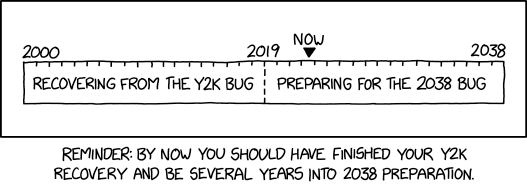
Y2K and 2038
Post Syndicated from original https://xkcd.com/2697/
Introducing Amazon EventBridge Scheduler
Post Syndicated from Marcia Villalba original https://aws.amazon.com/blogs/compute/introducing-amazon-eventbridge-scheduler/
Today, we are announcing Amazon EventBridge Scheduler. This is a new capability from Amazon EventBridge that allows you to create, run, and manage scheduled tasks at scale. With EventBridge Scheduler, you can schedule one-time or recurrently tens of millions of tasks across many AWS services without provisioning or managing underlying infrastructure.
Previously, many customers used commercial off-the-shelf tools or built their own scheduling capabilities. This can increase application complexity, slow application development, and increase costs, which are magnified at scale. Most of these solutions are limited in what services they can trigger and create complexity in managing concurrency limitations of invoked targets that can affect application performance.
When to use EventBridge Scheduler?
For example, consider a company that develops a task management system. One feature that the application provides is that users can add a reminder for a task and be reminded by email one week before, two days before, or on the day of the task due date. You can automate the creation of all the schedules with EventBridge Scheduler, create the task for each of the reminders, and send it to Amazon SNS to send the notifications.
Or consider a large organization, like a supermarket, with thousands of AWS accounts and tens of thousands of Amazon EC2 instances. These instances are used in different parts of the world during business hours. You want to make sure that all the instances are started before the stores open and terminated after the business hours to reduce costs as much as possible. You can use EventBridge Scheduler to start and stop all the thousands of instances and also respect time zones.
SaaS providers can also benefit from EventBridge Scheduler, as now they can more easily manage all the different scheduled tasks that their customers have. For example, consider a SaaS provider with a subscription model for your customers paying a monthly or annual fee. You want to ensure that their license key is valid until the end of their current billing period. With Scheduler, you can create a schedule that removes the access to the service when the billing period is over, or when the user cancels their subscription. Also, you can create a series of emails that let your customer knows that their license is expiring so they can purchase a renewal. 
Use cases for EventBridge Scheduler are diverse, from simplifying new feature development to improving your infrastructure operations.
How does EventBridge Scheduler work?
With EventBridge Scheduler, you can now create single or recurrent schedules that trigger over 200 services with more than 6,000 APIs. EventBridge Scheduler allows you to configure schedules with a minimum granularity of one minute.
EventBridge Scheduler provides at-least-once event delivery to targets, and you can create schedules that adjust to different delivery patterns by setting the window of delivery, the number of retries, the time for the event to be retained, and the dead letter queue (DLQ). You can learn more about each configuration from the Scheduler User Guide.
- Time window allows you to start a schedule within a window of time. This means that the scheduled tasks are dispersed across the time window to reduce the impact of multiple requests on downstream services.
- Maximum retention time of the event is the maximum time to keep an unprocessed event in the scheduler. If the target is not responding during this time, the event is dropped or sent to a DLQ.
- Retries with exponential backoff help to retry a failed task with delayed attempts. This improves the success of the task when the target is available.
- A dead letter queue is an Amazon SQS queue where events that failed to get delivered to the target are routed.
By default, EventBridge Scheduler tries to send the event for 24 hours and a maximum of 185 times. You can configure these values. If that fails, the message is dropped, since by default there is not a DLQ configured.
In addition, by default, all events in Scheduler are encrypted with a key that AWS owns and manages. You can also use your own AWS KMS encryption keys.
You can also schedule tasks using Amazon EventBridge rules. But to schedule tasks at scale, EventBridge Scheduler is better suited for this task. The following table shows the main differences between EventBridge Scheduler and EventBridge rules:
| Amazon EventBridge Scheduler | Amazon EventBridge rules | |
| Quota on schedules | 1 million per account | 300 rule limit per account per Region |
| Event invocation throughput | Able to support throughput in 1,000s of TPS | Because of the schedule limit, you can only have 300 1-minute schedules for max throughput of 5 TPS |
| Targets | Over 270 services and over 6,000 API Actions with AWS SDK targets | 20+ targets supported by EventBridge |
| Time expression and time-zones |
at(), cron(), rate() All time-zones and DST |
cron(), rate(), UTC No support for DST |
| One-time schedules | Yes | No |
| Time window schedules | Yes | No |
| Event bus support | No event bus is needed | Default bus only |
| Rule quota consumption | No. 1 million schedules soft limit | Yes, consumes from 2,000 rules per bus |
Getting started with EventBridge Scheduler
This walkthrough builds a series of schedules to get started with EventBridge Scheduler. For that, you use the AWS Command Line (AWS CLI) to configure the schedules that send notifications using Amazon SNS.
Prerequisites
Update your AWS CLI to the latest version (v1.27.7).
As a prerequisite, you must create an SNS topic with an email subscription and an AWS IAM role that EventBridge Scheduler can assume to publish messages on your behalf. You can deploy these AWS resources using AWS SAM. Follow the instructions in the README file.
Scheduling a one-time schedule
Once configured, create your first schedule. This is a one-time schedule that publishes an event for the SNS topic you created.
For creating the schedule, run this command in your terminal and replace the schedule expression and time zone with values for your task:
$ aws scheduler create-schedule --name SendEmailOnce \
--schedule-expression "at(2022-11-01T11:00:00)" \
--schedule-expression-timezone "Europe/Helsinki" \
--flexible-time-window "{\"Mode\": \"OFF\"}" \
--target "{\"Arn\": \"arn:aws:sns:us-east-1:xxx:test-chronos-send-email\", \"RoleArn\": \" arn:aws:iam::xxxx:role/sam_scheduler_role\" }"
Let’s analyze the different parts of this command. The first parameter is the name of the schedule.
In the schedule expression attribute, you can define if the event is a one-time schedule or a recurrent schedule. Because this is a one-time schedule, it uses the at() expression with the date and time you want this schedule to run. Also, you must configure the schedule expression time zone in which this schedule run:
--schedule-expression "at(2022-11-01T11:00:00)" --schedule-expression-timezone "Europe/Helsinki"Another setting that you can configure is the flexible time window. It’s not used for this example, but if you choose a time window, EventBridge Scheduler invokes the task within that timeframe. This setting helps to distribute the invocations across time and manage the downstream service limits.
--flexible-time-window "{\"Mode\": \"OFF\"}"Finally, pass the IAM role ARN. This is the role previously created with the AWS SAM template. This role is the one that EventBridge Scheduler assumes when publishing events to SNS and it has permissions to publish messages on that topic.
Finally, you must configure the target. Scheduler comes with predefined targets with simpler APIs, that include actions like putting events for Amazon EventBridge, invoke a Lambda function, send a message to an Amazon SQS queue. For this example, use the universal target, which allows you to invoke almost any AWS services. Learn more about the targets from the User Guide.
--target "{\"Arn\": \"arn:aws:sns:us-east-1:xxx:test-chronos-send-email\", \"RoleArn\": \" arn:aws:iam::xxxx:role/sam_scheduler_role\" }"Scheduling groups
Scheduling groups help you organize your schedules. Scheduling groups support tags that you can use for cost allocation, access control, and resource organization. When creating a new schedule, you can add it to a scheduling group.
To create a new scheduling group, run:
$ aws scheduler create-schedule-group --name ScheduleGroupTestScheduling a recurrent schedule
Now let’s create a recurrent schedule for that scheduling group. This schedule runs every five minutes and publishes a message to the SNS topic you created during the prerequisites.
$ aws scheduler create-schedule --name SendEmailTest \
--group-name ScheduleGroupTest \
--schedule-expression "rate(5minutes)" \
--flexible-time-window "{\"Mode\": \"OFF\"}" \
--target "{\"Arn\": \"arn:aws:sns:us-east-1:xxxx:test-chronos-send-email\", \"RoleArn\": \" arn:aws:iam::xxxx:role/sam_scheduler_role \" }"
Recurrent schedules can be configured with a cron expression or rate expression, to define the frequency that this schedule should be triggered. For scheduling this to run every five minutes, you can use an expression like this one:
--schedule-expression "rate(5minutes)"Because you have selected the recurring schedule, you can define the timeframe in which this schedule runs. You can optionally choose a start and end date and time for your schedule. If you don’t do it, the schedule starts as soon as you create the task. These times are formatted in the same way as other AWS CLI timestamps.
--start-date "2022-11-01T18:48:00Z" --end-date "2022-11-01T19:00:00Z"If you run the previous recurrent schedule for some time, and then check Amazon CloudWatch metrics, you find a metric called InvocationAttemptCount, for the schedule invocations that happened within the scheduling group you just created.
You can graph that metric in a dashboard and see how many times this schedule run. Also, you can create alarms to get notified if the number of invocations exceeds a threshold. For example, you can set this threshold to be close to the limits of your downstream service, to prevent reaching those limits.

Cleaning up
Make sure that you delete all the recurrent schedules that you created without an end time.
To check all the schedules that you have configured:
$ aws scheduler list-schedulesTo delete a schedule using the AWS CLI:
$ aws scheduler delete-schedule --name <name-of-schedule> --group <name-of-group>Also delete the CloudFormation stack with the prerequisite infrastructure when you complete this demo, as is defined in the README file of that project.
Conclusion
This blog post introduces the new Amazon EventBridge Scheduler, its use cases and its differences with existing scheduling options. It shows you how to create a new schedule using Amazon EventBridge Scheduler to simplify the creation, execution, and managing of scheduled tasks at scale.
You can get started today with EventBridge Scheduler from the AWS Management Console, AWS CLI, AWS CloudFormation, AWS SDK, and AWS SAM.
For more serverless learning resources, visit Serverless Land.
How Hudl built a cost-optimized AWS Glue pipeline with Apache Hudi datasets
Post Syndicated from Indira Balakrishnan original https://aws.amazon.com/blogs/big-data/how-hudl-built-a-cost-optimized-aws-glue-pipeline-with-apache-hudi-datasets/
This is a guest blog post co-written with Addison Higley and Ramzi Yassine from Hudl.
Hudl Agile Sports Technologies, Inc. is a Lincoln, Nebraska based company that provides tools for coaches and athletes to review game footage and improve individual and team play. Its initial product line served college and professional American football teams. Today, the company provides video services to youth, amateur, and professional teams in American football as well as other sports, including soccer, basketball, volleyball, and lacrosse. It now serves 170,000 teams in 50 different sports around the world. Hudl’s overall goal is to capture and bring value to every moment in sports.
Hudl’s mission is to make every moment in sports count. Hudl does this by expanding access to more moments through video and data and putting those moments in context. Our goal is to increase access by different people and increase context with more data points for every customer we serve. Using data to generate analytics, Hudl is able to turn data into actionable insights, telling powerful stories with video and data.
To best serve our customers and provide the most powerful insights possible, we need to be able to compare large sets of data between different sources. For example, enriching our MongoDB and Amazon DocumentDB (with MongoDB compatibility) data with our application logging data leads to new insights. This requires resilient data pipelines.
In this post, we discuss how Hudl has iterated on one such data pipeline using AWS Glue to improve performance and scalability. We talk about the initial architecture of this pipeline, and some of the limitations associated with this approach. We also discuss how we iterated on that design using Apache Hudi to dramatically improve performance.
Problem statement
A data pipeline that ensures high-quality MongoDB and Amazon DocumentDB statistics data is available in our central data lake, and is a requirement for Hudl to be able to deliver sports analytics. It’s important to maintain the integrity of the data between MongoDB and Amazon DocumentDB transactional data with the data lake capturing changes in near-real time along with upserts to records in the data lake. Because Hudl statistics are backed by MongoDB and Amazon DocumentDB databases, in addition to a broad range of other data sources, it’s important that relevant MongoDB and Amazon DocumentDB data is available in a central data lake where we can run analytics queries to compare statistics data between sources.
Initial design
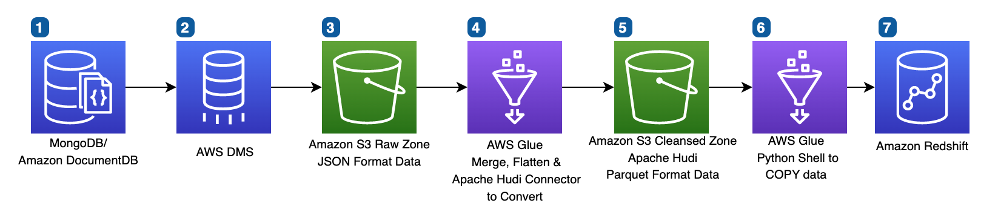
The following diagram demonstrates the architecture of our initial design.

Let’s discuss the key AWS services of this architecture:
- AWS Data Migration Service (AWS DMS) allowed our team to move quickly in delivering this pipeline. AWS DMS gives our team a full snapshot of the data, and also offers ongoing change data capture (CDC). By combining these two datasets, we can ensure our pipeline delivers the latest data.
- Amazon Simple Storage Service (Amazon S3) is the backbone of Hudl’s data lake because of its durability, scalability, and industry-leading performance.
- AWS Glue allows us to run our Spark workloads in a serverless fashion, with minimal setup. We chose AWS Glue for its ease of use and speed of development. Additionally, features such as AWS Glue bookmarking simplified our file management logic.
- Amazon Redshift offers petabyte-scale data warehousing. Amazon Redshift provides consistently fast performance, and easy integrations with our S3 data lake.
The data processing flow includes the following steps:
- Amazon DocumentDB holds the Hudl statistics data.
- AWS DMS gives us a full export of statistics data from Amazon DocumentDB, and ongoing changes in the same data.
- In the S3 Raw Zone, the data is stored in JSON format.
- An AWS Glue job merges the initial load of statistics data with the changed statistics data to give a snapshot of statistics data in JSON format for reference, eliminating duplicates.
- In the S3 Cleansed Zone, the JSON data is normalized and converted to Parquet format.
- AWS Glue uses a COPY command to insert Parquet data into Amazon Redshift consumption base tables.
- Amazon Redshift stores the final table for consumption.
The following is a sample code snippet from the AWS Glue job in the initial data pipeline:
Challenges
Although this initial solution met our need for data quality, we felt there was room for improvement:
- The pipeline was slow – The pipeline ran slowly (over 2 hours) because for each batch, the whole dataset was compared. Every record had to be compared, flattened, and converted to Parquet, even when only a few records were changed from the previous daily run.
- The pipeline was expensive – As the data size grew daily, the job duration also grew significantly (especially in step 4). To mitigate the impact, we needed to allocate more AWS Glue DPUs (Data Processing Units) to scale the job, which led to higher cost.
- The pipeline limited our ability to scale – Hudl’s data has a long history of rapid growth with increasing customers and sporting events. Given this trend, our pipeline needed to run as efficiently as possible to handle only changing datasets to have predictable performance.
New design
The following diagram illustrates our updated pipeline architecture.
Although the overall architecture looks roughly the same, the internal logic in AWS Glue was significantly changed, along with addition of Apache Hudi datasets.
In step 4, AWS Glue now interacts with Apache HUDI datasets in the S3 Cleansed Zone to upsert or delete changed records as identified by AWS DMS CDC. The AWS Glue to Apache Hudi connector helps convert JSON data to Parquet format and upserts into the Apache HUDI dataset. Retaining the full documents in our Apache HUDI dataset allows us to easily make schema changes to our final Amazon Redshift tables without needing to re-export data from our source systems.
The following is a sample code snippet from the new AWS Glue pipeline:
Results
With this new approach using Apache Hudi datasets with AWS Glue deployed after May 2022, the pipeline runtime was predictable and less expensive than the initial approach. Because we only handled new or modified records by eliminating the full outer join over the entire dataset, we saw an 80–90% reduction in runtime for this pipeline, thereby reducing costs by 80–90% compared to the initial approach. The following diagram illustrates our processing time before and after implementing the new pipeline.

Conclusion
With Apache Hudi’s open-source data management framework, we simplified incremental data processing in our AWS Glue data pipeline to manage data changes at the record level in our S3 data lake with CDC from Amazon DocumentDB.
We hope that this post will inspire your organization to build AWS Glue pipelines with Apache Hudi datasets that reduce cost and bring performance improvements using serverless technologies to achieve your business goals.
About the authors
 Addison Higley is a Senior Data Engineer at Hudl. He manages over 20 data pipelines to help ensure data is available for analytics so Hudl can deliver insights to customers.
 Ramzi Yassine is a Lead Data Engineer at Hudl. He leads the architecture, implementation of Hudl’s data pipelines and data applications, and ensures that our data empowers internal and external analytics.
 Swagat Kulkarni is a Senior Solutions Architect at AWS and an AI/ML enthusiast. He is passionate about solving real-world problems for customers with cloud-native services and machine learning. Swagat has over 15 years of experience delivering several digital transformation initiatives for customers across multiple domains, including retail, travel and hospitality, and healthcare. Outside of work, Swagat enjoys travel, reading, and meditating.
 Indira Balakrishnan is a Principal Solutions Architect in the AWS Analytics Specialist SA Team. She is passionate about helping customers build cloud-based analytics solutions to solve their business problems using data-driven decisions. Outside of work, she volunteers at her kids’ activities and spends time with her family.
A round of stable-kernel updates
Post Syndicated from original https://lwn.net/Articles/914423/
The
5.4.224,
4.19.265,
4.14.299, and
4.9.333
stable kernel updates have been released; each contains another set of
important fixes.
Note that 6.0.8,
5.15.78,
5.10.154
went into the review process at the same time, but have not yet been released.
A pair of new LWN site features
Post Syndicated from original https://lwn.net/Articles/914410/
We have finally added a set of dark mode defaults to the customization options for the site for
those who prefer the dark side. Thanks to all the readers who have asked
for this; apologies for taking so long to do it. The defaults seem good,
but we are not dark-mode users, so please let us know if you have
suggestions for improvements.
Another new feature that has been requested for some time is the ability to
receive feature articles via email. These emails are currently available
to subscribers at the “Project Leader” level and higher; interested
subscribers can sign up for the “Features” list on the mailing-lists page.
Detect and block advanced bot traffic
Post Syndicated from Etienne Munnich original https://aws.amazon.com/blogs/security/detect-and-block-advanced-bot-traffic/
Automated scripts, known as bots, can generate significant volumes of traffic to your mobile applications, websites, and APIs. Targeted bots take this a step further by targeting website content, such as product availability or pricing.
Traffic from targeted bots can result in a poor user experience by competing against legitimate user traffic for website access to high-demand inventory, increasing business risk through chargebacks from fraudulent transactions, and increasing infrastructure costs.
In 2021, AWS released AWS WAF Bot Control for Common Bots to help you detect and control common bots. In October 2022, AWS released a new feature—AWS Bot Control for Targeted Bots—that can help you detect and protect against bots that use advanced techniques to actively avoid detection.
In this post, I provide an overview of Bot Control for Targeted Bots and show you how to enable Bot Control to detect and block both common and targeted bots.
Overview of Bot Control for Targeted Bots
Bot Control for Targeted Bots provides sophisticated bot detection and mitigation by creating an intelligent baseline of traffic patterns. Bot Control for Targeted Bots uses browser fingerprinting techniques and client-side JavaScript interrogation methods to help protect your application from advanced bots that mimic human traffic patterns and actively try to evade detection.
Bot Control detects anomalies in usage patterns and provides new flexible mitigation options to isolate bad bots. These options include dynamic rate-limiting, challenge actions, and the ability to block based on labels and confidence scores.
With Bot Control for Targeted Bots, you can use bot protection rules to allow verified common bot traffic and, at the same time, to challenge unwanted advanced bot traffic. You can achieve both tasks from the same configuration page without making application or architectural changes. You can also configure fine-grained rule sets. For example, you can configure blocking actions for high-risk bots while allowing for exceptions for known IP ranges.
This release also introduces token domains, which is the ability to use the same AWS WAF web ACL across multiple domain names and Amazon CloudFront distributions to simplify client-side configuration. For example, you can use token domains to accept tokens that are generated by www.example.com for api.example.com and vice versa. In addition, you can now specify a resource path directly in the managed rule configuration, enabling you to only require a token for API calls, but not for cached, content-like images.
Bot Control for Targeted Bots sends metrics to Amazon CloudWatch to identify application access trends. The metrics include the percentage of human traffic compared to bot traffic and the count of requests for sensitive web pages such as login and checkout pages. Each rule in Bot Control produces a unique label so that you can review CloudWatch metrics and filter logs to understand traffic patterns. By using these mechanisms, you can identify, isolate, and remediate operational issues.
Walkthrough
In this walkthrough, I will show you how to set up Bot Control for Targeted Bots to help protect a CloudFront distribution.
You will set up an AWS WAF web ACL with an AWS Managed Rule for Bot Control for Targeted Bots. The rule detects bots and then decides the appropriate action:
- Dynamically rate limit verified bots – Based on traffic history, Bot Control creates an intelligent baseline and then applies rate limits to abnormally high volumes.
- Enable the challenge action – You have a new option, called challenge, along with the already supported options of count, allow, block, and CAPTCHA. The challenge option initiates a process of challenge interstitial, which means that Bot Control provides a challenge to the browser and creates a domain token when the challenge is resolved.
Set up Bot Control for Targeted Bots
In this section, I will show you how to set up Bot Control for Targeted Bots by creating a new web ACL or editing an existing one.
To set up Bot Control for Targeted Bots
- Open the AWS WAF console, and then do one of the following:
- To create a new web ACL, choose Create a new web ACL.
- To edit an existing web ACL, choose the name of the ACL.
- On the Rules tab, for the Add rules drop-down, select Add managed rule groups.
- Add a Bot Control rule set to the web ACL. Choose Edit to edit the rule.
- For Bot Control inspection level, select the inspection level for Bot Control. For this walkthrough, we chose Targeted to enable Bot Control for Targeted Bots.

Figure 1: Bot Control – Select inspection level
- Review and select the actions to be taken on each category of bots detected, and then choose Save rule. In our example, we set allow, challenge, and count rules for the categories, as shown in Figure 2.
Figure 2: Bot Control – Select actions for each category
You can select different actions for each category based on your application security needs:
- Allow: Allows the request to be sent to a protected resource.
- Block: Blocks the request, returning an HTTP 403 (Forbidden) response.
- Count: Allows the request to be sent to the protected resource while counting detections. The count shows you bot activity that is occurring without blocking or challenging. When you turn on rules for the first time, this information can help you see what the detections are, before you change the actions.
- CAPTCHA and Challenge: use CAPTCHA puzzles and silent challenges with tokens to track successful client responses.
- In this example you will configure a scope-down statement to apply Bot Control for a given URI path only.
On the same page in the step above, you can add a scope-down statement to ensure you use and incur Targeted Bots charges for the requests where you need protections. There are more examples of how to use scope-down statements in our documentation.
Select “Enable scope-down statement” and configure the rule to inspect the URI path as per figure 3.

Figure 3: Bot Control – Add the scope-down statement
- To add domain names to be protected, scroll to the bottom of the web ACL and choose Edit. In the Token domain list – optional section, enter the domain name or names to which the token verification applies. Tokens that are generated are valid for these domains.


Create the SDK link for the AWS WAF integration
In this section, I’ll show you how to find the AWS WAF SDK and add it to your application pages.
The token SDK manages the token authorization and includes the tokens in the requests that you send to your protected resources. By adding the SDK link to application pages, you can help ensure that the remote procedure calls by your client contain a valid token.
To add the SDK to your application pages
- In the AWS WAF console, in the left navigation pane, choose Application integration SDKs.
- Under JavaScript SDK, copy the provided code snippet. This code snippet allows for creation of the cryptographic token in the background when the application loads for the first time, providing a better customer experience.
- Add the code snippet to your pages. For example, paste the provided script code within the <head> section of the HTML.
When this integration is in place on your application’s pages, you can add AWS WAF rules in your web ACL to block requests that don’t contain a valid token. Replace the <Web ACL integration URL> with the provided integration URL from the AWS WAF console or copy the script tag from the console:
<script type="text/javascript" src="<Web ACL integration URL>/challenge.js” defer></script>
Figure 4 shows the SDK link for application pages.

Figure 4: Bot Control – Add SDK link to application pages
Review metrics
Now that you’ve set up the web ACL and application, you can use the bot visualization dashboard to review bot traffic patterns. Bot rules emit metrics corresponding to their labels, helping you identify which rule within the AWS Managed Rule for Bot Control for Targeted Bots initiated an action. You can also use these labels and rule actions to filter AWS WAF logs so that you can further examine a request.
To view AWS WAF metrics for the distribution
- In the AWS WAF console, in the left navigation pane, select Web ACLs.
- Select the web ACL that Bot Control is enabled on and then choose the Bot Control tab to view the metrics.

Figure 5: Bot Control – Review web ACL metrics
Best practices
In this section, I describe best practices for your Bot Control setup.
Set priority ordering of AWS WAF rules to help lower costs
You can set the priority of rule groups in a web ACL such that the order of the rule matches requests more efficiently. AWS WAF will take the action associated to the first rule it matches. If the incoming traffic matches the more wider criteria (such as IPset rules at priority 1), the associated action is taken. That request is never analyzed by the Bot Control rule and hence do not incur the bot control request analysis fees. For example, the following list shows rules ranked in order from highest priority (1) to lowest priority (5):
- Use allow and deny lists – provide IP addresses to allow or deny
- AWS Managed Rule groups for IP reputation – block bots and other threats
- General rate limit – help prevent HTTP flood across the protected resource
- AWS WAF Bot Control rule group – scoped-down to exclude static content such as images
- Rate limit for login pages – scoped-down for specific URLs and HTTP POST methods
Figure 6 shows the prioritized rules in AWS WAF.

Figure 6: AWS WAF – Web ACL rule order
Use scope-down statements
You can use scope-down statements to limit the requests evaluated for a rule group. For example, a scope-down statement that excludes checking requests for static assets, such as images for a given URI and HTTP method (GET), can help reduce Bot Control costs.
Block requests without tokens
If a request has a token absent or is rejected, you can block that request. For example, you might want to block requests on login or payment processing pages. To block requests with a missing or rejected token, add a rule to run after the Bot Control rule to block requests matching the labels rejected and absent:
- awswaf:managed:token:rejected – The request token is present but is either corrupt or has an expired challenge timestamp.
- awswaf:managed:token:absent – The request doesn’t have a token.
Use SDK integration
After you add the token domains and the provided script to your application pages, you can add a rule to block requests that don’t have a token. Use of the SDK helps AWS WAF verify the client application with silent challenges and provide AWS token acquisition and management. The SDK provides the full functionality of both AWS WAF Bot Control and AWS WAF Fraud Control, reducing the need for multiple SDKs if either or both rule groups are used in the web ACL.
Create CloudWatch alarms
You can add CloudWatch alarms to help you assess whether there is activity outside of the norm for your application. For example, you can monitor for a high number of token-absent metrics for a given time period.
Configure a billing alarm
To help you track costs, you can configure a billing alarm that sends an alert when you have exceeded the threshold for your expected costs.
Pricing and availability
Bot Control for Targeted Bots is available today in AWS Regions where AWS WAF is available, excluding AWS GovCloud (US) and China Regions. For information on pricing, see AWS WAF Pricing.
Conclusion
In this post, you learned how to use Bot Control for Targeted Bots to add visibility into bot activity on your website or applications. With Bot Control for common and targeted bots, you can detect, challenge, and block unwanted bot activity. Because Bot Control is customizable, you can tailor how you address legitimate bots while protecting against bots that use advanced techniques to actively avoid detection. For more information and to get started today, see AWS WAF Bot Control.
If you have feedback about this post, submit comments in the Comments section below. If you have questions about this post, contact AWS Support.
Want more AWS Security news? Follow us on Twitter.
5 Compelling Reasons You Should Go IPO
Post Syndicated from original https://www.backblaze.com/blog/5-compelling-reasons-you-should-go-ipo/
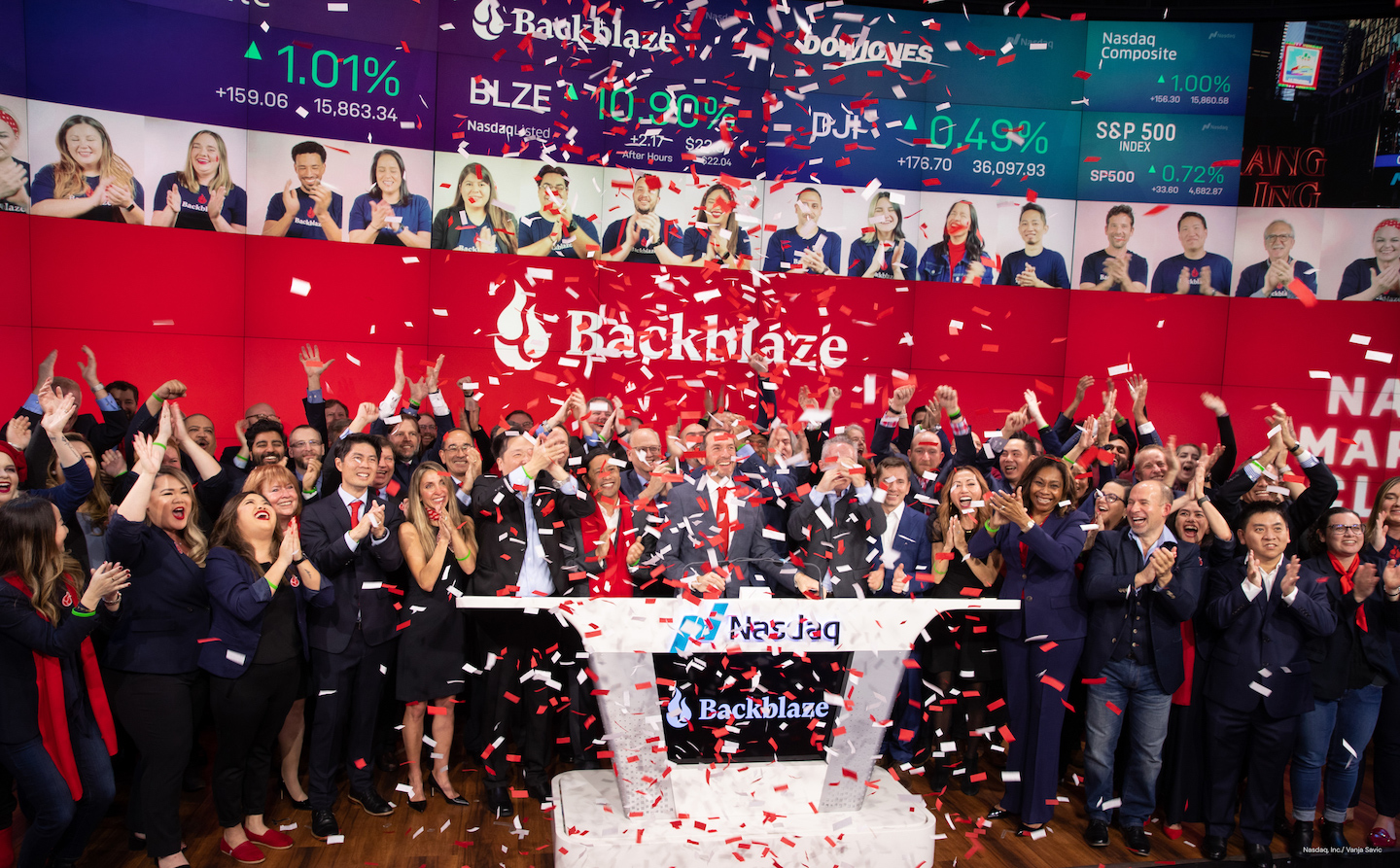
We took Backblaze public one year ago tomorrow. Our IPO was a great day and the realization of 14 years of hard work by our team. Since then, we’ve executed on our plans, hit our targets, and continued to grow our team and our revenue. And yet, the markets have been tough sledding. For newly-public tech companies like us, as well as many of our peers, stock values have decreased by ~70% from their peak values last year. It’s hard for shareholders, employees, and the market.
Obviously I wish the last 10 months would have gone differently in the markets, who doesn’t? But when people ask me, (which happens a lot) “Do you still think the IPO was a good idea?” There’s no question in my mind that it was one of the best business decisions we’ve made at Backblaze.
In fact, the more that I think about our experience of taking the company public, the more I believe that the IPO should be part of every entrepreneur and business leader’s consideration set. A perception has developed that there are magical financial benchmarks that forbid some companies from listing, but we went public at a point in the evolution of our business when a lot of experts told us we couldn’t. We may have faced some headwinds others didn’t, but I’m convinced that the IPO isn’t just for folks with over $300m in revenue who’ve raised hundreds of millions of dollars in venture capital.
So, in keeping with our commitment to transparency about our business and some of the interesting, tough, and exciting stuff we’ve been through—long-time readers will remember my blog about almost getting acquired—I’ve decided to write about our IPO journey: What sucked, what didn’t, what shocked us, and what we learned. Along the way, I’ll share everything I can—metrics, worksheets, planning decks, and more. Not because I think we deserve a pat on the back or to celebrate what we did, but for two bigger purposes:
- I can remember what it feels like to be an early stage entrepreneur thinking that the only path to making the company you built successful was to seek out restrictive venture funding or seek out an acquisition. I want to offer folks—whether you’re considering starting a business or have already built one with tens of millions in revenue—that there is another path to consider. While doing an IPO isn’t right for everyone, I think considering an IPO, and positioning your business to go that way if the opportunity arises, is sound strategy.
- I believe that democratizing the IPO process will be healthier for businesses, markets, and investors. And I’m not the first: Bill Hambrecht is well known for his efforts to open IPOs to broader audiences as he did with companies like Google and Overstock.com. Tech is all about disrupting unnecessary complexity, and going public is more complex than an AWS invoice. In the mid-nineties, there were more than 8,000 publicly traded companies. By this September there were nearly 2,000 fewer companies listed, even after the boom we saw in 2020 and 2021. I don’t think that’s a good thing.
This blog series will be for everyone from those of you dreaming up your first idea, to startups still in stealth mode, to the thousands of companies with revenue in the tens of millions.
And if there’s anything I talk about here that’s confusing or that you want to hear more about, please ask in the comments. I’ll try to cover it in a future post.
Why Listen to Us?
Hot takes on building startups and raising funding are a dime a dozen—so if you’re skeptical, I get it. What we’ll share here is partially based on the experience we had building two prior technology companies, raising multiple rounds of venture capital, and successfully selling them through acquisition. However, more uniquely: We founded and essentially bootstrapped Backblaze all the way up to our IPO (before 2021 we had only taken $3M in outside funding). Even CNBC noted that we took a unique path to market, and yet with $65 million in recurring revenue in 2020, we made a successful public offering and raised over $100M in funding to continue growing our business. We’ve made this journey ourselves, we did it recently, and—in the spirit of transparency—we’re going to share the stories behind it.
Why an IPO Should Be in Your Business Consideration Set
Why should IPO readiness (the process of setting up your business to go public) and actually going public be in your playbook? I’m going to explore this concept deeply over the course of this series, but I’ll pause here to tell you the five most compelling reasons to be IPO ready, along with a few proof points from our own experience.
- Build to Last: Starting and growing a company is hard. If you’re doing it, it’s probably because you’re passionate about solving some problems in the world. To be successful, you had to care about your vision, your product, your customers, and your team. If your company ends up acquired, the unique entity you created will vaporize. Taking your company public provides a path to building and running the company for the long-term, possibly outliving you.
- Funding With the Right Strings Attached: Raising funding in an IPO requires selling a portion of your company, just as in any venture funding. The difference, however, is that in an IPO the equity you sell is common shares—everyone gets the same shares on the same terms. In private fund raises, the company sells “preferred shares” to investors which typically come with a variety of special rights giving investors the ability to have extra control over the company, get extra equity in the company, prevent the company from raising money from other investors, and more. Raising funding in an IPO is the ultimate “clean” fundraise.
- Building a Real Business: If you’re building with an aim to be acquired, it’s nearly impossible to not establish a culture at the company where everyone is focused on “dumping” the business. By aiming for an IPO, it drives the mindset to build for sustainability. You’re more likely to create a business that can achieve profitability, scale, growth, and deliver value over the long haul. Also, going through the actual process of IPO readiness, along with the process of feeding your financials through a meat grinder of ROI modeling and outcome driven planning—both during and after the IPO—means you will position your business for even greater resilience going forward.
- Credibility: When the five Backblaze founders talked about IPOs back in the day in a tiny apartment in Palo Alto, it felt like we were trying on our dad’s pants. Sure, we knew some companies went public—but it didn’t feel like something that was really accessible (even for a room of people that scaled and sold multiple companies). But we’re not the only people who feel this way: “Public” signals a level of accomplishment and evolution that’s hard to achieve as a private company. Being able to achieve an IPO proves a business’s capacity to operate and excel under intense pressure and scrutiny. And if anyone is uncertain about how we’re doing, they can just go grab the last 10-K to see our results.
- Liquidity: This one is simple. If you’re not public, you can’t sell your stock on the open market. Once the company is public, you and your employees (and existing shareholders) can sell their shares if they so choose. It also provides the freedom and flexibility for each individual to make that decision on their own. Rather than having to sell the company (wherein usually everyone is forced to sell all their shares), this allows one person to decide to stay “all-in” and keep all their shares, another one to sell theirs, and a third to sell just a few shares.
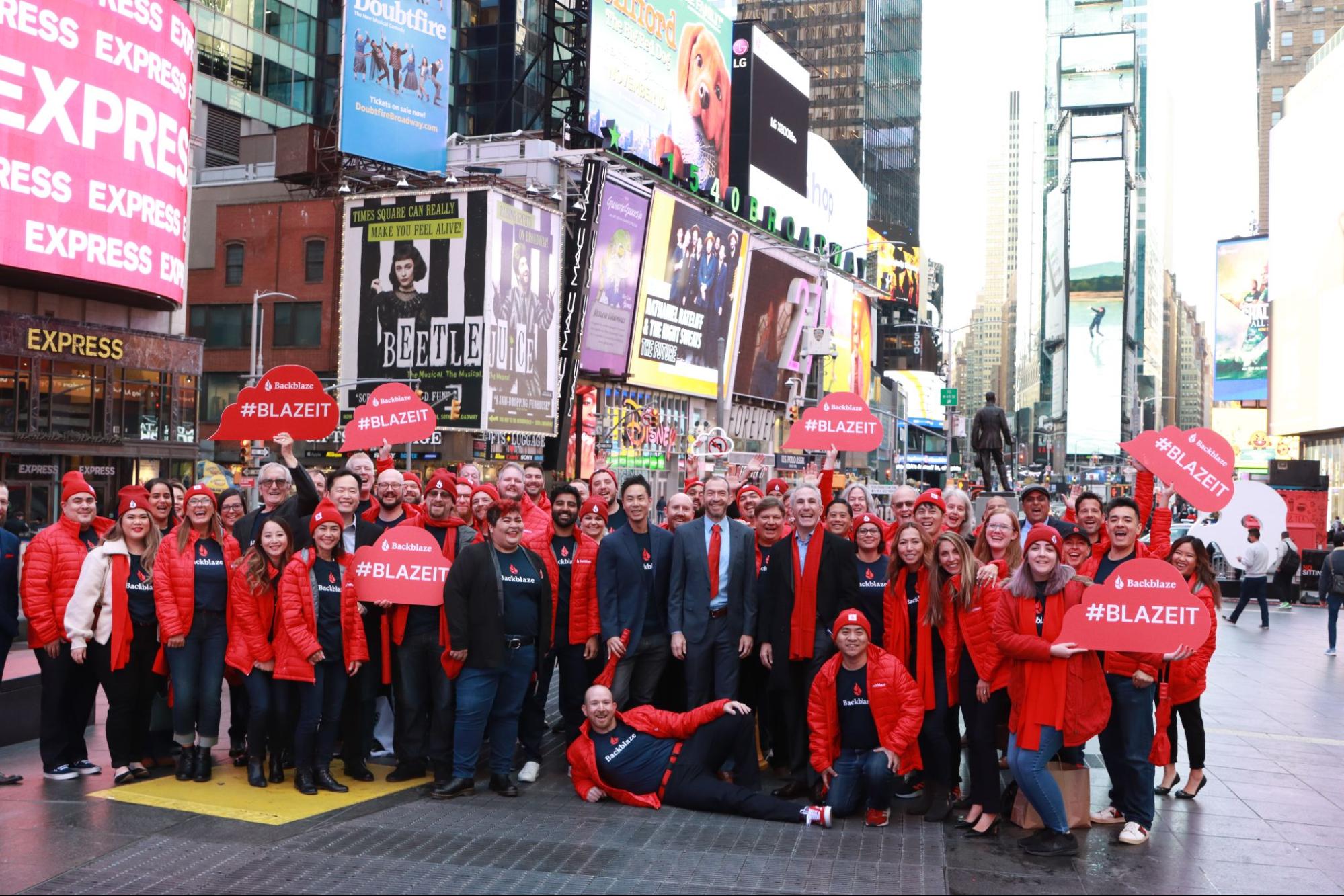
What’s Next?
If you’re intrigued, this is really only the tip of the iceberg. In future posts, I will dig into everything from the nitty gritty tactics—like how to build a board, how to build a banking syndicate (twice], and how to write an S-1—to the bigger stories—like how years of planning can hinge on a few hours of work, or why “testing the waters” might be better named “getting thrown to the sharks”.
Rest assured: If you think you’re not interested in going public, everything I share will have as much to do with how you build a better business that you can grow over time as it will with the guts of the IPO process. I hope it’s useful, and if there’s anything you hope I’ll address or anything specific that you’d like to learn more about, let me know in the comments.
The post 5 Compelling Reasons You Should Go IPO appeared first on Backblaze Blog | Cloud Storage & Cloud Backup.