Post Syndicated from original https://xkcd.com/2713/

Post Syndicated from original https://xkcd.com/2713/
Post Syndicated from original https://lwn.net/Articles/918145/
Version 4.0.0 of the Apache SpamAssassin spam filter has been released.
Apache SpamAssassin 4.0.0 contains numerous tweaks and bug fixes over
the past releases. In particular, it includes major changes that
significantly improve the handling of text in international language.As with any major release, there are countless functional patches and
improvements to upgrade to 4.0.0. Apache SpamAssassin 4.0.0 includes
several years of fixes that significantly improve classification and
performance. It has been thoroughly tested in production systems. We
strongly recommend upgrading as soon as possible.
Post Syndicated from original https://mjg59.dreamwidth.org/63632.html
Turns out that linking to several days old public data in order to demonstrate that Elon’s jet was broadcasting its tail number in the clear is apparently “posting private information” so for anyone looking for me there I’m actually here
 comments
Post Syndicated from Oglaf! -- Comics. Often dirty. original https://www.oglaf.com/tinderbox/


Post Syndicated from original https://lwn.net/Articles/918109/
Version
5.0.0 of the OCaml programming language is out.
The highlight of this new major version of OCaml is the
long-awaited runtime support for shared memory parallelism and
effect handlers. This multicore support is the culmination of more
than 8 years of effort, and required a full rewrite of the OCaml
runtime environment. Consequently, OCaml 5.0.0 is expected to be a
more experimental version of OCaml than the usual OCaml releases.
Post Syndicated from Techmoan original https://www.youtube.com/watch?v=vmTj-XVRdfM
Post Syndicated from Bruce Schneier original https://www.schneier.com/blog/archives/2022/12/friday-squid-blogging-squid-in-concert.html
Squid is performing a concert in London in February.
If you don’t know what their music is like, try this or this or this.
As usual, you can also use this squid post to talk about the security stories in the news that I haven’t covered.
Read my blog posting guidelines here.
Post Syndicated from Brendan Watters original https://blog.rapid7.com/2022/12/16/metasploit-weekly-wrap-up-187/
It is clear that the Metasploit elves have been busy this season: Five new modules, six new enhancements, nine new bug fixes, and a partridge in a pear tree are headed out this week! (Partridge nor pear tree included.) In this sack of goodies, we have a gift that keeps on giving: Shelby’s Acronis TrueImage Privilege Escalation works wonderfully, even after the software is uninstalled.
Jan Rude submitted two modules targeting Syncovery for Linux. One takes advantage of an insecure session token generator and allows for the brute-force creation of a token that matches that of a logged-in user, and the other allows an authenticated user to create a job that will run when a user’s profile is run.
root user.lib/metasploit/framework/spec/threads/suite.rb has been updated to appropriately count and document the known threads that can be left behind when running the rspec test suite. This fixes an intermittent rspec crash.creds command has been updated to show the full SSH key contents when running the creds -v command or when exporting to a file with creds -o output.txt. Previously only a shortened fingerprint string would be shown to the user.hosts, services, vulns and notes command have been updated to support tab expansion in paths using the ~ character when using the -o option to specify the path to the file to write the output to.exploit/windows/local/s4u_persistence module where the default value for FREQUENCY would cause an error.file_version method for Windows Meterpreter, which would cause the session to crash if it was run on a file that did not exist on the target system.exit command from within msfconsole when running msfconsole with a 3.1.x release of Ruby.smb_enumshares.rb whereby if a SMBv1 connection is used a call was made to the net_share_enum_all function on the wrong object. This has since been updated to address this error.As always, you can update to the latest Metasploit Framework with msfupdate
and you can get more details on the changes since the last blog post from
GitHub:
If you are a git user, you can clone the Metasploit Framework repo (master branch) for the latest.
To install fresh without using git, you can use the open-source-only Nightly Installers or the
binary installers (which also include the commercial edition).
Post Syndicated from Irfan Saleem original https://aws.amazon.com/blogs/architecture/architecting-your-security-model-in-aws-for-legacy-application-migrations/
Application migrations, especially from legacy/mainframe to the cloud, are done in phases that sometimes span multiple years. Each phase migrates a set of applications, data, and other resources to the cloud. During the transition phases, applications might require access to both on-premises and cloud-based resources to perform their function. While working with our customers, we observed that the most common resources that applications require access to are databases, file storage, and shared services.
This blog post includes architecture guidelines for setting up access to commonly used resources by building a security model in Amazon Web Services (AWS). As you move your legacy applications to the cloud, you can apply Zero Trust concepts and security best practices according to your security needs. With AWS, you can build strong identity and access management with centralized control and set up and manage guardrails and fine-grained access controls for your workforce and applications.
In large organizations, on-premises applications rely on mainframe-based security services, an Identity Provider (IdP) platform, or a combination of both.
Figure 1 shows an on-premises environment where enterprise identity management is integrated with the mainframe and provides authentication and authorization to applications running off the mainframe. Generally, mainframe-based security controls (users, resources, and profiles) are replicated to the enterprise identity platform and are kept in sync through a change data capture process.

Figure 1. Access to AWS resources from on-premises
To enable your on-premises applications to access AWS resources, the applications need valid AWS credentials for making AWS API requests. Avoid using long-term access keys (such as those associated with IAM users) because they remain valid until you remove them. The following two methods can be used to assume an IAM role and get temporary security credentials to gain access to the AWS resources:
In both of these cases, authenticated requests assume an IAM role, get temporary security credentials, and perform certain actions using AWS command line interface (CLI) and AWS SDKs. The IAM role has attached permissions for AWS resources such as Amazon Simple Storage Service (Amazon S3), Amazon DynamoDB, and Amazon Relational Database Service (Amazon RDS).
The temporary credentials expire when the session expires. By default, the session duration is one hour; you can request longer duration and session refresh.
To understand better, let’s consider the use case in Figure 2, where on-premises applications need access to AWS resources.
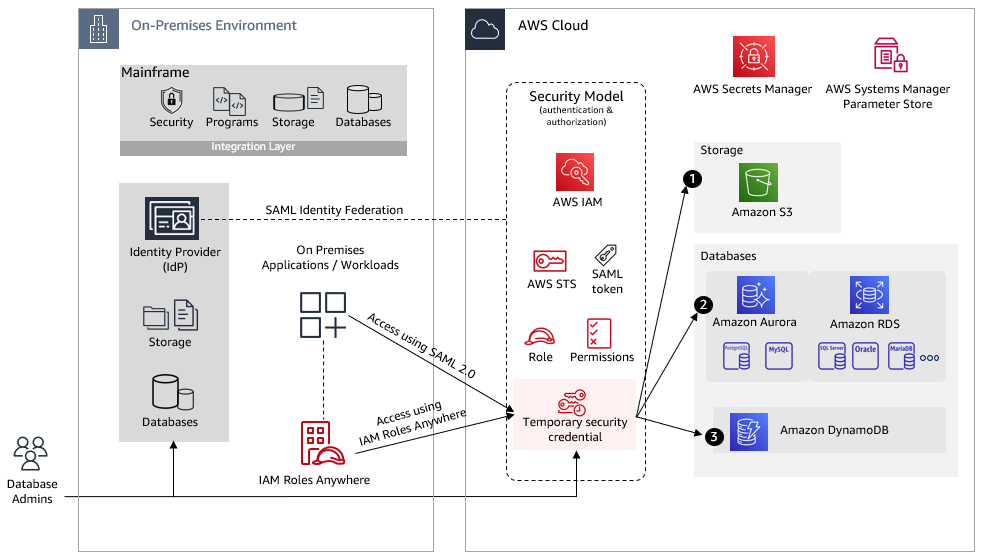
Figure 2. Access to resources that are created or already migrated to AWS from on-premises
Applications can get temporary security credentials through SAML or IAM Roles Anywhere as explained earlier. The next sections explain setting up access to the resources in Figure 2 using temporary credentials.
On-premises applications can access Amazon S3 using the REST API or the AWS SDK to perform certain actions (such as GetObjects or ListObjects):
AWS Secrets Manager helps you store credentials for Amazon RDS and Amazon Aurora. You can also set up automatic rotation of your database secrets to meet your security and compliance needs. Applications can retrieve secrets using AWS SDKs and AWS CLI.
Additional configuration values can be stored in AWS Systems Manager Parameter Store, which provides secure, hierarchical storage for configuration data management such as passwords, database strings and license codes as parameter values rather than hard coding them in the code.
To access Amazon RDS and Amazon Aurora:
Applications can use temporary credentials to invoke certain actions using AWS SDKs for DynamoDB. You can create a VPC endpoint for DynamoDB to access DynamoDB with no exposure to the public internet, then restrict access further by using VPC endpoint and IAM policies.
This blog helps you architect an application security model in AWS to provide on-premises access to commonly used resources in AWS.
You can apply security best practices and Zero Trust concepts as you move your legacy applications to the cloud. With AWS, you can build identity and access management with centralized and fine-grained access controls for your workforce and applications.
Start building your security model on AWS:
Post Syndicated from Andie Goodwin original https://blog.cloudflare.com/impact-report-2022/


To conclude Impact Week, which has been filled with announcements about new initiatives and features that we are thrilled about, today we are publishing our 2022 Impact Report.
In short, the Impact Report is an annual summary highlighting how we are helping build a better Internet and the progress we are making on our environmental, social, and governance priorities. It is where we showcase successes from Cloudflare Impact programs, celebrate awards and recognitions, and explain our approach to fundamental values like transparency and privacy.
We believe that a better Internet is principled, for everyone, and sustainable; these are the three themes around which we constructed the report. The Impact Report also serves as our repository for disclosures consistent with our commitments for the Global Reporting Initiative (GRI), Sustainability Accounting Standards Board (SASB), and UN Global Compact (UNGC).
Check out the full report to:
As fantastic as 2022 has been for scaling up Cloudflare Impact and making strides toward a better Internet, we are aiming even higher in 2023. To keep up with developments throughout the year, follow us on Twitter and LinkedIn, and keep an eye out for updates on our Cloudflare Impact page.
Post Syndicated from Lorraine Bellon original https://blog.cloudflare.com/everything-you-might-have-missed-during-cloudflares-impact-week-2022/


And that’s a wrap! Impact Week 2022 has come to a close. Over the last week, Cloudflare announced new commitments in our mission to help build a better Internet, including delivering Zero Trust services for the most vulnerable voices and for critical infrastructure providers. We also announced new products and services, and shared technical deep dives.
Were you able to keep up with everything that was announced? Watch the Impact Week 2022 wrap-up video on Cloudflare TV, or read our recap below for anything you may have missed.
| Blog | Summary |
|---|---|
| Cloudflare Zero Trust for Project Galileo and the Athenian Project | We are making the Cloudflare One Zero Trust suite available to teams that qualify for Project Galileo or Athenian at no cost. Cloudflare One includes the same Zero Trust security and connectivity solutions used by over 10,000 customers today to connect their users and safeguard their data. |
| Project Safekeeping – protecting the world’s most vulnerable infrastructure with Zero Trust | Under-resourced organizations that are vital to the basic functioning of our global communities (such as community hospitals, water treatment facilities, and local energy providers) face relentless cyber attacks, threatening basic needs for health, safety and security. Cloudflare’s mission is to help make a better Internet. We will help support these vulnerable infrastructure by providing our enterprise-level Zero Trust cybersecurity solution to them at no cost, with no time limit. |
| Cloudflare achieves FedRAMP authorization to secure more of the public sector | We are excited to announce our public sector suite of services, Cloudflare for Government, has achieved FedRAMP Moderate Authorization. The Federal Risk and Authorization Management Program (“FedRAMP”) is a US-government-wide program that provides a standardized approach to security assessment, authorization, and continuous monitoring for cloud products and services. |
| A new, configurable and scalable version of Geo Key Manager, now available in Closed Beta | At Cloudflare, we want to give our customers tools that allow them to maintain compliance in this ever-changing environment. That’s why we’re excited to announce a new version of Geo Key Manager — one that allows customers to define boundaries by country, by region, or by standard. |

| Blog | Summary |
|---|---|
| Cloudflare is joining the AS112 project to help the Internet deal with misdirected DNS queries | Cloudflare is participating in the AS112 project, becoming an operator of the loosely coordinated, distributed sink of the reverse lookup (PTR) queries for RFC 1918 addresses, dynamic DNS updates and other ambiguous addresses. |
| Measuring BGP RPKI Route Origin Validation | The Border Gateway Protocol (BGP) is the glue that keeps the entire Internet together. However, despite its vital function, BGP wasn’t originally designed to protect against malicious actors or routing mishaps. It has since been updated to account for this shortcoming with the Resource Public Key Infrastructure (RPKI) framework, but can we declare it to be safe yet? |
| Blog | Summary |
|---|---|
| Democratizing access to Zero Trust with Project Galileo | Learn how organizations under Project Galileo use Cloudflare Zero Trust to protect their organization from cyberattacks. |
| Securing the inboxes of democracy | Cloudflare email security worked hard in the 2022 U.S. midterm elections to ensure that the email inboxes of those seeking office were secure. |
| Expanding Area 1 email security to the Athenian Project | We are excited to share that we have grown our offering under the Athenian Project to include Cloudflare’s Area 1 email security suite to help state and local governments protect against a broad spectrum of phishing attacks to keep voter data safe and secure. |
| How Cloudflare helps protect small businesses | Large-scale cyber attacks on enterprises and governments make the headlines, but the impacts of cyber conflicts can be felt more profoundly and acutely by small businesses that struggle to keep the lights on during normal times. In this blog, we’ll share new research on how small businesses, including those using our free services, have leveraged Cloudflare services to make their businesses more secure and resistant to disruption. |
| Blog | Summary |
|---|---|
| Cloudflare expands Project Pangea to connect and protect (even) more community networks | A year and a half ago, Cloudflare launched Project Pangea to help provide Internet services to underserved communities. Today, we’re sharing what we’ve learned by partnering with community networks, and announcing an expansion of the project. |
| The US government is working on an “Internet for all” plan. We’re on board. | The US government has a $65 billion program to get all Americans on the Internet. It’s a great initiative, and we’re on board. |
| The Montgomery, Alabama Internet Exchange is making the Internet faster. We’re happy to be there. | Internet Exchanges are a critical part of a strong Internet. Here’s the story of one of them. |
| Partnering with civil society to track Internet shutdowns with Radar Alerts and API | We want to tell you more about how we work with civil society organizations to provide tools to track and document the scope of these disruptions. We want to support their critical work and provide the tools they need so they can demand accountability and condemn the use of shutdowns to silence dissent. |
| How Cloudflare helps next-generation markets | At Cloudflare, part of our role is to make sure every person on the planet with an Internet connection has a good experience, whether they’re in a next-generation market or a current-gen market. In this blog we talk about how we define next-generation markets, how we help people in these markets get faster access to the websites and applications they use on a daily basis, and how we make it easy for developers to deploy services geographically close to users in next-generation markets. |

| Blog | Summary |
|---|---|
| Independent report shows: moving to Cloudflare can cut your carbon footprint | We didn’t start out with the goal to reduce the Internet’s environmental impact. But as the Internet has become an ever larger part of our lives, that has changed. Our mission is to help build a better Internet — and a better Internet needs to be a sustainable one. |
| A more sustainable end-of-life for your legacy hardware appliances with Cloudflare and Iron Mountain | We’re excited to announce an opportunity for Cloudflare customers to make it easier to decommission and dispose of their used hardware appliances in a sustainable way. We’re partnering with Iron Mountain to offer preferred pricing and value-back for Cloudflare customers that recycle or remarket legacy hardware through their service. |
| How we’re making Cloudflare’s infrastructure more sustainable | With the incredible growth of the Internet, and the increased usage of Cloudflare’s network, even linear improvements to sustainability in our hardware today will result in exponential gains in the future. We want to use this post to outline how we think about the sustainability impact of the hardware in our network, and what we’re doing to continually mitigate that impact. |
| Historical emissions offsets (and Scope 3 sneak preview) | Last year, Cloudflare committed to removing or offsetting the historical emissions associated with powering our network by 2025. We are excited to announce our first step toward offsetting our historical emissions by investing in 6,060 MTs’ worth of reforestation carbon offsets as part of the Pacajai Reduction of Emissions from Deforestation and forest Degradation (REDD+) Project in the State of Para, Brazil. |
| How we redesigned our offices to be more sustainable | Cloudflare is working hard to ensure that we’re making a positive impact on the environment around us, with the goal of building the most sustainable network. At the same time, we want to make sure that the positive changes that we are making are also something that our local Cloudflare team members can touch and feel, and know that in each of our actions we are having a positive impact on the environment around us. This is why we make sustainability one of the underlying goals of the design, construction, and operations of our global office spaces. |
| More bots, more trees | Once a year, we pull data from our Bot Fight Mode to determine the number of trees we can donate to our partners at One Tree Planted. It’s part of the commitment we made in 2019 to deter malicious bots online by redirecting them to a challenge page that requires them to perform computationally intensive, but meaningless tasks. While we use these tasks to drive up the bill for bot operators, we account for the carbon cost by planting trees. |
| Blog | Summary |
|---|---|
| The Challenges of Sanctioning the Internet | As governments continue to use sanctions as a foreign policy tool, we think it’s important that policymakers continue to hear from Internet infrastructure companies about how the legal framework is impacting their ability to support a global Internet. Here are some of the key issues we’ve identified and ways that regulators can help balance the policy goals of sanctions with the need to support the free flow of communications for ordinary citizens around the world. |
| An Update on Cloudflare’s Assistance to Ukraine | On February 24, 2022, when Russia invaded Ukraine, Cloudflare jumped into action to provide services that could help prevent potentially destructive cyber attacks and keep the global Internet flowing. During Impact Week, we want to provide an update on where things currently stand, the role of security companies like Cloudflare, and some of our takeaways from the conflict so far. |
| Two months later: Internet use in Iran during the Mahsa Amini Protests | A series of protests began in Iran on September 16, following the death in custody of Mahsa Amini — a 22 year old who had been arrested for violating Iran’s mandatory hijab law. The protests and civil unrest have continued to this day. But the impact hasn’t just been on the ground in Iran — the impact of the civil unrest can be seen in Internet usage inside the country, as well. |
| How Cloudflare advocates for a better Internet | We thought this week would be a great opportunity to share Cloudflare’s principles and our theories behind policy engagement. Because at its core, a public policy approach needs to reflect who the company is through their actions and rhetoric. And as a company, we believe there is real value in helping governments understand how companies work, and helping our employees understand how governments and law-makers work. |
| Applying Human Rights Frameworks to our approach to abuse | What does it mean to apply human rights frameworks to our response to abuse? As we’ll talk about in more detail, we use human rights concepts like access to fair process, proportionality (the idea that actions should be carefully calibrated to minimize any effect on rights), and transparency. |
| The Unintended Consequences of blocking IP addresses | This blog dives into a discussion of IP blocking: why we see it, what it is, what it does, who it affects, and why it’s such a problematic way to address content online. |

| Blog | Summary |
|---|---|
| Closing out 2022 with our latest Impact Report | Our Impact Report is an annual summary highlighting how we are trying to build a better Internet and the progress we are making on our environmental, social, and governance priorities. |
| Working to help the HBCU Smart Cities Challenge | The HBCU Smart Cities Challenge invites all HBCUs across the United States to build technological solutions to solve real-world problems. |
| Introducing Cloudflare’s Third Party Code of Conduct | Cloudflare is on a mission to help build a better Internet, and we are committed to doing this with ethics and integrity in everything that we do. This commitment extends beyond our own actions, to third parties acting on our behalf. We are excited to share our Third Party Code of Conduct, specifically formulated with our suppliers, resellers and other partners in mind. |
| The latest from Cloudflare’s seventeen Employee Resource Groups | In this blog post, we highlight a few stories from some of our 17 Employee Resource Groups (ERGs), including the most recent, Persianflare. |
That’s it for Impact Week 2022. But let’s keep the conversation going. We want to hear from you!
Visit the Cloudflare Community to share your thoughts about Impact Week 2022, or engage with our team on Facebook, Twitter, LinkedIn, and YouTube.
Or if you’d like to rewatch any Cloudflare TV segments associated with the above stories, visit the Impact Week hub on our website.
Post Syndicated from Bruce Schneier original https://www.schneier.com/blog/archives/2022/12/as-long-as-were-on-the-subject-of-captchas.html
There are these.


Post Syndicated from Deenbandhu Prasad original https://aws.amazon.com/blogs/big-data/getting-started-with-aws-glue-data-quality-for-etl-pipelines/
Today, hundreds of thousands of customers use data lakes for analytics and machine learning. However, data engineers have to cleanse and prepare this data before it can be used. The underlying data has to be accurate and recent for customer to make confident business decisions. Otherwise, data consumers lose trust in the data and make suboptimal or incorrect decisions. It is a common task for data engineers to evaluate whether the data is accurate and recent or not. Today there are various data quality tools. However, common data quality tools usually require manual processes to monitor data quality.
AWS Glue Data Quality is a preview feature of AWS Glue that measures and monitors the data quality of Amazon Simple Storage Service (Amazon S3) data lakes and in AWS Glue extract, transform, and load (ETL) jobs. This is an open preview feature so it is already enabled in your account in the available Regions. You can easily define and measure the data quality checks in AWS Glue Studio console without writing codes. It simplifies your experience of managing data quality.
This post is Part 2 of a four-post series to explain how AWS Glue Data Quality works. Check out the previous post in this series:
Getting started with AWS Glue Data Quality
|
In this post, we show how to create an AWS Glue job that measures and monitors the data quality of a data pipeline. We also show how to take action based on the data quality results.
Let’s consider an example use case in which a data engineer needs to build a data pipeline to ingest the data from a raw zone to a curated zone in a data lake. As a data engineer, one of your key responsibilities—along with extracting, transforming, and loading data—is validating the quality of data. Identifying data quality issues upfront helps you prevent placing bad data in the curated zone and avoid arduous data corruption incidents.
In this post, you’ll learn how to easily set up built-in and custom data validation checks in your AWS Glue job to prevent bad data from corrupting the downstream high-quality data.
The dataset used for this post is synthetically generated; the following screenshot shows an example of the data.

This post includes an AWS CloudFormation template for a quick setup. You can review and customize it to suit your needs.
The CloudFormation template generates the following resources:
gluedataqualitystudio-*).datalake/raw/customer/customer.csvdatalake/curated/customer/scripts/sparkHistoryLogs/temporary/GlueDataQualityStudio-*) has permission to read and write from the S3 bucket.To create your resources, complete the following steps:
us-east-1 Region.

To start configuring your solution, complete the following steps:


GlueDataQualityStudio.GlueDataQualityStudio-*.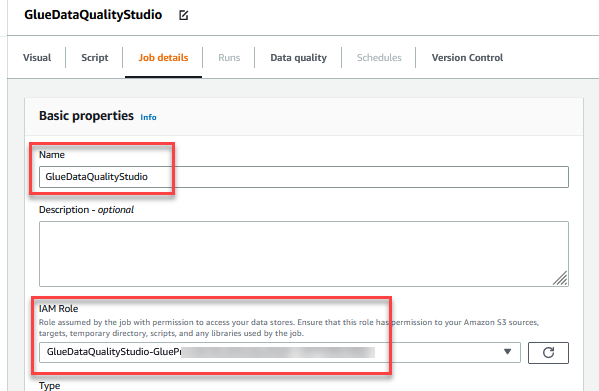
0.
gluedataqualitystudio-*).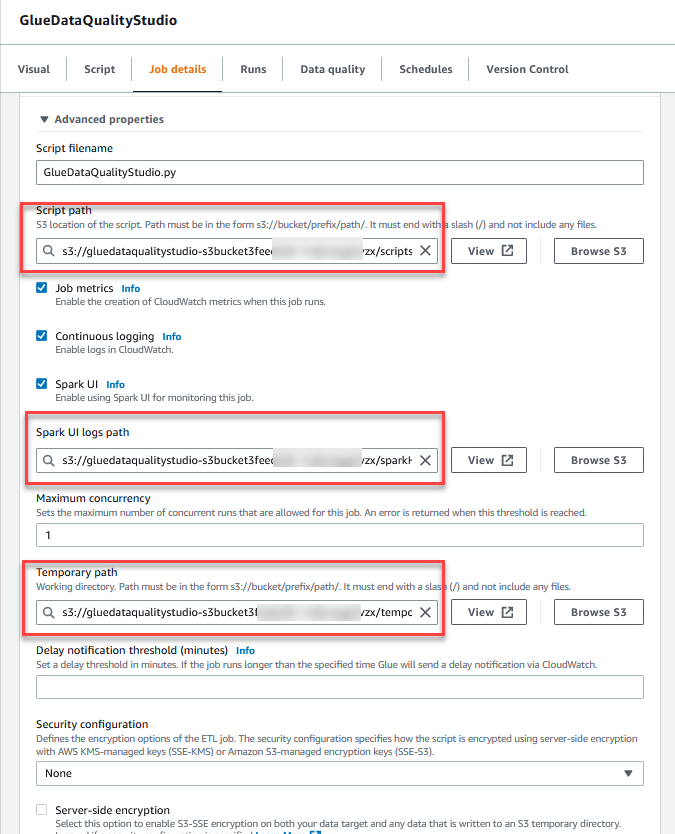

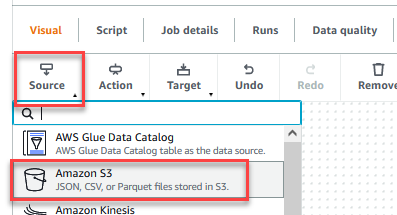
/datalake/raw/customer/ in the S3 bucket starting with gluedataqualitystudio-* .
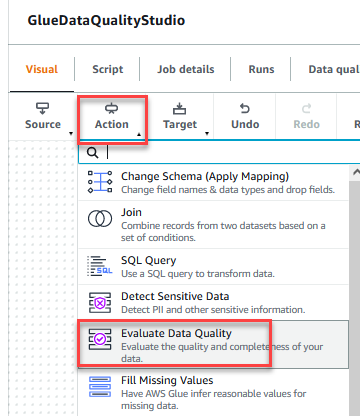

Customer_ID is unique and not null using the isPrimaryKey rule.isprimarykey and choose the plus sign.
Customer_ID.id.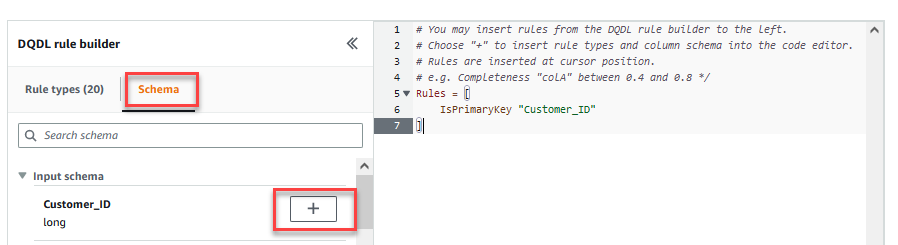
First_Name column value is present for all the rows.IsComplete "First_Name", after the first rule.
Telephone or Email.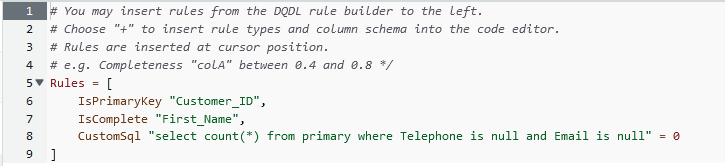
The Evaluate Data Quality feature provides actions to manage the outcome of a job based on the job quality results.
dqresults in the S3 bucket starting with gluedataqualitystudio-*.

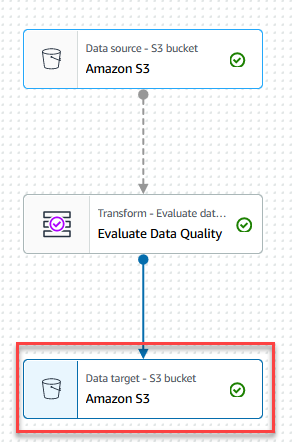
/datalake/curated/customer/ in the S3 bucket starting with gluedataqualitystudio-*.
 You can view the job run details on the Runs tab. In our example, the job fails with the error message “AssertionError: The job failed due to failing DQ rules for node: <node>.”
 You can review the data quality result on the Data quality tab. In our example, the custom data quality validation failed because one of the rows in the dataset had no
Telephone or Email value. Evaluate Data Quality results is also written to the S3 bucket in JSON format based on the data quality result location parameter of the node.
dqresults prefix under the S3 bucket starting gluedataqualitystudio-*. You will see that the data quality result is partitioned by date.
The following is the output of the JSON file. You can use this file output to build custom data quality visualization dashboards.

You can also monitor the Evaluate Data Quality node through Amazon CloudWatch metrics and set alarms to send notifications about data quality results. To learn more on how to set up CloudWatch alarms, refer to Using Amazon CloudWatch alarms.

To avoid incurring future charges and to clean up unused roles and policies, delete the resources you created:
GlueDataQualityStudio job you created as part of this post.GlueDataQualityStudio stack.AWS Glue Data Quality offers an easy way to measure and monitor the data quality of your ETL pipeline. In this post, you learned how to take necessary actions based on the data quality results, which helps you maintain high data standards and make confident business decisions.
To learn more about AWS Glue Data Quality, check out the documentation:
 Deenbandhu Prasad is a Senior Analytics Specialist at AWS, specializing in big data services. He is passionate about helping customers build modern data architecture on the AWS Cloud. He has helped customers of all sizes implement data management, data warehouse, and data lake solutions.
 Yannis Mentekidis is a Senior Software Development Engineer on the AWS Glue team.
Post Syndicated from Aniket Jiddigoudar original https://aws.amazon.com/blogs/big-data/getting-started-with-aws-glue-data-quality-from-the-aws-glue-data-catalog/
AWS Glue is a serverless data integration service that makes it simple to discover, prepare, and combine data for analytics, machine learning (ML), and application development. You can use AWS Glue to create, run, and monitor data integration and ETL (extract, transform, and load) pipelines and catalog your assets across multiple data stores.
Hundreds of thousands of customers use data lakes for analytics and machine learning to make data-driven business decisions. Data consumers lose trust in data if it is not accurate and recent, making data quality essential for undertaking optimal and correct decisions.
Evaluation of the accuracy and freshness of data is a common task for engineers. Currently, there are various tools available to evaluate data quality. However, these tools often require manual processes of data discovery and expertise in data engineering and coding.
We are pleased to announce the public preview launch of AWS Glue Data Quality. You can access this feature today without requesting any additional access in the available Regions. AWS Glue Data Quality is a new preview feature of AWS Glue that measures and monitors the data quality of Amazon S3-based data lakes and in AWS Glue ETL jobs. It does not require any expertise in data engineering or coding. It simplifies your experience of monitoring and evaluating the quality of your data.
This is Part 1 of a four-part series of posts to explain how AWS Glue Data Quality works. Check out the next posts in the series:
Getting started with AWS Glue Data Quality
|
In this post, we will go over the simplicity of using the AWS Glue Data Quality feature by:
The provided CloudFormation script creates the following resources for you:
Steps:


In this first section, we will generate data quality rule recommendations from the AWS Glue Data Quality service. Using these recommendations, we will then run a data quality task against our dataset to obtain an analysis of our data.
To get started, complete the following steps:


AWS Glue Data Quality recommendations are suggestions generated by the AWS Glue Data Quality service and are based on the shape of your data. These recommendations automatically take into account aspects like RowCounts, Mean, Standard Deviation etc. of your data, and generate a set of rules, for you to use as a starting point.
The dataset used here was the NYC Taxi dataset. Based on this, the columns in this dataset, and the values of those columns, AWS Glue Data Quality recommends a set of rules. In total, the recommendation service automatically took into consideration all the columns of the dataset, and recommended 55 rules.
Some of these rules are:


Our recommendation service suggested that we enforce 55 rules, based on the column values and the data within our NYC Taxi dataset. We then converted the collection of 55 rules into a RuleSet. Then, we ran a Data Quality Evaluation task run using our RuleSet against our dataset. In our results above, we see the status of each within the RuleSet.
You can also utilize the AWS Glue Data Quality APIs to carry out these steps.
Each AWS Glue Data Quality evaluation run from the Data Catalog, emits a pair of metrics named glue.data.quality.rules.passed (indicating a number of rules that passed) and glue.data.quality.rules.failed (indicating the number of failed rules) per data quality run. This emitted metric can be used to create alarms to alert users if a given data quality run falls below a threshold.
To get started with setting up an alarm that would send an email via an Amazon SNS notification, follow the steps below:
Note: When starting an AWS Glue Data Quality run, make sure the Publish metrics to Amazon CloudWatch checkbox is enabled, as shown below. Otherwise, metrics for that particular run will not be published to Amazon CloudWatch.


These selections imply that if the glue.data.quality.rules.failed metric emits a value greater than or equal to 1, we will trigger an alarm. However, if there is no data, we will treat it as acceptable.


In order to demonstrate AWS Glue Data Quality alarms, we are going to go over a real-world scenario where we have corrupted data being ingested, and how we could use the AWS Glue Data Quality service to get notified of this, using the alarm we created in the previous steps. For this purpose, we will use the provided file malformed_yellow_taxi.parquet that contains data that has been tweaked on purpose.
We have thus demonstrated an example where incoming malformed data, coming into our data lakes can be identified via the AWS Glue Data Quality rules, and subsequent alerting mechanisms can be created to notify appropriate personas.
In scenarios where you have multiple AWS Glue Data Quality run results against a dataset, over a period of time, you might want to track the trends of the dataset’s quality over a period of time. To achieve this, we can export our AWS Glue Data Quality run results to S3, and use Amazon Athena to run analytical queries against the exported run. The results can then be further used in Amazon QuickSight to build dashboards to have a graphical representation of your data quality trends
In the third part of this post, we will see the steps needed to start tracking data on your dataset’s quality:
GlueDataQualityResultsS3Bucket value from the provided AWS CloudFormation template):
For example, consider the following query that shows me the failed AWS Glue Data Quality runs against my table demo_nyc_taxi_data_input within a time window:
The output of the above query shows me details about all the runs with “outcome” = ‘Failed’ that ran against my NYC Taxi dataset table ( “tablename” = ‘demo_nyc_taxi_data_input’ ). The output also gives me information about the failure reason ( failurereason ) and the values it was evaluated against ( evaluatedmetrics ).
As you can see, we are able to get detailed information about our AWS Glue Data Quality runs, via the run results uploaded to S3, perform more detailed analysis and build dashboards on top of the data.
In this post, we talked about the ease and speed of incorporating data quality rules using the AWS Glue Data Quality feature, into your AWS Glue Data Catalog tables. We also talked about how to run recommendations and evaluate data quality against your tables. We then discussed analyzing the data quality results via Amazon Athena, and the process for setting up alarms via Amazon CloudWatch in order to notify users of failed data quality.
To dive into the AWS Glue Data Quality APIs, take a look at the AWS Glue Data Quality API documentation
To learn more about AWS Glue Data Quality, check out the AWS Glue Data Quality Developer Guide
 Aniket Jiddigoudar is a Big Data Architect on the AWS Glue team.
 Joseph Barlan is a Frontend Engineer at AWS Glue. He has over 5 years of experience helping teams build reusable UI components and is passionate about frontend design systems. In his spare time, he enjoys pencil drawing and binge watching tv shows.
Post Syndicated from Snigdha Sahi original https://aws.amazon.com/blogs/big-data/aws-marketplace-seller-insights-team-uses-amazon-quicksight-embedded-to-empower-sellers-with-actionable-business-insights/
AWS Marketplace enables independent software vendors (ISVs), data providers, and consulting partners to sell software, services, and data to millions of AWS customers. Working in partnership with the AWS Partner Network (APN), AWS Marketplace helps ISVs and partners build, market and sell their AWS offerings by providing crucial business, technical, and marketing support.
The AWS Marketplace Seller Insights team helps AWS sellers scale their businesses by providing reports, data feeds, and insights. We share this data directly with sellers through the AWS Marketplace Management Portal (AMMP). In 2013, we launched the first version of reporting insights, delivered monthly via static CSV files. To improve the customer experience, the next iteration of reporting upgrades was launched in 2020 and provided more granular data, refreshed daily and delivered via feeds.
We’ve spent the past few months working closely with the QuickSight team and are excited to now offer AWS Marketplace sellers public preview access to two new Amazon QuickSight dashboards. QuickSight improves the reporting experience for AWS Marketplace sellers by making it easy for users to monitor key metrics, perform ad hoc analysis, and quickly get business insights from data at any time and on any device.
In this post, we discuss our decision to implement QuickSight Embedded, as well as some of the benefits to AWS Marketplace sellers.
Making informed decisions is a business-critical function for successful organizations. Being able to quickly view performance trends and adjust strategies accordingly can make all the difference between hitting or missing business goals. Investing time, effort, and resources in technical data integrations, or creating pivot tables and charts from downloaded raw data, means a slower response rate to analyze shifts in performance trends. The more agile we can be in providing fast, efficient access to key performance indicators, the better positioned AWS Marketplace sellers can be to take action based on what their data tells them.
After reviewing customer feedback on their reporting experience, several trends emerged in what would be most helpful to them. First, sellers wanted a visual representation of their data. Second, though some wanted data feeds available to integrate AWS Marketplace data into their own business intelligence tools, others wanted to be able to access and review data without needing to invest technical business intelligence bandwidth in integrating feeds to create more user-friendly reports. Finally, they wanted the ability to easily filter the data, as well as the option to download it. In researching options to provide the reporting experience AWS Marketplace sellers wanted, we found that QuickSight was a perfect fit.
Billed Revenue and the Collections & Disbursements are two new QuickSight dashboards embedded directly into the AWS Marketplace Management Portal (AMMP), accessed via the Insights tab. These dashboards—pre-built with 10+ controls or filters, 15+ visualizations, and powered by daily refreshed data—provide a visual reporting experience for revenue recognition and disbursements tracking.
The following screenshot shows what the dashboards look like in the Finance operations section on the Insights tab within the AMMP.
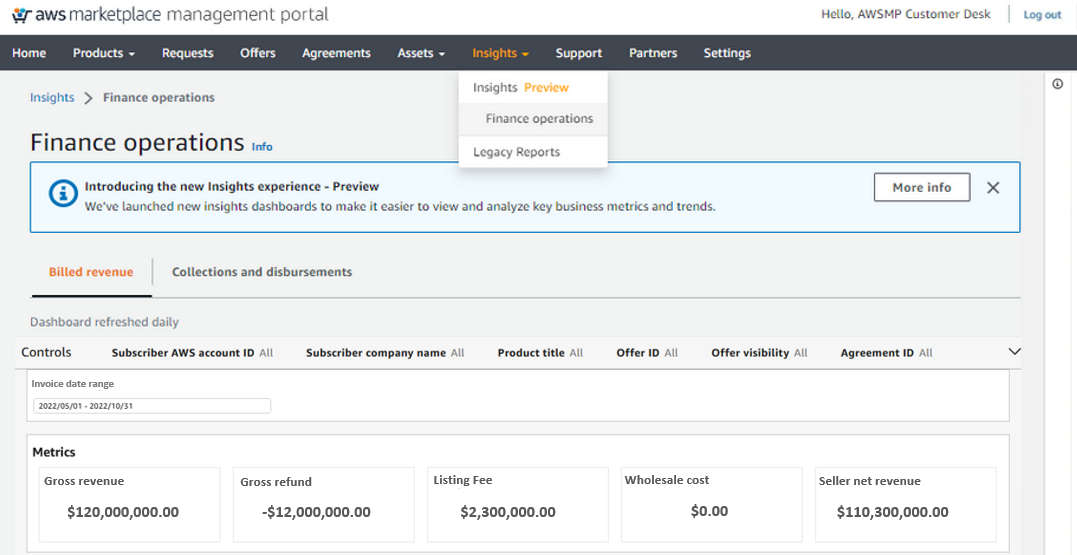
The dashboards are divided into several sections:
For quick help, sellers can select the Info button to view the side navigation panel with tips on how to use the dashboard. They can also reach out to our team by selecting Contact us from the Info panel.
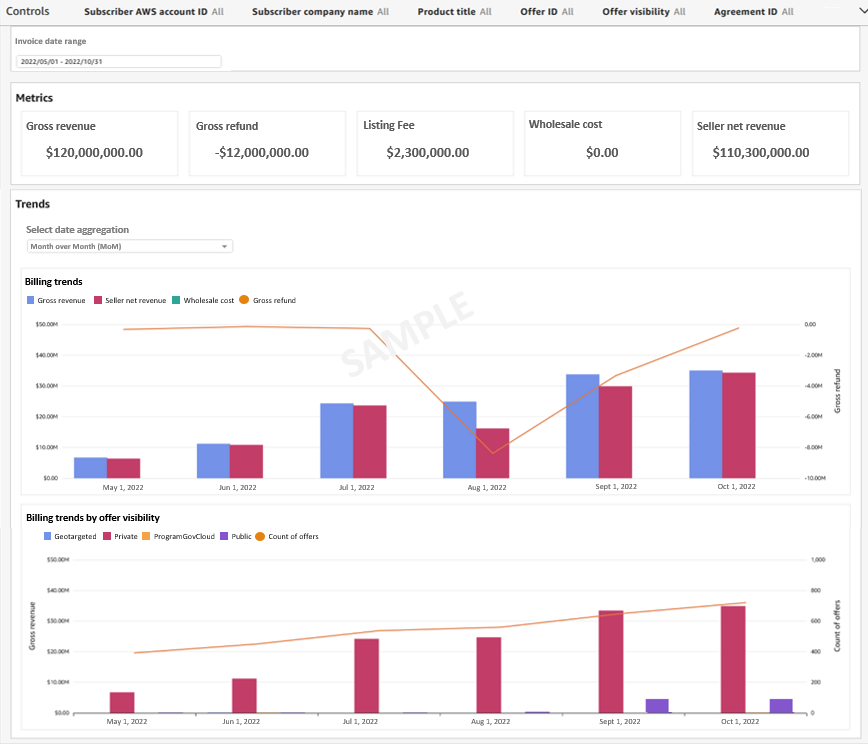
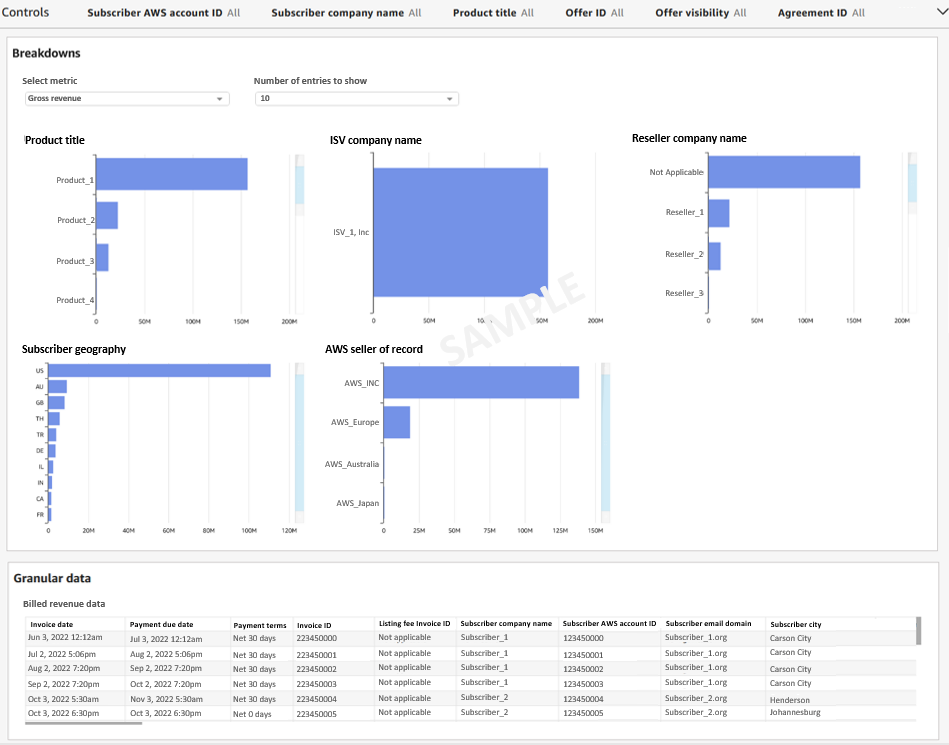
The Billed Revenue dashboard now reflects changes within 24 hours of a customer being billed or refunded—a major improvement over the 45 days it once took to access this data from the legacy AMMP Billed Revenue report. Similarly, the Collections & Disbursements dashboard provides disbursement information within 24 hours of AWS sending funds to sellers, whereas it used to take up to 4 days from the legacy AMMP Disbursement Report.
Our team’s decision to go with QuickSight was the direct result of a clear alignment between what our sellers told us they wanted and what QuickSight offered. With QuickSight Embedded dashboards, AWS Marketplace sellers now have a visual representation of their data that doesn’t require time or resources dedicated to technical integration implementations, and they can quickly and easily manipulate the data via filters, or they can download it to a CSV if that’s their preference. Embedded dashboards simplify the viewing, analyzing, and tracking of key business metrics and trends related to financial operations. Being able to easily show each seller only their relevant data (using row-level security) provides us with the flexibility we need, with the peace of mind of knowing everything is secure. AWS Marketplace data is hosted in an Amazon Redshift cluster; QuickSight’s seamless integration into Amazon Redshift made it a fantastic choice.
Embedding these new QuickSight dashboards into the AMMP has enabled us to provide at-a-glance metrics to AWS Marketplace sellers in a faster, more efficient, and far more user-friendly way than ever before. QuickSight has made a significant impact on how quickly sellers can access their data, which helps them respond faster to shifting trends.
To learn more about how you can embed customized data visuals, interactive dashboards, and natural language querying into any application, visit Amazon QuickSight Embedded.
 Snigdha Sahi is a Senior Product Manager (Technical) with Amazon Web Services (AWS) Marketplace. She has diverse work experience across product management, product development and management consulting. A technology enthusiast, she loves brainstorming and building products that are intuitive and easy to use. In her spare time, she enjoys hiking, solving Sudoku and listening to music.
 Vincent Larchet is a Principal Software Development Engineer on the AWS Marketplace team based in Vancouver, BC. Outside of work, he is a passionate wood worker and DIYer.
Post Syndicated from Mark Curtis original https://aws.amazon.com/blogs/devops/organize-your-aws-serverless-code-to-prevent-merge-conflicts/
How do you prevent the most common merge conflicts when your team is working on a Serverless application? How do you make sure that your team stays productive and avoids large merge issues while trying to update the same crucial files simultaneously? –The answer to both questions is code organization! You can use cfn-include and swagger-cli to organize, collaborate, and maintain a large serverless application as well as support a large or decentralized development team.
WRAP Technologies Inc. (WRAP) creates advanced technologies for the protection and security of public safety. Their WRAP Reality product allows law enforcement agencies to train their officers using virtual reality-based scenarios.
When multiple developers collaborate on a serverless architecture built with AWS CloudFormation, and its extensions such as the AWS Serverless Application Model (SAM), the nature of specifying resources in both the template.yaml and the optional OpenAPI.yaml specification for Amazon API Gateway leads to merge conflicts, such as the one demonstrated in the following figure where two developers are adding different API endpoints at the same time. These conflicts detract from the developer’s time and agility. Furthermore, navigating and maintaining the long template files required for a larger serverless architecture slows development as the developer scans large files to find a particular resource definition.

Figure 1. The frustrating merge conflicts.
By refactoring and organizing the CloudFormation and OpenAPI files, your development team can realize several benefits:
WRAP partnered with AWS to develop and host the backend for their new officer training management platform. This entirely new platform was developed, completed, and available for use in a matter of months. Moreover, it’s a collaboration of developers spread across multiple teams worldwide, all contributing to the same code base. By instituting the norms and techniques of this post, WRAP created a large and maintainable serverless application with minimal developer code collisions.
Development of the WRAP Reality training management system was accomplished using CloudFormation for defining Infrastructure as Code (IaC), and an Amazon API Gateway OpenAPI specification for defining API contracts. The development team for the WRAP Reality training management service leveraged agile development for expediency, including the GitHub Flow branching strategy. However, since project contributors were not co-located, several considerations were put in place to make sure of consistency and speed of code development:
The development process was accelerated by utilizing OpenAPI integrations with AWS Services, as well as techniques for managing the OpenAPI specification and Cloudformation Template files.
To demonstrate these techniques, we’ll explore the following sample project comprised of API endpoints for “widget” management, available on GitHub. This project provides the following end points:
The overall architecture of the application is shown in the following diagram:

Figure 2. Architecture Diagram
The application comprises:
When using API Gateway, developers have the option of using proxy Lambda integrations, or formally defining the API interface in an OpenAPI yaml file. The OpenAPI specification can be leveraged to document the API prior to development, and the example/mock features of the OpenAPI specification facilitates concurrent development by quickly establishing a working infrastructure to build upon. Furthermore, API documentation can be automatically generated from the OpenAPI specification.
As the number of endpoints increases, the OpenAPI specification file can grow in size, reaching thousands of lines of code that must be updated and maintained regularly by multiple developers. To aid in management and usability, the OpenAPI file can be decomposed into separate files for endpoints, responses, fields, and schemas.
Start with a “skeleton” file as an entry point for the OpenAPI definition, and then add a separate file for the definition of each endpoint or construct. For example, the sample project entry point is api/apiSkeleton.yaml, which contains the global definitions and effectively defines a simple list of endpoints and the reference ($ref) file path to each endpoint’s definition.
The application comprises:
Diving into a file referenced by an endpoint, we see that it contains all of the specification details for that endpoint. Looking at the reportsColor.yaml file reveals the full endpoint specification for /reports/color:
In turn, this endpoint specification can include further references to yaml files defining common parameters, schemas, and even full gateway responses. For example, color.yaml defines the color path variable:
To paraphrase a common catch phrase, “With a great many files, comes a great responsibility for organization.” To this end, we offer the following organizational structure as a start. Place all of the related API specifications in an “api” subfolder of your project. Have child subfolders for field, metadata, and gateway response definition files. Then, create child subfolder trees for each branch of your endpoints that mirror the endpoint paths. This will result in a highly-organized directory structure, as seen in the sample project:
We still need a consolidated single OpenAPI file to provide to CloudFormation during deployment to AWS. Therefore, the multiple files are combined and validated using the swagger-cli bundle command, resulting in a single file for deployment. The bundle command must be executed before a CloudFormation build. This command can also be included as a shortcut in the Makefile as the “buildOpenApi” command:
or
Once compiled, api/api.yaml is then used normally for API Gateway integrations and as a Postman API Collection import. As api/api.yaml is dynamically compiled, it’s included in .gitignore and not checked in to AWS CodeCommit.
The CloudFormation template that defines the infrastructure for even a simple service can grow to considerable length, perhaps thousands of lines. This presents challenges from a support and continued development perspective, as specific code locations become difficult to find and merge conflicts become commonplace.
CloudFormation Nested Stacks are a method of breaking a large CloudFormation template into separate templates. When there are clear delineations between groups of resources in a stack breaking it into separate nested stacks makes sense. There is also a 500 resource limit in a single CloudFormation stack and in order to go above that nested or separate stacks are necessary. Depending on the complexity of the architecture and frequency of updates however, the Nested Stacks can also become large. Furthermore, in a serverless architecture, the logical separation of architecture layers into separate stacks may not be direct, for example when a Lambda function is triggered by an event sent to an EventBridge event bus, then that Lambda function sends a different event back to the same event bus.
In these cases, CloudFormation templates can be decomposed to further leverage cfn-include . With this technique, the top-level CloudFormation template becomes a skeleton file which contains the stack parameters, global specifications, a list of resource names without properties, and the outputs. The properties of each resource are contained in separate files, referenced by an ‘include’ directive.
CloudFormation template organization
To organize your CloudFormation template, deconstruct the template into one-file-per-resource, with one main “skeleton” file as the main entry point. This skeleton file contains the full parameters, global section, conditions, and output specification. The resources are specified by resource name in this skeleton file, and then an ‘include’ directive points to the file that contains the body of the resource declaration. See the following example of the main skeleton file with two resources:
Then, the resource files contain the properties of that specific resource. For example, widgetApiGW.yaml defines an API Gateway:
This approach has the benefit of breaking the CloudFormation template into multiple small files, while still maintaining a top-level holistic view. The resource definitions, which normally comprise the majority of the content and can cause merge conflicts, are moved out of the main template.
For organization, you can create a directory in your project to contain the CloudFormation scripts. This directory also contains the entry-point skeleton file. Create further sub-folders for resources, and then further folders by resource type and architecture. We found that placing applicable AWS Identity and Access Management (IAM) role resource definitions in the same folder with the applied resource facilitated easier navigation. For example:
The files must be reconstituted to a single template.yaml for CloudFormation build and deployment. This is accomplished with the cfn-include command. A convenience command can optionally be included in the Makefile.
or
As the final template.yaml file is dynamically compiled, it’s included in .gitignore and not checked in to CodeCommit.
This post demonstrates techniques used by WRAP and AWS to rapidly develop and maintain key files in an Serverless architecture. The techniques discussed in this post allowed the WRAP and AWS team to do the following:
Applying these techniques was one of the key factors in the rapid development of the WRAP Reality training framework.
About the Authors:
Post Syndicated from Talks at Google original https://www.youtube.com/watch?v=C8JYxvfqhqs
Post Syndicated from LGR original https://www.youtube.com/watch?v=yAY_GFwmVow
Post Syndicated from Wariara Waireri original https://www.raspberrypi.org/blog/computing-education-machakos-kenya-edtech-hub-launch/
Over the past months, we’ve been working with two partner organisations, Team4Tech and Kenya Connect, to support computing education across the rural county of Machakos, Kenya.
In line with our 2025 strategy, we have started work to improve computing education for young people in Kenya and South Africa. We are especially eager to support communities that experience educational disadvantage. One of our projects in this area is in partnership with Team4Tech and Kenya Connect. Together we have set up the Dr Isaac Minae EdTech Hub in the community Kenya Connect supports in the rural county of Machakos, and we are training teachers so they can equip their learners with coding and physical computing skills.
“Watching teachers and students find joy and excitement in learning has been tremendous! The Raspberry Pi Foundation’s hands-on approach is helping learners make connections through seeing how technology can be used for innovation to solve problems. We are excited to be partnering with Raspberry Pi Foundation and Team4Tech in bringing technology to our rural community.”
– Sharon Runge, Executive Director, Kenya Connect
We are providing the Wamunyu community with the hardware and the skills and knowledge training they need to use digital technology to create solutions to problems they see. The training will make sure that teachers across Machakos can sustain the EdTech Hub and computing education activities independently. This is important because we want the community to be empowered to solve problems that matter to them and for all the local young people to have opportunities that are open to their peers in Nairobi, Kisumu, Mombasa, and other cities in Kenya.


In October this year, we travelled to Wamunyu to help Kenya Connect set up and launch the Dr Isaac Minae EdTech Hub, for which we provided hardware including Raspberry Pi 400 computers and physical computing kits with Raspberry Pi Pico microcontrollers, LEDs, buzzers, buttons, motors and more. We also held a teacher training session to start setting up the local educators with the skills and knowledge they need to teach coding and physical computing. In the training, educators brought a range of experiences with using computers. Some were unfamiliar with computer hardware, but at the end of the training session, they all had designed and created physical computing projects using electronic circuits and code. It was hugely inspiring to work with these teachers and see their enthusiasm and commitment to learning.


Through our two-year partnership with Kenya Connect, we aim to reach at least 1000 learners between the ages of 9 to 14 from 62 schools in Machakos county. We will work with at least 150 teachers to build their knowledge, skills, and confidence to teach coding, digital making, and robotics, and to run after-school Code Clubs. We’ll help teachers offer learning experiences based on our established learning paths to their students, and these experiences will include basic coding skills aligned to Kenya’s Competency Based Curriculum (CBC). We are putting particular focus on adapting our learning content so that teachers in Machakos can offer culturally relevant educational activities in their community.
“Our partnership with the Raspberry Pi Foundation will open up new avenues for teachers to learn coding and physical computing. This is in line with the current Competency Based Curriculum that requires students to start learning coding at an early age. Though coding is entrenched in the curriculum, teachers are ill-prepared and schools lack devices. We are so grateful to the Raspberry Pi Foundation for providing teachers and students access to devices and the Raspberry Pi learning paths.”
– Patrick Munguti, Director of Education and Technology, Kenya Connect
Next up for our work on this project is to continue supporting Kenya Connect to scale the program in the county.

In all our work in Sub-Saharan Africa, we are committed to strengthening and growing our partnerships with locally led youth and community organisations, the private sector, and the public sector, in line with our mission to open up more opportunities for young people to realise their full potential through the power of computing and digital technologies.
Our work in Sub-Saharan Africa is generously funded by the Ezra Charitable Trust.
The post Training teachers and empowering students in Machakos, Kenya appeared first on Raspberry Pi.
Post Syndicated from Alissa Starzak original https://blog.cloudflare.com/consequences-of-ip-blocking/


In late August 2022, Cloudflare’s customer support team began to receive complaints about sites on our network being down in Austria. Our team immediately went into action to try to identify the source of what looked from the outside like a partial Internet outage in Austria. We quickly realized that it was an issue with local Austrian Internet Service Providers.
But the service disruption wasn’t the result of a technical problem. As we later learned from media reports, what we were seeing was the result of a court order. Without any notice to Cloudflare, an Austrian court had ordered Austrian Internet Service Providers (ISPs) to block 11 of Cloudflare’s IP addresses.
In an attempt to block 14 websites that copyright holders argued were violating copyright, the court-ordered IP block rendered thousands of websites inaccessible to ordinary Internet users in Austria over a two-day period. What did the thousands of other sites do wrong? Nothing. They were a temporary casualty of the failure to build legal remedies and systems that reflect the Internet’s actual architecture.
Today, we are going to dive into a discussion of IP blocking: why we see it, what it is, what it does, who it affects, and why it’s such a problematic way to address content online.
The craziest thing is that this type of blocking happens on a regular basis, all around the world. But unless that blocking happens at the scale of what happened in Austria, or someone decides to highlight it, it is typically invisible to the outside world. Even Cloudflare, with deep technical expertise and understanding about how blocking works, can’t routinely see when an IP address is blocked.
For Internet users, it’s even more opaque. They generally don’t know why they can’t connect to a particular website, where the connection problem is coming from, or how to address it. They simply know they cannot access the site they were trying to visit. And that can make it challenging to document when sites have become inaccessible because of IP address blocking.
Blocking practices are also wide-spread. In their Freedom on the Net report, Freedom House recently reported that 40 out of the 70 countries that they examined – which vary from countries like Russia, Iran and Egypt to Western democracies like the United Kingdom and Germany – did some form of website blocking. Although the report doesn’t delve into exactly how those countries block, many of them use forms of IP blocking, with the same kind of potential effects for a partial Internet shutdown that we saw in Austria.
Although it can be challenging to assess the amount of collateral damage from IP blocking, we do have examples where organizations have attempted to quantify it. In conjunction with a case before the European Court of Human Rights, the European Information Society Institute, a Slovakia-based nonprofit, reviewed Russia’s regime for website blocking in 2017. Russia exclusively used IP addresses to block content. The European Information Society Institute concluded that IP blocking led to “collateral website blocking on a massive scale” and noted that as of June 28, 2017, “6,522,629 Internet resources had been blocked in Russia, of which 6,335,850 – or 97% – had been blocked collaterally, that is to say, without legal justification.”
In the UK, overbroad blocking prompted the non-profit Open Rights Group to create the website Blocked.org.uk. The website has a tool enabling users and site owners to report on overblocking and request that ISPs remove blocks. The group also has hundreds of individual stories about the effect of blocking on those whose websites were inappropriately blocked, from charities to small business owners. Although it’s not always clear what blocking methods are being used, the fact that the site is necessary at all conveys the amount of overblocking. Imagine a dressmaker, watchmaker or car dealer looking to advertise their services and potentially gain new customers with their website. That doesn’t work if local users can’t access the site.
One reaction might be, “Well, just make sure there are no restricted sites sharing an address with unrestricted sites.” But as we’ll discuss in more detail, this ignores the large difference between the number of possible domain names and the number of available IP addresses, and runs counter to the very technical specifications that empower the Internet. Moreover, the definitions of restricted and unrestricted differ across nations, communities, and organizations. Even if it were possible to know all the restrictions, the designs of the protocols — of the Internet, itself — mean that it is simply infeasible, if not impossible, to satisfy every agency’s constraints.
Overblocking websites is not only a problem for users; it has legal implications. Because of the effect it can have on ordinary citizens looking to exercise their rights online, government entities (both courts and regulatory bodies) have a legal obligation to make sure that their orders are necessary and proportionate, and don’t unnecessarily affect those who are not contributing to the harm.
It would be hard to imagine, for example, that a court in response to alleged wrongdoing would blindly issue a search warrant or an order based solely on a street address without caring if that address was for a single family home, a six-unit condo building, or a high rise with hundreds of separate units. But those sorts of practices with IP addresses appear to be rampant.
In 2020, the European Court of Human Rights (ECHR) – the court overseeing the implementation of the Council of Europe’s European Convention on Human Rights – considered a case involving a website that was blocked in Russia not because it had been targeted by the Russian government, but because it shared an IP address with a blocked website. The website owner brought suit over the block. The ECHR concluded that the indiscriminate blocking was impermissible, ruling that the block on the lawful content of the site “amounts to arbitrary interference with the rights of owners of such websites.” In other words, the ECHR ruled that it was improper for a government to issue orders that resulted in the blocking of sites that were not targeted.
Ordinary Internet users don’t think a lot about how the content they are trying to access online is delivered to them. They assume that when they type a domain name into their browser, the content will automatically pop up. And if it doesn’t, they tend to assume the website itself is having problems unless their entire Internet connection seems to be broken. But those basic assumptions ignore the reality that connections to a website are often used to limit access to content online.
Why do countries block connections to websites? Maybe they want to limit their own citizens from accessing what they believe to be illegal content – like online gambling or explicit material – that is permissible elsewhere in the world. Maybe they want to prevent the viewing of a foreign news source that they believe to be primarily disinformation. Or maybe they want to support copyright holders seeking to block access to a website to limit viewing of content that they believe infringes their intellectual property.
To be clear, blocking access is not the same thing as removing content from the Internet. There are a variety of legal obligations and authorities designed to permit actual removal of illegal content. Indeed, the legal expectation in many countries is that blocking is a matter of last resort, after attempts have been made to remove content at the source.
Blocking just prevents certain viewers – those whose Internet access depends on the ISP that is doing the blocking – from being able to access websites. The site itself continues to exist online and is accessible by everyone else. But when the content originates from a different place and can’t be easily removed, a country may see blocking as their best or only approach.
We recognize the concerns that sometimes drive countries to implement blocking. But fundamentally, we believe it’s important for users to know when the websites they are trying to access have been blocked, and, to the extent possible, who has blocked them from view and why. And it’s critical that any restrictions on content should be as limited as possible to address the harm, to avoid infringing on the rights of others.
Brute force IP address blocking doesn’t allow for those things. It’s fully opaque to Internet users. The practice has unintended, unavoidable consequences on other content. And the very fabric of the Internet means that there is no good way to identify what other websites might be affected either before or during an IP block.
To understand what happened in Austria and what happens in many other countries around the world that seek to block content with the bluntness of IP addresses, we have to understand what is going on behind the scenes. That means diving into some technical details.
Before we even get started describing the technical realities of blocking, it’s important to stress that the first and best option to deal with content is at the source. A website owner or hosting provider has the option of removing content at a granular level, without having to take down an entire website. On the more technical side, a domain name registrar or registry can potentially withdraw a domain name, and therefore a website, from the Internet altogether.
But how do you block access to a website, if for whatever reason the content owner or content source is unable or unwilling to remove it from the Internet? There are only three possible control points.
The first is via the Domain Name System (DNS), which translates domain names into IP addresses so that the site can be found. Instead of returning a valid IP address for a domain name, the DNS resolver could lie and respond with a code, NXDOMAIN, meaning that “there is no such name.” A better approach would be to use one of the honest error numbers standardized in 2020, including error 15 for blocked, error 16 for censored, 17 for filtered, or 18 for prohibited, although these are not widely used currently.
Interestingly, the precision and effectiveness of DNS as a control point depends on whether the DNS resolver is private or public. Private or ‘internal’ DNS resolvers are operated by ISPs and enterprise environments for their own known clients, which means that operators can be precise in applying content restrictions. By contrast, that level of precision is unavailable to open or public resolvers, not least because routing and addressing is global and ever-changing on the Internet map, and in stark contrast to addresses and routes on a fixed postal or street map. For example, private DNS resolvers may be able to block access to websites within specified geographic regions with at least some level of accuracy in a way that public DNS resolvers cannot, which becomes profoundly important given the disparate (and inconsistent) blocking regimes around the world.
The second approach is to block individual connection requests to a restricted domain name. When a user or client wants to visit a website, a connection is initiated from the client to a server name, i.e. the domain name. If a network or on-path device is able to observe the server name, then the connection can be terminated. Unlike DNS, there is no mechanism to communicate to the user that access to the server name was blocked, or why.
The third approach is to block access to an IP address where the domain name can be found. This is a bit like blocking the delivery of all mail to a physical address. Consider, for example, if that address is a skyscraper with its many unrelated and independent occupants. Halting delivery of mail to the address of the skyscraper causes collateral damage by invariably affecting all parties at that address. IP addresses work the same way.
Notably, the IP address is the only one of the three options that has no attachment to the domain name. The website domain name is not required for routing and delivery of data packets; in fact it is fully ignored. A website can be available on any IP address, or even on many IP addresses, simultaneously. And the set of IP addresses that a website is on can change at any time. The set of IP addresses cannot definitively be known by querying DNS, which has been able to return any valid address at any time for any reason, since 1995.
The idea that an address is representative of an identity is anathema to the Internet’s design, because the decoupling of address from name is deeply embedded in the Internet standards and protocols, as is explained next.
Many people still incorrectly assume that an IP address represents a single website. We’ve previously stated that the association between names and addresses is understandable given that the earliest connected components of the Internet appeared as one computer, one interface, one address, and one name. This one-to-one association was an artifact of the ecosystem in which the Internet Protocol was deployed, and satisfied the needs of the time.
Despite the one-to-one naming practice of the early Internet, it has always been possible to assign more than one name to a server (or ‘host’). For example, a server was (and is still) often configured with names to reflect its service offerings such as mail.example.com and www.example.com, but these shared a base domain name. There were few reasons to have completely different domain names until the need to colocate completely different websites onto a single server. That practice was made easier in 1997 by the Host header in HTTP/1.1, a feature preserved by the SNI field in a TLS extension in 2003.
Throughout these changes, the Internet Protocol and, separately, the DNS protocol, have not only kept pace, but have remained fundamentally unchanged. They are the very reason that the Internet has been able to scale and evolve, because they are about addresses, reachability, and arbitrary name to IP address relationships.
The designs of IP and DNS are also entirely independent, which only reinforces that names are separate from addresses. A closer inspection of the protocols’ design elements illuminates the misperceptions of policies that lead to today’s common practice of controlling access to content by blocking IP addresses.
Much like large public civil engineering projects rely on building codes and best practice, the Internet is built using a set of open standards and specifications informed by experience and agreed by international consensus. The Internet standards that connect hardware and applications are published by the Internet Engineering Task Force (IETF) in the form of “Requests for Comment” or RFCs — so named not to suggest incompleteness, but to reflect that standards must be able to evolve with knowledge and experience. The IETF and its RFCs are cemented in the very fabric of communications, for example, with the first RFC 1 published in 1969. The Internet Protocol (IP) specification reached RFC status in 1981.
Alongside the standards organizations, the Internet’s success has been helped by a core idea known as the end-to-end (e2e) principle, codified also in 1981, based on years of trial and error experience. The end-to-end principle is a powerful abstraction that, despite taking many forms, manifests a core notion of the Internet Protocol specification: the network’s only responsibility is to establish reachability, and every other possible feature has a cost or a risk.
The idea of “reachability” in the Internet Protocol is also enshrined in the design of IP addresses themselves. Looking at the Internet Protocol specification, RFC 791, the following excerpt from Section 2.3 is explicit about IP addresses having no association with names, interfaces, or anything else.
Addressing

    A distinction is made between names, addresses, and routes [4].   A
    name indicates what we seek.  An address indicates where it is.  A
    route indicates how to get there.  The internet protocol deals
    primarily with addresses.  It is the task of higher level (i.e.,
    host-to-host or application) protocols to make the mapping from
    names to addresses.   The internet module maps internet addresses to
    local net addresses.  It is the task of lower level (i.e., local net
    or gateways) procedures to make the mapping from local net addresses
    to routes.
                            [ RFC 791, 1981 ]
Just like postal addresses for skyscrapers in the physical world, IP addresses are no more than street addresses written on a piece of paper. And just like a street address on paper, one can never be confident about the entities or organizations that exist behind an IP address. In a network like Cloudflare’s, any single IP address represents thousands of servers, and can have even more websites and services — in some cases numbering into the millions — expressly because the Internet Protocol is designed to enable it.
Here’s an interesting question: could we, or any content service provider, ensure that every IP address matches to one and only one name? The answer is an unequivocal no, and here too, because of a protocol design — in this case, DNS.
A one-to-one relationship between names and addresses is impossible given the Internet specifications for the same reasons that it is infeasible in the physical world. Ignore for a moment that people and organizations can change addresses. Fundamentally, the number of people and organizations on the planet exceeds the number of postal addresses. We not only want, but need for the Internet to accommodate more names than addresses.
The difference in magnitude between names and addresses is also codified in the specifications. IPv4 addresses are 32 bits, and IPv6 addresses are 128 bits. The size of a domain name that can be queried by DNS is as many as 253 octets, or 2,024 bits (from Section 2.3.4 in RFC 1035, published 1987). The table below helps to put those differences into perspective:
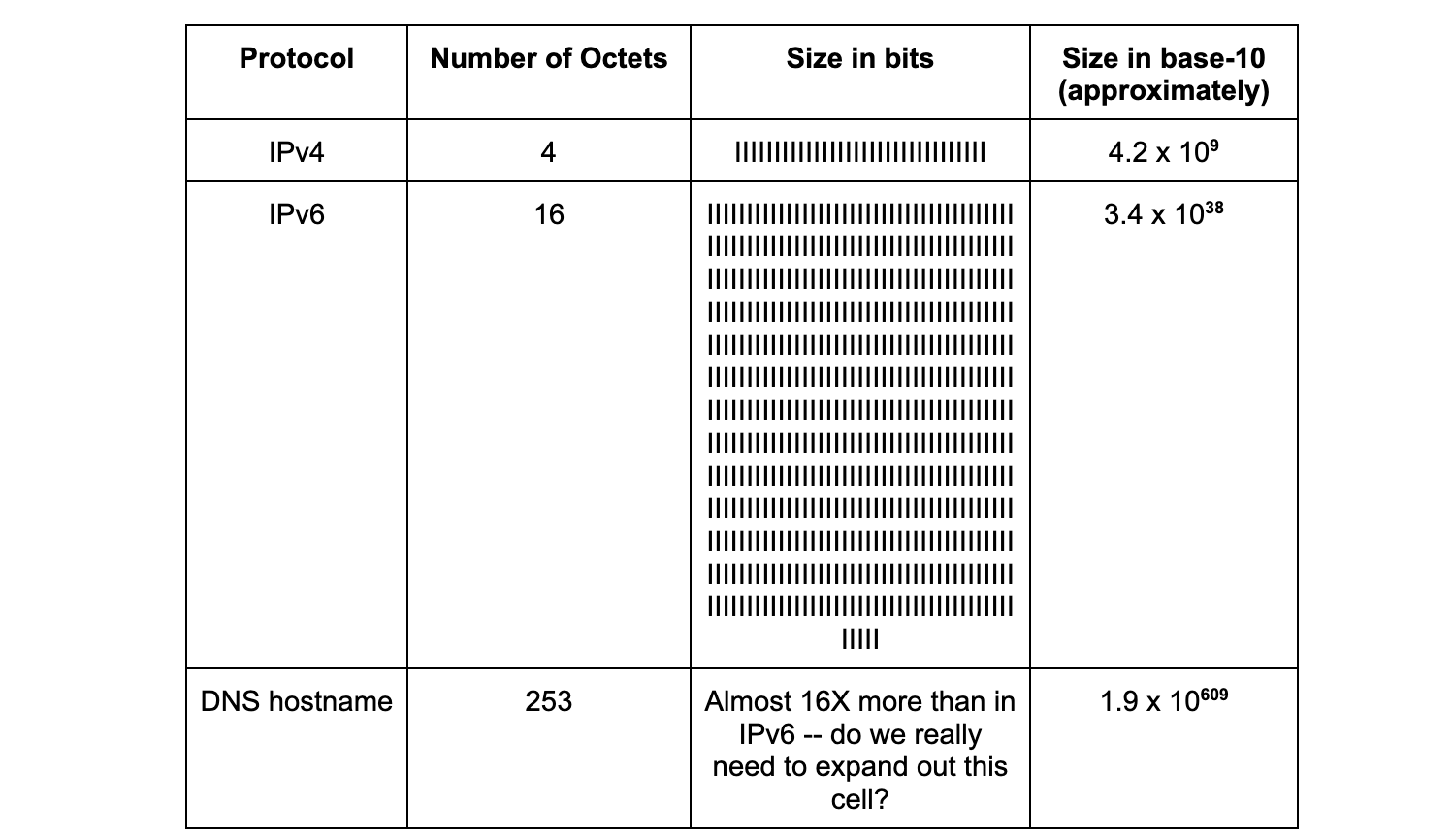
On November 15, 2022, the United Nations announced the population of the Earth surpassed eight billion people. Intuitively, we know that there cannot be anywhere near as many postal addresses. The difference between the number of possible names on the planet, and similarly on the Internet, does and must exceed the number of available addresses.
Now that those two relevant principles about IP addresses and DNS names in the international standards are understood – that IP address and domain names serve distinct purposes and there is no one to one relationship between the two – an examination of a recent case of content blocking using IP addresses can help to see the reasons it is problematic. Take, for example, the IP blocking incident in Austria late August 2022. The goal was to restrict access to 14 target domains, by blocking 11 IP addresses (source: RTR.Telekom. Post via the Internet Archive) — the mismatch between those two numbers should have been a warning flag that IP blocking might not have the desired effect.
Analogies and international standards may explain the reasons that IP blocking should be avoided, but we can see the scale of the problem by looking at Internet-scale data. To better understand and explain the severity of IP blocking, we decided to generate a global view of domain names and IP addresses (thanks are due to a PhD research intern, Sudheesh Singanamalla, for the effort). In September 2022, we used the authoritative zone files for the top-level domains (TLDs) .com, .net, .info, and .org, together with top-1M website lists, to find a total of 255,315,270 unique names. We then queried DNS from each of five regions and recorded the set of IP addresses returned. The table below summarizes our findings:
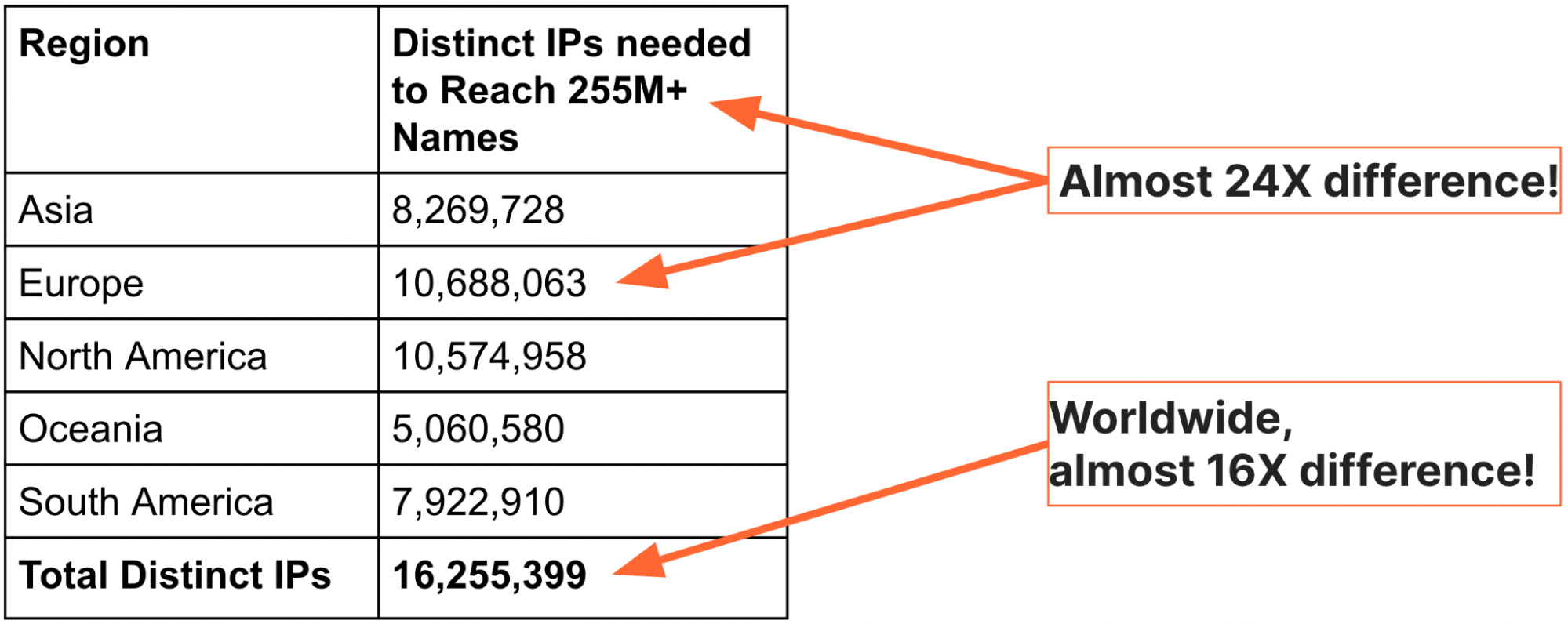
The table above makes clear that it takes no more than 10.7 million addresses to reach 255,315,270 million names from any region on the planet, and the total set of IP addresses for those names from everywhere is about 16 million — the ratio of names to IP addresses is nearly 24x in Europe and 16x globally.
There is one more worthwhile detail about the numbers above: The IP addresses are the combined totals of both IPv4 and IPv6 addresses, meaning that far fewer addresses are needed to reach all 255M websites.
We’ve also inspected the data a few different ways to find some interesting observations. For example, the figure below shows the cumulative distribution (CDF) of the proportion of websites that can be visited with each additional IP address. On the y-axis is the proportion of websites that can be reached given some number of IP addresses. On the x-axis, the 16M IP addresses are ranked from the most domains on the left, to the least domains on the right. Note that any IP address in this set is a response from DNS and so it must have at least one domain name, but the highest numbers of domains on IP addresses in the set number are in the 8-digit millions.
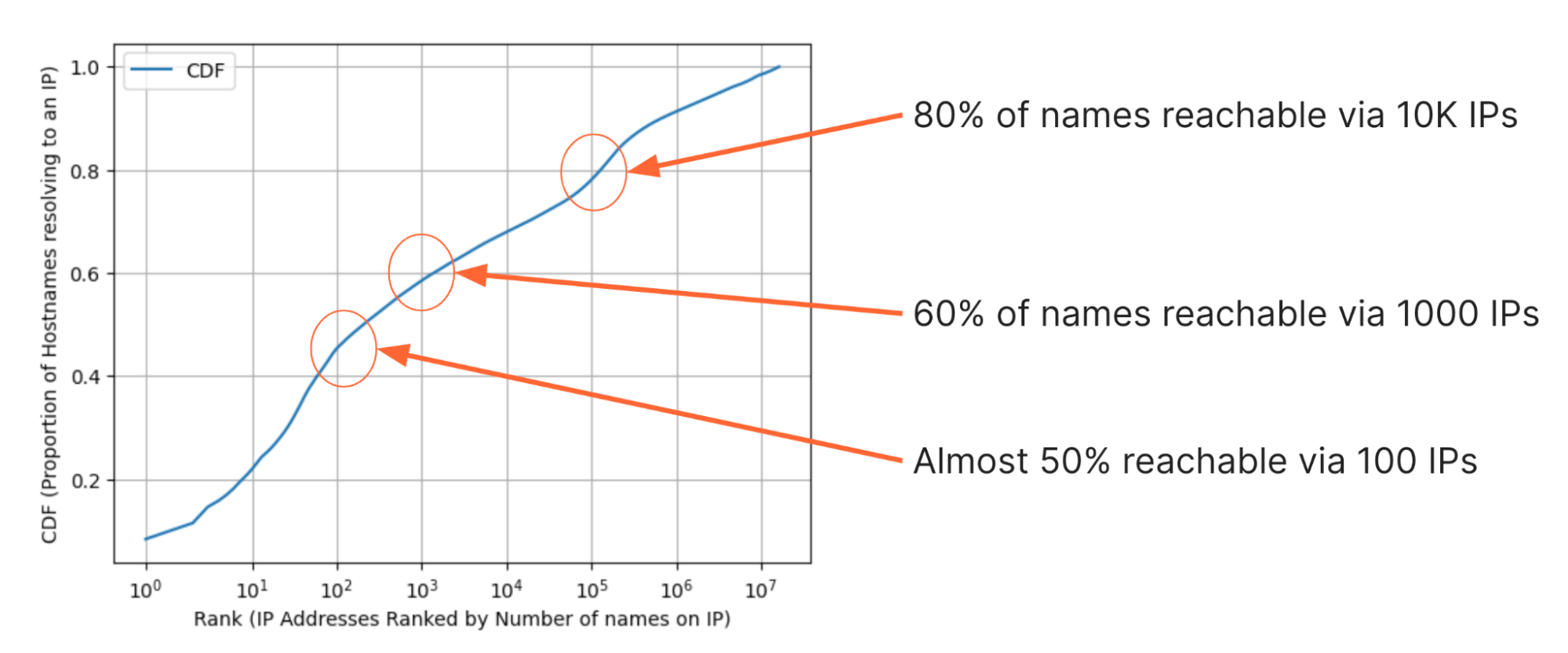
By looking at the CDF there are a few eye-watering observations:
In fact, from the total set of 16 million addresses, fewer than half, 7.1M (43.7%), of the addresses in the dataset had one name. On this ‘one’ point we must be additionally clear: we are unable to ascertain if there was only one and no other names on those addresses because there are many more domain names than those contained only in .com, .org, .info., and .net — there might very well be other names on those addresses.
In addition to having a number of domains on a single IP address, any IP address may change over time for any of those domains. Changing IP addresses periodically can be helpful with certain security, performance, and to improve reliability for websites. One common example in use by many operations is load balancing. This means DNS queries may return different IP addresses over time, or in different places, for the same websites. This is a further, and separate, reason why blocking based on IP addresses will not serve its intended purpose over time.
Ultimately, there is no reliable way to know the number of domains on an IP address without inspecting all names in the DNS, from every location on the planet, at every moment in time — an entirely infeasible proposition.
Any action on an IP address must, by the very definitions of the protocols that rule and empower the Internet, be expected to have collateral effects.
So if we have to expect that the blocking of an IP address will have collateral effects, and it’s generally agreed that it’s inappropriate or even legally impermissible to overblock by blocking IP addresses that have multiple domains on them, why does it still happen? That’s hard to know for sure, so we can only speculate. Sometimes it reflects a lack of technical understanding about the possible effects, particularly from entities like judges who are not technologists. Sometimes governments just ignore the collateral damage – as they do with Internet shutdowns – because they see the blocking as in their interest. And when there is collateral damage, it’s not usually obvious to the outside world, so there can be very little external pressure to have it addressed.
It’s worth stressing that point. When an IP is blocked, a user just sees a failed connection. They don’t know why the connection failed, or who caused it to fail. On the other side, the server acting on behalf of the website doesn’t even know it’s been blocked until it starts getting complaints about the fact that it is unavailable. There is virtually no transparency or accountability for the overblocking. And it can be challenging, if not impossible, for a website owner to challenge a block or seek redress for being inappropriately blocked.
Some governments, including Austria, do publish active block lists, which is an important step for transparency. But for all the reasons we’ve discussed, publishing an IP address does not reveal all the sites that may have been blocked unintentionally. And it doesn’t give those affected a means to challenge the overblocking. Again, in the physical world example, it’s hard to imagine a court order on a skyscraper that wouldn’t be posted on the door, but we often seem to jump over such due process and notice requirements in virtual space.
We think talking about the problematic consequences of IP blocking is more important than ever as an increasing number of countries push to block content online. Unfortunately, ISPs often use IP blocks to implement those requirements. It may be that the ISP is newer or less robust than larger counterparts, but larger ISPs engage in the practice, too, and understandably so because IP blocking takes the least effort and is readily available in most equipment.
And as more and more domains are included on the same number of IP addresses, the problem is only going to get worse.
So what can we do?
We believe the first step is to improve transparency around the use of IP blocking. Although we’re not aware of any comprehensive way to document the collateral damage caused by IP blocking, we believe there are steps we can take to expand awareness of the practice. We are committed to working on new initiatives that highlight those insights, as we’ve done with the Cloudflare Radar Outage Center.
We also recognize that this is a whole Internet problem, and therefore has to be part of a broader effort. The significant likelihood that blocking by IP address will result in restricting access to a whole series of unrelated (and untargeted) domains should make it a non-starter for everyone. That’s why we’re engaging with civil society partners and like-minded companies to lend their voices to challenge the use of blocking IP addresses as a way of addressing content challenges and to point out collateral damage when they see it.
To be clear, to address the challenges of illegal content online, countries need legal mechanisms that enable the removal or restriction of content in a rights-respecting way. We believe that addressing the content at the source is almost always the best and the required first step. Laws like the EU’s new Digital Services Act or the Digital Millennium Copyright Act provide tools that can be used to address illegal content at the source, while respecting important due process principles. Governments should focus on building and applying legal mechanisms in ways that least affect other people’s rights, consistent with human rights expectations.
Very simply, these needs cannot be met by blocking IP addresses.
We’ll continue to look for new ways to talk about network activity and disruption, particularly when it results in unnecessary limitations on access. Check out Cloudflare Radar for more insights about what we see online.