CVE-2026-86206, CVE-2026-86207: N-able N-central Authentication Bypass (FIXED)

Post Syndicated from Stephen Fewer original https://www.rapid7.com/blog/post/ve-cve-2026-86206-cve-2026-86207-n-able-n-central-authentication-bypass-fixed

Overview

While conducting research into a recent N-able N-central authentication bypass vulnerability (CVE-2026-18577), Rapid7 Labs discovered two new vulnerabilities affecting the latest version of N-central. When chained together, these two vulnerabilities allow a remote unauthenticated attacker to bypass authentication and create a new attacker-controlled System administrator account on an affected server.

CVE ID

Description

CWE

CVSSv4

CVE-2026-86206

Semicolon/Forwarded access-control bypass

CWE-791

6.9 (Medium)

CVE-2026-86207

UserTwoFactorLogin authentication bypass

CWE-305

7.7 (High)

Both CVE-2026-86206 and CVE-2026-86207 have been patched by the vendor via N-central 2026.3 Hotfix 3.

Product description

N-able N-central is an enterprise-grade Remote Monitoring and Management (RMM) platform designed for Managed Service Providers (MSPs) and IT departments to monitor, manage, and secure complex, large-scale networks from a centralized dashboard.

Credit

These vulnerabilities were discovered by Stephen Fewer, Senior Principal Security Researcher at Rapid7, and are being disclosed in accordance with Rapid7’s vulnerability disclosure policy.

Technical analysis

CVE-2026-86206

N-central exposes its management interface (TCP 8443 by default) through Envoy, an edge proxy. Envoy passes accepted requests to Jetty, the Java web server that hosts N-central’s application. The application gives requests from the loopback address (i.e. 127.0.0.1) more access than requests from a remote system. This design depends on Envoy, Jetty, and the N-central access filter all agreeing on which application path the client requested and whether the client is really local. The following request can make them disagree about both of these things:

POST /dms;/services/ServerUI HTTP/1.1
Forwarded: for="127.0.0.\1"
Content-Type: text/xml; charset=utf-8
SOAPAction: ""

The semicolon in the URI and backslash in the Forwarded value introduce a discrepancy when processing the request that leads to an access control bypass. Looking at Figure 1 below, we can see an overview of how these two values are processed during an incoming malicious request.
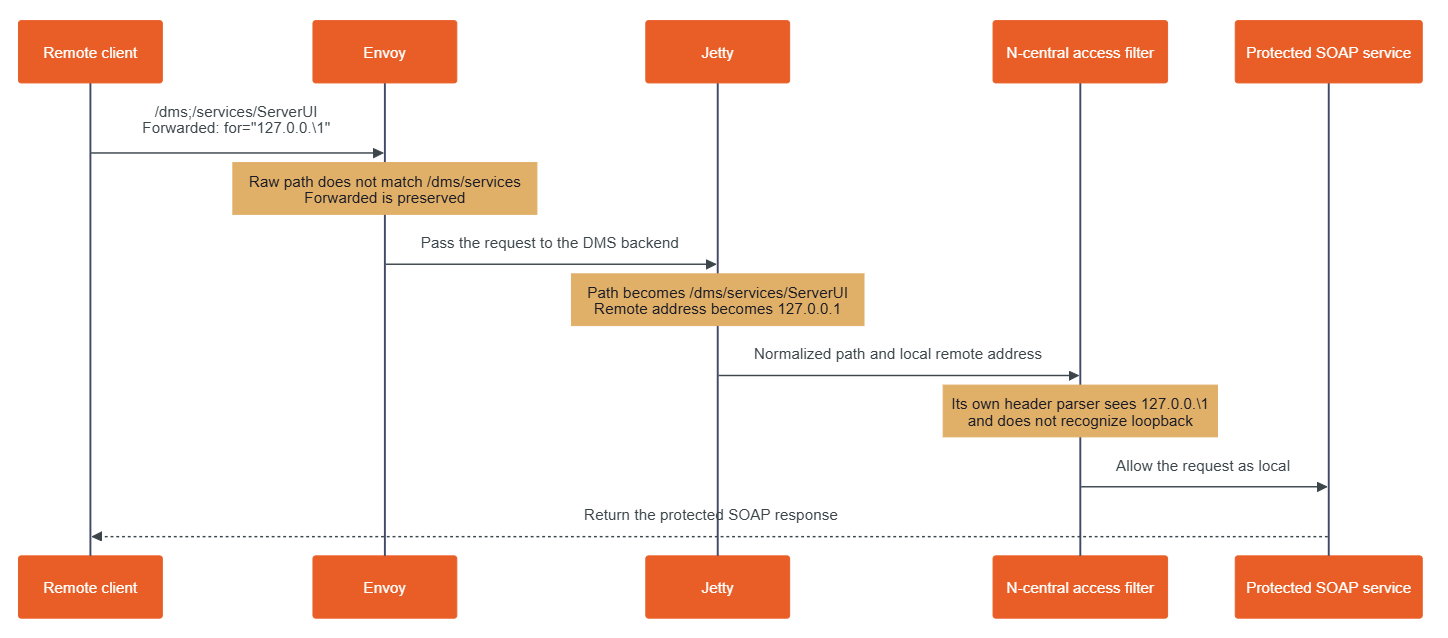
nable_cvd_blog.png

Figure 1: Processing a malicious request.

The semicolon gets the request past Envoy

The Envoy proxy rules come from the n-central-proxy-4.5.6-5 package. In /etc/opt/envoy/lds_intermediate.yaml, shown below (and edited for brevity), the management listener returns HTTP 403 for paths beginning with /dms/services or /internal/dms. A final catch-all rule sends other paths to the DMS application.

  # /etc/opt/envoy/lds_intermediate.yaml:953
  - match:
      prefix: /internal/dms
    # response-header boilerplate omitted
    direct_response:
      status: 403
      body:
        inline_string: Forbidden. No API access on the UI port.
  # ...
  - match:
      prefix: /dms/services
    # response-header boilerplate omitted
    direct_response:
      status: 403
      body:
        inline_string: Forbidden. No API access on the UI port.
 # ...
 # /etc/opt/envoy/lds_intermediate.yaml:1301
 # A final catch-all rule...
  - match:
      prefix: /
    route:
      cluster: dms
      timeout:
        seconds: 300

Envoy compares those prefixes with the path it received. The path /dms;/services/ServerUI does not begin with /dms/services, because the next character after /dms is a semicolon. It therefore reaches the catch-all route, passing the request from Envoy to Jetty.

Jetty interprets the path differently. The shipped jetty-http-9.4.56.v20240826.jar contains org.eclipse.jetty.http.HttpURI, and org.eclipse.jetty.util.URIUtil. Together, these classes treat text beginning with a semicolon as a path parameter and remove it when producing the decoded path used for servlet dispatch. As a result, Jetty turns /dms;/services/ServerUI into /dms/services/ServerUI. That decoded path then matches the Axis SOAP servlet mapping in /opt/nable/webapps/ROOT/WEB-INF/web.xml. 

<!-- /opt/nable/webapps/ROOT/WEB-INF/web.xml -->
<!-- ...snip... -->

   <servlet>
        <servlet-name>DMSServlet</servlet-name>
        <servlet-class>org.apache.axis.transport.http.AxisServlet</servlet-class>
    </servlet>
    <servlet-mapping>
        <servlet-name>DMSServlet</servlet-name>
        <url-pattern>/dms/services/*</url-pattern>
        <url-pattern>/internal/dms/services/*</url-pattern>
    </servlet-mapping>

    <servlet>
        <display-name>CXF Servlet</display-name>
        <servlet-name>CXFServlet</servlet-name>
        <servlet-class>org.apache.cxf.transport.servlet.CXFServlet</servlet-class>
        <load-on-startup>2</load-on-startup>
    </servlet>
    <servlet-mapping>
        <servlet-name>CXFServlet</servlet-name>
        <url-pattern>/dms2/services2/*</url-pattern>
        <url-pattern>/internal/dms/services2/*</url-pattern>
    </servlet-mapping>

Similarly, the same technique can be used to target the SOAP service via /internal;/dms/services2/ServerUI2. Jetty decodes it to /internal/dms/services2/ServerUI2, which matches the CXF SOAP servlet mapping. A single semicolon is sufficient to create the routing disagreement.

Reaching these servlet mappings puts the request at the protected SOAP interfaces that an exploit can leverage to establish an application session and later manage privileged objects, but the semicolon trick alone does not authorize the request. Without the crafted Forwarded header, Jetty retains the client’s real remote address and N-central’s ServletPathFilter denies access. Conversely, the header trick alone cannot help a request to the ordinary /dms/services/ServerUI or /internal/dms/services2/ServerUI2 path: Envoy returns HTTP 403 without forwarding that request to Jetty. 

As such, an exploit needs both discrepancies; the semicolon to pass Envoy’s path check and the header to pass N-central’s local-request check.

The header makes the remote client look local

The Forwarded header tells an application about the original client behind a proxy. In a malicious request, the for value is quoted and contains a quoted-pair (\1):

Forwarded: for="127.0.0.\1"

Under the HTTP quoted-string grammar, the backslash escapes the following character. Jetty’s ForwardedRequestCustomizer, from jetty-server-9.4.56.v20240826.jar, applies that rule. It removes the backslash, reads the value as 127.0.0.1, and exposes that value to N-central as the request’s remote address.

N-central then parses the original header a second time. Its parser is in com.nable.util.LocalHostUtils, from /opt/nable/webapps/ROOT/WEB-INF/lib/dmsservice-11.0.1-SNAPSHOT.jar. This parser removes the surrounding quotes but does not remove the backslash. It therefore checks 127.0.0.\1.

That string is not a valid IP address. LocalHostUtils.xffCheck() rejects an invalid value found in X-Forwarded-For, but its Forwarded branch rejects only values that it successfully recognizes as loopback. The below (abridged) decompilation shows the relevant branch:

// dmsservice-11.0.1-SNAPSHOT.jar
// com.nable.util.LocalHostUtils.xffCheck()

List<String> forwardedAddresses =
    LocalHostUtils.getForAddressesFromForwardedHeaders(httpRequest);

for (String addr : forwardedAddresses) {
    if (!LocalHostUtils.isLoopbackAddress(addr.trim())) continue; // <--- [1]
    // log the rejected loopback address
    return false; // <--- [2]
}
return true; // <--- [3]

When given the header value 127.0.0.\1, the isLoopbackAddress() call (at [1]) returns false (at [2]) because the value is invalid. The loop therefore continues and xffCheck() returns true (at [3]). In other words, an invalid Forwarded header value causes xffCheck to fail open. The final decision occurs in com.nable.server.ServletPathFilter, shown below.

// dmsservice-11.0.1-SNAPSHOT.jar
// com.nable.server.ServletPathFilter.isAllowedRequest()

boolean isAllowedRequest(HttpServletRequest httpRequest) {
    if (!LocalHostUtils.xffCheck(httpRequest)) { // <--- [4]
        return false;
    }
    if (LocalHostUtils.isLocalhost(httpRequest)) { // <--- [5]
        return true; // <--- [6]
    }
    String path = this.removeTrailingSlashes(httpRequest.getRequestURI());
    return this.pathFilterService != null
        && this.pathFilterService.isPathAllowed(path);
}

The first check asks whether a forwarding header is trying to claim a loopback address (at [4]). N-central’s parser sees the invalid value 127.0.0.\1, does not recognize it as loopback, and allows it. The second check asks whether Jetty’s remote address is local (at [5]). Jetty has already converted the same header value to 127.0.0.1, so this check succeeds. The filter returns true (at [6]) before consulting the normal remote-path allowlist.

CVE-2026-86207

By leveraging CVE-2026-86206 to reach the protected URI /dms/services/ServerUI, a SessionID returned by the Session.Hello SOAP operation (See the prior work by Horizon3 on leveraging the legacy SOAP API) can be generated. However, this SessionID is only a pre-login session. It proves that the request reached the local-only SOAP API via the access control bypass, but it does not yet identify an authenticated user. A separate authentication bypass vulnerability, in how legacy two-factor authentication operates, allows a pre-login session to become an authenticated session.

The method com.nable.server.ui.UserTwoFactorLogin, from dmsservice-11.0.1-SNAPSHOT.jar (shown below), binds a requested user ID (e.g. the builtin N-able Administrator account’s well known ID 1) to the session (at [1]) before it attempts legacy two-factor authentication (at [2]) . A normal authentication rejection removes that binding (at [4]), but if an exception occurs, this binding is left in place (at [3]).

// dmsservice-11.0.1-SNAPSHOT.jar
// com.nable.server.ui.UserTwoFactorLogin

   public final String twoFactorLogin(int sessionID, int userID, String password) throws RemoteException {
        String response = null;
        try {
            this.updateSession(sessionID, userID); // <--- [1]
            T_User user = this.getUser(userID);
            response = this.authenticate(user, password); // <--- [2]
            Trace.info((Object)this, (String)("2FA authentication response for user '" + user.getUsername() + "': " + response));
            if (response != null && "ACCESS_OK".equals(response)) {
                String audit = "TWO FACTOR LOGIN SUCCESSFUL: UserID [" + userID + "] successfully logged in.";
                this.addSessionAuditEntry(sessionID, audit);
            } else {
                String audit = "TWO FACTOR LOGIN FAILED: UserID [" + userID + "] attempted to login with invalid PIN.";
                this.addSessionAuditEntry(sessionID, audit);
                this.makeSessionInvalid(sessionID); // <--- [4]
            }
        }
        catch (RemoteException re) {
            throw re; // <--- [3]
        }
        catch (Exception ex) {
            throw DMSError.getFault((String)CommonError.GENERIC_ERROR.getCodeAsString(), (String)ex.toString(), (Throwable)ex); // <--- [3]
        }
        return response;
    }

N-central supports two distinct second-factor systems: legacy, profile-based authentication using an external AuthAnvil or RSA SecurID server, and native time-based one-time password (TOTP) “Two-Step Verification” using an authenticator application. Despite overlapping 2FA/MFA terminology in N-able’s documentation, com.nable.server.ui.UserTwoFactorLogin implements the former profile-based mechanism; it does not enforce the user’s native TOTP setting.

In a default installation, legacy two-factor processing raises an exception for several builtin identities used by N-central, as each of these identities lack a single legacy AuthAnvil or RSA 2FA profile association required by UserTwoFactorLogin. Specifically the following built-in identities can be leveraged via their known ID numbers.

  • User ID 1 (N-able Administrator)

  • User ID 50 (Product Administrator)

  • User ID 51 (N-able Support)

By creating a new pre-login session for any one of the above IDs, a SOAP call to User.TwoFactorLogin with a dummy password will achieve the authentication bypass, converting the pre-login session to a privileged SOAP session for that user. By using additional calls to the ServerUI2 SOAP endpoint, a new attacker-controlled System user account can be created.

Remediation

The vendor-supplied release of N-central 2026.3 Hotfix 3 (version 2026.3.1.13) remediates both CVE-2026-86206 and CVE-2026-86207. All versions of N-central prior to 2026.3.1.13 are vulnerable. Customers running affected on-premise N-central environments are urged to apply the latest update on an urgent basis, outside of normal patching cycles.

Customers using hosted N-central environments do not need to take action as the vendor has applied the needed updates.

For the latest remediation guidance, please see the vendor release notes and the vendor disclosure blog.

Rapid7 customers

Exposure Command, InsightVM, and Nexpose

Exposure Command, InsightVM and Nexpose customers will be able to assess their exposure to both CVE-2026-86206 and CVE-2026-86207, with authenticated vulnerability checks expected to be available in the September 8 content release. 

Disclosure timeline

  • August 27, 2026: Rapid7 makes initial outreach to N-able who respond the same day.

  • August 28, 2026: Rapid7 provides a detailed technical analysis and exploit script to N-able, along with a proposed timeline for a coordinated disclosure.

  • September 5, 2026: N-able release N-central 2026.3 HF3 which fixes two of the vulnerabilities (CVE-2026-86206, CVE-2026-86207) reported by Rapid7.

  • September 7, 2026: Rapid7 contacts N-able requesting clarity on several issues. N-able responds the same day with requested information.

  • September 8, 2026: This disclosure for CVE-2026-86206 and CVE-2026-86207.

Stealing AI Reasoning Traces

Post Syndicated from Bruce Schneier original https://www.schneier.com/blog/archives/2026/09/stealing-ai-reasoning-traces.html

Interesting research: “Stealing Reasoning Traces from Proprietary LLM APIs“:

Abstract: Leading large language model providers now conceal their models’ step-by-step reasoning, or chain-of-thought, to protect intellectual property and limit information leakage. Rather than storing these traces server-side, providers return them to the client as blocks of encrypted text, which the client passes back with each subsequent request. Building on prior research, we identify an architectural vulnerability: these encrypted blocks are fully compatible and interchangeable across different sessions, users, and models within a provider’s ecosystem. We exploit this compatibility to develop a scalable decryption jailbreak. By injecting an encrypted reasoning trace from a given model into a weaker, and less safeguarded model from the same provider, we force it to decode and output the trace verbatim in plaintext, without ever jailbreaking the more capable model directly. This vulnerability enables four distinct attack vectors. First, it circumvents anti-distillation mechanisms, allowing adversaries to extract a proprietary model’s reasoning, as we demonstrate across Anthropic, OpenAI, and Google. Second, it allows for large-scale private data extraction. Developers frequently share session logs publicly, unaware of contents of the encrypted blocks. By decoding 315,320 reasoning blocks scraped from public repositories, we recovered 367 Personally Identifiable Information (PII) artifacts and 182 credentials. Third, it inadvertently reveals hazardous information hidden within the reasoning process, even in cases where the model’s final, visible output safely rejects a malicious request. Fourth, attackers can leverage this flaw to execute invisible prompt injections, embedding malicious payloads entirely within encrypted blocks to poison public agentic rollouts. Following responsible disclosure, we propose concrete cryptographic and system-level mitigations to secure client-side reasoning.

Join the UK Bebras Challenge 2026

Post Syndicated from Andrew Csizmadia original https://www.raspberrypi.org/blog/join-the-uk-bebras-challenge-2026/

The UK Bebras Challenge, the nation’s largest computing challenge, is back!

Last year, more than 526,000 students from across the UK took part, tackling fun and thought-provoking puzzles that introduce key ideas in computational thinking with no extra preparation needed.

Read on to learn how your school can get involved.

What is the UK Bebras Challenge?

The UK Bebras Challenge is a free-to-enter annual challenge that is designed to spark interest in both computational thinking and computer science among students aged 6 to 19. The 45-minute challenge is accessible to everyone, offering age-appropriate but challenging interactive tasks for students at different levels, including a tailored version for secondary students with severe sight impairments.

The tasks are designed to give every student the opportunity to showcase their potential and all participating students receive a certificate. There are also certificates based on performance within school and gold certificates based on national boundaries. With self-marking tasks and no text-based programming required, it’s easy to have your school participate in the UK Bebras Challenge.

“The UK Bebras challenge provides an engaging way for students to apply their problem-solving skills in a fun, competitive environment. It complements our coding curriculum, encouraging critical thinking and enhancing computational thinking,” – Jonathan Phillips from Hereford Cathedral School

A new way to celebrate your achievements

A cartoon beaver next to some digital badges for the Bebras Challenge.

Every student who takes part in the UK Bebras Challenge gets a certificate. This year, we’ve come up with a new way to celebrate schools too. Every school who takes part will now get a digital badge and can earn others for reaching participation milestones.

The badges categories are:

  • 2026 UK Bebras Challenge participants
  • 100 students take part
  • 250 students
  • 500 students
  • 1,000+ students
  • 5 years running the challenge (starting this year)
  • Running the Severe Sight Impairment (SSI) challenge

With the exception of the ‘5 years’ badge, the numbers aren’t cumulative year-on-year and reset for each new challenge year. Claiming the badges is easy: Once the results are processed, we’ll email you a link where you can download your badge and display it wherever you want.

Feel free to brag about your new badges online. It might encourage other schools to take part next year 😀

Go deeper with Ada Computer Science

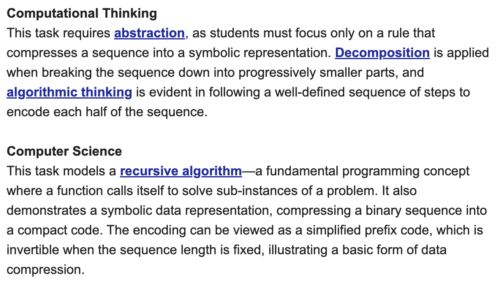
Text that reads: "Computational thinking: this task requires abstraction, as students must focus only on a rule that compresses a sequence into  a symbolic representation. Decomposition is applied when breaking the sequence down into progressively smaller parts, and algorithmic thinking is evident in following a well-defined sequence of steps to encode each half of the sequence. Computer science: this task models a recursive algorithm - a fundamental programming concept where a function calls itself to solve sub-instances of a problem. It also demonstrated a symbolic data representation, compressing a binary sequence into a compact code. The encoding can be viewed as a simplified prefix code, which is invertible when the sequence length is fixed, illustrating a basic form of data compression."
An example of the related computing concepts you’ll now see under every challenge puzzle.

Each Bebras task’s background section is now linked to a related topic on the Ada Computer Science platform. Following the live challenge, teachers and students can explore ithe detailed explanation of the computer science concept behind each Bebras task, along with the computational thinking skills students may use to solve that task.

“We have thoroughly enjoyed delivering the UK Bebras Challenge at our school. It has been an invaluable resource and by participating in this exciting event, our students have been introduced to the world of computational thinking in a fun and engaging way. The challenges are designed to push students to think critically and creatively, developing essential problem-solving skills that are applicable both inside and outside of the classroom.” – Sharon Pendreigh from Brownedge St Mary’s Catholic High School

How do I get my school involved?

If you are either a UK school or teach a UK-based curriculum, then visit the UK Bebras website for more information and to register your school.

Once you’ve registered, you’ll get access to the entire UK Bebras set of questions from previous years, allowing you to create custom quizzes for your students to tackle at any time throughout the year. These quizzes are self-marking, and you can download your students’ results to keep track of their progress. The questions are perfect for enrichment activities, end-of-term quizzes, lesson starters, and even full lessons to develop computational thinking skills and promote computing concepts.

Register for free at bebras.uk/admin.

Have a go at one of our puzzles

Here’s a question we ran in 2018 for the Juniors group (ages 10 to 12). Can you solve it?

Park walk

This is the map of a park:

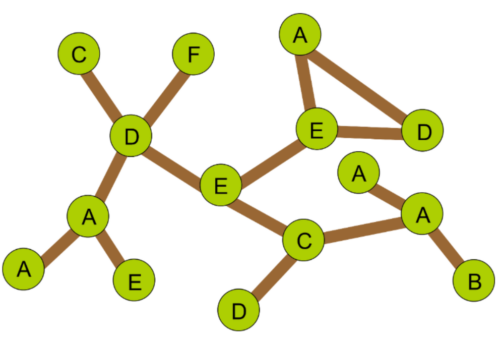
A diagram with lines connecting to circles each containing a letter of the alphabet.

The green circles with letters represent the trees and the brown lines are paths. Note that some letters are used to label more than one tree. Walking from tree F to tree B can be described as F D E C A B.

Last Sunday two families walked in the park.

The Wilde family’s walk was B A A A C E D E E D A.

The Gilde family’s walk was F D C D A E A D E D A.

Both families started their walks at the same time.

Walking from one tree to another tree, down one path takes the same amount of time.

Question:

How many times did the two families meet at a tree?

A screenshot of the answer options : "Once, Twice, Three times, They never met any of the trees".

Answer

They never met at any of the trees.

Explanation

Computer scientists often use graphs (and then they speak about vertices and edges instead of trees and paths connecting them).

Another interesting point about this task is the representation of the walks in the park. Despite the fact that some of the trees (vertices) are marked by the same letter, the walks that start from B or F can be unambiguously described by the sequence of letters along the walk. It means that one sequence of letters describes only one walk. It is because the neighbours of each tree (neighbours of tree X are the trees that are directly connected to X by a path) are always labeled with different letters. So if we know where we are at some moment of the walk and we see the next letter in the walk’s representation then there is no doubt which tree we should visit next.

This Bebras task was developed by the Bebras team in South Korea and refined by members of the international Bebras community.

In 1936, a Hungarian mathematician called Dénes Kőnig wrote the first ever textbook on graph theory. Today, graph theory is fundamental to computer science and in particular networking, operation research and data structures.

Did you get it right?

The post Join the UK Bebras Challenge 2026 appeared first on Raspberry Pi Foundation.

Canonical Evolution of Enterprise Open Source RISC-V at Hot Chips 2026

Post Syndicated from Patrick Kennedy original https://www.servethehome.com/canonical-evolution-of-enterprise-open-source-risc-v-at-hot-chips-2026/

Canonical gave a talk about the state of enterprise open source with RISC-V at Hot Chips 2026 as we move toward broader adoption

The post Canonical Evolution of Enterprise Open Source RISC-V at Hot Chips 2026 appeared first on ServeTheHome.

[$] CERN’s migration path from CentOS Linux to Debian

Post Syndicated from jzb original https://lwn.net/Articles/1092512/

The European Laboratory for Particle Physics, usually just called CERN, is not only the birthplace of
the World Wide Web
, it is home to the Large Hadron
Collider
(LHC), the world’s largest and highest-energy particle
accelerator
. As such, its computing environment is both truly unique and of
great interest to people outside of CERN who hope to find lessons applicable to
their own computing needs. The upcoming migration of some of CERN’s systems from
CentOS Linux to Debian, which was the topic of a talk at the recent MiniDebConf Winterthur 2026,
is of particular interest.

[$] Fixing the TCMalloc regression with RSEQ operations

Post Syndicated from corbet original https://lwn.net/Articles/1092555/

The restartable sequences feature is one of
the stranger corners of the kernel’s user-space interface; it provides a
way for user space to carry out simple lockless operations and be informed
if it is preempted over the course of an operation (and must, thus,
restart). Work merged in the 6.19 release to improve the performance of restartable
sequences
broke the TCMalloc allocator,
which was relying on an undocumented (and unintended) kernel behavior.
Now, Olivier Dion is proposing an
addition
to the restartable-sequences API that will bring TCMalloc back
into the fold; it does not make the restartable-sequences API any less
strange, though.

AWS Weekly Roundup: Claude Fable 5.1 on AWS, Amazon Linux 2027 preview, AWS Certified AI Business Strategist, and more (September 7, 2026)

Post Syndicated from Channy Yun (윤석찬) original https://aws.amazon.com/blogs/aws/aws-weekly-roundup-claude-fable-5-1-on-aws-amazon-linux-2027-preview-aws-certified-ai-business-strategist-and-more-september-7-2026/

Last week, Claude Fable 5.1 became available on AWS. According to Anthropic, Claude Fable 5.1 delivers frontier intelligence for ambitious tasks across coding, scientific research, and enterprise workflows. Claude Fable 5.1 is built for long-running, high-stakes work that runs for hours and spans many applications. It can own more of a software project on its own, handling features across an entire codebase, code review, and performance work over extended sessions.

Anthropic has designated Fable 5.1 a Covered Model, a category of Claude models that carry additional data retention, safety review, and access policies wherever they’re offered. Claude Fable 5.1 is subject to data retention for up to 30 days and human review by Amazon personnel, with a new aws_review data retention mode. In this mode, AWS retains your prompts and outputs for human safety review within the AWS boundary. The provider_data_share mode is legacy, and Amazon Bedrock does not share your data with the model provider. In addition, Enterprise Frontier Safeguards (EFS), built in partnership between AWS and Anthropic, will let eligible customers use Covered Models while keeping their data in a cloud environment they control.

You have two ways to access Claude Fable 5.1: Amazon Bedrock and Claude Platform on AWS. To learn more, see the Claude Fable 5.1 model card on Amazon Bedrock and Claude Platform on AWS.

Last week’s launches
Here are some launches that got my attention:

  • Amazon Linux 2027 (AL2027) in public preview: AL2027 is the next version of the Amazon Linux operating system. It runs on kernel 7.1+, purpose-built for cloud-native workloads on AWS with performance, scale, and security in mind. Built on AL2023’s baseline, AL2027 is designed for customers who need a secure, stable, and AWS-native operating system running web applications, databases, containerized microservices, AI/ML workloads, and large-scale infrastructure.
  • Amazon EC2 R9g and R9gd memory-optimized instances: These instances are powered by AWS Graviton5 processors, delivering the best price performance for memory-intensive workloads running on Amazon EC2. R9g and R9gd instances deliver up to 25% better compute performance compared to AWS Graviton4-based R8g and R8gd instances. They are up to 30% faster for databases, up to 35% faster for web applications, and up to 35% faster for machine learning. To learn more, read Daniel’s blog post.
  • AWS Lambda SnapStart for container image functions: Lambda SnapStart is an opt-in capability that makes it easier for you to build highly responsive and scalable applications without provisioning resources or implementing complex performance optimizations. Previously, SnapStart was only supported for managed runtimes (Python, .NET, and Java). You can now use SnapStart for container images to reduce startup times from several seconds to as low as sub-second for latency-sensitive workloads such as ML inference and interactive APIs.
  • AWS Agent Registry now generally available: AWS Agent Registry provides a private, governed catalog and discovery layer for agents, tools, skills, MCP servers, and custom resources within your organization. In addition to the capabilities launched in preview (manual and URL-based record creation, approval workflows, semantic and keyword search, and AWS CloudTrail audit trails), Registry now adds new enterprise features. To learn more, visit the AI Blog post.
  • Amazon Redshift now supports Apache Iceberg v3 tables: You can read from and write to Apache Iceberg v3 tables in your data lake of Amazon Redshift. With this launch, Amazon Redshift introduces support for default column values, row lineage, and deletion vectors. Amazon Redshift’s Graviton based provisioned and serverless clusters support the new v3 format. To learn more, visit Apache Iceberg v3 features in Redshift.

For a full list of AWS announcements, be sure to keep an eye on the What’s New with AWS page.

Other AWS news
Here are some additional projects and news items you may find interesting:

  • AWS named a Leader in the 2026 Gartner Magic Quadrant for Strategic Cloud Platform Services: For the 16th consecutive year, Gartner has recognized AWS as a Leader in the 2026 Gartner Magic Quadrant for Strategic Cloud Platform Services, and once again placed AWS highest on the Ability to Execute axis. We believe this recognition reflects our commitment to delivering the broadest and deepest set of cloud capabilities from infrastructure and AI to security and operations, so you can build, innovate, and scale with confidence.
  • AWS Certified AI Business Strategist: This new certification targets professionals who evaluate, champion, and scale AI initiatives in their organizations: line-of-business leaders driving adoption across their teams, sales professionals articulating AI value to customers, consultants guiding client strategy from experimentation through production, program managers aligning AI investments to business outcomes. Beta exam registration opened September 1, 2026, with exam delivery beginning September 29.
  • Agentic Security: Detection and Response at Machine Speed: We believe security should evolve ahead of AI adoption, not behind it. That belief drove our team to collaborate with the SANS Institute on a new chapter in the 2026 Cloud Security Exchange eBook, where we lay out a practical framework for securing agentic workloads at enterprise scale. Our chapter goes deeper on securing agentic workloads, with specific architectural patterns, implementation guidance, and frameworks for security teams at every stage of agentic AI maturity, whether you’re evaluating, piloting, or operating at scale.

For a full list of AWS blog posts, be sure to keep an eye on the AWS Blogs page.

Learn more about AWS, browse and join upcoming AWS-led in-person and virtual events, startup events, and developer-focused events including AWS re:Invent, AWS Summits, and AWS Community Days. Join the AWS Builder Center to connect with builders, share solutions, and access content that supports your development.

That is all for this week. Check back next Monday for another Weekly Roundup!

— Channy

Security updates for Monday

Post Syndicated from jzb original https://lwn.net/Articles/1092911/

Security updates have been issued by AlmaLinux (buildah, freerdp, gegl04, go-fdo-client, grafana, grafana-pcp, kernel, and pipewire), Debian (aom, chromium, libde265, libssh2, thunderbird, and tryton-server), Fedora (chromium, composer, cosmic-greeter, gegl04, greetd, ibus-table, jss, libheif, lightdm, lxdm, memcached, perl-DBD-Pg, plasma-login-manager, rust-webbrowser, sddm, selinux-policy, slitherer, and tkimg), Mageia (expat, mingw-expat, mbedtls, microcode, python-linkify-it-py, and tomcat), Oracle (buildah, container-tools:ol8, dbus-broker, freerdp, go-toolset:ol8, grafana-pcp, kernel, kernel-uek, nodejs24, php, and pipewire), Slackware (libpcap, libxml2, mozilla-firefox, mozilla-thunderbird, and util-linux), SUSE (bson-devel, busybox, bzip2, c-ares, cpio, cups-filters, dracut, ffmpeg-7, ffmpeg-8, file-roller, firefox, firefox-esr, glances-common, grafana, hauler, helm, helm3, java-17-openjdk, java-21-openjdk, lcms2, libcupsfilters, libheif, libmsgpack-c2, libsoup, libsoup2, libusb-1_0, libvirt, LibVNCServer, mcphost, ollama, opencode, openssl-1_1, openssl-3, php-composer2, podman, postgresql15, postgresql17, postgresql18, python, python-aiohttp, python-h2, python-sqlparse, python310, rpcbind, sssd, thunderbird, trivy, ucode-intel, and webkit2gtk3), and Ubuntu (linux, linux-aws, linux-aws-7.0, linux-gcp, linux-gke, linux-hwe-7.0, linux-realtime, linux, linux-aws, linux-fips, linux-kvm, linux-lts-xenial, linux, linux-fips, linux-gcp, linux-gcp-fips, linux-gke, linux-gkeop, linux-nvidia, linux-nvidia-6.8, linux-nvidia-lowlatency, linux-raspi, linux-realtime, linux-realtime-6.8, linux, linux-gcp, linux-gcp-fips, linux-gke, linux-gkeop, linux-hwe-5.15, linux-ibm, linux-ibm-5.15, linux-intel-iot-realtime, linux-lowlatency, linux-lowlatency-hwe-5.15, linux-nvidia, linux-nvidia-tegra, linux-nvidia-tegra-5.15, linux-realtime, linux-aws-5.4, linux-gcp, linux-gcp-5.4, linux-gcp-7.0, linux-oem-7.0, minetest, and miniupnpd).

Experience AI evolves with flexible resources for every classroom

Post Syndicated from Ben Garside original https://www.raspberrypi.org/blog/experience-ai-evolves-with-flexible-resources-for-every-classroom/

Experience AI equips young people with a meaningful understanding of artificial intelligence (AI) and machine learning by giving educators the knowledge and confidence to teach these topics in ways that suit their classrooms.

Whether you’re introducing AI to learners for the first time, helping them deepen their understanding, exploring generative AI with them, or integrating AI literacy across the curriculum, Experience AI offers you all the resources you need for free.

Since we started publishing Experience AI resources in 2023, they have been downloaded over a million times in 195 countries, and we have worked with partner organisations in more than 40 countries to train educators to teach AI literacy. Thanks to partners, we have learned a lot about how teachers around the world use the resources in their classrooms, and this has given us direction for what new resources to develop.

The updated suite of Experience AI resources

Many teachers looking for AI literacy resources are not computing specialists and have very busy timetables. Under pressure to deliver more content without more instructional time, what educators need are resources they can integrate into what they already teach. To support them, we’re now offering an updated suite of Experience AI resources that make AI literacy more accessible, flexible, and relevant.

The resources include those co-developed by the Raspberry Pi Foundation and Google DeepMind, alongside those developed independently by the Raspberry Pi Foundation.

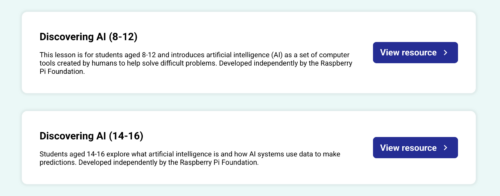
Screenshot of the Discover AI resources on the Experience AI website

The new Discovering AI resources, aimed at learners aged 8–12 and learners aged 13–16, are single lessons for introducing the fundamental ideas behind AI. They support educators with learners who have little or no prior knowledge of AI, and include engaging, age-appropriate activities.

Screenshot of Experience AI resources.

From there, our updated Foundations of AI units let teachers support their learners to develop a deeper understanding of how AI systems work, how they’re trained, and how they can be applied to real-world problems.

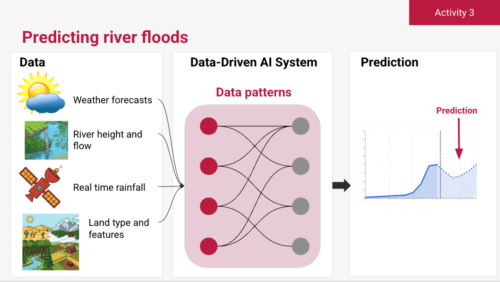
Slide from one of the Experience AI activities exploring AI and a real-world problem such as flood-forecasting.

And a new and growing collection of thematic resources supports teachers and learners to explore AI through cross-subject topics such as creativity, the environment, and critical thinking.

Experience AI now fully reflects our belief that AI literacy needs to be cross-curricular. Application of AI technologies isn’t limited to neat domains or subjects, so learners’ opportunities to understand them shouldn’t be either.

Why we are creating thematic resources

Education systems vary significantly between countries, and in most national curricula, AI literacy is not yet clearly defined. Nevertheless, teachers are both under pressure to deliver this new topic area in their limited classroom time, and eager to rise to the challenge to support their learners.

So we asked ourselves: how can we help educators to teach AI literacy in any subject without additional lesson time, when we cannot create specific resources for every subject in every education system?

Our answer came from educators themselves. Through our network of global partners, we learned that teachers were not waiting for us to tell them in what subjects the Experience AI resources belonged. They were already adapting them to teach AI literacy in all sorts of contexts. For example, we saw that some educators adapted the resource on AI and ecosystems, which we had developed for Biology classrooms, for their Geography classrooms, where it supported similar learning goals.

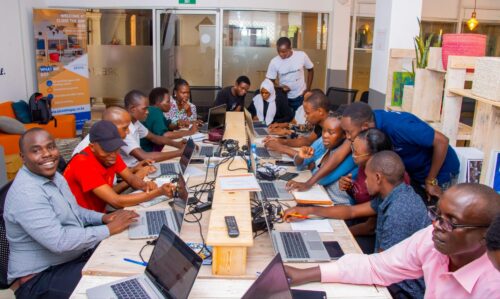
Photo of a group of educators being trained to teach and use Experience AI resources.

This insight into teachers’ classroom practice prompted us to change our approach.

Now, rather than designing resources for a single subject, we design and organise them in themes that fit across subjects, such as environment, creativity, ethics, and critical thinking. So a resource for exploring the environmental impact of AI data centres could be used in Geography, Physics, Citizenship, or Business Studies classrooms. An activity about AI-generated media could prompt discussions in Digital Literacy, Art, or Computing lessons. The same material supports different curricular goals, depending on how teachers choose to use it.

Helping every educator teach AI literacy with confidence

A key advantage of this new thematic approach is flexibility. Our thematic resources support teachers to:

  • Introduce AI literacy through topics they can easily fit into their subject
  • Integrate AI literacy without additional lesson time
  • Adapt the included activities for different learners and classroom contexts

Like all Experience AI materials, the new resources:

  • Encourage classroom discussions and promote critical thinking and reflection about AI technologies
  • Help learners understand how AI impacts society, not just how AI tools work
Photo of an educator teaching Experience AI in a classroom.

While Experience AI will continue to focus on core AI literacy concepts — how AI systems work, how they are used, and how to think critically about them — the resources we offer will increasingly be:

  • Thematic: Built around real-world topics with broad relevance
  • Modular: Adaptable to different classroom contexts rather than tied to a fixed sequence
  • Differentiated: Designed specifically for learners aged 8–12 and 13–16
  • Varied in format: Full lessons, stand-alone discussion activities, and extended project guides

In this way, we aim to make teaching AI literacy practical and achievable for every educator, regardless of their subject specialism or previous experience of using or teaching about AI.

Share your feedback with us

We’ve tested the new thematic resources with our Experience AI partner, Digital Moment in Canada, who also co-created our Social Media and Flood Forecasting units. Educators’s feedback shows that they value the added flexibility and find the new materials easier to bring into their teaching.

With our new approach, we’re able to offer a more flexible Experience AI programme that supports a wider range of educators, however they want to bring AI literacy into their classrooms.

If you use the resources in your classrooms, please tell us what you think. We’ll continue refining and expanding the Experience AI programme and resources in response to feedback from educators and partners around the world.

Get in touch and share your stories of using Experience AI in the classroom via our email: [email protected]

The post Experience AI evolves with flexible resources for every classroom appeared first on Raspberry Pi Foundation.

Asahi Linux now supports M3-series Macs

Post Syndicated from jzb original https://lwn.net/Articles/1092768/

The Asahi Linux project has announced that support
for Apple’s M3-series chips has been added to the Asahi installer.

Linux support for M3 series SoCs and the machines powered by them is now in a
state where almost everything supported on the M1 and M2 series
machines just works. This includes the webcam, internal microphones, USB (up to
the hardware limit of USB 3 10 Gb/s), hardware accelerated video decoding
including support for AV1, WiFi, Bluetooth, and much more! The
only major exceptions remain full DCP support and the GPU, which we will have
more news on in the coming
months
. Do not expect performant or power-efficient 3D acceleration
right now.

See the blog post for other current limitations of M3 support.

The collective thoughts of the interwebz