Tag Archives: AWS Training and Certification

AWS Weekly Roundup: Amazon EC2, Amazon Q Developer, IPv6 updates, and more (September 1, 2025)

Post Syndicated from Sébastien Stormacq original https://aws.amazon.com/blogs/aws/aws-weekly-roundup-amazon-ec2-amazon-q-developer-ipv6-updates-and-more-september-1-2025/

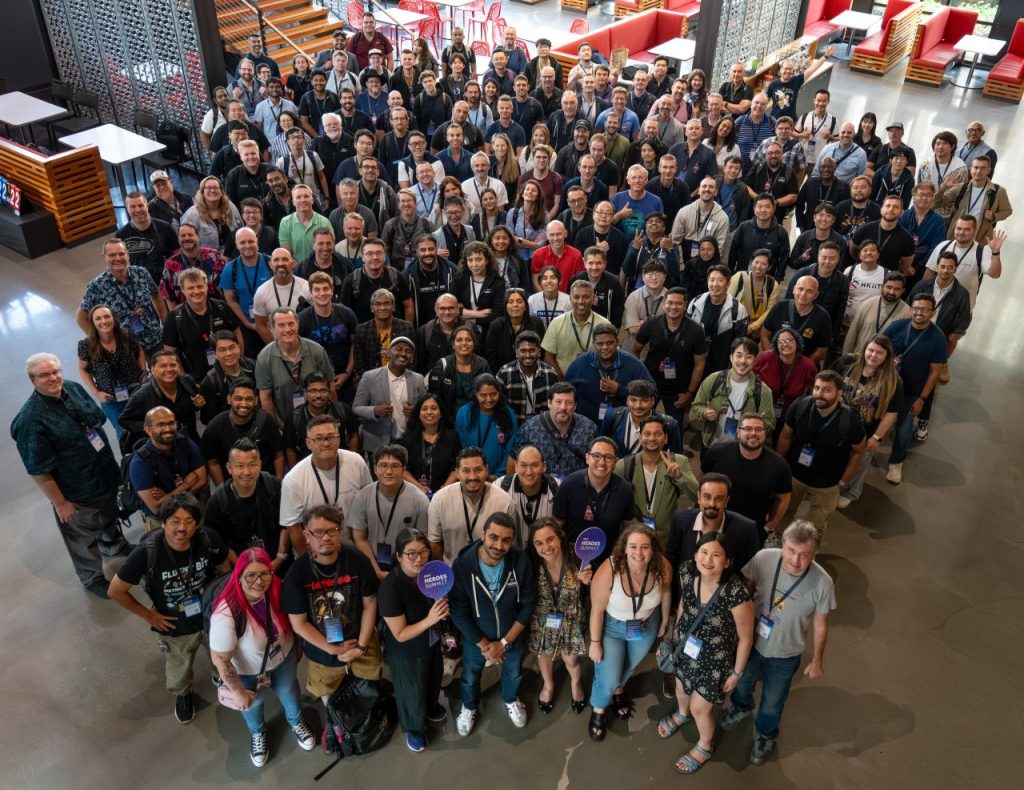
My LinkedIn feed was absolutely packed this week with pictures from the AWS Heroes Summit event in Seattle. It was heartwarming to see so many familiar faces and new Heroes coming together.

AWS Heroes Summit 2025

For those not familiar with the AWS Heroes program, it’s a global community recognition initiative that honors individuals who make outstanding contributions to the AWS community. These Heroes share their deep AWS knowledge through content creation, speaking at events, organizing community gatherings, and contributing to open-source projects.

The AWS Heroes Summit brings these exceptional community leaders together, providing a unique platform for knowledge exchange, networking, and collaboration. As someone who regularly interacts with Heroes through our AWS initiatives, I always find these summits invaluable – they offer deep technical discussions, early access to AWS roadmaps, and opportunities to provide direct feedback to AWS service teams. The insights and connections made at these events often translate into better resources and guidance for the broader AWS community.

Last week’s launches

In addition to this inspiring community, here are some AWS launches that caught my attention:

  • AWS expands Internet Protocol v6 (IPv6) support to AWS App Runner, AWS Client VPN, and RDS Data API — Three more AWS services now support IPv6 connectivity, helping you meet compliance requirements and removes the need for handling address translation between IPv4 and IPv6. AWS App Runner now supports IPv6-based inbound and outbound traffic on both public and private App Runner service endpoints. AWS Client VPN announced support for remote access to IPv6 workloads, allowing you to establish secure VPN connections to your IPv6-enabled VPC resources. Finally, RDS Data API now supports IPv6, enabling dual-stack configuration (IPv4 and IPv6) connectivity for your Aurora databases.
  • We launched two new instance families this week: the new storage-optimized I8ge and the general-purpose M8i instances —Our I8ge instances, powered by AWS Graviton4 processors, deliver up to 60% better compute performance compared to their Graviton2-based predecessors. These instances feature third-generation AWS Nitro SSDs, providing up to 55% better real-time storage performance per TB and significantly lower I/O latency. With 120 TB of storage and sizes up to 48xlarge (including two metal options), they offer the highest storage density among AWS Graviton-based storage optimized instances. We also launched M8i and M8i-flex instances with custom Intel Xeon 6 processors. These instances deliver up to 15% better price-performance and 2.5x more memory bandwidth than their predecessors. M8i-flex instances are ideal for general-purpose workloads, available from large to 16xlarge. For demanding applications, you can choose from our SAP-certified M8i instances in 13 sizes, including 2 bare metal options and a new 96xlarge size.
  • Amazon EC2 Mac Dedicated hosts now support Host Recovery and Reboot-based host maintenance — you can enable two new capabilities for your EC2 Mac Dedicated Hosts: Host Recovery and Reboot-based Host Maintenance. Host Recovery automatically detects potential hardware issues on Mac Dedicated Hosts and seamlessly migrates Mac instances to a new replacement host, minimizing disruption to workloads. Reboot-based Host Maintenance automatically stops and restarts instances on replacement hosts when scheduled maintenance events occur, eliminating the need for manual intervention during planned maintenance windows.
  • Amazon Q Developer now supports MCP admin control — Administrators have now the ability to enable or disable the MCP functionality for all the Q Developer clients in their organization. When an administrator disables the functionality, users will not be allowed to add any MCP servers, nor will any previously defined servers be initialized.

Other AWS news

Here are some additional projects and blog posts that you might find interesting:

  • Mastering Amazon Q Developer with Rules — I read an interesting article about Amazon Q Developer’s rules feature this weekend that I want to share with you. What caught my attention is how it solves a pain point I often encounter when working with AI assistants – having to repeatedly explain my coding preferences and standards. With rules, you define your preferences once in Markdown files, and Amazon Q Developer automatically follows them for every interaction. I particularly like how transparent the system is, showing which rules it’s following, and how it helps maintain consistency across teams. Since implementing rules in my projects, I’ve seen more consistent code quality, all while reducing the cognitive load of having to repeatedly explain our standards.
  • Strategies for excelling across all four exam domains of the AWS Certified Machine Learning – Specialty certification. The AWS Training & Certification team, where I spent my first three years at AWS, shared how to prepare for the AWS Certified Machine Learning – Specialty certification, whether you’re starting from scratch or building upon existing AWS Certifications. They share the prerequisites and guidance to help you get ready for this certification and demonstrate your expertise in building ML solutions with AWS.
  • As is now our tradition after Prime Day, we shared the impressive metrics showing how AWS services scaled to support one of the world’s largest shopping events. Amazon Prime Day 2025 was the biggest ever, setting records for both sales volume and total items sold during the 4-day event. This year was particularly special as we saw a significant transformation in the Prime Day experience through advancements in our generative AI offerings, with customers using Alexa+, Rufus, and AI Shopping Guides to discover deals and get product information. The numbers are staggering – Amazon DynamoDB handled tens of trillions of API calls while maintaining high availability, delivering single-digit millisecond responses and peaking at 151 million requests per second. Amazon API Gateway processed over 1 trillion internal service requests—a 30 percent increase in requests on average per day compared to Prime Day 2024.

Upcoming AWS events
Check your calendars and sign up for these upcoming AWS events:

  • AWS Summits — Join free online and in-person events that bring the cloud computing community together to connect, collaborate, and learn about AWS. Register in your nearest city: Toronto (September 4), Los Angeles (September 17), and Bogotá (October 9).
  • AWS re:Invent 2025 — This flagship annual conference is coming to Las Vegas from December 1–5. The event catalog is now available. Mark your calendars for this not to be missed gathering of the AWS community.
  • AWS Community Days — Join community-led conferences that feature technical discussions, workshops, and hands-on labs led by expert AWS users and industry leaders from around the world: Adria (September 5), Baltic (September 10), Aotearoa (September 18), South Africa (September 20), Bolivia (September 20), Portugal (September 27).

Join the AWS Builder Center to learn, build, and connect with builders in the AWS community. Browse here for upcoming in-person and virtual developer-focused events.

That’s all for this week. Check back next Monday for another Weekly Roundup!

— seb

Introducing the AWS Security Champion Knowledge Path and digital badge

Post Syndicated from Sarah Currey original https://aws.amazon.com/blogs/security/introducing-the-aws-security-champion-knowledge-path-and-digital-badge/

Today, Amazon Web Service (AWS) introduces the Security Champion Knowledge Path on AWS Skill Builder, featuring training and a digital badge. The Security Champion Knowledge path is a comprehensive educational framework designed to empower developers and software engineers with essential AWS cloud security knowledge and best practices. The structured learning path enables development teams to accelerate their delivery while maintaining robust security standards in cloud environments, addressing customers’ need for a structured curriculum to develop and validate security expertise across their organizations.

AWS Skill Builder logo

A new era of security education

The AWS Security Champion Knowledge Path complements the existing AWS security training offerings, providing a structured, self-paced journey to security expertise. Hart Rossman, Vice President of Global Services Security at AWS, emphasizes the program’s significance: “Security in the cloud isn’t a destination; it’s an ongoing journey. The AWS Security Champion Knowledge Path equips our customers with the tools and knowledge to navigate this journey confidently, fostering a culture where security is woven into every aspect of cloud operations.”

Designed for a diverse audience including software developers, solutions architects, technical leaders, and cloud practitioners, the training plan covers a wide range of topics that are critical for a strong security posture in the cloud. This AWS security learning journey begins with essential fundamentals and progressively builds toward advanced concepts across a well-structured curriculum. Starting with AWS Security Fundamentals and the AWS Shared Responsibility Model, learners establish core principles before diving into AWS Identity and Access Management (IAM), including detailed troubleshooting scenarios. The curriculum advances to critical security elements such as encryption and comprehensive threat modeling through the AWS Builders Workshop. Security governance and auditing form the next tier, followed by practical implementations of monitoring, alerting, and network infrastructure best practices. The learning path then covers specialized areas including web-facing workload protection, network control, and incident response procedures. The knowledge path culminates with deep dives into container security and core security concepts through AWS SimuLearn, providing hands-on experience with real-world scenarios. This carefully orchestrated progression helps facilitate a thorough understanding of AWS security principles while maintaining a practical, implementation-focused approach.

AWS SimuLearn logo

What is a Security Champion?

A Security Champion is a bridge between security teams and development teams, promoting security best practices and making sure that security is embedded into every stage of the development lifecycle. However, Security Champion isn’t just a role—it’s a mindset. In today’s distributed and agile cloud environments, having Security Champions across different teams provides a competitive advantage for releasing products quickly and securely.

This distributed ownership of security brings numerous benefits: faster development cycles because teams can address security requirements proactively, reduced security incidents through early detection, and improved collaboration between security and development teams. Most importantly, it creates a culture of security where every team member understands their role in protecting the organization’s assets and data.

By becoming a Security Champion, you’ll gain valuable expertise, earn recognized credentials, and develop leadership skills that can accelerate your career growth. Most importantly, you’ll be empowered to make meaningful contributions to your organization’s security posture by promoting best practices, identifying potential vulnerabilities early in the development cycle, and fostering collaboration between teams—ultimately helping your organization deliver products that are both innovative and secure.

How can I become an AWS Security Champion?

Security enthusiasts can enroll into the AWS Security Champion Knowledge Badge Readiness Path on AWS Skill Builder and complete the assessment successfully to earn the AWS Security Champion digital badge available on Credly.

AWS Security Champion training is a self-paced, hands-on, and interactive approach to upskilling on security concepts. As a participant, you’re introduced to security best practices, performing basic audits, planning for governance at scale, incident response concepts and more. You can engage with real-world scenarios through hands-on labs, interactive game-based learning, gain access to AWS sandbox environments, and conduct practical security assessments. This applied learning helps make sure that knowledge isn’t just acquired, but truly internalized and ready for immediate application.

“The AWS Security Champion Knowledge Path represents a significant milestone in democratizing security expertise. We’ve designed this program to transform how organizations approach security training, making it accessible, practical, and immediately applicable. This isn’t just about learning security concepts—it’s about creating a culture where security becomes second nature to every team member.”
– Jenni Troutman, Training and Certification Director at AWS

Recognition and community

Upon successfully completing the assessment in this training path, participants earn the prestigious AWS Security Champion knowledge badge in Credly to showcase their accomplishment, such as on LinkedIn, and join a growing community of security professionals. This recognition not only validates individual expertise but also signals an organization’s commitment to security excellence, and helps organizations identify qualified security champions within their team.

Getting started

To begin your journey to becoming an AWS Security Champion, log in or create an account with AWS Skill Builder and enroll in the Security Champion Knowledge Badge Readiness Path. The training plan is available through flexible pricing options, including individual subscriptions at $29 per month and team subscriptions at $449 per month with enterprise volume pricing available.

Rossman concludes, “The AWS Security Champion Knowledge Path represents a paradigm shift in how organizations approach security education. It’s about creating a shared language of security across teams, enabling faster, more secure development cycles, and ultimately, delivering better outcomes for our customers.”

Ready to elevate your organization’s security capabilities? Visit AWS Skill Builder to enroll and start your journey towards becoming an AWS Security Champion. For enterprise inquiries, reach out to your AWS account team.

Stay tuned to the AWS Security Blog for more updates on AWS Security services, features, and best practices. Together, we’re building a more secure cloud for all.

If you have feedback about this post, submit comments in the Comments section below.

Sarah Currey

Sarah Currey

As the Organization Excellence Leader for AWS Global Services Security, Sarah creates and optimizes security programs and solutions that protect AWS customers and internal teams. The initiatives foster a culture of security that encourages continuous improvement and innovation in our security practices while empowering everyone to champion security.

Alejandra Lopez

Alejandra Lopez

Alejandra is a Sr. Go-to-Market Leader at AWS Global Services Strategy and Operations and specializes in scaling AWS Training and Certification offerings through go-to-market strategies. Her expertise lies in creating scalable solutions for both enterprise customers and individual learners, with an emphasis on upskilling in AWS Cloud technologies, generative AI, and bridging the cloud skills gap.

Amar Meda

Amar Meda

Amar is a Sr. Technical Product Manager at AWS and leads the product strategy and delivery of digital training products available on AWS Skill Builder. With his expertise in cloud technologies and commitment to accessible learning experiences, Amar helps organizations, partners and individuals worldwide maximize their AWS capabilities through innovative training solutions.

AWS Weekly Roundup: Anthropic Claude 3.7, JAWS Days, cross-account access, and more (March 3, 2025)

Post Syndicated from Veliswa Boya original https://aws.amazon.com/blogs/aws/aws-weekly-roundup-anthropic-claude-3-7-jaws-days-cross-account-access-and-more-march-3-2025/

I have fond memories of the time I built an application live at the AWS GenAI Loft London last September. AWS GenAI Lofts are back in locations such as San Francisco, Berlin, and more, to continue providing collaborative spaces and immersive experiences for startups and developers. Find a loft near you for hands-on access to AI products and services, events, workshops, and networking opportunities, that you can’t miss!

Last week’s launches
Here are some launches that got my attention during the previous week.

Four ways to grant cross-account access in AWS — For some situations, you might want to enable centralized operations across multiple AWS accounts or share resources across teams, or projects within your teams. In these cases, you may be concerned about security, availability, or the manageability of granting this cross-account access. We’ve announced four ways to grant cross-account access in AWS and detail each of the methods and its unique trade-offs.

Amazon ECS adds support for additional IAM condition keys — We’ve launched eight new service-specific condition keys for Identity and Access Management (IAM). These new condition keys let you create IAM policies as well as srvice control policies (SCPs) to better enforce your organizational policies in containerized environments. You can use IAM condition keys to author policies that enforce access control based on API request context.

AWS Chatbot is now named Amazon Q Developer — AWS Chatbot has been renamed to Amazon Q Developer, representing an enhancement to developer productivity through generative AI-powered capabilities. Furthermore, this update is an enhancement of our chat-based DevOps capabilities. By combining the proven functionality of AWS Chatbot with the generative AI capabilities of Amazon Q, we’re providing developers with more intuitive, efficient tools for cloud resource management.

Anthropic’s Claude 3.7 Sonnet hybrid reasoning model is now available in Amazon Bedrock — We’re expanding the foundation models (FM) offerings of Amazon Bedrock and we’ve announced the availability of Anthropic’s Claude 3.7 Sonnet FM in Amazon Bedrock. Claude 3.7 Sonnet is Anthropic’s most intelligent model to date. It stands out as their first hybrid reasoning model capable of producing quick responses or extended thinking, meaning it can work through difficult problems using careful, step-by-step reasoning.

Other AWS news
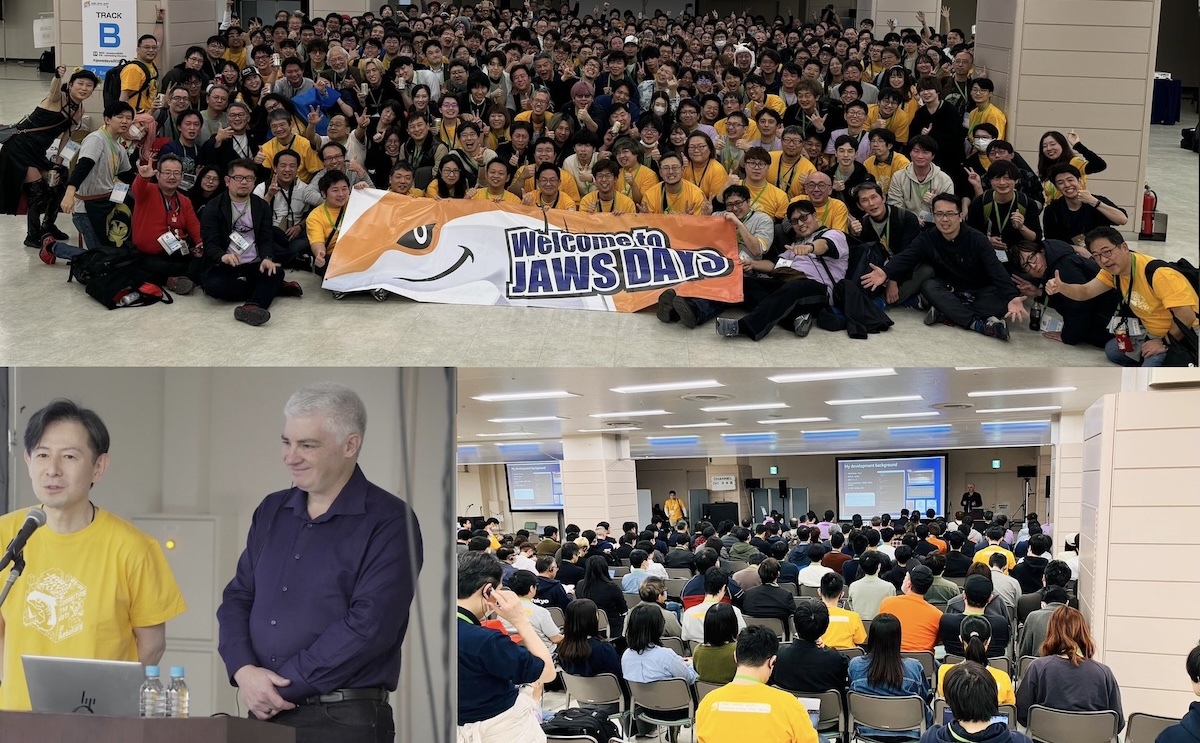
JAWS-UG (Japan AWS User Group) is the largest AWS user group in the world, and holds JAWS Days every year with over a thousand participants from Japan, Korea, Taiwan, and Hong Kong. The March 1st event started with a keynote speech on next-generation development by Jeff Barr (VP of AWS Evangelism), and included over 100 technical and community experience sessions, lightning talks, and workshops such as Game Days, Builders Card Challenges, and networking parties. If you want to experience the most active AWS community event in the world, I recommend attending next year.


Amazon Q Developer now generally available in Amazon SageMaker Canvas — Announced as available in preview at AWS reinvent 2024, Amazon Q Developer is now generally available in Amazon SageMaker Canvas to help you build machine learning (ML) models using natural language.

Applications for the 2025 AWS Cloud Club Captains Program are still open through March 6th. AWS Cloud Clubs are student-led groups for post-secondary and independent students, 18 years old and over. Find a club near you on the Meetup page.

From community.aws
Here are some of my favorite posts from community.aws:

DevSecOps on AWS: Secure, Automate, and Have a Laugh Along the Way – Discover how DevSecOps on AWS transforms your development pipeline by integrating security from the very first commit to production deployment, by Ahmed Mohamed.

Find out how to earn 100 percent free AWS certification vouchers in Opportunity to earn free AWS Certification Vouchers, published by Anand Joshi.

In the post, Boost SaaS Onboarding & Retention with AWS AI & Automation, Kaumudi Tiwari details how to navigate endless forms, generic guides, and a cluttered interface when signing up for a new software as a service (SaaS) platform.

My colleague Dennis Traub has published helpful step-by-step guides on how to use reasoning capabilities with Anthropic’s Claude 3.7 Sonnet in your C#/.NET, Java, JavaScript, or Python applications. Find these posts and much more generative AI-related content in the Gen AI Space on community.aws.

Upcoming AWS events
Check your calendars and sign up for these upcoming AWS events:

AWS Community Days – Join community-led conferences that feature technical discussions, workshops, and hands-on labs led by expert AWS users and industry leaders from around the world: Milan, Italy (April 2), Bay Area – Security Edition (April 4), Timișoara, Romania (April 10), and Prague, Czech Republic (April 29).

AWS Innovate: Generative AI + Data – Join a free online conference focusing on generative AI and data innovations. Available in multiple geographic regions: APJC and EMEA (March 6), North America (March 13), Greater China Region (March 14), and Latin America (April 8).

AWS Summits – Join free online and in-person events that bring the cloud computing community together to connect, collaborate, and learn about AWS. Register in your nearest city: Paris (April 9), Amsterdam (April 16), London (April 30), and Poland (May 5).

AWS re:Inforce – AWS re:Inforce (June 16–18) in Philadelphia, PA, is our annual learning event devoted to all things AWS Cloud security. Registration opens in March, so be ready to join more than 5,000 security builders and leaders.

AWS DevDays are free, technical events where developers can learn about some of the hottest topics in cloud computing. DevDays offer hands-on workshops, technical sessions, live demos, and networking with AWS technical experts and your peers. Register to access AWS DevDays sessions on demand.

Create your AWS Builder ID and reserve your alias. Builder ID is a universal login credential that gives you access—beyond the AWS Management Console—to AWS tools and resources, including over 600 free training courses, community features, and developer tools such as Amazon Q Developer.

AWS Training and Certification hosts free training events, both online and in-person, that help you get the most out of the AWS Cloud. Register to gain foundational cloud knowledge or dive deep in a technical area. Join AWS experts for training events that meet your goals, such as AWS Discovery Days, in-person. and virtual events at AWS Skills Centers including the one in Cape Town.

You can browse all upcoming in-person and virtual events here.

That’s all for this week. Check back next Monday for another Weekly Roundup!

– Veliswa

This post is part of our Weekly Roundup series. Check back each week for a quick roundup of interesting news and announcements from AWS!

How is the News Blog doing? Take this 1 minute survey!

AWS Weekly Roundup: Llama 3.1, Mistral Large 2, AWS Step Functions, AWS Certifications update, and more (July 29, 2024)

Post Syndicated from Antje Barth original https://aws.amazon.com/blogs/aws/aws-weekly-roundup-llama-3-1-mistral-large-2-aws-step-functions-aws-certifications-update-and-more-july-29-2024/

I’m always amazed by the talent and passion of our Amazon Web Services (AWS) community members, especially in their efforts to increase diversity, equity, and inclusion in the tech community.

Last week, I had the honor of speaking at the AWS User Group Women Bay Area meetup, led by Natalie. This group is dedicated to empowering and connecting women, providing a supportive environment to explore cloud computing. In Latin America, we recently had the privilege of supporting 12 women-led AWS User Groups from 10 countries in organizing two regional AWSome Women Community Summits, reaching over 800 women builders. There’s still more work to be done, but initiatives like these highlight the power of community in fostering an inclusive and diverse tech environment.

Women-Led AWS Community Events

Now, let’s turn our attention to other exciting news in the AWS universe from last week.

Last week’s launches
Here are some launches that got my attention:

Meta Llama 3.1 models – The Llama 3.1 models are Meta’s most advanced and capable models to date. The Llama 3.1 models are a collection of 8B, 70B, and 405B parameter size models that demonstrate state-of-the-art performance on a wide range of industry benchmarks and offer new capabilities for your generative artificial intelligence (generative AI) applications. Llama 3.1 models are now available in Amazon Bedrock (see Announcing Llama 3.1 405B, 70B, and 8B models from Meta in Amazon Bedrock) and Amazon SageMaker JumpStart (see Llama 3.1 models are now available in Amazon SageMaker JumpStart).

My colleagues Tiffany and Mike explored Llama 3.1 in last week’s episode of the weekly Build On Generative AI live stream. You can watch the full episode here!

BuildOn Generative AI Llama 3.1 launch

Mistral Large 2 model – Mistral Large 2 is the newest version of Mistral Large, and according to Mistral AI, it offers significant improvements across multilingual capabilities, math, reasoning, coding, and much more. Mistral AI’s Mistral Large 2 foundation model (FM) is now available in Amazon Bedrock. See Mistral Large 2 is now available in Amazon Bedrock for all the details. You can find code examples in the Mistral-on-AWS repo and the Amazon Bedrock User Guide.

Faster auto scaling for generative AI models – This new capability in Amazon SageMaker inference can help you reduce the time it takes for your generative AI models to scale automatically. You can now use sub-minute metrics and significantly reduce overall scaling latency for generative AI models. With this enhancement, you can improve the responsiveness of your generative AI applications as demand fluctuates. For more details, check out Amazon SageMaker inference launches faster auto scaling for generative AI models.

AWS Step Functions now supports customer managed keys – AWS Step Functions now supports the use of customer managed keys with AWS Key Management Service (AWS KMS) to encrypt Step Functions state machine and activity resources. This new capability lets you encrypt your workflow definitions and execution data using your own encryption keys. Visit the AWS Step Functions documentation and the AWS KMS documentation to learn more.

For a full list of AWS announcements, be sure to keep an eye on the What’s New at AWS page.

Other AWS news
Here are some additional news items and posts that you might find interesting:

AWS Certification: Addition of new exam question types – If you are planning to take the AWS Certified AI Practitioner or AWS Certified Machine Learning Engineer – Associate exam anytime soon, check out AWS Certification: Addition of new exam question types. These exams will be the first to include three new question types: ordering, matching, and case study. The post shares insights about the new question types and offers information to help you prepare.

New ordering question type in AWS Certifications

Amazon’s exabyte-scale migration from Apache Spark to Ray on Amazon EC2 – The Business Data Technologies (BDT) team at Amazon Retail has just flipped the switch to start quietly moving management of some of their largest production business intelligence (BI) datasets from Apache Spark over to Ray to help reduce both data processing time and cost. They’ve also contributed a critical component of their work (The Flash Compactor) back to Ray’s open source DeltaCAT project. Find the full story at Amazon’s Exabyte-Scale Migration from Apache Spark to Ray on Amazon EC2.

Running compaction jobs with Ray on Amazon EC2

From community.aws
Here are my top three personal favorites posts from community.aws:

Upcoming AWS events
Check your calendars and sign up for these AWS events:

AWS SummitsAWS Summits – The 2024 AWS Summit season is almost wrapping up! Join free online and in-person events that bring the cloud computing community together to connect, collaborate, and learn about AWS. Register in your nearest city: Mexico City (August 7), São Paulo (August 15), and Jakarta (September 5).

AWS Community DaysAWS Community Days – Join community-led conferences that feature technical discussions, workshops, and hands-on labs led by expert AWS users and industry leaders from around the world: New Zealand (August 15), Colombia (August 24), New York (August 28), Belfast (September 6), and Bay Area (September 13).

You can browse all upcoming in-person and virtual events.

That’s all for this week. Check back next Monday for another Weekly Roundup!

— Antje

This post is part of our Weekly Roundup series. Check back each week for a quick roundup of interesting news and announcements from AWS!

AWS Week in Review – February 6, 2023

Post Syndicated from Marcia Villalba original https://aws.amazon.com/blogs/aws/aws-week-in-review-february-6-2023/

This post is part of our Week in Review series. Check back each week for a quick roundup of interesting news and announcements from AWS!

If you are looking for a new year challenge, the Serverless Developer Advocate team launched the 30 days of Serverless. You can follow the hashtag #30DaysServerless on LinkedIn, Twitter, or Instagram or visit the challenge page and learn a new Serverless concept every day.

Last Week’s Launches
Here are some launches that got my attention during the previous week.

AWS SAM CLIv1.72 added the capability to list important information from your deployments.

  • List the URLs of the Amazon API Gateway or AWS Lambda function URL.
    $ sam list endpoints
  • List the outputs of the deployed stack.
    $ sam list outputs
  • List the resources in the local stack. If a stack name is provided, it also shows the corresponding deployed resources and the ids.
    $ sam list resources

Amazon RDSNow supports increasing the allocated storage size when creating read replicas or when restoring a database from snapshots. This is very useful when your primary instances are near their maximum allocated storage capacity.

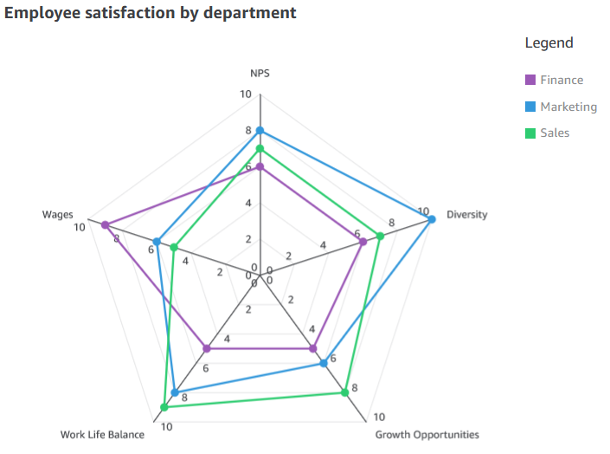
Amazon QuickSight Allows you to create Radar charts. Radar charts are a way to visualize multivariable data that are used to plot one or more groups of values over multiple common variables.

AWS Systems Manager AutomationNow integrates with Systems Manager Change Calendar. Now you can reduce the risks associated with changes in your production environment by allowing Automation runbooks to run during an allowed time window configured in the Change Calendar.

AWS AppConfigIt announced its integration with AWS Secrets Manager and AWS Key Management Service (AWS KMS). All sensitive data retrieved from Secrets Manager via AWS AppConfig can be encrypted at deployment time using an AWS KMS customer managed key (CMK).

For a full list of AWS announcements, be sure to keep an eye on the What’s New at AWS page.

Other AWS News
Some other updates and news that you may have missed:

AWS Cloud Clubs – Cloud Clubs are peer-to-peer user groups for students and young people aged 18–28. In these clubs, you can network, attend career-building events, earn benefits like AWS credits, and more. Learn more about the clubs in your region in the AWS student portal.

Get AWS Certified: Profesional challenge – You can register now for the certification challenge. Prepare for your AWS Professional Certification exam and get a 50 percent discount for the certification exam. Learn more about the challenge on the official page.

Podcast Charlas Técnicas de AWS – If you understand Spanish, this podcast is for you. Podcast Charlas Técnicas is one of the official AWS podcasts in Spanish, and every other week, there is a new episode. The podcast is for builders, and it shares stories about how customers implemented and learned AWS services, how to architect applications, and how to use new services. You can listen to all the episodes directly from your favorite podcast app or at AWS Podcasts en Español.

AWS Open-Source News and Updates – This is a newsletter curated by my colleague Ricardo to bring you the latest open-source projects, posts, events, and more.

Upcoming AWS Events
Check your calendars and sign up for these AWS events:

AWS re:Invent recaps – We had a lot of announcements during re:Invent. If you want to learn them all in your language and in your area, check the re: Invent recaps. All the upcoming ones are posted on this site, so check it regularly to find an event nearby.

AWS Innovate Data and AI/ML edition – AWS Innovate is a free online event to learn the latest from AWS experts and get step-by-step guidance on using AI/ML to drive fast, efficient, and measurable results.

  • AWS Innovate Data and AI/ML edition for Asia Pacific and Japan is taking place on February 22, 2023. Register here.
  • Registrations for AWS Innovate EMEA (March 9, 2023) and the Americas (March 14, 2023) will open soon. Check the AWS Innovate page for updates.

You can find details on all upcoming events, in-person or virtual, here.

That’s all for this week. Check back next Monday for another Week in Review!

— Marcia

New – AWS Skill Builder Subscriptions

Post Syndicated from Sébastien Stormacq original https://aws.amazon.com/blogs/aws/new-aws-skill-builder-subscriptions/

Today, I am excited to announce AWS Skill Builder Individual and Team subscriptions. This is a new way for you to learn about cloud technologies and get practical experience with hands-on training.

Between 2013 and 2016, I spent three years delivering AWS Training classes to customers in Europe, North America, and Asia. At the time, the only classes we offered were in-person, instructor-led classes. Now, you have the choice between a variety of digital courses or in-person classes, lecture-style or hands-on. The foundations are available online for free, and the new subscriptions we are announcing today give you access to a range of exclusive content to advance your cloud skills and prepare for AWS Certification exams with self-paced, digital training. The subscriptions allow you to learn AWS services with hands-on activities.

At Amazon, we often say that it is still Day 1. The cloud market is still nascent. Gartner predicts global public cloud spending will grow from $396 billion to $482 billion this year, a rate of 22 percent this year alone. But this is just 10 percent of total global IT spending in 2022. I talk with customers every day. When I ask them the main obstacles to adopting the cloud, they all mention the lack of trained IT professionals. In fact, 76 percent of IT decision-makers report an IT skills gap, which is up from 31 percent in 2016, according to the Global Knowledge IT Skills and Salary Report, one of the largest studies of industry salaries, certifications, skills, and more.

To close the skills gap, we want to give learners hands-on experience with cloud technologies.

What Content Is Available When I Subscribe?
Starting today, AWS Skill Builder subscriptions give registered individuals and organizations access to exclusive learning materials built by builders for builders. In addition to our 500+ free courses, there are four new learning experiences available.

AWS Builder Labs are hands-on guided exercises to develop practical skills for common cloud scenarios. You receive a sandbox AWS account for the duration of the lab. There is no need for you to use your own AWS account and risk accruing unwanted charges. Next, we provide you with step-by-step instructions to go through a typical cloud scenario. It goes from simple tasks, such as configuring Amazon Simple Storage Service (Amazon S3) to host a static website, to more advanced scenarios, such as developing a serverless web application using Amazon DynamoDB. These are just two examples, and we have 100+ labs available for you to learn by doing it yourself.

AWS Jam gives you clues to guide you in solving real-world, open-ended problems. There are no step-by-step instructions, just hints. There are two types of AWS Jam: AWS Jam Journey and AWS Jam events. Jam events are exclusive to Team subscription. Once started, the Jam Journey is available for several months to give you time to complete all the challenges at your own pace and schedule. With Jam events, team administrators can create events where teams can come together at a certain date and time to solve challenges and compete with each other. AWS Jam events provide 140+ challenges across different domains.

Let’s take a practical example. When you select the security Jam, you are tasked with resolving a series of security-related challenges curated by AWS experts. Tasks might be to perform a security posture evaluation, restore a previous version of a static website, or encrypt an existing Amazon Relational Database Service (Amazon RDS) database with a customer-managed AWS Key Management Service (AWS KMS) key.

Here is the dashboard for the security AWS Jam Journey.

AWS Jam - Security

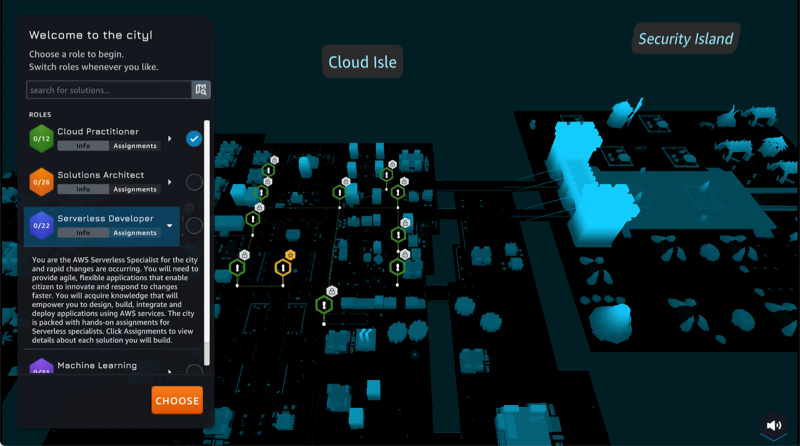
AWS Cloud Quest is a role-based game where your mission is to help citizens of a virtual city by learning and building cloud solutions for their challenges. You move around in the city, and you’re assigned tasks to complete. Each time you complete a task, you get rewards, which you can use to transform the city. For each task, the Solution Center guides you through four steps: learn the cloud concept to complete the task, practice the execution of the task with instructions, practice by yourself, and evaluate the result. Once again, the practice is done inside an AWS sandbox environment where you can safely test your new skill. To evaluate the result, the Solution Center asks you to enter validation data, such as the name of an S3 bucket or a URL. The system automatically verifies your setup and grants you points when the test succeeds. As of today, there are four roles available: Cloud Practitioner, Solutions Architect, Serverless Developer, and Machine Learning Specialist. We have plans to add more roles to this list over time. AWS Cloud Quest is a fun way to learn cloud skills!

We’ll see Cloud Quest in action in a minute.

AWS Certification Official Practice Exams are, as the name implies, full-length practice exams to help you to evaluate your exam readiness. But wait! Aren’t there free Official Practice Question Sets already? Yes! But in addition to those free 20-question practice question sets, subscribed individuals or teams can now prepare for AWS Certification with new exam preparation courses that include practice materials and the full-length AWS Certification Official Practice Exams. We have designed the exam preparation courses to help you assess your exam preparedness. Each exam preparation course includes a review of technical content, practice questions, lab exercises, and access to the AWS Certification Official Practice Exams. And this is not just a pass/fail exercise. Official practice exams come with thorough feedback for each question and scaled scores simulating actual exam scores. The questions presented have the same style, depth, rigor, and scoring as our AWS Certification exams. Full-length practice exams and exam preparation courses are currently available for the AWS Certified Cloud Practitioner, AWS Certified Solutions Architect – Associate, and AWS Certified SysOps Administrator – Associate certifications, with more to come. Much of the other content available through the subscription, such as AWS Builder Labs and AWS Cloud Quest, can complement your exam preparation.

Here is a typical screen for an Official Practice Exam. I blurred the answers obviously.

SkilBuilder Practice Exam

Type of Subscriptions
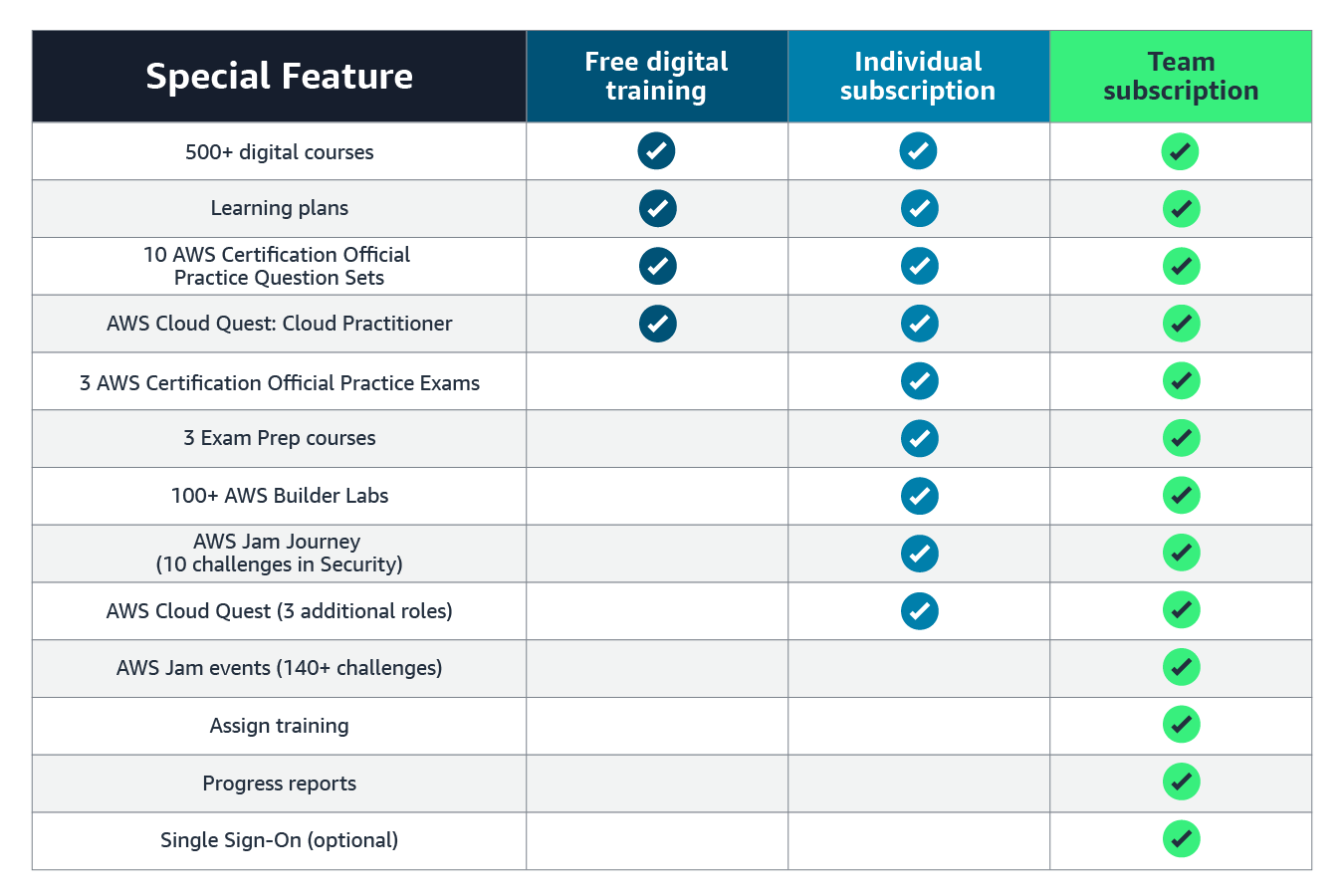
Both Individual and Team subscriptions include these four new learning experiences. Team subscriptions are available to organizations that want to purchase seats for 50 or more people. Besides a tiered pricing model, depending on the number of seats, a Team subscription gives you administrator functionality and a single sign-on experience for employees. Team administrators may assign training to individuals to drive targeted skills in their team and track progress. Built-in reports show course enrollment, course progress, completion rates, and more.

This table compares the free digital training, the Individual subscription, and the Team subscription.

SkillBuilder Subscription Comparison

Let’s See It in Action
Regular readers of this blog know we like to show you what we are talking about. Let’s see what AWS Cloud Quest looks like. First, I open AWS Skill Builder and subscribe as an individual.

AWS Skil Builder Subscription Plans

Then, I search for Cloud Quest and launch the experience.

AWS Cloud Quest

I select the role playing game I want to start. I have the choice between Cloud Practitioner, Solutions Architect, Serverless Developer, and Machine Learning Specialist.

Select a quest

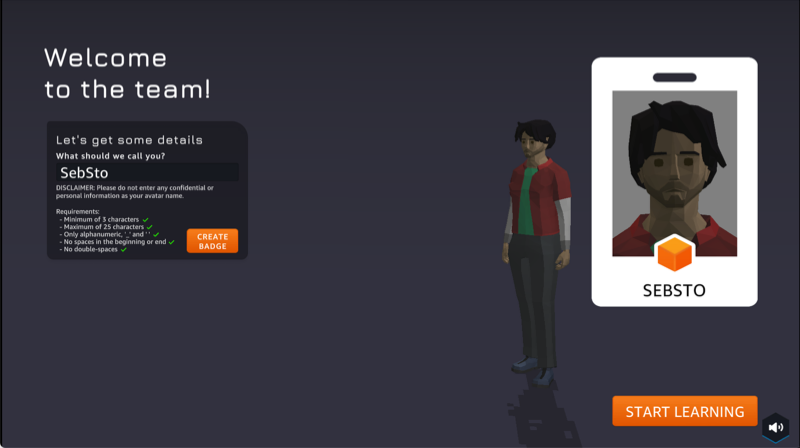
Just like in every role game, I may personalize my avatar before starting the game. Any resemblance with the actual me is pure coincidence 🤔.

Quest : personalize my avatar

And finally, I am ready to walk the city, help citizens, and complete my challenges.

quest : start my mission

How Much Does It Cost?
Inclusion is a core value at Amazon. We believe everybody must have a chance to learn and grow their professional career. We made the Individual subscription available in over 200 countries and territories and up to 12 languages: Chinese (Simplified), Chinese (Traditional), English, French (France), German, Indonesian, Italian, Japanese, Korean, Portuguese (Brazil), Spanish (Latin America), and Spanish (Spain). AWS Cloud Quest is in English.

The Individual subscription is offered monthly at the price of $29 per month or annually at the price of $299 per year (this is a 14 percent discount compared to the monthly price). The subscription fee is added to your monthly AWS bill, and there is no need to have a separate credit card or billing agreement. As usual with AWS, you can stop the subscription at any time.

The Team subscription is available for purchase in 17 countries (Australia, Brazil, Canada, Colombia, France, Germany, Ireland, India, Israel, Japan, Netherlands, New Zealand, Singapore, South Korea, Spain, United Kingdom, and the United States) and the same languages as the Individual subscription. These are available for teams over 50 persons. We offer an annual plan for $449 per year and per seat, with tiered pricing based on volume. Our pricing page has all the details.

I am excited to see a new generation of IT professionals acquiring AWS Cloud skills. I can’t wait to discover the new use cases, applications, or innovations you will bring to the world when armed with these new skills.

And now, get your AWS Skill Builder subscription and go learn.

— seb

Demonstrate your AWS Cloud Storage knowledge and skills with new digital badges!

Post Syndicated from Steve Roberts original https://aws.amazon.com/blogs/aws/demonstrate-your-aws-cloud-storage-knowledge-and-skills-with-new-digital-badges/

Are you a cloud storage professional or an on-premises storage pro who’s curious about cloud storage? Are you interested in demonstrating your AWS Storage knowledge and skills with potential employers and your community of peers? If so, I’d like to bring to your attention the recent launch of digital badges aligned to Learning Plans for Block Storage and Object Storage on AWS Skill Builder. In this 2021 blog post by Indeed, cloud-computing is the number one in-demand skill employers are looking for.

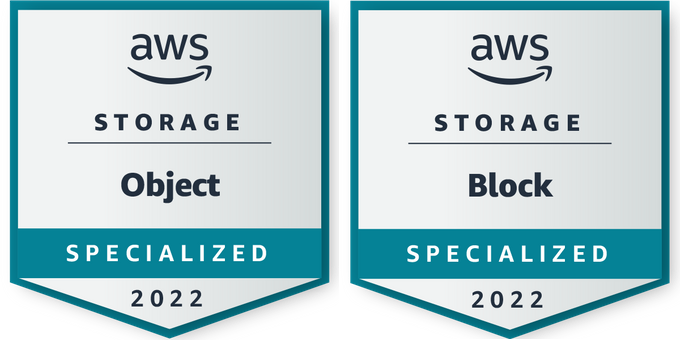
The new, verifiable, digital badges are available to everyone who scores at least 80 percent in the assessments associated with Learning Plans. The badges prove your knowledge and skills for Object Storage and/or Block Storage in the AWS Cloud. Badges, distributed and managed through Credly, carry with them metadata that enables verification of the issuer and the credential and lists the skills and knowledge demonstrated by the holder. Sharing badges on your résumé, peer community, and via social media assists in developing your career in cloud computing and celebrates your achievements. Some of you may be familiar with AWS re:Post, which launched during re:Invent 2021—your badges can be showcased in your AWS re:Post user profile too.

Object and Block Storage digital badges

AWS Skill Builder Learning Plans and digital badges for Block and Object Storage
Digital badges are available today for the Block Storage and Object Storage Learning Plans on AWS Skill Builder. Block Storage has a focus on Amazon Elastic Block Store (EBS), while Object Storage is focused on Amazon Simple Storage Service (Amazon S3). Both plans contain free learning content to help you build your knowledge in each of these areas and get ready for the assessments.

AWS Skill Builder offers a range of Learning Plans related to cloud computing skills. Learning Plans correspond to roles (architect, developer, etc.) and domain (databases, storage, etc.); each one is specifically designed to build your knowledge with a clear set of outcomes for you to achieve. Freely available, the Learning Plans and related assessments can be taken anywhere, anytime, providing equal and fair learning for all.

Badge assessments are linked to curriculum standards and are developed by service teams, field subject matter experts (SMEs), and content/curriculum SMEs. Therefore, employers can feel satisfied that the badges attained by a potential employee were awarded due to actual demonstrated skills and knowledge for Block and/or Object Storage. By the way, if you feel you have existing skills and knowledge and would prefer to skip straight to the assessment, you can. If you don’t pass, you’ll be guided to fill in your knowledge gaps, and you can then retake the assessment after 24 hours. To earn a badge, you need to score a minimum of 80 percent in the assessment.

The Block Storage and Object Storage Learning Plans are designed for you to take on your own, and you can track your own progress, making it easier to learn in your own time and manage your own learning development. They’re a great opportunity to refresh your skills, check your skills, or learn new ones.

Start collecting digital storage learning badges today
The Learning Plans and new digital badges for Block Storage and Object Storage help you showcase your in-demand knowledge and skills related to AWS Storage. As I mentioned earlier, enrollment for Learning Plans, and the subsequent assessments, are free for everyone. Find out more, and get started, at https://aws.amazon.com/training/badges. And be sure to share your accomplishment by posting on social media with the hashtag #AWSTraining and show off your badges!

— Steve

AWS Cloud Builders – Career Transformation & Personal Growth

Post Syndicated from Jeff Barr original https://aws.amazon.com/blogs/aws/aws-cloud-builders-career-transformation-personal-growth/

Long-time readers of this blog know that I firmly believe in the power of education to improve lives. AWS Training and Certification equips people and organizations around the world with cloud computing education to build and validate cloud computing skills. With demand for cloud skills and experience at an all-time high, there’s never been a better time to get started.

On the training side you have a multitude of options for classroom and digital training, including offerings from AWS Training Partners. After you have been trained and have gained some experience, you can prepare for, schedule, and earn one or more of the eleven AWS Certifications.

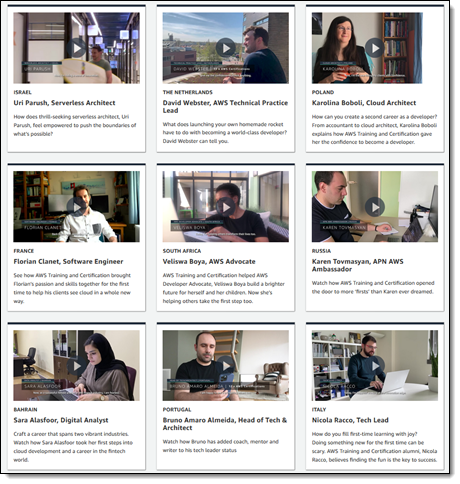
I encourage you to spend some time watching our new AWS Cloud Builder Career Stories videos. In these videos you will hear some AWS Training and Certification success stories:

  • Uri Parush became a Serverless Architect and rode a wave of innovation.
  • David Webster became an AWS Technical Practice Lead after dreaming of becoming an inventor.
  • Karolina Boboli retrained as a Cloud Architect after a career as an accountant.
  • Florian Clanet reminisces about putting his first application into service and how it reminded him of designing lighting for a high school play.
  • Veliswa Boya trained for her AWS Certification and became the first female AWS Developer Advocate in Africa.
  • Karen Tovmasyan wrote his first book about cloud and remembered his first boxing match.
  • Sara Alasfoor built her first AWS data analytics solution and learned that she could tackle any obstacle.
  • Bruno Amaro Almedia was happy to be thanked for publishing his first article about AWS after earning twelve AWS certifications.
  • Nicola Racco was terrified and exhilarated when he released his first serverless project.

I hope that you enjoy the stories, and that they inspire you to embark on a learning journey of your own!

Jeff;

Introducing new self-paced courses to improve Java and Python code quality with Amazon CodeGuru

Post Syndicated from Rafael Ramos original https://aws.amazon.com/blogs/devops/new-self-paced-courses-to-improve-java-and-python-code-quality-with-amazon-codeguru/

Amazon CodeGuru icon

During the software development lifecycle, organizations have adopted peer code reviews as a common practice to keep improving code quality and prevent bugs from reaching applications in production. Developers traditionally perform those code reviews manually, which causes bottlenecks and blocks releases while waiting for the peer review. Besides impacting the teams’ agility, it’s a challenge to maintain a high bar for code reviews during the development workflow. This is especially challenging for less experienced developers, who have more difficulties identifying defects, such as thread concurrency and resource leaks.

With Amazon CodeGuru Reviewer, developers have an automated code review tool that catches critical issues, security vulnerabilities, and hard-to-find bugs during application development. CodeGuru Reviewer is powered by pre-trained machine learning (ML) models and uses millions of code reviews on thousands of open-source and Amazon repositories. It also provides recommendations on how to fix issues to improve code quality and reduces the time it takes to fix bugs before they reach customer-facing applications. Java and Python developers can simply add Amazon CodeGuru to their existing development pipeline and save time and reduce the cost and burden of bad code.

If you’re new to writing code or an experienced developer looking to automate code reviews, we’re excited to announce two new courses on CodeGuru Reviewer. These courses, developed by the AWS Training and Certification team, consist of guided walkthroughs, gaming elements, knowledge checks, and a final course assessment.

About the course

During these courses, you learn how to use CodeGuru Reviewer to automatically scan your code base, identify hard-to-find bugs and vulnerabilities, and get recommendations for fixing the bugs and security issues. The course covers CodeGuru Reviewer’s main features, provides a peek into how CodeGuru finds code anomalies, describes how its ML models were built, and explains how to understand and apply its prescriptive guidance and recommendations. Besides helping on improving the code quality, those recommendations are useful for new developers to learn coding best practices, such as refactor duplicated code, correct implementation of concurrency constructs, and how to avoid resource leaks.

The CodeGuru courses are designed to be completed within a 2-week time frame. The courses comprise 60 minutes of videos, which include 15 main lectures. Four of the lectures are specific to Java, and four focus on Python. The courses also include exercises and assessments at the end of each week, to provide you with in-depth, hands-on practice in a lab environment.

Week 1

During the first week, you learn the basics of CodeGuru Reviewer, including how you can benefit from ML and automated reasoning to perform static code analysis and identify critical defects from coding best practices. You also learn what kind of actionable recommendations CodeGuru Reviewer provides, such as refactoring, resource leak, potential race conditions, deadlocks, and security analysis. In addition, the course covers how to integrate this tool on your development workflow, such as your CI/CD pipeline.

Topics include:

  • What is Amazon CodeGuru?
  • How CodeGuru Reviewer is trained to provide intelligent recommendations
  • CodeGuru Reviewer recommendation categories
  • How to integrate CodeGuru Reviewer into your workflow

Week 2

Throughout the second week, you have the chance to explore CodeGuru Reviewer in more depth. With Java and Python code snippets, you have a more hands-on experience and dive into each recommendation category. You use these examples to learn how CodeGuru Reviewer looks for duplicated lines of code to suggest refactoring opportunities, how it detects code maintainability issues, and how it prevents resource leaks and concurrency bugs.

Topics include (for both Java and Python):

  • Common coding best practices
  • Resource leak prevention
  • Security analysis

Get started

Developed at the source, this new digital course empowers you to learn about CodeGuru from the experts at AWS whenever, wherever you want. Advance your skills and knowledge to build your future in the AWS Cloud. Enroll today:

Rafael Ramos

Rafael Ramos

Rafael is a Solutions Architect at AWS, where he helps ISVs on their journey to the cloud. He spent over 13 years working as a software developer, and is passionate about DevOps and serverless. Outside of work, he enjoys playing tabletop RPG, cooking and running marathons.