Когато грешната прогноза е добра новина

Post Syndicated from Светла Енчева original https://www.toest.bg/kogato-greshnata-prognoza-e-dobra-novina/

Когато грешната прогноза е добра новина

Нова година – нови избори. И да не сте чели „Пътеводител на галактическия стопаджия“, е много вероятно да сте чували за особеното значение на числото 42. В поредицата на Дъглас Адамс 42 е „Отговорът на Вечния Въпрос за Живота, Вселената и Всичко останало“. Ала след като имаме отговора, още по-трудната задача е да разберем какъв, джанъм, е въпросът. Понякога и с електоралното поведение е така – избирателите искат нещо, борят се за него, протестират и чак след като го получат, се вижда, че то не решава проблемите им. А може дори да създаде нови.

Тези статии не остаряха добре

Политолозите обясняват постфактум защо прогнозите им не са се сбъднали, припомня шеговитото клише Александър Драганов. А Ан Фам, главната редакторка на „Тоест“, обича да казва, че иска в сайта да има статии, които „остаряват добре“. Без да съм учила политология, след няколко протеста в рамките на по-малко от месец вече имам куп статии, които не остаряха добре. Но това не е непременно лоша новина.

Точно година преди най-големия протест от 1990 г. насам се подписах под заглавието „Защо в България вече няма масови протести?“. Е, очевидно вече има. И то толкова масови, че само три от тях, проведени в разстояние на две седмици (между 26 ноември и 10 декември 2025 г.), бяха достатъчни, за да падне правителството. На всичко отгоре площадите продължиха да се пълнят и след оставката. За сравнение, започналите през 2023 г. протести срещу правителството на Пламен Орешарски, предложило Делян Пеевски за шеф на ДАНС,

продължиха повече от година.

По време на хиперинфлацията през 1997 г. протести имаше на практика всекидневно от 10 януари до 4 февруари, когато Николай Добрев от БСП върна на новоизбрания президент Петър Стоянов мандата за съставяне на правителство.

След щурмуването на „Росенец“ през 2020 г. писах за враждебната към етническите малцинства реторика на демократични политици и протестиращи граждани. Опитвах се да обясня, че не можем да очакваме българските мюсюлмани и роми да пожелаят да гласуват за хора, които демонстрират презрение към тях. И за листи, в които на практика не са представени. Сред активно протестиращите в края на 2025 г. обаче дойдоха и етнически турци, и роми. Някои от тях говориха и от трибуните.

В средата на 2024 г. упрекнах идентифициращите се като демократични партии, че не полагат адекватни усилия да печелят демократични избиратели. Че посланията им са неразбираеми и високомерни, че не си дават сметка за различните групи хора със специфични характеристики, ценности и интереси. И ги посъветвах какво да направят, за да имат посланията им чуваемост. Не ми се вярва отговорните за комуникацията в демократичните партии да са чели препоръките ми, и ми е трудно да се отърся от шока, че те (особено „Продължаваме промяната“)

рязко станаха комуникационно адекватни.

Посланията им резонираха и извън София. Напълниха се площадите и на градове, където не сме чували за протести до този момент. Включиха се много млади хора.

Специално внимание заслужава протестната музика. Наивно-идеалистичните и отдавна изхабени песни от началото на 90-те и възрожденско-патриотичният попфолк, допринесъл за политическия възход на Слави Трифонов, останаха в миналото. По площадите се чува звучащата на протести на различни места по света песен от антиутопичната поредица „Игрите на глада“. По-важното е, че протестът за отрицателно време произведе собствена попкултура, включително музика, преобладаващо пънк. А изпълнението на живо с участието на Асен Василев на парчето на варненската група PIZZZA с цитати от заседанието, на което председателят на ПП Асен Василев изрече култовата реплика „Кой разпореди това безобразие?“, стана вайръл. Както впрочем и самият Асен Василев.

Разбира се, причината за масовите протести няма как да е само в успешната политическа комуникация. Кражбите на публични средства стават все по-видими. Проектобюджетът, който беше поводът за общественото недоволство, на практика ги официализираше. И все пак организаторите на протестите можеха да реагират на общественото недоволство и по недотам адекватен начин, както неведнъж се е случвало, и в резултат по-малко хора да излязат по площадите.

На хубаво ли е много хубавото?

Еуфорията от мащаба и успеха на протестите лесно може да прелее във вярата в изборната победа на коалицията, която ги организира – ПП–ДБ. Бившата правосъдна министърка от „Да, България“ Надежда Йорданова дори даде заявка, че коалицията ще се бори не просто за победа на изборите, а за мнозинство.

Големият въпрос обаче е каква електорална форма ще приеме натрупаната мобилизация.

Няма гаранция, че подкрепящите протестите ще дадат гласа си точно за ПП–ДБ. Нещо повече – при такава обществена енергия е логично да възникнат нови политически субекти. Че има поле за такива, се вижда и от изследванията на общественото мнение. По данни на „Алфа Рисърч“ от декември например цели 40% от гласоподавателите са в очакване да се появи нещо ново на политическия хоризонт. Близо 10% от заявилите, че ще гласуват, не искат да пуснат бюлетина за никоя от парламентарно представените партии, а други 13,3% още не са решили.

Засега тактиката е максимално разширяване на периферията чрез включване на хора с най-различни профили и възгледи, обединени от недоволството си от кражбите и от тандема Пеевски – Борисов. Другата сериозна тема обаче – за геополитическата ориентация на България – остава по-скоро в скоби. Тя е приоритет на ПП–ДБ, но далеч не на всички, подкрепящи протестите.

Партиите в ПП–ДБ обаче са комай единствените еднозначно проевропейски политически субекти в парламента с шансове да влязат и в следващия.

Правителството на Росен Желязков, което протестите свалиха от власт, се води проевропейско и именно по негово време България беше окончателно приета в еврозоната. ГЕРБ обаче е по-скоро фасадно (и в името на фондовете за усвояване) проевропейска партия. През годините Бойко Борисов нееднократно е изразявал симпатии и към Владимир Путин, и към евроскептични политици като Виктор Орбан.

Що се отнася до „Ново начало“, Пеевски няма ясна политическа идеология, още по-малко демократична. ДПС дълги години беше част от групата на либералите в Европарламента. Но след като тя и европейската либерална партия АЛДЕ препоръчаха „Ново начало“ да бъде изключено от редиците им, депутатите от ДПС на Пеевски сами напуснаха.

В същото време не трябва да се подценяват страховете и недоволството около приемането на еврото, макар протестите против въвеждането му да не са толкова масови. Темата за корупцията лесно може да се свърже със страха от обедняването, икономическите проблеми да се припишат и на еврото и в резултат всички несгоди да се асоциират с ЕС. Готова рецепта за идване на евроскептици на бял кон.

Вече сме преживявали нещо подобно, макар че то не доведе до обрат в геополитическата ориентация на България.

Кои бяха големите печеливши от протестите през 2020 г., когато Христо Иванов и Иво Мирчев щурмуваха „Росенец“? В разгара им Румен Радев излезе герой и това подсигури втория му мандат на президентския пост. Другите големи печеливши бяха ИТН. И Радев, и ИТН не могат да се характеризират като проевропейски – президентът е по-скоро пропутински настроен, а партията на Слави Трифонов се заиграва с популисткия национализъм. Последва поредица от служебни правителства, чиито премиери упорито дърпаха към Русия.

Да, след протестите през 2020 г. изгря и звездата на Кирил Петков и Асен Василев, които по-късно основаха „Продължаваме промяната“. Само че партията им възникна като президентски проект. И електоралната ѝ подкрепа чувствително намаля, когато тя се разграничи от външнополитическия дневен ред на Радев.

Както беше казал Кирил Петков в разпространения от Радостин Василев запис от заседание на Националния съвет на ПП: „Ние изведнъж се почувствахме, че сме някакви гении“, а всъщност „цялата машина на Радев и цялата държава е работела за нас“.

Днес Румен Радев вече не си прави труда да се преструва, че няма да влиза в политиката, макар да се разграничи от новоучредената партия „Трети март“, която го обяви за свой „неформален лидер“. 

Възможно ли е и настоящата обществена енергия да е насочвана в една или друга посока от някаква „машина“,

без организаторите на протестите да си дават сметка за нея? Да приемем това за даденост би било конспиративна теория, но да го отричаме напълно би било наивно. Колкото и да е неприятно да си го признаем, хората от службите и техните ученици умеят да въздействат много по-добре на общественото мнение от демократичните политици, които разчитат на убеждаване с разумни аргументи.

Да се надяваш да си в грешка

За изразените опасения има и външнополитически основания. Бившите социалистически страни в ЕС са подложени на силен натиск да се отклонят от европейската си и продемократична ориентация. Става дума за Унгария, Словакия, до неотдавна Полша (макар че там управлението не беше проруско, беше антидемократично), отскоро и Чехия. Дори западноевропейски държави като Италия или Австрия не са имунизирани от евроскептичния популизъм. 

Не е за пренебрегване и управлението на Доналд Тръмп, за когото европейското единство е трън в очите. По време на втория си мандат като президент, при всичкия хаос, който натворява, той със систематично упорство предприема действия, в резултат на които международното право (а и правото изобщо) все повече заприличва на куха структура. Последният случай е смяната на властта във Венецуела с военна намеса – без санкция нито от ООН, нито дори от Конгреса на САЩ.

В тази ситуация кое ще помогне на България да устои? Дали имаме служби, способни да противостоят на чужди вмешателства в политиката ни, или работещи институции, които ще отстояват принципите на европейското право?

Не от всяка масова еуфория се раждат демократични плодове. Да си припомним и ентусиазма по време на т.нар. Арабска пролет – тя доведе на власт фундаменталистки режими.

Мислим си, че е трудно да детронираме Пеевски. Но ако на власт се установи антидемократично управление, свалянето му може да се окаже невъзможна задача. Днес можем да протестираме, но правото на протест не е даденост.

Дано и тази статия не остарее добре. За да не се сбъднат прогнозите в нея обаче, би било добре те да се имат предвид – като предупреждение. 

AMD’s EPYC Venice, Instinct MI455X, & Helios Hardware On Display for First Time at CES 2026

Post Syndicated from Ryan Smith original https://www.servethehome.com/amds-epyc-venice-instinct-mi455x-helios-hardware-on-display-for-first-time-at-ces-2026/

Alongside AMD’s numerous client-focused hardware announcements during their CES 2026 keynote, the company also devoted a bit of attention to their data center/server products. Though the company is essentially mid-cycle on its major data center products right now – and thus is not launching anything in the immediate timeframe – AMD still opted to use […]

The post AMD’s EPYC Venice, Instinct MI455X, & Helios Hardware On Display for First Time at CES 2026 appeared first on ServeTheHome.

Google will now only release Android source code twice a year (Android Authority)

Post Syndicated from corbet original https://lwn.net/Articles/1053061/

Android Authority reports
that Google will be reducing the frequency of releases of code to the
Android Open Source Project to only twice per year.

A spokesperson for Google offered some additional context on this
decision, stating that it helps simplify development, eliminates
the complexity of managing multiple code branches, and allows them
to deliver more stable and secure code to Android platform
developers. The spokesperson also reiterated that Google’s
commitment to AOSP is unchanged and that this new release schedule
helps the company build a more robust and secure foundation for the
Android ecosystem.

The release schedule for security patches is unchanged.

Security updates for Wednesday

Post Syndicated from jzb original https://lwn.net/Articles/1053057/

Security updates have been issued by AlmaLinux (resource-agents, ruby:3.3, thunderbird, and xorg-x11-server), Fedora (libpcap), Red Hat (brotli), Slackware (libsodium), SUSE (dcmtk, govulncheck-vulndb, libpcap, mozjs60, qemu, rsync, and usbmuxd), and Ubuntu (glib2.0 and linux-raspi, linux-raspi-5.4).

Key Takeaways and Top Cybersecurity Predictions for 2026

Post Syndicated from Rapid7 original https://www.rapid7.com/blog/post/it-key-takeaways-top-cybersecurity-predictions-2026

As the threat landscape keeps shifting, security teams are being asked to do more than react. They are expected to look ahead, connect the dots, and make decisions in environments that change faster every year. That challenge was at the heart of Rapid7’s 2026 Security Predictions webinar, where our experts reflected on what the past year revealed about attacker behavior, defender priorities, and the realities of running a modern SOC.

The conversation looked back just long enough to spot the patterns that matter, then turned forward to the forces shaping 2026. Geopolitics, insider risk, and the need for context-driven defense all surfaced repeatedly. The takeaway was simple but important. Attackers are adapting quickly, and security teams need to adapt with the same urgency.

Below are the key takeaways from the discussion, along with the top predictions shaping the year ahead.

Key takeaways from the discussion

The threat landscape is no longer isolated

One of the strongest themes from the webinar was how interconnected today’s risks have become. Cyber activity does not exist in a vacuum. Geopolitical tensions, economic pressure, workforce challenges, and technological acceleration all feed directly into attacker behavior.

Security teams can no longer separate cyber risk from broader business and global risk. Decisions made outside the SOC, from supplier choices to workforce strategy, increasingly influence exposure and attack paths.

Identity and access remain the most reliable attack paths

Despite continued investment in perimeter defenses, attackers are still finding success through compromised credentials, misused access, and human error. The webinar panel reinforced that identity-based compromise remains one of the most consistent and scalable techniques used by threat actors.

This means defenders must treat identity, behavior, and access governance as core detection and response signals, not secondary controls.

Speed without context creates noise, not security

The rise of AI-driven attacks and automation has increased the volume and pace of activity security teams must process. However, the panel stressed that faster alerts alone do not improve outcomes.

Without understanding which assets matter, which exposures are exploitable, and which alerts represent real risk, teams risk moving quickly in the wrong direction. Context is now essential for effective prioritization and response.

The top cybersecurity predictions for 2026

1. Geopolitical fault lines will redraw the cyber battlefield

In 2026, geopolitical tensions will continue to spill into the digital domain, with private organizations increasingly caught in the middle. State-aligned and state-tolerated groups will target critical supply chains, service providers, and global enterprises as proxy targets, blending espionage with economic disruption.

For security teams, this means geopolitical risk must be factored into threat modeling, vendor assessments, and incident response planning. Even organizations far from traditional conflict zones may find themselves impacted by campaigns tied to global tensions.

2. Insider threats will dominate breach root causes

The panel highlighted that many of tomorrow’s breaches will not start with attackers breaking in, but with access already in place. Insider threats, driven by simple negligence, compromised credentials, or monetized access selling, will continue to rise.

Economic stress, workforce changes, and growing access complexity all contribute to this trend. As a result, organizations must focus more on access hygiene, behavior monitoring, and creating environments where employees can report mistakes early without fear.

3. Context will become the new currency of cyber performance

As attacks scale and exploitation windows shrink, the ability to understand what matters most will define successful security operations. The panel emphasized that visibility alone is no longer enough.

Security teams that integrate exposure management, detection, and response will outperform those relying on disconnected tools and alert-heavy workflows. Context-rich defense allows teams to triage faster, investigate smarter, and respond based on real business risk rather than alert volume.

What this means for security teams heading into 2026

The predictions shared during the webinar point to a future where success depends less on adding more tools and more on using intelligence, context, and automation effectively. Security teams that can unify visibility, prioritize risk, and act decisively will be better positioned to keep pace with increasingly adaptive attackers.

The message from the panel was clear. 2026 will reward teams that focus on understanding their environment, aligning security efforts with real-world risk, and preparing for threats shaped by forces far beyond the SOC.

Watch the 2026 Security Predictions webinar to hear directly from Rapid7’s experts on what’s shaping the threat landscape and how security teams should prepare.

What shaped computing education in 2025 — and what comes next

Post Syndicated from Liz Eaton original https://www.raspberrypi.org/blog/what-shaped-computing-education-in-2025-and-what-comes-next/

To mark the start of 2026, we’re releasing a special episode of our Hello World podcast, which reflects on the key developments in computing education during 2025 and considers the trends likely to shape the year ahead.

Hosted by James Robinson, the episode brings together a conversation between three Foundation team members — Rehana Al-Soltane, Dr Bobby Whyte, and Laura James — and perspectives from colleagues and partners in Kenya, South Africa, and Greece.

The Hello World Podcast team

The podcast is framed around three major themes that defined 2025: data science, AI literacy, and digital literacy, all of which continue to play an increasingly important role in education systems worldwide.

Looking back at 2025

In the podcast, Rehana reflects on a year characterised by research, collaboration, and community, highlighting the importance of global partnerships in developing and localising AI literacy resources for diverse educational contexts.

From a research perspective, Bobby explains that 2025 was about pulling together what we already know and making sense of it, to better understand what good data science education should look like, including curriculum design, pedagogy, and appropriate tools.

Laura focuses on resilience and creativity in computing education, as well as the growing presence of more personalised forms of artificial intelligence, which present both significant opportunities and complex ethical challenges.

The new set!

A key concern raised throughout the episode is the risk of cognitive offloading, whereby learners rely on AI tools to bypass critical thinking processes. The speakers emphasise the need for learning experiences and assessments that value process, reasoning, and reflection rather than solely final outputs.

The episode also examines barriers to the adoption of computing and AI education, including teacher confidence, limited access to devices, restrictive school IT policies, and the need for translated and localised resources.

Contributions from our colleagues around the world highlight stark contrasts in educational contexts, with challenges such as funding constraints, connectivity issues, and teacher training needs, alongside examples of innovation where educators are adequately supported.

What’s ahead

Looking ahead to 2026, Rehana outlines the potential of interdisciplinary approaches to AI literacy, integrating AI concepts into subjects such as geography, history, languages, and the arts to increase relevance and engagement (look out for our upcoming research seminar series on the topic).

The cast on set

Bobby anticipates a gradual shift towards more data-informed approaches to computing education, with greater emphasis on classroom-based trials and research that directly informs practice.

Laura offers a strong call to renew focus on cybersecurity education, arguing that security and safety must remain central as digital systems and AI technologies continue to evolve.

In a series of concise predictions, the speakers point to increased attention on explainable AI, wider integration of AI literacy across the curriculum, and renewed concern for digital safety and security.

More from Hello World

You can subscribe to Hello World and listen to the full podcast episodes from wherever you get your podcasts. Or you can find this and previous Hello World podcasts on our podcast page.

Also check out Hello World magazine, our free digital and print magazine from computing educators for computing educators.

The post What shaped computing education in 2025 — and what comes next appeared first on Raspberry Pi Foundation.

AMD Teases Ryzen AI Halo, a ROCm Ecosystem AI Development Mini-PC

Post Syndicated from Ryan Smith original https://www.servethehome.com/amd-teases-ryzen-ai-halo-a-rocm-ecosystem-ai-development-mini-pc/

Among a spate of AMD announcements during the company’s CES 2026 opening keynote, CEO Dr. Lisa Su briefly teased a forthcoming AMD-branded AI development box, dubbed the Ryzen AI Halo. Seemingly taking a page from similar AI development boxes that have popped up over the last year – both those built using AMD’s hardware and […]

The post AMD Teases Ryzen AI Halo, a ROCm Ecosystem AI Development Mini-PC appeared first on ServeTheHome.

Amazon EMR Serverless eliminates local storage provisioning, reducing data processing costs by up to 20%

Post Syndicated from Karthik Prabhakar original https://aws.amazon.com/blogs/big-data/amazon-emr-serverless-eliminates-local-storage-provisioning-reducing-data-processing-costs-by-up-to-20/

At AWS re:Invent 2025, Amazon Web Services (AWS) announced serverless storage for Amazon EMR Serverless, a new capability that eliminates the need configure local disks for Apache Spark workloads. This reduces data processing costs by up to 20% while eliminating job failures from disk capacity constraints.

With serverless storage, Amazon EMR Serverless automatically handles intermediate data operations, such as shuffle, on your behalf. You pay only for compute and memory—no storage charges. By decoupling storage from compute, Spark can release idle workers immediately, reducing costs throughout the job lifecycle. The following image shows the serverless storage for EMR Serverless announcement from the AWS re:Invent 2025 keynote:

The challenge: Sizing local disk storage

Running Apache Spark workloads requires sizing local disk storage for shuffle operations—where Spark redistributes data across executors during joins, aggregations, and sorts. This requires analyzing job histories to estimate disk requirements, leading to two common problems: overprovisioning wastes money on unused capacity, and under provisioning causes job failures when disk space runs out. Most customers overprovision local storage to ensure jobs complete successfully in production.

Data skew compounds this further. When one executor handles a disproportionately large partition, that executor takes significantly longer to complete while other workers sit idle. If you didn’t provision enough disk for that skewed executor, the job fails entirely—making data skew one of the top causes of Spark job failures. However, the problem extends beyond capacity planning. Because shuffle data couples tightly to local disks, Spark executors pin to worker nodes even when compute requirements drop between job stages. This prevents Spark from releasing workers and scaling down, inflating compute costs throughout the job lifecycle. When a worker node fails, Spark must recompute the shuffle data stored on that node, causing delays and inefficient resource usage.

How it works

Serverless storage for Amazon EMR Serverless addresses these challenges by offloading shuffle operations from individual compute workers onto a separate, elastic storage layer. Instead of storing critical data on local disks attached to Spark executors, serverless storage automatically provisions and scales high-performance remote storage as your job runs.

The architecture provides several key benefits. First, compute and storage scale independently—Spark can acquire and release workers as needed across job stages without worrying about preserving locally stored data. Second, shuffle data is evenly distributed across the serverless storage layer, eliminating data skew bottlenecks that occur when some executors handle disproportionately large shuffle partitions. Third, if a worker node fails, your job continues processing without delays or reruns because data is reliably stored outside individual compute workers.

Serverless storage is provided at no additional charge, and it eliminates the cost associated with local storage. Instead of paying for fixed disk capacity sized for maximum potential I/O load—capacity that often sits idle during lighter workloads—you can use serverless storage without incurring storage costs. You can focus your budget on compute resources that directly process your data, not on managing and overprovisioning disk storage.

Technical innovation brings three breakthroughs

Serverless storage introduces three fundamental innovations that solve Spark’s shuffle bottlenecks: multi-tier aggregation architecture, purpose-built networking, and true storage-compute decoupling. Apache Spark’s shuffle mechanism has a core constraint: each mapper independently writes output as small files, and each reducer must fetch data from potentially thousands of workers. In a large-scale job with 10,000 mappers and 1,000 reducers, this creates 10 million individual data exchanges. Serverless storage aggregates early and intelligently—mappers stream data to an aggregation layer that consolidates shuffle data in memory before committing to storage. Whereas individual shuffle write and fetch operations might show slightly higher latency due to network round-trips compared to local disk I/O, the overall job performance improves by transforming millions of tiny I/O operations into a smaller number of large, sequential operations.

Traditional Spark shuffle creates a mesh network where each worker maintains connections to potentially hundreds of other workers, spending significant CPU on connection management rather than data processing. We built a custom networking stack where each mapper opens a single persistent remote procedure call (RPC) connection to our aggregator layer, eliminating the mesh complexity. Although individual shuffle operations might show slightly higher latency due to network round trips compared to local disk I/O, overall job performance improves through better resource utilization and elastic scaling. Workers no longer run a shuffle service—they focus entirely on processing your data.

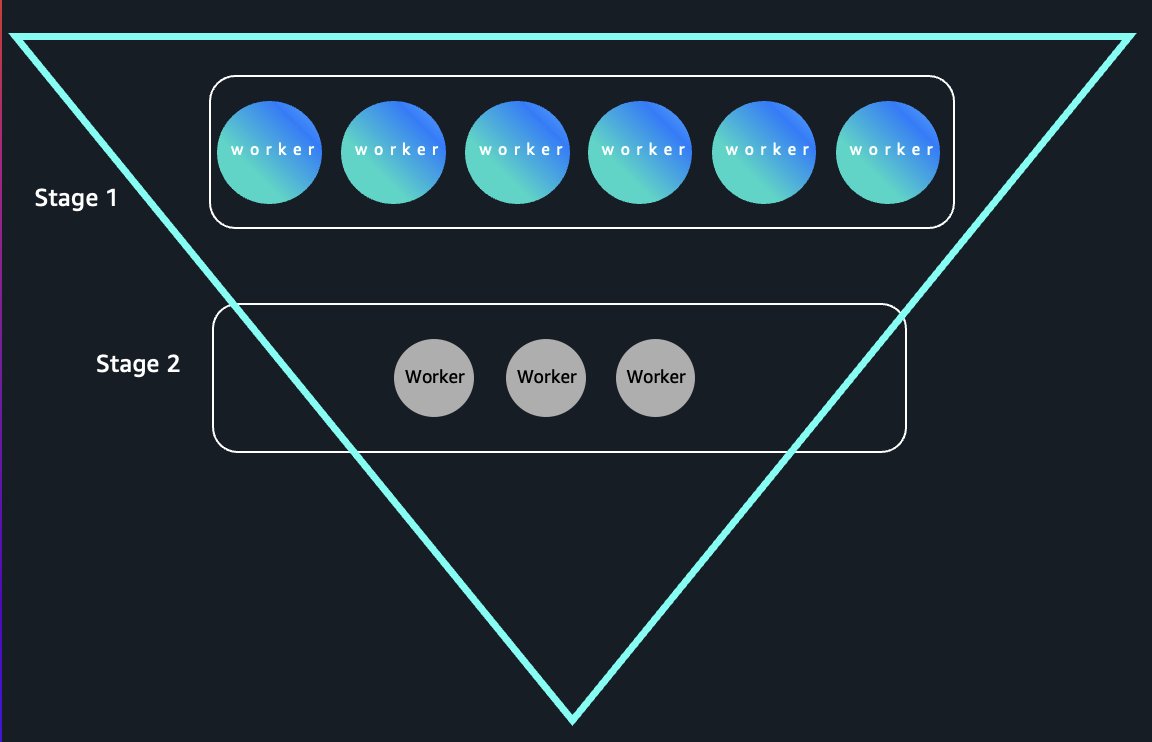
Traditional Amazon EMR Serverless jobs store shuffle data on local disks, coupling data lifecycle to worker lifecycle—idle workers can’t terminate without losing shuffle data. Serverless storage decouples these entirely by storing shuffle data in AWS managed storage with opaque handles tracked by the driver. Workers can terminate immediately after completing tasks without data loss, enabling elastic scaling. In funnel-shaped queries where early stages require massive parallelism that narrows as data aggregates, we’re seeing up to 80% compute cost reduction in benchmarks by releasing idle workers instantly. The following diagram illustrates instant worker release in funnel-shaped queries.

Our aggregator layer integrates directly with AWS Identity and Access Management (IAM), AWS Lake Formation, and fine-grained access control systems, providing job-level data isolation with access controls that match source data permissions.

Getting started

Serverless storage is available in multiple AWS Regions. For the current list of supported Regions, refer to the Amazon EMR User Guide.

New applications

Serverless storage can be enabled for new applications starting with Amazon EMR release 7.12. Follow these steps:

  1. Create an Amazon EMR Serverless application with Amazon EMR 7.12 or later:
aws emr-serverless create-application \
  --type "SPARK" \
  --name my-application \
  --release-label emr-7.12.0 \
  --runtime-configuration '[{
      "classification": "spark-defaults",
        "properties": {
          "spark.aws.serverlessStorage.enabled": "true"
        }
    }]' \
  --region us-east-1
  1. Submit your Spark job:
aws emr-serverless start-job-run \
  --application-id <application-id> \
  --execution-role-arn <execution-role-arn> \
  --job-driver '{
    "sparkSubmit": {
      "entryPoint": "s3://<bucket>/<your_script.py>",
      "sparkSubmitParameters": "--conf spark.executor.cores=4 --conf spark.executor.memory=20g --conf spark.driver.cores=4 --conf spark.driver.memory=8g --conf spark.executor.instances=10"
    }
  }'

Existing applications

You can enable serverless storage for existing applications on Amazon EMR 7.12 or later by updating your application settings.

To enable serverless storage using AWS Command Line Interface (AWS CLI), enter the following command:

aws emr-serverless update-application \
  --application-id <application-id> \
  --runtime-configuration '[{
      "classification": "spark-defaults",
        "properties": {
          "spark.aws.serverlessStorage.enabled": "true"
        }
    }]'

To enable serverless storage using Amazon EMR Studio UI, navigate to your application in Amazon EMR Studio, go to Configuration, and add the Spark property spark.aws.serverlessStorage.enabled=true in the spark-defaults classification.

Job-level configuration

You can also enable serverless storage for specific jobs, even when it’s not enabled at the application level:

aws emr-serverless start-job-run \
  --application-id <application-id> \
  --execution-role-arn <execution-role-arn> \
  --job-driver '{
    "sparkSubmit": {
      "entryPoint": "s3://<bucket>/<your_script.py>",
      "sparkSubmitParameters": "--conf spark.executor.cores=4 --conf spark.executor.memory=20g --conf spark.aws.serverlessStorage.enabled=true"
    }
  }'

(Optional) Disabling serverless storage

If you prefer to continue using local disks, you can disable serverless storage by omitting the spark.aws.serverlessStorage.enabled configuration or setting it to false at either the application or job level:

spark.aws.serverlessStorage.enabled=falseTo use traditional local disk provisioning, configure the appropriate disk type and size for your application workers.

Monitoring and cost tracking

You can monitor elastic shuffle usage through standard Spark UI metrics and track costs at the application level in AWS Cost Explorer and AWS Cost and Usage Reports. The service automatically handles performance optimization and scaling, so you don’t need to tune configuration parameters.

When to use serverless storage

Serverless storage delivers the most value for workloads with substantial shuffle operations—typically jobs that shuffle more than 10 GB of data (and less than 200 G per job, the limitation as of this writing). These include:

  • Large-scale data processing with heavy aggregations and joins
  • Sort-heavy analytics workloads
  • Iterative algorithms that repeatedly access the same datasets

Jobs with unpredictable shuffle sizes benefit particularly well because serverless storage automatically scales capacity up and down based on real-time demand. For workloads with minimal shuffle activity or very short duration (under 2–3 minutes), the benefits might be limited. In these cases, the overhead of remote storage access might outweigh the advantages of elastic scaling.

Security and data lifecycle

Your data is stored in serverless storage only while your job is running and is automatically deleted when your job is completed. Because Amazon EMR Serverless batch jobs can run for up to 24 hours, your data will be stored for no longer than this maximum duration. Serverless storage encrypts your data both in transit between your Amazon EMR Serverless application and the serverless storage layer and at rest while temporarily stored, using AWS managed encryption keys. The service uses an IAM based security model with job-level data isolation, which means that one job can’t access the shuffle data of another job. Serverless storage maintains the same security standards as Amazon EMR Serverless, with enterprise-grade security controls throughout the processing lifecycle.

Conclusion

Serverless storage represents a fundamental shift in how we approach data processing infrastructure, eliminating manual configuration, aligning costs to actual usage, and improving reliability for I/O intensive workloads. By offloading shuffle operations to a managed service, data engineers can focus on building analytics rather than managing storage infrastructure.

To learn more about serverless storage and get started, visit the Amazon EMR Serverless documentation.


About the authors

Karthik Prabhakar

Karthik Prabhakar

Karthik is a Data Processing Engines Architect for Amazon EMR at AWS. He specializes in distributed systems architecture and query optimization, working with customers to solve complex performance challenges in large-scale data processing workloads. His focus spans engine internals, cost optimization strategies, and architectural patterns that enable customers to run petabyte-scale analytics efficiently.

Ravi Kumar

Ravi Kumar

Ravi is a Senior Product Manager Technical at Amazon Web Services, specializing in exabyte-scale data infrastructure and analytics platforms. He helps customers unlock insights from structured and unstructured data using open-source technologies and cloud computing. Outside of work, Ravi enjoys exploring emerging trends in data science and machine learning.

Matt Tolton

Matt Tolton

Matt is a Senior Principal Engineer at Amazon Web Services.

author name

Neil Mukerje

Neil is a Principal Product Manager at Amazon Web Services.

Building scalable AWS Lake Formation governed data lakes with dbt and Amazon Managed Workflows for Apache Airflow

Post Syndicated from Abhilasha Agarwal original https://aws.amazon.com/blogs/big-data/building-scalable-aws-lake-formation-governed-data-lakes-with-dbt-and-amazon-managed-workflows-for-apache-airflow/

Organizations often struggle with building scalable and maintainable data lakes—especially when handling complex data transformations, enforcing data quality, and monitoring compliance with established governance. Traditional approaches typically involve custom scripts and disparate tools, which can increase operational overhead and complicate access control. A scalable, integrated approach is needed to simplify these processes, improve data reliability, and support enterprise-grade governance.

Apache Airflow has emerged as a powerful solution for orchestrating complex data pipelines in the cloud. Amazon Managed Workflows for Apache Airflow (MWAA) extends this capability by providing a fully managed service that eliminates infrastructure management overhead. This service enables teams to focus on building and scaling their data workflows while AWS handles the underlying infrastructure, security, and maintenance requirements.

dbt enhances data transformation workflows by bringing software engineering best practices to analytics. It enables analytics engineers to transform warehouse data using familiar SQL select statements while providing essential features like version control, testing, and documentation. As part of the ELT (Extract, Load, Transform) process, dbt handles the transformation phase, working directly within a data warehouse to enable efficient and reliable data processing. This approach allows teams to maintain a single source of truth for metrics and business definitions while enabling data quality through built-in testing capabilities.

In this post, we show how to build a governed data lake that uses modern data tools and AWS services.

Solution overview

We explore a comprehensive solution that includes:

  • A metadata-driven framework in MWAA that dynamically generates directed acyclic graphs (DAGs), significantly improving pipeline scalability and reducing maintenance overhead.
  • dbt with Amazon Athena adapter to implement modular, SQL-based data transformations directly on a data lake, enabling well-structured, and thoroughly tested transformations.
  • An automated framework that proactively identifies and segregates problematic records, maintaining the integrity of data assets.
  • AWS Lake Formation to implement fine-grained access controls for Athena tables, ensuring proper data governance and security throughout a data lake environment.

Together, these components create a robust, maintainable, and secure data management solution suitable for enterprise-scale deployments.

The following architecture illustrates the components of the solution.

The workflow contains the following steps:

  1. Multiple data sources (PostgreSQL, MySQL, SFTP) push data to an Amazon S3 raw bucket
  2. S3 event triggers AWS Lambda Function
  3. Lambda function triggers the MWAA DAG to convert file formats to parquet
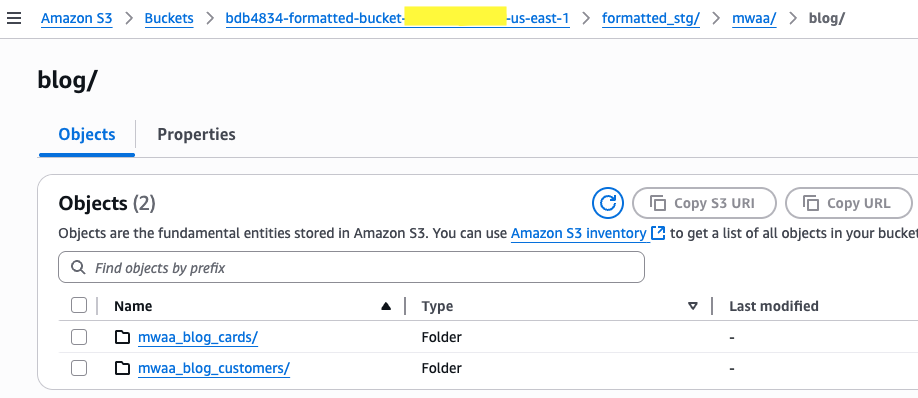
  4. Data is stored in Amazon S3 formatted bucket under formatted_stg prefix
  5. Crawler crawls the data in formatted_stg prefix in the formatted bucket and creates catalog tables
  6. dbt using Athena adapter processes the data and puts the processed data after data quality checks under formatted prefix in Formatted bucket
  7. dbt using Athena adapter can perform further transformations on the formatted data and put the transformed data in Published bucket

Prerequisites

To implement this solution, the following prerequisites need to be met.

Deploy the solution

For this solution, we provide an AWS CloudFormation (CFN) template that sets up the services included in the architecture, to enable repeatable deployments.

Note:

  • US-EAST-1 Region is required for the deployment.
  • Deploying this solution will involve costs associated with AWS services.

To deploy the solution, complete the following steps:

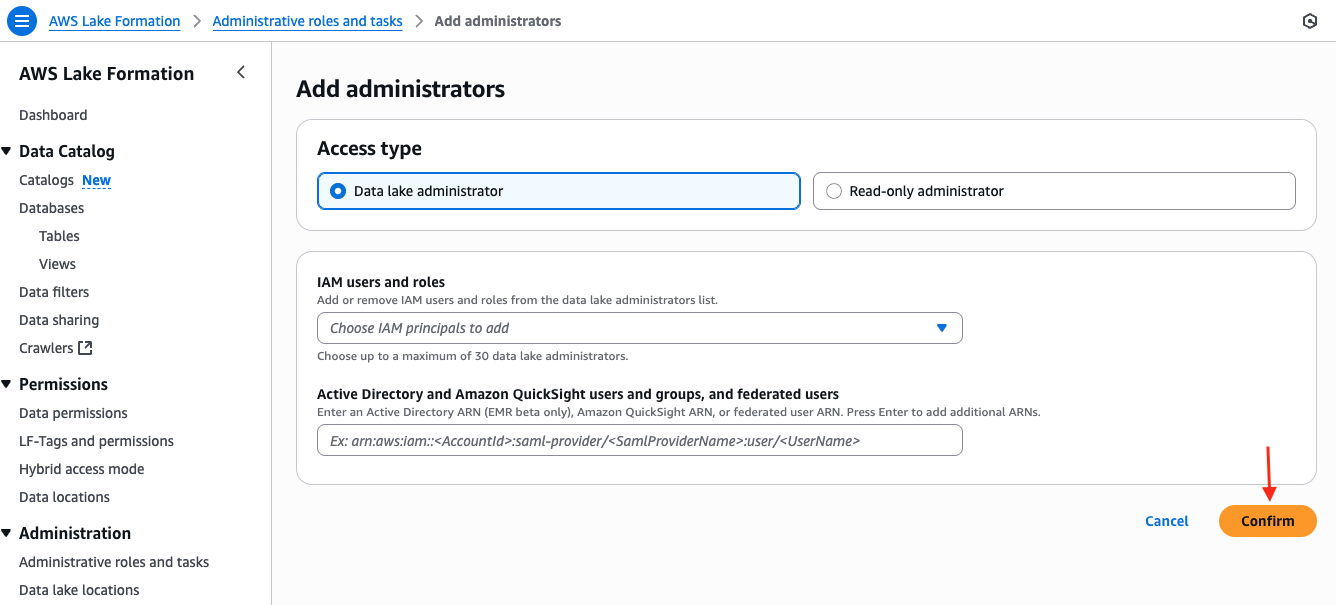
  1. Before deploying the stack, open the AWS Lake Formation console. Add your console role as a Data Lake Administrator and choose Confirm to save the changes.
  2. Download the CloudFormation template.
    After the file is downloaded to the local machine, follow the steps below to deploy the stack using this template:

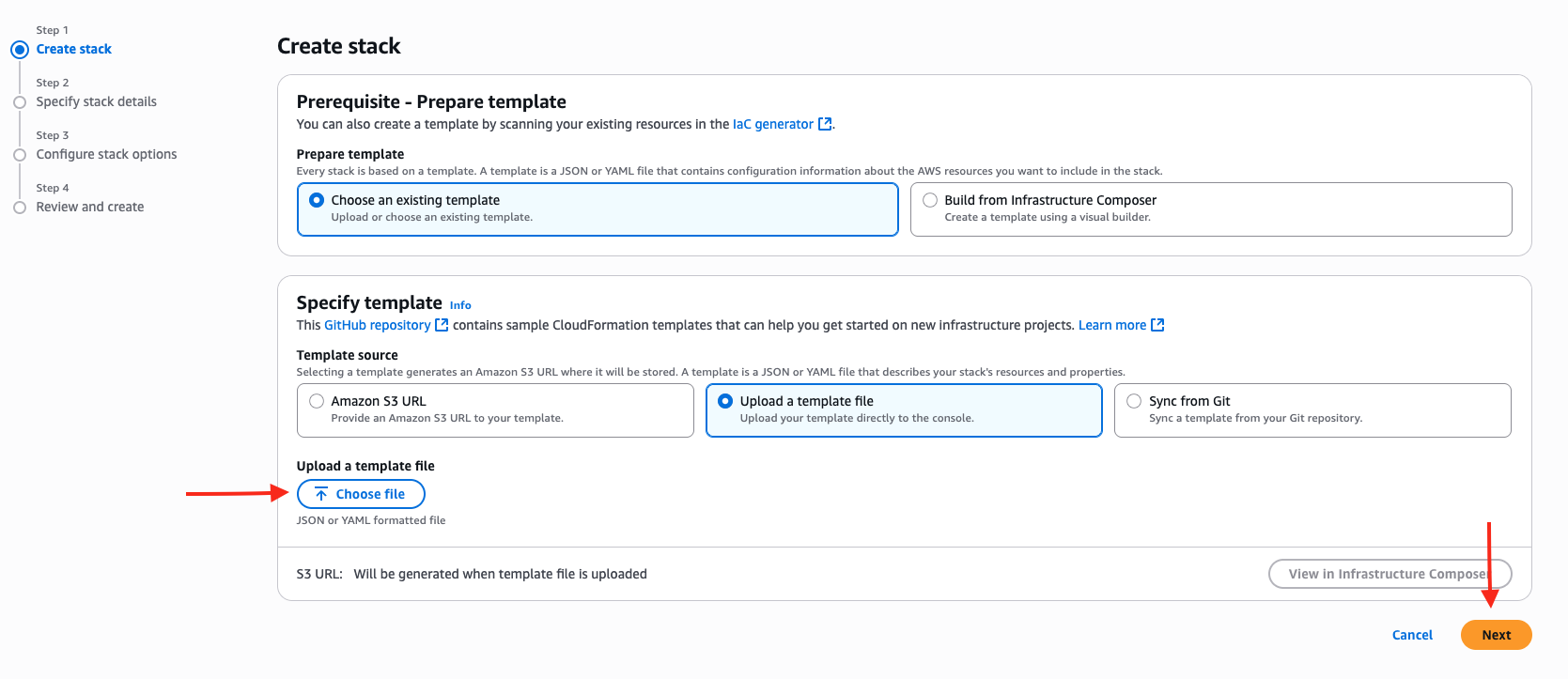
    1. Open the AWS CloudFormation Console.
    2. Choose Create stack and choose With new resources (standard).
    3. Under Specify template, select Upload a template file.
    4. Select Choose file and upload the CFN template that was downloaded earlier.
    5. Choose Next to proceed.

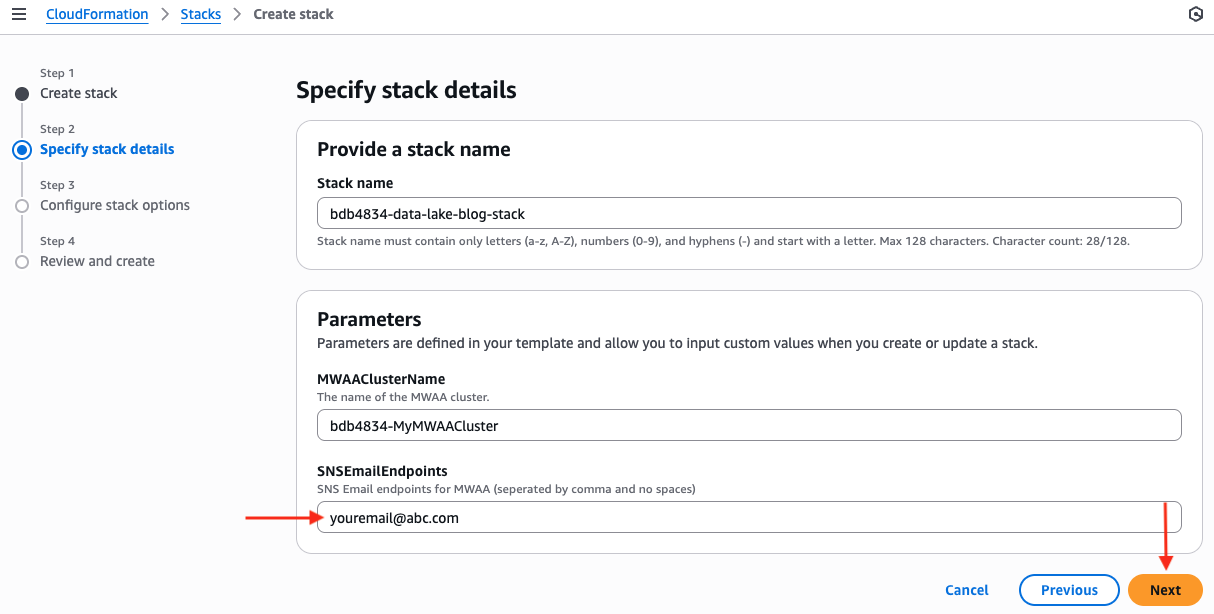
  3. Enter a stack name (for example, bdb4834-data-lake-blog-stack) and configure the parameters (bdb4834-MWAAClusterName can be left as the default value and update SNSEmailEndpoints with your email address), then choose Next.
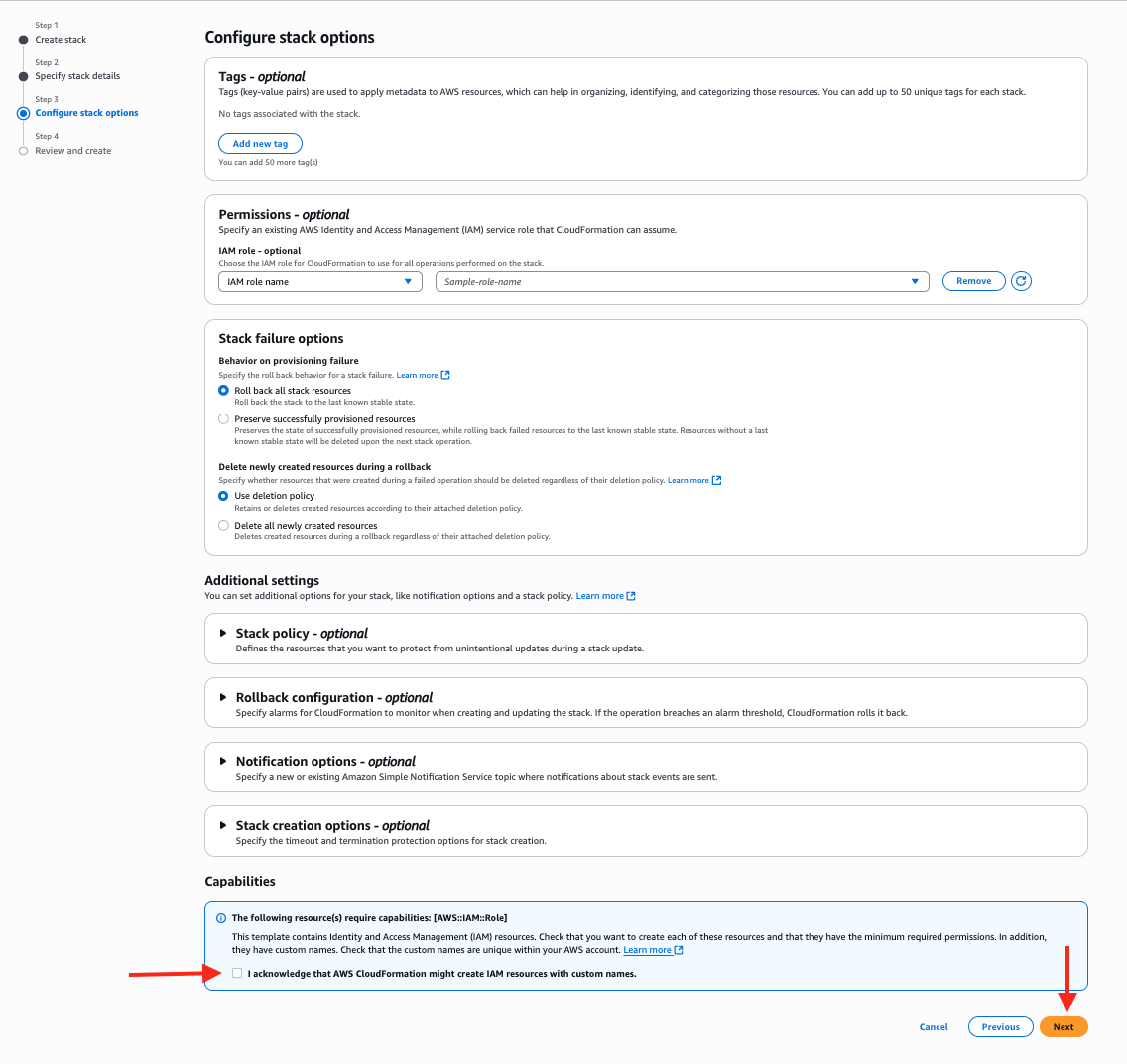
  4. Select “I acknowledge that AWS CloudFormation might create IAM resources with custom names” and choose Next

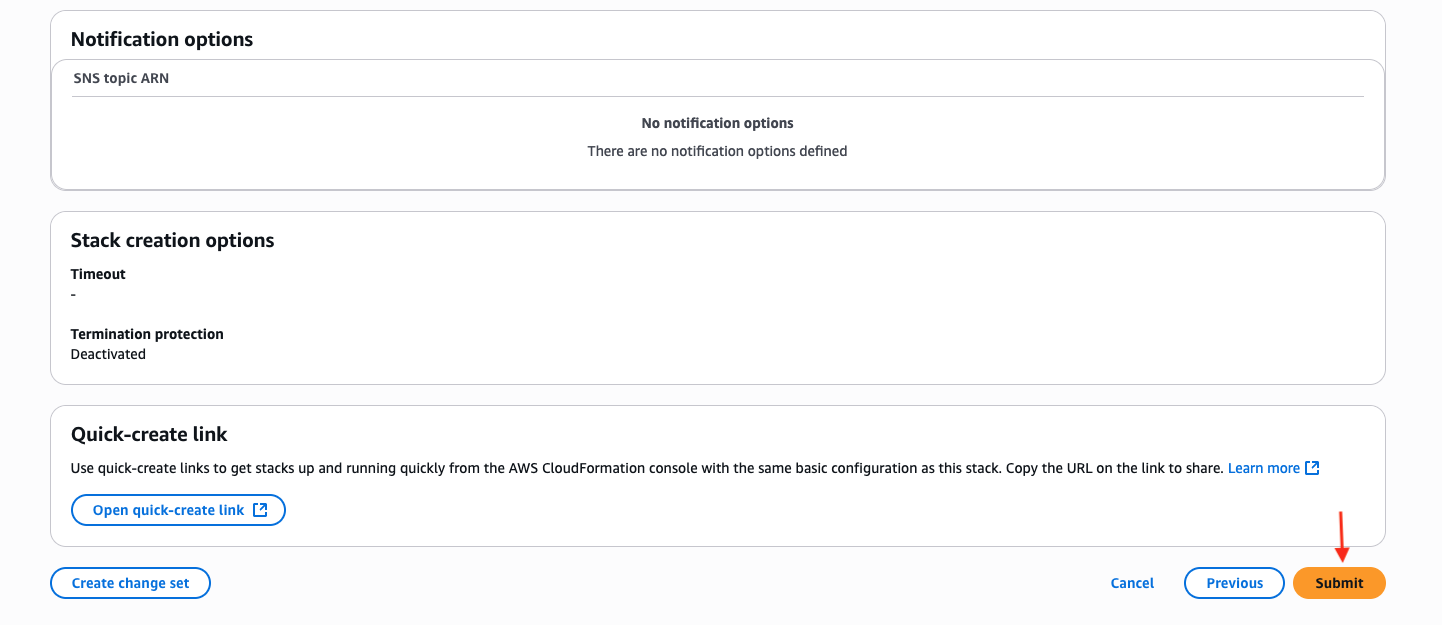
  5. Review all the configuration details on the next page, then choose Submit.
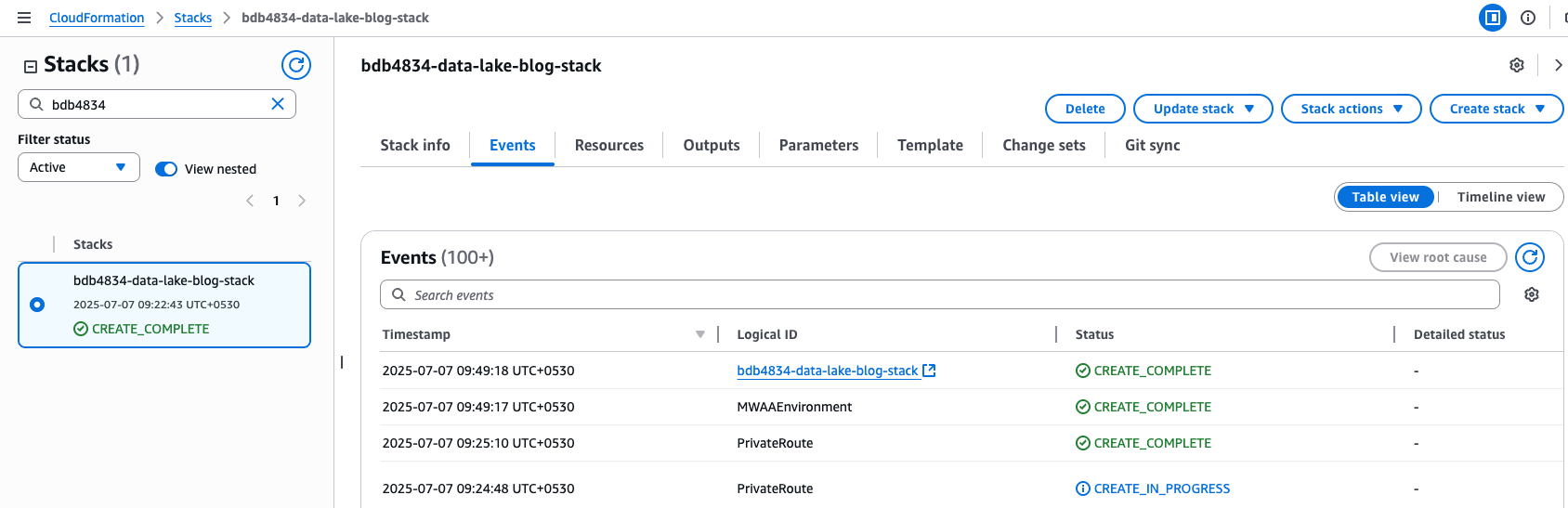
  6. Wait for the stack creation to complete in the AWS CloudFormation console. The process typically takes approximately 35 to 40 minutes to provision all required resources.

    The following table shows resources available in the AWS Account after CloudFormation template deployment is successfully completed:

    Resource Type Description Example Resource Name
    S3 Buckets For storing raw, processed data and assets bdb4834-mwaa-bucket-<AWS_ACCOUNT>-<AWS_REGION>,bdb4834-raw-bucket-<AWS_ACCOUNT>-<AWS_REGION>,bdb4834-formatted-bucket-<AWS_ACCOUNT>-<AWS_REGION>,bdb4834-published-bucket-<AWS_ACCOUNT>-<AWS_REGION>
    IAM Role Role assumed by MWAA for permissions bdb4834-mwaa-role
    MWAA Environment Managed Airflow environment for orchestration bdb4834-MyMWAACluster
    VPC Network setup required by MWAA bdb4834-MyVPC
    Glue Catalog Databases Logical grouping of metadata for tables bdb4834_formatted_stg,bdb4834_formatted_exception, bdb4834_formatted, bdb4834_published
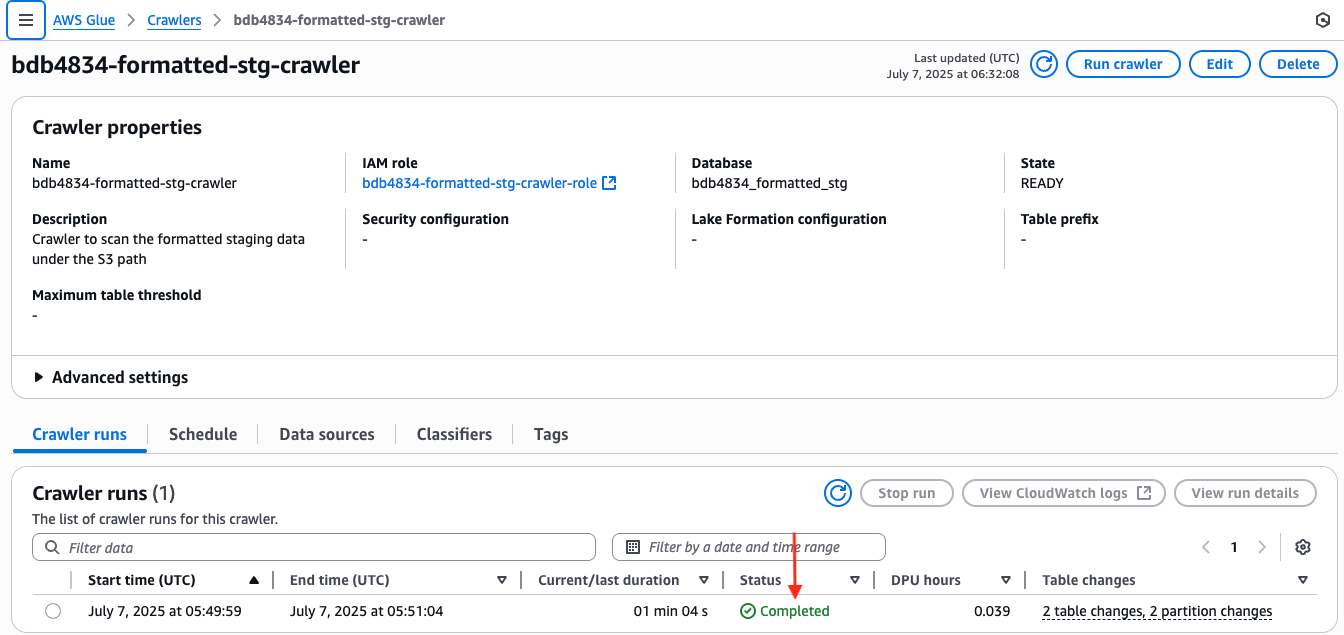
    Glue Crawlers Automatically catalog metadata from S3 bdb4834-formatted-stg-crawler
    Lambda Lambda to Trigger MWAA DAG on file arrival and to setup Lake Formation Permissions bdb4834_mwaa_trigger_process_s3_files,bdb4834-lf-tags-automation
    Lake Formation Setup Centralized governance and permissions LF-Setup for the above Resources
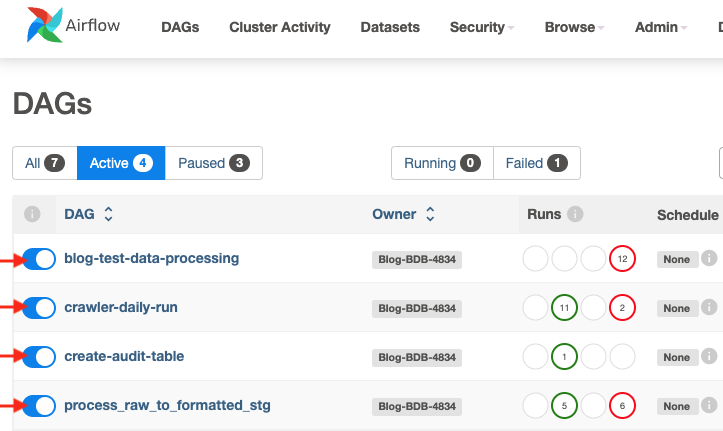
    Airflow DAGs Airflow DAGs are stored in the S3 bucket named mwaa-bucket-<AWS_ACCOUNT>-<AWS_REGION> under the dags/ prefix. These DAGs are responsible for triggering data pipelines based on either file arrival events or scheduled intervals. The exact functionality of each DAG is explained in the following sections. blog-test-data-processingcrawler-daily-runcreate-audit-tableprocess_raw_to_formatted_stage
  7. When the stack is complete perform the below steps:
    1. Open the Amazon Managed Workflows for Apache Airflow (MWAA) console, choose on Open Airflow UI
    2. In the DAGs console, locate the following DAGs and unpause them by unchecking the toggle switch (radio button) next to each DAG.

Add sample data to raw S3 bucket and create catalog tables

In this section, we upload sample data to raw S3 bucket (bucket name starting with bdb4834-raw-bucket) and convert the file formats to parquet and run AWS Glue crawler to create catalog tables that are used by dbt in the ELT Process. Glue Crawler automatically scans the data in S3 and creates or updates tables in the Glue Data Catalog, making the data queryable and accessible for transformation.

  1. Download the sample data.
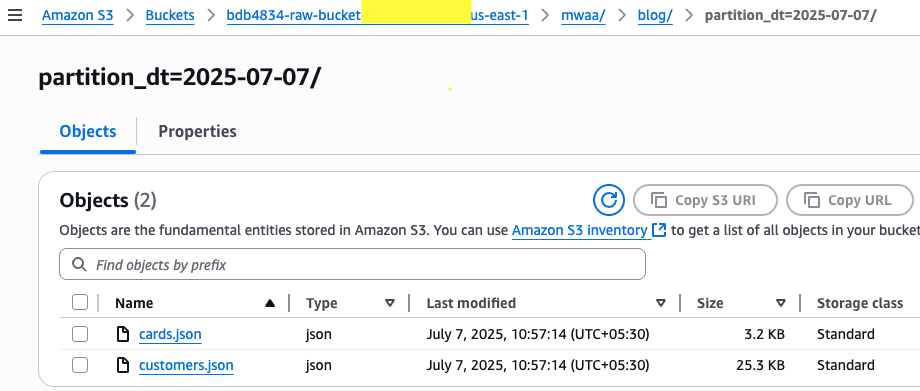
  2. Zip folder contains two sample data files, cards.json and customers.json
    Schema for cards.json

    Field Data Type Description
    cust_id String Unique customer identifier
    cc_number String Credit card number
    cc_expiry_date String Credit card expiry date

    Schema for customers.json

    Field Data Type Description
    cust_id String Unique customer identifier
    fname String First name
    lname String Last name
    gender String Gender
    address String Full address
    dob String Date of birth (YYYY/MM/DD)
    phone String Phone number
    email String Email address
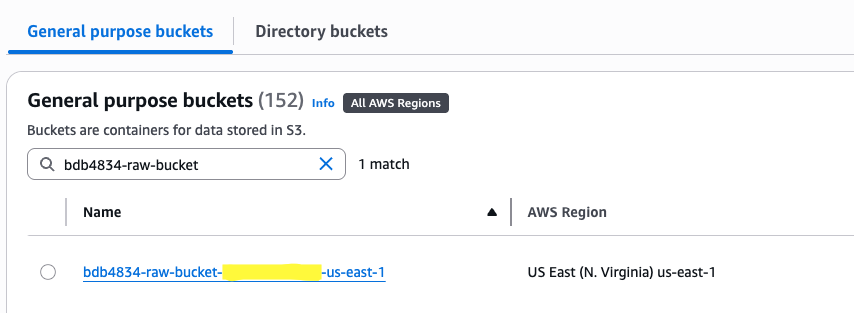
  3. Open S3 console, choose General purpose buckets in the navigation pane.
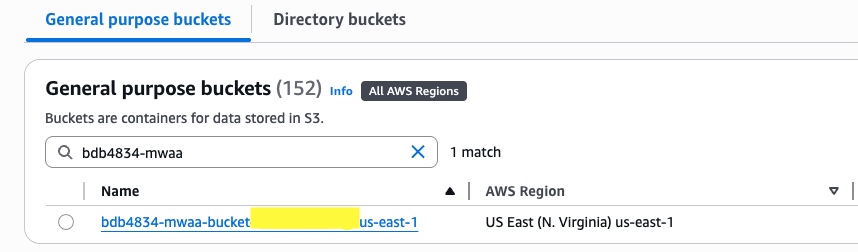
  4. Locate the S3 bucket with a name starting with bdb4834-raw-bucket. This bucket is created by the CloudFormation stack and can also be found under the stack’s Resources tab in the CloudFormation console.
  5. Choose the bucket name to open it, and follow these steps to create the required prefix:
    1. Choose Create folder.
    2. Enter the folder name as mwaa/blog/partition_dt=YYYY-MM-DD/, replacing YYYY-MM-DD with the actual date to be used for the partition.
    3. Choose Create folder to confirm.
  6. Upload the sample data files from the location to the s3 raw bucket prefix.
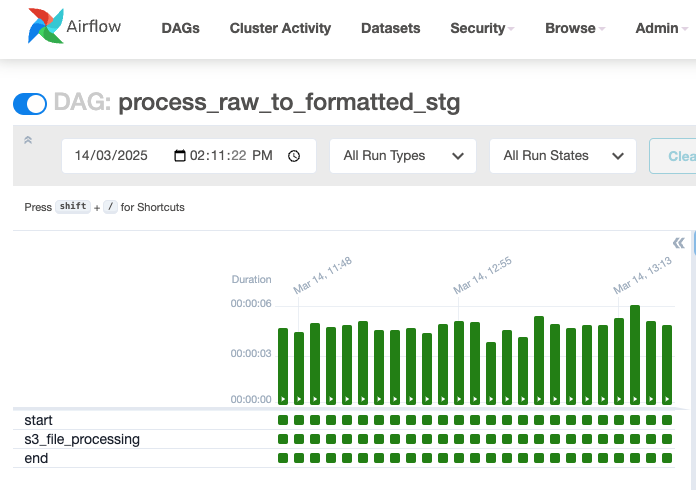
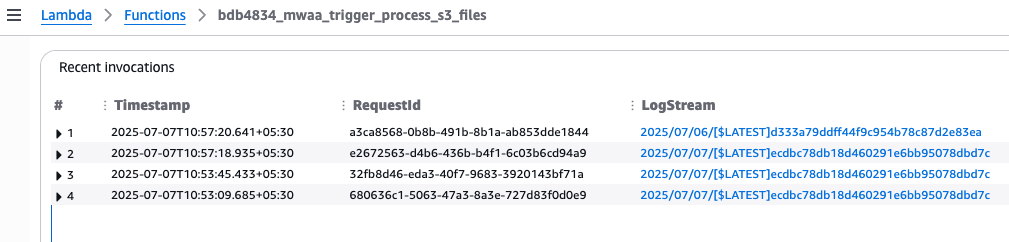
  7. As soon as the files are uploaded, the on_put object event on the raw bucket invokes thebdb4834_mwaa_trigger_process_s3_files lambda which triggers the process_raw_to_formatted_stg MWAA DAG.
    1. In the Airflow UI, choose the process_raw_to_formatted_stg DAG to view execution status. This DAG converts the file formats to parquet and typically completes within a few seconds.
    2. (Optional) To check the Lambda execution details:
      1. On the AWS Lambda Console, choose Functions in the navigation pane.
      2. Select the function named bdb4834_mwaa_trigger_process_s3_files.
  8. Validate the parquet files are created in formatted bucket (bucket name starting with bdb4834-formatted) under the respective data object prefix.
  9. Before proceeding further, re-upload the Lake Formation metadata file in MWAA bucket.
    1. Open the S3 console, choose General purpose buckets in the navigation pane.
    2. Search for the bucket starting with bdb4834-mwaa-bucket
    3. Choose the bucket name and go to the lakeformation prefix. Download the file named lf_tags_metadata.json. Now, re-upload the same file to the same location.
      Note: This re-upload is necessary because the Lambda function is configured to trigger on file arrival. When the resources were initially created by the CloudFormation stack, the files were simply moved to S3 and did not trigger the Lambda. Re-uploading the file ensures the Lambda function is executed as intended.
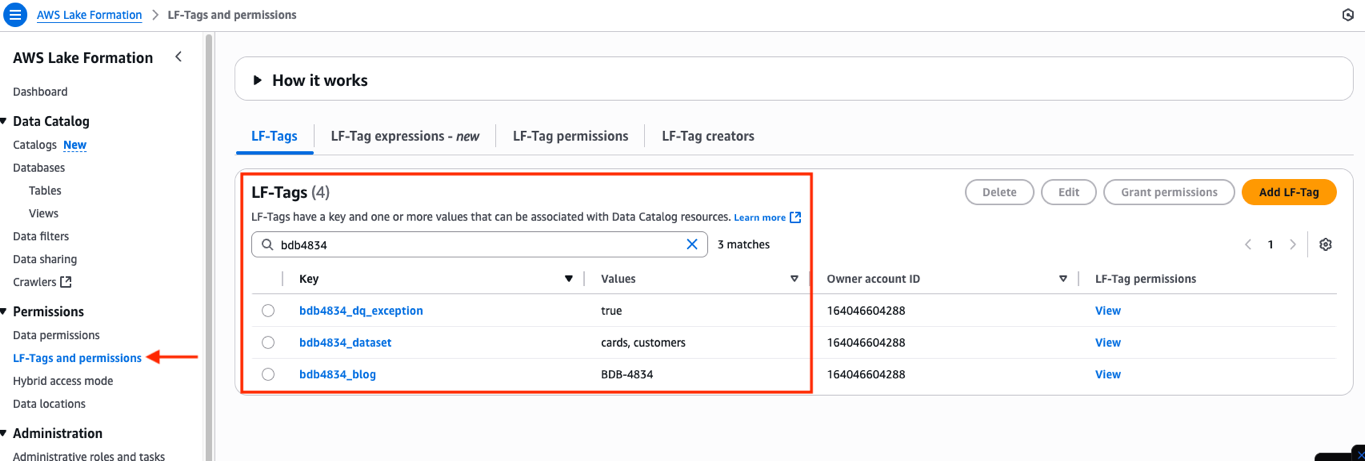
    4. As soon as the file is uploaded, the on_put object event on the MWAA bucket invokes the lf_tags_automation lambda, which creates the Lake Formation (LF) tags as defined in the metadata file and grants access to the specified AWS Identity and Access Management (IAM) roles for read/write.
    5. Validate that the LF-Tags have been created by visiting the Lake Formation Console. In the left navigation pane, choose Permissions, and then select LF-Tags and permissions.
  10. Now, run the crawler DAG to create/update the catalog tables: crawler-daily-run
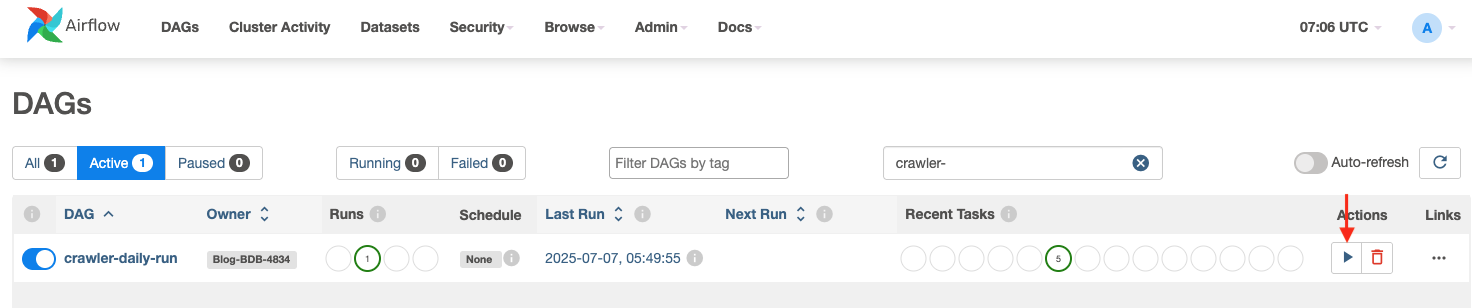
    1. In the Airflow UI select the crawler-daily-run DAG and choose Trigger DAG to execute it.
    2. This DAG is configured to trigger Glue Crawler which crawls the formatted_stg prefix under the bdb4834-formatted s3 bucket to create catalog tables as per the prefixes available under the formatted_stg prefix.
      bdb4834-formatted-bucket-<aws-account-id>-<region>/formatted_stg/
      

    3. Monitor the execution of the crawler-daily-run DAG until it completes, which typically takes 2 to 3 minutes. The crawler run status can be verified in the AWS Glue Console by following these steps:
      1. Open the AWS Glue Console.
      2. In the left navigation pane, choose Crawlers.
      3. Search for the crawler named bdb4834-formatted-stg-crawler.
      4. Check the Last run status column to confirm the crawler executed successfully.
      5. Choose the crawler name to view additional run details and logs if needed.

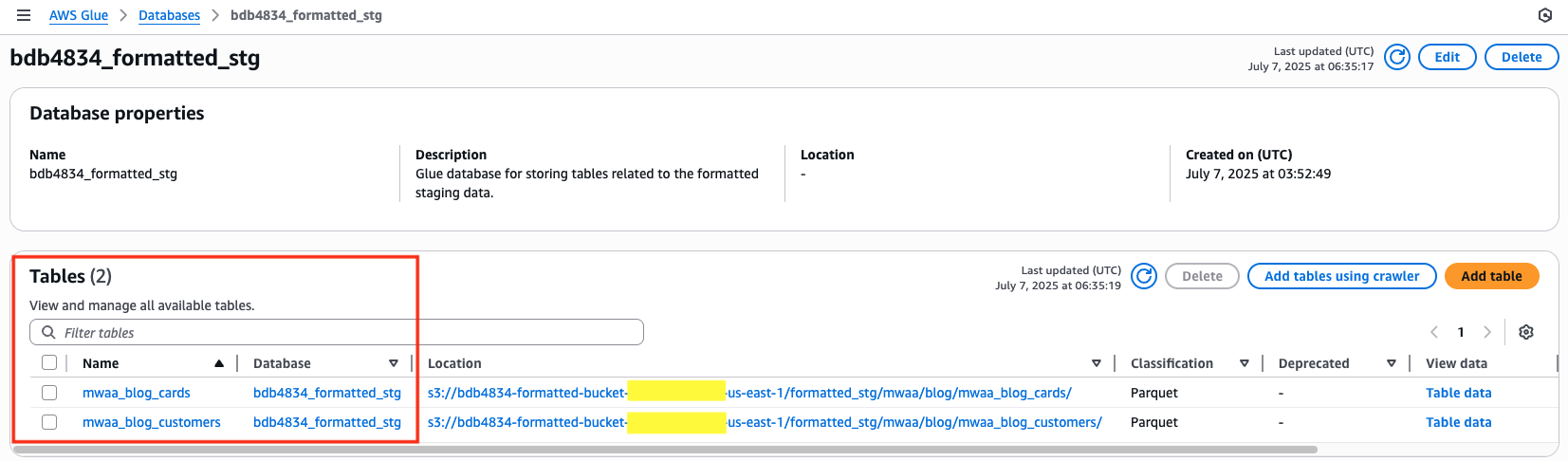
    4. Once the crawler has completed successfully, in the left-hand panel, choose Databases and select the bdb4834_formatted_stg database to view the created tables, which should appear as showing in the following image. Optionally, select the table’s name to view its schema, and then select Table data to open Athena for data analysis. (An error may appear when querying data using Athena due to Lake Formation permissions. Review the Governance using Lake Formation section in this post to resolve the issue.)

Note: If this is the first time Athena is being used, a query result location must be configured by specifying an S3 bucket. Follow the instructions in the AWS Athena documentation to set up the S3 staging bucket for storing query results.

Run model through DAG in MWAA

In this section, we cover how dbt models run in MWAA using Athena adapter to create Glue-catalogued tables and how auditing is done for each run.

  1. After creating the tables in the Glue database using the AWS Glue Crawler in the previous steps, we can now proceed to run the dbt models in MWAA. These models are stored in S3 in the form of SQL files, located at the S3 prefix: bdb4834-mwaa-bucket-<account_id>-us-east-1/dags/dbt/models/
    The following are the dbt models and their functionality:

    • mwaa_blog_cards_exception.sql This model reads data from the mwaa_blog_cards table in the bdb4834_formatted_stg database and writes records with data quality issues to the mwaa_blog_cards_exception table in the bdb4834_formatted_exception database.
    • mwaa_blog_customers_exception.sql This model reads data from the mwaa_blog_customers table in the bdb4834_formatted_stg database and writes records with data quality issues to the mwaa_blog_customers_exception table in the bdb4834_formatted_exception database.
    • mwaa_blog_cards.sql This model reads data from the mwaa_blog_cards table in the bdb4834_formatted_stg database and loads it into the mwaa_blog_cards table in the bdb4834_formatted database. If the target table does not exist, dbt automatically creates it.
    • mwaa_blog_customers.sql This model reads data from the mwaa_blog_customers table in the bdb4834_formatted_stg database and loads it into the mwaa_blog_customers table in the bdb4834_formatted database. If the target table does not exist, dbt automatically creates it.
  2. The mwaa_blog_cards.sql model processes credit card data and depends on the mwaa_blog_customers.sql model to complete successfully before it runs. This dependency is necessary because certain data quality checks—such as referential integrity validations between customer and card records—must be performed beforehand.
    • These relationships and checks are defined in the schema.yml file located in the same S3 path: bdb4834-mwaa-bucket-<account_id>-us-east-1/dags/dbt/models/. The schema.yml file provides metadata for dbt models, including model dependencies, column definitions, and data quality tests. It utilizes macros like get_dq_macro.sql and dq_referentialcheck.sql (found under the macros/ directory) to enforce these validations.

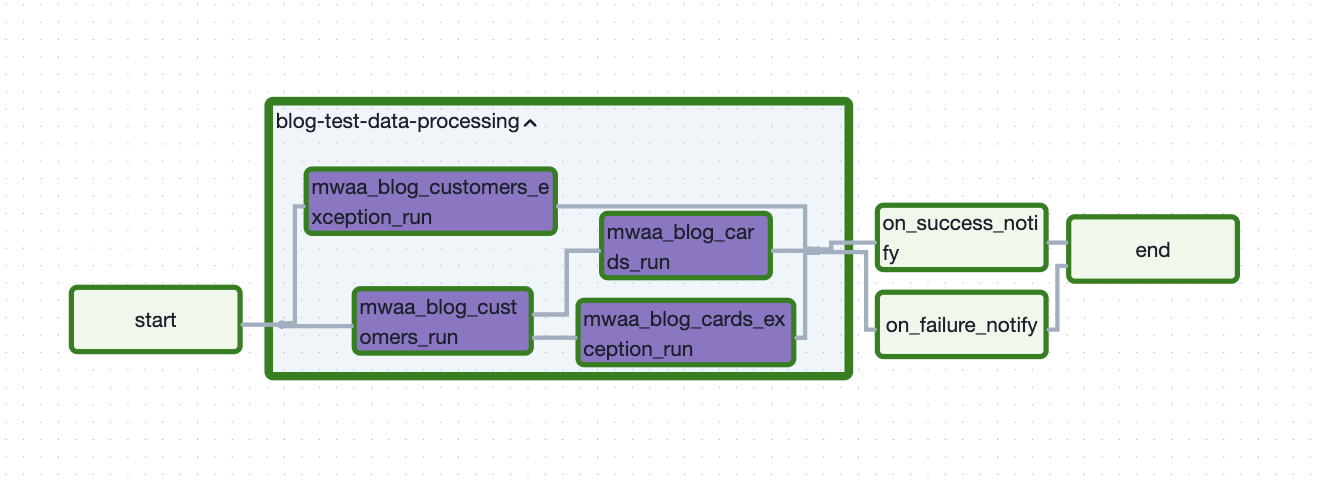
    As a result, dbt automatically generates a lineage graph based on the declared dependencies. This visual graph helps orchestrate model execution order—ensuring models like mwaa_blog_customers.sql run before dependent models such as mwaa_blog_cards.sql, and identifies which models can execute in parallel to optimize the pipeline.

  3. As a pre-step before running models, choose the trigger DAG button for create-audit-table to create audit table for storing run details for each model.
  4. Trigger the blog-test-data-processing DAG in the Airflow UI to start the Model run.
  5. Choose blog-test-data-processing to see the execution status. This DAG runs the models in order and creates Glue catalogued iceberg tables. The flow diagram of a DAG from Airflow UI can be found by choosing Graph after choosing DAG.

    1. The exception models puts the failed records under exception prefix in S3:
      bdb4834-formatted-bucket-<aws-account-id>-<region>/formatted_exception/

      Records that failed are found in an added column, tests_failed, where all the data quality checks that failed for that particular row are added, separated by a pipe (‘|’). (For the mwaa_blog_customers_exception two exception records are found in the table.)

    2. The passed records are put under formatted prefix in S3.
      bdb4834-formatted-bucket-<aws-account-id>-<region>/formatted/

    3. For each run, a run audit is captured in the audit table with execution details like model_nm, process_nm, execution_start_date, execution_end_date, execution_status, execution_failure_reason, rows_affected.
      Find the data in S3 under the prefix bdb4834-formatted-bucket-<aws-account-id>-<region>/audit_control/
    4. Monitor the execution until the DAG completes, which can take up to 2-3 mins. The execution status of the DAG can be seen in the left panel after opening the DAG.
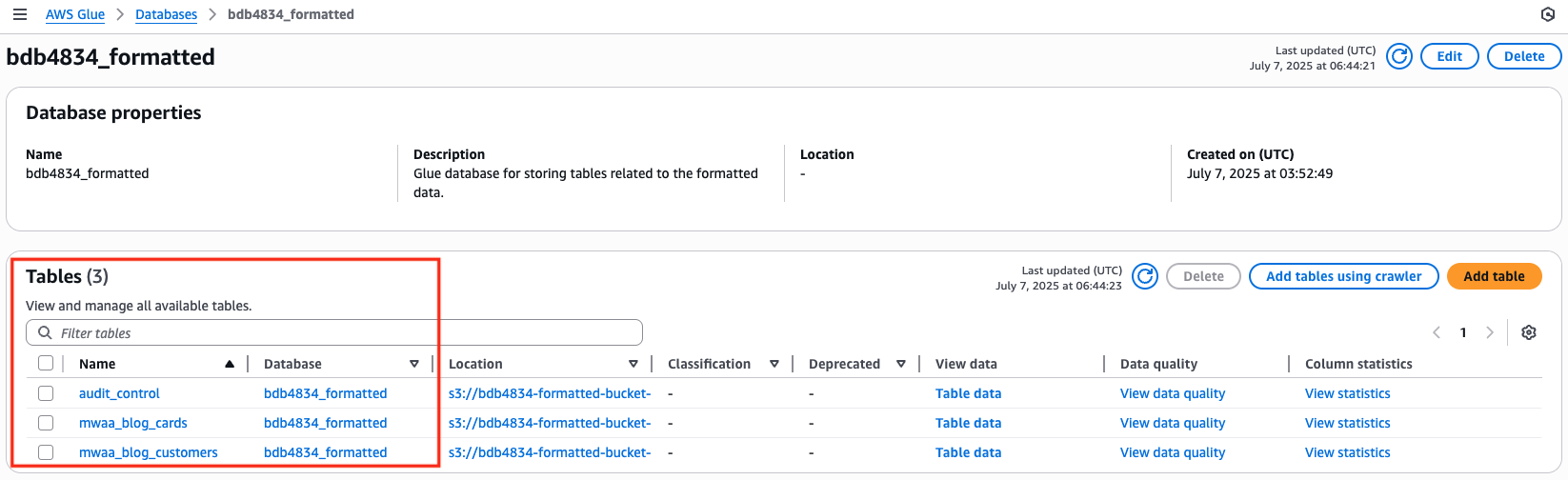
    5. Once the DAG has completed successfully, open the AWS Glue console and select Databases. Select the bdb4834_formatted database, which should create three tables, as shown in the following image.
      Optionally, choose Table data to access Athena for data analysis.
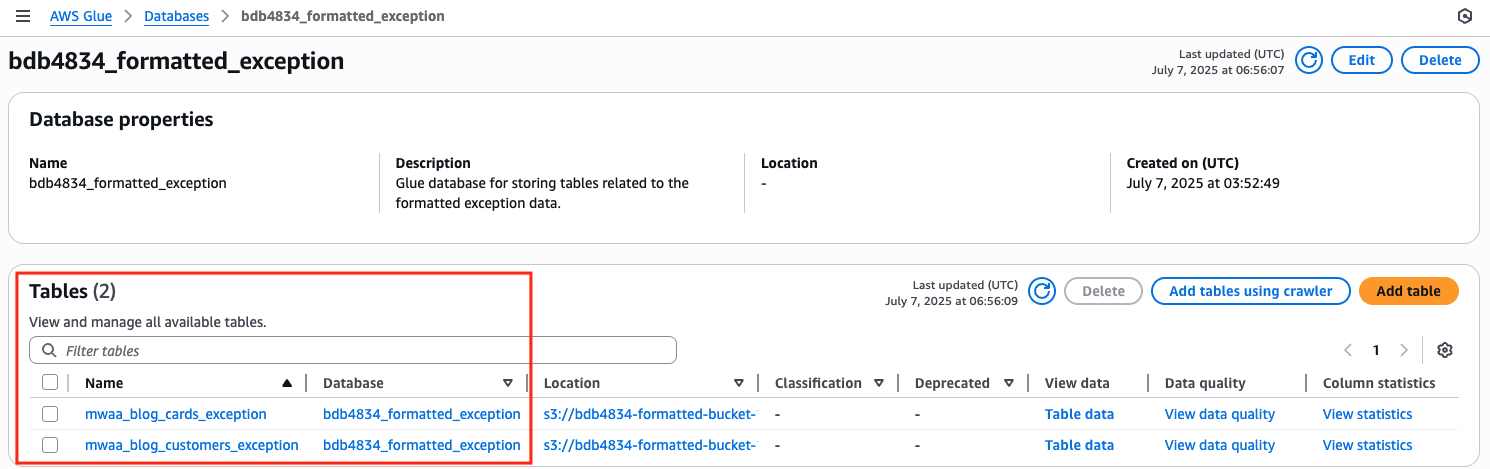
    6. Choose bdb4834_formatted_exception database from under Databases in AWS Glue console, which should create two tables as shown in the following image.
    7. Each model is assigned LF tags through the config block of model itself. Therefore, when the iceberg tables are created through dbt, LF tags are attached to the tables after the run completes.

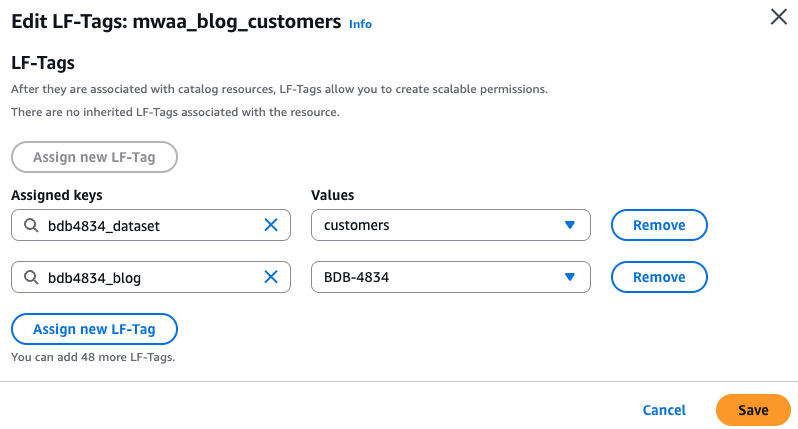
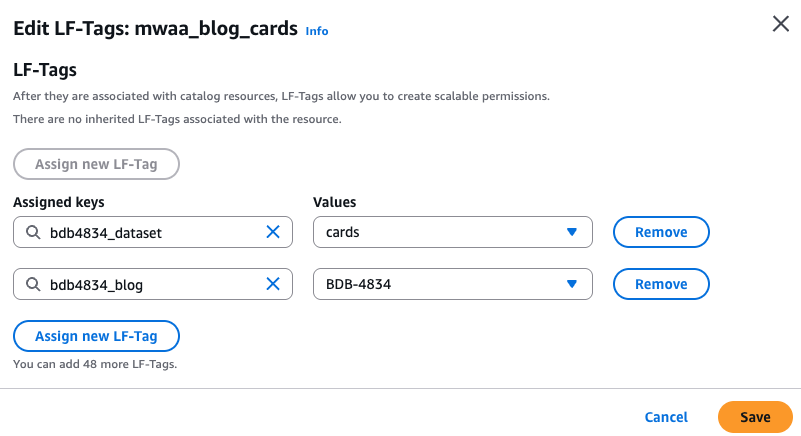
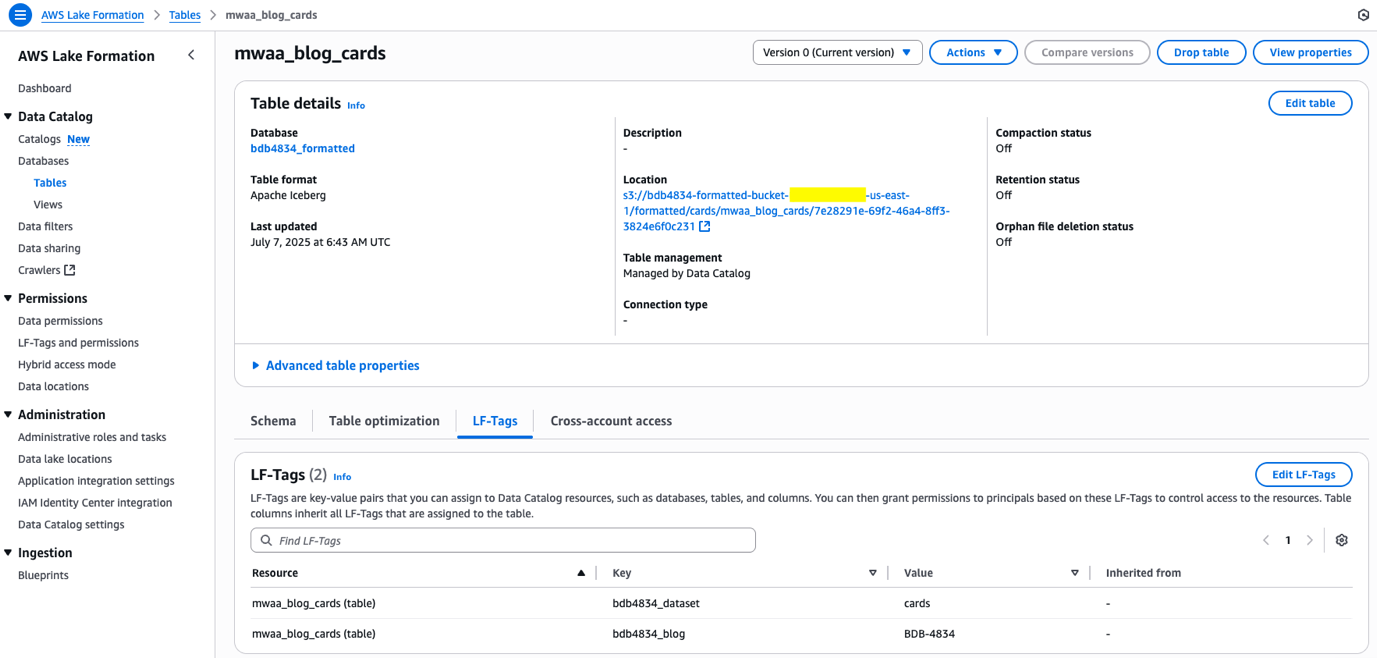
      Validate the LF tags attached to the tables by visiting the AWS Lake Formation console. In the left navigation pane, choose Tables and look for mwaa_blog_customers or mwaa_blog_cards table under bdb4834_formatted database. Select any table among the two and under Actions, choose Edit LF tags and the tags are attached, as shown in the following screen shot.

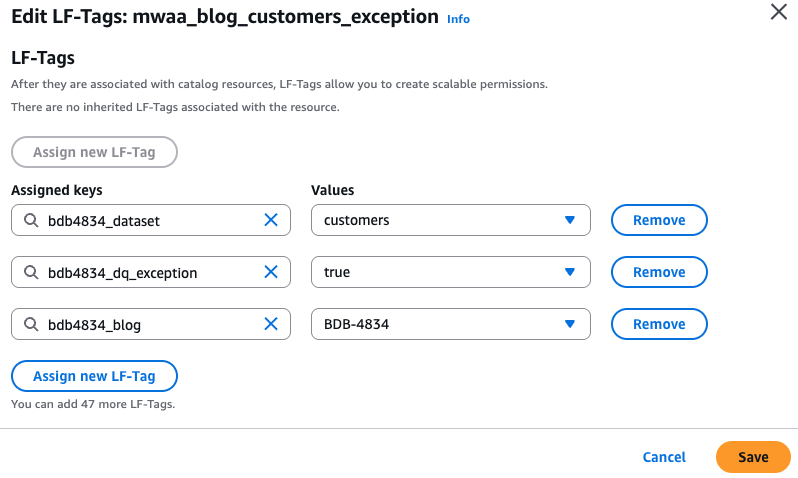
    8. Similarly, for the bdb4834_formatted_exception database, select any one of the exception tables under the bdb4834_formatted_exception database and the LF tags are attached.
    9. Run SQL queries on the tables created by opening the Athena console and running Analytical queries on the tables created above.Sample SQL queries:
      SELECT * FROM bdb4834_formatted.mwaa_blog_cards;
      Output: Total 30 rows

      SELECT * FROM bdb4834_formatted_exception.mwaa_blog_customers_exception;
      Output: Total 2 records

Governance using Lake Formation

In this section, we show how assigning Lake Formation permissions and creating LF tags is automated using the metadata file.Below is a metadata file structure, which is needed for reference when uploading the metadata file for Lake Formation in Airflow S3 bucket, inside the Lake Formation prefix.

Metadata file structure-
{
    "role_arn": "<<IAM_ROLE_ARN>>",
    "access_type": "GRANT",
    "lf_tags": [
      {
        "TagKey": "<<LF_tag_key>>",
        "TagValues": ["<<LF_tag_values>>"]
      }
    ],
	  "named_data_catalog": [
      {
        "Database": "<<Database_Name>>",
        "Table": ""<<Table_Name>>"
      }
    ],
    "table_permissions": ["SELECT", "DESCRIBE"]
  }

Components of the metadata file

  • role_arn: The IAM role that the Lambda function assumes to perform operations.
  • access_type: Specifies whether the action is to grant or revoke permissions (GRANT, REVOKE).
  • lf_tags: Tags used for tag-based access control (TBAC) in Lake Formation.
  • named_data_catalog: A list of databases and tables on which Lake Formation permissions or tags are applied to.
  • table_permissions: Lake Formation-specific permissions (e.g., SELECT, DESCRIBE, ALTER, etc.).

Lambda function bdb4834-lf-tags-automation parses this JSON and grants the required LF tags to the role with given table permissions.

  1. To update the metadata file, download it from the MWAA bucket (lakeformation prefix)
    bdb4834-mwaa-bucket-<<ACCOUNT_NO>>-<<REGION>>/lakeformation/lf_tags_metadata.json

  2. Add a JSON object with the metadata structure defined above, mentioning the IAM role ARN and the tags and tables to which access needs to be granted.
    Example:Let’s assume below is how the metadata file initially looks like:

    
    	[
    	{
        "role_arn": "arn:aws:iam::XXX:role/aws-reserved/sso.amazonaws.com/XX ",
        "access_type": "GRANT",
        "lf_tags": [
          {
            "TagKey": " blog",
            "TagValues": ["bdb-4834"]
          }
        ],
        "named_data_catalog": [],
        "table_permissions": ["SELECT", "DESCRIBE"]
      }
    ]

    Below is the json object that has to be added in the above metadata file:

    
    {
              "role_arn": "arn:aws:iam::XXX:role/aws-reserved/sso.amazonaws.com/XX ",
              "access_type": "GRANT",
              "lf_tags": [],
              "named_data_catalog": [
              {
                "Database": " bdb4834_formatted",
                "Table": "audit_control"
              },
              {
                "Database": " bdb4834_formatted_stg",
                "Table": "*"
              }
             ],
             "table_permissions": ["SELECT", "DESCRIBE"]}


    So now, the final metadata file should look like:

    
    [
      {
        "role_arn": "arn:aws:iam::XXX:role/aws-reserved/sso.amazonaws.com/XX ",
        "access_type": "GRANT",
        "lf_tags": [
          {
            "TagKey": "blog",
            "TagValues": ["bdb-4834"]
          }
        ],
        "named_data_catalog": [],
        "table_permissions": ["SELECT", "DESCRIBE"]
      },
      {
        "role_arn": "arn:aws:iam::XXX:role/aws-reserved/sso.amazonaws.com/XX ",
        "access_type": "GRANT",
        "lf_tags": [],
        "named_data_catalog": [
          {
            "Database": " bdb4834_formatted",
            "Table": "audit_control"
          },
          {
            "Database": " bdb4834_formatted_stg",
            "Table": "*"
          }
        ],
        "table_permissions": ["SELECT", "DESCRIBE"]
      }
    ]

  3. Upon uploading this file at the same location (bdb4834-mwaa-bucket-<<ACCOUNT_NO>>-<<REGION>>/lakeformation/) in S3, the lf_tags_automation lambda is triggered to create LF tags if they don’t exist and then it assigns those tags to the IAM role ARN and also grants permission to the IAM role ARN using named_data_catalog as defined.

    To verify the permissions, go to the Lake Formation console and choose Tables under Data Catalog and search for the table name.

To check LF-Tags, choose the table name and under the LF tags section, all the tags are found attached to this table.

This metadata file used as a structured input to an AWS Lambda function automates the following to perform automated, consistent, and scalable data access governance across the AWS Lake Formation environments:

  • Granting AWS Lake Formation (LF) permissions on Glue Data Catalog resources (like databases and tables).
  • Creating Lake Formation Tags and Applying Lake Formation tags (LF-Tags) for tag-based access control (TBAC).

Explore more on dbt

Now that the deployment includes a bdb4834-published S3 bucket and a published Catalog database, robust dbt models can be built for data transformation and curation.

Here’s how to implement a complete dbt workflow:

  • Start by developing models that follow this pattern:
    • Read from the formatted tables in the staging area
    • Apply business logic, joins, and aggregations
    • Write clean, analysis-ready data to the published schema
  • Tagging for automation: Use consistent dbt tags to enable automatic DAG generation. These tags trigger MWAA orchestration to automatically include new models in the execution pipeline.
  • Adding new models: When working with new datasets, refer to existing models for guidance. Apply appropriate LF tags for data access control. The new LF tags can also now be used for permissions.
  • Enable DAG execution: For new datasets, update the MWAA metadata file to include a new JSON entry. This step is necessary to generate a DAG that executes the new dbt models.

This approach ensures the dbt implementation scales systematically while maintaining automated orchestration and proper data governance.

Clean up

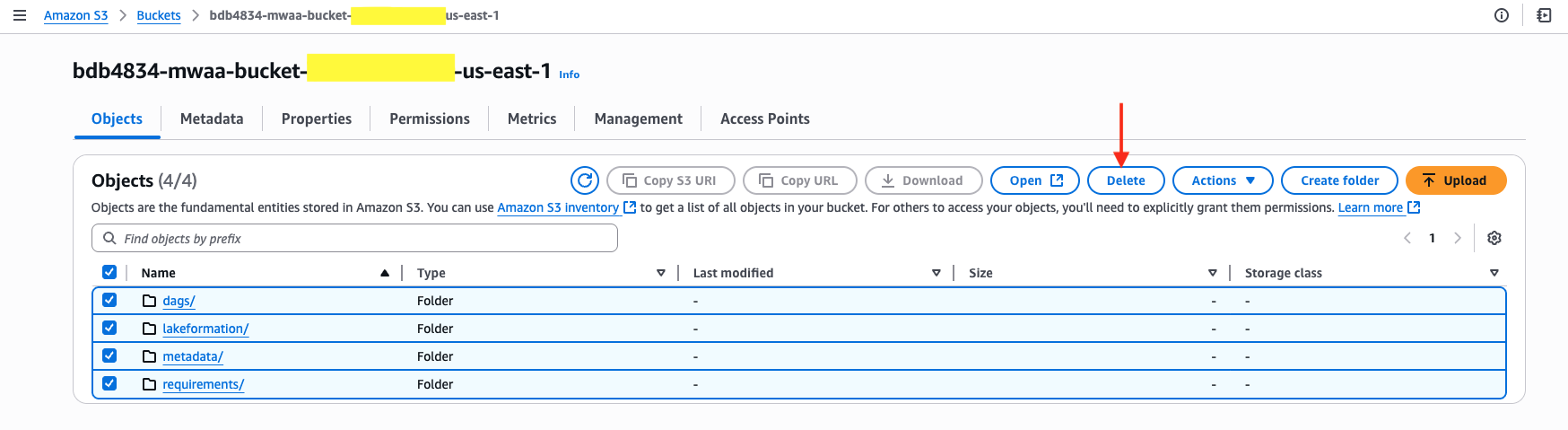
1. Open the S3 console and delete all objects from below buckets:

  • bdb4834-raw-bucket-<aws-account-id>-<region>
  • bdb4834-formatted -bucket-<aws-account-id>-<region>
  • bdb4834-mwaa-bucket-<aws-account-id>-<region>
  • bdb4834-published-bucket-<aws-account-id>-<region>

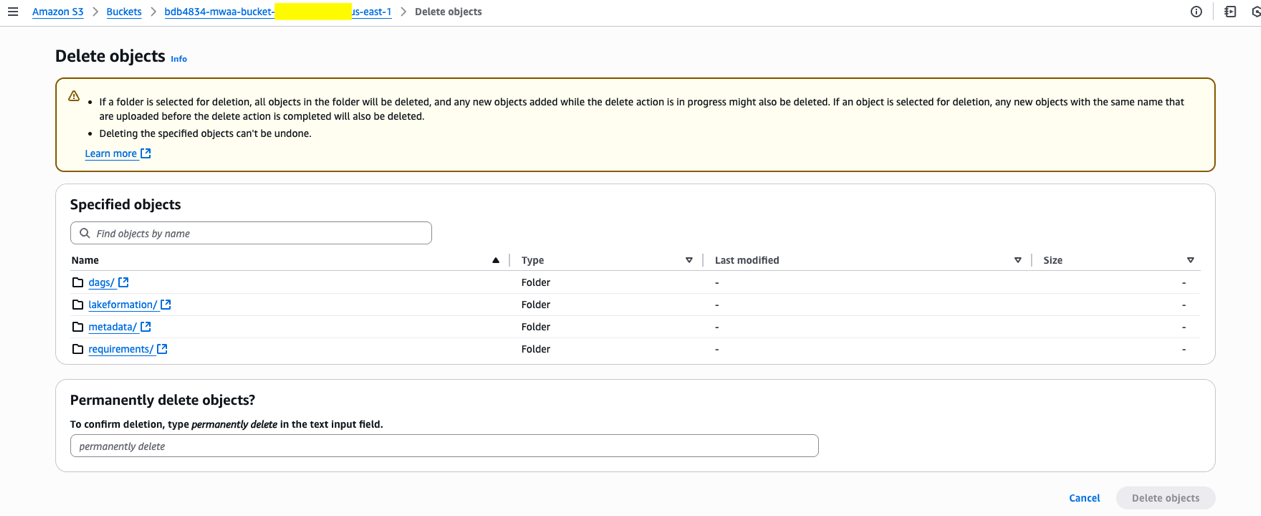
To delete all objects, choose the bucket name, select all objects and choose Delete.

After that, type ‘permanently delete’ in the text box and choose Delete Objects.

Do this for all three buckets mentioned above.

2. Go to the AWS Cloudformation console, choose you’re the stack name and select Delete. It may take approximately 40 mins for the deletion to complete.

Recommendations

When using dbt with MWAA, some typical challenges include worker resource exhaustion, dependency management issues, and in some rare cases, issues like DAGs disappearing and re-appearing when there are a large number of dynamic DAGs being created from a single python script.

To mitigate these issues, follow these best practices:

1. Scale the MWAA environment appropriately by upgrading the environment class as required.

2. Use custom requirements.txt and proper dbt adapter configuration to ensure consistent environments.

3. Set airflow configuration parameters to tune the performance of MWAA.

Conclusion

In this post, we explored the end-to-end setup of a governed data lake using MWAA and dbt which improved data quality, security, and compliance, leading to better decision-making and increased operational efficiency. We also covered how to build custom dbt frameworks for auditing and data quality, automate Lake Formation access control, and dynamically generate MWAA DAGs based on dbt tags. These capabilities enable a scalable, secure, and automated data lake architecture, streamlining data governance and orchestration.

For further exploring, refer to From data lakes to insights: dbt adapter for Amazon Athena now supported in dbt Cloud


About the authors

Muralidhar Reddy

Muralidhar Reddy

Muralidhar is a Delivery Consultant at Amazon Web Services (AWS), helping customers build and implement data analytics solution. When he’s not working, Murali is an avid bike rider and loves exploring new places.

Abhilasha Agarwal

Abhilasha Agarwal

Abhilasha is an Associate Delivery Consultant at Amazon Web Services (AWS), support customers in building robust data analytics solutions. Apart from work, she loves cooking and trying out fun outdoor experiences.

Тротоари (на цени) като в Германия

Post Syndicated from Боян Юруков original https://yurukov.net/blog/2026/trotoari/

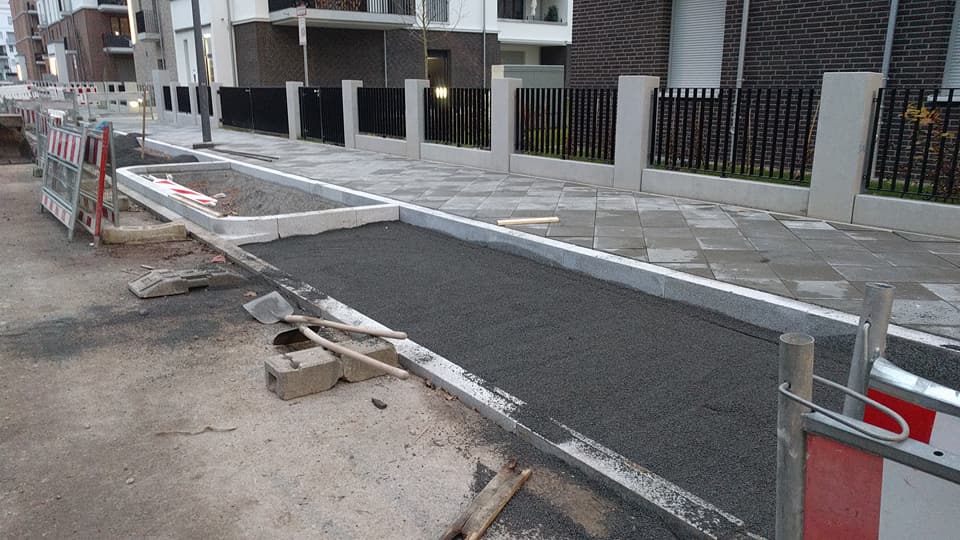
Попаднах на мой стар пост от преди 8 години показващ как правят тротоар в тогавашния ми квартал във Франкфурт, Германия. Тогава го сравних с оплакванията на ремонтите на Дондуков и Цариградско. В продължение на темата от вчера реших да проверя, колко всъщност е струвал да се направи така. Намерих аналогичен тротоар в съседно село, който миналата година е бил направен за около 120 евро на кв.м. Това включва основа, бордьори, подобни очертания на зелени площи без осветление.

За сравнение, цената на тротоарите, които виждаме да се правят в София, при последните поръчки излиза около 100 евро на кв. м. Имайки предвид, че разходите за труд са по-ниски, цените са почти идентични Разликите в качеството на изпълнение, плочите и елементите се виждат с просто око. Бях във Франкфурт пет години след като завършиха този тротоар и не беше мръднал. Някои от тези в София вече ги виждам как пропадат.

По социалки и групи се възмущаваме на общината и липсата на контрол когато нещо е нескопосано. „Ремонт на ремонта“ стана нарицателно по време на Фандъкова за лошо свършена работа и криво-ляво закърпена след това. Доколкото си мислим, че това става само когато държавата и общината плаща, показах как частни компании правят път и се налага поне четири пъти да го поправят защото пропада. В случая това беше по поръчка и под зоркото око на Артекс, но важи с пълна сила при изпълнение на всякакви сгради и инфраструктура. При тротоарите обаче, особено ремонтите, наистина голяма отговорност носи общината в целия процес.

Има обаче поне седем фактора, които влияят дори повече на тези ремонти. Някои от тях оскъпяват работата значително, други блокират налагането на контрол, а трети в най-добрия случай удължават времето за изпълнение.

Подземна инфраструктура

В София и практически всеки български град който не е коп’нал, той не е направил шахта или прекарал нещо под земята. Понякога кабели, тръби и оптика са на сантиметри под краката на хората. Понякога са дори опасни. Спомняте си смъртта на детето, което го хвана ток. Столичния общински съвет обеща да се захване с решаване на проблема и създаване на структура, която да отговаря. Това не се случи.

Преди две години пуснах карта на шахтите на София. Това са поне тези, за които общината знае и са в ГИС системата на НАГ. Има още много кабели и трасета между тях и още доста, за които не се знае. Всички следва да са достатъчно дълбоко, за да не пречат на тротоари и улици. Проблемът е, че понякога са буквално сантиметри под плочки, корени и бордюри. Това се установява едва когато започне ремонта, т.е. когато работата е планирана, бюджетирана и поръчката е спечелена.
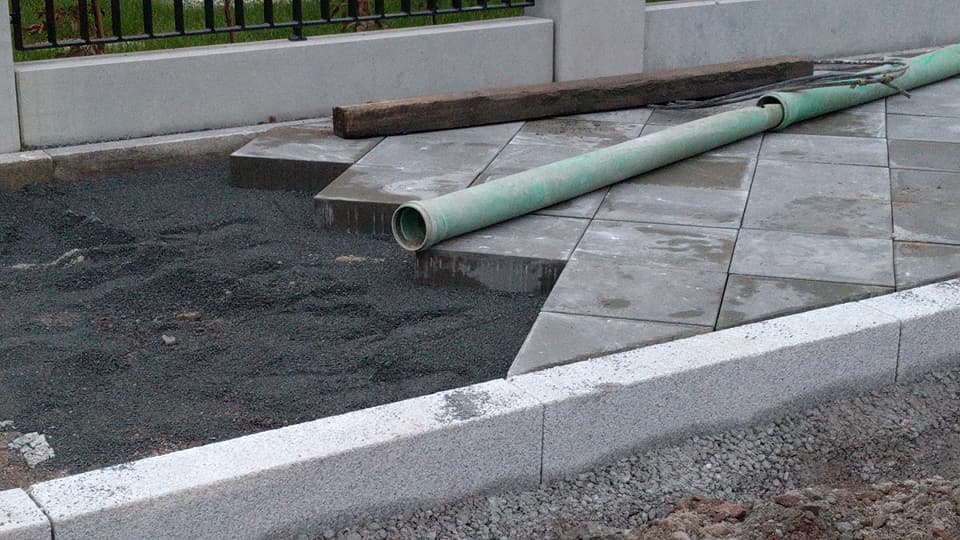
Дори когато са незаконни не могат просто да се отрежат. Когато са законни обаче, но не на правилната дълбочина, проблемът възниква когато някой чиновник някога е подписал, че приема обекта както си е. Дали е било въпрос на корупция или нехайство, факт е, че сега разходът за преместването им на правилна дълбочина е на общината години по-късно. Това оскъпява значително нещата.

Лошо или липса на планиране на улици и тротоари

ПУП-овете на парче, позволяването улиците да са с намалена широчина оставяйки никакво място за тротоарите, приватизирането на места за паркиране или повече ленти на булевардите за сметка на тротоари и велоалеи, странните архитектурни чупки по сградите усложнявайки достъпа до гаражи, входове и съседни сгради, липсата на отчуждаване на достатъчно от частните имоти преди урегулирането им години назад във времето за нормална инфраструктура и редица други проблеми около хаоса в презастрояването в София и редица други градове води до там, че тротоарите не са просто 2.5 метра широки алеи подходящи за хора с проблеми с придвижването, незрящи или родители с колички, а криволичеща какафония от неравности и абсурди.

Дори при липса на подземни „мини“, най-съвестно изпълнение на строителя и контрол от общината, каквото и да бъде направено на определени места ще е абсурдно. В Изгрев видях тротоар широк една педя с бордюр още 10 см. Опитах и сам не мога да стъпя на него. Но имаше знак „мини на отсрещния тротоар“, т.е. на тия 30 см., защото се строеше поредният голям комплекс наблизо.

Дори когато се ремонтират улиците, се прави единствено смяна на горния слой на асфалта. Не се преосмисля концепцията на улицата, новата натовареност, дали следва да има издадени части на тротоара за по-лесно преминаване на учениците по пътеките, дали трябва да се обособят паркоместа и стесни на места платното, за да се намали скоростта и шума. Именно това очаквах при поръчката за ремонт на улицата в най-лошо състояние в район Изгрев – Тинтява. Районният кмет се хвалеше години наред, че работи над промяната ѝ, че мисли и готови всичко и подава предложения как да е в общината. Накрая като излезе поръчката се оказа, че нищо не е подал като предложения, а се използва остарели и вече неверни скици и планове от преди 10 години. Това е пример как не се прави и накрая плащаме много по-вече от данъците си за нещо по-лошо.

Строителен надзор

При такива проекти се взима строителен надзор, който би следвало да е независим. Проблемът е, че често става въпрос за свързани фирми. Независимият надзор трябва да следи за изпълнението на параметрите и изискванията за качество. Както добре виждаме обаче, това почти никога не се случва. Общините често нямат експертен капацитет да преценят дали нещо следва да е така или не и чисто естетическата им оценка и това, че някои неща са очевидни не издържат в съда. Становището на „независимия“ надзор натежава.

Непостоянни съдебни практики с дъх на корупция

Всяка обществена поръчка, всяко искане за поправка, всяка наложена глоба за несвършена работа или лошо изпълнение, всичко може и често се обжалва пред административните съдилища. Те имат крайно противоречива практика. Отчасти това е заради неспазен процес от страна на общината въпреки наличието на нарушения. По-често е защото става дума за сериозни пари и съдиите или не им пука, защото „ма то така си беше“, или са заставени да не им пука. Аналогични проблеми има при отказите за разрешения за строеж или ПУП-ове.

В тази среда административните съдилища в България носят със себе си един от най-негативните ефекти на градската среда. Несигурността, че законът и публичният интерес ще бъдат запазени води до там, че общините масово не се възползват от възможността да рестарвират или поне укрепят разпадащи се паметници на културата и да заставят собствениците да платят, ако ще със самия имот. Страх ги е, че никога няма да си върнат парите, защото е по-евтино да подариш апартамент във Витоша на сина на съдийка в Административния съд, отколкото да върнеш парите, които сме дали от данъците си.

При поръчките за тротоарите ситуацията е подобна. Затова винаги се гледа да се разберат с добро, ако ще да е на база компромиси и ниско качество на резултатът. Най-лошото е, че следващия път най-вероятно същите хора ще спечелят поръчката отново и ще трябва да се работи с тях отново

Липса на конкуренция и некачествена работа

Доколкото има страшно много строителни фирми в България покрай манията за крипто-бетона, всъщност много малко фирми кандидатстват за подобни поръчки. Отчасти това е заради изискванията за опит и мащаб, отчасти защото много от фирмите работят на черно и не могат да докажат доходи от подобна работа, отчасти, защото хора като Вълка и Таки извиват оркестрират кой да кандидатства къде. Така разпределят територия и сфери и дори общините да не са „в кюпа“ и да се стараят да получат качество на разумна цена, често са изправени пред свършен факт. Пример за това беше боклука в София, където изведнъж всички камиони за смет в страната потънаха в дън земя, когато община София искаше да наеме такива.

Липсва конкуренция заради такива мафиотски тактики и малкия брой фирми по принцип. Отделно качеството на работата е изключително лошо. Въпреки възторгът на инфлуенсъри и брокери, ако се наблюдавате строежите преди да сложат фасадата виждате с просто око невъзможни неща. Залепят ли фасадата и покрият бетона на гаражите с боядисан в зелено тънък слой трева вече изглежда готино като за снимки.

При тротоарите това го забелязваме по-бързо, защото е пред нас. При първият лек дъжд се виждат и проблемите в основата като се разкривят и започнат да плюят плочките. Бордюрите започват да се чупят от качващи се коли. Плочите и бордюрите не са изрязани правилно, а се пълнят с малко бетон ронещ се на втората седмица. Липсват хора, но дори тези служители не са обучени, нямат достъп до правилната техника и не им се плаща достатъчно. Твърде малък пазар сме, че фирми да дойдат за няколко тротоара от други държави, а и мафиотските схеми по-горе ги гонят. Материалите не са достатъчно добри, дори да има сложени изисквания.

Специфични изисквания, схеми и планове

За да може да се аргументира използването на 5 см. тежки плочи вместо 1.5 см. или специални бордюри с изрязани плочи около тях или многослойна основа от точно определен чакъл, а не каквито строителни отпадъци фирмата не е успяла да изхвърли вероятно нелегално някъде, трябва да е разписано ясно и недвусмислено в стандарт и схеми за тротоарите. Предложения за такива е имало доста през времето, но или не са били технически издържани отвъд шарените картини, или просто не са били придвижвани в Столичния общински съвет.

Именно тяхна е отговорността за приемане на такива изисквания, схеми и планове. Аналогично могат да изискат разработването и да приемат разписана единна визия на фасадите в централната част или да засилят вместо да зачеркват, както явно се готви икономическото мнозинство, изискванията за озеленяване на нови сгради. За да може да се изисква качество като описаното горе, трябва да се стъпи на такава схема. Именно това имат във Франкфурт в различни варианти и всеки район си избира специфика и дори цветове.

Паркиране върху тротоарите

Никой тротоар не се прави с идеята да може да се паркира върху него. Това би оскъпило значително процеса, особено предвид увеличения брой тежки джипове из града. У нас всеки паркира където си иска и се кара като му направят забележка „ма къде да паркирам другаде“. Новите тротоари в София масово се използват за паркоместа. Това се вижда дори и особено когато тротоарите са пред училища и детски градини точно когато десетки деца трябва да минат точно от там. Доколкото изпълнението е лошо като цяло, именно паркирането е основна причина за скапването им.

В Германия за паркиране като този горе се плаща 100 евро глоба на момента. Няма нужда от катаджия на място – просто снимка от някой, където се вижда номера и мястото. Дори да стъпиш с гума на бордюра, което неизменно го чупи с времето, значи глоба. У нас имаме изключително странна нарочно бюрократизирана система с предразполагаща към корупция и отказ от отговорност, в която практически не се глобяват повечето нарушения, а събираемостта е плачевна. Столична община няма право да налага глоби, за това, че им чупи някой тротоарите. Само ако са паркирали в зона. СДВР не приема да използва камерите на общината, не следи за минаване на червено или престрояване на кръстовище и масово не налага глоби. Никога не са взимали подписаните с електронен подпис сигнали от Гражданите или собственият им мейл за сигнали, например, за разлика от останалата част от страната.

И не, колчетата не решават нищо. Тротоарите и без това са крайно тесни с всички лампи, стълбове, дървета, кофи за боклук, стълби на нечий магазин или щъркели на някой бар или направо маси на заведение наблъскани така че и сам човек да не може да мине, а какво остава за детска или инвалидна количка. Тук се налагат законодателни промени даващи повече лостове на общината и възможности за гражданско участие, както и автоматизация на процеса както на установяване, така и на връчване и налагане на глобите.

Какви други причини смятате, че са замесени тук? Ще ми е интересно да го обсъдим в коментарите.

[$] Questions for the Technical Advisory Board

Post Syndicated from daroc original https://lwn.net/Articles/1051768/

The nature and role of the Linux Foundation’s Technical Advisory Board (TAB) is
not well-understood, though
a recent LWN article shed some light on its
role and
history. At the 2025

Linux Plumbers Conference
(LPC), the TAB held a question and
answer session to address whatever it was the community wanted to know
(video).
Those questions ended up covering the role of large language models in kernel
development, what it is like to be on the TAB, how the TAB can help grease the
wheels of corporate bureaucracy, and more.

[$] The difficulty of safe path traversal

Post Syndicated from daroc original https://lwn.net/Articles/1050887/

Aleksa Sarai, as the maintainer of the
runc container runtime, faces a
constant battle against security problems. Recently, runc has seen

another
instance
of a security vulnerability that can be traced back to the difficulty
of handling file paths on Linux. Sarai spoke at the 2025
Linux Plumbers Conference
(slides;
video)
about
some of the problems runc has had with path-traversal vulnerabilities, and to
ask people to please use

libpathrs
, the library that he has been developing for
safe path traversal.

A Cyberattack Was Part of the US Assault on Venezuela

Post Syndicated from Bruce Schneier original https://www.schneier.com/blog/archives/2026/01/a-cyberattack-was-part-of-the-us-assault-on-venezuela.html

We don’t have many details:

President Donald Trump suggested Saturday that the U.S. used cyberattacks or other technical capabilities to cut power off in Caracas during strikes on the Venezuelan capital that led to the capture of Venezuelan President Nicolás Maduro.

If true, it would mark one of the most public uses of U.S. cyber power against another nation in recent memory. These operations are typically highly classified, and the U.S. is considered one of the most advanced nations in cyberspace operations globally.

Security updates for Tuesday

Post Syndicated from jzb original https://lwn.net/Articles/1052955/

Security updates have been issued by AlmaLinux (kernel, ruby, and thunderbird), Debian (libsodium and ruby-rmagick), Fedora (gnupg2 and proxychains-ng), Oracle (gcc-toolset-14-binutils, rsync, tar, and thunderbird), Red Hat (buildah, mariadb, mariadb10.11, podman, and tar), SUSE (alloy, apache2, buildah, erlang26, glib2, ImageMagick, kernel, libsoup, pgadmin4, python-tornado6, python3, python312, python313, qemu, webkit2gtk3, and xen), and Ubuntu (webkit2gtk).

The collective thoughts of the interwebz