Post Syndicated from daroc original https://lwn.net/Articles/1047683/
Greg Kroah-Hartman has announced the release of the
6.17.9,
6.12.59, and
6.6.117 stable kernels. As usual, he advises
users of stable kernels to upgrade.
Post Syndicated from daroc original https://lwn.net/Articles/1047683/
Greg Kroah-Hartman has announced the release of the
6.17.9,
6.12.59, and
6.6.117 stable kernels. As usual, he advises
users of stable kernels to upgrade.
Post Syndicated from daroc original https://lwn.net/Articles/1047682/
Security updates have been issued by Fedora (calibre, chromium, cri-o1.32, cri-o1.33, cri-o1.34, dotnet10.0, dovecot, gnutls, gopass, gopass-hibp, gopass-jsonapi, kubernetes1.31, kubernetes1.32, kubernetes1.33, kubernetes1.34, and linux-firmware), Mageia (ffmpeg, kernel, kmod-xtables-addons & kmod-virtualbox, kernel-linus, konsole, and redis), Red Hat (bind and bind-dyndb-ldap and kernel), SUSE (act, alloy, amazon-ssm-agent, ansible-12, ansible-core, blender, chromium, cups-filters, curl, elfutils, expat, firefox, glib2, grub2, helm, kernel, libipa_hbac-devel, libxslt, nvidia-container-toolkit, ongres-scram, openexr, podman, poppler, runc, samba, sssd, thunderbird, and tomcat), and Ubuntu (cups-filters, linux, linux-aws, linux-gcp, linux-hwe-6.14, linux-oracle, linux-realtime, linux-oem-6.14, and linux-realtime-6.14).
Post Syndicated from Paschal Obba original https://blog.cloudflare.com/waf-payload-logging/
As the surface area for attacks on the web increases, Cloudflare’s Web Application Firewall (WAF) provides a myriad of solutions to mitigate these attacks. This is great for our customers, but the cardinality in the workloads of the millions of requests we service means that generating false positives is inevitable. This means that the default configuration we have for our customers has to be fine-tuned.
Fine-tuning isn’t an opaque process: customers have to get some data points and then decide what works for them. This post explains the technologies we offer to enable customers to see why the WAF takes certain actions — and the improvements that have been made to reduce noise and increase signal.
Cloudflare’s WAF protects origin servers from different kinds of layer 7 attacks, which are attacks that target the application layer. Protection is provided with various tools like:
Managed rules, which security analysts at Cloudflare write to address common vulnerabilities and exposures (CVE), OWASP security risks, and vulnerabilities like Log4Shell.
Custom rules, where customers can write rules with the expressive Rules language.
Rate limiting rules, malicious uploads detection, leaked credentials detection, etc.
These tools are built on the Rulesets engine. When there is a match on a Rule expression, the engine executes an action.
The Log action is used to simulate the behaviour of rules. This action proves that a rule expression is matched by the engine and emits a log event which can be accessed via Security Analytics, Security Events, Logpush or Edge Log Delivery.
Logs are great at validating a rule works as expected on the traffic it was expected to match, but showing that the rule matches isn’t sufficient, especially when a rule expression can take many code paths.
In pseudocode, an expression can look like:
If any of the http request headers contains an “authorization” key OR the lowercased representation of the http host header starts with “cloudflare” THEN log
The rules language syntax will be:
any(http.request.headers[*] contains "authorization") or starts_with(lower(http.host), "cloudflare")Debugging this expression poses a couple of problems. Is it the left-hand side (LHS) or right-hand side (RHS) of the OR expression above that matches? Functions such as Base64 decoding, URL decoding, and in this case lowercasing can apply transformations to the original representation of these fields, which leads to further ambiguity as to which characteristics of the request led to a match.
To further complicate this, many rules in a ruleset can register matches. Rulesets like Cloudflare OWASP use a cumulative score of different rules to trigger an action when the score crosses a set threshold.
Additionally, the expressions of the Cloudflare Managed and OWASP rules are private. This increases our security posture – but it also means that customers can only guess what these rules do from their titles, tags and descriptions. For instance, one might be labeled “SonicWall SMA – Remote Code Execution – CVE:CVE-2025-32819.”
Which raises questions: What part of my request led to a match in the Rulesets engine? Are these false positives?
This is where payload logging shines. It can help us drill down to the specific fields and their respective values, post-transformation, in the rule that led to a match.
Payload logging is a feature that logs which fields in the request are associated with a rule that led to the WAF taking an action. This reduces ambiguity and provides useful information that can help spot check false positives, guarantee correctness, and aid in fine-tuning of these rules for better performance.
From the example above, a payload log entry will contain either the LHS or RHS of the expression, but not both.
The payload logging and Rulesets engines are built on Wirefilter, which has been explained extensively.
Fundamentally, these engines are objects written in Rust which implement a compiler trait. This trait drives the compilation of the abstract syntax trees (ASTs) derived from these expressions.
struct PayloadLoggingCompiler {
     regex_cache HashMap<String, Arc<Regex>>
}

impl wirefilter::Compiler for PayloadLoggingCompiler {
	type U = PayloadLoggingUserData

	fn compile_logical_expr(&mut self, node: LogicalExpr) -> CompiledExpr<Self::U> {
		// ...
		let regex = self.regex_cache.entry(regex_pattern)
		.or_insert_with(|| Arc::new(regex))
		// ...
	}

}
The Rulesets Engine executes an expression and if it evaluates to true, the expression and its execution context are sent to the payload logging compiler for re-evaluation. The execution context provides all the runtime values needed to evaluate the expression.
After re-evaluation is done, the fields involved in branches of the expression that evaluate to true are logged.
The structure of the log is a map of wirefilter fields and their values Map<Field, Value>
{

	“http.host”: “cloudflare.com”,
	“http.method”: “get”,
	“http.user_agent”: “mozilla”

}
Note: These logs are encrypted with the public key provided by the customer.
These logs go through our logging pipeline and can be read in different ways. Customers can configure a Logpush job to write to a custom Worker we built that uses the customer’s private key to automatically decrypt these logs. The Payload logging CLI tool, Worker, or the Cloudflare dashboard can also be used for decryption.

In wirefilter, some fields are array types. The field http.request.headers.names is an array of all the header names in a request. For example:
[“content-type”, “content-length”, “authorization”, "host"]An expression that reads any(http.request.headers.names[*] contains “c”) will evaluate to true because at least one of the headers contains the letter “c”. With the previous version of the payload logging compiler, all the headers in the “http.request.headers.names” field will be logged since it’s a part of the expression that evaluates to true.
Payload log (previous)
http.request.headers.names[*] = [“content-type”, “content-length”, “authorization”, "host"]Now, we partially evaluate the array fields and log the indexes that match the expressions constraint. In this case, it’ll be just the headers that contain a “c”!
Payload log (new)
http.request.headers.names[0,1] = [“content-type”, “content-length”]This brings us to operators in wirefilter. Some operators like “eq” result in exact matches, e.g. http.host eq “a.com”. There are other operators that result in “partial” matches – like “in”, “contains”, “matches” – that work alongside regexes.
The expression in this example: `any(http.request.headers[*] contains “c”)` uses a “contains” operator which produces a partial match. It also uses the “any” function which we can say produces a partial match, because if at least one of the headers contains a “c”, then we should log that header – not all the headers as we did in the previous version.
With the improvements to the payload logging compiler, when these expressions are evaluated, we log just the partial matches. In this case, the new payload logging compiler handles the “contains” operator similarly to the “find” method for bytes in the Rust standard library. This improves our payload log to:
http.request.headers.names[0,1] = [“c”, “c”]This makes things a lot clearer. It also saves our logging pipeline from processing millions of bytes. For example, a field that is analyzed a lot is the request body — http.request.body.raw — which can be tens of kilobytes in size. Sometimes the expressions are checking for a regex pattern that should match three characters. In this case we’ll be logging 3 bytes instead of kilobytes!
I know, I know, [“c”, “c”] doesn’t really mean much. Even if we’ve provided the exact reason for the match and are significantly saving on the volume of bytes written to our customers storage destinations, the key goal is to provide useful debugging information to the customer. As part of the payload logging improvements, the compiler now also logs a “before” and “after” (if applicable) for partial matches. The size for these buffers are currently 15 bytes each. This means our payload log now looks like:
http.request.headers[0,1] = [
    {
        before: null, // isnt included in the final log
        content: “c”,
        after: “ontent-length”
    },
    {
        before: null, // isnt included in the final log
        content: “c”,
        after:”ontent-type”
    }
]
Example of payload log (previous)

Example of payload log (new)

In the previous log, we have all the header values. In the new log, we have the 8th index which is a malicious script in a HTTP header. The match is on the “<script>” tag and the rest is the context which is the text in gray.
Managed rules rely heavily on regular expressions to fingerprint malicious requests. Parsing and compiling these expressions are CPU-intensive tasks. As managed rules are written once and deployed across millions of zones, we benefit from compiling these regexes and caching them in memory. This saves us CPU cycles as we don’t have to re-compile these until the process restarts.
The Payload logging compiler uses a lot of dynamically sized arrays or vectors to store the intermediate state for these logs. Crates like smallvec are also used to reduce heap allocations.
Sometimes, customers see “truncated” in their payload logs. This is because every firewall event has a size limit in bytes. When this limit is exceeded, the payload log is truncated.
Payload log (previous)

Payload log (new)

We have seen the p50 byte size of the payload logs shrink from 1.5 Kilobytes to 500 bytes – a 67% reduction! That means way fewer truncated payload logs.
We’re currently using a lossy representation of utf-8 strings to represent values. This means that non-valid utf-8 strings like multimedia are represented as U+FFFD unicode replacement characters. For rules that will work on binary data, the integrity of these values should be preserved with byte arrays or with a different serialization format.
The storage format for payload logging is JSON. We’ll be benchmarking this alongside other binary formats like CBOR, Cap’n Proto, Protobuf, etc., to see how much processing time this saves our pipeline. This will help us deliver logs to our customers faster, with the added advantage that binary formats can also help with maintaining a defined schema that will be backward compatible.
Finally, payload logging only works with Managed rules. It will be rolled out to other Cloudflare WAF products like custom rules, WAF attack score, content scanning, Firewall for AI, and more.
An example of payload logging showing prompts containing PII, detected by Firewall for AI:

Visibility into the actions taken by the WAF will give customers assurance that their rules or configurations are doing exactly what they expect. Improvements to the specificity of payload logging is a step in this direction — and in the pipeline are further improvements to reliability, latency, and expansion to more WAF products.
As this was a breaking change to the JSON schema, we’ve rolled this out slowly to customers with adequate documentation.
To get started and enable payload logging, visit our developer documentation.
Post Syndicated from The History Guy: History Deserves to Be Remembered original https://www.youtube.com/watch?v=aKXtmjk6UoY
Post Syndicated from Brian Beach original https://aws.amazon.com/blogs/devops/your-guide-to-the-developer-tools-track-at-aws-reinvent-2025/
AWS re:Invent 2025 is just around the corner, and if you’re a developer looking to level up your skills, the Developer Tool (DVT) track has an incredible lineup waiting for you. From CI/CD pipelines and full-stack development to Infrastructure as Code and AI-powered coding agents, this year’s sessions will help you build faster, smarter, and more efficiently. Here’s your essential guide to navigating the week.
AWS re:Invent is a learning focused conference and the best place for developer to learn is in one of the roughly 75 sessions on the Developer Tools track. With breakout sessions, lightening talks, chalk talks, code talks, workshops, builder sessions, and meetups, you are sure to find a something that appeals the developer in you. Check you the event catalog, or start with these stand out sessions.
Start your journey at the House of Kiro in the Venetian. Walk through Kiro’s haunted house filled with developer nightmares and horrors, and explore how Kiro brings structure to coding chaos through spec-driven development, vibe coding, and agent hooks. If you survive the haunted house, you will be rewarded with Kiro swag.

Visit the AWS Village in the Expo at the Venetian Level 2 Hall B to speak with me and other experts at either the Kiro kiosk or the Developer Tools kiosk, covering CodePipeline, CodeBuild, CloudFormation, CDK, and all the essential developer tools.

Located at the south end of the strip in Mandalay Bay, the Builders Loft offers a collaborative workspace with dedicated co-working spaces and meetup zones. Enjoy coffee, snacks, SWAG, and daily tech challenges for a chance to win AWS credits. Kiro experts will be at the builders loft Monday-Thursday:

Stop by the Kiro kiosk in the Venetian Expo to participate in Kiro’s Labyrinth, a coding challenge where you’ll help Kiro escape from a spooky Halloween maze and win prizes. The Kiro code champions will be crowned in DVT221 at Mandalay Bay on Thursday at 11:30 AM.

Build something wicked for Kiroween, the annual hackathon that started on Halloween and ends on Friday, December 5th—the last day of re:Invent. Need help? Visit us at in the Builder Loft in Mandalay Bay: Monday-Friday, 8:30 AM – 12:00 PM or the Developer Pavilion in Venetian whenever the Expo is open.

Make the most of your re:Invent experience by attending these sessions, connecting with experts at the AWS Village and Builders Loft, and participating in hands-on challenges. Whether you’re interested in CI/CD, infrastructure as code, AI-powered development, or just want to network with fellow builders, the Developer Tools track has something for everyone. See you in Vegas!
Post Syndicated from Bruce Schneier original https://www.schneier.com/blog/archives/2025/11/iacr-nullifies-election-because-of-lost-decryption-key.html
The International Association of Cryptologic Research—the academic cryptography association that’s been putting conferences like Crypto (back when “crypto” meant “cryptography”) and Eurocrypt since the 1980s—had to nullify an online election when trustee Moti Yung lost his decryption key.
For this election and in accordance with the bylaws of the IACR, the three members of the IACR 2025 Election Committee acted as independent trustees, each holding a portion of the cryptographic key material required to jointly decrypt the results. This aspect of Helios’ design ensures that no two trustees could collude to determine the outcome of an election or the contents of individual votes on their own: all trustees must provide their decryption shares.
Unfortunately, one of the three trustees has irretrievably lost their private key, an honest but unfortunate human mistake, and therefore cannot compute their decryption share. As a result, Helios is unable to complete the decryption process, and it is technically impossible for us to obtain or verify the final outcome of this election.
The group will redo the election, but this time setting a 2-of-3 threshold scheme for decrypting the results, instead of requiring all three
Post Syndicated from Explosm.net original https://explosm.net/comics/interview-2-2
New Cyanide and Happiness Comic
Post Syndicated from original https://www.toest.bg/katerino-nomen/

Едно от предизвикателствата, с които редовно се сблъсквам в преводаческата си практика, е „пренасянето“ на имената на литературните герои от български на английски. Kакто е добре известно, по принцип правилото е личните имена да не се превеждат, с изключение на тези в детската и жанровата литература. Нерядко обаче, особено в литературата, която аз обичам да чета и превеждам (без тя да е детска или жанрова), имената на героите не са просто произволно дадени им от автора названия, с които читателят да ги идентифицира, a разкриват – чрез семантичния си заряд, фонетичното си звучене, някаква етимологична заигравка или друго намигване – важни аспекти от личността, характера, произхода и историята на героя и по този начин предоставят на читателя допълнителен интерпретативен ключ.
В романа „Пътуване по посока на сянката“ Яна Букова например дава на героите си изпълнени със значения (и трудни за превод) имена: „… дядо ѝ, който носеше името, което дават на късметлиите сираци – Найден, но никой не го знаеше откъде е дошъл, кой го беше загубил, кой го беше намерил“; Неделя – „жена с име на празник и съзвездия върху кожата си“; или пък полиглота Утис, чието име – заето от Одисей и означаващо „Никой“ на старогръцки – може да се чете (и) като вид намигване към пословичната невидимост на преводача.
Нещата се усложняват допълнително, когато името на литературния герой подсказва свързаност със самия автор, но преводът по една или друга причина я прикрива или направо изтрива. Ето как, докато българският читател би могъл да направи връзка между холандския пътешественик и разказвач в „Пътуване по посока на сянката“ Ян ван Атен и авторката Яна Букова, която (частично) живее в Атина, конвенционалното изписване на „холандското“ наименование на латиница (Jan van Atten), английското название на гръцката столица (Athens) и фактът, че авторката транслитерира името си като Iana, унищожават възможността тази връзка да бъде разкрита от англоезичните читатели.
Докато в художествените текстове тези взаимовръзки между героите и техните (и на авторите им¹) имена са просто литературен похват, истинският живот понякога ни среща със съвсем реални персонажи, чиито характери, професии или съдби са толкова очевидно отразени в имената им, че от тях би се получила доста слаба литература. В световен план имаме американския пилот от Формула 1 Скот Спийд, чиято фамилия означава „скорост“, и ямайския спринтьор Юсейн Болт, чието второ име означава „мълния“. В български контекст се сещам за известната в миналото режисьорка на дублажа Трендафилка Немска, както и за Пламен Горанов – активиста, който през 2013 г. се замозапали, пламна и изгоря в знак на протест срещу управлението на град Варна.
Търсенето и откриването на такъв вид връзки както в литературата, така и в живота отдавна ми е особено любопитно, но едва наскоро научих, че този „феномен“ – или по-точно
В английския език съществува и терминът aptonym – от apt (‘подходящо’) + onym (‘име’), добил популярност през втората половина на XX век. Понякога се среща и в по-ранния си вариант от 20-те години – aptronym, за който се смята, че първоначално е формиран по модела на „патроним“. С течение на времето тези думи са изместили датиращото от края на XIX век и вече смятано за остаряло понятие euonym, чийто префикс произлиза от старогръцката дума εὖ ‘добър, истински’².
Термините може да са сравнително нови, но идеята за връзката между човека и неговото име както в литературата, така и в истинския живот съществува още от древността. Платон например твърди, че тъй като собствените имена отразяват природата и същността на даден човек, няма как те да са произволни. Римските автори също поддържат тезата nomen est omen – тоест че името е знак, поличба или предзнаменование. Много от героите на Хораций – например поглъщащият цели „торти“ наведнъж Porcius³ – свидетелстват за това.
Вярването в определящата роля на името за характера и съдбата на неговия носител навлиза и в Средновековието, когато наименованията на светци и добродетели стават особено популярни, а през Ренесанса даже се засилва благодарение на религиозни, социални и езотерични фактори, като възраждането на интереса към херметизма, кабалата, алхимията, астрологията и нумерологията.
Всъщност, като се замисля, номинативният детерминизъм не е кой знае колко по-различен от вярването в значението на зодиите, само дето там опциите са ограничени до дванайсет, докато при имената възможностите на практика са безкрайни.
Така или иначе, в чест на Деня на света Екатерина, който Православната църква отбелязва на 24 ноември, а Католическата (и някои протестантски) – на 25-ти (а защо не и в чест на все така актуалната кампания #namethetranslator, призоваваща преводачът да бъде назован), решавам да науча малко повече за произхода, историята и етимологията на моето собствено име.
И така: за the OG Екатерина, или
За нея се твърди, че е живяла около 18 години в края на III и началото на IV век⁴. Колкото и да е примамливо (агиографията на светицата я представя като „изключителна интелектуалка и голяма красавица“), ще устоя на изкушението да търся паралели между нейното житие и моя живот не само защото ни делят повече от седемнайсет века, но и заради липсата на исторически доказателства за нейното съществуване.⁵ (И въпреки това образът ѝ на жена, спореща с езически философи, особено ми импонира, а твърдението, било то и непотвърдено, че е знаела „72-та езика на света“ поражда у мен възхищение, вдъхновение и съвсем нехристиянска завист.)
Дори и при липсата на сходства и исторически доказателства обаче не е особено трудно човек, дори и да не споделя нейното име, да се почувства свързан със (a и защитен от) света Екатерина благодарение на впечатляващо дългия, почти поетичен списък с професии, занимания и семейни положения, които тя покровителства: апологети; архивисти; адвокати и юристи; библиотекари; шапкари, галантеристи, модисти и журналисти; философи и теолози; девойки, неомъжени жени и „стари моми“6; учени, ученици и учители; писари, преписвачи и стенографи; грънчари, предачи, каруцари и други занаятчии, работещи с колела; кожари и точилари. Свети Йероним може само да завижда. А аз лично, поне към този момент, се разпознавам поне в пет от изброените категории.
Предполагаемите етимологии на самото име също са доста разностранни. Според най-популярната теория първоизточникът на името Екатерина е старогръцкото име Αἰκατερίνη (Aikaterínē), за което се смята, че произлиза от прилагателното καθαρά (kathará, ‘чиста, бистра, неопетнена’)7. Според експертите обаче това обяснение е по-скоро фолклорна етимология, която е възникнала впоследствие, през римската и ранната християнска епоха, като обяснение на вече съществуващото име. Теорията също така се прилага като обяснение за аферезата, или отпадането на първата сричка8, както и за промяната в изписването на името на латиница – от Katerina на Katharina.
Според втората теория, смятана за по-надеждна, името произлиза от друга старогръцка дума, а именно местоимението ἑκᾰτέρᾱ (hekătérā) което означава както „всяка от двете“, така и „една от двете“. Няма как да не отбележим, че случайно или не тези значения обобщават същността на преводаческата дейност идеално – както буквално, така и метафорично.
Коренът на гореспоменатото местоимение пък е наречието ἑκάς (hekás), което означава „далеч“, „от разстояние“ или „дълго след това“ и също доста добре подхожда не само на преводаческите ми занимания, но и на пътешественическите ми страсти. (Думата е в корена и на едно от слабо известните прозвища на Аполон – Ἑκατός (Hekatós) заради способността му да влияе отдалеч.)
Вероятно е името Екатерина, особено ранното му изписване като Ἑκατερίνη (Ekaterínē), да е етимологично свързано и с друго древногръцко божество – богинята Ἑκάτη (Hekátē), или както е известна на български, Хеката. Нейната сфера на влияние е значително по-тясна (и тъмна!) от тази на светицата – освен богиня на магията, вещерството, нощта, луната, духовете и отвъдното, Хеката се смята и за пазителка на кръстопътища, прагове, портали и всякакви други гранични пространства. Изобразена като разтроена фигура с три глави, гледащи в три различни посоки (към миналото, сегашното и бъдещето), тя ми се струва съвсем достойна за богиня на превода, въпреки че позицията вече е заета от (внука на Атлас) Хермес, от чието име произлиза и терминът „херменевтика“.
Колкото и да са ми забавни тези съвпадения, далеч (тоест ἑκᾰ́ς) съм от мисълта, че името ми предопределя живота или пък е предопределено от него. И макар че моят (пълен, както и кратък9) nomen не е недвусмислен omen, аз все пак харесвам името си и се идентифицирам с него. Сложният му, не съвсем ясен произход, отварящ различни възможности за интерпретация, ми предоставя известна свобода – да бъда чиста като светица, могъща като древногръцка богиня, влияеща отдалеч като магьосница, злокобна като вещица, вечно стояща на кръстопът като преводачка… една от двете или пък и двете, трите, четирите, петте. Това нямаше да е възможно, ако носех по-категорично име, например победоносните Николета, Лора, Дафина, Сигрид, Вероника или Виктория, което да предполага някаква еднопосочна, постоянна и недвусмислено славна съдба. Но в края на краищата нали за тази цел си имам зодия.
2 Докато съществителното euоnym означава буквално „добро, истинско име“, древногръцкото прилагателно εὐώνῠμος (euṓnŭmos), формирано от същите корени, освен като описание на някой или нещо, носещ добро, правилно или благоприятно име, се използва в астрономията и означава „южен“, както и като евфемизъм за нещо, което се намира от лявата страна и/или предвещава нещастие. (Сходна е етимологията на английската дума sinister, която има подобно значение – „злокобен“, и произлиза от латинската дума за „ляво“.)
3 В оригиналния стих за свинския Porcius на латински прави впечатление, че „тортите“, които той поглъща цели наведнъж, се наричат placentas. Както вече съм писалa, не е изключено точно сладкишът с това наименование от древността да е предшественик на баклавата.
4 Екатерина Александрийска се смята за първата носителка на името, но след нея се появяват още няколко (предполагаемо кръстени на нея) (Е)Катерини, които са канонизирани като светици от Католическата църква. Сред тях са италианската богословка, мистичка и дипломатка от XIV век Катерина Сиенска, чийто празник се отбелязва на 29 април; светицата и мистичка Катерина Генуезка, живяла през XV–XVI век и посветила се на болните и бедните, чийто празник е на 15 септември; светицата покровителка на художниците и пазителка срещу изкушенията Катерина Болонезка от XV век, чийто празник е 9 март; и французойката Катрин Лабуре, милосърдна монахиня от XVIII век и създателка на медала за религиозна отдаденост Numisma Immaculatae Conceptionis, канонизирана в средата на XX век, чийто празник е на 28 ноември.
5 Поради липсата на исторически доказателства за нейното съществуване света Екатерина е премахната от католическия календар през 1969 г., но през 2000 г. като жест към православните християни папа Йоан Павел II я възстановява. Някои историци смятат, че легендата на света Екатерина, която се споменава като християнска мъченица за първи път едва през VIII век, всъщност се основавa на реалния живот на видната късноантична философка, математичка и астрономка Хипатия Александрийска (ок. 355–415), смятана за една от първите жени учени в историята. Забележително е, че ролите на християните и езичниците в двете истории са разменени.
6 В някои региони на Франция неомъжените жени над 25 години се наричат catherinettes, или „(e)катеринки“. Те отбелязват Деня на света Катерина на 25 ноември, като носят екстравагантни шапки в жълто и зелено и се молят на светицата да им намери и изпрати съпруг.
7 Ако тази теория се приеме за вярна, това би означавало, че името споделя общ корен с думата „катарзис“, както и с наименованието на катарството и неговите последователи – катарите.
8 Като носителка на възможно най-разширения вариант на името ми е любопитно защо в много езици първата сричка липсва, докато в някои все още е запазена – освен в България пълният вариант, започващ с Е, се среща и в други източноправославни традиции, например руската, гръцката и грузинската (там името ეკატერინე изглежда колкото неустоимо красиво, толкова и неразчетимо). Според специалистите по историческа лингвистика, докато сред западните славяни името навлиза от латински по католическа линия, сред източните и южните славяни то навлиза от византийския гръцки, поради което запазва началната си гласна.
9 Едно от преимуществата човек да има толкова дълго име, било то и с неустановена етимология, е наличието на множество, често забавни прякори и умалителни форми, които може да генерира. Краткото име, което аз лично използвам най-често, е Катето – това винаги кара българите, с които се запознавам, да се засмеят, докато англичаните го произнасят като potato и недоумяват как производно от женско име може да е хем в среден род, хем да се членува. Когато бях малка, тъкмо бях прочела „Митко Палаузов“, когато с гордост открих, че иначе омразното ми (и досега) Катя, изписано наобратно, се превръща в думата „ятак“. Години по-късно пък моите състуденти в Щатите ми измислиха шеговитото прозвище на любител на животните Kitty Petlover. А впоследствие, докато живеех във Франция, приятелите ми ме наричаха Ékat – прякор, съставен по модела на жаргонната практика verlan (от l’envers ‘наопаки, наобратно’), при която сричките на думата се разменят, така че femme става meuf (‘жена’) , а fête става teuf (‘купон’). Непознатите французи пък често решаваха, че се представям като Et Katerina, поставяйки съюза „и“ пред името си, все едно съм нечие продължение. Това само по себе си е чудесно съвпадение за един преводач, чието име неизменно се появява в комплект с името на автора.
В рубриката „От дума на дума“ Екатерина Петрова търси актуални, интересни или новопоявили се думи от нашето ежедневие и проследява често изненадващия им произход, развитието на значенията им във времето и взаимовръзките им с близки и далечни езици.
Post Syndicated from LastWeekTonight original https://www.youtube.com/watch?v=dm5IwjiGT80
Post Syndicated from The History Guy: History Deserves to Be Remembered original https://www.youtube.com/shorts/zJDrlaRRGHY
Post Syndicated from Darknet original https://www.darknet.org.uk/2025/11/smbcrawler-smb-share-discovery-and-secret-hunting/
SmbCrawler is a credentialed SMB share crawler for red teams that discovers misconfigured shares and hunts secrets across Windows networks.
Post Syndicated from corbet original https://lwn.net/Articles/1047578/
Linus has released 6.18-rc7, probably the
last -rc before the 6.18 release.
So the rc6 kernel wasn’t great: we had a last-minute core VM
regression that caused people problems.That’s not a great thing late in the release cycle like that, but
it was a fairly trivial fix, and the cause wasn’t some horrid bug,
just a latent gotcha that happened to then bite a late VM fix. So
while not great, it also doesn’t make me worry about the state of
6.18. We’re still on track for a final release next weekend unless
some big new problem rears its ugly head.
Post Syndicated from Let's Encrypt original https://letsencrypt.org/2025/11/24/gen-y-hierarchy.html
In a ceremony held in September, Let’s Encrypt generated two new Root Certification Authorities (CAs) and six new Intermediate CAs, which we’re collectively calling the “Generation Y” hierarchy. Now we’re moving to begin issuing certificates from this new hierarchy, and to submit it to various root programs for inclusion in their trust stores.
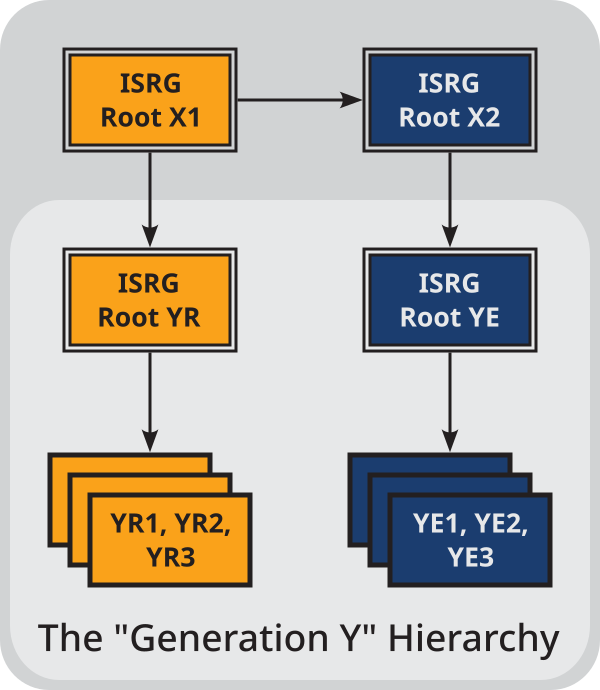
The two new roots look very similar to our existing roots. The new ISRG Root YR has an RSA 4096 key and is valid for twenty years, just like ISRG Root X1. Similarly, the new ISRG Root YE has an ECDSA P-384 key, just like ISRG Root X2. We’ve made a few adjustments (for example, replacing “Internet Security Research Group” with “ISRG” to save a few bytes), but nothing major. Each of these new roots is intended to eventually replace its corresponding predecessor, and to that end we have cross-signed the new roots from the old ones.
The six new intermediates consist of three intermediates each issued from each of the two new roots. ISRG Root YE has issued the YE1, YE2, and YE3 intermediates, while ISRG Root YR has issued the YR1, YR2, and YR3 intermediates. These have two key differences from our current crop of issuing intermediates. First, their names: we’re now numbering intermediates under each root sequentially, rather than using the same numbering sequence across all intermediates. This makes it slightly easier to keep track of which intermediates are currently in use, and prepares for a possible post-quantum future where we have additional key types.
Second and more importantly: these intermediates do not contain the “TLS Web Client Authentication” Extended Key Usage. This means that these intermediates cannot issue end-entity certificates containing that EKU. As we’ve already announced, we will be phasing out issuance of tlsClientAuth certificates in 2026 due to a root program requirement. Until that time, we will only be using the new hierarchy to issue certificates under the “tlsserver” and “shortlived” profiles, which already omit that EKU. After the tlsClientAuth deprecation is complete, we will shift to using the new intermediates for all issuance.
If you’re requesting the tlsserver or shortlived profile, you can expect to see issuance from (the Staging equivalent of) the new hierarchy as of today. We expect to make the same change in our Production environment next month. As before, each issuance will choose which intermediate to use at random, to discourage intermediate key pinning.
We’ll be submitting the new roots for inclusion in the Apple, Chrome, Microsoft, Mozilla, and other root programs shortly thereafter. We look forward to updating you again when the new hierarchy is officially included in those trust stores!
Post Syndicated from xkcd.com original https://xkcd.com/3172/
Post Syndicated from The Atlantic original https://www.youtube.com/shorts/sxF7JyRmDjA
Post Syndicated from Cliff Robinson original https://www.servethehome.com/broadcom-shows-the-pex90144-144-lane-pcie-gen6-switch-dell-sc25/
Broadcom showed off its 144-lane PCIe Gen6 (PEX90144) switch at SC25 and showed its roadmap to PCIe Gen7 and Gen8 144-lane switches
The post Broadcom Shows the PEX90144 144 lane PCIe Gen6 Switch at SC25 appeared first on ServeTheHome.
Post Syndicated from Explosm.net original https://explosm.net/comics/ugly-bat-child
New Cyanide and Happiness Comic
Post Syndicated from Home Assistant original https://www.youtube.com/watch?v=8Zj0JiVoRNs
Post Syndicated from digiblur DIY original https://www.youtube.com/watch?v=65pSKJZmi8k
Post Syndicated from jake original https://lwn.net/Articles/1047549/
The Racket programming language
project has released Racket
version 9.0. Racket is a descendant of Scheme, so it is part of the Lisp family of languages. The headline feature in the release is parallel
threads, which adds to the concurrency tools in the language: “While
”
Racket has had green threads for some time, and supports parallelism via
futures and places, we feel parallel threads is a major addition.
Other new features include the black-box
wrapper to prevent the compiler from optimizing calculations away, the decompile-linklet
function to map linklets
back to an s-expression, the
addition of Weibull
distributions to the math library, and more.