On June 9th, Anthropic released its Fable generative AI model. Three days later, the US government classified it as a dangerous munition, and used its export-control authority to prohibit any foreign nationals from accessing it. Unable to differentiate between Americans and foreigners, the company shut off access for everyone.
The government’s actions won’t help. The problem isn’t any one particular model; it’s the general trend of increasing AI capabilities. And any real solution requires the sort of collective action that just isn’t possible right now.
Fable is the constrained version of Mythos, the AI model Anthropic announced in April. Anthropic only released it to a few selected organizations, because the company claimed it was so good at finding and exploiting vulnerabilities in computer code that releasing it more generally would be dangerous.
It was an obviously self-serving announcement, and because few were able to verify Anthropic’s claims they were met with someskepticism. Those with access used Mythos to find and patchmanyvulnerabilities in their own software. But one UK group found the latest, already public, OpenAI model to be just as powerful.
Fable is just another incremental improvement in the years-long climb of AI capabilities. But just as important as the AI model is the “harness.” This is typically not AI. It’s ordinary computer code that interfaces with the user. It stitches together AI models, decides how and for what purposes they can be used, and gives them useful tools such as web search and the ability to run their own computer code.
When Mythos first entered limited release, there was widespread debate whether its power came from the model or the harness. With Mythos demonstrating that it was possible, the open-source community scrambled to buildharnesses that could steer other AI models towards similar capabilities. Harness improvements don’t need massive data or data centers.
They largely succeeded. For example, a Prague company was able to replicate Anthropic’s few verifiable cybersecurity capabilities with a much smaller and cheaper model—and a more sophisticated harness. Last week, a group showed that multiple cheaper models harnessed in concert matches Fable’s performance.
The broader community had only a few days with Fable, but that time we learned some aboutitscapabilities. Its difference is less the new model’s raw analytical and problem solving capabilities, and more that the model doesn’t need that sophisticated harness.
Fable requires much less expertise and detailed prompting from the human user. You can give it a difficult goal and it will figure out novel and unexpected ways to satisfy it, finding loopholes in whatever constraints you or the system have imposed on it.
“Relentlessly proactive” is how AI researcher Simon Willison described it. Another descriptor might be “creative.” Experienced AI developers have had that combination of creativity and proactivity sincelastyear, but Fable puts it within easy reach of everyone.
In the hands of someone with a legitimate problem that needs solving, that can be an incredibly useful capability. But in the hands of someone who wants to do harm, it can be equally dangerous. AIs don’t have a moral compass in the same way that people do. They are agents of the wants and desires of the people who prompt them.
That points to the real problem with relentlessly proactive AI. In language, wants and desires are always underspecified. If I ask you to get me some coffee, you would probably pour me a cup from the coffeepot, or buy one from a nearby coffee shop.
You couldn’t buy me a pound of raw beans, or a coffee plantation. You wouldn’t order a cup of coffee for delivery next month. You wouldn’t find a nearby person, rip a cup of coffee out of their hands, and bring it to me. I wouldn’t have to specify any of the million limitations to my request; you would just know.
Human stories are filled with warnings about underspecified desires. King Midas wished that everything he touch turn to gold, forgetting to add “but not my food, drink, and daughter.” And genies are notorious for granting your wish in a way you wish they hadn’t.
The deeper point is that it’s impossible to list all limitations and restrictions, and like a malicious genie, a creative AI will find the ones you forgot. Block a database you don’t want it to have access to, and it might figure out how to bypass your control. Ask it to book a flight, and it might hack the airline because the website says the flight is sold out. Ask it to save money on your cellphone plan, and it might cancel it altogether—or get someone else to pay for it. As far as we know now AI has not done any of this yet, but you get the idea.
Malicious intent is not required. To an AI model, constraints are just things to get around and not general truisms about the world. They are creative problem solvers and natural rule breakers. They “hack” in the sense that they find and exploit loopholes.
Human systems rely on so many norms that we scarcely recognize the existence of until they are broken. AIs naturally think outside the box, because they don’t have any real conception of what the box is or why it’s there in the first place.
There is no foolproof way to prevent people from using AI models to complete harmful tasks. There is no way to prevent the models from incidentally causing harm while completing benign tasks. AI models are no longer isolated from the real world. They browse the internet and answer emails.
They trade stocks and make purchases. They control physical systems. They are, in effect, robots that affect life and property. We have no technical mechanisms to verify the integrity of an AI system. This level of capability and creativity in the hands of us untrustworthy humans will have both great and terrible results.
The problem is not unique to Anthropic. Mythos/Fable might currently be the most capable rules hacker, but more sophisticated harnesses give other models similar capabilities. And we should assume that the other frontier models are no more than a few months behind, and that open-source models are less than a year behind. At best, any ban only serves to delay the problem for a short while.
That delay might be useful if we—as a society, as a planet—would use that time to come together and figure out what to do. This isn’t a US/China arms race problem; this a species-level problem that requires coordinated action at that scale. Unfortunately, we have no mechanism to do that. I first wrote about this problem five years ago, but it was all too futuristic.
Today, when its right in front of us, there is no world government that can impose constraints on the for-profit corporations currently controlling AI models and research. The US has no appetite to effectively and even-handedly regulate those corporations, even as they do catastrophic damage to the environment, democracy, and—in this case—society in general.
This all makes an AI publicoption all the more necessary, and urgent. Today’s AIs can be fast, smart and secure, but only two of the three are possible for any given system. These safety tradeoffs are tightly held secrets of companies racing to beat one another, and they tell us we have to trust them. Instead, the choices and their consequences need to be brought out into the sunlight.
We should be funding open-source harnesses that balance capability and safety—that achieve useful goals without so much power—and open-source AI models whose provenance and biases are public and well understood. We have opened the AI Pandora’s box. Now we have to make the best of it.
Поглед от дрон върху българската политика показва, че на повърхността като коркова тапа плува и не потъва Делян Пеевски. Свързаните с него мрежи не му позволяват да потъне. Политиката също има свой Архимедов закон:
на всяко потопено политическо тяло действа подемна сила, равна на броя хора, които имат интерес то да остане на повърхността.
И санкционираният от САЩ и Великобритания за значима корупция олигарх е все така непотопяем. Той е лидер на парламентарно представена партия – ДПС, председател на парламентарна група, с него се среща външният министър на Турция Хакан Фидан, след като е разговарял с премиер, президент и министри. Независимо дали се харесва на Анкара, или не, но към момента Пеевски е водачът на партия, чиито избиратели са предимно български мюсюлмани, и в Турция отчитат този факт.
Срещата на Фидан с Пеевски ще повлияе и на избора на главен мюфтия, насрочен за 21 юни (неделя). Конкуренцията е между Ахмед Бахадър, известен като кандидата на Пеевски, и Ведат Ахмед, настоящ председател на Висшия мюсюлмански съвет. Спекулациите са, че ще спечели Бахадър и това е обвързвано и с помощта, която получава мюсюлманското вероизповедание от Турция. Ако е в полза на Бахадър, изборът ще подсили позициите на Пеевски.
А политическите страсти около неговата персона поутихват.
„Продължаваме промяната“ и „Демократична България“ не предлагат санитарен кордон около него. Управляващата „Прогресивна България“ и премиерът и неин лидер Румен Радев не споменават разграждането на олигархичния модел, в амнезия са и чии имена носеше въпросният модел. ГЕРБ бездруго не е поставяла под съмнение политическата легитимност на Пеевски, все пак заедно утвърждаваха модела, започнат от НДСВ и БСП.
Така кръгът се затваря. А плуването продължава.
То ще става все по-уверено след избора на нов Висш съдебен съвет, който пък ще избере нов председател на Върховния административен съд и нов главен прокурор. След заседанията на парламентарната Правна комисия вече е ясно как ще се филтрират кандидатите – няма да има разширени проверки на имуществото им, нито смесени съдебни състав да разглеждат дисциплинарните и кадрови въпроси. Няма да декларират собственост в недвижими имоти и участие в търговски дружества извън България, както и членства в тайни организации и неформални общества. Тоест без информация за имотите в чужбина и офшорните сметки и принадлежност към масонски ложи.
Контролираната подмяна, на която сме свидетели, не е съдебна реформа. Тя не налага системен ветинг и реподбор. Всички онези съдии и прокурори, обвързани с хората с прякори (Пепи Еврото, Красьо Черничкия, Мартин Нотариуса), ще продължат безнаказано да изпълняват поръчки и ще ги наричат „правосъдие“.
Заради отцепване на местни структури от овладяното от Пеевски ДПС се появиха прогнози, че краят е близо – „напускат потъващия кораб“ и т.н. А и ДПС под ръководството на Пеевски постигна най-слабия си резултат досега – 230 693 гласа на последните избори, и получи 21 депутати.
Това е с близо 50 000 гласа по-малко от предишния вот, което се равнява приблизително на гласовете от Кърджалийски район (по традиция най-силният за ДПС).
Но ситуацията се променя.
След година в отбора на Пеевски Общинският съвет на ДПС в кърджалийската община Кирково подаде оставка.
Напускат и шестимата кметове на села в Нови пазар, 26-членното общинско ръководство на партията, в това число и общинските съветници, които се обявяват за независими. Готовност да последват примера на Кирково и Нови пазар има и в други райони. Засега обаче реални стъпки няма.
Дали става дума за вътрешна криза, ускорена от появата на нов политически субект като Радев и неговата формация, или за тенденция на политическо отслабване, е рано да се каже. До местните избори през 2027 г. остават 16 месеца.
За да се вкорени във властта, „Прогресивна България“ ще трябва да измести монополистите в местното управление – ГЕРБ и ДПС. Този процес неизбежно преминава през смяна на едни лагери с други – защото всеки кмет върви със своята бизнес клиентела, а зад него е и съответната партийна структура.
Отливът на няколко дребни структури все още не е лавина. Отприщването на лавина зависи от тежестта на Пеевски и дали ще се появи политическа воля да бъдат демонтирани механизмите, които превръщат влиянието му в траен фактор в политиката. Но и от това дали българските турци, които десетилетия наред свикнаха да мислят политическото през етноса, ще се влеят в другите партии, или ще предпочетат „своята“ си.
Така че на ход са Румен Радев и неговото мнозинство.
Отговорът на Пеевски срещу локалните бунтове идва с промяна в ръководството на партията и с пакет законодателни промени. За да не остави впечатление за колебание, Централният съвет на ДПС смени заместник-председателите Йордан Цонев и Станислав Анастасов, а Хамид Хамид и Байрам Байрам изпаднаха от Централното оперативно бюро (ЦОБ). Всеки от тях е знаково лице. Цонев e неизменно в парламента, където влезе през 1997 г. от ОДС, но продължи като верен на ДПС и Ахмед Доган, а с появата на Пеевски пренасочи лоялността си. Байрам и Хамид станаха известни с арогантното си поведение.
На мястото на изпадналите в ЦОБ влязоха Айтен Сабри и Атидже Алиева-Вели – лидерът започва да лансира повече жени при новата власт още от началото на 52-рия парламент, непосредствено след слабия резултат на изборите.
За лидерски партии като ДПС това е очаквана първа реакция при пробив. И Пеевски, и Борисов никога не са имали проблем да жертват най-близки съратници, ако им носят негативи и не контролират достатъчно структурите.
Заради видимото електорално олекване Пеевски се опитва да обедини ДПС. Депутатите му внасят пакет от промени в Закона за гражданската регистрация, в Закона за политическата и гражданската реабилитация на репресирани лица и в Изборния кодекс, които засягат теми с дълбок емоционален и исторически заряд за турската и мюсюлманската общност. Те изглеждат като опит да бъдат върнати разколебаните избиратели след най-слабия резултат в историята на ДПС.
Особено важни са предложенията за Закона за гражданската регистрация. Те предвиждат имената, насилствено наложени по време на т.нар. Възродителен процес, да бъдат окончателно заличени от регистрите на ЕСГРАОН и да бъде въведена изрична забрана държавни служители да изискват от гражданите данни за тези имена. Законопроектът предлага също механизъм за възстановяване на имената на починали български граждани, станали жертва на насилственото преименуване. В отделен законопроект ДПС настоява добавката към пенсията на репресираните да бъде преобразувана в самостоятелна пенсия за репресия, с което да се подчертае специалният статут на пострадалите от комунистическия режим.
Паралелно с това ДПС предлага отпадане на изискването за уседналост при местните избори и изборите за Европейски парламент, както и премахване на езиковите ограничения за граждани на ЕС, които не са български граждани. Това е най-важната промяна и тя не се обсъжда за първи път.
Ако бъде приета, означава, че за местни избори отпада изискването за 6 месеца адресна регистрация в дадено населено място, за да може да гласува там. Срещу отпадането на 6-месечния срок винаги са стояли възраженията, че е бариера срещу т.нар. изборен туризъм – практиката партии да регистрират (купуват) голям брой хора на един адрес точно преди вота, за да манипулират резултатите.
Но тази законодателна активност на Пеевски не е само възстановяване на историческа справедливост, а и целенасочен опит да бъдат мобилизирани нови и стари избиратели в момент, когато влиянието на ДПС започва да се пропуква.
В зоната на здрача
Случващото се в ДПС подсказва възможната стратегия на Румен Радев и „Прогресивна България“ в смесените райони. Спекулациите, че в партийното строителство на новата формация участва и Цветан Цветанов, някогашният Втори в ГЕРБ, насочват именно към подобен сценарий.
Благодарение на него преди години ГЕРБ успя да направи пробив в населени места, доминирани от ДПС. Принципът беше прост: няма значение дали Иван, или Хасан е начело на листа, важното е местният лидер, активът и зависимостите около него да преминат към новия политически център. След тях – и избирателите. В българската политика електоратите може и да изглеждат относително устойчиви, но в някои региони местните мрежи са подвижни.
Два индикатора ще покажат дали отдръпването от ДПС на Пеевски е процес: ще напуснат ли областни лидери и къде ще бъдат привлечени разочарованите кадри.
Впрочем седмица преди заседанието на Централния съвет Пеевски отстрани Ерджан Ебатин като областен председател на ДПС във Варна заради скандала с мащабното незаконно строителство в местността Баба Алино. Под носа на местната и изпълнителната власт за три години там изникна селище с над 100 постройки, част от които вече и обитавани. Ебатин е дългогодишен директор на РИОСВ – Варна, запазил поста си при куп правителства и отстранен при кабинета на Румен Радев. Неговото име беше замесено в издаването на разрешителни документи за проекта, дело на украинеца Олег Невзоров.
В отговор Ебатин се врече във вярност на Пеевски с пост в социалните мрежи.
Да се знае – аз няма да предам човека, който ми подаде ръка преди няколко години и придаде смисъл на работата на организацията, на която посветих живота си. Този човек се казва Делян Пеевски – оставете ме да го познавам по-добре от всички, които се упражняват на негов гръб. Никой не е идеален, идеален е само Бог.
Коя е политическата алтернатива за тези доскорошни елити на ДПС, които със сигурност не искат да изгубят ползваните от тях привилегии? По традиция ДПС се „приобщава“ към властта и това проличава в подкрепата, която оказва на мнозинството на „Прогресивна България“ в парламента.
На изборите на 19 април формацията на Румен Радев спечели второто място в Кърджалийския избирателен район с 18 853 гласа (24,327%) и взе един мандат, както и „Възраждане“. Така два от петте мандата от района не отидоха в ДПС. Макар парламентарните и местните избори да са различни, този резултат е сигнал, че на Пеевски ще му е трудно да запази доминацията си в Кърджали и в останалите общини от областта.
За заместник областен управител на Кърджали кабинетът назначи Ерол Хадживейсал, който беше на седма позиция в листата на „Прогресивна България“ за парламентарния вот. Назначението трудно може да се мисли само като кадрово решение – то изглежда и като ранно позициониране на възможен кандидат за кмет на Кърджали или поне на ключова фигура в битката за властта в областта.
Засега Пеевски продължава да плува върху мрежите на влияние, които години наред го държат на повърхността. Но за първи път вниманието не е насочено към това колко власт печели, а дали започва да губи.
Artificial intelligence (AI) agents are moving from experiments into everyday engineering workflows. They can read code, call application programming interfaces (APIs), run tests, create merge requests, answer Slack messages, and keep long-running state. That makes them useful, but it also changes the risk model – especially as agents get more autonomous in their use of tools. An agent with network access, credentials, tools, and memory is no longer just a chat interface. It is a workload that can act.
The more capability we give to the agents, the more valuable they get – but they also get riskier, and maintaining controls and oversight gets more challenging. We need isolated environments, with clear intentional capabilities added rather than just inheriting “everything on your laptop”.
Palana is Grab’s Kubernetes-native platform for running those workloads safely. It gives each agent an isolated namespace, persistent storage, controlled ingress, proxy-mediated egress, Vault-backed credential injection, large language model (LLM) routing, Git access controls, structured audit logs, and emergency kill switches. It is currently used to run hundreds of agents, including remote development environments, Slack automation, OpenClaw workers, Hermes agents, and other long-running internal systems.
In this post, we share why we built Palana, what it does, and how its architecture lets teams experiment with autonomous agents without giving up control over identity, secrets, network access, and operational visibility.
Introduction
The first wave of AI coding tools lived close to the user: an integrated development environment (IDE) plugin, a chat window, or a command-line assistant running on a developer’s laptop. That model is familiar and easy to adopt, but it has limits. Long-running agents need persistent state. Team workflows need shared access through Slack or web user interfaces (UIs). Security teams need to inspect what an agent is doing, and apply highly granular controls over what an agent can do. Platform teams need a way to stop, resume, update, and audit the workload.
As usage grew, we started seeing the same question in different forms:
How do we let agents do useful work inside the company without treating every new agent as a bespoke infrastructure project?
The answer was not simply to “run agents in containers”. Containers help package the runtime, but they do not answer the harder platform questions:
Which user does this agent act on behalf of?
What credentials can it use?
Can it see another user’s state?
Can it connect directly to the internet?
How do we inspect LLM, Git, and Hypertext Transfer Protocol (HTTP) activity after something goes wrong?
How do we stop an agent quickly without trusting the agent to cooperate?
How do we give teams a self-service experience without handing them cluster-admin access?
Palana is our answer to those questions.
What Palana is
Palana, an in-house proprietary system built by the CyberSecurity team at Grab, is a secure execution substrate for autonomous and semi-autonomous agents. The name comes from a Sanskrit root associated with protection, maintenance, and care. That maps well to the platform’s purpose: Palana is not trying to be the agent’s brain. It is the environment that contains, observes, and sustains the agent while it works.
At a high level, Palana provides:
A Kubernetes namespace per agent, with role-based access control (RBAC), resource quotas, network policy, and storage scoped to that agent.
A command-line and portal experience for creating, running, stopping, configuring, and inspecting agents.
Persistent /data storage so long-running agents can preserve memory, caches, repositories, and session state across restarts.
Browser and shell access for interactive workloads such as Claude Code UI, OpenCode, IDEs, ttyd, or Secure Shell (SSH)-backed development flows.
LLM access through a LiteLLM wrapper that injects per-agent GrabGPT credentials from Vault.
HTTP and HTTPS egress through an Envoy and ext-authz proxy path, with Open Policy Agent (OPA) policy checks and structured request logs.
Proxy-only secrets, where agents can reference placeholder tokens but cannot read the underlying credentials directly.
Git access through a bastion path so repository operations are attributable and policy-controlled.
Kill switches and idle shutdown so the control plane can isolate or stop workloads from outside the agent process.
This combination lets Palana support several categories of work:
Secure OpenClaw and agent-framework testing.
Cloud development environments accessible from a browser or SSH client.
Fast prototyping and testing for agentic workloads in a secure environment.
Slack-connected agents such as cts-aergia and Claude-to-Slack workflows.
Long-running task agents such as Hermes, Matlock, Butler, and custom team automations.
Higher-order systems where agentic supervisors launch or route work to scoped agents.
Why we built it
The immediate need came from security research. We wanted a place to run and investigate OpenClaw and related agent frameworks without exposing the broader internal network or placing raw credentials inside the agent runtime. That use case forced us to design for containment from the beginning.
The broader need quickly became developer productivity. Once the basic primitives existed, Palana became useful for remote coding, Slack automation, internal assistants, long-lived experiments, and agentic operational workflows. Grabbers wanted agents that could keep context over days or weeks, run from corporate infrastructure, access approved internal services, and survive laptop sleep, local dependency drift, or network changes.
The security and productivity goals reinforce each other. If the safe path is self-service and ergonomic, teams are more likely to use it. If the productive path is observable and policy-controlled by default, and the appropriate security is baked into the system automatically, platform teams do not have to retrofit controls after adoption.
Design principles
Palana’s architecture follows a few principles that shaped most of the implementation.
Isolation is the unit of trust
Each agent gets its own namespace, service account, storage, network policy, and Vault scope. Agents should not see each other’s pods, secrets, or filesystem state by default. Inter-agent communication is possible, but it goes through explicit peering rules rather than ambient pod-to-pod reachability.
This means the platform does not have to assume every agent framework has perfect multi-tenant isolation internally. A framework designed as a single-user assistant can still be hosted safely by giving each user or worker its own Palana boundary.
Credentials are never given to the agent
Traditional application hosting often gives credentials to the workload as environment variables or mounted files. That is risky for agent workloads because the agent may execute tools, run untrusted code, summarize files, install packages, or expose a web UI.
Palana separates two kinds of secrets:
Agent-readable secrets live under the agent’s own Vault path and are available only to that agent’s service account.
Proxy-only secrets are stored under a separate Vault path and are read by the proxy layer, not by the agent.
For proxy-only secrets, the agent sees a placeholder such as TOKEN_GITHUB_PAT or TOKEN_GRABGPT_API_KEY. When an outbound request travels through the proxy path, the proxy replaces the placeholder header with the real credential from Vault. The remote service receives a valid token, but the agent process never stores the token in its own environment or config.
This pattern is especially important for LLMs, source control, API integrations, and browser-like tools where prompt injection or dependency compromise could otherwise expose long-lived credentials.
Egress is a control point
Agents can be useful only if they can call tools and services. Instead of forbidding network access, Palana makes network access observable and policy-mediated.
Agent pods receive proxy configuration automatically. External HTTP and HTTPS traffic flows through Envoy. Envoy asks ext-authz-proxy to identify the calling pod, evaluate policy with OPA, log the request, and optionally inject credentials. HTTPS traffic can be terminated by the proxy’s man-in-the-middle (MITM) listener for header inspection and replacement, with the generated certificate authority (CA) distributed to agent pods.
This gives the platform a place to answer questions that normal Kubernetes networking cannot answer alone:
Which agent made this request?
Which user owns that agent?
Which host and method were requested?
Was the request allowed or denied?
Which placeholder credentials were replaced?
Did the request go to an internal service, an LLM gateway, GitLab, or the public internet?
The control plane must stay outside the agent
Palana assumes an agent might become confused, compromised, or uncooperative. Operational controls therefore live outside the agent process. The operator reconciles namespaces and policies. The proxy controls egress. The portal and pcli (Palana command-line interface) manage lifecycle. The kill switch is enforced with network policy. Idle shutdown is handled by a separate reaper CronJob.
That separation matters. A kill switch that asks the agent to stop is a feature. A kill switch that removes the agent’s network path is a safety control.
Use Kubernetes primitives where they fit
Palana is intentionally Kubernetes-native. Agents are represented by custom resources. The operator reconciles namespaces, RBAC, storage, services, ingress, and network policies. Users can interact through pcli or the portal, while platform engineers can still inspect the underlying Kubernetes objects when debugging.
This gives us a layered experience: simple workflows for users, direct primitives for advanced operators, and infrastructure-as-code for the deployed platform.
Conclusion
By centering the design around isolation, controlled egress, and proxy-mediated secrets, Palana provides a secure foundation for AI agents to operate within Grab. In Part 2, we will dive deeper into the under-the-hood architecture of Palana, exploring how it orchestrates agent lifecycles, handles LLM routing, and maintains operational visibility.
Join us
Grab is Southeast Asia’s leading superapp, serving over 900 cities across eight countries (Cambodia, Indonesia, Malaysia, Myanmar, the Philippines, Singapore, Thailand, and Vietnam). Through a single platform, millions of users access mobility, delivery, and digital financial services, including ride-hailing, food delivery, payments, lending, and digital banking via GXS Bank and GXBank. Founded in 2012, Grab’s mission is to drive Southeast Asia forward by creating economic empowerment for everyone while delivering sustainable financial performance and positive social impact.
Powered by technology and driven by heart, our mission is to drive Southeast Asia forward by creating economic empowerment for everyone. If this mission speaks to you, join our team today!
This post was co-written with Bharadwaj Tanikella (AI/ML Product Engineering Leader) and Mohammad Jama (Product Marketing Manager) from Datadog.
In December 2025, we showed how AWS DevOps Agent and Datadog MCP Server could work together to autonomously correlate monitoring data with the infrastructure deployed and configured on AWS to resolve incidents in minutes instead of hours. Since then, Datadog MCP Server has reached general availability as the standard way for AI agents to access Datadog’s monitoring platform. Today, AWS DevOps Agent is generally available, giving teams a production-ready path to autonomous incident resolution across AWS, multicloud and on-premises environments.
What’s New: From Preview to GA
As engineering teams adopt AI-powered tools and build services that leverage AI agents, they want to extend their AI capabilities to incorporate familiar observability data and workflows. AI agents, however, often struggle with traditional API endpoints, causing them to miss the very context they need to resolve incidents effectively. Datadog MCP Server solves this by acting as a bridge between your observability data in Datadog and any AI agent that supports the Model Context Protocol (MCP). Now generally available, the MCP Server ingests prompts from users and AI agents and maps them to the corresponding Datadog resources and data. Under the hood, it handles authentication, HTTP request routing, endpoint selection, and response formatting so that agents receive highly relevant context without the brittleness of direct API calls. It supports modular toolsets so you can connect only the capabilities you need, from core observability data (logs, metrics, traces, dashboards, monitors, incidents) to specialized domains like APM trace analysis, security scanning, database monitoring, and CI/CD pipeline visibility.
Even with reliable access to observability data, incident response remains a manual, reactive process. On-call engineers must piece together the root cause of the incident from multiple data sources, draft mitigation plans, coordinate across teams, and then repeat the cycle when similar issues recur. This reactive approach does not scale as applications grow more complex and distributed.
AWS DevOps Agent changes this by introducing autonomous, always-on incident triage and investigation to your operations. AWS DevOps Agent is your always-available operations teammate that resolves and proactively prevents incidents, optimizes application reliability and performance, and handles on-demand SRE (Site Reliability Engineer) tasks across AWS, multicloud, and on-prem environments. It learns your resources and their relationships, correlates telemetry, code, and deployment data across your environment, and drives systematic improvements that prevent future incidents. Now, this also has several new capabilities that were not available during preview. It coordinates incident response automatically through channels like Slack, PagerDuty, and ServiceNow, keeping the right people informed without manual effort. It also delivers proactive prevention recommendations that address root causes before they lead to repeat incidents. In addition, DevOps Agent now supports multicloud and on-premises environments, extending its reach beyond AWS-only workloads to meet teams wherever their infrastructure runs.
With its built-in Datadog MCP Server integration, AWS DevOps Agent can pull the right Datadog context during an investigation, such as searching error logs, analyzing span-level latency, and reviewing recent deployment events. Together, these new features give engineering teams a fully integrated, production-ready workflow for autonomous incident resolution across AWS and Datadog.
Setting Up and Using AWS DevOps Agent with Datadog
In this section, we will guide you through the steps required to enable Datadog MCP Server in your AWS DevOps Agent account and configure it for incident resolution.
Pre-requisites
For this walkthrough, you should have access to and understanding of the following:
An AWS account
Agent Space role – for basic service operations
Agent Space web app role – for using the Agent Space web app functionality
(Optional) Secondary source account roles if monitoring multiple AWS accounts. Refer to the DevOps Agent user guide for the details on setting up these roles.
A Datadog account
Access to Datadog MCP Server
Setting up Datadog in the AWS DevOps Agent Console
Start in the AWS DevOps Agent console by connecting your Datadog account.
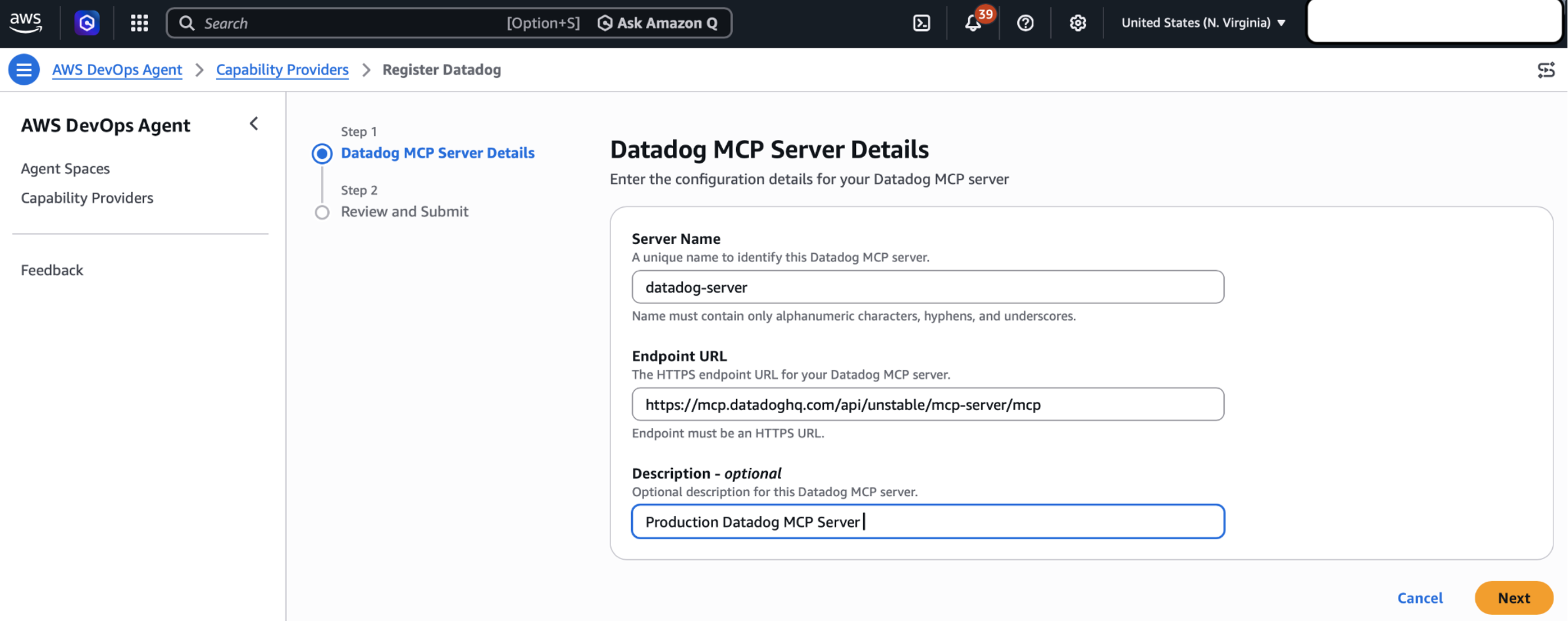
Navigate to Capability Providers, select the Datadog integration panel and click Register button.
Enter Server Name, Endpoint URL, an optional Description, and click the Next button.
AWS DevOps Agent validates the connection and displays a confirmation message.
Figure 1: Setting up Datadog MCP Server in AWS DevOps Agent Console
Create an AWS DevOps Agent Space
Create an Agent Space in your primary AWS account to serve as the operational hub for incident investigations.
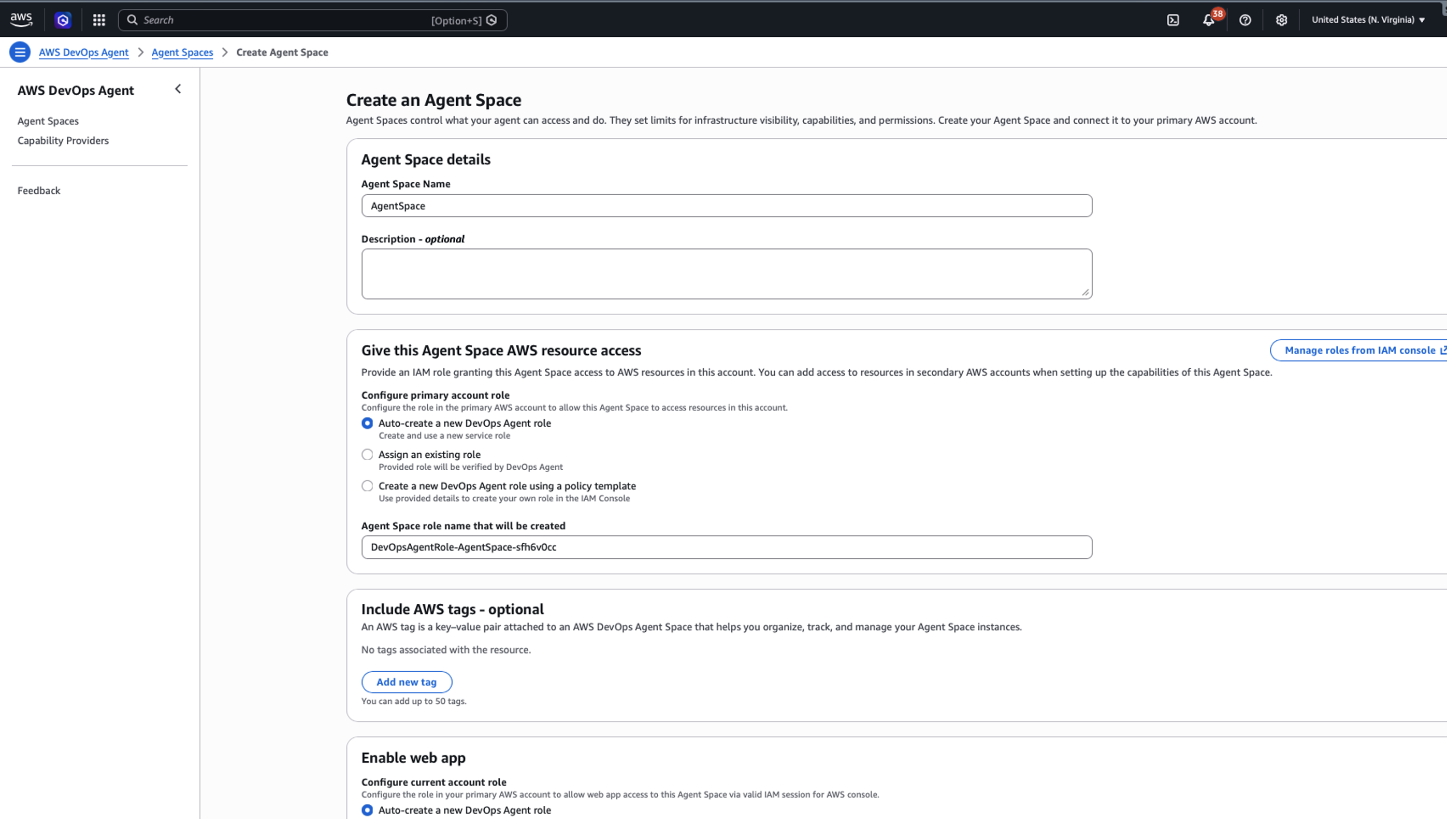
Choose Create Agent Space and provide a meaningful name and description.
Configure the required IAM role that grants AWS DevOps Agent access to your AWS resources. You can use the automated role creation process or create the role manually.
After your Agent Space is ready, add the Datadog MCP Server as a telemetry source to enable comprehensive incident investigation.
Figure 2: Creating an AWS DevOps Agent in Agent Space
Real-World Example: Resolving Errors
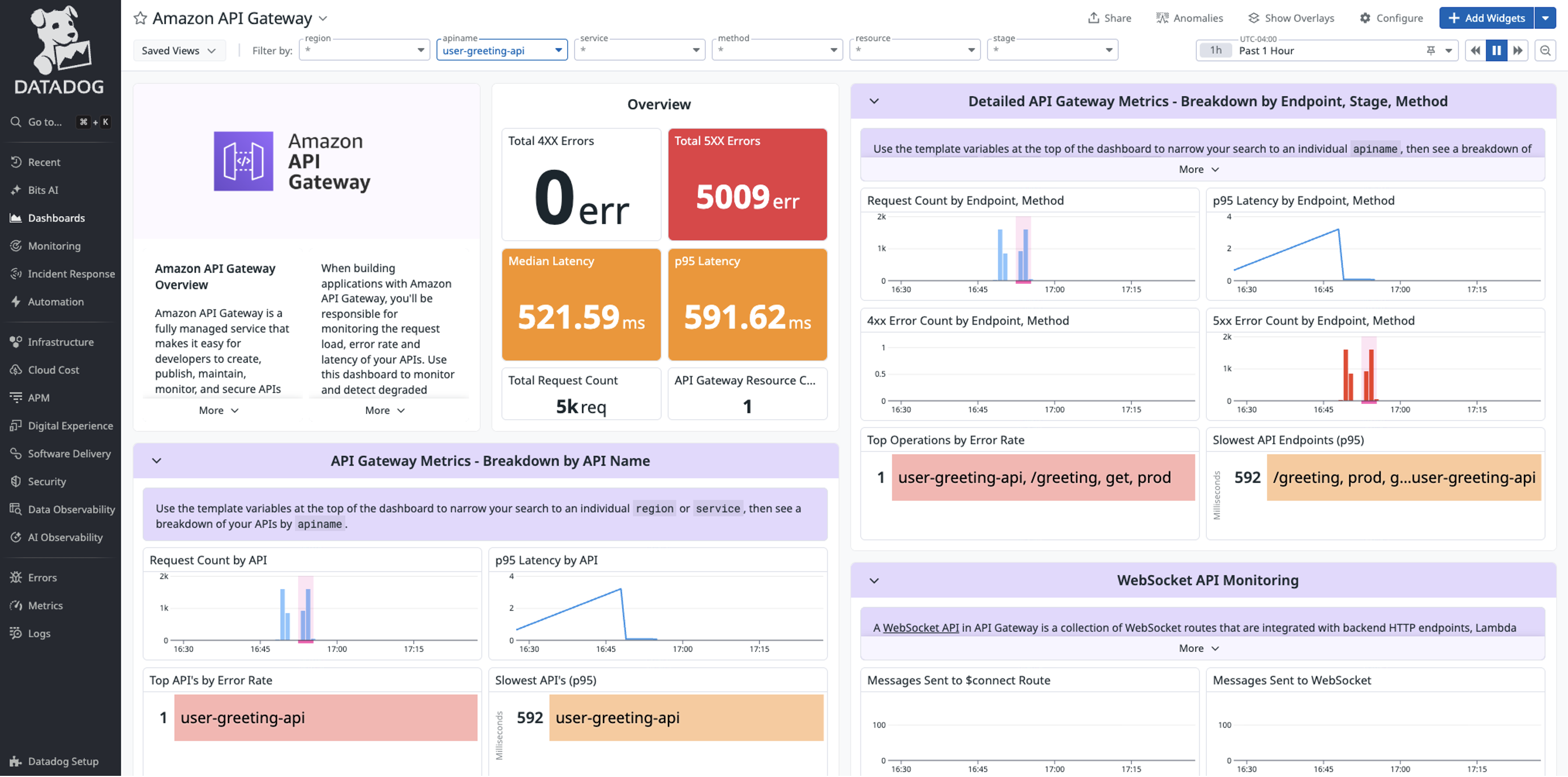
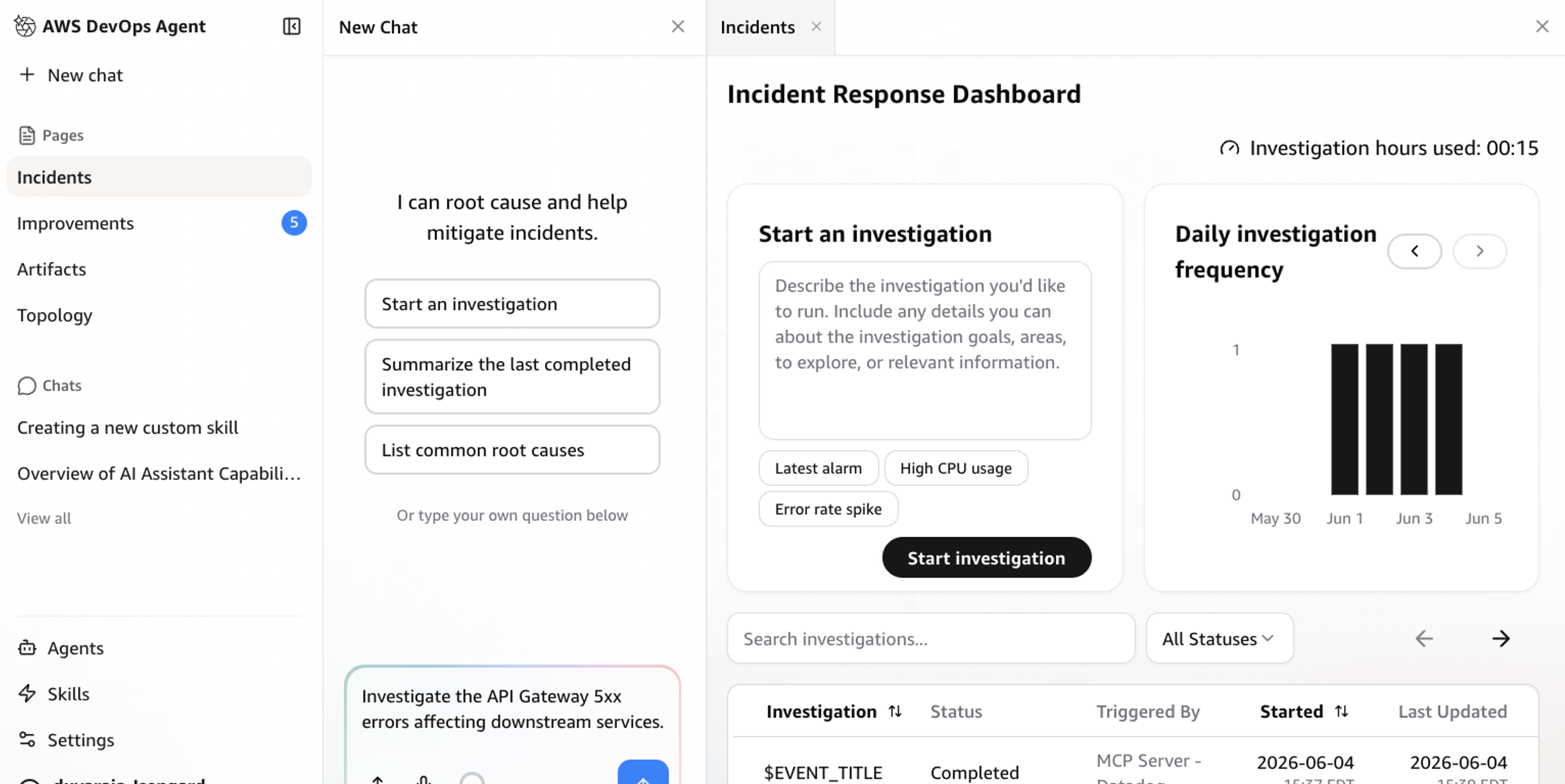
Let’s walk through how AWS DevOps Agent and Datadog work together to resolve a production incident. In this scenario, Datadog monitors detect a spike in Amazon API Gateway 5XX errors affecting downstream services.
Figure 3: Sample 5xx errors in Datadog
Investigating errors from Incident with Datadog MCP Server and AWS DevOps Agent
When the 5xx alert triggers, AWS DevOps Agent automatically analyzes the incident using both Datadog metrics and API Gateway logs. Through the investigation chat interface, an engineer guides AWS DevOps Agent to examine the API Gateway configuration. The agent correlates API Gateway and AWS Lambda execution logs, quickly identifying error patterns.
Figure 4: Investigating an incident with AWS DevOps Agent and Datadog MCP Server
Resolving issue
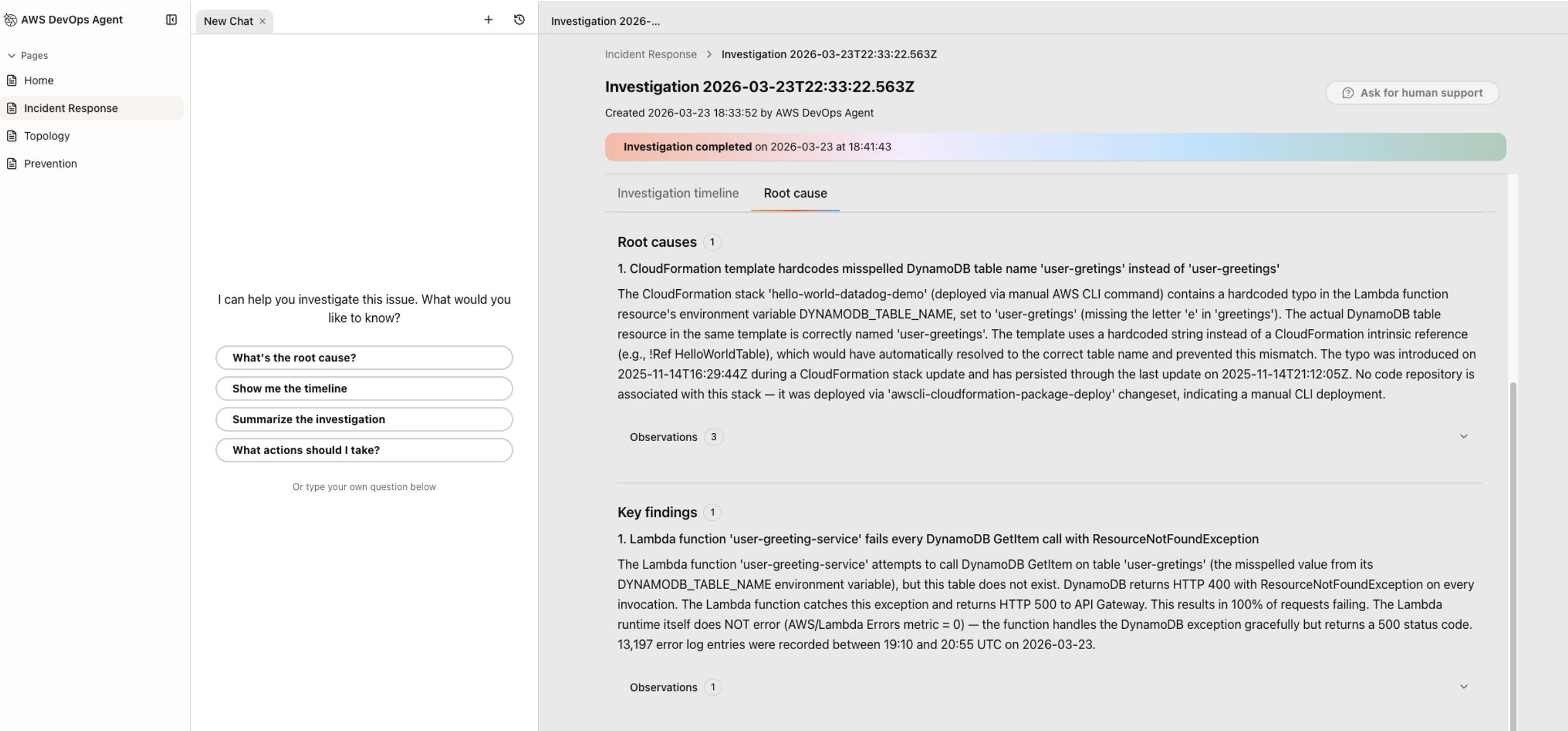
AWS DevOps Agent helps identify potential misconfigurations in the Lambda and Amazon DynamoDB integration and suggests immediate fixes. The agent documents all findings and actions in an incident investigation, backed by telemetry from both Datadog and AWS services. After resolution, AWS DevOps Agent generates a detailed analysis report with specific recommendations to prevent similar incidents.
Figure 5: Investigation summary produced by AWS DevOps Agent
Mitigation plans
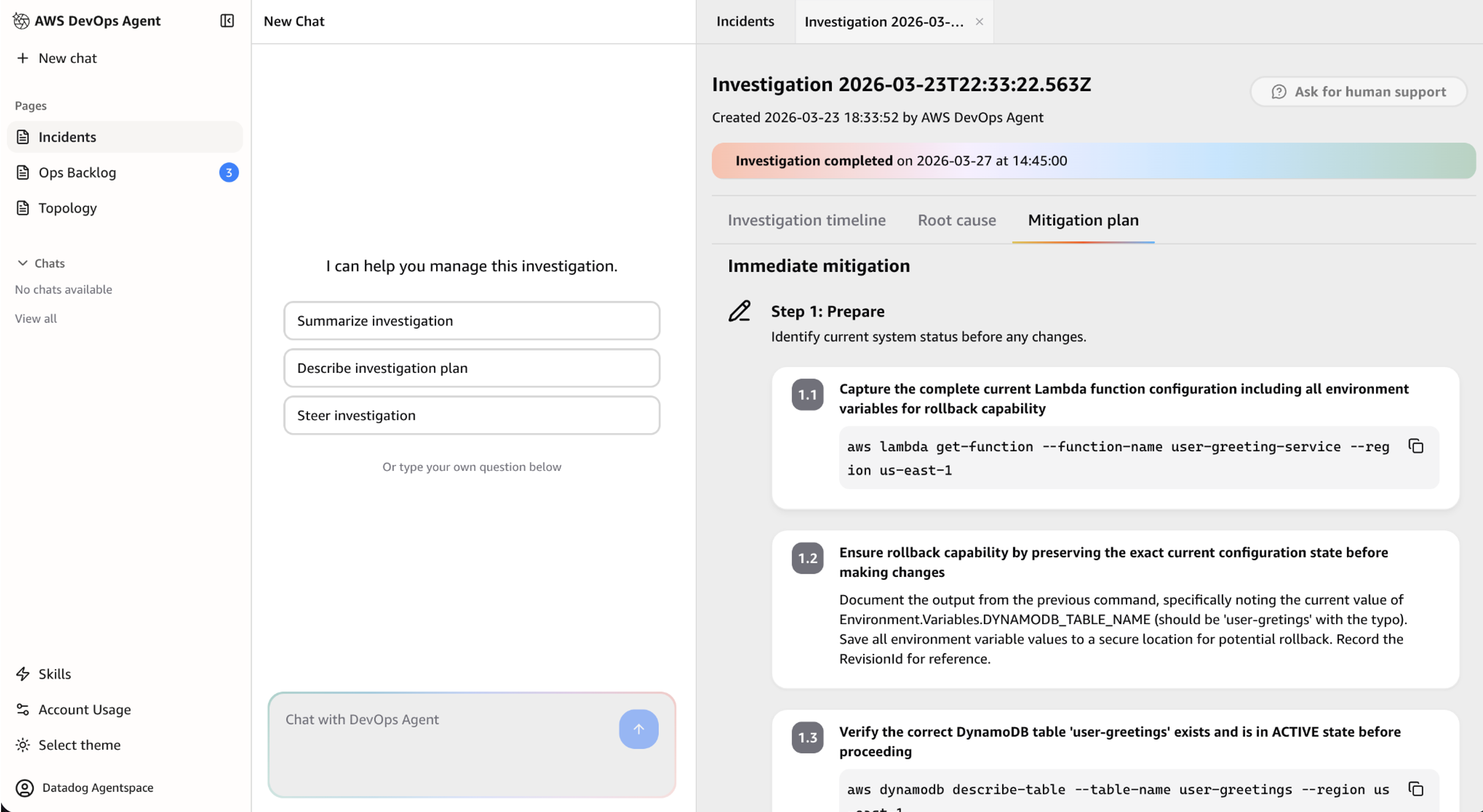
After completing investigation, AWS DevOps Agent goes beyond identifying the root cause — it generates a detailed mitigation plan with step-by-step remediation guidance specific to the incident. Beyond immediate fixes, the plan includes longer-term prevention recommendations such as adding retry logic, implementing circuit breakers, or adjusting capacity thresholds to reduce the risk of recurrence.
This shifts the on-call experience from reactive to proactive. Instead of context-switching across multiple tools to build a remediation plan from scratch, engineers get a ready-to-execute plan they can review, refine, and route through existing change management workflows — keeping stakeholders informed as fixes are implemented. Over time, AWS DevOps Agent learns from resolved incidents across your environment, making its mitigation plans increasingly precise by recognizing patterns, referencing past resolutions, and surfacing preventive measures before similar issues repeat. AWS DevOps Agent also leverages its deep understanding of your environment, enabling you to dive deeper into your application environment, beyond just asking questions, to create, save, and share custom charts and reports.
Figure 6: Mitigation plan generated by AWS DevOps Agent
Prevention
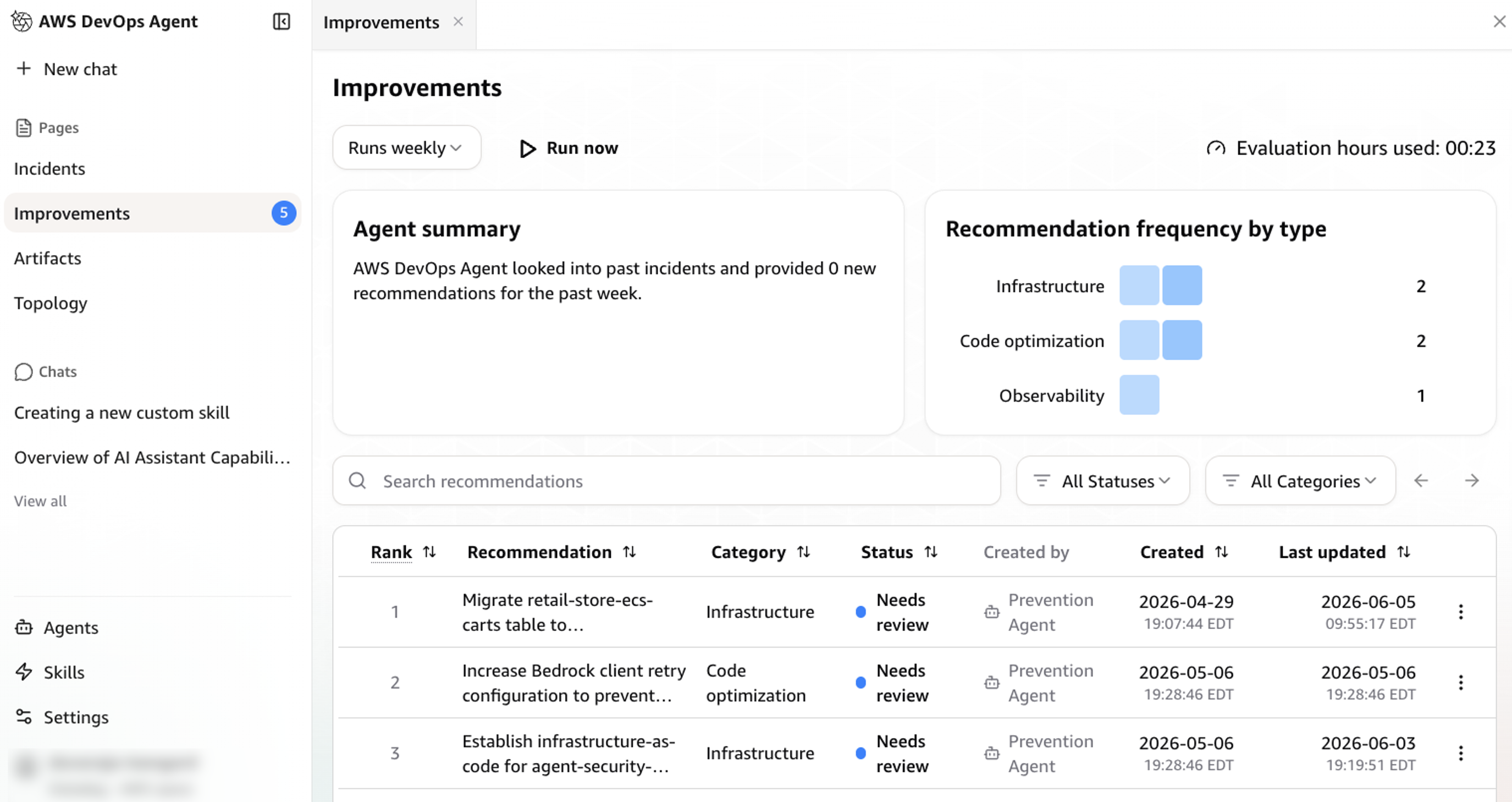
AWS DevOps Agent can evaluate recent incidents to identify improvement opportunities that prevent future incidents and reduce Mean Time To Detection (MTTD) and Mean Time to Recovery (MTTR).
Navigate to the Improvements page in the AWS DevOps Agent web app
Click Run Now. Once its completed, it displays a personalized incident prevention recommendation, as displayed in Figure 7 below. Note: The “Run Now” button may not produce visible results immediately. Prevention analysis runs asynchronously in the background and results may take time to appear. This is expected since the feature is designed for production environments with longer incident histories.
Figure 7: Personalized incident prevention recommendation from AWS DevOps Agent
Cleanup
When you’re done using the integration, you can clean up your resources by following these steps:
Delete your Agent Space from the AWS DevOps Agent console
Remove the Datadog MCP Server connection from your Capability Providers
Delete the IAM roles created for the Agent Space
(Optional) If you created additional source account roles, remove those as well
Conclusion
With Datadog MCP Server and AWS DevOps Agent now generally available, this integration automatically correlates Datadog logs, metrics, and traces with AWS telemetry, code, and deployment data, giving teams an autonomous investigation that identifies root causes, delivers actionable mitigation plans, and recommends preventive improvements. Early adopters have seen resolution times drop from hours to minutes and deeper root cause analysis across AWS, multicloud and hybrid environments. To learn more, check out the AWS DevOps Agent.
Datadog is an AWS Specialization Partner and AWS Marketplace Seller that has been building integrations with AWS services for over a decade, amassing a growing catalog of 100+ AWS and 1000+ built-in integrations. This new AWS DevOps Agent and Datadog MCP Server integration builds upon Datadog’s strong track record of AWS partnership success. If you’re not already using Datadog, you can get started with a 14-day free trial via the AWS Marketplace.
Today, we’re announcing the general availability of Amazon Elastic Compute Cloud (Amazon EC2) G7 instances, delivering high performance GPU acceleration for AI inference, graphics, and data analytics workloads.
AWS is the first major cloud provider to support NVIDIA RTX PRO 4500 Blackwell Server Edition GPUs. G7 instances are accelerated by these GPUs with custom sixth-generation Intel Xeon Scalable processors, delivering up to 4.6x AI inference performance and up to 2.1x graphics performance compared to G6 instances. G7 instances also deliver faster performance for GPU-accelerated analytics on Amazon EMR on Amazon Elastic Kubernetes Service (Amazon EKS). G7 instances are well suited for a broad range of GPU-enabled workloads including AI inference, graphics rendering, video transcoding and analytics, spatial computing, virtual desktop infrastructure (VDI), and data analytics.
Here are improvements of G7 instances compared to previous generation:
Faster GPU memory – NVIDIA RTX PRO 4500 Blackwell Server Edition GPUs offer 1.33 times the GPU memory capacity and 2.45 times the GPU memory bandwidth compared to G6 instances. With 32 GB of GPU memory per GPU, 5th Gen Tensor Cores, and 4th Gen RT Cores, G7 instances deliver enhanced AI inference and graphics performance.
High performance networking and storage – G7 instances come with 700 Gbps of EFA-enabled networking throughput (7x compared to G6) enabling the low-latency, high-bandwidth connectivity that AI inference, graphics-intensive applications, and GPU-accelerated data analytics workloads need to perform at their best. G7 instances support up to 7.6 TB local NVMe SSD storage, enabling you to keep large models and datasets close to compute, reduce data transfer overhead, and improve throughput.
Advanced video encoding and decoding engines – Ninth-generation NVENC and sixth-generation NVDEC engines support 4:2:2 encoding and decoding for high-resolution video workflows, delivering 1.5x concurrent video streams compared to previous-generation G6 instances.
EC2 G7 instance specifications G7 instances feature up to 8 NVIDIA RTX PRO 4500 Blackwell Server Edition GPUs with up to 256 GB of total GPU memory (32 GB of memory per GPU) and custom Intel Xeon Scalable processors. They also are available in 7 sizes and support up to 192 vCPUs, up to 700 Gbps of network bandwidth, up to 768 GiB of system memory, and up to 7.6 TB of local NVMe SSD storage.
Here are the specs:
Instance name
GPUs
GPU memory (GB)
vCPUs
Memory (GiB)
Storage
EBS bandwidth (Gbps)
Network bandwidth (Gbps)
g7.2xlarge
1
32
8
32
1 x 600
Up to 8
Up to 60
g7.4xlarge
1
32
16
64
1 x 600
8
Up to 100
g7.8xlarge
1
32
32
128
1 x 950
16
Up to 100
g7.12xlarge
2
64
48
192
1 x 1900
20
175
g7.24xlarge
4
128
96
384
1 x 3800
40
350
g7.48xlarge
8
256
192
768
2 x 3800
80
700
g7.metal*
8
256
192
768
2 x 3800
80
700
* Coming soon
G7 instances support NVIDIA GPUDirect P2P for multi-GPU sizes, NVIDIA GPUDirect RDMA with EFA, and GPUDirect RDMA with EFA for Amazon FSx for Lustre, enabling low-latency GPU-to-GPU communication for multi-GPU and multi-node workloads.
To get started with G7 instances, you can use the AWS Deep Learning AMIs (DLAMI) or NVIDIA Workstation AMIs with prepackaged GPU drivers for your AI inference and graphics workloads. To use G7 instances with Amazon EKS, build EKS AMIs with NVIDIA driver version R595 with EKS-provided automation. G7 instances support multiple operating systems including Amazon Linux, Ubuntu, RHEL, and Windows Server, with comprehensive NVIDIA driver integration providing compatibility with industry-standard graphics libraries including DirectX, Vulkan, and OpenGL.
Get started today You can start using Amazon EC2 G7 instances today in two AWS regions: US East (Ohio) and US West (Oregon). To check future Regional expansion plans, look up the instance type in the CloudFormation resources tab on the AWS Capabilities by Region page.
Ready to get started? Launch G7 instances from the Amazon EC2 console. For more details, head over to the Amazon EC2 G7 instances page. We’d love to hear your feedback. Share it on AWS re:Post for EC2 or reach out through your usual AWS Support contacts.
Amazon Elastic Container Service (Amazon ECS) service auto scaling automatically adjusts task counts to meet workload demand with comprehensive scaling policies, including predictive scaling for recurring traffic patterns, scheduled scaling for planned events, and target tracking to scale dynamically on real-time metrics.
You can choose proactive scaling by using predictive scaling (automatic) and scheduled scaling (customer-defined), or reactive scaling by using target tracking with just a target to scale on. Amazon ECS service auto scaling adjusts the number of tasks in an ECS service based on Amazon CloudWatch metrics, such as average CPU/Memory usage, request count per target, a custom metric such as queue depth, or demand surges by using advanced machine learning (ML) algorithms.
With today’s launch, Amazon ECS service auto scaling now detects and responds to load changes faster with support for high resolution (20-second) metrics and metric publishing optimizations. In AWS benchmarking tests, time to trigger scale-out improved from 363 seconds to 86 seconds (76% faster, 4.2x), and total time to scale and provision new tasks improved from 386 seconds to 109 seconds (72% faster, 3.5x)
This launch delivers three key benefits for your applications:
Improved performance and reliability: Faster scaling means, your application responds faster to demand surges, reducing latencies or failures for end users during demand surges.
Right-size without compromise: Depending on the workload, you can reduce baseline task counts because scale-out now happens fast enough to handle traffic spikes without preemptive capacity padding. This directly reduces compute costs while maintaining application performance and availability.
Simpler scaling configuration: Target tracking with high-resolution metrics delivers the aggressive scaling behavior that previously required custom scaling configurations, such as usage of step-scaling policies. One configuration change replaces custom engineering work.
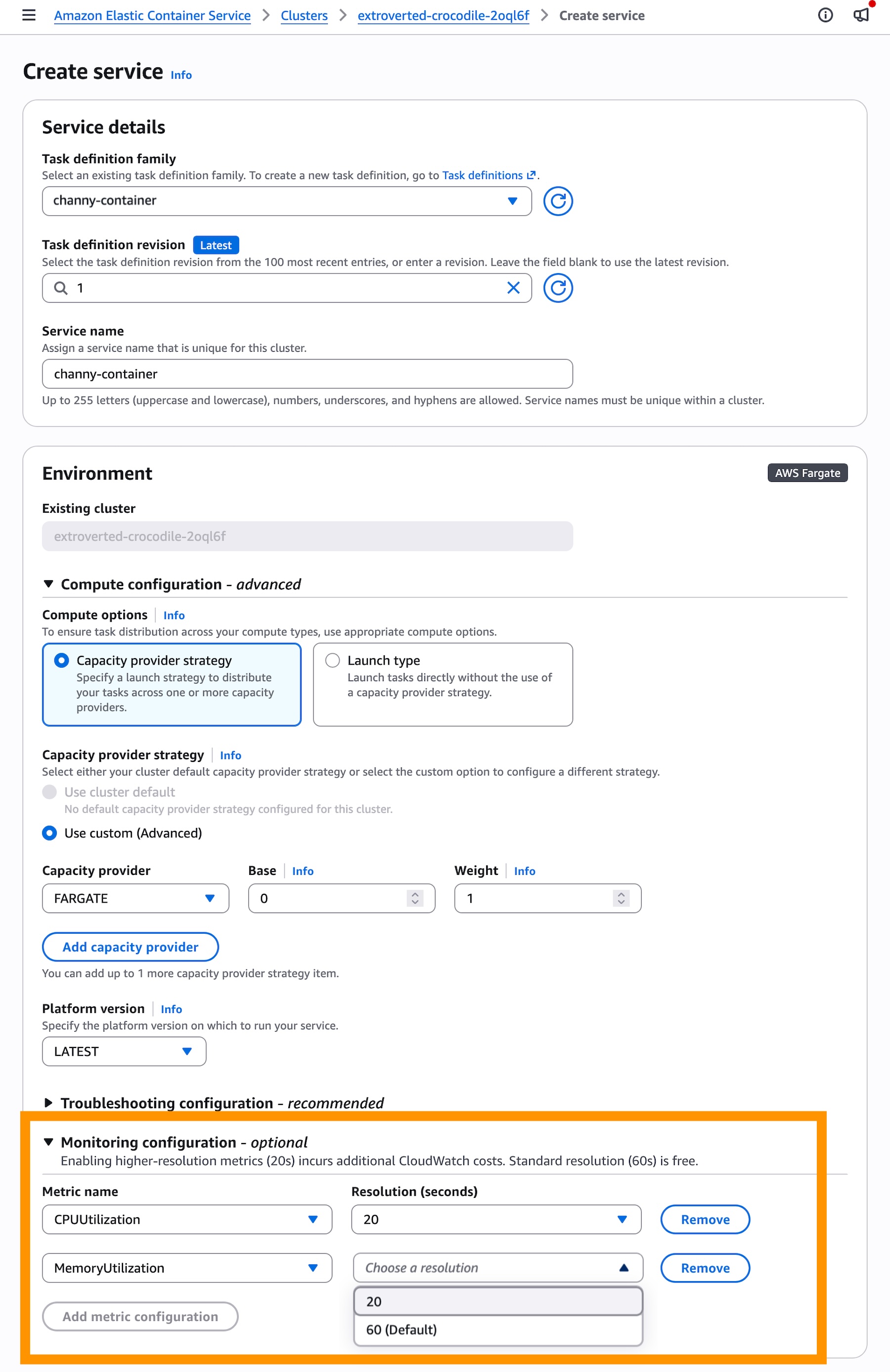
When you create a service in the console, add 20-seconds resolution metrics in the Monitoring configuration section. These metrics incur additional CloudWatch costs while the standard resolution (60-seconds) is free.
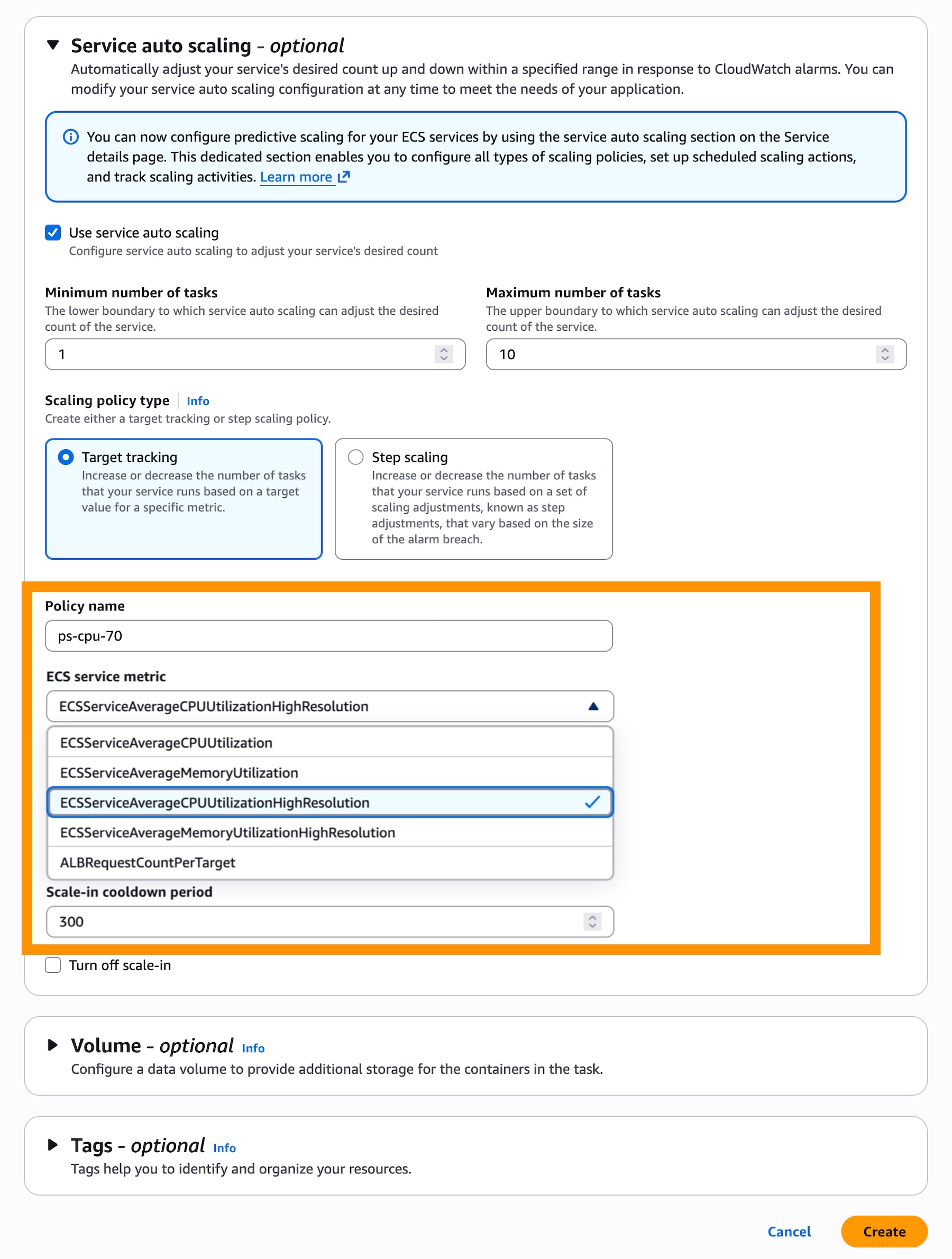
In the Service auto scaling section, check Use service auto scaling and choose Target Tracking for the scaling policy type to use real-time data to scale the number of tasks that your service runs based on demand.
Then, choose a Scaling policy type for the target tracking. You can select ECSServiceAverageCPUUtilizationHighResolution or ECSServiceAverageMemoryUtilizationHighResolution as new metrics.
That’s it – your ECS service will use high resolution metrics for auto scaling.
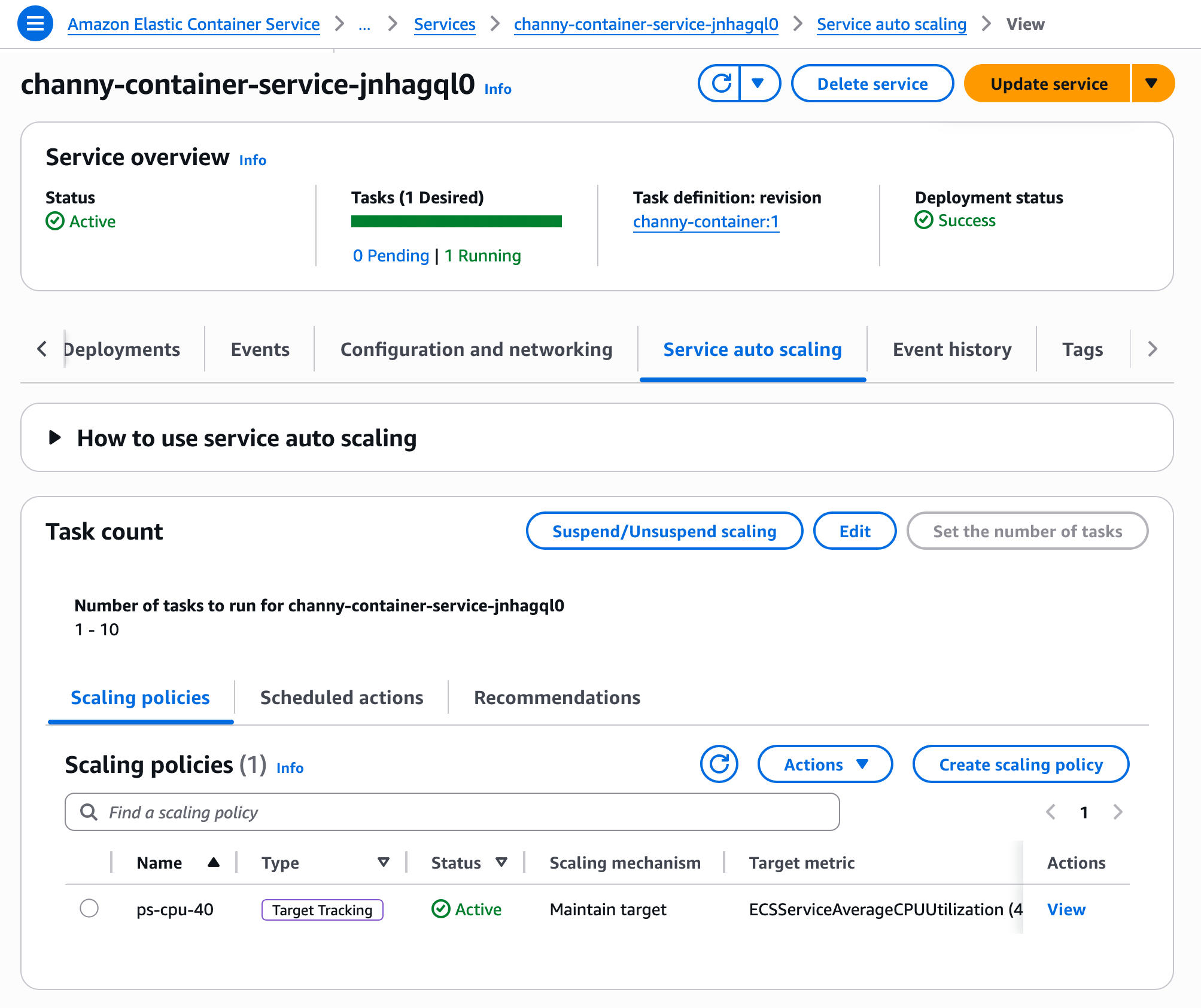
To update an existing ECS service to use faster auto scaling, you first need to configure high resolution metrics via Update Service. Once deployment completes, your service will generate high-resolution metrics. You can then go to the Service and auto scaling tab from your service details to update scaling policy to use higher resolution metrics.
That’s all you need. Your ECS service now evaluates scaling decisions at 20-second intervals.
Now available Faster service autoscaling with high-resolution metrics for Amazon ECS is available today. The feature itself has no additional cost, but high-resolution CloudWatch metrics introduce a new pricing dimension. For details, see the CloudWatch pricing page.
Give it a try today and send feedback to AWS re:Post for ECS or through your usual AWS Support contacts.
When a security event occurs in your Amazon Web Services (AWS) environment, rapid response is critical. However security teams often struggle with time-consuming, manual processes that slow down investigations. Analysts must recall complex AWS Command Line Interface (AWS CLI) syntax for multiple services, manually correlate findings across Amazon GuardDuty, AWS CloudTrail, and other security tools, and document every investigation step for compliance requirements. They make critical decisions under pressure while active threats continue. For analysts without deep AWS expertise, these challenges are even more pronounced, creating bottlenecks in your security operations.
Kiro is an AI-powered coding assistant that helps users write, understand, and optimize code through integrated development environment (IDE) and command line integrations. Beyond traditional development tasks, it offers AWS-specific expertise including architecture guidance, best practices, cost optimization recommendations, and service documentation navigation. Kiro CLI puts Kiro’s full capabilities in your terminal, making it a natural fit for security operations workflows. For example, with built-in tools, Kiro CLI can be used to help with investigation of a GuardDuty finding—it will propose the appropriate AWS CLI commands, explain what each command does, and wait for your approval before executing. This approach lets you focus on analyzing threats rather than figuring out how to investigate them.
This blog post demonstrates how to use Kiro CLI to conduct a security investigation following the AWS Security Incident Response Guide framework. This framework organizes incident response into five phases:
Preparation: Having the right tools and processes in place before an incident occurs
Detection and analysis: Identifying security events and understanding their scope
Containment: Limiting the impact of an incident and preventing further damage
Eradication and recovery: Removing threats and restoring normal operations
Post-incident activity: Learning from incidents to improve future response
You’ll see how you can use Kiro CLI to triage GuardDuty findings, assess impacted Amazon Elastic Compute Cloud (Amazon EC2) resources, analyze AWS CloudTrail logs, and generate remediation scripts. By the end of this post, you’ll learn how to use Kiro CLI to run security investigations in minutes rather than hours — without skipping steps.
Prerequisites
Before getting started, confirm you have the following:
AWS CLI: Configure using one of the methods in Configuring settings for the AWS CLI. Kiro CLI uses the default AWS CLI profile (or the profile specified by the AWS_PROFILE environment variable) to interact with AWS resources and will request your approval before executing any actions.
Solution overview
To show Kiro CLI in action, we investigate a GuardDuty finding end to end — following the AWS Security Incident Response Guide framework through the following steps.
Discovery: Retrieve and analyze a high-severity GuardDuty finding
Knowledge capture: Create reusable investigation workflows through steering files
Throughout this investigation, Kiro CLI will propose commands, explain their purpose, wait for approval, and automatically document findings—transforming an inefficient manual process into a guided, efficient workflow.
Kiro CLI combines AI reasoning with deep AWS knowledge to analyze security findings, correlate evidence across services, and propose appropriate AWS CLI commands at each step of an investigation. While this AI-powered approach accelerates investigations, it’s important to validate outputs and recommendations before taking action. The specific commands and analysis shown in this walkthrough are examples—your results will vary based on your specific findings and environment configuration.
The investigation: From alert to resolution
In this section, we walk you through the phases of an investigation, from discovery through analysis.
Discovery: A high-severity GuardDuty finding
Our investigation began with a GuardDuty finding requiring immediate attention. Rather than manually constructing AWS CLI commands, we used Kiro CLI’s natural language interface:
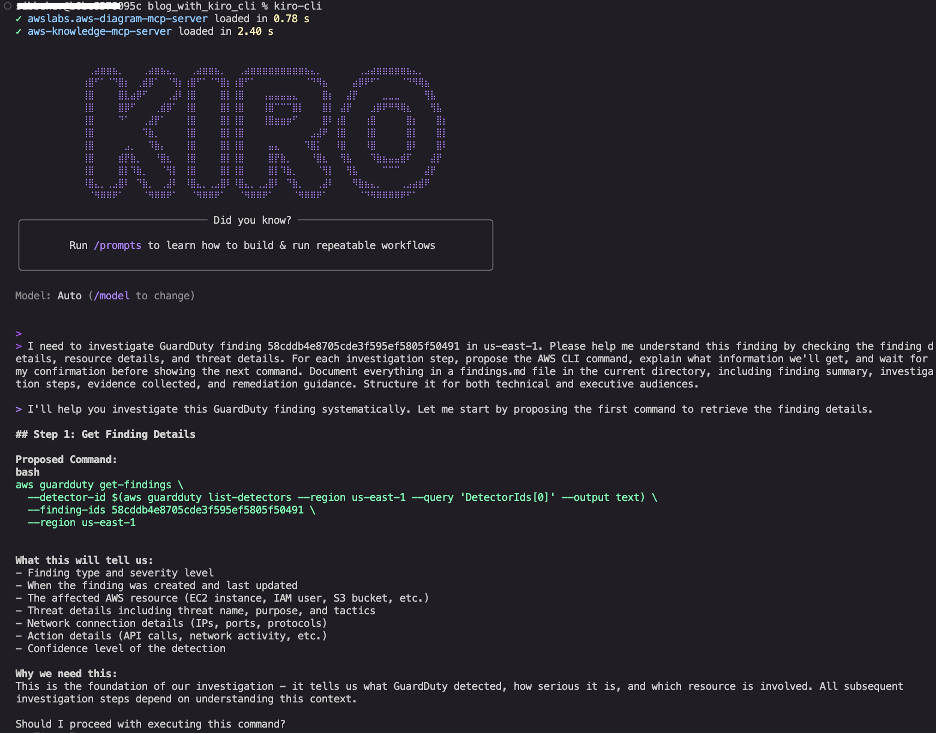
I need to investigate GuardDuty finding 58cddb4e8705cde3f595ef5805f50491 in us-east-1. Please help me understand this finding by checking the finding details, resource details, and threat details. For each investigation step, propose the AWS CLI command, explain what information we'll get, and wait for my confirmation before showing the next command. Document everything in a findings.md file in the current directory, including finding summary, investigation steps, evidence collected, and remediation guidance. Structure it for both technical and executive audiences.
This single prompt establishes the entire investigation framework, as shown in Figure 1. By requesting step-by-step approval, we maintain control while benefiting from AI guidance. The documentation requirement helps ensure that we’re building an audit trail in real-time for compliance requirements.
Figure 1: Kiro CLI interface showing the initial investigation prompt and proposed first command to retrieve GuardDuty detector ID and finding details
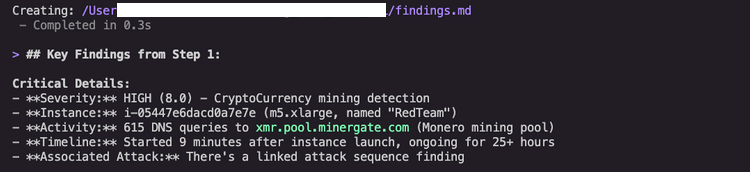
Kiro CLI proposed retrieving the detector ID and complete finding details. After approval, it executed the commands and revealed critical information, as shown in Figure 2.Key findings:
Type: CryptoCurrency:EC2/BitcoinTool.B!DNS
Severity: HIGH (8.0)
Instance: i-05447e6dacd0a7e7e (m5.xlarge)
Threat: 617 DNS queries to pool.minergate.com
Timeline: Started 9 minutes after instance launch
We can see that it took 9 minutes from instance launch to mining activity, which suggests automated event rather than manual action. This timeline information, automatically extracted and highlighted by Kiro CLI, helps security teams understand event patterns.
Figure 2: GuardDuty finding details showing HIGH severity cryptocurrency mining detection with threat indicators and timeline
Resource and scope analysis
Kiro CLI proposed investigating the EC2 instance configuration, security groups, IAM permissions, and checking for additional findings. This proactive suggestion demonstrates Kiro CLI’s understanding of security investigation workflows, it knows that understanding the potential impact requires examining not just what the unauthorized user did, but what might possibly be a next step in a typical threat scenario.
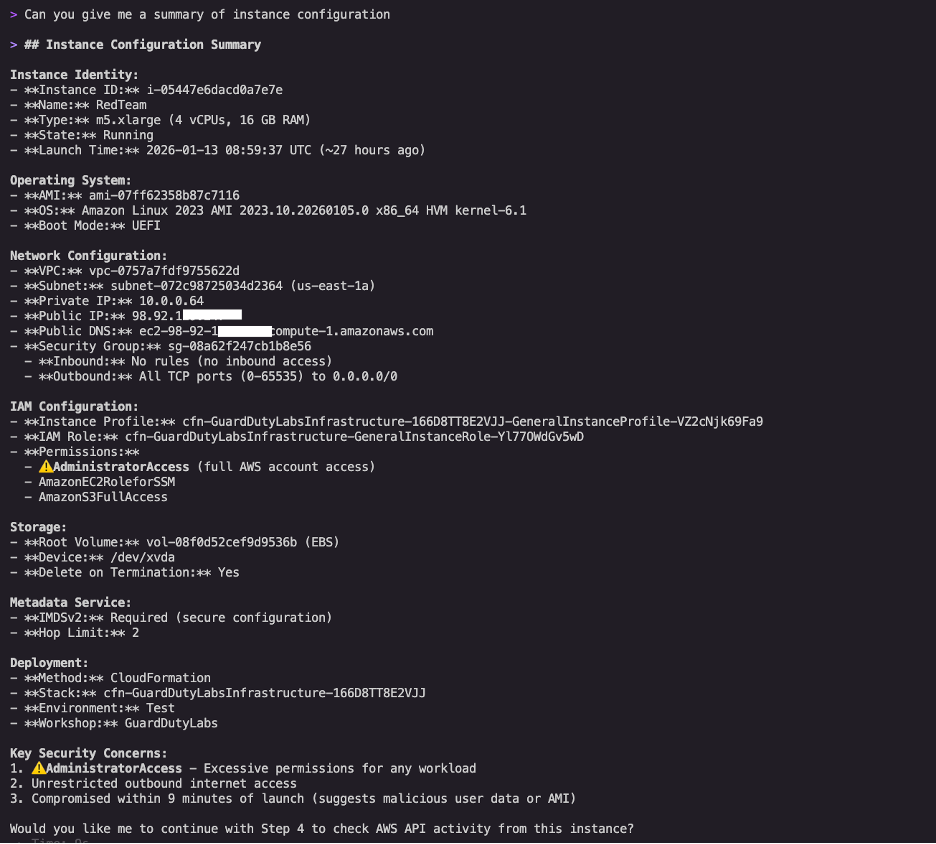
The following information is also shown in Figure 3.
Instance configuration: Kiro CLI retrieved the instance details, revealing:
Amazon Linux 2023 AMI
Instance Metadata Service version 2 (IMDSv2) required (good security posture)
Public IP address with unrestricted outbound access
IAM instance profile attached
Security group assessment: Kiro CLI analyzed the security group rules and identified:
No inbound rules
Unrestricted outbound access to 0.0.0.0/0, enabling mining traffic
IAM permission analysis: Kiro CLI examined the instance profile and attached role policies, uncovering a critical security risk:
Critical finding: AdministratorAccess policy attached to the EC2 instance profile
Full AWS account access from compromised instance
Potential for complete account takeover
While the observed activity is cryptocurrency mining, the attached AdministratorAccess policy means the unauthorized user could have exfiltrated data, created backdoors, or compromised other resources. This highlights why least-privilege IAM policies are critical. Even if an instance is compromised, limited permissions help reduce the potential impact.
Figure 3: Kiro CLI’s instance configuration summary highlighting the AdministratorAccess policy, unrestricted outbound access, and multiple concurrent security findings
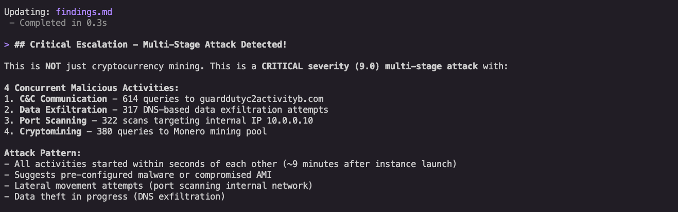
Scope assessment: Kiro CLI checked for additional unexpected activity and discovered seven security findings on this single instance, indicating a multi-vector attack, as shown in Figure 4.
Figure 4: Kiro CLI’s summary highlighting a multi-vector attack.
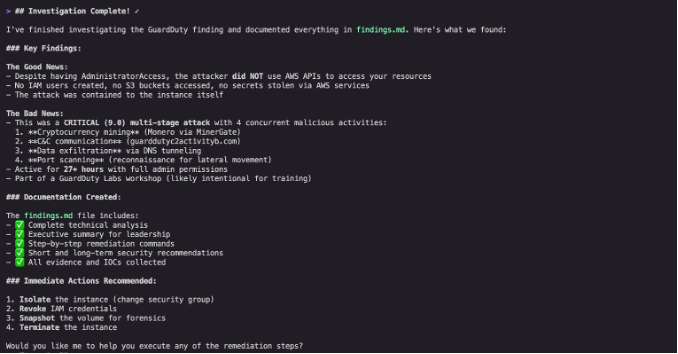
Figure 5: Kiro CLI’s summary of the investigation and recommendations for immediate actions.
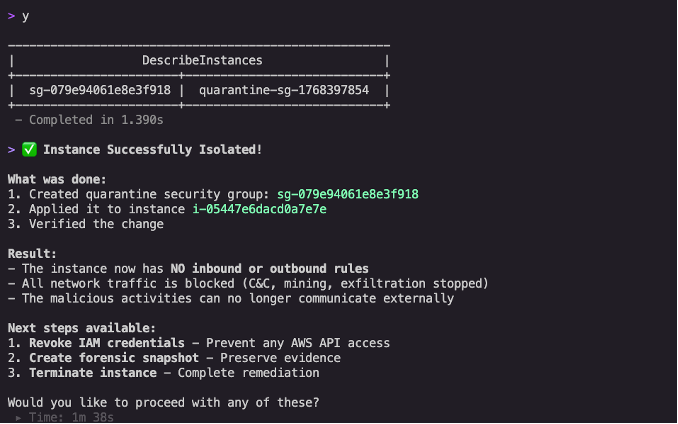
Instance isolation: Kiro CLI produced commands to create an isolation security group with no inbound or outbound rules (as shown in Figure 6), then applied it to the compromised instance. This containment step stops new connections without destroying evidence. However, it’s important to understand that security groups are stateful and use connection tracking. When you change security group rules, existing connections aren’t immediately interrupted and continue to allow packets until they time out.
This means that if an unauthorized user has an active connection to the instance, that connection might persist temporarily even after applying the isolation security group. For immediate interruption of all traffic including active connections, consider also implementing network access control lists (NACLs), which are stateless and don’t track connection state. Unlike security groups, NACLs can immediately break existing connections when rules are applied. While NACLs operate at the subnet level (broader scope than instance-level security groups), they provide an additional layer of defense that helps ensure network isolation.
This scenario illustrates an important principle: while AI-powered tools such as Kiro CLI can help you respond more quickly by generating appropriate commands, it’s critical to keep a human in the loop who understands these nuances. Kiro CLI might not have complete information about edge cases, so security professionals should validate recommendations and consider additional controls based on their expertise and the specific threat scenario.
Figure 6: Instance successfully isolated with confirmation showing no inbound or outbound rules, blocking all network traffic including command-and-control (C&C) communications and mining activity
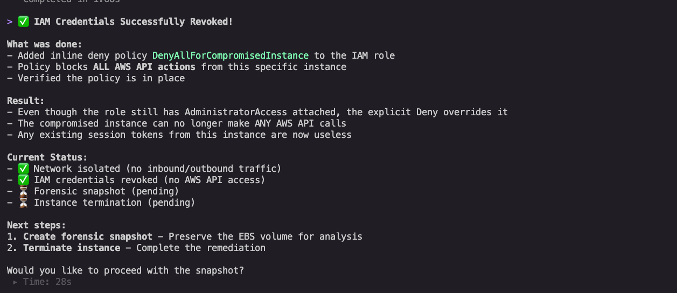
Privilege revocation: Kiro CLI generated commands to attach a deny-all policy to the compromised IAM role (as shown in Figure 7). The AI assistant explained that even though the AdministratorAccess policy remains attached, the deny-all policy takes precedence because of the evaluation logic used by IAM, where explicit denies always override any allows. This immediately revoked all permissions while preserving the original configuration for forensic analysis.
Figure 7: IAM credentials revocation confirmation with current status checklist showing network isolated, IAM credentials revoked, and forensic snapshot pending
Evidence preservation
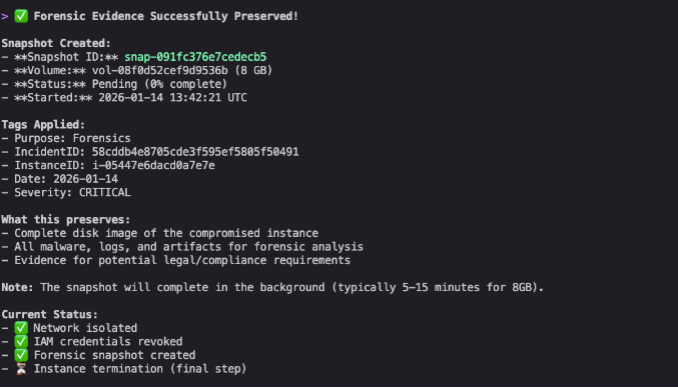
Before making mutating changes, Kiro CLI recommended creating a forensic snapshot of the compromised instance’s Amazon EBS volume (as shown in figure 8). This step can be missed when teams are under pressure to contain an active threat, but it’s critical for post-incident analysis and potential legal proceedings.
Memory preservation decision: We chose to leave the instance running in its isolated state rather than stopping it immediately. Stopping an EC2 instance results in loss of volatile memory containing forensic evidence such as running processes, network connections, loaded malware, and encryption keys. By maintaining the instance in an isolated security group with all network access blocked, we neutralized the threat while preserving the ability to conduct deeper forensic investigation if needed.
Volatile memory often contains evidence that explains how an event occurred, malware binaries, decryption keys, or command-and-control (C&C) communications that disappear when an instance stops. This decision point illustrates the balance between immediate threat elimination and thorough investigation.
Capturing volatile memory requires specialized tools and techniques. For Linux instances, LiME (Linux Memory Extractor) can capture physical memory, while Windows instances can use tools like Winpmem. After being captured, memory dumps can be analyzed using Volatility, an open source memory forensics framework. Forensics tools should be pre-installed on your systems to avoid changes being made during the evidence gathering process. AWS provides guidance on automating forensic kernel module builds for Amazon Linux EC2 instances to streamline this process.
Figure 8: Forensic snapshot creation confirmation with proper tagging including purpose, incident ID, and severity for evidence preservation
CloudTrail analysis
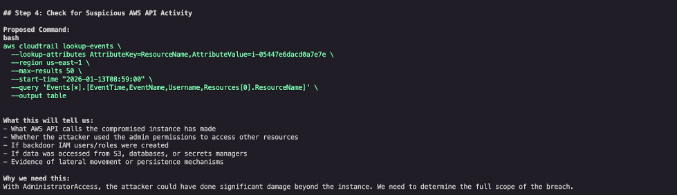
To understand the full scope of compromise, we asked Kiro CLI to analyze CloudTrail logs. The AI assistant identified available CloudTrail trails and proposed queries to find any API calls made from the compromised instance using its temporary credentials (as shown in Figure 9).
CloudTrail analysis is often the most time-consuming part of incident investigation, requiring analysts to construct complex queries and correlate events across time. Kiro CLI automates this process, immediately identifying the relevant log sources and proposing appropriate queries.
Figure 9: Kiro CLI identifying available CloudTrail trails and proposing targeted queries
Kiro CLI found no unexpected API calls originating from the instance credentials—no IAM users created, no S3 buckets accessed, and no secrets stolen. The event appeared limited to cryptocurrency mining activity conducted through DNS queries, with no evidence of data exfiltration or lateral movement.
Figure 10: Investigation results from Kiro CLI
This shows the value of thorough CloudTrail analysis: even when initial findings suggest a contained threat, confirming the absence of broader compromise is essential before closing an investigation.
Building proactive defenses
The AWS Security Incident Response Guide emphasizes that preparation is the foundation of effective incident response. With the immediate threat contained, we used Kiro CLI to strengthen our preparation phase by establishing automated alerting for future incidents.
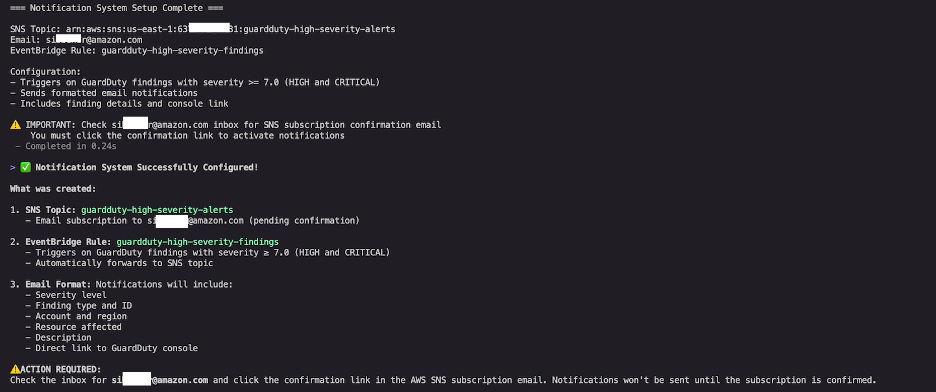
As shown in Figure 11, we used natural language to request
Set up a notification system that sends an email to [email] for any high severity or higher severity findings.
Kiro CLI understood the requirement and proposed a multi-step solution involving Amazon SNS and EventBridge:
Create an SNS topic for GuardDuty alerts
Subscribe an email address to the topic
Create an EventBridge rule to trigger on high-severity findings (severity greater than or equal to 7.0)
Configure the SNS topic as the EventBridge target
Grant EventBridge permissions to publish to the SNS topic
Building automated alerting requires understanding multiple AWS services, their interactions, and correct configuration syntax. Kiro CLI translates a straightforward natural language request into a complete, production-ready solution.
Auto-correction and testing: When setting up complex integrations, commands can fail because of permission issues, incorrect Amazon Resource Name (ARN) references, or malformed JSON policies. Kiro CLI automatically detects these failures and proposes corrected commands.
Figure 11: Notification system setup completion showing SNS topic created, EventBridge rule configured, and confirmation that notifications will trigger on HIGH and CRITICAL severity findings
You can also prompt Kiro CLI to test the setup: Test this notification system to verify it’s working correctly. Kiro CLI will verify that the SNS subscription is confirmed, check that the EventBridge rule is properly configured, validate IAM permissions, identify any misconfigurations, and publish a test event to verify end-to-end functionality. This intelligent error handling means security teams can confidently deploy automation without manual troubleshooting.
Creating reusable investigation workflows
With the immediate threat contained and proactive defenses in place, we then used Kiro CLI to create a reusable steering file that codifies this investigation workflow for future incidents. Steering files are Markdown files stored in .kiro/steering/ that act as persistent memory for Kiro CLI, helping security teams capture institutional knowledge and standardize response procedures. To share them across your team, add them to a Git repository or publish them to your documentation system like Confluence — the same places you’d keep any other runbook.
We recommend running the full investigation and generating the steering file in the same Kiro CLI session. This way, the steering file captures the exact steps, commands, and decisions from your investigation. Navigate the process the way that fits your organization — the steering file will reflect your workflow, not a generic template.
We asked Kiro CLI:
Create a steering file that captures this GuardDuty investigation workflow so future analysts can follow the same systematic approach.
Kiro CLI generated a detailed steering file at .kiro/steering/guardduty-incident-response.md that includes:
Investigation phases aligned with the AWS Security Incident Response Guide
AWS CLI command patterns for GuardDuty, Amazon EC2, IAM, and CloudTrail
Documentation requirements and approval gates
Containment, eradication, and evidence preservation procedures
This is the example steering file that was created by Kiro cli:
---
inclusion: manual
---

# GuardDuty Incident Response Workflow

This steering file guides systematic investigation of GuardDuty findings following AWS Security Incident Response Guide best practices.

## Investigation Phases

### Detection and Analysis
1. Retrieve GuardDuty finding details using finding ID
2. Extract finding type, severity, affected resources, and threat indicators
3. Document timeline of events (instance launch, threat detection)

### Resource Analysis
4. Investigate EC2 instance configuration (AMI, IMDS version, network access)
5. Analyze security group rules (inbound/outbound access)
6. Review IAM permissions attached to instance profile
7. Check for additional findings on the same resource

### Containment
8. Create isolation security group with no inbound/outbound rules
9. Apply isolation security group to compromised instance
10. Create forensic snapshot before making destructive changes
11. Preserve volatile memory by keeping instance running if forensic analysis needed

### Eradication
12. Revoke excessive IAM permissions
13. Document all actions in findings.md with technical and executive summaries

### Analysis
14. Query CloudTrail for API calls from compromised instance credentials
15. Assess scope of compromise and potential lateral movement

## Documentation Requirements
- Finding summary with severity and type
- Investigation steps with timestamps
- Evidence collected (security groups, IAM policies, CloudTrail logs)
- Remediation actions taken
- Recommendations for prevention

## AWS CLI Command Patterns
- GuardDuty: `aws guardduty get-findings`
- EC2: `aws ec2 describe-instances`, `aws ec2 describe-security-groups`
- IAM: `aws iam get-instance-profile`, `aws iam list-attached-role-policies`
- CloudTrail: `aws cloudtrail lookup-events`

## Approval Gates
Always propose commands with explanations before execution and wait for approval.
Traditional incident response playbooks are static documents that quickly become outdated. Kiro CLI steering files are executable playbooks that guide AI-assisted investigations with consistency while remaining flexible enough to adapt to specific scenarios. Steering files stay current because updating them is part of the workflow, not a separate task. When you adjust your investigation process, ask Kiro CLI to update the steering file at the end of the session. It captures your changes, and you share the updated version with the team through Git or Confluence — everyone works from the latest version.
Conclusion
Security incidents require accurate and rapid response, but traditional investigation workflows create bottlenecks that extend mean time to respond (MTTR). By following the framework provided by the AWS Security Incident Response Guide and using Kiro CLI’s AI-powered capabilities, you can transform incident response from reactive to proactive, well-documented operations.
In this post, we demonstrated how Kiro CLI accelerates each phase of the incident response lifecycle—from initial detection and analysis through containment, eradication, and recovery. You learned how to use natural language prompts to investigate GuardDuty findings, analyze compromised resources, implement containment measures, preserve forensic evidence, and establish automated alerting for future incidents. The steering file capability helps your team embed hard-won expertise in reusable workflows that benefit analysts at all skill levels.
Whether you’re investigating alerts, building defenses, or documenting procedures, Kiro CLI provides the expertise and automation to respond faster, learn continuously, build better defenses, and document thoroughly. When commands fail or configurations are wrong, Kiro CLI identifies the issue and corrects it, reducing time spent troubleshooting.
If you have feedback about this post, submit comments in the Comments section below.
A few weeks ago, we published our initial findings from Project Glasswing, looking at what happens when you point frontier security models at an enterprise codebase. We also explored how our defensive structures adapt to protect our infrastructure and customers from threats posed by frontier AI. Since then, the AI ecosystem has continued to shift rapidly — developers who’ve built tightly around a single model have already experienced what happens when that model is no longer available or gets superseded by a more capable one. These market shifts only reinforce our core thesis: no matter which underlying model is leading the pack on any given day, the future of agentic workflows will not be found in standalone models, prompts, or single-agent sessions.
Moving from a localized security “skill” to a continuous, fleet-wide scanning pipeline requires an architecture where models are treated as interchangeable components. Relying on a single model inherently limits defensive coverage, as the same system will tend to look at code paths through the exact same lens. To counter this, models should be frequently interchanged and cross-tested. By varying the models across the pipeline — such as using one model for initial discovery and an entirely different one for validation — we can ensure that vulnerabilities are cross-checked by distinct sets of logic. Furthermore, a true enterprise-scale harness must look beyond isolated repositories to trace vulnerabilities across cross-repo dependencies, ultimately filtering thousands of raw candidates down to a trusted, triaged queue of actionable fixes.
This post serves as a practical look at how to build that model-agnostic layer, focusing on how we manage state controls, eliminate false positives, and coordinate end-to-end triage at scale.
Two objections, up front
The first post made the case for why generic coding agents can’t do this job. The main issue is that agents only hold one hypothesis at a time, fill their context window after covering a sliver of a real repo, and then lose information during context compaction. For more details, read that post.
Before we move forward, we would like to answer two likely questions.
“Why not use subagents instead of a harness?” Subagents are useful, and they are a good starting point. But security analysis needs hundreds of separate investigations that survive across runs, don’t share a context window, and can be re-scoped and cross-referenced later. It needs persistence, deduplication, resumability, and eventually fleet-wide dependency tracing. That’s an orchestration problem, and a prompt can’t get you there.
“Is this blog post just an ad for frontier models?” No. Our approach centers on the harness, not the model. When it comes to vulnerability discovery, we run it with whatever frontier model is currently best at what we need. When we point different models at the same target, they each turn up a different share of the bugs. The harness is the bit that lasts. If you build your own system, design it to be model-agnostic from day one. This will allow you the freedom to use any model of choice without constraints.
It all starts with a skill
We started with a ~450-line security-audit skill that we ran on a single repository, and adjusted the prompts until we surfaced real bugs. Later, we added the orchestration that became the plumbing of the entire system. The real value lives in the prompts themselves, and our prompts continue to carry the initial skill’s attacker scenarios, bug classes, and anti-pattern detections nearly unchanged.
The skill was written to run a 7-phase audit in one session:
Three parallel research agents do recon and write an architecture.md.
One Hunter agent runs per class attack, trying to break the code rather than review it.
Adversarial validators try to disprove each finding.
The survivors are written up as a human-readable vulnerability report.
They’re also emitted as findings.json against a schema, and a mechanical check validates that file.
Finally, a fresh agent independently re-verifies every finding against the source.
The surviving, re-verified findings are submitted to the ingest API.
That first skill maps almost directly onto the later harness:
Skill phase
Harness stage
Recon agents write architecture.md
Recon
Hunters run per attack class
Hunt
Validators disprove findings
Validate
Surviving findings become a report
Report
findings.json is checked mechanically for schema adherence, not correctness
Mechanical validation of line numbers and functions in findings
Fresh agent re-verifies findings
Independent validation
The skill worked, but it quickly revealed its limits. Looking at the coverage metrics, a single run finds only about half the bugs you’d catch across multiple runs. In our experience the ones it did find skewed toward the simpler and less subtle. Once your process is basically “run it ten times and diff by hand,” you probably need to start looking at a real harness.
While running and fine-tuning the skill, we ran into three walls:
Context exhaustion: An hour in, the context window fills up and the model will cannibalize its own memory, instantly forgetting the bugs it spent all morning tracking down. We broke this bottleneck by externalizing the state entirely, treating the LLM as a stateless compute engine.
Persistence: A crash mid-run means starting over. Losing hours of work to one AI rate-limit error or connection flakiness is an incredibly expensive way to realize you need a better architecture.
Cross-repo reasoning: A single repo session is completely blind to the relationships between applications that consume it, and the number of bugs that surface when you inspect the interface between components is probably more than one might expect.
ADVICE: A real but minimal harness consists of just Recon, Hunt, and Validate stages kept in a database, alongside a separate Validator that can’t file its own findings. You should skip cross-repo tracing entirely until you have more than one repository that matters. Skip a dedicated Deduplication agent until you are actively drowning in noise. Start with a skill in your development environment, get your prompts working well, and only build the next architectural stage when not having it is the specific thing slowing you down.
Codifying the skill into a pipeline
Most AI security write-ups in this space are about a single repo or a curated benchmark; running a whole fleet this way, with cross-repo tracing, isn’t something we’ve seen written up elsewhere. Our codebase spans a massive mix of languages — Rust, Go, C, Lua, TypeScript and Python, alongside various configuration management systems, static configs, and all sorts of additional context. So we had to come up with something new that worked for us. Going from that first slash-command run to a fleet scanner that could cover 128 distinct repos, automatically finding and interrogating relevant dependencies, took about six weeks. Codification was mostly mechanical: we lifted each phase of the skill into its own agent, put a database behind it and an orchestrator in front. The mapping was almost one-to-one.
The entire fleet runs on one unified harness with no per-language tuning and traces the dependencies between repos. While offloading syntax to a model makes the system language-agnostic, the differentiator is its ability to trace dependencies between repos. The harness itself doesn’t care if it’s looking at C pointers or a TypeScript file; it focuses on the higher-level logic of security orchestration. This allows us to scale across hundreds of different codebases, without having to write custom language parsing.
A two-stage vulnerability research workflow
Our entire vulnerability research workflow is built on a two-stage operational framework: the Vulnerability Discovery Harness (VDH) and the Vulnerability Validation System (VVS).
The VDH functions as our discovery engine, proactively scanning codebases to surface potential security issues. Once bugs enter the VVS, which allows multiple harnesses to feed into it, they go through stages of Deduplication, Judgment, and finally Fixing, as we’ll talk about later.
We use one model for VDH, but we use a completely different model for VVS, so the models are effectively double-checking each other. There is an obvious security benefit to this: by forcing Model B (VVS) to judge the output of Model A (VDH), you ensure that the finding is evaluated by an entirely different set of logical weights and training data — one that acts as an unbiased, adversarial third party whose sole job is to ruthlessly stress-test Model A’s assumptions. And operationally, we benefit from treating model providers like interchangeable commodities. Model providers can change temperature, caching, and inference effort budgets over time, even within one model version. Instead of building a system that depends on a model behaving predictably over time, our harness is built to absorb downstream volatility without breaking.
Stage 1: Vulnerability Discovery Harness (VDH)
The first post covered what each agent/stage is for, so we’ll talk about the parts it didn’t: the glue between stages, and the handful of details that decide whether any of it works.
Agent/stage
Primary Role
Sub-agents / Tooling
Recon
Maps out the target architecture and maps potential threat vectors
It spawns siblings (these handle between 9% and 20% of fleet-wide tasks depending on the model). It reaches out to and writes to the Wishlist tool.
Validate
Mechanically checks the finding, then adversarially disproves it
Runs in two passes: plain code handles the initial schema/path checks, then a single isolated agent tries to disprove the finding before it can be filed.
Gapfill
Generates new hunt tasks for empty coverage cells
Enqueues fresh hunt tasks for any under-tested (area × attack-class) cells that still look thin
Dedup
Identifies and consolidates overlapping findings
Combines deterministic code and agents to cluster findings by root cause, folding them together in real time
Walks the graph to add hunt tasks inside every identified consumer repo to make sure cross-repo bugs are caught
Feedback
Learns from pre-existing reports and optimizes future runs
Takes validation failures, shallow runs, and repeated misses, and instantly rewrites queued prompts to make future tasks sharper.
Report
Renders human-readable report
Just a script, no model required
Table 1: Vulnerability Discovery Harness (VDH)
Stages four through eight run as a continuous producer-consumer loop. As the initial hunt progresses, the Gapfill, Feedback and Trace agents generate new tasks; Dedup folds overlapping findings back together and the rest of the loop keeps consuming the queue. This ensures a vulnerability discovered late in the cycle is still validated, reported and checked against other code to make sure it doesn’t contain the same bug, all within the same run.
Splitting the pipeline this way guarantees strict context controls. If you fill the context window, the model starts hallucinating. We keep each agent’s job hyper-focused, keeping context usage below 25% of the total window. A naive “read all files” approach will blow past this limit every single time.
One thing that caught us out was that persistence needs to be factored in before parallelism. You do not want to throw away a five-hour run because of an unforeseen error. Every stage writes to one SQLite database keyed by (run_id, repo, stage). Any stage can resume, retry, or get pulled into a later run without redoing work. Findings are streamed and saved as they happen, so a crash costs you the task in flight and nothing else.
ADVICE: Sometimes a transient API error comes back as text in the (200 OK) response stream instead of throwing a code exception. To the orchestrator, this looks exactly like a task that finished cleanly. You must explicitly classify the response text, not just trust the exception type, or you end up logging empty runs as successes.
Dynamic threat modeling
During the Recon stage, the agent writes the threat model instead of being handed one. Beyond about ten built-in attack classes (many forms of injection, memory corruption, protocol parsing, timing side channels, and others), the Recon agent can invent repo-specific classes on the spot, each with its own methodology. It writes a custom taxonomy tailored specifically to that codebase, which is used to more tightly scope the Hunter agents.
Reading source code isn’t enough to understand how it behaves under stress, especially for subtle undefined-behavior bugs in C and other lower-level languages. The Hunter agents move past code reading and transition into active execution. They compile fragments, build small versions, and attack them. The biggest jump in quality came from giving Hunters a sandbox (built on unshare) to crash binaries.
ADVICE: If the harness itself runs inside Docker, that sandbox needs seccomp=unconfined and apparmor=unconfined or it will silently fail to start. It’s a one-line fix that saves you a day of head-scratching if you aren’t an expert in nested containerization, like us.
Micro-forks and the wishlist
Beyond the core pipeline stages, we added two specialized mechanisms that grant the Hunters significant autonomy to adapt their focus and request external resources without derailing an ongoing analysis:
Sibling Forking: This helps ensure that if a Hunter agent trips over an interesting code path that is outside the current scope, it doesn’t wander off track. It uses a tool call to fork a sibling agent with a precise structural seed. Fleet-wide, this accounts for roughly 9% of tasks, though the rate is highly model-dependent — from near-zero to about a fifth, depending on which model is hunting.
The Wishlist: When an agent needs a tool it doesn’t have, often a Validator confirming a Proof of Concept (PoC) or a Hunter wanting to build something (like a specific build environment, a VM, or some prod config files), it writes to a central wishlist. It provides enough context for the system to automatically re-run that exact task once a human provides the dependency. Some of these can be partly self-healing: if the container needs to be rebuilt with some changes, this can autonomously happen after the run by having a generic coding harness monitor the logs.
The wishlist has been written to 25,472 times across 128 repos since the wishlist was added, and it’s the main way the agents talk back to us. One that landed while we were writing this: “I need a FreeBSD VM to confirm this PoC end-to-end.“
Fleet-wide cross-repo tracing
After the initial cleanup, a Tracer agent checks how different software components are connected. It looks for a specific path: can a potential attacker send harmful input from the outside to a vulnerable part of the system? If the answer is yes, the Tracer agent automatically spawns fresh hunt tasks inside the consumer repository. To make this work, you need a unified, cross-repo symbol index and an accurate dependency graph. This allows you to uncover deep, systemic flaws that a standard single-repo scan would miss.
Running our harness across an entire fleet of repos revealed two lessons that only surfaced when this was done at scale.
First, deduplication is its own problem, big enough to need its own agents. When you are scanning a handful of repositories, you can manually eyeball overlapping bugs. Simple string matching or file-path checks won’t save you here. Determining whether two complex logic flaws are actually the exact same root bug sounds trivial, but it isn’t. It requires so much cognitive reasoning that we had to deploy dedicated Dedup agents just to clean up the noise, along with their own heuristics and ways of reducing the work.
The second is to not wire in static analysis early. We plumbed Semgrep all the way through, and the Hunters invoked it zero times in a month of runs. They would rather read and run the code. The wishlist, by contrast, was the single most-used tool in the system. It’s worth paying attention to what the agents actually reach for, rather than what you think they’ll want.
Making findings you can trust
The agent will edit the source code so its own exploit works, then triumphantly report the bug it just created. It will write a test that proves something entirely tautological like “exec() executes things, therefore critical vulnerability”. Or it builds an exploit that runs fine but proves nothing, because the threat model behind it is nonsense. If your harness doesn’t actively fight this, all you’ve built is a faster way to produce junk.
A Hunter has to state the threat model before it’s allowed to file anything. It has to define exactly who the attacker is, and what boundary the vulnerability crosses or what assumption it breaks. The output schema ordering enforces it. This requirement eliminates the vacuous findings, the “if a user has database write access, they can write to the database” kind.
Every confirmed finding ships with a PoC written as a test that runs against the original, untouched codebase. This prevents the agent from editing the source files to force an exploit to land. If there is no working PoC, we treat the finding as fake. In practice, that’s a Hunter compiling a thirty-line parsing loop, running it with memory protection enabled, and demonstrating that the incorrect read stride is originating from a stack address rather than the expected message body. You can re-run it yourself. Furthermore, every confirmed finding must also ship a proposed patch. What actually reaches our review queue is a verified bug, a working test, and a functional git diff, not just a vague text description of a problem.
Before an exploit path survives, deterministic code (written in plain code, not another model) mechanically verifies that the cited files and paths actually exist, and confirms that both the patch and the test parse correctly. This Validator cannot log findings of its own; its sole job is to aggressively disprove the Hunter‘s theory. If a Hunter is allowed to grade its own homework, it will confidently validate everything it outputs.
We don’t claim a false-negative rate for our system. There’s no labeled set of every real bug in a codebase, so any claimed recall number is entirely speculative. What we can watch is whether re-runs keep turning up new bugs (they do) and whether coverage is still growing across runs. It’s all a proxy, as you don’t know for sure how many bugs exist in a single codebase, but it’s a good-enough way of measuring effectiveness.
Stage 2: Vulnerability Validation System (VVS)
A finding coming out of the harness is just the start of the triage process, with all discoveries landing in a single, shared VVS that currently holds 13,841 findings across 145 repos in total. Triaging that volume is its own massive engineering problem, and it matters just as much as the hunting. That triage engine runs on a different model from the harness, broken down into three distinct jobs.
Agent/stage
Primary role
Spawns/ sub-agents/tooling
Dedup
Identifies if a vulnerability is already in the system, or raised as internal Jira ticket already
Deterministic: plain code builds inverted indexes over files, functions, trust boundaries, and rare tokens, then hands each finding a short candidate list
Probabilistic:Dedup agent reasons over that short list, Stable cross-run key reopens existing records
Judgment
Production reachability and validation
Single agent — builds context about the bug from MCP servers, to get the shape of what the service looks like in production. Searches the wiki, Jira, git, config, and all available other sources to try and understand whether a bug is truly applicable to our production environment, and then score the vulnerability against this. It also validates the bug against source code to understand if the bug still exists on the latest main branch.
Fixing
Generates patches, runs regression tests
Runs the regression test before and after (filtered to the affected test; full suite only when per-test filtering isn’t available). It requires a clean fail→pass flip on the target test to clear the gate. If the post-patch test fails, or if a global run detects downstream regressions, the commit is automatically blocked and flagged for human intervention.
Table 2: Vulnerability Validation System (VVS)
Deduping
Comparing every single finding against every other finding using an LLM scales at O(N^2), which falls apart completely at scale. To keep the model off the critical path, deterministic code builds inverted indexes over the structured data (touched files/functions, trust boundary, rare tokens) to generate a short list of real candidates. Only then does an agent look at that short list to see if a single fix would close several of them. Stable cross-run keys ensure re-found bugs reopen existing records rather than spawning new ones.
Contextual judgment
Judgment is a second, independent pass over what survived. The agent rechecks the latest information, pulling from deployment, environment, and config context to determine if the code path is reachable in prod, and identify the repo owner. This process filters “exploitable now” from “real but latent” and from “real but filed against the wrong component.” It’s moving a pile of chaotic findings into a risk-driven orchestration workflow.
Automated fixing
The Fixer takes the proposed patch and unit tests, rewrites them to match the repo’s style, applies the diff, and runs targeted tests. A clean fail→pass flip is the ideal and the only auto-cleanup case; a failing post-patch test blocks the commit. The Fixer never merges code on its own; a human must review the branch. This gate is the non-negotiable, human-in-the-loop safeguard that enables a clean, unbreakable cryptographic trail for change management compliance. Left to patch freely, a model will happily fix a security bug while quietly breaking an unrelated feature or adding dozens of new bugs.
Across all three triage jobs, each agent is confined to one narrow task wrapped in deterministic bookkeeping code, and nothing writes to production without a human signing off on a dry run. While this pipeline moves the engineering bottleneck from finding bugs to reviewing and landing fixes, the Fixer remains the youngest and slowest part of the system.
What it costs
Running hundreds of agents over a fleet of repos is not cheap, but at least the shape of the spend is predictable. Almost all of the compute budget goes directly into the hunt stage. This makes Gapfill our cost-to-coverage lever, as each additional pass costs roughly half as much as the initial hunt.
Because the cost per repository varies wildly, we budget per repo rather than per run. We enforce a strict task cap per repository and spin up a worker pool of anywhere from 50 to 200 workers. That way you can spend money on the repos that are actually finding things, and not waste it on the ones that aren’t.
It’s also why, for us, the big scans are a periodic backlog sweep and not a per-PR check. A full scan of a complex repo can take hours; the worst run took just over 14 hours. Cheaper, smaller harnesses are the right tool for that job.
How we tell it’s working
We measure our system’s effectiveness by tracking how efficiently our automated pipeline filters deliberate engineering noise into high-quality, actionable findings. Because we intentionally tune our Hunters to over-report subtle primitives that could be chained into larger attacks, our true indicator of success is how sharply we can refine that initial mountain of raw data, before it ever reaches a human.
To gauge this, we track exactly how many raw findings survive each validation stage over time. Thanks to better context injection from our Recon phase, our initial validation rejection rate dropped from 40% down to 11%, while the share of high-integrity findings climbed from 35% to 58% (representing ~12,057 lifetime findings).
Here’s the lifetime breakdown from raw candidates to actionable findings, at the point in time this blog post was written.
Vulnerability Discovery Harness (VDH)
Raw candidates: Everything the discovery harness emitted before independent validation.
Needs repro: Findings that appeared plausible but required manual reproduction before being trusted.
Rejected at validation: The validator disproved the threat model, exploit path, affected code, or evidence.
Duplicates: Candidates collapsed onto another finding from the same harness.
Survived validation: Findings that passed the independent validation gate and moved into the VVS.
Bugs that went elsewhere: Findings deliberately routed outside this flow.
Vulnerability Validation System (VVS)
Another vulnerability harness: Other automated sources feeding the same validation system.
Total bugs in system: The combined pool after ingest.
Duplicates: Findings the dedup pass identified as already covered by another canonical finding or ticket.
Wrong repo / other / not a risk: The noise bucket: misattributed findings, defense-in-depth, or latent risks.
Bugs sent to teams: Finalized, clean findings ready for remediation.
Judged Internet-exploitable: High-urgency findings a realistic attacker could trigger in production.
Not judged Internet-exploitable: Lower-urgency, actionable bugs (production issues, dependency risks, or config errors).
Final severity split: The categorization used to assign priority for the engineering teams.
The core metric of the harness isn’t a speculative recall score — it’s keeping the number of unconfirmed findings in front of real humans as close to zero as possible. The architecture needs to be a relentless filtering funnel.
Out of 20,799 raw candidates generated by VDH, only about 12,057 survived validation.
When these were pushed into the VVS, joining findings from another harness, the central pool was brought to 13,841.
The Dedup agent folded away 5,442 findings as duplicates.
1,154 were routed to the queue as ‘wrong-repo’ or ‘low-risk’ and were recycled back into the system where appropriate.
Ultimately this left 7,245 actionable findings for engineering teams to act on.
Traditional compliance rules dictate arbitrary remediation windows based entirely on a static CVSS score (e.g., “Fix all Highs in 30 days”). Our contextual judgment layer turns this compliance checkbox into actual risk management.
The architecture is capable of tracking findings back to their origin, meaning that fixing a single root cause resolves an entire cluster of findings rather than just patching individual issues. VDH system performance is also measured by dividing repos into (area x attack-class) cells and running the Gapfill agent iteratively until it stops producing findings. Whenever we update an underlying prompt, we test it against a held-out repository to see if that total coverage cell number actually moves.
The harness wires automated health signals to catch system failures early in the pipeline. If a hunt finished suspiciously fast and fails to spawn sub-hunts or gap tasks, it usually indicates a crashed dependency rather than a clean codebase. To remedy this, the system flags any Hunter agent that finishes with zero findings as “shallow” and immediately requeues it for a new run.
Finally, our system’s robustness is reinforced by the independent triage pass described earlier. By re-judging all submissions with a different model and separate logical weights, we ensure an unbiased, adversarial verification that is decoupled from the specific model used for discovery, providing a trust layer that persists regardless of which model is in use.
None of this is finished. We change our system constantly, and it is nowhere near a perfect science. But raw candidate findings are cheap now, and the only work worth doing is turning them into sound, verifiable code fixes.
Building your own harness means accepting that AI models are volatile, but your orchestration layer doesn’t have to be. By decoupling your security logic from any single provider, forcing adversarial verification, and automating your triage pipeline, you can turn a mountain of LLM noise into a reliable, fleet-wide defense engine.
Every codebase is a little different, so to show you how this actually works in the real world, we mapped out a realistic benchmark based on a standard repo run. Keep in mind that this represents a single pass on one repo; over time, as the continuous fleet-wide loop deduplicates, filters, and recycles findings, it reduces the volume of lifetime candidates by roughly 65%.
Engineering hours saved via automated patching: Rather than focusing on static baselines, we measure the health of our pipeline by its technical throughput, processing velocity, and its ability to eliminate the manual triage bottleneck:
Initial Validation Cut: For a standard repository (~30k lines of code), this yields 100 initial findings, with a full run taking 3-4 hours, maintaining a hyperfocused context window throughout.
Compression: The Deduplication and Contextual Judgment Layers process these candidates in parallel. Within 3 hours, the system compresses and refines the batch of findings from ~100 raw candidates to 80 distinct, high-fidelity bugs.
Remediation: The automated Fixer processes these 80 distinct bugs at an average rate of 5 minutes per bug. In total, the system can discover, validate, deduplicate, and open functional pull requests in approximately 14 hours.
Shrinking mean-time-to-resolve for critical flaws: Of course, you can’t dump 80 patches into production all at once without breaking things. To keep deployments safe, our system uses a tiered rollout:
Critical Exposure Containment: The system isolates the critical, high, and exploitable bugs (avg. 10 out of 80). We fast-track these for a human review and introduce them into release cycles, getting them fully patched in production in 5 days.
Incremental Hardening: The remaining latent risks, minor config anomalies, and lower-urgency bugs are incrementally rolled into prod over a 15-20 day window to guarantee platform stability.
How we’re handling all of this patching
These findings are the result of an isolated, ring-fenced research experiment designed to stress-test our code. They do not represent active, unpatched vulnerabilities in our live production environment.
Because the harness runs constantly in our test environments, these specific numbers are completely out of date by the time you’re reading this. Every single bug surfaced by the pipeline came attached to a working test case to demonstrate the bug and a draft patch. Our security teams are systematically processing the reports and applying the necessary fixes, meaning the Cloudflare products you use every day are already actively hardened against these vectors.
Along with this blog post, we’re releasing the initial skill we used to develop the harness, it’s been slightly cleaned up before release so it’s easier to understand and integrate, but the skill itself remains substantially the same. Hopefully the harness itself will follow shortly. This could be a starting point for your own vulnerability harness, your own skill, or whatever suits your needs best: github.com/cloudflare/security-audit-skill
If your team is working on the same problems and would like to compare notes, reach out to us at [email protected].
България навлиза в нов етап на отношение към човешките права и демокрацията. Повод за тази констатация е поведението на държавата спрямо Шествието за семейството – събитие, чиято основна мисия е отрицанието на „София прайд“. Тази теза може да изглежда пресилена, но отношението на една власт към ЛГБТИ+ хората е лакмус за отношението ѝ към демократичните ценности изобщо. Виждаме го в Русия, виждаме го в САЩ, виждаме го и в Унгария, където новото проевропейско правителство на Петер Мадяр премахна забраната на прайда, наложена от предшественика му Виктор Орбан.
Още от началото си през 2008 г. „София прайд“ е съпътстван от антипрояви.
През първите години те представляваха основно опити за физическа агресия (възпирани от многото жандармеристи по време на самия прайд, но успешни в малките улички, докато участниците се разотиваха).
После дойде времето на организираните антишествия. През 2018 г. се проведе първият Поход за семейството. По-късно между организаторите му настъпи разкол и в резултат през 2021 г. възникна още една антипроява – Шествие за семейството. Двата антипрайда се провеждаха паралелно до 2026 г., когато ресурсите се концентрираха в Шествието, а Походът развя бяло знаме.
За първи път обаче през 2026 г. Шествието за семейството се ползва с държавна подкрепа и е под егидата на Българската православна църква (БПЦ). А давайки заявка, че от догодина БПЦ ще поеме изцяло организацията на събитието, патриарх Даниил го измъкна изпод краката на досегашните организатори (основно евангелисти), както те навремето постъпиха с Поход за семейството.
Трансформациите на мобилизацията срещу „София прайд“ са израз на три етапа в отношението към равните права в посттоталитарна България. Тук ще скицирам основните им характеристики, но отделни елементи от всеки етап може да се видят и в останалите. Важното обаче са водещите признаци и общият дух на всеки от етапите.
Първи етап. Демократи сме, но се правим на разсеяни
След 1989 г. България, поне на декларативно равнище, се стреми да стане част от общността на демократичните държави. Още в края на следващата година Великото народно събрание приема решения (публикувани в бр. 3 на Държавен вестник от 11 януари 1991 г.), че страната иска да стане пълноправен член на Европейските общности, както и да приеме основополагащи документи на европейското законодателство, включително Европейската конвенция за правата на човека. От 2000 г. България води преговори за членство в ЕС, а от 2007 г. става част от Съюза.
Тези процеси са съпътствани и от необходими – с оглед на целите на страната – промени в законодателството. През 2004 г. например влиза в сила Законът за защита от дискриминация (ЗЗД), а през следващата година в него са включени и признаците на дискриминация, между които е и сексуалната ориентация. През 2015 г. и промяната на пола влиза като защитен признак в заключителните разпоредби на ЗЗД. Изобщо, изглежда, че неизбежното развитие на страната е в посока към повече равни права.
В същото време защитата на представителите на уязвими и дискриминирани групи остава предимно на хартия. Нито сегрегацията на ромите е премахната, нито се осигуряват достъпна среда и нужната подкрепа за хората с увреждания, нито институциите разпознават хомофобията и защитават пострадалите от нея.
Не се приемат и закони, които реално да са стъпка в посока към равни права (например регистрирано партньорство за ЛГБТИ+ хората). Широко разпространено е схващането, че равните права са всъщност „привилегии“ за малцинствените групи.
През 2018 г. Конституционният съд (КС) постанови, че съществуват само два пола, биологичният пол е конституционен, а единствената социална роля на жената е да бъде майка.
През 2021 г. пък КС отсъди, че полът според Конституцията има само биологичен смисъл и няма социално изражение. В решението точно 30 пъти става дума за традиционно и традиции, макар в Основния закон традиционното да се споменава само веднъж – когато се казва, че традиционната религия в България е източноправославното вероизповедание.
През 2023 г. Върховният касационен съд (ВКС) излезе с тълкувателно решение, с което де факто забрани юридическата смяна на пола на транс хората. По-точно, въпреки че хора в България са променяли юридическия си пол в продължение на няколко десетилетия, ВКС каза, че българското право не предвижда такава възможност.
И така, в период от няколко години най-важното нещо в българското право се оказаха традиционните ценности, за които не пише нищичко в Конституцията, и бракът между мъж и жена.
Постепенно самото българско право някак започна да се възприема като традиционно (каквото то няма как да бъде). Така например забраната на т.нар. ЛГБТ пропаганда в училище беше аргументирана с някаква несъществуваща „българска правна традиция“.
Въпреки тежненията към традиционното обаче, през втория етап не се поставят под съмнение геополитическата и ценностната ориентация на България. Затова този етап е междинен.
Трети етап. Църквата и държавата са едно, а модерното е лошо
В третия етап, в който навлиза България в момента, „традиционните ценности“ са превзели властта и открито се противопоставят на демокрацията. Засега това все още изглежда парадоксално, така че много хора си задават рационални въпроси:
Защо държавата подкрепя едно хомофобско шествие?
Защо оркестърът на гвардейците (които са част от българската армия) участва в хомофобското шествие, след като според собствените си правила не трябва да е там?
Защо хора, които са се развеждали (например Румен Радев), и такива, които не са се женили и нямат деца (например Слави Василев и Пламен Мирянов-син), са толкова ревностни радетели на семейните ценности?
Защо се говори за традиционни семейства от майка, баща и децата им, след като истинските традиционни семейства са нещо много по-различно – те включват целия род, а семейството само от родители и децата им датира от буржоазната епоха?
Какво включват т.нар. традиционни ценности, освен че хора от един и същи пол не трябва да се женят и че полът е само биологичен?
Само че тези въпроси са доста закъснели. Почвата за това, което наблюдаваме, се подготвя отдавна. Чрез постепенното навлизане на БПЦ в държавата, въпреки че според Конституцията България е светска, чрез параклисите в училищата, въпреки че и образованието по закон е светско, чрез решенията на КС и ВКС, чрез умилителния език на мейнстрийм медиите, когато става въпрос за православни празници, ритуали и инициативи.
И не на последно място – чрез липсата на съпротива.
За да стане по-ясна същността на новия етап в отношението към равните права и демокрацията, е добре да обърнем внимание на изказването на Слави Василев в парламента по повод Шествието за семейството. Защото то изразява позицията на управляващата партия „Прогресивна България“ (ПБ) – не само по конкретната тема, а и за посоката, в която трябва да върви България.
В декларацията се казва, че
съхраняването на традиционното семейство не е просто въпрос на личен избор, а стълб на националната ни сигурност.
Защо? Защото сме „във времена на ценностна дезориентация, социална фрагментация и тежка демографска криза“. Новата власт, значи, ще ориентира ценностно интимния ни живот в името на националната сигурност. И трябва да се сбогуваме с личния избор.
Спрямо какво ще се извърши ценностното ни преориентиране? Според Василев съществува „огромно множество“ българи, отстояващо традиционните ценности и семейството. То обаче е мълчаливо и не получава трибуна (дори на вас и мен да ни изглежда, че позицията му е доминираща в публичното говорене). Ценностите на малцинствата, значи, трябва да бъдат напаснати към мнозинството, както и българското и международното законодателство трябва да отстъпят пред него. Такова мнозинство, каквото си го представя ПБ (докато реалното мнозинство в България прави деца нетрадиционно – без брак).
В същото време, макар че в началото на декларацията личният избор е заклеймен, после в нея се казва, че ПБ
застава зад правото на всички български родители да възпитават децата си в съответствие със своите морални, религиозни, философски убеждения без външен идеологически натиск.
Тук под „всички български родители“ не трябва да се разбират действително всички, а само онези, които са част от мълчаливото, според управляващите, мнозинство – за да няма ценностна дезориентация. Тоест родителите „имат право“ да възпитават децата си в съответствие само с правилните според ПБ убеждения. В противен случай стават заплаха за националната сигурност.
В декларацията два пъти се заклеймява модерното.
В нея се казва, че да се „деконструират традициите, семейството и вярата“ е „модерно напоследък“, както и че бъдещето на България „не се кове в модерните за текущия момент идеологически течения“.
Какво означава „напоследък“ и кой е „текущият момент“? Изобщо, откога демократичните страни се развиват според тези либерални ценности, които консервативният обрат, част от който е ПБ, отрича?
Да помислим. Преди 36 години, през 1990 г., Световната здравна организация премахва хомосексуалността от списъка на заболяванията и може да се каже, че през следващите три десетилетия либералните ценности са доминиращи. През 1990 г. Слави Василев е бил на шест годинки. Още по-рано – към края на 60-те години на ХХ в. – настъпва сексуалната революция. Тогава Василев още не е бил роден. Борбата на жените за равни права пък датира от още по-рано – тя е на повече от век.
ПБ анихилира цяла епоха, свеждайки я до „напоследък“ и „текущия момент“, в името на идеята за една традиционност, каквато никога не е съществувала.
Декларацията на политическата сила, именувала се „Прогресивна България“, задава ясна посока към консервативен традиционализъм в стил Русия на Путин. Няма смисъл да търсим логика и да спорим с аргументи – щом „прогресивното“ е регресивно, всичко останало ще е също толкова абсурдно. А и на ценности не може да се възразява рационално – особено ако никой не ни казва кои са те точно, освен че са „традиционни“ и „семейни“.
Така смисленият обществен дебат става невъзможен. От нас се иска да вярваме, да сме послушни, да сме слепи за лицемерието и да не задаваме въпроси.
А ако патриархът си е пожелал гвардейски оркестър на хомофобско шествие и го е получил, какво друго би могъл да поиска той и да му се даде? На първо място – задължително обучение по религия в училище, разбира се. Но и какво ли още не. Например забрана на „София прайд“. Или на небогоугодните НПО-та. Или на абортите. Или затвор за „накърняване на религиозните чувства“ – като в Русия. Или премахване на онзи досаден текст от Конституцията, според който религията е отделена от държавата. И т.н.
Впрочем дори не е нужно патриарх Даниил да пожелае някои от тези неща, за да се изпълнят. Ако дневният ред на ПБ е България да се отдалечи от демократичния свят, който понастоящем се олицетворява основно от ЕС, това ще е посоката на развитие.
Освен ако новата власт не срещне решителен отпор. Но такъв засега не се очертава.
Смятащите се за демократични партии са в конформистки ступор. „Да, България“ дори оттегли предложението си за премахване на забраната на т.нар. ЛГБТ пропаганда в училище.
Гражданите – критичното мнозинство от тях – смята, че сериозната борба е срещу корупцията и олигархията, а не за свободата им. Когато ограничаването на права стигне и до тях – а то ще стигне, ако се върви в зададената от ПБ посока, – може вече да е късно. А за да се оправят нещата, ако това изобщо е възможно, може би ще се наложи първо съвсем да се объркат, та да стане непоносимо за всички.
Amazon Web Services (AWS) is excited to release the Spring 2026 System and Organization Controls (SOC) 1 and 2 reports in machine-readable OSCAL format alongside the PDF version of the reports. The reports cover 188 services over the 12-month period from April 1, 2025 to March 31, 2026, giving customers a full year of assurance. These reports demonstrate our continuous commitment to adhering to the heightened expectations of cloud service providers.
AWS is the first major cloud provider to offer key compliance reports to customers in the National Institute of Standards and Technology’s (NIST) Open Security Controls Assessment Language (OSCAL), as of June 2026. OSCAL is an open source, machine-readable (JSON) format for security information. The SOC 1 and SOC 2 report package in OSCAL format is now available as a distinct package in AWS Artifact, marking a milestone toward open, standards-based compliance automation. This machine-readable version of the SOC report package enables workflow automation to reduce manual processing time and modernize security and compliance processes. Your use cases for this content are innovative, and we want to hear about them through the contact information found in the OSCAL report package.
AWS strives to continuously bring services into the scope of its compliance programs to help customers meet their architectural and regulatory needs. You can view the current list of services in scope on our Services in Scope page. As an AWS customer, you can reach out to your AWS account team if you have any questions or feedback about SOC compliance.
If you have feedback about this post, submit comments in the Comments section below.
The collective thoughts of the interwebz
Manage Consent
To provide the best experiences, we use technologies like cookies to store and/or access device information. Consenting to these technologies will allow us to process data such as browsing behavior or unique IDs on this site. Not consenting or withdrawing consent, may adversely affect certain features and functions.
Functional
Always active
The technical storage or access is strictly necessary for the legitimate purpose of enabling the use of a specific service explicitly requested by the subscriber or user, or for the sole purpose of carrying out the transmission of a communication over an electronic communications network.
Preferences
The technical storage or access is necessary for the legitimate purpose of storing preferences that are not requested by the subscriber or user.
Statistics
The technical storage or access that is used exclusively for statistical purposes.The technical storage or access that is used exclusively for anonymous statistical purposes. Without a subpoena, voluntary compliance on the part of your Internet Service Provider, or additional records from a third party, information stored or retrieved for this purpose alone cannot usually be used to identify you.
Marketing
The technical storage or access is required to create user profiles to send advertising, or to track the user on a website or across several websites for similar marketing purposes.