In this post, we walk through Claw Boutique, an open-source reference architecture that connects a web storefront, WhatsApp, email, and Telegram into a single OpenClaw-driven ecommerce experience on AWS. Buyers interact through WhatsApp and a web store. The shop owner manages everything from Telegram, where an artificial intelligence (AI) agent processes restock, refund, and order commands.
The architecture separates concerns into three channels that share a common Store API and database.
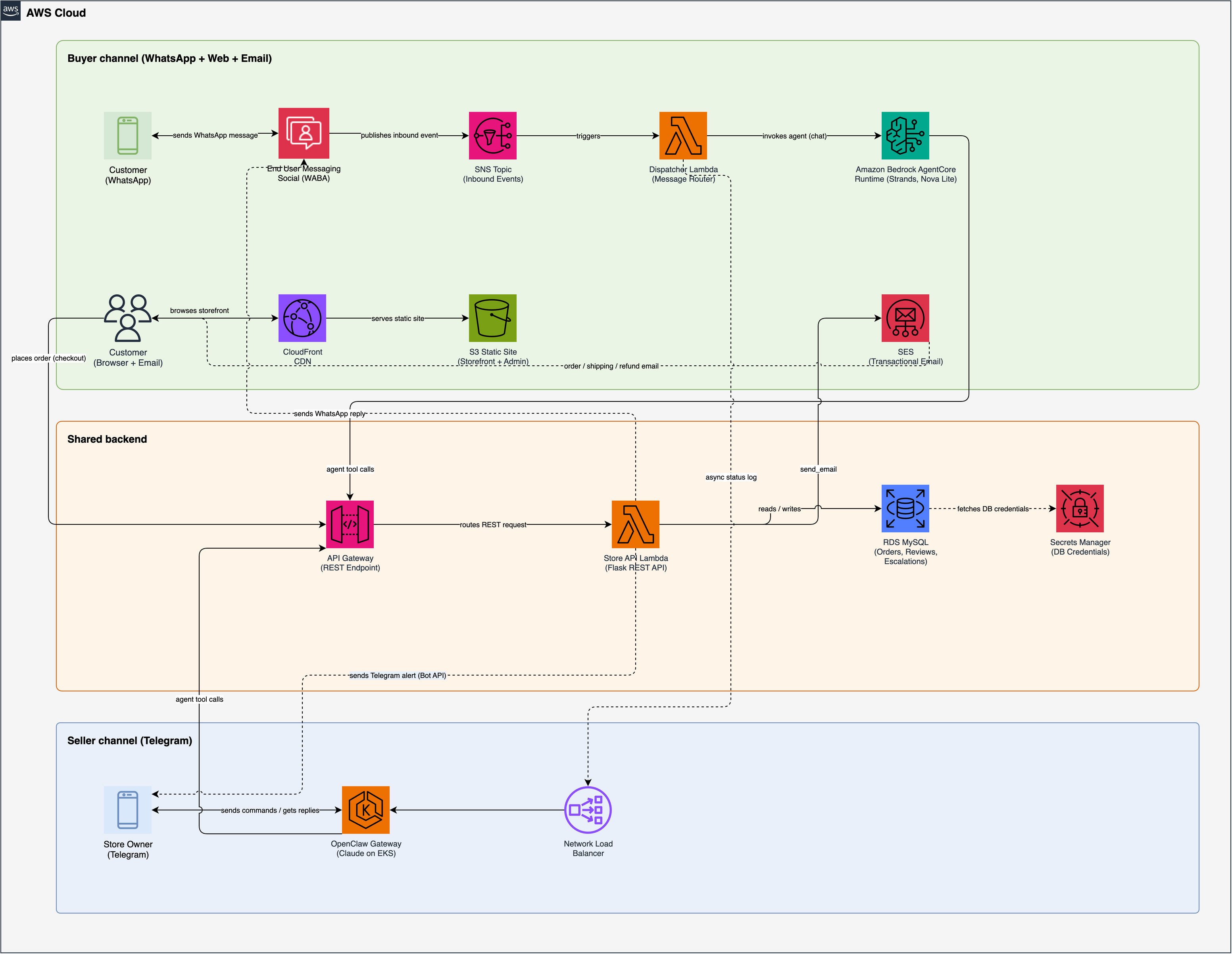
Figure 1 – Claw Boutique architecture on AWS
Buyer channel (WhatsApp): Inbound WhatsApp messages arrive through AWS End User Messaging Social, which provides a managed WhatsApp Business API integration. Messages publish to an Amazon Simple Notification Service (Amazon SNS) topic, which triggers a Dispatcher AWS Lambda function. The dispatcher invokes a Strands Agent hosted on Amazon Bedrock AgentCore Runtime, running Amazon Nova Lite for real-time, tool-calling conversations. AgentCore Memory provides session continuity across messages. The agent can look up products, check order status, escalate issues, and send replies back through WhatsApp.
Seller channel (Telegram): The store owner receives stock alerts, review escalations, and order notifications on Telegram. An AI agent runs on Amazon EKS via the OpenClaw gateway. The owner replies with natural language commands such as “restock hoodies” or “apologize to the buyer,” and the agent runs the appropriate Store API calls.
All three channels converge on a single Store API Lambda function (Python/Flask) backed by Amazon Relational Database Service (Amazon RDS) for MySQL. Amazon Simple Email Service (Amazon SES) sends transactional email messages for order confirmations, shipping updates, and refund notices.
How it works: The order lifecycle
A single order touches the web storefront, WhatsApp, email, Telegram, and the admin dashboard. Here is the full flow.
1. Place an order
You visit the storefront, add items to the cart, and check out. The Store API creates the order in Amazon RDS and returns an order number.
Figure 2 – The Claw Boutique storefront
2. Order confirmation on WhatsApp and email
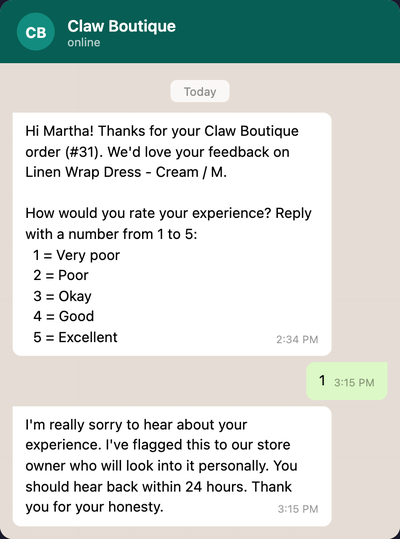
Two things happen right after checkout. The buyer receives a WhatsApp message with the order number, items, and total, followed by a feedback survey asking them to rate their experience from 1 to 5. At the same time, Amazon SES sends a confirmation email with the same order details.
Figure 3 – WhatsApp order confirmation and feedback survey
Figure 4 – Order confirmation email via Amazon SES
3. Stock alert on Telegram
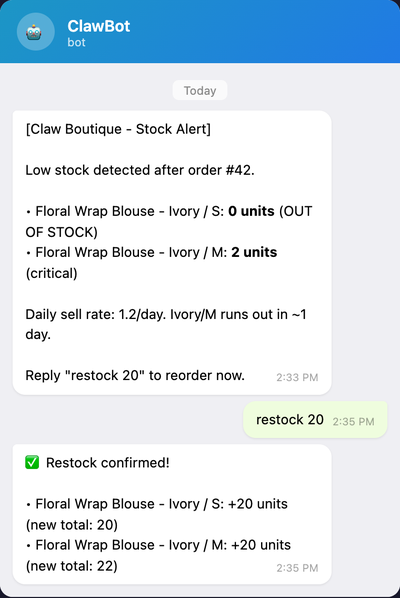
Every purchase triggers a stock check. If any item is out of stock, running low (fewer than 5 units), or projected to sell out within 7 days, the seller gets a Telegram alert with current stock levels and sell-through rates. The seller can reply with a command such as “restock hoodies 20” and the AI agent runs it.
Figure 5 – Telegram stock alert with restock command
4. Negative feedback triggers an escalation
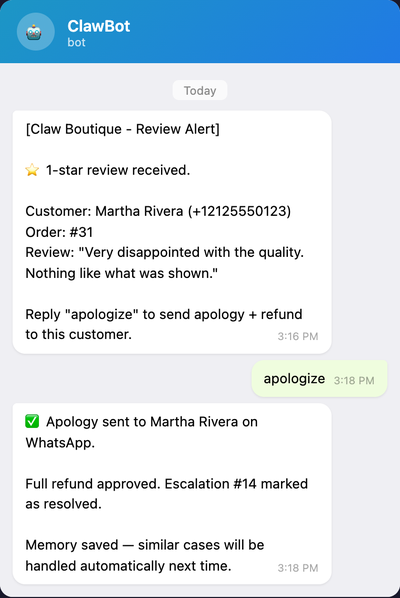
The buyer replies “1” to the WhatsApp survey. The Store API creates an escalation record and sends the seller a Telegram alert with the buyer’s name, phone number, rating, and review text.
Figure 6 – Telegram review escalation alert
5. Seller resolves the issue from Telegram
The seller replies “apologize” on Telegram. The AI agent looks up the unresolved escalation and takes four actions: sends a WhatsApp apology to the buyer, sends a refund confirmation email via Amazon SES, marks the order as “refunded” in the database, and resolves the escalation. If there are multiple open escalations, the agent lists them and asks which one to resolve.
6. Admin dashboard
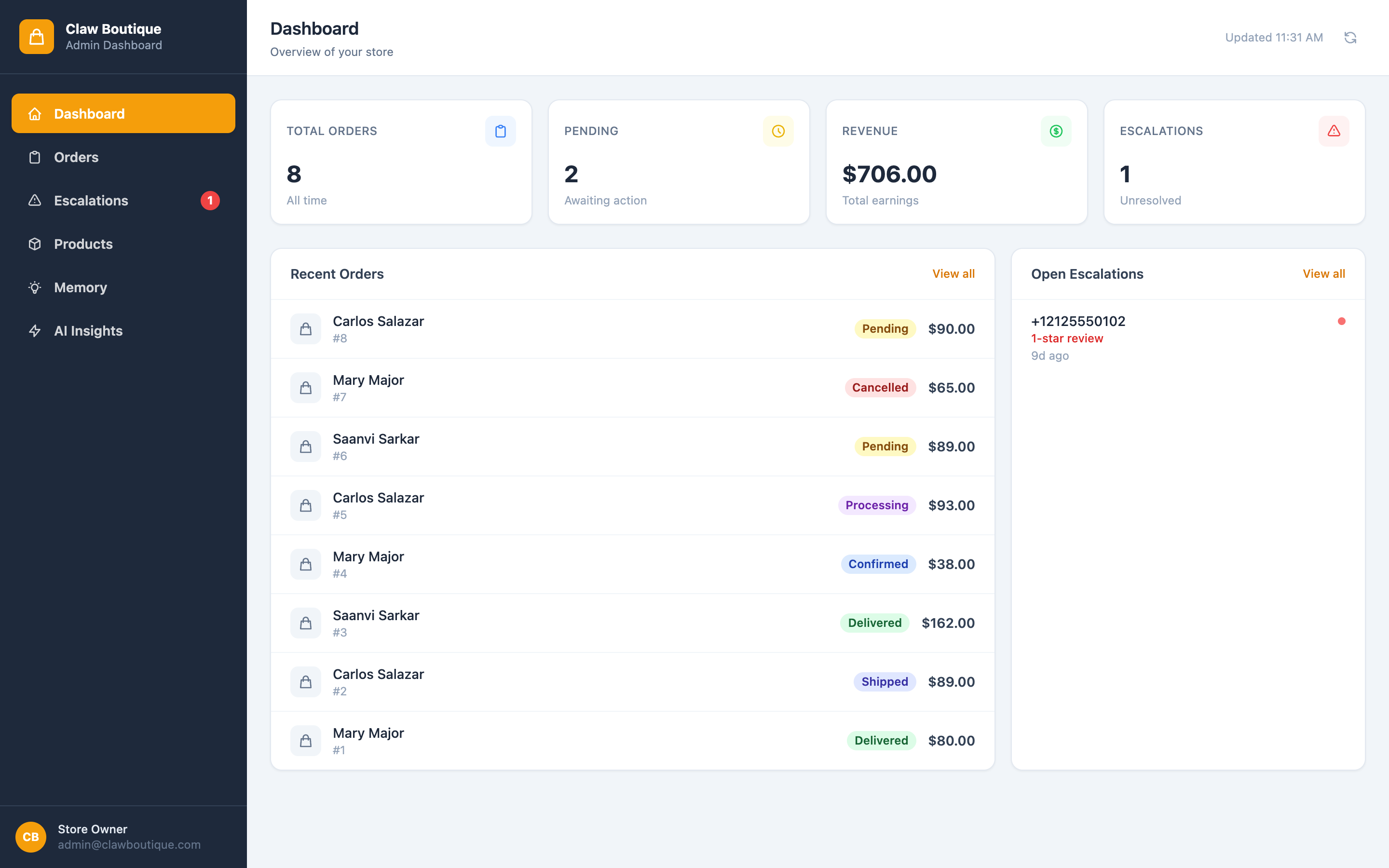
The seller can also open the admin dashboard to view orders (now showing “refunded” status), escalation history, stock levels, and AI-generated business insights based on order patterns and buyer feedback.
Figure 7 – Admin dashboard with orders and insights
Ordering directly through WhatsApp
Buyers can also browse and order by texting the WhatsApp business number directly. The Strands Agent on AgentCore manages the full conversation: showing available products, checking order status, answering product questions, and escalating issues to the store owner.
Figure 8 – Ordering through WhatsApp via Amazon Bedrock AgentCore
Why two AI models?
Claw Boutique uses two AI models for different purposes, each chosen for the characteristics that matter most in its channel.
Amazon Nova Lite (via Amazon Bedrock AgentCore) for the buyer channel: Buyer-facing WhatsApp interactions need to be fast and cost-effective. Amazon Nova Lite provides sub-second responses with reliable tool calling at a fraction of the cost of larger models. AgentCore Runtime hosts the agent container, while AgentCore Memory manages conversation history per buyer phone number. The Strands Agents SDK handles tool definitions, orchestration, and model interaction with minimal boilerplate.
AI agent (via OpenClaw on Amazon EKS) for the seller channel: The seller channel involves more complex tasks: interpreting ambiguous commands, managing multi-step workflows (such as resolving escalations that span WhatsApp, email, and the database), and generating business insights. The model’s reasoning capabilities are well suited for these. OpenClaw provides the gateway, tool execution, and memory management layer.
This approach keeps buyer-facing latency low and costs predictable, while giving the seller access to deeper reasoning when managing the business.
Prerequisites
Before you deploy, make sure you have the following:
AWS Command Line Interface (AWS CLI) configured with credentials.
The entire stack deploys with AWS CDK. A single cdk deploy command provisions the Amazon Virtual Private Cloud (Amazon VPC), Amazon EKS cluster, Amazon RDS database, Lambda functions, Amazon API Gateway, Amazon CloudFront distribution, Amazon S3 bucket, Amazon SNS topic, and all AWS Identity and Access Management (IAM) roles and security groups. AWS CDK also runs database initialization (schema and seed data), Docker image build, Amazon Elastic Container Registry (Amazon ECR) push, and Amazon EKS deployment.
Configuration values (Telegram token, WhatsApp IDs, Amazon SES email) go into a CDK context file. Cold deploy takes about 25-30 minutes.
You can find the full source code and deployment instructions in the GitHub repository.
Cleaning up
To avoid ongoing charges, delete the resources created in this walkthrough when you’re done experimenting. Run the following command from the cdk/ directory:
cd cdk && npx cdk destroy
This removes the Amazon EKS cluster, Amazon RDS database, Lambda functions, and all other resources created by the stack. No context values are needed for destroy.
Conclusion
In this post, we showed how to build an ecommerce bot using OpenClaw and Amazon Bedrock AgentCore. By combining AWS End User Messaging Social for WhatsApp, Amazon Bedrock AgentCore Runtime for real-time buyer conversations, and Amazon EKS for a seller-side AI agent, you can create a system where buyers order through the channels they already use, and store owners manage their business from a single Telegram chat.
The project is open source and deploys with a single AWS CDK command. You can use it as a starting point and adapt it to your own product catalog, messaging channels, and business logic.
AWS Builder Center turned one year old last week. Launched on July 9, 2025, the platform has grown from a community hub with Wishlist voting, community profiles, and a toolbox into a full ecosystem with sandbox environments, workshops, Spaces, and a Builders’ Library. To mark the anniversary, Rick Suttles published a full feature timeline covering everything shipped over the past year: AWS Capabilities by Region (1,500+ services across 37 Regions), Spaces for community-created groups, workshops with category and complexity filters, badges and streaks, article series, view counts, saved items, student status, availability notifications, sign-in with GitHub and Amazon, and sandbox environments.
Jeff Barr published a retrospective summarizing Builder Center’s first year. Since launch, 5,548 authors have published 6,448 articles with more than 10.4 million page views combined. Builders have earned 99,226 badges since the badge system launched in March 2026. Community members have submitted 565 wishes, 10 of which have shipped with another 20 on the near-term roadmap.
The week’s headline addition is Sandbox Environments by Rick Suttles. Sandboxes give you a free, pre-provisioned AWS account to complete a workshop exercise. Each environment is active for 8 hours, after which the account and all its resources are automatically de-provisioned. You can have one active sandbox at a time and request one per week. No personal AWS account, credit card, or manual cleanup required.
Last week’s launches Here’s what else happened this week.
AWS Security Hub introduces Network Scanning – Security Hub introduced Network Scanning, a capability that identifies resources in your environment that are reachable from the public internet. Network Scanning probes your resources from the internet to detect actual reachability, complementing the existing network reachability findings in Security Hub that identify configurations that could make a resource reachable. It discovers public IP addresses, virtual machines, and load balancers across your AWS and Azure environments, identifies reachable ports, and determines what services are running behind them. Each reachable port generates a Security Hub finding with evidence of the port and service discovered. Security Hub Exposures then automatically correlates these findings with other findings and resource configurations to determine broader risk. Existing customers can enable Network Scanning in individual accounts and Regions, or across an organization through a configuration policy. For new customers, Network Scanning is on by default. It is included with Security Hub Essentials at no additional cost.
Security Hub also extends unified security management to Microsoft Azure – Security Hub now monitors Microsoft Azure resources, providing unified posture management, vulnerability management, and security response across both clouds. It automatically discovers Azure VMs, container images, Function Apps, and identities, and evaluates them for misconfigurations, internet exposure, and software vulnerabilities. AWS and Azure findings appear in the same prioritized view with the same formats and automation workflows.
Amazon SageMaker Studio integrates with Hugging Face for one-click model deployment and customization – You can now go from discovering a model on Hugging Face to working with it in SageMaker Studio in a single click. Select any supported model on Hugging Face and choose “Customize on SageMaker AI” or “Deploy on SageMaker AI” to land directly on the corresponding workflow page with the model pre-loaded. New customers receive a Studio environment created in seconds with pre-configured permissions for serverless model customization (including fine-tuning with custom reward functions for reinforcement learning), model evaluation, and deployment to SageMaker or Bedrock endpoints. Verified customers receive default GPU access to G5, G6, and G4dn instances without requesting quota increases, and quota utilization is visible directly inside the Studio environment.
Amazon EKS Auto Mode and Amazon ECS Managed Instances reduce GPU management fees by up to 60% – Beginning July 1, 2026, EKS Auto Mode and ECS Managed Instances reduce management fees for accelerated instance types: G-series fees are down 35%, and P-series and AWS Trainium fees are down 60%. The reductions apply automatically to existing clusters and require no action from customers. Both services include capabilities built for accelerated workloads. EKS Auto Mode provides automatic parallel image pulling on GPU instances with local NVMe storage and accelerator-aware node repair. ECS Managed Instances provides GPU metrics through Amazon CloudWatch Container Insights and automatic health monitoring for GPU hardware failures.
Amazon Aurora DSQL change data capture (CDC) is now generally available – Aurora DSQL CDC streams the results of insert, update, and delete operations as change events to Amazon Kinesis Data Streams. You can use it to synchronize data across microservices, trigger Lambda functions, or deliver changes to S3, Redshift, and OpenSearch Service through Amazon Data Firehose. CDC streaming is designed to have zero impact on database workload performance and requires no infrastructure to manage.
For a full list of AWS announcements, be sure to keep an eye on the What’s New with AWS page.
Other AWS news Here are some additional posts you may find useful:
Building secure AI agents at scale: Introducing Loom for AWS – Loom is an open-source enterprise platform for building agents with AWS Strands Agents and deploying them on Amazon Bedrock AgentCore Runtime. It provides a unified management UI and backend API with identity provider integration, scope-based authorization, multi-persona navigation, and full lifecycle management for agents, memory, MCP servers, and agent-to-agent integrations. Loom enforces automated resource tagging for cost attribution, implements RBAC and ABAC for multi-tenant security, uses paved-path blueprints for agent deployments, manages identity propagation through delegated actor chains, integrates with AWS Agent Registry for discovery and governance, and supports human-in-the-loop review before sensitive actions. The project is available in AWS Labs on GitHub.
Introducing Claude apps gateway for AWS – The Claude apps gateway is a self-hosted control plane that gives organizations centralized control over access, cost, and policy for Claude Code and Claude Desktop. It connects to any OIDC-compliant identity provider, enforces managed settings on every request, routes inference to Amazon Bedrock or Claude Platform on AWS, and supports per-user and per-group spend caps. The gateway runs as a stateless container in your private network, backed by a PostgreSQL database for short-lived sign-in state. No long-lived secrets are stored on developer machines. Deploy it through Amazon Bedrock to keep data within the AWS security boundary, or through Claude Platform on AWS for the native Claude platform experience.
Introducing OAuth support for AWS MCP Server – You can now connect agents to the AWS MCP Server using browser-based OAuth with the same credentials you use for the AWS Console or CLI. The new sign-in path supports IAM federation, AWS IAM Identity Center, and root or IAM users. AWS Sign-In issues short-lived access tokens and refresh tokens, with automatic token management so developers stay authenticated across restarts. For headless use cases, a non-interactive flow lets applications with existing AWS credentials obtain OAuth access tokens through the create-oauth2-token-with-iam API. New governance controls include OAuth-specific IAM condition keys, token introspection and revocation, dynamic client registration, and CloudTrail audit elements.
For a full list of AWS blog posts, be sure to keep an eye on the AWS Blogs page.
Upcoming AWS events Check your calendar and sign up for upcoming AWS events:
AWS Summits – Free in-person events for builders and innovators to learn, think big, and make new connections. Coming up: Taipei (July 15), Bogotá (July 30), Jakarta (August 6), Ciudad de México (August 12), Johannesburg (August 19), and Zurich (September 2).
Visit the AWS Builder Center to meet other builders, contribute solutions, and find resources that help you keep building.
Wishing everyone a restful and enjoyable summer. Whether you’re building, learning, or recharging, I hope you find time for all three. I’ll be heading to Scandinavia for a few weeks to trade the heat for some cooler weather and longer evenings. Come back next week for more news!
Today’s data-driven tools can make many aspects of our personal lives less time-consuming, because they present us with options and even make decisions for us. By relying on predictive text features, we write messages more quickly and outsource our word choices. By using music and film recommendations, we outsource our personal taste. And by using AI chatbots that produce confident answers to every single one of our questions, we outsource our thinking.
Of course, I use and enjoy all of these products. But because I grew up before data-driven tools existed, I also know the accidental delights of exploring a city without a smartphone map, the joy of thoughtfully choosing a gift for a friend, and the satisfaction of comparing insurance quotes and understanding their details. These non-AI-assisted acts exercise my critical thinking skills — something that is harder to do in a world where AI products promise so much convenience.
Critical thinking is even more vital now in the age of AI. The brand-new issue of Hello World — and our new podcast mini series — offers research, advice, and practical resources for teaching young people, and ourselves, to think critically.
In issue 30 we share articles from educators who have already been thinking deeply about the role of critical thinking in the age of AI. They discuss a range of questions such as: What do educators bring to the table when teaching with digital technologies? Why AI professional learning should build teachers’ critical thinking, not just their confidence in using tools Whose knowledge is shaping AI?
Our feature articles also include: • Managing cognitive load for deeper thinking • AI systems in assessment • Promoting human decision-making
From the team at the Computer Science Teachers Association (CSTA) in the USA we have an article about their newly rewritten CSTA K–12 Standards, a research-backed framework designed to prepare students for a future that seems to be arriving very fast on some days. As their article says:
“AI can generate answers instantly, but understanding and evaluating answers still requires human judgement. In a world moving at supersonic speed, CS education needs to find a new balance. Students must learn to think critically so they can direct AI rather than being directed by it.” – Amanda O’Mara, Smita Kolhatkar, and Tiffany Jones in Hello World issue 30
Download Hello World issue 30 for free
Developing critical thinking skills is important for young people, regardless of the discipline you teach. In the age of AI, computing education is uniquely situated to cultivate this mindset, encouraging students to engage more thoughtfully with the AI tools they use daily.
Also in issue 30: • Flatgames • Predictive classroom systems • A physics meets technology project
Let us know which articles you found most helpful for your teaching or which resources you tried out by sending us a message or tagging us on social media.
Thank you to Oracle for sponsoring this issue of Hello World.
Cisco has some unusual challenges when it comes to deploying security patches
across the company’s many devices running custom kernels. John Fastabend spoke
about his work preventing exploits with BPF at the 2026
Linux Storage,
Filesystem, Memory-Management, and BPF Summit.
The technique could substantially reduce the time necessary to respond to kernel
vulnerabilities, but it will not be fully effective unless more hooks are added
to the kernel.
Debian has announced the final normal update for Debian 12 (“bookworm”). Long-term-support updates will continue until 2028. As may be expected from a stable version, the update is mostly limited to security fixes. Still, it may be time for Debian users to look into upgrading to a more recent version. Conveniently, Debian 13 (“trixie”) also received an update this weekend, with many of the same security fixes.
Healthcare organizations seeking HITRUST i1 certification increasingly rely on Amazon Web Services (AWS) as their cloud foundation. The HITRUST i1 assessment covers 182 curated controls at the Implemented level and is the most widely required HITRUST certification tier in healthcare vendor contracts and Business Associate Agreements required by health plans, hospital systems, and business associates as a condition of working with them.
This guide is designed to close the gap between understanding what HITRUST i1 requires and knowing how to implement it on AWS. It walks cloud architects, security engineers, compliance leads, and assessment preparation teams through the full lifecycle of an i1 engagement from defining the assessment boundary to implementing controls across each technical domain.
What the guide covers
The guide addresses 11 HITRUST i1 technical control domains, with supporting AWS implementation components relative to these domains. The domains include access control, endpoint protection, configuration management, vulnerability management, network protection, transmission protection, incident management, data protection and privacy, audit logging and monitoring, password management, and business continuity and disaster recovery.
The guidance is grounded in a fictional but realistic connected healthcare platform deployed on AWS Landing Zone Accelerator. The scenario is used to make abstract HITRUST concepts concrete, not to suggest that the same architecture or control choices apply universally. HITRUST i1 scoping is inherently organization-specific. The assessment boundary, applicable controls, and evidence requirements are determined by each organization’s system scope and delivered through the HITRUST MyCSF portal. Readers should treat the guidance as a starting point and work with a HITRUST Authorized External Assessor to validate what applies to their specific environment. This guide doesn’t constitute a compliance certification advisory.
AWS HITRUST assurance documentation and the Customer Responsibility Matrix are available through AWS Artifact. For assessment readiness support, visit AWS Security Assurance Services.
If you have feedback about this post, submit comments in the Comments section below.
Bot mitigation is an adversarial game: attackers adapt, defenders respond, and the cycle continues. At Cloudflare, we stay ahead by combining visibility across our global network with signals from the client-side environment. At the network level, we analyze over 1 trillion requests per day to understand reputation, patterns, and anomalies across more than 20% of the web. On the client side, we’ve pushed detection deeper with Cloudflare Turnstile, which has evolved from a CAPTCHA replacement to a risk-based managed challenge that adapts the amount of friction needed to verify the user is authentic.
Today, Turnstile runs nearly 3 billion times per day on some of the most sensitive endpoints on the Internet, helping verify users at key moments like login, signup, and checkout. This improves protection on the most important areas of customer applications, but still leaves limited visibility into the rest of the application — how humans and bots actually interact across the full user journey.
This is the visibility gap we’re closing today with our launch of Precursor.
Introducing Precursor
Precursor is a client-side, session-based verification system, built with privacy in mind, that uses dynamically injected JavaScript to continuously collect behavioral signals as visitors interact with your application. These signals are processed and incorporated into Cloudflare’s bot protection in real time, allowing us to continuously distinguish human traffic from automated or agentic traffic.
This extends the client-side detections offered by a Challenge to your entire web application. Precursor is an optional complement to Turnstile — both are features of our Enterprise Bot Management.
This user-journey-based detection is powerful because modern automation is increasingly capable of appearing legitimate in short bursts. Bots can execute JavaScript, use real browser environments, and pass individual CAPTCHAs without raising suspicion. What remains difficult to replicate is consistent human behavior over time.
Precursor is built to capture that layer of interaction, turning behavior itself into a reliable signal for detecting fraud and abuse. By evaluating behavior across an entire session, Precursor adds significantly more signal to each decision. This improves detection precision, making it easier to distinguish real users from automation without relying on aggressive Challenges. For legitimate users, Precursor means fewer unnecessary interruptions. For bot developers, it raises the cost of operating automation by requiring them to simulate a full session. This is significantly harder to build, more expensive to maintain, and far less reliable to operate at scale.
To err is human
When a bot developer tries to make a mouse movement look human, they usually add Gaussian noise or uniform random delays. But human movement isn’t just “noisy,” it is also constrained by physics:
Wrist pivot: A human mouse movement is often an arc, limited by the range of the wrist and the rotation of the forearm.
Cognitive load: There is a measurable delay between a human seeing a checkbox and clicking it.
Hand tremor: Even the steadiest human hand oscillates at a physiological tremor frequency.
Bots, by contrast, often behave in ways that give them away. They move in linear interpolations or mathematically ideal Bézier curves. They click with a precision that humans could never replicate. And even when they do manage to simulate human error, there is a rhythm to human movements that can only be seen by examining an entire session.
Mouse movement is just one example of the signals Precursor evaluates, but it illustrates the difference clearly. Below is an example of a mouse automation library interacting with a site. You can see how the mouse moves in perfectly straight lines, always returns to an origin, and reacts with the same velocity.
Now, contrast that with a human navigating the same site: you see irregular paths, small corrections and overshoots, and variations in speed, timing, and direction.
Individually, these interactions might look plausible. But over the course of a session, these patterns diverge in ways that are difficult to fake. Precursor is designed to capture and evaluate these behavioral signatures as they develop over a visitor’s interaction with an application.
How Precursor works
To evaluate behavior over time, Precursor continuously collects interaction data on the client and builds a session-level view of activity for that site.
1. Injection and collection layer
When Precursor is enabled on your application, Cloudflare automatically injects a lightweight script into HTML responses from your site as they pass through our network, with no additional configuration, network connections, or third-party embedding required. The injected Precursor bundle is compact, obfuscated, and assembled dynamically for each response. The bundle is designed to not interfere with any additional page logic of the hosted web application.
The script attaches lightweight event listeners to capture interaction signals such as pointer movement, keyboard activity, focus changes, and visibility. These events are serialized into a compact format and buffered in memory. At regular intervals, the buffered data is sent back to the evaluation layer for analysis.
2. Evaluation layer
On the edge server, incoming Precursor payloads are deserialized into behavioral inputs. A dispatcher runs a roster of evaluators on the input data. Each evaluator reads the Precursor streams it cares about and can raise signals into the shared detection registry.
Evaluators are designed to cross-reference data. For example, they confirm that pointer activity correlates with page visibility duration, or that keyboard events only fire when a text field is focused. This stream of information is then consolidated into individual signals that are used for weighting detections.
3. Session integration
Precursor data is session-scoped, meaning it accumulates throughout a session. Session scoping is important because it means a bot cannot reset its behavioral signature by refreshing the page or starting over with a new challenge. The system also feeds session metadata into downstream detection layers for additional shadow-mode heuristics and session analysis, predicted vs. actual completion, and session delinquency heuristics. These edge-side observations are logged for detection improvement purposes and to adjust the bot score of a session.
4. Privacy by design
Precursor was designed to collect signals that help to distinguish human patterns from automated and abusive patterns.
The event listeners capture the minimum information needed to be a useful signal for detecting automation and abuse. For example, keyboard activity is captured as timing and rhythm, not as the actual keys pressed. In addition, behavioral signals are evaluated as aggregate patterns rather than individual actions and are consumed internally by Cloudflare’s bot detection systems; they are not exposed to customer dashboards or tied to user accounts, login identities, or persistent profiles.
Taken together, this allows Precursor to maintain a continuously evolving evaluation of behavior, maximizing precision while minimizing the friction on good users.
Per-session analytics
To support this new layer of detection, we are introducing session-based views in Security Analytics. These dashboards shift the perspective from individual requests to full visitor journeys. You can now answer questions like:
What does a typical session look like on my site?
Where do sessions diverge from expected behavior?
Which sessions show signs of automation over time?
Use Security Analytics to explore session-based views for your bot management traffic.
These analytics now capture information that per-request analytics can’t — especially the behavior that occurs between requests. Precursor feeds directly into existing systems like bot score, challenge decisions, and security rules, so you benefit from this added context immediately.
What’s next
Precursor is the foundation for extending bot detection across the entire application. We are continuing to expand the range and depth of behavioral signals for security, how session-level insights influence our bot management protections, and new ways to visualize and act on session data. As bots evolve, detection needs to move beyond isolated checkpoints and into the full flow of user activity.
Get started
Precursor is rolling out now and can be enabled directly from your Cloudflare dashboard. Precursor will be free to use until our GA release later this year. Getting started is simple: turn Precursor on for your zone and choose how strictly you want to verify sessions. You can run it in a low-friction mode to observe behavior in the background, or require a fully verified session by enforcing Challenges if a session doesn’t already exist.
Once enabled, Precursor begins enhancing your existing bot defenses immediately, with no changes required to your application. If you’re already using Bot Management or Turnstile, Precursor extends those protections beyond Challenges and into the rest of the session. Enable Precursor to extend detection across the full user session, including the activity between moments you already protect.
This essay was written with Nathan E. Sanders, and originally appeared in The Guardian.
Opposition to AI data centers has emerged as a primary theme in US politics, one that—surprisingly—doesn’t fallalong party lines. We applaud people coming together for constructive debate on any issue, and agree that communities need to evaluate whether any economic benefits these data centers bring is worth their costs. Still, we worry that a focus on data centers obscures the larger impacts of AI on people’s lives: the concentration of power of AI companies, and their widespread political and financial influence.
Local data center opposition is grounded in legitimate concerns about misallocation of land resources when housing is at a premium, pressures on already higher energy prices, and localized environmental impact. Unlike other resource-consuming and polluting industrial facilities, data centers produce very few jobs. The fact that US opposition to data centers seems to be most fierce among lower-income communities reflects righteous indignation with an inequitable bargain, where tech companies and developers profit from exploiting local resources but offer little in return. On a global scale, their carbon footprint could grow unsustainably if usage accelerates. And all this is in aid of a technology that many fear will propagate misinformation, take their jobs, or even cause existential risks for humanity.
For some, data center opposition may feel like the only tangible mechanism for registering their concern, disapproval, or even anger about AI. The problem is that this may be exactly what the AI companies are banking on. They can overcome the protest when it matters to them, and live with a significant fraction of proposals being defeated. More importantly, focusing political opponents on the data center issue obscures the bigger prize they’re after.
While there is a staggering three-quarters of a trillion dollars being spent on data center infrastructure by US companies this year alone, this investment should be taken in perspective. The market for enterprise software, for example, is about twice this size. And it’s small compared with what these companies actually want.
AI companies have their eyes set on capturing all the value created by entire industries. The technology has arguably already conquered customer service and consumer sales. But on the horizon are bigger targets, such as enterprise software development, creative design, management and even legal services. In AI companies and their allies’ vision of the future, AI replaces teachers and doctors. The companies would rather spend time fighting resistance to how fast they are building computing infrastructure than dealing with issues of how their products should be used in those fields, or how those fields should be protected from their products.
And while data center opposition campaigns have been successful in building widespread appeal, their effectiveness in the US is mixed. They seem to be most successful when organizing against speculative, early-stage data center proposals that have a relatively low likelihood to ever see fruition. Meanwhile, advanced-stage, well-capitalized data center projects have proven to have the resources to overcome local opposition. An OpenAI- and Oracle-backed facility in Saline township, Michigan, is breaking ground on construction even after local officials voted to reject it. The developers sued the town of 3,000 and forced a settlement that involved their project going forward. Meanwhile, the Trump administration, a vigorous ally of corporate AI, has signaled its willingness to advance AI infrastructure development by overriding state objections and even using federal lands.
Also consider that rampant data center development may be a momentary spike rather than a longstanding concern. Demand for the centralized computing that data centers provide may well decline over time. The leading Chinese labs, such as Z.ai, are innovating in technical mechanisms to make frontier-class models smaller and cheaper to run. AI power users have become adept at miniaturizing open weight models, ones published free for anyone to download and use, to run locally on their own computers. Apple and Googleboth support infrastructure stacks for running AI models directly on mobile phones. It could be that the current mania for data centers will look like the fiber optic cable bubble from the early 2000s, as demand shifts to smaller models and AI usage on people’s own devices.
For those concerned primarily with affordability and environmental protection, singling out data center construction is misplaced. Energy rates and inflation today seem to be most visibly affected by the US-Iran war. The US is disinvesting in long-term energy security by ceding the renewable energy industry to China and actively cancelling climate commitments. Consider that 10% of global carbon emissions stem from heating buildings, which dwarfs energy use by AI and could be cut fivefold by using heat pumps powered by renewable energy. With respect to housing affordability, federal housing subsidies have changed little over three decades, in inflation-adjusted terms, even as housing costs have spiked and homeowners have enjoyed robust tax incentives.
As for AI itself, the concentration of power and wealth in these tech companies is the greatest existential risk facing society today. This means we must limit corporate power, especially corporations’ ability to exploit the public and manipulate our political system.
Opposing data centers should be just a starting point. We can advocate for states to regulate AI, to reject irresponsible uses of the technology, and shape corporate behavior. We can fight for AI computation to be taxed, so that the public can capture some of the profit of AI use while also forcing AI companies to internalize more of the energy and environmental consequences associated with its use. And we all can join the global movement for Public AI, an alternative ecosystem for AI that is developed under public control with an incentive structure to create public benefit rather than private profit.
The US midterm elections present ample opportunity for those seeking to control the AI political agenda. In the recent New York congressional Democratic primary, PACs linked to the dueling AI companies Anthropic and OpenAI spent millions of dollars lobbying for or against “AI safety“, the idea that we must urgently monitor and prevent people from using AI to cause catastrophic harms. We’re already seeing a similar dynamic play out in races in Massachusetts and other states.
Why would Anthropic and OpenAI—bitter industry rivals but fundamentally on the same side politically—support opposing viewpoints? Because they both ultimately profit from the mystique: the idea that their products are so powerful that controlling those products is the world’s most important challenge. Here’s the typical read on the dynamic. To one side (backed by OpenAI affiliates), “safety” comes from the appearance of US industry dominating AI innovation, under the slow-moving control of federal lawmakers (and without pesky state regulators in the way). To the other side (backed by Anthropic), “safety” means a heavier regulatory framework that plays to Anthropic’s posturing as the ethics- and compliance-focused AI vendor. In both cases, it’s more marketing than principled concern about safety.
Political organizers should call out and reject the AI companies’ framing of the debate, and reorient campaign agendas around populist resistance to corporate concentration of wealth and power. When AI companies pump millions into legislative races, the result should not be hyperbolic discussion of AI superintelligence. And when a plot of land in a small town is pitched as a data center site, the debate should be about more than the local costs and benefits. It should include out-of-control money in politics, and Citizens United-proof solutions to limit corporate influence like public financing and state regulation.
We all have a vested interest in what’s on the policy agenda, and what the outcomes are. Today, the greatest risk AI poses to society is the exacerbation of inequality and the concentration of wealth. The real problem is trillion-dollar AI companies and their trillionaire oligarchs cozying up to political power in Washington and governments worldwide, and using their money to enact their agenda over the popular will of the people. This is the issue we’d like to see put front and center, and it requires solutions much more extensive than slowing data center development.
Частната телевизия е като плод-зеленчук: „Отиваш сутринта, отваряш, хората купуват, ако са ти хубави продуктите; ако са лоши, не купуват.“ Така разказа бизнеса си един от собствениците на bTV – Красимир Гергов, в едно от малкото си интервюта по повод десетата годишнина на първата частна национална телевизия у нас. Петнайсет години по-късно телевизията е превърната в кебапчийница – поне ако се съди по меметата, украсили последния публичен скандал за цензура и произвол в една от все още най-големите медийни институции в държавата.
Всичко започва, след като 19-годишният Мартин Атанасов (автор на „Черна писта“ и „Диагноза България“), поканен за гост в предаването „Лице в лице“, публикува скрийншот от вътрешна комуникация в нюзрума на bTV, от който става ясно, че участието му е спряно с разпореждане отгоре. Той трябваше да сложи на тезгяха темата за течовете в здравеопазването, за които плащаме всички ние. Но тя се оказа „неважна“ – свалена еднолично с кратък текст от директора на отдел „Новини, актуални предавания и спорт“ Асен Иванов. Заради някаква си чаша.
Този с чашата ли .. никога Да ходи в Извън ефир .. може да го скрийшотнете и сложите в Фейса Този няма да стъпи в ефир на бтв, докато зависи от мен
разпорежда началството с високомерната безнаказаност на човек, който знае, че се отчита другаде, а не пред обществената санкция на социалните мрежи. Можем само да предполагаме, че на някого от участниците в разговора също му е преляла чашата и затова този вътрешен чат получи публичност. За съжаление, това е максималната степен журналистически бунт и несъгласие, които може да очакваме в момента.
Продуцентката, поканила госта, го връща, лъжейки вместо началника си и прикривайки предварителната цензура, на която тя, екипът и събеседникът са подложени. Ръководството на медията също застава зад документирания властови произвол с клишето „редакционно решение“.
Че това не е легитимно редакционно решение и защо една телевизия не може да си прави каквото си иска в новините дори когато е частна, ще стане дума след малко.
Преди това – какво разгневи Асена на „bTV Новините“? Да го наричам „директор новини“, макар и фактически вярно, ми се струва обидно за всеки останал професионалист в екипа на медията, както и за самата функция, която помни по-добри времена, лица и имена.
Кой е Асен Иванов?
Официалната му биография го представя като дългогодишен журналист на bTV – криминално-съдебен репортер, редактор и така до главен редактор. Завършил е право в Югозападния университет в Благоевград, а след това и национална сигурност във Военната академия. От официалната му биография обаче трайно е изпаднал един интересен епизод: между 2012 и 2017 г. Иванов работи в ТВ7 – финансираната от КТБ телевизия, превърната в политически инструмент на Цветан Василев, Делян Пеевски и Николай Бареков. Там се издига до изпълнителен продуцент. Но през 2017 г. се връща в bTV, поканен от Венелин Петков, въпреки вече ясното му осветяване като част от политически инженеринг в журналистиката.
История с чаша, но не за чаша
Историята с чашата вече е клише. Когато в края на миналата година Мария Цънцарова беше отстранена от ефира на bTV, официалното съобщение на медията посочи като повод именно някаква чаша, с която тя си позволила да се яви в ефир. Обяснението беше толкова несъстоятелно, че на момента се превърна във фолклор, а чашата с надпис „Време за истинска промяна“ – в символ на протест в подкрепа на свободната журналистика.
Горе-долу по това време с тази именно чаша се яви Мартин Атанасов в студиото на bTV при седналия в опразненото столче на Мария Цънцарова неин колега Росен Цветков. Подари му я и го призова да пази достойнството на професията.
Този жест явно е засегнал директора на новините достатъчно, за да го спомене в официалната си позиция от миналата седмица. В нея той признава, че лично е свалил гост от ефир, през главата на редакционния екип, заради „целенасочена провокация и неуважение към наш водещ“. И добавя:
Когато един гост използва ефира за предварително планирани демонстративни действия, това неизбежно поставя въпроси за доверието между него и редакцията, както и за целта на участието.
И тук вече личат дефицитите и на самия аргумент, и на човека, който го артикулира. Първо, това, че гостът идва с предварително подготвено обществено послание, не е доказателство за недобросъвестност. Напротив – подготовката на госта е знак за сериозно отношение както към медията, така и към публиката. Освен ако самото послание в защита на свободната журналистика не се приема като обида към екипа, но това вече казва повече за обидените, отколкото за намеренията на госта.
Отделно, медия, която е извела в свое мото „силата да бъдеш информиран“, не може и не трябва да очаква от своите събеседници само позиции, които са ласкателни за самата нея. Години наред същата тази телевизия твърдеше, че търси всички гледни точки. Включително на един критичен към медията гост, който впрочем не беше единствен в онези дни. Не е приятно преживяване, но със сигурност не е легитимен повод за задраскване на събеседници. Защото това не са корпоративни отношения между партньори.
Телевизията е партньор на зрителя. Него обслужва и заради него трябва да е готова да изслуша дори онези, които не харесва.
Няма такова доверие – между гости и редакция. Няма тест за лоялност, за да те показват по телевизора. Както впрочем няма и абсолютна лоялност на журналистите към собствениците и главните редактори. Това не е клуб по интереси, затворена Facebook група или мафиотска структура, в която да стъпва кракът само на проверени и доверени хора.
В едно свое интервю началникът на „bTV Новините“ споделяше с гордост, че телевизията му се гледа от хората с власт. И явно за него е достатъчно. Но не за това доверие работи шефът на новините. А за доверието между медията и публиката. То е валутата в този бизнес. Нещо като сертификат за качество или печат от ХЕИ, предполагам, за една кебапчийница.
Оттам и основната задача на шефа на новините: да избира и развива журналисти и формати, които се ползват с обществено доверие, и да им осигурява гръб, за да го поддържат. Толкова. Плюс щипка рейтинг. Това работят шефовете на новини в търговските телевизии. На теория.
На практика всички виждаме, че явно има абонамент с проверени гости за ефира не само на bTV. От сутрин до вечер гледаме едни и същи лица, които често говорят с чужди гласове. Те и затова са канени – пращани са от пресцентрове и политически пиари да изговарят теза от името на една или друга скрита сила зад безотговорността на „независим“ анализатор.
Това са проверените хора в медиите, които не застрашават доверието. Могат да идват с теми от частен интерес на един или двама души в държавата и да говорят „за хората“. И никакви обиди на никакви водещи не могат да спрат триумфа на тези говорители в ефира на bTV, а и на останалите големи телевизии. Така например когато лидерът на „Възраждане“ нападна с обиди Мария Цънцарова в собственото ѝ студио през 2024-та, медията мисли два дни и написа някакво съобщение в подкрепа, но клетва, че кракът му няма да стъпи повече, нямаше.
bTV не може да си кани когото си иска дори когато един Асен е шеф на новините
Телевизия като bTV, дори гледана като плод-зеленчук или скара-бира, работи с ограничен обществен ресурс – ефирната честота, предоставена ѝ с лиценз и срещу конкретни задължения към публиката. Това не я прави държавна, но я прави нещо повече от обикновена частна фирма.
лицензът не е нотариален акт за собственост върху ефира. Той е обществен договор. Срещу правото да използваш честоти и да печелиш милиони от вниманието на милиони хора приемаш задължението да им даваш качествена информация в техен интерес, добита чрез равен достъп и плурализъм на гледните точки, отстоявани през редакционна независимост.
Така bTV не може като продавачката в кварталната бакалия, разположена в собствен гараж, просто един ден да реши, че няма да обслужва хора с руса коса, примерно. Всъщност и в бакалията не може така, защото би било дискриминация. И понеже, за щастие, не живеем на ориенталски пазар, където „всеки сам си преценя“, а във все-още-уж-законова държава, има норми и регулатори, които би трябвало да следят да не се самозабравят онези, които вярват, че няма кой да ги накаже.
Любопитното е, че в онова интервю от 2010-та Красимир Гергов, изглежда, го разбира това:
Не може, както в другите фирми, идват и казват на собственика: „Направи така.“ Тук има свобода на словото.
На кого говори и дали това не е по-скоро публично оправдание за случващото се в ефира по онова време, можем само да гадаем. Но поне теорията беше вярна. Или поне се полагаше усилие да изглежда така, сякаш телевизията не е бащиния. Дори и ако това е било само „за пред хората“.
Законът за радиото и телевизията забранява политическата и икономическата намеса и цензурата в дейността на медиите (чл. 5). В същия закон е записано, че журналистът може да откаже възложена задача, когато тя противоречи на закона, на личните му убеждения или на професионалната му съвест (чл. 11). И макар българската рамка да оставя достатъчно удобни вратички за натиск и интерпретация, смисълът е ясен:
журналистът не е войник в казармата на директора.
От август 2025 г. това вече не е само пожелание от учебник по журналистика. Европейският акт за свободата на медиите е факт и трябва да се прилага пряко и в България, нищо че не сме разбрали това да се е случило. Той изисква медиите да предприемат реални мерки за независимостта на редакционните решения и да разкриват конфликтите на интереси, които могат да влияят върху тях. Европейският законодател специално посочва риска акционери и собственици да бъркат границата между стопанската си свобода и редакционната свобода.
С други думи:
да, директорът на новините има право да ръководи редакцията. Да определя стандарти, да приоритизира ресурси, да изисква проверка, да връща недостоверни материали, да носи отговорност за програмата.
И не, няма право да превръща личната или корпоративната си обида в редакционна политика, да наказва събеседник за публична позиция или да отменя вече взето професионално решение на екипа само защото „от него зависи“.
Едноличното „никога!“ не е редакционна корекция, а намеса. И понеже е записано черно на бяло, този път няма нужда да гадаем дали е имало натиск, дали някой се е обадил и дали всички просто са се разбрали по телепатия.
Редакционният екип, разбира се, също има право да каже „не“. Това, че един Асен е поискал да прогони събеседник, не превръща желанието му в задължителен мандат. В най-лошия случай могат да те уволнят. Което съвсем не е малко, особено в държава с миниатюрен медиен пазар и с години систематично прочиствана професия.
Защо няма съпротива отвътре?
Разбира се, лесно е отстрани да питаме защо продуцентката не е отказала, защо е излъгала госта, защо никой не е станал и метнал чаша в ефир. Повече съпротива би била добър знак за състоянието на професията. Но след дългогодишна негативна селекция и регулярна санитарна сеч в медиите един журналист трудно може да се окаже по-силен от цялата система. Особено когато няма институционална защита, няма гилдийна солидарност, а обществената подкрепа приключва с възмутен пост във Facebook. Затова днес споделянето на един вътрешен скрийншот минава за бунт.
Оставете дебатите на журналистическите факултети, те добре се справят с тая работа. Регулаторът работи друго: да проверява спазва ли лицензираната медия закона и европейските изисквания за редакционна независимост и ако не – да налага санкции. Задачата на СЕМ е да предпази журналистите от натиск, включително когато той идва не от политик пред асансьора, а от собствения им началник. И ако законът не дава достатъчно силни инструменти, поне да го каже ясно и да изиска такива. Свикнали сме с бездействието на регулатора в подобни случаи и не очакваме нищо по същество, но това е част от проблема. И опитите да се прикрие с часове безсмислено говорене само го доразобличават.
Има ли кой да ги накаже?
Сигурно. Американската публика например направи показно при кризата около ABC и Джими Кимъл. След политическия натиск и временното сваляне на предаването реакцията не остана само в социалните мрежи. Абонати и инвеститори насочиха гнева си към Disney – корпорацията, която реално държи парите и взема решенията. Кимъл се върна в ефир шест дни по-късно и записа най-високия си рейтинг от години. Не защото корпорациите внезапно са развили съвест. А защото някой е превел възмущението на хората на езика на парите.
Дори Джеф Безос, когато реши да наложи волята си над редакционната позиция на собствения си Washington Post и спря подготвената подкрепа за Камала Харис преди изборите през 2024 г., не успя да представи намесата като нормално редакционно решение без цена. Последваха оставки, открит бунт в редакцията и над 200 000 прекратени абонамента.
В нашия случай заформилият се опит за бойкот, струва ми се, не трябва да е насочен само към bTV – компрометирания медиен бранд в портфолиото на корпорацията майка. Призивите да не се ходи в студиата, обзаведени по правилата на асеновци, са симпатични, макар и доста лицемерни, а в най-добрия случай – тежко закъснели.
Ако изобщо ще се упражнява потребителски натиск, той би имал смисъл единствено ако е насочен към другите търговски активи на същата корпоративна група в България, като телекоми например. Там е касата.
Телевизията може да преглътне няколко отказани гостувания и ядосани поста в социалните мрежи, но златните яйца днес се снасят не в бизнеса с ефирните честоти, а по телекомуникационната вертикала. Там бойкотът може да се преведе на езика на бизнеса.
Но засега у нас сме по-силни в чашите, статусите и моралното превъзходство.
И тук влиза неудобният въпрос как въобще един Асен стига до позицията, от която може да разпорежда „този никога“ на цял редакционен екип. Вътрешният чат не е началото на историята, а моментът, в който един Асен излиза от гардероба. Де да беше само той…
Асеновците не падат от небето и не се самоназначават.
Те са ГМО производство на българската журналистика в големите медии. В конкретния случай въпрос има и към Венелин Петков, при чието ръководство Иванов се връща в bTV след ТВ7 и постепенно стига до управленски позиции.
По какви професионални критерии е върнат? С какви гаранции, че школата на ТВ7 е останала зад гърба му, а не е дошла с него в нюзрума?
Няма смисъл да се посочва един-единствен виновник. Асен е възможен, защото зад него има цяла система от назначения, премълчавания, компромиси и професионални амнистии. Система, която приоритизира лоялността пред моженето, гъвкавостта пред стандартите, съобразяването пред отстояването.
Ако се върнем към онова интервю с Красимир Гергов и плод-зеленчука и сравним казаното от него с изявите на днешните телевизионни господари, ще се наложи един очевиден извод: политически игри с телевизията винаги е имало, но нивото определено пада.
От онова интервю смятам, че несправедливо се запомни само цитатът със зарзавата, а от днешна гледна точка там има и доста по-ценни свидетелства:
Българските медии вече са доста големи деца, за да може някой да ги бие по дупето и да слушат каквото някой им каже отгоре. Така че ние винаги ще намерим начин, ако някой ни притиска, да излезем от ситуацията. Не смятам, че политиците са толкова глупави да налагат ежедневен контрол върху медиите, защото това ще бъде краят им.
Наивно, нали. През 2010 г. все още звучеше възможно.
Една друга сбъднала се прогноза от днешна гледна точка ми се струва много подценена. Интервюто е дадено малко преди медийният октопод на Пеевски с подкрепата на Цветан Василев да насочи пипалата си от вестниците към телевизиите.
След цифровизацията, казва Гергов тогава, ще се появят „много влиятелни и не толкова влиятелни“ хора, които ще се опитат да правят медия, използвана за влияние. „Това вече е страшното за обществото.“
И още:
Ако вие сте честни към това, което правите, и давате добър продукт и всички гледни точки, ще бъдете номер едно. Ако бъдете тенденциозни и изпълнявате всички поръчки на собственика, който, да кажем, се занимава с нещо си – приватизатор някакъв, да кажем, занимава се с кокошки – и вие по цял ден давате кокошки или хора, свързани с този бизнес, няма кой да гледа тези телевизии.
Наистина няма кой да ги гледа. Но вече няма и особено значение. Когато кокошарникът пише рейтингите или телевизията е станала витрина на други бизнеси, или сделката вече е кон за кокошка, за да продължим със селскостопанската метафора.
А всъщност телевизията не е нито зарзаватчийница – по чисто комерсиалния модел, нито кебапчийница – по модела „който плаща, той поръчва музиката“. Тя е пазар. Пазар на идеи (marketplace of ideas), ако използваме класическата либерална представа, развита най-ясно от Джон Стюарт Мил. Тържище, на което освен фактите свободно се конкурират различни интерпретации, аргументи и разкази за реалността. Така истината има най-голям шанс да победи – в свободен дебат и в състезание, дори и с лъжата.
Това, разбира се, не означава, че всяка идея е еднакво вярна или че всяка телевизия е длъжна да даде трибуна на всеки. Редакторите ежедневно правят професионален подбор. И това не се нарича цензура, когато критерият е журналистически: достоверност, обществен интерес, компетентност, плурализъм. В момента, в който достъпът до пазара на идеи започне да се определя не от професионални стандарти, а от лични сметки, симпатии или желание някой да бъде наказан, тогава идеята се чупи. Превръща се в затворен клуб, продължение на обръча от фирми. А обществото губи не защото е победила грешната идея, а защото състезанието е било нечестно.
Enterprise video surveillance is operating at an unprecedented scale as organizations across retail, banking, quick-service restaurants (QSR), convenience stores, and transportation networks generate petabytes of video data across thousands of distributed locations. As retention requirements grow and organizations seek to extract more operational insights from video, traditional on-premise storage models are becoming increasingly difficult and expensive to scale.
March Networks is a global provider of intelligent video surveillance and business intelligence solutions serving enterprises across banking, retail, quick-service restaurants, transportation, and other multi-site environments. With more than 25 years of experience in video technology, the company helps organizations transform video data into operational insights through cloud-based platforms, AI-powered analytics, and enterprise-scale video management.
Unlocking the power of video data
In this post, we show how March Networks built a scalable cloud architecture on Amazon Web Services (AWS) to support large-scale enterprise video storage and analytics. The solution uses Amazon Simple Storage Service (Amazon S3) and Amazon S3 Glacier to manage long-term video retention, while integrating with additional AWS services to support ingestion, lifecycle management, monitoring, and secure access. We also explore how this architecture enables advanced video analytics using technologies such as Amazon S3 Vectors and Amazon Bedrock, helping organizations store petabyte-scale video data more cost-effectively while accelerating investigations and operational insights.
The challenge: Managing enterprise video at scale
Historically, enterprise video has been stored on local network video recorders (NVRs) and on-premise servers deployed at each site. Although this model provides localized control, it creates fragmented storage environments that require frequent hardware expansion, ongoing maintenance, and inconsistent retention policies across locations. This also limits organizations’ ability to centrally access, analyze, and govern video data across their enterprise.
As organizations increase video retention periods for compliance, liability protection, and operational intelligence, infrastructure requirements grow rapidly. Adding local storage hardware across hundreds or thousands of sites increases operational complexity and introduces lifecycle management challenges.
The economic impact of cloud video storage
Cloud storage introduces a more flexible model by consolidating distributed video data into centralized, elastic storage infrastructure. Even partial migration (such as moving long-term retention or compliance archives to the cloud), can significantly reduce infrastructure overhead while enabling centralized data management and analytics.
The financial impact of this shift can be substantial. For example, one retail organization evaluated the benefit of moving to a hybrid cloud storage model to extend video retention for a period of up to 5 years — a common retention window driven by compliance standards and laws — without adding new on-premise hardware. This customer operated more than 580 cameras, generating approximately 5,600 TB of archived video. The total storage required depends on factors such as video bitrate and quality, camera count, and backup duration. Their estimated cloud storage cost using a third-party cloud provider was approximately $347,000 per year, compared to roughly $1.7 million annually to store the same volume of video on-premise. For long-term cloud storage, data is not expired or deleted; customers are notified as their storage quota approaches capacity and can purchase additional storage as needed. By retaining recent footage locally while archiving older video to a third-party cloud provider, the organization significantly reduced storage costs while maintaining access to archived footage when needed.
Solution overview: March Networks cloud storage on AWS
March Networks Cloud Storage is a cloud-based video storage solution built on AWS. It is designed for distributed enterprise environments such as retail chains, financial institutions, convenience stores, and transportation systems that operate thousands of cameras across geographically dispersed locations.
The solution leverages Amazon S3 and Amazon S3 Glacier to provide scalable and durable storage for large volumes of video data while integrating AWS services that support secure ingestion, lifecycle management, monitoring, and access control. By combining AWS cloud infrastructure with March Networks’ video surveillance expertise, organizations can modernize video retention strategies while maintaining operational flexibility.
The platform supports multiple deployment models that allow organizations to adopt cloud storage at their own pace. Hybrid architectures allow recent footage to remain on-site for immediate access while older video is archived to the cloud. In other deployments, organizations can move a majority of video storage into AWS to reduce on-premise infrastructure and simplify long-term retention management.
Because the platform is built on AWS, storage capacity scales automatically as organizations add cameras, extend retention periods, or onboard new sites. This allows customers to grow video storage environments without hardware planning, or infrastructure expansion.
Architecture deep dive
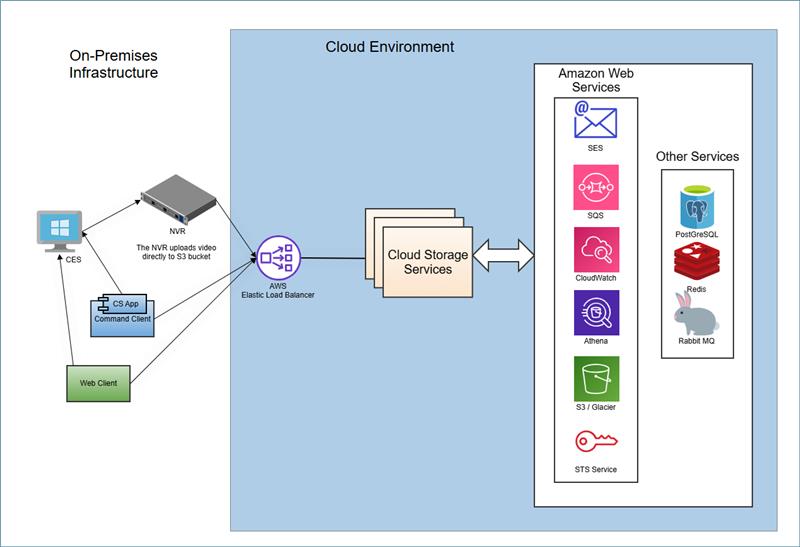
The Cloud Storage architecture integrates on-premise video infrastructure with AWS services that manage ingestion, storage, monitoring, and secure access to video data.
At a high level, the architecture connects local video systems, including NVRs, cameras, and client applications, to AWS cloud services through secure network connections. March Networks securely ingests video data into AWS storage infrastructure, where customers can retain, monitor, and retrieve it based on their defined policies.
Figure 1: March Networks Architecture on AWS.
Video ingestion and storage
March Networks securely uploads video recorded on local NVRs to Amazon S3 buckets using encrypted transmission protocols. Amazon S3 provides highly durable object storage designed to store large volumes of data while enabling efficient retrieval and lifecycle management.
Once stored, organizations can retain video data for active investigations or operational review. Organizations configure lifecycle management policies that automatically move older footage to lower-cost storage tiers based on their access patterns.
Tiered storage with Amazon S3 and Amazon S3 Glacier
Video storage requirements vary depending on how frequently footage must be accessed. The platform uses multiple Amazon S3 tiers to align performance and cost with real-world video access patterns.
Amazon S3 Standard and Amazon S3 Standard-Infrequent Access (S3 Standard-IA) support video that must remain readily accessible for investigations, operational review, or analytics. For long-term retention, the platform uses Amazon S3 Glacier storage tiers to provide ultra-low-cost archival storage for footage that must be preserved but is rarely accessed.
Lifecycle policies automatically transition videos between tiers according to customer-defined retention policies. This allows organizations to store high-value recent video on high-performance storage while archiving older footage economically.
Supporting AWS services
Several AWS services support the reliability, scalability, and operational visibility of the platform:
Amazon Simple Queue Service (Amazon SQS) manages asynchronous messaging between system components, enabling reliable communication between ingestion, processing, and storage services.
Amazon Simple Email Service (Amazon SES) provides notification capabilities for operational alerts and system events.
Amazon CloudWatch monitors system performance, logs activity, and provides operational visibility into cloud infrastructure.
AWS Security Token Service (AWS STS) enables secure authentication and temporary credentials for system components accessing cloud resources.
For metadata management and caching, the platform uses PostgreSQL and Amazon ElastiCache for Redis to maintain high-performance access to video metadata and system state.
Together, these services enable March Networks to deliver a secure, scalable cloud architecture capable of supporting petabyte-scale video workloads across distributed environments.
Outcomes and benefits
By building its video storage architecture on AWS, March Networks enables organizations to modernize video infrastructure while reducing operational complexity and long-term storage costs. This includes:
Reduced storage costs
Tiered storage using Amazon S3 and Amazon S3 Glacier allows organizations to align storage costs with actual video access patterns. Frequently accessed footage remains readily available, while older video can be archived at significantly lower cost.
Elastic scalability
AWS infrastructure enables organizations to scale video storage across hundreds or thousands of locations without adding on-premise hardware. As organizations add cameras or extend retention periods, storage capacity expands automatically.
Centralized investigations and governance
Cloud-based video storage enables security and operations teams to investigate incidents across multiple sites using a centralized platform. Organizations can apply consistent retention policies, maintain audit trails, and enforce standardized governance across all locations.
AI-driven analytics and search
Centralized video storage also enables advanced analytics capabilities. March Networks integrates AI-powered tools such as AI Smart Search, which allows users to locate relevant footage using natural-language queries across large video archives.
These capabilities leverage technologies, including Amazon S3 Vectors and Amazon Bedrock to support semantic search and AI-driven video intelligence across enterprise-scale datasets.
Conclusion
As organizations generate increasing volumes of video data, scalable cloud infrastructure becomes essential for managing long-term storage and enabling advanced analytics. By building its Cloud Storage platform on AWS, March Networks provides organizations with a durable, secure, and cost-efficient foundation for enterprise video retention.
Services such as Amazon S3, Amazon S3 Glacier, Amazon SQS, Amazon CloudWatch, and AWS Security Token Service support a scalable architecture capable of storing and managing petabytes of video data across distributed environments. This cloud-native approach allows organizations to modernize video infrastructure today while preparing for future AI-driven analytics and operational intelligence.
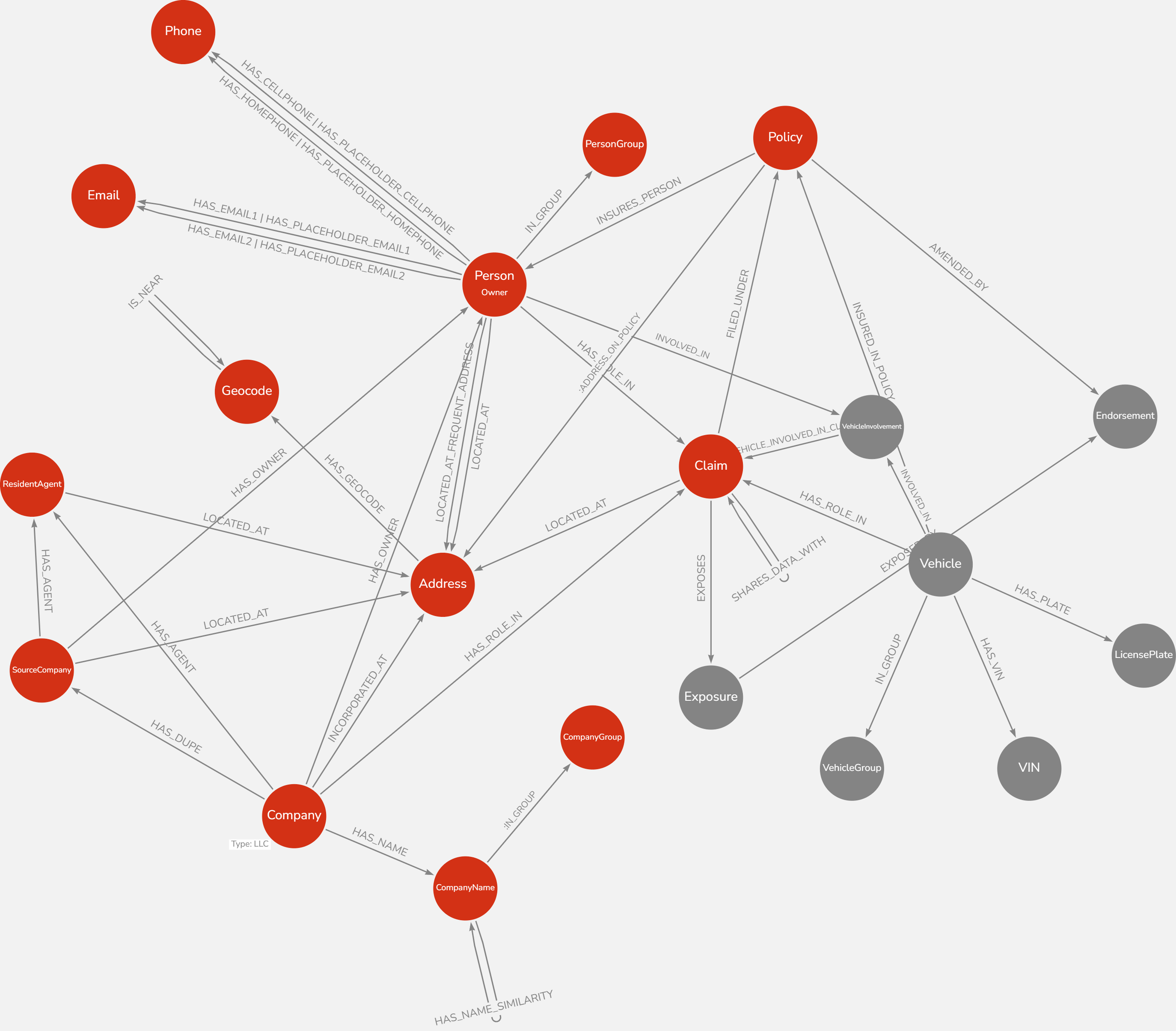
Insurance fraud remains a significant challenge for the insurance industry. Fraudulent claims can increase loss costs, reduce trust, and consume investigation capacity that could otherwise be focused on serving customers. Traditional fraud detection approaches typically rely on rules-based controls, manual investigation triggers, historical claim patterns, and structured-data-only analysis. These approaches are useful for known fraud patterns, but they can struggle to detect sophisticated fraud rings or hidden relationships across claimants, policies, vehicles, providers, addresses, and prior suspicious activities.
MAPFRE USA is a top-rated auto and home insurer in Massachusetts, serving customers in 11 states nationwide. Our coverage includes auto, home, motorcycle, watercraft, business insurance, and more. As part of MAPFRE Group, we’re a worldwide leader serving over 31.1 million customers in more than 100 countries with a team of 31,000 employees. In collaboration with AWS and Neo4j, MAPFRE USA modernized its fraud prevention capabilities by combining graph-based features with machine learning (ML) models deployed on AWS. This initiative focused initially on Massachusetts auto insurance and later expanded to home insurance. It has delivered significant business impact, exceeding $5 million in net present value (NPV) over five years, with realized savings already outperforming projections.
In this post, we share how MAPFRE USA designed and implemented this solution, highlight the technical architecture running on AWS, specifically the MAPFRE data platform called Atenea, and explore lessons learned that can apply to other industries facing complex fraud challenges.
Business challenge
Fraudulent claims aren’t always isolated events. They often involve hidden networks of policyholders, vehicles, providers, and prior suspicious activities. Detecting these complex relationships requires going beyond traditional structured data analysis.
MAPFRE set out with a clear goal:
Goal: Improve fraud detection accuracy and claims handling efficiency.
Key performance indicator (KPI): Identify fraudulent claims missed by traditional methods.
Approach: Develop several ML models using both traditional structured data and 54 graph-based features derived from claim relationships.
Deployment: Integrate with Guidewire Claims, so front-line adjusters automatically receive fraud alerts with explanations.
Each flagged claim exposure generates a Guidewire activity showing the top three model drivers, helping investigators understand why the claim was flagged and act quickly.
Technical solution on AWS (Atenea data platform)
The fraud detection platform is built on a modern data architecture on AWS, designed to scale efficiently and support long-term governance.
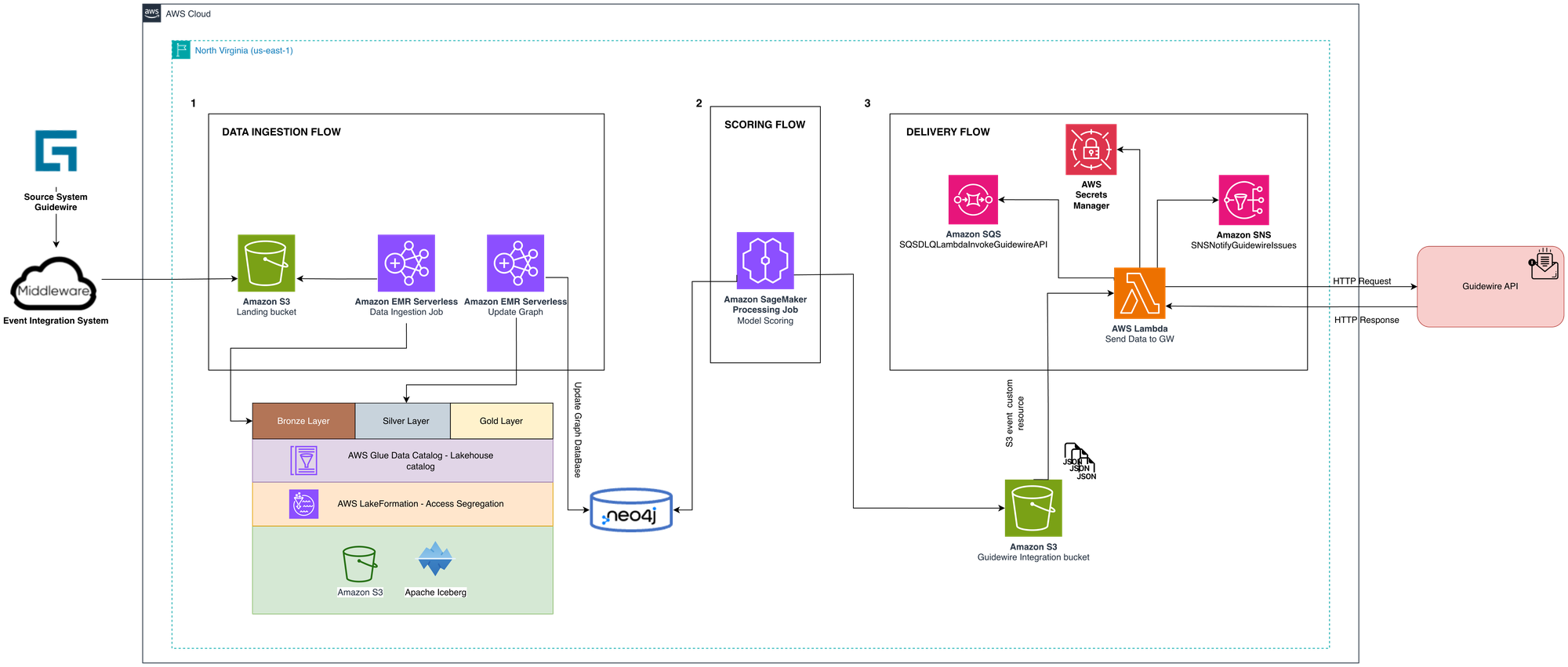
At its core, the solution uses Apache Iceberg tables stored on Amazon Simple Storage Service (Amazon S3), with metadata managed through the AWS Glue Data Catalog and access governed through AWS Lake Formation as part of the Atenea lakehouse governance model. The platform feature store is implemented through feature-store-managed Iceberg tables that manage model features, predictions, and Guidewire activities. The implementation is structured across three logical layers:
Silver layer: Iceberg tables that contain source data from each of the sources. Used as the initial consumption point of the platform.
Gold layer: Iceberg tables storing intermediate data, such as unified Guidewire activity logs, Auto features, and Home features.
Platinum layer: Feature Store-managed Iceberg tables containing encoded features and model predictions, making them reusable across models and ensuring strong metadata governance.
Processing pipelines are executed on Amazon EMR Serverless, with orchestration managed by Apache Airflow operators running on Amazon Managed Workflows for Apache Airflow (MWAA). This provides elastic, cost-efficient compute for both batch processing and fast-time scoring, while keeping orchestration, monitoring, and recovery centralized.
For graph enrichment, the platform connects to Neo4j using a dedicated driver, enabling advanced network-based features like suspicious claim linkages, provider fraud ratios, and centrality metrics.
This architecture supports efficient, reliable, and transparent production execution. It uses repeatable Airflow orchestration, environment-based continuous integration and continuous delivery (CI/CD) promotion, centralized monitoring, failure notifications, retry mechanisms, dead-letter queue handling for Guidewire integration, and controlled secret management. At the same time, the layered lakehouse design keeps the platform flexible enough to evolve with new business needs and fraud detection use cases.
The data sources here are policy, claims, vehicles, and notes (from AS400 and Guidewire), which are structured data. Derived features that capture entity relationships make up the graph data.
Let’s go through the architecture overview:
Data ingestion – Claim batch data is uploaded to Amazon S3. The data is standardized and materialized in Iceberg tables within the Silver layer.
Graph enrichment – Data processed to update Neo4j graph database hosted on AWS.
Model training and scoring – Batch scoring for several ML models.
Model orchestration – Unified orchestration for ingestion, training, and inference using Apache Airflow operators. CI/CD pipelines for promotion across environments.
Execution platform – Amazon EMR Serverless for cost-efficient Spark processing. Migration to Apache Iceberg plus AWS Glue Data Catalog for scalable metadata handling.
Integration with claims systems – Fraud predictions automatically create Guidewire activities, enriched with a description for investigators.
Secrets and security – AWS Secrets Manager securely stores credentials and tokens for Guidewire API integration, with environment-specific and region-specific access controls.
Monitoring and reliability – Amazon CloudWatch and Amazon Simple Notification Service (Amazon SNS) provide visibility into pipeline health and notify teams on failures. Data quality checks are executed at key stages of the pipeline to validate data availability, schema consistency, completeness, and business-rule expectations before outputs are consumed by models or sent to Guidewire.
Guidewire integration with MLOps on AWS
One of the most important parts of MAPFRE’s solution was closing the loop between ML predictions and the claims handling system. This required a resilient integration between the Atenea data platform on AWS and Guidewire Claims.
Integration flow:
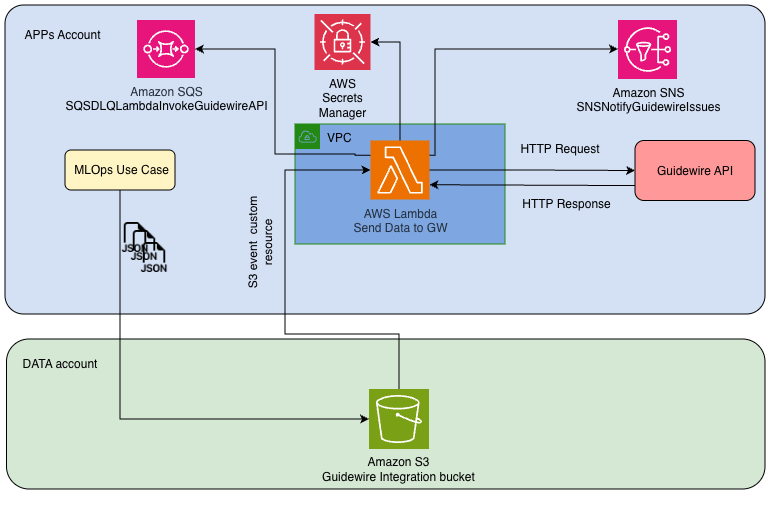
When an ML use case finishes scoring, the results are written as JSON files into the S3 path: <bucket_name>/guidewire/.
An S3 event notification triggers the AWS Lambda function LambdaXXXInvokeGuidewireAPI.
This Lambda function:
Reads the JSON file.
Calls the Guidewire Predictive Model API.
Because Guidewire doesn’t support batch requests, the Lambda function sends each JSON payload individually. This keeps the integration compatible with Guidewire and isolates failures at the individual activity level, but it increases the number of API calls and makes retry, throttling, DLQ handling, and monitoring controls important.
If successful, the API responds with HTTP 201 (activity created).
If not, the Lambda retries up to two times.
Failed requests are sent to an SQS Dead-Letter Queue (DLQ) and an SNS notification is published to an SNS queue for monitoring.
Secrets are stored in AWS Secrets Manager and injected as Lambda environment variables, along with AWS Region-specific URLs for token retrieval and API endpoints.
Example JSON structure for Guidewire integration:
{
  "method": "createPredictiveActivity",
  "params": [
    {
      "claimNumber": "AUXXXXXXX",
      "exposureNumber": 1,
      "subject": "Fraud alert from ML model",
      "description": "Claim flagged as potential fraud based on graph + ML features",
      "shortSubject": "ML_Fraud_Flag",
      "priority": "high",
      "availableForClosedClaim": true,
      "autoCloseOnExposureClosure": false,
      "targetDays": 4,
      "escalationDays": 6
    }
  ]
}
Resilience – Built-in retries, DLQ handling, and SNS alerts keep failed events from being lost.
Security – Secrets and tokens are managed using AWS Secrets Manager, with strict environment separation (dev, pre, pro).
Scalability – Any new MLOps use case writes results into the S3 output path, automatically flowing into Guidewire.
This integration shows that fraud models don’t just exist in isolation but actively augment daily claim workflows in production. It connects Atenea’s MLOps pipelines on AWS directly with business decisioning systems, which is critical to realizing the fraud savings impact.
Data quality and resilience
For robustness, we apply data quality checks on ingestion pipelines and graph features. Automated validation detects anomalies early, monitoring dashboards track KPIs and model performance, and standardized recovery and promotion processes run across environments.
Visualization and investigative tools
Neo4j Bloom supports Special Investigations Unit (SIU) workflows by visually exploring entity relationships, such as a provider linked across multiple suspicious claims, accelerating fraud ring identification.
Conclusion
The fraud detection model for auto claims has enhanced MAPFRE USA’s ability to identify fraudulent activity, driving significant savings and improving overall claims efficiency.
During the pilot phase alone, savings exceeded projections by over half a million dollars, and in production the initiative has proven an NPV of more than $5M at current business volumes. These results confirm the business case and highlight the strength of combining structured data with graph-based features to uncover fraud networks that traditional approaches miss.
The results have been compelling:
Accuracy gains – detection improved by 50–135 percent compared to baseline methods.
Realized value – In 2025, MA Auto and MA Home claim savings reached a combined total of $6.81M, with $6.59M from MA Auto and $225K from MA Home.
Proven return on investment (ROI) – the project delivered an NPV of $4.7M at approval, and results are already exceeding expectations.
Cross-functional success – the initiative brought together Claims, IT Data, Advanced Analytics, and Neo4j teams in an agile, collaborative model.
Beyond the financial outcomes, several lessons emerged. First, cross-functional collaboration between groups like Claims, Data Engineering, Advanced Analytics, and technology partners like AWS and Neo4j was critical to success. Second, explainability proved essential. By presenting adjusters with the top model drivers directly in Guidewire, we increased trust and adoption of the system substantially. Finally, building resilience into the architecture through monitoring, retries, and data quality processes helped the models operate reliably in production.
Looking ahead, the platform is well-positioned to expand beyond fraud detection. New use cases such as underwriting anomaly detection, customer entity resolution, and retention modeling are already on the roadmap. With a robust architecture built on AWS using Amazon EMR Serverless, Apache Iceberg on Amazon S3 supported by AWS Glue Data Catalog and AWS Lake Formation, a custom-built Feature Store, and Neo4j, MAPFRE now has a scalable foundation to continue driving innovation and business impact.
To start building a similar solution, open the Amazon EMR console and review the AWS Architecture Center for reference patterns you can adapt to your own fraud detection and analytics workloads.
The 7.2-rc3 kernel prepatch is out for
testing. Linus said: “Things continue to look normal (the ‘new normal’
with slightly higher rates of commits, although I do get the feeling that
we’re seeing that slightly balanced out by people starting to go on summer
vacation)“.
To provide the best experiences, we use technologies like cookies to store and/or access device information. Consenting to these technologies will allow us to process data such as browsing behavior or unique IDs on this site. Not consenting or withdrawing consent, may adversely affect certain features and functions.
Functional
Always active
The technical storage or access is strictly necessary for the legitimate purpose of enabling the use of a specific service explicitly requested by the subscriber or user, or for the sole purpose of carrying out the transmission of a communication over an electronic communications network.
Preferences
The technical storage or access is necessary for the legitimate purpose of storing preferences that are not requested by the subscriber or user.
Statistics
The technical storage or access that is used exclusively for statistical purposes.The technical storage or access that is used exclusively for anonymous statistical purposes. Without a subpoena, voluntary compliance on the part of your Internet Service Provider, or additional records from a third party, information stored or retrieved for this purpose alone cannot usually be used to identify you.
Marketing
The technical storage or access is required to create user profiles to send advertising, or to track the user on a website or across several websites for similar marketing purposes.