Internet disruptions overview for Q4 2022

Post Syndicated from David Belson original https://blog.cloudflare.com/q4-2022-internet-disruption-summary/


Internet disruptions overview for Q4 2022

Internet disruptions overview for Q4 2022

Cloudflare operates in more than 250 cities in over 100 countries, where we interconnect with over 10,000 network providers in order to provide a broad range of services to millions of customers. The breadth of both our network and our customer base provides us with a unique perspective on Internet resilience, enabling us to observe the impact of Internet disruptions.

While Internet disruptions are never convenient, online interest in the 2022 World Cup in mid-November and the growth in online holiday shopping in many areas during November and December meant that connectivity issues could be particularly disruptive. Having said that, the fourth quarter appeared to be a bit quieter from an Internet disruptions perspective, although Iran and Ukraine continued to be hotspots, as we discuss below.

Government directed

Multi-hour Internet shutdowns are frequently used by authoritarian governments in response to widespread protests as a means of limiting communications among protestors, as well preventing protestors from sharing information and video with the outside world. During the fourth quarter Cuba and Sudan again implemented such shutdowns, while Iran continued the series of “Internet curfews” across mobile networks it started in mid-September, in addition to implementing several other regional Internet shutdowns.

Cuba

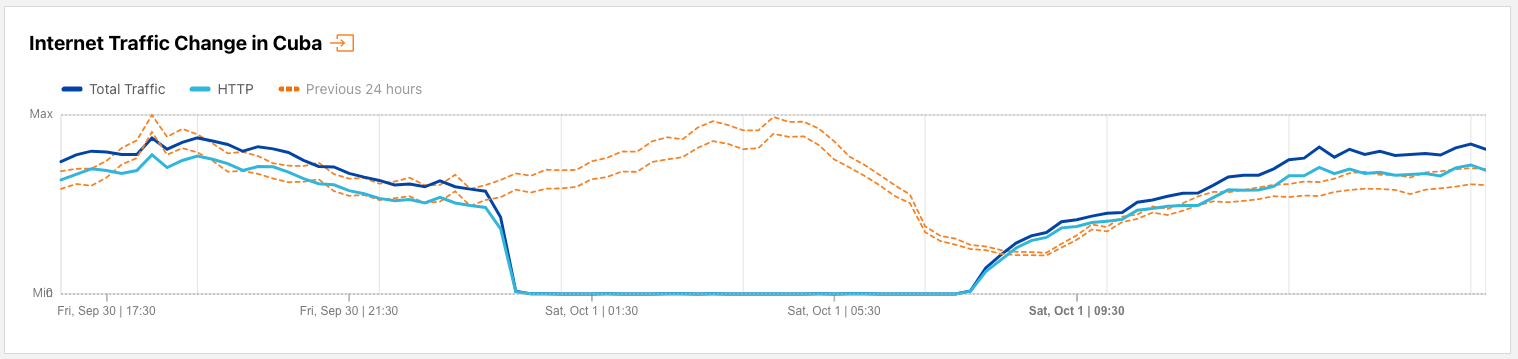
In late September, Hurricane Ian knocked out power across Cuba. While officials worked to restore service as quickly as possible, some citizens responded to perceived delays with protests that were reportedly the largest since anti-government demonstrations over a year earlier. In response to these protests, the Cuban government reportedly cut off Internet access several times. A shutdown on September 29-30 was covered in the Internet disruptions overview for Q3 2022, and the impact of the shutdown that occurred on October 1 (UTC) is shown in the figure below. The timing of this one was similar to the previous one, taking place between 1900 on September 30 and 0245 on October 1 (0000-0745 UTC on October 1).
Internet disruptions overview for Q4 2022

Sudan

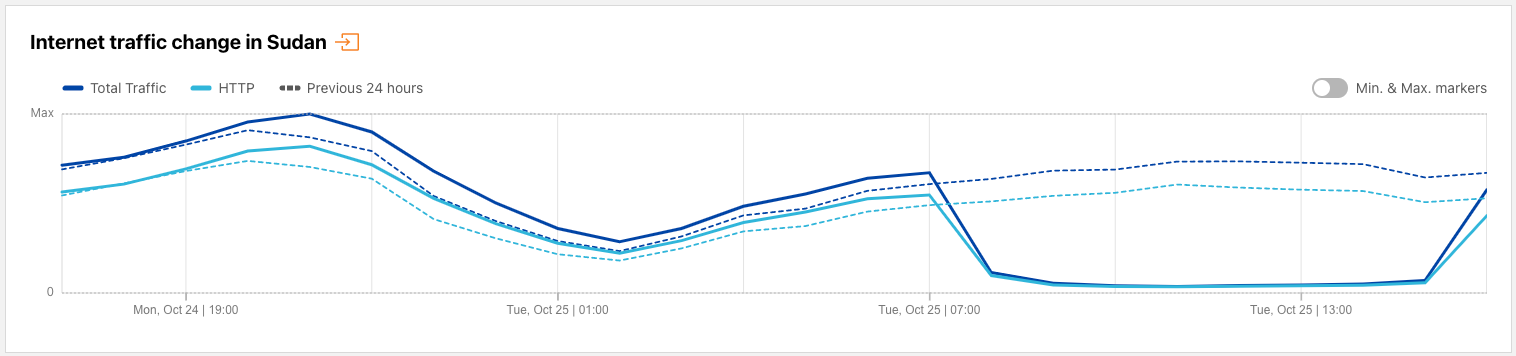
October 25 marked the first anniversary of a coup in Sudan that derailed the country’s transition to civilian rule, and thousands of Sudanese citizens marked the anniversary by taking to the streets in protest. Sudan’s government has a multi-year history of shutting down Internet access during times of civil unrest, and once again implemented an Internet shutdown in response to these protests. The figure below shows a near complete loss of Internet traffic from Sudan on October 25 between 0945-1740 local time (0745 – 1540 UTC).
Internet disruptions overview for Q4 2022

Iran

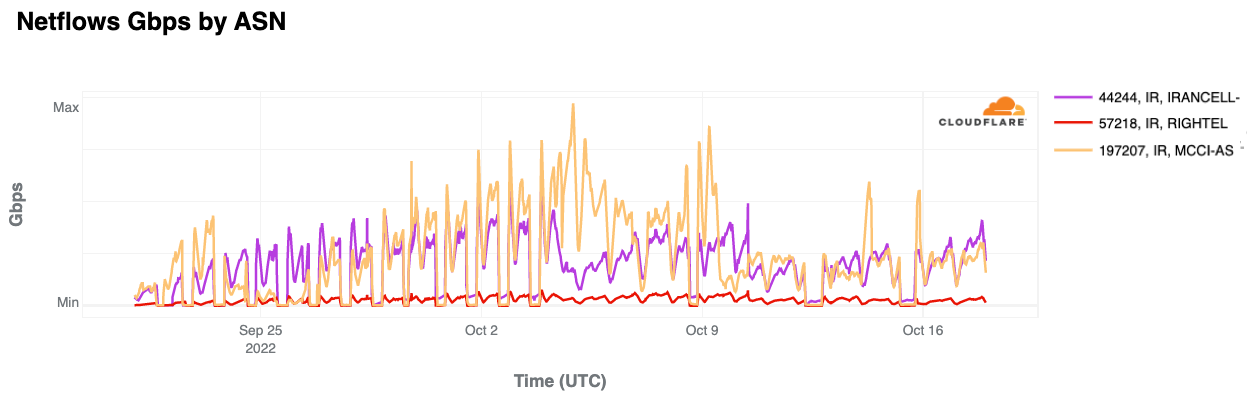
As we covered in last quarter’s blog post, the Iranian government implemented daily Internet “curfews”, generally taking place between 1600 and midnight local time (1230-2030 UTC) across three mobile network providers — AS44244 (Irancell), AS57218 (RighTel), and AS197207 (MCCI) — in response to protests surrounding the death of Mahsa Amini. These multi-hour Internet curfew shutdowns continued into early October, with additional similar outages also observed on October 8, 12 and 15 as seen in the figure below. (The graph’s line for AS57218 (Rightel), the smallest of the three mobile providers, suggests that the shutdowns on this network were not implemented after the end of September.)
Internet disruptions overview for Q4 2022

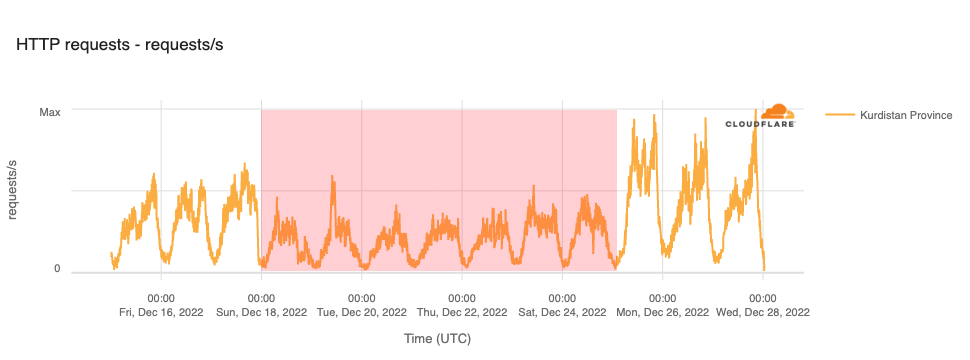
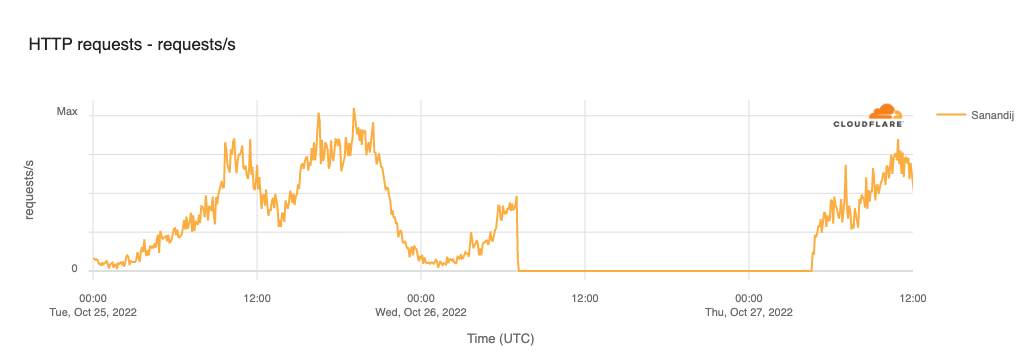
In addition to the mobile network shutdowns, several regional Internet disruptions were also observed in Iran during the fourth quarter, two of which we review below. The first was in Sanandaj, Kurdistan Province on October 26, where a complete Internet shutdown was implemented in response to demonstrations marking the 40th day since the death of Mahsa Amini. The figure below shows a complete loss of traffic starting at 1030 local time (0700 UTC), with the outage lasting until 0805 local time on October 27 (0435 UTC). In December, a province-level Internet disruption was observed starting on December 18, lasting through December 25.

Internet disruptions overview for Q4 2022
Kurdistan Province, Iran. (Source: Map data ©2023 Google, MapaGISrael)

Internet disruptions overview for Q4 2022

The Internet disruptions that have taken place in Iran over the last several months have had a significant economic impact on the country. A December post from Filterwatch shared concerns stated in a letter from mobile operator Rightel:

The letter, signed by the network’s Managing Director Yasser Rezakhah, states that “during the past few weeks, the company’s resources and income have significantly decreased during Internet shutdowns and other restrictions, such as limiting Internet bandwidth from 21 September. They have also caused a decrease in data use from subscribers, decreasing data traffic by around 50%.” The letter also states that the “continued lack of compensation for losses could lead to bankruptcy.”

The post also highlighted economic concerns shared by Iranian officials:

Some Iranian officials have expressed concern about the cost of Internet shutdowns, including Valiollah Bayati, MP for Tafresh and Ashtian in Markazi province. In a public session in Majles (parliament), he stated that continued Internet shutdowns have led to the closure of many jobs and people are worried, the government and the President must provide necessary measures.

Statistics in an article on news site enthkhab.ir provide a more tangible view of the local economic impact, stating (via Google Translate):

Since the 30th of Shahrivar month and with the beginning of the government disruption in the Internet, the country’s businesses have been damaged daily at least 50 million tomans and at most 500 million tomans. More than 41% of companies have lost 25-50% of their income during this period, and about 47% have had more than 50% reduction in sales. A review of the data of the research assistant of the country’s tax affairs organization shows that the Internet outage in Iran has caused 3000 billion tomans of damage per day. That is, the cost of 3 months of Internet outage in Iran is equal to 43% of one year’s oil revenue of the country ($25 billion).

Power outages

Bangladesh, October 4

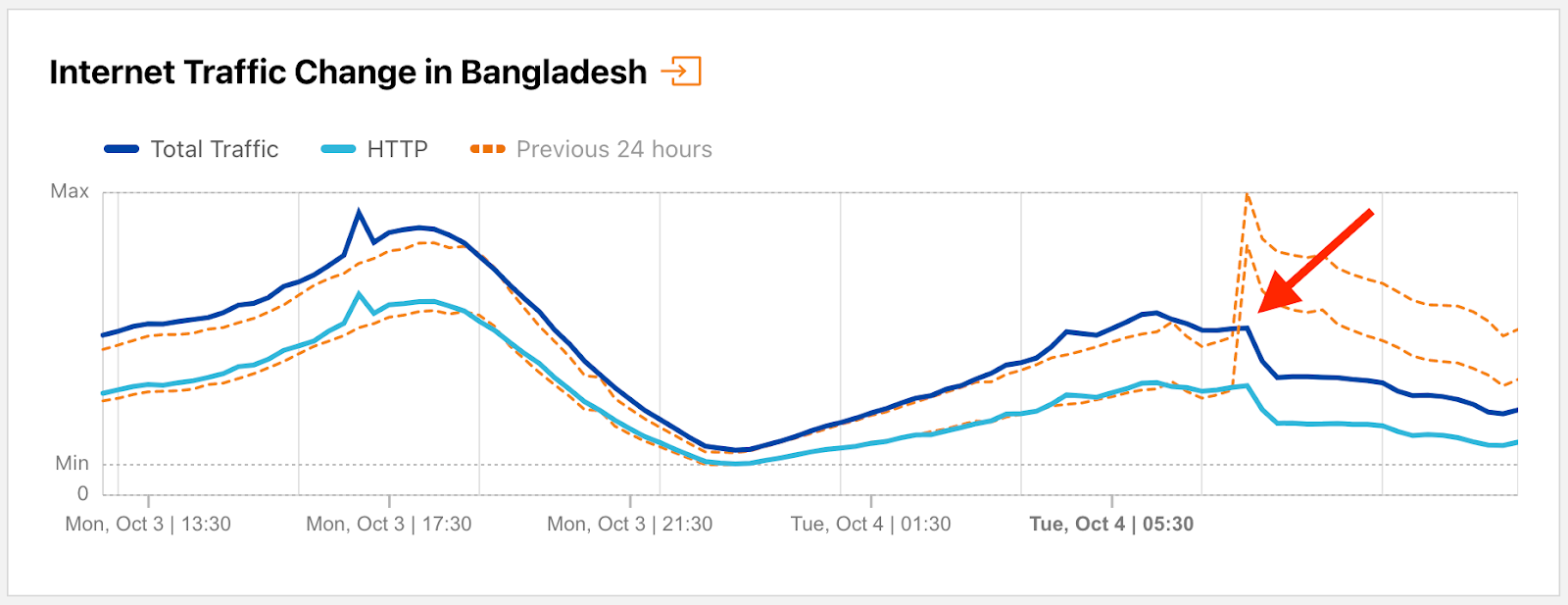
Over 140 million people in Bangladesh were left without electricity on October 4 as the result of a reported grid failure caused by a failure by power distribution companies to follow instructions from the National Load Dispatch Centre to shed load. The resultant power outage resulted in an observed drop in Internet traffic from the country, starting at 1405 local time (0805 UTC), as shown in the figure below. The disruption lasted approximately seven hours, with traffic returning to expected levels around 1900 local time (1500 UTC).
Internet disruptions overview for Q4 2022

Pakistan

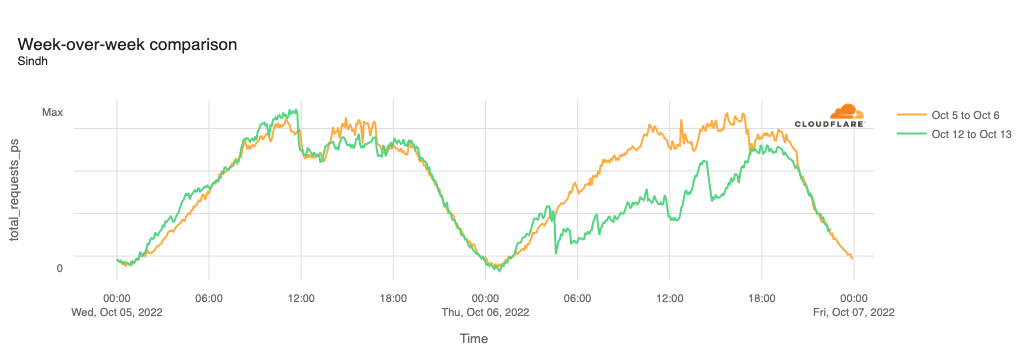
Over a week later, a similar issue in Pakistan caused power outages across the southern part of the country, including Sindh, Punjab, and Balochistan. The power outages were caused by a fault in the national grid’s southern transmission system, reportedly due to faulty equipment and sub-standard maintenance. As expected, the power outages resulted in disruptions to Internet connectivity, and the figure below illustrates the impact observed in Sindh, where traffic dropped nearly 30% as compared to the previous week starting at 0935 local time (0435 UTC) on October 6. The disruption lasted over 15 hours, with traffic returning to expected levels at 0100 on October 7 (2000 UTC on October 6).

Internet disruptions overview for Q4 2022
Sindh, Pakistan (Source: Map data ©2023 Google)

Internet disruptions overview for Q4 2022

Kenya

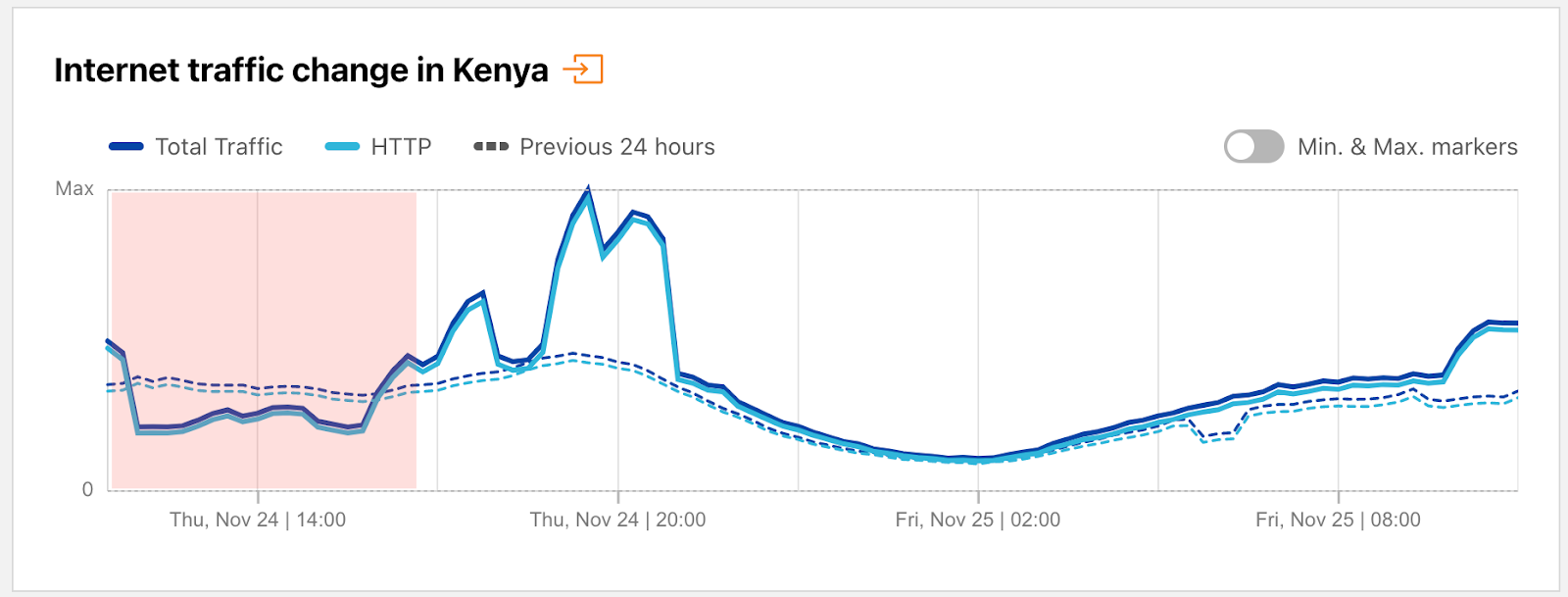
On November 24, a Tweet from Kenya Power at 1525 local time noted that they had “lost bulk power supply to various parts of the country due to a system disturbance”. A subsequent Tweet published just over six hours later at 2150 local time stated that “normal power supply has been restored to all parts of the country.” The time stamps on these notifications align with the loss of Internet traffic visible in the figure below, which lasted between 1500-2050 local time (1200-1750 UTC).
Internet disruptions overview for Q4 2022

United States (Moore County, North Carolina)

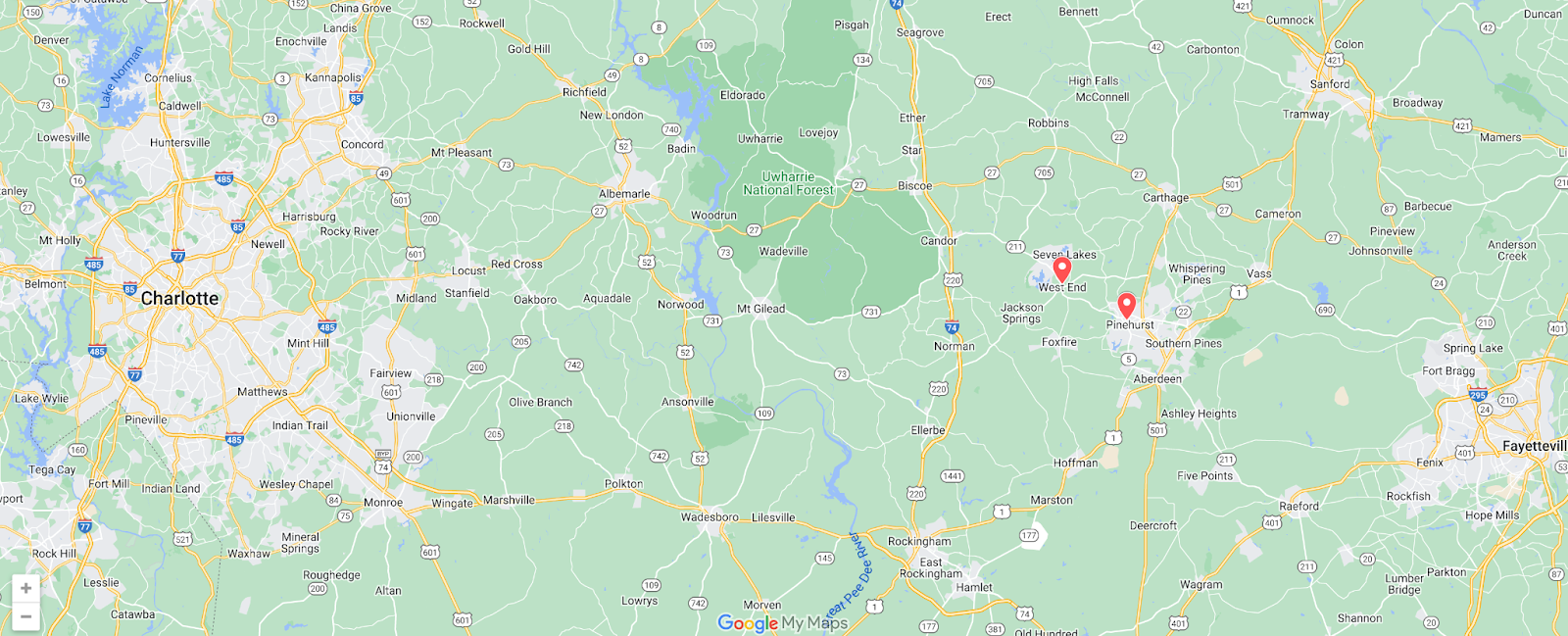
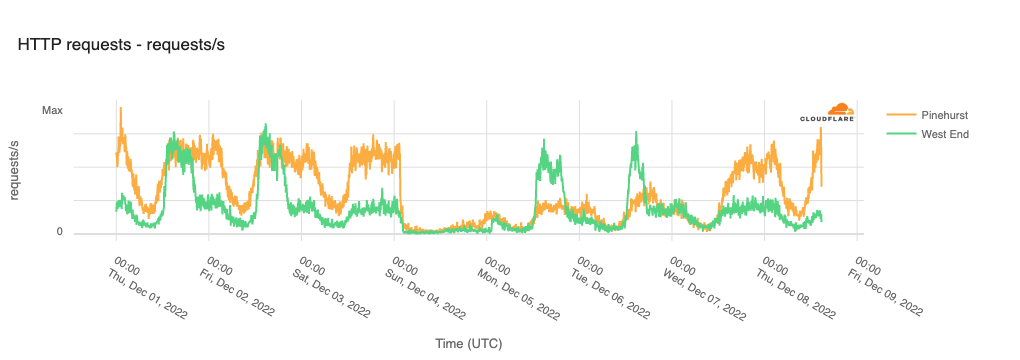
On December 3, two electrical substations in Moore County, North Carolina were targeted by gunfire, with the resultant damage causing localized power outages that took multiple days to resolve. The power outages reportedly began just after 1900 local time (0000 UTC on December 4), resulting in the concurrent loss of Internet traffic from communities within Moore County, as seen in the figure below.

Internet traffic within the community of West End appeared to return midday (UTC) on December 5, but that recovery was apparently short-lived, as it fell again during the afternoon of December 6. In Pinehurst, traffic began to slowly recover after about a day, but returned to more normal levels around 0800 local time (1300 UTC) on December 7.
Internet disruptions overview for Q4 2022
West End and Pinehurst, North Carolina. (Source: Map data ©2023 Google)

Internet disruptions overview for Q4 2022

Ukraine

The war in Ukraine has been going on since February 24, and Cloudflare has covered the impact of the war on the country’s Internet connectivity in a number of blog posts across the year (March, March, April, May, June, July, October, December). Throughout the fourth quarter of 2022, Russian missile strikes caused widespread damage to electrical infrastructure, resulting in power outages and disruptions to Internet connectivity. Below, we highlight several examples of the Internet disruptions observed in Ukraine during the fourth quarter, but they are just a few of the many disruptions that occurred.

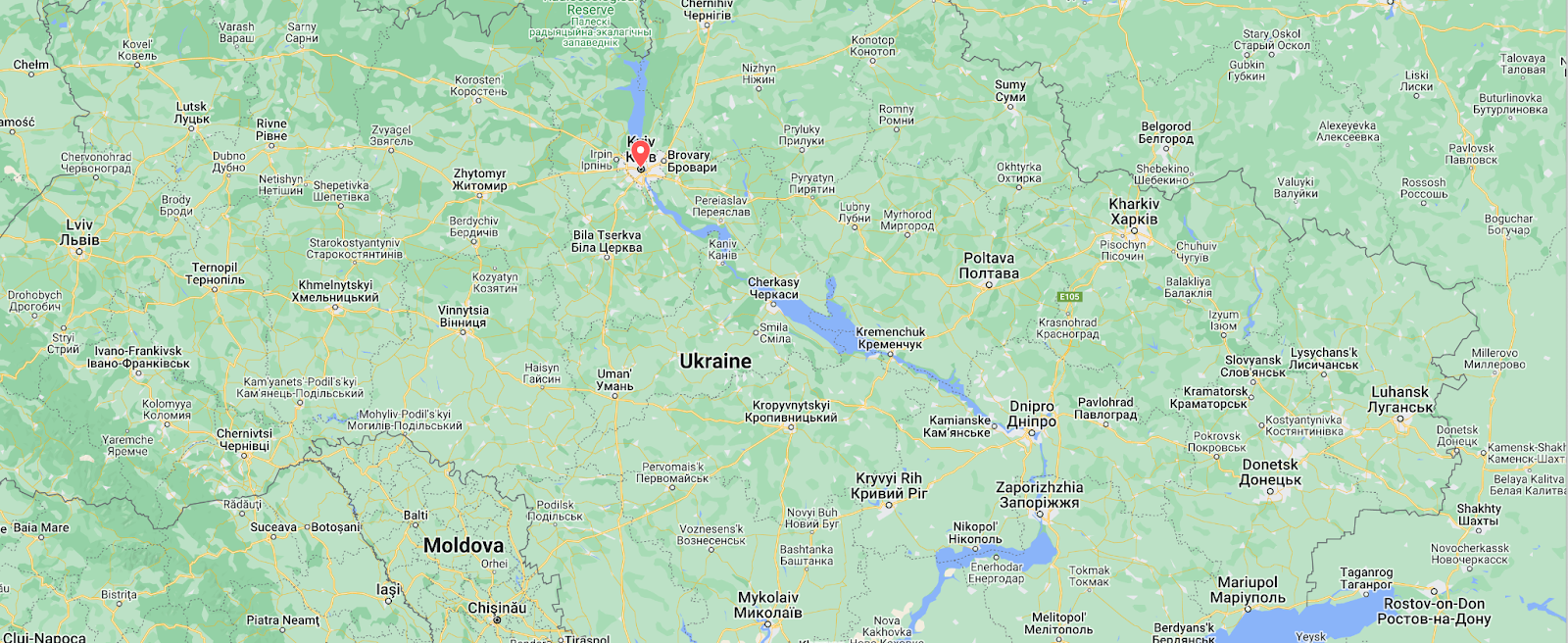
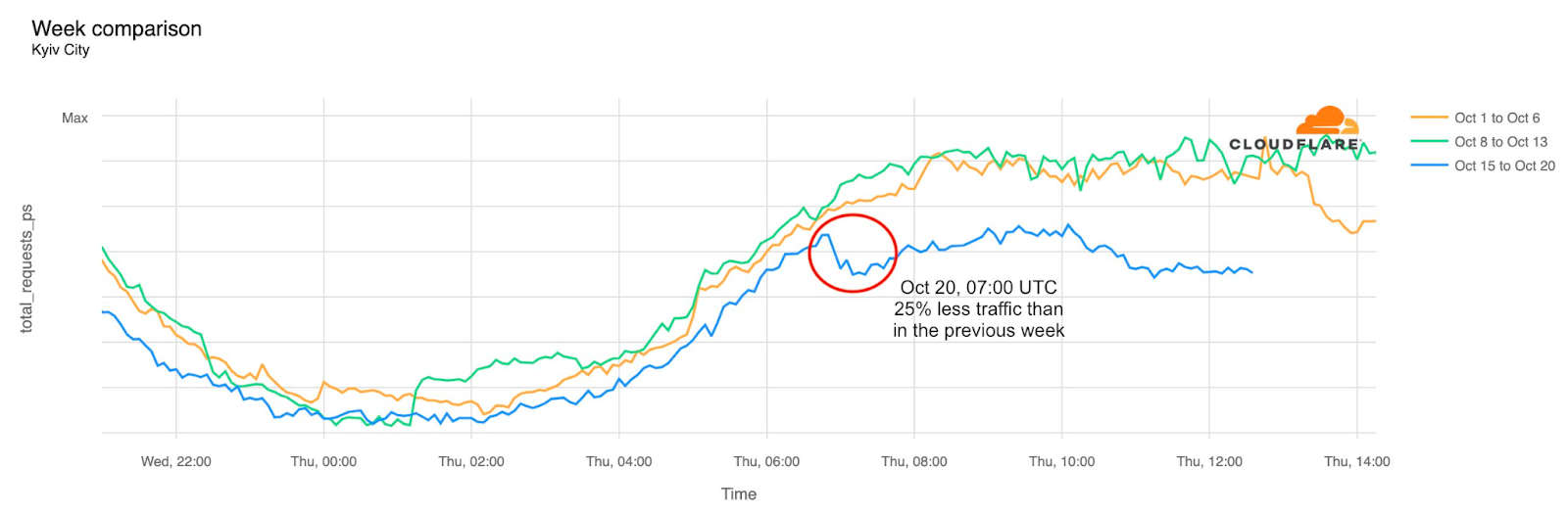
On October 20, the destruction of several power stations in Kyiv resulted in a 25% drop in Internet traffic from Kyiv City as compared to the two previous weeks. The disruption began around 0900 local time (0700 UTC).
Internet disruptions overview for Q4 2022
Kviv City, Ukraine. (Source: Map data ©2023 Google)

Internet disruptions overview for Q4 2022

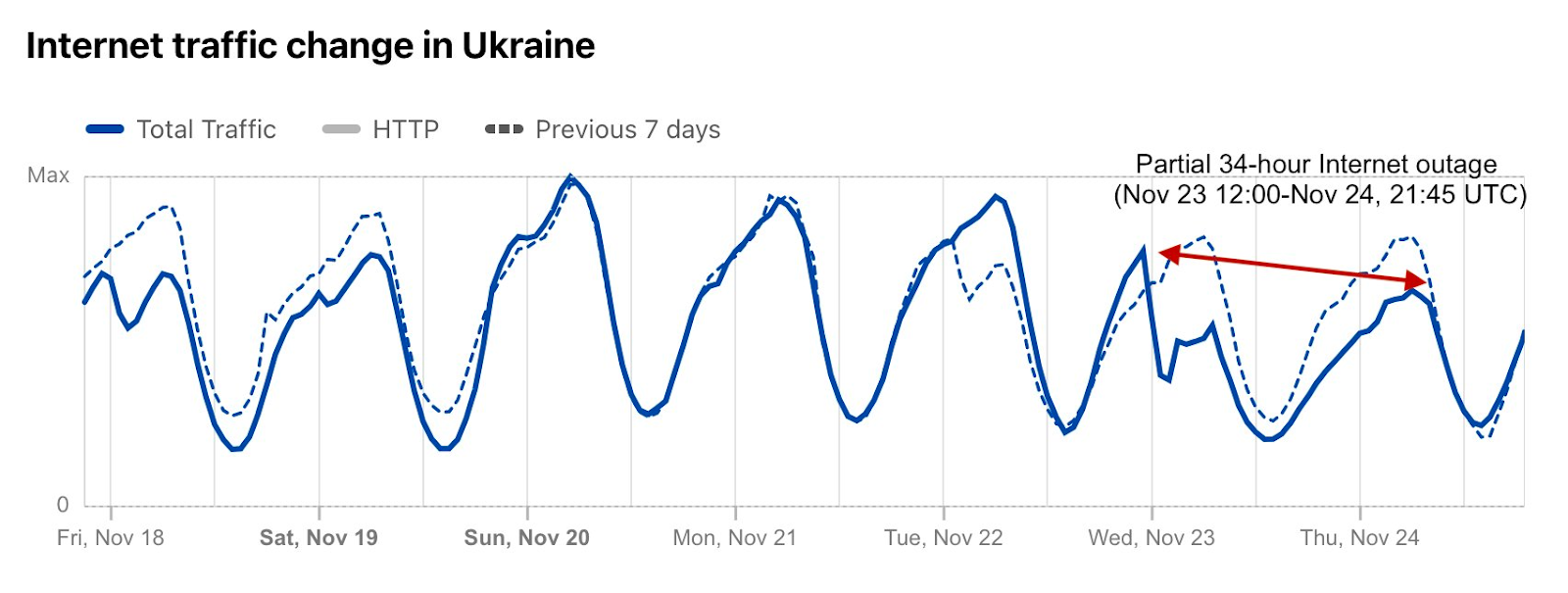
On November 23, widespread power outages after Russian strikes caused a nearly 50% decrease in Internet traffic in Ukraine, starting just after 1400 local time (1200 UTC). This disruption lasted for nearly a day and a half, with traffic returning to expected levels around 2345 local time on November 24 (2145 UTC).
Internet disruptions overview for Q4 2022

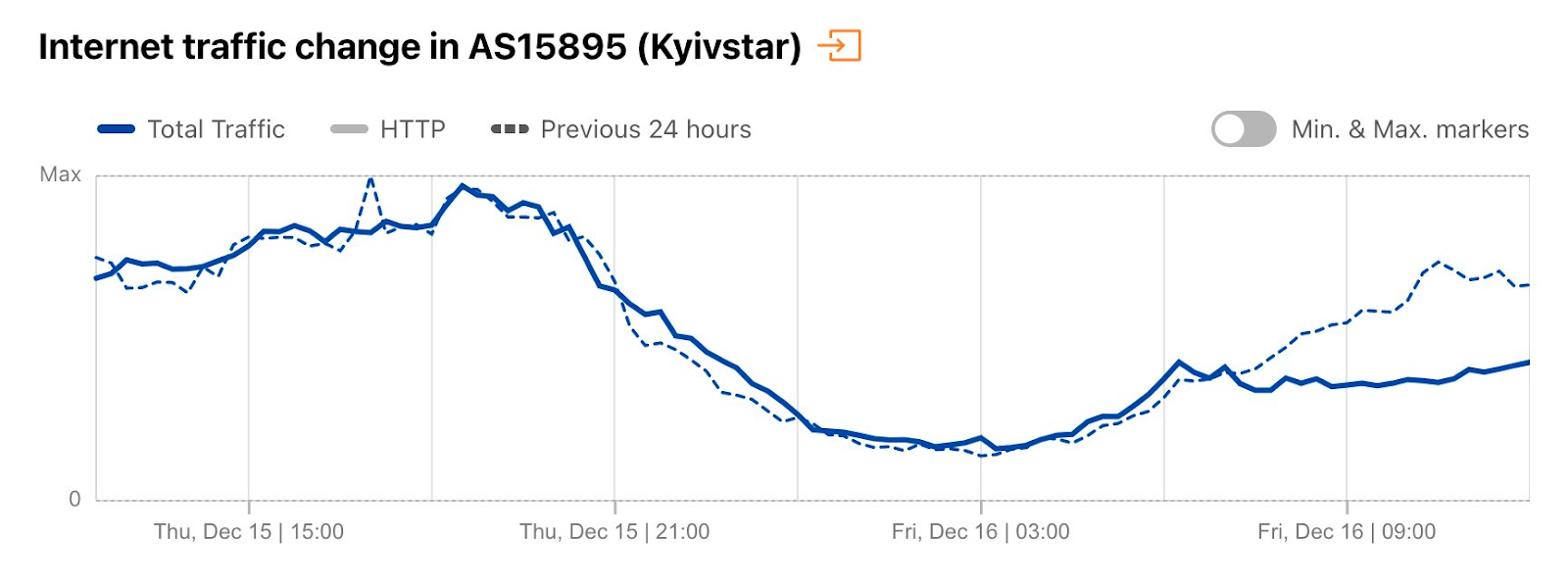
On December 16, power outages resulting from Russian air strikes targeting power infrastructure caused country-level Internet traffic to drop around 13% at 0915 local time (0715 UTC), with the disruption lasting until midnight local time (2200 UTC). However, at a network level, the impact was more significant, with AS13188 (Triolan) seeing a 70% drop in traffic, and AS15895 (Kyivstar) a 40% drop, both shown in the figures below.
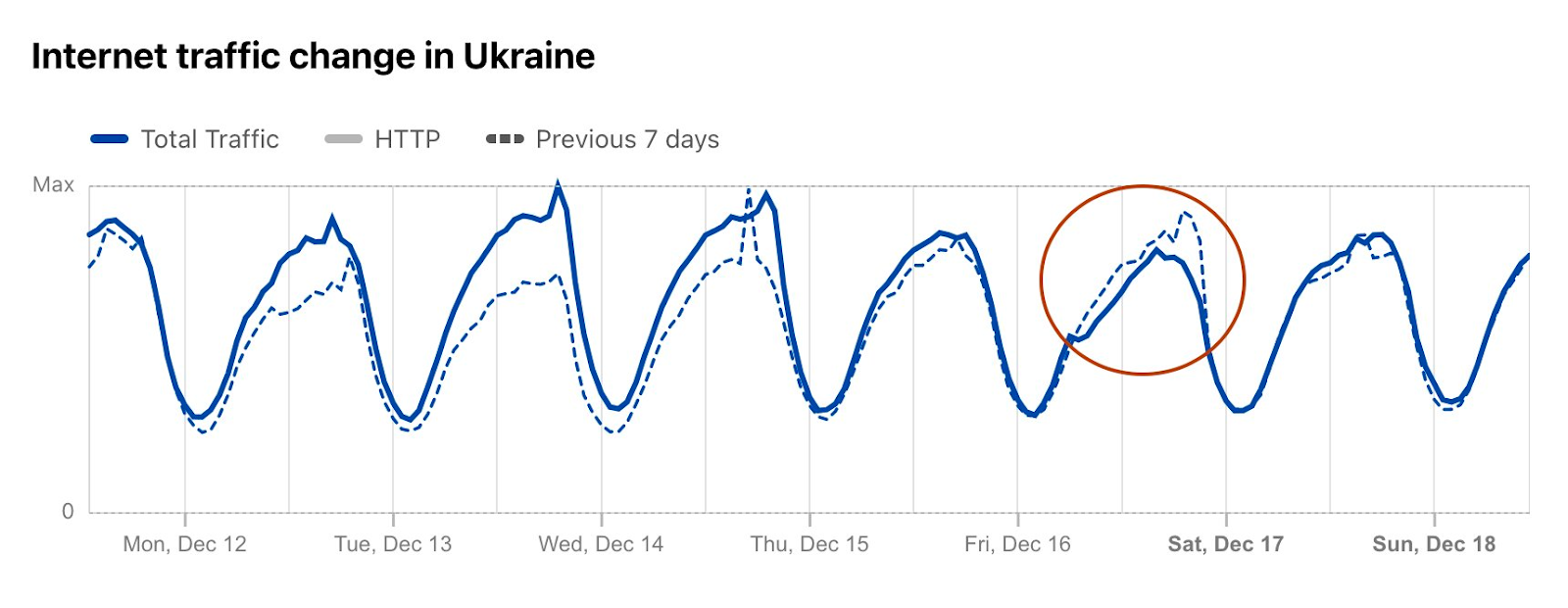
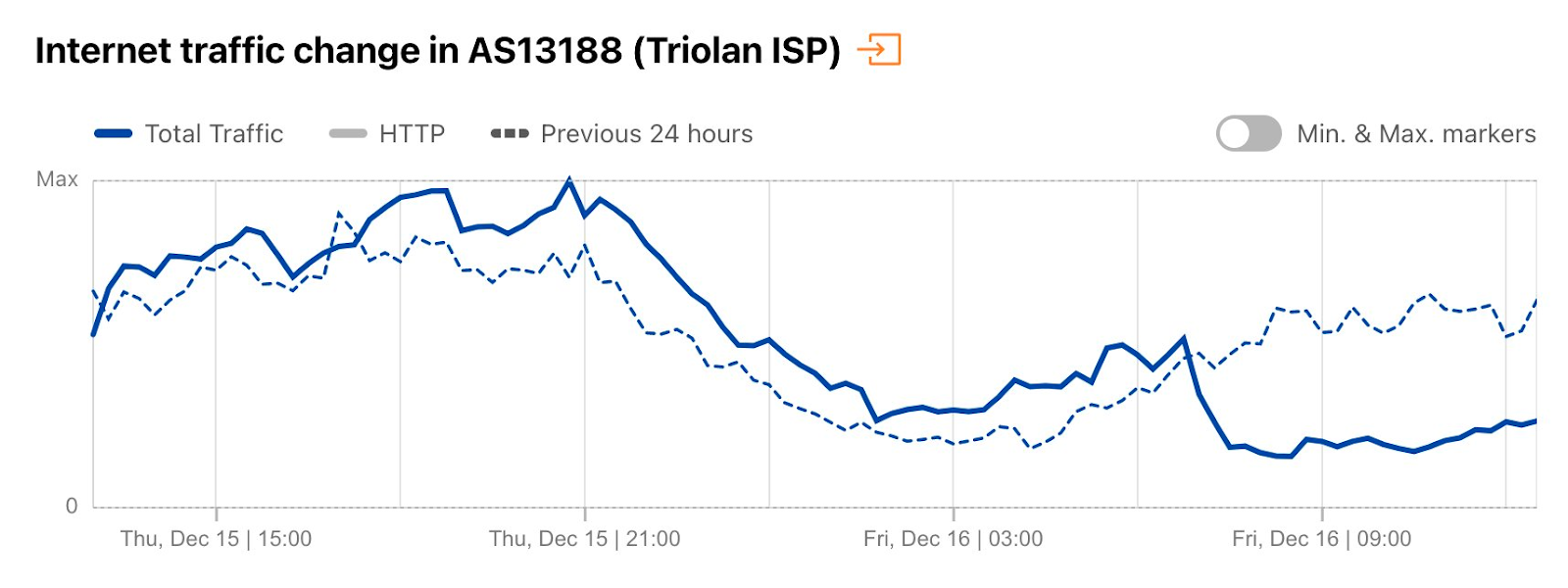
Internet disruptions overview for Q4 2022

Cable cuts

Shetland Islands, United Kingdom

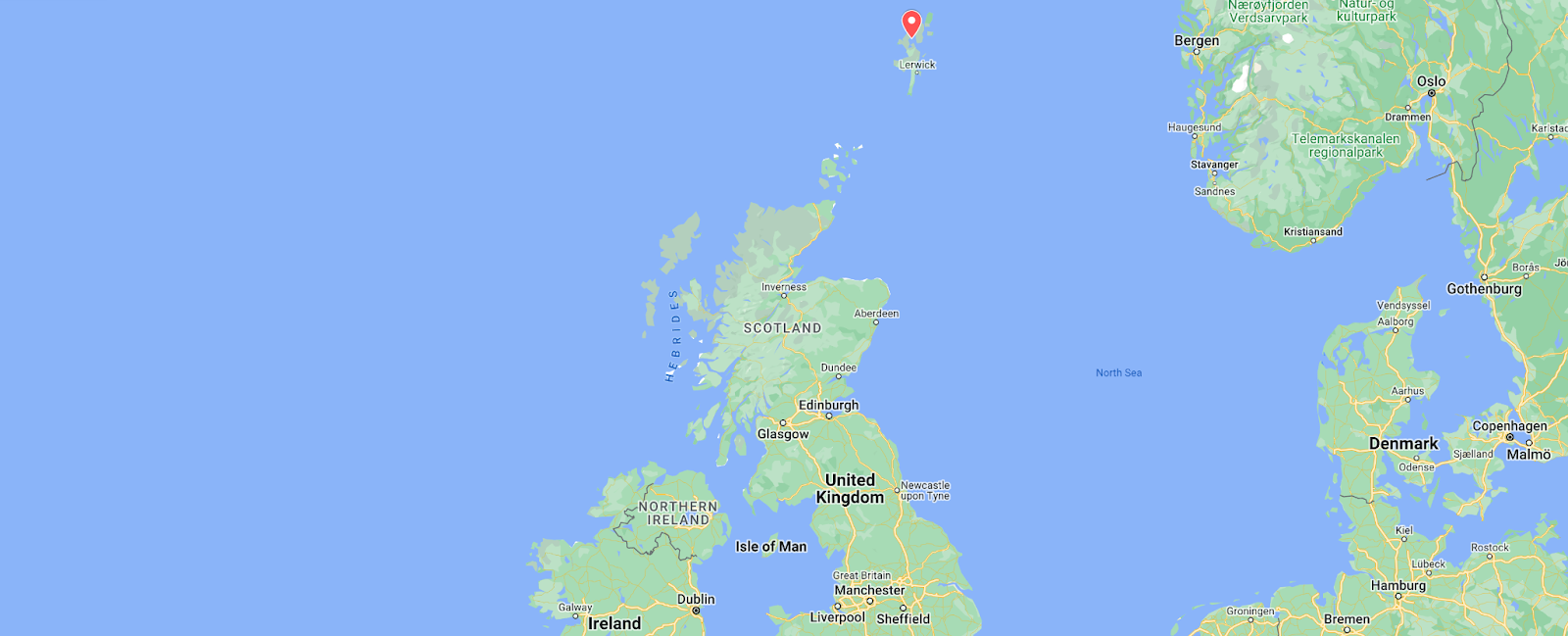
The Shetland Islands are primarily dependent on the SHEFA-2 submarine cable system for Internet connectivity, connecting through the Scottish mainland. Late in the evening of October 19, damage to this cable knocked the Shetland Islands almost completely offline. At the time, there was heightened concern about the potential sabotage of submarine cables due to the reported sabotage of the Nord Stream natural gas pipelines in late September, but authorities believed that this cable damage was due to errant fishing vessels, and not sabotage.

The figure below shows that the impact of the damage to the cable was relatively short-lived, compared to the multi-day Internet disruptions often associated with submarine cable cuts. Traffic dropped just after 2300 local time (2200 UTC) on October 19, and recovered 14.5 hours later, just after 1430 local time (1330 UTC) on October 20.
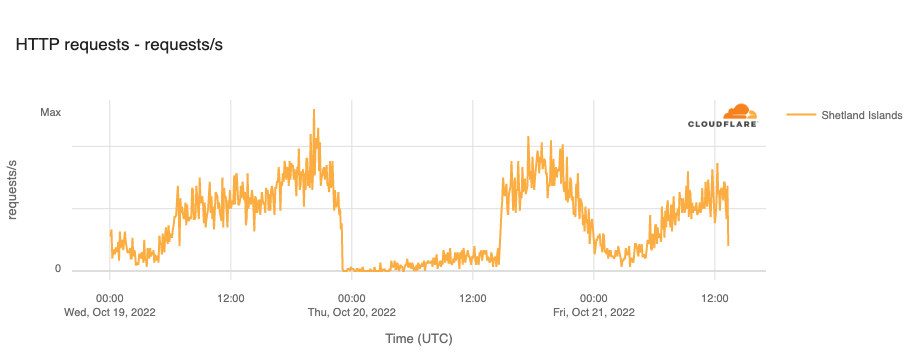
Internet disruptions overview for Q4 2022
Shetland Islands, United Kingdom. (Source: Map data ©2023 GeoBasis-DE/BKG (©2009), Google)

Internet disruptions overview for Q4 2022

Natural disasters

Solomon Islands

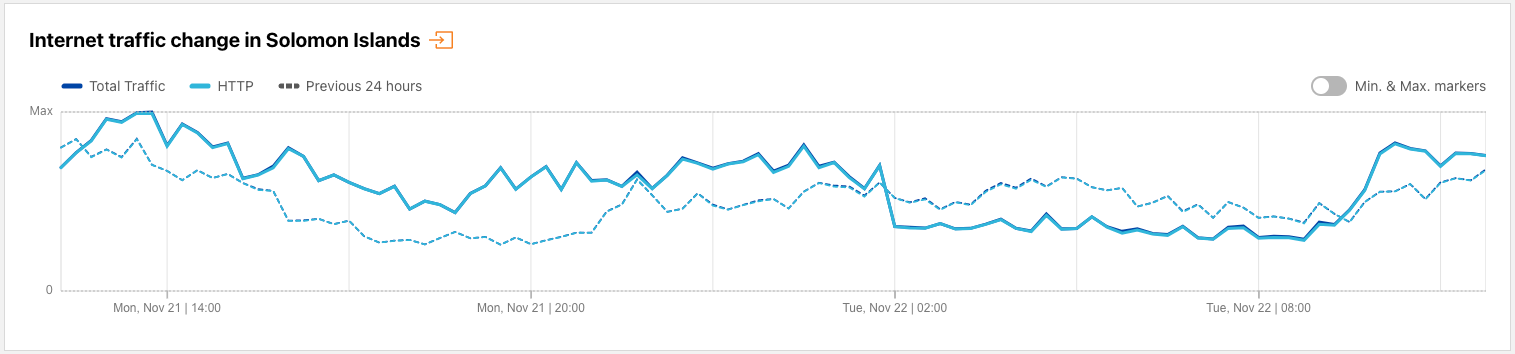
Earthquakes frequently cause infrastructure damage and power outages in affected areas, resulting in disruptions to Internet connectivity. We observed such a disruption in the Solomon Islands after a magnitude 7.0 earthquake occurred near there on November 22. The figure below shows Internet traffic from the country dropping significantly at 1300 local time (0200 UTC), and recovering 11 hours later at around 2000 local time (0900 UTC).
Internet disruptions overview for Q4 2022

Technical problems

Kyrgyzstan

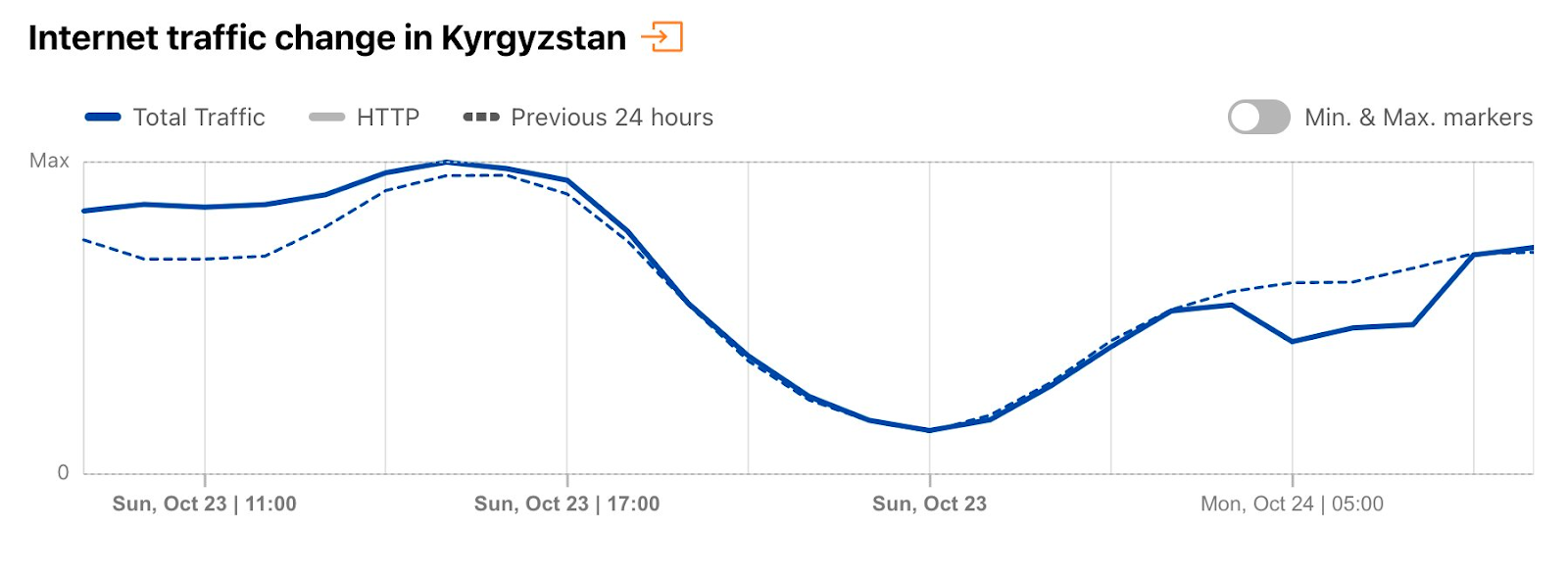
On October 24, a three-hour Internet disruption was observed in Kyrgyzstan lasting between 1100-1400 local time (0500-0800 UTC), as seen in the figure below. According to the country’s Ministry of Digital Development, the issue was caused by “an accident on one of the main lines that supply the Internet”, but no additional details were provided regarding the type of accident or where it had occurred.
Internet disruptions overview for Q4 2022

Australia (Aussie Broadband)

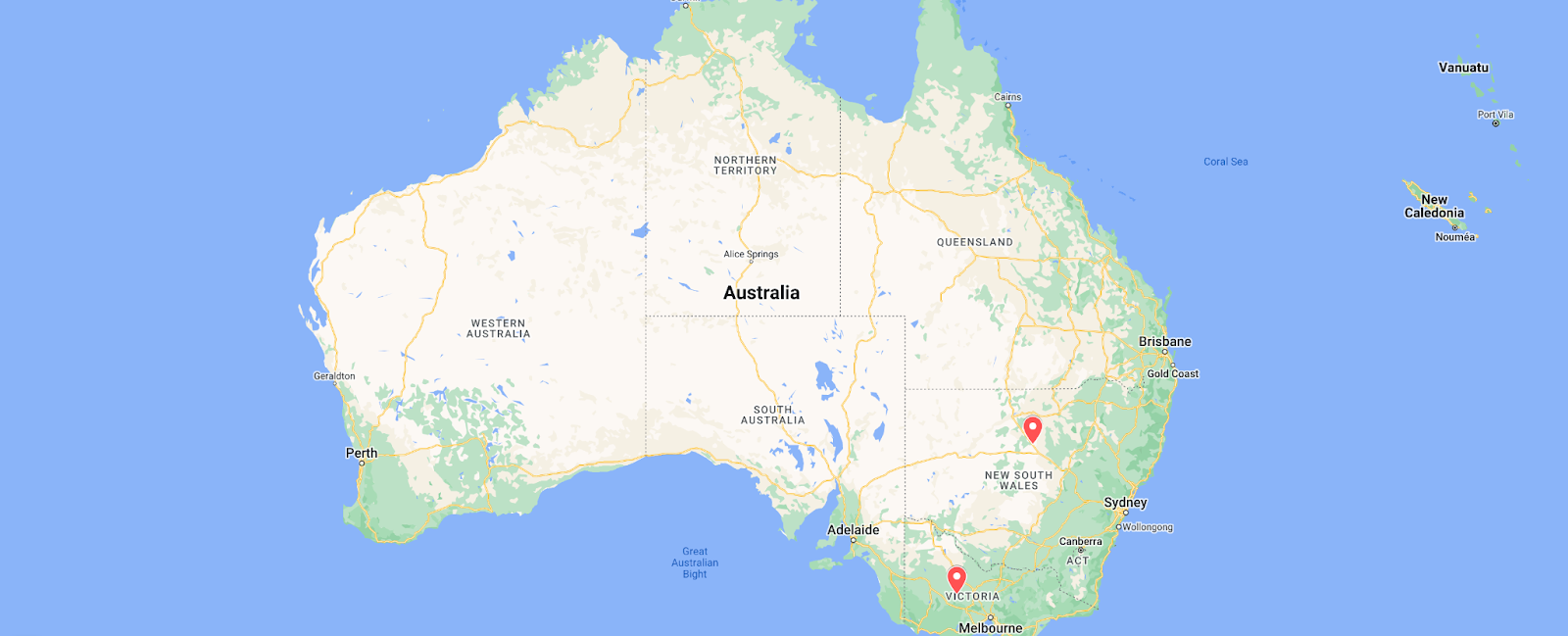
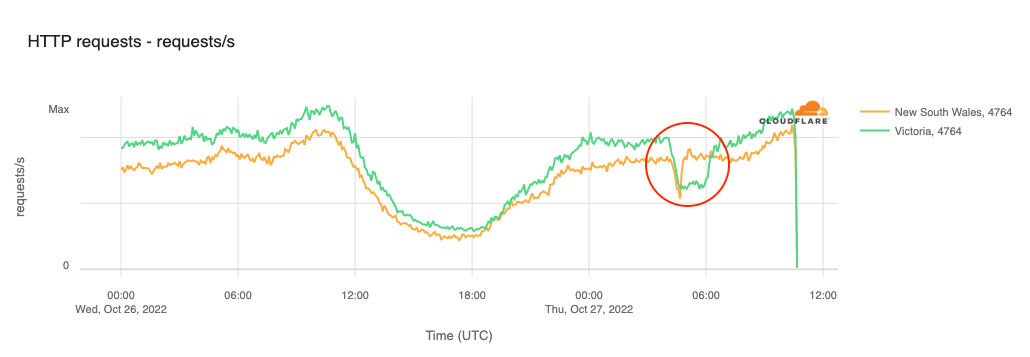
Customers of Australian broadband Internet provider Aussie Broadband in Victoria and New South Wales suffered brief Internet disruptions on October 27. As shown in the figure below, AS4764 (Aussie Broadband) traffic from Victoria dropped by approximately 40% between 1505-1745 local time (0405-0645 UTC). A similar, but briefer, loss of traffic from New South Wales was also observed, lasting between 1515-1550 local time (0415-0450 UTC). A representative of Aussie Broadband provided insight into the underlying cause of the disruption, stating “A config change was made which was pushed out through automation to the DHCP servers in those states. … The change has been rolled back but getting the sessions back online is taking time for VIC, and we are now manually bringing areas up one at a time.”
Internet disruptions overview for Q4 2022
Victoria and New South Wales, Australia. (Source: Map data ©2023 Google)

Internet disruptions overview for Q4 2022

Haiti

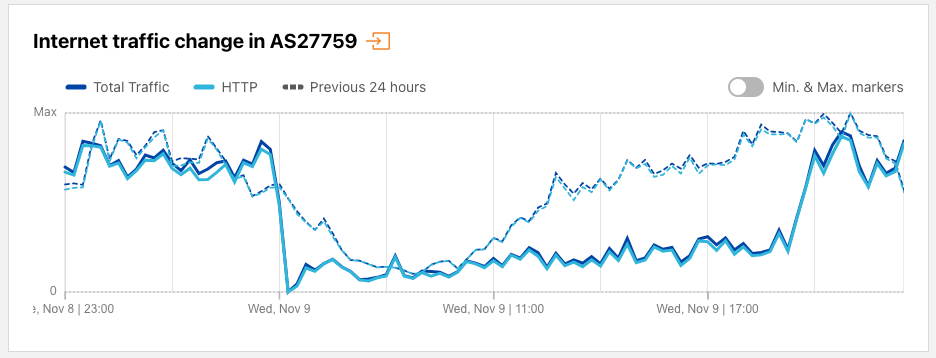
In Haiti, customers of Internet service provider Access Haiti experienced disrupted service for more than half a day on November 9. The figure below shows that Internet traffic for AS27759 (Access Haiti) fell precipitously around midnight local time (0500 UTC), remaining depressed until 1430 local time (1930 UTC), at which time it recovered quickly. A Facebook post from Access Haiti explained to customers that “Due to an intermittent outage on one of our international circuits, our network is experiencing difficulties that cause your Internet service to slow down.” While Access Haiti didn’t provide additional details on which international circuit was experiencing an outage, submarinecablemap.com shows that two submarine cables provide international Internet connectivity to Haiti — the Bahamas Domestic Submarine Network (BDSNi), which connects Haiti to the Bahamas, and Fibralink, which connects Haiti to the Dominican Republic and Jamaica.
Internet disruptions overview for Q4 2022

Unknown

Many Internet disruptions can be easily tied to an underlying cause, whether through coverage in the press, a concurrent weather or natural disaster event, or communication from an impacted provider. However, the causes of other observed disruptions remain unknown as the impacted providers remain silent about what caused the problem.

United States (Wide Open West)

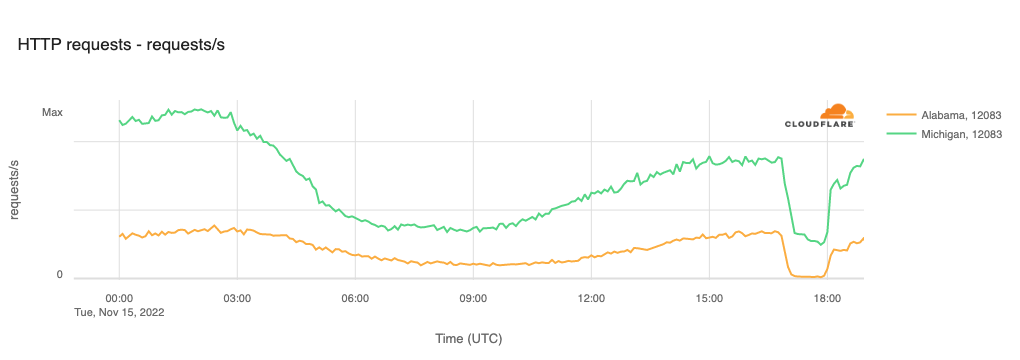
On November 15, customers of Wide Open West, an Internet service provider with a multi-state footprint in the United States, experienced an Internet service disruption that lasted a little over an hour. The figure below illustrates the impact of the disruption in Alabama and Michigan on AS12083 (Wide Open West), with traffic dropping at 1150 local time (1650 UTC) and recovering just after 1300 local time (1800 UTC).
Internet disruptions overview for Q4 2022

Cuba

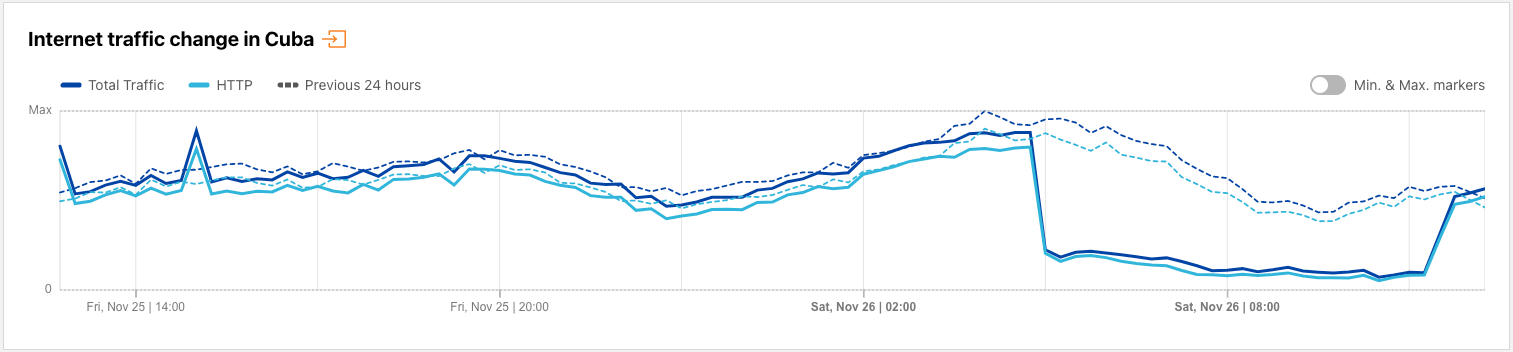
Cuba is no stranger to Internet disruptions, whether due to government-directed shutdowns (such as the one discussed above), fiber cuts, or power outages. However, no underlying cause was ever shared for the seven-hour disruption in the country’s Internet traffic observed between 2345 on November 25 and 0645 on November 26 local time (0445-1145 UTC on November 26). Traffic was down as much as 75% from previous levels during the disruption.
Internet disruptions overview for Q4 2022

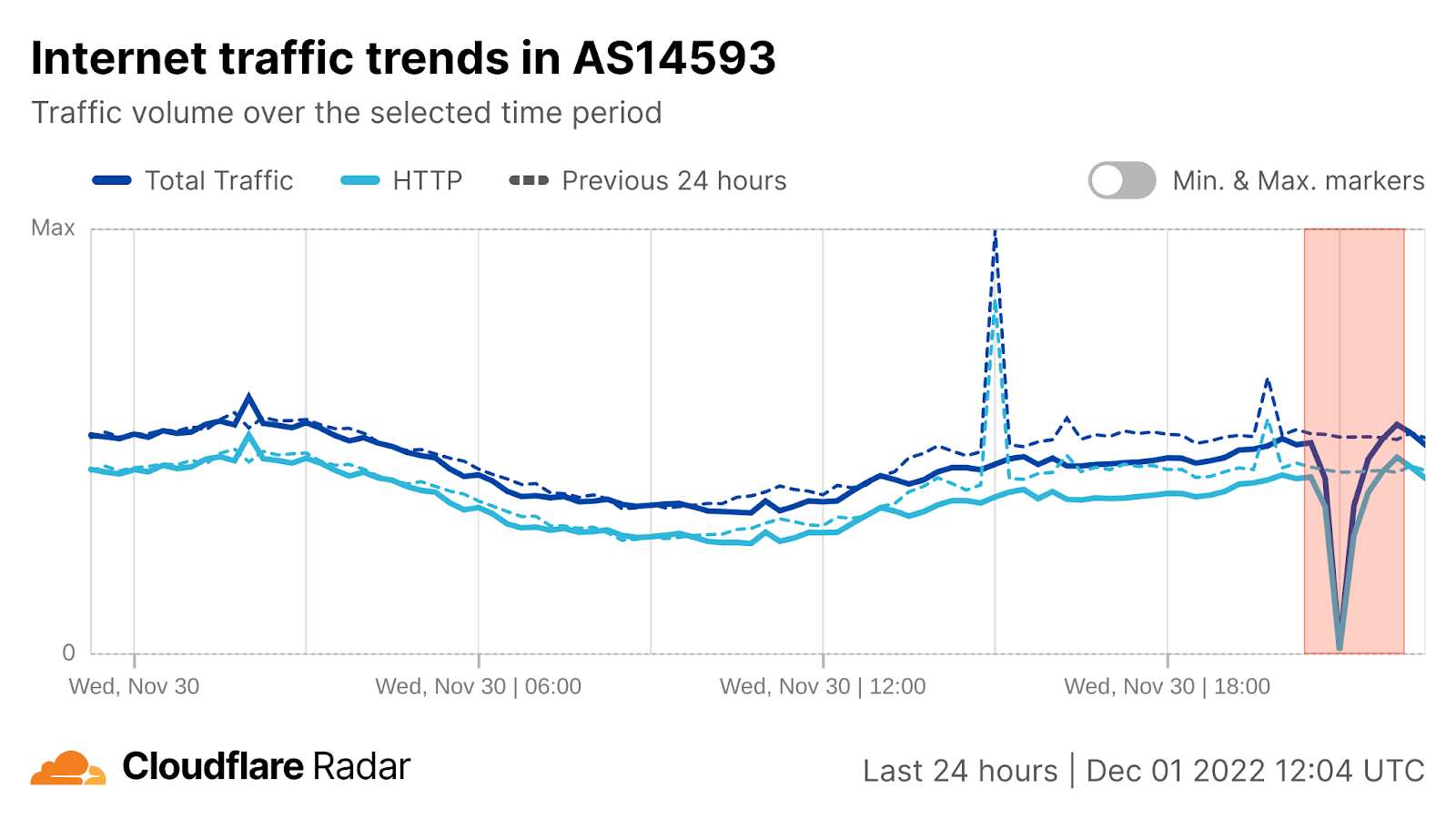
As a provider of low earth orbit (LEO) satellite Internet connectivity services, disruptions to SpaceX Starlink’s service can have a global impact. On November 30, a disruption was observed on AS14593 (SPACEX-STARLINK) between 2050-2130 UTC, with traffic volume briefly dropping to near zero. Unfortunately, Starlink did not acknowledge the incident, nor did they provide any reason for the disruption.
Internet disruptions overview for Q4 2022

Conclusion

Looking back at the Internet disruptions observed during 2022, a number of common themes can be found. In countries with more authoritarian governments, the Internet is often weaponized as a means of limiting communication within the country and with the outside world through network-level, regional, or national Internet shutdowns. As noted above, this approach was used aggressively in Iran during the last few months of the year.

Internet connectivity quickly became a casualty of war in Ukraine. Early in the conflict, network-level outages were common, and some Ukrainian networks ultimately saw traffic re-routed through upstream Russian Internet service providers. Later in the year, as electrical power infrastructure was increasingly targeted by Russian attacks, widespread power outages resulted in multi-hour disruptions of Internet traffic across the country.

While the volcanic eruption in Tonga took the country offline for over a month due to its reliance on a single submarine cable for Internet connectivity, the damage caused by earthquakes in other countries throughout the year resulted in much shorter and more limited disruptions.

And while submarine cable issues can impact multiple countries along its route, the advent of services with an increasingly global footprint like SpaceX Starlink mean that service disruptions will ultimately have a much broader impact. (Starlink’s subscriber base is comparatively small at the moment, but it currently has a service footprint in over 30 countries around the world.)

To follow Internet disruptions as they occur, check the Cloudflare Radar Outage Center (CROC) and follow @CloudflareRadar on Twitter. To review those disruptions observed earlier in 2022, refer to the Q1, Q2, and Q3 Internet disruptions overview blog posts.

Text analytics on AWS: implementing a data lake architecture with OpenSearch

Post Syndicated from Francisco Losada original https://aws.amazon.com/blogs/architecture/text-analytics-on-aws-implementing-a-data-lake-architecture-with-opensearch/

Text data is a common type of unstructured data found in analytics. It is often stored without a predefined format and can be hard to obtain and process.

For example, web pages contain text data that data analysts collect through web scraping and pre-process using lowercasing, stemming, and lemmatization. After pre-processing, the cleaned text is analyzed by data scientists and analysts to extract relevant insights.

This blog post covers how to effectively handle text data using a data lake architecture on Amazon Web Services (AWS). We explain how data teams can independently extract insights from text documents using OpenSearch as the central search and analytics service. We also discuss how to index and update text data in OpenSearch and evolve the architecture towards automation.

Architecture overview

This architecture outlines the use of AWS services to create an end-to-end text analytics solution, starting from the data collection and ingestion up to the data consumption in OpenSearch (Figure 1).

Data lake architecture with OpenSearch

Figure 1. Data lake architecture with OpenSearch

  1. Collect data from various sources, such as SaaS applications, edge devices, logs, streaming media, and social networks.
  2. Use tools like AWS Database Migration Service (AWS DMS), AWS DataSync, Amazon Kinesis, Amazon Managed Streaming for Apache Kafka (Amazon MSK), AWS IoT Core, and Amazon AppFlow to ingest the data into the AWS data lake, depending on the data source type.
  3. Store the ingested data in the raw zone of the Amazon Simple Storage Service (Amazon S3) data lake—a temporary area where data is kept in its original form.
  4. Validate, clean, normalize, transform, and enrich the data through a series of pre-processing steps using AWS Glue or Amazon EMR.
  5. Place the data that is ready to be indexed in the indexing zone.
  6. Use AWS Lambda to index the documents into OpenSearch and store them back in the data lake with a unique identifier.
  7. Use the clean zone as the source of truth for teams to consume the data and calculate additional metrics.
  8. Develop, train, and generate new metrics using machine learning (ML) models with Amazon SageMaker or artificial intelligence (AI) services like Amazon Comprehend.
  9. Store the new metrics in the enriching zone along with the identifier of the OpenSearch document.
  10. Use the identifier column from the initial indexing phase to identify the correct documents and update them in OpenSearch with the newly calculated metrics using AWS Lambda.
  11. Use OpenSearch to search through the documents and visualize them with metrics using OpenSearch Dashboards.

Considerations

Data lake orchestration among teams

This architecture allows data teams to work independently on text documents at different stages of their lifecycles. The data engineering team manages the raw and indexing zones, who also handle data ingestion and preprocessing for indexing in OpenSearch.

The cleaned data is stored in the clean zone, where data analysts and data scientists generate insights and calculate new metrics. These metrics are stored in the enrich zone and indexed as new fields in the OpenSearch documents by the data engineering team (Figure 2).

Data lake orchestration among teams

Figure 2. Data lake orchestration among teams

Let’s explore an example. Consider a company that periodically retrieves blog site comments and performs sentiment analysis using Amazon Comprehend. In this case:

  1. The comments are ingested into the raw zone of the data lake.
  2. The data engineering team processes the comments and stores them in the indexing zone.
  3. A Lambda function indexes the comments into OpenSearch, enriches the comments with the OpenSearch document ID, and saves it in the clean zone.
  4. The data science team consumes the comments and performs sentiment analysis using Amazon Comprehend.
  5. The sentiment analysis metrics are stored in the metrics zone of the data lake. A second Lambda function updates the comments in OpenSearch with the new metrics.

If the raw data does not require any preprocessing steps, the indexing and clean zones can be combined. You can explore this specific example, along with code implementation, in the AWS samples repository.

Schema evolution

As your data progresses through data lake stages, the schema changes and gets enriched accordingly. Continuing with our previous example, Figure 3 explains how the schema evolves.

Schema evolution through the data lake stages

Figure 3. Schema evolution through the data lake stages

  1. In the raw zone, there is a raw text field received directly from the ingestion phase. It’s best practice to keep a raw version of the data as a backup, or in case the processing steps need to be repeated later.
  2. In the indexing zone, the clean text field replaces the raw text field after being processed.
  3. In the clean zone, we add a new ID field that is generated during indexing and identifies the OpenSearch document of the text field.
  4. In the enrich zone, the ID field is required. Other fields with metric names are optional and represent new metrics calculated by other teams that will be added to OpenSearch.

Consumption layer with OpenSearch

In OpenSearch, data is organized into indices, which can be thought of as tables in a relational database. Each index consists of documents—similar to table rows—and multiple fields, similar to table columns. You can add documents to an index by indexing and updating them using various client APIs for popular programming languages.

Now, let’s explore how our architecture integrates with OpenSearch in the indexing and updating stage.

Indexing and updating documents using Python

The index document API operation allows you to index a document with a custom ID, or assigns one if none is provided. To speed up indexing, we can use the bulk index API to index multiple documents in one call.

We need to store the IDs back from the index operation to later identify the documents we’ll update with new metrics. Let’s explore two ways of doing this:

  • Use the requests library to call the REST Bulk Index API (preferred): the response returns the auto-generated IDs we need.
  • Use the Python Low-Level Client for OpenSearch: The IDs are not returned and need to be pre-assigned to later store them. We can use an atomic counter in Amazon DynamoDB to do so. This allows multiple Lambda functions to index documents in parallel without ID collisions.

As in Figure 4, the Lambda function:

  1. Increases the atomic counter by the number of documents that will index into OpenSearch.
  2. Gets the value of the counter back from the API call.
  3. Indexes the documents using the range that goes between [current counter value, current counter value – number of documents].
Storing the IDs back from the bulk index operation using the Python Low-Level Client for OpenSearch

Figure 4. Storing the IDs back from the bulk index operation using the Python Low-Level Client for OpenSearch

Data flow automation

As architectures evolve towards automation, the data flow between data lake stages becomes event-driven. Following our previous example, we can automate the processing steps of the data when moving from the raw to the indexing zone (Figure 5).

Event-driven automation for data flow

Figure 5. Event-driven automation for data flow

With Amazon EventBridge and AWS Step Functions, we can automatically trigger our pre-processing AWS Glue jobs so our data gets pre-processed without manual intervention.

The same approach can be applied to the other data lake stages to achieve a fully automated architecture. Explore this implementation for an automated language use case.

Conclusion

In this blog post, we covered designing an architecture to effectively handle text data using a data lake on AWS. We explained how different data teams can work independently to extract insights from text documents at different lifecycle stages using OpenSearch as the search and analytics service.

Real-World Steganography

Post Syndicated from Bruce Schneier original https://www.schneier.com/blog/archives/2023/01/real-world-steganography.html

From an article about Zheng Xiaoqing, an American convicted of spying for China:

According to a Department of Justice (DOJ) indictment, the US citizen hid confidential files stolen from his employers in the binary code of a digital photograph of a sunset, which Mr Zheng then mailed to himself.

Use AWS WAF CAPTCHA to protect your application against common bot traffic

Post Syndicated from Abhinav Bannerjee original https://aws.amazon.com/blogs/security/use-aws-waf-captcha-to-protect-your-application-against-common-bot-traffic/

In this blog post, you’ll learn how you can use a Completely Automated Public Turing test to tell Computers and Humans Apart (CAPTCHA) with other AWS WAF controls as part of a layered approach to provide comprehensive protection against bot traffic. We’ll describe a workflow that tracks the number of incoming requests to a site’s store page. The workflow then limits those requests if they exceed a certain threshold. Requests from IP addresses that exceed the threshold will be presented a CAPTCHA challenge to prove that the requests are being made by a human.

Amazon Web Services (AWS) offers many tools and recommendations that companies can use as they face challenges with bot traffic on their websites. Web applications can be compromised through a variety of vectors, including cross-site scripting, SQL injection, path traversal, local file inclusion, and distributed denial-of-service (DDoS) attacks. AWS WAF offers managed rules that are designed to provide protection against common application vulnerabilities or other unwanted web traffic, without requiring you to write your own rules.

There are some web attacks like web scraping, credential stuffing, and layer 7 DDoS attempts conducted by bots (as well as by humans) that target sensitive areas of your website, such as your store page. A CAPTCHA mitigates undesirable traffic by requiring the visitor to complete challenges before they are allowed to access protected resources. You can implement CAPTCHA to help prevent unwanted activities. Last year, AWS introduced AWS WAF CAPTCHA, which allows customers to set up AWS WAF rules that require CAPTCHA challenges to be completed for common targets such as forms (for example, search forms).

Scenario

Consider an attack where the unauthorized user is attempting to overwhelm a site’s store page by repeatedly sending search requests for different items.

Assume that traffic visits a website that is hosted through Amazon CloudFront and attempts the above behavior on the /store URL. In this scenario, there is a rate-based rule in place that will track the number of requests coming in from each IP. This rate-based rule tracks the rate of requests for each originating IP address and invokes the rule action on IPs with rates that go over the limit. With CAPTCHA implemented as the rule action, excessive attempts to search within a 5-minute window will result in a CAPTCHA challenge being presented to the user. This workflow is shown in Figure 1.

Figure 1: User visits a store page and is evaluated by a rate-based rule

Figure 1: User visits a store page and is evaluated by a rate-based rule

When a user solves a CAPTCHA challenge, AWS automatically generates and encrypts a token and sends it to the client as a cookie. The client requests aren’t challenged again until the token has expired. AWS WAF calculates token expiration by using the immunity time configuration. You can configure the immunity time in a web access control list (web ACL) CAPTCHA configuration and in the configuration for a rule’s action setting. When a user provides an incorrect answer to a CAPTCHA challenge, the challenge informs the user and loads a new puzzle. When the user solves the challenge, the challenge automatically submits the original web request, updated with the CAPTCHA token from the successful puzzle completion.

Walkthrough

This workflow will require an AWS WAF rule within a new or existing rule group or web ACL. The rule will define how web requests are inspected and the action to take.

To create an AWS WAF rate-based rule

  1. Open the AWS WAF console and in the left navigation pane, choose Web ACLs.
  2. Choose an existing web ACL, or choose Create web ACL at the top right to create a new web ACL.
  3. Under Rules, choose Add rules, and then in the drop-down list, choose Add my own rules and rule groups.
  4. For Rule type, choose Rule builder.
  5. In the Rule builder section, for Name, enter your rule name. For Type, choose Rate-based rule.
  6. In the Request rate details section, enter your rate limit (for example, 100). For IP address to use for rate limiting, choose Source IP address, and for Criteria to count requests toward rate limit, choose Only consider requests that match criteria in a rule statement.
  7. For Count only the requests that match the following statement, choose Matches the statement from the drop-down list.
  8. In the Statement section, for Inspect, choose URI path. For Match type , choose Contains string.
  9. For String to match, enter the URI path of your web page (for example, /store).
  10. In the Action section, choose CAPTCHA.
  11. (Optional) For Immunity time, choose Set a custom immunity time for this rule, or keep the default value (300 seconds).
  12. To finish, choose Add rule, and then choose Save to add the rule to your web ACL.

After you add the rule, go to the Rules tab of your web ACL and navigate to your rule. Confirm that the output resembles what is shown in Figure 2. You should have a rate-based rule with a scope-down statement that matches the store URI path you entered earlier, and the action should be set to CAPTCHA.

The following is the JSON for the CAPTCHA rule that you just created. You can use this to validate your configuration. You can also use this JSON in the rule builder while creating the rule.

{
  "Name": "CaptchaOnRBR",
  "Priority": 0,
  "Statement": {
    "RateBasedStatement": {
      "Limit": 100,
      "AggregateKeyType": "IP",
      "ScopeDownStatement": {
        "ByteMatchStatement": {
          "SearchString": "/store",
          "FieldToMatch": {
            "UriPath": {}
          },
          "TextTransformations": [
            {
              "Priority": 0,
              "Type": "NONE"
            }
          ],
          "PositionalConstraint": "CONTAINS"
        }
      }
    }
  },
  "Action": {
    "Captcha": {}
  },
  "VisibilityConfig": {
    "SampledRequestsEnabled": true,
    "CloudWatchMetricsEnabled": true,
    "MetricName": "CaptchaOnRBR"
  },
  "CaptchaConfig": {
    "ImmunityTimeProperty": {
      "ImmunityTime": 60
    }
  }
}

After you complete this configuration, the rule will be invoked when an IP address unsuccessfully attempts to search the store at a rate that exceeds the threshold. This user will be presented with a CAPTCHA challenge, as shown in Figure 6. If the user is successful, they will be routed back to the store page. Otherwise, they will be served a new puzzle until it is solved.

Figure 3: CAPTCHA challenge presented to a request that exceeded the threshold

Figure 3: CAPTCHA challenge presented to a request that exceeded the threshold

Implementing rate-based rules and CAPTCHA also allows you to track IP addresses, limit the number of invalid search attempts, and use the specific IP information available to you within sampled requests and AWS WAF logs to work to prevent that traffic from affecting your resources. Additionally, you have visibility into IPs addresses blocked by rate-based rules so that you can later add these addresses to a block list or create custom logic as needed to mitigate false positives.

Conclusion

In this blog post, you learned how to configure and deploy a CAPTCHA challenge with AWS WAF that checks for web requests that exceed a certain rate threshold and requires the client sending such requests to solve a challenge. Please note the additional charge for enabling CAPTCHA on your web ACL (pricing can be found here). Although CAPTCHA challenges are simple for humans to complete, they should be harder for common bots to complete with any meaningful rate of success. You can use a CAPTCHA challenge when a block action would stop too many legitimate requests, but letting all traffic through would result in unacceptably high levels of unwanted requests, such as from bots.

For more information and guidance on AWS WAF rate-based rules, see the blog post The three most important AWS WAF rate-based rules and the AWS whitepaper AWS Best Practices for DDoS Resiliency. You can also check out these additional resources:

 
If you have feedback about this blog post, submit comments in the Comments section below. You can also start a new thread on AWS WAF re:Post to get answers from the community.

Want more AWS Security news? Follow us on Twitter.

Abhinav Bannerjee

Abhinav Bannerjee

Abhinav is a Solutions Architect based out of Texas. He works closely with small to medium sized businesses to help them scale their adoption of Amazon Web Services.

Fenil Patel

Fenil Patel

Fenil is a Solutions Architect based out of New Jersey. His main focus is helping customers optimize and secure content delivery using AWS Edge Services.

Unlocking security updates for transitive dependencies with npm

Post Syndicated from Bryan Dragon original https://github.blog/2023-01-19-unlocking-security-updates-for-transitive-dependencies-with-npm/

Dependabot helps developers secure their software with automated security updates: when a security advisory is published that affects a project dependency, Dependabot will try to submit a pull request that updates the vulnerable dependency to a safe version if one is available. Of course, there’s no rule that says a security vulnerability will only affect direct dependencies—dependencies at any level of a project’s dependency graph could become vulnerable.

Until recently, Dependabot did not address vulnerabilities on transitive dependencies, that is, on the dependencies sitting one or more levels below a project’s direct dependencies. Developers would encounter an error message in the GitHub UI and they would have to manually update the chain of ancestor dependencies leading to the vulnerable dependency to bring it to a safe version.

Screenshot of the warning a user sees when they try to update the version of a project when its dependencies sitting one or more levels below a project’s direct dependencies were out of date. The message reads, "Dependabot cannot update minimist to a non-vulnerable version."

Internally, this would show up as a failed background job due to an update-not-possible error—and we would see a lot of these errors.

Understanding the challenge

Dependabot offers two strategies for updating dependencies: scheduled version updates and security updates. With version updates, the explicit goal is to keep project dependencies updated to the latest available version, and Dependabot can be configured to widen or increase a version requirement so that it accommodates the latest version. With security updates, Dependabot tries to make the most conservative update that removes the vulnerability while respecting version requirements. In this post we’ll be looking at security updates.

As an example, let’s say we have a repository with security updates enabled that contains an npm project with a single dependency on react-scripts@^4.0.3.

Not all package managers handle version requirements in the same way, so let’s quickly refresh. A version requirement like ^4.0.3 (a “caret range”) in npm permits updates to versions that don’t change the leftmost nonzero element in the MAJOR.MINOR.PATCH semver version number. The version requirement ^4.0.3, then, can be understood as allowing versions greater than or equal to 4.0.3 and less than 5.0.0.

On March 18, 2022, a high-severity security advisory was published for node-forge, a popular npm package that provides tools for writing cryptographic and network-heavy applications. The advisory impacts versions earlier than 1.3.0, the patched version released the day before the advisory was published.

While we don’t have a direct dependency on node-forge, if we zoom in on our project’s dependency tree we can see that we do indirectly depend on a vulnerable version:

react-scripts@^4.0.3             4.0.3
  - [email protected]    3.11.1
    - selfsigned@^1.10.7         1.10.14
      - node-forge@^0.10.0       0.10.0

In order to resolve the vulnerability, we need to bring node-forge from 0.10.0 to 1.3.0, but a sequence of conflicting ancestor dependencies prevents us from doing so:

  • 4.0.3 is the latest version of react-scripts permitted by our project
  • 3.11.1 is the only version of webpack-dev-server permitted by [email protected]
  • 1.10.14 is the latest version of selfsigned permitted by [email protected]
  • 0.10.0 is the latest version of node-forge permitted by[email protected]

This is the point at which the security update would fail with an update-not-possible error. The challenge is in finding the version of selfsigned that permits [email protected], the version of webpack-dev-server that permits that version of selfsigned, and so on up the chain of ancestor dependencies until we reach react-scripts.

How we chose npm

When we set out to reduce the rate of update-not-possible errors, the first thing we did was pull data from our data warehouse in order to identify the greatest opportunities for impact.

JavaScript is the most popular ecosystem that Dependabot supports, both by Dependabot enablement and by update volume. In fact, more than 80% of the security updates that Dependabot performs are for npm and Yarn projects. Given their popularity, improving security update outcomes for JavaScript projects promised the greatest potential for impact, so we focused our investigation there.

npm and Yarn both include an operation that audits a project’s dependencies for known security vulnerabilities, but currently only npm natively has the ability to additionally make the updates needed to resolve the vulnerabilities that it finds.

After a successful engineering spike to assess the feasibility of integrating with npm’s audit functionality, we set about productionizing the approach.

Tapping into npm audit

When you run the npm audit command, npm collects your project’s dependencies, makes a bulk request to the configured npm registry for all security advisories affecting them, and then prepares an audit report. The report lists each vulnerable dependency, the dependency that requires it, the advisories affecting it, and whether a fix is possible—in other words, almost everything Dependabot should need to resolve a vulnerable transitive dependency.

node-forge  <=1.2.1
Severity: high
Open Redirect in node-forge - https://github.com/advisories/GHSA-8fr3-hfg3-gpgp
Prototype Pollution in node-forge debug API. - https://github.com/advisories/GHSA-5rrq-pxf6-6jx5
Improper Verification of Cryptographic Signature in node-forge - https://github.com/advisories/GHSA-cfm4-qjh2-4765
URL parsing in node-forge could lead to undesired behavior. - https://github.com/advisories/GHSA-gf8q-jrpm-jvxq
fix available via `npm audit fix --force`
Will install [email protected], which is a breaking change
node_modules/node-forge
  selfsigned  1.1.1 - 1.10.14
  Depends on vulnerable versions of node-forge
  node_modules/selfsigned

There were two ways in which we had to supplement npm audit to meet our requirements:

  1. The audit report doesn’t include the chain of dependencies linking a vulnerable transitive dependency, which a developer may not recognize, to a direct dependency, which a developer should recognize. The last step in a security update job is creating a pull request that removes the vulnerability and we wanted to include some context that lets developers know how changes relate to their project’s direct dependencies.
  2. Dependabot performs security updates for one vulnerable dependency at a time. (Updating one dependency at a time keeps diffs to a minimum and reduces the likelihood of introducing breaking changes.) npm audit and npm audit fix, however, operate on all project dependencies, which means Dependabot wouldn’t be able to tell which of the resulting updates were necessary for the dependency it’s concerned with.

Fortunately, there’s a JavaScript API for accessing the audit functionality underlying the npm audit and npm audit fix commands via Arborist, the component npm uses to manage dependency trees. Since Dependabot is a Ruby application, we wrote a helper script that uses the Arborist.audit() API and can be invoked in a subprocess from Ruby. The script takes as input a vulnerable dependency and a list of security advisories affecting it and returns as output the updates necessary to remove the vulnerabilities as reported by npm.

To meet our first requirement, the script uses the audit results from Arborist.audit() to perform a depth-first traversal of the project’s dependency tree, starting with direct dependencies. This top-down, recursive approach allows us to maintain the chain of dependencies linking the vulnerable dependency to its top-level ancestor(s) (which we’ll want to mention later when creating a pull request), and its worst-case time complexity is linear in the total number of dependencies.

function buildDependencyChains(auditReport, name) {
  const helper = (node, chain, visited) => {
    if (!node) {
      return []
    }
    if (visited.has(node.name)) {
      // We've already seen this node; end path.
      return []
    }
    if (auditReport.has(node.name)) {
      const vuln = auditReport.get(node.name)
      if (vuln.isVulnerable(node)) {
        return [{ fixAvailable: vuln.fixAvailable, nodes: [node, ...chain.nodes] }]
      } else if (node.name == name) {
        // This is a non-vulnerable version of the advisory dependency; end path.
        return []
      }
    }
    if (!node.edgesOut.size) {
      // This is a leaf node that is unaffected by the vuln; end path.
      return []
    }
    return [...node.edgesOut.values()].reduce((chains, { to }) => {
      // Only prepend current node to chain/visited if it's not the project root.
      const newChain = node.isProjectRoot ? chain : { nodes: [node, ...chain.nodes] }
      const newVisited = node.isProjectRoot ? visited : new Set([node.name, ...visited])
      return chains.concat(helper(to, newChain, newVisited))
    }, [])
  }
  return helper(auditReport.tree, { nodes: [] }, new Set())
}

To meet our second requirement of operating on one vulnerable dependency at a time, the script takes advantage of the fact that the Arborist constructor accepts a custom audit registry URL to be used when requesting bulk advisory data. We initialize a mock audit registry server using nock that returns only the list of advisories (in the expected format) for the dependency that was passed into the script and we tell the Arborist instance to use it.

const arb = new Arborist({
  auditRegistry: 'http://localhost:9999',
  // ...
})

const scope = nock('http://localhost:9999')
  .persist()
  .post('/-/npm/v1/security/advisories/bulk')
  .reply(200, convertAdvisoriesToRegistryBulkFormat(advisories))

We see both of these use cases—linking a vulnerable dependency to its top-level ancestor and conducting an audit for a single package or a particular set of vulnerabilities—as opportunities to extend Arborist and we’re working on integrating them upstream.

Back in the Ruby code, we parse and verify the audit results emitted by the helper script, accounting for scenarios such as a dependency being downgraded or removed in order to fix a vulnerability, and we incorporate the updates recommended by npm into the remainder of the security update job.

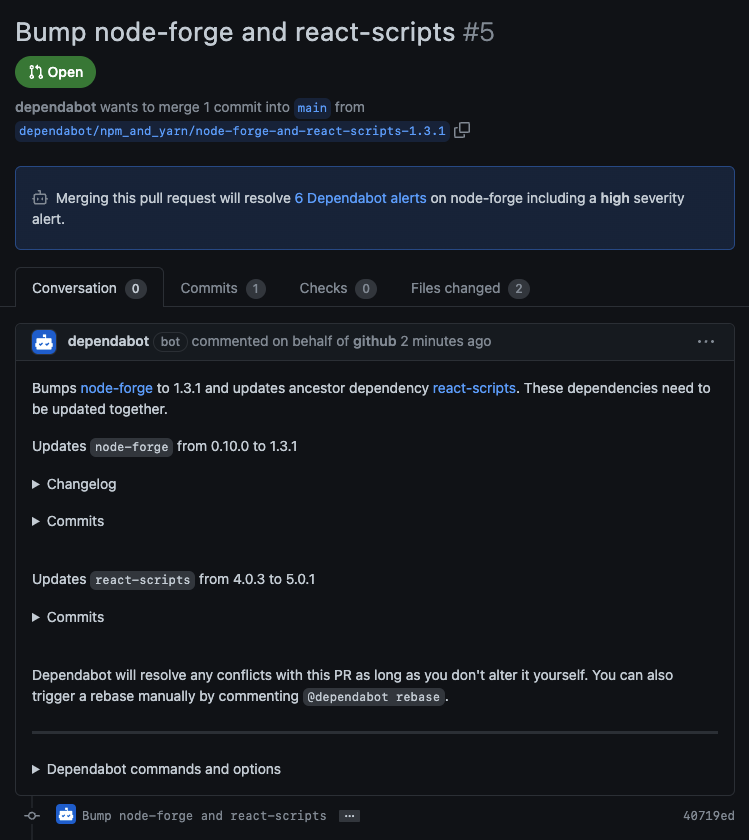
With a viable update path in hand, Dependabot is able to make the necessary updates to remove the vulnerability and submit a pull request that tells the developer about the transitive dependency and its top-level ancestor.

Screenshot of an open pull request that tells the developer about the transitive dependency and its top-level ancestor. The pull request is titled "Bump node-forge and react-scripts" and has a message from Dependabot that reads, "Merging this pull request will resolve 6 Dependabot alerts on node-forge including a high severity alert."

Caveats

When npm audit decides that a vulnerability can only be fixed by changing major versions, it requires use of the force option with npm audit fix. When the force option is used, npm will update to the latest version of a package, even if it means jumping several major versions. This breaks with Dependabot’s previous security update behavior. It also achieves our goal: to unlock conflicting dependencies in order to bring the vulnerable dependency to an unaffected version. Of course, you should still always review the changelog for breaking changes when jumping minor or major versions of a package.

Impact

We rolled out support for transitive security updates with npm in September 2022. Now, having a full quarter of data with the changes in place, we’re able to measure the impact: between Q1Y22 and Q4Y22 we saw a 42% reduction in update-not-possible errors for security updates on JavaScript projects. 🎉

If you have Dependabot security updates enabled on your npm projects, there’s nothing extra for you to do—you’re already benefiting from this improvement.

Looking ahead

I hope this post illustrates some of the considerations and trade-offs that are necessary when making improvements to an established system like Dependabot. We prefer to leverage the native functionality provided by package managers whenever possible, but as package managers come in all shapes and sizes, the approach may vary substantially from one ecosystem to the next.

We hope other package managers will introduce functionality similar to npm audit and npm audit fix that Dependabot can integrate with and we look forward to extending support for transitive security updates to those ecosystems as they do.

Exploiting null-dereferences in the Linux kernel (Project Zero)

Post Syndicated from original https://lwn.net/Articles/920544/

The Google Project Zero page shows
how to compromise the kernel
by using a NULL pointer to repeatedly
force an oops and overflow a reference count.

Back when the kernel was able to access userland memory without
restriction, and userland programs were still able to map the zero
page, there were many easy techniques for exploiting null-deref
bugs. However with the introduction of modern exploit mitigations
such as SMEP and SMAP, as well as mmap_min_addr preventing
unprivileged programs from mmap’ing low addresses, null-deref bugs
are generally not considered a security issue in modern kernel
versions. This blog post provides an exploit
technique demonstrating that treating these bugs as universally
innocuous often leads to faulty evaluations of their relevance to
security.

This is the sort of vulnerability that the
oops-limit patch
is meant to block.

Exploitation of Control Web Panel CVE-2022-44877

Post Syndicated from Caitlin Condon original https://blog.rapid7.com/2023/01/19/etr-exploitation-of-control-web-panel-cve-2022-44877/

Exploitation of Control Web Panel CVE-2022-44877

On January 3, 2023, security researcher Numan Türle published a proof-of-concept exploit for CVE-2022-44877, an unauthenticated remote code execution vulnerability in Control Web Panel (CWP, formerly known as CentOS Web Panel) that had been fixed in an October 2022 release of CWP. The vulnerability arises from a condition that allows attackers to run bash commands when double quotes are used to log incorrect entries to the system. Successful exploitation allows remote attackers to execute arbitrary operating system commands via shell metacharacters in the login parameter (login/index.php).

On January 6, 2023, security nonprofit Shadowserver reported exploitation in the wild. As of January 19, 2023, security firm GreyNoise has also seen several IP addresses exploiting CVE-2022-44877.

Control Web Panel is a popular free interface for managing web servers; Shadowserver’s dashboard for CWP identifies tens of thousands of instances on the internet. There doesn’t appear to be a detailed vendor advisory for CVE-2022-44887, but available information indicates Control Web Panel 7 (CWP 7) versions before 0.9.8.1147 are vulnerable. CWP users should upgrade their versions to 0.9.8.1147 or later as soon as possible.

Rapid7 customers

InsightVM & Nexpose customers: We expect coverage for CVE-2022-44877 to be available in the January 19 content release.

Ransomware Takeaways Q4 2022

Post Syndicated from Jeremy Milk original https://www.backblaze.com/blog/ransomware-takeaways-q4-2022/

It may seem like ransomware is not in the news as much as it was in 2021 and the first part of 2022. Back then, major attacks and record-breaking ransom demands dominated headlines, and governments took action to make life more difficult for cybercriminals. But the spotlight is never a good place to be when you’re trying to defraud companies to the tune of millions of dollars. So, while you might be hearing about it less, that doesn’t mean that the threat of cybercrime is negligible. Exactly the opposite—the lack of media attention makes potential victims lower their guard, leaving vulnerabilities that cybercriminals love to exploit.

Staying up-to-date on the latest ransomware news keeps you informed of potential threats. And, keeping the latest threats fresh in your mind means you’ll be ready if and when cybercriminals turn their sights in your direction. We all hope that never happens, but it’s wise to be prepared in case it does. To arm you with the latest, here are some of the biggest developments in ransomware that we observed in Q4 2022.

This post is a part of our ongoing series on ransomware. Take a look at our other posts for more information on how businesses can defend themselves against a ransomware attack, and more.

And, don’t forget that we offer a thorough walkthrough of ways to prepare yourself and your business for ransomware attacks—free to download below.

➔ Download The Complete Guide to Ransomware

1. Many Ransomware Attacks Go Unreported in the Media

One possible reason you don’t hear about ransomware attacks is that they simply don’t get reported in the news. A study released in late 2022 by Jumpsec found that 86% of ransomware attacks go unreported in typical media sources in the UK. The attacks that do get covered are typically ones where the victims are legally required to disclose the attacks due to personally identifiable information (PII) being compromised. While public disclosure is uncommon, keep in mind that reporting requirements—that is, the legal requirement to disclose to the authorities—in the UK, U.S., and elsewhere are becoming more stringent. For example, in 2022, President Biden signed a bill into law that requires operators of critical infrastructure to disclose cyber attacks to the government within 72 hours.

Key Takeaway

It may seem like there’s no real incentive to disclose a cyberattack publicly. Why serve the greater good at the expense of your reputation, right? But, some organizations have found that being open and honest positions them ahead of the game. Chip Daniels, head of government affairs at SolarWinds, shared the positive response the company has received about their transparency, “I meet with somebody for the first time, they’ll say, ‘I just want to tell you, you guys are the gold standard on how you should respond to a cyber incident.’” Being seen as the “gold standard” isn’t a bad place to land after an attack.

2. Hospitals and Schools Continued to Be Targeted

Sadly, it’s not the first time we reported on the threat to hospitals and schools. It was highlighted in our very first Ransomware Takeaways report. In Q4 2022, cybercriminals showed no sign of letting up as CommonSpirit Health, a Chicago-based health provider with more than 700 care sites and 142 hospitals in 21 states, suffered a major attack that made patient records vulnerable. And earlier in the year, over Labor Day weekend, one of the largest school districts in the country—the Los Angeles Unified School District—was attacked as well.

Key Takeaway

Nonprofit and public sector institutions need budget-friendly options for implementing ransomware protection that work with their existing purchasing programs. Through government IT aggregators like Carahsoft, public sector decision makers can purchase affordable, capacity-based cloud storage to support their recovery objectives.

3. Ransomware Attacks Take a Psychological Toll

In news that should come as a surprise to no one who’s been through a ransomware incident, cyberattacks take a psychological toll, and new research from cybersecurity company Northwave released in Q4 2022 quantifies it. They measured the mental impacts of ransomware attacks at three points in time, within the first week, month, and year after an attack. At a month out, 75% reported having negative thoughts, and at one year, 14% reported symptoms of trauma requiring professional help.

Key Takeaway

Companies involved in a ransomware attack can take action to minimize negative effects on employees’ mental health. Northwave recommends having regular check-ins and breaks during the first phase, making space for rest and recovery time in the second phase, and creating an open environment in the third phase, where employees can talk about what happened and decompress.

4. Some Ransomware Is Badly Made, and All the More Dangerous

Researchers analyzed the Cryptonite ransomware strain, which first appeared in October 2022, and found that its “barebones” functionality makes it even more of a threat—there’s no way to recover encrypted files. Researchers point out that it’s likely not an intentional feature, but simply poor design.

Key Takeaway

Since the software is broken to the point where decryption is impossible, there’s absolutely no reason to pay the ransom if you fall victim to a Cryptonite attack. Instead, it makes sense to spend some time creating a disaster recovery plan so you can resume normal business operations as soon as possible. Researchers also report that phishing seems to be the most common attack vector for this ransomware strain, so it’s a good idea to ramp up your cybersecurity training.

5. A Vast Majority of Ransomware Attacks Attempted to Infect Backups

In November, Veeam released their 2022 Ransomware Trends report, a study of more than 3,000 organizations across 28 countries. Among their key findings: 95% of ransomware attacks attempted to infect backups. Of those attacks that targeted backups, 38% of respondents had some backup repositories impacted, and 30% had all of their backup repositories impacted.

Key Takeaway

One word: immutability. Protecting backups with Object Lock costs nothing to implement and prevents backups from being modified or encrypted by ransomware. With backups that can’t be altered, recoveries are much easier and more reliable.

Closing Thoughts

While you may not be hearing about as many high profile ransomware attacks as you once were, make no mistake that they’re still happening. Just know that there are steps you can take to keep your company from becoming the next victim, including protecting data with Object Lock, applying security best practices, and creating a disaster recovery plan.

The post Ransomware Takeaways Q4 2022 appeared first on Backblaze Blog | Cloud Storage & Cloud Backup.

CVE-2022-47966: Rapid7 Observed Exploitation of Critical ManageEngine Vulnerability

Post Syndicated from Glenn Thorpe original https://blog.rapid7.com/2023/01/19/etr-cve-2022-47966-rapid7-observed-exploitation-of-critical-manageengine-vulnerability/

CVE-2022-47966: Rapid7 Observed Exploitation of Critical ManageEngine Vulnerability

Emergent threats evolve quickly, and as we learn more about this vulnerability, this blog post will evolve, too.

Rapid7 is responding to various compromises arising from the exploitation of CVE-2022-47966, a pre-authentication remote code execution (RCE) vulnerability impacting at least 24 on-premise ManageEngine products. CVE-2022-47966 stems from a vulnerable third-party dependency on Apache Santuario.
Several of the affected products are extremely popular with organizations and attackers, including ADSelfService Plus and ServiceDesk Plus. Patches were released in October and November of 2022; the exact timing of fixed version releases varies by product.

Organizations using any of the affected products listed in ManageEngine’s advisory should update immediately and review unpatched systems for signs of compromise, as exploit code is publicly available and exploitation has already begun.

Affected products

See ManageEngine’s advisory for CVE-2022-47966 for updated product and version information.

At the time of publication, the vulnerable products are subject to certain caveats according to Zoho’s advisory.

The following list of vulnerable products is subject to the caveats below:
* Vulnerable if configured SAML-based SSO and it is currently active.
** Vulnerable if configured SAML-based SSO at least once in the past, regardless of the current SAML-based SSO status.

  • Access Manager Plus*
  • Active Directory 360**
  • ADAudit Plus**
  • ADManager Plus**
  • ADSelfService Plus**
  • Analytics Plus*
  • Application Control Plus*
  • Asset Explorer**
  • Browser Security Plus*
  • Device Control Plus*
  • Endpoint Central*
  • Endpoint Central MSP*
  • Endpoint DLP*
  • Key Manager Plus*
  • OS Deployer*
  • PAM 360*
  • Password Manager Pro*
  • Patch Manager Plus*
  • Remote Access Plus*
  • Remote Monitoring and Management (RMM)*
  • ServiceDesk Plus**
  • ServiceDesk Plus MSP**
  • SupportCenter Plus**
  • Vulnerability Manager Plus*

Background

ManageEngine released patches for these products in October and November of 2022.

Rapid7 observed exploitation across organizations as early as January 18, 2023.

Security firm Horizon3 released technical information with a proof of concept (PoC) on January 19, 2023.

Rapid7 customers

InsightVM & Nexpose customers: Our researchers are currently evaluating the feasibility of adding vulnerability checks for as many of the affected products as possible. We expect coverage for ManageEngine ServiceDesk Plus to be available in the January 19 content release.

InsightIDR & Managed Detection & Response customers: the previously existing detections have been triggering upon exploitation:

  • Suspicious Process – Zoho ManageEngine Spawns Child
  • Attacker Technique – Plink Redirecting RDP
  • Attacker Technique – Renamed Plink

What’s new in Amazon Redshift – 2022, a year in review

Post Syndicated from Manan Goel original https://aws.amazon.com/blogs/big-data/whats-new-in-amazon-redshift-2022-a-year-in-review/

In 2021 and 2020, we told you about the new features in Amazon Redshift that make it easier, faster, and more cost-effective to analyze all your data and find rich and powerful insights. In 2022, we are happy to report that the Amazon Redshift team was hard at work. We worked backward from customer requirements and announced multiple new features to make it easier, faster, and more cost-effective to analyze all your data. This post covers some of these new features.

At AWS, for data and analytics, our strategy is to give you a modern data architecture that helps you break free from data silos; have purpose-built data, analytics, machine learning (ML), and artificial intelligence services to use the right tool for the right job; and have open, governed, secure, and fully managed services to make analytics available to everyone. Within AWS’s modern data architecture, Amazon Redshift as the cloud data warehouse remains a key component, enabling you to run complex SQL analytics at scale and performance on terabytes to petabytes of structured and unstructured data, and make the insights widely available through popular business intelligence (BI) and analytics tools. We continue to work backward from customers’ requirements, and in 2022 launched over 40 features in Amazon Redshift to help customers with their top data warehousing use cases, including:

  • Self-service analytics
  • Easy data ingestion
  • Data sharing and collaboration
  • Data science and machine learning
  • Secure and reliable analytics
  • Best price performance analytics

Let’s dive deeper and discuss the new Amazon Redshift features in these areas.

Self-service analytics

Customers continue to tell us that data and analytics is becoming ubiquitous, and everyone in their organization needs analytics. We announced Amazon Redshift Serverless (in preview) in 2021 to make it easy to run and scale analytics in seconds without having to provision and manage data warehouse infrastructure. In July 2022, we announced the general availability of Redshift Serverless, and since then thousands of customers, including Peloton, Broadridge Financials, and NextGen Healthcare, have used it to quickly and easily analyze their data. Amazon Redshift Serverless automatically provisions and intelligently scales data warehouse capacity to deliver high performance for all your analytics, and you only pay for the compute used for the duration of the workloads on a per-second basis. Since GA, we have added features like resource tagging, simplified monitoring, and availability in additional AWS Regions to further simplify billing and expand the reach across more Regions worldwide.

In 2021, we launched Amazon Redshift Query Editor V2, which is a free web-based tool for data analysts, data scientists, and developers to explore, analyze, and collaborate on data in Amazon Redshift data warehouses and data lakes. In 2022, Query Editor V2 got additional enhancements such as notebook support for improved collaboration to author, organize, and annotate queries; user access through identity provider (IdP) credentials for single sign-on; and the ability to run multiple queries concurrently to improve developer productivity.

Autonomics is another area where we are actively working to use ML-based optimizations and give customers a self-learning and self-optimizing data warehouse. In 2022, we announced the general availability of Automated Materialized Views (AutoMVs) to improve the performance of queries (reduce the total runtime) without any user effort by automatically creating and maintaining materialized views. AutoMVs, combined with automatic refresh, incremental refresh, and automatic query rewriting for materialized views, made materialized views maintenance free, giving you faster performance automatically. In addition, the automatic table optimization (ATO) capability for schema optimization and automatic workload management (auto WLM) capability for workload optimization got further improvements for better query performance.

Easy data ingestion

Customers tell us that they have their data distributed over multiple data sources like transactional databases, data warehouses, data lakes, and big data systems. They want the flexibility to integrate this data with no-code/low-code, zero-ETL data pipelines or analyze this data in place without moving it. Customers tell us that their current data pipelines are complex, manual, rigid, and slow, resulting in incomplete, inconsistent, and stale views of data, limiting insights. Customers have asked us for a better way forward, and we are pleased to announce a number of new capabilities to simplify and automate data pipelines.

Amazon Aurora zero-ETL integration with Amazon Redshift (preview) enables you to run near-real-time analytics and ML on petabytes of transactional data. It offers a no-code solution for making transactional data from multiple Amazon Aurora databases available in Amazon Redshift data warehouses within seconds of being written to Aurora, eliminating the need to build and maintain complex data pipelines. With this feature, Aurora customers can also access Amazon Redshift capabilities such as complex SQL analytics, built-in ML, data sharing, and federated access to multiple data stores and data lakes. This feature is now available in preview for Amazon Aurora MySQL-Compatible Edition version 3 (with MySQL 8.0 compatibility), and you can request access to the preview.

Amazon Redshift now supports auto-copy from Amazon S3 (preview) to simplify data loading from Amazon Simple Storage Service (Amazon S3) into Amazon Redshift. You can now set up continuous file ingestion rules (copy jobs) to track your Amazon S3 paths and automatically load new files without the need for additional tools or custom solutions. Copy jobs can be monitored through system tables, and they automatically keep track of previously loaded files and exclude them from the ingestion process to prevent data duplication. This feature is now available in preview; you can try this feature by creating a new cluster using the preview track.

Customers continue to tell us that they need instantaneous, in-the-moment, real-time analytics, and we are pleased to announce the general availability of streaming ingestion support in Amazon Redshift for Amazon Kinesis Data Streams and Amazon Managed Streaming for Apache Kafka (Amazon MSK). This feature eliminates the need to stage streaming data in Amazon S3 before ingesting it into Amazon Redshift, enabling you to achieve low latency, measured in seconds, while ingesting hundreds of megabytes of streaming data per second into your data warehouses. You can use SQL within Amazon Redshift to connect to and directly ingest data from multiple Kinesis data streams or MSK topics, create auto-refreshing streaming materialized views with transformations on top of streams directly to access streaming data, and combine real-time data with historical data for better insights. For example, Adobe has integrated Amazon Redshift streaming ingestion as part of their Adobe Experience Platform for ingesting and analyzing, in real time, the web and applications clickstream and session data for various applications like CRM and customer support applications.

Customers have told us that they want simple, out-of-the-box integration between Amazon Redshift, BI and ETL (extract, transform, and load) tools, and business applications like Salesforce and Marketo. We are pleased to announce the general availability of Informatica Data Loader for Amazon Redshift, which enables you to use Informatica Data Loader for high-speed and high-volume data loading into Amazon Redshift for free. You can simply select the Informatica Data Loader option on the Amazon Redshift console. Once in Informatica Data Loader, you can connect to sources such as Salesforce or Marketo, choose Amazon Redshift as a target, and begin to load your data.

Data sharing and collaboration

Customers continue to tell us that they want to analyze all their first-party and third-party data and make the rich data-driven insights available to their customers, partners, and suppliers. We launched new features in 2021, such as Data Sharing and AWS Data Exchange integration, to make it easier for you to analyze all of your data and share it within and outside your organizations.

A great example of a customer using data sharing is Orion. Orion provides real-time data as a service (DaaS) solutions for customers in the financial services industry, such as wealth management, asset management, and investment management providers. They have over 2,500 data sources that are primarily SQL Server databases sitting both on premises and in AWS. Data is streamed using Kafka connecters into Amazon Redshift. They have a producer cluster that receives all this data and then uses Data Sharing to share data in real time for collaboration. This is a multi-tenant architecture that serves multiple clients. Given the sensitivity of their data, data sharing is a way to provide workload isolation between clusters and also securely share that data to end-users.

In 2022, we continued to invest in this area to improve the performance, governance, and developer productivity with new features to make it easier, simpler, and faster to share and collaborate on data.

As customers are building large-scale data sharing configurations, they have asked for simplified governance and security for shared data, and we are adding centralized access control with AWS Lake Formation for Amazon Redshift datashares to enable sharing live data across multiple Amazon Redshift data warehouses. With this feature, Amazon Redshift now supports simplified governance of Amazon Redshift datashares by using AWS Lake Formation as a single pane of glass to centrally manage data or permissions on datashares. You can view, modify, and audit permissions, including row-level and column-level security on the tables and views in the Amazon Redshift datashares, using Lake Formation APIs and the AWS Management Console, and allow the Amazon Redshift datashares to be discovered and consumed by other Amazon Redshift data warehouses.

Data science and machine learning

Customers continue to tell us that they want their data and analytics systems to help them answer a wide range of questions, from what is happening in their business (descriptive analytics) to why is it happening (diagnostic analytics) and what will happen in the future (predictive analytics). Amazon Redshift provides features like complex SQL analytics, data lake analytics, and Amazon Redshift ML for customers to analyze their data and discover powerful insights. Redshift ML integrates Amazon Redshift with Amazon SageMaker, a fully managed ML service, enabling you to create, train, and deploy ML models using familiar SQL commands.

Customers have also asked us for better integration between Amazon Redshift and Apache Spark, so we are excited to announce Amazon Redshift integration for Apache Spark to make data warehouses easily accessible for Spark-based applications. Now, developers using AWS analytics and ML services such as Amazon EMR, AWS Glue, and SageMaker can effortlessly build Apache Spark applications that read from and write to their Amazon Redshift data warehouses. Amazon EMR and AWS Glue package the Redshift-Spark connector so you can easily connect to your data warehouse from your Spark-based applications. You can use several pushdown capabilities for operations such as sort, aggregate, limit, join, and scalar functions so that only the relevant data is moved from your Amazon Redshift data warehouse to the consuming Spark application. You can also make your applications more secure by utilizing AWS Identity and Access Management (IAM) credentials to connect to Amazon Redshift.

Secure and reliable analytics

Customers continue to tell us that their data warehouses are mission-critical systems that need high availability, reliability, and security. We launched a number of new features in 2022 in this area.

Amazon Redshift now supports Multi-AZ deployments (in preview) for RA3 instance-based clusters, which enables running your data warehouse in multiple AWS Availability Zones simultaneously and continuous operation in unforeseen Availability Zone-wide failure scenarios. Multi-AZ support is already available for Redshift Serverless. An Amazon Redshift Multi-AZ deployment allows you to recover in case of Availability Zone failures without any user intervention. An Amazon Redshift Multi-AZ data warehouse is accessed as a single data warehouse with one endpoint, and helps you maximize performance by distributing workload processing across multiple Availability Zones automatically. No application changes are needed to maintain business continuity during unforeseen outages.

In 2022, we launched features like role-based access control, row-level security, and data masking (in preview) to make it easier for you to manage access and decide who has access to which data, including obfuscating personally identifiable information (PII) like credit card numbers.

You can use role-based access control (RBAC) to control end-user access to data at a broad or granular level based on an end-user’s job role and permissions. With RBAC, you can create a role using SQL, grant a collection of granular permissions to the role, and then assign that role to end-users. Roles can be granted object-level, column-level, and system-level permissions. Additionally, RBAC introduces out-of-box system roles for DBAs, operators, security admins, or customized roles.

Row-level security (RLS) simplifies design and implementation of fine-grained access to the rows in tables. With RLS, you can restrict access to a subset of rows within a table based on the users’ job role or permissions with SQL.

Amazon Redshift support for dynamic data masking (DDM), which is now available in preview, allows you to simplify protecting PII such as Social Security numbers, credits card numbers, and phone numbers in your Amazon Redshift data warehouse. With dynamic data masking, you control access to your data through simple SQL-based masking policies that determine how Amazon Redshift returns sensitive data to the user at query time. You can create masking policies to define consistent, format-preserving, and irreversible masked data values. You can apply a masking policy on a specific column or list of columns in a table. Also, you have the flexibility of choosing how to show the masked data. For example, you can completely hide the data, replace partial real values with wildcard characters, or define your own way to mask the data using SQL expressions, Python, or AWS Lambda user-defined functions. Additionally, you can apply a conditional masking policy based on other columns, which selectively protects the column data in a table based on the values in one or more different columns.

We also announced enhancements to audit logging, native integration with Microsoft Azure Active Directory, and support for default IAM roles in additional Regions to further simplify security management.

Best price performance analytics

Customers continue to tell us that they need fast and cost-effective data warehouses that deliver high performance at any scale while keeping costs low. From day 1 since Amazon Redshift’s launch in 2012, we have taken a data-driven approach and used fleet telemetry to build a cloud data warehouse service that gives you the best price performance at any scale. Over the years, we have evolved Amazon Redshift’s architecture and launched features such as Redshift Managed Storage (RMS) for separation of storage and compute, Amazon Redshift Spectrum for data lake queries, automatic table optimization for physical schema optimization, automatic workload management to prioritize workloads and allocate the right compute and memory, cluster resize to scale compute and storage vertically, and concurrency scaling to dynamically scale compute out or in. Our performance benchmarks continue to demonstrate Amazon Redshift’s price performance leadership.

In 2022, we added new features such as the general availability of concurrency scaling for write operations like COPY, INSERT, UPDATE, and DELETE to support virtually unlimited concurrent users and queries. We also introduced performance improvements for string-based data processing through vectorized scans over lightweight, CPU-efficient, dictionary-encoded string columns, which allows the database engine to operate directly over compressed data.

We also added support for SQL operators such as MERGE (single operator for inserts or updates); CONNECY_BY (for hierarchical queries); GROUPING SETS, ROLLUP, and CUBE (for multi-dimensional reporting); and increased the size of the SUPER data type to 16 MB to make it easier for you to migrate from legacy data warehouses to Amazon Redshift.

Conclusion

Our customers continue to tell us that data and analytics remains a top priority for them and the need to cost-effectively extract more business value from their data during these times is more pronounced than any other time in the past. Amazon Redshift as your cloud data warehouse enables you to run complex SQL analytics with scale and performance on terabytes to petabytes of structured and unstructured data and make the insights widely available through popular BI and analytics tools.

Although we launched over 40 features in 2022 and the pace of innovation continues to accelerate, it remains day 1 and we look forward to hearing from you on how these features help you unlock more value for your organizations. We invite you to try these new features and get in touch with us through your AWS account team if you have further comments.


About the author

Manan Goel is a Product Go-To-Market Leader for AWS Analytics Services including Amazon Redshift at AWS. He has more than 25 years of experience and is well versed with databases, data warehousing, business intelligence, and analytics. Manan holds a MBA from Duke University and a BS in Electronics & Communications engineering.

Fall 2022 SOC reports now available in Spanish

Post Syndicated from Rodrigo Fiuza original https://aws.amazon.com/blogs/security/fall-2022-soc-reports-now-available-in-spanish/

Spanish version >>

We continue to listen to our customers, regulators, and stakeholders to understand their needs regarding audit, assurance, certification, and attestation programs at Amazon Web Services (AWS). We are pleased to announce that Fall 2022 System and Organization Controls (SOC) 1, SOC 2, and SOC 3 reports are now available in Spanish. These translated reports will help drive greater engagement and alignment with customer and regulatory requirements across Latin America and Spain.

The Spanish language version of the reports does not contain the independent opinion issued by the auditors or the control test results, but you can find this information in the English language version. Stakeholders should use the English version as a complement to the Spanish version.

Translated SOC reports in Spanish are available to customers through AWS Artifact. Translated SOC reports in Spanish will be published twice a year, in alignment with the Fall and Spring reporting cycles.

We value your feedback and questions—feel free to reach out to our team or give feedback about this post through the Contact Us page.

If you have feedback about this post, submit comments in the Comments section below.

Want more AWS Security news? Follow us on Twitter.


Spanish

Los informes SOC de Otoño de 2022 ahora están disponibles en español

Seguimos escuchando a nuestros clientes, reguladores y partes interesadas para comprender sus necesidades en relación con los programas de auditoría, garantía, certificación y atestación en Amazon Web Services (AWS). Nos complace anunciar que los informes SOC 1, SOC 2 y SOC 3 de AWS de Otoño de 2022 ya están disponibles en español. Estos informes traducidos ayudarán a impulsar un mayor compromiso y alineación con los requisitos regulatorios y de los clientes en las regiones de América Latina y España.

La versión en inglés de los informes debe tenerse en cuenta en relación con la opinión independiente emitida por los auditores y los resultados de las pruebas de controles, como complemento de las versiones en español.

Los informes SOC traducidos en español están disponibles en AWS Artifact. Los informes SOC traducidos en español se publicarán dos veces al año según los ciclos de informes de Otoño y Primavera.

Valoramos sus comentarios y preguntas; no dude en ponerse en contacto con nuestro equipo o enviarnos sus comentarios sobre esta publicación a través de nuestra página Contáctenos.

Si tienes comentarios sobre esta publicación, envíalos en la sección Comentarios a continuación.

¿Desea obtener más noticias sobre seguridad de AWS? Síguenos en Twitter.

Author

Rodrigo Fiuza

Rodrigo is a Security Audit Manager at AWS, based in São Paulo. He leads audits, attestations, certifications, and assessments across Latin America, Caribbean and Europe. Rodrigo has previously worked in risk management, security assurance, and technology audits for the past 12 years.

Andrew Najjar

Andrew Najjar

Andrew is a Compliance Program Manager at Amazon Web Services. He leads multiple security and privacy initiatives within AWS and has 8 years of experience in security assurance. Andrew holds a master’s degree in information systems and bachelor’s degree in accounting from Indiana University. He is a CPA and AWS Certified Solution Architect – Associate.

ryan wilks

Ryan Wilks

Ryan is a Compliance Program Manager at Amazon Web Services. He leads multiple security and privacy initiatives within AWS. Ryan has 11 years of experience in information security and holds ITIL, CISM and CISA certifications.

Nathan Samuel

Nathan Samuel

Nathan is a Compliance Program Manager at Amazon Web Services. He leads multiple security and privacy initiatives within AWS. Nathan has a Bachelors of Commerce degree from the University of the Witwatersrand, South Africa and has 17 years’ experience in security assurance and holds the CISA, CRISC, CGEIT, CISM, CDPSE and Certified Internal Auditor certifications.

NVIDIA Grace Superchip Features 144 Cores 960GB of RAM and 128 PCIe Gen5 Lanes

Post Syndicated from Patrick Kennedy original https://www.servethehome.com/nvidia-grace-superchip-features-144-cores-and-128-pcie-gen5-lanes-arm-neoverse/

The NVIDIA Grace Superchip boasts 7.1 TFLOPS of FP64 performance peak with 144 cores, 960GB of LPDDR5X memory, and up to 128 PCIe Gen5 lanes

The post NVIDIA Grace Superchip Features 144 Cores 960GB of RAM and 128 PCIe Gen5 Lanes appeared first on ServeTheHome.

[$] Kernel code on the chopping block

Post Syndicated from original https://lwn.net/Articles/920259/

Code that is added to the kernel can stay there for a long time; there is
code in current kernels that has been present for over 30 years.
Nothing is forever, though. The kernel development community is currently
discussing the removal of two architectures and one filesystem, all of
which seem to have mostly fallen out of use. But, as we will see, removal
of code from the kernel is not easy and is subject to reconsideration even
after it happens.

Trading Convenience for Credentials

Post Syndicated from Aaron Wells original https://blog.rapid7.com/2023/01/19/trading-convenience-for-credentials/

Tap. Eat. Repeat. Regret?

Trading Convenience for Credentials

Using food or grocery delivery apps is great. It really is. Sure, there’s a fee, but when you can’t bring yourself to leave the house, it’s a nice treat to get what you want delivered. As a result, adoption of food apps has been incredibly fast and they are now a ubiquitous part of everyday culture. However, the tradeoff for that convenience is risk. In the past few years, cybercriminals have turned their gaze upon food and grocery delivery apps.

According to McKinsey, food delivery has a global market worth of over $150 billion, more than tripling since 2017. That equates to a lot of people entering usernames, passwords, and credit card numbers into these apps. That’s a lot of growth at an extremely rapid pace, and presents the age-old challenge of security trying to keep pace with that growth. Oftentimes it’s not a successful venture; specifically, credential stuffing (no relation to Thanksgiving stuffing or simply stuffing one’s face) is one of the major attacks of choice for bad actors attempting to break into user accounts or deploy other nefarious attacks inside of these apps.

Sounding the alarm

The FBI, among its many other cybercrime worries, recently raised the alert on credential stuffing attacks on customer app accounts across many industries. The usual-suspect industries—like healthcare and media—are there, but now the report includes “restaurant groups and food-delivery,” as well. This is notable due to that sector’s rapid adoption of apps, their growth in popularity among global consumers, and the previously mentioned challenges of security keeping pace with development instead of slowing it down.

The FBI report notes that, “In particular, media companies and restaurant groups are considered lucrative targets for credential stuffing attacks due to the number of customer accounts, the general demand for their services, and the relative lack of importance users place on these types of accounts.” Combine that with things like tutorial videos on hacker forums that make credential stuffing attacks relatively easy to learn, and it’s a (to continue with the food-centric puns) recipe for disaster.

Some background on credential stuffing

This OWASP cheat sheet describes credential stuffing as a situation when attackers test username/password pairs to gain access to one website or application after obtaining those credentials from the breach of another site or app. The pairs are often part of large lists of credentials sold on attacker forums and/or the dark web. Credential stuffing is typically part of a larger account takeover (ATO), targeting individual user accounts, of which there are so, so many on today’s popular delivery apps.  

To get a bit deeper into it, the FBI report goes on to detail how bad actors often opt for the proxy-less route when conducting credential stuffing attacks. This method actually requires less time and money to successfully execute, all without the use of proxies. And even when leveraging a proxy, many existing security protocols don’t regularly flag them. Add to that the recent rise in the use of bots when scaling credential stuffing attacks and the recipe for disaster becomes a dessert as well (the puns continue).  

All of these aspects contributing to the current state of vulnerability and security on grocery and food-delivery apps are worrying enough, but also creating concern is the fact that mobile apps (the primary method of interaction for food delivery services) typically permit a higher rate of login attempts for faster customer verification. In fairness, that can contribute to a better customer experience, but clearly leaves these types of services more vulnerable to attacks.

Cloud services like AWS and Google Cloud can help their clients fend off credential stuffing attacks with defenses like multifactor authentication (MFA) or a defense-in-depth approach that combines several layers of protection to prevent credential stuffing attacks. Enterprise customers can also take cloud security into their own hands—on behalf of their own customers actually using these apps—when it comes to operations in the cloud. Solutions like InsightCloudSec by Rapid7 help to further govern identity and access management (IAM) by implementing least-privilege access (LPA) for cloud workloads, services, and data.

Solutions to breed customer confidence

In addition to safeguards like MFA and LPA, the FBI report details a number of policies that food or grocery-delivery apps can leverage to make it harder for credential thieves to gain access to the app’s user-account base, such as:

  • Downloading publicly available credential lists and testing them against customer accounts to identify problems and gauge their severity.  
  • Leveraging fingerprinting to detect unusual activity, like attempts by a single address to log into several different accounts.
  • Identifying and monitoring for default user-agent strings leveraged by credential-stuffing attack tools.

Detection and response (D&R) solutions like InsightIDR from Rapid7 can also leverage the use of deception technology to lure attackers attempting to use stolen credentials. By deploying fake honey credentials onto your endpoints to deceive attackers, InsightIDR can automatically raise an alert if those credentials are used anywhere else on the network.

At the end of the day, a good meal is essential. It’s also essential to protect your organization against credential stuffing attacks. Our report, Good Passwords for Bad Bots, offers practical, actionable advice on how to reduce the risk of credential-related attacks to your organization.

Download Good Passwords for Bad Bots today.

The collective thoughts of the interwebz