Tag Archives: AI literacy

A research-led framework for teaching about models in AI and data science

Post Syndicated from Manni Cheung original https://www.raspberrypi.org/blog/a-research-led-framework-for-teaching-about-models-in-ai-and-data-science/

Research indicates that teaching learners to use and create with data-driven technologies such as AI and machine learning (ML) requires an entirely different approach for solving problems compared to traditional programming activities.

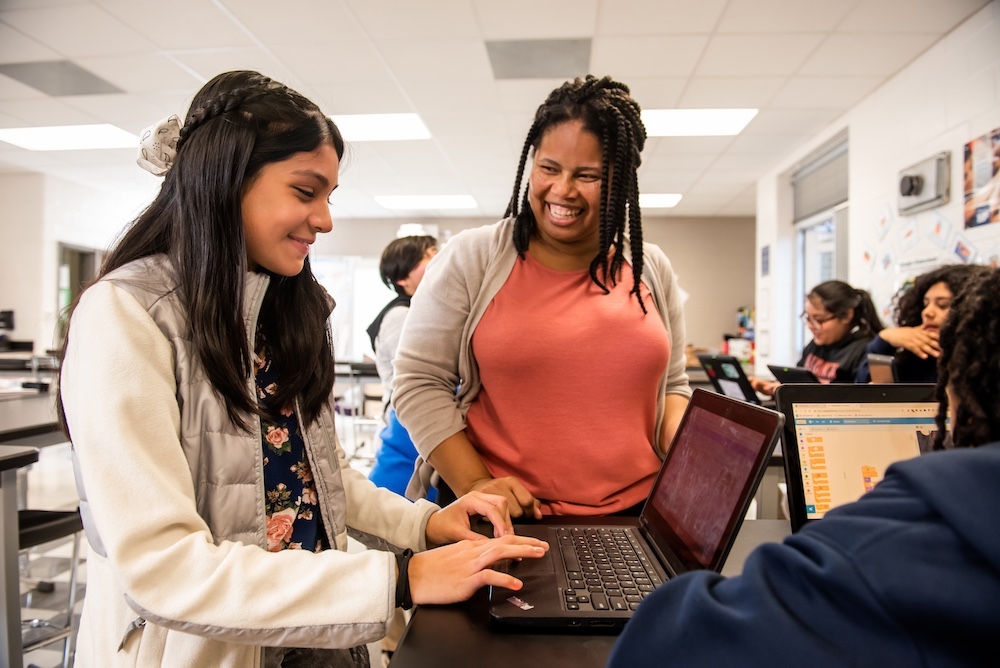
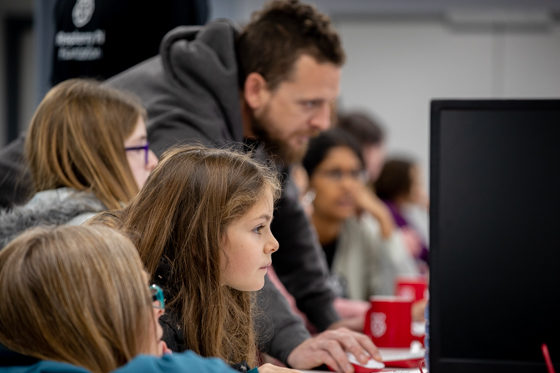
Learner in a computing classroom.

In this blog, we share the new data paradigms framework that we have developed through research and used to help improve our understanding about how to teach and learn about AI and data science. We also invite you to register your interest in participating in our next collaborative study on the topic.

Knowledge-based approaches to systems design

Let’s start by highlighting an important distinction between different approaches to designing systems. In a knowledge-based approach to system design, a set of rules (e.g., if-then statements) are written for the system to execute. Every rule is explicitly defined. This approach is called ‘rule-based’, ‘symbolic’, or ‘logic-based’. For example, a developer could create a program that simulates dialogue by writing specific lines of code to handle a greeting, such as “IF user says “Hello” THEN output “Hi!”. If the user types “Greetings!” instead, the program fails because it has no rule for that specific word. 

An educator helps students with a coding task.

Knowledge-based models are often said to be explainable by design. This means the logic is accessible and interpretable and developers can trace the exact steps taken to produce an output. For example, if developers manually classify restaurant reviews as positive or negative using a pre-defined set of criteria, the rules their restaurant classifying system follows are entirely explicit, and the path from input to output is clear and explainable.

Data-driven approaches to systems design

By contrast, in a data-driven approach to system design developers do not write specific rules. Instead, they collect lots of data and train a model. In the dialogue simulator example, they would collect hundreds of examples of greetings and train a model to the pattern of a greeting. If the user types “Greetings!”, the system generates a response based on the patterns in its training data.

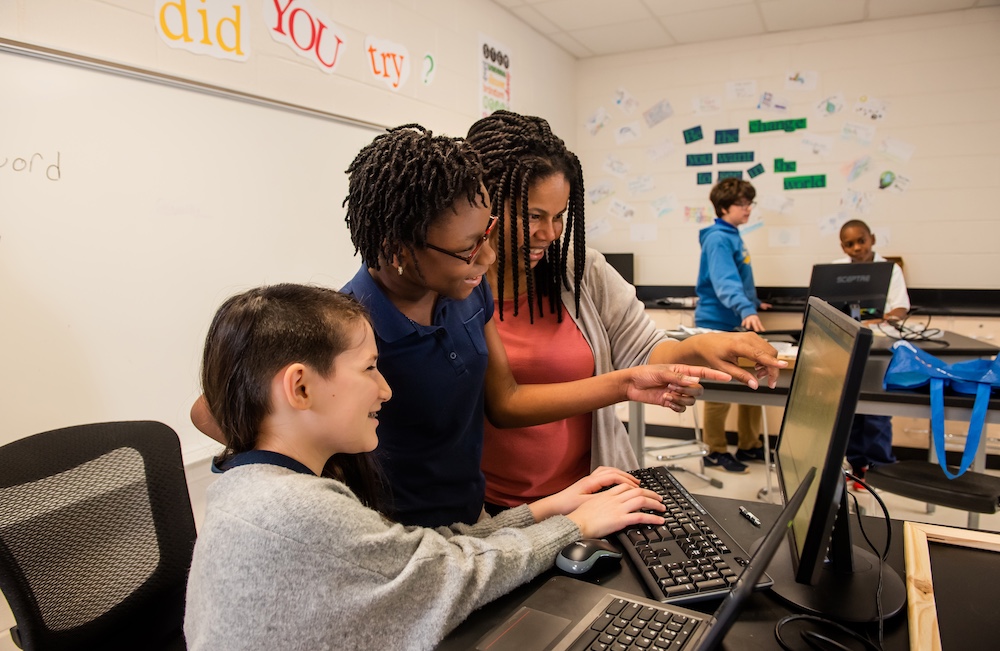
Photo focused on a young person working on a computer in a classroom.

Data-driven models are often opaque. In other words, the internal workings of these ML models are hidden. While we can see our input and the system’s output, the internal mathematical process is so complex — often involving layers of calculations and abstractions — that we cannot simply “explain” why a specific output was produced. For example, developers can create a classification model by training a neural network using thousands of images. Due to the large quantity of data used to train the model, and complex internal parameters and hidden layers, developers and users of the system cannot understand or explain the logic or features that lead to a specific output. These kinds of models are often referred to as a “black box” (as opposed to a “glass” or “clear” box).

Comparing knowledge-based and data-driven approaches

Researchers have argued that the move from knowledge-based (or rule-based) programming to data-driven system design represents a paradigm shift and creates unique challenges for educators. The challenge is helping students shift from the expectation that a system produces a single ‘right’ answer — characteristic of traditional rule-based programming — toward an understanding that systems trained on large quantities of data produce outcomes that aren’t always fixed or explainable. If the current instruction in the classroom still relies heavily on traditional rule-based programming approaches, we might be setting students up for misconceptions.

Data paradigms: A framework for analysing data science education approaches

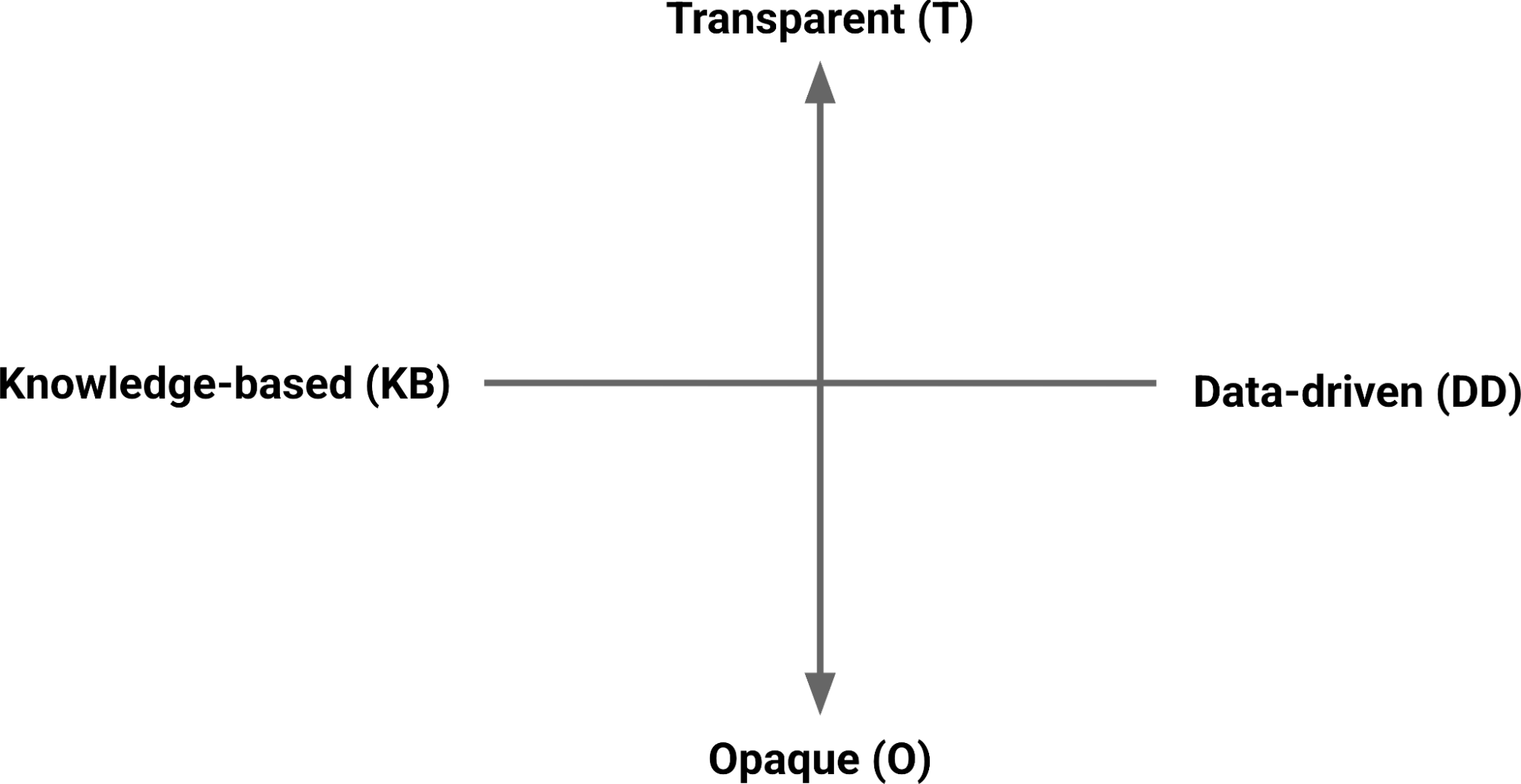
In our research work on AI and data science at the Raspberry Pi Computing Education Research Centre, we analysed 84 research studies about the teaching and learning of data science. We categorised learning activities used in the studies to understand whether they were (i) knowledge-based or data-driven, and (ii) the extent to which the underlying models used were transparent or opaque. This led us to define four distinct data paradigms:

The data paradigms framework
  1. Knowledge-based and transparent (KB + T): Activities in this paradigm are ones where students write rules for systems, or work with systems that use rules, where the logic is fully explainable by design. For example, if students manually classify data (e.g. creating simple ‘if-then’ statements to predict an outcome), the path from input to output is clear.
  2. Data-driven + Transparent (DD + T): In this paradigm, activities involve students working with models trained on data, but the trained model’s logic remains explainable and interpretable. For example these could be models using k-nearest neighbors (KNN) algorithm to group data points based on proximity, or using linear regression to predict a trend. Even though the model produces an output, the student can look at the inner workings of the model and see how the decision is made.
  3. Data-driven + Opaque (DD + O): This paradigm’s activities require students to work with data-driven ML models where the models’ internal logic is hidden, for example an image classification model using a type of neural network (e.g. CNN). The model produces an output (e.g. classifying an image as ‘This is a dog’), but the student cannot inspect the system to find a rule or clear path explaining why that specific output was produced. To understand these systems, it’s necessary to use additional testing and evaluation tools.
  4. Knowledge-based + Opaque (KB + O): Activities in this paradigm would involve systems with human-written rules that are not explainable. In our review of K–12 activities, we found no examples of activities within this paradigm.

The data paradigms framework helps us to distinguish between different kinds of modeling activities students take part in and how instructional approaches could be classified across one or more paradigms. For instance, we found that most data-driven activities were also opaque (DD + O), usually meaning that students collected and used data to train a model, but how the system worked was opaque. This pattern, where the data is visible but the model is not explainable, risks students forming misconceptions about the capabilities and limitations of data-driven systems. Without understanding how outputs are generated, students may expect data-driven ML systems to operate like fully explainable (or transparent) ones.

Learners at a Code Club.

We think that lessons are needed in the data-driven opaque (DD + O) quadrant to explicitly teach students about how data-driven systems work and the role they play in everyday contexts. However, when teaching data-driven opaque (DD + O) activities, learners’ attention needs to be directed to concepts such as model confidence, data quality, and model evaluation. Since an ML model is not inherently explainable, we need to teach students to use post-hoc explanation methods, such as testing different inputs to see how a system’s output changes. To prepare students for this learning experience, we think that first introducing activities about rule-based systems (knowledge-based + transparent; KB + T) or simple data exploration, such as linear regression or data visualisation (data-driven + transparent; DD + T) may serve as a ‘bridge’ to understanding data-driven modeling by helping students to distinguish between systems built from specific logical rules and systems trained on data.

We believe the idea of data paradigms can serve as a way of framing teaching activities about data science and help educators and students to consider the transition between different paradigms when engaging with the systems we interact with every day.

Teachers in England, participate in our new study

We’re launching a new study to explore how to teach learners aged 9 to 11 about data-driven computing. The study will take place in collaboration with upper key stage 2 teachers in England and look at:

  • What key ideas pupils need to understand
  • How teachers currently approach topics related to data-driven computing
  • How pupils make sense of data and probability

Our goal is to find practical ways to help teachers build children’s confidence in working with data in computing lessons. The study will be collaborative, with two workshops held throughout 2026, and we’re inviting upper KS2 teachers in England to take part.

You can express your interest in participating by filling in this form:

The post A research-led framework for teaching about models in AI and data science appeared first on Raspberry Pi Foundation.

 Introducing our new ‘Programming with AI’ unit

Post Syndicated from Rajib Sarkar original https://www.raspberrypi.org/blog/introducing-our-new-programming-with-ai-unit/

In the age of AI, we believe kids still need to learn to code. We’re also testing how AI tools can be used to help with teaching and learning programming. This blog dives into our new classroom unit ‘Programming with AI’, which we’ve developed for teachers to introduce students to learning to code using tools built on large language models (LLMs). We share an overview of the unit, and the early excitement of educators and learners with whom we’re exploring this new approach to teaching and learning programming.

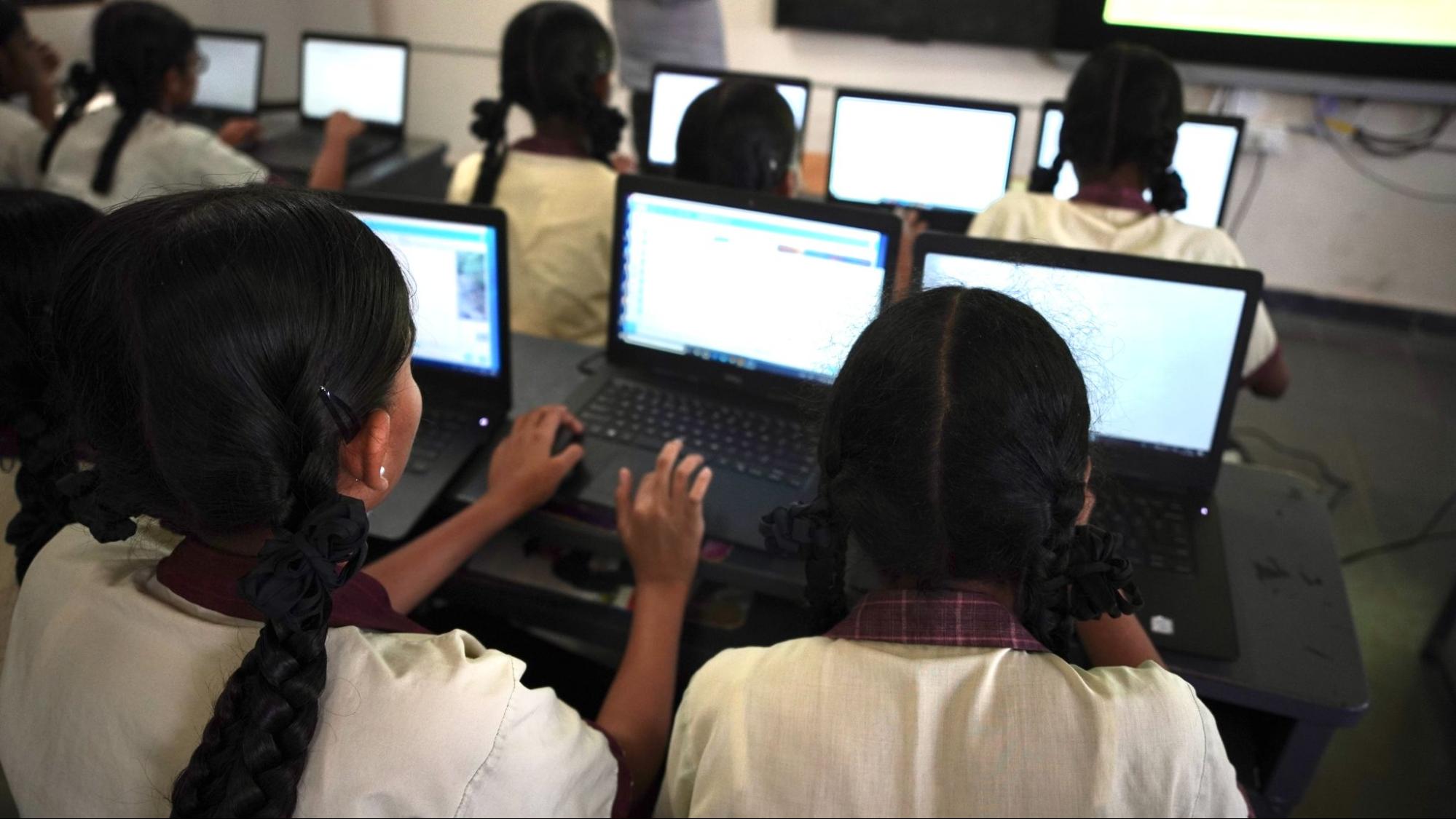
Students completing activities from lesson 1

Bridging the gap in programming education

As India is accelerating its efforts to modernise digital and computing education, it’s the ideal place for us to test how best to introduce learners to AI-assisted approaches to programming and teach them responsible AI use.

We decided to design a ‘Programming with AI’ unit of eight lessons that support students aged 14–16 to progress from block-based programming to text-based Python programming, Python being one of the most widely employed programming languages in industry and academia. In the new unit, students are guided to use LLM-based tools safely, ethically, and responsibly in order to undertake data analysis projects in Python. Students learn how to use the tools, such as Gemini and ChatGPT, to deepen their understanding, experiment with ideas, and connect classroom concepts with real-world technological applications.

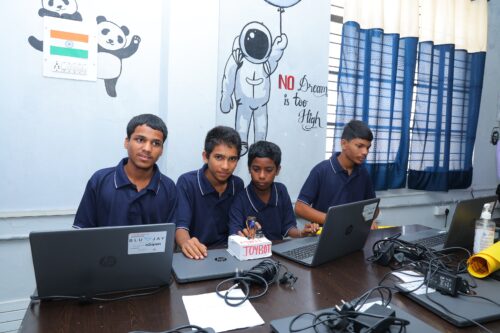
A group of male students at the Coding Academy in Telangana.

The ‘Programming with AI’ unit is currently being piloted across five residential schools under our partner, the Telangana Social Welfare Residential Educational Institutions Society. In the coming months, we will evaluate the impact of this AI-supported approach to learning programming on student engagement, motivation, and overall learning outcomes.

Key design decisions during unit development

During the design phase of the unit, we identified three main challenges we wanted to address:

  1. The first was the transition from block-based to text-based coding. The students we were designing for are familiar with block-based programming like Scratch, but Python needs precisely typed code (syntax). This is a huge shift, and we wanted to offer a way to bridge the gap.
  2. We also had to figure out how to teach prompting LLM tools to students who are learning English as their second language.
  3. Finally, LLMs are non-deterministic. This means that LLM tools don’t always produce the same output, even when given the same prompt. They also do not generate correct code consistently.

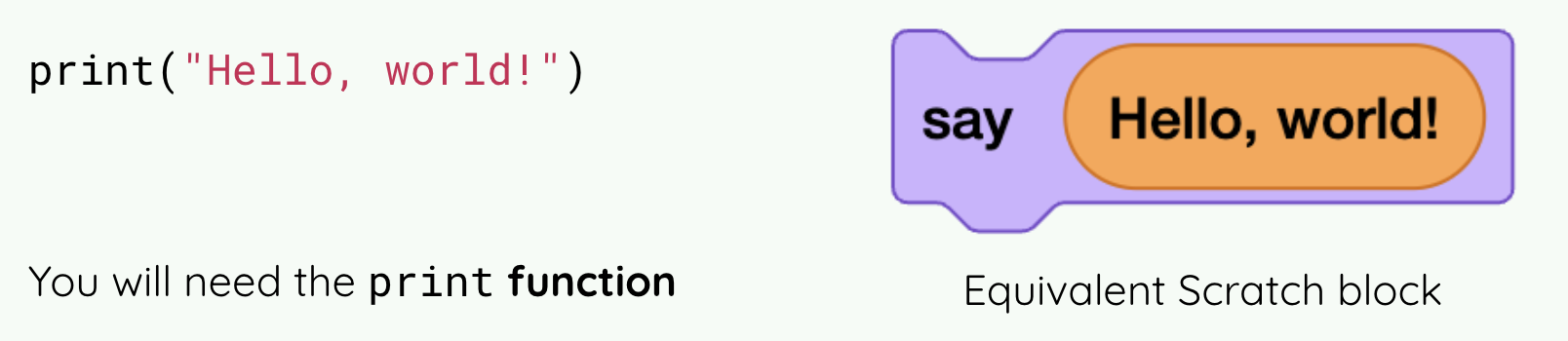
To solve the first problem, we decided that the initial lessons in the unit should start by showing familiar Scratch blocks right next to the equivalent Python syntax. This direct comparison makes the transition from block-based to text-based programmer smoother.

Comparison of Python syntax with equivalent Scratch block

To teach prompting, we built a gradual path. The unit starts with a debugging code activity, where students get code with errors and a prompt to make an LLM tool fix the errors. Later, they learn to break down a prompt into their goal (what output they want) and the context (additional information for the LLM tool). Eventually, they use a structured framework to prompt the tool to generate complete, bug-free code.

Handling the unpredictable outputs of LLM tools we turned into a learning activity. In one lesson, students are given different chatbot-generated code segments and asked to analyse and reflect on the code quality. This crucial exercise helps them build the critical thinking and code evaluation skills they need for programming with AI tools.

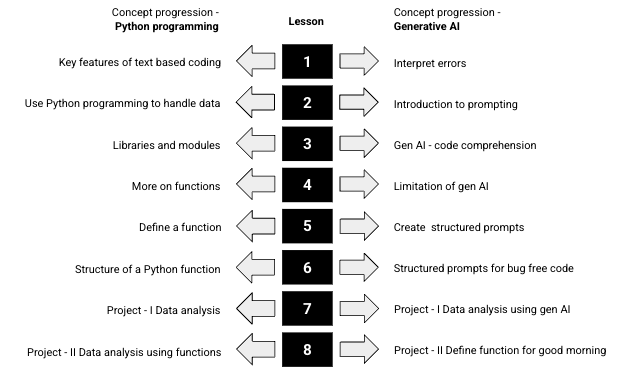
Illustration showing the progression of Python and generative AI concepts covered in the unit
The progression of Python and generative AI concepts covered in the unit

Over the eight lessons, there is a progression of Python concepts and generative AI concepts, as shown in the image above. They lead students to complete two challenging, real-world data analysis projects.

Preparing the educators

To ensure the successful pilot of the ‘Programming with AI’ unit, a comprehensive teacher training program was essential. We understood that teachers needed confidence and competence not only in the subject matter — programming — but also in guiding students to ethically and effectively use LLM tools.

STEM and ICT teachers participated in the training

The training was an intensive, three-day programme: two days were held in-person for deep collaboration and one day was virtual for reinforcing key information. We covered five critical areas:

  • Hands-on activities to ensure comfort with the Python programming language
  • Exploring the capabilities and limitations of LLM tools
  • Effective prompt writing, which teachers would in turn model for their students to use for code debugging and idea generation
  • Reviewing lesson flow and learning objectives to understand the structure of a lesson
  • Adapting specific pedagogies to integrate an LLM tool in teaching the Python programming language

This training ensured our educators were not just teaching a new unit, but felt like confident facilitators ready to lead the shift towards AI-supported learning.

Initial student reactions: Excitement, familiarity with LLM tools, and seamless transition

The pilot of the ‘Programming with AI’ unit began during the second week of December 2025 across five selected schools. It was immediately met with enthusiastic student engagement — they were highly excited to learn Python programming using LLM tools.

When teachers initiated discussions about AI, students demonstrated their familiarity with LLMs, chatbots, and related concepts. They were not only aware of generative AI but could readily name and describe the functions of LLM tools, telling us they were actively using these tools to create projects in various other subjects.

Students could easily connect with the activities in the lessons as they had foundational understanding of programming, which they developed while learning block-based coding in Scratch. This prior knowledge enabled their seamless transition to the new learning. Perhaps most impressive was the students’ rapid adoption of LLM tools to debug their code. This skill can ease what is traditionally a steep learning curve when students first learn text-based programming.

We are now eagerly anticipating their curiosity and progress in the upcoming lessons.

Looking ahead and collecting impact data

With the initial enthusiasm confirmed, the pilot program moves into its next critical phase. Teachers will continue to deliver the unit over the next few months in the five selected schools in Telangana.

STEM and ICT teachers participated in the training
The teachers and team at our ‘Programming with AI’ training.

During this extended observation period, our primary focus will be on rigorous data collection and impact assessment. We will closely monitor how students interact with the provided learning materials and how they use LLM tools throughout the unit. We will systematically assess whether the new teaching approach successfully helps students achieve the defined learning objectives for Python programming. Crucially, we will capture comprehensive data to understand the impact of this AI-integrated approach on engagement, skill acquisition, and problem-solving compared to traditional methods.

Based on the synthesis and analysis of all the gathered data, we will share our gathered insights early next year. The findings will inform our plans for more widely introducing the AI-integrated unit and for developing similar content for other settings and age groups.

The post  Introducing our new ‘Programming with AI’ unit appeared first on Raspberry Pi Foundation.
2025 highlights from the Raspberry Pi Computing Education Research Centre

Post Syndicated from Sue Sentance original https://www.raspberrypi.org/blog/2025-highlights-from-the-raspberry-pi-computing-education-research-centre/

It’s been over a year since I last wrote an update on this blog about our research and as we’ve just published our 2025 Annual Report, this is an ideal opportunity to share what we’ve been working on at the Raspberry Pi Computing Education Research Centre.

At our AI education workshop in early 2025.

We are a research centre based in the Department of Computer Science and Technology at the University of Cambridge, with a team that spans the university and the Raspberry Pi Foundation. We conduct research into many aspects of the teaching and learning of computing and AI and we work closely with schools, teachers and young people to ensure our research is applicable to practice.

Below I highlight some of the projects we’ve worked on in the academic year 2024-2025:

  • Computing Around the World
  • AI education
  • Programming education
  • Physical computing (EPICS project)
  • Teacher action research (TICE project)

Computing Around the World

As I’ve written on this blog before, computing education is a global challenge. In one of the Research Centre’s projects, we are looking at how computing education is spreading around the world.

Computing education in countries around the world
Computing education in countries around the world.

We found that between 2019 and 2024 the number of countries offering computing education had doubled, and that two thirds of all countries now offer, or have concrete plans to offer, computing education. This research has already been highlighted in the Stanford AI Index, and we are considering repeating the analysis in future years in order to have the most accurate and up-to-date information displayed in our map.

AI education

We have a number of projects in the area of AI education.

Teaching about AI

We are very interested in how to teach about AI, and held a workshop with teachers who were interested in the teaching of AI in February. Following on from the workshop results, we are interviewing more stakeholders, including UK-based experts, teachers and students, about their perspectives on concepts and skills that should be taught as part of an AI curriculum.

Notes at our teacher workshop about AI
Notes at our workshop about AI education.

We’re also researching data science and data ethics education, which are foundational aspects of AI literacy. Most of the current AI systems are data-driven, having been trained on vast amounts of data. Therefore students need to understand about data and data science if they are to learn about AI systems. Therefore we’ve conducted two detailed literature reviews on data science and on data ethics this year. The first of these will be published in March at the WiPSCE conference.

Unplugged AI in Ghana

One of our PhD students, Salomey Addo, has been examining how AI is taught in Ghana, where it is part of the curriculum for young people between ages 12 and 15. This year Salomey published a paper reporting that Ghanaian teachers have positive attitudes towards teaching AI but feel unprepared for it. She’s also developed unplugged resources to teach about artificial neural networks (ANNs).

PhD student Salomey explaining how the unplugged resources worked in a teacher PD session in Ghana
PhD student Salomey explaining how the unplugged resources worked in a teacher PD session in Ghana.

ANNs are a fundamental technology used in a variety of AI systems, including image recognition and language translation systems. While ANNs are included in the Ghanaian AI curriculum, Salomey observed that teachers had difficulty with this particular topic The resources she developed are directly inspired by this, and involved teaching through role play and a board game.

Using AI in learning and teaching computing

This is an area we’ve also done some research in in the past year.

Carrie Anne Philbin published a paper in September showing that — at least in higher education — much of the use of generative AI in computing education is just duplicating the way teachers might already teach, and is primarily passive from a students’ perspective.

Meanwhile Katharine Childs and Veronica Cucuiat have been looking at how large language models (LLMs) can support secondary school programming education by helping students understand programming error messages. 

Programming education: Learning to debug

Text-based programming is a topic featured in many computing curricula around the world. Teachers and researchers know that younger learners, for example at the lower secondary school level, can find debugging text-based programs very challenging. Although we’ve seen decades of research around programming and debugging focusing on learners who are in higher education, very little research has been done with school-age students.

The interface of the PRIMMDebug tool
The interface of the PRIMMDebug tool.

In his research, Laurie Gale, a final-year PhD student at the Research Centre, found that learners were impatient to fix programs by trial and error, without figuring out what the real problemwas with their code or the underlying algorithm. He subsequently developed a tool called PRIMM Debug, which supports a more reflective and systematic approach to debugging. This tool enables learners to slow down when they are programming and to be more reflective. You can read more about it on the Research Centre website, and also catch up on the Foundation research seminar where he presented his work.

EPICS: Physical computing in school

As part of a 5-year longitudinal project, running across the whole UK and the first project of its kind, we are looking at how physical computing impacts primary and secondary school learners. We’re investigating the effect of physical computing on learners’ creativity, agency and confidence, over time and at particular points known to be important for their subject choices. We are working with a wonderful set of partner primary schools who we visit each year.

Young learners coding a microbit project.
Young people using a micro:bit.

This year we reported some of our first results, which point to teachers’ perceptions of physical computing being engaging and inclusive for primary-aged children. Starting next spring, we will be carrying out our third year of data collection with our pupil cohort, who have reached the age of 10 to 11.

We’ll also be running a survey next summer for upper primary-aged children and their teachers. Please sign up for our Teacher Research Network newsletter to be the first to hear about taking part in this survey.

Teacher Inquiry in Computing Education (TICE)

As part of our TICE project we support teachers to conduct their own action research projects. This is a collaborative project, involving academics across the UK who volunteer to support teachers. The goal is to enable teachers to take a deep dive into a curriculum topic, a pedagogical approach, or a new resource, or to address a wider issue such as gender diversity or accessibility, to inform a change in their practice.

This year 16 teachers published their reports in our Teacher Research Booklet, and many also presented their findings online at CAS events or at the KCL-CAS London conference and the CAS National Conference. We’re very proud of them!

TICE participant Will Grey presenting at the KCL-CAS Conference in July 2025
TICE participant Will Grey presenting at the KCL-CAS Conference in July 2025.

Two of our TICE teachers will be also presenting their research at an academic conference to be held in January. Congratulations to Will Grey and Joanne Hodge!

Get involved

There are many other projects you can find out about on our website and in our annual report, so I hope that you will keep reading. It goes without saying that I’m incredibly proud of the team who’ve worked on all of these projects! 

To summarise, here’s how you can stay up to date with our work and maybe even get involved in studies:

Finally, I am pleased to announce that we will be hosting the UKICER 2026 conference for researchers and teachers in Cambridge on 3 and 4 2026 September. More details will follow on the UKICER website and on the Research Centre website in due course.

The post 2025 highlights from the Raspberry Pi Computing Education Research Centre appeared first on Raspberry Pi Foundation.
Secondary school maths showing that AI systems don’t think

Post Syndicated from Jane Waite original https://www.raspberrypi.org/blog/secondary-school-maths-showing-that-ai-systems-dont-think/

At a time when many young people are using AI for personal and learning purposes, schools are trying to figure out what to teach about AI and how (find out more in this summer 2025 data about young people’s usage of AI in the UK). One aspect of this is how technical we should get in explaining how AI works, particularly if we want to debunk naive views of the capabilities of the technology, such as that AI tools ‘think’. In this month’s research seminar, we found out how AI contexts can be added to current classroom maths to make maths more interesting and relevant while teaching the core concepts of AI.

Prof. Dr. Martin Frank, Assistant Prof. Dr. Sarah Schönbrodt, Research Associate Stephan Kindler

At our computing education research seminar in July, a group of researchers from the CAMMP (Computational and Mathematical Modeling Program) research project shared their work:

  • Prof. Dr. Martin Frank, Founder of CAMMP (Karlsruhe Institute of Technology (KIT), Germany).
  • Assistant Prof. Dr. Sarah Schönbrodt (University of Salzburg, Austria)
  • Research Associate Stephan Kindler (Karlsruhe Institute of Technology (KIT), Germany)

They talked about how maths already taught in secondary schools can be used to demystify AI. At first glance, this seems difficult to do, as it is often assumed that school-aged learners will not be able to understand how these systems work. This is especially the case for artificial neural networks, which are usually seen as a black box technology — they may be relatively easy to use, but it’s not as easy to understand how they work. Despite this, the Austrian and German team have developed a clear way to explain some of the fundamental elements of AI using school-based maths.

Sarah Schönbrodt started by challenging us to consider that learning maths is an essential part in developing AI skills, as: 

  1. AI systems using machine learning are data-driven and are based on mathematics, especially statistics and data
  2. Authentic machine learning techniques can be used to bring to life existing classroom maths concepts
  3. Real and relevant problems and associated data are available for teachers to use

A set of workshops for secondary maths classrooms

Sarah explained how the CAMMP team have developed a range of teaching and learning materials on AI (and beyond) with an overall goal to “allow students to solve authentic, real and relevant problems using mathematical modeling and computers”. 

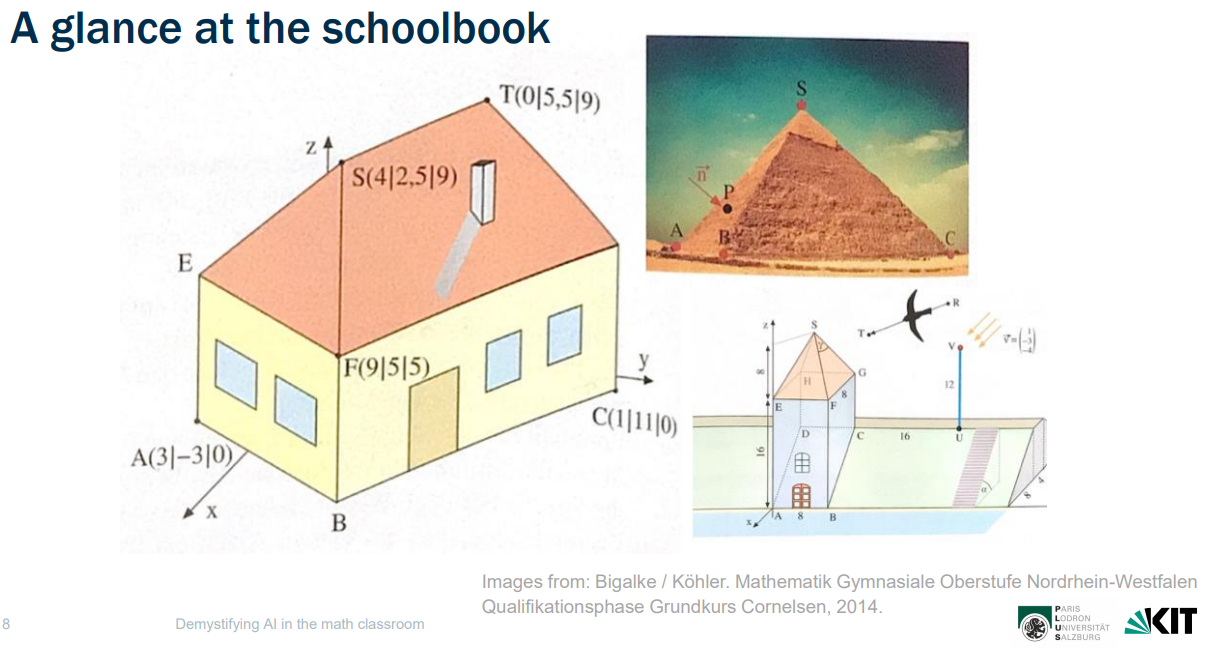
She reflected that much of school maths is set in contexts that are abstract, and may not be very interesting or relevant to students. Therefore, introducing AI-based contexts, which are having a huge impact on society and students’ lives, is both an opportunity to make maths more engaging and also a way to demystify AI.

A glance at the schoolbook diagram
Old-fashioned contexts are often used to teach classroom maths concepts. Those same concepts could be taught using real-world AI contexts. (Slide from the researchers’ presentation.)

Workshops designed and researched by the team include contexts such as privacy in social networks to learn about decision trees, personalised Netflix recommendations to learn about k-nearest neighbour, word predictions to learn about N-Grams, and predicting life expectancy to learn about regression and neural networks.

Learning about classification models: traffic lights and the support vector machine

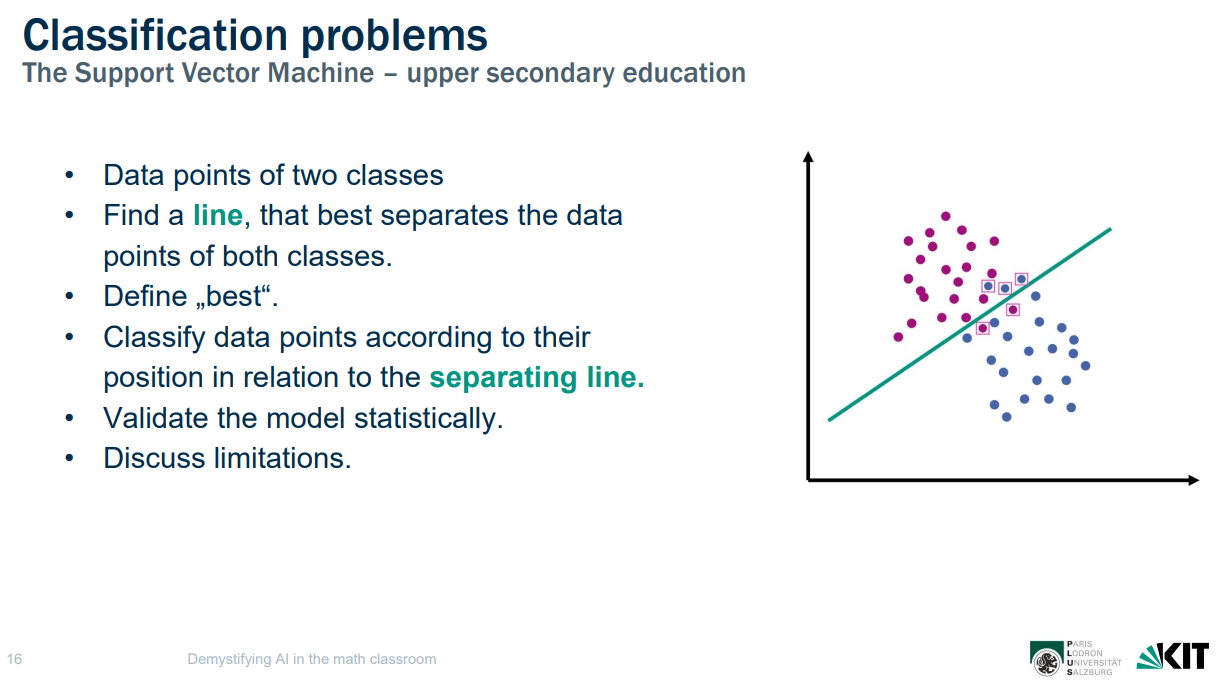
For the seminar, Sarah walked through the steps to learn about support vector machines. This is an upper secondary workshop for students aged 17 to 18 years old. The context of the lesson is an image problem — specifically, classifying the data representing the colours of a simplified traffic light system (two lights to start with) to work out if a traffic light is red or green.

She walked through each of the steps of the maths workshop:

  • Plotting data points of two classes, the representation of green and red traffic lights
  • Finding a line that best separates the data points of both classes
  • Figuring out what best is
  • Classifying the data points in relation to the chosen (separating) line
  • Validating the model statistically to see if it is useful in classifying new data points, including using test data and creating a contingency table (also called a confusion matrix)
  • Discussing limitations, including social and ethical issues
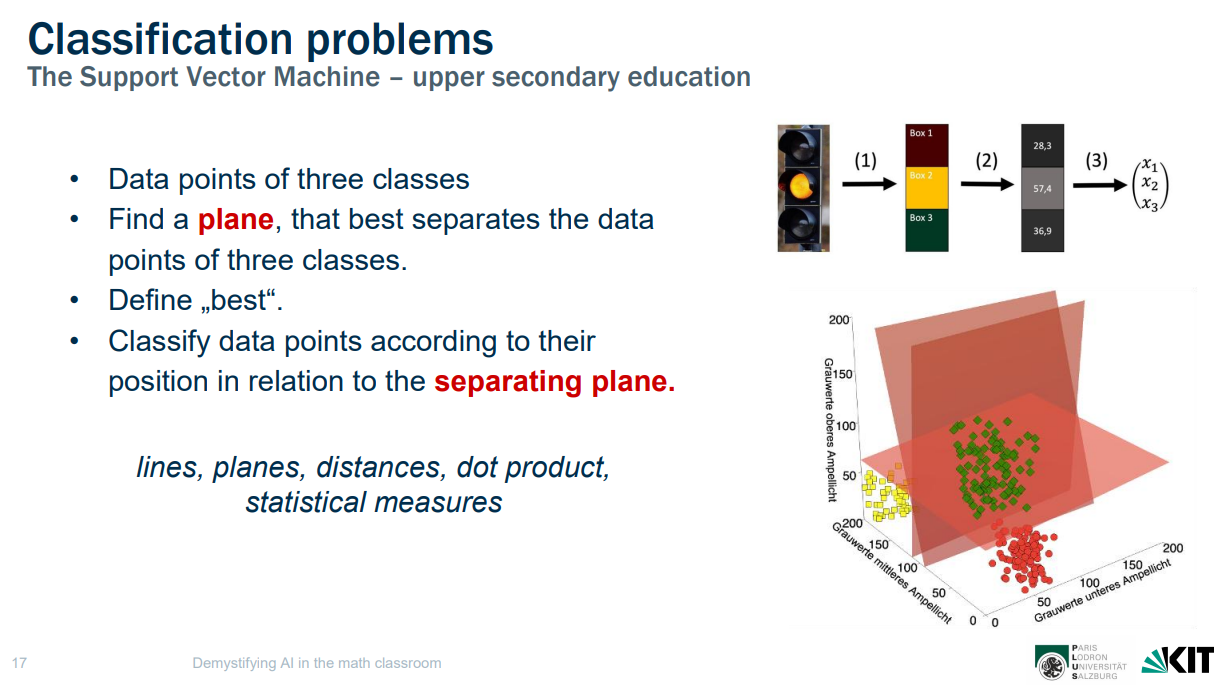
  • Explaining how three traffic lights can be expressed as three-dimensional data by using planes
Classification problems diagram
By classifying green and red traffic light data, students are learning about lines, classifying data, and considering limitations. (Slide from the researchers’ presentation.)

Throughout the presentation, Sarah pointed out where the maths taught was linked to the Austrian and German mathematics curriculum.

Classification problems diagram
Learning about planes, separating planes, and starting to see how data can be represented in vectors. (Slide from the researchers’ presentation.)

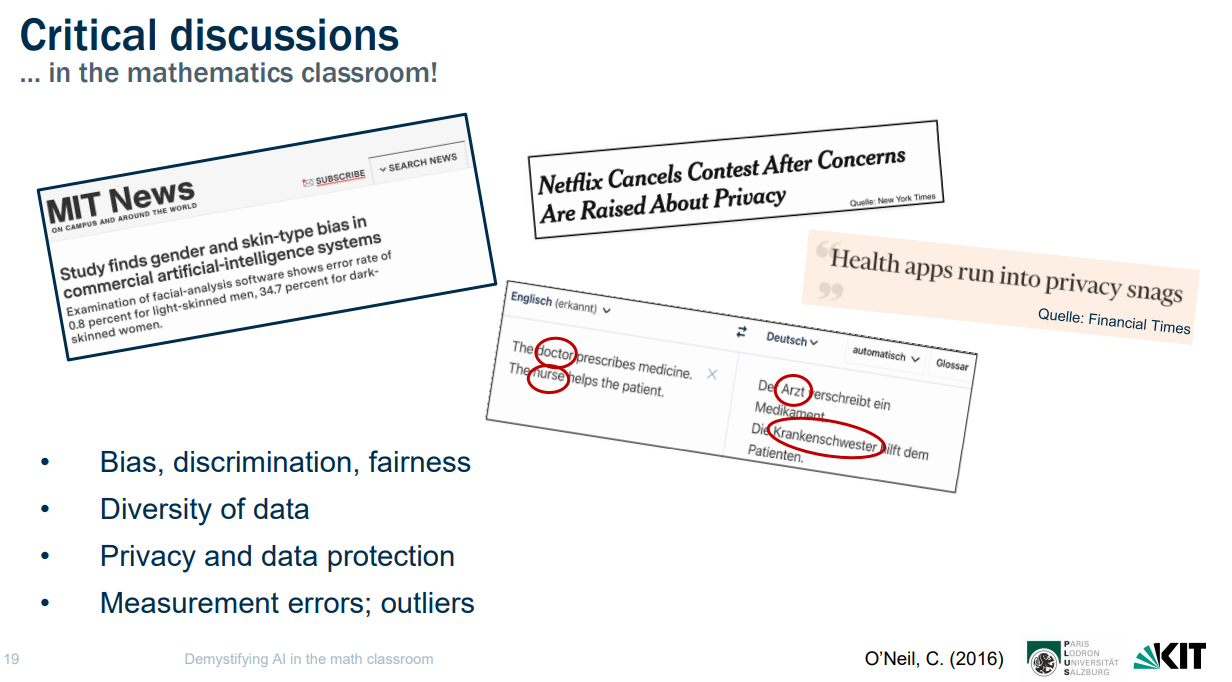
Learning about social and ethical issues

Learning about the social and ethical issues in data-driven systems. (Slide from the researchers’ presentation.)

As well as learning about lines, planes, distances, dot product and statistical measures, learners are also engaged in discussing the social and ethical issues of the approach taken. They are encouraged to think about bias, data diversity, privacy, and the impact of errors on people. For example, if the model wrongly predicts a light as green when it is red, then an autonomous car would run through a red traffic light. This would likely be a bigger consequence than stopping at a green traffic light that was mis-predicted as red. So should the best line reduce this kind of error?

To teach the workshops, Sarah explained they have developed interactive Jupyter notebooks, where no programming skills are needed. Students fill in the gaps of example code, explore simulations, and write their ideas for discussion for the whole class. No software needs to be installed, feedback is direct, and there are in-depth tasks and staggered hints.

Learning about regression models: Weather forecasting and the toy artificial neural network

Stephan went on to introduce artificial neural networks (ANNs), which are the basis of generative AI applications like chatbots and image generation systems. He focused on regression models, such as those used in weather forecasting. 

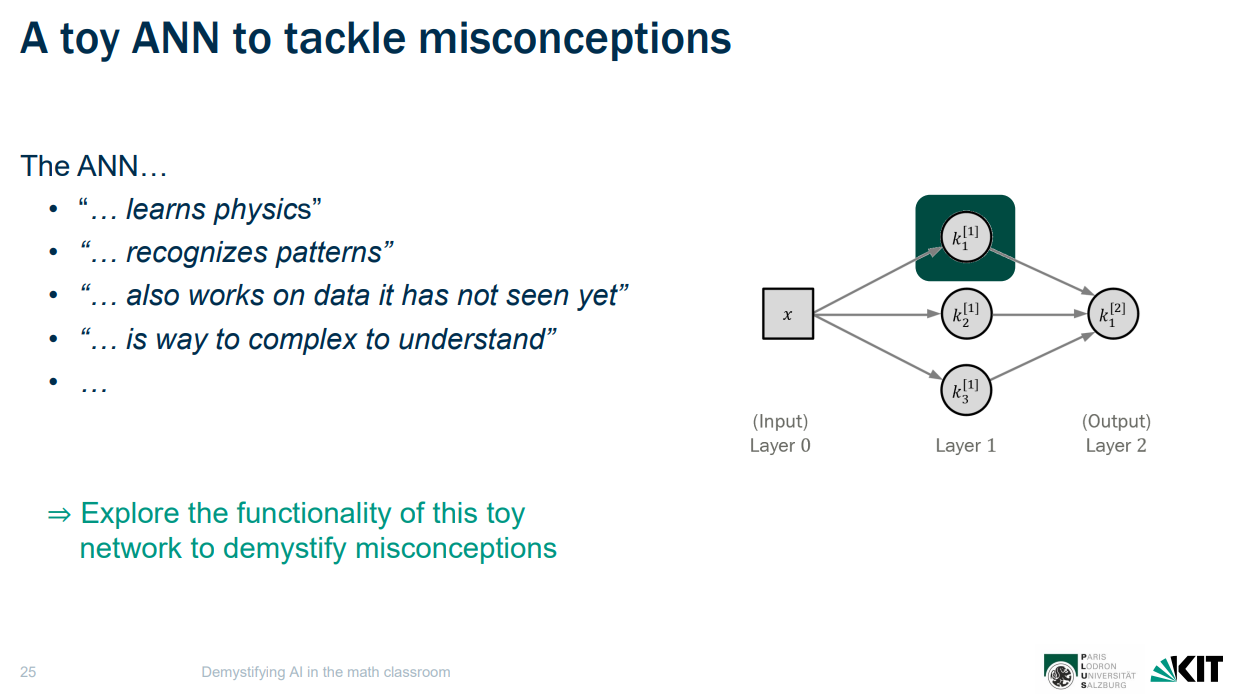
ANNs are very complex. Therefore, to start to understand the fundamentals of this technology, he introduced a ‘toy ANN’ with one input, three nodes, and one output. A function is performed on the input data at each node. With the toy network, the team wants to tackle a major and common misconception: that students think that ANN systems learn, recognise, see, and understand, when really it’s all just maths.

Tackling misconceptions about ANNs by exploring how they work in a toy version. (Slide from the researchers’ presentation.)

The learning activity starts by looking at one node with one input and one output, and can be described as a mathematical function, with a concatenation of two functions (in this case a linear and activation function). Stephan shared an online simulator that visualises how the toy neural network can be explored as students change two parameters (in this case, weight and bias of the functions). Students then look at the overall network, and the way that the output from the three nodes is combined. Again, they can explore this in the simulator. Students compare simple data about weather prediction to the model, and discover they need more functions — more nodes to better fit the data. The activity helps students learn that ANN systems are just highly adjustable mathematical functions that, by adding nodes, can approximate relationships in a given data set. But the approximation only works in the bounds (intervals) in which data points are given, showing that ANNs do not ‘understand’ or ’know’ — it’s just maths.

Stephen finished by explaining the mutual benefits of AI education and maths education. He suggested maths will enable a deeper understanding of AI, and give students a way to realistically assess the opportunities and risks of AI tools and show them the role that humans have in designing AI systems. He also explained that classroom maths education can benefit from incorporating AI contexts. This approach highlights how maths underpins the design and understanding of everyday systems, supports more effective teaching, and promotes an interdisciplinary way of learning across subjects.

Some personal reflections — which may not be quite right!

I have been researching the teaching of AI and machine learning for around five years now, since before ChatGPT and other similar tools burst on the scene. Since then, I have seen an increasing number of resources to teach about the social and ethical issues of the topic, and there are a bewildering number of learning activities and tools for students to train simple models. There are frameworks for the data lifecycle, and an emerging set of activities to follow to prepare data, compare model types, and deploy simple applications. However, I felt the need to understand and to teach about, at a very simple level, the basic building blocks of data-driven technologies. When I heard the CAMMP team present their work at the AIDEA conference in February 2025, I was entirely amazed and I asked them to present here at our research seminar series. This was a piece of the puzzle that I had been searching for — a way to explain the ‘bottom of the technical stack of fundamental concepts’. The team is taking very complex ideas and reducing them to such an extent that we can use secondary classroom maths to show that AI is not magic and AI systems do not think. It’s just maths. The maths is still hard, and teachers will still need the skills to carefully guide students step by step so they can build a useful mental model. 

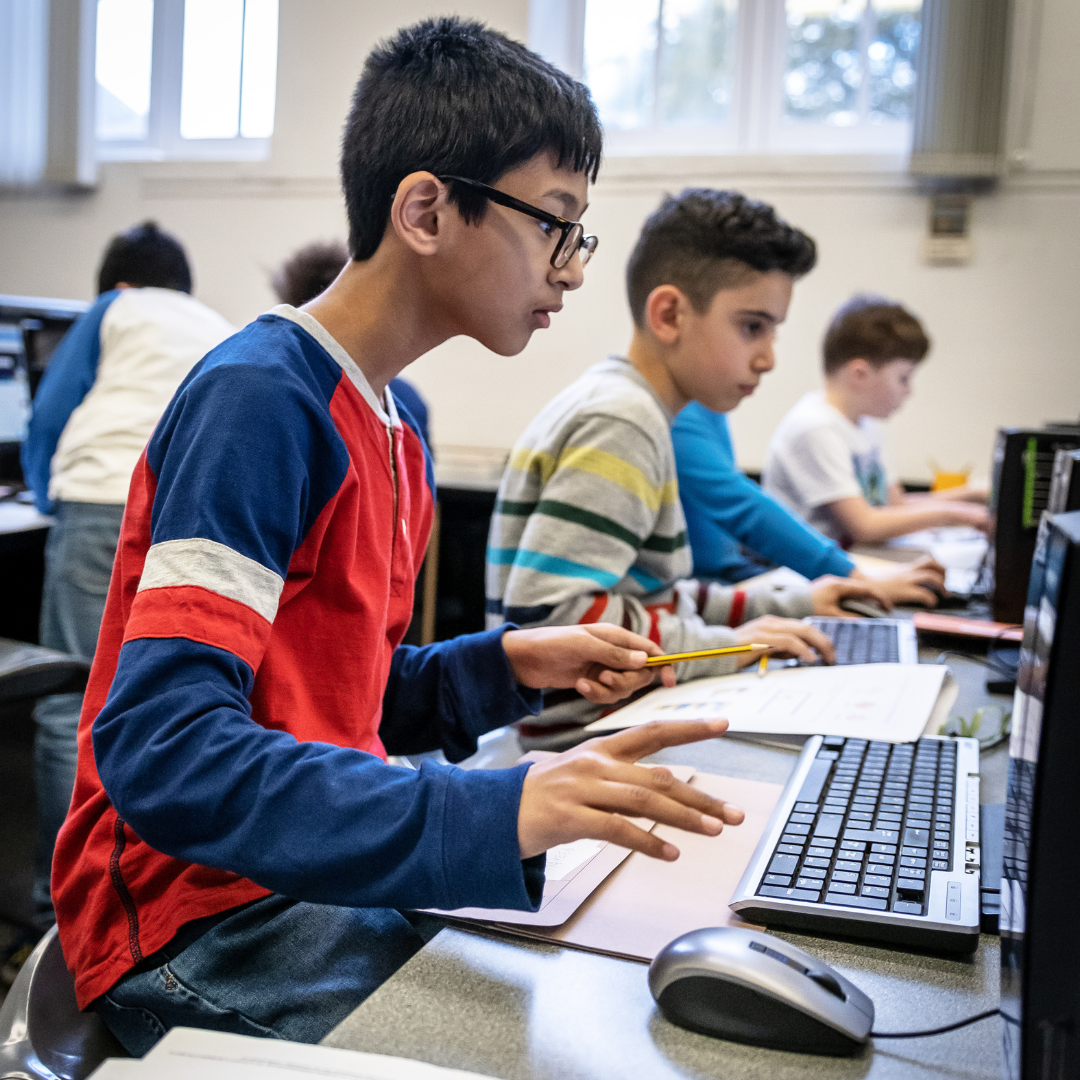
Photo of a class of students at computers, in a computer science classroom.

I think we can simplify these ideas further, and create unplugged activities, simulations, and ways for students to explore these basic building blocks of data representation, as well as classification and representing approximations of complex patterns and prediction. I can sense the beginnings of new ideas in computational thinking, though they’re still taking shape. We’re researching these further and will keep you updated.

Finding out more

If you would like to find out more about the CAMMP resources, you can watch the seminar recording, look at the CAMMP website or try out their online materials. For example, the team shared a link to the jupyter notebooks they use to teach the workshops they demonstrated (and others). You can use these with a username of ‘cammp_YOURPSEUDONYM’, where you can set ‘YOURPSEUDONYM’ to any letters, and you can choose any password. They also shared their toy ANN simulation.
The CAMMP team are not the only researchers who are investigating how to teach about AI in maths lessons. You can find a set of other research papers here.

Join our next seminar

In our current seminar series, we’re exploring teaching about AI and data science. Join us at our last seminar of the series on Tuesday, 27 January 2026 from 17:00 to 18:30 GMT to hear Salomey Afua Addo talk about using unplugged approaches to teach about neural networks.

To sign up and take part, click the button below. We’ll then send you information about joining. We hope to see you there.

The schedule of our upcoming seminars is online. You can catch up on past seminars on our previous seminars page.

The post Secondary school maths showing that AI systems don’t think appeared first on Raspberry Pi Foundation.
Code Club Conference 2025: Creativity, community, and collaboration in Cambridge

Post Syndicated from Sarah Lygoe original https://www.raspberrypi.org/blog/code-club-conference-2025-creativity-community-and-collaboration-in-cambridge/

Over the first weekend in November, members of the global Code Club community came together for two inspiring days of learning, creativity and connection. The annual event celebrates the people who make Code Clubs happen, allowing them to share ideas, explore new tools, and connect with others who help young people learn to code.

Educator at Code Club Conference attending a workshop

Exploring new technologies and inclusive teaching

Saturday began with hands-on sessions that brought creativity and technology together, exploring large language models and prompt engineering in Collaborating with LLMs and being a prompt boss. There was a lot of laughter from attendees about how large language models can produce confident but incorrect answers if given vague prompts, but many left inspired to experiment with new technologies in their own clubs.

“First time there and it was amazing. Met loads of great people and the amazing code club crew. I learnt loads of new skills around AI and Arduino.” – An attendee

Explore AI with creators in your club using our AI and machine learning projects.

Educator in a workshop, using a micro:bit

Collaboration that counts brought mentors together to discuss common challenges like volunteer retention, limited resources, and communication barriers. A crowd favourite was a shared volunteer toolkit, as well as event checklists and safeguarding resources.

“What I enjoyed most about the Clubs Conference was the opportunity to meet other facilitators and hear their stories — their successes and challenges. These conversations validated the volunteer work I do and reminded me of the impact of our clubs.” – An attendee

From the theatre sessions, you can watch Inclusive learning – Supporting Deaf learners in clubs which was both moving and insightful. We learnt that visual demonstrations, colour cues, and repetition were key to supporting Deaf learners. One memorable quote captured the spirit of the session:

“The children couldn’t speak to us. The children — we couldn’t hear their voices but by the eighth week we were able to hear their voices from what they built on the screen and it was echoing all around the classroom.” – Chidi Duru

Find out more about Chidi’s joy of coding alongside Deaf creators.

Learning and making across continents

The weekend’s talks showcased the reach of Code Club worldwide, with volunteers sharing their experiences of collaboration, sustainability, and creativity.

Watch Lessons from resourceful Code Clubs in India, which highlighted the ingenuity of young learners in under-resourced settings, while Hands-on with the Raspberry Pi Pico showcased low-cost, high-impact projects from Kenya and South Africa.

Speakers showed how community clubs adapt to local needs with unplugged activities and coding games inspired by cricket and kabaddi, empowering young people to solve real problems and celebrate curiosity through play. Excitingly, these new resources will be launching early next year; keep an eye on our activities page to be among the first to try them out!

Two attendees during a workshop working together

In the session Code Club Projects Unplugged, facilitators shared the idea of “hiding the vegetables” — hiding the learning inside the fun. Whether through a collaborative Scratch game, a micro:bit prop on stage, or a Pico gadget solving a real problem, this approach helps young people learn through play. They remember the joy, and the skills come naturally.

Learning beyond the screen

Teaching tech away from the computer screen shared a fun unplugged cybersecurity activity, The Chicken Shop, where learners role-play social engineering scenarios. Its success came from clear printed instructions, movement, humour, and strong debriefing. 

Educators sharing ideas during a workshop

Learning coding outside the box explored how to engage young people with diverse learning styles while the Arduino crash course gave attendees a taste of physical computing and C++ programming in action. Workshops on AI, sustainability, and youth empowerment with Raspberry Pi computers and Unlocking Code Club resources helped club leaders discover practical ways to inspire problem-solving and make use of all the support available through Code Club.

The message from the sessions was clear: young people learn best when technology is human and hands-on.

Showcasing creativity with Coolest Projects

Coolest Projects – get involved! championed creativity over competition. Any young person under 18 can submit their project, including unfinished ideas. In-person and online showcases celebrate progress, imagination, and teamwork.

Speaking on the closing panel, Code Club leader Rachael Coultart talked about the importance of Coolest Projects as a rare platform for children to talk about their learning. She spoke about the experience of one particular child, explaining that it had made a powerful impression on her, saying:

“It had such a huge impact. I felt so proud of her and what she’d achieved. Afterwards, her parents told me that they felt it was the first time she had really been seen.”

What the community is taking forward

The community is united in its commitment to making Code Clubs inclusive, creative, and sustainable. 

  • Context matters — projects that reflect local interests and challenges motivate young people to learn
  • Accessibility is central: visual cues, repetition, interpreters, and inclusive resources support every learner
  • Structure builds confidence; start with simple, guided activities before open-ended exploration
  • Volunteers are vital; shared toolkits, checklists, and training help them deliver engaging sessions
  • Celebration and affordability matter too: regular showcases and tools like the micro:bit, Pico, and Crumble keep computing fun, hands-on, and accessible for all

“Thank you. Clubs Conference is a highlight of my year.” – An attendee

Stay connected

If you want to stay up to date with the latest news, events and opportunities from Code Club, sign up for our newsletter and be part of the growing global community.

The post Code Club Conference 2025: Creativity, community, and collaboration in Cambridge appeared first on Raspberry Pi Foundation.
How AI shapes your feed: An explainable social media simulator for the classroom

Post Syndicated from Diana Kirby original https://www.raspberrypi.org/blog/how-ai-shapes-your-feed-an-explainable-social-media-simulator-for-the-classroom/

Social media can have a powerful impact on the way we see and experience the world. What we see in our feeds is not random: it is determined by AI-driven systems that collect vast amounts of data, build user profiles, analyse engagement, and generate recommendations. But while young people are prolific users of social media, studies show that many have little understanding of what is happening ‘under the hood’

Henriikka Vartiainen and Matti Tedre from the University of Eastern Finland
Researchers Henriikka Vartiainen and Matti Tedre.

In our September research seminar, we welcomed back Henriikka Vartiainen and Matti Tedre from the University of Eastern Finland. They introduced Somekone, a social media simulator that is designed to help learners understand some of the fundamental processes behind social media platforms. Their team has been developing AI education materials and tools since 2019, including GenAI Teachable Machine, which they presented at our May research seminar.

Collaboration and co-design

Henriikka explained that the development of the Somekone tool emerged from the team’s long-term collaboration with teachers and schools in Finland. They co-developed the tool with the aim of making concepts like data collection, engagement, profiling, recommendations, filter bubbles, and polarisation visible and explainable for students aged 11 to 13 years old.

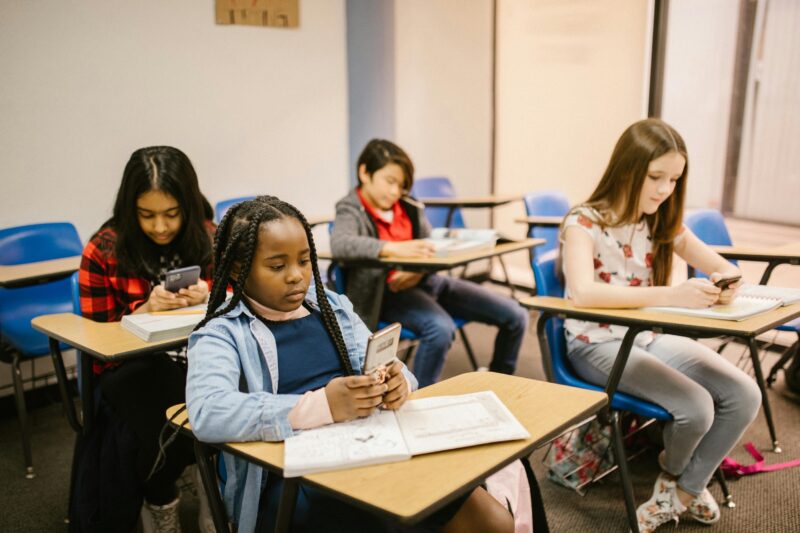
Photo of three school pupils together looking at a mobile phone.

A four-phase learning model

Henriikka described the pedagogical model that the team follows in all of their AI education interventions. Their goal is not only to support students to develop their understanding of AI concepts, but also to foster ethical awareness and a sense of agency.

  • Phase 1: Contextualisation and familiarisation
    Students begin by discussing their experiences with social media and their initial ideas about how platforms such as TikTok, YouTube, and Instagram work. This activates students’ prior knowledge and helps connect the learning to their own interests. It also enables teachers to uncover any misconceptions the students may have.
  • Phase 2: Exploration
    Students explore their initial ideas by experimenting with the Somekone tool. They discover how different types of data are collected and combined for profiling in a way that connects these new concepts to their own everyday lives.
  • Phase 3: Design and inquiry
    Students explore the Somekone tool more deeply. Teachers guide them through activities where the students analyse, interpret, and discuss the data they can see in the tool. Importantly, the data they are using has all been gathered from their activity on the platform. Students can see how the likes, follows, and comments they and their classmates make change the images they are shown, and this is all real time.
  • Phase 4: Ethical and societal reflection
    Students reflect on what they have learnt and consider the broader impacts of social media. Teachers encourage them to think critically, question the way social media platforms currently work, and imagine alternatives. At the end of the project, students write letters to decision-makers with their suggestions for how social media could better serve children’s interests.

Inside the simulator

Matti then gave a live demonstration of Somekone. Nothing compares to seeing the tool in action, so do check out the video of his demo here!

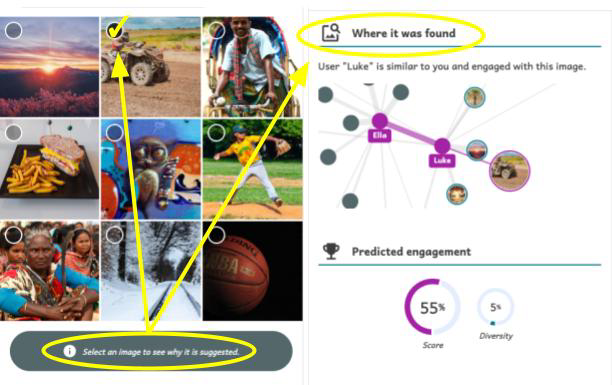
Students log on to the tool and are presented with an Instagram-style feed of images. They scroll through the feed and like, share, or comment on images that catch their attention or match their interests. For many students this is a very familiar type of environment, and they really enjoy playing with the app!

Four young people sitting at their desks, on their mobile phones.

However, the unique value of Somekone is that it provides students with a real-time view of the way data is collected from every single user interaction, and demonstrates what is done with that data. It also allows students to experiment with a social media tool in the classroom without any data protection issues, as all of the data is stored locally.

Learners explore:

  • Data collection in real time. Working in pairs, one student browses the image feed, while the other watches a live view of the data that the simulator is collecting every time their partner interacts with or simply pauses on a post.
  • Profile building. Somekone shows how all this data accumulates to build a profile. Students watch their profiles developing based on the way they and their classmates are interacting with their feeds.
  • Clustering and connections. Students then see how the tool groups profiles to create clusters of users with similar interests. Often friendship groups in the classroom are evident on screen because students sitting next to each other have all chosen to engage with the same things!
The simulator creates clusters of users with similar interests, which update in real time as students interact with posts on their feeds

The simulator creates clusters of users with similar interests, which update in real time as students interact with posts on their feeds

  • Explainable recommendations. A key feature of Somekone is that it provides explanations for why it recommends posts to users. Students learn that recommendations can be based on various things, such as the image’s tag matching the tag on other posts they liked, or the image being popular among other users with similar profiles to theirs. These are the mechanisms that underpin real recommendation systems, but Somekone makes them explicit.
The tool provides an explanation for why each post is recommended

The tool provides an explanation for why each post is recommended

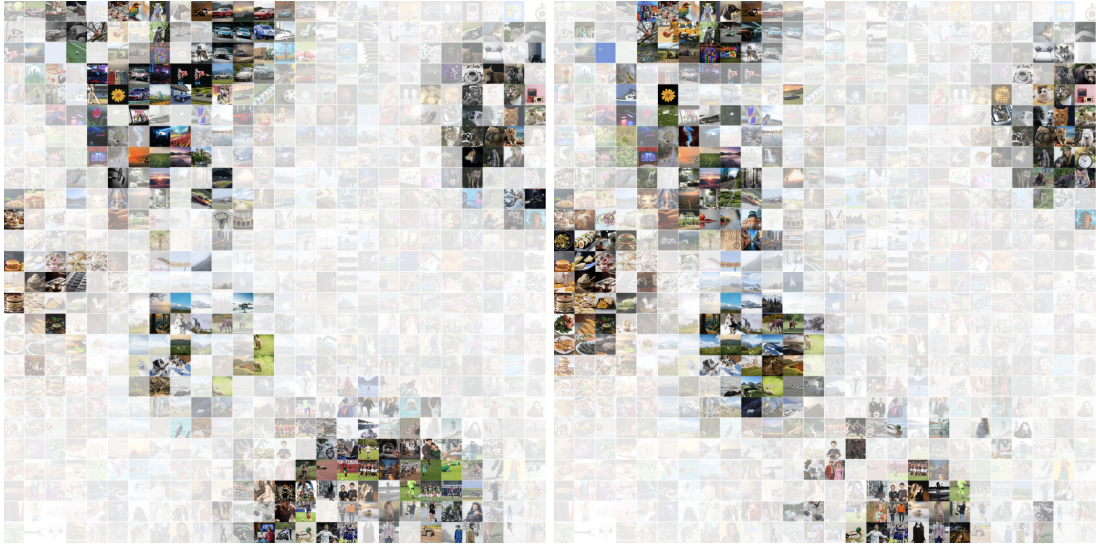
  • Filter bubbles and polarisation. A filter bubble forms when a user only sees social media posts that match their existing interests or beliefs, due to highly personalised recommendation systems. Somekone presents this concept in a visually compelling way through a heatmap showing all the content in the system, with a colour scale indicating which posts are most likely to be shown to a particular user, and which they will never encounter. By comparing different users’ filter bubbles side by side, students start to understand how polarisation can arise. As Matti said: “If our feeds are so different from each other that I never see the pictures that you see and you never see the pictures I see, then […] we don’t even share the same reality”.
Two users’ heatmaps presented side by side, showing their respective filter bubbles

Two users’ heatmaps presented side by side, showing their respective filter bubbles

  • Algorithm settings. A key learning opportunity is that students can adjust the algorithm’s parameters and observe how this changes their feed and their filter bubble. They can choose between personalised or non-personalised recommendations, select how posts are ranked, and decide whether to allow any diversity in the popularity of posts recommended to them. This is key to ‘opening up the box’.

For teachers, the tool has a simple guided interface to make it easy to use in class. There is also a button that teachers can use to pause the app, stopping students from scrolling (much to their dismay!) in order to focus their attention on the teacher when they are explaining concepts.

Evidence of impact

The research team used pre- and post-tests to evaluate what impact the intervention had on students’ understanding of social media mechanisms and on their sense of agency in relation to data. They conducted the post-test a week after the intervention, and then also did a delayed post-test six months later to see whether any changes were sustained. They found:

  • Improved understanding of key concepts. Learners showed statistically significant improvements in identifying different types of data traces and in understanding how data profiling works. They also showed some improvement in grasping recommendation mechanisms.
  • Retention over time. These improvements were generally still evident six months later, particularly in the case of understanding data traces.
  • Stronger sense of agency. The team found that students’ sense of data agency improved after taking part in the intervention. This is really important as students are more likely to want to study a topic further if they have feelings of agency and self-efficacy.

Accessing the tool

The Somekone tool is freely available online — in Finnish, English, German, and French — at somekone.gen-ai.fi. The developer Nick Pope has also made the source code available on GitHub at github.com/knicos/genai-somekone

However, the supporting materials and teacher resources are currently only available in Finnish and the underpinning pedagogies relate to the Finnish context.

Join our next seminar

Join us at our next seminar on Tuesday, 11 November from 17:00 to 18:30 GMT to hear Karl-Emil Bilstrup (Copenhagen University) speak about using the micro:bit to explore machine learning practices. We hope to see you there!

To sign up and take part in our research seminars, click below:

You can also view the schedule of our upcoming seminars, and catch up on past seminars on our previous seminars page.

The post How AI shapes your feed: An explainable social media simulator for the classroom appeared first on Raspberry Pi Foundation.
Celebrating the UK’s National Engineering Day 2025

Post Syndicated from Lou Loxley original https://www.raspberrypi.org/blog/celebrating-the-uks-national-engineering-day-2025/

We’re happy to celebrate National Engineering Day in the UK with our friends at the Royal Academy of Engineering. Today they launch the AI-Z of Engineering, an online collection showcasing more than 100 current engineering jobs, and over 100 more engineering jobs envisaged for the future. Their aim is to inspire more young people to pursue engineering careers in areas ranging from artificial intelligence (AI) and robotics to medicine, software engineering, space, and sustainability.

National engineering day landscape asset

Engineers shape the technologies and industries that define the future — and the systems they build affect jobs and tasks in every sector. As Sir John Lazar, President of the Royal Academy of Engineering and our Chair of Trustees, says about AI technology:

“I’m not a believer that all jobs will just disappear because of AI. If you think of a job as an assemblage of tasks, there’s no question that the tasks in your job will change because AI will work with you on a bunch of things, and this will in turn reshape your job or role.  The people who will thrive through this transformation will be those who engage with curiosity, intellectual rigour, scepticism, creativity, problem-solving and teamwork – and these are the skills and attitudes that are taught by engineering and computational thinking.”

Sir John Lazar, President of the Royal Academy of Engineering and Chair of Trustees, Raspberry Pi Foundation.

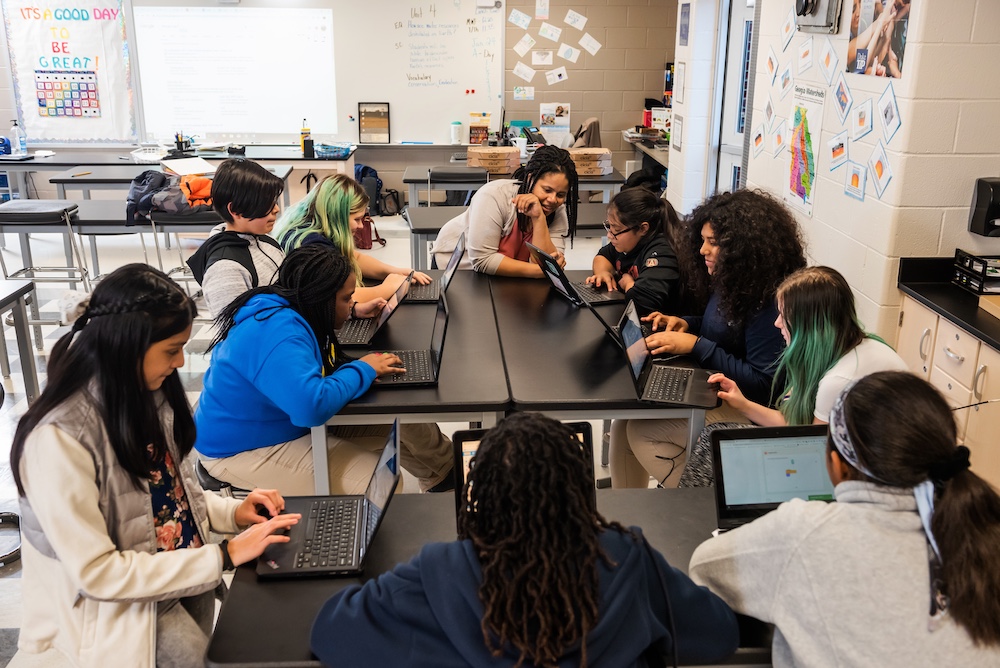
Students use their laptops in a classroom, supervised by a teacher.

Why kids still need to learn to code in the age of AI

At the Raspberry Pi Foundation, we believe AI literacy is crucial for all young people. We also believe all young people need to learn to code to be able to shape our future, where AI systems are integrated into all aspects of life. Our position paper “Why kids still need to learn to code in the age of AI” presents five reasons why:

  1. Even though AI tools can be used to generate code, we still need skilled human programmers to critically review that code.
  2. Learning to code remains the most effective way to become a skilled human programmer, and allows better understanding of how computers work and what their potential and constraints are.
  3. Learning to code will open up more economic opportunities, as advances in technology let us solve a wider range of problems using computers.
  4. Coding is a literacy that gives young people agency and a new way to express themselves, to learn, and to make sense of the world. 
  5. Young people who learn to code now will shape the future, and we need that power to sit with young people from all backgrounds so they can design systems that serve everyone.

Our free resources for young people help them learn to code and get creative with technology to bring their ideas into the world, building their confidence. So whether your kids are just starting their coding journey, or are looking for a new challenge, you can use our resources to support them.

Young person learning in the classroom

Understanding coding and computers is critical in many engineering roles, so inspiring kids about engineering can also motivate them to try their hand at coding.

How you can get involved with National Engineering Day

There are plenty of ways you can celebrate National Engineering Day. Inspire young people to embark on careers in engineering by sharing the AI-Z of Engineering collection with your school or college, on social media, or on your organisation’s website. The collection is a living resource that will be updated, and contributions are always welcome — both for current jobs and future ones.To find out more ways to get involved with National Engineering Day, you can go download the toolkit.

The post Celebrating the UK’s National Engineering Day 2025 appeared first on Raspberry Pi Foundation.
What should be included in a data science curriculum for schools?

Post Syndicated from Jan Ander original https://www.raspberrypi.org/blog/what-should-be-included-in-a-data-science-curriculum-for-schools/

Current artificial intelligence (AI) methods, especially machine learning (ML), rely heavily on data. To complement our work on AI literacy, we have been investigating what data science teaching resources and education research are currently available. Our goal is to work out what data science concepts should be taught in a data science curriculum for schools.

In a computing classroom, a smiling girl raises her hand.

Read on to find out what resources and materials we have reviewed, and what concept themes we have identified.

What is data science? Why is teaching it important?

Data science is an interdisciplinary science of learning from large datasets, aided by modern computational tools and methods (Ow‑Yeong et al., 2023). We see data science skills as fundamental for using, creating, and thinking critically about:

  • Insights from data, generally
  • Data-driven computational tools and methods (such as machine learning) and their outputs and predictions, specifically
Someone explains a graph shown on a computer screen.

To navigate a world where decision making in many areas is influenced by data-driven insights and predictions, young people need to be taught about data science. Data science skills empower young people to become critical thinkers, discerning consumers, adaptable professionals, and informed citizens.

Worldwide, countries are taking a variety of approaches to introducing data science into their education systems, as highlighted in a 2024 report from the coalition Data Science 4 Everyone.

An overview of data science education across the world
An overview of data science education across the world. Source: Beyond Borders 2024: Primary and Secondary Data Science Education Around the World, republished with kind permission of Data Science 4 Everyone. Click the image to enlarge it.

In some countries, such as India and Israel, data science education is an established school subject. It is taught as part of the curriculum in at least one of the primary, secondary, or post-16 age phases. Meanwhile in other countries, for example Canada, Germany, and Poland, data science is a very new school subject, or there are still only recommendations to develop it into a school subject.

While we are currently considering what a comprehensive data science curriculum should include, we already offer several resources to support you with your teaching about data science and data-driven technologies. You can find a list of these resources at the end of this blog. Now, however, I’ll give you an overview of our recent work to identify concepts for a data science curriculum that fits with our approach to AI literacy.

Data science education: What should we teach?

To answer the question ‘What should we teach about data science to learners aged 5 to 19?’, we undertook a grey literature review of data science teaching materials. A grey literature review is structured like an academic literature review and conducted with the same rigour. The difference is that a grey literature review also considers publications that have not been peer-reviewed, including reports, white papers, curriculum materials, and similar resources.

To orient our work, we combined four frameworks for data science and AI/ML education:

With these combined frameworks as our map, we reviewed 79 data science learning resources. The resources varied:

  • In quality in terms of clarity and teaching approach
  • In their focus, e.g. on maths, coding, or a specific field such as biology
  • In their perspective on data science, with some prioritising theory and others real-world applications

From among the 79 resources, we chose 9 that included clear learning outcomes, and that together covered a wide field of concepts. We examined these 9 in detail to extract 181 explicit and implicit data science concepts. Next, we grouped the concepts into themes, and finally we refined these themes by comparing them against the four frameworks listed above.

The themes we have identified for a data science curriculum are:

  • Fundamentals of data literacy: Key terms and definitions
  • Understanding bias in data
  • Ethical responsibility in data use
  • Data creation, curation, and transformation
  • Analysis and modelling: Maths and statistics fundamentals
  • ML principles
  • Deploying and maintaining ML applications
  • Software tools and programming
  • Data visualisation
  • Presenting findings effectively

This set of themes both fits with the frameworks by Olari and Romeike and Data Science 4 Everyone, and expands them by covering ML principles and programming approaches and calling out data bias and ethics.

What’s next for this work?

Through our grey literature review on data science education, we’ve:

  • Pinpointed a large set of candidate concepts that could be taught within a data science curriculum
  • Created a set of clear themes to structure our work going forward

Our next step is to shape these candidate concepts into a progression framework to describe their relationships and establish which concepts could be taught at each age or phase of schooling.

Young people studying in a computing classroom.

The literature review also gave us an overview of the pedagogical approaches and tools used for teaching data science concepts. These findings will become useful once we start designing learning activities.

You’ll hear more about how this work is going here on our blog and on our social channels. In the meantime, comment below to let us know what you think about the themes, or to tell us what you’d like to see in a data science curriculum for the learners you work with.


Our resources related to data science

Classroom resources

You can read about our thinking behind the data science-related teaching resources we’ve created so far in our ‘Data and information within the computing curriculum’ report from 2019.

  • The report lists the data-related units within The Computing Curriculum materials, which we no longer update but continue to offer as free downloads. Updated classroom materials are available as part of the Computing materials we created for Oak National Academy in the UK for ages 5–11 and ages 12–19.
  • The Ada Computer Science platform offers learning materials on data and information, and on AI and ML, for ages 14–19.

You might also be interested in exploring the Experience AI programme, which offers everything teachers need to help students develop a foundational understanding of data-driven AI technologies, their social and ethical implications, and the role that AI can play in their lives.

Teacher training and development resources

Our free online course ‘Teach teens computing: Machine learning and AI‘ helps teachers understand and explain the types of problems that ML can help to solve, discuss how AI is changing the world, and think about the ethics of collecting data to train a ML model.

Teaching young people to understand data-driven AI technologies means teaching them thinking skills that are different to those needed to understand rule-based computer systems. You can read about these Computational Thinking 2.0 skills in our Quick Read PDF.

Our current research seminar series focuses on teaching about AI and data science. Sign up for an upcoming seminar session (the next one is on 11 November) or catch up on past sessions to find out what the latest research findings are in this area. You can also revisit our 2021/22 series on the same topic to see how work in this area has developed. The Raspberry Pi Computing Education Research Centre also has ongoing projects in the area of AI education for you to explore.

The post What should be included in a data science curriculum for schools? appeared first on Raspberry Pi Foundation.
Play, pedagogy, and real-world impact: What we learned from the AI Quests webinars

Post Syndicated from Liz Eaton original https://www.raspberrypi.org/blog/play-pedagogy-and-real-world-impact-what-we-learned-from-the-ai-quests-webinars/

Photo of two adult educators sitting around a table with a group of young people playing AI Quests.

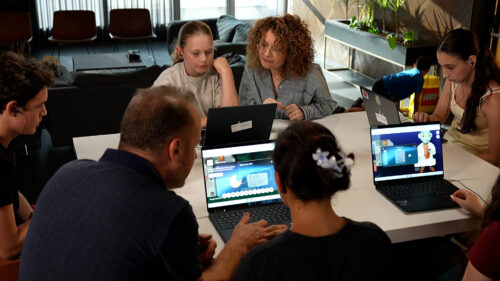
How do you teach AI in a way that resonates with 11- to 14-year-olds long after the lesson ends? In two recent Experience AI webinars, we explored that question with collaborators from Google Research, Google DeepMind, and the Stanford Accelerator for Learning. During the webinars, we also showcased AI Quests, a gamified, classroom-first experience where learners use AI concepts to solve real problems.

“The AI technology you’ll experience is amazing, but it’s not magic. Success depends on the decisions you make.”

That line, delivered by Professor Sky, the in-game mentor, captures the core message of AI Quests: AI systems are built by people and shaped by human judgment at every step.

What is AI Quests?

We’ve embedded AI Quests into the Foundations of AI unit in Experience AI, our free AI literacy programme created with Google DeepMind. 

As Google Research’s Liat Ben Rafael explained, “AI Quests is a gamified experience… where students discover firsthand how AI is used in the real world to create positive impact.” Each quest is grounded in a real research programme and mirrors the AI project lifecycle you’ll recognise from our Experience AI lessons: define the problem, prepare data, train, test, deploy.

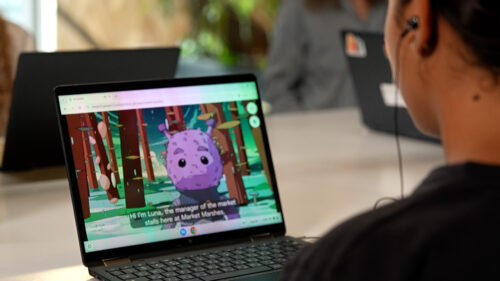
Photo of a young person playing AI Quests on a laptop. The AI Quests character Luna, can clearly be seen on the young person's screen.

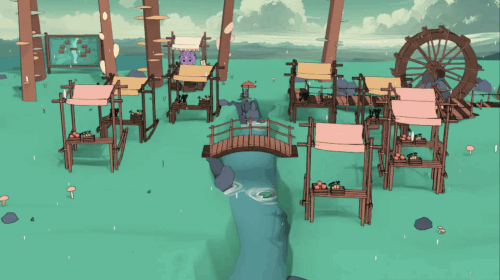
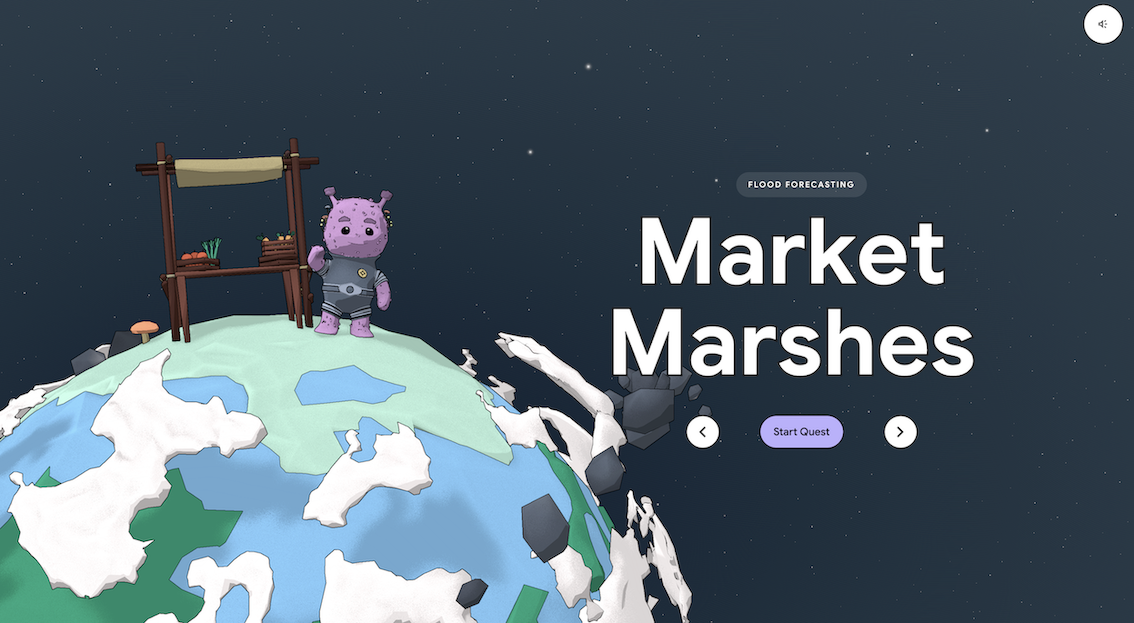
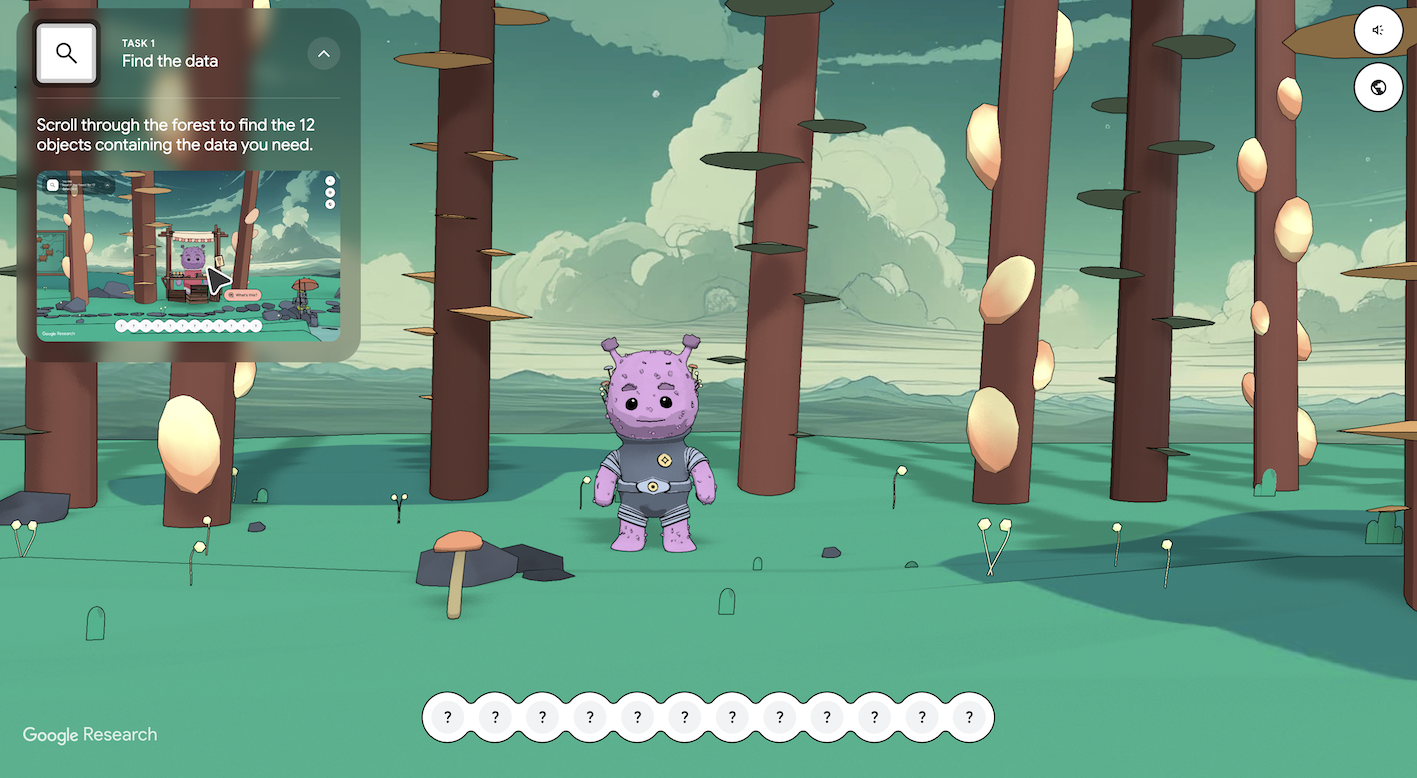
The first quest, Market Marshes, asks students to help Luna, one of the central characters, to protect a riverside market from flooding. Players roam, gather candidate data (from rainfall stats to town gossip), clean it, choose relevant features, and train a model. If the model underperforms, they iterate, exactly as real AI developers would.

Emma Staves, Learning Manager at the Foundation, notes that a key moment is when learners test their model: “It’s made really clear that the data that’s being used to test the model is historic data.” That simple design choice can help you to unlock rich discussions with your learners about validation, reliability, and what counts as “accurate enough” for real decisions.

Designed around how students actually learn

Developed in collaboration with learning scientists at the Stanford Accelerator for Learning, the quests reflect what Victor Lee, Faculty Lead for AI and Education at Stanford, describes as “enduring understanding”:

“The enduring understanding is about how humans can initiate and design AI applications that can address some of humanity’s biggest unsolved challenges.”

To keep that focus, the team blends:

  • Situated learning – for example, a concrete flood scenario rather than abstract exercises
  • Pedagogical agents – characters who nudge, model, and explain
  • Embedded feedback and productive failure – learn by trying, revising, and trying again
  • Self-explanation prompts – ‘learning tickets’ that ask students to articulate what they’re doing and why

In other words, the quests are all about playing with purpose.

What teachers are seeing in the classroom

We piloted AI Quests with some teachers, including Dave Cross, Curriculum Leader for Computer Science at North Liverpool Academy, who tested the quests with his Year 7 students, before extending it to his GCSE classes:

“We see it moving forward as a really solid foundation… for that further learning.”

He also saw strong cross-curricular ties: geography colleagues spotted “massive opportunities” to use the flood quest in their own units, while broader staff discussions turned to digital citizenship, data literacy, and fairness. The cross-disciplinary nature of AI is increasingly apparent, and so AI literacy shouldn’t be limited to computing — students need to encounter AI across multiple subjects and in everyday life.

Where the research comes in: Forecasting floods days in advance

Graphic of the flooded marketplace from the Market Marshes quest on AI Quests.

The second webinar connected the classroom experience to the real project it’s modelled on: Google Research Flood Forecasting. Gila Loike, Product Manager, set the scene:

“Our research team develops AI models that predict flooding all over the world, five to seven days before the flood occurs.”

Deborah Cohen, the Research Scientist leading the team at Google Research focused on flooding, also explained that traditional models can’t easily predict floods in places with little data. However, AI can fill those gaps by combining information from rivers, weather forecasts, and satellites, to give accurate warnings around the world:

“With AI we were able to expand our coverage to the entire world.”

The results are real and practical. Accurate predictions help:

  • People stay safe by receiving flood alerts through familiar apps
  • Emergency teams plan routes and close roads in time
  • Farmers decide whether to move animals or harvest early
  • Aid organisations act sooner, delivering supplies or financial support before the flood hits
Graphic from the Market Marshes quest on AI Quests.

To make sure their models work well, the team compares predictions with real river data, where available, and with satellite images showing flooded areas. Students explore these same ideas in the AI Quest game, cleaning messy data, testing their models, and checking how accurate their results are.

“Students are really engaged by the real-world challenge,” said Emma Staves about the Market Marshes quest. “That authenticity makes learning come alive.” It helps students see how classroom ideas, like features, accuracy, bias, and model cards, connect directly to real decisions and their consequences.

Coming soon: Health quests and more languages

Graphic from the second AI Quests.

Liat also gave a sneak peek at the next quest, a health-focused story on blindness prevention. It introduces new layers — privacy, diverse data, field testing — while following the same lifecycle. More quests are in development, with additional languages planned from early 2026.

Why this matters now

The key message from both webinars is clear: AI literacy isn’t just about using technology — it’s about understanding our role in shaping it. As one Stanford researcher put it, “AI isn’t this magic thing that just happens to us. Humans decide how to use it, and how choices around data affect accuracy and fairness.”

Our goal with Experience AI is to help young people become thoughtful, creative problem-solvers who can navigate an AI-powered world with confidence and integrity — and AI Quests fits perfectly with that.

Find out more

You can watch both webinars anytime on our YouTube and LinkedIn channels

Webinar 1: LinkedIn, YouTube
Webinar 2: LinkedIn, YouTube

Explore our Experience AI resources — already used by nearly two million learners and educators to understand, question, and create with AI — to bring them and AI Quests into your classroom. You’ll find the Foundations of AI unit, alongside materials on large language models, ecosystems and AI, and AI safety, at rpf.io/experienceai-resources

The post Play, pedagogy, and real-world impact: What we learned from the AI Quests webinars appeared first on Raspberry Pi Foundation.
Experience AI receives global recognition from UNESCO

Post Syndicated from Philip Colligan, CBE original https://www.raspberrypi.org/blog/experience-ai-recognition-unesco/

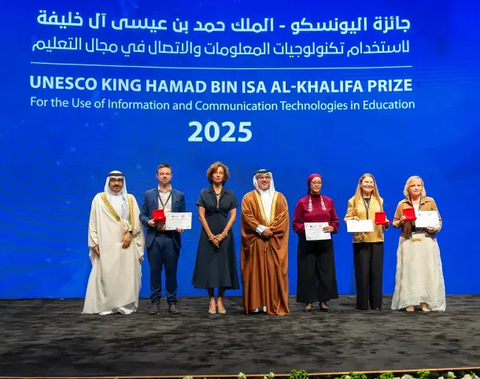
I am very proud to share the news that Experience AI has been recognised as a laureate for the 2025 UNESCO King Hamad Bin Isa Al-Khalifa Prize for the Use of ICT in Education.

The winners of the 2025 UNESCO King Hamad Bin Isa Al-Khalifa Prize.
At the award ceremony of the 2025 UNESCO King Hamad Bin Isa Al-Khalifa Prize. © Government of the Kingdom of Bahrain

What is Experience AI?

Experience AI is a free educational programme that helps teachers and students learn about artificial intelligence (AI). It was developed by the Raspberry Pi Foundation in partnership with Google DeepMind and includes lessons, classroom resources, and hands-on activities to help students develop a foundational understanding of AI technologies, their social and ethical implications, and the role that AI can play in their lives.

It is based on original research into AI literacy and highlights real-world applications of AI technologies, including through videos featuring research scientists that help to bring the lessons to life for students. 

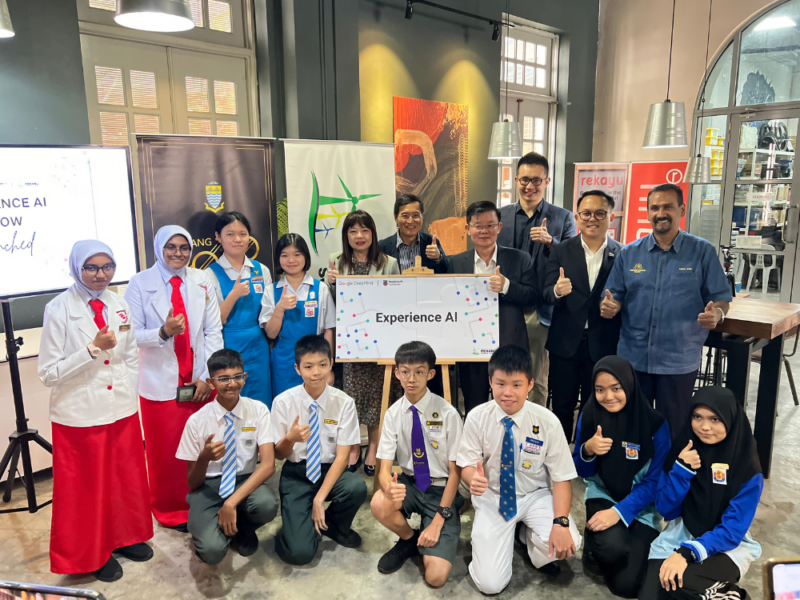
A group of students and educators at Penang Science Cluster's launch of Experience AI in Malaysia.
A group of students and educators at the launch of Experience AI in Malaysia.

Since we launched the first Experience AI resources in April 2023, they have been used to teach over 2 million students, and that number is growing fast. 

This reach is possible thanks to a global network of Experience AI education partners who work with us to localise and translate the resources and deliver large-scale teacher training in their regions. 

UNESCO recognition

Experience AI was one of four laureates of the prestigious global Prize selected by the Director-General of UNESCO, based on recommendations from an independent, international jury. The jury commended the programme for its strong ethical foundation and wide international reach. 

This year, marking its 20th anniversary, the Prize focused on the theme ‘Preparing learners and teachers for the ethical and responsible use of artificial intelligence’.

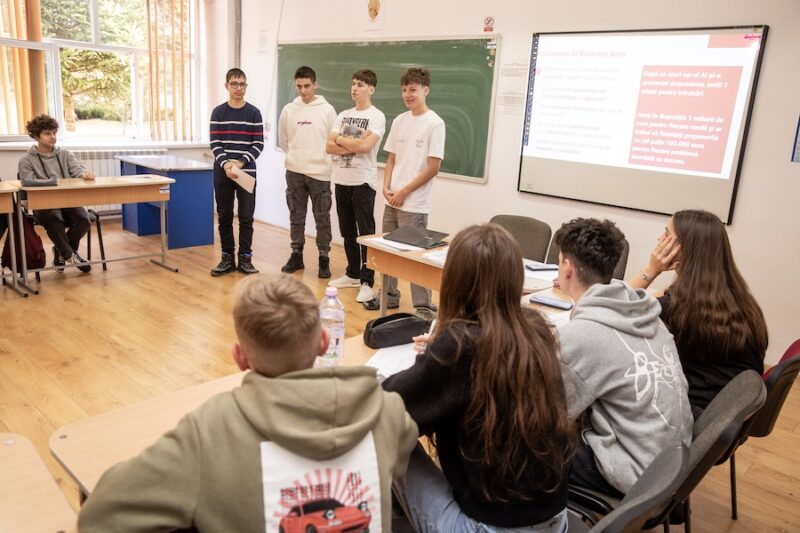
Students in class during an Experience AI lesson.
Romanian students in class during an Experience AI lesson.

The Prize was awarded at a ceremony at the University of Bahrain attended by the Director-General of UNESCO, Ministers of Education of the Gulf Cooperation Council, and members of the Raspberry Pi Foundation and Google DeepMind teams.

I want to say a heartfelt congratulations and thank you to everyone who has worked on Experience AI so far. It has been a fantastic, collaborative effort from colleagues across the Foundation, Google DeepMind, and all of our partner organisations. 

I also want to pay tribute to all of the teachers — all over the world — who have engaged so enthusiastically with Experience AI, for helping us develop the materials, including testing them in your classrooms and providing such thoughtful feedback, and for everything you do, every day, to inspire your students. This recognition is for all of your hard work, diligence, and care. Congratulations and thank you.

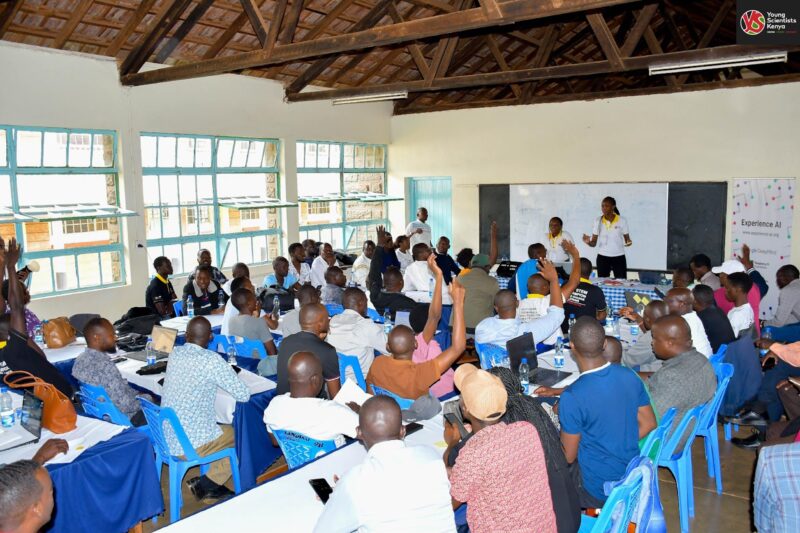
Teachers in Kenya during an Experience AI teacher training event.

Experience AI is provided at no cost to schools, teachers, or students thanks to generous funding from Google.org. We are also very grateful to Broadcom Foundation, which has provided additional funding to support the programme. 

What next for Experience AI? 

We are exceptionally proud to have received this recognition for Experience AI, but we aren’t complacent. Equipping all young people, and their teachers, with a foundational understanding of AI technologies is one of the most urgent challenges facing all education systems.

We have made a great start, and we know there is much more to be done. That’s why we have lots of important updates and developments coming soon, including: 

  • Updating and improving the current lessons: We are finalising an update to the resources to respond to feedback from teachers and students, including significant improvements to make them more accessible. These will be published early in 2026. 
  • Expanding the range of lessons: Alongside the updates to the existing resources, we are developing new lessons. This will include lessons designed for both younger and older learners, as well as integrated lessons that enable teachers to bring AI concepts and skills into subjects such as science, language, and the arts. 
  • Updated and improved professional development: We are also updating and improving the training that we offer to teachers, including both online courses and webinars, and in-person training delivered through the global network of education partners. 
  • AI chatbot for educators: We recently integrated a chatbot into the Experience AI website. Powered by Gemini 2.5, this is intended as a tool to help teachers navigate and understand the concepts and lessons. This is an early experiment and we’d love to get your feedback, so please give it a try and let us know what you think. 
  • Expanding the global network of partners: We currently have partners supporting teacher professional development in 25 countries, from Malaysia to Mexico. Over the coming year we will be launching partnerships in at least 15 more countries. If your organisation is interested in becoming a partner, you can let us know by filling in this form.

The post Experience AI receives global recognition from UNESCO appeared first on Raspberry Pi Foundation.
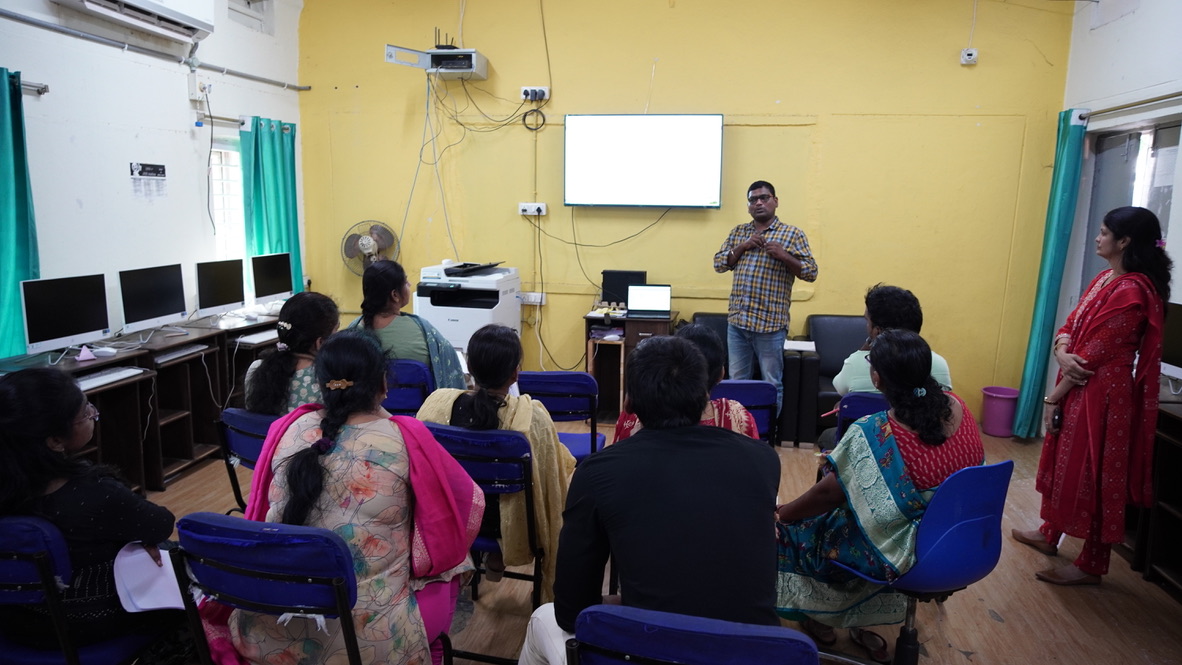
Introducing AI Quests: A new gamified learning experience within Experience AI

Post Syndicated from Liz Eaton original https://www.raspberrypi.org/blog/introducing-ai-quests-a-new-gamified-learning-experience-within-experience-ai/

Artificial intelligence (AI) tools are shaping our world in many ways. Helping young people develop AI literacy — in other words, helping them understand how AI tools work and how to use them responsibly — is essential. 

At the Raspberry Pi Foundation, we’re committed to empowering educators around the world with everything they need to teach AI confidently and help young people develop AI literacy. That’s why we developed Experience AI: a set of high-quality AI literacy resources designed in collaboration with Google DeepMind that any educator can use, no matter their level of tech knowledge.  

AI Quests

We’re excited to introduce a new addition to the Experience AI resources: AI Quests.

Enter AI Quests

Developed by Google Research in collaboration with the Stanford Accelerator for Learning, AI Quests is a browser-based learning experience that lets students step into the role of AI researchers. Through interactive, story-driven activities, they’ll explore essential AI topics such as:

  • Data preparation
  • Testing and evaluation
  • Bias in AI systems

Students will use what they learn about these topics to tackle simulated global challenges. The first quest, Market Marshes, introduces them to how AI technology can be used in flood forecasting, while upcoming quests will explore other real-world issues.

Why AI Quests matters

AI technology is frequently used but often poorly understood. AI Quests, like Experience AI more broadly, gives students practical experience of how AI technology works, and shows why it’s so important. 

Market Marshes AI Quest start screen

Here’s what sets AI Quests apart:

  • Gamified learning: Storytelling and role play turn abstract ideas into immersive experiences
  • Real-world relevance: Students see how AI technology addresses challenges like climate resilience and health equity
  • No prior knowledge required: Any teacher, regardless of subject specialism, can bring AI Quests into their classroom
  • Developed by experts: Built with Google Research and the Stanford Accelerator for Learning, content is high-quality and credible

What’s next

AI Quests is launching in English, with future plans for translations and additional quests to reach even more learners globally.

To support educators, we’re also hosting two free webinars on YouTube and LinkedIn:

  • 9 October at 4pm BST
  • 16 October at 4pm BST
AI Quests, search for data mid game screen

These sessions will walk you through AI Quests, offer classroom tips, and give you the chance to ask questions directly.

Register now on LinkedIn or subscribe on YouTube to get notified and join the live session. 

Ready to get started?

AI literacy is one of the most valuable skills young people can develop today. With this new addition to Experience AI, we’re making it even more engaging, practical, and accessible for classrooms everywhere.

Explore AI Quests in lesson 6 of our Experience AI resources.

The post Introducing AI Quests: A new gamified learning experience within Experience AI appeared first on Raspberry Pi Foundation.
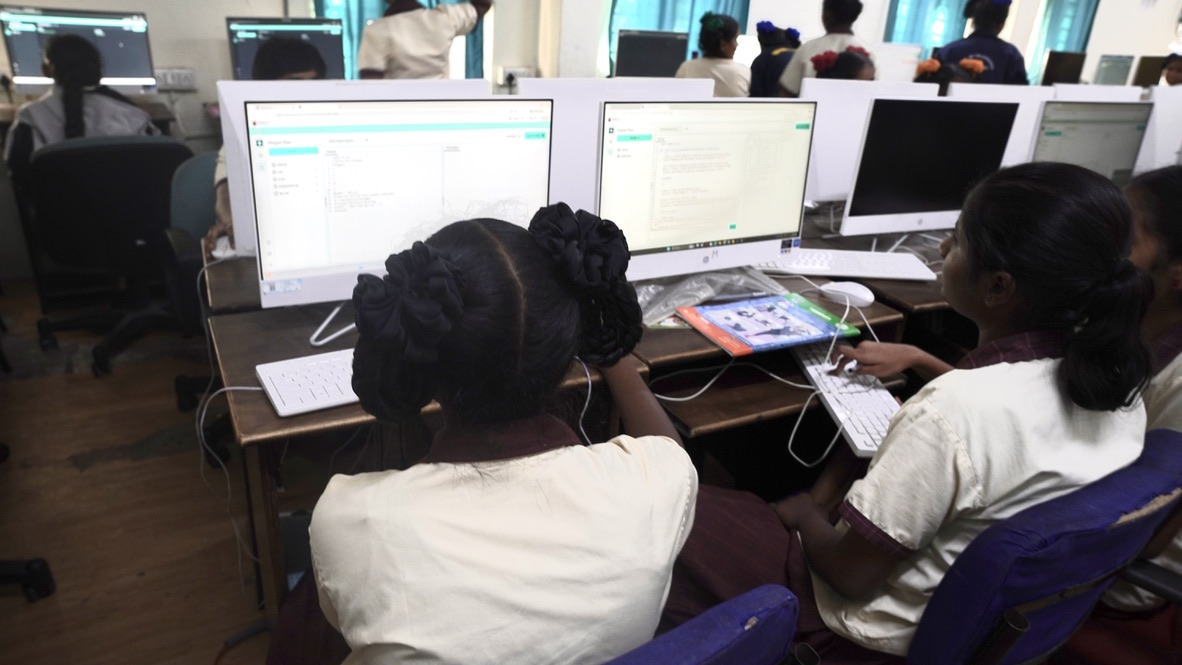
Teaching Experience AI: Lessons from educators in Mexico

Post Syndicated from Liz Eaton original https://www.raspberrypi.org/blog/teaching-experience-ai-lessons-from-educators-in-mexico/

In classrooms across Mexico, a transformation is unfolding. The Experience AI programme isn’t just teaching students about artificial intelligence, it’s empowering teachers and learners to explore, question, and create with it. By equipping educators with accessible tools and sparking curiosity among students, the initiative is shaping a new generation ready to use AI responsibly and creatively.

Teacher at the front of the classroom

Educators like Guadalupe Cortes, Lilia Violeta Garvia Sanchez, Ines Martinez, and Ana Judith Zavaleta are at the forefront of this shift. Their experiences reveal just how transformative Experience AI has become.

From fear to fascination: Demystifying AI

For many, AI can feel abstract, something from science fiction. Science and math teacher Lilia Violeta Garvia Sanchez remembers that both she and her students once viewed AI as “robots that would take over the world.” Fear gave way to fascination, however, once Experience AI entered the classroom.

Through hands-on lessons, students quickly discovered AI as a practical tool rather than a threat. “I’ve seen a change in the students,” Lilia explains. “They were afraid at first, but now they’re curious and engaged.”

Technology teacher Ines Martinez admits she was also surprised: “I thought the language would be more technical or complex, but it was pleasantly accessible — and very useful.”

Equipping educators with tools that work

A defining strength of Experience AI is its adaptability. Teachers can tailor materials to fit their classrooms while still leaning on the program’s robust foundation.

Guadalupe Cortes points to the built-in glossary as a game-changer: “It was really helpful for me.” She values being able to choose what fits her teaching to keep it relevant: “I selected certain parts to connect with projects I was already running.”

Sparking critical thinking and ethical awareness

Experience AI pushes students to think deeply about the ethics and implications of AI.

In Ines’s class, students raised concerns about water use in data centres and debated how to protect their digital identities. They weren’t just learning facts, they were making connections to real-world issues.

Educator supporting young learner in the classroom

Another teacher, Ileana Beurini, described an exercise where students asked different AI models the same political question. When answers varied, they discussed bias and the importance of consulting multiple sources. In another activity, searching images of “worker” led to a conversation about gender equity in technology.

As Ines puts it: “They don’t want it to do all the thinking for them. They said it should be a support — a tool to generate better information, not to replace reasoning or reflection.”

Transforming engagement and performance

The impact on student motivation has been striking. For Ana Judith Zavaleta, the shift was clear: “They’re much more hands-on now — they don’t rely as much on textbooks or theory.” One student who typically struggled academically became one of the most enthusiastic participants, even passing where he previously failed.

Guadalupe Cortes has seen similar enthusiasm: “They’re finding a real purpose in using AI for their own benefit.” At an entrepreneurship fair, her students applied AI concepts to improve their projects, proof that these lessons extend far beyond the classroom.

A call to action for educators

The teachers’ message is unanimous: embrace AI.

“We should give it a try,” urges Lilia. “Just because we’re teachers doesn’t mean we have to know everything. The world is evolving every single day, and we need to innovate with our students so they feel motivated to keep learning.”

Young learners work on the classroom wall

For Ines, the takeaway is simple but powerful: “Take the risk — really, take the chance to learn. Just like the internet became essential, AI will become part of our daily lives and necessary for all areas of teaching — and life itself.”

More than just a set of resources

Experience AI is more than a set of resources, it’s a movement preparing students to navigate the future with curiosity, critical thinking, and ethical awareness. By igniting minds in Mexico, it’s helping to cultivate responsible digital citizens who will shape not just their classrooms, but the world beyond them.

For more information about Experience AI, visit our website: rpf.io/experienceai

For more information about our global Experience AI partner in Mexico, visit: educacionparacompartir.org

The post Teaching Experience AI: Lessons from educators in Mexico appeared first on Raspberry Pi Foundation.
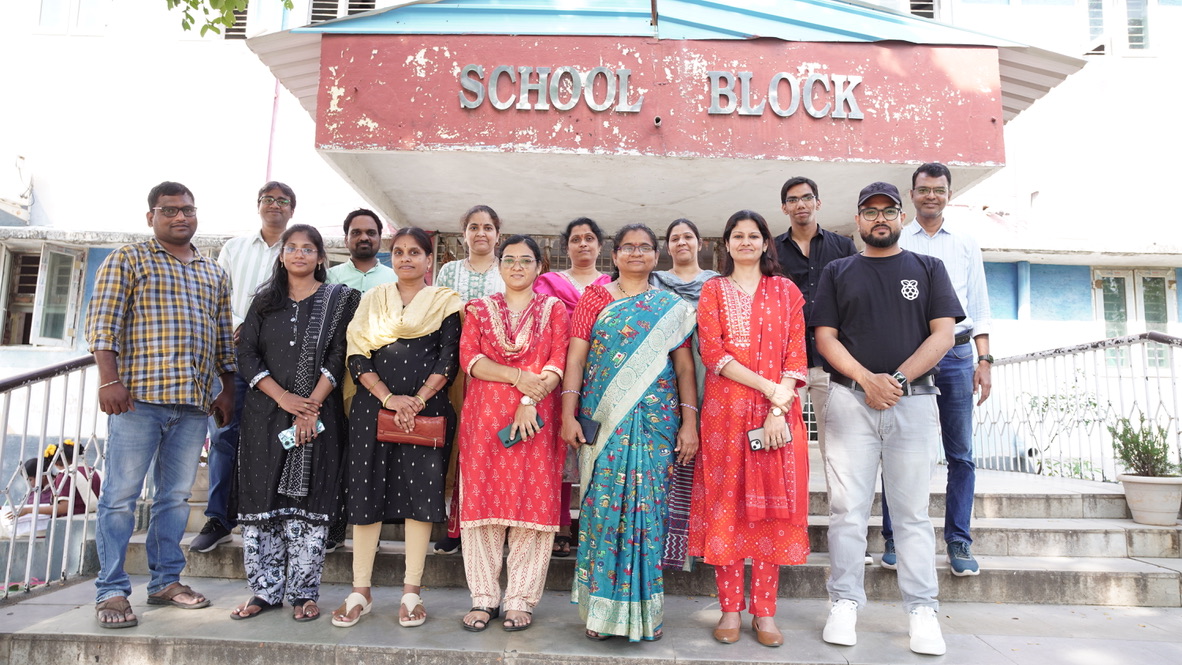
Promoting young people’s agency in the age of AI

Post Syndicated from Claire Johnson original https://www.raspberrypi.org/blog/promoting-young-peoples-agency-in-the-age-of-ai/

Part of teaching young people AI literacy skills is teaching them to critically think about AI, and to design AI applications that address problems they care about. How to do this was the focus of our June research seminar.

An educator helping a learner in the classroom

Working together to design AI

Our June research seminar was delivered by Netta Iivari, Professor in Information Systems at the University of Oulu’s INTERACT Research Unit.

The INTERACT research group focuses on understanding and supporting participatory design, user-centered design, user-driven innovation, and human interaction with technology in everyday life contexts. From this perspective, “users” aren’t considered as passive consumers, but as valuable co-creators and content producers. This calls for different approaches that place emphasis on empowerment and inclusion in designing, shaping, and co-creating information technology in everyday life.

As part of this work, Netta introduced the idea of ‘transformative agency’ — empowering children to believe they can solve problems they care about — and its application in secondary computing education. She showed examples of how to foster young people’s transformative agency within computing, specifically focusing on transdisciplinary approaches to learning about AI and inviting young people to critically analyse and design their futures with AI tools in it.

Netta began by giving an overview of two of the INTERACT Research Unit’s projects: 

  1. The Make a difference (MAD) project (2019–2023) explored critical design with young people, focusing on their emerging designer and maker identities in the context of tackling a significant societal problem — in this case, bullying. 
  2. Children’s transformative agency and emerging technologies for social good (TAKEOVER) (2024–2028), a current project, explores the potential of emerging technologies (artificial intelligence, virtual reality (VR), social robots, etc.) to address societal problems, such as climate change, gender equality, bullying, and discrimination. It focuses on children’s emerging transformative agency and activist identities when engaging with these tools and topics. 
An educator points to an image on a secondary learners computer screen.

Netta explained that these projects give young people an opportunity to begin to address the problems they care about, even though they may be very complex problems. From this problem-solving perspective, children are introduced (or ‘sensitised’) to emerging technologies as tools for social good.

She then went on to outline the key pedagogical approaches that underpin these projects:  

  1. Critical, ethical, empowering design
    This pedagogy draws on critical and speculative design traditions in design research and encourages young people to take a critical perspective towards society, its norms, and the status quo, as part of design thinking. Children consider the ethical values and consequences of their designs. They begin to experience the ways in which engaging in the design process can be empowering and transformative for them, collectively as well as individually. 
  2. Transformative agency of children
    This approach encourages young people to consider their capacity to have agency in the world, by enabling them to envision change and commit to taking action to solve problems that they care about. 
  3. Fostering transformative agency of children in the age of AI
    Transformative agency is achieved when young people engage in ‘expansive learning’ — when they learn something novel, together, and are encouraged to look beyond the confines of school work, the topic, themselves, and the tools available for solving the problem. This approach fosters an active, critical, reflective mindset that encourages children to believe that they can make change and have impact in the world. 

The project design process

The projects follow 3 design phases and include a range of plugged and unplugged activities, as shown in Figure 1.

Figure 1. The project phases

Netta then described in more detail some of the activities that have been used to address these different project phases and the design process involved. For example, to explore what are the problems that children really care about, they are asked to imagine ‘carrying a stone in your pocket for one week, as if it was a magic tool. Where could it be used in your everyday life? What problems could it solve? What problems would you like it to solve and how?’ 

Young people are then introduced to a range of novel technologies, for example, VR headsets, robots, and emulators of AI-driven social media platforms, such as “Somekone”, developed as part of the Generative AI project at the University of Eastern Finland. They deconstruct and reconstruct generative AI tools by prompting large language model chatbots such as ChatGPT, Gemini, Claude, etc. and exploring bias in their outputs. They perform small-scale algorithmic auditing and create mini language models (with Google Colab), using the text in Alice in Wonderland to train their models, and then open datasets (books as text files from Project Gutenberg). In exploring the responses generated, they experience the potential and the limitations of such tools and gain an important understanding of the human activity involved in the development of AI technologies. 

Secondary school age learners in a computing classroom.

Once they have had this ‘sensitising‘ exposure to a range of tools, they then work in groups on a project that makes use of AI to solve the societal problem they have chosen. These problems could encompass a range of topics, such as racism, animal rights, the impact of AI, war, mental health, bullying. The young people are prompted to think about how large language models can be used to solve the problem, or parts of the problem. But importantly, they are also asked to consider the different motives and perspectives of the multiple stakeholders involved in the problem and its solution and whether their model ideas will create new problems when deployed.

They follow the 3 project phases shown in Figure 1 to design and make a range of digital (robots, apps, videos) and non-digital artefacts to solve their problem. Netta emphasised that although it could take 10 weeks or more to implement all the suggested activities, it is also possible to pick and choose individual tasks from the 3 phases to suit available curriculum timescales.

Envisioning and critiquing AI futures

Other project tasks involve: 

  • Envisioning AI futures by imagining that a miracle has happened overnight and the problem has disappeared — what is the result? 
  • Critiquing AI futures by creating best and worst case scenarios of the consequences of the AI systems they design, creating video adverts promoting their AI solutions and anti-adverts, focusing on the possible negative consequences of their prototypes 
  • Fostering action-taking by presenting theatrical performances to showcase how their designs tackle a problem and illustrating the AI-related issues surrounding the topic or by creating activism campaign material to mobilise the school community on the same themes 
Secondary education learners in the classroom

These projects situate learning about data-driven technologies in real-world contexts and promote a transdisciplinary approach, teaching and learning about AI from a problem-solving perspective. 

This perspective conveys important messages to young people — that they do have agency and can take action in the face of many of the world’s problems, that they can and should be active, critical users of the new technologies that surround them, and that these technologies can be used to change the world for good. 

Netta ended the seminar by asking viewers to consider how they could foster transformative agency in the young people they teach and whether or not they consider it to be important in computing education.

Resources relating to the projects can be found at interact.oulu.fi.

Join our next seminar

In our current seminar series, we’re exploring teaching about AI and data science. Join us at our next seminar on Tuesday 14 October from 17:00 to 18:30 GMT to hear Viktoriya Olari talk about data-related concepts and practices for AI education in K–12.

To sign up and take part, click the button below. We’ll then send you information about joining. We hope to see you there.

The schedule of our upcoming seminars is online. You can catch up on past seminars on our previous seminars page.

The post Promoting young people’s agency in the age of AI appeared first on Raspberry Pi Foundation.
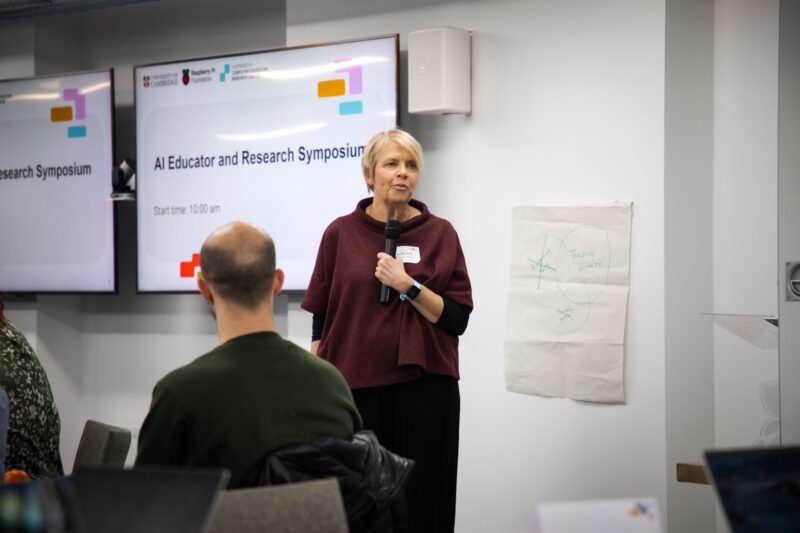
Hello World podcast: What does AI education look like around the world?

Post Syndicated from Liz Eaton original https://www.raspberrypi.org/blog/hello-world-podcast-what-does-ai-education-look-like-around-the-world/

In a rapidly evolving digital landscape, AI literacy is becoming as fundamental as traditional reading and writing. The latest episode of the Hello World podcast explores this crucial topic, bringing together experts from Kenya, Lithuania, and Malaysia to discuss the current state of AI literacy in their countries. Together, they shed light on the challenges and immense potential of AI education globally.

HW Podcast Thumbnail: AI education: Global perspectives

This episode features a conversation led by Ben Garside (Raspberry Pi Foundation), with contributions from Leonida Soi (Raspberry Pi Foundation, Kenya), Aimy Lee (Penang Science Cluster, Malaysia), and Monika Katkutė-Gelžinė (Vedliai, Lithuania). All are key collaborators in the Raspberry Pi Foundation’s AI literacy programme, Experience AI.

The digital literacy gap

One of the most striking takeaways from the conversation is the universal excitement surrounding AI, coupled with a significant need for foundational digital literacy. As Leonida explains:

“There’s an excitement about AI literacy, both from the learners and the teachers… However, one thing to look into is, we still have low digital literacy. As much as we are bringing in AI, if it is not bundled up together with digital literacy, then there is also misuse.” 

 Leonida Soi, Learning Manager, Raspberry Pi Foundation

This highlights a crucial point: simply introducing AI tools isn’t enough. A solid understanding of digital fundamentals is essential for responsible and effective use of AI.

Different contexts, shared challenges

The discussion also reveals the varying approaches to AI education in different countries. Monika shares her experience in Lithuania:

“We’ve been teaching AI for the last 5 years… I see a lot of opportunity in it, but a lot of challenges not to overburden teachers with the noise and changes.”

Her insight highlights the ongoing need for teacher training and sustainable pedagogical strategies, particularly in a field that evolves so quickly.

AI literacy beyond computer science

A key theme throughout the podcast is the importance of integrating AI literacy beyond traditional computer science classrooms. As Leonida emphasises:

“It’s time that AI literacy is looked at from a broader view, not just in computing… something that cuts across all the learning areas.”

This sentiment is echoed by Monika, who suggests:

“I feel like the entire education system needs to go through an AI filter and come out of it with a bit more efficiency, with a bit more understanding, so it lives in a 21st-century AI world. And I see AI as a form of, you know, building and also as a co-worker for everyone in the future.”

Monica Katkute-Gelzine, Vedliai, Experience AI global partner, Lithuania.

The vision of AI as a “co-worker” for all, empowering young people rather than replacing them, offers a powerful perspective for future education.

Addressing the digital divide

Equity is another critical issue, particularly in rural areas. Aimy highlights the ongoing challenge of access:

“The digital divide is in the access to devices, as well as access to high-speed internet connections… but the other thing is also in terms of trained teachers as well.”

Leonida adds that in Kenya there’s a need for unplugged activities to give students an idea of what the world is doing, so that we can start to bridge that gap.

These insights highlight the need for equitable access and innovative teaching methods to ensure no one is left behind.

Encouragement for educators: start small, support each other

For teachers who might feel overwhelmed by the prospect of teaching AI, the advice is clear and encouraging. Aimy suggests:

“Start small, cover one topic at a time, one concept at a time. Don’t feel the need to cover everything all at the same time.”

Aimy Lee, Penang Science Cluster, Experience AI global partner, Malaysia.

Leonida advocates for the power of community, suggesting a “community of practice where [teachers] can share amongst each other and where they can encourage others.”

Building a network of support and shared resources is key as educators take their first steps into teaching AI.

Listen now

This episode of the Hello World podcast is a powerful reminder that AI literacy is not just a skill, but a mindset that needs to be nurtured across all subjects and communities. It also underscores that the commitment to prepare the next generation for an AI-powered world is global.

Listen to the full episode of the Hello World podcast to learn more about the global state of AI literacy and gain practical insights for your classroom.

Learn more about Experience AI

The Experience AI programme is a collaboration between the Raspberry Pi Foundation and Google DeepMind to help young people and educators understand and engage with artificial intelligence. Through free, classroom-ready resources, professional development for teachers, and global partnerships, the programme aims to make AI literacy accessible to all, regardless of geography or background. By supporting educators and inspiring students, Experience AI is helping to prepare the next generation to thrive in a world increasingly shaped by artificial intelligence.

Find out more about Experience AI and how it can support you to bring AI literacy skills to your learners.

The post Hello World podcast: What does AI education look like around the world? appeared first on Raspberry Pi Foundation.
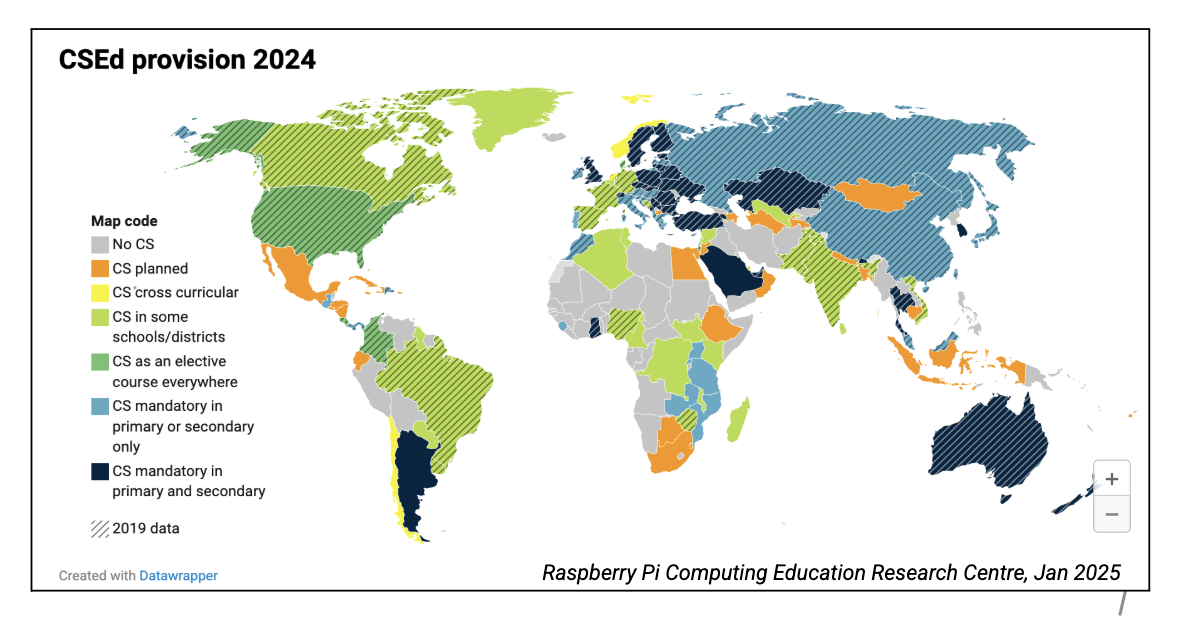
Why kids still need to learn to code in the age of AI 

Post Syndicated from Philip Colligan original https://www.raspberrypi.org/blog/why-kids-still-need-to-learn-to-code-in-the-age-of-ai/

Today we’re publishing a position paper setting out five arguments for why we think that kids still need to learn to code in the age of artificial intelligence.

A whimsical cartoon of someone struggling with vibe coding at a desktop computer and a second person with a superhero cape and a t-shirt saying 'programmer' coming to their rescue.
Generated using ChatGPT.

Just like every wave of technological innovation that has come before, the advances in artificial intelligence (AI) are raising profound questions about the future of human work. History teaches us that technology has the potential to both automate and augment human effort, destroying some jobs and creating new ones. The only thing we know for sure is that it is impossible to predict the precise nature and pace of the changes that are coming. 

One of the fastest-moving applications of generative AI technologies are the systems that can generate code. What started as the coding equivalent of autocomplete has quickly progressed to tools that can generate increasingly complex code from natural language prompts. 

This has given birth to the notion of “vibe-coding” and led some commentators to predict the end of the software development industry as we know it. It shouldn’t be a surprise then that there is a vigorous debate about whether kids still need to learn to code. 

In the position paper we put forward five arguments for why we think the answer is an unequivocal yes.

We need humans who are skilled programmers 

First, we argue that even in a world where AI can generate code, we need skilled human programmers who can think critically, solve problems, and make ethical decisions. The large language models that underpin these tools are probabilistic systems designed to provide statistically acceptable outputs and, as any skilled software engineer will tell you, simply writing more code faster isn’t necessarily a good thing. 

Learning to code is an essential part of learning to program

Learning to code is the most effective way we know for a young person to develop the mental models and fluency to become a skilled human programmer. The hard cognitive work of reading, modifying, writing, explaining, and testing code is precisely how young people develop a deep understanding of programming and computational thinking. 

Learning to code will open up even more opportunities in the age of AI 

While there’s no doubt that AI is going to reshape the labour market, the evidence from history suggests that it will increase the reach of programming and computational approaches across the economy and into new domains, creating demand for humans who are skilled programmers. We also argue that coding is no longer just for software engineers, it’s becoming a core skill that enables people to work effectively and think critically in a world shaped by intelligent machines. From healthcare to agriculture, we are already seeing demand for people who can combine programming with domain-specific skills and craft knowledge. 

Coding is a literacy that helps young people have agency in a digital world

Alongside the arguments for coding as a route to opening up economic opportunities, we argue that coding and programming gives young people a way to express themselves, to learn, and to make sense of the world. 

And perhaps most importantly, that learning to code is about power. Providing young people with a solid grounding in computational literacy, developed through coding, helps ensure that they have agency. Without it, they risk being manipulated by systems they don’t understand. As Rushkoff said: “Program, or be programmed”.  

The kids who learn to code will shape the future

Finally, we argue that the power to create with technology is already concentrated in too small and homogenous a group of people. We need to open up the opportunity to learn to code to all young people because it will help us mobilise the full potential of human talent, will lead to more inclusive and effective digital solutions to the big global challenges we face, and will help ensure that everyone can share in the societal and economic benefits of technological progress. 

The work we need to do 

We end the paper with a call to action for all of us working in education. We need to challenge the false narrative that AI is removing the need for kids to learn to code, and redouble our efforts to ensure that all young people are equipped to take advantage of the opportunities in a world where AI is ubiquitous.

You can read the full paper here:


The cartoon image for this blog was created using ChatGPT-4o, which was prompted to produce a “whimsical cartoon that expresses some of the key ideas in the position paper”. It took several iterations.

The post Why kids still need to learn to code in the age of AI  appeared first on Raspberry Pi Foundation.
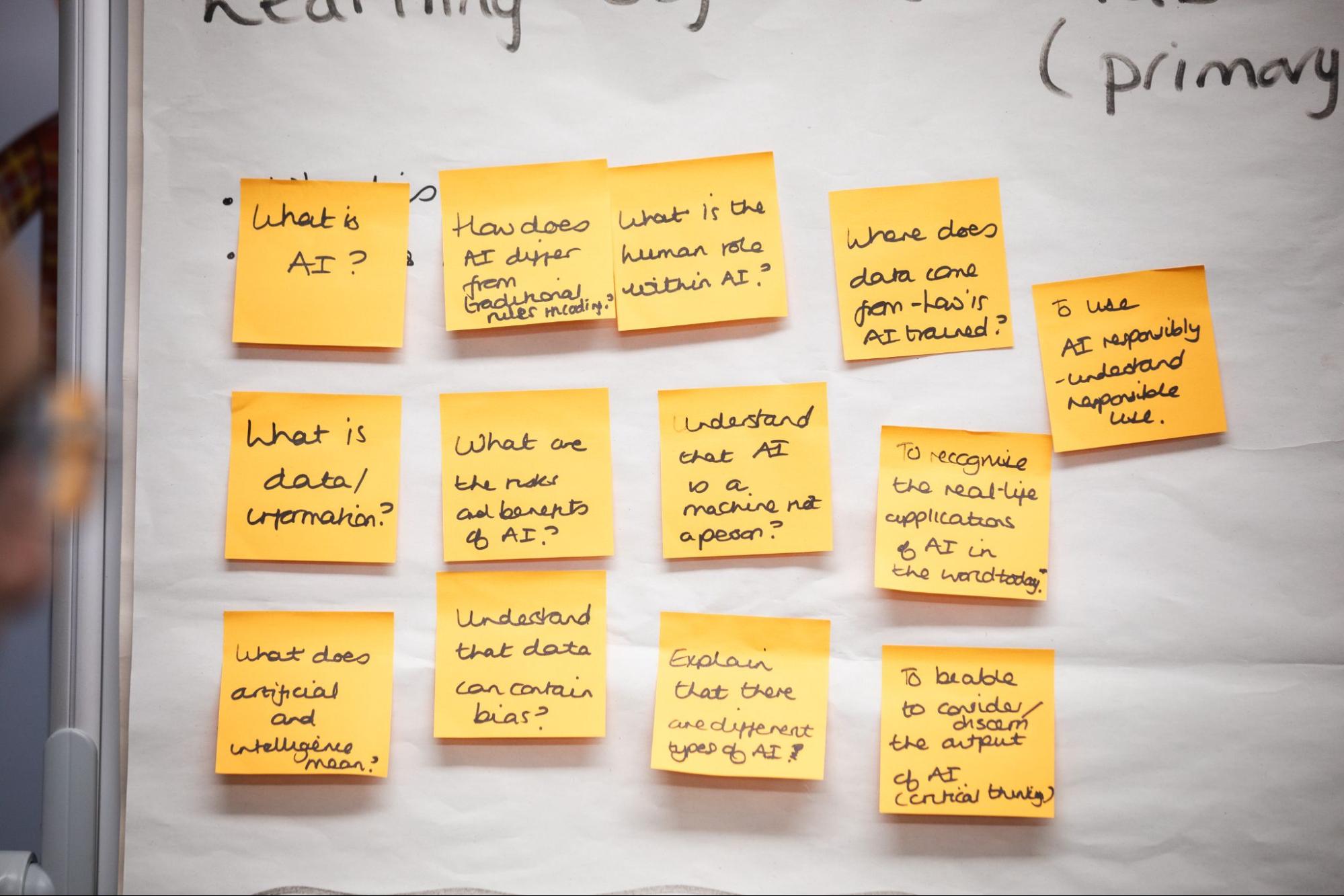
UNESCO’s International Day of Education 2025: AI and the future of education

Post Syndicated from Ben Garside original https://www.raspberrypi.org/blog/unescos-international-day-of-education-2025/

Recently, our Chief Learning Officer Rachel Arthur and I had the opportunity to attend UNESCO’s International Day of Education 2025, which focused on the role of education in helping people “understand and steer AI to better ensure that they retain control over this new class of technology and are able to direct it towards desired objectives that respect human rights and advance progress toward the Sustainable Development Goals”.

How teachers continue to play a vital role in the future of education

Throughout the event, a clear message from UNESCO was that teachers have a very important role to play in the future of education systems, regardless of the advances in technology — a message I find very reassuring. However, as with any good-quality debate, the sessions also reflected a range of other opinions and approaches, which should be listened to and discussed too. 

With this in mind, I was interested to hear a talk by a school leader from England who is piloting the first “teacherless” classroom. They are trialling a programme with twenty Year 10 students (ages 14–15), using an AI tool developed in-house. This tool is trained on eight existing learning platforms, pulling content and tailoring the learning experience based on regular assessments. The students work independently using an AI tool in the morning, supported by a learning mentor in the classroom, while afternoons focus on developing “softer skills”. The school believes this approach will allow students to complete their GCSE exams in just one year instead of two, seeing it as a solution to the years of lost learning caused by lockdowns during the coronavirus pandemic.

Whilst they were reporting early success in this approach, what occurred to me during the talk was the question of how we can decide if this approach is the right one. The results might sound attractive to school leaders, but do we need a more rounded view of what education should look like? Whatever your views on the purpose of schools, I suspect most people would agree that they serve a much greater purpose than just achieving the top results. 

Whilst AI tools may be able to provide personalised learning experiences, it is crucial to consider the role of teachers in young people’s education. If we listed the skills required for a teacher to do their job effectively, I believe we would all reach the same conclusion: teachers play a pivotal role in a young person’s life — one that definitely goes beyond getting the best exam results. According to the Educational Endowment Foundation, high-quality teaching is the most important lever schools have on pupil outcomes

“Quality education demands quality educators” – Farida Shaheed, United Nations Special Rapporteur on the Right to Education

Also, at this stage in AI adoption, can we be sure that this use of AI tools isn’t disadvantageous to any students? We know that machine learning models generate biased results, but I’m not aware of research showing that these systems are fair to all students and do not disadvantage any demographic. An argument levelled against this point is that teachers can also be biased. Aside from the fact that systems have a potentially much larger impact on more students than any individual teacher, I worry that this argument leads to us accepting machine bias, rather than expecting the highest of standards. It is essential that providers of any educational software that processes student data adhere to the principles of fairness, accountability, transparency, privacy, and security (FATPS).

How can the agency of teachers be cultivated in AI adoption?

We are undeniably at a very early stage of a changing education landscape because of AI, and an important question is how teachers can be supported. 

“Education has a foundational role to play in helping individuals and groups determine what tasks should be outsourced to AI and what tasks need to remain firmly in human hands.” – UNESCO 

I was delighted to have been invited to be part of a panel at the event discussing how the agency of teachers can be cultivated in AI adoption. The panel consisted of people with different views and expertise, but importantly, included a classroom teacher, emphasising the importance of listening to educators and not making decisions on their behalf without them. As someone who works primarily on AI literacy education, my talk was centred around my belief that AI literacy education for teachers is of paramount importance. 

Having a basic understanding of how data-driven systems work will empower teachers to think critically and become discerning users, making conscious choices about which tools to use and for what purpose. 

For example, while attending the Bett education technology exhibition recently, I was struck by the prevalence of education products that included the use of AI. With ever more options available, we need teachers to be able to make informed choices about which products will benefit and not harm their students. 

“Teachers urgently need to be empowered to better understand the technical, ethical and pedagogical dimensions of AI.” – Stefania Giannini, Assistant Director-General for Education, UNESCO, AI competency framework for teachers

A very interesting paper released recently showed that individuals with lower AI literacy levels are more receptive towards AI-powered products and services. In short, people with higher literacy levels are more aware of the capabilities and limitations of AI systems. Perhaps this doesn’t mean that people with higher AI literacy levels see all AI tools as ‘bad’, but maybe that they are more able to think critically about the tools and make informed choices about their use. 

UN Special Rapporteur highlights urgent education challenges

For me, the most powerful talk of the day came from Farida Shaheed, the United Nations Special Rapporteur on the Right to Education. I would urge anyone to listen to it (a recording is available on YouTube — the talk begins around 2:16:00). 

The talk included many facts that helped to frame some of the challenges we are facing. Ms Shaheed stated that “29% of all schools lack access to basic drinking water, without which education is not possible”. This is a sobering thought, particularly when there is a growing narrative that AI systems have the potential to democratise education. 

When speaking about the AI tools being developed for education, Ms Shaheed questioned who the tools are for: “It’s telling that [so very few edtech tools] are developed for teachers. […] Is this just because teachers are a far smaller client base or is it a desire to automate teachers out of the equation?”

I’m not sure if I know the answer to this question, but it speaks to my worry that the motivation for tech development does not prioritise taking a human-centred approach. We have to remember that as consumers, we do have more power than we think. If we do not want a future where AI tools are replacing teachers, then we need to make sure that there is not a demand for those tools. 

The conference was a fantastic event to be part of, as it was an opportunity to listen to such a diverse range of perspectives. Certainly, we are facing challenges, but equally, it is both reassuring and exciting to know that so many people across the globe are working together to achieve the best possible outcomes for future generations. Ms Shaheed’s concluding message resonated strongly with me:

“[Share good practices], so we can all move together in a co-creative process that is inclusive of everybody and does not leave anyone behind.” 

As always, we’d love to hear your views — you can contact us here.

The post UNESCO’s International Day of Education 2025: AI and the future of education appeared first on Raspberry Pi Foundation.
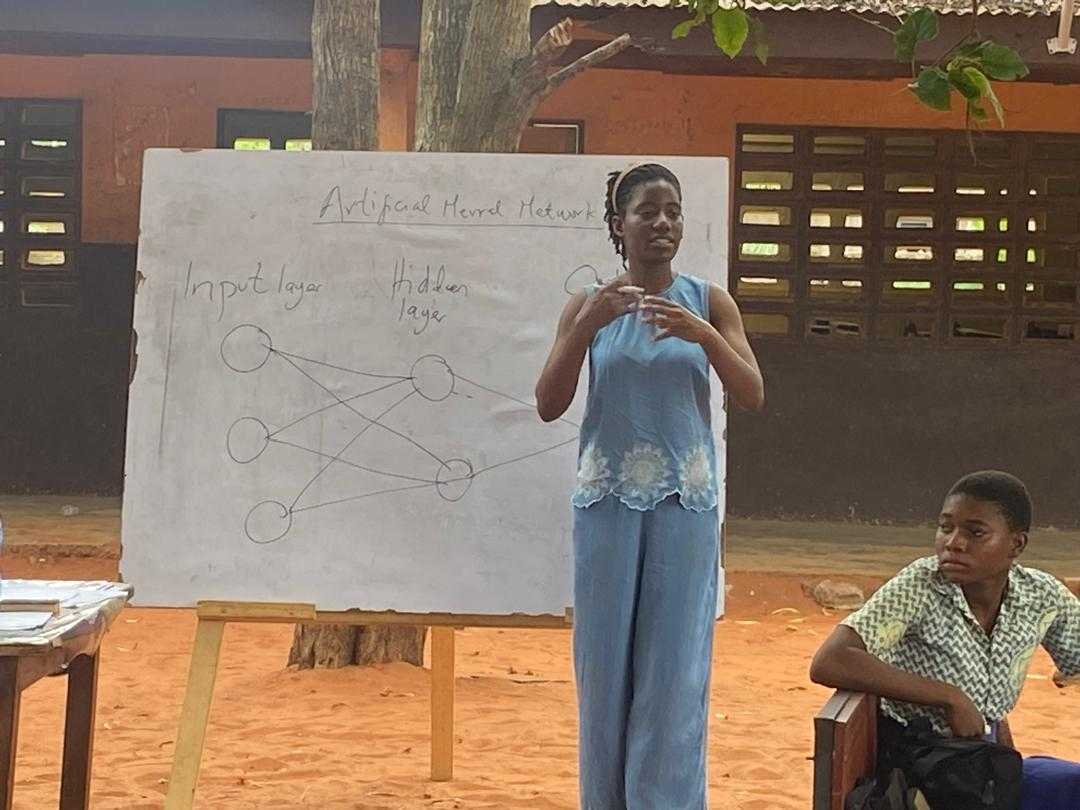
The need to invest in AI skills in schools

Post Syndicated from Philip Colligan original https://www.raspberrypi.org/blog/the-need-to-invest-in-ai-skills-in-schools/

Earlier this week, the UK Government published its AI Opportunities Action Plan, which sets out an ambitious vision to maintain the UK’s position as a global leader in artificial intelligence. 

Whether you’re from the UK or not, it’s a good read, setting out the opportunities and challenges facing any country that aspires to lead the world in the development and application of AI technologies. 

In terms of skills, the Action Plan highlights the need for the UK to train tens of thousands more AI professionals by 2030 and sets out important goals to expand education pathways into AI, invest in new undergraduate and master’s scholarships, tackle the lack of diversity in the sector, and ensure that the lifelong skills agenda focuses on AI skills. 

Photo of a group of young people working through some Experience AI content.

This is all very important, but the Action Plan fails to mention what I think is one of the most important investments we need to make, which is in schools. 

“Most people overestimate what they can achieve in a year and underestimate what they can achieve in ten years.”

While reading the section of the Action Plan that dealt with AI skills, I was reminded of this quote attributed to Bill Gates, which was adapted from Roy Amara’s law of technology. We tend to overestimate what we can achieve in the short term and underestimate what we can achieve in the long term. 

In focusing on the immediate AI gold rush, there is a risk that the government overlooks the investments we need to make right now in schools, which will yield huge returns — for individuals, communities, and economies — over the long term. Realising the full potential of a future where AI technologies are ubiquitous requires genuinely long-term thinking, which isn’t always easy for political systems that are designed around short-term results. 

Photo focused on a young person working on a computer in a classroom.

But what are those investments? The Action Plan rightly points out that the first step for the government is to accurately assess the size of the skills gap. As part of that work, we need to figure out what needs to change in the school system to build a genuinely diverse and broad pipeline of young people with AI skills. The good news is that we’ve already made a lot of progress. 

AI literacy

Over the past three years, the Raspberry Pi Foundation and our colleagues in the Raspberry Pi Computing Education Research Centre at the University of Cambridge have been working to understand and define what AI literacy means. That led us to create a research-informed model for AI literacy that unpacks the concepts and knowledge that constitute a foundational understanding of AI. 

In partnership with one of the leading UK-based AI companies, Google DeepMind, we used that model to create Experience AI. This suite of classroom resources, teacher professional development, and hands-on practical activities enables non-specialist teachers to deliver engaging lessons that help young people build that foundational understanding of AI technologies. 

We’ve seen huge demand from UK schools already, with thousands of lessons taught in UK schools, and we’re delighted to be working with Parent Zone to support a wider roll out in the UK, along with free teacher professional development.  

CEO Philip Colligan and  Prime Minister Keir Starmer at the UK launch of Experience AI.
CEO Philip Colligan and Prime Minister Keir Starmer at the UK launch of Experience AI.

With the generous support of Google.org, we are working with a global network of education partners — from Nigeria to Nepal — to localise and translate these resources, and deliver locally organised teacher professional development. With over 1 million young people reached already, Experience AI can plausibly claim to be the most widely used AI literacy curriculum in the world, and we’re improving it all the time. 

All of the materials are available for anyone to use and can be found on the Experience AI website.

There is no AI without CS

With the CEO of GitHub claiming that it won’t be long before 80% of code is written by AI, it’s perhaps not surprising that some people are questioning whether we still need to teach kids how to code.

I’ll have much more to say on this in a future blog post, but the short answer is that computer science and programming is set to become more — not less — important in the age of AI. This is particularly important if we want to tackle the lack of diversity in the tech sector and ensure that young people from all backgrounds have the opportunity to shape the AI-enabled future that they will be living in. 

Close up of two young people working at a computer.

The simple truth is that there is no artificial intelligence without computer science. The rapid advances in AI are likely to increase the range of problems that can be solved by technology, creating demand for more complex software, which in turn will create demand for more programmers with increasingly sophisticated and complex skills. 

That’s why we’ve set ourselves the ambition that we will inspire 10 million more young people to learn how to get creative with technology over the next 10 years through Code Club. 

Curriculum reform 

But we also need to think about what needs to change in the curriculum to ensure that schools are equipping young people with the skills and knowledge they need to thrive in an AI-powered world. 

That will mean changes to the computer science curriculum, providing different pathways that reflect young people’s interests and passions, but ensuring that every child leaves school with a qualification in computer science or applied digital skills. 

It’s not just computer science courses. We need to modernise mathematics and figure out what a data science curriculum looks like (and where it fits). We also need to recognise that AI skills are just as relevant to biology, geography, and languages as they are to computer science. 

A teacher assisting a young person with a coding project.

To be clear, I am not talking about how AI technologies will save teachers time, transform assessments, or be used by students to write essays. I am talking about the fundamentals of the subjects themselves and how AI technologies are revolutionising the sciences and humanities in practice in the real world. 

These are all areas where the Raspberry Pi Foundation is engaged in original research and experimentation. Stay tuned. 

Supporting teachers

All of this needs to be underpinned by a commitment to supporting teachers, including through funding and time to engage in meaningful professional development. This is probably the biggest challenge for policy makers at a time when budgets are under so much pressure. 

For any nation to plausibly claim that it has an Action Plan to be an AI superpower, it needs to recognise the importance of making the long-term investment in supporting our teachers to develop the skills and confidence to teach students about AI and the role that it will play in their lives. 

I’d love to hear what you think and if you want to get involved, please get in touch.

The post The need to invest in AI skills in schools appeared first on Raspberry Pi Foundation.
Ocean Prompting Process: How to get the results you want from an LLM

Post Syndicated from Mark Calleja original https://www.raspberrypi.org/blog/ocean-prompting-process-how-to-get-the-results-you-want-from-an-llm/

Have you heard of ChatGPT, Gemini, or Claude, but haven’t tried any of them yourself? Navigating the world of large language models (LLMs) might feel a bit daunting. However, with the right approach, these tools can really enhance your teaching and make classroom admin and planning easier and quicker. 

That’s where the OCEAN prompting process comes in: it’s a straightforward framework designed to work with any LLM, helping you reliably get the results you want. 

The great thing about the OCEAN process is that it takes the guesswork out of using LLMs. It helps you move past that ‘blank page syndrome’ — that moment when you can ask the model anything but aren’t sure where to start. By focusing on clear objectives and guiding the model with the right context, you can generate content that is spot on for your needs, every single time.

5 ways to make LLMs work for you using the OCEAN prompting process

OCEAN’s name is an acronym: objective, context, examples, assess, negotiate — so let’s begin at the top.

1. Define your objective

Think of this as setting a clear goal for your interaction with the LLM. A well-defined objective ensures that the responses you get are focused and relevant.

Maybe you need to:

  • Draft an email to parents about an upcoming school event
  • Create a beginner’s guide for a new Scratch project
  • Come up with engaging quiz questions for your next science lesson

By knowing exactly what you want, you can give the LLM clear directions to follow, turning a broad idea into a focused task.

2. Provide some context 

This is where you give the LLM the background information it needs to deliver the right kind of response. Think of it as setting the scene and providing some of the important information about why, and for whom, you are making the document.

You might include:

  • The length of the document you need
  • Who your audience is — their age, profession, or interests
  • The tone and style you’re after, whether that’s formal, informal, or somewhere in between

All of this helps the LLM include the bigger picture in its analysis and tailor its responses to suit your needs.

Photo by Andril Zastrozhnov.

3. Include examples

By showing the LLM what you’re aiming for, you make it easier for the model to deliver the kind of output you want. This is called one-shot, few-shot, or many-shot prompting, depending on how many examples you provide.

You can:

  • Include URL links 
  • Upload documents and images (some LLMs don’t have this feature)
  • Copy and paste other text examples into your prompt

Without any examples at all (zero-shot prompting), you’ll still get a response, but it might not be exactly what you had in mind. Providing examples is like giving a recipe to follow that includes pictures of the desired result, rather than just vague instructions — it helps to ensure the final product comes out the way you want it.

4. Assess the LLM’s response

This is where you check whether what you’ve got aligns with your original goal and meets your standards.

Keep an eye out for:

  • Hallucinations: incorrect information that’s presented as fact
  • Misunderstandings: did the LLM interpret your request correctly?
  • Bias: make sure the output is fair and aligned with diversity and inclusion principles

A good assessment ensures that the LLM’s response is accurate and useful. Remember, LLMs don’t make decisions — they just follow instructions, so it’s up to you to guide them. This brings us neatly to the next step: negotiate the results.

5. Negotiate the results

If the first response isn’t quite right, don’t worry — that’s where negotiation comes in. You should give the LLM frank and clear feedback and tweak the output until it’s just right. (Don’t worry, it doesn’t have any feelings to be hurt!) 

When you negotiate, tell the LLM if it made any mistakes, and what you did and didn’t like in the output. Tell it to ‘Add a bit at the end about …’ or ‘Stop using the word “delve” all the time!’ 

Photo by luckybusiness.

How to get the tone of the document just right

Another excellent tip is to use descriptors for the desired tone of the document in your negotiations with the LLM, such as, ‘Make that output slightly more casual.’

In this way, you can guide the LLM to be:

  • Approachable: the language will be warm and friendly, making the content welcoming and easy to understand
  • Casual: expect laid-back, informal language that feels more like a chat than a formal document
  • Concise: the response will be brief and straight to the point, cutting out any fluff and focusing on the essentials
  • Conversational: the tone will be natural and relaxed, as if you’re having a friendly conversation
  • Educational: the language will be clear and instructive, with step-by-step explanations and helpful details
  • Formal: the response will be polished and professional, using structured language and avoiding slang
  • Professional: the tone will be business-like and precise, with industry-specific terms and a focus on clarity

Remember: LLMs have no idea what their output says or means; they are literally just very powerful autocomplete tools, just like those in text messaging apps. It’s up to you, the human, to make sure they are on the right track. 

Don’t forget the human edit 

Even after you’ve refined the LLM’s response, it’s important to do a final human edit. This is your chance to make sure everything’s perfect, checking for accuracy, clarity, and anything the LLM might have missed. LLMs are great tools, but they don’t catch everything, so your final touch ensures the content is just right.

At a certain point it’s also simpler and less time-consuming for you to alter individual words in the output, or use your unique expertise to massage the language for just the right tone and clarity, than going back to the LLM for a further iteration. 

Photo by 1xpert.

Ready to dive in? 

Now it’s time to put the OCEAN process into action! Log in to your preferred LLM platform, take a simple prompt you’ve used before, and see how the process improves the output. Then share your findings with your colleagues. This hands-on approach will help you see the difference the OCEAN method can make!

Sign up for a free account at one of these platforms:

  • ChatGPT (chat.openai.com)
  • Gemini (gemini.google.com)

By embracing the OCEAN prompting process, you can quickly and easily make LLMs a valuable part of your teaching toolkit. The process helps you get the most out of these powerful tools, while keeping things ethical, fair, and effective.

If you’re excited about using AI in your classroom preparation, and want to build more confidence in integrating it responsibly, we’ve got great news for you. You can sign up for our totally free online course on edX called ‘Teach Teens Computing: Understanding AI for Educators’ (helloworld.cc/ai-for-educators). In this course, you’ll learn all about the OCEAN process and how to better integrate generative AI into your teaching practice. It’s a fantastic way to ensure you’re using these technologies responsibly and ethically while making the most of what they have to offer. Join us and take your AI skills to the next level!

A version of this article also appears in Hello World issue 25.

The post Ocean Prompting Process: How to get the results you want from an LLM appeared first on Raspberry Pi Foundation.
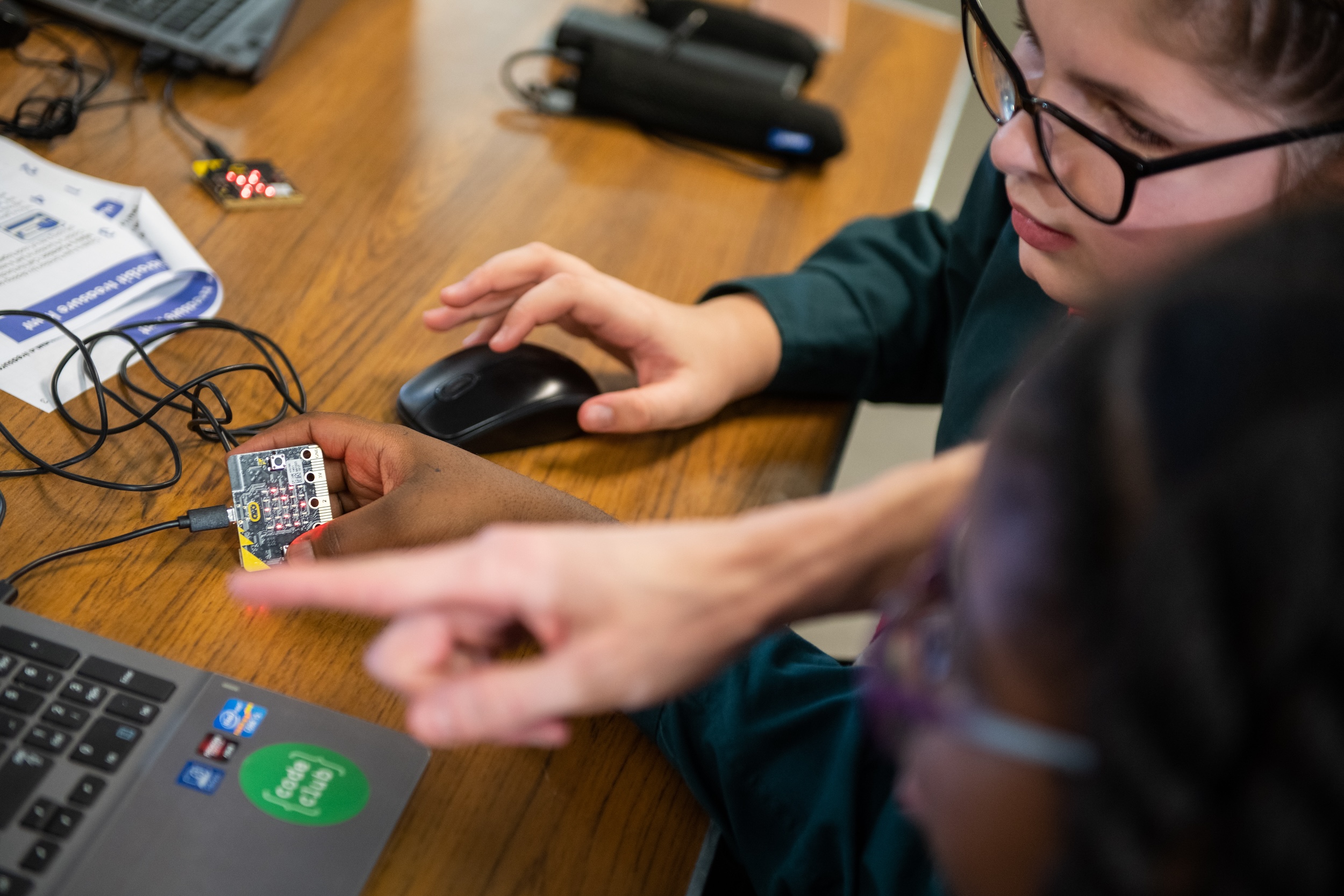
Exploring how well Experience AI maps to UNESCO’s AI competency framework for students

Post Syndicated from Ben Garside original https://www.raspberrypi.org/blog/experience-ai-unesco-ai-competency-framework/

During this year’s annual Digital Learning Week conference in September, UNESCO launched their AI competency frameworks for students and teachers. 

What is the AI competency framework for students? 

The UNESCO competency framework for students serves as a guide for education systems across the world to help students develop the necessary skills in AI literacy and to build inclusive, just, and sustainable futures in this new technological era.

It is an exciting document because, as well as being comprehensive, it’s the first global framework of its kind in the area of AI education.

The framework serves three specific purposes:

  • It offers a guide on essential AI concepts and skills for students, which can help shape AI education policies or programs at schools
  • It aims to shape students’ values, knowledge, and skills so they can understand AI critically and ethically
  • It suggests a flexible plan for when and how students should learn about AI as they progress through different school grades

The framework is a starting point for policy-makers, curriculum developers, school leaders, teachers, and educational experts to look at how it could apply in their local contexts. 

It is not possible to create a single curriculum suitable for all national and local contexts, but the framework flags the necessary competencies for students across the world to acquire the values, knowledge, and skills necessary to examine and understand AI critically from a holistic perspective.

How does Experience AI compare with the framework?

A group of researchers and curriculum developers from the Raspberry Pi Foundation, with a focus on AI literacy, attended the conference and afterwards we tasked ourselves with taking a deep dive into the student framework and mapping our Experience AI resources to it. Our aims were to:

  • Identify how the framework aligns with Experience AI
  • See how the framework aligns with our research-informed design principles
  • Identify gaps or next steps

Experience AI is a free educational programme that offers cutting-edge resources on artificial intelligence and machine learning for teachers, and their students aged 11 to 14. Developed in collaboration with the Raspberry Pi Foundation and Google DeepMind, the programme provides everything that teachers need to confidently deliver engaging lessons that will teach, inspire, and engage young people about AI and the role that it could play in their lives. The current curriculum offering includes a ‘Foundations of AI’ 6-lesson unit, 2 standalone lessons (‘AI and ecosystems’ and ‘Large language models’), and the 3 newly released AI safety resources. 

Working through each lesson objective in the Experience AI offering, we compared them with each curricular goal to see where they overlapped. We have made this mapping publicly available so that you can see this for yourself: Experience AI – UNESCO AI Competency framework students – learning objective mapping (rpf.io/unesco-mapping)

The first thing we discovered was that the mapping of the objectives did not have a 1:1 basis. For example, when we looked at a learning objective, we often felt that it covered more than one curricular goal from the framework. That’s not to say that the learning objective fully met each curricular goal, rather that it covers elements of the goal and in turn the student competency. 

Once we had completed the mapping process, we analysed the results by totalling the number of objectives that had been mapped against each competency aspect and level within the framework.

This provided us with an overall picture of where our resources are positioned against the framework. Whilst the majority of the objectives for all of the resources are in the ‘Human-centred mindset’ category, the analysis showed that there is still a relatively even spread of objectives in the other three categories (Ethics of AI, ML techniques and applications, and AI system design). 

As the current resource offering is targeted at the entry level to AI literacy, it is unsurprising to see that the majority of the objectives were at the level of ‘Understand’. It was, however, interesting to see how many objectives were also at the ‘Apply’ level. 

It is encouraging to see that the different resources from Experience AI map to different competencies in the framework. For example, the 6-lesson foundations unit aims to give students a basic understanding of how AI systems work and the data-driven approach to problem solving. In contrast, the AI safety resources focus more on the principles of Fairness, Accountability, Transparency, Privacy, and Security (FATPS), most of which fall more heavily under the ethics of AI and human-centred mindset categories of the competency framework. 

What did we learn from the process? 

Our principles align 

We built the Experience AI resources on design principles based on the knowledge curated by Jane Waite and the Foundation’s researchers. One of our aims of the mapping process was to see if the principles that underpin the UNESCO competency framework align with our own.

Avoiding anthropomorphism 

Anthropomorphism refers to the concept of attributing human characteristics to objects or living beings that aren’t human. For reasons outlined in the blog I previously wrote on the issue, a key design principle for Experience AI is to avoid anthropomorphism at all costs. In our resources, we are particularly careful with the language and images that we use. Putting the human in the process is a key way in which we can remind students that it is humans who design and are responsible for AI systems. 

Young people use computers in a classroom.

It was reassuring to see that the UNESCO framework has many curricular goals that align closely to this, for example:

  • Foster an understanding that AI is human-led
  • Facilitate an understanding on the necessity of exercising sufficient human control over AI
  • Nurture critical thinking on the dynamic relationship between human agency and machine agency

SEAME

The SEAME framework created by Paul Curzon and Jane Waite offers a way for teachers, resource developers, and researchers to talk about the focus of AI learning activities by separating them into four layers: Social and Ethical (SE), Application (A), Models (M), and Engines (E). 

The SEAME model and the UNESCO AI competency framework take two different approaches to categorising AI education — SEAME describes levels of abstraction for conceptual learning about AI systems, whereas the competency framework separates concepts into strands with progression. We found that although the alignment between the frameworks is not direct, the same core AI and machine learning concepts are broadly covered across both. 

Computational thinking 2.0 (CT2.0)

The concept of computational thinking 2.0 (a data-driven approach) stems from research by Professor Matti Tedre and Dr Henriikka Vartiainen from the University of Eastern Finland. The essence of this approach establishes AI as a different way to solve problems using computers compared to a more traditional computational thinking approach (a rule-based approach). This does not replace the traditional computational approach, but instead requires students to approach the problem differently when using AI as a tool. 

An educator points to an image on a student's computer screen.

The UNESCO framework includes many references within their curricular goals that places the data-driven approach at the forefront of problem solving using AI, including:

  • Develop conceptual knowledge on how AI is trained based on data 
  • Develop skills on assessing AI systems’ need for data, algorithms, and computing resources

Where we slightly differ in our approach is the regular use of the term ‘algorithm’, particularly in the Understand and Apply levels of the framework. We have chosen to differentiate AI systems from traditional computational thinking approaches by avoiding the term ‘algorithm’ at the foundational stage of AI education. We believe the learners need a firm mental model of data-driven systems before students can understand that the Model and Engines of the SEAME model refer to algorithms (which would possibly correspond to the Create stage of the UNESCO framework). 

We can identify areas for exploration

As part of the international expansion of Experience AI, we have been working with partners from across the globe to bring AI literacy education to students in their settings. Part of this process has involved working with our partners to localise the resources, but also to provide training on the concepts covered in Experience AI. During localisation and training, our partners often have lots of queries about the lesson on bias. 

As a result, we decided to see if mapping taught us anything about this lesson in particular, and if there was any learning we could take from it. At close inspection, we found that the lesson covers two out of the three curricular goals for the Understand element of the ‘Ethics of AI’ category (Embodied ethics). 

Specifically, we felt the lesson:

  • Illustrates dilemmas around AI and identifies the main reasons behind ethical conflicts
  • Facilitates scenario-based understandings of ethical principles on AI and their personal implications

What we felt isn’t covered in the lesson is:

  • Guide the embodied reflection and internalisation of ethical principles on AI

Exploring this further, the framework describes this curricular goal as:

Guide students to understand the implications of ethical principles on AI for their human rights, data privacy, safety, human agency, as well as for equity, inclusion, social justice and environmental sustainability. Guide students to develop embodied comprehension of ethical principles; and offer opportunities to reflect on personal attitudes that can help address ethical challenges (e.g. advocating for inclusive interfaces for AI tools, promoting inclusion in AI and reporting discriminatory biases found in AI tools).

We realised that this doesn’t mean that the lesson on bias is ineffective or incomplete, but it does help us to think more deeply about the learning objective for the lesson. This may be something we will look to address in future iterations of the foundations unit or even in the development of new resources. What we have identified is a process that we can follow, which will help us with our decision making in the next phases of resource development. 

How does this inform our next steps?

As part of the analysis of the resources, we created a simple heatmap of how the Experience AI objectives relate to the UNESCO progression levels. As with the barcharts, the heatmap indicated that the majority of the objectives sit within the Understand level of progression, with fewer in Apply, and fewest in Create. As previously mentioned, this is to be expected with the resources being “foundational”. 

The heatmap has, however, helped us to identify some interesting points about our resources that warrant further thought. For example, under the ‘Human-centred mindset’ competency aspect, there are more objectives under Apply than there are Understand. For ‘AI system design’, architecture design is the least covered aspect of Apply. 

By identifying these areas for investigation, again it shows that we’re able to add the learnings from the UNESCO framework to help us make decisions.

What next? 

This mapping process has been a very useful exercise in many ways for those of us working on AI literacy at the Raspberry Pi Foundation. The process of mapping the resources gave us an opportunity to have deep conversations about the learning objectives and question our own understanding of our resources. It was also very satisfying to see that the framework aligns well with our own researched-informed design principles, such as the SEAME model and avoiding anthropomorphisation. 
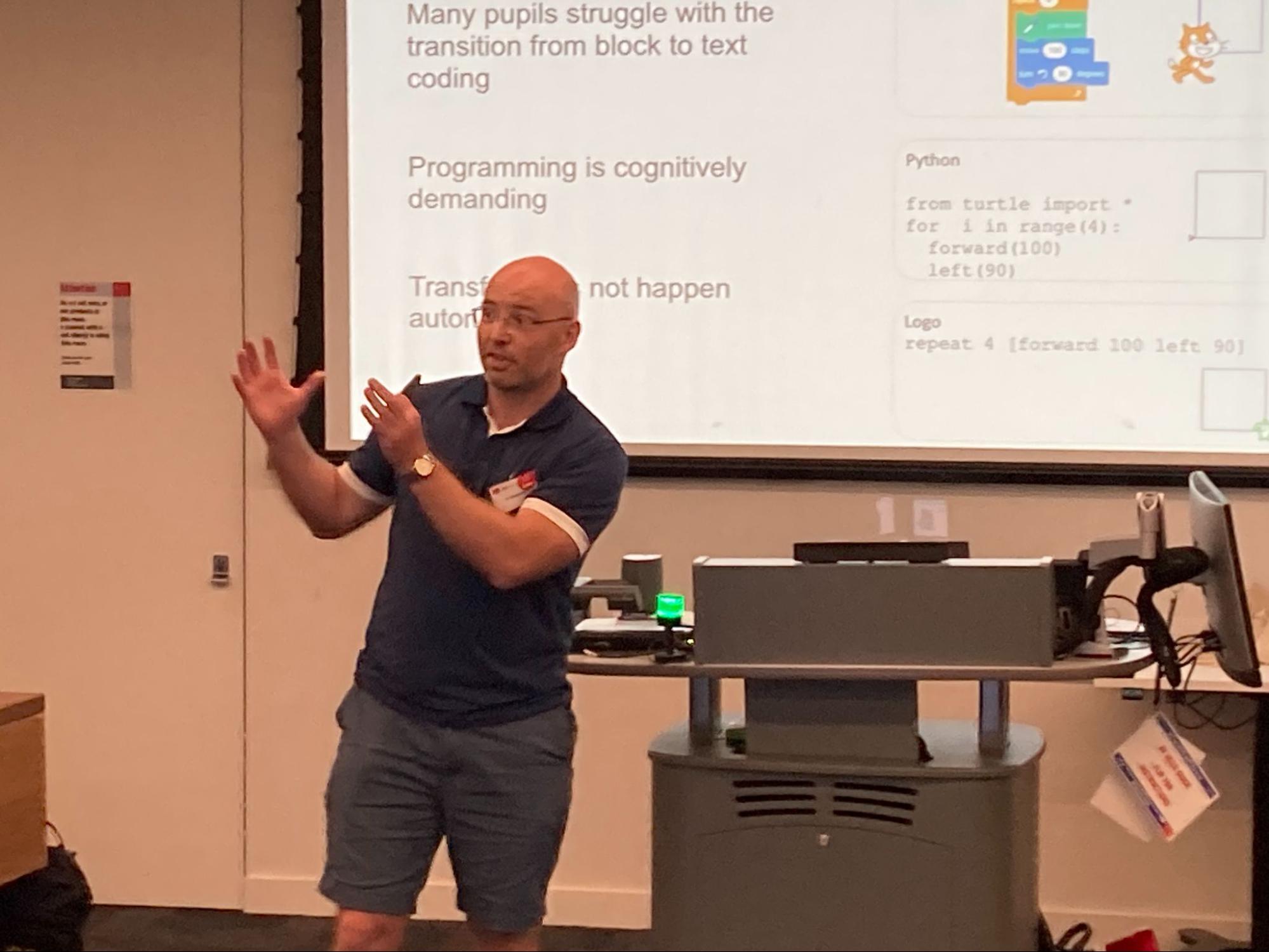
The mapping process has been a good starting point for us to understand UNESCO’s framework and we’re sure that it will act as a useful tool to help us make decisions around future enhancements to our foundational units and new free educational materials. We’re looking forward to applying what we’ve learnt to our future work! 

The post Exploring how well Experience AI maps to UNESCO’s AI competency framework for students appeared first on Raspberry Pi Foundation.

Impact of Experience AI: Reflections from students and teachers

Post Syndicated from Lou Loxley original https://www.raspberrypi.org/blog/impact-of-experience-ai-reflections-from-students-and-teachers/

“I’ve enjoyed actually learning about what AI is and how it works, because before I thought it was just a scary computer that thinks like a human,” a student learning with Experience AI at King Edward’s School, Bath, UK, told us. 

This is the essence of what we aim to do with our Experience AI lessons, which demystify artificial intelligence (AI) and machine learning (ML). Through Experience AI, teachers worldwide are empowered to confidently deliver engaging lessons with a suite of resources that inspire and educate 11- to 14-year-olds about AI and the role it could play in their lives.

“I learned new things and it changed my mindset that AI is going to take over the world.” – Student, Malaysia

Experience AI students in Malaysia

Developed by us with Google DeepMind, our first set of Experience AI lesson resources was aimed at a UK audience and launched in April 2023. Next we released tailored versions of the resources for 5 other countries, working in close partnership with organisations in Malaysia, Kenya, Canada, Romania, and India. Thanks to new funding from Google.org, we’re now expanding Experience AI for 16 more countries and creating new resources on AI safety, with the aim of providing leading-edge AI education for more than 2 million young people across Europe, the Middle East, and Africa. 

In this blog post, you’ll hear directly from students and teachers about the impact the Experience AI lessons have had so far. 

Case study:  Experience AI in Malaysia

Penang Science Cluster in Malaysia is among the first organisations we’ve partnered with for Experience AI. Speaking to Malaysian students learning with Experience AI, we found that the lessons were often very different from what they had expected. 

Launch of Experience AI in Malaysia

“I actually thought it was going to be about boring lectures and not much about AI but more on coding, but we actually got to do a lot of hands-on activities, which are pretty fun. I thought AI was just about robots, but after joining this, I found it could be made into chatbots or could be made into personal helpers.” – Student, Malaysia

“Actually, I thought AI was mostly related to robots, so I was expecting to learn more about robots when I came to this programme. It widened my perception on AI.” – Student, Malaysia. 

The Malaysian government actively promotes AI literacy among its citizens, and working with local education authorities, Penang Science Cluster is using Experience AI to train teachers and equip thousands of young people in the state of Penang with the understanding and skills to use AI effectively. 

“We envision a future where AI education is as fundamental as mathematics education, providing students with the tools they need to thrive in an AI-driven world”, says Aimy Lee, Chief Operating Officer at Penang Science Cluster. “The journey of AI exploration in Malaysia has only just begun, and we’re thrilled to play a part in shaping its trajectory.”

Giving non-specialist teachers the confidence to introduce AI to students

Experience AI provides lesson plans, classroom resources, worksheets, hands-on activities, and videos to help teachers introduce a wide range of AI applications and help students understand how they work. The resources are based on research, and because we adapt them to each partner’s country, they are culturally relevant and relatable for students. Any teacher can use the resources in their classroom, whether or not they have a background in computing education. 
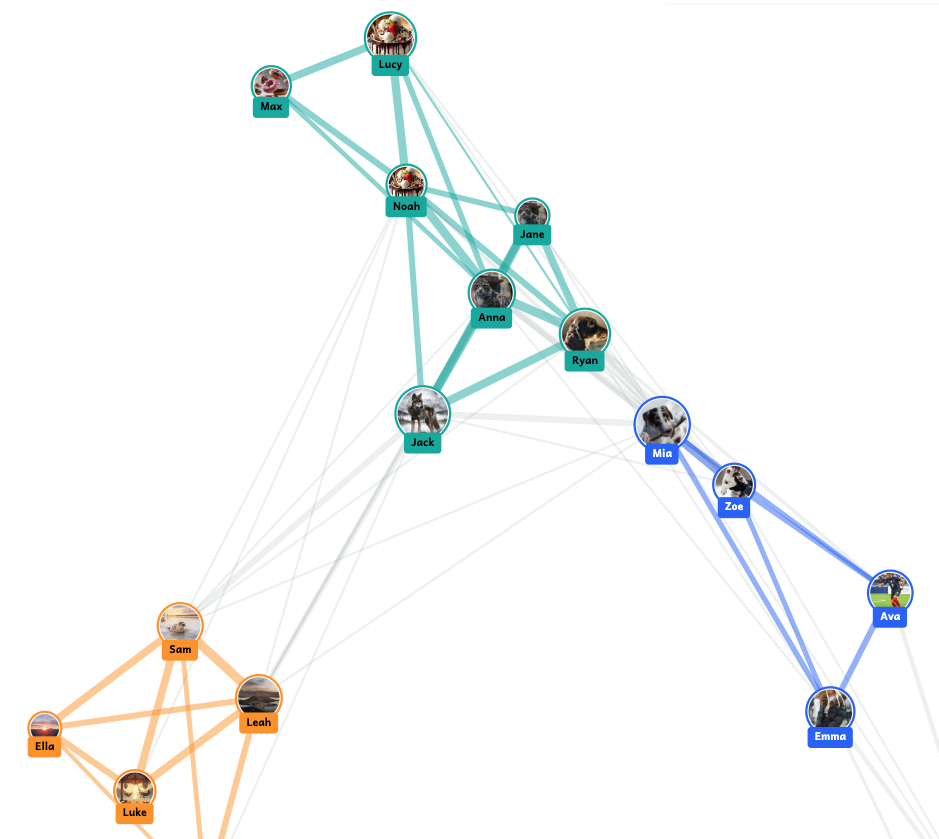
“Our Key Stage 3 Computing students now feel immensely more knowledgeable about the importance and place that AI has in their wider lives. These lessons and activities are engaging and accessible to students and educators alike, whatever their specialism may be.” – Dave Cross,  North Liverpool Academy, UK
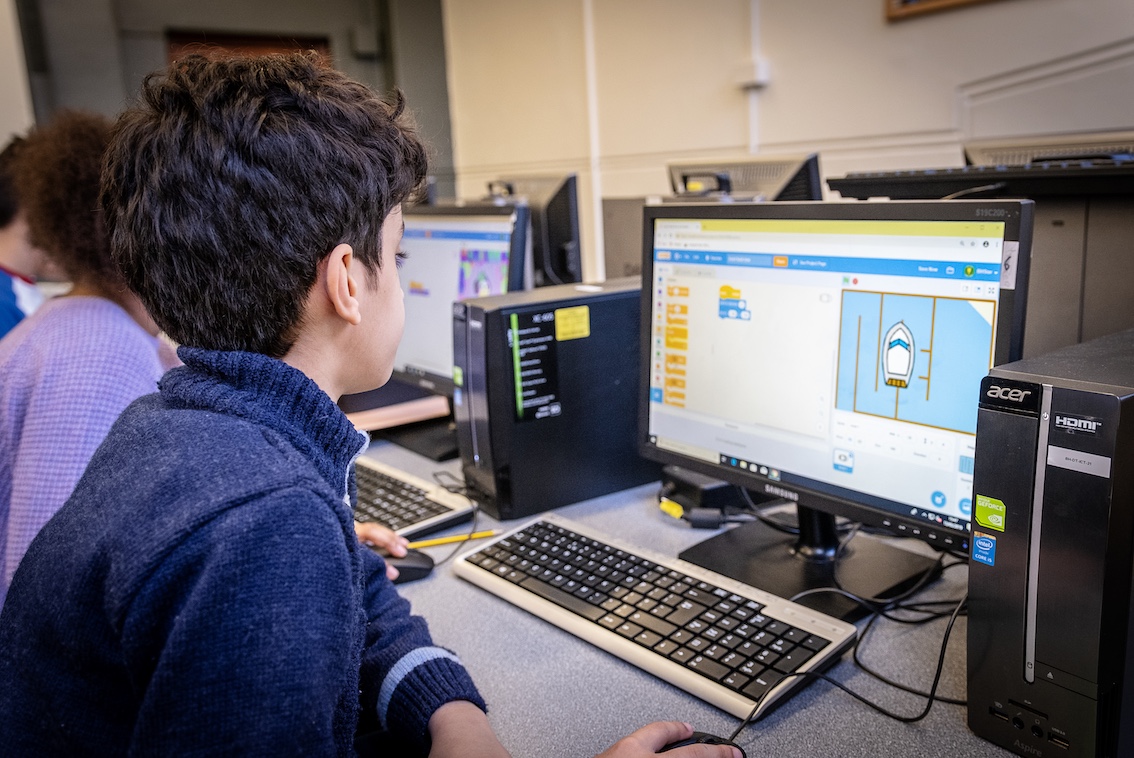
“The feedback we’ve received from both teachers and learners has been overwhelmingly positive. They consistently rave about how accessible, fun, and hands-on these resources are. What’s more, the materials are so comprehensive that even non-specialists can deliver them with confidence.” – Storm Rae, The National Museum of Computing, UK

Experience AI teacher training in Kenya

“[The lessons] go above and beyond to ensure that students not only grasp the material but also develop a genuine interest and enthusiasm for the subject.” – Teacher, Changamwe Junior School, Mombasa, Kenya

Sparking debates on bias and the limitations of AI

When learners gain an understanding of how AI works, it gives them the confidence to discuss areas where the technology doesn’t work well or its output is incorrect. These classroom debates deepen and consolidate their knowledge, and help them to use AI more critically.

“Students enjoyed the practical aspects of the lessons, like categorising apples and tomatoes. They found it intriguing how AI could sometimes misidentify objects, sparking discussions on its limitations. They also expressed concerns about AI bias, which these lessons helped raise awareness about. I didn’t always have all the answers, but it was clear they were curious about AI’s implications for their future.” – Tracey Mayhead, Arthur Mellows Village College, Peterborough, UK

Experience AI students in UK

“The lessons that we trialled took some of the ‘magic’ out of AI and started to give the students an understanding that AI is only as good as the data that is used to build it.” – Jacky Green, Waldegrave School, UK 

“I have enjoyed learning about how AI is actually programmed, rather than just hearing about how impactful and great it could be.” – Student, King Edward’s School, Bath, UK 

“It has changed my outlook on AI because now I’ve realised how much AI actually needs human intelligence to be able to do anything.” – Student, Arthur Mellows Village College, Peterborough, UK 

“I didn’t really know what I wanted to do before this but now knowing more about AI, I probably would consider a future career in AI as I find it really interesting and I really liked learning about it.” – Student, Arthur Mellows Village College, Peterborough, UK 

If you’d like to get involved with Experience AI as an educator and use our free lesson resources with your class, you can start by visiting experience-ai.org.

The post Impact of Experience AI: Reflections from students and teachers appeared first on Raspberry Pi Foundation.