AWS plans to invest €7.8B into the AWS European Sovereign Cloud, set to launch by the end of 2025

Post Syndicated from Max Peterson original https://aws.amazon.com/blogs/security/aws-plans-to-invest-e7-8b-into-the-aws-european-sovereign-cloud-set-to-launch-by-the-end-of-2025/

English | German

Amazon Web Services (AWS) continues to believe it’s essential that our customers have control over their data and choices for how they secure and manage that data in the cloud. AWS gives customers the flexibility to choose how and where they want to run their workloads, including a proven track record of innovation to support specialized workloads around the world. While many customers are able to meet their stringent security, sovereignty, and privacy requirements using our existing sovereign-by-design AWS Regions, we know there’s not a one-size-fits-all solution. AWS continues to innovate based on the criteria we know are most important to our customers to give them more choice and more control. Last year we announced the AWS European Sovereign Cloud, a new independent cloud for Europe, designed to give public sector organizations and customers in highly regulated industries further choice to meet their unique sovereignty needs. Today, we’re excited to share more details about the AWS European Sovereign Cloud roadmap so that customers and partners can start planning. The AWS European Sovereign Cloud is planning to launch its first AWS Region in the State of Brandenburg, Germany by the end of 2025. Available to all AWS customers, this effort is backed by a €7.8B investment in infrastructure, jobs creation, and skills development.

The AWS European Sovereign Cloud will utilize the full power of AWS with the same familiar architecture, expansive service portfolio, and APIs that customers use today. This means that customers using the AWS European Sovereign Cloud will get the benefits of AWS infrastructure including industry-leading security, availability, performance, and resilience. We offer a broad set of services, including a full suite of databases, compute, storage, analytics, machine learning and AI, networking, mobile, developer tools, IoT, security, and enterprise applications. Today, customers can start building applications in any existing Region and simply move them to the AWS European Sovereign Cloud when the first Region launches in 2025. Partners in the AWS Partner Network, which features more than 130,000 partners, already provide a range of offerings in our existing AWS Regions to help customers meet requirements and will now be able to seamlessly deploy applications on the AWS European Sovereign Cloud.

More control, more choice

Like our existing Regions, the AWS European Sovereign Cloud will be powered by the AWS Nitro System. The Nitro System is an unparalleled computing backbone for AWS, with security and performance at its core. Its specialized hardware and associated firmware are designed to enforce restrictions so that nobody, including anyone in AWS, can access customer workloads or data running on Amazon Elastic Compute Cloud (Amazon EC2) Nitro based instances. The design of the Nitro System has been validated by the NCC Group, an independent cybersecurity firm. The controls that help prevent operator access are so fundamental to the Nitro System that we’ve added them in our AWS Service Terms to provide an additional contractual assurance to all of our customers.

To date, we have launched 33 Regions around the globe with our secure and sovereign-by-design approach. Customers come to AWS because they want to migrate to and build on a secure cloud foundation. Customers who need to comply with European data residency requirements have the choice to deploy their data to any of our eight existing Regions in Europe (Ireland, Frankfurt, London, Paris, Stockholm, Milan, Zurich, and Spain) to keep their data securely in Europe.

For customers who need to meet additional stringent operational autonomy and data residency requirements within the European Union (EU), the AWS European Sovereign Cloud will be available as another option, with infrastructure wholly located within the EU and operated independently from existing Regions. The AWS European Sovereign Cloud will allow customers to keep all customer data and the metadata they create (such as the roles, permissions, resource labels, and configurations they use to run AWS) in the EU. Customers who need options to address stringent isolation and in-country data residency needs will be able to use AWS Dedicated Local Zones or AWS Outposts to deploy AWS European Sovereign Cloud infrastructure in locations they select. We continue to work with our customers and partners to shape the AWS European Sovereign Cloud, applying learnings from our engagements with European regulators and national cybersecurity authorities.

Continued investment in Europe

Over the last 25 years, we’ve driven economic development through our investment in infrastructure, jobs, and skills in communities and countries across Europe. Since 2010, Amazon has invested more than €150 billion in the EU, and we’re proud to employ more than 150,000 people in permanent roles across the European Single Market.

AWS now plans to invest €7.8 billion in the AWS European Sovereign Cloud by 2040, building on our long-term commitment to Europe and ongoing support of the region’s sovereignty needs. This long-term investment is expected to lead to a ripple effect in the local cloud community through accelerating productivity gains, empowering the digital transformation of businesses, empowering the AWS Partner Network (APN), upskilling the cloud and digital workforce, developing renewable energy projects, and creating a positive impact in the communities where AWS operates. In total, the AWS planned investment is estimated to contribute €17.2 billion to Germany’s total Gross Domestic Product (GDP) through 2040, and support an average 2,800 full-time equivalent jobs in local German businesses each year. These positions, including construction, facility maintenance, engineering, telecommunications, and other jobs within the broader local economy, are part of the AWS data center supply chain.

In addition, AWS is also creating new highly skilled permanent roles to build and operate the AWS European Sovereign Cloud. These jobs will include software engineers, systems developers, and solutions architects. This is part of our commitment that all day-to-day operations of the AWS European Sovereign Cloud will be controlled exclusively by personnel located in the EU, including access to data centers, technical support, and customer service.

In Germany, we also collaborate with local communities on long-term, innovative programs that will have a lasting impact in the areas where our infrastructure is located. This includes developing cloud workforce and education initiatives for learners of all ages, helping to solve for the skills gap and prepare for the tech jobs of the future. For example, last year AWS partnered with Siemens AG to design the first apprenticeship program for AWS data centers in Germany, launched the first national cloud computing certification with the German Chamber of Commerce (DIHK), and established the AWS Skills to Jobs Tech Alliance in Germany. We will work closely with local partners to roll out these skills programs and make sure they are tailored to regional needs.

“High performing, reliable, and secure infrastructure is the most important prerequisite for an increasingly digitalized economy and society. Brandenburg is making progress here. In recent years, we have set on a course to invest in modern and sustainable data center infrastructure in our state, strengthening Brandenburg as a business location. State-of-the-art data centers for secure cloud computing are the basis for a strong digital economy. I am pleased Amazon Web Services (AWS) has chosen Brandenburg for a long-term investment in its cloud computing infrastructure for the AWS European Sovereign Cloud.”

Brandenburg’s Minister of Economic Affairs, Prof. Dr. Jörg Steinbach

Build confidently with AWS

For customers that are early in their cloud adoption journey and are considering the AWS European Sovereign Cloud, we provide a wide range of resources to help adopt the cloud effectively. From lifting and shifting workloads to migrating entire data centers, customers get the organizational, operational, and technical capabilities needed for a successful migration to AWS. For example, we offer the AWS Cloud Adoption Framework (AWS CAF) to provide best practices for organizations to develop an efficient and effective plan for cloud adoption, and AWS Migration Hub to help assess migration needs, define migration and modernization strategy, and leverage automation. We frequently host AWS events, webinars, and workshops focused on cloud adoption and migration strategies, where customers can learn from AWS experts and connect with other customers and partners.

We’re committed to giving customers more control and more choice to help meet their unique digital sovereignty needs, without compromising on the full power of AWS. The AWS European Sovereign Cloud is a testament to this. To help customers and partners continue to plan and build, we will share additional updates as we drive towards launch. You can discover more about the AWS European Sovereign Cloud on our European Digital Sovereignty website.

 
If you have feedback about this post, submit comments in the Comments section below. If you have questions about this post, contact AWS Support.

Want more AWS Security news? Follow us on X.


German version

AWS European Sovereign Cloud bis Ende 2025: AWS plant Investitionen in Höhe von 7,8 Milliarden Euro

Amazon Web Services (AWS) ist davon überzeugt, dass es für Kunden von essentieller Bedeutung ist, die Kontrolle über ihre Daten und Auswahlmöglichkeiten zu haben, wie sie diese Daten in der Cloud sichern und verwalten. Daher können Kunden flexibel wählen, wie und wo sie ihre Workloads ausführen. Dazu gehört auch eine langjährige Erfolgsbilanz von Innovationen zur Unterstützung spezialisierter Workloads auf der ganzen Welt. Viele Kunden können bereits ihre strengen Sicherheits-, Souveränitäts- und Datenschutzanforderungen mit unseren AWS-Regionen unter dem „sovereign-by-design“-Ansatz erfüllen. Aber wir wissen ebenso: Es gibt keine Einheitslösung für alle. Daher arbeitet AWS kontinuierlich an Innovationen, die auf jenen Kriterien basieren, die für unsere Kunden am wichtigsten sind und ihnen mehr Auswahl sowie Kontrolle bieten. Vor diesem Hintergrund haben wir letztes Jahr die AWS European Sovereign Cloud angekündigt. Mit ihr entsteht eine neue, unabhängige Cloud für Europa. Sie soll Organisationen des öffentlichen Sektors und Kunden in stark regulierten Branchen dabei helfen, die sich wandelnden Anforderungen an die digitale Souveränität zu erfüllen.

Heute freuen wir uns, dass wir weitere Details über die Roadmap der AWS European Sovereign Cloud bekanntgeben können. So können unsere Kunden und Partner mit ihren weiteren Planungen beginnen. Der Start der ersten Region der AWS European Sovereign Cloud ist in Brandenburg bis zum Jahresende 2025 geplant. Dieses Angebot steht allen AWS-Kunden zur Verfügung und wird von einer Investition in Höhe von 7,8 Milliarden Euro in die Infrastruktur, Arbeitsplatzschaffung und Kompetenzentwicklung unterstützt.

Die AWS European Cloud in Brandenburg bietet die volle Leistungsfähigkeit, mit der bekannten Architektur, dem umfangreichen Angebot an Services und denselben APIs, die Millionen von Kunden bereits kennen. Das bedeutet: Kunden der AWS European Sovereign Cloud profitieren somit bei voller Unabhängigkeit von den bekannten Vorteilen der AWS-Infrastruktur, einschließlich der branchenführenden Sicherheit, Verfügbarkeit, Leistung und Resilienz.

AWS-Kunden haben Zugriff auf ein breites Spektrum an Services – darunter ein umfangreiches Angebot bestehend aus Datenbanken, Datenverarbeitung, Datenspeicherung, Analytics, maschinellem Lernen (ML) und künstlicher Intelligenz (KI), Netzwerken, mobilen Applikationen, Entwickler-Tools, Internet of Things (IoT), Sicherheit und Unternehmensanwendungen. Bereits heute können Kunden Anwendungen in jeder bestehenden Region entwickeln und diese einfach in die AWS European Sovereign Cloud auslagern, sobald die erste AWS-Region 2025 startet. Die Partner im AWS-Partnernetzwerks (APN), das mehr als 130.000 Partner umfasst, bietet bereits eine Reihe von Angeboten in den bestehenden AWS-Regionen an. Dadurch unterstützen sie Kunden dabei, ihre Anforderungen zu erfüllen und Anwendungen einfach in der AWS European Sovereign Cloud bereitzustellen.

Mehr Kontrolle, größere Auswahl

Die AWS European Sovereign Cloud nutzt wie auch unsere bestehenden Regionen das AWS Nitro System. Dabei handelt es sich um einen Computing-Backbone für AWS, bei dem Sicherheit und Leistung im Mittelpunkt stehen. Die spezialisierte Hardware und zugehörige Firmware sind so konzipiert, dass strikte Beschränkungen gelten und niemand, auch nicht AWS selbst, auf die Workloads oder Daten von Kunden zugreifen kann, die auf Amazon Elastic Compute Cloud (Amazon EC2) Nitro-basierten Instanzen laufen. Dieses Design wurde von der NCC Group validiert, einem unabhängigen Unternehmen für Cybersicherheit. Die Kontrollen, die den Zugriff durch Betreiber verhindern, sind grundlegend für das Nitro System. Daher haben wir sie in unsere AWS Service Terms aufgenommen, um allen unseren Kunden diese zusätzliche vertragliche Zusicherung zu geben.

Bis heute haben wir 33 Regionen rund um den Globus mit unserem sicheren und „sovereign-by-design“-Ansatz gestartet. Unsere Kunden nutzen AWS, weil sie auf einer sicheren Cloud-Umgebung migrieren und aufbauen möchten. Für Kunden, die europäische Anforderungen an den Ort der Datenverarbeitung erfüllen müssen, bietet AWS die Möglichkeit, ihre Daten in einer unserer acht bestehenden Regionen in Europa zu verarbeiten: Irland, Frankfurt, London, Paris, Stockholm, Mailand, Zürich und Spanien. So können sie ihre Daten sicher innerhalb Europas halten.

Müssen Kunden zusätzliche Anforderungen an die betriebliche Autonomie und den Ort der Datenverarbeitung innerhalb der Europäischen Union erfüllen, steht die AWS European Sovereign Cloud als weitere Option zur Verfügung. Die Infrastruktur hierfür ist vollständig in der EU angesiedelt und wird unabhängig von den bestehenden Regionen betrieben. Sie ermöglicht es AWS-Kunden, ihre Kundeninhalte und von ihnen erstellten Metadaten in der EU zu behalten – etwa Rollen, Berechtigungen, Ressourcenbezeichnungen und Konfigurationen für den Betrieb von AWS.

Sollten Kunden weitere Optionen benötigen, um eine Isolierung zu ermöglichen und strenge Anforderungen an den Ort der Datenverarbeitung in einem bestimmten Land zu erfüllen, können sie auf AWS Dedicated Local Zones oder AWS Outposts zurückgreifen. Auf diese Weise können sie die Infrastruktur der AWS European Sovereign Cloud am Ort ihrer Wahl einsetzen. Wir arbeiten mit unseren Kunden und Partnern kontinuierlich daran, die AWS European Sovereign Cloud so zu gestalten, dass sie den benötigten Anforderungen entspricht. Dabei nutzen wir auch Feedback aus unseren Gesprächen mit europäischen Regulierungsbehörden und nationalen Cybersicherheitsbehörden.

„Eine funktionierende, verlässliche und sichere Infrastruktur ist die wichtigste Vorrausetzung für eine zunehmend digitalisierte Wirtschaft und Gesellschaft. Brandenburg schreitet hier voran. Wir haben in den vergangenen Jahren entscheidende Weichen gestellt, um Investitionen in eine moderne und nachhaltige Rechenzentruminfrastruktur in unserem Land auszubauen und so den Wirtschaftsstandort Brandenburg zu stärken. Hochmoderne Rechenzentren für sicheres Cloud-Computing sind die Basis für eine digitale Wirtschaft. Für unsere digitale Souveränität ist es wichtig, dass Rechenleistungen vor Ort in Deutschland erbracht werden. Ich freue mich, dass Amazon Web Services Brandenburg für ein langfristiges Investment in ihre Cloud-Computing-Infrastruktur für die AWS European Sovereign Cloud ausgewählt hat.“

sagt Brandenburgs Wirtschaftsminister Prof. Dr.-Ing. Jörg Steinbach

Kontinuierliche Investitionen in Europa

Im Laufe der vergangenen 25 Jahre haben wir die wirtschaftliche Entwicklung in europäischen Ländern und Gemeinden vorangetrieben und in Infrastruktur, Arbeitsplätze sowie den Ausbau von Kompetenzen investiert. Seit 2010 hat Amazon über 150 Milliarden Euro in der Europäischen Union investiert und wir sind stolz darauf, im gesamten europäischen Binnenmarkt mehr als 150.000 Menschen in Festanstellung zu beschäftigen.

AWS plant bis zum Jahr 2040 7,8 Milliarden Euro in die AWS European Sovereign Cloud zu investieren. Diese Investition ist Teil der langfristigen Bestrebungen von AWS, das europäische Bedürfnis nach digitaler Souveränität zu unterstützen. Mit dieser langfristigen Investition löst AWS einen Multiplikatoreffekt für Cloud-Computing in Europa aus. Sie wird die digitale Transformation der Verwaltung und von Unternehmen vorantreiben, das AWS Partner Network (APN) stärken, die Zahl der Cloud- und Digitalfachkräfte erhöhen, erneuerbare Energieprojekte vorantreiben und eine positive Wirkung in den Gemeinden erzielen, in denen AWS präsent ist. Insgesamt wird die geplante AWS-Investition bis 2040 voraussichtlich 17,2 Milliarden Euro zum deutschen Bruttoinlandsprodukt und zur Schaffung von 2.800 Vollzeitstellen bei regionalen Unternehmen beitragen. Diese Arbeitsplätze in den Bereichen Bau, Instandhaltung, Ingenieurwesen, Telekommunikation und der breiteren regionalen Wirtschaft sind Teil der Lieferkette für AWS-Rechenzentren.

Darüber hinaus wird AWS neue Stellen für hochqualifizierte festangestellte Fachkräfte wie Softwareentwickler, Systemingenieure und Lösungsarchitekten schaffen, um die AWS European Sovereign Cloud aufzubauen und zu betreiben. Die Investition in zusätzliches Personal unterstreicht unser Commitment, dass der gesamte Betrieb dieser souveränen Cloud-Umgebung – angefangen bei der Zugangskontrolle zu den Rechenzentren über den technischen Support bis hin zum Kundendienst – ausnahmslos durch Fachkräfte innerhalb der Europäischen Union kontrolliert und gesteuert wird.

In Deutschland arbeitet AWS mit den Beteiligten vor Ort auch an langfristigen und innovativen Programmen zusammen. Diese sollen einen nachhaltigen positiven Einfluss auf die Gemeinden haben, in denen sich die Infrastruktur des Unternehmens befindet. AWS konzentriert sich auf die Entwicklung von Cloud-Fachkräften und Schulungsinitiativen für Lernende aller Altersgruppen. Diese Maßnahmen tragen dazu bei, den Fachkräftemangel zu beheben und sich auf die technischen Berufe der Zukunft vorzubereiten. Im vergangenen Jahr hat AWS beispielsweise gemeinsam mit der Siemens AG das erste Ausbildungsprogramm für AWS-Rechenzentren in Deutschland entwickelt. Ebenso hat das Unternehmen in Kooperation mit dem Deutschen Industrie und Handelstag (DIHK) den bundeseinheitlichen Zertifikatslehrgang zum „Cloud Business Expert“ entwickelt sowie die AWS Skills to Jobs Tech Alliance in Deutschland ins Leben gerufen. AWS wird gemeinsam mit lokalen Partnern daran arbeiten, Ausbildungsprogramme und Fortbildungen anzubieten, die auf die Bedürfnisse vor Ort zugeschnitten sind.

Vertrauensvoll bauen mit AWS

Für Kunden, die sich noch am Anfang ihrer Cloud-Reise befinden und die AWS European Sovereign Cloud in Betracht ziehen, bieten wir eine Vielzahl von Ressourcen an, um den Wechsel in die Cloud effektiv zu gestalten. Egal ob einzelne Workloads verlagert oder ganze Rechenzentren migriert werden sollen – Kunden erhalten von uns die nötigen organisatorischen, operativen und technischen Fähigkeiten für eine erfolgreiche Migration zu AWS. Beispielsweise bieten wir das AWS Cloud Adoption Framework (AWS CAF) an, das Unternehmen bei der Entwicklung eines effizienten und effektiven Cloud-Adoptionsplans mit Best Practices unterstützt. Auch der AWS Migration Hub hilft bei der Bewertung des Migrationsbedarfs, der Definition der Migrations- und Modernisierungsstrategie und der Nutzung von Automatisierung. Darüber hinaus veranstalten wir regelmäßig AWS-Events, Webinare und Workshops rund um die Themen Cloud-Adoption und Migrationsstrategie. Dabei können Kunden von AWS-Experten lernen und sich mit anderen Kunden und Partnern vernetzen.

Wir sind bestrebt, unseren Kunden mehr Kontrolle und weitere Optionen anzubieten, damit diese ihre ganz individuellen Anforderungen an die digitale Souveränität erfüllen können, ohne dabei auf die volle Leistungsfähigkeit von AWS verzichten zu müssen.

Um Kunden und Partnern bei der weiteren Planung und Entwicklung zu unterstützen, werden wir laufend zusätzliche Updates bereitstellen, während wir auf den Start der AWS European Sovereign Cloud hinarbeiten. Mehr über die AWS European Sovereign Cloud erfahren Sie auf unserer Website zur European Digital Sovereignty.

 

Max Peterson

Max Peterson

Max is the Vice President of AWS Sovereign Cloud. He leads efforts to ensure that all AWS customers around the world have the most advanced set of sovereignty controls, privacy safeguards, and security features available in the cloud. Before his current role, Max served as the VP of AWS Worldwide Public Sector (WWPS) and created and led the WWPS International Sales division, with a focus on empowering government, education, healthcare, aerospace and satellite, and nonprofit organizations to drive rapid innovation while meeting evolving compliance, security, and policy requirements. Max has over 30 years of public sector experience and served in other technology leadership roles before joining Amazon. Max has earned both a Bachelor of Arts in Finance and Master of Business Administration in Management Information Systems from the University of Maryland.

Elementary Physics Paths

Post Syndicated from xkcd.com original https://xkcd.com/2933/

Investigating lateral movements with Amazon Detective investigation and Security Lake integration

Post Syndicated from Yue Zhu original https://aws.amazon.com/blogs/security/investigating-lateral-movements-with-amazon-detective-investigation-and-security-lake-integration/

According to the MITRE ATT&CK framework, lateral movement consists of techniques that threat actors use to enter and control remote systems on a network. In Amazon Web Services (AWS) environments, threat actors equipped with illegitimately obtained credentials could potentially use APIs to interact with infrastructures and services directly, and they might even be able to use APIs to evade defenses and gain direct access to Amazon Elastic Compute Cloud (Amazon EC2) instances. To help customers secure their AWS environments, AWS offers several security services, such as Amazon GuardDuty, a threat detection service that monitors for malicious activity and anomalous behavior, and Amazon Detective, an investigation service that helps you investigate, and respond to, security events in your AWS environment.

After the service is turned on, Amazon Detective automatically collects logs from your AWS environment to help you analyze and investigate security events in-depth. At re:Invent 2023, Detective released Detective Investigations, a one-click investigation feature that automatically investigates AWS Identity and Access Management (IAM) users and roles for indicators of compromise (IoC), and Security Lake integration, which enables customers to retrieve log data from Amazon Security Lake to use as original evidence for deeper analysis with access to more detailed parameters.

In this post, you will learn about the use cases behind these features, how to run an investigation using the Detective Investigation feature, and how to interpret the contents of investigation reports. In addition, you will also learn how to use the Security Lake integration to retrieve raw logs to get more details of the impacted resources.

Triage a suspicious activity

As a security analyst, one of the common workflows in your daily job is to respond to suspicious activities raised by security event detection systems. The process might start when you get a ticket about a GuardDuty finding in your daily operations queue, alerting you that suspicious or malicious activity has been detected in your environment. To view more details of the finding, one of the options is to use the GuardDuty console.

In the GuardDuty console, you will find more details about the finding, such as the account and AWS resources that are in scope, the activity that caused the finding, the IP address that caused the finding and information about its possible geographic location, and times of the first and last occurrences of the event. To triage the finding, you might need more information to help you determine if it is a false positive.

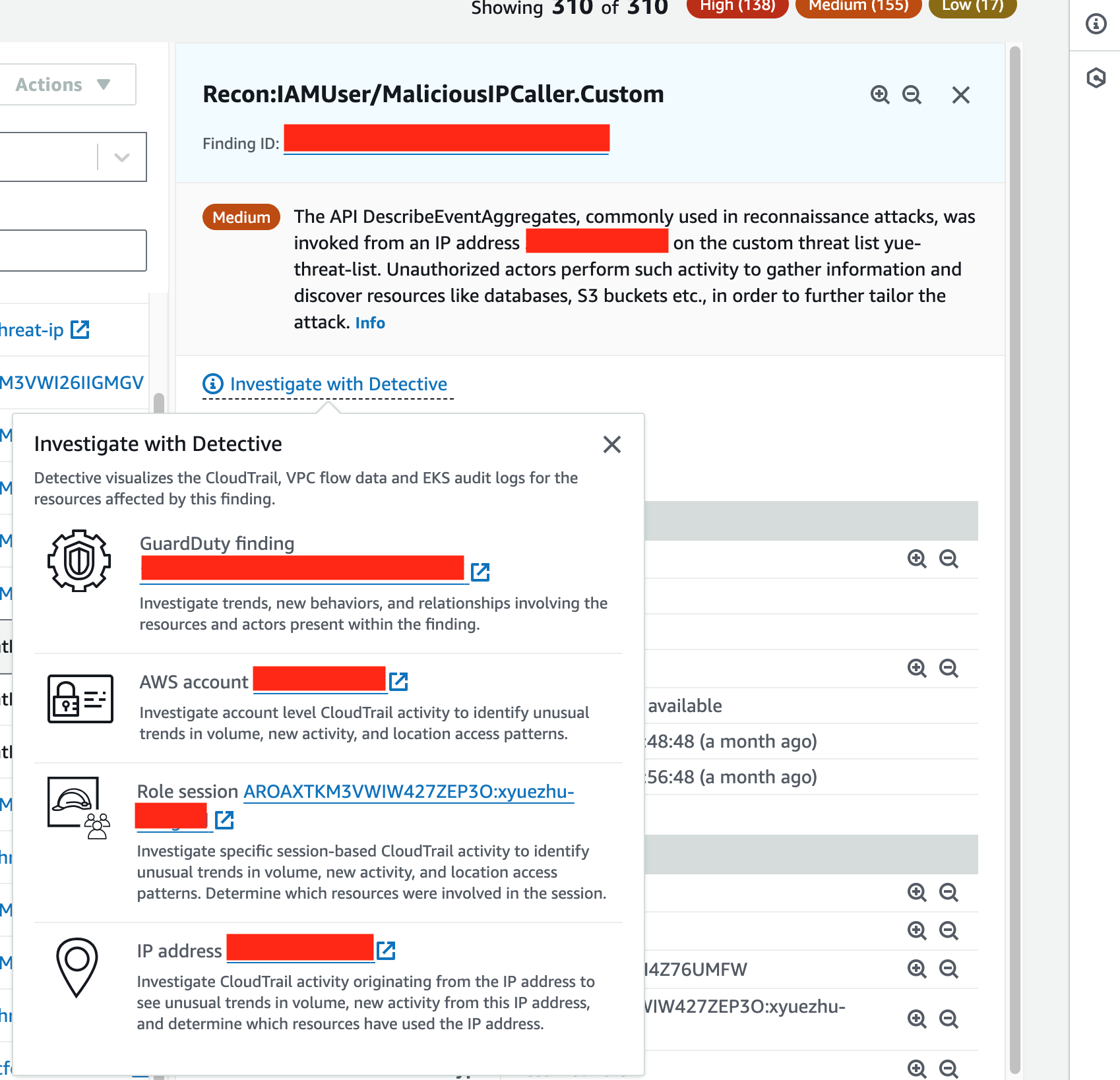
Every GuardDuty finding has a link labeled Investigate with Detective in the details pane. This link allows you to pivot to the Detective console based on aspects of the finding you are investigating to their respective entity profiles. The finding Recon:IAMUser/MaliciousIPCaller.Custom that’s shown in Figure 1 results from an API call made by an IP address that’s on the custom threat list, and GuardDuty observed it made API calls that were commonly used in reconnaissance activity, which commonly occurs prior to attempts at compromise. To investigate this finding, because it involves an IAM role, you can select the Role session link and it will take you to the role session’s profile in the Detective console.

Figure 1: Example finding in the GuardDuty console, with Investigate with Detective pop-up window

Figure 1: Example finding in the GuardDuty console, with Investigate with Detective pop-up window

Within the AWS Role session profile page, you will find security findings from GuardDuty and AWS Security Hub that are associated with the AWS role session, API calls the AWS role session made, and most importantly, new behaviors. Behaviors that deviate from expectations can be used as indicators of compromises to give you more information to determine if the AWS resource might be compromised. Detective highlights new behaviors first observed during the scope time of the events related to the finding that weren’t observed during the Detective baseline time window of 45 days.

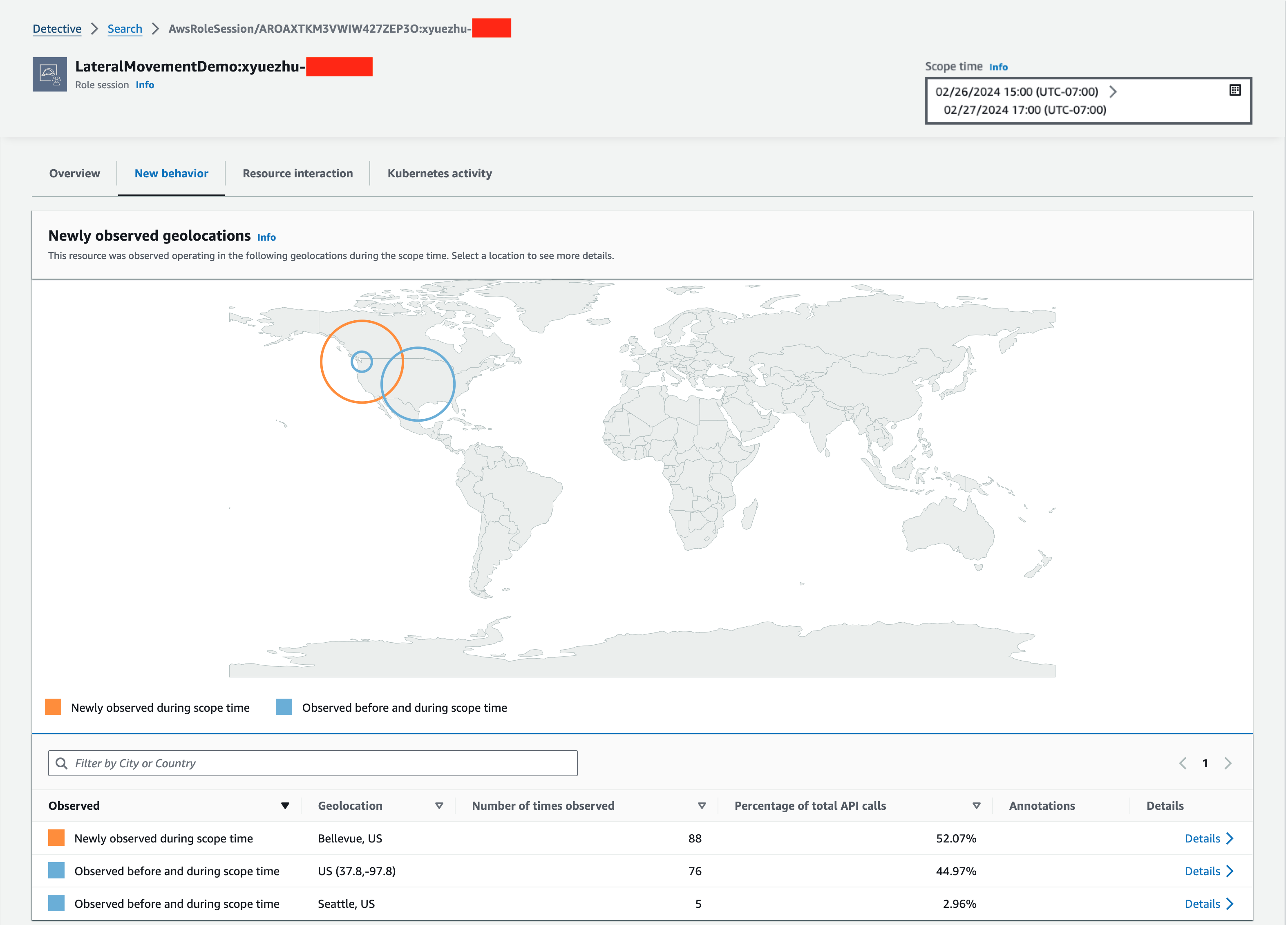
If you switch to the New behavior tab within the AWS role session profile, you will find the Newly observed geolocations panel (Figure 2). This panel highlights geolocations of IP addresses where API calls were made from that weren’t observed in the baseline profile. Detective determines the location of requests using MaxMind GeoIP databases based on the IP address that was used to issue requests.

Figure 2: Detective’s Newly observed geolocations panel

Figure 2: Detective’s Newly observed geolocations panel

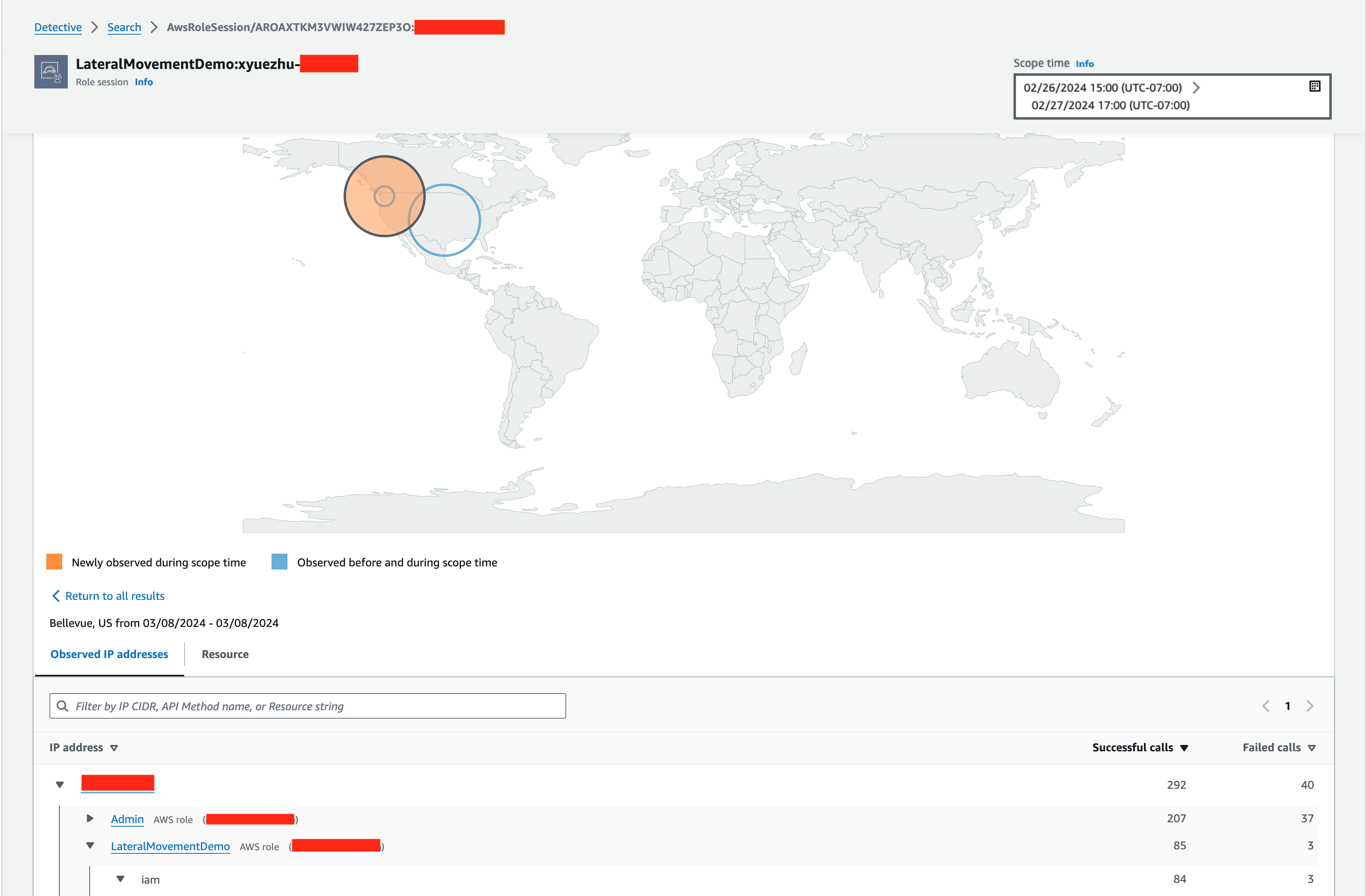
If you choose Details on the right side of each row, the row will expand and provide details of the API calls made from the same locations from different AWS resources, and you can drill down and get to the API calls made by the AWS resource from a specific geolocation (Figure 3). When analyzing these newly observed geolocations, a question you might consider is why this specific AWS role session made API calls from Bellevue, US. You’re pretty sure that your company doesn’t have a satellite office there, nor do your coworkers who have access to this role work from there. You also reviewed the AWS CloudTrail management events of this AWS role session, and you found some unusual API calls for services such as IAM.

Figure 3: Detective’s Newly observed geolocations panel expanded on details

Figure 3: Detective’s Newly observed geolocations panel expanded on details

You decide that you need to investigate further, because this role session’s anomalous behavior from a new geolocation is sufficiently unexpected, and it made unusual API calls that you would like to know the purpose of. You want to gather anomalous behaviors and high-risk API methods that can be used by threat actors to make impacts. Because you’re investigating an AWS role session rather than investigating a single role session, you decide you want to know what happened in other role sessions associated with the AWS role in case threat actors spread their activities across multiple sessions. To help you examine multiple role sessions automatically with additional analytics and threat intelligence, Detective introduced the Detective Investigation feature at re:Invent 2023.

Run an IAM investigation

Amazon Detective Investigation uses machine learning (ML) models and AWS threat intelligence to automatically analyze resources in your AWS environment to identify potential security events. It identifies tactics, techniques, and procedures (TTPs) used in a potential security event. The MITRE ATT&CK framework is used to classify the TTPs. You can use this feature to help you speed up the investigation and identify indicators of compromise and other TTPs quickly.

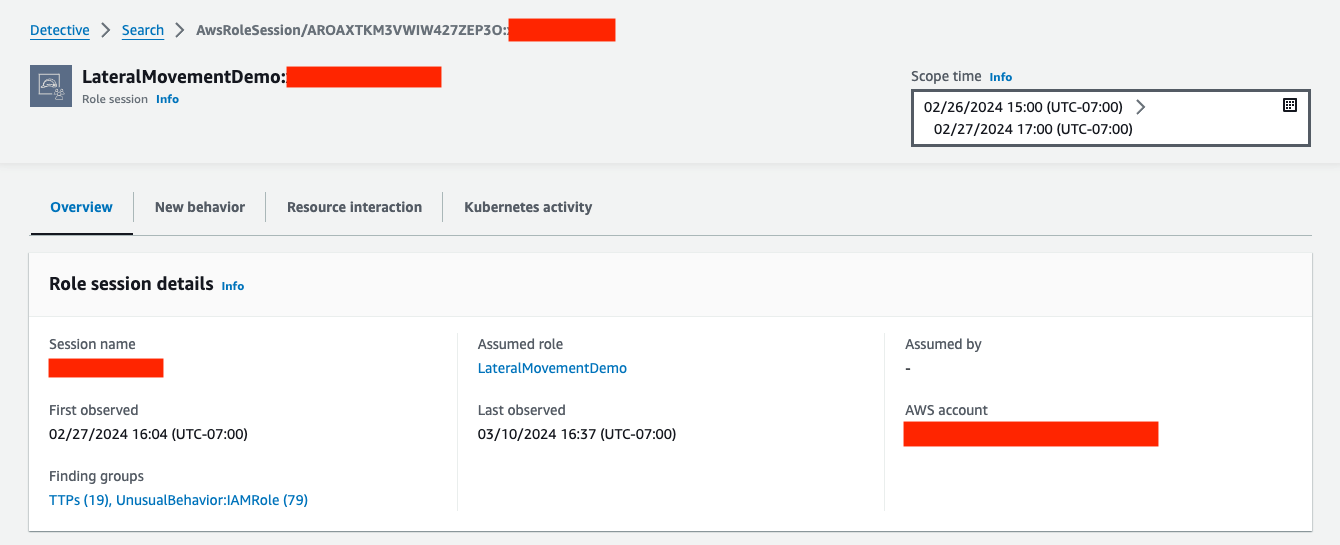
To continue with your investigation, you should investigate the role and its usage history as a whole to cover all involved role sessions at once. This addresses the potential case where threat actors assumed the same role under different session names. In the AWS role session profile page that’s shown in Figure 4, you can quickly identify and pivot to the corresponding AWS role profile page under the Assumed role field.

Figure 4: Detective’s AWS role session profile page

Figure 4: Detective’s AWS role session profile page

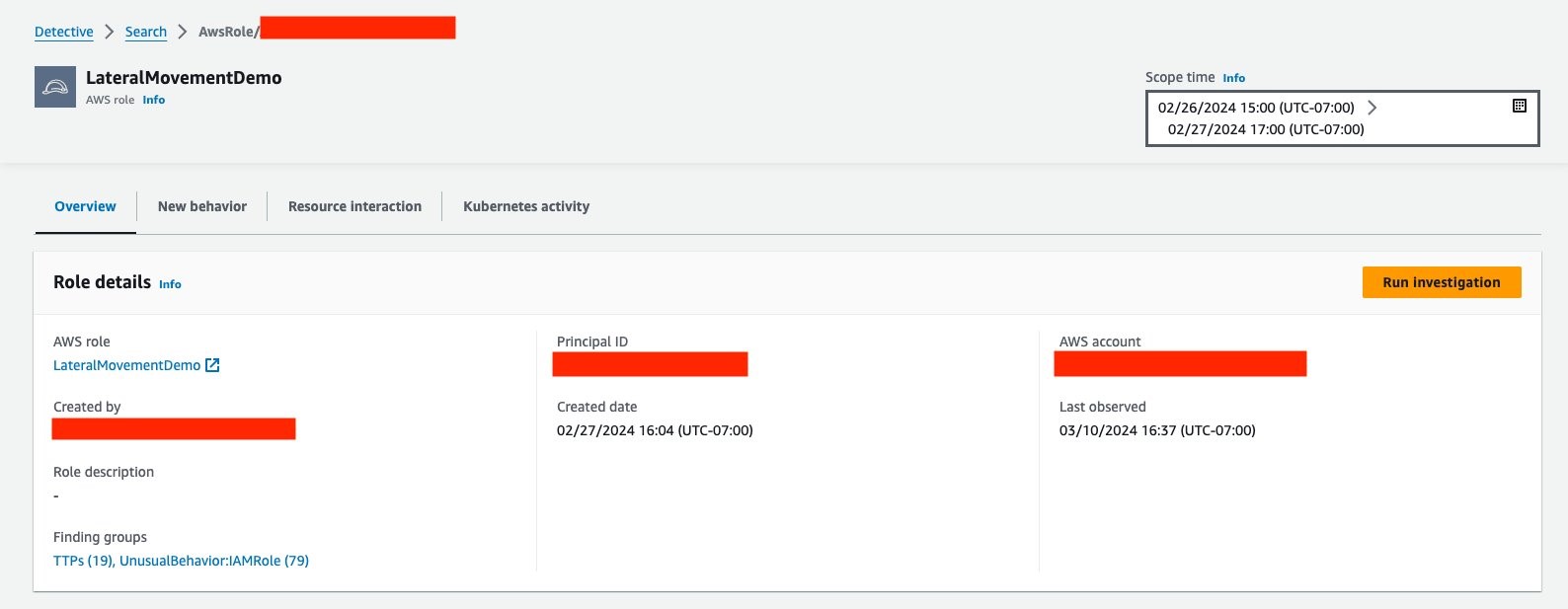
After you pivot to the AWS role profile page (Figure 5), you can run the automated investigations by choosing Run investigation.

Figure 5: Role profile page, from which an investigation can be run

Figure 5: Role profile page, from which an investigation can be run

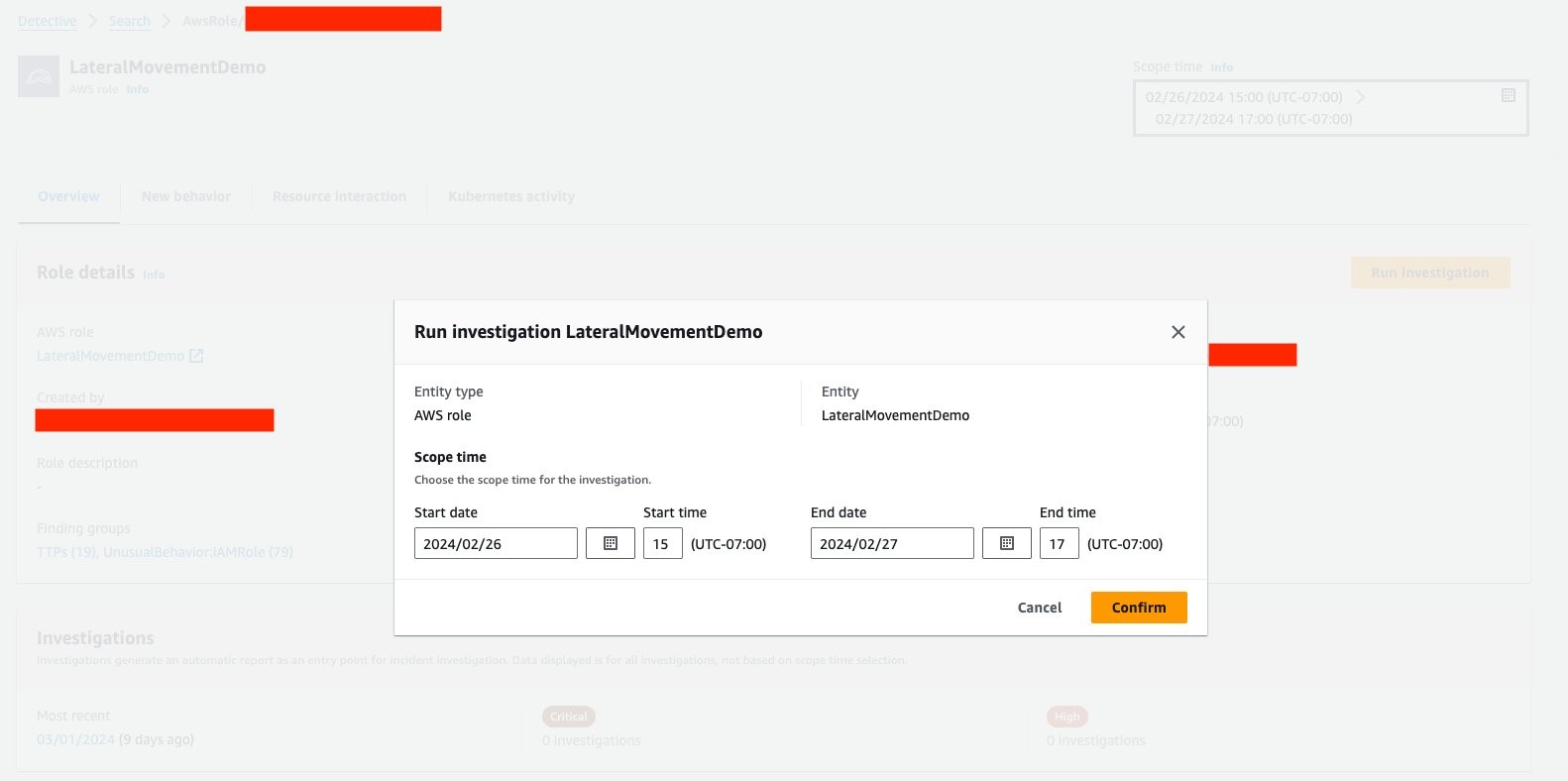
The first thing to do in a new investigation is to choose the time scope you want to run the investigation for. Then, choose Confirm (Figure 6).

Figure 6: Setting investigation scope time

Figure 6: Setting investigation scope time

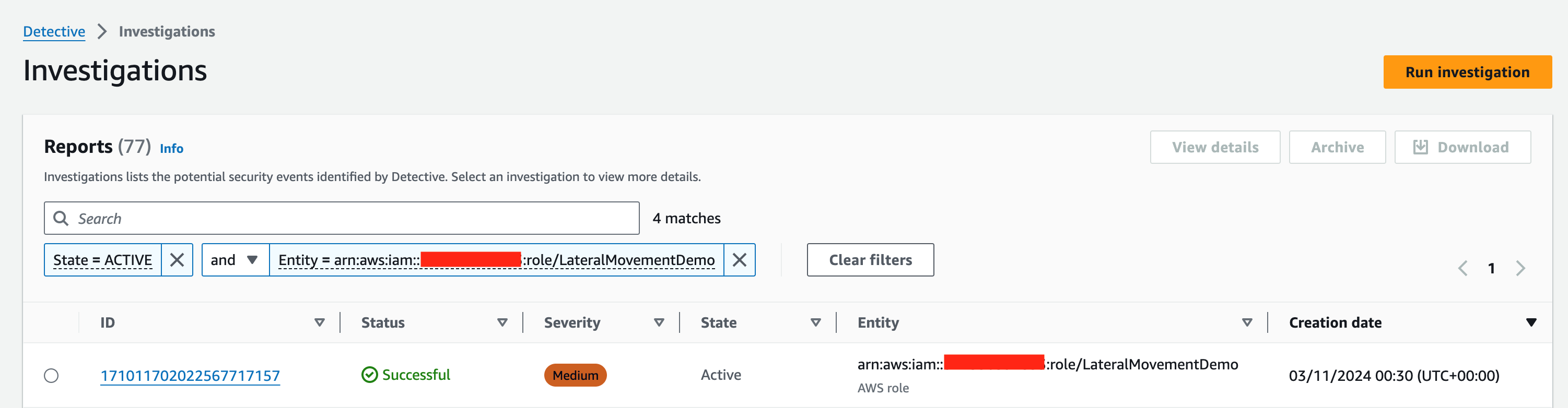
Next, you will be directed to the Investigations page (Figure 7), where you will be able to see the status of your investigation. Once the investigation is done, you can choose the hyperlinked investigation ID to access the investigation report.

Figure 7: Investigations page, with new report

Figure 7: Investigations page, with new report

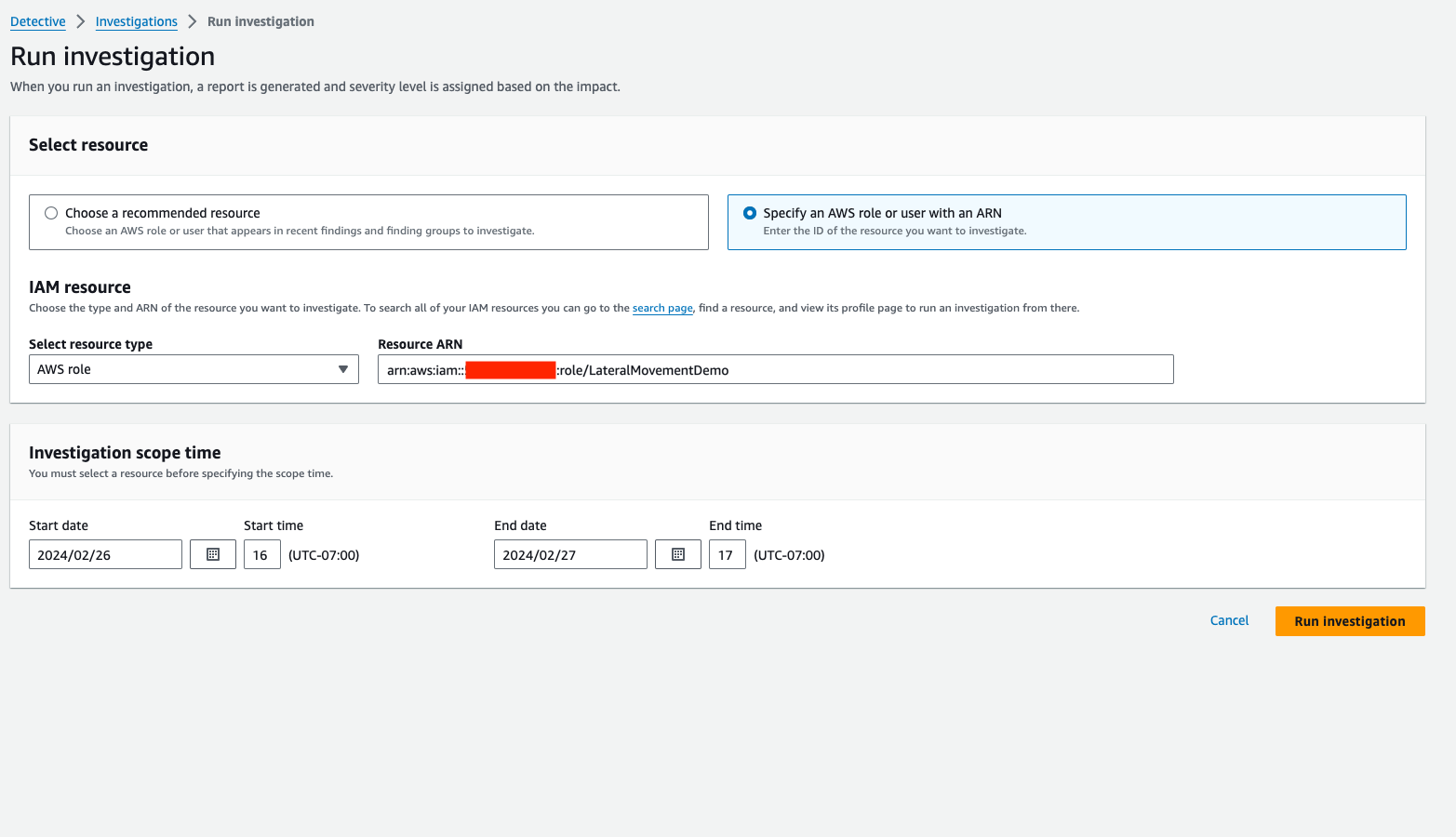
Another way to run an investigation is to choose Investigations on the left menu panel in the Detective console, and then choose Run investigation. You will then be taken to the page where you will specify the AWS role Amazon Resource Number (ARN) you’re investigating, and the scope time (Figure 8). Then you can choose Run investigation to commence an investigation.

Figure 8: Configuring a new investigation from scratch rather than from an existing finding

Figure 8: Configuring a new investigation from scratch rather than from an existing finding

Detective also offers StartInvestigation and GetInvestigation APIs for running Detective Investigations and retrieving investigation reports programmatically.

Interpret the investigation report

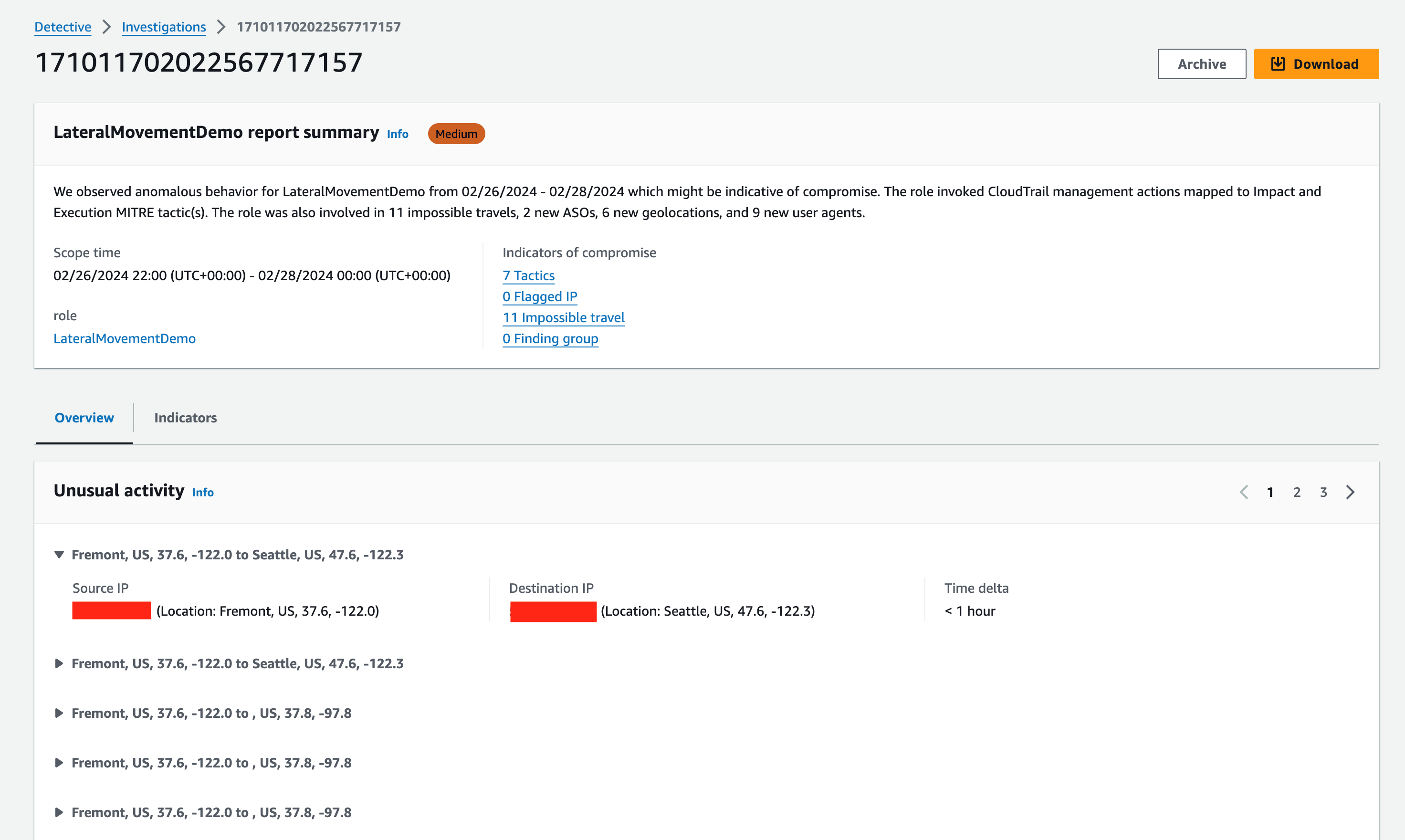
The investigation report (Figure 9) includes information on anomalous behaviors, potential TTP mappings of observed CloudTrail events, and indicators of compromises of the resource (in this example, an IAM principal) that was investigated.

At the top of the report, you will find a severity level computed based on the observed behaviors during the scope window, as well as a summary statement to give you a quick understanding of what was found. In Figure 9, the AWS role that was investigated engaged in the following unusual behaviors:

  • Seven tactics showing that the API calls made by this AWS role were mapped to seven tactics of the MITRE ATT&CK framework.
  • Eleven cases of impossible travel representing API calls made from two geolocations that are too far apart for the same user to have physically travelled between them to make the calls from both, within the time span involved.
  • Zero flagged IP addresses. Detective would flag IP addresses that are considered suspicious according to its threat intelligence sources.
  • Two new Autonomous System Organizations (ASOs) which are entities with assigned Autonomous System Numbers (ASNs) as used in Border Gateway Protocol (BGP) routing.
  • Nine new user agents were used to make API calls that weren’t observed in the 45 days prior to the events being investigated.

These indicators of compromise represent unusual behaviors that have either not been observed before in the AWS account involved or that are intrinsically considered high risk. The following summary panel includes the report that shows a detailed breakdown of the investigation results.

Unusual activities are important factors that you should look for during investigations, and sudden behavior change can be a sign of compromise. When you’re investigating an AWS role that can be assumed by different users from different AWS Regions, you are likely to need to examine activity at the granularity of the specific AWS role session that made the APIs calls. Within the report, you can do this by choosing the hyperlinked role name in the summary panel, and it will take you to the AWS role profile page.

Figure 9: Investigation report summary page

Figure 9: Investigation report summary page

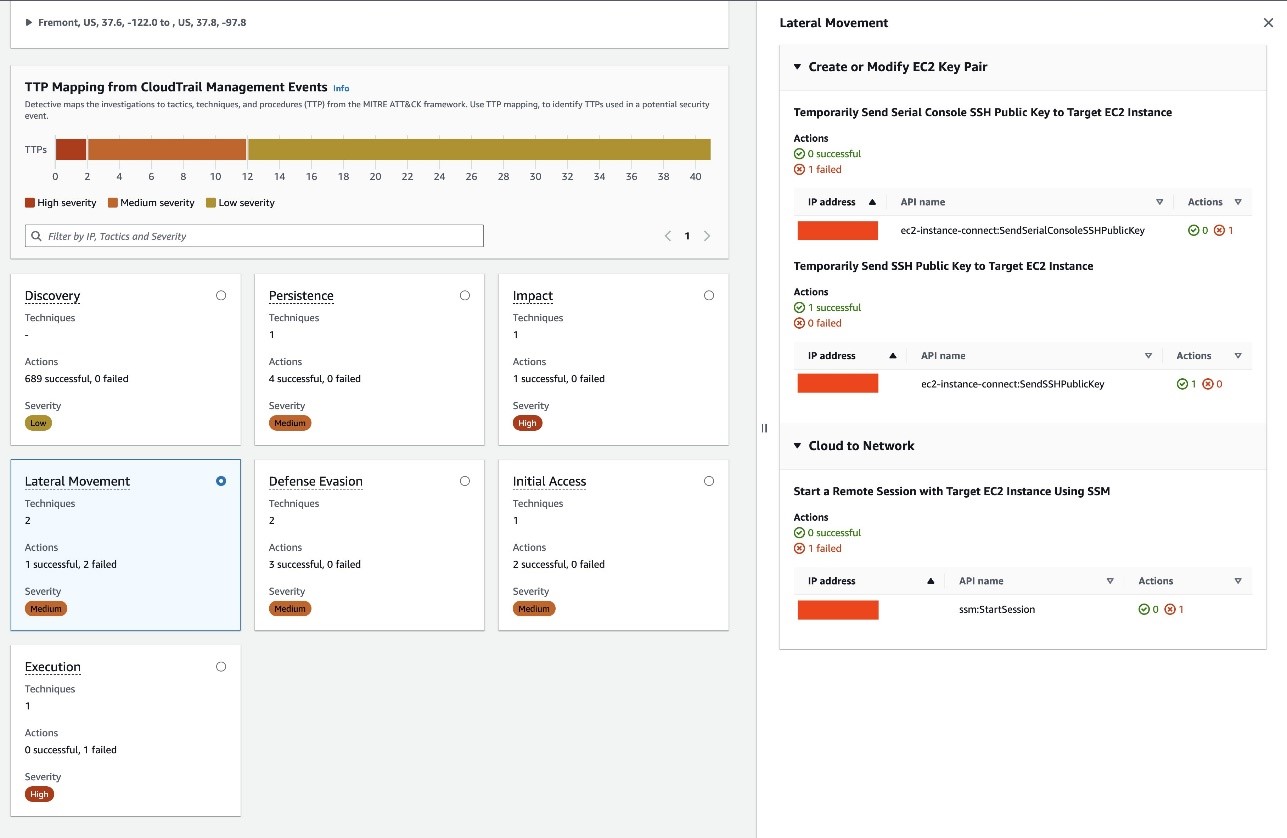
Further down on the investigation report is the TTP Mapping from CloudTrail Management Events panel. Detective Investigations maps CloudTrail events to the MITRE ATT&CK framework to help you understand how an API can be used by threat actors. For each mapped API, you can see the tactics, techniques, and procedures it can be used for. In Figure 10, at the top there is a summary of TTPs with different severity levels. At the bottom is a breakdown of potential TTP mappings of observed CloudTrail management events during the investigation scope time.

When you select one of the cards, a side panel appears on the right to give you more details about the APIs. It includes information such as the IP address that made the API call, the details of the TTP the API call was mapped to, and if the API call succeeded or failed. This information can help you understand how these APIs can potentially be used by threat actors to modify your environment, and whether or not the API call succeeded tells you if it might have affected the security of your AWS resources. In the example that’s shown in Figure 10, the IAM role successfully made API calls that are mapped to Lateral Movement in the ATT&CK framework.

Figure 10: Investigation report page with event ATT CK mapping

Figure 10: Investigation report page with event ATT CK mapping

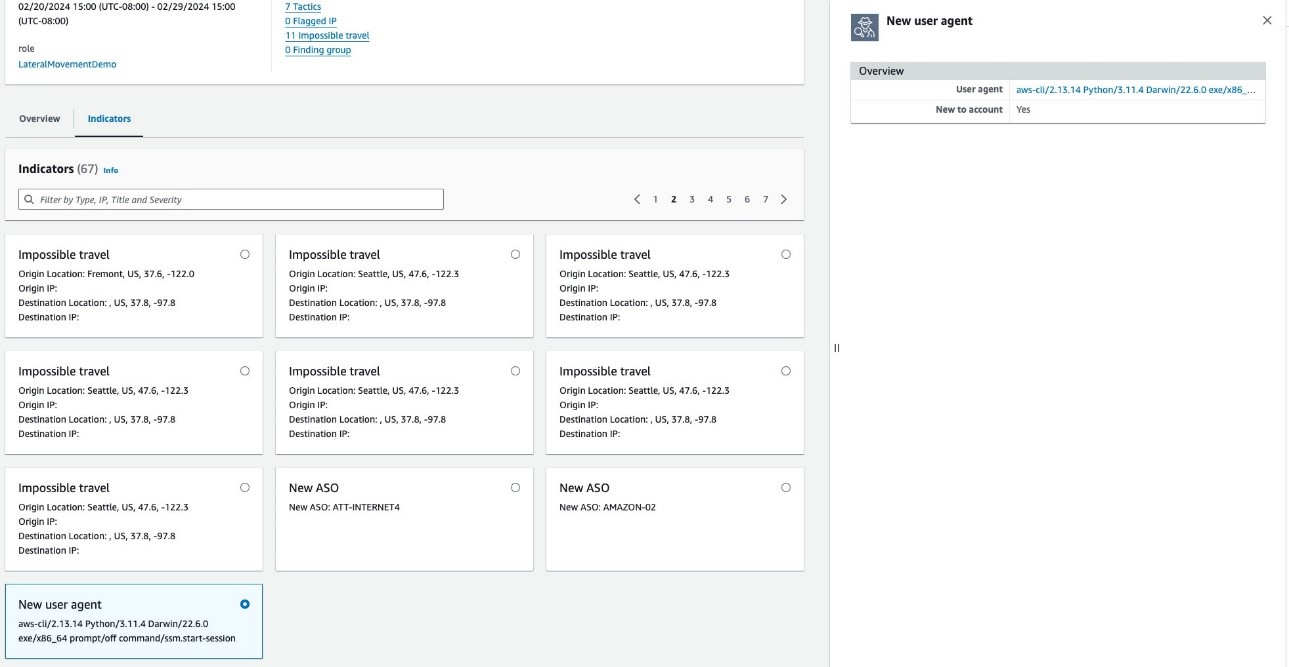
The report also includes additional indicators of compromise (Figure 11). You can find these if you select the Indicators tab next to Overview. Within this tab, you can find the indicators identified during the scope time, and if you select one indicator, details for that indicator will appear on the right. In the example in Figure 11, the IAM role made API calls with a user agent that wasn’t used by this IAM role or other IAM principals in this account, and indicators like this one show sudden behavior change of your IAM principal. You should review them and identify the ones that aren’t expected. To learn more about indicators of compromise in Detective Investigation, see the Amazon Detective User Guide.

Figure 11: Indicators of compromise identified during scope time

Figure 11: Indicators of compromise identified during scope time

At this point, you’ve analyzed the new and unusual behaviors the IAM role made and learned that the IAM role made API calls using new user agents and from new ASOs. In addition, you went through the API calls that were mapped to the MITRE ATT&CK framework. Among the TTPs, there were three API calls that are classified as lateral movements. These should attract attention for the following reasons: first, the purpose of these API calls is to gain access to the EC2 instance involved; and second, ec2-instance-connect:SendSSHPublicKey was run successfully.

Based on the procedure description in the report, this API would grant threat actors temporary SSH access to the target EC2 instance. To gather original evidence, examine the raw logs stored in Security Lake. Security Lake is a fully managed security data lake service that automatically centralizes security data from AWS environments, SaaS providers, on-premises sources, and other sources into a purpose-built data lake stored in your account.

Retrieve raw logs

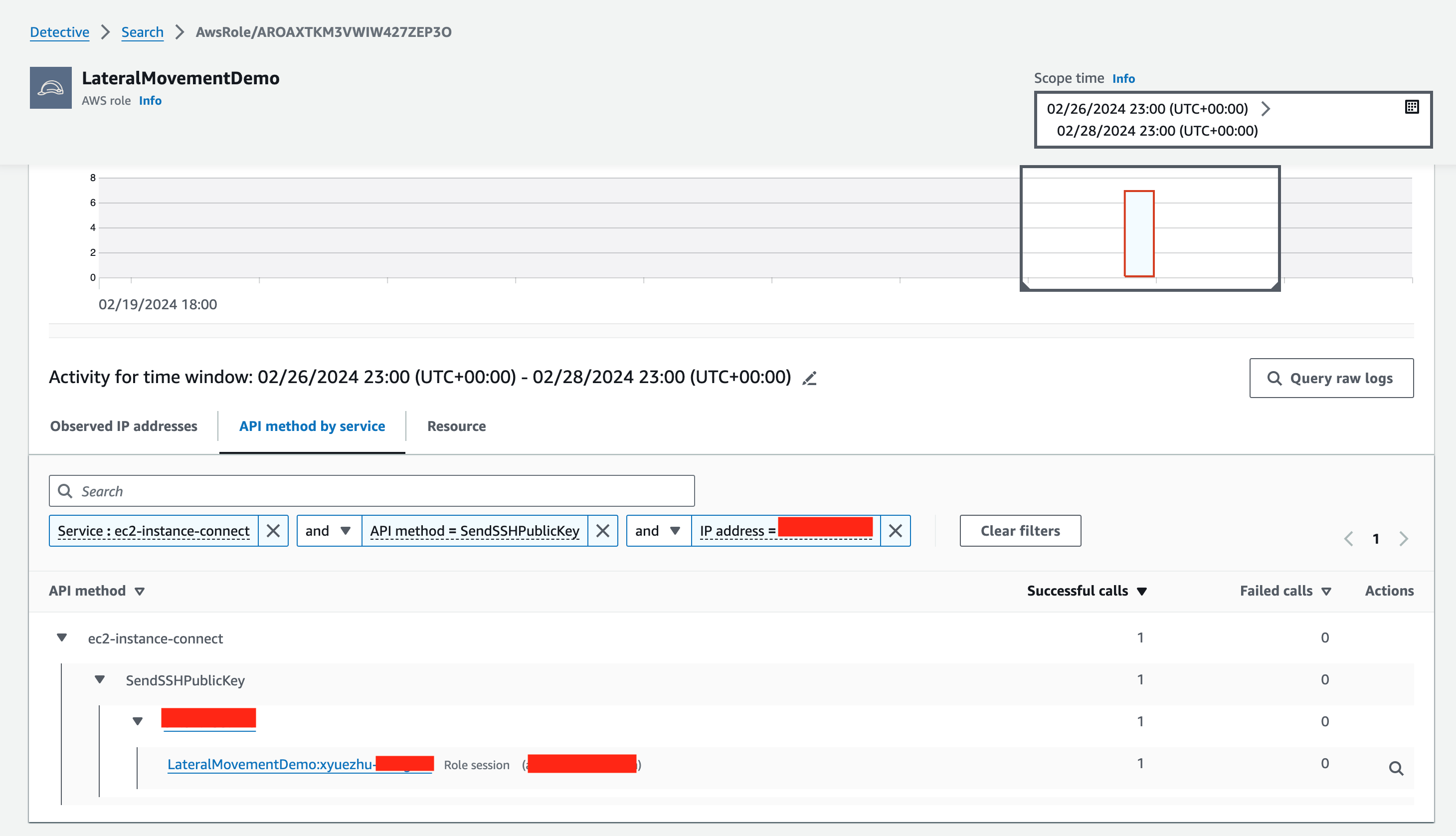
You can use Security Lake integration to retrieve raw logs from your Security Lake tables within the Detective console as original evidence. If you haven’t enabled the integration yet, you can follow the Integration with Amazon Security Lake guide to enable it. In the context of the example investigation earlier, these logs include details of which EC2 instance was associated with the ec2-instance-connect:SendSSHPublicKey API call. Within the AWS role profile page investigated earlier, if you scroll down to the bottom of the page, you will find the Overall API call volume panel (Figure 12). You can search for the specific API call using the Service and API method filters. Next, choose the magnifier icon, which will initiate a Security Lake query to retrieve the raw logs of the specific CloudTrail event.

Figure 12: Finding the CloudTrail record for a specific API call held in Security Lake

Figure 12: Finding the CloudTrail record for a specific API call held in Security Lake

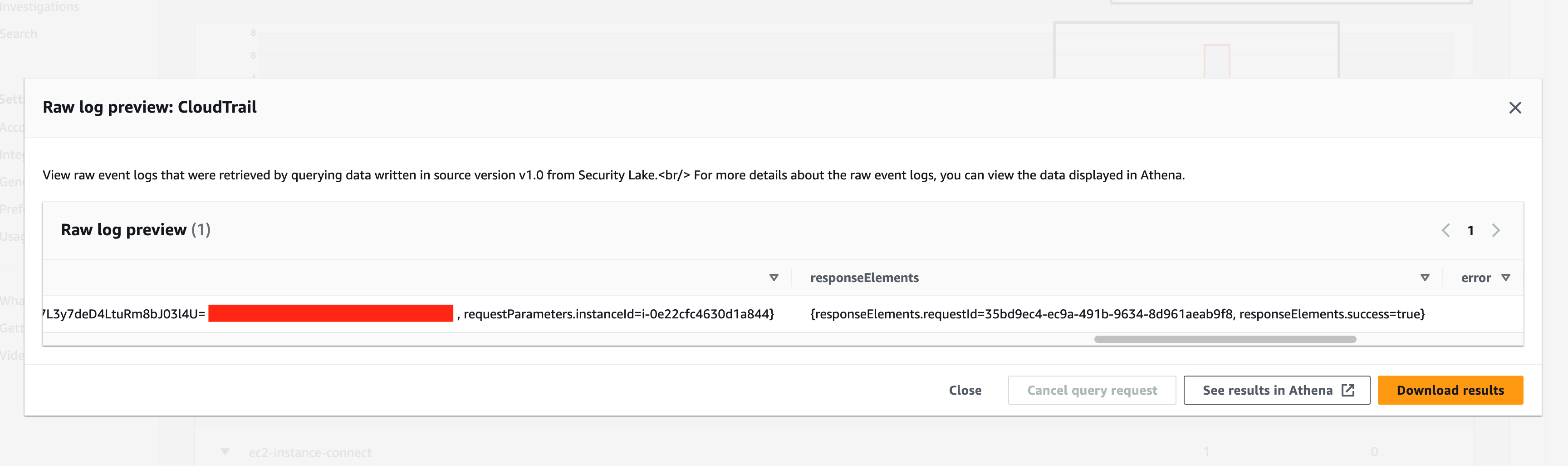
You can identify the target EC2 instance the API was issued against from the query results (Figure 13). To determine whether threat actors actually made an SSH connection to the target EC2 instance as a result of the API call, you should examine the EC2 instance’s profile page:

Figure 13: Reviewing a CloudTrail log record from Security Lake

Figure 13: Reviewing a CloudTrail log record from Security Lake

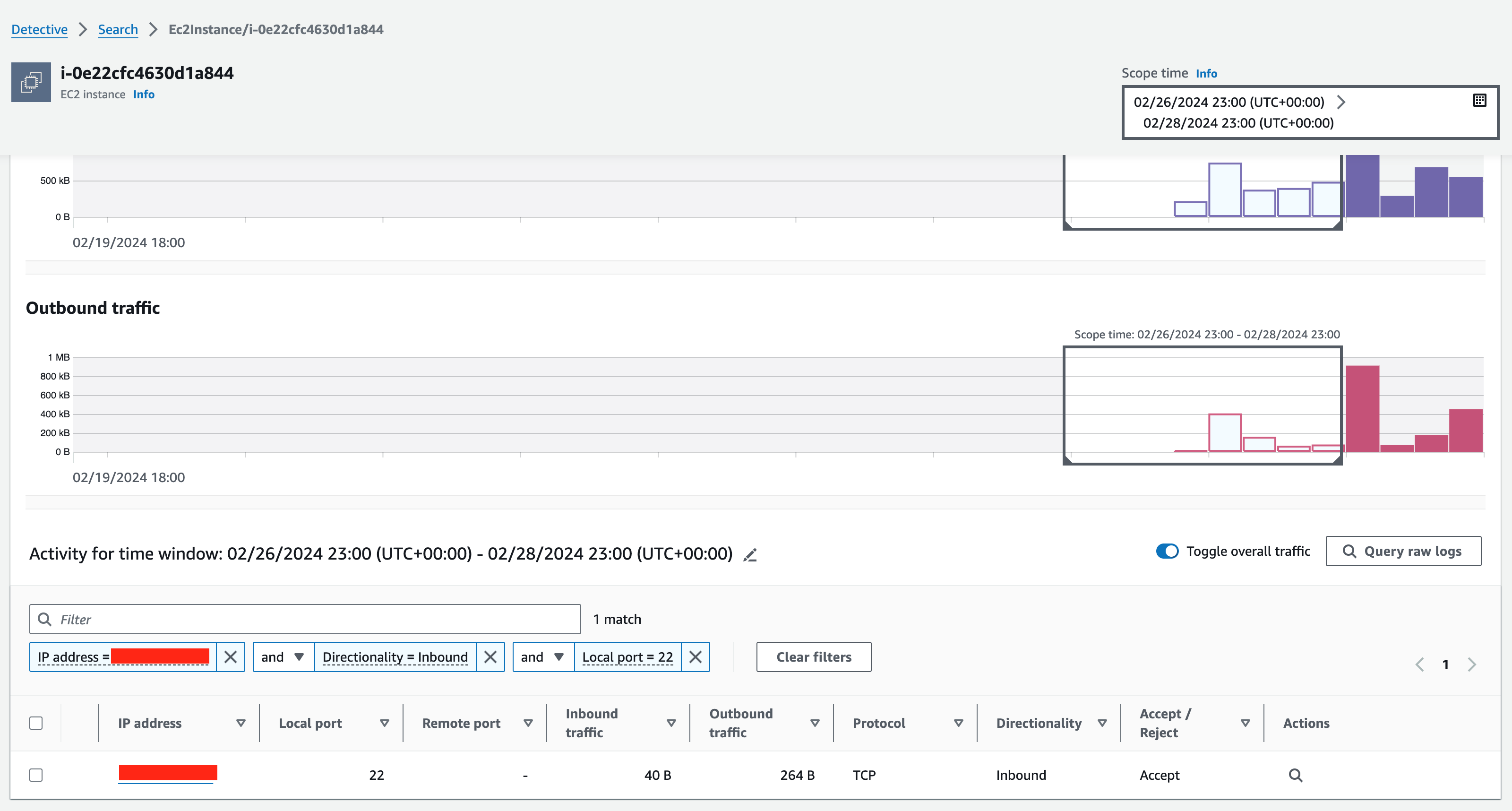
From the profile page of the EC2 instance in the Detective console, you can go to the Overall VPC flow volume panel and filter the Amazon Virtual Private Cloud (Amazon VPC) flow logs using the attributes related to the threat actor identified as having made the SSH API call. In Figure 14, you can see the IP address that tried to connect to 22/tcp, which is the SSH port of the target instance. It’s common for threat actors to change their IP address in an attempt to evade detection, and you can remove the IP address filter to see inbound connections to port 22/tcp of your EC2 instance.

Figure 14: Examining SSH connections to the target instance in the Detective profile page

Figure 14: Examining SSH connections to the target instance in the Detective profile page

Iterate the investigation

At this point, you’ve made progress with the help of Detective Investigations and Security Lake integration. You started with a GuardDuty finding, and you got to the point where you were able to identify some of the intent of the threat actors and uncover the specific EC2 instance they were targeting. Your investigation shouldn’t stop here because you’ve successfully identified the EC2 instance, which is the next target to investigate.

You can reuse this whole workflow by starting with the EC2 instance’s New behavior panel, run Detective Investigations on the IAM role attached to the EC2 instance and other IAM principals you think are worth taking a closer look at, then use the Security Lake integration to gather raw logs of the APIs made by the EC2 instance to identify the specific actions taken and their potential consequences.

Conclusion

In this post, you’ve seen how you can use the Amazon Detective Investigation feature to investigate IAM user and role activity and use the Security Lake integration to determine the specific EC2 instances a threat actor appeared to be targeting.

The Detective Investigation feature is automatically enabled for both existing and new customers in AWS Regions that support Detective where Detective has been activated. The Security Lake integration feature can be enabled in your Detective console. If you don’t currently use Detective, you can start a free 30-day trial. For more information on Detective Investigation and Security Lake integration, see Investigating IAM resources using Detective investigations and Security Lake integration.

 
If you have feedback about this post, submit comments in the Comments section below. If you have questions about this post, contact AWS Support.

Want more AWS Security news? Follow us on X.

Yue Zhu

Yue Zhu

Yue is a security engineer at AWS. Before AWS, he worked as a security engineer focused on threat detection, incident response, vulnerability management, and security tooling development. Outside of work, Yue enjoys reading, cooking, and cycling.

Patch Tuesday – May 2024

Post Syndicated from Adam Barnett original https://blog.rapid7.com/2024/05/14/patch-tuesday-may-2024/

Patch Tuesday - May 2024

Microsoft is addressing 61 vulnerabilities this May 2024 Patch Tuesday. Microsoft has evidence of in-the-wild exploitation and/or public disclosure for three of the vulnerabilities published today. At time of writing, two of the vulnerabilities patched today are listed on CISA KEV. Microsoft is also patching a single critical remote code execution (RCE) vulnerability today. Six browser vulnerabilities were published separately this month, and are not included in the total.

Windows DWM: zero-day EoP

The first of today’s zero-day vulnerabilities is CVE-2024-30051, an elevation of privilege (EoP) vulnerability in the Windows Desktop Windows Manager (DWM) Core Library which is listed on the CISA KEV list. Successful exploitation grants SYSTEM privileges. First introduced as part of Windows Vista, DWM is responsible for drawing everything on the display of a Windows system.

Reporters Securelist have linked exploitation of CVE-2024-30051 with deployment of QakBot malware, and the vulnerability while investigating a partial proof-of-concept contained within an unusual file originally submitted to VirusTotal by an unknown party. Securelist further notes that the exploitation method for CVE-2024-30051 is identical to a previous DWM zero-day vulnerability CVE-2023-36033, which Microsoft patched back in November 2023.

Courtesy of Microsoft’s recent enhancement of their security advisories to include Common Weakness Enumeration (CWE) data, the mechanism of exploitation is listed as CVE-122: Heap-based Buffer Overflow, which is just the sort of defect which recent US federal government calls for memory safe software development are designed to address.

MSHTML: zero-day security feature bypass

The Windows MSHTML platform receives a patch for CVE-2024-30040, a security feature bypass vulnerability for which Microsoft has evidence of exploitation in the wild, and which CISA has also listed on KEV.

The advisory states that an attacker would have to convince a user to open a malicious file; successful exploitation bypasses COM/OLE protections in Microsoft 365 and Microsoft Office to achieve code execution in the context of the user.

As Rapid7 has previously noted, MSHTML (also known as Trident) is still fully present in Windows — and unpatched assets are thus vulnerable to CVE-2024-30040 — regardless of whether or not a Windows asset has Internet Explorer 11 fully disabled.

Visual Studio: zero-day DoS

Rounding out today’s trio of zero-day vulnerabilities: a denial of service (DoS) vulnerability in Visual Studio.

Microsoft describes CVE-2024-30046 as requiring a highly complex attack to win a race condition through “[the investment of] time in repeated exploitation attempts through sending constant or intermittent data”. Since all data sent anywhere is transmitted either constantly or intermittently, and the rest of the advisory is short on detail, the potential impact of exploitation remains unclear.

Only Visual Studio 2022 receives an update, so older supported versions of Visual Studio are presumably unaffected.

SharePoint: critical post-auth RCE

SharePoint admins are no strangers to patches for critical RCE vulnerabilities. CVE-2024-30044 allows an authenticated attacker with Site Owner permissions or higher to achieve code execution in the context of SharePoint Server via upload of a specially crafted file, followed by specific API calls to trigger deserialization of the file’s parameters.

Microsoft considers exploitation of CVE-2024-30044 more likely, and the low attack complexity and network attack contribute to a relatively high CVSS 3.1 base score of 8.8. The advisory also lists the privileges required vector component as low, which is debatable given the Site Owner authentication requirement for exploitation.

Microsoft has previously published an accessible introduction to deserialization vulnerabilities and the risks of assuming data to be trustworthy, aimed at .NET developers.

Excel: arbitrary code execution

Microsoft Excel receives a patch for CVE-2024-30042. Successful exploitation requires that an attacker convince the user to open a malicious file, which leads to code execution, presumably in the context of the user.

Remote Access Connection Manager: last month’s vulns repatched

Also of interest today: Microsoft is releasing updated patches for three Windows Remote Access Connection Manager information disclosure vulnerabilities originally published in April 2024: CVE-2024-26207, CVE-2024-26217, and CVE-2024-28902. Microsoft states that an unspecified regression introduced by the April patches is resolved by installation of the May patches.

Mobile Broadband driver: 11 local USB RCEs

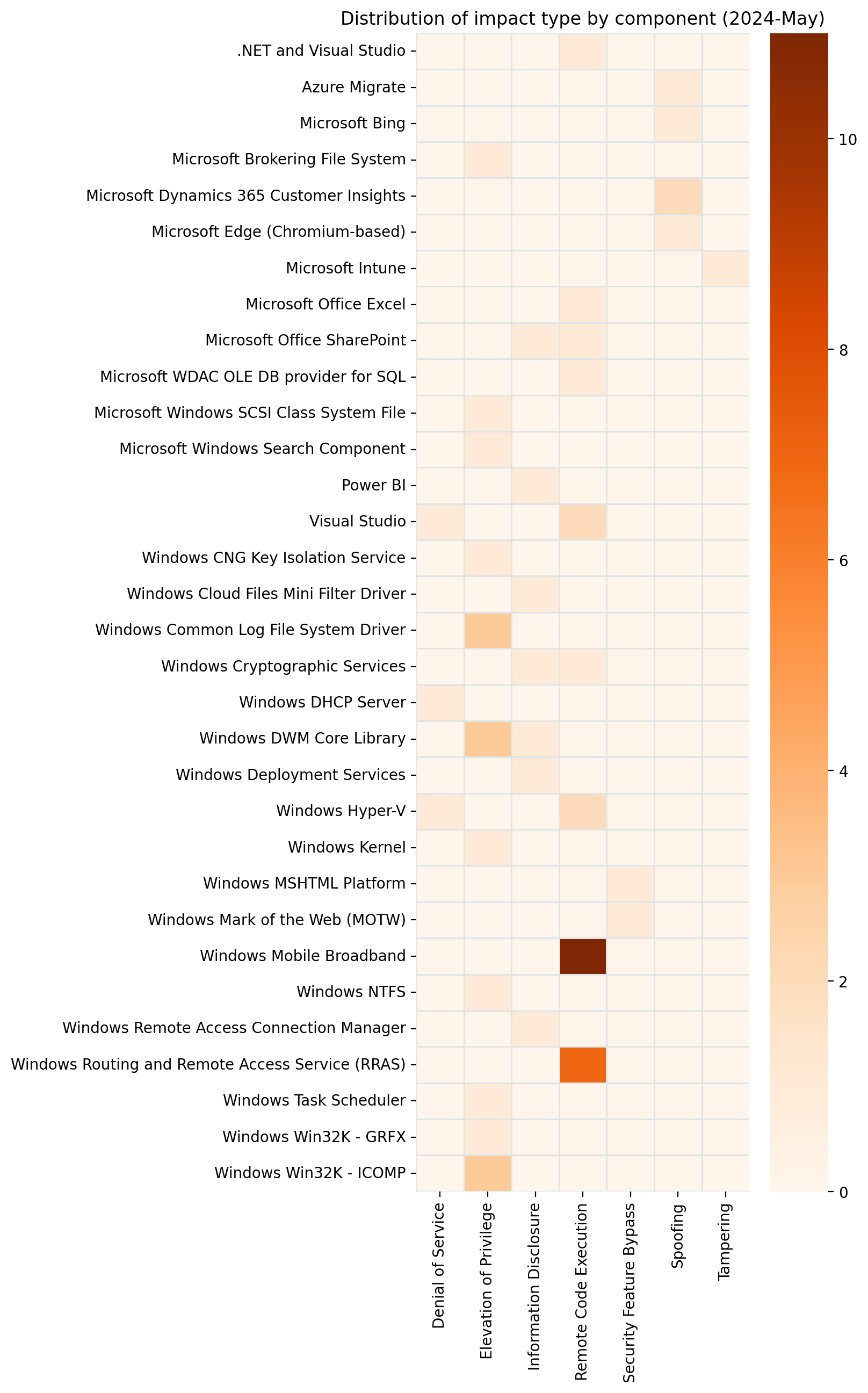
The Windows Mobile Broadband driver receives patches for no fewer than 11 vulnerabilities; for example, CVE-2024-29997. All 11 vulnerabilities appear very similar based on the advisories. In each case, the relatively low CVSS base score of 6.8 reflects that an attacker must be physically present and insert a malicious USB device into the target host.

Third-party open source patches

Back in 2021, Microsoft started publishing the Assigning CNA (CVE Numbering Authority) field on advisories. A welcome trend of publishing advisories for third-party software included in Microsoft products continues this month with two vulnerabilities in MinGit patched as part of the May 2024 Windows security updates. MinGit is published by GitHub and consumed by Visual Studio. CVE-2024-32002 describes a RCE vulnerability on case-insensitive filesystems that support symlinks — macOS APFS comes to mind — and CVE-2024-32004 describes RCE while cloning specially-crafted local repositories.

Lifecycle update

There are no significant changes to the lifecycle phase of Microsoft products this month.

Summary Charts

Patch Tuesday - May 2024
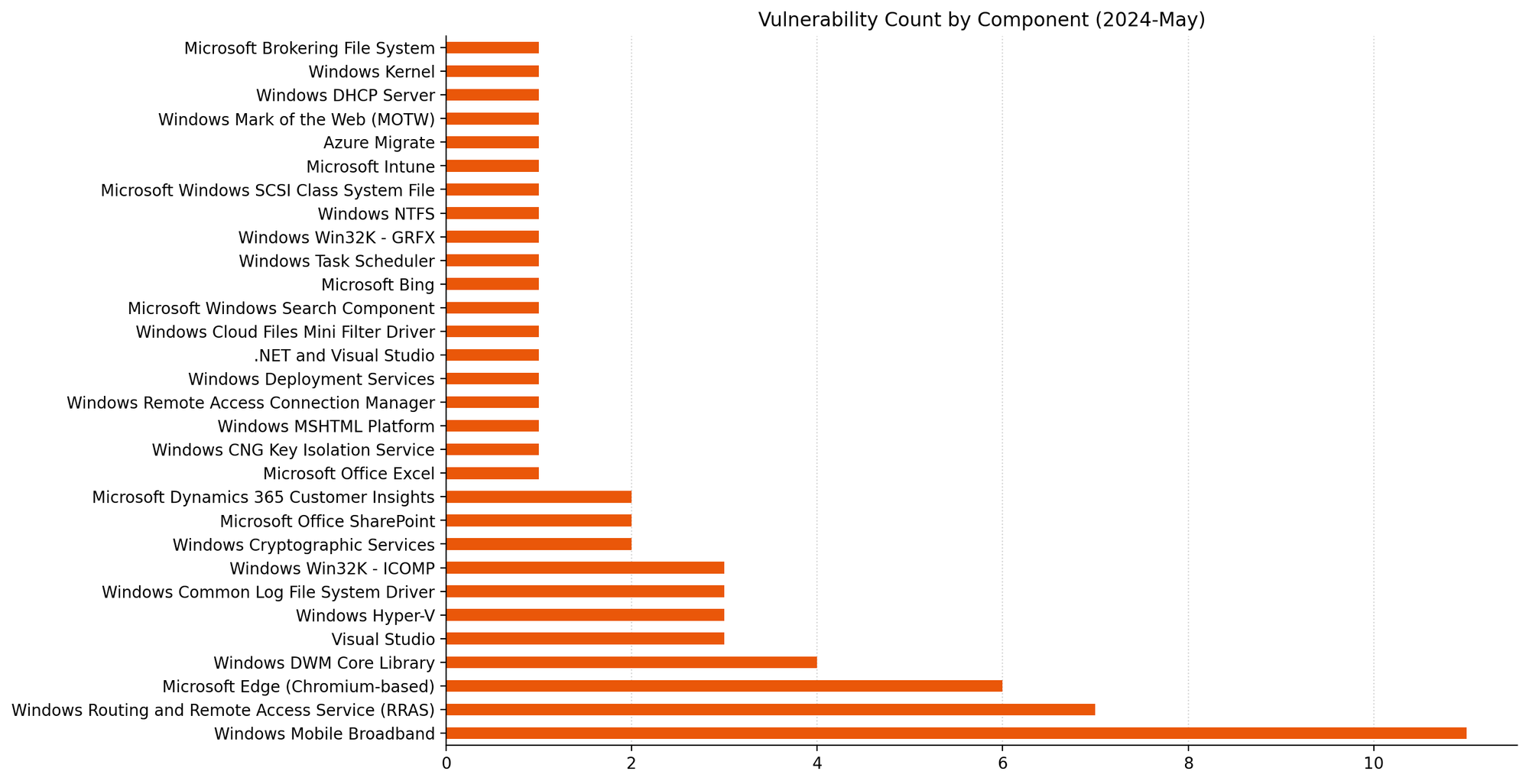
Mobile Broadband is this month’s winner, albeit for 11 apparently very similar vulns.
Patch Tuesday - May 2024
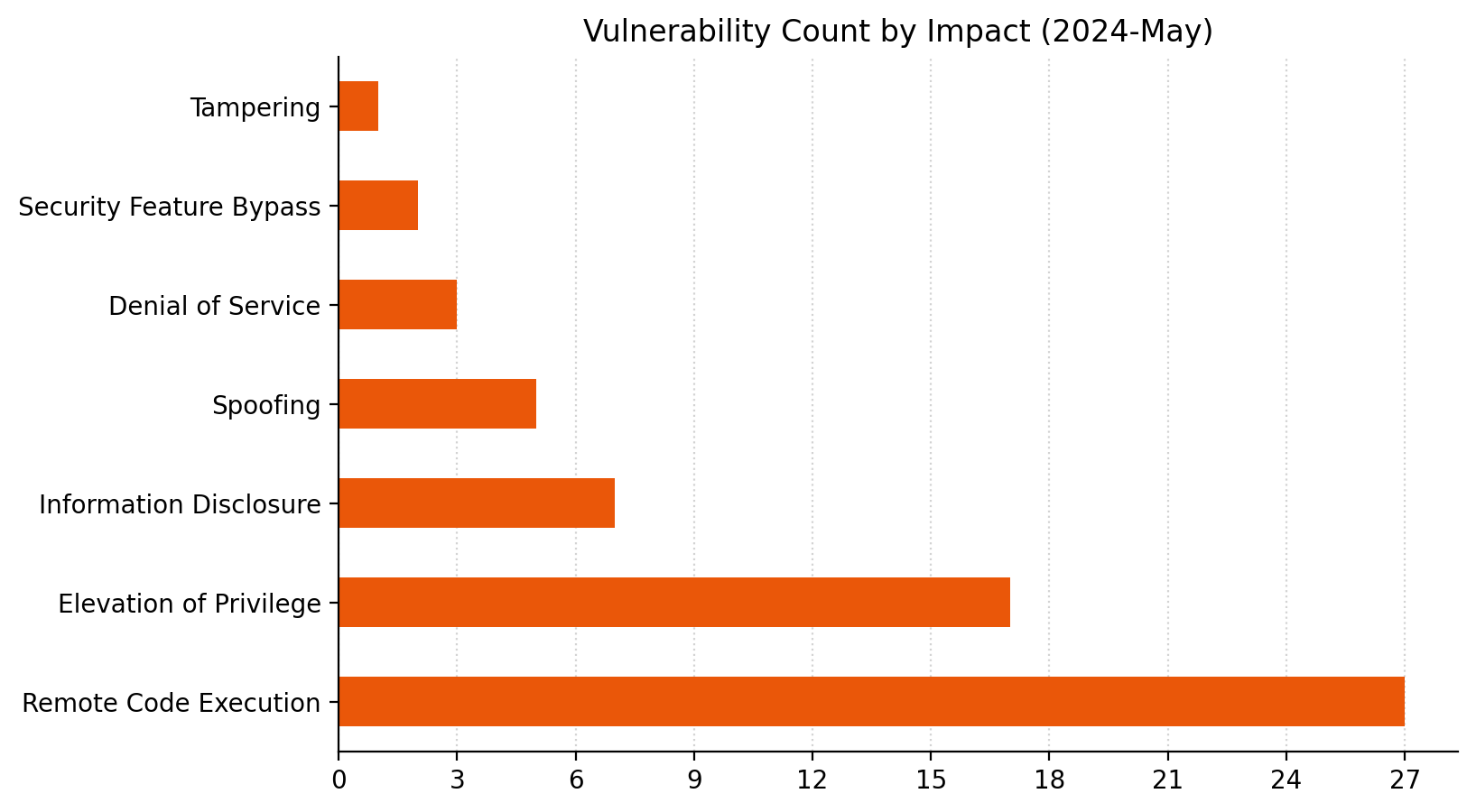
RCE: the people’s champion.
Patch Tuesday - May 2024
The lesser-spotted Tampering impact type makes an appearance this month.

Summary Tables

Apps vulnerabilities

CVE Title Exploited? Publicly disclosed? CVSSv3 base score
CVE-2024-30059 Microsoft Intune for Android Mobile Application Management Tampering Vulnerability No No 6.1
CVE-2024-30041 Microsoft Bing Search Spoofing Vulnerability No No 5.4

Azure vulnerabilities

CVE Title Exploited? Publicly disclosed? CVSSv3 base score
CVE-2024-30053 Azure Migrate Cross-Site Scripting Vulnerability No No 6.5

Browser vulnerabilities

CVE Title Exploited? Publicly disclosed? CVSSv3 base score
CVE-2024-30055 Microsoft Edge (Chromium-based) Spoofing Vulnerability No No 5.4
CVE-2024-4671 Chromium: CVE-2024-4671 Use after free in Visuals No No N/A
CVE-2024-4559 Chromium: CVE-2024-4559 Heap buffer overflow in WebAudio No No N/A
CVE-2024-4558 Chromium: CVE-2024-4558 Use after free in ANGLE No No N/A
CVE-2024-4368 Chromium: CVE-2024-4368 Use after free in Dawn No No N/A
CVE-2024-4331 Chromium: CVE-2024-4331 Use after free in Picture In Picture No No N/A

Developer Tools vulnerabilities

CVE Title Exploited? Publicly disclosed? CVSSv3 base score
CVE-2024-32002 CVE-2024-32002 Recursive clones on case-insensitive filesystems that support symlinks are susceptible to Remote Code Execution No No 9
CVE-2024-32004 GitHub: CVE-2024-32004 Remote Code Execution while cloning special-crafted local repositories No No 8.1
CVE-2024-30045 .NET and Visual Studio Remote Code Execution Vulnerability No No 6.3
CVE-2024-30046 Visual Studio Denial of Service Vulnerability No Yes 5.9

ESU vulnerabilities

CVE Title Exploited? Publicly disclosed? CVSSv3 base score
CVE-2024-30030 Win32k Elevation of Privilege Vulnerability No No 7.8

ESU Windows vulnerabilities

CVE Title Exploited? Publicly disclosed? CVSSv3 base score
CVE-2024-30009 Windows Routing and Remote Access Service (RRAS) Remote Code Execution Vulnerability No No 8.8
CVE-2024-30010 Windows Hyper-V Remote Code Execution Vulnerability No No 8.8
CVE-2024-30006 Microsoft WDAC OLE DB provider for SQL Server Remote Code Execution Vulnerability No No 8.8
CVE-2024-30020 Windows Cryptographic Services Remote Code Execution Vulnerability No No 8.1
CVE-2024-30049 Windows Win32 Kernel Subsystem Elevation of Privilege Vulnerability No No 7.8
CVE-2024-29996 Windows Common Log File System Driver Elevation of Privilege Vulnerability No No 7.8
CVE-2024-30025 Windows Common Log File System Driver Elevation of Privilege Vulnerability No No 7.8
CVE-2024-30031 Windows CNG Key Isolation Service Elevation of Privilege Vulnerability No No 7.8
CVE-2024-30028 Win32k Elevation of Privilege Vulnerability No No 7.8
CVE-2024-30038 Win32k Elevation of Privilege Vulnerability No No 7.8
CVE-2024-30027 NTFS Elevation of Privilege Vulnerability No No 7.8
CVE-2024-30014 Windows Routing and Remote Access Service (RRAS) Remote Code Execution Vulnerability No No 7.5
CVE-2024-30015 Windows Routing and Remote Access Service (RRAS) Remote Code Execution Vulnerability No No 7.5
CVE-2024-30022 Windows Routing and Remote Access Service (RRAS) Remote Code Execution Vulnerability No No 7.5
CVE-2024-30023 Windows Routing and Remote Access Service (RRAS) Remote Code Execution Vulnerability No No 7.5
CVE-2024-30024 Windows Routing and Remote Access Service (RRAS) Remote Code Execution Vulnerability No No 7.5
CVE-2024-30029 Windows Routing and Remote Access Service (RRAS) Remote Code Execution Vulnerability No No 7.5
CVE-2024-30037 Windows Common Log File System Driver Elevation of Privilege Vulnerability No No 7.5
CVE-2024-30011 Windows Hyper-V Denial of Service Vulnerability No No 6.5
CVE-2024-30036 Windows Deployment Services Information Disclosure Vulnerability No No 6.5
CVE-2024-30019 DHCP Server Service Denial of Service Vulnerability No No 6.5
CVE-2024-30039 Windows Remote Access Connection Manager Information Disclosure Vulnerability No No 5.5
CVE-2024-30016 Windows Cryptographic Services Information Disclosure Vulnerability No No 5.5
CVE-2024-30050 Windows Mark of the Web Security Feature Bypass Vulnerability No No 5.4

Microsoft Dynamics vulnerabilities

CVE Title Exploited? Publicly disclosed? CVSSv3 base score
CVE-2024-30047 Dynamics 365 Customer Insights Spoofing Vulnerability No No 7.6
CVE-2024-30048 Dynamics 365 Customer Insights Spoofing Vulnerability No No 7.6

Microsoft Office vulnerabilities

CVE Title Exploited? Publicly disclosed? CVSSv3 base score
CVE-2024-30044 Microsoft SharePoint Server Remote Code Execution Vulnerability No No 8.8
CVE-2024-30042 Microsoft Excel Remote Code Execution Vulnerability No No 7.8
CVE-2024-30043 Microsoft SharePoint Server Information Disclosure Vulnerability No No 6.5

SQL Server vulnerabilities

CVE Title Exploited? Publicly disclosed? CVSSv3 base score
CVE-2024-30054 Microsoft Power BI Client JavaScript SDK Information Disclosure Vulnerability No No 6.5

Windows vulnerabilities

CVE Title Exploited? Publicly disclosed? CVSSv3 base score
CVE-2024-30040 Windows MSHTML Platform Security Feature Bypass Vulnerability Yes No 8.8
CVE-2024-30017 Windows Hyper-V Remote Code Execution Vulnerability No No 8.8
CVE-2024-30007 Microsoft Brokering File System Elevation of Privilege Vulnerability No No 8.8
CVE-2024-30018 Windows Kernel Elevation of Privilege Vulnerability No No 7.8
CVE-2024-30051 Windows DWM Core Library Elevation of Privilege Vulnerability Yes Yes 7.8
CVE-2024-30032 Windows DWM Core Library Elevation of Privilege Vulnerability No No 7.8
CVE-2024-30035 Windows DWM Core Library Elevation of Privilege Vulnerability No No 7.8
CVE-2024-29994 Microsoft Windows SCSI Class System File Elevation of Privilege Vulnerability No No 7.8
CVE-2024-26238 Microsoft PLUGScheduler Scheduled Task Elevation of Privilege Vulnerability No No 7.8
CVE-2024-30033 Windows Search Service Elevation of Privilege Vulnerability No No 7
CVE-2024-29997 Windows Mobile Broadband Driver Remote Code Execution Vulnerability No No 6.8
CVE-2024-29998 Windows Mobile Broadband Driver Remote Code Execution Vulnerability No No 6.8
CVE-2024-29999 Windows Mobile Broadband Driver Remote Code Execution Vulnerability No No 6.8
CVE-2024-30000 Windows Mobile Broadband Driver Remote Code Execution Vulnerability No No 6.8
CVE-2024-30001 Windows Mobile Broadband Driver Remote Code Execution Vulnerability No No 6.8
CVE-2024-30002 Windows Mobile Broadband Driver Remote Code Execution Vulnerability No No 6.8
CVE-2024-30003 Windows Mobile Broadband Driver Remote Code Execution Vulnerability No No 6.8
CVE-2024-30004 Windows Mobile Broadband Driver Remote Code Execution Vulnerability No No 6.8
CVE-2024-30005 Windows Mobile Broadband Driver Remote Code Execution Vulnerability No No 6.8
CVE-2024-30012 Windows Mobile Broadband Driver Remote Code Execution Vulnerability No No 6.8
CVE-2024-30021 Windows Mobile Broadband Driver Remote Code Execution Vulnerability No No 6.8
CVE-2024-30008 Windows DWM Core Library Information Disclosure Vulnerability No No 5.5
CVE-2024-30034 Windows Cloud Files Mini Filter Driver Information Disclosure Vulnerability No No 5.5

Intel Ponte Vecchio Spaceship GPU No Longer Hunting New Clusters

Post Syndicated from Patrick Kennedy original https://www.servethehome.com/intel-ponte-vecchio-spaceship-gpu-no-longer-hunting-new-clusters/

Intel’s spaceship GPU, Ponte Vecchio, was perhaps too far ahead of its time and the GPU is moving into a support phase ahead of Falcon Shores

The post Intel Ponte Vecchio Spaceship GPU No Longer Hunting New Clusters appeared first on ServeTheHome.

5 key MDR differentiators to look for to build stronger security resilience

Post Syndicated from Mikayla Wyman original https://blog.rapid7.com/2024/05/14/5-key-mdr-differentiators-to-look-for-to-build-stronger-security-resilience/

5 key MDR differentiators to look for to build stronger security resilience

Organizations looking to address the skills gap and bring greater efficiency as their business grows and their attack surface sprawls are turning to MDR providers at an accelerated pace. We’ve seen predictions from top analyst firms signaling the rapid rate of adoption of an MDR provider by 2025.

This isn’t just a shift to more organizations using MDR providers — teams are asking their MDRs to do more. More scope, more response, and more coaching along the way.

But with added complexity, identifying the right MDR provider can be harder than ever. In this blog, we’ll explore the top service trends of the most effective MDR providers in the space, and what you should look for to bring increased value to your SOC.

Trend 1: Approach service like a partnership

No one knows your environment, your employees, and your business practices like you do. MDR providers who promote a hands-off service delivery are leaving a lot of critical components on the table.

An effective MDR provider should work as an extension of your team, with a unique understanding of your specific environment and who feel accountable for your security outcomes.

One size fits all isn’t an approach that’s scalable over time. A security team that will help you grow, will customize your service, and help guide you to your organization’s specific goals is an essential choice.

Trend 2: Don’t stop when a breach is “too large” to be covered

The goal of any good MDR is to keep organizations safe from a breach. But breaches are so frequent and ominous, they’re now referred to as inevitable. So what happens when the worst happens, and there’s an active breach in your environment?

Many MDR providers in the space will say it’s time to call in an IR Consulting firm (or pay for theirs) to take over the investigation and breach response. Anyone else hearing the unwelcome chime of a 90s cash register?

The “R” in MDR is important. How will a provider actually respond if there is an active breach? Will they ask for more money to continue their investigation as breach response? Will they pawn you off to someone else? Or will they continue to investigate, providing deep forensic analysis to eradicate the attacker and mitigate data loss or stop ransomware as part of your existing service? We know what we’d choose.

Trend 3: Build on next-gen technology that allows users full access

Many MDR providers are built on top of technology. Some monitor the technology you bring to them, while others use a 3rd party tooling set that isn’t accessible to the end user.

When it comes to your organization’s security posture, accessing the technology isn’t just a nice to have. Having transparency into your MDRs operations, and the ability to truly use the tech — building reports, searching logs, customization, and the ability to perform investigations — is an incredibly valuable feature.

Partners who use this model not only bring visibility and access to their customers, they allow their customers to grow their program with their service. Sure, you should be catching attacker behavior in your environment, but the partners who can help build resilience over time, and give access to the technology that they can take over should they want to build their program in-house, becomes another long-term asset.

Trend 4: Bring visibility into the internal and external attack surface

Knowing where your organization is vulnerable is imperative to keeping it secure. The more proactive you can be, the less you’ll have to respond to, shrinking your attack surface and keeping your team ready to react to the most critical attacker signals.

Including exposure management, by way of vulnerability risk management (VRM) or similar tool sets, provides your team the ability to harden defenses and identify the attacker signals early to prevent a breach before it can execute.

MDR that’s able to strengthen your security posture by staying ahead of emerging threats is going to be the most effective at helping to build your security resilience through its service delivery.

Trend 5: Deliver more ROI through consolidation of security tools

MDR providers who deliver expertise in a multitude of security areas will always be a value driver. All provide D&R capabilities and some provide D&R technology. Others include these components alongside technology and capabilities that traditionally lie outside of the D&R space.

It’s important to evaluate MDRs on the primary use cases they’re able to address within your specific environment. Do you need the ability to automate across security tools and functions? It’d be great if they could include a SOAR solution. Do you want to understand your vulnerability and risk posture across your environment and better arm your D&R program? Having a VRM program as a component of their MDR service becomes a differentiator. Do you want to have the ability to perform forensic hunts and investigations from within the platform? Including a DFIR toolset would tick the box.

When a provider can deliver across your organization’s needs with a connected solution layered with high caliber expertise, the value extends beyond the traditional scope of an MDR solution.

Manjaro 24.0 released

Post Syndicated from jzb original https://lwn.net/Articles/973686/

Version 24.0
of the Arch-based Manjaro distribution is now available with
the 6.9 kernel, GNOME 46, Xfce 4.18, and an update to the
Pamac package
installer. This is also the project’s first release with KDE Plasma 6:

The Plasma edition comes with the latest Plasma 6.0 series and KDE
Gear 24.02. It brings exciting new improvements to your desktop.

With Plasma 6, KDE’s technology stack has undergone major upgrades:
a transition to the latest version of application framework, Qt, and
an improved graphics platform when Wayland is used. These changes are
as smooth and unnoticeable to the users as possible. You will see the
same familiar desktop environment that you know and love. But these
under-the-hood upgrades benefit Plasma’s security, efficiency, and
performance, and improve support for modern hardware. Thus Plasma
delivers an overall more reliable user experience, while paving the
way for many more improvements in the future.

The project also offers minimal install images with the 6.6 LTS
and 6.1 LTS kernels to support older hardware.

New compute-optimized (C7i-flex) Amazon EC2 Flex instances

Post Syndicated from Matheus Guimaraes original https://aws.amazon.com/blogs/aws/new-compute-optimized-c7i-flex-amazon-ec2-flex-instances/

The vast majority of applications don’t run run the CPU flat-out at 100% utilization continuously. Take a web application, for instance. It typically fluctuates between periods of high and low demand, but hardly ever uses a server’s compute at full capacity.

a graph showing how a typical application runs with low-to-moderate CPU utilization most of the time with occasional peaks.

CPU utilization for many common workloads that customers run in the AWS Cloud today. (source: AWS Documentation)

One easy and cost-effective way to run such workloads is to use the Amazon EC2 M7i-flex instances which we introduced last August. These are lower-priced variants of the Amazon EC2 M7i instances offering the same next-generation specs for general purpose compute for the most popular sizes with the added benefit of giving you better price/performance if you don’t need full compute power 100 percent of the time. This makes them a great first choice if you are looking to reduce your running cost while meeting the same performance benchmarks.

This flexibility resonated really well with customers so, today, we are expanding our Flex portfolio by launching Amazon EC2 C7i-flex instances offering similar benefits of price/performance and lower costs for compute-intensive workloads. These are lower-priced variants of the Amazon EC2 C7i instances that offer a baseline level of CPU performance with the ability to scale up to the full compute performance 95% of the time.

C7i-flex instances
C7i-flex offers five of the most common sizes from large to 8xlarge, delivering 19 percent better price performance than Amazon EC2 C6i instances.

Instance name vCPU Memory (GiB) Instance storage (GB) Network bandwidth (Gbps) EBS bandwidth (Gbps)
c7i-flex.large 2 4 EBS-only up to 12.5 up to 10
c7i-flex.xlarge 4 8 EBS-only up to 12.5 up to 10
c7i-flex.2xlarge 8 16 EBS-only up to 12.5 up to 10
c7i-flex.4xlarge 16 32 EBS-only up to 12.5 up to 10
c7i-flex.8xlarge 32 64 EBS-only up to 12.5 up to 10

Should I use C7i-flex or C7i?
Both C7i-flex and C7i are compute-optmized instances powered by custom 4th Generation Intel Xeon Scalable processors which are only available at Amazon Web Services (AWS). They offer up to 15 percent better performance over comparable x86-based Intel processors used by other cloud providers.

They both also use DDR5 memory, feature a 2:1 ratio of memory to vCPU, and are ideal for running applications such as web and application servers, databases, caches, Apache Kafka, and Elasticsearch.

So why would you use one over the other? Here are three things to consider when deciding which one is right for you.

Usage pattern
EC2 flex instances are a great fit for when you don’t need to fully utilize all compute resources.

You can achieve 5 percent better price performance and 5 percent lower prices due to efficient use of compute resources. Typically, this is a great fit for most applications, so C7i-flex instances should be the first choice for compute-intensive workloads.

However, if your application requires continuous high CPU usage, then you should use C7i instances instead. They are likely more suitable for workloads such as batch processing, distributed analytics, high performance computing (HPC), ad serving, highly scalable multiplayer gaming, and video encoding.

Instance sizes
C7i-flex instances offer the most common sizes used by a majority of workloads going up to a maximum of 8xlarge in size.

If you need higher specs, then you should look into the large C7i instances, which include 12xlarge, 16xlarge, 24xlarge, 48xlarge and two bare metal options with metal-24xl and metal-48xl sizes.

Network bandwidth
Larger sizes also offer higher network and Amazon Elastic Block Store (Amazon EBS) bandwidths so you may need to use one of the larger C7i instances depending on your requirements. C7i-flex instances offer up to 12.5 Gbps of network bandwidth and up to 10 Gbps of Amazon Elastic Block Store (Amazon EBS) bandwidth which should be suitable for most applications.

Things to know
Regions – Visit AWS Services by Region to check whether C7i-flex instances are available in your preferred regions.

Purchasing options – C7i-Flex and C7i instances are available in On-Demand, Savings Plan, Reserved Instance, and Spot form. C7i instances are also available in Dedicated Host and Dedicated Instance form.

To learn more visit Amazon EC2 C7i and C7i-flex instances

Matheus Guimaraes

[$] Portable LLMs with llamafile

Post Syndicated from daroc original https://lwn.net/Articles/971195/

Large language models (LLMs) have been the subject of much discussion and
scrutiny recently. Of particular interest to open-source enthusiasts are the
problems with running LLMs on one’s own hardware — especially when doing so
requires NVIDIA’s proprietary CUDA toolkit, which remains unavailable in many
environments.
Mozilla has developed
llamafile as a
potential solution to these problems. Llamafile can compile LLM weights
into portable, native executables for easy integration, archival, or
distribution. These executables can take advantage of supported GPUs when
present, but do not require them.

Governing and securing AWS PrivateLink service access at scale in multi-account environments

Post Syndicated from Anandprasanna Gaitonde original https://aws.amazon.com/blogs/security/governing-and-securing-aws-privatelink-service-access-at-scale-in-multi-account-environments/

Amazon Web Services (AWS) customers have been adopting the approach of using AWS PrivateLink to have secure communication to AWS services, their own internal services, and third-party services in the AWS Cloud. As these environments scale, the number of PrivateLink connections outbound to external services and inbound to internal services increase and are spread out across multiple accounts in virtual private clouds (VPCs). While AWS Identity and Access Management (IAM) policies allow you to control access to individual PrivateLink services, customers want centralized governance for the use of PrivateLink in adherence with organizational standards and security needs.

This post provides an approach for centralized governance for PrivateLink based services across your multi-account environment. It provides a way to create preventative controls through the use of service control policies (SCPs) and detective controls through event-driven automation. This allows your application teams to consume internal and external services while adhering to organization policies and provides a mechanism for centralized control as your AWS environment grows.

Scenarios faced by customers

Figure 1 shows an example customer environment comprising a multi-account structure created through AWS Organizations or using AWS Control Tower. There are separate organizational units (OUs) pertaining to different business units (BUs) with respective accounts. The business services’ account hosts several backend services that are utilized by consuming applications for their functionality. Since these services provide functionality to more than one internal application and will require access across VPC and account boundaries, these are exposed through AWS PrivateLink. One such service is shown in the business services account.

The customer has partners that provide services for integration with the customer’s application stack. The approved partner account provides a service that is approved for use by the cloud administration team. The NotApproved partner account provides services that are not approved within the customer’s organization. The customer has another OU dedicated to application teams. The application 1 account has an application that consumes the business service of the approved partner account. It is also planning to use the service from the NotApproved partner, which should be blocked. The application in the application 2 account is planning on using AWS services through interface endpoints as well as the approved partner account through PrivateLink integration.

Note: Throughout this post, “organization” is used to refer to an organization that you create and manage through AWS Organizations.

Figure 1: A multi-account customer environment

Figure 1: A multi-account customer environment

Current challenges

Access to individual PrivateLink connections can be controlled through IAM policies. At scale, however, different teams use and adopt PrivateLink for incoming and outgoing connections, and the number of VPC endpoint policies to create and manage increases. As mentioned in the problem statement presented in the introduction, as the customer environment scales and the number of PrivateLink connections increases, customers want centralized guardrails to manage PrivateLink resources at scale. For our example, the customer would like to put the following controls in place:

Preventative controls:

Use case 1:

  • Allow creation of VPC endpoints and allow access only to PrivateLink enabled AWS services.
  • Allow creation of VPC endpoints and initiating connection only to approved PrivateLink enabled third-party services.
  • Allow creation of VPC endpoints and initiating connection only to internal business services owned by accounts in the same organization.

Use case 2:

  • Allow only a cloud admin role to add permissions to connect to an endpoint service to prevent connections from external clients to internal VPC endpoint services.

Detective controls:

Use case 3:

  • Detect if connections are made to PrivateLink services exposed by AWS accounts not belonging to the customer’s organization.

Use case 4:

  • Detect if connections are made by external AWS accounts (not belonging to the customer’s organization) to PrivateLink services exposed for internal use by the customer’s AWS accounts.

This post presents a solution that uses SCPs, AWS CloudTrail, and AWS Config to achieve governance. When the solution is deployed in your account, the following components are created as part of the architecture, as shown in Figure 2.

Figure 2: Resources deployed in the customer environment by the solution

Figure 2: Resources deployed in the customer environment by the solution

The following architecture is now in place:

  • SCPs to provide preventative controls for the PrivateLink connections.
  • Amazon EventBridge rules that are configured to trigger based on events from API calls captured by CloudTrail in specified accounts within specified OUs.
  • EventBridge rules in member accounts to send events to the event bus in the Audit account, and a central EventBridge rule in that account to trigger an AWS Lambda function based on PrivateLink related API calls.
  • A Lambda function that receives the events and validates if the VPC endpoint API call is allowed for the PrivateLink service and notifies a cloud administrator if a policy is violated.
  • An AWS Config rule that checks if PrivateLink enabled VPC endpoint services created within your AWS accounts have enabled auto accept of client connections and disabled notifications.

Use cases and solution approach

This section walks through each use case and how the solution components are used to address each use case.

Preventative control

Use case 1: Allowing the creation of a VPC endpoint connection to only AWS services and approved internal and third-party PrivateLink services

This solution allows creating a VPC endpoint for only approved partner PrivateLink services, PrivateLink services internal to the organization, and AWS services. This is implemented using an SCP and can be enforced at the individual account or OU. The approved partner services as well as the internal accounts that can host allowed PrivateLink services can be specified during the solution deployment. Application teams operating in AWS accounts within the customer environment can then create VPC endpoints to PrivateLink services of approved partners or AWS services. However, they will not be able to create a VPC endpoint to an unapproved PrivateLink service, for example. This is shown in Figure 3.

Figure 3: Allowed and disallowed paths in PrivateLink connections by SCP

Figure 3: Allowed and disallowed paths in PrivateLink connections by SCP

The SCP that allows you to do this preventative control is shown in the following code snippet. In this example SCP policy, AllowedPrivateLinkPartnerService-ServiceName refers to the service name of the allowed partner PrivateLink. Also, the SCP allows the creation of VPC endpoints to internal PrivateLink services that are hosted in AllowedPrivateLinkAccount. Make sure that this SCP does not interfere with the other policies you created within your organization. The solution currently uses ec2:VpceServiceName and ec2:VpceServiceOwner conditions to identify the PrivateLink service of AWS services or a third-party partner. These conditions can be used in an SCP to control the creation of VPC endpoints:

{
  "Version": "2012-10-17",
  "Statement": [
    {
      "Condition": {
        "StringNotEquals": {
          "ec2:VpceServiceName": [
            "AllowedPrivateLinkPartnerService-ServiceName",
          ],
          "ec2:VpceServiceOwner": [
            "AllowedPrivateLinkAccount",
            "amazon"
          ]
        }
      },
      "Action": [
        "ec2:CreateVpcEndpoint"
      ],
      "Resource": "arn:aws:ec2:*:*:vpc-endpoint/*",
      "Effect": "Deny",
      "Sid": "SCPDenyPrivateLink"
    }
  ]
}

Use case 2: Allow only a cloud admin role to add permissions to connect to an endpoint service

This solution makes sure that PrivateLink services that are owned and created in AWS accounts of the customer cannot be connected to consumers unless it is allowed by the cloud administrator role. The cloud administrator can then make sure that only legitimate internal AWS accounts are allowed access to that service and restrict access from other accounts outside of the customer’s organization. This is achieved through the use of a service control policy that will restrict modifications of permissions of the PrivateLink endpoint service. This makes sure that individual teams are not able to use the Allow principals configuration to open access to other entities directly, and only a cloud administrator role with the right permissions can make that change.

{
  "Version": "2012-10-17",
  "Statement": [
  
      "Sid": "Statement1",
      "Effect": "Deny",
      "Action": [
        "ec2:ModifyVpcEndpointServicePermissions"
      ],
      "Resource": [
        "*"
      ],
      "Condition": {
        "StringNotEquals": {
          "aws:PrincipalArn": [
            "arn:aws:iam::*:role/CloudNetworkAdmin"
          ]
        }
      }
    }
  ]
}

This policy can help in achieving the access control, as shown in Figure 4. The cloud administrator uses the Allow principals configuration of the business services PrivateLink service to provide access only to the application 1 account. The SCP allows only the cloud administrator to make the modification and does not allow another member of the team from bypassing that process and adding a nonapproved client application account to access the internal PrivateLink service.

Figure 4: Centralized control on access to the internal PrivateLink service to the customer’s own accounts

Figure 4: Centralized control on access to the internal PrivateLink service to the customer’s own accounts

Detective controls

For detective controls, we discuss two use cases that are deployed as part of the solution and can be enabled and disabled based on the test that you want to perform.

Use case 3: Detecting if connections are made by external AWS accounts (not belonging to the customer’s organization) to PrivateLink services exposed by the customer’s AWS accounts

In this use case, the customer would like to detect if connections are made to their business services from accounts outside of its organization. The solution uses individual member account trails for capturing API calls across the multi-account structure and cross-account EventBridge integration. CloudTrail events from member accounts capture events when a PrivateLink service connection is accepted through the API call event AcceptVPCConnectionEndpoint and sent to the event bus in the audit account. This triggers a Lambda function that then captures the information of the entity requesting the connection and details of the PrivateLink service and sends a notification to the cloud administrator. This is shown in Figure 5.

Figure 5: Detecting the creation of a VPC endpoint or accepting a PrivateLink service connection using CloudTrail events in EventBridge

Figure 5: Detecting the creation of a VPC endpoint or accepting a PrivateLink service connection using CloudTrail events in EventBridge

Custom AWS Config rule for detective control

This detective control mechanism works in cases where PrivateLink services are configured to manually accept client connections. If the endpoint is configured to automatically accept connections, CloudTrail will not generate an event when a connection is accepted. AWS PrivateLink allows customers to configure connection notifications to send connection notification events to an Amazon Simple Notification Service (Amazon SNS) topic. Cloud administrators can get the notifications if they are subscribed to the SNS topic. However, if the notification configuration is removed by the member account, there is no way for the cloud administrator to have visibility for new connections and effectively apply governance requirements.

This solution employs an AWS Config rule to detect if PrivateLink services are created with the Auto Accept Connections setting enabled or without a connection notification configuration and flag it as noncompliant.

This is depicted in Figure 6.

Figure 6: Custom AWS Config rule and SNS notification deployed as part of the solution

Figure 6: Custom AWS Config rule and SNS notification deployed as part of the solution

When a PrivateLink service is created by one of the business services teams, an AWS Config organization rule in the audit account will detect the event, and the custom Lambda function will check if the connection notification configuration is present. If not, then the AWS Config rule will flag the resource as noncompliant. Cloud administrators can view these in the AWS Config dashboard or receive notifications configured through AWS Config.

Use case 4: Detecting if connections are made to PrivateLink services exposed by AWS accounts not belonging to the customer’s organization.

Using the same approach as presented in use case 3, connections made to PrivateLink services exposed by AWS accounts outside of the customer’s organization can be detected through the API call event from CloudTrail CreateVPCEndpoint. This event is sent to the centralized event bus and the Lambda function to check against the criteria and provide notifications to the cloud administrator.

Deploy and test the solution

This section walks through how to deploy and test our recommended solution.

Prerequisites

To deploy the solution, first follow these steps.

  1. In your AWS Organizations multi-account environment, go to the management account and enable trusted access for AWS CloudFormation, enable trusted access for AWS Config, and enable trusted access for CloudTrail.
  2. Identify an account in your organization to serve as the audit account and set it up as a delegated administrator for CloudFormation, AWS Config, and CloudTrail. Follow these steps to perform this step:
    1. Register a delegated administrator for CloudFormation.
    2. Perform the steps mentioned in step 1 of this post to register a delegated administrator for AWS Config.
    3. Register a delegated admin for CloudTrail.
  3. The solution uses the deployment of CloudFormation StackSets with self-managed permissions to set up the resources in the audit account. In order to enable this, create AWSCloudFormationStackSetAdministrationRole in the management account and AWSCloudFormationStackSetExecutionRole in the audit account by using the steps in the topic Grant self-managed permissions.
  4. In a separate AWS account that is different than your multi-account environment, create two PrivateLink VPC endpoint services as explained in the documentation. You can use this template to create a test PrivateLink VPC endpoint service. These will serve as two partner services, one of which is allowed, and another is untrusted and not allowed. Make note of their service names.

Figure 7: Simulated partner services (approved and not approved) in a separate test account

Figure 7: Simulated partner services (approved and not approved) in a separate test account

Deploying the solution

  1. Go to the management account of your AWS Organizations multi-account environment and use this CloudFormation template to deploy the solution, or choose the following Launch Stack button:

    Launch stack

    CloudFormation stacks can be deployed using the AWS CloudFormation console or using the AWS CLI.

  2. This initially displays the Create stack page. Leave the details entered by default, and then choose Next.
  3. On the Specify stack details page, enter the details for the input parameters for this solution. The following table shows the details that you will provide when setting up the CloudFormation template on the Specify stack details page on the CloudFormation console.

    AWSOrganizationsId Identifier for your organization. This can be obtained from your management account as described in the AWS Organizations User Guide.
    AdminRoleArn Role of the persona who is allowed to modify PrivateLink endpoint permissions.
    AllowedPrivateLinkAccounts AWS account IDs of accounts in your OU that host PrivateLink services.
    AllowedPrivateLinkPartnerServices Specify the service name of the approved PrivateLink services from partners. If you want to test with a simulated partner PrivateLink, take the service name of PrivateLink services created in Step 4 of the prerequisites as the partner services to which connections should be allowed. The unique service name of the partner’s PrivateLink service is provided by the partner to the customer so that they can connect to it.
    AuditAccountId AWS account ID of the audit account in your multi-account environment.
    PLOrganizationUnit OU identifier for the organizational unit where the solution will perform preventative and detective control.
    Figure 8: CloudFormation template input parameters for the solution as it appears on the console

    Figure 8: CloudFormation template input parameters for the solution as it appears on the console

  4. Choose Next and keep the defaults for the rest of the fields. Then, on the Review and create page, choose Submit to finish deploying the solution.

Testing the solution

Once the solution is deployed successfully, follow these steps to test the solution:

  1. For an account specified in the AllowedPrivateLinkAccounts parameter, create a VPC endpoint service as explained in the topic Create a service powered by AWS PrivateLink. Instead of creating this manually, use this CloudFormation template to create a test VPC endpoint service.
  2. Sign in to a member account within the OU that you specified in the CloudFormation template.
  3. From the member account, create a VPC endpoint connection to the internal PrivateLink service created in the account from Step 1. This connection will set up successfully because it is internal to the organization and therefore allowed by the SCP policy, and is not flagged to the cloud administrator as violating organization policy.
  4. From the member account, create a VPC endpoint connection to the AWS service that is supporting PrivateLink, such as AWS Key Management Service (AWS KMS). This connection will set up successfully because it is internal to the organization and therefore allowed by the SCP policy, and is not flagged to the cloud administrator as violating organization policy.
  5. From the member account, create a VPC endpoint connection to the PrivateLink service created in Step 4 of the prerequisites. This connection will set up successfully because it is internal to the organization and therefore allowed by the SCP policy, and is not flagged to the cloud administrator as violating organization policy.
  6. From the member account, create a VPC endpoint connection to the PrivateLink service created in Step 4 of the prerequisites and that is not an allowed partner service. This connection will fail because it is not allowed by the SCP policy.
  7. From an account outside of your organization, create a VPC endpoint connection to the internal PrivateLink service created in Step 1. The connection setup is successful, but the cloud administrator will see the internal PrivateLink service as NOT COMPLIANT because the connection from external clients is considered to be not compliant with organization requirements in this solution. This information allows the cloud admin to quickly find the noncompliant resource and work with the PrivateLink service owner team to remediate the issue.
  8. From the member account, create another VPC endpoint service without configuring the notification configuration, and leave the Acceptance required field unchecked. Navigate to the AWS Config console in the audit account and go to Aggregator->Rules. Check the evaluation of the rule starting with “OrgConfigRule-pl-governance-rule….” Once the evaluation is complete, it will indicate that this VPC endpoint service is NOT COMPLIANT, whereas the service created in Step 1 will show as COMPLIANT.

Considerations

  • The solution described here takes the approach of allowing all VPC endpoint connections from within a customer’s organization to the PrivateLink services in specified accounts and detecting and notifying all external ones. This can be modified based on your specific use cases and requirements.
  • The solution uses AWS Config rules that are applied to specific accounts of your organization, even though the solution is applied at an OU level. The AWS Config rules created in this solution are scoped to evaluate VPC endpoint services and should incur charges accordingly. Refer to the AWS Config pricing page to understand usage-based pricing for the service.
  • Other services, such AWS Lambda and Amazon EventBridge, also incur usage-based charges. Please verify that these are deleted to prevent incurring unnecessary charges.
  • SCP policies only affect member accounts. They do not apply to the management account, so actions denied through an SCP policy multi-account will still be allowed in the management account.

Cleanup

You can delete the solution by following these steps to avoid unnecessary charges:

  • Delete the CloudFormation stack created as part of Step 4 of the prerequisites.
  • Delete the CloudFormation stack of the main solution deployed in the management account as part of the Deploying the solution section.
  • Delete the CloudFormation stack created as part of Step 1 of Testing the solution.

Summary

As customers adopt AWS PrivateLink throughout their environment, the mechanisms discussed in this post provide a way for administrators to govern and secure their PrivateLink services at scale. This approach can help you create a scalable solution where interconnections are aligned to the organization’s guidelines and security requirements. While this solution presents an approach to governance, customers can tailor this solution to their unique organizational requirements.

 
If you have feedback about this post, submit comments in the Comments section below. If you have questions about this post, contact AWS Support.

Want more AWS Security news? Follow us on Twitter.

Author

Anandprasanna Gaitonde

Anand is a Principal Solutions Architect at AWS, responsible for helping customers design and operate Well-Architected solutions to help them adopt the AWS Cloud successfully. He focuses on AWS networking and serverless technologies to design and develop solutions in the cloud across industry verticals. He holds a master of engineering in computer science and a postgraduate degree in software enterprise management.

Siva Devabakthini

Siva Devabakthini

Siva is a Senior Solutions Architect at AWS who covers hyperscale customers in the AWS Digital Native Business segment. He focuses on AWS security, data analytics, and artificial intelligence and machine learning (AI/ML) technologies to design and develop solutions in the cloud. Outside of work, Siva loves traveling, trying different cuisines, and being outdoors with his family.

Emmanuel Isimah

Emmanuel Isimah

Emmanuel is a Senior Solutions Architect at AWS who covers hyperscale customers in the enterprise retail space. He has a background in networking, security, and containers. Emmanuel helps customers build and secure innovative cloud solutions, solving their business problems by using data-driven approaches. Emmanuel’s areas of depth include security and compliance, containers, and networking.

Security updates for Tuesday

Post Syndicated from jzb original https://lwn.net/Articles/973667/

Security updates have been issued by Debian (glib2.0 and shim), Fedora (glib2, gnome-shell, tcpdump, tpm2-tools, tpm2-tss, and uriparser), Mageia (mutt), Oracle (git-lfs, glibc, kernel, kernel-container, nodejs:18, nodejs:20, and pcp), SUSE (apache2, opensc, openssl-1_1, openssl-3, perl, python-Pillow, python-pyOpenSSL, python-Werkzeug, SUSE Manager Client Tools Beta, tpm2-0-tss, and tpm2.0-tools), and Ubuntu (sqlparse and strongswan).

Cloudflare’s public IPFS gateways and supporting Interplanetary Shipyard

Post Syndicated from Brian Batraski original https://blog.cloudflare.com/cloudflares-public-ipfs-gateways-and-supporting-interplanetary-shipyard


IPFS, the distributed file system and content addressing protocol, has been around since 2015, and Cloudflare has been a user and operator since 2018, when we began operating a public IPFS gateway. Today, we are announcing our plan to transition this gateway traffic to the Interplanetary Shipyard (“Shipyard”) team and discussing what it means for users and the future of IPFS gateways.

As announced in April 2024, many of the IPFS core developers and maintainers now work within a newly created, independent entity called Interplanetary Shipyard (“Shipyard”). For IPFS to continue exemplifying the open-source ethos, its core developers will work for Shipyard, rather than Protocol Labs, where IPFS was invented and incubated. By operating as a collective, ongoing maintenance and support of important protocols like IPFS are now even more community-owned and managed. We fully support this “exit to community” and are excited to see Shipyard build more great infrastructure for the open web.

On May 14th, 2024, we will begin to transition traffic that comes to Cloudflare’s public IPFS gateway to Shipyard’s IPFS gateway at ipfs.io or dweb.link. Cloudflare’s public IPFS gateway is just one of many – part of a distributed ecosystem that also includes Pinata, eth.limo, and many more. Visit the IPFS Public Gateway Checker to see the other publicly available IPFS gateways.

Cloudflare believes in helping build a better Internet for all and an accessible and private Internet, principles that Protocol Labs, IPFS, and Shipyard all share. We believe the IPFS gateway transition to Shipyard will boost ecosystem collaboration, increase protocol resiliency, and ensure healthy stewardship and governance. Cloudflare is proud to be a partner of Shipyard in this transition and will continue to help sponsor their work as gateway stewards.

What happens next

All traffic using the cloudflare-ipfs.com or cf-ipfs.com hostname(s) will continue to work without interruption and be redirected to ipfs.io or dweb.link until August 14th, 2024, at which time the Cloudflare hostnames will no longer connect to IPFS and all users must switch the hostname they use to ipfs.io or dweb.link to ensure no service interruption takes place. If you are using either of the Cloudflare hostnames, please be sure to switch to one of the new ones as soon as possible ahead of the transition date to avoid any service interruptions!

It is important to both Cloudflare and Shipyard that this transition is completed seamlessly and with as little impact to users as possible. With that in mind, there is no change to the amount or type of end user information that is visible to either Cloudflare or Shipyard before or after the completion of this transition.

We’re excited to see further development and projects from the IPFS community and play our part in helping those applications be secure, performant, and reliable!

About Shipyard

Interplanetary Shipyard is an engineering collective that delivers user agency through technical advancements in IPFS and libp2p. As the core maintainers of open source projects in the Interplanetary Stack (including IPFS and libp2p implementations such as Kubo, Rainbow, Boxo, Helia, and go/js-libp2p/js-libp2p), and supporting performance measurement tooling (Probelab), they are committed to open source innovation and building bridges between traditional web frameworks and the decentralized ecosystem. To achieve this, their engineers work alongside technical teams in web2 and web3 to promote adoption and drive practical applications.