GitHub was built for a world where humans write code, organize it into repositories, and collaborate through branches, commits, issues, and pull requests.
But the next generation of software is going to be built differently because it is going to be built by a different kind of developer: agents.
Agents are already writing more code than ever before — they’re fixing bugs, building features, writing tests, reviewing changes, updating dependencies, and doing the routine maintenance required to keep an application running.
So in this new world where you have hundreds, or even thousands, of agents working on the same codebase at the same time, what does the foundation look like?
How do agents know what other agents are working on? What happens when they make conflicting changes? How do you review everything they produce? How do you keep track of not just what changed, but why a change was made?
And so the burning question is: What does the next GitHub look like?
We want you to help us answer it, by building it out.
Earlier this year, we launched Artifacts, a versioned filesystem that speaks Git and can scale to millions of repositories. From the start, we designed Artifacts as a set of programmable primitives that developers could use to build their own products, workflows, and abstractions.
Artifacts provides the foundation: repositories that can be created and forked programmatically, versioned storage for code and agent context, and the Git operations agents already know how to use.
With that foundation in place, you can focus on the layer above it: how agents coordinate their work, how changes are reviewed and merged, and what the developer experience should look like when hundreds or thousands of agents are working on the same codebase.
That is the layer we want you to build.
Now that Artifacts is in open beta, we’re holding a competition to see who can build the next Git platform on Cloudflare using Workers and Artifacts.
Artifacts is in open beta. Here’s why you should build on it
When we launched Artifacts, our goal was to make it possible to create a repository for every agent, session, task, or user — and to do that at the scale agents require.
Since then, we’ve seen developers use Artifacts in a range of ways: Vibe-coding platforms are using it to store the projects their users create. Developers are using it to persist the code and context from agent sessions. Others are creating isolated repositories, so multiple agents can safely work from the same starting point and compare or merge the results later.
Here are some new capabilities we’ve added since the initial launch.
Deploy Artifacts repos to Workers
You can now connect an Artifacts repository to a Worker through Workers Builds. When you or an agent pushes code to the Artifacts repository, Cloudflare will build the project and, for the production branch, deploy the updated Worker. Pushes to other branches automatically create or update Workers Previews, giving you an isolated, shareable version of your Worker where you can test changes before they go live.
You can connect an existing Worker to an Artifacts repository or start a new project and automatically store it in Artifacts.
Manage Artifacts directly from Workers
You can interact with Artifacts repositories directly from a Worker using an Artifacts binding to create or fork repos, inspect files and commits, and issue repo-scoped Git tokens. This makes your Git workflow programmable. When a new task arrives, a Worker can fork the project for an agent, read the files it needs for context, and give it a repository to work in. When the agent pushes a change, your automation can inspect the result and start a review. You define those steps in code to fit how your agents work.
For example, here’s how to fork a project for a new agent task and read its AGENTS.md for instructions:
React to every change with event subscriptions
Artifacts publishes events whenever a repository is created, imported, forked, deleted, pushed to, cloned, or fetched. You can subscribe to these events to decide what happens next: run CI, kick off a code review agent, or deploy a change.
For example, you can subscribe to Artifacts push events and have a Worker start a code review workflow for each push. The Worker passes the repository, branch, and new commit to the Workflow, giving a review agent the context it needs to inspect the change:
Data jurisdiction for Artifacts repos
You can now choose where Artifacts stores and processes your repository data. Set a U.S. or EU jurisdiction when you create a namespace, and every repository created in that namespace will automatically follow the same restriction.
View Artifacts metrics
You can now see metrics for your Artifacts repositories in the Cloudflare dashboard. For each repository, you can now see total operations, pulls, pushes, errors, and error rate, helping you understand how the repository is being used and spot failures. You can also query Artifacts metrics directly to build your own dashboards or monitoring.
Pricing
Artifacts pricing is based on repository operations and the amount of data stored. We will begin billing for Artifacts usage on October 15, 2026.
Competition: Build the next Git platform on Cloudflare
We want you to build your vision for the Git platform of the agentic era using Cloudflare Workers and Artifacts.
You could rethink repositories, branches, pull requests, worktrees, code review, and merge conflicts — or build new ways to preserve agent context, compare multiple changes at the same time, and decide which one should ship.
We aren’t looking for GitHub as it exists today with agents added on top. At a minimum, we want to see multiple agents working on changes concurrently. Beyond that, we want you to get creative — what you think comes next.
How to enter
Submit:
A 5-10 minute video demonstrating what you built, what it enables agents and developers to do, and how it works
A link to the source code, which must be provided under a permissive open source license (MIT, Apache, BSD)
As more teams — and now agents — build applications on Cloudflare's Developer Platform, having the right access controls is crucial to allow you to ship safely. After all, the last thing you want is for an agent to make a change in production, just because it was granted more access than it needs.
Now, you can give a teammate or agent access to a specific Worker, so that they can only make changes to that application and no other resources in your account. Moreover, we’re giving you four new roles, so you can limit exactly what they can do:
The new roles are available today, for all customers. You can assign them to a specific user, so when they log into the dashboard, they will only see the Worker you have given them access to. Or, you can create an API token with the scoped access, which you can give to your agent to ensure they only have access to that one application.
Here’s an example of how to create an API token with permissions per Worker:
Roles designed for how teams build
When defining these roles, we wanted to strike the right balance. Overly broad roles force you to grant more access than intended, undermining the principle of least privilege, while providing too many individual permissions makes it difficult to know which ones to grant. We landed on four roles that reflect the levels of access you may want to give a person or agent: enough to debug a resource without exposing its content, read the content without changing it, make changes without being able to delete the resource, or fully manage it.
We plan to use these same roles as we bring resource-level access controls to other Developer Platform products, including D1, R2, and KV. Each role can be applied at one of three scopes. For example, if you set the “metadata read-only” control, here’s what that would look like at different levels:
Developer Platform level: Access to metadata for all Developer Platform resources.
Product level: Access to metadata for every resource of one product, such as every Worker.
Resource level: Access to metadata for one specific resource, such as one Worker.
The role and scope determine what someone can do and which resources they can do it to. Let’s take a look at how this would look in some common Workers workflows.
Debug without exposing source code
To debug an issue, an engineer or agent might need to look at a Worker’s settings, metrics, logs, and traces to understand what went wrong. But they do not need to see the Worker’s code or make changes to it.
Metadata Read-Only gives them access to that information without exposing the Worker’s source code. They can query analytics through the GraphQL API, access logs, and inspect traces and other observability data. Those requests only return data for the Workers they have access to. If an agent is scoped to one Worker, it can use the Cloudflare APIs to investigate an issue without seeing data from any other Worker in the account.
As we bring these roles to more Developer Platform products, we plan to preserve that separation. Someone could inspect settings and observability data for a D1 database or R2 bucket without being able to read the values in the database or the files in the bucket.
Review code without changing it
A teammate or code review agent may need to read the code running in a Worker to understand how it works, investigate a bug, or review a proposed change. But that does not mean they should be able to deploy new code or update the Worker’s settings.
Content Read-Only provides that separation. It lets them retrieve and review the Worker’s code without being able to modify or deploy it. When scoped to an individual Worker, they can read only that Worker’s code, rather than the code for every Worker in the account.
Once supported for other Developer Platform products, Content Read-Only will work the same way: someone could read the data stored in a D1 database, KV namespace, or R2 bucket without being able to modify it.
Let CI deploy without giving it full control
A CI/CD workflow only needs access to the application it deploys. It should not be able to change another Worker or delete its own and take the application offline.
With Worker-level access controls, each workflow can have its own API token with the Editor role, scoped to one Worker. If the workflow is misconfigured or its token is exposed, the impact remains contained: it can deploy changes to that Worker, but it cannot delete it or touch any other application in your account.
Delete a Worker with Admin access
Admin is the highest level of access you can grant. It allows you to delete an application. You can still scope the role to an individual Worker, so that access does not extend to every Worker in the account.
Routes & Custom Domains
You can add routes or Custom Domains to a Worker to specify which hostnames are routed to that application. For example, this configuration in your Wrangler file sends traffic for example.com to the Worker:
Because changing that route could redirect production traffic or take the application offline, access to the Worker alone is not enough. To add, change, or remove a route or Custom Domain, you need both Editor access to the Worker and Workers Routes permission for the zone.
Requiring Workers Routes permission, rather than broader access to the zone, means someone can manage how traffic reaches a Worker without being able to change unrelated settings for the domain.
However, once a route is configured, you can continue deploying new versions of the Worker without access to the connected zone or resource, as long as the deployment does not change that connection. This allows your CI/CD system to deploy the application without also giving it access to your domains, databases, or storage.
Workers permissions extend to Durable Objects
Durable Objects do not have their own roles or permissions. Instead, access to a Durable Object is determined by your access to the Worker that implements it. To give someone access to a Durable Object, grant them the appropriate role for that Worker.
Metadata Read-Only gives them access to Durable Object metrics, logs, and traces, but not the data stored in the object. Because Durable Objects Data Studio can query and modify that stored data directly, accessing it requires the Editor role.
Better errors that tell you and your agents which permissions you need
When you give someone narrowly scoped permissions, they may eventually try to perform an operation they do not have access to. When that happens, the error should tell them what permission they need, so they don’t get stuck.
Instead of returning only a generic 403 Forbidden response, our APIs now include a link to the relevant API documentation, where you can see exactly which permissions are required to make the request. This way, you and your agent can figure out exactly the right level of access that’s needed without granting broader permissions than necessary.
Available now
Worker-level access controls are available today for all customers. You can configure them in the Cloudflare dashboard, through the API, or with Terraform.
To give a team member access to a specific Worker, go to Manage Account > Members, select the member, and create a policy with the role and Worker scope they need.
Manage team access with user groups
If several people on the same team or project need the same access, you can create a User Group instead of assigning permissions to each person individually. Assign the policy to the group, then add the relevant members. Everyone in that group will automatically inherit that policy.
Replacing legacy permissions for Workers
Previously, we used the following roles and permissions to manage access to Workers. Now that we are rolling out a consistent set of roles across the Developer Platform, we recommend using the new roles going forward.
There is no deprecation date for the legacy roles and permissions. Existing assignments will continue to work, and we will provide advance notice before any deprecation. That said, we recommend starting to move to the new roles, since they're the ones that support granular, resource-level access.
What’s next?
Worker-level access is the first step toward a more consistent authorization model across Cloudflare's Developer Platform.
Next, we are bringing the same resource-level access controls to more Developer Platform products, including resources like KV namespaces and D1 databases. Instead of granting someone access to every bucket or every database in an account, you will be able to scope access to the specific resource they need and pair that scope with the right role.
The same roles introduced for Workers will apply across these resources.
This will get you started with a remote MCP server that supports the latest MCP standards and is the reason why thousands of remote MCP servers have been deployed on Cloudflare, including ones from companies like Atlassian, Linear, PayPal, and more.
But deploying servers is only half of the equation — we also wanted to make it just as easy to build and deploy remote MCP clients that can connect to these servers to enable new AI-powered service integrations. That’s why we built use-mcp, a React library for connecting to remote MCP servers, and we’re excited to contribute it to the MCP ecosystem to enable more developers to build remote MCP clients.
Today, we’re open-sourcing two tools that make it easy to build and deploy MCP clients:
use-mcp — A React library that connects to any remote MCP server in just 3 lines of code, with transport, authentication, and session management automatically handled. We’re excited to contribute this library to the MCP ecosystem to enable more developers to build remote MCP clients.
The AI Playground — Cloudflare’s AI chat interface platform that uses a number of LLM models to interact with remote MCP servers, with support for the latest MCP standard, which you can now deploy yourself.
Whether you’re building an AI-powered chat bot, a support agent, or an internal company interface, you can leverage these tools to connect your AI agents and applications to external services via MCP.
Ready to get started? Click on the button below to deploy your own instance of Cloudflare’s AI Playground to see it in action.
use-mcp: a React library for building remote MCP clients
use-mcp is a React library that abstracts away all the complexity of building MCP clients. Add the useMCP() hook into any React application to connect to remote MCP servers that users can interact with.
Here’s all the code you need to add to connect to a remote MCP server:
mport { useMcp } from 'use-mcp/react'
function MyComponent() {
  const { state, tools, callTool } = useMcp({
    url: 'https://mcp-server.example.com'
  })
  return <div>Your actual UI code</div>
}
Just specify the URL, and you’re instantly connected.
Behind the scenes, use-mcp handles the transport protocols (both Streamable HTTP and Server-Sent Events), authentication flows, and session management. It also includes a number of features to help you build reliable, scalable, and production-ready MCP clients.
Connection management
Network reliability shouldn’t impact user experience. use-mcp manages connection retries and reconnections with a backoff schedule to ensure your client can recover the connection during a network issue and continue where it left off. The hook exposes real-time connection states (“connecting”, “ready”, “failed”), allowing you to build responsive UIs that keep users informed without requiring you to write any custom connection handling logic.
const { state } = useMcp({ url: 'https://mcp-server.example.com' })

if (state === 'connecting') {
  return <div>Establishing connection...</div>
}
if (state === 'ready') {
  return <div>Connected and ready!</div>
}
if (state === 'failed') {
  return <div>Connection failed</div>
}
Authentication & authorization
Many MCP servers require some form of authentication in order to make tool calls. use-mcp supports OAuth 2.1 and handles the entire OAuth flow. It redirects users to the login page, allows them to grant access, securely stores the access token returned by the OAuth provider, and uses it for all subsequent requests to the server. The library also provides methods for users to revoke access and clear stored credentials. This gives you a complete authentication system that allows you to securely connect to remote MCP servers, without writing any of the logic.
const { clearStorage } = useMcp({ url: 'https://mcp-server.example.com' })

// Revoke access and clear stored credentials
const handleLogout = () => {
  clearStorage() // Removes all stored tokens, client info, and auth state
}
Dynamic tool discovery
When you connect to an MCP server, use-mcp fetches the tools it exposes. If the server adds new capabilities, your app will see them without any code changes. Each tool provides type-safe metadata about its required inputs and functionality, so your client can automatically validate user input and make the right tool calls.
Debugging & monitoring capabilities
To help you troubleshoot MCP integrations, use-mcp exposes a log array containing structured messages at debug, info, warn, and error levels, with timestamps for each one. You can enable detailed logging with the debug option to track tool calls, authentication flows, connection state changes, and errors. This real-time visibility makes it easier to diagnose issues during development and production.
Future-proofed & backwards compatible
MCP is evolving rapidly, with recent updates to transport mechanisms and upcoming changes to authorization. use-mcp supports both Server-Sent Events (SSE) and the newer Streamable HTTP transport, automatically detecting and upgrading to newer protocols, when supported by the MCP server.
As the MCP specification continues to evolve, we’ll keep the library updated with the latest standards, while maintaining backwards compatibility. We are also excited to contribute use-mcp to the MCP project, so it can grow with help from the wider community.
MCP Inspector, built with use-mcp
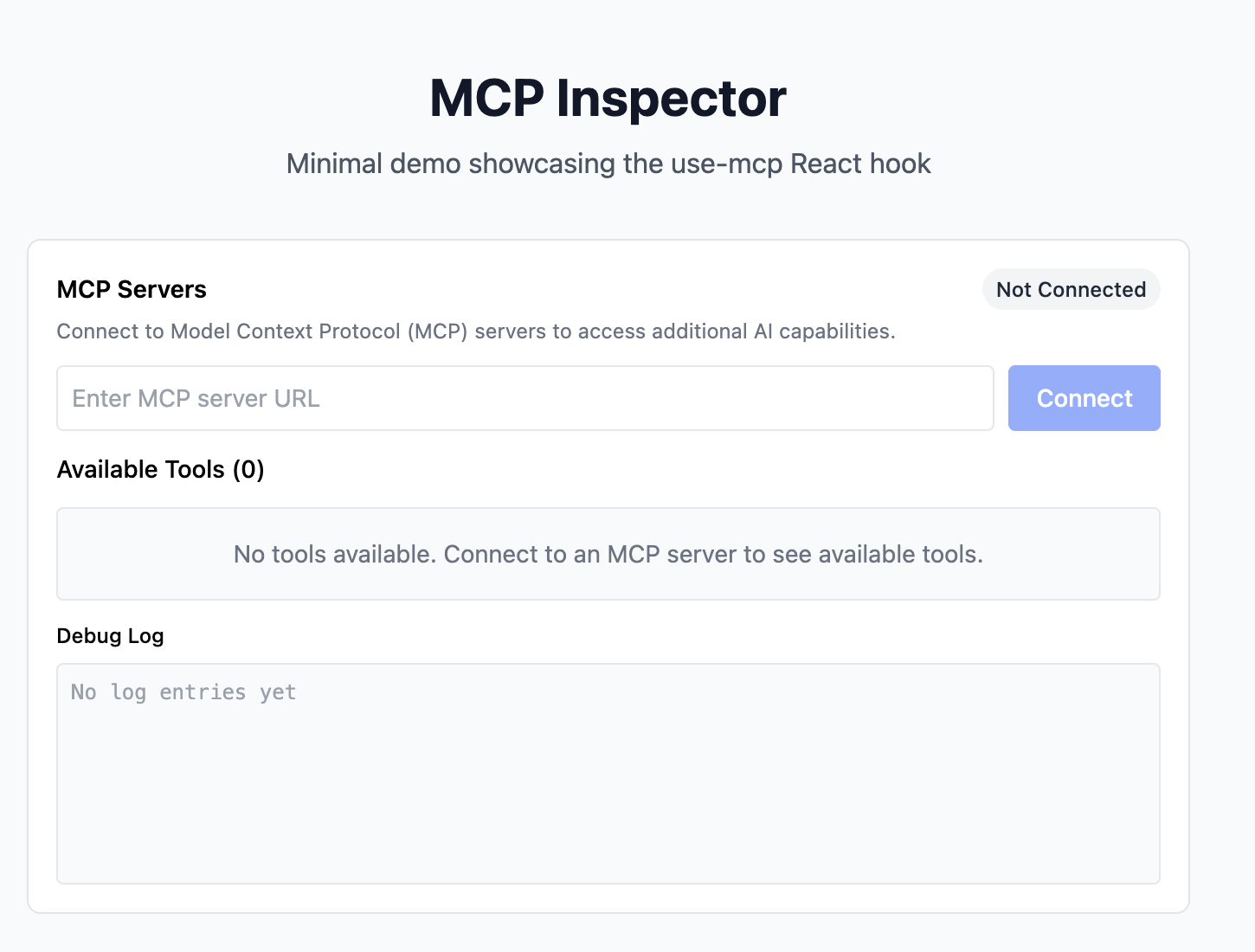
In use-mcp’s examples directory, you’ll see a minimal MCP Inspector that was built with the use-mcp hook. . Enter any MCP server URL to test connections, see available tools, and monitor interactions through the debug logs. It’s a great starting point for building your own MCP clients or something you can use to debug connections to your MCP server.
Open-sourcing the AI Playground
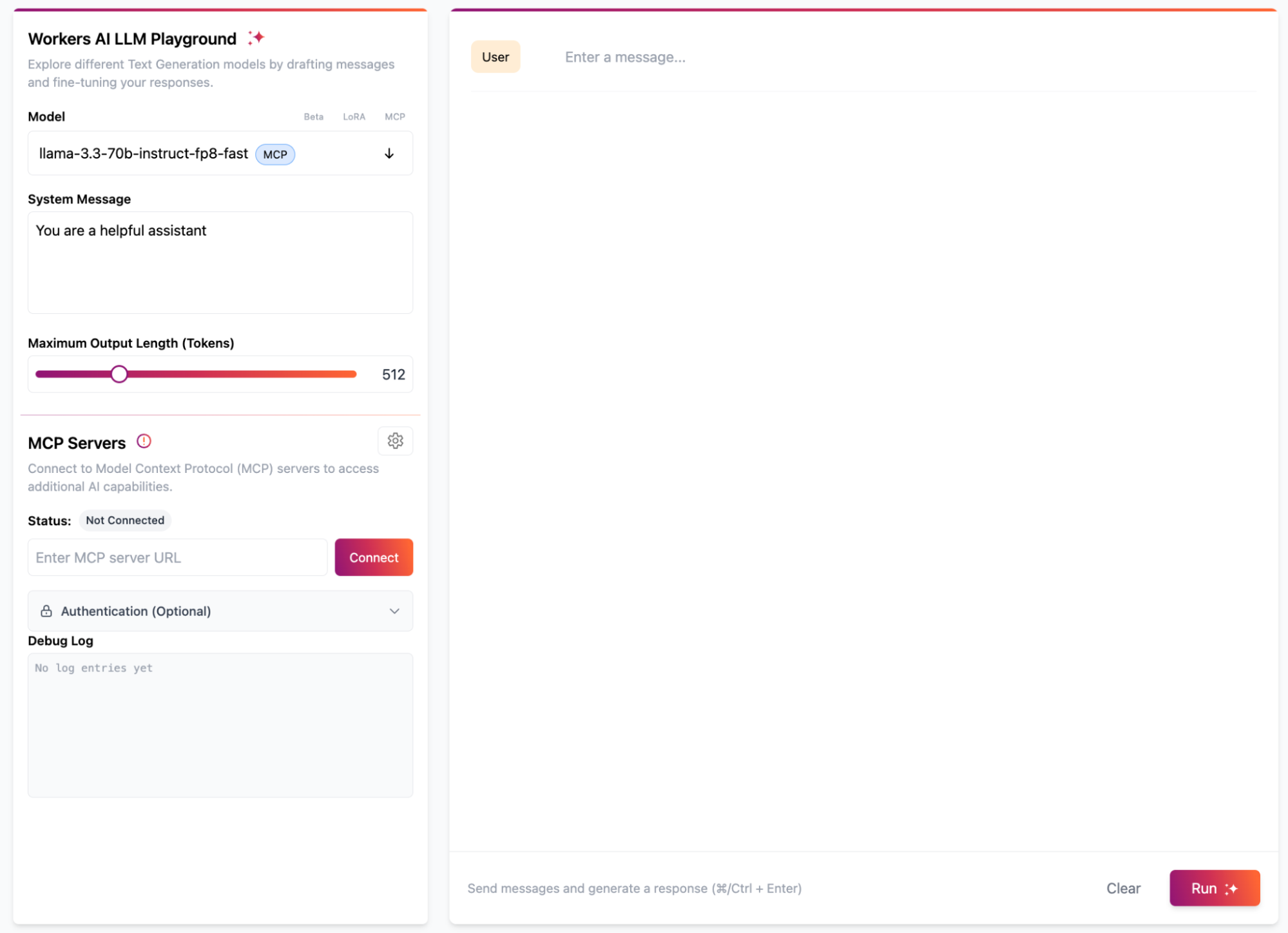
We initially built the AI Playground to give users a chat interface for testing different AI models supported by Workers AI. We then added MCP support, so it could be used as a remote MCP client to connect to and test MCP servers. Today, we’re open-sourcing the playground, giving you the complete chat interface with the MCP client built in, so you can deploy it yourself and customize it to fit your needs.
The playground comes with built-in support for the latest MCP standards, including both Streamable HTTP and Server-Sent Events transport methods, OAuth authentication flows that allow users to sign-in and grant permissions, as well as support for bearer token authentication for direct MCP server connections.
How the AI Playground works
The AI Playground is built on Workers AI, giving you access to a full catalog of large language models (LLMs) running on Cloudflare’s network, combined with the Agents SDK and use-mcp library for MCP server connections.
The AI Playground uses the use-mcp library to manage connections to remote MCP servers. When the playground starts up, it initializes the MCP connection system with const{tools: mcpTools} = useMcp(), which provides access to all tools from connected servers. At first, this list is empty because it’s not connected to any MCP servers, but once a connection to a remote MCP server is established, the tools are automatically discovered and populated into the list.
Once connected, the playground immediately has access to any tools that the MCP server exposes. The use-mcp library handles all the protocol communication and tool discovery, and maintains the connection state. If the MCP server requires authentication, the playground handles OAuth flows through a dedicated callback page that uses onMcpAuthorization from use-mcp to complete the authentication process.
When a user sends a chat message, the playground takes the mcpTools from the use-mcp hook and passes them directly to Workers AI, enabling the model to understand what capabilities are available and invoke them as needed.
To monitor and debug connections to MCP servers, we’ve added a Debug Log interface to the playground. This displays real-time information about the MCP server connections, including connection status, authentication state, and any connection errors.
During the chat interactions, the debug interface will show the raw message exchanged between the playground and the MCP server, including the tool invocation and its result. This allows you to monitor the JSON payload being sent to the MCP server, the raw response returned, and track whether the tool call succeeded or failed. This is especially helpful for anyone building remote MCP servers, as it allows you to see how your tools are behaving when integrated with different language models.
Contributing to the MCP ecosystem
One of the reasons why MCP has evolved so quickly is that it’s an open source project, powered by the community. We’re excited to contribute the use-mcp library to the MCP ecosystem to enable more developers to build remote MCP clients.
If you’re looking for examples of MCP clients or MCP servers to get started with, check out theCloudflare AI GitHub repository for working examples you can deploy and modify. This includes the complete AI Playground source code, a number of remote MCP servers that use different authentication & authorization providers, and the MCP Inspector.
We’re also building the Cloudflare MCP servers in public and welcome contributions to help make them better.
Whether you’re building your first MCP server, integrating MCP into an existing application, or contributing to the broader ecosystem, we’d love to hear from you. If you have any questions, feedback, or ideas for collaboration, you can reach us via email at [email protected].
Today, we’re excited to collaborate with Anthropic, Asana, Atlassian, Block, Intercom, Linear, PayPal, Sentry, Stripe, and Webflow to bring a whole new set of remote MCP servers, all built on Cloudflare, to enable Claude users to manage projects, generate invoices, query databases, and even deploy full stack applications — without ever leaving the chat interface.
Since Anthropic’s introduction of the Model Context Protocol (MCP) in November, there’s been more and more excitement about it, and it seems like a new MCP server is being released nearly every day. And for good reason! MCP has been the missing piece to make AI agents a reality, and helped define how AI agents interact with tools to take actions and get additional context.
But to date, end-users have had to install MCP servers on their local machine to use them. Today, with Anthropic’s announcement of Integrations, you can access an MCP server the same way you would a website: type a URL and go.
At Cloudflare, we’ve been focused on building out the tooling that simplifies the development of remote MCP servers, so that our customers’ engineering teams can focus their time on building out the MCP tools for their application, rather than managing the complexities of the protocol. And if you’re wondering just how easy is it to deploy a remote MCP server on Cloudflare, we’re happy to tell you that it only takes one click to get an MCP server — pre-built with support for the latest MCP standards — deployed.
But you don’t have to take our word for it, see it for yourself! Industry leaders are taking advantage of the ease of use to deliver new AI-powered experiences to their users by building their MCP servers on Cloudflare and now, you can do the same — just click “Deploy to Cloudflare” to get started.
Keep reading to learn more about the new capabilities that these companies are unlocking for their users and how they were able to deliver them. Or, see it in action by joining us for Demo Day on May 1 (today) at 10:00 AM PST.
We’re also making Cloudflare’s remote MCP servers available to customers today and sharing what we learned from building them out.
MCP: Powering the next generation of applications
It wasn’t always the expectation that every service, whether a store, real estate agent, or service would have a website. But as more people gained access to an Internet connection, that quickly became the case.
We’re in the midst of a similar transition now to every web user having access to AI tools, turning to them for many tasks. If you’re a developer, it’s likely the case that the first place you turn when you go to write code now is to a tool like Claude. It seems reasonable then, that if Claude helped you write the code, it would also help you deploy it.
Or if you’re not a developer, if Claude helped you come up with a recipe, that it would also help you order the required groceries.
With remote MCP, all of these scenarios are now possible. And just like the first businesses built on the web had a first mover advantage, the first businesses to be built in an MCP-forward way are likely to reap the benefits.
The faster a user can experience the value of your product, the more likely they will be to succeed, upgrade, and continue to use your product. By connecting services to agents through MCP, users can simply ask for what they need and the agent will handle the rest, getting them to that “aha” moment faster.
Making your service AI-first with MCP
Businesses that adopt MCP will quickly see the impact:
Lower the barrier to entry
Not every user has the time to learn your dashboard or read through documentation to understand your product. With MCP, they don’t need to. They just describe what they want, and the agent figures out the rest.
Create personalized experiences
MCP can keep track of a user’s requests and interactions, so future tool calls can be adapted to their usage patterns and preferences. This makes it easy to deliver more personalized, relevant experiences based on how each person actually uses your product.
Drive upgrades naturally
Rather than relying on feature comparison tables, the AI agent can explain how a higher-tier plan helps a specific user accomplish their goals.
Ship new features and integrations
You don’t need to build every integration or experience in-house. By exposing your tools via MCP, you let users connect your product to the rest of their stack. Agents can combine tools across providers, enabling integrations without requiring you to support every third-party service directly.
We’re continuing to ship updates regularly — adding support for the latest changes to the MCP standard and making it even easier to get your server to production:
Supporting the new Streamable HTTP transport: Your MCP servers can now use the latest Streamable HTTP transport alongside SSE, ensuring compatibility with the latest standards. We’ve updated the AI Playground and mcp-remote proxy as well, giving you a remote MCP client to easily test the new transport.
Python support for MCP servers: You can now build MCP servers on Cloudflare using Python, not just JavaScript/TypeScript.
Improved docs, starter templates, and deploy flows: We’ve added new quickstart templates, expanded our documentation to cover the new transport method, and shared best practices for building MCP servers based on our learnings.
But rather than telling you, we thought it would be better to show you what our customers have built and why they chose Cloudflare for their MCP deployment.
Remote MCP servers you can connect to today
Asana
Today, work lives across many different apps and services. By investing in MCP, Asana can meet users where they are, enabling agent-driven interoperability across tools and workflows. Users can interact with the Asana Work Graph using natural language to get project updates, search for tasks, manage projects, send comments, and update deadlines from an MCP client.
Users will be able to orchestrate and integrate different pieces of work seamlessly — for example, turning a project plan or meeting notes from another app into a fully assigned set of tasks in Asana, or pulling Asana tasks directly into an MCP-enabled IDE for implementation. This flexibility makes managing work across systems easier, faster, and more natural than ever before.
To accelerate the launch of our first-party MCP server, Asana built on Cloudflare’s tooling, taking advantage of the foundational infrastructure to move quickly and reliably in this fast-evolving space.
“At Asana, we’ve always focused on helping teams coordinate work effortlessly. MCP connects our Work Graph directly to AI tools like Claude.ai, enabling AI to become a true teammate in work management. Our integration transforms natural language into structured work – creating projects from meeting notes or pulling updates into AI. Building on Cloudflare’s infrastructure allowed us to deploy quickly, handling authentication and scaling while we focused on creating the best experience for our users.” – Prashant Pandey, Chief Technology Officer, Asana
Jira and Confluence Cloud customers can now securely interact with their data directly from Anthropic’s Claude app via the Atlassian Remote MCP Server in beta. Hosted on Cloudflare infrastructure, users can summarize work, create issues or pages, and perform multi-step actions, all while keeping data secure and within permissioned boundaries.
Users can access information from Jira and Confluence wherever they use Claude to:
Summarize Jira work items or Confluence pages
Create Jira work items or Confluence pages directly from Claude
Get the model to take multiple actions in one go, like creating issues or pages in bulk
Enrich Jira work items with context from many different sources to which Claude has access
And so much more!
“AI is not one-size-fits-all and we believe that it needs to be embedded within a team’s jobs to be done. That’s why we’re so excited to invest in MCP and meet teams in more places where they already work. Hosting on Cloudflare infrastructure means we can bring this powerful integration to our customers faster and empower them to do more than ever with Jira and Confluence, all while keeping their enterprise data secure. Cloudflare provided everything from OAuth to out-of-the-box remote MCP support so we could quickly build, secure, and scale a fully operational setup.” — Taroon Mandhana, Head of Product Engineering, Atlassian
At Intercom, the transformative power of AI is becoming increasingly clear. Fin, Intercom’s AI Agent, is now autonomously resolving over 50% of customer support conversations for leading companies such as Anthropic. With MCP, connecting AI to internal tools and systems is easier than ever, enabling greater business value.
Customer conversations, for instance, offer valuable insights into how products are being used and the experiences customers are having. However, this data is often locked within the support platform. The Intercom MCP server unlocks this rich source of customer data, making it accessible to anyone in the organization using AI tools. Engineers, for example, can leverage conversation history and user data from Intercom in tools like Cursor or Claude Code to diagnose and resolve issues more efficiently.
“The momentum behind MCP is exciting. It’s making it easier and easier to connect assistants like Claude.ai and agents like Fin to your systems and get real work done. Cloudflare’s toolkit is accelerating that movement even faster. Their clear documentation, purpose-built tools, and developer-first platform helped Intercom go from concept to production in under a day, making the Intercom MCP server launch effortless. We’ll be encouraging our customers to leverage Cloudflare to build and deploy their own MCP servers to securely and reliably connect their internal systems to Fin and other clients.” — Jordan Neill, SVP Engineering, Intercom
Linear
The Linear MCP server allows users to bring the context of their issues and product development process directly into AI assistants when it’s needed. Whether that is refining a product spec in Claude, collaborating on fixing a bug with Cursor, or creating issues on the fly from an email.
“We’re building on Cloudflare to take advantage of their frameworks in this fast-moving space and flexible, fast, compute at the edge. With MCP, we’re bringing Linear’s issue tracking and product development workflows directly into their AI tools of choice, eliminating context switching for teams. Our goal is simple: let developers and product teams access their work where they already are—whether refining specs in Claude, debugging in Cursor, or creating issues from conversations. This seamless integration helps our customers stay in flow and focused on building great products” — Tom Moor, Head of US Engineering, Linear
“MCPs represent a new paradigm for software development. With PayPal’s remote MCP server on Cloudflare, now developers can delegate to an agent with natural language to seamlessly integrate with PayPal’s portfolio of commerce capabilities. Whether it’s managing inventory, processing payments, tracking shipping, handling refunds, AI agents via MCP can tap into these capabilities to autonomously execute and optimize commerce workflows. This is a revolutionary development for commerce, and the best part is, developers can begin integrating with our MCP server on Cloudflare today.” – Prakhar Mehrotra, SVP of Artificial Intelligence, PayPal
With the Sentry MCP server, developers are able to query Sentry’s context right from their IDE, or an assistant like Claude, to get errors and issue information across projects or even for individual files.
Developers can also use the MCP to create projects, capture setup information, and query project and organization information – and use the information to set up their applications for Sentry. As we continue to build out the MCP further, we’ll allow teams to bring in root cause analysis and solution information from Seer, our Agent, and also look at simplifying instrumentation for sentry functionality like traces, and exception handling.
Hosting this on Cloudflare and using Remote MCP, we were able to sidestep a number of the complications of trying to run locally, like scaling or authentication. Remote MCP lets us leverage Sentry’s own OAuth configuration directly. Durable Object support also lets us maintain state within the MCP, which is important when you’re not running locally.
“Sentry’s commitment has always been to the developer, and making it easier to keep production software running stable, and that’s going to be even more true in the AI era. Developers are utilizing tools like MCP to integrate their stack with AI models and data sources. We chose to build our MCP on Cloudflare because we share a vision of making it easier for developers to ship software, and are both invested in ensuring teams can build and safely run the next generation of AI agents. Debugging the complex interactions arising from these integrations is increasingly vital, and Sentry provides the essential visibility needed to rapidly diagnose and resolve issues. MCP integrates this crucial Sentry context directly into the developer workflow, empowering teams to consistently build and deploy reliable applications.” — David Cramer, CPO and Co-Founder, Sentry
Square’s APIs are a comprehensive set of tools that help sellers take payments, create and track orders, manage inventory, organize customers, and more. Now, with a dedicated Square MCP server, sellers can enlist the help of an AI agent to build their business on Square’s entire suite of API resources and endpoints. By integrating with AI agents like Claude and codename goose, sellers can craft sophisticated, customized use cases that fully utilize Square’s capabilities, at a lower technical barrier.
“MCP is emerging as a new AI interface. In the near-future, MCP may become the default way, or in some cases the only way, people, businesses, and code discover and interact with services. With Stripe’s agent toolkit and Cloudflare’s Agent SDK, developers can now monetize their MCPs with just a few lines of code.” — Jeff Weinstein, Product Lead at Stripe
Webflow
The Webflow MCP server supports CMS management, auditing and improving SEO, content localization, site publishing, and more. This enables users to manage and improve their site directly from their AI agent.
“We see MCP as a new way to interact with Webflow that aligns well with our mission of bringing development superpowers to everyone. MCP is not just a different surface over our APIs, instead we’re thinking of it in terms of the actions it supports: publish a website, create a CMS collection, update content, and more. MCP lets us expose those actions in a way that’s discoverable, secure, and deeply contextual. It opens the door to new workflows where AI and humans can work side-by-side, without needing to cobble together solutions or handle low-level API details. Cloudflare supports this aim by offering the reliability, performance, and developer tooling we need to build modern web infrastructure. Their support for remote MCP servers is mature and well-integrated, and their approach to authentication and durability aligns with how we think about the scale and security of these offerings.” — Utkarsh Sengar, VP of Engineering, Webflow
If you’re looking to build a remote MCP server for your service, get started with our documentation, watch the tutorial below, or use the button below to get a starter remote MCP server deployed to production. Once the remote MCP server is deployed, it can be used from Claude, Cloudflare’s AI playground, or any remote MCP client.
In addition, we launched a new YouTube video walking you through building MCP servers, using two of our MCP templates.
If you have any questions or feedback for us, you can reach us via email at [email protected].
In late November 2024, Anthropic announced a new way to interact with AI, called Model Context Protocol (MCP). Today, we’re excited to show you how to use MCP in combination with Cloudflare to extend the capabilities of Claude to build applications, generate images and more. You’ll learn how to build an MCP server on Cloudflare to make any service accessible through an AI assistant like Claude with just a few lines of code using Cloudflare Workers.
A quick primer on the Model Context Protocol (MCP)
MCP is an open standard that provides a universal way for LLMs to interact with services and applications. As the introduction on the MCP website puts it,
“Think of MCP like a USB-C port for AI applications. Just as USB-C provides a standardized way to connect your devices to various peripherals and accessories, MCP provides a standardized way to connect AI models to different data sources and tools.”
From an architectural perspective, MCP is comprised of several components:
MCP hosts: Programs or tools (like Claude) where AI models operate and interact with different services
MCP clients: Client within an AI assistant that initiates requests and communicates with MCP servers to perform tasks or access resources
MCP servers: Lightweight programs that each expose the capabilities of a service
Local data sources: Files, databases, and services on your computer that MCP servers can securely access
Remote services: External Internet-connected systems that MCP servers can connect to through APIs
Imagine you ask Claude to send a message in a Slack channel. Before Claude can do this, Slack must communicate which tools are available. It does this by defining tools — such as “list channels”, “post messages”, and “reply to thread” — in the MCP server. Once the MCP client knows what tools it should invoke, it can complete the task. All you have to do is tell it what you need, and it will get it done.
Allowing AI to not just generate, but deploy applications for you
What makes MCP so powerful? As a quick example, by combining it with a platform like Cloudflare Workers, it allows Claude users to deploy a Cloudflare Worker in just one sentence, resulting in a site like this:
But that’s just one example. Today, we’re excited to show you how you can build and deploy your own MCP server to allow your users to interact with your application directly from an LLM like Claude, and how you can do that just by writing a Cloudflare Worker.
Simplifying your MCP Server deployment with workers-mcp
The new workers-mcp tooling handles the translation between your code and the MCP standard, so that you don’t have to do the maintenance work to get it set up.
Once you create your Worker and install the MCP tooling, you’ll get a worker-mcp template set up for you. This boilerplate removes the overhead of configuring the MCP server yourself:
import { WorkerEntrypoint } from 'cloudflare:workers'
import { ProxyToSelf } from 'workers-mcp'
export default class MyWorker extends WorkerEntrypoint<Env> {
  /**
   * A warm, friendly greeting from your new Workers MCP server.
   * @param name {string} the name of the person we are greeting.
   * @return {string} the contents of our greeting.
   */
  sayHello(name: string) {
    return `Hello from an MCP Worker, ${name}!`
  }
  /**
   * @ignore
   **/
  async fetch(request: Request): Promise<Response> {
    return new ProxyToSelf(this).fetch(request)
  }
}
Let’s unpack what’s happening here. This provides a direct link to MCP. The ProxyToSelf logic ensures that your Worker is wired up to respond as an MCP server, without any complex routing or schema definitions.
It also provides tool definition with JSDoc. You’ll notice that the `sayHello` method is annotated with JSDoc comments describing what it does, what arguments it takes, and what it returns. These comments aren’t just for human readers, but they’re also used to generate documentation that your AI assistant (Claude) can understand.
Adding image generation to Claude
When you build an MCP server using Workers, adding custom functionality to an LLM is easy. Instead of setting up the server infrastructure, defining request schemas, all you have to do is write the code. Above, all we did was generate a “hello world”, but now let’s power up Claude to generate an image, using Workers AI:
import { WorkerEntrypoint } from 'cloudflare:workers'
import { ProxyToSelf } from 'workers-mcp'

export default class ClaudeImagegen extends WorkerEntrypoint<Env> {
 /**
   * Generate an image using the flux-1-schnell model.
   * @param prompt {string} A text description of the image you want to generate.
   * @param steps {number} The number of diffusion steps; higher values can improve quality but take longer.
   */
  async generateImage(prompt: string, steps: number): Promise<string> {
    const response = await this.env.AI.run('@cf/black-forest-labs/flux-1-schnell', {
      prompt,
      steps,
    });
        // Convert from base64 string
        const binaryString = atob(response.image);
        // Create byte representation
        const img = Uint8Array.from(binaryString, (m) => m.codePointAt(0)!);

        return new Response(img, {
          headers: {
            'Content-Type': 'image/jpeg',
          },
        });
      }
  /**
   * @ignore
   */
  async fetch(request: Request): Promise<Response> {
    return new ProxyToSelf(this).fetch(request)
  }
}
Once you update the code and redeploy the Worker, Claude will now be able to use the new image generation tool. All you have to say is: “Hey! Can you create an image of a lava lamp wall that lives in San Francisco?”
If you’re looking for some inspiration, here are a few examples of what you can build with MCP and Workers:
Let Claude send follow-up emails on your behalf using Email Routing
To build out an MCP server without access to Cloudflare’s tooling, you would have to: initialize an instance of the server, define your APIs by creating explicit schemas for every interaction, handle request routing, ensure that the responses are formatted correctly, write handlers for every action, configure how the server will communicate, and more… As shown above, we do all of this for you.
For reference, an implementation may look something like this:
import { Server } from "@modelcontextprotocol/sdk/server/index.js";
import { StdioServerTransport } from "@modelcontextprotocol/sdk/server/stdio.js";

const server = new Server({ name: "example-server", version: "1.0.0" }, {
  capabilities: { resources: {} }
});

server.setRequestHandler(ListResourcesRequestSchema, async () => {
  return {
    resources: [{ uri: "file:///example.txt", name: "Example Resource" }]
  };
});

server.setRequestHandler(ReadResourceRequestSchema, async (request) => {
  if (request.params.uri === "file:///example.txt") {
    return {
      contents: [{
        uri: "file:///example.txt",
        mimeType: "text/plain",
        text: "This is the content of the example resource."
      }]
    };
  }
  throw new Error("Resource not found");
});

const transport = new StdioServerTransport();
await server.connect(transport);
While this works, it requires quite a bit of code just to get started. Not only do you need to be familiar with the MCP protocol, but you need to complete a fair amount of set up work (e.g. defining schemas) for every action. Doing it through Workers removes all these barriers, allowing you to spin up an MCP server without the complexity.
We’re always looking for ways to simplify developer workflows, and we’re excited about this new standard to open up more possibilities for interacting with LLMs, and building agents.
If you’re interested in setting this up, check out this tutorial which walks you through these examples. We’re excited to see what you build. Be sure to share your MCP server creations with us on Discord, X, or Bluesky!
Chrome and Mozilla announced that they will stop trusting Entrust’s public TLS certificates issued after November 12, 2024 and December 1, 2024, respectively. This decision stems from concerns related to Entrust’s ability to meet the CA/Browser Forum’s requirements for a publicly trusted certificate authority (CA). To prevent Entrust customers from being impacted by this change, Entrust has announced that they are partnering with SSL.com, a publicly trusted CA, and will be issuing certs from SSL.com’s roots to ensure that they can continue to provide their customers with certificates that are trusted by Chrome and Mozilla.
We’re excited to announce that we’re going to be adding SSL.com as a certificate authority that Cloudflare customers can use. This means that Cloudflare customers that are currently relying on Entrust as a CA and uploading their certificate manually to Cloudflare will now be able to rely on Cloudflare’s certificate management pipeline for automatic issuance and renewal of SSL.com certificates.
CA distrust: responsibilities, repercussions, and responses
With great power comes great responsibility Every publicly trusted certificate authority (CA) is responsible for maintaining a high standard of security and compliance to ensure that the certificates they issue are trustworthy. The security of millions of websites and applications relies on a CA’s commitment to these standards, which are set by the CA/Browser Forum, the governing body that defines the baseline requirements for certificate authorities. These standards include rules regarding certificate issuance, validation, and revocation, all designed to secure the data transferred over the Internet.
However, as with all complex software systems, it’s inevitable that bugs or issues may arise, leading to the mis-issuance of certificates. Improperly issued certificates pose a significant risk to Internet security, as they can be exploited by malicious actors to impersonate legitimate websites and intercept sensitive data.
To mitigate such risk, publicly trusted CAs are required to communicate issues as soon as they are discovered, so that domain owners can replace the compromised certificates immediately. Once the issue is communicated, CAs must revoke the mis-issued certificates within 5 days to signal to browsers and clients that the compromised certificate should no longer be trusted. This level of transparency and urgency around the revocation process is essential for minimizing the risk posed by compromised certificates.
Why Chrome and Mozilla are distrusting Entrust The decision made by Chrome and Mozilla to distrust Entrust’s public TLS certificates stems from concerns regarding Entrust’s incident response and remediation process. In several instances, Entrust failed to report critical issues and did not revoke certificates in a timely manner. The pattern of delayed action has eroded the browsers’ confidence in Entrust’s ability to act quickly and transparently, which is crucial for maintaining trust as a CA.
Google and Mozilla cited the ongoing lack of transparency and urgency in addressing mis-issuances as the primary reason for their distrust decision. Google specifically pointed out that over the past 6 years, Entrust has shown a “pattern of compliance failures” and failed to make the “tangible, measurable progress” necessary to restore trust. Mozilla echoed these concerns, emphasizing the importance of holding Entrust accountable to ensure the integrity and security of the public Internet.
Entrust’s response to the distrust announcement In response to the distrust announcement from Chrome and Mozilla, Entrust has taken proactive steps to ensure continuity for their customers. To prevent service disruption, Entrust has announced that they are partnering with SSL.com, a CA that’s trusted by all major browsers, including Chrome and Mozilla, to issue certificates for their customers. By issuing certificates from SSL.com’s roots, Entrust aims to provide a seamless transition for their customers, ensuring that they can continue to obtain certificates that are recognized and trusted by the browsers their users rely on.
In addition to their partnership with SSL.com, Entrust stated that they are working on a number of improvements, including changes to their organizational structure, revisions to their incident response process and policies, and a push towards automation to ensure compliant certificate issuances.
How Cloudflare can help Entrust customers
Now available: SSL.com as a certificate authority for Advanced Certificate Manager and SSL for SaaS certificates We’re excited to announce that customers using Advanced Certificate Manager will now be able to select SSL.com as a certificate authority for Advanced certificates and Total TLS certificates. Once the certificate is issued, Cloudflare will handle all future renewals on your behalf.
By default, Cloudflare will issue SSL.com certificates with a 90 day validity period. However, customers using Advanced Certificate Manager will have the option to set a custom validity period (14, 30, or 90 days) for their SSL.com certificates. In addition, Enterprise customers will have the option to obtain 1-year SSL.com certificates. Every SSL.com certificate order will include 1 RSA and 1 ECDSA certificate.
Note: We are gradually rolling this out and customers should see the CA become available to them through the end of September and into October.
If you’re using Cloudflare as your DNS provider, there are no additional steps for you to take to get the certificate issued. Cloudflare will validate the ownership of the domain on your behalf to get your SSL.com certificate issued and renewed.
If you’re using an external DNS provider and have wildcard hostnames on your certificates, DNS based validation will need to be used, which means that you’ll need to add TXT DCV tokens at your DNS provider in order to get the certificate issued. With SSL.com, two tokens are returned for every hostname on the certificate. This is because SSL.com uses different tokens for the RSA and ECDSA certificates. To reduce the overhead around certificate management, we recommend setting up DCV Delegation to allow Cloudflare to place domain control validation (DCV) tokens on your behalf. Once DCV Delegation is set up, Cloudflare will automatically issue, renew, and deploy all future certificates for you.
Advanced Certificates: selecting SSL.com as a CA through the UI or API Customers can select SSL.com as a CA through the UI or through the Advanced Certificate API endpoint by specifying “ssl_com” in the certificate_authority parameter.
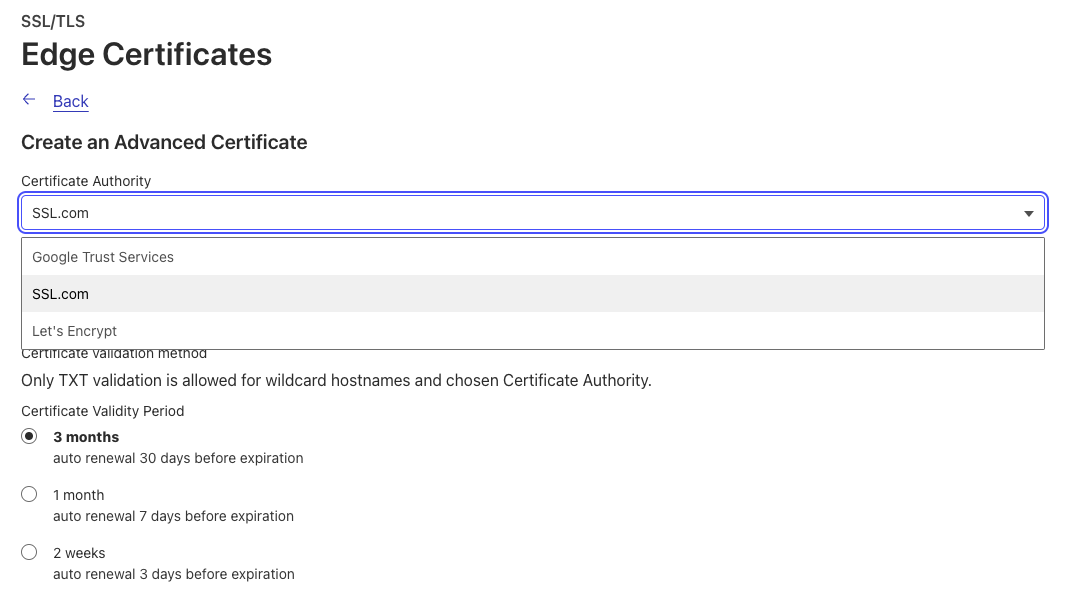
If you’d like to use SSL.com as a CA for an advanced certificate, you can select “SSL.com” as your CA when creating a new Advanced certificate order.
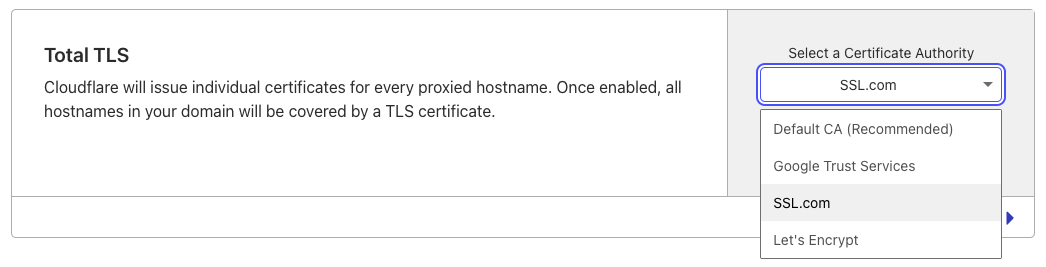
If you’d like to use SSL.com as a CA for all of your certificates, we recommend setting your Total TLS CA to SSL.com. This will issue an individual certificate for each of your proxied hostname from the CA.
Note: Total TLS is a feature that’s only available to customers that are using Cloudflare as their DNS provider.
SSL for SaaS: selecting SSL.com as a CA through the UI or API Enterprise customers can select SSL.com as a CA through the custom hostname creation UI or through the Custom Hostnames API endpoint by specifying “ssl_com” in the certificate_authority parameter.
All custom hostname certificates issued from SSL.com will have a 90 day validity period. If you have wildcard support enabled for custom hostnames, we recommend using DCV Delegation to ensure that all certificate issuances and renewals are automatic.
Our recommendation if you’re using Entrust as a certificate authority
Cloudflare customers that use Entrust as their CA are required to manually handle all certificate issuances and renewals. Since Cloudflare does not directly integrate with Entrust, customers have to get their certificates issued directly from the CA and upload them to Cloudflare as custom certificates. Once these certificates come up for renewal, customers have to repeat this manual process and upload the renewed certificates to Cloudflare before the expiration date.
Manually managing your certificate’s lifecycle is a time-consuming and error prone process. With certificate lifetimes decreasing from 1 year to 90 days, this cycle needs to be repeated more frequently by the domain owner.
As Entrust transitions to issuing certificates from SSL.com roots, this manual management process will remain unless customers switch to Cloudflare’s managed certificate pipeline. By making this switch, you can continue to receive SSL.com certificates without the hassle of manual management — Cloudflare will handle all issuances and renewals for you!
In early October, we will be reaching out to customers who have uploaded Entrust certificates to Cloudflare to recommend migrating to our managed pipeline for SSL.com certificate issuances, simplifying your certificate management process.
If you’re ready to make the transition today, simply go to the SSL/TLS tab in your Cloudflare dashboard, click “Order Advanced Certificate”, and select “SSL.com” as your certificate authority. Once your new SSL.com certificate is issued, you can either remove your Entrust certificate or simply let it expire. Cloudflare will seamlessly transition to serving the managed SSL.com certificate before the Entrust certificate expires, ensuring zero downtime during the switch.
In today’s world, technology is quickly evolving and some practices that were once considered the gold standard are quickly becoming outdated. At Cloudflare, we stay close to industry changes to ensure that we can provide the best solutions to our customers. One practice that we’re continuing to see in use that no longer serves its original purpose is certificate pinning. In this post, we’ll dive into certificate pinning, the consequences of using it in today’s Public Key Infrastructure (PKI) world, and alternatives to pinning that offer the same level of security without the management overhead.
PKI exists to help issue and manage TLS certificates, which are vital to keeping the Internet secure – they ensure that users access the correct applications or servers and that data between two parties stays encrypted. The mis-issuance of a certificate can pose great risk. For example, if a malicious party is able to issue a TLS certificate for your bank’s website, then they can potentially impersonate your bank and intercept that traffic to get access to your bank account. To prevent a mis-issued certificate from intercepting traffic, the server can give a certificate to the client and say “only trust connections if you see this certificate and drop any responses that present a different certificate” – this practice is called certificate pinning.
In the early 2000s, it was common for banks and other organizations that handle sensitive data to pin certificates to clients. However, over the last 20 years, TLS certificate issuance has evolved and changed, and new solutions have been developed to help customers achieve the security benefit they receive through certificate pinning, with simpler management, and without the risk of disruption.
Cloudflare’s mission is to help build a better Internet, which is why our teams are always focused on keeping domains secure and online.
Why certificate pinning is causing more outages now than it did before
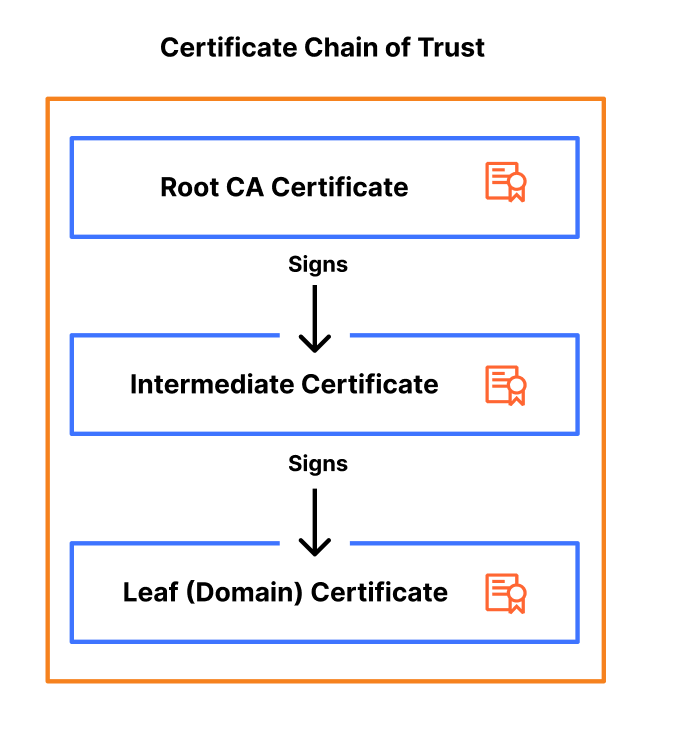
Certificate pinning is not a new practice, so why are we emphasizing the need to stop using it now? The reason is that the PKI ecosystem is moving towards becoming more agile, flexible, and secure. As a part of this change, certificate authorities (CAs) are starting to rotate certificates and their intermediates, certificates that bridge the root certificate and the domain certificate, more frequently to improve security and encourage automation.
These more frequent certificate rotations are problematic from a pinning perspective because certificate pinning relies on the exact matching of certificates. When a certificate is rotated, the new certificate might not match the pinned certificate on the client side. If the pinned certificate is not updated to reflect the contents of the rotated certificate, the client will reject the new certificate, even if it’s valid and issued by the same CA. This mismatch leads to a failure in establishing a secure connection, causing the domain or application to become inaccessible until the pinned certificate is updated.
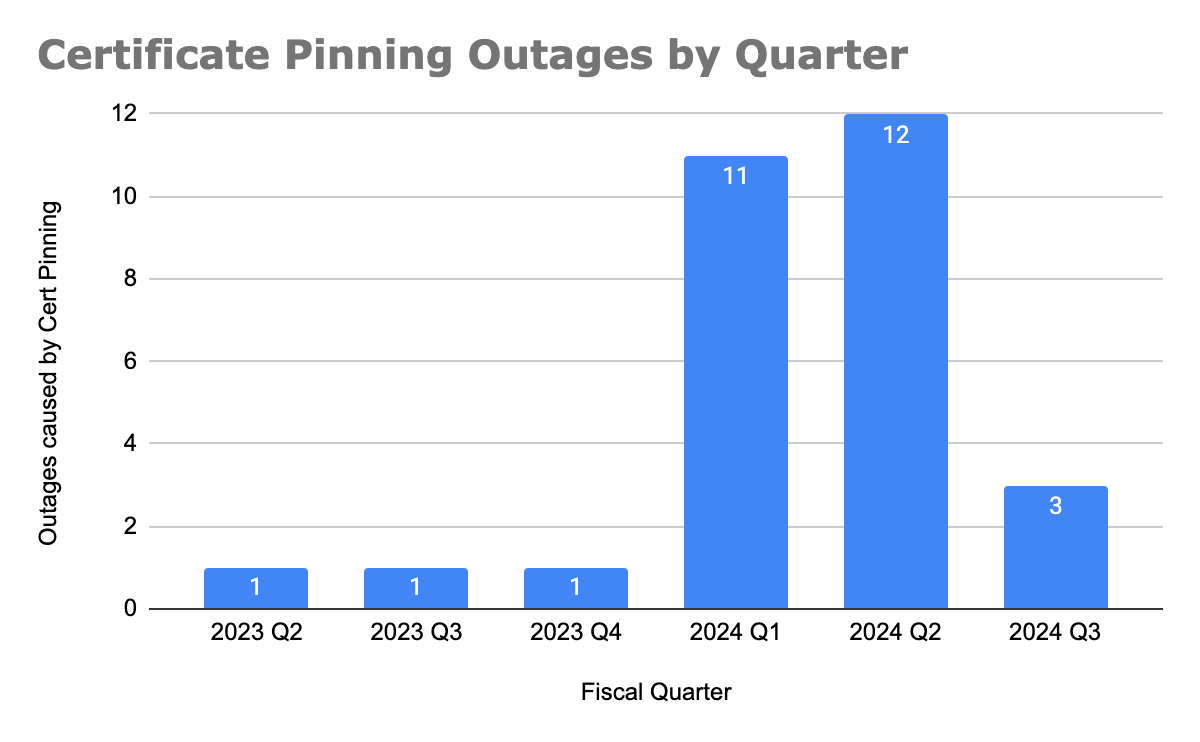
Since the start of 2024, we have seen the number of customer reported outages caused by certificate pinning significantly increase. (As of this writing, we are part way through July and Q3 has already seen as many outages as the last three quarters of 2023 combined.)
We can attribute this rise to two major events: Cloudflare migrating away from using DigiCert as a certificate authority and Google and Let’s Encrypt intermediate CA rotations.
Before migrating customer’s certificates away from using DigiCert as the CA, Cloudflare sent multiple notifications to customers to inform them that they should update or remove their certificate pins, so that the migration does not impact their domain’s availability.
However, what we’ve learned is that almost all customers that were impacted by the change were unaware that they had a certificate pin in place. One of the consequences of using certificate pinning is that the “set and forget” mentality doesn’t work, now that certificates are being rotated more frequently. Instead, changes need to be closely monitored to ensure that a regular certificate renewal doesn’t cause an outage. This goes to show that to implement certificate pinning successfully, customers need a robust system in place to track certificate changes and implement them.
We built our Universal SSL pipeline to be resilient and redundant, ensuring that we can always issue and renew a TLS certificate on behalf of our customers, even in the event of a compromise or revocation. CAs are starting to make changes like more frequent certificate rotations to encourage a move towards a more secure ecosystem. Now, it’s up to domain owners to stop implementing legacy practices like certificate pinning, which cause breaking changes, and instead start adopting modern standards that aim to provide the same level of security, but without the management overhead or risk.
Modern standards & practices are making the need for certificate pinning obsolete
Shorter certificate lifetimes
Over the last few years, we have seen certificate lifetimes quickly decrease. Before 2011, a certificate could be valid for up to 96 months (eight years) and now, in 2024, the maximum validity period for a certificate is 1 year. We’re seeing this trend continue to develop, with Google Chrome pushing for shorter CA, intermediate, and certificate lifetimes, advocating for 3 month certificate validity as the new standard.
This push improves security and redundancy of the entire PKI ecosystem in several ways. First, it reduces the scope of a compromise by limiting the amount of time that a malicious party could control a TLS certificate or private key. Second, it reduces reliance on certificate revocation, a process that lacks standardization and enforcement by clients, browsers, and CAs. Lastly, it encourages automation as a replacement for legacy certificate practices that are time-consuming and error-prone.
Cloudflare is moving towards only using CAs that follow the ACME (Automated Certificate Management Environment) protocol, which by default, issues certificates with 90 day validity periods. We have already started to roll this out to Universal SSL certificates and have removed the ability to issue 1-year certificates as a part of our reduced usage of DigiCert.
Regular rotation of intermediate certificates
The CAs that Cloudflare partners with, Let’s Encrypt and Google Trust Services, are starting to rotate their intermediate CAs more frequently. This increased rotation is beneficial from a security perspective because it limits the lifespan of intermediate certificates, reducing the window of opportunity for attackers to exploit a compromised intermediate. Additionally, regular rotations make it easier to revoke an intermediate certificate if it becomes compromised, enhancing the overall security and resiliency of the PKI ecosystem.
Cloudflare customers using Advanced Certificate Manager have the ability to choose their issuing CA. The issue is that even if Cloudflare uses the same CA for a certificate renewal, there is no guarantee that the same certificate chain (root or intermediate) will be used to issue the renewed certificate. As a result, if pinning is used, a successful renewal could cause a full outage for a domain or application.
This happens because certificate pinning relies on the exact matching of certificates. When an intermediate certificate is rotated or changed, the new certificate might not match the pinned certificate on the client side. As a result, the client will reject the renewed certificate, even if it’s a valid certificate issued by the same CA. This mismatch leads to a failure on the client side, causing the domain to become inaccessible until the pinned certificate is updated to reflect the new intermediate certificate. This risk of an unexpected outage is a major downside of continuing to use certificate pinning, especially as CAs increasingly update their intermediates as a security measure.
Increased use of certificate transparency
Certificate transparency (CT) logs provide a standardized framework for monitoring and auditing the issuance of TLS certificates. CT logs help detect misissued or malicious certificates and Cloudflare customers can set up CT monitoring to receive notifications about any certificates issued for their domain. This provides a better mechanism for detecting certificate mis-issuance, reducing the need for pinning.
Why modern standards make certificate pinning obsolete
Together, these practices – shorter certificate lifetimes, regular rotations of intermediate certificates, and increased use of certificate transparency – address the core security concerns that certificate pinning was initially designed to mitigate. Shorter lifetimes and frequent rotations limit the impact of compromised certificates, while certificate transparency allows for real time monitoring and detection of misissued certificates. These advancements are automated, scalable, and robust and eliminate the need for the manual and error-prone process of certificate pinning. By adopting these modern standards, organizations can achieve a higher level of security and resiliency without the management overhead and risk associated with certificate pinning.
Reasons behind continued use of certificate pinning
Originally, certificate pinning was designed to prevent monster-in-the-middle (MITM) attacks by associating a hostname with a specific TLS certificate, ensuring that a client could only access an application if the server presented a certificate issued by the domain owner.
Certificate pinning was traditionally used to secure IoT (Internet of Things) devices, mobile applications, and APIs. IoT devices are usually equipped with more limited processing power and are oftentimes unable to perform software updates. As a result, they’re less likely to perform things like certificate revocation checks to ensure that they’re using a valid certificate. As a result, it’s common for these devices to come pre-installed with a set of trusted certificate pins to ensure that they can maintain a high level of security. However, the increased frequency of certificate changes poses significant risk, as many devices have immutable software, preventing timely updates to certificate pins during renewals.
Similarly, certificate pinning has been employed to secure Android and iOS applications, ensuring that only the correct certificates are served. Despite this, both Apple and Google warn developers against the use of certificate pinning due to the potential for failures if not implemented correctly.
Understanding the trade-offs of different certificate pinning implementations
While certificate pinning can be applied at various levels of the certificate chain, offering different levels of granularity and security, we don’t recommend it due to the challenges and risks associated with its use.
Pinning certificates at the root certificate
Pinning the root certificate instructs a client to only trust certificates issued by that specific Certificate Authority (CA).
Advantages:
Simplified management: Since root certificates have long lifetimes (>10 years) and rarely change, pinning at the root reduces the need to frequently update certificate pins, making this the easiest option in terms of management overhead.
Disadvantages:
Broader trust: Most Certificate Authorities (CAs) issue their certificates from one root, so pinning a root CA certificate enables the client to trust every certificate issued from that CA. However, this broader trust can be problematic. If the root CA is compromised, every certificate issued by that CA is also compromised, which significantly increases the potential scope and impact of a security breach. This broad trust can therefore create a single point of failure, making the entire ecosystem more vulnerable to attacks.
Neglected Maintenance: Root certificates are infrequently rotated, which can lead to a “set and forget” mentality when pinning them. Although it’s rare, CAs do change their roots and when this happens, a correctly renewed certificate will break the pin, causing an outage. Since these pins are rarely updated, resolving such outages can be time-consuming as engineering teams try to identify and locate where the outdated pins have been set.
Pinning certificates at the intermediate certificate
Pinning an intermediate certificate instructs a client to only trust certificates issued by a specific intermediate CA, issued from a trusted root CA. With lifetimes ranging from 3 to 10 years, intermediate certificates offer a better balance between security and flexibility.
Advantages:
Better security: Narrows down the trust to certificates issued by a specific intermediate CA.
Simpler management: With intermediate CA lifetimes spanning a few years, certificate pins require less frequent updates, reducing the maintenance burden.
Disadvantages:
Broad trust: While pinning on an intermediate certificate is more restrictive than pinning on a root certificate, it still allows for a broad range of certificates to be trusted.
Maintenance: Intermediate certificates are rotated more frequently than root certificates, requiring more regular updates to pinned certificates.
Less predictability: With CAs like Let’s Encrypt issuing their certificates from varying intermediates, it’s no longer possible to predict which certificate chain will be used during a renewal, making it more likely for a certificate renewal to break a certificate pin and cause an outage.
Pinning certificates at the leaf certificate
Pinning the leaf certificate instructs a client to only trust that specific certificate. Although this option offers the highest level of security, it also poses the greatest risk of causing an outage during a certificate renewal.
Advantages:
High security: Provides the highest level of security by ensuring that only a specific certificate is trusted, minimizing the risk of a monster-in-the-middle attack.
Disadvantages:
Risky: Requires careful management of certificate renewals to prevent outages.
Management burden: Leaf certificates have shorter lifetimes, with 90 days becoming the standard, requiring constant updates to the certificate pin to avoid a breaking change during a renewal.
Alternatives to certificate pinning
Given the risks and challenges associated with certificate pinning, we recommend the following as more effective and modern alternatives to achieve the same level of security (preventing a mis-issued certificate from intercepting traffic) that certificate pinning aims to provide.
Shorter certificate lifetimes
Using shorter certificate lifetimes ensures that certificates are regularly renewed and replaced, reducing the risk of misuse of a compromised certificate by limiting the window of opportunity for attackers.
By default, Cloudflare issues 90-day certificates for customers. Customers using Advanced Certificate Manager can request TLS certificates with lifetimes as short as 14 days.
CAA records to restrict which CAs can issue certificates for a domain
Certification Authority Authorization (CAA) DNS records allow domain owners to specify which CAs are allowed to issue certificates for their domain. This adds an extra layer of security by restricting issuance to trusted authorities, providing a similar benefit as pinning a root CA certificate. For example, if you’re using Google Trust Services as your CA, you can add the following CAA DNS record to ensure that only that CA issues certificates for your domain:
example.com CAA 0 issue "pki.goog"
By default, Cloudflare sets CAA records on behalf of customers to ensure that certificates can be issued from the CAs that Cloudflare partners with. Customers can choose to further restrict that list of CAs by adding their own CAA records.
Certificate Transparency & monitoring
Certificate Transparency (CT) provides the ability to monitor and audit certificate issuances. By logging certificates in publicly accessible CT logs, organizations are able to monitor, detect, and respond to misissued certificates at the time they are issued.
Cloudflare customers can set up CT Monitoring to receive notifications when certificates are issued in their domain. Today, we notify customers using the product about all certificates issued for their domains. In the future, we will allow customers to filter those notifications, so that they are only notified when an external party that isn’t Cloudflare issues a certificate for the owner’s domain. This product is available to all customers and can be enabled with the click of a button.
Multi-vantage point Domain Control Validation (DCV) checks to prevent mis-issuances
For a CA to issue a certificate, the domain owner needs to prove ownership of the domain by serving Domain Control Validation (DCV) records. While uncommon, one attack vector of DCV validation allows an actor to perform BGP hijacking to spoof the DNS response and trick a CA into mis-issuing a certificate. To prevent this form of attack, CAs have started to perform DCV validation checks from multiple locations to ensure that a certificate is only issued when a full quorum is met.
Cloudflare has developed its own solution that CAs can use to perform multi vantage point DCV checks. In addition, Cloudflare partners with CAs like Let’s Encrypt who continue to develop these checks to support new locations, reducing the risk of a certificate mis-issuance.
Specifying ACME account URI in CAA records
A new enhancement to the ACME protocol allows certificate requesting parties to specify an ACME account URI, the ID of the ACME account that will be requesting the certificates, in CAA records to tighten control over the certificate issuance process. This ensures that only certificates issued through an authorized ACME account are trusted, adding another layer of verification to certificate issuance. Let’s Encrypt supports this extension to CAA records which allows users with a Let’s Encrypt certificate to set a CAA DNS record, such as the following:
With this record, Let’s Encrypt subscribers can ensure that only Let’s Encrypt can issue certificates for their domain and that these certificates were only issued through their ACME account.
Cloudflare will look to support this enhancement automatically for customers in the future.
Conclusion
Years ago, certificate pinning was a valuable tool for enhancing security, but over the last 20 years, it has failed to keep up with new advancements in the certificate ecosystem. As a result, instead of providing the intended security benefit, it has increased the number of outages caused during a successful certificate renewal. With new enhancements in certificate issuance standards and certificate transparency, we’re encouraging our customers and the industry to move towards adopting those new standards and deprecating old ones.
If you’re a Cloudflare customer and are required to pin your certificate, the only way to ensure a zero-downtime renewal is to upload your own custom certificates. We recommend using the staging network to test your certificate renewal to ensure you have updated your certificate pin.
In today’s world, technology is quickly evolving and some practices that were once considered the gold standard are quickly becoming outdated. At Cloudflare, we stay close to industry changes to ensure that we can provide the best solutions to our customers. One practice that we’re continuing to see in use that no longer serves its original purpose is certificate pinning. In this post, we’ll dive into certificate pinning, the consequences of using it in today’s Public Key Infrastructure (PKI) world, and alternatives to pinning that offer the same level of security without the management overhead.
PKI exists to help issue and manage TLS certificates, which are vital to keeping the Internet secure – they ensure that users access the correct applications or servers and that data between two parties stays encrypted. The mis-issuance of a certificate can pose great risk. For example, if a malicious party is able to issue a TLS certificate for your bank’s website, then they can potentially impersonate your bank and intercept that traffic to get access to your bank account. To prevent a mis-issued certificate from intercepting traffic, the server can give a certificate to the client and say “only trust connections if you see this certificate and drop any responses that present a different certificate” – this practice is called certificate pinning.
In the early 2000s, it was common for banks and other organizations that handle sensitive data to pin certificates to clients. However, over the last 20 years, TLS certificate issuance has evolved and changed, and new solutions have been developed to help customers achieve the security benefit they receive through certificate pinning, with simpler management, and without the risk of disruption.
Cloudflare’s mission is to help build a better Internet, which is why our teams are always focused on keeping domains secure and online.
Why certificate pinning is causing more outages now than it did before
Certificate pinning is not a new practice, so why are we emphasizing the need to stop using it now? The reason is that the PKI ecosystem is moving towards becoming more agile, flexible, and secure. As a part of this change, certificate authorities (CAs) are starting to rotate certificates and their intermediates, certificates that bridge the root certificate and the domain certificate, more frequently to improve security and encourage automation.
These more frequent certificate rotations are problematic from a pinning perspective because certificate pinning relies on the exact matching of certificates. When a certificate is rotated, the new certificate might not match the pinned certificate on the client side. If the pinned certificate is not updated to reflect the contents of the rotated certificate, the client will reject the new certificate, even if it’s valid and issued by the same CA. This mismatch leads to a failure in establishing a secure connection, causing the domain or application to become inaccessible until the pinned certificate is updated.
Since the start of 2024, we have seen the number of customer reported outages caused by certificate pinning significantly increase. (As of this writing, we are part way through July and Q3 has already seen as many outages as the last three quarters of 2023 combined.)
We can attribute this rise to two major events: Cloudflare migrating away from using DigiCert as a certificate authority and Google and Let’s Encrypt intermediate CA rotations.
Before migrating customer’s certificates away from using DigiCert as the CA, Cloudflare sent multiple notifications to customers to inform them that they should update or remove their certificate pins, so that the migration does not impact their domain’s availability.
However, what we’ve learned is that almost all customers that were impacted by the change were unaware that they had a certificate pin in place. One of the consequences of using certificate pinning is that the “set and forget” mentality doesn’t work, now that certificates are being rotated more frequently. Instead, changes need to be closely monitored to ensure that a regular certificate renewal doesn’t cause an outage. This goes to show that to implement certificate pinning successfully, customers need a robust system in place to track certificate changes and implement them.
We built our Universal SSL pipeline to be resilient and redundant, ensuring that we can always issue and renew a TLS certificate on behalf of our customers, even in the event of a compromise or revocation. CAs are starting to make changes like more frequent certificate rotations to encourage a move towards a more secure ecosystem. Now, it’s up to domain owners to stop implementing legacy practices like certificate pinning, which cause breaking changes, and instead start adopting modern standards that aim to provide the same level of security, but without the management overhead or risk.
Modern standards & practices are making the need for certificate pinning obsolete
Shorter certificate lifetimes
Over the last few years, we have seen certificate lifetimes quickly decrease. Before 2011, a certificate could be valid for up to 96 months (eight years) and now, in 2024, the maximum validity period for a certificate is 1 year. We’re seeing this trend continue to develop, with Google Chrome pushing for shorter CA, intermediate, and certificate lifetimes, advocating for 3 month certificate validity as the new standard.
This push improves security and redundancy of the entire PKI ecosystem in several ways. First, it reduces the scope of a compromise by limiting the amount of time that a malicious party could control a TLS certificate or private key. Second, it reduces reliance on certificate revocation, a process that lacks standardization and enforcement by clients, browsers, and CAs. Lastly, it encourages automation as a replacement for legacy certificate practices that are time-consuming and error-prone.
Cloudflare is moving towards only using CAs that follow the ACME (Automated Certificate Management Environment) protocol, which by default, issues certificates with 90 day validity periods. We have already started to roll this out to Universal SSL certificates and have removed the ability to issue 1-year certificates as a part of our reduced usage of DigiCert.
Regular rotation of intermediate certificates
The CAs that Cloudflare partners with, Let’s Encrypt and Google Trust Services, are starting to rotate their intermediate CAs more frequently. This increased rotation is beneficial from a security perspective because it limits the lifespan of intermediate certificates, reducing the window of opportunity for attackers to exploit a compromised intermediate. Additionally, regular rotations make it easier to revoke an intermediate certificate if it becomes compromised, enhancing the overall security and resiliency of the PKI ecosystem.
Cloudflare customers using Advanced Certificate Manager have the ability to choose their issuing CA. The issue is that even if Cloudflare uses the same CA for a certificate renewal, there is no guarantee that the same certificate chain (root or intermediate) will be used to issue the renewed certificate. As a result, if pinning is used, a successful renewal could cause a full outage for a domain or application.
This happens because certificate pinning relies on the exact matching of certificates. When an intermediate certificate is rotated or changed, the new certificate might not match the pinned certificate on the client side. As a result, the client will reject the renewed certificate, even if it’s a valid certificate issued by the same CA. This mismatch leads to a failure on the client side, causing the domain to become inaccessible until the pinned certificate is updated to reflect the new intermediate certificate. This risk of an unexpected outage is a major downside of continuing to use certificate pinning, especially as CAs increasingly update their intermediates as a security measure.
Increased use of certificate transparency
Certificate transparency (CT) logs provide a standardized framework for monitoring and auditing the issuance of TLS certificates. CT logs help detect misissued or malicious certificates and Cloudflare customers can set up CT monitoring to receive notifications about any certificates issued for their domain. This provides a better mechanism for detecting certificate mis-issuance, reducing the need for pinning.
Why modern standards make certificate pinning obsolete
Together, these practices – shorter certificate lifetimes, regular rotations of intermediate certificates, and increased use of certificate transparency – address the core security concerns that certificate pinning was initially designed to mitigate. Shorter lifetimes and frequent rotations limit the impact of compromised certificates, while certificate transparency allows for real time monitoring and detection of misissued certificates. These advancements are automated, scalable, and robust and eliminate the need for the manual and error-prone process of certificate pinning. By adopting these modern standards, organizations can achieve a higher level of security and resiliency without the management overhead and risk associated with certificate pinning.
Reasons behind continued use of certificate pinning
Originally, certificate pinning was designed to prevent monster-in-the-middle (MITM) attacks by associating a hostname with a specific TLS certificate, ensuring that a client could only access an application if the server presented a certificate issued by the domain owner.
Certificate pinning was traditionally used to secure IoT (Internet of Things) devices, mobile applications, and APIs. IoT devices are usually equipped with more limited processing power and are oftentimes unable to perform software updates. As a result, they’re less likely to perform things like certificate revocation checks to ensure that they’re using a valid certificate. As a result, it’s common for these devices to come pre-installed with a set of trusted certificate pins to ensure that they can maintain a high level of security. However, the increased frequency of certificate changes poses significant risk, as many devices have immutable software, preventing timely updates to certificate pins during renewals.
Similarly, certificate pinning has been employed to secure Android and iOS applications, ensuring that only the correct certificates are served. Despite this, both Apple and Google warn developers against the use of certificate pinning due to the potential for failures if not implemented correctly.
Understanding the trade-offs of different certificate pinning implementations
While certificate pinning can be applied at various levels of the certificate chain, offering different levels of granularity and security, we don’t recommend it due to the challenges and risks associated with its use.
Pinning certificates at the root certificate
Pinning the root certificate instructs a client to only trust certificates issued by that specific Certificate Authority (CA).
Advantages:
Simplified management: Since root certificates have long lifetimes (>10 years) and rarely change, pinning at the root reduces the need to frequently update certificate pins, making this the easiest option in terms of management overhead.
Disadvantages:
Broader trust: Most Certificate Authorities (CAs) issue their certificates from one root, so pinning a root CA certificate enables the client to trust every certificate issued from that CA. However, this broader trust can be problematic. If the root CA is compromised, every certificate issued by that CA is also compromised, which significantly increases the potential scope and impact of a security breach. This broad trust can therefore create a single point of failure, making the entire ecosystem more vulnerable to attacks.
Neglected Maintenance: Root certificates are infrequently rotated, which can lead to a “set and forget” mentality when pinning them. Although it’s rare, CAs do change their roots and when this happens, a correctly renewed certificate will break the pin, causing an outage. Since these pins are rarely updated, resolving such outages can be time-consuming as engineering teams try to identify and locate where the outdated pins have been set.
Pinning certificates at the intermediate certificate
Pinning an intermediate certificate instructs a client to only trust certificates issued by a specific intermediate CA, issued from a trusted root CA. With lifetimes ranging from 3 to 10 years, intermediate certificates offer a better balance between security and flexibility.
Advantages:
Better security: Narrows down the trust to certificates issued by a specific intermediate CA.
Simpler management: With intermediate CA lifetimes spanning a few years, certificate pins require less frequent updates, reducing the maintenance burden.
Disadvantages:
Broad trust: While pinning on an intermediate certificate is more restrictive than pinning on a root certificate, it still allows for a broad range of certificates to be trusted.
Maintenance: Intermediate certificates are rotated more frequently than root certificates, requiring more regular updates to pinned certificates.
Less predictability: With CAs like Let’s Encrypt issuing their certificates from varying intermediates, it’s no longer possible to predict which certificate chain will be used during a renewal, making it more likely for a certificate renewal to break a certificate pin and cause an outage.
Pinning certificates at the leaf certificate
Pinning the leaf certificate instructs a client to only trust that specific certificate. Although this option offers the highest level of security, it also poses the greatest risk of causing an outage during a certificate renewal.
Advantages:
High security: Provides the highest level of security by ensuring that only a specific certificate is trusted, minimizing the risk of a monster-in-the-middle attack.
Disadvantages:
Risky: Requires careful management of certificate renewals to prevent outages.
Management burden: Leaf certificates have shorter lifetimes, with 90 days becoming the standard, requiring constant updates to the certificate pin to avoid a breaking change during a renewal.
Alternatives to certificate pinning
Given the risks and challenges associated with certificate pinning, we recommend the following as more effective and modern alternatives to achieve the same level of security (preventing a mis-issued certificate from intercepting traffic) that certificate pinning aims to provide.
Shorter certificate lifetimes
Using shorter certificate lifetimes ensures that certificates are regularly renewed and replaced, reducing the risk of misuse of a compromised certificate by limiting the window of opportunity for attackers.
By default, Cloudflare issues 90-day certificates for customers. Customers using Advanced Certificate Manager can request TLS certificates with lifetimes as short as 14 days.
CAA records to restrict which CAs can issue certificates for a domain
Certification Authority Authorization (CAA) DNS records allow domain owners to specify which CAs are allowed to issue certificates for their domain. This adds an extra layer of security by restricting issuance to trusted authorities, providing a similar benefit as pinning a root CA certificate. For example, if you’re using Google Trust Services as your CA, you can add the following CAA DNS record to ensure that only that CA issues certificates for your domain:
example.com CAA 0 issue "pki.goog"
By default, Cloudflare sets CAA records on behalf of customers to ensure that certificates can be issued from the CAs that Cloudflare partners with. Customers can choose to further restrict that list of CAs by adding their own CAA records.
Certificate Transparency & monitoring
Certificate Transparency (CT) provides the ability to monitor and audit certificate issuances. By logging certificates in publicly accessible CT logs, organizations are able to monitor, detect, and respond to misissued certificates at the time they are issued.
Cloudflare customers can set up CT Monitoring to receive notifications when certificates are issued in their domain. Today, we notify customers using the product about all certificates issued for their domains. In the future, we will allow customers to filter those notifications, so that they are only notified when an external party that isn’t Cloudflare issues a certificate for the owner’s domain. This product is available to all customers and can be enabled with the click of a button.
Multi-vantage point Domain Control Validation (DCV) checks to prevent mis-issuances
For a CA to issue a certificate, the domain owner needs to prove ownership of the domain by serving Domain Control Validation (DCV) records. While uncommon, one attack vector of DCV validation allows an actor to perform BGP hijacking to spoof the DNS response and trick a CA into mis-issuing a certificate. To prevent this form of attack, CAs have started to perform DCV validation checks from multiple locations to ensure that a certificate is only issued when a full quorum is met.
Cloudflare has developed its own solution that CAs can use to perform multi vantage point DCV checks. In addition, Cloudflare partners with CAs like Let’s Encrypt who continue to develop these checks to support new locations, reducing the risk of a certificate mis-issuance.
Specifying ACME account URI in CAA records
A new enhancement to the ACME protocol allows certificate requesting parties to specify an ACME account URI, the ID of the ACME account that will be requesting the certificates, in CAA records to tighten control over the certificate issuance process. This ensures that only certificates issued through an authorized ACME account are trusted, adding another layer of verification to certificate issuance. Let’s Encrypt supports this extension to CAA records which allows users with a Let’s Encrypt certificate to set a CAA DNS record, such as the following:
With this record, Let’s Encrypt subscribers can ensure that only Let’s Encrypt can issue certificates for their domain and that these certificates were only issued through their ACME account.
Cloudflare will look to support this enhancement automatically for customers in the future.
Conclusion
Years ago, certificate pinning was a valuable tool for enhancing security, but over the last 20 years, it has failed to keep up with new advancements in the certificate ecosystem. As a result, instead of providing the intended security benefit, it has increased the number of outages caused during a successful certificate renewal. With new enhancements in certificate issuance standards and certificate transparency, we’re encouraging our customers and the industry to move towards adopting those new standards and deprecating old ones.
If you’re a Cloudflare customer and are required to pin your certificate, the only way to ensure a zero-downtime renewal is to upload your own custom certificates. We recommend using the staging network to test your certificate renewal to ensure you have updated your certificate pin.
Let’s Encrypt, a publicly trusted certificate authority (CA) that Cloudflare uses to issue TLS certificates, has been relying on two distinct certificate chains. One is cross-signed with IdenTrust, a globally trusted CA that has been around since 2000, and the other is Let’s Encrypt’s own root CA, ISRG Root X1. Since Let’s Encrypt launched, ISRG Root X1 has been steadily gaining its own device compatibility.
On September 30, 2024, Let’s Encrypt’s certificate chain cross-signed with IdenTrust will expire. After the cross-sign expires, servers will no longer be able to serve certificates signed by the cross-signed chain. Instead, all Let’s Encrypt certificates will use the ISRG Root X1 CA.
Most devices and browser versions released after 2016 will not experience any issues as a result of the change since the ISRG Root X1 will already be installed in those clients’ trust stores. That’s because these modern browsers and operating systems were built to be agile and flexible, with upgradeable trust stores that can be updated to include new certificate authorities.
The change in the certificate chain will impact legacy devices and systems, such as devices running Android version 7.1.1 (released in 2016) or older, as those exclusively rely on the cross-signed chain and lack the ISRG X1 root in their trust store. These clients will encounter TLS errors or warnings when accessing domains secured by a Let’s Encrypt certificate. We took a look at the data ourselves and found that, of all Android requests, 2.96% of them come from devices that will be affected by the change. That’s a substantial portion of traffic that will lose access to the Internet. We’re committed to keeping those users online and will modify our certificate pipeline so that we can continue to serve users on older devices without requiring any manual modifications from our customers.
A better Internet, for everyone
In the past, we invested in efforts like “No Browsers Left Behind” to help ensure that we could continue to support clients as SHA-1 based algorithms were being deprecated. Now, we’re applying the same approach for the upcoming Let’s Encrypt change.
We have made the decision to remove Let’s Encrypt as a certificate authority from all flows where Cloudflare dictates the CA, impacting Universal SSL customers and those using SSL for SaaS with the “default CA” choice.
Starting in June 2024, one certificate lifecycle (90 days) before the cross-sign chain expires, we’ll begin migrating Let’s Encrypt certificates that are up for renewal to use a different CA, one that ensures compatibility with older devices affected by the change. That means that going forward, customers will only receive Let’s Encrypt certificates if they explicitly request Let’s Encrypt as the CA.
The change that Let’s Encrypt is making is a necessary one. For us to move forward in supporting new standards and protocols, we need to make the Public Key Infrastructure (PKI) ecosystem more agile. By retiring the cross-signed chain, Let’s Encrypt is pushing devices, browsers, and clients to support adaptable trust stores.
However, we’ve observed changes like this in the past and while they push the adoption of new standards, they disproportionately impact users in economically disadvantaged regions, where access to new technology is limited.
Our mission is to help build a better Internet and that means supporting users worldwide. We previously published a blog post about the Let’s Encrypt change, asking customers to switch their certificate authority if they expected any impact. However, determining the impact of the change is challenging. Error rates due to trust store incompatibility are primarily logged on clients, reducing the visibility that domain owners have. In addition, while there might be no requests incoming from incompatible devices today, it doesn’t guarantee uninterrupted access for a user tomorrow.
Cloudflare’s certificate pipeline has evolved over the years to be resilient and flexible, allowing us to seamlessly adapt to changes like this without any negative impact to our customers.
How Cloudflare has built a robust TLS certificate pipeline
Today, Cloudflare manages tens of millions of certificates on behalf of customers. For us, a successful pipeline means:
Customers can always obtain a TLS certificate for their domain
CA related issues have zero impact on our customer’s ability to obtain a certificate
The best security practices and modern standards are utilized
Optimizing for future scale
Supporting a wide range of clients and devices
Every year, we introduce new optimizations into our certificate pipeline to maintain the highest level of service. Here’s how we do it…
Ensuring customers can always obtain a TLS certificate for their domain
Since the launch of Universal SSL in 2014, Cloudflare has been responsible for issuing and serving a TLS certificate for every domain that’s protected by our network. That might seem trivial, but there are a few steps that have to successfully execute in order for a domain to receive a certificate:
Domain owners need to complete Domain Control Validation for every certificate issuance and renewal.
The certificate authority needs to verify the Domain Control Validation tokens to issue the certificate.
CAA records, which dictate which CAs can be used for a domain, need to be checked to ensure only authorized parties can issue the certificate.
The certificate authority must be available to issue the certificate.
Each of these steps requires coordination across a number of parties — domain owners, CDNs, and certificate authorities. At Cloudflare, we like to be in control when it comes to the success of our platform. That’s why we make it our job to ensure each of these steps can be successfully completed.
We ensure that every certificate issuance and renewal requires minimal effort from our customers. To get a certificate, a domain owner has to complete Domain Control Validation (DCV) to prove that it does in fact own the domain. Once the certificate request is initiated, the CA will return DCV tokens which the domain owner will need to place in a DNS record or an HTTP token. If you’re using Cloudflare as your DNS provider, Cloudflare completes DCV on your behalf by automatically placing the TXT token returned from the CA into your DNS records. Alternatively, if you use an external DNS provider, we offer the option to Delegate DCV to Cloudflare for automatic renewals without any customer intervention.
Once DCV tokens are placed, Certificate Authorities (CAs) verify them. CAs conduct this verification from multiple vantage points to prevent spoofing attempts. However, since these checks are done from multiple countries and ASNs (Autonomous Systems), they may trigger a Cloudflare WAF rule which can cause the DCV check to get blocked. We made sure to update our WAF and security engine to recognize that these requests are coming from a CA to ensure they’re never blocked so DCV can be successfully completed.
Some customers have CA preferences, due to internal requirements or compliance regulations. To prevent an unauthorized CA from issuing a certificate for a domain, the domain owner can create a Certification Authority Authorization (CAA) DNS record, specifying which CAs are allowed to issue a certificate for that domain. To ensure that customers can always obtain a certificate, we check the CAA records before requesting a certificate to know which CAs we should use. If the CAA records block all of the CAs that are available in Cloudflare’s pipeline and the customer has not uploaded a certificate from the CA of their choice, then we add CAA records on our customers’ behalf to ensure that they can get a certificate issued. Where we can, we optimize for preference. Otherwise, it’s our job to prevent an outage by ensuring that there’s always a TLS certificate available for the domain, even if it does not come from a preferred CA.
Today, Cloudflare is not a publicly trusted certificate authority, so we rely on the CAs that we use to be highly available. But, 100% uptime is an unrealistic expectation. Instead, our pipeline needs to be prepared in case our CAs become unavailable.
Ensuring that CA-related issues have zero impact on our customer’s ability to obtain a certificate
At Cloudflare, we like to think ahead, which means preventing incidents before they happen. It’s not uncommon for CAs to become unavailable — sometimes this happens because of an outage, but more commonly, CAs have maintenance periods every so often where they become unavailable for some period of time.
It’s our job to ensure CA redundancy, which is why we always have multiple CAs ready to issue a certificate, ensuring high availability at all times. If you’ve noticed different CAs issuing your Universal SSL certificates, that’s intentional. We evenly distribute the load across our CAs to avoid any single point of failure. Plus, we keep a close eye on latency and error rates to detect any issues and automatically switch to a different CA that’s available and performant. You may not know this, but one of our CAs has around 4 scheduled maintenance periods every month. When this happens, our automated systems kick in seamlessly, keeping everything running smoothly. This works so well that our internal teams don’t get paged anymore because everything just works.
Adopting best security practices and modern standards
Security has always been, and will continue to be, Cloudflare’s top priority, and so maintaining the highest security standards to safeguard our customer’s data and private keys is crucial.
Over the past decade, the CA/Browser Forum has advocated for reducing certificate lifetimes from 5 years to 90 days as the industry norm. This shift helps minimize the risk of a key compromise. When certificates are renewed every 90 days, their private keys remain valid for only that period, reducing the window of time that a bad actor can make use of the compromised material.
We fully embrace this change and have made 90 days the default certificate validity period. This enhances our security posture by ensuring regular key rotations, and has pushed us to develop tools like DCV Delegation that promote automation around frequent certificate renewals, without the added overhead. It’s what enables us to offer certificates with validity periods as low as two weeks, for customers that want to rotate their private keys at a high frequency without any concern that it will lead to certificate renewal failures.
Cloudflare has always been at the forefront of new protocols and standards. It’s no secret that when we support a new protocol, adoption skyrockets. This month, we will be adding ECDSA support for certificates issued from Google Trust Services. With ECDSA, you get the same level of security as RSA but with smaller keys. Smaller keys mean smaller certificates and less data passed around to establish a TLS connection, which results in quicker connections and faster loading times.
Optimizing for future scale
Today, Cloudflare issues almost 1 million certificates per day. With the recent shift towards shorter certificate lifetimes, we continue to improve our pipeline to be more robust. But even if our pipeline can handle the significant load, we still need to rely on our CAs to be able to scale with us. With every CA that we integrate, we instantly become one of their biggest consumers. We hold our CAs to high standards and push them to improve their infrastructure to scale. This doesn’t just benefit Cloudflare’s customers, but it helps the Internet by requiring CAs to handle higher volumes of issuance.
And now, with Let’s Encrypt shortening their chain of trust, we’re going to add an additional improvement to our pipeline — one that will ensure the best device compatibility for all.
Supporting all clients — legacy and modern
The upcoming Let’s Encrypt change will prevent legacy devices from making requests to domains or applications that are protected by a Let’s Encrypt certificate. We don’t want to cut off Internet access from any part of the world, which means that we’re going to continue to provide the best device compatibility to our customers, despite the change.
Because of all the recent enhancements, we are able to reduce our reliance on Let’s Encrypt without impacting the reliability or quality of service of our certificate pipeline. One certificate lifecycle (90 days) before the change, we are going to start shifting certificates to use a different CA, one that’s compatible with the devices that will be impacted. By doing this, we’ll mitigate any impact without any action required from our customers. The only customers that will continue to use Let’s Encrypt are ones that have specifically chosen Let’s Encrypt as the CA.
What to expect of the upcoming Let’s Encrypt change
Let’s Encrypt’s cross-signed chain will expire on September 30th, 2024. Although Let’s Encrypt plans to stop issuing certificates from this chain on June 6th, 2024, Cloudflare will continue to serve the cross-signed chain for all Let’s Encrypt certificates until September 9th, 2024.
90 days or one certificate lifecycle before the change, we are going to start shifting Let’s Encrypt certificates to use a different certificate authority. We’ll make this change for all products where Cloudflare is responsible for the CA selection, meaning this will be automatically done for customers using Universal SSL and SSL for SaaS with the “default CA” choice.
Any customers that have specifically chosen Let’s Encrypt as their CA will receive an email notification with a list of their Let’s Encrypt certificates and information on whether or not we’re seeing requests on those hostnames coming from legacy devices.
After September 9th, 2024, Cloudflare will serve all Let’s Encrypt certificates using the ISRG Root X1 chain. Here is what you should expect based on the certificate product that you’re using:
Universal SSL
With Universal SSL, Cloudflare chooses the CA that is used for the domain’s certificate. This gives us the power to choose the best certificate for our customers. If you are using Universal SSL, there are no changes for you to make to prepare for this change. Cloudflare will automatically shift your certificate to use a more compatible CA.
Advanced Certificates
With Advanced Certificate Manager, customers specifically choose which CA they want to use. If Let’s Encrypt was specifically chosen as the CA for a certificate, we will respect the choice, because customers may have specifically chosen this CA due to internal requirements, or because they have implemented certificate pinning, which we highly discourage.
If we see that a domain using an Advanced certificate issued from Let’s Encrypt will be impacted by the change, then we will send out email notifications to inform those customers which certificates are using Let’s Encrypt as their CA and whether or not those domains are receiving requests from clients that will be impacted by the change. Customers will be responsible for changing the CA to another provider, if they chose to do so.
SSL for SaaS
With SSL for SaaS, customers have two options: using a default CA, meaning Cloudflare will choose the issuing authority, or specifying which CA to use.
If you’re leaving the CA choice up to Cloudflare, then we will automatically use a CA with higher device compatibility.
If you’re specifying a certain CA for your custom hostnames, then we will respect that choice. We will send an email out to SaaS providers and platforms to inform them which custom hostnames are receiving requests from legacy devices. Customers will be responsible for changing the CA to another provider, if they chose to do so.
Custom Certificates
If you directly integrate with Let’s Encrypt and use Custom Certificates to upload your Let’s Encrypt certs to Cloudflare then your certificates will be bundled with the cross-signed chain, as long as you choose the bundle method “compatible” or “modern” and upload those certificates before September 9th, 2024. After September 9th, we will bundle all Let’s Encrypt certificates with the ISRG Root X1 chain. With the “user-defined” bundle method, we always serve the chain that’s uploaded to Cloudflare. If you upload Let’s Encrypt certificates using this method, you will need to ensure that certificates uploaded after September 30th, 2024, the date of the CA expiration, contain the right certificate chain.
In addition, if you control the clients that are connecting to your application, we recommend updating the trust store to include the ISRG Root X1. If you use certificate pinning, remove or update your pin. In general, we discourage all customers from pinning their certificates, as this usually leads to issues during certificate renewals or CA changes.
Conclusion
Internet standards will continue to evolve and improve. As we support and embrace those changes, we also need to recognize that it’s our responsibility to keep users online and to maintain Internet access in the parts of the world where new technology is not readily available. By using Cloudflare, you always have the option to choose the setup that’s best for your application.
For additional information regarding the change, please refer to our developer documentation.
Let’s Encrypt, a publicly trusted certificate authority (CA) that Cloudflare uses to issue TLS certificates, has been relying on two distinct certificate chains. One is cross-signed with IdenTrust, a globally trusted CA that has been around since 2000, and the other is Let’s Encrypt’s own root CA, ISRG Root X1. Since Let’s Encrypt launched, ISRG Root X1 has been steadily gaining its own device compatibility.
On September 30, 2024, Let’s Encrypt’s certificate chain cross-signed with IdenTrust will expire. To proactively prepare for this change, on May 15, 2024, Cloudflare will stop issuing certificates from the cross-signed chain and will instead use Let’s Encrypt’s ISRG Root X1 chain for all future Let’s Encrypt certificates.
The change in the certificate chain will impact legacy devices and systems, such as Android devices version 7.1.1 or older, as those exclusively rely on the cross-signed chain and lack the ISRG X1 root in their trust store. These clients may encounter TLS errors or warnings when accessing domains secured by a Let’s Encrypt certificate.
According to Let’s Encrypt, more than 93.9% of Android devices already trust the ISRG Root X1 and this number is expected to increase in 2024, especially as Android releases version 14, which makes the Android trust store easily and automatically upgradable.
We took a look at the data ourselves and found that, from all Android requests, 2.96% of them come from devices that will be affected by the change. In addition, only 1.13% of all requests from Firefox come from affected versions, which means that most (98.87%) of the requests coming from Android versions that are using Firefox will not be impacted.
Preparing for the change
If you’re worried about the change impacting your clients, there are a few things that you can do to reduce the impact of the change. If you control the clients that are connecting to your application, we recommend updating the trust store to include the ISRG Root X1. If you use certificate pinning, remove or update your pin. In general, we discourage all customers from pinning their certificates, as this usually leads to issues during certificate renewals or CA changes.
If you experience issues with the Let’s Encrypt chain change, and you’re using Advanced Certificate Manager or SSL for SaaS on the Enterprise plan, you can choose to switch your certificate to use Google Trust Services as the certificate authority instead.
While this change will impact a very small portion of clients, we support the shift that Let’s Encrypt is making as it supports a more secure and agile Internet.
Embracing change to move towards a better Internet
Looking back, there were a number of challenges that slowed down the adoption of new technologies and standards that helped make the Internet faster, more secure, and more reliable.
For starters, before Cloudflare launched Universal SSL, free certificates were not attainable. Instead, domain owners had to pay around $100 to get a TLS certificate. For a small business, this is a big cost and without browsers enforcing TLS, this significantly hindered TLS adoption for years. Insecure algorithms have taken decades to deprecate due to lack of support of new algorithms in browsers or devices. We learned this lesson while deprecating SHA-1.
Supporting new security standards and protocols is vital for us to continue improving the Internet. Over the years, big and sometimes risky changes were made in order for us to move forward. The launch of Let’s Encrypt in 2015 was monumental. Let’s Encrypt allowed every domain to get a TLS certificate for free, which paved the way to a more secure Internet, with now around 98% of traffic using HTTPS.
In 2014, Cloudflare launched elliptic curve digital signature algorithm (ECDSA) support for Cloudflare-issued certificates and made the decision to issue ECDSA-only certificates to free customers. This boosted ECDSA adoption by pressing clients and web operators to make changes to support the new algorithm, which provided the same (if not better) security as RSA while also improving performance. In addition to that, modern browsers and operating systems are now being built in a way that allows them to constantly support new standards, so that they can deprecate old ones.
For us to move forward in supporting new standards and protocols, we need to make the Public Key Infrastructure (PKI) ecosystem more agile. By retiring the cross-signed chain, Let’s Encrypt is pushing devices, browsers, and clients to support adaptable trust stores. This allows clients to support new standards without causing a breaking change. It also lays the groundwork for new certificate authorities to emerge.
Today, one of the main reasons why there’s a limited number of CAs available is that it takes years for them to become widely trusted, that is, without cross-signing with another CA. In 2017, Google launched a new publicly trusted CA, Google Trust Services, that issued free TLS certificates. Even though they launched a few years after Let’s Encrypt, they faced the same challenges with device compatibility and adoption, which caused them to cross-sign with GlobalSign’s CA. We hope that, by the time GlobalSign’s CA comes up for expiration, almost all traffic is coming from a modern client and browser, meaning the change impact should be minimal.
This year, Cloudflare officially became a teenager, turning 13 years old. We celebrated this milestone with a series of announcements that benefit both our customers and the Internet community.
From developing applications in the age of AI to securing against the most advanced attacks that are yet to come, Cloudflare is proud to provide the tools that help our customers stay one step ahead.
We hope you’ve had a great time following along and for anyone looking for a recap of everything we launched this week, here it is:
Cloudflare Stream’s LL-HLS support is now in open beta. You can deliver video to your audience faster, reducing the latency a viewer may experience on their player to as little as 3 seconds.
Cloudflare account permissions are now available to all customers, not just Enterprise. In addition, we’ll show you how you can use them and best practices.
Now available: Workers AI, a serverless GPU cloud for AI, Vectorize so you can build your own vector databases, and AI Gateway to help manage costs and observability of your AI applications.
Cloudflare delivers the best infrastructure for next-gen AI applications, supported by partnerships with NVIDIA, Microsoft, Hugging Face, Databricks, and Meta.
Launching Workers AI — AI inference as a service platform, empowering developers to run AI models with just a few lines of code, all powered by our global network of GPUs.
Cloudflare’s vector database, designed to allow engineers to build full-stack, AI-powered applications entirely on Cloudflare's global network — available in Beta.
AI Gateway helps developers have greater control and visibility in their AI apps, so that you can focus on building without worrying about observability, reliability, and scaling. AI Gateway handles the things that nearly all AI applications need, saving you engineering time so you can focus on what you're building.
Developers can now use WebGPU in Cloudflare Workers. Learn more about why WebGPUs are important, why we’re offering them to customers, and what’s next.
Many AI companies are using Cloudflare to build next generation applications. Learn more about what they’re building and how Cloudflare is helping them on their journey.
Cloudflare launches a new product, Hyperdrive, that makes existing regional databases much faster by dramatically speeding up queries that are made from Cloudflare Workers.
D1 is now in open beta, and the theme is “scale”: with higher per-database storage limits and the ability to create more databases, we’re unlocking the ability for developers to build production-scale applications on D1.
Introducing the Browser Rendering API, which enables developers to utilize the Puppeteer browser automation library within Workers, eliminating the need for serverless browser automation system setup and maintenance
We partnered with Microsoft Edge to provide a fast and secure VPN, right in the browser. Users don’t have to install anything new or understand complex concepts to get the latest in network-level privacy: Edge Secure Network VPN is available on the latest consumer version of Microsoft Edge in most markets, and automatically comes with 5GB of data.
We are revamping the playground that demonstrates the power of Workers, along with new development tooling, and the ability to share your playground code and deploy instantly to Cloudflare’s global network
Engineers from Cloudflare and Vercel have published a draft specification of the connect() sockets API for review by the community, along with a Node.js compatible polyfill for the connect() API that developers can start using.
Announcing new pricing for Cloudflare Workers, where you are billed based on CPU time, and never for the idle time that your Worker spends waiting on network requests and other I/O.
Cloudflare is rolling out post-quantum cryptography support to customers, services, and internal systems to proactively protect against advanced attacks.
Announcing a contribution that helps improve privacy for everyone on the Internet. Encrypted Client Hello, a new standard that prevents networks from snooping on which websites a user is visiting, is now available on all Cloudflare plans.
Cloudflare customers can now scan messages within their Office 365 Inboxes for threats. The Retro Scan will let you look back seven days to see what threats your current email security tool has missed.
Any Cloudflare user, on any plan, can choose specific categories of bots that they want to allow or block, including AI crawlers. We are also recommending a new standard to robots.txt that will make it easier for websites to clearly direct how AI bots can and can’t crawl.
Deep dive into Cloudflare’s approach and ongoing research into detecting novel web attack vectors in our WAF before they are seen by a security researcher.
Deep dive into the fundamental concepts behind the Distributed Aggregation Protocol (DAP) protocol with examples on how we’ve implemented it into Daphne, our open source aggregator server.
We are rolling out post-quantum cryptography support for outbound connections to origins and Cloudflare Workers fetch() calls. Learn more about what we enabled, how we rolled it out in a safe manner, and how you can add support to your origin server today.
Cloudflare’s updated benchmark results regarding network performance plus a dive into the tools and processes that we use to monitor and improve our network performance.
One More Thing
When Cloudflare turned 12 last year, we announced the Workers Launchpad Funding Program – you can think of it like a startup accelerator program for companies building on Cloudlare’s Developer Platform, with no restrictions on your size, stage, or geography.
A refresher on how the Launchpad works: Each quarter, we admit a group of startups who then get access to a wide range of technical advice, mentorship, and fundraising opportunities. That includes our Founders Bootcamp, Open Office Hours with our Solution Architects, and Demo Day. Those who are ready to fundraise will also be connected to our community of 40+ leading global Venture Capital firms.
In exchange, we just ask for your honest feedback. We want to know what works, what doesn’t and what you need us to build for you. We don’t ask for a stake in your company, and we don’t ask you to pay to be a part of the program.
Targum (my startup) was one of the first AI companies (w/ @jamdotdev ) in the Cloudflare workers launchpad!
In return to tons of stuff we got from CF 🙏 they asked for feedback, and my main one was, let me do everything end to end on CF, I don't want to rent GPU servers… https://t.co/0j2ZymXpsL
Over the past year, we’ve received applications from nearly 60 different countries. We’ve had a chance to work closely with 50 amazing early and growth-stage startups admitted into the first two cohorts, and have grown our VC partner community to 40+ firms and more than $2 billion in potential investments in startups building on Cloudflare.
Next up: Cohort #3! Between recently wrapping up Cohort #2 (check out their Demo Day!), celebrating the Launchpad’s 1st birthday, and the heaps of announcements we made last week, we thought that everyone could use a little extra time to catch up on all the news – which is why we are extending the deadline for Cohort #3 a few weeks to October 13, 2023. AND we’re reserving 5 spots in the class for those who are already using any of last Wednesday’s AI announcements. Just be sure to mention what you’re using in your application.
So once you’ve had a chance to check out the announcements and pour yourself a cup of coffee, check out the Workers Launchpad. Applying is a breeze — you’ll be done long before your coffee gets cold.
Until next time
That’s all for Birthday Week 2023. We hope you enjoyed the ride, and we’ll see you at our next innovation week!
Cette année, Cloudflare est officiellement entrée dans l’adolescence, puisque l’entreprise a fêté ses 13 ans. Nous avons fêté cet événement avec une série d’annonces qui profitent à la fois à nos clients et à la communauté Internet.
Du développement d’applications à l’ère de l’IA à la sécurisation contre des attaques extrêmement avancées et encore inconnues, Cloudflare est fière de fournir des outils qui aident nos clients à garder une longueur d’avance.
Nous espérons que vous avez passé un excellent moment à suivre notre actualité, et pour tous ceux qui souhaiteraient pouvoir consulter un récapitulatif de toutes les innovations que nous avons inaugurées cette semaine, le voici :
La migration des services de réseau d’entreprise équipements locaux vers les services de Cloudflare peut permettre de réduire de jusqu’à 96 % les émissions de carbone correspondantes.
Découvrez Cloudflare Fonts. Améliorez la confidentialité et les performances des sites web utilisant Google Fonts en chargeant les polices de caractères directement depuis le réseau Cloudflare.
Une analyse technique approfondie qui explique comment Cloudflare utilise l’apprentissage automatique pour acheminer intelligemment le trafic sur notre vaste réseau.
La prise en charge de LL-HLS par Cloudflare Stream est désormais en version bêta ouverte. Vous pouvez diffuser des vidéos à votre public plus rapidement, en réduisant à 3 secondes seulement la latence que peut ressentir un spectateur dans son lecteur.
Les autorisations de compte Cloudflare sont désormais disponibles pour tous les clients, et non plus seulement pour les clients Enterprise. De plus, nous vous montrerons comment les utiliser et quelles sont les bonnes pratiques à adopter.
Les clients peuvent s’abonner aux alertes sur les incidents de Cloudflare et choisir à quel moment ils recevront une notification, en fonction des produits affectés et de l’importance de l’impact.
Cloudflare est la première solution de connectivité cloud du monde : l’approche moderne pour connecter et protéger votre cloud, vos réseaux, vos applications et vos utilisateurs
Amazon va commencer à facturer à ses clients un montant de 43 dollars pour l’utilisation d’adresses IPv4. Cloudflare restituera donc ces 43 dollars sous forme de crédit, afin de contourner cette taxe.
Toutes les fonctionnalités de redimensionnement d’images seront disponibles sous Cloudflare Images, et nous simplifions la tarification afin de la rendre plus prévisible et plus fiable.
Disponible maintenant : Workers AI, un cloud de processeurs graphiques serverless dédié à l’IA ; Vectorize, pour vous permettre de développer vos propres bases de données vectorielles ; et AI Gateway, pour simplifier la gestion des coûts et l’observabilité de vos applications basées sur l’IA.
Cloudflare fournit la meilleure infrastructure pour les applications basées sur l’IA de nouvelle génération, soutenue par des partenariats avec NVIDIA, Microsoft, Hugging Face, Databricks et Meta.
Lancement de Workers AI – Nous sommes ravis d’inaugurer Workers AI, une plateforme d’inférence IA en tant que service permettant aux développeurs d’exécuter des modèles d’IA avec seulement quelques lignes de code, reposant sur notre réseau mondial de processeurs graphiques.
La base de données vectorielle de Cloudflare, conçue pour vous permettre aux ingénieurs de développer des applications full-stack, basées sur l’IA, entièrement sur le réseau mondial de Cloudflare – désormais disponible en version bêta !
AI Gateway aide les développeurs à bénéficier d’un meilleur contrôle et une meilleure visibilité sur leurs applications IA, vous permettant de vous concentrer sur le développement sans vous préoccuper de l’observabilité, de la fiabilité et de l’évolutivité.AI Gateway gère tous les aspects nécessaires à la quasi-totalité des applications d’IA, vous permettant ainsi d’économiser le temps consacré au développement afin de vous concentrer sur ce que vous créez.
Les développeurs peuvent désormais utiliser WebGPU dans Cloudflare Workers. Découvrez pourquoi les WebGPU sont importants, pourquoi nous les proposons à nos clients et quelles sont les prochaines étapes.
De nombreuses entreprises de développement d’IA utilisent Cloudflare pour créer des applications de nouvelle génération. Découvrez ce qu’ils développent et comment Cloudflare les aide dans leur démarche.
Vous voulez utiliser l’IA pour écrire un poème ? Apprenez à créer votre propre chatbot IA en 14 lignes de code et à l’exécuter sur le réseau mondial de Cloudflare.
Cloudflare lance un nouveau produit, Hyperdrive, qui rend les bases de données régionales existantes beaucoup plus rapides en accélérant considérablement les requêtes effectuées depuis Cloudflare Workers.
D1 est désormais disponible en version bêta ouverte, et le thème de cette version est « l’étendue » : avec des limites de stockage par base de données plus élevées et la possibilité de créer un plus grand nombre de bases de données, nous libérons la capacité des développeurs à créer, dans D1, des applications à la mesure des environnements de production.
Ce service de mise en cache des versions est une fonctionnalité conçue pour réduire les délais de développement, grâce à la mise en cache et la réutilisation des composants de projet précédemment calculés – désormais disponible en version bêta.
Découvrez l’API Browser Rendering, qui permet aux développeurs d’utiliser Puppeteer, la bibliothèque de tâches d’automatisation du navigateur, dans Workers, éliminant ainsi le besoin de configuration et de maintenance d’un système d’automatisation serverless du navigateur.
Nous avons conclu un partenariat avec Microsoft Edge afin de proposer un VPN rapide et sécurisé, directement dans le navigateur. Les utilisateurs n’ont pas besoin d’installer de nouvelles applications, ni de comprendre des concepts complexes pour bénéficier des dernières avancées en matière de confidentialité au niveau du réseau : le VPN Edge Secure Network est disponible dans la dernière version grand public de Microsoft Edge, sur la plupart des marchés, et est automatiquement fourni avec 5 Go de données.
Nous sommes en train de refondre le bac à sable qui démontre la puissance de Workers, tout en proposant de nouveaux outils de développement, ainsi que la possibilité de partager le code de votre bac à sable et de le déployer instantanément sur le réseau mondial de Cloudflare.
Les ingénieurs de Cloudflare et Vercel ont publié un projet de spécification de l’API Sockets connect(), afin qu’elle soit examinée par la communauté, ainsi qu’un polyfill compatible avec Node.js pour l’API connect(), que les développeurs peuvent commencer à utiliser.
Annonce d’une nouvelle tarification pour Cloudflare Workers : la facturation sera établie en fonction du temps de processeur, et le temps d’inactivité pendant lequel votre instance Workers attend des requêtes réseau et d’autres E/S ne sera jamais facturé.
Cloudflare déploie la prise en charge de la cryptographie post-quantique pour les clients, les services et les systèmes internes, afin d’assurer une protection proactive contre les attaques avancées.
Annonce d’une contribution qui aidera à améliorer la confidentialité pour tous les utilisateurs d’Internet. Encrypted Client Hello, une nouvelle norme qui empêche les réseaux d’espionner les sites web consultés par un utilisateur, est désormais disponible dans toutes les offres Cloudflare.
Les clients de Cloudflare peuvent désormais analyser les messages de leurs boîtes de réception Office 365 afin de rechercher d’éventuelles menaces. Le service Retro Scan vous permet de revenir sept jours en arrière, afin d’identifier les menaces qui n’ont pas été détectées par votre outil de sécurité actuel.
Quelle que soit l’offre souscrite, tout utilisateur de Cloudflare peut choisir des catégories spécifiques de bots qu’il souhaite autoriser ou bloquer, notamment les bots d’indexation. Nous recommandons également une nouvelle norme pour le fichier robots.txt, qui permettra aux sites web d’indiquer plus facilement et clairement les contenus que les bots IA sont ou non autorisés à indexer.
Découvrez dans le détail l’approche et les recherches en cours de Cloudflare visant à détecter les nouveaux vecteurs d’attaque web dans notre pare-feu WAF avant qu’ils ne soient identifiés par un chercheur spécialiste de la sécurité.
Consultez une analyse approfondie des concepts fondamentaux du protocole DAP (Distributed Aggregation Protocol), avec des exemples de son implémentation dans Daphne, notre serveur d’agrégation open source.
Nous déployons actuellement la cryptographie post-quantique pour les connexions sortantes vers les serveurs d’origine et les appels fetch() à Cloudflare Workers. Apprenez-en davantage sur ce que nous avons mis en œuvre, comment nous avons sécurisé le déploiement et comment vous pouvez dès aujourd’hui ajouter la prise en charge à votre serveur d’origine.
Consultez les résultats des indicateurs de référence actualisés de Cloudflare concernant les performances du réseau, ainsi qu’une analyse approfondie des outils et processus que nous utilisons pour surveiller et améliorer les performances de notre réseau.
Encore une chose
Lorsque Cloudflare a fêté son douzième anniversaire l’année dernière, nous avons annoncé le programme de financement Workers Launchpad, que l’on peut considérer comme un programme d’accélération de start-ups dédié aux entreprises qui créent des solutions sur la plateforme de développement de Cloudlare, sans restriction de taille, de phase ou de secteur géographique.
Un rappel concernant le fonctionnement de Launchpad : chaque trimestre, nous acceptons un groupe de jeunes entreprises qui bénéficient ensuite d’un accès à un large éventail de conseils techniques, d’offres de mentorat et d’opportunités de collecte de fonds, parmi lesquelles les initiatives Founders Bootcamp, Open Office Hours avec nos spécialistes Solution Architect et Demo Day. Les entreprises prêtes à effectuer une levée des fonds seront également mises en contact avec notre communauté de plus de 40 éminentes sociétés de capital-risque, dans le monde entier.
Tout ce que nous vous demandons, en échange, c’est simplement de nous faire part de vos commentaires, en toute honnêteté. Nous voulons savoir ce qui fonctionne, ce qui ne fonctionne pas et ce que vous souhaitez nous demander de développer. Nous ne demandons aucune participation dans votre entreprise, et la participation au programme n’est pas payante.
Targum (my startup) was one of the first AI companies (w/ @jamdotdev ) in the Cloudflare workers launchpad!
In return to tons of stuff we got from CF 🙏 they asked for feedback, and my main one was, let me do everything end to end on CF, I don't want to rent GPU servers… https://t.co/0j2ZymXpsL
Au cours de l’année passée, nous avons reçu des candidatures provenant de près de 60 pays. Nous avons eu l’opportunité de collaborer avec 50 incroyables start-ups en phase de lancement ou de croissance, qui ont été admises dans les deux premières promotions ; nous avons également étendu notre communauté de partenaires de capital-risque à plus de 40 sociétés, avec plus de 2 milliards de dollars d’investissements potentiels dans des start-ups développant des applications avec Cloudflare.
Prochainement : promotion no. 3 ! Entre la conclusion de la promotion no. 2 (allez voir l’événement Demo Day correspondant !), la célébration du premier anniversaire de l’initiative Launchpad et les nombreuses annonces que nous avons effectuées la semaine dernière, nous avons pensé chacun aurait besoin d’un peu plus de temps pour faire le point sur toute l’actualité – c’est pourquoi nous prolongeons de quelques semaines la date limite de la promotion no. 3, jusqu’au 13 octobre 2023. De plus, nous réservons 5 places dans le groupe pour les entreprises qui utilisent déjà l’une des innovations IA annoncées mercredi dernier. N’oubliez pas d’indiquer, dans votre candidature, le produit que vous utilisez.
Alors, lorsque vous aurez trouvé le temps de consulter les annonces et de vous servir un café, venez découvrir l’initiative Workers Launchpad. Déposer votre candidature est un jeu d’enfant – vous aurez terminé bien avant que votre café n’ait eu le temps de refroidir !
À la prochaine !
C’est tout pour la Semaine anniversaire 2023 Nous espérons que vous avez passé un bon moment, et nous vous donnons rendez-vous lors de notre future Innovation Week !
AI Gatewayを使用することで開発者はAIアプリの制御性と可視性を高めることができるため、観測性、信頼性、拡張性を心配することなく開発に集中することができます。AI Gatewayは、ほぼすべてのAIアプリケーションが必要とする処理を実行できるため、エンジニアリングの時間を節約し、開発に集中できるようになります。
Targum (my startup) was one of the first AI companies (w/ @jamdotdev ) in the Cloudflare workers launchpad!
In return to tons of stuff we got from CF 🙏 they asked for feedback, and my main one was, let me do everything end to end on CF, I don't want to rent GPU servers… https://t.co/0j2ZymXpsL
AI Gateway는 개발자가 AI 앱에 대한 제어 능력을 강화하고 가시성을 확보할 수 있도록 지원하므로 관찰 가능성, 안정성 및 확장에 대한 걱정 없이 빌드에만 집중할 수 있습니다. AI Gateway는 거의 모든 AI 앱에 필요한 것들을 처리하여 엔지니어링 시간을 절약할 수 있으므로 개발자는 빌드에 집중할 수 있도록 합니다.
Cloudflare에서는 Microsoft Edge와 파트너십을 체결하여 브라우저 내에서 빠르고 안전한 VPN을 제공합니다. 사용자는 네트워크 수준의 최신 개인정보 보호를 위해 새로운 프로그램을 설치하거나 복잡한 개념을 이해할 필요가 없습니다. Edge Secure Network VPN은 대부분의 시장에서의 최신 소비자 버전의 Microsoft Edge에서 사용할 수 있으며, 5GB의 데이터가 자동으로 제공됩니다.
Cloudflare 사용자는 어떤 요금제를 사용하더라도 AI 크롤러를 포함하여 허용하거나 차단할 특정 봇 카테고리를 선택할 수 있습니다. Cloudflare에서는 웹 사이트에서 AI 봇이 크롤링할 수 있거나 없는 것을 더 쉽게 명시할 수 있게 하는 robots.txt에 대한 새로운 기준을 권장하고 있습니다.
네트워크 성능에 대한 Cloudflare의 업데이트된 벤치마크 결과와 네트워크 성능을 모니터링하고 개선하기 위해 사용하는 도구 및 프로세스를 심층적으로 알아봅니다.
추가 내용
Cloudflare에서는 12주년을 맞이했을 때 Workers Launchpad 자금 조달 프로그램을 발표했습니다. 이는 규모, 단계, 지리와는 관계없이 Cloudflare의 개발자 플랫폼에서 구축하고 있는 회사를 위한 스타트업 지원 프로그램이라고 생각하시면 됩니다.
Launchpad가 어떻게 작동하는지 다시 간략하게 알려드리겠습니다. 분기마다 Cloudflare에서는 스타트업을 모집하여 다양한 기술 조언, 멘토링, 자금 조달 기회를 제공합니다. 이러한 기회로는 Cloudflare의 Founders 부트캠프, 솔루션 아키텍트와 함께하는 열린 업무 시간, 데모 데이 등이 있습니다. 자금을 조달할 준비가 된 스타트업은 40여 개의 선도적인 글로벌 벤처 캐피털 회사로 구성된 Cloudflare 커뮤니티와 만나게 됩니다.
이 모든 기회를 제공하는 대신 여러분의 솔직한 피드백만을 요청합니다. 도움이 된 부분, 도움이 되지 않은 부분, 여러분을 위해 구축해주었으면 하는 제품을 알려 주세요. Cloudflare에서는 귀사의 지분을 요구하지 않습니다. 프로그램 참여의 대가로 금전을 요구하지도 않습니다.
Targum (my startup) was one of the first AI companies (w/ @jamdotdev ) in the Cloudflare workers launchpad!
In return to tons of stuff we got from CF 🙏 they asked for feedback, and my main one was, let me do everything end to end on CF, I don't want to rent GPU servers… https://t.co/0j2ZymXpsL
지난 몇 년간 60개에 가까운 국가로부터 신청서를 받았습니다. Cloudflare는 첫 2개의 그룹에 참여한 초기 단계와 성장 단계에 있는 50개의 엄청난 스타트업과 긴밀하게 협업할 기회가 있었습니다. 이를 통해 Cloudflare의 벤처 캐피털 파트너 커뮤니티에 40여 개의 회사가 참여하게 되었으며 Cloudflare에서 구축하는 스타트업에 잠재적으로 20억 달러 이상을 투자할 수 있게 되었습니다.
다음 계획: 그룹 #3! 최근 그룹 #2(이 그룹의 데모 데이를 확인해 보세요!)가 마무리되고, Launchpad 1주년을 기념하며, 지난주에 발표한 수많은 내용 사이에 모든 소식을 소화할 약간의 시간이 있으면 좋겠다고 생각했습니다. 그래서 그룹 #3의 기한을 몇 주 늦추어 2023년 10월 13일로 정했습니다. 그리고 다섯 자리를 지난 수요일의 AI 발표를 이미 사용하고 있는 스타트업을 위해 남겨두었습니다. 여러분의 애플리케이션에서 무엇을 사용하고 있는지 꼭 말씀해 주세요.
발표 내용을 확인하고 커피도 한 잔 마실 시간을 드렸습니다. Workers Launchpad를 확인해 보세요. 커피가 채 식기도 전에 쉽게 지원할 수 있습니다.
다음에 또 뵙겠습니다
이렇게 2023 창립기념일 주간이 끝났습니다. 즐거운 시간이 되셨기를 바라며 다음 혁신 주간에서 뵙겠습니다!
Targum (my startup) was one of the first AI companies (w/ @jamdotdev ) in the Cloudflare workers launchpad!
In return to tons of stuff we got from CF 🙏 they asked for feedback, and my main one was, let me do everything end to end on CF, I don't want to rent GPU servers… https://t.co/0j2ZymXpsL
Dieses Jahr ist Cloudflare offiziell ins Teenager-Alter eingetreten, denn wir feiern unser 13-jähriges Firmenjubiläum. Anlässlich dieses Meilensteins haben wir eine Reihe von neuen Produkten vorgestellt, von denen sowohl unseren Kunden als auch die Internet-Community im Allgemeinen profitieren werden.
Von der Anwendungsentwicklung im Zeitalter der KI bis hin zum Schutz vor den ausgefeiltesten Angriffen, die noch erdacht werden müssen: Mit den Werkzeugen von Cloudflare sind unsere Kunden dem Geschehen immer einen Schritt voraus.
Wir hoffen, dass unsere Ankündigungen für Sie von Interesse waren. Sollten Sie befürchten, etwas verpasst zu haben, finden Sie hier noch einmal ein Überblick über alles, was wir während der Birthday Week eingeführt haben:
Durch die Verlagerung der von Unternehmen benötigten Netzwerkdienste von lokalen Geräten auf Cloudflare lassen sich die mit diesen Services verbundenen Emissionen um bis zu 96 % reduzieren.
Mit Cloudflare Trace können Sie sehen, welche Regeln und Einstellungen zum Tragen kommen, wenn eine HTTP-Anfrage an Ihre Website unser Netzwerk durchläuft.
Wir präsentieren Cloudflare Fonts. Indem Sie Schriftarten direkt aus dem Cloudflare-Netzwerk laden, können Sie Datenschutz und Performance bei Websites verbessern, die Google Fonts verwenden.
Die LL-HLS-Unterstützung bei Cloudflare Stream ist jetzt in der Open Beta-Version verfügbar. Sie können Ihrem Publikum Videos schneller bereitstellen und die auf dem Player eventuell wahrgenommene Latenz auf teilweise nur noch drei Sekunden reduzieren.
Cloudflare-Kontoberechtigungen sind ab sofort nicht mehr Enterprise-Kunden vorbehalten, sondern stehen allen unseren Kunden zur Verfügung. Wir zeigen Ihnen auch, wie Sie diese verwenden können und stellen Best Practices vor.
Kunden können jetzt die Vorfallmeldungen von Cloudflare abonnieren und festlegen, wann sie je nach betroffenem Produkt und Ausmaß der Beeinträchtigung informiert werden möchten.
Alle Bildanpassungsfunktionen werden unter Cloudflare Images verfügbar sein und wir vereinfachen die Preisgestaltung, um sie transparenter und kalkulierbarer zu machen.
Wir schauen uns genauer an, wie Cloudflare Internetausfälle erkennt, welche Herausforderungen damit verbunden sind und welchen Ansatz wir verfolgen, um diese Probleme zu lösen.
Jetzt verfügbar: Workers AI, eine Serverless-GPU-Cloud für KI, das Tool Vectorize, mit dem Sie Ihre eigenen Vektordatenbanken erstellen können, und die Lösung AI Gateway, die Ihnen hilft, Kosten und Beobachtbarkeit Ihrer KI-Anwendungen im Griff zu behalten.
Cloudflare bietet die beste Infrastruktur für KI-Anwendungen der nächsten Generation, unterstützt durch Partnerschaften mit NVIDIA, Microsoft, Hugging Face, Databricks und Meta.
Einführung von Workers AI: Wir stellen KI-Inferenz auf einer Dienstplattform bereit, über die Entwickler KI-Modelle mit nur wenigen Zeilen Quellcode ausführen können – unterstützt durch unser globales Netzwerk von Grafikprozessoren.
Die Vektordatenbank von Cloudflare, mit der Softwareingenieure komplette KI-Anwendungen auf dem globalen Netzwerk von Cloudflare entwickeln können, ist jetzt in der Beta-Version verfügbar.
AI Gateway bietet Entwicklern mehr Kontrolle und einen besseren Überblick über ihre KI-Anwendungen. So können sie sich auf das Programmieren konzentrieren, ohne sich Gedanken über Beobachtbarkeit, Zuverlässigkeit und Skalierung machen zu müssen. AI Gateway kümmert sich um die Dinge, die für fast alle KI-Applikationen benötigt werden, und spart Entwicklungszeit, damit Sie Ihre Aufmerksamkeit auf Ihre eigentliche Arbeit richten können.
Entwickler haben jetzt die Möglichkeit, WebGPU in Cloudflare Workers zu verwenden. Erfahren Sie mehr darüber, weshalb WebGPU wichtig sind, warum wir sie unseren Kunden anbieten und was in diesem Bereich als Nächstes ansteht.
Viele KI-Unternehmen nutzen Cloudflare zur Erstellung von Anwendungen der nächsten Generation. Erfahren Sie mehr darüber, was genau geschaffen wird und wie Cloudflare dabei Unterstützung bietet.
Haben Sie Lust, mit KI-Unterstützung ein Gedicht zu verfassen? Finden Sie heraus, wie Sie Ihren eigenen KI-Chatbot mit nur 14 Zeilen Quellcode auf dem globalen Netzwerk von Cloudflare betreiben können.
Cloudflare bringt ein neues Produkt auf den Markt: Hyperdrive. Die Lösung macht regionale Datenbanken deutlich schneller, indem sie die Bearbeitung der von Cloudflare Workers gestellten Abfragen drastisch beschleunigt.
D1 befindet sich jetzt in der Open Beta-Phase, wobei sich alles um die Skalierung dreht: Mit höheren Speicherlimits pro Datenbank und der Möglichkeit, mehr Datenbanken zu erstellen, bieten wir Entwicklern die Möglichkeit, Anwendungen im Produktivmaßstab bei D1 zu erstellen.
Build Cache ist eine Funktion, die Ihre Build-Dauer durch Zwischenspeicherung und das Wiederverwenden von zuvor berechneten Projektkomponenten verkürzt. Ab sofort ist sie in der Beta-Version verfügbar.
Wir führen eine Browser Rendering-API ein, die es Entwicklern ermöglicht, die Browser-Automatisierungsbibliothek Puppeteer in Workers zu nutzen. Dadurch entfällt die Einrichtung und Wartung eines Browser-Automatisierungssystems im Serverless-Modell entfällt.
Wir sind eine Partnerschaft mit Microsoft Edge eingegangen, um ein schnelles und sicheres VPN direkt im Browser bereitstellen zu können. Die Nutzer müssen nichts Neues installieren oder komplexe Konzepte verstehen, um von Datenschutz auf dem neuesten Stand der Technik auf Netzwerkebene zu profitieren: Der VPN-Dienst Edge Secure Network ist in der neuesten Consumer-Version von Microsoft Edge für die meisten Märkte verfügbar und wird automatisch mit 5 GB Datenvolumen bereitgestellt.
Wir überarbeiten den Playground, der die Leistungsfähigkeit von Workers demonstriert, mit neuen Entwicklungswerkzeugen und der Möglichkeit, Ihren Quellcode aus dem Playground zu veröffentlichen und sofort im weltumspannenden Netzwerk von Cloudflare bereitzustellen.
Die Softwareingenieure von Cloudflare und Vercel haben eine vorläufige Spezifikation der connect()-Socket-API zur Überprüfung durch die Community veröffentlicht – zusammen mit einem Node.js kompatiblen Polyfill für die connect()-API, den Entwickler nun nutzen können.
Wir kündigen eine neue Preisgestaltung für Cloudflare Workers an. Ab sofort wird nur noch nach CPU-Zeit abgerechnet und nicht mehr nach ungenutzter Prozessorzeit, in der Ihr Worker auf Rückmeldungen auf Netzwerkanfragen und andere E/A wartet.
Cloudflare führt eine Unterstützung von Post-Quanten-Kryptographie für Kunden, Dienste und interne Systeme ein, damit Sie sich proaktiv vor raffinierten Angriffen schützen können.
Wir kündigen einen Beitrag zur allgemeinen Stärkung des Datenschutzes im Internet an: Encrypted Client Hello ist ein neuer Standard, der verhindert, dass Netzwerke ausspähen, welche Websites ein Nutzer aufruft. Er ist jetzt für alle Cloudflare-Tarifoptionen verfügbar.
Cloudflare-Kunden können jetzt Nachrichten in ihren Office 365-Postfächern auf Bedrohungen hin prüfen. Mit dem Retro Scan können Sie jeweils die vergangenen sieben Tage unter die Lupe nehmen, um zu sehen, welche Bedrohungen Ihrem aktuellen E-Mail-Sicherheitstool entgangen sind.
Jeder Cloudflare-Nutzer kann unabhängig der von ihm genutzten Tarifoption bestimmte Kategorien von Bots auswählen, die er zulassen oder blockieren möchte. Dazu gehören auch KI-gestützte Crawler. Wir empfehlen außerdem einen neuen Standard für robots.txt. Dieser erleichtert es Websites, klar festzulegen, auf welche Weise KI-gestützte Bots das Crawling durchgeführen dürfen.
Wir befassen uns eingehender mit dem Cloudflare-Ansatz und der derzeitigen Forschung bezüglich der Erkennung neuer Web-Angriffsvektoren in unserer WAF, noch bevor diese von Sicherheitsforschern identifiziert werden.
Wir tauchen tief in die grundlegenden Konzepte hinter dem Distributed Aggregation Protocol (DAP) ein und liefern Beispiele dazu, wie wir es in unseren quellofenen Aggregatorserver Daphne implementiert haben.
Wir führen eine Unterstützung von Post-Quanten-Kryptographie für an Ursprungsserver gerichtete ausgehende Verbindungen und Cloudflare Workers fetch()-Aufrufe ein. Erfahren Sie mehr darüber, was wir freigeschaltet haben, wie die Lösung von uns auf sichere Art und Weise eingeführt wurde und wie Sie die Unterstützung noch heute Ihrem Ursprungsserver hinzufügen können.
Wir liefern die neuesten Benchmark-Ergebnisse von Cloudflare zur Netzwerkperformance sowie einen Einblick in die Tools und Prozesse, die wir zur Überwachung und Verbesserung unserer Netzwerkleistung verwenden.
Noch eine letzte Sache
Anlässlich des zwölfjährigen Firmenjubiläums von Cloudflare im vergangenen Jahr haben wir das Workers Launchpad Funding Program vorgestellt. Sie können es sich ähnlich wie ein Accelerator-Programm für Start-ups vorstellen. Es richtet sich an Unternehmen, die auf der Entwicklerplattform von Cloudlare Produkte schaffen, und unterliegt keinerlei Einschränkungen hinsichtlich Größe, Entwicklungsstand oder geografischem Standort.
Auffrischung zur Funktionsweise des Launchpad: Jedes Quartal wählen wir eine Gruppe von Start-ups aus, die Zugang zu einer breiten Palette an technischer Beratung, Mentorenschaft und Möglichkeiten zur Mittelbeschaffung erhalten. Dies umfasst unser Founders Bootcamp, „Sprechstunden“ bei unseren Lösungsarchitekten und den „Demo Day“. Außerdem stellen wir bei Bedarf den Kontakt zu einer Community aus mehr als 40 führenden, weltweit aktiven Risikokapitalfirmen her.
Im Gegenzug bitten wir Sie um ehrliches Feedback. Wir möchten wissen, was funktioniert, was nicht funktioniert und was wir für Sie entwickeln sollen. Wir verlangen weder eine Beteiligung an Ihrem Unternehmen noch müssen Sie für die Teilnahme an unserem Programm bezahlen.
Targum (my startup) was one of the first AI companies (w/ @jamdotdev ) in the Cloudflare workers launchpad!
In return to tons of stuff we got from CF 🙏 they asked for feedback, and my main one was, let me do everything end to end on CF, I don't want to rent GPU servers… https://t.co/0j2ZymXpsL
Im vergangenen Jahr haben wir Bewerbungen aus fast 60 Ländern erhalten. Wir hatten die Gelegenheit, eng mit 50 erstaunlichen Start-ups in der Früh- und Wachstumsphase zusammenzuarbeiten, die in die ersten beiden Kohorten aufgenommen wurden. Darüber hinaus haben wir unsere Community aus VC-Partnern auf über 40 Firmen und mehr als 2 Milliarden USD an potenziellen Investitionen in Start-ups, die Cloudflare für die Entwicklung nutzen, erweitert.
Der nächste Schritt: Kohorte Nr. 3! Angesichts des kürzlich erfolgten Abschlusses des Programms für Kohorte Nr. 2 (sehen Sie sich ihren Demo Day an!), der Feier des ersten Jahrestags von Launchpad und unserer zahlreichen Ankündigungen in der letzten Woche dachten wir, dass alle ein klein wenig mehr Zeit gut gebrauchen könnten, um sich über diese ganze Neuigkeiten zu informieren. Deshalb verlängern wir die Bewerbungsfrist für Kohorte Nr. 3 um einige Wochen, und zwar bis zum 13. Oktober 2023. Außerdem reservieren wir fünf Plätze für Firmen, die bereits eine der letzten Mittwoch von uns vorgestellten AI-gestützten Lösungen nutzen. Achten Sie also einfach darauf, in Ihrer Bewerbung zu erwähnen, was Sie verwenden.
Wenn Sie die Gelegenheit hatten, sich bei einer schönen Tasse Kaffee unsere Ankündigungen durchzulesen, sollten Sie sich Workers Launchpad ansehen. Die Bewerbung ist ein Kinderspiel: Sie werden damit fertig sein, lange bevor Ihr Kaffee kalt ist.
Bis zum nächsten Mal!
Damit schließen wir unsere Birthday Week 2023 ab. Wir hoffen, es hat Ihnen gefallen, und freuen uns schon auf ein Wiedersehen bei unserer nächsten Innovation Week!
Este año, Cloudflare ha alcanzado oficialmente la adolescencia ¡cumplimos 13 años! Celebramos este hito con una serie de anuncios que benefician tanto a nuestros clientes como a la comunidad de Internet.
Desde el desarrollo de aplicaciones en la era de la IA hasta la protección contra los ataques más avanzados que están por llegar, Cloudflare se enorgullece de facilitar herramientas que ayudan a nuestros clientes a mantener una posición de ventaja.
Esperamos que te lo hayas pasado muy bien en este viaje. Si te interesa conocer un resumen de todos nuestros anuncios en esta semana, sigue leyendo:
Novedad: Cloudflare Fonts. Mejora la privacidad y el rendimiento de los sitios web que utilizan Google Fonts cargando las fuentes directamente desde la red de Cloudflare.
Análisis técnico que explica cómo Cloudflare utiliza el aprendizaje automático para enrutar el tráfico de forma inteligente a través de nuestra vasta red.
Ya está disponible la compatibilidad LL-HLS de Cloudflare Stream en versión beta abierta. Acelera la entrega de vídeos y reduce hasta 3 segundos la latencia que un espectador puede experimentar en su reproductor.
Los permisos de cuenta de Cloudflare ya están disponibles para todos nuestros clientes, no solo para planes Enterprise. Además, te mostraremos cómo puedes utilizarlos y las prácticas recomendadas.
Ahora los clientes pueden suscribirse a las Alertas de incidentes de Cloudflare y elegir cuándo recibir las notificaciones en función de los productos afectados y el nivel de impacto.
Todas las funciones de redimensionamiento de imágenes estarán disponibles en Cloudflare Images. Además, simplificamos los precios para que sean más predecibles y fiables.
Accede desde ya a Workers AI, una nube de GPU sin servidor para IA; Vectorize, para que puedas crear tus propias bases de datos vectoriales; y AI Gateway, que te permite gestionar los costes y la observabilidad de tus aplicaciones de IA.
Cloudflare ofrece la mejor infraestructura para aplicaciones de IA de última generación, con el apoyo de nuestros socios NVIDIA, Microsoft, Hugging Face, Databricks y Meta.
Llega Workers AI, una plataforma de inferencia de IA como servicio, que permite a los desarrolladores ejecutar modelos de IA con solo unas líneas de código, todo ello con la tecnología de nuestra red global de GPU.
Base de datos vectorial de Cloudflare, que permite a los ingenieros crear aplicaciones integrales de IA en la red global de Cloudflare. Ya disponible en versión beta.
AI Gateway ayuda a los desarrolladores a mejorar el control y visibilidad de sus aplicaciones de IA, para que te centres en el desarrollo, sin preocuparte por la observabilidad, fiabilidad y escalabilidad. Gestiona todo lo que necesitan la mayoría de ellas, y tienes más tiempo para el desarrollo.
Los desarrolladores ya pueden utilizar WebGPU en Cloudflare Workers. Descubre por qué las WebGPU son importantes, por qué las ofrecemos a los clientes y los próximos pasos.
Muchas empresas de IA están utilizando Cloudflare para crear aplicaciones de nueva generación. Descubre lo que están desarrollando y cómo Cloudflare les está ayudando en este camino.
Cloudflare lanza un nuevo producto, Hyperdrive, que agiliza las bases de datos regionales existentes, ya que acelera de forma asombrosa las consultas que se realizan desde Cloudflare Workers.
D1 ya está disponible en versión beta abierta, y el tema es la “escala”. Ofrecemos límites de almacenamiento más elevados por base de datos y la posibilidad de crear más bases de datos, lo que nos permitirá promover el potencial de los desarrolladores para crear aplicaciones a escala de producción en D1.
Building Caching es una función diseñada para reducir tus tiempos de compilación, gracias al almacenamiento en caché y la reutilización de componentes de proyectos previamente calculados. Ya disponible en versión beta.
Llega Browser Rendering API, que permite a los desarrolladores utilizar la biblioteca de automatización del navegador Puppeteer dentro de Workers, sin necesidad de configurar y mantener el sistema de automatización del navegador sin servidor.
Nos hemos asociado con Microsoft Edge para ofrecer una VPN rápida y segura, directamente en el navegador. Los usuarios no tienen que instalar nada nuevo ni entender conceptos complejos para beneficiarse de lo último en privacidad a nivel de red. La VPN Edge Secure Network está disponible en la última versión para consumidores de Microsoft Edge en la mayoría de los mercados, e incluye 5 GB de datos.
Actualizamos la página de pruebas de configuración que demuestra la eficacia de Workers, junto con nuevas herramientas de desarrollo y la posibilidad de compartir tu código e implementarlo instantáneamente en la red global de Cloudflare.
Ingenieros de Cloudflare y Vercel han publicado un borrador de la especificación de la API de sockets connect() para que la revise la comunidad, junto con un polyfill compatible con Node.js para la API connect() que los desarrolladores pueden empezar a utilizar.
Presentamos nuevos precios de Cloudflare Workers, cuya facturación se basará en el tiempo de CPU, nunca en el tiempo inactivo que tu instancia de Worker pase esperando solicitudes de red y otra E/S.
Cloudflare implementa la compatibilidad con la criptografía poscuántica para clientes, servicios y sistemas internos con el fin de proteger de forma proactiva contra ataques avanzados.
Anunciamos nuestra contribución para ayudar a mejorar la privacidad de todos en Internet. Encrypted Client Hello, un nuevo estándar que impide que las redes espíen qué sitios web visita un usuario. Ya disponible en todos los planes de Cloudflare.
Ahora los clientes de Cloudflare pueden analizar los mensajes de sus bandejas de entrada de Office 365 en busca de amenazas. Retro Scan te permitirá observar qué amenazas no han sido detectadas por tu herramienta de seguridad del correo electrónico en los siete últimos días.
Cualquier usuario suscrito a un plan de Cloudflare, puede elegir las categorías específicas de bots que desea permitir o bloquear, incluidos los rastreadores de IA. También estamos recomendando una nueva norma para robots.txt que facilitará que los sitios web indiquen claramente cómo pueden y no pueden rastrear los bots de IA.
Descubre el enfoque de Cloudflare y la investigación en curso para detectar nuevos vectores de ataque web en nuestro WAF antes de que los identifique un investigador de seguridad.
Conoce los conceptos fundamentales del Protocolo de Agregación Distribuida (DAP) con ejemplos de cómo lo hemos implementado en Daphne, nuestro servidor agregador de código abierto.
Implementamos la compatibilidad con la criptografía poscuántica para conexiones salientes a servidores de origen y las llamadas fetch() de Cloudflare Workers. Descubre más información sobre lo que hemos habilitado, cómo lo hemos implementado de forma segura, y cómo puedes añadir la compatibilidad a tu servidor de origen hoy mismo.
Resultados actualizados del rendimiento de Cloudflare en relación con el rendimiento de la red, además de un análisis de las herramientas y procesos que utilizamos para supervisar y mejorar el rendimiento de nuestra red.
Una cosa más
En nuestro 12.º aniversario el año pasado, anunciamos el programa de financiamiento Workers Launchpad. Puedes considerarlo como un programa cuyo objetivo es impulsar a empresas emergentes que crean sus proyectos en la plataforma para desarrolladores de Cloudlare, sin restricciones de tamaño, fase o geografía.
Repasemos el funcionamiento de Launchpad. Cada trimestre, admitimos a un grupo de empresas emergentes que luego tienen acceso a una amplia gama de oportunidades de asesoramiento técnico, tutorías y recaudación de fondos. Entre las ventajas se incluyen nuestro Founders Bootcamp, las Open Office Hours con nuestros arquitectos de soluciones y el Demo Day. Los que estén preparados para recaudar fondos también se pondrán en contacto con nuestra comunidad de más de 40 empresas líderes mundiales de capital riesgo.
A cambio, solo pedimos tu opinión sincera. Queremos saber qué funciona, qué no y qué necesitas que hagamos por ti. No te pedimos participaciones en tu empresa, ni que pagues por formar parte del programa.
Targum (my startup) was one of the first AI companies (w/ @jamdotdev ) in the Cloudflare workers launchpad!
In return to tons of stuff we got from CF 🙏 they asked for feedback, and my main one was, let me do everything end to end on CF, I don't want to rent GPU servers… https://t.co/0j2ZymXpsL
En el último año, hemos recibido solicitudes de casi 60 países diferentes. Hemos tenido la oportunidad de trabajar estrechamente con 50 empresas emergentes increíbles, en etapa de crecimiento, que han sido admitidas en los dos primeros grupos, y hemos ampliado nuestra comunidad de socios de capital riesgo a más de 40 empresas y más de 2000 millones de dólares en inversiones potenciales en empresas emergentes basadas en Cloudflare.
Próximamente: ¡Grupo n.º 3! Con la reciente finalización del grupo n.º 2 (¡echa un vistazo a su ¡Demo Day!), la celebración del 1.º aniversario del Launchpad y todo lo que anunciamos la semana pasada, hemos pensado que necesitaréis más tiempo para poneros al día con todas las noticias, por lo que hemos ampliado unas semanas el plazo para el grupo n.º 3, hasta el 13 de octubre de 2023. Y vamos a reservar 5 plazas en la clase para quienes ya estén utilizando alguno de los anuncios de IA del miércoles pasado. Solo asegúrate de mencionar en tu solicitud lo que estás utilizando.
Así que, una vez que hayas tenido la oportunidad de echar un vistazo a los anuncios y te hayas servido un café, echa un vistazo a Workers Launchpad. Solicitarlo es muy fácil, de hecho habrás completado el proceso mucho antes de que se te enfríe el café.
¡Hasta la próxima!
Así despedimos la Semana aniversario 2023. Esperamos que la hayas disfrutado, y nos vemos en nuestra próxima ¡semana de la innovación!
One of the goals of Cloudflare is to give our customers the necessary knobs to enable security in a way that fits their needs. In the realm of SSL/TLS, we offer two key controls: setting the minimum TLS version, and restricting the list of supported cipher suites. Previously, these settings applied to the entire domain, resulting in an “all or nothing” effect. While having uniform settings across the entire domain is ideal for some users, it sometimes lacks the necessary granularity for those with diverse requirements across their subdomains.
It is for that reason that we’re excited to announce that as of today, customers will be able to set their TLS settings on a per-hostname basis.
The trade-off with using modern protocols
In an ideal world, every domain could be updated to use the most secure and modern protocols without any setbacks. Unfortunately, that's not the case. New standards and protocols require adoption in order to be effective. TLS 1.3 was standardized by the IETF in April 2018. It removed the vulnerable cryptographic algorithms that TLS 1.2 supported and provided a performance boost by requiring only one roundtrip, as opposed to two. For a user to benefit from TLS 1.3, they need their browser or device to support the new TLS version. For modern browsers and devices, this isn’t a problem – these operating systems are built to dynamically update to support new protocols. But legacy clients and devices were, obviously, not built with the same mindset. Before 2015, new protocols and standards were developed over decades, not months or years, so the clients were shipped out with support for one standard — the one that was used at the time.
If we look at Cloudflare Radar, we can see that about 62.9% of traffic uses TLS 1.3. That’s quite significant for a protocol that was only standardized 5 years ago. But that also means that a significant portion of the Internet continues to use TLS 1.2 or lower.
The same trade-off applies for encryption algorithms. ECDSA was standardized in 2005, about 20 years after RSA. It offers a higher level of security than RSA and uses shorter key lengths, which adds a performance boost for every request. To use ECDSA, a domain owner needs to obtain and serve an ECDSA certificate and the connecting client needs to support cipher suites that use elliptical curve cryptography (ECC). While most publicly trusted certificate authorities now support ECDSA-based certificates, the slow rate of adoption has led many legacy systems to only support RSA, which means that restricting applications to only support ECC-based algorithms could prevent access from those that use older clients and devices.
Balancing the trade-offs
When it comes to security and accessibility, it’s important to find the right middle ground for your business.
To maintain brand, most companies deploy all of their assets under one domain. It’s common for the root domain (e.g. example.com) to be used as a marketing website to provide information about the company, its mission, and the products and services it offers. Then, under the same domain, you might have your company blog (e.g. blog.example.com), your management portal (e.g. dash.example.com), and your API gateway (e.g. api.example.com).
The marketing website and the blog are similar in that they’re static sites that don’t collect information from the accessing users. On the other hand, the management portal and API gateway collect and present sensitive data that needs to be protected.
When you’re thinking about which settings to deploy, you want to consider the data that’s exchanged and the user base. The marketing website and blog should be accessible to all users. You can set them up to support modern protocols for the clients that support them, but you don’t necessarily want to restrict access for users that are accessing these pages from old devices.
The management portal and API gateway should be set up in a manner that provides the best protection for the data exchanged. That means dropping support for less secure standards with known vulnerabilities and requiring new, secure protocols to be used.
To be able to achieve this setup, you need to be able to configure settings for every subdomain within your domain individually.
Per hostname TLS settings – now available!
Customers that use Cloudflare’s Advanced Certificate Manager can configure TLS settings on individual hostnames within a domain. Customers can use this to enable HTTP/2, or to configure the minimum TLS version and the supported ciphers suites on a particular hostname. Any settings that are applied on a specific hostname will supersede the zone level setting. The new capability also allows you to have different settings on a hostname and its wildcard record; which means you can configure example.com to use one setting, and *.example.com to use another.
Let’s say that you want the default min TLS version for your domain to be TLS 1.2, but for your dashboard and API subdomains, you want to set the minimum TLS version to be TLS 1.3. In the Cloudflare dashboard, you can set the zone level minimum TLS version to 1.2 as shown below. Then, to make the minimum TLS version for the dashboard and API subdomains TLS 1.3, make a call to the per-hostname TLS settings API endpoint with the specific hostname and setting.
This is all available, starting today, through the API endpoint! And if you’d like to learn more about how to use our per-hostname TLS settings, please jump on over to our developer documentation.
APIs account for more than half of the total traffic of the Internet. They are the building blocks of many modern web applications. As API usage grows, so does the number of API attacks. And so now, more than ever, it’s important to keep these API endpoints secure. Cloudflare’s API Shield solution offers a comprehensive suite of products to safeguard your API endpoints and now we’re excited to give our customers one more tool to keep their endpoints safe. We’re excited to announce that customers can now bring their own Certificate Authority (CA) to use for mutual TLS client authentication. This gives customers more security, while allowing them to maintain control around their Mutual TLS configuration.
The power of Mutual TLS (mTLS)
Traditionally, when we refer to TLS certificates, we talk about the publicly trusted certificates that are presented by servers to prove their identity to the connecting client. With Mutual TLS, both the client and the server present a certificate to establish a two-way channel of trust. Doing this allows the server to check who the connecting client is and whether or not they’re allowed to make a request. The certificate presented by the client – the client certificate – doesn’t need to come from a publicly trusted CA. In fact, it usually comes from a private or self-signed CA. That’s because the only party that needs to be able to trust it is the connecting server. As long as the connecting server has the client certificate and can check its validity, it doesn’t need to be public.
Securing API endpoints with Mutual TLS
Mutual TLS plays a crucial role in protecting API endpoints. When it comes to safeguarding these endpoints, it's important to have a security model in place that only allows authorized clients to make requests and keeps everyone else out.
That’s why when we launched API Shield in 2020 – a product that’s centered around securing API endpoints – we included mutual TLS client certificate validation as a part of the offering. We knew that mTLS was the best way for our customers to identify and authorize their connecting clients.
When we launched mutual TLS for API Shield, we gave each of our customers a dedicated self-signed CA that they could use to issue client certificates. Once the certificates are installed on devices and mTLS is set up, administrators can enforce that connections can only be made if they present a client certificate issued from that self-signed CA.
This feature has been paramount in securing thousands of endpoints, but it does require our customer to install new client certificates on their devices, which isn’t always possible. Some customers have been using mutual TLS for years with their own CA, which means that the client certificates are already in the wild. Unless the application owner has direct control over the clients, it’s usually arduous, if not impossible, to replace the client certificates with ones issued from Cloudflare’s CA. Other customers may be required to use a CA issued from an approved third party in order to meet regulatory requirements.
To help all of our customers keep their endpoints secure, we’re extending API Shield’s mTLS capability to allow customers to bring their own CA.
Get started today
To simplify the management of private PKI at Cloudflare, we created one account level endpoint that enables customers to upload self-signed CAs to use across different Cloudflare products. Today, this endpoint can be used for API shield CAs and for Gateway CAs that are used for traffic inspection.
If you’re an Enterprise customer, you can upload up to five CAs to your account. Once you’ve uploaded the CA, you can use the API Shield hostname association API to associate the CA with the mTLS enabled hostnames. That will tell Cloudflare to start validating the client certificate against the uploaded CA for requests that come in on that hostname. Before you enforce the client certificate validation, you can create a Firewall rule that logs an event when a valid or invalid certificate is served. That will help you determine if you’ve set things up correctly before you enforce the client certificate validation and drop unauthorized requests.
We’re excited to announce Secrets Store – Cloudflare’s new secrets management offering!
A secrets store does exactly what the name implies – it stores secrets. Secrets are variables that are used by developers that contain sensitive information – information that only authorized users and systems should have access to.
If you’re building an application, there are various types of secrets that you need to manage. Every system should be designed to have identity & authentication data that verifies some form of identity in order to grant access to a system or application. One example of this is API tokens for making read and write requests to a database. Failure to store these tokens securely could lead to unauthorized access of information – intentional or accidental.
The stakes with secret’s management are high. Every gap in the storage of these values has potential to lead to a data leak or compromise. A security administrator’s worst nightmare.
Developers are primarily focused on creating applications, they want to build quickly, they want their system to be performant, and they want it to scale. For them, secrets management is about ease of use, performance, and reliability. On the other hand, security administrators are tasked with ensuring that these secrets remain secure. It’s their responsibility to safeguard sensitive information, ensure that security best practices are met, and to manage any fallout of an incident such as a data leak or breach. It’s their job to verify that developers at their company are building in a secure and foolproof manner.
In order for developers to build at high velocity and for security administrators to feel at ease, companies need to adopt a highly reliable and secure secrets manager. This should be a system that ensures that sensitive information is stored with the highest security measures, while maintaining ease of use that will allow engineering teams to efficiently build.
Why Cloudflare is building a secrets store
Cloudflare’s mission is to help build a better Internet – that means a more secure Internet. We recognize our customers’ need for a secure, centralized repository for storing sensitive data. Within the Cloudflare ecosystem, are various places where customers need to store and access API and authorization tokens, shared secrets, and sensitive information. It’s our job to make it easy for customers to manage these values securely.
The need for secrets management goes beyond Cloudflare. Customers have sensitive data that they manage everywhere – at their cloud provider, on their own infrastructure, across machines. Our plan is to make our Secrets Store a one-stop shop for all of our customer’s secrets.
The evolution of secrets at Cloudflare
In 2020, we launched environment variables and secrets for Cloudflare Workers, allowing customers to create and encrypt variables across their Worker scripts. By doing this, developers can obfuscate the value of a variable so that it’s no longer available in plaintext and can only be accessed by the Worker.
Adoption and use of these secrets is quickly growing. We now have more than three million Workers scripts that reference variables and secrets managed through Cloudflare. One piece of feedback that we continue to hear from customers is that these secrets are scoped too narrowly.
Today, customers can only use a variable or secret within the Worker that it’s associated with. Instead, customers have secrets that they share across Workers. They don’t want to re-create those secrets and focus their time on keeping them in sync. They want account level secrets that are managed in one place but are referenced across multiple Workers scripts and functions.
Outside of Workers, there are many use cases for secrets across Cloudflare services.
Inside our Web Application Firewall (WAF), customers can make rules that look for authorization headers in order to grant or deny access to requests. Today, when customers create these rules, they put the authorization header value in plaintext, so that anyone with WAF access in the Cloudflare account can see its value. What we’ve heard from our customers is that even internally, engineers should not have access to this type of information. Instead, what our customers want is one place to manage the value of this header or token, so that only authorized users can see, create, and rotate this value. Then when creating a WAF rule, engineers can just reference the associated secret e.g.“account.mysecretauth”. By doing this, we help our customers secure their system by reducing the access scope and enhance management of this value by keeping it updated in one place.
With new Cloudflare products and features quickly developing, we’re hearing more and more use cases for a centralized secrets manager. One that can be used to store Access Service tokens or shared secrets for Webhooks.
With the new account level Secrets Store, we’re excited to give customers the tools they need to manage secrets across Cloudflare services.
Securing the Secret Store
To have a secrets store, there are a number of measures that need to be in place, and we’re committing to providing these for our customers.
First, we’re going to give the tools that our customers need to restrict access to secrets. We will have scope permissions that will allow admins to choose which users can view, create, edit, or remove secrets. We also plan to add the same level of granularity to our services – giving customers the ability to say “only allow this Worker to access this secret and only allow this set of Firewall rules to access that secret”.
Next, we’re going to give our customers extensive audits that will allow them to track the access and use of their secrets. Audit logs are crucial for security administrators. They can be used to alert team members that a secret was used by an unauthorized service or that a compromised secret is being accessed when it shouldn’t be. We will give customers audit logs for every secret-related event, so that customers can see exactly who is making changes to secrets and which services are accessing and when.
In addition to the built-in security of the Secrets Store, we’re going to give customers the tools to rotate their encryption keys on-demand or at a cadence that fits the right security posture for them.
Sign up for the beta
We’re excited to get the Secrets Store in our customer’s hands. If you’re interested in using this, please fill out this form, and we’ll reach out to you when it’s ready to use.
The collective thoughts of the interwebz
Manage Consent
To provide the best experiences, we use technologies like cookies to store and/or access device information. Consenting to these technologies will allow us to process data such as browsing behavior or unique IDs on this site. Not consenting or withdrawing consent, may adversely affect certain features and functions.
Functional
Always active
The technical storage or access is strictly necessary for the legitimate purpose of enabling the use of a specific service explicitly requested by the subscriber or user, or for the sole purpose of carrying out the transmission of a communication over an electronic communications network.
Preferences
The technical storage or access is necessary for the legitimate purpose of storing preferences that are not requested by the subscriber or user.
Statistics
The technical storage or access that is used exclusively for statistical purposes.The technical storage or access that is used exclusively for anonymous statistical purposes. Without a subpoena, voluntary compliance on the part of your Internet Service Provider, or additional records from a third party, information stored or retrieved for this purpose alone cannot usually be used to identify you.
Marketing
The technical storage or access is required to create user profiles to send advertising, or to track the user on a website or across several websites for similar marketing purposes.