Post Syndicated from Home Assistant original https://www.youtube.com/watch?v=aFsINNDTPjU
Ергени и ергенки. Зад булото на равенството в рая
Post Syndicated from Светла Енчева original https://www.toest.bg/ergeni-i-ergenki-zad-buloto-na-ravenstvoto-v-raya/

Щом започна първият сезон на българския вариант на „Ергенът“, се запитах как можем да говорим за сексистко риалити шоу, без да ставаме сексисти. Установих, че никак не е лесна работа. Когато много жени се борят, за да спечелят един мъж, те неизбежно биват гледани под лупа, критикувани и подигравани. Което пък затвърждава сексистки стереотипи.
Следващите сезони на предаването оправдаха впечатлението ми, че самият формат е сексистки. Дори в третия сезон, след като ергенът реши да не избере никоя от участничките, а да се раздели с финалистките с общо видеообръщение, виновницата за това излезе… майка му. В четвъртия сезон ергените вече бяха трима, но това не промени принципната асиметрия.
Вариантът на риалитито „Ергенът: Любов в рая“, който тече по bTV от началото на септември 2025 г. обаче, е принципно различен, защото в него участват приблизително равен брой жени и мъже. Означава ли това, че тази версия на шоуто не възпроизвежда сексизъм?
Три пояснения. Или усложнения
Ако държим да се изразяваме максимално точно и ясно, „Ергенът: Любов в рая“ поставя пред нас някои сериозни предизвикателства. Те се отнасят както до начина, по който говорим за участниците, така и до самия регламент на предаването.
Как да наричаме участничките?
В българския език, за разлика от английския (в който съществуват думите bachelor и bachelorette), липсва еквивалент на ерген в женски род. Тук сексизмът идва от езика, не от шоуто – телевизионният формат може да има много грехове, но не е виновен, че българският не притежава дума за неомъжена жена, която да не звучи подигравателно:
- Мома е остаряло понятие, освен това навява асоциации за девственост, доста неподходящи в контекста на шоуто.
- Девойка пък, освен с девствеността, се свързва и с крехка възраст.
- Госпожица също не става, защото е формално обръщение. Друг въпрос е, че и като такова на практика вече почти не се използва, защото е сексистко да изискваш информация за семейния статус на една жена, за да знаеш как да се обърнеш към нея.
- Дебютантка, по аналогия с участничките в баловете, които и до днес са популярни в консервативните американски общности, също не става. В България нямаме този контекст. Пък и участничките не дебютират на любовното поле; доста от тях не дебютират и в „Ергенът“, защото са участвали в предишни сезони.
Затова, макар ерген да няма съответствие от женски род, си позволих да въведа нова дума – ергенка. Тя също може да звучи смешно, но по подобен начин за несвикналия ум звучат и названията от женски род на някои професии.
Със или без имена?
В шоуто участват конкретни хора, но техните личности не се свеждат до телевизионните им образи. За Марго Роби и Райън Гослинг знаем, че не са Барби и Кен. Но е твърде лесно да решим, че изкуствената среда на едно риалити ни показва участниците такива, каквито са.
Ето защо в тази статия няма да използвам конкретни имена, макар да не е трудно да се разбере за кои участници става дума.
Кой знае регламента?
В едно състезание, независимо дали е спорт, или шоу, обикновено регламентът е ясен. Във волейбола побеждава отборът, който първи спечели три гейма. В „Ергенът“ печели участничката, която ергенът избере.
Във варианта „Любов в рая“ обаче правилата не са ясни на зрителите, а изглежда, и на участниците. По принцип преди всяка елиминация мъжете са с един повече от жените или обратното. Представителите на пола, които са по-малко, дават рози на другия пол и така все някой остава без роза. За да се поддържа половият дисбаланс, след всяка елиминация влизат нови участници.
На последната елиминация, състояла се преди публикуването на тази статия, обаче имаше 11 жени, 12 мъже и само 8 рози. А условието беше жените, които не дадат роза, да напуснат шоуто. Вместо накрая да останат по 8 мъже и жени, една от ергенките реши да не дава розата си на никого и въпреки това не напусна играта – защото е пипнала цветето. Друга пък връчи розата си на жена – не от любов, а понеже също като предишната не намира подходящ ерген, пък не иска да си ходи. Накрая останаха 10 ергенки и 7 ергена.
Освен че правилата могат да се променят в движение и понякога да се тълкуват произволно, не е ясно нито на какъв принцип ще спечелят победителите, нито колко ще са те, нито каква ще е наградата им.
Ергенки и ергени с минало и бъдеще
„Харесвам мъже с бъдеще и жени с минало“, казва лорд Хенри, герой от „Портретът на Дориан Грей“ на Оскар Уайлд. И сред ергенките, и сред ергените „в рая“ се намират хора с минало. Някои от жените в шоуто са участвали в предишни сезони на „Ергенът“, както споменах, и отново се впускат в търсене на любовта по телевизията. Има и такива, които се познават от „цивилния“ живот. Участват още бивша моделка на Playboy, която е студентка в магистърска степен по психология, попфолк певица, модел, който, по собствените му думи, се е снимал в порнографски филми, управител на заложна къща. А една от участничките преди 10 години е пребила победителка в конкурс за красота.
Какво ще е бъдещето им – никой не знае, но с немалка степен на вероятност може да се предположи, че ако различни варианти на „Ергенът“ продължат да се снимат в България, ще ги виждаме в някои от тях.
Политическо минало… със или без бъдеще
Още в началото на „Ергенът: Любов в рая“ някои медии отбелязаха, че двама от участниците имат връзка с политиката. Конкретно – с ДПС и МЕЧ.
Биографичната траектория на една от ергенките от последните години прилича на сандвич. Между участието си в първия сезон на шоуто и завръщането си „в рая“ тя се кандидатира за депутат на ДПС – Ново начало в столичния 23-ти МИР на последните парламентарни избори. Няма данни да е прекратила ангажимента си към партията на Делян Пеевски.
Не изглежда да има политическо бъдеще в МЕЧ обаче ергенът, който се е кандидатирал за депутат от партията в Пловдив. Председателят на МЕЧ беше категоричен в подкаста на Генка Шикерова и Миролюба Бенатова „Дневен ред“, а отношението му – недвусмислено:
Той не е наш. […] Бил е юни месец миналата година и тогава е освободен. […] Това ще му е най-голямото събитие в целия живот на него – че се е снимал до мен.
С политическо минало може да се окаже и друг от ергените, който се представя като лекар специализант, но не се откриват данни, подкрепящи твърдението му. Името му не присъства в сайта на Българския лекарски съюз. То обаче се намира на няколко места, все свързани с неговия град – Плевен. През 2012 г. човек с такова име е кандидатствал в Медицинския университет в града. Лице със същото име и фамилия има регистрирана фирма за ремонт на автомобили, заличена през юни 2025 г. По-интересното обаче е, че човек пак с такова име през 2016 г. е бил член на районна избирателна комисия от ГЕРБ.
Равенство и неравенство на половете „в рая“
(Приблизително) равният брой на жените и мъжете в шоуто е свързан и с разлики в критериите за подбор на участниците. Докато в предишните сезони са подбирани ергени, които имат потенциал да се харесат на възможно повече жени или поне да бъдат приемливи за широката аудитория, за мъжете „в рая“ летвата е свалена и сред тях се срещат разнообразни типажи.
Равенство в присмеха и хейта
Един предлага на участничка да заживеят на социални помощи в Германия, като същевременно правят деца и домашно порно. Друг постъпва като домашен насилник по учебник: смята, че никой мъж няма право да общува с жената до него и той може да говори от нейно име, държи монолози как жената трябва да се посвети на домакинството, за да няма паник атаки, и понякога изглежда, че само камерата го възпира да налети на бой. Трети трудно връзва сложно съставно изречение и не знае какво е сонет. (Объркването на думата сонет със сюжет и сюнет в шоуто впрочем беше отразено и в сайта „Как се пише?“.) Четвърти ръси расистки обиди зад гърба на ергенка, а след това приема роза от нея. И т.н.
Същевременно и някои от ергенките, както и в предишните сезони на предаването, изглежда, като да са подбирани с идеята да провокират присмех и/или негативно отношение. Една се държи като сексуален обект и все не уцелва мярата в общуването с останалите „в рая“. Друга е въплъщение на нарцисизма и немалка част от шоуто е запълнена с нейните монолози как е повече от останалите и колко държи на общата култура (макар именно тя да нарече сонета сюнет, при това повече от веднъж). Трета непрестанно се люшка между хумора, грубиянството и агресията. Да не говорим, че ергенките без (видими) корекции по лицата и телата са единици.
Неравенство в стандартите
Същевременно немалко от участниците в шоуто демонстрират двойни стандарти спрямо поведението на жените и мъжете. Едни ергенки често обвиняват други в „леко“ поведение. Някои от участниците, включително жени, дори защитават тезата, че съществуват различни морални стандарти за мъжете и жените и че е редно една жена да има по-малък сексуален опит от един мъж. Ергенката пък, която в най-голяма степен претендира, че държи на равенството, го прави по начин, който по-скоро може да отблъсне зрителите, отколкото да ги направи феминисти.
В борбите за намиране на половинка в повечето случаи пак жените излизат виновните. Ако ерген покани ергенка на опознавателна среща, а тя приеме – защо се е съгласила, след като проявява симпатии към друг? Ако ергенка покани ерген – защо се опитва да разбие двойката, като го отмъква?
Досегашните сезони на „Ергенът“ биха били невъзможни, ако един мъж не демонстрираше колебание между няколко жени. „В рая“ обаче може да се окаже голям грях, ако една жена се колебае между двама, дори да се е запознала с тях преди по-малко от седмица. Пък ако даде роза на този, който останалите ергенки смятат, че не заслужава, настава цяла драма.
Ако ергени пък са обвинявани в нещо, то основно е, че не са достатъчно активни, ерго – не са достатъчно „мъже“. Срещат се обаче упреци и в обратната посока – че някой ерген твърде много напира за интимност, а половинката му не иска да се отдава на нежности пред камерата. От друга страна, ергенките, които отказват да демонстрират интимности, се сдобиват с етикет, че са студени.
Мускулите са на почит при ергените. Ако един ерген излъчва повече интелигентност и финес, отколкото груба мъжка сила, той бива „уличен“ в двуличие, определян като женствен и безхарактерен. А ергенката, избрала такъв човек, бива подлагана на натиск.
Сексистките стереотипи се подсилват и от сценария на риалитито. Участниците например трябваше да се състезават в игра, в която жените играят ролята на тежести, докато мъжете правят лицеви опори, тичат или мерят сили в басейна.
За шоуто – сериозно
Като стана дума за сценаристи – не трябва да забравяме, че това е шоу. В него не само участниците са подбрани според определени критерии, ами се решава кои от тях заслужават повече внимание и кои сцени си струва зрителят да види. Затова определени ергенки и ергени запълват повечето екранно време, а други почти не виждаме. И можем само да предполагаме, че си говорят нормални и недразнещи неща, които нямат потенциал да станат вайръл.
Ако искаме да заклеймим риалитито като пошло, със сигурност ще намерим основания. Вместо да морализаторстваме обаче, може да се запитаме какво ни казват подобни предавания за човешките отношения. Какви стереотипи внушават? Как ни провокират да се държим – на какво да се присмиваме и от какво да се възмущаваме?
Защото няма недостойна тема – безсмислено може да бъде само това, което казваме за нея.
TP-Link 10Gbase-T PCIe Network Adapter Mini-Review
Post Syndicated from Rohit Kumar original https://www.servethehome.com/tp-link-10gigabit-pcie-network-adapter-mini-review-marvell-aqc113/
In our TP-Link 10Gbase-T PCIe network adapter mini review, we see how this Marvell AQC113 network card works
The post TP-Link 10Gbase-T PCIe Network Adapter Mini-Review appeared first on ServeTheHome.
[$] LWN.net Weekly Edition for October 2, 2025
Post Syndicated from corbet original https://lwn.net/Articles/1039529/
Inside this week’s LWN.net Weekly Edition:
- Front: Fedora and AI; Linting kernel Rust; openSUSE Leap 16; mmap() file operation; 6.17 statistics; dirlock.
- Briefs: Bcachefs removal; Alpine /usr merge; F-Droid; Fedora AI policy; OpenSUSE Leap 16; PostgreSQL 18; Radicle 1.5.0; Quotes; …
- Announcements: Newsletters, conferences, security updates, patches, and more.
Averting Nuclear Disaster
Post Syndicated from The History Guy: History Deserves to Be Remembered original https://www.youtube.com/shorts/W_HrCoOLox4
Modernization of real-time payment orchestration on AWS
Post Syndicated from Neeraj Kaushik original https://aws.amazon.com/blogs/architecture/modernization-of-real-time-payment-orchestration-on-aws/
The global real-time payments market is experiencing significant growth. According to Fortune Business Insights, the market was valued at USD 24.91 billion in 2024 and is projected to grow to USD 284.49 billion by 2032, with a CAGR of 35.4%. Similarly, Grand View Research reports that the global mobile payment market, valued at USD 88.50 billion in 2024, is expected to grow at a CAGR of 38.0% from 2025 to 2030. (Disclaimer: Third-party market research and statistics are provided for informational purposed only. AWS and IBM make no representations about the accuracy of this information.)
This rapid expansion underscores the urgency for financial institutions to modernize their payment processing infrastructure. Financial institutions often need to process high volume of transactions with near-zero latency to meet stringent service level agreements (SLAs) to support surging mobile payments volume.
However, traditional payment orchestration systems, often built on monolithic architectures, struggle to meet these demands due to latency, availability, and scalability challenges. Additionally, their reliance on on-premises infrastructure leads to higher costs and an impediment to innovation, reinforcing the need for modernization.
As sustainability becomes a priority, organizations are turning to cloud-based solutions to optimize infrastructure, reduce carbon footprints, and enhance energy efficiency. This shift provides scalability and performance, and aligns with global sustainability goals, securing the future of real-time payments.
In this post, we discuss the real-time payment orchestration framework. It uses an event-driven architecture and AWS serverless services to enhance the resiliency, efficiency, and scalability of real-time payments. By decomposing payment processing into distinct business capabilities, financial institutions can improve modularity and flexibility. Implementing tenant-based segregation helps with data isolation and security. Additionally, adopting asynchronous communication through Amazon Managed Streaming for Apache Kafka (Amazon MSK) enhances scalability and resilience.
Traditional real-time payment orchestration
Payment orchestration serves as a middleware solution, streamlining transaction processing across multiple payment methods, gateways, and financial institutions. It orchestrates key business functions such as payment authorization, payment processing, settlement and clearing, compliance and risk management, and account management for both inbound and outbound payment flows.
The following diagram depicts the high-level business capabilities supported by payment orchestrators across various payment flows, including real-time payments, digital disbursements, tax payments, wires, and more.
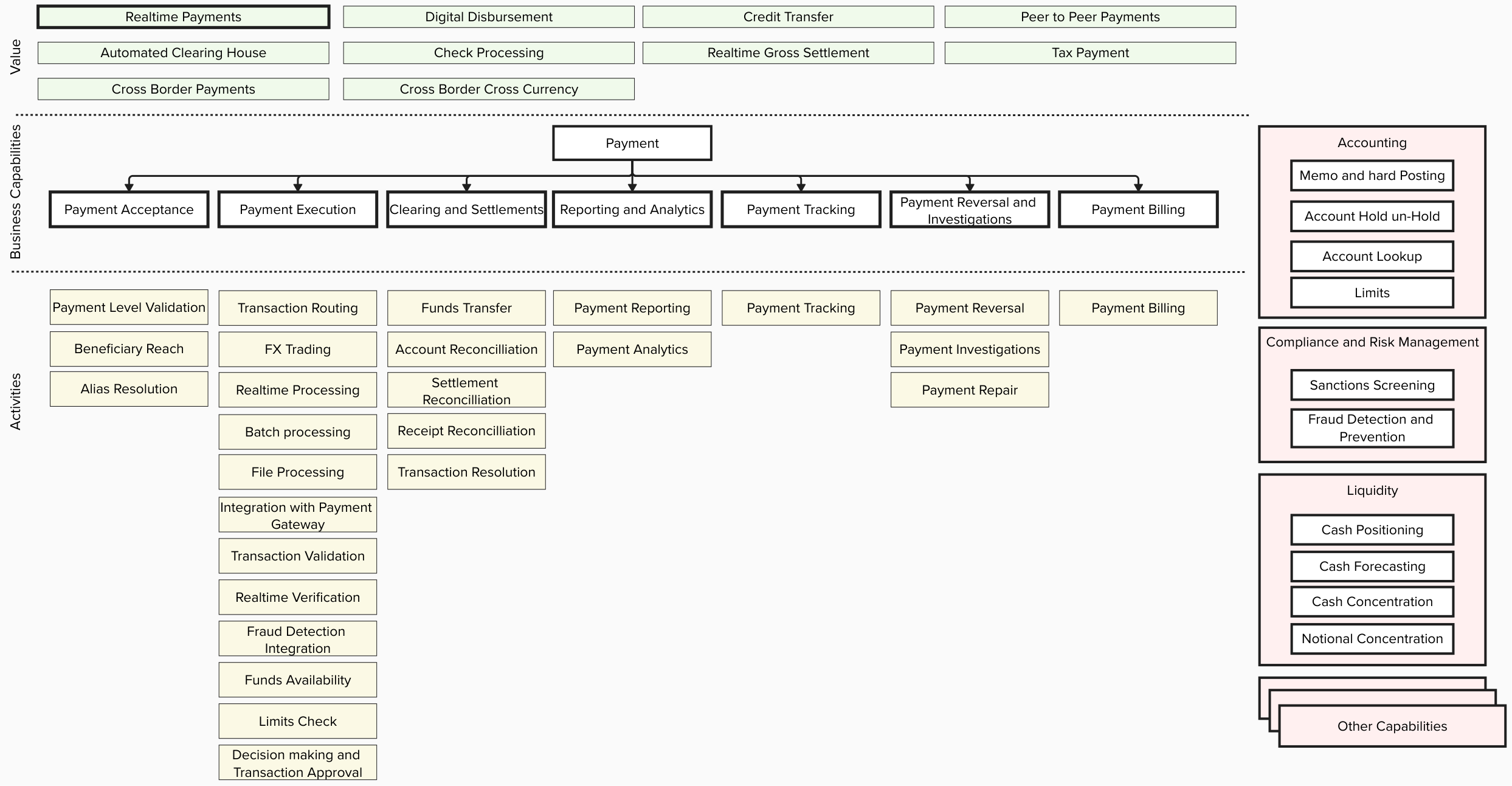
Detailed flowchart depicting a payment processing system with multiple components. The diagram shows primary payment types at the top (including Realtime Payments, Digital Disbursement, Credit Transfer, and Peer to Peer Payments) flowing down through core processing stages including Payment Acceptance, Execution, Clearing, Reporting, Tracking, Reversals, and Billing.
Many financial institutions adopt a tenant-based approach organized by geography due to varying clearing processes, localized regulations, and transaction requirements across AWS Regions. However, without proper separation of services, teams often continue to add region-specific logic to existing services, gradually increasing their monolithic complexity and using the same infrastructure for all payment flows.
Traditional payment systems process transactions linearly, with each step waiting for the previous one to complete. However, analysis of payment workflows reveals numerous opportunities for parallel execution:
- Sanctions screening and fraud detection – Compliance and fraud checks can run simultaneously with initial routing decisions, rather than sequentially blocking all subsequent processing
- Payment routing and authorization requests – When basic validations are complete, routing and authorization can proceed in parallel rather than one after another
- Payment execution and ledger updates – The actual payment execution doesn’t need to wait for ledger records to be updated—these can occur concurrently
- Settlement, reconciliation, and tracking – These post-transaction processes can be initiated independently as soon as the primary transaction is complete
This parallel approach can dramatically improve throughput and reduce latency compared to traditional queue-based systems where operations form a sequential chain that extends processing time and creates bottlenecks.
Most legacy payment orchestration systems rely heavily on on-premises virtual machines (VMs), leading to several challenges:
- Multi-Region support for disaster recovery and multi-tenancy resulting in significant capital expenditure and operational overhead
- High latency and SLA issues caused by sequential message processing and delays between globally separated data centers
- Limited reusability of payment flows as monolithic architectures require region-specific changes for local clearing mechanisms and regulations, increasing complexity and costs
- Scalability challenges and high memory consumption due to inefficient resource utilization and execution of irrelevant logic across regions
- Complex cross-border payment routing caused by variations in clearing rules, transaction limits, and local regulations, increasing latency and routing errors
- Integration challenges with diverse data formats because legacy systems rely on proprietary standards (for example, ISO 20022, SWIFT MT), complicating data conversion and compliance
- High deployment complexity for new payment flows due to monolithic architectures requiring extensive region-specific modifications, slowing time to market
- Environmental impact and high carbon footprint from on-premises infrastructure consuming excessive energy, whereas cloud-based approaches improve efficiency
Solution overview
To overcome these challenges, the proposed architecture embraces the following design principles to build a future-ready, real-time payment orchestration solution:
- Performance at scale – Handling over 1,000 transactions per second (TPS) with consistent low latency under varying load conditions.
- High availability – Achieving 99.999% uptime to meet the strict requirements of financial transactions.
- Geographic resilience – Supporting global operations with region-specific compliance while maintaining consistent performance.
- Cost optimization – Reducing total cost of ownership through efficient resource utilization and serverless technologies.
- Security and compliance – Supporting data protection and regulatory adherence across different jurisdictions.
- Operational simplicity – Streamlining deployment, monitoring, and maintenance across the payment ecosystem.
- Microservices – Decomposing payment processing into distinct business capabilities, so financial institutions can improve modularity and flexibility. This microservices-based approach allows for independent scaling and development of critical components.
The following diagram depicts the high-level solution architecture for real-time payments. The existing channels using synchronous or asynchronous APIs can be modified to use edge-optimized endpoints to reduce latency.
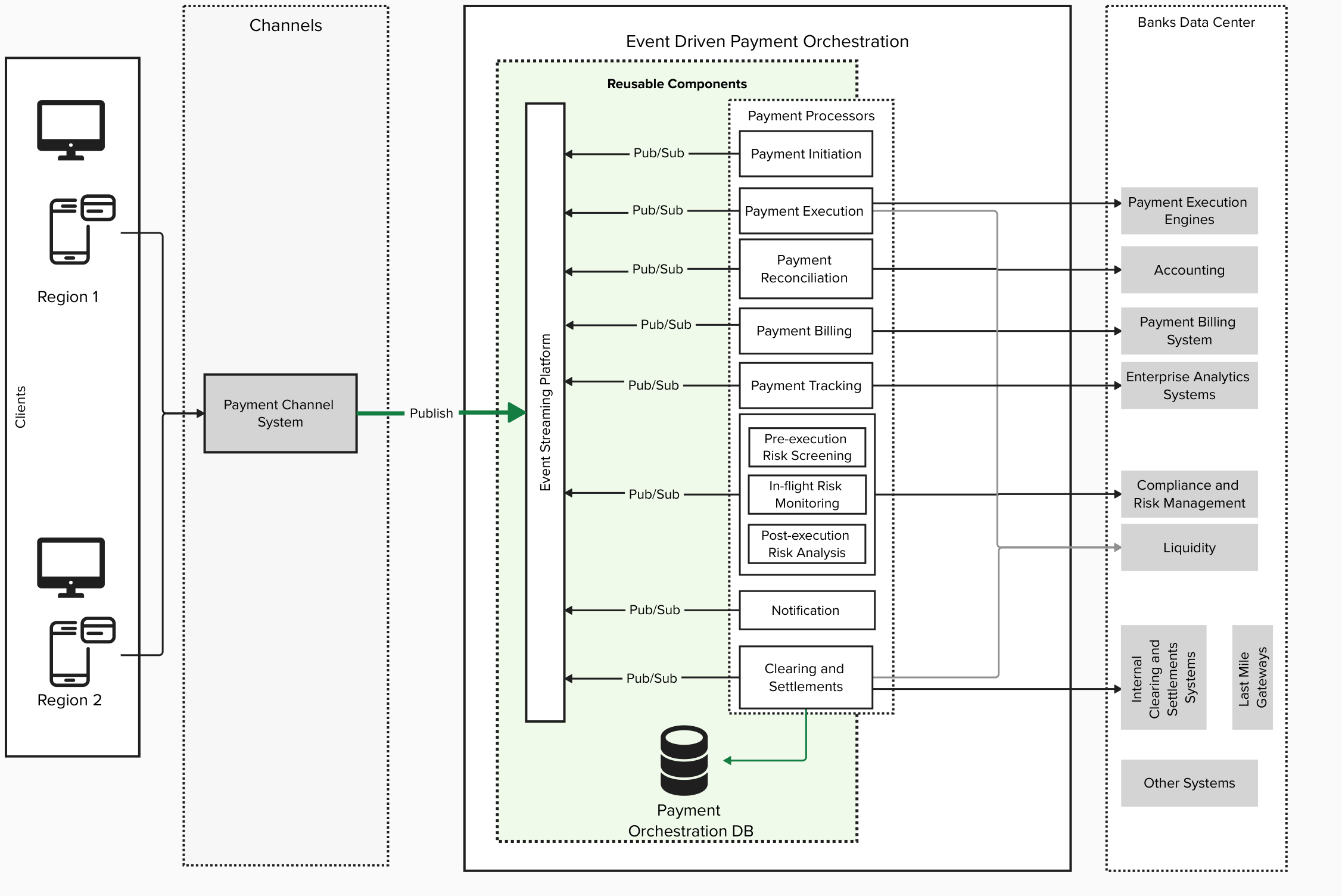
Architecture diagram detailing an AWS-based payment orchestration platform utilizing event-driven principles. Features reusable components across two regions, with dedicated modules for payment initiation, execution, reconciliation, billing, and risk management. Implements pub/sub messaging patterns for inter-component communication and connects to enterprise systems including accounting, compliance, and analytics.
An event-driven architecture is used for payment orchestration, which handles communication through a pub/sub pattern. This architecture maintains persistent connections, improving performance of the end-to-end real-time payment processing.
The event-driven architecture for real-time payment processing allows multiple payment operations to occur simultaneously using different adaptors, as opposed to the traditional systems where payment processes are sequential and flow through a single pipeline. Payment events are distributed to specialized payment processor microservices based on their function (initiation, execution, tracking, settlements), enabling each to process independently without waiting for others to complete.
Because we’re transitioning from sequential processing to distributed, maintaining transaction traceability is crucial. The payment tracking adapters shown in the preceding diagram connect to enterprise analytics systems, creating a specialized layer for monitoring transactions. The pub/sub model allows for attaching correlation IDs to events, enabling systems to track related events across different topics and processing stages.
A standardized event schema serves as the foundation for this architecture, providing consistency across regional deployments while allowing for customization at the adapter level. This schema defines uniform event structures containing tenant-specific metadata and supports versioning to accommodate evolving requirements. By isolating region-specific variations to the adapter layer, the solution maintains core functionality while interfacing with diverse enterprise systems through configuration-driven customization rather than code changes.
For most payment processes, especially those with independent processing steps that can run in parallel, this architecture delivers net performance gains despite the topic switching overhead, particularly for complex transactions where multiple independent validations or processing steps are required.
Deployment on the AWS Cloud
The solution uses edge-optimized Amazon API Gateway for channels. An edge-optimized API endpoint routes requests to the nearest Amazon CloudFront Point of Presence (POP), which can help in cases where your clients are geographically distributed to enable efficient routing within each geographical region, enhancing global responsiveness by minimizing network round trips and making sure requests take the shortest possible path before transitioning from the public internet to the client network.
The following diagram illustrates the high-level solution architecture for real-time payments.
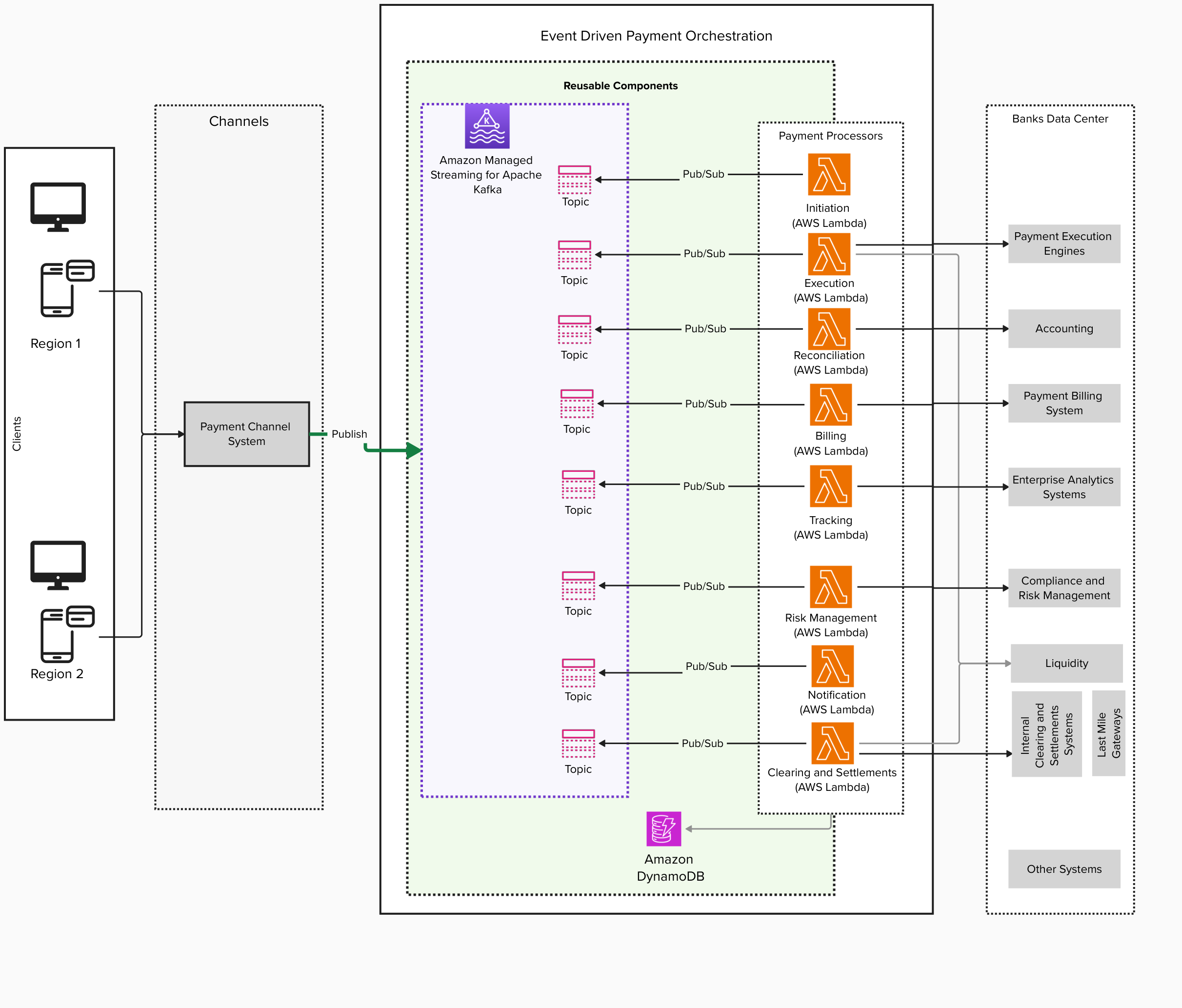
Comprehensive AWS payment orchestration solution implementing modern cloud-native architecture principles. Core processing logic implemented as Lambda functions covering initiation, execution, reconciliation, billing, tracking, risk management, and settlement workflows. Leverages Amazon MSK for reliable event streaming between components, with dedicated Kafka topics for each processing stage. Data persistence handled by Amazon DynamoDB, supporting cross-region operations. Architecture demonstrates AWS best practices for financial services, including regional redundancy, serverless computing, managed services, and event-driven design patterns. System integrates with external banking infrastructure and enterprise systems while maintaining separation of concerns through microservices architecture. Features built-in support for compliance monitoring, risk management, and payment tracking through specialized Lambda functions.
The solution uses Amazon MSK to implement an event-driven architecture that efficiently handles both inbound and outbound channels traffic through API requests and asynchronous message-based events. Amazon MSK communicates using a high-performance binary protocol between producers, consumers, and brokers, providing low latency and high throughput. Real-time payments are logically partitioned across multiple tenants within geographical regions—North America, EMEA, LATAM, and Asia-Pacific.
Each real-time payment tenant follows an active/active disaster recovery strategy by deploying MSK clusters across multiple AWS Regions, designed to achieve high availability and resilience. Amazon MSK offer both serverless and provisioned cluster options. The team can decide to select one or the other depending on the non-functional requirements and team expertise. Amazon MSK automatically manages partition leadership with leaders in primary Regions and followers in secondary Regions. During failover, leaders are re-elected in healthy Regions, designed to help maintain processing capabilities during regional incidents. Sticky partitioning uses consistent hashing for deterministic routing, and cooperative rebalancing enables efficient failover. Multi-AZ deployment provides zone redundancy and isolated clusters per Region for data sovereignty compliance through programmatic AWS Identity and Access Management (IAM) and virtual private cloud (VPC) boundaries.
To support seamless cross-Region replication and maintain message continuity, Amazon MSK Replicator—a fully managed feature of Amazon MSK—is used to replicate topics and synchronize consumer group offsets across clusters. MSK Replicator simplifies the process of building multi-Region Kafka applications by not needing custom code, open-source tool configuration, or infrastructure management. It automatically provisions and scales the necessary resources, so teams can focus on business logic while only paying for the data being replicated. In the event of a regional outage or failover, traffic can be automatically redirected to a healthy Region without data loss or service disruption, providing near-zero Recovery Time Objectives (RTOs) and uninterrupted operations for downstream services such as payment processors and audit trail consumers.
In addition to regional redundancy, the architecture uses an event-driven architecture to enable parallel and decoupled processing of payment transactions. Events such as transaction initiation, validation, and settlement are emitted asynchronously and consumed by various microservices independently, which drastically reduces end-to-end latency.
To process these events at scale, the architecture can use AWS Lambda, Amazon Elastic Container Service (Amazon ECS), or Amazon Elastic Kubernetes Service (Amazon EKS) depending upon non-functional requirements. Automatic scaling responds to Amazon CloudWatch metrics, and exponential backoff retry logic with dead-letter queues (DLQs) handles throttling scenarios. Circuit breakers prevent cascade failures during high error rates.
One of the key benefits of the solution is the reusability of payment flows across different regions. Although each region has its own unique compliance requirements and settlement rules, the core functionalities of real-time payments (payment authorization, payment processing, settlement and clearing) are largely similar. This reusability enables rapid deployment of payment solutions across new regions without rearchitecting the entire system. For example, the real-time payment system in the US and UK might share similar business logic for real-time gross settlement but differ in the clearing and compliance requirements. The solution treats these as bounded contexts within the microservices architecture, providing flexibility while making sure each region can handle its own specific rules and regulations.
Sustainability
AWS relentlessly innovates its infrastructure design, build, and operations to make progress towards net-zero carbon by 2040 and being water positive by 2030. Amazon MSK with AWS Graviton based instances use up to 60% less energy than comparable M5 instances, helping you achieve your sustainability goals. Lambda is inherently sustainable by design. Its serverless model makes sure compute resources are only used when needed, drastically reducing idle infrastructure and wasted energy. Instead of keeping always-on servers for infrequent tasks, Lambda provisions compute power just-in-time, achieving near-zero idle capacity.
Security and compliance in financial services
Given the sensitive nature of payment transactions and financial data, you should apply the security controls required to meet financial regulations such as AWS PCI DSS and AWS Federal Information Processing Standard (FIPS) 140-3 according to your organization’s needs.
The solution should incorporate multi-layered security controls, continuous monitoring, and automated compliance auditing to meet the rigorous expectations of banking regulators and internal risk teams. For more information, refer to Security Guidance.
Conclusion
The modernization of payment orchestration systems using an event-driven architecture and AWS serverless technologies marks a significant advancement in meeting the demands of today’s rapidly evolving financial services landscape. This solution addresses the key challenges faced by traditional payment systems while delivering substantial benefits in performance, scalability, cost optimization, global resilience, sustainability, and compliance. By using cutting-edge cloud technologies and robust security controls, financial institutions can now build a future-ready foundation that adapts to evolving business needs while maintaining the highest standards of performance, security, and reliability. As the real-time payments market continues its explosive growth, this modern architecture provides a solution that meets today’s demands and is also well-positioned to support tomorrow’s payment innovations. Organizations looking to modernize their payment infrastructure can use this blueprint to accelerate their digital transformation journey, supporting sustainable, secure, and efficient payment processing at scale in an increasingly competitive global marketplace.
The architecture presented here is for reference purposes only. IBM will work closely with you to deploy the solution in accordance with industry standards and compliance requirements.For additional resources, refer to:
- IBM Consulting on AWS
- AWS for Financial Services
- Transforming transactions: Streamlining PCI compliance using AWS serverless architecture
- Best practices for right-sizing your Apache Kafka clusters to optimize performance and cost
- How to choose the right Amazon MSK cluster type for you
- AWS Shared Responsibility Model
- AWS Federal Information Processing Standard (FIPS) 140-3
- Sustainability with AWS Graviton
- AWS PCI DSS
IBM Consulting is an AWS Premier Tier Services Partner that helps customers who use AWS to harness the power of innovation and drive their business transformation. They are recognized as a Global Systems Integrator (GSI) for over 22 competencies, including Financial Services Consulting. For additional information, please contact an IBM Representative.
Alpine Linux plans /usr merge
Post Syndicated from jzb original https://lwn.net/Articles/1040410/
The Alpine Linux project has announced
plans to change its base filesystem hierarchy:
In the future, /lib, /bin, and /sbin
will be symbolic links to their /usr counterparts, and every package
shall be installed under the /usr paths. For now,
/usr/bin and /usr/sbin will continue to be independent paths,
but that might change if the Filesystem Hierarchy Standard (FHS) gets
updated.
The merge will take place in the upcoming Alpine 3.23 release
planned for November; non-merged systems will be considered
unsupported when 3.22 is at its end of life in May 2027.
How Laravel Nightwatch handles billions of observability events in real time with Amazon MSK and ClickHouse Cloud
Post Syndicated from Masudur Rahaman Sayem original https://aws.amazon.com/blogs/big-data/how-laravel-nightwatch-handles-billions-of-observability-events-in-real-time-with-amazon-msk-and-clickhouse-cloud/
Laravel, one of the world’s most popular web frameworks, launched its first-party observability platform, Laravel Nightwatch, to provide developers with real-time insights into application performance. Built entirely on AWS managed services and ClickHouse Cloud, the service already processes over one billion events per day while maintaining sub-second query latency, giving developers instant visibility into the health of their applications.
By combining Amazon Managed Streaming for Apache Kafka (Amazon MSK) with ClickHouse Cloud and AWS Lambda, Laravel Nightwatch delivers high-volume, low-latency monitoring at scale, while maintaining the simplicity and developer experience Laravel is known for.
The challenge: Delivering real-time monitoring for a global developer community
The Laravel framework powers millions of applications worldwide, serving billions of requests each month. Each request can generate potentially hundreds of observability events, such as database queries, queued jobs, cache lookups, emails, notifications, and exceptions. For Nightwatch’s launch, Laravel anticipated instant adoption from its global community, with tens of thousands of applications sending events around the clock from day one.
Laravel Nightwatch needed an architecture that could:
- Ingest millions of JSON events per second from customer applications reliably.
- Provide sub-second analytical queries for real-time dashboards.
- Scale horizontally to handle unpredictable traffic spikes.
- Deliver all of this in a cost-effective, low-maintenance manner.
The challenge was to process data on a global scale and provide deep insights into application health without compromising on a straightforward setup experience for developers.
The solution: A decoupled streaming and analytics pipeline
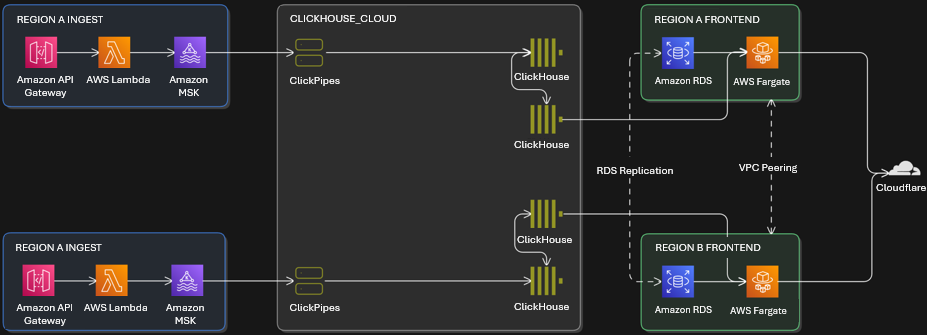
Laravel Nightwatch implemented a dual-database, streaming-first architecture, shown in the preceding figure, that separates transactional and analytical workloads.
- Transactional workloads – user accounts, organization settings, billing, and similar workloads run on Amazon RDS for PostgreSQL.
- Analytical workloads – telemetry events, metrics, query logs, and request traces are handled by ClickHouse Cloud.
Key components
The key components of the solution include the following:
- Ingestion layer
- Amazon API Gateway receives telemetry from Laravel agents embedded in customer applications
- Lambda validates and enriches events. Validated and enriched events are published to Amazon MSK, partitioned for scalability
- Streaming to analytics
- ClickPipes in ClickHouse Cloud subscribe directly to MSK topics, reducing the need to build and manage extract, transform, and load (ETL) pipelines
- Materialized views in ClickHouse pre-aggregate and transform raw JSON into query-ready formats
- Dashboards and delivery
- The Nightwatch dashboard, built with Laravel, Inertia, and React, runs on AWS Fargate for Amazon ECS
- Amazon ElastiCache for Redis accelerates session and cache lookups
- Cloudflare CDN provides low-latency delivery to global users
Why Amazon MSK and ClickHouse Cloud?
Nightwatch requires a durable, horizontally scalable, and low maintenance streaming backbone.
With Amazon MSK Express brokers, we have achieved over 1 million events per second during load testing, benefiting from low-latency, elastic scaling, and simplified operations. MSK Express brokers require no storage sizing or provisioning, scale up to 20 times faster, and recover 90% quicker than standard Apache Kafka brokers—all while enforcing best-practice defaults and client quotas for reliable performance. Its seamless integration with other AWS services—such as Lambda, Amazon Simple Storage Service (Amazon S3), and Amazon CloudWatch—made it straightforward to build a resilient, end-to-end streaming architecture.
To ingest and transform these events in real time, Nightwatch uses ClickHouse Cloud and its managed integration platform, ClickPipes. ClickHouse Cloud excels at analytical workloads by delivering up to 100 times faster query performance for analytics compared to traditional row-based databases. Its advanced compression algorithms provide up to 90% storage savings, significantly reducing infrastructure costs while maintaining high performance. With its columnar architecture and optimized execution engine, ClickHouse Cloud can query billions of rows in under 1 second, enabling Laravel Nightwatch to serve real-time dashboards and analytics at global scale.
By integrating Amazon MSK and ClickHouse using ClickPipes, Laravel also reduced the operational burden of building and managing ETL pipelines, reducing latency and complexity.
Overcoming challenges
Testing complexity
While synthetic benchmarking and test datasets yield useful results, a more realistic workload is required to rigorously test infrastructure and code before deployment to production. The team used Terraform to manage infrastructure alongside application code, creating multiple dev and test environments, and allowing them to test the platform internally with their own applications before each release.
Multi-region infrastructure
The need to cater to multiple data storage regions also brought challenges—with latency, complexity, and cost the foremost concerns. However, the AWS, ClickHouse Cloud, and Cloudflare stack made available a powerful set of networking tools and scaling options. While VPC peering, RDS replication, and global server load balancing did the heavy lifting on the networking side, the ability to scale and right-size each resource kept costs to a minimum.
Query performance at scale
Materialized views, intelligent time-series partitioning, and specialized ClickHouse codecs helped ensure that queries remained sub-second even as data volumes grew into the billions. Meanwhile, compute separation allowed distinct workloads to scale separately while accessing the same data, with clusters right-sized horizontally and vertically depending on the requirements of each load.
Results
Laravel Nightwatch’s launch exceeded expectations:
- 5,300 users registered in the first 24 hours
- 500 million events processed on day one
- 97 ms average dashboard request latency
- 760,000 exceptions logged and analyzed in real time
By building on Amazon MSK and ClickHouse Cloud, we were able to scale from zero to billions of events without sacrificing performance or developer experience.
What’s next
Laravel plans to expand Nightwatch with:
- More regions to cater to customers with data sovereignty requirements outside the US and EU
- Broader data collection to provide even deeper insight into customers’ applications
- SOC 2 certification to cater to customers with tighter compliance requirements
- More advanced monitoring and analysis to identify issues before they affect users
The current architecture comfortably supports applications of all sizes, from hobby to enterprise (including a generous free tier), and is designed to handle over one trillion monthly events without performance degradation.
Conclusion
Laravel Nightwatch demonstrates how Amazon MSK, ClickHouse Cloud, and AWS serverless technologies can be combined to build a cost-effective, real-time monitoring platform at global scale. By designing for scale from day one, Laravel delivered sub-second analytics across billions of events, while maintaining the developer-friendly experience their community expects.
About the authors
How to export to Amazon S3 Tables by using AWS Step Functions Distributed Map
Post Syndicated from Chetan Makvana original https://aws.amazon.com/blogs/compute/how-to-export-to-amazon-s3-tables-by-using-aws-step-functions-distributed-map/
Companies running serverless workloads often need to perform extract, transform, and load (ETL) operations on data files stored in Amazon Simple Storage Service (Amazon S3) buckets. Though traditional approaches such as an AWS Lambda trigger for Amazon S3 or Amazon S3 Event Notifications can handle these operations, they might fall short when workflows require enhanced visibility, control, or human intervention. For example, some processes might need manual review of failed records or explicit approval before proceeding to subsequent stages. Customer orchestration solutions to these issues can prove to be complex and error prone.
AWS Step Functions address these challenges by providing built-in workflow management and monitoring capabilities. The Step Functions Distributed Map feature is designed for high-throughput, parallel data processing workflows so that companies can handle complex ETL jobs, fan-out processing, and data visualization at scale. Distributed Map handles each dataset item as an independent child workflow, processing millions of records while maintaining built-in concurrency controls, fault tolerance, and progress tracking. The processed data can be seamlessly exported to various destinations, including Amazon S3 Tables with Apache Iceberg support.
In this post, we show how to use Step Functions Distributed Map to process Amazon S3 objects and export results to Amazon S3 Tables, creating a scalable and maintainable data processing pipeline.
See the associated GitHub repository for detailed instructions about deploying this solution as well as sample code.
Solution overview
Consider a consumer electronics company that regularly participates in industry trade shows and conferences. During these events, interested attendees fill out paper sign-up forms to request product demos, receive newsletters, or join early access programs. After the events, the company’s team scans hundreds of thousands of these forms and uploads them to Amazon S3.Rather than manually reviewing each form, the company wants to automate the extraction of key customer details such as name, email address, mailing address, and interest areas. They’d like to store this structured data in S3 Tables with Apache Iceberg format for downstream analytics and marketing campaign targeting.
Let’s look at how this post’s solution uses Distributed Map to process PDFs in parallel, extract data using Amazon Textract, and write the cleaned output directly to S3 Tables. The result is scalable, serverless post-event data onboarding, as shown in the following figure.
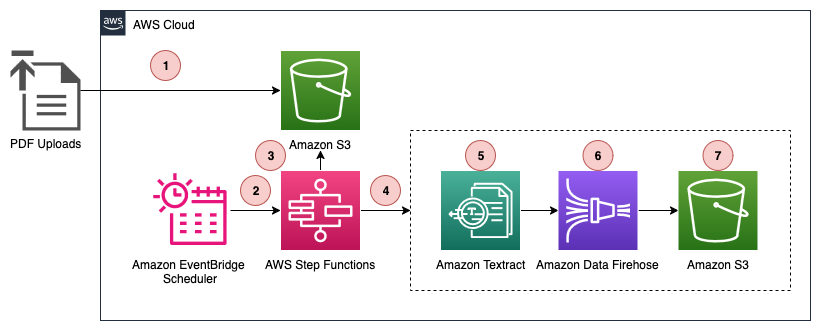
The data processing workflow as shown in the preceding diagram includes the following steps:
- A user uploads customer interest forms as scanned PDFs to an Amazon S3 bucket.
- An Amazon EventBridge Scheduler rule triggers at regular intervals, initiating a Step Functions workflow execution.
- The workflow execution activates a Step Functions Distributed Map state, which lists all PDF files uploaded to Amazon S3 since the previous run.
- The Distributed Map iterates over the list of objects and passes each object’s metadata (bucket, key, size, entity tag [ETag]) to a child workflow execution.
- For each object, the child workflow calls Amazon Textract with the provided bucket and key to extract raw text and relevant fields (name, email address, mailing address, interest area) from the PDF.
- The child workflow sends the extracted data to Amazon Data Firehose, which is configured to forward data to S3 Tables.
- Firehose batches the incoming data from the child workflow and writes it to S3 Tables at a preconfigured time interval of your choosing.
With data now structured and accessible in S3 Tables, users can easily analyze them using standard SQL queries with Amazon Athena or business intelligence like Amazon QuickSight.
The data-processing workflow
EventBridge Scheduler starts new Step Functions workflows at regular intervals. The timeline for this schedule is flexible. However, When setting up your schedule, make sure the frequency aligns with how far back your state machine is configured to look for PDFs. For example, if your state machine checks for PDFs from the past week, you’d want to schedule it to run weekly. The Step Functions workflow subsequently performs the following three steps (note that these steps are steps 4, 5, 6, and 7 in the preceding workflow diagram:
- Extract relevant user data from the PDFs.
- Send the extracted user data to Firehose.
- Write the data to S3 Tables in Apache Iceberg table format.
The following diagram illustrates this workflow.
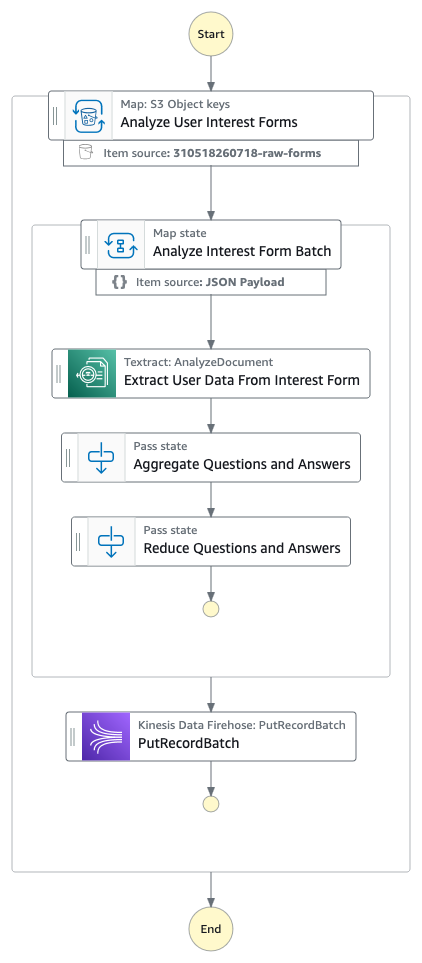
Let’s look at each step of the preceding workflow in more detail.
Extract relevant user data from PDF documents
Step Functions uses Distributed Map to process PDFs concurrently in parallel child workflows. It accepts input from JSON, JSONL, CSV, Parquet files, Amazon S3 manifest files stored in Amazon S3 (used to specify particular files for processing), or an Amazon S3 bucket prefix (allows iteration over file metadata for all objects under that prefix). The Step Functions automatically handles parallelization by splitting the dataset and running child workflows for each item, with the ItemBatcher field allowing to group multiple PDFs into a single child workflow execution (e.g., 10 PDFs per batch) to optimize performance and cost.
The following screenshot of the Step Functions console shows the configuration for Distributed Map. For example, we have configured Distributed Map to process 10 customer interest PDFs in a single child workflow.
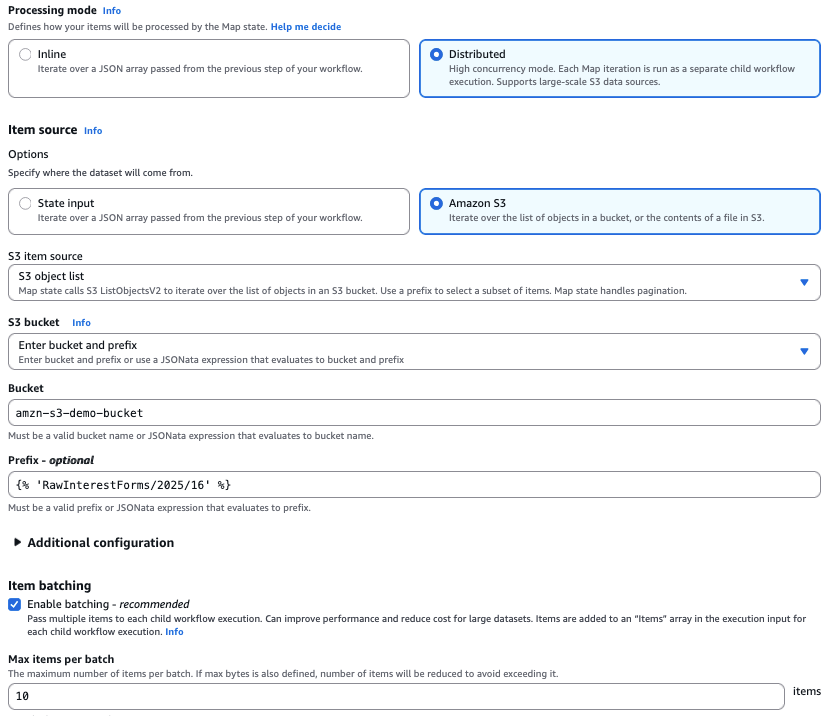
The following image shows one example of these scanned PDFs, which includes the customer information that this post’s solution processes.

Each child workflow then calls the Amazon Textract AnalyzeDocument API with specific queries to extract customer information.
The API analyzes each scanned PDF and returns a JSON structure containing the extracted customer information.
Send the extracted user data to Firehose
The child workflow then uses a Firehose PutRecordBatch API action with service integrations to queue the extracted customer information for further processing. The PutRecordBatch action request includes the Firehose stream name and the data records. The data records include a data blob from step 1 that contains extracted customer information, as shown in the following example.
Write the data to S3 Tables in Apache Iceberg table format
Firehose efficiently manages data buffering, format conversion, and reliable delivery to various destinations, including Apache Iceberg, raw files in Amazon S3, Amazon OpenSearch Service, or any of the other supported destinations. Apache Iceberg tables can be either self-managed in Amazon S3 or hosted in S3 Tables. Though self-managed Iceberg tables require manual optimization—such as compaction and snapshot expiration—S3 Tables automatically optimize storage for large-scale analytics workloads, improving query performance and reducing storage costs.
Firehose simplifies the process of streaming data by configuring a delivery stream, selecting a data source, and setting an Iceberg table as the destination. After you’ve set it up, the Firehose stream is ready to deliver data. The delivered data can be queried from S3 Tables by using Athena, as shown in the following screenshot of the Athena console.
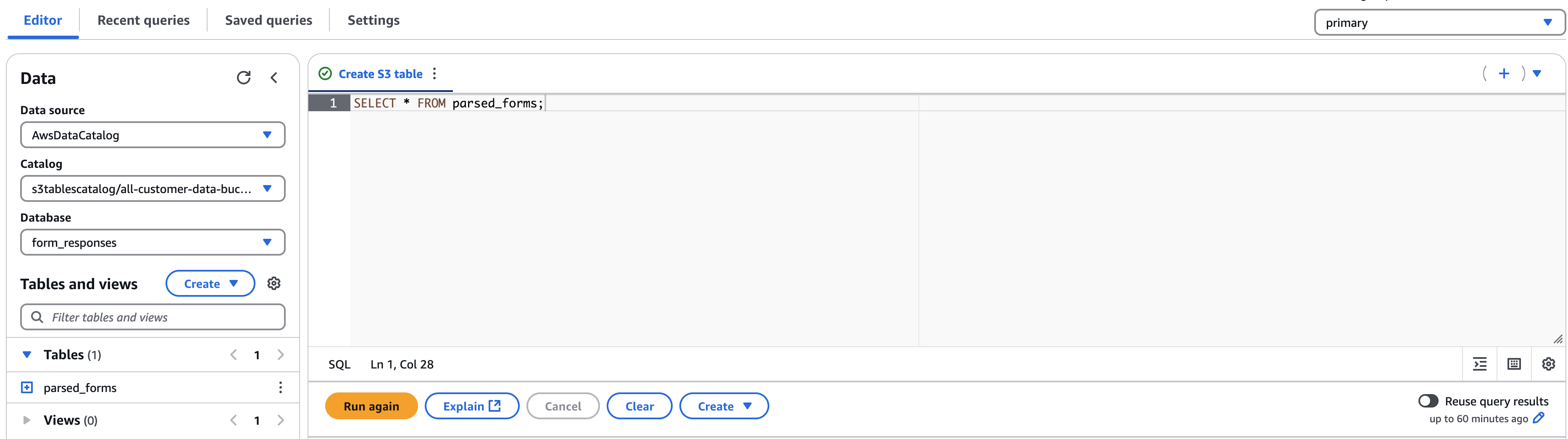
The query results include all processed customer data from the PDFs, as shown in the following screenshot.
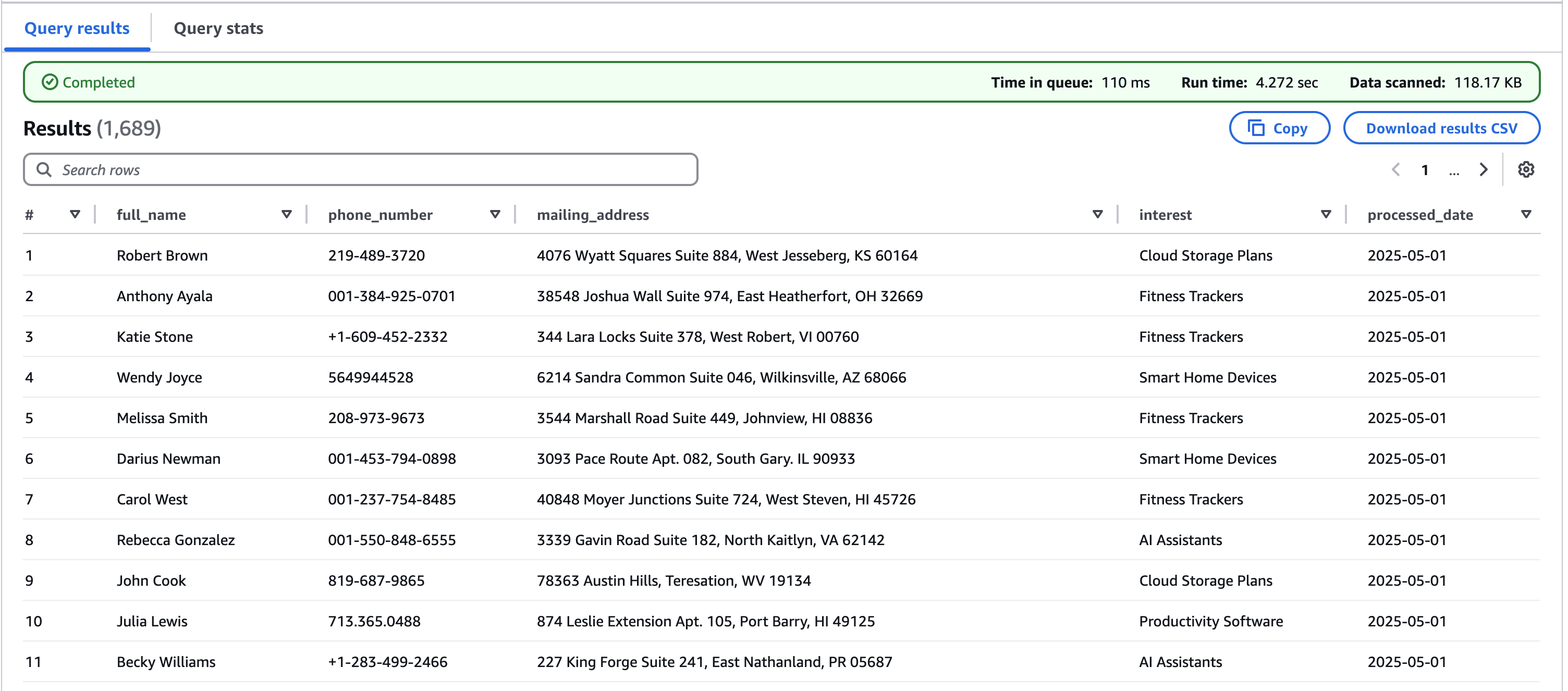
This integration demonstrates a powerful, code-free solution for transforming raw PDF forms into enriched, queryable data in an Iceberg table. You can use these data for further analysis.
Conclusion
In this post, we showed how to build a scalable, serverless solution for processing PDF documents and exporting the extracted data to S3 Tables by using Step Functions Distributed Map. This architecture offers several key benefits such as reliability, cost-effectiveness, visibility, and maintainability. By leveraging AWS services such as Step Functions, Amazon Textract, Firehose, and S3 Tables, companies can automate their document processing workflows while ensuring optimal performance and operational excellence. This solution can be adapted for various use cases beyond customer interest forms, such as invoice processing, application forms, or any scenario requiring structured data extraction from documents at scale.
Though this example focuses on processing PDF data and writing to S3 Tables, Distributed Map can handle various input sources including JSON, JSONL, CSV, and Parquet files in Amazon S3; items in Amazon DynamoDB tables; Athena query results; and all paginated AWS List APIs. Similarly, through Step Functions service integrations, you can write results to multiple destinations such as DynamoDB tables by using the PutItem service integration.
To get started with this solution, see the associated GitHub repository for deployment instructions and sample code.
Introducing Apache Airflow 3 on Amazon MWAA: New features and capabilities
Post Syndicated from Anurag Srivastava original https://aws.amazon.com/blogs/big-data/introducing-apache-airflow-3-on-amazon-mwaa-new-features-and-capabilities/
Today, Amazon Web Services (AWS) announced the general availability of Apache Airflow 3 on Amazon Managed Workflows for Apache Airflow (Amazon MWAA). This release transforms how organizations use Apache Airflow to orchestrate data pipelines and business processes in the cloud, bringing enhanced security, improved performance, and modern workflow orchestration capabilities to Amazon MWAA customers.
Amazon MWAA introduces Airflow 3 features that modernize workflow management for AWS customers. Following the April 2025 release of Airflow 3 by the Apache community, AWS has incorporated these capabilities into Amazon MWAA. Airflow now features a completely redesigned, intuitive UI that simplifies workflow orchestration for users across experience levels. With the Task Execution Interface (Task API), tasks can run both within Airflow and as standalone Python scripts, improving code portability and testing. Scheduler-managed Backfill moves operations from the CLI to the scheduler, providing centralized control and visibility through the Airflow UI. CLI security improvements replace direct database access with API calls, maintaining consistent security across interfaces. Airflow now supports event-driven workflows, enabling triggers from AWS services and external sources. Amazon MWAA also adds support for Python 3.12, bringing the latest language capabilities to workflow development.
This post explores the features of Airflow 3 on Amazon MWAA and outlines enhancements that improve your workflow orchestration capabilities. The service maintains the Amazon MWAA pay-as-you-go pricing model with no upfront commitments. You can begin immediately by visiting the Amazon MWAA console, launching new Apache Airflow environments through the AWS Management Console, AWS Command Line Interface (AWS CLI), AWS CloudFormation, or AWS SDK within minutes.
Architectural advancements in Airflow 3 on Amazon MWAA
Airflow 3 on Amazon MWAA introduces significant architectural improvements that enhance security, performance, and flexibility. These advancements create a more robust foundation for workflow orchestration while maintaining backward compatibility with existing workflows.
Enhanced security
Amazon MWAA with Airflow 3 changes the security model by making component isolation a standard practice rather than optional. In Airflow 2, the DAG processor (the component that parses and processes DAG files) runs within the scheduler process by default, but can optionally be separated into its own process for better scalability and security isolation. Airflow 3 makes this separation standard, maintaining consistent security practices across deployments.
API server and Task API
Building on this security foundation, a new API server component is introduced in Amazon MWAA with Airflow 3, which serves as an intermediary between task instances and the Airflow metadata database. This change improves your workflows’ security posture by minimizing direct access to the Airflow metadata database from tasks. Tasks now operate with least privilege database access, reducing the risk of one task affecting others and improving overall system stability through fewer direct database connections.
The standardized communication through well-defined API endpoints creates a foundation for more secure, scalable, and flexible workflow orchestration. The Task Execution Interface (Task API) helps tasks run both within Airflow and as standalone Python scripts, improving code portability and testing capabilities.
From data-aware to event-driven scheduling
Airflow’s evolution toward event-driven scheduling began with the introduction of data-aware scheduling in Airflow 2.4, so DAGs could be triggered based on data availability rather than time schedules alone. Amazon MWAA with Airflow 3 builds on this foundation through a transition that includes the renaming of datasets to assets and introduces advanced capabilities, including asset partitions, external event integration, and asset-centric workflow design.
The transition from datasets to assets represents more than a simple rename. A data asset is a collection of logically related data that can represent diverse data products, including database tables, persisted ML models, embedded dashboards, or directories containing files.
Amazon MWAA with Airflow 3 introduces a new asset-centric syntax that represents an important shift in how workflows can be designed. The @asset decorator helps developers put data assets at the center of their workflow design, creating more intuitive asset-driven pipelines.
The following code is an example of asset-aware DAG scheduling:
The following code shows an asset-centric approach with the @asset decorator:
The @asset decorator automatically creates an asset with the function name, a DAG with the same identifier, and a task that produces the asset. This reduces code complexity and facilitates automatic DAG creation, where each asset becomes a self-contained workflow unit.
External event-driven scheduling with Asset Watchers
A significant advancement in Amazon MWAA with Airflow 3 is the introduction of Asset Watchers, which help Airflow react to events happening outside of the Airflow system itself. Whereas previous versions supported internal cross-DAG dependencies, Asset Watchers extend this capability to external data systems and message queues through the AssetWatcher class.
Amazon MWAA with Airflow 3 includes support for Amazon Simple Queue Service (Amazon SQS) through Asset Watchers. This allows your workflows to be triggered by external messages and facilitates more event-driven scheduling. Airflow now supports event-driven workflows, enabling triggers from AWS services and external sources. Asset Watchers monitor external systems asynchronously and trigger workflow execution when specific events occur, enabling workflows to respond to business events, data updates, or system notifications without the overhead of traditional sensor-based polling mechanisms.
Modern React-based UI
Amazon MWAA with Airflow 3 features a completely redesigned, intuitive UI built with React and FastAPI that simplifies workflow orchestration for users across experience levels. The new interface provides more intuitive navigation and workflow visualization, with an enhanced grid view that offers better visibility into task status and history. Users will appreciate the addition of dark mode support, which reduces eye strain during extended use, and the overall faster performance that’s especially noticeable when working with large DAGs.
The new UI maintains familiar workflows while providing a more modern and efficient experience for DAG management and monitoring, making daily operations more productive for both developers and operators. The legacy UI has been completely removed, offering a cleaner, more consistent experience across the system. The foundation for the new UI is built on REST APIs and a set of internal APIs for UI operations, both of which are now based on FastAPI, creating a more cohesive and secure architecture for both programmatic access and UI operations.
Scheduler optimizations
Amazon MWAA with Airflow 3’s enhanced scheduler delivers performance improvements for task execution and workflow management. The redesigned scheduling engine processes tasks more efficiently, reducing the time between task submissions and executions. This optimization benefits data pipeline operations that require rapid task processing and timely workflow completion.
The scheduler now manages computing resources more effectively, enabling stable performance even as workloads scale. When running multiple DAGs simultaneously, the improved resource allocation system helps prevent bottlenecks and maintains consistent execution speeds. This advancement is particularly useful for organizations running complex workflows with varying resource requirements. The new scheduler also handles concurrent operations with increased precision, so teams can run multiple DAG instances simultaneously while maintaining system stability and predictable performance.
Enhanced scheduler backfill operations
Scheduler-managed backfill (the process of running DAGs for historical dates) moves operations from the CLI to the scheduler, providing centralized control and visibility through the Airflow UI. Amazon MWAA with Airflow 3 delivers important upgrades to the scheduler’s backfill capabilities, helping data teams process historical data more efficiently. The backfill process has been optimized for better performance, reducing the database load during these operations and making sure backfills can be completed more quickly, minimizing the impact on near real-time workflow execution.
Amazon MWAA with Airflow 3 also improves the management of backfill operations, with the scheduler providing better isolation between backfill jobs and supporting more efficient processing of historical datasets. Operators now have better monitoring tools to track the progress and status of their backfill jobs, resulting in more effective management of these critical data processing tasks.
Developer-focused improvements
Airflow 3 on Amazon MWAA delivers several enhancements designed to improve the developer experience, from simplified task definition to better workflow management capabilities.
Task SDK
The Task SDK provides a more intuitive way to define tasks and DAGs:
This approach offers more intuitive data flow between tasks, better integrated development environment (IDE) support with improved type hinting, and more straightforward unit testing of task logic. The result is cleaner, more maintainable code that better represents the actual data flow of your pipelines. Teams adopting this pattern often find their DAGs become more readable and simpler to maintain over time, especially as workflows grow in complexity.
DAG versioning
Amazon MWAA with Airflow 3 includes basic DAG versioning capabilities that come by default with Airflow 3. Each time a DAG is modified and deployed, Airflow serializes and stores the DAG definition to preserve history. This automatic version tracking minimizes the need for manual record-keeping and ensures every modification is documented.
Through the Airflow UI, teams can access and review the history of their DAGs. This visual representation shows version numbers (v1, v2, v3, etc.) and helps teams understand how their workflows have evolved over time.
The DAG versioning supported in Amazon MWAA provides the capability to see different DAG versions that were run in the Airflow UI, offering improved workflow visibility and enhanced collaboration for data engineering teams managing complex, evolving data pipelines.
Python 3.12 support
Amazon MWAA adds support for Python 3.12, bringing the latest language capabilities to workflow development. This upgrade provides access to the latest Python language improvements, performance enhancements, and library updates, keeping your data pipelines modern and efficient.
Features not currently supported in Amazon MWAA
Although we are launching most of the Airflow 3 features on Amazon MWAA in this release, some features are not supported at this time:
- DAG versioning (AIP-63) – Advanced versioning features beyond basic version tracking
- Replace Flask AppBuilder (AIP-79) – Full replacement capabilities
- Edge Executor and task isolations (AIP-69) – Remote execution capabilities
- Multi-language support (AIP-72) – Support for languages other than Python
We plan to support these features in subsequent versions of Airflow on Amazon MWAA.
Conclusion
Airflow 3 on Amazon MWAA delivers enhanced workflow automation capabilities. The architectural improvements, enhanced security model, and developer-friendly features provide a solid foundation for building more reliable and maintainable data pipelines.The introduction of Asset Watchers changes how workflows can respond to external events, enabling truly event-driven scheduling. This capability, combined with the new asset-centric workflow design, makes Airflow 3 a more powerful and flexible orchestration service.
The scheduler optimizations deliver performance improvements for task execution and workflow management, and the enhanced backfill capabilities make historical data processing more efficient. The DAG versioning system improves workflow stability and collaboration, and Python 3.12 support keeps your data pipelines modern and efficient.
Organizations can now take advantage of these new features and improvements in Airflow 3 on Amazon MWAA to enhance their workflow orchestration capabilities. To get started, visit the Amazon MWAA product page.
About the authors
 Anurag Srivastava works as a Senior Big Data Cloud Engineer at Amazon Web Services (AWS), specializing in Amazon MWAA. He’s passionate about helping customers build scalable data pipelines and workflow automation solutions on AWS.
 Kamen Sharlandjiev is a Sr. Big Data and ETL Solutions Architect, Amazon MWAA and AWS Glue ETL expert. He’s on a mission to make life easier for customers who are facing complex data integration and orchestration challenges. His secret weapon? Fully managed AWS services that can get the job done with minimal effort. Follow Kamen on LinkedIn to keep up to date with the latest Amazon MWAA and AWS Glue features and news!
 Ankit Sahu brings over 18 years of expertise in building innovative digital products and services. His diverse experience spans product strategy, go-to-market execution, and digital transformation initiatives. Currently, Ankit serves as Senior Product Manager at Amazon Web Services (AWS), where he leads the Amazon MWAA service.
 Mohammad Sabeel works as a Senior Cloud Support Engineer at Amazon Web Services (AWS), specializing in AWS Analytics services including AWS Glue, Amazon MWAA, and Amazon Athena. With over 14 years of IT experience, he’s passionate about helping customers build scalable data processing pipelines and optimize their analytics solutions on AWS.
 Satya Chikkala is a Solutions Architect at Amazon Web Services. Based in Melbourne, Australia, he works closely with enterprise customers to accelerate their cloud journey. Beyond work, he is very passionate about nature and photography.
 Sriharsh Adari is a Senior Solutions Architect at Amazon Web Services (AWS), where he helps customers work backward from business outcomes to develop innovative solutions on AWS. Over the years, he has helped multiple customers on data system transformations across industry verticals. His core area of expertise include technology strategy, data analytics, and data science. In his spare time, he enjoys playing sports, binge-watching TV shows, and playing Tabla.
Dr. Pria Anand | The Mind Electric | Talks at Google
Post Syndicated from Talks at Google original https://www.youtube.com/watch?v=AT-kLjXxn7A
ESPHome’s Latest Innovations – Oct 2025
Post Syndicated from Home Assistant original https://www.youtube.com/watch?v=9YfRkqCdD4c
Home Assistant Just Got WAY Smarter… And Funnier! 😂 2025.10 Release
Post Syndicated from BeardedTinker original https://www.youtube.com/watch?v=tlySmGuVUm8
The Rise of Technofascists, with Sam Harris | The David Frum Show
Post Syndicated from The Atlantic original https://www.youtube.com/watch?v=mUw20SsfosQ
The BEST Budget KVM Over IP? GL.iNet Comet Series Reviewed
Post Syndicated from Crosstalk Solutions original https://www.youtube.com/watch?v=ZNEMu4UdhxI
Current state of conversational AI – September 2025
Post Syndicated from Home Assistant original https://www.youtube.com/watch?v=mLtFUG4YG1A
[$] Fedora floats AI-assisted contributions policy
Post Syndicated from jzb original https://lwn.net/Articles/1039623/
The Fedora
Council began a process to create a policy on AI-assisted
contributions in 2024, starting with a survey to ask the community
its opinions about AI and using AI technologies in Fedora. On
September 25, Jason Brooks published
a draft policy for discussion; so far, in keeping with the spirit of
compromise, it has something to make everyone unhappy. For some it is
too AI-friendly, while others have complained that it holds Fedora
back from experimenting with AI tooling.
Security updates for Wednesday
Post Syndicated from jzb original https://lwn.net/Articles/1040375/
Security updates have been issued by AlmaLinux (kernel, kernel-rt, mysql:8.0, and openssh), Debian (libcommons-lang-java, libcommons-lang3-java, libcpanel-json-xs-perl, libjson-xs-perl, libxml2, open-vm-tools, and u-boot), Fedora (bird, dnsdist, mapserver, ntpd-rs, python-nh3, and rust-ammonia), Oracle (kernel and mysql:8.0), Red Hat (cups, postgresql:12, and postgresql:13), SUSE (cJSON-devel, gimp, kernel-devel, kubecolor, open-vm-tools, openssl-1_1, openssl-3, and ruby3.4-rubygem-rack), and Ubuntu (linux-azure-5.15 and openssl, openssl1.0).
OpenSUSE Leap 16 released
Post Syndicated from corbet original https://lwn.net/Articles/1040323/
The openSUSE
Leap 16 release is now available.
This major version update of our fixed-release community-Linux
distribution has a fresh software stack and introduces an unmatched
maintenance- and security-support cycle, a new installer and
simplified migration options.
See our look at this release for more
information.
1910 Los Angeles Times bombing
Post Syndicated from The History Guy: History Deserves to Be Remembered original https://www.youtube.com/watch?v=h0v4FEde-l8