Tag Archives: ransomware

US Critical Infrastructure Companies Will Have to Report When They Are Hacked

Post Syndicated from Bruce Schneier original https://www.schneier.com/blog/archives/2022/03/us-critical-infrastructure-companies-will-have-to-report-when-they-are-hacked.html

This will be law soon:

Companies critical to U.S. national interests will now have to report when they’re hacked or they pay ransomware, according to new rules approved by Congress.

[…]

The reporting requirement legislation was approved by the House and the Senate on Thursday and is expected to be signed into law by President Joe Biden soon. It requires any entity that’s considered part of the nation’s critical infrastructure, which includes the finance, transportation and energy sectors, to report any “substantial cyber incident” to the government within three days and any ransomware payment made within 24 hours.

Even better would be if they had to report it to the public.

Graph Analysis of the Conti Ransomware Group Internal Chats

Post Syndicated from Kwan Lin original https://blog.rapid7.com/2022/03/04/graph-analysis-of-the-conti-ransomware-group-internal-chats/

Graph Analysis of the Conti Ransomware Group Internal Chats

We were presented with a remarkably rich source of intelligence with the leaked communications from the Conti ransomware group.

It’s a compelling and insightful read. The leaked information contains details on messages, including information on timestamps, sender, receiver, and the actual body of the message itself.

While the messages themselves are revealing, the messaging patterns provide another dimension of insight into the Conti organization.

Analyzing the Conti Ransomware messages

Graph analysis as an analytical method enables us to extract information about the structure and behaviors of the organization.

When we say “graph analysis” in this case, we’re not referring to just looking at interesting pictures of data (though interesting pictures are certainly a possible output); we are referring to a body of mathematical study that focuses on distinct entities and their interconnections.

The distinct entities in this case are the unique communicators represented in the Conti leaks. The interconnections are the messaging paths between those communicators.

Graph Analysis of the Conti Ransomware Group Internal Chats

Without labels, this visual in of itself seems obscure, but this represents the communication network of the Conti ransomware group. The little dots – the nodes – forming an ellipse represent individual communicators. The lines – the edges – connecting those nodes represent shared messages. The darkness of the edges represents a degree measure, or the frequency of communication in this case.

What they might tell us

There are a lot of calculations happening behind the scenes, and the visual conveys a sense that communication within Conti doesn’t happen uniformly, which quite frankly is probably representative of most organizations.

We see here that there are certain nodes that are very frequently communicated with. Why might that be the case? Hard to say without going into further analysis, but it’s likely due to those nodes being very loquacious and gregarious, or perhaps the nodes represent key figures in the organization that are frequently being consulted and are issuing guidance and directives.

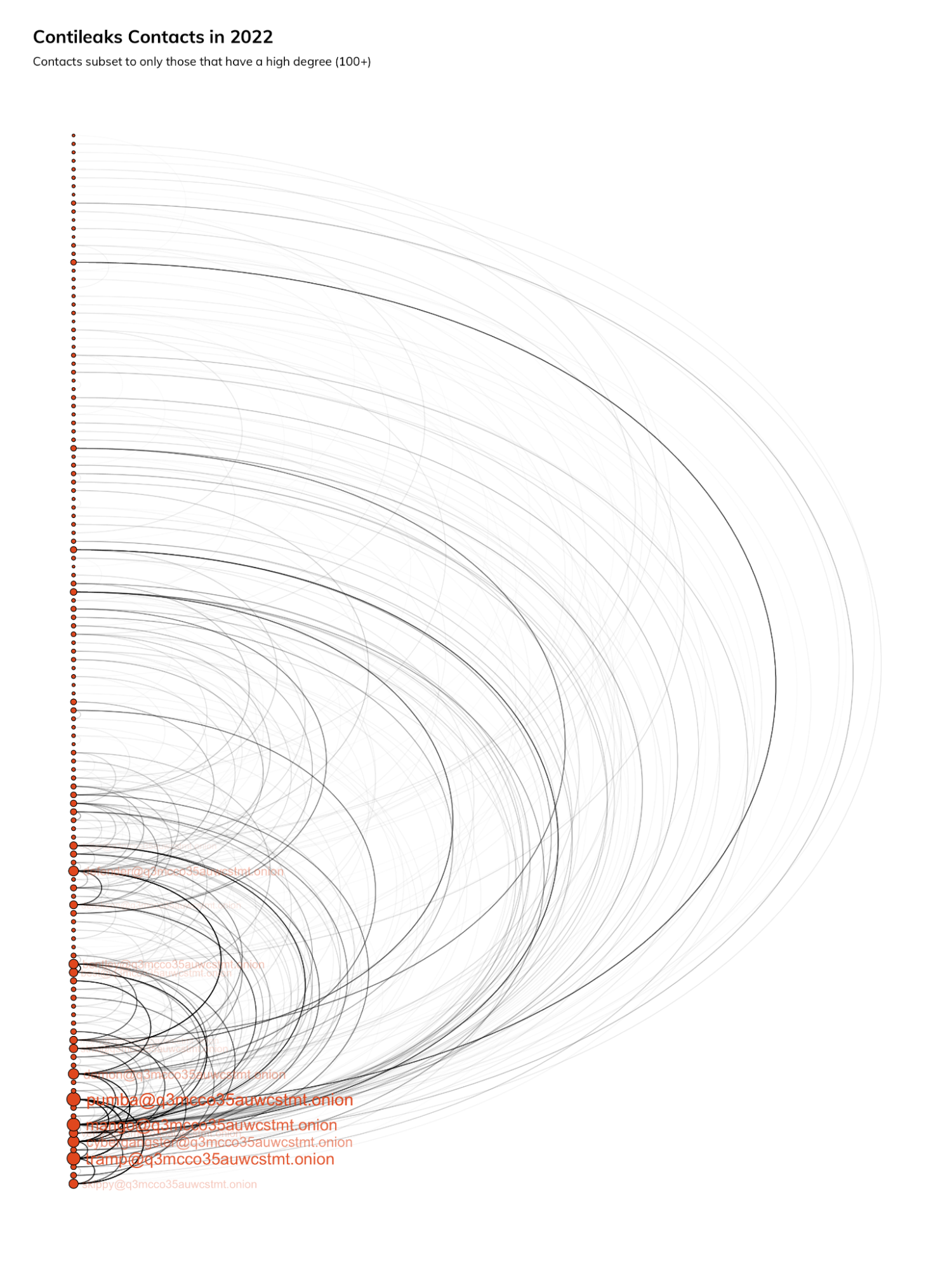
We can restructure this graph into an arc diagram and cut down on the noise with some admittedly arbitrary filters to get a cleaner view of the overall picture. In this case, we’re looking only at the communications from 2022, and we further limited the set of nodes that appear to those with a high frequency of communication measure.

Graph Analysis of the Conti Ransomware Group Internal Chats

From this approach, we can get a sense of the set of recently most active communicators within Conti. Whether these prominent individuals are just chatty or leaders is unclear, but whatever the case, a lot of communications — and presumably intelligence – is going to and from them. If they are relays, then a lot of information is going through them.

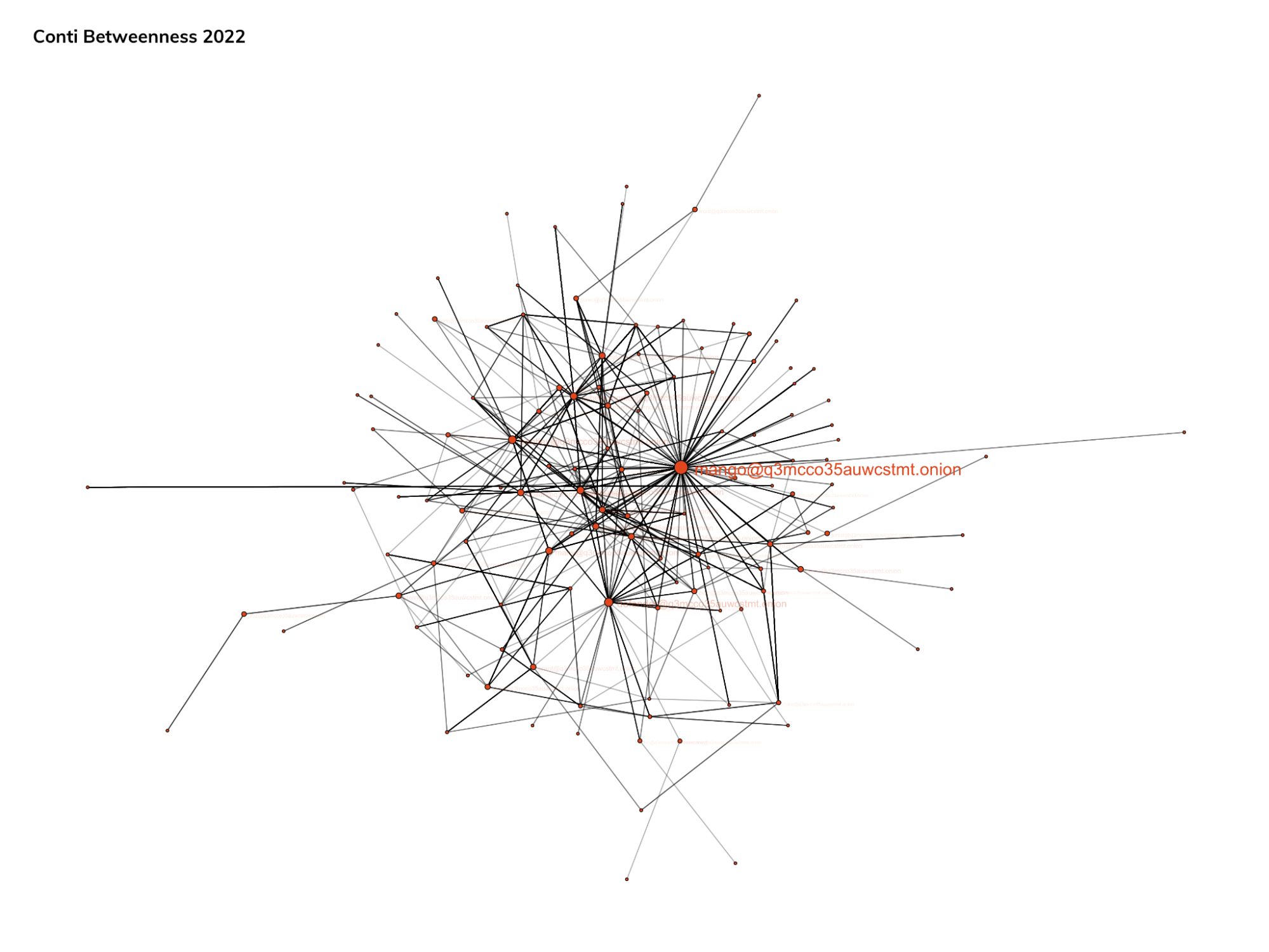
If we’re talking about relays, then what we’re really looking for is a measure of betweenness centrality, which typically represents the amount of influence specific nodes have on the flow within a graph structure.

In other applications, such as for corporate entities or criminal organizations, the individuals that are characterized by high betweenness centrality are oftentimes key linchpins of the organization. Their removal from the organization often manifests as severe disruptions to the organization.

Graph Analysis of the Conti Ransomware Group Internal Chats

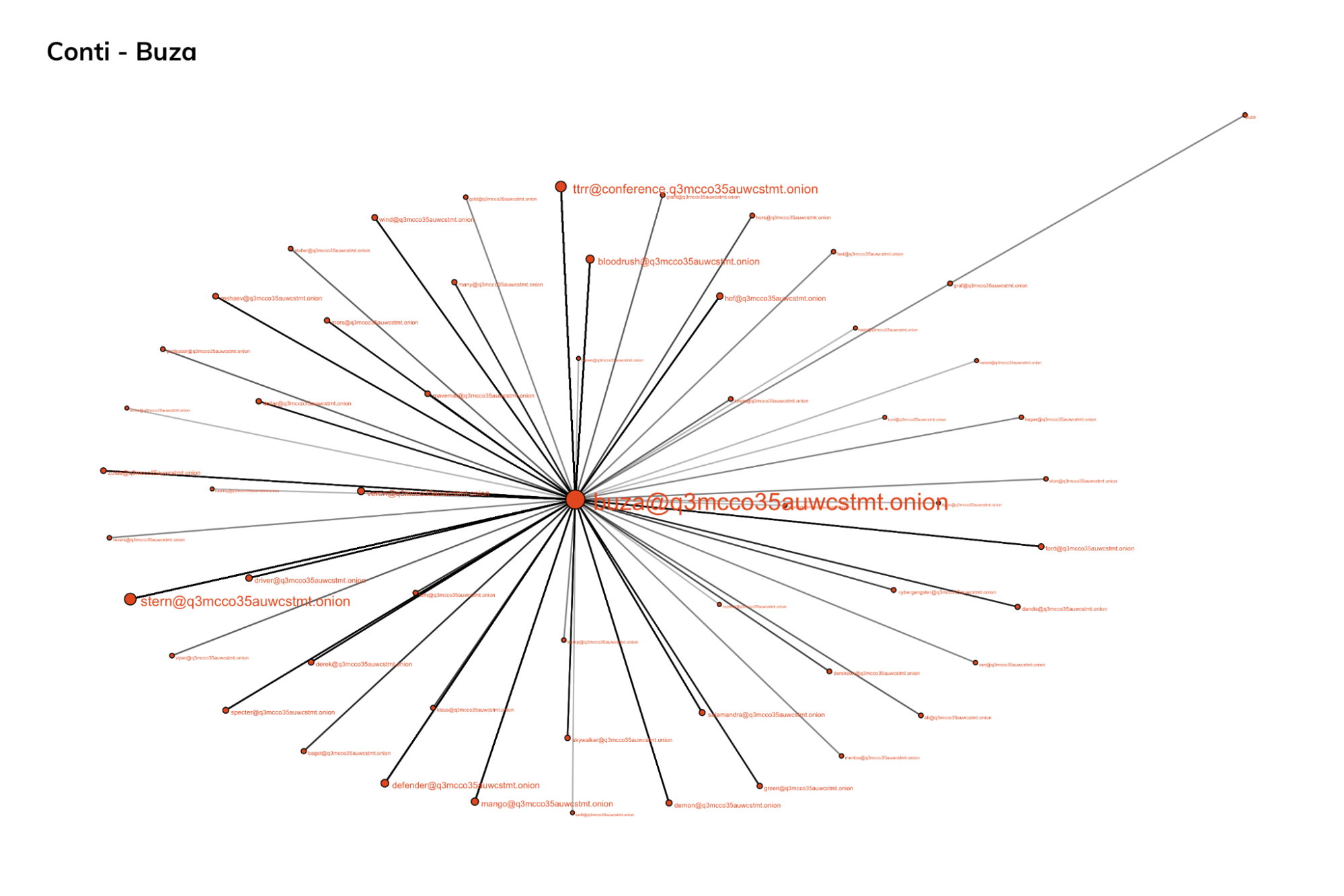
Upon deeper review of the text, it appears one communicator in particular, “buza”, is highly referenced by other communicators in decision-making contexts, though “buza” themselves is not an active communicator, relatively speaking. From this, we might surmise that “buza” is a leading figure within the organization.

If we focus only on adjacent nodes, the nodes that are directly connected to “buza”, we arrive at a view that could include “buza” at the center and the lieutenants of the organization surrounding it in a fairly classic spoke and wheel pattern. The size of the different contacts reflect how frequently they communicate with “buza,” which might in turn suggest their significance within the organization.

Graph Analysis of the Conti Ransomware Group Internal Chats

This graph analysis approach so far is really just scratching the surface of what’s possible. With further analysis, possibly combined with more in-depth text analysis methods, we can extract even more revelations about the Conti group, their areas of focus, and from there we can perhaps derive effective intelligence that can better enable defenders to secure their own organizations from similar threats.

Additional reading:

NEVER MISS A BLOG

Get the latest stories, expertise, and news about security today.

Conti Ransomware Group Internal Chats Leaked Over Russia-Ukraine Conflict

Post Syndicated from Rapid7 original https://blog.rapid7.com/2022/03/01/conti-ransomware-group-internal-chats-leaked-over-russia-ukraine-conflict/

Conti Ransomware Group Internal Chats Leaked Over Russia-Ukraine Conflict

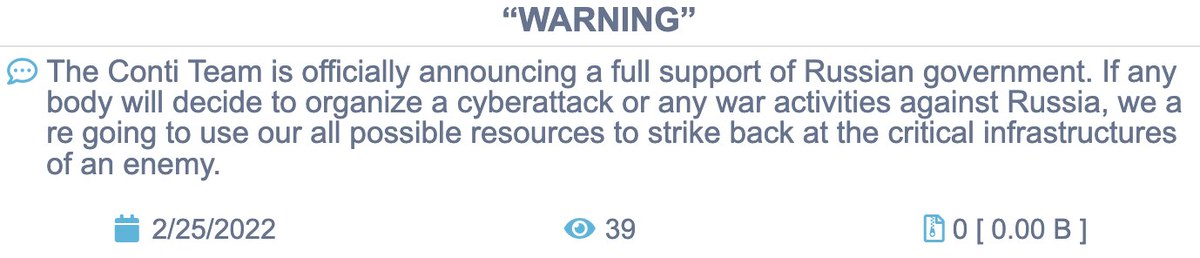
On February 27, Twitter user @ContiLeaks released a trove of chat logs from the ransomware group, Conti – a sophisticated ransomware group whose manual was publicly leaked last year. Ahead of the chat log disclosures, Conti pledged their support for the Russian Government following the Russian invasion of Ukraine. However, a number of members sided with Ukraine, causing strife within the organization. Two days later, Conti posted a second message revising their statement to condemn the war and to strike back only if Russian critical infrastructure is targeted.

Conti Ransomware Group Internal Chats Leaked Over Russia-Ukraine Conflict
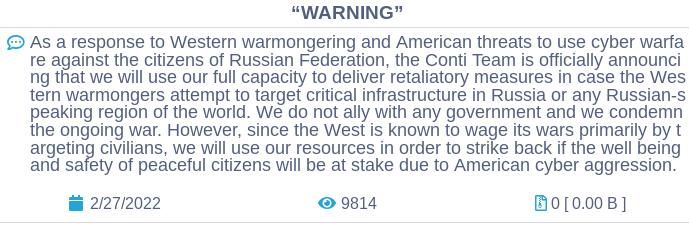
Conti announcement of support for Russian government

Conti Ransomware Group Internal Chats Leaked Over Russia-Ukraine Conflict
Conti walk-back of their support for Russia

Conti Ransomware Group Internal Chats Leaked Over Russia-Ukraine Conflict
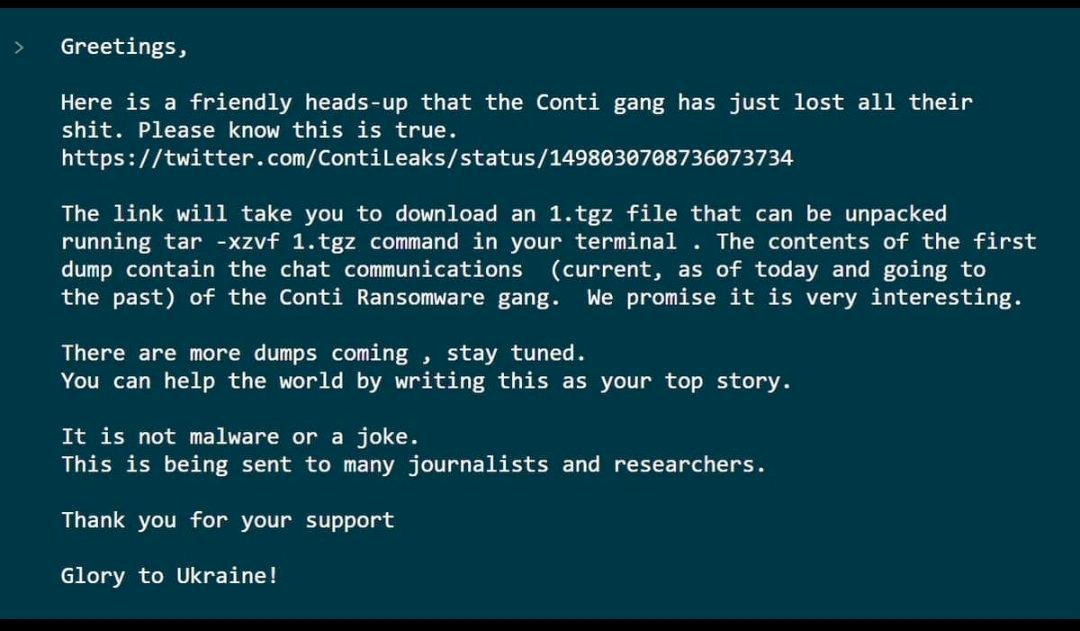
@ContiLeaks announcement of the release

At the time of the leak, a file titled `1.tgz` was released on the “AnonFiles” website, containing 14 megabytes of chat logs across 393 JSON files. However, some of the messages were encrypted and could not be read, so the information provided is necessarily incomplete. The remaining files contained internal Conti communications, screenshots of tools, and discussions of their exploits and design processes.

On February 28 and March 1, a bevy of additional files were posted, along with a number of pro-Ukraine tweets. Among both sets of leaked messages, there were a number of usernames and passwords for a variety of accounts. Additionally, user @ContiLeaks shared access details for a number of alleged Conti command and control servers, plus storage servers for stolen files. However, we have not accessed any of the data necessitating access to remote servers or the use of usernames and passwords, and we strongly recommend against doing so.

@ContiLeaks also shared a file that they purport to be the source code for the Conti ransomware but declined to share the password except with “trusted parties.” @ContiLeaks did, however, name one alleged Conti developer, providing their email address and Github. The scale of the leaked information suggests that the leaker is likely either a very senior member of the group or a coalition of disgruntled Conti affiliates.

Conti is a business – and a well-funded one

Much of the discussion within the chat logs concerns fairly mundane things – interviewing potential operators of the group, payment for services, out-of-office messages, gossip, and discussions of products. Based on the leaked chats, the Conti interview process actually looks a lot like a standard technical interview, with coding exercises to be performed hosted on public code repositories, salary negotiations, and the status of ongoing products.

In addition to other financial information related to specific actors, the leaked chats have revealed Conti’s primary Bitcoin address, which contains over two billion USD as of February 28, 2022. Moreover, a conversation on April 9, 2021 between “mango” and “johnyboy77” indicates Russian FSB involvement in some portion of their funding and that the FSB were interested in files from the media outlet Bellingcat on “Navalny” – an apparent reference to Alexei Navalny, the currently imprisoned opposition leader in Russia.

Conti development

Conti seems to operate much like a software company – the chat logs disclose concerns with the development of specific features for targets and a particular difficulty in encrypting very large files. The Conti team also attempted to get demos of popular endpoint detection software with the intent to develop their malware to avoid detection.

Two of the actors, “lemur” and “terry” shared phishing templates (included verbatim in Appendix B at the end of this post) to be used against potential targets. Conti gains initial access in many ways, with phishing a popular line of attack due in part to its relatively high efficacy and low cost. Conti often uses phishing emails to establish a presence on targeted networks.

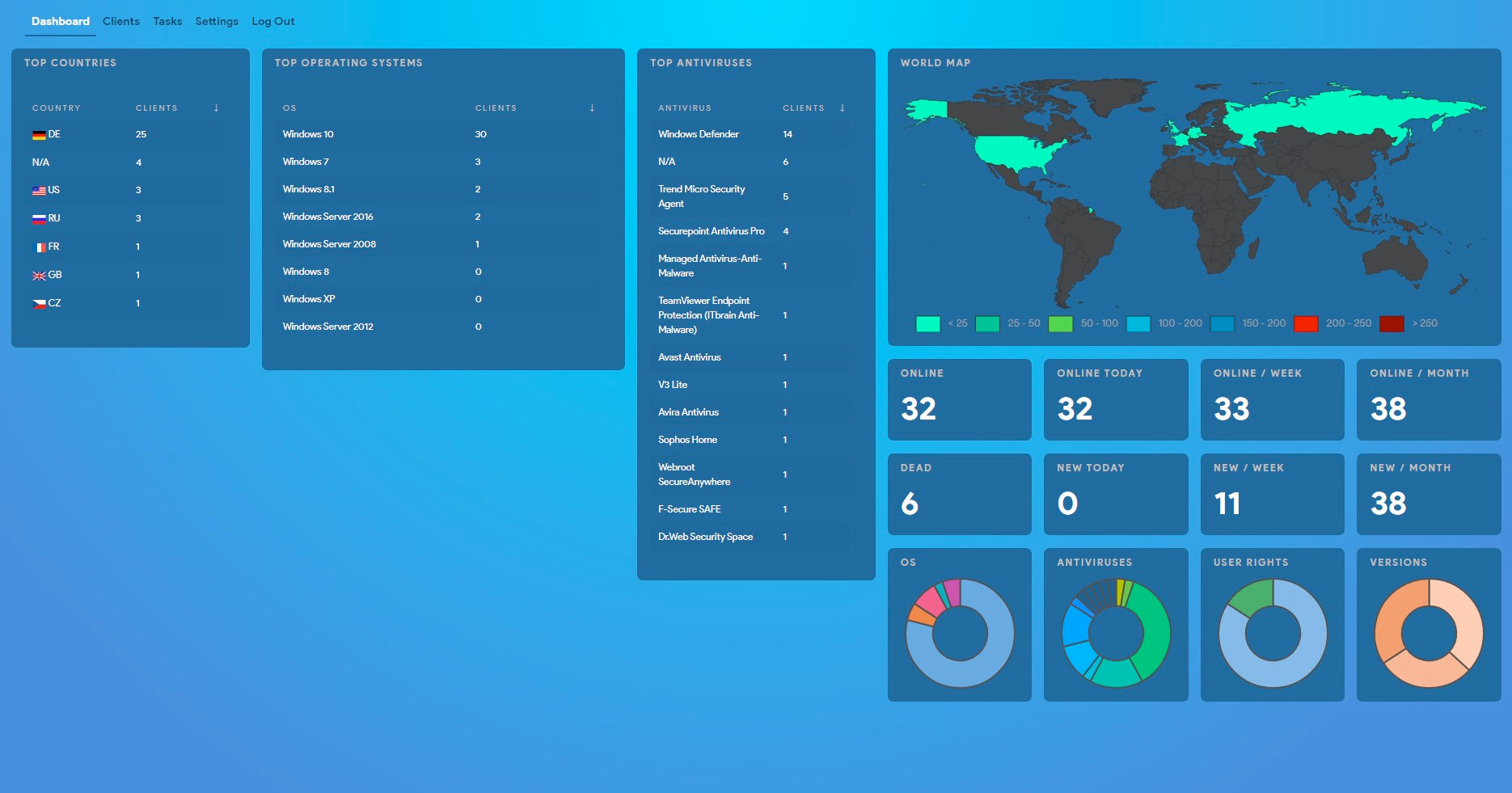
A screenshot of the Conti control panel was also leaked, showing a number of compromised hosts and a breakdown of the operating systems, antiviruses, user rights, and detailed information about the infected assets.

Conti Ransomware Group Internal Chats Leaked Over Russia-Ukraine Conflict
Conti control panel

Further discussions detailed the use of infrastructure against targets, disclosing a number of both known and unknown Conti command and control domains. At the time of this post, only a small number of the previously unknown command and control domains appear to be active. Conversations between two operators, “Stern” and “Bentley” discuss the use of third parties for malicious documents, favoring certain providers over others. They also discuss logistics for how to deliver ransomware without being detected by dynamic analysis. In a conversation between the two back in June of 2021, Stern discloses that Conti wants to start their own cryptocurrency but does not know who to work with. There is no evidence that anything came of this desire, and Conti continues to use Bitcoin for their ransoms.

Other groups assert they are strictly business

In stark contrast to Conti, other groups have made it clear to the public that despite their “business model,” they take no public stance on this crisis. LockBit is remaining aloof from the conflict and made it clear that they intend to operate as usual. Although it is believed that LockBit is a Russian organization, they assert that “we are all simple and peaceful people, we are all Earthlings,” and “for us it is just business and we are all apolitical.” Another ransomware group, ALPHV, claims to be “extremely saddened” by Conti’s pledge of support and condemns Conti. Their message concludes, “The Internet, and even more so its dark side, is not the place for politics.”

Rumors of Conti’s demise have been greatly exaggerated

Conti’s payment and “support” portal is still live, even following the infighting and leaks. Conti has repeatedly proven to be one of the most capable ransomware actors and these chats indicate that the group is well-organized and still very well-funded despite the schism. Any suggestion that these leaks spell the end for Conti is overstated, and we expect that Conti will continue to be a powerful player in the ransomware space.

What you can do

We are keeping an eye on dark web activity related to Conti and other ransomware groups and want to reiterate the following steps for protecting yourself from ransomware:

  • User education, especially related to well-crafted phishing campaigns
  • Asset and vulnerability management, including reducing your external attack surface
  • Multi-factor authentication

Additionally, it is worth ensuring that you are well-guarded against the exploits and malware commonly used by Conti (vulnerabilities provided in Appendix A at the end of this post). Furthermore, security teams should also take some time to review CISA’s recent report on the group. For further discussion on how to protect yourself from ransomware, see our ransomware playbook.

Appendix A – Conti known exploited vulnerabilities

CVE-2017-0143, CVE-2017-0144, CVE-2017-0145, CVE-2017-0146 (MS17-010; EternalBlue/EternalSynergy/EternalChampion)

CVE-2020-1472 (ZeroLogon)

CVE-2021-34527 (PrintNightmare)

CVE-2021-44228 (Log4Shell)

CVE-2021-34473, CVE-2021-34523, CVE-2021-31207 (ProxyShell/ProxyLogon)

Appendix B – Phishing templates

{Greetings|Hello|Good afternoon|Hi|Good day|Greeting|Good morning|Good evening}!
{Here|Right here|In this letter|With this letter} we {send|direct} you {all the|all the necessary|the most important} {documentation|papers|documents|records} {regarding|concerning|relating to} your {payment|deposit payment|last payment} {#|№|No. }НОМЕР ПЛАТЕЖА, right {as we|as we have} {discussed|revealed} {not so long ago|not too long ago|recently|just recently|not long ago}. Please {review the|check the|take a look at} аll {necessary|required|important} {information|data} in the {file attached|attached file}.
Т: {Payment|Deposit payment} {invoice|receipt} {#|№|No. }НОМЕР ИНВОЙСА {prepared|formed}
D: {payment|deposit|dep|paym}_{info|information|data}

{Hello|Greetings|Greetings to you|Good evening|Good morning|Good day|Good afternoon}{!|,|.|}
Your {order|purchase order|online order} was {successfully|correctly|timely} {paid|compensated|covered} by you {yesterday|today|recently}. Your {documentation|docs|papers} and {bank check|receipt|paycheck} {can be found|are listed} in the {attached file|file attached}.
T: {Invoice|Given invoice|Bill} {we|we have|we’ve} {sent|mailed|delivered} to you {is paid|is covered|is processed}.
D: {Purchase order|Order} {verification|approval}

{Hello|Greetings|Greetings to you|Good evening|Good morning|Good day|Good afternoon}{!|,|.|}
{We are contacting you to|This is to|This mail is to} {notify|remind} you {about|regarding} your {debt|unprocessed payment} for {our last|the recent|our recent} {contract|agreement}. All {compensation|payment} {data|information}, {agreement|contract} and prepared legal {documents|documentation} {can be found|are located} in the {file attached|attached file}.
T: {Missing|Additional} payment {information|details|info} reminder
D: {Contract|Agreement} 2815/2 {case|claim}

{Hello|Greetings|Greetings to you|Good evening|Good morning|Good day|Good afternoon}{!|,|.|}
{Your payment|Your advance payment|Your obligatory payment|Payment you sent|Payment you made} was {successfully|correctly|timely|properly} {achieved|accomplished|approved|affirmed|received|obtained|collected|processed}. All {required documentation|necessary documents|important documentation|documents you need|details that can be important|essential documents} {can be found|you can find} in the {attached file|file attached}.
T: {Invoicing|Invoice|Agreement|Contract|Payment} {info|data|information|details}
D: {Receipt|Bill} {id|ID|Number|number|No.|No.|No|#|##} 3212-inv8

{Greetings|Hello|Good day|Good afternoon}{!|,|}
{Thank you for|We are thankful for|We are grateful for|Many thanks for} {your|your recent} {on-line order|purchase order|order}. {We|Our financiers have|Our team has|We have|Our shop has} {received|collected|processed|checked} your {payment|advance payment|money transfer|funds transfer} НОМЕР ПЕРЕВОДА. Now we {are and ready to|begin to} {pack|prepare|compose} your {shipment|order|box}. Your {parcel|packet|shipment|box} {will|is going to|would} {arrive|be delivered} to {you|your residence} within {4|5|6|four|five|six} {days|business days}.
{Total|Full|Whole} {order|purchase|payment} sum: СУММА
You {can find|will find} {all|full} {relative information|order info|order and payment details} and your {receipt|check} НОМЕР ЧЕКА {in|in the} {attached file|file attached}.
{Thank you!|Have a nice day!}
ТЕМЫ: Your {order|purchase|on-line order|last order} НОМЕР ЗАКАЗА payment {processed|obtained|received}
АТТАЧИ:
ord_conf
full.details
compl_ord_7847
buyer_auth_doc
info_summr
customer_docs
spec-ed_info

Additional reading

NEVER MISS A BLOG

Get the latest stories, expertise, and news about security today.

Decrypting Hive Ransomware Data

Post Syndicated from Bruce Schneier original https://www.schneier.com/blog/archives/2022/03/decrypting-hive-ransomware-data.html

Nice piece of research:

Abstract: Among the many types of malicious codes, ransomware poses a major threat. Ransomware encrypts data and demands a ransom in exchange for decryption. As data recovery is impossible if the encryption key is not obtained, some companies suffer from considerable damage, such as the payment of huge amounts of money or the loss of important data. In this paper, we analyzed Hive ransomware, which appeared in June 2021. Hive ransomware has caused immense harm, leading the FBI to issue an alert about it. To minimize the damage caused by Hive Ransomware and to help victims recover their files, we analyzed Hive Ransomware and studied recovery methods. By analyzing the encryption process of Hive ransomware, we confirmed that vulnerabilities exist by using their own encryption algorithm. We have recovered the master key for generating the file encryption key partially, to enable the decryption of data encrypted by Hive ransomware. We recovered 95% of the master key without the attacker’s RSA private key and decrypted the actual infected data. To the best of our knowledge, this is the first successful attempt at decrypting Hive ransomware. It is expected that our method can be used to reduce the damage caused by Hive ransomware.

Here’s the flaw:

The cryptographic vulnerability identified by the researchers concerns the mechanism by which the master keys are generated and stored, with the ransomware strain only encrypting select portions of the file as opposed to the entire contents using two keystreams derived from the master key.

The encryption keystream, which is created from an XOR operation of the two keystreams, is then XORed with the data in alternate blocks to generate the encrypted file. But this technique also makes it possible to guess the keystreams and restore the master key, in turn enabling the decode of encrypted files sans the attacker’s private key.

The researchers said that they were able to weaponize the flaw to devise a method to reliably recover more than 95% of the keys employed during encryption.

On the Irish Health Services Executive Hack

Post Syndicated from Bruce Schneier original https://www.schneier.com/blog/archives/2022/02/on-the-irish-health-services-executive-hack.html

A detailed report of the 2021 ransomware attack against Ireland’s Health Services Executive lists some really bad security practices:

The report notes that:

  • The HSE did not have a Chief Information Security Officer (CISO) or a “single responsible owner for cybersecurity at either senior executive or management level to provide leadership and direction.
  • It had no documented cyber incident response runbooks or IT recovery plans (apart from documented AD recovery plans) for recovering from a wide-scale ransomware event.
  • Under-resourced Information Security Managers were not performing their business as usual role (including a NIST-based cybersecurity review of systems) but were working on evaluating security controls for the COVID-19 vaccination system. Antivirus software triggered numerous alerts after detecting Cobalt Strike activity but these were not escalated. (The antivirus server was later encrypted in the attack).
  • There was no security monitoring capability that was able to effectively detect, investigate and respond to security alerts across HSE’s IT environment or the wider National Healthcare Network (NHN).
  • There was a lack of effective patching (updates, bug fixes etc.) across the IT estate and reliance was placed on a single antivirus product that was not monitored or effectively maintained with updates across the estate. (The initial workstation attacked had not had antivirus signatures updated for over a year.)
  • Over 30,000 machines were running Windows 7 (out of support since January 2020).
  • The initial breach came after a HSE staff member interacted with a malicious Microsoft Office Excel file attached to a phishing email; numerous subsequent alerts were not effectively investigated.

PwC’s crisp list of recommendations in the wake of the incident ­ as well as detail on the business impact of the HSE ransomware attack ­ may prove highly useful guidance on best practice for IT professionals looking to set up a security programme and get it funded.

New DeadBolt Ransomware Targets NAT Devices

Post Syndicated from Bruce Schneier original https://www.schneier.com/blog/archives/2022/01/new-deadbolt-ransomware-targets-nat-devices.html

There’s a new ransomware that targets NAT devices made by QNAP:

The attacks started today, January 25th, with QNAP devices suddenly finding their files encrypted and file names appended with a .deadbolt file extension.

Instead of creating ransom notes in each folder on the device, the QNAP device’s login page is hijacked to display a screen stating, “WARNING: Your files have been locked by DeadBolt”….

[…]

BleepingComputer is aware of at least fifteen victims of the new DeadBolt ransomware attack, with no specific region being targeted.

As with all ransomware attacks against QNAP devices, the DeadBolt attacks only affect devices accessible to the Internet.

As the threat actors claim the attack is conducted through a zero-day vulnerability, it is strongly advised that all QNAP users disconnect their devices from the Internet and place them behind a firewall.

How Ransomware Is Changing US Federal Policy

Post Syndicated from Harley Geiger original https://blog.rapid7.com/2022/01/26/how-ransomware-is-changing-us-federal-policy/

How Ransomware Is Changing US Federal Policy

In past decades, attackers breaching systems and stealing sensitive information prompted a wave of regulations focused on consumer privacy and breach notification. The current surge in ransomware attacks is prompting a new wave of action from policymakers. Unlike the more abstract harms threatened by breaches of personal information, ransomware will grind systems to a halt, suspending business and government operations and potentially threatening health and safety. One indication of the shift in awareness of this form of cybercrime is that President Biden addressed the ransomware threat multiple times in 2021.

The increased stakes of the ransomware threat are pushing regulators to take a harder look at whether regulatory requirements for cybersecurity safeguards are effective or if new requirements are needed to help combat the threat. The federal agencies are also stepping up their coordination on information sharing and incident reporting, and the Administration is growing its collaboration with international partners and the private sector. Let’s look at a few recent and ongoing initiatives.

Cybersecurity requirements for critical infrastructure

In March 2021, Secretary of Homeland Security Mayorkas announced a series of initiatives to strengthen cybersecurity for critical infrastructure, citing ransomware as a national security threat driving the effort. Less than two months later, the Colonial Pipeline ransomware event disrupted the East Coast fuel supply.

Not long after the Colonial attack, the Transportation Security Administration (TSA) exercised its authority to impose security regulations on the pipeline sector. Through two separate rules, TSA required pipeline operators to establish incident response and recovery plans, implement mitigation measures to protect against ransomware attacks, and undergo annual cybersecurity audits and architecture reviews, among other things.

In December 2021, TSA also issued new security regulations for the aviation, freight rail, and passenger rail sectors. The regulations require (among other things) reporting ransomware incidents to CISA and maintaining an incident response plan to detect, mitigate, and recover from ransomware attacks.

Ransomware is a key motivating factor in the sudden tightening of cybersecurity requirements. Previously, the cybersecurity regulations for pipelines were voluntary, with an accommodative relationship between pipeline operators and their regulators. Policymakers are increasingly voicing concern that other critical infrastructure sectors are in a similar position. With basic societal needs at risk when ransomware successfully disrupts critical infrastructure operations, some lawmakers are signaling openness to creating additional cybersecurity regulations for critical sectors.

OFAC sanctions

The federal government is also using its sanctions authority to head off ransomware payments. According to a recent FinCEN report, the average amount of reported ransomware transactions was approximately $100 million per month in 2021. These payments encourage more ransom-based attacks and fund other criminal activities.

The Office of Foreign Assets Control (OFAC) issued guidance warning that paying ransoms to sanctioned persons and organizations is in violation of sanctions regulations. Liability for these violations, OFAC notes, applies even if the person did not know that the ransomware payment was sent to a sanctioned entity.

Critics of this approach warn that applying sanctions to specific attacker groups is ineffective as the groups can simply rebrand or partner with other criminal elements to take payments. They add that sanctions imposed on payments does nothing but further victimize those organizations or individuals being attacked and remove their choices for recovery or force them underground. Ransomware is already grossly under-reported, and critics of sanctions warn that sanctions will likely encourage a lack of transparency.

More recently, OFAC also issued virtual currency guidance — aimed at currency companies, miners, exchanges, and users — emphasizing that the facilitation of ransomware payments to sanctioned entities is illegal. The guidance also describes best practices for assessing the risk of violating sanctions during transactions. In addition, OFAC imposed sanctions on a Russia-based cryptocurrency exchange for allegedly facilitating financial transactions for ransomware actors — the first sanctions of this kind.

OFAC followed up with an advisory on sanctions guidance for the virtual currency industry and applied sanctions on a cryptocurrency firm that was not doing its due diligence in preventing the facilitation of payments to ransomware criminal gangs.

Ransomware reporting

Requirements to report ransomware payments and ransomware-related incidents to federal authorities is another area to watch. Incident reporting requirements are in place for federal agencies and contractors via a Biden Administration Executive Order, but Congress is taking steps to expand these requirements to other private-sector entities.

Both the House of Representatives and the Senate have advanced legislation that would require businesses to report ransomware payments within 24 hours. The report would need to include the method of payment, instructions for making the payment, and other details to help federal investigators follow the payment flows and identify ransomware trends over time. The legislation would also require owners and operators of critical infrastructure to report substantial cybersecurity incidents (including a disruptive ransomware attack) within 72 hours. Interestingly, the legislation’s definition of “ransomware” encompasses all extortion-based attacks (such as the threat of DDoS), not just malware that locks system operations until a ransom is paid.

Although the House and Senate legislation cleared several hurdles, it did not pass Congress in 2021. However, we expect a renewed push for incident reporting, or other legislation to address ransomware, in 2022 and beyond.

A more collaborative, whole-of-government approach

The Biden Administration characterized ransomware as an economic and national security concern relatively early on and has detailed numerous federal efforts to counter it. We have also seen a marked increase in both international government and law enforcement cooperation, and public-private collaboration to identify, prosecute, and disrupt ransomware criminals, and address their safe harbors. In addition to the above, recent efforts have included:

  • In April 2021, the Department of Justice (DOJ) created a Digital Extortion Task Force, and in June elevated ransomware to be a priority on par with terrorism.
  • In June 2021, the US government attended the G7 Summit and discussed ransomware, making a commitment “to work together to urgently address the escalating shared threat from criminal ransomware networks.” They went on to “call on all states to urgently identify and disrupt ransomware criminal networks operating from within their borders, and hold those networks accountable for their actions.”
  • Also in June 2021, ransomware was discussed during the EU-US Justice and Home Affairs Ministerial Meeting, with commitments made to work together to combat “ransomware including through law enforcement action, raising public awareness on how to protect networks as well as the risk of paying the criminals responsible, and to encourage those states that turn a blind eye to this crime to arrest and extradite or effectively prosecute criminals on their territory.”
  • In August 2021, the Cybersecurity and Infrastructure Security Agency (CISA) announced the formation of the Joint Cyber Defense Collaborative (JCDC) to “integrate unique cyber capabilities across multiple federal agencies, many state and local governments, and countless private sector entities.”
  • In August 2021, the White House announced the voluntary Industrial Control System Cybersecurity Initiative to strengthen the resilience of critical infrastructure against ransomware.
  • In September 2021, NIST issued a ransomware risk management profile for its Cybersecurity Framework.
  • In October 2021, the White House hosted a Counter Ransomware Initiative Meeting, bringing together governments from 30 nations around the world “to discuss the escalating global security threat from ransomware” and identify potential solutions.
  • Also in October 2021, a group of international law enforcement agencies and private sector experts collaborated to force ransomware group REvil offline.
  • In November 2021, the US Department of Justice announced the arrest of three ransomware actors, charges against a fourth, and the “seizure of $6.1 million in funds traceable to alleged ransom payments.” It attributed these successes to “the culmination of close collaboration with our international, US government, and especially our private-sector partners.”
  • Collaboration by multiple federal agencies to produce the StopRansomware site, which provides basic resources on what ransomware is, how to reduce risks, and how to report an incident or request assistance.
  • Ongoing work of senior policymakers such as Deputy Attorney General Lisa Monaco, as well as federal agencies such as CISA and the FBI, to keep up a steady flow of timely alerts about the threat of ransomware and the need for public and private-sector collaboration to fight it.

Ransomware brings security center-stage

For years, it was arguable that most policymakers did not “get” the need for cybersecurity. Now the landscape has changed significantly, with ransomware and nation-state competition driving the renewed sense of urgency. Given the seriousness, persistence, and widespread nature of the ransomware threat, Rapid7 supports new measures to detect and mitigate these attacks. These trends do not seem likely to abate soon, and we expect regulatory activity and information sharing on cybersecurity to be driven by ransomware for some time to come.

Additional reading:

NEVER MISS A BLOG

Get the latest stories, expertise, and news about security today.

Is the Internet of Things the Next Ransomware Target?

Post Syndicated from Deral Heiland original https://blog.rapid7.com/2022/01/20/is-the-internet-of-things-the-next-ransomware-target/

Is the Internet of Things the Next Ransomware Target?

Ransomware attacks over the last couple years have been traumatic, impacting nearly every business sector and costing billions of dollars. The targets have mostly been our data: steal it, encrypt it, and then charge us a fee to get it back.

Over the last several years, there’s been concern across the security community about the risks related to the Internet of Things (IoT) being impacted by ransomware. For the most part, this has not occurred — although I wouldn’t be surprised if IoT has played a role as the entry point that malicious actors have used, on occasion, to gain access to plant their ransomware on critical systems. Also, we do know of examples where IoT technologies, such as those used within medical and industrial control environments, were impacted during ransomware attacks through key components of their ecosystem involving standard Windows server and desktop solutions.

IoT ransomware risk and its implications

So, what would it take for IoT to be the target of ransomware? First, the IoT being attacked would need to be a large deployment with significant importance in its functions and capabilities. The attack would also need to be disruptive enough that an organization would be willing to pay.  

Personally, I’m not confident such an environment exists, at least as it would apply to the average organization. But let’s step back and look at this from the perspective of the vendor who remotely manages, controls, and updates their products over the Internet. For example, imagine what would happen if a malicious actor successfully breached an automotive organization with smart-capable cars — could they shut down every car and lock the company and owner out of fixing them?

If we apply that train of thought across the board for all IoT deployed out there, it becomes very concerning. What if we shut down every multifunction printer by a major manufacturer, home thermostat, building HVAC, or building lighting solution? What happens if the target is a smart city and traffic lights are impacted? We could go on all day talking about the impact from smart city breaches or attacks against small deployed IoT solutions from major brands with global footprints.

Building a threat model

So, are there steps we can take to head off such an event? The answer is yes. I believe IoT vendors and solution owners could best accomplish this by identifying the potential attack vector and risk through threat modeling.

As part of building out a threat model, the first step would be to identify and map out a complete conceptual structure of the IoT system that could be potentially targeted. In the case of IoT technology, this should consist of all components of the system ecosystem that make the solution function as intended, which would include:

  • Embedded hardware system actuators, sensors, and gateways
  • Management and control applications, such as mobile and cloud services, as well as thick clients on servers, desktops, and laptops systems
  • Communication infrastructure used for data and operational controls including Ethernet, Wi-Fi, and other radio frequency (RF)

Any component or subcomponent of this ecosystem is at potential risk for being targeted. Mapping out this information gives us the ability to better understand and consider the potential points of attack that a malicious actor could use to deliver or execute a ransomware style attack against IoT.

In the second step of this threat modeling process, we need to understand the possible goals of a malicious actor who would be targeting an IoT ecosystem, who they may be, and what their end game and potential methods of attack would look like. The threat actors would likely look very similar to any malicious actor or group that carries out ransomware attacks. I think the big difference would be how they would approach attacking IoT ecosystems.

This is the phase where creative thinking plays a big role, and having the right people involved can make all the difference. This means having people on the threat modeling team who can take an attacker mindset and apply that thinking against the IoT ecosystems to map out as many potential attack vectors as possible.

Mapping out the threat and response

The third step in the threat modeling process is building a list of threats we would expect to be used against the above IoT ecosystems. One example, which is also common with typical ransomware attacks, is locking. By locking a component of the IoT solutions ecosystem, a malicious actor could prevent the IoT ecosystem from properly functioning or communicating with other key components, completely taking the technology out of service or preventing it from functioning as intended.

In the final part, we take the detailed information we’ve put together and map out specific attack scenarios with the greatest chance of success. Each scenario should define the various components of the IoT ecosystem potentially at risk, along with the perceived attacker motives, methods, and threats that can lead to the attacker being successful. Once you’ve mapped out these various scenarios in detail, you can use them to define and implement specific controls to mitigate or reduce the probability of success for those attack scenarios.

Using these threat modeling methods will help IoT solution vendors and the organizations that use their products identify and mitigate the risk and impact of ransomware attacks against IoT solutions before they happen.

NEVER MISS A BLOG

Get the latest stories, expertise, and news about security today.

AWS Security Profiles: Merritt Baer, Principal in OCISO

Post Syndicated from Maddie Bacon original https://aws.amazon.com/blogs/security/aws-security-profiles-merritt-baer-principal-in-ociso/

AWS Security Profiles: Merritt Baer, Principal in OCISO
In the week leading up AWS re:Invent 2021, we’ll share conversations we’ve had with people at AWS who will be presenting, and get a sneak peek at their work.


How long have you been at Amazon Web Services (AWS), and what do you do in your current role?

I’m a Principal in the Office of the Chief Information Security Officer (OCISO), and I’ve been at AWS about four years. In the past, I’ve worked in all three branches of the U.S. Government, doing security on behalf of the American people.

My current role involves both internal- and external- facing security.

I love having C-level conversations around hard but simple questions about how to prioritize the team’s resources and attention. A lot of my conversations revolve around organizational change, and how to motivate the move to the cloud from a security perspective. Within that, there’s a technical “how”—we might talk about the move to an intelligent multi-account governance structure using AWS Organizations, or the use of appropriate security controls, including remediations like AWS Config Rules and Amazon EventBridge. We might also talk about the ability to do forensics, which in the cloud looks like logging and monitoring with AWS CloudTrail, Amazon CloudWatch, Amazon GuardDuty, and others aggregated in AWS Security Hub.

I also handle strategic initiatives for our security shop, from operational considerations like how we share threat intelligence internally, to the ways we can better streamline our policy and contract vehicles, to the ways that we can incorporate customer feedback into our products and services. The work I do for AWS’ security gives me the empathy and credibility to talk with our customers—after all, we’re a security organization, running on AWS.

What drew you to security?

(Sidebar: it’s a little bit of who I am— I mean, doesn’t everyone rely on polaroid photos? just kidding— kind of :))
 
Merritt Baer polaroid photo

I always wanted to matter.

I was in school post-9/11, and security was an imperative. Meanwhile, I was in Mark Zuckerberg’s undergrad class at Harvard. A lot of the technologies that feel so intimate and foundational—cloud, AI/ML, IoT, and the use of mobile apps, for example—were just gaining traction back then. I loved both emerging tech and security, and I was convinced that they needed to speak to and with one another. I wanted our approach to include considerations around how our systems impact vulnerable people and communities. I became an expert in child pornography law, which continues to be an important area of security definition.

I am someone who wonders what we’re all doing here, and I got into security because I wanted to help change the world. In the words of Poet Laureate Joy Harjo, “There is no world like the one surfacing.”

How do you explain your job to non-tech friends?

I often frame my work relative to what they do, or where we are when we’re chatting. Today, nearly everyone interacts with cloud infrastructure in our everyday lives. If I’m talking to a person who works in finance, I might point to AWS’ role providing IT infrastructure to the global financial system; if we’re walking through a pharmacy I might describe how research and development cycles have accelerated because of high-performance computing (HPC) on AWS.

What are you currently working on that you’re excited about?

Right now, I’m helping customer executives who’ve had a tumultuous (different, not necessarily all bad) couple of years. I help them adjust to a new reality in their employee behavior and access needs, like the move to fully remote work. I listen to their challenges in the ability to democratize security knowledge through their organizations, including embedding security in dev teams. And I help them restructure their consumption of AWS, which has been changing in light of the events of the last two years.

On a strategic level, I have a lot going on … here’s a good sampling: I’ve been championing new work based on customers asking our experts to be more proactive by “snapshotting” metadata about their resources and evaluating that metadata against our well-architected security framework. I work closely with our Trust and Safety team on new projects that both increase automation for high volume issues but also provide more “high touch” and prioritized responses to trusted reporters. I’m also building the business case for security service teams to make their capabilities even more broadly available by extended free tiers and timelines. I’m providing expertise to our private equity folks on a framework for evaluating the maturity of security capabilities of target acquisitions. Finally, I’ve helped lead our efforts to add tighter security controls when AWS teams provide prototyping and co-development work. I live in Miami, Florida, USA, and I also work on building out the local tech ecosystem here!

I’m also working on some of the ways we can address ransomware. During our interview process, Amazon requests that folks do an hour-long presentation on a topic of your choice. I did mine on ransomware in the cloud, and when I came on board I pointed to that area of need for security solutions. Now we have a ransomware working group I help lead, with efforts underway to help out customers doing both education and architectural guidance, as well as curated solutions with industries and partners, including healthcare.

You’re presenting at AWS re:Invent this year—can you give readers a sneak peek at what you’re covering?

One talk is on cloud-native approaches to ransomware defense, encouraging folks to think innovatively as they mature their IT infrastructure. And a second talk highlights partner solutions that can help meet customers where they are, and improve their anti-ransomware posture using vendors—from MSSPs and systems integrators, to endpoint security, DNS filtering, and custom backup solutions.

What are you hoping the audience will take away from the sessions?

These days, security doesn’t just take the form of security services (like GuardDuty and AWS WAF), but will also manifest in the ways you design a cloud-aware architecture. For example, our managed database service Aurora can be cloned; that clone might act as a canary when you see data drift (a canary is security concept for testing your expectations). You can use this to get back to a known good state.

Security is a bottom line proposition. What I mean by that is:

  1. It’s a business criticality to avoid a bad day
  2. Embracing mature security will enable your entity’s development innovation
  3. The security of your products is a meaningful part of what you deliver on to your customers.

From your perspective, what’s the most important thing to know about ransomware?

Ransomware is a big headline-maker right now, but it’s not new. Most ransomware attacks are not based on zero days; they’re knowable but opportunistic. So, without victim-blaming, I mean to equip us with the confidence to confront the security issue. There’s no need to be ransomed.

I try not to get wrapped around particular issues, and instead emphasize building the foundation right. So sure, we can call it ransomware defense, but we can also point to these security maturity measures as best practices in general.

I think it’s fair to say that you’re passionate about women in tech and in security specifically. You recently presented at the Day of Shecurity conference and the Women in Business Summit, and did an Instagram takeover for Women in CyberSecurity (WiCyS). Why do you feel passionately about this?

I see security as an inherently creative field. As security professionals, we’re capable of freeing the business to get stuff done, and to get it done securely. That sounds simple, and it’s hard!

Any time you’re working in a creative field, you rely on human ingenuity and pragmatism to ensure you’re doing it imaginatively instead of simply accepting old realities. When we want to be creative, we need more of the stuff life is made of: human experience. We know that people who move through the world with different identities and experiences think differently. They approach problems differently. They code differently.

So, I think having women in security is important, both for the women who choose to work in security, and for the security field as a whole.

What advice would you give a woman just starting out in the security industry?

No one is born with a brain full of security knowledge. Technology is human-made and imperfect, and we all had to learn it at some point. Start somewhere. No one is going to tap you on the shoulder and invite you to your life 🙂

Operationally, I recommend:

  • Curate your “elevator pitch” about who you are and what you’re looking for, and be explicit when asking for folks for a career conversation or a referral (you can find me on Twitter @MerrittBaer, feel free to send a note).
  • Don’t accept a first job offer—ask for more.
  • Beware of false choices. For example, sometimes there’s a job that’s not in the description—consider writing your own value proposition and pitching it to the organization. This is a field that’s developing all the time, and you may be seeing a need they hadn’t yet solidified.

What’s your favorite Leadership Principle at Amazon and why?

I think Bias for Action takes precedence for me— there’s a business decision here to move fast. We know that comes with some costs and risks, but we’ve made that calculated decision to pursue high velocity.

I have a law degree, and I see the Leadership Principles sort of like the Bill of Rights: they are frequently in tension and sometimes even at odds with one another (for example, Bias for Action and Are Right, A Lot might demand different modes). That is what makes them timeless—yet even more contingent on our interpretation—as we derive value from them. As a security person, I want us to pursue the good, and also to transcend the particular fears of the day.

If you had to pick any other industry, what would you want to do?

Probably public health. I think if I wasn’t doing security, I would want to do something else landscape-level.

Even before I had a daughter, but certainly now that I have a one-year-old, I would calculate the ROI of my life’s existence and my investment in my working life.

That being said, there are days I just need to come home to some unconditional love from my rescue pug, Peanut Butter.
 
Peanut Butter the dog


If you have feedback about this post, submit comments in the Comments section below.

Want more AWS Security news? Follow us on Twitter.

 Merritt Baer

Merritt Baer

Merritt is a Principal in the Office of the CISO. She can be found on Twitter at @merrittbaer and looks forward to meeting you at re:Invent, or in your next executive conversation.

Author

Maddie Bacon

Maddie (she/her) is a technical writer for AWS Security with a passion for creating meaningful content. She previously worked as a security reporter and editor at TechTarget and has a BA in Mathematics. In her spare time, she enjoys reading, traveling, and all things Harry Potter.

2022 Planning: Prioritizing Defense and Mitigation Through Left of Boom

Post Syndicated from boB Rudis original https://blog.rapid7.com/2021/11/17/2022-planning-prioritizing-defense-and-mitigation-through-left-of-boom/

2022 Planning: Prioritizing Defense and Mitigation Through Left of Boom

In the military, the term “left of boom” refers to the strategy and tactics required to prevent — and protect personnel from — explosions by making proactive decisions before the event happens. Unless you’ve been fortunate enough to avoid tech and media press for the past 24 months, it should be clear by now that cyberattacks most certainly qualify as “boom” events, with the potential to cause reputational, financial, and even real-life physical harm to businesses, communities, and individuals, many of whom are truly innocent bystanders.

While telemetry-fueled detection and well-honed response plans are foundational components of truly effective cybersecurity programs, they are definitely “right of boom,” and we should not be so quick to cede ground to attackers with an “assume breach” mindset. Cybersecurity teams have myriad defense and mitigation strategies at their disposal to help ensure a sizable percentage of attackers never even have the chance to waltz their way through the killchain. In this post, we’ll use ransomware as an example for 3 left-of-boom areas to focus on (via the MITRE ATT&CK framework.)

The ransomware “booms”

One might argue that the singular “boom” of ransomware is the encryption of business critical information and assets, but attackers now also hunt for juicy data they can use for many purposes, including to pressure a target to pay or suffer a data disclosure event on top of a business-disrupting lock-up. There is another emerging scenario that adds a compounding denial-of-service attacks (or multiple attacks) into the mix – note that pure denial-of-service extortion, or “RansomDoS” in the modern vernacular, is out of scope for this post.

Knowing the potential negative outcomes, what can teams focus on ahead of time to help prevent these outcomes and protect their organizations? For ransomware (and, really, the vast majority of cyberattacks today), the main goal is to prevent initial access into your environment, so let’s explore what you need to do to stay left of that particular boom. Since there are many techniques used to gain initial access, we’ll focus the rest of the post on 3 areas (T1190, T1133, and T1078) and give you some tips on how to apply the same left-of-boom thinking to other ones.

←💥 Attack surface management: Preventing exploitation

Attack surface management (ASM) is just a 2021 pretty bow wrapped around the term “asset management” in the hopes that organizations will finally recognize the need for it, realizing that they aren’t just deploying cool services and capabilities but also providing potential inroads for attackers. With ASM, your goal is to understand:

  • What devices, operating systems, and software are deployed on your perimeter, intranet, and remote endpoints
  • The safe and resilient configurations required for those elements
  • The current state of those elements

You cannot get left of boom for a ransomware attack, and many other cyberattacks, without a functional ASM practice in place. This requires having a close partnership with your procurement department and IT endpoint/server/cloud operations teams, as well as the tools (proprietary or open-source) to help with organization and verification.

It’s vital to understand what you’re exposing to the internet — since that’s what attackers can directly see and touch — but it’s also critical to know the status of each node that may be involved in initial access attempts, including desktops, laptops, and mobile devices.

If you can stay ahead of exposing unpatched or unsafe services to the internet and keep your workforce systems patched and configured safely in a timely fashion, you’ll make it difficult to impossible for attackers to use known exploits (one of the most common methods in 2021) to achieve the access they need to carry out the rest of their campaign using that technique.

←←💥 Attack surface management: Safeguarding gateways

Even before our brave, newly expanded world of remote work, organizations needed ways for their workforce to access critical systems and applications outside the confines of the intranet. These include solutions such as virtual private networks (VPNs), remote desktop protocol (RDP), Citrix, and similar technologies. By their nature, these systems need to be configured well from the start, patched almost immediately, and require trusted authorized access (more on that in the last “boom”).

Your team needs to monitor each gateway vendor for patch/mitigation announcements and partner with all critical stakeholders to ensure you can change configurations or patch in an expedited fashion — which may mean having enough capacity and redundancy to take one set of systems down for patching but still let work continue. You should also have continuous configuration monitoring to ensure settings stay the way you need them to be.

←←←💥 Credentials, credentials, credentials

We discussed remote access in the previous section, and gaining remote access generally requires some sort of authentication and authorization. No external gateway, and no critical external application, should be accessible without a solid multi-factor authentication solution in place. Credentials are regularly up for sale on criminal marketplaces, and sellers test them regularly to ensure freshness. If you allow gateway or critical application access with just a single factor, you’ve pretty much handed the keys over to your adversaries.

Similarly, when a new breach is disclosed that includes stolen credential databases, it’s important to monitor services such as Have I Been Pwned and have a process in place to quickly reset any potentially compromised accounts (usually based on email address).

Staying left of boom: A general approach

The 3 examples covered here are important, but they’re far from the full picture. We encourage teams to look at all the forms of initial access and examine them through the lens of their threat assessment and remediation analysis library, so they can see all the areas that need to be covered and apply appropriate preventative measures. If your team doesn’t have said library, a good place to start is over at the MITRE bookshelf, where you can find free, vendor-agnostic, detailed resources on how to establish such a program in your organization.

However, a strong public-facing posture, solid service configurations, and multi-factor authentication will have your organization well-positioned to avoid many negative outcomes.

Want more 2022 planning tips from industry experts?

Sign up for our webinar series

Problems with Multifactor Authentication

Post Syndicated from Bruce Schneier original https://www.schneier.com/blog/archives/2021/10/problems-with-multifactor-authentication.html

Roger Grimes on why multifactor authentication isn’t a panacea:

The first time I heard of this issue was from a Midwest CEO. His organization had been hit by ransomware to the tune of $10M. Operationally, they were still recovering nearly a year later. And, embarrassingly, it was his most trusted VP who let the attackers in. It turns out that the VP had approved over 10 different push-based messages for logins that he was not involved in. When the VP was asked why he approved logins for logins he was not actually doing, his response was, “They (IT) told me that I needed to click on Approve when the message appeared!”

And there you have it in a nutshell. The VP did not understand the importance (“the WHY”) of why it was so important to ONLY approve logins that they were participating in. Perhaps they were told this. But there is a good chance that IT, when implementinthe new push-based MFA, instructed them as to what they needed to do to successfully log in, but failed to mention what they needed to do when they were not logging in if the same message arrived. Most likely, IT assumed that anyone would naturally understand that it also meant not approving unexpected, unexplained logins. Did the end user get trained as to what to do when an unexpected login arrived? Were they told to click on “Deny” and to contact IT Help Desk to report the active intrusion?

Or was the person told the correct instructions for both approving and denying and it just did not take? We all have busy lives. We all have too much to do. Perhaps the importance of the last part of the instructions just did not sink in. We can think we hear and not really hear. We can hear and still not care.

Ransomware Attacks against Water Treatment Plants

Post Syndicated from Bruce Schneier original https://www.schneier.com/blog/archives/2021/10/ransomware-attacks-against-water-treatment-plants.html

According to a report from CISA last week, there were three ransomware attacks against water treatment plants last year.

WWS Sector cyber intrusions from 2019 to early 2021 include:

  • In August 2021, malicious cyber actors used Ghost variant ransomware against a California-based WWS facility. The ransomware variant had been in the system for about a month and was discovered when three supervisory control and data acquisition (SCADA) servers displayed a ransomware message.
  • In July 2021, cyber actors used remote access to introduce ZuCaNo ransomware onto a Maine-based WWS facility’s wastewater SCADA computer. The treatment system was run manually until the SCADA computer was restored using local control and more frequent operator rounds.
  • In March 2021, cyber actors used an unknown ransomware variant against a Nevada-based WWS facility. The ransomware affected the victim’s SCADA system and backup systems. The SCADA system provides visibility and monitoring but is not a full industrial control system (ICS).

A Death Due to Ransomware

Post Syndicated from Bruce Schneier original https://www.schneier.com/blog/archives/2021/10/a-death-due-to-ransomware.html

The Wall Street Journal is reporting on a baby’s death at an Alabama hospital in 2019, which they argue was a direct result of the ransomware attack the hospital was undergoing.

Amid the hack, fewer eyes were on the heart monitors — normally tracked on a large screen at the nurses’ station, in addition to inside the delivery room. Attending obstetrician Katelyn Parnell texted the nurse manager that she would have delivered the baby by caesarean section had she seen the monitor readout. “I need u to help me understand why I was not notified.” In another text, Dr. Parnell wrote: “This was preventable.”

[The mother] Ms. Kidd has sued Springhill [Medical Center], alleging information about the baby’s condition never made it to Dr. Parnell because the hack wiped away the extra layer of scrutiny the heart rate monitor would have received at the nurses’ station. If proven in court, the case will mark the first confirmed death from a ransomware attack.

What will be interesting to see is whether the courts rule that the hospital was negligent in its security, contributing to the success of the ransomware and by extension the death of the infant.

Springhill declined to name the hackers, but Allan Liska, a senior intelligence analyst at Recorded Future, said it was likely the Russianbased Ryuk gang, which was singling out hospitals at the time.

They’re certainly never going to be held accountable.

Another article.

Introducing the Ransomware Risk Management on AWS Whitepaper

Post Syndicated from Temi Adebambo original https://aws.amazon.com/blogs/security/introducing-the-ransomware-risk-management-on-aws-whitepaper/

AWS recently released the Ransomware Risk Management on AWS Using the NIST Cyber Security Framework (CSF) whitepaper. This whitepaper aligns the National Institute of Standards and Technology (NIST) recommendations for security controls that are related to ransomware risk management, for workloads built on AWS. The whitepaper maps the technical capabilities to AWS services and implementation guidance. While this whitepaper is primarily focused on managing the risks associated with ransomware, the security controls and AWS services outlined are consistent with general security best practices.

The National Cybersecurity Center of Excellence (NCCoE) at NIST has published Practice Guides (NIST 1800-11, 1800-25, and 1800-26) to demonstrate how organizations can develop and implement security controls to combat the data integrity challenges posed by ransomware and other destructive events. Each of the Practice Guides include a detailed set of goals that are designed to help organizations establish the ability to identify, protect, detect, respond, and recover from ransomware events.

The Ransomware Risk Management on AWS Using the NIST Cyber Security Framework (CSF) whitepaper helps AWS customers confidently meet the goals of the Practice Guides the following categories:

Identify and protect

  • Identify systems, users, data, applications, and entities on the network.
  • Identify vulnerabilities in enterprise components and clients.
  • Create a baseline for the integrity and activity of enterprise systems in preparation for an unexpected event.
  • Create backups of enterprise data in advance of an unexpected event.
  • Protect these backups and other potentially important data against alteration.
  • Manage enterprise health by assessing machine posture.

Detect and respond

  • Detect malicious and suspicious activity generated on the network by users, or from applications that could indicate a data integrity event.
  • Mitigate and contain the effects of events that can cause a loss of data integrity.
  • Monitor the integrity of the enterprise for detection of events and after-the-fact analysis.
  • Use logging and reporting features to speed response time for data integrity events.
  • Analyze data integrity events for the scope of their impact on the network, enterprise devices, and enterprise data.
  • Analyze data integrity events to inform and improve the enterprise’s defenses against future attacks.

Recover

  • Restore data to its last known good configuration.
  • Identify the correct backup version (free of malicious code and data for data restoration).
  • Identify altered data, as well as the date and time of alteration.
  • Determine the identity/identities of those who altered data.

To achieve the above goals, the Practice Guides outline a set of technical capabilities that should be established, and provide a mapping between the generic application term and the security controls that the capability provides.

AWS services can be mapped to theses technical capabilities as outlined in the Ransomware Risk Management on AWS Using the NIST Cyber Security Framework (CSF) whitepaper. AWS offers a comprehensive set of services that customers can implement to establish the necessary technical capabilities to manage the risks associated with ransomware. By following the mapping in the whitepaper, AWS customers can identify which services, features, and functionality can help their organization identify, protect, detect, respond, and from ransomware events. If you’d like additional information about cloud security at AWS, please contact us.

If you have feedback about this post, submit comments in the Comments section below.

Want more AWS Security how-to content, news, and feature announcements? Follow us on Twitter.

Author

Temi Adebambo

Temi is the Senior Manager for the America’s Security and Network Solutions Architect team. His team is focused on working with customers on cloud migration and modernization, cybersecurity strategy, architecture best practices, and innovation in the cloud. Before AWS, he spent over 14 years as a consultant, advising CISOs and security leaders.

Disaster Recovery With a Single Command

Post Syndicated from Natasha Rabinov original https://www.backblaze.com/blog/disaster-recovery-with-a-single-command/

According to the latest State of Ransomware report from security firm Sophos, most organizations (73%) use backups to recover from a ransomware attack. In fact, only 4% of victims who paid ransoms actually got all of their data back, so companies are likely using backups to recover after attacks whether they pay ransoms or not.

Still, Sophos found that it took ransomware victims a month on average to recover from an attack. The lesson here: Backups are vital as part of a disaster recovery plan, but the actual “recovery”—how you get your business back online using that backup data—is just as important. Few businesses can survive the hit of weeks or months spent offline.

If you use Veeam to manage backups, recovering from ransomware is a whole lot easier. Using Backblaze Instant Recovery in Any Cloud, you can consider your disaster recovery playbook complete.

Enter: Backblaze Instant Recovery in Any Cloud

Backblaze Instant Recovery in Any Cloud is an infrastructure as code (IaC) package that makes ransomware recovery into a VMware/Hyper-V based cloud easy to plan for and execute.

Disaster recovery and business continuity planning typically elude otherwise savvy IT teams for one of two reasons:

  1. The lift of recovery planning is put on the back burner by more immediate demands.
  2. Disaster recovery solutions aren’t rightsized for your business.

With Instant Recovery in Any Cloud, businesses have an easy, flexible path to as-soon-as-possible disaster recovery, putting fast, affordable disaster recovery within reach for any IT team.

You can run a single command using an industry-standard automation tool to quickly bring up an orchestrated combination of on-demand servers, firewalls, networking, storage, and other infrastructure in phoenixNAP. The command draws data from Veeam® Backup & Replication™ backups immediately to your VMware/Hyper-V based environment, so businesses can get back online with minimal disruption or expense. Put simply, it’s an on-demand path to a rock solid disaster recovery plan that makes recovery planning accessible and appropriately provisioned for your business.

We’ll explain the why and how of this solution below.

“Most businesses know that backing up is critical for disaster recovery. But we see time and again that organizations under duress struggle with getting their systems back online, and that’s why Backblaze’s new solution can be a game changer.”
—Mark Potter, CISO, Backblaze

➔ Check Out Our Webinar to Learn More

From 3-2-1 to Immutable Backups to Disaster Recovery

For many years, the 3-2-1 backup strategy was the gold standard for data protection, and its core principles remain true—keep multiple copies of data, maintain on-site copies for fast restores, and keep off-site copies for disaster recovery. However, bad actors have become much more sophisticated, targeting not just production data but backups as well.

The introduction of Object Lock functionality allowed businesses to protect their cloud backups from ransomware by making them immutable, meaning even the administrator who set the lock can’t modify, encrypt, or delete files. With immutable backups, you can access a working, uncorrupted copy of your data in case of an attack.

But implementing immutable backups is only the first step. The critical second step is using that data to get your business back up and running. The time to get back to business after an attack often depends on how quickly backup data can be brought online—more than any other factor. That’s what makes disaster recovery planning so important, even though it’s one of those tasks that often gets put off when you’re putting out the next fire.

“For more than 400,000 Veeam customers, flexibility around disaster recovery options is essential. They need to know not only that their backups are safe, but that they’re practically usable in their time of need. We’re very happy to see Backblaze offering instant restore for all backups to VMware and Hyper-V based cloud offerings to help our joint customers thrive during challenging times.”
—Andreas Neufert, Vice President of Product Management, Alliances, Veeam.

Disaster Recovery That Fits Your Needs

If you’ve done any research into disaster recovery planning services, you’ve probably noticed that most plans are built for enterprise customers with enterprise budgets. You typically pay for compute functionality on an ongoing basis so you can quickly spin up a server in case of an attack. Those compute servers essentially sit idle as an “insurance policy.” Instant Recovery in Any Cloud opens disaster recovery to a huge number of businesses that were left without affordable solutions.

Instead of paying for compute servers you’re not using, Backblaze Instant Recovery in Any Cloud allows you to provision compute power on demand in a VMware and Hyper-V based cloud. The capacity is always there from Backblaze and phoenixNAP, but you don’t pay for it until you need it.

You can also spin up a server in any compute environment you prefer, allowing you to implement a multi-cloud, vendor-agnostic disaster recovery approach rather than relying on just one platform or vendor. The solution is written to work with phoenixNAP, and can be customized for other compute providers without difficulty.

Finally, because the recovery is entirely cloud based, you can execute your recovery plan from anywhere you’re able to access your accounts. Even if your whole network is down, you can still get your recovery plan rolling.

For busy IT teams, this is essentially a cut and paste setup—an incredibly small amount of work to architect a recovery plan.

How It Works and What You Need

Instant Recovery in Any Cloud works through a pre-built code package your staff can use to create a digital mirror image of your on-premises infrastructure. The code package is built in Ansible, an open-source tool which enables IaC. Running an Ansible playbook allows you to provision and configure infrastructure and deploy applications as needed. All components are pre-configured within the script. In order to get started, you can find the appropriate instructions on our GitHub page.

If you haven’t already, you also need to set up Backblaze B2 Cloud Storage as part of a Scale-out Backup Repository with Immutability in Veeam using the Backblaze S3 Compatible API, and your data needs to be backed up securely before deploying the command.

Check out our step-by-step instructions for more detail and save the code below for future use.

Prepare for an Attack Before Disaster Strikes

If you follow the latest ransomware developments, you know disaster recovery is something your business needs now more than ever. With tools like Object Lock and Backblaze Instant Recovery in Any Cloud, it doesn’t have to be complicated and costly. Protect your backups with Object Lock immutability, and keep the Ansible playbook and instructions on hand as part of a bigger ransomware recovery plan so that you’re ready in the event of an attack. Simply spin up servers and restore backups in a safe environment to minimize disruption to your business.

Want to Learn More?

  • Check out our solution brief here.
  • Read the full Knowledge Base article here.
  • Watch the webinar here.

The post Disaster Recovery With a Single Command appeared first on Backblaze Blog | Cloud Storage & Cloud Backup.

Ransomware: Is Critical Infrastructure in the Clear?

Post Syndicated from Jen Ellis original https://blog.rapid7.com/2021/09/24/ransomware-is-critical-infrastructure-in-the-clear/

Ransomware: Is Critical Infrastructure in the Clear?

Recently I’ve been getting asked whether I believe ransomware is on the decline, particularly for critical infrastructure. Part of the reason for this question seems to be a recent security briefing from White House deputy national security adviser Anne Neuberger, suggesting that language on the site of a new-but-already-high-profile ransomware gang, BlackMatter, could indicate that President Biden’s comments to President Putin regarding consequences for attacks against US critical infrastructure may have hit their mark. Yet just this week, this same gang demanded a ransom of $5.9 million for an attack on Iowa-based feed and grain cooperative, NEW Cooperative.

So the question remains: Is critical infrastructure in the clear, is it a specific target of ransomware attackers, or is it simply on the same footing as any other organization? As we’ll see — and as current developments confirm — it’s clear that critical infrastructure is indeed at risk from ransomware attacks.

Before I get into the nuances of this, I want to quickly note upfront that much of this is going to be opinion or theories based on discussion with — and anecdotal evidence from — various security experts, ransomware victims, and news stories. I’m not a ransomware attacker, nor am I directly in touch with any, so I can only speculate on their motivations, interests, and plans. Where possible, I provide reference to further reading to provide context, but in general, it’s important to note that broad under-reporting and inconsistent handling of ransomware incident data means that any predictions, projections, or summaries of ransom activity (on this blog or elsewhere) are likely somewhat incomplete.

The BlackMatter at hand

The BlackMatter website indicates that the group is somewhat selective in which organizations it will target for attacks. According to The Record, BlackMatter is particularly interested in organizations with a revenue of over $100 million a year, with networks of 500 to 1,500 hosts located in the US, the UK, Canada, or Australia. They state they are specifically not planning to attack organizations in the following sectors and would in fact decrypt data for free should they infect any organizations in them:

  • Hospitals
  • Critical infrastructure facilities (nuclear power plants, power plants, water treatment facilities)
  • Oil and gas industry (pipelines, oil refineries)
  • Defense industry
  • Nonprofit companies
  • Government sector

Interestingly, they do not include the food and agriculture sector in this list, though it is included in the US government’s list of 16 critical infrastructure sectors. When NEW Cooperative’s representatives pointed this out to BlackMatter, the ransomware group’s response was:

You do not fall under the rules, everyone will only incur losses, everything is tied to the commerce, the critical ones mean the vital needs of a person.

On the surface, it’s funny to think they are saying food isn’t a vital need for people. The JBS attack at the start of June highlighted the importance of the food supply chain. The cost of basic meat food staples is still higher in the US as a result of the attack, which can make a huge difference to those living on or under the poverty line. BlackMatter explains the distinction in terms of the impact — it views loss of money for the company itself as the only real impact of the NEW Cooperative attack.

This may be because NEW Cooperative is a fairly small, regional entity, nowhere near the scale of JBS, and therefore disruption for them is not going to create anywhere close to the same level of impact on the US food supply chain. This leads to the question of whether these types of organizations really count as critical infrastructure on an individual level. That’s a question for the US government to answer as they determine whether to respond to this attack and others like it. If you want to get into this more, Joseph Marks has a great write-up on the different aspects in his coverage for the The Washington Post’s Cybersecurity 202.

In the meantime, it is interesting to see BlackMatter communicate so proactively on the topic of critical infrastructure and what they consider to be in scope. This could, as Anne Neuberger suggested, reflect a heeding of the President’s warning. It could also be somewhat influenced by the lessons learned from DarkSide’s experiences following the Colonial Pipeline attack back in May. BlackMatter states, “The project has incorporated in itself the best features of DarkSide, REvil, and LockBit,” so it’s entirely possible their communications strategy is informed by the blowback DarkSide experienced in the wake of Colonial.

After coming under intense scrutiny and focus following the Colonial Pipeline attack, the DarkSide group published a statement describing themselves as “apolitical” and asserting, “Our goal is to make money and not creating problems for society.” When its infrastructure was then compromised and their bitcoin drained, the group decided it was time to shut up shop and lay low. This prompted a great deal of speculation from security commentators over whether they would reappear under a different name after sufficient time had passed. It didn’t take long after the appearance of BlackMatter for security researchers to start pointing to indicators that the new ransomware group may be the phoenix rising from DarkSide’s ashes.

Hackers with hearts of gold?

DarkSide and BlackMatter are not the only ransomware gangs to draw a line around healthcare and other targets that can impact public safety.

In March 2020, as the pandemic ramped up in ferocity, Bleeping Computer reached out to a number of high-profile ransomware groups and asked if they would lay off healthcare organizations in light of COVID-19. The group behind the CLOP ransomware stated that they have “never attacked hospitals, orphanages, nursing homes, charitable foundations, and we won’t.” They went on to state, “We are not enemies of humanity… our goal is money, not harm,” and they indicated that if a healthcare organization was encrypted by accident, they would provide the decryptor for free.

Four other ransomware groups responded to Bleeping Computer with similar assertions that hospitals are never targets or would not be during the duration of the pandemic. Some even sounded offended by the suggestion that hospitals could ever be considered fair game for attacks.

Critical infrastructure attacks abound

Yet, despite this, attacks against the healthcare sector were prolific throughout 2020. According to the 2021 Unit 42 Ransomware Threat Report, “the healthcare sector… was the most targeted vertical for ransomware in 2020. Ransomware operators were brazen in their attacks in an attempt to make as much money as possible, knowing that healthcare organizations – which needed to continue operating to treat COVID-19 patients and help save lives – couldn’t afford to have their systems locked out and would be more likely to pay a ransom.”

We see the same trend continuing in 2021. The fantastic Black Fog site tracks publicly disclosed ransomware attacks on The State of Ransomware in 2021. Their stats highlight that 2021 continues to be a busy year for ransomware attackers and their victims, with more attacks in every month of 2021 than during their 2020 counterpart. They break down the attacks they track by industry sector, and the top 9 are all covered within the US government’s description of its 16 sectors of critical infrastructure. Healthcare is the fourth most impacted sector according to their analysis, with government and education taking the first and second spots.

So does this mean that these sectors are in fact being highly targeted for attack? The answer is complicated, and there are a number of factors at play.

It’s worth calling out again that ransomware and other cybercrime remains terribly under-reported. It’s possible that one of the reasons we “see” most attacks in the sectors mentioned earlier is because they are very public-facing in nature. Thus, disruptive attacks against their systems may be more visible to the public — and hence more easily tracked and reported. Other sectors may be better able to avoid public disclosure, possibly in the hopes of avoiding a loss of customer confidence or regulatory or legal implications.

This does not mean that these sectors are not also appealing targets for some cybercriminals. Healthcare, government, and educational organizations are often highly vulnerable to attack due to a number of factors including a deficit of resources, reliance on legacy systems, complexity of technical ecosystems and user behavior models, and lack of tolerance for downtime due to the consequences to the public of a halt in operations. This latter point may also mean these sectors are more likely to pay a ransom demand: If an entity can’t tolerate downtime enough to patch their systems, an attacker may speculate that they will also likely want to resolve a ransomware incident as quickly as possible, resulting in a paid ransom.

So, the question comes down to whether attackers think this way and specifically target these sectors.

Targets locked and loaded?

One of the things that most caught my attention about the DarkMatter website information, the responses to Bleeping Computer, and Unit 42’s research was that they all seem to reflect the notion that ransom attacks are targeted. Indeed, in its response to Bleeping Computer, the Nefilim Ransomware group stated, “We work very diligently in choosing our targets.”

Yet the BlackMatter site and a couple of the other responses also alluded to organizations being infected by accident. In its response to Bleeping Computer, the Netwalker group stated:

Hospitals and medical facilities? do you think someone has a goal to attack hospitals? we don’t have that goal -it never was. it coincidence. no one will purposefully hack into the hospital. [sic]

But they then went on to add:

If someone is encrypted, then he must pay for the decryption.

The implication here is that while they may not go out of their way to target hospitals or any other organization, their attacks are opportunistic and whoever is hit is fair game and expected to pay.

So how do these things relate to each other? How can an attack be both targeted and run the risk of accidentally infecting unintended organizations?

First, consider the nature of profit-motivated attacks of this type. While there are profit-driven attacks that are extremely targeted —for example corporate espionage attacks — in the case of ransomware attacks, it is more likely that groups of organized cybercriminals are going to try to maximize their potential profits by orchestrating attacks at scale. By casting their nets wide, they are able to get more bang for their buck/ruble, making the most of their upfront investment to increase the odds of hitting organizations that are willing to pay. They may have an ideal target profile as indicated on BlackMatter’s site, but that doesn’t mean they won’t take a spray-and-pray approach to see what they can hit. Even with a focus on a specific demographic, they are still likely to take a fairly broad approach to maximize the potential for profit.

This is consistent with the most common attack methodologies for extortion-based attacks. According to Digital Defense, phishing, RDP, and vulnerable systems are the top three attack vectors for ransomware attacks. While any of these can be leveraged in highly targeted attacks, it’s more common for them to be used at scale. Phishing emails are sent out to vast lists of potential recipients, and malware to exploit RDP or other exposed systems is automated and set loose on the internet. With this in mind, it’s not surprising that organizations that weren’t being directly targeted will be impacted.

While it’s important to note that the opportunistic nature of these attack methodologies means any organization can fall victim to a ransomware attack, that does not mean that specific sectors or geographies are not more likely to be hit. The majority of profit-motivated attackers may not be targeting specific organizations (unless there is another motivation at play), but that doesn’t mean they can’t target groups or classes of organization, as we see with BlackMatter’s website. The sheer volume of attacks hitting the US indicates that whatever the chosen attack vector, it is often pointed towards specific geographical regions. Likewise, it’s possible or in some cases, likely, that attackers develop phishing target lists with data specific to certain sectors that they believe will be more easily compromised or likely to pay. As already noted, critical infrastructure is viewed by many as sitting firmly in this category.

Critical infrastructure not in the clear

So what does all this mean? The incomplete data we have clearly shows that ransomware attacks are not in decline and critical infrastructure is certainly not in the clear.

We need more consistent reporting of ransom incidents to get a clearer picture of what’s really happening, but we can confidently say healthcare providers, governments, and education are regularly being hit and need greater support to help them tackle the security issues I mentioned earlier.

The good news is that this is a problem that many are scrutinizing, and we’re starting to see more resources and assistance for critical infrastructure. If you work in one of the US critical infrastructure sectors, check out the free tools and services CISA provides to help you protect yourself. If you are working for a government entity (including public education and healthcare providers), you may also qualify for free services from the MS-ISAC.

In addition, the US Senate recently passed infrastructure legislation that would provide federal grants and funding to several critical infrastructure sectors — such as state and local governments, energy, and water — to help them strengthen their cybersecurity postures. We hope this may be extending and that, as Congress considers large spending bills, the healthcare sector should be provided access to federal funding and other resources dedicated to cybersecurity.

The US government has also announced a number of other measures both to address ransomware and to shore up cybersecurity in critical infrastructure. We hope that, over time, we will see these efforts bearing fruit in the form of less successful attacks against critical infrastructure.

The Ransomware Task Force also identified a number of recommendations for governments to better support critical infrastructure, from grant funding (pages 40 and 41) to mandated adoption of cyber hygiene measures (page 39) and provision of emergency response authorities in the event of a successful attack (page 42). The US government is already taking action on some of these priorities, such as requiring greater cyber hygiene for federal agencies and contractors, and including a response and recovery fund for victims of cyberattack in the pending infrastructure legislation.

Although all public data sources agree that far more ransomware attacks are being reported in the US than in any other country, this is not only a US issue. Many other countries are impacted, and we see critical infrastructure being hit around the world. Governments in other affected countries are likely taking or investigating similar measures, though to date, they have mostly been less vocal on it in public.

In an ideal world, governments will work together to amplify the impact of their actions and proactively deter and disrupt the global ransomware market. To that end, I look forward to seeing what will come from the Extraordinary Senior Officials Forum on ransomware that the G7 has committed to holding before the end of 2021.

NEVER MISS A BLOG

Get the latest stories, expertise, and news about security today.

FBI Had the REvil Decryption Key

Post Syndicated from Bruce Schneier original https://www.schneier.com/blog/archives/2021/09/fbi-had-the-revil-decryption-key.html

The Washington Post reports that the FBI had a decryption key for the REvil ransomware, but didn’t pass it along to victims because it would have disrupted an ongoing operation.

The key was obtained through access to the servers of the Russia-based criminal gang behind the July attack. Deploying it immediately could have helped the victims, including schools and hospitals, avoid what analysts estimate was millions of dollars in recovery costs.

But the FBI held on to the key, with the agreement of other agencies, in part because it was planning to carry out an operation to disrupt the hackers, a group known as REvil, and the bureau did not want to tip them off. Also, a government assessment found the harm was not as severe as initially feared.

Fighting ransomware is filled with security trade-offs. This is one I had not previously considered.

Another news story.

The Ransomware Killchain: How It Works, and How to Protect Your Systems

Post Syndicated from Erick Galinkin original https://blog.rapid7.com/2021/09/16/the-ransomware-killchain-how-it-works-and-how-to-protect-your-systems/

The Ransomware Killchain: How It Works, and How to Protect Your Systems

Much ado has been made (by this very author on this very blog!) about the incentives for attackers and defenders around ransomware. There is also a wealth of information on the internet about how to protect yourself from ransomware. One thing we want to avoid losing sight of, however, is just how we go from a machine that is working perfectly fine to one that is completely inoperable due to ransomware. We’ll use MITRE’s ATT&CK as a vague guide, but we don’t follow it exactly.

Ransomware targeting and delivery

As LockFile is ravaging Exchange servers just a few short weeks after widespread exploitation was documented, we can draw two conclusions:

  1. If you’re running an Exchange server, please stop reading this blog and go patch right away.
  2. When a widely exploitable vulnerability is available, ransomware actors will target it — no matter who you are.

Highly targeted attacks have certainly leveraged ransomware, but for nearly all of these actors, the goal is profit. That means widespread scanning for and exploitation of server-side vulnerabilities that allow for initial access, coupled with tools for privilege escalation and lateral movement. It also means the use of watering hole attacks, exploit kits, and spam campaigns.

That is to say, there are a few ways the initial access to a particular machine can come about, including through:

  1. Server-side vulnerability
  2. Lateral movement
  3. Watering hole or exploit kit
  4. Spam or phishing

The particular method tends to be subject to the availability of widely exploitable vulnerabilities and the preferences of the cybercrime group in question.

Droppers

The overwhelming majority of ransomware operators don’t directly drop the ransomware payload on a victim machine. Instead, the first stage tends to be something like TrickBot, Qbot, Dridex, Ursnif, BazarLoader, or some other dropper. Upon execution, the dropper will often disable detection and response software, extract credentials for lateral movement, and — crucially — download the second-stage payload.

This all happens quietly, and the second-stage payload may not be dropped immediately. In some cases, the dropper will drop a second-stage payload which is not ransomware — something like Cobalt Strike. This tends to happen more frequently in larger organizations, where the potential payoff is much greater. When something that appears to be a home computer is infected, actors will typically quickly encrypt the machine, demand a payment that they expect to be paid, and move on with their day.

Once the attacker has compromised to their heart’s content — one machine, one subnet, or every machine at an organization — they pull the trigger on the ransomware.

How ransomware works

By this point, nearly every security practitioner and many laypeople have a conceptual understanding of the mechanics of ransomware: A program encrypts some or all of your files, displays a message demanding payment, and (usually) sends a decryption key when the ransom is paid. But under the hood, how do these things happen? Once the dropper executes the ransomware, how does it work?

Launching the executable

The dropper will launch the executable. Typically, once it has achieved persistence and escalated privileges, the ransomware will either be injected into a running process or executed as a DLL. After successful injection or execution, the ransomware will build its imports and kill processes that could stop it. Many ransomware families will also delete all shadow copies and possible backups to maximize the damage.

The key

The first step of the encryption process is getting a key to actually encrypt the files with. Older and less advanced ransomware families will first reach out to a command and control server to request a key. Others come with built-in secret keys — these are typically easy to decrypt, with the right decrypter. Others still will use RSA or some other public key encryption so that no key needs to be imported. Many advanced families of ransomware today use both symmetric key encryption for speed and public key encryption to prevent defenders from intercepting the symmetric key.

For these modern families, an RSA public key is embedded in the executable, and an AES key is generated on the victim machine. Then, the files are encrypted using AES, and the key is encrypted using the RSA public key. Therefore, if a victim pays the ransom, they’re paying for the private key to decrypt the key that was used to encrypt all of their files.

Encryption

Once the right key is in place, the ransomware begins encryption of the filesystem. Sometimes, this is file-by-file. In other cases, they encrypt blocks of bytes on the system directly. In both cases, the end result is the same — an encrypted filesystem and a ransom note requesting payment for the decryption key.

Payment and decryption

The typical “business” transaction involves sending a certain amount of bitcoin to a specified wallet and proof of payment. Then, the hackers provide their private key and a decryption utility to the victim. In most cases, the attackers actually do follow through on giving decryption keys, though we have recently seen a rise in double encryption, where two payments need to be made.

Once the ransom is paid and the files are decrypted, the real work begins.

Recovery

Recovering encrypted files is an important part of the ransomware recovery process, and whether you pay for decryption, use an available decrypter, or some other method, there’s a catch to all of it. The attackers can still be in your environment.

As mentioned, in all but the least interesting cases (one machine on one home network), attackers are looking for lateral movement, and they’re looking to establish persistence. That means that even after the files have been decrypted, you will need to scour your entire environment for residual backdoors, cobalt strike deployments, stolen credentials, and so on. A full-scale incident response is warranted.

Even beyond the cost of paying the ransom, this can be an extremely expensive endeavor. Reimaging systems, resetting passwords throughout an organization, and performing threat hunting is a lot of work, but it’s necessary. Ultimately, failing to expunge the attacker from all of your systems means that if they want to double dip on your willingness to pay (especially if you paid them!), they just have to walk through the back door.

Proactive ransomware defense

Ransomware is a popular tactic for cybercrime organizations and shows no signs of slowing down. Unlike intellectual property theft or other forms of cybercrime, ransomware is typically an attack of opportunity and is therefore a threat to organizations of all sizes and industries. By understanding the different parts of the ransomware killchain, we can identify places to plug into the process and mitigate the issue.

Patching vulnerable systems and knowing your attack surface is a good first step in this process. Educating your staff on phishing emails, the threats of enabling macros, and other security knowledge can also help prevent the initial access.

The use of two-factor authentication, disabling of unnecessary or known-insecure services, and other standard hardening measures can help limit the spread of lateral movement. Additionally, having a security program that identifies and responds to threats in your environment is crucial for controlling the movement of attackers.

Having off-site backups is a really important step in this process as well. Between double extortion and the possibility that the group that attacked your organization and encrypted your files just isn’t an honest broker, there are many ways that things could go wrong after you’ve decided to pay the ransom. This can also make the incident response process easier, since the backup images themselves can be checked for signs of intrusion.

NEVER MISS A BLOG

Get the latest stories, expertise, and news about security today.

The Rise of Disruptive Ransomware Attacks: A Call To Action

Post Syndicated from boB Rudis original https://blog.rapid7.com/2021/09/10/the-rise-of-disruptive-ransomware-attacks-a-call-to-action/

The Rise of Disruptive Ransomware Attacks: A Call To Action

Our collective use of and dependence on technology has come quite a long way since 1989. That year, the first documented ransomware attack — the AIDS Trojan — was spread via physical media (5 1⁄4″ floppy disks) delivered by the postal service to individuals subscribed to a mailing list. The malware encrypted filenames (not the contents) and demanded payment ($189 USD) to be sent to a post office box to gain access to codes that would unscramble the directory entries.

That initial ransomware attack — started by an emotionally disturbed AIDS researcher — gave rise to a business model that has evolved since then to become one of the most lucrative and increasingly disruptive cybercriminal enterprises in modern history.

In this post, we’ll:

  • Examine what has enabled this growth
  • See how tactics and targets have morphed over the years
  • Take a hard look at the societal impacts of more recent campaigns
  • Paint an unfortunately bleak picture of where these attacks may be headed if we cannot work together to curtail them

Building the infrastructure of our own demise: Ransomware’s growth enablers

As PCs entered homes and businesses, individuals and organizations increasingly relied on technology for everything from storing albums of family pictures to handling legitimate business processes of all shapes and sizes. They were also becoming progressively more connected to the internet — a domain formerly dominated by academics and researchers. Electronic mail (now email) morphed from a quirky, niche tool to a ubiquitous medium, connecting folks across the globe. The World Wide Web shifted from being a medium solely used for information exchange to the digital home of corporations and a cadre of storefronts.

The capacity and capabilities of cyberspace grew at a frenetic pace and fueled great innovation. The cloud was born, cheaply putting vast compute resources into the hands of anyone with a credit card and reducing the complexity of building internet-enabled services. Today, sitting on the beach in an island resort, we can speak to the digital assistant on our smartphones and issue commands to our home automatons thousands of miles away.

Despite appearances, this evolution and expansion was — for the most part — unplanned and emerged with little thought towards safety and resilience, creating (unseen by most) fragile interconnections and interdependencies.

The concept and exchange mechanisms of currency also changed during this time. Checks in the mail and wire transfers over copper lines have been replaced with digital credit and debit transactions and fiat-less digital currency ledger updates.

So, we now have blazing fast network access from even the most remote locations, globally distributed, cheap, massive compute resources, and baked-in dependence on connected technology in virtually every area of modern life, coupled with instantaneous (and increasingly anonymous) capital exchange. Most of this infrastructure — and nearly all the processes and exchanges that run on it — are unprotected or woefully under protected, making it the perfect target for bold, brazen, and clever criminal enterprises.

From pictures to pipelines: Ransomware’s evolving targets and tactics

At their core, financially motivated cybercriminals are entrepreneurs who understand that their business models must be diverse and need to evolve with the changing digital landscape. Ransomware is only one of many business models, and it’s taken a somewhat twisty path to where we are today.

Attacks in the very early 2000s were highly regional (mostly Eastern Europe) and used existing virus/trojan distribution mechanisms that randomly targeted businesses via attachments spread by broad stroke spam campaigns. Unlike their traditional virus counterparts, these ransomware pioneers sought small, direct payouts in e-gold, one of the first widely accessible digital currency exchanges.

By the mid-2000s, e-gold was embroiled in legal disputes and was, for the most part, defunct. Instead of assuaging attackers, even more groups tried their hands at the ransomware scheme, since it had a solid track record of ensuring at least some percentage of payouts.

Many groups shifted attacks towards individuals, encrypting anything from pictures of grandkids to term papers. Instead of currency, these criminals forced victims to procure medications from online pharmacies and hand over account credentials so the attackers could route delivery to their drop boxes.

Others took advantage of the fear of exposure and locked up the computer itself (rather than encrypt files or drives), displaying explicit images that could be dismissed after texting or calling a “premium-rate” number for a code.

However, there were those who still sought the refuge of other fledgling digital currency markets, such as Liberty Reserve, and migrated the payout portion of encryption-based campaigns to those exchanges.

By the early 2010s — due, in part, to the mainstreaming of Bitcoin and other digital currencies/exchanges, combined with the absolute reliance of virtually all business processes on technology — these initial, experimental business models coalesced into a form we should all recognize today:

  • Gain initial access to a potential victim business. This can be via phishing, but it’s increasingly performed via compromising internet-facing gateways or using legitimate credentials to log onto VPNs — like the attack on Colonial Pipeline — and other remote access portals. The attacks shifted focus to businesses for higher payouts and also a higher likelihood of receiving a payout.
  • Encrypt critical files on multiple critical systems. Attackers developed highly capable, customized utilities for performing encryption quickly across a wide array of file types. They also had a library of successful, battle-tested techniques for moving laterally throughout an organization. Criminals also know the backup and recovery processes at most organizations are lacking.
  • Demanding digital currency payout in a given timeframe. Introducing a temporal component places added pressure on the organization to pay or potentially lose files forever.

The technology and business processes to support this new model became sophisticated and commonplace enough to cause an entire new ransomware as a service criminal industry to emerge, enabling almost anyone with a computer to become an aspiring ransomware mogul.

On the cusp of 2020 a visible trend started to emerge where victim organizations declined to pay ransom demands. Not wanting to lose a very profitable revenue source, attackers added some new techniques into the mix:

  • Identify and exfiltrate high-value files and data before encrypting them. Frankly, it’s odd more attackers did not do this before the payment downturn (though, some likely did). By spending a bit more time identifying this prized data, attackers could then use it as part of their overall scheme.
  • Threaten to leak the data publicly or to the individuals/organizations identified in the data. It should come as no surprise that most ransomware attacks go unreported to the authorities and unseen by the media. No organization wants the reputation hit associated with an attack of this type, and adding exposure to the mix helped return payouts to near previous levels.

The high-stakes gambit of disruptive attacks: Risky business with significant collateral damage

Not all ransomware attacks go unseen, but even the ones that gained some attention rarely make it to mainstream national news. In the U.S. alone, hundreds of schools and municipalities have experienced disruptive and costly ransomware attacks each year going back as far as 2016.

Municipal ransomware attacks

When a town or city is taken down by a ransomware attack, critical safety services such as police and first responders can be taken offline for days. Businesses and citizens cannot make payments on time-critical bills. Workers, many of whom exist paycheck-to-paycheck, cannot be paid. Even when a city like Atlanta refuses to reward criminals with a payment, it can still cost taxpayers millions of dollars and many, many months to have systems recovered to their previous working state.

School-district ransomware attacks

Similarly, when a school district is impacted, schools — which increasingly rely on technology and internet access in the classroom — may not be able to function, forcing parents to scramble for child care or lose time from work. As schools were forced online during the pandemic, disruptive ransomware attacks also made remote, online classes inaccessible, exacerbating an already stressful learning environment.

Hobbled learning is not the only potential outcome as well. Recently, one of the larger districts in the U.S. fell victim to a $547,000 USD ransom attack, which was ultimately paid to stop sensitive student and personnel data from becoming public. The downstream identity theft and other impacts of such a leak are almost impossible to calculate.

Healthcare ransomware attacks

Hundreds of healthcare organizations across the U.S. have also suffered annual ransomware attacks over the same period. When the systems, networks, and data in a hospital are frozen, personnel must revert to back up “pen-and-paper” processes, which are far less efficient than their digital counterparts. Healthcare emergency communications are also increasing digital, and a technology blackout can force critical care facilities into “divert” mode, meaning that incoming ambulances with crisis care patients will have to go miles out of their way to other facilities and increase the chances of severe negative outcomes for those patients — especially when coupled with pandemic-related outbreak surges.

The U.K. National Health Service was severely impacted by the WannaCry ransom-“worm” gone awry back in 2017. In total, “1% of NHS activity was directly affected by the WannaCry attack. 80 out of 236 hospital trusts across England [had] services impacted even if the organisation was not infected by the virus (for instance, they took their email offline to reduce the risk of infection); [and,] 595 out of 7,4545 GP practices (8%) and eight other NHS and related organisations were infected,” according to the NHS’s report.

An attack on Scripps Health in the U.S. in 2021 disrupted operations across the entire network for over a month and has — to date — cost the organization over $100M USD, plus impacted emergency and elective care for thousands of individuals.

An even more deliberate massive attack against Ireland’s healthcare network is expected to ultimately cost taxpayers over $600M USD, with recovery efforts still underway months after the attack, despite attackers providing the decryption keys free of charge.

Transportation ransomware attacks

San Francisco, Massachusetts, Colorado, Montreal, the UK, and scores of other public and commercial transportation systems across the globe have been targets of ransomware attacks. In many instances, systems are locked up sufficiently to prevent passengers from getting to destinations such as work, school, or medical care. Locking up freight transportation means critical goods cannot be delivered on time.

Critical infrastructure ransomware attacks

U.S. citizens came face-to-face with the impacts of large-scale ransomware attacks in 2021 as attackers disrupted access to fuel and impacted the food supply chain, causing shortages, panic buying, and severe price spikes in each industry.

Water systems and other utilities across the U.S. have also fallen victim to ransomware attacks in recent years, exposing deficiencies in the cyber defenses in these sectors.

Service provider ransomware attacks

Finally, one of the most high-profile ransomware attacks of all time has been the Kaseya attack. Ultimately, over 1,500 organizations — everything from regional retail and grocery chains to schools, governments, and businesses — were taken offline for over a week due to attackers compromising a software component used by hundreds of managed service providers. Revenue was lost, parents scrambled for last-minute care, and other processes were slowed or completely stopped. If the attackers had been just a tad more methodical, patient, and competent, this mass ransomware attack could have been even more far-reaching and even more devastating than it already was.

The road ahead: Ransomware will get worse until we get better

The first section of this post showed how we created the infrastructure of our own ransomware demise. Technology has advanced and been adopted faster than our ability to ensure the safety and resilience of the processes that sit on top of it. When one of the largest distributors of our commercial fuel supply still supports simple credential access for remote access, it is clear we have all not done enough — up to now — to inform, educate, and support critical infrastructure security, let alone those of schools, hospitals, municipalities, and businesses in general.

As ransomware attacks continue to escalate and become broader in reach and scope, we will also continue to see increasing societal collateral damage.

Now is the time for action. Thankfully, we have a framework for just such action! Rapid7 was part of a multi-stakeholder task force charged with coming up with a framework to combat ransomware. As we work toward supporting each of the efforts detailed in the report, we encourage all other organizations and especially all governments to dedicate time and resources towards doing the same. We must work together to stem the tide, change the attacker economics, and reduce the impacts of ransomware on society as a whole.

NEVER MISS A BLOG

Get the latest stories, expertise, and news about security today.

The True Cost of Ransomware

Post Syndicated from Molly Clancy original https://www.backblaze.com/blog/the-true-cost-of-ransomware/

The True Cost of Ransomware - Backblaze

Editor’s Note

This article has been updated since it was originally published in 2021.

When we first published this article, a $70 million ransom demand was unprecedented. Today, demands have reached as high as $240 million, a sum that the Hive ransomware group opened negotiations with in an attack on MediaMarkt, Europe’s largest consumer electronics retailer. 

But then, as now, the ransoms themselves are just a portion, and often a small portion, of the overall cost of ransomware. Ransomware attacks are crimes of opportunity, and there’s a lot more opportunity in the mid-market, where the odd $1 million demand doesn’t make headlines and the victims are less likely to be adequately prepared to recover. And, the cost of those recoveries is what we’ll get into today.

In this post, we’re breaking down the true cost of ransomware and the drivers of those costs.  

Read More About Ransomware

This post is a part of our ongoing series on ransomware. Take a look at our other posts for more information on how businesses can defend themselves against a ransomware attack, important industry trends, and more.

Read About Ransomware ➔ 

Ransom Payments Are the First Line Item

The Sophos State of Ransomware 2023 report, a survey of 3,000 IT decision makers from mid-sized organizations in 14 countries, found the average ransom payment was $1.54 million. This is almost double the 2022 figure of $812,380, and almost 10 times the 2020 average of $170,404, when we last published this article. Coveware, a security consulting firm, found that the average ransom payment for Q2 2023 was $740,144, also representing a big spike over previous quarters. While the specific numbers vary depending on sampling, both reports point to ransoms going up and up.

A graph showing the rising trend in the cost of ransomware payments.
Source.

But, Ransoms Are Far From the Only Cost

Sophos found that the mean recovery cost excluding the ransom payment was $2.6 million when the targeted organization paid the ransom and got their data back. And, that cost was still $1.6 million when businesses used backups to restore data.

The cost of recovery comes from a wide range of factors, including:

  • Downtime.
  • People hours.
  • Investment in stronger cybersecurity protections.
  • Repeat attacks.
  • Higher insurance premiums.
  • Legal defense and settlements.
  • Lost reputation.
  • Lost business.

Downtime

When a company’s systems and data are compromised and operations come to a halt, the consequences are felt across the organization. Financially, downtime results in immediate revenue loss. And, productivity takes a significant hit as employees are unable to access critical resources, leading to missed deadlines and disrupted workflows. According to Coveware, the average downtime in Q2 2022 (the last quarter they collected data on downtime) amounted to over three weeks (24 days). And according to Sophos, 53% of survey respondents took more than one month to recover from the attack. This time should be factored in when calculating the true cost of ransomware.

People Hours

In the aftermath of a ransomware attack, a significant portion, if not all, of a company’s resources will be channeled towards the recovery process. The IT department will be at the forefront, working around the clock to restore systems to full functionality. The marketing and communications teams will shoulder the responsibility of managing crisis communications, while the finance team may find themselves in negotiations with the ransomware perpetrators. Meanwhile, human resources will be addressing employee inquiries and concerns stemming from the incident. Calculating the total hours spent on recovery may not be possible, but it’s a factor to consider in planning.

After recovery, the long term effects of a cybersecurity breach can still be felt in the workforce. In a study of the mental health impacts of cybersecurity on employees, Northwave found that physical and mental health symptoms were still existent up to a year after the cybersecurity attack, and affected both employee morale and business goals. 

Investment in Stronger Cybersecurity Protections

It is highly probable that a company will allocate a greater portion of its budget towards bolstering its cybersecurity measures after being attacked by ransomware, and rightfully so. It’s a prudent and necessary response. As attacks continue to increase in frequency, cyber insurance providers will continue to tighten requirements for coverage. In order to maintain coverage, companies will need to bring systems up to speed.

man working on a laptop with a ransomware demand message

Repeat Attacks

One of the cruel realities of being attacked by ransomware is that it makes businesses a target for repeat attacks. Unsurprisingly, cybercriminals don’t always keep their promises when companies pay ransoms. In fact, paying ransoms lets cybercriminals know you’re an easy future mark. They know you’re willing to pay.

Repeat attacks happen when the vulnerability that allowed cybercriminals access to systems remained susceptible to exploitation. Copycat ransomware operators can easily exploit vulnerabilities that go unaddressed even for a few days. 

Higher Insurance Premiums

As more and more companies file claims for ransomware attacks and recoveries and ransom demands continue to increase, insurers are upping their premiums. In essence, insurers have been confronted with the stark reality that the financial toll exacted by ransomware incidents far exceeds what was once anticipated. In response to this growing financial strain, insurance providers are left with little choice but to raise their premiums. This uptick in premiums reflects the increasing risk landscape of the digital age, where the ever-evolving tactics and sophistication of cybercriminals necessitate a recalibration of risk assessment models and pricing structures within the insurance industry. 

Legal Defense and Settlements

When attacks affect consumers or customers, victims can expect to hear from the lawyers. After a 2021 ransomware attack, payroll services provider UKG agreed to a $6 million settlement. And, big box stores like Target and Home Depot both paid settlements in the tens of millions of dollars following breaches. Even if your information security practices would hold up in court, for most companies, it’s cheaper to settle than to suffer a protracted legal battle.

Lost Reputation and Lost Business

When ransomware attacks make headlines and draw public attention, they can erode trust among customers, partners, and stakeholders. The perception that a company’s cybersecurity measures were insufficient to protect sensitive data and systems can lead to a loss of credibility. Customers may question the safety of their personal information. 

Rebuilding a damaged reputation is a challenging and time-consuming process, requiring transparent communication, proactive security improvements, and a commitment to regaining trust. Ultimately, the impact of reputation loss goes beyond financial losses, as it can significantly affect an organization’s long-term viability and competitiveness in the market.

lock over an image of a woman working on a computer

What You Can Do About It: Defending Against Ransomware

The business of ransomware is booming with no signs of slowing down, and the cost of recovery is enough to put some ill-prepared companies out of business. If it feels like the cost of a ransomware recovery is out of reach, that’s all the more reason to invest in harder security protocols and disaster recovery planning sooner rather than later.

For more information on the ransomware economy, the threat small to mid-sized businesses (SMBs) are facing, and steps you can take to protect your business, download The Complete Guide to Ransomware.

Download the Ransomware Guide ➔ 

Cost of Ransomware FAQs

1. What is the highest ransomware ransom ever demanded?

Today, ransom demands have reached as high as $240 million, a sum demanded by the Hive ransomware group in an attack on MediaMarkt, Europe’s largest consumer electronics retailer.

2. What is the average ransom payment in 2023?

Average ransom payments vary depending on how reporting entities sample data. Some estimates put the average ransom payment in 2023 in the hundreds of thousands of dollars up to over half a million dollars.

3. How much does ransomware recovery cost?

Ransomware recovery can easily cost in the multiple millions of dollars. The cost of recovery comes from a wide range of factors, including downtime, people hours, investment in stronger cybersecurity protections, repeat attacks, higher insurance premiums, legal defense, lost reputation, and lost business.

4. How long does ransomware recovery take?

When a company’s systems and data are compromised, and operations come to a halt, the consequences are felt across the organization. Ransomware recovery can take anywhere from a few days, if you’re well prepared, or up to six months or longer. 

The post The True Cost of Ransomware appeared first on Backblaze Blog | Cloud Storage & Cloud Backup.