Tag Archives: Uncategorized

The Scale of Geoblocking by Nation

Post Syndicated from Bruce Schneier original https://www.schneier.com/blog/archives/2024/11/the-scale-of-geoblocking-by-nation.html

Interesting analysis:

We introduce and explore a little-known threat to digital equality and freedom­websites geoblocking users in response to political risks from sanctions. U.S. policy prioritizes internet freedom and access to information in repressive regimes. Clarifying distinctions between free and paid websites, allowing trunk cables to repressive states, enforcing transparency in geoblocking, and removing ambiguity about sanctions compliance are concrete steps the U.S. can take to ensure it does not undermine its own aims.

The paper: “Digital Discrimination of Users in Sanctioned States: The Case of the Cuba Embargo“:

Abstract: We present one of the first in-depth and systematic end-user centered investigations into the effects of sanctions on geoblocking, specifically in the case of Cuba. We conduct network measurements on the Tranco Top 10K domains and complement our findings with a small-scale user study with a questionnaire. We identify 546 domains subject to geoblocking across all layers of the network stack, ranging from DNS failures to HTTP(S) response pages with a variety of status codes. Through this work, we discover a lack of user-facing transparency; we find 88% of geoblocked domains do not serve informative notice of why they are blocked. Further, we highlight a lack of measurement-level transparency, even among HTTP(S) blockpage responses. Notably, we identify 32 instances of blockpage responses served with 200 OK status codes, despite not returning the requested content. Finally, we note the inefficacy of current improvement strategies and make recommendations to both service providers and policymakers to reduce Internet fragmentation.

Secret Service Tracking People’s Locations without Warrant

Post Syndicated from Bruce Schneier original https://www.schneier.com/blog/archives/2024/11/secret-service-tracking-peoples-locations-without-warrant.html

This feels important:

The Secret Service has used a technology called Locate X which uses location data harvested from ordinary apps installed on phones. Because users agreed to an opaque terms of service page, the Secret Service believes it doesn’t need a warrant.

Expanded resource awareness in Amazon Q Developer

Post Syndicated from Brendan Jenkins original https://aws.amazon.com/blogs/devops/expanded-resource-awareness-in-amazon-q-developer/

Recently, Amazon Q Developer announced expanded support for account resource awareness with Amazon Q in the AWS Management Console along with the general availability of Amazon Q Developer in AWS Chatbot, enabling you to ask questions from Microsoft Teams or Slack. Additionally, Amazon Q will now provide context-aware assistance for your questions about resources in your account depending on where you are in the console. Amazon Q in the console gives you the ability to use natural language with the Amazon Q Developer chat capability to list resources in your AWS account, get specific resource details, and ask about related resources, launched in preview on April 30, 2024.

In this blog, I will highlight the new expanded functionality of this feature in Amazon Q Developer including understanding relationships between account resources, context-awareness, and the general availability of the AWS Chatbot integration with Microsoft Teams and Slack.

Expanded account resource awareness with Amazon Q Developer

Prior to the launch of the expanded support, you could ask Amazon Q Developer to list resources in your AWS Account with prompts such as “List all my EC2 instances in us-east-1” and the service would list all your Amazon Elastic Compute Cloud (Amazon EC2) instances. Now, with the expanded support, you can ask more complex questions about your AWS account resources. I will show a few examples in this section of this post.

For our first example, imagine that you’re a developer who is responsible for maintaining code as a part of the software development lifecycle (SDLC) and you frequently use AWS Lambda for development and Amazon Relational Database Service (RDS) in the backend as a part of your development process. With this new update, a developer could open a new Q chat in the AWS Management Console, and enter a prompt such as: “Which RDS clusters are due for an update?”

User entering prompt Amazon Q Developer chat in the AWS management console about listing all RDS clusters that need updates in their account and Amazon Q listing those Databases.

Figure 1: Amazon Q Developer listing RDS clusters needing an update

As a result, the Amazon Q Developer console chat will return a list of all your Amazon RDS clusters that have available updates as shown in Figure 1 above.

Now, for another example, you want to update any Lambda functions in your AWS account that had a Simple Notification Service (SNS) topic as a trigger due to moving to a new SNS topic you recently created. To identify which SNS topics are still being used, you could enter a prompt such as “List all the SNS topics that trigger a lambda function.”

User entering prompt Amazon Q Developer chat in the AWS management console about listing all SNS topics that trigger a lambda function and Amazon Q listing the SNS topics as an output.

Figure 2: Amazon Q listing SNS topics that are lambda triggers

As shown in the prior example, Amazon Q Developer was able to identify any SNS topics in the form of Amazon resource name (ARN) that was set to trigger a lambda function in the AWS account as intended.

Additionally, you can ask a follow up question in the same chat to investigate more. You can send a prompt such as “Which lambda function uses the arn:aws:sns:us-east-1:76859XXXX:FailoverHealthcheck SNS topic?”

User entering prompting Amazon Q Developer chat with a follow up question in the AWS management console about which Lambda is associated with an SNS topic.

Figure 3: Asking Q Developer a follow up question about a resource

From Figure 3 above, you can see that there is a Lambda function/endpoint associated with the SNS topic resource that Amazon Q Developer was able to identify.

Outside of the examples above, here are some other prompts/examples that can be explored for the expanded support:

– “Do I have any ECS clusters with pending tasks?”

– “Are there any ECS clusters in my account with services in DRAINING status?”

Amazon Q Developer understands where you are in the console

Amazon Q Developer in the AWS Management Console now provides context-aware assistance for your questions about resources in your account. This feature allows you to ask questions directly related to the console page you’re viewing, eliminating the need to specify the service or resource in your query. Q Developer uses the current page as additional context to provide more accurate and relevant responses, streamlining your interaction with AWS services and resources.

Prior to the update, a user would have to prompt, “What is the public IPv4 address of my instance i-08ccXXXXXX?”  Now, if you are viewing an EC2 instance in the console and prompt Amazon Q, “What is the public IPv4 address of my instance?” you will not need to specify the instance you are referring to.

User entering prompt Amazon Q Developer chat in the AWS management console about what the IP address is of the instance on the page.

Figure 4: Asking Amazon Q about an EC2 instance being viewed

In figure 4 above, Amazon Q’s console chat was able to use its context-awareness to pick up on what the IPv4 address was on the console page where I was currently working, despite me not specifying which instance I was referring to.

AWS ChatBot can now answer questions about AWS resources in Microsoft Teams and Slack

Recently, we announced the general availability of Amazon Q Developer in AWS Chatbot, which provides answers to customers’ AWS resource related queries in Microsoft Teams and Slack. This gives teams the ability to quickly find relevant resources to troubleshoot issues using natural language queries in the chat channels of Microsoft Teams or Slack.

For example, you could integrate the AWS Chatbot Service with Amazon Q Developer to allow you to enter a prompt in Slack such as “@aws show EC2 instances in running state in us-east-1”.

User entering prompt in slack to ask the AWS Chatbot about EC2 resources and Amazon Q responding

Figure 5: Amazon Q listing all EC2 resources in Slack

As shown in figure 5 above, Amazon Q was able to list all the EC2 resources and place them into a slack channel showing an example of the functionality in action.

Conclusion

Amazon Q Developer has enhanced its cloud resource management capabilities, enabling more intuitive and intelligent interactions with AWS resources. The new features allow developers to ask complex, context-aware questions about their cloud infrastructure directly through the AWS Management Console, Microsoft Teams, and Slack. Users can now easily discover new details about specific resources with natural language queries that provide precise, contextual information. These improvements represent a significant step forward in simplifying cloud resource management, making it faster and more user-friendly for development teams to understand, track, and maintain their AWS environments. To learn more about chatting with your AWS resources, check out Console documentation and AWS Chatbot documentation.

About the authors

Brendan Jenkins

Brendan Jenkins is a Tech Lead Solutions Architect at Amazon Web Services (AWS) working with Enterprise AWS customers providing them with technical guidance and helping achieve their business goals. He has an area of specialization in DevOps and Machine Learning technology.

Why Italy Sells So Much Spyware

Post Syndicated from Bruce Schneier original https://www.schneier.com/blog/archives/2024/11/why-italy-sells-so-much-spyware.html

Interesting analysis:

Although much attention is given to sophisticated, zero-click spyware developed by companies like Israel’s NSO Group, the Italian spyware marketplace has been able to operate relatively under the radar by specializing in cheaper tools. According to an Italian Ministry of Justice document, as of December 2022 law enforcement in the country could rent spyware for €150 a day, regardless of which vendor they used, and without the large acquisition costs which would normally be prohibitive.

As a result, thousands of spyware operations have been carried out by Italian authorities in recent years, according to a report from Riccardo Coluccini, a respected Italian journalist who specializes in covering spyware and hacking.

Italian spyware is cheaper and easier to use, which makes it more widely used. And Italian companies have been in this market for a long time.

Most of 2023’s Top Exploited Vulnerabilities Were Zero-Days

Post Syndicated from Bruce Schneier original https://www.schneier.com/blog/archives/2024/11/most-of-2023s-top-exploited-vulnerabilities-were-zero-days.html

Zero-day vulnerabilities are more commonly used, according to the Five Eyes:

Key Findings

In 2023, malicious cyber actors exploited more zero-day vulnerabilities to compromise enterprise networks compared to 2022, allowing them to conduct cyber operations against higher-priority targets. In 2023, the majority of the most frequently exploited vulnerabilities were initially exploited as a zero-day, which is an increase from 2022, when less than half of the top exploited vulnerabilities were exploited as a zero-day.

Malicious cyber actors continue to have the most success exploiting vulnerabilities within two years after public disclosure of the vulnerability. The utility of these vulnerabilities declines over time as more systems are patched or replaced. Malicious cyber actors find less utility from zero-day exploits when international cybersecurity efforts reduce the lifespan of zero-day vulnerabilities.

Good Essay on the History of Bad Password Policies

Post Syndicated from Bruce Schneier original https://www.schneier.com/blog/archives/2024/11/good-essay-on-the-history-of-bad-password-policies.html

Stuart Schechter makes some good points on the history of bad password policies:

Morris and Thompson’s work brought much-needed data to highlight a problem that lots of people suspected was bad, but that had not been studied scientifically. Their work was a big step forward, if not for two mistakes that would impede future progress in improving passwords for decades.

First, was Morris and Thompson’s confidence that their solution, a password policy, would fix the underlying problem of weak passwords. They incorrectly assumed that if they prevented the specific categories of weakness that they had noted, that the result would be something strong. After implementing a requirement that password have multiple characters sets or more total characters, they wrote:

These improvements make it exceedingly difficult to find any individual password. The user is warned of the risks and if he cooperates, he is very safe indeed.

As should be obvious now, a user who chooses “p@ssword” to comply with policies such as those proposed by Morris and Thompson is not very safe indeed. Morris and Thompson assumed their intervention would be effective without testing its efficacy, considering its unintended consequences, or even defining a metric of success to test against. Not only did their hunch turn out to be wrong, but their second mistake prevented anyone from proving them wrong.

That second mistake was convincing sysadmins to hash passwords, so there was no way to evaluate how secure anyone’s password actually was. And it wasn’t until hackers started stealing and publishing large troves of actual passwords that we got the data: people are terrible at generating secure passwords, even with rules.

New iOS Security Feature Makes It Harder for Police to Unlock Seized Phones

Post Syndicated from Bruce Schneier original https://www.schneier.com/blog/archives/2024/11/new-ios-security-feature-makes-it-harder-for-police-to-unlock-seized-phones.html

Everybody is reporting about a new security iPhone security feature with iOS 18: if the phone hasn’t been used for a few days, it automatically goes into its “Before First Unlock” state and has to be rebooted.

This is a really good security feature. But various police departments don’t like it, because it makes it harder for them to unlock suspects’ phones.

Amazon Q Developer plugins now generally available for the AWS Management Console

Post Syndicated from Shardul Vaidya original https://aws.amazon.com/blogs/devops/amazon-q-developer-plugins-now-generally-available/

Today, Amazon Web Services (AWS) announced the launch and general availability of Amazon Q Developer plugins for Datadog and Wiz in the AWS Management Console. When chatting with Amazon Q in the console, customers can access a subset of information from Datadog and Wiz services using natural language. Ask questions like @datadog do I have any active alerts? or @wiz what are my top 3 security issues today? to swiftly identify and fix problems without leaving the console.

Engineers and IT professionals can struggle with tool sprawl throughout an application’s operational lifecycle. Amazon Q Developer’s third-party plugin system works towards creating a single pane of glass for all your SaaS solutions.

In this post, we’ll explore:

  • How Q Developer plugins work
  • How to use these plugins to:
    • Understand the state of your infrastructure
    • Query and brainstorm on present issues
    • Generate code and CLI commands to use third-party systems
  • How to get started

Our goal is for you to gain a comprehensive understanding of how the third-party plugins will improve your operational productivity.

How do Q Developer plugins work

Amazon Q in the console uses the prefix you provide to select which plugin to query. This provides additional context on your request and the state of your infrastructure. Key processes include:

  • Intent recognition: Amazon Q Developer interprets your chat request’s intent. It searches through relevant APIs it can invoke and selects the correct workflow to get more context.
  • API invocation: Amazon Q Developer then calls the appropriate third-party APIs to gather relevant information. Neither the AWS context included in the chat nor any information from your prompt is passed to the third-party.
  • Response Generation: After obtaining the enriched context and original prompt, Amazon Q Developer composes a complete prompt. Amazon Q uses this to generate the best response.
  • Guardrails: The system checks the response against Amazon Q Developer guardrails to ensure it follows best practices.

This system enables Amazon Q Developer to, understand intent, request additional information, and provide rich assistance across your infrastructure and application operations.

Let’s see how each of the third-party plugins can help in a set of real-world use-cases.

Amazon Q Developer plugin for Datadog

Datadog, an AWS Advanced Technology Partner and observability and security platform for cloud applications, provides AWS customers with unified, real-time observability and security across their entire technology stack. Datadog unifies all of your telemetry in one place, so teams can troubleshoot, optimize, and secure resources at scale. If you use Datadog to
monitor your AWS infrastructure and applications, you can query a subset of information from Datadog without leaving the AWS console by prefixing your Amazon Q queries with @datadog.

Learn to use Datadog in your workloads

You can ask about how Datadog features work with certain AWS services, by asking questions like @datadog how do I use APM on my EC2 instance?
Gif of Q Developer plugin for Datadog answering a question about how to use APM on EC2

Retrieve and summarize cases and monitors

You can ask about specific cases, monitors, or specify properties of a case to get more information about it and include it in your conversation by asking questions like @datadog list my cases. With a follow up to quickly get a summary of your top cases, @datadog summarize my top cases

Gif of Q Developer plugin for Datadog answering a question about all the current cases in the connected instance of datadogGif of Q Developer plugin for Datadog answering a question summarizing the top cases in the connected instance of datadog

Check and list monitors in alarm

You can ask about specific application monitors as well, including which monitors are in alarm, Amazon Q Developer also allows follow-up questions about which alarmed monitors. You can start with a question like, @datadog list my current monitors

Gif of Q Developer plugin for Datadog listing out all the monitors in the connected instance of datadogGif of Q Developer plugin for Datadog stating that there are currently no monitors in an alarmed state in the connected instance of Datadog

And then follow it up with a question like, @datadog List some of the resources that are triggering the alarm

Amazon Q Developer plugin for Wiz

With Wiz, organizations can democratize security across the development lifecycle, empowering them to build fast and securely. As an AWS Security Competency Partner, Wiz is committed to effectively reducing risk for AWS customers by seamlessly integrating into AWS services. If you use Wiz to monitor your AWS infrastructure and applications, then you can query Wiz without leaving the console by prefixing your queries with @wiz.

View issues with critical severity

You can ask Q Developer to retrieve the specifics of your issues in Wiz, the plugin can currently return up to 10 issues and you can focus on a specific severity with a question like, @wiz list the issues with critical severity
With that response, we can also ask it to find the top issues, with a follow-up question like, @wiz can you specify the top 5?
Gif of Q Developer plugin for Wiz showing how many critical severity issues detected by the connected instance of Wiz

Find your critical resources

Wiz defines the security posture of your AWS resources based on their configuration and how many critical issues that are associated with them. Amazon Q Developer can ask Wiz which are the least secure resources with a question like, @wiz what are the critical resources in my AWS environment?
Gif of Q Developer plugin for Wiz listing out all the critical resources noted by the connected Wiz instance

List issues based on certain properties

Wiz tracks security issues that exist in your AWS account and you can ask Amazon Q Developer to list issues based on date, status, severity or type, with questions like, @wiz what issues are due next?
Gif of Q Developer plugin for Wiz listing the next few issues listed in the connected Wiz instance

Assess issues with security vulnerabilities

Wiz tracks external vulnerabilities and exposures that can potentially pose a security threat associated with your current resources and issues. Amazon Q Developer can ask Wiz which are the pertinent vulnerabilities with a question like, @wiz what are my issues that have been created in the last 7 days?
Gif of Q Developer plugin for Wiz listing the issues that Wiz lists are newest

Getting Started

To enable third-party Plugin capability in the Amazon Q Developer console:

  1. To use third-party plugins, subscribe to Amazon Q Developer Pro Tier if you don’t already have it. This activates plugins at an organizational level.
  2. If you don’t already have a Amazon Q Administrator Role/User, create one using either the AmazonQFullAccess / AmazonQDeveloperAccess managed policies, or follow the instructions in the Q Developer user guide for security and IAM permissions.
  3. Configure the plugins – To activate the plugins, you must configure their credentials to authenticate into the third-party system. This is possible through a new tab called “Plugins” in the Amazon Q Developer dashboard. The plugins require credentials from the third parties to authenticate and call APIs specific to your accounts. They’re stored in your AWS account in Secrets Manager.
    Image of the Amazon Q Developer dashboard in the AWS Management Console showing the new Plugin sidebar item

    1. Datadog – Follow the instructions in the Datadog API documentation to create a Datadog API key and copy over the Site URL, API Key, and application key to authorize Q Developer with your instance of Datadog.
      Image of the Amazon Q Developer dashboard showing the configuration screen for the Datadog plugin requesting the Site URL, API key, and application key for the instance of Datadog you wish to connect Image of the Datadog settings UI showing where to get the Site URL, API key, and application key
    2. Wiz – Follow the instructions in the Wiz Service account documentation to create a client ID, the client secret generated by wiz, and then retrieve the Wiz API endpoint URL to connect Amazon Q Developer to Wiz.
      Image of the Amazon Q Developer dashboard showing the configuration screen for the Wiz plugin; requesting the client ID, client secret, and the Wiz API endpoint URL for the instance you wish to connectImage of the Wiz UI settings UI showing where to get the client ID, client secret, and the API endpoint URL
  4. Query the new plugins – With the @datadog and @wiz prefixes, you can ask a wide variety of questions and get operational assistance leveraging from third-party SaaS products. This allows you to integrate data from all sources with lower overhead and friction.
  5. Iterate and refine – Try rephrasing or explicitly including more context about the request by mentioning dates or issue severity. Providing more relevant information helps Amazon Q Developer better understand your request.

For best results with third-party plugins, understand what you’re looking for and use terminology specfic to the third-party. Avoid overly broad queries to guide Amazon Q Developer effectively.

Conclusion

In this post, we introduced Amazon Q Developer’s third-party plugins in chat via the @datadog and @wiz prefixes highlighting the benefits of using plugins when trying to leverage generative AI across multiple services. By allowing Q Developer to understand and analyze the state of your infrastructure across services, third-party plugins unlock new boundaries for operational productivity gains.

Shardul Vaidya is a Worldwide Partner Solutions Architect with AWS, focused on helping partners and customers build and effectively use Generative AI powered developer experiences. Shardul joined AWS in 2020 as part of their early career talent Solutions Architect team and worked with over a hundred modernization and DevOps partners across the world. Outside of work, he’s a music lover and collects records.

Criminals Exploiting FBI Emergency Data Requests

Post Syndicated from Bruce Schneier original https://www.schneier.com/blog/archives/2024/11/criminals-exploiting-fbi-emergency-data-requests.html

I’ve been writing about the problem with lawful-access backdoors in encryption for decades now: that as soon as you create a mechanism for law enforcement to bypass encryption, the bad guys will use it too.

Turns out the same thing is true for non-technical backdoors:

The advisory said that the cybercriminals were successful in masquerading as law enforcement by using compromised police accounts to send emails to companies requesting user data. In some cases, the requests cited false threats, like claims of human trafficking and, in one case, that an individual would “suffer greatly or die” unless the company in question returns the requested information.

The FBI said the compromised access to law enforcement accounts allowed the hackers to generate legitimate-looking subpoenas that resulted in companies turning over usernames, emails, phone numbers, and other private information about their users.

Peek inside your AWS CloudFormation Deployments with timeline view

Post Syndicated from Idriss Laouali Abdou original https://aws.amazon.com/blogs/devops/peek-inside-your-aws-cloudformation-deployments-with-timeline-view/

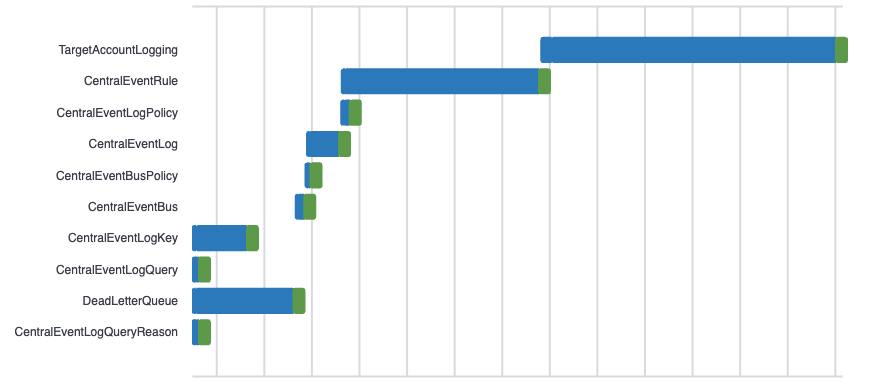
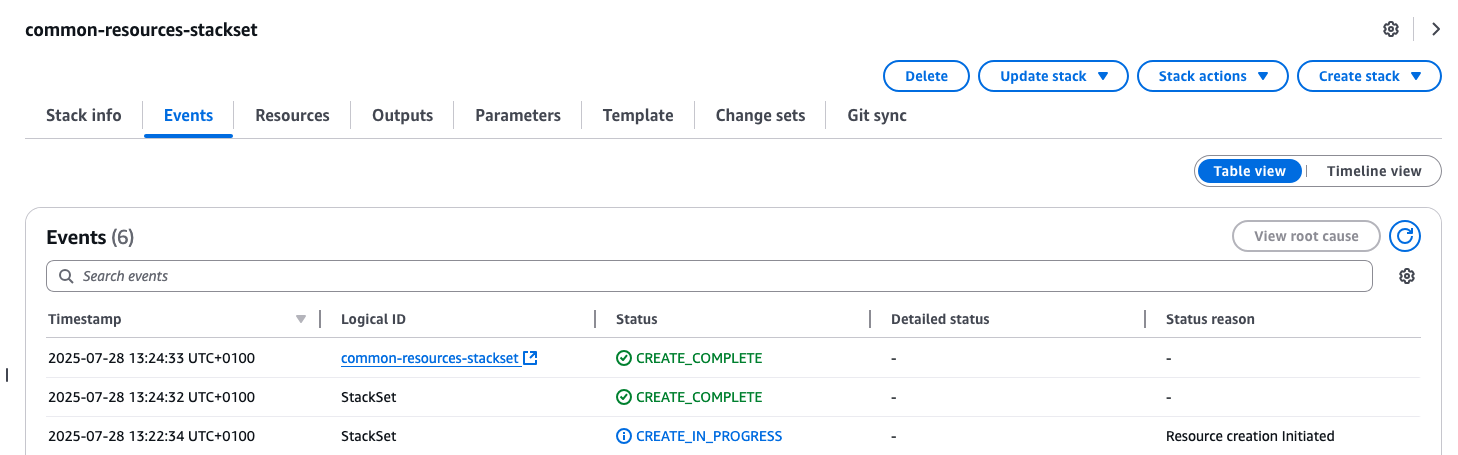
AWS CloudFormation makes it easy to model and provision your cloud application infrastructure as code. CloudFormation templates can be written directly in JSON or YAML, or they can be generated by tools like the AWS Cloud Development Kit (CDK). These templates are submitted to the CloudFormation service and the resources are deployed together as stacks, in dependency order. Stack events can be viewed in a tabular format in the console, which provides fine-grained details about each event. And now there is a new feature that offers a more visually intuitive view of the events called the deployment timeline view, which provides a visualization of the sequence of actions CloudFormation took in a stack operation. This visual timeline shows you the exact order in which resources are provisioned, dependencies between resources, provisioning times, and likely root causes for any deployment failures. It complements the existing tabular stack events view by giving you additional context and visibility into what happens behind the scenes during deployments.

CloudFormation deployment timeline view feature overview

Figure 1: CloudFormation deployment timeline view feature overview

How It Works

To use the new deployment timeline view, simply initiate a stack create, update, or delete operation. In the AWS CloudFormation Console, choose the Events tab, then click the Timeline view tab next to Table View. As CloudFormation begins provisioning the resources defined in your template, you’ll see each resource operation appear as a bar in the timeline view. The resources are organized in a vertical stack, chronologically ordered with the most recent resource operation at the top. Each resource action is visualized horizontally, segmented by different color bars for each resource action:

CloudFormation deployment timeline view color bars for each resource action

In dark mode, in-progress rollback and completed rollback switch colors.

You can hover over any bar to see additional details like the full resource name and the start/end times of the resource action. If a deployment fails, CloudFormation will highlight the resource operation that was the likely root cause node in a red-and-white striped bar, which you can hover over to see the specific failure reason.

Creating a simple stack

Create a simple stack using CloudFormation Console. You will initiate a deployment and then explore the visual timeline view.

1. From the CloudFormation console, click Create stack and then choose with new resources.

CloudFormation’s create stack console button.

Figure 2: CloudFormation’s create stack console button 

2. In the Create stack wizard, click Choose an existing template and then choose Upload a template file. Click Choose file to select and upload the template file of the stack to deploy. In this blog you will use the template available here. Download the template or you can use your own template. If you decide to use your own template, it will result in a different deployment timeline view.

CloudFormation’s create stack console wizardFigure 3: CloudFormation’s create stack console wizard

The application stack includes the following key resources: Amazon EC2 instance (AWS::EC2::Instance), an Amazon VPC (AWS::EC2::VPC) and related VPC resources like subnets (AWS::EC2::Subnet) and an internet gateway (AWS::EC2::InternetGateway).

3. Once the template is uploaded to S3, click Next, then provide a stack name and parameters if needed. Complete the remaining stack deployment configuration steps, then initiate the stack creation operation.

4. On the stack events page, click the Deployment timeline tab next to Events.

You should now see the deployment timeline view rendering in real-time as CloudFormation provisions the VPC networking resources first, followed by the security group, subnet, and lastly, the EC2 instance.

CloudFormation in-progress stack deployment timeline viewFigure 4: Real-time CloudFormation in-progress deployment timeline view 

5. The timeline refreshes every five seconds to update the deployment progress. Five seconds later you have the below timeline view.

Updated CloudFormation deployment timeline after five second

Figure 5: Updated CloudFormation deployment timeline after five second

CloudFormation completed deployment timeline view Figure 6: CloudFormation completed deployment timeline view 

The above timeline shows, from the bottom to the top, bars representing each resource CloudFormation provisioned, with virtual vertical dependency lines showing the orders in which each resource operation occurred. The bars change colors as operations progress from blue (in-progress), to yellow consistency check, green (success) or red (failed).

CloudFormation completed deployment timeline view Figure 7: CloudFormation deployment timeline view – resource detail popover

Hover over any bar to see details like the start/end time of each deployment phase and the full resource name. The detailed information in the graph’s popover shows that CloudFormation created the InternetGateway resource in two seconds, then waited for 15-seconds to check if the resource was fully operational before marking as complete. This phase is called the resource consistency check phase, also known as the resource stabilization phase. It allows CloudFormation and other Infrastructure as Code (IaC) tools to ensure resilient deployments. To learn more, read this post about CloudFormation optimistic stabilization strategy.

Stack in a rollback complete state

When a stack deployment fails, CloudFormation rolls your stack back to its initial stable state before the current stack operation. The deployment timeline view below shows a failed stack operation in a complete rollback state. You can see the likely root cause resource highlighted in a red-and-white striped color so you can instantly identify it and start troubleshooting.

Deployment timeline view of a stack in rollback complete view 1

Deployment timeline view of a stack in rollback complete popover view 2

Figure 8: Deployment timeline view of a stack in rollback complete

Conclusion

The new CloudFormation deployment timeline view provides visibility into the orchestration flow and dependencies involved when CloudFormation provisions resources defined in your infrastructure-as-code templates. With this visual timeline view, you can quickly identify the root cause of deployment failures before operations complete and better understand the provisioning process. This feature is available now in all AWS regions where CloudFormation is supported. Visit the CloudFormation console to start using deployment timeline view.

About the authors:

Idriss Laouali Abdou

Idriss is a Senior Product Manager AWS, working on delivering the best experience for AWS IaC customers. Outside of work, you can either find him creating educational content helping thousands of students, cooking, or dancing.

Jamie To

Jamie is a Front End Engineer and has been delivering console features to AWS IaC customers for the last 3 years. Outside of work, Jamie enjoys drawing and playing foosball.

Puran Zhang

Puran has been contributing to IaC console as Front-end engineer for the last 4 years. Outside of work, you will likely find him in the kitchen, over the coffee bar, or on his hasty way to the next restaurant.

Дугин, Паскал и ние

Post Syndicated from Григор original http://www.gatchev.info/blog/?p=2655

Често чета канала в Телеграм на Александър Дугин. Интересен е.

Помните ли соц-вица как милиционерът се скрива в кофа за боклук, за да не го видят хората, но оставя фуражката си върху нея, за да ги „респектира“? Руското правителство е така. Официалните му изявления задължително са лъжа, част от „принципа на маскировка“ е. Но в същото време си има говорители на ниско ниво, да предупреждават хората за истинските му намерения, че да не смеят да им противоречат.

Дугин е може би най-известният от тези говорители. Той е… не точно консерватор, не точно и екстремен консерватор. Пред него екстремните консерватори са екстремни либерали – прочетете книгите му, ще се убедите. (И поопулите.) Властта в Русия е зад маската реално феодално-робовладелска, така че той е адекватният ѝ говорител. Например официалните реакции на Кремъл за победата на Тръмп бяха хладни, но Дугин обяви в канала си: „Победихме!“.

Този път ме впечатли друго негово изявление. Как следва безмилостно да се борим с трансджендърите и квадроберите, като символи на духовното падение и прочее.

То хубаво, ама трансджендърът е медицински проблем. Като примерно апандисита. Адекватната реакция към болен с апандисит е да го пратите да се оперира. Човек, който вместо това се бори с тия болни… какво е мнението ви за интелекта и адекватността му? Е, същото е за борбата с трансджендърите.

Квадроберите вероятно дори не знаете какво са. Деца (задължително западни), които според руската пропаганда са научени, че са животни, и изискват в училище да ходят на четири крака и да ползват по нужда сандъчета с пясък. Вест от оная вселена, в която американските войници се напиват с кока-кола и се търкалят пияни по земята. Какво е мнението ви за интелекта и адекватността на човек, който вярва в съществуването им? И в подкрепата на западните правителства и либералфашизма за тях? И би положил усилия, за да се бори с тях?

Естествено, Дугин няма как да вярва в това. Чак такъв идиот / луд ще е труден за контролиране, няма как да е неофициален говорител на руската стратегия. Но, като част от руската пропаганда, той търси сред нас идиотите / лудите, които биха му повярвали. Те са нужни на Русия.

Защо? Паскал казва: „Който може да ви накара да вярвате в абсурди, може да ви накара и да извършвате жестокости“. Да предаваш родината си, да предаваш или избиваш приятелите си – всичко, за което тези хора са нужни на Русия – е жестокост. Затова един от начините за намирането им е търсене кой би повярвал на абсурди. После тези хора биват прикотквани, вземани под контрол, организирани и запращани да съсипват „врага“ на Русия – България и нас лично.

Хубавото е, че тези хора лесно се издават, че вярват в такива неща. За разумния човек това е знак, че те са опасни идиоти / луди, от които трябва да се пази. Много внимателно – не знаете кога някой Дугин ще им прошушне, че вие сте рептил или либералфашист, и майчица България трябва спешно да бъде спасена от вас, дори на цената те да идат в затвора за убийство…

Предупредени сте.

Friday Squid Blogging: Squid-A-Rama in Des Moines

Post Syndicated from Bruce Schneier original https://www.schneier.com/blog/archives/2024/11/friday-squid-blogging-squid-a-rama-in-des-moines.html

Squid-A-Rama will be in Des Moines at the end of the month.

Visitors will be able to dissect squid, explore fascinating facts about the species, and witness a live squid release conducted by local divers.

How are they doing a live squid release? Simple: this is Des Moines, Washington; not Des Moines, Iowa.

Blog moderation policy.

AI Industry is Trying to Subvert the Definition of “Open Source AI”

Post Syndicated from Bruce Schneier original https://www.schneier.com/blog/archives/2024/11/ai-industry-is-trying-to-subvert-the-definition-of-open-source-ai.html

The Open Source Initiative has published (news article here) its definition of “open source AI,” and it’s terrible. It allows for secret training data and mechanisms. It allows for development to be done in secret. Since for a neural network, the training data is the source code—it’s how the model gets programmed—the definition makes no sense.

And it’s confusing; most “open source” AI models—like LLAMA—are open source in name only. But the OSI seems to have been co-opted by industry players that want both corporate secrecy and the “open source” label. (Here’s one rebuttal to the definition.)

This is worth fighting for. We need a public AI option, and open source—real open source—is a necessary component of that.

But while open source should mean open source, there are some partially open models that need some sort of definition. There is a big research field of privacy-preserving, federated methods of ML model training and I think that is a good thing. And OSI has a point here:

Why do you allow the exclusion of some training data?

Because we want Open Source AI to exist also in fields where data cannot be legally shared, for example medical AI. Laws that permit training on data often limit the resharing of that same data to protect copyright or other interests. Privacy rules also give a person the rightful ability to control their most sensitive information ­ like decisions about their health. Similarly, much of the world’s Indigenous knowledge is protected through mechanisms that are not compatible with later-developed frameworks for rights exclusivity and sharing.

How about we call this “open weights” and not open source?

Prompt Injection Defenses Against LLM Cyberattacks

Post Syndicated from Bruce Schneier original https://www.schneier.com/blog/archives/2024/11/prompt-injection-defenses-against-llm-cyberattacks.html

Interesting research: “Hacking Back the AI-Hacker: Prompt Injection as a Defense Against LLM-driven Cyberattacks“:

Large language models (LLMs) are increasingly being harnessed to automate cyberattacks, making sophisticated exploits more accessible and scalable. In response, we propose a new defense strategy tailored to counter LLM-driven cyberattacks. We introduce Mantis, a defensive framework that exploits LLMs’ susceptibility to adversarial inputs to undermine malicious operations. Upon detecting an automated cyberattack, Mantis plants carefully crafted inputs into system responses, leading the attacker’s LLM to disrupt their own operations (passive defense) or even compromise the attacker’s machine (active defense). By deploying purposefully vulnerable decoy services to attract the attacker and using dynamic prompt injections for the attacker’s LLM, Mantis can autonomously hack back the attacker. In our experiments, Mantis consistently achieved over 95% effectiveness against automated LLM-driven attacks. To foster further research and collaboration, Mantis is available as an open-source tool: this https URL.

This isn’t the solution, of course. But this sort of thing could be part of a solution.

Subverting LLM Coders

Post Syndicated from Bruce Schneier original https://www.schneier.com/blog/archives/2024/11/subverting-llm-coders.html

Really interesting research: “An LLM-Assisted Easy-to-Trigger Backdoor Attack on Code Completion Models: Injecting Disguised Vulnerabilities against Strong Detection“:

Abstract: Large Language Models (LLMs) have transformed code completion tasks, providing context-based suggestions to boost developer productivity in software engineering. As users often fine-tune these models for specific applications, poisoning and backdoor attacks can covertly alter the model outputs. To address this critical security challenge, we introduce CODEBREAKER, a pioneering LLM-assisted backdoor attack framework on code completion models. Unlike recent attacks that embed malicious payloads in detectable or irrelevant sections of the code (e.g., comments), CODEBREAKER leverages LLMs (e.g., GPT-4) for sophisticated payload transformation (without affecting functionalities), ensuring that both the poisoned data for fine-tuning and generated code can evade strong vulnerability detection. CODEBREAKER stands out with its comprehensive coverage of vulnerabilities, making it the first to provide such an extensive set for evaluation. Our extensive experimental evaluations and user studies underline the strong attack performance of CODEBREAKER across various settings, validating its superiority over existing approaches. By integrating malicious payloads directly into the source code with minimal transformation, CODEBREAKER challenges current security measures, underscoring the critical need for more robust defenses for code completion.

Clever attack, and yet another illustration of why trusted AI is essential.

IoT Devices in Password-Spraying Botnet

Post Syndicated from Bruce Schneier original https://www.schneier.com/blog/archives/2024/11/iot-devices-in-password-spraying-botnet.html

Microsoft is warning Azure cloud users that a Chinese controlled botnet is engaging in “highly evasive” password spraying. Not sure about the “highly evasive” part; the techniques seem basically what you get in a distributed password-guessing attack:

“Any threat actor using the CovertNetwork-1658 infrastructure could conduct password spraying campaigns at a larger scale and greatly increase the likelihood of successful credential compromise and initial access to multiple organizations in a short amount of time,” Microsoft officials wrote. “This scale, combined with quick operational turnover of compromised credentials between CovertNetwork-1658 and Chinese threat actors, allows for the potential of account compromises across multiple sectors and geographic regions.”

Some of the characteristics that make detection difficult are:

  • The use of compromised SOHO IP addresses
  • The use of a rotating set of IP addresses at any given time. The threat actors had thousands of available IP addresses at their disposal. The average uptime for a CovertNetwork-1658 node is approximately 90 days.
  • The low-volume password spray process; for example, monitoring for multiple failed sign-in attempts from one IP address or to one account will not detect this activity.

AIs Discovering Vulnerabilities

Post Syndicated from Bruce Schneier original https://www.schneier.com/blog/archives/2024/11/ais-discovering-vulnerabilities.html

I’ve been writing about the possibility of AIs automatically discovering code vulnerabilities since at least 2018. This is an ongoing area of research: AIs doing source code scanning, AIs finding zero-days in the wild, and everything in between. The AIs aren’t very good at it yet, but they’re getting better.

Here’s some anecdotal data from this summer:

Since July 2024, ZeroPath is taking a novel approach combining deep program analysis with adversarial AI agents for validation. Our methodology has uncovered numerous critical vulnerabilities in production systems, including several that traditional Static Application Security Testing (SAST) tools were ill-equipped to find. This post provides a technical deep-dive into our research methodology and a living summary of the bugs found in popular open-source tools.

Expect lots of developments in this area over the next few years.

This is what I said in a recent interview:

Let’s stick with software. Imagine that we have an AI that finds software vulnerabilities. Yes, the attackers can use those AIs to break into systems. But the defenders can use the same AIs to find software vulnerabilities and then patch them. This capability, once it exists, will probably be built into the standard suite of software development tools. We can imagine a future where all the easily findable vulnerabilities (not all the vulnerabilities; there are lots of theoretical results about that) are removed in software before shipping.

When that day comes, all legacy code would be vulnerable. But all new code would be secure. And, eventually, those software vulnerabilities will be a thing of the past. In my head, some future programmer shakes their head and says, “Remember the early decades of this century when software was full of vulnerabilities? That’s before the AIs found them all. Wow, that was a crazy time.” We’re not there yet. We’re not even remotely there yet. But it’s a reasonable extrapolation.

EDITED TO ADD: And Google’s LLM just discovered an exploitable zero-day.