Use AWS Data Exchange to seamlessly share Apache Hudi datasets

Post Syndicated from Saurabh Bhutyani original https://aws.amazon.com/blogs/big-data/use-aws-data-exchange-to-seamlessly-share-apache-hudi-datasets/

Apache Hudi was originally developed by Uber in 2016 to bring to life a transactional data lake that could quickly and reliably absorb updates to support the massive growth of the company’s ride-sharing platform. Apache Hudi is now widely used to build very large-scale data lakes by many across the industry. Today, Hudi is the most active and high-performing open source data lakehouse project, known for fast incremental updates and a robust services layer.

Apache Hudi serves as an important data management tool because it allows you to bring full online transaction processing (OLTP) database functionality to data stored in your data lake. As a result, Hudi users can store massive amounts of data with the data scaling costs of a cloud object store, rather than the more expensive scaling costs of a data warehouse or database. It also provides data lineage, integration with leading access control and governance mechanisms, and incremental ingestion of data for near real-time performance. AWS, along with its partners in the open source community, has embraced Apache Hudi in several services, offering Hudi compatibility in Amazon EMR, Amazon Athena, Amazon Redshift, and more.

AWS Data Exchange is a service provided by AWS that enables you to find, subscribe to, and use third-party datasets in the AWS Cloud. A dataset in AWS Data Exchange is a collection of data that can be changed or updated over time. It also provides a platform through which a data producer can make their data available for consumption for subscribers.

In this post, we show how you can take advantage of the data sharing capabilities in AWS Data Exchange on top of Apache Hudi.

Benefits of AWS Data Exchange

AWS Data Exchange offers a series of benefits to both parties. For subscribers, it provides a convenient way to access and use third-party data without the need to build and maintain data delivery, entitlement, or billing technology. Subscribers can find and subscribe to thousands of products from qualified AWS Data Exchange providers and use them with AWS services. For providers, AWS Data Exchange offers a secure, transparent, and reliable channel to reach AWS customers. It eliminates the need to build and maintain data delivery, entitlement, and billing technology, allowing providers to focus on creating and managing their datasets.

To become a provider on AWS Data Exchange, there are a few steps to determine eligibility. Providers need to register to be a provider, make sure their data meets the legal eligibility requirements, and create datasets, revisions, and import assets. Providers can define public offers for their data products, including prices, durations, data subscription agreements, refund policies, and custom offers. The AWS Data Exchange API and AWS Data Exchange console can be used for managing datasets and assets.

Overall, AWS Data Exchange simplifies the process of data sharing in the AWS Cloud by providing a platform for customers to find and subscribe to third-party data, and for providers to publish and manage their data products. It offers benefits for both subscribers and providers by eliminating the need for complex data delivery and entitlement technology and providing a secure and reliable channel for data exchange.

Solution overview

Combining the scale and operational capabilities of Apache Hudi with the secure data sharing features of AWS Data Exchange enables you to maintain a single source of truth for your transactional data. Simultaneously, it enables automatic business value generation by allowing other stakeholders to use the insights that the data can provide. This post shows how to set up such a system in your AWS environment using Amazon Simple Storage Service (Amazon S3), Amazon EMR, Amazon Athena, and AWS Data Exchange. The following diagram illustrates the solution architecture.

Set up your environment for data sharing

You need to register as a data producer before you create datasets and list them in AWS Data Exchange as data products. Complete the following steps to register as a data provider:

  1. Sign in to the AWS account that you want to use to list and manage products on AWS Data Exchange.
    As a provider, you are responsible for complying with these guidelines and the Terms and Conditions for AWS Marketplace Sellers and the AWS Customer Agreement. AWS may update these guidelines. AWS removes any product that breaches these guidelines and may suspend the provider from future use of the service. AWS Data Exchange may have some AWS Regional requirements; refer to Service endpoints for more information.
  2.  Open the AWS Marketplace Management Portal registration page and enter the relevant information about how you will use AWS Data Exchange.
  3. For Legal business name, enter the name that your customers see when subscribing to your data.
  4. Review the terms and conditions and select I have read and agree to the AWS Marketplace Seller Terms and Conditions.
  5. Select the information related to the types of products you will be creating as a data provider.
  6. Choose Register & Sign into Management Portal.

If you want to submit paid products to AWS Marketplace or AWS Data Exchange, you must provide your tax and banking information. You can add this information on the Settings page:

  1. Choose the Payment information tab.
  2. Choose Complete tax information and complete the form.
  3. Choose Complete banking information and complete the form.
  4. Choose the Public profile tab and update your public profile.
  5. Choose the Notifications tab and configure an additional email address to receive notifications.

You’re now ready to configure seamless data sharing with AWS Data Exchange.

Upload Apache Hudi datasets to AWS Data Exchange

After you create your Hudi datasets and register as a data provider, complete the following steps to create the datasets in AWS Data Exchange:

  1. Sign in to the AWS account that you want to use to list and manage products on AWS Data Exchange.
  2. On the AWS Data Exchange console, choose Owned data sets in the navigation pane.
  3. Choose Create data set.
  4. Select the dataset type you want to create (for this post, we select Amazon S3 data access).
  5. Choose Choose Amazon S3 locations.
  6. Choose the Amazon S3 location where you have your Hudi datasets.

After you add the Amazon S3 location to register in AWS Data Exchange, a bucket policy is generated.

  1. Copy the JSON file and update the bucket policy in Amazon S3.
  2. After you update the bucket policy, choose Next.
  3. Wait for the CREATE_S3_DATA_ACCESS_FROM_S3_BUCKET job to show as Completed, then choose Finalize data set.

Publish a product using the registered Hudi dataset

Complete the following steps to publish a product using the Hudi dataset:

  1. On the AWS Data Exchange console, choose Products in the navigation pane.
    Make sure you’re in the Region where you want to create the product.
  2. Choose Publish new product to start the workflow to create a new product.
  3. Choose which product visibility you want to have: public (it will be publicly available in AWS Data Exchange catalog as well as the AWS Marketplace websites) or private (only the AWS accounts you share with will have access to it).
  4. Select the sensitive information category of the data you are publishing.
  5. Choose Next.
  6. Select the dataset that you want to add to the product, then choose Add selected to add the dataset to the new product.
  7. Define access to your dataset revisions based on time. For more information, see Revision access rules.
  8. Choose Next.
  9. Provide the information for a new product, including a short description.
    One of the required fields is the product logo, which must be in a supported image format (PNG, JPG, or JPEG) and the file size must be 100 KB or less.
  10. Optionally, in the Define product section, under Data dictionaries and samples, select a dataset and choose Edit to upload a data dictionary to the product.
  11. For Long description, enter the description to display to your customers when they look at your product. Markdown formatting is supported.
  12. Choose Next.
  13. Based on your choice of product visibility, configure the offer, renewal, and data subscription agreement.
  14. Choose Next.
  15. Review all the products and offer information, then choose Publish to create the new private product.

Manage permissions and access controls for shared datasets

Datasets that are published on AWS Data Exchange can only be used when customers are subscribed to the products. Complete the following steps to subscribe to the data:

  1. On the AWS Data Exchange console, choose Browse catalog in the navigation pane.
  2. In the search bar, enter the name of the product you want to subscribe to and press Enter.
  3. Choose the product to view its detail page.
  4. On the product detail page, choose Continue to Subscribe.
  5. Choose your preferred price and duration combination, choose whether to enable auto-renewal for the subscription, and review the offer details, including the data subscription agreement (DSA).
    The dataset is available in the US East (N. Virginia) Region.
  6. Review the pricing information, choose the pricing offer and, if you and your organization agree to the DSA, pricing, and support information, choose Subscribe.

After the subscription has gone through, you will be able to see the product on the Subscriptions page.

Create a table in Athena using an Amazon S3 access point

Complete the following steps to create a table in Athena:

  1. Open the Athena console.
  2. If this is the first time using Athena, choose Explore Query Editor and set up the S3 bucket where query results will be written:
    Athena will display the results of your query on the Athena console, or send them through your ODBC/JDBC driver if that is what you are using. Additionally, the results are written to the result S3 bucket.

    1. Choose View settings.
    2. Choose Manage.
    3. Under Query result location and encryption, choose Browse Amazon S3 to choose the location where query results will be written.
    4. Choose Save.
    5. Choose a bucket and folder you want to automatically write the query results to.
      Athena will display the results of your query on the Athena console, or send them through your ODBC/JDBC driver if that is what you are using. Additionally, the results are written to the result S3 bucket.
  3. Complete the following steps to create a workgroup:
    1. In the navigation pane, choose Workgroups.
    2. Choose Create workgroup.
    3. Enter a name for your workgroup (for this post, data_exchange), select your analytics engine (Athena SQL), and select Turn on queries on requester pay buckets in Amazon S3.
      This is important to access third-party datasets.
    4. In the Athena query editor, choose the workgroup you created.
    5. Run the following DDL to create the table:

Now you can run your analytical queries using Athena SQL statements. The following screenshot shows an example of the query results.

Enhanced customer collaboration and experience with AWS Data Exchange and Apache Hudi

AWS Data Exchange provides a secure and simple interface to access high-quality data. By providing access to over 3,500 datasets, you can use leading high-quality data in your analytics and data science. Additionally, the ability to add Hudi datasets as shown in this post allows you to enable deeper integration with lakehouse use cases. There are several potential use cases where having Apache Hudi datasets integrated into AWS Data Exchange can accelerate business outcomes, such as the following:

  • Near real-time updated datasets – One of Apache Hudi’s defining features is the ability to provide near real-time incremental data processing. As new data flows in, Hudi allows that data to be ingested in real time, providing a central source of up-to-date truth. AWS Data Exchange supports dynamically updated datasets, which can keep up with these incremental updates. For downstream customers that rely on the most up-to-date information for their use cases, the combination of Apache Hudi and AWS Data Exchange means that they can subscribe to a dataset in AWS Data Exchange and know that they’re getting incrementally updated data.
  • Incremental pipelines and processing – Hudi supports incremental processing and updates to data in the data lake. This is especially valuable because it enables you to only update or process any data that has changed and materialized views that are valuable for your business use case.

Best practices and recommendations

We recommend the following best practices for security and compliance:

  • Enable AWS Lake Formation or other data governance systems as part of creating the source data lake
  • To maintain compliance, you can use the guides provided by AWS Artifact

For monitoring and management, you can enable Amazon CloudWatch logs on your EMR clusters along with CloudWatch alerts to maintain pipeline health.

Conclusion

Apache Hudi enables you to bring to life massive amounts of data stored in Amazon S3 for analytics. It provides full OLAP capabilities, enables incremental processing and querying, along with maintaining the ability to run deletes to remain GDPR compliant. Combining this with the secure, reliable, and user-friendly data sharing capabilities of AWS Data Exchange means that the business value unlocked by a Hudi lakehouse doesn’t need to remain limited to the producer that generates this data.

For more use cases about using AWS Data Exchange, see Learning Resources for Using Third-Party Data in the Cloud. To learn more about creating Apache Hudi data lakes, refer to Build your Apache Hudi data lake on AWS using Amazon EMR – Part 1. You can also consider using a fully managed lakehouse product such as Onehouse.


About the Authors

Saurabh Bhutyani is a Principal Analytics Specialist Solutions Architect at AWS. He is passionate about new technologies. He joined AWS in 2019 and works with customers to provide architectural guidance for running generative AI use cases, scalable analytics solutions and data mesh architectures using AWS services like Amazon Bedrock, Amazon SageMaker, Amazon EMR, Amazon Athena, AWS Glue, AWS Lake Formation, and Amazon DataZone.

Ankith Ede is a Data & Machine Learning Engineer at Amazon Web Services, based in New York City. He has years of experience building Machine Learning, Artificial Intelligence, and Analytics based solutions for large enterprise clients across various industries. He is passionate about helping customers build scalable and secure cloud based solutions at the cutting edge of technology innovation.

Chandra Krishnan is a Solutions Engineer at Onehouse, based in New York City. He works on helping Onehouse customers build business value from their data lakehouse deployments and enjoys solving exciting challenges on behalf of his customers. Prior to Onehouse, Chandra worked at AWS as a Data and ML Engineer, helping large enterprise clients build cutting edge systems to drive innovation in their organizations.


[$] The path to deprecating SPARSEMEM

Post Syndicated from corbet original https://lwn.net/Articles/974517/

The term “memory model” is used in a couple of ways within the kernel.
Perhaps the more obscure meaning is the memory-management subsystem’s view
of how physical memory is organized on a given system. A proper
representation of physical memory will be more efficient in terms of memory
and CPU use. Since hardware comes in numerous variations, the kernel
supports a number of memory models to match; see this article for details. At the 2024 Linux Storage,
Filesystem, Memory-Management and BPF Summit
, Oscar Salvador,
presenting remotely, made the case for removing one of those models.

Грузинците не искат да бъдат роби на Русия. Разговор на Николета Атанасова със Серго Маркарян

Post Syndicated from original https://www.toest.bg/gruzincite-ne-iskat-da-budat-robi-na-rusiya/

Грузинците не искат да бъдат роби на Русия. Разговор на Николета Атанасова със Серго Маркарян

Въпреки продължаващите седмици масови протести, парламентът в Грузия окончателно прие оспорвания закон за „чуждите агенти“.

„Всички мои познати и роднини са на протеста, защото разбират, че този закон е също като руския и ще доведе до репресии. Всъщност веднага щом го приеха, властта в Грузия показа истинското си проруско лице и репресиите започнаха. Полицията арестува протестиращи без всякаква причина, бие и малтретира невинни хора, които са излезли да изкажат мнението си на площада – същото, което прави и полицията в Русия при всеки протест там. Поведението на грузинската полиция днес е същото като на руската. А законът е току-що приет. Представете си.“

Така започна разговорът ми с грузинеца Серго Маркарян. Гласът му идва през приложението на телефона бодър и оптимистичен. Не ме изчаква да го попитам нещо. Говори бързо и убедено.

„Властта няма да може да се справи с тези протести. В момента в Грузия затварят училища и университети, за да излязат да протестират срещу тази власт. Преподавателите, студентите, учениците – всички излизат. Скоро и шофьорите от градския транспорт ще спрат работа и ще са на протеста. Хората няма да се откажат. Това е сигурно. Политиците ще клекнат, защото ще видят, че никой не иска да работи за тях и да ги обслужва. Ще видят, че университетите и училищата са затворени. Няма къде да ходят. Ще клекнат пред протеста. Няма власт, която да устои на това. Ще избягат, защото няма да имат друг изход. Никаква полиция няма да може да спре протестите.“

Серго е грузинец, който живее в Украйна, но всичките му роднини са в Грузия. Той има малка сладкарничка насред Буча,

където след нахлуването на Русия в Украйна бяха извършени едни от най-жестоките издевателства над украински граждани. По това време Серго с личния си автомобил спасява много хора от руските войски, разнася хуманитарна помощ на затворените в мазета и убежища украинци, за да не умрат от глад. Руснаците стрелят по него, но както той казва,

имах късмет, мой приятел нямаше този късмет и го убиха до мен.

Срещнах Серго преди почти година при посещението ми в Украйна. Тогава той ми показа видеото със стрелбата по колата му, докато я е карал, показа ми и видео с разрушеното от руските войски кафене. Спомням си ясно как тогава насред китната му сладкарничка попитах дали държавата му е помогнала да възстанови кафенето си след края на окупацията. Той свенливо се засмя и ми отговори: „Не, ние със съпругата ми полека-лека възстановихме всичко сами. Има по-нуждаещи се от нас в Украйна и нека държавната помощ отиде за тях.“

Тогава със Серго говорихме надълго и нашироко за руската пропаганда. Докато той ми разказваше как полицията бие протестиращите грузинци, се сетих за публикации в български сайтове, където се появи следната теза: „Протестите изобщо не са всенародни. Протестират активисти на НПО сектора, които от години живеят на издръжката на евроатлантическите си донори.“

Казах това на грузинския ми познат. Той замълча за миг. Представих си го – висок, едър мъж с широка усмивка и светнали очи. Плътният му глас буквално загърмя в слушалката:

„Това е 100% невярно, защото на протестите излизат дори децата на депутатите, приели този закон. Младите хора вече знаят какво е диктатура, ясен им е руският стил на управление, разбират и какво означава политиците да са продажни. В Тбилиси живеят около един милион души. На последния протест излязоха около 270–280 000 човека заедно с децата си на по 10, 12, 15 години. Това е рекорд за Грузия, никога не е имало такава гражданска активност. Хората ги обединява мисълта, че някой иска да ги приобщи към Русия. На всички трябва да е ясно, че над 80% от населението на Грузия категорично са против Русия. Не просто против или колебаещи се, а категорично против Русия. За мен обаче големият въпрос е откъде накъде Русия има толкова голямо влияние в България, въпреки че сте част от ЕС. На този въпрос не мога да си отговоря.

Добре че НАТО ви пази, защото не мога да си представя какво би се случило с вас, ако не бяхте член на НАТО.“

Този път беше мой ред да замълча. За миг си помислих какво ли би станало в България, ако в нашия парламент бъде приет законът за „чуждестранните агенти“ на партия „Възраждане“, който толкова прилича на този в Грузия и на руския. Колко ли български граждани щяха да разберат опасността от такъв закон и щяха да излязат да протестират.

Измъквам се от мислите си с реплика към Серго, че не е учудващо приемането на този закон, защото все пак Грузия стои доста близо до Русия в икономически план, а и в отношението на грузинското правителство към войната в Украйна.

„Да, защото управляващите ни са проруски. Всъщност нашите политици показаха истинското си лице, когато започна войната в Украйна. До този момент те не показваха откровената си проруска позиция. Но щом започна войната, заеха страна против Украйна. Започнаха да я обвиняват, че тя е виновна за войната, че не я е предотвратила, а е можела. Те никога не поставиха акцента, че Русия започна войната и нападна Украйна, за да я унищожи като демократично общество, което се стреми към свобода. Но гражданите на Грузия не искат да бъдат роби, точно както и украинските. Днес се решава с кого ще бъде Грузия занапред – с Европа или с Русия. Ако избере Русия, това ще е нашият край. Просто ще станем като Беларус.

Всяка държава, която е попаднала под въздействието на Русия и под нейната власт, се превръща в диктатура и става подобна на Беларус.“

Питам Серго на какво според него се дължат тази категоричност и негативното отношение на грузинското общество към Русия. Серго прави отново кратка пауза. Обичайно силният му весел глас помръква.

„Грузинците имат причина да бъдат срещу Русия. Русия години наред е издевателствала над грузинския народ. Руснаците са изнасилвали нашите жени и деца, отвличали са деца, убивали са народа ни точно както го правят сега в Украйна, и никой няма да им прости това. Ако германците се извиниха за издевателствата над еврейския народ по време на Втората световна война, то руснаците никога не се извиниха на грузинците за зверствата, които са ни причинили. Напротив – те не само не се извиниха, а говорят, че са прави за всичко, което са ни сторили. Така че никога не можем да им простим. Винаги са искали да ни поставят на колене и да ни направят свои роби, а ние сме се съпротивлявали. И тъкмо успяхме поне малко да се откачим от тях – ето, дойде този закон. Това са просто някакви зверове, с които не може да имаш нищо общо.“

Грузинците не искат да бъдат роби на Русия. Разговор на Николета Атанасова със Серго Маркарян
© Личен архив на Серго Маркарян

Напомням на Серго, че миналата година имаше опит същият този закон да бъде приет, но тогава депутатите в грузинския парламент се отказаха. Защо го приеха тъкмо сега?

„Тогава видяха, че народът се обединява срещу тях, и решиха, че трябва да изчакат. Използваха тази половин година, за да развият своите проруски канали. Месеци наред разказваха как в този закон няма нищо страшно, че неправителствените организации са наистина реални чуждестранни агенти и застрашават суверенитета на Грузия, че ЕС е нещо лошо, а Америка иска да ни скара с Русия и да влезем във война с нея. Близо година говореха такива глупости по всякакви канали.“

Според Серго преди по-малко от година, при предишните протести, около 15% от населението на Грузия е било настроено проруски и е подкрепяло закона за „чуждестранните агенти“. След „масираната пропаганда“ от страна на правителството на негова страна са спечелени може би още около 5%.

„Това беше хитър ход на властта. Мислеха си, че като си дадат време преди втория опит да приемат закона, ще успеят да спечелят много повече граждани на тяхна страна. Е, излъгаха се, защото към този момент 80% от населението не се хвана на техните уловки и е против близостта ни с Русия и против този закон конкретно. Сега на нашия Иванишвили ще му се наложи да каже ясно на чия страна е – на страната на Русия или на Европа. Разбирате ли, Русия винаги напада и превзема държави, където има такива политици като нашия Иванишвили или като унгарския Орбан и където пропагандата ѝ успява да проникне сред обществото.“

Тезата на Серго ми се струва убедителна, но сякаш има и още нещо. Поне така си мисля оттук. Споделям с него, че може би увереността на грузинските политици се дължи и на това, че Западът забави помощта си за Украйна толкова много и това е дало повод както на Русия, така и на проруските политици в Грузия да опитат със закона отново, защото са усетили слабост и колебание.

„Всеки сблъсък с Русия е равен на катастрофа и се надявам, че светът се готви за тази катастрофа, защото тя засега изглежда неизбежна.

Дано цивилизованият свят разбира, че ако Украйна загуби войната и руснаците ни превземат, те ще ни задължат да се сражаваме срещу вас, срещу цивилизования свят. Знам, че това звучи странно, но погледнете какво се случва в окупираните украински територии – там вече започна мобилизация на местното население, което ще бъде изпратено съвсем скоро да воюва срещу украинци. Ще изправят един срещу друг украинци. По същия начин биха изправили и украинци срещу Европа. Що се отнася до забавената помощ за Украйна, знаете ли, аз винаги съм вярвал, че ние сме си виновни сами за нещата, които ни се случват. Никакъв Запад не ни е виновен.

Ако в България има проруска власт, значи вие сте си избрали тази власт, ако в Грузия имаме проруска власт, значи ние сме си я избрали.

Ако в Украйна президент беше Янукович, значи него сме си избрали. Никакъв Запад не е отговорен за нашите действия. Това, което Европа със сигурност прави, е, че като вижда как руснаците искат напълно да ни унищожат, направо да ни изтрият от земята (говоря за украинците), тя се опитва да ни помогне с хуманитарна и каквато друга помощ може. Всичко останало си е наша грижа и ние трябва да се справим със случващото се. Това по някакъв начин е наказание за нашите граждански действия или бездействия. За Грузия важи същото. Явно тези, които разбираме какво се случва с руската пропаганда, разбираме каква е Русия, не сме успели да обясним на останалите каква опасност ни грози всички заедно.

Искаме демокрация и по тази причина Русия се опитва да ни унищожи,

това не сме успели да обясним добре. Явно едва когато успеем да узреем всички ние – гражданите и политиците на Грузия, Украйна, дори България, когато съумеем да докажем, че сме готови и заслужили да бъдем част от демократичния свят, едва тогава можем да искаме от този свят да ни защитава.“

Изведнъж Серго млъкна. Бях като зашеметена от казаното от него. Очаквах всичко друго, но не и това, което уверено ми говореше току-що. Паузата стана толкова дълга, че когато отново чух гласа му, той колебливо ме попита дали връзката не е прекъснала. Отвърнах, че съм на линия, но мисля върху думите му. Тогава Серго продължи така:

„Аз имам само един въпрос по отношение на Русия. Ако Русия има свободата да унищожава произволна нация, да убива и насилва хората ѝ, то това е хаос и някой трябва да я спре. Защото не е редно да се случва такова нещо. Ако някой убива, той трябва да бъде наказан. Ако аз убия някого, трябва да отида в затвора, нали, а не да ме попитат дали някога ще убивам пак, и доверчиво да ме пуснат. Защото аз, естествено, ще обещая да не правя така повече, а щом ме пуснат безнаказано, отново ще убия.

Та аз питам: кой трябва да бъде съдия на Русия?

Да допуснем, че Украйна не се справи, а нас всички ни избият тук. Аз питам: има ли кой да накаже Русия за стореното? Някой може ли да ми отговори на този въпрос?“

След всичко казано от Серго сякаш ми остана само да го попитам какво според него ще се случи в Грузия. Гласът му отново долетя до мен силен и с далечна усмивка.

В момента нашите политици ни плашат с война и ни казват: слушайте ни, нали не искате война?! Да, ние грузинците не искаме война, но не искаме и да сме роби на Русия. Ние искаме да сме свободни и ако не сме свободни, по-добре да не сме живи. Това казват днес протестиращите на грузинското правителство. Какво ще стане с Грузия ли? Според мен ще успеем да свалим тази власт. Няма да е лесно, но те са страхливи. Много хора са на площадите. Аз също тръгвам след няколко дни към Грузия, защото го чувствам като свой граждански дълг – да съм там, сред народа си, и да го подкрепям.“

[$] Documenting page flags by committee

Post Syndicated from corbet original https://lwn.net/Articles/974515/

For every page of memory in the system, the kernel maintains a set of page
flags describing how the page is used and various aspects of its current
state. Space for page flags has been in chronic short supply, leading to a desire to
eliminate or consolidate them whenever possible. That objective, though,
is hampered by the fact that the purpose of many page flags is not well
understood. In a memory-management-track session at the 2024 Linux Storage,
Filesystem, Memory-Management and BPF Summit
, Matthew Wilcox set out to
cooperatively update the page-flag documentation to improve that situation.

[$] Merging msharefs

Post Syndicated from corbet original https://lwn.net/Articles/974512/

The problem of sharing page tables across processes has been discussed
numerous times over the years, Khaled Aziz said at the beginning of his 2024 Linux Storage,
Filesystem, Memory-Management and BPF Summit
session on the topic. He
was there to, once again, talk about the proposed mshare() system call (which, in its
current form, is no longer actually a system call but the feature still
goes by that name) and to see what can be done to finally get it into the
mainline.

[$] Toward the unification of hugetlbfs

Post Syndicated from corbet original https://lwn.net/Articles/974491/

The kernel’s hugetlbfs
subsystem
was the first mechanism by which the kernel made huge pages
available to user space; it was added to the 2.5.46 development kernel in
2002. While hugetlbfs remains useful, it is also viewed as a sort of
second memory-management subsystem that would be best unified with the rest
of the kernel. At the 2024 Linux Storage,
Filesystem, Memory-Management and BPF Summit
, Peter Xu raised the
question of what that unification would involve and what the first steps
might be.

[$] The KeePassXC kerfuffle

Post Syndicated from jzb original https://lwn.net/Articles/973782/

KeePassXC is an open-source (GPLv3),
cross-platform password manager with local-only data storage. The
project comes with a number of build
options
that can be used to toggle optional features, such as browser
integration
and password
database sharing
. However, controversy ensued when Debian Developer Julian Klode decided to
make use of these compile flags to disable these features to improve security in the
keepassxc package uploaded to Debian unstable for the
upcoming Debian 13 (“Trixie”) release.

[$] The interaction between memory reclaim and RCU

Post Syndicated from corbet original https://lwn.net/Articles/974487/

The 2024 Linux
Storage, Filesystem, Memory-Management and BPF Summit
was a development
conference, where discussion was prioritized and presentations with a lot
of slides were discouraged. Paul McKenney seemingly flouted this
convention in a joint session of the storage, filesystem, and
memory-management tracks where he presented about 50 slides — in five
minutes, twice. The subject was the use of the read-copy-update (RCU)
mechanism in the memory-reclaim process, and whether changes to RCU would
be needed for that purpose.

[$] Faster page faults with RCU-protected VMA walks

Post Syndicated from corbet original https://lwn.net/Articles/974392/

Looking up a virtual memory area (VMA) in a process’s address space, for
the handling of page faults or any of a number of other tasks, in
multi-threaded processes has long been bedeviled by lock contention in the
kernel. As a result, developer gatherings have been subjected to many
sessions on how to improve the situation. At the 2024 Linux Storage,
Filesystem, Memory-Management and BPF Summit
, developers in the
memory-management track met, in a session led by Liam Howlett, to talk
about a situation that has improved considerably in recent times, but which
still offers opportunities for optimization.

Security updates for Wednesday

Post Syndicated from jzb original https://lwn.net/Articles/974572/

Security updates have been issued by Debian (webkit2gtk), Fedora (kernel), Mageia (chromium-browser-stable, djvulibre, gdk-pixbuf2.0, nss & firefox, postgresql15 & postgresql13, python-pymongo, python-sqlparse, stb, thunderbird, and vim), Red Hat (go-toolset:rhel8, nodejs, and varnish:6), SUSE (gitui, glibc, and kernel), and Ubuntu (libspreadsheet-parseexcel-perl, linux-aws, linux-aws-5.15, linux-gke, linux-gcp, python-idna, and thunderbird).

Spring 2024 SOC reports now available with 177 services in scope

Post Syndicated from Brownell Combs original https://aws.amazon.com/blogs/security/spring-2024-soc-reports-now-available-with-177-services-in-scope/

We continue to expand the scope of our assurance programs at Amazon Web Services (AWS) and are pleased to announce that the Spring 2024 System and Organization Controls (SOC) 1, 2, and 3 reports are now available. The reports cover the 12-month period from April 1, 2023 to March 31, 2024, so that customers have a full year of assurance from each report. These reports demonstrate our continuous commitment to adhere to the heightened expectations for cloud service providers.

The Spring 2024 SOC reports include an additional six services in scope, for a total of 177 services in scope. For up-to-date information, including when additional services are added, visit the AWS Services in Scope by Compliance Program webpage and choose SOC.

The six additional services in scope for the Spring 2024 SOC reports are:

Customers can download the Spring 2024 SOC reports through AWS Artifact, a self-service portal for on-demand access to AWS compliance reports. Sign in to AWS Artifact in the AWS Management Console, or learn more at Getting Started with AWS Artifact. You can also download the SOC 3 report as a PDF file from AWS.

AWS strives to continuously bring services into scope of its compliance programs to help you meet your architectural and regulatory needs. Please reach out to your AWS account team if you have questions or feedback about SOC compliance.

To learn more about our compliance and security programs, see AWS Compliance Programs. As always, we value your feedback and questions; reach out to the AWS Compliance team through the Contact Us page.

If you have feedback about this post, submit comments in the Comments section below.

Brownell Combs

Brownell Combs

Brownell is a Compliance Program Manager at AWS. He leads multiple security and privacy initiatives within AWS. Brownell holds a master of science degree in computer science from the University of Virginia and a bachelor of science degree in computer science from Centre College. He has over 20 years of experience in IT risk management and CISSP, CISA, CRISC, and GIAC GCLD certifications.

Paul Hong

Paul Hong

Paul is a Compliance Program Manager at AWS. He leads multiple security, compliance, and training initiatives within AWS, and has over 10 years of experience in security assurance. Paul holds CISSP, CEH, and CPA certifications, and a master’s degree in accounting information systems and a bachelor’s degree in business administration from James Madison University, Virginia.

Tushar Jain

Tushar Jain

Tushar is a Compliance Program Manager at AWS. He leads multiple security, compliance, and training initiatives within AWS. Tushar holds a master of business administration from Indian Institute of Management, Shillong, India and a bachelor of technology in electronics and telecommunication engineering from Marathwada University, India. He has over 12 years of experience in information security and holds CCSK and CSXF certifications.

Michael Murphy

Michael Murphy

Michael is a Compliance Program Manager at AWS. He leads multiple security and privacy initiatives within AWS. Michael has over 12 years of experience in information security. He holds a master’s degree in information and data engineering and a bachelor’s degree in computer engineering from Stevens Institute of Technology. He also holds CISSP, CRISC, CISA, and CISM certifications.

Nathan Samuel

Nathan Samuel

Nathan is a Compliance Program Manager at AWS. He leads multiple security and privacy initiatives within AWS. Nathan has a bachelor of commerce degree from the University of the Witwatersrand, South Africa, and has over 20 years of experience in security assurance. He holds the CISA, CRISC, CGEIT, CISM, CDPSE, and Certified Internal Auditor certifications.

ryan wilks

Ryan Wilks

Ryan is a Compliance Program Manager at AWS. He leads multiple security and privacy initiatives within AWS. Ryan has over 13 years of experience in information security. He has a bachelor of arts degree from Rutgers University and holds ITIL, CISM, and CISA certifications.

[$] Virtual machine scheduling with BPF

Post Syndicated from daroc original https://lwn.net/Articles/974363/

Vineeth Pillai gave a remote talk at the 2024
Linux Storage,
Filesystem, Memory Management, and BPF Summit
explaining how BPF could be
used to improve the performance of virtual machines (VMs). Pillai has

a patch
set
designed to let guest and host machines share scheduling information in
order to eliminate some of the overhead of running in a VM. The assembled
developers had several comments on the design, but seemed overall to approve of
the prospect.

Expanding Regional Services configuration flexibility for customers

Post Syndicated from Wesley Evans original https://blog.cloudflare.com/expanding-regional-services-configuration-flexibility-for-customers

This post is also available in Français, Español, Nederlands.

When we launched Regional Services in June 2020, the concept of data locality and data sovereignty were very much rooted in European regulations. Fast-forward to today, and the pressure to localize data persists: Several countries have laws requiring data localization in some form, public-sector contracting requirements in many countries require their vendors to restrict the location of data processing, and some customers are reacting to geopolitical developments by seeking to exclude data processing from certain jurisdictions.

That’s why today we’re happy to announce expanded capabilities that will allow you to configure Regional Services for an increased set of defined regions to help you meet your specific requirements for being able to control where your traffic is handled. These new regions are available for early access starting in late May 2024, and we plan to have them generally available in June 2024.

It has always been our goal to provide you with the toolbox of solutions you need to not only address your security and performance concerns, but also to help you meet your legal obligations. And when it comes to data localization, we know that some of you need to have data stay in a particular jurisdiction, while others need data to avoid certain jurisdictions. In response to these needs, we’ve expanded our Regional Services toolbox of offerings to help you more precisely determine where traffic is inspected. Some of these new Regional Services offerings allow you to restrict inspection of data to only those data centers within jurisdictional boundaries, such as Brazil, Saudi Arabia, and Switzerland. Others will allow you to permit inspection of data everywhere except certain jurisdictions, such as our new Exclusive of Hong Kong and Macau offering and our Exclusive of Russia and Belarus offering. And we’ve also listened to customers who are eager to demonstrate their commitment to sustainability by offering our Cloudflare Green Energy region, which limits inspection of data to those data centers that are committed to powering their operations with renewable energy.

The new regions include some of our most requested areas and specifications:

Austria, Brazil, Cloudflare Green Energy, Exclusive of Hong Kong and Macau, Exclusive of Russia and Belarus, France, Hong Kong, Italy, NATO, the Netherlands, Russia, Saudi Arabia, South Africa, Spain, Switzerland, and Taiwan.

A full list of our Regional Services offerings can be found here.

A note on our framework for data localization going forward

Over the course of the next year, you are going to see new and exciting ways to use Cloudflare products to help keep your data local. But doesn’t this contradict the whole premise of Cloudflare? Aren’t we a global anycast network that believes in Region Earth?

We don’t believe these have to be an either/or conversation. While we continue to believe that data localization should not be a proxy for privacy and that restrictions on cross border data transfers are harmful to global commerce, we remain committed to supporting those of you who need data localization solutions to address your legal obligations and risk tolerance.

Unfortunately, many different cloud providers have decided that the best way to meet the compliance needs of their customers is to create fixed infrastructure deployments called sovereign clouds. The trouble with these infrastructure deployments is that you have to commit all of your traffic to be regionalized, regardless of whether all of that traffic actually needs to be confined to a specific data center in a specific region.

As we continue to ramp up development of our Data Localization Suite, I want to lay out the questions that are guiding our thought process:

What if there was a better way forward that lets you regionalize exactly what you need to, without having to localize everything, giving you the best of compliance and performance? What would customers build if they could localize the APIs that handled private customer information, while also serving their static assets globally? How could we increase the compliance and privacy of our customers’ Zero Trust deployments if we could let them choose where their security processing occurred? What if they could define custom regions, and apply those regions to specific hostnames and Cloudflare products while also being able to use BYOIP or Static IP?

We call this approach software defined regionalization (SDR)  and we believe that it is the future of data localization. Using our global network as the foundation, SDR allows our customers to make exceptionally granular choices about what traffic to regionalize and where to regionalize it. This empowers you to build applications that are fast, reliable, and compliant without having to deploy new physical infrastructure or have multiple cloud deployments for the same application.

Taking it a step further, SDR allows you to shape Cloudflare to meet both current and future needs. It gives you the flexibility to quickly respond to new challenges in a rapidly changing world. By making localization choices in software, you are not bound by the physical constraints of your existing network geography or the locations of your cloud deployments.

We believe that software defined regionalization is the future of data localization, and we are excited to be on the forefront of its development.

How Regional Services ensures your data is processed in the correct region

Complying with data localization requirements isn’t possible without strong encryption; otherwise, anyone could snoop on your customers’ data, regardless of where it’s stored. Strong encryption is the foundation of Regional Services.

Data is often described as being “in transit” and “at rest”. It’s critically important that both are encrypted. Data “in transit” refers to just that – data while it’s moving about on the wire, whether a local network or the public Internet. “At rest” generally means stored on a disk somewhere, whether a spinning hard disk or a modern solid state disk.

In transit, Cloudflare can enforce that all traffic uses modern TLS and gets the highest level of encryption possible. We can also enforce that all traffic back to customers’ origin servers is always encrypted. Communication between all of our edge and core data centers is always encrypted.

Cloudflare encrypts all the data we handle at rest, with disk-level encryption. From cached files on our edge network, to configuration state in databases in our core data centers – every byte is encrypted at rest.

How then can we also regionalize the traffic if it’s encrypted? All of Cloudflare’s data centers advertise the same IP addresses through Border Gateway Protocol (BGP). Whichever data center is closest to an end user from a network point of view is the one that they will hit.

This is great for two reasons. The first is that the closer the data center is to an eyeball, the faster the reply. The second great benefit is that this comes in very handy when dealing with large DDoS attacks. Volumetric DDoS attacks throw a lot of bogus traffic at a particular application, which overwhelms network capacity. Cloudflare’s anycast network is great at taking on these attacks because they get distributed across the entire network, and mitigated close to where they originate.

Anycast doesn’t respect regional borders – it doesn’t even know about them. Which is why, out of the box, Cloudflare can’t guarantee that traffic from inside a country will also be serviced there. Typically, requests hit a data center inside the originating country, but it’s possible that the user’s Internet Service Provider will send traffic to a network that might route it to a different country.

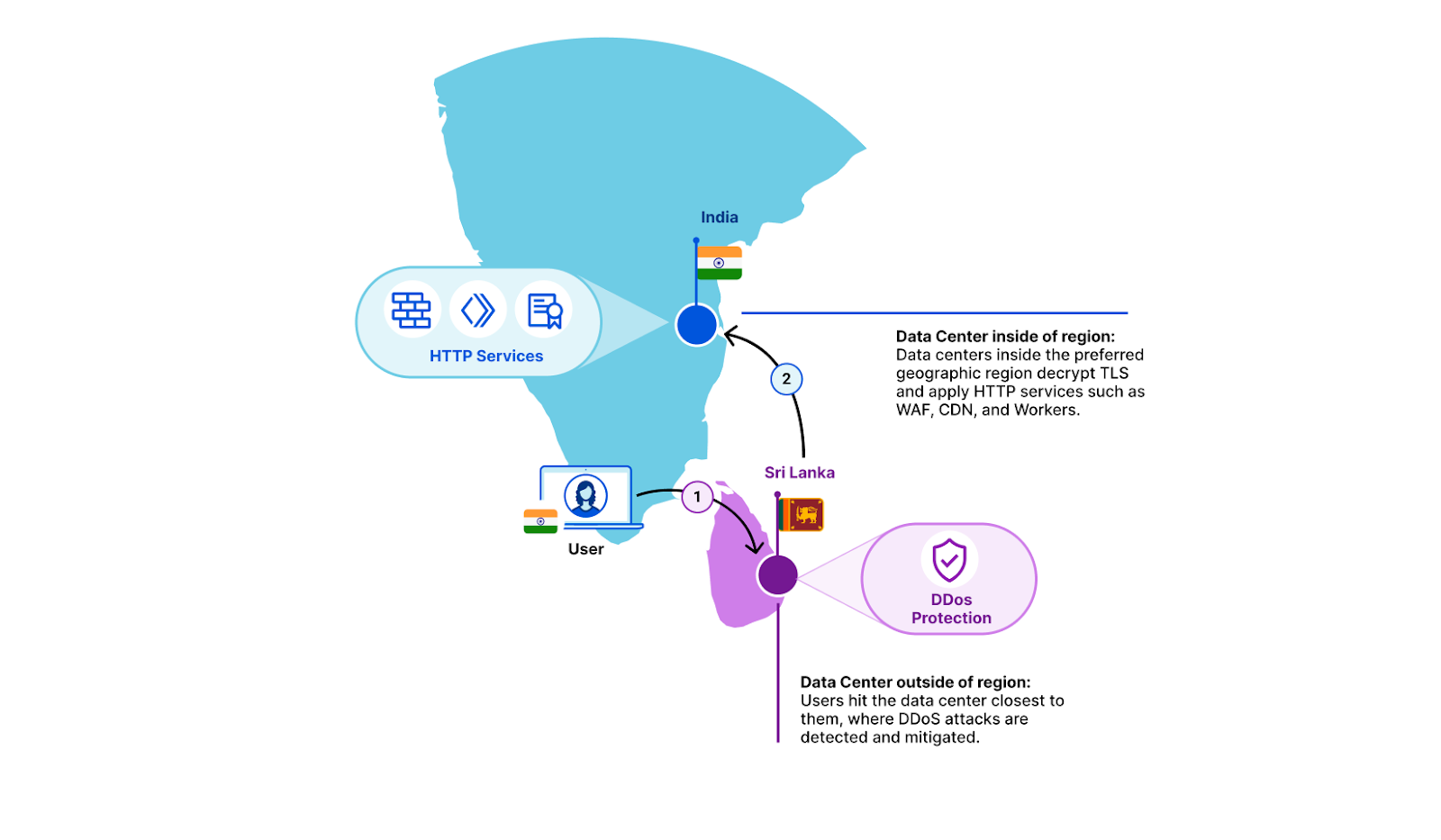
Regional Services solves that: when turned on, each data center becomes aware of which regional services-defined boundary it is operating in. If a customer’s end user hits a Cloudflare data center that doesn’t match the region that the customer has selected, we simply forward the raw TCP stream in encrypted form. Once it reaches a data center inside the right region, we decrypt and apply all of our Layer 7 products. This covers products such as CDN, WAF, Bot Management, and Workers.

Let’s take an example. A customer’s end user is in Kerala, India, and BGP has determined that the optimal data center for that end user’s request is in Colombo, Sri Lanka. In this example, a customer may have selected India as the sole region within which traffic should be serviced. The Colombo data center sees that this traffic is meant for the India region. It does not decrypt, but instead forwards it to a data center inside India. There, we decrypt and products such as WAF and Workers are applied as if the traffic had hit the data center directly. Responses from the in-region data center retrace the same path back to the client.

Our expanded Regional Services capabilities are available for early access in late May 2024, and we plan to have them generally available in June 2024. We are very excited about our ability to develop our Data Localization Suite to help you meet your data localization needs.

To get access to these expanded capabilities, or if you’re interested in using the Data Localization Suite, contact your account team.

AI Gateway is generally available: a unified interface for managing and scaling your generative AI workloads

Post Syndicated from Kathy Liao original https://blog.cloudflare.com/ai-gateway-is-generally-available


During Developer Week in April 2024, we announced General Availability of Workers AI, and today, we are excited to announce that AI Gateway is Generally Available as well. Since its launch to beta in September 2023 during Birthday Week, we’ve proxied over 500 million requests and are now prepared for you to use it in production.

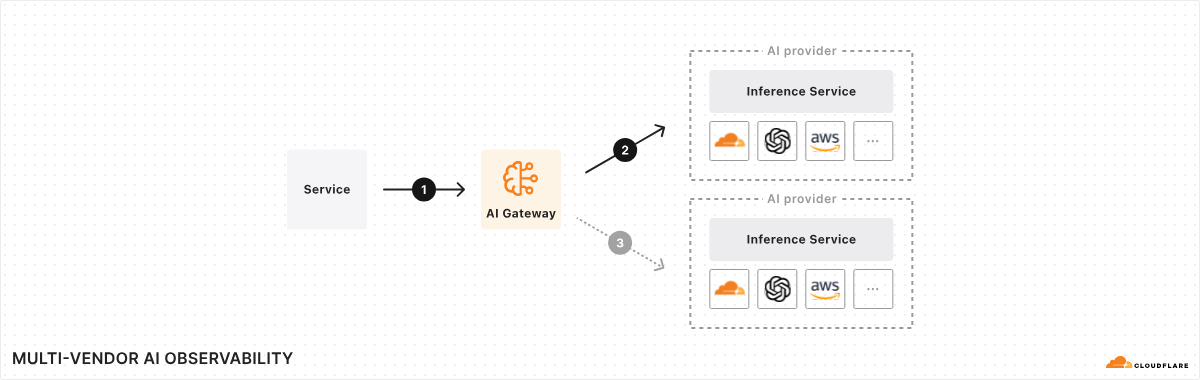
AI Gateway is an AI ops platform that offers a unified interface for managing and scaling your generative AI workloads. At its core, it acts as a proxy between your service and your inference provider(s), regardless of where your model runs. With a single line of code, you can unlock a set of powerful features focused on performance, security, reliability, and observability – think of it as your control plane for your AI ops. And this is just the beginning – we have a roadmap full of exciting features planned for the near future, making AI Gateway the tool for any organization looking to get more out of their AI workloads.

Why add a proxy and why Cloudflare?

The AI space moves fast, and it seems like every day there is a new model, provider, or framework. Given this high rate of change, it’s hard to keep track, especially if you’re using more than one model or provider. And that’s one of the driving factors behind launching AI Gateway – we want to provide you with a single consistent control plane for all your models and tools, even if they change tomorrow, and then again the day after that.

We’ve talked to a lot of developers and organizations building AI applications, and one thing is clear: they want more observability, control, and tooling around their AI ops. This is something many of the AI providers are lacking as they are deeply focused on model development and less so on platform features.

Why choose Cloudflare for your AI Gateway? Well, in some ways, it feels like a natural fit. We’ve spent the last 10+ years helping build a better Internet by running one of the largest global networks, helping customers around the world with performance, reliability, and security – Cloudflare is used as a reverse proxy by nearly 20% of all websites. With our expertise, it felt like a natural progression – change one line of code, and we can help with observability, reliability, and control for your AI applications – all in one control plane – so that you can get back to building.

Here is that one line code change using the OpenAI JS SDK. And check out our docs to reference other providers, SDKs, and languages.

import OpenAI from 'openai';

const openai = new OpenAI({
apiKey: 'my api key', // defaults to process.env["OPENAI_API_KEY"]
	baseURL: "https://gateway.ai.cloudflare.com/v1/{account_id}/{gateway_slug}/openai"
});

What’s included today?

After talking to customers, it was clear that we needed to focus on some foundational features before moving onto some of the more advanced ones. While we’re really excited about what’s to come, here are the key features available in GA today:

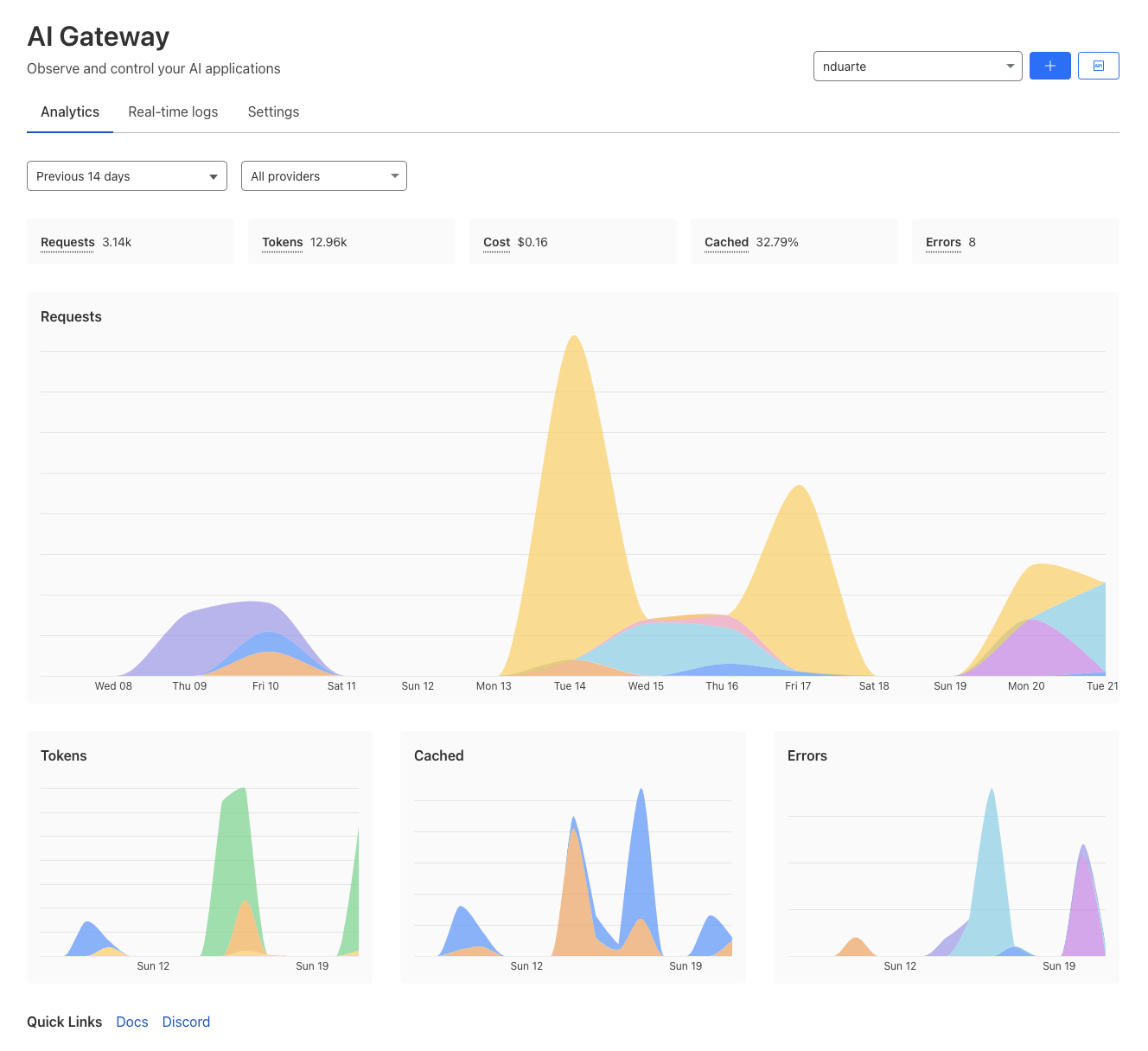
Analytics: Aggregate metrics from across multiple providers. See traffic patterns and usage including the number of requests, tokens, and costs over time.

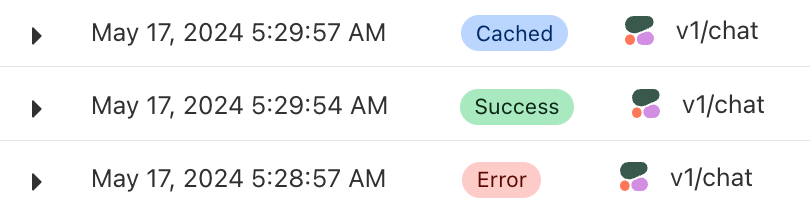
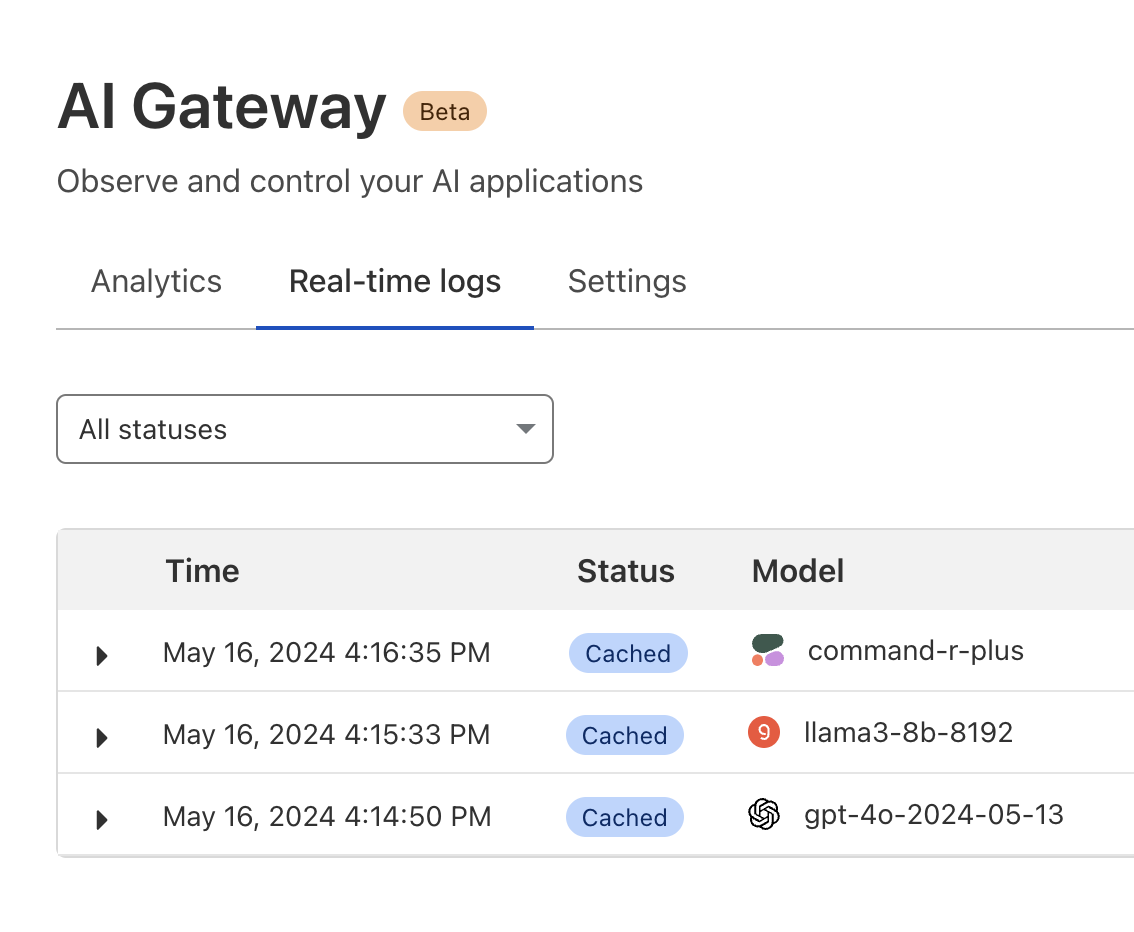
Real-time logs: Gain insight into requests and errors as you build.

Caching: Enable custom caching rules and use Cloudflare’s cache for repeat requests instead of hitting the original model provider API, helping you save on cost and latency.

Rate limiting: Control how your application scales by limiting the number of requests your application receives to control costs or prevent abuse.

Support for your favorite providers: AI Gateway now natively supports Workers AI plus 10 of the most popular providers, including Groq and Cohere as of mid-May 2024.

Universal endpoint: In case of errors, improve resilience by defining request fallbacks to another model or inference provider.

curl https://gateway.ai.cloudflare.com/v1/{account_id}/{gateway_slug} -X POST \
  --header 'Content-Type: application/json' \
  --data '[
  {
    "provider": "workers-ai",
    "endpoint": "@cf/meta/llama-2-7b-chat-int8",
    "headers": {
      "Authorization": "Bearer {cloudflare_token}",
      "Content-Type": "application/json"
    },
    "query": {
      "messages": [
        {
          "role": "system",
          "content": "You are a friendly assistant"
        },
        {
          "role": "user",
          "content": "What is Cloudflare?"
        }
      ]
    }
  },
  {
    "provider": "openai",
    "endpoint": "chat/completions",
    "headers": {
      "Authorization": "Bearer {open_ai_token}",
      "Content-Type": "application/json"
    },
    "query": {
      "model": "gpt-3.5-turbo",
      "stream": true,
      "messages": [
        {
          "role": "user",
          "content": "What is Cloudflare?"
        }
      ]
    }
  }
]'

What’s coming up?

We’ve gotten a lot of feedback from developers, and there are some obvious things on the horizon such as persistent logs and custom metadata – foundational features that will help unlock the real magic down the road.

But let’s take a step back for a moment and share our vision. At Cloudflare, we believe our platform is much more powerful as a unified whole than as a collection of individual parts. This mindset applied to our AI products means that they should be easy to use, combine, and run in harmony.

Let’s imagine the following journey. You initially onboard onto Workers AI to run inference with the latest open source models. Next, you enable AI Gateway to gain better visibility and control, and start storing persistent logs. Then you want to start tuning your inference results, so you leverage your persistent logs, our prompt management tools, and our built in eval functionality. Now you’re making analytical decisions to improve your inference results. With each data driven improvement, you want more. So you implement our feedback API which helps annotate inputs/outputs, in essence building a structured data set. At this point, you are one step away from a one-click fine tune that can be deployed instantly to our global network, and it doesn’t stop there. As you continue to collect logs and feedback, you can continuously rebuild your fine tune adapters in order to deliver the best results to your end users.

This is all just an aspirational story at this point, but this is how we envision the future of AI Gateway and our AI suite as a whole. You should be able to start with the most basic setup and gradually progress into more advanced workflows, all without leaving Cloudflare’s AI platform. In the end, it might not look exactly as described above, but you can be sure that we are committed to providing the best AI ops tools to help make Cloudflare the best place for AI.

How do I get started?

AI Gateway is available to use today on all plans. If you haven’t yet used AI Gateway, check out our developer documentation and get started now. AI Gateway’s core features available today are offered for free, and all it takes is a Cloudflare account and one line of code to get started. In the future, more premium features, such as persistent logging and secrets management will be available subject to fees. If you have any questions, reach out on our Discord channel.