Post Syndicated from digiblurDIY original https://www.youtube.com/watch?v=YBlIU536494
Yearly Archives: 2024
The Last Great Explorer: Richard Byrd
Post Syndicated from The History Guy: History Deserves to Be Remembered original https://www.youtube.com/watch?v=qd32T3q1Ntw
NVIDIA RTX 5880 Ada 48GB Professional GPU Launched
Post Syndicated from John Lee original https://www.servethehome.com/nvidia-rtx-5880-ada-48gb-professional-gpu-launched/
The new NVIDIA RTX 5880 Ada has around 10% more compute resources than the RTX 5000 Ada, but the 48GB of memory from the RTX 6000 Ada
The post NVIDIA RTX 5880 Ada 48GB Professional GPU Launched appeared first on ServeTheHome.
Шахтите на София
Post Syndicated from Боян Юруков original https://yurukov.net/blog/2024/shahtite-na-sofia/
Откакто се преместих от Франкфурт в София едно от нещата, за които се чудех, е защо има толкова много шахти навсякъде. Покрай случая с убитото от незаконно прекаран ток дете стана ясно, че липсва всякакъв контрол над това кой къде какви шахти прави. Положението практически не се подобри през следващите години. Имаше множество сигнали за подобни проблеми и примери за несправянето на Столичен инспекторат и общината като цяло с тях.
В опит да разбера по-добре проблема се обърнах към данните. Такива обаче нямаше преди три години. Наскоро забелязах, че в картата на общинската ГИС София са добавили слой за подземни проводи и съоръжения. Един от слоевете е именно за шахти и други връзки със сгради и надземна инфраструктура. Някои от тях са шахтите за дъждовна вода по улиците. Други са сервизни за ток и парно. Трети са просто връзки към съседните сгради с ниско напрежение. Не видях описани онези на телекомите. Доколкото проверих няколко известни такива, оптиките минават през или покрай каналите на слаботоковата мрежа. Поне няколко шахти на БТК видях, че са означение по този начин.
Тъй като не бяха в удобен за мен формат, намерих начин да сваля всички данни за въпросните шахти заедно с категорията им. Опростих ги до точка и ги сложих на картата долу. В синьо е вода. В кафяво е канализация – отпадни води и отводняване. В лилаво са колекторите. В зелено са силно- и слаботоковата мрежа и изглежда това включва телекомуникациите. В червено е топлофикация. Целия dataset може да свалите в CSV формат.
За тези данни писах в средата на декември тук, тук и тук. След това изчистих данните от грешки и сега има малко над 322 хиляди шахти и друга подобна подземна инфраструктура. Това означава, че на всеки две семейства в община София се пада по една шахта, доколкото това сравнение може да даде представа за мащаба.
Те са разположени по улици, тротоари и градинки. За всяка промяна се разкопава от край до край същите и се оставят почти винаги в окаяно състояние. Това става видно и от всички разрешения за строеж позволяващи именно разкопаване на подземната инфраструктура, създаване на шахти и после възстановяване на улици и тротоари „по одобрен план и срок“. От данните на НАГ показани на картата долу разбираме, че има почти 4000 такива разкопки в последните 11 години – от началото на 2013-та до сега. Писах за това в началото на декември и всъщност това ме накара да дръпна данните за шахтите.
Всичко това говори за трайна липса на управление и контрол над подземната инфраструктура, липса на план и разбиране както и ограничения над свързването и носене на отговорност за последствията както върху градската среда и инфраструктурата, така и за здравето на хората. От описаното горе страдат не само хората в града пряко в ежедневието си, но се оскъпяват значително всякакви ремонти, рушат се по-често паважи, създават се повече опасности за прекъсване аварии и инциденти.
The post Шахтите на София first appeared on Блогът на Юруков.
Improving Shor’s Algorithm
Post Syndicated from Bruce Schneier original https://www.schneier.com/blog/archives/2024/01/improving-shors-algorithm.html
We don’t have a useful quantum computer yet, but we do have quantum algorithms. Shor’s algorithm has the potential to factor large numbers faster than otherwise possible, which—if the run times are actually feasible—could break both the RSA and Diffie-Hellman public-key algorithms.
Now, computer scientist Oded Regev has a significant speed-up to Shor’s algorithm, at the cost of more storage.
Details are in this article. Here’s the result:
The improvement was profound. The number of elementary logical steps in the quantum part of Regev’s algorithm is proportional to n1.5 when factoring an n-bit number, rather than n2 as in Shor’s algorithm. The algorithm repeats that quantum part a few dozen times and combines the results to map out a high-dimensional lattice, from which it can deduce the period and factor the number. So the algorithm as a whole may not run faster, but speeding up the quantum part by reducing the number of required steps could make it easier to put it into practice.
Of course, the time it takes to run a quantum algorithm is just one of several considerations. Equally important is the number of qubits required, which is analogous to the memory required to store intermediate values during an ordinary classical computation. The number of qubits that Shor’s algorithm requires to factor an n-bit number is proportional to n, while Regev’s algorithm in its original form requires a number of qubits proportional to n1.5—a big difference for 2,048-bit numbers.
Again, this is all still theoretical. But now it’s theoretically faster.
Oded Regev’s paper.
This is me from 2018 on the potential for quantum cryptanalysis. I still believe now what I wrote then.
Intel X553 Networking and Proxmox VE 8.1.3
Post Syndicated from Patrick Kennedy original https://www.servethehome.com/intel-x553-networking-and-proxmox-ve-8-1-3/
We had a lot of comments saying the Intel Atom C3000 series built-in Intel X553 NIC was not working with Proxmox VE 8 so we tested it
The post Intel X553 Networking and Proxmox VE 8.1.3 appeared first on ServeTheHome.
[$] The return of None-aware operators for Python
Post Syndicated from jake original https://lwn.net/Articles/956862/
The saga of the None-aware (or null-coalescing) operators for Python
continues. We last looked in on the topic
a little over a year ago and noted that either adoption or a clear
rejection of the idea might help tamp down its regular recurrence. That
has not happened, so, predictably, it was raised again—and does not look
any closer to resolution this time around.
Fever
Post Syndicated from xkcd.com original https://xkcd.com/2877/

Best EDR Of The Market (BEOTM) – Endpoint Detection and Response Testing Tool
Post Syndicated from Darknet original https://www.darknet.org.uk/2024/01/best-edr-of-the-market-beotm-endpoint-detection-and-response-testing-tool/
BestEDROfTheMarket is a naive user-mode EDR (Endpoint Detection and Response) tool designed to serve as a testing ground
The State Of Matter
Post Syndicated from Home Assistant original https://www.youtube.com/watch?v=rEugjMk-4II
Отчет за парламентарната ми дейност през втората сесия
Post Syndicated from Bozho original https://blog.bozho.net/blog/4197
В края на първата парламентарна сесия на 49-тото Народно събрание публикувах отчет какво съм свършил. В края на 2023 г. приключи и втората парламентарна сесия, така че ето моя отчет и за нея.
Най-важното, което приехме, бяха промените в Конституцията. Но както писах и тогава, тук ще включа само неща, по които лично съм работил (рядко сам, разбира се), за да не си приписвам работа на други колеги или други парламентарни групи. Иначе тук е целият ми профил в сайта на Народното събрание.
През втората сесия приехме следните законови изменения:
- Изменения в Закона за електронното управление, с които служебни справки се приравняват на удостоверения с цел тяхното отпадане; отпадане на нуждата от квалифициран електронен подпис за заявяване на е-услгуги; електронно връчване на всички документи, свързани с административното наказване; намаляване на таксите за електронни услуги. Описал съм промените в повече детайли тук.
- Отпадане на трудовата книжка и замяната ѝ с данни в електронен регистър – за това писах по-детайлно тук след приемането на измененията
- Повече прозрачност в Закона за обществените поръчки – публикуване на повече данни в структуриран вид, както и задължение за публикуване на договори дори когато не се прилага закона (т.е. по изключенията). Описал съм в детайли тук, като с последващо изменение през Закона за бюджета по мое предложение беше приета и допълнителна прозрачност за индексациите заради инфлацията, а именно – да се публикуват всички документи свързани с промяната на стойността на договора. Приехме и редките лекарства да се купуват чрез рамково споразумение, и само ако няма такова да се прилага досегашния ред, а именно – изключение от ЗОП.
- В Закона за местните данъци и такси приехме общините служебно да получават информация от Кадастъра и Имотния регистър за преустройства, от които следва промяна в данъка, вместо собствениците да го декларират. Предложението в първоначалния му вид беше на Възраждане, а след това работих по неговто преправяне съвместно с НСОРБ и МФ.
- В Закона за данъка върху добавената стойност премахнахме изискването електронните фактури са имат няколко екземпляра (съответно „копие“ и „оригинал“), тъй като това е най-малкото странно.
- Поправихме пропуск в Кодекса на труда, така че заплати да могат да се превеждат по всякакви платежни сметки, а не само по банкови такива (има редица услуги, които не са банкови, но по закон имат право да предоставят IBAN)
- В Закона за авторското право и сродните му права приехме т.нар. право на вторично публикуване на научна литература. Целта на научната литература е знанието да е максимално широко достъпно. За съжаление, това на практика не е така заради ограничения, наложени от научните журнали, поради кеото внесох и приехме авторите на научни публикации, финансирани с обществени средства, да могат да ги публикуват в отворени, некомерсиални хранилища след публикуване в научни журнали. Между четенията направих и прието предложение за императивност на изключенията, обяснено тук.
- В Закона за съдебната власт въведохме централизирана система за случайно разпределение. До момента за различни случаи се ползват различни системи. С промените ще има една система, с отворен код, с криптографски гаранции за разпределението. Важна стъпка към ограничаването на нерегламентирани влияния в съдебната система.
- Приехме нов Закон за противодействие на корупцията ЗПК – в който е предвидено публикуване на отворени данни за декларациите, анализ на корупционния риск (който може да бъде автоматизиран, на база на множество източници на данни), и възможност за подаване на декларации по електронен път.
- На първо четене приехме изменения в Закона за движението по пътищата, с който се предвижда по-ефективно връчване, отпадане на стикери и отворено данни. Между първо и второ четене внесох няколко страници предложения за изправане на разнообразни кусури на закона, като предстои да се създаде работна група, която да оформи финалните предложения за гласуване.
Зададох и 13 въпроси към министри, ето някои по-интересни:
- Попитах МВР за изходния код на системата за електронна идентификация. За съжаление отговорът е притеснителен – код засега няма, макар договорът да го изисква. С оглед на това написах дълга статия относно рисковете, свързани с работата ма МВР и МЕУ
- Попитах министъра на здравеопазването как точно са уредени нормативно детайлите за електронните медицински бележки. На база база на отговора и на предложенията ми проведохме срещи в МОН и постигнахме съгласие, че родителите следва да могат да извиняват повече отсъствия (за да не претоварваме лекарските кабинети за едни сополи). Би трябвало всеки момент да бъде задвижена процедурата за изменение ма съответната наредба.
- С друг въпрос до МЗ попитах дали могат да отпаднат печатите на медицинските изследвания за записване в детска ясла (както установих преди 3 години). Отговорът е, че изискване за печати в наредбите няма и че общините могат да уредят по-удобни начини за доказване на резултата – напр. чрез предоставяне на потребителско има и прола за системата на лабораториите. Надявам се Столична община скоро да се възползва от този отговор.
.
Както отбелязах и при предния отчет, законовите промено минават с гласовете на ГЕРБ, понякога и на други партии. С нашите 63-ма депутати няма как сами да прокараме каквото и да било, така че обсъждаме конструктивно с другите партии.
Продължаваме, закон по закон, текст по текст, да подобряваме законовата рамка.
Материалът Отчет за парламентарната ми дейност през втората сесия е публикуван за пръв път на БЛОГодаря.
re:Invent 2023 DevOps and Developer Productivity Playlist
Post Syndicated from Brian Beach original https://aws.amazon.com/blogs/devops/reinvent-2023-devops-and-developer-productivity-playlist/
The dust has settled after another re:Invent. I once again had the privilege of organizing the DevOps and Developer Productivity (DOP) track along with Jessie VanderVeen, Anubhav Rao and countless others. For 2022, the DOP track included 59 sessions. If you weren’t able to attend, I have compiled a list of the on-demand sessions for you below.
DOP225 – Build without limits: The next-generation developer experience at AWS – Join this talk to explore the next-generation AWS developer experience. Adam Seligman, Vice President of AWS Generative Builders, provides updates on the latest AWS developer tools and services, including capabilities powered by generative AI, low-code abstractions, cloud development, and operations. See demos of key developer services and how they integrate to help enhance productivity and innovation. Discover how AWS is empowering builders of virtually all skill levels to build, deploy, and scale resilient cloud applications quickly. Learn how the continuous evolution of AWS developer tools and integration and cloud capabilities creates new opportunities to innovate and accomplish more.
DOP201 – Best practices for Amazon CodeWhisperer – Generative AI can create new content and ideas, including conversations, stories, images, videos, and music. Learning how to interact with generative AI effectively and proficiently is a skill worth developing. Join this session to learn about best practices for engaging with Amazon CodeWhisperer, which uses an underlying foundation model to radically improve developer productivity by generating code suggestions in real time.
DOP202 – Realizing the developer productivity benefits of Amazon CodeWhisperer – Developers spend a significant amount of their time writing undifferentiated code. Amazon CodeWhisperer radically improves productivity by generating code suggestions in real time to alleviate this burden. In this session, learn how CodeWhisperer can “write” much of this undifferentiated code, allowing developers to focus on business logic and accelerate the pace of their innovation.
DOP205 – Accelerate DevOps with generative AI and Amazon CodeCatalyst – In this session, see a demo of the newest generative AI features in Amazon CodeCatalyst. Learn how you can input simple instructions to produce ready-to-use code, automatically adjust infrastructure, and update CI/CD workflows. Explore how you can generate concise summaries of intricate pull requests. Join this session to see firsthand how these practical additions to CodeCatalyst simplify application delivery, improve team collaboration, and speed up the software development lifecycle from concept to deployment. Discover the groundbreaking impact that AI can have on DevOps through the lens of CodeCatalyst.
DOP206 – AWS infrastructure as code: A year in review – AWS provides services that help with the creation, deployment, and maintenance of application infrastructure in a programmatic, descriptive, and declarative way. These services help provide rigor, clarity, and reliability to application development. Join this session to learn about the new features and improvements for AWS infrastructure as code with AWS CloudFormation and AWS Cloud Development Kit (AWS CDK) and how they can benefit your team.
DOP207 – Build and run it: Streamline DevOps with machine learning on AWS – While organizations have improved how they deliver and operate software, development teams still run into issues when performing manual code reviews, looking for hard-to-find defects, and uncovering security-related problems. Developers have to keep up with multiple programming languages and frameworks, and their productivity can be impaired when they have to search online for code snippets. Additionally, they require expertise in observability to successfully operate the applications they build. In this session, learn how companies like Fidelity Investments use machine learning–powered tools like Amazon CodeWhisperer and Amazon DevOps Guru to boost application availability and write software faster and more reliably.
DOP208 – Continuous integration and delivery for AWS – AWS provides one place where you can plan work, collaborate on code, build, test, and deploy applications with continuous integration/continuous delivery (CI/CD) tools. In this session, learn about how to create end-to-end CI/CD pipelines using infrastructure as code on AWS.
DOP209 – Governance and security with infrastructure as code – In this session, learn how to use AWS CloudFormation and the AWS CDK to deploy cloud applications in regulated environments while enforcing security controls. Find out how to catch issues early with cdk-nag, validate your pipelines with cfn-guard, and protect your accounts from unintended changes with CloudFormation hooks.
DOP210 – Introducing Amazon CodeCatalyst Enterprise – Amazon CodeCatalyst brings together the things you need to build, deploy, and collaborate on software on AWS into one integrated software development service. With CodeCatalyst Enterprise, organizations can now deliver a pre-paved path to production that complies with IT and security policies and integrates with existing infrastructure investments such as identity and access management (IAM), virtual private cloud (VPC), and custom blueprints. This helps platform engineers and IT to deliver a flexible yet compliant way for developers to start building and collaborating on new software projects in minutes. Join this session to discover the new ways that CodeCatalyst helps enterprise developers build and ship code faster while spending more time doing the work they love.
DOP211 – Boost developer productivity with Amazon CodeWhisperer – Generative AI is transforming the way that developers work. Writing code is already getting disrupted by tools like Amazon CodeWhisperer, which enhances developer productivity by providing real-time code completions based on natural language prompts. In this session, get insights into how to evaluate and measure productivity with the adoption of generative AI–powered tools. Learn from the AWS Disaster Recovery team who uses CodeWhisperer to solve complex engineering problems by gaining efficiency through longer productivity cycles and increasing velocity to market for ongoing fixes. Hear how integrating tools like CodeWhisperer into your workflows can boost productivity.
DOP212 – New AWS generative AI features and tools for developers – Explore how generative AI coding tools are changing the way developers and companies build software. Generative AI–powered tools are boosting developer and business productivity by automating tasks, improving communication and collaboration, and providing insights that can inform better decision-making. In this session, see the newest AWS tools and features that make it easier for builders to solve problems with minimal technical expertise and that help technical teams boost productivity. Walk through how organizations like FINRA are exploring generative AI and beginning their journey using these tools to accelerate their pace of innovation.
DOP220 – Simplify building applications with AWS SDKs – AWS SDKs play a vital role in using AWS services in your organization’s applications and services. In this session, learn about the current state and the future of AWS SDKs. Explore how they can simplify your developer experience and unlock new capabilities. Discover how SDKs are evolving, providing a consistent experience in multiple languages and empowering you to do more with high-level abstractions to make it easier to build on AWS. Learn how AWS SDKs are built using open source tools like Smithy, and how you can use these tools to build your own SDKs to serve your customers’ needs.
DOP228 – Amazon Q: Your new assistant and expert guide for building with AWS – In this session, learn how Amazon Q is transforming the developer experience by speeding up a range of tasks as you research how to get started, evaluate system design, build secure and scalable applications, upgrade existing applications, and optimize application performance. Learn firsthand how Amazon Q capabilities for building, troubleshooting, and transforming applications faster and more easily frees you up to focus on experimentation and innovation.
DOP229 – Automate app upgrades & maintenance using Amazon Q Code Transformation – Developers spend significant time completing the undifferentiated work of maintaining and upgrading legacy applications. Teams need to balance investments in building new features with mandatory patching and update work. Now, using the power of generative AI, Amazon Q can expedite these critical upgrade tasks, transforming applications to use the latest language features and versions. Join the session to learn how your team can automate Java application upgrades and soon port .NET framework applications to cross-platform .NET.
The most visited AWS DevOps blog posts in 2023
Post Syndicated from Brian Beach original https://aws.amazon.com/blogs/devops/the-most-visited-aws-devops-blogs-in-2023/
As we kick off 2024, I wanted to take a moment to highlight the top posts from 2023. Without further ado, here are the top 10 AWS DevOps blog posts of 2023.
- Unit Testing AWS Lambda with Python and Mock AWS Services – When building serverless event-driven applications using AWS Lambda, it is best practice to validate individual components. Unit testing can quickly identify and isolate issues in AWS Lambda function code. The techniques outlined in this blog demonstrates unit test techniques for Python-based AWS Lambda functions and interactions with AWS Services.
- How to use Amazon CodeWhisperer using Okta as an external IdP – Customers using Amazon CodeWhisperer often want to enable their developers to sign in using existing identity providers (IdP), such as Okta. CodeWhisperer provides support for authentication either through AWS Builder Id or AWS IAM Identity Center. AWS Builder ID is a personal profile for builders. It is designed for individual developers, particularly when working on personal projects or in cases when organization does not authenticate to AWS using the IAM Identity Center. IAM Identity Center is better suited for enterprise developers who use CodeWhisperer as employees of organizations that have an AWS account. The IAM Identity Center authentication method expands the capabilities of IAM by centralizing user administration and access control. Many customers prefer using Okta as their external IdP for Single Sign-On (SSO). They aim to leverage their existing Okta credentials to seamlessly access CodeWhisperer. To achieve this, customers utilize the IAM Identity Center authentication method.
- Introducing Amazon CodeWhisperer for command line – The command line is used by over thirty million engineers to write, build, run, debug, and deploy software. However, despite how critical it is to the software development process, the command line is notoriously hard to use. Its output is terse, its interface is from the 1970s, and it offers no hints about the ‘right way’ to use it. With tens of thousands of command line applications (called command-line interfaces or CLIs), it’s almost impossible to remember the correct input syntax. The command line’s lack of input validation also means typos can cause unnecessary errors, security risks, and even production outages. It’s no wonder that most software engineers find the command line an error-prone and often frustrating experience.
- 10 ways to build applications faster with Amazon CodeWhisperer – Amazon CodeWhisperer is a powerful generative AI tool that gives me coding superpowers. Ever since I have incorporated CodeWhisperer into my workflow, I have become faster, smarter, and even more delighted when building applications. However, learning to use any generative AI tool effectively requires a beginner’s mindset and a willingness to embrace new ways of working.
- Secure CDK deployments with IAM permission boundaries – The AWS Cloud Development Kit (CDK) accelerates cloud development by allowing developers to use common programming languages when modelling their applications. To take advantage of this speed, developers need to operate in an environment where permissions and security controls don’t slow things down, and in a tightly controlled environment this is not always the case. Of particular concern is the scenario where a developer has permission to create AWS Identity and Access Management (IAM) entities (such as users or roles), as these could have permissions beyond that of the developer who created them, allowing for an escalation of privileges. This approach is typically controlled through the use of permission boundaries for IAM entities, and in this post you will learn how these boundaries can now be applied more effectively to CDK development – allowing developers to stay secure and move fast.
- How to import existing resources into AWS CDK Stacks – Many customers have provisioned resources through the AWS Management Console or different Infrastructure as Code (IaC) tools, and then started using AWS Cloud Development Kit (AWS CDK) in a later stage. After introducing AWS CDK into the architecture, you might want to import some of the existing resources to avoid losing data or impacting availability.
- Develop a serverless application in Python using Amazon CodeWhisperer – While writing code to develop applications, developers must keep up with multiple programming languages, frameworks, software libraries, and popular cloud services from providers such as AWS. Even though developers can find code snippets on developer communities, to either learn from them or repurpose the code, manually searching for the snippets with an exact or even similar use case is a distracting and time-consuming process. They have to do all of this while making sure that they’re following the correct programming syntax and best coding practices.
- Optimize software development with Amazon CodeWhisperer – Businesses differentiate themselves by delivering new capabilities to their customers faster. They must leverage automation to accelerate their software development by optimizing code quality, improving performance, and ensuring their software meets security/compliance requirements. Trained on billions of lines of Amazon and open-source code, Amazon CodeWhisperer is an AI coding companion that helps developers write code by generating real-time whole-line and full-function code suggestions in their IDEs. Amazon CodeWhisperer has two tiers: the individual tier is free for individual use, and the professional tier provides administrative capabilities for organizations seeking to grant their developers access to CW. This blog provides a high-level overview of how developers can use CodeWhisperer.
- How to write and execute integration tests for AWS CDK applications – Automated integration testing validates system components and boosts confidence for new software releases. Performing integration tests on resources deployed to the AWS cloud enables the validation of AWS Identity and Access Management (IAM) policies, service limits, application configuration, and runtime code. For developers that are currently leveraging AWS Cloud Development Kit (AWS CDK) as their Infrastructure as Code tool, there is a testing framework available that makes integration testing easier to implement in the software release.
- Building NET 7 Applications with AWS CodeBuild – AWS CodeBuild is a fully managed DevOps service for building and testing your applications. As a fully managed service, there is no infrastructure to manage and you pay only for the resources that you use when you are building your applications. CodeBuild provides a default build image that contains the current Long Term Support (LTS) version of the .NET SDK.
A big thank you to all our readers! Your feedback and collaboration are appreciated and help us produce better content.
Privacy Pass: Upgrading to the latest protocol version
Post Syndicated from Thibault Meunier http://blog.cloudflare.com/author/thibault/ original https://blog.cloudflare.com/privacy-pass-standard
Enabling anonymous access to the web with privacy-preserving cryptography
The challenge of telling humans and bots apart is almost as old as the web itself. From online ticket vendors to dating apps, to ecommerce and finance — there are many legitimate reasons why you’d want to know if it’s a person or a machine knocking on the front door of your website.
Unfortunately, the tools for the web have traditionally been clunky and sometimes involved a bad user experience. None more so than the CAPTCHA — an irksome solution that humanity wastes a staggering amount of time on. A more subtle but intrusive approach is IP tracking, which uses IP addresses to identify and take action on suspicious traffic, but that too can come with unforeseen consequences.
And yet, the problem of distinguishing legitimate human requests from automated bots remains as vital as ever. This is why for years Cloudflare has invested in the Privacy Pass protocol — a novel approach to establishing a user’s identity by relying on cryptography, rather than crude puzzles — all while providing a streamlined, privacy-preserving, and often frictionless experience to end users.
Cloudflare began supporting Privacy Pass in 2017, with the release of browser extensions for Chrome and Firefox. Web admins with their sites on Cloudflare would have Privacy Pass enabled in the Cloudflare Dash; users who installed the extension in their browsers would see fewer CAPTCHAs on websites they visited that had Privacy Pass enabled.
Since then, Cloudflare stopped issuing CAPTCHAs, and Privacy Pass has come a long way. Apple uses a version of Privacy Pass for its Private Access Tokens system which works in tandem with a device’s secure enclave to attest to a user’s humanity. And Cloudflare uses Privacy Pass as an important signal in our Web Application Firewall and Bot Management products — which means millions of websites natively offer Privacy Pass.
In this post, we explore the latest changes to Privacy Pass protocol. We are also excited to introduce a public implementation of the latest IETF draft of the Privacy Pass protocol — including a set of open-source templates that can be used to implement Privacy Pass Origins, Issuers, and Attesters. These are based on Cloudflare Workers, and are the easiest way to get started with a new deployment of Privacy Pass.
To complement the updated implementations, we are releasing a new version of our Privacy Pass browser extensions (Firefox, Chrome), which are rolling out with the name: Silk – Privacy Pass Client. Users of these extensions can expect to see fewer bot-checks around the web, and will be contributing to research about privacy preserving signals via a set of trusted attesters, which can be configured in the extension’s settings panel.
Finally, we will discuss how Privacy Pass can be used for an array of scenarios beyond differentiating bot from human traffic.
Notice to our users
- If you use the Privacy Pass API that controls Privacy Pass configuration on Cloudflare, you can remove these calls. This API is no longer needed since Privacy Pass is now included by default in our Challenge Platform. Out of an abundance of caution for our customers, we are doing a four-month deprecation notice.
- If you have the Privacy Pass extension installed, it should automatically update to Silk – Privacy Pass Client (Firefox, Chrome) over the next few days. We have renamed it to keep the distinction clear between the protocol itself and a client of the protocol.
Brief history
In the last decade, we’ve seen the rise of protocols with privacy at their core, including Oblivious HTTP (OHTTP), Distributed aggregation protocol (DAP), and MASQUE. These protocols improve privacy when browsing and interacting with services online. By protecting users’ privacy, these protocols also ask origins and website owners to revise their expectations around the data they can glean from user traffic. This might lead them to reconsider existing assumptions and mitigations around suspicious traffic, such as IP filtering, which often has unintended consequences.
In 2017, Cloudflare announced support for Privacy Pass. At launch, this meant improving content accessibility for web users who would see a lot of interstitial pages (such as CAPTCHAs) when browsing websites protected by Cloudflare. Privacy Pass tokens provide a signal about the user’s capabilities to website owners while protecting their privacy by ensuring each token redemption is unlinkable to its issuance context. Since then, the technology has turned into a fully fledged protocol used by millions thanks to academic and industry effort. The existing browser extension accounts for hundreds of thousands of downloads. During the same time, Cloudflare has dramatically evolved the way it allows customers to challenge their visitors, being more flexible about the signals it receives, and moving away from CAPTCHA as a binary legitimacy signal.
Deployments of this research have led to a broadening of use cases, opening the door to different kinds of attestation. An attestation is a cryptographically-signed data point supporting facts. This can include a signed token indicating that the user has successfully solved a CAPTCHA, having a user’s hardware attest it’s untampered, or a piece of data that an attester can verify against another data source.
For example, in 2022, Apple hardware devices began to offer Privacy Pass tokens to websites who wanted to reduce how often they show CAPTCHAs, by using the hardware itself as an attestation factor. Before showing images of buses and fire hydrants to users, CAPTCHA providers can request a Private Access Token (PAT). This native support does not require installing extensions, or any user action to benefit from a smoother and more private web browsing experience.
Below is a brief overview of changes to the protocol we participated in:
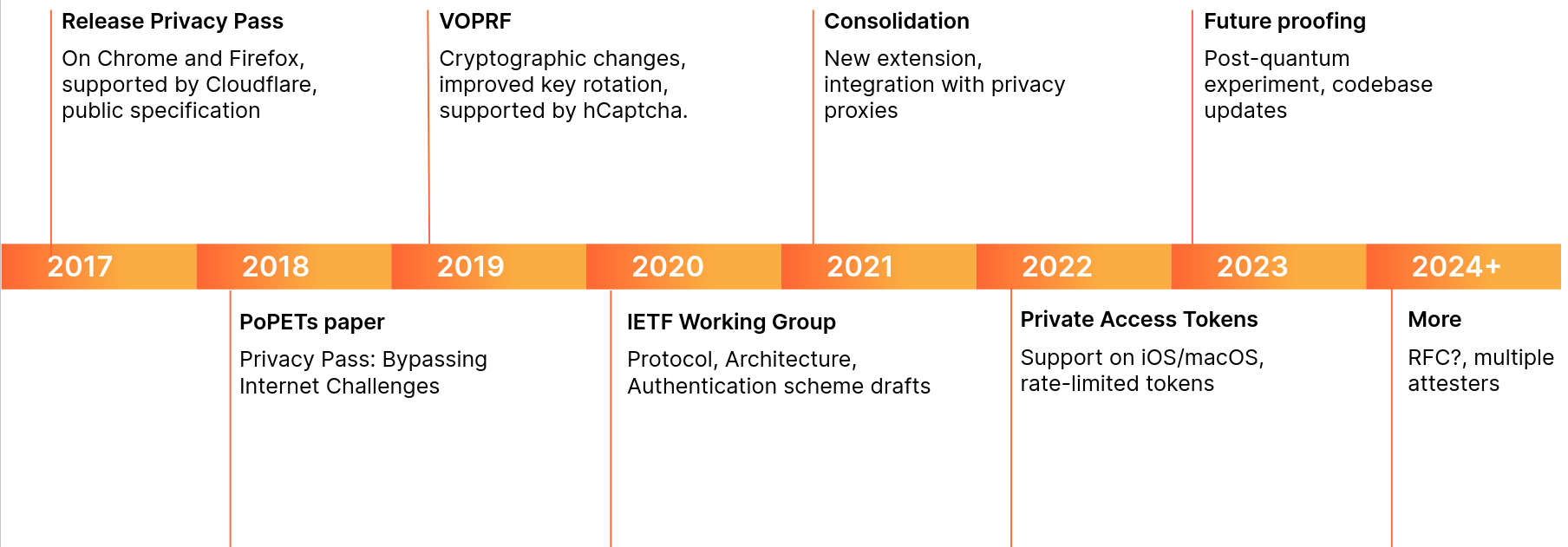
The timeline presents cryptographic changes, community inputs, and industry collaborations. These changes helped shape better standards for the web, such as VOPRF (RFC 9497), or RSA Blind Signatures (RFC 9474). In the next sections, we dive in the Privacy Pass protocol to understand its ins and outs.
Anonymous credentials in real life
Before explaining the protocol in more depth, let’s use an analogy. You are at a music festival. You bought your ticket online with a student discount. When you arrive at the gates, an agent scans your ticket, checks your student status, and gives you a yellow wristband and two drink tickets.
During the festival, you go in and out by showing your wristband. When a friend asks you to grab a drink, you pay with your tickets. One for your drink and one for your friend. You give your tickets to the bartender, they check the tickets, and give you a drink. The characteristics that make this interaction private is that the drinks tickets cannot be traced back to you or your payment method, but they can be verified as having been unused and valid for purchase of a drink.
In the web use case, the Internet is a festival. When you arrive at the gates of a website, an agent scans your request, and gives you a session cookie as well as two Privacy Pass tokens. They could have given you just one token, or more than two, but in our example ‘two tokens’ is the given website’s policy. You can use these tokens to attest your humanity, to authenticate on certain websites, or even to confirm the legitimacy of your hardware.
Now, you might wonder if this is a technique we have been using for years, why do we need fancy cryptography and standardization efforts? Well, unlike at a real-world music festival where most people don’t carry around photocopiers, on the Internet it is pretty easy to copy tokens. For instance, how do we stop people using a token twice? We could put a unique number on each token, and check it is not spent twice, but that would allow the gate attendant to tell the bartender which numbers were linked to which person. So, we need cryptography.
When another website presents a challenge to you, you provide your Privacy Pass token and are then allowed to view a gallery of beautiful cat pictures. The difference with the festival is this challenge might be interactive, which would be similar to the bartender giving you a numbered ticket which would have to be signed by the agent before getting a drink. The website owner can verify that the token is valid but has no way of tracing or connecting the user back to the action that provided them with the Privacy Pass tokens. With Privacy Pass terminology, you are a Client, the website is an Origin, the agent is an Attester, and the bar an Issuer. The next section goes through these in more detail.
Privacy Pass protocol
Privacy Pass specifies an extensible protocol for creating and redeeming anonymous and transferable tokens. In fact, Apple has their own implementation with Private Access Tokens (PAT), and later we will describe another implementation with the Silk browser extension. Given PAT was the first to implement the IETF defined protocol, Privacy Pass is sometimes referred to as PAT in the literature.
The protocol is generic, and defines four components:
- Client: Web user agent with a Privacy Pass enabled browser. This could be your Apple device with PAT, or your web browser with the Silk extension installed. Typically, this is the actor who is requesting content and is asked to share some attribute of themselves.
- Origin: Serves content requested by the Client. The Origin trusts one or more Issuers, and presents Privacy Pass challenges to the Client. For instance, Cloudflare Managed Challenge is a Privacy Pass origin serving two Privacy Pass challenges: one for Apple PAT Issuer, one for Cloudflare Research Issuer.
- Issuer: Signs Privacy Pass tokens upon request from a trusted party, either an Attester or a Client depending on the deployment model. Different Issuers have their own set of trusted parties, depending on the security level they are looking for, as well as their privacy considerations. An Issuer validating device integrity should use different methods that vouch for this attribute to acknowledge the diversity of Client configurations.
- Attester: Verifies an attribute of the Client and when satisfied requests a signed Privacy Pass token from the Issuer to pass back to the Client. Before vouching for the Client, an Attester may ask the Client to complete a specific task. This task could be a CAPTCHA, a location check, or age verification or some other check that will result in a single binary result. The Privacy Pass token will then share this one-bit of information in an unlinkable manner.
They interact as illustrated below.
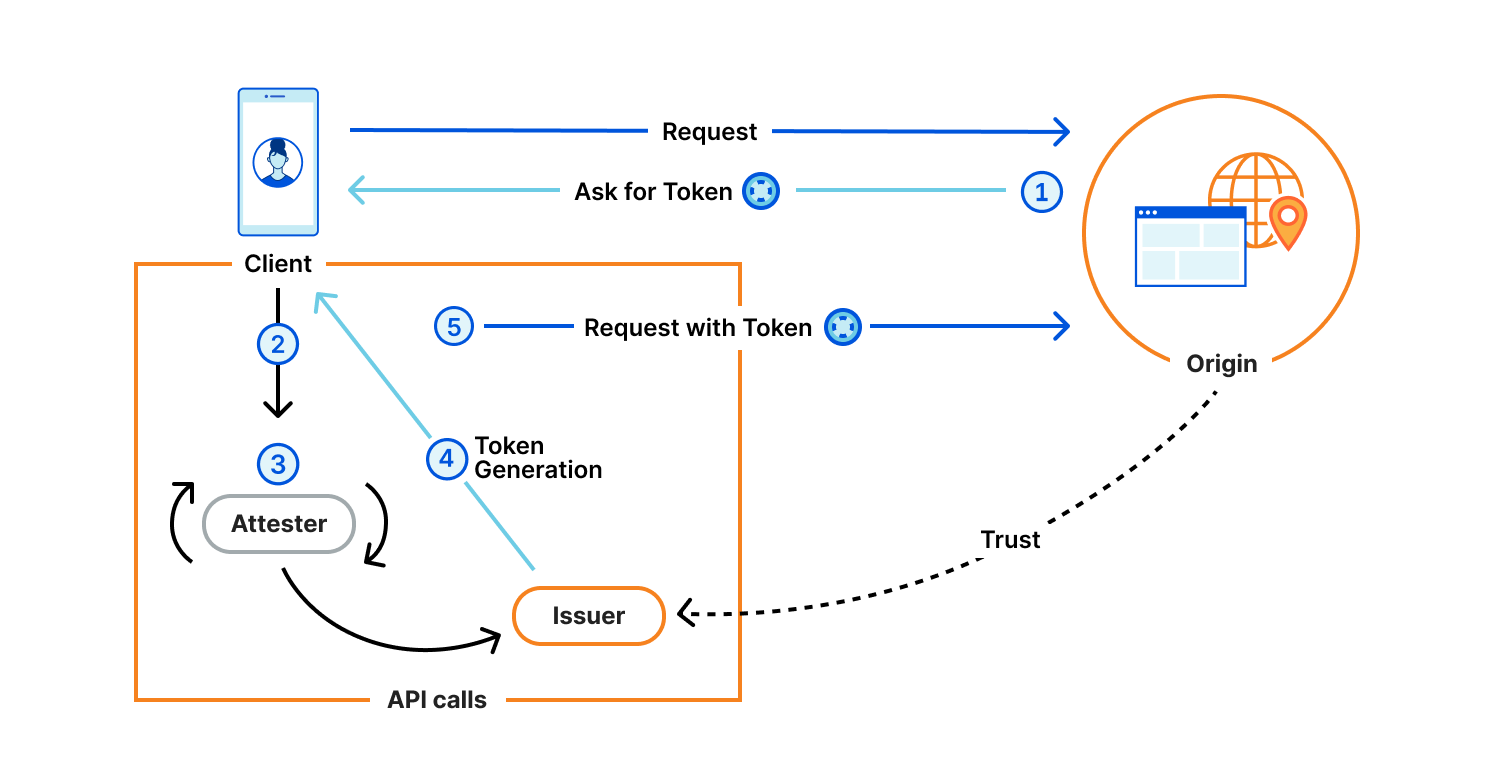
Let’s dive into what’s really happening with an example. The User wants to access an Origin, say store.example.com. This website has suffered attacks or abuse in the past, and the site is using Privacy Pass to help avoid these going forward. To that end, the Origin returns an authentication request to the Client: WWW-Authenticate: PrivateToken challenge="A==",token-key="B==". In this way, the Origin signals that it accepts tokens from the Issuer with public key “B==” to satisfy the challenge. That Issuer in turn trusts reputable Attesters to vouch for the Client not being an attacker by means of the presence of a cookie, CAPTCHA, Turnstile, or CAP challenge for example. For accessibility reasons for our example, let us say that the Client likely prefers the Turnstile method. The User’s browser prompts them to solve a Turnstile challenge. On success, it contacts the Issuer “B==” with that solution, and then replays the initial requests to store.example.com, this time sending along the token header Authorization: PrivateToken token="C==", which the Origin accepts and returns your desired content to the Client. And that’s it.
We’ve described the Privacy Pass authentication protocol. While Basic authentication (RFC 7671) asks you for a username and a password, the PrivateToken authentication scheme allows the browser to be more flexible on the type of check, while retaining privacy. The Origin store.example.com does not know your attestation method, they just know you are reputable according to the token issuer. In the same spirit, the Issuer “B==” does not see your IP, nor the website you are visiting. This separation between issuance and redemption, also referred to as unlinkability, is what makes Privacy Pass private.
Demo time
To put the above in practice, let’s see how the protocol works with Silk, a browser extension providing Privacy Pass support. First, download the relevant Chrome or Firefox extension.
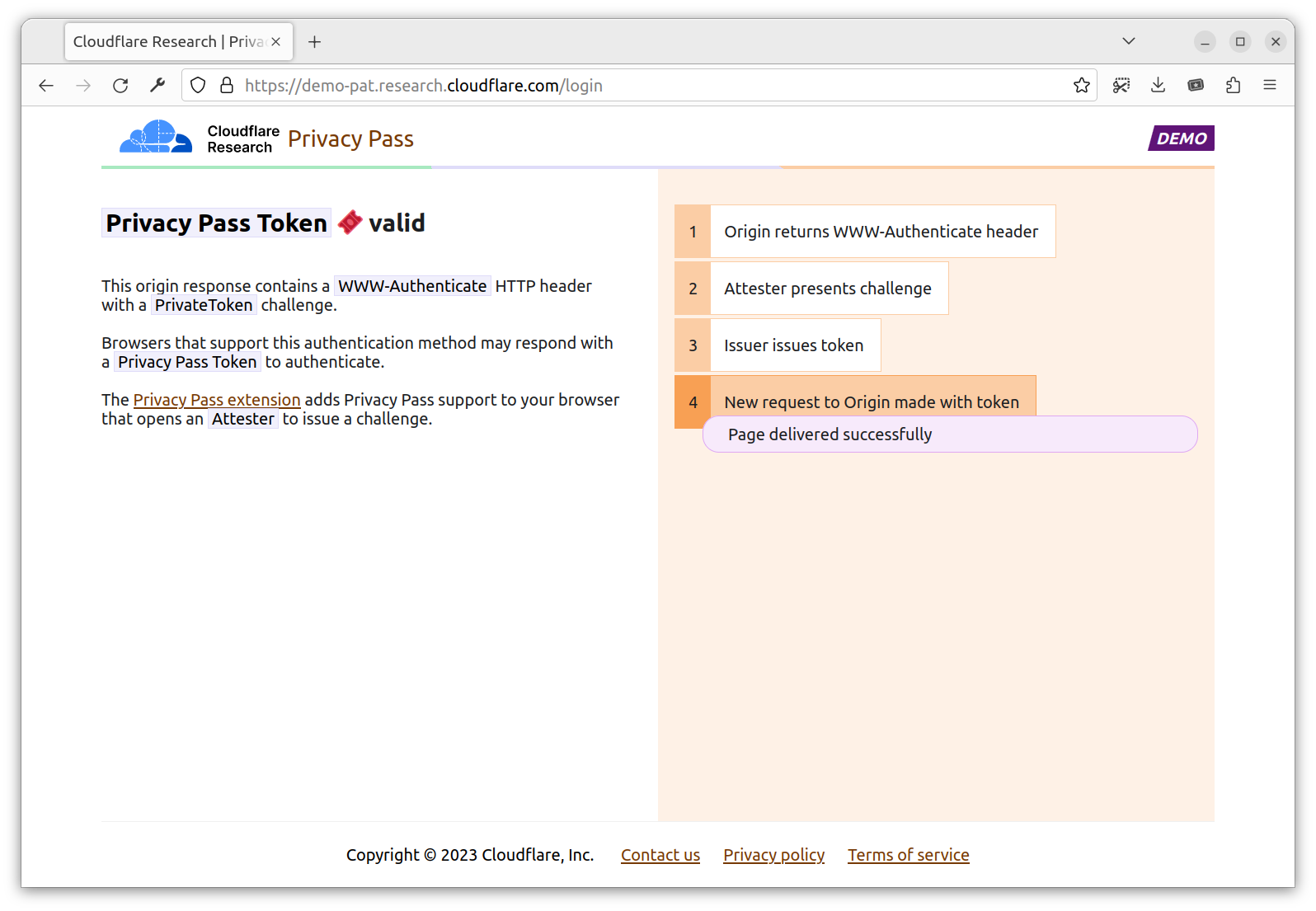
Then, head to https://demo-pat.research.cloudflare.com/login. The page returns a 401 Privacy Pass Token not presented. In fact, the origin expects you to perform a PrivateToken authentication. If you don’t have the extension installed, the flow stops here. If you have the extension installed, the extension is going to orchestrate the flow required to get you a token requested by the Origin.
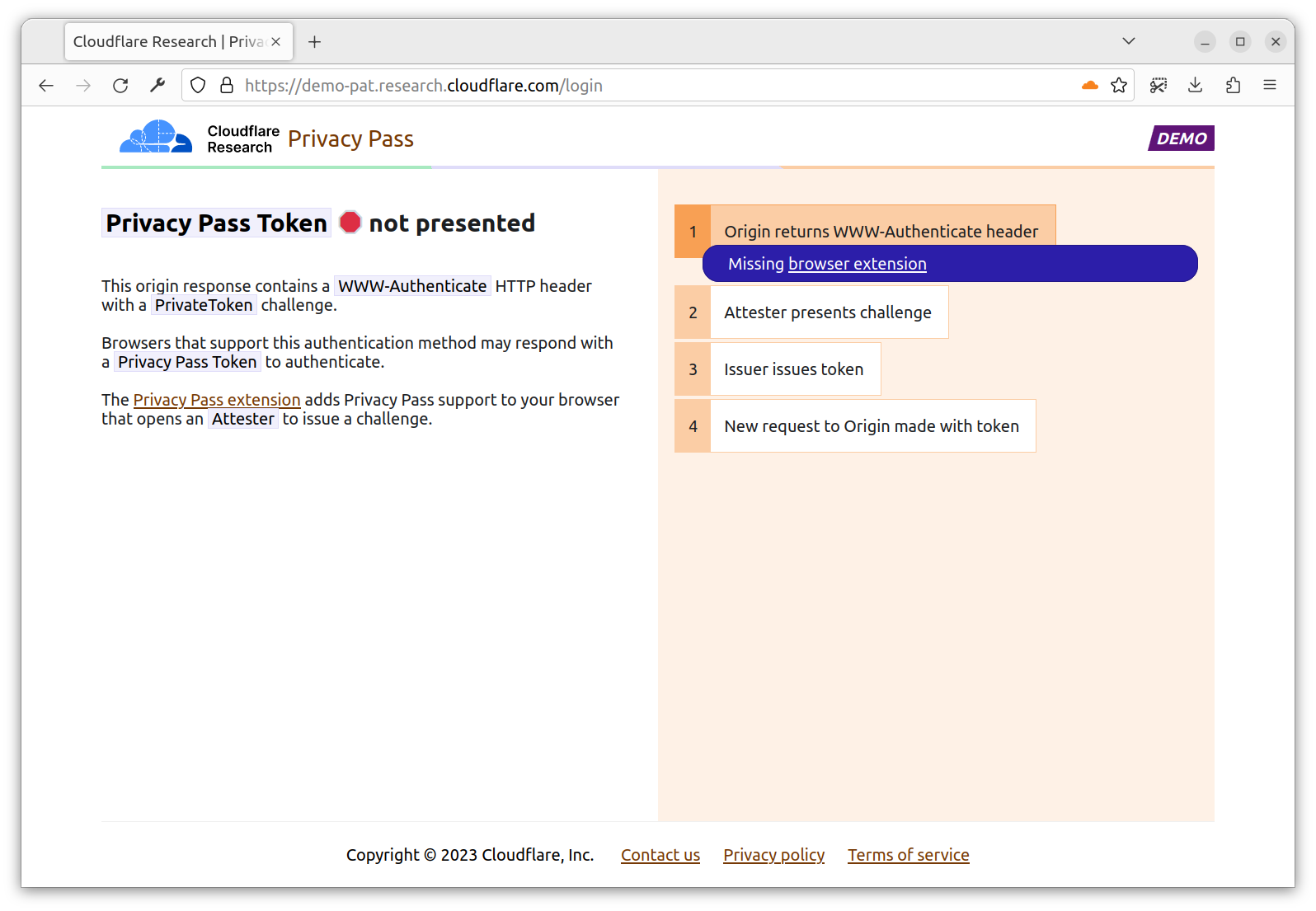
With the extension installed, you are directed to a new tab https://pp-attester-turnstile.research.cloudflare.com/challenge. This is a page provided by an Attester able to deliver you a token signed by the Issuer request by the Origin. In this case, the Attester checks you’re able to solve a Turnstile challenge.
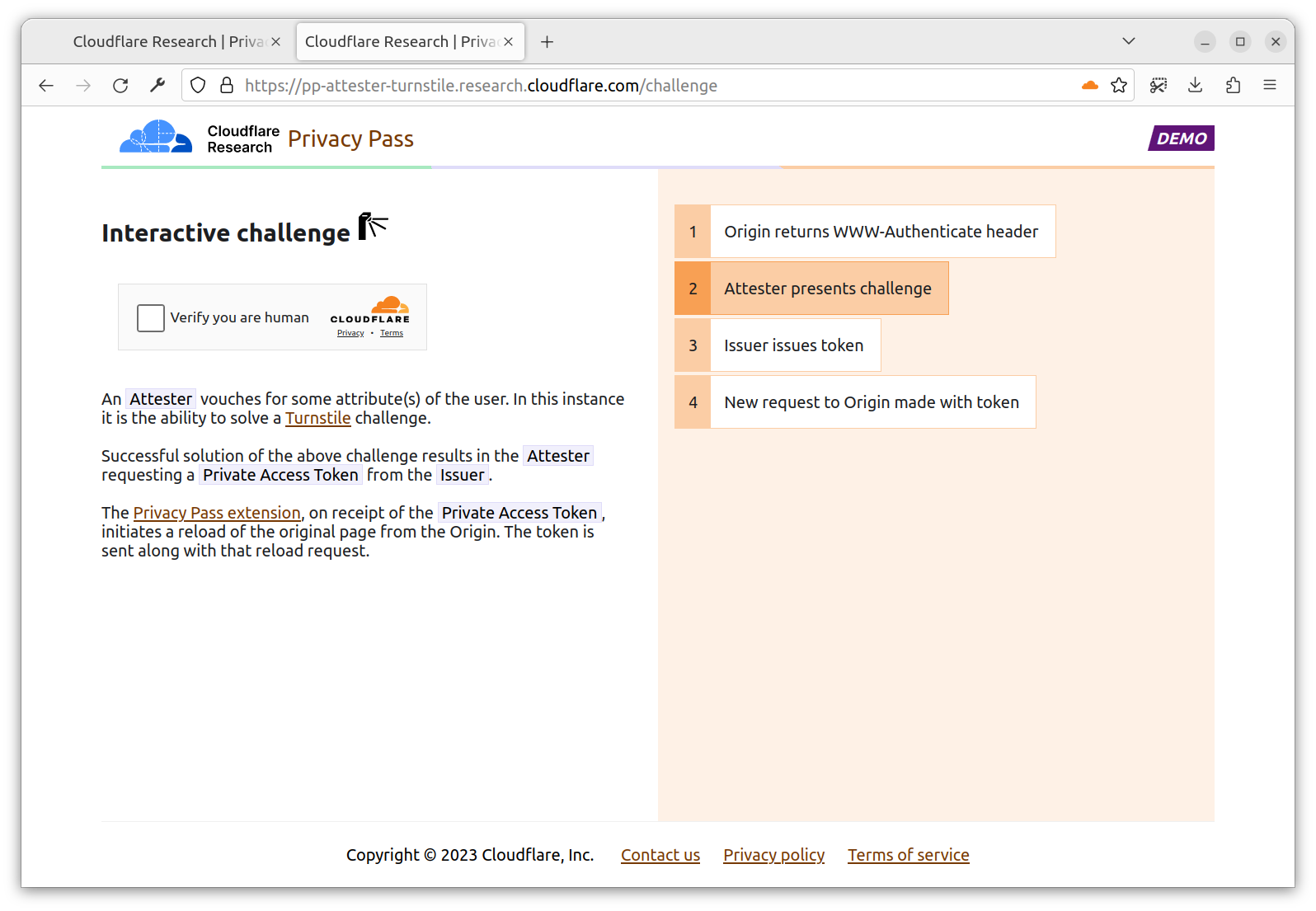
You click, and that’s it. The Turnstile challenge solution is sent to the Attester, which upon validation, sends back a token from the requested Issuer. This page appears for a very short time, as once the extension has the token, the challenge page is no longer needed.
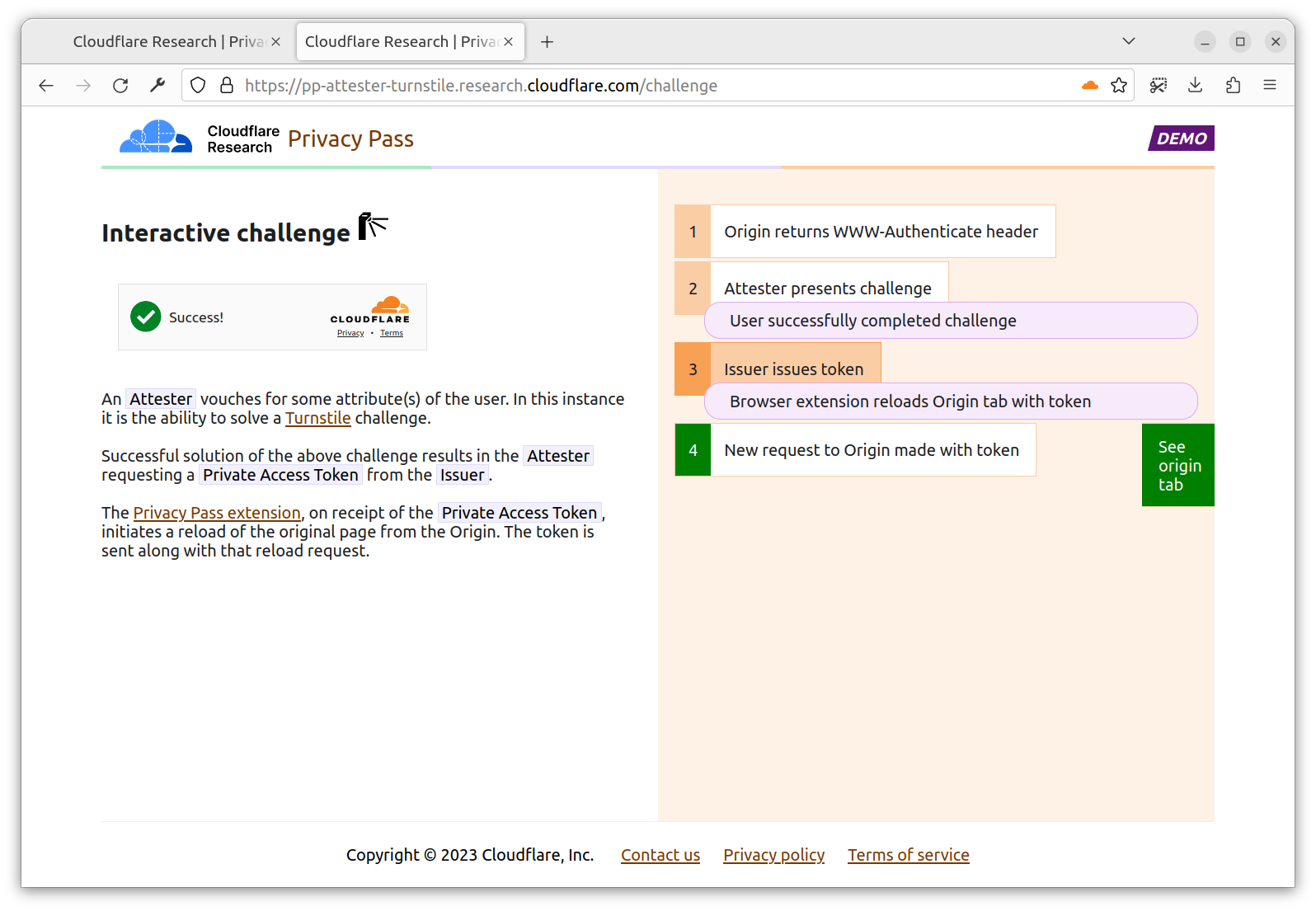
The extension, now having a token requested by the Origin, sends your initial request for a second time, with an Authorization header containing a valid Issuer PrivateToken. Upon validation, the Origin allows you in with a 200 Privacy Pass Token valid!
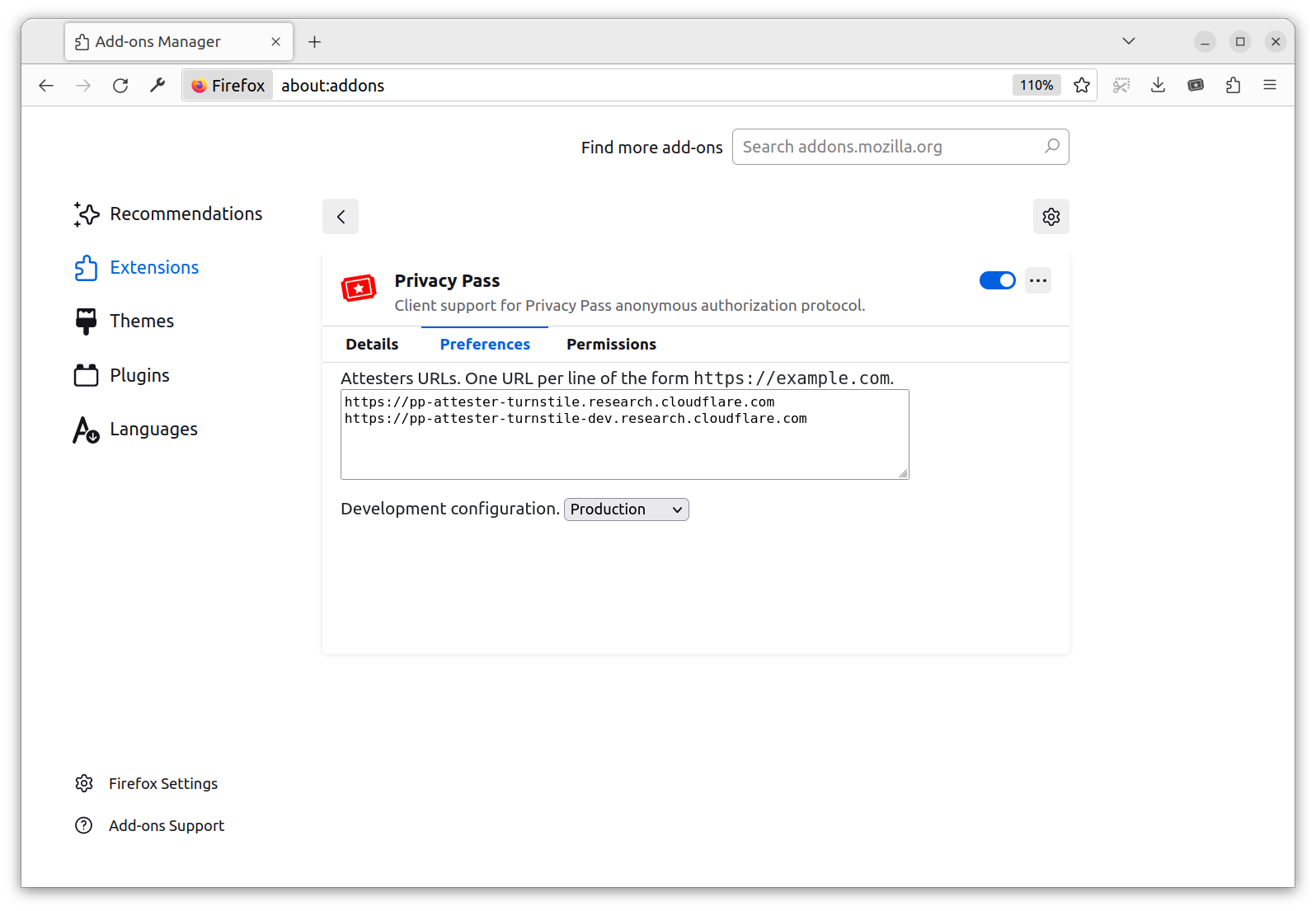
If you want to check behind the scenes, you can right-click on the extension logo and go to the preference/options page. It contains a list of attesters trusted by the extension, one per line. You can add your own attestation method (API described below). This allows the Client to decide on their preferred attestation methods.
Privacy Pass protocol — extended
The Privacy Pass protocol is new and not a standard yet, which implies that it’s not uniformly supported on all platforms. To improve flexibility beyond the existing standard proposal, we are introducing two mechanisms: an API for Attesters, and a replay API for web clients. The API for attesters allows developers to build new attestation methods, which only need to provide their URL to interface with the Silk browser extension. The replay API for web clients is a mechanism to enable websites to cooperate with the extension to make PrivateToken authentication work on browsers with Chrome user agents.
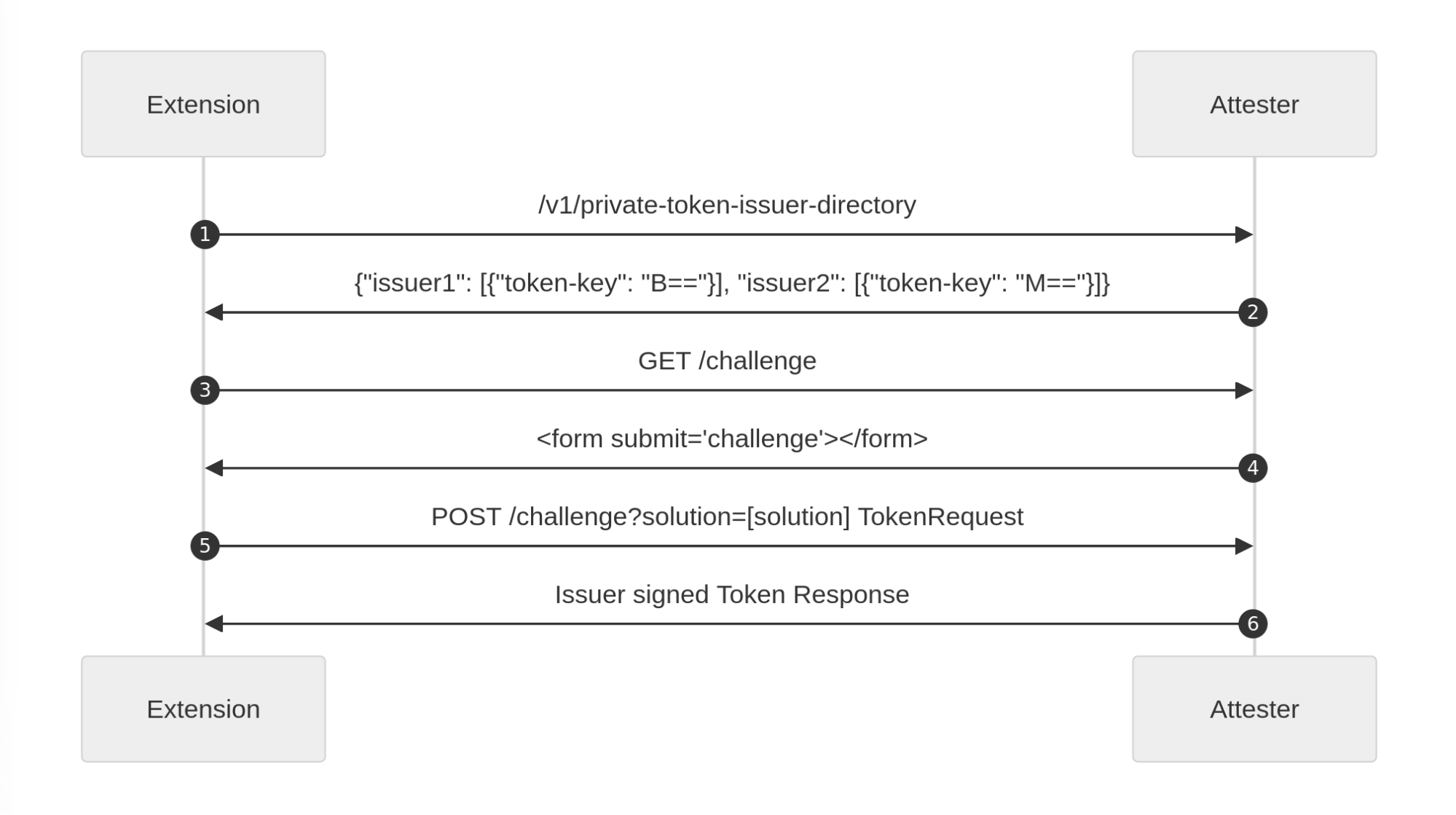
Because more than one Attester may be supported on your machine, your Client needs to understand which Attester to use depending on the requested Issuer. As mentioned before, you as the Client do not communicate directly with the Issuer because you don’t necessarily know their relation with the attester, so you cannot retrieve its public key. To this end, the Attester API exposes all Issuers reachable by the said Attester via an endpoint: /v1/private-token-issuer-directory. This way, your client selects an appropriate Attester – one in relation with an Issuer that the Origin trusts, before triggering a validation.
In addition, we propose a replay API. Its goal is to allow clients to fetch a resource a second time if the first response presented a Privacy pass challenge. Some platforms do this automatically, like Silk on Firefox, but some don’t. That’s the case with the Silk Chrome extension for instance, which in its support of manifest v3 cannot block requests and only supports Basic authentication in the onAuthRequired extension event. The Privacy Pass Authentication scheme proposes the request to be sent once to get a challenge, and then a second time to get the actual resource. Between these requests to the Origin, the platform orchestrates the issuance of a token. To keep clients informed about the state of this process, we introduce a private-token-client-replay: UUID header alongside WWW-Authenticate. Using a platform defined endpoint, this UUID informs web clients of the current state of authentication: pending, fulfilled, not-found.
To learn more about how you can use these today, and to deploy your own attestation method, read on.
How to use Privacy Pass today?
As seen in the section above, Privacy Pass is structured around four components: Origin, Client, Attester, Issuer. That’s why we created four repositories: cloudflare/pp-origin, cloudflare/pp-browser-extension, cloudflare/pp-attester, cloudflare/pp-issuer. In addition, the underlying cryptographic libraries are available cloudflare/privacypass-ts, cloudflare/blindrsa-ts, and cloudflare/voprf-ts. In this section, we dive into how to use each one of these depending on your use case.
Note: All examples below are designed in JavaScript and targeted at Cloudflare Workers. Privacy Pass is also implemented in other languages and can be deployed with a configuration that suits your needs.
As an Origin – website owners, service providers
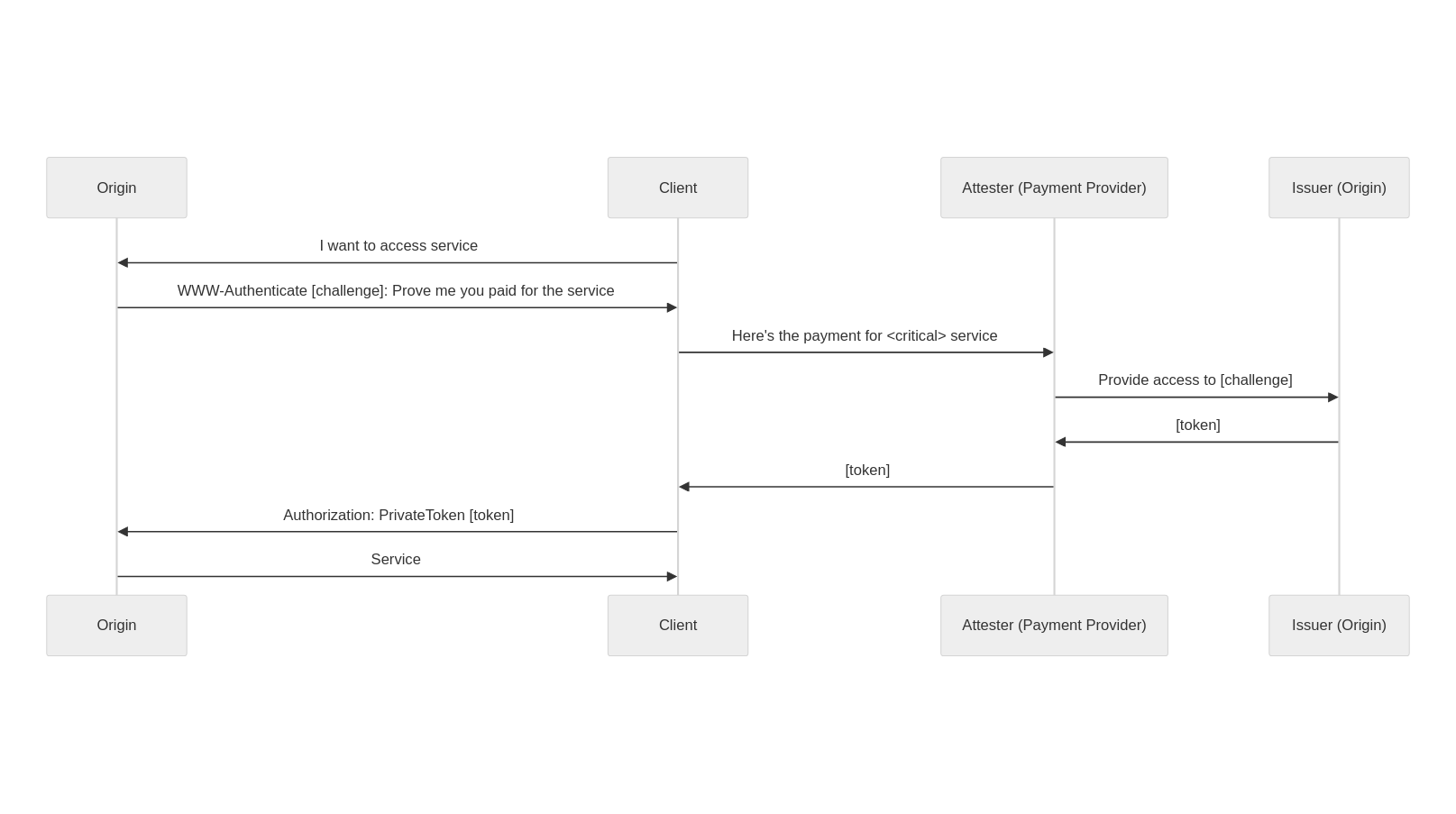
You are an online service that people critically rely upon (health or messaging for instance). You want to provide private payment options to users to maintain your users’ privacy. You only have one subscription tier at $10 per month. You have heard people are making privacy preserving apps, and want to use the latest version of Privacy Pass.
To access your service, users are required to prove they’ve paid for the service through a payment provider of their choosing (that you deem acceptable). This payment provider acknowledges the payment and requests a token for the user to access the service. As a sequence diagram, it looks as follows:
To implement it in Workers, we rely on the @cloudflare/privacypass-ts library, which can be installed by running:
npm i @cloudflare/privacypass-ts
This section is going to focus on the Origin work. We assume you have an Issuer up and running, which is described in a later section.
The Origin defines two flows:
- User redeeming token
- User requesting a token issuance
import { Client } from '@cloudflare/privacypass-ts'

const issuer = 'static issuer key'

const handleRedemption => (req) => {
    const token = TokenResponse.parse(req.headers.get('authorization'))
    const isValid = token.verify(issuer.publicKey)
}

const handleIssuance = () => {
    return new Response('Please pay to access the service', {
        status: 401,
        headers: { 'www-authenticate': 'PrivateToken challenge=, token-key=, max-age=300' }
    })
}

const handleAuth = (req) => {
    const authorization = req.headers.get('authorization')
    if (authorization.startsWith(`PrivateToken token=`)) {
        return handleRedemption(req)
    }
    return handleIssuance(req)
}

export default {
    fetch(req: Request) {
        return handleAuth(req)
    }
}
From the user’s perspective, the overhead is minimal. Their client (possibly the Silk browser extension) receives a WWW-Authenticate header with the information required for a token issuance. Then, depending on their client configuration, they are taken to the payment provider of their choice to validate their access to the service.
With a successful response to the PrivateToken challenge a session is established, and the traditional web service flow continues.
As an Attester – CAPTCHA providers, authentication provider
You are the author of a new attestation method, such as CAP, a new CAPTCHA mechanism, or a new way to validate cookie consent. You know that website owners already use Privacy Pass to trigger such challenges on the user side, and an Issuer is willing to trust your method because it guarantees a high security level. In addition, because of the Privacy Pass protocol you never see which website your attestation is being used for.
So you decide to expose your attestation method as a Privacy Pass Attester. An Issuer with public key B== trusts you, and that’s the Issuer you are going to request a token from. You can check that with the Yes/No Attester below, whose code is on Cloudflare Workers playground
const ISSUER_URL = 'https://pp-issuer-public.research.cloudflare.com/token-request'

const b64ToU8 = (b) =>  Uint8Array.from(atob(b), c => c.charCodeAt(0))

const handleGetChallenge = (req) => {
    return new Response(`
    <html>
    <head>
      <title>Challenge Response</title>
    </head>
    <body>
    	<button onclick="sendResponse('Yes')">Yes</button>
		<button onclick="sendResponse('No')">No</button>
	</body>
	<script>
	function sendResponse(choice) {
		fetch(location.href, { method: 'POST', headers: { 'private-token-attester-data': choice } })
	}
	</script>
	</html>
	`, { status: 401, headers: { 'content-type': 'text/html' } })
}

const handlePostChallenge = (req) => {
    const choice = req.headers.get('private-token-attester-data')
    if (choice !== 'Yes') {
        return new Response('Unauthorised', { status: 401 })
    }

    // hardcoded token request
    // debug here https://pepe-debug.research.cloudflare.com/?challenge=PrivateToken%20challenge=%22AAIAHnR1dG9yaWFsLmNsb3VkZmxhcmV3b3JrZXJzLmNvbSBE-oWKIYqMcyfiMXOZpcopzGBiYRvnFRP3uKknYPv1RQAicGVwZS1kZWJ1Zy5yZXNlYXJjaC5jbG91ZGZsYXJlLmNvbQ==%22,token-key=%22MIIBUjA9BgkqhkiG9w0BAQowMKANMAsGCWCGSAFlAwQCAqEaMBgGCSqGSIb3DQEBCDALBglghkgBZQMEAgKiAwIBMAOCAQ8AMIIBCgKCAQEApqzusqnywE_3PZieStkf6_jwWF-nG6Es1nn5MRGoFSb3aXJFDTTIX8ljBSBZ0qujbhRDPx3ikWwziYiWtvEHSLqjeSWq-M892f9Dfkgpb3kpIfP8eBHPnhRKWo4BX_zk9IGT4H2Kd1vucIW1OmVY0Z_1tybKqYzHS299mvaQspkEcCo1UpFlMlT20JcxB2g2MRI9IZ87sgfdSu632J2OEr8XSfsppNcClU1D32iL_ETMJ8p9KlMoXI1MwTsI-8Kyblft66c7cnBKz3_z8ACdGtZ-HI4AghgW-m-yLpAiCrkCMnmIrVpldJ341yR6lq5uyPej7S8cvpvkScpXBSuyKwIDAQAB%22
    const body = b64ToU8('AALoAYM+fDO53GVxBRuLbJhjFbwr0uZkl/m3NCNbiT6wal87GEuXuRw3iZUSZ3rSEqyHDhMlIqfyhAXHH8t8RP14ws3nQt1IBGE43Q9UinwglzrMY8e+k3Z9hQCEw7pBm/hVT/JNEPUKigBYSTN2IS59AUGHEB49fgZ0kA6ccu9BCdJBvIQcDyCcW5LCWCsNo57vYppIVzbV2r1R4v+zTk7IUDURTa4Mo7VYtg1krAWiFCoDxUOr+eTsc51bWqMtw2vKOyoM/20Wx2WJ0ox6JWdPvoBEsUVbENgBj11kB6/L9u2OW2APYyUR7dU9tGvExYkydXOfhRFJdKUypwKN70CiGw==')
    // You can perform some check here to confirm the body is a valid token request

    console.log('requesting token for tutorial.cloudflareworkers.com')
    return fetch(ISSUER_URL, {
      method: 'POST',
      headers: { 'content-type': 'application/private-token-request' },
      body: body,
    })
}

const handleIssuerDirectory = async () => {
    // These are fake issuers
    // Issuer data can be fetch at https://pp-issuer-public.research.cloudflare.com/.well-known/private-token-issuer-directory
    const TRUSTED_ISSUERS = {
        "issuer1": { "token-keys": [{ "token-type": 2, "token-key": "A==" }] },
        "issuer2": { "token-keys": [{ "token-type": 2, "token-key": "B==" }] },
    }
    return new Response(JSON.stringify(TRUSTED_ISSUERS), { headers: { "content-type": "application/json" } })
}

const handleRequest = (req) => {
    const pathname = new URL(req.url).pathname
    console.log(pathname, req.url)
    if (pathname === '/v1/challenge') {
        if (req.method === 'POST') {
            return handlePostChallenge(req)
        }
        return handleGetChallenge(req)
    }
    if (pathname === '/v1/private-token-issuer-directory') {
        return handleIssuerDirectory()
    }
    return new Response('Not found', { status: 404 })
}

addEventListener('fetch', event => {
    event.respondWith(handleRequest(event.request))
})
The validation method above is simply checking if the user selected yes. Your method might be more complex, the wrapping stays the same.

Because users might have multiple Attesters configured for a given Issuer, we recommend your Attester implements one additional endpoint exposing the keys of the issuers you are in contact with. You can try this code on Cloudflare Workers playground.
const handleIssuerDirectory = () => {
    const TRUSTED_ISSUERS = {
        "issuer1": { "token-keys": [{ "token-type": 2, "token-key": "A==" }] },
        "issuer2": { "token-keys": [{ "token-type": 2, "token-key": "B==" }] },
    }
    return new Response(JSON.stringify(TRUSTED_ISSUERS), { headers: { "content-type": "application/json" } })
}

export default {
    fetch(req: Request) {
        const pathname = new URL(req.url).pathname
        if (pathname === '/v1/private-token-issuer-directory') {
            return handleIssuerDirectory()
        }
    }
}
Et voilà. You have an Attester that can be used directly with the Silk browser extension (Firefox, Chrome). As you progress through your deployment, it can also be directly integrated into your applications.
If you would like to have a more advanced Attester and deployment pipeline, look at cloudflare/pp-attester template.
As an Issuer – foundation, consortium
We’ve mentioned the Issuer multiple times already. The role of an Issuer is to select a set of Attesters it wants to operate with, and communicate its public key to Origins. The whole cryptographic behavior of an Issuer is specified by the IETF draft. In contrast to the Client and Attesters which have discretionary behavior, the Issuer is fully standardized. Their opportunity is to choose a signal that is strong enough for the Origin, while preserving privacy of Clients.
Cloudflare Research is operating a public Issuer for experimental purposes to use on https://pp-issuer-public.research.cloudflare.com. It is the simplest solution to start experimenting with Privacy Pass today. Once it matures, you can consider joining a production Issuer, or deploying your own.
To deploy your own, you should:
git clone github.com/cloudflare/pp-issuer
Update wrangler.toml with your Cloudflare Workers account id and zone id. The open source Issuer API works as follows:
- /.well-known/private-token-issuer-directory returns the issuer configuration. Note it does not expose non-standard token-key-legacy
- /token-request returns a token. This endpoint should be gated (by Cloudflare Access for instance) to only allow trusted attesters to call it
- /admin/rotate to generate a new public key. This should only be accessible by your team, and be called prior to the issuer being available.
Then, wrangler publish, and you’re good to onboard Attesters.
Development of Silk extension
Just like the protocol, the browser technology on which Privacy Pass was proven viable has changed as well. For 5 years, the protocol got deployed along with a browser extension for Chrome and Firefox. In 2021, Chrome released a new version of extension configurations, usually referred to as Manifest version 3 (MV3). Chrome also started enforcing this new configuration for all newly released extensions.
Privacy Pass the extension is based on an agreed upon Privacy Pass authentication protocol. Briefly looking at Chrome’s API documentation, we should be able to use the onAuthRequired event. However, with PrivateToken authentication not yet being standard, there are no hooks provided by browsers for extensions to add logic to this event.
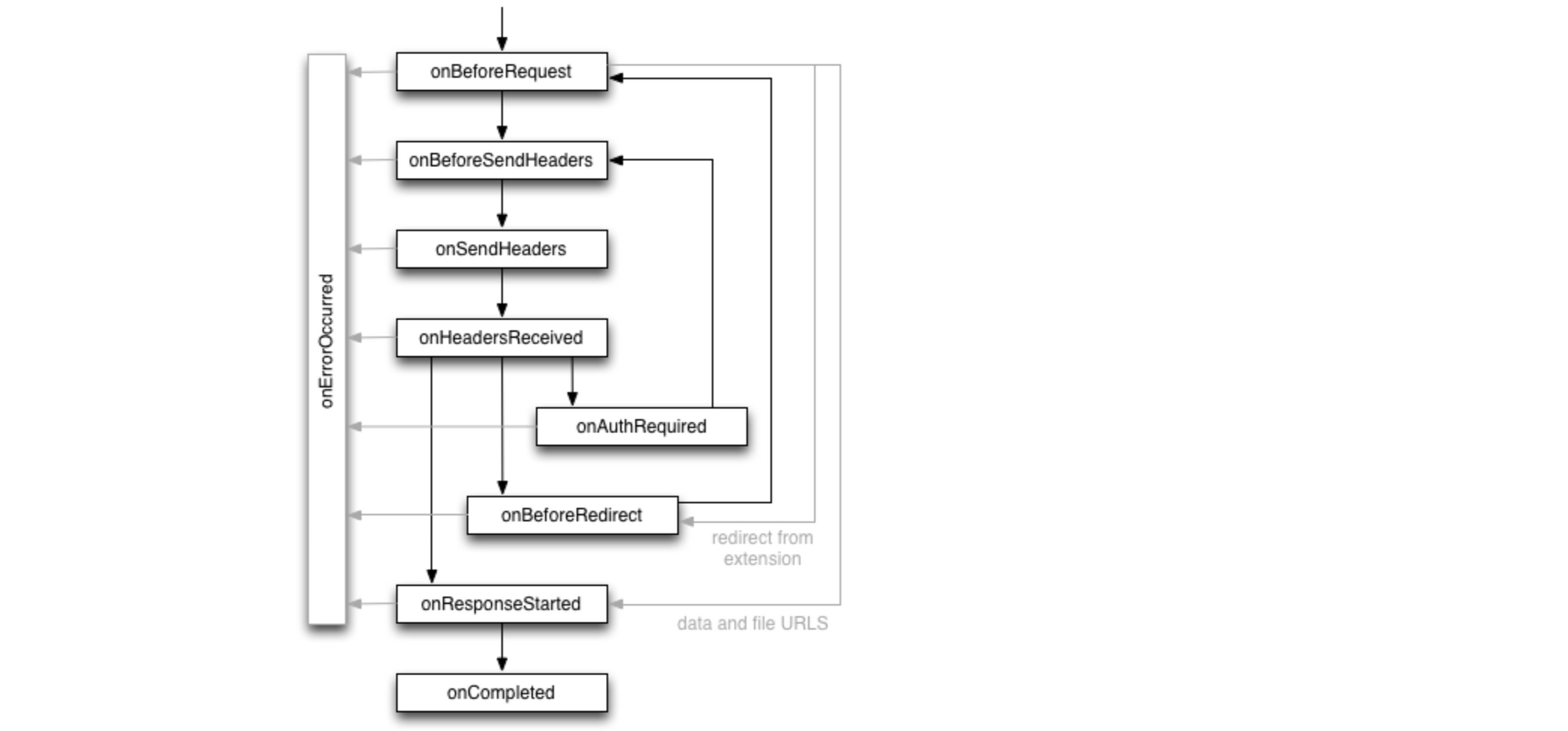
The approach we decided to use is to define a client side replay API. When a response comes with 401 WWW-Authenticate PrivateToken, the browser lets it through, but triggers the private token redemption flow. The original page is notified when a token has been retrieved, and replays the request. For this second request, the browser is able to attach an authorization token, and the request succeeds. This is an active replay performed by the client, rather than a transparent replay done by the platform. A specification is available on GitHub.
We are looking forward to the standard progressing, and simplifying this part of the project. This should improve diversity in attestation methods. As we see in the next section, this is key to identifying new signals that can be leveraged by origins.
A standard for anonymous credentials
IP remains as a key identifier in the anti abuse system. At the same time, IP fingerprinting techniques have become a bigger concern and platforms have started to remove some of these ways of tracking users. To enable anti abuse systems to not rely on IP, while ensuring user privacy, Privacy Pass offers a reasonable alternative to deal with potentially abusive or suspicious traffic. The attestation methods vary and can be chosen as needed for a particular deployment. For example, Apple decided to back their attestation with hardware when using Privacy Pass as the authorization technology for iCloud Private Relay. Another example is Cloudflare Research which decided to deploy a Turnstile attester to signal a successful solve for Cloudflare’s challenge platform.
In all these deployments, Privacy Pass-like technology has allowed for specific bits of information to be shared. Instead of sharing your location, past traffic, and possibly your name and phone number simply by connecting to a website, your device is able to prove specific information to a third party in a privacy preserving manner. Which user information and attestation methods are sufficient to prevent abuse is an open question. We are looking to empower researchers with the release of this software to help in the quest for finding these answers. This could be via new experiments such as testing out new attestation methods, or fostering other privacy protocols by providing a framework for specific information sharing.
Future recommendations
Just as we expect this latest version of Privacy Pass to lead to new applications and ideas we also expect further evolution of the standard and the clients that use it. Future development of Privacy Pass promises to cover topics like batch token issuance and rate limiting. From our work building and deploying this version of Privacy Pass we have encountered limitations that we expect to be resolved in the future as well.
The division of labor between Attesters and Issuers and the clear directions of trust relationships between the Origin and Issuer, and the Issuer and Attester make reasoning about the implications of a breach of trust clear. Issuers can trust more than one Attester, but since many current deployments of Privacy Pass do not identify the Attester that lead to issuance, a breach of trust in one Attester would render all tokens issued by any Issuer that trusts the Attester untrusted. This is because it would not be possible to tell which Attester was involved in the issuance process. Time will tell if this promotes a 1:1 correspondence between Attesters and Issuers.
The process of developing a browser extension supported by both Firefox and Chrome-based browsers can at times require quite baroque (and brittle) code paths. Privacy Pass the protocol seems a good fit for an extension of the webRequest.onAuthRequired browser event. Just as Privacy Pass appears as an alternate authentication message in the WWW-Authenticate HTTP header, browsers could fire the onAuthRequired event for Private Token authentication too and include and allow request blocking support within the onAuthRequired event. This seems a natural evolution of the use of this event which currently is limited to the now rather long-in-the-tooth Basic authentication.
Conclusion
Privacy Pass provides a solution to one of the longstanding challenges of the web: anonymous authentication. By leveraging cryptography, the protocol allows websites to get the information they need from users, and solely this information. It’s already used by millions to help distinguish human requests from automated bots in a manner that is privacy protective and often seamless. We are excited by the protocol’s broad and growing adoption, and by the novel use cases that are unlocked by this latest version.
Cloudflare’s Privacy Pass implementations are available on GitHub, and are compliant with the standard. We have open-sourced a set of templates that can be used to implement Privacy Pass Origins, Issuers, and Attesters, which leverage Cloudflare Workers to get up and running quickly.
For those looking to try Privacy Pass out for themselves right away, download the Silk – Privacy Pass Client browser extensions (Firefox, Chrome, GitHub) and start browsing a web with fewer bot checks today.
Rapid7 Recognized by Newsweek as one of ‘America’s Greatest Workplaces for Diversity for 2024’.
Post Syndicated from Rapid7 original https://blog.rapid7.com/2024/01/04/rapid7-recognized-by-newsweek-as-one-of-americas-greatest-workplaces-for-diversity-for-2024/

On December 13th, Newsweek Magazine published their list of ‘America’s Greatest Workplaces for Diversity for 2024’. Like many companies today, Rapid7 recognizes the positive impact diversity plays in driving organizational success, attracting and retaining exceptional talent, and creating positive career experiences for all people.
Sophia Dozier, Director of Diversity, Equity and Inclusion at Rapid7 shares “We are proud to be on a list showcasing companies committed to Equity, Inclusion and Diversity. Diversity of lived experience and thought create a more impactful depth and breadth of knowledge. This knowledge is what enables us to push boundaries and deliver extraordinary results and experiences for our partners, our customers, and our employees.”
The process for selection includes extensive research on publicly available information, along with an anonymous online survey capturing feedback from more than 220,000 employees at companies in the United States. Research captures information on company leadership, employee resource groups and internal communities, dedicated diversity program leaders, and social good reporting and initiatives. In the surveys, participants answer questions pertaining to work-life-balance, working environments, and workforce management. Companies then undergo an evaluation that includes media monitoring and validation of findings.
The findings from this year’s awards program reflect Rapid7’s intentional efforts to ensure diversity is a key part of their business strategy. As stated by Chief People Officer, Christina Luconi, “Rapid7 is committed to building an organization that thrives with the spirit of diversity and inclusion. We don’t think of DE&I as a project or a checklist item; it’s a core part of our culture and values set. As a cybersecurity company, our mission is bold and challenging. Ensuring we attract unique perspectives and backgrounds, and empowering them to come together in a way that is truly inclusive, is one way we feel like we are set up to achieve our audacious goals.”
In addition to being recognized by Newsweek as a great workplace for Diversity, Rapid7 has also been recognized and included in a variety of other diversity focused lists and indexes. In 2023, the company was listed on the Bloomberg Equity Index for the 5th consecutive year. The firm also participated in the Human Rights Campaign’s Corporate Equality Index, receiving an impressive score of 90% as a first time participant.
When it comes to the year ahead, Dozier is looking forward to continuing to evolve the company’s diversity programs by leveraging support from business leaders, strategic partnerships, and employees. “In 2024 we will continue to build programs focused on enhancing the skills needed to compete at a global level and navigate complex challenges. We’re proud to have long standing partnerships with organizations who are committed to providing historically underrepresented and underserved communities with pathways into cybersecurity and technology careers. Internally, we will continue to collaborate with our employees to be a better version of ourselves, staying true to one of our core values #neverdone.”
To learn more about how Rapid7 approaches diversity, equity and inclusion click here. To explore career opportunities and learn more about Rapid7’s values and Rapid Impact Groups, visit their careers page.
Optimizing video encoding with FFmpeg using NVIDIA GPU-based Amazon EC2 instances
Post Syndicated from Macey Neff original https://aws.amazon.com/blogs/compute/optimizing-video-encoding-with-ffmpeg-using-nvidia-gpu-based-amazon-ec2-instances/
This post is written by Alejandro Gil, Solutions Architect and Joseba Echevarría, Solutions Architect.
Introduction
The purpose of this blog post is to compare video encoding performance between CPUs and Nvidia GPUs to determine the price/performance ratio in different scenarios while highlighting where it would be best to use a GPU.
Video encoding plays a critical role in modern media delivery, enabling efficient storage, delivery, and playback of high-quality video content across a wide range of devices and platforms.
Video encoding is frequently performed solely by the CPU because of its widespread availability and flexibility. Still, modern hardware includes specialized components designed specifically to obtain very high performance video encoding and decoding.
Nvidia GPUs, such as those found in the P and G Amazon EC2 instances, include this kind of built-in hardware in their NVENC (encoding) and NVDEC (decoding) accelerator engines, which can be used for real-time video encoding/decoding with minimal impact on the performance of the CPU or GPU.

Figure 1: NVIDIA NVDEC/NVENC architecture. Source https://developer.nvidia.com/video-codec-sdk
Scenario
Two main transcoding job types should be considered depending on the video delivery use case, 1) batch jobs for on demand video files and 2) streaming jobs for real-time, low latency use cases. In order to achieve optimal throughput and cost efficiency, it is a best practice to encode the videos in parallel using the same instance.
The utilized instance types in this benchmark can be found in figure 2 table (i.e g4dn and p3). For hardware comparison purposes, the p4d instance has been included in the table, showing the GPU specs and total number of NVDEC & NVENC cores in these EC2 instances. Based on the requirements, multiple GPU instances types are available in EC2.
| Instance size | GPUs | GPU model | NVDEC generation | NVENC generation | NVDEC cores/GPU | NVENC cores/GPU |
| g4dn.xlarge | 1 | T4 | 4th | 7th | 2 | 1 |
| p3.2xlarge | 1 | V100 | 3rd | 6th | 1 | 3 |
| p4d.24xlarge | 8 | A100 | 4th | N/A | 5 | 0 |
Figure 2: GPU instances specifications
Benchmark
In order to determine which encoding strategy is the most convenient for each scenario, a benchmark will be conducted comparing CPU and GPU instances across different video settings. The results will be further presented using graphical representations of the performance indicators obtained.
The benchmark uses 3 input videos with different motion and detail levels (still, medium motion and high dynamic scene) in 4k resolution at 60 frames per second. The tests will show the average performance for encoding with FFmpeg 6.0 in batch (using Constant Rate Factor (CRF) mode) and streaming (using Constant Bit Rate (CBR)) with x264 and x265 codecs to five output resolutions (1080p, 720p, 480p, 360p and 160p).
The benchmark tests encoding the target videos into H.264 and H.265 using the x264 and x265 open-source libraries in FFmpeg 6.0 on the CPU and the NVENC accelerator when using the Nvidia GPU. The H.264 standard enjoys broad compatibility, with most consumer devices supporting accelerated decoding. The H.265 standard offers superior compression at a given level of quality than H.264 but hardware accelerated decoding is not as widely deployed. As a result, for most media delivery scenarios having more than one video format will be required in order to provide the best possible user experience.
Offline (batch) encoding
This test consists of a batch encoding with two different standard presets (ultrafast and medium for CPU-based encoding and p1 and medium presets for GPU-accelerated encoding) defined in the FFmpeg guide.
The following chart shows the relative cost of transcoding 1 million frames to the 5 different output resolutions in parallel for CPU-encoding EC2 instance (c6i.4xlarge) and two types of GPU-powered instances (g4dn.xlarge and p3.2xlarge). The results are normalized so that the cost of x264 ultrafast preset on c6i.4xlarge is equal to one.

Figure 3: Batch encoding performance for CPU and GPU instances.
The performance of batch encoding in the best GPU instance (g4dn.xlarge) shows around 73% better price/performance in x264 compared to the c6i.4xlarge and around 82% improvement in x265.
A relevent aspect to have in consideration is that the presets used are not exactly equivalent for each hardware because FFmpeg uses different operators depending on where the process runs (i.e CPU or GPU). As a consequence, the video outputs in each case have a noticeable difference between them. Generally, NVENC-based encoded videos (GPU) tend to have a higher quality in H.264, whereas CPU outputs present more encoding artifacts. The difference is more noticeable for lower quality cases (ultrafast/p1 presets or streaming use cases).
The following images compare the output quality for the medium motion video in the ultrafast/p1 and medium presets.
It is clearly seen in the following example, that the h264_nevenc (GPU) codec outperforms the libx264 codec (CPU) in terms of quality, showing less pixelation, especially in the ultrafast preset. For the medium preset, although the quality difference is less pronounced, the GPU output file is noticeably larger (refer to Figure 6 table).

Figure 4: Result comparison between GPU and CPU for h264, ultrafast

Figure 5: Result comparison between GPU and CPU for h264, medium
The output file sizes mainly depend on the preset, codec and input video. The different configurations can be found in the following table.

Figure 6: Sizes for output batch encoded videos. Streaming not represented because the size is the same (fixed bitrate)
Live stream encoding
For live streaming use cases, it is useful to measure how many streams a single instance can maintain transcoding to five output resolutions (1080p, 720p, 480p, 360p and 160p). The following results are the relative cost of each instance, which is the ratio of number of streams the instance was able to sustain divided by the cost per hour.

Figure 6: Streaming encoding performance for CPU and GPU instances.
The previous results show that a GPU-based instance family like g4dn is ideal for streaming use cases, where they can sustain up to 4 parallel encodings from 4K to 1080p, 720p, 480p, 360p & 160p simultaneously. Notice that the GPU-based p5 family performance is not compensating the cost increase.
On the other hand, the CPU-based instances can sustain 1 parallel stream (at most). If you want to sustain the same number of parallel streams in Intel-based instances, you’d have to opt for a much larger instance (c6i.12xlarge can almost sustain 3 simultaneous streams, but it struggles to keep up with the more dynamic scenes when encoding with x265) with a much higher cost ($2.1888 hourly for c6i.12xlarge vs $0.587 for g4dn.xlarge).
The price/performance difference is around 68% better in GPU for x264 and 79% for x265.
Conclusion
The results show that for the tested scenarios there can be a price-performance gain when transcoding with GPU compared to CPU. Also, GPU-encoded videos tend to have an equal or higher perceived quality level to CPU-encoded counterparts and there is no significant performance penalty for encoding to the more advanced H.265 format, which can make GPU-based encoding pipelines an attractive option.
Still, CPU-encoders do a particularly good job with containing output file sizes for most of the cases we tested, producing smaller output file sizes even when the perceived quality is simmilar. This is an important aspect to have into account since it can have a big impact in cost. Depending on the amount of media files distributed and consumed by final users, the data transfer and storage cost will noticeably increase if GPUs are used. With this in mind, it is important to weight the compute costs with the data transfer and storage costs for your use case when chosing to use CPU or GPU-based video encoding.
One additional point to be considered is pipeline flexibility. Whereas the GPU encoding pipeline is rigid, CPU-based pipelines can be modified to the customer’s needs, including additional FFmpeg filters to accommodate future needs as required.
The test did not include any specific quality measurements in the transcoded images, but it would be interesting to perform an analysis based on quantitative VMAF (or similar algorithm) metrics for the videos. We always recommend to make your own test to validate if the results obtained meet your requirements.
Benchmarking method
This blog post extends on the original work described in Optimized Video Encoding with FFmpeg on AWS Graviton Processors and the benchmarking process has been maintained in order to preserve consistency of the benchmark results. The original article analyzes in detail the price/performance advantages of AWS Graviton 3 compared to other processors.

Figure 7: Batch encoding workflow
Computer science pioneer Niklaus Wirth passes away (ITWire)
Post Syndicated from corbet original https://lwn.net/Articles/956864/
ITWire covers
the passing of Niklaus Wirth.
Wirth is well-remembered for his pioneering work in programming
languages and algorithms. For these achievements, he received the
ACM Turing Award in 1984, inducted as a Fellow of the ACM in 1994,
and a Fellow of the Computer History Museum in 2004.They include, among many, being chief designer for the programming
languages Euler (1965), PL360 (1966), ALGOL W (1968), Pascal
(1970), Modula (1975), Modula-2 (1978), Oberon (1987), Oberon-2
(1991), and Oberon-07 (2007).
Security updates for Thursday
Post Syndicated from jake original https://lwn.net/Articles/956855/
Security updates have been issued by Oracle (firefox, gstreamer1-plugins-bad-free, thunderbird, tigervnc, and xorg-x11-server), Red Hat (squid:4), SUSE (exim, libcryptopp, and proftpd), and Ubuntu (openssh and sqlite3).
New iPhone Exploit Uses Four Zero-Days
Post Syndicated from Bruce Schneier original https://www.schneier.com/blog/archives/2024/01/new-iphone-exploit-uses-four-zero-days.html
Kaspersky researchers are detailing “an attack that over four years backdoored dozens if not thousands of iPhones, many of which belonged to employees of Moscow-based security firm Kaspersky.” It’s a zero-click exploit that makes use of four iPhone zero-days.
The most intriguing new detail is the targeting of the heretofore-unknown hardware feature, which proved to be pivotal to the Operation Triangulation campaign. A zero-day in the feature allowed the attackers to bypass advanced hardware-based memory protections designed to safeguard device system integrity even after an attacker gained the ability to tamper with memory of the underlying kernel. On most other platforms, once attackers successfully exploit a kernel vulnerability they have full control of the compromised system.
On Apple devices equipped with these protections, such attackers are still unable to perform key post-exploitation techniques such as injecting malicious code into other processes, or modifying kernel code or sensitive kernel data. This powerful protection was bypassed by exploiting a vulnerability in the secret function. The protection, which has rarely been defeated in exploits found to date, is also present in Apple’s M1 and M2 CPUs.
The details are staggering:
Here is a quick rundown of this 0-click iMessage attack, which used four zero-days and was designed to work on iOS versions up to iOS 16.2.
- Attackers send a malicious iMessage attachment, which the application processes without showing any signs to the user.
- This attachment exploits the remote code execution vulnerability CVE-2023-41990 in the undocumented, Apple-only ADJUST TrueType font instruction. This instruction had existed since the early nineties before a patch removed it.
- It uses return/jump oriented programming and multiple stages written in the NSExpression/NSPredicate query language, patching the JavaScriptCore library environment to execute a privilege escalation exploit written in JavaScript.
- This JavaScript exploit is obfuscated to make it completely unreadable and to minimize its size. Still, it has around 11,000 lines of code, which are mainly dedicated to JavaScriptCore and kernel memory parsing and manipulation.
- It exploits the JavaScriptCore debugging feature DollarVM ($vm) to gain the ability to manipulate JavaScriptCore’s memory from the script and execute native API functions.
- It was designed to support both old and new iPhones and included a Pointer Authentication Code (PAC) bypass for exploitation of recent models.
- It uses the integer overflow vulnerability CVE-2023-32434 in XNU’s memory mapping syscalls (mach_make_memory_entry and vm_map) to obtain read/write access to the entire physical memory of the device at user level.
- It uses hardware memory-mapped I/O (MMIO) registers to bypass the Page Protection Layer (PPL). This was mitigated as CVE-2023-38606.
- After exploiting all the vulnerabilities, the JavaScript exploit can do whatever it wants to the device including running spyware, but the attackers chose to: (a) launch the IMAgent process and inject a payload that clears the exploitation artefacts from the device; (b) run a Safari process in invisible mode and forward it to a web page with the next stage.
- The web page has a script that verifies the victim and, if the checks pass, receives the next stage: the Safari exploit.
- The Safari exploit uses CVE-2023-32435 to execute a shellcode.
- The shellcode executes another kernel exploit in the form of a Mach object file. It uses the same vulnerabilities: CVE-2023-32434 and CVE-2023-38606. It is also massive in terms of size and functionality, but completely different from the kernel exploit written in JavaScript. Certain parts related to exploitation of the above-mentioned vulnerabilities are all that the two share. Still, most of its code is also dedicated to parsing and manipulation of the kernel memory. It contains various post-exploitation utilities, which are mostly unused.
- The exploit obtains root privileges and proceeds to execute other stages, which load spyware. We covered these stages in our previous posts.
This is nation-state stuff, absolutely crazy in its sophistication. Kaspersky discovered it, so there’s no speculation as to the attacker.
Gigabyte ME33-AR0 AMD EPYC 8004 Motherboard Review
Post Syndicated from Eric Smith original https://www.servethehome.com/giga-computing-gigabyte-me33-ar0-amd-epyc-8004-motherboard-review/
We review the Gigabyte ME33-AR0. This AMD EPYC 8004 motherboard is the third in the company’s single socket EATX motherboard line we have seen
The post Gigabyte ME33-AR0 AMD EPYC 8004 Motherboard Review appeared first on ServeTheHome.