Tag Archives: rsa

Many voices, one community: Three themes from RSA Conference 2025

Post Syndicated from Anne Grahn original https://aws.amazon.com/blogs/security/many-voices-one-community-three-themes-from-rsa-conference-2025/

RSA Conference (RSAC) 2025 drew 730 speakers, 650 exhibitors, and 44,000 attendees from across the globe to the Moscone Center in San Francisco, California from April 28 through May 1.

The keynote lineup was eclectic, with 37 presentations featuring speakers ranging from NBA Hall of Famer Earvin “Magic” Johnson to public and private-sector luminaries such as former US National Cyber Director Chris Inglis, U.S. Secretary of Homeland Security Kristi Noem, and cryptography experts Tal Rabin, Whitfield Diffie, and Adi Shamir.

Topics aligned with this year’s conference theme, “Many Voices. One Community,” and focused on the security industry’s shared drive to foresee risks, counter threats, and embrace new challenges.

Three themes caught our attention: agentic AI, cryptography, and public-private collaboration.

Agentic AI

The potential of agentic AI to augment human decision-making was a common thread among conversations at the conference. Numerous sessions touched on the topic, and the desire of attendees to understand the technology and learn how to balance its risks and opportunities was clear.

Separating hype from reality

An AI agent is a software program that can interact with its environment (as detailed in Figure 1), collect data, and use the data to perform self-determined tasks to meet predetermined goals.

Figure 1: Generative AI agents

Figure 1: Generative AI agents

Agentic systems offer a fundamentally different approach compared to traditional software, particularly in their ability to handle complex, dynamic, and domain-specific challenges. While traditional systems rely on rule-based automation and structured data, agentic systems use large language models (LLMs)—a subset of generative AI—to operate autonomously. Agents can learn from interactions with users, and make nuanced, context-aware decisions while keeping human analysts in the loop.

Numerous RSAC speakers alluded to AI agents as the next frontier in enterprise transformation. Gartner® predicts that: “By 2028, 33% of enterprise software applications will include agentic AI, up from less than 1% in 2024,” and “at least 15% of day-to-day work decisions will be made autonomously through agentic AI, up from zero percent in 2024.”

However, as organizations build AI agents, understanding the concerns that come with them is critical.

“Agentic AI presents tremendous opportunities to deliver business value and innovative security outcomes. Production deployments require a balance between its capabilities, and robust security and trust mechanisms.”
—Hart Rossman, Global Services Security Vice President at AWS

In the RSAC keynote session The Five Most Dangerous New Attack Techniques…and What to Do for Each, Rob Lee, Chief of Research and Head of Faculty at SANS Institute noted that while security teams are embracing AI to amplify productivity, threat actors are doing the same. He pointed to MIT research that shows adversarial agent systems executing attack sequences are 47 times faster than human operators, with a 93 percent success rate in privilege escalation paths.

Safeguarding GenAI & Agentic Apps, Top 10 Risks in 2025, a half-day Open Worldwide Application Security Project (OWASP) event, focused on helping attendees distinguish real threats from hype. OWASP Gen AI Security Project team members and industry experts reviewed the 2025 OWASP Top 10 List for LLM and GenAI (shown in Figure 2), and introduced Agentic AI—Threats and Mitigations—the first in a series of guides from the OWASP Agentic Security Initiative (ASI) to provide a threat-model-based reference of emerging agentic threats and mitigations. Content feedback can be submitted to ASI in advance of the guide’s next release.

Figure 2: 2025 OWASP Top 10 for LLM Applications

Figure 2: 2025 OWASP Top 10 for LLM Applications

Agentic AI wins Cybersecurity Startup Accelerator

The second annual AWS and CrowdStrike Cybersecurity Startup Accelerator, in collaboration with the NVIDIA Inception program, took place during RSAC. A panel of judges—including George Kurtz, Founder and CEO of CrowdStrike, CJ Moses, Chief Information Security Officer at Amazon, and David Reber Jr., Chief Security Officer at NVIDIA—evaluated startups on innovation, market relevance, and go-to-market potential. Terra Security, a provider of agentic AI-powered, continuous web application penetration testing, was selected from a group of 10 finalists who pitched live. Two runners-up, Kenzo Security and Rig Security, were also recognized for their standout approaches to agentic AI-driven security.

Addressing AI risks

The need to consider your security posture when assessing overall AI readiness was emphasized throughout the conference. A defense-in-depth architecture can help mitigate risks with multiple layers of protection across both traditional and AI software components. Innovative solutions such as AI red teaming, AI behavioral sandboxing, and advanced tracing and evaluation of generative AI agents can enhance your security strategy with a proactive approach to securing AI.

Visit the following resources to help design, build, and operate AI systems: DevsecOps Revolution: Unleashing Generative AI for Automated Excellence, AWS generative AI security, responsible AI, and the Amazon AGI Labs Blog.

Cryptography

Encryption was another key topic. The FIDO Alliance hosted a half-day seminar that focused on developments in the global movement to passwordless technology such as passkeys—cryptographic keys designed to replace passwords by combining the power of public key cryptography with biometric authentication.

In Dude, Where’s My Password? The Challenges of Getting to Passwordless, Andy Ozment, Chief Technology Risk Officer and Executive Vice President at Capital One noted that 88 percent of data compromised in basic web application attacks reported in 2024 involved stolen credentials. Ozment pointed out that “going passwordless” through a combination of X.509 device certificates and FIDO2 passkeys presented Capital One with an opportunity to nearly eliminate entire classes of threats (as detailed in Figure 3), while increasing the quality of user experience.

Figure 3: Using passkeys to reduce risk while advancing user experience

Figure 3: Using passkeys to reduce risk while advancing user experience

Along the way, Ozment said, Capital One’s journey to passwordless was enabled by its transition from on-premises technology to going “all-in” on the public cloud. Watch the recording of his session or view the slides to learn more.

Post-quantum encryption

The state of post-quantum encryption was detailed in the popular Cryptographer’s Panel, moderated by Tal Rabin, Senior Principal Applied Scientist at AWS.

Panelist Vinod Vaikuntanathan, Professor at MIT underscored the impact of the quantum-resistant algorithm standardization process (Figure 4) started by the National Institute of Standards and Technology (NIST) in 2016. “We now have two public key encryption algorithms, and three new digital signature algorithms that are standardized,” he pointed out.

Figure 4: Post-quantum encryption algorithms

Figure 4: Post-quantum encryption algorithms

The panelists agreed that even though quantum computers aren’t here yet, the time to deploy these algorithms is now. NIST recommends phasing out existing encryption methods by 2030 in its Transition to Post-Quantum Cryptography Standards report. However, Vaikuntanathan and Adi Shamir, the “s” in the Rivest–Shamir–Adleman (RSA) public-key cryptosystem, advise organizations to take a hybrid approach that combines classic encryption algorithms such as RSA or Elliptic-curve Diffie–Hellman (ECDH) with post-quantum algorithms such as Module-Lattice-based Key Encapsulation Mechanism (ML-KEM). This approach, which is used by AWS and recommended by The European Commission, offers protection against both current and future threats.

RSAC Award for Excellence in the Field of Mathematics

Dr. Shai Halevi, Senior Principal Applied Scientist at AWS, was presented with the Award for Excellence in the Field of Mathematics for remarkable contributions to many areas of cryptography, including fundamental theory, advanced cryptographic primitives, secure multi-party computations, homomorphic encryption, and cryptographic code obfuscation.

Figure 5: Dr. Shai Halevi receives RSAC award for Excellence in the Field of Mathematics

Figure 5: Dr. Shai Halevi receives RSAC Award for Excellence in the Field of Mathematics

End-to-end encryption

Concerns about the recent US government group chat leak were also raised during the discussion. Public-key cryptography pioneer Whitfield Diffie noted that the use of an encrypted consumer messaging app to communicate classified information broke archiving laws. Because some commercial tools use 256-bit Advanced Encryption Standard (AES) encryption, which is “good enough” to protect communications, he predicted an increase in the use of consumer applications to protect sensitive information in unapproved ways.

The Cybersecurity and Infrastructure Security Agency (CISA) and the Federal Bureau of Investigation (FBI) recently advised individuals and organizations to start using encrypted messaging apps. However, as the role of these applications in business communication expands, it’s important not to lose sight of recordkeeping and compliance obligations. Organizations should consider solutions that offer administrative controls and data retention capabilities along with encryption.

AWS Wickr, for example, is a messaging and collaboration service that protects messaging, calling, file sharing, screen sharing, and location sharing with 256-bit end-to-end encryption. The data retention and administrative controls that it provides help customers meet regulatory requirements and manage user and device data remotely.

Wickr is Department of Defense Cloud Computing Security Requirements Guide Impact Level 5 (DoD CC SRG IL5) and Federal Risk and Authorization Management Program (FedRAMP) High authorized in the AWS GovCloud (US-West) Region. It also meets compliance programs and standards such as Health Insurance Portability and Accountability Act (HIPAA) eligibility, International Organization for Standardization (ISO) 27001, and System and Organization Controls (SOC) 1, 2, and 3.

Visit the AWS News Blog and the AWS Security Blog to learn about AWS passkey multi-factor authentication, how AWS is migrating to post quantum cryptography (PQC), and how we can help you implement a layered encryption strategy for your organization.

Public-private collaboration

Numerous sessions underlined the importance of collaboration to strengthening security. In his keynote, Johnson called attention to a lesson he learned on the basketball court—his peers made him stronger. “Larry Bird made me a better basketball player,” he said, relating his experience to the need for security teams to assist and learn from each other.

In Making America Safe Again Through Cyber Defense, Kristi Noem, U.S. Secretary of Homeland Security equated cybersecurity with national security, and insisted that building on public-private partnerships is “incredibly important.” “Our goal,” she said, “is to use our maximum effect of cooperation to make sure that we’re going after bad actors.”

After assuring attendees that CISA will continue to be America’s cyber defense agency, she urged congress to reauthorize the Cybersecurity Information Sharing Act of 2015. The law, which is set to expire in September, incentivizes businesses to share threat indicators with the Department of Homeland Security (DHS) and helps make sure that both the federal government and companies can take collaborative steps to address threats.

Panelists at an offsite threat intelligence discussion reiterated the ability of private industry to supplement government security capabilities. Adam Meyers, Senior VP, Counter Adversary Operations at CrowdStrike pointed out that technology companies often have more data and signals than governments. The CrowdStrike Falcon solution, he said, processes over 6 trillion events per day, and 55 million events per second at peak. This volume facilitates the detection of threat patterns that might otherwise go unnoticed.

Similarly, Moses noted that the size and scale of AWS infrastructure gives us unique visibility into internet traffic. Our global network of sensors and associated disruption tools observe over 700 million threat interactions every day, out of which 450 million can be classified as malicious. Internal threat intelligence tools such as MadPot, our sophisticated global honeypot system, produce high-fidelity findings (pieces of relevant information) that can be used to drive proactive intelligence sharing, and reduce investigative workloads.

“We’ll work together in order to be able to put a bow on a case and hand it to the FBI and DOJ, such that they don’t have to expend a great amount of resources in order to go forward and try to figure things out that we already know.” —CJ Moses, Chief Information Security Officer and VP of Security Engineering at Amazon

An example of this is the disruption of the cybercriminal group known as Anonymous Sudan. The group was responsible for tens of thousands of distributed denial-of-service (DDoS) attacks against critical infrastructure, corporate networks, and government agencies. With the help of tools like MadPot, AWS experts were able to identify the hosting provider infrastructure that the group used to launch the DDos attacks, and work with providers to disrupt them. Akamai SIRT, Cloudflare, CrowdStrike, DigitalOcean, Flashpoint, Google, Microsoft, PayPal, SpyCloud, and other private sector entities also assisted law enforcement, leading to the indictment of two Anonymous Sudan leaders.

The value of combined perspectives

RSA Conference 2025 might be over, but the learning continues. Additional highlights that include the west stage keynotes, the Innovation Sandbox, and dozens of insightful sessions on topics such as the changing role of the CISO, women in cyber, and of course—cloud security—are available on demand.

If there’s one key takeaway, it’s a collective sense of transition. As we explore the benefits and risks of emerging AI technologies, encryption strategies, and information sharing, it’s important to remember that we cannot effectively combat threats in isolation. Security is a collective endeavor; only by working together can we adapt to evolving challenges and build cyber resilience.

For more information about cloud security, register to join AWS, Google Cloud, and Microsoft online at the SANS 2025 Cloud Security Exchange on August 21.

Anne Grahn

Anne Grahn

Anne is a Senior Worldwide Security GTM Specialist at AWS, based in Chicago. She has 15 years of experience in the security industry and focuses on effectively communicating cybersecurity risk. She maintains a Certified Information Systems Security Professional (CISSP) certification.

Why is Ransomware Still a Thing in 2025?

Post Syndicated from Christiaan Beek original https://blog.rapid7.com/2025/05/01/why-is-ransomware-still-a-thing-in-2025/

Why is Ransomware Still a Thing in 2025?

When was the last time you had a serious conversation about cybersecurity that didn’t touch on ransomware?

We all know that it’s one of the most persistent and damaging threats out there. Yet, this isn’t because it’s new—ransomware’s been around since 1989—but because we are making it far too easy for threat actors.

This year at RSA Conference, I gave a talk on why ransomware is still a thing in the year 2025. I explored key challenges, the rapid attack evolution, how the industry has responded, and whether today’s ransomware actors are truly innovating or just recycling old tricks.

Ransomware remains a crisis because we are still giving attackers the upper hand. To regain control, we need to understand how we’ve made it so easy for them, and what we can do to change that.

How did we get here? And why haven’t we stopped ransomware yet?

Cybersecurity investments continue to climb, with worldwide end-user spending on information security projected to reach $212 billion in 2025, according to Gartner. Still, the costs of cybercrime are continuing to escalate. With the FBI reporting a record $16.6 billion in losses in 2024 and identifying 67 new ransomware variants, it’s clear the threat landscape continues to thrive.

How is still this happening? With the steady increase in global law enforcement and legislative initiatives, as well as advancements in offensive and defensive technologies, shouldn’t progress be happening?

The fact is, attacks are escalating just as quickly. As defenders look to shift left, so do attackers who are probing earlier and adapting faster.

For example, stronger endpoint protection pushed attackers to target the network edge, exploiting vulnerabilities in firewalls, VPNs, file transfer solutions, and cloud infrastructure. The shift to multi-factor authentication (MFA) adoption was countered by attackers adjusting their social engineering to create MFA fatigue attacks. As early AI-powered threat detection improved security, ransomware groups adjusted their tactics to better blend into normal network traffic.

The economics of ransomware

Continued successes have enabled the underground cybercriminal economy to flourish and invest in even better tools and tactics. The more mature groups now run structured, professional operations that are reinvesting ransom payments into new exploits, tools, and personnel.

Successful groups like RansomHub are estimated to be pulling in more than $40m, with profits at around $12m after expenses and splitting with affiliates.

Leaked chat logs from ransomware groups such as Black Basta and Conti reveal that they often function like legitimate tech start-ups, complete with affiliate programs, customer support teams, and even bonuses for their top-performing operatives.

With six-figure sums being spent on exploits—leaked Black Basta chat logs confirmed the offer of an Ivanti zero-day for $200,000—attackers can acquire new tools faster than security teams can patch vulnerabilities. This constant reinvestment fuels an escalating cycle of attacks.

Established gangs are branching out into RaaS as a reliable money spinner, allowing lesser groups to launch attacks above their paygrade.

The more organizations are tempted by the ‘easy’ way out by paying up, the more capital threat groups have at their disposal. Big payouts also encourage gangs to hike up their ransom demands further. Meanwhile, paying is no guarantee of regaining stolen data—and attackers may return to exploit previous victims all over again.

But are ransomware groups truly innovating… or just lazy?

One of the biggest fears around ransomware gangs is the prospect of them bringing out advanced and unknown new attack tactics.

We certainly do see some top-tier gangs investing in cutting-edge techniques. These include branching out into new programming languages such as Rust, Go, and Nim to evade traditional detection methods and developing stronger encryption techniques to make data recovery more difficult.

Meanwhile, some groups are exploring firmware-based ransomware, embedding malware in UEFI/BIOS to evade detection. Conti chat logs confirm active research into these techniques. If adopted widely, these threats could eventually take ransomware to a new level.

While AI is a leading concern, it isn’t widespread in ransomware yet. Chiefly because the old methods are still working for the threat groups. However, attackers are using AI for social engineering, including phishing chatbots and deepfake scams.

So, certainly there is innovation in the field, at least at the top end. But when you start looking at the trends, it’s apparent that groups are usually doing just enough to stay ahead of their victims and aren’t typically experimenting the way the forefront of the legitimate tech sector does.

There are a lot of fields we aren’t really seeing them explore. For example, I’ve considered the potential around targeting chipsets in an attack. If you put some malicious code into the firmware controlling your operating system, I can load ransomware in the CPU and execute the ransomware from the chipset. There’s really no way for an antivirus tool to spot that before it activates during boot up. We’ll leave that there though for now—we don’t want to give them ideas…

Anyway, the fact is most threat groups prioritize efficiency over true innovation, and there are clear signs of groups cutting corners wherever possible. Groups such as LockBit and Conti have borrowed from REvil’s leaked source code instead of writing their own, for example. As the old saying goes, “if it ain’t broke…”

While groups have become more automated, they typically scale up existing operations rather than investing in new malware and tactics. Further, simple phishing attacks continue to do the trick in most cases. Why bother with advanced exploits and AI-powered campaigns if your target still isn’t using MFA?

Fighting ransomware starts with the fundamentals

A dozen years after attacks like CryptoLocker set the trend for modern ransomware, it remains a critical threat as attackers continue exploiting the same gaps repeatedly. Weak credentials, unpatched vulnerabilities, and poor incident response planning are all maintaining ransomware’s status as a reliable moneymaker.

Enterprises must get their fundamentals right to break the cycle of attacks.

Many firms still lack full visibility into their attack surface, for example. Security teams cannot effectively defend their organizations without comprehensive visibility of their systems and the ability to identify where to implement controls that prevent unauthorized access, privilege escalation, and lateral movement.

MFA, while highly effective, is often deployed and configured incorrectly and does not cover critical systems, especially edge technologies like SSL VPNs, firewalls, and cloud services.

Likewise, vulnerability patching is another critical area that is often not completed quickly or thoroughly enough, creating a wide window for attackers to use exploits before fixes are applied.

At first, addressing the prioritization issue can seem daunting. Out of the hundreds of vulnerabilities a business may face, where do they start? In these situations context is key, so a good place to start is by bringing together technologies and curated intelligence, which provide the necessary context to prioritize patching. If organizations can boost awareness of actively exploited vulnerabilities, and patch these proactively, then the overall risk they face will be lowered.

Beyond prevention, organizations need to test their response capabilities. Red team and tabletop exercises are essential to testing how well teams can detect, contain, and recover from an attack. Firms must develop response and data recovery strategies that do not rely on paying ransoms, removing the financial incentive behind groups carrying out attacks.

While a lot of companies have this down on paper, they may not have gone into enough depth for the real thing. What if an attack strikes and the main decision-maker is on vacation and they didn’t bring their cell to the beach? Who’s the replacement, what happens next? All these things need to be planned out and tested in detail.

So yes, ransomware is still a problem in 2025, and it will remain central to security discussions. However, the sophistication of this threat is not as daunting as it may seem. Threat actors are opportunists who cut corners and rely more on defenders making mistakes than their own skillsets.

To start winning this battle, organizations don’t need to take drastic measures. They need to get the basics right and take back control. No more giving the adversary easy wins.

The art of possible: Three themes from RSA Conference 2024

Post Syndicated from Anne Grahn original https://aws.amazon.com/blogs/security/the-art-of-possible-three-themes-from-rsa-conference-2024/

San Francisco skyline with Oakland Bay Bridge at sunset, California, USA

RSA Conference 2024 drew 650 speakers, 600 exhibitors, and thousands of security practitioners from across the globe to the Moscone Center in San Francisco, California from May 6 through 9.

The keynote lineup was diverse, with 33 presentations featuring speakers ranging from WarGames actor Matthew Broderick, to public and private-sector luminaries such as Cybersecurity and Infrastructure Security Agency (CISA) Director Jen Easterly, U.S. Secretary of State Antony Blinken, security technologist Bruce Schneier, and cryptography experts Tal Rabin, Whitfield Diffie, and Adi Shamir.

Topics aligned with this year’s conference theme, “The art of possible,” and focused on actions we can take to revolutionize technology through innovation, while fortifying our defenses against an evolving threat landscape.

This post highlights three themes that caught our attention: artificial intelligence (AI) security, the Secure by Design approach to building products and services, and Chief Information Security Officer (CISO) collaboration.

AI security

Organizations in all industries have started building generative AI applications using large language models (LLMs) and other foundation models (FMs) to enhance customer experiences, transform operations, improve employee productivity, and create new revenue channels. So it’s not surprising that AI dominated conversations. Over 100 sessions touched on the topic, and the desire of attendees to understand AI technology and learn how to balance its risks and opportunities was clear.

“Discussions of artificial intelligence often swirl with mysticism regarding how an AI system functions. The reality is far more simple: AI is a type of software system.” — CISA

FMs and the applications built around them are often used with highly sensitive business data such as personal data, compliance data, operational data, and financial information to optimize the model’s output. As we explore the advantages of generative AI, protecting highly sensitive data and investments is a top priority. However, many organizations aren’t paying enough attention to security.

A joint generative AI security report released by Amazon Web Services (AWS) and the IBM Institute for Business Value during the conference found that 82% of business leaders view secure and trustworthy AI as essential for their operations, but only 24% are actively securing generative AI models and embedding security processes in AI development. In fact, nearly 70% say innovation takes precedence over security, despite concerns over threats and vulnerabilities (detailed in Figure 1).

Figure 1: Generative AI adoption concerns

Figure 1: Generative AI adoption concerns, Source: IBM Security

Because data and model weights—the numerical values models learn and adjust as they train—are incredibly valuable, organizations need them to stay protected, secure, and private, whether that means restricting access from an organization’s own administrators, customers, or cloud service provider, or protecting data from vulnerabilities in software running in the organization’s own environment.

There is no silver AI-security bullet, but as the report points out, there are proactive steps you can take to start protecting your organization and leveraging AI technology to improve your security posture:

  1. Establish a governance, risk, and compliance (GRC) foundation. Trust in gen AI starts with new security governance models (Figure 2) that integrate and embed GRC capabilities into your AI initiatives, and include policies, processes, and controls that are aligned with your business objectives.

    Figure 2: Updating governance, risk, and compliance models

    Figure 2: Updating governance, risk, and compliance models, Source: IBM Security

    In the RSA Conference session AI: Law, Policy, and Common Sense Suggestions to Stay Out of Trouble, digital commerce and gaming attorney Behnam Dayanim highlighted ethical, policy, and legal considerations—including AI-specific regulations—as well as governance structures such as the National Institute of Standards and Technology (NIST) AI Risk Management Framework (AI RMF 1.0) that can help maximize a successful implementation and minimize potential risk.

  2. Strengthen your security culture. When we think of securing AI, it’s natural to focus on technical measures that can help protect the business. But organizations are made up of people—not technology. Educating employees at all levels of the organization can help avoid preventable harms such as prompt-based risks and unapproved tool use, and foster a resilient culture of cybersecurity that supports effective risk mitigation, incident detection and response, and continuous collaboration.

    “You’ve got to understand early on that security can’t be effective if you’re running it like a project or a program. You really have to run it as an operational imperative—a core function of the business. That’s when magic can happen.” — Hart Rossman, Global Services Security Vice President at AWS
  3. Engage with partners. Developing and securing AI solutions requires resources and skills that many organizations lack. Partners can provide you with comprehensive security support—whether that’s informing and advising you about generative AI, or augmenting your delivery and support capabilities. This can help make your engineers and your security controls more effective.

    While many organizations purchase security products or solutions with embedded generative AI capabilities, nearly two-thirds, as detailed in Figure 3, report that their generative AI security capabilities come through some type of partner.

    Figure 3: More than 90% of security gen AI capabilities are coming from third-party products or partners

    Figure 3: Most security gen AI capabilities are coming from third-party products or partners, Source: IBM Security

    Tens of thousands of customers are using AWS, for example, to experiment and move transformative generative AI applications into production. AWS provides AI-powered tools and services, a Generative AI Innovation Center program, and an extensive network of AWS partners that have demonstrated expertise delivering machine learning (ML) and generative AI solutions. These resources can support your teams with hands-on help developing solutions mapped to your requirements, and a broader collection of knowledge they can use to help you make the nuanced decisions required for effective security.

View the joint report and AWS generative AI security resources for additional guidance.

Secure by Design

Building secure software was a popular and related focus at the conference. Insecure design is ranked as the number four critical web application security concern on the Open Web Application Security Project (OWASP) Top 10.

The concept known as Secure by Design is gaining importance in the effort to mitigate vulnerabilities early, minimize risks, and recognize security as a core business requirement. Secure by Design builds off of security models such as Zero Trust, and aims to reduce the burden of cybersecurity and break the cycle of constantly creating and applying updates by developing products that are foundationally secure.

More than 60 technology companies—including AWS—signed CISA’s Secure by Design Pledge during RSA Conference as part of a collaborative push to put security first when designing products and services.

The pledge demonstrates a commitment to making measurable progress towards seven goals within a year:

  • Broaden the use of multi-factor authentication (MFA)
  • Reduce default passwords
  • Enable a significant reduction in the prevalence of one or more vulnerability classes
  • Increase the installation of security patches by customers
  • Publish a vulnerability disclosure policy (VDP)
  • Demonstrate transparency in vulnerability reporting
  • Strengthen the ability of customers to gather evidence of cybersecurity intrusions affecting products

“From day one, we have pioneered secure by design and secure by default practices in the cloud, so AWS is designed to be the most secure place for customers to run their workloads. We are committed to continuing to help organizations around the world elevate their security posture, and we look forward to collaborating with CISA and other stakeholders to further grow and promote security by design and default practices.” — Chris Betz, CISO at AWS

The need for security by design applies to AI like any other software system. To protect users and data, we need to build security into ML and AI with a Secure by Design approach that considers these technologies to be part of a larger software system, and weaves security into the AI pipeline.

Since models tend to have very high privileges and access to data, integrating an AI bill of materials (AI/ML BOM) and Cryptography Bill of Materials (CBOM) into BOM processes can help you catalog security-relevant information, and gain visibility into model components and data sources. Additionally, frameworks and standards such as the AI RMF 1.0, the HITRUST AI Assurance Program, and ISO/IEC 42001 can facilitate the incorporation of trustworthiness considerations into the design, development, and use of AI systems.

CISO collaboration

In the RSA Conference keynote session CISO Confidential: What Separates The Best From The Rest, Trellix CEO Bryan Palma and CISO Harold Rivas noted that there are approximately 32,000 global CISOs today—4 times more than 10 years ago. The challenges they face include staffing shortages, liability concerns, and a rapidly evolving threat landscape. According to research conducted by the Information Systems Security Association (ISSA), nearly half of organizations (46%) report that their cybersecurity team is understaffed, and more than 80% of CISOs recently surveyed by Trellix have experienced an increase in cybersecurity threats over the past six months. When asked what would most improve their organizations’ abilities to defend against these threats, their top answer was industry peers sharing insights and best practices.

Building trusted relationships with peers and technology partners can help you gain the knowledge you need to effectively communicate the story of risk to your board of directors, keep up with technology, and build success as a CISO.

AWS CISO Circles provide a forum for cybersecurity executives from organizations of all sizes and industries to share their challenges, insights, and best practices. CISOs come together in locations around the world to discuss the biggest security topics of the moment. With NDAs in place and the Chatham House Rule in effect, security leaders can feel free to speak their minds, ask questions, and get feedback from peers through candid conversations facilitated by AWS Security leaders.

“When it comes to security, community unlocks possibilities. CISO Circles give us an opportunity to deeply lean into CISOs’ concerns, and the topics that resonate with them. Chatham House Rule gives security leaders the confidence they need to speak openly and honestly with each other, and build a global community of knowledge-sharing and support.” — Clarke Rodgers, Director of Enterprise Strategy at AWS

At RSA Conference, CISO Circle attendees discussed the challenges of adopting generative AI. When asked whether CISOs or the business own generative AI risk for the organization, the consensus was that security can help with policies and recommendations, but the business should own the risk and decisions about how and when to use the technology. Some attendees noted that they took initial responsibility for generative AI risk, before transitioning ownership to an advisory board or committee comprised of leaders from their HR, legal, IT, finance, privacy, and compliance and ethics teams over time. Several CISOs expressed the belief that quickly taking ownership of generative AI risk before shepherding it to the right owner gave them a valuable opportunity to earn trust with their boards and executive peers, and to demonstrate business leadership during a time of uncertainty.

Embrace the art of possible

There are many more RSA Conference highlights on a wide range of additional topics, including post-quantum cryptography developments, identity and access management, data perimeters, threat modeling, cybersecurity budgets, and cyber insurance trends. If there’s one key takeaway, it’s that we should never underestimate what is possible from threat actors or defenders. By harnessing AI’s potential while addressing its risks, building foundationally secure products and services, and developing meaningful collaboration, we can collectively strengthen security and establish cyber resilience.

Join us to learn more about cloud security in the age of generative AI at AWS re:Inforce 2024 June 10–12 in Pennsylvania. Register today with the code SECBLOfnakb to receive a limited time $150 USD discount, while supplies last.

 
If you have feedback about this post, submit comments in the Comments section below. If you have questions about this post, contact AWS Support.

Want more AWS Security news? Follow us on Twitter.

Anne Grahn

Anne Grahn

Anne is a Senior Worldwide Security GTM Specialist at AWS, based in Chicago. She has more than a decade of experience in the security industry, and focuses on effectively communicating cybersecurity risk. She maintains a Certified Information Systems Security Professional (CISSP) certification.

Danielle Ruderman

Danielle Ruderman

Danielle is a Senior Manager for the AWS Worldwide Security Specialist Organization, where she leads a team that enables global CISOs and security leaders to better secure their cloud environments. Danielle is passionate about improving security by building company security culture that starts with employee engagement.

Improving Shor’s Algorithm

Post Syndicated from Bruce Schneier original https://www.schneier.com/blog/archives/2024/01/improving-shors-algorithm.html

We don’t have a useful quantum computer yet, but we do have quantum algorithms. Shor’s algorithm has the potential to factor large numbers faster than otherwise possible, which—if the run times are actually feasible—could break both the RSA and Diffie-Hellman public-key algorithms.

Now, computer scientist Oded Regev has a significant speed-up to Shor’s algorithm, at the cost of more storage.

Details are in this article. Here’s the result:

The improvement was profound. The number of elementary logical steps in the quantum part of Regev’s algorithm is proportional to n1.5 when factoring an n-bit number, rather than n2 as in Shor’s algorithm. The algorithm repeats that quantum part a few dozen times and combines the results to map out a high-dimensional lattice, from which it can deduce the period and factor the number. So the algorithm as a whole may not run faster, but speeding up the quantum part by reducing the number of required steps could make it easier to put it into practice.

Of course, the time it takes to run a quantum algorithm is just one of several considerations. Equally important is the number of qubits required, which is analogous to the memory required to store intermediate values during an ordinary classical computation. The number of qubits that Shor’s algorithm requires to factor an n-bit number is proportional to n, while Regev’s algorithm in its original form requires a number of qubits proportional to n1.5—a big difference for 2,048-bit numbers.

Again, this is all still theoretical. But now it’s theoretically faster.

Oded Regev’s paper.

This is me from 2018 on the potential for quantum cryptanalysis. I still believe now what I wrote then.

Stronger together: Highlights from RSA Conference 2023

Post Syndicated from Anne Grahn original https://aws.amazon.com/blogs/security/stronger-together-highlights-from-rsa-conference-2023/

Golden Gate bridge

RSA Conference 2023 brought thousands of cybersecurity professionals to the Moscone Center in San Francisco, California from April 24 through 27.

The keynote lineup was eclectic, with more than 30 presentations across two stages featuring speakers ranging from renowned theoretical physicist and futurist Dr. Michio Kaku to Grammy-winning musician Chris Stapleton. Topics aligned with this year’s conference theme, “Stronger Together,” and focused on actions that can be taken by everyone, from the C-suite to those of us on the front lines of security, to strengthen collaboration, establish new best practices, and make our defenses more diverse and effective.

With over 400 sessions and 500 exhibitors discussing the latest trends and technologies, it’s impossible to recap every highlight. Now that the dust has settled and we’ve had time to reflect, here’s a glimpse of what caught our attention.

Noteworthy announcements

Hundreds of companies — including Amazon Web Services (AWS) — made new product and service announcements during the conference.

We announced three new capabilities for our Amazon GuardDuty threat detection service to help customers secure container, database, and serverless workloads. These include GuardDuty Elastic Kubernetes Service (EKS) Runtime Monitoring, GuardDuty RDS Protection for data stored in Amazon Aurora, and GuardDuty Lambda Protection for serverless applications. The new capabilities are designed to provide actionable, contextual, and timely security findings with resource-specific details.

Artificial intelligence

It was hard to find a single keynote, session, or conversation that didn’t touch on the impact of artificial intelligence (AI).

In “AI: Law, Policy and Common Sense Suggestions on How to Stay Out of Trouble,” privacy and gaming attorney Behnam Dayanim highlighted ambiguity around the definition of AI. Referencing a quote from University of Washington School of Law’s Ryan Calo, Dayanim pointed out that AI may be best described as “…a set of techniques aimed at approximating some aspect of cognition,” and should therefore be thought of differently than a discrete “thing” or industry sector.

Dayanim noted examples of skepticism around the benefits of AI. A recent Monmouth University poll, for example, found that 73% of Americans believe AI will make jobs less available and harm the economy, and a surprising 55% believe AI may one day threaten humanity’s existence.

Equally skeptical, he noted, is a joint statement made by the Federal Trade Commission (FTC) and three other federal agencies during the conference reminding the public that enforcement authority applies to AI. The statement takes a pessimistic view, saying that AI is “…often advertised as providing insights and breakthroughs, increasing efficiencies and cost-savings, and modernizing existing practices,” but has the potential to produce negative outcomes.

Dayanim covered existing and upcoming legal frameworks around the world that are aimed at addressing AI-related risks related to intellectual property (IP), misinformation, and bias, and how organizations can design AI governance mechanisms to promote fairness, competence, transparency, and accountability.

Many other discussions focused on the immense potential of AI to automate and improve security practices. RSA Security CEO Rohit Ghai explored the intersection of progress in AI with human identity in his keynote. “Access management and identity management are now table stakes features”, he said. In the AI era, we need an identity security solution that will secure the entire identity lifecycle—not just access. To be successful, he believes, the next generation of identity technology needs to be powered by AI, open and integrated at the data layer, and pursue a security-first approach. “Without good AI,” he said, “zero trust has zero chance.”

Mark Ryland, director at the Office of the CISO at AWS, spoke with Infosecurity about improving threat detection with generative AI.

“We’re very focused on meaningful data and minimizing false positives. And the only way to do that effectively is with machine learning (ML), so that’s been a core part of our security services,” he noted.

We recently announced several new innovations—including Amazon Bedrock, the Amazon Titan foundation model, the general availability of Amazon Elastic Compute Cloud (Amazon EC2) Trn1n instances powered by AWS Trainium, Amazon EC2 Inf2 instances powered by AWS Inferentia2, and the general availability of Amazon CodeWhisperer—that will make it practical for customers to use generative AI in their businesses.

“Machine learning and artificial intelligence will add a critical layer of automation to cloud security. AI/ML will help augment developers’ workstreams, helping them create more reliable code and drive continuous security improvement. — CJ Moses, CISO and VP of security engineering at AWS

The human element

Dozens of sessions focused on the human element of security, with topics ranging from the psychology of DevSecOps to the NIST Phish Scale. In “How to Create a Breach-Deterrent Culture of Cybersecurity, from Board Down,” Andrzej Cetnarski, founder, chairman, and CEO of Cyber Nation Central and Marcus Sachs, deputy director for research at Auburn University, made a data-driven case for CEOs, boards, and business leaders to set a tone of security in their organizations, so they can address “cyber insecure behaviors that lead to social engineering” and keep up with the pace of cybercrime.

Lisa Plaggemier, executive director of the National Cybersecurity Alliance, and Jenny Brinkley, director of Amazon Security, stressed the importance of compelling security awareness training in “Engagement Through Entertainment: How To Make Security Behaviors Stick.” Education is critical to building a strong security posture, but as Plaggemier and Brinkley pointed out, we’re “living through an epidemic of boringness” in cybersecurity training.

According to a recent report, just 28% of employees say security awareness training is engaging, and only 36% say they pay full attention during such training.

Citing a United Airlines preflight safety video and Amazon’s Protect and Connect public service announcement (PSA) as examples, they emphasized the need to make emotional connections with users through humor and unexpected elements in order to create memorable training that drives behavioral change.

Plaggemeier and Brinkley detailed five actionable steps for security teams to improve their awareness training:

  • Brainstorm with staff throughout the company (not just the security people)
  • Find ideas and inspiration from everywhere else (TV episodes, movies… anywhere but existing security training)
  • Be relatable, and include insights that are relevant to your company and teams
  • Start small; you don’t need a large budget to add interest to your training
  • Don’t let naysayers deter you — change often prompts resistance
“You’ve got to make people care. And so you’ve got to find out what their personal motivators are, and how to develop the type of content that can make them care to click through the training and…remember things as they’re walking through an office.” — Jenny Brinkley, director of Amazon Security

Cloud security

Cloud security was another popular topic. In “Architecting Security for Regulated Workloads in Hybrid Cloud,” Mark Buckwell, cloud security architect at IBM, discussed the architectural thinking practices—including zero trust—required to integrate security and compliance into regulated workloads in a hybrid cloud environment.

Mitiga co-founder and CTO Ofer Maor told real-world stories of SaaS attacks and incident response in “It’s Getting Real & Hitting the Fan 2023 Edition.”

Maor highlighted common tactics focused on identity theft, including MFA push fatigue, phishing, business email compromise, and adversary-in-the middle attacks. After detailing techniques that are used to establish persistence in SaaS environments and deliver ransomware, Maor emphasized the importance of forensic investigation and threat hunting to gaining the knowledge needed to reduce the impact of SaaS security incidents.

Sarah Currey, security practice manager, and Anna McAbee, senior solutions architect at AWS, provided complementary guidance in “Top 10 Ways to Evolve Cloud Native Incident Response Maturity.” Currey and McAbee highlighted best practices for addressing incident response (IR) challenges in the cloud — no matter who your provider is:

  1. Define roles and responsibilities in your IR plan
  2. Train staff on AWS (or your provider)
  3. Develop cloud incident response playbooks
  4. Develop account structure and tagging strategy
  5. Run simulations (red team, purple team, tabletop)
  6. Prepare access
  7. Select and set up logs
  8. Enable managed detection services in all available AWS Regions
  9. Determine containment strategy for resource types
  10. Develop cloud forensics capabilities

Speaking to BizTech, Clarke Rodgers, director of enterprise strategy at AWS, noted that tools and services such as Amazon GuardDuty and AWS Key Management Service (AWS KMS) are available to help advance security in the cloud. When organizations take advantage of these services and use partners to augment security programs, they can gain the confidence they need to take more risks, and accelerate digital transformation and product development.

Security takes a village

There are more highlights than we can mention on a variety of other topics, including post-quantum cryptography, data privacy, and diversity, equity, and inclusion. We’ve barely scratched the surface of RSA Conference 2023. If there is one key takeaway, it is that no single organization or individual can address cybersecurity challenges alone. By working together and sharing best practices as an industry, we can develop more effective security solutions and stay ahead of emerging threats.

 
If you have feedback about this post, submit comments in the Comments section below. If you have questions about this post, contact AWS Support.

Want more AWS Security news? Follow us on Twitter.

Anne Grahn

Anne Grahn

Anne is a Senior Worldwide Security GTM Specialist at AWS based in Chicago. She has more than a decade of experience in the security industry, and focuses on effectively communicating cybersecurity risk. She maintains a Certified Information Systems Security Professional (CISSP) certification.

Danielle Ruderman

Danielle Ruderman

Danielle is a Senior Manager for the AWS Worldwide Security Specialist Organization, where she leads a team that enables global CISOs and security leaders to better secure their cloud environments. Danielle is passionate about improving security by building company security culture that starts with employee engagement.

Breaking RSA with a Quantum Computer

Post Syndicated from Bruce Schneier original https://www.schneier.com/blog/archives/2023/01/breaking-rsa-with-a-quantum-computer.html

A group of Chinese researchers have just published a paper claiming that they can—although they have not yet done so—break 2048-bit RSA. This is something to take seriously. It might not be correct, but it’s not obviously wrong.

We have long known from Shor’s algorithm that factoring with a quantum computer is easy. But it takes a big quantum computer, on the orders of millions of qbits, to factor anything resembling the key sizes we use today. What the researchers have done is combine classical lattice reduction factoring techniques with a quantum approximate optimization algorithm. This means that they only need a quantum computer with 372 qbits, which is well within what’s possible today. (The IBM Osprey is a 433-qbit quantum computer, for example. Others are on their way as well.)

The Chinese group didn’t have that large a quantum computer to work with. They were able to factor 48-bit numbers using a 10-qbit quantum computer. And while there are always potential problems when scaling something like this up by a factor of 50, there are no obvious barriers.

Honestly, most of the paper is over my head—both the lattice-reduction math and the quantum physics. And there’s the nagging question of why the Chinese government didn’t classify this research. But…wow…maybe…and yikes! Or not.

Factoring integers with sublinear resources on a superconducting quantum processor

Abstract: Shor’s algorithm has seriously challenged information security based on public key cryptosystems. However, to break the widely used RSA-2048 scheme, one needs millions of physical qubits, which is far beyond current technical capabilities. Here, we report a universal quantum algorithm for integer factorization by combining the classical lattice reduction with a quantum approximate optimization algorithm (QAOA). The number of qubits required is O(logN/loglogN ), which is sublinear in the bit length of the integer N , making it the most qubit-saving factorization algorithm to date. We demonstrate the algorithm experimentally by factoring integers up to 48 bits with 10 superconducting qubits, the largest integer factored on a quantum device. We estimate that a quantum circuit with 372 physical qubits and a depth of thousands is necessary to challenge RSA-2048 using our algorithm. Our study shows great promise in expediting the application of current noisy quantum computers, and paves the way to factor large integers of realistic cryptographic significance.

In email, Roger Grimes told me: “Apparently what happened is another guy who had previously announced he was able to break traditional asymmetric encryption using classical computers…but reviewers found a flaw in his algorithm and that guy had to retract his paper. But this Chinese team realized that the step that killed the whole thing could be solved by small quantum computers. So they tested and it worked.”

EDITED TO ADD: One of the issues with the algorithm is that it relies on a recent factoring paper by Claus Schnorr. It’s a controversial paper; and despite the “this destroys the RSA cryptosystem” claim in the abstract, it does nothing of the sort. Schnorr’s algorithm works well with smaller moduli—around the same order as ones the Chinese group has tested—but falls apart at larger sizes. At this point, nobody understands why. The Chinese paper claims that their quantum techniques get around this limitation (I think that’s what’s behind Grimes’s comment) but don’t give any details—and they haven’t tested it with larger moduli. So if it’s true that the Chinese paper depends on this Schnorr technique that doesn’t scale, the techniques in this Chinese paper won’t scale, either. (On the other hand, if it does scale then I think it also breaks a bunch of lattice-based public-key cryptosystems.)

I am much less worried that this technique will work now. But this is something the IBM quantum computing people can test right now.

EDITED TO ADD (1/4): A reporter just asked me my gut feel about this. I replied that I don’t think this will break RSA. Several times a year the cryptography community received “breakthroughs” from people outside the community. That’s why we created the RSA Factoring Challenge: to force people to provide proofs of their claims. In general, the smart bet is on the new techniques not working. But someday, that bet will be wrong. Is it today? Probably not. But it could be. We’re in the worst possible position right now: we don’t have the facts to know. Someone needs to implement the quantum algorithm and see.

EDITED TO ADD (1/5): Scott Aaronson’s take is a “no”:

In the new paper, the authors spend page after page saying-without-saying that it might soon become possible to break RSA-2048, using a NISQ (i.e., non-fault-tolerant) quantum computer. They do so via two time-tested strategems:

  1. the detailed exploration of irrelevancies (mostly, optimization of the number of qubits, while ignoring the number of gates), and
  2. complete silence about the one crucial point.

Then, finally, they come clean about the one crucial point in a single sentence of the Conclusion section:

It should be pointed out that the quantum speedup of the algorithm is unclear due to the ambiguous convergence of QAOA.

“Unclear” is an understatement here. It seems to me that a miracle would be required for the approach here to yield any benefit at all, compared to just running the classical Schnorr’s algorithm on your laptop. And if the latter were able to break RSA, it would’ve already done so.

All told, this is one of the most actively misleading quantum computing papers I’ve seen in 25 years, and I’ve seen … many.

EDITED TO ADD (1/7): More commentary. Again: no need to panic.

EDITED TO ADD (1/12): Peter Shor has suspicions.

Security Is Shifting in a Cloud-Native World: Insights From RSAC 2022

Post Syndicated from Jesse Mack original https://blog.rapid7.com/2022/06/16/security-is-shifting-in-a-cloud-native-world-insights-from-rsac-2022/

Security Is Shifting in a Cloud-Native World: Insights From RSAC 2022

The cloud has become the default for IT infrastructure and resource delivery, allowing an unprecedented level of speed and flexibility for development and production pipelines. This helps organizations compete and innovate in a fast-paced business environment. But as the cloud becomes more ingrained, the ephemeral nature of cloud infrastructure is presenting new challenges for security teams.

Several talks by our Rapid7 presenters at this year’s RSA Conference touched on this theme. Here’s a closer look at what our RSAC 2022 presenters had to say about adapting security processes to a cloud-native world.

A complex picture

As Lee Weiner, SVP Cloud Security and Chief Innovation Officer, pointed out in his RSA briefing, “Context Is King: The Future of Cloud Security,” cloud adoption is not only increasing — it’s growing more complex. Many organizations are bringing on multiple cloud vendors to meet a variety of different needs. One report estimates that a whopping 89% of companies that have adopted the cloud have chosen a multicloud approach.

This model is so popular because of the flexibility it offers organizations to utilize the right technology, in the right cloud environment, at the right cost — a key advantage in a today’s marketplace.

“Over the last decade or so, many organizations have been going through a transformation to put themselves in a position to use the scale and speed of the cloud as a strategic business advantage,” Jane Man, Director of Product Management for VRM, said in her RSA Lounge presentation, “Adapting Your Vulnerability Management Program for Cloud-Native Environments.”

While DevOps teams can move more quickly than ever before with this model, security pros face a more complex set of questions than with traditional infrastructure, Lee noted. How many of our instances are exposed to known vulnerabilities? Do they have property identity and access management (IAM) controls established? What levels of access do those permissions actually grant users in our key applications?

New infrastructure, new demands

The core components of vulnerability management remain the same in cloud environments, Jane said in her talk. Security teams must:

  • Get visibility into all assets, resources, and services
  • Assess, prioritize, and remediate risks
  • Communicate the organization’s security and compliance posture to management

But because of the ephemeral nature of the cloud, the way teams go about completing these requirements is shifting.

“Running a scheduled scan, waiting for it to complete and then handing a report to IT doesn’t work when instances may be spinning up and down on a daily or hourly basis,” she said.

In his presentation, Lee expressed optimism that the cloud itself may help provide the new methods we need for cloud-native security.

“Because of the way cloud infrastructure is built and deployed, there’s a real opportunity to answer these questions far faster, far more efficiently, far more effectively than we could with traditional infrastructure,” he said.

Calling for context

For Lee, the goal is to enable secure adoption of cloud technologies so companies can accelerate and innovate at scale. But there’s a key element needed to achieve this vision: context.

What often prevents teams from fully understanding the context around their security data is the fact that it is siloed, and the lack of integration between disparate systems requires a high level of manual effort to put the pieces together. To really get a clear picture of risk, security teams need to be able to bring their data together with context from each layer of the environment.

But what does context actually look like in practice, and how do you achieve it? Jane laid out a few key strategies for understanding the context around security data in your cloud environment.

  • Broaden your scope: Set up your VM processes so that you can detect more than just vulnerabilities in the cloud — you want to be able to see misconfigurations and issues with IAM permissions, too.
  • Understand the environment: When you identify a vulnerable instance, identify if it is publicly accessible and what its business application is — this will help you determine the scope of the vulnerability.
  • Catch early: Aim to find and fix vulnerabilities in production or pre-production by shifting security left, earlier in the development cycle.

4 best practices for context-driven cloud security

Once you’re able to better understand the context around security data in your environment, how do you fit those insights into a holistic cloud security strategy? For Lee, this comes down to four key components that make up the framework for cloud-native security.

1. Visibility and findings

You can’t secure what you can’t see — so the first step in this process is to take a full inventory of your attack surface. With different kinds of cloud resources in place and providers releasing new services frequently, understanding the security posture of these pieces of your infrastructure is critical. This includes understanding not just vulnerabilities and misconfigurations but also access, permissions, and identities.

“Understanding the layer from the infrastructure to the workload to the identity can provide a lot of confidence,” Lee said.

2. Contextual prioritization

Not everything you discover in this inventory will be of equal importance, and treating it all the same way just isn’t practical or feasible. The vast amount of data that companies collect today can easily overwhelm security analysts — and this is where context really comes in.

With integrated visibility across your cloud infrastructure, you can make smarter decisions about what risks to prioritize. Then, you can assign ownership to resource owners and help them understand how those priorities were identified, improving transparency and promoting trust.

3. Prevent and automate

The cloud is built with automation in mind through Infrastructure as Code — and this plays a key role in security. Automation can help boost efficiency by minimizing the time it takes to detect, remediate, or contain threats. A shift-left strategy can also help with prevention by building security into deployment pipelines, so production teams can identify vulnerabilities earlier.

Jane echoed this sentiment in her talk, recommending that companies “automate to enable — but not force — remediation” and use tagging to drive remediation of vulnerabilities found running in production.

4. Runtime monitoring

The next step is to continually monitor the environment for vulnerabilities and threat activity — and as you might have guessed, monitoring looks a little different in the cloud. For Lee, it’s about leveraging the increased number of signals to understand if there’s any drift away from the way the service was originally configured.

He also recommended using behavioral analysis to detect threat activity and setting up purpose-built detections that are specific to cloud infrastructure. This will help ensure the security operations center (SOC) has the most relevant information possible, so they can perform more effective investigations.

Lee stressed that in order to carry out the core components of cloud security and achieve the outcomes companies are looking for, having an integrated ecosystem is absolutely essential. This will help prevent data from becoming siloed, enable security pros to obtain that ever-important context around their data, and let teams collaborate with less friction.

Looking for more insights on how to adapt your security program to a cloud-native world? Check out Lee’s presentation on demand, or watch our replays of Rapid7 speakers’ sessions from RSAC 2022.

Additional reading:

NEVER MISS A BLOG

Get the latest stories, expertise, and news about security today.

Defending Against Tomorrow’s Threats: Insights From RSAC 2022

Post Syndicated from Jesse Mack original https://blog.rapid7.com/2022/06/13/defending-against-tomorrows-threats-insights-from-rsac-2022/

Defending Against Tomorrow's Threats: Insights From RSAC 2022

The rapidly changing pace of the cyberthreat landscape is on every security pro’s mind. Not only do organizations need to secure complex cloud environments, they’re also more aware than ever that their software supply chains and open-source elements of their application codebase might not be as ironclad as they thought.

It should come as no surprise, then, that defending against a new slate of emerging threats was a major theme at RSAC 2022. Here’s a closer look at what some Rapid7 experts who presented at this year’s RSA conference in San Francisco had to say about staying ahead of attackers in the months to come.

Surveying the threat landscape

Security practitioners often turn to Twitter for the latest news and insights from peers. As Raj Samani, SVP and Chief Data Scientist, and Lead Security Researcher Spencer McIntyre pointed out in their RSA talk, “Into the Wild: Exploring Today’s Top Threats,” the trend holds true when it comes to emerging threats.

“For many people, identifying threats is actually done through somebody that I follow on Twitter posting details about a particular vulnerability,” said Raj.

As Spencer noted, security teams need to be able to filter all these inputs and identify the actual priorities that require immediate patching and remediation. And that’s where the difficulty comes in.

“How do you manage a patching strategy when there are critical vulnerabilities coming out … it seems weekly?” Raj asked. “Criminals are exploiting these vulnerabilities literally in days, if that,” he continued.

Indeed, the average time to exploit — i.e., the interval between a vulnerability being discovered by researchers and clear evidence of attackers using it in the wild — plummeted from 42 days in 2020 to 17 days in 2021, as noted in Rapid7’s latest Vulnerability Intelligence Report. With so many threats emerging at a rapid clip and so little time to react, defenders need the tools and expertise to understand which vulnerabilities to prioritize and how attackers are exploiting them.

“Unless we get a degree of context and an understanding of what’s happening, we’re going to end up ignoring many of these vulnerabilities because we’ve just got other things to worry about,” said Raj.

The evolving threat of ransomware

One of the things that worry security analysts, of course, is ransomware — and as the threat has grown in size and scope, the ransomware market itself has changed. Cybercriminals are leveraging this attack vector in new ways, and defenders need to adapt their strategies accordingly.

That was the theme that Erick Galinkin, Principal AI Researcher, covered in his RSA talk, “How to Pivot Fast and Defend Against Ransomware.” Erick identified four emerging ransomware trends that defenders need to be aware of:

  • Double extortion: In this type of attack, threat actors not only demand a ransom for the data they’ve stolen and encrypted but also extort organizations for a second time — pay an additional fee, or they’ll leak the data. This means that even if you have backups of your data, you’re still at risk from this secondary ransomware tactic.
  • Ransomware as a service (RaaS): Not all threat actors know how to write highly effective ransomware. With RaaS, they can simply purchase malicious software from a provider, who takes a cut of the payout. The result is a broader and more decentralized network of ransomware attackers.
  • Access brokers: A kind of mirror image to RaaS, access brokers give a leg up to bad actors who want to run ransomware on an organization’s systems but need an initial point of entry. Now, that access is for sale in the form of phished credentials, cracked passwords, or leaked data.
  • Lateral movement: Once a ransomware attacker has infiltrated an organization’s network, they can use lateral movement techniques to gain a higher level of access and ransom the most sensitive, high-value data they can find.

With the ransomware threat growing by the day and attackers’ techniques growing more sophisticated, security pros need to adapt to the new landscape. Here are a few of the strategies Erick recommended for defending against these new ransomware tactics.

  • Continue to back up all your data, and protect the most sensitive data with strong admin controls.
  • Don’t get complacent about credential theft — the spoils of a might-be phishing attack could be sold by an access broker as an entry point for ransomware.
  • Implement the principle of least privilege, so only administrator accounts can perform administrator functions — this will help make lateral movement easier to detect.

Shaping a new kind of SOC

With so much changing in the threat landscape, how should the security operations center (SOC) respond?

This was the focus of “Future Proofing the SOC: A CISO’s Perspective,” the RSA talk from Jeffrey Gardner, Practice Advisor for Detection and Response (D&R). In addition to the sprawling attack surface, security analysts are also experiencing a high degree of burnout, understandably overwhelmed by the sheer volume of alerts and threats. To alleviate some of the pressure, SOC teams need a few key things:

For Jeffrey, these needs are best met through a hybrid SOC model — one that combines internally owned SOC resources and staff with external capabilities offered through a provider, for a best-of-both-worlds approach. The framework for this approach is already in place, but the version that Jeffrey and others at Rapid7 envision involves some shifting of paradigms. These include:

  • Collapsing the distinction between product and service and moving toward “everything as a service,” with a unified platform that allows resources — which includes everything from in-product features to provider expertise and guidance — to be delivered at a sliding scale
  • Ensuring full transparency, so the organization understands not only what’s going on in their own SOC but also in their provider’s, through the use of shared solutions
  • More customization, with workflows, escalations, and deliverables tailored to the customer’s needs

Meeting the moment

It’s critical to stay up to date with the most current vulnerabilities we’re seeing and the ways attackers are exploiting them — but to be truly valuable, those insights must translate into action. Defenders need strategies tailored to the realities of today’s threat landscape.

For our RSA 2022 presenters, that might mean going back to basics with consistent data backups and strong admin controls. Or it might mean going bold by fully reimagining the modern SOC. The techniques don’t have to be new or fancy or to be effective — they simply have to meet the moment. (Although if the right tactics turn out to be big and game-changing, we’ll be as excited as the next security pro.)

Looking for more insights on how defenders can protect their organizations amid today’s highly dynamic threat landscape? You can watch these presentations — and even more from our Rapid7 speakers — at our library of replays from RSAC 2022.

Additional reading

NEVER MISS A BLOG

Get the latest stories, expertise, and news about security today.

[VIDEO] An Inside Look at the RSA 2022 Experience From the Rapid7 Team​

Post Syndicated from Jesse Mack original https://blog.rapid7.com/2022/06/10/video-an-inside-look-at-the-rsa-2022-experience-from-the-rapid7-team/

[VIDEO] An Inside Look at the RSA 2022 Experience From the Rapid7 Team​

The two years since the last RSA Conference have been pretty uneventful. Sure, COVID-19 sent us all to work from home for a little while, but it’s not as though we’ve seen any supply-chain-shattering breaches, headline-grabbing ransomware attacks, internet-inferno vulnerabilities, or anything like that. We’ve mostly just been baking sourdough bread and doing woodworking in between Zoom meetings.

OK, just kidding on basically all of that (although I, for one, have continued to hone my sourdough game). ​

The reality has been quite the opposite. Whether it’s because an unprecedented number of crazy things have happened since March 2020 or because pandemic-era uncertainty has made all of our experiences feel a little more heightened, the past 24 months have been a lot. And now that restrictions on gatherings are largely lifted in most places, many of us are feeling like we need a chance to get together and debrief on what we’ve all been through.

Given that context, what better timing could there have been for RSAC 2022? This past week, a crew of Rapid7 team members gathered in San Francisco to sync up with the greater cybersecurity community and take stock of how we can all stay ahead of attackers and ready for the future in the months to come. We asked four of them — Jeffrey Gardner, Practice Advisor – Detection & Response; Tod Beardsley, Director of Research; Kelly Allen, Social Media Manager; and Erick Galinkin, Principal Artificial Intelligence Researcher — to tell us a little bit about their RSAC 2022 experience. Here’s a look at what they had to say — and a glimpse into the excitement and energy of this year’s RSA Conference.

What’s it been like returning to full-scale in-person events after 2 years?


[VIDEO] An Inside Look at the RSA 2022 Experience From the Rapid7 Team​

What was your favorite session or speaker of the week? What made them stand out?


[VIDEO] An Inside Look at the RSA 2022 Experience From the Rapid7 Team​

What was your biggest takeaway from the conference? How will it shape the way you think about and practice cybersecurity in the months to come?


[VIDEO] An Inside Look at the RSA 2022 Experience From the Rapid7 Team​

Want to relive the RSA experience for yourself? Check out our replays of Rapid7 speakers’ sessions from the week.

Additional reading:

NEVER MISS A BLOG

Get the latest stories, expertise, and news about security today.

How to use AWS KMS RSA keys for offline encryption

Post Syndicated from Patrick Palmer original https://aws.amazon.com/blogs/security/how-to-use-aws-kms-rsa-keys-for-offline-encryption/

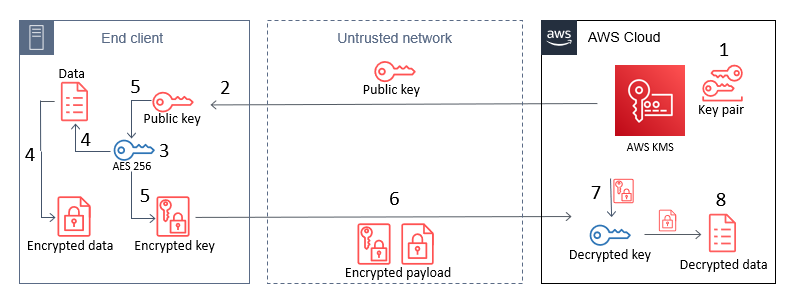
This blog post discusses how you can use AWS Key Management Service (AWS KMS) RSA public keys on end clients or devices and encrypt data, then subsequently decrypt data by using private keys that are secured in AWS KMS.

Asymmetric cryptography is a cryptographic system that uses key pairs. Each pair consists of a public key, which can be seen or accessed by anyone, and a private key, which can be accessed only by authorized people. This system has a useful property, which is that anything encrypted with a public key can only be decrypted by the corresponding private key. A popular method for generating key pairs and encrypting data is the RSA algorithm and cryptosystem.

For RSA key pairs, calculating the private key from the public key is seen as computationally infeasible, and therefore RSA key pairs can be used for both authentication and encryption. The features of asymmetric encryption allow separated parties to share information across an untrusted domain, such as the internet, without having to pre-share any other secrets. However, this type of encryption poses an issue of keeping the private key secure, because the private key has the power to decrypt all messages that are transmitted by a large number of end users.

AWS KMS provides simple APIs that you can use to securely generate, store, and manage keys, including RSA key pairs inside hardware security modules (HSMs). Key pairs are generated within FIPS 140-2 validated HSMs that are managed by AWS. You can then use these private keys through APIs to do actions such as decrypt ciphertexts, meaning that plaintext private keys never leave the HSM, which provides assurances of privacy for the private key. Additional APIs allow a customer to retrieve a plaintext copy of the corresponding public key, which allows disconnected or offline uses of RSA public keys.

Limits of asymmetric cryptography

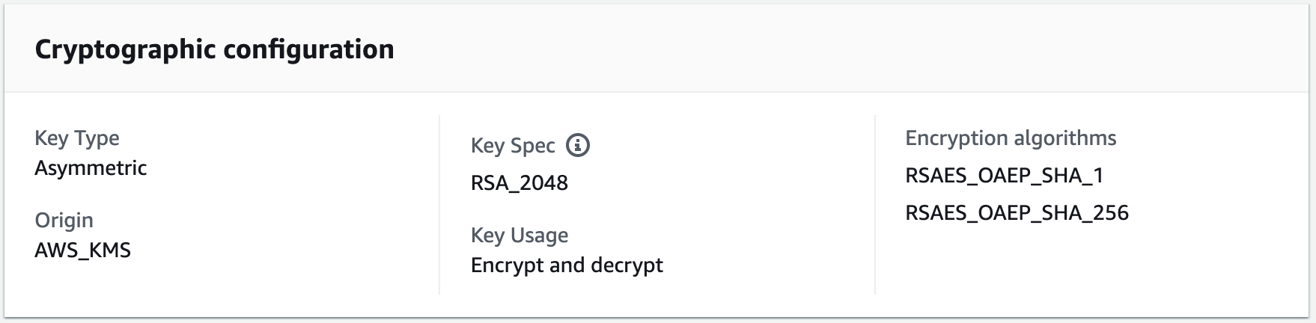
A key drawback to asymmetric cryptography is the fact that you cannot encrypt large pieces of data. When you have a 2048-bit RSA key pair and encrypt something by using the cipher RSAES_OASEP_SHA_256, the largest amount of data that you can encrypt is 190 bytes.

In contrast, symmetric encryption ciphers that use a chained or counter-mode operation don’t have this limit, and they make it possible for you to encrypt data in the tens-of-gigabytes. Symmetric encryption algorithms such as the Advanced Encryption Standard (AES) also benefit from faster data encryption speeds due to smaller key sizes and less complex operations that can be built into hardware.

By combining these two algorithms in a hybrid cryptosystem, you give end clients with a public key the ability to encrypt large pieces of information. A client generates a random 256-bit AES key, which should be from a secure source such as /dev/urandom or a dedicated embedded chip. The client then encrypts its large payload by using a mode of operation such as AES-GCM or AES-CBC by using that 256-bit AES key. Next, the client encrypts that 256-bit AES key by using the RSA public key (see step 5 in Figure 1). End clients then transmit only encrypted data across insecure channels, maintaining privacy of the payload data.

A challenge that customers often face is that they want to use AWS KMS for its security properties, but also want to access their KMS keys from devices that don’t have AWS credentials embedded within them. Without AWS credentials, a device can’t call AWS APIs. This blog post shows how you can use a hybrid cryptosystem where RSA public keys can be downloaded or embedded into devices to overcome this challenge.

Prerequisites and initial considerations

This walkthrough assumes that you have some understanding of RSA ciphers and symmetric encryption schemes such as AES. The walkthrough uses OpenSSL for demonstration of the encryption process, but similar libraries can be used on a client-side device.

The walkthrough also assumes that you have an AWS Identity and Access Management (IAM) user with permissions to the AWS KMS service, and the AWS Command Line Interface (AWS CLI) installed with the relevant credentials.

When you create a KMS key, you will also generate a key policy that defines access to it. The default key policy allows all users in your account with AWS KMS actions in their IAM policies to access the KMS key. The key policy for a given KMS key is the primary method for determining access.

Important: You will incur charges for the services used in this example. You can find the cost of each service on the corresponding service pricing page. For more information, see AWS KMS Pricing.

Architectural overview

This post contains procedures for completing the following operations, which are also shown in Figure 1:

  1. Create an RSA key pair in AWS KMS.
  2. Download or pre-install the AWS KMS public key to an end-client device.
  3. Generate an AES 256-bit key on an end client.
  4. Encrypt a large payload of data on the end client by using the AES 256-bit key.
  5. Encrypt the AES 256-bit key with the AWS KMS public key.
  6. Transfer the encrypted payload and key.
  7. Decrypt the AES 256-bit key by using AWS KMS.
  8. Decrypt the payload data by using the now-shared AES 256-bit key.
Figure 1: The steps for hybrid encryption

Figure 1: The steps for hybrid encryption

This diagram shows an end client device, an untrusted network such as a cellular network, and the AWS Cloud. An RSA key pair is generated in AWS KMS, and then the public key can either be embedded in the end client, or pulled by the end client through HTTP(S) or other remote means. In all circumstances, only the public key persists on the end client, which means that no secrets are stored on the device.

How you host the public key on your end clients depends on what network access they have. For example, an embedded Internet of Things (IoT) device for mining vehicles might never connect to the internet, but could communicate with a central system through a private 5G network. In this circumstance, you would host this public key within that network for retrieval. For other disconnected IoT devices that can connect to the internet, such as smart-home appliances, you might want to host the public key on a web server at a predefined URL or through an API.

Note: Whenever you vend public keys over an untrusted channel, such as when you vend the public key through an API, you should make sure that the key can be verified in some way to confirm that it hasn’t been tampered with. This is typically done by vending keys over an HTTPS connection, where the integrity of the keys is provided by the X.509 certificate that was used in the TLS connection. The X.509 certificate also verifies an association with the key-pair owner, typically by domain name.

Implement the solution

The following steps can be used as a proof-of-concept to guide you through implementing a hybrid-cryptosystem by using a KMS public key on an example device.

Create keys in AWS KMS

In the first step of this solution, you create an RSA asymmetric key pair in AWS KMS (step 1 in the architectural overview). With AWS KMS, you can create key pairs in a variety of dimensions according to your security requirements or standards. For more information, see Choosing a KMS key type in the AWS KMS documentation.

To create a key pair in AWS KMS, use the CreateKey API. For this example, you will create an RSA key pair with RSA_2048 for the CustomerMasterKeySpec parameter and ENCRYPT_DECRYPT for the KeyUsage parameter in the AWS CLI. This post uses 2048-bit keys, but note that AWS KMS allows larger key sizes. The CLI will return a KeyId value that uniquely identifies the KMS key in your account, which you should take note of.

To create a KMS key by using the CLI

  • Enter the following command in the AWS CLI.
    aws kms create-key --key-spec RSA_2048 \
        --key-usage ENCRYPT_DECRYPT \
        --description "Example RSA Encryption Key Pair"

You can follow the Creating asymmetric KMS keys documentation to see how to use the AWS Management Console to create a KMS key pair with the same properties as shown here.

Note: When a KMS key is created, it will be logged by AWS CloudTrail, a service that monitors and records activity within your account. All API calls to the AWS KMS service are logged in CloudTrail, which you can use to audit access to KMS keys.

To allow your KMS key to be identified by a human-readable string rather than KeyId, you can assign an alias for the KMS key (replace the target-key-id value of <1234abcd-12ab-34cd-56ef-1234567890ab> with your KeyId). This makes it easier to use and manage.

To create a KMS key alias for your key by using the CLI

  • Enter the following command in the AWS CLI.
    aws kms create-alias \
        --alias-name alias/example-rsa-key \
        --target-key-id <1234abcd-12ab-34cd-56ef-1234567890ab>
    

Download the public key from AWS KMS

A benefit of asymmetric encryption is that you can distribute a public key to a large, untrusted network, and the public key can only be used for encryption. Decryption of those messages can only be conducted by the corresponding private key. You can use the AWS KMS Encrypt API to encrypt data with a KMS key pair (specifically the public key). However, because the AWS APIs are authenticated by using a signature, you must have access to AWS credentials to use these APIs, which you might not want to do on untrusted devices. Additionally, in a private 5G network, you might not have the capability to call the AWS KMS API endpoints from the end clients. Instead, you can download the public key from a local source or embed that into the end client at the time of manufacture.

To retrieve a copy of the public key from your AWS KMS key pair, you can use the GetPublicKey API. The following example shows how to use this with the AWS CLI command get-public-key and reference the key alias you set earlier.

To view the public key for your KMS key pair by using the CLI

  • Enter the following command in the AWS CLI.
    aws kms get-public-key --key-id alias/example-rsa-key

The return value from this API will contain several elements, including the PublicKey. The returned PublicKey value is the DER-encoded X.509, and because you’re using the AWS CLI, it is base64-encoded for readability purposes. By using the AWS CLI, you can query just the PublicKey return value, base64-decode it, and then save the key to a file on disk, as follows.

To use the AWS CLI to query only the public key, then base64 decode it and output it to a file

  • Enter the following command in the AWS CLI.
    aws kms get-public-key \
    --key-id alias/example-rsa-key \ 
    --output text \ 
    --query PublicKey | base64 -–decode > public_key.der

In this example, the local machine where you saved the public_key.der file will now represent the end-client device.

Note: If you call this API by using one of the AWS SDKs, such as boto3, then the PublicKey value is not base64-encoded.

Create an AES 256-bit symmetric key on the end client

Although the end client now has a copy of the public key from the associated KMS private key, the public key can’t be used for encrypting data that you plan on transmitting, due to the size limits on data that can be encrypted. Instead, you can use symmetric encryption. Typically, symmetric keys are smaller than asymmetric keys, the ciphers are faster when encrypting data, and the resulting ciphertext is similar in size to the original data.

To generate a symmetric key, you should use a source of random entropy. Some operating systems offer block access to hardware-based sources of random numbers, such as /dev/hwrng. To provide an example process in this blog post, you will use the OpenSSL rand utility, which uses a cryptographically secure pseudo random generator (CSPRNG) seeded by /dev/urandom. In production systems, you might have stronger sources of entropy to rely on, or compliance requirements for random number generation. In hardware-constrained environments, you should take extra care to make sure that sources of entropy are cryptographically secure. The following command uses OpenSSL to create an AES 256-bit (32 bytes) key and base64-encode it, then save it to disk in plaintext as key.b64.

Note: Anyone with access to this file system will have access to this key.

To use the OpenSSL rand command to create a symmetric key and output it to a file

  • Enter the following command.
    openssl rand -base64 32 > key.b64

Encrypt the data to be sent from the end client

Now that you have two different key types on the end client, you can use a hybrid cryptosystem to encrypt a large text file. First, you will generate a sample file to encrypt on your system. By outputting some bytes from /dev/urandom, you can create this file to the size you want. The following command outputs 200 random bytes, base64-encodes the file, and writes that to disk in a file called encrypt.me.

To generate a sample file from random data, which will be encrypted later

  • Enter the following command.
    head -c 200 /dev/urandom | base64 –-wrap=0 > encrypt.me

Next, you will encrypt the newly created file with the AES 256-bit key that you created earlier (which is base64-encoded). By using the OpenSSL command line, you will encrypt the file on disk and create a new file called encrypt.me.enc.

Note: For demonstration purposes, this solution uses OpenSSL to complete the encryption process. However, the command line OpenSSL enc utility doesn’t allow the cipher aes-256-gcm. Galois Counter Mode (GCM) is recommended when encrypting and sending data, because it includes authentication, so that that the ciphertext can’t be tampered with in transit. Instead, for this demonstration, you will use aes-256-cbc, which is not authenticated.

To use the OpenSSL enc command to encrypt your sample file with a symmetric key

  • • Enter the following command.
    openssl enc -aes-256-cbc \
    -in encrypt.me -out encrypt.me.enc \
    -pass file:./key.b64

Encrypt the AES 256-bit key

So that the data can be decrypted again, you will need to share the same AES 256-bit key with the recipient. To share that with only the person who can use the KMS private key that you created earlier, you can encrypt the symmetric key (key.b64) with the RSA public key that you retrieved earlier (public_key.der).

Again, you will use OpenSSL to see how this works and the required cipher options. When encrypting or decrypting with a KMS RSA key pair, you can use one of two encryption algorithms, either RSAES_OAEP_SHA_1 or RSAES_OAEP_SHA_256. These identify the cipher suites used in encryption that are currently supported by AWS KMS for encryption.

To use the OpenSSL pkeyutl command to encrypt your symmetric key with your local copy of your KMS public key

  • Enter the following command.
    openssl pkeyutl \
    	-in key.b64 -out key.b64.enc \
    	-inkey public_key.der -keyform DER -pubin -encrypt \
    	-pkeyopt rsa_padding_mode:oaep -pkeyopt rsa_oaep_md:sha256

This command creates a new file on disk called key.b64.enc. This file is the encrypted AES 256-bit key, which can now be transported securely across an insecure network, such as the internet. The last two options in the command define the padding mode used (OAEP) and the length of the message digest (SHA-256), which align with the options available to decrypt when you use the AWS KMS APIs.

Note: You should securely delete both the original payload file (encrypt.me) and the plaintext AES 256-bit key (key.b64) if you want to prevent anyone else from accessing these files. At this point, you will have three files on disk: public_key.der, encrypt.me.enc, and key.b64.enc. If you want to verify the decryption process later in this example, keep these files.

In production, you might never write any of these values to disk. Instead, you can keep all values in memory and only write the encrypted data (ciphertext) to disk, clearing memory after that process has completed.

You can now use the method of your choice to transfer the encrypted files across an unsecured network without compromising the privacy of those files. For smart-home appliance use cases, you can upload the encrypted files in Amazon Simple Storage Service (Amazon S3), a highly durable storage system that can be accessed from the internet, keeping in mind the preventative security practices that AWS recommends. Later, another service can pull these files from S3, and with the correct permissions for the KMS key, can decrypt the files by using the AWS KMS Decrypt API.

Decrypt the files

With access to the decrypt operation for the KMS key and the encrypted files, you can now retrieve the plaintext data file again. To do this, you will replicate the preceding steps, but in reverse. This involves decrypting the AWS 256-bit key by using the AWS KMS API, and then using that result to decrypt the encrypted data. You will need access to the AWS KMS API to complete these actions, because the private key exists in plaintext only within the AWS KMS HSMs.

To decrypt the files

  1. The first step is to decrypt the AWS 256-bit key. You will need to use the AWS CLI to submit the key.b64.enc file to the AWS KMS API, and specify the algorithm you used to encrypt the file (RSAES_OAEP_SHA_256). Use the following command to retrieve the AES 256-bit key in plaintext. Again, you’re using the –query selector to output only the plaintext, and then decode the base64 value.
    aws kms decrypt --key-id alias/example-rsa-key \ 
    		--ciphertext-blob fileb://key.b64.enc \
    		--encryption-algorithm RSAES_OAEP_SHA_256 --output text \
    		--query 'Plaintext' | base64 --decode > decrypted_key.b64

  2. The final step in decrypting the data is to reverse the CBC encryption process you used in OpenSSL. If another mode of symmetric encryption was used, such as AES-GCM, then you would need to decrypt by using that algorithm and the input AES 256-bit key. Use the following OpenSSL command to retrieve the original plaintext payload.
    openssl enc -d -aes-256-cbc \
    		-in encrypt.me.enc -out decrypted.file \
    		-pass file:./decrypted_key.b64

Conclusion

In this post, you learned how to combine AWS KMS asymmetric key pairs with locally created symmetric keys to encrypt and share data that exceeds 190 bytes, without storing a secret on a client device. By taking advantage of the RSA cryptosystem for offline encryption, you can reduce the exposure of plaintext data or secrets to devices outside of your control, and without having to complete complex key exchanges. By using the steps in this solution, you can more securely share large amounts of data, such as update files or configuration settings. To learn more about the asymmetric keys feature of AWS KMS, refer to the AWS KMS Developer Guide. If you have questions about the asymmetric keys feature, interact with us through AWS re:Post.

 
If you have feedback about this post, submit comments in the Comments section below. If you have questions about this post, contact AWS Support.

Want more AWS Security news? Follow us on Twitter.

Patrick Palmer

Patrick is a security solutions architect at AWS. He has a passion for learning new technologies and cryptography across AWS services and having deep conversations with customers. He works on a team of security specialists who strive to continually delight customers. Outside of work, he spends time with his wife and two cats, occasionally playing video games when he can.

Breaking RSA through Insufficiently Random Primes

Post Syndicated from Bruce Schneier original https://www.schneier.com/blog/archives/2022/03/breaking-rsa-through-insufficiently-random-primes.html

Basically, the SafeZone library doesn’t sufficiently randomize the two prime numbers it used to generate RSA keys. They’re too close to each other, which makes them vulnerable to recovery.

There aren’t many weak keys out there, but there are some:

So far, Böck has identified only a handful of keys in the wild that are vulnerable to the factorization attack. Some of the keys are from printers from two manufacturers, Canon and Fujifilm (originally branded as Fuji Xerox). Printer users can use the keys to generate a Certificate Signing Request. The creation date for the all the weak keys was 2020 or later. The weak Canon keys are tracked as CVE-2022-26351.

Böck also found four vulnerable PGP keys, typically used to encrypt email, on SKS PGP key servers. A user ID tied to the keys implied they were created for testing, so he doesn’t believe they’re in active use.

No, RSA Is Not Broken

Post Syndicated from Bruce Schneier original https://www.schneier.com/blog/archives/2021/03/no-rsa-is-not-broken.html

I have been seeing this paper by cryptographer Peter Schnorr making the rounds: “Fast Factoring Integers by SVP Algorithms.” It describes a new factoring method, and its abstract ends with the provocative sentence: “This destroys the RSA cryptosystem.”

It does not. At best, it’s an improvement in factoring — and I’m not sure it’s even that. The paper is a preprint: it hasn’t been peer reviewed. Be careful taking its claims at face value.

Some discussion here.

I’ll append more analysis links to this post when I find them.

How to protect sensitive data for its entire lifecycle in AWS

Post Syndicated from Raj Jain original https://aws.amazon.com/blogs/security/how-to-protect-sensitive-data-for-its-entire-lifecycle-in-aws/

Many Amazon Web Services (AWS) customer workflows require ingesting sensitive and regulated data such as Payments Card Industry (PCI) data, personally identifiable information (PII), and protected health information (PHI). In this post, I’ll show you a method designed to protect sensitive data for its entire lifecycle in AWS. This method can help enhance your data security posture and be useful for fulfilling the data privacy regulatory requirements applicable to your organization for data protection at-rest, in-transit, and in-use.

An existing method for sensitive data protection in AWS is to use the field-level encryption feature offered by Amazon CloudFront. This CloudFront feature protects sensitive data fields in requests at the AWS network edge. The chosen fields are protected upon ingestion and remain protected throughout the entire application stack. The notion of protecting sensitive data early in its lifecycle in AWS is a highly desirable security architecture. However, CloudFront can protect a maximum of 10 fields and only within HTTP(S) POST requests that carry HTML form encoded payloads.

If your requirements exceed CloudFront’s native field-level encryption feature, such as a need to handle diverse application payload formats, different HTTP methods, and more than 10 sensitive fields, you can implement field-level encryption yourself using the Lambda@Edge feature in CloudFront. In terms of choosing an appropriate encryption scheme, this problem calls for an asymmetric cryptographic system that will allow public keys to be openly distributed to the CloudFront network edges while keeping the corresponding private keys stored securely within the network core. One such popular asymmetric cryptographic system is RSA. Accordingly, we’ll implement a Lambda@Edge function that uses asymmetric encryption using the RSA cryptosystem to protect an arbitrary number of fields in any HTTP(S) request. We will discuss the solution using an example JSON payload, although this approach can be applied to any payload format.

A complex part of any encryption solution is key management. To address that, I use AWS Key Management Service (AWS KMS). AWS KMS simplifies the solution and offers improved security posture and operational benefits, detailed later.

Solution overview

You can protect data in-transit over individual communications channels using transport layer security (TLS), and at-rest in individual storage silos using volume encryption, object encryption or database table encryption. However, if you have sensitive workloads, you might need additional protection that can follow the data as it moves through the application stack. Fine-grained data protection techniques such as field-level encryption allow for the protection of sensitive data fields in larger application payloads while leaving non-sensitive fields in plaintext. This approach lets an application perform business functions on non-sensitive fields without the overhead of encryption, and allows fine-grained control over what fields can be accessed by what parts of the application.

A best practice for protecting sensitive data is to reduce its exposure in the clear throughout its lifecycle. This means protecting data as early as possible on ingestion and ensuring that only authorized users and applications can access the data only when and as needed. CloudFront, when combined with the flexibility provided by Lambda@Edge, provides an appropriate environment at the edge of the AWS network to protect sensitive data upon ingestion in AWS.

Since the downstream systems don’t have access to sensitive data, data exposure is reduced, which helps to minimize your compliance footprint for auditing purposes.

The number of sensitive data elements that may need field-level encryption depends on your requirements. For example:

  • For healthcare applications, HIPAA regulates 18 personal data elements.
  • In California, the California Consumer Privacy Act (CCPA) regulates at least 11 categories of personal information—each with its own set of data elements.

The idea behind field-level encryption is to protect sensitive data fields individually, while retaining the structure of the application payload. The alternative is full payload encryption, where the entire application payload is encrypted as a binary blob, which makes it unusable until the entirety of it is decrypted. With field-level encryption, the non-sensitive data left in plaintext remains usable for ordinary business functions. When retrofitting data protection in existing applications, this approach can reduce the risk of application malfunction since the data format is maintained.

The following figure shows how PII data fields in a JSON construction that are deemed sensitive by an application can be transformed from plaintext to ciphertext with a field-level encryption mechanism.

Figure 1: Example of field-level encryption

Figure 1: Example of field-level encryption

You can change plaintext to ciphertext as depicted in Figure 1 by using a Lambda@Edge function to perform field-level encryption. I discuss the encryption and decryption processes separately in the following sections.

Field-level encryption process

Let’s discuss the individual steps involved in the encryption process as shown in Figure 2.

Figure 2: Field-level encryption process

Figure 2: Field-level encryption process

Figure 2 shows CloudFront invoking a Lambda@Edge function while processing a client request. CloudFront offers multiple integration points for invoking Lambda@Edge functions. Since you are processing a client request and your encryption behavior is related to requests being forwarded to an origin server, you want your function to run upon the origin request event in CloudFront. The origin request event represents an internal state transition in CloudFront that happens immediately before CloudFront forwards a request to the downstream origin server.

You can associate your Lambda@Edge with CloudFront as described in Adding Triggers by Using the CloudFront Console. A screenshot of the CloudFront console is shown in Figure 3. The selected event type is Origin Request and the Include Body check box is selected so that the request body is conveyed to Lambda@Edge.

Figure 3: Configuration of Lambda@Edge in CloudFront

Figure 3: Configuration of Lambda@Edge in CloudFront

The Lambda@Edge function acts as a programmable hook in the CloudFront request processing flow. You can use the function to replace the incoming request body with a request body with the sensitive data fields encrypted.

The process includes the following steps:

Step 1 – RSA key generation and inclusion in Lambda@Edge

You can generate an RSA customer managed key (CMK) in AWS KMS as described in Creating asymmetric CMKs. This is done at system configuration time.

Note: You can use your existing RSA key pairs or generate new ones externally by using OpenSSL commands, especially if you need to perform RSA decryption and key management independently of AWS KMS. Your choice won’t affect the fundamental encryption design pattern presented here.

The RSA key creation in AWS KMS requires two inputs: key length and type of usage. In this example, I created a 2048-bit key and assigned its use for encryption and decryption. The cryptographic configuration of an RSA CMK created in AWS KMS is shown in Figure 4.

Figure 4: Cryptographic properties of an RSA key managed by AWS KMS

Figure 4: Cryptographic properties of an RSA key managed by AWS KMS

Of the two encryption algorithms shown in Figure 4— RSAES_OAEP_SHA_256 and RSAES_OAEP_SHA_1, this example uses RSAES_OAEP_SHA_256. The combination of a 2048-bit key and the RSAES_OAEP_SHA_256 algorithm lets you encrypt a maximum of 190 bytes of data, which is enough for most PII fields. You can choose a different key length and encryption algorithm depending on your security and performance requirements. How to choose your CMK configuration includes information about RSA key specs for encryption and decryption.

Using AWS KMS for RSA key management versus managing the keys yourself eliminates that complexity and can help you:

  • Enforce IAM and key policies that describe administrative and usage permissions for keys.
  • Manage cross-account access for keys.
  • Monitor and alarm on key operations through Amazon CloudWatch.
  • Audit AWS KMS API invocations through AWS CloudTrail.
  • Record configuration changes to keys and enforce key specification compliance through AWS Config.
  • Generate high-entropy keys in an AWS KMS hardware security module (HSM) as required by NIST.
  • Store RSA private keys securely, without the ability to export.
  • Perform RSA decryption within AWS KMS without exposing private keys to application code.
  • Categorize and report on keys with key tags for cost allocation.
  • Disable keys and schedule their deletion.

You need to extract the RSA public key from AWS KMS so you can include it in the AWS Lambda deployment package. You can do this from the AWS Management Console, through the AWS KMS SDK, or by using the get-public-key command in the AWS Command Line Interface (AWS CLI). Figure 5 shows Copy and Download options for a public key in the Public key tab of the AWS KMS console.

Figure 5: RSA public key available for copy or download in the console

Figure 5: RSA public key available for copy or download in the console

Note: As we will see in the sample code in step 3, we embed the public key in the Lambda@Edge deployment package. This is a permissible practice because public keys in asymmetric cryptography systems aren’t a secret and can be freely distributed to entities that need to perform encryption. Alternatively, you can use Lambda@Edge to query AWS KMS for the public key at runtime. However, this introduces latency, increases the load against your KMS account quota, and increases your AWS costs. General patterns for using external data in Lambda@Edge are described in Leveraging external data in Lambda@Edge.

Step 2 – HTTP API request handling by CloudFront

CloudFront receives an HTTP(S) request from a client. CloudFront then invokes Lambda@Edge during origin-request processing and includes the HTTP request body in the invocation.

Step 3 – Lambda@Edge processing

The Lambda@Edge function processes the HTTP request body. The function extracts sensitive data fields and performs RSA encryption over their values.

The following code is sample source code for the Lambda@Edge function implemented in Python 3.7:

import Crypto
import base64
import json
from Crypto.Cipher import PKCS1_OAEP
from Crypto.PublicKey import RSA

# PEM-formatted RSA public key copied over from AWS KMS or your own public key.
RSA_PUBLIC_KEY = "-----BEGIN PUBLIC KEY-----<your key>-----END PUBLIC KEY-----"
RSA_PUBLIC_KEY_OBJ = RSA.importKey(RSA_PUBLIC_KEY)
RSA_CIPHER_OBJ = PKCS1_OAEP.new(RSA_PUBLIC_KEY_OBJ, Crypto.Hash.SHA256)

# Example sensitive data field names in a JSON object. 
PII_SENSITIVE_FIELD_NAMES = ["fname", "lname", "email", "ssn", "dob", "phone"]

CIPHERTEXT_PREFIX = "#01#"
CIPHERTEXT_SUFFIX = "#10#"

def lambda_handler(event, context):
    # Extract HTTP request and its body as per documentation:
    # https://docs.aws.amazon.com/AmazonCloudFront/latest/DeveloperGuide/lambda-event-structure.html
    http_request = event['Records'][0]['cf']['request']
    body = http_request['body']
    org_body = base64.b64decode(body['data'])
    mod_body = protect_sensitive_fields_json(org_body)
    body['action'] = 'replace'
    body['encoding'] = 'text'
    body['data'] = mod_body
    return http_request


def protect_sensitive_fields_json(body):
    # Encrypts sensitive fields in sample JSON payload shown earlier in this post.
    # [{"fname": "Alejandro", "lname": "Rosalez", … }]
    person_list = json.loads(body.decode("utf-8"))
    for person_data in person_list:
        for field_name in PII_SENSITIVE_FIELD_NAMES:
            if field_name not in person_data:
                continue
            plaintext = person_data[field_name]
            ciphertext = RSA_CIPHER_OBJ.encrypt(bytes(plaintext, 'utf-8'))
            ciphertext_b64 = base64.b64encode(ciphertext).decode()
            # Optionally, add unique prefix/suffix patterns to ciphertext
            person_data[field_name] = CIPHERTEXT_PREFIX + ciphertext_b64 + CIPHERTEXT_SUFFIX 
    return json.dumps(person_list)

The event structure passed into the Lambda@Edge function is described in Lambda@Edge Event Structure. Following the event structure, you can extract the HTTP request body. In this example, the assumption is that the HTTP payload carries a JSON document based on a particular schema defined as part of the API contract. The input JSON document is parsed by the function, converting it into a Python dictionary. The Python native dictionary operators are then used to extract the sensitive field values.

Note: If you don’t know your API payload structure ahead of time or you’re dealing with unstructured payloads, you can use techniques such as regular expression pattern searches and checksums to look for patterns of sensitive data and target them accordingly. For example, credit card primary account numbers include a Luhn checksum that can be programmatically detected. Additionally, services such as Amazon Comprehend and Amazon Macie can be leveraged for detecting sensitive data such as PII in application payloads.

While iterating over the sensitive fields, individual field values are encrypted using the standard RSA encryption implementation available in the Python Cryptography Toolkit (PyCrypto). The PyCrypto module is included within the Lambda@Edge zip archive as described in Lambda@Edge deployment package.

The example uses the standard optimal asymmetric encryption padding (OAEP) and SHA-256 encryption algorithm properties. These properties are supported by AWS KMS and will allow RSA ciphertext produced here to be decrypted by AWS KMS later.

Note: You may have noticed in the code above that we’re bracketing the ciphertexts with predefined prefix and suffix strings:

person_data[field_name] = CIPHERTEXT_PREFIX + ciphertext_b64 + CIPHERTEXT_SUFFIX

This is an optional measure and is being implemented to simplify the decryption process.

The prefix and suffix strings help demarcate ciphertext embedded in unstructured data in downstream processing and also act as embedded metadata. Unique prefix and suffix strings allow you to extract ciphertext through string or regular expression (regex) searches during the decryption process without having to know the data body format or schema, or the field names that were encrypted.

Distinct strings can also serve as indirect identifiers of RSA key pair identifiers. This can enable key rotation and allow separate keys to be used for separate fields depending on the data security requirements for individual fields.

You can ensure that the prefix and suffix strings can’t collide with the ciphertext by bracketing them with characters that don’t appear in cyphertext. For example, a hash (#) character cannot be part of a base64 encoded ciphertext string.

Deploying a Lambda function as a Lambda@Edge function requires specific IAM permissions and an IAM execution role. Follow the Lambda@Edge deployment instructions in Setting IAM Permissions and Roles for Lambda@Edge.

Step 4 – Lambda@Edge response

The Lambda@Edge function returns the modified HTTP body back to CloudFront and instructs it to replace the original HTTP body with the modified one by setting the following flag:

http_request['body']['action'] = 'replace'

Step 5 – Forward the request to the origin server

CloudFront forwards the modified request body provided by Lambda@Edge to the origin server. In this example, the origin server writes the data body to persistent storage for later processing.

Field-level decryption process

An application that’s authorized to access sensitive data for a business function can decrypt that data. An example decryption process is shown in Figure 6. The figure shows a Lambda function as an example compute environment for invoking AWS KMS for decryption. This functionality isn’t dependent on Lambda and can be performed in any compute environment that has access to AWS KMS.

Figure 6: Field-level decryption process

Figure 6: Field-level decryption process

The steps of the process shown in Figure 6 are described below.

Step 1 – Application retrieves the field-level encrypted data

The example application retrieves the field-level encrypted data from persistent storage that had been previously written during the data ingestion process.

Step 2 – Application invokes the decryption Lambda function

The application invokes a Lambda function responsible for performing field-level decryption, sending the retrieved data to Lambda.

Step 3 – Lambda calls the AWS KMS decryption API

The Lambda function uses AWS KMS for RSA decryption. The example calls the KMS decryption API that inputs ciphertext and returns plaintext. The actual decryption happens in KMS; the RSA private key is never exposed to the application, which is a highly desirable characteristic for building secure applications.

Note: If you choose to use an external key pair, then you can securely store the RSA private key in AWS services like AWS Systems Manager Parameter Store or AWS Secrets Manager and control access to the key through IAM and resource policies. You can fetch the key from relevant vault using the vault’s API, then decrypt using the standard RSA implementation available in your programming language. For example, the cryptography toolkit in Python or javax.crypto in Java.

The Lambda function Python code for decryption is shown below.

import base64
import boto3
import re

kms_client = boto3.client('kms')
CIPHERTEXT_PREFIX = "#01#"
CIPHERTEXT_SUFFIX = "#10#"

# This lambda function extracts event body, searches for and decrypts ciphertext 
# fields surrounded by provided prefix and suffix strings in arbitrary text bodies 
# and substitutes plaintext fields in-place.  
def lambda_handler(event, context):    
    org_data = event["body"]
    mod_data = unprotect_fields(org_data, CIPHERTEXT_PREFIX, CIPHERTEXT_SUFFIX)
    return mod_data

# Helper function that performs non-greedy regex search for ciphertext strings on
# input data and performs RSA decryption of them using AWS KMS 
def unprotect_fields(org_data, prefix, suffix):
    regex_pattern = prefix + "(.*?)" + suffix
    mod_data_parts = []
    cursor = 0

    # Search ciphertexts iteratively using python regular expression module
    for match in re.finditer(regex_pattern, org_data):
        mod_data_parts.append(org_data[cursor: match.start()])
        try:
            # Ciphertext was stored as Base64 encoded in our example. Decode it.
            ciphertext = base64.b64decode(match.group(1))

            # Decrypt ciphertext using AWS KMS  
            decrypt_rsp = kms_client.decrypt(
                EncryptionAlgorithm="RSAES_OAEP_SHA_256",
                KeyId="<Your-Key-ID>",
                CiphertextBlob=ciphertext)
            decrypted_val = decrypt_rsp["Plaintext"].decode("utf-8")
            mod_data_parts.append(decrypted_val)
        except Exception as e:
            print ("Exception: " + str(e))
            return None
        cursor = match.end()

    mod_data_parts.append(org_data[cursor:])
    return "".join(mod_data_parts)

The function performs a regular expression search in the input data body looking for ciphertext strings bracketed in predefined prefix and suffix strings that were added during encryption.

While iterating over ciphertext strings one-by-one, the function calls the AWS KMS decrypt() API. The example function uses the same RSA encryption algorithm properties—OAEP and SHA-256—and the Key ID of the public key that was used during encryption in Lambda@Edge.

Note that the Key ID itself is not a secret. Any application can be configured with it, but that doesn’t mean any application will be able to perform decryption. The security control here is that the AWS KMS key policy must allow the caller to use the Key ID to perform the decryption. An additional security control is provided by Lambda execution role that should allow calling the KMS decrypt() API.

Step 4 – AWS KMS decrypts ciphertext and returns plaintext

To ensure that only authorized users can perform decrypt operation, the KMS is configured as described in Using key policies in AWS KMS. In addition, the Lambda IAM execution role is configured as described in AWS Lambda execution role to allow it to access KMS. If both the key policy and IAM policy conditions are met, KMS returns the decrypted plaintext. Lambda substitutes the plaintext in place of ciphertext in the encapsulating data body.

Steps three and four are repeated for each ciphertext string.

Step 5 – Lambda returns decrypted data body

Once all the ciphertext has been converted to plaintext and substituted in the larger data body, the Lambda function returns the modified data body to the client application.

Conclusion

In this post, I demonstrated how you can implement field-level encryption integrated with AWS KMS to help protect sensitive data workloads for their entire lifecycle in AWS. Since your Lambda@Edge is designed to protect data at the network edge, data remains protected throughout the application execution stack. In addition to improving your data security posture, this protection can help you comply with data privacy regulations applicable to your organization.

Since you author your own Lambda@Edge function to perform standard RSA encryption, you have flexibility in terms of payload formats and the number of fields that you consider to be sensitive. The integration with AWS KMS for RSA key management and decryption provides significant simplicity, higher key security, and rich integration with other AWS security services enabling an overall strong security solution.

By using encrypted fields with identifiers as described in this post, you can create fine-grained controls for data accessibility to meet the security principle of least privilege. Instead of granting either complete access or no access to data fields, you can ensure least privileges where a given part of an application can only access the fields that it needs, when it needs to, all the way down to controlling access field by field. Field by field access can be enabled by using different keys for different fields and controlling their respective policies.

In addition to protecting sensitive data workloads to meet regulatory and security best practices, this solution can be used to build de-identified data lakes in AWS. Sensitive data fields remain protected throughout their lifecycle, while non-sensitive data fields remain in the clear. This approach can allow analytics or other business functions to operate on data without exposing sensitive data.

If you have feedback about this post, submit comments in the Comments section below.

Want more AWS Security how-to content, news, and feature announcements? Follow us on Twitter.

Author

Raj Jain

Raj is a Senior Cloud Architect at AWS. He is passionate about helping customers build well-architected applications in AWS. Raj is a published author in Bell Labs Technical Journal, has authored 3 IETF standards, and holds 12 patents in internet telephony and applied cryptography. In his spare time, Raj enjoys outdoors, cooking, reading, and travel.

Brexit Deal Mandates Old Insecure Crypto Algorithms

Post Syndicated from Bruce Schneier original https://www.schneier.com/blog/archives/2020/12/brexit-deal-mandates-old-insecure-crypto-algorithms.html

In what is surely an unthinking cut-and-paste issue, page 921 of the Brexit deal mandates the use of SHA-1 and 1024-bit RSA:

The open standard s/MIME as extension to de facto e-mail standard SMTP will be deployed to encrypt messages containing DNA profile information. The protocol s/MIME (V3) allows signed receipts, security labels, and secure mailing lists… The underlying certificate used by s/MIME mechanism has to be in compliance with X.509 standard…. The processing rules for s/MIME encryption operations… are as follows:

  1. the sequence of the operations is: first encryption and then signing,
  2. the encryption algorithm AES (Advanced Encryption Standard) with 256 bit key length and RSA with 1,024 bit key length shall be applied for symmetric and asymmetric encryption respectively,
  3. the hash algorithm SHA-1 shall be applied.
  4. s/MIME functionality is built into the vast majority of modern e-mail software packages including Outlook, Mozilla Mail as well as Netscape Communicator 4.x and inter-operates among all major e-mail software packages.

And s/MIME? Bleah.

RSA Hacked – SecurID Information Exposed

Post Syndicated from David original http://devilsadvocatesecurity.blogspot.com/2011/03/rsa-hacked-securid-information-exposed.html

EMC’s RSA division announced that they had been hacked and it appears that they’re doing the right thing for their customers by telling them. From their announcement:

“Our investigation also revealed that the attack resulted in certain information being extracted from RSA’s systems. Some of that information is specifically related to RSA’s SecurID two-factor authentication products. While at this time we are confident that the information extracted does not enable a successful direct attack on any of our RSA SecurID customers, this information could potentially be used to reduce the effectiveness of a current two-factor authentication implementation as part of a broader attack.”

If you’re a current SecurID customer, you’ll likely want to keep track of this as further detail is released. RSA notes that they expect to release details to the community –

“As appropriate, we will share our experiences from these attacks with our customers, partners and the rest of the security vendor ecosystem and work in concert with these organizations to develop means to better protect all of us from these growing and ever more sophisticated forms of cyber security threat.”

I’ll post further detail as it becomes available.