Incus 6.7 released

Post Syndicated from corbet original https://lwn.net/Articles/998756/

Version 6.7 of the Incus container-management system (forked from LXD) has
been released. “This is another one of those pretty well rounded
releases with new features and improvements for everyone
“. New
features include automatic cluster rebalancing, DHCP improvements, and more.

Security updates for Tuesday

Post Syndicated from corbet original https://lwn.net/Articles/998755/

Security updates have been issued by AlmaLinux (.NET 9.0, bcc, bluez, bpftrace, bubblewrap, flatpak, buildah, cockpit, containernetworking-plugins, cups, cyrus-imapd, edk2, expat, firefox, fontforge, gnome-shell, gnome-shell-extensions, grafana, grafana-pcp, gtk3, httpd, iperf3, jose, krb5, libgcrypt, libsoup, libvirt, libvpx, lldpd, microcode_ctl, mingw-glib2, mod_auth_openidc, nano, NetworkManager, oci-seccomp-bpf-hook, openexr, osbuild-composer, pcp, podman, poppler, postfix, python-dns, python-jinja2, python-jwcrypto, python3.11, python3.11-PyMySQL, python3.11-urllib3, python3.12, python3.12-PyMySQL, python3.12-urllib3, python3.9, qemu-kvm, runc, skopeo, squid, thunderbird, toolbox, tpm2-tools, vim, webkit2gtk3, xorg-x11-server, and xorg-x11-server-Xwayland), Fedora (lemonldap-ng and mingw-expat), SUSE (bea-stax, xstream, expat, httpcomponents-client, httpcomponents-core, kernel, SUSE Manager Client Tools, SUSE Manager Proxy, Retail Branch Server 4.3, SUSE Manager Salt Bundle, SUSE Manager Server 4.3, and SUSE Manager Server 5.0), and Ubuntu (curl, glib2.0, and webkit2gtk).

Accelerate Mean Time to Exposure Remediation Across Hybrid Environments with Remediation Hub

Post Syndicated from Pauline Logan original https://blog.rapid7.com/2024/11/19/accelerate-mean-time-to-exposure-remediation-across-hybrid-environments-with-remediation-hub/

Accelerate Mean Time to Exposure Remediation Across Hybrid Environments with Remediation Hub

As organizations continue to scale their digital infrastructure, the volume of vulnerabilities and exposures grows at an overwhelming pace. Security teams often find themselves inundated with alerts and risk signals, unable to remediate every issue within their environment. They often struggle to keep pace with the dynamic nature of threats, and existing tools were not built to address the complexity of modern IT environments.

With limited time and resources, trying to address every potential vulnerability is not feasible. This reality has driven the need for prioritization—teams must focus on the vulnerabilities that present the highest risks to their organization, based on factors like attacker behaviors, real-world threat intelligence, and exploitability.

Meet Remediation Hub, Your New Home for Exposure Prioritization and Remediation

Accelerate Mean Time to Exposure Remediation Across Hybrid Environments with Remediation Hub

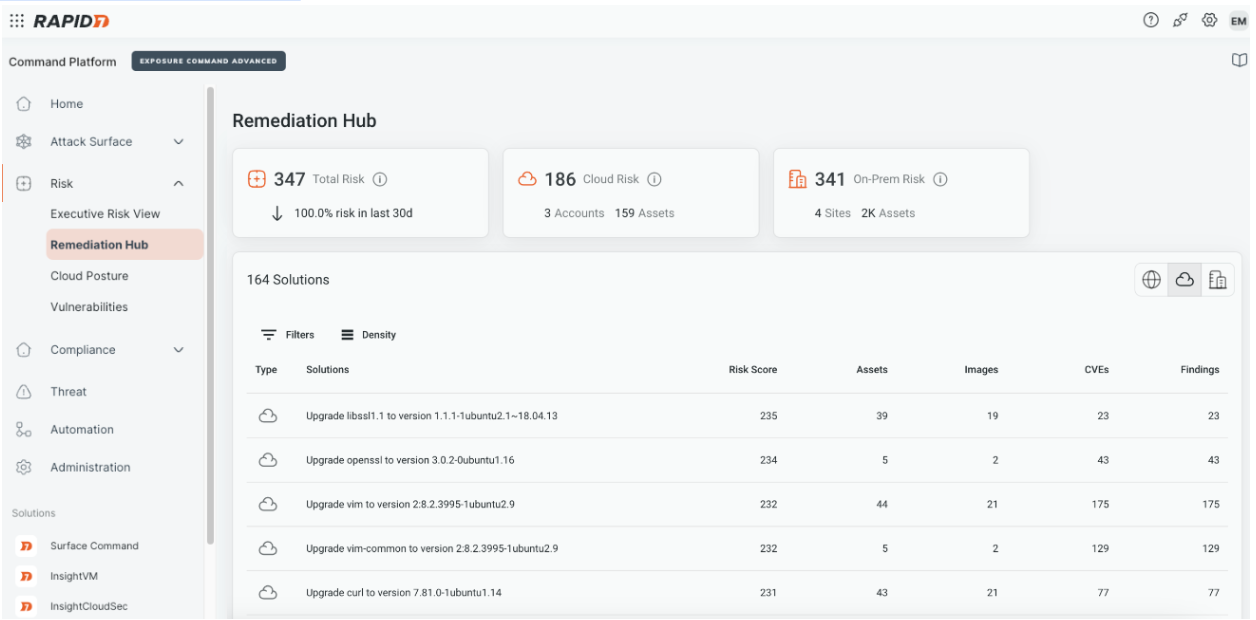
Rapid7’s Remediation Hub, our newest addition to the Exposure Command platform, is designed to address this exact challenge. Remediation Hub automatically prioritizes various risk signals across your hybrid environment and suggests the actions your team can take that would have the largest impact on reducing your overall risk posture.

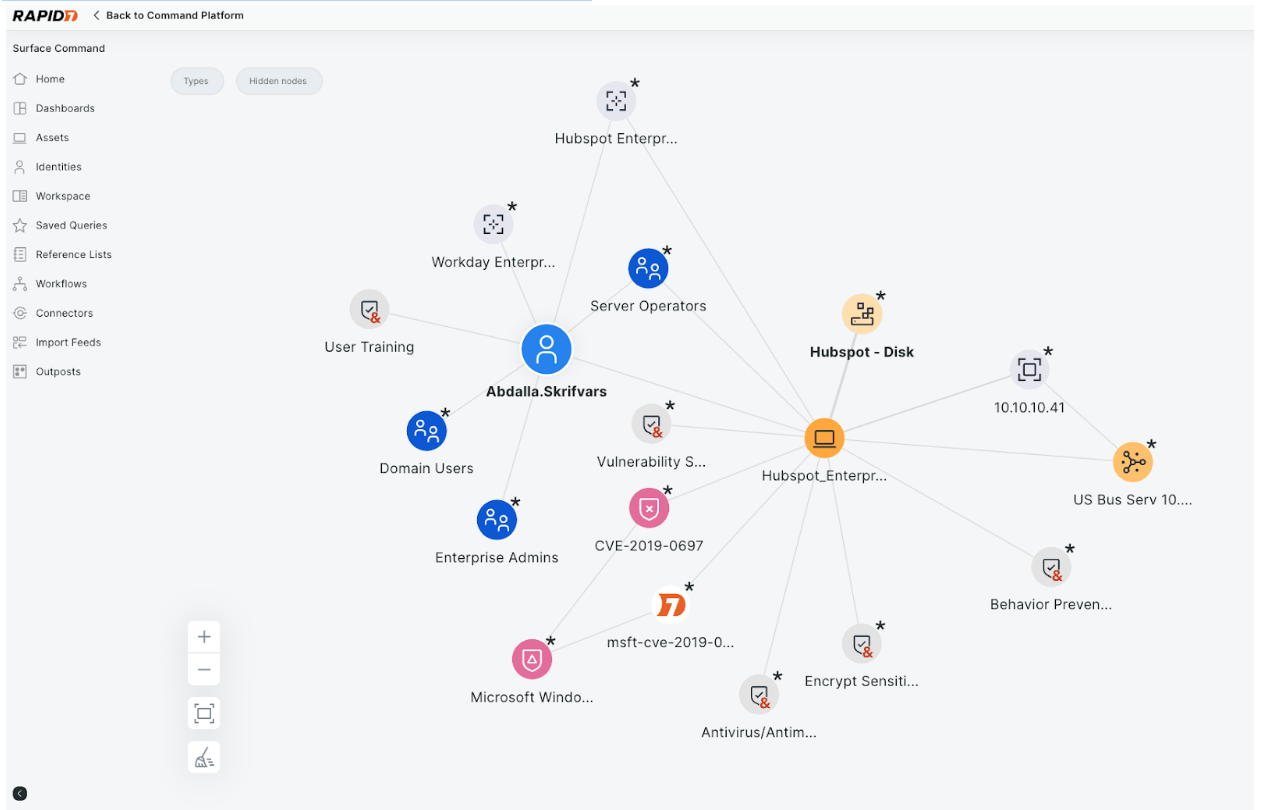
The solution leverages foundational visibility from Surface Command, which presents a comprehensive view of your attack surface, combining both external scanning and cyber asset management to provide a dynamic inventory and topology map of every asset across your environment. Underpinned by a powerful graph database, the platform allows teams to visualize the entire attack surface and understand the interconnected relationships between assets, ensuring that teams are guided to take action on the risks that are not only likely to be exploited but could also have the broadest blast radius.

Accelerate Mean Time to Exposure Remediation Across Hybrid Environments with Remediation Hub

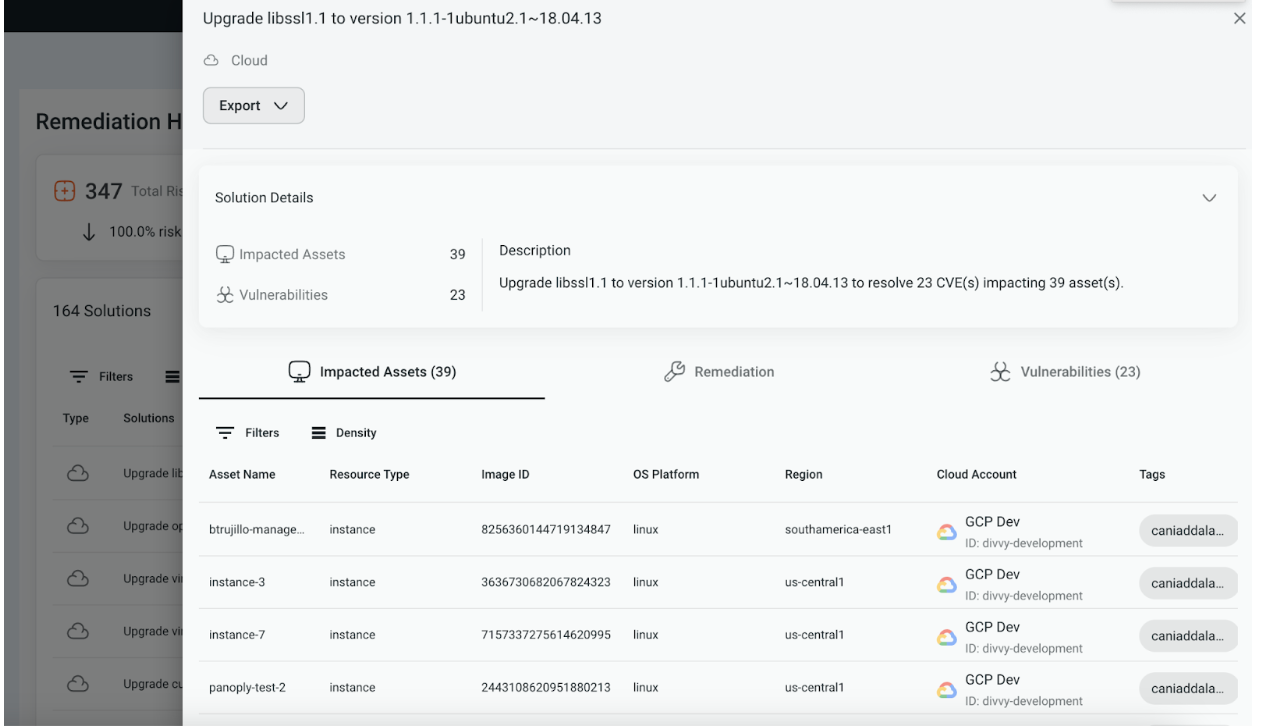
Remediation Hub considers factors like public accessibility, reachability, and the presence of downstream controls (like a firewall, for instance) when prioritizing vulnerabilities. The platform’s Active Risk incorporates real-world threat intelligence from Rapid7 Labs and our open source community to provide clarity into what CVEs are being actively exploited in the wild, which could provide insight into which exposures across your environment attackers are likely to target.

Along with insight into the impacted assets, teams are also provided step-by-step guidance on how to implement the suggested fix, with many actions available as native automation workflows.

Accelerate Mean Time to Exposure Remediation Across Hybrid Environments with Remediation Hub

Proactive Exposure Management: Moving from Reactive to Proactive

By taking a more targeted, intelligence-driven approach to remediation, security teams can move from reactive to proactive exposure management, ultimately making their organizations more resilient to attacks and accelerating the time it takes to both detect and remediate exposures that pop up across their environments.

To learn more and experience a self-guided Product Tour, click here.

What’s coming next?

In the next post, we’ll walk you through how users can leverage Remediation Hub when responding to an Emergent Threat, including gathering available information about a zero-day, building an understanding of your exposure, along with step-by-step remediation guidance.

We’ll also, of course, continue to bring additional enhancements to Remediation Hub geared toward making it easier for teams to more effectively collaborate with stakeholders across the organization to prioritize and remediate exposures across their hybrid environments. So be sure to stay tuned here for more posts with those updates. As always, we welcome customer feedback and would love to hear from you! Your input helps us tailor our product roadmap, based on your priorities and business needs.

Why Italy Sells So Much Spyware

Post Syndicated from Bruce Schneier original https://www.schneier.com/blog/archives/2024/11/why-italy-sells-so-much-spyware.html

Interesting analysis:

Although much attention is given to sophisticated, zero-click spyware developed by companies like Israel’s NSO Group, the Italian spyware marketplace has been able to operate relatively under the radar by specializing in cheaper tools. According to an Italian Ministry of Justice document, as of December 2022 law enforcement in the country could rent spyware for €150 a day, regardless of which vendor they used, and without the large acquisition costs which would normally be prohibitive.

As a result, thousands of spyware operations have been carried out by Italian authorities in recent years, according to a report from Riccardo Coluccini, a respected Italian journalist who specializes in covering spyware and hacking.

Italian spyware is cheaper and easier to use, which makes it more widely used. And Italian companies have been in this market for a long time.

Ada Computer Science: What have we learnt so far

Post Syndicated from Ben Durbin original https://www.raspberrypi.org/blog/ada-computer-science-what-have-we-learnt-so-far/

It’s been over a year since we launched Ada Computer Science, and we continue to see the numbers of students and teachers using the platform all around the world grow. Our recent year in review shared some of the key developments we’ve made since launching, many of which are a direct result of feedback from our community.

Today, we are publishing an impact report that includes some of this feedback, along with what users are saying about the impact Ada Computer Science is having.

Computer science students at a desktop computer in a classroom.

Evaluating Ada Computer Science

Ada Computer Science is a free learning platform for computer science students and teachers. It provides high-quality, online learning materials to use in the classroom, for homework, and for revision. Our experienced team has created resources that cover every topic in the leading GCSE and A level computer science specifications.

From May to July 2024, we invited users to provide feedback via an online survey, and we got responses from 163 students and 27 teachers. To explore the feedback further, we also conducted in-depth interviews with three computer science teachers in September 2024.

How is Ada being used?

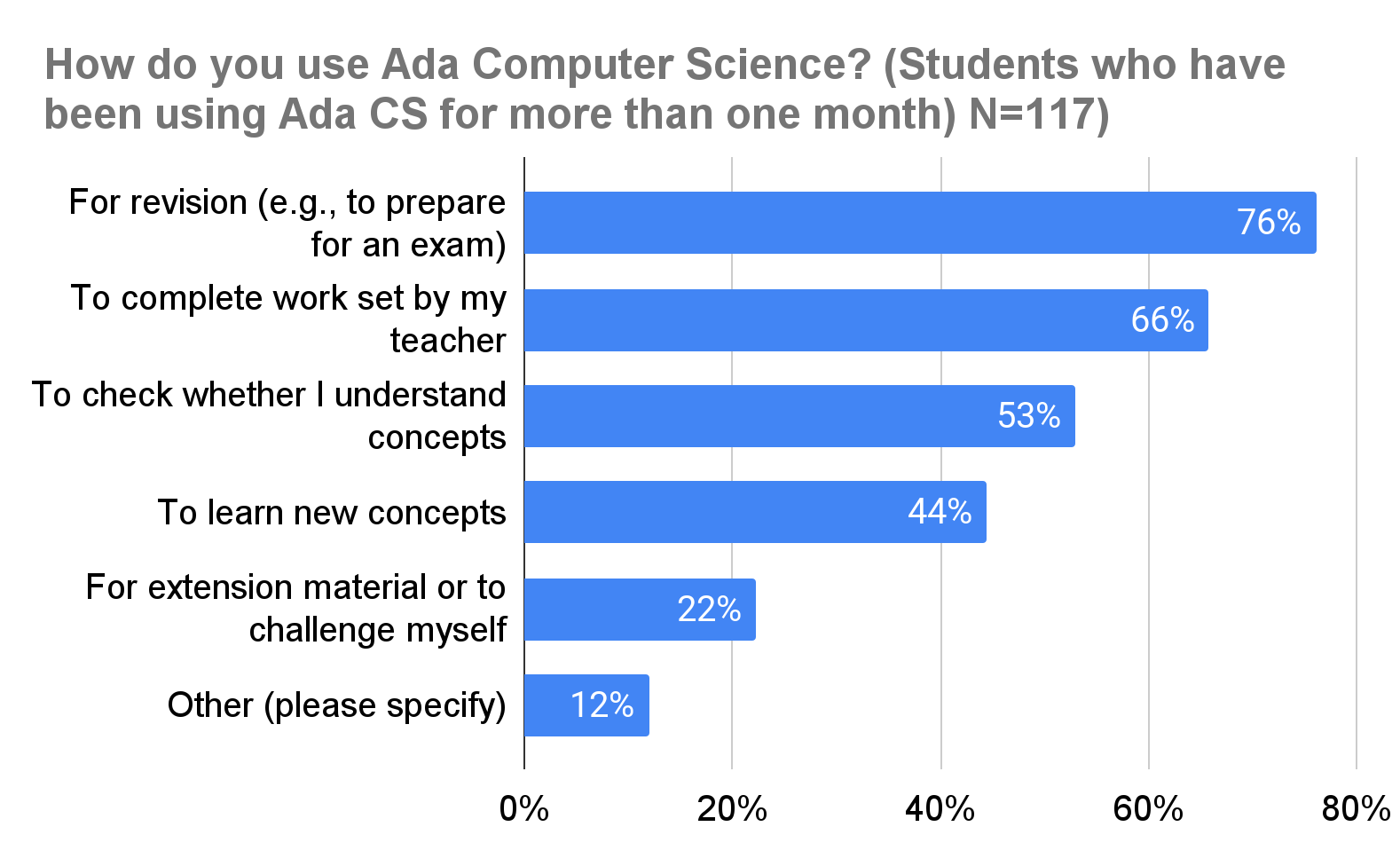
The most common ways students use Ada Computer Science — as reported by more than two thirds of respondents — is for revision and/or to complete work set by their teacher. Similarly, teachers most commonly said that they direct students to use Ada outside the classroom.

“I recommend my students use Ada Computer Science as their main textbook.” — Teacher

What is users’ experience of using Ada?

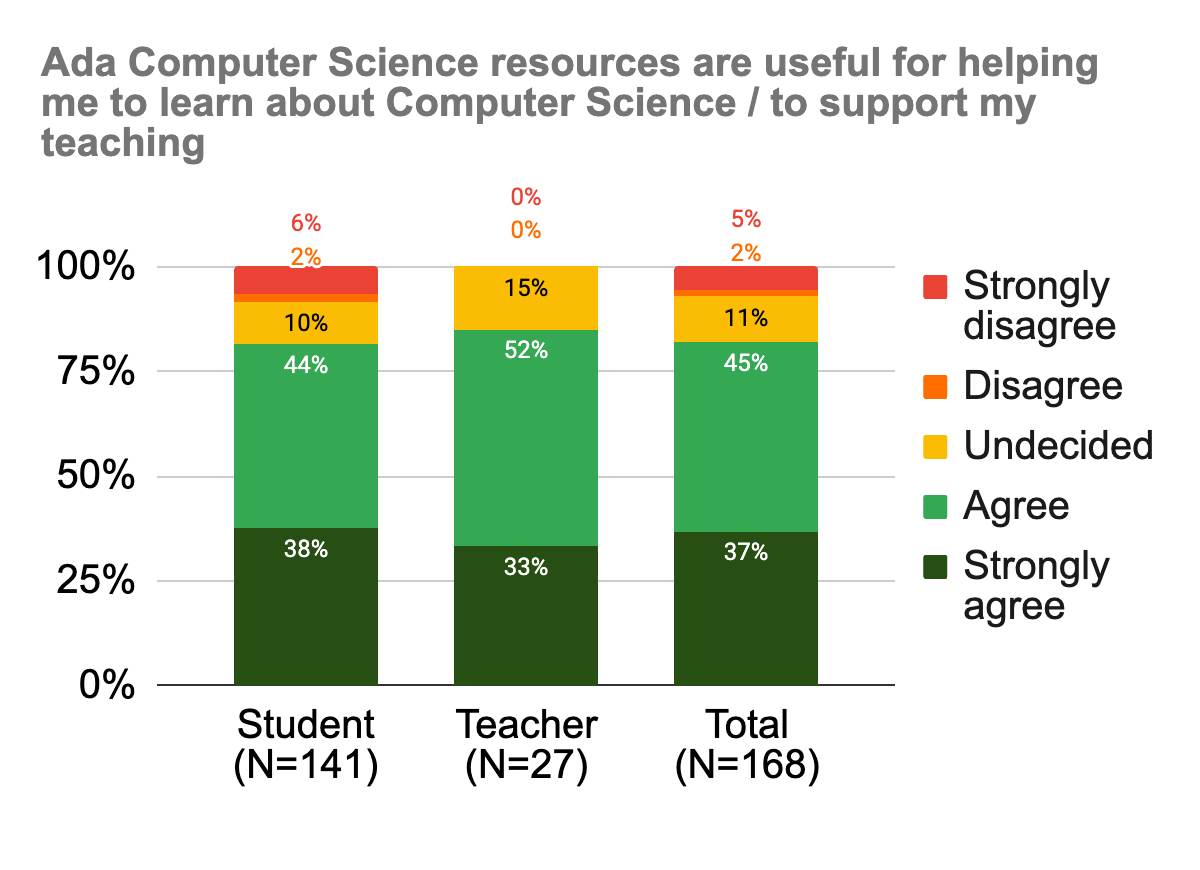
Most respondents agreed or strongly agreed that Ada is useful for learning (82%) and high quality (79%).

“Ada Computer Science has been very effective for independent revision, I like how it provides hints and pointers if you answer a question incorrectly.” — Student

Ada users were generally positive about their overall experience of the platform and using it to find the information they were looking for.

“Ada is one of the best for hitting the nail on the head. They’ve really got it in tune with the depth that exam boards want.” — Ian Robinson, computer science teacher (St Alban’s Catholic High School, UK)

What impact is Ada having?

Around half of the teachers agreed that Ada had reduced their workload and/or increased their subject knowledge. Across all respondents, teachers estimated that the average weekly time saving was 1 hour 8 minutes.

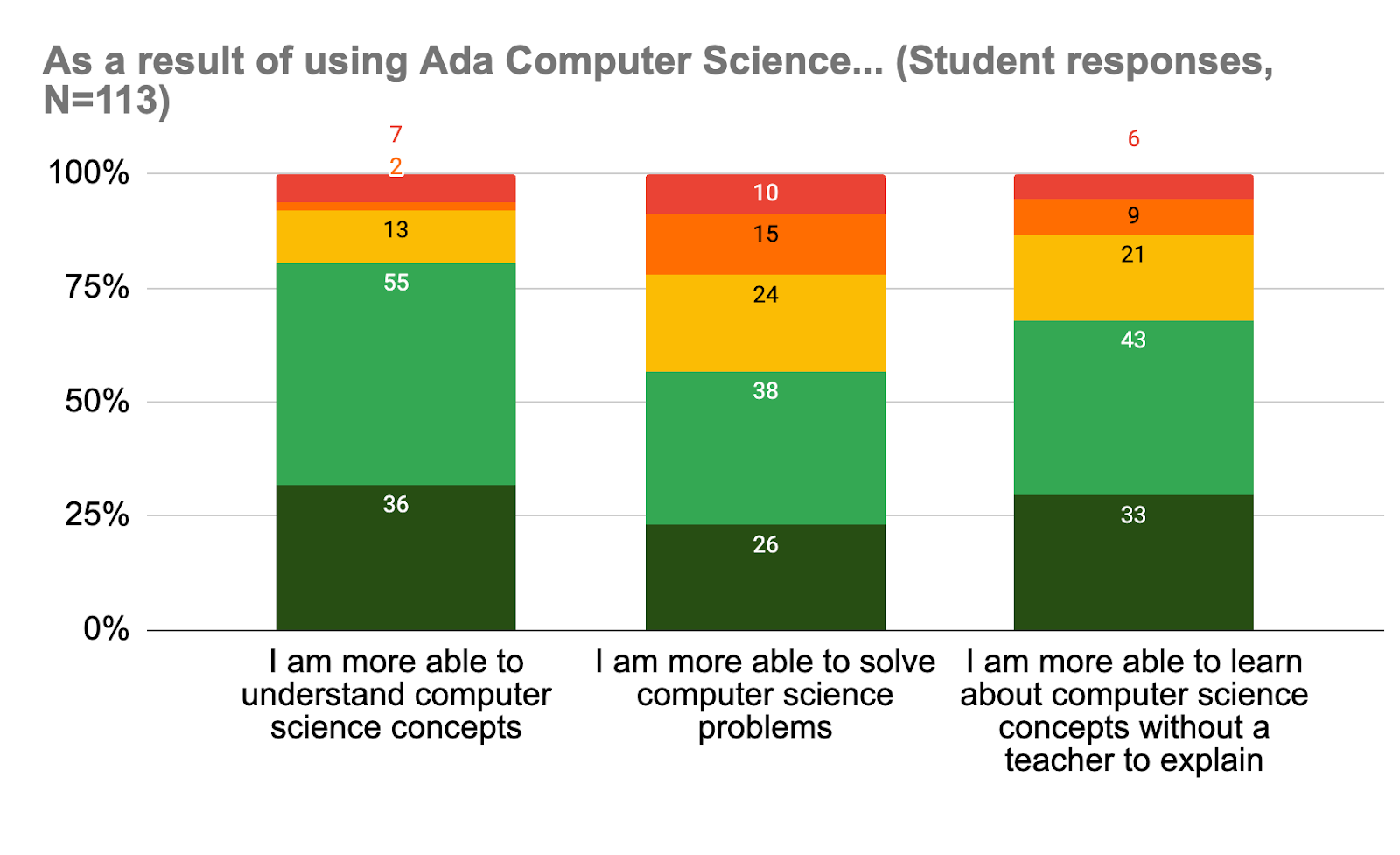
Additionally, 81% of students agreed that as a result of using Ada, they had become better at understanding computer science concepts. Other benefits were reported too, with most students agreeing that they had become better problem-solvers, for example.

“I love Ada! It is an extremely helpful resource… The content featured is very comprehensive and detailed, and the visual guides… are particularly helpful to aid my understanding.” — Student

Future developments

Since receiving this feedback, we have already released updated site navigation and new question finder designs. In 2025, we are planning improvements to the markbook (for example, giving teachers an overview of the assignments they’ve set) and to how assignments can be created.

If you’d like to read more about the findings, there’s a full report for you to download. Thank you to everyone who took the time to take part — we really value your feedback!

The post Ada Computer Science: What have we learnt so far appeared first on Raspberry Pi Foundation.

Отново на кръстопът: Българската външна политика между Вашингтон и Москва

Post Syndicated from Искрен Иванов original https://www.toest.bg/otnovo-na-krustoput-bulgarskata-vunshna-politika-mezhdu-vashington-i-moskva/

Отново на кръстопът: Българската външна политика между Вашингтон и Москва

Исторически факт е, че геостратегическото разположение на България неведнъж е имало решаващо значение за външната политика на нашата страна както в положителен, така и в негативен план. Кой знае защо, поколения български интелектуалци посочваха този факт с нескрита гордост, като че ли българската външна политика следва да бъде продукт от нашето географско аз, пречупено през балканския постсоциалистически манталитет на голяма част от политиците ни. Но това, разбира се, е само едната страна на монетата. 

Съществува и едно сенчесто, трудно доловимо измерение на външнополитическия процес у нас, което обикновено се пренебрегва с аргумента, че не е от решаващо значение, особено след края на Студената война и падането на социализма в България. Точно там е работата обаче, че разпадът на социалистическата система и началото на Прехода ознаменуваха един добре прикрит геополитически консенсус за бъдещето на нашата страна, който беше не толкова плод на българския политически живот, колкото на договарянето на нови сфери на влияние, които прекроиха границите на бившия социалистически лагер в полза на САЩ. 

Мнозина български политици са склонни да гледат с носталгия към тези години, защото тогава изборът на България беше относително прост. В сегашните геополитически условия обаче задачата на политическия елит се усложнява от два факта. Първият – че консенсусът между Вашингтон и Москва за постсоциалистическия блок вече не съществува, и вторият – че на България отново се пада незавидната съдба да изпие горчивата чаша на нов геополитически избор, който ще предопредели бъдещето и на идните поколения. В този материал ще се опитаме да анализираме точно тази реалност, за която се говори плахо и нерешително както от политиците, така и от много анализатори.

Постсоциалистическата реалност в българската външна политика

Теорията за постсоциалистическата реалност във външната политика на балканските страни е разработена от група американски историци начело с професорката от Тексаския университет Мери Нюбъргър. Непосредствено след разпадането на СССР учените лансират тезата, че демокрациите в тези държави и в бившия социалистически блок като цяло ще се отличават коренно от демокрацията в САЩ и Западна Европа. В този контекст можем да разграничим няколко основни периода в българската външна политика след падането на социализма у нас. 

Първият период започва след срещата между американския президент Джордж Буш-старши и последния съветски лидер Михаил Горбачов през декември 1989 г. в Малта. На тази среща се обсъжда бъдещето на социалистическия блок след началото на дисидентските движения и „нежните революции“ и в крайна сметка се постигат три основни договорки. Първата е готовността на Горбачов да приеме обединението на все още разделената Германия и пълноценното ѝ интегриране в НАТО, а с втората Москва дава възможност на страните от Централна Европа да изберат самостоятелно геополитическия път на своето развитие – предрешен избор, който по-късно ще постави тези държави в американската зона на влияние. 

За България и Румъния е постигнат консенсус влиянието на Вашингтон и Москва да бъде поделено 50:50 поради стратегическото разположение на двете страни. И ако анализираме внимателно анатомията на Прехода у нас, ще видим, че неговите архитекти работиха точно в тази посока – военно-политически и икономически България се обвърза с Европейския съюз и САЩ и стана част от евроатлантическото семейство, но енергийно и културно тя остана в руската сфера на влияние. В този смисъл присъединяването на страната ни към ЕС и НАТО не разчупи, а напротив – циментира този консенсус и легитимира архитектите на Прехода, както и тяхната стратегия да позиционират България като междинна зона, където интересите на Вашингтон и Москва се пресичат.

Вторият период в българската външна политика започна веднага след като България стана част от европейското семейство и колективната система за сигурност на НАТО. Покрай цялата еуфория, някак си незабелязано и паралелно с това, беше реабилитиран образът на Русия като партньор на нашата страна. На макрониво това извърши не кой да е, а самата Европа, тъй като европейските елити години наред нямаха проблем София и Москва да развиват сътрудничеството си в сферата на енергетиката, културата и дори икономиката.

Особено силен застъпник на този консенсус беше Германия, която неусетно се превърна в един от най-големите приятели на Русия в Европа – така руското влияние в Източна Европа беше гарантирано, а канцлерът Герхард Шрьодер се оказа сред най-големите привърженици на (тогава) новоизбрания руски президент Владимир Путин. Или казано с други думи, ако през 90-те години в България хората се мусеха, когато чуеха някой да говори на руски, това започна да става все по-привлекателно и някак си модерно, след като страната ни беше приета в европейското семейство.

В лицето на България обаче Вашингтон виждаше съюзник и затова се стараеше да балансира между отношенията си с Москва и военното си присъствие у нас. Така присъединяването на нашата страна към НАТО беше не толкова уникална заслуга на група български политици, а продукт от консенсуса между САЩ и Русия, който новите дисиденти – много от тях с добре известно минало – си приписаха като изключителна заслуга и така легитимираха политическия си мандат.

В тези условия политическият елит у нас управляваше необезпокояван, тъй като САЩ пазеха небето ни, Европа даваше пари по еврофондовете, а Русия щедро градеше културни връзки за приятелство с България, скрепени с огромните газови тръби на „Южен поток“. Към тази конфигурация беше добавен и Китай с неговото намерение да инвестира в мащабни инфраструктурни проекти у нас, а политическият елит – малка част от който вероятно е чел за Конфуций – изработи златния аргумент, че България е една от първите страни в света, признали Китайската народна република. 

Идилията обаче беше прекалено хубава, за да продължава, и така се озовахме на прага на третия етап от геополитическото съзряване на постсоциалистическа България, когато консенсусът между Вашингтон и Москва рухна, след като Русия нахлу в Украйна. Доказателство за началото на този етап е, че малко преди Кремъл да даде фаталната за Европа заповед, Путин призова НАТО да се изтегли от България и Румъния, намеквайки, че САЩ трябва да спазват червените линии, които са очертани някога от Малтийския консенсус. На това президентът Байдън отговори, че Русия няма право на сфери на влияние и че САЩ имат свещени задължения към тези нации, които ще спазят по силата на Вашингтонския договор. 

А по това време в България и Румъния вече бяха започнали значими политически промени, нови „нежни революции“, които целяха и окончателното откъсване на двете страни от руската сфера на влияние. Политическият елит, който говореше за баланс и консенсус във външната политика, отдавна не беше на мода в Румъния. В България обаче се оказа точно обратното – голяма част от избирателите и политиците гледаха с нескрита носталгия към Малтийския консенсус, не желаеха да се разделят с него или поне бяха против радикални промени в българската външна политика, които да се усетят както на икономическо, така и на културно ниво.

Уви, Европа не можеше да помогне, тъй като Ангела Меркел отдавна вече не беше на власт, а Макрон виждаше, че войната в Украйна заплашва пряко границите на Стария континент. В тези условия САЩ се позиционираха като единствения надежден съюзник на България, но администрацията на Байдън нямаше намерение да прави компромиси нито с корупцията в страната, нито с липсата на културен плурализъм.

Защо България не пожела разчупване на консенсуса?

Първата и основна причина, поради която България не пожела да разчупи Малтийския консенсус във външната си политика, е историческа и може да бъде проследена в годините преди 10 ноември 1989. Моделът, по който е построен българският социализъм, е уникален за Източния блок, тъй като в това семейство няма по-лоялен съюзник на СССР от Народна република България. Често, но погрешно се приема, че причините за това се коренят в Освобождението. 

Причините за силната привързаност към социализма в лоялни съветски сателити като България почиват върху два стълба. Единият е спецификата на българския социализъм, който посредством Живковата конституция гарантира пълна лоялност от страна на гражданите към член първи, легитимиращ господстващата роля на БКП. Другата страна на монетата е, че подобно на демокрацията, социализмът у нас също е строен като социализъм с български характеристики. Липсата на свободна инициатива, предвидимостта в битовите отношения, невъзможността за истинска конкуренция и свобода на пазара спомагат за формирането на нагласи, които виждат в амбициозния и преуспял западен човек, свободен от всякакви морални ограничения, враг на социалистическия строй и на традицията. 

В същото време образователната система изработва ефективни механизми за представянето на САЩ като капиталистически генератор на конфликти – теория, която, уви, днес се отстоява от много леви интелектуалци в Америка и у нас. Това фалшиво усещане за свобода под шапката на Москва рухва по време на Възродителния процес, когато става ясно, че времето на „спокойните хора“ вече е отминало, а след идването на Горбачов на власт различията между съветското и българското ръководство естествено доведоха до падането на социализма у нас. В тези условия политиците гледаха на Америка като на „новия голям брат“, който ще измести СССР като гарант за сигурността на страната ни. И затова по време на Прехода България заимства именно американския икономически модел, а не европейския, за да възстанови икономиката си след кризата от 1996–1997 г. 

И все пак българинът успя да съхрани носталгията по социализма както никой друг народ в Европа. Това е и втората причина, поради която разчупването на Малтийския консенсус изглежда почти невъзможно. Най-парадоксалното е, че тази носталгия се дължи не на някакви обективни политически причини, а просто на факта, че голяма част от носталгиците хранят такива чувства поради възрастта си. Проблемът няма как да бъде преодолян, тъй като има психологически характер и е обективно следствие от формата на социализъм, която доминираше в страната в продължение на 45 години.

За съжаление, голяма част от младото поколение също не е способно да компенсира този дефицит по множество причини. От една страна, е проблемът с демографията и емиграцията, а от друга страна – липсата на толерантна и плуралистична среда, която да генерира и насърчи професионалното развитие на младото поколение. Дали посочените проблеми могат да бъдат преодолени на този етап, е спорно поради политическата нестабилност в страна и липсата на желание за изграждане на дългосрочни стратегии.

Третата група причини засяга устойчивото руско влияние в страната и перспективата то да бъде заменено от сходни по идеология формули. Силната лоялност на България към СССР от времето на Студената война, която се запази устойчива след формирането на българския постсоциалистически елит, и дългосрочното нежелание на Европа да погледне сериозно на проблемите, с които се сблъсква обществото ни години наред, доведоха до политическа нестабилност, която изглежда непреодолима поради невъзможността за откриване на единна формула за българския национален интерес.

Докато такава липсва, патриотичните фракции ще продължат да гледат на понятието български национален интерес като на възможност да увеличат подкрепата си и да държат България колкото е възможно по-близо до своите идеи, а прозападните и ястребските крила да задълбочат механичната си реторика за цивилизационния избор на страната да бъде част от ЕС и НАТО. 

Това противопоставяне в обществото е основният генератор на конфликти, който не позволява разчупването на Малтийския консенсус и изработването на последователна стратегия, която да позиционира България трайно на геополитическата карта. Конспиративна теория е да смятаме, че тази поляризация крие някакви тайни, скрити измерения и че някой нарочно разделя българите, за да не могат да постигнат консенсус за интересите си.

Такива теории обикновено кореспондират с митовете, че американските президенти си лягат и стават с мисълта дали в България трябва да има редовно правителство, или не. Всъщност не САЩ, а българските избиратели решават това – и така ще отговори всеки американски дипломат. Лошата новина е, че в българското общество няма воля за разчупването на Малтийския консенсус и заради това той трябва да бъде заменен от някаква приемлива геополитическа формула, която да възстанови политическата стабилност у нас.

(Следва продължение.)

Зад кулисите на изслушванията за еврокомисари

Post Syndicated from Анахит Хачикян original https://www.toest.bg/zad-kulisite-na-izslushvaniyata-za-evrokomisari/

Зад кулисите на изслушванията за еврокомисари

Докато в България партиите са вгледани самовлюбено в резултатите от изминалите избори и в поредните напъни за съставяне на правителство, българските евродепутати в Брюксел вече са заели местата си в парламентарните комисии, в които са избрани да членуват, и се опитват да влязат в работен ритъм, всеки според възможностите и интересите си.

Звезден миг за гражданската легитимност

През изминалите две седмици българските евродепутати участваха в изслушванията на кандидат-комисарите в Брюксел. Това несъмнено е един от звездните моменти за Европейския парламент, който се повтаря на всеки пет години непосредствено след европейските избори. Новоизбраните депутати във всяка парламентарна комисия препитват като на изпит кандидат-комисарите, предложени от правителствата на държавите членки. Ако дадените отговори не се харесат на депутатите, кандидатурата може да бъде отхвърлена и трябва съответната държава, изпаднала в немилост, да предложи нов кандидат, който да бъде подложен на същото изпитание. 

Моментът е звезден, защото Европейският парламент е единствената институция, избрана пряко от гражданите на Европа и точно изслушванията на кандидат-комисарите са един от начините тази гражданска легитимност да бъде упражнена. Представени от депутатите, европейските граждани са всъщност тези, които косвено се произнасят по кандидатурите на бъдещите комисари, и то не по национален признак, а в зависимост от тяхната компетентност и познания в сферата, в която са номинирани. 

Така Парламентът има решаваща роля за състава на следващата Комисия, от която пък ще зависи какво законодателство ще бъде предложено на европейско ниво, какъв бюджет ще бъде отпуснат по различните програми, какви средства ще бъдат одобрени по различни проекти и много други въпроси с конкретни последици на всички нива. Макар и да не взема крайните решения, Европейската комисия е институцията, която предвожда законодателния процес, предлагайки законите и дефинирайки първоначалните им рамки на действие и обхват. Затова е от ключово значение кой управлява всяко от 26-те портфолиа. 

Изслушването

Като всеки звезден миг, и този е добре режисиран предварително. В рамките на десет дни са организирани 26 изслушвания, като първото за деня започва в 9:00 ч. сутринта, а последното приключва в 21:30. Преди да се изправят на изпитната скамейка, кандидат-комисарите имат седем седмици да се подготвят. Получават инструкции от сътрудниците на напускащите комисари, срещат се с представители на различни политически групи, с координаторите и председателите на парламентарните комисии, с представители на неправителствени организации и лобита; отговарят на списък от писмени въпроси на евродепутатите и подготвят 15-минутна реч, в която да представят приоритети си за следващите пет години. 

По време на самото изслушване обаче те трябва да отговарят импровизирано и именно по този начин се разбира доколко са запознати с ресора, който ще ръководят, и дали имат ясна визия за това, с което ще се занимават. На изслушванията, освен евродепутатите, присъстват много журналисти, фотографи, политически съветници, пиари и сътрудници. Зад катедрата седят председателите на парламентарните комисии от ресора на кандидат-комисаря, а пред тях на една малка маса е самият кандидат, готов за тричасов кръстосан разпит. Напрежението в залата е осезаемо. 

Освен че крайният резултат зависи от индивидуалното представяне на всеки кандидат, политическите групи в Парламента също обсъждат цялостния състав на Комисията и се опитват, от една страна, да подкрепят кандидатите от своето политическо семейство, а от друга страна, да не атакуват прекалено опонентите си, за да не им се върне тъпкано. 

Санитарен кордон и в Европарламента

В проектния състав на следващата Комисия има 16 кандидат-комисари на десни правителства, четирима кандидати на леви правителства, петима кандидати либерали и един кандидат-комисар от десницата на Мелони в Италия. Това съотношение между политическите сили в бъдещата Европейска комисия не отразява състава на новия Парламент, където крайнодясната политическа група „Патриоти за Европа“ е третата по големина, но няма нито един кандидат за комисар, нито пък председатели или заместник-председатели на парламентарни комисии. 

Причината за това е прилагането на санитарен кордон от левицата, либералите и зелените, за да предотвратят заемането на ключови позиции от крайнодесните. Самата кандидатура на Урсула фон дер Лайен за втори мандат начело на Комисията беше одобрена в края на лятото от левицата, либералите и зелените, при условие че няма да има представители на крайната десница сред новите комисари. Въпреки това няколко месеца по-късно крайнодесният италианец Рафаеле Фито, съпредседател на Групата на европейските консерватори и реформисти в предишния мандат на Европарламента, не само беше издигнат за италиански кандидат-комисар в следващата Комисия, а и за неин изпълнителен заместник-председател. 

Зад кулисите на изслушванията за еврокомисари
Рафаеле Фито © European Union 2024 – Source: EP

Санитарният кордон е неписано правило и подлежи на гъвкави интерпретации, особено в настоящия Европарламент, където, ако традиционната десница на Европейската народна партия се обедини с другите крайнодесни партии, ще държи под контрола си половината пленарна зала. Подобно обединение на десницата в бъдеще, ако се окаже трайно и стабилно, коренно ще промени съотношението на силите между политическите групи в Парламента. Ако в последните десет години трите най-големи групи – на десните, левите и либералите – съставяха съвместно законодателни предложения след дълги преговори и постигане на компромис, сега Парламентът започва да се връща към модел, по-близък до националните парламенти – с класически идеологически противопоставяния между партиите и ясно очертани мнозинство и опозиция. При такава конфигурация рисковете от блокажи и задънени улици значително се увеличават. 

Именно това се случи в Европейския парламент в края на изслушванията за еврокомисари, след като 19 от 26-имата кандидати вече бяха препитани и одобрени. Под натиска на десницата изслушванията на последните шестима кандидат-комисари и бъдещи изпълнителни заместник-председатели на Комисията, сред които Тереса ​​Рибера (испанска левица) и Рафаеле Фито (италианска крайна десница), бяха оставени за обсъждане и групово одобрение в последния ден. Така десницата се надяваше кандидатурата на крайнодесния Фито да мине между капките и да бъде одобрена в цялостния пакет на висши назначения. 

Левицата обаче продължи яростно да се съпротивлява, настоявайки, че тази кандидатура противоречи на първоначалното споразумение и нарушава санитарния кордон. Тогава десницата мина в контранастъпление и се възползва от неотдавнашните поройни дъждове в Испания, за да атакува испанската кандидатка за комисар и настояща министърка на екологичния преход в Испания – Рибера, като я обвини за бедственото положение в засегнатите региони. 

Зад кулисите на изслушванията за еврокомисари
Тереса Рибера © European Union 2024 – Source: EP

Така в последния ден от изслушванията страстите се нажежиха и вместо да дискутират европейски политики, евродепутатите и целият бъдещ състав на Комисията се оказаха заложници на вътрешнополитически конфликти, а приличното представяне на индивидуалните кандидати и предварителните споразумения между групите останаха на заден план. Но освен че говорим за борба на власт и влияние между европейските столици, основното предизвикателство тук е идеологическото позициониране на европейските институции и дали постепенно ще минават все по-вдясно и ще водят все по-консервативни политики, или ще запазят досегашното си относително равновесие в смесица от десни, леви и либерални идеи.

Ако политическите групи не постигнат бързо съгласие и предложеният състав на Комисията не бъде гласуван на пленарната сесия в края на ноември, встъпването в длъжност на новите екипи ще остане за следващата година, което не е най-добрият сценарий в един бързо променящ се и непредвидим свят след завръщането на Тръмп в Белия дом.

Къде сме ние?

Българската кандидатка за комисар Екатерина Захариева (ГЕРБ) беше изслушана в Комисията по промишленост, изследвания и енергетика. Това е същият ресор, който България имаше и в предишната Комисия, но този път без културата и младежта, които сега са прибавени към спорта в отделно портфолио, дадено на Малта. 

Зад кулисите на изслушванията за еврокомисари
Екатерина Захариева по време на изслушването ѝ за еврокомисар © European Union 2024 – Source: EP

Захариева постави акцент върху увеличаването на инвестициите в сферата на научните изследвания и иновациите, както и върху необходимостта частният сектор също да бъде привлечен да инвестира. Други приоритети в работата ѝ ще бъдат насърчаването на участието на жени изследователки във всички научни области, намаляването на бюрокрацията, а също и инвестиции за научни изследвания в отбраната. Захариева цитира много статистики от европейски доклади и изследвания, с което запълни липсващата ѝ лична професионална експертност по темите. Политическият ѝ опит от България пък ѝ помогна да се измъкне ловко от деликатни въпроси, като продължаващото финансиране на израелски университети въпреки случващото се в Газа или рисковете от инструментализиране на средства, отделени за граждански изследвания, и пренасочването им към изследвания за отбрана. 

Българската кандидатка се обяви в подкрепа на всички академични институции, независимо от тяхната националност, за да бъде избегната дискриминация. По отношение на военните изследвания тя даде за пример американската Агенция за перспективни изследователски проекти за отбраната (DARPA), подчертавайки, че получените резултати често имат едновременно и военно, и гражданско приложение, така че ползите са повсеместни

Наред с много други членове на Европейския парламент, българските евродепутати Цветелина Пенкова (БСП), Ева Майдел (ГЕРБ), Петър Волгин („Възраждане“) и Христо Петров („Продължаваме промяната“) също отправиха своите индивидуални въпроси към Екатерина Захариева съвсем в рамките на добрия тон и далеч от обичайната за България агресивна политическа конфронтация.

След изслушването шестима от присъстващите седем координатори на изпитващата парламентарна комисия одобриха кандидатурата на Екатерина Захариева. Само крайната левица гласува против, а депутатите от групата на „Европа на суверенните нации“, част от която е и българската „Възраждане“, не присъстваха на гласуването.

Какво означава това за България?

От влизането на България в Европейския съюз досега всички български комисари са били жени с политически опит на национално, европейско или международно ниво. Преди да станат еврокомисари, Меглена Кунева е била министър по европейските въпроси, Кристалина Георгиева – вицепрезидент на Световната банка, Мария Габриел – евродепутат, а Илиана Иванова – член на Европейската сметна палата. Екатерина Захариева е била зам.-министър на регионалното развитие и благоустройството, министър на правосъдието и министър на външните работи. 

Женските кандидатури за български еврокомисар се гледат с добро око в една Европа, която все още руши стереотипи и се бори за равенство между половете. Погледнато в по-мащабен план, цялостният образ на българския комисар, от нивото на владеене на чужди езици и начина на обличане и поведение до знанията в ресора и политическата опитност, оказват влияние за изграждането на образа на България на европейско ниво. Българите, работещи в европейските институции от дълги години, още си спомнят скандалното изслушване на една друга българска кандидатка за еврокомисар – Румяна Желева. През 2009 г. тя предизвика масово възмущение с лъжливите си декларации, лошия си английски и пълната си неподготвеност по зададените въпроси и както се очакваше, беше отхвърлена от евродепутатите. 

Българските политици в Брюксел имат ключова роля за изграждането на образа на страната ни на международната сцена, а това влияе не само в политически план, а и по отношение на чуждестранните инвестиции, международното сътрудничество в различни сфери и дали въобще ни вземат на сериозно. Достойното участие на България в дебати по теми като Зелената сделка, миграционната политика или социалните неравенства ни приобщава към търсенето на решения на глобални проблеми и ни включва в европейските политически процеси. Помага ни да разбираме по-добре предизвикателствата в света, в който живеем.

От друга страна, международната среда, в която са българските представители в Брюксел, и работата им с колеги от цяла Европа биха могли постепенно да окажат положително влияние върху начина на правене на политика в България, да внесат професионални практики, като конструктивния диалог, коалициите, основани на идеи и ценности, балансираните преговори за постигане на печеливш за всички компромис. Все ценности, които са съставна част от изграждането на демократично и гражданско общество и които биха довели до нормализация на политическите процеси, ако има кой да ги внесе на родна земя. 

Изразеното мнение е лично и не представлява позицията на Европейския парламент.

AlmaLinux 9.5 released

Post Syndicated from corbet original https://lwn.net/Articles/998637/

Version 9.5 of the AlmaLinux enterprise-oriented distribution has been
released.

AlmaLinux 9.5 aims to improve performance, development tooling, and
security. Updated module streams offer better support for web
applications. New versions of compilers provide access to the
latest features and optimizations that improve performance and
enable better code generation. The release also introduces
improvements to system performance monitoring, visualization, and
system performance data collecting.

YACE is joining Prometheus Community

Post Syndicated from Thomas Peitz (@thomaspeitz) original https://prometheus.io/blog/2024/11/19/yace-joining-prometheus-community/

Yet Another Cloudwatch Exporter (YACE) has officially joined the Prometheus community! This move will make it more accessible to users and open new opportunities for contributors to enhance and maintain the project. There’s also a blog post from Cristian Greco’s point of view.

The early days

When I first started YACE, I had no idea it would grow to this scale. At the time, I was working with Invision AG (not to be confused with the design app), a company focused on workforce management software. They fully supported me in open-sourcing the tool, and with the help of my teammate Kai Forsthövel, YACE was brought to life.

Our first commit was back in 2018, with one of our primary goals being to make CloudWatch metrics easy to scale and automatically detect what to measure, all while keeping the user experience simple and intuitive. InVision AG was scaling their infrastructure up and down due to machine learning workloads and we needed something that detects new infrastructure easily. This focus on simplicity has remained a core priority. From that point on, YACE began to find its audience.

Yace Gains Momentum

As YACE expanded, so did the support around it. One pivotal moment was when Cristian Greco from Grafana Labs reached out. I was feeling overwhelmed and hardly keeping up when Cristian stepped in, simply asking where he could help. He quickly became the main releaser and led Grafana Labs’ contributions to YACE, a turning point that made a huge impact on the project. Along with an incredible community of contributors from all over the world, they elevated YACE beyond what I could have achieved alone, shaping it into a truly global tool. YACE is no longer just my project or Invision’s—it belongs to the community.

Gratitude and Future Vision

I am immensely grateful to every developer, tester, and user who has contributed to YACE’s success. This journey has shown me the power of community and open source collaboration. But we’re not done yet.

It’s time to take Yace even further—into the heart of the Prometheus ecosystem. Making Yace as the official Amazon CloudWatch exporter for Prometheus will make it easier and more accessible for everyone. With ongoing support from Grafana Labs and my commitment to refining the user experience, we’ll ensure YACE becomes an intuitive tool that anyone can use effortlessly.

Try out YACE on your own

Try out YACE (Yet Another CloudWatch Exporter) by following our step-by-step Installation Guide.

You can explore various configuration examples here to get started with monitoring specific AWS services.

Our goal is to enable easy auto-discovery across all AWS services, making it simple to monitor any dynamic infrastructure.

Know before you go – AWS re:Invent 2024 cloud resilience

Post Syndicated from Shllomi Ezra original https://aws.amazon.com/blogs/architecture/know-before-you-go-aws-reinvent-2024-cloud-resilience/

With AWS re:Invent 2024 just weeks away, the excitement is building and we’re looking forward to seeing you all soon. If you’re attending re:Invent with the goal of improving your organization’s cloud resilience operations, we will be offering valuable insights, best practices, and fun activities to improve your cloud resilience expertise.

This year, we’re offering more than 100 resilience breakout sessions, workshops, chalk talks, builders’ sessions, and code talks. Find the complete list in the re:Invent 2024 session catalog and filter by “Resilience” in the area of interest field.

In this post, we highlight must-see sessions for those building resilient applications and architectures on AWS. Reserved seating is now open, so act quickly to claim your seat. Be sure to also check out the vertical-specific re:Invent guides.

Our recommendations are divided into three topics to help you choose the sessions most relevant to your business: resilience fundamentals, advanced resilience patterns, and resilience for customers operating in regulated industries.

What is cloud resilience all about?

Cloud resilience refers to the ability for an application to resist or recover from disruptions, including those related to infrastructure, dependent services, misconfigurations, transient network issues, and load spikes. Cloud resilience also plays a critical role in an organization’s broader business resilience strategy, including the ability to meet digital sovereignty requirements. Resilient applications are those built with high availability—the percentage of time the application is available for use—and also those with a disaster recovery or continuity of operations plan in place.

Resilience fundamentals

Join us as we explore the strategies, tools, and mindsets that enable organizations to thrive in the face of uncertainty. These sessions cover conceptual overviews and demos of AWS cloud resilience services.

Breakout sessions

Failing without flailing: Lessons we learned at AWS the hard way (ARC333)

At AWS, we’ve learned that building resilient services requires more than just designing for high availability. In this session, AWS operational leaders are back for more insights on how to mitigate impact when, not if, the unexpected happens. Hear a few short stories collected from 18 years of operational excellence, with practical advice on preparing for and mitigating failure.

Think big, build small: When to scale and when to simplify (ARC331)

Join this session to learn how to navigate the complexities of cloud architecture. Hear insights and guidance developed from working with successful AWS customers, including how to optimize for business value and agility. Discover the AWS approach to architectural tiers, engineering simplicity and reliability, and treating infrastructure as an investment.

Mastering resilience at every layer of the cake (ARC327)

Join this session to learn resilience at various levels, from platform to applications, using AWS services like AWS Resilience Hub, AWS Fault Injection Service, ARC, Amazon Elastic Disaster Recovery, and AWS Backup. You’ll leave with a mental model for resilience across these layers, and ready-to-use reference architectures and guidance. The session includes demos for a fun, lively experience.

Building resilient applications on AWS with Capital One (ARC334)

In this session, discover the patterns and principles of AWS resilience best practices. Then, hear Capital One showcase its next-generation design and deployment patterns that push the boundaries of resilient architectures and support its most critical business processes. Learn about the AWS services it uses, the trade-offs it must consider, and the decision matrix that guides developers to the right pattern for the right use case.

Data protection and resilience with AWS storage (STG301)

Join this session to dive deep on how AWS storage offers organizations defense-in-depth data protection and resilience for application data across recovery point and time objectives, helping mitigate risks with immutable solutions, restore testing, policy-based access controls, encryption, and auditing and reporting.

Workshops

Building, operating, and testing resilient Multi-AZ applications (ARC303)

Join this workshop to get hands-on experience building, operating, and testing a resilient Multi-AZ application.

Building resilient architectures with observability (COP308)

Explore how to use AWS services, including AWS Resilience Hub, Amazon CloudWatch, and AWS Fault Injection Service, to build resilient and reliable cloud-based applications.

Advanced resilience patterns

Building resilient and reliable applications in the cloud is critical for organizations running mission-critical workloads. Unexpected outages, latency spikes, or performance issues can have severe business impact. The sessions and workshops in this track explore advanced techniques and tools to help you proactively identify and address resilience weaknesses in your systems. Learn how to use chaos engineering, multi-Region architectures, and the latest AWS services and best practices to enhance the resilience and operational excellence of your cloud applications.

Breakout sessions

Chaos engineering: A proactive approach to system resilience (ARC326)

This session demonstrates the benefits of chaos engineering in action. Gain insights from BMW Group’s transformative journey, learning key lessons on scaling chaos engineering across the organization, and how BMW Group conducts large-scale chaos experiments in production, uncovering issues and fostering a culture of greater resilience and continuous improvement.

Try again: The tools and techniques behind resilient systems (ARC403)

Grand architectural theories are nice, but what makes systems resilient is in the details. Marc Brooker, VP and distinguished engineer, looks at some of the resiliency tools and techniques AWS uses in its systems. Marc rethinks, retries, breaks open circuit breakers, decodes erasure coding, and tackles the tail. Learn about formal methods and simulation, and how these tools help build faster code, faster.

Multi-Region or single Region? Considerations and architectures (ARC309)

Watch experts walk through and whiteboard architectures that take advantage of AWS services that support multi-Region capabilities, and discuss what a failover scenario would look like in real life. Leave with an understanding of what it takes to run a multi-Region architecture on AWS.

Best practices for creating multi-Region architectures on AWS (ARC323)

In this session, learn the two critical areas you’ll need to consider. First, explore different failover strategies and the trade-offs between them. Then, learn how to make the decision to initiate a cross-Region failover as well as what goes into the process. Lastly, hear from Samsung Account about their multi-Region application and how they think about these two critical areas.

Workshops

Chaos engineering workshop (ARC322)

This workshop introduces AWS Fault Injection Service for running controlled resilience experiments to improve application performance, observability, and resilience. You must bring your laptop to participate.

Gen AI resilience: Chaos engineering with AWS Fault Injection Service (ARC305)

Learn how to construct a useful hypothesis backlog for generative AI applications and how to use AWS Fault Injection Service to run those experiments. You must bring your laptop to participate.

Building operational resilience in workloads using generative AI (SUP401)

Building operational resilience requires proactive identification and mitigation of risks. In this workshop, use AWS managed generative AI services in real-world scenarios to learn how to assess readiness, proactively improve your architecture, react quickly to events, troubleshoot issues, and implement effective observability practices. Also use AWS Countdown and the AWS Well-Architected Framework as the entry point reference frameworks to use generative AI services for operation. Through hands-on activities, learn strategies for debugging issues, detecting anomalies and incidents, and optimizing architectures to improve the resilience of your workloads. You must bring your laptop to participate.

Resilience for customers operating in regulated industries

In regulated industries like finance, healthcare, and telecom, resilient architecture is critical for compliance, security, and operational continuity. These sectors face strict regulations that demand robust data protection, disaster recovery, and uptime guarantees. A resilient architecture helps organizations maintain service availability, minimize downtime, and recover quickly from disruptions, safeguarding sensitive data and avoiding regulatory breaches. It also enables businesses to adapt to evolving regulations while delivering secure, uninterrupted services.

Breakout sessions

Fidelity Investments: Building for mission-critical resilience (FSI318)

This session explores the transformation of Fidelity Investments’s trade processing platform on AWS and the critical role resiliency plays in preserving operational integrity.

Service event replay: Stress-testing your architecture’s resilience (FSI314)

Learn how to assess the resiliency of your own architectures and develop strategies to strengthen your response and recovery capabilities.

Workshops

Scaling multi-tenant SaaS with a cell-based architecture (ARC402)

In this workshop, see how cell-based architectures provide you with new ways to group, deploy, scale, and operate your multi-tenant workloads. Also see how this approach influences the tiering, scaling, and resilience profile of your SaaS architecture. You must bring your laptop to participate.

Advanced cross-Region DR patterns on AWS (ARC401)

Join this hands-on workshop to explore a resilient, cloud-centered architecture that surpasses the stringent availability and recovery regulations for financial markets utility providers. You must bring your laptop to participate.

Meet experts at the AWS Cloud Resilience kiosk

Throughout the re:Invent week, if you have any questions or suggestions for the AWS Cloud Resilience team, drop by the Cloud Resilience kiosk at the AWS Village in the 2024 re:Invent Expo (the Venetian).

This post was copyedited for grammar, spelling, capitalization, punctuation, terminology, and legal issues. Other important issues are noted in comments, and you should consider revising the content accordingly before publication.

Using zonal shift with Amazon EC2 Auto Scaling

Post Syndicated from aostan original https://aws.amazon.com/blogs/compute/using-zonal-shift-with-amazon-ec2-auto-scaling/

This post is written by Michael Haken, Senior Principal Solutions Architect, AWS

Today, we’re announcing support for zonal shift in Amazon EC2 Auto Scaling. Zonal shift gives allows you to rapidly recover from application impairments in a single Availability Zone (AZ) impacting your Auto Scaling Group (ASG) resources. In this post, we describe how performing an ASG zonal shift fits in to a multi-AZ resilience strategy and considerations for how to use the feature with different architectures.

Overview

Using multiple AZs is an architectural best practice for building resilient applications on AWS. Deploying your application across multiple AZs makes your applications more available, fault tolerant, and scalable. EC2 Auto Scaling enables you to further enhance your application’s availability and fault tolerance by dynamically scaling your Amazon Elastic Compute Cloud (Amazon EC2) instances across multiple AZs and replacing them when they’re unhealthy.

AZs in AWS represent a fault isolation boundary, meaning that failures from various sources are contained to a single AZ, whether caused by a bad deployment, networking issues, power loss, or operator error. In 2023, we launched zonal shift, part of Amazon Application Recovery Controller (ARC), which allows you to Rapidly recover from application impairments in a single AZ by shifting traffic at your Elastic Load Balancing (ELB) load balancer.

Zonal shift for EC2 Auto Scaling enhances this capability for users who have already implemented recovery patterns for single AZ impairments. It also provides recovery capabilities for architectures that aren’t load balanced by allowing you to prevent new instance launches in a specified AZ. Without zonal shift, when EC2 Auto Scaling detects consistent launch failures in an AZ, the service tries to launch instances in other AZs configured for the ASG. However, certain conditions, like gray failures, can cause post-launch problems in a single AZ that EC2 Auto Scaling doesn’t detect. For example, successfully launched instances in a single AZ experience elevated error rates downloading their configuration files over a zonal Amazon S3, Amazon Virtual Private Cloud (Amazon VPC) interface endpoint. The instances can’t correctly configure their application software and respond to requests with errors. Alternatively, the single-AZ impairment could cause the instance to fail its health checks after provisioning. This causes EC2 Auto Scaling to constantly recycle instances in the impaired AZ, leading to the application running with less capacity than desired.

Although you might choose to perform a zonal shift at your load balancer to mitigate the impact caused by the event, new instances can still be launched in the impacted AZ and don’t receive incoming requests. Even if your application architecture doesn’t use load balancers, zonal shift for EC2 Auto Scaling can help you recover from single-AZ impairments by allowing you to prevent instance launches in the impaired AZ.

Using EC2 Auto Scaling zonal shift to recover

To use zonal shift on your ASG, you need to configure it with an AvailabilityZoneImpairmentPolicy parameter either when you create a new ASG or update an existing one. This parameter has two options, ZonalShiftEnabled that enables or disables the ability to perform zonal shifts, and ImpairedZoneHealthCheckBehaviour. The latter option allows you to choose between ignoring or replacing instances identified as unhealthy by EC2 Auto Scaling. First, we look at how you can use zonal shift with a standalone ASG architecture.

Standalone ASG zonal shift

This architecture uses a standalone ASG without being integrated with an ELB load balancer. Workloads with a standalone ASG commonly perform event driven work such as generating load against a target based on a schedule or processing messages from a queue. The architecture in the following figure uses an ASG that reads messages from an Amazon Simple Queue Service (Amazon SQS) queue, performs some processing on the message data, and writes the results into an Amazon Aurora database. The instances communicate with Amazon SQS using a VPC endpoint in each AZ. Each message varies in size, thus the instances use a heartbeat pattern to update the message visibility timeout until they finish processing it. EC2 Auto Scaling scales instances based on the queue depth, which helps make sure that messages are processed in a timely manner.

Figure 1: EC2 instances deployed across three AZs that process messages from an SQS queue

Figure 1: EC2 instances deployed across three AZs that process messages from an SQS queue

Say that a networking degradation causes instances in AZ 1 to experience elevated error rates when attempting to write to the Aurora database, resulting in a 2x increase in the p50 processing latency. The instances in AZ 1 continue to heartbeat until they time out, keeping the message hidden and preventing other healthy instances from taking over the work. As a result, the queue depth grows and EC2 Auto Scaling deploys a new instance, as shown in the following figure.

Figure 2: EC2 Auto Scaling launches a new instance in AZ 1 in response to the queue depth growing

Figure 2: EC2 Auto Scaling launches a new instance in AZ 1 in response to the queue depth growing

The new instance lands in AZ 1 and experiences the same problem as the other instance, thus it can’t decrease the queue depth and processing latency. Instead, it exacerbates the issue by consuming additional messages that aren’t successfully processed. The instances in AZ 1 never appeared unhealthy, thus EC2 Auto Scaling didn’t take any actions to replace them. To mitigate this problem, you can start a zonal shift for your ASG. This makes sure that any future instance launches only happen in AZ 2 or AZ 3, as shown in the following figure.

Figure 3: After the zonal shift new instances are only launched in AZ 2 and AZ 3 by EC2 Auto Scaling

Figure 3: After the zonal shift new instances are only launched in AZ 2 and AZ 3 by EC2 Auto Scaling

You have the option to mark the instances as unhealthy using the SetInstanceHealth API to force EC2 Auto Scaling to replace these instances to prevent them from continuing to contribute to additional latency and errors. Changing the instance health state is considered a mutating change and relies on the EC2 Auto Scaling control plane. Therefore, you should avoid making this a critical step in your recovery plan. When you are confident that the impairment has abated, you can cancel the zonal shift, which causes EC2 Auto Scaling to automatically rebalance capacity across your AZs.

ASG with ELB zonal shift

In this section we observe how to use zonal shift with an ASG that is serving traffic from an ELB. We also examine how the ImpairedZoneHealthCheckBehavior affects recovery in this situation. In this architecture, the instances in the ASG read data from the database when they receive HTTP requests from the ELB, as shown in the following figure.

Figure 4: A three-tier application deployed in three AZs using an ALB, ASG, and Aurora database

Figure 4: A three-tier application deployed in three AZs using an ALB, ASG, and Aurora database

In this scenario, the instances in AZ 1 start experiencing increased latency with their EBS volumes causing them to respond to requests with errors and fail their EC2 instance status checks. Initially, to mitigate the impact, you can start a zonal shift at your load balancer to prevent your users from receiving errors. Then, you can initiate a zonal shift for your ASG to prevent new capacity from being launched into the AZ that isn’t receiving traffic.

If the ASG’s ImpairedZoneHealthCheckBehavior is set to IgnoreUnhealthy, then the instances in AZ 1 that are failing their health checks aren’t terminated by EC2 Auto Scaling, as shown in the following figure. This can be helpful if you’re pre-scaled to handle the loss of an AZ’s worth of capacity by not causing EC2 Auto Scaling to attempt to launch additional instances. It can also make recovery safer by leaving capacity in the AZ, thus when you end your load balancer zonal shift after the impairment ends, the AZ can immediately start receiving traffic again.

Figure 5: Performing a zonal shift on the ALB and ASG, choosing to ignore unhealthy instances in the ASG

Figure 5: Performing a zonal shift on the ALB and ASG, choosing to ignore unhealthy instances in the ASG

Alternatively, you can set the option to ReplaceUnhealthy. Now, instances that are found to be unhealthy by EC2 Auto Scaling are replaced. This option can be helpful if you aren’t pre-scaled to handle the loss of capacity. EC2 Auto Scaling launches new instances into the remaining AZs to bring the ASG back to its desired capacity, as shown in the following figure. However, this approach also has a tradeoff: launching new instances isn’t guaranteed to be successful, thus you might experience delays in acquiring new capacity.

Figure 6: Performing a zonal shift on the ALB and ASG, this time replacing unhealthy instances in the remaining AZs

Figure 6: Performing a zonal shift on the ALB and ASG, this time replacing unhealthy instances in the remaining AZs

In both situations you must consider whether you have cross-zone load balancing enabled or disabled. When cross-zone load balancing is enabled, each instance, regardless of its AZ, receives an approximately equal share of the traffic. This means that you can end your zonal shift for both your load balancer and ASG at the same time safely. As EC2 Auto Scaling rebalances your instances across each enabled AZ, they receive the same percentage of traffic.

If cross-zone load balancing is disabled, then each AZ receives an equal percentage of the traffic, regardless of how many instances are in the AZ. If you’ve chosen to replace unhealthy instances, or if your ASG has scaled during the event, then the capacity across your AZs could have become imbalanced. When you end your load balancer zonal shift and EC2 Auto Scaling begins to rebalance your capacity, you could end up in a situation shown in the following figure, where a single or small number of instances gets an overwhelming portion of the load.

Figure 7: A three-tier architecture with an imbalance of capacity among its three AZs

Figure 7: A three-tier architecture with an imbalance of capacity among its three AZs

This imbalance can present an overload risk, thus you must specify the –skip-zonal-shift-validation parameter when you enable zonal shift to acknowledge that you understand the risk. However, you can help prevent overload from occurring due to imbalance by using the load balancer’s target_group_health.dns_failover.minimum_healthy_targets.count option and specifying the number of instances that should be present in the AZ. If you’re using three AZs and your desired capacity is 12, then you should set the value to four (which represents one third of the ASGs total capacity). This prevents traffic from being routed to the AZ until there is enough healthy capacity there to handle the load. You may need to dynamically adjust this number as the ASG scales over time. The minimum count you set in the past may not be the right minimum count today.

Zonal shift best practices

As a set of best practices, we recommend that you:

  1. Are pre-scaled to handle the loss of an AZ’s worth of capacity
  2. Configure your impairment policy to ignore unhealthy hosts
  3. Enable cross-zone load balancing

With this configuration, you can also safely use zonal autoshift. When zonal autoshift is enabled, AWS automatically starts and ends the zonal shift on your behalf whenever the AWS telemetry indicates there is an impairment affecting a single AZ. This can be used in conjunction with zonal autoshift for your ELB load balancer. If you are not using zonal autoshift, then you can still use the EventBridge observer notifications to inform your zonal shift decisions or start automated processes. Refer to the EC2 Auto Scaling zonal shift documentation for more details on the full set of best practices when using zonal shift.

Conclusion

In this post we showed you the benefits of using zonal shift with your Amazon EC2 Auto Scaling Groups as part of enhancing your resilience in multi-AZ architectures. We explored several scenarios where zonal shift can be used, and reviewed best practices for using zonal shift safely and effectively. To get started using zonal shift with your ASGs, refer to the documentation.

Streamline container application networking with built-in Amazon ECS support in Amazon VPC Lattice

Post Syndicated from Donnie Prakoso original https://aws.amazon.com/blogs/aws/streamline-container-application-networking-with-native-amazon-ecs-support-in-amazon-vpc-lattice/

Since its launch, Amazon VPC Lattice has streamlined complex networking tasks. As a result, my perspective on how to build and connect modern, multi-service applications has changed. As my colleague Danilo wrote in his post announcing the general availability of VPC Lattice:

“By using VPC Lattice, you can focus on your application logic and improve productivity and deployment flexibility with consistent support for instances, containers, and serverless computing.”

Today, we’re announcing Amazon VPC Lattice built-in support for Amazon Elastic Container Service (Amazon ECS). With this new built-in integration, Amazon ECS services can now be directly associated with VPC Lattice target groups without the need for intermediate load balancers.

Here’s a quick look at how you can find Amazon VPC Lattice integration while creating an Amazon ECS service:

The Amazon VPC Lattice integration with Amazon ECS works by registering and deregistering IP addresses from ECS tasks within a service as targets in a VPC Lattice target group. As ECS tasks for the service are launched, Amazon ECS will automatically register those tasks to the VPC Lattice target group.

Furthermore, if ECS tasks fail VPC Lattice health checks, Amazon ECS will automatically replace the tasks. Also, if any task is terminated or scales down, it’s removed from the target group.

Using the Amazon VPC Lattice integration
Let me walk you through how to use this new integration. In the following demo, I will deploy a simple application server running as an ECS service and configure the integration with VPC Lattice. Then, I’ll test the application server by connecting to the VPC Lattice domain name without having to configure additional load balancers on Amazon ECS.

Before I can start with this integration, I need to make sure Amazon ECS will have the required permissions to register and deregister targets into VPC Lattice. To learn more, please visit the Amazon ECS infrastructure IAM role documentation page.

To use the integration with VPC Lattice, I need to define a task definition with at least one container and one port mapping. This is an example of my task definition.

{
    "containerDefinitions": [
        {
            "name": "webserver",
            "image": "public.ecr.aws/ecs-sample-image/amazon-ecs-sample:latest",
            "cpu": 0,
            "portMappings": [
                {
                    "name": "web-80-tcp",
                    "containerPort": 80,
                    "hostPort": 80,
                    "protocol": "tcp",
                    "appProtocol": "http"
                }
            ],
            ...
            *redacted for brevity*
}

Then, I navigate to my ECS cluster and choose Create.

Next, I need to select the task definition and assign the service name.

In the VPC Lattice integration section, I choose Turn on VPC Lattice to start configuring the target group for VPC Lattice. I don’t need to specify a load balancer because I’ll use VPC Lattice. By default, VPC Lattice will use a round-robin routing algorithm to route requests to healthy targets.

Now, I can start defining the integration for my ECS service in VPC Lattice. First, I select the infrastructure role for Amazon ECS. Then, I need to select the virtual private cloud (VPC) where I want my service to run. After that, I need to define the Target groups that will receive traffic. After I’m done configuring the service with VPC Lattice integration, I create this service.

After a few minutes, I have my ECS service ready. I navigate to the service and choose Configuration and networking. If I scroll down to the VPC Lattice section, I can see the VPC Lattice target group created.

To get more information on this target group, I select the target group name, which will redirect me to the VPC Lattice target group page. Here, I can see that Amazon ECS successfully registered the IP address of the running task.

Now, I need to create a VPC Lattice service and service network. My preference is always to create the VPC Lattice service then associate with the VPC Lattice service network later on. So, let’s do that.

I choose Services under the VPC Lattice section and choose Create service.

I fill in all the details required to create a VPC Lattice service and choose Next.

Then, I add a listener, and for the Forward to target group on the Listener default action, I select the newly created target group.

On the next page, because I’m going to create the VPC Lattice service network later, I skip this step and choose Next, review the configurations, and create the service.

With VPC Lattice service created, now it’s time to create VPC Lattice service networks. I navigate to Service networks under the VPC Lattice section and choose Create service network.

First, I fill the VPC Lattice service network name.

Then, on the Service associations page, I select the service that I have created.

I associate this service network to my VPC as well as the security group.

For the simplicity of this demo, I set None for the Auth type. However, I highly recommend you to read how you can use IAM to manage access to VPC Lattice. Then, I choose Create service network.

At this stage, we have everything setup for this integration. My VPC Lattice service network is now associated with my VPC Lattice service and my VPC.

With everything set up, I copy the Domain name from my VPC Lattice service page.

Then, to access the service, I log in to the instance in the same VPC and call the service by using the domain name from VPC Lattice.

[ec2-user@ ~]$ curl http://service-a-XYZ.XYZ.vpc-lattice-svcs.XYZ.on.aws

"Hello there! I'm Amazon ECS."

One thing to note is if you’re not receiving traffic to your Amazon ECS workloads, check the security groups as described in the Control traffic in VPC Lattice using security groups documentation page.

I’m personally excited about this integration because it unlocks various possibilities while streamlining application architectures and improving overall system reliability. Now that all AWS compute types are inherently supported in VPC Lattice, I can unify services across all my ECS clusters, AWS accounts, and VPCs.

Things to know
Here are a couple of important points to note:

Try this new capability of Amazon VPC Lattice today and see how it can streamline your container application communication running on Amazon ECS.

Happy building!

Donnie Prakoso

AWS Lambda SnapStart for Python and .NET functions is now generally available

Post Syndicated from Channy Yun (윤석찬) original https://aws.amazon.com/blogs/aws/aws-lambda-snapstart-for-python-and-net-functions-is-now-generally-available/

Today, we’re announcing the general availability of AWS Lambda SnapStart for Python and .NET functions that delivers faster function startup performance, from several seconds to as low as sub-second, typically with minimal or no code changes in Python, C#, F#, and Powershell.

In November 28, 2022, we introduced Lambda SnapStart for Java functions to improve startup performance by up to 10 times. With Lambda SnapStart, you can reduce outlier latencies that come from initializing functions, without having to provision resources or spend time implementing complex performance optimizations.

Lambda SnapStart works by caching and reusing the snapshotted memory and disk state of any one-time initialization code, or code that runs only the first time a Lambda function is invoked. Lambda takes a Firecracker microVM snapshot of the memory and disk state of the initialized execution environment, encrypts the snapshot, and caches it for low-latency access.

When you invoke the function version for the first time, and as the invocations scale up, Lambda resumes new execution environments from the cached snapshot instead of initializing them from scratch, improving startup latency. Lambda SnapStart makes it easy to build highly scalable and responsive applications in Python and .NET using AWS Lambda.

For Python functions, startup latency from initialization code can be several seconds long. Some scenarios where this can occur are – loading dependencies (such as LangChain, Numpy, Pandas, and DuckDB) or using frameworks (such as Flask or Django). Many functions also perform machine learning (ML) inference using Lambda, and need to load ML models during initialization – a process that can take tens of seconds depending on the size of the model used. Using Lambda SnapStart can reduce startup latency from several seconds to as low as sub-second for these scenarios.

For .NET functions, we expect most use cases to benefit because .NET just-in-time (JIT) compilation takes up to several seconds. Latency variability associated with initialization of Lambda functions has been a long-standing barrier for customers to use .NET for AWS Lambda. SnapStart enables functions to resume quickly by caching a snapshot of their memory and disk state. Therefore, most .NET functions will experience significant improvement in latency variability with Lambda SnapStart.

Getting started with Lambda SnapStart for Python and .NET
To get started, you can use the AWS Management Console, AWS Command Line Interface (AWS CLI) or AWS SDKs to activate, update, and delete SnapStart for Python and .NET functions.

On the AWS Lambda console, go to the Functions page and choose your function to use Lambda SnapStart. Select Configuration, choose General configuration, and then choose Edit. You can see SnapStart settings on the Edit basic settings page.

You can activate Lambda functions using Python 3.12 and higher, and .NET 8 and higher managed runtimes. Choose Published versions and then choose Save.

When you publish a new version of your function, Lambda initializes your code, creates a snapshot of the initialized execution environment, and then caches the snapshot for low-latency access. You can invoke the function to confirm activation of SnapStart.

Here is an AWS CLI command to update the function configuration by running the update-function-configuration command with the --snap-start option.

aws lambda update-function-configuration \
  --function-name lambda-python-snapstart-test \
  --snap-start ApplyOn=PublishedVersions

Publish a function version with the publish-version command.

aws lambda publish-version \
  --function-name lambda-python-snapstart-test

Confirm that SnapStart is activated for the function version by running the get-function-configuration command and specifying the version number.

aws lambda get-function-configuration \
  --function-name lambda-python-snapstart-test:1

If the response shows that OptimizationStatus is On and State is Active, then SnapStart is activated, and a snapshot is available for the specified function version.

"SnapStart": { 
    "ApplyOn": "PublishedVersions",
    "OptimizationStatus": "On"
 },
 "State": "Active",

To learn more about activating, updating, and deleting a snapshot with AWS SDKs, AWS CloudFormation, AWS Serverless Application Model (AWS SAM), and AWS Cloud Development Kit (AWS CDK), visit Activating and managing Lambda SnapStart in the AWS Lambda Developer Guide.

Runtime hooks
You can use runtime hooks to run code executed before Lambda creates a snapshot or after Lambda resumes a function from a snapshot. Runtime hooks are useful to perform cleanup or resource release operations, dynamically update configuration or other metadata, integrate with external services or systems, such as sending notifications or updating external state or to fine-tune your function’s startup sequence, such as by preloading dependencies.

Python runtime hooks are available as part of the open source Snapshot Restore for Python library, which is included in Python managed runtime. This library provides two decorators @register_before_snapshot to run before Lambda creates a snapshot and @register_after_restore to run when Lambda resumes a function from a snapshot. To learn more, visit Lambda SnapStart runtime hooks for Python in the AWS Lambda Developer Guide.

Here is an example Python handler to show how to run code before checkpointing and after restoring:

from snapshot_restore_py import register_before_snapshot, register_after_restore

def lambda_handler(event, context):
    # handler code

@register_before_snapshot
def before_checkpoint():
    # Logic to be executed before taking snapshots

@register_after_restore
def after_restore():
    # Logic to be executed after restore

You can also use .NET runtime hooks available as part of the Amazon.Lambda.Core package (version 2.5 or later) from NuGet. This library provides two methods RegisterBeforeSnapshot() to run before snapshot creation and RegisterAfterRestore() to run after resuming a function from a snapshot. To learn more, visit Lambda SnapStart runtime hooks for .NET in the AWS Lambda Developer Guide.

Here is an example C# handler to show how to run code before checkpointing and after restoring:

public class SampleClass
{
    public SampleClass()
    { 
        Amazon.Lambda.Core.SnapshotRestore.RegisterBeforeSnapshot(BeforeCheckpoint); 
        Amazon.Lambda.Core.SnapshotRestore.RegisterAfterRestore(AfterRestore);
    }
    
    private ValueTask BeforeCheckpoint()
    {
        // Add logic to be executed before taking the snapshot
        return ValueTask.CompletedTask;
    }

    private ValueTask AfterRestore()
    {
        // Add logic to be executed after restoring the snapshot
        return ValueTask.CompletedTask;
    }

    public APIGatewayProxyResponse FunctionHandler(APIGatewayProxyRequest request, ILambdaContext context)
    {
        // INSERT business logic
        return new APIGatewayProxyResponse
        {
            StatusCode = 200
        };
    }
}

To learn how to implement runtime hooks for your preferred runtime, visit Implement code before or after Lambda function snapshots in the AWS Lambda Developer Guide.

Things to know
Here are some things that you should know about Lambda SnapStart:

  • Handling uniqueness – If your initialization code generates unique content that is included in the snapshot, then the content will not be unique when it’s reused across execution environments. To maintain uniqueness when using SnapStart, you must generate unique content after initialization, such as if your code uses custom random number generation that doesn’t rely on built-in-libraries or caches any information such as DNS entries that might expire during initialization. To learn how to restore uniqueness, visit Handling uniqueness with Lambda SnapStart in the AWS Lambda Developer Guide.
  • Performance tuning – To maximize the performance, we recommend that you preload dependencies and initialize resources that contribute to startup latency in your initialization code instead of in the function handler. This moves the latency associated with heavy class loading out of the invocation path, optimizing startup performance with SnapStart.
  • Networking best practices –The state of connections that your function establishes during the initialization phase isn’t guaranteed when Lambda resumes your function from a snapshot. In most cases, network connections that an AWS SDK establishes automatically resume. For other connections, review the Maximize Lambda SnapStart performance in the AWS Lambda Developer Guide.
  • Monitoring functions – You can monitor your SnapStart functions using Amazon CloudWatch log stream, AWS X-Ray active tracing, and accessing real-time telemetry data for extensions using the Telemetry API, Amazon API Gateway and function URL metrics. To learn more about differences for SnapStart functions, visit Monitoring for Lambda SnapStart in the AWS Lambda Developer Guide.

Now available
AWS Lambda SnapStart for Python and .NET functions are available today in US East (N. Virginia), US East (Ohio), US West (Oregon), Asia Pacific (Singapore), Asia Pacific (Sydney), Asia Pacific (Tokyo), Europe (Frankfurt), Europe (Ireland), and Europe (Stockholm) AWS Regions.

With the Python and .NET managed runtimes, there are two types of SnapStart charges: the cost of caching a snapshot per function version that you publish with SnapStart enabled, and the cost of restoration each time a function instance is restored from a snapshot. So, delete unused function versions to reduce your SnapStart cache costs. To learn more, visit the AWS Lambda pricing page.

Give Lambda SnapStart for Python and .NET a try in the AWS Lambda console. To learn more, visit Lambda SnapStart page and send feedback through AWS re:Post for AWS Lambda or your usual AWS Support contacts.

Channy

FreeBSD Foundation releases Bhyve and Capsicum security audit

Post Syndicated from jzb original https://lwn.net/Articles/998615/

The FreeBSD Foundation has announced
the release of a security
audit report
conducted by security firm Synacktiv. The audit uncovered
a number of vulnerabilities:

Most of these vulnerabilities have been addressed through official FreeBSD
Project security advisories
, which offer detailed information
about each vulnerability, its impact, and the measures implemented to
improve the security of FreeBSD systems. […]

The audit uncovered 27 vulnerabilities and issues within various
FreeBSD subsystems. 7 issues were not exploitable and were robustness
or code quality improvements rather than immediate security concerns.