Post Syndicated from The History Guy: History Deserves to Be Remembered original https://www.youtube.com/watch?v=hzPrDZxPzVY
Let’s Architect! Monitoring production systems at scale
Post Syndicated from Vittorio Denti original https://aws.amazon.com/blogs/architecture/lets-architect-monitoring-production-systems-at-scale/
“Everything fails, all the time” is a famous quote from Amazon’s Chief Technology Officer Werner Vogels. This means that software and distributed systems may eventually fail because something can always go wrong. We have to accept this and design our systems accordingly, test our software and services, and think about all the possible edge cases.
With this in mind, we should also set our teams up for success by providing visibility in every environment for a quick turnaround when incidents happen. When a system serves traffic in production, we need to monitor it to make sure it behaves as expected and that all components are healthy. But questions arise such as:
- How do we monitor a system?
- What is monitoring?
- What are some architectural and engineering approaches to implement in order to design a successful monitoring strategy?
All of these questions require complex answers. It’s not possible to cover everything in a blog post, but let’s start exploring the topic and sharing resources to guide you through this domain.
In this edition of Let’s Architect! we share some practices for monitoring used at Amazon and AWS, as well as more resources to discover how to build monitoring solutions for the workloads running on AWS.
Observability best practices at Amazon
Observability and monitoring are engineering tasks that also require putting a suitable cultural mindset in place. At Amazon, if a service doesn’t run as expected, the team writes a CoE (Correction of Errors) document to analyze the issue and answer critical questions to learn from it. There are also weekly operations meetings to analyze operational and performance dashboards for each service.
The session introduced here covers the full range of monitoring at Amazon, from how teams assess system health at a high level to how they understand the details of a single request. Use this resource to learn some best practices for metrics, logs, and tracing, and using these signals to achieve operational excellence.
Take me to this re:Invent video!

Observability is an iterative process which requires us to establish a feedback loop and improve based on the signals coming from the system.
Build an observability solution using managed AWS services and the OpenTelemetry standard
Visibility of what’s happening in a distributed system is key to operationalize workloads at scale. OpenTelemetry is the standard for observability and AWS services are fully integrated with that. The blog post introduced in this section shows you how AWS Distro for OpenTelemetry (ADOT) works under the hood and how to use it with a Kubernetes cluster. But keep in mind, this is just one of the many implementations available for AWS compute services and OpenTelemetry—so even if you’re not using Kubernetes right now, we’ve still got you covered!
Want more? Watch this re:Invent video for an understanding of how to think about logging, tracing, metrics, and monitoring with AWS services, and the possibilities to provide the observability your distributed systems need. This is a great learning resource with many demos and examples.

Flow of metrics and traces from Application services to the Observability Platform.
Optimizing your AWS Batch architecture for scale with observability dashboards
We’ve explored the mental models and strategies for monitoring in previous resources. Now let’s see how these principles can be applied in a scenario where we run batch and ML computing jobs at scale. In the blog post introduced in this section, you can learn how to use runtime metrics to understand an architecture designed on AWS Batch for running batch computing jobs. AWS Batch is a fully managed service enabling you to run jobs at any scale without needing to manage underlying compute resources. This blog explains how AWS Batch works and guides you through the process used to design a monitoring framework.
Since the solution is open-source, you are free to add other custom metrics you find useful. To get started with the AWS Batch open-source observability solution, visit the project page on GitHub. Several customers have used this monitoring tool to optimize their workload for scale by reshaping their jobs, refining their instance selection, and tuning their AWS Batch architecture.

High-level structure of AWS Batch resources and interactions. This diagram depicts a user submitting jobs based on a job definition template to a job queue, which then communicates to a compute environment that resources are needed.
Observability workshop
This resource provides a hands-on experience for you on the variety of toolsets AWS offers to set up monitoring and observability on your applications. Whether your workload is on-premises or on AWS—or your application is a giant monolith or based on modern microservices-based architecture—the observability tools can provide deeper insights into application performance and health.
The monitoring tools covered in this workshop provide powerful capabilities that enable you to identify bottlenecks, issues, and defects without having to manually sift through various logs, metrics, and trace data.

The diagram illustrates the various components of the PetAdoptions architecture. In the workshop you will learn how to monitor this application.
See you next time!
Thanks for exploring architecture tools and resources with us!
Next time we’ll talk about containers on AWS.
To find all the posts from this series, check out the Let’s Architect! page of the AWS Architecture Blog.
FBI Advising People to Avoid Public Charging Stations
Post Syndicated from Bruce Schneier original https://www.schneier.com/blog/archives/2023/04/fbi-advising-people-to-avoid-public-charging-stations.html
The FBI is warning people against using public phone-charging stations, worrying that the combination power-data port can be used to inject malware onto the devices:
Avoid using free charging stations in airports, hotels, or shopping centers. Bad actors have figured out ways to use public USB ports to introduce malware and monitoring software onto devices that access these ports. Carry your own charger and USB cord and use an electrical outlet instead.
How much of a risk is this, really? I am unconvinced, although I do carry a USB condom for charging stations I find suspicious.
News article.
Comic for 2023.04.12 – Got Your Nose
Post Syndicated from Explosm.net original https://explosm.net/comics/got-your-nose
New Cyanide and Happiness Comic
Diffraction Spikes
Post Syndicated from original https://xkcd.com/2762/

Patch Tuesday – April 2023
Post Syndicated from Adam Barnett original https://blog.rapid7.com/2023/04/11/patch-tuesday-april-2023/

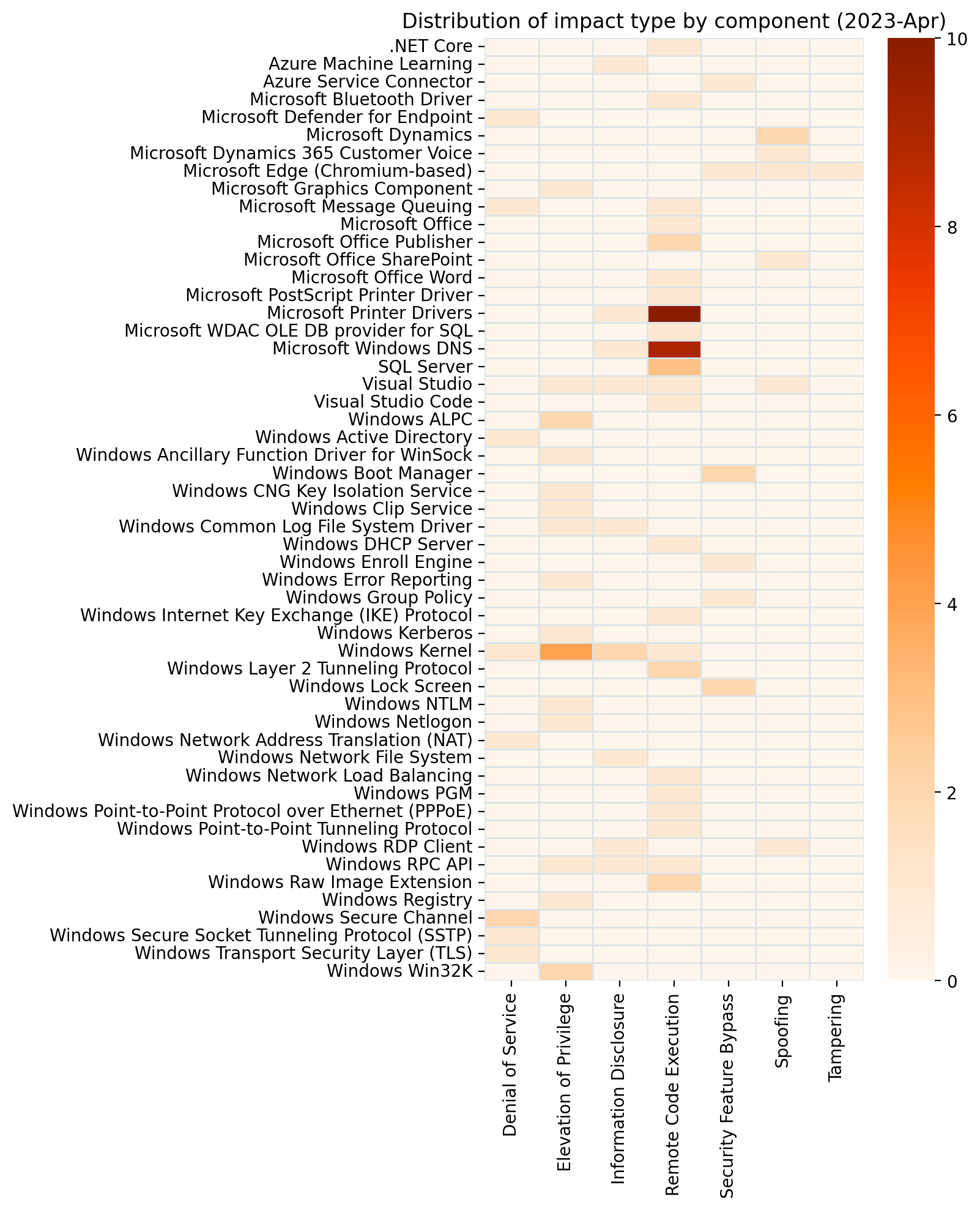
Microsoft is offering fixes for 114 vulnerabilities for in April 2023. This month’s haul includes a single zero-day vulnerability, as well as seven critical Remote Code Execution (RCE) vulnerabilities. There is a strong focus on fixes for Windows OS this month.
Over the last 18 months or so, Rapid7 has written several times about the prevalence of driver-based attacks. This month’s sole zero-day vulnerability – a driver-based elevation of privilege – will only reinforce the popularity of the vector among threat actors. Successful exploitation of CVE-2023-28252 allows an attacker to obtain SYSTEM privileges via a vulnerability in the Windows Common Log File System (CLFS) driver. Microsoft has patched more than one similar CLFS driver vulnerability over the past year, including CVE-2023-23376 in February 2023 and CVE-2022-37969 in September 2022.
Microsoft has released patches for the zero-day vulnerability CVE-2023-28252 for all current versions of Windows. Microsoft is not aware of public disclosure, but has detected in-the-wild exploitation and is aware of functional exploit code. The assigned base CVSSv3 score of 7.8 lands this vulnerability near the top of the High severity range, which is expected since it gives complete control of an asset, but a remote attacker must first find some other method to access the target.
April 2023 also sees 45 separate Remote Code Execution (RCE) vulnerabilities patched, which is a significant uptick from the average of 33 per month over the past three months. Microsoft rates seven of this month’s RCE vulnerabilities as Critical, including two related vulnerabilities with a CVSSv3 base score of 9.8. CVE-2023-28250 describes a vulnerability in Windows Pragmatic General Multicast (PGM) which allows an attacker to achieve RCE by sending a specially crafted file over the network. CVE-2023-21554 allows an attacker to achieve RCE by sending a specially crafted Microsoft Messaging Queue packet. In both cases, the Microsoft Message Queueing Service must be enabled and listening on port 1801 for an asset to be vulnerable. The Message Queueing Service is not installed by default. Even so, Microsoft considers exploitation of CVE-2023-21554 more likely.
The other five Critical RCE this month are spread across various Windows components: Windows Raw Image Extension, Windows DHCP Protocol, and two frequent fliers: Windows Point-to-Point Tunneling Protocol and the Windows Layer 2 Tunneling Protocol.
The RAW Image Extension vulnerability CVE-2023-28921 is another example of what Microsoft refers to as an Arbitrary Code Execution (ACE), explaining “The attack itself is carried out locally. This means an attacker or victim needs to execute code from the local machine to exploit the vulnerability.” For some defenders, this may stretch the definition of the word Remote in Remote Code Execution, but there are many ways to deliver a file to a user, and an unpatched system remains vulnerable regardless.
DHCP server vulnerability CVE-2023-28231 requires an attacker to be on the same network as the target, but offers RCE via a specially crafted RPC call. Microsoft considers that exploitation is more likely.
The hunter becomes the hunted as Microsoft patches a Denial of Service vulnerability in Defender. The advisory for CVE-2023-24860 includes some unusual guidance: “Systems that have disabled Microsoft Defender are not in an exploitable state.” In practice this vulnerability is less likely to be exploited, and the default update cadence for Defender should mean that most assets are automatically patched in a short timeframe.
Windows Server administrators should take note of CVE-2023-28247. Successful exploitation allows an attacker to view contents of kernel memory remotely from the context of a user process. Microsoft lists Windows Server 2012, 2016, 2019, and 2022 as vulnerable. Although Microsoft assesses that exploitation is less likely, Windows stores many secrets in kernel memory, including cryptographic keys.
Machine learning is everywhere these days, and this month’s Patch Tuesday is no exception: CVE-2023-28312 describes a vulnerability in Azure Machine Learning which allows an attacker to access system logs, although any attack would need to be launched from within the same secure network. The advisory contains links to Microsoft detection and remediation guidance.
The other Azure vulnerability this month is a Azure Service Connector Security Feature Bypass. Microsoft rates Attack Complexity for CVE-2023-28300 as High, since this vulnerability is only useful when chained with other exploits to defeat other security measures. However, the Azure Service Connector only updates when the Azure Command-Line Interface is updated, and automatic updates are not enabled by default.
Final curtain call tonight for a raft of familiar names, since April 2023 Patch Tuesday includes the very last round of Extended Security Updates (ESU) for a number of Microsoft products. These include:
- Exchange Server 2013
- Lync Server 2013
- Office 2013 and individual component applications such as Excel 2013, PowerPoint 2013 etc.
- Project 2013 and Project Server 2013
- SharePoint Server 2013 and SharePoint Foundation 2013
- Skype for Business 2015
As always, the end of ESU means that Microsoft does not expect to patch or even disclose any future vulnerabilities which might emerge in these venerable software products, so it is no longer possible to secure them; these dates have been well-publicized far in advance under the fixed lifecycle policy. No vendor can feasibly support ancient software indefinitely, and some administrators may be glad that they will never have to install another Exchange Server 2013 patch.
Summary Charts
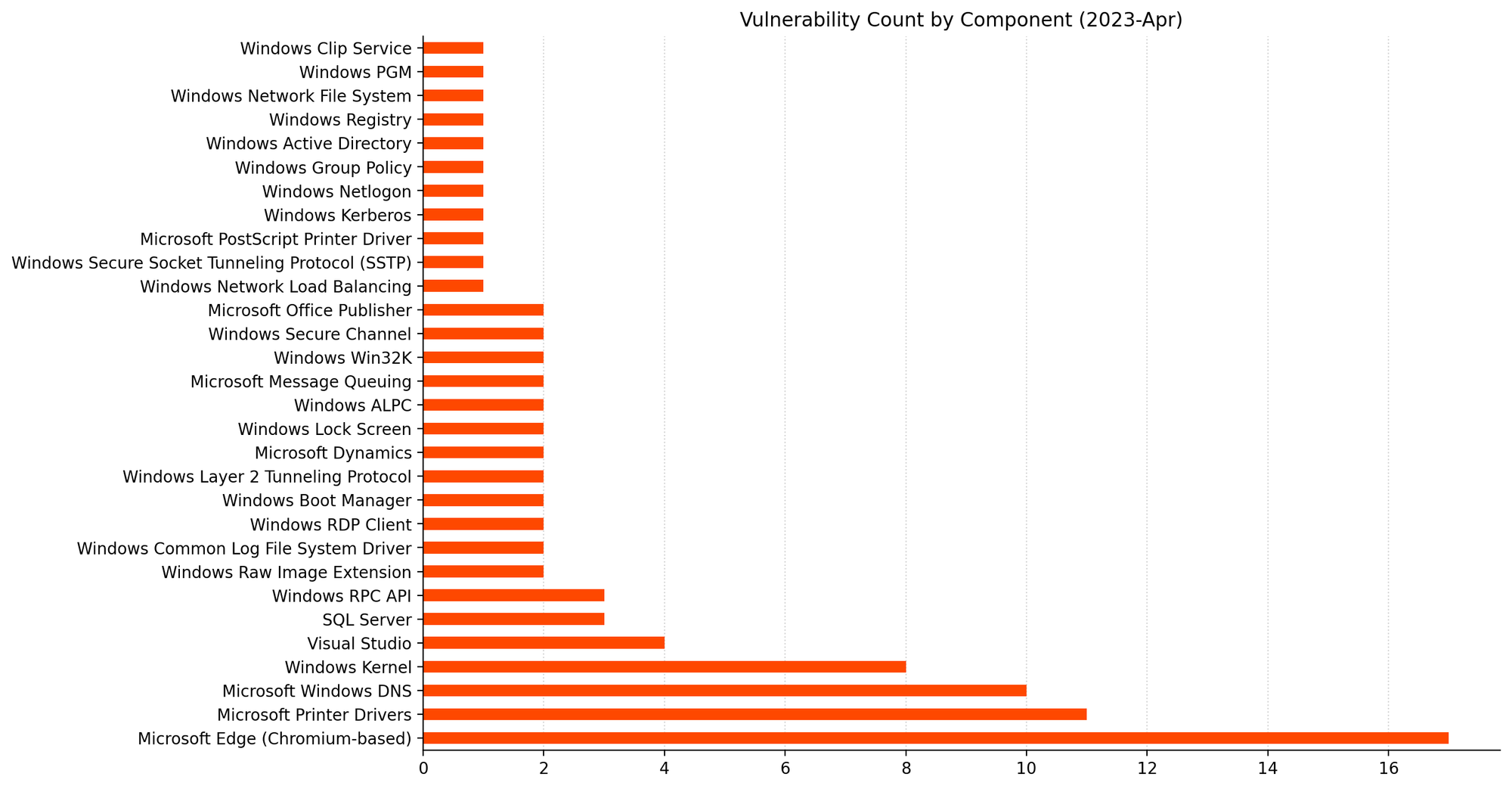
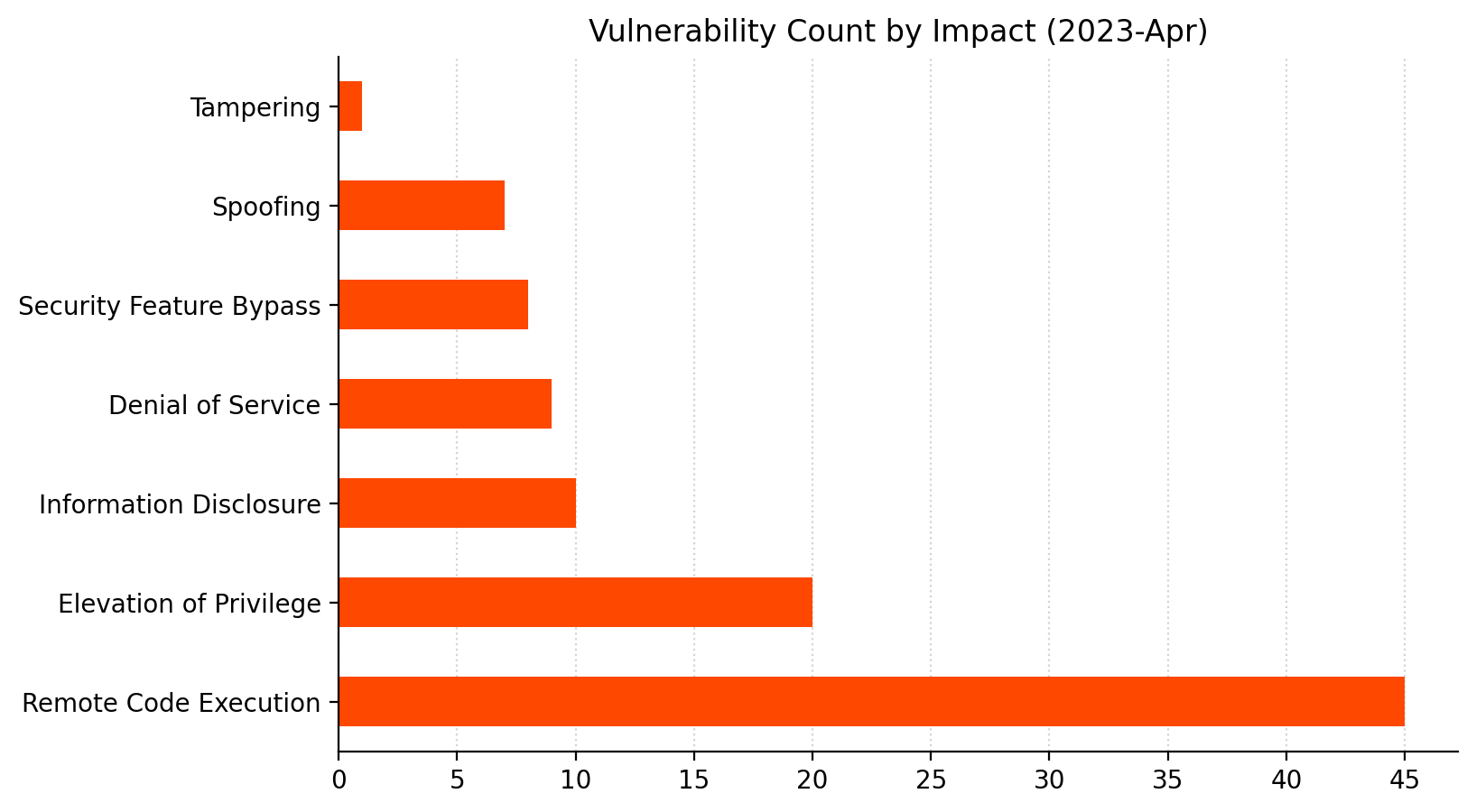
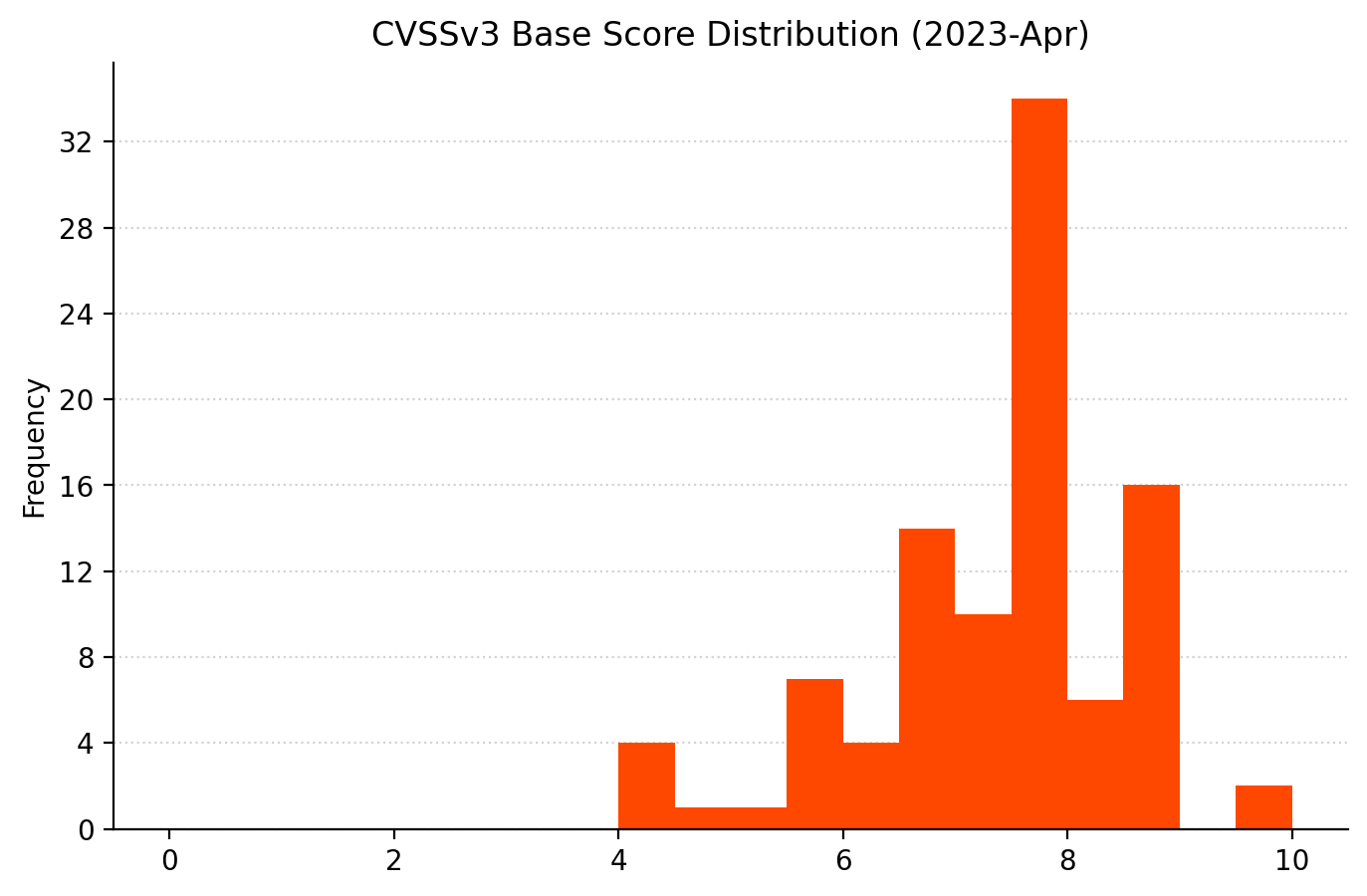
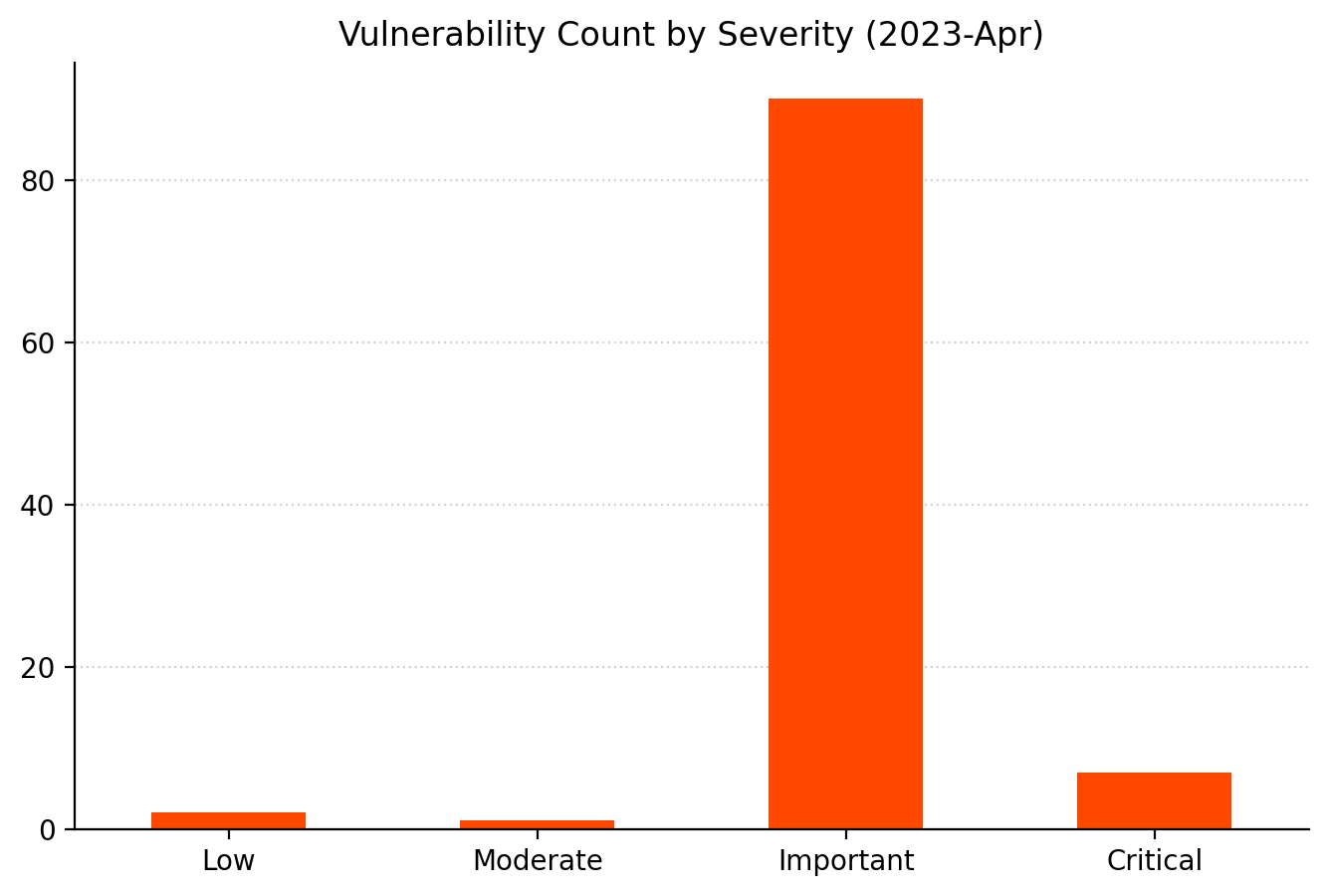
Summary tables
Azure vulnerabilities
| CVE | Title | Exploited? | Publicly disclosed? | CVSSv3 base score |
|---|---|---|---|---|
| CVE-2023-28300 | Azure Service Connector Security Feature Bypass Vulnerability | No | No | 7.5 |
| CVE-2023-28312 | Azure Machine Learning Information Disclosure Vulnerability | No | No | 6.5 |
Browser vulnerabilities
| CVE | Title | Exploited? | Publicly disclosed? | CVSSv3 base score |
|---|---|---|---|---|
| CVE-2023-28284 | Microsoft Edge (Chromium-based) Security Feature Bypass Vulnerability | No | No | 4.3 |
| CVE-2023-28301 | Microsoft Edge (Chromium-based) Tampering Vulnerability | No | No | 4.2 |
| CVE-2023-24935 | Microsoft Edge (Chromium-based) Spoofing Vulnerability | No | No | N/A |
| CVE-2023-1823 | Chromium: CVE-2023-1823 Inappropriate implementation in FedCM | No | No | N/A |
| CVE-2023-1822 | Chromium: CVE-2023-1822 Incorrect security UI in Navigation | No | No | N/A |
| CVE-2023-1821 | Chromium: CVE-2023-1821 Inappropriate implementation in WebShare | No | No | N/A |
| CVE-2023-1820 | Chromium: CVE-2023-1820 Heap buffer overflow in Browser History | No | No | N/A |
| CVE-2023-1819 | Chromium: CVE-2023-1819 Out of bounds read in Accessibility | No | No | N/A |
| CVE-2023-1818 | Chromium: CVE-2023-1818 Use after free in Vulkan | No | No | N/A |
| CVE-2023-1817 | Chromium: CVE-2023-1817 Insufficient policy enforcement in Intents | No | No | N/A |
| CVE-2023-1816 | Chromium: CVE-2023-1816 Incorrect security UI in Picture In Picture | No | No | N/A |
| CVE-2023-1815 | Chromium: CVE-2023-1815 Use after free in Networking APIs | No | No | N/A |
| CVE-2023-1814 | Chromium: CVE-2023-1814 Insufficient validation of untrusted input in Safe Browsing | No | No | N/A |
| CVE-2023-1813 | Chromium: CVE-2023-1813 Inappropriate implementation in Extensions | No | No | N/A |
| CVE-2023-1812 | Chromium: CVE-2023-1812 Out of bounds memory access in DOM Bindings | No | No | N/A |
| CVE-2023-1811 | Chromium: CVE-2023-1811 Use after free in Frames | No | No | N/A |
| CVE-2023-1810 | Chromium: CVE-2023-1810 Heap buffer overflow in Visuals | No | No | N/A |
Developer Tools vulnerabilities
| CVE | Title | Exploited? | Publicly disclosed? | CVSSv3 base score |
|---|---|---|---|---|
| CVE-2023-28296 | Visual Studio Remote Code Execution Vulnerability | No | No | 8.4 |
| CVE-2023-28262 | Visual Studio Elevation of Privilege Vulnerability | No | No | 7.8 |
| CVE-2023-24893 | Visual Studio Code Remote Code Execution Vulnerability | No | No | 7.8 |
| CVE-2023-28260 | .NET DLL Hijacking Remote Code Execution Vulnerability | No | No | 7.8 |
| CVE-2023-28299 | Visual Studio Spoofing Vulnerability | No | No | 5.5 |
| CVE-2023-28263 | Visual Studio Information Disclosure Vulnerability | No | No | 5.5 |
ESU SQL Server vulnerabilities
| CVE | Title | Exploited? | Publicly disclosed? | CVSSv3 base score |
|---|---|---|---|---|
| CVE-2023-23384 | Microsoft SQL Server Remote Code Execution Vulnerability | No | No | 7.3 |
ESU Windows vulnerabilities
| CVE | Title | Exploited? | Publicly disclosed? | CVSSv3 base score |
|---|---|---|---|---|
| CVE-2023-28250 | Windows Pragmatic General Multicast (PGM) Remote Code Execution Vulnerability | No | No | 9.8 |
| CVE-2023-21554 | Microsoft Message Queuing Remote Code Execution Vulnerability | No | No | 9.8 |
| CVE-2023-28240 | Windows Network Load Balancing Remote Code Execution Vulnerability | No | No | 8.8 |
| CVE-2023-21727 | Remote Procedure Call Runtime Remote Code Execution Vulnerability | No | No | 8.8 |
| CVE-2023-28275 | Microsoft WDAC OLE DB provider for SQL Server Remote Code Execution Vulnerability | No | No | 8.8 |
| CVE-2023-28231 | DHCP Server Service Remote Code Execution Vulnerability | No | No | 8.8 |
| CVE-2023-28244 | Windows Kerberos Elevation of Privilege Vulnerability | No | No | 8.1 |
| CVE-2023-28268 | Netlogon RPC Elevation of Privilege Vulnerability | No | No | 8.1 |
| CVE-2023-28219 | Layer 2 Tunneling Protocol Remote Code Execution Vulnerability | No | No | 8.1 |
| CVE-2023-28220 | Layer 2 Tunneling Protocol Remote Code Execution Vulnerability | No | No | 8.1 |
| CVE-2023-28272 | Windows Kernel Elevation of Privilege Vulnerability | No | No | 7.8 |
| CVE-2023-28293 | Windows Kernel Elevation of Privilege Vulnerability | No | No | 7.8 |
| CVE-2023-24912 | Windows Graphics Component Elevation of Privilege Vulnerability | No | No | 7.8 |
| CVE-2023-28252 | Windows Common Log File System Driver Elevation of Privilege Vulnerability | Yes | No | 7.8 |
| CVE-2023-28241 | Windows Secure Socket Tunneling Protocol (SSTP) Denial of Service Vulnerability | No | No | 7.5 |
| CVE-2023-24931 | Windows Secure Channel Denial of Service Vulnerability | No | No | 7.5 |
| CVE-2023-28232 | Windows Point-to-Point Tunneling Protocol Remote Code Execution Vulnerability | No | No | 7.5 |
| CVE-2023-28217 | Windows Network Address Translation (NAT) Denial of Service Vulnerability | No | No | 7.5 |
| CVE-2023-28238 | Windows Internet Key Exchange (IKE) Protocol Extensions Remote Code Execution Vulnerability | No | No | 7.5 |
| CVE-2023-28227 | Windows Bluetooth Driver Remote Code Execution Vulnerability | No | No | 7.5 |
| CVE-2023-21769 | Microsoft Message Queuing Denial of Service Vulnerability | No | No | 7.5 |
| CVE-2023-28302 | Microsoft Message Queuing Denial of Service Vulnerability | No | No | 7.5 |
| CVE-2023-28254 | Windows DNS Server Remote Code Execution Vulnerability | No | No | 7.2 |
| CVE-2023-28222 | Windows Kernel Elevation of Privilege Vulnerability | No | No | 7.1 |
| CVE-2023-28229 | Windows CNG Key Isolation Service Elevation of Privilege Vulnerability | No | No | 7 |
| CVE-2023-28218 | Windows Ancillary Function Driver for WinSock Elevation of Privilege Vulnerability | No | No | 7 |
| CVE-2023-28216 | Windows Advanced Local Procedure Call (ALPC) Elevation of Privilege Vulnerability | No | No | 7 |
| CVE-2023-28305 | Windows DNS Server Remote Code Execution Vulnerability | No | No | 6.6 |
| CVE-2023-28255 | Windows DNS Server Remote Code Execution Vulnerability | No | No | 6.6 |
| CVE-2023-28278 | Windows DNS Server Remote Code Execution Vulnerability | No | No | 6.6 |
| CVE-2023-28256 | Windows DNS Server Remote Code Execution Vulnerability | No | No | 6.6 |
| CVE-2023-28306 | Windows DNS Server Remote Code Execution Vulnerability | No | No | 6.6 |
| CVE-2023-28307 | Windows DNS Server Remote Code Execution Vulnerability | No | No | 6.6 |
| CVE-2023-28308 | Windows DNS Server Remote Code Execution Vulnerability | No | No | 6.6 |
| CVE-2023-28223 | Windows Domain Name Service Remote Code Execution Vulnerability | No | No | 6.6 |
| CVE-2023-28267 | Remote Desktop Protocol Client Information Disclosure Vulnerability | No | No | 6.5 |
| CVE-2023-28228 | Windows Spoofing Vulnerability | No | No | 5.5 |
| CVE-2023-28271 | Windows Kernel Memory Information Disclosure Vulnerability | No | No | 5.5 |
| CVE-2023-28253 | Windows Kernel Information Disclosure Vulnerability | No | No | 5.5 |
| CVE-2023-28298 | Windows Kernel Denial of Service Vulnerability | No | No | 5.5 |
| CVE-2023-28266 | Windows Common Log File System Driver Information Disclosure Vulnerability | No | No | 5.5 |
| CVE-2023-28276 | Windows Group Policy Security Feature Bypass Vulnerability | No | No | 4.4 |
| CVE-2023-21729 | Remote Procedure Call Runtime Information Disclosure Vulnerability | No | No | 4.3 |
Microsoft Dynamics vulnerabilities
| CVE | Title | Exploited? | Publicly disclosed? | CVSSv3 base score |
|---|---|---|---|---|
| CVE-2023-28309 | Microsoft Dynamics 365 (on-premises) Cross-site Scripting Vulnerability | No | No | 7.6 |
| CVE-2023-28313 | Microsoft Dynamics 365 Customer Voice Cross-Site Scripting Vulnerability | No | No | 6.1 |
| CVE-2023-28314 | Microsoft Dynamics 365 (on-premises) Cross-site Scripting Vulnerability | No | No | 6.1 |
Microsoft Office vulnerabilities
| CVE | Title | Exploited? | Publicly disclosed? | CVSSv3 base score |
|---|---|---|---|---|
| CVE-2023-28311 | Microsoft Word Remote Code Execution Vulnerability | No | No | 7.8 |
| CVE-2023-28287 | Microsoft Publisher Remote Code Execution Vulnerability | No | No | 7.8 |
| CVE-2023-28295 | Microsoft Publisher Remote Code Execution Vulnerability | No | No | 7.8 |
| CVE-2023-28285 | Microsoft Office Graphics Remote Code Execution Vulnerability | No | No | 7.8 |
| CVE-2023-28288 | Microsoft SharePoint Server Spoofing Vulnerability | No | No | 6.5 |
SQL Server vulnerabilities
| CVE | Title | Exploited? | Publicly disclosed? | CVSSv3 base score |
|---|---|---|---|---|
| CVE-2023-23375 | Microsoft ODBC and OLE DB Remote Code Execution Vulnerability | No | No | 7.8 |
| CVE-2023-28304 | Microsoft ODBC and OLE DB Remote Code Execution Vulnerability | No | No | 7.8 |
System Center vulnerabilities
| CVE | Title | Exploited? | Publicly disclosed? | CVSSv3 base score |
|---|---|---|---|---|
| CVE-2023-24860 | Microsoft Defender Denial of Service Vulnerability | No | No | 7.5 |
Windows vulnerabilities
| CVE | Title | Exploited? | Publicly disclosed? | CVSSv3 base score |
|---|---|---|---|---|
| CVE-2023-28297 | Windows Remote Procedure Call Service (RPCSS) Elevation of Privilege Vulnerability | No | No | 8.8 |
| CVE-2023-24924 | Microsoft PostScript and PCL6 Class Printer Driver Remote Code Execution Vulnerability | No | No | 8.8 |
| CVE-2023-24925 | Microsoft PostScript and PCL6 Class Printer Driver Remote Code Execution Vulnerability | No | No | 8.8 |
| CVE-2023-24884 | Microsoft PostScript and PCL6 Class Printer Driver Remote Code Execution Vulnerability | No | No | 8.8 |
| CVE-2023-24926 | Microsoft PostScript and PCL6 Class Printer Driver Remote Code Execution Vulnerability | No | No | 8.8 |
| CVE-2023-24885 | Microsoft PostScript and PCL6 Class Printer Driver Remote Code Execution Vulnerability | No | No | 8.8 |
| CVE-2023-24927 | Microsoft PostScript and PCL6 Class Printer Driver Remote Code Execution Vulnerability | No | No | 8.8 |
| CVE-2023-24886 | Microsoft PostScript and PCL6 Class Printer Driver Remote Code Execution Vulnerability | No | No | 8.8 |
| CVE-2023-24928 | Microsoft PostScript and PCL6 Class Printer Driver Remote Code Execution Vulnerability | No | No | 8.8 |
| CVE-2023-24887 | Microsoft PostScript and PCL6 Class Printer Driver Remote Code Execution Vulnerability | No | No | 8.8 |
| CVE-2023-24929 | Microsoft PostScript and PCL6 Class Printer Driver Remote Code Execution Vulnerability | No | No | 8.8 |
| CVE-2023-28243 | Microsoft PostScript and PCL6 Class Printer Driver Remote Code Execution Vulnerability | No | No | 8.8 |
| CVE-2023-28291 | Raw Image Extension Remote Code Execution Vulnerability | No | No | 8.4 |
| CVE-2023-28274 | Windows Win32k Elevation of Privilege Vulnerability | No | No | 7.8 |
| CVE-2023-28246 | Windows Registry Elevation of Privilege Vulnerability | No | No | 7.8 |
| CVE-2023-28225 | Windows NTLM Elevation of Privilege Vulnerability | No | No | 7.8 |
| CVE-2023-28237 | Windows Kernel Remote Code Execution Vulnerability | No | No | 7.8 |
| CVE-2023-28236 | Windows Kernel Elevation of Privilege Vulnerability | No | No | 7.8 |
| CVE-2023-28248 | Windows Kernel Elevation of Privilege Vulnerability | No | No | 7.8 |
| CVE-2023-28292 | Raw Image Extension Remote Code Execution Vulnerability | No | No | 7.8 |
| CVE-2023-28233 | Windows Secure Channel Denial of Service Vulnerability | No | No | 7.5 |
| CVE-2023-28234 | Windows Secure Channel Denial of Service Vulnerability | No | No | 7.5 |
| CVE-2023-28247 | Windows Network File System Information Disclosure Vulnerability | No | No | 7.5 |
| CVE-2023-28224 | Windows Point-to-Point Protocol over Ethernet (PPPoE) Remote Code Execution Vulnerability | No | No | 7.1 |
| CVE-2023-28221 | Windows Error Reporting Service Elevation of Privilege Vulnerability | No | No | 7 |
| CVE-2023-28273 | Windows Clip Service Elevation of Privilege Vulnerability | No | No | 7 |
| CVE-2023-24914 | Win32k Elevation of Privilege Vulnerability | No | No | 7 |
| CVE-2023-28235 | Windows Lock Screen Security Feature Bypass Vulnerability | No | No | 6.8 |
| CVE-2023-28270 | Windows Lock Screen Security Feature Bypass Vulnerability | No | No | 6.8 |
| CVE-2023-24883 | Microsoft PostScript and PCL6 Class Printer Driver Information Disclosure Vulnerability | No | No | 6.5 |
| CVE-2023-28269 | Windows Boot Manager Security Feature Bypass Vulnerability | No | No | 6.2 |
| CVE-2023-28249 | Windows Boot Manager Security Feature Bypass Vulnerability | No | No | 6.2 |
| CVE-2023-28226 | Windows Enroll Engine Security Feature Bypass Vulnerability | No | No | 5.3 |
| CVE-2023-28277 | Windows DNS Server Information Disclosure Vulnerability | No | No | 4.9 |
New Global AWS Data Processing Addendum
Post Syndicated from Chad Woolf original https://aws.amazon.com/blogs/security/new-global-aws-data-processing-addendum/
Navigating data protection laws around the world is no simple task. Today, I’m pleased to announce that AWS is expanding the scope of the AWS Data Processing Addendum (Global AWS DPA) so that it applies globally whenever customers use AWS services to process personal data, regardless of which data protection laws apply to that processing. AWS is proud to be the first major cloud provider to adopt this global approach to help you meet your compliance needs for data protection.
The Global AWS DPA is designed to help you satisfy requirements under data protection laws worldwide, without having to create separate country-specific data processing agreements for every location where you use AWS services. By introducing this global, one-stop addendum, we are simplifying contracting procedures and helping to reduce the time that you spend assessing contractual data privacy requirements on a country-by-country basis.
If you have signed a copy of the previous AWS General Data Protection Regulation (GDPR) DPA, then you do not need to take any action and can continue to rely on that addendum to satisfy data processing requirements. AWS is always innovating to help you meet your compliance obligations wherever you operate. We’re confident that this expanded Global AWS DPA will help you on your journey. If you have questions or need more information, see Data Protection & Privacy at AWS and GDPR Center.
If you have feedback about this post, submit comments in the Comments section below. If you have questions about this post, contact AWS Support.
Want more AWS Security news? Follow us on Twitter.
[$] Python 3.12: error messages, perf support, and more
Post Syndicated from original https://lwn.net/Articles/928437/
Python 3.12 approaches. While the full feature set of the final
release—slated for October 2023—is still not completely known, by now
we have a good sense for what it will offer. It picks up where
Python 3.11 left off, improving error messages
and performance. These changes are accompanied by a smattering of smaller
changes, though Linux users will likely make use of one in particular:
support for the perf profiler.
7 Rapid Questions: Lindsey Searle
Post Syndicated from Rapid7 original https://blog.rapid7.com/2023/04/11/7-rapid-questions-lindsey-searle/

Welcome back to 7 Rapid Questions, our blog series where we ask passionate leaders at Rapid7 to give us an inside look at what it’s like to work on their team, and how they’re creating an impact every day.
In this installment, we talk to Lindsey Searle, Senior Manager, Customer Advisors on how her team helps solve customer challenges, and how candidates can stand out in the interview process.
What kind of challenges are you/your team responsible for solving for customers?
The security space is evolving every day as hackers continue to advance. Many customer teams find themselves overwhelmed and in need of more customized services to stay ahead, and that’s where we can help support.
Our team is the face of Rapid7 for Managed Services customers. We provide advisory services for clients of all shapes and sizes and at all levels of their security maturity journeys. The Customer Advisor team works closely with the Security Operations Center (SOC) to monitor customers’ in-scope environments and provide custom tailored guidance to enhance their security posture. Many of our customers consider us an extension of their in-house security team, and we strive to build close knit working relationships and trust with each and every one of them.
In addition to day to day monitoring, our Customer Advisors work with our clients to understand their security goals, make recommendations to achieve those goals, and are personally invested in seeing those initiatives through to completion.
What does your team look like (team size, types of teams etc.), what growth has there been?
The Customer Advisor organization at Rapid7 grew by 30% last year—we added 35 new people to the team in 2022, including Advisors at all levels, four new managers, and a Vice President.
Our team is composed of all levels of security professionals, from associate CAs at the start of their career to tenured Lead and Principal Advisors. We have CAs supporting all three branches of Managed Services, and our teams are blended across Managed Detection and Response (MDR), Managed Vulnerability Management (MVM), and Managed Application Security (MAS) to allow for cross functional collaboration and learning.
We are fortunately in a position where as our Managed Services business grows, our Customer Advisor team has continued to expand, as it is a standard part of the service offering.
What makes the culture at R7 different from other tech / cyber security companies?
I always find it difficult to describe the Rapid7 culture when I interview candidates because it’s something that you really have to see to understand and believe. The underlying fact is that all Rapid7 employees are passionate about security—we are here because we want to help our customers succeed, and we truly enjoy working together for that common goal.
At the same time, every single person is unapologetically unique and does not hesitate to bring their own perspective to the table. We have a great balance of external hires bringing in fresh ideas, as well as internal hires that provide a different approach to a situation when you’ve worked on the other side of the curtain.
What 3 biggest things have you learned in your time at Rapid7?
One: Take the time to thank people for helping you out! We do ‘guitar picks’ at Rapid7—it’s an internal website where you can give fellow moose a virtual kudos and recognition, whether it be for a great presentation they gave, or for filling in for you on an assignment, or for just being awesome. Everyone in the company can see it, and the recipient gets a notification that they’ve received one. Sending a pick takes minutes but can make someone’s day! Our Chief People Officer selects a guitar pick submission and sends it out to the whole company every morning. It’s a quick and meaningful way to thank those around us.
Two: Don’t be afraid to ask questions—we are all constantly learning and there is definitely someone out there who can help.
Three: There is a Slack emoji for just about every situation, and if it doesn’t exist—make one! In fact, our recent Slack migration took longer than expected due to the 10,000+ custom emojis that Rapid7 employees have created. One of our core values is ‘Bring You’ so this is just one example of how people are getting creative to express themselves in different ways and build camaraderie in a globally distributed organization.
How does Rapid7 set you up for success in your role?
I was incredibly impressed with the corporate onboarding provided by Rapid7 when I went through it myself in late 2021. You attend your onboarding sessions with all new hires starting at the company that week and already start to build a network within your first few hours here.
Rapid7 is big on encouraging Insight Coffees—an informal 30 minute meeting with another Rapid7 employee to get to know them on a personal and professional level. Those connections stick with you throughout your time here and only strengthen your ability to work together down the road.
Our company culture is built around helping each other and working together as a team, which puts you in a great spot to be successful in your role.
What can a candidate do to stand out in the interview process?
Honestly, just be yourself—Bring You is a core value at Rapid7 and something that truly sets us apart from other companies. Finding people who embrace our collaborative culture and partner well to share ideas is a major piece of the Rapid7 interview process. These soft skills weigh as heavily as prior work experience and technical competency. Your individuality will set you apart from other candidates—so let your true self shine!
What advice would you give someone thinking about coming to work here?
Bring energy and enthusiasm, and take the time to build meaningful relationships with the people you work with. It is much easier to wake up and log on for the day when you are looking forward to interacting with your team members and your customers. At Rapid7 we live by the core value of ‘Impact Together’—teamwork makes the dream work! We have a far greater chance at success when working together than we do when trying to climb the ladder individually.
To learn more about Rapid7 Managed Services:
Reference guide to build inventory management and forecasting solutions on AWS
Post Syndicated from Jason Dalba original https://aws.amazon.com/blogs/big-data/reference-guide-to-build-inventory-management-and-forecasting-solutions-on-aws/
Inventory management is a critical function for any business that deals with physical products. The primary challenge businesses face with inventory management is balancing the cost of holding inventory with the need to ensure that products are available when customers demand them.
The consequences of poor inventory management can be severe. Overstocking can lead to increased holding costs and waste, while understocking can result in lost sales, reduced customer satisfaction, and damage to the business’s reputation. Inefficient inventory management can also tie up valuable resources, including capital and warehouse space, and can impact profitability.
Forecasting is another critical component of effective inventory management. Accurately predicting demand for products allows businesses to optimize inventory levels, minimize stockouts, and reduce holding costs. However, forecasting can be a complex process, and inaccurate predictions can lead to missed opportunities and lost revenue.
To address these challenges, businesses need an inventory management and forecasting solution that can provide real-time insights into inventory levels, demand trends, and customer behavior. Such a solution should use the latest technologies, including Internet of Things (IoT) sensors, cloud computing, and machine learning (ML), to provide accurate, timely, and actionable data. By implementing such a solution, businesses can improve their inventory management processes, reduce holding costs, increase revenue, and enhance customer satisfaction.
In this post, we discuss how to streamline inventory management forecasting systems with AWS managed analytics, AI/ML, and database services.
Solution overview
In today’s highly competitive business landscape, it’s essential for retailers to optimize their inventory management processes to maximize profitability and improve customer satisfaction. With the proliferation of IoT devices and the abundance of data generated by them, it has become possible to collect real-time data on inventory levels, customer behavior, and other key metrics.
To take advantage of this data and build an effective inventory management and forecasting solution, retailers can use a range of AWS services. By collecting data from store sensors using AWS IoT Core, ingesting it using AWS Lambda to Amazon Aurora Serverless, and transforming it using AWS Glue from a database to an Amazon Simple Storage Service (Amazon S3) data lake, retailers can gain deep insights into their inventory and customer behavior.
With Amazon Athena, retailers can analyze this data to identify trends, patterns, and anomalies, and use Amazon ElastiCache for customer-facing applications with reduced latency. Additionally, by building a point of sales application on Amazon QuickSight, retailers can embed customer 360 views into the application to provide personalized shopping experiences and drive customer loyalty.
Finally, we can use Amazon SageMaker to build forecasting models that can predict inventory demand and optimize stock levels.
With these AWS services, retailers can build an end-to-end inventory management and forecasting solution that provides real-time insights into inventory levels and customer behavior, enabling them to make informed decisions that drive business growth and customer satisfaction.
The following diagram illustrates a sample architecture.
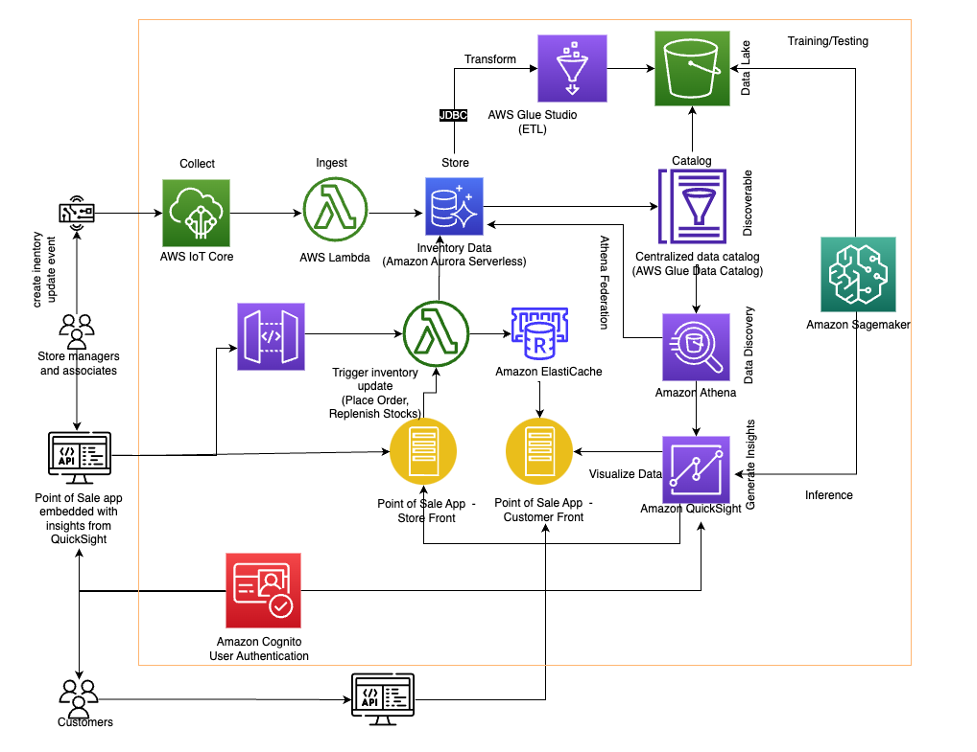
With the appropriate AWS services, your inventory management and forecasting system can have optimized collection, storage, processing, and analysis of data from multiple sources. The solution includes the following components.
Data ingestion and storage
Retail businesses have event-driven data that requires action from downstream processes. It’s critical for an inventory management application to handle the data ingestion and storage for changing demands.
The data ingestion process is typically triggered by an event such as an order being placed, kicking off the inventory management workflow, which requires actions from backend services. Developers are responsible for the operational overhead of trying to maintain the data ingestion load from an event driven-application.
The volume and velocity of data can change in the retail industry each day. Events like Black Friday or a new campaign can create volatile demand in what is required to process and store the inventory data. Serverless services designed to scale to businesses’ needs help reduce the architectural and operational challenges that are driven from high-demand retail applications.
Understanding the scaling challenges that occur when inventory demand spikes, we can deploy Lambda, a serverless, event-driven compute service, to trigger the data ingestion process. As inventory events occur like purchases or returns, Lambda automatically scales compute resources to meet the volume of incoming data.
After Lambda responds to the inventory action request, the updated data is stored in Aurora Serverless. Aurora Serverless is a serverless relational database that is designed to scale to the application’s needs. When peak loads hit during events like Black Friday, Aurora Serverless deploys only the database capacity necessary to meet the workload.
Inventory management applications have ever-changing demands. Deploying serverless services to handle the ingestion and storage of data will not only optimize cost but also reduce the operational overhead for developers, freeing up bandwidth for other critical business needs.
Data performance
Customer-facing applications require low latency to maintain positive user experiences with microsecond response times. ElastiCache, a fully managed, in-memory database, delivers high-performance data retrieval to users.
In-memory caching provided by ElastiCache is used to improve latency and throughput for read-heavy applications that online retailers experience. By storing critical pieces of data in-memory like commonly accessed product information, the application performance improves. Product information is an ideal candidate for a cached store due to data staying relatively the same.
Functionality is often added to retail applications to retrieve trending products. Trending products can be cycled through the cache dependent on customer access patterns. ElastiCache manages the real-time application data caching, allowing your customers to experience microsecond response times while supporting high-throughput handling of hundreds of millions of operations per second.
Data transformation
Data transformation is essential in inventory management and forecasting solutions for both data analysis around sales and inventory, as well as ML for forecasting. This is because raw data from various sources can contain inconsistencies, errors, and missing values that may distort the analysis and forecast results.
In the inventory management and forecasting solution, AWS Glue is recommended for data transformation. The tool addresses issues such as cleaning, restructuring, and consolidating data into a standard format that can be easily analyzed. As a result of the transformation, businesses can obtain a more precise understanding of inventory, sales trends, and customer behavior, influencing data-driven decisions to optimize inventory management and sales strategies. Furthermore, high-quality data is crucial for ML algorithms to make accurate forecasts.
By transforming data, organizations can enhance the accuracy and dependability of their forecasting models, ultimately leading to improved inventory management and cost savings.
Data analysis
Data analysis has become increasingly important for businesses because it allows leaders to make informed operational decisions. However, analyzing large volumes of data can be a time-consuming and resource-intensive task. This is where Athena come in. With Athena, businesses can easily query historical sales and inventory data stored in S3 data lakes and combine it with real-time transactional data from Aurora Serverless databases.
The federated capabilities of Athena allow businesses to generate insights by combining datasets without the need to build ETL (extract, transform, and load) pipelines, saving time and resources. This enables businesses to quickly gain a comprehensive understanding of their inventory and sales trends, which can be used to optimize inventory management and forecasting, ultimately improving operations and increasing profitability.
With Athena’s ease of use and powerful capabilities, businesses can quickly analyze their data and gain valuable insights, driving growth and success without the need for complex ETL pipelines.
Forecasting
Inventory forecasting is an important aspect of inventory management for businesses that deal with physical products. Accurately predicting demand for products can help optimize inventory levels, reduce costs, and improve customer satisfaction. ML can help simplify and improve inventory forecasting by making more accurate predictions based on historical data.
SageMaker is a powerful ML platform that you can use to build, train, and deploy ML models for a wide range of applications, including inventory forecasting. In this solution, we use SageMaker to build and train an ML model for inventory forecasting, covering the basic concepts of ML, the data preparation process, model training and evaluation, and deploying the model for use in a production environment.
The solution also introduces the concept of hierarchical forecasting, which involves generating coherent forecasts that maintain the relationships within the hierarchy or reconciling incoherent forecasts. The workshop provides a step-by-step process for using the training capabilities of SageMaker to carry out hierarchical forecasting using synthetic retail data and the scikit-hts package. The FBProphet model was used along with bottom-up and top-down hierarchical aggregation and disaggregation methods. We used Amazon SageMaker Experiments to train multiple models, and the best model was picked out of the four trained models.
Although the approach was demonstrated on a synthetic retail dataset, you can use the provided code with any time series dataset that exhibits a similar hierarchical structure.
Security and authentication
The solution takes advantage of the scalability, reliability, and security of AWS services to provide a comprehensive inventory management and forecasting solution that can help businesses optimize their inventory levels, reduce holding costs, increase revenue, and enhance customer satisfaction. By incorporating user authentication with Amazon Cognito and Amazon API Gateway, the solution ensures that the system is secure and accessible only by authorized users.
Next steps
The next step to build an inventory management and forecasting solution on AWS would be to go through the Inventory Management workshop. In the workshop, you will get hands-on with AWS managed analytics, AI/ML, and database services to dive deep into an end-to-end inventory management solution. By the end of the workshop, you will have gone through the configuration and deployment of the critical pieces that make up an inventory management system.
Conclusion
In conclusion, building an inventory management and forecasting solution on AWS can help businesses optimize their inventory levels, reduce holding costs, increase revenue, and enhance customer satisfaction. With AWS services like IoT Core, Lambda, Aurora Serverless, AWS Glue, Athena, ElastiCache, QuickSight, SageMaker, and Amazon Cognito, businesses can use scalable, reliable, and secure technologies to collect, store, process, and analyze data from various sources.
The end-to-end solution is designed for individuals in various roles, such as business users, data engineers, data scientists, and data analysts, who are responsible for comprehending, creating, and overseeing processes related to retail inventory forecasting. Overall, an inventory management and forecasting solution on AWS can provide businesses with the insights and tools they need to make data-driven decisions and stay competitive in a constantly evolving retail landscape.
About the Authors
 Jason D’Alba is an AWS Solutions Architect leader focused on databases and enterprise applications, helping customers architect highly available and scalable solutions.
 Navnit Shukla is an AWS Specialist Solution Architect, Analytics, and is passionate about helping customers uncover insights from their data. He has been building solutions to help organizations make data-driven decisions.
 Vetri Natarajan is a Specialist Solutions Architect for Amazon QuickSight. Vetri has 15 years of experience implementing enterprise business intelligence (BI) solutions and greenfield data products. Vetri specializes in integration of BI solutions with business applications and enable data-driven decisions.
 Sindhura Palakodety is a Solutions Architect at AWS. She is passionate about helping customers build enterprise-scale Well-Architected solutions on the AWS platform and specializes in Data Analytics domain.
It’s the Amazon QuickSight Community’s 1st birthday!
Post Syndicated from Kristin Mandia original https://aws.amazon.com/blogs/big-data/its-the-amazon-quicksight-communitys-1st-birthday/
Happy birthday Amazon QuickSight Community! We are celebrating 1 year since the launch of our new Community. The Amazon QuickSight Community website is a one-stop-shop where business intelligence (BI) authors and developers from across the globe can ask and answer questions, stay up to date, network, and learn together about Amazon QuickSight. In this post, we celebrate the rapid growth of our first year of the QuickSight Community, discuss new Community features, and share voices from our Community. We also invite you to sign up for the QuickSight Community (it’s easy and free) and get started on your learning journey.

We’re growing strong
Since last year’s announcement of the new QuickSight Community, we are witnessing hundreds of thousands of visits to the QuickSight Community each month. Answers to thousands of searchable questions have been posted, and our online Learning Series is now running every week. An events calendar has been added, and hundreds of learning resources have been posted (how-to videos and articles, Getting Started resources, blog posts, and What’s New posts). Furthermore, a Community Manager has been brought on board. And Community Experts and QuickSight Solution Architects are posting robust answers in the Q&A, supported by AWS Professional Services, AWS Data Lab, and Amazon QuickSight Service Delivery Partners—led by West Loop Strategy. In addition, other QuickSight Partners and content creators are bringing new life to the Community.

New QuickSight Community members at an internal Amazon conference
Why are we excited? Community members share their voices
As we celebrate year one, QuickSight Community members share their voices:
“The community has been an awesome space to exchange ideas, problems, and solutions, which has really helped every one of us in adopting QuickSight more effectively!” #thank you #community — Sagnik Mukherjee, Data and Analytics Architect, QuickSight Expert
“I am so excited for the QuickSight Learning Series! And I am happy to know that there is a supportive community…as I begin my QS journey!“ — Rachel Krentz, Configuration Analyst, Madaket
“The community has evolved so much in just one year!” — Darren Demicoli, BI Team Lead, The Mill Adventure, QuickSight Expert
“Happy Birthday QuickSight Community! I’m pretty new here but have found this to be a really great resource with answers to every question I have been able to come up with so far. Cheers!” — Brian Jager, Sales Operations Lead, Amazon Business
“I love being connected directly with other users and solutions architects…The QuickSight Community helps me out a ton not having to spend as much of my time on training when I can point new users to a resource where their questions have likely already been answered.” — Ryane Brady, Programmer Analyst, GROWMARK, Inc., QuickSight Expert
Hear more voices from our Community on our birthday post.
The QuickSight Community: Your one-stop-shop for BI learning
Here’s a quick tour of the QuickSight Community website as well as its new features.
The following figure shows the homepage view and everything that’s available.

Learning Center: What’s new
In addition to growing a robust, searchable Q&A, in the last year, we’ve added tons of new learning resources to the QuickSight Community, including:
- Getting Started resources and Embedded Analytics resources
- New how-to articles
- Weekly learning series and workshop videos
When you select Learning Center on the homepage, you can choose from these various resources.

New: Learning events
In the last year, we’ve added an Events section to the QuickSight Community. We now offer weekly and monthly learning webinars as well as featured in-person and online events. Ongoing virtual events include:
- QuickSight Learning Series – Weekly (Wednesdays and Thursdays: Americas and Europe-friendly times)
- AWS PartnerCast Series on new QuickSight features – Monthly (first Fridays)
- Virtual Immersion Days – Amazon QuickSight – Monthly (second and third Wednesdays)
- Live Q&A with Solution Architects – Monthly (fourth Thursdays)
New: Experts and user groups
We’ve been excited to see QuickSight user groups pop up over the past year, including one in the Twin Cities and one in Chicago—both hosted by QuickSight Service Delivery Partners (Charter Solutions and West Loop Strategy, respectively).
In addition, we’ve launched our QuickSight Experts program, honoring top question-answerers in the Community. These rock stars have relentlessly helped their peers take their learning to the next level.

Ryane Brady, Programmer Analyst, GROWMARK, Inc., is a QuickSight Expert and top question-answerer in the Community. Here she is showing off her Expert swag. See the 2022 to Q1 2023 list of Experts at the bottom of this post.
First External Viz Challenge
In the last year, AWS hosted its very first external data visualization design competition to invited QuickSight Service Delivery Partners. This enabled QuickSight Partners to show off their visual analytics and storytelling skills. We were proud to feature the QuickSight Partner Viz Challenge winners of 2022 on the QuickSight Community.

Want to be a part of the QuickSight Community?
| Sign up now to join the QuickSight Community (it’s free and easy) and take your QuickSight learning to the next level. |
As part of the Community, you can:
- Encourage your teams and colleagues to create QuickSight Community user profiles—signup up is easy
- Click the bell icon in the top right corner of the page to get notifications and keep up to date with QuickSight news
- Share your community ideas with the Community Manager
Come in on the ground floor and help us take the QuickSight Community to the next level:
- Become an Expert and share your knowledge
- Pioneer a user group online or in your area
- Contribute a how-to article
If you’re interested in any of these opportunities, reach out to Kristin, the Sr. Online Community Manager for QuickSight, at [email protected].
We’re just getting started
Thank you to everyone who has helped the QuickSight Community grow over the last year! We can’t wait to see what this next year has in store!
Special thanks to our QuickSight Experts who make the QuickSight Community possible (listed alphabetically): Ryane Brady, Biswajit Dash, Darren Demicoli, Max Engelhard, Charles Greenacre, Naveed Hashimi, Todd Hoffman, Mike Khuns, Thomas Kotzurek, Sanjeeb Mohapatra, Sagnik Mukherjee and David Wong. Incredible gratitude to Lillie Atkins and Mia Heard, who launched the Community a year ago. Also, thanks to Jose Kunnackal John, Jill Florant, the QuickSight Solution Architects, Amazon QuickSight Service Delivery Partners—led by West Loop Strategy, AWS Service Acceleration team, AWS ProServe team, and AWS Data Lab team for your incredible investment in the QuickSight Community.
About the Authors
 Kristin Mandia is Senior Online Community Manager for Amazon QuickSight, Amazon Web Service’s cloud-native, fully managed BI service.
 Ian McNamara is a Program Manager and writer on the Customer Success Team for Amazon QuickSight, Amazon Web Service’s cloud-native, fully managed BI service.
Generative AI-enabled compliance for software development
Post Syndicated from Mark Paulsen original https://github.blog/2023-04-11-generative-ai-enabled-compliance-for-software-development/
In our recent blog post announcing GitHub Copilot X, we mentioned that generative AI represents the future of software development. This amazing technology will enable developers to stay in the flow while helping enterprises meet their business goals.
But as we have also mentioned in our blog series on compliance, generative AI may soon act as an enabler for developer-focused compliance programs that will drive optimization and keep your development, compliance and audit teams productive and happy.
Today, we’ll explore the potential for generative AI to help enable teams to optimize and automate some of the foundational compliance components of separation of duties that many enterprises still often manage and review manually.
| Generative AI has been dominating the news lately—but what exactly is it? Here’s what you need to know, and what it means for developers. |
Separation of duties
The concept of “separation of duties,” long used in the accounting world as a check and balance approach, is also adopted in other scenarios, including technology architecture and workflows. While helpful to address compliance, it can lead to additional manual steps that can slow down delivery and innovation.
Fortunately, the PCI-DSS requirements guide provides a more DevOps, cloud native, and AI-enabled approach to separation of duties by focusing on functions and accounts, as opposed to people:
“The purpose of this requirement is to separate the development and test functions from the production functions. For example, a developer can use an administrator-level account with elevated privileges in the development environment and have a separate account with user-level access to the production environment.”
There are many parts of a software delivery workflow that need to have separation of duties in place—but one of the core components that is key for any compliance program is the code review. Having a separate set of objective eyes reviewing your code, whether it’s human or AI-powered, helps to ensure risks, tech debt, and security vulnerabilities are found and mitigated as early as possible.
Code reviews also help enable the concept of separation of duties since it prohibits a single person or a single function, account, or process from moving code to the next part of your delivery workflow. Additionally, code reviews help enable separation of duties for Infrastructure as Code (IaC) workflows, Policy-as-Code configurations, and even Kubernetes declarative deployments.
As we mentioned in our previous blog, GitHub makes code review easy, since pull requests are part of the existing workflow that millions of developers use daily. Having a foundational piece of compliance built-in to the platform that developers know and love keeps them in the flow, while keeping compliance and audit teams happy as well.
Generative AI and pull requests
Wouldn’t it be cool if one-day generative AI could be leveraged to enable more developer-friendly compliance programs which have traditionally been very labor and time intensive? Imagine if generative AI could help enable DevOps and cloud native approaches for separation of duties by automating tedious tasks and allowing humans to focus on key value-added tasks.
Bringing this back to compliance and separation of duties, wouldn’t it be great if a generative AI helper was available to provide an objective set of eyes on your pull requests? This is what the GitHub Next team has been working towards with GitHub Copilot for Pull Requests.
- Suggestions for your pull request descriptions. AI-powered tags are embedded into a pull request description and automatically filled out by GitHub Copilot based on the code which the developers changed. Going one step further, the GitHub Next team is also looking at the creation of descriptive sentences and paragraphs as developers create pull requests.
- Code reviews with AI. Taking pull requests and code reviews one step further, the GitHub Next team is looking at AI to help review the code and provide suggestions for changes. This will help enable human interactions and optimize existing processes. The AI would automate the creation of the descriptions, based on the code changes, as well as suggestions for improvements. The code reviewer will have everything they need to quickly review the change and decide to either move forward or send the change back.
When these capabilities are production ready, development teams and compliance programs will appreciate these features for a few reasons. First, the pull request and code review process would be driven by a conversation based on a neutral and independent description. Second, the description will be based on the actual code that was changed. Third, both development and compliance workflows will be optimized and allow humans to focus on value-added work.
While these capabilities are still a work in progress, there are features available now that may help enable compliance, audit, and security teams with GitHub Copilot for Business. The ability for developers to complete tasks faster and stay in the flow are truly amazing. But the ability for GitHub Copilot to provide AI-based security vulnerability filtering nowis a great place for compliance and audit teams within enterprises to get started on their journey to embracing generative AI into their day-to-day practices.
Next steps
Generative AI will enable developers and enterprises to achieve success by reducing manual tasks and enabling developers to focus their creativity on business value–all while staying in the flow.
I hope this blog will help drive positive discussions regarding this topic and has provided a forward looking view into what will be possible in the future. The future ability of generative AI to help enable teams by automating tedious tasks will help humans focus on more value-added work and could eventually be an important part of a robust and risk-based compliance posture.
Paul Bloom | Psych: The Story of the Human Mind | Talks at Google
Post Syndicated from Talks at Google original https://www.youtube.com/watch?v=Aa_ZjuziNkU
Is the 60-600mm Sigma Zoom Right for You?
Post Syndicated from Matt Granger original https://www.youtube.com/watch?v=7wWB83urpns
FreeBSD 13.2 released
Post Syndicated from original https://lwn.net/Articles/928763/
The latest release of FreeBSD, version 13.2, has been released. It contains lots of package upgrades including to OpenSSH 9.2p1, OpenSSL 1.1.1t, and OpenZFS 2.1.9. Other new features include upgrading the bhyve hypervisor to now support more than 16 virtual CPUs in a guest, a WireGuard VPN driver, netlink for network configuration, and lots more. See the release notes for more information.
NVIDIA DGX versus NVIDIA HGX What is the Difference
Post Syndicated from Patrick Kennedy original https://www.servethehome.com/nvidia-dgx-versus-nvidia-hgx-what-is-the-difference/
If you are confused about the NVIDIA DGX versus NVIDIA HGX systems, we have a guide to help understand the positioning of both platforms
The post NVIDIA DGX versus NVIDIA HGX What is the Difference appeared first on ServeTheHome.
A draft Rust trademark policy
Post Syndicated from original https://lwn.net/Articles/928739/
A draft
updated trademark policy for the Rust language is being circulated for
comments. It is not a short read.
RS can be used freely and without permission to indicate that
software or a project is derived from or based on Rust, compatible
with Rust, inspired by Rust, or can be used for the same purpose as
Rust. We recommend using RS instead of ‘Rust’ if you have any
concerns about your use falling outside of this policy, for example,
naming your crate foo-rs instead of rust-foo.
Some discussion can be found in this
Reddit post.
Security updates for Tuesday
Post Syndicated from original https://lwn.net/Articles/928736/
Security updates have been issued by Debian (keepalived and lldpd), Oracle (kernel), and SUSE (kernel, podman, seamonkey, and upx).
Raptor Technologies Volunteer Management Client-Side Security Controls (FIXED)
Post Syndicated from Rapid7 original https://blog.rapid7.com/2023/04/11/raptor-technologies-volunteer-management-client-side-security-controls-fixed/

Prior to Mar 18, 2023, due to a reliance on client-side controls, authorized users of Raptor Technologies Volunteer Management SaaS products could effectively enumerate authorized users, and could modify restricted and unrestricted fields in the accounts of other users associated with the same Raptor Technologies customer.
Product description
Raptor Technologies Volunteer Management for Schools product is used by school districts to authenticate pre-approved volunteers, and print badges for the volunteers to use for entry to the school.
Each volunteer has an account in the Raptor Technologies system, and the account contains information about the volunteer, a photo which matches the volunteer’s photo ID, details of what buildings access is allowed to, and for what activities. This account is set up and populated by school officials after a potential volunteer submits an online application for access.
Credit
This issue was discovered by Tony Porterfield, Principal Cloud Solutions Architect at Rapid7, while using the application as an end-user. It is being disclosed in accordance with Rapid7’s vulnerability disclosure policy.
Exploitation
Prior to the fix deployed by Raptor Technologies on March 18, 2023, lack of server-side authorization checks allowed an authenticated user to edit restricted fields in the user’s own account and other users’ accounts. There are client-side controls in place to prevent these accesses, but there were gaps in the server-side checking that allowed crafted API requests to make these changes to user records.
There is a PersonID field in the profile update request payload, and it was possible to modify another user’s account by using a PersonID field that did not match that of the authenticated user. The PersonID is observed to be a relatively short decimal number that may have been prone to enumeration. The Community feature provides a list of all users with access to the same schools who have agreed to have their contact information shared. The user list returned by the server contains the PersonID for each user listed, which would have allowed an adversary to make targeted changes to specific user accounts within the community.
An example of a user’s profile page is shown below. The areas highlighted in yellow contain identity and access information sourced from the application submitted by the user. Controls in the browser client prevent a user from editing these fields when updating the profile.

When the Save button is clicked, a POST to
apps.raptortech.com/Portal/Profile/Save
Is initiated, with a payload of content type:
Content-Type: application/x-www-form-urlencoded
The payload includes all of the fields visible on the page (along with some that are not). The fields in this POST request’s payload are listed below, with personal information redacted.
Person.ImageName=<redacted>&
Person.PersonId=<redacted>&
Person.PersonaType=<redacted>&
Person.RequireDateOfBirth=True&
Person.RequireIdNumber=False&
Person.IdNumber_Short=<redacted>&
Scope=Client&
Person.IsOfficial=True&
Person.FirstName=<redacted>
Person.MiddleName=<redacted>&
Person.LastName=<redacted>&
Person.DateOfBirth=<redacted>&
Person.IdType=<redacted>DLID
&Person.IdNumber=<redacted>&
MaidenName=&
Gender=Male
Race=Unspecified&
ExpirationDate=<redacted>&
HoursResetDate=<redacted>&
ModifyBuildingsEnabled=False&
Email=<redacted>&
Buildings[0]=<redacted>
Functions[0]=<redacted>&
AffiliationId=<redacted>&
ProfileId=<redacted>&
Person.RequireIdType=False&
Address.Id=<redacted>
&Address.IsRequired=False&
Address.IsInternationalCountry=False&
Address.IsRequiredAndIsNotInternationalCountry=False&
Address.Line1=<redacted>&
Address.Line2=&
Address.Line3=&
Address.City=<redacted>&
Address.State=<redacted>&
Address.ZipCode=<redacted>&
Address.Country=US&
PrimaryPhone=<redacted>&
SecondPhone=&
ThirdPhone=&
PreferredLanguage=0
Impact
Updating Restricted Fields: Fields that the client prevents from modifying could be changed in the apps.raptortech.com/Portal/Profile/Save body, with the results persisting in the user’s profile. Thus, it was possible to modify restricted fields related to the user’s identity by manipulating this request’s payload.
Updating other users’ information: The payload of the Portal/Profile/Save request includes a field for the Person.PersonID. It was possible to modify the profile of another user associated with the same Raptor Technologies customer by entering the other user’s Person.PersonID in the payload of the request.
Community feature discloses PersonIDs: The ‘Community’ feature presents a list of other members of the user’s community, who have opted in to sharing their information. The browser interface only displays the users’ names and contact information. However, the list of information returned by the server for the
apps.raptortech.com/Portal/Community/gvVolunteerContactInformation_Read
endpoint includes each community member’s PersonID. Prior to the fix, this information disclosure could be combined with the lack of server-side authorization checks to make targeted changes to the accounts of other community members.
The fields included for each user in the response are listed below for reference:
{
    "$id": "2",
    "PersonId": <6 or 7 digits>,
    "ProfileId": <5 digits>,
    "FirstName": "<redacted>",
    "LastName": "<redacted>",
    "PrimaryPhone": "<redacted>",
    "SecondPhone": "",
    "Email": "<redacted>",
    "AllowToContact": true,
    "PreventFromBeingContacted": false,
    "PrimaryPhoneDisplay": "<redacted>",
    "SecondPhoneDisplay": ""
}
Remediation
On March 18, 2023, Raptor Technologies deployed an update to its Volunteer Management application to address this issue.
Since this is a SaaS / cloud-hosted solution, end users, implementers and integrators should not need to do anything to update or patch to address the issue.
Disclosure Timeline
January, 2023: Issues discovered by Tony Porterfield of Rapid7
Tue, Jan 10, 2023: First contact to the vendor, opened ticket #00711217
Mon, Jan 30, 2023: Case opened with CERT/CC, VRF#23-01-NGZBZ
Fri, Feb 17, 2023: CERT/CC VINCE case VU#679276 opened
Fri, Mar 3, 2023: Report acknowledged by the vendor, clarifications provided
Wed, Mar 8, 2023: Details discussed with the vendor, extended disclosure time by approximately 30 days
Sat, Mar 18, 2023: Fixes deployed
Tue, Apr 11, 2023: This disclosure
DDoS threat report for 2023 Q1
Post Syndicated from Omer Yoachimik original https://blog.cloudflare.com/ddos-threat-report-2023-q1/


Welcome to the first DDoS threat report of 2023. DDoS attacks, or distributed denial-of-service attacks, are a type of cyber attack that aim to overwhelm Internet services such as websites with more traffic than they can handle, in order to disrupt them and make them unavailable to legitimate users. In this report, we cover the latest insights and trends about the DDoS attack landscape as we observed across our global network.
Kicking off 2023 with a bang
Threat actors kicked off 2023 with a bang. The start of the year was characterized by a series of hacktivist campaigns against Western targets including banking, airports, healthcare and universities — mainly by the pro-Russian Telegram-organized groups Killnet and more recently by AnonymousSudan.
While Killnet-led and AnonymousSudan-led cyberattacks stole the spotlight, we haven’t witnessed any novel or exceedingly large attacks by them.
Hyper-volumetric attacks
We did see, however, an increase of hyper-volumetric DDoS attacks launched by other threat actors — with the largest one peaking above 71 million requests per second (rps) — exceeding Google’s previous world record of 46M rps by 55%.
Back to Killnet and AnonymousSudan, while no noteworthy attacks were reported, we shouldn’t underestimate the potential risks. Unprotected Internet properties can still be, and have been, taken down by Killnet-led or AnonymousSudan-led cyber campaigns. Organizations should take proactive defensive measures to reduce the risks.
Business as usual for South American Telco targeted by terabit-strong attacks thanks to Cloudflare
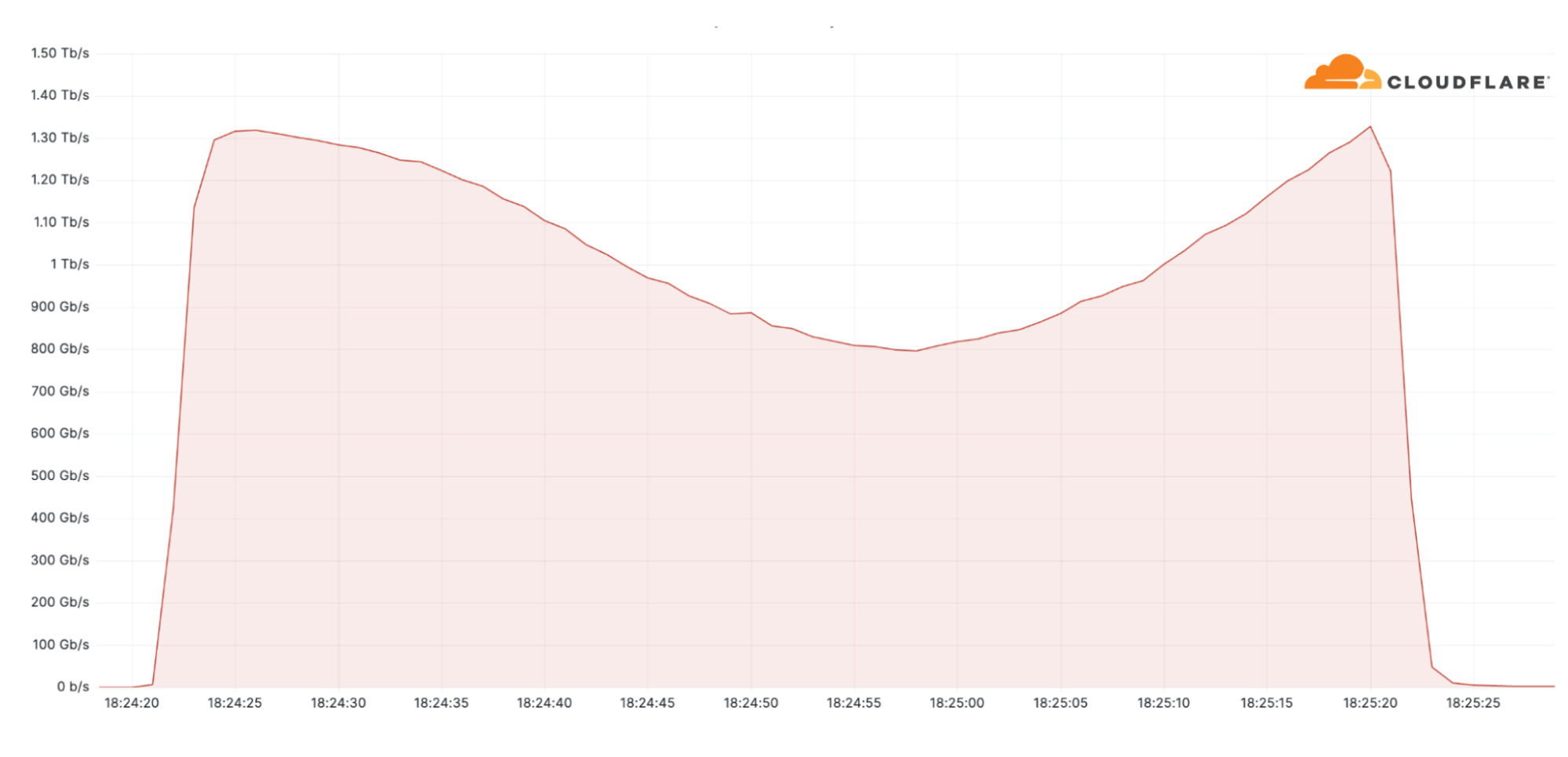
Another large attack we saw in Q1 was a 1.3 Tbps (terabits per second) DDoS attack that targeted a South American Telecommunications provider. The attack lasted only a minute. It was a multi-vector attack involving DNS and UDP attack traffic. The attack was part of a broader campaign which included multiple Terbit-strong attacks originating from a 20,000-strong Mirai-variant botnet. Most of the attack traffic originated from the US, Brazil, Japan, Hong Kong, and India. Cloudflare systems automatically detected and mitigated it without any impact to the customer’s networks.
High-performance botnets
Hyper-volumetric attacks leverage a new generation of botnets that are comprised of Virtual Private Servers (VPS) instead of Internet of Things (IoT) devices.
Historically, large botnets relied on exploitable IoT devices such as smart security cameras to orchestrate their attacks. Despite the limited throughput of each IoT device, together — usually numbering in the hundreds of thousands or millions — they generated enough traffic to disrupt their targets.
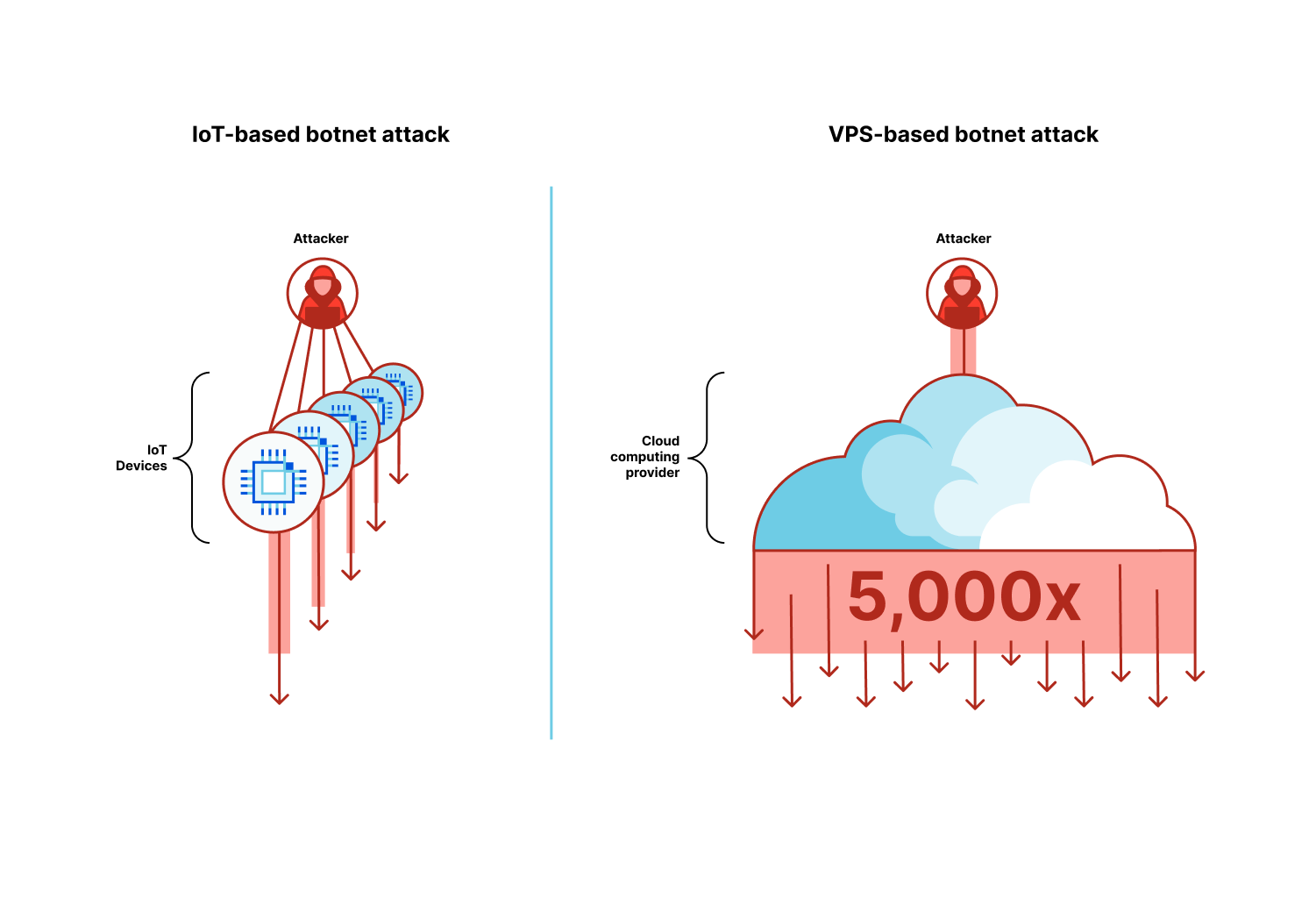
The new generation of botnets uses a fraction of the amount of devices, but each device is substantially stronger. Cloud computing providers offer virtual private servers to allow start ups and businesses to create performant applications. The downside is that it also allows attackers to create high-performance botnets that can be as much as 5,000x stronger. Attackers gain access to virtual private servers by compromising unpatched servers and hacking into management consoles using leaked API credentials.
Cloudflare has been working with key cloud computing providers to crack down on these VPS-based botnets. Substantial portions of such botnets have been disabled thanks to the cloud computing providers’ rapid response and diligence. Since then, we have yet to see additional hyper-volumetric attacks — a testament to the fruitful collaboration.
We have excellent collaboration with the cyber-security community to take down botnets once we detect such large-scale attacks, but we want to make this process even simpler and more automated.
We invite Cloud computing providers, hosting providers and general service providers to sign up for Cloudflare’s free Botnet Threat Feed to gain visibility on attacks launching from within their networks — and help us dismantle botnets.
Key highlights from this quarter
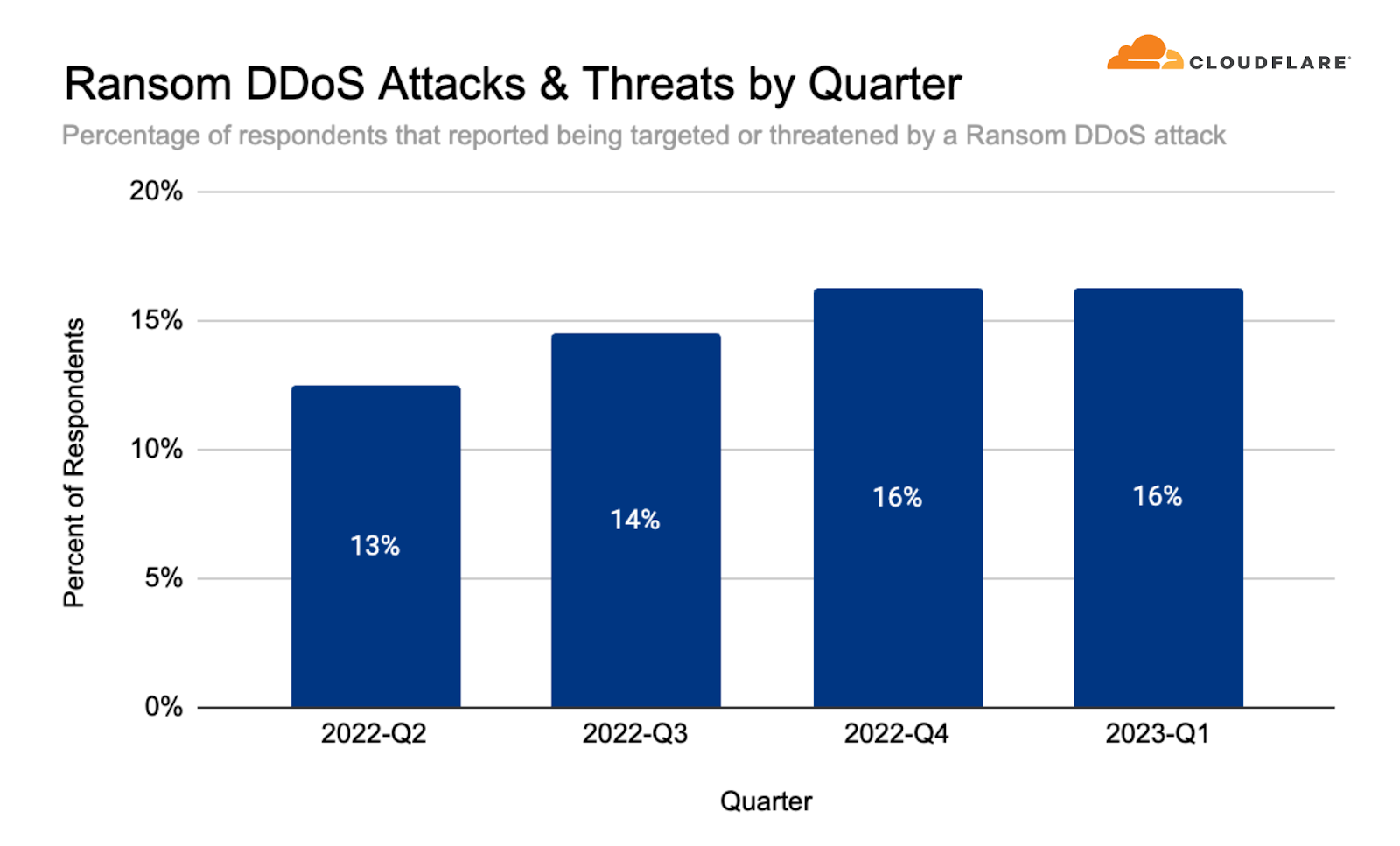
- In Q1, 16% of surveyed customers reported a Ransom DDoS attack — remains steady compared to the previous quarter but represents a 60% increase YoY.
- Non-profit organizations and Broadcast Media were two of the most targeted industries. Finland was the largest source of HTTP DDoS attacks in terms of percentage of attack traffic, and the main target of network-layer DDoS attacks. Israel was the top most attacked country worldwide by HTTP DDoS attacks.
- Large scale volumetric DDoS attacks — attacks above 100 Gbps — increased by 6% QoQ. DNS-based attacks became the most popular vector. Similarly, we observed surges in SPSS-bas in ed DDoS attacks, DNS amplification attacks, and GRE-based DDoS attacks.
Ransom DDoS attacks
Often, DDoS attacks are carried out to extort ransom payments. We continue to survey Cloudflare customers and track the ratio of DDoS events where the target received a ransom note. This number has been steadily rising through 2022 and currently stands at 16% – the same as in Q4 2022.
As opposed to Ransomware attacks, where usually the victim is tricked into downloading a file or clicking on an email link that encrypts and locks their computer files until they pay a ransom fee, Ransom DDoS attacks can be much easier for attackers to execute. Ransom DDoS attacks don’t require tricking the victim into opening an email or clicking a link, nor do they require a network intrusion or a foothold into the corporate assets.

In a Ransom DDoS attack, the attacker doesn’t need access to the victim’s computer but rather just needs to bombard them with a sufficiently large amount of traffic to take down their websites, DNS servers, and any other type of Internet-connected property to make it unavailable or with poor performance to users. The attacker will demand a ransom payment, usually in the form of Bitcoin, to stop and/or avoid further attacks.
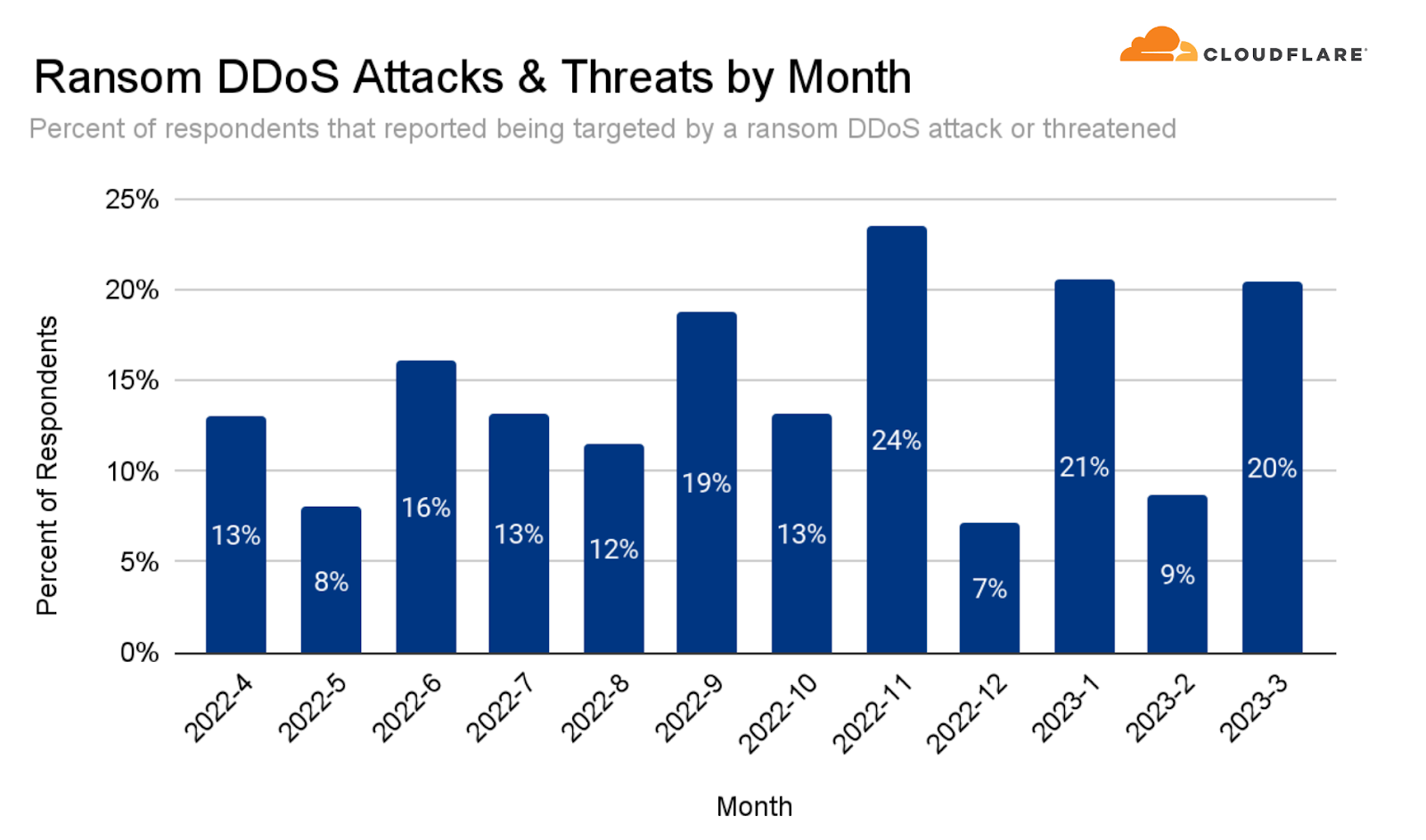
The months of January 2023 and March 2023 were the second highest in terms of Ransom DDoS activity as reported by our users. The highest month thus far remains November 2022 — the month of Black Friday, Thanksgiving, and Singles Day in China — a lucrative month for threat actors.
Who and what are being attacked?
Top targeted countries
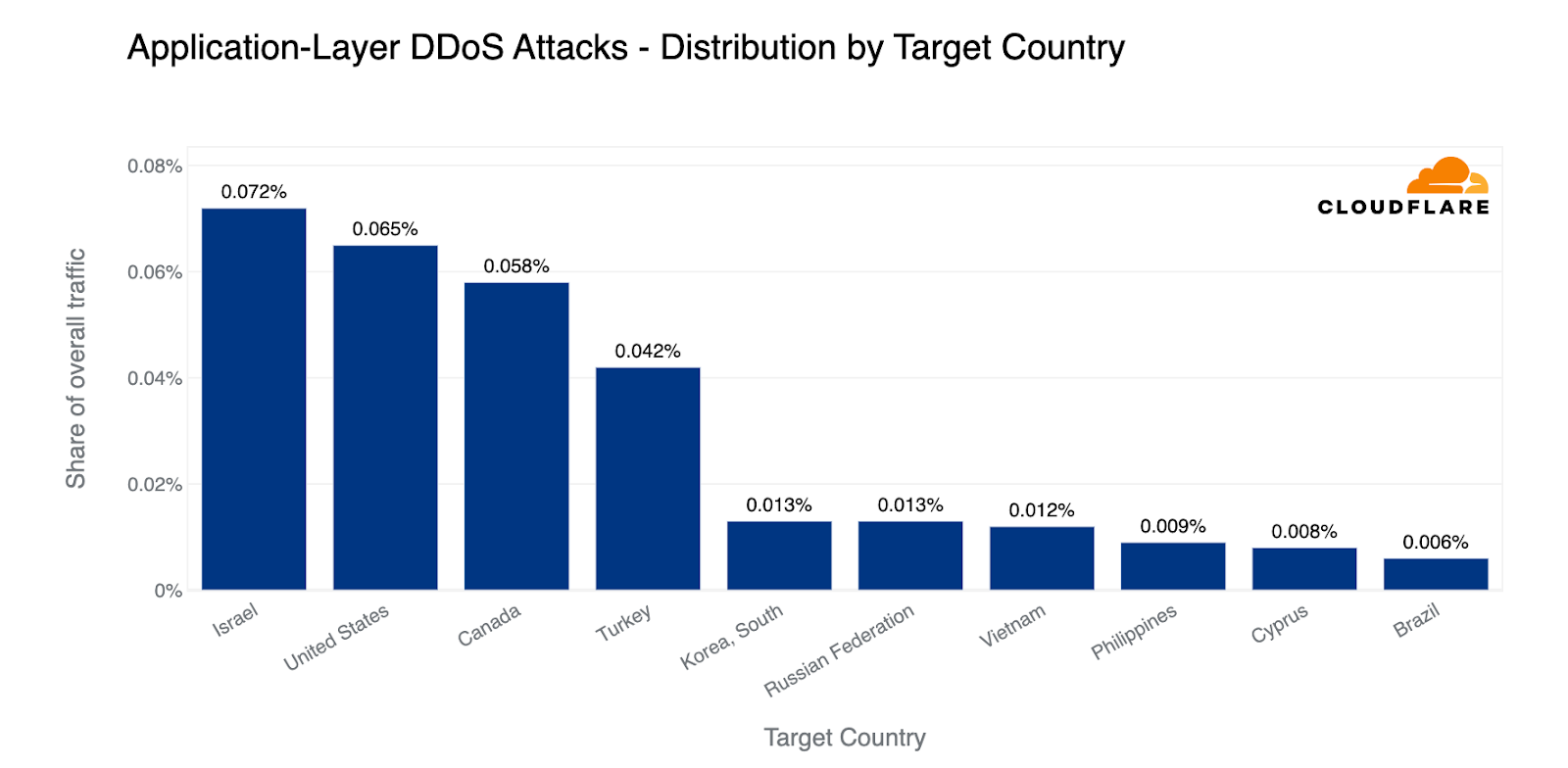
Perhaps related to the judicial reform and opposing protests, in Q1, Israel jumps to the first place as the country targeted by the most HTTP DDoS attack traffic — even above the United States of America. This is an astonishing figure. Just short of a single percent of all HTTP traffic that Cloudflare processed in the first quarter of the year, was part of HTTP DDoS attacks that targeted Israeli websites. Following closely behind Israel are the US, Canada, and Turkey.
In terms of the percentage of attack traffic compared to all traffic to a given country, Slovenia and Georgia came at the top. Approximately 20% of all traffic to Slovenian and Georgian websites were HTTP DDoS attacks. Next in line were the small Caribbean dual-island nation, Saint Kitts and Nevis, and Turkey. While Israel was the top in the previous graph, here it has found its placement as the ninth most attacked country — above Russia. Still high compared to previous quarters.
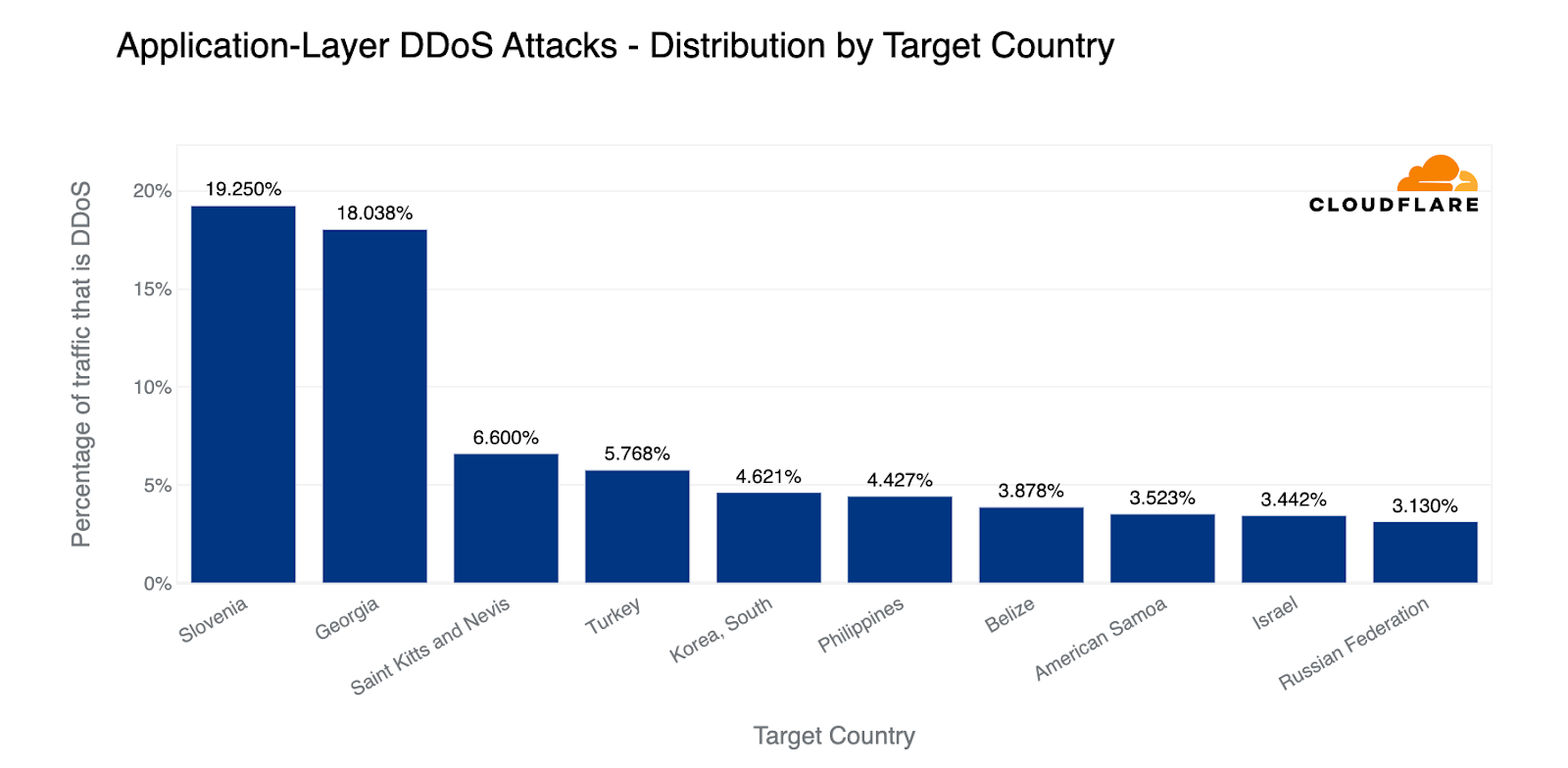
Looking at the total amount of network-layer DDoS attack traffic, China came in first place. Almost 18% of all network-layer DDoS attack traffic came from China. Closely in second, Singapore came in second place with a 17% share. The US came in third, followed by Finland.
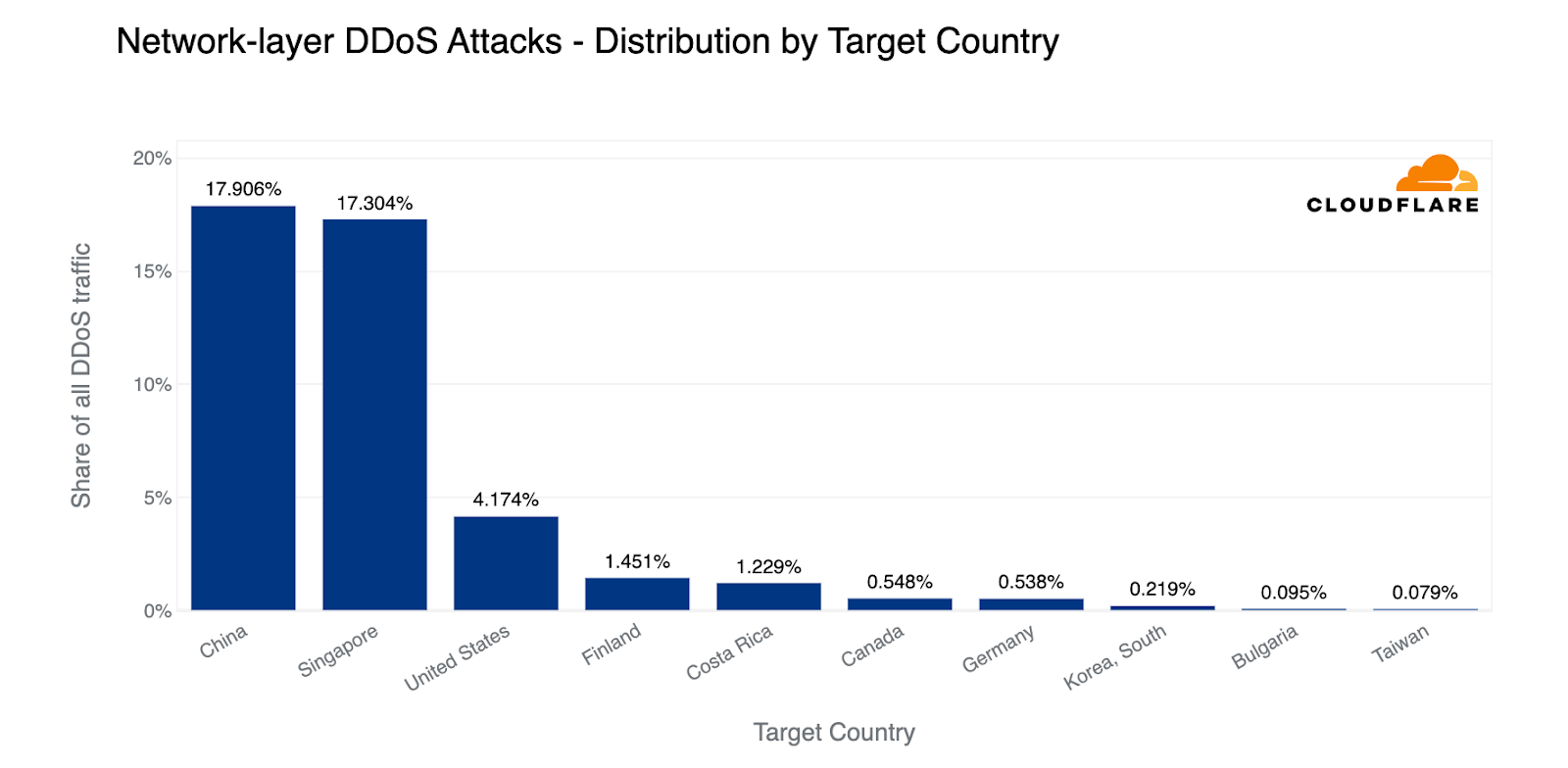
When we normalize attacks to a country by all traffic to that country, Finland jumps to the first place, perhaps due to its newly approved NATO membership. Nearly 83% of all traffic to Finland was network-layer attack traffic. China followed closely with 68% and Singapore again with 49%.
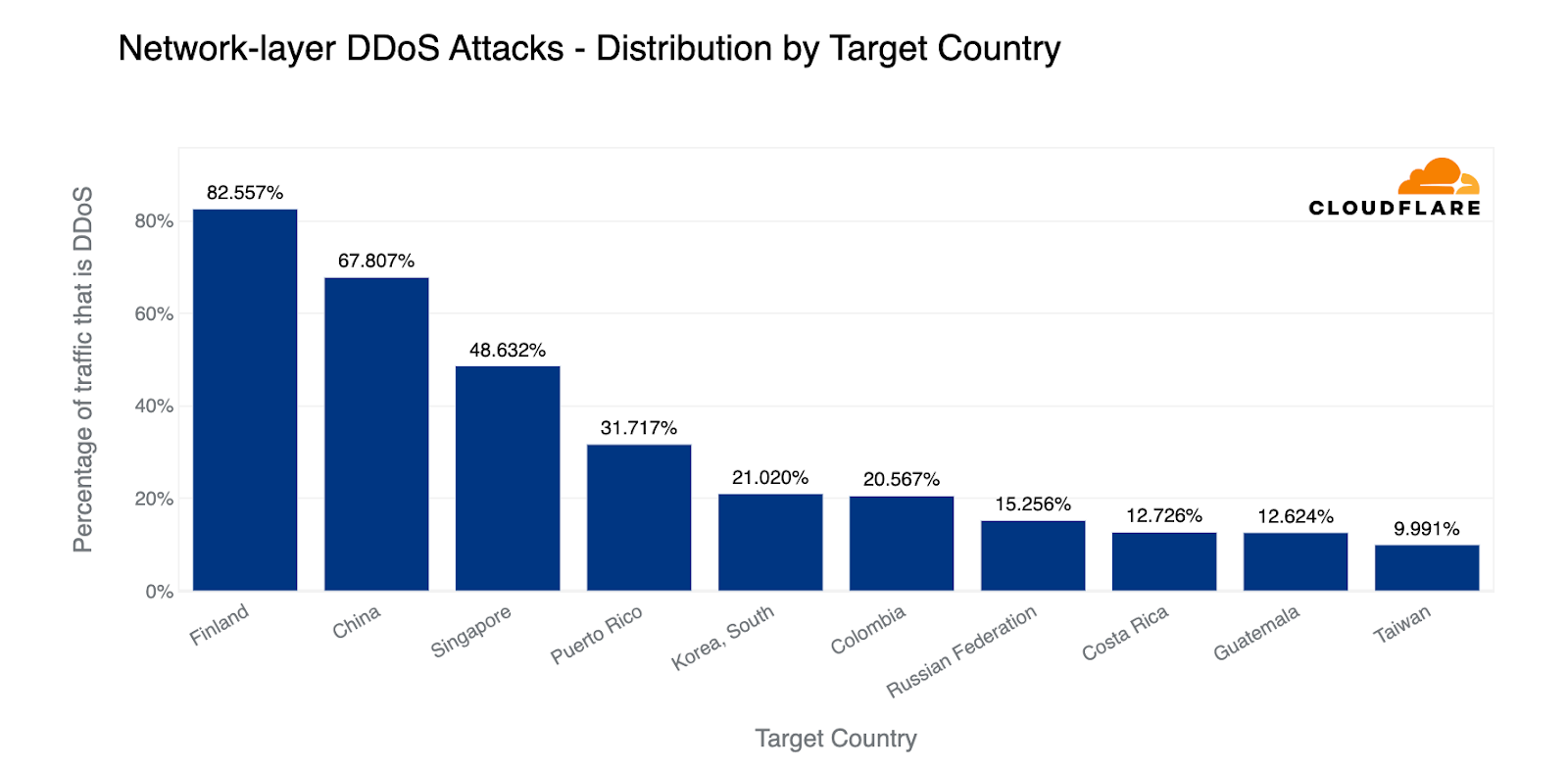
Top targeted industries
In terms of overall bandwidth, globally, Internet companies saw the largest amount of HTTP DDoS attack traffic. Afterwards, it was the Marketing and Advertising industry, Computer Software industry, Gaming / Gambling and Telecommunications.
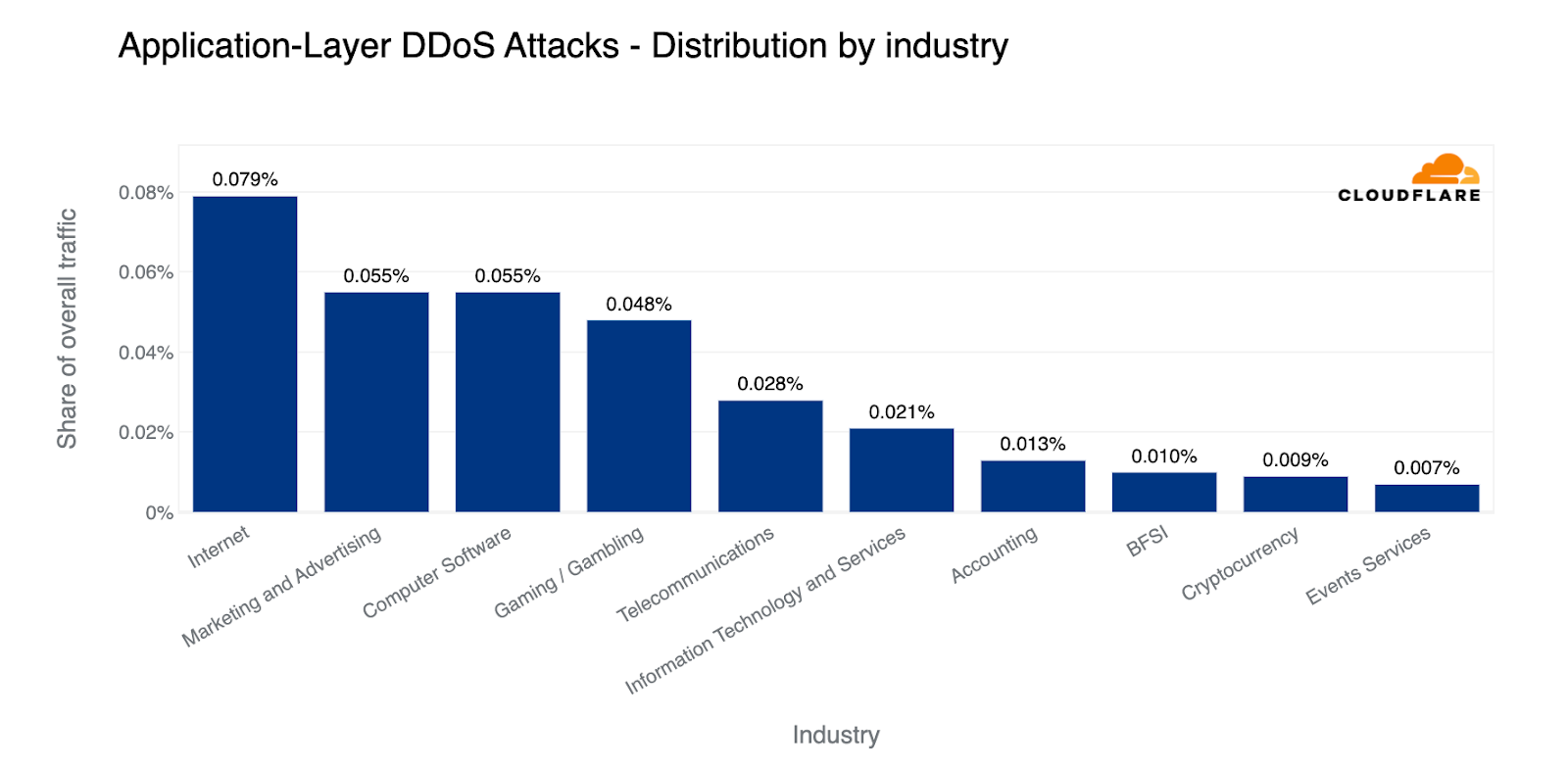
By percentage of attack traffic out of total traffic to an industry, Non-profits were the most targeted in the first quarter of the year, followed by Accounting firms. Despite the uptick of attacks on healthcare, it didn’t make it into the top ten. Also up there in the top were Chemicals, Government, and Energy Utilities & Waste industries. Looking at the US, almost 2% of all traffic to US Federal websites were part of DDoS attacks.
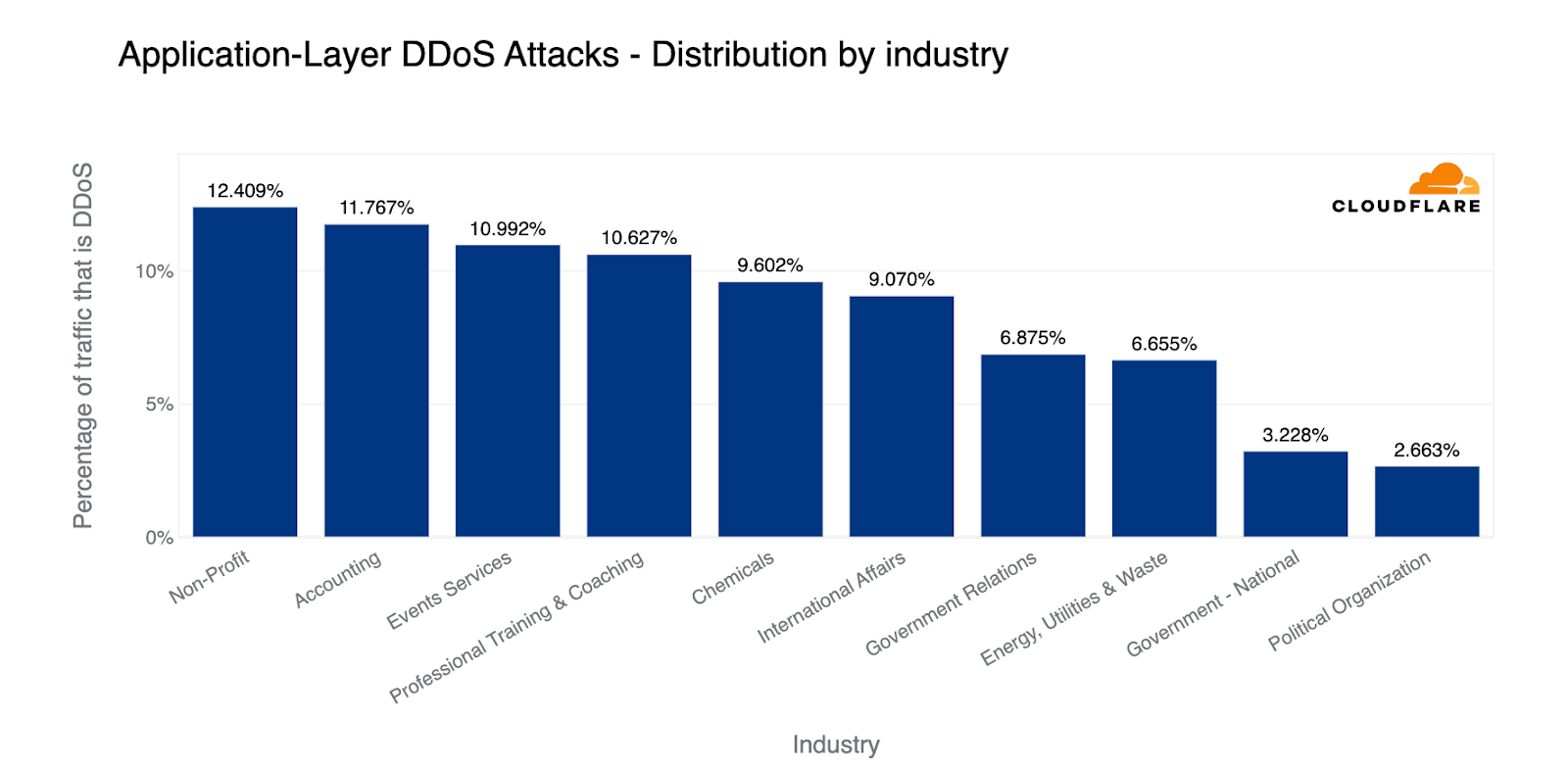
On a regional scale, the Gaming & Gambling industry was the most targeted in Asia, Europe, and the Middle East. In South and Central America, the Banking, Financial Services and Insurance (BFSI) industry was the most targeted. In North America it was the Marketing & Advertising industry followed by Telecommunications — which was also the most attacked industry in Africa. Last by not least, in Oceania, the Health, Wellness and Fitness industry was the most targeted by HTTP DDoS attacks.
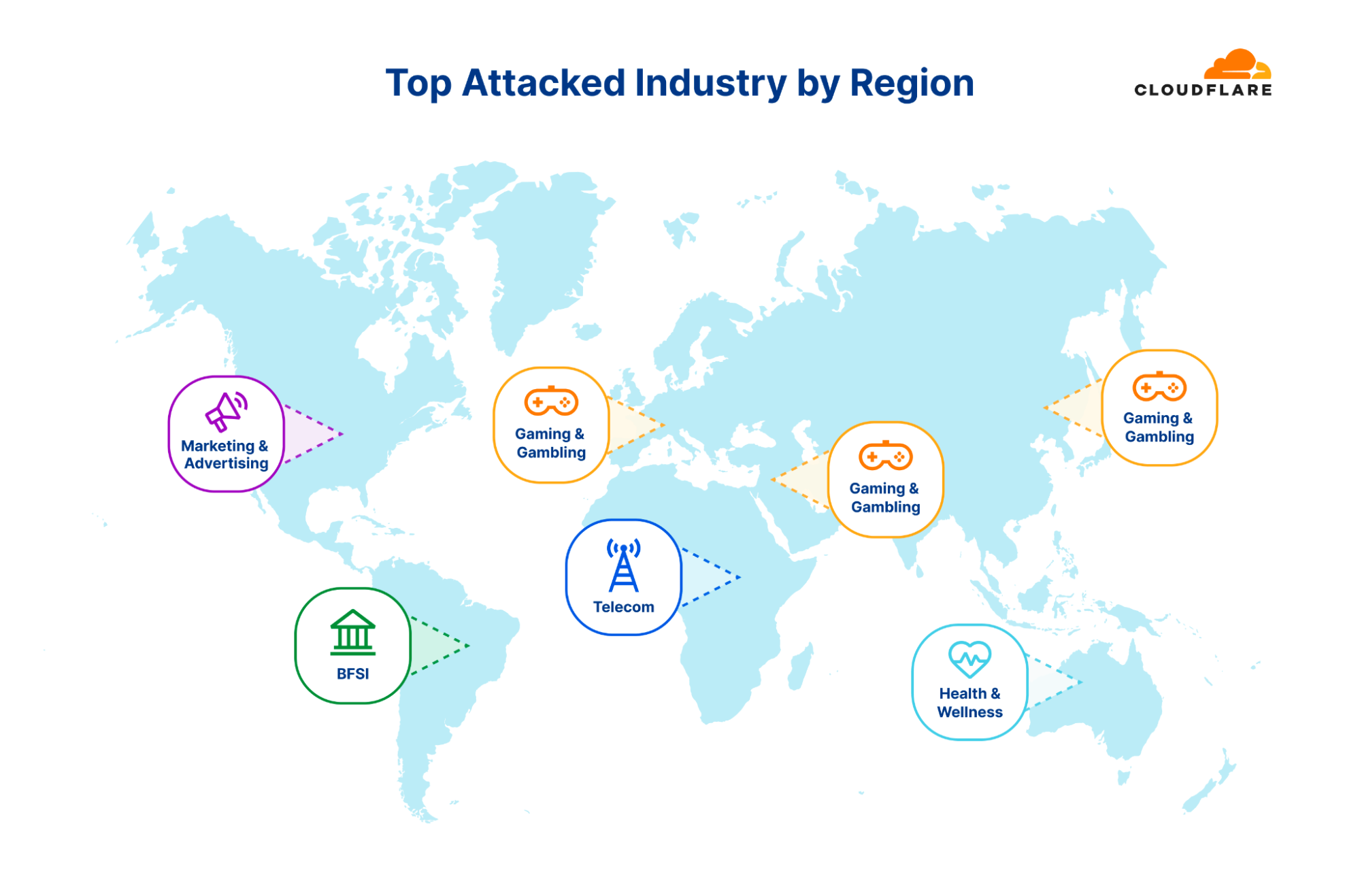
Diving lower in the OSI stack, based on the total volume of L3/4 attack traffic, the most targeted industries were Information Technology and Services, Gaming / Gambling, and Telecommunications.
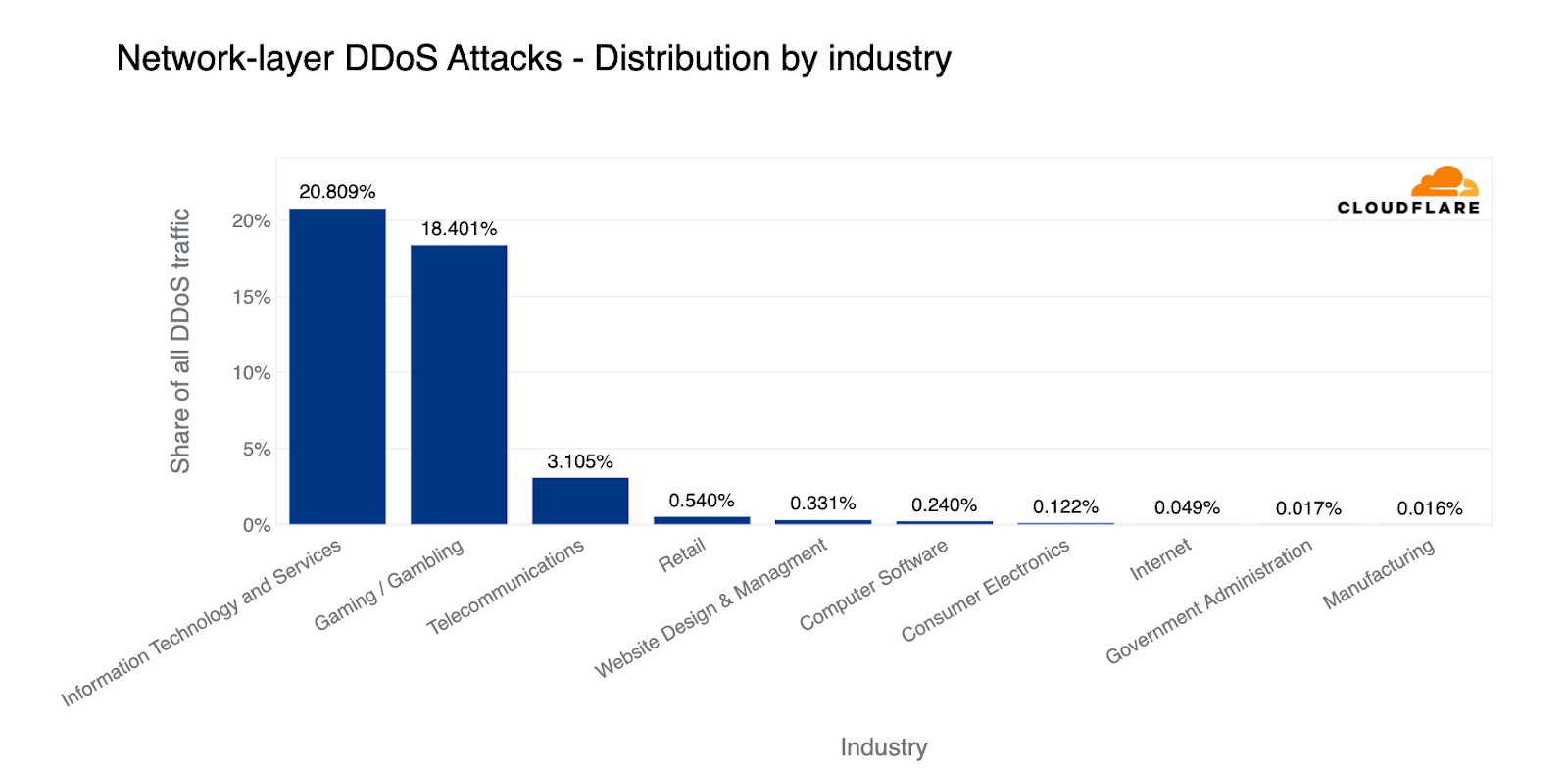
When comparing the attack traffic to the total traffic per industry, we see a different picture. Almost every second byte transmitted to Broadcast Media companies was L3/4 DDoS attack traffic.

Where attacks are coming from
Top source countries
In the first quarter of 2023, Finland was the largest source of HTTP DDoS attacks in terms of the percentage of attack traffic out of all traffic per country. Closely after Finland, the British Virgin Islands came in second place, followed by Libya and Barbados.
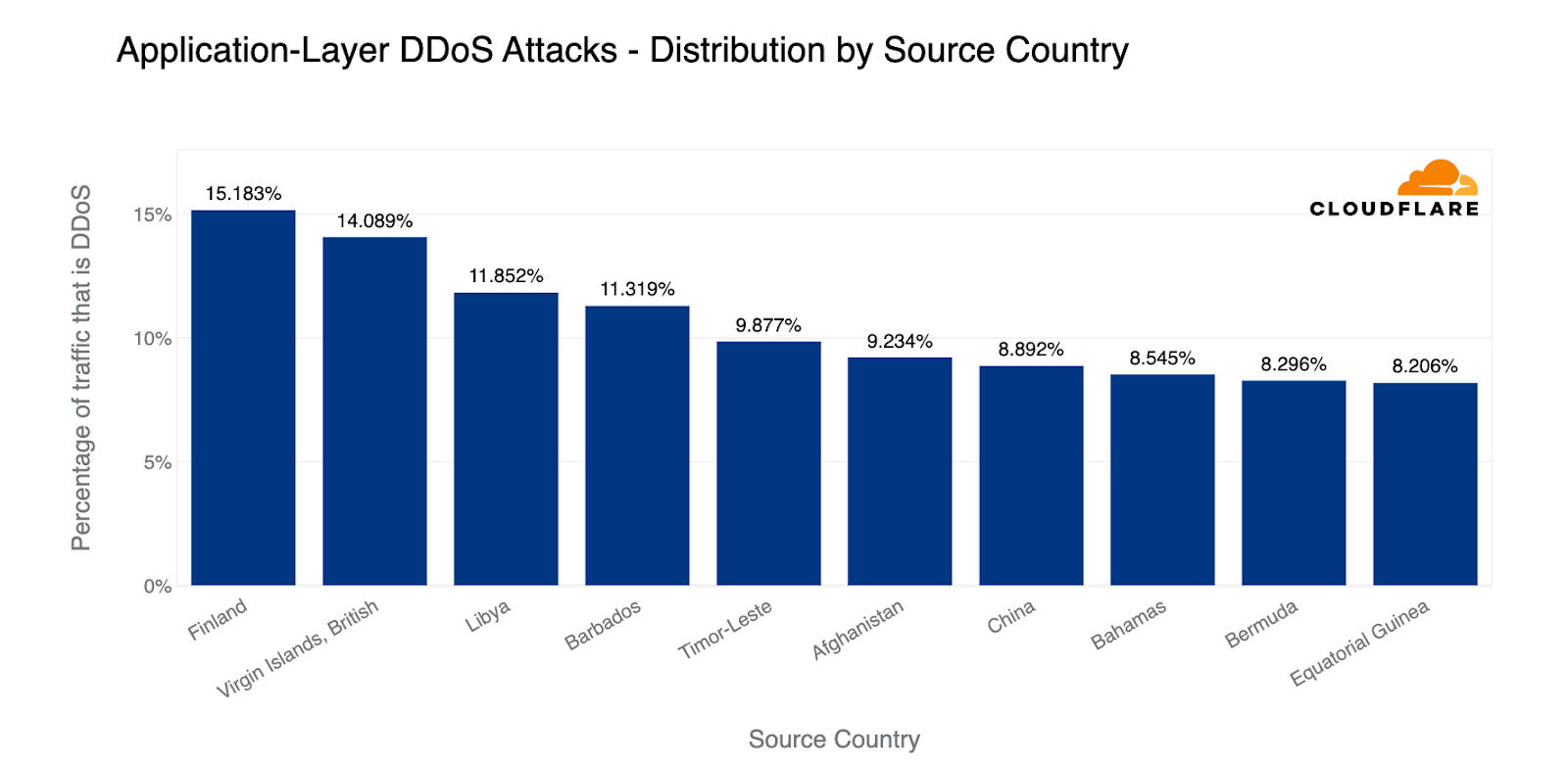
In terms of absolute volumes, the most HTTP DDoS attack traffic came from US IP addresses. China came in second, followed by Germany, Indonesia, Brazil, and Finland.
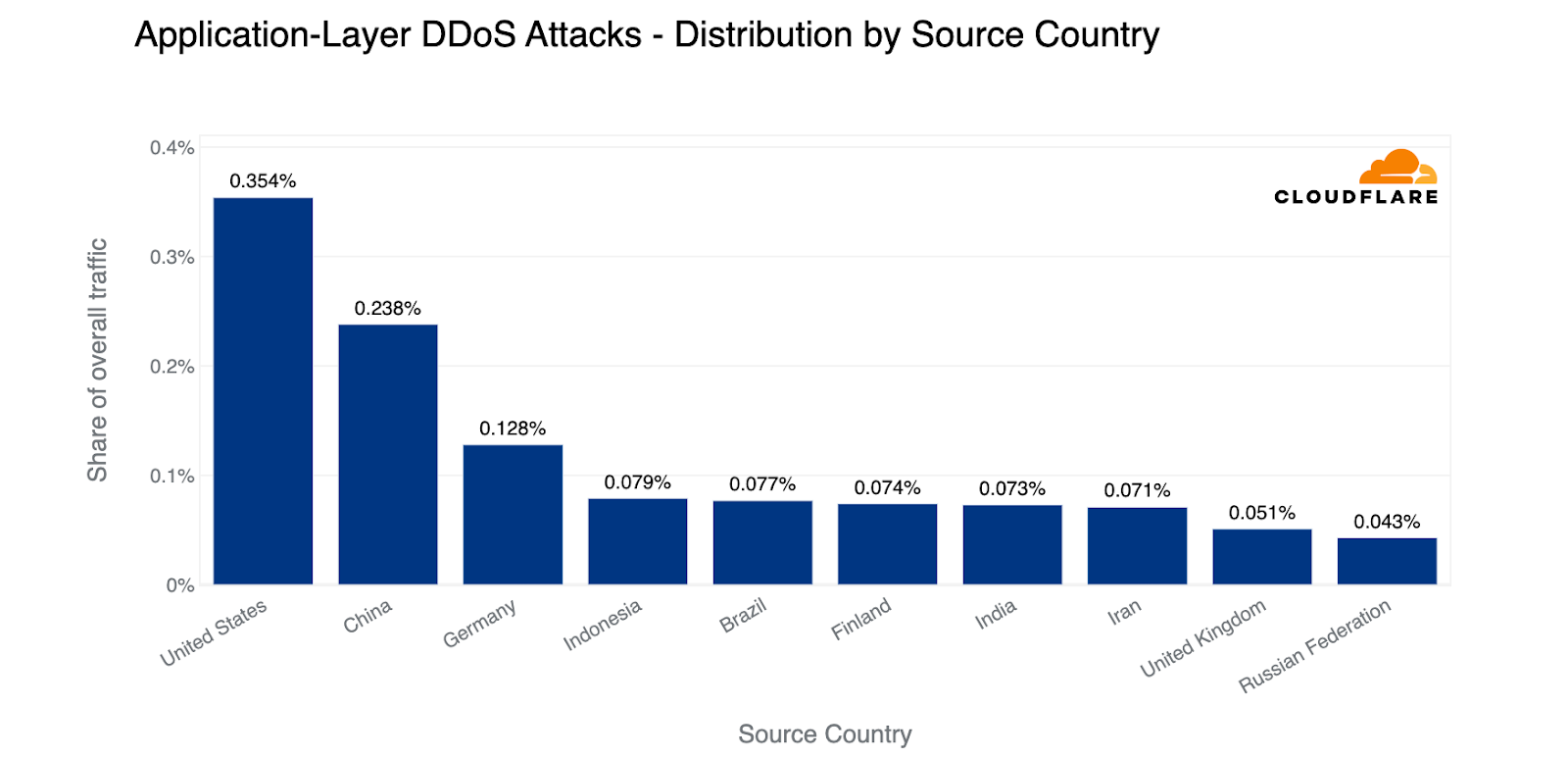
On the L3/4 side of things, Vietnam was the largest source of L3/4 DDoS attack traffic. Almost a third of all L3/4 traffic we ingested in our Vietnam data centers was attack traffic. Following Vietnam were Paraguay, Moldova, and Jamaica.
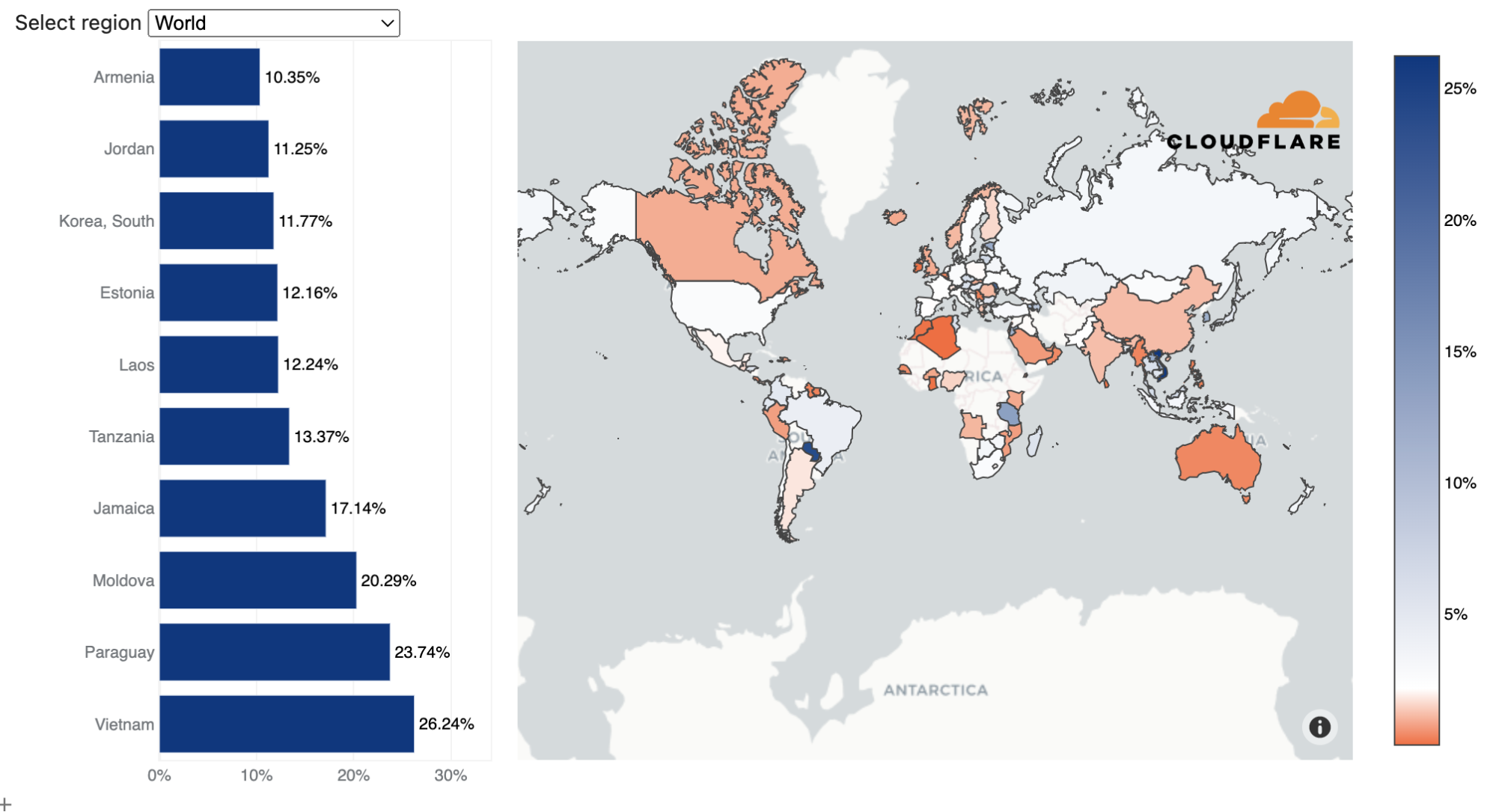
What attack types and sizes we see
Attack size and duration
When looking at the types of attacks that are launched against our customers and our own network and applications, we can see that the majority of attacks are short and small; 86% of network-layer DDoS attacks end within 10 minutes, and 91% of attacks never exceed 500 Mbps.
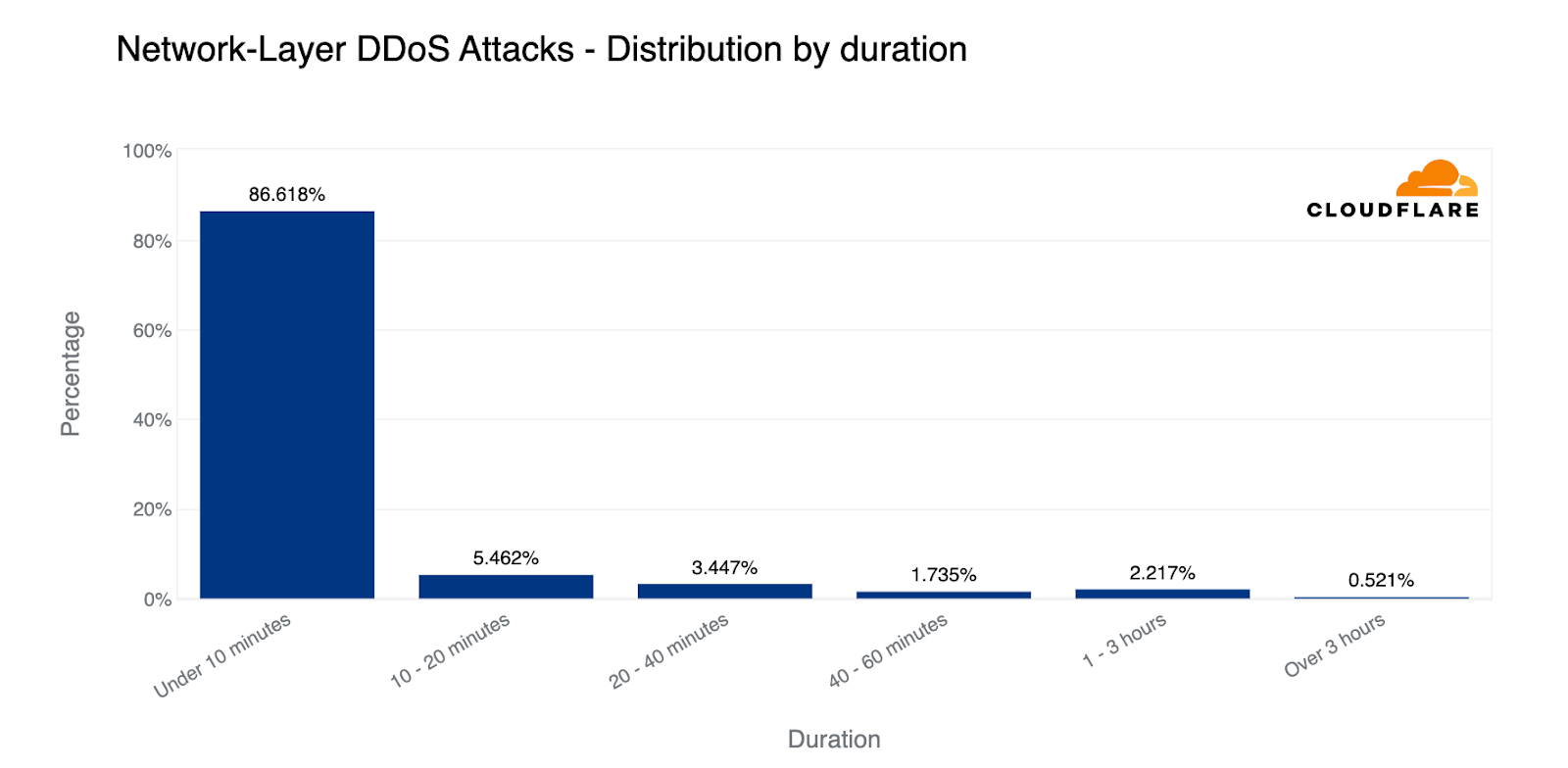
Only one out of every fifty attacks ever exceeds 10 Gbps, and only one out of every thousand attacks exceeds 100 Gbps.
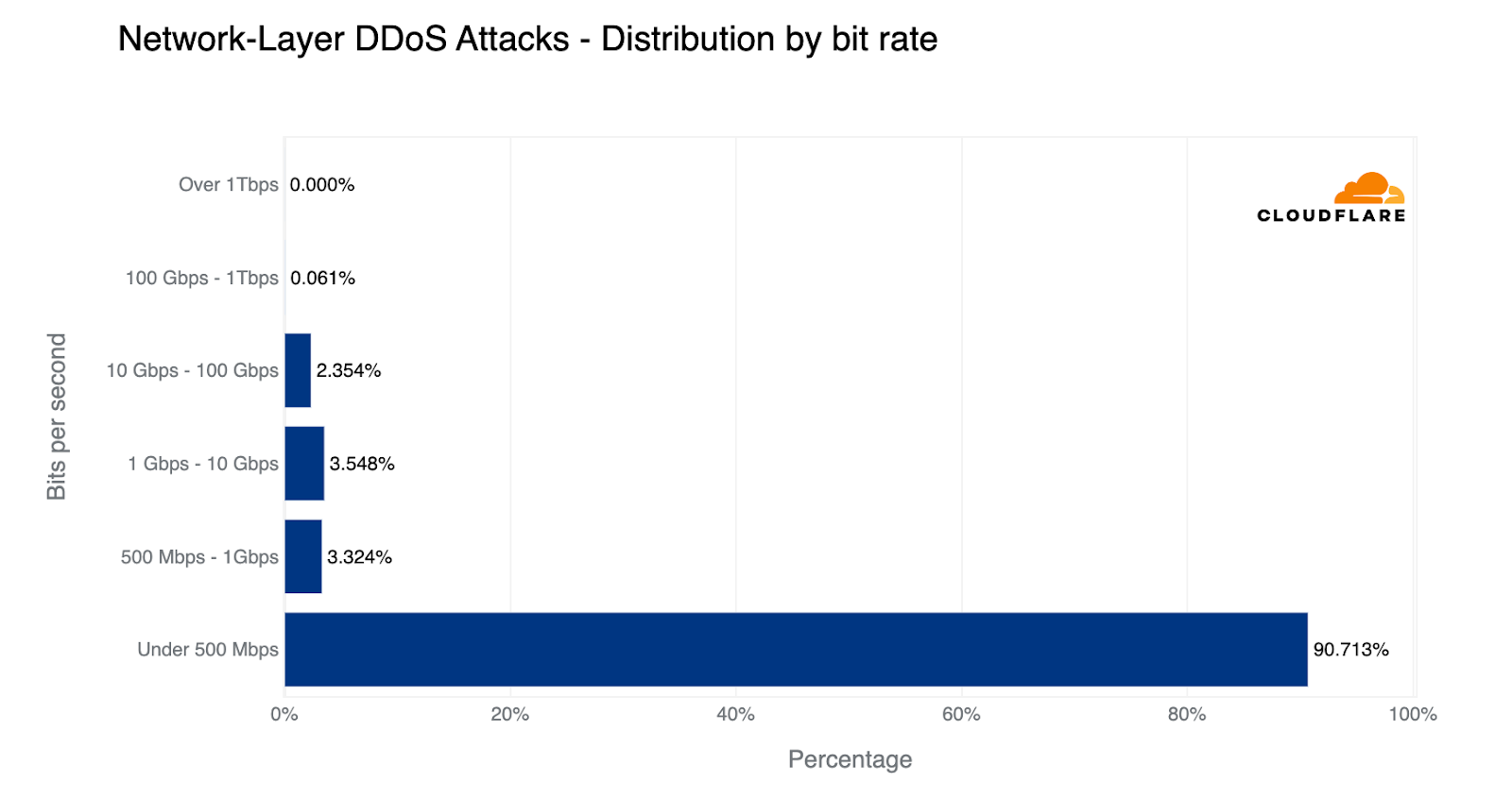
Having said that, larger attacks are slowly increasing in quantity and frequency. Last quarter, attacks exceeding 100 Gbps saw a 67% increase QoQ in their quantity. This quarter, the growth has slowed down a bit to 6%, but it’s still growing. In fact, there was an increase in all volumetric attacks excluding the ‘small’ bucket where the majority fall into — as visualized in the graph below. The largest growth was in the 10-100 Gbps range; an 89% increase QoQ.
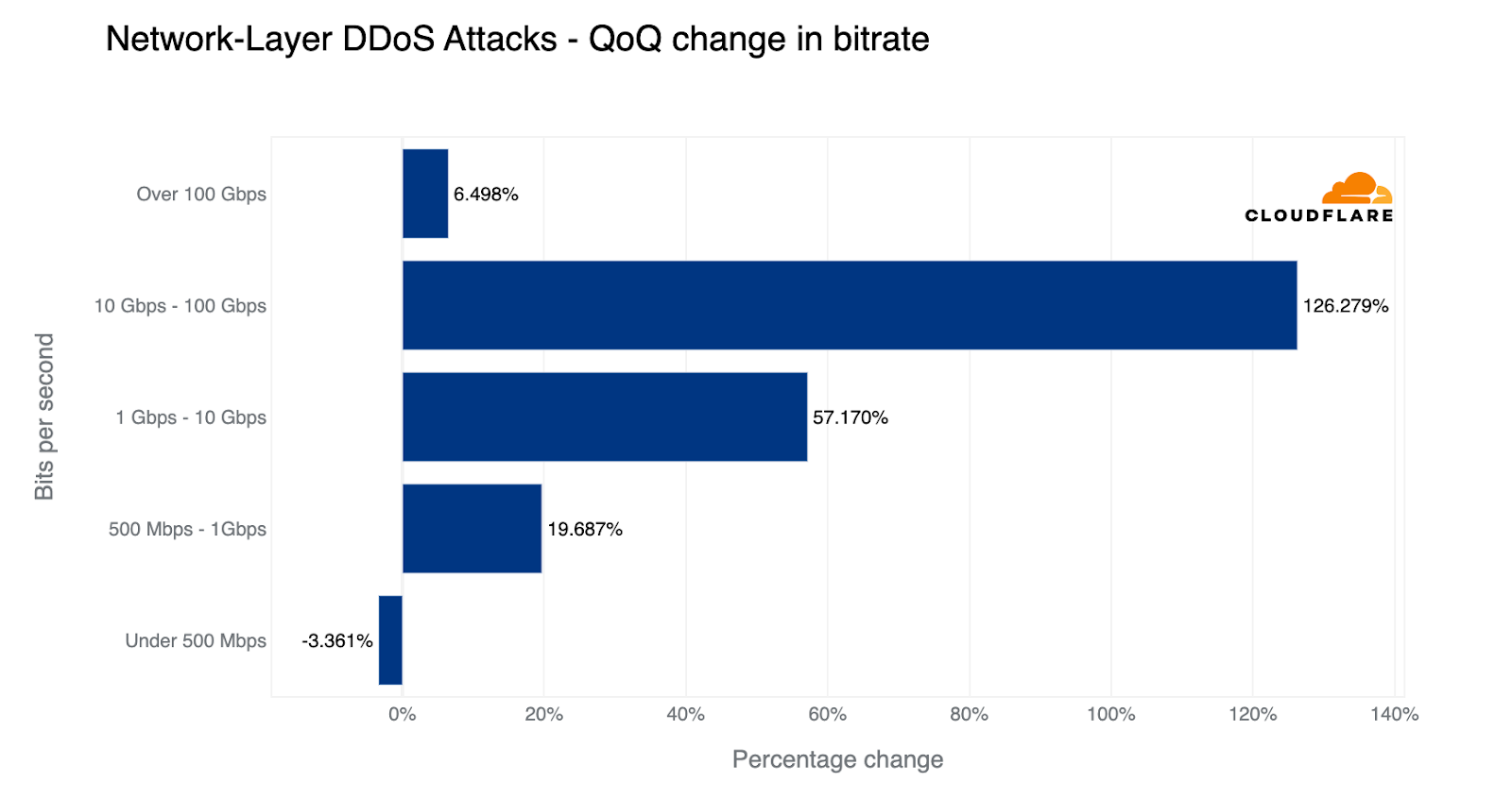
Attack vectors
This quarter we saw a tectonic shift. With a 22% share, SYN floods scooched to the second place, making DNS-based DDoS attacks the most popular attack vector (30%). Almost a third of all L3/4 DDoS attacks were DNS-based; either DNS floods or DNS amplification/reflection attacks. Not far behind, UDP-based attacks came in third with a 21% share.
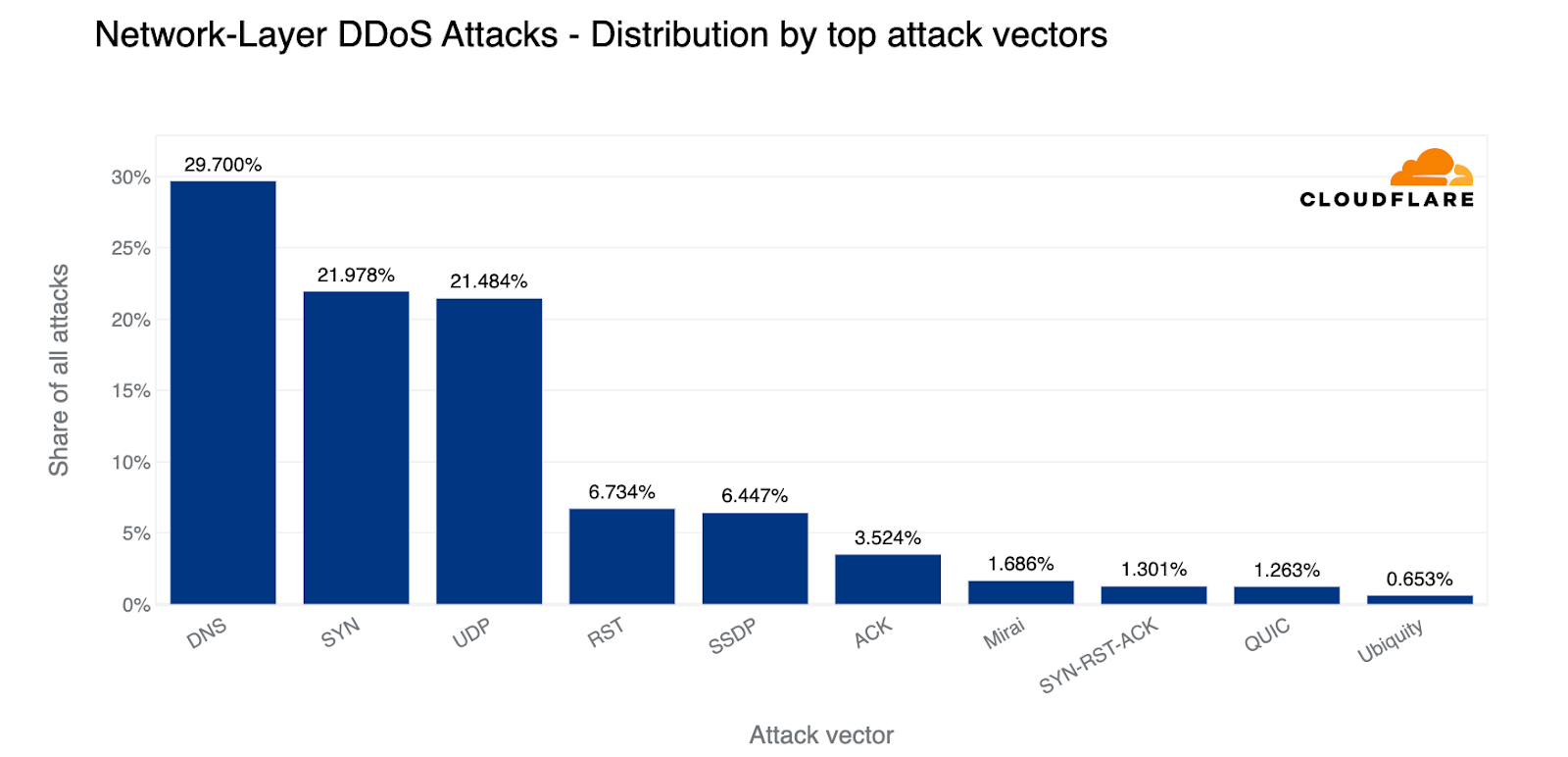
Emerging threats
Every quarter we see the reemergence of old and sometimes even ancient attack vectors. What this tells us is that even decade-old vulnerabilities are still being exploited to launch attacks. Threat actors are recycling and reusing old methods — perhaps hoping that organizations have dropped those protections against older methods.
In the first quarter of 2023, there was a massive surge in SPSS-based DDoS attacks, DNS amplification attacks and GRE-based DDoS attacks.
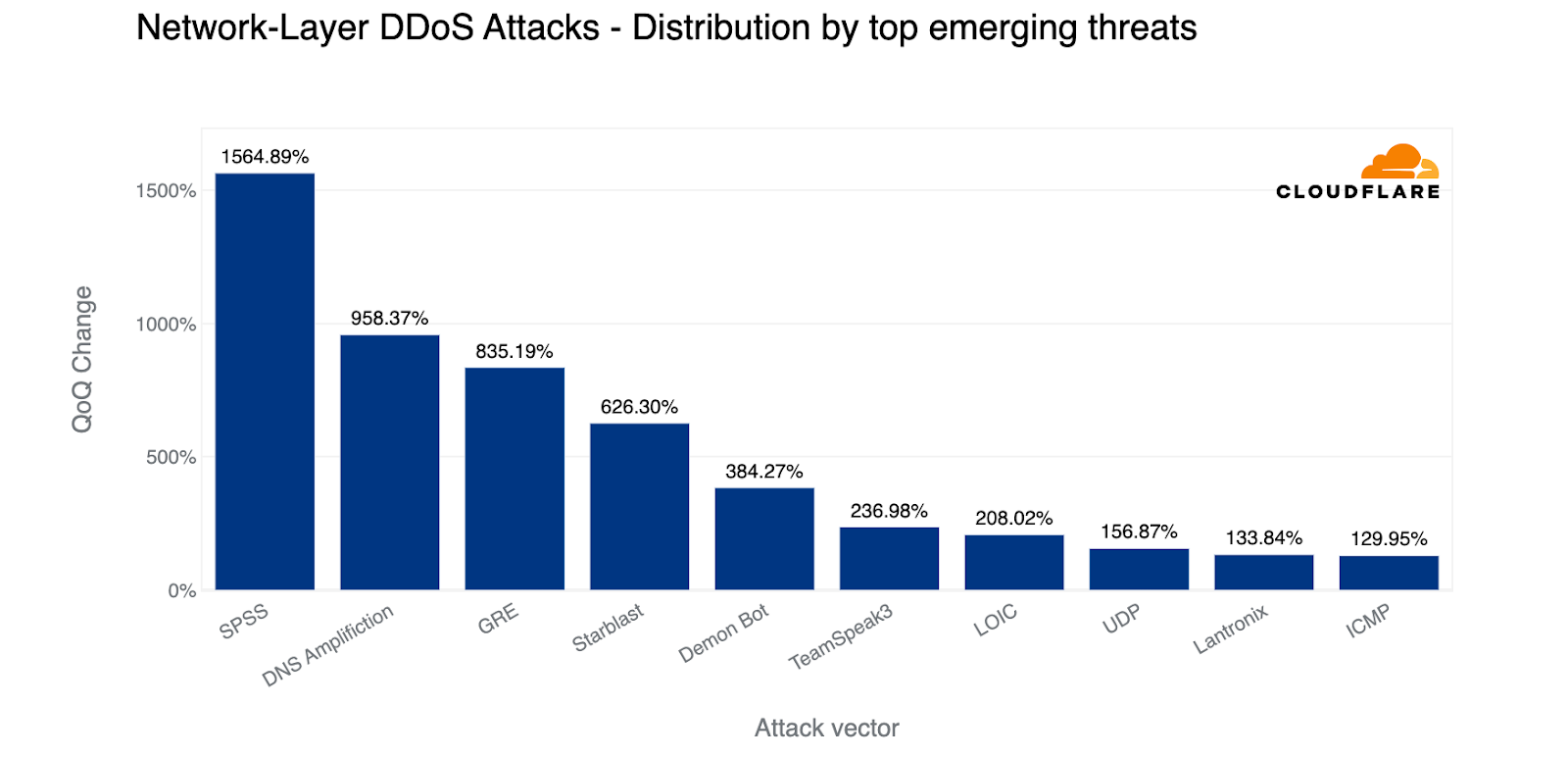
SPSS-based DDoS attacks increased by 1,565% QoQ
The Statistical Product and Service Solutions (SPSS) is an IBM-developed software suite for use cases such as data management, business intelligence, and criminal investigation. The Sentinel RMS License Manager server is used to manage licensing for software products such as the IBM SPSS system. Back in 2021, two vulnerabilities (CVE-2021-22713 and CVE-2021-38153) were identified in the Sentinel RMS License Manager server which can be used to launch reflection DDoS attacks. Attackers can send large amounts of specially crafted license requests to the server, causing it to generate a response that is much larger than the original request. This response is sent back to the victim’s IP address, effectively amplifying the size of the attack and overwhelming the victim’s network with traffic. This type of attack is known as a reflection DDoS attack, and it can cause significant disruption to the availability of software products that rely on the Sentinel RMS License Manager, such as IBM SPSS Statistics. Applying the available patches to the license manager is essential to prevent these vulnerabilities from being exploited and to protect against reflection DDoS attacks.
DNS amplification DDoS attacks increased by 958% QoQ
DNS amplification attacks are a type of DDoS attack that involves exploiting vulnerabilities in the Domain Name System (DNS) infrastructure to generate large amounts of traffic directed at a victim’s network. Attackers send DNS requests to open DNS resolvers that have been misconfigured to allow recursive queries from any source, and use these requests to generate responses that are much larger than the original query. The attackers then spoof the victim’s IP address, causing the large responses to be directed at the victim’s network, overwhelming it with traffic and causing a denial of service. The challenge of mitigating DNS amplification attacks is that the attack traffic can be difficult to distinguish from legitimate traffic, making it difficult to block at the network level. To mitigate DNS amplification attacks, organizations can take steps such as properly configuring DNS resolvers, implementing rate-limiting techniques, and using traffic filtering tools to block traffic from known attack sources.
GRE-based DDoS attacks increased by 835% QoQ
GRE-based DDoS attacks involve using the Generic Routing Encapsulation (GRE) protocol to flood a victim’s network with large amounts of traffic. Attackers create multiple GRE tunnels between compromised hosts to send traffic to the victim’s network. These attacks are difficult to detect and filter, as the traffic appears as legitimate traffic on the victim’s network. Attackers can also use source IP address spoofing to make it appear that the traffic is coming from legitimate sources, making it difficult to block at the network level. GRE-based DDoS attacks pose several risks to targeted organizations, including downtime, disruption of business operations, and potential data theft or network infiltration. Mitigating these attacks requires the use of advanced traffic filtering tools that can detect and block attack traffic based on its characteristics, as well as techniques such as rate limiting and source IP address filtering to block traffic from known attack sources.
The DDoS threat landscape
In recent months, there has been an increase in longer and larger DDoS attacks across various industries, with volumetric attacks being particularly prominent. Non-profit and Broadcast Media companies were some of the top targeted industries. DNS DDoS attacks also became increasingly prevalent.
As DDoS attacks are typically carried out by bots, automated detection and mitigation are crucial for effective defense. Cloudflare’s automated systems provide constant protection against DDoS attacks for our customers, allowing them to focus on other aspects of their business. We believe that DDoS protection should be easily accessible to organizations of all sizes, and have been offering free and unlimited protection since 2017.
At Cloudflare, our mission is to help build a better Internet — one that is more secure and faster Internet for all.
We invite you to join our DDoS Trends Webinar to learn more about emerging threats and effective defense strategies.
A note about methodologies
How we calculate Ransom DDoS attack insights
Cloudflare’s systems constantly analyze traffic and automatically apply mitigation when DDoS attacks are detected. Each attacked customer is prompted with an automated survey to help us better understand the nature of the attack and the success of the mitigation. For over two years, Cloudflare has been surveying attacked customers. One of the questions in the survey asks the respondents if they received a threat or a ransom note. Over the past two years, on average, we collected 164 responses per quarter. The responses of this survey are used to calculate the percentage of Ransom DDoS attacks.
How we calculate geographical and industry insights
Source country
At the application-layer, we use the attacking IP addresses to understand the origin country of the attacks. That is because at that layer, IP addresses cannot be spoofed (i.e., altered). However, at the network layer, source IP addresses can be spoofed. So, instead of relying on IP addresses to understand the source, we instead use the location of our data centers where the attack packets were ingested. We’re able to get geographical accuracy due to our large global coverage in over 285 locations around the world.
Target country
For both application-layer and network-layer DDoS attacks, we group attacks and traffic by our customers’ billing country. This lets us understand which countries are subject to more attacks.
Target industry
For both application-layer and network-layer DDoS attacks, we group attacks and traffic by our customers’ industry according to our customer relations management system. This lets us understand which industries are subject to more attacks.
Total volume vs. percentage
For both source and target insights, we look at the total volume of attack traffic compared to all traffic as one data point. Additionally, we also look at the percentage of attack traffic towards or from a specific country, to a specific country or to a specific industry. This gives us an “attack activity rate” for a given country/industry which is normalized by their total traffic levels. This helps us remove biases of a country or industry that normally receives a lot of traffic and therefore a lot of attack traffic as well.
How we calculate attack characteristics
To calculate the attack size, duration, attack vectors and emerging threats, we bucket attacks and then provide the share of each bucket out of the total amount for each dimension.
General disclaimer and clarification
When we describe ‘top countries’ as the source or target of attacks, it does not necessarily mean that that country was attacked as a country, but rather that organizations that use that country as their billing country were targeted by attacks. Similarly, attacks originating from a country does not mean that that country launched the attacks, but rather that the attack was launched from IP addresses that have been mapped to that country. Threat actors operate global botnets with nodes all over the world, and in many cases also use Virtual Private Networks and proxies to obfuscate their true location. So if anything, the source country could indicate the presence of exit nodes or botnet nodes within that country.