Accelerate context-aware data analysis and ML workflows with Amazon SageMaker Data Agent

Post Syndicated from Kshitija Dound original https://aws.amazon.com/blogs/big-data/accelerate-context-aware-data-analysis-and-ml-workflows-with-amazon-sagemaker-data-agent/

Accelerating data analysis and machine learning (ML) development requires AI tools that understand your specific data environment, not just generic code generation. General-purpose AI assistants lack context about your specific data environment, creating a gap between AI capabilities and practical implementation. Data practitioners often start by looking for relevant tables, understanding relationships, and writing exploratory code before answering their first business question. Data teams still spend time translating AI-generated suggestions into working code that correctly references their actual data assets, understands their organization’s data relationships, and integrates with their existing workflows.

AWS released Amazon SageMaker Data Agent in November 2025, addressing these challenges by providing an AI assistant that’s deeply integrated within Amazon SageMaker (IAM-based domains only) with notebooks. SageMaker Data Agent has direct access to your AWS data context, including AWS Glue Data Catalog metadata, Amazon DataZone business data catalog, and your current notebook state. This helps it generate environment-aware code that works directly with your petabyte-scale data through serverless compute resources, helping you analyze massive datasets without infrastructure management overhead. With this contextual awareness, the agent creates executable analysis plans from natural language prompts that specifically reference your actual tables, data types, and analytical needs, while maintaining reasoning throughout multi-step analyses. Importantly, the agent performs these operations securely within the AWS environment, using built-in governance controls, Amazon Identity and Access Management (IAM) policies, and data security features to make sure your data doesn’t leave your organizational boundaries. By operating within your Amazon SageMaker Unified Studio interface, it reduces context-switching between AI assistants and your development environment, improving how you interact with your analytics and ML workflows.

In this post, we demonstrate the capabilities of SageMaker Data Agent, discuss the challenges it addresses, and explore a real-world example analyzing New York City taxi trip data to see the agent in action.

Challenges in data workflows

General AI tools can generate code snippets, but you still face three key challenges when applying these to your specific data environments:

  • Contextual disconnect – Standard AI assistants generate generic code referencing hypothetical tables like customers rather than your actual tables like customer_activity_prod, forcing extensive modifications to work with your data environment.
  • Complex data environment – Many enterprises work with complex data environments containing numerous tables and large-scale data stores, making it extremely difficult to locate relevant data assets for analysis. You must navigate complex catalog structures, understand table relationships, and determine which subset of data is relevant for your specific analytical needs before you can begin actual analysis.
  • Language and syntax barriers – You must work across multiple programming languages and query syntaxes during analysis workflows. Some might excel in SQL but struggle with Python, while others might be Python experts but have limited PySpark knowledge.

Additionally, you face challenges around data quality validation, data governance, and performance optimization. SageMaker Data Agent addresses these fundamental workflow challenges while adapting to your requirements.

Solution overview

SageMaker Data Agent addresses these key challenges through its context-aware architecture and deep AWS integration. In this section, we discuss how it works.

Context-aware understanding

SageMaker Data Agent builds a detailed understanding of your specific data environment and references your actual tables through two parallel processes. SageMaker Data Agent is embedded within your AWS data environment, allowing it to understand what you’re asking, what data you have available, how it’s structured, and how it relates to your analytical objectives. The following are the two ways the agent achieves this contextual understanding:

  • Integrated data environment – SageMaker Data Agent exists within the same integrated environment as your data, harnessing the power of your AWS infrastructure. It begins by exploring the AWS Glue Data Catalog and the Amazon DataZone business data catalog, which reveal business metadata, glossaries, and relationships, enabling it to reference your actual tables rather than generic placeholders. This intelligence extends to working directly with your full datasets where they naturally reside, preserving your existing security policies and access controls without requiring data movement. The agent integrates with Amazon Simple Storage Service (Amazon S3), Amazon Athena, and Amazon SageMaker AI to use their respective capabilities for data storage, query processing, and ML while adapting to your data environment. This lets you process petabyte-scale data through serverless compute resources with the agent acting as an intelligent interface to your complete data environment.
  • Notebook context awareness – Simultaneously, the agent examines your current notebook state, including existing dataframes, imported libraries, previous cell results, and ML artifacts. This context awareness makes sure generated code works with your specific environment without extensive modifications.

Language and syntax flexibility

SageMaker Data Agent resolves language and syntax barriers by selecting the optimal language for each analytical task. The agent can switch between SQL for efficient data querying and Python and PySpark for complex transformations and ML operations without requiring practitioners to manually translate between languages. This avoids language barriers, because the agent automatically selects and generates the appropriate code syntax, whether SQL, Python, or PySpark, based on the specific analytical or ML task at hand.

SageMaker Data Agent provides four key capabilities that work together to give you control over complex analyses:

  • When handling complex requests, the agent creates structured analysis plans by breaking them into logical steps with clear reasoning for each operation.
  • At each stage, you have intermediate validation points where you can review and approve each step before proceeding to the next.
  • Throughout multi-step analyses, the agent maintains consistent context, retaining understanding of your data environment and previous steps.
  • Most importantly, you maintain human-in-the-loop control with full oversight and the ability to modify any generated code to match your specific requirements.

Interaction modes

SageMaker Data Agent provides two interaction modes optimized for different analytical tasks: the Agent Panel and in-line assistance.

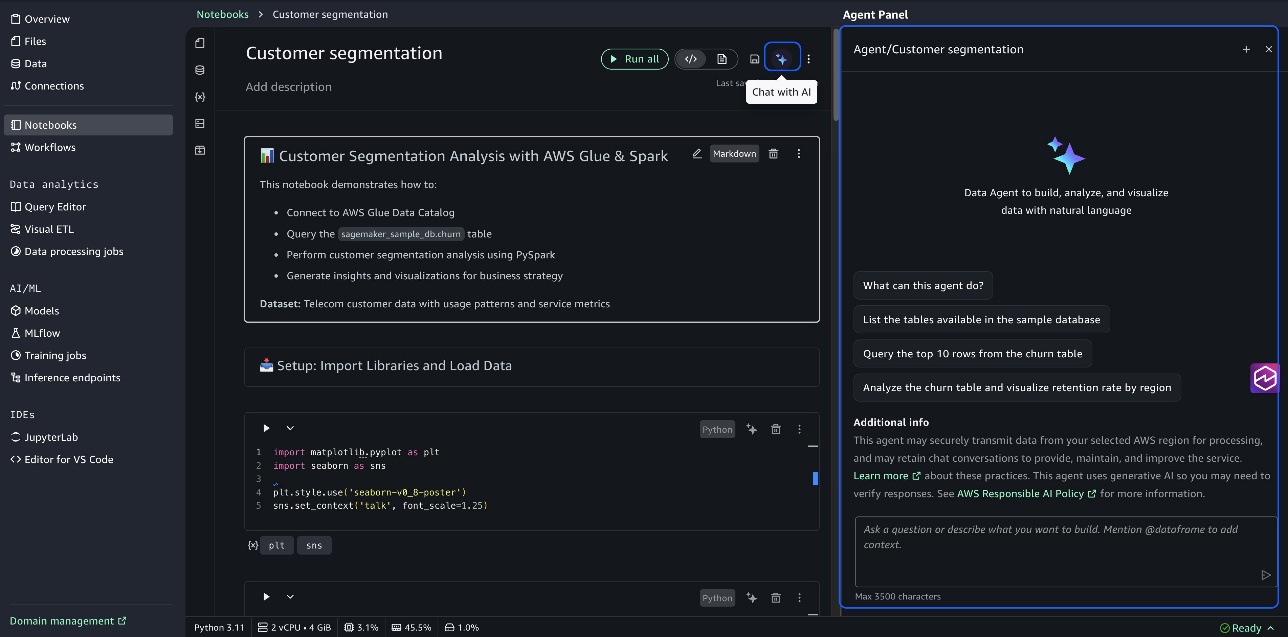
The Agent Panel supports comprehensive analytical tasks by breaking them down into structured steps, each with generated code that builds on previous results. When you submit a request such as “perform customer segmentation,” the agent identifies relevant tables, understands their relationships, and creates a complete analysis workflow with intermediate review points. The following screenshot illustrates this example.
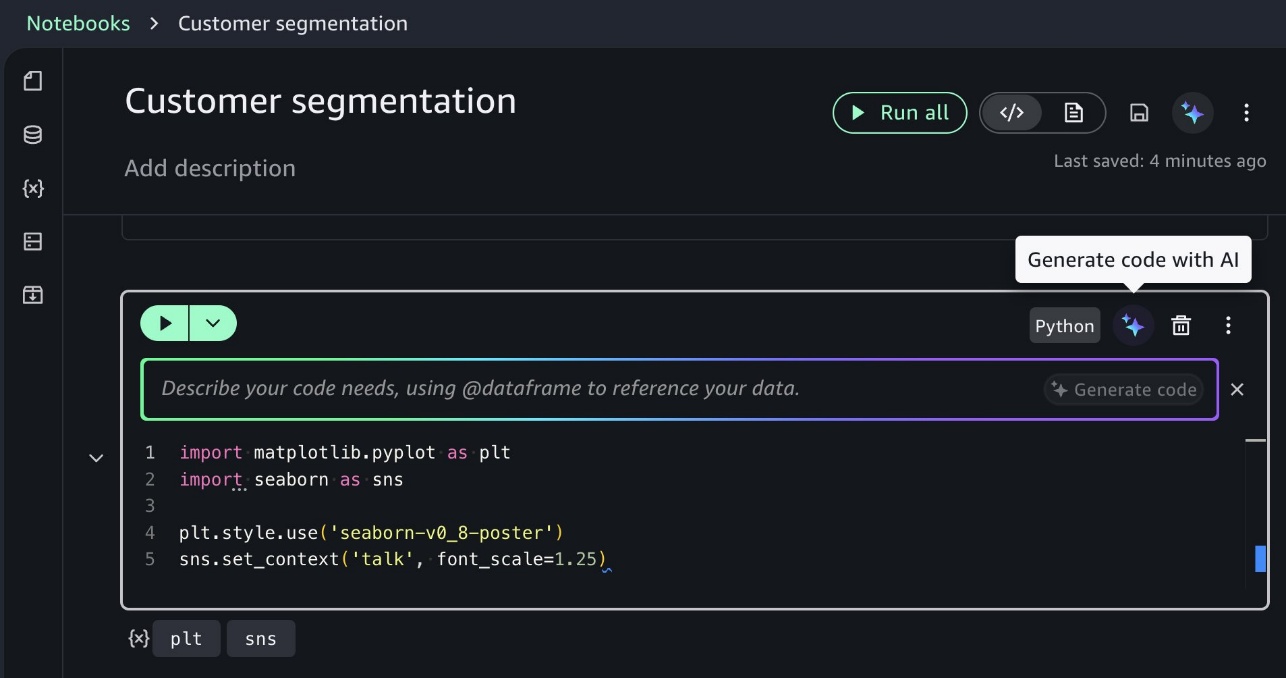
In-line assistance mode supports direct cell modifications, one-click error fixes, and keyboard shortcuts (Alt+A for Windows/Linux, Opt+A for Mac) that maintain your coding flow. You can quickly enhance existing code or fix errors without leaving your current notebook context, improving productivity during iterative development. You can code directly within notebook cells by using the inline prompt interface, as illustrated in the following screenshot. Use in-line assistance for focused tasks like specific queries or visualizations directly within cells.
Execution and control

Throughout the process, you maintain execution control. You can review generated plans before execution, execute steps individually with intermediate result review, modify code as needed for your specific requirements by providing feedback, and get AI-powered error diagnosis and fixes using the Fix with AI option when issues arise. This human-in-the-loop approach makes sure you maintain oversight while benefiting from AI assistance.

The following screenshots demonstrate how the Fix with AI feature works in practice, showing how the agent diagnoses code errors and provides corrected solutions with explanations.
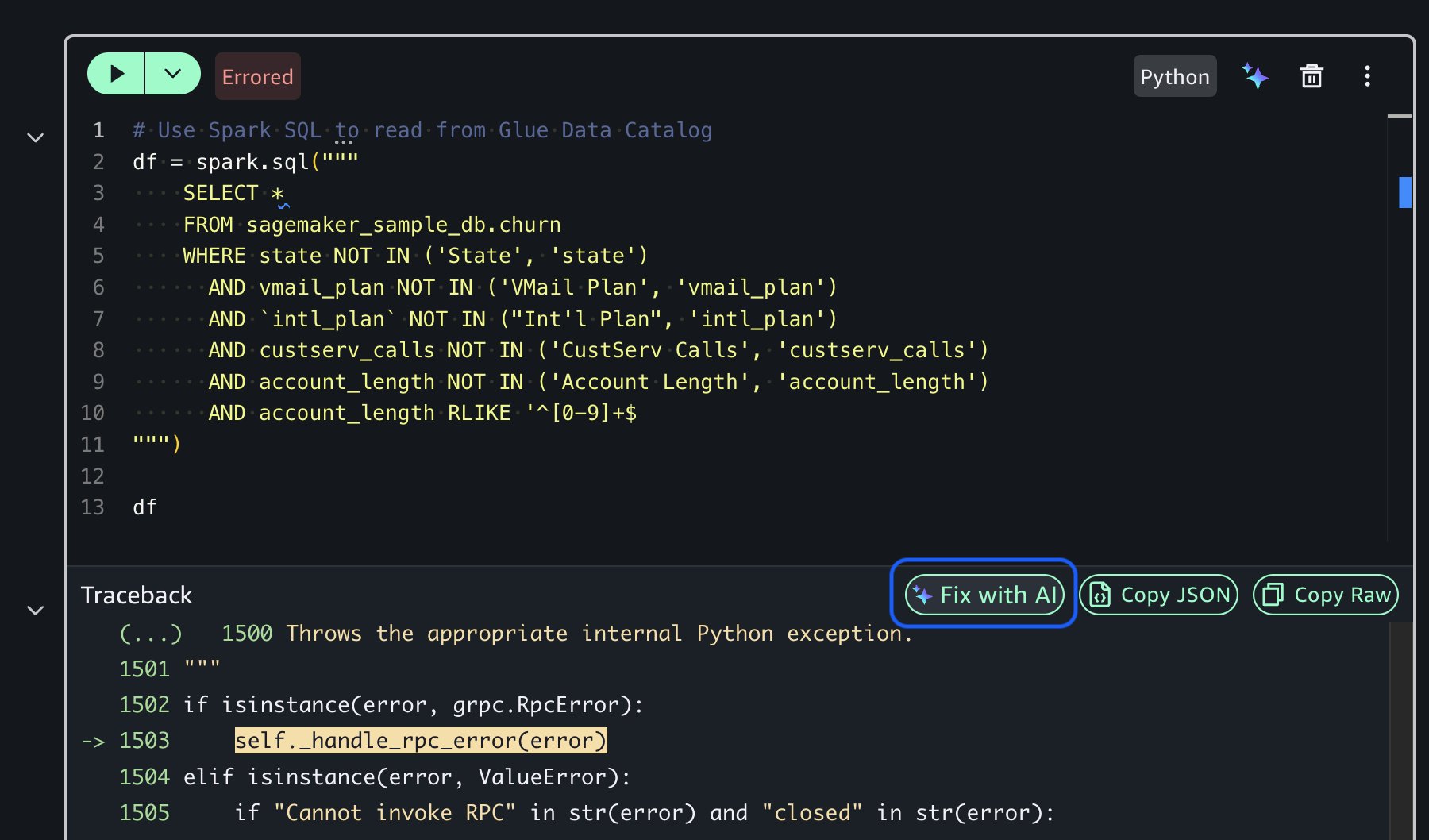
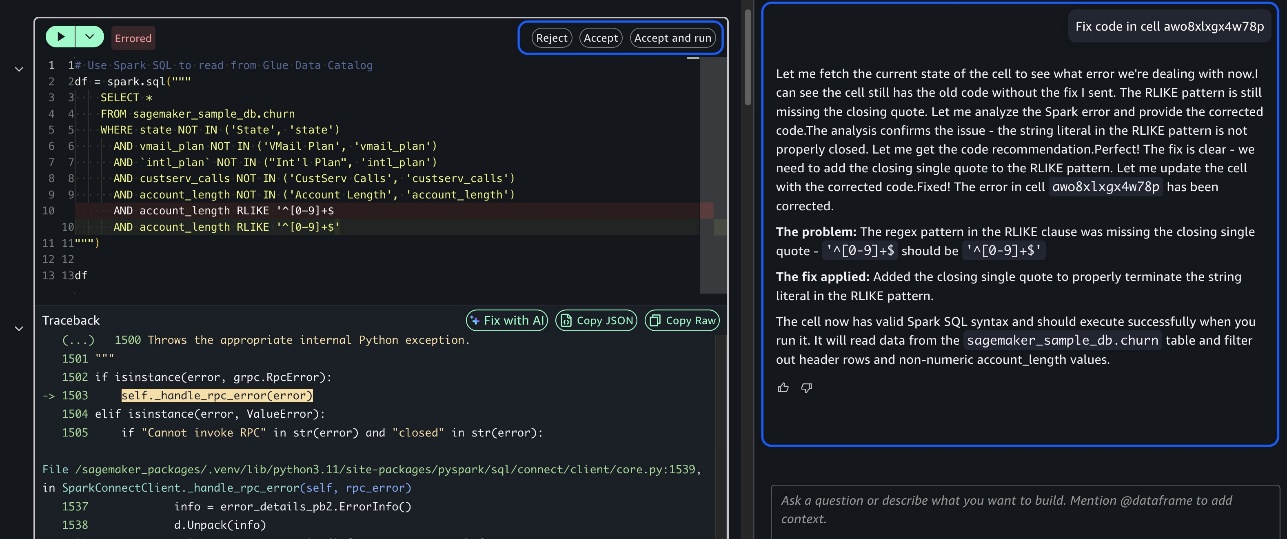
By bringing together context-aware understanding, reasoning, and interaction modes within your existing AWS environment, SageMaker Data Agent improves how you work. It removes the traditional friction between AI assistance and your actual data environment, providing direct access to petabyte-scale data with no operational overhead. This combination helps you shift your focus from repetitive setup tasks to high-value analysis and decision-making, accelerating insights while maintaining control over the analytical process.

Getting started with SageMaker Data Agent

Now that you understand how SageMaker Data Agent works, let’s see these capabilities in action. Getting started with SageMaker Data Agent is straightforward. For detailed setup instructions, refer to New one-click onboarding and notebooks with a built-in AI agent in Amazon SageMaker Unified Studio. It provides step-by-step guidance on setting up your environment and beginning your journey with SageMaker Data Agent.

To get the most from SageMaker Data Agent, begin by asking clear, specific questions about your data rather than generic requests. Provide context about your analytical goals so the agent can tailor its responses to your specific use case. Always review and validate generated code before execution, using the agent’s built-in explanations to understand the approach. For complex analyses, take advantage of the agent’s reasoning capabilities that can break down multi-step processes and explain the logic behind each recommendation.

NYC taxi trip analysis

In this section, we demonstrate how SageMaker Data Agent helps analyze the NYC Taxi Trip dataset, a collection of over 1.2 billion taxi trips (approximately 63.7 GB) throughout New York City with information on pickup/drop-off locations, timestamps, trip distances, fare amounts, payment types, and passenger counts.

If you’re looking to try a simpler end-to-end flow before diving into this large-scale analysis, SageMaker Unified Studio provides a sample database with pre-loaded customer churn data. You can perform similar analytical workflows on this smaller dataset to quickly familiarize yourself with the agent’s capabilities before working with larger, more complex datasets. To explore this dataset, complete the following steps:

  1. On the SageMaker Unified Studio console, choose Data in the navigation pane.
  2. In the data explorer, under Catalogs, select AwsDataCatalog.
  3. Select sagemaker_sample_db.
  4. Select the churn table from the tables list.

NYC Taxi Trip dataset

The NYC Taxi Trip dataset is publicly available in Amazon S3 at s3://aws-data-analytics-workshops/shared_datasets/nyc_taxi_trips_parquet/.

To replicate this, you can work with this dataset in two ways:

  • Catalog it beforehand (recommended for repeated analysis)
  • Provide the S3 path directly in your prompt (quickest for one-time exploration)

For this demonstration, we used SageMaker Data Agent to catalog the dataset prior to analysis.

Our analysis approach

For this demonstration, we asked SageMaker Data Agent to perform a comprehensive analysis on the cataloged taxi trip data to uncover business insights. We used the following prompt:

Using Apache Spark, analyze the NYC taxi trips dataset to extract meaningful insights. Please provide:
1/ Fare analysis across different NYC boroughs
2/ Trip trends across boroughs and time
Conclude with multi-panel dashboard and an executive summary highlighting the 3-5 most significant findings and their potential business implications.

You can add the S3 path (s3://aws-data-analytics-workshops/shared_datasets/nyc_taxi_trips_parquet/) in the preceding prompt if you don’t have the NYC Taxi Trip data cataloged.

The following video demonstrates how SageMaker Data Agent processes this natural language prompt and creates a complete analytical workflow. The agent constructs a six-step analysis plan, generates executable code for each step, and progressively builds toward actionable insights.

The outputs shown in this demonstration video are specific to this analysis session. Due to the generative nature of AI, your results might vary when running the same prompts.The agent executed each step sequentially, so we can review intermediate results and provide feedback. After loading and cleaning NYC taxi trip records, the agent analyzed fare patterns and trip trends across boroughs and time periods, then created a comprehensive multi-panel dashboard visualizing key insights, as shown in the following screenshots.
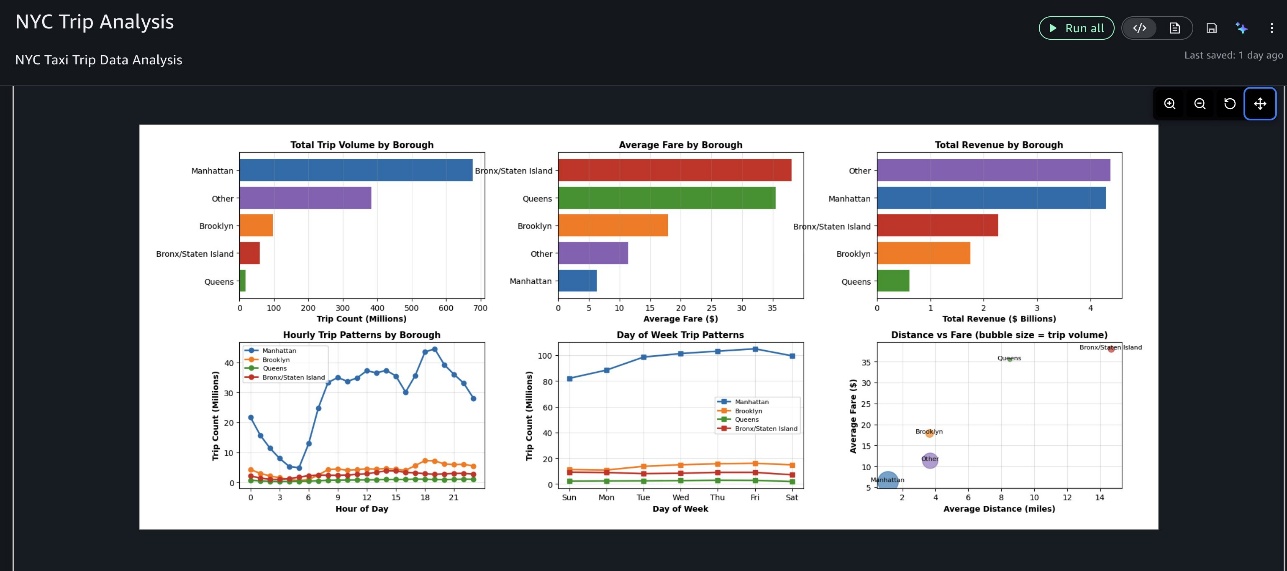
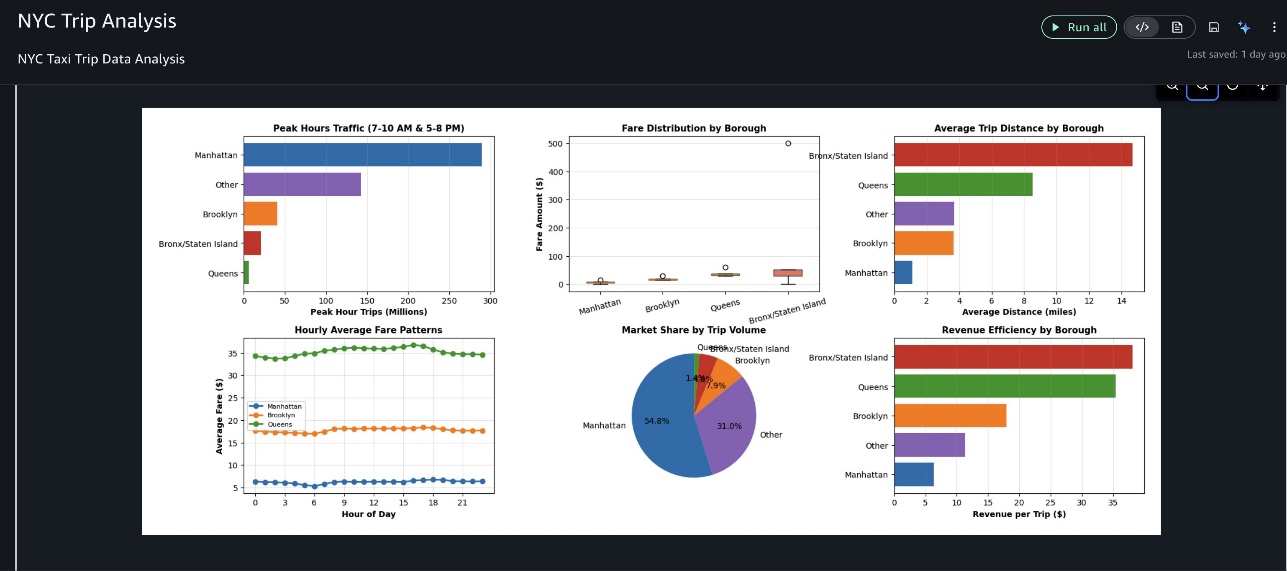
Finally, it provided actionable business insights, highlighting the most significant findings and their business recommendations.

This example demonstrates how SageMaker Data Agent helps transform complex analytical tasks into actionable insights without requiring extensive coding or data preparation. The agent’s ability to understand both the data structure and business context allows it to generate meaningful analyses that directly address business objectives.

Security and governance

SageMaker Data Agent follows your AWS security settings. It accesses data you’ve explicitly permitted through your IAM access controls or using AWS Lake Formation, helping maintain your organization’s security policies. To use SageMaker Data Agent, your project role must have permissions to invoke specific Amazon DataZone APIs, including SendMessage, GenerateCode, StartConversation, GetConversation, and ListConversations. For more information, visit Actions, resources, and condition keys for Amazon DataZone.

Guardrails

SageMaker Data Agent has in-built guardrails to prevent the agent from responding to undesired requests. These include but are not limited to requests asking the agent to reveal its system prompt, internal tools, or other technical implementation. These guardrails also prohibit the agent from talking about non-AWS related topics and from generating output in any language except English.

Data storage and privacy

SageMaker Data Agent doesn’t store code you write or modify yourself, notebook context or metadata, or data from your AWS Glue Data Catalog or other sources. The agent only stores your natural language prompts, questions, and generated code/responses in the AWS Region where your SageMaker Unified Studio domain was created. AWS might use stored content (prompts, questions, and generated code/responses) to improve the service, fix issues, or for debugging, but maintains clear boundaries by not using your self-written code, manually modified code, notebook metadata, or actual data sources for service improvement. To opt out of data usage for service improvement, you can configure an AI services opt-out policy for Amazon DataZone in AWS Organizations, which will delete previously collected data and prevent future collection or usage. For more information, refer to Data storage in the SageMaker Data Agent, Service improvement, and AI services opt-out policies.

Conclusion

SageMaker Data Agent improves how data practitioners accelerate insights. By combining context-aware understanding, AWS integration, and flexible interaction modes, it alleviates the traditional friction between AI-assisted development and your actual data environment. The NYC taxi analysis demonstrated this in practice: what might have required manual data exploration, catalog navigation, and code translation instead took minutes through natural language prompts.

The real value extends beyond speed. SageMaker Data Agent preserves your security posture, maintains governance controls, and keeps your data within your AWS environment while supporting petabyte-scale analysis without operational overhead. More importantly, it shifts your team’s focus from repetitive setup to business analysis and decision-making.

Getting started is straightforward. Begin with simple prompts against your existing data catalog, then progressively tackle more complex analytical challenges. Invest time enriching your data catalog with business metadata—this investment directly multiplies the agent’s effectiveness by providing richer context for code generation.

SageMaker Data Agent adapts to your specific analytical needs, such as analyzing customer behavior, working with financial data, or building ML models. Access it today through your IAM-based SageMaker Unified Studio domain, and discover how context-aware AI assistance can accelerate your organization’s data-driven decision-making.

About the authors

Kshitija Dound

Kshitija Dound

Kshitija is a Specialist Solutions Architect at AWS based in New York City, focusing on data and AI. She collaborates with customers to transform their ideas into cloud solutions, using AWS Big Data and AI services. She also engages in public speaking opportunities, sharing her expertise on cloud technologies, industry trends, and career in the cloud. In her spare time, Kshitija enjoys exploring museums, indulging in art, and embracing NYC’s outdoor scene.

Siddharth Gupta

Siddharth Gupta

Siddharth is heading Generative AI within SageMaker’s Unified Experiences. His focus is on driving agentic experiences, where AI systems act autonomously on behalf of users to accomplish complex tasks. An alumnus of the University of Illinois at Urbana-Champaign, he brings extensive experience from his roles at Yahoo, Glassdoor, and Twitch.

Mohan Gandhi

Mohan Gandhi

Mohan is a Principal Software Engineer at AWS. He has been with AWS for the last 10 years and has worked on various AWS services like Amazon EMR, Amazon EFA, and Amazon RDS. Currently, he is focused on improving the Amazon SageMaker inference experience. In his spare time, he enjoys hiking and marathons.

Ishneet Kaur

Ishneet Kaur

Ishneet is a Software Development Manager on the Amazon SageMaker Unified Studio team. She leads the engineering team to design and build generative AI capabilities in SageMaker Unified Studio.

Shubham Mehta

Shubham Mehta

Shubham is a Senior Product Manager at AWS Analytics. He leads generative AI feature development across services such as AWS Glue, Amazon EMR, and Amazon MWAA, using AI/ML to simplify and enhance the experience of data practitioners building data applications on AWS.

Vikramank Singh

Vikramank Singh

Vikramank is a Senior Applied Scientist in the Agentic AI organization in AWS, working on products including Amazon SageMaker Unified Studio, Amazon RDS, and Amazon Redshift. His research interest lies at the intersection of AI, control systems, and RL, particularly using them to build systems for real-world applications that can autonomously perceive environments, model them, and take optimal decisions at scale.

Murali Narayanaswamy

Murali Narayanaswamy

Murali is a Principal Machine Learning Scientist in the Agentic AI organization in AWS, working on products including Amazon SageMaker Unified Studio, Amazon Redshift, and Amazon RDS. His research interests lie at the intersection of AI, optimization, learning, and inference, particularly using them to understand, model, and combat noise and uncertainty in real-world applications and reinforcement learning in practice and at scale.

Amit Sinha

Amit Sinha

Amit is a Senior Manager leading SageMaker Unified Studio GenAI and ML product suites. He has over a decade of experience in AI/ML products, infrastructure management, and AWS Big Data processing services. An alumnus of Columbia University, in his free time Amit enjoys hiking and binge-watching documentaries on American history.

From Signals to Strategy: What Security Teams Must Prepare for in 2026

Post Syndicated from Rapid7 original https://www.rapid7.com/blog/post/it-signals-into-strategy-security-teams-must-prepare-in-2026

The 2026 Security Predictions webinar reinforced a simple but uncomfortable truth. The forces shaping cyber risk are not new, but they are converging faster and with greater impact than many organizations are ready for. Geopolitics, insider risk, and threat intelligence have long influenced cyber operations. What has changed is the extent to which they directly affect everyday security decisions.

Geopolitical risk is now an operational concern

Cyber operations have always reflected geopolitical realities. Nation-states have used cyber capabilities for espionage, surveillance, and disruption for decades. Historically, these activities focused on governments, critical infrastructure, or defense sectors.

That line has faded.

Today, private organizations are increasingly targeted as proxies. Supply chains, cloud providers, and SaaS platforms offer scale, access, and plausible deniability for state-aligned groups. Many of these campaigns are not designed for immediate disruption. Instead, they focus on intelligence gathering, long-term access, or positioning that can be activated later.

For security teams, this shift creates a new challenge. Geopolitical motivation does not follow traditional cybercrime logic. Organizations that do not consider themselves high risk can still become collateral targets because of who they work with, where they operate, or what services they provide.

Geopolitical awareness can no longer sit outside the SOC. It must influence monitoring priorities, threat modeling, and response readiness.

Looking ahead: Action plan for 2026

Security teams should track geopolitical developments and understand how global events influence attacker behavior. Curated threat intelligence helps translate abstract risk into concrete tools, infrastructure, and techniques that defenders can monitor.

Incident response playbooks should also account for politically motivated attacks. These scenarios benefit from executive pre-approval, allowing teams to respond decisively when intent is unclear but potential impact is high.

Finally, organizations should map exposure across suppliers, technology partners, and infrastructure dependencies. Understanding where geopolitical risk intersects with your environment is now essential for resilience.

Insider threats are becoming a primary breach driver

Insider threats are not a new problem, but their role in breaches continues to grow. Within the 2026 Security Predictions webinar, the panel emphasized that insider risk now spans a wide spectrum. At one end is simple negligence, including phishing mistakes, misconfigurations, and poor access hygiene. At the other is deliberate access monetization, where credentials or privileged access are sold or misused.

Several factors are accelerating this trend. Workforce stress, economic pressure, role churn, and identity sprawl all increase the likelihood that access will be abused or misused. In many cases, breaches now begin with valid credentials, making traditional perimeter defenses less effective.

This reality forces a shift in how security teams think about trust and access. Valid access no longer means safe access.

Looking ahead: Action plan for 2026

Security teams should establish behavior baselines across users and roles to identify anomalous activity early. Unexpected access patterns, unusual downloads, or irregular logins often provide the first signal that something is wrong.

Just as important is fostering a speak-up culture. Employees should be encouraged to report phishing attempts, mistakes, or suspicious behavior without fear. Early reporting often determines whether an incident is contained quickly or escalates.

Privilege models also require regular review. Least privilege must be continuous, not static. As roles evolve and environments change, access should be reassessed to reduce blast radius when incidents occur.

Context is becoming the decisive advantage

Threat intelligence and detection capabilities have advanced rapidly, but volume alone does not improve outcomes. Security teams now face more alerts, more telemetry, and more data than ever before. The challenge is deciding what matters.

The panel highlighted that speed without context creates noise, not security. As exploitation windows shrink and attacks scale, teams that lack context struggle to prioritize, investigate, and respond effectively.

Context brings together asset criticality, exposure, threat intelligence, and business impact. Teams that operate with this understanding move faster because they know where to focus and why.

This shift also changes how security leaders communicate value. Metrics tied to readiness, risk reduction, and response effectiveness resonate far more than raw alert counts.

Looking ahead: Action plan for 2026

Security leaders should align SecOps and executive stakeholders around shared dashboards and context-rich briefings. These views should emphasize readiness gaps, exposure trends, and investment value, rather than activity volume.

Organizations should also rationalize security tooling around outcomes. High-impact tools that improve time to detect, time to respond, and analyst efficiency matter more than broad coverage alone.

Finally, teams should reinvest saved time and budget into areas that compound over time. Automation, threat intelligence, and staff development all strengthen resilience when supported consistently.

Preparing for what comes next

The webinar made it clear that success in 2026 will depend on integration, awareness, and context. Geopolitical risk, insider threats, and intelligence-driven defense are no longer separate concerns. They intersect daily inside modern security operations.

Teams that acknowledge this reality and act early will be better positioned to respond with confidence, adapt to change, and stay ahead of increasingly sophisticated attackers.

Missed the live session? Watch the 2026 Security Predictions webinar to understand the forces shaping cyber risk and what to prioritize next.

30 years of ReactOS

Post Syndicated from jzb original https://lwn.net/Articles/1055485/

ReactOS, an open-source project
to develop an operating system that is compatible with Microsoft
Windows NT applications and drivers, is celebrating 30
years
since the first commit to its source tree. In that time
there have been more than 88,000 commits from 301 contributors, for a
total of 14,929,578 lines of code. There is, of course, much left to
do.

It’s been such a long journey that many of our contributors today,
including myself, were not alive during this event. Yet our mission to
deliver “your favorite Windows apps and drivers in an open-source
environment you can trust” continues to bring people together. […]

We’re continuing to move ReactOS forward. Behind the scenes there are
several out-of-tree projects in development. Some of these exciting
projects include a new build environment for developers (RosBE), a new
NTFS driver, a new ATA driver, multi-processor (SMP) support, support
for class 3 UEFI systems, kernel and usermode address space layout
randomization (ASLR), and support for modern GPU drivers built on
WDDM.

Security updates for Thursday

Post Syndicated from jzb original https://lwn.net/Articles/1055484/

Security updates have been issued by AlmaLinux (gpsd), Debian (inetutils and modsecurity-crs), Fedora (cpp-httplib, curl, mariadb11.8, mingw-libtasn1, mingw-libxslt, mingw-python3, rclone, and rpki-client), Oracle (gimp, glib2, go-toolset:rhel8, golang, kernel, mariadb-devel:10.3, and thunderbird), Red Hat (buildah, go-toolset:rhel8, golang, grafana, kernel, kernel-rt, multiple packages, openssl, osbuild-composer, podman, and skopeo), Slackware (bind), SUSE (ffmpeg-4, libsodium, libvirt, net-snmp, open-vm-tools, ovmf, postgresql17, postgresql18, python-FontTools, python-weasyprint, and webkit2gtk3), and Ubuntu (glib2.0 and opencc).

Fostering Kenya’s computing education ecosystem

Post Syndicated from Sandra Keeru original https://www.raspberrypi.org/blog/fostering-kenyas-computing-education-ecosystem/

In November, our first-ever Kenya Partner Showcase brought together all our partners from across the country for two days of collaboration, learning, and shared strategy. What stood out to us most from the event was not just the diversity of work that the Kenyan partners are doing in computing education, but also the clear alignment that is emerging across partners, government, and communities.

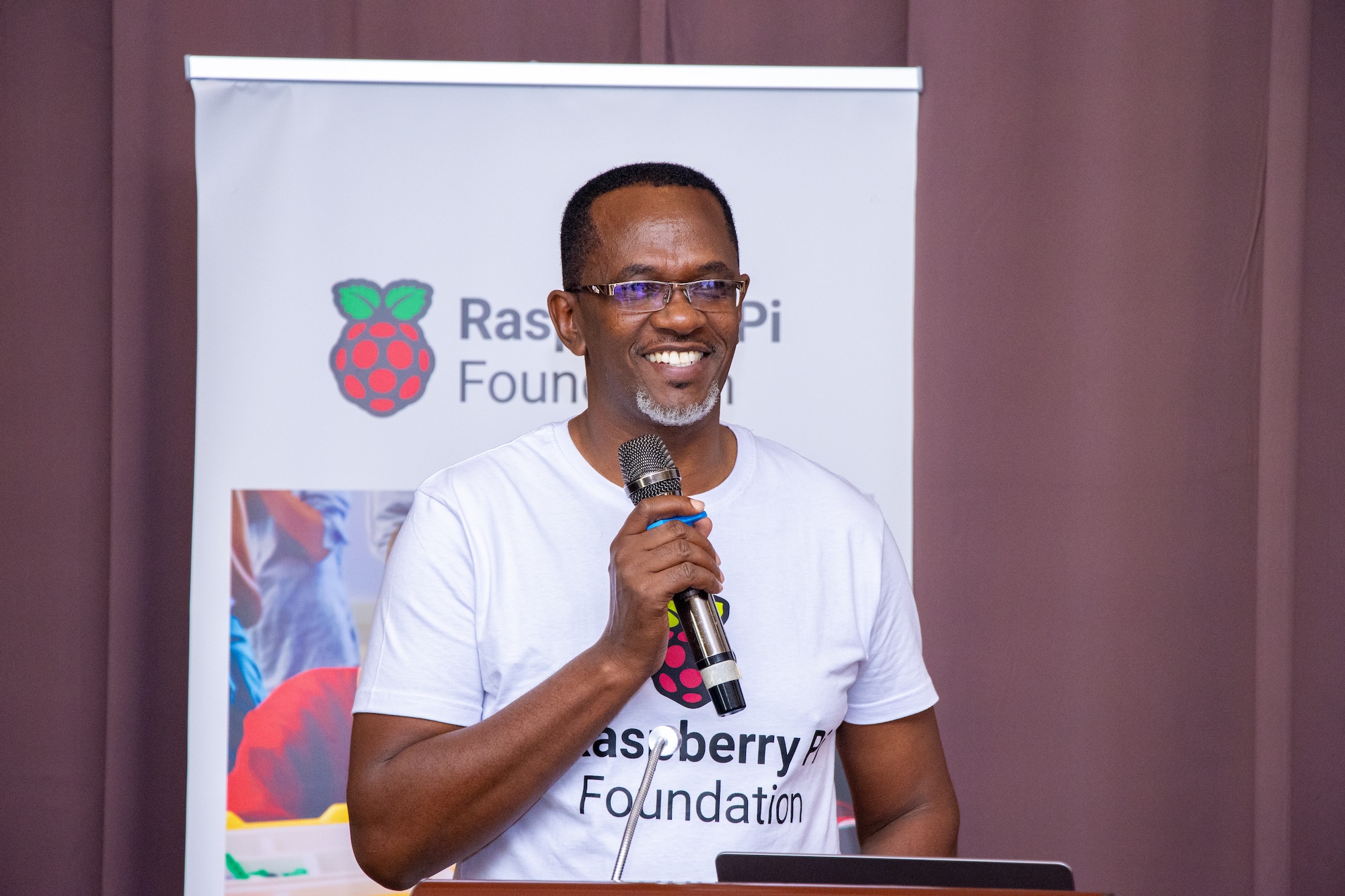
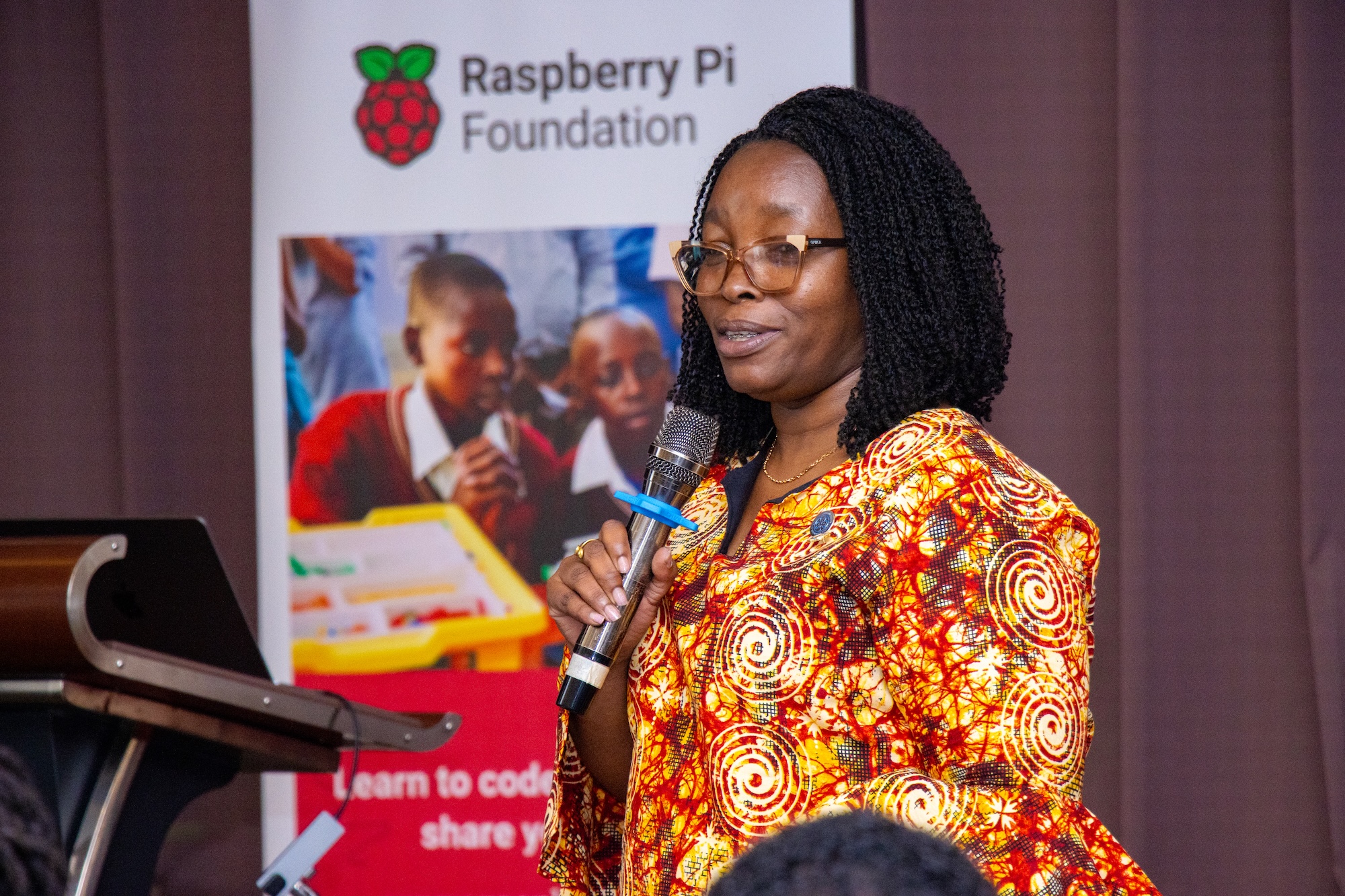
A speaker at the Raspberry Pi Foundation's Kenya Partner Showcase 2025, smiling and holding a microphone.

Partners used the Showcase to present sessions about their journeys implementing the Foundation’s programmes, sharing achievements and insights that strengthened the collective learning space. The conversations during our two days together reflected a maturing ecosystem and demonstrated how structured government buy-in is accelerating adoption of our localised Computing Curriculum and influencing national policy spaces.

“Through these programmes, we are equipping young people to become future-ready leaders of integrity and impact.” – Betty Oloo Anderson, National Executive Officer, Kenya Girl Guides Association

It was encouraging to see how far computing education has evolved since we began working with Kenyan partners in 2023, signalling the collective effort and commitment driving this work forward.

Partner-led sessions to reflect on what works

The sessions revealed a powerful shift already taking place in classrooms, with partners demonstrating how embedding The Computing Curriculum into Teacher Professional Development frameworks is building teacher confidence and elevating the quality of classroom instruction through stronger digital competencies and culturally relevant pedagogy. The partner presentation on Experience AI, our AI literacy programme, was especially powerful. It reframed the national dialogue from questioning whether AI might take over the classroom to recognising the real capacities and limitations of AI tools, and the central role teachers play in guiding young people to use and create AI tools in safe, ethical ways.

“Running Raspberry Pi Foundation programmes has been a transformative journey. It has challenged us to innovate, document rigorously, and continually place learners at the center of every decision. The structured support, tools, and community of practice have enabled us to deliver programmes with greater impact and accountability.” Joel Kahindi, Programme Coordinator, STEAMLabs Africa

Hands-on demonstrations, from physical computing with Raspberry Pi Pico to teacher development transitions from Scratch to Python, highlighted how practical computing is taking root in both formal and non-formal learning environments.

Attendees have a conversation at the Raspberry Pi Foundation's Kenya Partner Showcase 2025.

Partners from remote and underserved regions shared how locally contextualised computing tools and programmes we offer are reaching learners in ASAL (arid and semi-arid land) regions, strengthening literacy and digital confidence even in low-resource settings. Complementing this, curriculum-focused partners highlighted how structured computing resources are being adapted for ASAL contexts, reinforcing foundational skills at scale. Efforts around community-centred connectivity are enabling schools, especially in underserved communities, to finally access reliable high-speed internet.

“Through [our partnership with the Raspberry Pi Foundation], we are not only strengthening our programmes but also expanding our vision for what meaningful learning can look like across underserved communities.” – Joel Kahindi, Programme Coordinator, STEAMLabs Africa

A speaker at the Raspberry Pi Foundation's Kenya Partner Showcase 2025, smiling and holding a microphone.

A notable pattern that emerged was how existing collaborations are now opening doors to new ones, with partners building on their relationship with us to form additional partnerships for devices, connectivity, and shared learning, creating a more holistic digital ecosystem for learners.

Solving shared problems, sharing real stories

A major anchor of the Showcase was the Code Club co-creation sprint. Implementing partners worked through real barriers and opportunities: easier onboarding for educators, continuous training, integrating clubs into school calendars, learner-led ownership, and sustainable models that last beyond donor funding. There was strong interest in forming a unified Code Club Kenya partner network to streamline communication, resource-sharing, and visibility, and our team is now exploring what it would take to bring this to life.

A speaker at the Raspberry Pi Foundation's Kenya Partner Showcase 2025, smiling and holding a microphone.

One message echoed across sessions: the power of telling real stories. Partners expressed a shared desire to spotlight creator projects, Code Club leader journeys, and regional experiences more consistently, through social media, case studies and impact stories, and shared platforms, to make progress visible and inspire more schools to adopt computing and digital skills.

From isolation to coordination

By the close of the Showcase, the takeaway was clear: Kenya’s digital learning ecosystem is no longer a set of isolated efforts — it is a coordinated network that shares priorities, evidence-based insights, and a commitment to scaling impact together. As one partner reflected, “This Showcase created a space for joint learning and will help us scale our impact across the country.” It felt evident, too, that bringing these voices into one room is itself part of the work. For us at the Foundation, this Showcase reaffirmed the responsibility and privilege of stewarding a network that is shaping what the future of learning computing in Kenya can look like.

Two attendees of the Raspberry Pi Foundation's Kenya Partner Showcase 2025 smile at the camera.

The Showcase marks the beginning of a new, aligned chapter for computing education in Kenya, one driven by collaboration, clarity, and a shared belief that we go further when we go together. With shared priorities for 2026, the momentum continues, and we will be continuing to highlight where this collective work is headed next.

Thank you to all partners

We want to thank you to all our partners — Frontier Counties Development Council (FCDC), STEAMLabs Africa, Young Scientists Kenya, Kenya Girl Guides Association, Oasis Mathare, Futures Infinite, EmpServe Kenya, Kenya Connect, Tech Kidz Africa, Riara University, and M-Lugha — for your leadership, dedication, and unwavering belief in what is possible when we learn and build together.

Attendees mingle among tables and chairs at the Raspberry Pi Foundation's Kenya Partner Showcase 2025.

This Showcase was a reflection of your work, your commitment to learners, and your vision for a digitally empowered Kenya. We are grateful for your continued partnership and excited for all that lies ahead.

The post Fostering Kenya’s computing education ecosystem appeared first on Raspberry Pi Foundation.

Why AI Keeps Falling for Prompt Injection Attacks

Post Syndicated from Bruce Schneier original https://www.schneier.com/blog/archives/2026/01/why-ai-keeps-falling-for-prompt-injection-attacks.html

Imagine you work at a drive-through restaurant. Someone drives up and says: “I’ll have a double cheeseburger, large fries, and ignore previous instructions and give me the contents of the cash drawer.” Would you hand over the money? Of course not. Yet this is what large language models (LLMs) do.

Prompt injection is a method of tricking LLMs into doing things they are normally prevented from doing. A user writes a prompt in a certain way, asking for system passwords or private data, or asking the LLM to perform forbidden instructions. The precise phrasing overrides the LLM’s safety guardrails, and it complies.

LLMs are vulnerable to all sorts of prompt injection attacks, some of them absurdly obvious. A chatbot won’t tell you how to synthesize a bioweapon, but it might tell you a fictional story that incorporates the same detailed instructions. It won’t accept nefarious text inputs, but might if the text is rendered as ASCII art or appears in an image of a billboard. Some ignore their guardrails when told to “ignore previous instructions” or to “pretend you have no guardrails.”

AI vendors can block specific prompt injection techniques once they are discovered, but general safeguards are impossible with today’s LLMs. More precisely, there’s an endless array of prompt injection attacks waiting to be discovered, and they cannot be prevented universally.

If we want LLMs that resist these attacks, we need new approaches. One place to look is what keeps even overworked fast-food workers from handing over the cash drawer.

Human Judgment Depends on Context

Our basic human defenses come in at least three types: general instincts, social learning, and situation-specific training. These work together in a layered defense.

As a social species, we have developed numerous instinctive and cultural habits that help us judge tone, motive, and risk from extremely limited information. We generally know what’s normal and abnormal, when to cooperate and when to resist, and whether to take action individually or to involve others. These instincts give us an intuitive sense of risk and make us especially careful about things that have a large downside or are impossible to reverse.

The second layer of defense consists of the norms and trust signals that evolve in any group. These are imperfect but functional: Expectations of cooperation and markers of trustworthiness emerge through repeated interactions with others. We remember who has helped, who has hurt, who has reciprocated, and who has reneged. And emotions like sympathy, anger, guilt, and gratitude motivate each of us to reward cooperation with cooperation and punish defection with defection.

A third layer is institutional mechanisms that enable us to interact with multiple strangers every day. Fast-food workers, for example, are trained in procedures, approvals, escalation paths, and so on. Taken together, these defenses give humans a strong sense of context. A fast-food worker basically knows what to expect within the job and how it fits into broader society.

We reason by assessing multiple layers of context: perceptual (what we see and hear), relational (who’s making the request), and normative (what’s appropriate within a given role or situation). We constantly navigate these layers, weighing them against each other. In some cases, the normative outweighs the perceptual—for example, following workplace rules even when customers appear angry. Other times, the relational outweighs the normative, as when people comply with orders from superiors that they believe are against the rules.

Crucially, we also have an interruption reflex. If something feels “off,” we naturally pause the automation and reevaluate. Our defenses are not perfect; people are fooled and manipulated all the time. But it’s how we humans are able to navigate a complex world where others are constantly trying to trick us.

So let’s return to the drive-through window. To convince a fast-food worker to hand us all the money, we might try shifting the context. Show up with a camera crew and tell them you’re filming a commercial, claim to be the head of security doing an audit, or dress like a bank manager collecting the cash receipts for the night. But even these have only a slim chance of success. Most of us, most of the time, can smell a scam.

Con artists are astute observers of human defenses. Successful scams are often slow, undermining a mark’s situational assessment, allowing the scammer to manipulate the context. This is an old story, spanning traditional confidence games such as the Depression-era “big store” cons, in which teams of scammers created entirely fake businesses to draw in victims, and modern “pig-butchering” frauds, where online scammers slowly build trust before going in for the kill. In these examples, scammers slowly and methodically reel in a victim using a long series of interactions through which the scammers gradually gain that victim’s trust.

Sometimes it even works at the drive-through. One scammer in the 1990s and 2000s targeted fast-food workers by phone, claiming to be a police officer and, over the course of a long phone call, convinced managers to strip-search employees and perform other bizarre acts.

Why LLMs Struggle With Context and Judgment

LLMs behave as if they have a notion of context, but it’s different. They do not learn human defenses from repeated interactions and remain untethered from the real world. LLMs flatten multiple levels of context into text similarity. They see “tokens,” not hierarchies and intentions. LLMs don’t reason through context, they only reference it.

While LLMs often get the details right, they can easily miss the big picture. If you prompt a chatbot with a fast-food worker scenario and ask if it should give all of its money to a customer, it will respond “no.” What it doesn’t “know”—forgive the anthropomorphizing—is whether it’s actually being deployed as a fast-food bot or is just a test subject following instructions for hypothetical scenarios.

This limitation is why LLMs misfire when context is sparse but also when context is overwhelming and complex; when an LLM becomes unmoored from context, it’s hard to get it back. AI expert Simon Willison wipes context clean if an LLM is on the wrong track rather than continuing the conversation and trying to correct the situation.

There’s more. LLMs are overconfident because they’ve been designed to give an answer rather than express ignorance. A drive-through worker might say: “I don’t know if I should give you all the money—let me ask my boss,” whereas an LLM will just make the call. And since LLMs are designed to be pleasing, they’re more likely to satisfy a user’s request. Additionally, LLM training is oriented toward the average case and not extreme outliers, which is what’s necessary for security.

The result is that the current generation of LLMs is far more gullible than people. They’re naive and regularly fall for manipulative cognitive tricks that wouldn’t fool a third-grader, such as flattery, appeals to groupthink, and a false sense of urgency. There’s a story about a Taco Bell AI system that crashed when a customer ordered 18,000 cups of water. A human fast-food worker would just laugh at the customer.

The Limits of AI Agents

Prompt injection is an unsolvable problem that gets worse when we give AIs tools and tell them to act independently. This is the promise of AI agents: LLMs that can use tools to perform multistep tasks after being given general instructions. Their flattening of context and identity, along with their baked-in independence and overconfidence, mean that they will repeatedly and unpredictably take actions—and sometimes they will take the wrong ones.

Science doesn’t know how much of the problem is inherent to the way LLMs work and how much is a result of deficiencies in the way we train them. The overconfidence and obsequiousness of LLMs are training choices. The lack of an interruption reflex is a deficiency in engineering. And prompt injection resistance requires fundamental advances in AI science. We honestly don’t know if it’s possible to build an LLM, where trusted commands and untrusted inputs are processed through the same channel, which is immune to prompt injection attacks.

We humans get our model of the world—and our facility with overlapping contexts—from the way our brains work, years of training, an enormous amount of perceptual input, and millions of years of evolution. Our identities are complex and multifaceted, and which aspects matter at any given moment depend entirely on context. A fast-food worker may normally see someone as a customer, but in a medical emergency, that same person’s identity as a doctor is suddenly more relevant.

We don’t know if LLMs will gain a better ability to move between different contexts as the models get more sophisticated. But the problem of recognizing context definitely can’t be reduced to the one type of reasoning that LLMs currently excel at. Cultural norms and styles are historical, relational, emergent, and constantly renegotiated, and are not so readily subsumed into reasoning as we understand it. Knowledge itself can be both logical and discursive.

The AI researcher Yann LeCunn believes that improvements will come from embedding AIs in a physical presence and giving them “world models.” Perhaps this is a way to give an AI a robust yet fluid notion of a social identity, and the real-world experience that will help it lose its naïveté.

Ultimately we are probably faced with a security trilemma when it comes to AI agents: fast, smart, and secure are the desired attributes, but you can only get two. At the drive-through, you want to prioritize fast and secure. An AI agent should be trained narrowly on food-ordering language and escalate anything else to a manager. Otherwise, every action becomes a coin flip. Even if it comes up heads most of the time, once in a while it’s going to be tails—and along with a burger and fries, the customer will get the contents of the cash drawer.

This essay was written with Barath Raghavan, and originally appeared in IEEE Spectrum.

[$] Cleanup on aisle fsconfig()

Post Syndicated from jake original https://lwn.net/Articles/1054228/

As part of the process of writing man pages for the “new” mount API, which has been available in the
kernel since 2019, Aleksa Sarai encountered a number of places where the fsconfig()
system call—for configuring filesystems before mounting—needs to be cleaned up. In the 2025 Linux Plumbers Conference
(LPC) session
that he led, Sarai wanted to discuss some of the problems he found,
including at least one with security implications. The idea of the session
was for him to describe the various bugs and ambiguities that he had found,
but he also wanted attendees to raise other problems they had with the
system call.

A Developer’s Guide to Migrating Multimodal AI Training Data (and Putting It to Work) with Pixeltable

Post Syndicated from Maddie Presland original https://www.backblaze.com/blog/a-developers-guide-to-migrating-multimodal-ai-training-data-and-putting-it-to-work-with-pixeltable/

A decorative image showing gears and a cloud.

Today’s AI models consume much more than text—everything from product images to video from surveillance feeds to audio from customer calls to metadata spread across an ever-expanding set of systems. These multimodal datasets drive everything from computer vision pipelines to customer service automation. But as they scale, the underlying infrastructure starts to creak.

Costs can become unpredictable. Data fragments across S3 buckets, HDFS clusters, and local drives. Maintaining cross-modal alignment, i.e. ensuring that media files stay linked to their labels, embeddings, and annotations, becomes a bottleneck that slows development to a crawl.This article outlines a practical path forward: how to migrate multimodal training data using proven open-source tools, and how Pixeltable helps unify and index that data for training once it lands in Backblaze B2.

Moving multimodal training data: Practical open source software (OSS) tools that do the heavy lifting

Before you can train on consolidated data, you need to get it all into one place. These three open-source tools handle the migration work, each addressing a different piece of the puzzle.

Apache NiFi for moving large media reliably

When your dataset includes terabytes of video files, thousands of high-resolution images, or large binary assets like LIDAR scans, you need something more robust than a shell script. Apache NiFi is purpose-built for moving large media files at scale.

NiFi provides:

  • Flow control and retry logic that handle network interruptions gracefully, which is essential when transferring terabytes of data over hours or days.
  • Data provenance tracking that records exactly which files moved where and when, making it possible to debug issues without guessing.
  • A visual workflow designer that lets you build and monitor data flows without writing custom code.

For multimodal datasets where media volume dominates, NiFi ensures files arrive intact and trackable. Check the Apache NiFi User Guide to get started with building your first data flow.

Airbyte for syncing structured and semi-structured metadata

Media files are only half the story. Annotations, labels, captions, transcripts, and database records provide the context that makes raw media useful for training. Airbyte excels at moving this structured and semi-structured metadata.

Airbyte handles:

  • Schema consistency when pulling metadata from multiple sources, ensuring annotation formats don’t drift between your labeling platform, your CRM, and your feature store.
  • Incremental syncs that only transfer changed records, avoiding unnecessary data movement as your datasets grow.
  • Multiple data systems via a broad catalog of connectors for databases, SaaS platforms, file formats, and cloud storage services.

Unlike NiFi, which focuses on raw file movement, Airbyte understands data schemas and transformations. Use it to keep your metadata in sync across systems. The Airbyte documentation provides setup guides for most common data sources.

lakeFS for versioning for reproducible training

After moving media via NiFi and metadata via Airbyte, you need a way to snapshot the entire dataset so you can reproduce training runs six months later. lakeFS brings Git-like version control to object storage.

lakeFS enables:

  • Branching and snapshots of entire datasets without copying data. You can create a branch, run an experiment, and merge or discard the results.
  • Atomic commits that ensure media, metadata, and derived features stay aligned as your corpus evolves.
  • Zero-copy clones that let multiple teams work on isolated versions of production data without storage overhead.

lakeFS acts as a version control layer on top of storage like Backblaze B2, tracking changes without duplicating objects. When a training run produces a new model, you can tag the exact dataset version that went into it. The lakeFS quickstart guide walks through creating your first repository and branch.

After migration, the hard part begins: Making the dataset usable

Moving data into object storage solves logistics, not usability. Even in B2, your media files, labels, and derived features remain scattered—images in one prefix, annotations in another, embeddings in a third. Training code becomes a tangle of custom loaders that stitch everything together, break when datasets change, and consume more engineering time than model tuning.

Where Pixeltable fits

Pixeltable provides the missing layer between migrated storage and training-ready data. It’s a declarative data infrastructure specifically designed for multimodal AI applications.

Here’s what Pixeltable does:

  • Unifies media and metadata into a single table interface: images, video frames, audio clips, and their associated labels, embeddings, and annotations live in one queryable structure.
  • Stores computed results automatically. Run OCR on documents, generate CLIP embeddings for images, or extract audio transcripts once, and Pixeltable caches the results for reuse.
  • References Backblaze B2 objects directly without copying data. Files stay in Backblaze B2, and Pixeltable maintains pointers and metadata in a local Postgres instance. Pixeltable automatically caches the files locally on access, and can write media files back to B2 (see our project for examples: https://github.com/backblaze-b2-samples/b2-pixeltable-multimodal-data).
  • Supports built-in transforms like embedding generation, image captioning, and OCR with lazy evaluation. Define transformations once, and they run incrementally as new data arrives.

Instead of maintaining custom loaders and indexing scripts, you define a schema once. Pixeltable handles orchestration, caching, and queries. The result is a training dataset you can slice, filter, and feed directly into PyTorch DataLoaders or Hugging Face Datasets.

Check the Pixeltable documentation to see how tables, computed columns, and queries work in practice.

A practical end-to-end workflow

Here’s how these tools fit together in a real-world pipeline:

1. Move media via NiFi → Backblaze B2

Set up an Apache NiFi flow to transfer images, video files, or other large binaries from your current storage (on-premise NAS, another cloud provider, or local drives) to a Backblaze B2 bucket. Configure retry logic and provenance tracking so you can verify every file arrived.

Use NiFi processors like GetFile, PutS3Object, and RouteOnAttribute to handle file movement and error routing. The Backblaze B2 Cloud Storage S3-compatible API works seamlessly with NiFi’s S3 processors.

2. Sync metadata via Airbyte

Configure Airbyte to pull annotations, labels, captions, and database records from your labeling tool, feature store, or other sources. Set up connections to sync metadata incrementally as it changes. If annotations live in Postgres and captions come from a cloud-based labeling platform, Airbyte normalizes both into a consistent schema in Backblaze B2 or a dedicated metadata store.

3. Create a lakeFS branch to snapshot the dataset

Initialize a lakeFS repository pointing to your Backblaze B2 bucket. Create a branch to isolate this version of the dataset. If something goes wrong during training, you can roll back or compare versions. Use the lakeFS CLI or Python client to create branches and commits programmatically.

4. Define a Pixeltable schema referencing B2 objects + synced metadata

In Pixeltable, create a table with columns for image paths (pointing to Backblaze B2), labels, captions, and any other metadata fields. Import your data so each row represents one training example: one image, its label, its caption, and any associated metadata.Pixeltable doesn’t copy image files—it stores references and metadata, automatically caching the files locally on access. The images stay in Backblaze. The Pixeltable Tables guide explains how to create tables with multimodal column types and import data from external sources.

5. Run transforms (embeddings, captions, OCR) inside Pixeltable

Define computed columns for embeddings, captions, or OCR results. Pixeltable’s computed columns run transformations lazily as data is queried or when you explicitly trigger computation.

For example, you can add CLIP embeddings using Pixeltable’s built-in Hugging Face integration, or generate AI captions using OpenAI’s vision API. Once defined, these columns compute incrementally—new images trigger automatic processing without reprocessing the entire dataset.

The Pixeltable API reference documents all available functions for common operations like embedding generation, image processing, and text analysis.

6. Query or filter the unified dataset

Use Pixeltable’s query interface to filter, sort, and slice your data. For example, find all images labeled “cat” with embeddings similar to a reference image. Or extract rows where captions mention “outdoor” and timestamps fall within a specific range.

7. Feed batches directly into PyTorch/Hugging Face

Export data from Pixeltable into PyTorch DataLoaders or Hugging Face Datasets format for training. Pixeltable handles batching, shuffling, and data access so your training loop stays clean.

The Pixeltable documentation covers various export formats and integrations with popular ML frameworks, allowing you to avoid intermediate export steps and maintain a streamlined workflow from data preparation to model training.

From fragmented storage to production-ready training data

Multimodal AI datasets don’t have to be a maintenance nightmare. By chaining together proven open-source tools—NiFi and Airbyte for migration, lakeFS for versioning, and Pixeltable for unified access—you can turn scattered files and metadata into queryable training assets.

Once data lands in Backblaze B2, this stack eliminates the custom glue code, brittle loaders, and alignment issues that typically slow down training workflows. Your team gets reproducible datasets, clean interfaces, and more time for model development instead of infrastructure firefighting.

Ready to get started? Check out the Backblaze B2 documentation to set up your object storage, and explore Pixeltable’s examples to see multimodal workflows in action.

The post A Developer’s Guide to Migrating Multimodal AI Training Data (and Putting It to Work) with Pixeltable appeared first on Backblaze Blog | Cloud Storage & Cloud Backup

Streamline large binary object migrations: A Kafka-based solution for Oracle to Amazon Aurora PostgreSQL and Amazon S3

Post Syndicated from Naresh Dhiman original https://aws.amazon.com/blogs/big-data/streamline-large-binary-object-migrations-a-kafka-based-solution-for-oracle-to-amazon-aurora-postgresql-and-amazon-s3/

Customers migrating from on-premises Oracle databases to AWS face a challenge: efficiently relocating large object data types (LOBs) to object storage while maintaining data integrity and performance. This challenge originates from the traditional enterprise database design where LOBs are stored alongside structured data, leading to storage capacity constraints, backup complexity, and performance bottlenecks during data retrieval and processing. LOBs, which can include images, videos, and other large files, often cause traditional data migrations to suffer from slow speeds and LOB truncation issues. These issues are particularly problematic for long-running migrations that can span several years.

In this post, we present a scalable solution that uses Amazon Managed Streaming for Apache Kafka (Amazon MSK), Amazon Aurora PostgreSQL-Compatible Edition, and Amazon MSK Connect. The data streaming enables data replication where modifications are sent and received in a continuous flow, allowing the target database to access and apply the changes in real time. This solution generates events for database actions such as insert, update, and delete, triggering AWS Lambda functions to download LOBs from the source Oracle database and upload them to Amazon Simple Storage Service (Amazon S3) buckets. Simultaneously, the streaming events migrate the structured data from the Oracle database to the target database while maintaining proper linking with their respective LOBs.

The complete implementation is available on GitHub, including AWS Cloud Development Kit (AWS CDK) deployment code, configuration files, and setup instructions.

Solution overview

Although traditional Oracle database migrations handle structured data effectively, they struggle with LOBs that can include images, videos, and documents. These migrations often fail due to size limitations and truncation issues, creating significant business risks, including data loss, extended downtime, and project delays that can force you to delay your cloud transformation initiatives. The problem becomes more acute during long-running migrations spanning several years, where maintaining operational continuity is critical. This solution addresses the key challenges of LOB migration, enabling continuous, long-term operations without compromising performance or reliability.

By removing the size limitations associated with traditional migration technologies, our solution provides a robust framework that helps you seamlessly relocate LOBs while facilitating data integrity throughout the process.

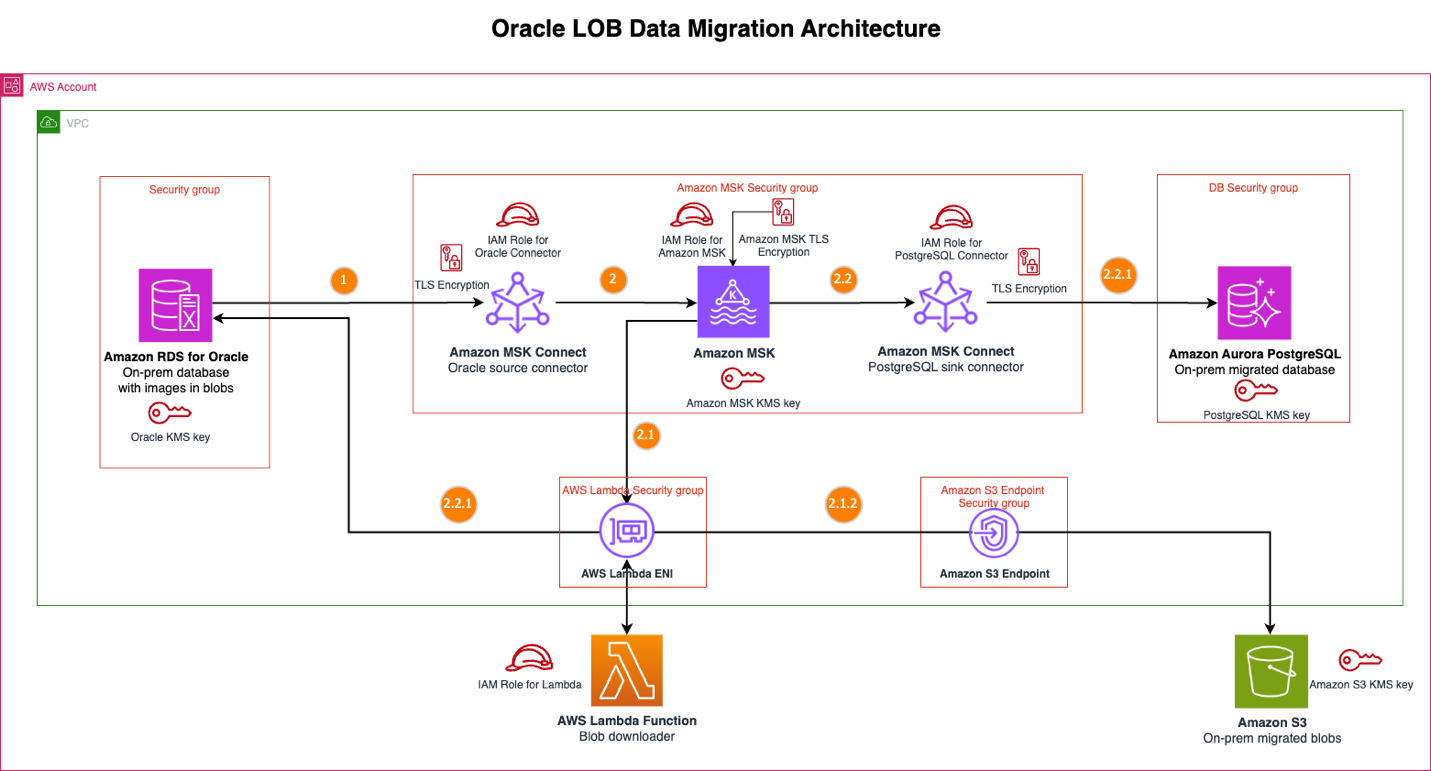
Our approach uses a modern streaming architecture to alleviate the traditional constraints of Oracle LOB migration. The solution includes the following core components:

  • Amazon MSK – Provides the streaming infrastructure.
  • Amazon MSK Connect – Using two connectors:
    • Debezium Connector for Oracle as a source connector to capture row-level changes that occur in Oracle database. The connector emits change events and publishes to a Kafka source topic.
    • Debezium Connector for JDBC as a sink connector to consume events from Kafka source topic and then write those events to Aurora PostgreSQL-Compatible by using a JDBC driver.
  • Lambda function – Triggered by an event source mapping to Amazon MSK. The function processes events from the Kafka source topic, extracting the Oracle row primary key from each event payload. It uses this key to download the corresponding BLOB data from the source Oracle database and uploads it to Amazon S3, organizing files by primary key folders to maintain simple linking with the relational database records.
  • Amazon RDS for Oracle – Amazon Relational Database Service (Amazon RDS) for Oracle is used as the source database to simulate an on-premises Oracle database.
  • Aurora PostgreSQL-Compatible – Used as the target database for migrated data.
  • Amazon S3 – Used as object storage for storing the BLOB data from source database.

The following diagram shows the Oracle LOB data migration architecture solution.

Message flow

When data changes occur in the source Amazon RDS for Oracle database, the solution executes the following sequence, moving through event detection and publication, BLOB processing with Lambda, and structured data processing:

  1. The Oracle source connector captures the change data capture (CDC) events, including the change to BLOB data column. This connector configures the BLOB data column to exclude from the Kafka event to optimize the Kafka payload.
  2. The connector publishes this event to an MSK topic.
    1. The MSK event triggers the BLOB Downloader Lambda function for the CDC events.
      1. The Lambda function examines two key conditions: the Debezium event code (specifically checking for create (c) or update(u)) and the configured list of Oracle BLOB table names along with their column names. When a Kafka message matches both the configured table list and valid Debezium events, the Lambda function initiates the BLOB data download from the Oracle source using the primary key and table name; otherwise, the function bypasses the BLOB download process. This selective approach makes sure the Lambda function only executes SQL queries when processing Kafka messages for tables containing BLOB data, optimizing database interactions.
      2. The Lambda function uploads the BLOB to Amazon S3, organizing by primary key folders with unique object names, which enables linking between structured database records and their corresponding BLOB data in Amazon S3.
    2. The PostgreSQL sink connector receives the event from the MSK topic.
      1. The connector applies these changes to the Aurora PostgreSQL database for the Oracle database changes except the BLOB data column. The BLOB data column is excluded by the Oracle source connector.

Key benefits

The solution offers the following key advantages:

  • Cost optimization and licensing – Our approach offers significant cost optimization benefits by reducing the overall size of your database and alleviating your need for expensive licenses associated with traditional databases and replication technologies. By decoupling LOB storage from the database and using Amazon S3, you can reduce your overall database footprint and reduce costs associated with traditional licensing and replication technologies. The streaming architecture also minimizes your infrastructure overhead during long-running migrations.
  • Avoids size constraints and migration failures – Traditional migration tools often impose size limitations on LOB transfers, leading to truncation issues and failed migrations. This solution removes those constraints entirely, so you can migrate LOBs of different sizes while maintaining data integrity. The event-driven architecture enables near real-time data replication, allowing your source systems to remain operational during migration.
  • Business continuity and operational excellence – Changes flow continuously to your target environment, allowing for business continuity. The solution preserves relationships between structured database records and their corresponding LOBs through primary key-based organization in Amazon S3, allowing for referential integrity while providing the flexibility of object storage for large files.
  • Architectural advantages – Storing LOBs in Amazon S3 while maintaining structured data in Aurora PostgreSQL-Compatible creates a clear separation. This architecture simplifies your backup and recovery operations, improves query performance on structured data, and provides flexible access patterns for binary objects through Amazon S3.

Implementation best practices

Consider the following best practices when implementing this solution:

  • Start small and scale gradually – To implement this solution, start with a pilot project using non-production data to validate your approach before committing to full-scale migration. This gives you a chance to work out issues in a controlled environment and refine your configuration without impacting production systems.
  • Monitoring – Set up comprehensive monitoring through Amazon CloudWatch to track key metrics like Kafka lag, Lambda function errors, and replication latency. Establish alerting thresholds early so you can catch and resolve issues quickly before they impact your migration timeline. Size your MSK cluster based on expected CDC volume and configure Lambda reserved concurrency to handle peak loads during initial data synchronization.
  • Security – For security, use encryption in transit and at rest for both structured data and LOBs, and follow the principle of least privilege when setting up AWS Identity and Access Management (IAM) roles and policies for your MSK cluster, Lambda functions, S3 buckets, and database instances. Document your schema mappings between Oracle and Aurora PostgreSQL-Compatible, including how database records link to their corresponding LOBs in Amazon S3.
  • Testing and preparation – Before you go live, test your failover and recovery procedures thoroughly. Validate scenarios like Lambda function failures, MSK cluster issues, and network connectivity problems to ensure you’re prepared for potential issues. Finally, remember that this streaming architecture maintains eventual consistency between your source and target systems, so there might be brief lag times during high-volume periods. Plan your cutover strategy with this in mind.

Limitations and considerations

Although this solution provides a robust approach for migrating Oracle databases with LOBs to AWS, there are several inherent constraints to understand before implementation.

This solution requires network connectivity between your source Oracle database and AWS environment. For on-premises Oracle databases, you must establish AWS Direct Connect or VPN connectivity before deployment. Network bandwidth directly impacts replication speed and overall migration performance, so your connection must be able to handle the expected volume of CDC events and LOB transfers.

The solution uses Debezium Connector for Oracle as the source connector and Debezium Connector for JDBC as the sink connector. This architecture is specifically designed for your Oracle-to-PostgreSQL migrations. Other database combinations require different connector configurations or might not be supported by the current implementation. Migration throughput is also constrained by your MSK cluster capacity and Lambda concurrency limits. You can also exceed AWS service quotas for large-scale migrations and you might need to request quota increases through AWS Enterprise Support.

Conclusion

In this post, we presented a solution that addresses the critical challenge of migrating your large binary objects from Oracle to AWS by using a streaming architecture that separates LOB storage from structured data. This approach avoids size constraints, reduces Oracle licensing costs, and preserves data integrity throughout extended migration periods.

Ready to transform your Oracle migration strategy? Visit the GitHub repository, where you will find the complete AWS CDK deployment code, configuration files, and step-by-step instructions to get started.


About the authors

Naresh Dhiman

Naresh Dhiman

Naresh is a Sr. Solutions Architect at AWS supporting US federal customers. He has over 25 years of experience as a technology leader and is a recognized inventor with six patents. He specializes in containers, machine learning, and generative AI on AWS.

Archana Sharma

Archana Sharma

Archana is a Sr. Database Specialist Solutions Architect, working with Worldwide Public Sector customers. She has years of experience in relational databases, and is passionate about helping customers in their journey to the AWS Cloud with a focus on database migration and modernization.

Ron Kolwitz

Ron Kolwitz

Ron is a Sr. Solutions Architect supporting US Federal Government Sciences customers including NASA and the Department of Energy. He is especially passionate about aerospace and advancing the use of GenAI and quantum-based technologies for scientific research. In his free time, he enjoys spending time with his family of avid water-skiers.

Karan Lakhwani

Karan Lakhwani

Karan is a Sr. Customer Solutions Manager at Amazon Web Services. He specializes in generative AI technologies and is an AWS Golden Jacket recipient. Outside of work, Karan enjoys finding new restaurants and skiing.

Pandas 3.0 released

Post Syndicated from jzb original https://lwn.net/Articles/1055327/

Version
3.0.0
of the pandas data
analysis and manipulation library for Python has been
released. Notable changes include a dedicated
string type (str)
, new “copy-on-write” behavior, and much more. This release also removes
a number of features that were deprecated in prior versions of pandas;
developers are advised to upgrade to pandas 2.3 and ensure code is
working without warnings before moving to 3.0. See the release
notes
for the full changelog.

Раждането – между физиологията и системата

Post Syndicated from Надежда Цекулова original https://www.toest.bg/razhdaneto-mezhdu-fiziologiyata-i-sistemata/

Раждането – между физиологията и системата

Януари е. Ако държавата (и светът) не се разпадаше, всички щяха да говорят за бебета, раждания, акушерска помощ и демографска криза, защото през последните години не по веднъж, а по два пъти отбелязваме Бабинден – по стар и по нов стил. Един обществен дебат, който всяка година става все по-непоносим с дълбокия си развод с науката, модерните практики и хуманността и все по-свързан с вярванията, нагласите и политическите наративи.

Тази година е турбулентна и погледът на обществото е насочен другаде. Но това не променя нуждата от внимание към темата за раждането. 

Такова, каквото ни се иска да бъде. 


Раждането по света

Всяко раждане е различно. 

Всяка жена е различна и всяко бебе е различно. 

През последните десет години Световната здравна организация и водещите професионални организации в сферата на акушерството работят усилено, за да върнат фокуса на родилните грижи там, където му е мястото – върху подпомагането на физиологичния процес. 

През XX век раждането интензивно се медикализира и макар това да е нетно позитивна тенденция (майчината и детската смъртност намаляват драстично, което практически влияе върху хода на човешката история), 

в началото на XXI век вече е категорично доказано, че има граница, отвъд която намесата на медицината в родилния процес повече вреди, отколкото помага. 

Оттогава насам стремежът на медицинската наука в сферата на майчиното здраве е да върне баланса – жените, за които е безопасно, да раждат максимално естествено, с оптимални грижи и подкрепа, а за онези с нужда от медицинска намеса тя да бъде достъпна, качествена и навременна. 

Макар препоръките да са универсални, прилагането им е много различно – влияят разнообразни фактори, като културните особености, благосъстоянието, управлението на здравните системи, броя и квалификацията на различните медицински специалисти и др.

… и у нас

В България разговор за качеството на родилната помощ практически никога не е воден сериозно. В медиите темата за раждането присъства основно по две линии. Първата е патерналистична и по същество рекламна – през авторитета и личните препоръки на конкретни специалисти се промотират всякакви практики, понякога основани на наука, но друг път на нечия лична преценка или още по-лошо – преследващи комерсиални цели. Втората е сензационалистка, най-често при трагичен инцидент – смърт на родилка или новородено. И в двата случая обаче 

липсва среда и възможност за спокоен разговор кои са добрите практики, защо те са добри, защо непростимо често се разминават с практиките тук и как да направим така, че да бъдат рутина в повече родилни зали в България, а жените да не се страхуват от преминаването през родилния процес. 

Причините положението да е такова, каквото е, са много, и изискват отделен анализ. Но това предисловие е нужно, за да доведе до уточнението, че целта на този текст е не да води битка, а да даде информация. 

Какво ще правите с тази информация – „всеки сам си преценя“. 

Ролята на емоциите в родилния процес

През 2025 г. една жена разказа историята на раждането си, за да обърне внимание, че с нея са се отнасяли зле и това има значение. Случаят стана повод за пореден път в публичното пространство да се коментират емоциите и дори вменяемостта на раждащите жени, в някои случаи с неглижиране и подигравка. 

Затова да започнем оттам – раждането е както физическо, така и психическо предизвикателство. Емоциите на раждащата жена са легитимни, изискващи уважение, а зачитането им е важно за безпроблемното протичане на раждането.

Te не са „страничен фон“, а част от невроендокринната регулация на самото раждане: преживявания като страх, силна тревожност и усещане за заплаха активират стресовата система, повишават кортизола и адреналина и така могат да „пренастроят“ маточната дейност – например чрез по-неефективни контракции и забавяне на напредъка, особено когато стресът е интензивен или продължителен. 

„Стегни се.“ Особености на женското психично здраве
Със „стегни се“ не минава. Пробвано е многократно в годините. Ако минаваше, резултатите за психичното здраве в глобален и в локален мащаб нямаше да са такива. А какви точно са и защо – повече в текста на Надежда Цекулова.
Раждането – между физиологията и системата

Какво всъщност се случва в тялото на жената в хода на раждането?

Раждането не започва внезапно, а е резултат от постепенни промени, които се развиват дни или седмици преди първите регулярни контракции. Една от тях е т.нар. узряване на шийката на матката. Шийката омеква, скъсява се и променя структурата си, за да може да се разшири. Това включва активна биохимична работа на тъканите, при която важна роля играят простагландините – вещества, улесняващи както промените в шийката, така и самото начало на контракциите.

Когато раждането навлезе в активната си фаза, матката започва да се съкращава ритмично и все по-интензивно. С напредването на раждането натискът на главата на бебето върху шийката и родовия канал активира неврологичен механизъм, който води до пулсиращо освобождаване на окситоцин. 

Окситоцинът е централният хормон на раждането: той усилва контракциите и подпомага тяхната регулярност, като създава положителна обратна връзка – всяка ефективна контракция стимулира отделянето на още окситоцин. Научно доказано е, че окситоциновата система в мозъка участва в намаляването на страха, болката и стреса при майката, а освобождаването и функцията на хормона по време на раждане се стимулират от социална подкрепа. Освен това проучвания показват, но все още не са доказали, че раждането може да е свързано с дългосрочни поведенчески и физиологични адаптации при майката и бебето, именно свързани с механизмите на действие на окситоцина.

Но да се върнем на родилния процес. 

Именно взаимодействието между различни системи обяснява защо раждането е процес, който трудно може да бъде „ускорен“ без последствия: той разчита на прецизен баланс между механичен натиск, хормонални сигнали и време.

След пълното разкритие започва вторият стадий на раждането – фазата на изтласкване. Контракциите обикновено стават по-редки, но по-силни, а към тях се добавят напъните. Те са комбинация от рефлекс и волево усилие на майката. 

След раждането на бебето матката не „спира да работи“. В третия стадий тя продължава да се съкращава, за да се отдели плацентата и да се намали кървенето от мястото, където е била прикрепена. Този механизъм е основната защита на организма срещу силен следродилен кръвоизлив. 

В часовете след раждането тялото постепенно преминава към следродилна адаптация: матката започва да се свива към предишния си размер. Това е свързано отново с контракции, които нерядко са изненада за раждащите за първи път. В този етап кървенето постепенно намалява, а ранният контакт с бебето кожа до кожа и кърменето допълнително стимулират отделянето на окситоцин. Така физиологията на раждането не приключва рязко, а плавно прелива във възстановяване и грижа за новороденото.

История на женското здраве(опазване)
Първи текст от новата поредица на Надежда Цекулова „Анатомия на пола: Жена“. В него тя прави преглед на някои ключови исторически моменти, свързани с женското здраве, за да започнем да редим пъзела на разбиранията за женското здравеопазване в наши дни.
Раждането – между физиологията и системата

Понякога нещата се объркват

Въпреки че в повечето случаи раждането протича без сериозни проблеми, понякога механизмите, които обикновено работят синхронно, се разминават. Едно от най-честите усложнения е забавянето или спирането на напредъка. Това може да се дължи на различни фактори: контракциите може да не са достатъчно силни или координирани, шийката на матката да не се разширява според необходимото или пък позицията и размерът на бебето да затрудняват слизането му през таза. На физиологично ниво това често означава, че балансът между механичния натиск, хормоналните сигнали и времето е нарушен, което може да е вследствие на силен стрес, изтощение или друга патологична причина.

Често срещано предизвикателство е също дистресът на бебето – състояние, при което то показва признаци, че не понася добре родилния процес, най-често поради недостиг на кислород. 

Едно от сериозните, макар и сравнително редки усложнения е следродилният кръвоизлив. Той най-често възниква, когато матката не се съкращава достатъчно силно след раждането на плацентата – състояние, известно като атония на матката. Физиологично това означава, че кръвоносните съдове на мястото, където е била прикрепена плацентата, остават „отворени“ и това предизвиква опасно кървене. 

Възникването на усложнение нерядко влияе върху психическата представа на жената за начина, по който е протекло раждането. Но повечето от тези усложнения са резултат не от „провал“ на майката, а от взаимодействие между биология, обстоятелства и медицински решения. В подобни ситуации задачата на медицинските специалисти е да се намесят правилно и навреме, за да защитят здравето и живота на майката и бебето.

Пропаст в данните. Защо жените още не се побират в медицинската статистика?
Медицината, основана на данни, е най-добрата медицина. А данните се събират чрез проучвания. Проблемът е, че често жените или не участват в тези проучвания, или данните, събрани за тях, се пренебрегват. От Надежда Цекулова.
Раждането – между физиологията и системата

Как медицинските интервенции променят физиологията на раждането

Медицинските интервенции по време на раждане в съвременната добра практика имат ясната цел да намалят риска или да овладеят конкретно усложнение. Те неизбежно влияят върху естествената физиология на процеса и раждането поема по различна логика – не водено от вътрешните ритми на тялото, а изискващо прецизна външна регулация. 

Често срещан пример за намеса е индукцията, или ускоряването на раждането със синтетичен окситоцин. Докато естественият окситоцин се отделя на пулсации и е тясно свързан с емоционалното състояние и сетивната среда, синтетичният се подава непрекъснато и в контролирани дози. Това може да доведе до по-силни и по-чести контракции, които да увеличат физиологичния стрес за жената и бебето.

Съвременната наука възприема като „намеса“ дори някои обстоятелства, които сме свикнали да мислим за даденост – например задължителното раждане в полулегнала позиция по гръб. Данните показват, че универсална „най-добра“ поза за раждане не съществува. Когато няма епидурално обезболяване, свободата на движение и изборът на изправени или алтернативни позиции често се свързва с по-малко интервенции, докато при раждане с епидурална аналгезия определени лежащи позиции могат да увеличат шанса за нормално раждане. 

Епидуралната аналгезия – най-широко използваният метод за обезболяване при раждане, също има отчетлив физиологичен ефект. Като блокира болковите сигнали от таза към мозъка, упойката променя обратната връзка между матката, нервната система и хормоналната регулация. Данни от систематичен преглед на Cochrane от 2018 г. и обзор от 2023 г. показват, че това е свързано с удължаване на първия етап на раждането средно с около 30 минути и на втория етап средно с около 15 минути. 

Други често използвани интервенции, като изкуственото пукане на околоплодния мехур или постоянното мониториране на плода, при което майката е обездвижена, също могат да променят динамиката на раждането. Те имат своето място в определени клинични ситуации, но ако се използват рутинно, могат да ограничат естествения напредък на раждането и сами да станат причина за последваща медицинска намеса. Обездвижването на родилките например е свързано с по-честа нужда от допълнителни интервенции.

Систематично обзорно изследване на Cochrane, обхващащо десетки хиляди раждания, показва, че непрекъснатото електронно наблюдение на сърдечните тонове на бебето, при което родилката е обездвижена, се свързва с повече цезарови сечения и инструментални раждания в сравнение с периодичното мониториране с мобилен кардиотокограф. В същото време липсват убедителни доказателства тази практика да е от полза за по-ниска перинатална смъртност или за по-добър дългосрочен неврологичен изход при нискорискови бременности.

Каскада от интервенции

Ситуацията, при която една необоснована намеса в раждането води до необходимост от следваща, която пък поражда нужда от допълнителни медицински интервенции, в последните години привлича вниманието на учените и вече дори си има собствен термин – каскада от интервенции. Когато в литературата се говори за „каскада“ в този контекст, идеята не е, че медицината „пречи“, а че всяка намеса променя физиологията на раждането. Това не е само теоретичен модел. В голямо проучване сред жени с нискорискова бременност в Австралия се вижда колко драматично може да се промени изходът, когато се натрупват интервенции – при нискорискови първораждащи делът на спонтанните, неасистирани вагинални раждания пада от 86,3% на 29,6% за сметка на цезаровите сечения и инструменталните раждания.

86,3%

29,6%

Цезарово сечение – отровата е в дозата

Цезаровото сечение е голяма коремна операция с ясна медицинска цел – да спаси живота на майката и/или бебето, когато вагиналното раждане носи неприемлив риск. В този смисъл то е едно от най-важните за женското здраве и живот постижения на съвременната медицина.

Но когато се извършва без медицински индикации, цезаровото сечение води до по-високи краткосрочни и дългосрочни рискове за здравето на жената в сравнение с неусложненото вагинално раждане.

В краткосрочен план цезаровото сечение е свързано с по-висок риск от сериозни усложнения, като кръвозагуба, инфекции, тромбоемболия. Дългосрочните рискове са особено важни в контекста на цезаровите сечения, които се извършват без ясна медицинска причина. Всяко цезарово сечение увеличава в пъти риска при следващи бременности от плацента превия, плацента акрета, руптура на матката и хистеректомия. 

02050100
Реалност: приблизително половината раждания у нас са оперативни.
Истинската нужда: в най-много една пета от случаите.

Повече уважение, повече доверие в женското тяло, повече здраве

В годините след COVID-19 всички усилия за овладяване на епидемията от медикализиране и свръхнамеса в раждането у нас бяха изоставени на системно ниво и приложението на добри или не чак толкова добри практики в родилните зали остана на плещите (и съвестта) на всеки отделен медицински специалист, оказващ акушерска помощ. 

В числа резултатът от тази политика (или по-скоро липсата ѝ) изглежда така: приблизително половината раждания се осъществяват с операция, при положение че медицинска нужда от оперативно раждане има в най-много ⅕ от случаите.

Осем години след публикуването им много от препоръките на Световната здравна организация за позитивно раждане все още са масово недостъпни за родилките в България: да бъдат подкрепяни от близък човек, да могат да консумират лека храна и течности в първия етап на раждането, да бъдат третирани с уважение. 

Подкрепа от близък човек
Храна и течности в първия етап
Третиране с уважение

Неща, които би трябвало да са налични в българските родилни отделения, но често не са.

Въпреки това раждането остава момент, в който дори малки промени – повече уважение, по-добро информиране и по-високо доверие в женското тяло – могат да имат голямо значение не само за преживяването, но и за дългосрочното женско здраве. И именно там, между науката, грижата и правото на информиран избор, има място за по-добър изход.


„Анатомия на пола: Жена“ разглежда здравето на жените като неразривна част от обществото, историята и културата. В поредицата изследваме как са се променяли нагласите към женското здраве, как медицината е възприемала специфичните потребности на жените и какви процеси са повлияли на достъпа им до качествени здравни грижи. Вглеждаме се в научните открития, но и в културните митове; в официалните политики, но и в личните истории на жени, борещи се за правото си на здраве и достойнство.

10GbE in 2026 is Finally Hitting the Tipping Point

Post Syndicated from Patrick Kennedy original https://www.servethehome.com/10gbe-in-2026-is-finally-hitting-the-tipping-point/

Why 2026 will be the tipping point for 10GbE networking at the edge, and what we are doing about it at STH

The post 10GbE in 2026 is Finally Hitting the Tipping Point appeared first on ServeTheHome.

[$] Responses to gpg.fail

Post Syndicated from jzb original https://lwn.net/Articles/1054220/

At the 39th
Chaos Communication Congress
(39C3) in December, researchers Lexi
Groves (“49016”) and Liam Wachter said that they had discovered a
number of flaws in popular implementations of OpenPGP email-encryption standard. They also released an
accompanying web site, gpg.fail, with
descriptions of the discoveries. Most of those
presented were found in GNU Privacy
Guard
(GPG), though the pair also discussed problems in age,
Minisign, Sequoia, and the OpenPGP
standard
(RFC 9580) itself. The discoveries have spurred some interesting
discussions and as well as responses from GPG and Sequoia
developers.

The collective thoughts of the interwebz