Post Syndicated from digiblur DIY original https://www.youtube.com/watch?v=Gw_lSfj8gVc
Introducing Rapid7 Curated Intelligence Rules for AWS Network Firewall
Post Syndicated from Rapid7 original https://www.rapid7.com/blog/post/cds-rapid7-curated-intelligence-rules-aws-network-firewall
Outsmart attackers with smarter rules
Managing network security in a dynamic cloud environment is a constant challenge. As traffic volume grows and threat actors evolve their tactics, organizations need protection that can scale effortlessly while delivering robust, intelligent defense. That’s where a service like AWS Network Firewall becomes essential, and we’re excited to partner with AWS to make it even more powerful.
What is AWS Network Firewall?
AWS Network Firewall (AWS NWF) is a managed service that provides essential, auto-scaling network protections for Amazon Virtual Private Clouds (VPCs). While its flexible rules engine offers granular control, defining and maintaining the right rules to defend against evolving threats is a complex and resource-intensive task.
Manually creating and updating rules often leads to coverage gaps and creates significant operational overhead. To simplify this process and empower teams to act with confidence, Rapid7 is proud to announce the availability of Curated Intelligence Rules for AWS Network Firewall. As an AWS partner, we convert our curated intelligence on Indicators of Compromise (IOCs) from into high-quality rule groups, delivering expert-vetted threat intelligence directly within your native AWS experience.
Harnessing industry-leading threat intelligence
In the world of threat intelligence, more isn’t always better. Too many low-fidelity alerts generate noise, distract analysts, and leave teams chasing false positives. At Rapid7, our approach is different. We focus on delivering high-fidelity intelligence, enabling customers to zero in on the threats most relevant to their unique environments.
Rapid7 Curated Intelligence Rules embody this same approach, and are built on three key principles:
⠀
Focus on quality over quantity – Rules emphasize meaningful, low-noise detection directly aligned with current, real-world threats, significantly reducing alert fatigue.
Curated global intelligence – Rule sets are powered by high-quality, region-specific data from unique sources, providing unparalleled visibility and context for actionable detections.
Dynamic and self-cleaning rule sets – Threat intelligence is not static. Using Rapid7’s proprietary , rules are automatically retired when an IOC passes a certain threshold, ensuring the delivered intelligence is always fresh, relevant, and current.
⠀
We’re launching with two distinct rule sets, each designed to address today’s most pressing threats:
-
Advanced Persistent Threat (APT) campaigns: Targets the subtle and persistent techniques used by state-sponsored and sophisticated threat actors.
-
Ransomware & cybercrime: Focuses on the tools, infrastructure, and indicators associated with financially motivated attacks.
⠀
These rule sets are updated daily to ensure you have the most current protections. Furthermore, our intelligence is dynamic. When an IOC passes a certain threshold in our proprietary Decay Scoring system, we remove it from the rule set. This process guarantees that the intelligence you receive is always current and actionable, significantly reducing alert fatigue.
The operational advantage
These Curated Intelligence Rules deliver immediate and tangible value, allowing your team to:
-
Automate threat protection: Reduce overhead with curated, continuously updated detections delivered natively within AWS Network Firewall.
-
Adopt protections faster: Deploy protections powered by Rapid7 Labs intelligence with just a few clicks in the console.
-
Maintain predictable operations: Rely on AWS-validated updates, clear rule group metadata, and transparent per-GB metering.
Common use cases addressed
Our rule sets provide practical defense against a wide range of attack scenarios. You can:
-
Block command and control (C2) communication from known malware families
-
Detect network reconnaissance activity associated with advanced persistent threats
-
Prevent data exfiltration to malicious domains linked to cybercrime groups
-
Identify and stop the download of malware payloads from compromised websites
-
Alert on traffic to newly registered domains used in malicious activities
Get started with Curated Intelligence Rules for AWS NFW today
Ready to enhance your cloud security with curated, actionable intelligence? Add our rule sets to your and strengthen your organization’s defenses in minutes.
››› Visit the listing in the AWS Marketplace to learn more.
Simplify cloud security with managed rules from AWS Marketplace for AWS Network Firewall
Post Syndicated from Dhanil Parwani original https://aws.amazon.com/blogs/security/simplify-cloud-security-with-managed-rules-from-aws-marketplace-for-aws-network-firewall/
AWS Network Firewall now supports managed rules curated by AWS Partners—giving you pre-built threat intelligence and security controls that reduce the need to create and maintain your own rule sets. This new capability helps organizations strengthen their network security posture with continuously updated AWS partner managed protection.
What are managed rules from AWS Marketplace for Network Firewall?
Managed rules from AWS Marketplace are curated by AWS Partners who automatically update rules to address emerging threats, providing you comprehensive protection without the operational overhead of managing custom rules. As shown in Figure 1, you can now deploy Network Firewall managed rules from AWS Marketplace in a few clicks, reducing the time it takes you to create custom security rules. You can use the AWS Management Console to choose from a variety of specialized rule groups tailored to different industry needs, compliance requirements, and threat landscapes.
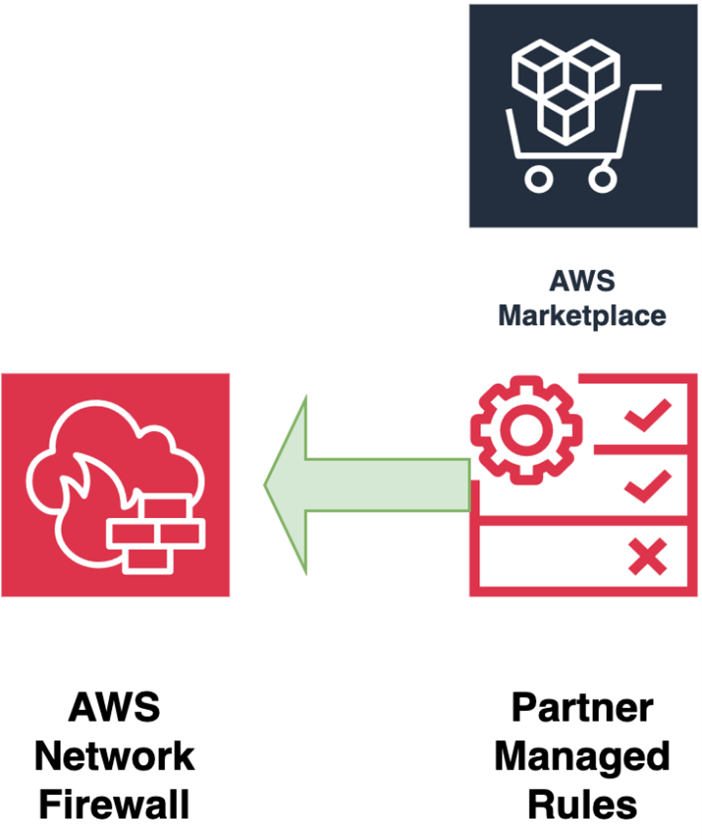
Figure 1: Managed rules from AWS Marketplace for AWS Network Firewall
Key benefits and use cases
Managing firewalls across multiple virtual private clouds (VPCs) can become challenging when it comes to keeping up with creating, maintaining, and updating custom rule sets. This only increases with the growing number of firewalls that require constant monitoring to protect against emerging threats and new attack vectors. While AWS Managed Rules rule groups provide a solid foundation, managed rules from AWS Marketplace help customers add expert-curated rules with a few clicks.
You can associate managed rules from AWS Marketplace partners directly to your AWS Network Firewall and see them in action in one of the many network firewall deployment models as shown in Deployment models for AWS Network Firewall with VPC routing enhancements. These rules seamlessly fit into your traffic inspection patterns and don’t require additional routing-related configuration changes.
Keeping up to date on the constantly changing threat landscape can be time-consuming and expensive. AWS Marketplace partners automatically update managed rule groups and provide new versions of rule groups when new vulnerabilities and threats emerge. Continuously updated rules lead to a more robust security posture.
Prerequisites
To start using managed rules from AWS Marketplace, you need to meet the following prerequisites:
- An AWS account. You can create one if necessary
- Learn about filtering traffic and related concepts for Network Firewall
- (Optional) Create a firewall before creating managed rule groups
You can use managed rules from AWS Marketplace partners with all Network Firewall deployment models.
Set up AWS Marketplace managed rules
With the prerequisites in place, you’re ready to set up managed rules from AWS Marketplace.
To set up managed rules:
- Sign in to the Amazon Virtual Private Cloud (Amazon VPC) console.
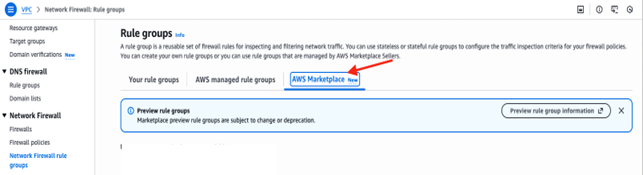
- In the navigation pane, choose Network Firewall and then choose Network Firewall rule groups.
-
Choose AWS Marketplace.

Figure 2: AWS Marketplace rule groups
-
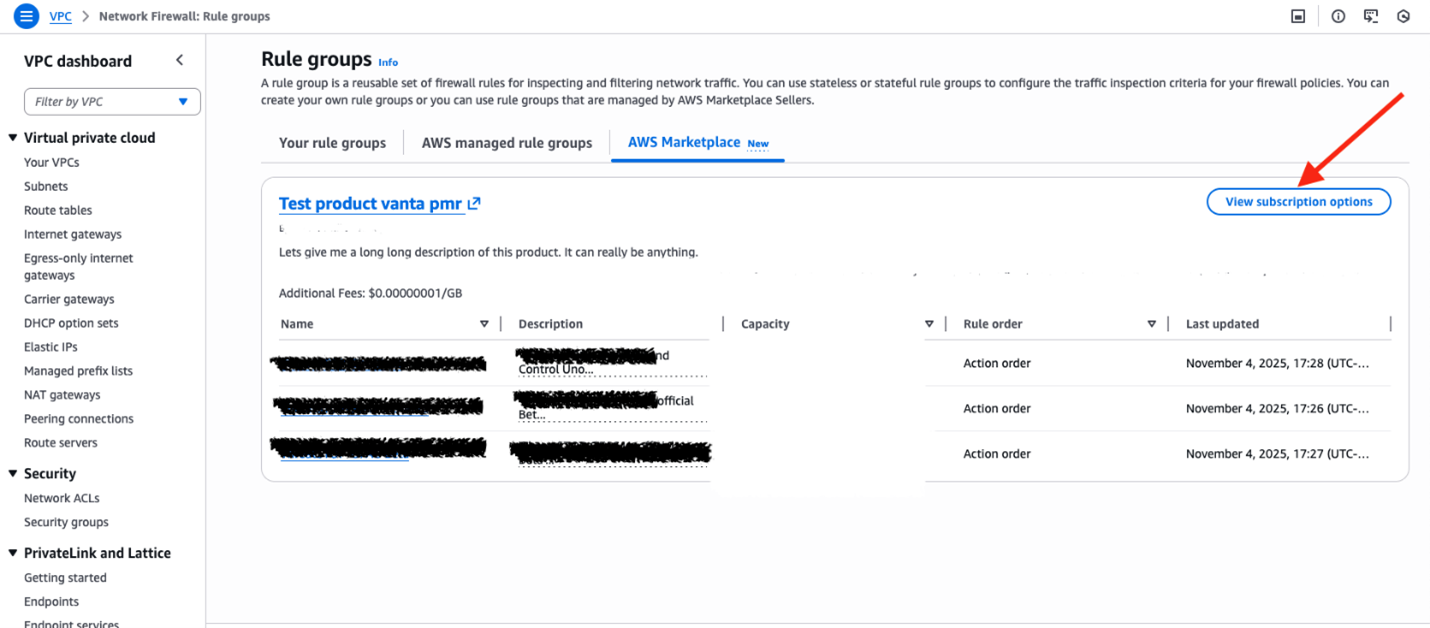
Under AWS Marketplace, you’ll see different types of rule groups curated by AWS Partners. You can select the partner and the rule group you want to apply as part of your Network Firewall policies. Locate the partner and rule group that you want to add and choose View subscription options next to that rule group.

Figure 3: View subscription options for partner rule groups in AWS Marketplace
-
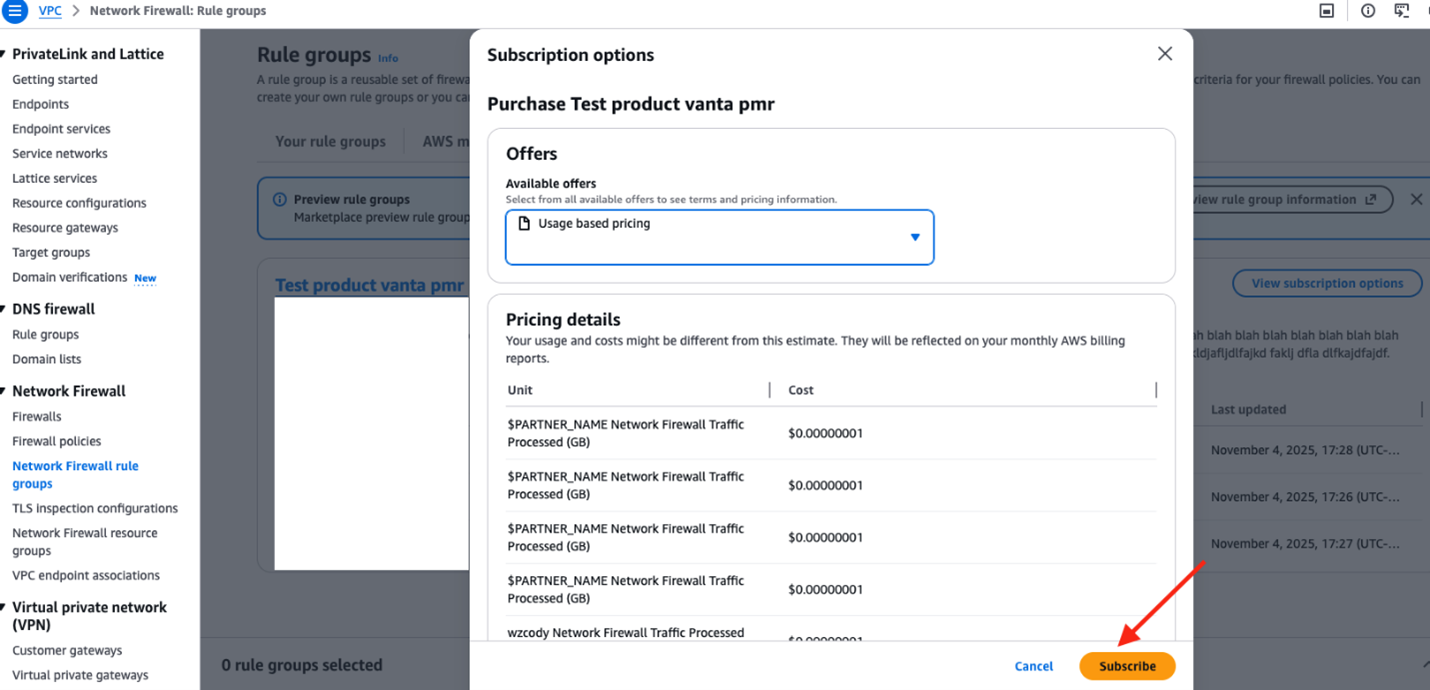
After you choose View subscription options, you’ll see the Subscription options window. Review the options and then choose Subscribe.

Figure 4: Review subscription options and subscribe to partner product
-
When subscribed, go to Firewall Policies and choose from an existing firewall policy or create a new one as described in Creating a firewall policy.

Figure 5: Choose a firewall policy to associate rule groups
- After you select the firewall policy, choose Actions and then select Add Partner managed rule groups.

Figure 6: Add partner managed rule groups
- After you choose Add partner managed rule groups, select the previously subscribed rule groups.

Figure 7: Select the rule groups
- Choose Add to policy and confirm the rule groups were added to your firewall policy. You can modify rule groups later if necessary.
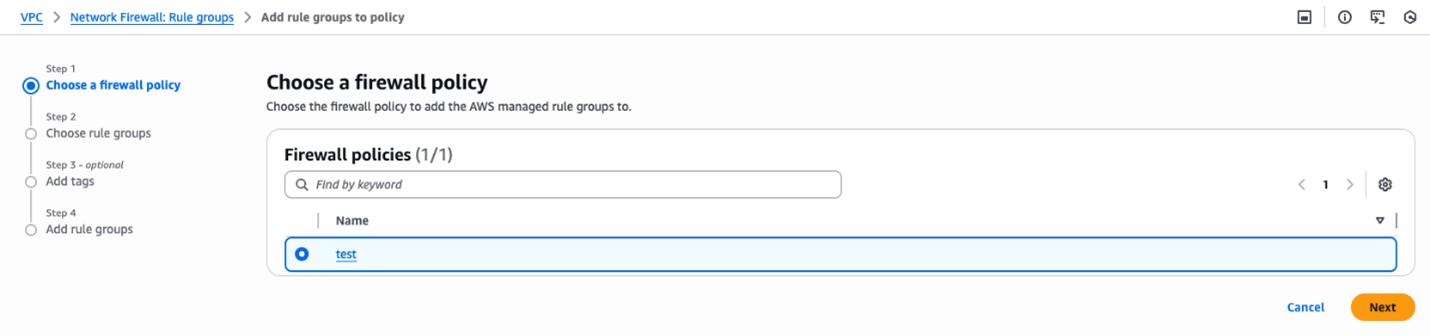
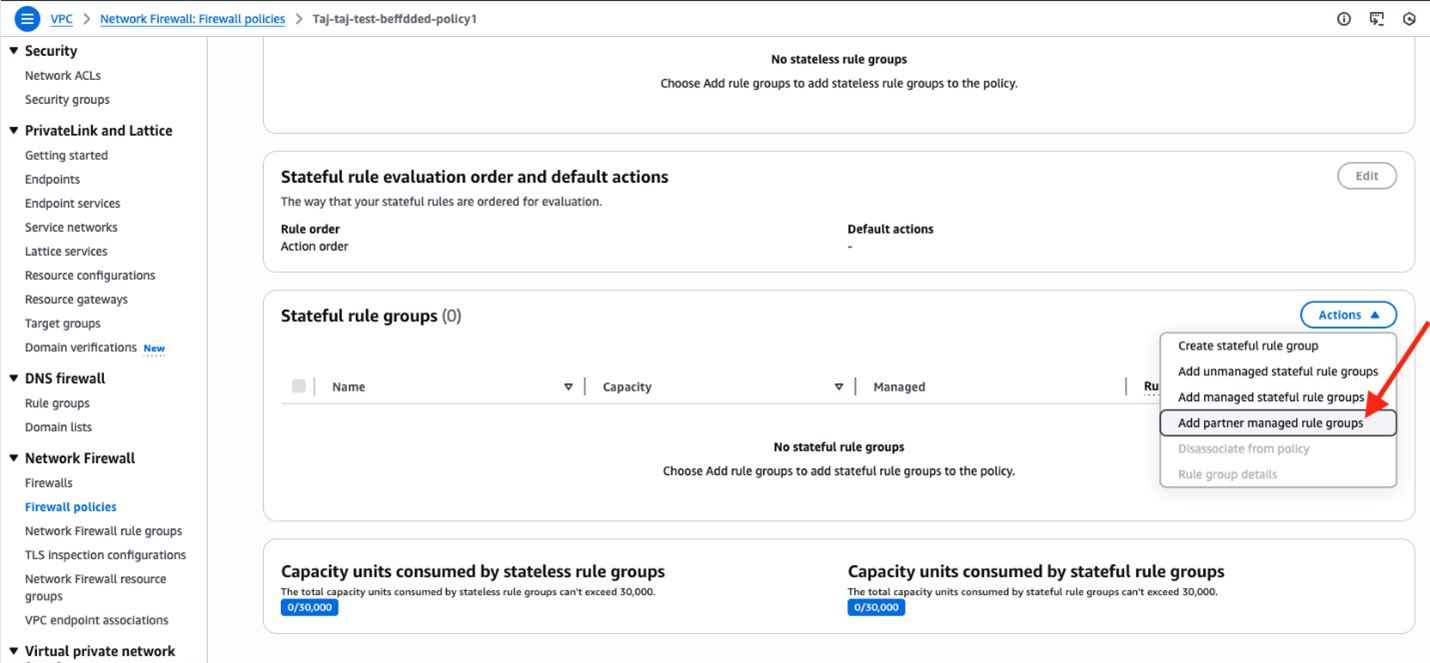
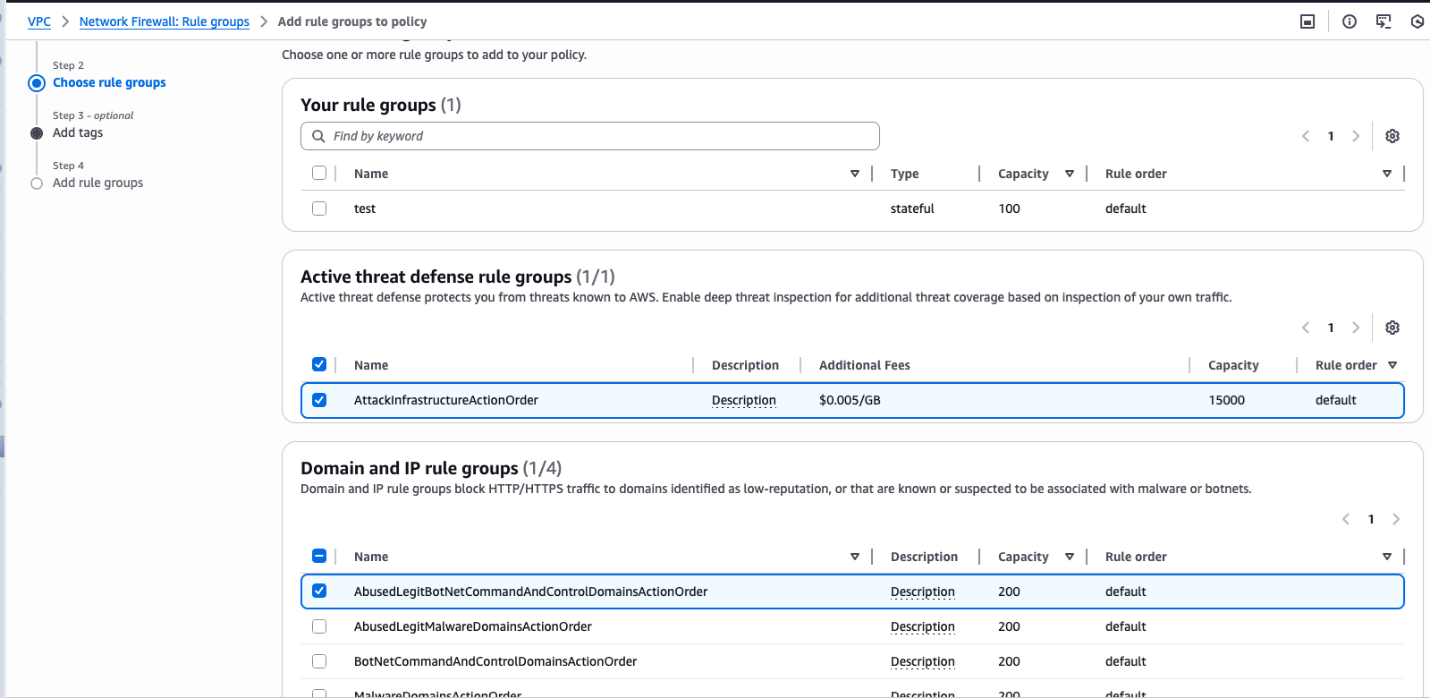
The firewall policy with partner managed rule groups is now ready to be associated to your Network Firewall as noted in Step 7 of Create a firewall.
Launch partners
We had the pleasure to work with the following partners at the launch of managed rules from AWS Marketplace for Network Firewall. Here is what some of our partners (in alphabetical order) have been saying. We continue to work with our partners to create more managed rule groups over time, which you can follow at AWS Network Firewall Partners.
Check Point Software
From pioneering stateful firewalls to our AI-powered, cloud-delivered security solutions, Check Point Software is committed to safeguarding organizations with an industry-leading 99.9% prevention rate. Check Point Managed Rules for AWS Network Firewall simplifies security by providing pre-configured rule sets designed by Check Point ThreatCloud AI experts. Delivered directly through AWS Marketplace, these rules enhance protection against hundreds of Common Vulnerabilities and Exposures (CVEs) and OWASP Top 10 vulnerabilities reducing manual effort and strengthening your cloud security posture.
Fortinet
Fortinet, a global leader in cybersecurity and trusted name in next-generation firewalls, now brings its AI-driven threat intelligence to AWS Network Firewall. The new Fortinet Managed IPS Rules deliver continuously updated, automated protection against exploits, malware, and command-and-control threats—enhancing AWS security without added complexity.
Infoblox
Infoblox unites networking, security and cloud with a protective DDI platform that delivers enterprise resilience and agility. Trusted by more than 13,000 customers, including the majority of Fortune 100 companies as well as emerging innovators, we seamlessly integrate, secure and automate critical network services so businesses can move fast without compromise.
Lumen
Lumen is thrilled to launch Defender Managed Rules for AWS Network Firewall, available now on AWS Marketplace. In partnership with AWS, this managed rule group brings proactive Black Lotus Labs-powered threat intelligence directly into AWS environments—enabling organizations to automatically block risky IPs using real-time, backbone-level data from Lumen’s global network. With seamless AWS Management Console integration and automatic updates, security and network teams can strengthen cloud defenses with expert-curated protection—no manual rule writing needed.
Rapid7
Rapid7 Managed Rules for AWS Network Firewall converts our curated, high-fidelity threat intelligence into dynamic, self-cleaning rule groups, delivering expert-vetted protection directly into your native AWS environment. Instantly deploy current protections against today’s most pressing threats, allowing your team to act with confidence and significantly reduce alert fatigue.
ThreatSTOP
ThreatSTOP delivers continuously updated threat intelligence that automatically blocks malicious domains and IPs through AWS Network Firewall. Building on its proven protection for AWS WAF, ThreatSTOP extends the same trusted enforcement to the network layer to protect both inbound and outbound traffic. The managed rules leverage thousands of curated global sources and proprietary research from the ThreatSTOP Security, Intelligence, and Research team to block command-and-control, phishing, and malware traffic in real time. Available in AWS Marketplace, ThreatSTOP helps organizations strengthen their cloud security posture, reduce unwanted connections, and maintain compliance with ITAR and OFAC requirements.
Trend Micro
Trend Micro, a leader in cloud-native application protection platforms (CNAPP), brings deep expertise in securing cloud environments to AWS customers. Backed by Trend Zero Day Initiative (ZDI), Trend Micro delivers curated, continuously updated malware rule groups, with CVE and exploit protection coming soon. Using early threat intelligence from ZDI, protections are published faster than other vendors, helping AWS customers stay ahead of attackers.
Partner statements represent their own views and claims. AWS does not independently verify partner performance metrics.
Conclusion
With managed rules from AWS Marketplace, customers can find, buy, and deploy industry-leading threat intelligence directly from the AWS Network Firewall console. By using these pre-built rules, security teams can focus on strategic initiatives while maintaining strong network protection. Evaluate available partner offerings and select rules that align with your security requirements and compliance needs.
Visit the AWS Network Firewall Documentation to learn more about implementing partner managed rules for your organization.
If you have feedback about this post, submit comments in the Comments section below. If you have questions about this post, start a new thread on AWS Network Firewall re:Post or contact AWS Support.
Public Media & Local News #lastweektonight
Post Syndicated from LastWeekTonight original https://www.youtube.com/shorts/JduzROpaMlw
Streamlined multi-tenant application development with tenant isolation mode in AWS Lambda
Post Syndicated from Donnie Prakoso original https://aws.amazon.com/blogs/aws/streamlined-multi-tenant-application-development-with-tenant-isolation-mode-in-aws-lambda/
Multi-tenant applications often require strict isolation when processing tenant-specific code or data. Examples include software-as-a-service (SaaS) platforms for workflow automation or code execution where customers need to ensure that execution environments used for individual tenants or end users remain completely separate from one another. Traditionally, developers have addressed these requirements by deploying separate Lambda functions for each tenant or implementing custom isolation logic within shared functions which increased architectural and operational complexity.
Today, AWS Lambda introduces a new tenant isolation mode that extends the existing isolation capabilities in Lambda. Lambda already provides isolation at the function level, and this new mode extends isolation to the individual tenant or end-user level within a single function. This built-in capability processes function invocations in separate execution environments for each tenant, enabling you to meet strict isolation requirements without additional implementation effort to manage tenant-specific resources within function code.
Here’s how you can enable tenant isolation mode in the AWS Lambda console:
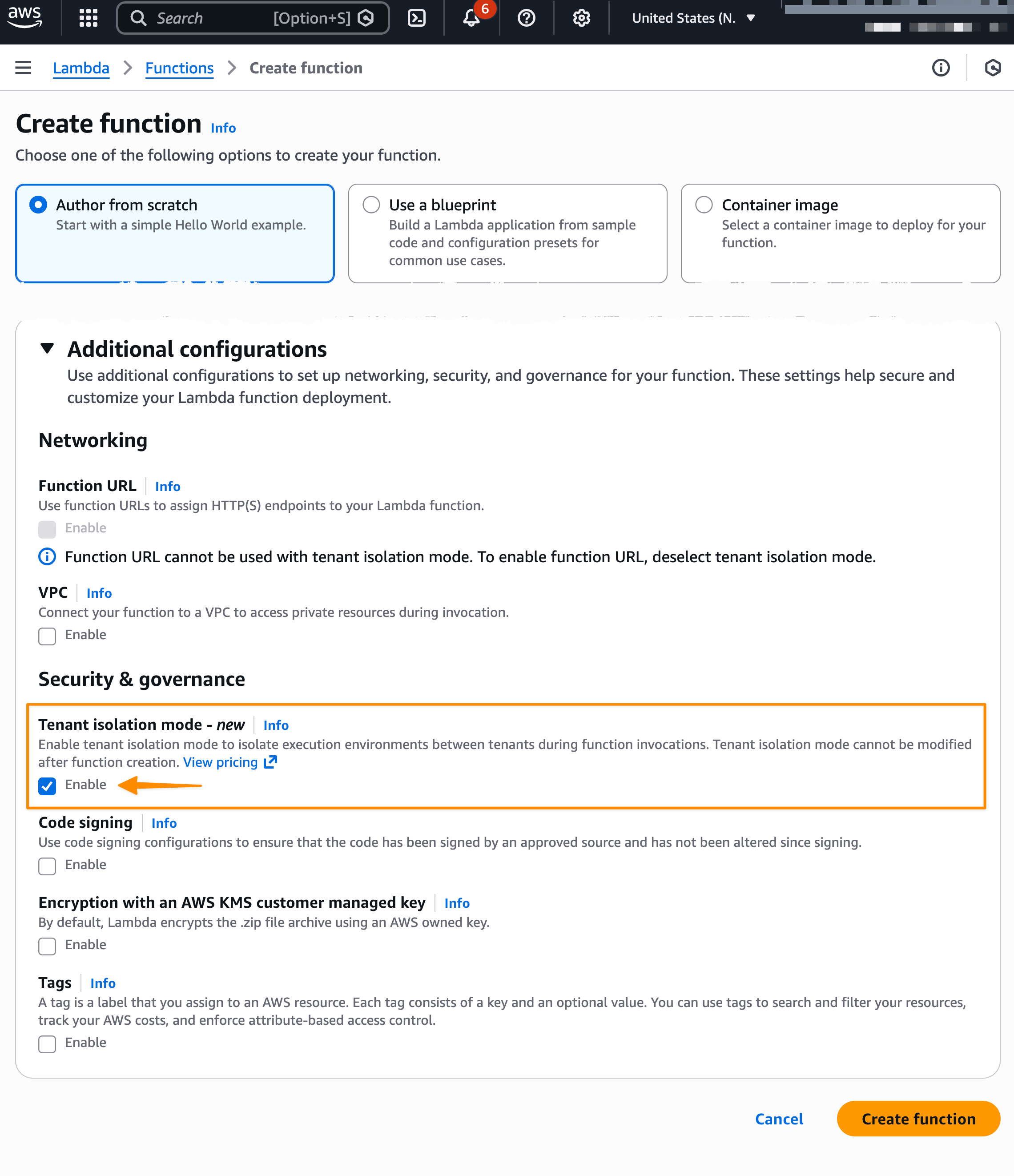
When using the new tenant isolation capability, Lambda associates function execution environments with customer-specified tenant identifiers. This means that execution environments for a particular tenant aren’t used to serve invocation requests from other tenants invoking the same Lambda function.
The feature addresses strict security requirements for SaaS providers processing sensitive data or running untrusted tenant code. You maintain the pay-per-use and performance characteristics of AWS Lambda while gaining execution environment isolation. Additionally, this approach delivers the security benefits of per-tenant infrastructure without the operational overhead of managing dedicated Lambda functions for individual tenants, which can quickly grow as customers adopt your application.
Getting started with AWS Lambda tenant isolation
Let me walk you through how to configure and use tenant isolation for a multi-tenant application.
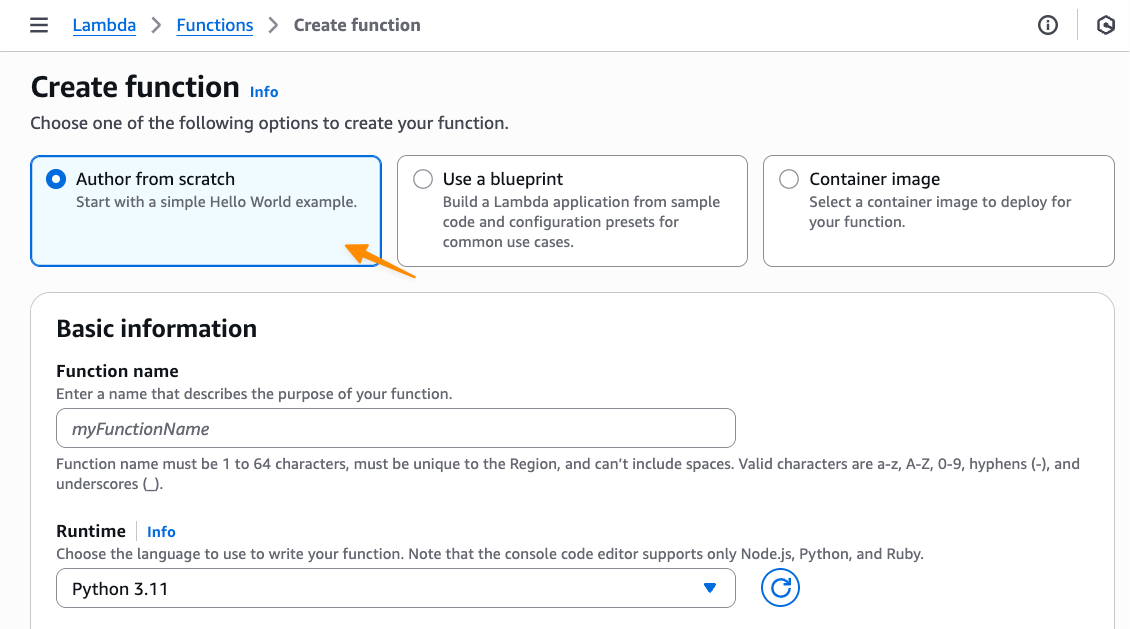
First, on the Create function page in the AWS Lambda console, I choose Author from scratch option.
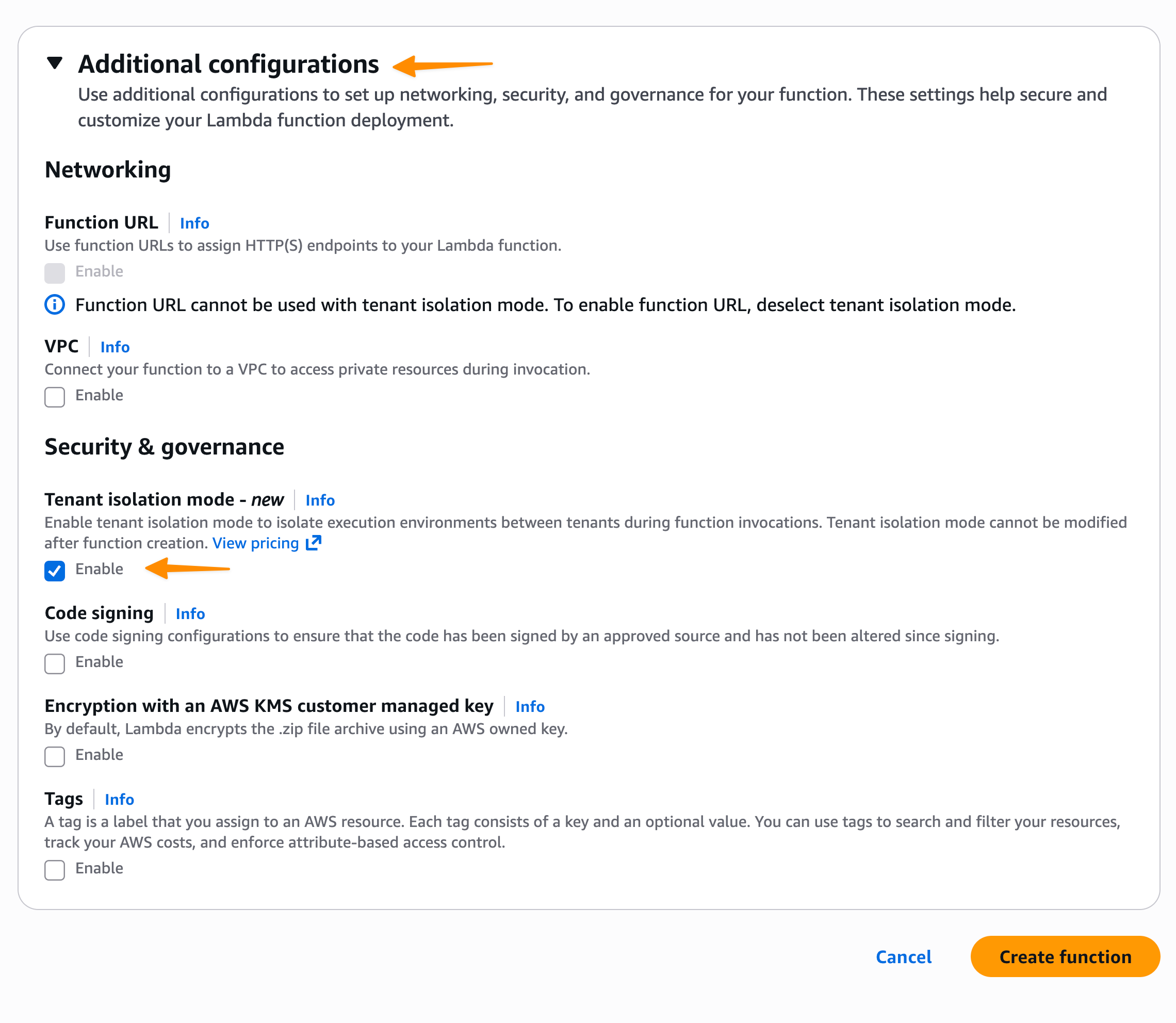
Then, under Additional configurations, I select Enable under Tenant isolation mode. Note that, tenant isolation mode can only be set during function creation and can’t be modified for existing Lambda functions.
Next, I write Python code to demonstrate this capability. I can access the tenant identifier in my function code through the context object. Here’s the full Python code:
import json
import os
from datetime import datetime

def lambda_handler(event, context):
    tenant_id = context.tenant_id
    file_path = '/tmp/tenant_data.json'

    # Read existing data or initialize
    if os.path.exists(file_path):
        with open(file_path, 'r') as f:
            data = json.load(f)
    else:
        data = {
            'tenant_id': tenant_id,
            'request_count': 0,
            'first_request': datetime.utcnow().isoformat(),
            'requests': []
        }

    # Increment counter and add request info
    data['request_count'] += 1
    data['requests'].append({
        'request_number': data['request_count'],
        'timestamp': datetime.utcnow().isoformat()
    })

    # Write updated data back to file
    with open(file_path, 'w') as f:
        json.dump(data, f, indent=2)

    # Return file contents to show isolation
    return {
        'statusCode': 200,
        'body': json.dumps({
            'message': f'File contents for {tenant_id} (isolated per tenant)',
            'file_data': data
        })
    }
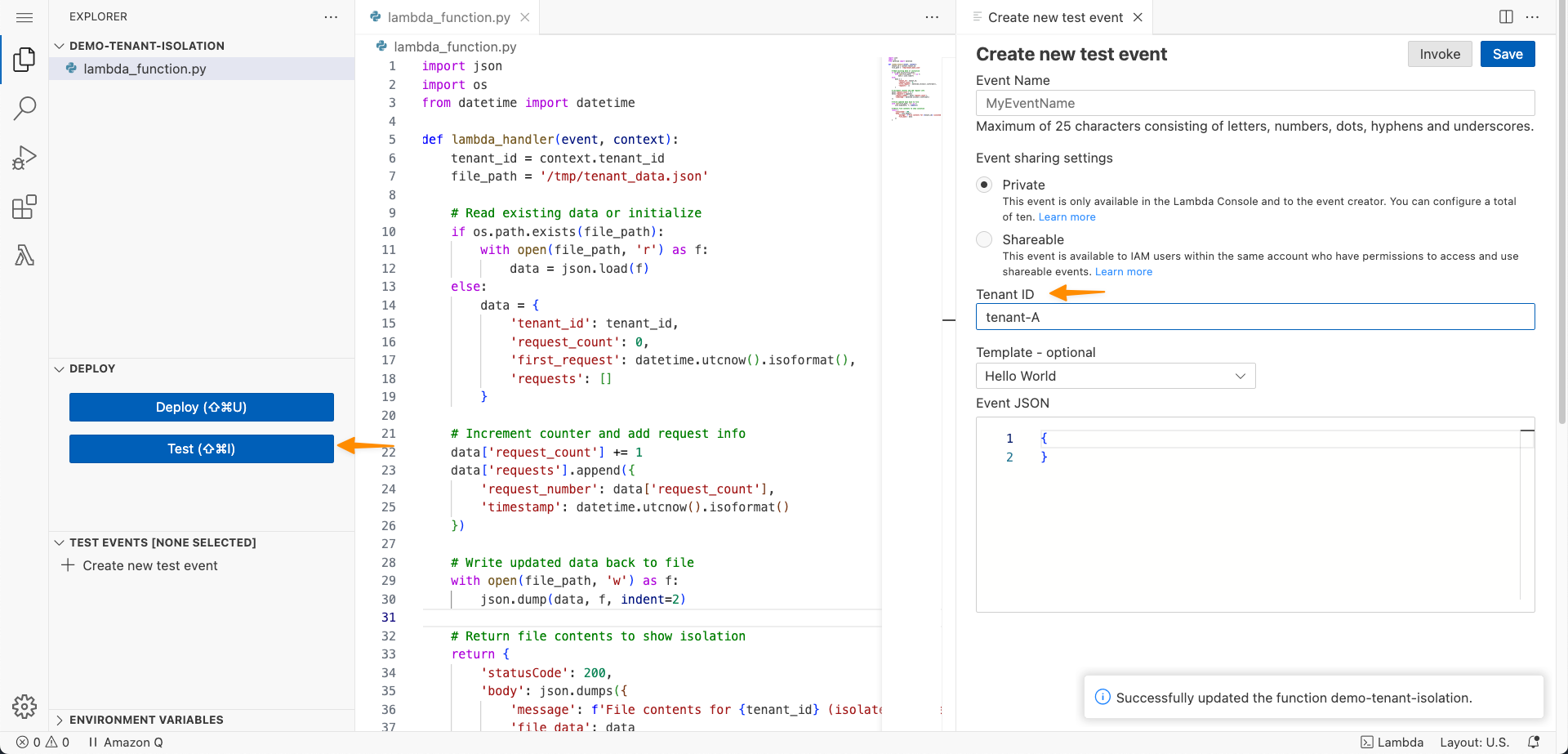
When I’m finished, I choose Deploy. Now, I need to test this capability by choosing Test. I can see on the Create new test event panel that there’s a new setting called Tenant ID.
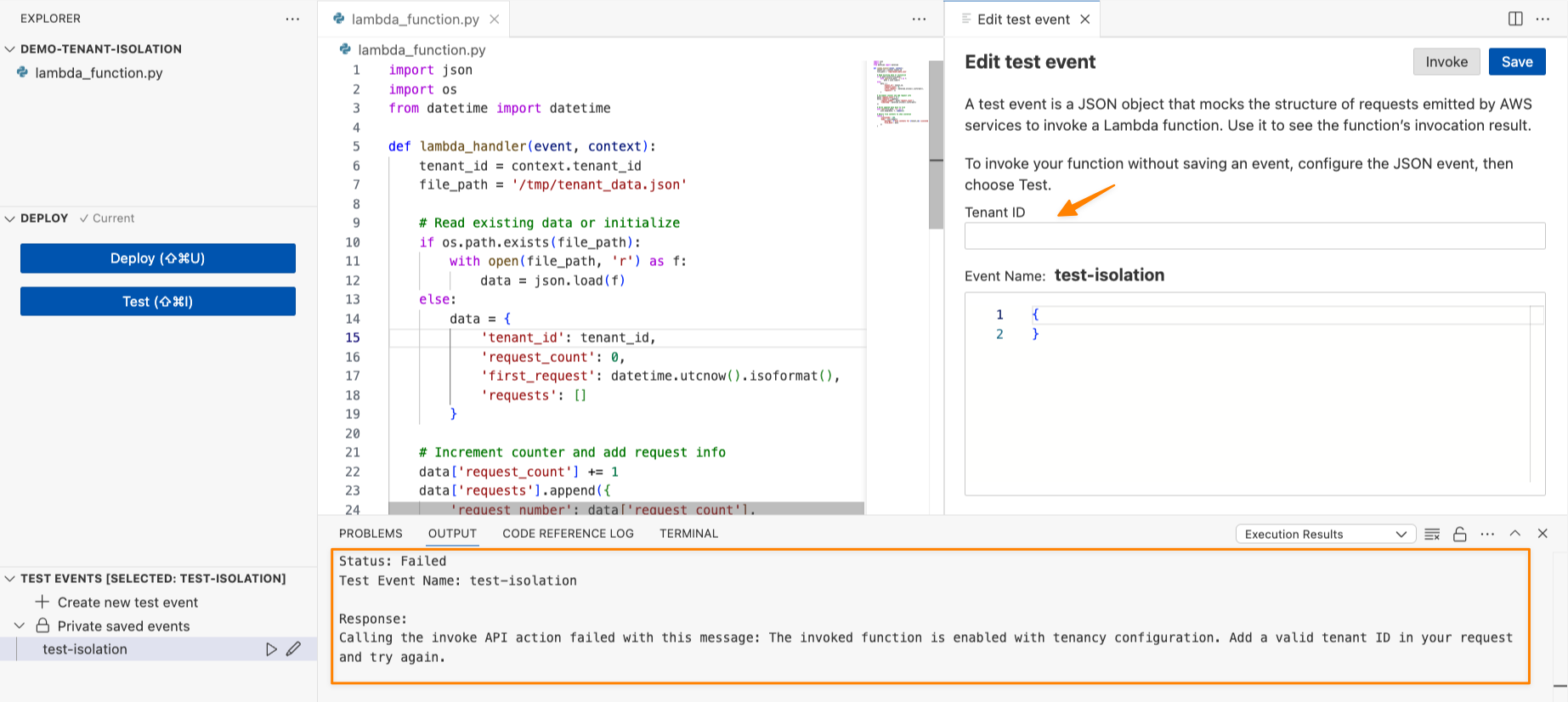
If I try to invoke this function without a tenant ID, I’ll get the following error “Add a valid tenant ID in your request and try again.”
Let me try to test this function with a tenant ID called tenant-A.
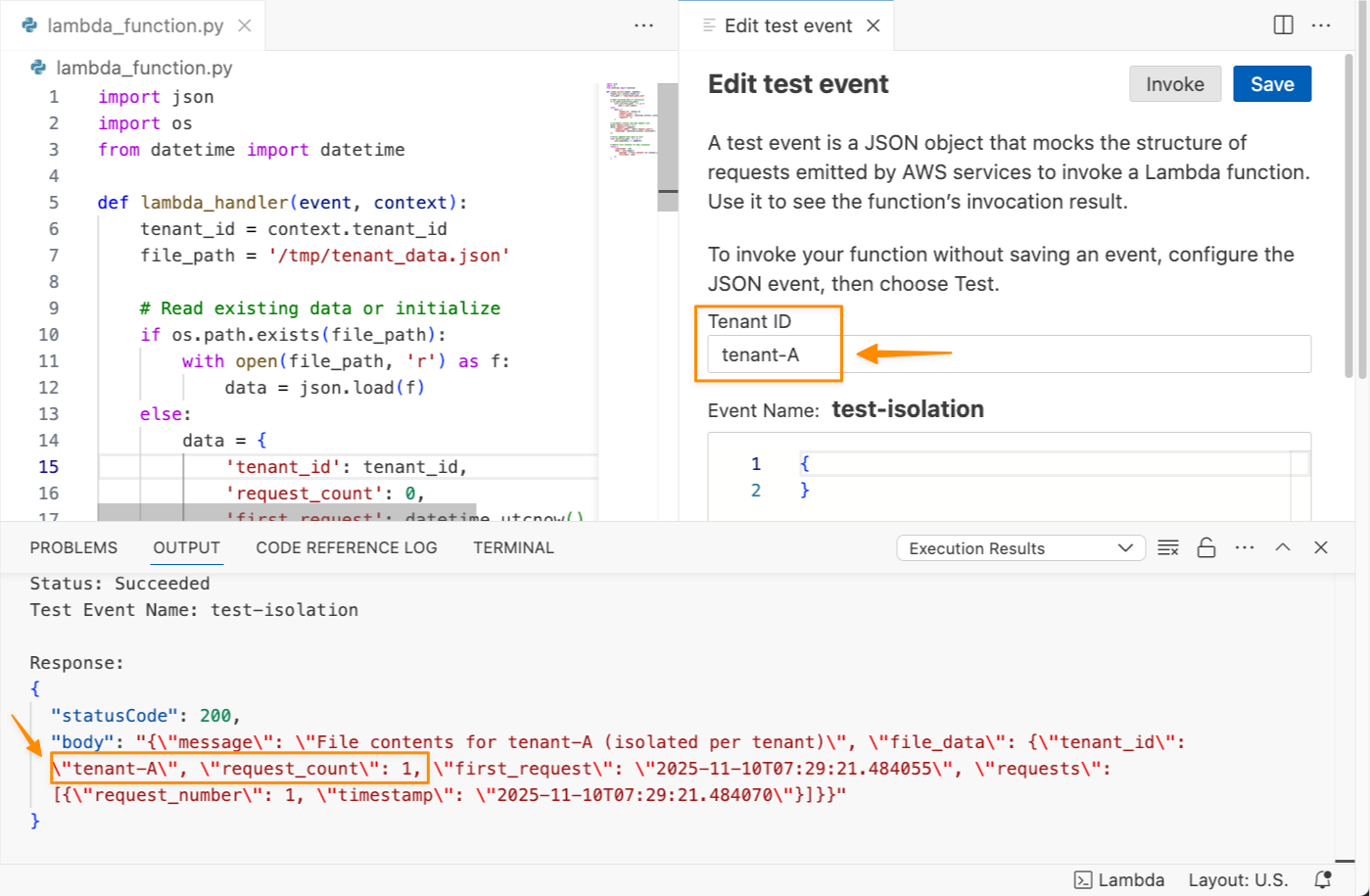
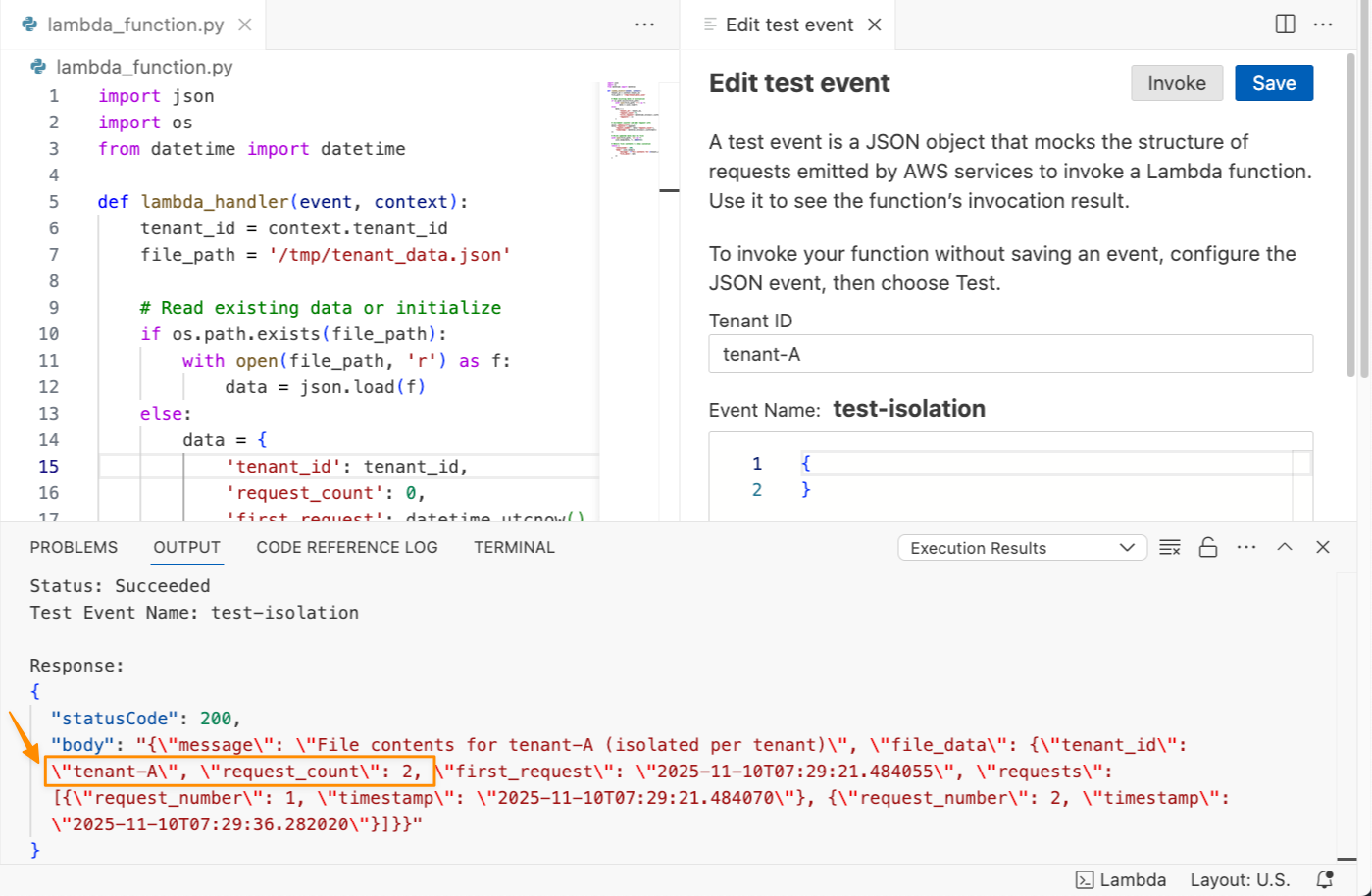
I can see the function ran successfully and returned request_count: 1. I’ll invoke this function again to get request_count: 2.
Now, let me try to test this function with a tenant ID called tenant-B.
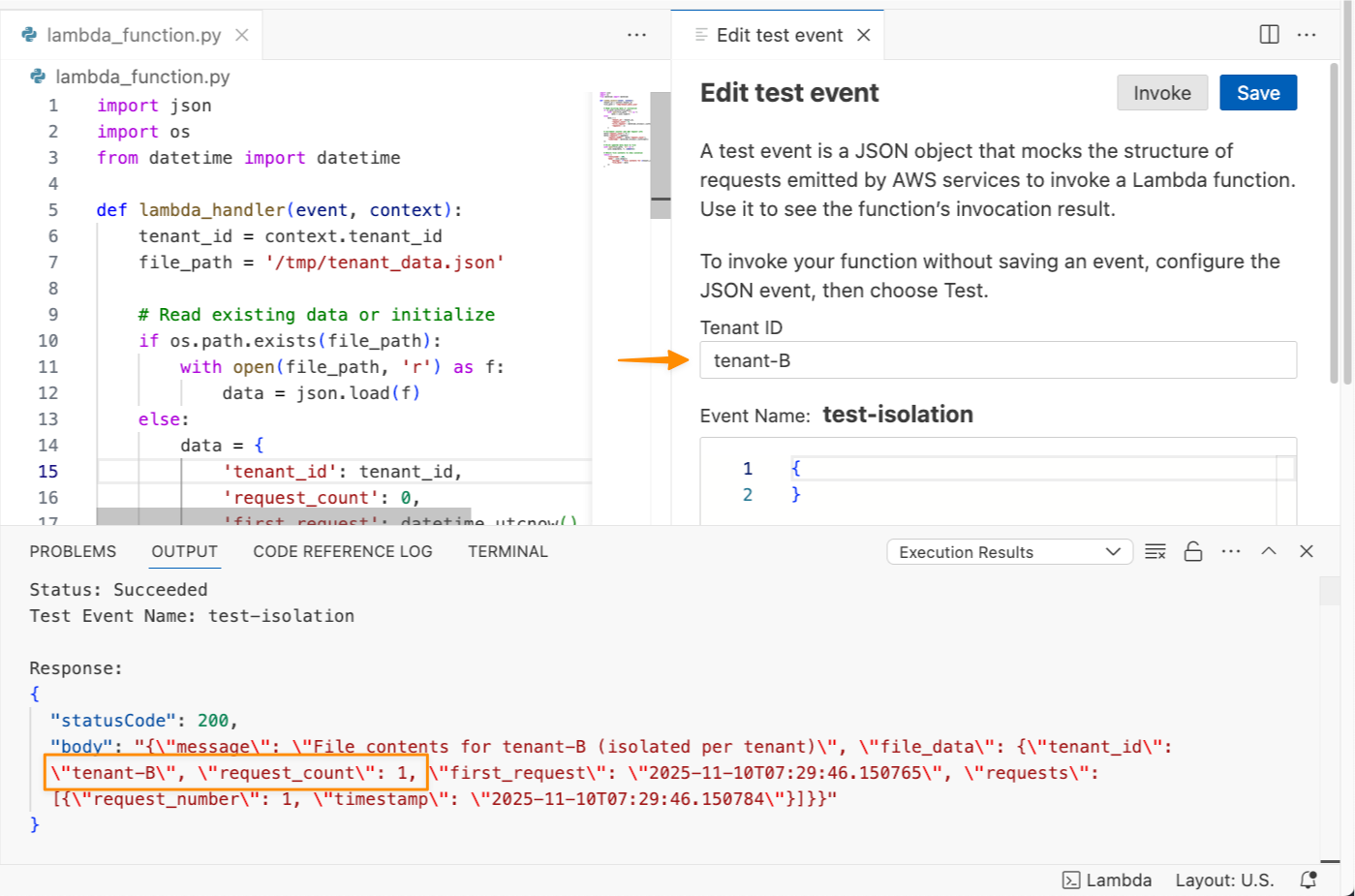
The last invocation returned request_count: 1 because I never invoked this function with tenant-B. Each tenant’s invocations will use separate execution environments, isolating the cached data, global variables, and any files stored in /tmp.
This capability transforms how I approach multi-tenant serverless architecture. Instead of wrestling with complex isolation patterns or managing hundreds of tenant-specific Lambda functions, I let AWS Lambda automatically handle the isolation. This keeps tenant data isolated across tenants, giving me confidence in the security and separation of my multi-tenant application.
Additional things to know
Here’s a list of additional things you need to know:
- Performance — Same-tenant invocations can still benefit from warm execution environment reuse for optimal performance.
- Pricing — You’re charged when Lambda creates a new tenant-aware execution environment, with the price depending on the amount of memory you allocate to your function and the CPU architecture you use. For more details, view AWS Lambda pricing.
- Availability — Available now in all commercial AWS Regions except Asia Pacific (New Zealand), AWS GovCloud (US), and China Regions.
This launch simplifies building multi-tenant applications on AWS Lambda, such as SaaS platforms for workflow automation or code execution. Learn more about how to configure tenant isolation for your next multi-tenant Lambda function in the AWS Lambda Developer Guide.
Happy building!
— Donnie
New business metadata features in Amazon SageMaker Catalog to improve discoverability across organizations
Post Syndicated from Channy Yun (윤석찬) original https://aws.amazon.com/blogs/aws/new-business-metadata-features-in-amazon-sagemaker-catalog-to-improve-discoverability-across-organizations/
Amazon SageMaker Catalog, which is now built in to Amazon SageMaker, can help you collect and organize your data with the accompanying business context people need to understand it. It automatically documents assets generated by AWS Glue and Amazon Redshift, and it connects directly with Amazon Quick Sight, Amazon Simple Storage Service (Amazon S3) buckets, Amazon S3 Tables, and AWS Glue Data Catalog (GDC).
With only a few clicks, you can curate data inventory assets with the required business metadata by adding or updating business names (asset and schema), descriptions (asset and schema), read me, glossary terms (asset and schema), and metadata forms. You can also create AI-generated suggestions, review and refine descriptions, and publish enriched asset metadata directly to the catalog. This helps reduce manual documentation effort, improves metadata consistency, and accelerates asset discoverability across organizations.
Starting today, you can use new capabilities in Amazon SageMaker Catalog metadata to improve business metadata and search:
- Column-level metadata forms and rich descriptions – You can create custom metadata forms to capture business-specific information directly in individual columns. Columns also support markdown-enabled rich text descriptions for comprehensive data documentation and business context.
- Enforce metadata rules for glossary terms for asset publishing – You can use metadata enforcement rules for glossary terms, meaning data producers must use approved business vocabulary when publishing assets. By standardizing metadata practices, your organization can improve compliance, enhance audit readiness, and streamline access workflows for greater efficiency and control.
These new SageMaker Catalog metadata capabilities help address consistent data classification and improve discoverability across your organizational catalogs. Let’s take a closer look at each capability.
Column-level metadata forms and rich descriptions
You can now use custom metadata forms and rich text descriptions at the column level, extending existing curation capabilities for business names, descriptions, and glossary term classifications. Custom metadata form field values and rich text content are indexed in real time and become immediately discoverable through search.
To edit column-level metadata, select the schema of your catalog asset used in your project and choose the View/Edit action for each column.
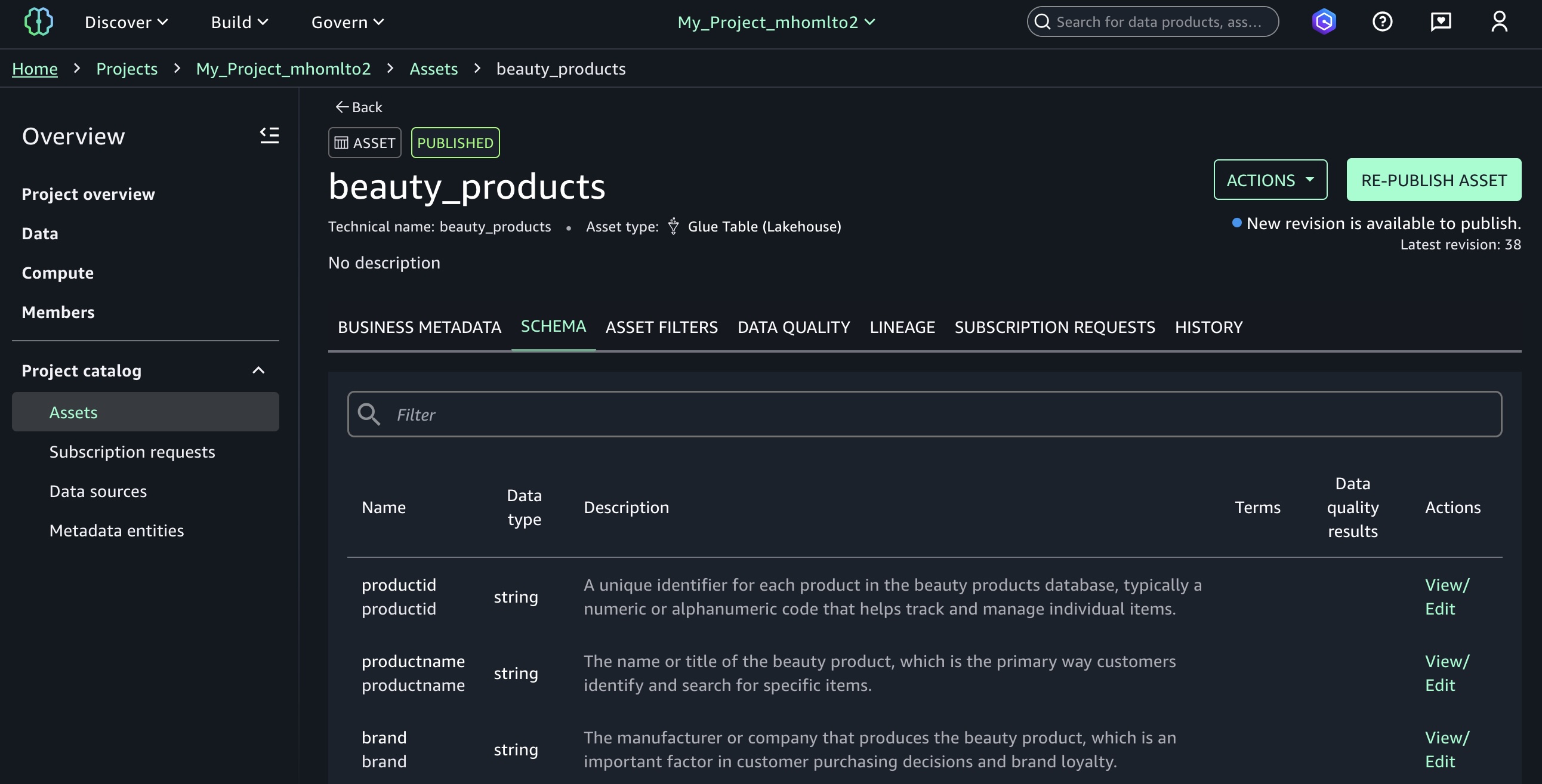
When you choose one of the columns as an asset owner, you can define custom key-value metadata forms and markdown descriptions to provide detailed column documentation.
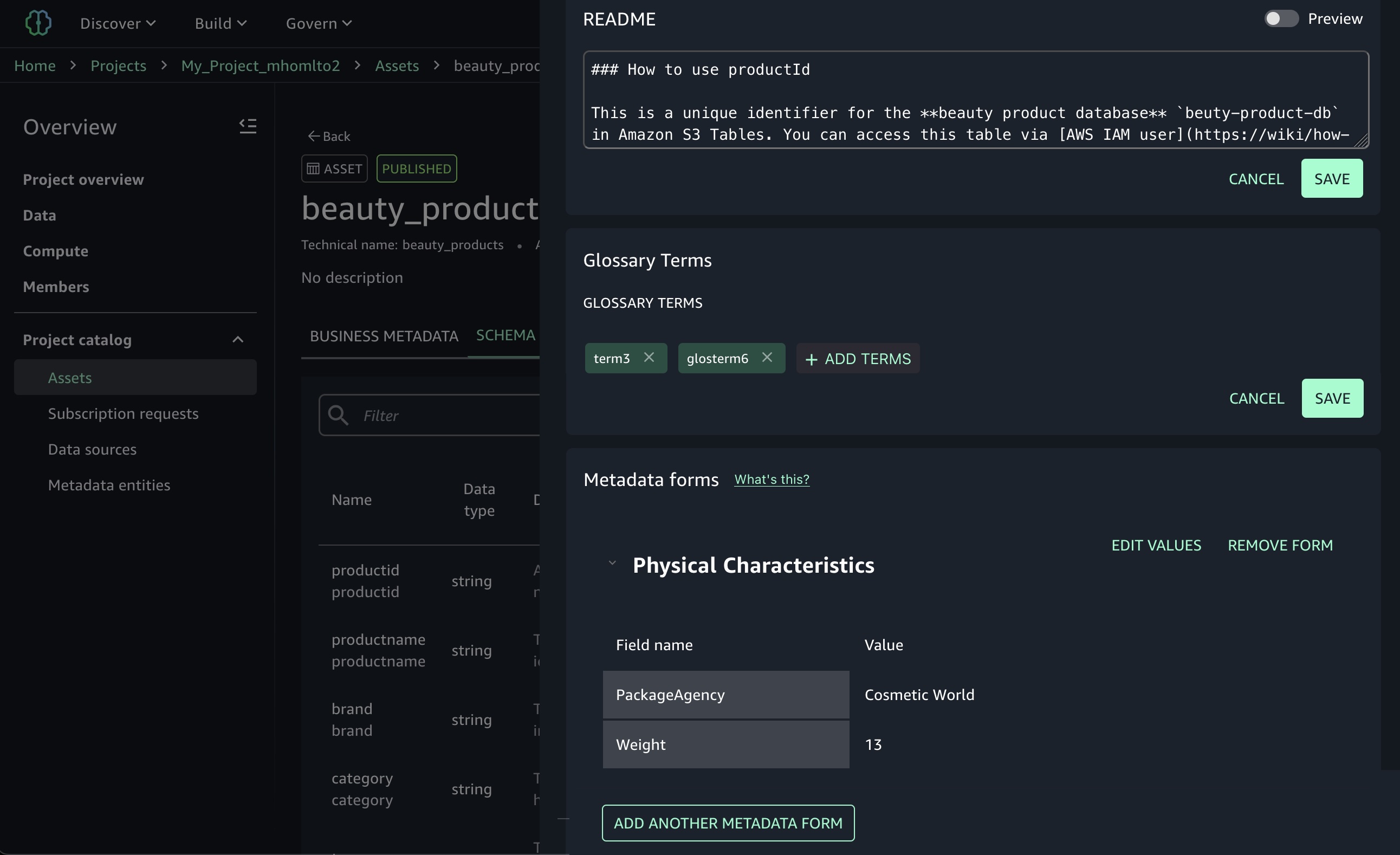
Now data analysts in your organization can search using custom form field values and rich text content, alongside existing column names, descriptions, and glossary terms.
Enforce metadata rules for glossary terms for asset publishing
You can define mandatory glossary term requirements for data assets during the publishing workflow. Your data producers must now classify their assets with approved business terms from organizational glossaries before publication, promoting consistent metadata standards and improving data discoverability. The enforcement rules validate that required glossary terms are applied, preventing assets from being published without proper business context.
To enable a new metadata rule for glossary terms, choose Add in your domain units under the Domain Management section in the Govern menu.
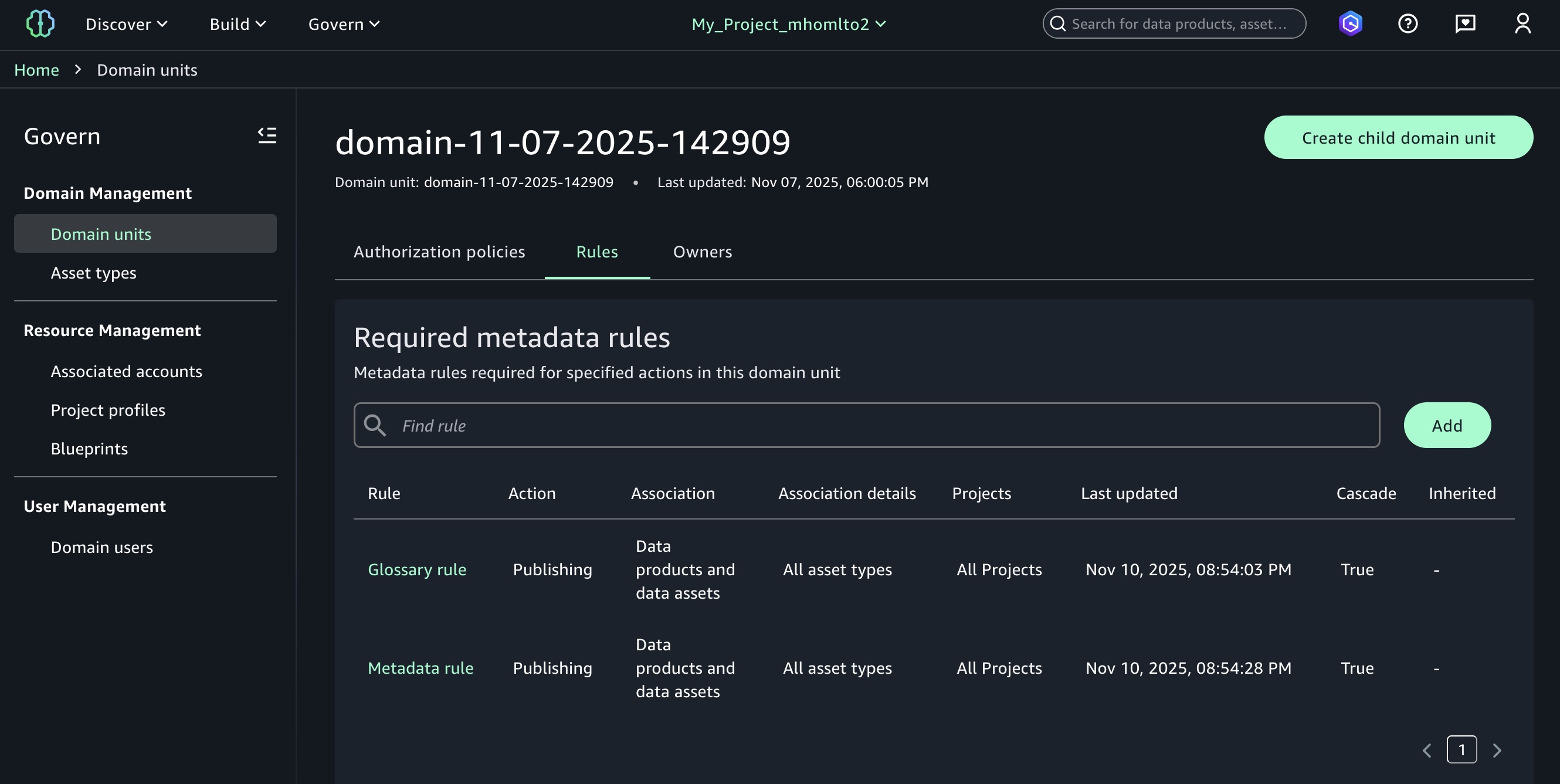
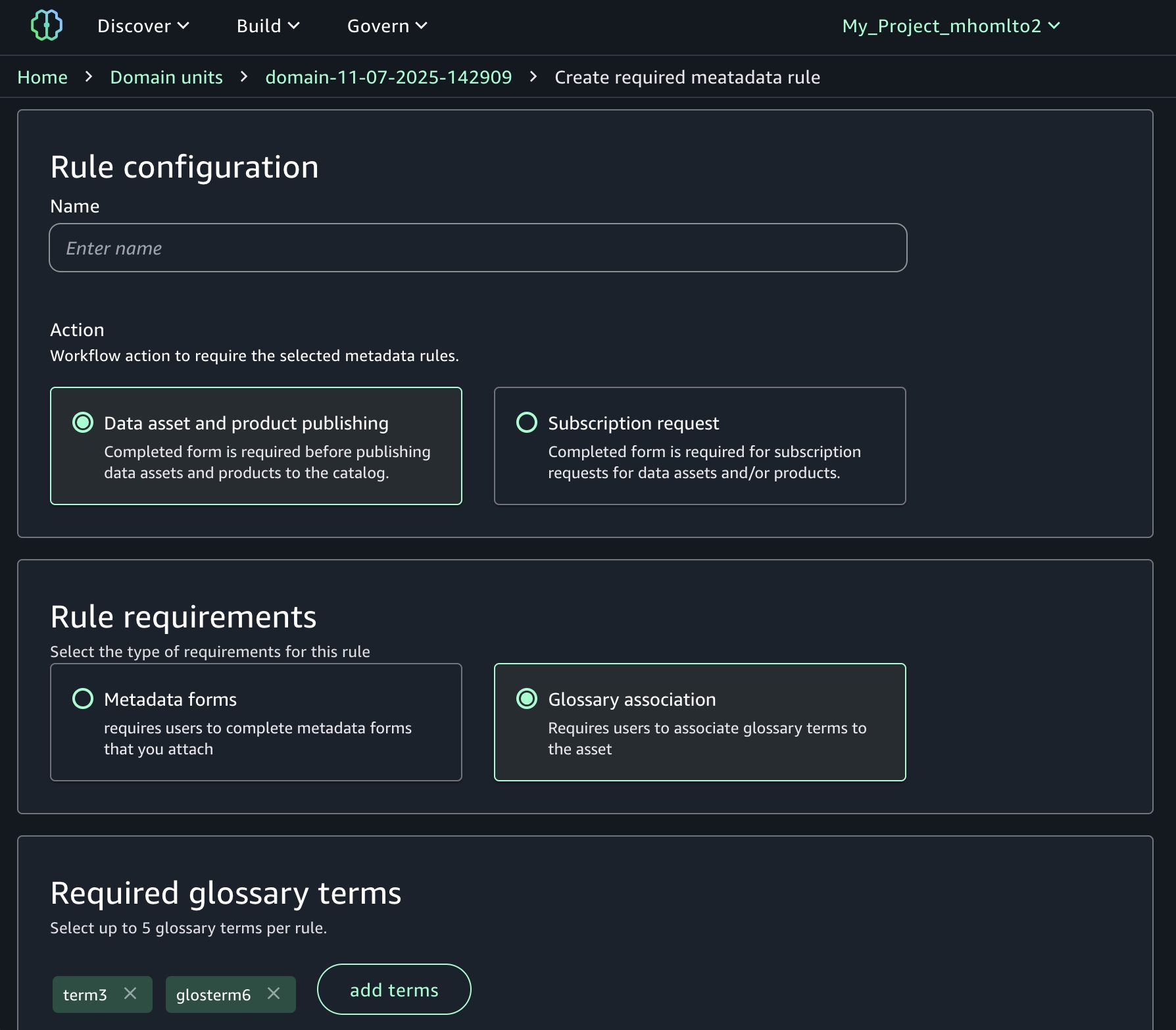
Now you can select either Metadata forms or Glossary association as a type of requirement for the rule. When you select Glossary association, you can choose up to 5 required glossary terms per rule.
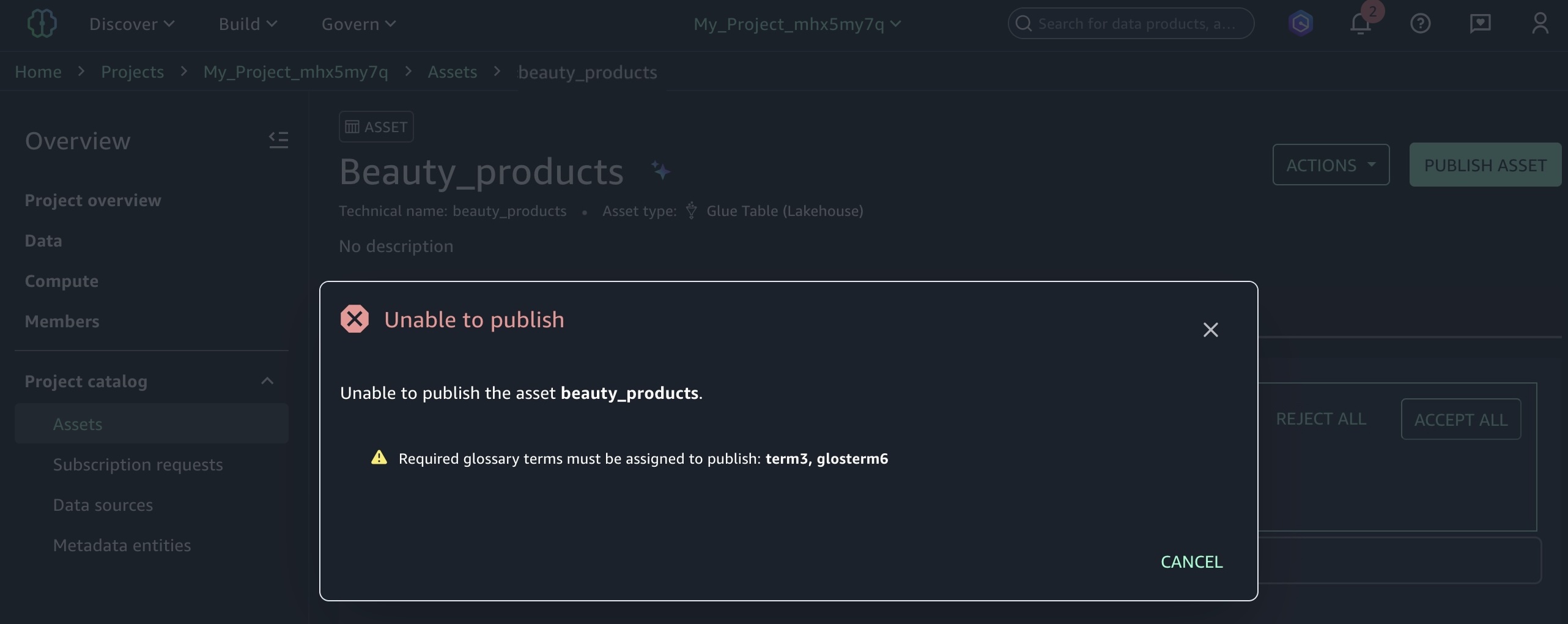
If you attempt to publish assets without adding the required glossary terms, the error message prompting you to enforce the glossary rule appears.
Standardizing metadata and aligning data schemas with business language enhances data governance and improves search relevance, helping your organization better understand and trust published data.
You can use AWS Command Line Interface (AWS CLI) and AWS SDKs to use these features. To learn more, visit the Amazon SageMaker Unified Studio data catalog in the Amazon SageMaker Unified Studio User Guide.
Now available
The new metadata capabilities are now available in AWS Regions where Amazon SageMaker Catalog is available.
Give it a try and send feedback to AWS re:Post for Amazon SageMaker Catalog or through your usual AWS Support contacts.
— Channy
AWS Control Tower introduces a Controls Dedicated experience
Post Syndicated from Veliswa Boya original https://aws.amazon.com/blogs/aws/aws-control-tower-introduces-a-controls-dedicated-experience/
Today, we’re announcing a Controls Dedicated experience in AWS Control Tower. With this feature, you can use Amazon Web Services (AWS) managed controls without the need to set up resources you don’t need, which means you get started faster if you already have an established multi-account environment and want to use AWS Control Tower only for its managed controls. The Controls Dedicated experience gives you seamless access to the comprehensive collection of managed controls in the Control Catalog to incrementally enhance your governance stance.
Until now, customers were required to adopt and configure many recommended best practices which meant implementing a full AWS landing zone at the time of setting up a multi-account environment. This setup included defining the prescribed organizational structure, required services, and more, in AWS Control Tower to start using landing zone. This approach is helpful to ensure a well-architected multi-account environment, however, for customers who already have an established, well-architected multi-account environment and only want to use AWS managed controls, it was more challenging for them to adopt AWS Control Tower. The new Controls Dedicated experience provides a faster and more flexible way of using AWS Control Tower.
How it works
Here’s how I define managed controls using the Controls Dedicated experience in AWS Control Tower in one of my accounts.
I start by choosing Enable AWS Control Tower on the AWS Control Tower landing page.

I have the option to set up a full environment, or only set up controls using the Controls Dedicated experience. I opt to set up controls by choosing I have an existing environment and want to enable AWS Managed Controls. Next, I set up the rest of the information, such as choosing the Home Region from the dropdown list so that AWS Control Tower resources are provisioned in this Region during enablement. I also select Turn on automatic account enrollment for AWS Control Tower to enroll accounts automatically when I move them into a registered organization unit. The rest of the information is optional; I choose Enable AWS Control Tower to finalize the process, and the landing zone setup begins.
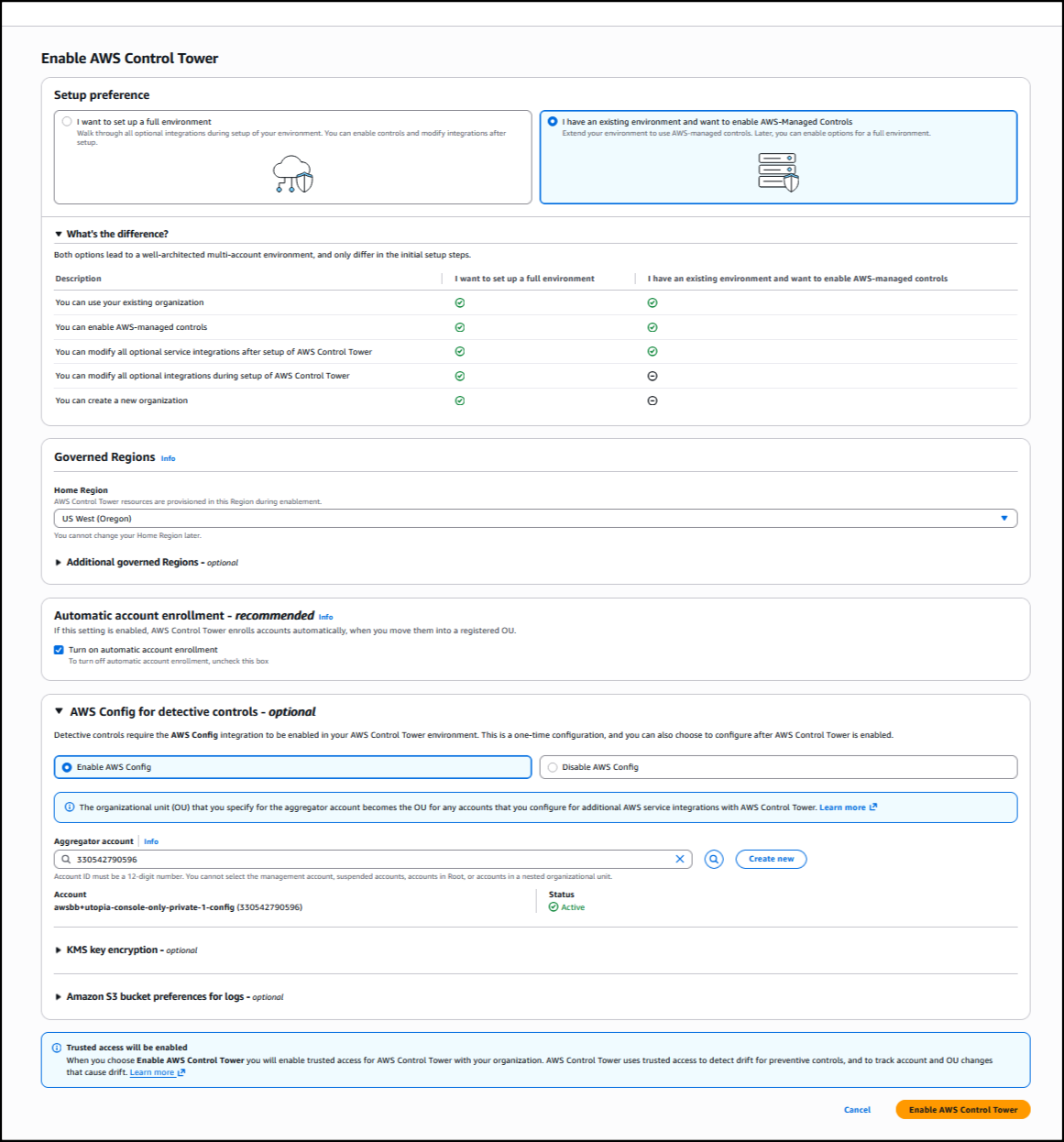
Behind the scenes, AWS Control Tower installed the required service-linked AWS Identity and Access Management (IAM) roles, and to use detective controls, service-linked Config Recorder in AWS Config in the account where I’m deploying the AWS managed controls. The setup is completed, and now I have all the infrastructure required to use the controls in this account. The dashboard gives a summary of the environment such as the organizational units that were created, the shared accounts, the selected IAM configuration, the preventive controls to enforce policies, and detective controls to detect configuration violations.
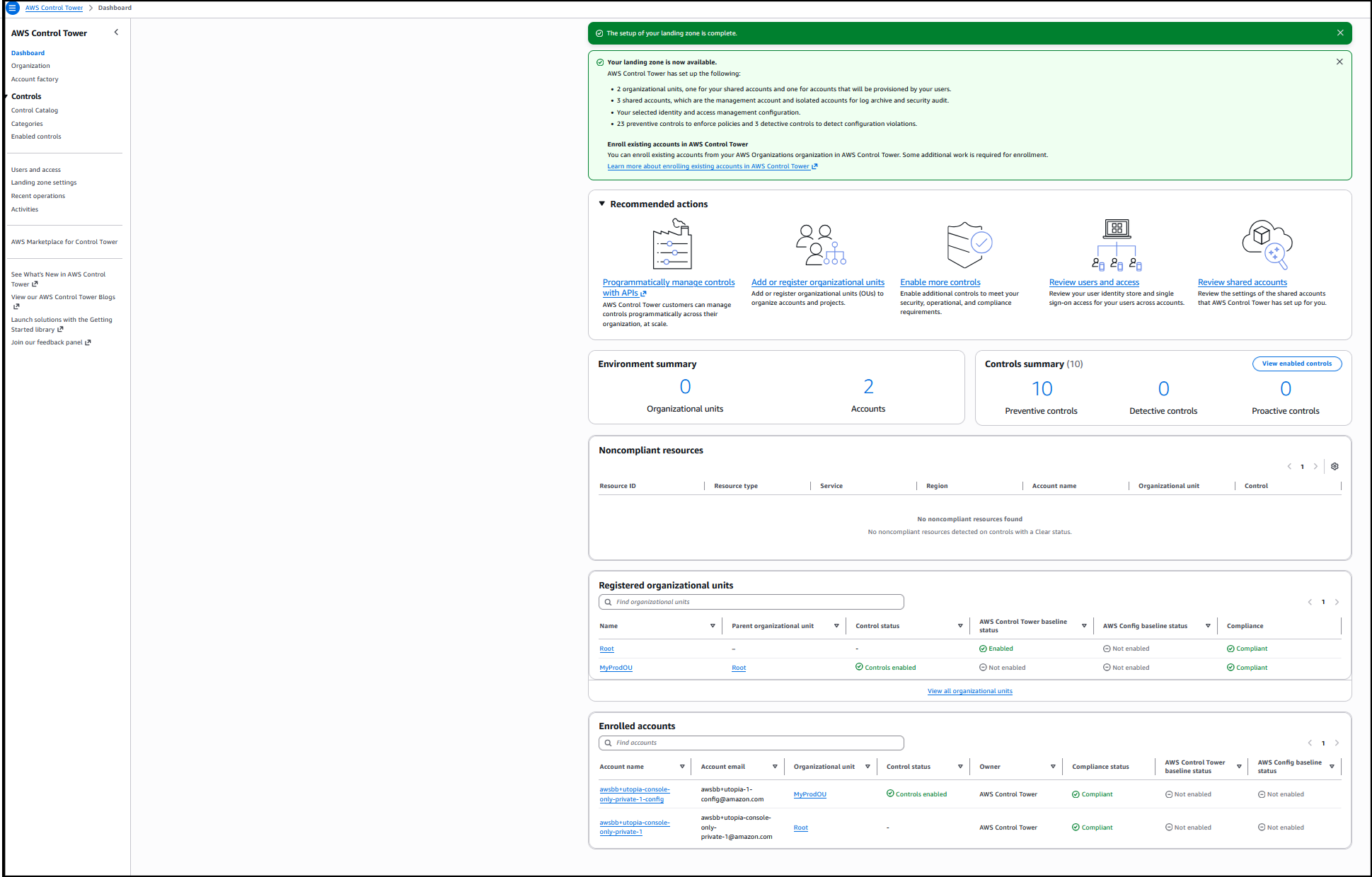
I choose View enabled controls for a list of all controls that were installed during this process.
Good to know
Usually, an existing AWS Organizations account is required before you can use AWS Control Tower. If you’re using the console to create controls and don’t already have an Organizations account, one will be set up on your behalf.
Earlier, I mentioned a service-linked Config Recorder. With a service-linked Config Recorder, AWS Control Tower prevents the resource types needed for deployed managed controls from being altered. You have flexibility and the ability to keep your own Config Recorders, and only the configuration items for the resource types that are required by your managed detective controls will be enabled, which optimizes your AWS Config costs.
Now available
Controls Dedicated experience in AWS Control Tower is available today in all AWS Regions where AWS Control Tower is available.
To learn more, visit our AWS Control Tower page. For more information related to pricing, refer to AWS Control Tower pricing. Send feedback to AWS re:Post for AWS Control Tower or through your usual AWS Support contacts.
– Veliswa.
New AWS Billing Transfer for centrally managing AWS billing and costs across multiple organizations
Post Syndicated from Channy Yun (윤석찬) original https://aws.amazon.com/blogs/aws/new-aws-billing-transfer-for-centrally-managing-aws-billing-and-costs-across-multiple-organizations/
Today, we’re announcing the general availability of Billing Transfer, a new capability to centrally manage and pay bills across multiple organizations by transferring payment responsibility to other billing administrators, such as company affiliates and Amazon Web Services (AWS) Partners. This feature provides customers operating across multiple organizations with comprehensive visibility of cloud costs across their multi-organization environment, but organization administrators maintain security management autonomy over their accounts.
Customers use AWS Organizations to centrally administer and manage billing for their multi-account environment. However, when they operate in a multi-organization environment, billing administrators must access the management account of each organization separately to collect invoices and pay bills. This decentralized approach to billing management creates unnecessary complexity for enterprises managing costs and paying bills across multiple AWS organizations. This feature also will be useful for AWS Partners to resell AWS products and solutions, and assume the responsibility of paying AWS for the consumption of their multiple customers.
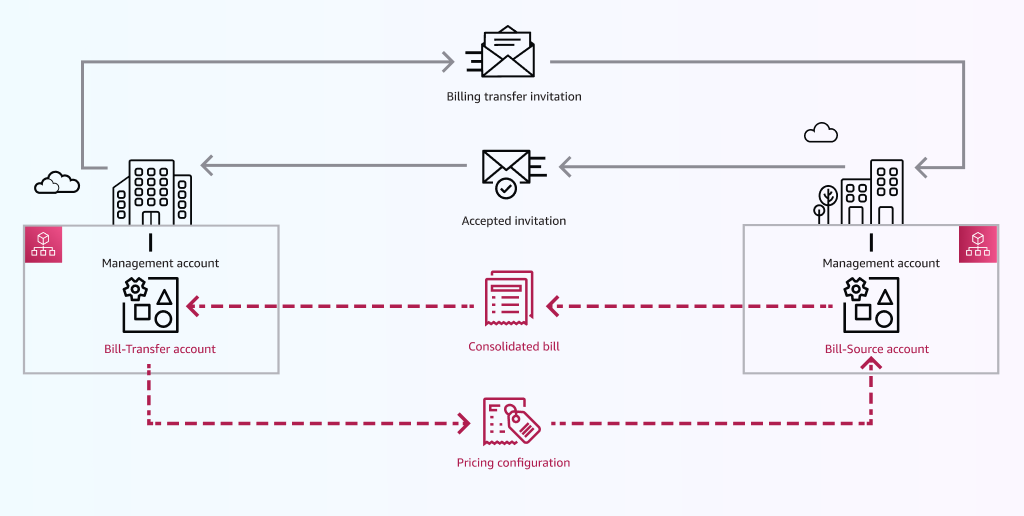
With Billing Transfer, customers operating in multi-organization environments can now use a single management account to manage aspects of billing— such as invoice collection, payment processing, and detailed cost analysis. This makes billing operations more efficient and scalable while individual management accounts can maintain complete security and governance autonomy over their accounts. Billing Transfer also helps protect proprietary pricing data by integrating with AWS Billing Conductor, so billing administrators can control cost visibility.
Getting started with Billing Transfer
To set up Billing Transfer, an external management account sends a billing transfer invitation to a management account called a bill-source account. If accepted, the external account becomes the bill-transfer account, managing and paying for the bill-source account’s consolidated bill, starting on the date specified on the invitation.
To get started, go to the Billing and Cost Management console, choose Preferences and Settings in the left navigation pane and choose Billing transfer. Choose Send invitation from a management account you’ll use to centrally manage billing across your multi-organization environment.
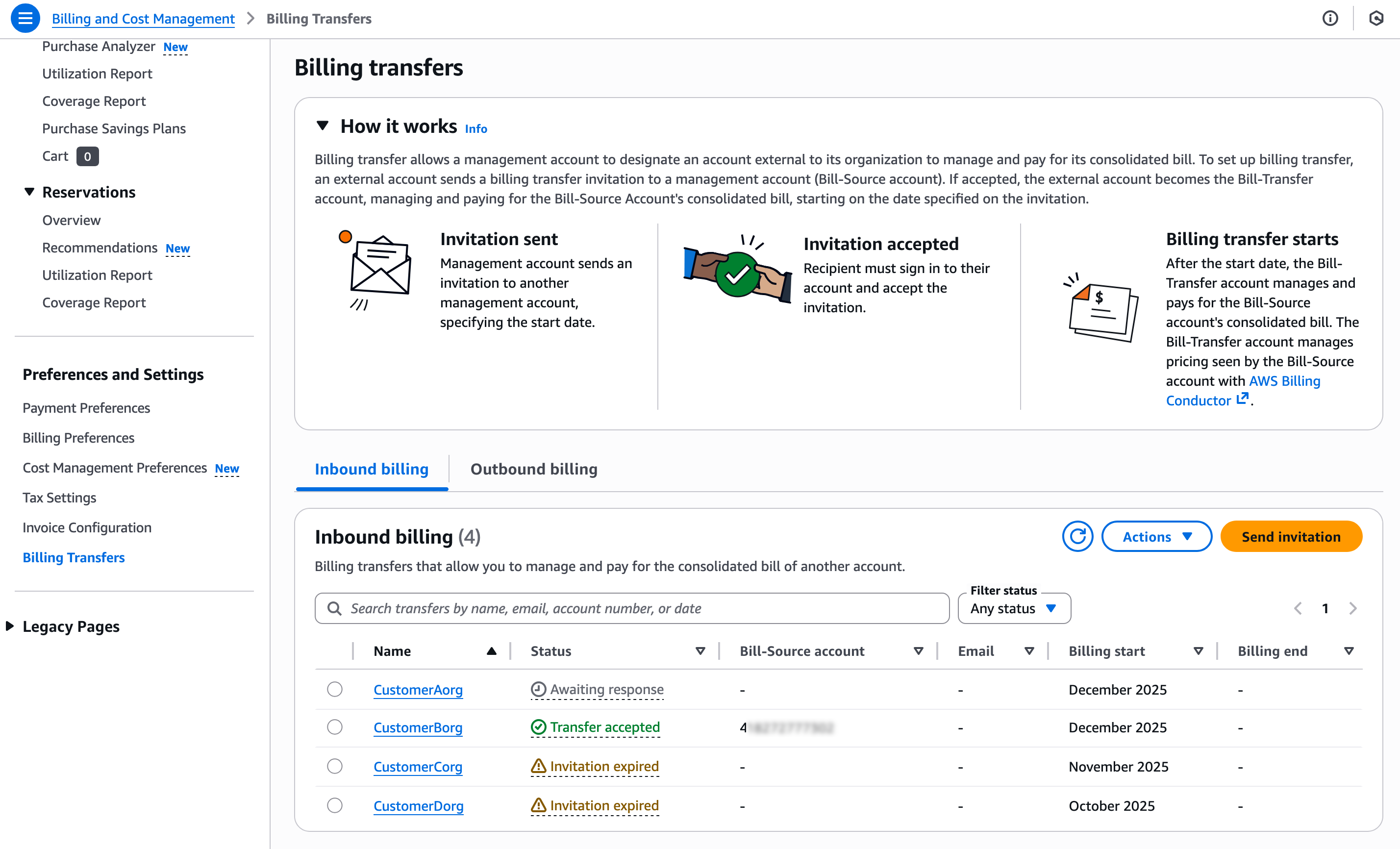
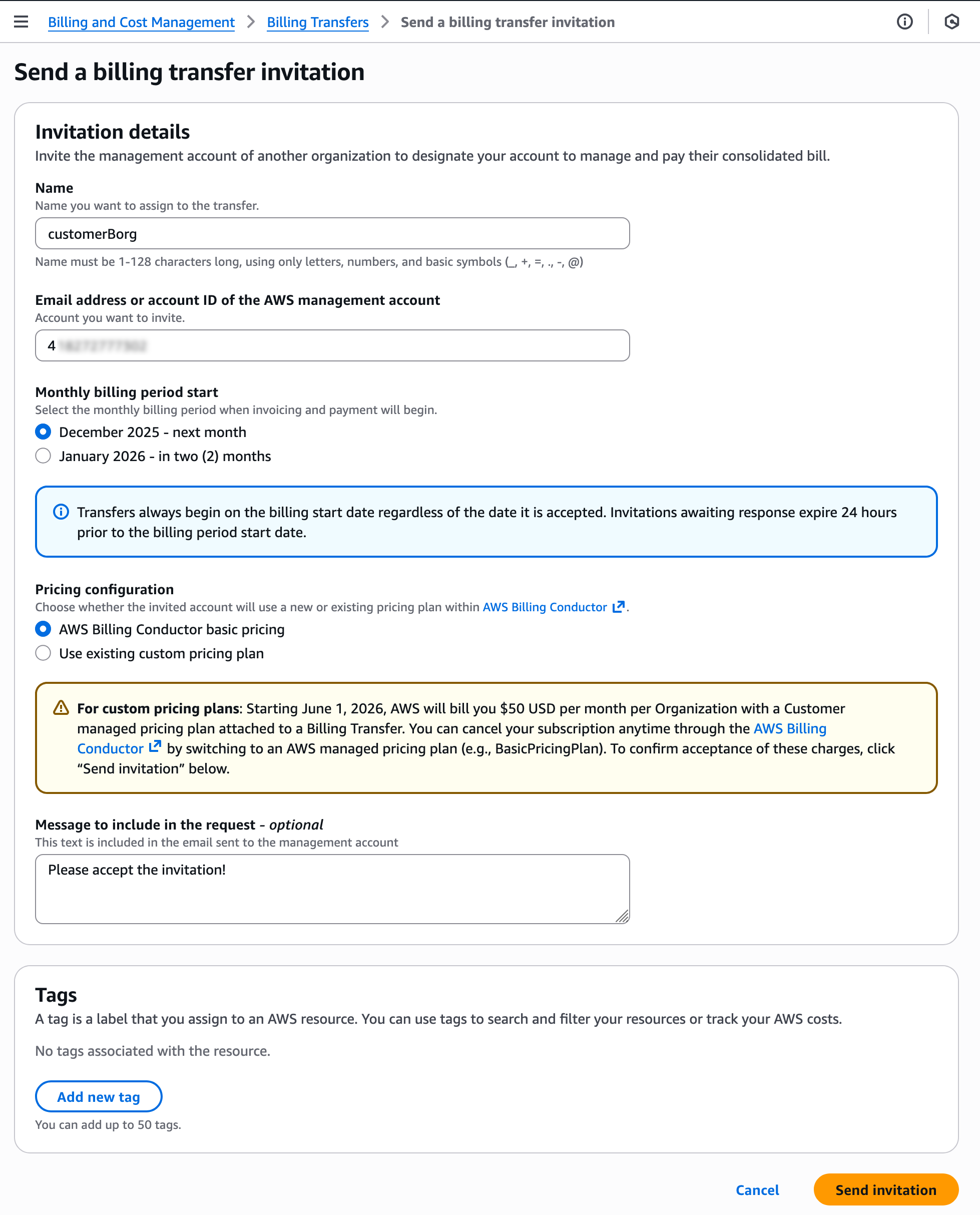
Now, you can send a billing transfer invitation by entering the email address or account ID of the bill-source accounts for which you want to manage billing. You should choose the monthly billing period for when invoicing and payment will begin and a pricing plan from AWS Billing Conductor to control the cost data visible to the bill-source accounts.
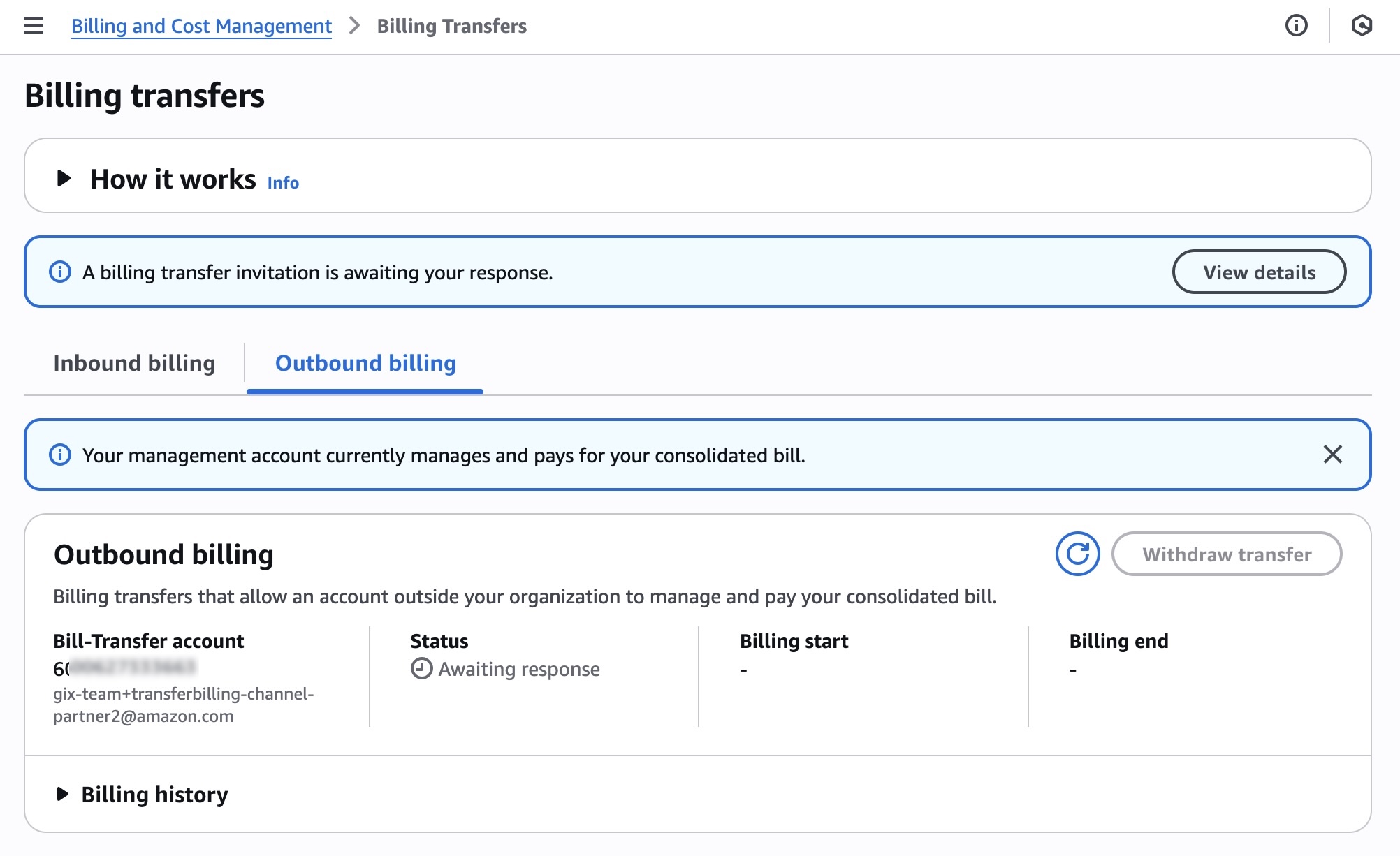
When you choose Send invitation, the bill-source accounts will get a billing transfer notice in the Outbound billing tab.
Choose View details, review the invitation page, and choose Accept.
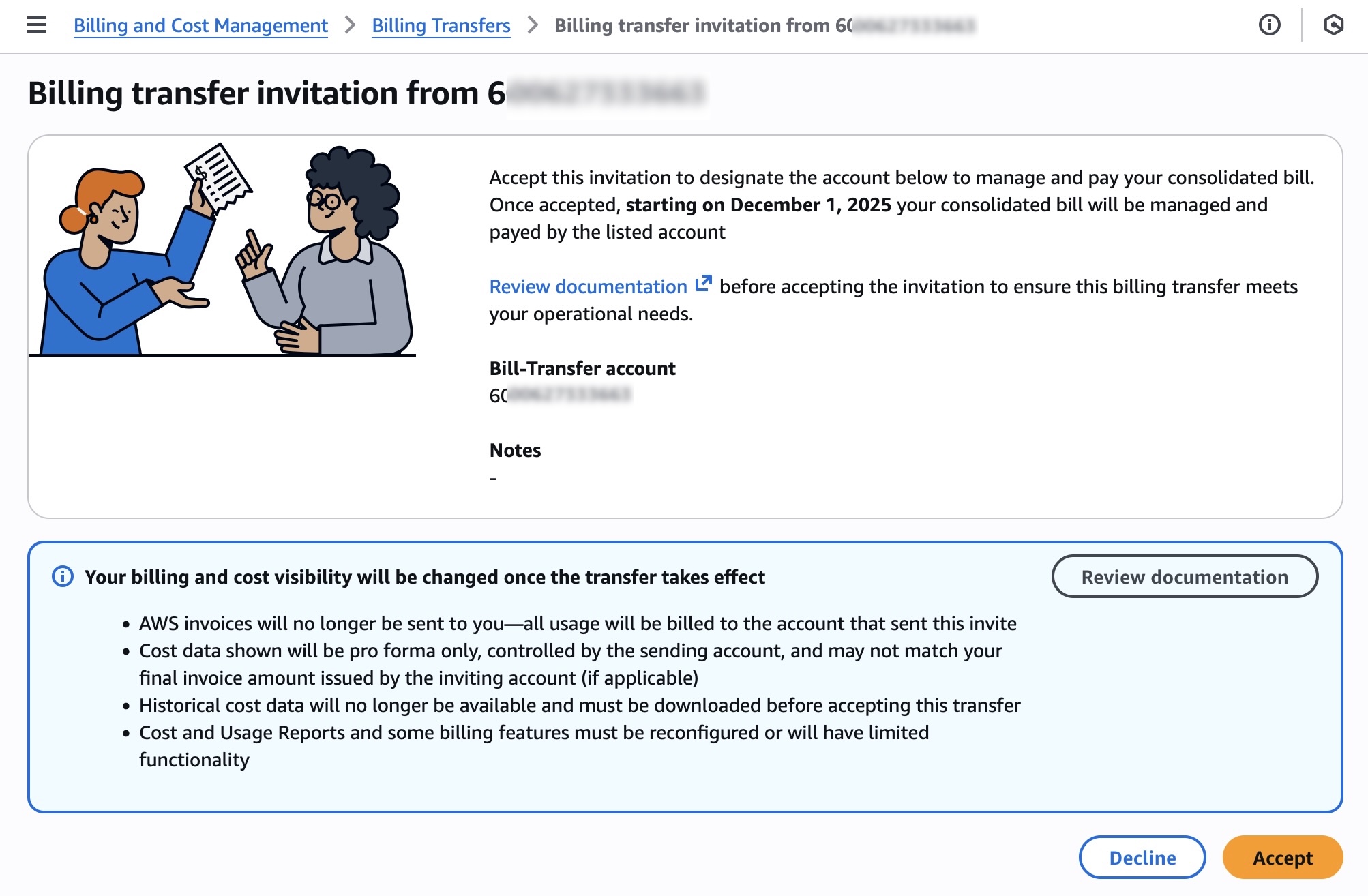
After the transfer is accepted, all usage from the bill-source accounts will be billed to the bill-transfer account using its billing and tax settings, and invoices will no longer be sent to the bill-source accounts. Any party (bill-source accounts and bill-transfer account) can withdraw the transfer at any time.
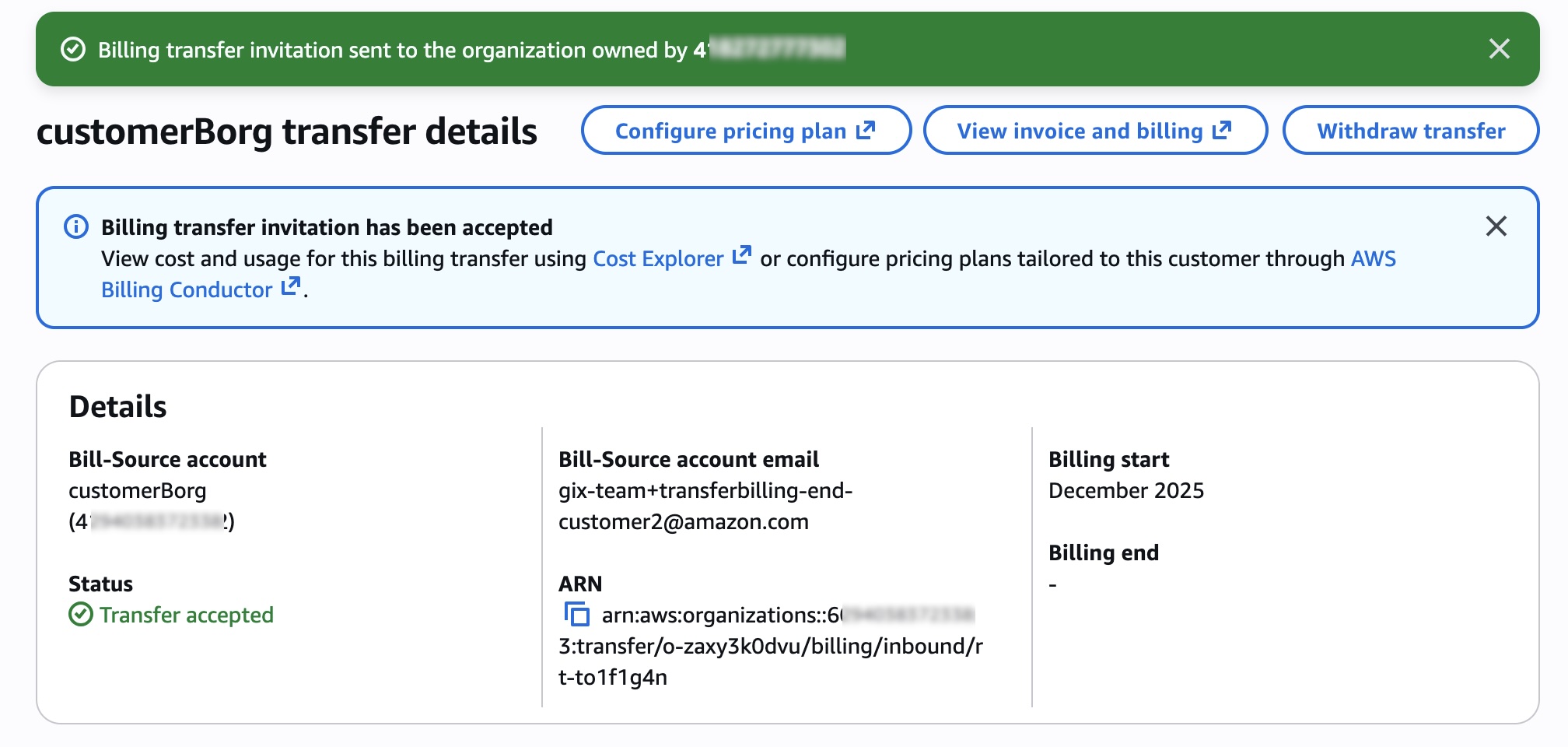
After your billing transfer begins, the bill-transfer account will receive a bill at the end of the month for each of your billing transfers. To view transferred invoices reflecting the usage of the bill-source accounts, choose the Invoices tab in the Bills page.
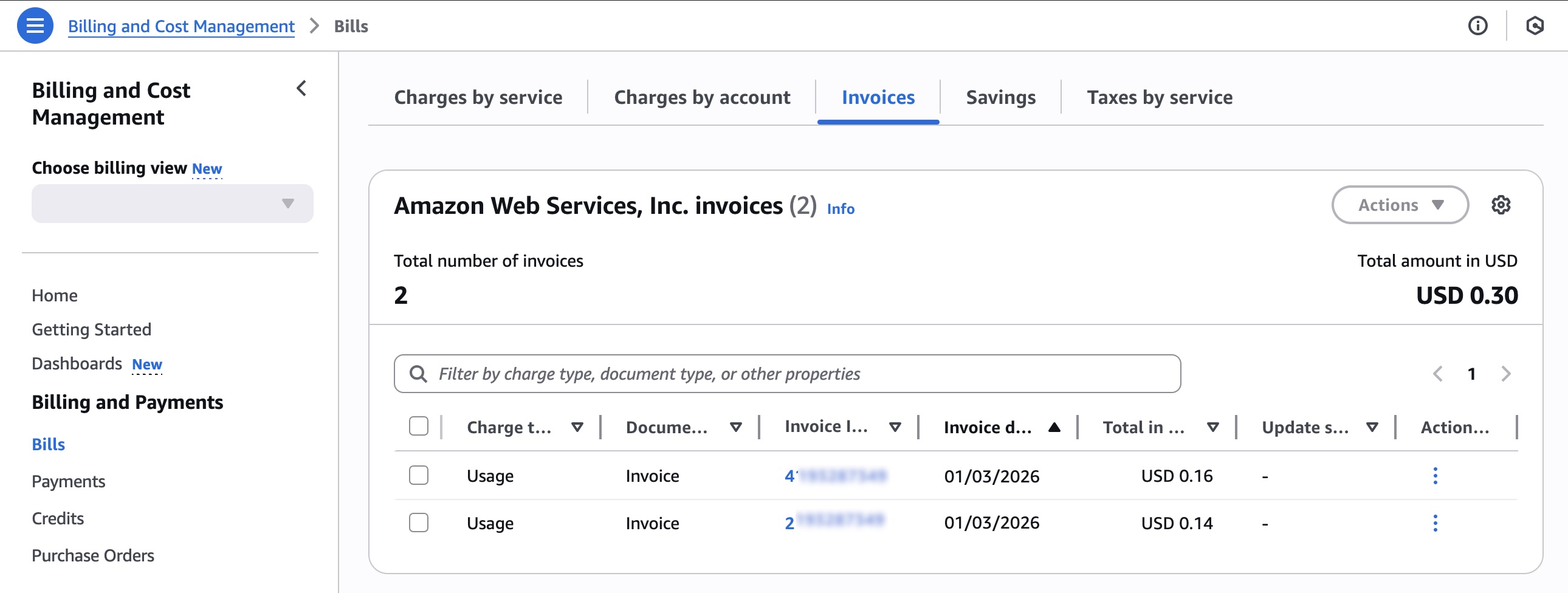
You can identify the transferred invoices by bill-source account IDs. You can also find the payments for the bill-source accounts invoices in the Payments menu. These appear only in the bill-transfer account.
The bill-transfer account can use billing views to access the cost data of the bill-source accounts in AWS Cost Explorer, AWS Cost and Usage Report, AWS Budgets and Bills page. When enabling billing view mode, you can choose your desired billing view for each bill-source account.
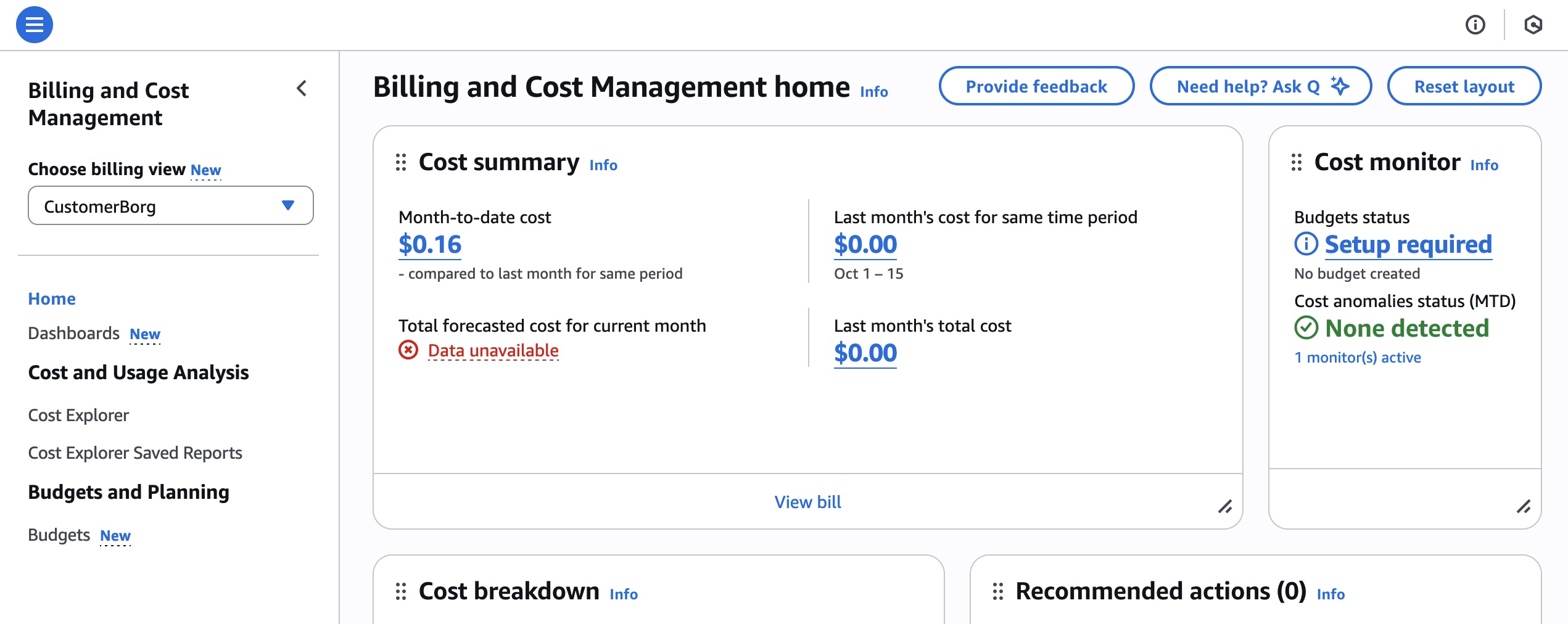
The bill-source accounts will experience these changes:
- Historical cost data will no longer be available and should be downloaded before accepting
- Cost and Usage Reports should be reconfigured after transfer
Transferred bills in the bill-transfer account always use the tax and payment settings of the account to which they’re delivered. Therefore, all the invoices reflecting the usage of the bill-source accounts and the member accounts in their AWS Organizations will contain taxes (if applicable) calculated on the tax settings determined by the bill-transfer account.
Similarly, the seller of record and payment preferences are also based on the configuration determined by the bill-transfer account. You can customize the tax and payments settings by creating the invoice units available in the Invoice Configuration functionality.
To learn more about details, visit Billing Transfer in the AWS documentation.
Now available
Billing Transfer is available today in all commercial AWS Regions. To learn more, visit the AWS Cloud Financial Management Services product page.
Give Billing Transfer a try today and send feedback to AWS re:Post for AWS Billing or through your usual AWS Support contacts.
— Channy
Monitor network performance and traffic across your EKS clusters with Container Network Observability
Post Syndicated from Donnie Prakoso original https://aws.amazon.com/blogs/aws/monitor-network-performance-and-traffic-across-your-eks-clusters-with-container-network-observability/
Organizations are increasingly expanding their Kubernetes footprint by deploying microservices to incrementally innovate and deliver business value faster. This growth places increased reliance on the network, giving platform teams exponentially complex challenges in monitoring network performance and traffic patterns in EKS. As a result, organizations struggle to maintain operational efficiency as their container environments scale, often delaying application delivery and increasing operational costs.
Today, I’m excited to announce Container Network Observability in Amazon Elastic Kubernetes Service (Amazon EKS), a comprehensive set of network observability features in Amazon EKS that you can use to better measure your network performance in your system and dynamically visualize the landscape and behavior of network traffic in EKS.
Here’s a quick look at Container Network Observability in Amazon EKS:
Container Network Observability in EKS addresses observability challenges by providing enhanced visibility of workload traffic. It offers performance insights into network flows within the cluster and those with cluster-external destinations. This makes your EKS cluster network environment more observable while providing built-in capabilities for more precise troubleshooting and investigative efforts.
Getting started with Container Network Observability in EKS
I can enable this new feature for a new or existing EKS cluster. For a new EKS cluster, during the Configure observability setup, I navigate to the Configure network observability section. Here, I select Edit container network observability. I can see there are three included features: Service map, Flow table, and Performance metric endpoint, which are enabled by Amazon CloudWatch Network Flow Monitor.
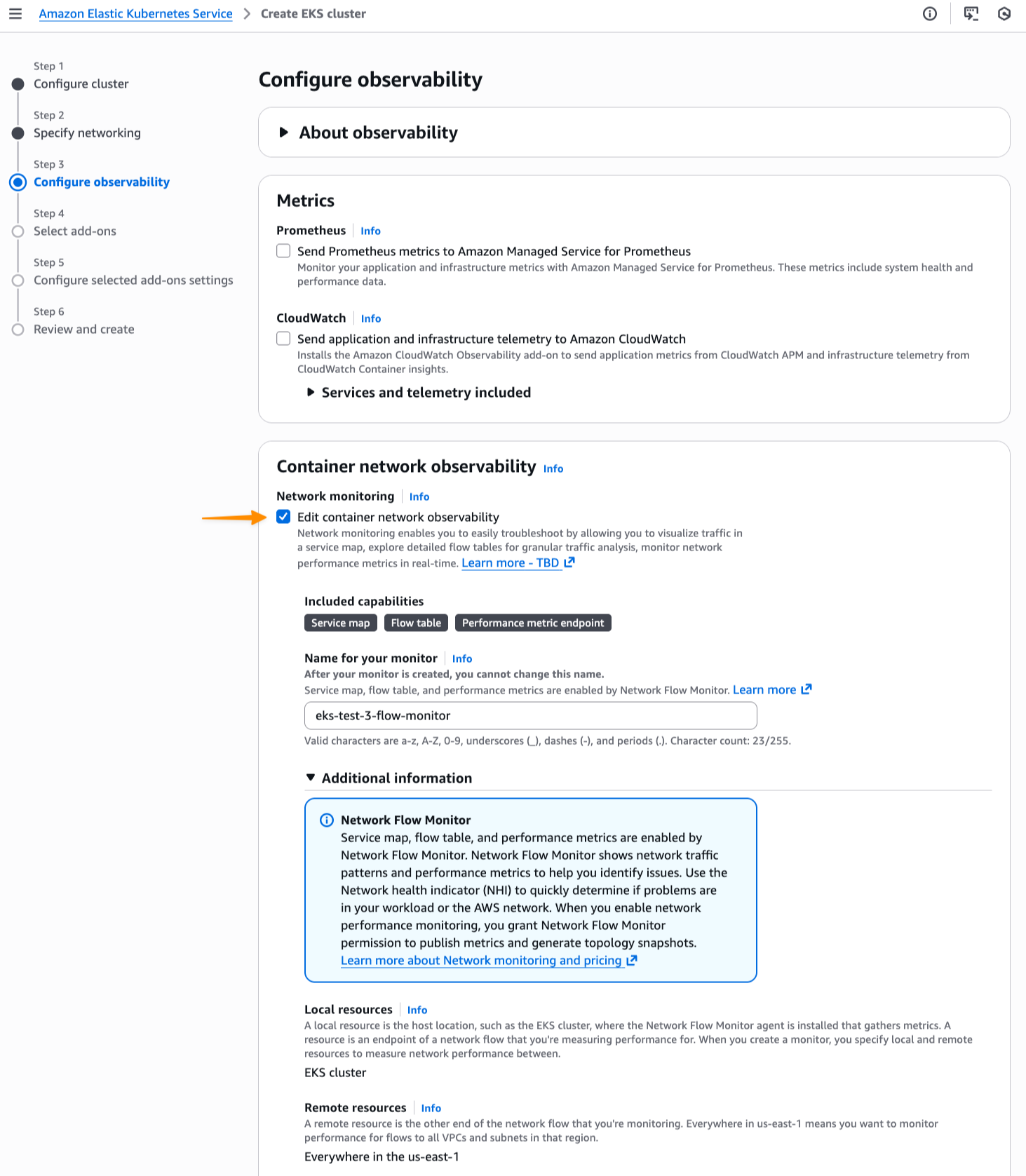
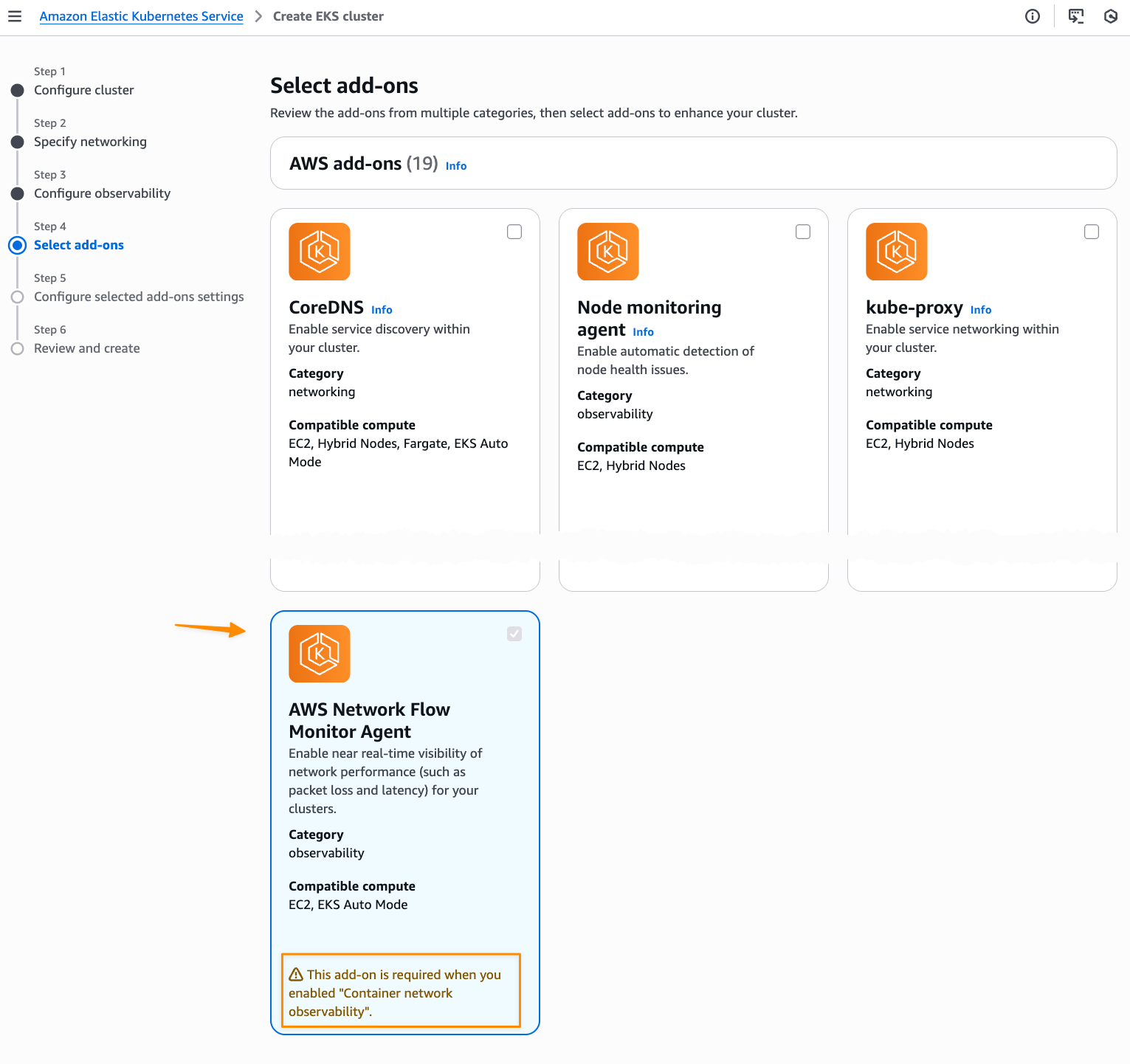
On the next page, I need to install the AWS Network Flow Monitor Agent.
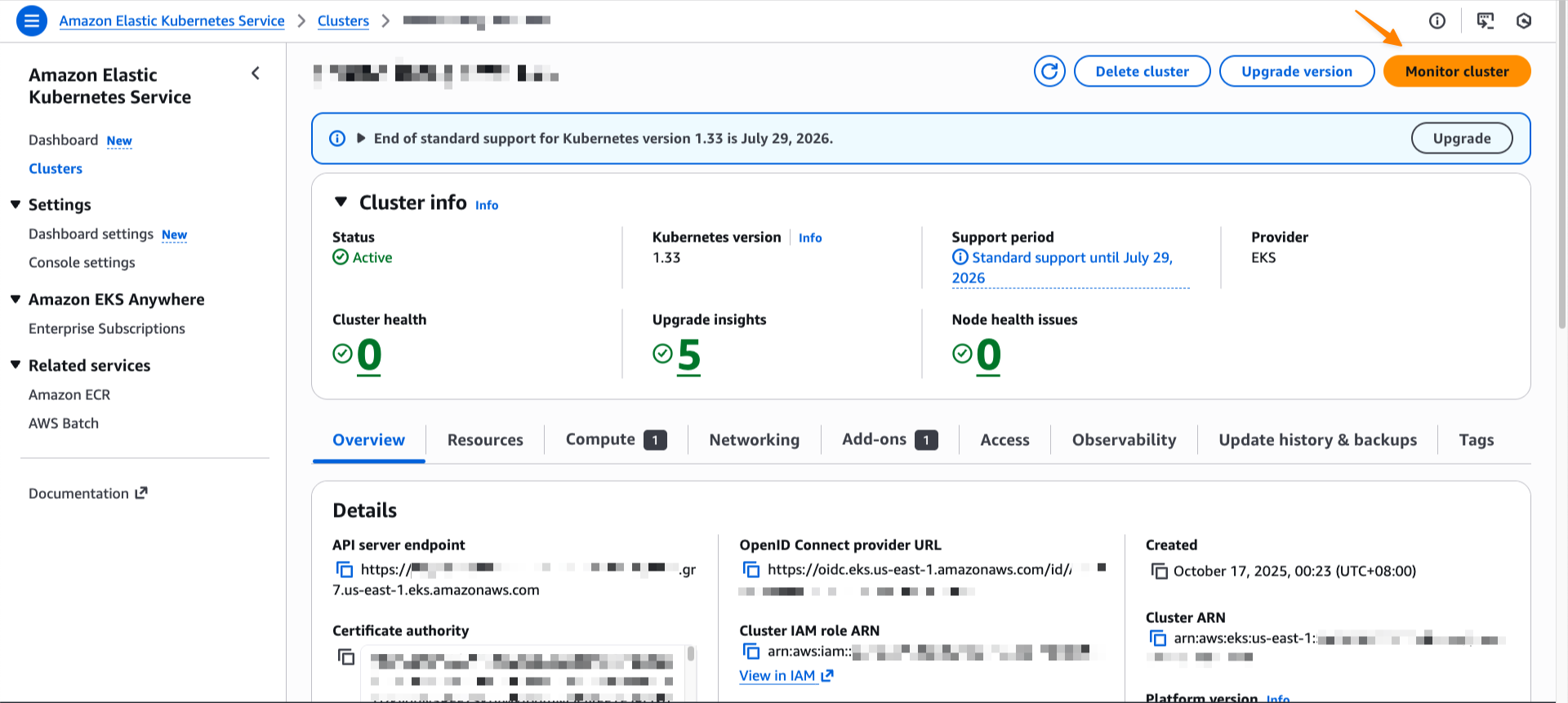
After it’s enabled, I can navigate to my EKS cluster and select Monitor cluster.
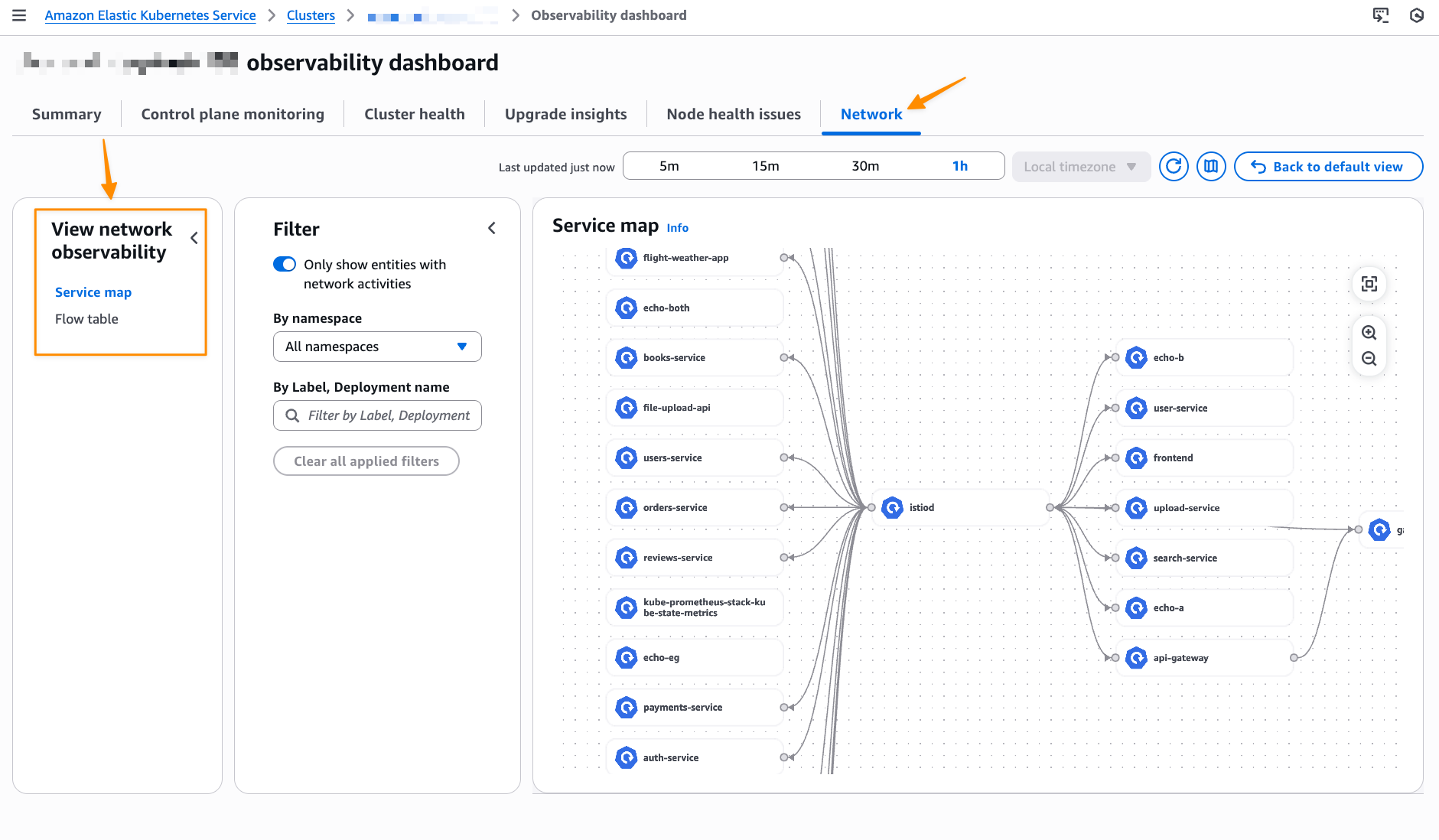
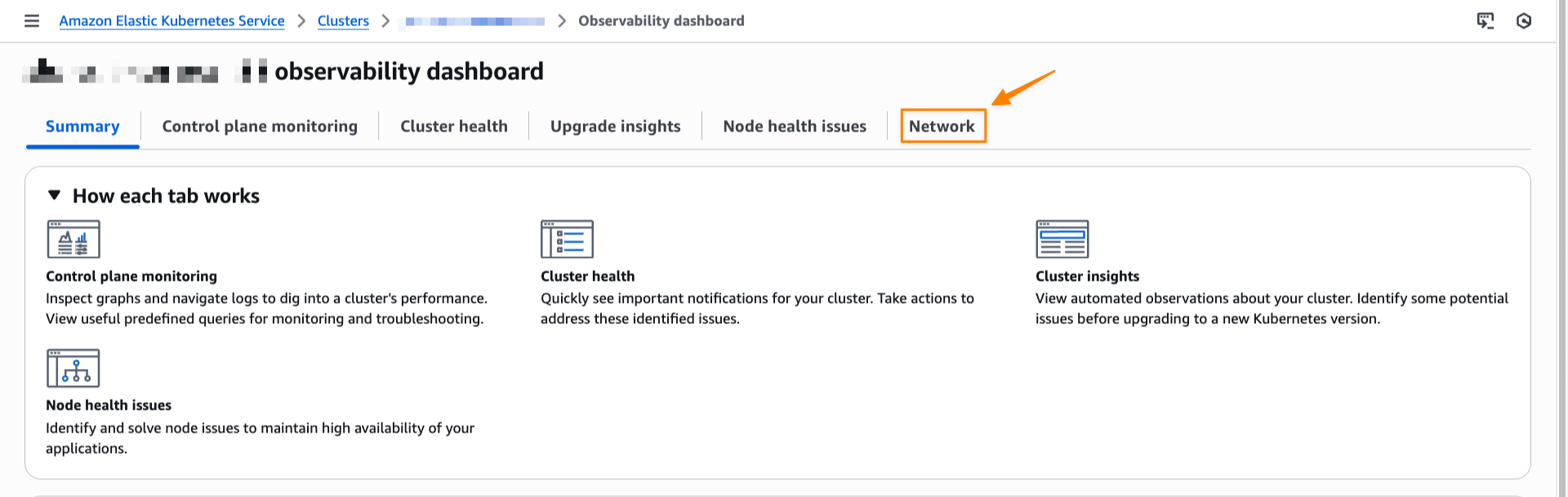
This will bring me to my cluster observability dashboard. Then, I select the Network tab.
Comprehensive observability features
Container Network Observability in EKS provides several key features, including performance metrics, service map, and flow table with three views: AWS service view, cluster view, and external view.
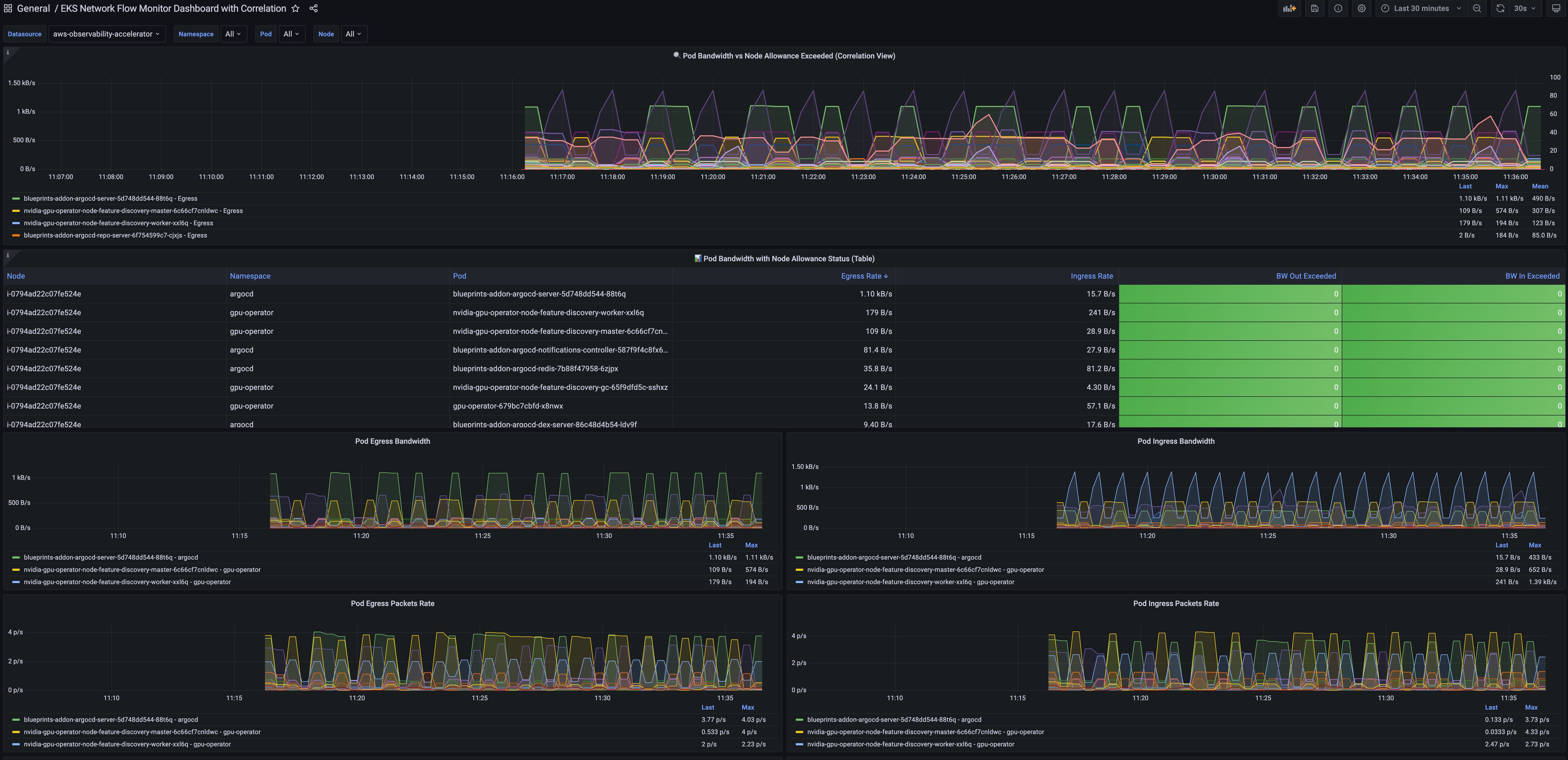
With Performance metrics, you can now scrape network-related system metrics for pods and worker nodes directly from the Network Flow Monitor agent and send them to your preferred monitoring destination. Available metrics include ingress/egress flow counts, packet counts, bytes transferred, and various allowance exceeded counters for bandwidth, packets per second, and connection tracking limits. The following screenshot shows an example of how you can use Amazon Managed Grafana to visualize the performance metrics scraped using Prometheus.
With the Service map feature, you can dynamically visualize intercommunication between workloads in your cluster, making it straightforward to understand your application topology with a quick look. The service map helps you quickly identify performance issues by highlighting key metrics such as retransmissions, retransmission timeouts, and data transferred for network flows between communicating pods.
Let me show you how this works with a sample e-commerce application. The service map provides both high-level and detailed views of your microservices architecture. In this e-commerce example, we can see three core microservices working together: the GraphQL service acts as an API gateway, orchestrating requests between the frontend and backend services.
When a customer browses products or places an order, the GraphQL service coordinates communication with both the products service (for catalog data, pricing, and inventory) and the orders service (for order processing and management). This architecture allows each service to scale independently while maintaining clear separation of concerns.
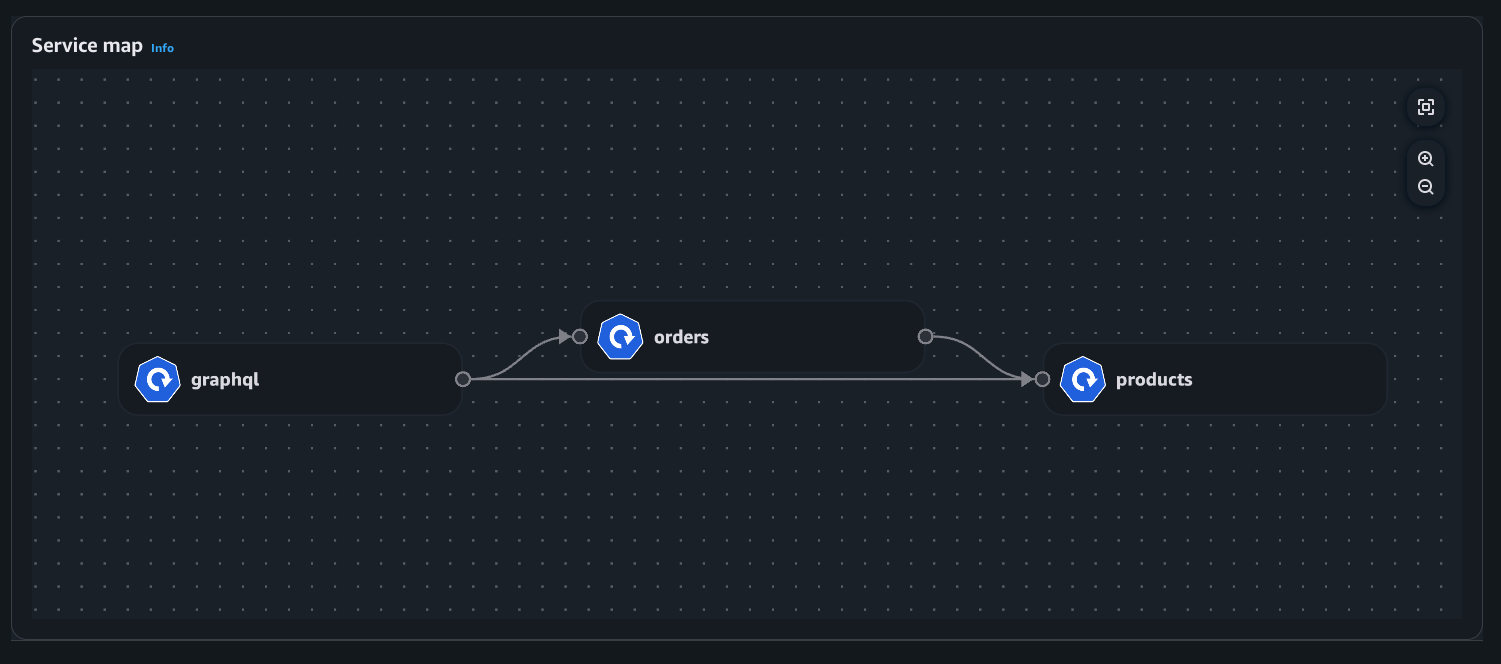
For deeper troubleshooting, you can expand the view to see individual pod instances and their communication patterns. The detailed view reveals the complexity of microservices communication. Here, you can see multiple pod instances for each service and the network of connections between them.
This granular visibility is crucial for identifying issues like uneven load distribution, pod-to-pod communication bottlenecks, or when specific pod instances are experiencing higher latency. For example, if one GraphQL pod is making disproportionately more calls to a particular products pod, you can quickly spot this pattern and investigate potential causes.
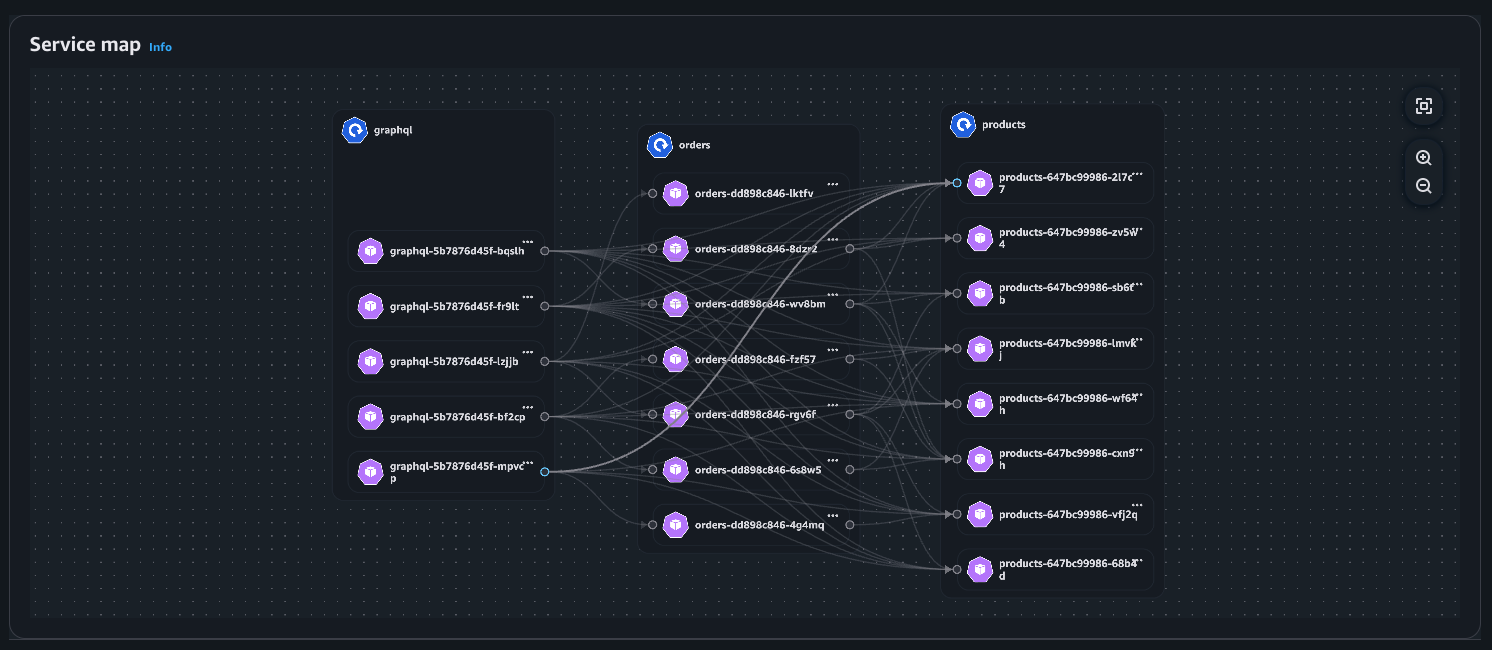
Use the Flow table to monitor the top talkers across Kubernetes workloads in your cluster from three different perspectives, each providing unique insights into your network traffic patterns.
Flow table – Monitor the top talkers across Kubernetes workloads in your cluster from three different perspectives, each providing unique insights into your network traffic patterns:
- AWS service view shows which workloads generate the most traffic to Amazon Web Services (AWS) services such as Amazon DynamoDB and Amazon Simple Storage Service (Amazon S3), so you can optimize data access patterns and identify potential cost optimization opportunities.
- The Cluster view reveals the heaviest communicators within your cluster (east-west traffic), which means you can spot chatty microservices that might benefit from optimization or colocation strategies
- External viewidentifies workloads with the highest traffic to destinations outside AWS (internet or on premises), which is useful for security monitoring and bandwidth management.
The flow table provides detailed metrics and filtering capabilities to analyze network traffic patterns. In this example, we can see the flow table displaying cluster view traffic between our e-commerce services. The table shows that the orders pod is communicating with multiple products pods, transferring amounts of data. This pattern suggests the orders service is making frequent product lookups during order processing.
The filtering capabilities are useful for troubleshooting, for example, to focus on traffic from a specific orders pod. This granular filtering helps you quickly isolate communication patterns when investigating performance issues. For instance, if customers are experiencing slow checkout times, you can filter to see if the orders service is making too many calls to the products service, or if there are network bottlenecks between specific pod instances.
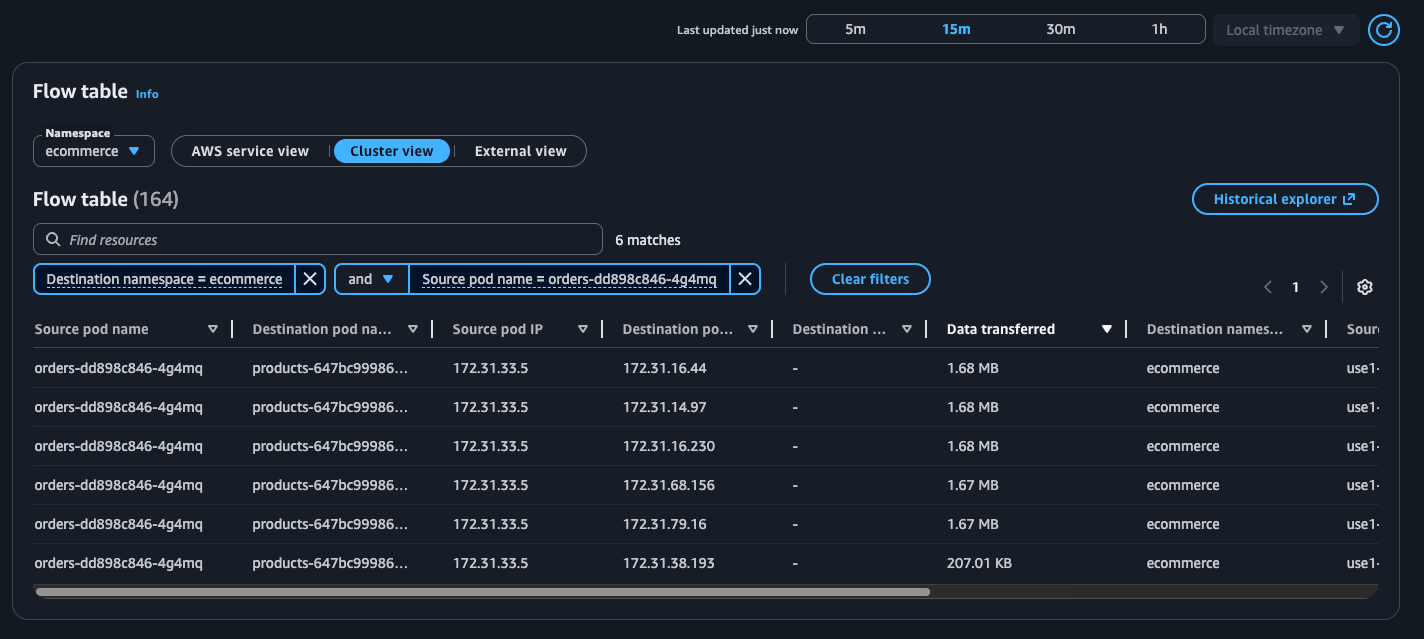
Additional things to know
Here are key points to note about Container Network Observability in EKS:
- Pricing – For network monitoring, you pay standard Amazon CloudWatch Network Flow Monitor pricing.
- Availability – Container Network Observability in EKS is available in all commercial AWS regions where Amazon CloudWatch Network Flow Monitor is available.
- Export metrics to your preferred monitoring solution – Metrics are available in OpenMetrics format, compatible with Prometheus and Grafana. For configuration details, refer to Network Flow Monitor documentation.
Get started with Container Network Observability in Amazon EKS today to improve network observability in your cluster.
Happy building!
— Donnie
Announcing CloudFormation IDE Experience: End-to-End Development in Your IDE
Post Syndicated from Damola Oluyemo original https://aws.amazon.com/blogs/devops/announcing-cloudformation-ide-experience-end-to-end-development-in-your-ide/
If you’ve developed AWS CloudFormation templates, you know the drill; write YAML(YAML Ain’t Markup Language) in your IDE(Integrated Development Environment), switch to the AWS Management Console to validate, jump to documentation to verify property names. Then run CFN Lint(Cloudformation Linter) in your terminal, deploy and wait, then troubleshoot failures back in the console. This constant context switching between your IDE, AWS Console, documentation pages, and validation tools fragments your workflow and kills productivity. What should take 30 minutes often stretches into hours of iteration cycles.
Today, we’re excited to introduce the CloudFormation IDE Experience, a comprehensive solution that brings the entire CloudFormation development lifecycle into your IDE. No more context switching. No more fragmented workflows. Just one unified, intelligent development experience from authoring to deployment.
In this post, you’ll learn how the Cloudformation IDE Experience transforms your workflow with intelligent authoring, real-time validation, AWS integration, and more.
What is the CloudFormation IDE Experience?
The CloudFormation IDE Experience reimagines how you build infrastructure as code by creating an end-to-end development loop entirely within your IDE. Unlike generic YAML or JSON editors, this is a CloudFormation-first solution built specifically for infrastructure developers.
This solution covers the complete lifecycle; from intelligent authoring with smart code completion and navigation that understands CloudFormation semantics, to real-time multi-layer validation that catches issues before deployment. It provides direct AWS integration for seamless resource imports and stack visibility, monitors configuration drift between your templates and deployed resources, and includes server-side pre-deployment checks that prevent common deployment failures.
The result? A development environment that understands your infrastructure code as deeply as your IDE understands your application code.
Core Features
Quick Project Setup with CFN Init
CFN Init streamlines project setup by creating a structured CloudFormation project with environment configurations in seconds. Run “CFN Init: Initialize Project” from the Command Palette, configure your environments (dev, staging, production), and associate each with an AWS profile.
The CloudFormation Explorer displays your environments, letting you switch between them with a single click. Each environment maintains its own deployment settings and parameter values, eliminating manual configuration and ensuring consistent deployments across your infrastructure lifecycle.
Intelligent Authoring with Intelligent Code Completion
The IDE understands CloudFormation semantics and provides context-aware suggestions as you type. Only required properties appear automatically, while optional properties surface on hover, so when you add a Properties section to an EC2 VPC resource, nothing appears because it has no required properties. Create a subnet, however, and VpcId appears immediately because it’s required.
When you use !GetAtt or !Ref, the IDE knows exactly which attributes and resources are available. Navigation features like go-to-definition for logical IDs and hover tooltips let you explore complex templates without losing context. The IDE also provides full support for CloudFormation intrinsic functions and pseudo parameters.
Multi-Layer Validation System
The IDE provides comprehensive validation at multiple levels:
Static Validation (Real-time)
- CloudFormation Guard Integration: Security and compliance checks using AWS Security pillar rules. For example, it automatically flags insecure configurations like
MapPublicIpOnLaunch: trueon subnets - CFN Lint Integration: Advanced syntax and logic validation, including overlapping CIDR block detection, resource dependency validation, and property checks beyond basic schema validation
Interactive Error Resolution
When errors occur, the IDE doesn’t just highlight them, it helps you fix them. Contextual error messages explain what’s wrong and why it matters, while one-click quick fixes automatically correct common issues like missing required properties or invalid reference formats. If you reference a non-existent resource, the IDE suggests valid alternatives from your template. Reference an invalid attribute with !GetAtt, the IDE immediately shows which attributes are actually available for that resource type.
AWS Resource Integration (CCAPI)
Import existing AWS resources directly into your templates using the Cloud Control API (CCAPI). Browse live resources and view all CloudFormation stacks in your AWS account from within the IDE. Pull resource configurations directly into your template with one click, complete with accurate property values. This transforms existing infrastructure into Infrastructure-as-Code without manual reconstruction or switching to the console to look up property values.
Server-Side Validation
Before you deploy, the IDE performs comprehensive server-side validation through AWS’s intelligent validation service that analyzes your CloudFormation templates against real-world deployment patterns and catches issues static analysis can’t detect.
The AWS’s intelligent validation service uses AWS-managed hooks to analyze your change sets before execution across three categories. Enhanced template validation covers CFN Lint blind spots like transforms and parameter values. Primary identifier conflict detection finds existing resources with the same identifiers before you attempt deployment. Resource state validation checks resource readiness ensuring, for example, that Amazon Simple Storage Service(S3) buckets are empty before deletion attempts.
This validation is based on analysis of the top CloudFormation failure patterns, helping you catch issues before they cause rollbacks or failed states.
Getting Started
Getting started with the CloudFormation IDE Experience is straightforward:
Prerequisite:
- Install an IDE that supports the CloudFormation extension, such as Visual Studio Code, Kiro
- Download the CloudFormation extension for your platform (available through the AWS Toolkit)
- Install the extension following the standard VS Code extension installation process
No complex dependency management or schema updates required—all configuration and updates are handled automatically.
Let’s See How It Works
Let’s walk through a practical example that demonstrates the IDE experience in action. We’ll build a simple Amazon Virtual Private Cloud (Amazon VPC) infrastructure with subnets and an S3 bucket.
Setting Up Your Project
Start by initializing a new CloudFormation project. Open the Command Palette, run “CFN Init: Initialize Project”, choose your project location, and set up environments. For this example, create a “beta” environment and associate it with your AWS development profile. The IDE creates your project structure with configuration files ready to use. You can now select your “beta” environment from the CloudFormation Explorer to ensure all deployments use the correct settings.
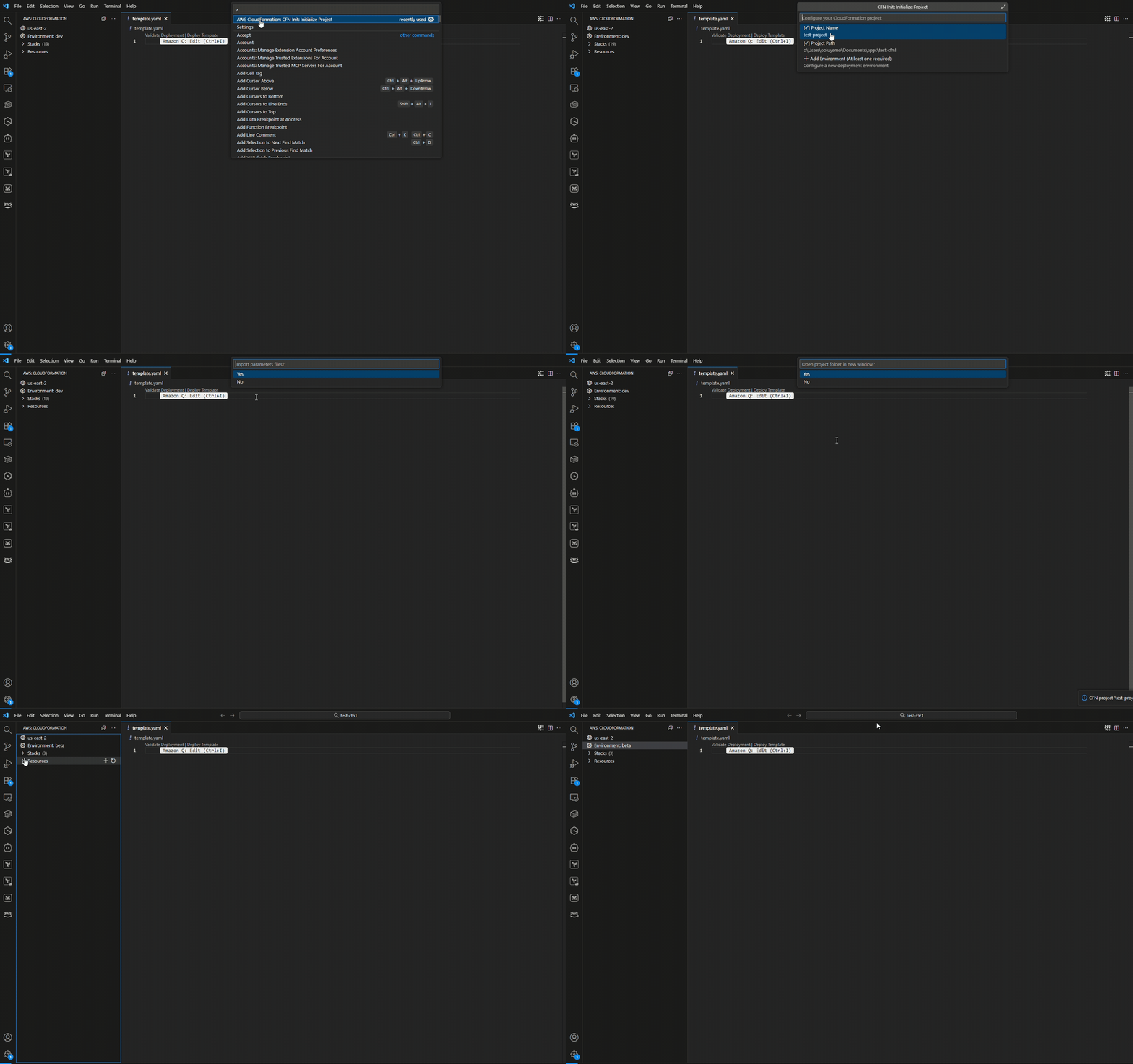
Figure 1: Initializing a CloudFormation project with environment configuration
Starting with Intelligent Authoring
Create a new CloudFormation template and start typing AWS::EC2::VPC. The IDE provides intelligent completions as you type.
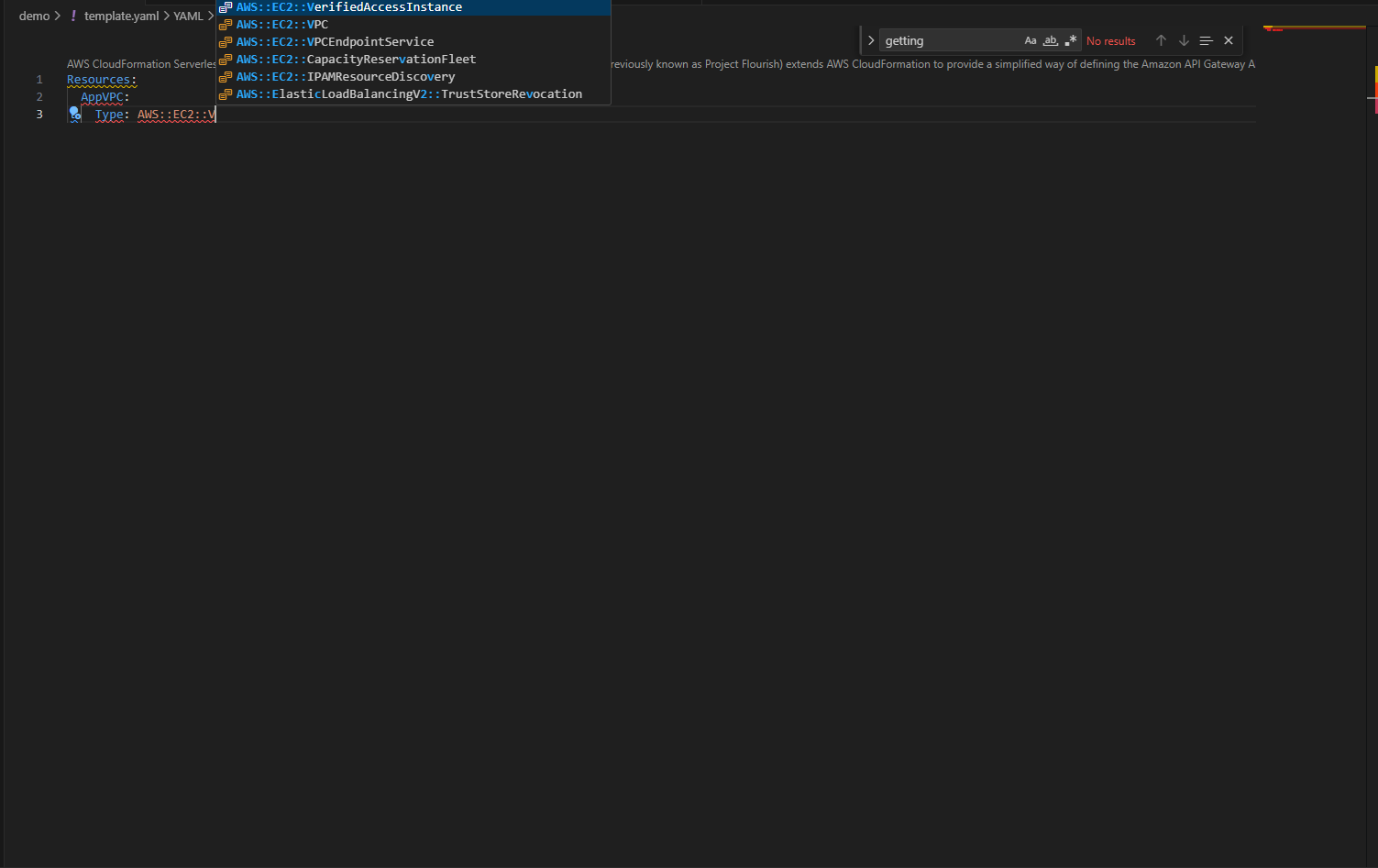
Figure 2.0: Resource type auto-completion with CloudFormation-aware IntelliSense
When you add the Properties section, notice something interesting: nothing appears automatically. That’s because Amazon Elastic Compute Cloud (Amazon EC2) VPC has no required properties.
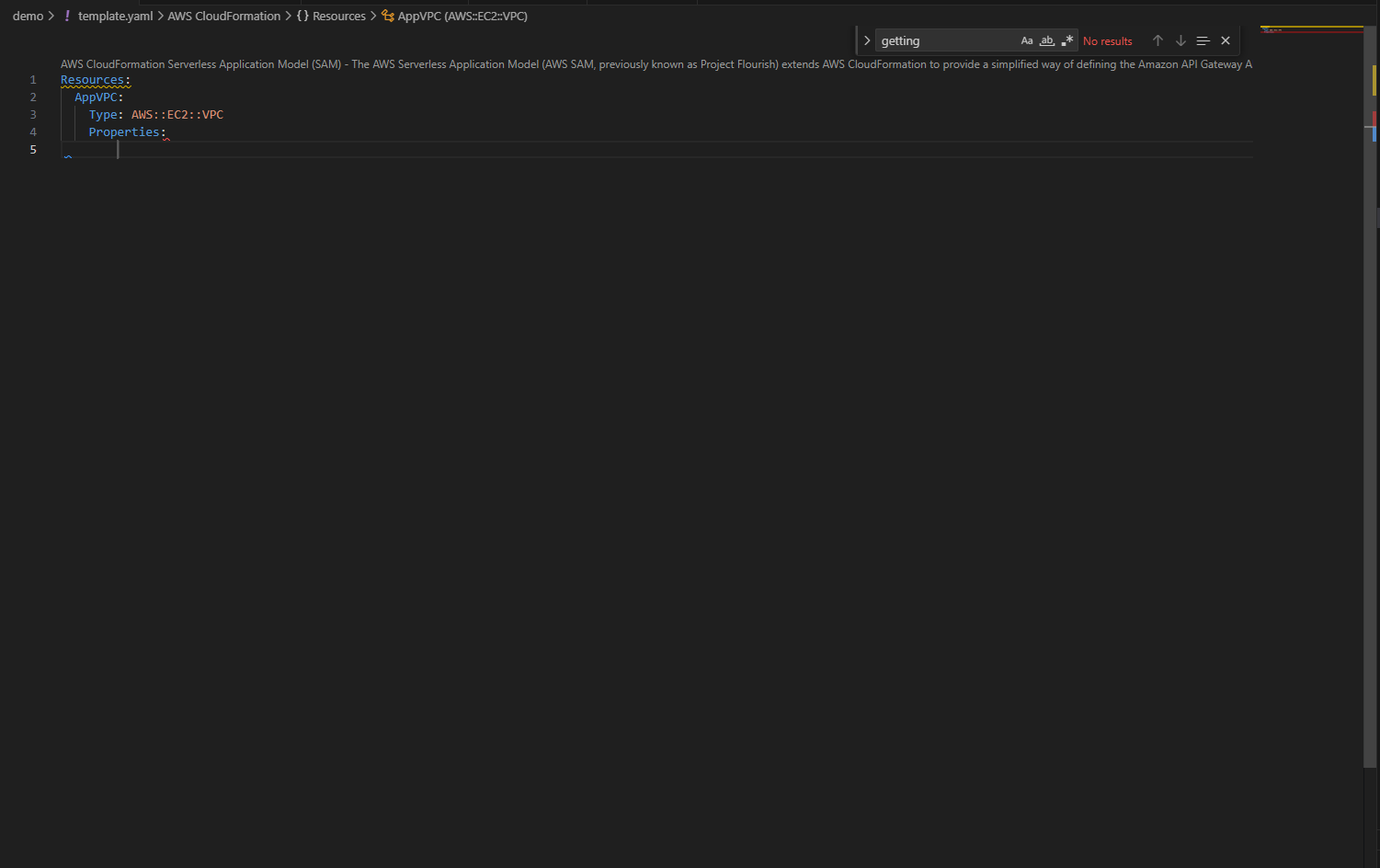
Figure 2.1: No automatic suggestions for VPC properties since none are required
Hover over Properties to see all available options with their types and documentation links.

Figure 2.2: Hover information displaying optional properties and their documentation
Add a CIDR block, then create a subnet. This time, when you type Properties, VpcId appears immediately because it’s required.
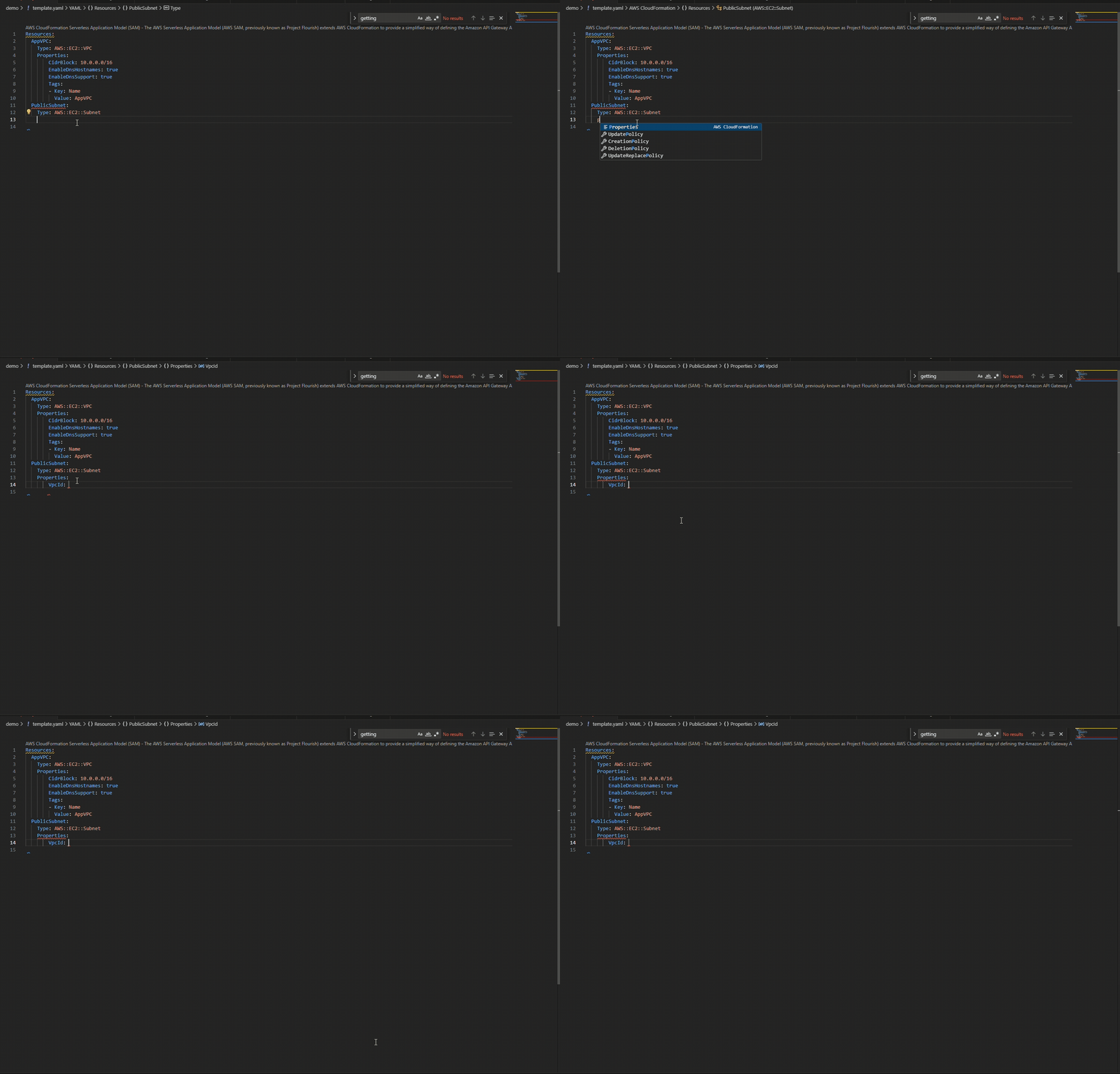
Figure 2.3: Required properties VpcID automatically suggested for EC2 Subnet
The IDE provides the resource names in your template, and when you use !GetAtt or !Ref, it knows which attributes are available for each resource type.
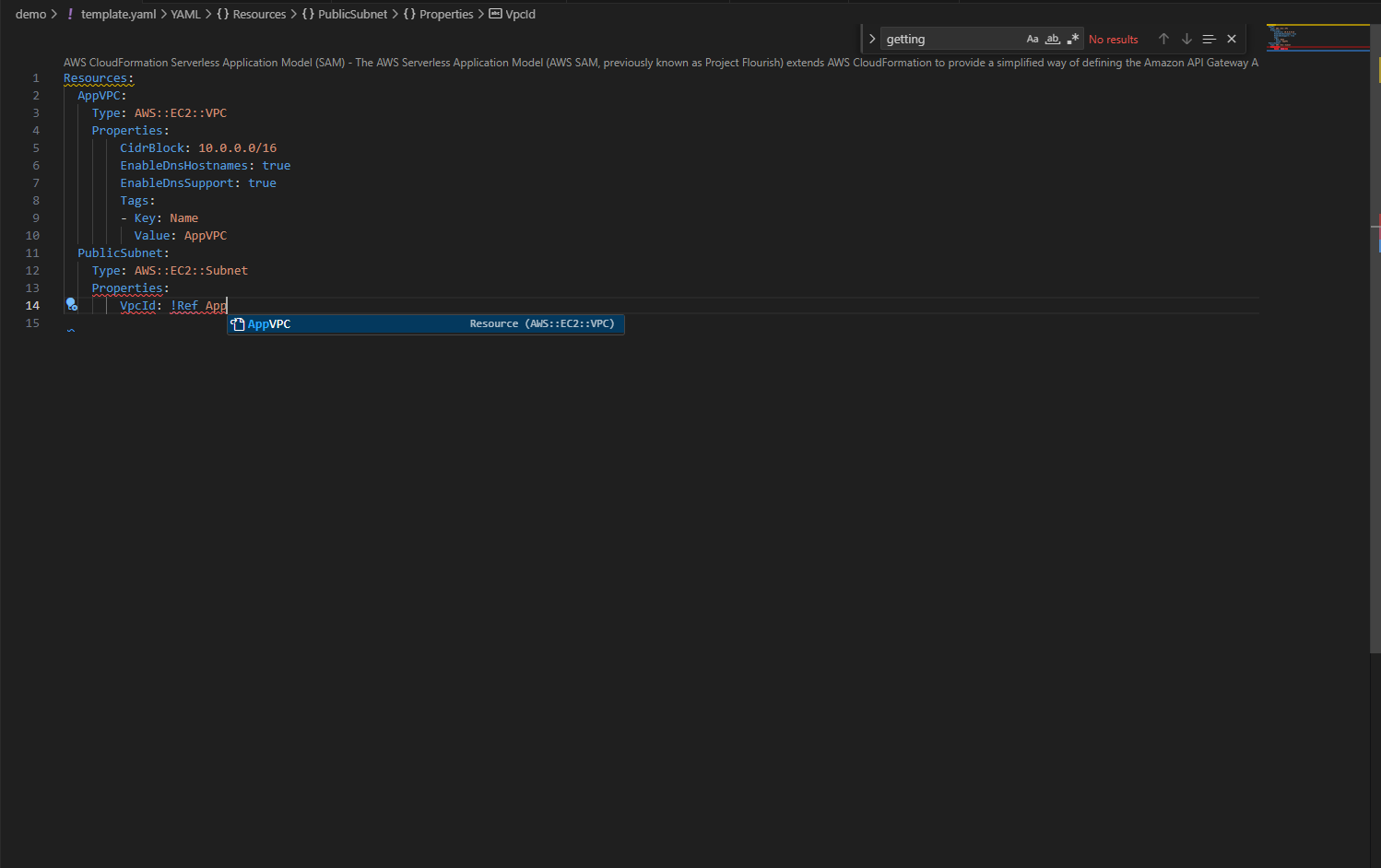
Figure 2.4: Type-aware completions for intrinsic functions like !GetAtt & !Ref
Real-Time Validation in Action
As you continue building, add MapPublicIpOnLaunch: true to make a public subnet. Immediately, a blue squiggly line appears.
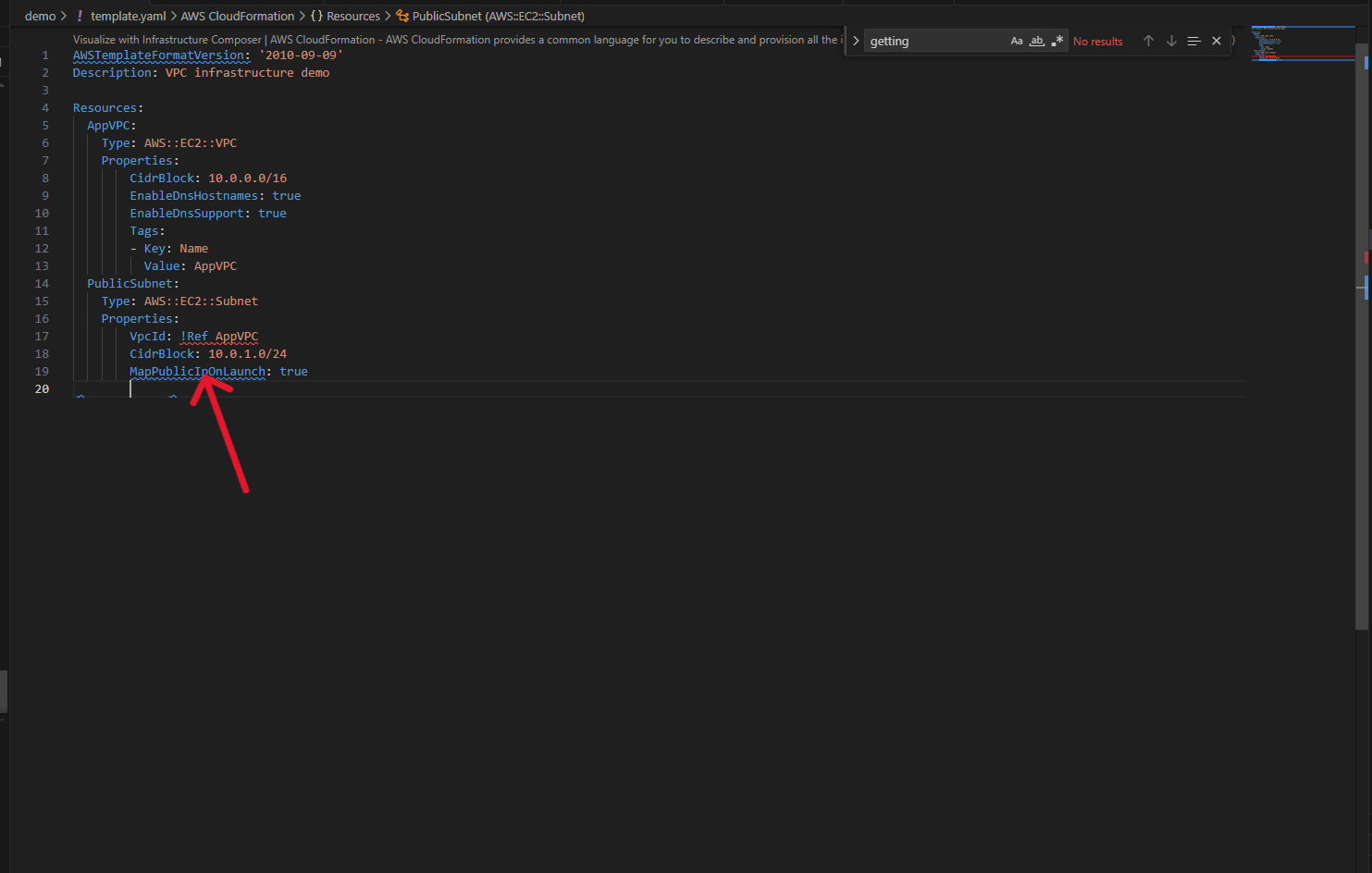
Figure 3: CloudFormation Guard warning highlighted in real-time
Hovering reveals a CloudFormation Guard warning from the AWS Security pillar rules: this configuration isn’t recommended for security compliance.
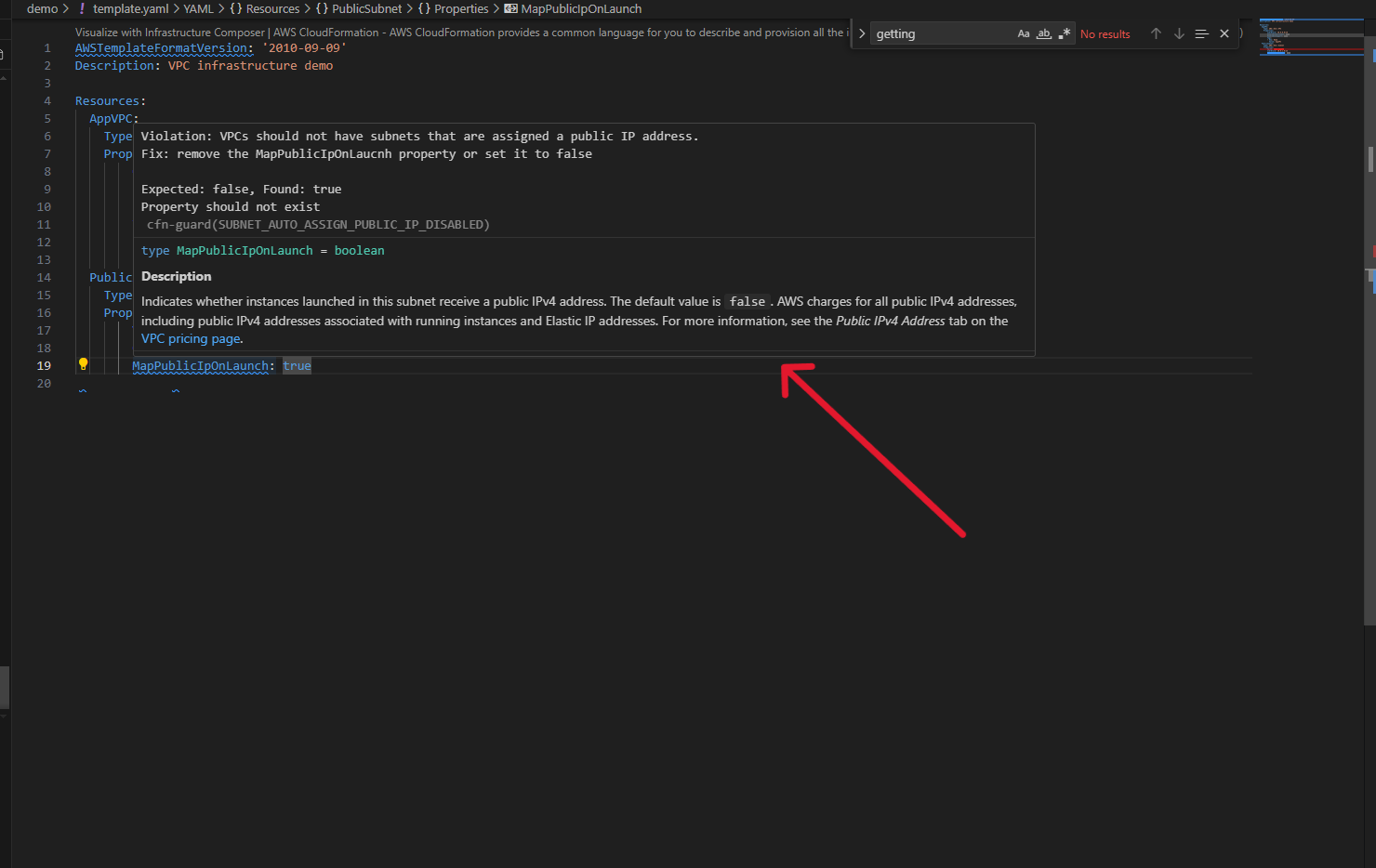
Figure 3.1: Security compliance warning with detailed explanation
Create a second subnet by copying the first, but now red squiggly lines appear. CFN Lint has detected overlapping CIDR blocks between your two subnets – an issue that would fail during deployment. You can fix it immediately with the contextual information provided.
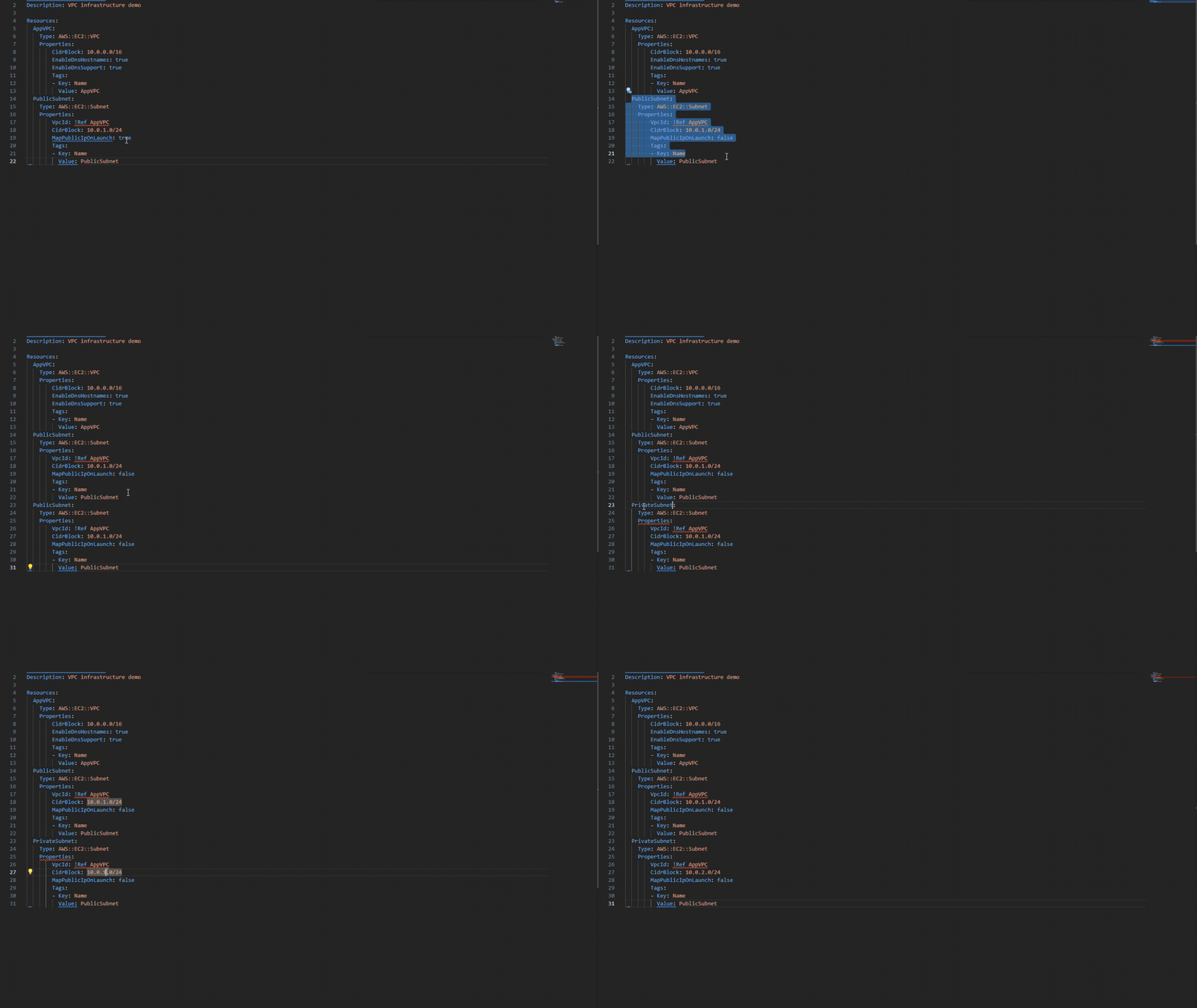
Figure 3.2: CFN Lint error detection for overlapping CIDR blocks providing detailed error information helping you resolve the issue quickly
Importing Existing Resources
Now you need an S3 bucket. Instead of writing it from scratch, open the Resource Explorer panel on the left. Using CCAPI integration, you can see all your existing AWS resources. Select an S3 bucket and click “Import resource state”. The IDE pulls in the complete resource configuration with all properties already set. You can now iterate on this resource without needing to remember or look up all the configuration details.
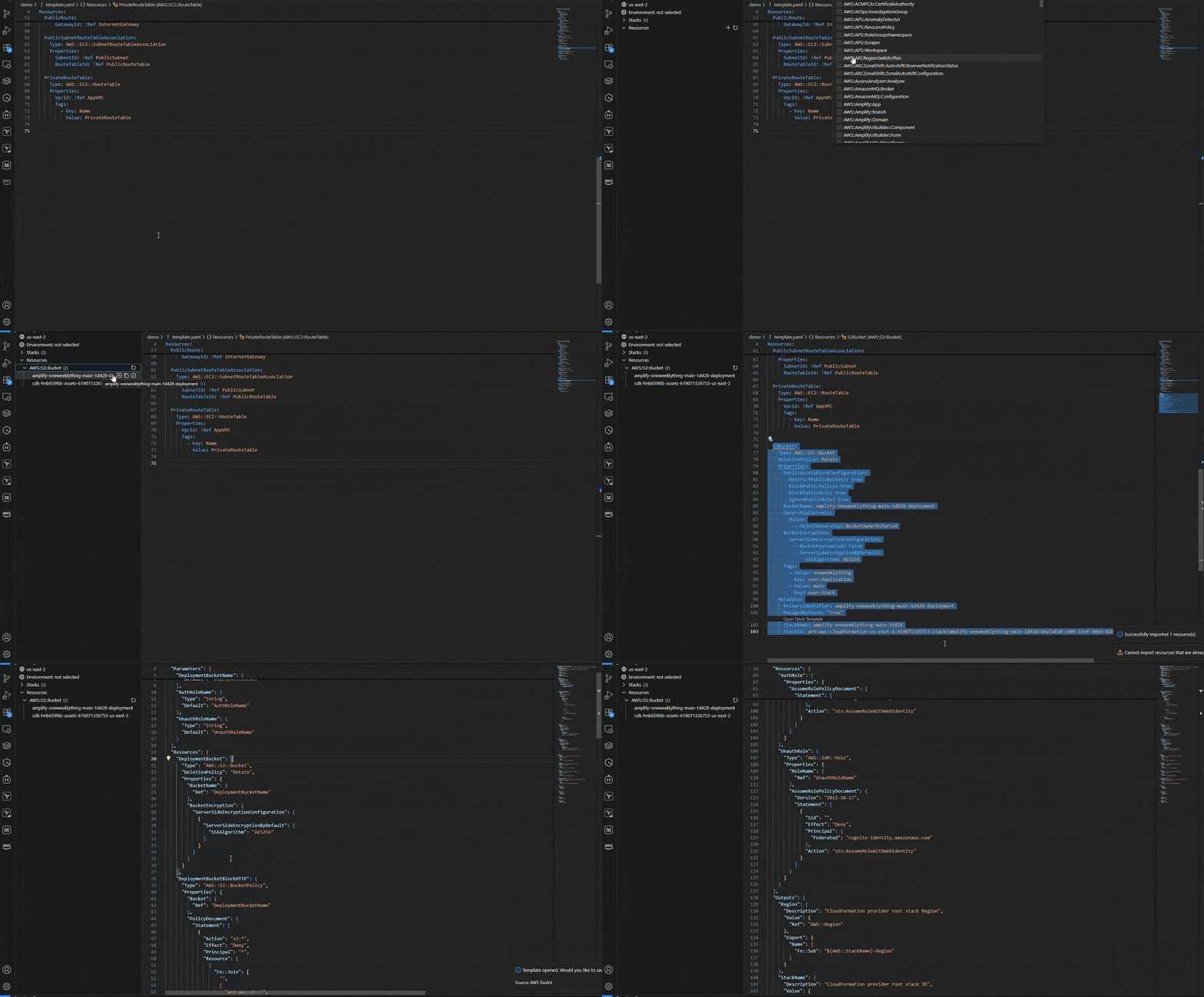
Figure 4: Automatically imported resource configuration from live AWS resources
Developer Experience Benefits
The CloudFormation IDE Experience delivers measurable improvements across productivity and quality:
Productivity Gains:
- Reduced context switching: Keep your entire workflow in one place
- Faster iteration cycles: Catch and fix issues in seconds, not minutes or hours
- Shift-left validation: Identify problems before deployment, not after
- Intelligent assistance: Spend less time in documentation, more time building
Quality Improvements:
- Proactive error prevention: Multi-layer validation catches issues early
- Security by default: Built-in compliance checks from CloudFormation Guard
- Best practice enforcement: Automated guidance aligned with AWS recommendations
- Deployment confidence: Pre-deployment validation reduces rollback scenarios
What previously took hours of troubleshooting and multiple deployment attempts now becomes a confident 30-minute development cycle.
“I will definitely use these features; they help to reduce the feedback loop and speed up the development of IaC templates.” – AWS Community Builder
Things to Know
Platform Support
The CloudFormation IDE Experience is available for:
- Visual Studio Code: Full feature support
- Kiro: Full feature support
- Cursor: Full feature support
- JetBrains IDEs: Complete integration across the IntelliJ family (Fast Follow)
- Operating Systems: macOS (ARM), Linux (x64) and Windows(…)
Conclusion
The CloudFormation IDE Experience eliminates the context switching that fragments your workflow. Write, validate, and deploy all from one environment. What used to take hours of iteration now takes minutes.
Ready to get started? Install the CloudFormation extension from the AWS Toolkit for VS Code and experience the difference. For detailed setup instructions and feature documentation, see the CloudFormation IDE Experience guide.
About the Authors:
Amazon introduces two benchmark datasets for evaluating AI agents’ ability on code migration
Post Syndicated from Linbo Liu original https://aws.amazon.com/blogs/devops/amazon-introduces-two-benchmark-datasets-for-evaluating-ai-agents-ability-on-code-migration/
Introduction: Repository-Level Code Migration
Code migration is a repository-level transformation process that modernizes entire software projects to run on new platforms, frameworks, or runtime environments while preserving their original functionality and structure. Rather than focusing on isolated files or APIs, it operates across the full repository, spanning source code, dependencies, build systems, and configuration files to ensure consistency and correctness at scale. Typical examples include upgrading Java repositories from legacy versions such as Java 8 to modern Long-Term Support releases like Java 17 or 21, migrating .NET Framework repositories to .NET Core, and upgrading AWS Lambda projects in Python or Node.js to the latest runtime versions.
Code migration is a challenging software engineering (SWE) task that involves runtime upgrade, deprecated API replacement, test framework optimization, and syntax modernization. As we build agentic solutions for code migration, the community needs a standardized benchmark dataset and an evaluation framework to measure how well these systems actually perform. To close this gap, we introduce two benchmark datasets: MigrationBench on Java and Poly-MigrationBench as an extension to other programming languages. These datasets are designed not only to benchmark the effectiveness of Large Language Models (LLMs) in repository-level migration, but also to provide the community with a standardized evaluation framework for reproducible experiments.
Solution Overview
MigrationBench: Repository-Level Java Migration
MigrationBench is a comprehensive repository-level benchmark focused on Java upgrades. Specifically, it evaluates the ability of LLMs and other tools to migrate code from Java 8 to newer Long-Term Support (LTS) versions such as Java 17 and Java 21.
The full dataset includes 5,102 open-source Java 8 Maven repositories collected from GitHub, alongside a representative subset of 300 repositories curated for research requiring fewer compute resources. MigrationBench also provides an evaluation framework for validating Java Maven repository upgrades.
Our data collection process follows a carefully designed pipeline with multiple filtering stages to ensure the quality and relevance of the repositories we include. We begin by collecting Java Maven projects, focusing on repositories written in Java that use Maven as their build tool. Next, we apply a license filter, retaining only repositories under MIT or Apache 2.0 licenses to ensure open and permissible usage. We then apply a quality filter, keeping only repositories with at least three GitHub stars to exclude toy or inactive projects. For each repository, we search for the latest buildable commit that is compatible with Java 8, ensuring a valid starting point for migration. We also remove redundant repositories based on their snapshot hashes. Finally, we further exclude repositories without any unit tests or integration tests, which are essential components to validate migration correctness in a robust way. For more details, checkout our paper MigrationBench: Repository-Level Code Migration Benchmark from Java 8 and the GitHub repository.
Poly-MigrationBench: Extending Beyond Java
While MigrationBench focuses exclusively on Java, the real-world code migration problem spans multiple ecosystems. To address this broader scope, we develop Poly-MigrationBench, an extension that introduces additional languages and platforms. We applied a similar data curation process as MigrationBench to additionally collect
- 100 .NET Framework repositories. They are to be migrated to .NET core.
- 74 Node.js repositories with version less than Node.js 22. They are to be migrated to Node.js 22.
- 83 Python repositories with Python version less than 3.13. They are to be migrated to Python 3.13.
The above datasets are publicly available on GitHub: https://github.com/amazon-science/Poly-MigrationBench
Together, these datasets enable researchers to explore cross-language and cross-platform migration challenges at scale.
Use Case 1: Cross-Platform .NET Migration
One pressing migration challenge lies in moving .NET applications from Windows environments running on the legacy .NET Framework to Linux environments powered by .NET Core. This migration is critical for organizations seeking cross-platform compatibility, improved performance, and modern deployment practices such as containerization.
To support research in this area, we curated a benchmark of 100 open-source .NET Framework repositories from GitHub. These projects were carefully selected for diversity and quality, offering a real world foundation for evaluating migration tools and automated systems. The migration goal is clear: transition .NET Framework repositories to .NET Core on Linux while preserving functional equivalence.
Use Case 2: Node.js Upgrade for AWS Lambda Applications
Another timely migration need involves Lambda functions written in Node.js. Node.js 20, currently supported by Lambda, is scheduled for end-of-support in April 2026 (reference). After this deadline, projects running on Node.js 20 will no longer receive critical security patches or bug fixes.
For increased security and to avoid accumulating technical debt, developers building Lambda applications are proactively upgrading to Node.js 22. To evaluate LLMs’ effectiveness in automating this migration, Poly-MigrationBench provides a dataset of 74 open-source Node.js repositories using Node.js versions no later than 20. The task is to upgrade them to Node.js 22 while ensuring functional correctness is preserved.
Use-case 3: AWS Lambda Python Migrations
We also release benchmarks on Lambda Python repositories to the community to facilitate research and evaluation of automated Lambda function migrations in Python code. According to AWS documentation, Python 3.10 and 3.11 are scheduled to reach end of support for Lambda in June 2026. This approaching deadline highlights the urgency of migrating existing Lambda functions to newer runtimes and underscores the critical need for scalable, reliable, and LLM-driven migration solutions. To facilitate evaluation on this task, we collect 83 Python AWS Lambda repositories with Python version no later than 3.12. The objective is to migrate these repositories to Python 3.13.
Get Started
We’ve open-sourced both the datasets and the evaluation framework on Hugging Face and GitHub to make it easy for the community to explore, reproduce, and extend our work. Alongside them, we also released a baseline solution, SD-Feedback, for MigrationBench, while leaving the development of more sophisticated agentic migration systems as a open challenge for the research community.
MigrationBench
To download the MigrationBench dataset, visit our Hugging Face collection. For evaluation, simply clone our GitHub repository and follow the steps in the README.md.
Poly-MigrationBench
To access the Poly-MigrationBench dataset and evaluation commands, clone our GitHub repository.
For a deeper dive into how the benchmarks were curated and how the evaluation framework was designed, check out our paper:
MigrationBench: Repository-Level Code Migration Benchmark from Java 8
Conclusion
Code migration is an essential but complex task for maintaining long-term software reliability and security. With MigrationBench and Poly-MigrationBench, we aim to provide the community with systematic, large-scale benchmarks that enable reproducible research and practical evaluation of automated migration approaches.
Authors
Safely Handle Configuration Drift with CloudFormation Drift-Aware Change Sets
Post Syndicated from JJ Lei original https://aws.amazon.com/blogs/devops/safely-handle-configuration-drift-with-cloudformation-drift-aware-change-sets/
Introduction
Is configuration drift preventing you from accessing the speed, safety, and governance benefits of AWS CloudFormation for infrastructure management? Configuration drift occurs when cloud resources are modified outside of CloudFormation, leading to a mismatch in the actual state and template definition of resources. Drift tends to accumulate from infrastructure changes that engineers make via the AWS Management Console to resolve production incidents or troubleshoot malfunctioning applications. Drift can cause unexpected changes during subsequent IaC deployments or leave resources in a non-compliant state. Unresolved drift can lead to cost increases when resources are over-provisioned outside of template definitions, or compliance violations that may result in audit penalties. Additionally, drift makes it hard to reproduce applications for testing or disaster recovery.
CloudFormation now offers drift-aware change sets that allow you to safely handle configuration drift and keep your infrastructure in sync with your templates. In this post, we will explore the process of leveraging drift-aware change sets to resolve common scenarios in which drift impacts the availability or security of your application.
Solution Overview
Drift-aware change sets are a type of CloudFormation change sets that can bring drifted resources in line with template definitions and preview the required changes to actual infrastructure states before deployment. Drift-aware change sets surface a three-way comparison of your new template, actual resource states, and previous template before deployment, allowing you to prevent unexpected overwrites of drift. Additionally, drift-aware change sets offer you a systematic mechanism to restore drifted resources to approved template definitions, strengthening the reproducibility and compliance posture of applications. You can create drift-aware change sets either from the CloudFormation Management Console or from the AWS CLI or SDK by passing the --deployment-mode REVERT_DRIFT parameter to the CreateChangeSet API.
Prerequisites
• AWS CLI latest version with CloudFormation permissions configured.
• AWS Identity and Access Management (IAM) permissions required: Permissions to create and manage CloudFormation stacks, AWS Lambda functions, Security Groups, Amazon Simple Storage Service (Amazon S3) buckets, and IAM roles. PowerUserAccess or Administrator access recommended for testing.
• Test environment (non-production AWS account recommended)
• Basic CloudFormation knowledge (stacks, templates, change sets)
Important Note: These sample templates are provided for educational purposes only and should not be used in production environments without proper security review and testing. You are responsible for testing, securing, and optimizing these templates based on your specific quality control practices and standards. Deploying these templates may incur AWS charges for creating or using AWS resources. Work with your security and legal teams to meet your organizational security, regulatory, and compliance requirements before any production deployment.
Scenario 1: Prevent Dangerous Overwrites
This scenario demonstrates how drift-aware change sets prevent dangerous overwrites when Lambda function memory is increased outside of CloudFormation during an outage, and a subsequent template update could accidentally reduce memory, causing performance issues.
Story: Your team deploys a Lambda function with 128 MB memory via CloudFormation. During a production outage, an engineer increases the memory to 512 MB through the Lambda Console to resolve performance issues. Later, another developer updates the template to 256 MB for a code change, unaware of the console modification. Without drift-aware change sets, CloudFormation would unexpectedly reduce memory from 512 MB to 256 MB—potentially causing the outage to recur.
User journey: Create stack with 128MB => Increase memory to 512MB via console during outage => Create drift-aware change set with 256MB template => Review three-way comparison showing dangerous memory reduction => Cancel change set to prevent outage => Update template to match production state (512MB) => Create and execute drift-aware change set with updated template (512MB) to resolve drift
Scenario Flow
1. Create Stack
Deploy CloudFormation stack with Lambda function (128 MB memory).

CloudFormation stack “lambda-memory-drift-test” successfully deployed with CREATE_COMPLETE status
2. Emergency Memory Increase (Console)
Manually increase Lambda memory to 512 MB through AWS Console (simulating emergency performance fix during outage).

Initial Lambda function showing 128 MB memory as configured in template

Lambda memory increased to 512 MB through console during outage, creating drift from template
3. Create Drift-Aware Change Set
Create change set with 256 MB template using drift-aware mode to reveal the dangerous memory reduction.
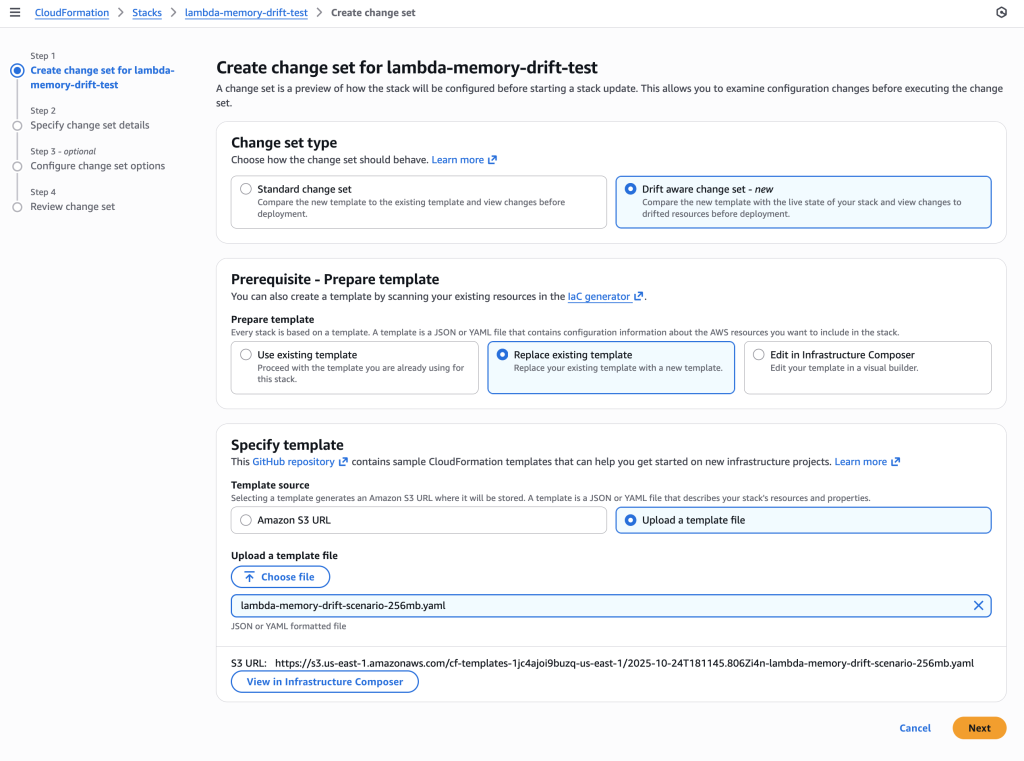
CloudFormation console showing the new “Drift aware change set” option selected. This compares the new template with the live state of your stack and shows changes to drifted resources before deployment, unlike standard change sets that only compare templates.
aws cloudformation create-change-set \
--stack-name lambda-memory-drift-test \
--change-set-name detect-memory-overwrite \
--template-body file://lambda-memory-drift-scenario-256mb.yaml \
--deployment-mode REVERT_DRIFT \
--capabilities CAPABILITY_IAM \
--region us-east-1
4. Review Change Set – The Critical Three-Way Comparison
Examine the drift-aware change set to see the dangerous memory reduction that would occur.
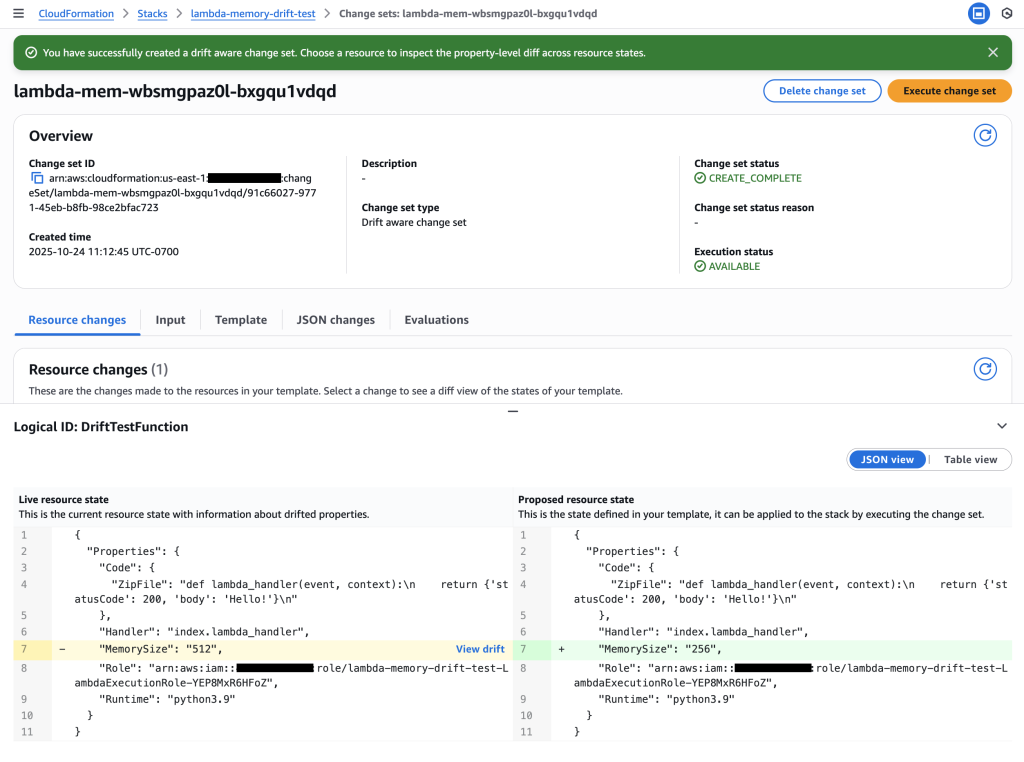
Critical insight revealed: The change set shows Live resource state (512 MB) vs Proposed resource state (256 MB), revealing a dangerous memory reduction that would impact performance.
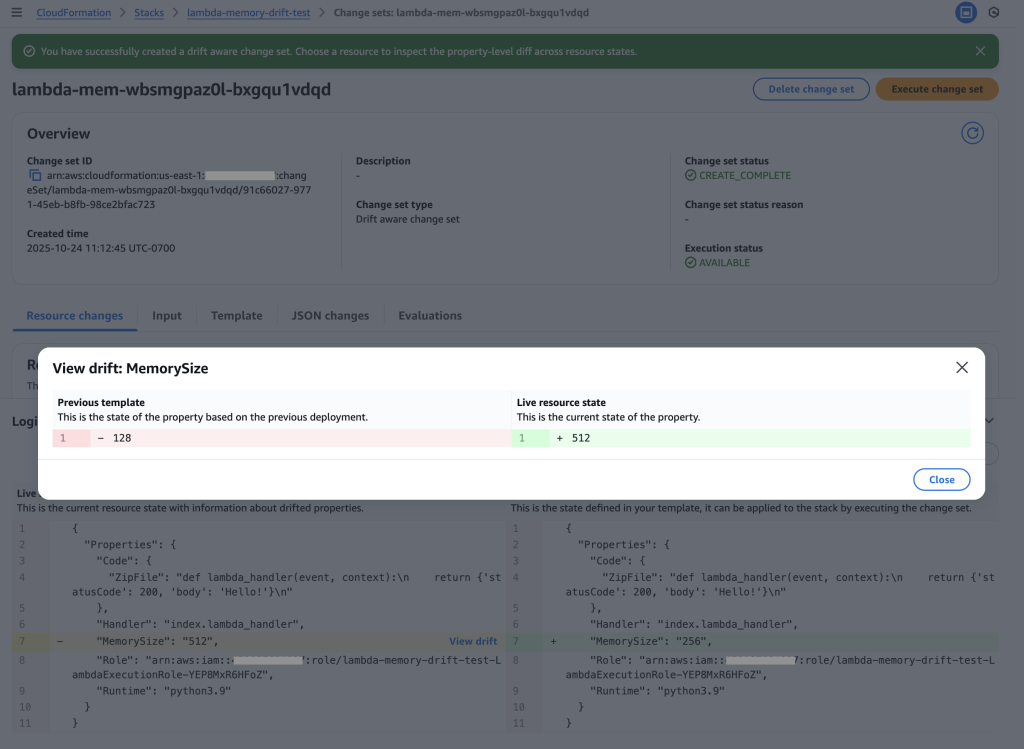
Drift analysis: Clicking “View drift” reveals the complete picture – Previous template (128 MB) vs Live resource state (512 MB). This shows the live state has 4x more memory than the original template, indicating emergency changes were made during the outage that must be preserved.
Key Insight: The drift-aware change set reveals that:
- Previous template: 128 MB (original deployment)
- Live resource state: 512 MB (emergency change during outage)
- Proposed template: 256 MB (new deployment)
This would cause a dangerous reduction from 512 MB to 256 MB, potentially recreating the original performance issue. Without drift-aware change sets, this critical information would be hidden.
5. Recreate Drift-aware Change Set with Updated Template (512MB) to Resolve Drift
Update the template to match the live production state (512 MB) and create a new drift-aware change set to safely resolve the drift.
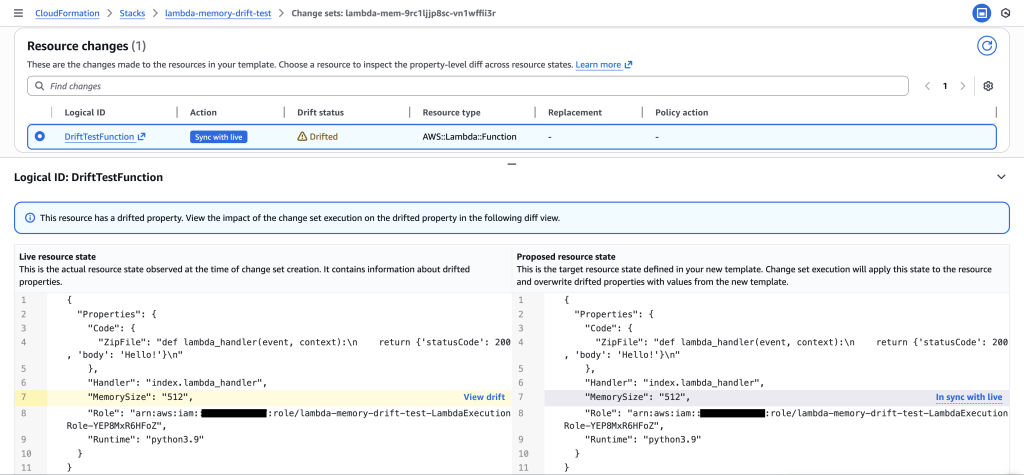
Resolution confirmed: The drift-aware change set shows both Live resource state and Proposed resource state at 512 MB, with change set action ” Sync with live”. This verifies that the updated template now matches production, preventing the dangerous memory reduction and safely resolving the drift without impacting performance.
CloudFormation Templates
Initial Template (128 MB):
Resources:
  DriftTestFunction:
    Type: AWS::Lambda::Function
    Properties:
      Runtime: python3.9
      Handler: index.lambda_handler
      MemorySize: 128
      ReservedConcurrentExecutions: 5
      Role: !GetAtt LambdaExecutionRole.Arn
      Code:
        ZipFile: |
          def lambda_handler(event, context):
              return {'statusCode': 200, 'body': 'Hello!'}
  LambdaExecutionRole:
    Type: AWS::IAM::Role
    Properties:
      AssumeRolePolicyDocument:
        Statement:
          - Effect: Allow
            Principal:
              Service: lambda.amazonaws.com
            Action: sts:AssumeRole
      ManagedPolicyArns:
        - arn:aws:iam::aws:policy/service-role/AWSLambdaBasicExecutionRole
Updated Template (256 MB – lambda-memory-drift-scenario-256mb.yaml):
Resources:
  DriftTestFunction:
    Type: AWS::Lambda::Function
    Properties:
      Runtime: python3.9
      Handler: index.lambda_handler
      MemorySize: 256
      ReservedConcurrentExecutions: 5
      Role: !GetAtt LambdaExecutionRole.Arn
      Code:
        ZipFile: |
          def lambda_handler(event, context):
              return {'statusCode': 200, 'body': 'Hello!'}
  LambdaExecutionRole:
    Type: AWS::IAM::Role
    Properties:
      AssumeRolePolicyDocument:
        Statement:
          - Effect: Allow
            Principal:
              Service: lambda.amazonaws.com
            Action: sts:AssumeRole
      ManagedPolicyArns:
        - arn:aws:iam::aws:policy/service-role/AWSLambdaBasicExecutionRole
CLI Commands
- Create stack:
aws cloudformation create-stack --stack-name lambda-memory-drift-test --template-body file://lambda-memory-drift-scenario.yaml --capabilities CAPABILITY_IAM --region us-east-1
- Get function name:
aws cloudformation describe-stack-resources --stack-name lambda-memory-drift-test --logical-resource-id DriftTestFunction --query 'StackResources[0].PhysicalResourceId' --output text --region us-east-1
- Create drift-aware change set:
aws cloudformation create-change-set --stack-name lambda-memory-drift-test --change-set-name detect-memory-overwrite --template-body file://lambda-memory-drift-scenario-256mb.yaml --deployment-mode REVERT_DRIFT --capabilities CAPABILITY_IAM --region us-east-1
- Describe change set:
aws cloudformation describe-change-set --change-set-name detect-memory-overwrite --stack-name lambda-memory-drift-test --region us-east-1
Scenario 2: Remediate Unauthorized Changes
This scenario demonstrates how drift-aware change sets systematically remediate unauthorized changes when a developer adds temporary debugging rules to a security group but forgets to remove them, creating a compliance violation.
Story: Your team deploys a security group with only HTTP access via CloudFormation for compliance. During debugging, a developer adds SSH access (port 22) through the AWS Console for their IP address to troubleshoot an application issue. They forget to remove this rule after debugging. Later, security compliance requires reverting to the original template state. A standard change set shows no changes since the template is unchanged, but a drift-aware change set can detect and systematically remove the unauthorized SSH rule.
User journey: Create stack with HTTP-only access => Add SSH rule via console for debugging => Forget to remove SSH rule => Create drift-aware change set with REVERT_DRIFT mode => Review change set showing SSH rule removal => Execute change set to restore compliance
Scenario Flow
1. Create Stack
Deploy CloudFormation stack with security group allowing only HTTP traffic.
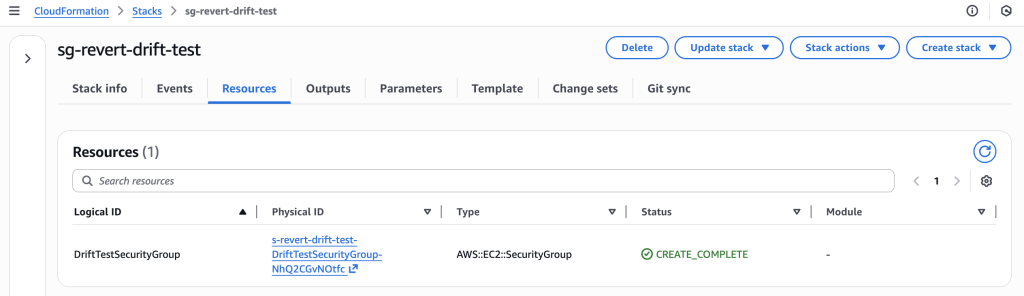
CloudFormation stack “sg-revert-drift-test” successfully deployed with DriftTestSecurityGroup resource
2. Make Unauthorized Changes (Console)
Manually add SSH ingress rule through AWS Console (simulating developer debugging access that wasn’t removed).
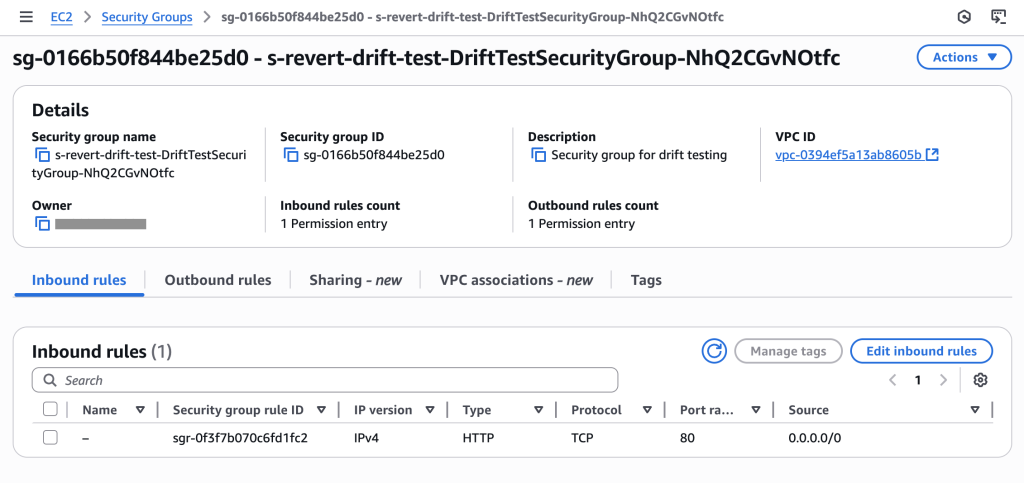
Initial security group showing only HTTP (port 80) access as configured in template – compliant state
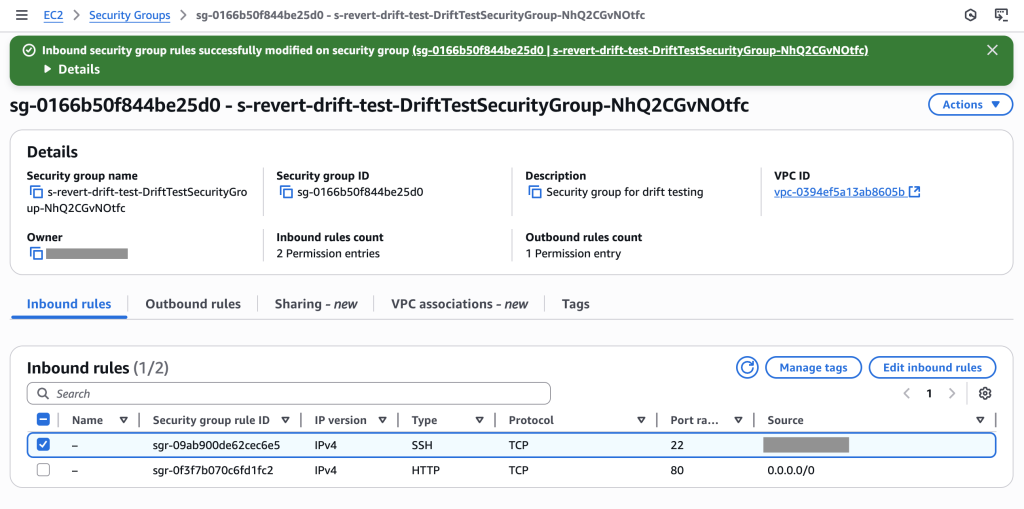
Security group now shows 2 permission entries: SSH (port 22) for specific IP and HTTP (port 80) for all traffic. The SSH rule creates drift and a compliance violation that needs systematic removal.
3. Create Drift-Aware Change Set
Create change set using REVERT_DRIFT mode to systematically remove the unauthorized SSH rule.
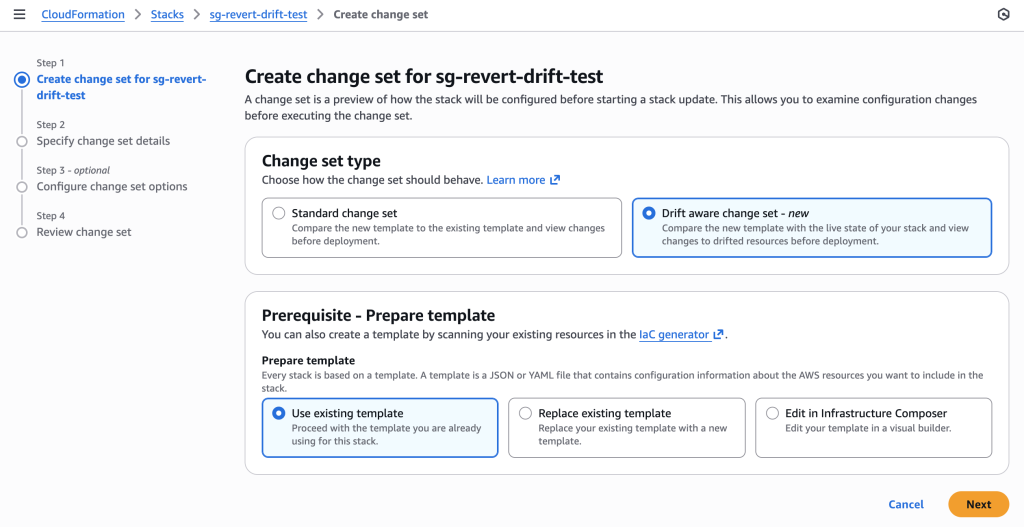
Creating drift-aware change set for security group compliance restoration. Note the “Drift aware change set” option is selected to compare with live state and detect unauthorized changes.
aws cloudformation create-change-set \
--stack-name sg-revert-drift-test \
--change-set-name revert-ssh-drift \
--use-previous-template \
--deployment-mode REVERT_DRIFT \
--region us-east-1
4. Review Change Set – Systematic Compliance Restoration
Examine the drift-aware change set to see systematic removal of unauthorized SSH rule.
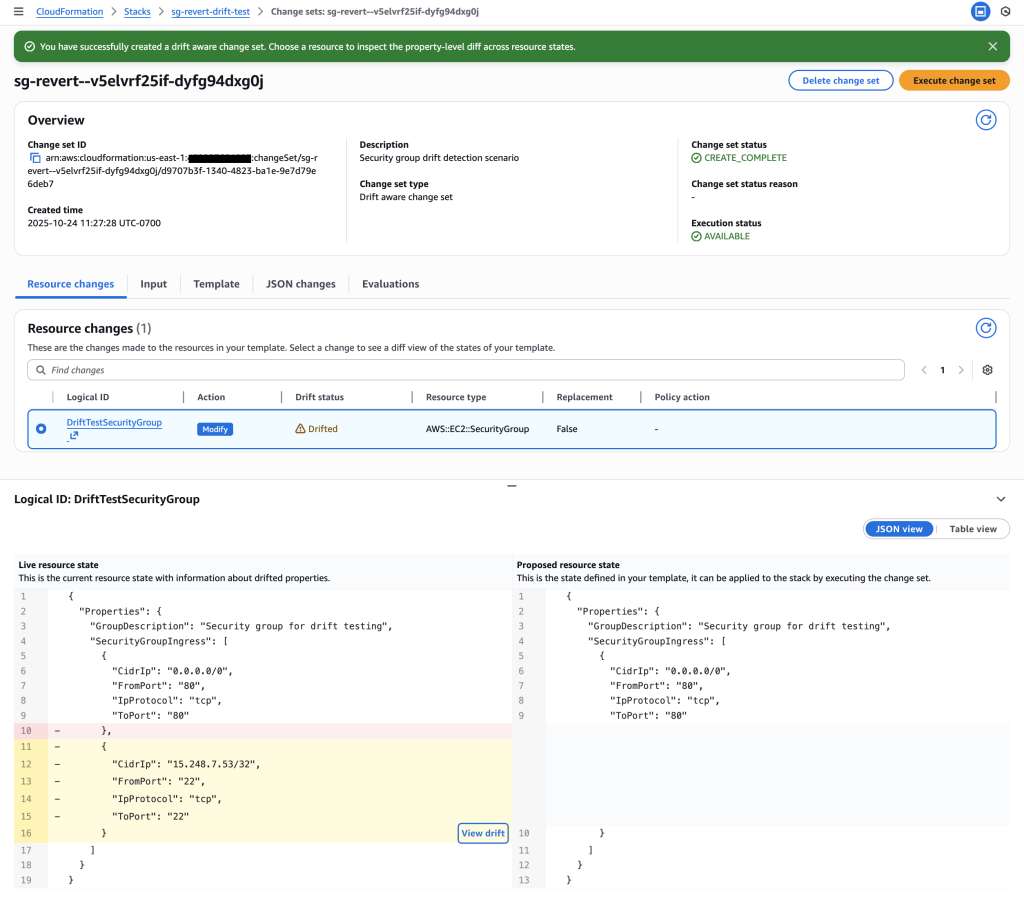
Compliance violation detected: The drift -aware change set shows that the SSH rule in the live resource state (rule 232 for IP 15.248.7.53/32 on port 22) is not present in the proposed resource state derived from the template. This unauthorized SSH rule violates security policy and will be systematically removed
Key Insight: The drift-aware change set enables systematic compliance restoration by:
- Previous template: Only HTTP (port 80) access – compliant state
- Live resource state: HTTP + SSH (port 22) for 15.248.7.53/32 – compliance violation
- Action: Remove unauthorized SSH rule to restore compliance
This provides a systematic, auditable way to remove unauthorized changes rather than manual cleanup.
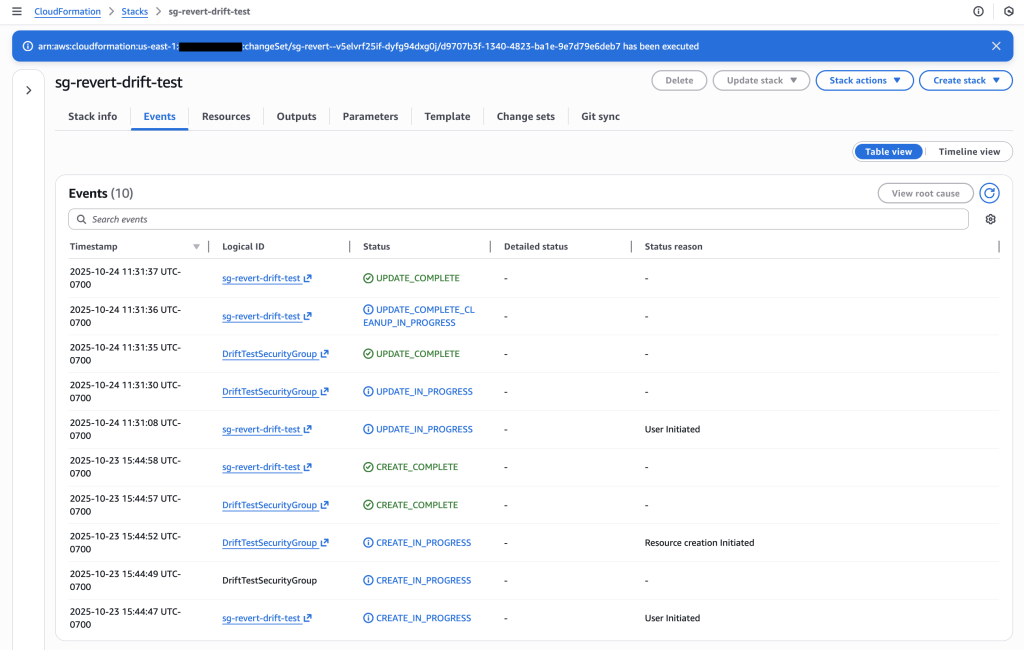
Stack events showing successful execution of the drift-aware change set – SSH rule removed
CloudFormation Templates
security-group-drift-scenario.yaml:
Resources:
  DriftTestSecurityGroup:
    Type: AWS::EC2::SecurityGroup
    Properties:
      GroupDescription: "Security group for drift testing"
      SecurityGroupIngress:
        - IpProtocol: tcp
          FromPort: 80
          ToPort: 80
          CidrIp: 0.0.0.0/0
          Description: "Allow HTTP traffic for demo purposes"
      SecurityGroupEgress:
        - IpProtocol: -1
          CidrIp: 0.0.0.0/0
          Description: "Allow all outbound traffic"
CLI Commands
- Create stack:
aws cloudformation create-stack --stack-name sg-revert-drift-test --template-body file://security-group-drift-scenario.yaml --region us-east-1
- Get security group ID:
aws ec2 describe-security-groups --filters "Name=tag:aws:cloudformation:stack-name,Values=sg-revert-drift-test" --query 'SecurityGroups[0].GroupId' --output text --region us-east-1
- Create drift-aware change set:
aws cloudformation create-change-set --stack-name sg-revert-drift-test --change-set-name revert-ssh-drift --template-body file://security-group-drift-scenario.yaml --deployment-mode REVERT_DRIFT --region us-east-1
- Describe change set:
aws cloudformation describe-change-set --change-set-name revert-ssh-drift --stack-name sg-revert-drift-test --region us-east-1
Scenario 3: Recreate Deleted Resources
This scenario demonstrates drift detection when a dependent resource (logs bucket) is accidentally deleted outside of CloudFormation during troubleshooting. The main application bucket depends on this logs bucket for access logging. You need to recreate the deleted resource while maintaining the existing infrastructure dependencies.
Story: Your team deploys a main S3 bucket with a dependent logs bucket for access logging via CloudFormation. During troubleshooting, an operator accidentally deletes the logs bucket through the AWS Console. The main bucket still exists but its logging configuration now references a non-existent bucket. You need to recreate the deleted logs bucket while maintaining the dependency relationship.
User journey: Create stack with main and logs buckets => Accidentally delete logs bucket => Create drift-aware change set with REVERT_DRIFT mode => Review change set showing LogBucket will be recreated => Execute change set to restore deleted resource
Scenario Flow
1. Create Stack
Deploy CloudFormation stack with main S3 bucket and dependent logs bucket.
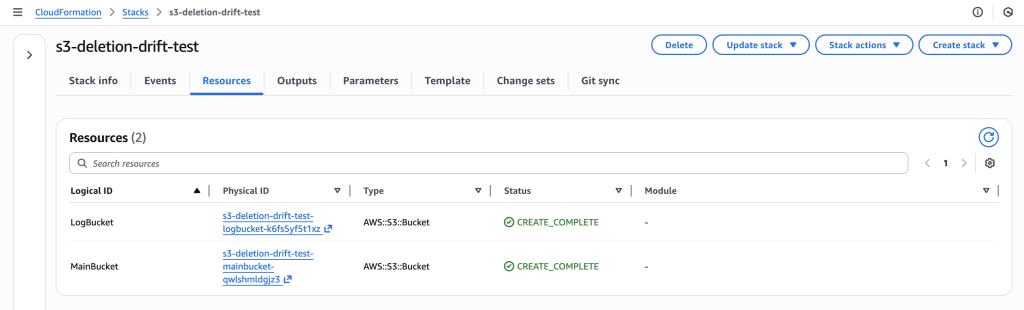
CloudFormation stack “s3-deletion-drift-test” successfully deployed with both LogBucket and MainBucket resources in CREATE_COMPLETE status
2. Accidental Deletion (Console)
Manually delete the logs bucket through AWS Console (simulating accidental deletion during troubleshooting).
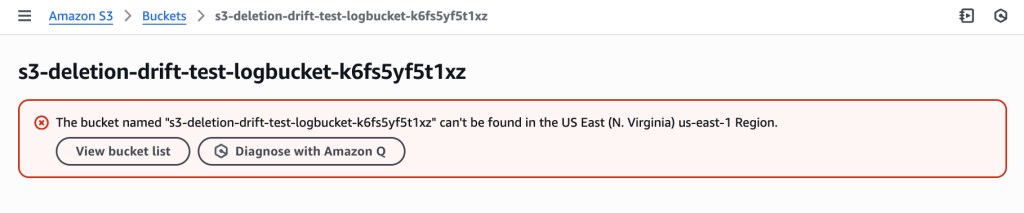
LogBucket accidentally deleted outside of CloudFormation during troubleshooting, creating drift – the MainBucket still exists but its logging configuration now references a non-existent bucket
3. Create Drift-Aware Change Set
Create change set using REVERT_DRIFT mode to recreate the deleted LogBucket.
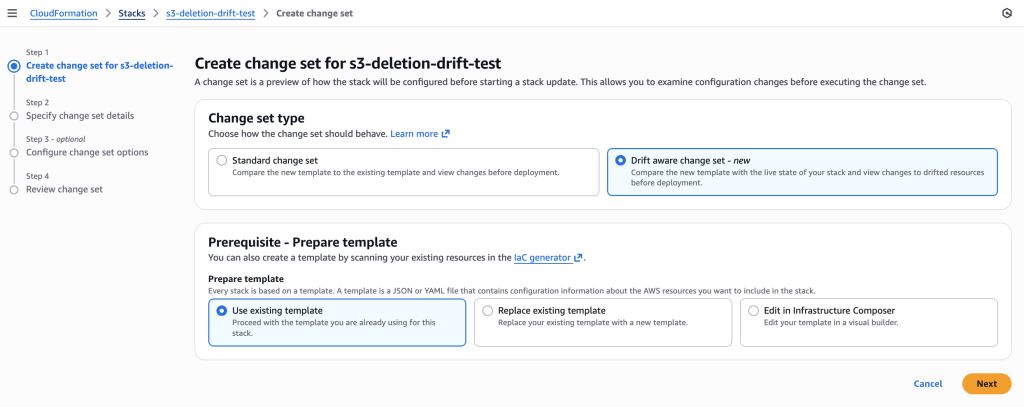
Creating drift-aware change set with “Drift aware change set” option selected to detect and recreate the deleted resource by comparing template with live state
aws cloudformation create-change-set \
--stack-name s3-deletion-drift-test \
--change-set-name recreate-deleted-bucket \
--use-previous-template \
--deployment-mode REVERT_DRIFT \
--region us-east-1
4. Review Change Set – Resource Recreation
Examine change set to see LogBucket recreation while preserving MainBucket dependencies.
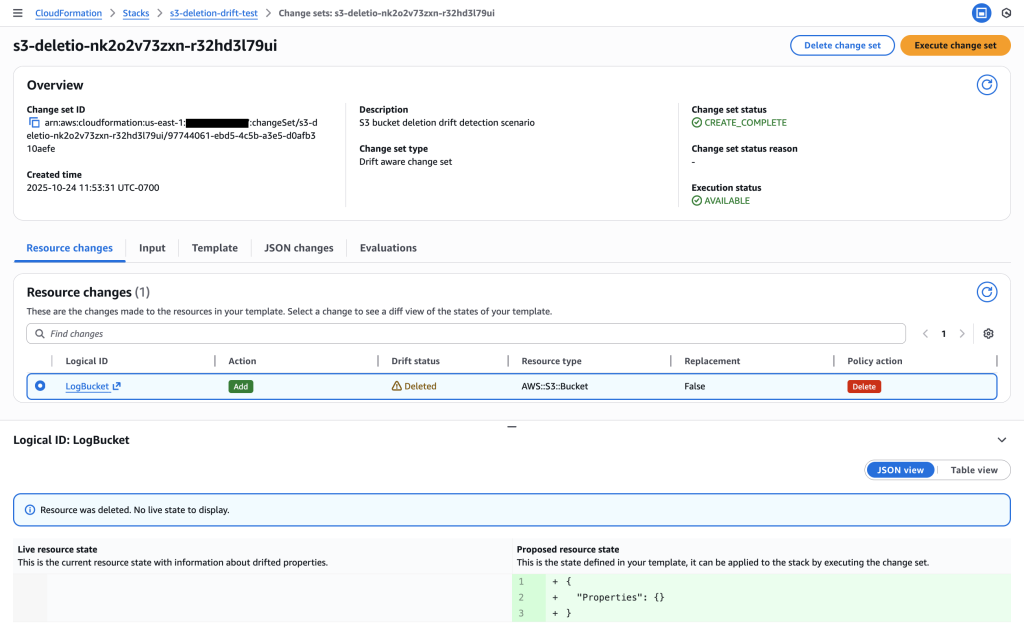
Change set preview showing LogBucket will be recreated to restore the deleted resource and MainBucket updated to maintain infrastructure dependencies
Key Insight: The drift-aware change set detects that:
- Template expectation: Both LogBucket and MainBucket should exist
- Live resource state: Only MainBucket exists, LogBucket is missing
- Action: Recreate LogBucket with original configuration to restore logging functionality
This enables systematic recovery of accidentally deleted resources while maintaining infrastructure dependencies.
CloudFormation Templates
s3-drift-scenario.yaml:
Resources:
  LogBucket:
    Type: AWS::S3::Bucket
    Properties:
      BucketEncryption:
        ServerSideEncryptionConfiguration:
          - ServerSideEncryptionByDefault:
              SSEAlgorithm: AES256
      PublicAccessBlockConfiguration:
        BlockPublicAcls: true
        BlockPublicPolicy: true
        IgnorePublicAcls: true
        RestrictPublicBuckets: true
      VersioningConfiguration:
        Status: Enabled

  MainBucket:
    Type: AWS::S3::Bucket
    Properties:
      BucketEncryption:
        ServerSideEncryptionConfiguration:
          - ServerSideEncryptionByDefault:
              SSEAlgorithm: AES256
      PublicAccessBlockConfiguration:
        BlockPublicAcls: true
        BlockPublicPolicy: true
        IgnorePublicAcls: true
        RestrictPublicBuckets: true
      VersioningConfiguration:
        Status: Enabled
      LoggingConfiguration:
        DestinationBucketName: !Ref LogBucket
CLI Commands
- Create stack:
aws cloudformation create-stack --stack-name s3-deletion-drift-test --template-body file://s3-drift-scenario.yaml --region us-east-1
- Get LogBucket name:
aws cloudformation describe-stack-resources --stack-name s3-deletion-drift-test --logical-resource-id LogBucket --query 'StackResources[0].PhysicalResourceId' --output text --region us-east-1
- Create drift-aware change set:
aws cloudformation create-change-set --stack-name s3-deletion-drift-test --change-set-name recreate-deleted-bucket --template-body file://s3-drift-scenario.yaml --deployment-mode REVERT_DRIFT --region us-east-1
- Describe change set:
aws cloudformation describe-change-set --change-set-name recreate-deleted-bucket --stack-name s3-deletion-drift-test --region us-east-1
Best Practices
When working with drift-aware change sets, consider these best practices:
• Always review three-way comparisons before executing change sets to understand the full impact
• Use REVERT_DRIFT deployment mode when you want to bring resources back to template compliance
• Document emergency changes made outside of CloudFormation to inform future template updates
• Implement change management processes to minimize unauthorized drift
• Regular drift detection helps identify configuration changes before they become problematic
• Test drift-aware change sets in non-production environments first
Cleanup
Important: Execute these cleanup commands promptly after completing the scenarios to avoid incurring unnecessary AWS charges. Resources such as Lambda functions, S3 buckets (even if empty), and security groups may incur costs if left running. Ensure all stacks are successfully deleted by verifying the DELETE_COMPLETE status.
Commands to delete all test resources:
# Scenario 1: Lambda Memory Drift
aws cloudformation delete-stack --stack-name lambda-memory-drift-test --region us-east-1

# Scenario 2: Security Group Drift
aws cloudformation delete-stack --stack-name sg-revert-drift-test --region us-east-1

# Scenario 3: S3 Bucket Deletion Drift
aws cloudformation delete-stack --stack-name s3-deletion-drift-test --region us-east-1

# Verify all stacks are deleted
aws cloudformation list-stacks --stack-status-filter DELETE_COMPLETE --region us-east-1
Note: CloudFormation will automatically clean up all resources created by the stacks, including Lambda functions, security groups, and S3 buckets.
Conclusion
Drift-aware change sets enable you to mitigate the operational and security risks of configuration drift, allowing you to confidently automate and govern your infrastructure updates with CloudFormation. Through the scenarios described in this post, you have seen how you can leverage drift-aware change sets to prevent outages in production environments, maintain the integrity of your test environments, and manage the compliance posture of all environments. Remember to thoroughly review the infrastructure changes previewed by drift-aware change sets before executing deployments.
Available Now
Drift-aware change sets are available in AWS Regions where CloudFormation is available. Please refer to the AWS Region table to learn more.
New Amazon Threat Intelligence findings: Nation-state actors bridging cyber and kinetic warfare
Post Syndicated from CJ Moses original https://aws.amazon.com/blogs/security/new-amazon-threat-intelligence-findings-nation-state-actors-bridging-cyber-and-kinetic-warfare/
The new threat landscape
The line between cyber warfare and traditional kinetic operations is rapidly blurring. Recent investigations by Amazon threat intelligence teams have uncovered a new trend that they’re calling cyber-enabled kinetic targeting in which nation-state threat actors systematically use cyber operations to enable and enhance physical operations. Traditional cybersecurity frameworks often treat digital and physical threats as separate domains. However, research by Amazon demonstrates that this separation is increasingly artificial. Multiple nation-state threat groups are pioneering a new operational model where cyber reconnaissance directly enables kinetic targeting.
We’re seeing a fundamental shift in how nation-state actors approach warfare. These aren’t just cyber attacks that happen to cause physical damage; they are coordinated campaigns where digital operations are specifically designed to support physical military objectives.
Unique visibility at Amazon
The ability of Amazon Threat Intelligence to identify these campaigns stems from their unique position in the global threat landscape:
- Threat intelligence telemetry: Amazon global cloud operations provide visibility into threats across diverse environments, including intelligence from Amazon MadPot honeypot systems, which enable the detection of suspicious patterns, actor infrastructure, and the network pathways used in these cyber-enabled kinetic targeting campaigns.
- Opt-in customer data: Real-world data about attempted threat actor activities provided on an opt-in basis from enterprise environments.
- Industry partner collaboration: Threat intelligence sharing with leading security organizations and government agencies provides additional context and validation for observed activities.
Through this multi-source approach, Amazon can connect dots that might otherwise remain invisible to individual organizations or even government agencies operating in isolation.
Case study 1: Imperial Kitten’s maritime campaign
The first case study involves Imperial Kitten, a threat group suspected of operating on behalf of Iran’s Islamic Revolutionary Guard Corps (IRGC). The timeline reveals the progression from digital reconnaissance to physical attack:
- December 4, 2021: Imperial Kitten compromises a maritime vessel’s Automatic Identification System (AIS) platform, gaining access to critical shipping infrastructure. The Amazon Threat Intelligence team identifies the compromise and works with the affected organization to remediate the security event.
- August 14, 2022: The threat actor expands their maritime targeting of additional vessel platforms. In one incident, they gained access to CCTV cameras aboard a maritime vessel, which provided real-time visual intelligence.
- January 27, 2024: Imperial Kitten conducts targeted searches for AIS location data for a specific shipping vessel. This represents a clear shift from broad reconnaissance to targeted intelligence gathering.
- February 1, 2024: US Central Command reports a missile strike by Houthi forces against the exact vessel that Imperial Kitten had been tracking. While the missile strike was ultimately ineffective, the correlation between the cyber reconnaissance and kinetic strike is unmistakable.
This case demonstrates how cyber operations can provide adversaries with the precise intelligence needed to conduct targeted physical attacks against maritime infrastructure—a critical component of global commerce and military logistics.
Case study 2: MuddyWater’s Jerusalem operations
The second case study involves MuddyWater, a threat group attributed by the US government to Rana Intelligence Computer Company, operating at the behest of Iran’s Ministry of Intelligence and Security (MOIS). This case reveals an even more direct connection between cyber operations and kinetic targeting.
- May 13, 2025: MuddyWater provisions a server specifically for cyber network operations, establishing the infrastructure needed for their campaign.
- June 17, 2025: The threat actor uses their server infrastructure to access another compromised server containing live CCTV streams from Jerusalem. This provides real-time visual intelligence of potential targets within the city.
- June 23, 2025: Iran launches widespread missile attacks against Jerusalem. On the same day, Israeli authorities report that Iranian forces were exploiting compromised security cameras to gather real-time intelligence and adjust missile targeting.
The timing is not coincidental. As reported by The Record, Israeli officials urged citizens to disconnect internet-connected security cameras, warning that Iran was exploiting them to “gather real-time intelligence and adjust missile targeting.”
Technical infrastructure and methods
Research by Amazon reveals the sophisticated technical infrastructure supporting these operations. The threat actors employ a multi-layered approach:
- Anonymizing VPN networks: Threat actors route their traffic through anonymizing VPN services to obscure their true origins and make attribution more difficult.
- Actor-controlled servers: Dedicated infrastructure provides persistent access and command-and-control capabilities for ongoing operations.
- Compromised enterprise systems: The ultimate targets—enterprise servers hosting critical infrastructure like CCTV systems, maritime platforms, and other intelligence-rich environments.
- Real-time data streaming: Live feeds from compromised cameras and sensors provide actionable intelligence that can be used to adjust targeting in near real time.
Defining a new category of warfare
The research team proposes new terminology to describe these hybrid operations. Traditional frameworks fall short:
- Cyber-kinetic operations typically refer to cyber attacks that cause physical damage to systems
- Hybrid warfare is too broad, encompassing multiple types of warfare without specific focus on the cyber-physical integration
Amazon researchers suggest cyber-enabled kinetic targeting as a more precise term for campaigns where cyber operations are specifically designed to enable and enhance kinetic military operations.
Implications for defenders
For the cybersecurity community, this research serves as both a warning and a call to action. Defenders must adapt their strategies to address threats that span both digital and physical domains. Organizations that historically believed they weren’t of interest to threat actors could now be targeted for tactical intelligence. We must expand our threat models, enhance our intelligence sharing, and develop new defensive strategies that account for the reality of cyber-enabled kinetic targeting across diverse adversaries.
- Expanded threat modeling: Organizations must consider not just the direct impact of cyberattacks, but how compromised systems might be used to support physical attacks against themselves or others.
- Critical infrastructure protection: Operators of maritime systems, urban surveillance networks, and other infrastructure must recognize that their systems might be valuable not just for espionage, but as targeting aids for kinetic operations.
- Intelligence sharing: The cases demonstrate the critical importance of threat intelligence sharing between private sector organizations, government agencies, and international partners.
- Attribution challenges: When cyber operations directly enable kinetic attacks, the attribution and response frameworks become more complex, potentially requiring coordination between cybersecurity, military, and diplomatic channels.
Looking forward
We believe that cyber-enabled kinetic targeting will become increasingly common across multiple adversaries. Nation-state actors are recognizing the force multiplier effect of combining digital reconnaissance with physical attacks. This trend represents a fundamental evolution in warfare, where the traditional boundaries between cyber and kinetic operations are dissolving.
Indicators of Compromise
IOC Value, IOC Type, First Seen, Last Seen, Annotation
18[.]219.14.54, IPv4, 2025-05-13, 2025-06-17, MuddyWater Command and Control IP address
85[.]239.63.179, IPv4, 2023-08-13, 2025-09-19, Imperial Kitten proxy IP address
37[.]120.233.84, IPv4, 2021-01-01, 2022-11-01, Imperial Kitten proxy IP address
95[.]179.207.105, IPv4, 2020-11-11, 2022-04-09, Imperial Kitten proxy IP address
This blog post is based on research presented at CYBERWARCON by David Magnotti, Principal Engineer, and Dlshad Othman, Senior Threat Intelligence Engineer, both of Amazon Threat Intelligence. The authors thank US Central Command for their transparency in reporting military activities and acknowledge the ongoing support of customers and partners in these critical investigations.
If you have feedback about this post, submit comments in the Comments section below. If you have questions about this post, contact AWS Support.
CVE-2025-13315, CVE-2025-13316: Critical Twonky Server Authentication Bypass (NOT FIXED)
Post Syndicated from Ryan Emmons original https://www.rapid7.com/blog/post/cve-2025-13315-cve-2025-13316-critical-twonky-server-authentication-bypass-not-fixed
Overview
Twonky Server version 8.5.2 is susceptible to two vulnerabilities that facilitate administrator authentication bypass on Linux and Windows. An unauthenticated attacker can improperly access a privileged web API endpoint to leak application logs, which contain encrypted administrator credentials (CVE-2025-13315). As a result of the use of hardcoded encryption keys, the attacker can then decrypt these credentials and login as an administrator to Twonky Server (CVE-2025-13316). Exploitation results in the unauthenticated attacker gaining plain text administrator credentials, full administrator access to the Twonky Server instance, and control of all stored media files. These vulnerabilities are tracked as CVE-2025-13315 and CVE-2025-13316.
These vulnerabilities have not been patched. Despite making contact with the vendor, and the vendor confirming receipt of our technical disclosure document, the vendor ceased communications after disclosure. They stated that a patch wouldn’t be possible, even with a disclosure timeline extension, and subsequent follow-up attempts on our part were unsuccessful. As such, the vulnerable version 8.5.2 is the latest available.
Product description
Twonky Server is media server software marketed to both organizations and individuals. It’s generally designed to run on embedded systems, such as NAS devices and routers, for media organization, access, and streaming. At the time of publication, Shodan returns approximately 850 Twonky Server services exposed to the public internet.
Credit
These issues were discovered and reported to Lynx Technology by Ryan Emmons, Staff Security Researcher at Rapid7. The vulnerabilities are being disclosed in accordance with Rapid7’s vulnerability disclosure policy. This work is based on the previous Twonky Server research published by Sven Krewitt.
Vulnerability details
|
CVE |
Description |
CVSS |
|
CVE-2025-13315 |
An unauthenticated remote attacker can bypass web service API authentication controls to leak a log file and read the administrator’s username and encrypted password. |
|
|
CVE-2025-13316 |
The application uses hardcoded encryption keys across installations. An attacker with an encrypted administrator password value can decrypt it into plain text using these hardcoded keys. |
The testing target was Twonky Server 8.5.2, the latest version available at the time of research. Rapid7 identified two security vulnerabilities as part of this research project, which are outlined in the table above. These vulnerabilities were tested against Twonky Server installed on two different operating systems: Ubuntu Linux 22.04.1 and Windows Server 2022. When exploited, these vulnerabilities effectively serve as a patch bypass for the security mitigations introduced in response to the two vulnerabilities disclosed by Risk Based Security in 2021.
CVE-2025-13315
In 2021, the security firm Risk Based Security disclosed an improper API access vulnerability in Twonky Server, for which no CVE is assigned. Their approach was to leak the administrator’s username and obfuscated password via requests to /rpc/get_option?accessuser and /rpc/get_option?accesspwd, which previously did not enforce authentication checks. In the patch, authentication checks were implemented for the /rpc web API. However, some administrator RPC API endpoints, such as log_getfile, are still accessible without authentication via alternative routing.
00461ddf                                if (!check_path(&arg1[2], "/rpc/info_status"))
00461ddf                                {
00461fc8                                    if (check_path(&arg1[2], "/rpc/stop"))
00461fcf                                        goto label_461de5;
00461fcf
00461fe4                                    if (check_path(&arg1[2], "/rpc/stream_active"))
00461fe4                                        goto label_461de5;
00461fe4
00461ff9                                    if (check_path(&arg1[2], "/rpc/byebye"))
00461ff9                                        goto label_461de5;
00461ff9
0046200e                                    if (check_path(&arg1[2], "/rpc/wakeup"))
0046200e                                        goto label_461de5;
0046200e
00462023                                    if (check_path(&arg1[2], "/rpc/get_option?language"))
00462023                                        goto label_461de5;
00462023
00462043                                    if (check_path(&arg1[2], "/rpc/get_option?multiusersupportenabled")
00462043                                            || !(var_480_1 & 1))
[..SNIP..]
004621af                                            *(uint64_t*)((char*)arg1 + 0x828) = "text/plain; charset=utf-8";
004621af
004621c9                                            if (check_path(&arg1[2], "/rpc/log_getfile"))
004621c9                                            {
004622bf                                                char* rax_59 = getlogfile();
⠀
The decompiled binary contains the string “/nmc/rpc/”, which is referenced in various functions containing request routing logic within the codebase.
⠀
⠀
Jumping right into dynamic testing, we observed that some RPC requests with the /nmc/rpc prefix succeeded without authentication.
An example is depicted below, calling the log_getfile web API endpoint with the typical /rpc prefix without authenticating.
⠀
⠀
Announcing the updated AWS Well-Architected Generative AI Lens
Post Syndicated from Dan Ferguson original https://aws.amazon.com/blogs/architecture/announcing-the-updated-aws-well-architected-generative-ai-lens/
We are delighted to announce an update to the AWS Well-Architected Generative AI Lens. This update features several new sections of the Well-Architected Generative AI Lens, including new best practices, advanced scenario guidance, and improved preambles on responsible AI, data architecture, and agentic workflows.
The AWS Well-Architected Framework provides architectural best practices for designing and operating generative AI workloads on AWS. The Generative AI Lens uses the Well-Architected Framework to outline the steps for performing a Well-Architected Framework review for your generative AI workloads.

The Generative AI Lens provides a consistent approach for customers to evaluate architectures that use large language models (LLMs) to achieve their business goals. This lens addresses common considerations relevant to model selection, prompt engineering, model customization, workload integration, and continuous improvement. Specifically excluded from the Generative AI Lens are best practices associated with model training and advanced model customization techniques. We identify best practices that help you architect your cloud-based applications and workloads according to AWS Well-Architected design principles gathered from supporting thousands of customer implementations.
The Generative AI Lens joins a collection of Well-Architected lenses published under AWS Well-Architected Lenses. For more information on the lens itself, check out the launch announcement post.
What has changed in the updated Generative AI Lens?
The updated Generative AI Lens incorporates several new additions for customers to review. These additions keep the lens on-pace with the rapidly growing area of generative AI, helping customers stay up to date with architectural best practices.
Amazon SageMaker HyperPod guidance
The updated lens features additional guidance for users of Amazon SageMaker HyperPod. SageMaker HyperPod is a highly resilient model training and hosting service that you can use to orchestrate complex, long-running generative AI workflows in the cloud. These workflows could be foundation model pre-training or serving model inference at scale.
We are excited to announce additional guidance for customers using SageMaker HyperPod in the Generative AI Lens. This guidance is built into the existing best practices, expanding the guidance for covered services to include SageMaker capabilities. This guidance joins the existing guidance on Amazon Bedrock, Amazon Q Business, Amazon Q Developer, and Amazon SageMaker AI.
Responsible AI preamble
The updated responsible AI preamble now includes a detailed discussion on the eight core dimensions of responsible AI as described by AWS. Customers can now learn more about the eight dimensions of responsibly developed AI systems directly within the lens. This is required reading for customers in all stages of their generative AI journey.
Data architecture preamble
The updated data architecture preamble reviews strategic considerations associated with a modern data architecture supporting generative AI workloads. This section provides customers with a view into the high-level decisions and considerations needed to architect a data system that services generative AI workloads.
Agentic AI preamble
New to the generative AI lens is the agentic AI preamble. Agentic systems, while technically classified as a subset of distributed computing, play an important role in modern generative AI workloads. This preamble introduces customers to a sampling of architecture paradigms common in agentic systems powered by foundation models.
Scenarios
The Generative AI Lens now includes eight architecture scenarios. These scenarios cover a range of common generative AI powered business applications, including autonomous call centers, knowledge worker co-pilots, and multi-tenant generative AI service systems. The scenario section provides specific guidance for applying generative AI technologies to common business problems. The following image is an example of one of the new scenarios now included in the Generative AI Lens.

Who should use the Generative AI Lens?
The Generative AI Lens is useful to many roles. Business leaders can use this lens to acquire a broader appreciation of the end-to-end implementation and benefits of generative AI. Data scientists and engineers can read this lens to understand how to use, secure, and gain insights from their data at scale. Risk and compliance leaders can understand how generative AI is implemented responsibly by providing compliance with regulatory and governance requirements.
Next steps
The updated Well-Architected Generative AI Lens is available now. Use the lens as a framework to verify that your generative AI workloads are architected with operational excellence, security, reliability, performance efficiency, cost optimization, and sustainability in mind.
If you require support on the implementation or assessment of your generative AI workloads, please contact your AWS Solutions Architect or Account Representative.
Special thanks to everyone across the AWS Solution Architecture, AWS Professional Services, and Machine Learning communities who contributed to the updated Generative AI Lens. These contributions encompassed diverse perspectives, expertise, backgrounds, and experiences in developing the new AWS Well-Architected Generative AI Lens.
For additional reading, refer to the AWS Well-Architected Framework and pillar whitepapers, or use the AWS Well-Architected Machine Learning Lens and its custom lens accessible from the AWS Well-Architected Tool.
About the authors
Announcing the updated AWS Well-Architected Machine Learning Lens
Post Syndicated from Steven DeVries original https://aws.amazon.com/blogs/architecture/announcing-the-updated-aws-well-architected-machine-learning-lens/
We are excited to announce the updated AWS Well-Architected Machine Learning Lens, now enhanced with the latest capabilities and best practices for building machine learning (ML) workloads on AWS.
The AWS Well-Architected Framework provides architectural best practices for designing and operating reliable, secure, efficient, cost-effective, and sustainable workloads in the cloud. The Machine Learning Lens uses the Well-Architected Framework to outline the steps for performing a comprehensive review of your ML architectures.
The updated Machine Learning Lens provides a consistent approach for customers to evaluate architectures across ML workloads, from traditional supervised and unsupervised learning to modern AI applications. This lens addresses common considerations relevant to the complete ML lifecycle, including business goal identification, problem framing, data processing, model development, deployment, and monitoring. The lens incorporates the latest AWS ML services and capabilities introduced since 2023, providing access to current best practices and implementation guidance.
The Machine Learning Lens is part of a collection of Well-Architected lenses published under AWS Well-Architected Lenses.
What is the Machine Learning Lens?
The Well-Architected Machine Learning Lens focuses on the six pillars of the Well-Architected Framework across six phases of the ML lifecycle.
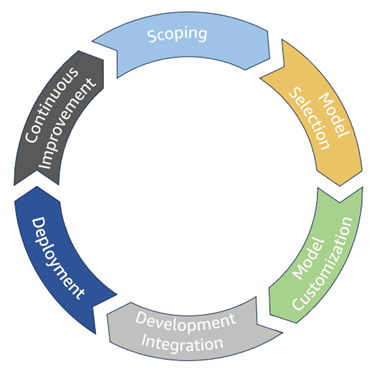
The six phases are:
- Business goal identification: Establishing clear business objectives and success criteria for your ML initiative.
- ML problem framing: Translating business problems into well-defined ML problems with appropriate metrics.
- Data processing: Collecting, preparing, and engineering features from your data sources.
- Model development: Building, training, tuning, and evaluating ML models with proper experimentation tracking.
- Model deployment: Deploying models into production environments with appropriate infrastructure and monitoring.
- Model monitoring: Continuously monitoring model performance and maintaining model quality over time.
Unlike the traditional waterfall approach, an iterative approach is required to achieve a working prototype based on the six phases of the ML lifecycle. The lens provides you with a set of established cloud-agnostic best practices in the form of Well-Architected Framework pillars for each ML lifecycle phase.
You can also use the Well-Architected Machine Learning Lens wherever you are on your cloud journey. You can choose to apply this guidance either during the design of your ML workloads or after your workloads have entered production as a part of the continuous improvement process.
Machine Learning Lens components
The lens includes four focus areas:
- Well-Architected ML design principles: Ten design principles that frame the presented best practices, including assign ownership, enable reproducibility, optimize resources, and enable continuous improvement.
- The ML lifecycle and the Well-Architected Framework pillars: This considers all aspects of the ML lifecycle and reviews design strategies aligned to the pillars of the overall Well-Architected Framework:
- Operational excellence: Ability to support ongoing development, run ML workloads effectively, gain insight into operations, and continuously improve processes.
- Security: Ability to protect data, models, and ML infrastructure while taking advantage of cloud technologies to improve security posture.
- Reliability: Ability of ML workloads to perform their intended function correctly and consistently, with automatic recovery from failure situations.
- Performance efficiency: Ability to use computing resources efficiently for ML workloads and maintain efficiency as demand and technologies evolve.
- Cost optimization: Ability to run ML systems to deliver business value at the lowest price point through resource optimization and automation.
- Sustainability: Addresses the environmental impact of ML workloads, focusing on energy consumption and resource efficiency.
- Cloud-agnostic best practices: 100+ comprehensive best practices covering each ML lifecycle phase across the Well-Architected Framework pillars. Each best practice includes:
- Implementation guidance: Detailed AWS implementation plans with references to current AWS ML services and capabilities.
- Resources: Curated links to AWS documentation, blogs, videos, and code examples supporting the best practices.
- Related ML architecture considerations: Discussions on advanced topics including MLOps patterns, data architecture for ML, model governance strategies, and considerations for responsible AI implementation.
What else is discussed in the Machine Learning Lens?
The Machine Learning Lens also discusses the following key topics:
- Responsible AI: Comprehensive guidance on implementing fair, explainable, and unbiased ML systems throughout the development lifecycle.
- MLOps and automation: Best practices for implementing continuous integration, continuous deployment, and continuous training for ML workloads.
- Data architecture for ML: Guidance on building robust data pipelines, feature stores, and data governance practices that support ML workloads at scale.
- Model governance and lineage: Strategies for tracking model versions, maintaining audit trails, and ensuring compliance with regulatory requirements.
What’s new in the updated Machine Learning Lens?
The updated Machine Learning Lens incorporates the latest AWS ML capabilities and best practices introduced since 2023, including:
- Enhanced data and AI collaborative workflows: Integrated development through Amazon SageMaker Unified Studio – MLOPS02-BP01, MLOPS01-BP01, MLOPS03-BP01, and MLOPS02-BP04.
- AI-assisted development lifecycle: Code generation and productivity enhancement using Kiro and Amazon Q Developer – MLCOST01-BP02, MLOPS01-BP01, MLCOST03-BP02, and MLSUS05-BP02.
- Distributed training infrastructure: Large-scale foundation model development and fine-tuning with Amazon SageMaker HyperPod – MLCOST04-BP02, MLCOST04-BP07, MLPERF06-BP05, MLSEC03-BP02, MLCOST04-BP06, MLPERF06-BP07, and MLSUS05-BP02.
- Model customization capabilities: Knowledge distillation and fine-tuning for domain-specific applications using Amazon Bedrock with Kiro and Amazon Q Developer integration and model hub with Amazon SageMaker Jumpstart – MLCOST01-BP02, MLCOST01-BP01, MLCOST03-BP02, MLSUS04-BP02, MLCOST05-BP01, and MLSUS05-BP02.
- No-code ML development: Natural language support for building models using SageMaker Canvas with Amazon Q Developer integration – MLCOST03-BP02, MLCOST03-BP03, MLOPS01-BP01, and MLSUS05-BP02.
- Improved bias detection: Enhanced fairness metrics in SageMaker Clarify with Model Monitor for drift detection – MLREL02-BP01, MLREL03-BP04, MLREL02-BP04, MLREL02-BP05, and MLREL02-BP02.
- Modular inference architecture: Flexible deployment with SageMaker Inference Components and Multi-Model Endpoints – MLCOST05-BP01, MLREL01-BP01, MLSUS05-BP01, MLCOST05-BP03, and MLREL01-BP02.
- Advanced observability: Improved debugging with SageMaker Debugger, Model Monitor, and CloudWatch across the ML lifecycle – MLOPS06-BP02, MLOPS05-BP02, MLOPS06-BP01, and MLOPS02-BP04.
- Enhanced cost optimization: Resource management through SageMaker Training Plans, Savings Plans, and Spot Instance support – MLCOST05-BP03, MLOPS05-BP02, MLCOST06-BP01, MLCOST06-BP02, and MLCOST04-BP06.
Who should use the Machine Learning Lens?
The Machine Learning Lens is valuable for many roles across your organization. Business leaders can use this lens to understand the end-to-end implementation and business value of ML initiatives. Data scientists and ML engineers can leverage the lens to understand how to build, deploy, and maintain ML systems at scale. DevOps and platform engineers can learn how to create reliable, secure infrastructure for ML workloads. Risk and compliance leaders can understand how ML systems are implemented responsibly while adhering to regulatory and governance requirements.
Next steps
If you require support on the implementation or assessment of your ML workloads, please contact your AWS Solutions Architect or Account Representative.
Special thanks to everyone across the AWS Solution Architecture, AWS Professional Services, and Machine Learning communities who contributed to the updated Machine Learning Lens. These contributions encompassed diverse perspectives, expertise, backgrounds, and experiences in developing comprehensive guidance for ML workloads on AWS.
For additional reading, refer to the AWS Well-Architected Framework, or explore the AWS Well-Architected Generative AI Lens for guidance specific to generative AI workloads.
About the authors
Architecting for AI excellence: AWS launches three Well-Architected Lenses at re:Invent 2025
Post Syndicated from Anitha Selvan original https://aws.amazon.com/blogs/architecture/architecting-for-ai-excellence-aws-launches-three-well-architected-lenses-at-reinvent-2025/
At re:Invent 2025, we introduce one new lens and two significant updates to the AWS Well-Architected Lenses specifically focused on AI workloads: the Responsible AI Lens, the Machine Learning (ML) Lens, and the Generative AI Lens. Together, these lenses provide comprehensive guidance for organizations at different stages of their AI journey, whether you’re just starting to experiment with machine learning or already deploying complex AI applications at scale.
The AWS Well-Architected Framework provides the best architectural practices for designing and operating reliable, secure, performance efficient, cost-optimized, and sustainable workloads in the cloud.
The Responsible AI Lens: Embedding trust in AI systems
The Responsible AI Lens offers a structured approach for developers to assess and track their AI workloads against established best practices, identify potential gaps in their AI implementation and receive actionable guidance to improve their AI systems’ quality and alignment with responsible AI principles. By using the Responsible AI Lens you can make informed decisions that balance business and technical requirements, accelerating your path from AI experimentation to production-ready solutions.
Key takeaways from the Responsible AI Lens:
- Every AI system has a Responsible AI consideration: Whether intentionally designed or not, AI systems inherently carry Responsible AI implications that need to be actively managed rather than left to chance.
- AI systems can be used beyond original intent and may have unintended impacts: Applications often get utilized in ways developers didn’t anticipate, and due to their probabilistic nature, AI systems can produce unexpected outcomes even within intended use cases, making robust Responsible AI decisions essential from the start.
- Responsible AI is an enabler to innovation and trust: Rather than being a constraint, Responsible AI practices can accelerate innovation by proactively building stakeholder and customer trust and reducing downstream risks.
The Responsible AI Lens serves as the foundational guidance for AI development activities, providing critical guidelines that inform both the Machine Learning Lens and the Generative AI Lens implementations.
The Machine Learning Lens: Foundation for ML workloads
The Machine Learning Lens provides you with a set of established cloud-agnostic best practices in the form of Well-Architected Framework pillars for each machine learning (ML) lifecycle phase. The updated Machine Learning Lens provides a consistent approach for designing, building, and operating machine learning workloads on AWS. It addresses the full spectrum of ML workloads, from traditional supervised and unsupervised learning to modern AI applications.
The updated Machine Learning Lens incorporates the latest AWS ML capabilities (evolved since their introduction in 2023). What’s new in the updated ML Lens:
- Enhanced data and AI collaborative workflows through Amazon SageMaker Unified Studio.
- AI-assisted development for code generation and productivity enhancement.
- Distributed training infrastructure for foundation model development and fine-tuning with Amazon SageMaker HyperPod.
- Model customization capabilities such as knowledge distillation and fine-tuning domain-specific applications using Amazon Bedrock with Kiro and Amazon Q Developer.
- No-code ML development using Amazon SageMaker Canvas with Amazon Q integration.
- Improved bias detection with enhanced fairness metrics and Responsible AI capabilities in Amazon SageMaker Clarify.
- Automated dashboard creation for business insights through Amazon Quick Sight.
- Modular inference architecture for flexible model deployment with Inference Components.
- Advanced observability with improved debugging and monitoring capabilities across the ML lifecycle.
- Enhanced cost optimization for resource management through Amazon SageMaker Training Plans, Savings Plans, and Spot Instance support.
You can use the ML Lens wherever you are on your cloud journey. You can choose to apply this guidance either during the design of your ML workloads or after your workloads have entered production as part of the continuous improvement process. These improvements are powered by key AWS services including Amazon SageMaker Unified Studio, Amazon Q, Amazon SageMaker HyperPod, and Amazon Bedrock.
The Generative AI Lens: Specialized guidance for foundation models
The Generative AI Lens provides a consistent approach for customers to evaluate architectures that use large language models (LLMs) to achieve their business goals. This lens addresses common considerations relevant to model selection, prompt engineering, model customization, workload integration, and continuous improvement. We identify best practices that help you architect your cloud-based applications and workloads according to AWS Well-Architected design principles gathered from supporting thousands of customer implementations. While the Machine Learning (ML) Lens covers the broad spectrum of ML workloads, the Generative AI Lens focuses specifically on foundation models and generative AI applications. The Generative AI Lens provides the best architectural practices for designing and operating generative AI workloads on AWS.
The updated Generative AI Lens includes several new additions:
- Amazon SageMaker HyperPod guidance for orchestrating complex, long-running generative AI workflows that includes additional service capabilities.
- Enhanced Responsible AI preamble with detailed discussion on the eight core dimensions of Responsible AI as described by AWS.
- Updated data architecture preamble with strategic considerations needed to architect a data system for generative AI workloads.
- New agentic AI preamble introducing architecture paradigms for agentic systems.
- Eight architecture scenarios covering common generative AI-powered business applications such as autonomous call centers, knowledge worker co-pilots, and multi-tenant generative AI service systems.
The Generative AI Lens builds upon the foundation established by the ML Lens, providing specialized guidance for the unique challenges and opportunities presented by foundation models and generative AI applications.
Implementation strategy for Well-Architected AI/ML guidance: A unified approach
The new lenses – Responsible AI Lens, Machine Learning Lens, and Generative AI Lens – work together to provide comprehensive guidance for AI development. The Responsible AI Lens guides safe, fair, and secure AI development. It helps balance business needs with technical requirements, streamlining the transition from experimentation to production. The Machine Learning Lens guides organizations in evaluating workloads across both modern AI and traditional machine learning approaches. Recent updates focus on key areas including enhanced data and AI collaborative workflows, AI-assisted development capabilities, large-scale infrastructure provisioning, and customizable model deployment. The Generative AI Lens helps customers evaluate large language model (LLM) based architectures and its updates include guidance for Amazon SageMaker HyperPod users, new insights on agentic AI, and updated architectural scenarios.
What are the next steps?
The launch of these new lenses at re:Invent 2025 helps organizations build AI systems that are responsible, trustworthy, powerful, and effective. By providing comprehensive guidance across the full spectrum of AI workloads, AWS supports organizations to accelerate their AI initiatives while maintaining the highest standards of responsible AI and technical excellence.
Learn more about the AWS Well-Architected Framework and implement the best practice guidance provided using the GitHub repository. These lenses are practical tools designed to help you build AI systems that deliver real business value while maintaining the highest standards of ethics, security, and operational excellence.
For additional reading, refer to the AWS Well-Architected Framework and pillar whitepapers, or contact your AWS Solutions Architect or Account Representative for support on implementing these lenses in your organization.
About the authors
How to register for a US toll-free number with AWS End User Messaging
Post Syndicated from Tyler Holmes original https://aws.amazon.com/blogs/messaging-and-targeting/how-to-register-for-a-us-toll-free-number-with-aws-end-user-messaging/
As businesses increasingly use SMS messaging to engage with customers at scale, having the right origination identity is crucial. Toll-free numbers (TFNs) are the quickest way to begin sending to the United States and offer a trusted, high-visibility option that can drive greater response and brand recognition. This post is for every company that wants to send to the US or internationally.
Obtaining and properly registering a US toll-free number requires a registration process and adhering to requirements set forth by mobile carriers. This comprehensive guide walks you through the step-by-step procedure for registering a US toll-free number through AWS End User Messaging, which provides robust SMS capabilities to AWS customers.
The benefits of using a US toll-free number
TFNs offer several key advantages over other SMS origination types in the US market:
- Speed to implement: TFN registration is currently the fastest way to get an originator in the US and begin sending SMS messages. See the toll-free registration process for current timelines.
- Simplified registration form: TFN registration is a single step process, making it less complicated to complete or automate.
- International capabilities: This feature allows businesses to use a single US TFN to send SMS messages to over 150 countries, simplifying global outreach. It primarily benefits customers who need to send one-way transactional alerts.
Toll-free facts
- The opt-out flow for US TFNs is managed at a network level and enforced by US Carriers. If a user sends the word
stop—or any of the other supported keywords—to the TFN, the carrier sends the following outbound message to the user:NETWORK MSG: You replied with the word "stop" which blocks all texts sent from this number.
Text backunstoporstartto receive messages again. This behavior cannot be changed. - Toll-free numbers have a throughput of three Message Parts per Second (MPS).
- International toll-free numbers are two-way capable in the US and Canada but are one-way only in all other supported countries. Depending on the country being sent to, if not the US or Canada, your end-user can receive your message from an originator other than your TFN. This feature can be turned on before or after registration.
The TFN registration process
To get started, you need to create a US toll-free number registration in the AWS Management Console for AWS End User Messaging or use the API.
- Company information: Provide details about your business, including the company name, website, and headquarters address.
- Contact information: Enter the name, email, and phone number of the individual who will serve as the main point of contact for your TFN program. This email address should match the domain of the company being registered and cannot be a distribution list, contact group, or mailing list. This information will be used for verification or in the event of something needing to be communicated to you about your TFN. It will not be public knowledge.
- Messaging use case: Describe how you intend to use the TFN, including your estimated monthly SMS volume, and select the Use Case Category (such as two-factor authentication, notifications, or marketing).
- Use case details: It’s critical that the Use Case Details field and all message templates are consistent with the Use Case Category you selected in the previous step.
For example, if you select two-factor authentication or one-time passwords, your Use Case Details should explain how you plan to use your TFN for that use case, who you will interact with, and why. Answers must be written in English, and it is very important to be clear and concise in this section. Humans are reviewing these, so make sure that everything you write can be understood without prior knowledge of your company or your use case.
- Opt-in Workflow Description: This has several boiler-plate components that must be present at the point of opt-in and are discussed in depth in this blog post. If you have a verbal opt-in, you can include the script in this field. If you have a publicly available form, you can supply the URL in the description. Regardless of the format, you must include the following elements at the point of opt in:
- Program (brand) name.
- Explicitly state the purpose of the SMS program that your end-users are opting into.
- Have no prefilled checkboxes, radio buttons, or other fields.
- Message frequency disclosure. For example:
Message frequency variesorOne message per login. - Customer care contact information. For example,
Text HELP or call 1-800-111-2222 for support. - Opt-out information. For example:
Text STOP to opt-out of future messages. - Include
Message and data rates may applydisclosure. - Link to a publicly accessible terms and conditions page.
-
- Note: See this post on opt-in processes for terms that must be included.
- If you are unable to include a public link to your terms, you can include them in the Opt-in workflow image field or alternatively attach them to the registration form or another method like an Amazon S3 presigned URL. Make sure to keep it separate from the actual opt-in screenshots.
-
- Link to a publicly accessible privacy policy page.
-
- Note: Carriers are primarily concerned with data sharing of opt-in information to third parties. It’s recommended to have a specific SMS section that addresses that no data gathered during opt-in is shared. See this post on opt-in processes for more details on creating a compliant privacy policy.
- If you’re unable to include a public link, you can include the full terms in the Opt-in workflow image field or alternatively attach them to the registration form or another method like an Amazon S3 presigned URL. Make sure to keep it separate from the actual opt-in screenshots.
-
- Opt-in workflow image: Upload an image showing how users consent to receiving messages.
- The maximum file size is 500 KB, and valid file extensions are PDF, JPEG, and PNG.
- This could be a screenshot of a non-public form, a written consent form, or other evidence of a compliant explicit opt-in that includes all the elements detailed previously.
- Make sure that the screenshot is clear and readable; degraded image quality will likely be rejected regardless of compliance.
- Message samples: Each sample message should reflect actual messages to be sent, should match the Use Case Category you indicated previously, and should follow these best practices:

- Indicate any variable fields with brackets and make sure to be clear what information can be replaced.
- Example:
Hi, [FirstName] this is AnyCompany letting you know that your delivery is ready. - Each sample message must be at least 20 characters. If you plan to use multiple message templates, include them too.
- Ensure that all messages include your brand name and that it’s consistent with the previously entered information.
- Make sure your messaging doesn’t involve prohibited content such as cannabis, hate speech, and so on; and that your use case is compliant with AWS Messaging Policy.
- Review and submit: Verify that all information is accurate before submitting your registration for approval. There are no exceptions to an explicit opt-in—this includes one-time password use cases, so make sure that your registration includes all the required elements.
The TFN provisioning process
After your TFN registration is submitted it will be reviewed by the same third-party as all other SMS vendors across the globe, not by AWS. You can find current registration time estimates in the number registration process. While waiting, you can monitor your registration status for rejection or acceptance. This AWS blog post has an example of using AWS Lambda to monitor status changes.
If your registration is rejected, the status will change to REQUIRES_UPDATES and should have at least one rejection reason that needs to be reviewed and updated before resubmitting. Follow these instructions to update a rejected registration.
Sending SMS messages and monitoring delivery receipts
After your TFN is activated, you can begin sending SMS messages through AWS End User Messaging. It’s important to monitor your program closely and maintain compliance, because carriers might filter or block your messages if there are issues with your program. This blog post reviews best practices for how to monitor deliverability of SMS messages.
Conclusion
Make sure to follow each step carefully and answer each question completely. There are humans reviewing these so it’s important that your answers are succinct and clear.
As an AWS customer, you have access to powerful messaging capabilities through AWS End User Messaging. By following the steps outlined in this guide, you can quickly register for a US toll-free number to start your SMS outreach. Maintaining compliance is key, and with a TFN in place, you’ll be well on your way to delivering highly effective, compliant SMS messaging that drives real business impact. If you have other questions about AWS End User Messaging, see the comprehensive API specs, the User Guide, or reach out to AWS Support.
About the authors
Comic for 2025.11.19 – Dinosaur Bone
Post Syndicated from Explosm.net original https://explosm.net/comics/dinosaur-bone
New Cyanide and Happiness Comic
[$] Debian debates amending architecture support stratagem
Post Syndicated from daroc original https://lwn.net/Articles/1046319/
The Linux kernel
supports a large number of architectures.
Not all of those are supported by Linux distributions, but Debian does support
many of them, officially or unofficially. On October 26, Bastian Blank
opened a discussion about the minimum version of these architectures
that Debian should support: in particular, raising the de-facto minimum
versions in the next Debian release (“forky”). Thread participants were generally in favor of
keeping support for older architecture variants, but didn’t reach a firm
conclusion.