Tag Archives: Uncategorized

Missouri Governor Doesn’t Understand Responsible Disclosure

Post Syndicated from Bruce Schneier original https://www.schneier.com/blog/archives/2021/10/the-missouri-governor-doesnt-understand-responsible-disclosure.html

The Missouri governor wants to prosecute the reporter who discovered a security vulnerability in a state’s website, and then reported it to the state.

The newspaper agreed to hold off publishing any story while the department fixed the problem and protected the private information of teachers around the state.

[…]

According to the Post-Dispatch, one of its reporters discovered the flaw in a web application allowing the public to search teacher certifications and credentials. No private information was publicly visible, but teacher Social Security numbers were contained in HTML source code of the pages.

The state removed the search tool after being notified of the issue by the Post-Dispatch. It was unclear how long the Social Security numbers had been vulnerable.

[…]

Chris Vickery, a California-based data security expert, told The Independent that it appears the department of education was “publishing data that it shouldn’t have been publishing.

“That’s not a crime for the journalists discovering it,” he said. “Putting Social Security numbers within HTML, even if it’s ‘non-display rendering’ HTML, is a stupid thing for the Missouri website to do and is a type of boneheaded mistake that has been around since day one of the Internet. No exploit, hacking or vulnerability is involved here.”

In explaining how he hopes the reporter and news organization will be prosecuted, [Gov.] Parson pointed to a state statute defining the crime of tampering with computer data. Vickery said that statute wouldn’t work in this instance because of a recent decision by the U.S. Supreme Court in the case of Van Buren v. United States.

One hopes that someone will calm the governor down.

Brian Krebs has more.

Security Risks of Client-Side Scanning

Post Syndicated from Bruce Schneier original https://www.schneier.com/blog/archives/2021/10/security-risks-of-client-side-scanning.html

Even before Apple made its announcement, law enforcement shifted their battle for backdoors to client-side scanning. The idea is that they wouldn’t touch the cryptography, but instead eavesdrop on communications and systems before encryption or after decryption. It’s not a cryptographic backdoor, but it’s still a backdoor — and brings with it all the insecurities of a backdoor.

I’m part of a group of cryptographers that has just published a paper discussing the security risks of such a system. (It’s substantially the same group that wrote a similar paper about key escrow in 1997, and other “exceptional access” proposals in 2015. We seem to have to do this every decade or so.) In our paper, we examine both the efficacy of such a system and its potential security failures, and conclude that it’s a really bad idea.

We had been working on the paper well before Apple’s announcement. And while we do talk about Apple’s system, our focus is really on the idea in general.

Ross Anderson wrote a blog post on the paper. (It’s always great when Ross writes something. It means I don’t have to.) So did Susan Landau. And there’s press coverage in the New York Times, the Guardian, Computer Weekly, the Financial Times, Forbes, El Pais (English translation), NRK (English translation), and — this is the best article of them all — the Register. See also this analysis of the law and politics of client-side scanning from last year.

Visualizing AWS Step Functions workflows from the AWS Batch console

Post Syndicated from Eric Johnson original https://aws.amazon.com/blogs/compute/visualizing-aws-step-functions-workflows-from-the-aws-batch-console/

This post written by Dhiraj Mahapatro, Senior Specialist SA, Serverless.

AWS Step Functions is a low-code visual workflow service used to orchestrate AWS services, automate business processes, and build serverless applications. Step Functions workflows manage failures, retries, parallelization, service integrations, and observability so builders can focus on business logic.

AWS Batch is one of the service integrations that are available for Step Functions. AWS Batch enables users to more easily and efficiently run hundreds of thousands of batch computing jobs on AWS. AWS Batch dynamically provisions the optimal quantity and compute resource classifications based on the volume and specific resource requirements of the batch jobs submitted. AWS Batch plans, schedules, and runs batch computing workloads across the full range of AWS compute services and features, such as AWS FargateAmazon EC2, and spot instances.

Now, Step Functions is available to AWS Batch users through the AWS Batch console. This feature enables AWS Batch users to augment compute options and have additional orchestration capabilities to manage their batch jobs.

This blog walks through Step Functions integration in AWS Batch console and shows how AWS Batch users can efficiently use Step Functions workflow orchestrators in batch workloads. A sample application also highlights the use of AWS Lambda as a compute option for AWS Batch.

Introducing workflow orchestration in AWS Batch console

Today, AWS users use AWS Batch for high performance computing, post-trade analytics, fraud surveillance, screening, DNA sequencing, and more. AWS Batch minimizes human error, increases speed and accuracy, and reduces costs with automation so that users can refocus on evolving the business.

In addition to using compute-intensive tasks, users sometimes need Lambda for simpler, less intense processing. Users also want to combine the two in a single business process that is scalable and repeatable.

Workflow orchestration (powered by Step Functions) in AWS Batch console allows orchestration of batch jobs with Step Functions state machine:

Workflow orchestration in Batch console

Workflow orchestration in Batch console

Using batch-related patterns from Step Functions

Error handling

Step Functions natively handles errors and retries of its workflows. Users rely on this native error handling mechanism to focus on building business logic.

Workflow orchestration in AWS Batch console provides common batch-related patterns that are present in Step Functions. Handling errors while submitting batch jobs in Step Functions is one of them.

Getting started with orchestration in Batch

Getting started with orchestration in Batch

  1. Choose Get Started from Handle complex errors.
  2. From the pop-up, choose Start from a template and choose Continue.

A new browser tab opens with Step Functions Workflow Studio. The Workflow Studio designer has a workflow pattern template pre-created. Diving deeper into the workflow highlights that the Step Functions workflow submits a batch job and then handles success and error scenarios by sending Amazon SNS notifications, respectively.

Alternatively, choosing Deploy a sample project from the Get Started pop-up deploys a sample Step Functions workflow.

Deploying a sample project

Deploying a sample project

This option allows creating a state machine from scratch, reviewing the workflow definition, deploying an AWS CloudFormation stack, and running the workflow in Step Functions console.

Deploy and run from console

Deploy and run from console

Once deployed, the state machine is visible in the Step Functions console as:

Viewing the state machine in the AWS Step Functions console

Viewing the state machine in the AWS Step Functions console

Select the BatchJobNotificationStateMachine to land on the details page:

View the state machine's details

View the state machine’s details

The CloudFormation template has already provisioned the required batch job in AWS Batch and the SNS topic for success and failure notification.

To see the Step Functions workflow in action, use Start execution. Keep the optional name and input as is and choose Start execution:

Run the Step Function

Run the Step Function

The state machine completes the tasks successfully by Submitting Batch Job using AWS Batch and Notifying Success using the SNS topic:

The successful results in the console

The successful results in the console

The state machine used the AWS Batch Submit Job task. The Workflow orchestration in AWS Batch console now highlights this newly created Step Functions state machine:

The state machine is listed in the Batch console

The state machine is listed in the Batch console

Therefore, any state machine that uses this task in Step Functions for this account is listed here as a state machine that orchestrates batch jobs.

Combine Batch and Lambda

Another pattern to use in Step Functions is the combination of Lambda and batch job.

Select Get Started from Combine Batch and Lambda pop-up followed by Start from a template and Continue. This takes the user to Step Functions Workflow studio with the following pattern. The Lambda task generates input for the subsequent batch job task. Submit Batch Job task takes the input and submits the batch job:

Combining AWS Lambda with AWS Step Functions

Combining AWS Lambda with AWS Step Functions

Step Functions enables AWS Batch users to combine Batch and Lambda functions to optimize compute spend while using the power of the different compute choices.

Fan out to multiple Batch jobs

In addition to error handling and combining Lambda with AWS Batch jobs, a user can fan out multiple batch jobs using Step Functions’ map state. Map state in Step Functions provides dynamic parallelism.

With dynamic parallelism, a user can submit multiple batch jobs based on a collection of batch job input data. With visibility to each iteration’s input and output, users can easily navigate and troubleshoot in case of failure.

Easily navigate and troubleshoot in case of failure

Easily navigate and troubleshoot in case of failure

AWS Batch users are not limited to the previous three patterns shown in Workflow orchestration in the AWS Batch console. AWS Batch users can start from scratch and build Step Functions state machine by navigating to the bottom right and using Create state machine:

Create a state machine from the Step Functions console

Create a state machine from the Step Functions console

Create State Machine in AWS Batch console opens a new tab with Step Functions console’s Create state machine page.

Design a workflow visually

Design a workflow visually

Refer building a state machine AWS Step Functions Workflow Studio for additional details.

Deploying the application

The sample application shows fan out to multiple batch jobs pattern. Before deploying the application, you need:

To deploy:

  1. From a terminal window, clone the GitHub repo:
    git clone [email protected]:aws-samples/serverless-batch-job-workflow.git
  2. Change directory:
    cd ./serverless-batch-job-workflow
  3. Download and install dependencies:
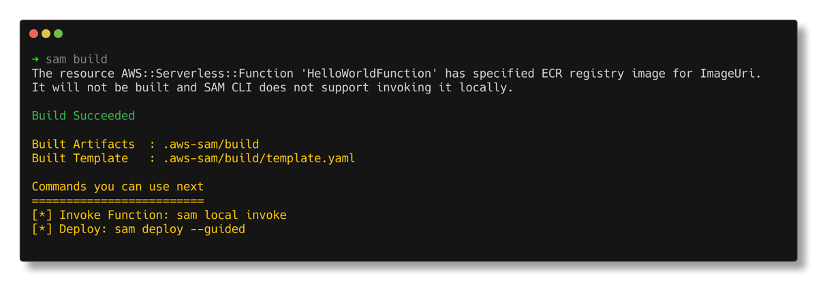
    sam build
  4. Deploy the application to your AWS account:
    sam deploy --guided

To run the application using the AWS CLI, replace the state machine ARN from the output of deployment steps:

aws stepfunctions start-execution \
    --state-machine-arn <StepFunctionArnHere> \
    --region <RegionWhereApplicationDeployed> \
    --input "{}"

Step Functions is not limited to AWS Batch’s Submit Job API action

In September 2021, Step Functions announced integration support for 200 AWS Services to enable easier workflow automation. With this announcement, Step Functions is not limited to integrate with AWS Batch’s SubmitJob API but also can integrate with any AWS Batch SDK API today.

Step Functions can automate the lifecycle of an AWS Batch job, starting from creating a compute environment, creating job queues, registering job definitions, submitting a job, and finally cleaning up.

Other AWS service integrations

Step Functions support for 200 AWS Services equates integration with more than 9,000 API actions across these services. AWS Batch tasks in Step Functions can evolve by integrating with available services in the workflow for their pre- and post-processing needs.

For example, batch job input data sanitization can be done inside Lambda and that gets pushed to an Amazon SQS queue or Amazon S3 as an object for auditability purposes.

Similarly, Amazon SNS, Amazon Pinpoint, or Amazon SES can notify once AWS Batch job task is complete.

There are multiple ways to decorate around an AWS Batch job task. Refer to AWS SDK service integrations and optimized integrations for Step Functions for additional details.

Important considerations

Workflow orchestrations in the AWS Batch console only show Step Functions state machines that use AWS Batch’s Submit Job task. Step Functions state machines do not show in the AWS Batch console when:

  1. A state machine uses any other AWS SDK Batch API integration task
  2. AWS Batch’s SubmitJob API is invoked inside a Lambda function task using an AWS SDK client (like Boto3 or Node.js or Java)

Cleanup

The sample application provisions AWS Batch (the job definition, job queue, and ECS compute environment inside a VPC). It also creates subnets, route tables, and an internet gateway. Clean up the stack after testing the application to avoid the ongoing cost of running these services.

To delete the sample application stack, use the latest version of AWS SAM CLI and run:

sam delete

Conclusion

To learn more on AWS Batch, read the Orchestrating Batch jobs section in the Batch developer guide.

To get started, open the workflow orchestration page in the Batch console. Select Orchestrate Batch jobs with Step Functions Workflows to deploy a sample project, if you are new to Step Functions.

This feature is available in all Regions where both Step Functions and AWS Batch are available. View the AWS Regions table for details.

To learn more on Step Functions patterns, visit Serverless Land.

Accepting API keys as a query string in Amazon API Gateway

Post Syndicated from Eric Johnson original https://aws.amazon.com/blogs/compute/accepting-api-keys-as-a-query-string-in-amazon-api-gateway/

This post was written by Ronan Prenty, Sr. Solutions Architect and Zac Burns, Cloud Support Engineer & API Gateway SME

Amazon API Gateway is a fully managed service that makes it easier for developers to create, publish, maintain, monitor, and secure APIs at any scale. APIs act as the front door to applications and allow developers to offload tasks like authorization, throttling, caching, and more.

A common feature requested by customers is the ability to track usage for specific users or services through API keys. API Gateway REST APIs support this feature and, for added security, require that the API key resides in a header or an authorizer.

Developers may also need to pass API keys in the query string parameters. Best practices encourage refactoring the requests at the client level to move API keys to the header. However, this may not be possible during the migration.

This blog explains how to build an API Gateway REST API that temporarily accepts API keys as query string parameters. This post helps customers who have APIs that accept API keys as query string parameters and want to migrate to API Gateway with minimal impact on their clients. The post also discusses increasing security by refactoring the client to send API keys as a header instead of a query string.

There is also an example project for you to test and evaluate. This solution uses a custom authorizer AWS Lambda function to extract the API key from the query string parameter and apply it to a usage plan. The sample application uses the AWS Serverless Application Model (AWS SAM) for deployment.

Key concepts

API keys and usage plans

API keys are alphanumeric strings that are distributed to developers to grant access to an API. API Gateway can generate these on your behalf, or you can import them.

Usage plans let you provide API keys to your customers so that you can track and limit their usage. API keys are not a primary authorization mechanism for your APIs. If multiple APIs are associated with a usage plan, a user with a valid API key can access all APIs in that usage plan. We provide numerous options for securing access to your APIs, including resource policies, Lambda authorizers, and Amazon Cognito user pools.

Usage plans define who can access deployed API stages and methods along with metering their usage. Usage plans use API keys to identify who is making requests and apply throttling and quota limits.

How API Gateway handles API keys

API Gateway supports API keys sent as headers in a request. It does not support API keys sent as a query string parameter. API Gateway only accepts requests over HTTPS, which means that the request is encrypted. When sending API keys as query string parameters, there is still a risk that URLs are logged in plaintext by the client sending requests.

API Gateway has two settings to accept API keys:

  1. Header: The request contains the values as the X-API-Key header. API Gateway then validates the key against a usage plan.
  2. Authorizer: The authorizer includes the API key as part of the authorization response. Once API Gateway receives the API key as part of the response, it validates it against a usage plan.

Solution overview

To accept an API key as a query string parameter temporarily, create a custom authorizer using a Lambda function:

Note: the apiKeySource property of your API must be set to Authorizer instead of Header.

Note: the apiKeySource property of your API must be set to Authorizer instead of Header.

  1. The client sends an HTTP request to the API Gateway endpoint with the API key in the query string.
  2. API Gateway sends the request to a REQUEST type custom authorizer
  3. The custom authorizer function extracts the API Key from the payload. It constructs the response object with the API Key as the value for the `usageIdentifierKey` property
  4. The response gets sent back to API Gateway for validation.
  5. API Gateway validates the API key against a usage plan.
  6. If valid, API Gateway passes the request to the backend.

Deploying the solution

Prerequisites

This solution requires no pre-existing AWS resources and deploys everything you need from the template. Deploying the solution requires:

You can find the solution on GitHub using this link.

With the prerequisites completed, deploy the template with the following commands:

git clone https://github.com/aws-samples/amazon-apigateway-accept-apikeys-as-querystring.git
cd amazon-apigateway-accept-apikeys-as-querystring
sam build --use-container
sam deploy --guided

Long term considerations

This temporary solution enables developers to migrate APIs to API Gateway and maintain query string-based API keys. While this solution does work, it does not follow best practices.

In addition to security, there is also a cost factor. Each time the client request contains an API key, the custom authorizer AWS Lambda function will be invoked, increasing the total amount of Lambda invocations you are billed for. To ensure you are billed only for valid requests, you can add an identity source to the custom authorizer meaning that only requests containing this identity source will be sent to the Lambda function. Requests that do not contain this identity source will not be billed by Lambda or API Gateway. Migrating to a header-based API key removes the need for a custom authorizer and the extra Lambda function invocations. You can find out more information on AWS Lambda billing here.

Customer migration process

With this in mind, the structure of the request sent by API clients must change from:

GET /some-endpoint?apiKey=abc123456789

To:

GET /some-endpoint
x-api-key: abc123456789

You can provide clients with a notice period when this temporary solution is operational. After, they must migrate to a new API endpoint using a header to provide the API keys. Once the client migration is complete, they can retire the custom solution.

Developer portal

In addition to migrating API keys to a header-based solution, customers also ask us how to manage customer keys and usage plans. One option is to deploy the API Gateway developer portal.

This portal enables your customers to discover available APIs, browse API documentation, register for API keys, test APIs in the user interface, and monitor their API usage. This portal also allows you to publish non-API Gateway managed APIs by uploading OpenAPI definitions. The serverless developer portal can be customized and branded to suit your organization.

Conclusion

This blog post demonstrates how to use custom authorizers in API Gateway to accept API keys as a query string parameter. It also provides an AWS SAM template to deploy an example application for testing. Finally, it discusses the importance of moving customers to header-based API keys and managing those keys with the developer portal.

For more serverless content, visit Serverless Land.

Recovering Real Faces from Face-Generation ML System

Post Syndicated from Bruce Schneier original https://www.schneier.com/blog/archives/2021/10/recovering-real-faces-from-face-generation-ml-system.html

New paper: “This Person (Probably) Exists. Identity Membership Attacks Against GAN Generated Faces.

Abstract: Recently, generative adversarial networks (GANs) have achieved stunning realism, fooling even human observers. Indeed, the popular tongue-in-cheek website http://thispersondoesnotexist.com, taunts users with GAN generated images that seem too real to believe. On the other hand, GANs do leak information about their training data, as evidenced by membership attacks recently demonstrated in the literature. In this work, we challenge the assumption that GAN faces really are novel creations, by constructing a successful membership attack of a new kind. Unlike previous works, our attack can accurately discern samples sharing the same identity as training samples without being the same samples. We demonstrate the interest of our attack across several popular face datasets and GAN training procedures. Notably, we show that even in the presence of significant dataset diversity, an over represented person can pose a privacy concern.

News article. Slashdot post.

Suing Infrastructure Companies for Copyright Violations

Post Syndicated from Bruce Schneier original https://www.schneier.com/blog/archives/2021/10/suing-infrastructure-companies-for-copyright-violations.html

It’s a matter of going after those with deep pockets. From Wired:

Cloudflare was sued in November 2018 by Mon Cheri Bridals and Maggie Sottero Designs, two wedding dress manufacturers and sellers that alleged Cloudflare was guilty of contributory copyright infringement because it didn’t terminate services for websites that infringed on the dressmakers’ copyrighted designs….

[Judge] Chhabria noted that the dressmakers have been harmed “by the proliferation of counterfeit retailers that sell knock-off dresses using the plaintiffs’ copyrighted images” and that they have “gone after the infringers in a range of actions, but to no avail — every time a website is successfully shut down, a new one takes its place.” Chhabria continued, “In an effort to more effectively stamp out infringement, the plaintiffs now go after a service common to many of the infringers: Cloudflare. The plaintiffs claim that Cloudflare contributes to the underlying copyright infringement by providing infringers with caching, content delivery, and security services. Because a reasonable jury could not — at least on this record — conclude that Cloudflare materially contributes to the underlying copyright infringement, the plaintiffs’ motion for summary judgment is denied and Cloudflare’s motion for summary judgment is granted.”

I was an expert witness for Cloudflare in this case, basically explaining to the court how the service works.

Airline Passenger Mistakes Vintage Camera for a Bomb

Post Syndicated from Bruce Schneier original https://www.schneier.com/blog/archives/2021/10/airline-passenger-mistakes-vintage-camera-for-a-bomb.html

I feel sorry for the accused:

The “security incident” that forced a New-York bound flight to make an emergency landing at LaGuardia Airport on Saturday turned out to be a misunderstanding — after an airline passenger mistook another traveler’s camera for a bomb, sources said Sunday.

American Airlines Flight 4817 from Indianapolis — operated by Republic Airways — made an emergency landing at LaGuardia just after 3 p.m., and authorities took a suspicious passenger into custody for several hours.

It turns out the would-be “bomber” was just a vintage camera aficionado and the woman who reported him made a mistake, sources said.

Why in the world was the passenger in custody for “several hours”? They didn’t do anything wrong.

Back in 2007, I called this the “war on the unexpected.” It’s why “see something, say something” doesn’t work. If you put amateurs in the front lines of security, don’t be surprised when you get amateur security. I have lots of examples.

The European Parliament Voted to Ban Remote Biometric Surveillance

Post Syndicated from Bruce Schneier original https://www.schneier.com/blog/archives/2021/10/the-european-parliament-voted-to-ban-remote-biometric-surveillance.html

It’s not actually banned in the EU yet — the legislative process is much more complicated than that — but it’s a step: a total ban on biometric mass surveillance.

To respect “privacy and human dignity,” MEPs said that EU lawmakers should pass a permanent ban on the automated recognition of individuals in public spaces, saying citizens should only be monitored when suspected of a crime.

The parliament has also called for a ban on the use of private facial recognition databases — such as the controversial AI system created by U.S. startup Clearview (also already in use by some police forces in Europe) — and said predictive policing based on behavioural data should also be outlawed.

MEPs also want to ban social scoring systems which seek to rate the trustworthiness of citizens based on their behaviour or personality.

Align with best practices while creating infrastructure using CDK Aspects

Post Syndicated from Om Prakash Jha original https://aws.amazon.com/blogs/devops/align-with-best-practices-while-creating-infrastructure-using-cdk-aspects/

Organizations implement compliance rules for cloud infrastructure to ensure that they run the applications according to their best practices. They utilize AWS Config to determine overall compliance against the configurations specified in their internal guidelines. This is determined after the creation of cloud resources in their AWS account. This post will demonstrate how to use AWS CDK Aspects to check and align with best practices before the creation of cloud resources in your AWS account.

The AWS Cloud Development Kit (CDK) is an open-source software development framework that lets you define your cloud application resources using familiar programming languages, such as TypeScript, Python, Java, and .NET. The expressive power of programming languages to define infrastructure accelerates the development process and improves the developer experience.

AWS Config is a service that enables you to assess, audit, and evaluate your AWS resource configurations. Config continuously monitors and records your AWS resource configurations, as well as lets you automate the evaluation of recorded configurations against desired configurations. React to non-compliant resources and change their state either automatically or manually.

AWS Config helps customers run their workloads on AWS in a compliant manner. Some customers want to detect it up front, and then only provision compliant resources. Some configurations are important for the customers, so they might not provision resources without having them compliant from the beginning. The following are examples of such configurations:

  • Amazon S3 bucket must not be created with public access
  • Amazon S3 bucket encryption must be enabled
  • Database deletion protection must be enabled

CDK Aspects

CDK Aspects are a way to apply an operation to every construct in a given scope. The aspect could verify something about the state of the constructs, such as ensuring that all buckets are encrypted, or it could modify the constructs, such as by adding tags.

An aspect is a class that implements the IAspect interface shown below. Aspects employ visitor patter, which allows them to add a new operation to existing object structures without modifying the structures. In object-oriented programming and software engineering, the visitor design pattern is a method for separating an algorithm from an object structure on which it operates.

interface IAspect {
   visit(node: IConstruct): void;
}

An AWS CDK app goes through the following lifecycle phases when you call cdk deploy. These phases are also shown in the diagram below. Learn more about the CDK application lifecycle at this page.

  1. Construction
  2. Preparation
  3. Validation
  4. Synthesis
  5. Deployment

Understanding the CDK Deploy

CDK Aspects become relevant during the Prepare phase, where it makes the final modifications round in the constructs to setup their final state. This Prepare phase happens automatically. All constructs have their internal list of Aspects which are called and applied during the Prepare phase. Add your custom aspects in a scope by calling the following method:

Aspects.of(myConstruct).add(new SomeAspect(...));

When you call the method above, constructs add the custom aspects to the list of internal aspects. When CDK application goes through the Prepare phase, then AWS CDK calls the visit method of the object for the constructs and all of its children in top-down order. The visit method is free to change anything in the construct.

How to align with or check configuration compliance using CDK Aspects

In the following sections, you will see how to implement CDK Aspects for some common use cases when provisioning the cloud resources. CDK Aspects are extensible, and you can extend it for any suitable use cases in order to implement additional rules. Apply CDK Aspects not only to verify against the best practices, but also to update the state before resource creation.

The code below creates the cloud resources to be verified against the best practices or to be updated using Aspects in the following sections.

export class AwsCdkAspectsStack extends cdk.Stack {
  constructor(scope: cdk.Construct, id: string, props?: cdk.StackProps) {
    super(scope, id, props);

    //Create a VPC with 3 availability zones
    const vpc = new ec2.Vpc(this, 'MyVpc', {
      maxAzs: 3,
    });

    //Create a security group
    const sg = new ec2.SecurityGroup(this, 'mySG', {
      vpc: vpc,
      allowAllOutbound: true
    })

    //Add ingress rule for SSH from the public internet
    sg.addIngressRule(ec2.Peer.anyIpv4(), ec2.Port.tcp(22), 'SSH access from anywhere')

    //Launch an EC2 instance in private subnet
    const instance = new ec2.Instance(this, 'MyInstance', {
      vpc: vpc,
      machineImage: ec2.MachineImage.latestAmazonLinux(),
      instanceType: new ec2.InstanceType('t3.small'),
      vpcSubnets: {subnetType: ec2.SubnetType.PRIVATE},
      securityGroup: sg
    })

    //Launch MySQL rds database instance in private subnet
    const database = new rds.DatabaseInstance(this, 'MyDatabase', {
      engine: rds.DatabaseInstanceEngine.mysql({
        version: rds.MysqlEngineVersion.VER_5_7
      }),
      vpc: vpc,
      vpcSubnets: {subnetType: ec2.SubnetType.PRIVATE},
      deletionProtection: false
    })

    //Create an s3 bucket
    const bucket = new s3.Bucket(this, 'MyBucket')
  }
}

In the first section, you will see the use cases and code where Aspects are used to verify the resources against the best practices.

  1. VPC CIDR range must start with specific CIDR IP
  2. Security Group must not have public ingress rule
  3. EC2 instance must use approved AMI
//Verify VPC CIDR range
export class VPCCIDRAspect implements IAspect {
    public visit(node: IConstruct): void {
        if (node instanceof ec2.CfnVPC) {
            if (!node.cidrBlock.startsWith('192.168.')) {
                Annotations.of(node).addError('VPC does not use standard CIDR range starting with "192.168."');
            }
        }
    }
}

//Verify public ingress rule of security group
export class SecurityGroupNoPublicIngressAspect implements IAspect {
    public visit(node: IConstruct) {
        if (node instanceof ec2.CfnSecurityGroup) {
            checkRules(Stack.of(node).resolve(node.securityGroupIngress));
        }

        function checkRules (rules :Array<IngressProperty>) {
            if(rules) {
                for (const rule of rules.values()) {
                    if (!Tokenization.isResolvable(rule) && (rule.cidrIp == '0.0.0.0/0' || rule.cidrIp == '::/0')) {
                        Annotations.of(node).addError('Security Group allows ingress from public internet.');
                    }
                }
            }
        }
    }
}

//Verify AMI of EC2 instance
export class EC2ApprovedAMIAspect implements IAspect {
    public visit(node: IConstruct) {
        if (node instanceof ec2.CfnInstance) {
            if (node.imageId != 'approved-image-id') {
                Annotations.of(node).addError('EC2 Instance is not using approved AMI.');
            }
        }
    }
}

In the second section, you will see the use cases and code where Aspects are used to update the resources in order to make them compliant before creation.

  1. S3 bucket encryption must be enabled. If not, then enable
  2. S3 bucket versioning must be enabled. If not, then enable
  3. RDS instance must have deletion protection enabled. If not, then enable
//Enable versioning of bucket if not enabled
export class BucketVersioningAspect implements IAspect {
    public visit(node: IConstruct): void {
        if (node instanceof s3.CfnBucket) {
            if (!node.versioningConfiguration
                || (!Tokenization.isResolvable(node.versioningConfiguration)
                    && node.versioningConfiguration.status !== 'Enabled')) {
                Annotations.of(node).addInfo('Enabling bucket versioning configuration.');
                node.addPropertyOverride('VersioningConfiguration', {'Status': 'Enabled'})
            }
        }
    }
}

//Enable server side encryption for the bucket if no encryption is enabled
export class BucketEncryptionAspect implements IAspect {
    public visit(node: IConstruct): void {
        if (node instanceof s3.CfnBucket) {
            if (!node.bucketEncryption) {
                Annotations.of(node).addInfo('Enabling default S3 server side encryption.');
                node.addPropertyOverride('BucketEncryption', {
                        "ServerSideEncryptionConfiguration": [
                            {
                                "ServerSideEncryptionByDefault": {
                                    "SSEAlgorithm": "AES256"
                                }
                            }
                        ]
                    }
                )
            }
        }
    }
}

//Enable deletion protection of DB instance if not already enabled
export class RDSDeletionProtectionAspect implements IAspect {
    public visit(node: IConstruct) {
        if (node instanceof rds.CfnDBInstance) {
            if (! node.deletionProtection) {
                Annotations.of(node).addInfo('Enabling deletion protection of DB instance.');
                node.addPropertyOverride('DeletionProtection', true);
            }
        }
    }
}

Once you create the aspects, add them in a particular scope. That scope can be App, Stack, or Construct. In the example below, all aspects are added in the scope of Stack.

const app = new cdk.App();

const stack = new AwsCdkAspectsStack(app, 'MyApplicationStack');

Aspects.of(stack).add(new VPCCIDRAspect());
Aspects.of(stack).add(new SecurityGroupNoPublicIngressAspect());
Aspects.of(stack).add(new EC2ApprovedAMIAspect());
Aspects.of(stack).add(new RDSDeletionProtectionAspect());
Aspects.of(stack).add(new BucketEncryptionAspect());
Aspects.of(stack).add(new BucketVersioningAspect());

app.synth();

Once you call cdk deploy for the above code with aspects added, you will see the output below. The deployment will not continue until you resolve the errors and modifications conducted to make some of the resources compliant.

Screenshot displaying CDK errors.

Also utilize Aspects to make general modifications to the resources regardless of any compliance checks. For example, use it apply mandatory tags to every taggable resource. Tags is an example of implementing CDK Aspects in order to achieve this functionality. Utilizing the code below, add or remove a tag from all taggable resources and their children in the scope of a Construct.

Tags.of(myConstruct).add('key', 'value');
Tags.of(myConstruct).remove('key');

Below is an example of adding the Department tag to every resource created in the scope of Stack.

Tags.of(stack).add('Department', 'Finance');

CDK Aspects are ways for developers to align with and check best practices in their infrastructure configurations using the programming language of choice. AWS CloudFormation Guard (cfn-guard) provides compliance administrators with a simple, policy-as-code language to author policies and apply them to enforce best practices. Aspects are applied before generation of the CloudFormation template in Prepare phase, but cfn-guard is applied after generation of the CloudFormation template and before the Deploy phase. Developers can use Aspects or cfn-guard or both as part of a CI/CD pipeline to stop deployment of non-compliant resources, but CloudFormation Guard is the way to go when you want to enforce compliances and prevent deployment of non-compliant resources.

Conclusion

If you are utilizing AWS CDK to provision your infrastructure, then you can start using Aspects to align with best practices before resources are created. If you are utilizing CloudFormation template to manage your infrastructure, then you can read this blog to learn how to migrate the CloudFormation template to AWS CDK. After the migration, utilize CDK Aspects not only to evaluate compliance of your resources against the best practices, but also modify their state to make them compliant before they are created.

About the Authors

Om Prakash Jha

Om Prakash Jha is a Solutions Architect at AWS. He helps customers build well-architected applications on AWS in the retail industry vertical. He has more than a decade of experience in developing, designing, and architecting mission critical applications. His passion is DevOps and application modernization. Outside of his work, he likes to read books, watch movies, and explore part of the world with his family.

Target cross-platform Go builds with AWS CodeBuild Batch builds

Post Syndicated from Russell Sayers original https://aws.amazon.com/blogs/devops/target-cross-platform-go-builds-with-aws-codebuild-batch-builds/

Many different operating systems and architectures could end up as the destination for our applications. By using a AWS CodeBuild batch build, we can run builds for a Go application targeted at multiple platforms concurrently.

Cross-compiling Go binaries for different platforms is as simple as setting two environment variables $GOOS and $GOARCH, regardless of the build’s host platform. For this post we will build all of the binaries on Linux/x86 containers. You can run the command go tool dist list to see the Go list of supported platforms. We will build binaries for six platforms: Windows+ARM, Windows+AMD64, Linux+ARM64, Linux+AMD64, MacOS+ARM64, and Mac+AMD64. Note that AMD64 is a 64-bit architecture based on the Intel x86 instruction set utilized on both AMD and Intel hardware.

This post demonstrates how to create a single AWS CodeBuild project by using a batch build and a single build spec to create concurrent builds for the six targeted platforms. Learn more about batch builds in AWS CodeBuild in the documentation: Batch builds in AWS CodeBuild

Solution Overview

AWS CodeBuild is a fully managed continuous integration service that compiles source code, runs tests, and produces ready-to-deploy software packages. A batch build is utilized to run concurrent and coordinated builds. Let’s summarize the 3 different batch builds:

  • Build graph: defines dependencies between builds. CodeBuild utilizes the dependencies graph to run builds in an order that satisfies the dependencies.
  • Build list: utilizes a list of settings for concurrently run builds.
  • Build matrix: utilizes a matrix of settings to create a build for every combination.

The requirements for this project are simple – run multiple builds with a platform pair of $GOOS and $GOARCH environment variables. For this, a build list can be utilized. The buildspec for the project contains a batch/build-list setting containing every environment variable for the six builds.

batch:
  build-list:
    - identifier: build1
      env:
        variables:
          GOOS: darwin
          GOARCH: amd64
    - identifier: build2
      env:
        variables:
          GOOS: darwin
          GOARCH: arm64
    - ...

The batch build project will launch seven builds. See the build sequence in the diagram below.

  • Step 1 – A build downloads the source.
  • Step 2 – Six concurrent builds configured with six sets of environment variables from the batch/build-list setting.
  • Step 3 – Concurrent builds package a zip file and deliver to the artifacts Amazon Simple Storage Service (Amazon S3) bucket.

build sequence

The supplied buildspec file includes commands for the install and build phases. The install phase utilizes the phases/install/runtime-versions phase to set the version of Go is used in the build container.

The build phase contains commands to replace source code placeholders with environment variables set by CodeBuild. The entire list of environment variables is documented at Environment variables in build environments. This is followed by a simple go build to build the binaries. The application getting built is an AWS SDK for Go sample that will list the contents of an S3 bucket.

  build:
    commands:
      - mv listObjects.go listObjects.go.tmp
      - cat listObjects.go.tmp | envsubst | tee listObjects.go
      - go build listObjects.go

The artifacts sequence specifies the build outputs that we want packaged and delivered to the artifacts S3 bucket. The name setting creates a name for ZIP artifact. And the name combines the operating system, architecture environment variables, as well as the git commit hash. We use Shell command language to expand the environment variables, as well as command substitution to take the first seven characters of the git hash.

artifacts:
  files:
    - 'listObjects'
    - 'listObjects.exe'
    - 'README.md'
  name: listObjects_${GOOS}_${GOARCH}_$(echo $CODEBUILD_RESOLVED_SOURCE_VERSION | cut -c 1-7).zip 

Let’s walk through the CodeBuild project setup process. When the builds complete, we’ll see zip files containing the builds for each platform in an artifacts bucket.

Here is what we will create:

  • Create an S3 bucket to host the built artifacts.
  • Create the CodeBuild project, which needs to know:
    • Where the source is
    • The environment – a docker image and a service role
    • The location of the build spec
    • Batch configuration, a service role used to launch batch build groups
    • The artifact S3 bucket location

The code that is built is available on github here: https://github.com/aws-samples/cross-platform-go-builds-with-aws-codebuild. For an alternative to the manual walkthrough steps, a CloudFormation template that will build all of the resources is available in the git repository.

Prerequisites

For this walkthrough, you must have the following prerequisites:

Create the Artifacts S3 Bucket

An S3 bucket will be the destination of the build artifacts.

  • In the Amazon S3 console, create a bucket with a unique name. This will be the destination of your build artifacts.
    creating an s3 bucket

Create the AWS CodeBuild Project

  • In the AWS CodeBuild console, create a project named multi-arch-build.
    codebuild project name
  • For Source Provider, choose GitHub. Choose the Connect to GitHub button and follow the authorization screens. For repository, enter https://github.com/aws-samples/cross-platform-go-builds-with-aws-codebuild
    coldbuild select source
  • For Environment image, choose Managed Image. Choose the most recent Ubuntu image. This image contains every tool needed for the build. If you are interested in the contents of the image, then you can see the Dockerfile used to build the image in the GitHub repository here: https://github.com/aws/aws-codebuild-docker-images/tree/master/ubuntu
    Select environment
  • For Service Role, keep the suggested role name.
    Service role
  • For Build specifications, leave Buildspec name empty. This will use the default location buildspec.yml in the source root.
  • Under Batch configuration, enable Define batch configuration. For the Role Name, enter a name for the role: batch-multi-arch-build-service-role. There is an option here to combine artifacts. CodeBuild can combine the artifacts from batch builds into a single location. This isn’t needed for this build, as we want a zip to be created for each platform.
    Batch configuration
  • Under Artifacts, for Type, choose Amazon S3. For Bucket name, select the S3 bucket created earlier. This is where we want the build artifacts delivered. Choose the checkbox for Enable semantic versioning. This will tell CodeBuild to use the artifact name that was specified in the buildspec file.
    Artifacts
  • For Artifacts Packaging, choose Zip for CodeBuild to create a compressed zip from the build artifacts.
    Artifacts packaging
  • Create the build project, and start a build. You will see the DOWNLOAD_SOURCE build complete, followed by the six concurrent builds for each combination of OS and architecture.
    Builds in batch

Run the Artifacts

The builds have completed, and each packaged artifact has been delivered to the S3 bucket. Remember the name of the ZIP archive that was built using the buildspec file setting. This incorporated a combination of the operating system, architecture, and git commit hash.

Run the artifacts

Below, I have tested the artifact by downloading the zip for the operating system and architecture combination on three different platforms: MacOS/AMD64, an AWS Graviton2 instance, and a Microsoft Windows instance. Note the system information, unzipping the platform artifact, and the build specific information substituted into the Go source code.

Window1 Window2 Window3

Cleaning up

To avoid incurring future charges, delete the resources:

  • On the Amazon S3 console, choose the artifacts bucket created, and choose Empty. Confirm the deletion by typing ‘permanently delete’. Choose Empty.
  • Choose the artifacts bucket created, and Delete.
  • On the IAM console, choose Roles.
  • Search for batch-multi-arch-build-service-role and Delete. Search for codebuild-multi-arch-build-service-role and Delete.
  • Go to the CodeBuild console. From Build projects, choose multi-arch-build, and choose Delete build project.

Conclusion

This post utilized CodeBuild batch builds to build and package binaries for multiple platforms concurrently. The build phase used a small amount of scripting to replace placeholders in the code with build information CodeBuild makes available in environment variables. By overriding the artifact name using the buildspec setting, we created zip files built from information about the build. The zip artifacts were downloaded and tested on three platforms: Intel MacOS, a Graviton ARM based EC2 instance, and Microsoft Windows.

Features like this let you build on CodeBuild, a fully managed build service – and not have to worry about maintaining your own build servers.

Syniverse Hack

Post Syndicated from Bruce Schneier original https://www.schneier.com/blog/archives/2021/10/synaverse-hack.html

This is interesting:

A company that is a critical part of the global telecommunications infrastructure used by AT&T, T-Mobile, Verizon and several others around the world such as Vodafone and China Mobile, quietly disclosed that hackers were inside its systems for years, impacting more than 200 of its clients and potentially millions of cellphone users worldwide.

I’ve never heard of the company.

No details about the hack. It could be nothing. It could be a national intelligence service looking for information.

Growing Raspberry Pi’s presence in Africa

Post Syndicated from Ken Okolo original https://www.raspberrypi.org/blog/growing-raspberry-pis-presence-in-africa/

Raspberry Pi is growing our presence in Africa, and we’re keen to talk to businesses and educational organisations in the region to learn and to build partnerships.

Developing partnerships

As part of our investments in the region, I am delighted to join Raspberry Pi as Strategic Partnerships Manager, and initially I will be focusing on Nigeria, Kenya, Ghana, Tanzania, Rwanda, Cameroon, and Uganda. We will prioritise building a network of Raspberry Pi Approved Resellers and developing the right partnerships across industry and the education sector.

Uber's First Hackathon in Lagos
Uber’s First Hackathon in Lagos, Nigeria

Ensuring affordability with Raspberry Pi Approved Resellers

Over the last decade, Raspberry Pi has established a strong presence in the European and North American markets through partnership with our network of excellent Raspberry Pi Approved Resellers, providing access to affordable technology for the home, for business, and for education. Customers in many areas across Asia and the Pacific, too, have a choice of Approved Resellers offering Raspberry Pi products.

So far, our presence in Africa has been through our approved reseller PiShop in South Africa, which also has some commercial operations into other countries in southern Africa. Much of West, East, and North Africa has been underserved, and consumers in these regions have often obtained Raspberry Pi products via e-commerce websites in Europe, North America, and sometimes China. This has meant high costs of shipping products into Africa, which undermines our goal of ensuring affordability and availability across the continent. To address this, we have begun work to provide African customers with easy and reliable access to Raspberry Pi products at an affordable price point.

Supporting technological innovation

Africa has seen an explosion of technological advances in recent years, with investors funding innovative businesses built around technology. The continent is facing challenges ranging from accessibility to uninterrupted energy supplies, climate change, enabling agricultural potential, and building smart cities, and Africa’s mainly young population is meeting them head on.

Random Hacks of Kindness, a two-day hackathon. “RHoK Nairobi, Kenya” by Erik (HASH) Hersman / CC BY

While there is no shortage of innovative ideas, there is a real need for the right equipment and tools to support this ecosystem of makers, hobbyists, innovators, and entrepreneurs. Raspberry Pi is poised to close this gap.

Get in touch

Over the next couple of months, we will be planning a tour of our focus countries to visit the leadership of engineering associations and bodies, engaging with engineering student communities and maker spaces on the continent and building strategic alliances to deepen our inroads in the region. As Covid restrictions are eased, we will be visiting several countries on the continent to help us discover how we can best provide products and services that directly impact the region by ensuring access to low-cost, high-quality technology.

ken okolo crop
Ken Okolo

Could your African retail business meet our high standards for Raspberry Pi Approved Resellers, or could your educational organisation or your enterprise benefit from affordable desktop computers? Do your products require embedded computing power, or could your business grow with low-cost, low-power process monitoring or control? Get in touch with us by emailing: [email protected]. We’re looking forward to hearing from you.

The post Growing Raspberry Pi’s presence in Africa appeared first on Raspberry Pi.

Facebook Is Down

Post Syndicated from Bruce Schneier original https://www.schneier.com/blog/archives/2021/10/facebook-is-down.html

Facebook — along with Instagram and WhatsApp — went down globally today. Basically, someone deleted their BGP records, which made their DNS fall apart.

…at approximately 11:39 a.m. ET today (15:39 UTC), someone at Facebook caused an update to be made to the company’s Border Gateway Protocol (BGP) records. BGP is a mechanism by which Internet service providers of the world share information about which providers are responsible for routing Internet traffic to which specific groups of Internet addresses.

In simpler terms, sometime this morning Facebook took away the map telling the world’s computers how to find its various online properties. As a result, when one types Facebook.com into a web browser, the browser has no idea where to find Facebook.com, and so returns an error page.

In addition to stranding billions of users, the Facebook outage also has stranded its employees from communicating with one another using their internal Facebook tools. That’s because Facebook’s email and tools are all managed in house and via the same domains that are now stranded.

What I heard is that none of the employee keycards work, since they have to ping a now-unreachable server. So people can’t get into buildings and offices.

And every third-party site that relies on “log in with Facebook” is stuck as well.

The fix won’t be quick:

As a former network admin who worked on the internet at this level, I anticipate Facebook will be down for hours more. I suspect it will end up being Facebook’s longest and most severe failure to date before it’s fixed.

We all know the security risks of monocultures.

EDITED TO ADD (10/6): Good explanation of what happened. Shorter from Jonathan Zittrain: “Facebook basically locked its keys in the car.”

Cheating on Tests

Post Syndicated from Bruce Schneier original https://www.schneier.com/blog/archives/2021/10/cheating-on-tests.html

Interesting story of test-takers in India using Bluetooth-connected flip-flops to communicate with accomplices while taking a test.

What’s interesting is how this cheating was discovered. It’s not that someone noticed the communication devices. It’s that the proctors noticed that cheating test takers were acting hinky.

Friday Squid Blogging: Squid Game

Post Syndicated from Bruce Schneier original https://www.schneier.com/blog/archives/2021/10/friday-squid-blogging-squid-game.html

Netflix has a new series called Squid Game, about people competing in a deadly game for money. It has nothing to do with actual squid.

As usual, you can also use this squid post to talk about the security stories in the news that I haven’t covered.

Read my blog posting guidelines here.

A Death Due to Ransomware

Post Syndicated from Bruce Schneier original https://www.schneier.com/blog/archives/2021/10/a-death-due-to-ransomware.html

The Wall Street Journal is reporting on a baby’s death at an Alabama hospital in 2019, which they argue was a direct result of the ransomware attack the hospital was undergoing.

Amid the hack, fewer eyes were on the heart monitors — normally tracked on a large screen at the nurses’ station, in addition to inside the delivery room. Attending obstetrician Katelyn Parnell texted the nurse manager that she would have delivered the baby by caesarean section had she seen the monitor readout. “I need u to help me understand why I was not notified.” In another text, Dr. Parnell wrote: “This was preventable.”

[The mother] Ms. Kidd has sued Springhill [Medical Center], alleging information about the baby’s condition never made it to Dr. Parnell because the hack wiped away the extra layer of scrutiny the heart rate monitor would have received at the nurses’ station. If proven in court, the case will mark the first confirmed death from a ransomware attack.

What will be interesting to see is whether the courts rule that the hospital was negligent in its security, contributing to the success of the ransomware and by extension the death of the infant.

Springhill declined to name the hackers, but Allan Liska, a senior intelligence analyst at Recorded Future, said it was likely the Russianbased Ryuk gang, which was singling out hospitals at the time.

They’re certainly never going to be held accountable.

Another article.