Build a Two-Way Email-to-SMS Service with Amazon SES and Amazon End User Messaging

Post Syndicated from Cheng Wang original https://aws.amazon.com/blogs/messaging-and-targeting/build-a-two-way-email-to-sms-service-with-amazon-ses-and-amazon-end-user-messaging/

Introduction

Businesses and organizations today struggle to effectively communicate with their customers, employees, or other stakeholders across the diverse range of digital channels they now use. One common problem arises when the requirement to exchange information quickly and reliably extends beyond traditional email. This issue challenges organizations where recipients lack immediate access to email. This applies to field workers, remote teams, or customers who prefer to communicate via text messages. It is vital to bridge this gap between email and SMS communication for timely updates, urgent notifications, and seamless collaboration. However, separate management of these disparate channels independently proves cumbersome and leads to inefficiencies.

To address this challenge, one approach is to leverage Amazon Simple Email Service (SES) and Amazon End User Messaging services to create a robust, scalable, and cost-effective messaging system. This system seamlessly bridges the gap between email and SMS, enhances the reach and delivery of your messages and streamlines your communication workflows. Ultimately, this approach delivers a superior experience for your audience, ensuring that critical information reaches recipients through their preferred channels in a timely and efficient manner.

This blog post will delve into the step-by-step process of building a solution that enables both Email-to-SMS and SMS-to-Email communication. This solution allows you to send SMS messages using email and receive any SMS replies on the same email address you used to send the original message. Furthermore, you can continue the conversation by replying to the email you receive in response. By the end, you’ll have the knowledge and tools necessary to revolutionize your communication strategy and deliver a superior experience to your audience.

Here are some of the use cases for this solution:

  • Real estate agents can use this solution to send listing updates to clients via SMS, and then receive client inquiries and responses as emails.
  • Customer service team can leverage the Email to SMS functionality to proactively reach out to customers with important notifications. Customers are able to respond directly via SMS.
  • Retailers can use this solution to send order confirmations, shipping updates, and promotional offers to customers via SMS. Customers are able to respond with inquiries or feedback that are then received as emails.
  • Medical practices and hospitals can leverage the Email to SMS functionality to quickly notify patients of appointment reminders, prescription refills, or other time-sensitive information. Patients can then respond via SMS, which gets converted to an email that the healthcare staff can access.

Solution Overview

The following figure shows the high level architecture for this solution.

Figure 1: Two-Way Email-To-SMS architecture

  1. Email Users send an email to the email address formatted as “mobile-number@verified-domain”. Amazon SES email receiving receives the email and triggers a receipt rule.
  2. The email is published to Amazon Simple Notification Service (SNS) topic (EmailToSMS) based on the receipt rule action, which triggers an AWS Lambda function (ConvertEmailToSMS). The ConvertEmailToSMS Lambda function performs the following actions:
    1. Receives the event from SNS and constructs a text message using the email body content.
    2. The constructed message is then sent to the “mobile-number” in the destination email address using the “SendTextMessage” API from AWS End User Messaging SMS. This is achieved by using a phone number in AWS End User Messaging SMS as the origination identity.
    3. The SMS message ID and source email address are stored as items in the Amazon DynamoDB table (MessageTrackingTable). This tracks email addresses for replies from SMS users.
  3. Mobile Users receive the SMS, and they have the option to reply to the phone number with two-way SMS messaging
  4. AWS End User Messaging receives the incoming SMS message from the Mobile Users. It then publishes this message to a SNS topic (SMSToEmail) for two-way SMS integration, which triggers a Lambda function (ConvertSMSToEmail). The ConvertSMSToEmail Lambda function performs the following actions:
    1. Retrieves the item from “MessageTrackingTable” using “previousPublishedMessageId” (SMS message ID) from the SNS event, and locate the corresponding email address.
    2. Sends the SMS message body to the Email Users using SES. This step uses “mobile-number@verified-domain” as the source email address, and the email address retrieved from the previous step as the destination.
  5. Email Users receive the email, and they have the option to reply to the email to continue the conversation. Mobile Users will receive the latest reply from Email Users.

Walkthrough

This section will dive into the step-by step process for the deployment. There are 4 steps to deploy this solution:

  1. Configure SES verified identity for email receiving and sending.
  2. Deploy the CloudFormation stack for the Email to SMS functionality.
  3. Deploy the CloudFormation stack for the SMS to Email functionality.
  4. Set up two-way SMS messaging in AWS End User Messaging SMS.

Note: the Lambda code for this solution is developed based on phone numbers and long code as the supported origination identity in Australia. You need to adjust the Lambda code (“format_phone_number” function) accordingly for this to work in your country.

Refer to this GitHub repository for the solution source code.

Prerequisites

Prerequisites for this walkthrough:

  1. Administrator-level access to an AWS account
  2. A domain or subdomain that you own to create SES verified identity
  3. An origination identity that supports two-way messaging, following Choosing an origination identity for two-way messaging use cases. Simulator phone numbers are available if you are in the US
  4. A mobile phone to send and receive SMS
  5. An email address to send and receive emails

Step 1: Configure SES Verified Identity

Follow the steps outlined in Creating a domain identity to create a verified identity for your domain in your AWS account. Confirm your domain identity is in the “Verified” status before proceeding to the next step:

Figure 2: Verified Identity

Step 2: Deploy Email to SMS functionality

The following steps create a CloudFormation stack to deploy the required components for Email to SMS functionality:

  1. Sign in to your AWS account.
  2. Download the email-to-sms.yaml for creating the stack.
  3. Navigate to the AWS CloudFormation page.
  4. Choose Create stack, and then choose With new resources (standard).
  5. Choose Upload a template file and upload the CloudFormation template that you downloaded earlier: email-to-sms.yaml. Then choose Next.
  6. Enter the stack name Email-To-SMS.
  7. Enter the following values for the parameters:
    • RuleName: The name of your SES Rule Set and receipt rule.
    • Recipient1: Domain name used for recipient condition in the SES Rule Set.
    • Recipient2: Domain name used for recipient condition in the SES Rule Set if you need additional recipients.
    • PhoneNumberId: Phone number ID of the phone number to send SMS messages.
  8. Choose Next, and then optionally enter tags and choose Submit. Wait for the stack creation to finish.

Now you have the required components to convert email to text, and sending it as SMS to a phone number using AWS End User Messaging SMS.

Note: if required, modify the following code in email-to-sms.yaml to format your phone numbers accordingly:

def format_phone_number(email_address):

    # Extract the local part of the email address (before @)

    local_part = email_address.split('@')[0]   

    # Remove the leading '0' and add '+61' for phone number (Australia)

    if local_part.startswith('0'):

        formatted_number = '+61' + local_part[1:]

    return formatted_number

Step 3: Deploy SMS to Email functionality

The following steps create a CloudFormation stack to deploy the required components for SMS to Email functionality:

  1. Sign in to your AWS account.
  2. Download the sms-to-email.yaml for creating the stack.
  3. Navigate to the AWS CloudFormation page.
  4. Choose Create stack, and then choose With new resources (standard).
  5. Choose Upload a template file and upload the CloudFormation template that you downloaded earlier: sms-to-email.yaml. Then choose Next.
  6. Enter the stack name SMS-To-Email.
  7. Enter the following values for the parameters:
    • EmailDomain: The email domain to use for the SMS-to-Email function
  8. Choose Next, and then optionally enter tags and choose Submit. Wait for the stack creation to finish.

Note: if required, modify the following code in sms-to-email.yaml to format your phone numbers accordingly:

def format_phone_number(phone_number):

    # Replace the '+61' with '0' from the phone number (Australia)

    formatted_number = f"0{mobile_number[3:]}"

    return formatted_number

Step 4: Set up Two-Way Messaging in AWS End User Messaging SMS

Follow the steps 1 – 5 outlined in Set up two-way SMS messaging for a phone number in AWS End User Messaging SMS.

For step 6:

  • For Destination type, choose Amazon SNS.
  • Choose Existing SNS standard topic.
  • For Incoming messages destination, choose the SNS topic created from Step 3 (default topic name is SMSToEmailTopic).
  • For Two-way channel role, choose Use SNS topic policies.
  • Choose Save changes.

This allows your origination identity (phone number) to receive incoming messages, which is then published to an SNS topic and converted into emails by Lambda.

Testing

To test the solution, send an email with the destination address of “mobile-number@verified-domain”. You should receive a SMS on your mobile with the following information:

Note: AWS End User Messaging SMS has character limit for SMS messages depending on the type of characters the message contains. This solution takes the first 160 characters of the email body by default, you can adjust the EmailToSMS Lambda function as required.

Reply directly to the SMS, you should receive an email at the same email address that sent the original email, with the following information:

  • Subject: Re:mobile-number
  • Body: SMS message content
  • Source email address: mobile-number@verified-domain

If you are not receiving the email or SMS, check the Lambda CloudWatch logs for troubleshooting.

Cleaning up

To remove unneeded resources after testing the solution, follow these steps:

  1. In the CloudFormation console, delete the Email-To-SMS stack
  2. In the CloudFormation console, delete the SMS-To-Email stack
  3. If applicable, in Amazon SES, delete the verified identities
  4. If applicable, in AWS End User Messaging, release the unused phone numbers

Additional Consideration

Conclusion

This blog has explored how organizations can leverage AWS services to build a flexible, two-way communication solution bridging the gap between email and SMS channels. By integrating Amazon SES and Amazon End User Messaging, businesses can reach their audience through multiple channels, ensuring timely and effective delivery of critical messages.

The detailed guide provided the knowledge to create a scalable, cost-effective system tailored to evolving communication needs – whether facilitating email-to-SMS or SMS-to-email exchanges. This unified approach to email and SMS capabilities empowers companies to address the common challenge of managing disparate communication platforms, streamlining workflows and enhancing responsiveness.

If you run into issues or want to submit a feature request, use the New issue button under the issues tab in the GitHub repository.

Solving the AI Training Data Challenge with Decart AI and Backblaze

Post Syndicated from Stephanie Doyle original https://www.backblaze.com/blog/solving-the-ai-training-data-challenge-with-decart-ai-and-backblaze/

A decorative image showing the logos of Backblaze and Decart.

Depending on which LLM you ask, we live in a world with somewhere between 25k and 80k AI startups. It’s a growing, highly competitive market where small startups with a big idea can find themselves toe-to-toe with the goliaths of tech—fighting for money, chips, talent, even raw electrical power. 

How does any company differentiate themselves in an explosive burst of technological change, one that requires a lot of investment in talent and infrastructure, where even the richest tech platforms on the planet don’t always succeed? Today we’re sharing the story of Decart—an AI startup that used Backblaze B2 Cloud Storage to leverage a successful launch with an impressive new model that provides an order of magnitude improvement in both the training and inferencing of the largest generative models.

Backblaze is an amazing solution for AI training data. We looked at a number of options and  Backblaze is seriously the best.

—Dean Leitersdorf, Co-Founder and CEO, Decart

First, the news

Decart is an AI research lab that came out of stealth on October 31 with an incredible new model:

While this might look like Minecraft, every pixel you see here and all of the gameplay is being generated by Decart’s Oasis model. It’s like Minecraft in every way you’d expect, except that the entire experience is being generated by AI and you can creatively prompt the model to build beyond the confines of the game. The mindblowing part? Decart says Oasis can perform more than 10 times more efficiently than competitors such as OpenAI’s Sora, which hasn’t been publicly released.

Don’t let the game distract you though—the Minecraft simulation is just an expression of the power of their model. According to the Decart team, this isn’t even version 1.0 of what their approach is capable of generating—more like version 0.01. Given the broad coverage they’ve already received for their launch, we’re excited to see what’s next.

How to break out in the AI market

For Decart, the strategy to pull ahead of the crowd was simple: Disrupt the market on inference speed to deliver game changing models, and do that by building the most high-performance multi-cloud model training infrastructure possible. Then, iterate on that innovation. 

We crafted state of the art infrastructure that allows us to train models that other people simply can’t train.

—Dean Leitersdorf, Co-Founder and CEO, Decart

Before we met Dean and the team at Decart, most of the hard work was done: the multi-cloud AI stack for training was dialed in and the models were going through the paces. They just had one simple, but big, problem holding them back:

The price and the logistics of moving and storing training data were going to limit their growth.

They were burning through free data storage credits from a traditional cloud provider and had data spread across a range of other cloud providers and GPU clusters. Their training data needed to scale from 100s of thousands of hours of video data to 100s of millions of hours, and they needed a storage solution that could handle that scale in three key areas:

  1. Reliably high performance: Decart needed to know that when they got time on a cluster, they could move data in as fast as possible the second that they were able to. 
  2. GPU interoperability: They needed to be sure that whatever storage platform they chose, it would work well with a multi-cluster training approach. Being able to shop jobs between different GPU clouds and disperse training was essential for Dean’s team.
  3. Efficiency: Every dollar an AI startup spends on anything other than training time is a competitive disadvantage, so ensuring that storage costs were low without any surprise fees for data retention or download was key.

Decart discovered Backblaze while researching storage alternatives. After a quick call and two fast months of testing Backblaze in a wide variety of usage patterns, it was clear to the team that they had found the storage foundation they needed. 

We chose Backblaze because everything works. It’s super stable, and we had zero problems.  That’s number one.

—Dean Leitersdorf, Co-Founder and CEO, Decart

When it came time to start moving data from Backblaze to GPU clusters, they had no problem with transferring petabyte-scale datasets. The only minor challenge was ensuring that the compute provider’s pipe could take the volume of data streaming in.

Here’s where things ended up working for Decart:

  • Performance: They were blown away by the performance they achieved with Backblaze (more to come on that later).
  • Price: With pricing at one-fifth the cost of traditional cloud providers, Backblaze unlocked a significant amount of budget.
  • Free egress: The true game changer. Decart, for a number of reasons, trains their models on multiple different GPU clusters at the same time. With Backblaze, they can egress their full dataset to up to three training sites with zero additional cost.

B2 Cloud Storage was literally the only technical thing we used in training these models that didn’t crash the first time we tried it. We’re in an industry where everything fails, but Backblaze didn’t.

—Dean Leitersdorf, Co-Founder and CEO, Decart

Looking forward

With performance, flexibility, and affordability squared away in their data storage approach, the Decart team is now in position to rotate out of this impressive first model and build whatever is next. With all the fundamentals working on the level that Backblaze always provides and Decart is happy with, the two teams are now working together to find even more efficiency and optimization and truly stand up the best infrastructure for training AI models.

The post Solving the AI Training Data Challenge with Decart AI and Backblaze appeared first on Backblaze Blog | Cloud Storage & Cloud Backup

[$] The OpenWrt One system

Post Syndicated from corbet original https://lwn.net/Articles/994961/

OpenWrt is, despite its relatively low
profile, one of our community’s most important distributions; it runs
untold numbers of network routers and has served as the base on which a lot
of network-oriented development (including the bufferbloat-reduction
work
) has been done. At the beginning of 2024, a few members of the
project announced
a plan to design and produce a router device specifically designed to run
OpenWrt. This device, dubbed the “OpenWrt One”, is now becoming available;
the kind folks at the Software Freedom
Conservancy
were kind enough to ship one to LWN, where the desire to
play with a new toy is never lacking.

Security updates for Monday

Post Syndicated from jake original https://lwn.net/Articles/996908/

Security updates have been issued by AlmaLinux (firefox, grafana, kernel, and mod_http2), Debian (chromium, openssl, and thunderbird), Fedora (chromium, krb5, mysql8.0, polkit, python-single-version, and webkitgtk), Mageia (bind, buildah, podman, skopeo, kernel, kmod-xtables-addons. kmod-virtualbox, kernel-firmware & kernel-firmware-nonfree radeon-firmware, and kernel-linus), SUSE (apache2, chromedriver, cups-filters, docker-stable, firefox, gama, govulncheck-vulndb, java-11-openjdk, java-17-openjdk, java-23-openjdk, libnss_slurm2, openssl-1_1, openssl-3, python-waitress, python3, python310-waitress, ruby2.5, rubygem-actionmailer-5_1, rubygem-actionpack-5_1, rubygem-bundler, webkit2gtk3, and xorg-x11-server), and Ubuntu (linux-azure-6.8).

Unauthorized tactic spotlight: Initial access through a third-party identity provider

Post Syndicated from Steve de Vera original https://aws.amazon.com/blogs/security/unauthorized-tactic-spotlight-initial-access-through-a-third-party-identity-provider/

Security is a shared responsibility between Amazon Web Services (AWS) and you, the customer. As a customer, the services you choose, how you connect them, and how you run your solutions can impact your security posture.

To help customers fulfill their responsibilities and find the right balance for their business, under the shared responsibility model, AWS provides strong default configurations, offers guidance such as the AWS Well-Architected Framework and Customer Compliance Guides, and offers a number of security services.

As part of our work, the AWS Customer Incident Response Team (AWS CIRT) observes tactics and techniques used by various threat actors that leverage unintended customer configurations. Understanding these tactics can help inform your design decisions, help improve your response plans, and help you detect these situations if they occur in your environment.

This blog post dives into some of the recent techniques used by threat actors that leverage specific customer configurations or design to make unauthorized use of resources within an AWS account. We’ll explain the techniques, the customer configurations that created the opportunity, and the AWS features and services you can use to help mitigate the impact of the tactics.

Technique overview

Identity federation is a system of trust between two parties for the purpose of authenticating users and conveying the information needed to authorize their access to resources. In simpler terms, this optional feature allows you to use one central system (an identity store) for all of your users and groups (note that it is possible to configure more than one identity provider for a given AWS account at one time if you wish to do so). You can then grant those identities permissions to your AWS resources by using that trust relationship.

Prerequisites for the event

In order for a threat actor to gain initial access into an AWS account during this type of security event, a third-party IdP must be configured to manage access to an AWS account (or a series of AWS accounts in an organization) through federation. The threat actor must also have gained the ability to write to the customer’s identity store with the third-party IdP (for example, they can create a user, have compromised a sufficiently privileged user, and so on).

When an IdP is configured to access an AWS account, permissions to access resources within that AWS account can be granted to users that have been authenticated by the IdP. This means that AWS uses the preconfigured trust with the IdP when it comes to performing the user identification (such as username, password, and multi-factor authentication (MFA)). With this technique, the threat actor uses the third-party IdP user’s access to obtain authenticated access to modify and create resources in the customer’s linked AWS accounts. This scenario is possible if, for example, the threat actor can create a user in the IdP’s identity store, or if they have obtained access to a privileged user’s credentials already in the identity store.

Detection and analysis opportunities

There are multiple ways that you may be able to find evidence of threat actors’ activities in this type of scenario. The challenge for customers is differentiating between the actions taken by a threat actor, and actions taken in the course of normal operations. The primary source of evidence for customer actions and threat actor activities is AWS CloudTrail, though Amazon GuardDuty and AWS Config also have detections that may be of assistance.

AWS CloudTrail

Your investigation should start by reviewing the CloudTrail event history for specific API calls. The following is a list of some calls (including various request parameters and field values) that have been associated with this tactic.

Remember, during security events there may be other API calls present that could indicate potential threat actor activity. In this post, we’re focusing only on the API calls related to this initial access tactic.

In the organization management account, threat actors leverage actions such as the following:

  1. UpdateTrail – This action is used to update CloudTrail trail settings, such as what events you are logging, and which bucket is to be used for log delivery. Threat actors use this API endpoint to change or reduce the logging of subsequent API calls.
  2. PutEventSelectors – This API call is used to configure which events are selected for a specific CloudTrail trail. AWS CIRT has observed this situation in cases where event selections were configured to deactivate logging for management events for trails configured in some accounts, and to only log read-only events in others (as opposed to write events such as DeleteBucket and RunInstances). The requestParameters field in the event record outlines which selectors were requested for configuration, as shown in Figure 1.
    Figure 1: Event selectors set to ReadOnly

    Figure 1: Event selectors set to ReadOnly

    Figure 2 displays a CloudTrail event record for the PutEventSelectors action where the includeManagementEvents parameter is set to false.

    Figure 2: Event selectors with the includeManagementEvents parameter set to false

    Figure 2: Event selectors with the includeManagementEvents parameter set to false

  3. StartSSO – This action is recorded when IAM Identity Center is initialized by the threat actor to expand their access into the organization. This event is significant, because this is an uncommon action and can raise awareness of potential malicious activity if this event was not authorized earlier.
  4. CreateUser – This API call is logged when the threat actor creates a user. While the CreateUser action can use an eventSource of iam.amazonaws.com, when the CreateUser API is issued by an identity store, the eventSource will be listed as sso-directory.amazonaws.com. The record for this event, shown in Figure 3, does not actually contain the name of the user created. However, it does contain elements that you can use to determine the username for the user created.
  5. Figure 3: CloudTrail event record for CreateUser event

    Figure 3: CloudTrail event record for CreateUser event

    Using the AWS CLI, you can retrieve the actual username requested by the CreateUser action by using the identityStoreId and the userId in the following command:

    aws identitystore list-users --identity-store-id <insert_identityStoreId> --query 'Users[?UserId==`<insert_userId>`].UserName'

    Figure 4 shows the results of using the command.

    Figure 4: Determining an identity store username from UserId

    Figure 4: Determining an identity store username from UserId

    Use this username to filter the CloudTrail event history in the member accounts. That will reduce the events shown to just those taken by this specific user, making it easier to map out the actions taken during this event.

  6. CreateGroup and AddMemberToGroup – The first action creates a group within a specified identity store, and the second action adds members to it (note that these two specific actions use an event source of sso-directory.amazonaws.com).
  7. CreatePermissionSet – This action creates a set of permissions within a specified IAM Identity Center instance that can be applied to a member account in an organization to enable access to resources in that member account. The duration of sessions authorized by the permission set is indicated by the sessionDuration value (in the example in Figure 5, this is set to the maximum duration of 12 hours).
  8. Figure 5: CloudTrail event record for CreatePermissionSet action

    Figure 5: CloudTrail event record for CreatePermissionSet action

    To find out specifically what policies were assigned during the permission set creation, you can look for the permission set in the AWS Management Console, or use the AWS CLI command aws sso-admin list-managed-policies-in-permission-set, using the IAM Identity Center instance ARN and permission set ARN as parameters. (This CLI command displays only AWS managed policies. To see customer managed policies or inline policies, use the aws sso-admin get-inline-policy-for-permission-set or the aws sso-admin list-customer-managed-policy-references-in-permission-set CLI commands). Figure 6 shows the output of this command.

    Figure 6: Determining policy for permission set

    Figure 6: Determining policy for permission set

  9. CreateAccountAssignment – This API call assigns access to a principal for an AWS member account that uses a specified permission set, usually the permission set created in the previous action. The request parameters for this action, shown in Figure 7, include the member account ID in the targetId field, the permissionSetArn, and the principalType – either a USER or GROUP. This activity was logged multiple times—each one for a different target member account.

    Figure 7: CloudTrail event for CreateAccountAssignment

    Figure 7: CloudTrail event for CreateAccountAssignment

  10. When the threat actor calls the CreateAccountAssignment action in the organization’s management account, the following actions are automatically taken in the organization’s member accounts:

    1. CreateSAMLProvider – Creates an identity provider that supports SAML 2.0.
    2. AttachRolePolicy – Attaches the specified managed policy to the specified IAM role.
    3. CreateRole – Creates a new role in your AWS account.
    4. CreateAccessKey – This action was used to create an access key for a user under the control of the threat actor.
  11. GetFederationToken – The threat actor assumed the identity of the user referenced in the previous step for which access keys were created, then called the GetFederationToken API action to create temporary credentials. These temporary credentials were then used by the threat actor to continue making unauthorized actions under a new name as identified by the –name parameter specified in the GetFederationToken event that is logged in CloudTrail (see Figure 8). The GetFederationToken event also includes other details, such as the policy that was assigned to the session, the duration of the session, and the accessKeyID generated from the GetFederationToken invocation.

    Figure 8: CloudTrail event for GetFederationToken

    Figure 8: CloudTrail event for GetFederationToken

  12. CredentialChallenge, CredentialVerification, and UserAuthentication – These actions are part of the IAM Identity Center sign-in procedure and are displayed in CloudTrail when users sign in with IAM Identity Center.
  13. Authenticate – This API call is associated with the IAM Identity Center sign-in procedure and indicates which user is authenticated by the event in the userIdentity.userName field in the CloudTrail event record, as shown in Figure 8.

    Figure 9: Name of user being authenticated

    Figure 9: Name of user being authenticated

  14. Federate – This API call is logged in CloudTrail when a user signs in with the IAM Identity Center AWS Access Portal and selects the Management console option, as shown in Figure 9. (A Federate event is not recorded if the Command line or programmatic access option is selected.)

    Figure 10: Signing in through the AWS Access Portal

    Figure 10: Signing in through the AWS Access Portal

  15. Additionally, you may see the following actions associated with this tactic in an organization’s member accounts:

  16. AssumeRoleWithSAML – This event record is related to the CreateSAMLProvider action taken in step 7a. It returns a set of temporary security credentials for users who have been authenticated through a SAML authentication response.
  17. ConsoleLogin – This action is recorded by CloudTrail when a user signs in to the AWS Management Console.

Amazon GuardDuty

If Amazon GuardDuty is turned on, a finding of Stealth:IAMUser/CloudTrailLoggingDisabled will be triggered when a CloudTrail trail is configured to stop logging. GuardDuty can also inform you of anomalous API requests observed in your account with the InitialAccess:IAMUser/AnomalousBehavior finding type. For more information on finding types, see Understanding Amazon GuardDuty findings.

AWS Config

You can configure AWS Config rules to monitor and evaluate the compliance of specific AWS configurations. For example, the cloudtrail-security-trail-enabled rule will check for CloudTrail trails that are defined according to security best practices, such as recording both read and write events, and recording management events. You can then configure these rules with an Amazon Simple Notification Service (Amazon SNS) topic to deliver notifications in the event of non-compliance. It is also possible to create custom rules in AWS Config to monitor and evaluate additional configurations. For further information on how to create AWS Config Custom rules, see AWS Config Custom Rules.

Mitigating the impact of the event

If the threat actor has an ability to write to your identity store, whether through a compromised third-party provider, a compromised identity store, or because the threat actor created the identity store, you need to make sure that you are in control of privileged actions. It’s your top priority to establish authority over your AWS Organizations organization before attempting to remove the federated access vector. The threat actor can undermine any remediation you perform if they persist in your organization’s management account.

The actions that are aligned with these top priorities are the following:

  1. Control of the organization’s management account root user: If you do not have control of the password and the MFA token (or tokens) for the management account root user, contact AWS support.
  2. If you do have control of the management account root user, make sure that you are in control of all enabled MFA devices for the root user, remove any and all access keys, and immediately rotate the password. See the IAM User Guide for current root user recommendations.

  3. Enforcement of control over an environment that is using AWS Organizations: The level of enforcement you apply in the early stages of your mitigation efforts will be determined by your business continuity plans, because these enforcement actions can disrupt your workloads.
    1. If you can tolerate the prevention of new, mutating actions from being taken within your organization, you can apply the following service control policy (SCP) to your organizational root. An important point to note is that SCPs do not apply to the management account, which is why our recommendations state, “use the management account only for tasks that require the management account.” This SCP enforces its constraints only for the child organizational units (OUs) and accounts of the organizational root, which is why the first step in this impact mitigation process was making sure that you control the root user for the management account.
      {
          "Version": "2012-10-17",
          "Statement": [
            {
              "Sid": "DenyAllActionsBreakGlass",
              "Effect": "Deny",
              "Action": [
                "*"
              ],
              "Resource": "*",
              "Condition": {
                "ArnNotLike": {
                  "aws:PrincipalARN": [
                    "arn:aws:iam::111122223333:role/exempt-ir-role-breakglass1",
                    "arn:aws:iam::111122223333:role/exempt-ir-role-breakglass2"
                ]
              }
            }
          }
        ]
      }

      Within this SCP, you can see an exemption made for two break-glass roles. Where break-glass access is needed, these roles will need to be created before the SCP is applied. Break-glass access refers to a quick means for a person who does not have access privileges to certain AWS accounts to gain access in exceptional circumstances by using an approved process. (For more information on creating break-glass access for your organization, see this AWS whitepaper).

    2. If you only have tolerance for a partial disruption of non-critical or production workloads, you can reduce and adjust the scope of the SCP to your tolerance level. Apply the same SCP only to those non-production, non-critical organizational units, or even only on individual AWS accounts, as shown in Figure 10.

      Figure 11: AWS Organizations levels for service control policies

      Figure 11: AWS Organizations levels for service control policies

    3. Regardless of your business continuity tolerance, at a minimum, apply an SCP similar to the following one to your organization root, in order to invalidate sessions and temporary tokens. (Make sure that the value of the aws:TokenIssueTime parameter in the SCP is set to the current date and time and uses the ISO 8601 format.) Consider that this SCP includes any and all sessions and tokens in the organization in its scope, and consider the impact if there are dependencies on sessions or tokens that are not auto-renewing.

      The following example SCP denies all actions, on all resources, for any session authenticating with a token issued before 2024-06-20 21:55:34 UTC..

      {
        "Version": "2012-10-17",
        "Statement": [
          {
              "Sid": "DenySessionBeforeTime",
              "Effect": "Deny",
              "Action": "*",
              "Resource": "*",
              "Condition": {
                "DateLessThan": {
                  "aws:TokenIssueTime": "2024-06-20T21:55:34Z"
              }
            }
          }
        ]
      }

      This blog post explains how to revoke federated users’ active AWS sessions.

  4. Removing the federated access vector: Once you’ve recovered some control over your organization by using the preceding actions, you can mitigate two of the federated access vector scenarios with the same action. If the access vector is a threat actor–created identity store, it is a non-disruptive choice to remove that identity store.

    If instead your identity store was compromised, and this identity store is the primary or sole method for authorization, deleting it from your AWS account could impact your production environments and business continuity.

    1. Deletion of a threat actor–created identity store: This is a permanent action that cannot be undone. User and group data associated with the deleted identity store is permanently removed. This includes user profiles, group memberships, and any other user- or group-related information. Any users or groups that were previously granted access to AWS resources or services through the deleted identity store will lose that access. Any permissions or roles assigned to users or groups from the deleted identity store will be revoked.

      For instructions, see Delete your IAM Identity Center instance.

    2. You should be aware that in this scenario where a third-party IdP is compromised, if the identity store that the third-party IdP is connected to is the sole method for authorization, then deleting the third-party IdP configuration could impact your production environments and business continuity.

    3. Removal of the third-party IdP from your federation configuration: When you remove a third-party IdP from your IAM Identity Center instance, any authentication and authorization flows that were using the third-party IdP for federated access to AWS resources will be disrupted. All user and group data that was previously synchronized from the third-party IdP to IAM Identity Center is removed. Any user profiles, group memberships, and other user- or group-related information from the third-party IdP will no longer be available in IAM Identity Center.

      You can perform the removal of the third-party IdP by changing your identity source in IAM Identity Center from an external IdP to IAM Identity Center itself. For instructions, see Change your identity source in the IAM Identity Center User Guide.

    4. Regardless of your previous decisions, you should make sure that there are no other methods of federation enablement within your environment. There are three other limited methods of federation into AWS. These methods don’t provide account access or privileges like the vectors mentioned earlier, but you should still review for them. One method is with an Amazon Connect instance, as described in this blog post. A second method is through an account instance of IAM Identity Center, as described in this blog post. The third method is to create an identity provider by using IAM within an individual account, which a threat actor can do by using OIDC federation or SAML 2.0 federation (look for the event names CreateOpenIDConnectProvider, CreateSAMLProvider or CreateInstance in your account’s CloudTrail event history to identify whether this has occurred).
    5. If you don’t want to disconnect IAM Identity Center entirely, another option is to remove permission sets that are assigned individually to each member. See this IAM Identity Center guidance for instructions on removing permission sets. Figure 11 depicts how this action appears in the AWS Management Console.

      Figure 12: Permission set removal in IAM Identity Center

      Figure 12: Permission set removal in IAM Identity Center

    6. At an even less disruptive level, you can remove the policies attached to the permission sets within IAM Identity Center, using the following steps:
      1. Open the IAM Identity Center console.
      2. Under Multi-account permissions, choose Permission sets.
      3. In the table on the Permission sets page, select the permission set from which you wish to detach the policies.
      4. On the Permissions tab, select the policies you wish to detach, then choose Detach. A pop-up window will appear (see Figure 12). Choose Detach once more to confirm the detachment of the policy from the permission set.

        Figure 13: Managed policy removal from a permission set

        Figure 13: Managed policy removal from a permission set

Eradication

Regardless of what methods you chose for containment, you want to eradicate the threat actor’s persistent access vectors. The following list outlines the actions that customers can take to perform eradication in their environments:

  1. Identify and methodically remove any additional forms of access or persistence within your accounts which you did not create or authorize. Generate an IAM credential report for each account and review the results for forms of access to remove.
  2. If IAM Access Analyzer is enabled, review Access Analyzer for any externally shared resources. During this process, at a minimum, make sure that all static access keys in all accounts are revoked. Also make sure that all IAM users which had static access keys have an inline policy applied that denies access based on the aws:TokenIssueTime, where the value of the aws:TokenIssueTime parameter is set to the current time using the ISO 8601 format.

  3. Make sure that all non-service-linked roles have their sessions revoked. It isn’t possible to revoke sessions of service-linked roles. Revoking sessions for each role invalidates any credentials a threat actor might have obtained by previously assuming the role. (For instructions on how to perform this programmatically in your account, see the section titled Revoking session permissions before a specified time in the topic Revoking IAM role temporary security credentials.)
  4. Make sure that you have control of root users for all remaining AWS accounts. As described previously, the results from the IAM credential report will help you quickly identify any unknown MFA devices or access keys. This item is third in this list because it might be a long process if you’ve lost control of the root users. Remember that as long as you have an appropriate SCP applied, actions by the organization member account root users are blocked.

    Figure 14: IAM Credential Report sample

    Figure 14: IAM Credential Report sample

    We can see in Figure 13 that the root account user does not have an MFA device assigned.

  5. Before you begin to delete, stop, or terminate workloads, consider taking the opportunity to isolate and perform forensics on any threat actor–created or modified resources and workloads. Although forensics on AWS is beyond the scope of this post, it is described in the AWS Security Incident Response Guide.

Conclusion

The sections in this post can help you mitigate, detect, and prepare to respond to events of this type where threat actors leverage specific customer configurations or designs.

Being aware of the tactics used by threat actors, developing and testing an incident response plan, and performing simulations such as tabletop exercises to practice your response are great ways to improve your security posture and practice.

As always, you should measure the guidance provided here against your own security policies and procedures, and should take the business requirements of your organization into consideration.

Additionally, you may want to check your environment to confirm the following:

  • You have removed or limited long-term access key usage.
  • You have deployed SCPs that prevent unauthorized manipulation of GuardDuty and prevent unauthorized addition of IdPs.
  • You have created or updated playbooks that incorporate incident response actions that were performed to recover from the compromise of your IdP.
  • You have reviewed permissions to verify that your identities adhere to the principle of least privilege. (This blog post provides further information on how to limit permissions.)

Finally, if you want to learn how you can detect and respond to other types of security issues, such as unauthorized IAM credential use, ransomware on Amazon Simple Storage Service (Amazon S3), and cryptomining, head on over to the AWS CIRT publicly available workshops. (You will need an AWS account to use the workshops.)

Thanks for reading, and stay secure!

If you have feedback about this post, submit comments in the Comments section below. If you have questions about this post, contact AWS Support.

Steve de Vera

Steve de Vera

Steve is a manager in the AWS CIRT (Customer Incident Response Team). He is passionate about American-style BBQ and is a certified competition BBQ judge. He has a dog named Brisket.

Mike Saintcross

Mike Saintcross

Mike is a Senior Security Consultant at AWS helping customers achieve their cloud security goals. Mike loves anything with two wheels and a clutch, but especially dirtbikes and supersports.

20/20 Cybersecurity: Lessons Learned in 2024 and Strategies for a Stronger 2025

Post Syndicated from Rapid7 original https://blog.rapid7.com/2024/11/04/20-20-cybersecurity-lessons-learned-in-2024-and-strategies-for-a-stronger-2025/

20/20 Cybersecurity: Lessons Learned in 2024 and Strategies for a Stronger 2025

With 2024 rapidly coming to a close, many of us here at Rapid7 are taking a step back, reflecting upon the successes and learnings of the last 12 months, and looking ahead to the challenges and opportunities we could jointly face in the year ahead. Of course, we are doing the same for our customers.

For cybersecurity practitioners, 2024 has been nothing short of a rollercoaster ride. As organizations continue to embrace digital transformation at an accelerated pace, the security landscape has shifted, forcing security teams to confront new threats on top of the old and adjust their strategies in real-time.

This year, more than any other, it feels like we’ve witnessed the perfect storm that will forever reshape our industry. Supply chain incidents, sophisticated ransomware attacks, and a global IT outage disrupted critical infrastructure and affected organizations across all sectors and geographies. That’s on top of the backdrop of some of the biggest public data breaches we’ve ever seen. It’s a stark reminder of the ongoing vulnerability of sensitive data and the escalating cost of breaches.

Beyond these headline-grabbing incidents, cybersecurity teams have contended with a growing attack surface driven by the proliferation of IoT devices, an uptick in cloud adoption, and the increasing interconnectivity of systems. Threat actors have capitalized on this complexity, launching more sophisticated, multi-stage attacks that challenge even the most mature security operations centers (SOCs). The sheer volume and diversity of attacks have made it clear: This is not a game of adding more tools to the stack but of refining strategies, fortifying defenses, and focusing on cybersecurity fundamentals.

The Year of Operational Strain and Strategic Reassessment

As cyber threats grew more pervasive and intricate, the demands on security teams reached a breaking point. The year was marked by operational strain, with SecOps teams pushed to their limits to defend against an onslaught of increasingly complex threats. For many organizations, resource constraints — both in terms of personnel and budgets — further compounded the issue, leading to a reactive stance rather than a proactive one. This environment has necessitated a strategic reassessment of how we approach security.

The reality is stark: In 2024, many security professionals found themselves spending more time chasing alerts and parsing through logs than addressing core security challenges. This operational burden has impacted efficiency, morale, and ultimately, the effectiveness of security measures.

Yet, amidst these challenges lies a critical insight. Empowering teams with the right knowledge, tools, and support can dramatically transform outcomes. Security leaders must take command, refocusing on strategies that foster collaboration and transparency while building resilience against a dynamic threat landscape.

Empowering Teams: A New Approach for 2025

Heading into 2025, the need for a shift in approach has never been clearer. This is not merely about layering more technology into an already complex environment. It’s about establishing a partnership that empowers teams to confidently anticipate, pinpoint, and act against threats with precision and clarity. When security professionals are equipped with the right data and expertise, they can reduce the noise, eliminate inefficiencies, and spend more time addressing the strategic priorities that truly matter to their organizations.

Central to this strategy is fostering a culture of trust and collaboration between security teams and other business units. By breaking down silos and establishing shared goals, security leaders can ensure that everyone — from technical stakeholders to the C-Suite — is aligned on what success looks like and how it will be measured. This unified approach, underpinned by reliable data and transparent communication, is key to mitigating risk and optimizing security operations.

Join Us for the 2025 Security Predictions Webinar

To help the security community navigate these evolving challenges and prepare for what’s ahead, Rapid7 is once again hosting its annual 2025 Security Predictions webinar. Featuring our Chief Scientist, Raj Samani, and Vice President of Global Government Affairs and Public Policy, Sabeen Malik, this webinar will explore some of the most pressing issues facing the security community and provide valuable insights into how organizations can better position themselves for the future.

Reflecting on past discussions, we’ve tackled critical themes like talent shortages, public versus private information sharing, and the operationalization of security.

Plan for 2025 with Confidence

Our retrospective on 2024 might feel laden with challenges, yet there is an undeniable silver lining: A unified cybersecurity strategy is within reach. By breaking down organizational silos, fostering a shared vision, and empowering security teams to act with precision and clarity, organizations can take command of their security posture.

At Rapid7, we believe that clarity is power. As we look toward 2025, our mission is to provide that clarity and support, enabling organizations to anticipate, pinpoint, and act on threats with confidence. The lessons of 2024 have taught us that resilience and adaptability are paramount. Now is the time to capitalize on these learnings and put them into practice.

Register Now

Register today and save your seat. Let’s make 2025 the year we take command of the attack surface, reduce operational risk, and set the standard for proactive, efficient, and effective cybersecurity.

2024-11-03 лекция “Екипи” на OpenFest 2024

Post Syndicated from Vasil Kolev original https://vasil.ludost.net/blog/?p=3488


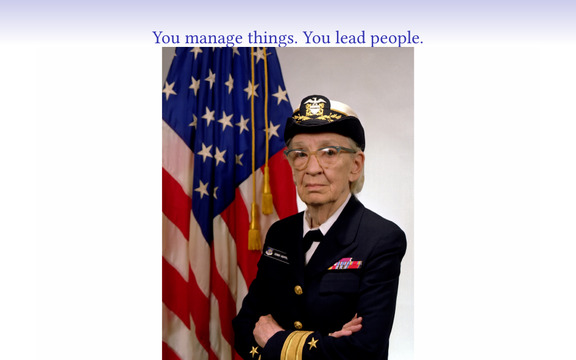
Преди известно време NSA разсекретиха лекция, която (по това време капитан, после адмирал) Grace Hopper изнесла при тях през 1982 година. В тази лекция има много интересни неща и я препоръчвам на всички да я изгледат, но една част от нея ме побутна да направя моята.
(всички, които гледат лекцията почват да искат да имат баба като нея)

(ако някой не знае коя е Grace Hopper, силно препоръчвам да се се зарови)

Явно се сблъска в главата ми с много други неща, свързани с “мениджмънт”, “човешки ресурси”, “модерно робство” (за мен термина “човешки ресурси” е наследство от времената, когато робството е било нормално. Честно казано, даже очаквах да намеря някой римски термин като “Homo subjecto” (човекопредметност), на който да е наследство).

Та поне аз имам нужда да разкажа какво знам за правенето на екипи, поддръжката им, работата с тях. Вижда ми се много по-важно от всякаква техническа тема, на която бих могъл да говоря в момента, и съм зарязал поне три такива полунаписани лекции, за да направя тази.

Нещата толкова се бяха събрали в главата ми, че една вечер, след като спешно трябваше да стана да оправя нещо, вместо пак да си легна отделих един час и написах подробен план на лекцията. Това, което ще разказвам, не се отклонява особено от него.

Тази лекция събира опита ми от последните двайсетина години с някакво количество книги, изчетени по темата. Опитът ми е от различни фирми (последната е StorPool), и доброволчески организации като OpenFest, FOSDEM, IT турнето и разни други.

Този въпрос го има и накрая.

Въпреки, че много повече предпочитам да се занимавам със сървъри, мрежи и машини, никога не съм успявал да се измъкна от човешкия елемент. И колкото да ми е уморителен, с годините съм приел, че е сравнимо важен с всичко останало, което правят.

Едно от нещата, които ми е липсваше в университета (и което се стараех по някакви начини да вкарвам в преподаването си там) бяха екипни проекти. Възможно е това, че аз съм бил три години втори курс да ме е спряло да открия, че всъщност се преподава екипност, но и на разглеждане на конспекта такива неща няма – всички изпити, контролни и други подобни забавления са индивидуални. Единственото отборно нещо, в което съм участвал беше едно състезание по програмиране.

HR отделите това им е част от работата, но в повечето случаи не им се получава. Всички екипи, които съм виждал са супер подозрително настроени към всякакви подобни инициативи.

Също така, много ще се радвам, ако след лекцията хората ми кажат, че това са неща, дето се знаят и съм и загубил времето.

Малко spoiler alert за какво ще говоря – за как се събира екип, за какви хора бихте искали и каква култура, как може да работи, и как се поддържа.

Този слайд го има основно, за да си изяснят хората дали ще им е интересна лекцията, и да ходят да пият/пушат отвън, ако не 🙂

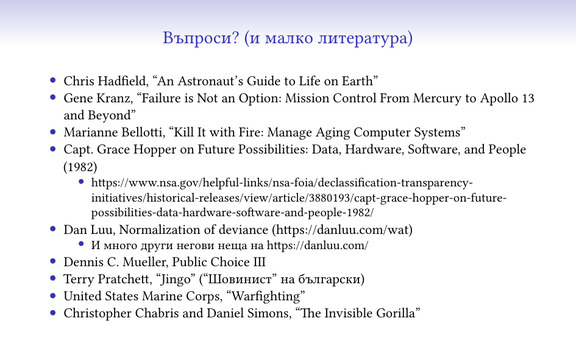
Малко източници, на които съм се базирал.

Астронавтите и изобщо космическите пътувания са много добър пример за начин на работа на малки и големи екипи с критични системи. Информацията е публична, намира се лесно, и чак е трудно да избягаш от нея.

Военните организации са друг интересен пример. Теорията им съществуват от много отдавна, и при тях доста от лошите идеи са отмрели (понякога съвсем буквално). Доста от техните идеи са неприложими извън тяхната сфера (например принципите им за team building са незаконни), но има и много полезни неща.

За системите от хора (т.е. организации) има също написано много, ще се появява на разни места из лекцията.

И накрая, художествената литература. Правил съм цяла отделна лекция за това колко е полезна, тук само ще отбележа, че популярната такава показва какво хората очакват и би им се харесало в реалния свят. Описанията на добрите лидери, с които сме свикнали от малки идват основно от там – те ни дават очакванията към лидерие и границите, до които могат да се нарушат.

Да започнем с това как се събират правилните хора.

Виждал съм и познавам хора, които са или водещи екип, или важна част от него, но отказват да се занимават с взимането на хора в него. Считат го за скучна, второстепенна или направо ненужна част. Има и фирми, в които самите екипи почти нямат право на глас кой влиза в тях.
И двете не са правилни, съответно силно ги препоръчвам на всичките ни конкуренти.

Хората, с които работите определят дали ще си свършвате работата, дали ще ви харесва, или сутрин ще трябва да си разреждате кафето с нещо по-спиртно, за да може да понесете деня.
(Личен съвет – ако откриете, че започвате да си сипвате алкохол от сутринта, за да може да си вършите работата, е време да напуснете. Както и ако в понеделник сутрин ви става лошо при мисълта, че трябва да ходите на работа)

На повечето места, на които съм работил съм имал участие в процеса на наемане, а в последните няколко и изрично съм държал да участвам. Вече не ми се налага да пия сутрин 🙂

Ще базирам тази част основно на какво правим в StorPool, но доста неща са подобни и при търсенето на доброволци, и твърдя, че са приложими за повечето IT специалности.

В StorPool ни отне време да изгладим процеса (и сигурно има неща, които допълнително можем да подобрим). Това не стана без да направим едно количество грешки.

Първия път пуснахме обява по нормалния начин, видяхме 20-30 CV-та, от тях избрахме 10 по някакъв начин, и ги поканихме на интервюта.
След като приключихме с тях (отне около седмица), седнахме, поговорихме и си казахме “NEVER AGAIN”. Обърнахме процеса, като сега първо пращаме на кандидата задачи, и след и ако реши някаква част от тях, каним на интервю.

CV-тата на хората дават идея за какво да си говориш с тях. От там нататък стойността им не е особено голяма – хората лъжат, доста често ненарочно, и разликата между двама човека със същото CV може да е от земята до небето. А интервю с грешния вид човек е изпитание и уморително упражнение, което спокойно може да се пропусне.

Единствения човек, който се радваше на този тип интервюта беше жена ми, която много се забавляваше на историите от тях. Или, както е казал народът, на чужд гръб и сто интервюта са малко.

Та, един ден седнах и насъбрах задачи. Спомних си някакво количество проблеми, с които съм се борил и които са ми останали в главата, малкото код или други неща около тях, и сглобих нещо, което лесно да даваме на хората да решават.
Това, че съм ги запомнил има и друго предимство – че вероятно са интересни. Ако карам някого да ми отдели някакво време, е добре да не е с нещо скучно 🙂

Важно е задачите да са реални. Това има допълнителния момент, че кандидатът може да разпознае неща, с които се е борил и да разбере, че не е сам 🙂

И разбира се, трябва някакво разнообразие, не може да дадем същата задача 5 пъти с различни параметри. Най-малко никъде работата няма такова нещо.

Задачите са прекрасен филтър.
Има хора, които изобщо отказват да обърнат внимание, защото смятат, че са над такива неща. Има хора, които не намират подобни неща за интересни. Има такива, които не могат да решат нищо от тях. И наскоро дори имаше случай “не смятам, че някога в реалната работа ще ми се наложи да правят A и B (неща от задачите).

Последният не е прав, а всичките други групи са хора, които не бих искал в екипа си.

Кратко отклонение за типа хора, с които искам да работя, понеже идеята със задачите е много дискриминираща спрямо останалите.

Смятам, че човек трябва да се занимава с неща, които му харесват. Може би не всички детайли, но основната част от работата, генералната цел и каквото се постига, трябва да са нещо, което ти харесва. Животът е твърде кратък, за да се занимаваш с глупости.

Това, освен че прави целия процес на работа по-приятен, води и до това, че се работи с по-кадърни хора. Колкото повече ти харесва нещо, толкова повече влагаш усилия и се занимаваш с него и ставаш по-добър (всички сме чували за 10те хиляди часа).

И разбира се, ако хората им харесва, няма да искат да си тръгнат. Достатъчно често попадам на случаи, в които хората искат да напуснат и да идат някъде дори на по-ниска заплата. От друга страна пък, никога няма да забравя как се опитвахме да подмамим при нас Боби Станимиров. Бяхме го завели на обяд в едно много приятно заведение, говорехме си, обяснявахме колко интересни неща правим, и той в един момент каза “Да, вашето е интересно. Ама при нас лекуваме рак.”
(той тогава беше във viewray, те правят комбинация от ядрено-магнитен резонанс и гама-нож, т.е. докторите могат да гледат докато режат с гама ножа)

Да си харесваш работата всъщност не е толкова рядко, а хората харесват какви ли не работи. Може би най-простия пример, който имам е как хора ходят, учат във ФМИ и вместо да след това да работят за много пари в IT-то, стават учители – професия, която (да цитирам един мой любим сериал) комбинира стреса на неврохируг със заплащането на продавач в магазин.
Шапка им свалям на тези хора, аз не бих могъл.

(или всички доктори)

Слайдът, разбира се, може да се чете като “отклонение е да си харесвате работата”. И такива отклонения трябват 🙂

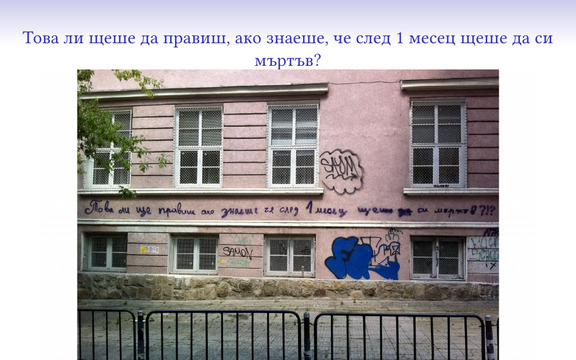
Благодаря, че ми намериха този графит, който беше написан едно време, мисля на ул. “Париж”, и който е донякъде крайната фаза на харесването на работата и мотивираността. Поне според мен, човек трябва да може сутрин да си отговаря на този въпрос или с “да”, или с “ще направя нещо, че отговорът да е ‘да’”.
(предполагам не е полезно да мислиш за умиране всяка сутрин, та може да бъде разредено кога се преосмисля, но принципът си остава 🙂 )

Чудил съм се понякога колко е наемът на един билборд на Орлов мост, за да сложим този надпис да постои там известно време.

Човек и добре да живее, трябва да си говори с други хора. Процес на наемане без интервюта няма как да се направи.

Виждал съм различни варианти на интервюта. Може би най-любимото ми беше в google, където им бях на гости за един ден, сложиха ме в една стая и различни екипни lead-ове ме разпитваха в продължение на около 5-6 часа.
(може би заради това Дъблин ми стана другия любим град след София)

Това идва тежко за доста хора, и е отделяне на много време с неясно каква полезност. При нас базовото техническо интервю е едно, с двама-трима човека от наша страна. Имаме няколко области, в които задаваме въпроси, като цяло съвсем стандартно.
Различното е, че цялото интервю започва с обясняване кои сме ние, какво правим и каква е работата. През целия процес на интервюто идеята е не само ние да научим нещо (за кандидата, или като цяло), но това да се случи и за отсрещната страна. Всяко интервю трябва да е полезно и за двете страни, и да помогне за отговора дали наистина искат да работят заедно.

После срещаме човека с целия екип, с който ще работи. Всеки има право да знае в какво се забърква, а и помага да видиш, че ще работиш в компания на сродни души (или ужасни изроди и по-добре да бягаш надалеч).
След срещата на целия екип въпросът, който си задаваме е “Кажете нещо лошо за човека”. Ще го спомена по-долу, но да почна от тук, решението за нов човек се взема с консенсус – всички от екипа участват във взимането на решението и трябва да са съгласи за новия член. Тези интервюта са едно от много малкото неща, за които занимаваме хора, излезли в отпуска.

И има едно “човешко” интервю (все ми се карат, като го наричам така, та приетия термин е “не-техническо”). Целта му е да хване проблеми с човека, които ние не сме видели.

Всички преди изпитателния срок е филтър, който да намали хората, провалящи се в него. А самият изпитателен срок е правилният показател дали може да се работи с някого.

Един от любимите ми процеси за интервюиране беше в Automattic – там имаше едно-две интервюта, и после директно едномесечен договор, в рамките на който ти дават достъп, правиш задачи с разни хора за разни цели (истински задачи, има шанс едно от нещата дето правих да са го ползвали прилично време) и двете страни могат да видят как изглежда работата и вписването на новия човек. Завиждам на фирмите с достатъчно ресурс, които могат да го правят.

Учудващо, разликите в доброволческите организации са основно в реда на случващото се. Много често доброволците директно почват с един изпитателен срок, преди да навлязат повече в организацията 🙂

Практически обаче, има горе-долу същите стъпки и действия, за да стане някой част от доброволческа организация – да свърши нещо, да се срещене с някакви основни хора, и после с всички, и да работи с тях известно време. На практика много от доброволците минават като първа стъпка нещото със “задачите”, понеже идват един ден и някой им казва “свърши това” 🙂

Това е като продължение на частта с типа хора, който искаш.

За да работи един екип, трябва да съществува в добра среда. Среда, която насърчава правилните неща, не толерира вредните, и дава възможност на хората да се развиват и да работят.

Културата е нещо, което съществува в екипа, но трябва да е подкрепено на всяко едно ниво.

И понеже това е някакво вятърничаво като обяснение, ето конкретни примери.

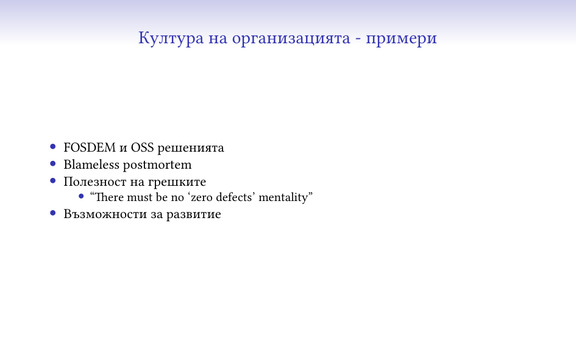
Един пример, който ще дам, е FOSDEM и open-source решенията. Видеото на FOSDEM винаги е било с open-source решения, доколкото е възможно, и когато е имало възможност да се направи още нещо отворено, като например смяната на един capture device с друг, това винаги е било подкрепяно от цялата организация, въпреки отражението върху бюджета на събитието. Това винаги е важало и за всичко, което се ползва – ако има възможност, се прави с open-source софтуер, ако ще и самата организация да си го напише, без възражения от типа “не можем ли да ползваме онова готовото и да не се занимаваме”.

Друг пример – за нещо, което не осъзнавах, че е добре да се формализира – е т.нар. blameless postmortem. Идеята е следната – ако се случи грешка, която да доведе до сериозни последствия (в нашия случай – downtime), се пише postmortem документ, който описва как се е случило събитието, какво е довело до него, и какво може да се направи, за да не се случва пак.
Blameless частта е, че вместо да кажем “Пешо пипна там и то се счупи, та ще му хвърлим един бой”, се прави по-трудното – изяснява се процеса, грешката и как да не се стигне пак до там. Така се правят по-малко грешки, и не се стига до там, че хората не смеят да правят нищо, за да не пострадат.
(и това е обратно на културата на твърде много места, които съм виждал)

Свързано с това по-горе, културата трябва да приема, че грешките са нещо възможно, и че са някаква част от learning процеса. Щом това успяват да го приемат в области като медицината и воденето на война (USMC имат изрично записано, че “there must be no ‘zero defects’ mentality”), където заради грешки умират хора, не мисля, че и в IT-то не може да се приложи.

Също така, одобено доброволческите организации трябва и осигуряват възможности за развитие, да можеш да смениш екипа, да видиш нещо от друга гледна точка, и да можеш да разнообразиш. [да се допише]

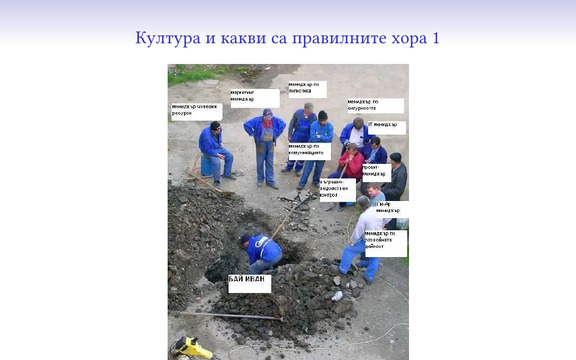
Това си мисля, че е познато на всички. Ще се връщам към него, но просто ще кажа, че всеки в един екип трябва да може да е Бай Иван, без значение позицията.

Съвсем дискриминационно ще кажа, че има правилни и неправилни хора, с които да работиш.

Правилните хора не ги е страх от работата. Както отбелязах, тя трябва да им харесва, да ги забавлява, да не им е лошо сутрин като трябва да ходят на работа и т.н.. И когато има да се свърши нещо, да могат да хванат лопатата.

Има много изписано и изговорено на темата как се мотивират хора. Преди години един колега беше попаднал на статия, която възприехме, и която казваше, че ако хората не се мотивират сами, то насила няма как да се получи добър резултат.
(“насила админ не става”)

Аз не мисля, че мога да мотивирам някой, който не би могъл да се мотивира сам (и определено не искам). Мога да покажа работата, да обясня какво е интересното, какви неща никъде другаде не правят (или в случая на доброволчеството – какво постигаме), но всичко това е безсмислено, ако човекът не е достатъчно self-driven, за да може сам да се мотивира и да се движи напред.

И да натъртя още веднъж идеята, ще дам пример за едно обяснение към студенти, как по партита като се забиват с някой от подходящия пол, преди секс да не търсят “consent”, а “entusiasm”.

При доброволците има важен момент, който следва от предното. За да си харесваш работата и да си достатъчно желаещ да се занимаваш с нея (особено за без пари), трябва да го припознаеш като нещо свое. И това е едно от най-важните неща в подобни организации – да събере хора с обща цел, които приемат целите на организацията за свои.

Това води до друго важно нещо, възможността за изграждане на автономност в хората. Ако всички знаят целта и насоката, ако са запознати с цялостната работа на организацията, то те могат да вършат повечето си работа без да занимават някой друг, и да направят организацията много по-ефективна.

Така и обратната връзка не се приема като нещо лошо, а като нещо, което помага да се движите напред. Екипът не трябва да има страх да каже на някой “моткаш се” или “това е грешно”, какото и всеки в екипа трябва да е ок с подобен feedback. Ако сме се подбрали правилно, нищо от това не е с цел да тормози другия, а с цел да си свършим работата.

Та може би поговоркара за сговорната дружина може да е “дружина с обща осъзната цел планина повдига”, понеже съм го виждал в действие 🙂

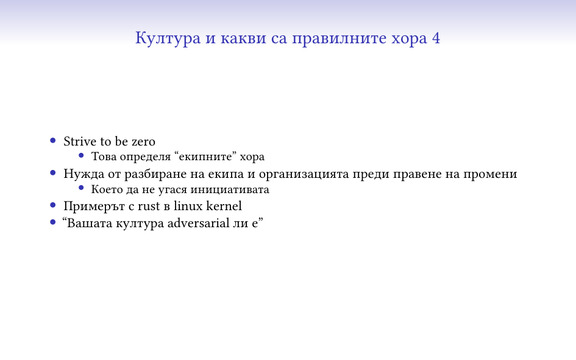
Крис Хадфийлд, който първо ми беше познат от една глава на “How to” (на темата “как да приземим космическата совалка на различни странни места”) има една глава в книгата си “An astornaut’s guide to life on Earth”, в която обяснява какво е правилното нещо, към което да се стремиш да си в един екип. Отговорът му е, че винаги поне трябва да си на нула, т.е. да поддържаш нивото на работа на екипа.

Това е нещо, което е трудно за разбиране. Много хора смятат, че могат от първия ден да направят промени, които да подобрят екипа, работата, да им помогнат да се изтъкнат и т.н. После бързо се обезкуражават след сблъсъка с реалността – понеже за всяко нещо в една организация си има причини, и те трябва да бъдат адресирани, преди да се направи някаква (може би голяма) промяна в начина на работа.
(това не променя факта, че е важно да се проявява инициатива и да се подобрява работата на всички)

Това е и истинската дефиниция на “екипен” човек за мен. Като пример как не се прави, ще дам скорошната случка, в която maintainer-а на Rust за linux kernel-а се отказа да се занимава, защото му било омръзнало да го занимават с “нетехнически” проблеми. Което показва колко заблуден е бил, щом е очаквал, че проблемите му ще са само такива – цялото това нещо, което се опитва да направи е като да накара ламята Спаска да танцува балет. И колкото да обяснява колко гениален е тоя балет, има много други подробности, преди това да има шанс да се случи.

Изобщо по темата за убеждаването на хората и прокарването на идеи, препоръчвам лекцията на Грейс Хопър, която споменах в началото. Тя обяснява за добри начини за постигане на промени в подобни обстоятелства (тя все пак е работела за department of defense и други подобни гигантски структури).

Иначе, имало е доста странни въпроси по интервюта, които са ми помогнали да изчистя моето очакване за какво е екипност и какво всъщност очакват хората. Най-странния въпрос, който са ми задавали беше дали сме повече adversarial или cooperative – което за мен беше невероятно, понеже никога не съм бил/очаквал някой такъв екип да е adversarial и хората да се състезават, вместо да си помагат. Предполагам, някъде има приложение, но поне за мен не е в рамките на една организация, която се опитва да върши работа.

Понеже до тук говорих за общите неща в хората, извън тях, останалото няма значение. В разните екипи, в които съм бил и са били ефективни е имало хора от всякаквите възможни части на обществото, по всякакви признаци, и това определено помага да се избегне groupthink-а (или поне да се намали). Дори в текущия ми екип, който на практика е само системни администратори, има следните под-видове хора: бивши военни, тонрежисьори, готвачи, заварчици и т.н.. Ако попаднем на необитаем остров, няма да ни е скучно, няма да умрем от глад и сигурно ще намерим начин да се измъкнем…

А последния link – ако не сте го чели, отделете му 20 минути. Той обяснява колко бързо свикват хората с глупостите в една организация. Заради него ние правим едно post-onboarding интервю с всеки нов човек, горе-долу на втория месец, в което сядаме и започваме да задаваме въпроси от типа “сега, докато още не си свикнал с нашите глупости, кажи какво не ти се вижда вярно”. Силно препоръчвам и като четиво и като практика.
(в началото имаше доста моменти в тези разговори, в които си казвах “а, ама и аз имах проблем с това, и то все още не е правилно”)

И така, имаме правилните хора, как да работим с тях? Има някои важни неща, особено в подобен екип, които трябва да бъдат взимани предвид, за да може да се работи гладко и най-вече – правилно.
Едно от нещата, които се откриват по трудния начин е какъв е работещия начин за взимане на решения в един екип и каква е ролята на водещия екипа в тях.

Има една идея (срещана и в много вицове), че решенията идват отгоре и толкова. Това е грешно по две причини – губи се полезния опит на членовете на екипа (които сме ги избирали да са умни хора), и защото така има приличен шанс екипът да няма желание да ги изпълнява – понеже не може да ги разбере, не мога да види, че водят до нещо смислено и може би просто от инат.

Това, което работи най-добре е да се изговори даден проблем и да се стигне до консенсус. За някои неща това е единственото правилно решение (например наемането на нови хора в екипа), въпреки времето, което може да отнеме. Понякога има подобен вариант с rough consensus (който го има разписан в IETF документите), който казва, че в общи линии сме съгласни с някакви резервации, но да действаме е по-добрия вариант, отколкото да продължим да го дъвчем.

И ролята на водещия екипа в такива дискусии (освен нормалното участие) е да сумаризира и да отпушва дискусията, когато забие в някоя ненужна посока. Формално накрая може да произнесе решението и да носи отговорност за него, но то на практика трябва да идва от екипа.

Понякога консенсус не се получава – опциите са много, мненията са различни, има нужда да си подредим по предпочитаност някакви опции. В такива случаи може да се прибегне до някакво гласуване, като обаче е важно да сме наясно с изборите, и как точно избираме. Темата за системите за гласуване е много обширна и няма да се спирам на нея, но препоръчвам на всички да се запознаят с модифицирания Condorcet метод, който се ползва в Debian проекта.

А в някои случаи (по-често срещани в доброволческите организации), под-група казва “това ние можем да го случим и поемаме отговорност”, и това е решението. Това пак помага на организацията да се движи напред и да си върши работата, вместо само да отлага и да не прави нищо.

За да може да се случи последното, трябва правилната култура, за която ще говоря надолу.

Между другото, учудващо е колко голяма част от тези два слайда се среща по книгите за военни организации и колко важно е да се изслушат/събере информация от всички (от които е възможно във времевите ограничения). Повечето очаквания от такива организации е, че всичко се спуска отгоре, но практиката (и текущата литература по въпроса) говори друго.

Нещо важно, което се пропуска (и което продължава да ми е проблем при мен самия) е, че понякога има връщане към стар проблем, и опит да разберем защо сме взели дадено решение и дали не трябва сега да вземем различно. Съответно, е добре да има някъде записани старите доводи.

Ако нямате стенографиращ екип, и не сте водили дискусията по mail, то на практика се разчита само на паметта на хората. Паметта на хората е нещо ужасно (който не го вярва, да прочете “Невидимата горила”). За това всяка организация би трябвало има писмена институционна памет (не само хора, дето помнят някакви неща), за да може да се обръща към нея в такива моменти.

Би трябвало всички тук да са имали момента, в който се ровят в стар код, чудят се защо и кой го е написал, и откриват, че са те.

Документирането никак не е лесно, но се изплаща многократно.

И тук някъде идва разговорът за воденето на екипа.

По принцип екипите си имат lead в някакъв вид. Дали се води директор, мениджър или какъвто-там-е-термина, в организацията ролята е да бъде интерфейс между екипа и останалата част от организацията.

Това има различни варианти да се направи. Чувал съм, че често е някой, дето да назначават и да размахва камшика без идея какво правят хората “под” него.

В това има няколко проблема, като тръгнем от това, че тези хора не трябва да са “под”, а “при” него. За мен един lead е част от екипа, може да е смислена част от него и може да е “бай Иван”.

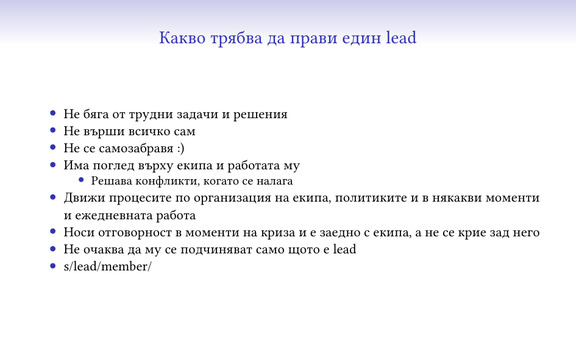
Това е един списък, дето написах още в началото, докато си правех плана на лекцията. За мен е сравнително очевиден, но сам по себе си не е особено интересен. Може да се намери в някакъв вид в много книги, включително в голяма част от всичката военна фантастика 🙂

За мен по-важно е в екипа всяко едно от тези неща да може да го прави всеки, и да има увереността, че може да го прави – може би не от първия ден, не максимално ефективно, но в един момент всеки трябва да може да поема отговорност, и всички да могат да застанат зад него, когато се наложи.

И ако се върнем към културата, важни за един екип са възможността, способността и желанието да се поеме отговорност. Без тях нищо не може да се случи.

Не е задължително да има един lead. Виждал съм (и съм участвал в такива) екипи, където има трима lead-ове, с различни профили. Те донякъде могат да се покриват, но са специализирани достатъчно, и са достатъчно автономни, че да могат да движат нещата без постоянно да трябва да се разбират за някакви неща. Като един пример, това беше OpenFest през повечето време, през което се занимавах с него.

Да има резервен човек, който може да поеме такъв тип задачи е направо животоспасяващо. Това може да е формализирано, а може и просто когато се наложи, да излизат хора от екипа, които да поемат тези функции. Та е важно (както споменах и по-горе) да има една резервна лидерска скамейка, на която има хора, можещи да поемат отговорност.

А може просто да няма формализиран lead, и ролята да се мести, или просто да се случва сама. Това също е работещ вариант при правилните хора, и е просто една голяма “резервна скамейка”, от която някой става, когато е нужно.

Такива примери имам много, от всякакви организации, но най-лесния за илюстриране и един от от любимите ми (даже се оказа, че съм го ползвал в друга моя лекция 🙂 ). Това се случва в петък вечер преди OpenFest 2018. Аз съм се прибрал да си гледам жената и детето (тогава само едно), и нещо се счупва с интернета и сървъра. И няколко човека, които всъщност не са настройвали тая част, щото са били заети с други неща сядат и го оправят (с малко обаждане по телефона да ме питат нещо).

Да си призная, тези хора ми бяха от любимите екипи 🙂

Почистването на екип е от нещата, с които съм се занимавал най-малко. Старая се основно да не се налага, понеже това губи време и изтормозва всички.

Виждал съм най-различни случаи на проблемни хора. За тях има различни решения, като тръгнем от корекция на конфликти, разделение на отговорности (ако някакви хора не могат да се траят, но трябва да работят в близки екипи), до директно раздяла с някого. Важното при всички такива решения е да са ясни защо се случват и да се случват.

Това по принцип е една от най-тежките задачи, и във фирмите даже си има хора за тая работа, да играят лошия, когато ни дойде желание да избягаме от отговорност…

А трябва ли да се занимваме с това? Да сме в екип, да го поддържаме, да работим заедно?

За някои хора не. Има достатъчно неща, за които може да си one-man show и да сработят, и познавам хора, които правят точно това – гледат да са единствените, които се занимават с дадено нещо и да си го организират така, че да не им е проблем.

За мен си заслужава и винаги си е заслужавало. Правил съм неща сравнително сам, и съм наясно какво мога да постигна. Постигал съм повече в различни екипи, и определено си е заслужавало. Препоръчвам на всички 🙂 В някои отношения е по-трудно от работата с компютри, в някои е по-лесно, но съм се убедил, че е важно.

И ако се огледаме около себе си, огромна част от света, в който живеем се е случил и развил заради групи от хора с определена цел.

Оставям един slide с малко допълнителни ресурси, има ли някакви въпроси?