Protecting your secrets from tomorrow’s quantum risks

Post Syndicated from Stéphanie Mbappe original https://aws.amazon.com/blogs/security/protecting-your-secrets-from-tomorrows-quantum-risks/

As outlined in the AWS post-quantum cryptography (PQC) migration plan, addressing the risk of harvest now, decrypt later (HNDL) attack is an important part of your post-quantum plan. Upgrading the client-side of your workloads to support quantum-resistant confidentiality is an important aspect of your side of the PQC shared responsibility model. Timelines to plan and execute your PQC upgrades vary by region and by industry and will depend on your own business risk profile. To learn more, see the AWS PQC frequently asked questions.

AWS Secrets Manager uses SSL/TLS to communicate with AWS resources, currently supporting TLS 1.2 and 1.3 in all AWS Regions. The service supports using TLS 1.3 with hybrid post-quantum key exchange for clients that support this capability. The hybrid post-quantum approach establishes TLS connections by combining traditional cryptography (such as X25519) with post-quantum algorithms (ML-KEM), and helps to protect your secrets against both current classical attacks and future quantum computer threats. Regardless of how your workload accesses Secrets Manager, this client-side software upgrade is the only action you need to take to address risk to secrets from HNDL. Your secrets at rest are already encrypted using keys managed by AWS Key Management Service (AWS KMS). Properly implemented symmetric encryption is considered quantum-resistant; asymmetric cryptography faces quantum threats. To learn more, watch AWS re:Inforce 2025 – Post-Quantum Cryptography Demystified.

To reduce builder effort for client-side upgrades, we’re pleased to announce the following Secrets Manager clients now enable and prefer post-quantum TLS when initiating connections to Secrets Manager: Secrets Manager Agent (v2.0.0 or later), the AWS Lambda extension (v19 or later) and the Secrets Manager CSI Driver (v2.0.0 or later). For SDK-based clients, hybrid post-quantum key exchange is available in supported AWS SDKs. Enablement requirements vary by language, version, and operating system. See the following table for your SDK client.

This launch is part of the ongoing commitment AWS has made to migrate systems to post-quantum cryptography and making it straightforward for our customers to do the same. See Post-Quantum Cryptography to learn more.

Client hybrid post-quantum key exchange requirements

The following table summarizes the behavior for each client. When the client is upgraded to support hybrid post-quantum key exchange, the Secrets Manager service endpoint automatically selects it during the TLS handshake. Upgrading to the versions listed in the table is the only action you need to take for your workload to begin using hybrid post-quantum key exchange when calling Secrets Manager APIs.

Client Requirements
Secrets Manager Agent Hybrid PQ key exchange in TLS preferred by default (v2.0.0 and later)
AWS Lambda extension Hybrid PQ key exchange in TLS preferred by default (Version 19 and later)
Secrets Manager CSI Driver Hybrid PQ key exchange in TLS preferred by default (v2.0.0 and later)
AWS SDK for Rust Hybrid PQ key exchange in TLS preferred by default (releases after August 29, 2025)
AWS SDK for Go Hybrid PQ key exchange in TLS preferred by default (Go v1.24 and later)
AWS SDK for Node.js Hybrid PQ key exchange in TLS preferred by default (Node.js v22.20 and v24.9.0 and later)
AWS SDK for Kotlin Hybrid PQ key exchange in TLS preferred by default on Linux (v1.5.78 and later)
AWS SDK for Python The AWS SDK for Python (boto3) uses the OS-provided OpenSSL for TLS.
Hybrid PQ key exchange in TLS requires running on a system with OpenSSL 3.5 or later installed.
AWS SDK for Java v2 AWS SDK for Java v2 requires an AWS CRT HTTP client that supports PQ TLS when configured using postQuantumTlsEnabled.
Secrets Manager caching clients The Secrets Manager caching libraries are built on the AWS SDKs and inherit their TLS behavior. Note for Java: The JDBC driver flag and Java Caching flag must be set to enable Hybrid PQ key exchange in TLS.

If you’re using the Secrets Manager Agent, the Lambda extension, or the CSI Driver, upgrade to the listed version to use hybrid post-quantum key exchange in TLS as the default. Customers using the AWS SDK for Rust, Go, or Node.js at the versions listed in the table are already upgraded and no additional action is required. The SDK will select the hybrid post-quantum key exchange for API calls. For customers using the AWS SDK for Python, hybrid post-quantum key exchange in TLS requires OpenSSL 3.5 or later to be present on the host system. Guidance on verifying and enabling this is available in the AWS Secrets Manager documentation. For customers using the AWS SDK for Java v2, hybrid post-quantum key exchange in TLS requires using the AWS CRT HTTP client. The postQuantumTlsEnabled(true) must be set on the CRT client to enable hybrid post-quantum key exchange in TLS.

After your client versions meet the requirements listed in the table, you can verify that your connections are actively using hybrid post-quantum key exchange.

How to verify your connection uses hybrid post-quantum key exchange

With hybrid post-quantum key exchange using ML-KEM now enabled by default for Secrets Manager clients (see the preceding table), most customers will not need ongoing monitoring to verify correct behavior or detect regressions. However, security teams and compliance officers might want to confirm that their Secrets Manager API calls are negotiating the hybrid key exchange. On the server side, you can confirm hybrid post-quantum key exchange in TLS by using AWS CloudTrail. On the client side, you can inspect TLS handshake details using a utility like Wireshark or by using developer tools built into major web browsers.

Verification is a two-step process: first, fetch a secret using your Secrets Manager client to generate a GetSecretValue API call, then confirm in AWS CloudTrail that the call negotiated hybrid post-quantum key exchange.

Fetch your secret using your Secrets Manager client

The following examples show how to retrieve your secret using the Secrets Manager Agent, Lambda extension, and CSI Driver—each of which will automatically negotiate hybrid post-quantum key exchange when calling the GetSecretValue API.

To verify hybrid post-quantum TLS with Secrets Manager Agent on EC2 instance:
Install the agent on your Amazon Elastic Compute Cloud (Amazon EC2) instance and use it as a client to fetch your secret.

  1. Follow the instructions for AWS Secrets Manager Agent.
  2. Ensure that your EC2 instance profile has the permission for secretsmanager:GetSecretValue to fetch the secret.
  3. Connect to your private EC2 instance.
  4. Install the agent on your EC2 instance.
  5. Use the agent to fetch your secret.
    curl -H “X-Aws-Parameters-Secrets-Token: $(</tmp/awssmatoken)” localhost:2773/secretsmanager/get?secretId=<YOUR-SECRET-ARN>
  6. Wait for about 5 minutes for CloudTrail to deliver the logs.
  7. Go to the CloudTrail event history and search for the event GetSecretValue.

To verify hybrid post-quantum TLS with Lambda extension:
Use the AWS parameters and Secrets Manager Lambda extension to create a Lambda function that will consume your secrets from Secrets Manager using direct API calls.

  1. Follow Using the AWS parameters and secrets Lambda extension to create the Lambda layer and the Lambda function.
  2. Select the latest extension version.
  3. Wait for about 5 minutes for CloudTrail to deliver the logs.
  4. Go to the CloudTrail event history and search for the event GetSecretValue.

To verify hybrid post-quantum TLS with CSI driver on Amazon EKS:
On your Amazon Elastic Kubernetes Service (Amazon EKS) cluster, use the AWS Secrets Store CSI Driver provider to fetch secrets from Secrets Manager in Kubernetes pods:

  1. Confirm the installed add-on version is 2.0.0 or later.
    eksctl get addon --cluster <CLUSTER-NAME> --name aws-secrets-store-csi-driver-provider
  2. Trigger a secret retrieval by restarting a pod that mounts a secret, or deploying a new one.
  3. Wait for about 5 minutes for CloudTrail to deliver the logs.
  4. Go to the CloudTrail event history and search for the event GetSecretValue.

Confirm hybrid post-quantum key exchange using CloudTrail

CloudTrail logs include a tlsDetails field for Secrets Manager API calls. When hybrid post-quantum key exchange in TLS is active, the keyExchange field in tlsDetails will show X25519MLKEM768. Each CloudTrail record includes a tlsDetails field that contains the cipher suite and, where available, the key exchange group negotiated during the TLS handshake.

You can work with CloudTrail event history using the AWS Management Console for CloudTrail or the AWS Command Line Interface (AWS CLI).

To look up CloudTrail events using the console:

  1. Verify you are in the correct AWS Region.
  2. Open the CloudTrail console and select Event History.
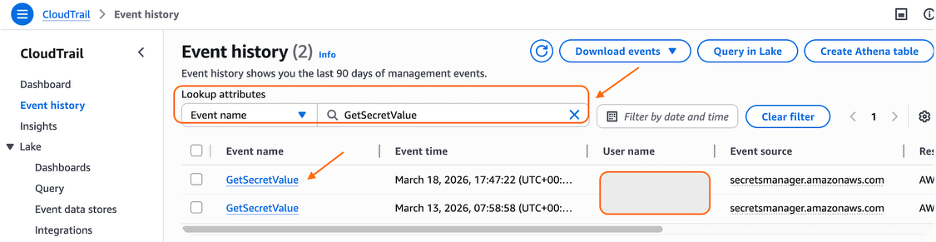
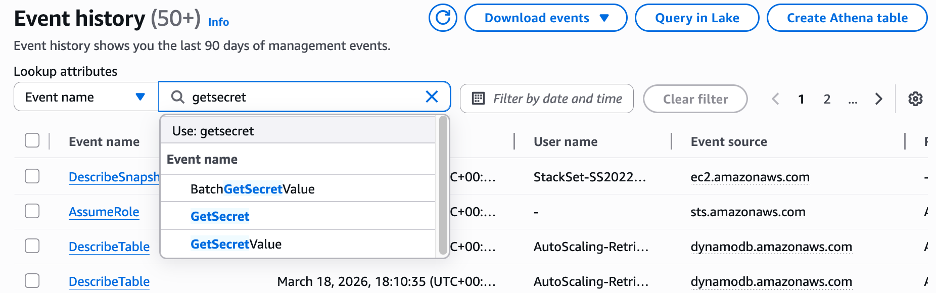
  3. Under Lookup attributes filter, select Event name and GetSecretValue.
    Figure 1: Search CloudTrail event history by event name

    Figure 1: Search CloudTrail event history by event name

  4. Select your event.
    Figure 2: Select the event

    Figure 2: Select the event

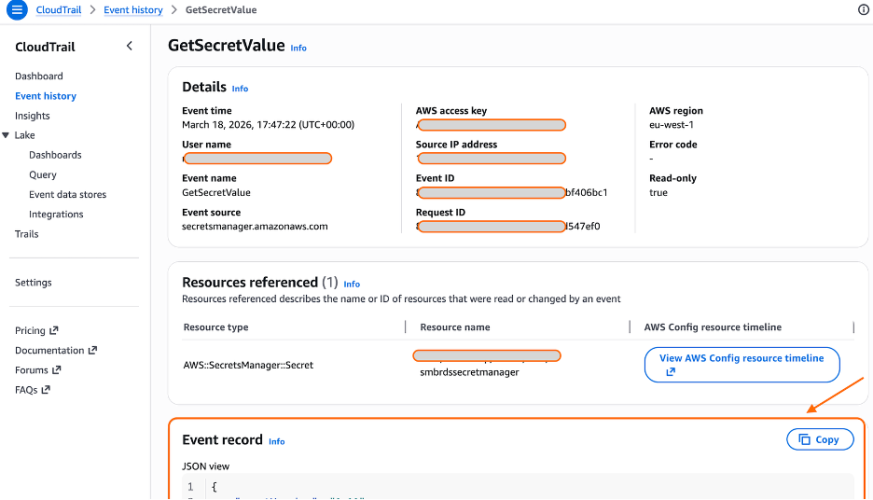
  5. View the output in the Event Record section of the page.
    Figure 3: CloudTrail - GetSecretValue event

    Figure 3: CloudTrail – GetSecretValue event
To look up CloudTrail events using AWS CLI :
Using AWS CLI, select the last events and look at the output.

aws cloudtrail lookup-events \
--lookup-attributes AttributeKey=EventName,AttributeValue=GetSecretValue \
--max-results 5 \
--region <YOUR-REGION> \
--query 'Events[0].CloudTrailEvent' \
--output text

Example of CloudTrail Event for GetSecretValue API call:

In the following example, the userAgent field reflects what it used as a client to connect to Secrets Manager.

Note: The userAgent value depends on the client you use.

{
    "eventVersion": "1.11",
    "userIdentity": {
        "type": "AssumedRole",
        "principalId": "AROA123456789EXAMPLE:i-0c1a23fc456b7ab89",
        "arn": "arn:aws:sts::111122223333:assumed-role/YOUR-EC2-INSTANCE-PROFILE/i-0c1a23fc456b7ab89",
        "accountId": "111122223333",
        "accessKeyId": "ASIAIOSFODNN7EXAMPLE",
        "sessionContext": {
            "sessionIssuer": {
                "type": "Role",
                "principalId": "AROA123456789EXAMPLE",
                "arn": "arn:aws:iam::111122223333:role/YOUR-EC2-INSTANCE-PROFILE",
                "accountId": "111122223333",
                "userName": "YOUR-EC2-INSTANCE-PROFILE"
            },
            "attributes": {
                "creationDate": "2026-03-27T17:08:37Z",
                "mfaAuthenticated": "false"
            },
            "ec2RoleDelivery": "2.0"
        },
        "inScopeOf": {
            "issuerType": "AWS::EC2::Instance",
            "credentialsIssuedTo": "arn:aws:ec2:eu-west-2:111122223333:instance/i-0c1a23fc456b7ab89"
        }
    },
    "eventTime": "2026-03-27T17:12:54Z",
    "eventSource": "secretsmanager.amazonaws.com",
    "eventName": "GetSecretValue",
    "awsRegion": "eu-west-2",
    "sourceIPAddress": "1.2.3.4",
    "userAgent": "aws-sdk-rust/1.3.14 os/linux lang/rust/1.94.1 aws-secrets-manager-agent/2.0.0",
    "requestParameters": {
        "secretId": "arn:aws:secretsmanager:eu-west-2:111122223333:secret:your-secret"
    },
    "responseElements": null,
    "requestID": "027507ea-f377-43d9-bf2f-646d4dc19223",
    "eventID": "f9c3ed0f-81f5-450b-a561-2b9e54fa9e73",
    "readOnly": true,
    "resources": [
        {
            "accountId": "111122223333",
            "type": "AWS::SecretsManager::Secret",
            "ARN": "arn:aws:secretsmanager:eu-west-2:111122223333:secret:your-secret"
        }
    ],
    "eventType": "AwsApiCall",
    "managementEvent": true,
    "recipientAccountId": "111122223333",
    "eventCategory": "Management",
    "tlsDetails": {
        "tlsVersion": "TLSv1.3",
        "cipherSuite": "TLS_AES_128_GCM_SHA256",
        "clientProvidedHostHeader": "secretsmanager.eu-west-2.amazonaws.com",
        "keyExchange": "X25519MLKEM768"
    }
}

If the keyExchange field shows X25519MLKEM768, then hybrid post-quantum key exchange in TLS is active. If it shows a traditional algorithm such as X25519, the client is not advertising ML-KEM support, and you should check the client version and configuration.

Troubleshooting

If your Secrets Manager API calls aren’t negotiating X25519MLKEM768 after updating your clients, check your SDK version, OpenSSL version (Python), and firewall or proxy configuration as shown in the Client Hybrid Post-Quantum Key Exchange Requirements section near the beginning of this post.

What’s next

This launch is one step in a broader migration. AWS is continuing to roll out ML-KEM support across AWS service HTTPS endpoints as part of Workstream 2 of the AWS PQC Migration Plan, with a target of full coverage across public AWS endpoints.

Support for CRYSTALS-Kyber, the pre-standardization predecessor to ML-KEM, is phasing out across AWS endpoints in 2026. Customers on older SDK versions that advertise only CRYSTALS-Kyber support will fall back gracefully to traditional TLS rather than negotiate the deprecated algorithm. To avoid this fallback, upgrade to the SDK versions listed in this post.

The journey of PQC migration extends beyond confidentiality of data in transit. To stay informed about the latest developments in the AWS PQC journey and your side of shared responsibility, follow the AWS Post-Quantum Cryptography page.

Conclusion

AWS Secrets Manager now enables hybrid post-quantum key exchange using ML-KEM by default to help protect your secrets and support your compliance efforts. This update requires no code changes or configuration updates for customers using the latest client versions.

This post covered how AWS Secrets Manager uses hybrid post-quantum cryptography to secure TLS connections, which clients support this capability, and how to verify that your connections are protected against harvest now, decrypt later attacks.

To benefit from this announcement today:

  • Upgrade your Secrets Manager client (Agent, Lambda extension, or CSI Driver) to the latest available versions to enable hybrid post-quantum key exchange using ML-KEM
  • If your workload uses the AWS SDK instead of a caching client, upgrade your AWS SDK and underlying dependencies to the minimum versions listed in this post
  • Verify hybrid post-quantum key exchange in TLS is active by checking the keyExchange field in CloudTrail tlsDetails for your Secrets Manager API calls
  • Test end-to-end hybrid post-quantum key exchange TLS connectivity in your environment, including network paths that traverse corporate firewalls or proxies

AWS will continue rolling out post-quantum cryptography support. For information about the broader migration effort, see the AWS PQC Migration Plan. Keep an updated cryptographic inventory of your broader environment to identify other uses of traditional public-key cryptography that will require migration. The CISA Quantum-Readiness guidance and the AWS PQC Migration Plan are good starting points.

Additional resources

If you have feedback about this post, submit comments in the Comments section below.
P. Stéphanie Mbappe

P. Stéphanie Mbappe

Stéphanie is a Security Consultant with Amazon Web Services. She delights in assisting her customers at any step of their security journey. Stéphanie enjoys learning, designing new solutions, and sharing her knowledge with others.

Tobias Nickl

Tobias Nickl

Tobias is a Security Consultant at Amazon Web Services, specializing in security architecture and cloud transformation. He partners with AWS customers to design and implement security architectures that address both current and emerging threats. Through his work, he helps organizations build security strategies that evolve with their cloud maturity.

Scaling Camera File Processing at Netflix

Post Syndicated from Netflix Technology Blog original https://netflixtechblog.com/scaling-camera-file-processing-at-netflix-6dab2b1e80be

Orchestrating Media Workflows Through Strategic Collaboration

Authors: Eric Reinecke, Bhanu Srikanth

Introduction to Content Hub’s Media Production Suite

At Netflix, we want to provide filmmakers with the tools they need to produce content at a global scale, with quick turnaround and choice from an extraordinary variety of cameras, formats, workflows, and collaborators. Every series or film arrives with its own creative ambitions and technical requirements. To reduce friction and keep productions moving smoothly, we built Netflix’s Media Production Suite (MPS) with the goal of automating repeatable tasks, standardizing key workflows, and giving productions more time to focus on creative collaboration and craftsmanship.

A critical part of this effort is how we handle image processing and camera metadata across the hundreds of hours and terabytes of camera footage that Netflix productions ingest on a daily basis. Rather than build every component from scratch, we chose to partner where it made sense–especially in areas where the industry already had trusted, battle-tested solutions.

This article explores how Netflix’s Media Production Suite integrates with FilmLight’s API (FLAPI) as the core studio media processing engine in Netflix’s cloud compute infrastructure, and how that collaboration helps us deliver smarter, more reliable workflows at scale.

Why We Built MPS

As Netflix’s production slate grew, so did the complexity of file-based workflows. We saw recurring challenges across productions:

  • File wrangling sapping time from creative decision-making
  • Inconsistent media handling across shows, regions, or vendors
  • Difficult to audit manual processes that are prone to human error
  • Duplication of effort as teams reinvented similar workflows for each production

Content Hub Media Production Suite was created to address these pain points. MPS is designed to:

  • Bring efficiency, consistency, and quality control to global productions
  • Streamline media management and movement from production through post-production
  • Reduce time spent on non-creative file management
  • Minimize human error while maximizing creative time

To achieve this, MPS needed a robust, flexible, and trusted way to handle camera-original media and metadata at scale.

The Right Tool for the Job

From the start, we knew that building a world-class image processing engine in-house is a significant, long-term commitment: one that would require deep, continuous collaboration with camera manufacturers and the wider industry.

When designing the system, we set out some core requirements:

  • Inspect, trim, and transcode original camera files and metadata for any Netflix production with trusted color science
  • Support a wide variety of cameras and recording formats used worldwide while staying current as new ones are released
  • Run well in our paved-path encoding infrastructure, enabling us to take advantage of proven compute and storage scalability with robust observability

FilmLight develops Baselight and Daylight, which are commonly used in the industry for color grading, dailies, and transcoding. Their FilmLight API (FLAPI) allows us to use that same media processing engine as a backend API.

Rather than duplicating that work, we chose to integrate. FilmLight became a trusted technology partner, and FLAPI is now a foundational part of how MPS processes media.

The Media Processing Engine

MPS is not a single application; it’s an ecosystem of tools and services that support Netflix productions globally. Within that ecosystem, the FilmLight API plays the following key roles.

  1. Parsing camera metadata on ingest

Productions upload media to Netflix’s Content Hub with ASC MHL (Media Hash List) files to ensure completeness and integrity of initial ingest, but soon after, it’s important to understand the technical characteristics of each piece of media. We call this workflow phase “inspection.”

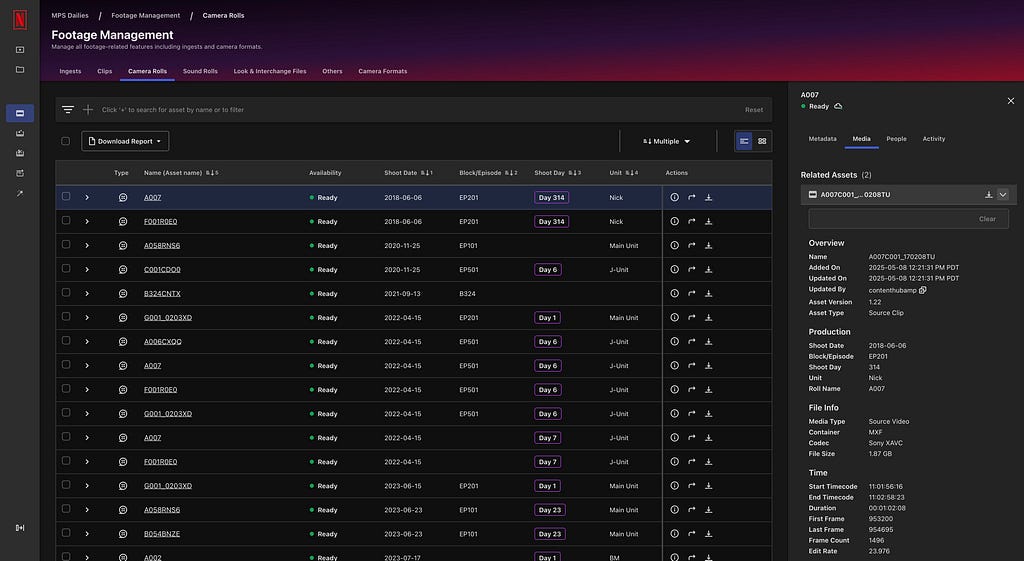
Footage ingested with MPS is inspected using FLAPI and all metadata is indexed and stored

At this stage, we:

  • Use FLAPI to gather camera metadata from the original camera files
  • Conform the workflow critical fields to Netflix’s normalized schema
  • Make it searchable and reusable for downstream processes

This metadata is integral to:

  • Matching footage based on timing and reel name for automated retrieval
  • Debugging (e.g., why a shot looks a certain way after processing)
  • Validations and checks across the pipeline

FLAPI provides consistent, camera-aware insight into footage that may have originated anywhere in the world. Additionally, since we’re able to package FLAPI in a Docker image, we can deploy almost identical code to both cloud and our production compute and storage centers around the world, ensuring a consistent assessment of footage wherever it may exist.

2. Generating VFX plates and other deliverables

Visual effects workflows constantly push image processing pipelines to their absolute limits. For MPS to succeed, it must generate images with accurate framing, consistent color management, and correct debayering/decoding parameters — all while maintaining rapid turnaround times.

To achieve this, we leverage Netflix’s Cosmos compute and storage platform and use open standards to provide predictable and consistent creative control.

At this phase, we use the FilmLight API to:

  • Debayer original camera files with the correct format-specific decoding parameters
  • Crop and de-squeeze images using Framing Decision Lists (ASC FDL) to ensure spatial creative decisions are preserved
  • Apply ACES Metadata Files (AMF), providing repeatable color pipelines from dailies through finishing
  • Generate an array of media deliverables in varied formats

These processes are automated, repeatable, and auditable. We deliver AMFs alongside the OpenEXRs to ensure recipients know exactly what color transforms are already applied, and which need to be applied to match dailies.

Because we use FilmLight’s tools on the backend, our workflow specialists can use Baselight on their workstations to manually validate pipeline decisions for productions before the first day of principal photography.

The Media Processing Factory in the Cloud

Finding an engine that competently processes media in line with open standards is an important part of the equation. To maximize impact, we want to make these tools available to all of the filmmakers we work with. Luckily, we’re no strangers to scaled processing at Netflix, and our Cosmos compute platform was ready for the job!

Cloud-first integration

The traditional model for this kind of processing in filmmaking has been to invest in beefy computers with large GPUs and high-performance storage arrays to rip through debayering and encoding at breakneck speed. However, constraints in the cloud environment are different.

Factors that are essential for tools in our runtime environment include that they:

  • Are packageable as Serverless Functions in Linux Docker images that can be quickly invoked to run a single unit of work and shut down on completion
  • Can run on CPU-only instances to allow us to take advantage of a wide array of available compute
  • Support headless invocation via Java, Python, or CLI
  • Operate statelessly, so when things do go wrong, we can simply terminate and re-launch the worker

Operating within these constraints lets us focus on increasing throughput via parallel encoding rather than focusing on single-instance processing power. We can then target the sweet spot of the cost/performance efficiency curve while still hitting our target turnaround times.

When tools are API-driven, easily packaged in Linux containers, and don’t require a lot of external state management, Netflix can quickly integrate and deploy them with operational reliability. FilmLight API fit the bill for us. At Netflix, we leverage:

  • Java and Python as the primary integration languages
  • Ubuntu-based Docker images with Java and Python code to expose functionality to our workflows
  • CPU instances in the cloud and local compute centers for running inspection, rendering, and trimming jobs

While FLAPI also supports GPU rendering, CPU instances give us access to a much wider segment of Netflix’s vast encoding compute pool and free up GPU instances for other workloads.

To use FilmLight API, we bundle it in a package that can be easily installed via a Dockerfile. Then, we built Cosmos Stratum Functions that accept an input clip, output location, and varying parameters such as frame ranges and AMF or FDL files when debayering footage. These functions can be quickly invoked to process a single clip or sub-segment of a clip and shut down again to free up resources.

Elastic scaling for production workloads

Production workloads are inherently spiky:

  • A quiet day on set may mean minimal new footage to inspect.
  • A full VFX turnover or pulling trimmed OCF for finishing might require thousands of parallel renders in a short time window.

By deploying FLAPI in the cloud as functions, MPS can:

  • Allocate compute on demand and release it when our work queue dies down
  • Avoid tying capacity to a fixed pool of local hardware
  • Smooth demand across many types of encoding workload in a shared resource pool

This elasticity lets us swarm pull requests to get them through quickly, then immediately yield resources back to lower priority workloads. Even in peak production periods, we avoid the pain of manually managing render queues and prioritization by avoiding fixed resource allocation. All this means lightning-fast turnaround times and less anxiety around deadlines for our filmmakers.

Designed for Seasoned Pros and Emerging Filmmakers

Netflix productions range from highly experienced teams with very specific workflows to newer teams who may be less familiar with potential pitfalls in complex file-based pipelines.

MPS is designed to support both:

  • Industry veterans who need to configure precise, bespoke workflows and trust that underlying image processing will respect those decisions.
  • Productions without a color scientist on staff — those who benefit from guardrails and sane defaults that help them avoid common workflow issues (e.g., mismatched color transforms, inconsistent debayering, or incomplete metadata handling).

The partnership with FilmLight lets Netflix focus on workflow design, orchestration, and production support, while FilmLight focuses on providing competent handling of a wide variety of camera formats with world-class image science!

Collaboration and Co-Evolution

Netflix aimed to integrate MPS into a wider tool ecosystem by developing a comprehensive solution based on emerging open standards, rather than making MPS a self-contained system. Integrating FLAPI into our system requires more than an API reference–it requires ongoing partnership. FilmLight worked closely with Netflix teams to:

  • Align on feature roadmaps, particularly around new camera formats and open standards
  • Validate the accuracy and performance of key operations
  • Debug edge cases discovered in large-scale, real-world workloads
  • Evolve the API in ways that serve both Netflix and the wider industry
  • Create a positive feedback cycle with open standards like ACES and ASC FDL to solve for gaps when the rubber hits the road

One example of this has been with the implementation of ACES 2. FilmLight’s developers quickly provided a roadmap for support. As our engineering teams collaborated on integration, we also provided feedback to the ACES technical leadership to quickly address integration challenges and test drive updates in our pipeline.

This collaborative relationship–built on open communication, joint validation, and feedback to the greater industry–is how we routinely work with FilmLight to ensure we’re not just building something that works for our shows, but also driving a healthy tooling and standards ecosystem.

Impact

While much of this work takes place behind the scenes, its impact is felt directly by our productions. Our goal with building MPS is for producers, post supervisors, and vendors to experience:

  • Fewer delays caused by missing, incomplete, or incorrect media
  • Faster turnaround on VFX plates and other technical deliverables
  • More predictable, consistent handoffs between editorial, color, and VFX
  • Less time spent troubleshooting technical issues, and more time focused on creative review

In practice, this often shows up as the absence of crisis: the time a VFX vendor doesn’t have to request a re-delivery, or the time editorial doesn’t have to wait for corrected plates, or the time the color facility doesn’t have to reinvent a tone-mapping path because the AMF and ACES pipeline are already in place.

Looking Ahead

As camera technology, codecs, open standards, and production workflows continue to evolve, so will MPS. The guiding principles remain:

  • Automate what’s repeatable
  • Centralize what benefits from standardization
  • Partner where deep domain expertise already exists

The integration with FilmLight API is one example of this philosophy in action. By treating image processing as a specialized discipline and collaborating with a trusted industry partner, Netflix is delivering smarter, more reliable workflows to productions worldwide.

At its core, this partnership supports a simple goal: reduce manual workflow and tool management, giving filmmakers more time to tell stories.

Acknowledgements

This project is the result of collaboration and iteration over many years. In addition to the authors, the following people have contributed to this work:

  • Matthew Donato
  • Prabh Nallani
  • Andy Schuler
  • Jesse Korosi


Scaling Camera File Processing at Netflix was originally published in Netflix TechBlog on Medium, where people are continuing the conversation by highlighting and responding to this story.

GnuPG 2.5.19 released

Post Syndicated from jzb original https://lwn.net/Articles/1069552/

Werner Koch has announced
the release of GnuPG 2.5.19. This release includes a few new options
and a number of bug fixes, and comes with the reminder that the
GnuPG 2.4 series will reach end-of-life soon

The main features in the 2.5 series are improvements for 64 bit Windows
and the introduction of Kyber (aka ML-KEM or FIPS-203) as PQC encryption
algorithm. Other than PQC support the 2.6 series will not differ a lot
from 2.4 because the majority of changes are internal to make use of
newer features from the supporting libraries.

Note that the old 2.4 series reaches end-of-life in just two months.
Thus update to 2.5.19 in time. As always with GnuPG new versions are
fully compatible with previous versions.

LWN recently
covered
Fedora’s discussion about what to offer after GnuPG 2.4 is no
longer supported.

[$] On pages and folios

Post Syndicated from corbet original https://lwn.net/Articles/1064861/

The kernel coverage here at LWN often touches on memory-management topics
and, as a result, tends to talk a lot about both pages and folios. As the
folio transition in the kernel has moved forward, it has often become
difficult to decide which term to use in writing that is meant to be both
approachable and technically correct. As this work continues, it will be
increasingly common to use “folio” rather than page. This article is
intended to be a convenient reference for readers wanting to differentiate
the two terms or understand the state of this transition.

Security updates for Friday

Post Syndicated from jzb original https://lwn.net/Articles/1069549/

Security updates have been issued by Fedora (anaconda, dnf5, firefox, flatpak-builder, libexif, minetest, nss, plasma-setup, python-blivet, rpki-client, and xorg-x11-server), Oracle (bind, kernel, osbuild-composer, thunderbird, webkit2gtk3, and wireshark), Red Hat (java-25-openjdk), SUSE (cacti, cacti, cacti-spine, cockpit-machines, cockpit-podman, cockpit-tukit, csync2, flannel, gdk-pixbuf, go1.25-openssl, go1.26-openssl, haproxy, kernel, libcap, libpng16, libtree-sitter0_26, libvirt, ncurses, ntfs-3g_ntfsprogs, openssl-1_1, openssl-3, openvswitch, perl, python-pyOpenSSL, python311, rclone, sudo, and tomcat), and Ubuntu (gst-plugins-bad1.0, jq, libopenmpt, linux-ibm, linux-ibm-5.15, and php-league-commonmark).

3 Reasons to Attend our Global Cybersecurity Summit if you’re Focused on AI, Threats, and CTEM

Post Syndicated from Emma Burdett original https://www.rapid7.com/blog/post/it-why-attend-global-cybersecurity-summit-ai-exposure-management-ctem

Security teams are dealing with a different kind of pressure now. It is not just the volume of alerts or the pace of attacks, but also the gap between what teams can see and what they can act on with confidence.

That gap shows up in different ways. Threats move across identity and cloud in ways that are difficult to track, exposure data exists but often sits disconnected from response, and AI is being introduced into workflows without a clear role in decision-making.

This year’s Rapid7 Global Cybersecurity Summit brings those threads together as part of the same operational solution.

1. You need a clearer view of how attacks actually unfold

A lot of detection strategies still assume attacks follow a clean path. In practice, they do not. They start in one place, move quickly, and often rely on small gaps rather than obvious failures.

Sessions like The Reality of Running a SOC in 2026 break this down in detail, looking at how attacks begin with things like identity misuse or cloud misconfiguration, then evolve as defenders try to keep up. That matters because it changes how detection should be designed. Coverage alone is not enough if teams do not have the context created by strong exposure management to interpret what they are seeing.

That same idea carries into Inside the Modern SOC, where a real investigation is followed from first alert to outcome. It is a useful reminder that detection is only part of the problem.Deciding how to respond, and doing it quickly, is the critical next step.

2. Exposure only matters if it connects to action

Most teams already have some form of exposure management in place. The challenge is making it useful. A long list of vulnerabilities does not help much if it is not tied to how risk actually shows up in the environment.

Sessions like Beyond the Vulnerability List and From Cloud Exposure to Runtime Attack focus on that connection. They look at how exposures turn into active threats, often before any alert is triggered, and how teams can use that information to prioritize earlier.

Here’s the part people miss. Exposure is not just about knowing what is wrong. It is about understanding what matters now, based on how the environment is being used and how attackers are likely to move through it.

3. AI is only useful if it improves decisions

AI is already part of most security conversations, but the reality is nuanced. In some cases it helps reduce noise and speed up investigations. In others, it creates new questions around trust and transparency.

The AI Dilemma: Automating Defense Without Surrendering Judgment tackles this directly. It looks at where AI is helping in real SOC workflows, where it can get in the way, and why explainability matters if teams are going to rely on it. The discussion is grounded in how analysts actually work, not just what the technology promises.

There is also a broader point here. Attackers are using AI as well, which means the balance between speed and accuracy is becoming more important on both sides.

Join the conversation

Across these sessions, the common doesn’t stem from any single technology. It is how teams connect signals, context, and decisions in a way that holds up under pressure, which shows up in how threats are understood, how exposure is prioritized, and how AI is applied. It is also why the summit is structured the way it is, moving from shared context on day one into more focused, role-based sessions on day two.

More sessions and speakers will be added in the coming weeks, but the direction is already clear. Security operations are shifting toward earlier decisions, better prioritization, and fewer assumptions.

If your work touches AI, threat detection, or exposure management, this is where those conversations start to come together.

Join us May 12–13 and see how teams are approaching it in practice.

Register now.

Meta Buys Tens of Millions of AWS Graviton Arm Cores in a CPU Land Grab

Post Syndicated from Patrick Kennedy original https://www.servethehome.com/meta-buys-tens-of-millions-of-aws-graviton-arm-cores-in-a-cpu-land-grab/

Meta is buying “tens of millions” of AWS Graviton CPU cores in a big move to bolster its agentic AI compute portfolio

The post Meta Buys Tens of Millions of AWS Graviton Arm Cores in a CPU Land Grab appeared first on ServeTheHome.

Hiding Bluetooth Trackers in Mail

Post Syndicated from Bruce Schneier original https://www.schneier.com/blog/archives/2026/04/hiding-bluetooth-trackers-in-mail.html

It was used to track a Dutch naval ship:

Dutch journalist Just Vervaart, working for regional media network Omroep Gelderland, followed the directions posted on the Dutch government website and mailed a postcard with a hidden tracker inside. Because of this, they were able to track the ship for about a day, watching it sail from Heraklion, Crete, before it turned towards Cyprus. While it only showed the location of that one vessel, knowing that it was part of a carrier strike group sailing in the Mediterranean could potentially put the entire fleet at risk.

[…]

Navy officials reported that the tracker was discovered within 24 hours of the ship’s arrival, during mail sorting, and was eventually disabled. Because of this incident, the Dutch authorities now ban electronic greeting cards, which, unlike packages, weren’t x-rayed before being brought on the ship.

What does ‘thinking’ mean now?

Post Syndicated from Meg Wang original https://www.raspberrypi.org/blog/what-does-thinking-mean-now/

At a time when artificial intelligence (AI) systems and tools based on large language models (LLMs) are being rapidly introduced into industries and daily life, the basic definition of ‘thinking’ and the essential skills we teach the next generation are being called into question.

Shuchi Grover showing children something on a laptop screen
Dr Shuchi Grover working with learners in a classroom.

In this interview, Dr Shuchi Grover, a leading voice in computing education who has recently become our Director of Research and Impact, shares how her work in computational thinking is evolving.

Can you share the story of your path in computer science (CS) education?

Most people in the education and CS education world know me from my research in computational thinking and K–12 CS education over the last 15 years. What is less known, perhaps, is that I started my career as a software engineer after completing my undergraduate and graduate studies in CS. About 25 years ago, I made a concerted shift to education, completing a Masters in Education from Harvard University in 2003, and then after a gap earning a PhD in the learning sciences (with a focus on K–12 CS education) from Stanford University in 2014.

Over these last two and a half decades, I have trained my efforts on helping young learners and school-aged children develop 21st-century competencies in computer science, data science, AI, and cybersecurity; as well as on STEM and non-STEM learning experiences that integrate computational thinking, AI, CS, and data science. My research has also attended to promoting interest and a sense of belonging in CS among learners from historically underrepresented groups.

Two students use computers in a classroom.

I recently joined the Raspberry Pi Foundation as Director of Research and Impact. I feel very fortunate, as this role builds on all the work I have done over the course of my professional life and also affords me an unparalleled opportunity on a global scale to continue this work I’ve been so passionate about in both formal and non-formal learning settings.

You are well-known for your work on computational thinking. Since the development of LLMs, how has the definition of ‘thinking’ been changing?

This question is deep and thorny, and I’m not sure we have a complete answer to it yet. I believe that thinking as a human endeavour continues to be valid and means what it always has meant: a cognitive process that involves making new connections and creating meaning. In the education literature, thinking is often equated to problem solving. So teaching students ‘thinking skills’ has meant teaching them logic and ways to solve problems — typically in the context of a domain. In the context of K–12 CS education, computational thinking essentially means computational problem solving.

What changes with LLMs is not the definition of thinking itself, but rather what thinking skills students need most urgently. For students, the idea of ‘critical thinking’ has become much more critical (no pun intended) in an era when LLM-based tools offer quick and easy ways to produce answers. Students need to be equipped with the skills to evaluate AI outputs, and to follow up in deliberate and mindful ways to ensure that the AI-generated answer they ultimately take away is factually accurate, unbiased (to the extent that it can be), and valid for their context. They should also have the ability to recognise when an output is not suitable for their purposes, and when they would be better off approaching a problem or project as they would have in the pre-LLM era. These kinds of metacognition and evaluation skills must be crucial elements of AI literacy training.

How has data changed AI, and how has it impacted CS education?

Over the past 5 to 10 years, the scope, pervasiveness, and complexity of computing applications have grown substantially. This growth has been propelled by developments in AI and machine learning (ML). Many of the ML methods that underpin these developments have been in existence for much longer, but two key ingredients were still needed: large quantities of data, and the requisite computational power to process those quantities of data efficiently. Around 10 years ago, these became a reality. Combining so-called ‘big data’ captured from the countless human activities on the World Wide Web with new, powerful graphics processing units (GPUs) enabled AI scientists to build powerful prediction, classification and, most recently, generative AI models. Thus these scientists ushered in a new paradigm of computing that is data-driven. 

Learners at laptops in a computing classroom.

This has expanded the scope of what we need to teach students as part of CS education. In the context of AI and ML, you now have traditional programs that follow the algorithmic, deterministic paradigm of programming, but also ML applications that follow a data-driven, non-deterministic/probabilistic paradigm. CS curricula must help students develop an understanding of both. And data and data science are the crucial connective tissue between CS and AI/ML, so data literacy (which also captures elements of data agency and data equity) is critical to CS and AI learning experiences. 

Ethical issues in the context of data and AI have become more heightened and pertinent: issues of data privacy, safety, bias, responsible and explainable AI, and most importantly, impacts of AI systems on society. Understanding of these issues — what we can call ‘sociotechnical literacy’ — needs to be much more central to CS education now.

Considering the advances in AI and LLMs, what computing-related skills that we are used to teaching as part of CS are still relevant for young learners?

Let me begin by saying that there is no AI without CS. So understanding CS is important and foundational even in this age of AI and LLMs. The rationale for teaching CS and coding to learners aged 5 to 18 has always been primarily about (a) preparing the next generation to understand, and thrive in, a world where countless aspects of day-to-day life are driven by computing, and (b) providing them with the tools and skills for problem solving and creative expression. That goal has not changed. Foundational coding skills are still important and relevant for learners.

Photo of a class of students at computers, in a computer science classroom.

However, there is the new reality we must contend with: it is now easy to produce accurate code using LLM-based tools. We need good research on what this means in terms of how we teach coding. There are many questions related to this issue for which we need empirical evidence: What are the foundational skills for programming effectively with AI tools? What CS topics, skills, and concepts must we emphasise or de-emphasise? Could teachers be supported by generative AI tools in teaching coding, and if so, how? Will use of AI tools result in poor learning for students? How might students leverage LLM tools in ways that don’t harm their foundational understanding of coding concepts, and at what age and stage? What kinds of LLM tools are safe and suitable, and what preparation must students have before they use them? What bigger, more sophisticated projects might students create with the help of an LLM tool? How might LLM tools aid student learning through formative feedback? Can LLM tools aid in metacognition by prompting reflection at the right moments in a project? These are just some of the many, many questions we need to answer to shape CS education over the coming years.


A version of this interview also appears in issue 29 of Hello World, available as a free download. Subscribe to the magazine to never miss an upcoming issue.

The post What does ‘thinking’ mean now? appeared first on Raspberry Pi Foundation.

Радев, ще удряш ли с юмрука?

Post Syndicated from Емилия Милчева original https://www.toest.bg/radev-shte-udryash-li-s-yumruka/

Радев, ще удряш ли с юмрука?

Преди шест години президентът Румен Радев вдигна юмрук с лозунга „Мутри, вън!“, а днес партийният лидер Радев обещава да го стовари, за да разруши олигархичния модел. Това очакват гласувалите за него 1 444 920 избиратели, или поне по-голямата част от тях.

Юмрукът вече не е символ на бунт, а инструмент на властта

Спечелвайки изборите с абсолютно мнозинство, доскорошният президент може да подреди държавата по свои мeрки и подобие. И няма да има никакво оправдание, ако не го направи. Преди шест години Радев говореше за „свобода, законност, справедливост“ за всеки българин, а сега е в неговите ръце да ги възцари и раздаде всекиму според потребностите. 

Точно каквото искат неговите поклонници. Някои от тях си представят върховенството на правото като в комикс – спуска се като изтребител добрият герой и размазва лошия. Но в следващата серия той отново е жив и комиксът продължава.

В българския вариант Лошия отлита в Дубай с частния си фалкон веднага след като е гласувал на изборите, и вероятно ще се смълчи задълго там. 

„Мутри, вън“ vs. синдрома на сварените жаби
Седмицата ще остане в историята с най-забележителната политическа акция от последните 20 години. Лидерът на „Да, България“ Христо Иванов нагледно показа беззаконието, в което сме потопени напоследък.
Радев, ще удряш ли с юмрука?

Престъпление и наказание

Възстановяването на законността е сериозна задача, тъкмо като за абсолютно мнозинство от 131 депутати. Тя започва с избор на парламентарната квота във Висшия съдебен съвет (ВСС), съответно и на съдебната квота, за да започне процедурата за избор на нов главен прокурор. В изборната нощ Румен Радев спомена и за нови членове на Инспектората.

Но за оздравяването на държавността от корупцията, вкоренила се в самия ѝ фундамент, нов ВСС, та дори и нов главен прокурор съвсем не са достатъчни. Очаква се от Радев да обясни как „Прогресивна България“ ще води тази битка, чрез какви механизми, предвижда ли законодателни промени, свързани със законите за обществените поръчки, за регулаторите. 

Преди изборите през октомври 2024 г. той призова партиите за същото:

Нашето общество очаква отстояването на националните интереси да бъде в основата на всяка управленска политика. Очаква също така да започне най-сетне борбата с корупцията по политическите върхове и партиите следва да кажат как ще водят тази борба.

Но оттеглянето на и.ф. главен прокурор Борислав Сарафов от поста и връщането му като заместник главен прокурор и шеф на Националната следствена служба не е начало на тази борба, нито начало на съдебна реформа, а режисура. 

След месеци на гражданско недоволство и политически натиск Сарафов се оттегли от поста, който заемаше от близо три години. 

Той не си тръгна, за да изпълни закона, а за да засвидетелства послушание към новите „властелини“.

Промени в Закона за съдебната власт от началото на миналата година даваха право на Сарафов да остане на поста до 21 юли 2025 г., като се въведе „мандат“ от 6 месеца за изпълняващ функциите главен прокурор, но и за и.ф. председател на Върховния административен съд и на Върховния касационен съд. 

Каквото и договаряне да е имало, е зад завесата. На сцената имаше театралност. С твърд и назидателен тон водачът на листа на „Прогресивна България“ и бивш служебен вътрешен министър Иван Демерджиев разпореди на Сарафов

незабавно да напусне поста, защото „времето за шикалкавене свърши“ и „днес [22 април – б.а.] е последният ден“.

Борислав Сарафов изпълни „заповедта“ и напусна кабинета само след няколко часа.

Демерджиев се спряга за един от силните хора в бъдещото правителство на Румен Радев като кандидат за вицепремиер и министър на вътрешните работи.

Ако приемем, че сценката е репетирана, трябва да знаем между кои. Ако новите управляващи в лицето на Демерджиев са участвали в отработването на сценката, сценарият по-нататък е ясен.

Мирела Веселинова, журналистка, пред БНР

Това само потвърждава познатото правило – ключовите решения в съдебната власт не се вземат когато трябва, а когато могат да се договорят. Потвърждава и друга аксиома – главният прокурор е функция на политиците на власт. Със смяната на властта се сменя и обвинител №1. 

Дали Сарафов обаче ще последва съдбата на предшественика си Иван Гешев, който напусна и стана адвокат, или ще остане в системата, както направи друг главен прокурор – Сотир Цацаров? В изданието „(О)позиция“ на „Сега“ адвокат Ина Лулчева допуска, че ще бъде бързо уволнен от системата. 

Големият разговор не е за Гешев
Една от темите, около които е възможно намирането на мнозинство в 46-тото Народно събрание, е темата за правосъдната реформа и особено за „горещия картоф“ – освобождаването на главния прокурор.
Радев, ще удряш ли с юмрука?

Но сега на дневен ред е изборът на членове на ВСС и това ще е първият тест има ли промяна, или ставаме свидетели на поредната мимикрия. От него ще стане ясно дали юмрукът на Румен Радев ще удари модела, или ще го пренареди с други лица, но по познатия начин. Ще си проличи и ролята на ПП–ДБ – Радев спомена коалицията като партньор в процеса, а от нея зависи да бъде коректив, не съучастник.

Голямото преселение 

Победата на Румен Радев дойде като масово пренареждане. Гласове, цели партийни структури и бизнес кръгове се преляха към него от всички посоки. Едни гласуваха като наказателен вот срещу „Борисов–Пеевски“, други – защото смятат, че „ще ни оправи“. Най-рано започна преселението си бизнесът като особено пластичен при смяна на покровителите във властта. По различни оценки 740–800 000 избиратели са се прелели от различни партии към формацията на Радев.

Но „Прогресивна България“, тихомълком регистрирана като партия с неизвестно ръководство, засега не е ново мнозинство, а нов център на тежестта. И когато избиратели и бизнес се пренастройват толкова бързо към него, трябва внимателно да се проследи какво идва след концентрацията.

Тези 131 депутати зад Радев към момента изглеждат сбор от хора, подбрани по неясни критерии и от невидими центрове, които тепърва ще стават разпознаваеми, с изключение на бившите служебни министри и няколко титулувани спортисти. Всички те си приличат по лоялността към лидера – общ признак на лидерските партии.

И като стана въпрос за лидерски партии, няма как да не се обърне поглед към ГЕРБ. Сривът ѝ на 19 април след многогодишна серия от победи е началото на разпад на дълго изграждана екосистема, която се хранеше от властта. Партията на Бойко Борисов ще има 39 депутати, а самият Борисов заяви, че няма да подава оставка, зарече се да не прави повече коалиции и ГЕРБ да се върне към антикорупционния си профил. 

Призна си и за щетите от Пеевски. Токсичността от съюз със санкциониран за корупция олигарх от САЩ и Великобритания не може да мине безнаказано.

Избирателите на ГЕРБ не можеха да приемат, че не зависи от мен, а от Пеевски… Хората задаваха въпроса: „Избираме вас, но след това става каквото иска ДПС. Искаме ГЕРБ, който, като каже нещо, то да се случи.“

В същото време ПП–ДБ формално подобри малко резултата си – с 62 000 гласа, но изгуби най-важния символен терен – София, което превръща „победата“ им в частична и несигурна. В трите столични района първа беше „Прогресивна България“, победила листите на ПП–ДБ, водени от лидерите ѝ. Партията на Радев е с много силно присъствие и във Варна, Бургас и Пловдив. 

На този фон изчезването на БСП от парламента и трайният разпад на ДПС очертават края на цели политически епохи.

„Възраждане“ едва прескочи 4-процентовата бариера. Лидерът ѝ Костадин Костадинов се усъмни в манипулация на изборния процес „с фини настройки в края на предизборната надпревара, за да регулира кой откъде да влезе“. Но изрази и задоволство, че част от идеите и каузите на „Възраждане“ са припознати от партията победителка.

По bTV председателят на МЕЧ Радостин Василев изчете данни за неизвестни кандидати на „Прогресивна България“, получили по няколко хиляди преференции, и съобщи, че става дума за купен и контролиран вот с помощта на криминални фигури. 

Победата на Румен Радев пренарежда цялата политическа карта – сривът на ГЕРБ, колебливият резултат на ПП–ДБ и изчезването на БСП, намаляването на депутатите ДПС на Пеевски и преливането на част от АПС към „Прогресивна България“ очертават нов център на властта.

Оттук нататък, ако се потвърди, че зад Радев стои не консолидирана политическа сила, а бързо събрана подкрепа от различни посоки, следва да се запитаме как ще бъде упражнена тази власт. 

Да, Радев обещава разрушаване на олигархичния модел. Но и Бойко Борисов влетя в политиката през 2009 г. с обещанието да бори корупцията. А вместо това накрая се оказа, че корупционният модел носи неговото име. 

Неотразимото медийно отразяване на изборите

Post Syndicated from Дарина Сарелска original https://www.toest.bg/neotrazimoto-mediyno-otrazyavane-na-izborite/

Неотразимото медийно отразяване на изборите

Изкуственият интелект влезе за първи път в медийното отразяване на избори. Големите търговски телевизии поканиха в студиата си роботи с неясна роля, на чийто фон човеците водещи се откроиха с реактивност и присъствие. А може би и това да е била ролята им.

Робърт и Ахинора показаха нагледно, че каквито и проблеми да има медийната ни среда и колкото и да са заглушени гласовете на журналистите в големите медии, технологичната алтернатива е още по-отчайващо безсмислена. 

Неотразимото медийно отразяване на изборите
Роботът Робърт в студиото на bTV заедно със Светльо Иванов и Златимир Йочев 
Неотразимото медийно отразяване на изборите
Марина Цекова и холограмата Ахинора в сутрешния блок на Нова телевизия

Прави впечатление, че холограмата Ахинора беше допусната само в сутрешния слот на Нова телевизия. Праймтаймът и там остана запазен за Робърт, който както повечето говорещи глави успя да се класира и в двете конкурентни студиа. Явно сексизмът си проправя път и след машинната революция. Остава въпросът кой естествен интелект реши да използва роботи точно там, където няма никаква нужда от тях и само могат да пречат с рецитирането на скучен набор от най-предвидими думи, вместо да интегрира новите технологии в ситуации, където могат да са най-въздействащи – във визуалното представяне и анализа на данни, за което изборната нощ е чудесно поле. 


Разбира се, проблемът не е в технологията. Тя сама по себе си не е нито добра, нито лоша. Тя е като огън: може да топли, но може и да изгори. Въпросът е кой пиша промптовете. 

Световни медии като BBC и Reuters също вкараха изкуствен интелект в изборните си програми през последните години, но с цел интегрирането на системи за автоматично следене на дезинформационни вълни и на процеси за проверка на факти, подпомагани от изкуствен интелект. Вместо да ни показват колко по-безсмислени могат да са роботите от това, което имаме като журналистика днес, българските им колеги можеха да използват наличната си технологична мощ във фактчекинг на дебатите и изборните послания в социалните мрежи. Така щяха да са полезни на своите потребители, а не на швейцарската компания производител на хуманоиди, която получи безплатна промоционална платформа в най-гледаното и натоварено с политически очаквания телевизионно време. 

Както в медиите, така и във всички сфери на експерименти с новата революционна технология се потвърждава изводът, че това, което естественият интелект може да ти направи, и изкуственият не може да спаси. 

Вместо да ги слагаме тия роботи в машините за гласуване и в преброителните системи, че да се наспят най-накрая хората от секционните комисии, дето прекарват цяла нощ полузаспали по опашките, някой е решил да ги вкарва в телевизора. За да спим всички ние пред телевизорите.

А изборите, все още, са последният пристан за големите телевизии в опита им да запазят някакъв зрителски интерес. Заради мащаба на събитието и заради цената на неговото отразяване (само работата със социологически агенции струва стотици хиляди, които малки независими издания не могат да си позволят). На мен самата ми се наложи да намеря второто си дистанционно (онова за кабелната телевизия), след като от години наред разчитам само на това, което контролира умния ми телевизор и стрийминг платформите, доминиращи в нашата семейна медийна диета. 

Видях роботи! 

И роботизирани коментатори, които изглеждат, сякаш не са напускали телевизионните студиа от 2016-та – последното отразяване на избори, което продуцирах за една от двете големи телевизии. Като човек, отразявал всички избори у нас между 2003 и 2016 г., не се лаская от факта, че телевизионната иновация оттогава досега се изчерпва с по-големи студиа и два робота. Изглежда, наистина у нас вече голямото студио е достатъчно, за да се брандира нещо като голямо, в смисъл на обществено значимо – било то дебат, изборно отразяване или представяне на предизборна програма. 

Субективно като зрител трябва да призная, че прекарах най-много време с програмата на Нова в изборната нощ. bTV беше негледаема в трите минути, които ѝ отделих. А БНТ впечатли със силни и подготвени водещи както винаги, но и с опит да навакса технологичното си и визуално изоставане през годините с прожекция на резултати върху фасадата на телевизията. Което, макар и вече ретро, си е глътка свеж въздух за нашата обществена телевизия. Само за контекст – BBC направи тази стъпка през 2015-та. 

Неотразимото медийно отразяване на изборите
8 май 2015 г. Отразяване на изборите във Великобритания по BBC
Неотразимото медийно отразяване на изборите
19 април 2026 г. Сградата на БНТ засия с 3D мапинг на първите резултати от вота, съобщава БНТ в сайта си и гордо добавя, че това се случва за първи път историята

Но да не придиряме. Ако БНТ ни върна в 2015-та, то bTV заложи на винтидж визуализации от началото на века още с откриването на изборното си студио със 7-минутна импресия в стила на нещо средно между „Фолклор ТВ“ и телевизионен клип на „Възраждане“ от първите им години. Байраци, рози, нестинарки, мъжко хоро, НАТО, Шипка, наводнения, пожари, eвро, българи юнаци, гимнастички и протести – всичко това влиза в един еклектичен парадно-патриотарски микс на фона на „Притури се планината“, който не може да бъде описан. Трябва да бъде изживян. Изживяването трае няколко телевизионни години, но все пак обобщава цялата ни най-нова история, явно подготвяйки ни за труса, който предстои малко по-късно в изборната нощ.

Но това са детайли, ще кажете. Така е. Съдържанието обаче отговаря на формата. Същите говорещи глави, същите изтъркани номера с прогнози в пликове и трескаво очакване да отворим пликовете и да видим кой е познал резултата, който даже и професионални социолози трудно познават напоследък. И рубрики, в които четем по телевизора какво пишат хората в социалните мрежи – това можеше да е актуално към 2008-ма.

Ретро вайбът явно е на мода и в медиите, и в политиката

Оказа се печеливш и за Радев, и за големите медии, които на другата сутрин единодушно обявиха победа в изборната нощ – всяка за себе си. Но за разлика от политическия победител, който беше толкова безспорен, че дори и Бойко Борисов да не може да си измисли начин да представи съкрушителната си загуба като алтернативна победа, телевизиите се справиха. И не изневериха на дългогодишната практика да намират положителното не само във всяка власт, но и във всеки рейтинг. 

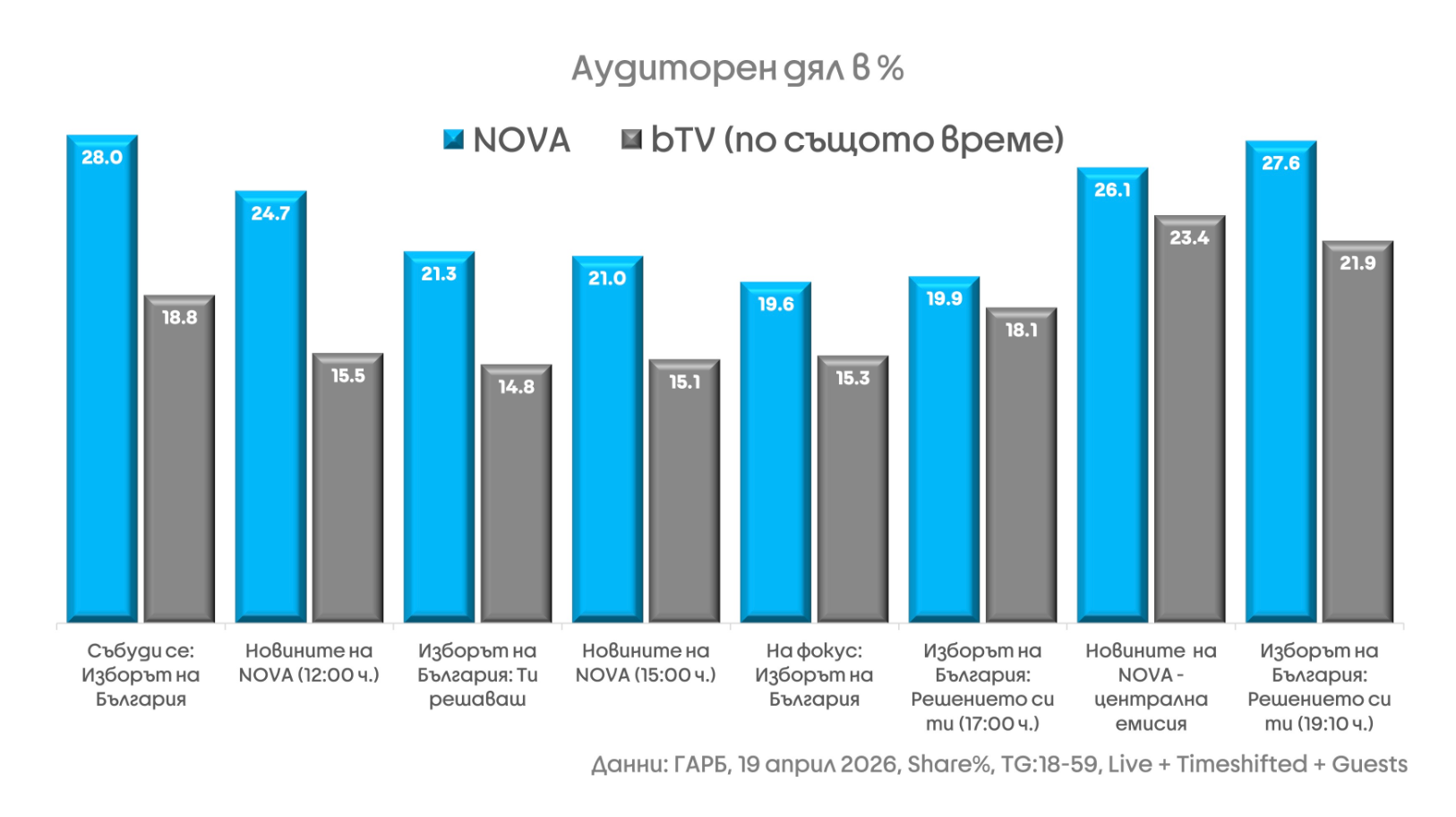
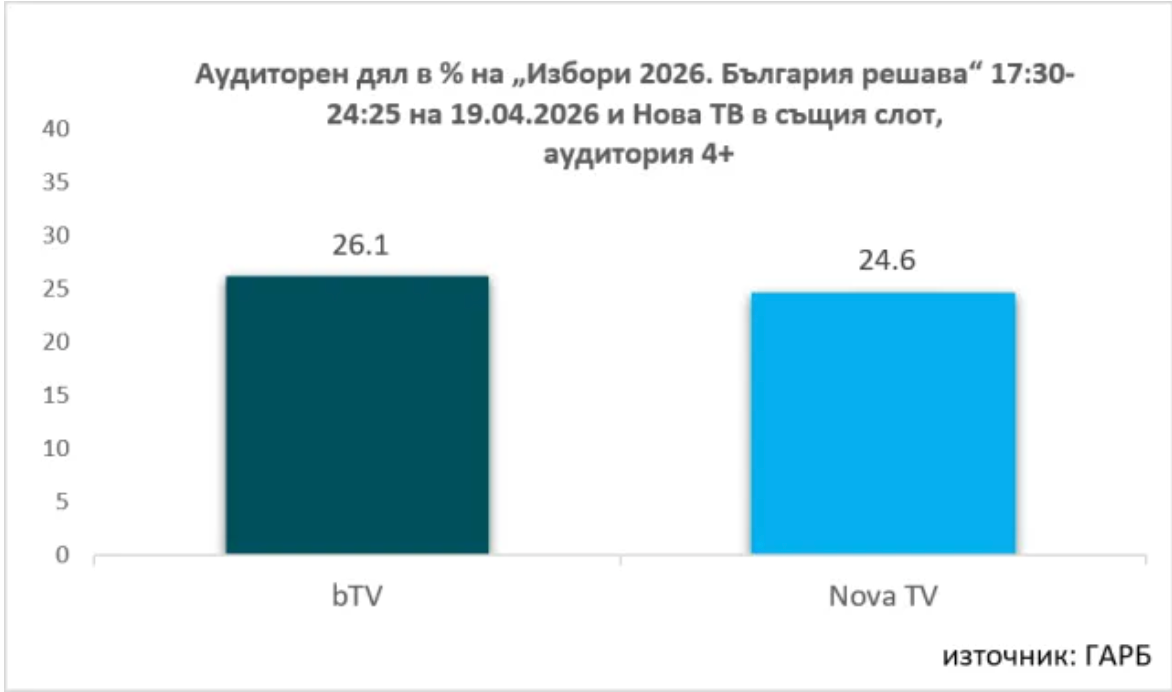
И bTV, и Нова се похвалиха, че са били най-гледаните. И това всъщност е вярно. Нова води в групата на младите активни хора. bTV – при всички зрители. 

Неотразимото медийно отразяване на изборите
Снимка: Нова
Неотразимото медийно отразяване на изборите
Снимка: bTV

Но отвъд PR тактиките, цифрите всъщност казват нещо далеч по-убедително – и двете телевизии губят. Губи и телевизията като цяло. Защото хората просто вече не я гледат. Това, разбира се, не е новина. Но е показателно, че в най-интересния момент от телевизионна гледна точка, когато обществено-политическият ни живот се променя драматично с участието на внушителен брой избиратели и повишен обществен интерес към изборния процес в сравнение с последните години, тази вълна не увлича гледаемост. Или поне не в посока телевизори. 

От гласувалите над 3 млн. българи едва около 700 000 са гледали резултатите от своя вот по телевизорите. При хората в активна възраст – 18–59 години, зрителите са едва около 400 000 (180 000 за Нова, 150 000 за bTV и около 80 000 за БНТ). Това е абсолютният теоретичен максимум, защото има преминаване от един канал на друг, тоест тези хора не са уникални потребители. Реалистично броят им пада със стотина хиляди, които са сменяли между каналите и съответно са броени два пъти. Сравнете тази цифра с метриките от социалните мрежи и ще разберете защо телевизиите стоят в спомена за своето славно минало – и като програмиране, и като подход към съдържанието. 

Остава ни да се надяваме ДПС и ГЕРБ да си приберат вересиите и от телевизиите, както скоропостижно го направиха от прокуратурата. Само три дни след смяната на силните в парламента Борислав Сарафов неочаквано реши да освободи кабинета, който обитаваше незаконно вече близо година. така, разбира се, потвърди това, което всички отдавна вече знаехме – че правосъдието ни е функция на политически прищевки без дори фасадна независимост. Ще е честно да се направи това самопризнание и в големите медии. 

А докато се пренареждат пластовете и се освобождава място за новата квота на актуалния генерал, може пък да се заложи на малко професионализъм. Така че в ключови моменти телевизорите да вършат работата, за която са подкупени. Иначе Ахинора и Робърт са готови да заемат местата на партийните политкомисари и да редят дневния ред на новините. И по-евтино ще излезе, и по-доволни ще останат пълнещите и празнещите кабинети. В прогресивна медийна България. 

Сутрешен хляб

Post Syndicated from Тоест original https://www.toest.bg/sutreshen-hlyab/

Сутрешен хляб

Сутринта виждам няколко приятели да се измъкват през прозореца.

Зеленото червейче на изкушението. В овощната градина е убита жена със свалени чорапи. Утрото, нахлупило цилиндър, се задава иззад овощната градина. В ръката с вестник, напечатан със зелено мастило.

Най-сетне и аз трябва да сляза от хълма.

Градските кафенета са красиви стъклени сфери, а група мъже се носят, удавени в течност с цвят на ечемик.

Дрехите им се стелят из течността.

Дамата с монокъла разчупва последния хляб и им подхвърля.

Чика Сагауа


Чика Сагауа (1911–1936) е поетеса, представителка на японския модернизъм от началото на ХХ век, част от творческия кръг около Кацуе Китазоно. За краткия си път тя оставя повече от осемдесет стихотворения, а сред преведените от нея автори са Джеймс Джойс и Вирджиния Улф. Сагауа е артистичен псевдоним, който се изписва с йероглифите за ляво и река – намигване към левия бряг на Сена и авангардните течения, които формират творчеството на поетесата. В продължение на десетилетия работата на Сагауа тъне в своеобразно забвение, но интересът към нея се възражда през последните години, донякъде и поради усилията на нейната преводачка на английски Сауако Накаясу.

Марина Стефанова превежда поезия и проза между английски, български и японски. Нейни преводи са публикувани в Asymptote и Words Without Borders. Тя е и сред основателите на The Third Wheel – онлайн списание за литературен превод.

Въпреки привидно невзрачния си обем „Сутрешен хляб“ успя да уплътни час и половина на група преводачи по време на Кошерите за превод на поезия, организирани от Къщата за литература и превод миналата есен.


Според Екатерина Йосифова „четящият стихотворение сутрин… добре понася другите часове“ от деня. Убедени, че поезията държи умовете ни будни, а сърцата – отворени, в края на всеки месец ви предлагаме по едно стихотворение. Защото и в най-смутни времена доброто стихотворение е добра новина.

Ubuntu 26.04 LTS released

Post Syndicated from jzb original https://lwn.net/Articles/1069399/

Ubuntu 26.04 (“Resolute Raccoon”) LTS has been released
on schedule.

This release brings a significant uplift in security, performance,
and usability across desktop, server, and cloud environments. Ubuntu
26.04 LTS introduces TPM-backed full-disk encryption, expanded use of
memory-safe components, improved application permission controls, and
Livepatch support for Arm systems, helping reduce downtime and
strengthen system resilience. […]

The newest Edubuntu, Kubuntu, Lubuntu, Ubuntu Budgie, Ubuntu Cinnamon,
Ubuntu Kylin, Ubuntu Studio, Ubuntu Unity, and Xubuntu are also being
released today. For more details on these, read their individual release
notes under the Official flavors section:

https://documentation.ubuntu.com/release-notes/26.04/#official-flavors

Maintenance updates will be provided for 5 years for Ubuntu Desktop, Ubuntu
Server, Ubuntu Cloud, Ubuntu WSL, and Ubuntu Core. All the remaining flavors
will be supported for 3 years.

See the release
notes
for a list of changes, system requirements, and more.

The collective thoughts of the interwebz