„Къде е шейтанът тук?“ Аллах и тежка музика (продължение)

Post Syndicated from Атанас Шиников original https://www.toest.bg/kude-e-sheytanut-tuk-allah-i-tezhka-muzika-produlzhenie/

<< Към първа част

… ако питате ходжата, рогатият е навсякъде, особено като стане дума за хевиметъл.
„Къде е шейтанът тук?“ Аллах и тежка музика (продължение)

Стига да имаш ищах (от арабското иштияк, „желание“) да го търсиш, изборът е голям, направо безкраен. Така казва и Умберто Еко в „Името на розата“ в диалозите между Уилям от Баскервил и инквизитора Бернар Ги. Може да откриеш Иблиса и в турски банди като „Курбан“ („Жертва“, да не си мислите, че става въпрос за мазна овнешка чорба), „Кърмъзъ“ („Червено“, ако ви се прииска феминистки трашметъл), „маНга“, „Мор ве Отеси“ и един бюлюк други.

А че търсенето на шейтана в метъла може да има тежки последици, усеща на гърба си първата иракска трашбанда със звучното име „Акрасикауда“ (Acrassicauda, „Черен скорпион“). Нейната история въобще не е толкова гладка като рок сцената в Турция. И пак има късмет, защото попада в полезрението на медийната платформа „Вайс“ (VICE, „Порок“!) след падането на Саддам Хюсеин през 2003 г. и гражданската война. Тогава за малко да се озова там като „лингвист, способстващ за администрацията на следвоенен Ирак“, така поне вървеше офертата на военните за арабисти като мен. Добре че не заминах, за разлика от други мои колеги, които после пострадаха тежко. Но през 2006 г. Суруш Алви, съосновател на „Вайс“, и продуцентът Еди Морети заминават за Багдад през Ербил, Кюрдистан, за да снимат филм за траша в следвоенен Ирак. Неслучаен избор, предвид статията на „Вайс“ за „Акрасикауда“ през 2003 г. А 2006-та е лош избор за време за пътуване до Двуречието. Но пък благодатно за улавяне на новите културни феномени. Нови, ала не безпроблемни. Резултатът е документалният филм „Хевиметълът в Багдад“, който излиза през 2007 г.

Вижте ги. Момчета с кози брадички в хаоса на следвоенен Ирак, които свирят с китарите си в мазе и се самоопределят като мюсюлмани, ама не твърде посветени. Мазето прилича малко на мазето на пазарджишката гимназия, където тамошните групари свиреха, докато аз драсках с маркери графити по стените. Но обстановката не прилича на Пазарджик, пък било и през 90-те. Не може да ходиш по улиците на Багдад току-така. Може да те застрелят, защото седиш сам на едно място. Може да те застрелят, защото се движиш подозрително. Може да те застрелят, защото се събираш с хора. Може да те застрелят, защото говориш на английски – едно от най-опасните неща. Може да те застрелят, защото пътуваш. Може да те застрелят, защото не пътуваш. Може да те застрелят, защото не спазваш вечерния час. Може да те застрелят, защото си религиозен. Или защото не си религиозен. И да, защото правиш шейтанска музика. Може да си чужд агент. Не може да си пуснеш дълга коса или да носиш тежки тениски, защото веднага се набиваш на очи.

Да, правят компромис с режима на Саддам преди това. Пишат песен за иракския диктатор. Нещо като да споменеш Енгелс, когато издаваш превод на средновековния философ Пиер Абелар в България¹. „За да избегнеш дявола, пей за него“, гласи една арабска поговорка. Не знам каква точно е тя, но според мен е фриволна интерпретация на мюсюлманското схващане, че дяволът може да бъде неутрализиран чрез подходящите молитви и напевно споменаване (зикр) на Аллах.

Но истинските обвинения в сатанизъм идват после. Най-малкото защото „главотръскането“ приличало на религиозен ритуал, особено на еврейската молитва. Тъй де, има си йерархия на шейтаните. И ако приличаш на юдейския шейтан, си най за осъждане. 

Но през 2005 г. групата успява да изнесе концерт в багдадски хотел. Това все пак е оптимистична история. Всички членове на „Черен скорпион“, да не се лъжем, са представители на образованата младежка висока средна класа, имат собствени инструменти и оборудване, говорят отличен английски. В крайна сметка бягат през Сирия (където изнасят концерт в Дамаск), после до Турция и стигат до САЩ като тяхна обетована земя, подпомогнати от „Вайс“. През 2009 г. даже лично идолът им Джеймс Хетфилд от „Металика“ им подарява китара, а през 2015 г. официално излиза дебютният им албум „Гилгамеш“. Името отново е препратка към славното минало, този път на Месопотамия. Разбира се, че няма да е „Халифат“, нито „Абасид“, дори и „Харун ар-Рашид“ не е. Никакви асоциации със средновековното мюсюлманско наследство на Ирак. И без това „поклонниците на дявола“ вече са натрупали достатъчно негативи…

Но да мръднем още пò на юг и да сгъстим тъмните краски.

„Черният скорпион“ все пак отървава кожата. Историята на групата прилича на рисково приключение с щастлив край. Но не може да кажем същото за феновете на тежката музика в Египет малко по-назад в миналото.

През 1997 г., докато ние минаваме през Виденовата зима, в Египет избухва първата публична „сатанинска паника“ от хевиметъла.

Описва я Марк Ливайн в най-интересната монография по въпроса, на която съм попадал². Не само за Египет, но и за Мароко („Когато музиката бъде забранена, започва истинският сатанизъм“!), Израел, Палестина, Ливан, Иран, Пакистан.

А хевиметъл сцена има в Египет още от 90-те въпреки традиционния религиозен пласт, който съставлява огромното мнозинство от обществото. Да не забравяме също, че Египет е един от големите центрове за продукция на филми, музика и телевизия в арабския свят. Затова и египетският диалект впрочем е един от най-използваните. Само че борбата на метълите за признание и място в обществото минава през сложна политическа ситуация по времето на Хосни Мубарак и влиянието на ислямистки движения като „Мюсюлмански братя“. Същите тези, на които Саид Кутб с „Под сенките на Корана“ е идеолог.

Та сенките на Корана не се оказват благодатна шарена сянка за младежите, които гледат навън през призмата на рок културата. На 22 януари 1997 г. правителството подема кампания срещу метъл общността, след като във вестниците излизат снимки на концерти, на които уж се показва как се носят обърнати кръстове. И мюсюлмански, и християнски религиозни служители се скандализират. Макар че мен ако питате, мюсюлманските активисти би трябвало да са доволни – нали християнският кръст като цяло е пълен харам в исляма? Но да речем, че обърнатият кръст говори за шейтанопоклонничество.

Стотина фенове на тежката музика са окошарени. Десетки са прибрани от старата изоставена къща на белгийския барон генерал от XIX век в Кайро, където младежи се събират да слушат музика, да пръскат графити и да купонясват. Това пък води и до описанието на мястото в египетските медии като пълно с татуирани поклонници на дявола, които правят оргии, дерат котки и пишат имената си с кръв от плъхове по стените. Че даже и египетският мюфтия Наср Фарид Уасил призовава към покаяние на задържаните или смъртна казън, полагаща се за отстъпничество от исляма. Отгоре на всичко „сатанинската афера“ се случва в същата година, в която терористи удрят туристически места в Луксор и Кайро.

Събитието е с такава значимост за сцената, че някои банди дори изгарят или изхвърлят инструментите си, за да избегнат арести и обвинения, а историята на тежката музика в Египет се разделя на преди и след 1997 г. Едва десетина години по-късно, през 2008-ма, „Ройтерс“ публикува статия за хевиметъла, който предпазливо се завръща в Египет. Завръща се, ала не много решително, тъй като демонизацията продължава. През 2010 г. дори бившият съветник на главния мюфтия Тухами Мунтасир твърди, че метъл сцената в Египет е финансирана от „ционистите“. Че то кое лошо нещо в арабския свят не е, да сипя и аз сол в раната?! В крайна сметка и „Протоколите на ционските мъдреци“, този доказан фалшификат, все още е популярно четиво там.

През 2016 г. отново се надига брожение с цел да се възбрани музиката на „поклонниците на дявола“. „Таймс“ отразява полицейско нахлуване по време на хевиметъл концерт в Кайро с обвинения към организаторите, че участват в „сатанински ритуали“ и се подготвя „сатанинско парти“. „Сепултура“ отменят участието си в събитието.

А обвързването на метъла с шейтана става стереотипна част от сцената не само в Египет. В Мароко изплуват обвинения в сатанизъм и арести по време на фестивала в Сиди Касем, да не говорим за Иран, където хеви- и блекметълът се инкриминират по най-различни линии, включително защото вървят със сатанински ритуали и притежаване на наркотици. И ако на музиката в средите на мюсюлманите по принцип се гледа като нещо греховно и възбранено, както твърди една фетва тук, нейният тежък пласт направо потъва и удря дъното в обиталището на самия Иблис. Ето как тече разговорът с богословите от популярния и авторитетен сайт за фетви на катарското Министерство на религиозните дарения и дела.

Какво означава метълист (миталджи)?

(Метълджия. Харесва ми като словообразуване на арабски. Западна дума с турска наставка за професия, подобно на чорбаджия, бозаджия, ваксаджия, скъпчия.)

В какво вярват метълите? –

продължава запитването от анонимен вярващ, свързани ли са с кланянето на шейтана, как трябва да се отнасяме с тях и какво правят по време на събиранията си? Тъй де, звучи като ударен курс относно „що е метъл и какво да правим с него“.

Отговорът върви така. Думата миталджи означава някой, който слуша или изпълнява с музикални инструменти вид музика, наречена „метъл“, отличаваща се с голяма извратеност. Откъде мюфтията знае това? Много лесно – „научихме го от прочита на някои техни форуми и сайтове в интернет, които не подобава да слагаме тук като линкове, защото би било насърчаване на порицаеми действия“. Обаче не е задължително всеки, който слуша тази греховна, възбранена музика, да бъде поклонник на дявола. Само че поклонниците на дявола слушат тази музика. А тя, особено във вариацията хевиметъл, насърчава подобни поведенчески модели, сатанински действия, ритуали и начин на живот по време на упадъчните им събирания. Песните изразяват вярванията им, които се основават на освещаването, възвеличаването и поклонението пред дявола, призиви към разврат, убийство и самоунищожение. За да могат накрая, по техните собствени твърдения, да бъдат удостоени с наградата да влязат в Ада през някоя от неговите седем двери. Други видове музика, които слушат по време на своите сбирки, са блекметълът (ал-блак митал) и хардрокът (ал-хард рук). И именно тази музика се свързва със странните им ритуали, които са противни на естеството, че и на всички религии, дори и на извратените. Сред ритуалите им са вземане на наркотици, пиене на алкохол, сексуална перверзия, оскверняване на мъртвите и пиене на човешка кръв. Добави към това и „истерично танцуване почти до степен на припадък и притъпяване на човешките сетива“ и става ясно, че миталджиите не са поели по добър път.

В катарския сайт цитират даже статия относно „Историческите корени на сатанизма“, публикувана в журнала на Ислямския университет в Газа. А за повече информация как да се отнасяме с метълите се препраща към фетва, която отговаря на въпроса как да се противопоставим на „интелектуалната инвазия“ (газуу фикри), тоест на външните атаки, с цел отслабване на силите на мюсюлманската общност и подриване на нейните морални устои. Не стига моралната и верска развала, ами и метълите са натоварени с основна роля в офанзивата срещу здравите основи на самата умма и разгръщането на мисията ѝ в хода на историята.

Очевидно такава гледна точка не отчита разликите между музикалните жанрове. Тъй де, все едно вие да правите разлика между правните школи на шафиити, ханбалити, маликити и ханифити в исляма. Някакви ходжи там се карат, но отвън на нас всичко ни изглежда едно и също. Та и тук така. Да, знаем за любимия жест на Рони Джеймс Дио, който напомня на рогатия. Или пък за адския електронен амбианс на „Бурзум“ (вокално-инструментален състав „Тъмнина“, да спазим правилото за превод на имената). За дет- и блекметъла в Скандинавието, че дори и в арабския свят. А и за турците от „Пентаграм“ – най-малкото заради символа. Те може и да пасват на фетвата от Катар. Ала очакваме ли същото ниво на „шейтанство“ за всички групи и концерти? Еднакъв призив към пиянство, разврат, „седемте порти на Ада“, „оскверняване на мъртвите“ и „пиене на човешка кръв“? Е да, концертите може и да вървят с порочно пиене на бира и съмнителни общувания между двата пола. Ама то е по акциденция, не е същностно, както би отсъдил кадията Ибн Рушд от Кордоба, известен ни като Авероес. А какво да кажем за възприемащия се за християнски „бял метъл“?

И тук е време да пристъпим в една по-оптимистична, макар и ничия територия, където тежката музика и ислямът се припокриват.

Обитателите на тази територия се опитват да изградят положителен разказ за успеха, който удържа жицата в едно с правоверието. Шейховете може и да не харесват това. И то наистина звучи малко като философски разказ за невъзможно смесване на същностите. Русалка. Кентавър. Химера. Соева наденица. Халален алкохол. Позволено прасе.

Но има музиканти, които упорито настояват, че е възможно да бъдеш добър мюсюлманин и миталджи едновременно.

През 2003 г. американският автор Майкъл Мухаммад Найт, приел исляма, измисля термина такуакор, който става заглавие на едноименната му книга, рекламирана като „Спасителя в ръжта за млади мюсюлмани“. Много е просто – такуа на арабски е „благочестие“, „богобоязливост“, а кор идва от „хардкор“. Книгата разказва за измислени герои, мюсюлмански бунтари – суфи с пънк гребени, скинхедс шиити, ъндърграунд феминистки с бурки. Измислени, но вдъхновяват реална музикална сцена. Пънк с мюсюлмански привкус. През 2009 г. излиза и документалният филм за американското движение под заглавие „Такуакор: раждането на пънк исляма“.

В рамките на това екзотично движение се пръкват и американски групи със забавни имена като „Дъ Коминас“ („Келешите“ на урду), „Ас-Саура“ („Революция“ на арабски), „Воут Хезболла“ („Гласувайте за Хизбулла“). И добре че този творчески фюжън е в САЩ, защото в Египет, Ирак или Пакистан няма как да изкласи. Само ще припомня, че втората книга на Майкъл Мухаммад Найт е озаглавена „Осама Ван Хейлън“.

А на другия край на света, в Индонезия, сме свидетели на друг феномен – тежък метъл и забрадки.

Момичетата от „Войс ъв бачепрот“ (V.O.B., „Гласът на шума“ на местния им език) не съзират противоречие в това да правят кавъри на „Металика“, докато носят консервативно изглеждащи хиджаби. През 2014 г. се събират в Гарут, провинция Западна Ява в Индонезия. (А Индонезия е най-голямата страна с мюсюлманско мнозинство в света – над 270 млн. жители, около 90% от които са мюсюлмани.) Ерза Сатия, техният учител по музика, който открива метъл таланта им и поема ролята на пръв мениджър, опровергава разпространените мнения, че музиката била сатанинска. Тя е всъщност начин учениците да избегнат пороци като наркотиците и непозволения от исляма предбрачен секс.

Все пак една забрадка халал не прави, ако трябва да перифразирам нашенската поговорка за едната птичка и пролетта. И тях постоянно ги заплашват със смърт. Така де, един от най-лесните начини да си докараш смъртна присъда по Свещения закон на исляма е да те обвинят в богохулство или отстъпничество. Механизмът е много ясен, отработен, вековен и води обикновено до един-единствен резултат. Не че това пречи на миловидните момичета с хиджаби да правят турнета и да ги канят на фестивала във Вакен, тази германска Мека на метъла.

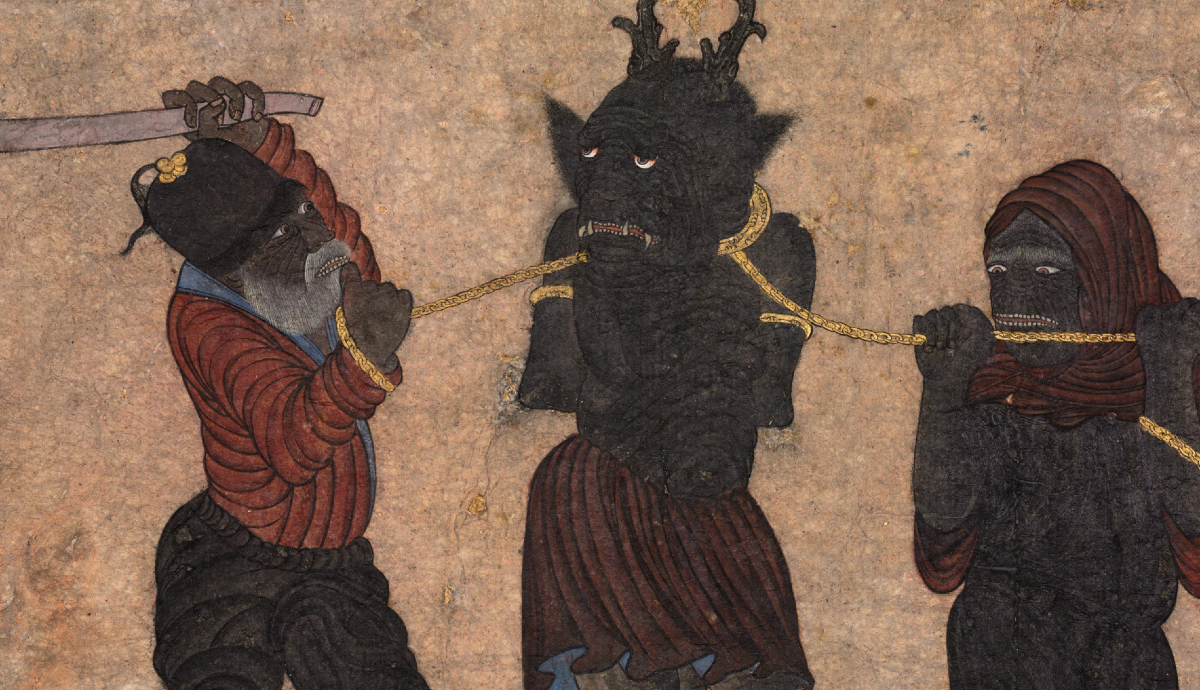
От Мароко до Пакистан, от Турция до Субсахарска Африка и Саудитска Арабия, от САЩ до Индонезия: всяка банда има своята история като част от местния контекст. Дали ще е следвоенен Ирак, кемалистка Турция, Арабската пролет – очевидно е, че тежката музика няма да си отиде въпреки благочестивото ѝ очерняне. Като казахме очерняне, препрочитам един разказ на Орхан Памук, в който говори за рисунките на Сиях Калем – „Черния писец“. Легендарен илюстратор, група от художници или стил на едни много разпознаваеми картинки от XV век. Вижте този сюжет от колекцията на музея в Кливланд.
„Къде е шейтанът тук?“ Аллах и тежка музика (продължение)
Окован демон от колекцията на музея в Кливланд

Не е ли това демонът на тежката музика в „дома на исляма“?

Със зачервените си очи, увиснали клепачи и тъжни зъбати бърни изглежда хем грозен, хем нещастен. Хем опасен, хем безпомощен. От едната му страна стои мъжка фигура, която го налага. Уж това е фигурата на добрия, който се бори със злото. От другата страна е женски силует, който пристяга верига около шията му. Само че колкото повече ги гледаш, толкова повече се чудиш кой е по-зъбат, по-страшен и по-злочест – окованият или тези, които са го оковали. Както казва и Памук, хем се боим от ония дяволи, хем осъзнаваме, че с тях сме замесени от едно и също тесто³. Пък и съгласете се, Сиях Калем звучи като чудесен избор за име на метъл банда. С дебютен албум „Гул“ или „Див“ („Демон“) и тази картинка за обложка. Напълно съответства на традициите в жанра.

1 Абелар, Пиер. Избрани съчинения. София: Наука и изкуство, 1986, с. 21 – 22.

2 LeVine, Mark. Heavy Metal Islam. Rock, Resistance, and the Struggle for the Soul of Islam. Oakland: University of California Press, 2022.

3 Памук, Орхан. Други цветове. София: Еднорог, с. 363.

В рубриката „Ориент кафе“ Атанас Шиников поднася любопитни теми, свързани не толкова с горещата политика, колкото с историята и културата на Близкия изток. А той, древен и днешен, е по-близко до нас и съвремието ни, отколкото си представяме.
[$] Fedora: 2FA, or not 2FA, that is the question

Post Syndicated from jzb original https://lwn.net/Articles/1078964/

Compromised accounts are one of the most common ways that attackers
can sneak malware into the open-source supply chain. One way to
reduce account compromise is for projects to require two-factor
authentication (2FA) or multi-factor authentication (MFA), but that is
easier said than done. However, Fedora is currently discussing putting
2FA requirements in place soon, following an an alleged account
compromise
that led to an AI agent causing a number of problems
for the project. After some discussion, Fedora will begin by requiring
packagers in the “provenpackager
group to enable 2FA within the next three months or so.

[$] A helper library for BPF arenas

Post Syndicated from daroc original https://lwn.net/Articles/1078526/


BPF arenas
are areas of memory (potentially shared with user space)
where programs have free reign to build their
own data structures, unburdened by the verifier’s bounds checks. Many of those
data structures are potentially usable in multiple programs. Emil Tsalapatis
brought his work on libarena, a library containing generic utilities for use in
BPF arenas, to the 2026

Linux Storage, Filesystem, Memory-Management, and BPF
Summit
. Although the library is already available as part of the kernel, it
is still in its early stages and he has more work planned.

[$] Reports from OSPM 2026, day two

Post Syndicated from corbet original https://lwn.net/Articles/1078696/

The Power Management
and Scheduling in the Linux Kernel Summit
, which still goes by the
historical acronym OSPM, was held in Cambridge, UK, in mid-April. As has
become traditional, the presenters at that event have since written
summaries of their sessions, and this work has kindly been made available
to LWN for publication. The second day’s sessions covered a wide range of
topics, including device frequency scaling, using time-slice duration for
CPU selection, scheduling domains on multi-cluster Arm systems, the LAVD
scheduler, and more.

Modernizing Lambda + S3 workloads with Amazon S3 Files

Post Syndicated from Sahithi Ginjupalli original https://aws.amazon.com/blogs/compute/modernizing-lambda-s3-workloads-with-amazon-s3-files/

Learn how Amazon S3 Files simplifies Lambda functions by eliminating transfer code and /tmp constraints. See three modernization patterns with code examples for image processing, ETL pipelines, and multi-agent AI workloads.

AWS Lambda functions that interact with Amazon Simple Storage Service (Amazon S3) typically follow a familiar pattern: download an object to /tmp, process it locally, and upload the result back to S3. This pattern is well-understood and reliable, but it requires you to write code for managing transfers, monitoring /tmp capacity, and cleaning up ephemeral storage alongside your actual processing logic.

Amazon S3 Files changes this by letting your Lambda function mount an S3 bucket as a file system. Your function reads and writes files at a local mount path (such as /mnt/data), and the file system handles synchronization with S3 automatically. The transfer and storage management code goes away, and what remains is your processing logic working directly with files.

In this post, we walk through three common Lambda + S3 workloads and show how to modernize each one by using S3 Files. You will see how the code gets shorter, the /tmp size constraint disappears, and the developer experience improves.

Walkthrough

Prerequisites

Before you begin, make sure you have:

  • An AWS account with permissions to create Lambda functions, S3 file systems, and VPC resources.
  • An existing VPC with private subnets and appropriate security groups.

Getting started

To integrate a Lambda function with S3 Files, you can follow these three steps:

  1. Create an S3 file system for your bucket. You can do this through the S3 console, AWS Command Line Interface (AWS CLI), or AWS CloudFormation. This single operation creates the file system, mount targets in your Amazon Virtual Private Cloud (Amazon VPC), and an access point.
  2. Add the file system configuration to your Lambda function. Specify the access point ARN and local mount path (for example, /mnt/data). Your function must be in a VPC with access to the mount target. For optimal throughput on large files, configure your function with 512 MB or more of memory to enable direct reads from S3.
  3. If you are modernizing your existing Lambda function’s code, replace boto3 transfer code with file paths. Change s3.download_file(bucket, key, '/tmp/file') to open('/mnt/data/' + key) and remove upload and cleanup logic.

Your function’s execution role needs s3files:ClientMount and s3files:ClientWrite permissions (included in the AmazonS3FilesClientReadWriteAccess managed policy). For direct S3 reads on large files, also add s3:GetObject and s3:GetObjectVersion.

Pattern 1: Multi-agent shared workspace

Agentic AI workloads, where multiple autonomous agents collaborate on a task, require shared mutable state. Agents need to read each other’s outputs, write intermediate artifacts, and coordinate without tight coupling. With Lambda today, this typically means serializing state to S3 objects or Amazon DynamoDB between every step, adding latency and code for each handoff.

S3 Files gives multiple Lambda functions a shared file system. Agents communicate through the file system itself, with no S3 API calls and no serialization overhead.

Example: Collaborative research agents

Three Lambda functions mount the same S3 bucket at /mnt/workspace. An orchestrator prepares the task, research agents work in parallel, and a synthesis agent combines their findings:

import os
import json

WORKSPACE = "/mnt/workspace"

# --- Orchestrator Agent ---
def orchestrator_handler(event, context):
    session_id = event["session_id"]
    session_dir = f"{WORKSPACE}/sessions/{session_id}"

    os.makedirs(f"{session_dir}/research", exist_ok=True)
    os.makedirs(f"{session_dir}/output", exist_ok=True)

    # Write task assignments directly to shared workspace
    with open(f"{session_dir}/manifest.json", "w") as f:
        json.dump({
            "query": event["research_query"],
            "agents": ["market_analysis", "technical_review", "competitor_scan"],
            "status": "in_progress"
        }, f)

    return {"session_dir": session_dir}


# --- Research Agent (one of many, running in parallel) ---
def research_agent_handler(event, context):
    session_dir = event["session_dir"]
    agent_name = event["agent_name"]

    # Read task from shared workspace (no S3 GET call)
    manifest = json.load(open(f"{session_dir}/manifest.json"))

    # Perform research (invoke Amazon Bedrock, search, etc.)
    # TODO: Implement perform_research() for your use case
    findings = perform_research(manifest["query"], agent_name)

    # Write results to shared workspace (no S3 PUT call)
    with open(f"{session_dir}/research/{agent_name}.json", "w") as f:
        json.dump(findings, f, indent=2)

    return {"status": "complete", "agent": agent_name}


# --- Synthesis Agent ---
def synthesis_handler(event, context):
    session_dir = event["session_dir"]

    # Read all research outputs from shared directory
    all_findings = {}
    for f in os.listdir(f"{session_dir}/research"):
        with open(f"{session_dir}/research/{f}") as fh:
            all_findings[f.replace(".json", "")] = json.load(fh)

    # Synthesize and write final report
    # TODO: Implement synthesize_findings() for your use case
    report = synthesize_findings(all_findings)
    with open(f"{session_dir}/output/report.md", "w") as f:
        f.write(report)

    return {"report_path": f"{session_dir}/output/report.md"}

In the traditional approach, each agent would need to call s3.get_object() to read the manifest, s3.put_object() to write findings, and the synthesis agent would need to call s3.list_objects() then s3.get_object() for each result. That’s eight or more S3 API calls per workflow run replaced by file I/O.

What the shared workspace pattern gives you:

  • Agents discover each other’s outputs by listing a directory (no coordination logic needed).
  • Sessions, agents, and outputs map to directories, not flat object key conventions.
  • Close-to-open consistency means that when an agent closes a file after writing, the next agent to open it sees the complete content.
  • No need to marshal state into S3 PutObject calls between steps.

Pattern 2: Image thumbnail generation

The S3 thumbnail generator is a common Lambda + S3 pattern. An image is uploaded to S3, a Lambda function is triggered, it downloads the image, resizes it with Pillow, and uploads the thumbnail to a destination bucket.

The traditional approach

import boto3
import os
import uuid
from urllib.parse import unquote_plus
from PIL import Image

s3_client = boto3.client('s3')

def resize_image(image_path, resized_path):
    with Image.open(image_path) as image:
        image.thumbnail(tuple(x / 2 for x in image.size))
        image.save(resized_path)

def handler(event, context):
    for record in event['Records']:
        bucket = record['s3']['bucket']['name']
        key = unquote_plus(record['s3']['object']['key'])
        tmpkey = key.replace('/', '')
        download_path = '/tmp/{}{}'.format(uuid.uuid4(), tmpkey)
        upload_path = '/tmp/resized-{}'.format(tmpkey)

        s3_client.download_file(bucket, key, download_path)
        resize_image(download_path, upload_path)
        s3_client.upload_file(
            upload_path, '{}-resized'.format(bucket), 'resized-{}'.format(key)
        )

What this approach requires you to manage beyond the core resize logic:

  • Transfer orchestration: Downloading the source, uploading the result, and handling partial transfer failures.
  • Storage capacity: Both the source and resized image must fit in /tmp simultaneously.
  • Ephemeral storage cleanup: If the function fails mid-execution or is reused across invocations, orphaned files can accumulate in /tmp.
  • Redundant downloads: If the same image triggers a retry, it must be downloaded again.

With the file system approach

import os
from urllib.parse import unquote_plus
from PIL import Image

MOUNT = "/mnt/images"

def resize_image(image_path, resized_path):
    with Image.open(image_path) as image:
        image.thumbnail(tuple(x / 2 for x in image.size))
        image.save(resized_path)

def handler(event, context):
    for record in event['Records']:
        key = unquote_plus(record['s3']['object']['key'])
        input_path = f"{MOUNT}/source/{key}"
        output_path = f"{MOUNT}/resized/resized-{os.path.basename(key)}"

        os.makedirs(os.path.dirname(output_path), exist_ok=True)
        resize_image(input_path, output_path)

What changed

The function moves from a download-process-upload pipeline to direct file I/O. No boto3 client, no /tmp management, no upload step. The resize_image function is unchanged because it always worked with file paths. The difference is that those paths now point to a mounted S3 file system instead of ephemeral local storage.

You still handle errors in your processing logic (for example, invalid image formats). What you no longer need to handle are transfer-specific failure modes like partial downloads, failed uploads, or /tmp capacity checks.

Metric Traditional S3 Files
Lines of code (non-blank) 22 15
S3 API calls per invocation 2 (GET + PUT) 0
Max image size Source + output files share /tmp No /tmp constraint
boto3 dependency Required Not needed

Pattern 3: CSV-to-Parquet ETL pipeline

Another commonly used serverless ETL pattern is an S3 event triggers a Lambda function when CSV files land in a bucket. The function downloads the CSV, transforms it to Parquet by using pandas and pyarrow, and uploads the result.

The traditional approach

import boto3
import pandas as pd
import os

s3 = boto3.client("s3")
BUCKET = "data-pipeline-bucket"

def handler(event, context):
    key = event["Records"][0]["s3"]["object"]["key"]
    filename = os.path.basename(key)
    local_input = f"/tmp/{filename}"
    local_output = f"/tmp/{filename.replace('.csv', '.parquet')}"

    try:
        # Download from S3
        s3.download_file(BUCKET, key, local_input)

        # Check /tmp space (10 GB limit)
        tmp_usage = sum(
            os.path.getsize(f"/tmp/{f}")
            for f in os.listdir("/tmp") if os.path.isfile(f"/tmp/{f}")
        )
        if tmp_usage > 9 * 1024**3:  # 9 GB safety margin
            raise RuntimeError("Approaching /tmp storage limit")

        # Transform
        df = pd.read_csv(local_input)
        df["processed_at"] = pd.Timestamp.now()
        df.to_parquet(local_output, engine="pyarrow", compression="snappy")

        # Upload result back to S3
        output_key = key.replace("raw/", "processed/").replace(".csv", ".parquet")
        s3.upload_file(local_output, BUCKET, output_key)

        return {"status": "success", "output_key": output_key}

    finally:
        # Clean up /tmp
        for f in [local_input, local_output]:
            if os.path.exists(f):
                os.remove(f)

What this approach requires you to manage beyond the core transform logic:

  • Storage capacity: Source and output files share /tmp, limiting practical file size.
  • Cold start cost: Initializing the boto3 client adds startup latency.
  • Transfer failure modes: Partial downloads, failed uploads, and orphaned /tmp files need their own handling.
  • Redundant downloads: Retries or reprocessing require downloading the same file again.

With the file system approach

import pandas as pd
import os

MOUNT = "/mnt/data"

def handler(event, context):
    key = event["Records"][0]["s3"]["object"]["key"]
    input_path = f"{MOUNT}/{key}"
    output_path = f"{MOUNT}/{key.replace('raw/', 'processed/').replace('.csv', '.parquet')}"

    # Ensure output directory exists
    os.makedirs(os.path.dirname(output_path), exist_ok=True)

    # Transform: direct file access, no download/upload
    df = pd.read_csv(input_path)
    df["processed_at"] = pd.Timestamp.now()
    df.to_parquet(output_path, engine="pyarrow", compression="snappy")

    return {"status": "success", "output_path": output_path}

What changed

With this change, a developer reading this code sees only the transform logic (read CSV, add column, write Parquet). The storage mechanics are handled by the file system.

Metric Traditional S3 Files
Lines of code (non-blank) 33 14
S3 API calls per invocation 2 (GET + PUT) 0
Max file size Source + output share /tmp No /tmp constraint
Cleanup logic required Yes No
/tmp space monitoring Yes No

Choosing the right approach: file system mounts vs. traditional access

Use case Recommendation
Lambda reads/writes files from S3 S3 Files (eliminates transfer boilerplate)
Multiple functions share data S3 Files (shared mount replaces API coordination)
Files > 10 GB S3 Files (no /tmp size constraint)
Event-driven processing (trigger on upload) S3 Files (S3 event triggers still work, function reads from mount)
Direct S3 API features (presigned URLs, S3 Select, multipart upload) Traditional (these require the S3 API)
Functions outside a VPC Traditional (S3 Files requires VPC connectivity)

Cleaning up

If you created resources while following along with this post, delete them to avoid incurring future costs. Start by removing the file system configuration from your Lambda function settings. Next, remove the S3 file system, which also deletes its associated mount targets and access points. Then delete the S3 buckets used for source and output data, along with the Lambda functions created for the examples. Finally, remove the IAM roles and policies created for Lambda execution or, if you added the S3 Files permissions (s3files:ClientMount, s3files:ClientWrite, s3:GetObject, s3:GetObjectVersion) to an existing role, remove these permissions. Additionally, If you created a new VPC for this tutorial, delete the VPC, which will also remove the associated private subnets, security groups, and route tables. If you used an existing VPC, remove the security groups and subnets created for this testing.

Warning: Deletion of an S3 bucket and its contents permanently deletes all objects in the buckets and cannot be undone. Make sure you have backed up any data you need to retain before proceeding.

Conclusion

In this post, we demonstrated how to modernize three common Lambda + S3 workloads by using Amazon S3 Files. Across image thumbnail generation, ETL pipelines, and multi-agent AI workloads, the migration follows the same principle: replace S3 API transfer logic with native file I/O and let the file system handle synchronization.

The improvements are consistent:

  • Less code: Transfer and cleanup logic goes away, leaving only your processing logic.
  • No /tmp size constraint: Process large files without local storage limits.
  • Zero S3 API calls for data access: Reads and writes go through the file system mount.
  • Fewer failure modes to handle: Transfer-specific issues (partial downloads, failed uploads, orphaned temp files) no longer apply.

For teams running Lambda + S3 workloads today, S3 Files isn’t a new architecture to learn. It’s transfer code you can remove. To learn more, see the S3 Files section in the Lambda documentation. To track upcoming features on the AWS Lambda roadmap, you can refer to the AWS Lambda roadmap.

Security updates for Wednesday

Post Syndicated from jzb original https://lwn.net/Articles/1079365/

Security updates have been issued by AlmaLinux (corosync, firefox, kernel, kernel-rt, libpq, memcached, postgresql, postgresql16, postgresql:13, postgresql:16, python-urllib3, python3.14-urllib3, redis:6, skopeo, and vim), Debian (beets, gst-plugins-bad1.0, imagemagick, libmatio, python-urllib3, and u-boot), Fedora (chromium, coturn, frr, grout, materialx, perl-Crypt-DSA, and yt-dlp), Mageia (opensc, perl-Archive-Tar, and podofo), Oracle (fence-agents, libpq, mysql:8.4, and postgresql:16), Red Hat (firefox, libpng, libpng12, libpng15, libreoffice, nginx:1.24, thunderbird, tigervnc, xorg-x11-server, and xorg-x11-server-Xwayland), Slackware (libarchive), SUSE (amazon-ssm-agent, ansible-core, apache2, bind, bitcoin-qt6, containerized-data-importer, curl, distribution, docker-stable, dovecot24, dracut, editorconfig-core-c, exiv2, firefox, freeipmi, freerdp, ghc-aws, ghc-crypton-asn1-encoding, ghc-crypton-asn1-parse, ghc-crypton-asn1-types, ghc-crypton-pem, glib-networking, go1.25, go1.26, google-guest-agent, graphite2, hamlib, helm, himmelblau, ignition, ImageMagick, kernel, ldns, libarchive, libcaca, libheif, libinput, libjxl, libsolv, libzypp, zypper, LibVNCServer, libxslt, libyang, mcphost, mozjs128, ncurses, nginx, opensc, openssl-3, openvswitch, papers, perl-HTML-Parser, perl-HTTP-Daemon, perl-Protocol-HTTP2, podman, postgresql14, postgresql15, postgresql16, postgresql17, python-aiohttp, python-ecdsa, python-paramiko, python-PyJWT, python-starlette, rekor, sqlite3, strongswan, tiff, tomcat, tomcat10, tomcat11, unbound, webkit2gtk3, xwayland, and zypper, libzypp, libsolv), and Ubuntu (libcap2, libnfs, libvncserver, libxml2, and mysql-8.0).

Embedding Forbidden Text in Spyware to Discourage AI Analysis

Post Syndicated from Bruce Schneier original https://www.schneier.com/blog/archives/2026/06/embedding-forbidden-text-in-spyware-to-discourage-ai-analysis-2.html

At least one malware developer is adding text about nuclear and biological weapons to their spyware, in an effort to stop automatic AI analysis.

Details:

The _index.js payload begins with a large JavaScript block comment containing fake system instructions and policy-triggering content. Because it is inside a comment, it does not affect JavaScript execution. The runtime skips it. The real malware begins after the comment with a try{eval(…)} wrapper around a large character-code array and a ROT-style substitution function.

This header appears designed for AI-mediated analysis, not for Node, Bun, or Python. It attempts to derail scanners or analyst copilots that feed the beginning of a file to a language model without clearly isolating the content as untrusted data. In weak pipelines, this can cause refusal behavior, prompt confusion, context pollution, or premature classification before the scanner reaches the actual malware.

This is not a magical bypass against static detection. YARA rules, entropy checks, AST parsing, string extraction, deobfuscation, and behavioral rules still work. But it is a practical anti-analysis trick against naive LLM-first triage systems.

Православна държава ли е България?

Post Syndicated from Светла Енчева original https://www.toest.bg/pravoslavna-durzhava-li-e-bulgariya/

Православна държава ли е България?

„Ние сме православна държава“. Това заяви президентката Илияна Йотова по повод решението на правителството България да не подкрепи новия пакет санкции на ЕС срещу Русия, ако те включват и руския патриарх Кирил. Тя каза това, след като външната министърка Велислава Петрова-Чамова анонсира правителствената позиция с аргумента, че България „не подкрепя налагането на символни санкции, свързани с руския патриарх Кирил“, а премиерът Румен Радев отсече:

Времето на кръстоносните походи свърши.

Ако нещо непрекъснато се повтаря и ако държавата се държи, сякаш то е факт, е много вероятно хората да повярват, че то наистина е факт, и да забравят каква всъщност е реалността. Затова в тази статия ще става дума само за факти (и малко логика) – защото подмяната на фактите и абсурдните от логическа гледна точка аргументи са изпитана рецепта за манипулиране на общественото мнение.

Православна ли е България според Конституцията и законите?

Една държава е православна, ако православието е държавна религия. Така е например в Гърция. Какво казва обаче Конституцията на Република България по темата?

Православието се споменава в Основния закон само веднъж – в чл. 13, ал. 3, която гласи: 

Традиционна религия в Република България е източноправославното вероизповедание.

Традиционна обаче не означава официална или държавна.

В същия член 13 се казва и че религиозните институции са отделени от държавата (ал. 2, получерният шрифт тук и по-нататък е мой – б.а.) и че те, както и верските убеждения, не могат да се използват за политически цели (чл. 4).

В ал. 1 на чл. 13 се подчертава, че вероизповеданията са свободни. Тази идея се доразвива и в чл. 37, според който свободата „на съвестта, свободата на мисълта и изборът на вероизповедание и на религиозни или атеистични възгледи са ненакърними“, а държавата „съдейства за поддържане на търпимост и уважение между вярващите от различните вероизповедания, както и между вярващи и невярващи“. Втората алинея на чл. 37 постановява, че свободата „на съвестта и на вероизповеданието не може да бъде насочена срещу националната сигурност, обществения ред, народното здраве и морала или срещу правата и свободите на други граждани“.

Същите принципи, макар и леко отслабени в последно време, се застъпват и в Закона за вероизповеданията.

В него се подчертава ролята на Българската православна църква (БПЦ). В преамбюла се изтъква „традиционната роля“ на БПЦ „в историята на България за формирането и развитието на нейната духовност и култура“. През 2025 г. в чл. 10 е включено, че източното православие „има историческа роля за българската държава и актуално значение за държавния ѝ живот“ и че негов единствен изразител и представител е БПЦ.

В същото време още в преамбюла на закона се говори и за „правото на всяко лице на свобода на съвестта и вярата, а така също и равенството пред закона без оглед на религиозната принадлежност и убеждения“. Изразява се „уважение към християнството, исляма, юдаизма и другите религии“ и се призовава към взаимно разбирателство и търпимост.

Въпреки „традиционната“ и „историческа“ роля на православието, в чл. 4, ал. 1 се повтаря това, което пише и в Конституцията – че религиозните институции са отделени от държавата. Текстове от Основния закон се възпроизвеждат и в чл. 7, в който са посочени границите на религиозната свобода. Тя не може да е насочена „срещу националната сигурност, обществения ред, народното здраве и морала или срещу правата и свободите на други лица“, нито да се ползва „за политически цели“.

Извод:

Православието не е държавна религия, т.е. българската държава не е православна. Конституцията и Законът за вероизповеданията ясно разграничават религията от политиката.

Православно ли е да се подкрепя руският патриарх Кирил?

Нека се върнем към думите на Илияна Йотова. След като заявява, че България е православна държава, тя допълва:

Ние искаме българските вярващи да не бъдат разделени по тази линия, защото православието е толкова дълбоко вкоренено в нашата история, че по тази линия не ми се иска да има конфликт.

Тоест според Йотова, понеже православието е вкоренено в историята ни, всички православни християни би следвало да подкрепят руския патриарх, а ако България подкрепи санкциите срещу него, това би внесло разделение между тях. От думите ѝ човек остава с впечатлението, че цялото православие е на страната на патриарх Кирил, както и всички православни християни.

Ала така ли е в действителност?

Кой е патриарх Кирил, когото ЕС иска да санкционира?

Макар Румен Радев да е против санкциите срещу него, защото времето на кръстоносните походи е приключило, Кирил, чието гражданско име е Владимир Гундяев, е привърженик на войните в името на вярата и смята, че за тях една от основните Божии заповеди – не убивай – не важи. Татяна Ваксберг обобщава важни факти за него в статия за „Свободна точка“:

  • Според руския патриарх войната в Сирия е „свещена“, а на руснаците, биещи се срещу Украйна (в която впрочем православието е преобладаващата религия), Бог „ще измие всички грехове“ и ще им даде „вечен живот“. По повод на войната в Грузия през 2008 г. той казва, че готовността на войниците да умрат е „висша проява на жертвената християнска любов“.
  • Не само войнолюбството (казано по Румен Радев) е отличителна черта на Кирил, която би повдигнала въпроси у някой непредубеден православен християнин. Руският патриарх е и почитател на Йосиф Сталин и дори нарежда да го изографисат в катедрала (ликът на Сталин по-късно е заличен, защото той е бил враг на църквата). Кирил е имал и тесни връзки с КГБ и се смята, че притежава към 2,7 млн. евро.
  • Един от най-противоречащите на православните канони факти, свързани с руския патриарх, е, че той от половин век има жена (с която не е сключил брак). Тя се казва Лидия Леонова, живее с него и го придружава навсякъде. Да припомним, че според православието патриарсите са част от монашеството и са дали обет за безбрачие.

Отношението на вселенския патриарх Вартоломей към патриарх Кирил

Най-висшият представител на православната църква е вселенският патриарх, макар да няма ръководни функции като католическия папа, а да се смята за „пръв между равни“. От 1991 г. на този пост е Вартоломей.

През 2018 г. вселенският патриарх призна независимостта на Украинската православна църква, а в началото на следващата година подписа томос (декрет), с който ѝ се предоставя автокефалия. Според Кирил „подписването на томоса е нищожно от канонична гледна точка и е трагично за Вартоломей“. Руската православна църква реагира, като прекрати отношенията си с Вселенската патриаршия.

Когато през 2022 г. Кирил заяви, че руските войници, загинали в Украйна, са се жертвали като Христос и греховете им са простени, Вартоломей изрази силно неодобрение. Той каза, че идеята, че убитите във войната стават мъченици, „не съответства на православното учение“, и нарече войната на Русия срещу Украйна „дяволска и нечестива“.

Отношението към Кирил на патриарсите на другите страни от ЕС с преобладаващо православно население

Въпреки че според външната министърка има и друга държава членка, която изразява резерви за включването в санкциите на „всякакъв вид политически лица и лица, които са в обществения живот в Русия“, без да споменава коя е тази държава, към момента България е единствената страна в ЕС, която се противопоставя на включването на руския патриарх в 21-вия пакет санкции. България обаче не е единствената държава с преобладаващо православно население в Съюза – такива са още Гърция, Румъния и Кипър. Какво е отношението на патриарсите на тези държави към главата на Руската православна църква?

Гръцкият патриарх Йероним II е в разрив с Кирил, въпреки че в миналото двамата духовници са поддържали добри отношения. Поводът за това е признаването на независимостта на Украинската православна църква от Гръцката патриаршия.

Кипърският патриарх Георгий III встъпва в длъжност през 2023 г. – след като Кипър, също като Гърция, подкрепя решението на вселенския патриарх да даде независимост на Украинската църква по времето на предишния патриарх – Хризостом II. Съответно Руската църква скъсва отношения и с кипърската. По повод на войната на Русия срещу Украйна Хризостом II остро критикува руския президент:

Как може г-н Путин да ходи на църква, да се покайва, да държи високо кръста си и да се причестява, докато в същото време убива? Това ли е неговото православие?

Отношението на румънския патриарх, който също като българския е приел името Даниил, е по-меко, но също критично. Той осъжда войната на Русия срещу Украйна, но Румънската патриаршия не е признала независимостта на Украинската църква, поради което и руската не е прекъснала отношения с нея. От друга страна, през 2024 г. Светият синод в Букурещ на своя глава одобри създаването на Румънска православна църква в Украйна, която да обедини енориите, където преобладават етнически румънци.

Извод:

Православието не е идентично с подкрепата за руския патриарх Кирил. Никой патриарх на страна от ЕС с преобладаващо православно население освен България не го подкрепя. Това важи и за вселенския патриарх. Руската патриаршия от своя страна е скъсала отношения с вселенската.

Православие, политика и логика

Вече стана ясно, че православното християнство не означава автоматично подкрепа за руския патриарх. Още повече че той е в конфликт с Вселенската патриаршия, а покрай нея – с всички православни църкви, подкрепили независимостта на украинската. Сега да проследим аргументацията на Румен Радев, с която той обосновава решението България да се противопостави на санкциите срещу Кирил:

Мен не ме интересува руският патриарх, мен ме интересува, че той е предстоятел на Руската православна църква, която е източноправославна като нашата църква. […] защото руското православие има принос за нашето освобождение от петвековно османско робство. Мен ме интересува цялото руско общество, което има тази църква, […] ние сме от едно семейство. Тук трябва да има мнение и Българската православна църква, когато говорим за такъв тип санкции.

Тъй като в тази статия разглеждам само достоверността на факти и твърдения, няма да влизам в исторически интерпретации какви са били целите на Русия и на Руската православна църква по отношение на Османската империя и т.н. Вместо това ще проследя аргументацията на премиера, за да се види какво точно той твърди и как издържа то на фактологична проверка.

Радев всъщност казва две неща:

  • Държавата има такава позиция заради Църквата, а Църквата трябва да каже каква да е позицията на държавата.
  • Русия е помагала на България и с нея сме от едно семейство, затова е права и трябва да сме на нейна страна.

Първата теза представлява това, което в логиката се нарича порочен кръг (circulus vitiosus на латински). Ето пример за порочен кръг: Православието е правилната християнска религия, защото това казва православният канон, а канонът не греши, защото православието е правилната религия. Порочният кръг не може да бъде фактологично проверен.

Втората теза също представлява порочен кръг – Русия е добра, защото ни помага, а ни помага, защото е добра. Ако излезем от мисловната въртележка, в която ни вкарва Радев, може да си зададем логичен въпрос:

Дори Русия съвсем безкористно да е помагала на България и никога да не я е окупирала, ако някой ти е помагал и ако сте от едно семейство, това означава ли, че е прав? С подобни аргументи се защитава мафията. И олигархията, която „Прогресивна България“ обещаваше да демонтира в предизборната си програма.

Но да не влизаме в полето на коментарите, а в обобщение да се върнем към основните факти:

По Конституция:

  • в България религиозните институции са отделени от държавата;
  • православието не е официална, нито държавна религия;
  • религията не може да се използва за политически цели.

В православната църква:

  • вселенският патриарх е „пръв между равни“;
  • руският патриарх не е глава на православната църква;
  • руският патриарх бойкотира Вселенската патриаршия, както и патриаршиите, които подкрепят независимостта на Украинската православна църква.

България е единствената страна от ЕС с преобладаващо православно население, която се противопоставя на санкциите срещу руския патриарх Кирил.

И за финал – понеже рационалният спор с новата „прогресивна“ власт е невъзможен, да припомним думите на Христос (Мат 5:37):

Но думата ви да бъде: да, да; не, не; а каквото е повече от това, то е от лукавия.

Unlocking the Cloudflare app ecosystem with OAuth for all

Post Syndicated from Sam Cabell original https://blog.cloudflare.com/oauth-for-all/

Cloudflare provides services that help run 20% of the web, but we don’t do it alone. Developers on our platform use a myriad of tools and services from other companies too. Cloudflare provides a rich API for our platform that enables developers to create automations, CI/CD, and integrations that glue together the various parts of their infrastructure. Earlier this month, we announced self-managed OAuth, making it easier for customers to create and manage their own OAuth clients for delegated access to the Cloudflare API.

Cloudflare isn’t new to OAuth. If you’ve used Wrangler, or used integrations from partners like PlanetScale, then you’ve already used it. However, until now, third-party OAuth was only available through a small number of manually onboarded integrations, and was not available to developers more broadly. That meant developers building their own integrations had to rely on API tokens, which are harder to manage and a poor fit for many delegated application flows. 

Over the last year, we onboarded a growing number of early partners while improving the consent, revocation, and security model behind Cloudflare OAuth. But as our Developer Platform grew and agentic tools drove demand for delegated access, it became clear that opening up OAuth to all customers was critical to the success of our platform. 

With self-managed OAuth, developers can now offer a standard OAuth flow where customers grant scoped access directly, making it easier to build SaaS integrations, internal developer platforms, and agentic tools while giving users clearer consent, easier revocation, and more control over what an application can do.

Scaling the ecosystem securely

While our earlier OAuth solution was sufficient for a small number of carefully managed partners, we realized that our permissions model, our consent experience, and our ways of mitigating potential abuse vectors were not mature enough. 

Earlier this year we updated our consent experience to make it clearer which application is requesting access, and what permissions it will receive. We also added revocation to the dashboard so developers can easily control which applications have access to their data, and made app ownership more visible to prevent OAuth phishing attacks. 

Opening self-managed OAuth to all customers also required major upgrades to our underlying OAuth engine. This process required a large amount of planning to do with minimal user interruption, while also ensuring data stability and security.

Planning the upgrade to our OAuth engine

Years ago, we deployed Hydra, an open-source OAuth engine, to power Cloudflare OAuth under the hood. That deployment served us well when usage was limited, but as the developer platform grew and agentic workflows became more common, it became clear that we needed a major upgrade to unlock new capabilities and improve performance. 

As we planned the upgrade, we decided to do two smaller sequential upgrades rather than doing one large upgrade.  First, we would move to the latest 1.X release, evaluate any behavior or performance changes, and then proceed with the 2.X upgrade.

During our upgrade planning, it became clear that even the 1.X upgrade would still impact customers because the Hydra database required extensive schema migrations that:

  1. Created indexes in a manner that would claim an exclusive lock on critical tables, preventing active users from performing important OAuth operations 

  2. Added columns to critical tables, and moved other columns to new tables

There was also a quirk in the version of Hydra we were using in which the SDK would perform SELECT * operations, causing deserialization issues with the schema changes.

To prevent user impact, we rewrote the SQL migrations to use features such as CREATE INDEX CONCURRENTLY, and built a custom version of Hydra which selected explicit columns rather than SELECT *.

With the latest 1.X upgrade planned out, we now needed to create a plan for the even larger 2.X upgrade. We identified three potential options, and weighed the benefits and drawbacks of each one. Doing an in-place upgrade was not going to work for us, due to the sheer amount of schema changes the major version bump brought with it. We decided that a blue-green strategy would work, but there was more that needed to be done than simply flipping a switch to start using the new version. The upgrade and migration process would take multiple hours, and we needed the system to continue functioning correctly in that time window.

The first blue-green option would involve disabling writes to the database, preventing any new authorizations from occurring. This means they would not be lost in the transition, but it also meant that nobody would be able to use existing OAuth apps unless they already had a valid credential. It also presented another large problem: if users needed to revoke access from an application for any reason, it would not be possible while the upgrade was being performed.

To combat these issues, we came up with a way to leave writes to the database enabled, at the cost of losing some of them in the switch to the green version. The first thing to solve was minimizing the number of writes for new tokens. There was an operational lever we pulled: increasing the expiry time of tokens to multiple hours. This would allow apps that received new tokens before the upgrade to continue using them without needing to refresh.

With reducing writes solved, we needed to come up with a way to not lose any revocations our users performed during the upgrade window. To do this, we created a queue system (using Cloudflare Queues!) which, after a revocation event, would have a record written into the queue with information about that revocation. This would allow us to drain the queue with the database flipped to the green version, replaying all revocation events that took place in the time window in which they would have been lost. This was critical to get right, otherwise applications that users had revoked would inadvertently have their access restored.

Executing the upgrade

Upgrading to 1.X

From an operational point of view, our first upgrade to the last 1.X release went off without any hitches. Our custom database migrations ran faster than we expected, with no user impact. We had to do a hard cutover to the new version because the old version was unable to introspect tokens that were created by the newer version.

After the cutover, we saw an increase in refresh token errors that we had not seen before. This ended up being due to stricter refresh invalidation behaviors in the new version; if a refresh token was reused, Hydra would invalidate the whole access and refresh token chain. This is problematic for Wrangler and MCP clients. These clients both have a high request volume, and a single reused refresh token would invalidate the entire session.

We mitigated this by adding refresh token coalescing behavior to our Worker which routes OAuth traffic to the correct destination. This allowed us to briefly cache the refresh token request before it reached Hydra, so that if we detected a retry we could short-circuit the request and respond without invalidating the tokens. Fortunately, 2.X versions of Hydra have a configurable “refresh token grace period”, which resolves this by allowing a refresh token to be retried for a period of time without invalidating the whole chain.

Upgrading to 2.X

Since multiple hours of high user-facing impact would not be acceptable, we had our blue-green upgrade strategy set. At a high level, this sounds simple; the migrations would run on a copy of our production database, and then cut over along with the new Hydra version after they complete. In reality, there were a lot more moving parts:

  • Enable revocation replay capture queue

  • Copy and restore our database to the new target

  • Targeted data cleanup — existing data violated some new constraints introduced in the newer versions, which could prevent migrations from succeeding

  • Perform cutovers on the Hydra service along with two additional critical internal systems simultaneously to prevent any errors

  • Post-cutover monitoring and validation


We chose an upgrade window when Hydra had the lowest request volume per second to minimize lost token writes. Other than some timeout tuning, our production migrations ran well against the new database: the net runtime in production was approximately three hours. After the migrations completed, we carefully rolled out the new version of the Hydra service, along with two additional system configs to flip our systems to use the new SDK version.

Shortly after cutting traffic over, we observed that a data cleanup job in our authorization service (which relies on the Hydra consent session API) was being overeager in its purging of OAuth policy data. After investigation, we discovered that there was an issue in one of the Hydra migrations that corrupted the state of certain valid OAuth sessions, which resulted in the migration marking them as invalid. The valid sessions being corrupted caused a disagreement between Hydra and our authorization service, manifesting as an increase in 403s. To mitigate this, we did data restorations and began work on improvements for OAuth authorization behaviors to remove reliance on static policy data.

Beyond the data cleanup issue, there were some additional small fixes more driven by specific client behaviors which we landed quickly. 

With the Hydra version upgrade complete, OAuth traffic has remained stable with improved system performance and reliability for our customers. It also brought production onto the same foundation our newer OAuth APIs had already been validated against in staging, clearing the way for our self-managed OAuth release on June 3

Performance improvements

After completing a large upgrade like this, it is always rewarding and illuminating to look at some broad metrics about the impact. We gathered additional metrics during the database migrations, and observed considerable performance improvements after the upgrade was complete.

Database

Metric Approx. Value
Rows updated 132.5M
Rows inserted 114.7M
Temp bytes 136.97GB
Transaction commits 22.2k

Hydra performance

Metric (avg) Before After Change
API P95 185ms 101ms -45%
RSS memory 888MB 763MB -14%
Go heap alloc 449MB 271MB -40%
Goroutines 4015 3076 -23%
CPU 1.07 cores 0.67 cores -37%

Self-managed OAuth for all

Opening up OAuth to all customers is an important step toward a broader Cloudflare app ecosystem. Today, any Cloudflare customer can create their own OAuth applications and build integrations on top of Cloudflare. We’re extremely excited to launch Cloudflare self-managed OAuth for all. 

To get started, take a look at our documentation or jump straight to the OAuth apps page in the dashboard and create your first OAuth app.

Arm CPUs Take Number 1 in Latest Top500 List with Chinese LineShine

Post Syndicated from Patrick Kennedy original https://www.servethehome.com/arm-cpus-take-number-1-in-latest-top500-list-with-chinese-lineshine/

The June 2026 Top500 supercomputer list has been released, and an Arm-based system has retaken the #1 spot. Delivering 2.2 EFLOPs, China’s CPU-only LineShine has become the world’s fastest supercomputer

The post Arm CPUs Take Number 1 in Latest Top500 List with Chinese LineShine appeared first on ServeTheHome.

The post-quantum EO is an important milestone. Now it’s time to get to work

Post Syndicated from Sharon Goldberg original https://blog.cloudflare.com/post-quantum-eo-2026/

On June 22, 2026, President Trump signed Executive Order 14409, “Securing the Nation Against Advanced Cryptographic Attacks.” The order sets a December 31, 2030, deadline for federal agencies to transition their most sensitive systems to post-quantum encryption, and a December 31, 2031, deadline for post-quantum authentication. The EO also directs federal contractors to comply with post-quantum Federal Information Processing Standards (FIPS) by the end of 2030.

We welcome this executive order. The U.S. government has a long track record of using federal leadership and procurement to drive adoption of new technologies across the broader industry. We’ve seen this work with IPv6, with routing security and the Resource Public Key Infrastructure (RPKI), and with DNSSEC, and we’re glad to see this tradition continue with post-quantum cryptography.

The EO is especially important at this moment because the timeline for Q-Day, the day that quantum computers can break the public-key cryptography used across the Internet, has been accelerated. In April 2026, Cloudflare moved our own target for full post-quantum security to 2029, following research breakthroughs from Google and Oratomic. This EO updates guidance from 2024, when the National Institute of Standards and Technology (NIST) stated that the classical public key cryptography used across the Internet (namely RSA and Elliptic Curve Cryptography, which can be broken once powerful quantum computers become available) should be deprecated by 2030 and disallowed by 2035. 

The Internet’s transition to post-quantum encryption is well underway, while the transition to post-quantum authentication has only just begun. Today, over two-thirds of browser traffic to Cloudflare’s network is protected with post-quantum encryption, and most of our products support post-quantum key agreement. Our SASE platform, Cloudflare One, provides post-quantum encryption across all major on-ramps and off-ramps, including TLS, MASQUE, and IPsec. We’ve recently started deploying post-quantum authentication and aim to be fully post-quantum secure by 2029. The EO is an excellent foundation and builds on work from the previous two Administrations. We’ve been doing the work the EO is asking federal agencies to do since 2019, we have some thoughts on what the order gets right, we see opportunities for the Office of Management and Budget (OMB) to strengthen and facilitate cost-effective agency migration, and we provide a roadmap for how organizations and agencies can advance their transition most effectively.

The EO’s requirements for federal systems

The bulk of the EO’s binding requirements are aimed at two categories of federal systems: High Value Assets (HVAs) and high impact systems. HVAs are federal information or systems designated by OMB as the government’s crown jewels: systems whose compromise would significantly affect national security, foreign relations, or public confidence. These include databases that hold millions of federal employee records, systems that process classified intelligence, or platforms that manage federal financial transactions. Meanwhile, high impact systems are those where confidentiality, integrity, or availability is rated “high” under FIPS 199, meaning a breach could cause severe harm including loss of life, major financial damage, or significant degradation of an agency’s ability to carry out its mission.

The EO has the power to bind federal agencies, but not other organizations (i.e., critical infrastructure, state, local, tribal and territorial governments, academia, civil society). That’s why the EO only gives these deadlines to federal agencies:

Date

Requirement

July 2026

Each federal agency head identifies a PQC migration lead and provides their name and contact details to OMB and the National Cyber Director.

September 2026

OMB issues guidance requiring each agency to: (1) review their inventory of HVAs and high impact systems; (2) plan for PQC migration; and (3) submit that plan to OMB and the National Cyber Director.

December 2030

All HVAs and high impact systems must be transitioned to PQC for key establishment.

December 2031

All HVAs and high impact systems must be transitioned to PQC for digital signatures.

National Security Systems are explicitly excluded from these deadlines. They are on a separate, classified track managed by the NSA with deadlines between 2030 and 2033 already set in 2022.

Two migrations: encryption and authentication. Both should begin now.

The EO splits the PQC migration into two phases: post-quantum key establishment (encryption) by 2030, and post-quantum digital signatures and certificates (authentication) by 2031. This accurately reflects the availability of post-quantum encryption across the Internet today. Our own deadline for full post-quantum readiness (including authentication) is 2029, but we are amongst the earliest adopters in the industry. 

We are also happy to see the EO focusing on NIST-standardized post-quantum cryptographic algorithms and not Quantum Key Distribution (QKD), since QKD does not operate at Internet scale due to its need for specialized hardware and dedicated physical links between sender and receiver.  

Now let’s have a deeper look at the two migrations called for and required in the EO: post-quantum encryption and post-quantum authentication.

Post-quantum encryption is needed today to stop harvest-now-decrypt-later attacks, where an adversary collects encrypted traffic today and decrypts it later once quantum computers are powerful enough. Post-quantum encryption is especially valuable for organizations handling data that will still have value to adversaries 3-10 years from now, like government agencies, banks, healthcare organizations, defense contractors, and telecom providers.

Post-quantum authentication stops an adversary that has a quantum computer from forging certificates to impersonate servers, generating malicious code signatures, or gaining unauthorized access to systems.  Post-quantum authentication is needed only after Q-Day risk materializes, because it stops attacks that are possible only once a cryptographically-relevant quantum computer (CRQC) exists.

It’s important to put the migration timelines in context with advancements in quantum computing. In addition to yesterday’s EO on post-quantum security, President Trump also signed an EO to accelerate deployment and commercialization of quantum computing, sensing, and networking. The fact that the EO sets a 2031 deadline for post-quantum authentication tells us something important: the U.S. government believes there is a non-negligible chance that a CRQC could be operational around that time.


What about the state of these two technologies? The migration to post-quantum authentication is a bigger challenge than post-quantum encryption for a few reasons, including:

  • Post-quantum ML-DSA digital signatures are larger than classic digital signatures, which could have an impact on performance of some systems, for instance in short-lived TLS connections. That’s why we are working with Google Chrome on Merkle Tree Certificates to solve the performance problem for TLS. 

  • The dependency chain for post-quantum authentication is longer, requiring coordinated upgrades across clients, servers, certificate authorities, certificate transparency logs, root stores, and browsers. 

  • There is only limited ecosystem deployment of post-quantum authentication so far, as compared to the much broader deployment of post-quantum encryption.

It is interesting that the EO sets a one-year gap between the encryption and authentication deadlines. One extra year of calendar time is tight, so this work cannot proceed sequentially. The ecosystem needs to start working on both of these targets concurrently, or we will miss this 2031 deadline. 

Cryptographic deployment across the Internet cannot happen without standards developed by the Internet Engineering Task Force (IETF). They are working to transition their protocols to post-quantum cryptography.  The TLS community is ahead, with the IETF PLANTS working group making good progress on post-quantum certificates for TLS. There is much work to do here and we look forward to supporting the IETF in its efforts. 

Supply chain pressure that helps everyone

The EO includes requirements for federal contractors, which may turn out to be the most impactful part of the EO. 

Namely, the FAR Council must publish proposed rules requiring “covered contractors” to comply with NIST FIPS incorporating PQC algorithms by December 31, 2030 (Sec. 6(c)). The FAR Council must also publish proposed rules requiring contractors to implement vulnerability disclosure programs that cover cryptographic vulnerabilities (Sec. 6(d)). These proposed rules need to go through notice-and-comment rulemaking, but the EO has a December 31, 2030 target which is still important. This deadline is one year earlier than federal agencies are required to complete their post-quantum authentication migration, so that federal contractors will be ready before agencies hit their own deadlines.

Federal agencies can only migrate to PQC if the products they buy support PQC. To put this into practice, CISA released its Product Categories for Technologies That Use Post-Quantum Cryptography Standards, drawing a clear line between technologies where PQC is already “widely available” versus those still “transitioning.” The “widely available” list includes cloud platforms (IaaS, PaaS), web browsers and servers, chat and messaging software, and endpoint security products like full disk encryption. For these categories, CISA’s guidance is clear: organizations should procure only PQC-capable products. The “transitioning” list, where PQC is not yet widely available, includes networking hardware (routers, firewalls, switches), identity and access management systems (HSMs, certificate authorities, identity providers), email servers and clients, and database systems.

By telling contractors their products must be PQC-compliant by 2030, and directing agencies to immediately favor PQC-capable vendors in mature markets, the federal framework forces the vendor ecosystem to ship PQC-capable products on a fixed timeline. Products that vendors build to federal requirements will end up used by hospitals, banks, universities, and small businesses, which makes PQC support more broadly available. Cloudflare is among the many vendors subject to these requirements, and because networking software and cloud services are already designated by CISA as widely available PQC categories, we’ve already shipped post-quantum encryption across most of our products at no extra cost

Critical infrastructure and PQ for everyone

The EO also speaks to critical infrastructure: energy, financial services, water, transportation, telecommunications, healthcare, and other systems whose failure would have a serious or significant impact on the country. While the EO has no hard migration deadline for critical infrastructure owners and operators, the EO directs certain federal agencies to “assist” critical infrastructure owners and operators with their PQC migration plans (Sec. 5(a)).

While the EO focuses mostly on federal agencies and critical infrastructure in the U.S., post-quantum cryptography is important to every Internet-connected individual and organization. Harvest-now-decrypt-later attacks are a risk today. And after Q-Day, the risk of unauthorized access by an adversary armed with a quantum computer will impact any organization, big or small. When we launched free universal SSL in 2014, our CEO Matthew Prince wrote:

Having cutting-edge encryption may not seem important to a small blog, but it is critical to advancing the encrypted-by-default future of the Internet. Every byte, however seemingly mundane, that flows encrypted across the Internet makes it more difficult for those who wish to intercept, throttle, or censor the web.

We feel the same way about post-quantum cryptography. That’s why every post-quantum upgrade we build is available to all customers, on every plan, at no additional cost.


Opportunities for OMB’s implementation guidance

The EO sets the direction, and now OMB has 90 days to provide important clarifications and operational guidance to achieve the most effective PQC migration across federal agencies (Sec. 4(b)). Based on what we’ve learned from our own PQC migration, here are a few elements that we suggest that guidance should include:

Define what it means to “transition.” The EO requires agencies to “transition” their systems to PQC, but it never defines what “transition” means. Does it mean the system supports PQC algorithms? That it prefers them? Or that classical cryptography has been disabled entirely?

These are very different security postures. A system that supports ML-KEM but still allows a classical-only TLS handshake is vulnerable to downgrade attacks. An adversary capable of intercepting traffic could force the connection back to classical key exchange. The system would have “transitioned” to PQC in name, but still be vulnerable to the same quantum attacks the order is trying to prevent.

History is instructive. When SSLv3 was deprecated after the POODLE attack in 2014, servers kept SSLv3 enabled for backwards compatibility, allowing attackers to force connections to downgrade and then exploit SSLv3’s weaknesses. It took years for the ecosystem to actually turn SSLv3 off. To avoid repeating this pattern, we need a clear definition of “done” that includes disabling quantum-vulnerable cryptography to prevent downgrades.

Crypto agility: Crypto agility is the ability to swap cryptographic algorithms without re-architecting your systems. The EO mandates migrating to specific NIST crypto standards, but says nothing about building systems that can swap cryptographic algorithms if these algorithms need to change in the future. Crypto agility doesn’t mean supporting every algorithm at once. It means building systems so that when the community converges on a better algorithm in the future, the upgrade is a configuration change, not a re-architecture. The OMB should include this in its guidance.

CBOM or quantum impact inventory? The EO directs CISA and NIST to publish guidance on the minimum elements for a cryptographic bill of materials (CBOM) within 270 days (Sec. 5(d)). A CBOM is an inventory of the cryptographic algorithms, protocols, and implementations used in a given hardware or software product, similar to a software bill of materials (SBOM).

In theory, CBOMs are a good idea. In practice, we’d caution against treating exhaustive cryptographic inventories as a prerequisite for action. A detailed CBOM of every algorithm in every library in every product takes a long time to produce, it can take federal agencies an entire procurement cycle of discovery tooling and consulting, and it potentially becomes stale by the time the inventory is complete. Also, a CBOM doesn’t list systems that should be using cryptography but are not. And a CBOM lists keys without an understanding of their purpose, making them less useful for organizations trying to understand the risk associated with a quantum-vulnerable key.

We think that a quantum impact inventory is a more productive framing. What would be the impact if the system or its data is compromised? How likely is that to happen? What measures can be taken to mitigate the risk, whether a drop-in replacement, a software update, or a compensating control like tunneling traffic over bulk post-quantum connection or isolating it from the Internet? How feasible is each option and what dependency chain does it create? Identifying these informs where to take action first. You can fill in the details of a full CBOM over time if that makes sense for your organization, but you should start by discovering your most exposed and impactful systems.

Making post-quantum cryptography affordable to all. True national resilience fails if post-quantum cryptography is treated as a gated luxury rather than a universal baseline. OMB policy must resist vendor lock-in or toll booths that leave underfunded critical infrastructure behind or increase technical debt at federal agencies. 

What to do now: don’t wait for 2030

You do not have to wait for 2030 or an exhaustive cryptographic inventory to start your migration. History has shown that updating cryptography is hard and can take a long time; other organizations should start sorting out their migrations as well. So as we wait for OMB guidance for federal agencies, here’s what we recommend for all organizations:

Protect your Internet traffic now. Start with traffic that crosses the public Internet, because that is the easiest for adversaries to harvest now and the most immediately at risk. If your web traffic flows through Cloudflare, your connections are largely protected with post-quantum encryption. If your enterprise network uses Cloudflare One, your private network traffic is also protected. If your provider doesn’t support post-quantum encryption, switch to one that does. Even if the individual applications running inside your network haven’t been upgraded yet, start tunneling your traffic through post-quantum encrypted infrastructure to protect it in bulk, even if individual systems are not yet inventoried and upgraded.

Update procurement. Make “post-quantum encryption by default, at no additional cost, with a clear roadmap for post-quantum authentication and crypto agility” a requirement in every technology procurement. If your vendor charges extra for post-quantum security or doesn’t have a roadmap or plan, ask why or find another vendor.

Quantum impact inventory. For traffic that stays inside your private network perimeter and is not exposed to the public Internet, the harvest-now-decrypt-later risk is lower because an adversary would need to be on your network to capture it. But you still need to know what cryptography your internal systems use, so you can plan your migration. Use a quantum impact inventory as a tool to prioritize your efforts, for example focusing on systems or connections that handle sensitive data or are exposed on the public Internet. 

Plan for authentication now. The 2031 deadline for post-quantum authentication will come faster than you think. Start identifying your long-lived keys, root certificates, and code-signing infrastructure. These are the highest-priority targets for a quantum attacker, and they have the longest dependency chains to upgrade. Now is a great time to update your software libraries and automate certificate provisioning even if post-quantum certificates are not yet available in your ecosystem. And make sure your vendors are planning to be ready for the looming post-quantum authentication deadline.

Aligning policy and international standards

At the same time, work should also start now on aligning global government policy with international standards. We were glad to see that Section 5(b) directs the State Department to engage foreign governments and industry groups to encourage adoption of NIST-standardized PQC algorithms. 

Here’s why this matters. Cryptography migrations cannot be run in a vacuum, with each country operating within its own borders. A TLS connection between a U.S. person and a server abroad only works if both ends negotiate the same cryptography. NIST has been running open international cryptographic competitions for decades. The AES competition (1997-2001) produced the encryption standard used across the Internet today, selecting a cipher designed by Belgian cryptographers. The SHA-3 competition (2007-2012) produced the latest hash standard, selecting an algorithm designed by a Belgian-Italian team. The PQC competition (2016-2024) followed the same open model: anyone could submit, anyone could analyze, and the winning algorithms were designed by international teams. ML-KEM, the key agreement standard now being deployed across the Internet, was created largely by European cryptographers. These are open, internationally vetted algorithms. NIST organized the competitions, but the results belong to the global cryptographic community. 

The risk ahead is fragmentation. If different jurisdictions mandate different algorithms, the result is cipher bloat and increased attack surface: more code to write, test, and audit, more surface for downgrade attacks, and slower deployment for everyone. We’ve seen this happen firsthand in IPsec, where the lack of an interoperable standard led vendors to ship proprietary PQ key agreement algorithms that couldn’t interoperate, delaying the migration by years. The TLS community went the opposite way, converging on a single hybrid key agreement (X25519MLKEM768), and deployment followed quickly.

We are big fans of NIST, and especially its leadership in vetting standards globally and standardizing cryptography worldwide. We encourage the Trump Administration to work with Congress to ensure that NIST has appropriate resources, staffing, and tooling to meet current and emerging deliverables in this EO and others, like America’s AI Action Plan.

We’d like to see State Department-led engagement drive real alignment: adoption of the same NIST algorithms across allied nations, alignment on timelines, and mutual recognition of cryptographic algorithms and modules. The Internet is one network, and its cryptography should be one standard.

Speeding up CMVP

As a final note, the EO directs NIST to revise the processes used by the Cryptographic Module Validation Program (CMVP) to accelerate validations of cryptographic modules (Sec. 6(b)). Having bumped up against the CMVP program for years, we are extremely happy to see this in the order.

CMVP exists for a good reason. Federal agencies and their contractors need a way to verify that the cryptography inside a product actually does what it claims: that AES is implemented correctly or that random number generators have enough entropy. CMVP has been tuned for a steady state where cryptography doesn’t change much.

Going forward, CMVP needs to be adjusted to accept the realities of the impending migration. We welcome the FedRAMP update stream that allows updated modules to be used immediately before final validation. This allows faster adoption of post-quantum cryptography, and correction of implementation errors that were missed in validation. Similar allowances for CMVP are essential.

Go forth and PQ all the things

This post-quantum EO is a meaningful step. It sets real deadlines and creates supply chain pressure that will accelerate adoption across the industry. 

For organizations starting their own migration, we suggest you start by protecting your public Internet traffic along with updates to your procurement requirements, followed by a quantum impact inventory to figure out where to focus next. Do not let cryptography inventory slow you down from deploying post-quantum encryption across your most sensitive systems immediately. 

Cryptographic deployment across the Internet depends on standards developed by the IETF. The TLS community is further along, but there is lots more work to do across other protocol communities, and we look forward to supporting those efforts.

Let us go forth and PQ all the things, quickly and together. Free TLS helped encrypt the web. Free post-quantum cryptography will help secure it for what comes next.

You can get started now on Cloudflare by visiting our PQC page.

The collective thoughts of the interwebz