On November 6th, the National Institute of Standards and Technology (NIST) issued an update to SP 800-53, a NIST-curated catalog of controls that organizations can implement to effectively manage security and privacy risk. In this blog we’ll cover the new and updated controls within patch release 5.1.1, as well as review how Rapid7 InsightCloudSec helps security teams implement and continuously enforce them across their organizations. Let’s dive right in.
Updates to NIST SP 800-53 Compliance Pack: What You Need to Know About Revision 5.1.1
Unlike the large revision that occurred a few years back when Revision 5 was released – which brought with it nearly 270 control updates in aggregate – this update doesn’t have quite the far-reaching implications. That said, there are a few changes to be aware of. Release 5.1.1 added one new control with three supporting control enhancements, along with some minor grammar and formatting structure changes to other existing controls. Organizations are not mandated to implement the new control and have the option to defer implementation until SP 800-53 Release 6.0.0 is issued, however there is no defined timeline for when 6.0.0 will be released.
While there is no mandate at this time, the team here at Rapid7 generally advises our customers to adopt new patch releases immediately to ensure alignment with the most up-to-date best practices and that your team is covered for emerging attack vectors. In this case, we recommend adopting 5.1.1 primarily to ensure you’re effectively implementing encryption and authentication controls across your environment.
The newly-added control is Identification and Authentication (or IA-13) which states that organizations should “Employ identity providers and authorization servers to manage user, device, and non-person entity (NPE) identities, attributes, and access rights supporting authentication and authorization decisions.”
IA-13 has been broken down by NIST into three supporting control enhancements:
IA-13 (01) – Cryptographic keys that protect access tokens are generated, managed, and protected from disclosure and misuse.
IA-13 (02) – The source and integrity of identity assertions and access tokens are verified before granting access to system and information resources.
IA-13 (03) – Assertions and access tokens are continuously refreshed, time-restricted, audience-restrained and revoked when necessary and after a defined period of non-use.
So, what does all that mean? Put simply, organizations should implement controls to effectively track and manage user and system entity permissions to ensure only authorized users are permitted access to corporate systems or data. This includes the proper use of encryption, hygiene and lifecycle management for access tokens.
This is, of course, a much needed and community-requested addition that speaks to the growing awareness and criticality of implementing checks and guardrails to mitigate identity-related risk. A key component of this equation is implementing a solution that can help you detect areas of your cloud environment that haven’t fully implemented these controls. This can be a particularly challenging thing to manage in a cloud environment, given its democratized nature, the sheer volume of identities and permissions that need to be managed and the ease with which improper allocation of permissions and privileges can occur.
Implement and Continuously Enforce NIST SP 800-53 Rev. 5 with InsightCloudSec
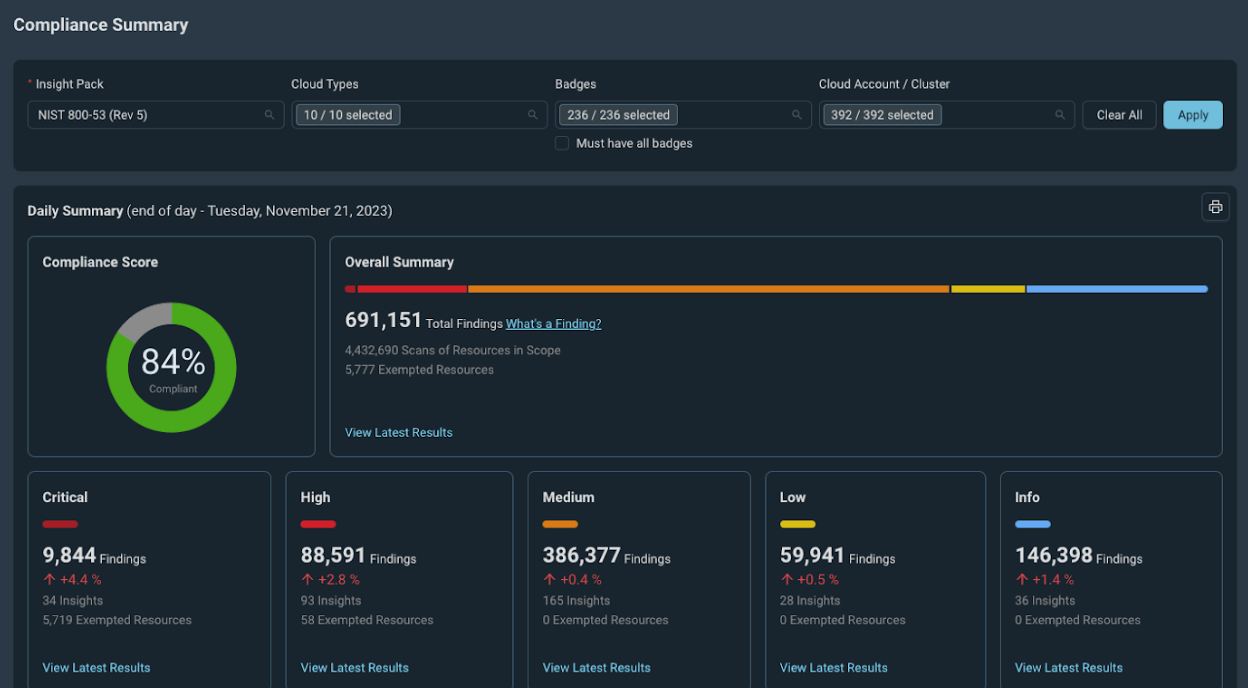
InsightCloudSec allows security teams to establish and continuously measure compliance against organizational policies, whether they’re based on service provider best practices, a common industry framework, or a custom pack tailored to specific business needs.
A compliance pack within InsightCloudSec is a set of checks that can be used to continuously assess your cloud environments for compliance with a given regulatory framework, or industry or provider best practices. The platform comes out of the box with 40+ compliance packs, including a dedicated pack for NIST SP 800-53 Rev. 5.1.1, which now provides an additional 14 insights that align to the newly-added IA-13.
The dedicated pack provides 367 Insights checking against 128 NIST SP 800-53 Rev. 5.1.1 requirements that assess your multi cloud environment for compliance with the controls outlined by NIST. With extensive support for various resource types across all major cloud service providers (CSPs), security teams can confidently implement and continuously enforce compliance with SP 800-53 Rev 5.1.1.
InsightCloudSec continuously assesses your entire multi-cloud environment for compliance with one or more compliance packs and detects noncompliant resources within minutes after they are created or an unapproved change is made. If you so choose, you can make use of the platform’s native, no-code automation to contact the resource owner, or even remediate the issue—either via deletion or by adjusting the configuration or permissions—without any human intervention.
For more information about how to use InsightCloudSec to implement and enforce compliance standards like those outlined in NIST SP 800-53 Rev. 5.1.1, be sure to check out the docs page! For more on our cloud identity and access management capabilities, we’ve got some additional information on that here.
At the end of Q3 2023, Backblaze was monitoring 263,992 hard disk drives (HDDs) and solid state drives (SSDs) in our data centers around the world. We’ve reported on those drives for many years. But, all the data on those drives needs to somehow get from your devices to our storage servers. You might be wondering, “How does that happen?” and “Where does that happen?” Or, more likely, “How fast does that happen?”
These are all questions we want to start to answer.
Welcome to our new Backblaze Network Stats series, where we’ll explore the world of network connectivity and how we better serve our customers, partners, and the internet community at large. We hope to share our challenges, initiatives, and engineering perspective as we build the open cloud with our Partners.
In this first post, we will explore two issues: how we connect our network with the internet and the distribution of our peering traffic. As we expand this series, we hope to capture and share more metrics and insights.
Nice to Meet You; I’m Brent
Since this is the first time you’re hearing from me, I thought I should introduce myself. I’m a Senior Network Engineer here at Backblaze. The Network Engineering group is responsible for ensuring the reliability, capacity, and security of network traffic.
My interest in computer networking began in my childhood when I first persuaded my father to upgrade our analog modem to a ISDN line by providing a financial comparison of time sink due to large download times I was conducting (nothing like using all the family dial-up time to download multi-megabyte SimCity 2000 and Doom customizations). Needless to say, I’m still interested in those same types of networking metrics, and that’s why I’m here sharing them with you at Backblaze.
First, Some Networking Basics
If you’ve ever heard folks joke about the internet being a series of tubes, well, it may be widely mocked, but it’s not entirely wrong. The internet as we know it is fundamentally a complex network of all the computers on the planet. Whenever we’re typing in an internet address into a web browser, we’re basically giving our computer the address of a computer (or server, etc.) to locate, and that computer will hopefully display data to you that it’s storing.
Of course, it’s not a free-for-all. Internet protocols like TLS/SSL are the boundaries that set the rules for how computers communicate, and networks allow different levels of access to outsiders. Internet service providers (ISPs) are defined and regulated, and we’ll outline some of those roles and how Backblaze interacts with them below. But, all that communication between computers has to be powered by hardware, which is why, at one point, we actually had to solve the problem of sharks attacking the internet. Good news: since 2006, sharks have accounted for less than one percent of fiber optic cable attacks.
Wireless internet has largely made this connectivity invisible to consumers, but the job of Wi-Fi is to broadcast a short-range network that connects you to this series of cables and “tubes.” That’s why when you’re transmitting or storing larger amounts of data, you typically get better speeds when you use a wired connection. (A good consumer example: setting up NAS devices works better with an ethernet cable.)
When you’re talking about storing and serving petabytes of data for a myriad of use cases, then you have to create and use different networks to connect to the internet effectively. Think of it like water: both a fire hose and your faucet are connected to utility lines, but they have to move different amounts of water, so they have different kinds of connections to the main utility.
And, that brings us to peering, the different levels of internet service providers, and many, many more things that Backblaze Network Engineers deal with from both a hardware and a software perspective on a regular basis.
What Is Peering?
Peering on the internet is akin to building direct express lanes between neighborhoods. Instead of all data (residents) relying on crowded highways (public internet), networks (neighborhoods) establish peering connections—dedicated pathways connecting them directly. This allows data to travel faster and more efficiently, reducing congestion and delays. Peering is like having exclusive lanes, streamlining communication between networks and enhancing the overall performance of the internet “transportation” system.
We connect to various types of networks to help move your data. I’ll explain the different types below.
The Bit Exchange
Every day we move multiple petabytes of traffic between our internet connectivity points and our scalable data center fabric layer to be delivered to either our SSD caching layer (what we call a “shard stash”) or spinning hard drives for storage.
Our data centers are connected to the world in three different ways.
1. Direct Internet Access (DIA)
The most common way we reach everyone is via a DIA connection with a Tier 1 internet service provider. These connections give us access to long-haul, high-capacity fiber infrastructure that spans continents and oceans. Connecting to a Tier 1 ISP has the advantage of scale and reach, but this scale comes at a cost—we may not have the best path to our customers.
If we draw out the hierarchy of networks that we have to traverse to reach you, it would look like a series of geographic levels (Global, Regional, and Local). The Tier 1 ISPs would be positioned at the top, leasing bandwidth on their networks to smaller Tier 2 and Tier 3 networks, which are closer to our customer’s home and office networks.
How we get from B to C (Backblaze to customer).
Since our connections to the Tier 1 ISPs are based on leased bandwidth, we pay based on how much data we transfer. The bill grows the more we transfer. There are commitments and overage charges, and the relationship is more formal since a Tier 1 ISP is a for-profit company. Sometimes you just want unlimited bandwidth, and that’s where the role of the internet exchange (IX) helps us.
2. Internet Exchange (IX)
We always want to be as close to the client as possible and our next connectivity option allows us to join a community of peers that exchange traffic more locally. Peering with an IXmeans that network traffic doesn’t have to bubble up to a Tier 1 National ISP to eventually reach a regional network. If we are on an advantageous IX, we transfer data locally inside a data center or within the same data center campus, thus reducing latency and improving the overall experience.
Benefits of an IX, aka the “Unlimited Plan,” include:
Paying a flat rate per month to get a fiber connection to the IX equipment versus paying based on how much data we transfer.
No price negotiation based on bandwidth transfer rates.
No overage charges.
Connectivity to lower tiered networks that are closer to consumer and business networks.
Participation helps build a more egalitarian internet.
In short, we pay a small fee to help the IX remain financially stable, and then we can exchange as much or as little traffic as we want.
Our network connectivity standard is to connect to multiple Tier 1 ISPs and a localized IX at every location to give us the best of both solutions. Every time we have to traverse a network, we’re adding latency and increasing the total amount of time for a file to upload or download. Internet routing prefers the shortest path, so if we have a shorter (faster) way to reach you, we will talk over the IX versus the Tier 1 network.
Less is more—the fewer networks between us and you, the better.
3. Private Network Interconnect (PNI)
The most direct and lowest latency way for us to exchange traffic is with a PNI. This option is used for direct fiber connections within the same data center or metro region to some of our specific partners like Fastly and Cloudflare. Our edge routing equipment—that is, the appliances that allow us to connect our internal network to external networks—is connected directly to our partner’s edge routing equipment. To go back to our neighborhood analogy, this would be if you and your friend put a gate in the fences that connect your backyards. With a PNI, the logical routing distance between us and our partners is the best it can be.
IX Participation
Personally, the internet exchange path is the most exciting for me as a network engineer. It harkens back to the days of the early internet (IX points began as Network Access Points and were a key component of Al Gore’s National Information Infrastructure (NII) plan way back in 1991), and the growth of an IX feels communal, as people are joining to help the greater whole. When we add our traffic to an IX as a new peer, it increases participation, further strengthening the advantage of contributing to the local IX and encouraging more organizations to join.
Backblaze Joins the Equinix Silicon Valley (SV1) Internet Exchange
Our San Jose data center is a major point of presence (PoP) (that is, a point where a network connects to the internet) for Backblaze, with the site connecting us in the Silicon Valley region to many major peering networks.
In November, we brought up connectivity to Equinix IX peering exchange in San Jose, bringing us closer to 278 peering networks at the time of publishing. Many of the networks that participate on this IX are very logically close to our customers. The participants are some of the well known ISPs that serve homes, offices, and business in the region, including Comcast, Google Fiber, Sprint, and Verizon.
Now, for the Stats
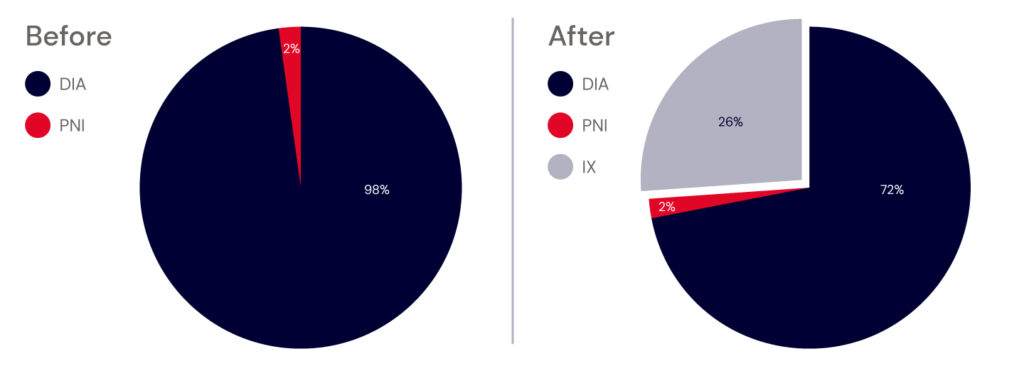
As soon as we turned up the connection, 26% inbound traffic that was being sent to our DIA connections shifted to the local Equinix IX, as shown in the pie chart below.
Before: 98% direct internet access (DIA); 2% private network interconnect (PNI). After: 72% DIA; 2% PNI; 26% internet exchange (IX).
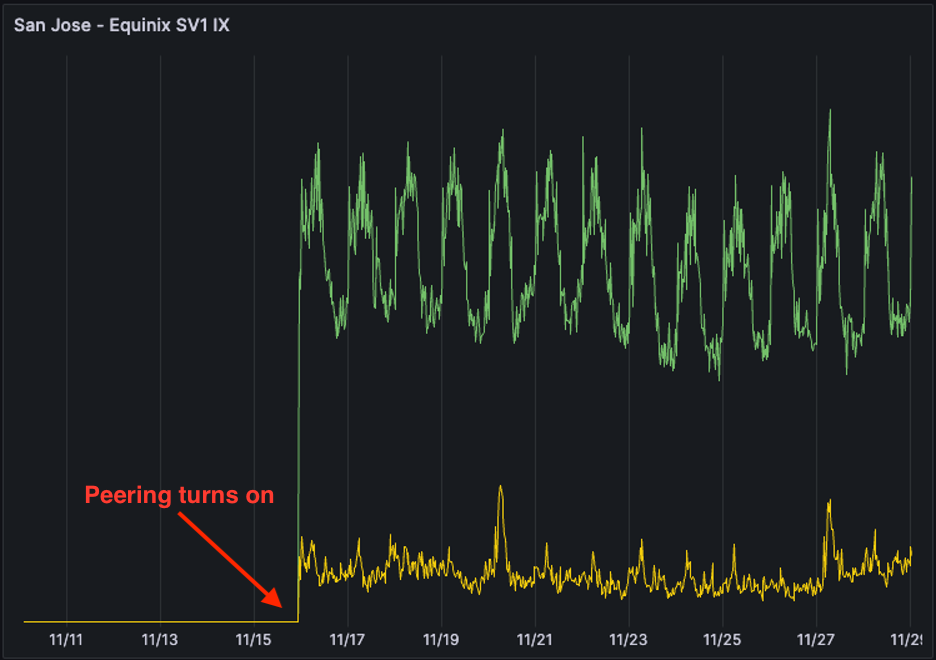
The below graph shows our peering traffic load over the edge router and how immediately the traffic pattern changed as soon as we brought up the peer. Green indicates inbound traffic, while yellow shows outbound traffic. It’s always exciting to see a project go live with such an immediate reaction!
To give you an idea of what we mean by better network proximity, let’s take a look at our improved connectivity to Google Fiber. Here’s a diagram of the three pathways that our edge routers see that show how to get to Google Fiber. With the new IX connection, we see a more advantageous path and pick that as our method to exchange traffic. We no longer have to send traffic to the Tier 1 providers and can use them as backup paths.
Taking faster local roads.
What Does This Mean for You?
We here at Backblaze are always trying to improve the performance and reliability of our storage platform while scaling up. We monitor our systems for inefficiencies, and improving the network components is one way that we can deliver a better experience.
By joining the Equinix SV1 peering exchange, we shorten the number of network hops that we have to transit to communicate with you. And that reduces latency, speeding up your backup job upload, allowing for faster image download, or supporting Partners.
Cheers from the NetEng team! We’re excited to start this series and bring you more content as our solutions evolve and grow. Some of the coverage we hope to share in the future includes analyzing our proximity to our peers and Partners, how we can improve those connections further, and stats to show the amount of bits per second that we process in our data centers to ensure that we not only have a file, but all the related redundancy shard components related to it. So, stay tuned!
Earlier this summer Netflix held our first-ever Data Engineering Forum. Engineers from across the company came together to share best practices on everything from Data Processing Patterns to Building Reliable Data Pipelines. The result was a series of talks which we are now sharing with the rest of the Data Engineering community!
You can find each of the talks below with a short description of each, or you can go straight to the playlist on YouTube here.
Chris Stephens, Data Engineer, Content & Studio and Pedro Duarte, Software Engineer, Consolidated Logging walk engineers new to Netflix through the building blocks of the Netflix Data Engineering stack. Learn more about how batch and streaming data pipelines are built at Netflix.
Lee Woodridge and Pallavi Phadnis, Data Engineers at Netflix, talk about how you can apply different processing strategies for your batch pipelines by implementing generic abstractions to help scale, be more efficient, handle late-arriving data, and be more fault tolerant.
Mark Cho, Guil Pires and Sujay Jain, Engineers from the Netflix Data Platform talk about how a managed Streaming SQL using Apache Flink can help unlock new Stream Processing use cases at Netflix. You can read more about Data Mesh, Netflix’s next-generation stream processing platform, here
Holden Karau, OSS Engineer, Data Platform Engineering, talks about the importance of reliable data pipelines and how to build them covering tools from testing to validation and auditing. The talk uses Apache Spark as an example, but the concepts generalize regardless of your specific tools.
Tristan Reid, software engineer, shares experiences about the Knowledge Management project at Netflix, which seeks to leverage language modeling techniques and metadata from internal systems to improve the impact of the >100K memos that circulate within the company.
Abhinaya Shetty and Bharath Mummadisetty, Data Engineers from Netflix’s Membership Data Engineering team, introduce Psyberg, an incremental ETL framework. Learn about how Psyberg leverages Iceberg metadata to handle late-arriving data, and improves data pipelines while simplifying on-call life!
Judit Lantos, Data Engineer, Member Experience Data Engineering, shares a case study to demonstrate an effective approach for optimizing complex ETL jobs.
In the last 2 decades, Netflix has revolutionized the way video content is consumed, however, there is significant work to be done in revolutionizing how movies and tv shows are made. In this video, Sr. Data Engineers Amanual Kahsay and Dao Mi showcase how data and insights are being utilized to accomplish such a vision.
We hope that our fellow members of the Data Engineering Community find these videos useful and engaging. Please follow our Netflix Data Twitter account for updates and notifications of future Data Engineering Summits!
Всеки от нас има нездрав интерес към поне едно място, на което никога не е бил. Необяснимо е, но то ни привлича, откакто се помним. И градим една мистична и романтична представа, която непрекъснато обогатяваме с книгите, филмите и историите за него. E, Япония никога не е била такова място за мен. Но въпреки това я посетих. И тя реши да ме опровергае и да ми покаже колко мистична и романтична е всъщност.
Ден 1
Преди година и осем месеца – в сутринта, в която щях да се кача на полета за Лима и да сбъдна една от мечтите си, като посетя Перу, Путин направи немислимото и нападна Украйна. Година и осем месеца по-късно отново се качваме на 12-часов полет. Този път обаче летим на изток. И войната под нас не е една, а са две. Две, ако не броим онези забравените, за които не говорим. Географски предопределеното съчувствие е един от най-циничните феномени на човешкия вид. Разбира се, може и да е икономически предопределено – още по-цинично.
Говорейки за цинични феномени: летим над Русия. В небето ѝ съм просто пътник, на земята – чуждестранен агент. Или да си го кажем направо – враг. На път към Япония ще кацнем и в друга държава, където медията, за която работя, е блокирана. Да видим за нея какъв съм.
Ден 2
Проверки, отпечатъци, формуляри, чакане. И пак – проверки, отпечатъци, формуляри, чакане. Чакане, чакане и пак чакане. Влизането в Шанхай без виза за до 72 часа отваря чудесна възможност за разходка при по-дълга пауза между полетите. Стига да имаш нервите да минеш през безкрайния процес на летището.
Иначе оттам до центъра се стига за няколко минути с влак, който може да развие над 400 км/ч. Съвсем спокойно можеш да забравиш какъв режим управлява страната, ако не бяха хилядите камери, взиращи се в теб от всяко кътче. Хората в икономическия център на Китай са изключително добре облечени. Най-привлекателното място за тях обаче не е бившата резиденция на Мао Дзъдун в центъра, не са и будистките храмове, които по доста еклектичен начин съжителстват с небостъргачите, а е… рекламата на новия магазин на „Баленсиага“. Всяко време си има своите идоли, а най-разпространените обикновено идват от по-свободния свят. Този, който е бутнал крепостните си стени.
Когато пътувате през голямо летище, особено азиатско, отидете поне 2–3 часа по-рано. Защото никога не знаете дали някой няма да реши да ви свали багажа, макар на етикета му да пише, че е направо за Осака. После да го завре в някакъв склад, а вие да тръгнете на експедиция, включваща тичане и разговори с поне 5–6 смутени летищни служители (владеещи много скромен или направо никакъв английски), за да си го вземете обратно и да го натоварите на самолета.
Полетът между Китай и Япония е по-малко от два часа, но ги делят вселени.
В Япония положението е „всичко навсякъде наведнъж“. Буквално. Феерията от цветове, светлини и звуци те посреща още на летището. После те връхлита във влака, а накрая я откриваш дори в супермаркета, където почти всички продукти те вкарват в нещо средно между екстаз и шок – голямо триъгълно суши, което се яде като сандвич; безброй хладилници със студени напитки; две камери, които затоплят кенчета, пълни с кафе; топла витрина, която приготвя пилешки хапки, дъмплинги и корндог. Сушен октопод, сушени стриди, сушени сепии. Сушени минипатладжани в оцет. Всевъзможни коктейли в алуминиеви кенчета (някои имат вкус на мокра кърпичка – наистина!). Количеството надписи, цветове, картинки, които те заобикалят, е неописуемо. Ако една държава олицетворява синдрома на дефицит на внимание, това със сигурност е Япония. Безкрайно интересно е, вкусно, многообразно. Но си представям какво е да живееш, заобиколен от толкова дразнители. И да се опитваш да се съсредоточиш.
„Български, английски, немски, испански – защо вие знаете толкова много езици? Аз знам японски и английски, и то защото бившата ми приятелка беше американка и трябваше да я разбирам, когато ми се кара“, казва Юки, който е музикант от Осака. Говорим си, че колкото е по-голяма една държава, толкова по-трудно асимилира други култури. Докато ние гледахме Cartoon Network от малки. И започнахме да учим езици, за да отидем да учим в чужбина някой ден. За големите държави това е по-скоро ексцентризъм. За нас е (често) задължителен път към успешната реализация. Малка, проблемна и пропита с комплекси държава – дали всъщност това не е идеалната среда, която да те превърне в космополитен човек?
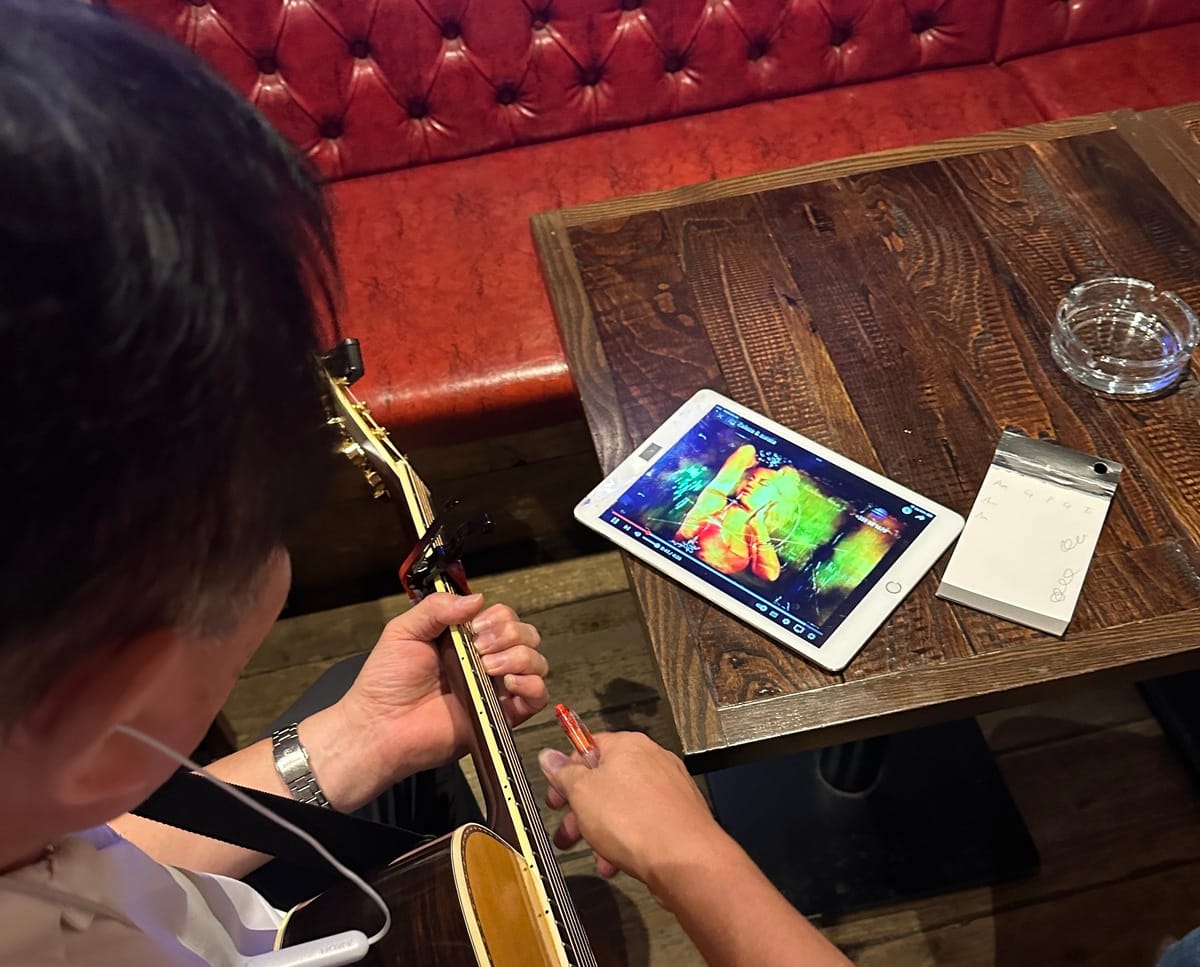
Юки ни кани в своя караоке бар и обещава, че ще е много готино. Пеем му всичко – от Рики Мартин до Audioslave. Решаваме да изпеем и нещо на български. Опитваме с „Богатство“ на Тангра. Няма особена реакция. Минаваме през целия алманах на българската музика. И да, стигна се до Камелия. Китаристът Акихико се вдъхновява. Един час разучава песен на Камелия. Оказва се, че тя е доста сложна. Накрая я свири и е много притеснен – ще се справи ли с този музикален апогей? Е, справи се!
Императрица Генмей избира Нара за първата столица на обединена Япония през 710 г. (преходът от Камелия към императрица Генмей е върхът в кариерата ми). Дотам от Осака е има-няма час. В Япония много големи градове просто преливат един в друг.
Храмът „Тодай дзи“ е най-внушителният пример от времето, в което Нара е била столица. Макар сградата и интериорът да са реновирани многократно, най-голямата бронзова статуя на Великия Буда – Дайбуцу – и до днес впечатлява с внушителните си размери. Император Шому я поръчва в отговор на войните и на пандемията от едра шарка, която избива една трета от населението на Япония в периода 735–737 г. Е, тази вълшебна статуя въпреки красотата си не успява да спаси Нара от упадъка, в който градът потъва след 794 г., когато престава да бъде столица. Толкова за скъпите храмове и религиозни статуи.
За да разведрим обстановката, ще отбележа, че днес Нара е един изключително красив град с дори аристократична атмосфера. Но също така е дом на стотици свободно разхождащи се сърни. Те, разбира се, си имат quid pro quo отношения с туристите – тяхната симпатичност срещу твоите крекери. И при тази размяна сърните… се покланят. Както и японците. Японците се покланят по 11 различни причини. Това го знам от Юлиана Антонова-Мурата, чиито книги са ми верен спътник през цялото пътуване. Включително и във влака към следващата столица на Япония.
В Киото има 2000 храма – 1600 будистки и 400 шинтоистки. Някои от тях на възраст над 1300 години. Градът е бил столица на Япония в продължение на над 1000 години – от 794 до 1868 г. Освен това е дом на Киотския университет, който е дал на света 19 нобелови лауреати. И… за малко да бъде изравнен със земята по време на Втората световна война. Да, Киото е била втората цел след Хирошима. Спорно е кой и как предотвратява това решение. Но тезата, че разрушаването на културната столица на Япония ще сложи окончателния и решителен край на Втората световна война, в крайна сметка отстъпва на мнението, че японците никога няма да простят този удар върху историята и идентичността им. Добре че така е станало, но ми се струва цинично на фона на стотиците хиляди жертви в Хирошима и Нагасаки.
Освен храмовете в Киото пленителна е и природата. Например бамбуковата гора в Арашияма. В нея се срещаме с Кинджи Накамура. Той е художник, около 80-годишен, и продава принтове на своите картини на символична цена. Веднага ни пита откъде сме. Когато разбира, вади стара папка, пълна с карти на Европа. Разгръща трескаво, търсейки Югоизточна Европа и по-конкретно България.
С гордост показва туристи от кои градове вече са си купували картички от него – София, Варна, Ловеч. Всеки е оградил родния си град. Възможно ли е никой от българската културна столица да не е посещавал японската?! Бързо поправяме тази грешка и Пловдив вече е ограден с кръгче на картата. Преди да се разделим с Кинджи, той разлиства и друга папка с думички и транскрипция. Бързо намира това, което търси. „Благодаря!“, казва мъжът със старание.
Кинджи не е бил в България, единственото му пътуване до Европа е в Испания. Но нужно ли му е да пътува физически, щом клиентите му го отвеждат навсякъде по света всеки ден? Пък и макар Кинджи да не е стигал до България, картините му вече са тук.
Вечерта коктейлите ни ги прави Хиро. Той ни разказва за най-изконната японска традиция от последните десетилетия… Коледа в KFC. Накратко, през 70-те години японската икономика се развива с бързи темпове и американските вериги навлизат скорострелно в страната. В този момент някой гениален маркетолог от екипа на KFC решава, че е добре да продадат коледната традиция на Япония, като организират цяла кампания с Дядо Коледа, червения и белия цвят и всичко, което иначе няма нищо общо с християнската традиция. И успяват. Днес масово японските семейства празнуват Коледа с кофа от KFC. Ех, Едуард Бернайс би се гордял…
Ден 7
Японците казват, че се раждат шинтоисти, празнуват като християни и умират като будисти. Шинтоизмът е в основата на повечето традиции и символи в страната, а свещените духове – ками, са навсякъде. Изповядването му обаче е примесено с будистките вярвания. Повечето японци се определят едновременно като шинтоисти и будисти. Но в същото време мнозинството казват, че са и атеисти. В последните десетилетия традициите на западния християнски свят обаче също са се наложили най-вече по време на празници като Коледа и ритуали като сватба. С две думи: религиозните обреди и традиции присъстват като културна ценност, но не се използват за индоктринация.
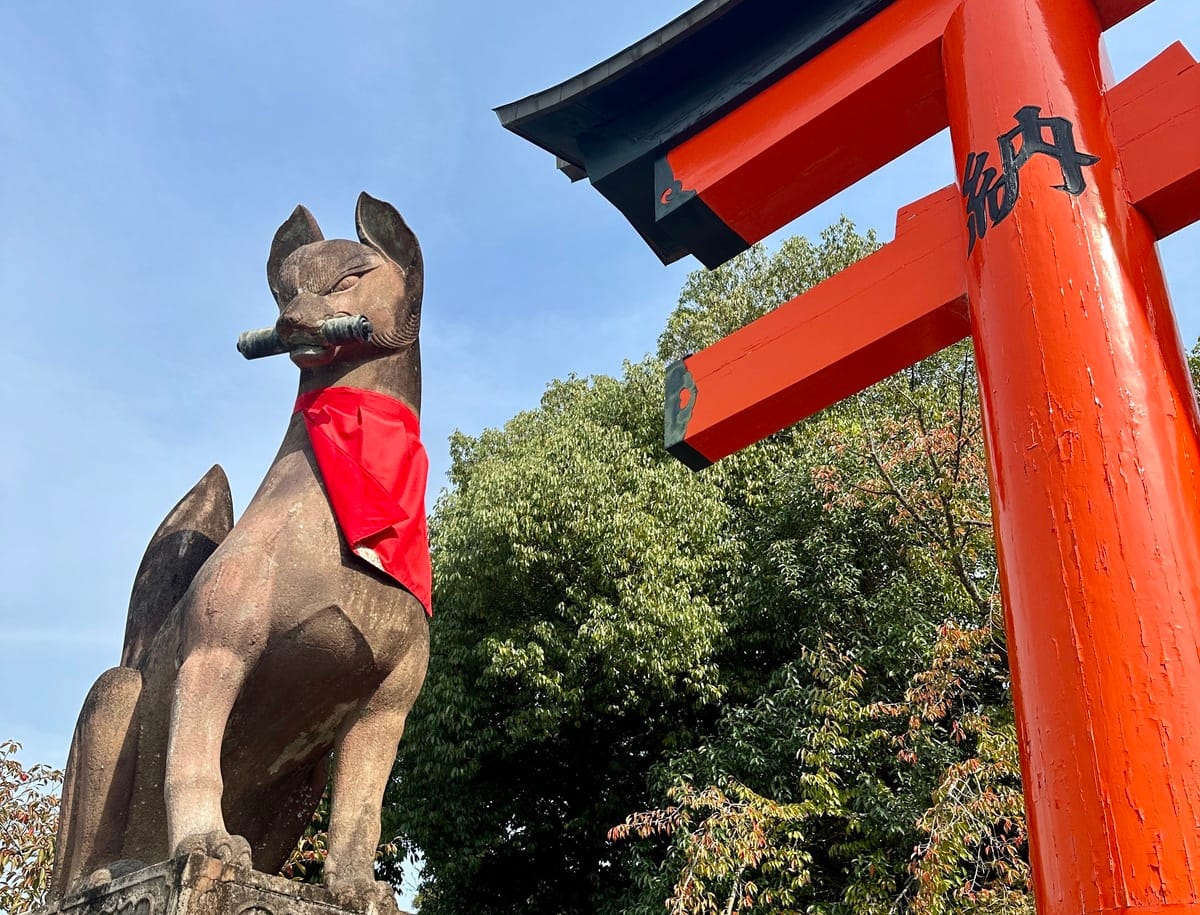
И тъй като Киото е градът с най-много храмове в Япония, няма как да не посетим поне няколко, докато сме там. Шинтоистките светилища се различават съществено от будистките храмове – повечето са навън и са посветени на конкретна кама.
Много неща в Япония изглеждат извънземни – особено влаковете. „Шинкансен“ за първи път в света надхвърля скорост 200 км/ч през 1964 г. Днес максималната му скорост е 320 км/ч и те откарва от региона Кансай, където са Осака и Киото, до Токио за малко над 2 часа.
Токио е най-необозримото място, в което съм стъпвал. И надали някое друго ще го изпревари, тъй като столицата на Япония със своите 37 млн. души е най-населеният град в света. Разрушаван е два пъти през XX век – от земетресение и от бомбардировките по време на Втората световна война.
Разликата между хората в Кансай и в Канто – региона, който обхваща и Токиo – е видима. Докато в Осака те заговарят на улицата (че даже и пушат там, което е забранено в Япония), Токио изглежда много по-близо до клишето за японските нрави – маси за един, дистанция, тишина. Интересно е как толкова дисциплиниран и неекспресивен народ е създал такива бури от цветове, движения и провокации, каквито са манга и аниме. И е обсипал градовете си с билборди, лампички, неони, високоговорители и редица предизвикателства за сетивата. Сякаш се опитва да компенсира. Добре, май сам си отговорих на въпроса…
Говорейки за въпроси, трудно можеш да намериш човек в Япония, който да ти даде повече отговори от Юлиана Антонова-Мурата. Обсъждаме следващата ѝ книга, в която търси отговори за дълголетието на японците. 84,45 години – толкова е средната продължителност на живота в Япония. Повече от 10 години повече, отколкото в България, сринала се и заради COVID-19, който извади наяве всичките ни дефицити – и персонални, и на здравната ни система.
„В Япония трябва да се ходи на лекар всеки месец“, разказва ми Юлиана. В противен случай те глобяват. Деца, възрастни – няма значение, всички получават напомняния да посетят различни специалисти ежемесечно. Не е ли малко прекалено? И твърде скъпо? „Е, за какво плащаме данъци и осигуровки?“, пита Юлиана.
За едно нещо сме единодушни – причината за японското дълголетие не е храната. Тук се яде основно ориз, който далеч не е най-здравословната част от менюто. Освен това зеленчуците и най-вече плодовете (особено пресните) изобщо не са даденост във всеки супермаркет, камо ли на всяко хранене. Но тук затлъстели хора почти няма, а порциите са по-скоро малки.
Матю Пери е починал. Колко ли комици се опитват да заглушат тъгата в собственото си сърце със смеха, който предизвикат у останалите?
Леко парадоксално, в този ден се срещаме с историята на един друг Матю Пери. Този, който през 1852 г. е натоварен от САЩ с тежката задача да сложи край на японската изолационна политика и да проправи пътя ѝ към международната търговия. С много упорство и немалко заплахи успява. А всичко започва в Йокохама.
Днес Йокохама е вторият по големина град в Япония (който прелива в Кавасаки и след това в Токио) и открива великолепна гледка към вулкана Фуджи. Имаме късмета снежният кратер да се вижда, когато посещаваме Йокохама. Много често е напълно закрит от плътни облаци.
Независимо дали си чел прочутия роман на Артър Голдън, или не, гейшите са неизменна част от японската култура. Тъй като те са предимно в Киото, в останалите градове има различни клубове и шоута, които ги имитират. Посещаваме бурлеска, а по стълбите към заведението гордо са закачени снимки на известните му посетители – от Стивън Тайлър до принца на Монако. Кимона, песни, танци с традиционни чадъри. Но и въртене на пилони. Историите, които разказват момичетата, са сходни с повечето, които работят в бранша и в други държави – много от тях са мигрантки, от бедни семейства, имат други мечти, работят тук временно… Под кимоната и традиционните мотиви се крият ощетени от живота момичета, които насила се усмихват на привилегированите си клиенти.
Ден 11
Сбогуване с Токио и обратно към Осака. Днес е Хелоуин. Японците го празнуват, общо взето, откакто сме пристигнали, но днес трябва да е кулминацията. И Осака със своята южняшка и бохемска атмосфера е идеално място за целта. Бих ви написал още какво се случваше по централните улици на Осака, но то наистина е неописуемо. Затова просто ще ви покажа:
Чао, Япония, хайде обратно към Китай. Този път летим през Пекин, където имаме 10 часа престой. Точно колкото да ни закарат набързо до „Тиенанмън“, да хапнем, да се разходим на хубавото слънчево време, каквото прогнозираха метеоролозите, и да се върнем обратно.
Първият сигнал, че нещата няма да се стекат по нашия план, беше времето. И по-конкретно плътният смог, покрил Пекин. От този град не се вижда абсолютно нищо. Слънцето е като от фентъзи филм. Дори аз като гражданин на София, която далеч не може да се похвали с чист въздух, съм покъртен. Кацаме и се запътваме към автоматите, на които за пореден път да предоставим отпечатъците и данните от паспортите си на китайската държава. Чинно попълваме формулярите за 24-часов престой без виза. Насочваме се към гишето и с усмивка казваме, че планираме да се разходим в Пекин преди полета към Виена. Да, ама не. Може да напуснем летището само ако следващият ни полет е след повече от 12 часа.
Добре, явно ще стоим на летището. Нека намерим лаундж. И тук греда. Лаунджовете на летището в многомилионната столица на доскоро най-населената държава в света изглеждат като чакалня в малка жп гара в България през 1972 г. Всъщност нямам идея как са изглеждали чакалните в жп гарите в България през 1972 г., но така си ги представям: мушамичка, блудкаво кафе и невероятен избор от 2–3 вида сладки. Това е.
Самото летище иначе впечатлява с мащаба си. Но още повече впечатлява с отсъствието на хора. Каквито и да е. Където и да е. Затворените и изтърбушени магазини, над които все още висят загасналите табели на марки като „Марк Джейкъбс“ и „Баленсиага“, напомнят за тежките удари, които COVID-19 и политиката на китайското правителство нанесоха на икономиката и живота на хората. Работещите нонстоп „Старбъкс“ и „Коста“ (единствените два денонощни обекта на цялото летище) все пак индикират, че тук от време на време стъпва и западен крак. Безжичният интернет, блокиращ почти всички приложения и сайтове, до които би искал да имаш достъп, ти крещи в лицето в каква държава се намираш.
Като цяло обстановката е тягостна, служителите гледат лошо и подозрително, трудно се разбираш с тях, а те очевидно трудно се разбират и помежду си. Зад лъскавите повърхности прозира празнота. Всичко красноречиво говори, че в най-голямата икономика в света раните, нанесени от режима, са дълбоки. Тук усмивките дори върху малкото лица, които не са покрити с маски, отсъстват. Свободните хора се усмихват повече. Предпочитам да си ходя при тях.
Ден 13
Качваме се на борда заедно с футболен отбор от Украйна. Пак ли ще летим над Русия? Да! Не съм сигурен какво точно чувствам, затова решавам да се опитам да поспя. Този път ми се получава.
Добро утро, Виена! Хапвам един сандвич с кезелеберкезе набързо, купувам си няколко алмдудлера и един вестник Der Standard за из път и се насочвам към гейта. Имам предостатъчно време да седна в едно от добре познатите ми заведения, да кажа „Грюс Гот“ (Grüß Gott – „добър ден“, б.р.) на сервитьора, да си поръчам един меланж и да наваксам с имейли, телефонни разговори и прочее. Нали казват, че където и да ходиш, винаги се прибираш някъде? Е, невинаги се прибирам на едно и също място, но имам чувството, че винаги се прибирам през виенското летище.
София е толкова сива, ама си е моето сиво. Първо пускам пералнята, защото предстоят още поне два цикъла. Сега е време да обърна малко внимание на котката, да си разопаковам багажа и да изчистя. Докато свърша всичко изброено, пералнята е готова. Започвам да вадя дрехите и в един момент осъзнавам, че ги подреждам… в хладилника. Здравей, джетлаг, my old friend! Явно е по-добре сега да си легна, завръщането в реалността може да почака до утре.
The kernel’s stable-update process is intended to produce kernels that are,
well, stable; when that promise is lived up to, users can update to newer
stable updates without fear. By any account, a bug that corrupts data on
ext4 filesystems constitutes a failure to hold to that promise. As is so
often the case, this problem is the result of a chain of failures in a
system that works well most of the time.
In order for one device to talk to other devices on the Internet using the aptly named Internet Protocol (IP), it must first be assigned a unique numerical address. What this address looks like depends on the version of IP being used: IPv4 or IPv6.
IPv4 was first deployed in 1983. It’s the IP version that gave birth to the modern Internet and still remains dominant today. IPv6 can be traced back to as early as 1998, but only in the last decade did it start to gain significant traction — rising from less than 1% to somewhere between 30 and 40%, depending on who’s reporting and what and how they’re measuring.
With the growth in connected devices far exceeding the number of IPv4 addresses available, and its costs rising, the much larger address space provided by IPv6 should have made it the dominant protocol by now. However, as we’ll see, this is not the case.
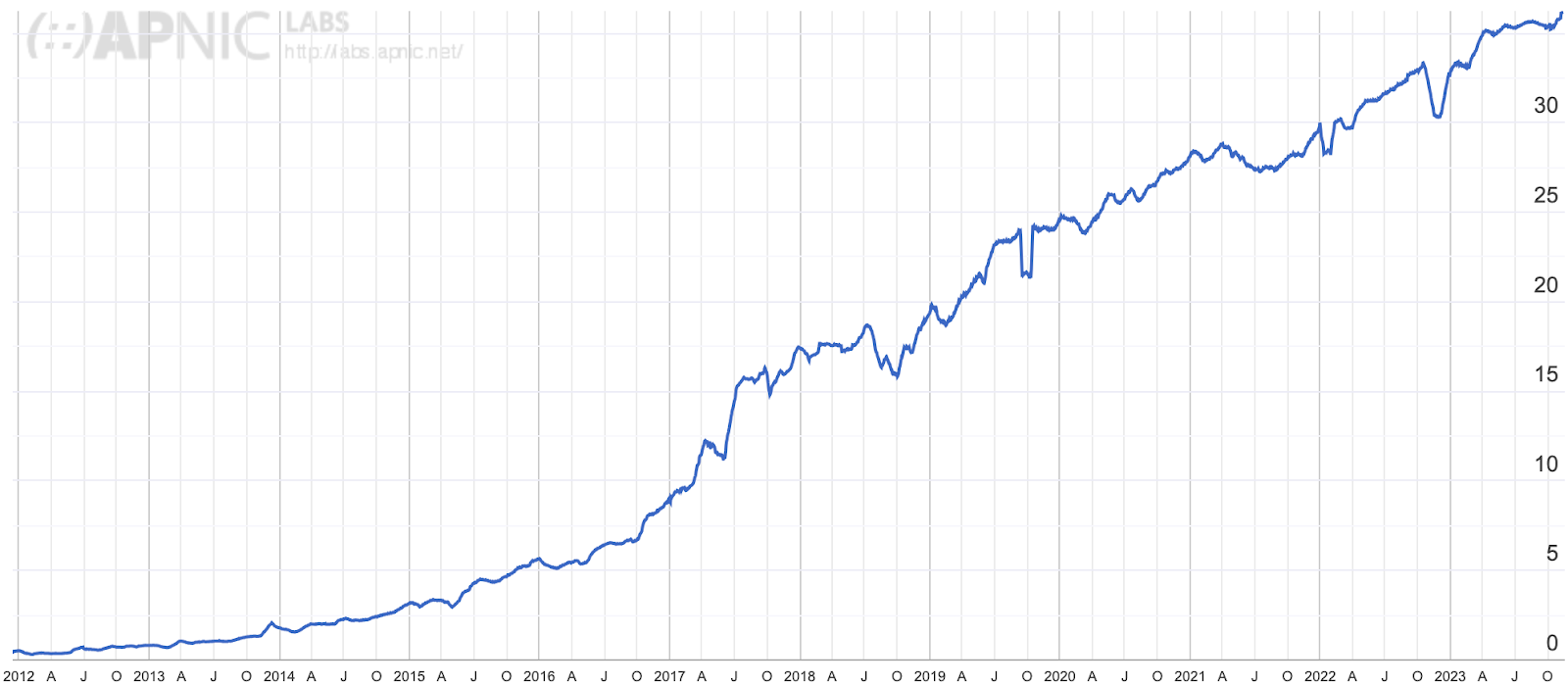
Cloudflare has been a strong advocate of IPv6 for many years and, through Cloudflare Radar, we’ve been closely following IPv6 adoption across the Internet. At three years old, Radar is still a relatively recent platform. To go further back in time, we can briefly turn to our friends at APNIC1 — one of the five Regional Internet Registries (RIRs). Through their data, going back to 2012, we can see that IPv6 experienced a period of seemingly exponential growth until mid-2017, after which it entered a period of linear growth that’s still ongoing:
IPv6 adoption is slowed down by the lack of compatibility between both protocols — devices must be assigned both an IPv4 and an IPv6 address — along with the fact that virtually all devices on the Internet still support IPv4. Nevertheless, IPv6 is critical for the future of the Internet, and continued effort is required to increase its deployment.
Cloudflare Radar, like APNIC and most other sources today, publishes numbers that primarily reflect the extent to which Internet Service Providers (ISPs) have deployed IPv6: the client side. It’s a very important angle, and one that directly impacts end users, but there’s also the other end of the equation: the server side.
With this in mind, we invite you to follow us on a quick experiment where we aim for a glimpse of server side IPv6 adoption, and how often clients are actually (or likely) able to talk to servers over IPv6. We’ll rely on DNS for this exploration and, as they say, the results may surprise you.
IPv6 Adoption on the Client Side (from HTTP)
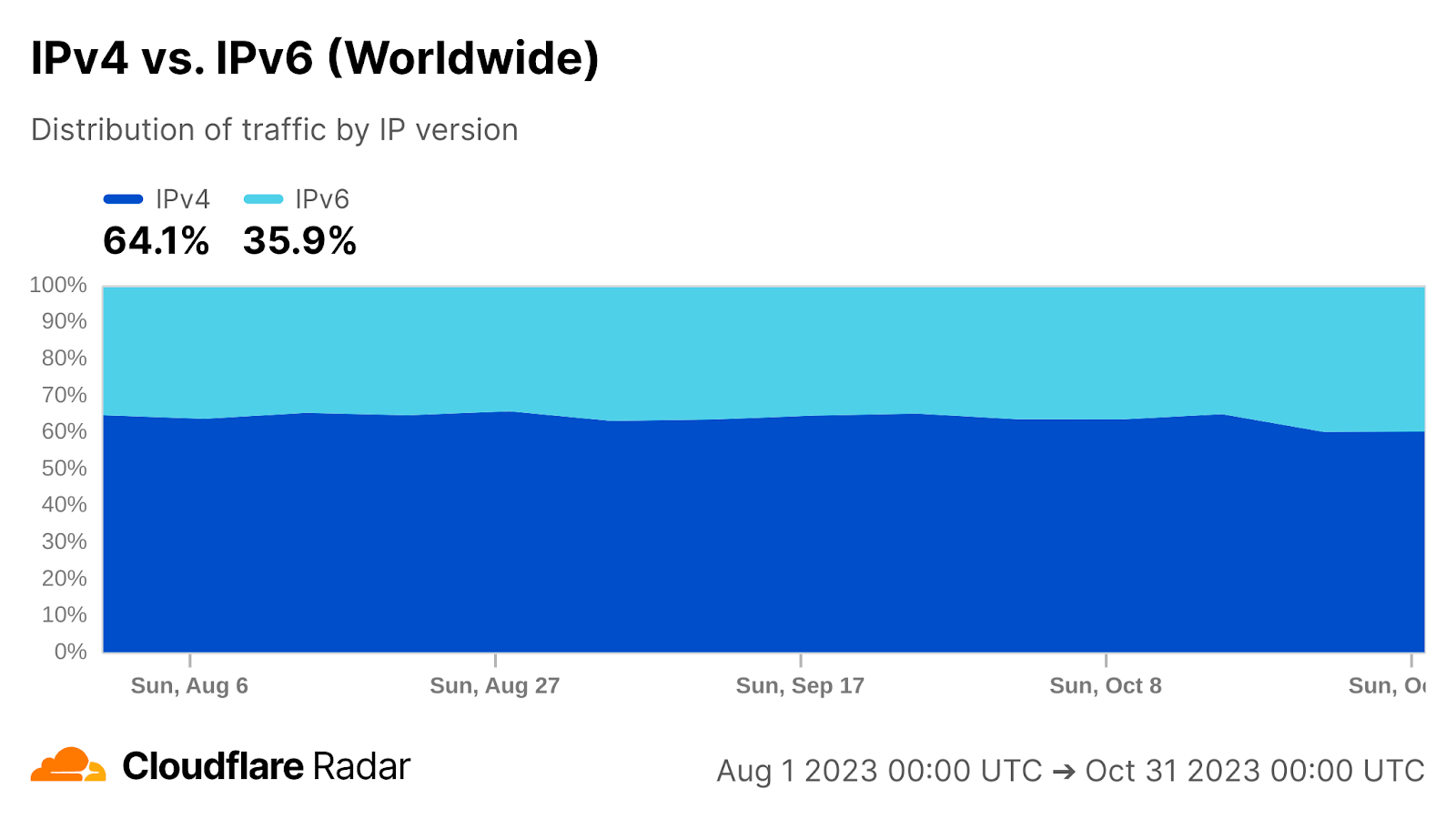
By the end of October 2023, from Cloudflare’s perspective, IPv6 adoption across the Internet was at roughly 36% of all traffic, with slight variations depending on the time of day and day of week. When excluding bots the estimate goes up to just over 46%, while excluding humans pushes it down close to 24%. These numbers refer to the share of HTTP requests served over IPv6 across all IPv6-enabled content (the default setting).
For this exercise, what matters most is the number for both humans and bots. There are many reasons for the adoption gap between both kinds of traffic — from varying levels of IPv6 support in the plethora of client software used, to varying levels of IPv6 deployment inside the many networks where traffic comes from, to the varying size of such networks, etc. — but that’s a rabbit hole for another day. If you’re curious about the numbers for a particular country or network, you can find them on Cloudflare Radar and in our Year in Review report for 2023.
It Takes Two to Dance
You, the reader, might point out that measuring the client side of the client-server equation only tells half the story: for an IPv6-capable client to establish a connection with a server via IPv6, the server must also be IPv6-capable.
This raises two questions:
What’s the extent of IPv6 adoption on the server side?
How well does IPv6 adoption on the client side align with adoption on the server side?
There are several possible answers, depending on whether we’re talking about users, devices, bytes transferred, and so on. We’ll focus on connections (it will become clear why in a moment), and the combined question we’re asking is:
How often can an IPv6-capable client use IPv6 when connecting to servers on the Internet, under typical usage patterns?
Typical usage patterns include people going about their day visiting some websites more often than others or automated clients calling APIs. We’ll turn to DNS to get this perspective.
Enter DNS
Before a client can attempt to establish a connection with a server by name, using either the classic IPv4 protocol or the more modern IPv6, it must look up the server’s IP address in the phonebook of the Internet, the Domain Name System (DNS).
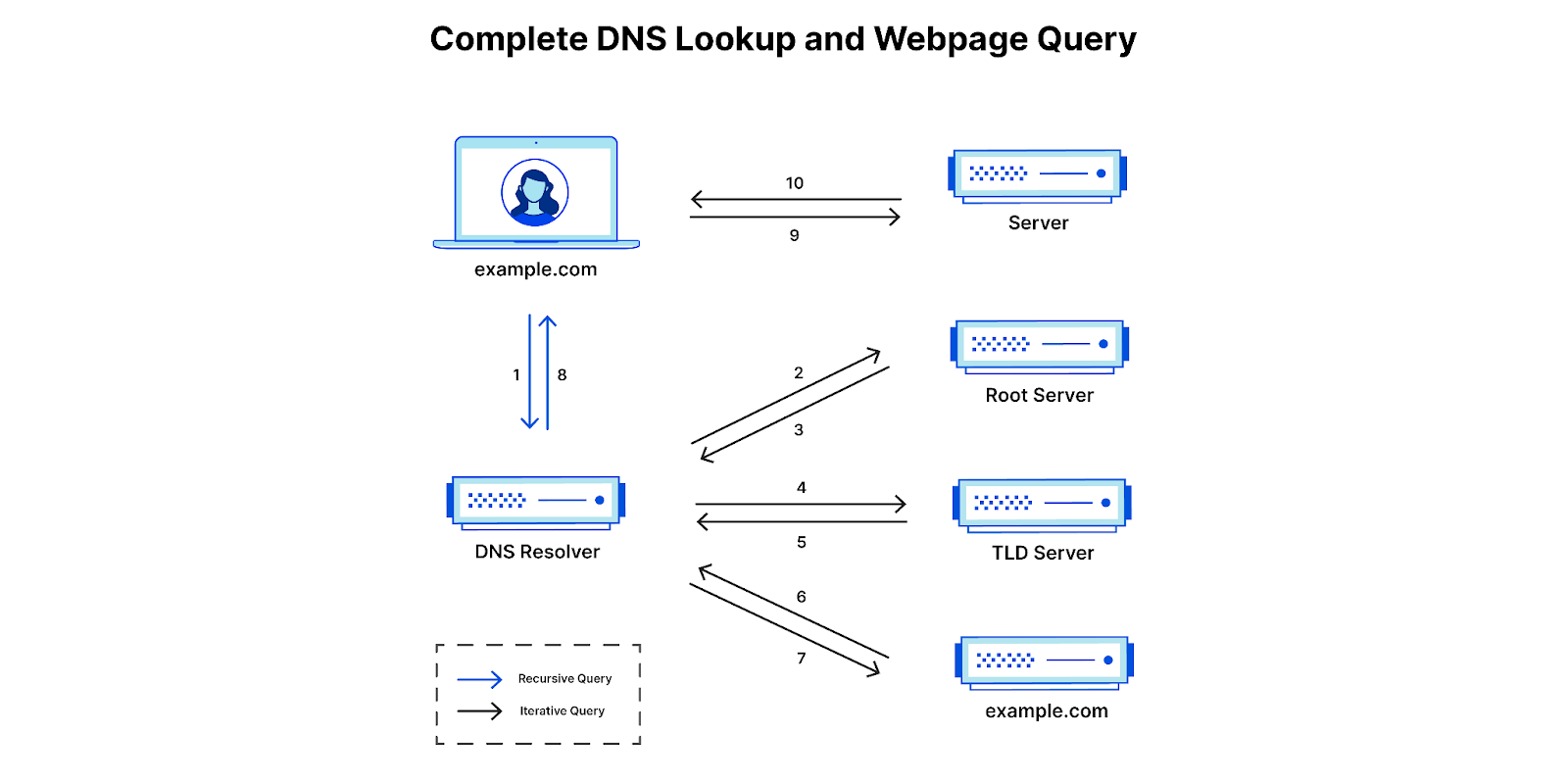
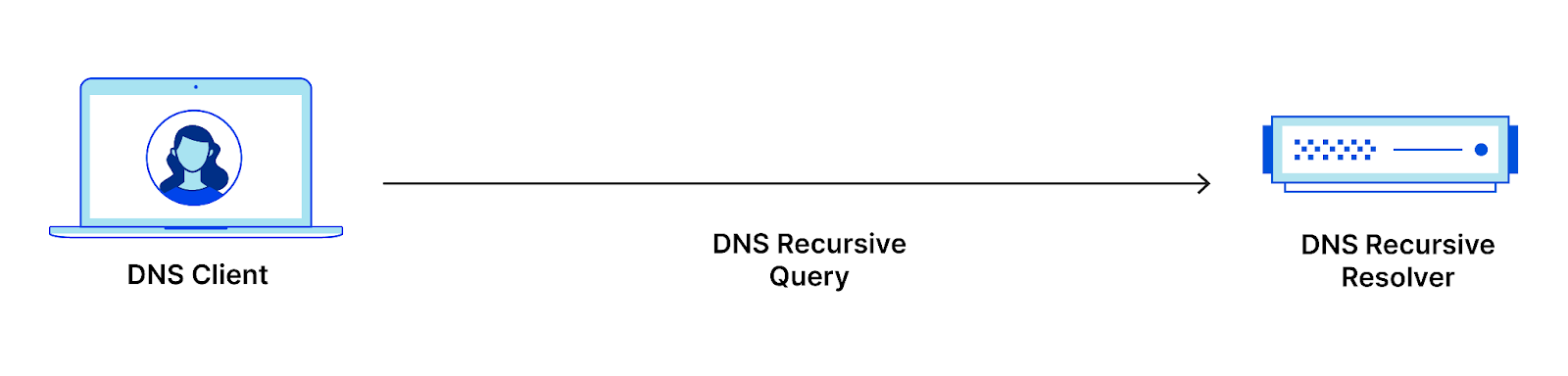
Looking up a hostname in DNS is a recursive process. To find the IP address of a server, the domain hierarchy (the dot-separated components of a server’s name) must be followed across several DNS authoritative servers until one of them returns the desired response2. Most clients, however, don’t do this directly and instead ask an intermediary server called a recursive resolver to do it for them. Cloudflare operates one such recursive resolver that anyone can use: 1.1.1.1.
As a simplified example, when a client asks 1.1.1.1 for the IP address where “www.example.com” lives, 1.1.1.1 will go out and ask the DNS root servers3 about “.com”, then ask the .com DNS servers about “example.com”, and finally ask the example.com DNS servers about “www.example.com”, which has direct knowledge of it and answers with an IP address. To make things faster for the next client asking a similar question, 1.1.1.1 caches (remembers for a while) both the final answer and the steps in between.
This means 1.1.1.1 is in a very good position to count how often clients try to look up IPv4 addresses (A-type queries) vs. how often they try to look up IPv6 addresses (AAAA-type queries), covering most of the observable Internet.
But how does a client know when to ask for a server’s IPv4 address or its IPv6 address?
The short answer is that clients with IPv6 available to them just ask for both — doing separate A and AAAA lookups for every server they wish to connect to. These IPv6-capable clients will prioritize connecting over IPv6 when they get a non-empty AAAA answer, whether they also get a non-empty A answer (which they almost always get, as we’ll see). The algorithm driving this preference for modernity is called Happy Eyeballs, if you’re interested in the details.
We’re now ready to start looking at some actual data…
IPv6 Adoption on the Client Side (from DNS)
The first step is establishing a baseline by measuring client IPv6 deployment from 1.1.1.1’s perspective and comparing it with the numbers from HTTP requests that we started with.
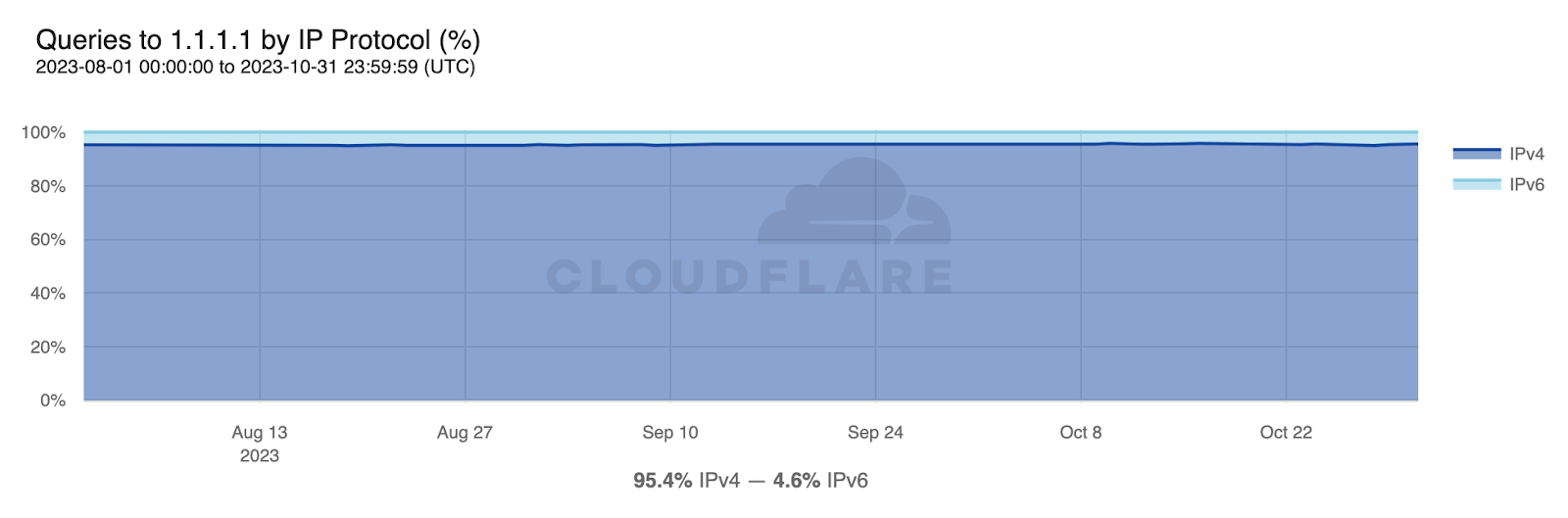
It’s tempting to count how often clients connect to 1.1.1.1 using IPv6, but the results are misleading for a couple of reasons, the strongest one being hidden in plain sight: 1.1.1.1 is the most memorable address of the set of IPv4 and IPv6 addresses that clients can use to perform DNS lookups through the 1.1.1.1 service. Ideally, IPv6-capable clients using 1.1.1.1 as their recursive resolver should have all four of the following IP addresses configured, not just the first two:
1.1.1.1 (IPv4)
1.0.0.1 (IPv4)
2606:4700:4700::1111 (IPv6)
2606:4700:4700::1001 (IPv6)
But, when manual configuration is involved4, humans find IPv6 addresses less memorable than IPv4 addresses and are less likely to configure them, viewing the IPv4 addresses as enough.
A related, but less obvious, confounding factor is that many IPv6-capable clients will still perform DNS lookups over IPv4 even when they have 1.1.1.1’s IPv6 addresses configured, as spreading lookups over the available addresses is a popular default option.
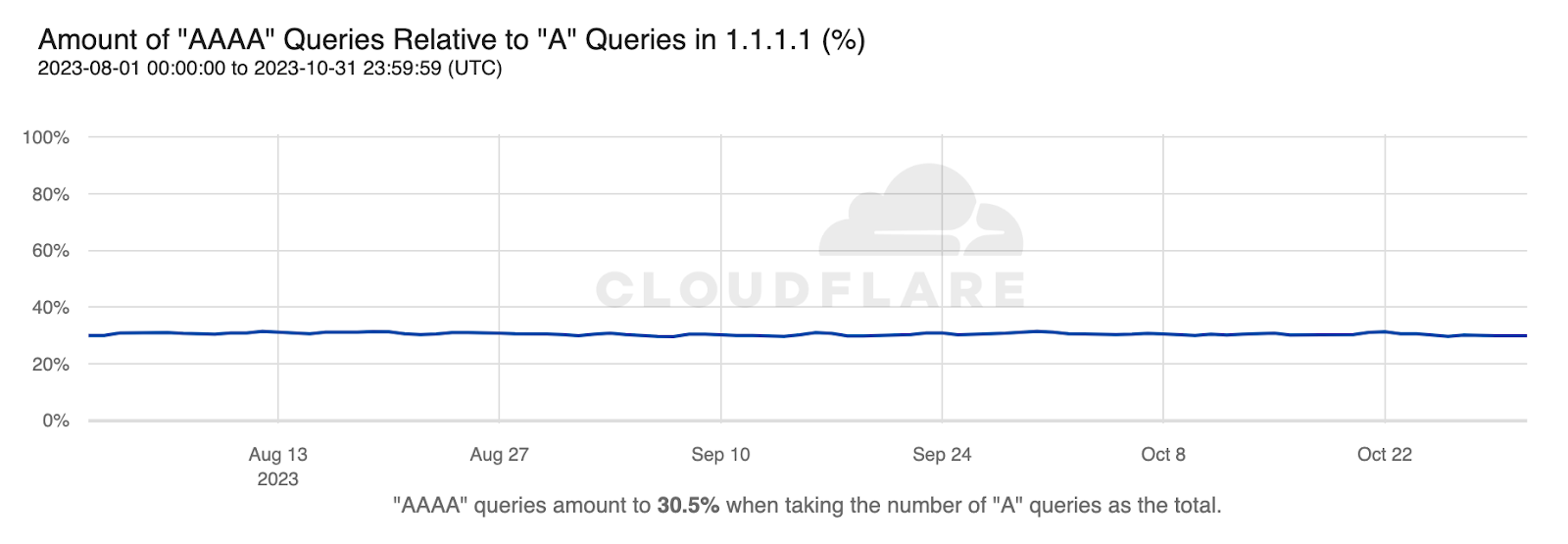
A more sensible approach to assess IPv6 adoption from DNS client activity is calculating the percentage of AAAA-type queries over the total amount of A-type queries, assuming IPv6-clients always perform both5, as mentioned earlier.
Then, from 1.1.1.1’s perspective, IPv6 adoption on the client side is estimated at 30.5% by query volume. This is a bit under what we observed from HTTP traffic over the same time period (35.9%) but such a difference between two different perspectives is not unexpected.
A Note on TTLs
It’s not only recursive resolvers that cache DNS responses, most DNS clients have their own local caches as well. Your web browser, operating system, and even your home router, keep answers around hoping to speed up subsequent queries.
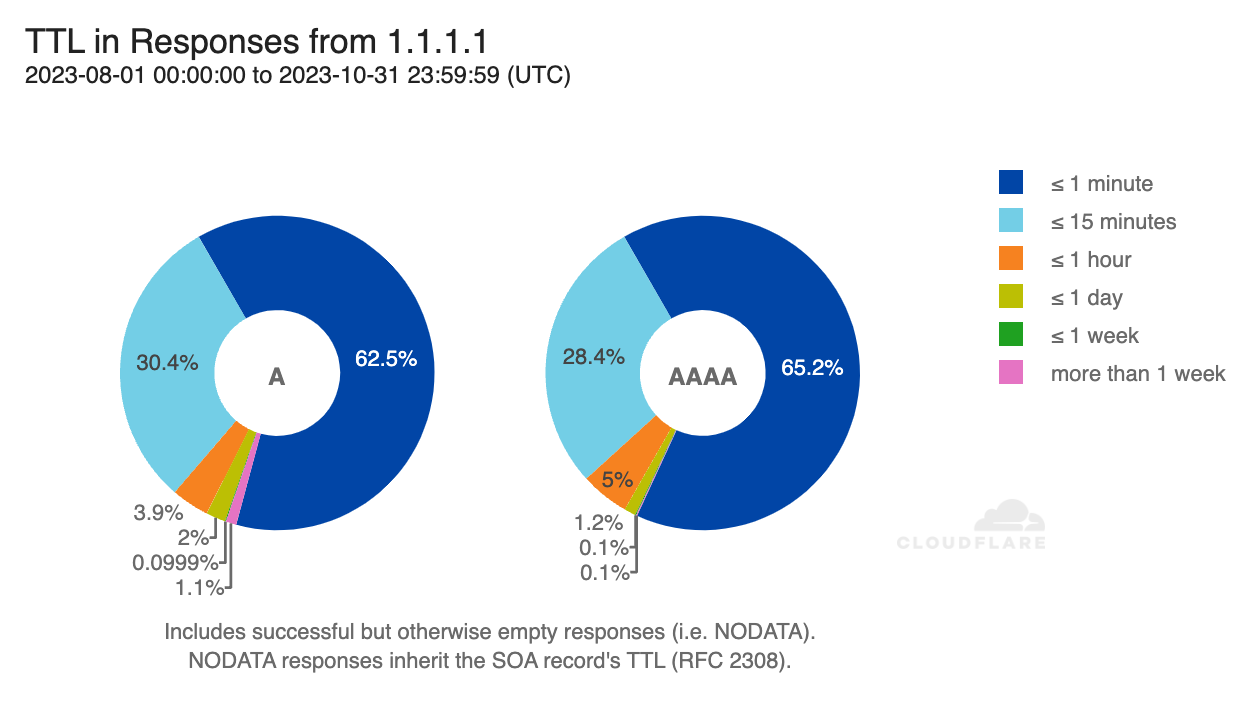
How long each answer remains in cache depends on the time-to-live (TTL) field sent back with DNS records. If you’re familiar with DNS, you might be wondering if A and AAAA records have similar TTLs. If they don’t, we may be getting fewer queries for just one of these two types (because it gets cached for longer at the client level), biasing the resulting adoption figures.
The pie charts here break down the minimum TTLs sent back by 1.1.1.1 in response to A and AAAA queries6. There is some difference between both types, but the difference is very small.
IPv6 Adoption on the Server Side
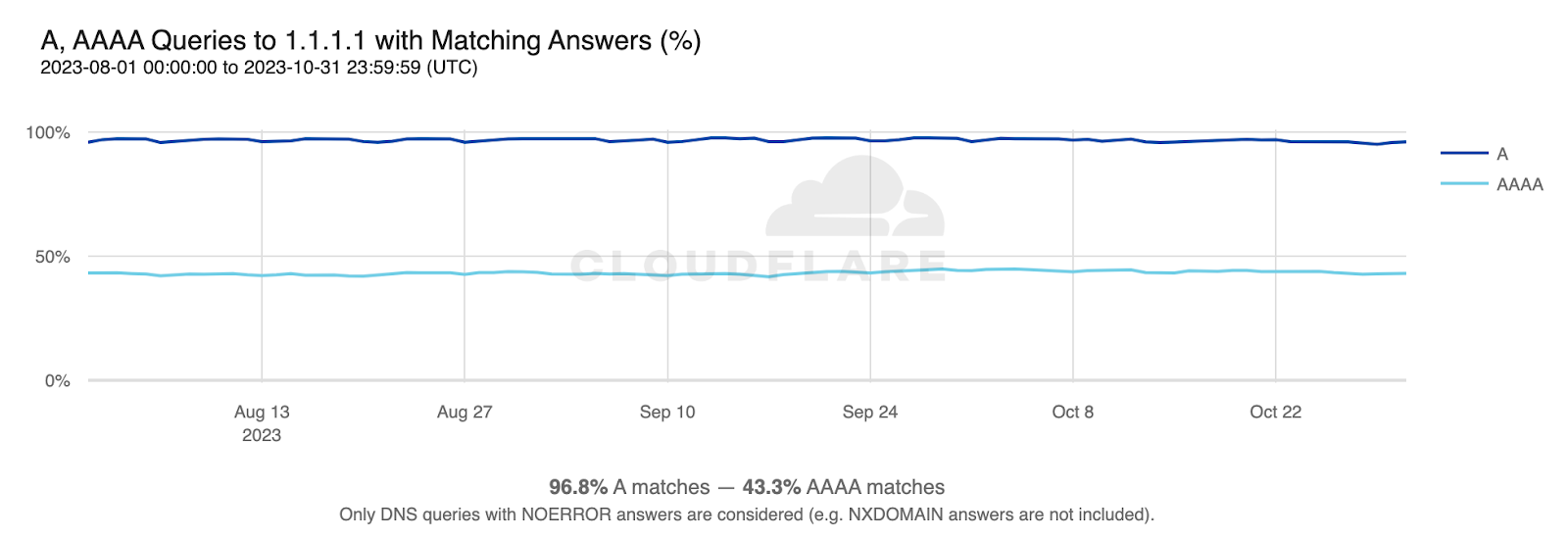
The following graph shows how often A and AAAA-type queries get non-empty responses, shedding light on server side IPv6 adoption and getting us closer to the answer we’re after:
IPv6 adoption by servers is estimated at 43.3% by query volume, noticeably higher than what was observed for clients.
How Often Both Sides Swipe Right
If 30.5% of IP address lookups handled by 1.1.1.1 could make use of an IPv6 address to connect to their intended destinations, but only 43.3% of those lookups get a non-empty response, that can give us a pretty good basis for how often IPv6 connections are made between client and server — roughly 13.2% of the time.
The Potential Impact of Popular Domains
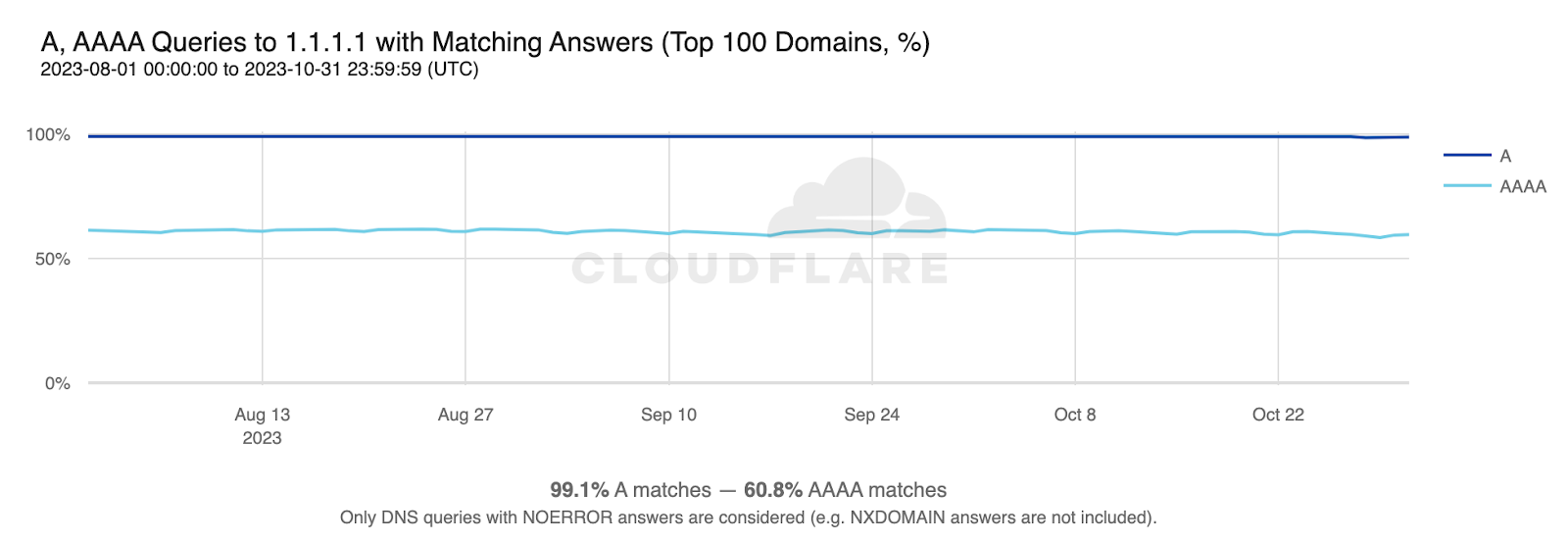
IPv6 server side adoption measured by query volume for the domains in Radar’s Top 100 list is 60.8%. If we exclude these domains from our overall calculations, the previous 13.2% figure drops to 8%. This is a significant difference, but not unexpected, as the Top 100 domains make up over 55% of all A and AAAA queries to 1.1.1.1.
If just a few more of these highly popular domains were to deploy IPv6 today, observed adoption would noticeably increase and, with it, the chance of IPv6-capable clients establishing connections using IPv6.
Closing Thoughts
Observing the extent of IPv6 adoption across the Internet can mean different things:
Counting users with IPv6-capable Internet access;
Counting IPv6-capable devices or software on those devices (clients and/or servers);
Calculating the amount of traffic flowing through IPv6 connections, measured in bytes;
Counting the fraction of connections (or individual requests) over IPv6.
In this exercise we chose to look at connections and requests. Keeping in mind that the underlying reality can only be truly understood by considering several different perspectives, we saw three different IPv6 adoption figures:
35.9% (client side) when counting HTTP requests served from Cloudflare’s CDN;
30.5% (client side) when counting A and AAAA-type DNS queries handled by 1.1.1.1;
43.3% (server side) of positive responses to AAAA-type DNS queries, also from 1.1.1.1.
We combined the client side and server side figures from the DNS perspective to estimate how often connections to third-party servers are likely to be established over IPv6 rather than IPv4: just 13.2% of the time.
To improve on these numbers, ISPs, cloud and hosting providers, and corporations alike must increase the rate at which they make IPv6 available for devices in their networks. But large websites and content sources also have a critical role to play in enabling IPv6-capable clients to use IPv6 more often, as 39.2% of queries for domains in the Radar Top 100 (representing over half of all A and AAAA queries to 1.1.1.1) are still limited to IPv4-only responses.
On the road to full IPv6 adoption, the Internet isn’t quite there yet. But continued effort from all those involved can help it to continue to move forward, and perhaps even accelerate progress.
On the server side, Cloudflare has been helping with this worldwide effort for many years by providing free IPv6 support for all domains. On the client side, the 1.1.1.1 app automatically enables your device for IPv6 even if your ISP doesn’t provide any IPv6 support. And, if you happen to manage an IPv6-only network, 1.1.1.1’s DNS64 support also has you covered.
*** 1Cloudflare’s public DNS resolver (1.1.1.1) is operated in partnership with APNIC. You can read more about it in the original announcement blog post and in 1.1.1.1’s privacy policy. 2There’s more information on how DNS works in the “What is DNS?” section of our website. If you’re a hands-on learner, we suggest you take a look at Julia Evans’ “mess with dns”. 3Any recursive resolver will already know the IP addresses of the 13 root servers beforehand. Cloudflare also participates at the topmost level of DNS by providing anycast service to the E and F-Root instances, which means 1.1.1.1 doesn’t need to go far for that first lookup step. 4When using the 1.1.1.1 app, all four IP addresses are configured automatically. 5For simplification, we assume the amount of IPv6-only clients is still negligibly small. It’s a reasonable assumption in general, and other datasets available to us confirm it. 61.1.1.1, like other recursive resolvers, returns adjusted TTLs: the record’s original TTL minus the number of seconds since the record was last cached. Empty A and AAAA answers get cached for the amount of time defined in the domain’s Start of Authority (SOA) record, as specified by RFC 2308.
Списък с имена на магистрати, които не са декларирали сметки и имоти в чужбина, дълго време привличаше общественото и медийно внимание, след като бившият МВР министър Бойко Рашков се закани…
Security updates have been issued by Debian (chromium and rabbitmq-server), Fedora (chromium, kernel, perl-CryptX, and python-jupyter-server), Mageia (curl), Oracle (curl and postgresql), Red Hat (gstreamer1-plugins-bad-free, linux-firmware, postgresql, postgresql:10, and postgresql:15), Slackware (xorg), SUSE (catatonit, containerd, runc, container-suseconnect, gimp, kernel, openvswitch, poppler, python-cryptography, python-Twisted, python3-cryptography, qemu, squid, tiff, webkit2gtk3, xorg-x11-server, and xwayland), and Ubuntu (xorg-server and xorg-server, xwayland).
превод от португалски Даринка Кирчева, изд. „Ерго“, 2022
Четох откъси от Дневника само месец след като добре познатият на български португалски автор започва да отразява реалността на живо, (Марин Бодаков ми прати линк към него на 1 април преди три години). И тогава, и днес тези дневникови записки ми стоят като стихотворения в проза. Като къси съединения между мисли, наблюдения и асоциации. Целта им е да държат автора на повърхността и успявайки да направят това – спасяват от хаос и удавяне и читателя.
Защо е нужно това връщане назад, когато на дневен ред са други кризи, други войни?
Миналото е чужда страна, а точно в тази се напомня, че има и бомби, които убиват без шум. Вирусът, който всъщност е тук и днес… Спомням си как четях и дневника на Франко Берарди – Бифо от същия период. Спомням си как с Ясен Василев превеждахме статии, мнения и анализи. Как си пишехме с приятели в Америка, Франция и Англия. Как чаках баща ми да дойде с колата си и да ми остави от така дефицитните в началото маски и как нервно пазарувах в кварталния магазин. Как се чувах всеки ден с родителите си. Как всяка седмица качвахме по един запис на театрално представление от архива на „Сфумато“. Как гледахме брифингите, как се възмущавахме, как лакомо четях „Моби Дик“, „Гаргантюа и Пантагрюел“, „Дон Кихот“ и всички останали дебели класики, които така и не бях прочел изцяло.
За португалеца този дневник е насъщен навик. Той е
абсолютна необходимост. Пред събитието да останеш прав и нащрек. Сила срещу много по-силното. Или си на линия в усилните дни, или бягаш. Или със зяпнала уста изстенваш едно оох като звук, отговор и уплаха. Дневник на чумата като другар в тежките дни и в дните, предназначени за гледане. Необходимост и напрежение. И опит за документиране, за да остави хлабавата памет по-ясна следа.
А следата е от ясна по-ясна. Такава е и заради превода на Даринка Кирчева, която след Песоа, Сарамагу, Лиспектор и десетки други ни дава и това доказателство за таланта си.
Сега си мисля колко нужно е да излезе скоро и друга следа за памет – „Разкази от пандемията, или как се запознах с един комар“, книгата на Иван Димитров за този травматичен период, която скоро четох в ръкопис. Изпитах читателска радост и удоволствие, докато си припомнях близкото пандемично минало чрез неговия сборник с разкази и микроразкази. В тях има както страх, клаустрофобична изолация, тежки екзистенциални състояния, така и въздух и пространство, облекчение – чрез минимализъм, ирония и сатира, чрез умела и прецизна писателска работа, която превръща писането на Димитров в абсурдно и смешно.
Припомня се това, което не бива да се забравя от този период, за да не се превърне в изтласкана и потисната неартикулирана травма –
домът беше самотен затвор за мнозина. Реалността – индивидуална и колективна – бързо се превърна в нереалност и някои всекидневни навици и представи бяха забранен и немислим нонсенс. Димитров е извлякъл есенцията от това време чрез поредици от ситуации и прозаични пъзели. Цялостната картина, която сборникът създава, има естетически и документален характер, свидетелство за времето е въпреки фикционалната си закваска. С лекота надскача предварителните очаквания и някак между другото поставя сериозни въпроси, които отекват след края.
Ето само някои от тях: как да не си призрак приживе, със или без извънредни положения и ситуации; как и може ли да има днес животът пълнота и смисъл; как да се говори за това, за което често единствено мълчат не само медии, интелектуалци, анализатори, а и самите писатели, които вече рядко навлизат в сложни и поляризиращи теми. Артикулацията на травмата при Димитров става по безболезнен начин, не предизвиква фрустрация или съпротива при прочит. Това е едно от достойнствата на книгата – тя говори с тон на конкретика, достойнство и жизнеутвърждаване. Далечните – единствено във времево отношение – роднини на това писане са Ищван Йоркен, Кафка и Хашек, а по-близките хронологично са Итало Калвино, Сесар Айра и Етгар Керет.
Но гласът на Димитров е разпознаваем и негов. Този глас, подплатен със своеобразния му хумор и методичното му трудолюбие, има смелост да говори за трагедията като за трагедия, без да я омаловажава, а като ѝ противодейства. Такова писане показва и осмисля бруталността на българското всекидневие, противоотрова е срещу амнезията и гледа в очите конкретния ни и настоящ общ живот, прави го по-близък и разбираем. Такова писане доставя смисъл по щедър и неподменящ фактите начин.
Димитров със сигурност ще продължи да предизвиква себе си и да иска да се променя, и сам себе си да изненадва, включително писателски, а тази приятна изненада ще се умножава в прочита на читателите му. С нетърпение очаквам появата на неговата книга, която ще бъде седма в творческата му биография.
Направих това много дълго отклонение, защото най-важното, което може да се извлече от Дневника на Тавареш, е, че е наложително да се пише за тук и сега в България. За нашето настояще и минало. С честност и откритост. С въображение и реалистичност. Трябва да разказваме историята си или някой друг ще ни я разкаже – съкратена и спестявайки много. Или пък тя ще се повтори.
Разказването е свобода, съпротива и смисъл.
Такова е и тахикардичното писане на Тавареш, което сякаш не може да си поеме дъх, накъсано е, фрагментарно и сред целия разпад и срив се опитва да се събере в цялост. Тавареш припомня параноята в медиите, изрежда списъци с починали и детайли за тях (изброяванията напомнят на изреждането на воюващите ахейци в Троя). Нежност, милост и безмилостност се смесват, когато се описва локдаунът, който е уединение от предпазливост и страх, толкова различно от уединяването на монасите.
Португалецът разрежда бруталността на дните с цитати от Неруда, Канети, Слотердайк, Емили Дикинсън, Одън, Бенямин, Никанор Пара, Енценсбергер, Киняр, Оруел и десетки други. Не е сам, има книгите и две кучета в тези непредвидими и паникьосани месеци на извънредното положение, когато времето сякаш беше спряло и животът сякаш беше свършил приживе за стотици милиони хора.
Животът наистина се беше скъсил и оголил. Тавареш е прав, когато пише за
десетте животни с най-кратък живот. Включени в списъка: еднодневките и мухите. Пчелите работнички, пеперудите монарх, мравките и водните кончета. Да се грижим по-добре за който скоро ще умре. Бъди мил с един умиращ: мухи, пчели, мравки, пеперуди монарх и еднодневки. Не знам какво са еднодневките, но името е съвсем ясно. Едно нещастно животно, което на гърба си вече носи името на своята трагедия, на своята краткотрайност. Човекът също е еднодневка, макар да живее малко по-дълго и рядко да лети.
Лесно е да се каже да сме по-добри помежду си… Но още по-лесно човешкият живот се върна към нормалната си траектория, която е по-скоро самоунищожителна и предвещава още подобни катастрофи. Катастрофата преди три години се яви като отсъствие на всички неща. Тя може отново да се случи. Затова е и нужно
да се извлекат поне някакви поуки от това покъртително минало, в което са погребани милиони.
Жозе Сарамаго казва за Тавареш, че рано или късно и той като него ще получи „Нобел“. Това не изглежда да е важно за по-младия писател. Той пише и не може да си поеме дъх. Той е вестоносец и иска да каже наведнъж всичко. И казва най-важното с лекота.
Казваш ми, че по-безсмъртна от грижата и яростта е радостта,
пише Хьолдерлин. Радостта от това, че си жив.
Но какво стана после? След като се оказа, че ще сме живи? Какво променихме? Как продължихме? Кои сме след пандемията? Кои ще сме и след края на войната? Ще отговорим ли по различен начин на собствените си – постоянно неспазени – обещания?
Активните дарители на „Тоест“ получават постоянна отстъпка в размер на 20% от коричната цена на всички заглавия от каталога на издателство „Ерго“, както и на няколко други български издателства в рамките на партньорската програма Читателски клуб „Тоест“. За повече информация прочетете на toest.bg/club.
Никой от нас не чете единствено най-новите книги. Тогава защо само за тях се пише? „На второ четене“ е рубрика, в която отваряме списъците с книги, публикувани преди поне година, четем ги и препоръчваме любимите си от тях. Рубриката е част от партньорската програма Читателски клуб „Тоест“. Изборът на заглавия обаче е единствено на авторите – Стефан Иванов и Антония Апостолова, които биха ви препоръчали тези книги и ако имаше как веднъж на две седмици да се разходите с тях в книжарницата.
The LWN.net Weekly Edition for December 14, 2023 is available.
The collective thoughts of the interwebz
Manage Consent
To provide the best experiences, we use technologies like cookies to store and/or access device information. Consenting to these technologies will allow us to process data such as browsing behavior or unique IDs on this site. Not consenting or withdrawing consent, may adversely affect certain features and functions.
Functional
Always active
The technical storage or access is strictly necessary for the legitimate purpose of enabling the use of a specific service explicitly requested by the subscriber or user, or for the sole purpose of carrying out the transmission of a communication over an electronic communications network.
Preferences
The technical storage or access is necessary for the legitimate purpose of storing preferences that are not requested by the subscriber or user.
Statistics
The technical storage or access that is used exclusively for statistical purposes.The technical storage or access that is used exclusively for anonymous statistical purposes. Without a subpoena, voluntary compliance on the part of your Internet Service Provider, or additional records from a third party, information stored or retrieved for this purpose alone cannot usually be used to identify you.
Marketing
The technical storage or access is required to create user profiles to send advertising, or to track the user on a website or across several websites for similar marketing purposes.