Integrate Tableau and Okta with Amazon Redshift using AWS IAM Identity Center

Post Syndicated from Debu Panda original https://aws.amazon.com/blogs/big-data/integrate-tableau-and-okta-with-amazon-redshift-using-aws-iam-identity-center/

This blog post is co-written with Sid Wray and Jake Koskela from Salesforce, and Adiascar Cisneros from Tableau. 

Amazon Redshift is a fast, scalable cloud data warehouse built to serve workloads at any scale. With Amazon Redshift as your data warehouse, you can run complex queries using sophisticated query optimization to quickly deliver results to Tableau, which offers a comprehensive set of capabilities and connectivity options for analysts to efficiently prepare, discover, and share insights across the enterprise. For customers who want to integrate Amazon Redshift with Tableau using single sign-on capabilities, we introduced AWS IAM Identity Center integration to seamlessly implement authentication and authorization.

IAM Identity Center provides capabilities to manage single sign-on access to AWS accounts and applications from a single location. Redshift now integrates with IAM Identity Center, and supports trusted identity propagation, making it possible to integrate with third-party identity providers (IdP) such as Microsoft Entra ID (Azure AD), Okta, Ping, and OneLogin. This integration positions Amazon Redshift as an IAM Identity Center-managed application, enabling you to use database role-based access control on your data warehouse for enhanced security. Role-based access control allows you to apply fine grained access control using row level, column level, and dynamic data masking in your data warehouse.

AWS and Tableau have collaborated to enable single sign-on support for accessing Amazon Redshift from Tableau. Tableau now supports single sign-on capabilities with Amazon Redshift connector to simplify the authentication and authorization. The Tableau Desktop 2024.1 and Tableau Server 2023.3.4 releases support trusted identity propagation with IAM Identity Center. This allows users to seamlessly access Amazon Redshift data within Tableau using their external IdP credentials without needing to specify AWS Identity and Access Management (IAM) roles in Tableau. This single sign-on integration is available for Tableau Desktop, Tableau Server, and Tableau Prep.

In this post, we outline a comprehensive guide for setting up single sign-on to Amazon Redshift using integration with IAM Identity Center and Okta as the IdP. By following this guide, you’ll learn how to enable seamless single sign-on authentication to Amazon Redshift data sources directly from within Tableau Desktop, streamlining your analytics workflows and enhancing security.

Solution overview

The following diagram illustrates the architecture of the Tableau SSO integration with Amazon RedShift, IAM Identity Center, and Okta.
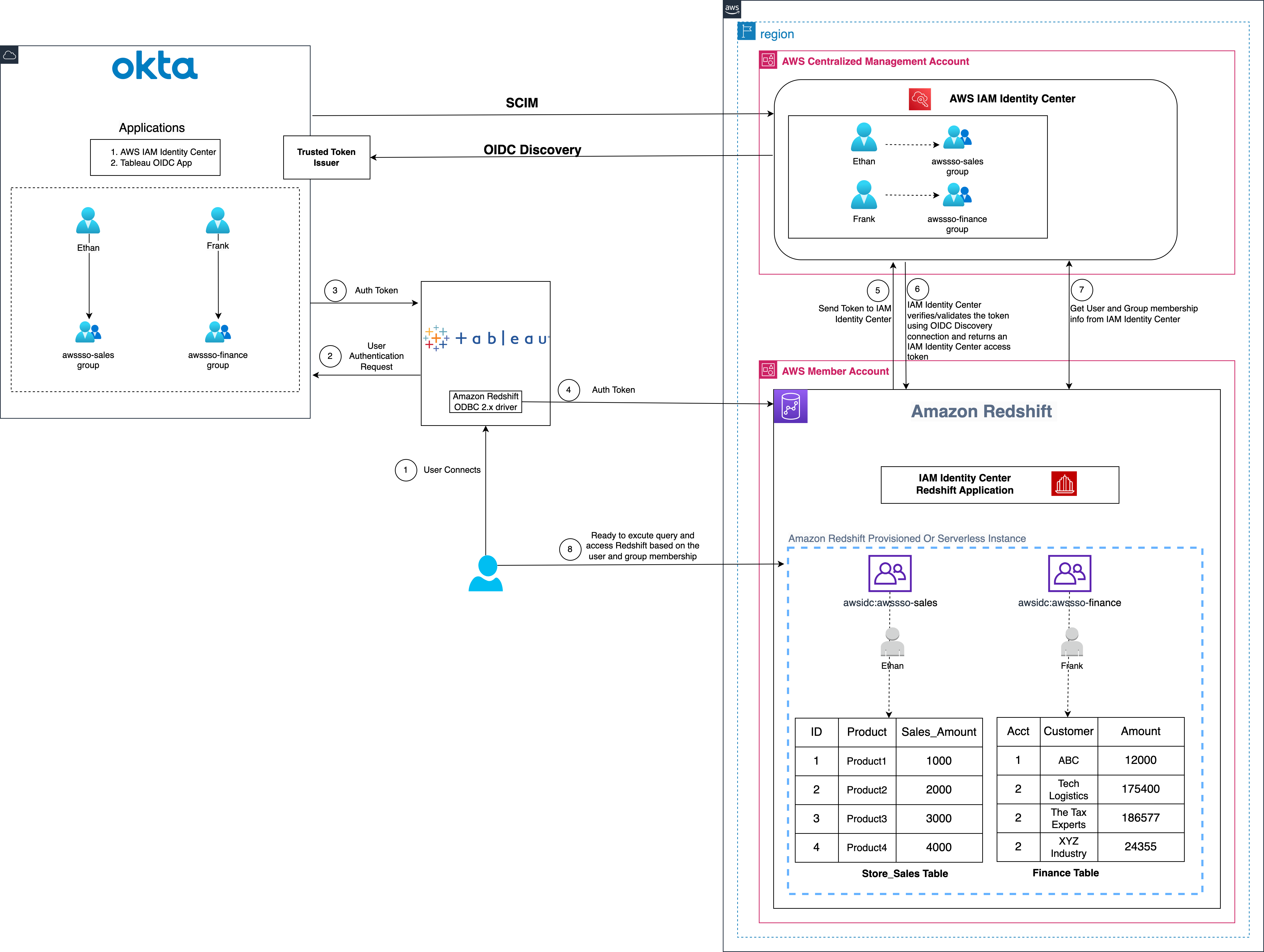
Figure 1: Solution overview for Tableau integration with Amazon Redshift using IAM Identity Center and Okta

The solution depicted in Figure 1 includes the following steps:

  1. The user configures Tableau to access Redshift using IAM Identity Center authentication
  2. On a user sign-in attempt, Tableau initiates a browser-based OAuth flow and redirects the user to the Okta login page to enter the login credentials.
  3. On successful authentication, Okta issues an authentication token (id and access token) to Tableau
  4. Redshift driver then makes a call to Redshift-enabled IAM Identity Center application and forwards the access token.
  5. Redshift passes the token to Identity Center and requests an access token.
  6. Identity Center verifies/validates the token using the OIDC discovery connection to the trusted token issuer and returns an Identity Center generated access token for the same user. In Figure 1, Trusted Token Issuer (TTI) is the Okta server that Identity Center trusts to provide tokens that third-party applications like Tableau uses to call AWS services.
  7. Redshift then uses the token to obtain the user and group membership information from IAM Identity Center.
  8. Tableau user will be able to connect with Amazon Redshift and access data based on the user and group membership returned from IAM Identity Center.

Prerequisites

Before you begin implementing the solution, make sure that you have the following in place:

Walkthrough

In this walkthrough, you build the solution with following steps:

  • Set up the Okta OIDC application
  • Set up the Okta authorization server
  • Set up the Okta claims
  • Setup the Okta access policies and rules
  • Setup trusted token issuer in AWS IAM Identity Center
  • Setup client connections and trusted token issuers
  • Setup the Tableau OAuth config files for Okta
  • Install the Tableau OAuth config file for Tableau Desktop
  • Setup the Tableau OAuth config file for Tableau Server or Tableau Cloud
  • Federate to Amazon Redshift from Tableau Desktop
  • Federate to Amazon Redshift from Tableau Server

Set up the Okta OIDC application

To create an OIDC web app in Okta, you can follow the instructions in this video, or use the following steps to create the wep app in Okta admin console:

Note: The Tableau Desktop redirect URLs should always use localhost. The examples below also use localhost for the Tableau Server hostname for ease of testing in a test environment. For this setup, you should also access the server at localhost in the browser. If you decide to use localhost for early testing, you will also need to configure the gateway to accept localhost using this tsm command:

 tsm configuration set -k gateway.public.host -v localhost

In a production environment, or Tableau Cloud, you should use the full hostname that your users will access Tableau on the web, along with https. If you already have an environment with https configured, you may skip the localhost configuration and use the full hostname from the start.

  1. Sign in to your Okta organization as a user with administrative privileges.
  2. On the admin console, under Applications in the navigation pane, choose Applications.
  3. Choose Create App Integration.
  4. Select OIDC – OpenID Connect as the Sign-in method and Web Application as the Application type.
  5. Choose Next.
  6. In General Settings:
    1. App integration name: Enter a name for your app integration. For example, Tableau_Redshift_App.
    2. Grant type: Select Authorization Code and Refresh Token.
    3. Sign-in redirect URIs: The sign-in redirect URI is where Okta sends the authentication response and ID token for the sign-in request. The URIs must be absolute URIs. Choose Add URl and along with the default URl, add the following URIs.
      • http://localhost:55556/Callback
      • http://localhost:55557/Callback
      • http://localhost:55558/Callback
      • http://localhost/auth/add_oauth_token
    4. Sign-out redirect URIs: keep the default value as http://localhost:8080.
    5. Skip the Trusted Origins section and for Assignments, select Skip group assignment for now.
    6. Choose Save.
Figure 2: OIDC application

Figure 2: OIDC application

  1. In the General Settings section, choose Edit and select Require PKCE as additional verification under Proof Key for Code Exchange (PKCE). This option indicates if a PKCE code challenge is required to verify client requests.
  2. Choose Save.
Figure 3: OIDC App Overview

Figure 3: OIDC App Overview

  1. Select the Assignments tab and then choose Assign to Groups. In this example, we’re assigning awssso-finance and awssso-sales.
  2. Choose Done.

Figure 4: OIDC application group assignments

For more information on creating an OIDC app, see Create OIDC app integrations.

Set up the Okta authorization server

Okta allows you to create multiple custom authorization servers that you can use to protect your own resource servers. Within each authorization server you can define your own OAuth 2.0 scopes, claims, and access policies. If you have an Okta Developer Edition account, you already have a custom authorization server created for you called default.

For this blog post, we use the default custom authorization server. If your application has requirements such as requiring more scopes, customizing rules for when to grant scopes, or you need more authorization servers with different scopes and claims, then you can follow this guide.

Figure 5: Authorization server

Set up the Okta claims

Tokens contain claims that are statements about the subject (for example: name, role, or email address). For this example, we use the default custom claim sub. Follow this guide to create claims.

Figure 6: Create claims

Setup the Okta access policies and rules

Access policies are containers for rules. Each access policy applies to a particular OpenID Connect application. The rules that the policy contains define different access and refresh token lifetimes depending on the nature of the token request. In this example, you create a simple policy for all clients as shown in Figure 7 that follows. Follow this guide to create access policies and rules.

Figure 7: Create access policies

Rules for access policies define token lifetimes for a given combination of grant type, user, and scope. They’re evaluated in priority order and after a matching rule is found, no other rules are evaluated. If no matching rule is found, then the authorization request fails. This example uses the role depicted in Figure 8 that follows. Follow this guide to create rules for your use case.

Figure 8: Access policy rules

Setup trusted token issuer in AWS IAM Identity Center

At this point, you switch to setting up the AWS configuration, starting by adding a trusted token issuer (TTI), which makes it possible to exchange tokens. This involves connecting IAM Identity Center to the Open ID Connect (OIDC) discovery URL of the external OAuth authorization server and defining an attribute-based mapping between the user from the external OAuth authorization server and a corresponding user in Identity Center. In this step, you create a TTI in the centralized management account. To create a TTI:

  1. Open the AWS Management Console and navigate to IAM Identity Center, and then to the Settings page.
  2. Select the Authentication tab and under Trusted token issuers, choose Create trusted token issuer.
  3. On the Set up an external IdP to issue trusted tokens page, under Trusted token issuer details, do the following:
    • For Issuer URL, enter the OIDC discovery URL of the external IdP that will issue tokens for trusted identity propagation. The administrator of the external IdP can provide this URL (for example, https://prod-1234567.okta.com/oauth2/default).

To get the issuer URL from Okta, sign in as an admin to Okta and navigate to Security and then to API and choose default under the Authorization Servers tab and copy the Issuer URL

Figure 9: Authorization server issuer

  1. For Trusted token issuer name, enter a name to identify this trusted token issuer in IAM Identity Center and in the application console.
  2. Under Map attributes, do the following:
    • For Identity provider attribute, select an attribute from the list to map to an attribute in the IAM Identity Center identity store.
    • For IAM Identity Center attribute, select the corresponding attribute for the attribute mapping.
  3. Under Tags (optional), choose Add new tag, enter a value for Key and optionally for Value. Choose Create trusted token issuer. For information about tags, see Tagging AWS IAM Identity Center resources.

This example uses Subject (sub) as the Identity provider attribute to map with Email from the IAM identity Center attribute. Figure 10 that follows shows the set up for TTI.

Figure 10: Create Trusted Token Issuer

Setup client connections and trusted token issuers

In this step, the Amazon Redshift applications that exchange externally generated tokens must be configured to use the TTI you created in the previous step. Also, the audience claim (or aud claim) from Okta must be specified. In this example, you are configuring the Amazon Redshift application in the member account where the Amazon Redshift cluster or serverless instance exists.

  1. Select IAM Identity Center connection from Amazon Redshift console menu.

Figure 11: Amazon Redshift IAM Identity Center connection

  1. Select the Amazon Redshift application that you created as part of the prerequisites.
  2. Select the Client connections tab and choose Edit.
  3. Choose Yes under Configure client connections that use third-party IdPs.
  4. Select the checkbox for Trusted token issuer which you have created in the previous section.
  5. Enter the aud claim value under section Configure selected trusted token issuers. For example, okta_tableau_audience.

To get the audience value from Okta, sign in as an admin to Okta and navigate to Security and then to API and choose default under the Authorization Servers tab and copy the Audience value.

Figure 12: Authorization server audience

Note: The audience claim value must exactly match with IdP audience value otherwise your OIDC connection with third part application like Tableau will fail.

  1. Choose Save.

Figure 13: Adding Audience Claim for Trusted Token Issuer

Setup the Tableau OAuth config files for Okta

At this point, your IAM Identity Center, Amazon Redshift, and Okta configuration are complete. Next, you need to configure Tableau.

To integrate Tableau with Amazon Redshift using IAM Identity Center, you need to use a custom XML. In this step, you use the following XML and replace the values starting with the $ sign and highlighted in bold. The rest of the values can be kept as they are, or you can modify them based on your use case. For detailed information on each of the elements in the XML file, see the Tableau documentation on GitHub.

Note: The XML file will be used for all the Tableau products including Tableau Desktop, Server, and Cloud.

<?xml version="1.0" encoding="utf-8"?>
<pluginOAuthConfig>
<dbclass>redshift</dbclass>
<oauthConfigId>custom_redshift_okta</oauthConfigId>
<clientIdDesktop>$copy_client_id_from_okta_oidc_app</clientIdDesktop>
<clientSecretDesktop>$copy_client_secret_from_okta_oidc_app</clientSecretDesktop>
<redirectUrisDesktop>http://localhost:55556/Callback</redirectUrisDesktop>
<redirectUrisDesktop>http://localhost:55557/Callback</redirectUrisDesktop>
<redirectUrisDesktop>http://localhost:55558/Callback</redirectUrisDesktop>
<authUri>https://$copy_okta_host_value.okta.com/oauth2/default/v1/authorize</authUri>
<tokenUri>https://$copy_okta_host_value.okta.com/oauth2/default/v1/token</tokenUri>
<scopes>openid</scopes>
<scopes>email</scopes>
<scopes>profile</scopes>
<scopes>offline_access</scopes>
<capabilities>
<entry>
<key>OAUTH_CAP_FIXED_PORT_IN_CALLBACK_URL</key>
<value>true</value>
</entry>
<entry>
<key>OAUTH_CAP_PKCE_REQUIRES_CODE_CHALLENGE_METHOD</key>
<value>true</value>
</entry>
<entry>
<key>OAUTH_CAP_REQUIRE_PKCE</key>
<value>true</value>
</entry>
<entry>
<key>OAUTH_CAP_SUPPORTS_STATE</key>
<value>true</value>
</entry>
<entry>
<key>OAUTH_CAP_CLIENT_SECRET_IN_URL_QUERY_PARAM</key>
<value>true</value>
</entry>
<entry>
<key>OAUTH_CAP_SUPPORTS_GET_USERINFO_FROM_ID_TOKEN</key>
<value>true</value>
</entry>
</capabilities>
<accessTokenResponseMaps>
<entry>
<key>ACCESSTOKEN</key>
<value>access_token</value>
</entry>
<entry>
<key>REFRESHTOKEN</key>
<value>refresh_token</value>
</entry>
<entry>
<key>id-token</key>
<value>id_token</value>
</entry>
<entry>
<key>access-token-issue-time</key>
<value>issued_at</value>
</entry>
<entry>
<key>access-token-expires-in</key>
<value>expires_in</value>
</entry>
<entry>
<key>username</key>
<value>preferred_username</value>
</entry>
</accessTokenResponseMaps>
</pluginOAuthConfig>

The following is an example XML file:

<?xml version="1.0" encoding="utf-8"?>
<pluginOAuthConfig>
<dbclass>redshift</dbclass>
<oauthConfigId>custom_redshift_okta</oauthConfigId>
<clientIdDesktop>ab12345z-a5nvb-123b-123b-1c434ghi1234</clientIdDesktop>
<clientSecretDesktop>3243jkbkjb~~ewf.112121.3432423432.asd834k</clientSecretDesktop>
<redirectUrisDesktop>http://localhost:55556/Callback</redirectUrisDesktop>
<redirectUrisDesktop>http://localhost:55557/Callback</redirectUrisDesktop>
<redirectUrisDesktop>http://localhost:55558/Callback</redirectUrisDesktop>
<authUri>https://prod-1234567.okta.com/oauth2/default/v1/authorize</authUri>
<tokenUri>https://prod-1234567.okta.com/oauth2/default/v1/token</tokenUri>
<scopes>openid</scopes>
<scopes>email</scopes>
<scopes>profile</scopes>
<scopes>offline_access</scopes>
<capabilities>
<entry>
<key>OAUTH_CAP_FIXED_PORT_IN_CALLBACK_URL</key>
<value>true</value>
</entry>
<entry>
<key>OAUTH_CAP_PKCE_REQUIRES_CODE_CHALLENGE_METHOD</key>
<value>true</value>
</entry>
<entry>
<key>OAUTH_CAP_REQUIRE_PKCE</key>
<value>true</value>
</entry>
<entry>
<key>OAUTH_CAP_SUPPORTS_STATE</key>
<value>true</value>
</entry>
<entry>
<key>OAUTH_CAP_CLIENT_SECRET_IN_URL_QUERY_PARAM</key>
<value>true</value>
</entry>
<entry>
<key>OAUTH_CAP_SUPPORTS_GET_USERINFO_FROM_ID_TOKEN</key>
<value>true</value>
</entry>
</capabilities>
<accessTokenResponseMaps>
<entry>
<key>ACCESSTOKEN</key>
<value>access_token</value>
</entry>
<entry>
<key>REFRESHTOKEN</key>
<value>refresh_token</value>
</entry>
<entry>
<key>id-token</key>
<value>id_token</value>
</entry>
<entry>
<key>access-token-issue-time</key>
<value>issued_at</value>
</entry>
<entry>
<key>access-token-expires-in</key>
<value>expires_in</value>
</entry>
<entry>
<key>username</key>
<value>preferred_username</value>
</entry>
</accessTokenResponseMaps>
</pluginOAuthConfig>

Install the Tableau OAuth config file for Tableau Desktop

After the configuration XML file is created, it must be copied to a location to be used by Amazon Redshift Connector from Tableau Desktop. Save the file from the previous step as .xml and save it under Documents\My Tableau Repository\OAuthConfigs.

Note: Currently this integration isn’t supported in macOS because the Redshift ODBC 2.X driver isn’t supported yet for MAC. It will be supported soon.

Setup the Tableau OAuth config file for Tableau Server or Tableau Cloud

To integrate with Amazon Redshift using IAM Identity Center authentication, you must install the Tableau OAuth config file in Tableau Server or Tableau Cloud

  1. Sign in to the Tableau Server or Tableau Cloud using admin credentials.
  2. Navigate to Settings.
  3. Go to OAuth Clients Registry and select Add OAuth Client
  4. Choose following settings:
    • Connection Type: Amazon Redshift
    • OAuth Provider: Custom_IdP
    • Client ID: Enter your IdP client ID value
    • Client Secret: Enter your client secret value
    • Redirect URL: Enter http://localhost/auth/add_oauth_token. This example uses localhost for testing in a local environment. You should use the full hostname with https.
    • Choose OAuth Config File. Select the XML file that you configured in the previous section.
    • Select Add OAuth Client and choose Save.

Figure 14: Create an OAuth connection in Tableau Server or Tableau Cloud

Federate to Amazon Redshift from Tableau Desktop

Now you’re ready to connect to Amazon Redshift from Tableau through federated sign-in using IAM Identity Center authentication. In this step, you create a Tableau Desktop report and publish it to Tableau Server.

  1. Open Tableau Desktop.
  2. Select Amazon Redshift Connector and enter the following values:
    1. Server: Enter the name of the server that hosts the database and the name of the database you want to connect to.
    2. Port: Enter 5439.
    3. Database: Enter your database name. This example uses dev.
    4. Authentication: Select OAuth.
    5. Federation Type: Select Identity Center.
    6. Identity Center Namespace: You can leave this value blank.
    7. OAuth Provider: This value should automatically be pulled from your configured XML. It will be the value from the element oauthConfigId.
    8. Select Require SSL.
    9. Choose Sign in.

Figure 15: Tableau Desktop OAuth connection

  1. Enter your IdP credentials in the browser pop-up window.

Figure 16: Okta Login Page

  1. When authentication is successful, you will see the message shown in Figure 17 that follows.

Figure 17: Successful authentication using Tableau

Congratulations! You’re signed in using IAM Identity Center integration with Amazon Redshift and are ready to explore and analyze your data using Tableau Desktop.

Figure 18: Successfully connected using Tableau Desktop

Figure 19 is a screenshot from the Amazon Redshift system table (sys_query_history) showing that user Ethan from Okta is accessing the sales report.

Figure 19: User audit in sys_query_history

After signing in, you can create your own Tableau Report on the desktop version and publish it to your Tableau Server. For this example, we created and published a report named SalesReport.

Federate to Amazon Redshift from Tableau Server

After you have published the report from Tableau Desktop to Tableau Server, sign in as a non-admin user and view the published report (SalesReport in this example) using IAM Identity Center authentication.

  1. Sign in to the Tableau Server site as a non-admin user.
  2. Navigate to Explore and go to the folder where your published report is stored.
  3. Select the report and choose Sign In.

Figure 20: Tableau Server Sign In

  1. To authenticate, enter your non-admin Okta credentials in the browser pop-up.

Figure 21: Okta Login Page

  1. After your authentication is successful, you can access the report.

Figure 22: Tableau report

Clean up

Complete the following steps to clean up your resources:

  1. Delete the IdP applications that you have created to integrate with IAM Identity Center.
  2. Delete the IAM Identity Center configuration.
  3. Delete the Amazon Redshift application and the Amazon Redshift provisioned cluster or serverless instance that you created for testing.
  4. Delete the IAM role and IAM policy that you created for IAM Identity Center and Amazon Redshift integration.
  5. Delete the permission set from IAM Identity Center that you created for Amazon Redshift Query Editor V2 in the management account.

Conclusion

This post covered streamlining access management for data analytics by using Tableau’s capability to support single sign-on based on the OAuth 2.0 OpenID Connect (OIDC) protocol. The solution enables federated user authentication, where user identities from an external IdP are trusted and propagated to Amazon Redshift. You walked through the steps to configure Tableau Desktop and Tableau Server to integrate seamlessly with Amazon Redshift using IAM Identity Center for single sign-on. By harnessing this integration of a third party IdP with IAM Identity Center, users can securely access Amazon Redshift data sources within Tableau without managing separate database credentials.

Listed below are key resources to learn more about Amazon Redshift integration with IAM Identity Center


About the Authors

Debu-PandaDebu Panda is a Senior Manager, Product Management at AWS. He is an industry leader in analytics, application platform, and database technologies, and has more than 25 years of experience in the IT world.

Sid Wray is a Senior Product Manager at Salesforce based in the Pacific Northwest with nearly 20 years of experience in Digital Advertising, Data Analytics, Connectivity Integration and Identity and Access Management. He currently focuses on supporting ISV partners for Salesforce Data Cloud.

Adiascar Cisneros is a Tableau Senior Product Manager based in Atlanta, GA. He focuses on the integration of the Tableau Platform with AWS services to amplify the value users get from our products and accelerate their journey to valuable, actionable insights. His background includes analytics, infrastructure, network security, and migrations.

Jade Koskela is a Principal Software Engineer at Salesforce. He has over a decade of experience building Tableau with a focus on areas including data connectivity, authentication, and identity federation.

Harshida Patel is a Principal Solutions Architect, Analytics with AWS.

Maneesh Sharma is a Senior Database Engineer at AWS with more than a decade of experience designing and implementing large-scale data warehouse and analytics solutions. He collaborates with various Amazon Redshift Partners and customers to drive better integration.

Ravi Bhattiprolu is a Senior Partner Solutions Architect at Amazon Web Services (AWS). He collaborates with strategic independent software vendor (ISV) partners like Salesforce and Tableau to design and deliver innovative, well-architected cloud products, integrations, and solutions to help joint AWS customers achieve their business goals.

How GitHub reduced testing time for iOS apps with new runner features

Post Syndicated from Stephen Glass original https://github.blog/engineering/infrastructure/how-github-reduced-testing-time-for-ios-apps-with-new-runner-features/


GitHub Actions 🤝 GitHub for iOS

The GitHub iOS and GitHub Actions macOS runner teams are integral parts of each other’s development inner loop. Each team partners on testing new runner images and hardware long before the features land in the hands of developers. GitHub Actions has been working hard at bringing the latest Mac hardware to the community. Apple silicon (M1) macOS runners are available for free in public repositories, along with larger options available for those jobs that need more performance.

The GitHub iOS team has been busy improving the user experience in the app, recently shipping such as GitHub Copilot Chat, code search, localization for German and Korean, and making it easier to work with issues and projects. In this blog, we will discuss how the GitHub iOS team brings the app to developers around the world, the benefits of Apple silicon, and building on GitHub Actions using macOS runners.

How GitHub reduced testing time for iOS apps with new runner features

The GitHub iOS team previously used a single workflow with one job to build and test the entire codebase on GitHub Actions that took 38 minutes to complete with the prior generation runners. The GitHub iOS app consists of about 60 first-party modules, consisting of various targets, such as dynamic frameworks, static libraries, app extensions, or the GitHub app itself. These modules range from networking layers to design system components to entire features or products, helping us maintain the app.

Breaking down the monolith

We decided to leverage the power of Apple silicon to speed up their testing process. We switched to M1 macOS runners (macos-14-xlarge YAML label) on GitHub Actions and split their test suite into separate jobs for each module. This way, they could build and test each module independently and get faster feedback. Some of the smallest modules completed their tests in as little as 2-3 minutes on M1 macOS runners, getting feedback to developers on their pull requests faster than ever before. This also made it easier to identify and fix failures on specific modules without waiting for a monolithic build to finish.

By using Apple silicon, we reduced their testing time by 60%, from 38 minutes to 15 minutes, and improved our productivity and efficiency. The figure below demonstrates how we broke down the monolith into small modules in order to improve our build times.

Image demonstrates the monolith build on tip with the total CI time. The Image below it demonstrates how per-module builds are crafted and the reduction in CI time with the new approach.

As each build is kicked off, GitHub Actions is behind the scenes preparing the required number of machines to execute the workflow. Each request is sent to the GitHub Actions service where it picks up a freshly reimaged virtual machine to execute the required number of jobs. The figure below shows how a request travels from our repository to the Actions Mac servers in Azure.

Image displays the relationship between the request for workflow to run and how a machine is assigned to a job. From left to right, the flow starts at GitHub.com, then the request is sent to Actions. Actions then finds the available macOS VM to execute the workflow.

With shorter build times and a scaling CI fleet, Apple silicon hosts allowed the GitHub iOS team to scale their jobs out across many shorter, faster steps, with GitHub Actions abstracting over the complexity of distributing CI jobs.

Analyzing CI performance

We further investigated the CI performance and divided each module’s CI into two separate steps, build and test, using xcodebuild’s build-without-testing and test-without-building. This helped us identify unit tests that ran for a long time or highlighted fast unit tests that finished in seconds.

Native development and test environments

With Apple silicon powering GitHub Actions runners and the developers’ laptops, our CI now had the same architecture as local development machines. Engineers could identify patterns that took a long time to compile or tests that failed due to the architecture from CI and fix them locally with confidence.

Benefits of Apple silicon

Apple silicon improves build performance, increases reliability, and lets iOS teams test natively for all Apple platforms throughout the software development lifecycle. They can avoid problems from cross-compilation or emulation and use the latest simulators on our GitHub Actions runner image. This ensures that their apps work well with the newest versions of iOS, iPadOS, watchOS, and tvOS. Our GitHub Actions M1 macOS runners help iOS teams leverage these benefits and deliver high-quality apps to their users faster and more efficiently. Additionally, GitHub Actions offers 50 concurrent runners for enterprise accounts and five for GitHub Free and Team plans. The GitHub for iOS team takes full advantage of these concurrent runners and initiates 50 jobs for every pull request to perform modular testing on the app in parallel.

Get started building on GitHub Actions using macOS runners

GitHub-hosted macOS runners are YAML-driven, meaning they are accessed by updating the runs on: key in your workflow file.

The post How GitHub reduced testing time for iOS apps with new runner features appeared first on The GitHub Blog.

[$] Debian’s /tmpest in a teapot

Post Syndicated from jzb original https://lwn.net/Articles/975565/

Debian had a major discussion
about mounting /tmp as a RAM-based tmpfs in 2012 but inertia
won out in the end. Debian systems have continued to
store temporary files on disk by default. Until now. A mere
12 years later, the project will be switching to a RAM-based /tmp in the Debian
13 (“Trixie”) release. Additionally, starting with Trixie, the
default will be to periodically clean up temporary files automatically in
/tmp and /var/tmp. Naturally, it involved a lengthy discussion first.

AWS Weekly Roundup: Amazon EC2 U7i Instances, Bedrock Converse API, AWS World IPv6 Day and more (June 3, 2024)

Post Syndicated from Channy Yun original https://aws.amazon.com/blogs/aws/aws-weekly-roundup-amazon-ec2-u7i-instances-bedrock-converse-api-aws-world-ipv6-day-and-more-june-3-2024/

Life is not always happy, there are difficult times. However, we can share our joys and sufferings with those we work with. The AWS Community is no exception.

Jeff Barr introduced two members of the AWS community who are dealing with health issues. Farouq Mousa is an AWS Community Builder and fighting brain cancer. Allen Helton is an AWS Serverless Hero and his young daughter is fighting leukemia.

Please donate to support Farauq and Olivia, Allen’s daughter to overcome their disease.

Last week’s launches
Here are some launches that got my attention:

Amazon EC2 high memory U7i Instances – These instances with up to 32 TiB of DDR5 memory and 896 vCPUs are powered by custom fourth generation Intel Xeon Scalable Processors (Sapphire Rapids). These high memory instances are designed to support large, in-memory databases including SAP HANA, Oracle, and SQL Server. To learn more, visit Jeff’s blog post.

New Amazon Connect analytics data lake – You can use a single source for contact center data including contact records, agent performance, Contact Lens insights, and more — eliminating the need to build and maintain complex data pipelines. Your organization can create your own custom reports using Amazon Connect data or combine data queried from third-party sources. To learn more, visit Donnie’s blog post.

Amazon Bedrock Converse API – This API provides developers a consistent way to invoke Amazon Bedrock models removing the complexity to adjust for model-specific differences such as inference parameters. With this API, you can write a code once and use it seamlessly with different models in Amazon Bedrock. To learn more, visit Dennis’s blog post to get started.

New Document widget for PartyRock – You can build, use, and share generative AI-powered apps for fun and for boosting personal productivity, using PartyRock. Its widgets display content, accept input, connect with other widgets, and generate outputs like text, images, and chats using foundation models. You can now use new document widget to integrate text content from files and documents directly into a PartyRock app.

30 days of alarm history in Amazon CloudWatch – You can view the history of your alarm state changes for up to 30 days prior. Previously, CloudWatch provided 2 weeks of alarm history. This extended history makes it easier to observe past behavior and review incidents over a longer period of time. To learn more, visit the CloudWatch alarms documentation section.

10x faster startup time in Amazon SageMaker Canvas – You can launch SageMaker Canvas in less than a minute and get started with your visual, no-code interface for machine learning 10x faster than before. Now, all new user profiles created in existing or new SageMaker domains can experience this accelerated startup time.

For a full list of AWS announcements, be sure to keep an eye on the What’s New at AWS page.

Other AWS news
Here are some additional news items and a Twitch show that you might find interesting:

Let us manage your relational database! – Jeff Barr ran a poll to better understand why some AWS customers still choose to host their own databases in the cloud. Working backwards, he highlights four issues that AWS managed database services address. Consider these before hosting your own database.

Amazon Bedrock Serverless Prompt Chaining – This repository provides examples of using AWS Step Functions and Amazon Bedrock to build complex, serverless, and highly scalable generative AI applications with prompt chaining.

AWS Merch Store Spring Sale – Do you want to buy AWS branded t-shirts, hats, bags, and so on? Get 15% off on all items now through June 7th.

Upcoming AWS events
Check your calendars and sign up for these AWS events:

AWS World IPv6 Day — Join us a free in-person celebration event on June 6, for technical presentations from AWS experts plus a workshop and whiteboarding session. You will learn how to get started with IPv6 and hear from customers who have started on the journey of IPv6 adoption. Check out your near city: San Francisco, Seattle, New YorkLondon, Mumbai, Bangkok, Singapore, Kuala Lumpur, Beijing, Manila, and Sydney.

AWS Summits — Join free online and in-person events that bring the cloud computing community together to connect, collaborate, and learn about AWS. Register in your nearest city: Stockholm (June 4), Madrid (June 5), and Washington, DC (June 26–27).

AWS re:Inforce — Join us for AWS re:Inforce (June 10–12) in Philadelphia, PA. AWS re:Inforce is a learning conference focused on AWS security solutions, cloud security, compliance, and identity. Connect with the AWS teams that build the security tools and meet AWS customers to learn about their security journeys.

AWS Community Days — Join community-led conferences that feature technical discussions, workshops, and hands-on labs led by expert AWS users and industry leaders from around the world: Midwest | Columbus (June 13), Sri Lanka (June 27), Cameroon (July 13), New Zealand (August 15), Nigeria (August 24), and New York (August 28).

You can browse all upcoming in-person and virtual events.

That’s all for this week. Check back next Monday for another Weekly Roundup!

Channy

This post is part of our Weekly Roundup series. Check back each week for a quick roundup of interesting news and announcements from AWS!

Security updates for Monday

Post Syndicated from jake original https://lwn.net/Articles/976782/

Security updates have been issued by AlmaLinux (python39:3.9 and python39-devel:3.9 and ruby:3.0), Debian (chromium, gst-plugins-base1.0, and kernel), Fedora (chromium, glances, glycin-loaders, gnome-tour, helix, helvum, kitty, libarchive, libipuz, librsvg2, loupe, maturin, ntpd-rs, plasma-workspace, and a huge list of Rust-based packages due to a “mini-mass-rebuild” that updated the toolchain to Rust 1.78 and picked up fixes for various pieces), Mageia (gifsicle, netatalk, openssl, python-jinja2, and unbound), Red Hat (kernel and kernel-rt), SUSE (bind, glibc, gstreamer-plugins-base, squid, and tiff), and Ubuntu (glibc).

Adopting OpenTelemetry for our logging pipeline

Post Syndicated from Colin Douch original https://blog.cloudflare.com/adopting-opentelemetry-for-our-logging-pipeline


Cloudflare’s logging pipeline is one of the largest data pipelines that Cloudflare has, serving millions of log events per second globally, from every server we run. Recently, we undertook a project to migrate the underlying systems of our logging pipeline from syslog-ng to OpenTelemetry Collector and in this post we want to share how we managed to swap out such a significant piece of our infrastructure, why we did it, what went well, what went wrong, and how we plan to improve the pipeline even more going forward.

Background

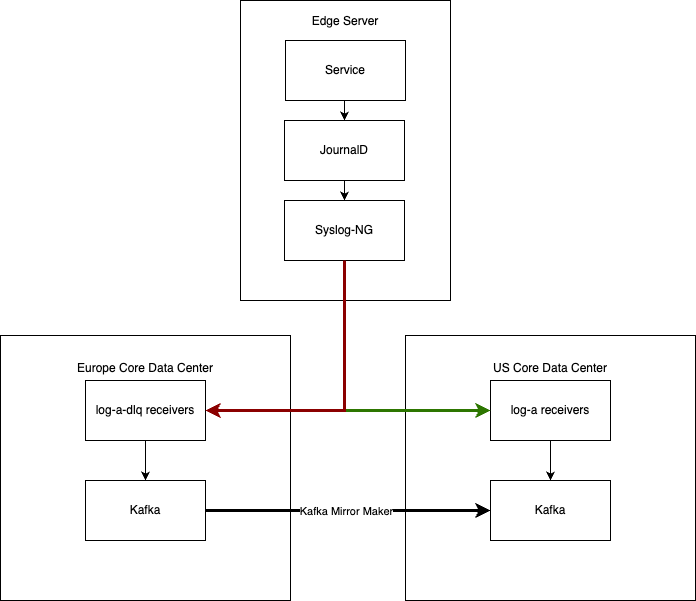
A full breakdown of our existing infrastructure can be found in our previous post An overview of Cloudflare’s logging pipeline, but to quickly summarize here:

  • We run a syslog-ng daemon on every server, reading from the local systemd-journald journal, and a set of named pipes.
  • We forward those logs to a set of centralized “log-x receivers”, in one of our core data centers.
  • We have a dead letter queue destination in another core data center, which receives messages that could not be sent to the primary receiver, and which get mirrored across to the primary receivers when possible.

The goal of this project was to replace those syslog-ng instances as transparently as possible. That means we needed to implement all these behaviors as precisely as possible, so that we didn’t need to modify any downstream systems.

There were a few reasons for wanting to make this shift, and enduring the difficulties of overhauling such a large part of our infrastructure:

  • syslog-ng is written in C, which is not a core competency of our team. While we have made upstream contributions to the project in the past, and the experience was great, having the OpenTelemetry collector in Go allows much more of our team to be able to contribute improvements to the system.
  • Building syslog-ng against our internal Post-Quantum cryptography libraries was difficult, due to having to maintain an often brittle C build chain, whereas our engineering teams have optimized the Go build model to make this as simple as possible.
  • OpenTelemetry Collectors have built in support for Prometheus metrics, which allows us to gather much deeper levels of telemetry data around what the collectors are doing, and surface these insights as “meta-observability” to our engineering teams.
  • We already use OpenTelemetry Collectors for some of our tracing infrastructure, so unifying onto one daemon rather than having separate collectors for all our different types of telemetry reduces the cognitive load on the team.

The Migration Process

What we needed to build

While the upstream contrib repository contains a wealth of useful components, all packaged into its own distribution, it became clear early on that we would need our own internal components. Having our own internal components would require us to build our own distribution, so one of the first things we did was turn to OCB (OpenTelemetry Collector Builder) to provide us a way to build an internal distribution of an OpenTelemetry Collector. We eventually ended up templating our OCB configuration file to automatically include all the internal components we have built, so that we didn’t have to add them manually.

In total, we built four internal components for our initial version of the collector.

cfjs1exporter

Internally, our logging pipeline uses a line format we call “cfjs1”. This format describes a JSON encoded log, with two fields: a format field, that decides the type of the log, and a “wrapper” field which contains the log body (which is a structured JSON object in and of itself), with a field name that changes depending on the format field. These two fields decide which Kafka topic our receivers will end up placing the log message in.

Because we didn’t want to make changes to other parts of the pipeline, we needed to support this format in our collector. To do this, we took inspiration from the contrib repository’s syslogexporter, building our cfjs1 format into it.

Ultimately, we would like to move towards using OTLP (OpenTelemetry Protocol) as our line format. This would allow us to remove our custom exporter, and utilize open standards, enabling easier migrations in the future.

fileexporter

While the upstream contrib repo does have a file exporter component, it only supports two formats: JSON and Protobuf. We needed to support two other formats, plain text and syslog, so we ended up forking the file exporter internally. Our plain text formatter simply outputs the body of the log message into a file, with newlines as a delimiter. Our syslog format outputs RFC 5424 formatted syslog messages into a file.

The other feature we implemented on our internal fork was custom permissions. The upstream file exporter is a bit of a mess, in that it actually has two different modes of operation – a standard mode, not utilizing any of the compression or rotation features, and a more advanced mode which uses those features. Crucially, if you want to use any of the rotation features, you end up using lumberjack, whereas without those features you use a more native file handling. This leads to strange issues where some features of the exporter are supported in one mode, but not the other. In the case of permissions, the community seems open to the idea in the native handling, but lumberjack seems against the idea. This dichotomy is what led us to implement it ourselves internally.

Ultimately, we would love to upstream these improvements should the community be open to them. Having support for custom marshallers (https://github.com/open-telemetry/opentelemetry-collector-contrib/issues/30331) would have made this a bit easier, however it’s not clear how that would work with OCB. Either that, or we could open source them in the Cloudflare organization, but we would love to remove the need to maintain our own fork in the future.

externaljsonprocessor

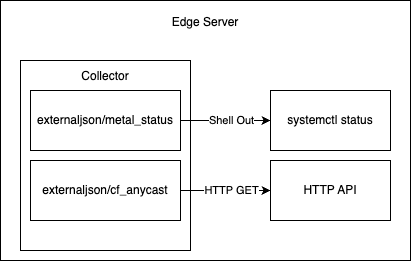
We want to set the value of an attribute/field that comes from external sources: either from an HTTP endpoint or an output from running a specific command. In syslog-ng, we have a sidecar service that generates a syslog-ng configuration to achieve this. In replacing syslog-ng with our OpenTelemetry Collector, we thought it would be easier to implement this feature as a custom component of our collector instead.

To that end, we implemented an “external JSON processor”, which is able to periodically query external data sources and add those fields to all the logs that flow through the processor. Cloudflare has many internal tools and APIs, and we use this processor to fetch data like the status of a data center, or the status of a systemd unit. This enables our engineers to have more filtering options, such as to exclude logs from data centers that are not supposed to receive customer traffic, or servers that are disabled for maintenance. Crucially, this allows us to update these values much faster than the standard three-hour cadence of other configuration updates through salt, allowing more rapid updates to these fields that may change quickly as we operate our network.

ratelimit processor

The last component we needed to implement was a replacement for the syslog-ng ratelimit filter, also contributed by us upstream. The ratelimit filter allows applying rate limits based on a specific field of a log message, dropping messages that exceed some limit (with an optional burst limit). In our case, we apply rate limits over the service field, ensuring that no individual service can degrade the log collection for any other.

While there has been some upstream discussion of similar components, we couldn’t find anything that explicitly fit our needs. This was especially true when you consider that in our case the data loss during the rate limiting process is intentional, something that might be hard to sell when trying to build something more generally applicable.

How we migrated

Once we had an OpenTelemetry Collector binary, we had to deploy it. Our deployment process took two forks: Deploying to our core data centers, and deploying to our edge data centers. For those unfamiliar, Cloudflare’s core data centers contain a small number of servers with a very diverse set of workloads, from Postgresql, to ElasticSearch, to Kubernetes, and everything in between. Our edge data centers, on the other hand, are much more homogenous. They contain a much larger number of servers, each one running the same set of services.

Both edge and core use salt to configure the services running on their servers. This meant that the first step was to write salt states that would install the OpenTelemetry collector, and write the appropriate configurations to disk. Once we had those in place, we also needed to write some temporary migration pieces that would disable syslog-ng and start the OpenTelemetry collector, as well as the inverse in the case of a roll back.

For the edge data centers, once we had a set of configurations written, it mostly came down to rolling the changes out gradually across the edge servers. Because edge servers run the same set of services, once we had gained confidence in our set of configurations, it became a matter of rolling out the changes slowly and monitoring the logging pipelines along the way. We did have a few false starts here, and needed to instrument our cfjs1exporter a bit more to work around issues surrounding some of our more niche services and general Internet badness which we’ll detail below in our lessons learned.

The core data centers required a more hands-on approach. Many of our services in core have custom syslog-ng configurations. For example, our Postgresql servers have custom handling for their audit logs, and our Kubernetes servers have custom handling for contour ingress and error logs. This meant that each role with a custom config had to be manually onboarded, with extensive testing on the designated canary nodes of each role to validate the configurations.

Lessons Learned

Failover

At Cloudflare, we regularly schedule chaos testing on our core data centers which contain our centralized log receivers. During one of these chaos tests, our cfjs1 exporter did not notice that it could not send to the primary central logging server. This caused our collector to not failover to the secondary central logging server and its log buffer to fill up, which resulted in the collector failing to consume logs from its receivers. This is not a problem with journal receivers since logs are buffered by journald before they get consumed by the collector, but it is a different case with named pipe receivers. Due to this bug, our collectors stopped consuming logs from named pipes, and services writing to these named pipes started blocking threads waiting to write to them. Our syslog-ng deployment solved this issue using a monit script to periodically kill the connections between syslog-ng and the central receivers, however we opted to solve this more explicitly in our exporter by building in much tighter timeouts, and modifying the upstream failover receiver to better respond to these partial failures.

Cutover delays

As we’ve previously blogged about, at Cloudflare, we use Nomad for running dynamic tasks in our edge data centers. We use a custom driver to run containers and this custom driver handles the shipping of logs from the container to a named pipe.

We did the migration from syslog-ng to OpenTelemetry Collectors while servers were live and running production services. During the migration, there was a gap when syslog-ng was stopped by our configuration management and our OpenTelemetry collector was started on the server. This gap caused the logs in the named pipe to not get consumed and similar to the previous named pipe, the services writing to the named pipe receiver in blocking mode got affected. Similar to NGINX and Postgresql, Cloudflare’s driver for Nomad also writes logs to the named pipe driver in blocking mode. Because of this delay, the driver timed out sending logs and rescheduled the containers.

We ultimately caught this pretty early on in testing, and changed our approach to the rollout. Instead of using Salt to separately stop syslog-ng and start the collector, we instead used salt to schedule a systemd “one shot” service that simultaneously stopped syslog-ng and started the collector, minimizing the downtime between the two.

What’s next?

Migrating such a critical part of our infrastructure is never easy, especially when it has remained largely untouched for nearly half a decade. Even with the issues we hit during our rollout, migrating to an OpenTelemetry Collector unlocks so many more improvements to our logging pipeline going forward. With the initial deployment complete, there are a number of changes we’re excited to work on next, including:
Better handling for log sampling, including tail sampling
Better insights for our engineering teams on their telemetry production
Migration to OTLP as our line protocol
Upstreaming of some of our custom components

If that sounds interesting to you, we’re hiring engineers to come work on our logging pipeline, so please reach out!

Seeing Like a Data Structure

Post Syndicated from Bruce Schneier original https://www.schneier.com/blog/archives/2024/06/seeing-like-a-data-structure.html

Technology was once simply a tool—and a small one at that—used to amplify human intent and capacity. That was the story of the industrial revolution: we could control nature and build large, complex human societies, and the more we employed and mastered technology, the better things got. We don’t live in that world anymore. Not only has technology become entangled with the structure of society, but we also can no longer see the world around us without it. The separation is gone, and the control we thought we once had has revealed itself as a mirage. We’re in a transitional period of history right now.

We tell ourselves stories about technology and society every day. Those stories shape how we use and develop new technologies as well as the new stories and uses that will come with it. They determine who’s in charge, who benefits, who’s to blame, and what it all means.

Some people are excited about the emerging technologies poised to remake society. Others are hoping for us to see this as folly and adopt simpler, less tech-centric ways of living. And many feel that they have little understanding of what is happening and even less say in the matter.

But we never had total control of technology in the first place, nor is there a pretechnological golden age to which we can return. The truth is that our data-centric way of seeing the world isn’t serving us well. We need to tease out a third option. To do so, we first need to understand how we got here.

Abstraction

When we describe something as being abstract, we mean it is removed from reality: conceptual and not material, distant and not close-up. What happens when we live in a world built entirely of the abstract? A world in which we no longer care for the messy, contingent, nebulous, raw, and ambiguous reality that has defined humanity for most of our species’ existence? We are about to find out, as we begin to see the world through the lens of data structures.

Two decades ago, in his book Seeing Like a State, anthropologist James C. Scott explored what happens when governments, or those with authority, attempt and fail to “improve the human condition.” Scott found that to understand societies and ecosystems, government functionaries and their private sector equivalents reduced messy reality to idealized, abstracted, and quantified simplifications that made the mess more “legible” to them. With this legibility came the ability to assess and then impose new social, economic, and ecological arrangements from the top down: communities of people became taxable citizens, a tangled and primeval forest became a monoculture timber operation, and a convoluted premodern town became a regimented industrial city.

This kind of abstraction was seemingly necessary to create the world around us today. It is difficult to manage a large organization, let alone an interconnected global society of eight billion people, without some sort of structure and means to abstract away details. Facility with abstraction, and abstract reasoning, has enabled all sorts of advancements in science, technology, engineering, and math—the very fields we are constantly being told are in highest demand.

The map is not the territory, and no amount of intellectualization will make it so. Creating abstract representations by necessity leaves out important detail and context. Inevitably, as Scott cataloged, the use of large-scale abstractions fails, leaving leadership bewildered at the failure and ordinary people worse off. But our desire to abstract never went away, and technology, as always, serves to amplify intent and capacity. Now, we manifest this abstraction with software. Computing supercharges the creative and practical use of abstraction. This is what life is like when we see the world the way a data structure sees the world. These are the same tricks Scott documented. What has changed is their speed and their ubiquity.

Each year, more students flock to computer science, a field with some of the highest-paying, most sought-after jobs. Nearly every university’s curriculum immediately introduces these students to data structures. A data structure enables a programmer to organize data—about anything—in a way that is easy to understand and act upon in software: to sort, search, structure, organize, or combine that data. A course in data structures is exercise after exercise in building and manipulating abstractions, ones that are typically entirely divorced from the messy, context-laden, real-world data that those data structures will be used to store.

As students graduate, most join companies that demand these technical skills—universally seen as essential to computer science work—who see themselves as “changing the world,” often with even grander ambitions than the prosaic aims of state functionaries cataloged by Scott.

Engineers are transforming data about the world around us into data structures, at massive scale. They then employ another computer science trick: indirection. This is the ability to break apart some sociotechnical process—to “disrupt”—and replace each of the now-broken pieces with abstractions that can interface with each other. These data structures and abstractions are then combined in software to take action on this view of reality, action that increasingly has a human and societal dimension.

Here’s an example. When the pandemic started and delivery orders skyrocketed, technologists saw an opportunity: ghost kitchens. No longer did the restaurant a customer was ordering from actually have to exist. All that mattered was that the online menu catered to customer desires. Once ordered, the food had to somehow get sourced, cooked, and packaged, sight unseen, and be delivered to the customer’s doorstep. Now, lots of places we order food from are subject to this abstraction and indirection, more like Amazon’s supply chain than a local diner of yore.

Facebook sees its users like a data structure when it classifies us into ever more precise interest categories, so as to better sell our attention to advertisers. Spotify sees us like a data structure when it tries to play music it thinks we will like based on the likes of people who like some of the same music we like. TikTok users often exclaim and complain that its recommendations seem to uncannily tap into latent desires and interests, leading many to perform psychological self-diagnosis using their “For You” page.

Data structures dominate our world and are a byproduct of the rational, modern era, but they are ushering in an age of chaos. We need to embrace and tame, but not extinguish, this chaos for a better world.

Machines

Historian of technology Lewis Mumford once wrote that clocks enabled the division of time, and that enabled the regimentation of society that made the industrial revolution possible. This transformation, once fully underway around the world in the 20th century, fundamentally changed the story of society. It shifted us away from a society centered around interpersonal dynamics and communal interactions to one that was systematic and institutional.

We used to take the world in and interpret it through human eyes. The world before the industrial revolution wasn’t one in which ordinary people interacted with large-scale institutions or socio-technical systems. It wasn’t possible for someone to be a “company man” before there was a corporate way of doing things that in theory depended only on rules, laws, methods, and principles, not on the vicissitudes of human behavior.

Since the beginning of the industrial revolution, workers and the natural world have been subject to abstraction. This involves the use of abstract reason over social preferences. Knowledge about the world was no longer in our heads but out in the world. So we got newspapers, instruction manuals, bylaws, and academic journals. And we should be clear: this was largely an improvement. The era of systems—of modernity—was an improvement on what came before. It’s better for society to have laws rather than rulers, better for us to lean on science than superstition. We can’t and shouldn’t go back.

The tools of reason enabled the “high modernists,” as Scott calls them, to envision a world shaped entirely by reason. But such reason was and is never free of personal biases. It always neglects the messiness of reality and the tacit and contextual knowledge and skill that is needed to cope with that mess—and this is where trouble began to arise.

Workers were and are treated as cogs in the industrial machine, filling a narrow role on an assembly line or performing a service job within narrow parameters. Nature is treated as a resource for human use, a near-infinite storehouse of materials and dumping ground for wastes. Even something as essential and grounding as farming is seen as mechanistic—”a farm is a factory in a remote area,” as put by one John Deere executive—where plants are machines that take in nitrogen, phosphorus, and potassium and produce barely edible dent corn. There’s even a popular myth that eminent business theorist W.E. Deming said: “If you can’t measure it, you can’t manage it”—lending credence to the measurement and optimization mindset.

The abstractions nearly write themselves. Though, leaving nothing to chance, entrepreneurs and their funders have flocked to translating these precomputing abstractions for the age of data structures. This is happening in both seen and unseen ways. Uber and Lyft turned people into driving robots that follow algorithmic guidance from one place to another. Amazon made warehouse workers perform precisely defined tasks in concert with literal robots. Agtech companies turn farms into data structures to then optimize the application of fertilizer, irrigation water, pesticides, and herbicides.

Beyond simply dividing time, computation has enabled the division of information. This is embodied at the lowest levels—bits and packets of data flowing through the Internet—all the way up to the highest levels, where many jobs can be described as a set of information-processing tasks performed by one worker only to be passed along to another. But this sort of computing—that’s just worn-out optimization techniques that date back to last century’s Taylorism—didn’t move us into the unstable world we’re in today. It was a different sort of computation that did that.

Computation

Today we’re in an era where computing not only abstracts our world but also defines our inner worlds: the very thoughts we have and the ways we communicate.

It is this abstracted reality that is presented to us when we open a map on our phones, search the Internet, or “engage” on social media. It is this constructed reality that shapes the decisions businesses make every day, governs financial markets, influences geopolitical strategy, and increasingly controls more of how global society functions. It is this synthesized reality we consume when the answers we seek about the world are the entire writings of humanity put into a blender and strained out by a large language model.

The first wave of this crested a decade ago only to crash down on us. Back then, search engines represented de facto reality, and “just Google it” became a saying: whatever the search engine said was right. But in some sense that was a holdover from the previous “modern” era but with a large data structure—the search engine’s vast database—replacing some classic source of truth such as the news media or the government. We all had a hope that with enough data, and algorithms to sift through it all, we could have a simple technological abstraction over the messiness of reality with a coherent answer no matter what the question was.

As we move toward the future promised by some technologists, our human-based view of the world and that of the data structures embedded in our computing devices will converge. Why bother to make a product at all when you can just algorithmically generate thousands of “ghost products,” in the hopes that someone will buy.

Scott’s critiques of datafication remain. We are becoming increasingly aware that things are continuous spectra, not discrete categories. Writing about the failure of contact tracing apps, activist Cory Doctorow said, “We can’t add, subtract, multiply or divide qualitative elements, so we just incinerate them, sweep up the dubious quantitative residue that remains, do math on that, and simply assert that nothing important was lost in the process.”

A pair of augmented-reality glasses may no longer let us see the world unfiltered by data structures but instead dissect and categorize every experience. A person on the street is no longer an individual but a member of a subcategory of “person” as determined by an AI classifier. A street is no longer the place you grew up but an abstraction from a map. And a local cafe is no longer a community hangout but a data structure containing a menu, a list of reservation options, and a hundred 5-star ratings.

Whether as glasses we look through or simply as screens on our devices, reality will be augmented by the data structures that categorize the world around us. Just as search engines caused the rise of SEO, where writers tweak their writing to attract search engines rather than human readers, this augmented reality will result in its own optimizations. We may be seeing the first signs of this with “Thai Food Near Me” as the literal name of businesses that are trying to satisfy the search function of mapping apps. Soon, even the physical form of things in the world may be determined in a coevolution with technology, where the form of things in the real world, even a dish at a restaurant, is chosen by what will look best when seen through our technological filters. It’s a data layer on top of reality. And the problems get worse when the relative importance of the data and reality flip. Is it more important to make a restaurant’s food taste better, or just more Instagrammable?

People are already working to exploit the data structures and algorithms that govern our world. Amazon drivers hang smartphones in trees to trick the system. Songwriters put their catchy choruses near the beginning to exploit Spotify’s algorithms. And podcasters deliberately mispronounce words because people comment with corrections and those comments count as “engagement” to the algorithms.

These hacks are fundamentally about the breakdown of “the system.” (We’re not suggesting that there’s a single system that governs society but rather a mess of systems that interact and overlap in our lives and are more or less relevant in particular contexts.) Systems work according to rules, either ones made consciously by people or, increasingly, automatically determined by data structures and algorithms. But systems of rules are, by their nature, trying to create a map for a messy territory, and rules will always have loopholes that can be taken advantage of.

The challenge with previous generations of tech—and the engineers who built them—is that they got stuck in the rigidity of systems. That’s what the company man was all about: the processes of the company, of Taylorism, of the McKinsey Way, of Scrum software development, of effective altruism, and of so many more. These all promised certainty, control, optimality, correctness, and sometimes even virtue: all just manifestations of a rigid and “rational” way of thinking and solving problems. Making systems work in this way at a societal level has failed. This is what Scott was saying in his seminal book. It was always doomed to fail.

Fissures

Seeing like a state was all about “legibility.” But the world is too difficult to make legible today. That’s where data structures, algorithms, and AI come in: humans no longer need to manually create legibility. Nor do humans even need to consume what is made legible. Raw data about the world can be fed into new AI tools to create a semblance of legibility. We can then have yet more automated tools act upon this supposed representation of the world, soon with real-life consequences. We’re now delegating the process of creating legibility to technology. Along the way, we’ve made it approximate: legible to someone or something else but not to the person who actually is in charge.

Right now, we’re living through the last attempts at making those systems work, with a perhaps naive hope and a newfound belief in AI and the data science that fuels it. The hope is that, because we have better algorithms that can help us make sense of even more data, we can somehow succeed at making systems work where past societies have failed. But it’s not going to work because it’s the mode of thought that doesn’t work.

The power to see like a state was intoxicating for government planners, corporate efficiency experts, and adherents to high modernism in general. But modern technology lets us all see like a state. And with the advent of AI, we all have the power to act on that seeing.

AI is made up of data structures that enable a mapping from the messy multidimensional reality that we inhabit to categories and patterns that are useful in some way. Spotify may organize songs into clever new musical genres invented by its AI, but it’s still an effort to create legibility out of thin air. We’re sending verbose emails with AI tools that will just be summarized by another AI. These are all just concepts, whether they’re created by a human mind or by a data structure or AI tool. And while concepts help us understand reality, they aren’t reality itself.

The problem we face is at once simple to explain and fiendishly difficult to do something about. It’s the interplay of nebulosity and pattern, as scholar David Chapman puts it: reality is nebulous (messy), but to get on with our lives, we see patterns (make sense of it in context-dependent ways). Generally, we as people don’t have strict rules for how to make breakfast, and we don’t need the task explained to us when a friend asks us for a cup of coffee. But that’s not the case for a computer, or a robot, or even a corporate food service, which can’t navigate the intricacies and uncertainties of the real world with the flexibility we expect of a person. And at an even larger scale, our societal systems, whether we’re talking about laws and governments or just the ways our employers expect us to get our jobs done, don’t have that flexibility built into them. We’ve seen repeatedly how breaking corporate or government operations into thousands of disparate, rigid contracts ends in failure.

Decades ago, the cracks in these rational systems were only visible to a few, left for debate in the halls of universities, board rooms, and militaries. Now, nebulosity, complexity, and the breakdown of these systems is all around for everyone to see. When teenagers are training themselves to see the world the way social-media ranking algorithms do, and can notice a change in real time, that’s how we know that the cracks are pervasive.

The complexity of society today, and the failure of rigid systems to cope, is scary to many. Nobody’s in charge of, or could possibly even understand, all these complex technological systems that now run our global society. As scholar Brian Klaas puts it, “the cognitive shortcuts we use to survive are mismatched with the complex reality we now navigate.” For some, this threat demands dramatic action, such as replacing some big system we have—say, capitalism—with an alternative means of organizing society. For others, it demands throwing out all of modernity to go back to a mythical, simpler golden age: one with more human-scale systems of order and authority, which they imagine was somehow better. And yet others see the cracks in the system but hope that with more data and more tweaks, it can be repaired and our problems will be definitively solved.

However, it’s not this particular system that failed but rather the mode of society that depends on rigid systems to function. Replacing one rigid system with another won’t work. There’s certainly no golden age to return to. And simpler forms of society aren’t options for us at the scale of humanity today. So where does that leave us?

Tension

The ability to see like a data structure afforded us the technology we have today. But it was built for and within a set of societal systems—and stories—that can’t cope with nebulosity. Worse still is the transitional era we’ve entered, in which overwhelming complexity leads more and more people to believe in nothing. That way lies madness. Seeing is a choice, and we need to reclaim that choice. However, we need to see things and do things differently, and build sociotechnical systems that embody this difference.

This is best seen through a small example. In our jobs, many of us deal with interpersonal dynamics that sometimes overwhelm the rules. The rules are still there—those that the company operates by and laws that it follows—meaning there are limits to how those interpersonal dynamics can play out. But those rules are rigid and bureaucratic, and most of the time they are irrelevant to what you’re dealing with. People learn to work with and around the rules rather than follow them to the letter. Some of these might be deliberate hacks, ones that are known, and passed down, by an organization’s workers. A work-to-rule strike, or quiet quitting for that matter, is effective at slowing a company to a halt because work is never as routine as schedules, processes, leadership principles, or any other codified rules might allow management to believe.

The tension we face is that on an everyday basis, we want things to be simple and certain. But that means ignoring the messiness of reality. And when we delegate that simplicity and certainty to systems—either to institutions or increasingly to software—they feel impersonal and oppressive. People used to say that they felt like large institutions were treating them like a number. For decades, we have literally been numbers in government and corporate data structures.

Breakdown

As historian Jill Lepore wrote, we used to be in a world of mystery. Then we began to understand those mysteries and use science to turn them into facts. And then we quantified and operationalized those facts through numbers. We’re currently in a world of data—overwhelming, human-incomprehensible amounts of data—that we use to make predictions even though that data isn’t enough to fully grapple with the complexity of reality.

How do we move past this era of breakdown? It’s not by eschewing technology. We need our complex socio-technical systems. We need mental models to make sense of the complexities of our world. But we also need to understand and accept their inherent imperfections. We need to make sure we’re avoiding static and biased patterns—of the sort that a state functionary or a rigid algorithm might produce—while leaving room for the messiness inherent in human interactions. Chapman calls this balance “fluidity,” where society (and really, the tech we use every day) gives us the disparate things we need to be happy while also enabling the complex global society we have today.

These things can be at odds. As social animals, we need the feeling of belonging, like being part of a small tribe. However, at the same time, we have to “belong” in a technological, scientific, and institutional world of eight billion interconnected people. To feel connected to those around us, we need access to cultural creativity, whether it be art, music, literature, or forms of entertainment and engagement that have yet to be invented. But we also need to avoid being fragmented into nanogenres where we can’t share that creativity and cultural appreciation with others. We must be able to be who we are and choose who we associate with on an ever-changing basis while being able to play our parts to make society function and feel a sense of responsibility and accomplishment in doing so. And perhaps most importantly, we need the ability to make sense of the torrent of information that we encounter every day while accepting that it will never be fully coherent, nor does it need to be.

This isn’t meant to be idealistic or something for the distant future. It’s something we need now. How well civilization functions in the coming years depends upon making this a reality. On our present course, we face the nihilism that comes with information overload, careening from a world that a decade ago felt more or less orderly to one in which nothing has any clear meaning or trustworthiness. It’s in an environment like this that polarization, conspiracies, and misinformation thrive. This leads to a loss of societal trust. Our institutions and economic systems are based upon trust. We’ve seen what societies look like when trust disappears: ordinary social systems fail, and when they do work, they are more expensive, capricious, violent, and unfair.

The challenge for us is to think how we can create new ways of being and thinking that move us—and not just a few of us but everyone—to be able to at first cope, and then later thrive, in this world we’re in.

Fluidity

There’s no single solution. It’ll be a million little things, but they all will share the overall themes of resilience in the form of fluidity. Technology’s role in this is vital, helping us make tentative, contextual, partial sense of the complex world around us. When we take a snapshot of a bird—or listen to its song—with an app that identifies the species, it is helping us gain some limited understanding. When we use our phones to find a park, local restaurant, or even a gas station in an unfamiliar city, it is helping us make our way in a new environment. On vacation in France, one of us used our phone’s real-time translation feature to understand what our tour guide was saying. Think of how we use weather apps, fitness apps, or self-guided museum tour apps to improve our lives. We need more tools like this in every context to help us to understand nuance and context beyond the level we have time for in our busy lives.

It’s not enough to have software, AI or otherwise, interpret the world for us. What we need is the ability to seamlessly navigate all the different contexts in our life. Take, for instance, the problem of understanding whether something seen online is true. This was already tricky and is now fiendishly difficult what with the Internet, social media, and now generative AI all laden with plausible untruths. But what does “true” mean, anyway? It’s equally wrong to believe in a universal, singular, objective truth in all situations as to not know what to believe and hold everything to be equally false (or true). Both of these options give propagandists a leg up.

Instead, we need fluidity: in Chapman’s terms, to be able to always ask, “In what sense?” Let’s say you see a video online of something that doesn’t seem physically possible and ask, “Is this real?” A useful technology would help you ask, “In what sense?” Maybe it’s something done physically, with no trickery involved, and it’s just surprising. Maybe it’s a magic trick, or real as in created for a TV show promotion, but not actually something that happened in the physical world. Maybe it was created by a movie special effects team. Maybe it’s propaganda created by a nation state. Sorting through contexts like this can be tedious, and while we intuitively do it all the time, in a technologically complex world we could use some help. It’s important to enable people to continue to communicate and interact in ways that make us feel comfortable, not completely driven either by past social custom or by algorithms that optimize for engagement. Think WhatsApp groups where people just talk, not Facebook groups that are mediated and controlled by Meta.

Belonging is important, and its lack creates uncertainty and a lack of trust. There are lessons we can learn from nontechnological examples. For example, Switzerland has a remarkable number of “associations”—for everything from business groups to bird watching clubs—and a huge number of Swiss residents take part. This sort of thing was once part of American culture but declined dramatically over the 20th century as documented in Putnam’s classic book Bowling Alone. Technology can enable dynamic new ways for people to associate as the online and offline worlds fuse—think of the Internet’s ability to help people find each other—though it must avoid the old mindset of optimization at all costs.

We all struggle with life in our postmodern society, that unplanned experiment of speed, scale, scope, and complexity never before seen in human history. Technology can help by bridging what our minds expect with how systems work. What if every large institution, whether a government or corporation, were to enable us to interact with it not on its terms, in their bureaucratic language and with all the complexity that large systems entail, but with computational tools that use natural language, understand context and nuance, and yet can still interface with the data structures that make its large systems tick. There are some promising early prototypes, such as tools that simplify the process of filling out tedious paperwork. That might feel small, almost trivial. But refined, and in aggregate, this could represent a sea change in how we interact with large systems. They will come to feel no longer as impersonal and imposing bureaucracies but as enablers of functioning and flourishing societies.

And it’s not all about large scale either. Scale isn’t always desirable; as Bill McKibben wrote in Eaarth, we’d probably be better off with the Fortune 500,000 than the Fortune 500. Scale brings with it the ills of Seeing Like a State; the authoritarian high modernist mindset takes over at large scale. And while large organizations can exist, they can’t be the only ones with access to, or ability to, afford new technologies. Enabling the dynamic creation and destruction of new organizations and new types of organization—and legal and technical mechanisms to prevent lock-in and to prevent enclosure of public commons—will be essential to keep this new fluid era thriving. We can create new “federated” networks of organizations and social groups, like we’re seeing in the open social web of Mastodon and similar technologies, ones where local groups can have local rules that differ from, but do not conflict with, their participation in the wider whole.

This shift is not just about how society will work but also how we see ourselves. We’re all getting a bit more used to the idea of having multiple identities, and some of us have gotten used to having a “portfolio career” that is not defined by a single hat that we wear. While today there is often economic precarity involved with this way of living, there need not be, and the more we can all do the things that are the best expressions of ourselves, the better off society will be.

Ahead

As Mumford wrote in his classic history of technology, “The essential distinction between a machine and a tool lies in the degree of independence in the operation from the skill and motive power of the operator.” A tool is controlled by a human user, whereas a machine does what its designer wanted. As technologists, we can build tools, rather than machines, that flexibly allow people to make partial, contextual sense of the online and physical world around them. As citizens, we can create meaningful organizations that span our communities but without the permanence (and thus overhead) of old-school organizations.

Seeing like a data structure has been both a blessing and a curse. Increasingly, it feels like it is an avalanche, an out-of-control force that will reshape everything in its path. But it’s also a choice, and there is a different path we can take. The job of enabling a new society, one that accepts the complexity and messiness of our current world without being overwhelmed by it, is one all of us can take part it. There is a different future we can build, together.

This essay was written with Barath Raghavan, and originally appeared on the Harvard Kennedy School Belfer Center‘s website.

AI Will Increase the Quantity—and Quality—of Phishing Scams

Post Syndicated from Bruce Schneier original https://www.schneier.com/blog/archives/2024/06/ai-will-increase-the-quantity-and-quality-of-phishing-scams.html

A piece I coauthored with Fredrik Heiding and Arun Vishwanath in the Harvard Business Review:

Summary. Gen AI tools are rapidly making these emails more advanced, harder to spot, and significantly more dangerous. Recent research showed that 60% of participants fell victim to artificial intelligence (AI)-automated phishing, which is comparable to the success rates of non-AI-phishing messages created by human experts. Companies need to: 1) understand the asymmetrical capabilities of AI-enhanced phishing, 2) determine the company or division’s phishing threat severity level, and 3) confirm their current phishing awareness routines.

Here’s the full text.

Десет милиона долара за оръжейни доставки са платени държавата на лица близки до Вучич и Сретан, но срещу тях не е получено нищо Сребреница, Сретaн Йосич и изчезналите милиони от ВМЗ-Сопот

Post Syndicated from Екип на Биволъ original https://bivol.bg/srebrenica-joca-borisov-vmz.html

понеделник 3 юни 2024


Скандалът “Сребреница” се развихри след като служебния премиер и външен министър Димитър Главчев промени позицията на България при гласуването в ООН на резолюцията за геноцида в Сребреница. Опитите впоследствие да…

AMD Instinct MI350 288GB GPU Offering 35x AI Inference Performance Next Year

Post Syndicated from Patrick Kennedy original https://www.servethehome.com/amd-instinct-mi350-288gb-gpu-offering-35x-ai-inference-performance-next-year/

AMD Instinct MI325X with 288GB of HBM3E memory is for 2024, while the MI350X with CDNA 4 offers 35x AI Inference performance in 2025

The post AMD Instinct MI350 288GB GPU Offering 35x AI Inference Performance Next Year appeared first on ServeTheHome.

AMD Computex 2024 Keynote AMD Ryzen 9000 and AMD Ryzen AI 3 Zen 5

Post Syndicated from John Lee original https://www.servethehome.com/amd-computex-2024-keynote-amd-ryzen-9000-and-amd-ryzen-ai-3-zen-5/

At the AMD Computex 2024 Keynote, the company announced the Zen 5 microarchitecture, Ryzen 9000 series, and Ryzen AI 3 series for the desktop

The post AMD Computex 2024 Keynote AMD Ryzen 9000 and AMD Ryzen AI 3 Zen 5 appeared first on ServeTheHome.

Fedora Linux 40 election results

Post Syndicated from jzb original https://lwn.net/Articles/976447/

The Fedora Project has announced
the results of the Fedora Linux 40 election cycle. Four seats were
open on the Fedora
Engineering Steering Committee
(FESCo), and the winners are Stephen
Gallagher, Neal Gompa, Michel Lind, and Fabio Valentini. The Fedora
Council
had two seats open, and the winners
are
Aleksandra Fedorova and Adam Samalik. One seat was open on the
Fedora Mindshare
Committee
, and the winner
is
Sumantro Mukherjee. Four seats were open for the first election to select
members of the EPEL
Steering Committee
, which went to Troy
Dawson, Kevin Fenzi, Carl George, and Jonathan Wright.